On Dec. 20, 2024, Marcellous Demps, a former patient-care provider at Michigan Medicine, was working the night shift when he slipped and fell in a dimly lit, wet hallway while carrying a 150-pound portable scale. He seriously injured his leg in the process, reporting severe pain and an inability to walk.
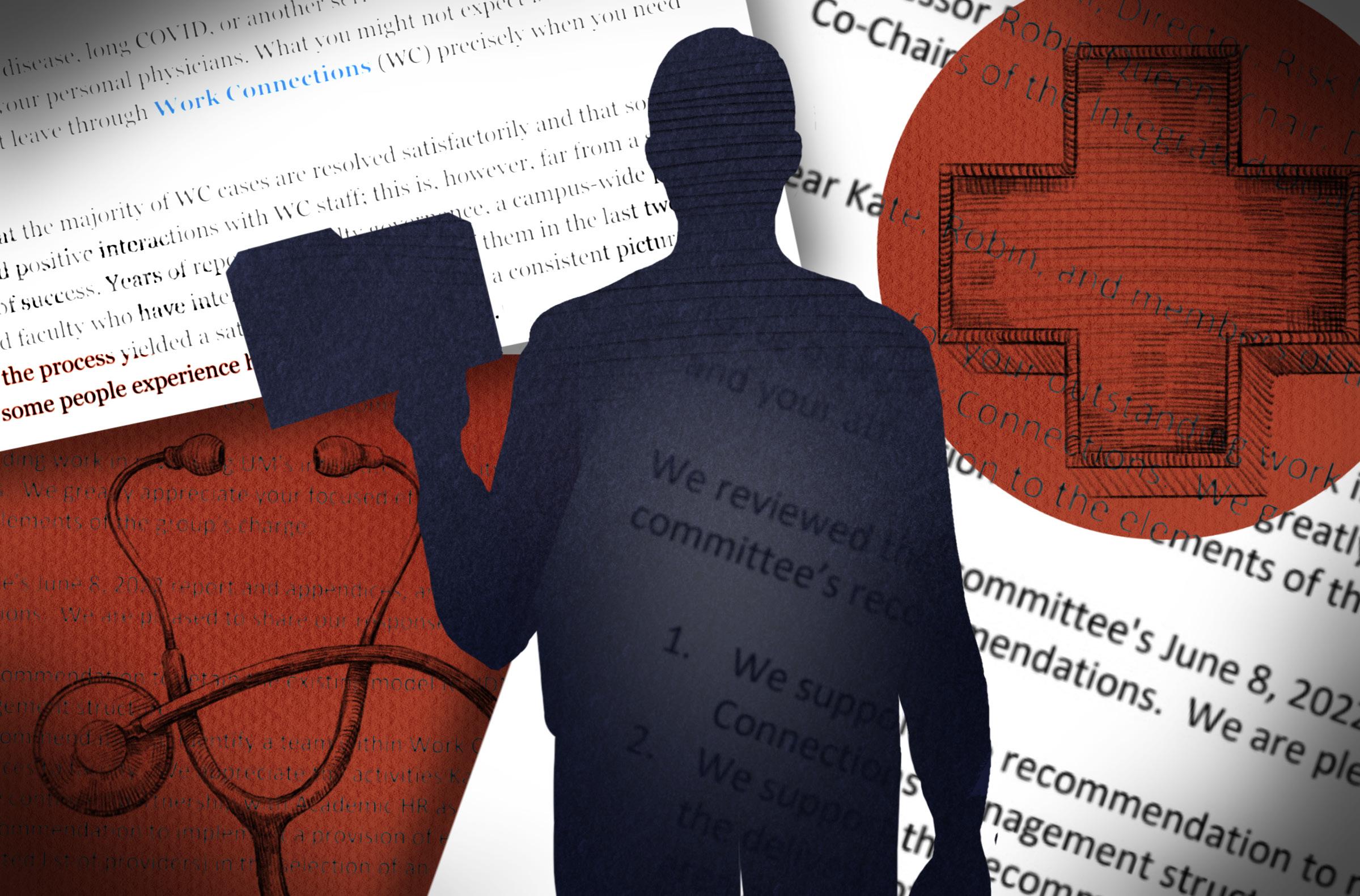
Following a 40-day paid leave, Demps was still in pain. Work Connections — the University of Michigan’s illness, injury and disability management program that granted his leave — asked for additional paperwork to extend it. But, before he could receive a full medical evaluation and provide the paperwork, he was put on unpaid, unsupported leave, according to documents obtained by The Michigan Daily.
An MRI on March 14, 2025, diagnosed the scope of his injury: a fluid-filled swelling behind his knee and an MCL sprain. In an interview with The Daily, Demps said he was required to return to work April 1, a mere 18 days after the MRI.
“My duties required me to lift, let’s say, a patient of 300 pounds,” Demps said. I weigh 200 (pounds), and I have to lift you out of your bed with an MCL sprain — that doesn’t make any sense.”
Demps said that by being placed on an unpaid leave of absence, he was effectively barred from unemployment benefits like Workers’ Compensation, which he claims would have helped pay for his continued medical treatment.
“(The University) purposely put me in a position so that in the state’s eyes, I’m employed, but I’m not getting Workers’ Comp,” Demps said. “At all angles, they made sure that I wasn’t getting money for being injured.”
Unable to either provide further medical documentation
IT FAILED THEM
or return to work, Demps was fired May 16, 2024. Within six months, he said his bank account was closed, his car was repossessed and he lost his home.
A Daily investigation found that Demps is one of hundreds of University employees who allege a years-long pattern of misconduct and abuse by Work Connections, according to surveys conducted by U-M faculty, employees and advocates at the Service Employees International Union. Respondents gave two chief complaints: They said their physician’s medical recommendations were disregarded and that they had generally hostile and bad experiences with Work Connections employees.
Documents obtained by The Daily also show that despite a 2021 Faculty Senate request for a reconstruction of Work Connections and several internal, administrative investigations into the program, the University has not taken any steps to implement substantial change.
The lack of action has drawn public attention and criticism from employees and faculty. An April 2025 University Record Op-Ed written by Emmanuelle Marquis, professor of materials science and engineering, and Bruno Giordani, professor of psychiatry and neurology, alleges that Work Connections is failing its users.
“In 2021, the Faculty Senate approved a motion calling for an overhaul of WC,” the article reads. “Yet, U-M still has not made any substantive change. How many times must we point out the problems? How
many lives must be impacted?
How many brilliant colleagues must we lose before change is enacted?”
Work Connections did not respond to repeated requests for comment, but University spokesperson Kay Jarvis wrote in an email to The Daily that they adhere to all relevant state and federal requirements when administering leave and absence management processes.
“It’s very relevant … that the University has placed it under Risk Management, because that’s how they’re looking at Work Connections,” Modrak said. “It’s about employees not costing money to the University rather than, ‘Are people getting their accurate benefits?’”
In an August 2015 interview with the University Record, Dr. Robert Winfield, former chief health officer and chair of the coordinating body for University assistance programs, said the University was committed to creating a work environment where employees feel recognized and supported in their roles.
While these examiners are technically licensed, faculty and employees have raised concerns that they are not qualified to assess users’ specific medical conditions, given that they are not the employees’ treating physicians and may be unfamiliar with the details of their individual cases.
Surveys conducted during and after the COVID-19 pandemic show that complaints about Work Connections came to a head in 2021 amid the return to in-person instruction.
Connections was making the return to in-person instruction more difficult for staffers at the University. Weineck says Work Connections minimized concerns about coronavirus transmission risks, overrode medical experts’ opinions and denied accommodations for medically vulnerable employees.
“Other colleagues described them to us as frequently rude and disrespectful, as interfering in their medical care, as being entirely unfamiliar with the nature and rhythms of academic work,” Weineck wrote. “They imply, though they never state outright, that you are malingering, that you are a slacker.”
“Work Connections collaborates with U-M units on a voluntary basis, primarily for personal medical leaves lasting more than 10 business days,” Jarvis wrote. “Many units routinely provide guidance for shorter absences and other types of leave.”
Established in 1998 and operating today under the University’s Financial Risk Management division, Work Connections was intended to guide employees through illness and injury — a mission current and former U-M faculty and staff say it has since failed to uphold. By placing the program under the Financial Risk Management division, a department concerned with reducing institutional liability, Rebekah Modrak, Stamps School of Art & Design professor and former chair of the Senate Advisory Committee on University Affairs, says that the University has created an inherent conflict of interest.
“Our comprehensive injury and illness services are intended to help them manage the benefits and treatment they need so they can fully recover and return to the workplace when they are able,” Winfield said.
Work Connections, which handles more than 6,500 cases a year, offers a wide array of services for employees at the University.
Namely, they work closely with Human Resources and individual departments to ensure employees’ return to work is handled properly.
After an employee submits a request for medical leave or workplace accommodations, their request may be reviewed by the Work Connections case managers. These managers often refer information to nurse practitioners for additional review, though the identities and qualifications of these reviewers are often unclear to employees.
A smaller number of cases are sent to independent medical examiners, or doctors contracted through third-party companies, which the University pays to organize evaluations.
Since then, what began as a handful of employee grievances has become an institutional controversy. Modrak said her knowledge of potential malpractice within Work Connections stemmed from hearing stories from colleagues, but turned into something bigger.
As a result of hearing their peers’ repeated frustration with the program, Modrak and Silke-Maria Weineck, professor of German and comparative literature, along with other faculty, surveyed their colleagues in 2021 through a listserv about their experiences with the program.
“During the pandemic, after we started to hear all these stories, we had put out a questionnaire saying, ‘Have you had any issues with Work Connections?’ And we were flooded with responses,” Modrak said. “(Respondents said) yes, ‘I applied and I was denied.’… ‘I applied, and they disregarded my doctor’s recommendations’.”
Weineck also wrote about employees’ concerns in a Chronicle of Higher Education article, alleging that Work
In an interview with The Daily, Jessyca Hannah, a financial specialist at the School of Information, said she had a medically necessary hysterectomy scheduled in 2022. Hannah says that to make the process of getting her time off approved as seamless as possible, she submitted forms to Work Connections regarding her doctor’s recommendation for leave months in advance, but there was immediate pushback. Hannah said her physician is a board-certified OB-GYN and faculty member in the U-M Department of Obstetrics and Gynecology. The physician requested she take six weeks off, per the medical standard. Work Connections allotted her two. After the two weeks, Hannah told The Daily she was expected to return to the office following a tiered structure, where she would be in the office on some days and work from home on others.
CONTINUED AT MICHIGANDAILY.COM
Abigail Schad/DAILY Design by Graceann Eskin
Additional UMich researchers arrested on federal smuggling charges
The researchers face charges for illegal transportation of biological material into the United States
Three additional University of Michigan researchers are facing federal charges after a complaint was filed Tuesday for the illegal transportation of biological material into the United States. The charges are related to an investigation of biological materials intended to be shipped into Michigan.
Stanford Lipsey Student Publications Building 420 Maynard St. Ann Arbor, MI 48109-1327 734-418-4115
www.michigandaily.com
ZHANE YAMIN and MARY COREY Co-Editors in Chief eic@michigandaily.com
ELLA THOMPSON Business Manager business@michigandaily.com
NEWS TIPS tipline@michigandaily.com
LETTERS TO THE EDITOR tothedaily@michigandaily.com
The arrests come after a series of smuggling-related arrests of U-M researchers this summer. One of the arrests included researcher Chengxuan Han, who was sentenced in September to time served — a total of three months — and returned to China.
Bai and Fengfan Zhang were both charged with conspiracy to smuggle goods into the U.S. after reportedly receiving several packages related to the roundworm research from Han.
Zhiyong Zhang has been charged with providing false statements
The researchers attempted to fly out of the John F. Kennedy International Airport to Beijing Oct. 16, but were arrested by federal agents and taken into U.S. Immigration and Customs Enforcement custody. All three researchers, Xu Bai, Fengfan Zhang and Zhiyong Zhang, worked in the X.Z. Shawn Xu Lab, which focuses on the biological research of nematodes — commonly known as roundworms.
to federal agents, having told federal authorities he had never received a package from Han and did not know her, despite having listed Han as a point of contact on his visa application.
The University conducted an internal investigation into the laboratory after Han’s arrest and terminated Bai, Fengfan Zhang and Zhiyong Zhang’s Student and Exchange Visitor Program records Oct. 8. All of the researchers refused to participate in the investigation.
The researchers were in the U.S. on J-1 visas through the University, but have been designated to be eligible for removal by the U.S. Department of Homeland Security for their criminal charges.
In a press release, acting ICE Director Todd Lyons said he believes the charges indicate larger security risks within foreign exchange programs at higher education institutions.
“This case underscores the vital importance of safeguarding the American people and addressing vulnerabilities within foreign student and exchange visitor programs,” Lyons said. “Educational institutions must enhance their admissions procedures to prevent exploitation, which can pose risks to national security, as demonstrated in this instance. I commend the ICE HSI agents and officers who work tirelessly to protect our nation and uphold the rule of law every day.”
UMMA exhibition ‘Both Sides of the Line’ celebrates pioneers of geometric abstract art The event highlighted the friendship and work of artists Carmen Herrera and Leon Polk Smith
identity as a gay man, with his work being disregarded in favor of heterosexual male artists.
bigotry the artists faced in their industry.
“Both Sides of the Line,” a new University of Michigan Museum of Art exhibit, celebrates the friendship and work of Carmen Herrera and Leon Polk Smith, both considered to be trailblazers of geometric abstract art. The exhibition, open at the UMMA until Jan. 4, includes more than 45 pieces which showcase the life’s work of the two artists.
Born in Cuba in 1915, Herrera did not sell a single piece until she was 89. Her work went unrecognized because the artistic institutions of her time favored men. Smith faced similar challenges due to his
“Both Sides of the Line,” meant to highlight the innovative styles of both artists, is the first exhibit to compare their art side by side.
The two artists first met in 1964 while living a block away from each other in New York City. Their similar artistic visions fostered a dynamic friendship and their distinctive styles are easily recognized throughout the exhibit. Smith died in 1996 at the age of 90, and Herrera in 2022 at the age of 106.
In an interview with The Michigan Daily, exhibit curator Dana Miller said the universal themes in Herrera and Smith’s art were reactions to the
“I think in their own lives they experienced a lot of disappointment and discrimination,” Miller said.
“And I think that they both felt that they wanted their work to transcend any sort of notions of grievance or identity, that their work was meant to be a little more universal.”
Miller said she hopes visitors to the exhibit will have a newfound appreciation for the artists and learn about the complexities of abstract art.
“My hope is that I can convince them that (the artists’ works are) not so simple, that there’s actually a lot more going on,” Miller said. “If you spend
more than 60 seconds looking at something, thinking, it might kind of open you up to being a little more appreciative of the process and the thinking that went behind the work itself.”
One of Smith’s works, titled “Six Involvements in One,” is a large three-dimensional installation of six wooden panels latched together in an accordion manner. On the front of the piece, each panel is painted with an individual design. The back side of the panels features a single mural, depicting an abstract red shape on a white background. The installation is backdropped by a mirror so that both sides of the work are viewable at once.
CONTINUED AT MICHIGANDAILY.COM
New Barton-Bandemer Pedestrian Tunnel opens
“The
vision for this tunnel came from the community, came from a longstanding effort of people coming together with
a vision for how their home can be better.”
FIONA LACROIX Digital Managing Editor flacroix@umich.edu
JONATHAN WUCHTER and ZACH EDWARDS Managing Sports Editors sports@michigandaily.com
Senior Sports Editors: Annabelle Ye, Alina Levine, Niyatee Jain, Jordan Klein, Graham Barker, Sam Gibson
CAMILLE NAGY and OLIVIA TARLING Managing Arts Editors arts@michigandaily.com
Senior Arts Editors: Nickolas Holcomb, Ben Luu, Sarah Patterson, Campbell Johns, Cora Rolfes, Morgan Sieradski
LEYLA DUMKE and ABIGAIL SCHAD Managing Design Editors design@michigandaily.com
Layout Editors: Junho Lee, Maisie Derlega, Annabelle Ye Senior Illustrators: Lara Ringey, Caroline Xi, Matthew Prock, Selena Zou
ALENA MIKLOSOVIC and BRENDAN DOWNEY Managing Copy Editors copydesk@michigandaily.com
Senior Copy Editors: Josue Mata, Tomilade Akinyelu, Tim Kulawiak, Jane Kim, Ellie Crespo, Lily Cutler, Cristina Frangulian, Elizabeth Harrington, Alina Murata
Managers: Sanvika Inturi, Ruhee Jain
Software Engineer: Kristen Su
AHTZIRI PASILLAS-RIQUELME and MAXIMILIAN THOMPSON Managing Video Editors video@michigandaily.com
Senior Video Editors: Kimberly Dennis, Andrew Herman, Michael Park
Arbor Corridor of Washtenaw County’s Border-to-Border Trail, the new tunnel crosses under a railroad to connect the segments passing through Bandemer Park and Barton Nature Area. Meghan Bonfiglio, director of the Washtenaw County Parks & Recreation Commission, began the ceremony by expressing gratitude to all the community members and officials involved in the tunnel’s development. Bonfiglio told the crowd the tunnel was a joint effort between Washtenaw County officials, the Huron-Waterloo Pathways Initiative, the Ralph C. Wilson, Jr. Foundation and contractors at Davis Construction, Inc.
with this sort of scope and scale, doesn’t just happen overnight.”
Bonfiglio said the Amtrak train service, which operates the Wolverine Line that travels on the railroad tracks above the tunnel, played a large role in making its construction possible. Due to tunnel construction, the railroad experienced an outage from June 3 to June 4, 2025.
“This has been a really incredible project,” Bonfiglio said. “A project like this, it’s a long time in the making. It takes a lot of collaboration. Something like this,
“As you can imagine, cutting open a railroad and having 48 hours to make a project happen takes incredible coordination and collaboration,” Bonfiglio said. “It has been no small feat to close a railroad like this.”
Today, the B2B Trail consists of approximately 42 miles of constructed trail across Washtenaw County. The goal is to connect the trail’s furthest points from the Lyndon Township Trailhead in Chelsea to North Hydro Park in Ypsilanti. Dan Ezekiel, secretary of the Washtenaw County Parks & Recreation Commission, said the B2B Trail’s largest remaining gap is between the cities of Ann Arbor and Dexter and the new tunnel is vital to completing that connection. CONTINUED AT MICHIGANDAILY.COM
Senior Podcast Editor: Quinn Murphy, Matt Popp, Sasha Kalvert
MiC Editors: Isabelle Fernandes, Aya Sharabi, Maya Kogulan, Nghi Nguyen
AVA CHATLOSH and MEGAN GYDESEN Managing Podcast Editors podeditors@michigandaily.com
MILES ANDERSON and DANIEL BERNSTEIN Managing Audience Engagement Editors socialmedia@michigandaily.com
Senior Audience Engagement Editors: Dayoung Kim, Lauren Kupelian, Kaelyn Sourya, Daniel Lee, Quinn Murphy, Madison Hammond, Sophia Barczak, Lucy Miller, Isbely Par SARA WONG and AYA SHARABI Michigan in Color Managing Editors michiganincolor@michigandaily.com
SAYSHA MAHADEVAN and EMMA SULAIMAN Culture, Training, and Inclusion Co-Chairs accessandinclusion@michigandaily.com
ANNA MCLEAN and DANIEL JOHNSON Managing Focal Point Editors lehrbaum@umich.edu, reval@umich.edu
Focal Point Editors: Elizabeth Foley and Sasha Kalvert DARRIN ZHOU and EMILY CHEN Managing Online Editors webteam@michigandaily.com Data Editors: Daniel Johnson, Priya Shah Engineering Manager: Tianxin “Jessica” Li, Julia Mei
TALIA BLACK and HAILEY MCCONNAUGHY Managing Games Editors crosswords@umich.edu
Games Editors: James Knake, Alisha Gandhi, Milan Thurman, Alex Warren
Business Staff
OLIVIA VALERY Marketing Manager
DRU HANEY Sales Manager
GABRIEL PAREDES Creative Director JOHN ROGAN Strategy Manager
CAMPUS LIFE
SARAH PALUSHI Daily Staff Reporter
Daily Staff Reporter
Zayd Ahmad/DAILY
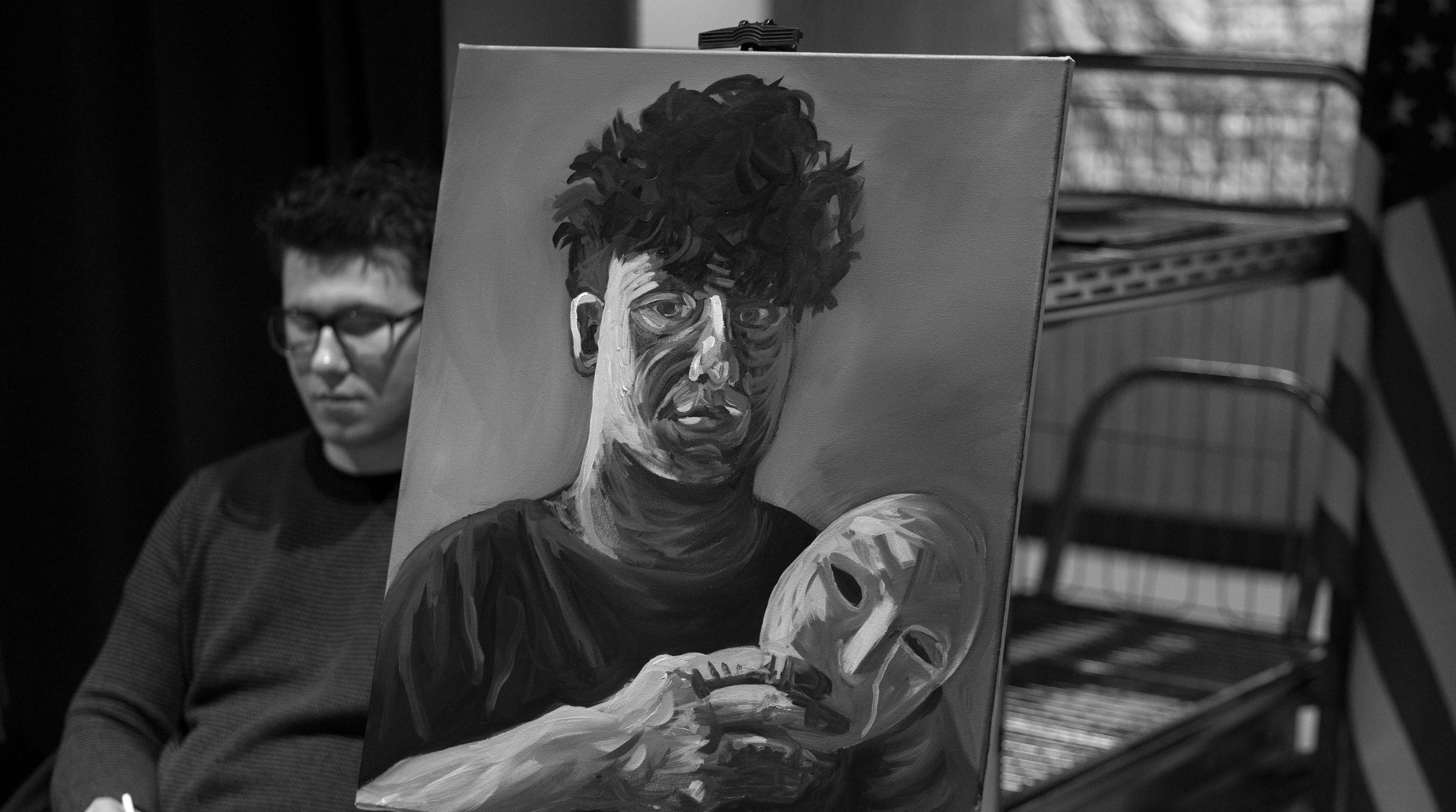
A self-portrait by Conner Allen presented at the “Queer Art Showcase and Panel Discussion” at the Stamps Gallery Wednesday.
The Embarrasment B-Side
I am a proud, slightly pretentious Michigan Daily Arts writer, so there is a lot of art I don’t allow myself to fully talk about. As far as my friends know, I like Taylor Swift in a totally chill way (and only the post-Fearless to pre-
Midnights eras, of course); I’m not currently rereading “All the Young Dudes” on Archive of Our Own; I don’t ever try to write poetry. There’s so much art I never speak about, because, honestly, I’m too embarrassed. But lately, I’m sick of it. Horror abounds in every direction, and I refuse to spend any more time liking things in secret. In the Embarrassment B-Side, I asked writers to take on the impossible: ignore the possibility of certain humiliation and write about the things they keep in the dark. From weird Tumblr fanfiction to unpacking shame in Olivia Rodrigo’s music, Arts writers wrote about it all. Get ready for some second-hand embarrassment.
C LA SSIFIEDS
Creative Assistant Internship
Seeking: Strong writers interested in TV, games, and storytelling.
We need a motivated part-time assistant. 13-20$/hr
Apply: cartel@thethirdcartel.com
Danganronpa did not make me smart
HUDSEN MAZUREK Daily Arts Writer
When I first entered high school, I found it quite important to prove that I was smart. Not just to other people, but also to myself. I believe this fixation started when I took the test for my high school’s honors program. During the summer, students who wished to apply for the program took a test, which would determine if they would be offered a spot. While taking the test, I realized I wasn’t so confident in my skills.
I knew how to answer all the questions, but something was eating away at me. At the time, I thought I was just nervous I wouldn’t make it. This was partially true, but there was also more to it. For the first time, I was being tested against other students for a spot I wanted, and it made me compare myself to those other students. It made me consider that I might not be as smart as I had thought I was.
In the end, I did get in, but the seed of doubt had been planted. There was now a part of me that wanted to be the smartest person in my class, and the one with the best grades. I quickly realized that, while the second was unrealistic for me, the desire to be the smartest still lingered deep within me.
Then, in my second year of high school, I found something to fill the gap that desire left — detective visual novel games. These mostly text-based games usually follow highly perceptive individuals solving mysteries and crimes. For a while, I binged the Ace Attorney games — a series following Phoenix Wright, a defense attorney who almost always represents people accused of murder. These games were great, but once they were over, I was hungry for more. That’s when I discovered Danganronpa.
Danganronpa: Trigger Happy Havoc follows a class of students from Hope’s Peak Academy, a school that only accepts students who are the best in their age group for their specific talent. These students find themselves trapped together in their high school and forced to kill each other in a wicked game run by a talking bear. The concept is pretty over-the-top, reflected in the game’s writing and characters. Looking back on it now, the game is not great. The tone is all over the place and the writing can be very repetitive, among other things. At the time, though, I didn’t notice.
I loved every moment of Danganronpa when I first played it. Something about it captured my attention even more than the games. If I had to guess why, it would probably be the tone. The game’s tone isn’t consistent, but it tries to be serious pretty often, and I treated it with that full seriousness.
The pull of solving the mystery is truly what drove me. I wanted to see more than anyone else saw in the game, faster than anyone else. I wanted to know I was smart, and I thought solving the mystery would prove my intelligence. Obviously, that was not the case. The mystery is designed to be solved, and it is not particularly impressive to come to the conclusion that was designed to
be found, which I knew. The feeling I got from solving the mystery, though, from being proved right, was something I wanted badly enough to ignore the fact the game had intentionally led me to that conclusion.
Danganronpa allowed me to believe that I was the smartest in the room. In the game, my character was the one solving the mystery; he was the one who cracked the case when no one else could. And he was me. At school, I wasn’t the smartest anymore, and rightfully so. There were other people who worked harder than I did for that title. I knew I wouldn’t work as hard as them, but I still wanted to be the best. Danganronpa gave me that feeling.
I played Danganronpa again recently with some friends, and we had a great time — but not because the mystery enthralled us at every moment. Instead, we had fun pointing out the game’s flaws and weird writing. Solving the mysteries was still just as fun as it had been before, but in a different sort of way. This time, it wasn’t about cracking the case to prove I was smart, it was just a silly ride that I enjoyed with friends. During this silly ride, I reconsidered what the game meant to me.
CONTINUED AT MICHIGANDAILY.COM
com
year we have partnered with Lauren
CAMPBELL JOHNS Senior Arts Editor
Natasha Eliya/DAILY
Maheen Rashid/DAILY
‘Just watch as I crucify myself...’
There’s nothing more embarrassing than being a teenager. Well, scratch that. I suppose the act of being a teenager is fine, but everything else that comes along with it? Truly the worst. The awkwardness of navigating changing relationships, the slow realization of horrors lurking in every corner of the world and everyone’s favorite references to “growing bodies” all create a special kind of hellish atmosphere — the price to pay for youth. Time offers the only solace for teens; a dawn will one day come when you will no longer be trapped in the realm of adolescence and your twenties will be there to greet you, turning your every action from cringe into cool.
Except, considering the fact that I’m a 21 year old and just used the
phrase “cringe into cool,” you have experienced firsthand the faults of that reality. Unfortunately, I’m all too often reminded of the limits of my age in protecting me from the awkwardness of existence. While I’ve found myself refusing to be shamed for certain choices I make (yes, I will wear crocs to the dining hall, and to class … and sure, why not to the football game too?), the world continues to place situations in my path that leave me no choice but to suffer through red-faced and insecure. And nobody captures these moments better than the unofficial voice of our generation; Olivia Rodrigo. In many ways, Rodrigo stands as the queen of teen embarrassment. Based on her notoriety among our generation, I’m sure I don’t need to fill you in on her discography — but don’t worry, I will. Starting with the dynamically melodramatic SOUR, Rodrigo has created a sound centered around the
realities of growing up in the 21st century. “Relatable” comes up time and time again as the primary descriptor of her music. Seemingly every member of Generation Z has cried about a breakup while driving through suburbia (you’d almost expect an uptick of car crashes post its 2021 release).
“Brutal” is the perfect channel for teenage angst, and I’ve personally screamed “good 4 u” too many times to count. Her second album, GUTS, matures with her, showcasing how, despite beginning to leave her teen years behind, Rodrigo still finds herself shackled to the same awkwardness. On “ballad of a homeschooled girl,” Rodrigo laments her unique upbringing, resulting in her committing “social suicide” with each failed interaction. The final song, “teenage dream,” acts as a heartfelt reflection on the very act of moving past teenhood, and the unpromising nature of the future,
with the haunting lyric “they all say that it gets better … but what if I don’t?” Rodrigo’s balance of quiet but moving ballads with more punky hits allows her to cast a wide net over the youthful experience, interweaving it all into a cohesive meditation on growing older —with more than a few winks of humor.
As Rodrigo begins to transition beyond her teenage years, however, things still linger from her adolescence — namely embarrassment. Look no further than its title, “love is embarrassing,” to find the song that tackles this reality best.
From its opening back-and-forth beat, I’m immediately trapped in Rodrigo’s (and my own) fixation on men, a cage from which Rodrigo and I watch as we fall victim to our delusions that spawn from the depths of our minds.
CONTINUED AT MICHIGANDAILY.COM
Am
I a
‘Hazbin Hotel’ hater or undercover fan?
MORGAN SIERADSKI Senior Arts Editor
As much as it pains me to say, I am the target audience for “Hazbin Hotel.” I’m a Queer former theater kid with a complicated relationship with Christianity. So when the first season dropped in January of 2024, my social media algorithm took one look at me and said, “Yeah, you’d watch this.”
My feed was flooded with clips, songs and theories galore.
The premise of the show itself is interesting: Charlie Morningstar (Erika Henningsen, “The Four Seasons”), daughter of Lucifer (Jeremy Jordan, “The Last Five Years”) and princess of Hell, runs a hotel designed to rehabilitate sinners so they may ascend to Heaven, thus solving Hell’s rampant overpopulation problem.
The series presents itself as a raunchy musical comedy that also tackles a share of relevant issues, including corruption in religious institutions, sexual exploitation and addiction.
By the time I caved to my feed, four episodes of the eight-episode season had already been released, with the latter four on the way in the following weeks. I figured I
would catch up and then watch the remaining episodes as they came out. So, I shut the blinds, sat down and turned on the TV. I hated it. I hated it with every fiber of my being. By episode two, I had a grocery list of everything I despised about the show, like Alastor (Amir Talai, “The Circle”), a powerful demon (and radio show host?) who has no belief in the hotel’s potential, but still volunteers to be its host.
The only thing Alastor is consistent in is his inconsistency, offering to help the hotel before running off on his own side-quest. I thought his poor writing would even itself out across the season, but I now know better than to have faith in this show. By episode six, that grocery list was practically a novel. I had to listen to Lucifer and Alastor song-battle it out over who was the better father figure to Charlie. The catch? Alastor, throughout the entire series, has never once positioned himself as a friend, let alone a father figure. Out of context, the song is certainly a song, but in context, it makes no sense. And when Alastor drops the line, “A reminder to all, not to mess with the Radio Demon,” I had to take a
Ex-theater kid support group
SIENA BERES Daily Arts Writer
When I was fifteen, I loved three very fundamental things: eyeliner, slam poetry and the 2016 revival of the hit Broadway musical “Falsettos.” I had poorly cut dyed-red hair, I was socially off-putting and I auditioned for every single high school play.
In two words, I was a theater kid.
I say “was” because I haven’t performed since coming to college. Not necessarily because I grew out of it, but because theater was less of a passion for me and more of a survival instinct; drama club was where I never failed to make friends each time I moved schools and states. Inevitably, there is still a mushy part of my soul that longs for the stage — it’s just more distant. And the saying is true: each day, my heart grows fonder with memories of tech nights, being an alto two and squeezing into itchy costumes.
When I tell people I meet now that I was in theater, the usual response is “Yeah, that tracks.” This always gives me pause, because I don’t know if they’re
saying I seem like a young talent or if I seem like an obnoxious, show-tune screamer.
Because let’s face it, there is a stereotype with high school theater. You can’t pin it exactly as it varies from place to place, but the general consensus is that the theater kid is on the outskirts of the social hierarchy.
Because high school theater is an act of public humiliation.
After all, anything earnest and loud and sparkly embarrasses us. The personal intimacy of stage performance makes us uncomfortable because we can smell the sweat; it’s so brutally unedited. Seeing something unapologetic will always leave us waiting for the apology.
Even the phrase “theater kid” feels demeaning. I understand it’s a catch-all for the many working parts of a show — not everyone is an actor, a tech hand, a stage designer — but “kid” seems to imply childishness. Think of “band kids” — perhaps the only other high school subculture viewed in the same obnoxious vein. Not only are both groups cringe, they’re also “kids.”
Why don’t we call football players “sports kids”? Like theater
and band kids, the majority of sports kids will never play in a Super Bowl — they are just kids. Yet, they’re taken more seriously than young creatives because the social devaluation of art is deeprooted and not always blatant. I doubt the majority of (nontheater) people even think of “art” when they think of theater. But theater is a complex interdisciplinary art form. Quite literally like nothing else, it combines dance, music and design into something accessible to the masses. Of course, there’s some highbrow theater out there, but the average high school musical can be enjoyed by almost anyone. Art, which is usually an individual pursuit, becomes collective. Theater isn’t all about selfexpression — it’s about learning what it means to make something. For young people, it’s utterly formative. So, why are these young creatives still cringe? Beyond the obvious embarrassment of performance, my working theory is that it most definitely has something to do with the patriarchy.
CONTINUED AT
Cornelia Ovren/DAILY
IAN GALLMORE Daily Arts Writer
Abigail Schad/DAILY
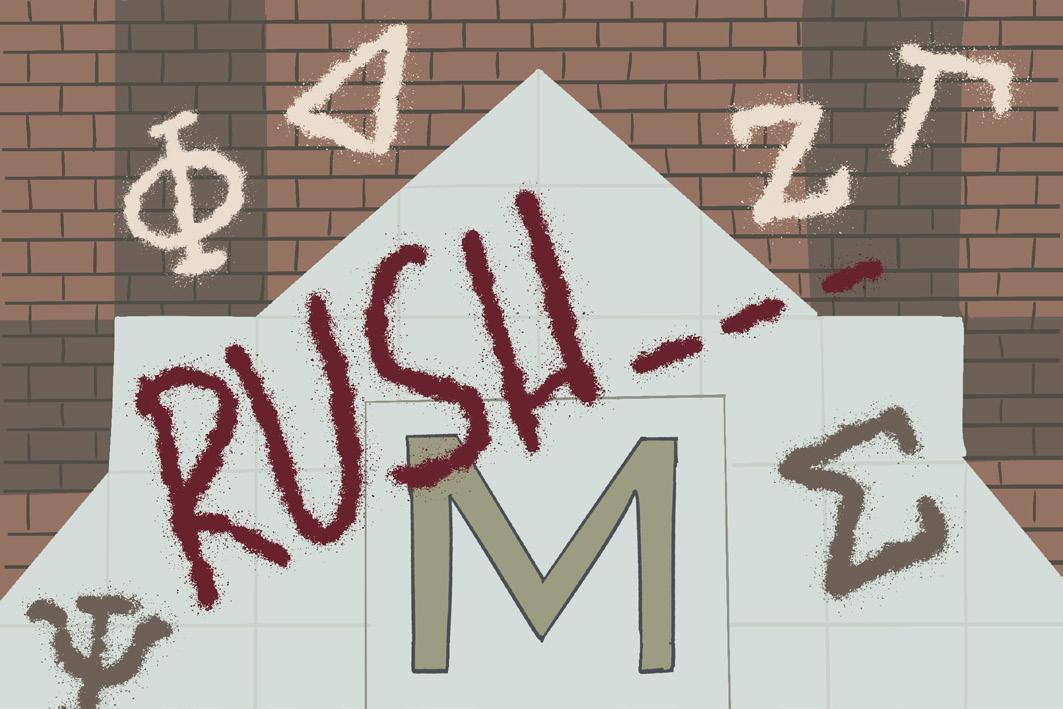
Let’s talk professional fraternities
When I was in high school, I had never heard of professional fraternities. If you’re unaware, like I was, professional frats are modeled around regular Fraternity and Sorority Life culture with “bigs” and “littles,” a rushing and pledging process and a guaranteed group of friends.
However, unlike traditional Greek organizations, they’re co-ed, usually don’t have their own housing and most importantly, are centered around some kind of major or field of study. The idea is that you join a group of people with the same aspirations, gain some professional development and connections from it and still have a ton of social events to attend.
When I first arrived on campus, people were buzzing with excitement about professional fraternities. I thought that might be normal across all colleges, but comparing notes with my friends at other schools proved otherwise. As far as I know, the University of Michigan is unique in how central professional fraternities are to the social life of the school, with more than
five major fraternities in many professional fields. There are business fraternities, technology fraternities, engineering fraternities, pre-law fraternities, pre-med fraternities, and even fraternities dedicated to more specific fields like entrepreneurship or design.
So when you’re a freshman desperate for community in an unfamiliar state, where almost everyone you know is talking about rushing a professional fraternity, it feels like that’s the natural place to start. Seems easy enough! Except — also central to the professional fraternity culture — it’s built on exclusivity. It’s purposeful, because to create a fraternity where everyone knows each other’s names and are good friends in a real way, there just have to be fewer people. However, unlike traditional FSL organizations, there’s no matching process to almost guarantee placement; you choose which fraternities to rush (if you even have the time for multiple) and then just hope it’ll work out.
In my first semester, I walked into the mass meeting of the first pre-law fraternity I’d heard of, where everyone was dressed in their best professional attire,
and I immediately felt sick to my stomach. The people were intimidating, and the room was stuffy, and I was immediately thrown into small talk that I was entirely unprepared for. I can’t even describe the relief I felt walking out of that room — taking a real breath for the first time in two hours, completely drained from the intense social interaction with strangers, knowing I didn’t come off as charming or intriguing or even particularly friendly. Despite the dread of going to rush events, I continued with it (sort of). I didn’t go to all the events I was supposed to and I
The guy with the Nazi tattoo
lingered around people I already knew, too afraid to force myself into conversation with people who seemed intimidating. Yet, in all my naivety, I was shocked when I received the email that I’d been rejected. What hurt me the most was what the process was based on. Although there was a professional interview and they reviewed my resume, the criteria for admission to these professional fraternities are largely based on personality. This meant I had to face the existential crisis of being rejected based on that: Was I unlikable?
CONTINUED AT MICHIGANDAILY.COM
Is anyone reading this?
When I was four, my mother took me to a speech therapist because I had a lisp and spoke in a fast slurry like I was drunk. After careful examination, the doctor told her that instead of a speech impediment, my mouth was just too small to say all I wanted to say. My orthodontist seconded this years later, while tightening my braces: “Wow, your mouth is awfully small!”
I like to think that this is why I enjoy writing so much — my mouth is still too small, and when I talk, everything still tends to come out jumbled. I sound (hopefully) much more articulate when I write because it’s the only way I’m ever sure of myself. Being a writer is being the man behind the curtain who everyone thinks is a wizard, but he’s really just a little old man.
For me, writing is less like a passion and more like the scratching of an itch — because it’s very difficult to be passionate every single day, but quite natural to be itchy. And writing has always been the unquestionable thing that I have to do.
Times New Roman that says “Siena Beres is a columnist/ novelist/essayist/editor,” and that’s about as far as I get. Pursuing anything subjective requires an inhuman amount of self-assurance — not only should I think that I’m good enough at what I do, but that other people should also think that I’m good. My success isn’t so much in my hands as it is in my audience’s. So here’s where I panic: What happens to writers when nobody is around to read?
Graham Platner, a candidate for Senate running in the Democratic Primary for the U.S. Senate in Maine, had a Nazi tattoo once. Before that, he was a Marine, serving in Iraq and Afghanistan, an oyster farmer and had a 34 percentage point polling advantage over Janet Mills, the 77-year-old current governor of Maine. Mills is backed by the Democratic Senatorial Campaign Committee. Platner is backed by Bernie Sanders. Indeed, initially, voters shared my anger at the Democratic party, which carried over from New York City to Maine. They, like me, did not want the status quo. People were, understandably, not pleased at the whole Nazi-tattoo thing, and the race was then polled again, and Platner’s numbers had gone down, as expected. Even with this situation factored in, the race is actually not even close to over.
Platner was only found to have been down by five points and has already raised insane amounts of grassroots donations while continuing to draw large crowds. He certainly may not win his race, whether it be the primary or the general, but the environment in which he is running — and how easy people are to forgive and forget — still feels remarkably different than even just a year ago. Platner says he regrets the tattoo, covered it up and apologized. I didn’t really care about it in the first place, and I am not really going to accept his apology now. Is he a Nazi? I’m not sure. Based on his words, I would say no, but I would never be so stupid as to get a Nazi tattoo in the first place, so either he is a secret Nazi, or genuinely extremely stupid. Neither is too appealing. However, in my mind, he’s still better than Mills. I simply cannot have another Senator more than four times older than me whose only calling card is that she isn’t a Republican. Furthermore, he
is promising me things I want! Free health care, arresting Immigrations and Customs Enforcement agents and no war with Venezuela. So, to me, he is the better option. Yet, what is inconceivable to me is that Maine voters agree with me. Democratic primary voters in Maine didn’t care about the tattoo scandal either. Again, this is a Democrat caught having a Nazi tattoo! I would expect this sort of thing from a Republican, but not a Democrat.
The modern Democratic party grew from the New Left, which gained purchase in America in the 1960s, shifting left-wing concerns away from just the economic and into the social. Since then, the Democratic party subsumed these social-justice-focused radicals into their coalition, while losing the economic message almost entirely. For example, someone like Representative Hakeem Jeffries, D-New York current House of Representatives minority leader does not identify as a socialist, yet commemorates socialist Malcolm X because of his contributions to social justice despite him being a socialist. Hakeem Jeffries buys into only the more well known and popular aspects of Malcolm X — that being his activism and not his socialism — stopping Jeffries’ own politics from venturing into radicalism. The rest of Malcom X’s message — that being redistribution — was lost on Hakeem Jeffries, and the rest of the Democratic Party for the last 60 years. With this focus on social justice burgeoning and taking over the Democratic party
in the last 60 years, it makes sense to me that Platner did, indeed, lose a lot of support. Some Democratic primary voters still hold on to that once-image of the Democratic party. I do not.
So the question is, why is Platner, the guy with the Nazi tattoo, still here? Why does he still have somewhat of a chance? Why have some Democrats lost their way?
To understand the current political environment, and to understand Platner’s ability to not completely hemorrhage his original popularity despite undergoing scandals that would sink many other candidates, we mustn’t look at Platner but instead at Democratic voters. A supermajority of Democrats are frustrated at their own party, with 41% of Democrats saying that their frustration comes from the fact that their party isn’t fighting hard enough against President Donald Trump.
Individually, Platner’s popularity may be due to a number of things. It could be his support for progressive policies. It could be that Sanders endorsed him. It could be his identity, existing as a white oyster farmer in a state that is 95% white. I think the answer is much more simple, and potentially much more sinister: He is embracing the Democratic id: an unconscious, primal desire by Democrats to get what they actually want, which is not Mills and is the free health care promised by the oysterman from Maine.
CONTINUED AT MICHIGANDAILY.COM
But most days, pursuing an English degree with the ultimate goal of “being a writer” feels, at best, fiscally irresponsible and, at worst, horribly egotistical. I am plagued by an amorphous anxiety that my vision of being a writer is antiquated, oversaturated and perhaps naive. I don’t even know what a modern writer is. When I picture myself as a writer, I picture a black and white photo of myself and below it one of those insipid third-person
Between 2003 and 2023, the number of Americans who read for pleasure fell by 40%. In 2022, only 33% of fourth graders were placed at or above National Assessment of Educational Progress proficiency in reading, a number that has been steadily declining since 2019. The average American reads only four books per year. Of course, storytelling is evolving — think video essays, podcasts, narrative games — but plain and simple, reading seems to be in peril, and none of us are safe from it. When I moved out before my freshman year of university, my uncle gave me two huge U-Haul boxes full of books about World War II. He went to college at some point in the ’90s and insisted that his favorite part of the four years was reading.
“It’s one of the only points in your life you’re going to have enough free time to read about Joseph Stalin,” he said. A year and a half later, I have read exactly one book about Stalin, and only because it was assigned for a class during my brief stint as a history major. Of course, I’ve wanted to read more, I just haven’t had the time.
CONTINUED AT
Rumaisa Wajahath/DAILY
GABE EFROS Statement Columnist
Abigail Schad/DAILY
From The Daily: Meet Donovan Golich, the new Face of student discipline
In November 2023, the University of Virginia hired a man named Donovan Golich to its Student Affairs office, where he was named associate director of accountability in the school’s Policy, Accountability and Critical Events unit. To simplify the administrative jargon, he was in charge of handling hazing cases and other alleged threats to student safety. Less than a year later, amid scandal and public outcry, his tenure came to an end.
It’s not clear whether Golich chose to leave UVA or if he was forced out. All we know is that he left quietly — about a week after an audio recording of him interrogating a student was leaked to the press. As The Michigan Daily was pursuing this story, the recording was removed from YouTube over a legal complaint.
There is evidence that he attended law school at Michigan State University, but his online biography notably leaves out a degree. Beyond law school, Golich’s resume includes a Master of Arts from the University of Southern California, an unsuccessful campaign for East Lansing City Council and a brief career as a middle and high school social studies teacher. He received his Bachelor of Arts from Ohio State University. “You’re not special,” Golich continues. “I’m not bullshitting you, I don’t care, I will send you to Honor and I will sleep just fine at night.”
Samaritan laws — which grant legal immunity to individuals who call emergency services for someone in need of assistance. One fraternity president, who dealt with Golich after a party attendee needed medical attention for excessive alcohol consumption, issued a stark rebuke of Golich’s tactics to The Cavalier Daily.
“Greek organizations are afraid to call the ambulance now,” he said. “(S)tudents think they can not call 911 out of fear of being in trouble.”
Over the course of the now-absent video, roughly 10 minutes long, Golich curses and repeatedly aggrandizes his own background to a Theta Chi fraternity member enrolled in the Reserve Officers’ Training Corps. He was investigating the student for non-violent hazing allegations.
“Maybe you’re not cut out to be in the Navy,” Golich says. “I went to law school. I’m a little bit more trained and learned than a lot of you guys. I know what I’m doing.”
Later in the conversation, he boasts about his ability to handle the case: “This is nothing to me. This is easy.” He tops it off with a profane attempt to intimidate the student: “I’m done with people like you. I don’t fuck around. You think your ROTC commander’s tough? Guess what? You guys just met your match.” Being tough on students is one thing. Endangering student safety is another. At UVA, Golich was known for his hard line, particularly on Greek Life. He implemented the unusual policy of reporting fraternities and sororities to their national organizations if anyone at their houses needed medical attention for substance use.
Both Golich’s background and performance on the job should have made him unhireable in future disciplinary roles. But not to the Leaders and Best. The University of Michigan hired him earlier this year to prosecute students for the Office of Student Conflict Resolution and lead the new Office of Student Accountability. His track record of intimidating students — to the point they fear seeking help when their lives are at stake — has led him here: a position overseeing disciplinary proceedings at one of the most renowned public institutions in the world.
This Editorial Board believes you deserve to know who he is.
This disciplinary strategy put students in danger and defied the spirit of Virginia’s Good
So, who is Donovan Golich? He is a bully and an impediment to student safety. And he just so happens to be the new face of student discipline at the University.
From The Daily: A system designed to Find you guilty
The University’s new disciplinary apparatus didn’t emerge out of a vacuum. Before 2024, students had access to a fairly robust justice system. The accused party could request a jury of their peers in the form of a student panel and even object to the initial ruling before an appeals board. This process, while flawed, worked relatively successfully for years.
It was put to the test by a series of controversial protests at the Alexander G. Ruthven Building in November 2023 and the 101st Honors Convocation in March 2024. Following the demonstrations, many of the participants were charged with violations of the rules. Some reached plea agreements, and others fought the allegations. As one would expect from a functioning judicial system, the verdicts were a mixed bag: Some students were found guilty while others were not.
findings, including the cases where the administration had lost its appeal. This Editorial Board can find no other reports of the VPSL invoking this authority, and Harmon’s decision to wield it so aggressively removed any pretense of impartiality from the disciplinary process. He tampered with a largely effective system to achieve the administration’s preferred outcome — an unsavory task that he has since outsourced to a new employee.
Enter Donovan Golich.
With institutional backing, Golich has overseen the rapid dismantling of justice at the University. The fact-finding exercises that define a trial — the presentation of evidence, alongside the calling and crossexamination of witnesses — have been reduced to mere formalities.
The University wasn’t satisfied, so Martino Harmon, Vice President for Student Life, intervened. According to the protesters, he personally overturned every single one of the not guilty
Who
The consequences are real. Students’ academic and professional careers are on the line, while the Office of Student Conflict Resolution and Office of Student Accountability perform a crude imitation of a fair system. You can spot the fraud from a distance. The accused no longer have access to a jury of their peers. When Golich denied student panels to the protesters who chose to fight their OSCR charges, he cited a shortage of trained panelists. A fair point, but only half the story. Rackham student Jared Eno’s case only recently ended, and the next panelist training is scheduled to take place on Nov. 14. The University was willing to wait when it let the six-month statute of limitations on the protesters’ cases expire before bringing charges. Golich could have waited too.
We’ve already discussed how the University refuses to grant the accused party access to potentially relevant facts of their case. But even if students manage to somehow overcome this barrier and craft a compelling defense, a guilty verdict would still be inevitable.
There were no reports of a shortage of panelists after the protest at the 101st Honors Convocation last year, and the demonstrators still had their requests denied. The University made its intentions clear then. For Eno and the other members
of his group, Golich was just exploiting a convenient excuse. In place of a student panel, a Resolution Officer considers Golich’s recommended sanctions. This lone adjudicator is nominated by faculty but generally defers to OSCR. The RO rubber stamped Golich’s desired guilty finding in all of the recent protest cases. The fix is in: The University’s operatives don’t stand in the way when the University wants a guilty finding. Harmon didn’t — and won’t — have to intervene again.“Build Trust. Promote Justice. Teach Peace.” This phrase is written in bold letters on the first page of OSCR’s website. It’s hard to imagine a more ironic statement, and we trust that isn’t lost on the administration. But if it’s between a change in course and a change in slogan, we anticipate a change in slogan first. So, who is Donovan Golich? He is the University’s fixer. He’s not a loose cannon; He’s a hired gun. And the University will deploy him to violate any precedent, any policy, any principle to find a student guilty.
From
The Daily: Inside
the
University’s kangaroo court, where the truth costs $ 4,000
The Statement of Student Rights and Responsibilities outlines the University of Michigan’s policies for non-academic misconduct. Violations include everything from underage drinking to disrupting classes during a protest. Donovan Golich’s job at the Office of Student Conflict Resolution and new Office of Student Accountability is to investigate and punish these violations. Imagine you end up on the wrong side of his interrogation table. Golich charges you with an SSRR infraction and claims to have you on tape, but he only shows you the short portion that he deems relevant. Nevertheless, he indicates the video is all the incriminating evidence he needs to recommend sanctions — which, depending on the severity of your infraction, can range from a reprimand to expulsion. When you ask for the rest of the footage, which you believe may prove your innocence, the University tells you it’s only accessible by a Freedom of Information Act request. The price tag? Nearly $4,000.
This is the situation Rackham student Jared Eno found himself in earlier this year, alongside many of the other 10 protesters Golich was hired to prosecute.
Since the first version of the SSRR was implemented in 1993, disciplinary proceedings at the University looked a lot like criminal cases brought before a U.S. court. The complainant — a student, staff or faculty member — would initiate an OSCR case after suffering an alleged harm. The investigator would then gather the relevant facts, and a Resolution Coordinator would inform the accused party of the specific charges against them. The RC was, more broadly, tasked with guiding both sides through the process. Eventually, an adjudicator would issue a ruling.
Not anymore. Golich is overseeing a new disciplinary apparatus. It bears little resemblance to the system that preceded it, and it delivers neither due process nor a shot at restorative justice. The prosecution of the 11 activists is unprecedented in nature. The
old system was designed exclusively to handle conflicts between students and individual members of the U-M community. Never between students and the University itself.
Before 2024, there was no precedent for the University to act as complainant, nor to appoint one person to control so much of the process. That precedent has been broken, and with administrative power firmly supporting one side, students don’t stand a chance.
Golich currently represents the University on three fronts: as the complainant, the investigator and as the de facto RC. These roles were once meant to be occupied by different people, and it’s clear why. The RC’s job is to help both the defendant and the complainant navigate the disciplinary process. But now, the RC and the complainant are the same person, reducing the proceedings to a confusing web of conflicting interests.
Golich (the complainant) filed complaints against the 11 demonstrators in July 2025. This was long after the six-month statute of limitations laid out in the SSRR had expired, but the University found a convenient bypass: simply waiving the policy. With this procedural hiccup out of the way, the intake meeting is scheduled. This is where Golich (the RC) lays out the evidence cherry-picked by Golich (the investigator) that supposedly warrants the sanctions recommended by Golich (the complainant). It’s meant to be confusing. OSCR procedure dictates that, at this point, students are told the specific complaint being levied against them. Students now going through OSA — separate from the 11 protesters, as the department didn’t exist when they were charged — say they haven’t received that courtesy, leaving them in the difficult position of having to answer for evidence without facing any formal allegations. Prosecuting tends to be easier when defendants incriminate themselves.
Furthermore, the University pressures the accused party to sign a strict confidentiality agreement. Given Golich’s track record of verbally harassing students, it’s obvious why
they wouldn’t want to accept a provision barring them from speaking out against abuses of administrative power. Students can refuse, but there’s a catch: They risk facing an additional slew of charges or being removed from their own hearing, which continues without them. Prosecuting also tends to be easier without the defense present. If the phrase “kangaroo court” comes to mind, that’s for good reason. The violation of the statute of limitations, the confidentiality agreement, hearings held without the defendant, the fact that OSA doesn’t tell students what they’re being charged with — none of these policies would hold up in court. But, then again, very little of what goes on in the University’s disciplinary proceedings would.
The University hardly lives up to its own rules. The SSRR states that “All parties may have access to all written or other information that will be considered prior to the hearing.”
But Golich has the power to determine which evidence is considered, rendering the policy defunct. And since the protesters can’t afford the small fortune required to make a FOIA request, it’s difficult for them to prove Golich is withholding relevant facts. Justice shouldn’t be pay-to-play, but that’s what the University has made it.
Deprived of any exonerating evidence, the accused party is forced to rely on Golich’s curated narrative — the story presented by the very man charging them in the first place. Beyond presenting a glaring conflict of interest, this situation prevents students from issuing pleas or defending themselves according to the facts of their case.
The sum of these changes is the consolidation of total operational control over discipline in the hands of one man. So, who is Donovan Golich? He is the complainant, investigator and Resolution Coordinator. More succinctly: Judge, jury and executioner. And neither he nor the system he represents are interested in justice.
From The Daily: The University’s
At the beginning of the academic year, the University of Michigan rejected a community-proposed amendment to the Statement of Student Rights and Responsibilities that would have banned conflicts of interest in the disciplinary process. Now we know why. Such a provision would have barred Donovan Golich, the head of the University’s new disciplinary system, from holding so many of the key positions of power within that system. It would have required the University to substantiate its allegations against students — in light of all the evidence — before issuing a punishment. In short, it would have kept the system fair. Instead, fairness has given way to farce. The University hired Golich, despite his checkered background. The University appointed him complainant, investigator and Resolution Coordinator, despite the clear conflict of interest those overlapping roles present. The University empowered him to hide potentially relevant evidence from defendants, despite the rules laid out in the SSRR. The University used him to secure guilty findings against the 11 protesters he was directed to prosecute. Justice is a two-way street. It requires a baseline level of trust to work. The University has given students no reason to trust it, and Golich certainly hasn’t given studentsareasontotrusthim.Alegitimate justice system requires at least a modicum of neutrality. But this administration and Golich don’t want the process to be legitimate. They want convictions. You don’t have to care about the
protesters’ cause to care that the rules have been weaponized against them, and ignoring blatant violations of process would be unwise. The process doesn’t have an ideology, nor do the individuals who carry it out. When Golich was at the University of Virginia, he wielded his authority to subjugate Greek Life. At the University of Michigan, it’s activists. His scrutiny doesn’t change based on the identity of the defendant, nor does it follow traditional political boundaries. It followsToday,orders. the orders are to crack down on pro-Palestine protesters. Tomorrow, those orders could change, turning back on Greek Life or toward a new target like international students. When they do, the University will exploit the dangerous precedents Golich is currently setting. Students’ futures are on the line. Are you really comfortable with the University having this much power? This Editorial Board has spent the last three editorials attempting to understand who Golich is — the bully, the conflict of interest, the fixer — and at last we’ve arrived at an answer. He is the personification of the University’s turn away from the values that once defined it. This institution rightfully prides itself on its role in “developing leaders and citizens who will challenge the present and enrich the future.” What kind of message does it send that Golich and the apparatus supporting him are training those leaders and citizens to expect, even tolerate, despotism from their justice system?
The free exchange of ideas, mutual respect and the pursuit of justice have withered in the shadow of the Office of Student Conflict Resolution and Office of Student Accountability. Golich’s background wasn’t a secret when the University hired him. He was chosen for a reason: The new disciplinary system sees his flaws as an asset. Given his track record, Golich should not have been hired. Given the problem with one man having so much power, thehimpositionheholdsshouldnotexist.Putting in charge makes the University look bad. Next time a leaked audio clip emerges, someone files a lawsuit or the national media puts a spotlight on the disciplinary process, the University will come to regret its decision. To be frank, this Editorial Board doesn’t know if firing Golich would change anything, or if the University would simply hire a new bully, a new conflict of interest, a new fixer to lead the student justice system. Golich is the wrong man for the job, but there’s no right man, either. Even a person without Golich’s baggage would still pose a threat in this role. The only certain way to fix discipline at the University is to abolish the role entirely, restore the checks and balances that define a fair system and restructure OSCR and OSA from the ground up.
On Tuesday night, Democratic Socialist Zohran Mamdani won a historic election to become New York City’s first Muslim mayor, winning the most votes by a mayoral candidate in the city since 1969.
Mamdani’s rise has been nothing short of stunning — a phenomenon that’s pulled together a coalition of enthusiastic voters that did not exist before his campaign. Mamdani galvanized his supporters over issues of substance, mainly around affordability. His ability to hear what was affecting New Yorkers on a daily basis and repackage that into a concrete platform, fueled by slick
and viral social media videos, helped grow his movement. Harnessing that into an army of more than 100,000 volunteer canvassers solidified it into a juggernaut that could not be stopped. I grew up in New York City, and after various pit stops, have been based there again for the past four years.
Since August, though, I’ve been here in Ann Arbor, as part of the KnightWallace Fellowship — a program for journalists around the world to spend an academic year on campus to take a step back from the daily grind of the industry and focus on our own research topics.
But as the energy built up to election day, I was having some serious fear of missing out. So on Monday, on the eve of the election, I went back to New York to be on the ground.
I first heard of Mamdani during his
The Mamdani moment
campaign to become a New York State assemblyman in 2020. He stood out, not just because of his background, but also what he stood for politically. I continued to follow him after he won that race, and was impressed with his energy and ideas.
But when he launched his campaign for mayor a little more than a year ago, I texted friends and family the following: “Good that he’s running, but he has no chance.” The polls agreed. Four months into his campaign, he was polling at 1%.
My doubts stemmed from my understanding both of politics in the city and this country. Like Mamdani, I was a brown kid living in New York City on Sept. 11, 2001, and in the era that followed. Unlike Mamdani, I am not Muslim — but the post-9/11 backlash aimed at the community
‘S 3RD ANNUAL
wasn’t exactly refined enough to always distinguish between types of brown people.
As hate crimes went up, the first person killed in the U.S. as a supposed act of retaliation for 9/11 was Balbir Singh Sodhi, a Sikh American man. Throughout the next decade, Conservative Mayors Rudy Giuliani and Michael Bloomberg oversaw unconstitutional NYPD surveillance of Muslim people throughout the country.
But the reality of growing up in this environment as a Muslim, or even as someone who supposedly looked like one, often meant facing more subtle forms of indignity. A terrorist joke here, a suspicious look at an airport there and the perpetually mispronounced name. This reality is part of what made it hard for me to believe the city would
elect a proud Muslim as mayor within 25 years of 9/11.
That Mamdani was able to make that happen is hugely significant — and perhaps best punctuated by a moment from one of the mayoral debates in June. Faced with his main opponent Andrew Cuomo, former governor of New York, butchering his name for the umpteenth time, Mamdani fired back.
“The name is Mamdani. M-A-M-
D-A-N-I. You should learn how to say it, because we gotta get it right.”
It was a moment for every immigrant in America who has ever had their name mispronounced. And it’s a moment that’s become a rallying cry among supporters, remixed into viral musical mashups on TikTok and Instagram.
But the significance of Mamdani’s racial and religious identity is only
part of the story. After all, mere representation along those lines have often proved shallow in recent years, with candidates or elected officials who don’t always align with the values of many of the people their presence on the political stage is nominally expected to excite.. After all, mere representation along those lines have often proved shallow in recent years, with candidates or elected officials who don’t always align with the values of many of the people their presence on the political stage is nominally expected to excite. One of the reasons Mamdani’s election feels different, though, is because his campaign was more focused on other forms of identity: political and generational. CONTINUED AT MICHIGANDAILY.COM
ASHISH MALHOTRA Opinion Contributor
Are these perpendicular lines? Is this water?
Fifth grade was when I first learned the difference between parallel and perpendicular lines. I still remember the worksheet my teacher gave us explaining each. It read: “Parallel lines have a lot in common but they never meet. Ever. You might think that’s sad. But every other pair of lines meets once and then drifts apart forever. Which is pretty sad too.”
Now I don’t know who hurt my teacher enough to spread this sad propaganda to fifth graders, but I still haven’t forgotten the difference between parallel and perpendicular lines. Nor have I taken for granted the fact that some relationships are fleeting. Ten weeks into my senior year of college, it feels as though many of my college friendships are running on some imaginary timer. Right now, I live with some of my closest friends who have seen me at my best and worst. That will no longer be true in seven months.
As I reminisce on this semester, I find myself struggling to keep up with the passage of time. In an attempt to try to hold onto experiences and cherish them for as long as I can, each moment passes on to the next, leaving me with an unfulfilled sense of longing. The best way I can describe this feeling is with Joan Didion’s wise prose, “I enter a revolving door at twenty and come out a good deal older, and on a different street.”
In Didion’s essay “Goodbye to All That,” she candidly recounts her intricate love for New York City through the eyes of her 20-year-old self. New York was the petri dish where her identity germinated, allowing her to stretch the bandwidths of her own emotional balances and live by “arbitrary but quite inflexible rules.” In truth, the piece is less about New York City than it is a commentary on youth itself: “the only city we’ve all lived in.”
At 21 years old, I stand wavering at the crossroads of the past and future with what feels like the weight of a million expectations on my shoulders. However, my college roommates reassure me that these feelings are shared and understood (even if I’d like to think that nothing like this has ever happened to anyone before). In times when it felt that my emotional balance had been completely spent or when my mistakes felt irrevocable, it was my roommates who provided me with a soft spot to land. New York was to Didion as my bubble of a college town is to me: an experimental atelier that forced personal development. However, New York’s cold shoulder could not be more of an aberration from the open arms my college roommates embraced me with. In doing so, they have disproven that all perpendicular lines must begin and end. With their patience and selflessness, they have instead shown me that if twisted and reconfigured enough, relationships can mirror oscillating lines on a horizontal axis.
Through the growing pains of college, it’s complete strangersturned-friends who make college my home away from home. It’s during late nights at the dinner table where eraser shavings (and tears) line the margins of my organic chemistry book when my roommate takes the time to delicately teach me resonance contributors. Or it’s during Sunday nights as we watch the Lions, Vikings or Bears when my roommates answer my laundry list of football hypotheticals. Or it’s during the days that seem to run too long while my gas tank runs too low, when debriefing our days together becomes something I always look forward to. In these tiny shared moments, I step out of my solipsistic world and recognize the need for and the gift of reciprocal connection.
Perhaps the senioritis has already decayed my bones, but during this semester especially, I
am constantly motivating myself to just make it to the next week, or month, or end of the semester. Then, all the time I passively “saved” will be mine to enjoy posthumously. But this kind of survival mentality is just that — survival. Innate resourcefulness and resilience are only part of the answer. It’s my roommates who pull me out of my monotonous routine and remind me that this is water.
David Foster Wallace’s eloquent, yet humorous, take on the underappreciated art of being present serves as an impactful commentary that the only way to accept changing times is to embrace the current. A problematic tendency of mine is that when I get overwhelmed by the uniquely arduous struggles of my 20s (which is frequently), I take a leave of absence on an emotional hiatus where no one hears from me for over a week, unless they actively live with me. Self-care flies out the window, along with my regard for others. But my roommates, whether they realize it or not, always reel me back to the present, reminding me to pause and admire the conditions of the water.
It’s true that the people make the place, but the people also make me reconsider how memories and love are precious intangibles that I can still hold onto, even long after shared moments have passed. Maybe next year I won’t be sitting on the same sienna-colored couch each night debriefing my latest crash out with my roommates. Or maybe we won’t talk every day through our Ring camera like we do now. But instead of drifting apart forever, the intangibles sustain these connections. And after we leave this simulation of a college town, there will always be traces of the people I love scattered within my shuffled songs, resembling faces, or in new friendships, proving that there are more ways than one to rekindle relationships.
CONTINUED AT MICHIGANDAILY.COM
In Al-Brazine, everyone knows my name even if I don’t know theirs. It’s a village of farmers, humidity and fruit. A younger version of myself used to play in front of my grandfather’s house with my little cousins and a ball. We loitered out there for hours on end, running to the mausoleum and back with the dirt grinding under our feet before finding a place to hide from the sun. I opted for the shade of the oak tree. Whose land it stood on, no one knew, but it was always lined with the neighbors sitting on either side, playing cards and drinking tea.
I sat next to Um Hamzeh, who lived across the street; it was as if we shared a front yard. She had the accent of the mountains, of self sufficiency. Of tough love and back-breaking work. Of drying your own tobacco, a place where spending the day in bed is a luxury. She knew me as “Reem’s Daughter” the first time we met years before, but now, she remembered me as Summer.
“You look out of place,” she said, pointing to her home. “Come, there’s a better spot to cool down.”
I followed her just 10 feet to the side of her house. There, I could hear the conversations pouring off the oak tree where others doted on someone’s youngest granddaughter. She showed me her figs, which were too green to pick, her husband who greeted me with kisses on my sweaty cheeks and finally, her mulberries. They were bright red, so I thought they weren’t ripe, but Um Hamzeh shuffled around the tree, picking off the reddest berries from the low hanging branches. She placed them in my hands, unmoved by my attempt to give her one. I brought them to my tongue as she watched me have my first taste. The fruit was juicy, perfectly sour and bigger than any mulberry I’d seen before. Once she was content with my eating, she began to pick some for herself and gave me an unfamiliar smile that reminded me I was mostly a stranger to her.
She had no duty to me, but she saw a girl in her village with red cheeks and chapped lips, so she gave me the only thing she could offer: her livelihood. We plucked fruit off the branches and ate one after another. Each berry washed down my throat and eased a scratch in my voice that I hadn’t even noticed was there. We talked as we ate, and passersby stopped to join our conversation or have a taste of their own. Um Hamzeh asked me how I found my visit to Syria, as I continued eating them with no intention of stopping. I don’t remember what I said, but I must’ve told her it was perfect.
*** Near Flint, Michigan, my family goes out every evening of the summer and picks mulberries by the bucketful from the tree in front of our house. They are so ripe that picking them makes the juice drip out and stain red from our fingernails to our elbows. We take turns on the ladder and yap about this and that, singing, or enjoying the weather in silence. Sometimes, when my brothers and I have been out there with Baba for an hour or two, I wonder if this is what harvest seasons are like in the mountains back home. We wave at the neighbors as they drive in and out, but no one stops to talk and neither do we. Inside, I help Mama wash them, cut off the stems and make jars upon jars of slimy jam that we will end up giving to our friends and eating throughout the winter. It doesn’t matter how often I invite others to come over to pick some mulberries; no one ever does. Maybe part of that is because property is always an issue in America. For example, in Michigan we have the Castle Doctrine and Stand Your Ground law, which acts as an extension to the Castle Doctrine promoting self defense in general while including on homeowners properties. These laws make people think they only belong to their square plot of land after working hours. When I take walks down streets and through grass and trees, I often wonder if I’m walking on anyone’s land. I passingly think that someone would yell at me
to leave, or threaten to shoot me if they thought I was loitering for a moment too long. Some people do get shot for being on someone else’s property. We heard stories like that growing up. In my family’s front yard, our tree sits tall and wide, much bigger than the ones in Al-Brazine. No matter how much we pick off the branches, there is always more to be eaten. The branches are higher and harder to reach; the fruits are smaller, sweeter and grow into a deep maroon before being ready for eating. We sometimes take a tarp with us and shake the branches, watching hundreds of little fruit and bugs fall down in a few seconds. That way is always fast, but it starts feeling like a chore to get as many buckets of fruit as possible in the quickest way possible, speaking only for efficiency’s sake. Suddenly, the art on my fingertips I love so much becomes annoying rather than the fulfilling feeling of picking them one at a time with the juice painting my hands for the rest of the summer.
People never pass by on foot, only in their cars. No one wants a grocery run to take three hours, and no one wants their kids to go walking in a town with no sidewalks. In suburbia, everything must be performed with the sweeping efficiency of cars, and no one relies on public transportation to get to work. If someone wants to ride their bike or take a long run, they have to take a drive first, to find a park that accommodates that or a part of town where there’s a sidewalk, bike lane or designated area for non-motorvehicles. When we’re all in our own little motor boxes, it’s hard to find anyone to have a chat with. As people pass in their cars, I wave and smile at them — only sometimes do they wave back. Last summer, I met a little girl and her father walking in the neighborhood while I was ushering mulberries into a bowl. I’d seen them a few times before, once when they moved to the neighborhood and a couple times after that. I couldn’t remember their names.
CONTINUED AT MICHIGANDAILY.COM
Who do I sing for?
Sometimes when I close my eyes, I can still picture it — I’m five years old, sitting outside my grandparents’ home on a rainy July morning in India. I’m on my Appuppa’s lap on his rocking chair, safe from the rain, as we eat a true Malayali delicacy: mango coated with salt, pepper and chili powder. He laughs, and asks me to sing our favorite song for him: “Kinavile Janalakal” from the hit 2010 Malayalam movie “Pranchiyettan & the Saint.” I have been singing ever since I was two years old. I like to think that I inherited this trait from my Appuppa, who was a “Swami,” or Hindu spiritual teacher who often sang “bhajans ,” or religious hymns, at the family temple.
One of my earliest memories of singing involves me as a toddler climbing up our temple stage and interrupting my grandpa singing just so I could accompany him, even though I didn’t know any of the words. However, at five years old, I had an entirely different outlook on singing. If Appuppa asked me to sing any song in English, I would’ve done it with no hesitation. However, our special song was in Malayalam, a language spoken in Kerala, a state in Southern India. I didn’t know Malayalam like I knew English. Little five-year-old me did not want to disappoint her Appuppa, but at the same time, I was so nervous and embarrassed that I’d get the words all wrong and be shamed by my loved ones for not knowing how to speak my cultural language properly, let alone sing it.
In a matter of a few years, I’d gone from being unafraid to sing in front of people in a different language to being utterly terrified to sing a few verses in front of my beloved grandfather. Why had I become so selfconscious?
I believe our actions are a result of our environments and the people around us. Growing up, I was surrounded by multilingual people, including in my own family, who could speak, read and write fluently in so many beautiful languages. In my eyes, they were these incredibly intelligent people who knew so much more about the world since they could understand it in multiple languages and perspectives. I wanted to be like them because I thought if I could learn multiple languages, I could be intelligent too, and I wanted to do this perfectly
to prove my intelligence. In elementary school, I remember spending hours trying to make sense of the Malayalam practice books my mom would get for me from India. I told my parents to start speaking to me in only Malayalam so that I could actively practice speaking with native speakers. For a time, this worked. It technically helped me understand Malayalam fluently. If someone speaks to me in Malayalam, I know exactly what they are trying to tell me, even colloquial terms and slang. Despite understanding the words, I could still not pronounce them, no matter how hard I tried. I theorize that this phenomenon, dubbed receptive bilingualism by linguists, must have occurred from the years I spent accumulating the vocabulary when other people
spoke. Whenever I made a mistake or my brain couldn’t understand certain concepts, I felt this sort of shame. I felt like I wasn’t intelligent enough to speak like the rest of my family. Eventually, I stopped trying to respond to my family in Malayalam completely, because my inability to respond to the sentences I understood frustrated me, and admittedly, my ego was hurt. But when I sang? My ego was hurt even more. Music is one of the most important things in my life, and I am incredibly passionate about it. I find that singing and playing music is one of the most rewarding experiences in my life, and it acts as an escape route to all the stress I face daily. I pride myself on being a talented musician. Perhaps this is because of my desire to be perfect, but I feel
confident in my abilities to sing and feel joy even when all else goes wrong. Singing is also a huge part of Malayali culture and Indian culture as a whole. Malayalam songs tend to be super lyrical and poetic, with an emphasis on high notes and flowy rhythms. I’m a perfectionist, particularly in singing. I could not break this mindset that if I messed up when singing in Malayalam, I was a bad singer and the stereotype of an American-born and raisedIndian girl who doesn’t know anything about her language or culture. It is truly unfortunate that this mindset was ingrained in me at such a young age. It wasn’t even a true statement, but I couldn’t help but feel like it was so representative of me.
Summer Salman/MiC
KARAH POST MiC Columnist
Sara Wong/MiC
ANNIKA SREEDHAR MiC Columnist
Michigan suffers loss against Wisconsin after early shutdown
SOPHIE MATTHEWS Daily Sports Writer
Perfection is nearly impossible, even for a team who had yet to lose at home. Saturday, Michigan’s Achilles heel was exposed after No. 10 Wisconsin established a wide deficit early on in the game. The No. 2 Michigan hockey team’s inability to dig themselves out of the hole hindered their chances at emerging ahead of the Badgers.
The Wolverines (10-2 overall, 3-1 Big Ten) suffered their first conference loss, 6-1, against Wisconsin. After a disappointing early showing from Michigan’s
penalty kill, its weakest points were exposed, allowing the Badgers to capitalize offensively, highlighting a collapse in the Wolverines’ first home loss.
The first period was not the showing Michigan was hoping to have. Avoidable penalties combined with a lack of breakthroughs into the attacking third equated to much of Wisconsin’s pressure falling onto the back of freshman goaltender Jack Ivankovic and the
to work its way back against a Wisconsin team eager for a marquee win. As the second period commenced, though, the differential only increased.
A turnover in the neutral zone offered the Badgers another opportunity as Wisconsin forward Blake Montgomery marched up center ice, weaving through the Wolverines’ defense to slot in the Badgers’ third goal, adding to the lead, 3-0.
weren’t bouncing back the way that we wanted.”
Despite attempting to resurge their offense, the Badgers found little trouble responding to the Wolverines’ advances, sneaking another past Ivankovic’s glove to extend to a comfortable 4-1 lead. Michigan’s offense required a complete shift if a win was in its sights.
But instead of channeling urgency into scoring goals, the Wolverines
The trend became more apparent throughout the third. A sixth goal added to Wisconsin’s tally left Michigan with nothing left to lose. The Wolverines served 86 penalty minutes, making that their defining trait leaving the ice.
“There’s things that we’ll remember from this game for motivation, and then there’s a lot of stuff where it’s just not us,” Michigan coach Brandon
Fantilli’s goal ended the feeble penalty kill that put them into a hole. From that point on, Michigan successfully fended off the many minutes it faced being down a man. However the focus toward filling that hole starved its other areas of play, ultimately contributing to its collapse. The Badgers peppered Ivankovic, and the Wolverines totaled 17 blocked shots — a testament to its constant uphill climb.
SEEING
Hockey is an imperfect game, and Michigan showed how a successful showing the night before can be altered in the blink of an eye. Saturday, Wisconsin badgered Michigan to hand it its
RED
‘Nothing beats Michigan’: Ellie Fife’s return home that follows familiar familial footsteps
As an Ann Arbor local, Ellie Fife has played soccer alongside Michigan athletes her entire life.
Her first taste of the Michigan women’s soccer team came at the early age of five, when Fife’s mother, Katie Fife, dropped her off at a soccer camp. Unbeknownst to what was ahead, Ellie — as the youngest camper — was taken under the wing of a former Wolverines player. With just that fraction of guidance, she was inspired to attend Michigan’s soccer camp every summer after. Thus, on that fateful morning in 2011, her prideful stride at wearing the maize and blue jersey began.
Ellie’s Michigan ties didn’t start when she attended her first camp, though. The Wolverine blood has pumped through her family lineage for generations.
“Everyone went to Michigan,” Ellie told The Michigan Daily. “It
played a huge role, Michigan is where I wanted to be. I wanted to play for Michigan.” Her father, Dugan Fife, played basketball at Michigan during the Fab Five era, while his father Dan Fife also competed for the Wolverines’ basketball and baseball teams decades prior. Dan went on to be one of the winningest basketball coaches in the state of Michigan, earning a spot in the Michigan Sports Hall of Fame as a small-town hero from Clarkston. Katie was an ambitious three-sport athlete in high school, but decided not to compete in college. Katie’s father Charlie, however, played on the Wolverines’ golf team.
The Fife family tie to Michigan has led to generation after generation of Wolverines, and played an influential role in Ellie’s long journey to the university herself. ***
First dribbling a soccer ball around three years old, Ellie
made it through the ranks and eventually played for a local travel team, the Michigan Hawks. In her youth, she also played travel field hockey and basketball. But going into high school, she quit both once she became aware of where her priorities really lie: a ball between her feet.
“I would always kick the field hockey ball, which is a foul,” Ellie said. “I would kick the basketball, which you can’t do. I’d always just want to be playing soccer.”
For most of her early soccer career, Ellie played forward. But after she tried out and made the Hawks, she was switched back a line and placed at midfield. The drastic change confused and challenged her, resulting in her spending most of her seventhgrade season behind the sidelines. But when her eighth-grade year rolled around, Ellie was moved again, this time to center back.
“She was always that kind of quiet, more observant kid,” Katie said. “As a center back you
No. 12 Michigan dominates VMI, 45-0, in emphatic win
Halfway through the meet, four of the five of the No. 12 Michigan’s wrestling team’s wrestlers had made their debuts for the team, and Virginia Military Institute hadn’t earned a single takedown or near-fall. Riding early momentum from the debuts, the Wolverines (1-0) shut out the Keydets (1-1), 45-0, to secure a win in the season opener.
“I thought (for) all 10 weights, (the) guys wrestled with a ton of energy, full effort (and) scored a lot of points from the first whistle to the last whistle,” Michigan coach Sean Bormet said. “It was just important that we came out and wrestled with the right mentality and the right approach and the right sort of energy, intensity tonight. And I’d say these guys, they nailed that and did a great job.”
Three of the Wolverines’ wrestlers were transfers, including graduate 125-pounder Diego Sotelo. Sotelo, who wrestled for four years at Harvard, set the tone for the dual in the first bout — winning before the first period ended.
“Got to my offense like I wanted to,” Sotelo said. “It was pretty open, I don’t think I asked for much better from myself. If I bring the energy to the first match, it’s going to carry through to the rest of them.”
Similar to Sotelo, redshirt freshman Hayden Walters brought energy. Walters, Michigan’s wrestler in the 197-pound division, tore his
WOMEN’S BASKETBALL
ACL two years ago and missed his entire first season. Since he redshirted for the Wolverines last year, this is his first year on varsity, despite it being his third on the team. But he didn’t let it show. Up 4-0 after the first period, Walters got two two-point near-falls in the second and gained riding time to secure a 9-1 major decision.
“Hayden Walters did a great job, he’s just an absolute worker, an unbelievable teammate,” Bormet said. “So for him to just sort of work quietly, work behind the scenes, chipping away at growth, chipping away at improvement over the last two years, and finally, get his chance to go out there and wrestle tonight, I thought he did a great job.”
Michigan continued its domination throughout the rest of the meet. It was aggressive, with Sotelo and freshman 133-pounder Gauge Botero maintaining control throughout their bouts. The Wolverines had three riding-time advantages and 30 takedowns to VMI’s one takedown.
Michigan faced little resistance until Keydets 184-pounder Gideon Gerber faced off against Wolverines redshirt freshman Brock Mantanona. Mantanona took down Gerber to begin the bout, but Gerber was able to escape from under Mantanona.
After earning a point, Gerber took town Mantanona, giving him a 4-3 lead. But Mantanona wasn’t finished yet. After getting a reversal, he outscored Gerber 20-6 to secure a 24-9 technical fall.
After a series of dominant performances, graduate heavyweight Taye Ghadiali, a four-time NCAA qualifier and 2024 All-American finisher at Campbell who’s now wrestling for Michigan, beat VMI’s Cole Will to conclude the Wolverines’ decisive victory.
With multiple new wrestlers, Michigan’s season opener doubled as an audition, and the Wolverines passed with flying colors — controlling nearly every exchange and showcasing the roster strength at each position.
have to run the show back there, you’ve got to be vocal and that was not natural for Ellie. She had to get comfortable telling girls what to do.”
A center back is the backbone of a soccer team’s defense — they are responsible for stopping attackers and have the best feel of the game. They see it progress right in front of them and all the way down the field at the opposite 6-yard line. Ellie had to grow into the role of understanding the importance of decision making to prevent goals, while also maintaining a strong voice to keep defensive structure.
Over time, things clicked. After that eighth-grade year, Ellie never moved out of the center back position.
As time went on, her team started traveling more, competing in Elite Club National League tournaments and showcases across the nation and world.
In her junior year, Ellie’s team
VOLLEYBALL
went to Japan to compete against teams from a different country altogether.
“With the Michigan Hawks, girls go all around the country to play and have success,” Dugan said. “So I don’t think she had the same pull (to the university) that I did, but she had enough to eventually end up at Michigan.”
That word ‘eventually,’ hung around past Ellie’s graduation from high school, though.
Originally, Ellie was recruited by the Wolverines, but they
ended up not needing a center back at the time. And before she was even getting recruited, Vanderbilt was one of the schools at the top of Ellie’s list. They reached out, and she committed in September 2022.
“I had other offers too, but Vanderbilt was the school that stood out to me,” said Ellie. “It seemed like the right fit for me. It’s a smaller school, very tightknit athletic community.”
CONTINUED AT MICHIGANDAILY.COM
Wolverines overcome defensive lapses in win at Rutgers
forced to call timeout and switch its formation defensively in an attempt to stifle what was a dominant serving attack from the opposition.
On a night where nothing initially seemed to be going its way, the Michigan volleyball team managed to pull off a comeback win over Rutgers Friday night. Led by graduate outside hitter Alison Jacobs and sophomore opposite hitter Lydia Johnson, the Wolverines rallied from a 2-0 set deficit in a match defined by defensive errors and struggles.
The first set started out rocky, as Michigan struggled to get the offense going. Rutgers’ outside hitter Tara Garvey was a tough matchup for Wolverines redshirt freshman Cymarah Gordon, who made her fourth start of the season against the Scarlet Knights.
Multiple battles at the net early on went in Rutgers’ favor as they seemingly looked to target the setter position — junior Morgan Burke and redshirt freshman Camille Edwards. The Scarlet Knights pulled away early as they continuously found holes in Michigan’s defensive zones, particularly in the middle of the court where the Wolverines could not reach the ball and attempt a dig. Every time Michigan seemed as though it was going to make a push to climb back into it, Rutgers managed to pull away in each of the first two sets. The largest lead the Scarlet Knights attained was four after which Michigan was
“They were doing a really good job getting into our cross-court and then they started attacking down the line … gave our blockers a little bit of a fit,” Wolverines coach Erin Virtue said Friday. “Our girls just did a good job, weathering the storm there with some good range from Rutgers attackers.”
But it turns out Michigan’s defensive changes were not enough.
Rutgers ended the first set after its outside hitter Lexi Visintine dominated the Wolverines’ defense to put Rutgers up 19-17. Even though they came out hot to start the second set, they still ended up looking out of sync defensively as they continuously were slow to respond to the Scarlet Knights’ attacking flurry. It was at this point that Johnson first subbed into the game for Michigan and had an instant defensive impact with a block on Garvey. It would not be able to keep up with Rutgers’ attack the rest of the way, however, going down by as much as five late in the second set and would go down 2-0. But the Wolverines showed signs of a comeback by implementing the mid-game adjustments put in place by the coaching staff.
“Trusting ourselves and trusting our system,” Jacobs said when asked about how Michigan was able to get back into the match after being down two sets to none.
“Erin (Virtue) mentioned how our defensive coach was not here and knowing what we were doing wrong blocking wise, setting up. We’re not making the right move, but we just weather the storm and keep trying to do our best.”
Despite Rutgers executing their gameplan and forcing Michigan to put players who are not defensive specialists in more defensive roles, Virtue worked out the mid-game adjustment. She decided to put Johnson and Demetrician on the right side to mitigate the major issue in the Wolverines’ zone defense and the flow of the game changed.
“I think we got burned quite a few times on our blocking,” Johnson said, who had five block assists and two digs in an impressive individual showing. “We said we’re going to try to reach too far and see if we can make that switch. And I think it worked.”
Demetrician spearheaded the defensive comeback, ending the night with 16 kills and 10 digs, including four key kills late in the fourth set that led to a comeback set win for the Wolverines.
Despite the unfamiliar position Michigan found itself in late, with Rutgers going up 7-2 early, the Wolverines stayed true to their principles as the match carried on. Although the Scarlet Knights never went away and threatened to retake the lead late, Michigan prevailed by inserting and executing the defensive adjustments made by the coaching staff.
Michigan rides early lead and breakout runs en route to 84-55 victory over Harvard
characterized by their ability to pick themselves up and use the Crimson’s mistakes to turn the momentum in their favor.
For the first five minutes, it seemed as though the No. 13 Michigan women’s basketball team was facing a real juggernaut. Gridlocked in a tie, all of the Wolverines’ efforts were matched by an equally balanced Harvard team, and their opponents’ mistakes were mirrored by their own too.
Yet, as the first quarter closed out, they surged ahead and led the Crimson by 16 — a trend of reattained momentum that played out time and time again.
Michigan (2-0) notched its second victory of the season in a 84-55 affair against Harvard (1-1). Despite the lopsided scoreline and the commanding lead taken in the first quarter, the matchup wasn’t defined by the Wolverines’ dominance. Rather, it was hard fought,
“We just talked about throwing the first punch and not letting them get comfortable,” sophomore guard Olivia Olson said. “So I think we did a good job of that. But again, we just need to carry that over throughout the rest of the game.”
Following those stagnant five minutes in the first quarter, Michigan picked up the pace and turned to the style of play that has characterized it so far this season — forcing turnovers and converting them into points. While Harvard was plagued with shot-clock and travel violations, the Wolverines also halted their little offensive momentum with aggressive defensive play. With the Crimson at bay, Michigan went on the attack.
The ball continuously found itself primarily in the hands of Olson and sophomore guard Syla Swords, who tallied the baskets to give the Wolverines a commanding 24-8 lead that gave them breathing room.
The lead was a strong buffer heading into the second quarter as Michigan fell into a lull, as both teams spent the first five minutes of the quarter trading turnovers. While the Wolverines found the net a few
Madalyn Braun/DAILY
times, their poorly timed fouls gave Harvard a second-quarter scoring lead, narrowing Michigan’s grasp on the game. But once more, the Wolverines buckled down and recaptured the momentum, this time in the last 90 seconds of the half. After subbing in some fresh faces, Michigan had newfound energy, ready to punish Harvard for any potential miscues and hasten the pace of the game.
Even when the Wolverines made mistakes of their own, someone was always there to cover. When sophomore guard Mila Holloway missed a layup, it was quickly collected by freshman forward Ciara Byers for a second-chance layup. Pushing, sprinting and focusing on every opportunity for a point, Michigan refocused and held its 16-point lead heading into halftime.
“I think we just are deeper,” Wolverines coach Kim Barnes Arico said. “We have the opportunity and the versatility to go deeper into our bench and bring people in that can really impact and change the game.”
The third and fourth quarters saw a return to back-and-forth scoring with Michigan narrowly outpacing the Crimson. Led by its trio of sophomores and backed by the defensive and rebounding presence of senior guard
Brooke Quarles Daniels, the Wolverines extended their lead bit by bit before a scoring surge in the fourth quarter ballooned their lead to a final score of 84-55.
Both Michigan and Harvard were far from perfect, turning the ball over 20 and 26 times, respectively. But what gave the Wolverines the edge is how they utilized their opponents’ miscues — tallying 27 points from turnovers compared to the Crimson’s measly 10. When Michigan needed the points and when it fell into small holes, its opponent’s mistakes were their rope out, a tactic Harvard couldn’t mimic. For the Wolverines, this win wasn’t about perfection, rather it showcased persistence and vigilance. Whenever Michigan slipped, it never stayed down for long — and when the Crimson did, the Wolverines made them pay.