UMich rejects Student Relations Advisory Committee proposals to protect political speech, reinstate appeals board
Of the committee’s proposed amendments, eight were approved, 10 rejected and one placed under further review
On Sept. 8, Erik Wessel, Office of Student Conflict Resolution director, sent an email to the University of Michigan student body detailing, among other administrative changes, recent amendments to the Statement of Student Rights and Responsibilities. The email provided brief descriptions of the approved amendments, but did not go into detail on a number of language modifications.
Documents obtained by The Michigan Daily show the Student Relations Advisory Committee, a committee composed of University students, faculty and staff, submitted their list of 19 proposed SSRR amendments Feb. 26 in a memorandum from SRAC Chair Dr. Marita Inglehart to Martino Harmon, vice president for student life. U-M interim President Domenico Grasso responded to Inglehart Aug. 29, detailing which SRAC proposals had been approved and rejected.
Of the 19 proposed amendments, eight were approved, 10 were rejected and one was placed under further review. Several of the approved amendments had been revised by the Office of the President to include language that was not present in SRAC’s original proposals.
In an interview with The Daily, Law School student Om Shah, former SRAC member, said he felt these revisions were an attempt to disguise unilateral decisions as democratic ones.
Taubman freshman Ava Cauda, who attended the concert, said she thinks the event may lead to a shift in how people view Ann Arbor.
Typical of fall in Ann Arbor, tens of thousands of people flocked to the Big House Saturday evening. However, rather than for football, visitors from across the country came to see Zach Bryan, Billboard chart-topping country musician, perform on the last stop of “The Quittin Time Tour”.
Bryan’s sold-out performance broke the United States ticketed concert attendance record, with 112,408 people in attendance. The previous record was held by George Strait, who performed for an audience of 110,905 at Texas A&M in 2024. The Grammy award-winning artist played songs from albums across his discography. John Mayer, seven-time Grammy winner, as well as Ryan Bingham and The Texas Gentlemen, Keenan O’Meara and Joshua Slone also performed.
Saturday’s performance was the first-ever concert hosted in the Big House. In an interview with The Michigan Daily,
“Outside of college and a football or educational context, not a lot of people think of Ann Arbor,” Cauda said. “But now, such a big artist is coming here and having the name get out there again and in a different context, and I think that’s really interesting. I think it makes me hopeful for more live music and more events in the Big House.” Cauda said she feels events like concerts can provide a sense of community.
“It kind of takes the school spirit and the small downtown and city vibe to a different level,” Cauda said. “The college town had a whole new energy to it for me. I think it’s a great way to bring people together. I think music on its own is a great way to connect people. And I’m so excited for that inevitable connection with so many people in one area.”
The concert attracted both new fans and longtime listeners. Cauda said this tour is rumored to be Bryan’s last and she felt
compelled to attend after seeing videos of his performance at Notre Dame Stadium.
“I realized that it was going to be an experience that I did not want to miss out on,” Cauda said.
“I only started listening to him on my own and avidly, I would say, December or January of last year. And ever since I started, I did not turn back. I listened to him 24/7.”
In an interview with The Daily, Information junior Abbey Halabis, who also attended the concert, said she was originally surprised Byran was the performer at the Big House. Halabis said his younger age means that more people can relate to his music.
“I felt like his lyrics, for me anyway, they kind of spoke to
some of the experiences that we were going through at the time,” Halabis said. “What makes him special for the people my age and college students is because his music is just good, but I also feel like he’s a really good lyricist.”
Halabis said football season ticket holders had priority access to purchase tickets and she was able to purchase them without a problem.
“I was one of the first people to grab a ticket,” Halabis said. “I think that Michigan, (the University and) Zach Bryan, hand in hand, they did a great job with making sure that these were accessible and not thousands of dollars.”
CONTINUED
“It’s another way for the University to implement these unilateral edits without making a big fuss over it,” Shah said.
“It’s really dishonest, and it circumvents the democratic processes that we have in place to protect the students and the community members on campus here. So, it’s really disheartening to see.”
The University’s Board of Regents made changes to the SSRR in July 2024. These changes were instituted without consulting SRAC, the Senate Advisory Committee on University Affairs or Central Student Government, a break from typical SSRR amendment procedure. The Board claimed the Michigan Constitution gave them the right to make amendments in this way.
The Michigan Constitution gives the regents general supervision of the University.
In an email to The Daily, University spokesperson Kay Jarvis wrote the changes to the SSRR were intended to improve the disciplinary processes for students.
“Under the Michigan Constitution, the Board of Regents has the authority to modify the statement,” Jarvis wrote. “The Board amended the statement after considering campus safety and how best to ensure that student discipline processes are both fair and provide certainty to affected students in a more timely manner.”
In an interview with The Daily, Inglehart claimed the regents’ changes removed community input from the SSRR amendment process and broke from normal procedure.
“That was very shocking, not only because they took the power away from everybody, but they went against the process that was outlined in the SSRR,” Inglehart said.
In response to the regents’ changes, SRAC proposed an amendment that sought to prohibit amending the SSRR outside of the traditional process, but the proposal backfired. Grasso approved the amendment but added language granting the Board “the right to modify the Statement outside of the traditional amendment process,” contrary to SRAC’s intentions.
In an interview with The Daily, Kaitlin Karmen, PhD candidate and former SRAC member, claimed this proposal was intended to stop the Board from making changes that the SRAC viewed as an overstep of their powers.
“The reason that we proposed this was because these unilateral changes were so clearly authoritarian and designed to target pro-Palestine activism, because those are the people that are experiencing charges through OSCR,” Karmen said. “By sticking it in there, (the regents) codify their right to authoritarianism. And now, it’s not an authoritarian move to make a unilateral change. In fact, it’s sanctioned by the SSRR, which is a democratic process, right?”
Jarvis wrote the new language in the SSRR confirmed the regents’ ability to change the statement particularly to comply with external laws and policies.
“The Board of Regents has the right to modify the statement,” Jarvis wrote. “This was affirmed last year. Language was added to include this and state that the university may need to make administrative modifications to the statement to ensure compliance with federal/state law as well as other university policies.”
One SRAC proposal would reinstate an appeals board composed of students, faculty and staff to hear individuals who wish to appeal a University decision. The panel was abolished last year in the Board’s changes. The proposal remains under further review and may be changed from the original SRAC proposal’s language to allow an appeals board only at the request of the vice president for student life, instead of being triggered automatically on appeal submission.
Shah said that while decisions made by an appeals board were not binding, they provided students and staff an opportunity to push back against potentiallyunfair University decisions.
“At the very least, we had documentation showing that, in some cases, the initial decision from the student panel had gone one way, the appeals panel had ruled the same way, and the University’s one sole administrator decided to change that, overrule it and give sanctions out to a student that was found to be not responsible multiple times,” Shah said. “By removing the appeals board, they remove a little bit of the documentation showing how ridiculous their own argument was and how unbalanced the process was against the student.” CONTINUED AT MICHIGANDAILY.COM
QUINN MITTLESTAT Daily Staff Reporter
Maisie Derlega/DAILY
BRADY MIDDLEBROOK Daily Staff Reporter
Alyssa Mulligan/DAILY
Holly Burkhart/DAILY
Zach Bryan and John Mayer perform at Michigan Stadium Saturday evening.
Ann Arbor for Public Power to draft ballot proposal for November 2026 election
Proposal would further the process of converting Ann Arbor’s privatized power supply through DTE to a public, municipal one.
DOMINIC APAP Daily Staff Reporter
After years of power outages and high electricity bills, Ann Arbor residents are pushing for an initiative to replace DTE Energy with a city-managed energy source. On Sept. 2, Ann Arbor for Public Power announced plans to draft a ballot proposal for the November 2026 election that would further the process of converting Ann Arbor’s privatized power supply through DTE to a public, municipal one.
While local policymakers are still discussing the proposal’s exact language, according to the Sept. 2 press release, the proposal would create a public utility board in Ann Arbor to oversee the potential change to the city’s energy supply. The proposal also plans for the purchase of DTE’s power lines and a shift in energy sources from fossil fuel-using power plants to solar and wind farms. Ann Arbor for Public Power needs 5,000 signatures to put the proposal.
The board would set prices, offer assistance for low-income households and decide on climate-related goals, according to the press release. The board would also initially fund a feasibility study to determine the exact value of the equipment the city would purchase from DTE, and could begin its work in 2027 or 2028.
In an interview with The Michigan Daily, Sean Higgins, member of Ann Arbor for Public Power, said after the feasibility study, the city of Ann Arbor and DTE would contest the price of acquisition in court before city
ADMINISTRATION
residents vote on the purchase in a future election.
“The length of these types of court cases has varied, but from what I’ve read, it seems to be on the scale of two years, maybe three,” Higgins said.
“Following that, the city would put a decision to actually make this purchase and start running a utility on the ballot with that exact number to the citizens of Ann Arbor. … If that vote passes by 60%, then Ann Arbor can take control of this infrastructure and start running a utility.”
In an interview with The Daily, Brian Geiringer, executive director of Ann Arbor for Public Power, said the organization plans to buy all of its energy from renewable sources outside of the city. Ann Arbor residents will soon also have the option
to opt in to the city’s ongoing Sustainable Energy Utility, which will supplement the energy they receive from DTE with renewable energy and allows them to use that power when DTE experiences outages.
“The Ann Arbor for Public Power proposal is to have all our electricity renewable as soon as possible, but it wouldn’t be created here,” Geiringer said. “It would be that, by taking over the poles and wires from DTE, Ann Arbor becomes a buyer on the energy market — on the grid — and can then purchase and hopefully incentivize renewable energy creation. So that’s the real climate dream — to have Ann Arbor tell the energy economy in the region we are ready to buy all this renewable energy if you make it.”
In an interview with The Daily, LSA junior Victoria Jacobs, president of Students for Clean Energy, said an increase in energy demand requires an increased investment in renewable energy.
“With our increasing tech and increasing population, energy demand is only going to go up,” Jacobs said. “So if we want to avoid exacerbating climate change — extreme weather patterns, global extinction of species, a decline in biodiversity — I know renewables is the only way to go. … Because Ann Arbor is such an integral city in the United States for technology innovation, I think this is exactly the place to jump-start that.”
CONTINUED AT MICHIGANDAILY.COM
Interim President Grasso discusses Look to Michigan, federal pressures and free speech on campus
The Interim University of Michigan President spoke about the new Look to Michigan plan, concerns about University accountability and more.
The Michigan Daily sat down with interim University of Michigan President Domenico Grasso Friday morning to discuss the new Look to Michigan plan, concerns about University accountability in response to federal changes under President Donald Trump’s administration and the protection of free speech on campus. The Daily provided Grasso with the questions prior to the interview. This interview has been edited and condensed for clarity.
The Michigan Daily: Following the departure of former University President Santa Ono, you were appointed to the position in the interim. How did you approach the transition from U-M Dearborn to the Ann Arbor campus?
Domenico Grasso: It was pretty abrupt, as you know, and it was sort of like a battlefield promotion. I moved very smoothly because I was very familiar with the University. I’d been an executive officer at the University for seven years. Before that, I’d been provost of a large research university. This, of course, is a larger operation, but all of the pieces are similar. When I moved into this position, there were a lot of balls that were still in the air that I had to catch. I think we have a terrific team at this campus and throughout all three campuses, and they were very helpful in my transition to this position. I had three priorities. I wanted to re-establish a sense of trust on
this campus with both the faculty and the student base and the staff. Then, to rethink how we were approaching our future with the transition from Vision 2034 to Look to Michigan. I think that the University of Michigan is in such a strong and positive position now that we can overtake many of our peers as a leader in higher education, and that’s what I’m trying to do in this short time that I’m here: move the University into the passing lane and re-establish the trust that has been abrogated with the American people and re-establish that social contract that we benefited from for so many years. I think that was my second goal. My third goal was to make sure we are operating in the most efficient and effective manner possible. I have a lot of experience in higher education. I also lean heavily on my experience in the military.
TMD: Just recently, Michigan Medicine, alongside the University of Michigan, discontinued genderaffirming care for individuals under the age of 19 after receiving a federal subpoena. Michigan Attorney General Dana Nessel joined a multistate lawsuit against the Trump administration’s actions in this area, and similar subpoenas have recently been blocked by federal judges. In an op-ed published in April, several of the University’s regents said “We must be prepared to assert our rights: publicly, clearly and in court if necessary.” Why, then, did the University agree to Trump’s demands?
DG: This situation is very difficult and very delicate. There are a lot of people involved and a lot of lives involved. Our colleagues at Michigan Medicine did a lot of
thinking and a lot of consultation with their colleagues. In the final analysis, we decided that it was in the University’s writ large best interest to avoid any threats or risks. Threats and risks not just to the institution but potentially to patients and staff.
It’s a very difficult decision and we’re supporting our patients to the best of our abilities and with a great deal of care. We have a tremendous number of caring physicians and nurses and other staff in Michigan Medicine that are trying to take care of this. This is also not inconsistent with other major medical centers — Yale University, University of Connecticut, University of Pennsylvania, University of Chicago, Washington University in St. Louis, Children’s Hospital Los Angeles and Stanford University all made the same decision.
TMD: In a recent opinion piece, an assortment of faculty members from across the University expressed what they hoped to see out of their next University president. The vast majority of them mentioned Trump, directly or indirectly, and hoped that the next University president will stand up to federal pressure from his administration. What would you say to faculty who feel disappointed with the University’s decision?
DG: A president is always looking to the future and is always looking out for the best shortand long-term interests for the institution. It’s not a question of just standing up to decisions that you may or may not think are right or wrong. And oftentimes — I’ve said this before — a president often makes decisions that he or
Stanford Lipsey Student Publications Building 420 Maynard St. Ann Arbor, MI 48109-1327 734-418-4115 www.michigandaily.com
ZHANE YAMIN and MARY COREY Co-Editors in Chief eic@michigandaily.com
ELLA THOMPSON Business Manager business@michigandaily.com
NEWS TIPS tipline@michigandaily.com
LETTERS TO THE EDITOR tothedaily@michigandaily.com
FIONA LACROIX Digital Managing Editor flacroix@umich.edu
she would not make on a personal level but rather in the best interest of the University. A president has to think broadly, not just institutionally, but about all the people at the institution and all of the members of the community. That goes from the alumni base to the faculty, the staff, the patients, the students, everybody here. I think oftentimes faculty may not be fully aware of all the factors in play. The biggest attribute or characteristic that you want in the next president is someone that you can trust to make the best decisions.
TMD: A number of on-campus groups are either currently attempting to unionize or working with the University on their next contracts, from the graduate student research assistants’ and postdoctoral researchers’ unionization campaigns to University Staff United’s ongoing bargaining efforts. How does the University support its unions and address their concerns?
DG: I appreciate everybody who works on this campus and we want to make sure everybody’s work is appreciated and properly compensated. The regents passed a resolution allowing unionization efforts on our campus. But they also made it clear that institutionally we have to stay neutral on new unionization efforts. One of my parents was in a union, so I appreciate what unions can do for labor. But at the same time, when we do union negotiations, we have to do it in a fair and equitable manner by thinking across all employee classes and the longevity of the University.
CONTINUED AT MICHIGANDAILY.COM
Frey, Hayden Buckfire, Gabe Efros, Elena Nicholson
JONATHAN WUCHTER and ZACH EDWARDS Managing Sports Editors sports@michigandaily.com
Senior Sports Editors: Annabelle Ye, Alina Levine, Niyatee Jain, Jordan Klein, Graham Barker, Sam Gibson
CAMILLE NAGY and OLIVIA TARLING Managing Arts Editors arts@michigandaily.com
Senior Arts Editors: Nickolas Holcomb, Ben Luu, Sarah Patterson, Campbell Johns, Cora Rolfes, Morgan Sieradski
LEYLA DUMKE and ABIGAIL SCHAD Managing Design Editors design@michigandaily.com
Senior Layout Editors: Junho Lee, Maisie Derlega, Annabelle Ye Senior Illustrators: Lara Ringey, Caroline Xi, Matthew Prock, Selena Zou
GEORGIA MCKAY and HOLLY BURKHART Managing Photo Editors photo@michigandaily.com
ANANYA GERA Managing Statement Editor statement@michigandaily.com
Deputy Editors: Graciela Batlle Cestero, Irena Tutunari, Aya Fayad
ALENA MIKLOSOVIC and BRENDAN DOWNEY Managing Copy Editors copydesk@michigandaily.com
Senior Copy Editors: Josue Mata, Tomilade Akinyelu, Tim Kulawiak, Jane Kim, Ellie Crespo, Lily Cutler, Cristina Frangulian, Elizabeth Harrington
Manager: Tianxin “Jessica” Li, Julia Mei Product Managers: Sanvika Inturi, Ruhee Jain Senior Software Engineer: Kristen Su
AHTZIRI PASILLAS-RIQUELME and MAXIMILIAN THOMPSON Managing Video Editors video@michigandaily.com
Senior Video Editors: Kimberly Dennis, Andrew Herman, Michael Park
Senior MiC Editors: Isabelle Fernandes, Aya Sharabi, Maya Kogulan, Nghi Nguyen
AVA CHATLOSH and MEGAN GYDESEN Managing Podcast Editors podeditors@michigandaily.com
Senior Podcast Editor: Quinn Murphy, Matt Popp, Sasha Kalvert
MILES ANDERSON and DANIEL BERNSTEIN Managing Audience Engagement Editors socialmedia@michigandaily.com
Senior Audience Engagement Editors: Dayoung Kim, Lauren Kupelian, Kaelyn Sourya, Daniel Lee, Quinn Murphy, Madison Hammond, Sophia Barczak, Lucy Miller, Isbely Par SARA WONG and AYA SHARABI Michigan in Color Managing Editors michiganincolor@michigandaily.com
SAYSHA MAHADEVAN and EMMA SULAIMAN Culture, Training, and Inclusion Co-Chairs accessandinclusion@michigandaily.com
ANNA MCLEAN and DANIEL JOHNSON Managing Focal Point Editors lehrbaum@umich.edu, reval@umich.edu
TALIA BLACK and HAILEY MCCONNAUGHY Managing Games Editors crosswords@umich.edu Senior Games Editors: James Knake, Alisha Gandhi, Milan Thurman, Alex Warren
Business Staff
OLIVIA VALERY Marketing Manager
DRU HANEY Sales Manager
GABRIEL PAREDES Creative Director JOHN ROGAN Strategy Manager
Selena Zou/DAILY
18-year-old killed, three in custody as AAPD responds to shooting on Platt and Packard
Ann Arbor Police Department investigates shooting that occurred at about 1:20 p.m. Friday
transported to the hospital. At 7:30 p.m., AAPD announced the victim, an 18-year-old boy, had died.
The Ann Arbor Police Department is investigating a shooting that occurred at about 1:20 p.m. Friday near the intersection of Platt Road and Packard Street. Three suspects are in custody.
According to AAPD’s post to X, one victim suffered a gunshot to the head, was unresponsive at the scene and
Officers pursued a red Chevy Malibu with tinted windows after the shooting. The vehicle crashed into a tree near Lorraine Street and Platt Road before one suspect fled on foot. Police said a fully automatic weapon was recovered.
Nearby schools were briefly placed on lockdown as a precaution but the order has
since been lifted. In their statement on X, AAPD wrote that although they are still investigating the suspect’s possible motive, they believe the incident was not random. In an email to The Michigan Daily, AAPD spokesperson Chris Page wrote that the department will provide an update when more information is available.
“Investigation remains active,” Page wrote. “More info to follow.”
UMich students crown woman as winner of ‘performative male’ contest
‘They were out here with their Labubus and their matchas and Clairo vinyls, women’s rights. I thought it went really well, you know…I had a great time.’
SARAH SPENCER Daily Staff Reporter
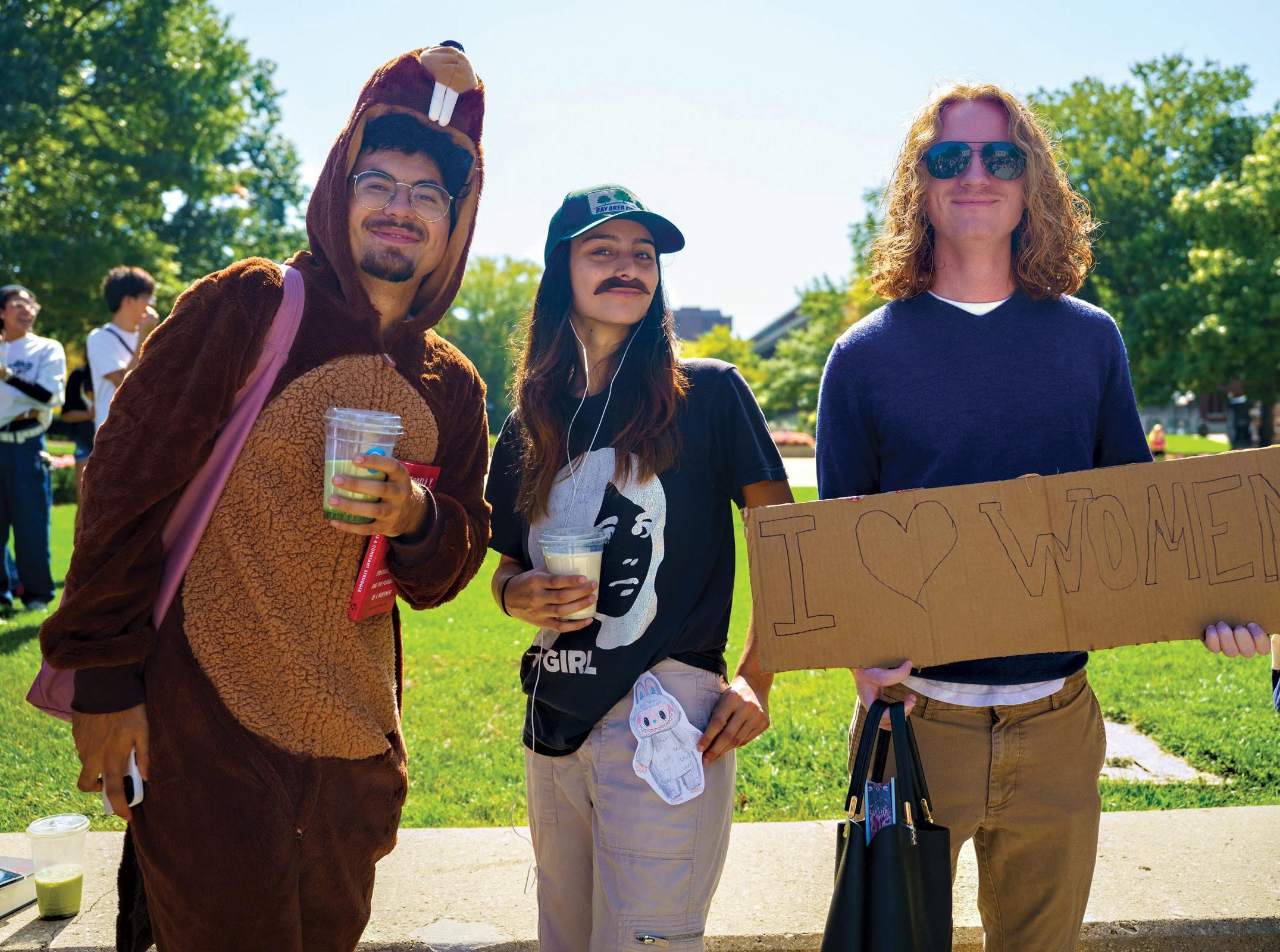
About 150 University of Michigan students gathered Saturday afternoon on Ingalls Mall to witness the Performative Men Contest organized on social media by LSA freshmen Nimra Shahab and Sadie Malik. The contest was inspired by the ‘performative male’ internet archetype and pulled in approximately 20 contestants dressed in clothing items including baggy denim, oversized flannels and tote bags. The ‘performative male’ archetype began on TikTok and other social media platforms, and describes men who purposefully engage in actions designed to cater to the female gaze in order to attract romantic attention from progressive women. This includes reading feminist literature, drinking matcha, listening to artists like Clairo and carrying Labubus. Previous ‘performative male’ contests were held in cities including San Francisco and New York City.
LSA freshman Holly Bowen won the contest through a vote of applause, wearing jean shorts and an oversized jacket, accompanied by a hand-painted Noah Kahan tote bag filled with poetry. A short brown wig and
an eyebrow pencil mustache completed the outfit. In an interview with The Michigan Daily, Bowen said comedy is important to her, and she hoped the humor of engaging in the ‘performative male’ trend as a woman would produce productive dialogue.
“I love a good performance, I love a good bit,” Bowen said. “The comedy is a basis to talk about things, especially when women take the joke and bring it even further, because a lot of the issues are about women and the struggles they go through.”
Contestants presented a range of items to the crowd, including records by female artists, feminist literature books, oat milk matchas and even a cat. Other contestants interacted with the crowd by throwing tampons to cheering fans and performing live music such as “Girls Just Wanna Have Fun” by Cyndi Lauper on acoustic guitar and “From the Start” by Laufey on oboe.
While some male contestants used their time in front of the crowd to criticize menstrual cramps, Bowen instead highlighted how she believes menstruation is normal and should not be vilified. Bowen said she appreciates how the ‘performative male’ movement educates men on women’s issues, even if the trend is mostly a joke.
“Men are honestly educating themselves about things so they can have more to talk about,” Bowen said. “And I don’t care how they get educated — as long as they know more, good for them.”
In an interview with The Daily, Malik said she believes the internet has partially blurred the lines between comedy and important societal issues.
“I’m a lover of the internet, I love a good doom-scroll every now and then,” Malik said. “But I think we also have to take time to reflect that maybe we are perpetuating cycles of making important issues just jokes. And we kind of have to reflect within ourselves, ‘Is that healthy for me? Is that healthy for my community? Is that healthy for the issues I care about?’”
Engineering freshman Maximiliano Rafael Juarez, who entered the contest armed with his tote bag and Labubu keychain, told The Daily he thinks everyone is performative in their own way.
“Usually people put on a performance just doing anything. I mean, most people dress a way to portray a certain aspect of themselves. I have another bag with a bunch of my pins, like performing, showing that, ‘Oh, I like all these things.’”
Local businesses close due to added Ann Arbor expenses
‘The businesses that are here today are the heart of our neighborhood, and their success depends on the ongoing support of the Ann Arbor community.’
“With many business closures, there is also a huge increase in high rises, which I know a lot of students are not pleased with,” Padda said.
with businesses that have been around for many years.
Art & Design and LSA junior Jenac’y Cardwell told The Daily she believes the contestants truly embodied the ‘performative male’ spirit.
“They really performed,” Cardwell said. “They were out here with their Labubus and their matchas and Clairo vinyls, women’s rights. I thought it went really well, you know, I thought it was pretty funny and I had a great time.”
GOVERNMENT
While students were away from campus this summer, Ann Arbor saw the closures of recognizable local businesses as rising rents, post-pandemic expenses and shifting consumer patterns pushed many owners to shut their doors.
Downtown restaurants including Red Hawk Bar & Grill, Tea Ninja and Samba Bowls were among those to close this summer. Kilwins, the popular ice cream and fudge shop on Main Street, and Downtown Home & Garden, a century-old gardening store, have announced their closures at the end of the year.
In an interview with The Michigan Daily, LSA senior Manruchi Padda said along with openings of fast food chains like Raising Cane’s, she feels disappointed about the recent closures and emphasized the increased rent prices due to high rise developments in Ann Arbor.
“Every year you see a new high rise being made and it is tiring; they keep increasing the prices and it is not affordable. You are paying major city costs to live in Ann Arbor.”
In an interview with The Daily, Ashley Schafer, executive director of the Main Street Area Association, said high rents and increasing foot traffic since the COVID pandemic are straining businesses already stretched thin by pandemic losses.
“Although we have reached our pre-COVID numbers, the foot traffic and pattern has changed,” Schafer said. “We’re not seeing as much from 8 A.M. to 6 P.M., but more from 6 P.M. to midnight Thursday through Sunday. You have to look at businesses and see if they are shifting their hours to meet those changing traffic patterns.”
Schafer said business closers will alter the city itself and its demographics, especially
“It will change Ann Arbor slightly,” Schafer said. “The demographic might change as far as age because some of these businesses have been around for 40-plus years.”
Kelly Vore, owner of Downtown Home & Garden, said the pandemic left damage that never fully healed.
“The fact of the matter is, if you ask any small business owner, and even large business owners, they’ll say ‘if COVID was an earthquake then we are still having reverb,’” Vore said.
“Finding a rhythm is a really huge part of your predictions and plans. Since COVID, it has been very difficult to find a predictable rhythm.”
Still, Vore said she has been most proud of community relationships she created through her time at Downtown Home & Garden. She emphasized the support she has received since announcing the closure of her store and believes Ann Arbor felt the impact. CONTINUED AT MICHIGANDAILY.COM
Many of the contestants appealed to the crowd by speaking about the inaccessibility of menstrual products. Malik said by hosting the contest as a way to poke fun at the trend, she hopes the event was able to raise awareness about these issues to a larger male audience.
“You gotta find a way to push the message,” Malik said. “It ends up as something that people understand and it really permeates (through) them. I’m glad we got a satire out of a satire, I think that drives the true message home, which is, like, these are real issues that need to be taught.”
Senate candidate Abdul El-Sayed meets with UMich students
‘I know I look different, I sound different, my name is definitely different — but maybe we need a little bit more difference.’
University of Michigan alum Abdul El-Sayed, a progressive candidate in the Democratic primary for Michigan’s upcoming Senate election, came to the Michigan Union Thursday afternoon to hold a town hall with students.
The event was co-hosted by the University’s chapter of Students for Abdul and the College Democrats at the University of Michigan. El-Sayed, who previously served as the director of Wayne County’s Department of Health, Human and Veteran Services and co-wrote the book “Medicare for All: A Citizen’s Guide,” opened the town hall by rallying the crowd against the influence of money in politics.
“Alright, who here believes in people over profit?” El-Sayed said. “Let me hear you: Government of the people, by the people and for the people, rather than of the corporations, by the corporations, for the corporations.”
Continuing his speech, El-Sayed described his childhood growing up in a family of Egyptian immigrants, the inequalities he witnessed in his life and their impact on his subsequent career in public health. El-Sayed said his Senate run was inspired by his love for the United States.
“People like to show up … and be like, ‘You must hate America,’” El-Sayed said. “Like, no, I love America. I love America because I know exactly what my life might have been like but for America. And at the same time, I love America enough to ask America to be its best.”
El-Sayed believes the United States must address several problems, such as the expansion of raids by U.S. Immigration and Customs Enforcement, that he feels have had a negative effect on the country.
“I happen to have family that live in a place where the government routinely kidnaps people,” El-Sayed said. “They don’t tell you why you’re being kidnapped, they don’t tell you when you’re going to get out, they don’t tell you for what reason —
you’re just disappeared. I don’t want this country to be that.”
El-Sayed said, however, that Trump was not the root of the nation’s troubles. Instead, he blamed the influence of billionaires in U.S. politics and society.
“Trump is not, himself, the disease of our politics,” El-Sayed said. “Donald Trump is just the worst symptom of the disease of our politics. The disease is a system that allows huge corporations, billionaires, would-be oligarchs to buy access to politicians in ways that leaves them rigging the system against us.”
El-Sayed previously ran in the 2018 Democratic primary for the Michigan gubernatorial race. Although he lost the race to current Gov. Gretchen Whitmer, he said his platform was more relevant than ever.
“When I ran back in 2018, we were crystal clear about what the problem was and about how we were going to solve it,” El-Sayed said. “Eight years on, things have just gotten worse. People are finding life less affordable.” CONTINUED AT MICHIGANDAILY.COM
Ananya Kedia/DAILY
LSA senior Christian Loza, Rackham student Anika Misra and LSA freshman Jonah Driy participate in the ‘Performative Men’ Contest at Ingalls Mall Saturday afternoon.
GLENN HEDIN Daily Staff Reporter
Ava Farah /DAILY
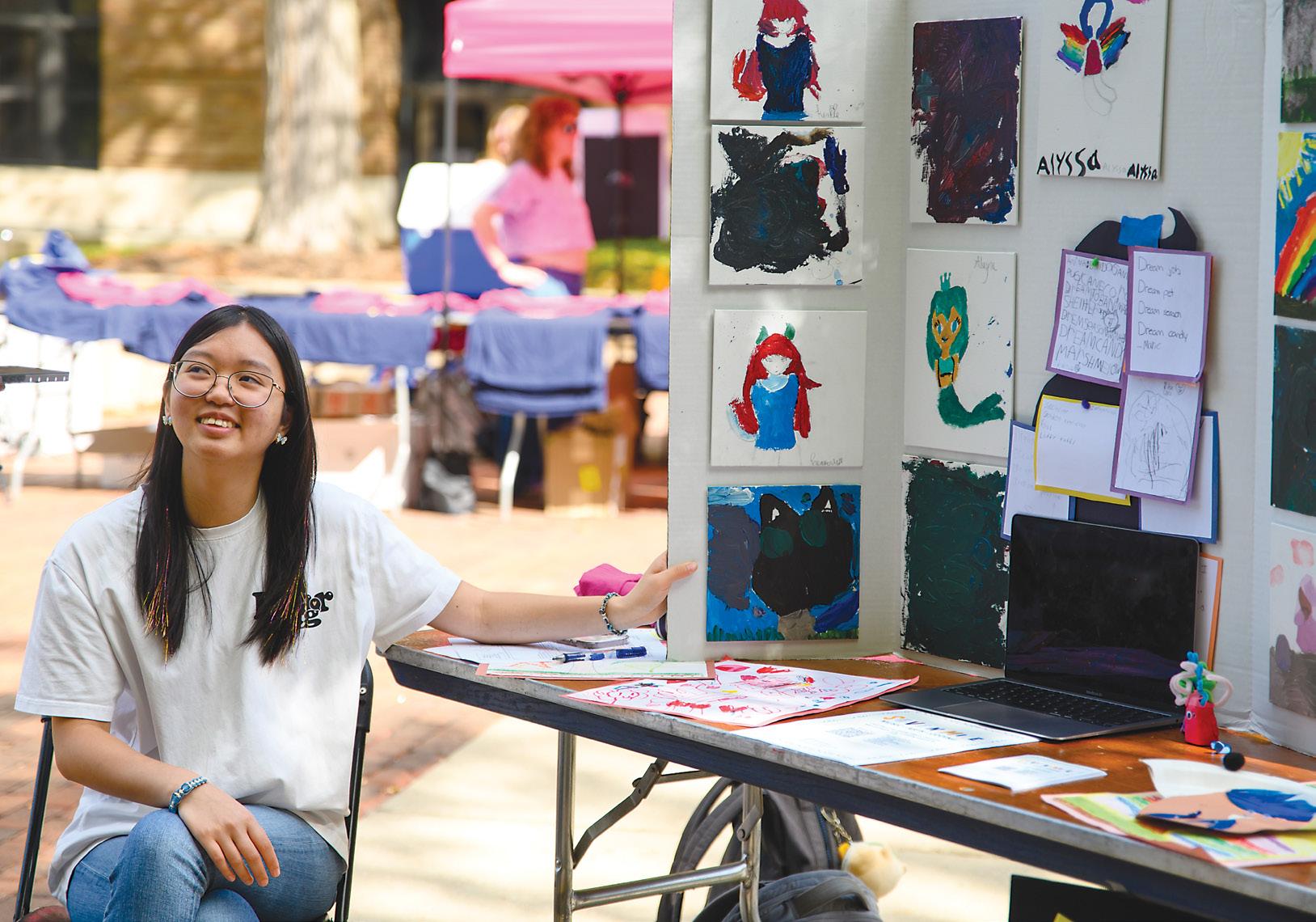
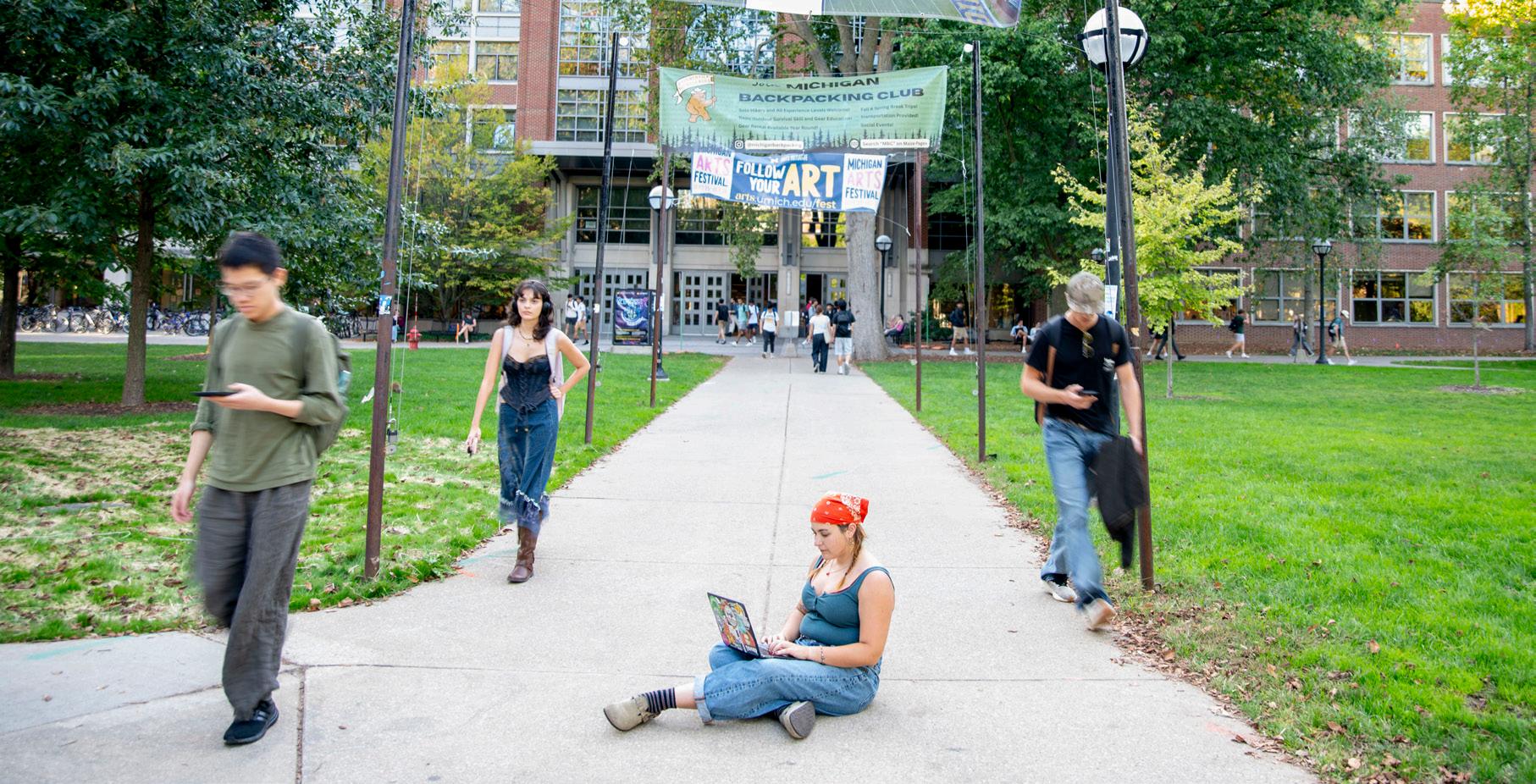
Sophomore Lauren Chi, member of Seven Mile, talks to prospective members at the Student Arts Org Fair in the Diag Friday afternoon.
PHOTO
EMMA SPRING Daily News Editor
MADDYN SHAPIRO Daily Staff Reporter
As the clock nears 10 p.m., the already-compact audience has dwindled down to fewer than 20 people. The 12th performer of the night, Chapman Grace, makes her way onto the stage carrying a sleek white electric guitar, her dangling gold earrings shining in the bluepurple light. This isn’t her first open mic. She plugs in her guitar and addresses the sparse crowd with the same comfortable familiarity of the many musicians that performed before her. When she starts to play, the room’s stellar acoustics cradle the hazy, enchanting sound so dreamily you feel like you are inside of her guitar. Her hands leap across the fretboard, producing sounds I didn’t even know were possible — sounds as cathartic as stepping into a warm ocean. For such a beautiful performance, the size of the audience feels disgracefully small.
The Ark hosts these Open Stages relatively frequently, with four more currently planned through November. They’re free for students to attend, only a 10-minute walk from Central Campus and bursting at the seams with talent. Of the 12 performers I saw, each and every one of them played their instruments with a captivating level of skill. The two hours of music that make up each Open Stage are fueled by the musicians’ love of the craft, nothing more. They aren’t getting paid — in fact, virtually everyone who works there is a volunteer, from the emcees to the people behind the concession stand. These nights are powered by passion, and you can tell just from listening.
The Ark’s Open Stage overflows with talent
At the beginning of each show, every performer writes their name on a ticket, which is then drawn from a hat by the host. On Tuesday, Sept. 16, this host was Steve Johgart, a retiree who spends his free time volunteering at The Ark’s Open Stages. Only the first six performers are chosen at 7:55 p.m — the second half of the roster is picked out of the hat at 8:30 p.m.. This happens so that the artists who don’t get chosen to start off the night don’t leave right away, staying for at least the first half hour. Artists also receive an automatic slot on the list if they bring five non-performing
friends to fill some seats. Even so, the intimate listening room usually ends up fairly sparse.
Despite the meager audience, musicians keep coming back. Everyone listens carefully to each other’s sets and claps enthusiastically as the artists find their way back to their seats. For Johgart, community and the experience itself are the true values of these events.
“There are people that come who don’t care about performing for money or at clubs. They just like to come out and play a couple of songs,” said Johgart. “Artists love to come play here because it’s a welcoming audience, a
welcoming crowd. It’s just a great atmosphere.”
Even with all of the empty seats, Johgart’s words ring true. The feeling in the listening room is a vibrant one, and the artists excitedly talk to one another about their music. The Ark, established as a nonprofit since 1965, is one of the top listening rooms in the country, hosting over 300 shows annually. Big names such as Nanci Griffith and The Milk Carton Kids have played there. It’s exciting to share a stage with so much history and fame, but that’s not the only thing that makes people keep coming back.
“It gives new people a chance to experience being up on stage for the first time,” Joghart said, “…being up on stage at The Ark is a thrill for a lot of people. … It gives people who aren’t big names and don’t have a lot of opportunities to play other places a chance, but there’s a lot of reasons … giving people a chance to practice new songs, giving people a chance to play and get people to come out to their gigs, or to come up on Band Camp or YouTube or somewhere, just promoting, get their careers going.”
Many of the artists are beginners, hoping to get their
music out there and secure a few new listeners. And they aren’t reaching too far. The Open Stage does have success stories, like Misty Lyn or Michelle Held. It’s about giving these smaller artists a chance to practice, to get their feet off the ground — but, most of all, it’s about the music. “It basically gives people a start, in whatever way they need a start, and that can be from different points in their early careers, or non-careers” Joghart said. “There are people, as I said, people who come out and they just want to play a couple of songs. They just like doing it.”
‘My Life with the Walter Boys’ and the death of my sanity
I don’t know what I was thinking when I opened Netflix and willingly typed “My Life with the Walter Boys” into the search bar. After sitting through all ten episodes of needless drama in season one, I didn’t think I would return for round two. But I’m a glutton for punishment and needed to know what happened next, so I came crawling back.
brother’s wedding, Alex tells Jackie he loves her, but she doesn’t say it back. Then, upon discovering that Cole fixed a teacup belonging to her deceased sister — previously broken by one of the Walter siblings — Jackie and Cole kiss. Now having cheated on her boyfriend with his older brother, Jackie flees, hopping on a plane and flying back to New York to live with her uncle.
place. Flawed protagonists may make for good TV, but reheating the same conflict with different garnishes doesn’t make the flavor any better.
“My Life with the Walter Boys” season one is the kind of turn-your-brain-off show that you can watch with friends and a bottle of cheap wine, pointing and laughing at the events unfolding onscreen. In contrast, this season involved a lot less laughter and a lot more screaming into my pillow. And I didn’t have any wine. The series follows Jackie Howard (Nikki Rodriguez, “On My Block”), a Manhattan teenager who moves to rural Colorado after her family dies in a tragic accident. Jackie is taken in by Katherine Walter (Sarah Rafferty, “Suits”), her mother’s longtime best friend, and her family, which consists of ten sons and one daughter. As Jackie navigates the difficulties of adolescence and the grief of losing her family, she simultaneously struggles with her feelings for two of the Walter brothers: Cole (Noah LaLonde, “Dear Camp ’86”) and Alex (Ashby Gentry, “Are You Afraid of the Dark?”). Jackie initially starts a relationship with Alex, but her feelings for Cole continue to simmer.
Season one ends on a massive cliffhanger: Drunk at his
Unfortunately, leaving is the last sound decision Jackie makes in this series. Within the first ten minutes of season two, she’s already back in Colorado, having been convinced by Katherine to return for the upcoming school year. Her relationship with Alex is (naturally) strained, and the pair officially breaks up. But rather than turning her attention to where her heart truly lies, Jackie locks herself in the same love triangle. Despite her obvious feelings for Cole, she gets back with Alex. I was consistently baffled by her ability to make the worst of any given situation.
Throughout the entire season, the plot is trapped in the same vicious cycle. Jackie makes an awful decision that, in real life, would be grounds for going completely no-contact. The other person — Cole, her best friend Grace (Ellie O’Brien, “Alert: Missing Persons Unit”) or whoever else her latest victim might be — gets upset and expresses their grievances to her. Then, instead of fixing the original problem, Jackie replies with a small act of kindness that she assumes will make everything better — before immediately repeating the same terrible behavior that landed her in this situation in the first
Unfortunately, the problems don’t just end with Jackie. Some kind of metaphorical black mold has infested the Walter ranch and made all members’ choices equally insane. No, Nathan (Corey Fogelmanis, “Girl Meets World”), cheating on your boyfriend in public is not the power move you thought it was. No, Alex, you don’t have the right to be jealous of your girl best friend seeing another guy while you’ve been pining over Jackie for the past two years. By the end of the season, my favorite characters were the ones with the least amount of screen time simply because they didn’t have the chance to make the same terrible decisions the others did. I can enjoy a show with characters that aren’t the pinnacle of rationality — I honestly prefer them — but when these decisions are made for no reason other than stirring the pot, they quickly become frustrating. That all said, there are still some genuinely emotional moments sprinkled throughout the season, as Jackie continues struggling to cope with the loss of her family from the first season. Rodriguez delivers a genuine, heartfelt performance, and a few scenes even brought tears to my eyes. Sadly, these are spliced between some of the most useless drama I’ve ever seen — even for a flock of hormonal high schoolers — which waters down the impact of these otherwise powerful scenes.
AUDREY HOLLENBAUGH
Daily Arts Writer
Cuphead gone corporate: The slow sterilization of modern rubberhose
I didn’t realize how often I had seen a chunky piece of pizza walking across a blank road to nowhere with Mickey Mouse gloves and big ol’ boots, but once I did, I could never unsee it. Every so often, usually while scrolling through Pinterest or Instagram, a sentient object with buggy eyes and a cheeky smile under a plasticine Canva font would greet me, usually with the intention of selling me something or telling me to go somewhere where other people could sell me something. The designs create an uneasy feeling for me; it’s unclear whether they belong in a pandemic teen’s bedroom or an overpriced millennial bistro. A quick Google search (and a couple of Reddit threads) brought me to a strange term: “modern rubberhose”.
TIFF 2025:
‘Little Lorraine’ starts a fight it can’t finish
MINA TOBYA Daily Arts Writer
Note: This review contains spoilers for “Little Lorraine.”
Nova Scotia, 1986. A town full of Irish and Scottish immigrants completely dependent on the only major industry in their forgotten corner of the world: back-breaking coal mining. Abandoned by their government with families to feed, the only thing to rely on is their work.
And then everything blows up.
roaring flame. Screams blend with high-adrenaline sound mixing as the tense atmosphere on screen suffocates the audience. Before the explosion dies down, it takes one of the miners with it.
It was a painstakingly human art style, as dynamic and lifelike as the controls — and you could tell, much like the shorts that inspired it, the game was made with love. Besides, I’ll never complain at
If you’re like me — someone who’s not embroiled in the history of animation — the phrase “modern rubberhose” sounds like it could refer to a pretentious underground band or a piece of cutting-edge gardening technology. In actuality, it refers to the interpretation of 1930s animation styles in present-day art. In the 1930s, “rubberhose” was the main art style for animation — namely the first mainstream one. Characterized by its loose-limbed, physicsdefying slapstick, the goal of the art style was to allow creative freedom within the constraints of a low budget, especially during the Great Depression. Fleischer Studios was the juggernaut of this era, and their creations remain American cultural icons (do Betty Boop or Popeye ring a bell?). Initially falling out of favor in exchange for more sophisticated longform animation (the post-Disney industry was not kind to this style), rubberhose blossomed back into popularity in the late 2010s after the massive success of video games like Bendy and The Ink Machine and Cuphead, both released in 2017 and directly inspired by Fleischer’s body of work. Now it’s everywhere in the graphic design community — and I can’t say that’s ideal. I may not be an animation expert, but I do love video games. I was a huge fan of the resurgence of the charming vignette-laden art style back when Cuphead first took the gaming scene by storm.
the sight of artists breathing new life into a long-dormant art style; that is, until the new life goes stale. My obvious grievance is that its overuse makes it mundane in comparison to when it first made its return to the mainstream scene. But that can be said for any stylistic trend. So what makes this particularly unappealing only a few years after its resurgence? The answer is simple: It misses the point. These new images are static snapshots that cannot replicate the fluidity that makes the style successful in animation, no matter how hard they try. The eyes of the characters no longer dazzle with excitement — they only possess a soulless, thousand-yard stare, transforming the cute character into a bizarre corporate entity. Unlike the distinct attire of the characters of yore, these little guys exclusively wear white gloves and boots, showing a severe lack of creativity when it
comes to giving them a distinct appearance. As for movement? You can forget it. No motion lines or creative poses here. The most they can muster is a halfhearted march across a beige No Man’s Land. Overall, without the animation to liven up the characters, these drawings can only ride nostalgic coattails rather than expand on a truly innovative idea. That lack of innovation is detrimental to a style like this. Rubberhose was born in an era of minimal resources and necessary simplicity. The animators had to have memorable storylines and a punchy sense of humor to make up for the immovable backgrounds and (usually) the lack of color paint. Without creative ingenuity, rubberhose wouldn’t exist! This is a crucial aspect of the history of rubberhose that the two video games are determined to honor.
CONTINUED AT MICHIGANDAILY.COM
The coal mine goes up in flames, leaving Jimmy (Stephen Amell, “Arrow”) and his friends with nowhere to turn except Jimmy’s shady Uncle Huey (Stephen McHattie, “Pontypool”), who comes knocking with an offer to work on his lobster boat. Against their better judgment, they take the job. When Huey ropes them into an illegal drug-smuggling operation, the only ones left to blame are themselves.
“Little Lorraine” has no fat in the first act. It doesn’t waste a moment in building empathy for the film’s characters by showing the love and sacrifice they give to those around them. We watch Jimmy put his overalls on at the crack of dawn, laugh with his buddies at a mine meeting and take the shaky camera with us down into the pitch-dark underground. The cinematography augments the constant unease that follows these characters; it’s unpolished because they are, it doesn’t get to stop for even a moment because they don’t either. Orange lamplight baths the scene, foreshadowing an abrupt shift to
It isn’t the loud, world-shattering moments that make this movie compelling, but the quiet ones where everything that needs to be said is done so with a look. At his coworkers’ funeral, Jimmy seems to share his grief with Emma (Auden Thornton, “Beauty Mark”), his wife, through charged eye contact and a sunken expression. She can practically read his mind, and it’s through her understanding of him that the audience discovers Jimmy’s softer side. Emma is also the reason Jimmy takes the job with Huey in the first place. You want to hate her for convincing Jimmy to make this decision, but you can’t. You can see it in her eyes that she truly trusts Huey to bring her husband back to her at the end of every day. Her desperation is palpable in Thornton’s performance, which makes it easy to see how she could miss the venom in Huey’s offer. It’s hard to fault her for having faith. With this opening, Debut Director Andy Hines sets up a compelling first-act narrative. Unfortunately, the film more or less loses its tight grip on this grounded concept not too long after. These human moments clash against the film’s attempt to raise the stakes in later acts. Once the drug operation is revealed, the film prioritizes confrontations with Huey and adrenaline-rushing showdowns with the cartel. CONTINUED AT
ISABELLA CASAGRANDA Daily Arts Writer
Rumaisa Wajahath/DAILY
ZHANE
Co-Editors
EDITORIAL BOARD MEMBERS
Long distance: A week
Idealistic year-round schools won’t cure Michigan’s failing test scores
Close the SUV loophole
Selena Zou/DAILY
In the U.S. today, there are no cultural symbols of strength and national pride like the pickup truck and the SUV. Each year, Americans buy more and more of these cars, which now dominate the domestic car market. Following this trend, the “Big Three” legacy American automobile manufacturers have cut nearly all of their sedans and other passenger cars from production to focus almost entirely on these categories. However, there is more at play here than the desires of car buyers. Automobile manufacturers are able to exploit gaps in fuel economy regulations that have made the production of larger and more inefficient vehicles more profitable. This has rapidly boosted the popularity of SUVs and trucks in the last four decades, but this also brings harmful side effects. To protect our personal health and prosperity, as well as that of the planet, it is vital that we relax our reliance on oversized automobiles and move to impose tighter restrictions on the fuel economy and size of American cars. During the mid-20th century, as the automobile rapidly evolved from a luxury good into a necessity for every American household, the roadways looked much different than they do now. Most Americans drove lower-slung station wagons, sedans and coupes — like the inexpensive and lasting Volkswagen Beetle, or more sporty and exciting, but still practical, Chevrolet Impala. At the same time, trucks and pickup trucks were present nearly exclusively in commercial or agricultural settings and the large, modern SUV as we know it today barely even existed yet.
American roadways were forever changed in the 1970s when the government implemented a new set of fuel efficiency regulations in response to rapidly-inflating oil prices. To keep gas prices low, the rules required automobiles sold in America to have significantly better gas mileage, spawning an era of compact, lightweight and practical cars like the Ford Escort. However, because the pickup held a relatively niche market share and
what we now know as the SUV barely existed, the government wanted to alleviate pressure from the farmers and business owners who needed these larger vehicles. Under the new regulations, larger vehicles — from SUVs to pickup trucks and anything that fell within a basic definition — was labelled as a “light truck,” and faced significantly more lenient regulations.
Facing higher development and production costs and tighter profit margins brought by these new regulations, automobile manufacturers soon began producing more of the larger models that fell within the definition of light truck. Due to the broader nature of this categorization, manufacturers could sell most of their larger models — not just pickups — within this grouping, and not have to worry about them passing tighter fuel economy standards. This legal exploit forms the basis of what critics label the “SUV Loophole.” Manufacturers steadily began putting more emphasis on the production of larger vehicles that could fit this definition. By the 1980s, models like the Jeep Cherokee and Chevrolet Suburban were selling more and more and are now some of the most popular in the country.
Though the SUV loophole incentivized manufacturers to pivot towards selling larger automobiles, profiting off of their sale has required them to encourage us to buy as many as possible. Car commercials are some of the most ubiquitous advertisements you see on TV, while browsing the internet or plastered on a billboard. Most brands portray their larger SUVs and crossovers as rugged, sporty vehicles built for overland trips across the great American west, while emphasizing the critical role of the pickup truck in the strong, independent, blue-collar life of working Americans. The pickup truck has become embedded in popular culture, often a lyrical staple of popular country songs. On top of this, a strong overall emphasis on appealing cultural values like self-dependence, personal freedom and individual strength drive more and more consumers every year towards larger models in the lineup of each brand.
To many Americans, the privi-
lege of having a full-size pickup or large SUV is very fulfilling, even if they don’t plan to use it for more than commuting, traveling and running errands. Chasing the models with more horsepower, towing or cargo capacity is very exciting for many, as it represents an enthusiasm for making free consumer choices. The idea of downsizing these vehicles or putting harsher regulations on them could be very suffocating to a bigger-is-better mindset among American car buyers. Though harsher regulations would likely decrease the availability of pickup trucks and other large cars, and permanently change the American car market, it is a step we must take towards a healthier, safer and more prosperous future.
Every year, automotive manufacturers — especially America’s Ford, GM and Stellantis — churn out more and more large automobiles that continue to hurt our country every year. For consumers, the lower fuel efficiency means owners pay more for gas in addition to higher upfront costs compared to sedans and other smaller categories. Besides price tags, accident rates are also rising, in part from the growing average size of our cars. Particularly for SUVs, crossovers and pickups, taller height means pedestrians are often pulled under a car in accidents, while higher weight means they hit harder during all accidents, raising the probability of injuries or fatality.
Another problem is more straightforward — larger automobiles release significantly more carbon and pollutants than other cars do. Pickup trucks and large SUVs — which the government categorizes as light trucks — release 41.8% and 57.8% more carbon dioxide per year than small cars, respectively. These vehicles continue to sell more and more every year and now hold the majority of market share in the United States while still falling into lower emissions standards. Raising fuel economy standards for light trucks is a necessity in lowering our carbon emissions, and would push consumers towards EVs, hybrids, light passenger vehicles and more efficient models of SUVs and trucks.
As September rolls around, K-12 schools welcome students back to the classroom in Michigan and across the country. Teachers get their rosters sorted and dust off their icebreakers. Students tame their nerves and prepare fun facts about themselves for said icebreakers. The start of each school year brings teachers several classic conundrums: planning new units for the months to come, class sizes bursting at the seams and certain students faring worse than others in the “summer slide”.
To best help students, educators must know their students’ strengths and what they can do to further their growth. Unfortunately, Michigan consistently ranks low in student test scores: 31 states scored higher in 2024 reading tests. Many states have turned to year-round schooling to decrease heightened struggles with student test scores lagging. The system proposes to bolster test scores by reducing summer learning loss and make student access to aid resources more consistent.
However, year-round schooling is not a sustainable solution to the issues Michigan is facing. Structural changes on the calendar level paint the brush of reform too broadly — low scores require more distinct attention. Our state must focus on clearer-cut, specific interventions to help address inequities in student achievement, not sweeping measures that fail to meet students where they are. Students need affordable, dependable support programs that do not further disrupt their expectations for schooling.
Year-round schooling, or a balanced calendar, spreads the traditional 180 required days of schooling out with larger interspersed breaks. Students in balanced calendar schools typically have 30 days of summer vacation and 45-day blocks of school split up by 15-day breaks. The West Michigan Policy Forum argues in favor of this split time. The more spreadout schedule allows teachers to reduce burnout with smaller units of time to plan for, and connects low-income students with more reliable access to resources that disappear during the summer break.
One proven affordance for year-round schedules is that a school’s capacity to accommodate its students increases 20-33% compared to the traditional schedule. When following a multi-track system of the balanced calendar, schools can stagger student attendance schedules to make full use of classrooms year-round. This may be admirable, but accommodation factors alone do not dictate success. The balanced schedule is able to attack inflated enrollment rates with the teacher shortage, but it fails to significantly rectify learning disparities between income levels.
Socioeconomic status remains a top predictor of achievement disparities within diverse school settings. One University of Michigan study found that
lower-income students in Michigan face a much greater probability than higher-income students of finding themselves in class sizes larger than 40. Additionally, higher-income students in larger class sizes rarely faced adverse conditions as a result.
Higher income students tend to have greater access to out-of-school resources such as tutoring and enrichment opportunities to supplement their time spent in overcrowded classes. The fact that large class sizes affect low income students more than high income students needs attention, and in conversation with closing resource gaps between these student groups.
Despite the ideals and success that year-round schools theoretically promote, like reducing teacher burnout and decreasing summer learning loss, most studies are inconclusive on whether the model creates higher test scores than the traditional model. Test scores overshadow all when it comes to which policies local school boards allow to stay within education, so many districts bail on the balanced calendar before they can see how it works long-term. Student success on standardized tests is the most used indicator of tracking students, yet a multitude of nonacademic factors also predict achievement levels.
Family wealth significantly predicts a child’s academic success at all points of a child’s schooling. Whether students attend the traditional school model or the balanced calendar model, however, does not consistently predict academic success. Therefore, the greater issue lies behind closing wealth disparities in student achievement in more specific and consistent ways.
Deviating from the traditional school calendar often faces significant backlash. Midwestern states already push back on allowance of schools to start earlier than Labor Day, let alone schools revamping the traditional calendar. Michigan and Minnesota require school districts to apply for waivers to start before Labor Day, and the tourism industry lobbies for schools to start after the holiday.
Michigan’s issues surrounding education are too longstanding for more whiplash in the larger structure of our schools. Whiplash already causes strife within policy, where Michigan attempted seven different school accountability systems within 10 years. Focusing on piloting a new quick fix rather than addressing perennial struggles inf-
lames school issues because if quick fixes fail to help students, kids flounder rather than the politicians who put those in place. In the last decade, Michigan injected $2.5 billion into the education system, yet still remains stagnant in critically low student reading and math scores. The increased funds are long overdue, as Michigan remains in the bottom 10 states for weighted per-pupil funding for low-income students. Rather than focusing on time spent out of school, focusing on what students accomplish during that time has proven more effective in closing socioeconomic achievement gaps. Many schools and families lack the budget or resources for summer school, so home-based remediation tactics often have greater success with low-income students. For example, the READS for Summer Learning program sends students books over the summer that match their interests, also providing comprehension checks that the program reminds children to submit. Texting families of elementary students reading tips and resources over the summer was also found to provide positive effects on scores. Universal, cost-effective and home-based interventions for students during the summer are necessary to address inequities in schooling. Summer learning loss isn’t the issue; rather, ineffective teaching for students going into summer is the issue. A 2008 study found that students who received direct lessons leading up to summer on comprehension skills and oral fluency practice grew much more over summer than students who simply received books. Michigan must hone in on the true issues of struggling scores through consistency and attention to struggling student populations. Year-round schools may appear as a remedy to plummeting test scores, but adjusting the balance of weeks spent in school may hurt our already hurting students rather than help them. Michigan’s gubernatorial race looms ahead in 2026. All eyes are on candidates as they discuss their plans to turn the state around. Elected officials determine how funds flow into different school initiatives, and for kids to succeed, these initiatives must be the most effective interventions. Michigan students deserve firm, steadfast support in their existing schooling rather than a constantly changing measuring stick or the next partisan silver bullet.
WILLEM DEGOOD Opinion Analyst
MEREDITH KNIGHT Opinion Columnist
JACK KAPCAR Opinion Cartoonist Hailey
The art of the American monopoly
ANNA SPERRY Opinions Analyst
After a long week of classes, meetings and attempts to complete an unending list of tasks, I try to wind down by going out to dinner with my friends. Sometimes at the bottom of the bill, there is a small surcharge for checking out with a credit card. While these fees are relatively small — usually about 3% of the bill — they demonstrate how corporations exploit their monopolistic power in small but impactful ways throughout our daily lives. The transaction fees forced by credit card companies ultimately harm the consumer, and because there are so few companies in the industry, credit card companies such as Visa maintain monopolies over competitors, forcing users to pay their fees. They drive up prices and leave consumers with nowhere to turn. Companies from other industries implement similar strategic business decisions, forcing consumers to face more monopolies and oligopolies. For example, Amazon sells in all 15 product categories at 14% cheaper than most other competitors. The efficiency that comes with Amazon and businesses alike comes at a cost; mom-and-pop stores close because they cannot out-sell large corporations that produce goods at a fraction of the cost and time. Eventually, corporations will replace many local businesses to the point that they have near-complete control of the market. Amazon establishes credibility with customers through its popularity, efficiency and reliability. This creates an
e-commerce market that other companies cannot enter as easily.
Amazon’s low prices and product selection give way to its dominance in the e-commerce market and their advertisements always seem to find their way to the top of product recommendations, leaving little room for small businesses to compete. Customers buy low-quality goods at a low cost, forcing small businesses out of the market and decreasing the number of products available to consumers.
Similarly, Microsoft is the dominant provider for personal computers and software, pushing its products onto consumers and leaving little room for competition. After establishing its popularity among consumers, Microsoft added other features — like Word, Excel and Internet Explorer — that contributed to its market dominance. But Microsoft was too ambitious: In 2001, the United States District Court for the District of Columbia found Microsoft guilty under the Sherman Act for illegally maintaining a monopoly.
A company can become a monopoly, or near-monopoly, through buyouts. Mergers are inorganic in that the companies don’t grow from innovation or providing customers more value, at least not initially. Instead, they grow from purchasing another company.
Mergers and acquisitions occur frequently. Globally, more than $2 trillion worth of deals were signed between Jan. 1, 2025, and June 27, 2025. President Donald Trump appeared to oppose large mergers when he nominated government officials, such as Gail Slater for assistant attorney general for the Department of Justice’s Antitrust Division and Andrew Ferguson for chairman of the Federal Trade
Commission, both of whom were known for their support of antitrust enforcement.
But this is not how things have played out since Trump’s term started.
In June, Slater and Ferguson failed to challenge three merger deals worth $63 billion. These deals include the candy giant Mars’s purchase of Kellanova, the maker of Pringles, and chocolate company Ferrero’s purchase of WK Kellogg, a mega-producer of cereal, as well as Frosted Flakes and Froot Loops.
That is not to say that every merger is successful. Kraft and Heinz, two consumer packaged goods companies, infamously joined forces in 2015; the combined entity was renamed Kraft Heinz. At the time, Forbes expected it to be the third-largest food company in the U.S., but a decade later, its stock fell more than 60%. Now, the two companies plan to separate.
Ultimately, these deals harm consumers. As companies become mega-conglomerates, they gain control of their market and can leverage their interests without much fear of protest because consumers have very few alternatives. They form economies of scale that lower their cost of production and increase their rate of production. They also combine assets to create a richer, more powerful company. Monopolies and oligopolies that focus on revenue synergies increase the price and mass-produce their products, increasing their profit margins. For example, within a month of merging with Time Warner, AT&T raised the price of the former DirecTV Now by $5 per month.
CONTINUED AT MICHIGANDAILY.COM
Fired up and ready for Ro
JACK VERRILL Opinion Analyst
Growing up in left-wing suburbia, there was nobody more popular than former President Barack Obama. Finding the “next Obama” was the unofficial mission of moms in my neighborhood. Even now, liberals around the country long for the days of “Yes We Can” optimism — when politics was civil and controversies centered around the color of the president’s suit. But underneath the veneer of Obama-era institutionalism was an ideology that materially failed, leading to today’s right-wing dominance.
As Obama fades into the background, Democrats are in need of new leadership. Beyond the usual favorites — Govs. Whitmer, Newsome and Shapiro — is a lesser-known congressman from California, who, despite representing the nation’s wealthiest district, is pushing an economic agenda decidedly different from mainstream Democrats. Rep. Ro Khanna is ready to look beyond Obama, and toward a Democratic party with fresh ideas and renewed values.
Consider economics: The Obama administration’s economic program was largely neoliberal, a mix of Clinton-era globalism paired with expanded social programs. The problem is that it didn’t work. Under Obama, the middle class failed to recover from the 2008 financial crisis, and was in decline by the end of his term. From 2008 to 2016, real wages remained stagnant and over 300,000 manufacturing jobs were lost.
More importantly, there was never a cohesive vision for Obamanomics. Sure, it favored marginally higher tax rates for the rich, but did nothing to reverse the decades-long hallowing out of America’s middle class. Fast forward to 2024, and former Vice President Kamala Harris was running on an eerily similar idea
of an “opportunity economy.”
“Obamanomics” was poorly defined and terribly contagious.
Contrast this with Khanna. Advocating for new economic patriotism, Khanna unapologetically vows to reindustrialize America. Working Americans, he argues, were left behind by globalization. Moreover, instead of bailing out massive banks, Khanna wants taxpayer dollars invested in companies that help us compete in the 21st century, chip manufacturing and artificial intelligence being foremost on that list. Combine new economic patriotism with novel monetary frameworks such as cryptocurrency, and what emerges is an economic program that departs from neoliberal slop.
But it’s not just economics.
Khanna embraces new thinking on a host of other issues. Notably, he is one of the few Democrats to admit the party no longer stands against war. He correctly pointed out that while Democratic leaders did not start any recent largescale conflicts, they were happy to go along with interventions in Libya, Somalia and Yemen, to name a few. And this summer, when the U.S. was on the brink of an all-out war with Iran, Obama and other Democratic leaders were silent. Khanna, on the other hand, was leading the charge against another Middle East intervention.
Beyond the uninspiring economics and pointless wars, Obama failed to address America’s declining trust in institutions.
Much of this is attributed to failures that occurred outside the White House — think regulatory capture and general ineptitude — but Obama is not wholly innocent. His administration did not bring to justice those responsible for economic collapse in 2008, but rigorously pursued Edward Snowden for leaking documents exposing illegal government surveillance. It’s no surprise that voters found it difficult to reconcile these priorities.
State Street study sesh
A living people, a fossilized constitution
SETH GABRIELSON Opinion Analyst
At present, the U.S. Constitution is the oldest written constitution still in force and, at the same time, one of the most difficult to amend or improve. There have only been 27 amendments since the Constitution was ratified in 1788.
II, was deliberately designed to adapt while preserving democratic guardrails. In Canada and India, too, constitutional change has been a normal, recurring feature of politics rather than an impossible mountain to climb. Stability does not require rigidity, and flexibility has often been democracy’s best safeguard.
Khanna, as you probably guessed, is on the side of transparency. His Espionage Act Reform Act protects whistleblowers, and his Internet Bill of Rights establishes real guardrails on the U.S. Intelligence Community’s surveillance practices. Today, you can find him authoring legislation to release the Epstein files and holding press conferences with survivors. Seventy percent of Americans are on his side.
It is valid to ask why Khanna has to be the anti-Obama. The president left office nine years ago, and is playing a less-vocal role in politics. But democratic politicians refuse to move on from Obama. Whether they’re copying his speaking cadence, or continuing his neoliberal economic policies, the overall political project remains the same. The project: Neoliberalism, foreign intervention and institutional trust, is a dying model. Khanna knows this.
It is unclear whether Khanna will emerge at the helm of the party, as he lags behind other Democrats in national recognition. But the ideas he set into motion, from new economic patriotism to the Internet Bill of Rights, are significant in and of themselves. They are signs of life for a party seemingly out of ideas. That’s why Steve Bannon, MAGA’s unofficial political strategist, is trying to recruit Khanna. Not because he’s some sort of closeted Republican, but because he addresses the concerns of President Donald Trump’s voters in a way that threatens the president’s political stronghold over working class America. Bannon’s playing defense. So, while my town is searching for the next Obama, the rest of the country has already moved on. It’s nothing personal. Just that his promises went unfulfilled, and the establishment wing of the party is still pretending otherwise. But this congressman from California has a new way forward if we’re willing to listen. Let’s give him a shot.
Some broadly popular reforms — from overturning Citizens United to guaranteeing equal rights regardless of sex — never make it into the Constitution, no matter how many Americans support them. The American people widely agree that the system is broken and needs to change, but unlike other constitutions, ours provides no reasonable means for evolution. To keep our democracy responsive and legitimate, we need a more accessible way to amend the Constitution — we need to change the way we change.
The American Constitution is deliberately frozen in place. Article V sets a nearly insurmountable bar: Any amendment requires two-thirds approval in both the House of Representatives and the Senate and ratification by threequarters of the states. In practice, this means that just 13 states representing a small minority of Americans can block any change, no matter how widely supported. More than 11,000 amendments have been formally proposed in U.S. history, meaning only 0.2% have made it through this gauntlet. Even amendments like the Equal Rights Amendment, which had widespread support, were unable to pass this high bar.
Other democracies have proven that constitutions can evolve without losing their legitimacy. France, for instance, has cycled through multiple constitutions and amended its current one more than 20 times since 1958, adjusting institutions as society has changed. Germany’s Basic Law, written in the ashes of World War
The cost of this rigidity is not abstract. It shows up in the everyday failures of American governance. We live under rules that almost everyone agrees are outdated, but which no one has the power to change. Gerrymandering continues to warp elections. The Electoral College misfires with alarming regularity. Campaign finance reform is a fantasy. Even basic voting rights — supposedly the bedrock of democracy — are subject to partisan sabotage. We’re stuck because the only body that can propose such changes is the very Congress that benefits from the status quo.
Because amendments are near-impossible, Americans have turned to the courts as a substitute.
For much of the 20th century, that seemed like a workable path:
The Chief Justice Earl Warren Supreme Court expanded civil rights and voting protections through bold reinterpretations of constitutional text. But judicial change is fragile. What one court gives, another can take away.
The Chief Justice John Roberts Supreme Court has dismantled campaign finance limits and gutted the Voting Rights Act, undoing decades of precedent.
None of those outcomes reflected new amendments or broad national consensus — only the views of a handful of unelected justices serving life terms.
This is the paradox of our system.
A Constitution too rigid to be changed by the people is constantly being reshaped by judges. Instead of democracy guiding law, law is bent to the philosophy of whichever justices hold power. And that makes our government
feel less like a reflection of the people’s will, and more like a hostage to chance and timing. Critics will say that this is how it should be. The Constitution was never meant to be easy to change. If majorities could rewrite it on a whim, minority rights would be constantly at risk. The supermajority thresholds in Article V are supposed to protect us from passion, from overreaction, from the tyranny of the moment.
There’s truth in that argument. Constitutional change should be difficult. The problem is that ours isn’t just difficult — it’s paralyzing. It’s one thing to demand broad consensus; it’s another to make reform nearly impossible. No other democracy asks for this much agreement across so many veto points.
It could be said that we don’t need easier amendments at all — that reinterpretation by the courts has already served as a pressure valve. After all, the Constitution means something very different today than it did in 1788, thanks to decades of judicial innovation. But relying on judges as our only vehicle for change carries its own danger. Judges are not elected. They serve for life. And their decisions can swing wildly from one generation to the next, not because the people demanded it, but because a few vacancies opened under a particular president. Even the irony here proves the point: The only way to fix our amendment process is with an amendment. A document designed to evolve has become a document that traps itself. The risk is not that Americans will change the Constitution too often. It’s that we will stop being able to change it at all. And that is exactly why we need a model that allows citizens themselves — not just Congress or the courts — to drive reform when a broad majority of the country agrees it is necessary.
CONTINUED AT MICHIGANDAILY.COM
ERIN COLEMAN Opinion Cartoonist
Michigan in Color is The Michigan Daily’s section by and for People of Color.
In this space, we invite our contributors to be vulnerable and authentic about our experiences and the important issues in our world today.
Our work represents our identities in a way that is both unapologetic and creative. We are a community that reclaims our stories on our own terms.
Roots and Reminders: A Cultural Object Portrait Series
A decade has passed since my family and I moved to the United States, but every night my dreams carry me back to the courtyard of my elementary school. I can still feel the burn of the afternoon sun softened by the cool breeze as I brush aside my neatly combed hair along with my Rose House badge pinned proudly to my uniform.
In my dreams, I watch that badge come loose, and I dive after it desperately, fearing it will be lost in the sand. I speak more Tamil and Malayalam in those dreams than I do in real life, as though my heart still remembers where it belongs.
I began this film and digital photography project to celebrate the unique stories and family traditions of my friends and classmates, captured through the objects that hold their memories. The idea grew out of conversations I was having in Ann Arbor, where I often noticed how everyday items carried deep cultural ties and personal histories. These objects — cherished since childhood, handed down through generations or shared among loved ones — preserve the roots that connect people to who they are and where they come from.
The maamoul press — a traditional tool, often made of wood or plastic, used to shape cookies filled with dates or nuts — serves as a bridge between generations, memories and identities. For U-M alum Reem Killawi, the press her mother carried from Syria 30 years ago holds that connection. Though Reem has been to Syria only once, she’s wrapped in the warmth of its traditions every Eid as she gathers with family to press cookies filled with dates and nuts.
She recalls baking during COVID19 to send care packages to distant siblings, sharing sweet exchanges with professors and fellow Syrians on campus and practicing the quiet persistence needed to carry on familial rituals — just like her mom once did. In each cookie is a reminder of a culture held tenderly.
For U-M alum Nile Andah, the camera hanging in his room is a lens into a lineage of artistry and a reminder of home in Ghana. Once belonging to his grandfather, one of the only Black men at Stanford University as well as the Secretary of Agriculture in Ghana, the camera was carried across the country to capture Ghana’s landscape and rhythms of everyday life. Through this camera, Nile sees his family’s creative legacy, one that reveals West Africa in all its nuance, rather than the flattened narratives often
seen in mainstream media. Each glance reconnects him to his father, to his biannual visits to Ghana and to the vibrant traditions of the Fante people. When his grandfather passed away four years ago, Nile’s own creative interests began to align with that inheritance, as though the camera itself had passed down not just images, but a method of storytelling.
To Candace and Bridgit Jung, a pair of siblings and U-M alumni, their Sanrio plushies are symbols of family love sent across oceans.
Growing up between Taiwan and the U.S., these gifts connected them to a culture where cuteness is not just aesthetic but a language of affection and care. It’s a gentle reminder of their frequent visits to Taiwan, infused with a deep pride in their roots and their communitydriven family values. On campus, which often feels chaotic and individualistic, their plushies provide a sense of grounding.
As Asian culture becomes more mainstream the sisters find strength in embracing who they are — recognizing that what might seem small or whimsical to others is, for them, a thread of continuity. The plushies are not just toys but soft anchors, tying them to a heritage of joy and belonging.
Before LSA senior Solomon Trice could define family, he could feel it in
the rhythms of the drum, the songs sung by his relatives and the music woven through every childhood memory. The dugdugi was his first love, a gift from his mother who, in his noisy wonder, saw not destruction but creative power.
Over time, that drum became a voice, a heritage and a symbol of activism through its explosive sound in times of protest. The dugdugi has a long history in Indian and South Asian culture. With only a twist of the wrist, this little drum creates sound — sounds that carry ritual, celebration and centuries of tradition, the same sounds that filled Solomon’s childhood home. It provokes him to reconsider culture at large: how Hollywood minimizes sitars into psychedelia, how real Indian music holds a depth of heritage that demands to be heard on its own terms. Each beat he strikes is a call to remember, to connect him to the generations before him and to carry forward the music that he was raised by.
CONTINUED AT MICHIGANDAILY.COM
CELINE SHAJI MiC Photographer
Courtesy of Sherin Shaji
Celine Shaji/MiC
Celine Shaji/MiC
Celine Shaji/MiC
Musings from the Korean restaurant
I timidly enter the store, gently closing the wooden door behind me. Instinctively, I bow my head at the Korean 아저씨 at the cash register. I browse through the frozen meats, picking up some pork belly and wandering over to the ramen selection. When I return to check out, he’s standing with his glasses lowered, a hint of a smile on his face. “You know how I knew you were Korean?” he asks in the language I hear so rarely now. “How?” I respond, a little taken aback by his question. “It’s the bow,” he answers knowingly. “Only the Koreans bow in greeting.”
In the tiny Korean market in the Czech Republic, a country that is home to only 3,000 Koreans, the recognition of my ethnicity is strangely welcoming and sweet. It doesn’t feel like that back home in the States, and it hasn’t for a while. Both my high school and university have a population of not just Koreans, but other East Asian students, big enough to create their own sort of mini-society, complete with its own niches, stereotypes and dynamics. Despite my vaguely scarring experience of being the only person of color in my small middle school, once I was given the chance to blend in inconspicuously into a group of people that looked like me, I welcomed it gratefully and never really looked back.
But community and comfort are not the only things associated with the Asian American label. America allegedly celebrates a melting pot of cultures, and yet it considers any Asian ethnicity the same flavor. The presence of this abstract “Asian American” label in and of itself erases the complexity of the cultures of which it is composed. Asian Americans who want to speak about their experience find it hard to incorporate nuances such as ethnicity or economic
status into each unique story, resulting in one-dimensional narratives like the lunchbox moment. This overdone trope, in an attempt to make the Asian American experience palatable to a white audience, is infamous for flattening a complex multitude of narratives in attempts to create a presentable shared struggle. My “lunchbox moment,” for example, was perpetuated by another Asian kid’s misdirected curiosity, and therefore probably has nothing to do with my racial identity. My partner, on the other hand, recalls a more wholesome “reverse lunchbox moment” of sharing his tteokbokki with white friends. In “Minor Feelings: An Asian American Reckoning,” Cathy Park Hong writes, “Most Americans know nothing about Asian Americans. They think Chinese is synecdoche for Asians the way Kleenex is for tissues. They don’t understand that we’re this tenuous alliance of many nationalities. There are so many qualifications weighing the ‘we’ in Asian America. Do I mean Southeast Asian, South Asian, East Asian, and Pacific Islander, queer and straight, Muslim and non-Muslim, rich and poor? Are all Asians self-hating? What if my cannibalizing ego is not a racial phenomenon but my own damn problem? ‘Koreans are self-hating,’ a Filipino friend corrected me over drinks. ‘Filipinos, not so much.’”
The book is a vulnerable and honest reflection about her Asian American experience. What I noticed most while reading is that Park Hong doesn’t write to be relatable, but to be authentic. In doing so, she strikes a deeper chord than any overdone lunchbox trope could. The experiences she writes about are, refreshingly, not intended to create any narrative. The lines I’ve quoted acknowledge a sentiment I had related to deeply but never expected to see articulated so accurately, especially from a published author. The last line in particular playfully nods to the relationships between the ethnicities in this
community with dry humor. Even while understanding that the Asian American label was created to simplify a plethora of cultures and people, there’s a comfort in knowing there’s so many groups of people going through the same thing. And yet, the complexities of it all made me question where my race ended and my ethnicity started.
A little over a year ago, I applied to work at an Asian noodle restaurant on campus, mainly because it seemed popular enough to make me a steady income. When I showed up for my interview, I was unwittingly placed at its Korean barbecue counterpart. Too hesitant to speak up about the mix-up, I spent the next year changing grills, interpreting Korean dishes spoken in American accents and learning about the difference between cross-cut and regular short ribs. I don’t think I would have ever taken the initiative to work at a Korean restaurant if it weren’t for the circumstances. When I seated a Korean family, I would be faced with the decision to consciously speak Korean or stick with my more comfortable English. I had Asian American coworkers and customers, of course, but the restaurant emphasized my ethnicity to me in a way I wasn’t used to.
The simple question “Have you been here before?” became a loaded one. What I really meant was, “Have you been to a Korean restaurant before?” and a “No,” would mean bracing for impact — to try my very best to not view curiosity and interest as ignorance, to not interpret clumsy attempts at the grill and inquiries about the menu as disrespect, to try to swallow what felt like bitter unfairness that some people had never had their culture’s food questioned. Once I caught a table trying to heat 냉면, a cold noodle summer dish, on the grill, and just about lost it.
CONTINUED AT MICHIGANDAILY.COM
The summer the Oxford study reigned supreme
If you are among the minority of Gen-Z who haven’t heard the passionate chatter regarding people’s obsessions with Jenny Han’s “The Summer I Turned Pretty,” then you have been living under a very large rock. Wednesdays are for the girls, so my roommates and I tune in each week to watch new episodes of this final season.
My personal love for the show is in part due to the gorgeous cast (Lola Tung is everything I wish I was), the tasteful soundtrack and the love-triangle-steeped plot. This was the summer Han brought back yearning. Patterns of toxic traits and emotional maturity (or lack thereof) are what rope the audience in. More notably, however, what keeps me glued to my seat each week is how I see my own interpersonal connections reflected in the characters’ relationship melodrama. All that being said, I really don’t think this show would be as popular if the two love interests were not white.
TSITP is but another example that follows a trope I am too familiar with: In shows like “Ginny and Georgia,” “My Life with the Walter Boys,” and “Never Have I Ever,” the racially diverse female main character always ends up with a white partner. Growing up watching pop culture normalize these relationships shaped my own beliefs about what I thought relationships should look like. One might argue that TSITP, where the halfKorean, half-white female lead toggles between dating two white brothers, is just another example of the “Oxford study.”
The “Oxford study” refers to how some East Asian women have an affinity for only dating white men. This phrase gained popularity about two years ago online, and had my Asian female friends and I jokingly quoting that “we are examples of the
‘Oxford study.’” However, this is a misinterpretation of a 2010 Oxford study that examined romantic relationships between Asian women and white males in television advertisements.
The original study, titled, “The New Suzie Wong: Normative Assumptions of White Male and Asian Female Relationships” references how this type of interracial relationship was popularized in “The World of Suzie Wong,” a 1960 film.
Murali Balaji, co-author of the study, clarified that his study isn’t necessarily about white men and Asian women in romantic relationships. Instead, it supposedly examines how negative depictions of Asian women have “othered” them, and how that subsequently affects the U.S. advertising industry.
Since then, this phrase has taken on a life of its own, becoming an entirely separate online entity with even greater implications. Today, when an Asian woman who is in a relationship with a white man posts on TikTok with him, there’s no escaping the flood of “Oxford study” comments. Not only do these comments project strong judgments onto the dating preferences of Asian women, but they also have greater racist, misogynistic undertones than one might think. These comments are rooted in the hypersexualization and fetishization of Asian women when historically, they have been labeled as exotic by white men.
Now, I think it’s important to distinguish, in this instance, the difference between having a physical type in romantic partners versus always being cast with the same race. No one is faulting Asian women for liking white men (been there, done that), but when the only media representations we see are this specific pairing, it becomes a rule for casting, not just a coincidental exception.
With the implications of the real Oxford study in
mind, the co-authors aimed to provide commentary on how depictions of Asian women and white men in film affected U.S. advertising. In this sense, TSITP might actually end up following both versions of the Oxford “studies” in more ways than one.
The marketing for the show promotes an Asian lead. Originally, in the books, the main character, Belly, was written as a white character. But, in the show, Belly is halfKorean and half-white. Han stated that she made this change because she wanted the show to feel more “modern,” but she has faced several criticisms for consistently writing and casting wasian, or half-white, half-Asian characters, when she herself is full Korean. Actress Lola Tung, who plays Belly, has a Chinese-Swedish mother and an Eastern European father. We see similar casting choices again in Han’s “To All the Boys I’ve Loved Before” franchise. The Song-Covey sisters were written as half-Korean, halfwhite characters, while the main actress, Lana Condor, is Vietnamese and the other lead, Anna Cathcart, is half-Chinese half-Irish.
Boston University columnist Rebecca Peng says it best: When we accept these portrayals as normal and satisfactory, we reinforce the idea that Asians can only be represented when they are “coupled with whiteness.” She furthers this point by saying that Asian ethnic identities are not interchangeable. So when Han advertises her movies and shows to have “modern” Asian representation, but casts the majority of the characters, especially the main love interests, as white, it feels as though she hypocritically profits off of this so-called breakthrough “diversity.” This might be some of the discourse the real Oxford study authors intended to provoke.
CONTINUED AT MICHIGANDAILY.COM
Why I’m relearning Cantonese
If you asked me about Hong Kong, I would tell you about the bright lights of Tsim Sha Tsui that told me it was time to find the next minibus home. I would tell you about the melon and strawberry flavored gum that seemed to cleanse my breath better than any mint-flavored sticks in America.
I would tell you about the faces I saw and the accents I heard — third generation Hongkongers mixed with Americans, Australians, Canadians, Filipinos, Koreans… the list goes on and on. One day, however, during a moment of introspection, I suddenly realized I felt indifferent about a place I used to call home.
After moving to Hong Kong at five, Cantonese often felt like a burden. Perhaps it was simple
childhood immaturity, but I never really bothered to properly learn the language. In my mind, there was no point in learning Cantonese; I grew up in a Mandarin-speaking household, everyone I knew spoke either English or Mandarin, and a basic understanding of common Cantonese phrases was enough to get by in my daily life. With most of my relatives in Northern China, there were very few instances where I needed to have an extended conversation in Cantonese. Somewhat ironically, the closer proximity to the mainland helped me feel closer to my Beijing roots. The holidays I spent visiting grandparents and aunts bolstered my Mandarin, so much so that while conversing with international students the other day, one thing inevitably came up: “You have a strong Beijing accent.”
Initially a funny quirk, I began to take pride in it as I began to discover more of myself. My Beijing accent was a direct link between me and my regional heritage, a reminder of the pillowy texture of my grandmother’s scrambled eggs that I could never replicate, and a connection to the grit and warmth I felt from Beijing in spite of its unforgiving, dry winters. It remained even after I moved back to Pennsylvania at 14, providing an emotional bridge in a way a standard Mandarin accent never could.
As I grew, so did the pride for my cultural pride, but it also brought attention to the lack of cultural connection to my past life in Hong Kong. There were other factors at play, too, but I have always brushed off my time in Hong Kong, believing it to be more bad than good. Maybe I wanted to mend my relationship with the city, or perhaps I simply
needed a rope to anchor myself to it. Either way, I chose Cantonese — the language I never learned — to do so. Finally learning Cantonese felt like swimming against a heavy current. Mandarin fluency certainly helped, but between Cantonese’s unique sentence structures and the myriad tones that made me want to retreat to the comfort of Mandarin’s five, I discovered its limitations very soon. I tried YouTube tutorials and online resources, but quickly got bored of the monotonous structure. The few I used absolutely helped me learn faster, but after the fundamentals, they left me emotionally unfulfilled because I did not feel any connection to it. Instead, I found it far more satisfying to learn the language by picking my brain for old connections to Hong Kong. Char siu bao, siu mai, daan taat — these
were all foods I have continued to eat that I now honor with their linguistic and regional heritage.
The more Cantonese words I have in my head, the more I appreciate just how much Hong Kong has influenced me. I have never been content with eating one cuisine or listening to one genre or artist for too long, and I credit Hong Kong’s multiculturalism for that. Maybe I picked up my free spirit on account of just how easy it was to take the Mass Transit Railway and bus system to anywhere in the city. Lychee will always be pronounced “lie-chee,” just as I heard it growing up: lai-zi. Instead of xie xie, sometimes I still catch another saying instinctively slipping out: m goi
As a Chinese-American, it can be incredibly easy to view my ethnic heritage as a cultural monolith.
The distance from China can lead to limited cultural expressions,
which makes it easy to take them all at face value. Chinese restaurants don’t specify which type of regional cuisine they serve and, sometimes, the offerings and ambiance of the many Chinatowns across the country don’t seem to stand out from one another. Familial values, hobbies and places of gathering can feel all too similar to the point where a universal Chinese-American experience is inferred. Today, I know I have encountered Chinese culture in many different mediums, and learning Cantonese has only helped me appreciate them more. My Beijing accent, the way Cantonese tones still trip me up, the gai daan zai that was my favorite childhood treat, the dou fu nao I always had when I visited Beijing — these are better seen as different branches from the same tree.
KARAH POST MiC Columnist
Lauren Hahn/MiC
VIVIAN PARK MiC Columnist
Anjalee Raval/MiC
BOWEN DENG MiC Columnist
GRACE WRIGHT Daily Sports Writer
Just 13.5 seconds: the difference between a topthird finish and falling into the masses. Muscling through a tight pack of runners, sophomores Stephanie Bertram and Angli Hocker Singh used one kilometer and support from one another to cement their spots in the top third of the competition. In the process, they led the charge for the Michigan women’s cross country team in a sea of national competition.
Hocker Singh and Bertram lead Michigan pack to 23rd place at Gans Creek Classic
Twelve Wolverines traveled to Columbia, Mo. Friday and raced in the Gans Creek Classic against strong competition from across the country. In its first taste of non-regional competition, Michigan attacked the course as a united front and consistently gained momentum as the race progressed. Securing a 23rd teamwide finish in the six kilometer gold race, the Wolverines showcased an ability to command the competition in a way they have yet to this season.
“We were very happy with how the race went,” Bertram said. “Everyone put up their best
performances. … We did a really good job getting out hard and trying to pass people along the race. We set up a plan of pushing at the 3k and 4k mark, which we all executed well.”
Despite being spread across two races Friday, Michigan displayed a teamwide race strategy that it executed cleanly across the two competitions. Racing in crowds of over 200 runners, the Wolverines attempted to stay connected as a unit and take on the course together. After getting separated slightly at the beginning of the race, Hocker Singh and Bertram tackled the course as a pair.
CROSS COUNTRY
Providing both support and friendly competition, the duo successfully navigated the tight pack that encompassed them.
Hocker Singh was the point of the pack, staying consistently in the top-70 runners throughout the course. Bertram fluctuated slightly, likely getting jostled by competitors, and took more time to gain speed. After the third kilometer, both runners kicked up their pace slightly and began to overtake their competition.
Hocker Singh and Bertram jumped eight and 21 spots, respectively, between the third and sixth kilometer, displaying a veteran-like race execution.
“Me and Anjali really like to train together in the same group,” Bertram said. “That’s really helped form a connection to us and a few other people as well. In Missouri specifically, we got separated a bit just because of the amount of people, but we tried our best to find each other and just work together as best we could, because we know that we can stay with each other.”
The unit may have remained in the latter half of the competition, but they still scored valuable points for the Wolverines. And arguably more importantly, they displaced two Vanderbilt runners allowing Michigan to leapfrog the Commodores in the overall team finals.
CONTINUED AT MICHIGANDAILY.COM
Senior Penelopea Gordon was the next Michigan runner to cross the finish line, 20 spots after Hocker Singh. Unlike the sophomores, Gordon raced mostly solo, and instead of gaining momentum, dropped slightly through the six kilometers. While not finishing as well as Hocker Singh and Bertram, junior Hannah Pricco and graduates Samantha Hastie, Ryleee Tolson and Gabbie Michael employed the pack race strategy keenly.
Lopez, Venhuizen lead Michigan to 18th place at Gans Creek Classic Showcase
SAM PREGLIASCO For The Daily
Through the first-three kilometers of Friday’s Gans Creek Classic the Michigan men’s cross country team relied on the exceptional performances of junior Nathan Lopez and senior Trent McFarland, who each finished within the top 45 individually in that span. Lopez and McFarland led the Wolverines’ charge throughout the first half of the race with outstanding pace. Despite their dynamic start, the races ended very differently for the two runners.
Lopez was able to continue at a steady climb throughout the Men’s 8k Gold Race, moving up four spots in the last-five kilometers to officially end the day in 38th place
with a time of 23:14.9 minutes individually. Lopez was Michigan’s highest placing runner and a leading factor in its final placing.
While Lopez showcased exceptional backend speed, Trent McFarland struggled with fatigue and exhaustion as he slid from 45th place to 91st place to end the race. This performance from McFarland was surprising considering his impressive results in the Michigan Open on Aug. 29 in which he finished second overall in the men’s race. It is uncertain whether McFarland had lack of backend attrition and speed or simply experienced a fluke, regardless, his lackluster performance can be used as preparation for coming weeks.
McFarland’s slip through the rankings could be attributed to the length of the course. The last
ICE HOCKEY
race McFarland ran was in the Michigan Open race and was a full three kilometers shorter than the Gans Creek Classic. But Mcfarland wasn’t the only one struggling to adjust. While Lopez started his race strong at 16th, he too lost steam, dropping to 34th before ultimately finishing in 26th place. Senior Luke Venhuizen was the next to cross the finish line, coming in at 78th place with a time of 23:36.4 minutes.
Michigan ended the race at a very respectable 18th place overall. The Wolverines faced 30 other universities with the only other Big Ten competition coming from their touted rival, Michigan State.
“We’ve definitely been increasing our tempo volume,” senior Kyler McNatt said. “That’s something that my coach, (Wolverines coach Kevin Sullivan),
has really been stressing this year. We’ve been doing seven or eight mile straight tempos. Just really being focused for a time period that’s longer than the race, going a little bit slower than race pace but still you’re using the same muscle groups and working your aerobics system. You’re really just training your mind.”
This extensive preparation through large mileage training likely will help them immensely in the back end of their season as they are able to get more accustomed to large distance training. While Michigan’s performance at the Gans Creek Classic Showcase was boosted by standout races from Lopez and Venhuizen, the showcase as a whole served to highlight the Wolverines’ weak points.
Excitement defines Michigan hockey as season approaches
MATTHEW AUCHINCLOSS Daily Sports Writer
Michigan hockey coach Brandon Naurato was practically beaming as he took questions Thursday.
“I’m excited,” Naurato said over and over. “Nobody is more excited than me and our staff right now.”
This eagerness stands in stark contrast to the attitude around the Wolverines last year. Just weeks before the season started, Naurato lost one of his most impactful players, forward Rutger McGroarty, to an entry-level contract with the Pittsburgh Penguins. With one penstroke, Michigan had a gaping hole in its offensive production and was down a veteran forward it was counting on to help bridge two eras of Wolverines hockey.
Team 103 ultimately struggled to find an identity and put together consistent performances. After its loss to Penn State in the Big Ten Tournament Quarterfinals, Michigan failed to reach the NCAA Tournament via pairwise standings. For the first time in Naurato’s tenure, there was no postseason action for his team. There would be no chance to prove they could become something more in the postseason — more than a disjointed team that frequently lacked chemistry.
Naurato believes that Team 104 is different.
“It’s been a lot of fun working with this group,” Naurato said. “Just a group of kids that want to get better every day. Which sounds so simple and cliché, but maybe when you have it early, you don’t appreciate it as much, and when you don’t have it, you don’t appreciate it. And I’ve had both, and I’m very excited.”
That excitement that was so rarely expressed about last year’s
team was evident both in Naurato’s words and in the smile that frequently crossed his face. As young as the team is — the Wolverines feature as many freshmen as sophomores and juniors combined — Naurato believes these players make up the deepest roster he’s ever had at Michigan.
With that depth comes the need to find what works. Last year, Naruato shuffled the lines gameto-game, attempting to find any internal remedy to that team’s woes — an ultimately Sisyphean task. He’ll need to do the same this year, but for different reasons and, Naurato hopes, for far less time.
“If I never had to change the lines all year, then it’s a perfect world,” Naurato said. “My goal is not to do what I did last year. As soon as we find chemistry, that’s what we’re looking for. You do it in pairs, and then there’s a third guy that mixes in. We feel like we’ve got some pretty good pairs, but it’s wide open.
I’ll probably blow it up the first 10 games, maybe even the first half. I’ll blow it up until we find chemistry. I think we’ll find it earlier than we did last year.”
Naurato is also more than ready to bet on his team, even with the shifted college hockey landscape.
The influx of CHL players has shaken up college hockey, and it’s
magnified in the Big Ten with the addition of big-name players such as forwards Cayden Lindstrom and Porter Martone at Michigan State and left-winger Gavin McKenna at Penn State. Naurato isn’t concerned about his team’s ability to compete with those teams, but his eyes also aren’t on what moves those teams made or what players he missed out on in the recruiting process.
Naurato’s gaze is firmly trained on the ice: on the battles he’s observed in practice, the defensive responsibility he’s noticed and the “hard skills” he’s seen — skills he believes will make this team just as successful as any in the country and will shape the team’s identity in a way it didn’t last year.
“Hard skill, all about the team, all about Michigan,” Naurato said. “And they just fight the fight. I don’t know what we are, but I know that if we ever go through a slump, I’m betting on these guys to respond.
If we’re doing very well in a stretch of games, say we’re on a winning streak, I don’t think these guys are going to get comfortable. That’s my gut feeling right now. … We haven’t played a game, but we’re very optimistic with this group, because we feel we have the right people, a lot of Michigan men.”
Georgia McKay/DAILY
Michigan rallies past Nebraska, 2-1, to stay unbeaten in Lincoln
CLAIRE ALTEVOGT
For The Daily
In just 46 seconds, the Michigan women’s soccer team flipped the script Thursday night. The Wolverines scored two key goals for Michigan coach Jennifer Klein’s 70th career win, and to keep the Wolverines undefeated alltime on the road against the Cornhuskers.
That offensive spark came after strong goalkeeping kept the Wolverines close amid an offensive onslaught from the Cornhuskers. Nebraska (5-1-5 overall, 1-1-2 Big Ten) had not lost at home this season before Friday night. The Wolverines (3-6-1, 1-2-1) came into the match struggling on the road, with only one road win this season, but continued its historical dominance in Lincoln with a 2-1 win.
The Cornhuskers struck first in the 35th minute on a top-corner shot by sophomore forward Carson Bohonek. She scored off a deflection after Michigan goalkeeper Sophie Homan blocked the original attempt.
“She just made good saves, kept the ball out of the back of the net (and) organized the players ahead of her to make
it difficult and challenging,” Klein said. “She’s continuing to grow in the positions … and building her confidence.”
Nebraska controlled much of the opening half, applying pressure with 10 first-half shots and a multitude of dangerous corner kicks. However, Michigan’s defense tightened after the break. Led by several stellar saves by Homan, the Wolverines were able to protect their narrow lead and withstand Nebraska’s constant attacks.
Homan finished with 10 saves, helping the Wolverines hold on despite being outshot 19-13 overall. Michigan entered the match with the most goals allowed in the Big Ten, but Klein’s 3-5-2 formation helped stabilize possession and provide more cover defensively.
“We felt like if we could possess the ball, that shape would allow us to find the spaces between their lines,” Klein said. “It also helped … get some good numbers behind the ball, to deal with them defensively.”
Trailing 1-0 at the half, Michigan came out of the locker room with a new energy, scoring quickly to turn the match around. Just under three minutes into the second half, sophomore forward Gabrielle Prych buried a shot to the bottom right corner off
an assist from senior forward Kali Burrel, netting her first goal of the season. Minutes later, Burell finished from the left side after a sharp assist by midfielder junior Jenna Lang, putting the Wolverines ahead 2-1, a lead they would keep.
“We just told them (at halftime), listen, ‘We haven’t really settled into the game plan,’ ” Klein said. ” ‘We need to get out there and then execute.
… We’ve got to go out and create.’ … And I thought they responded unbelievably well.”
Prych’s goal was not only her first one of the season, but ended up the equalizer in a crucial Big Ten road match. Burrell’s goal, coming under a minute later, served as the game winner.
“Someone told me that we have not yet lost at Nebraska, which is pretty impressive,” Klein said. “And this is a very, very, very difficult place to play.”
The match was physical throughout and with the win, the Wolverines earned its first conference victory of the season, a potential turning point as they look to climb in the Big Ten standings. Despite a slow first half with no scores, the Wolverines’ offense stayed persistent and pulled away in the end.
High press leads to high reward for Michigan in 1-0 victory against Minnesota
corner kicks and three shots on the precipice of a goal, keeping the Gophers on the defensive.
Going into Sunday’s match, the Michigan women’s soccer team was hoping to keep its one-week win streak alive. And through the Wolverines’ potent defense, they got the job done.
Two halves of intense gameplay led Michigan (5-6-1 overall, 2-2-1 Big Ten) to a 1-0 victory over Minnesota (5-5-1, 1-3-1), a feat that would not have been possible without the Wolverines’ strong defensive strategy.
The first half began with both teams trying to find their rhythm on the pitch. Long kicks and quick turnovers of possession allowed Michigan to settle into a high-press defense. Heavy player-on-player play kept the Golden Gophers on their side of the pitch, offering the Wolverines opportunities to maintain strong possession in their attacking third.
“It takes a lot of pressure off of our backs when we can keep the ball longer,” Michigan coach Jennifer Klein said. “We’ve defended really well and hard over these last games.” The Wolverines’ aggressive strategy had substantial payoff. Michigan forced multiple turnovers on Minnesota’s half, which it quickly turned into attacking opportunities. By the 24th minute, the Wolverines had taken three
But Michigan wanted more. When the Wolverines got a breakaway in the 25th minute, they made sure to take advantage of the opportunity. As the frontline pushed its way to the top of the box, sophomore forward Elle Ervin capitalized. She headed a long kick from sophomore midfielder Ali Walick into the net, putting Michigan up 1-0 and further cementing her as the Wolverines’ top shooter.
Michigan’s strong performance by its backline, as well as continued high-press play, kept Minnesota’s attacks at bay. By the end of the first half, the Gophers managed to squeeze out just two shots, neither of which required intervention from senior goalkeeper Sophie Homan.
“High press just relieves a lot of pressure for everybody in the midfield and defense,” Homan said.
“It gives us time to react, especially if you put them under pressure in the first third.”
The Wolverines continued this strategy in the second half. However, Minnesota finally responded.
The Gophers upped the intensity of their play, quickly creating a chance to strike back when they pushed into Michigan’s defensive third during the 47th minute. In a strong attack that drew a penalty
Homan’s second-half heroics shut out Minnesota in Michigan victory
TYLER FRICK For The Daily
Michigan women’s soccer team senior goalkeeper Sophie Homan had a quiet and calm first half. Her teammates held Minnesota to just two shot attempts in the first 45 minutes, giving her little to worry about.
But coming out of the break, it was a different story. Homan stepped up when her team needed it most with six key saves to help the Wolverines hang on against the Golden Gophers.
Homan was barely involved to start this game — the story revolved around Michigan’s ability to limit shot attempts and dominate time of possession instead. The half was highlighted by sophomore forward Elle Ervin’s header in the 25th minute to put the Wolverines up 1-0, giving them a cushion heading into the second half.
“We valued the ball a lot,” Michigan coach Jennifer Klein said. “We kept the ball a lot longer, and it made for both good defense and offense.”
Things flipped dramatically less than three minutes into the
second half. Michigan senior midfielder Vickie Jones was called for a penalty due to a push in the back. Minnesota was rewarded with a penalty kick — an opportunity to knot up the score on a silver platter.
But one person had other plans. Homan dove to her right — and guessed right too. She perfectly flashed her hands to the ball, knocking it wide and leaving the Gophers scoreless. Homan became the first Wolverines goalie to save a penalty kick since 2023.
“I love penalties, they’re my favorite,” Homan said. “When it came down to it I trusted myself, and my teammates were there to support me.”
It was Homan’s first time seeing a ball go her way all day, as she stayed engaged and was ready for her moment. Less than a minute later, Homan saw a strike to her chest from near the penalty arc, which she easily stopped. Homan’s steady hands denied Minnesota two scoring chances.
The Golden Gophers weren’t going to surrender, though.
Unlike the first half, they were moving the ball crisply against the Michigan defense. In the
57th minute, a beautiful giveand-go led to a cross and strike right towards the net, but Homan was there once again. Homan was in control now. In the 73rd minute, a close-range left-footed Minnesota strike deflected off of Michigan senior midfielder Jenna Lang and required an athletic diving save. Similar to her penalty kick save earlier in the game — Homan didn’t blink, she just executed. As a team captain, Homan’s leadership with this group is clear. The group’s confidence and growing team chemistry all start with Homan’s selflessness.
“That was an everybody penalty kick save, that was for the team,” Homan said. It’s unsurprising that Michigan has just given up four goals in its first five games of Big Ten play, well below its season average of 1.3 per contest. The team has found its identity and grown every day.
Homan’s performance made the difference today, but it’s been her leadership that’s made the difference for the Wolverines all year long. And Homan’s impact was on full display in the Wolverines’ win against the Gophers.
Michigan dominates both sides of the field en route to 4-1
victory against Old Dominion
NICOLAS PELAYO
For The Daily
The No. 12 Michigan field hockey team came into Saturday’s game against Old Dominion with the challenge of halting the Monarch’s high-powered offense, which ranks 17th in the nation in goals per game.
The Wolverines were looking to bring persistent pressure offensively to generate and convert the scoring opportunities needed to match Old Dominion.
Michigan (6-3) earned the commanding 4-1 win over the Monarchs (4-5), shutting down their offense for most of the day.
offensive cohesion the Wolverines displayed all game long.
“It’s just about creating opportunities and then being a little bit more ruthless in the attacking circle,” Michigan coach Kristi Gannon Fisher said. “And I thought we got a lot better at that. … We had a lot of people contributing and a lot of people coming off the bench and making plays.”
Despite multiple penalty corners and a fast brand of field hockey, Old Dominion was once again held scoreless in the second. And to expand their lead, the Wolverines pumped in two additional goals before halftime.
Payton Maloney, assisted by junior midfielder Zoë Bormet, hawked down a deflected shot and swiftly redirected it for a goal. Both teams headed into halftime with vastly different goals in mind. For Old Dominion, emphasis needed to be placed on slicing through the Wolverines’ stout forward line. On the other side, Michigan was looking to continue to shut down the Monarchs potent offense while remaining patient and intentional offensively.
Josh Sinha/DAILY
kick from the Wolverines, all the pressure was on Homan as Minnesota lined up for what it hoped would be the score-leveling shot. But after an uneventful first half at the Michigan goal line, Homan was more than ready to be put to the test. She lept up to make a full contact block, successfully saving the first penalty kick in more than two years for the Wolverines and denying the Gophers their long-awaited opportunity.
Yet, Minnesota was not ready to give up. It matched Michigan’s defense with aggressive play of its own, making for a physical half. The increased intensity was reflected in fouls: seven for the Gophers and five for the Wolverines, including two yellow cards. Minnesota took advantage of these moments, pushing up the field to earn five corner kicks and nine shots.
While Homan and the backline successfully protected the goal line, Michigan was forced to shift its focus toward containing the Gophers, taking its attention away from converting on its own opportunities. An attack featuring a series of effortless passes between the Wolverines’ frontline gave Ervin another goal, but it was called off due to an offsides call against Michigan. The second half remained scoreless, as the Wolverines’ defense buckled down to secure a 1-0 victory.
AT
The Wolverines set the tone early, holding the Monarchs shotless in the first period. And on offense, sophomore back Eva Bernardy converted on a penalty corner to put Michigan on the board. Junior midfielder Abby Burnett and junior forward Juliette Manzur set the goal up with ease, a first look at the
First, freshman midfielder Lexi Patterson connected with sophomore forward Dru Moffett on a goal that confused the Monarch’s goalie enough to sneak into the back of the net. The second goal came as a result of three shots on net in the same possession, underscoring Michigan’s incessant offensive attack. Sophomore forward
Momentum
The second half was defined by tough defenses, as the Wolverines continued to halt Old Dominion’s offense, but senior midfielder Emmy Tran’s late third-period goal all but sealed the win for Michigan. The Monarchs narrowly avoided the shutout via a late goal by senior midfielder Sian Emslie, but the Wolverines’ defense did enough earlier on to capture the convincing win.
CONTINUED AT MICHIGANDAILY.COM
slips for Michigan in 2-1 loss to Michigan State
KAYLA LUGO Daily Sports Writer
Momentum is a slippery slope. One moment, a team can feel entirely in control. The next, its feet slip out from under it and its struggling to regain its footing. And in a rivalry matchup, the tensions and emotions accentuates that momentum.
On Friday, that was the story for the No. 5 Michigan men’s soccer team. After a scoreless first half where chances were scarce, a fast-paced second half ultimately left the Wolverines (5-1-2 overall, 2-1-0 Big Ten) short in a 2-1 loss to Michigan State (5-4, 2-2).
Michigan thought it had the early momentum as junior forward Grayson Elmquist fired the ball to the back of the net just six minutes into the game. However, the goal was revoked due to the Wolverines having a player offsides.
A foul on junior midfielder Joao Paulo Ramos eight minutes later
shifted the momentum to the Spartans as they were awarded a free kick. The ball was passed to Michigan State midfielder Miles Merritt, who slotted it toward the bottom center of the net. But, Michigan managed to keep the Spartans at bay as the shot was saved by junior goalkeeper Isaiah Goldson.
Moments later, Michigan tried to shift the momentum back in its favor as graduate midfielder Shuma Sasaki aimed for the back of the net. But, the shot was deflected by a Spartan player and for the next 20 minutes, the match settled into a stalemate as each team failed to break through.
That deadlock weakened with three minutes left in the first half Michigan State forward Jake Spadafora took two quick shots on goal. While the first shot was off-target and Goldson saved the second, ending the half scoreless, this shift in momentum was noticeable as the Spartans’ offense was starting to find its spark.
“We both stunted each other, probably in the first half, and it stayed 0-0,” Wolverines coach Chaka Daley said. “And then the second half, (the game) came to light because there was less time, 45 minutes.”
With the game halfway through, momentum was crucial. Every play whether offensive or defensive counted because it could shift the fine line between control and struggle. And in the tight game, Michigan started to get more physical.
“Usually when you want to stop the game or stop momentum, you foul a little bit more,” Daley said. “And I think that’s sometimes (an) intelligent tactic.”
But that strategy was unsuccessful. Goldson committed a foul and the Spartans were awarded with a penalty kick. Merritt shot the ball to the bottom right of the net and broke the scoreless tie, controlling the momentum for the moment.
ISABELLA SUCRE
For The Daily
FIELD HOCKEY
SOCCER
UNDER
TSportsMonday: The Big Ten is becoming quarterback driven, Michigan must too
he Big Ten: traditionally a conference of hardnosed, physical football. No team champions those “Midwestern values” quite like the No. 20 Michigan football team.
But now, the conference spans from sea to shining sea. The Big Ten is a quarterback’s league.
While the Wolverines underwent their bye week, the elite teams separated themselves via elite play under center. Michigan surely spent the week looking inward, but it can’t ignore what happened around the conference either.
Now-No. 2 Oregon took down No. 7 Penn State in
double overtime. No. 1 Ohio State fended off Washington on the road after a sluggish 30-plus minutes of football. No. 8 Indiana scored late against Iowa to remain undefeated. Check the latest Heisman odds list. There’s correlation. Quarterbacks Dante Moore, Julian Sayin and Fernando Mendoza all catapulted up the list because of their performances in high-leverage conference matchups. A week ago, Wolverines freshman quarterback Bryce Underwood won his first Big Ten game on the road while being heckled by a hostile Lincoln crowd. It was a great start for a kid with huge expectations.
“He is mature beyond his years,” Michigan coach Sherrone Moore said Monday.
“… (Offensive coordinator) Chip Lindsey is doing a great job with teaching him what he needs to do, how he needs to do it. Bryce is really taking ownership of what he needs to do, and also for the staff on how we’ve created the game plans and what we’re doing to allow him to see that. So all of it takes a team, and he’s done a really good job of it. And Bryce just keeps getting better and better as the week goes.”
Underwood has done all that’s been asked of him so far. As the season unfolds, Sherrone wants to steadily ask more of him and acclimatize his 18-year-old quarterback to higher expectations — especially given the Wolverines’ vacuum of ranked opponents until Ohio State. That ask on Nov. 29, however, will be a big one.
Admittedly, a three game sample — the Ducks, Buckeyes and Hoosiers’ most recent wins — isn’t something to overreact to. It shouldn’t be the cause for Michigan to abandon its “Smash” philosophy entirely. After all, the Wolverines’ win over the Cornhuskers was driven by the rushing attack. And likewise, former quarterback J.J. McCarthy was secondary to the ground game when Michigan won the national championship. But a three-point win over unranked Nebraska is a win to build off of, not one for the Wolverines to hang their hat on as proof they belong among the Big Ten’s best. And this year’s offensive line isn’t going to allow Underwood to hand it off for an entire half against top contendors.
Now, Michigan is now like everyone else, with a ceiling set by its quarterback.
“You want to be explosive and you guys all know physicality pieces (are our) bread and butter,” Sherrone said. “But I want to make sure that we can impose our will on people, but also get those big plays, because that’s how you win ball games, right? Scoring points and possessing the football. So what it’s looked like is what you want. You want to make those plays in the passing game, to make those catches, because (the game against Nebraska) shouldn’t have been as close as it was.”
When the Wolverines face a team from the conference’s top tier — which luckily for them appears to be just Ohio
State — the physicality will allow them to be competitive, but Underwood will ultimately determine the outcome. Penn State and Oregon’s double overtime featured just two plays. On the first, the Ducks’ Dante Moore evaded a defender in the backfield and struck an open receiver downfield to go up six. The next play, Nittany Lions quarterback Drew Allar threw an ill-fated pass into heavy coverage. A touchdown from one quarterback and an interception from the other was what the game came down to. Soon enough, it’ll be Underwood’s turn in a big moment. Michigan will have no choice but to embrace the reality of existing in a quarterback-driven world.
JONATHAN WUCHTER Managing Sports Editor
Design by Annabelle Ye
Arushi Sanghi/DAILY
Grace Lahti/DAILY
IMMERSION EDITION
Designed by Maisie Derlega Meleck Eldahshoury/DAILY
Detroit’s Belle Isle Swim Club is worth waking up early for
KATIE LYNCH Statement Correspondent
With a cityscape shrouded in mist behind it, the Belle Isle bridge looks golden in the morning sunlight, its reflection dancing on top of the Detroit River. I’m sitting on the beach with Canada to my back, facing the Michigan side of the river and feeling utterly content. Even in early September, the temperature is cool enough to wear a fleece, and I feel in my element leaning against a familiar tree and writing in my journal as I look out at the water. Swimming on Belle Isle Beach is closed for the season, the Michigan Department of Natural Resources announced on Facebook Sept. 4, for reasons Matt Morris, Belle Isle Swim Club community manager, tells me have to do with lingering water quality issues after a rainstorm. This doesn’t seem to have stopped people from showing up and enjoying the morning, though — and it certainly doesn’t seem to have stopped two thrill-seeking and Speedo-donning figures from running into the water excitedly as everyone else looks on with mild concern. And, look, I promise I believe in science and all of
that, but I cannot help but sympathize with their decision. The water is right there, looking oh-so-lovely and almost impossible to resist. I’m sure if they take a shower as soon as they get home, they’ll be fine, right?
Swim club mornings, I have come to learn, harness the perfect blend of community buzz and peaceful solitude. People gather in groups and in twos and by themselves, sitting on blankets and towels on the beach, dressed in cozy hoodies and drinking free coffee (provided by James Oliver Coffee Co., one of the club’s sponsors) in mugs brought from home. I watched a girl hesitate, and then lean across the sand aisle, breaking the ice to ask her neighbor what she’s reading on her Kindle. Now they are facing each other and chatting like old friends, basking happily in the gentle glow of the sunrise. The air is filled with the warmth of a soft, almost apprehensive chatter at first — like meeting a roommate in the kitchen first thing in the morning and starting out with quiet conversation that gets louder and more comfortable as you wake up.
I am sitting against the same tree I sat against when I was here last summer, feeling its knots press into my back in
familiar places and looking towards the same serene body of water with ripples so small they almost look like shadows. A trail of eight geese glides across in sync, the sheen of their path splitting off in two directions, one towards Belle Isle and the other towards mainland Detroit. All around us, the threepronged tracks of seagulls crisscross in dotted trails across the sand.
In a few moments, I will say my goodbyes and head home to get started on my work for the day. Not to brag, but it’s only 8 a.m. and I’ve already been up for two hours. I feel great. ***
I am not a morning person by any stretch of the imagination, but the Belle Isle Swim Club makes me want to become one. Last summer, while working on a project for the Great Lakes Writers Corps about islands in the Great Lakes region, I got to spend a couple of weeks exploring Belle Isle and read about the swim club in a Bridge Detroit article. It’s a group that started meeting on Belle Isle at 7 a.m. on Fridays in the summer of 2023, following in the footsteps of swim clubs popping up across the country in the wake of the pandemic, when cravings for in-person community were especially high.
Ritualistic early-morning gatherings on the water quickly became a popular trend, especially in cities like Chicago, where the Friday Morning Swim Club continues to see crowds of up to 2,000 during the summer seasons. As of Friday, Sept. 19, the Belle Isle Swim Club has officially wrapped up its third successful season and is continuing to grow. The club is now sponsored by several Detroit-based organizations, such as Cities Reimagined, an urban design firm that emphasizes community input and human connection. Morris tells me a typical Friday morning on the beach will see a crowd of about 200 people show up. That may sound paltry in comparison to Chicago’s thousands of swimmers, but in Detroit, a city burdened by a deep history of prejudice and segregation and with a much less widely-established reputation as a hub for youth and community than Chicago, 200 is a meaningful number. The first time I went to swim club, I was alone, nervous that I would feel like an outsider sitting among established friend groups that I wasn’t privy to. I sat on a blanket reading by myself, casting anxious glances left and right, half expecting to see people pointing their fingers at me and laughing about how
out of place I seemed. But that’s not how swim club operates at all — people come with friends, sure, and people certainly make friends at swim club, but I’d say at least one-third of swim clubbers show up alone and nobody bats an eye. Swim club is built this way by design; it’s a space where you can find community in conversation and laughter, or you can find community through enjoying a moment of solitude in a shared space, and both are equally respected choices. Now, going to swim club feels easier knowing that there are no barriers to entry. When I went this September, I took the second half of the morning to enjoy my own company. I took notes in my journal about the scene unfolding around me — a horde of bikers in a V formation crossing the bridge in the distance, seagulls mingling with humans but keeping a surprisingly respectful distance from their food, a man in waders with a metal detector looking for treasures out deep in the water. I traced spirals in the sand and felt around for a rock to bring home for my roommate. Spilling a drop on my sleeve, I sipped my coffee and felt its warmth unfold in my chest. What a beautiful way to spend the morning. For the first hour, I spoke with a couple of swim clubbers, hesitant to disturb their pocket of peace but curious about what brought them to Belle Isle that morning. Grace Pawluzka, who came alone, told me she heard about swim club from her sister and had been itching to come all
summer. When I asked her if it was a daunting thing to show up by herself, she said she didn’t mind.
“Especially in the morning, it’s nice to just sit by yourself and have quiet before the day,” Pawluzka said.
Others took a different approach. Nicole Munson, Jose Varela and Kayla Burger sat together on overlapping towels and blankets right next to the shoreline.
“I like that we are able to take a piece out of our week to see a sunrise,” Varela said. “I don’t really swim a lot, but a lot of people don’t swim a lot. (Swim club) is mostly just to socialize and hang out.”
Munson nodded, adding, “It’s a good way to have your Friday morning — you wake up early and you go do something with other people. There’s good coffee, and you can meet lots of new people that way and just get to know people who live in the community around you.”
The trio knew each other before going to swim club, having spent some time together on what Munson calls “a softball team with the world’s poorest record.” Now, they all rock climb together and, of course, have swim club to keep them bonded as well. Varela describes how he’s come to see the swim club as an intentional coalescence of different community groups within Detroit.
“There is a lot of overlap,” he said. “There’s an overlap with this soccer league that’s in Detroit, too. It’s all these different social bubbles coming together at this club.”
Friends Kelly LaVaute and Samantha Mertins echoed similar sentiments, explaining how nice it is to be with a group of people all waking up together. Within the last three years, LaVaute and Mertins each had stretches of time where they were laid off from their jobs — a difficult experience, certainly, but both laughed, telling me the upside, which was that it was easier for them to come to swim club on Friday mornings.
“I’m a big sunrise girl,” Mertins said. “I’m up for sunrise all the time, and I come to Belle Isle often. In fact, I came just last week, to this very beach, to fix up my resume.”
***
I love water and I love swimming, especially in the Great Lakes Basin, and I’m grateful for the moments of introspection I’ve found at swim club amid busy weeks that have allowed me to remember this. Seeing the strength of overlapping communities that continue to return week after week gives me reason to believe that the innate desire for human connection that we all share can transcend the limitations of an American society characterized by individualism. There’s something about the experience of water, I think, that encourages this — feet moored together in silt and sand as the river current gently tugs downstream. This principle seems to hold true even when the river isn’t safe to swim in; existing in proximity to the water does, for all intents and purposes, largely have the same effect as swimming in it.
Last summer, while I was staying in Detroit, I spent a lot of early mornings and late evenings swimming in the river. Part of this had to do with the debilitating heat wave the region was experiencing; every day I spent exploring the network of trails snaking across Belle Isle left me thoroughly sweaty and dehydrated and itching for relief. But more than that, I think, is this pull tugging from the center of my chest that urged me to return to the water whenever I was away. I remember one afternoon spent with my sister Maggie, vying for a spot to lay our towels on a Belle Isle Beach crowded with families and beach chairs, loud music playing from speakers and ripe watermelons cut in half. We dipped in the water twice, counting to three and then sinking all the way under to cool off. I remember dreading the return to hot sand and scratchy towels as we trudged out, and the tunnel vision sense of thrill as we made our way back to the river again, Maggie having obliged my request for a second swim. When we were in the water, the moment felt limitless.
Writing this piece, I tried to lean into the immersive approach by listening to some of my favorite water-related songs: “The Swimming Song” by Loudon Wainwright III, “Swimming” by Pinegrove, “Next of Kin” by Alvvays and, of course, Lily Talmers’ “The Big Idea.”
CONTINUED AT MICHIGANDAILY.COM
Meleck Eldahshoury/DAILY
An ode to shutting the fuck up: My week of silence
OUMMU KABBA Statement Columnist
I wouldn’t go so far as to say that I was mute. But for all of preschool, I did not speak.
And when I think back, I can’t exactly remember why. A silent person is infinite, endless possibilities live inside their zipped lips. But to the outside world, I could be simply summed up with one word: shy. From ever-expanding to monosyllabic, infinite to shy.
What a small, ugly word. I was captured inside its inflexible constraints all throughout elementary and middle school. But during high school, I learned how to take up space — how to push against the sides of that tiny box and speak. I learned the difference between quiet and shy: All shy people are quiet, but not all quiet people are shy. I am quiet, I decided. A contraposition. A contradiction.
To the untrained eye, the only tangible difference between quiet and shy is two
letters. But I told myself that there was so much more space inside this new cage. For a while, I was content with being quiet. Until I began college, a time of endless expansion, and found myself quickly running out of room.
It is hard to be quiet when so much of being a college student requires you to be loud. Extroverted. Sociable. Energetic. Big words I didn’t have the space for. So, I tried to grow outside of myself, to slip into these new ways of living, but I instead was flailing inside a space I didn’t know how to fill.
All throughout freshman year, I wrestled with the implicit duty of speaking and my explicit desire to just shut up. A battle between who I was and who I was supposed to be — and as I began sophomore year this August, resuming my internal battle, I found myself envious of 4-year-old me.
Before I was quiet — before I was even shy — I was just a 4-year-old who wouldn’t go so far as to say she was mute. She wouldn’t go so far as to say anything. Because she didn’t want to. In times of crisis and necessity, people will reduce and reduce and reduce
their lives down to only the things they need. The wanting gets lost in the shuffle. Well, I want to be 4 years old again. I want to stop sidling back inside reductive words when I don’t know what to say. I want to stop shrinking inside myself. I want to stop stretching myself too thin. I want to push against the sides of this constrained life and learn to become a girl with no obligations to anyone, even herself. I want to gain control through the choice to relinquish control.
I want to spend a week in silence. ***
The parameters were this: For seven days, outside of work and classes (prior commitments), I would not speak. I was set to start at midnight in the middle of the week.
The only person I told in advance was my roommate. Part of me wanted to bend the rules to make it so we could still talk. But in order to make it real, I needed to cut her out too. And as the clock quickly rolled towards tomorrow, I felt surges of nervousness. The tangible
end of speaking, something I desperately needed, was also desperately terrifying. I began to have diarrhea of the mouth: speaking just to speak, yawning loudly, humming the melodies of non-existent songs. Every noise I made suddenly became sweeter, precious and valuable for the simple fact that it would become scarce in a matter of hours. I felt dread. It was becoming real.
Pushed up against the clock, I began to talk to my roommate while I still could. I told her that the hardest part was going to be not talking to myself. To this, she was confused. If the point was to not have to talk to other people, she asked, then why couldn’t I still talk to myself? But that was not the point. I couldn’t exactly put my finger on the point just yet, but I knew that certainly was not it. Maybe the point was me?
I can’t even remember how our last conversation ended. But I was satisfied. And then I was silent.
CONTINUED AT MICHIGANDAILY.COM
In the absence of superstition
LISKA TOROK Statement Columnist
I don’t remember when I started knocking on wood, I only know that over the years the habit grew louder, more insistent. At first, I did it after I jinxed myself out loud — a quick rap on a desk (always three knocks in a row) or the floor. Then it expanded to my thoughts, until even imagining a good outcome required the protective tap of knuckles. It got to the point where I began carrying a piece of wood — gifted to me years ago from my mom’s deeply spiritual friend, intended for burning but adequate for knocking — in my bag so I’d never be caught defenseless. If I was half asleep under my covers but an anxiety-inducing thought crept into my mind, I would wake up to complete what I deemed to be a necessary action. It became extreme, a burden, an inconvenient obligation. So this past week, I tried something different. I
immersed myself not in my superstition, but in its absence — resisting the urge to knock and letting the world stay out of my control, no matter how exposed it made me feel.
When I initially had this idea, I didn’t realize the impact it would have on my life — not just how it would change my perspective and the insight I would gain, but also how I was unaware that my wood hiatus would fall on one of the most anxiety-inducing weeks of my college career. After rushing a preprofessional fraternity and making it through multiple rounds of cuts, I had one final interview left. I’d spent the past three weeks knocking on wood every time I had a mildly positive thought about a conversation I’d had or felt myself getting hopeful about my chances of joining. I wanted it — badly — and was scared that the absence of my comforting habit would ruin my chances. I contemplated waiting until after my interview to begin my experiment, but a thought nagged at me until I was forced
to listen to it: What would it feel like to accomplish something purely because of my own effort, without the help of superstition?
The origin of knocking on wood isn’t entirely clear, but it’s consistent through many cultures. In Turkish culture, it’s common to pull on one earlobe and knock on wood twice to avoid a jinx. Ancient pagan cultures, such as the Celts, believed that gods and spirits lived in trees, and knocking on tree trunks was thought to have been a way to call for their protection. Other theories claim the opposite — knocking on wood wards off evil spirits or prevents the reversal of a good fortune. In Christian cultures, knocking on wood is linked to the wood of the cross during Christ’s crucifixion. Essentially, there seems to be something inherently useful about wood that multiple cultures aspire to harness.
My personal history with knocking on wood is far less spiritual. My relationship with superstition began quietly, avoiding
cracks on the sidewalk in elementary school, crossing my fingers under tables in middle school and taking birthday wishes too seriously. At some point, knocking on wood became the next natural step and eventually an ingrained part of my routine. On some level, I think that I knew it didn’t physically change the outcome of anything in my life. I knocked on wood when submitting my college applications and was rejected from the school I applied to early. I crossed my fingers just to get Cs on exams. But the belief always comforted me in the moment, like I was doing everything in my control to guide outcomes in the direction I wanted. In order to let go of this superstition, I knew I couldn’t carry my emergency wood block around, or eventually I would succumb to the temptation. I left it tucked between pages of a book on my desk, a place I was certain I wouldn’t stumble across it.
CONTINUED AT
Grace Lahti/DAILY
In all faireness
ANNA WHITNEY Statement Correspondent
Hear ye, hear ye! Um, did anyone else just cringe?
Look, I don’t believe in cringe. I mean, who am I to police what other people find joyful? But sometimes, it’s just an instinct. I once heard someone say that a tickle was just a minuscule pleasant sensation and an itch was a minuscule painful sensation; cringe feels somewhat similar, like a sense of vulnerability or agony just beyond reach, just barely scratching against my skin.
For some reason, fantasy role play — especially public fantasy role play — makes me cringe. Maybe it comes from some repressed feeling of rejection; I’ve had plenty of men over-explain the mythos to me because I, a girl, lack the basic brain circuitry to distinguish between an elf and a dwarf. In cases like these, not caring becomes a coping mechanism. When someone lays down, “You seriously don’t know what an orc is?” the only trump card is to respond, “Do I seriously look like I care?”
That’s a bad attitude to have, and I know it. I’m like a picky eater who squirms, not willing to try out any new textures. I could love it, but I let the lowlevel disgust push me away. I don’t want to be that kind of person. I’ve seen this rationalized disgust excuse the worst kinds of prejudice.
To give myself some exposure therapy, I decided to go to the Michigan Renaissance Festival.
I know what you’re thinking. It’s only a Renaissance faire! And you’re right. But this is where I have to start.
Actually, it started in my car with a one-hour drive to the fairgrounds. I was in a dress that laced up the front. I had no idea if it was authentic, but cinching seems essential to all the so-called “Renaissance” styles online. My boyfriend was in the passenger seat wearing a puffy white shirt; I had loaned him this same puffy white shirt for a vampire costume and for a crepe party. Somehow, his outfit felt more on theme than mine.
We arrived to a behemoth of a parking system managed by a cadre of local high school boys in high-visibility orange. Walking through the lot, two things became clear: All kinds of people show
up to the Renaissance Faire in droves, and they are here to have a good time. Pirates were chugging cans of espresso martinis from the bed of their trucks. Dudes with bows and arrows were knocking back beers. People were pregaming their time-travel experience. It was barely 10 a.m.
To enter the fairgrounds proper, you had to meander through the woods. The path alternated between plain dirt and raised wooden-plank walkways you’d see in a classy state park. The trees and shoulder-high grasses were getting brittle and golden with autumn and, slowly, the sounds of the Renaissance began to filter through.
Once the forest spits you out, we were in yet another gigantic parking lot. The entrance beckons, but those with weapons must go through the weapons check desk. I didn’t bring any weapons. I’m not sure what they were checking for, either. I heard the receptionist ask, “Are you over 18?” Huh, were adults permitted real swords?
Some posed near the entrance gate for photos — a guy dressed as a bloodied Jesus Christ on the cross leaned in for a group picture. Some people weren’t dressed up at all. One guy was Spiderman. We ran the full gamut. The first entrance gate led to a bureaucratic area for buying tickets, T-shirts and rain ponchos, already outfitted with the glitz of Renaissance. I was overwhelmed. We went through yet another tunnel into the actual village, and I was dumbfounded.
Everywhere I looked, there was handpainted ornamentation. Every space had a vendor and every vendor had a name, many of which didn’t make sense to me until I was already in the stall. “Dragon Hatchery”? Oh, I see, they sell mini dragons. “Queens Nuts”? Oh, they sell cinnamon sugar almonds. “Throne of Swords”? Actually, we didn’t even go in that one, because there was a line to sit in their free photo-op throne.
I perused swords at stores like Archangel Steel and Sabersmith. Most weapons were $500 or more, and they were shockingly sharp and heavy. The sellers were careful to keep children’s hands off the merchandise.
I tried to keep my own hands off delicate woven tapestries and spoke with Carolyn Tantanella, the artist selling these wares. It turned out she
Bridgette Bol/DAILY
had actually worked under the previous tapestry-seller at this Ren Faire, just like an apprentice of days gone by. For much of the year her art is in her own unique style, but then it morphs as the Renaissance days draw near. I asked if people in elaborate costumes were more likely to make big purchases. Tantanella’s answer was short but sweet: “Yes.”
I wandered aimlessly. There was a ton of ground to cover — more than I had realized, even though I had done research beforehand. I peoplewatched. There were babies dressed as fairies. There were men dressed as … honestly, there were lots of men dressed as scary fantasy characters that I didn’t understand. I am instinctively intimidated when anyone keeps their face covered, but I could also imagine the anonymity was freeing. There were plenty of people dressed androgynously, too. The appeal of a good costume started to make more sense to me.
Around midday, we decided it was time. Turkey time, that is. Despite my general lack of Ren Faire savvy, I knew these turkey legs. They are arguably more representative of Ren Faires than anything else in the zeitgeist.
To get your turkey leg, you walk up to a long counter, behind which the names of different items are painted on the wooden wall. Corresponding
foods appear through windows cut into that wall. We walked up to the segment painted “TURKEY LEGS” and peered at a metal platter of foilwrapped goodness. The people in front of us asked for hot sauce, something the food service workers were not prepared to offer. The servers had cool, historiclooking braids, but mostly they seemed like normal locals trying to survive the craziness of a seasonal job. They were relieved to hand us our meat hocks without any added hassle.
We stood in the crowd, trying to maintain our dignity while we ate drumsticks the size of my forearm. Prior to this adventure, I had asked my boyfriend, “Are they really from turkeys?” And now, I wondered the same thing again. I mean, they are so huge.
The skin is so decadently crisped and smoked it feels like bacon. I didn’t trust my mouth alone, so I used my right hand to pull the meat out in bite-sized chunks while my left hand gripped the foil at the base of the bone. It was so much meat. And it was so good with ranch.
The best part of the day came in the “Viking Village,” a section we had originally skipped to get turkey legs. There, we met Alex Soto, a sword instructor from the Swordsmanship Museum and Academy in Grand Rapids. Soto and his crew taught me (and a haul
of children) how to hold a (fake) sword, how to execute eight basic hits and how to defend. A dad near me mumbled, “They won’t teach you that in public school!”
The crowd watched Soto and others chop cabbages as if they were the heads of criminals. The crowd suggested family-friendly crimes they might have committed: I heard adults suggest, “Not passing in the left lane!” and “Supporting the 1%!” I added, “Not returning their library books!”
Soto told me that he taught classes for historical European martial arts. This greatly impressed my boyfriend, who described it as “MMA in full chainmail.” Soto was injured from a recent battle. This was even more impressive. I vowed to look up videos of HEMA on YouTube when I got home. With full hindsight, I can tell you: It is truly awesome.
The rain picked back up — it had been flirting with the crowds all day, just barely keeping everyone’s costumes damp — so we headed back into the shops. I saw a group of four having so much fun. They held a small plastic skeleton like a baby. They were each in costume. I needed to know the secret to their success, so I asked.
First, we just talked about the appeal of the Renaissance Faire in general. They listed the usual suspects: Dungeons and Dragons, live-action role-playing,
Bridgette Bol/DAILY
theater, history, mythology, costumes. But there was surprising depth and breadth to their answers, even within a single friend group. Aidan Johnson explained to me that it was a family practice; Johnson’s aunt is an American Sign Language interpreter and assisted in the Deaf weekends. I hadn’t even realized we were attending a Deaf weekend, but it was true; every staged fight had interpreters!
Then we really got into the meat of the magic, though, and I’m not talking about turkey legs. The skeleton’s primary parent, Donnie Lee, explained that the Ren Faire is “the ultimate form of playing pretend as an adult.”
Johnson continued on this theme, explaining that even in the midst of personal tragedies, the Renaissance Faire could be a safe place, a realm beyond those worldly problems; “It’s just the one place where I don’t allow myself to not have fun.” This struck a chord with me. How many of us have spaces like that? I’m not sure I do. Then, I just had to be a buzzkill. I had to ask: “So, what do you say to people who think this is cringe?”
Sophia Smith, the history and mythology buff of the group, responded immediately: “Suck it?”
CONTINUED AT MICHIGANDAILY.COM
AI ate my homework: My experience with the University’s AI toolkit
SIENA BERES Statement Columnist
The sophomore slump is real. On any given school night I am awake until 4:00 a.m., in a cold sweat, staring at my to-do list with a case of task paralysis so advanced that I would sooner drop out than read another page of James Joyce. So I scroll Instagram to take the edge off, only to be bombarded with an ad for yet another artificial intelligence homework app.
And each time I am tempted to reach into that yawning white void for a summary of a reading, or some feedback on a paper. Because everyone’s doing it and it’s just this one time and I’m so tired. But each time I stop myself, because we all know that AI is bad. Right?
I mean, it writes suicide notes for 16-year-olds and drains the planet’s water and makes it easier to cheat. These ads offer us relief from the very thing college is supposed to be for: learning. That’s all objectively bad. Right?
But how can it be so bad if the University of Michigan has its own little AI friend with a cute little name: Maizey. How can it be so bad if the University proclaims its pride at being “the first university in the world to provide a custom suite of generative AI tools to its community.” Or take the end of the student AI policy, in which the University decrees that “your usage
of GenAI-based tools can give you the means to better not just yourself, but also society as a whole, and there is an ethical responsibility towards doing so.”
Does this not feel like we’re being punked? Almost as if our administration is luring us into the maw of academic dishonesty, waiting to chomp down in the ill-fated moment that we type a calc problem into UM-GPT? This language frames AI as a moral good and an imperative for success — it is no longer optional.
If it’s not clear by now, I’m not a huge fan of AI.
My reasons are vague and numerous — probably about carbon footprints,
something I read somewhere, my fear of sentient robots or just the annoyance of reading AI policies on syllabi where professors sound so resigned to us cheating that they meekly tell us it’s OK to use ChatGPT as a source as long as we cite it.
But honestly, I don’t understand AI enough to properly dislike it. And I’m curious as to why the University is pushing this tool so much if it inherently devalues learning.
So I immersed myself in artificial intelligence for one week.
To begin my odyssey, I took advantage of the University’s meticulous GenAI website. The site serves as a springboard
Meleck Eldahshoury/DAILY
for not only the titular “toolkit” but also a host of U-M-curated and U-M-created resources that detail how to properly use AI in various contexts.
It’s immediately clear that the University stands at a crossroads — to ban AI is to incentivize its use, but to fully endorse it is to promote its flaws. Before diving into the tools themselves, I wanted to know what they do and how they do it. Good thing the University has more than 16 hours of online workshops (accompanied by a 16-page course guide) on general AI use and the toolkit.
Expectedly, these workshops are boring. In one video, they played an advertisement for the GoBlue app — an AI companion for the University community — in which a student wanders around campus asking her phone where the dining halls are. She even takes a picture of the menu in North Quad Residence Hall and asks the robot what she should eat for the highest protein option. The implication: This girl is smart enough to get into a top university, but too dumb to pick dinner. For example, MiMaizey is a chatbot that can be synced with Canvas to answer course questions so the student doesn’t have to root around in the syllabus to find the absence policy. To this I ask, have we forgotten about Ctrl+F?