Evolving our approach to DEI and moving forward together
UMich faces student backlash after announcing closure of ODEI and OHEI ‘We were really frustrated to see that failure, and also the fact that clearly, this decision was not made with student input.’
On Thursday afternoon, campus-wide cuts to University of Michigan diversity, equity and inclusion initiatives were announced in an email from University President Santa Ono and other U-M leaders. The changes include the immediate closing of the Office of Diversity, Equity and Inclusion and Office of Health, Equity and Inclusion at Michigan Medicine, discontinuing of the University’s DEI 2.0 Strategic Plan and ending the use of diversity statements in admissions and hiring across the University. Student-facing ODEI programs will shift to other offices and all units will evaluate their web presence to ensure compliance with President Donald Trump’s executive orders. According to Ono’s statement, this decision was made in response to last month’s Dear Colleague letter from the Department of Education — which criticizes DEI initiatives as perpetuating racial stereotypes. The decision also was made to ensure compliance with three executive orders
released in January — the Improving Education Outcomes by Empowering Parents, States, and Communities, Ending Radical And Wasteful Government DEI Programs and Preferencing and Ending Illegal Discrimination and Restoring Merit-Based Opportunity.
In the email, the University pledged to increase investments in other student-facing services, including expanding financial aid and enhancing mental health support, advising and counseling, pre-professional guidance and various student life programs. However, it did not specify which ODEI, OHEI and DEI 2.0 services and programs would be relocated to other University offices, what changes DEI-related programs across the University community will see or how employees will be affected by the closures.
In an email to The Michigan Daily, University spokesperson Kay Jarvis provided a general statement on the funding changes and directed community members back to Ono’s email and the University of Michigan Public Affairs Key Issues page.
“The University of Michigan is moving forward with important changes to our diversity, equity
and inclusion (DEI) programs,” Jarvis wrote. “In a message today to the Ann Arbor campus and Michigan Medicine, the university announced it will reallocate funding away from administrative functions and toward studentfacing initiatives that directly enhance student success and foster a sense of belonging for all members of our community.”
Following the University-wide email, some student organizations condemned the changes via social media, including Central Student Government and a critical joint statement signed by the University of Michigan College Democrats, Michigan Institute for Progressive Policy and American Civil Liberties Union Undergraduate Chapter. The statement claimed that the office closures represented the University’s submission to attacks on higher education and intellectual research, erasing decades of work towards racial justice within the University community.
In an interview with The Daily, Ford junior Madeleine Wren, the co-president of MIPP addressed the organizations’ core intentions behind the statement and said she wished the University allowed for
input from community members before making decisions on DEI.
“We were really frustrated to see that failure, and also the fact that clearly, this decision was not made with student input and this decision has massive implications for the students, first and foremost, and marginalized communities on campus,” Wren said. “Students deserve to know one, the factors that went into the decision that they made, but two, have a seat at the table and have a voice in the making of this decision.”
In an interview with The Daily, LSA sophomore Sydney Olthoff, the co-chair of the University’s chapter of ACLU, criticized both Ono and the University’s Board of Regents and said she felt the board was unresponsive to student concerns.
“We absolutely need to hold first President Ono and the Board of Regents accountable,” Olthoff said. “Even though we have a set up at this institution, (the set up) makes it really difficult for us to hold the Board of Regents accountable, because they are so inaccessible to students and because it’s not only us who elects them — it’s the entire state of Michigan.”
On March 5, the ACLU filed a lawsuit against the U.S. Department of Education addressing the Dear Colleagues letter, claiming the department overstepped its legal authority. Although the closing of ODEI is legal, Olthoff encouraged students to reach out if they feel concerned about their civil rights in the wake of the University’s decision.
“There’s no litigation that I know of right now about the closing of the DEI office and that’s because the closing of the DEI office was an internal decision,” Olthoff said. “It’s not illegal. The thing that could potentially be illegal is if discrimination results from the loss of these programs. And so if anyone feels like they have been discriminated against or have had unequal opportunities due to the closure of these programs, I would encourage them to reach out directly to the ACLU of Michigan, the National ACLU or ACLU undergrads.”
Other student organizations have welcomed Thursday’s changes. In an interview with The Daily, LSA sophomore Alexander Richmond, president of College Republicans at the University, said he appreciated the sentiment behind the University’s DEI programs, but questioned the effectiveness of them in practice.
“The premise of making (the University) welcoming for students who might have felt out of place historically, or creating opportunities for low income students, sounds like a good thing,” Richmond said. “(But) these initiatives have not done enough to warrant the continuation of them. A lot of it has come across as very performative, (like) the fact that minority students on campus, their enrollment has not gone up.” According to a report on U-M enrollment from the fall 2024 semester, minority enrollment has increased in recent years. Compared to 2020 statistics, the report details that Black and African American enrollment is up 87% and Hispanic and Latine enrollment has increased by 134%. Richmond criticized the administration’s lack of communication regarding where DEI programs would be moved to and where costs will be cut. He said he hopes the funding devoted to DEI initiatives will instead be redirected to other forms of financial aid. CONTINUED AT MICHIGANDAILY.COM
Design by Leyla Dumke
‘I would make it up to you’: A local developer, an FBI inquiry and money in Ann Arbor politics
Taylor told The Daily that, upon learning about Poscher’s criminal history, he took the money Poscher donated to his political action committee, Ann Arbor for Everyone, and regifted it to the Jim Toy Community Center.
Then, in 2001, Poscher (Laughery at the time) began a new business venture, stepping into the roles of president and chief executive officer of Sequelle Communications Alliance Inc., a broadband internet company located in West Virginia.
On July 16, 2020, at her home in Ann Arbor, former City Councilmember Elizabeth Nelson, D-Ward 4, had an unexpected phone call. On the other end was Heidi Poscher, sustainable technology advisor at a local development company, 4M. City Council had just proposed an ordinance to restrict the number of short-term rental properties permitted in residential areas — a step taken to address Ann Arbor’s worsening housing crisis.
According to Nelson, Poscher said the ordinance proposal would jeopardize 4M’s short-term rental properties in Ward 4. Nelson then alleged Poscher attempted to convince her that 4M’s preexisting short-term rental properties should be permitted to continue to operate regardless of the new restrictions. As a sitting City Councilmember at the time, Nelson was a key player in that decision.
“She got really desperate,” Nelson said in an interview with The Michigan Daily. “She was just like, ‘If you could help me with this, I would make it up to you. I don’t mean a bribe, but I just really need your help.’”
In December 2020, Elizabeth Nelson published a blog post detailing her account of the phone call with an unnamed developer, which Nelson later confirmed to The Daily was Poscher.
“In my two years on Council, I have had many conversations with people who hope to see me vote in support of something, people who have a lot at stake that depends on my vote,” Nelson wrote. “Until recently, none of those conversations have ever referenced personal benefit or favors to me.”
Nelson’s public allegations drew the attention of the FBI — within weeks, two agents showed up at her door. City Councilmember Kathy Griswold, D-Ward 2, and Ann Arbor Mayor Christopher Taylor told The Daily they also spoke with the FBI regarding this blog post.
Upon notification of the FBI’s involvement, The Daily began an in-depth investigation into Poscher’s criminal history. Hundreds of pages of court records reviewed by The Daily show that Poscher has been convicted of three felonies, all of which were related to financial crimes.
Poscher has recently established a political presence as one of the biggest individual campaign donors in the Ann Arbor political landscape, donating thousands of dollars to local elections.
“After learning her personal history, I chose to make that contribution from the PAC,” Taylor said.
The Daily reached out to Poscher for comment and received a response from her and her legal counsel, Arthur Siegal. In Poscher’s response, she wrote that the allegations Nelson made in her blog post are without merit.
“It is totally irresponsible for the Daily to consider repeating false and baseless claims based on lies and hearsay and not one shred of evidence,” Poscher wrote in an email.
Poscher and Siegal did not respond to The Daily’s questions about whether the FBI had, at any point, contacted Poscher.
The Daily also asked Poscher whether she expected favors from political candidates in return for her individual campaign donations.
“Any attempt to cast these legal contributions as something improper is irresponsible and untrue,” Poscher wrote.
‘You knew that it was for a purpose not allowed under the RUS program?’
Poscher, an Ann Arbor native and alum of the University of Michigan, has operated under at least four different surnames throughout her life according to profiles on MCommunity, LinkedIn and dozens of court documents obtained by The Daily.
Under the surnames Ditchendorf and Laughery, Poscher was convicted of three felonies for federal crimes, according to court records reviewed by The Daily.
In 1987, Poscher (Ditchendorf at the time) was convicted on two felony counts of wire fraud for misappropriating approximately $133,000 from client accounts while working as a representative at Merrill Lynch, Pierce, Fenner & Smith Inc. in San Francisco.
In 1988, the Securities and Exchange Commission issued an industry bar against Poscher as a result of her conviction, permanently preventing her from working with all firms dealing with brokerage, investment advising or municipal securities dealings — effectively terminating her career in the securities industry. According to the Financial Industry Regulatory Authority’s General Principles Applicable to All Sanction Determinations, out of all punishments instituted by regulatory security groups (the SEC and FINRA), an industry bar is one of the most severe repercussions an individual can face.
Eight years later, Poscher was named in a 12-count federal grand jury indictment and was convicted on count eight, conspiracy to commit money laundering. The indictment came after Poscher was paid through “an improper use” of Rural Utilities Service funds.
The Daily has obtained a copy of the indictment and the transcript from the plea hearing. Judge Robert C. Chambers of the United States District Court in Huntington, West Virginia presided over the case.
The Daily reached out to Chambers for comment. His office responded, saying he does not comment on previous cases.
When asked if she was aware that the federal Rural Utilities Service funds Sequelle Communications Alliances Inc. received were being “misrepresented” in order to pay her, Poscher confirmed.
“And so however they were invoicing this money to draw it down, you knew that it was for a purpose not allowed under the RUS program?” Chambers asked, according to the transcript of the plea hearing.
“That’s absolutely right,” Poscher said.
‘I find it very hard to believe that anyone approached you with a bribe’
Poscher and her wife, Margaret Poscher, began investing in Ann Arbor properties in 2012, and Poscher suggested the pair acquire real estate as a retirement investment, according to an article by the Ann Arbor Observer.
At the same time the Poschers were accumulating short-term rental properties — they currently advertise more than 25 rental options on their website — City Council was seeking to limit them.
The city had been grappling with how to keep real estate a profitable venture in Ann Arbor while also rectifying the increasingly severe Ann Arbor housing crisis; limiting the number of short-term rentals helped achieve this goal.
The Daily spoke with Peter Eckstein, longtime Ann Arbor resident and career public policy expert, who shared his concerns about the impact that the rapid development of short-term rentals has on students.
“A college student wants to come and rent an apartment or a room for a school year or the whole calendar year,” Eckstein said. “And if instead that facility, that apartment, is being rented out on a weekly basis, daily basis … It’s taking away a unit that could be used for student housing.”
On July 20, 2020, City Council held the first reading of the proposed ordinance which sought to limit the number of short-term rentals permitted in residential areas and to require owners of short-term rentals to obtain a license to operate.
Nelson said when Poscher called her four days before the City Council meeting, Poscher explained how the proposed ordinance would negatively impact her short-term rental properties. That’s when Nelson alleges that Poscher attempted to influence her to create a loophole for Poscher’s Henry Street properties.
In an interview with The Daily, Elizabeth Nelson’s husband, Peter Nelson, said he and his wife spoke directly after she hung up the phone.
“I do remember this phone call,” Peter Nelson said. “I do remember we even texted about it too, joking about it, because it was so astonishing, right?”
Nelson said she spoke with at least four former City Councilmembers who told her they felt the conversation with Poscher did not constitute a bribe.
Jack Eaton, retired attorney and former Councilmember, D-Ward 4, corroborated this account.
“I did advise Elizabeth not to bother reporting it,” Eaton wrote to The Daily. “Elizabeth said that Heide (sic) almost immediately retracted the offer and took no further actions that were improper. Further, I was of the opinion that it was a he said, she said incident that couldn’t be proved.”
Nelson told The Daily that, based on these conversations, she did not report the conversation to any authorities.
Though City Council passed the July ordinance in September 2020, just three months later, the issue of short-term rentals was once again on the City Council docket. On Dec. 21, 2020, City Council passed DC-1, a resolution sponsored by Taylor that would exempt some pre-existing shortterm rentals from complying with the new short-term rental ordinance. Among these rentals were Poscher’s pre-existing properties.
In an interview with The Daily, Taylor explained he sponsored the December ordinance because he believed that it was the appropriate legal course of action.
“The December action recognized the fact that the city, for years, had authorized these STRs, and that STR owners had acted in reasonable reliance upon that,” Taylor said. “I believe the (original short-term rental ordinance) action put the city at material risk to losing litigation.”
CONTINUED AT MICHIGANDAILY.COM
Stanford Lipsey Student Publications Building 420 Maynard St. Ann Arbor, MI 48109-1327 734-418-4115 www.michigandaily.com
ZHANE YAMIN and MARY COREY Co-Editors in Chief eic@michigandaily.com
ELLA THOMPSON Business Manager business@michigandaily.com
NEWS TIPS tipline@michigandaily.com
LETTERS TO THE EDITOR tothedaily@michigandaily.com
ANANYA GERA Managing Statement Editor statement@michigandaily.com
Deputy Editors: Graciela Batlle Cestero, Irena Tutunari, Paige Wilson
ALENA MIKLOSOVIC and BRENDAN DOWNEY Managing Copy Editors copydesk@michigandaily.com Senior Copy Editors: Josue Mata, Tomilade Akinyelu, Tim Kulawiak, Jane Kim, Ellie Crespo, Lily Cutler, Cristina Frangulian, Elizabeth Harrington, Nimai Talur, Zannah Baker, Zoey Ueland
TIANYU “DARRIN” ZHOU and EMILY CHEN Managing Online Editors webteam@michigandaily.com
Data Editors: Daniel Johnson, Priya Shah Engineering Manager: Tianxin “Jessica” Li, Julia Mei Product Managers: Sanvika Inturi, Ruhee Jain Senior Software Engineer: Kristen Su
JOVANNA GALLEGOS and MAXIMILIAN THOMPSON Managing Video Editors video@michigandaily.com
Senior Video Editors: Kimberly Dennis, Andrew Herman, Michael Park
Senior MiC Editors: Isabelle Fernandes, Aya Sharabi, Maya Kogulan, Nghi Nguyen
AVA CHATLOSH and MEGAN GYDESEN Managing Podcast Editors podeditors@michigandaily.com
Senior Podcast Editor: Quinn Murphy, Matt Popp, and Sasha Kalvert
MILES ANDERSON and DANIEL BERNSTEIN Managing Audience Engagement Editors socialmedia@michigandaily.com
Senior Audience Engagement Editors: Brianna Pirini, Emma LeFevre, Dayoung Kim, Emma Lapp, Lauren Kupelian, Kaelyn Sourya, Daniel Lee, Quinn Murphy, Madison Hammond SARA WONG and NOAH MOHAMED Michigan in Color Managing Editors michiganincolor@michigandaily.com
MELIA PAN Culture, Training, and Inclusion Chair accessandinclusion@michigandaily.com
SOPHIA LEHRBAUM and REVA LALWANI Managing Focal Point Editors lehrbaum@umich.edu, reval@umich.edu Senior Focal Point Editor: Madison Hammond
TALIA BLACK and HAILEY MCCONNAUGHY Managing Games Editors crosswords@umich.edu Senior Games Editors: James Knake, Alisha Gandhi, Milan Thurman, Alex Warren
OLIVIA VALERY Marketing Manager
DRU HANEY Sales Manager
GABRIEL PAREDES Creative Director JOHN ROGAN Strategy Manager
ANNA MCLEAN, DANIEL JOHNSON, SASHA KALVERT & SOPHIA LEHRBAUM
Focal Point Senior Editor, Focal Point Reporters & Focal Point Managing Editor
Abigail Schad/DAILY
Ann Arbor community holds march against Trump administration
‘We have to be targeted and effective, stand up collectively, and let America know that they’re attacking our democracy.’
GLENN HEDIN Daily Staff Reporter
Hundreds of Ann Arbor community members braved the rain Saturday to participate in a people’s march against President Donald Trump’s administration.
Protesters expressed dissatisfaction with what they saw as Trump’s increased authoritarianism, the cutting of important social programs and the transformation of the United States into an oligarchy.
The event began at the Federal Building, where several speakers presented a variety of grievances with the Trump administration.
U.S. Rep. Debbie Dingell, D-Mich, told the crowd she thinks the Trump administration wants ordinary citizens to be disoriented in order to quell resistance. She emphasized the need for targeted collective action and promised to resist Trump in the House of Representatives.
“This is intentional chaos,” Dingell said. “There is so much happening that we don’t know where to put our minds, our
ADMINISTRATION
thoughts, our words, our actions, and we can’t let that happen. We have to be targeted and effective, stand up collectively and let America know that they’re attacking our democracy, and they’re attacking our constitution and they’re attacking our neighbors. We are going to stand up and fight.”
U-M Dearborn junior Ethan Price later spoke to the audience about how he was able to recover from an addiction and become a student at the University due to the support of social services. He said those same support systems were now under threat due under Trump.
“(My) future is now being threatened, because today the same systems that helped save my life are being gutted,” Price said.
“Social services are being slashed, financial aid is being frozen, and the people who need the most help, people like me, are being told we don’t matter. Let me be clear, these cuts are not just numbers in a budget — they are the difference between life and death.”
Local activist Jessica Prozinski was the last speaker, telling
the crowd about the detention of Tufts University doctorate student Rumeysa Ozturk by U.S. Immigration and Customs Enforcement.
“Let me tell you about Rumeysa Ozturk: Tufts student, anti-war activist and immigrant on a student visa,” Prozinski said. “She wrote an opinion in the student newspaper calling for an end to the war on Gaza, and signed her name. A few days later she was surrounded by masked agents, dragged into an unmarked van as she screamed. That video has gone viral, and it should terrify us. This is political repression.”
Following the speeches, the protesters marched down Liberty Street towards Main Street, and then from Main Street to Huron Street. People carried signs with messages like “stop the coup,” “Elon must go, no kings,” “reject fascism” and other slogans.
In an interview with The Michigan Daily, Michigan resident Dennis Tomlin said he believed the Trump administration fundamentally lacked respect for the rights guaranteed to Americans in the Constitution.
“The Constitution and the rights guaranteed in that are the bedrock of the United States, and this administration has shown a clear contempt for that bedrock,” Tomlin said. “They’re fighting to take away our rights … (which has been) made abundantly clear by the most recent abductions of the immigrants who are speaking out against the federal government and against their homicidal policies. I feel we need to speak up before we don’t have the right to speak up.”
The route ended at Liberty Plaza, where the people gathered and chanted slogans like “This is what democracy looks like” and “Hope, not hate, makes America great.”
Tomlin said he wished people more people had come out and protested in order to show resistance in the current political moment.
“I would encourage everybody to get out, just speak up, have those conversations with people as hard conversations and fight for what you believe in.” Tomlin said. “Fight for your rights. Otherwise, they go away .”
Veal Jr. and Korn of EMPOWER MICHIGAN elected CSG president and vice president
Veal Jr. and Korn won 3,761 votes out of the 7,521 ballots cast in the executive election
to student organizations and build connections so that all students feel authentically represented within CSG.
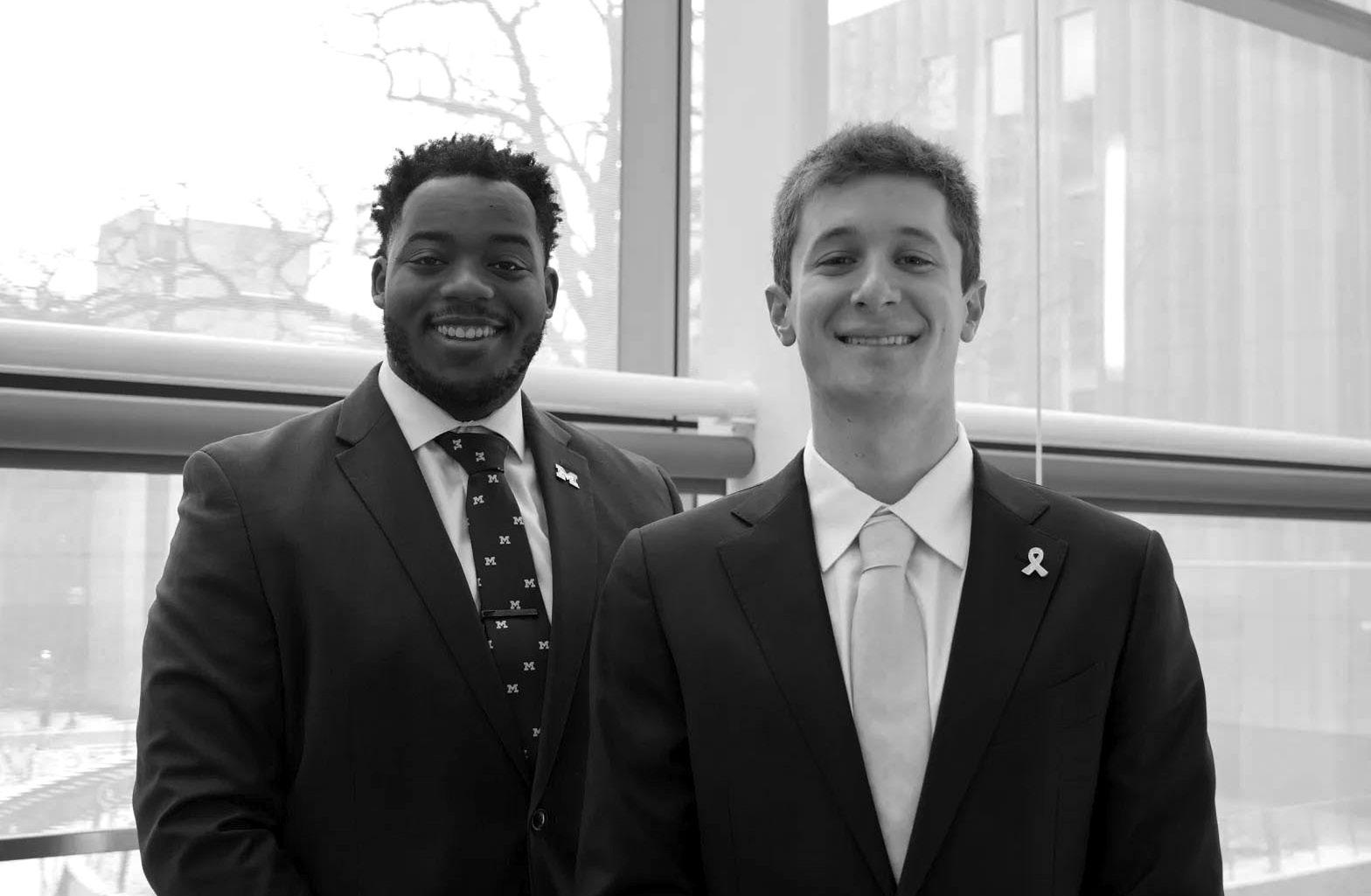
LSA juniors Eric Veal Jr. and Lucas Korn of the EMPOWER MICHIGAN party are projected to become the 2025-26 president and vice president of the University of Michigan Central Student Government, according to unofficial results obtained by The Michigan Daily Thursday evening.
Veal Jr. and Korn won 3,761 votes out of the 7,521 ballots cast in the executive election.
Veal Jr. and Korn’s campaign platform focused on accessibility, access to reproductive health care, campus safety and risk-prevention, collaboration with student groups, affordability, transparency and support for underrepresented members of the campus community.
During the CSG executive debate March 21, Veal Jr. said if he were elected president, he would focus on getting more students involved with CSG and addressing the needs of all students on campus.
“CSG is not always an accessible space for all students on our campus,” Veal Jr. said. “One of our big priorities is making sure that we are making student government more accessible (with) community town halls and liaisons for different communities, and making sure that (the) open door is there and people understand how student government can better support them.”
In a March 24 interview with The Daily, Korn said his administration hopes to reach out
“The truth of the matter is, we’re never going to have every single person feel 100% represented unless the people in leadership really put their heart and soul,” Korn said. “We feel that all students, regardless of background, need to have the ability to feel directly connected to what is going on at the school.”
The election used a rankedchoice voting system. If no ticket receives more than half the votes, there is an instant, automated runoff in which the ticket with the fewest votes is eliminated. Voters who ranked that candidate first have their votes redistributed to their second choice. This process is repeated until a ticket has the majority of votes.
According to LSA sophomore Aiden Burke, CSG elections director, Veal Jr. and Korn were ranked first 3,573 times in the first round of voting. LSA junior Keshava Demerath-Shanti of the Human Rights Party came in second with 1,936 votes and LSA juniors Tony Liu and Brandon Truong came in third with 1,122 votes. LSA freshmen Isaac Gardner and Robert “Silas” Ou of the CHANGE party came in last with 790 votes. After three runoff rounds, Veal Jr. and Korn received a majority, with 3,761 votes.
The official results will be made available once all elections-related litigation has been decided by the Central Student Judiciary.
UMich Jewish students and faculty send letters to Ono on exploitation of antisemitism
‘When antisemitism is misrepresented as speech the government dislikes, it loses its meaning and causes real instances of antisemitism to be taken less seriously.’
MARISSA CORSI Daily News Editor
Jewish faculty and students at the University of Michigan sent two letters to University President Santa Ono Wednesday afternoon condemning the exploitation of antisemitism as a means to attack higher education.
The letters, signed by nearly 300 faculty members and 100 students as of publication, express a joint concern that beliefs protected by the first amendment that are opposed by the Trump administration have been falsely labeled as antisemitism and used to justify the harassment, doxxing and punishment of members of communities of various universities. The student letter denounced the weaponization of antisemitism and wrote the practice could paint the Jewish community as repressive.
“When antisemitism is misrepresented as speech the
government dislikes, it loses its meaning and causes real instances of antisemitism to be taken less seriously — further endangering Jewish students,” the student letter read. “The Trump administration is cynically making Jews the face of authoritarian repression and diluting antisemitism’s meaning through politically motivated accusations. These actions make Jews less safe.”
The letters come at a time when multiple universities across the country have been criticized by the federal government for their handling of alleged antisemitism on campus. A March 10 letter from the Department of Education, sent to the University of Michigan and 59 other institutions, described the government’s concern about protecting Jewish students in higher education.
On March 7, three days before the release of the letter, the Trump administration pulled $400 million in federal grants and contracts from Columbia
University, claiming the institution had failed to address purported antisemitism. Columbia University has since complied with the administration’s demands, which include reassigning leadership of the Middle East, South Asian and African Studies department and hiring new security officers with the ability to arrest students.
Sean Johnson, an assistant professor of astronomy who signed the faculty letter, said in an interview with The Michigan Daily she thinks the actions taken against other institutions are a cause for concern at the University.
“A lot of the motivation for this (letter) came from seeing the Trump administration’s directions and orders essentially to Columbia University under the guise of supposedly fighting antisemitism,” Johnson said. “We have similar departments at this university, and there’s a long history of Jewish students, academics, professors, researchers, etc. being targeted by state governments like this.”
The letters provide Ono with five to six recommendations, including urging him to defend every University community member’s right to free speech, even if he may disagree with their opinions.
Law professor Richard Primus is an advisor to Protect Democracy, a nonprofit and nonpartisan group which has brought a lawsuit against the Trump administration for its cuts to Columbia University. Primus told The Daily he believes protecting and preserving free speech should be prioritized.
“Free speech and civil rights and the rule of law are enormously important, and most of us who grew up in the United States take them for granted, but they can’t be taken for granted,” Primus said.
“It’s not normal in human history to have societies that respect things like that. It is unusual, and it can collapse. We are now at a moment where it’s in danger of collapsing, and I do not think the Trump administration cares sincerely about antisemitism.”
The University’s reaction to protests has been criticized by numerous activist groups on campus who claim the institution has limited free speech by taking disciplinary action against student protesters and changing disciplinary processes in the Statement of Student Rights and Responsibilities in July 2024. The student letter asks Ono to reinstate the student hearing board and appeals board to the SSRR.
Primus stressed the need for protests to abide by set policies and rules, but also said if demonstrators are within those rules, their right to free speech should be protected by the University.
“The right to protest isn’t a right to disrupt classes or harass people or bring a halt to the normal operations of the University,” Primus said.
“That’s important, but when people protest in ways protected by the Constitution, they have to be free from retaliation by the government, even if their speech is unpopular. If we lose that, we may never recover it.”
The faculty letter also asked Ono to meet with a small group of educators to discuss concerns regarding academic free speech in the classroom. Johnson said he worries pressure from the Trump administration has affected faculty members’ ability to discuss certain topics in their courses, including University departments that house Jewish faculty.
“I hope that he at least takes a meeting with a small group of us to listen more directly and so that we can ensure that he understands that the lack of action by this university is already making a lot of professors and graduate student instructions reevaluate what they can teach in the classroom,” Johnson said. “We have already lost academic freedoms because the University is not willing to stand up. … Not standing up and following these recommendations means that we no longer have confidence that the University will protect its core mission.” CONTINUED AT
ANN ARBOR
PHOTO
Josh Sinha/DAILY
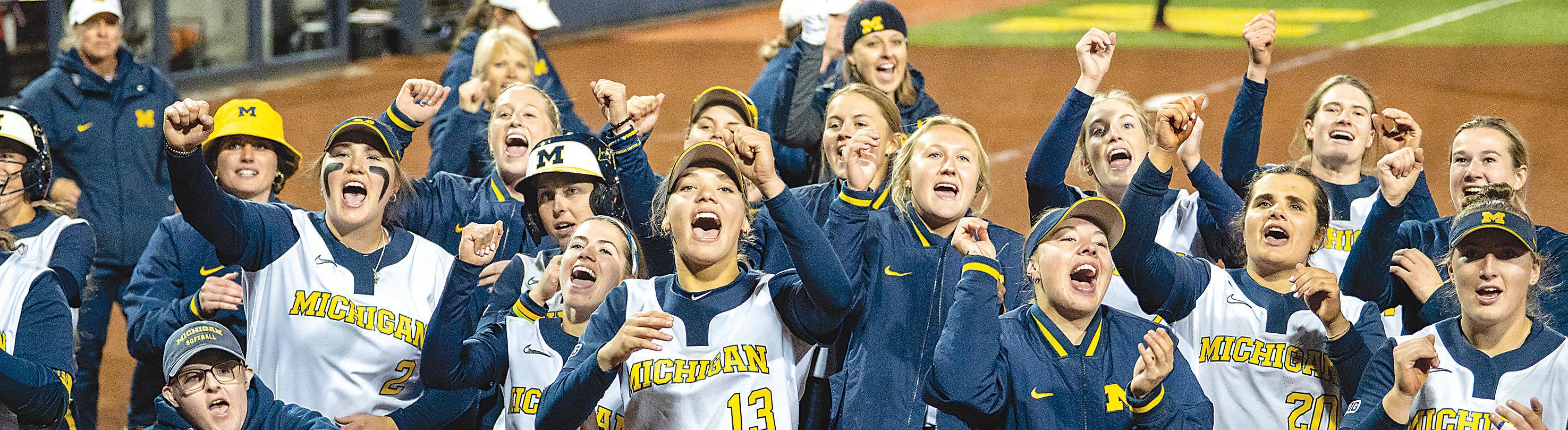
Kaylee Rodriquez high fives a team member after scoring a home run in a game against Michigan State March 29th.
EDITH PENDELL Daily News Editor
Photo courtesy of Eric Veal Jr.
SXSW 2025: Animated shorts highlights
MICHELLE WU Daily Arts Writer
Short films are given a bad rep. They often have no published IMDb ratings, giving viewers no way to know if these films are a complete waste of time. Sometimes, they have barely hashed out characters that leave audiences with an unsatisfying lack of closure. And more often than not, they follow the same tired clichés.
Done right, however, short films offer a powerful yet compact medium through which to engage viewers — and that’s exactly what the animated shorts at this year’s South by Southwest accomplished.
Of the seven animated shorts screened at the festival, three stood out to me with their creative animations, profound storytelling and darkly humorous commentary.
“Baggage” by Lucy Davidson
What’s it like being a woman in today’s world? For many, it means holding onto a host of insecurities related to outward appearance,
feelings of inadequacy and fears of not being loved. Using a clever play on words, “Baggage” portrays what it means to carry emotional baggage (haha, get it?) and how to find support in an otherwise antagonistic world.
Animated with stop motion by Aardman Animation Studios (“Wallace & Gromit”), this short follows three anthropological female suitcases as they pass through an “insecurity check” at the airport. All goes smoothly until the last suitcase, the heaviest one, is invasively inspected by the insecurity officers. The officers rummage through her emotional weight and poke fun at the things she feels least confident in.
Despite being about three nameless suitcases, this no-dialogue, five-minute animated short managed to move me to the point where I swear I could have shed a tear.
By balancing comedic puns like, “What’s weighing you down?” and the delicate moments that exemplify true friendship,
“Baggage” advances its storytelling by giving audiences something humorous and beautiful to appreciate. The most sentimental aspect of “Baggage,” though, is its testament to the strength of female friendships — how best to uplift others than by taking off emotional weight?
“My Wonderful Life” by Calleen Koh
What does it mean to be loved and valued? Is it only when you do things for others? Are you worth anything if you don’t?
“My Wonderful Life,” through comically expressive characters and bantering dialogue, answers these questions by addressing themes of unconditional love and transactional relationships.
Grace Lee (Yeo Yann Yann, “American Born Chinese”) is an overworked mother and personal assistant. Whether it be her manager, her family or the starving kitten outside of her home, Grace spends all her waking hours in the service of others.
CONTINUED AT MICHIGANDAILY.COM
On the Spring Break suntan
As I step out of my car after my 17-hour drive, I let the sun hit my skin and shake off the feathers of a temporary snowbird. I stretch my legs and take off my coat, basking in the light. This year, I join the seemingly thousands of other students making their annual pilgrimage to the South in search of warmth. For me, a week of worship of the sun is to follow, spending as many of the fleeting moments of Spring Break outside. And with me is my holy cross: my 30 SPF Sun Bum sunscreen.
My story — though hyperbolic and heavy on religious imagery — is not a unique one. Across campus, students are returning from a week spent primarily in the sun. Accompanying this blissful break comes the eternal question: Do they bear the burns of a zealous sun fanatic, or have they achieved the elusive Spring Break suntan?
As a society, we are more obsessed with our bodies than ever. We have more freedom now to control how we look —
from bodily adornments, such as clothing and piercings, to more physical changes like makeup and even plastic surgery. Tanning is just one of the ways we alter our appearance. With recent trends toward “natural” looks, it’s no surprise that tanning plays such an important role in the way people spend their time in warm climates. The practice not only feels relaxing and stimulates vitamin D production, but also marks bodies in a socially significant way.
A tan carries quite a lot of baggage with it. On the surface, it simply means a darkening of one’s skin. You might imagine that in a society obsessed with whiteness, this would be discouraged — and for a while, it was. Tanning was seen as a byproduct of the time spent outside working by the lower class. The upper class avoided exposing their skin to the sun, wearing brimmed hats and using parasols to stay strikingly pale. Yet as history marched on and attitudes shifted, tanning became a vice of the affluent. It was once again a marker of class, but this time of the rich who could afford “luxuries” such as tanning
beds and lotion or the time and money to travel to warmer climates. The narrative shifted, celebrating exposure in the sun rather than demonizing it. In a culture that prioritizes whiteness, the emphasis on tanning marks an interesting areas of clash between normative racial and class standards. From a historical standpoint, it’s clear that at one point these disgusting standards were aligned: Tanning made skin darker, which, in a racist society that values lighter skin, was undesirable. Yet the current reversal falls in trend with an exoticism of non-white cultures and skin tones, with white people striving to achieve darker skin tones. Naturally, this doesn’t tell the whole story, as people of any race can tan. But the obsession with darker skin plays into a fetishism of the foreign that white people have held for generations. Whether intended or not, the search for a tan reinforces standards that are both classist and racist, in addition to dangerous.
CONTINUED
Palmer Commons, Forum Hall 100 Washtenaw Ave., Ann Arbor
IAN GALLMORE Daily Arts Contributor
Courtesy of the official press website for South by Southwest 2025’s Animated Short Program
Caroline Guenther/DAILY
MATTHEW POPP Daily Arts Writer
‘Mayhem’ is Lady Gaga’s most ‘Lady Gaga’ record yet
In 2019, Lady Gaga professed “i don’t remember ARTPOP,” a renunciation of the vomitpainted, seashell-wearing, gloriously-divisive era of performance art and public stunts that surrounded her fourth studio album. Onlookers’ responses to the statement ranged from indignation to confusion — fans rushed to defend the cultclassic, Twitter users dredged up every image and headline from the album cycle and Gaga, well, Gaga sat back and laughed.
“It’s funny that I’m not allowed to have a sense of humor. … The internet is essentially a big joke, but if I tell one, everyone freaks out,” she told Paper Magazine, “I don’t regret my art, and I wouldn’t suggest anyone do.” Of course she remembers Artpop, it would be impossible to forget. But the push and pull of this moment — a bold provocation delivered with a sly smirk on her face, only later revealed to be an antic informed by something deeply personal — illustrates exactly the type of interaction with the public that was an essential unit of building Gaga’s early career.
But something’s been shifting in the past half-decade or so.
Her rap sheet of controversies has grown increasingly short, the infamous Artpop tweet being among the last iterations of this extensive game Gaga played. Her current moment is situated in the trajectory of postArtpop denouement that began with her and Tony Bennett’s 2014 collaborative vocal jazz project, Cheek to Cheek. A path characterized by an undressing of
her theatrics and a move towards the records that Gaga wants to make. The sharp pivot to projects like Joanne, the A Star is Born soundtrack or even Harlequin, was clearly helmed by a version of Lady Gaga that was interested in following a different kind of muse, one not necessarily mired in her pop superstardom or her role as professional provocateur.
2020’s Chromatica, the most significant detour in Gaga’s adult contemporary-leaning entries, is a sonic and aesthetic exception to this rule. But even with its ’90s house music backdrop and otherworldly setting, it’s a brushing of shoulders with her past work far more than it is a true return to form. On Chromatica, Gaga re-outfits the absurdity and histrionics of Born this Way and The Fame into something more palatable — wearing them with an unseriousness wellsuited to the escapist tendencies of pop in the wake of its midpandemic release. Whereas the perverse humor and scuzzy poptimism of her early records were played in service of critical edge and persona, it wasn’t clear on Chromatica if Gaga was in on the joke of its artifice, or if it really was just as plastic as it proclaimed itself to be. It was almost as if Lady Gaga had moved on, feeding her fans a reheated version of the music that many of them held dearest in an effort to keep them at bay, while turning her attention to the parts of her multifaceted career that she was actually interested in. It’s for this reason that lead singles “Disease” and “Abracadabra” (if you exclude the originally non-album single “Die With A Smile”), released in anticipation of Lady Gaga’s
seventh solo studio album Mayhem, piqued the interest of Little Monsters everywhere. The tracks don’t just revel in their Gaga-isms — operatic wails, illness metaphors and nonsensical choruses — they make them chic again. Accompanied by two music videos: the campy, sunsoaked suburban nightmare of “Disease,” and the terrifying ballroom cavort of “Abracadabra” — Mayhem introduced itself with style and taste, especially in comparison to the gaudy mood board of Chromatica. It was clear this wasn’t just another wild swing or noncommittal fan service: Lady Gaga was back, baby.
“Disease” and “Abracadabra” also poised Mayhem to be a decidedly dark project, both by virtue of their visual elements and their soundscapes, teasing a record populated by the likes of plague doctor antagonists and deep industrial house influences. And on the surface, it delivers on that premise. “Perfect Celebrity” and bonus track “Can’t Stop The High” are the most shameless about their darkness; the former’s growling bass propelling it toward raucous electro-grunge ecstasy, while the latter returns to the dance floor of The Fame with a slinky new outfit and more than a little sleaze.
The gang-vocal chorus in “Garden of Eden” is held up by a throaty distorted synth line that recalls Muse’s “Supermassive Black Hole” (and yes, I do want to see an edit of the “Twilight” baseball scene to it). Even tracks that borrow from poppier sounds, as with the funky break on “Vanish Into You,” are so grimy they remind us that discotheques were not always the vision of
‘The Monkey’ fails to look camp right in the eye
I made the mistake of watching “The Monkey” by myself in a large, nearly empty Cinemark theater. As the latest installment from “Longlegs” director Osgood Perkins, I was expecting to be horrified or, at least, shocked. Instead, “The Monkey” is a flurry of confusion. The film follows twin brothers Hal and Bill Shelburne (Theo James, “Divergent”) as they deal with a murderous toy monkey accidentally passed down to them by their absentee father. The story kicks into gear when, as children, young Hal and Bill (Christian Convery, “Cocaine Bear”) discover that winding up the monkey with a key will cause someone nearby to arbitrarily and brutally die. As adults, the resurgence of brutal, freak accidents in their town forces the brothers to find the monkey once again.
The first scene of “The Monkey” pretty much establishes the movie tonally, if not narratively. Here, we see Adam Scott (“Severance”) barge into a pawn shop, trying to return a life-sized, furry toy monkey that holds a drum and two drumsticks. Osgood Perkins shoots this scene with cinematographic color grading that rivals that of “Blade Runner 2049”: The green undertones establish an eerie tone and the clever composition helps to create an aura of mystery. However, these artistic choices are completely undermined in the next second when the monkey begins to play its little tune — and subsequently butchers the clerk of the pawn shop in an utterly comical way (to summarize: lots and lots of intestines).
This jarring opening scene sets the tone for the rest of the movie, which quickly becomes an uncoordinated game of ping
pong between seriousness and facetiousness. You would think that this constant whiplash in tone would make the movie more entertaining. As a B-rated modern horror film, “The Monkey” relies on all-too-common tropes in horror like the evil twin and, of course, the murderous childhood toy. However, the change in tone is simply so constant that its novelty disappears after the fourth gory, albeit creative, kill. So, what else does “The Monkey” offer other than shocking murders specifically designed to make your jaw drop?
Sitting by myself in that nearempty theater, I came to discover that the answer is: absolutely nothing. My biggest mistake in watching “The Monkey” was not bringing a friend with me. Instead of having someone to laugh at the ridiculous kills with, I was left sitting alone, mouth gaping in a silent theater and feeling as if I might be hallucinating the events happening on-screen. The greatest sin of “The Monkey” is that it has everything it needs to be genuinely entertaining, but it still fails to meet its potential. The idea of a killer toy monkey is exciting, but all the creative
glittery excess that Dua Lipa’s Future Nostalgia would have you believe.
But for all of Mayhem’s rockist costuming, the record refuses to undermine its own commitment to having fun.
“Zombieboy,” with its “Hollaback Girl” chant, insatiable groove and utter Halloween-party potential is downright euphoric, while “Killah,” featuring album collaborator Gesaffelstein, sounds like it was pulled straight from the best parts of David Bowie’s Young Americans or Prince’s Sign O’ The Times. Chalk it up to the palpable thrill of watching her absolutely rock out on the Saturday Night Live stage if you want, but this might be the giddiest I’ve ever been listening to a Gaga record.
In fact, Mayhem is so good at pulling you to the dance floor that its slower moments feel, at best, slight. “The Beast,” for instance, loses any emotional potency it might warrant as it drags through verse after verse of sludgy synths and middling crescendos, tipping the scale from compelling to buzzkill. “Die With A Smile” has higher highs and its existential bent is thematically engaging, but its original packaging separate from the record and unremarkable balladry make it difficult to look past as a made-to-order pop song for its two superstars. By contrast, “Blade of Grass” is a welcome outlier to its insipid siblings, more successfully leaning into the American Songbook inclinations of Gaga’s post-Artpop work with an age-old chord progression and dour wedding march piano; classic if not a little overdone.
CONTINUED AT MICHIGANDAILY.COM
Abdulrazak Gurnah’s ‘Theft’ is a novel of extreme realism
With a title like “Theft,” it’s not unreasonable to expect that most readers of Abdulrazak Gurnah’s new novel will expect a story centered around a significant theft, or a series of thefts or a community of thieves.
These readers, however, will be surprised to find that “Theft” has little to do with literal thievery.
“Theft,” in fact, repeatedly defies what one might expect from modern literary fiction: maybe a novel obsessed with narrative drive, riddled with beautiful prose or chock-full of thematic tension. That Gurnah’s first published novel since his 2021 win of the Nobel Prize in Literature does not possess these elements to the same degree as its contemporaries is not a statement of his inferiority. On the contrary — it is an intelligent move, purposefully sidestepping the trappings of what makes a book feel “literary” in favor of
something arguably much more important: what makes a book feel true. In his novel, Gurnah opts for a mode of storytelling that I can only refer to as extreme realism. It is a tale of real people living real lives, not for the sake of their narrative power, but because this is simply what would likely happen. While the novel is separated into many perspectives, the focal points are centered on three individuals: Karim, a son born into an unhappy marriage who grows into a well-educated architectural developer; Badar, a poor boy forced into servitude after his father can no longer pay for his son’s care; and Fauzia, a girl with aspirations of becoming a teacher. By the end of the novel each storyline will fully converge. The book’s chronological narrative, beginning with the parents of the three in 1960s Tanzania, gives each story space to grow before intertwining their stories.
CONTINUED AT MICHIGANDAILY.COM
ways in which Perkins kills off his characters quickly become, ironically, repetitive. The same can be said of the film’s relatively picturesque cinematography and funny dialogue choices, which start out as exciting but then never end up mattering in any significant way. However, out of all of these disappointing elements, the film’s most glaring failure is its inability to create interesting characters. The premise alone should warn you that this is an unserious movie, and indeed, you can tell that its writers and actors are all having fun on set coming up with the twists and turns of the movie. Theo James’s acting is certainly a plus. He plays the “good versus evil” twin trope to perfection, from appearing innocent in large circular glasses as Bill to sporting a bad edgy mullet as Hal. Throughout the film, the estranged twins struggle to reconcile, still haunted by the monkey killing their mother when they were younger. Both brothers handle the trauma of having owned a murderous childhood monkey toy in different ways — Bill grapples with fatherhood, while Hal seeks his mother’s vengeance. CONTINUED AT MICHIGANDAILY.COM
NATASHA SHIMON Daily Arts Writer
GRACE SIELINSKI Daily Arts Writer
Courtesy the official trailer of “The Monkey” distributed by Neon
Cover Art for “Theft” owned by Riverhead Books
Edited and managed by students at the University of Michigan since 1890.
Stanford Lipsey Student Publications Building
420 Maynard St. Ann Arbor, MI 48109 tothedaily@michigandaily.com
ZHANE YAMIN AND MARY COREY Co-Editors in Chief JACK BRADY AND SOPHIA PERRAULT Editorial Page Editors
Zach Ajluni
Jack Brady
Gabe Efros
Lucas Feller
Liv Frey
Seth Gabrielson
Opinion
The leaders & the best (at
FIONA LACROIX AND CECILIA LEDEZMA Managing Editors
EDITORIAL BOARD MEMBERS
Jovanna Gallegos
Jack Kapcar
Tate Moyer
Tom Muha
Sophia Perrault
Hunter Ryerson Maximilian Schenke
Lindsey Spencer Audra Woehle
Zhane Yamin
Sarah Zhang
f icial position of The Daily’s Editorial Board. All other signed articles and illustrations represent solely the views of their authors.
On March 27, the University of Michigan announced it was cutting all Diversity, Equity and Inclusion programs. The Michigan Daily Opinion section received numerous letters to the editor in response. Students, staff and alumni wrote the following collection.
“That the main reason for shuttering ODEI was to ‘eliminate bureaucracy’ sounds dodgy, not to mention DOGE-y, to me.”
The decision by the University of Michigan Board of Regents and President to defund DEI — which, up until last week, had been described as core to the University’s mission—is a betrayal of its own stated values. But it’s the timing, isn’t it? President Trump has issued Orwellian executive orders to end DEI, to target trans people and to rewrite and whitewash U.S. history. We’ve watched, in horror, the unlawful detainment of students who protested the Gaza genocide, wondering what to do if such a scenario unfolds here. It’s now, more than ever, that we need the spaces and programs facilitated by the Office of Diversity, Equity and Inclusion to help us navigate this challenging moment. Instead, the University has completely turned its back on ODEI, not to mention, its dedicated staff and leaders, many of whom are alumni who have devoted decades working to create a better University. The websites and profiles are erased. The language is scrubbed. That the main reason for shuttering ODEI was to “eliminate bureaucracy” sounds dodgy, not to mention DOGE-y, to me.
I teach here now, but I first came to this campus as an in-state undergrad in the late 1990s. Taking courses in Ethnic Studies, Black Studies and Queer Theory broadened my perspective immensely. It was witnessing student movements like the Michigamua protests and learning from the diverse (though not diverse enough) student body in the classroom that allowed me to challenge received wisdom and pushed me towards a career in the humanities. Returning as a faculty member, I saw the University’s formal adoption of DEI and its implementation in a strategic plan as a recognition of the longstanding and ongoing work of countless unsung staff, faculty and students who worked to make this place better. It’s a shame to see that legacy betrayed.
Manan Desai Associate Professor, Department of American
Culture
“But once powerful institutions are unaccountably giving in to the pressure rather than pursuing strong cases in court.”
From the start of his second term, President Trump and his administration have employed the specter of “illegal DEI” to intimidate universities, law firms and other large institutions that might serve as a check on their power or a locus of dissent. Trump and his minions have initiated investigations, threatened crushing liability and trumpeted the prospect of taking away all federal funds from entities that maintain what the administration calls illegal DEI programs. The Trump people have offered no clear definition of what they consider to be a “DEI” program, much less an illegal one — but the statements they have made suggest a view of illegal DEI that encompasses many practices that are sound and fully defensible under existing law. The Trump administration is plainly overreaching. But once powerful institutions are unaccountably giving in to the pressure rather than pursuing strong cases in court. Columbia University set the tone when it agreed to a series of extreme demands after the Trump administration canceled $400 million in federal funding — a cancellation that, I and many other experts have written, clearly violated the law. The large law firms of Paul, Weiss and Skadden have made major concessions to Trump to lift unprecedented executive orders that punished them for their legal work and the past legal work of some lawyers whom they later hired — even though other firms have been successful in challenging similar orders.
In this context, it is perhaps understandable that a school like the University of Michigan would try to lay low — to cut its own DEI programming in an effort to stay out of the sights of an aggressive and vindictive campaign by the Trump administration. But such a decision will likely prove short-sighted. When Columbia gave the Trump administration basically everything they had asked for — including unprecedented intrusion into the university’s academic decision making — the administration pocketed the concessions and demanded more. But they did not restore Columbia’s funding. Either way, our University does not stand alone. We have an obligation to the rest of the academy to defend our lawful programs, because each university that backs down in the face of Trump’s intimidation makes it harder for every other university to stand strong.
Sam Bagenstos
Frank G. Millard Professor of Law, School of Law
“Stand for progress, not against it.”
I’m writing in utter disbelief and outrage over the decision to gut Diversity, Equity and Inclusion initiatives at the University of Michigan. This decision is more than a bureaucratic shift. This decision is a betrayal of the very principles that define higher education: progress, inclusivity and the pursuit of knowledge for all. Diversity, Equity and Inclusion are not mere buzzwords. They are the foundation upon which a truly great institution stands. They ensure that students from all backgrounds have an equal opportunity to succeed. To dismantle these initiatives is to send a clear and devastating message: that some students matter more than others, that systemic barriers to success are acceptable and that the university is willing to turn its back on marginalized communities for the sake of appeasing political pressures.
Provosts, do you not see what you are doing? The University of Michigan is supposed to be a leader, a beacon of progress and innovation. And yet, with this move, you align yourselves not with the future, but with the forces of oppression. Without DEI, underrepresented students will be left without crucial support. Faculty and staff of color, who already face disproportionate obstacles in academia, will be further alienated. The campus will become a place of exclusion, not excellence. Education should challenge, uplift and empower. By cutting DEI, you are actively choosing to make this university weaker, less just and less prepared for the world it claims to serve. Stand for progress, not against it. The University of Michigan must do better.
Caden Mattingly Public Health Senior
“History will not view this moment with kindness.”
Like probably every other Michigan alumnus, the University will forever hold a special place in my heart and in my memories. It was the perfect place to take my first steps into the world outside my home, discover what I was meant to do with what talent I had and figure out how I wanted to be remembered by the community I had left behind. It was a place where I made lifelong friends, where I learned important and sometimes challenging lessons and where I met inspirational people who mentored me through my career. It was a place that I embraced, and it embraced me too.
What made my experience — and arguably every alumnus’s experience — so life-changing and worthwhile is the fact that you are constantly confronted with the richest diversity of experiences, perspectives and livelihoods. From student to professor, caretaker to administrator, athlete to coach, you will find someone from every walk of life, every possible religious group, ethnicity, race, sexuality, culture, nation and tongue. If you can think of it, there’s probably already a club for it. It’s not just a vision and a promise for what the University of Michigan can be, but a vision for America as well.
To see the University turn its back on this vision to appease the lowest, self-aggrandizing and frankly insufferable subsect of our population is not just heartbreaking, but utterly contemptuous. It should remind us all that progress is never won, but it must constantly be fought for. Every attempt there has ever been to give marginalized groups a leg up in this society — affirmative action, equal opportunity, and yes, DEI — there are people who have vehemently rejected it. People who are selfish enough to believe that opportunity is a zero-sum game where if black people, women, queer people, poor people or some other minority group is offered the chance to excel, then someone else must be falling behind. I am here as a testament that is blatantly false.
To the University of Michigan administration who made this horrible, regressive decision: Shame on you. You are supposed to be here to show us — your community who has paid your salaries, drummed up your reputation and made you what you are today — strength, and you showed us cowardice. History will not view this moment with kindness but with judgement, and deservedly so. Act accordingly.
Kjersti Swanson
Alumni
“I’m sick and fucking tired of universities capitulating to that son of a bitch.”
So, yeah, the school I had once been proud to have attended, worked for and graduated from, the University of Michigan, has caved to the Trump administration and cancelled DEI initiatives. My diploma is already in the trash and the school’s name removed from my resume, and I will be joining protests on campus. I’m probably spiting myself, but I’m sick and fucking tired of universities capitulating to that son of a bitch. This is an affront to everything I and my fellow alumni had learned during our time there, which included tolerance, respect for others and empathy. Please, please, everyone, help stop the madness. This is not the country we grew up in, and we’re better than this.
Jim
Utsler Alumni
“If we are, indeed, the leaders and best in higher education, we owe ourselves and American society so much more than what we have o ered during these times.”
The actions taken last week by the University of Michigan to terminate dedicated and high-performing staff in the Office of Diversity, Equity and Inclusion brings to surface an enduring contradiction in our University community. For the nearly 30 years in which I have been a faculty member at the University, explicit investment in diversity, equity and inclusion has been crucial for ensuring institutional excellence. Faculty, students and staff have been able to acknowledge and act upon the meaningful forms of social difference that they have brought to this community. They have also been encouraged to learn how to best recognize and respond to social differences in the classroom, in research spaces and in the course of their social and professional relationships across the University. The sudden rush to dismiss people and terminate programs and initiatives at this University has unfolded not only without any acknowledgment of how these efforts have served our core institutional principles; but also without acknowledgement of how those efforts helped to ingrain excellence in our institution.
At the University, we must do more than assert that the actions taken last week reflect an adherence to the law. Where is the space for critical engagement in our intellectual community about the law? As members of this community should know full well, it was once upon a time against the law for African Americans to enter into social institutions and make use of public resources in the way that white Americans could. In this country, it was once upon a time against the law for women to vote. It was once upon a time against the law for people in same-sex romantic relations to marry (and, unfortunately, it may become against the law again in this country). In each of these cases, what was against the law also stood against what was ethically and morally appropriate.
We have failed to be an appropriate intellectual community during these times because we have failed to explore distinctions between the ethical, the socially constructive and the lawful. If we are, indeed, the leaders and best in higher education, we owe ourselves and American society so much more than what we have offered during these times.
Alford Young, Jr.
University Diversity and Social Transformation Professor, Edgar G. Epps Collegiate Professor of Sociology, Arthur F. Thurnau Professor, Sociology, Afroamerican and African Studies, and Public Policy, Associate Director, Center for Social Solutions, Faculty Director, Anti-Racism Collaborative, National Center for Institutional Diversity
Re: UMich announces cuts
Erin Coleman/DAILY
I lost my Black job, now what?
Insight from ODEI’s only student employee
the world around us. Despite this, my department and its members have been accused for their implementation of “forced illegal and immoral discrimination programs” as described by President Trump in Executive Order 14151 published in January of this year.
purposes like Giving Blue Day, the campus’s single largest fundraising event. Some examples include a collective montage, a personal highlight, and a sweet photo posted on @umichlsa to name a few.
As a kid, my parents always supported my artistic urges, purchasing tablets, camcorders, video editing software, and the like. I could never exactly pinpoint what my artistic niche was, but I knew for sure that I loved capturing the essence of humanity and then showing it to fellow humans. News about my passion spread across campus so quickly that I was eventually offered an internship at the U-M Office of Diversity Equity and Inclusion as their sole engagement intern. Despite my excitement to serve the U-M community, the time spent in this position has not been the dream that I’d expected initially. Before arriving here on campus, I was gifted a Canon camera by a loved one, a gesture based on my childhood passion for digital design. I then took this camera with me to my first Michigan tailgate, thrown by the brothers of Lambda Theta Phi Latin Fraternity Inc. Shortly after it hit me — I decided to repurpose a private Instagram account I had once used as a journal for close friends. Clearing out the old posts I publicized the page and began using it to showcase and promote my photography. The page was titled “almaticpulse”, a moniker I’d used for a long time as the title to a playlist of songs that just feel like me. Since then, that has been my alias as a photographer.
As Almaticpulse I’ve been invited to capture birthdays, greek probates and many events from DVN, the annual Vietnamese culture show, Arab Expressions and Spectrum Center events to the Black History Month Ceremony. My camera has served as a VIP pass to the various cultural pockets here on campus. It was in one of these pockets that I met my friend and mentor Nolan Bona, a seasoned videographer and all around inspiring creative. Nolan and I exchanged names and favorite colors, not long after we were trading jobs and opportunities.
One day in January of 2024, Nolan called me asking to share my experience on campus as a part of a media highlight for Black History Month. After weeks of filming, the video was posted to UMich socials like Instagram and LinkedIn, flipping the hourglass on my 15 minutes of fame. Weeks later, just when I’d thought my river of clout to have run dry, I was contacted by the DEI Strategic Plan team. In short, they saw my video on LinkedIn and wanted to offer me a job in the Provost’s office, to give them insight into the student experience. I said yes.
I walked into the regal Alexander G. Ruthven Building — a space I’d only ever seen in the videos of protest occupations circling on my Instagram — for my first day of work on March 4, 2024. I took the elevator to the 4th floor and started my job with a team who I would quickly grow to call my family. The four members of the DEI Strategic Plan team were my supervisors. Over the course of the year up until this past Thursday, I watched these people pour their hearts and souls into upholding the core values of diversity, equity and inclusion with the utmost professionalism and morality, while many times being confronted with ridicule, specious claims and censorship. And over that same time, these three values have continued to be called into question. So now that you have the clearest understanding of my perspective, I will tell you what I know about DEI on our campus.
I will admit, as a Black American from Detroit, the former Blackest city in America, I’d never seen these words grouped together before stepping foot at the University of Michigan. The Merriam-Webster dictionary describes diversity, equity, and inclusion as “a set of values and related policies and practices focused on establishing a group culture of equitable (fair) and inclusive (broad) treatment and on attracting and retaining a diverse (various) group of participants, including people who have historically been excluded or discriminated against.”
From Campus Day, Festifall, the Summer Bridge Scholars Program and the Comprehensive Studies Program, My School did everything in its power to show me that it was fair, broad and various. I’d begun making friends from countries I’d never heard of, matriculating through STEM and business courses with professors who took time to help me understand concepts like reading NMR graphs or calculating marginal costs, all while establishing my foundation as a first-generation college student in the wider world of higher education. Among it all, I’d begun to feel welcomed at My School, comfortable even.
I was offered generous scholarships and opportunities that made me feel valued as an academic while those who support the dismantlement of these programs would say that I was not valued for my merit, but instead awarded due to its juxtaposition with my identity. The LEAD Scholarship Program was marketed to me as a network of support for high school students who demonstrated the values of leadership, excellence, academic achievement and diversity. And for as long as I have been a member, this has rung true. A program mentor quickly took note of my talents and would often contact me to photograph LEAD events. My fellow LEAD scholars were dentists, animators, engineers, entrepreneurs, doctors, teachers, students and most importantly of all they are humans. Due to legalities following Executive Order 14151, many of these esteemed academics have had the rug swept from under them. I watched. I watched as the news spread. I watched panic cloud the minds of my loved ones. I watched questions race through the minds of my peers: “Did you see the email?”, “What am I going to do?” And I told them (and partially myself) that it would be okay. My School is fair, broad, and various, I told them. In a fair system, we are innocent until proven guilty. And what did the LEAD Scholars do that was so prosecutable anyway? As I deliberated with friends, we reread the entire email. As a result, the realization set in that communication about our scholarship’s cancellation would only happen at a town hall about two weeks from the time we received the initial email, I started to foster doubts about the program directors’ regard for our humanity. I felt unseen, betrayed, and dehumanized. What I did not feel, however, was the urge to protest.
The Office of Diversity, Equity and Inclusion at the University of Michigan has provided professional development resources that have advanced the skill sets of current U-M faculty and staff, facilitated the development of accessible learning resources and accommodations for students with disabilities, implemented support systems for firstgeneration and transfer college students to navigate academic challenges and funded research initiatives focused on understanding and addressing
to
But many don’t understand what’s so wrong with diversity, equity and inclusion in the first place. How does the seemingly positive connotation of each of these words get so misconstrued that they’re criminalized as a group? If you believed that I was here to defend DEI and its effectiveness, then you are sadly mistaken. DEI as it existed here at the University did not operate to its full potential, nor anywhere near it. While that may be hard or surprising to hear from someone like me, it is true, but not for the reasons you may think.
Despite my wholehearted support of the core values of DEI, I do uphold certain critiques about the work I’ve observed and taken part in so far. Though I was hired to “bridge the gap” between students, staff and faculty, many of the initiatives I inherited didn’t honor the principle of intersectionality due to hyperspecificity. Most notably, there was a disproportionately small amount of programming that was centered toward interacting with or including the broader student population and their perspectives. I believe that my employment was a direct attempt at combating this, though not immediately effective.
As a result, ODEI programming severely lacked in its advocacy for transfer, military and other non-traditional students. As the only student employee in ODEI, I was tasked with typical intern tasks in addition to strategic campus engagement related projects. I quickly made notice of the lack of encouragement of cultural and creative expression on social media and other digital platforms relevant to the department. The DEI 2.0 Strategic Plan team then connected me with the ODEI social media team manager who was meant to integrate my ideas with ODEI’s existing media image.
Unfortunately, I was only ever able to finish one video project for the social media team due to miscommunications and unexpected regulations from both ODEI partners and higher level administration that seemed to me like a misalignment of Regent’s and employee’s opinions against student’s needs. I encountered a kind of subjective censorship many times throughout my internship from both ODEI partners and higher level administrative officials. There were times where I watched initiatives that I felt would truly make a difference be undervalued or even discarded for reasons of personal agenda and not collective advancement. We spent meetings revising the colors of infographics protesting our humanity to the Board of Regents instead of taking walks across campus to see that our “grand impact” truly had only just scratched the surface.
For the first few months at my job, this infuriated me. As a result, I quickly took matters into my own hands. In Fall of 2024 I signed ODEI up for Festifall, crafted an engaging logo with exclusive merchandise, created an AI tool to help departmental employees navigate their Google Drive archive, planned a summit to educate the campus on democracy and civic engagement and came up with so many unused social media engagement strategies that I don’t even want to hear the words “content creator” anymore. But despite all my work, and the work of those around me, we never amounted to being a big enough band aid for such a large and meticulously constructed system.
My most recent project was titled “Mosaic Imagination”, a student grant showcase I’d been planning for months, set to occur on March 31. We’d planned to include presentations from various student organizations on climate change, healthcare advancement, cultural traditions, innovative fashion, and modern literature and film in addition to student performances. Coincidentally, I received news about the LEAD scholarship cancellation as I was sending emails out to the student violinist and vocalist we’d hired as performers, a bump in the road but still I rode. I continued designing marketing materials. And while preparing for the social media takeover of @umichstudents, I received news that the takeover had been cancelled. Again, no biggie, I took the L and kept it pushing. Finally, on Thursday March 27 I entered work at noon, conference room 4140 in the regal Alexander G Ruthven Building to a sight that struck my heart like pins.
Tens of my bosses and colleagues with their eyes sunken, some still wet with tears sat as my supervisors escorted me out of the meeting. Hours later, I would learn that my bosses positions had been eliminated and alongside them, my title as the DEI student representative. Among the talk of legalities I could only think about the implications that the loss of a position would have on my colleagues who I’d grown to know as heads of their households, and providers for their families. What could they be thinking right now? What more could they have given? To a campus and an administration that failed to see the true value of their efforts in the first place?
Yes, ODEI’s impact fell below a technical bar, but, from my perspective, that bar has had a nearly 250 year head start. Were the shortcomings of such a broadly ranging and various communal support system fairgrounds for the upheaval of their progressive foundation? In my eyes they were not. I see this destruction as a complete disregard for the humanity of all those who benefit under a society which upholds the basic principles of fairness and variety, across the entire scope of human life. Or in short, everyone. My supervisors were just four members of our small community here at the University of Michigan. However, I believe this action to be a demonstration of the greater emergency state of our divided nation. One who overvalues the profitability of man-made products in comparison to the toll taken on the lives of the men who actually make them. As an American, I see more clearly now than ever that I am judged on the value of my assets and color of my skin rather than by my insight and the content of my character.
My photos and captions from events on campus have often been used to promote the campus’s diversity, many without credit. I have produced a Women’s History Month collage, a Black History Month collage, and taken plenty of photos at Trotter to be published on @umichdiversity. I have also had my personal narrative and image highlighted for lucrative
I am beyond grateful to have reached my goal of serving as a proud representative for my various communities. However, the use of my likeness for morale in conjunction with the successive dismantlement of the system that uplifted me, make me feel tokenized and exploited. So what now?
Well I, for one, will not protest for the recognition of my humanity.
Why spend time questioning why initiatives promoting human dignity and good ethics are considered controversial by some, or trying to convince these same humans of such basic morality? I propose that the most powerful response to division is solidarity through forms of civic engagement like mentoring, philanthropy, community service and engagement, organizing progressive initiatives, and taking generally good care of one’s local community.
Throughout my journey, I’ve witnessed firsthand how photojournalism and storytelling can bridge divides. Thanks to my guise as almaticpulse, my camera became more than just a tool for capturing light — it grew into a means of connection, understanding, and exposure.
In my eyes, our very presence on this campus, our achievements and contributions, are themselves revolutionary acts. We don’t need institutional support to maintain our commitment to diversity, equity, inclusion or any other basic human moral; these principles live in our daily actions.
I challenge you right now to envision a truly inclusive campus. What would this mean to you? How would you expect to show up? Who would be allowed in your community? Who would advocate for the little guy? How would your ideal society handle differences? It is my belief that once you’re able to answer these questions, you’ll have more than enough means to lend a hand in molding a better world not through protest, but through positive action and unwavering solidarity.
Losing my position at ODEI has, ironically, given me more freedom to do what I’ve always loved — capturing people and sharing them with other people. And so, I will continue to document our community’s journey, because many powerful statements are made not through words, but through the simple act of bearing witness to each other’s humanity.
VICTORIA ‘TORI’ WILSON Former ODEI Employee and LEAD Scholar
In this space, we invite our contributors to be vulnerable and authentic about our experiences and the important issues in our world today.
Our work represents our identities in a way that is both unapologetic and creative. We are a community that reclaims our stories on our own terms.
Where I plant my roots
There’s a familiar saying that home is where the heart is, and I’ve always believed that to be true. As people, we are inevitably impermanent By this I mean that, in the grand scheme of things, we never truly settle down. The childhood home that’s strangely unfamiliar after moving away, the college town that eventually won’t be yours to keep, the places where you build lives that you are bound to outgrow — each place we call home is temporary, shaped by time, experience and the people who fill it. What once felt permanent becomes a memory, a place you visit rather than belong to. Yet, I can’t help but think that this very impermanence has left me homesick, because I know, truly, that all I’ve ever wanted is to sink my roots deep into the soil and grow I first came across this conundrum my senior year of high school — or, more specifically, college application season. For the three years leading up to that point, I had stretched myself thin: allnighters, breakdowns, skipped meals. My parents and teachers had always told me that hard work pays off, so when college application season came around, I had believed in the formula: work hard, do well and everything else would fall into place. The American Dream in its most distilled form . Instead, I came to the realization that I was not like my peers — in the sense that I didn’t belong here.
There are over 250,000 visa-dependent immigrants in the United States — children and young adults living in the U.S. as dependents of their parents’ work visas, growing up in a country that may never legally recognize us as its own. We spend years building lives here, attending American schools, establishing lifelong friendships and dreaming of futures that, in the eyes of the law, are not wholly ours to hold. And at the age of 21, we’re faced with the expiration of our dependent visas, forced to return to countries we barely remember — lives stamped with an expiration date. This is often referred to as “aging out” — a bureaucratic phrase that simplifies the unraveling of everything we’ve ever known. And so while I had spent my entire life living in the U.S. and had technically done everything in the “College
Application Formula” correctly (besides the process itself being a disorganized, rigged jumble of nonsense), it didn’t matter. Because in the eyes of the system, I was not a student that had sat in the same classrooms or taken the same AP exams as my American peers — I was an international applicant held to stricter admissions standards, charged higher tuition and barred from the opportunities my classmates took for granted. It didn’t matter because no matter how much I wanted it to be, this place couldn’t be the home I returned to in the end.
I explicitly remember this time to be one of the worst times of my life, not because of my results, but rather the fact that I was forced to question what home really was to me moving forward — and whether I had ever truly belonged anywhere.
If I had worked just as hard, sacrificed just as much, why could I never stand on equal ground? And if I had spent all that time chasing something that was never mine to claim, why did I believe I ever could?
The second time I encountered this homesickness was my sophomore year of college. After my freshman year, I had transferred from Michigan State to the University of Michigan, and in doing so, I left behind the first place that had felt permanent — like a home. After I lived through the Feb. 13 shooting, I had expected to feel nothing but sorrow — and while that grief was certainly there, I had also caught glimpses of an unexpected, overwhelming sense of hope. In those six, long hours hidden away in the darkness, waiting for relief to finally wash over me, I had felt completely powerless. Yet, in the weeks that followed, I had found a blossoming community: a professor’s reassuring email, a friend’s unwavering presence, a stranger offering warmth in a moment of unbearable cold. A collective heartbeat.
It wasn’t until I left that I began to feel disconnected from my own grief, as if it had erased all the frantic text messages asking “where are you?” and “are you safe?” As if where I got my diploma from would be an indicator of what I had and hadn’t lived through. As if the distance had somehow made my experience less real. I spent a majority of my sophomore year struggling with this dissonance, trying to understand whether my grief was still justifiable — whether I had the right to continue mourning a tragedy
of the very community I had chosen to leave, and whether I could still hold onto the love and solidarity that had grown from it.
I once had a friend tell me that my longing for a home wasn’t valid, that I had no right to speak and that my struggles were insignificant in comparison to theirs. I remember thinking how absurd it was, how ridiculous the idea that our sorrow could be quantified and compared, how insincere the belief that our stories could be turned into something to be merely consumed by others was. Was my struggle only legitimate if it met a certain threshold? Was my grief only valid if it was recognizable to others?
But in spite of this, hadn’t I, too, been doubting myself all along? That my grief wasn’t real enough to hold, that my displacement wasn’t deep enough to count. That my longing for home was something fleeting, something I wasn’t meant to hold onto. That this yearning for permanence was just a dead end — because every place I had ever loved was one I had to leave behind.
There’s a quote from an anthropologist that I had found during the last week of my freshman year: “You will never be completely at home again, because part of your heart will always be elsewhere. That is the price you pay for the richness of loving and knowing people in more than one place.”
And for the first time, I began to understand — not just in theory, but in my bones. I know this is true because I am living proof of it. I am an amalgamation of everyone I have ever loved. I carry the movies they’ve told me to watch, the books they’ve insisted I read, the funny phrases they’ve unconsciously woven into my own vocabulary. I belong to the spaces that have held me, to the people who have shaped me, to the moments that have imprinted themselves onto me so deeply that no amount of time or distance can erase them.
Looking back, I spent a lot of time in my youth yearning for some sort of permanence to cling onto. Something I’d look forward to returning to at the end of a long, hard day. This yearning eventually turned into a series of diary entries and imagined stories of what I would finally do once I was an “adult”: the house I would live in, the walls I would paint, the bookshelves I would fill.
CONTINUED AT MICHIGANDAILY.COM
From palm lines to medicine
over my skin like persistent mosquito bites.
There’s a certain irony in how the universe unfolds — like how my aajoba reads fortunes in palms while I decipher chemistry problems at my grandparents’ kitchen table, both of us searching for answers in patterns others might overlook. His weathered hands trace the lines on my palm with the same careful precision I use to handle microscope slides in my lab back home. It’s been seven years since my last trip to India, and I can see how my aajoba and I are both still searching for reassurance in life’s simple truths. India is still as hot and bursting with bloodthirsty mosquitoes as ever, and I have yet to find someone who makes idli and sambar as well as my aaji does. I use my free left hand to tear into another steaming idli, dip it in sambar and eat it, basking in all of its soft and fluffy goodness.
“Two husbands,” my aajoba speaks with the certainty of someone who has watched stars dance across countless lifetimes. “Your first marriage will be unsuccessful before you divorce and find another husband,” he declares, like he’s diagnosing a chronic condition. I wonder if palm readings come with prescription plans.
I groan out loud. “Seriously?! I haven’t even had a boyfriend yet, but I’m destined for a tumultuous love life?” In Indian society, where divorce carries the heavy weight of stigma and scrutiny by onlookers, the prediction feels less like fortune-telling and more like a cosmic joke. The words sting, as if my lackluster Marathi and (lack of) Hindi weren’t already disappointing enough to extended family.
Aajoba isn’t fazed by my protest. “It’s not a bad thing,” he insists, as if foreseeing the troubles of a marriage is no more consequential than forecasting a rainy day. “Some things aren’t meant to last, but that does not mean they aren’t meant to be.”
I wonder if he would say the same to some of the aunties I know who’ve separated from their husbands and faced whispers and isolation at our local Marathi gatherings. I wonder how he’s observed marriages in America, where divorce is common but loneliness lingers just the same. I wonder if I will say it to myself one day. My mom clicks her tongue at her father before turning to smile at me. “Pay him no mind! Those predictions usually fail to turn into reality.”
She’s right, but something about his words nags at me. It settles deep in my stomach and forms a pit as we take a rickshaw back home. To be honest, I’ve always gravitated toward what was tangible and measurable. Yet here I am, letting the words crawl
As a child, I dreamed of becoming a veterinarian, having sort of immortalized it in that kindergarten activity where your teacher hands you a paper and asks you what you want to be when you grow up. I still have the paper slipped in between the books on my bookshelf back home — a smiling, colorful stick figure surrounded by animals and a misspelled “vetranarien” scribbled below it. I remember bringing the paper home to my parents and proudly showing it off with a gleaming, snaggletoothed smile, asserting that I would always love animals more than people. My veterinarian aspirations fizzled out after I played that one Nintendo DS game where you pet virtual dogs one too many times, but my love for science and helping others remained.
I’m not sure when it all changed, as I still think animals are better than humans (“four legs good, two legs bad,” as they say in “Animal Farm”). The path to medicine twisted and turned, but somehow here I am, still chasing that childhood dream but with a desire to heal real patients instead of pixelated puppies. My MCAT prep books glare at me from my desk like ancient texts, except instead of predicting futures, they’re threatening to destroy mine. The universe, it seems, has a sense of humor about destiny.
In the lab where I work, I find certainty in a different kind of pattern-reading, one that speaks to my scientific mind in the way palm lines speak to my aajoba’s understanding. I trace shapes of clumped cells in flasks like my aajoba traces life lines, each of us finding meaning through different lenses of observation. But if there’s anything I’ve inherited from him, it’s the ability to make sense of things. Where he finds meaning in celestial alignments, I find it in data, in the organization of chaos. Taking pre-med and public health classes has taught me how to analyze and interpret to a higher level. Maybe I don’t believe in fate, but I believe in understanding the world through puzzles waiting to be pieced together.
Aajoba would say this was all predetermined, written in the same stars he taught me to find during our Sunday WhatsApp calls. He’d map out my brother’s and my birth charts, speaking of possibilities while I squinted at my phone screen from our kitchen table in America, trying to follow his descriptions. “See there?” he’d say, his voice crackling through the connection. “These are your rashi’s characteristics.” I’d nod, pretending to understand, but I truly loved how his voice came alive when he spoke of our astrological signs and celestial patterns.
To him, astrology wasn’t a flimsy horoscope in the back
of a gossip magazine but a thoughtful, ancient discipline — a way of observing and understanding life’s obstacles. It was a career he cultivated to guide himself and others through uncertainty. I see now that we are not so different. Just as I fumble my way through the pre-med journey, he, too, started as a novice, reading palms on the streets of his hometown, making mistakes but never giving up. Aajoba would often remind me of life’s important lessons.
“The stars take time to align,” he’d say. I used to roll my eyes, but now, I see the wisdom in his words as I navigate my own set of challenges. There is the concept of karma in Vedic astrology, where it’s believed every thought and action has a corresponding reaction – sort of like Newton’s Third Law but for the soul. Karma is real, and I know it; this past week, I’ve had a friend throw up in my car, scrambled for housing for next year and slipped on a patch of black ice before falling flat on the ground, the ice mockingly cooling my aching, sprawled figure. I may not believe in a higher power, but I believe in the interconnected nature of actions and consequences — and lately, it feels like someone has been wishing for my downfall.
Even though my zodiac sign falls in February, I consider it the worst month of the year with its biting cold and relentless midterms serving as seasonal punishments. But I also believe in samsara — the endless cycle of living and dying. Another misstep in the pre-med journey is an opportunity to learn, to grow, to surpass my current self. If suffering is endless, so is rebirth. Each fall is just another chance to stand back up.
There’s a reason the human mind clings to belief systems, especially when faced with uncertainty. Aajoba looks at the stars for guidance, while I look at science for certainty. Either way, we are both searching for something to hold onto when the world feels vast and unpredictable. Perhaps that’s why even now, as I solve physics problems and memorize biochemical pathways, his voice lingers in my head. I still don’t know if I believe in destiny or in the meanings behind palm lines. But when I look down at my hands now — the same hands that pipette solutions and write public health papers — I see the inheritance of pattern-seeking that flows through our family line. The gap between the patterns my aajoba and I seek isn’t so wide after all. Mine just happens to be written in the language of medicine instead of astrology. And as I trace the familiar lines on my palm that he once read, I realize that maybe that is enough.
Caroline Xi/DAILY
LIA DU MiC Columnist
ARYA KAMAT MiC Columnist
Alisha Razi/MiC
Michigan in Color is The Michigan Daily’s section by and for People of Color.
Let’s say you’ve ordered a masala dosa in the Mavalli Tiffin Room, the one on Lal Bagh Road — every other franchise is just an extension of this ancient foodhouse, established back in 1924. You’re in Bangalore, the Silicon Valley of India, engineering and business firm skyscrapers tower over the North side of the city. Known for rapid tech development and the most extensive IT services in the world, its deep history also includes being one of the first places in the world to discover the dosa soon after they started making them in Udupi. You’re here and you’re hungry: You’d be crazy not to eat a dosa at MTR.
The ordering process is, to most foreigners, absolutely bizarre. But, you’re not exactly a foreigner. You’ve been to this place before, a long time ago, when you were as much a part of your land and culture as it was a part of you. But it’s been a while, so it is a little bizarre still. Someone behind the counter catches your eye, points and waits for an order to leave your lips. You say something like idli or dosa and they’ll nod. There’s no writing anything down, just a quick nod, and suddenly Mr. Behind-The-Counter is sliding a plate down the aisle to Mr. Has-APan-On-The-Stove and then the stove guy is neatly folding over a dosa on your plate and handing it to you at the register. Bon appétit.
You take your plate to a nearby booth. The aroma drifts up to your nose and your olfactory bulb groans in delight as the rich scent of masala, seasoned potatoes and chutney-covered dosa bring your mouth closer, closer to the plate … … and you realize you’ve
forgotten your fork and knife. You open your mouth to call over Sriram, the waiter that asked two minutes ago if you wanted a bottle of Bisleri, when you notice something.
The couple behind you is lost in their dosa. They’ve slipped the golden bands off of their ring fingers and set them aside so they could properly dig in with their hands. The group of schoolchildren in a booth to your left are all splitting two plates and tearing into their dosa, both literally and figuratively, with their fingers. In fact, not one person in the entire establishment is cutting into their food with silverware.
You glance back down at your delicious dosa. It’s waiting for you. It’s been a while since you’ve eaten with your hands. You could go next door to the ramen shop and ask for a fork, or you could rediscover a part of your culture that you’ve forgotten.
May 2012, somewhere in
Southeastern Michigan: My dad eyes my plate, my 7-year-old fingers twisted in the grains of rice that my mom has pressurecooked, chutney under my nails and in between my knuckles. He slides a napkin towards me. I open it to reveal a fork.
He nods at me to use it.
Why does my dad want me to eat with a fork? Why do my parents despise finger-eating?
How do you eat with your hands if you’ve forgotten how?
In the old timeline, when my dad slid me the fork, I said yes and picked up the utensil, the youthful urge to break the rice with my fingers squashed under his watchful glare. But this isn’t 2012: It’s today, I’m in the MTR restaurant, and I can make my own decisions this time.
This is the alternate timeline, and the alternate me has always
eaten with my hands. I’m going to help you remember how to, as well, in three easy little steps. 1. Wash your hands before and after Throughout this guide, I will be referring to the banana-leaf meal. I’ll explain more in a minute. You might be worried about unintentionally keeping little pieces of food under your fingernails. Don’t worry: Washing your hands is totally allowed. In fact, it’s encouraged. Common custom in South India states that it’s polite to keep your hands clean before you eat and to wash them after so you reduce the risk of transmitting your germs to others.
I have recently started traveling to India more often. Every other summer, I count down the days until we have a function to attend, because that’s where they serve you food on a banana leaf. Before you can enter the mess hall — usually in the basement, only accessible by a grainy set of ancient cement steps — you’ll see a set of sinks, soaps and, nowadays, hand sanitizer. Once you get here, I would advise you to tie your dupatta up, push your bangles further up your elbows and carefully clean the dirt and grime off of your hands before you dig in. In the case of a banana-leaf meal, you will also have to clean your plate, or, in other words, the leaf. Sit behind a leaf, any leaf, and wait for a chef to come by. He’ll drizzle your leaf with a couple spoonfuls of water. Press your fingers into the green and push outwards, gently, along the harsh, folded leaf veins. Don’t push too hard. It tears quite easily, and spilling your food onto the table would be fairly unsanitary.
2. Master your technique I work in a neurology lab on Fridays and I love it. It’s a relaxing
job, only made better by the amazing people I have working with me, including my mentor. He orders lunch for our labs occasionally. A few weeks ago, it was Indian food, from Shalimar over on Main Street. I got a chaat. Everyone else ordered two items each: a naan and a curry. My mentor grinned at me over the boxes.
“I’m getting better at my technique,” he said. “Technique?” I asked. I wasn’t aware there was any involved in eating food.
He twisted his fingers so it looked like he was holding a small ball. All I could think was that it looked suspiciously like the padmakosha mudra. “Like, my naan dipping technique. I can never get how you’re supposed to hold the curry in the pieces.”
I wasn’t sure how to respond. I didn’t know that this was a process to be learned — I just assumed that it was simply natural to fold
your fingers into a curve and press rice along your joints using your thumb. I know the taste of rice like I know the smell of air, and I can feel it just as I can feel water in a stream passing through my fingers on a hot day. Learning to eat with your hands was a concept I was wholly unfamiliar with.
I’ll let you in on the basics: Use the back of your thumb, palmside, to push food into the first three joints of your index, middle and ring fingers. When you are ready to eat, use your thumb again to push the food into your mouth.
Enjoy.
3. Ignore the haters
Now that you have used your hands to eat, you can look up from your plate (or leaf). I’m sorry to tell you that you might be getting a few stares.
Now, you understand the value of filial piety. It’s important to listen to your elders. But something about their argument no longer sits right in your mind.
Is it unhygienic to eat with your hands? Remember, you wash with soap and water both before and after eating. You are made to scrub for at least 15 seconds to wash the grime and bacteria off. You clean your banana leaf with purified water before placing any food on it. No, this can’t be right — eating with your hands doesn’t have to be dirty. Is it uncivilized? It’s common practice all over India and many other parts of the world to use your fingers to eat. Civility is the process of having good manners and polite conversation without degrading or putting down another individual’s identity simultaneously. While forks, spoons, knives and chopsticks are fairly common utensils all over the world, so are hands. Eating with your hands is, then, considered a polite and well-mannered gesture. It’s civilized enough.
CONTINUED AT MICHIGANDAILY.COM
AMRITA KONDUR MiC Columnist
Ananya Prashar/MiC
LISKA
TOROK Statement Correspondent
In the single week of 60 degrees and sunshine that Ann Arbor teased us with, I was walking in short sleeves with one of my friends and said, “I actually have no desire to be in a relationship anymore.” She turned to me and replied, “Honestly, me either.”
To understand the importance of this conversation, you need to first hear the kinds of exchanges we were having in the months prior to our springtime walk. My five friends and I spent most of the winter shrouded by dark skies, bundled in never-warm-enough coats and huddled on a bean bag taking up half of the floor space of the dorm I call my second home talking about relationships. We rehashed the baggage given to us by boys from high school, spent hours overanalyzing the smallest conversations with our current “situationships” and wondered what our soulmates will be like. This was a particularly monumental winter for me because, for the first time in my life, when I heard my friends yearning for a relationship, I related.
I spent the majority of high school viewing relationships as a sort of annoyance — my friends ditched me for them, they stayed with people who clearly treated them wrong and, most importantly, I never felt like I was missing out on love because I was so surrounded by it in other ways, from the people I already had in my life. I genuinely didn’t understand the appeal of relationships and had no desire to be in one. Sometimes there would be some sort of romance in my life, but it would always fizzle out and my opinion on love would remain unchanged. I had one brief relationship in high school, and it honestly didn’t make me rethink how I felt about love. It was easy, straightforward, simple and nice. We inevitably broke up; I cried once afterwards. I tell people I’m grateful for everything it taught me, but the relationship didn’t change my life. It wasn’t this great “first love” trope that’s always depicted in the media and spoken about. Nobody drove me
MIKAELA LEWIS Statement Columnist
Ice getting carved from tight turns, endboards shaking from crushing hip checks, crossbars echoing as slapshots ricochet — these noises make up the soundtrack of my happy place. Growing up obsessed with hockey and almost exclusively watching men’s games, I didn’t think there was space for women in the industry — at least not outside of the Olympics. But when I was 15 years old, my women’s hockey idol, Kendall Coyne, told me to dream big. Maybe she was still dreaming big, too. Back then, the idea of a professional women’s league — one successful enough to sell out National Hockey League arenas — seemed impossible.
This story isn’t going to end with me lacing up to play for the New York Sirens, but I will find myself eye-to-eye with my role model once again. This time, however, instead of being a teenage girl in a Team USA jersey, I’ll wear a blazer and listen as she tells me what it was like playing in front of a fully packed arena. Now, as a journalist, I watched my childhood idol inspire the next generation of women fighting for their spot in the hockey industry. Whether it’s on the ice, in the press box or from the stands, the pioneers of women’s hockey are materializing a dream that was once unthinkable.
*** I grew up playing in the New Jersey ice rink that was home to the Metropolitan Riveters,
STATEMENT
Closeness, comparison and cuffing season
crazy or made me create Spotify playlists secretly dedicated to them or whatever things you’re supposed to do with your first love. I never had serious feelings for anybody, and I always had a New Year’s kiss.
I came into college planning to spend freshman year happily single, using this time to “get to know myself better,” which was advice I received from almost every adult I spoke to. I craved independence, challenge and discomfort — all things that would allow me to grow into a version of myself I’d always wanted to become. And, naturally, dating wasn’t part of this equation. I wanted to know who I was before I was influenced by another person, something I had struggled with in friendships in high school. For that reason, I was firm in my stance that I should go into college single and remain that way at least through freshman year, when I had 12 months of self-growth under my belt.
The first semester of my freshman year was entirely different from anything I could have prepared for. It was simultaneously the most quintessential college experience
— Big Ten school, first-week friend group, fraternity parties and huge lecture halls — and also the most difficult adjustment period of my life. I was homesick, I struggled to declare a major, I was exhausted all the time, I contracted every illness known to man and I didn’t join any clubs because I was overwhelmed and then I felt overwhelmed that I wasn’t doing enough with my life. It was really, really hard in ways I never expected.
My four best friends at school, the people I love and am close to more than I realized could be humanly possible, were all single when we met on the first day of college (what feels like years ago). Several months into the school year, two were happily in relationships and it wasn’t long before I wanted to be in one too. While their influence undeniably played a role in my sudden change of opinion on romantic companionship, I don’t think it was the whole story. I was also alone, both physically and mentally, without my family, my support systems and the consolation of the place I’d had the privilege to call home. I was unsure of myself then more than ever. I was craving comfort,
something to make everything else easier amid all of the distress I was experiencing. And a relationship provides just that. It’s stable, it’s comfortable and it’s something to look forward to at the end of the day. I left my first semester of college wishing for something greater than myself, a feeling I wasn’t accustomed to. Winter Break allowed me to relish old comforts: my loving family, my hometown friends who — for a reason unbeknownst to me — loved me throughout all my awkward stages and the ancient Toyota Prius that had seen me cry to Gracie Abrams more times than I could count. It was everything I needed, and I had to leave it all over again as I was soon after jolted right back into college life. This time, I was determined to do college right. I quickly became involved on campus, got a fellowship and took classes I was genuinely interested in. And yet, by the time February (what I deem as the worst month of the year, again and again) rolled around, I was left with only one lingering desire perpetuated by the depressing weather and 24-hour hell known as Valentine’s Day: I want a relationship.
By this point, I felt like I had tried everything: embracing single life, being in a relationship, trying to love myself on my own. And yet, all I was left with was a sort of innate need to be loved by someone else. I resented myself for it, but it was also consuming. It was something that stayed on my mind and on my tongue as I shared my feelings with my friends. Then, a few weeks ago, the sun came out and suddenly, I remembered how much fun it was to be single. How it felt to not have to text anyone “good morning,” to go out with your friends without another person in the back of your mind, to have a spontaneous dance floor makeout — also known as a DFMO — at a club in a foreign country, to plan an entire day of being alone and looking forward to it. I love being single. Honestly, there’s no one I’d rather spend time with than myself or my friends. Most times, I think about how badass I would be as a single 80-year-old. So why did I forget that for months? ***
“Cuffing season” was a term first introduced in college newspapers in 2011, referring to a period of time during
Kendall Coyne told me to dream big: Here’s to the next generation of dreaming
but you wouldn’t be able to tell unless you were aware of the existence of the National Women’s Hockey League which — spoiler alert — most people were not. I remember one Sunday afternoon after I finished a game, I was lugging my gear bag out of the pathetic girl’s locker room, which was really more like a closet. Exiting the players’ tunnel alongside some of my male teammates, I bumped into Riveters captain Madison Packer. The Riveters were preparing for a professional game, and the rink couldn’t be bothered to add buffer time between our game and theirs. Female hockey players at the highest level were expected to play at their very best without being given any privacy to prepare.
The tiny women’s locker room truly wasn’t conducive for use by more than one person at a time. It was doable when I was getting ready for practice, given I was the only girl on my team, but it was pretty damn tight when the ice was open to the public. I recall a day I didn’t have practice and opted to attend an open skate. As I was trying to tie my skates without elbowing the player essentially on top of me, I noticed the Riveters logo on her bag, matching the one on my crewneck. It took a moment to realize that I was elbowing the first Kazakhstani-born player in the NWHL, Bulbul Kartanbay. This professional athlete from the other side of the globe didn’t even have access to proper facilities and instead paid the same $15 that I did to shoot around.
Through years of hard work, sacrifice and indomitable spirits, the dream of a sustainable professional hockey league for women has come to fruition. Coyne, the Minnesota Frost captain, led her team out in front of record-breaking 14,288-fan crowd at Little Caesars Arena. The kicker? Detroit still doesn’t have a team. Yet, all of the arena’s seats were filled with Michiganders eager to watch women’s hockey as Minnesota took on New York. However, the players recall that the state of women’s hockey has not always been met with such enthusiasm.
The road to a flourishing professional Women’s Hockey League has been a bumpy one, so stick with me here. The NWHL was founded in 2015.
Home to the top female hockey players in the world, the league didn’t even pay its players until 2017, when it began offering $2,000 to $10,000 stipends, which aren’t liveable wages. That same year the players finally started getting paid, the league expanded to China. Naturally, athletes who were already juggling nine-to-fives with professional hockey weren’t thrilled about flying to the other side of the globe for games. To add insult to injury, the NWHL slashed their pay by 38% without warning at the beginning of the following season.
In April 2019, the best players in the world gathered for the International Ice Hockey Federation Women’s World Championship in Finland.
A hotel conference room in Espoo was where Canadian
Women’s Hockey League and NWHL players dared to dream. A month later, more than 200 players — including every member from Team USA and Team Canada — risked their careers and declared themselves the Professional Women’s Hockey Players Association, now better known as the PWHPA.
Even with some of the top talent unionizing, conditions in the NWHL still continued to decline. Anonymous whistleblowers exposed the league in 2020 for its unacceptable treatment of athletes, from having to pay for their own travel to relieving themselves in trash cans because they weren’t given access to restrooms. By 2021, the NWHL folded and was rebranded to the Premier Hockey Federation, but players weren’t buying the shift. The most valuable players refused to play for a professional league until it provided the resources that they deserve. By 2023, the PHF was defunct.
Led by its president, none other than Coyne, the PWHPA came to a collective bargaining agreement with the newlyformed PWHL to ensure the NWHL’s blunders would not be repeated. For the first time, professional athletes could focus on hockey rather than worry about being able to use the restroom.
The players, like Coyne, had to put in the work to make their dream become reality. In a press conference following the game this past month at Little Caesars Arena, I reminded Coyne that she told me to
which single people seek out relationships. This occurs during the colder months of the year, frequently from the end of October until about March, when the joys of singleness are once again remembered. The term comes from the idea of being “handcuffed” to someone else, otherwise known as being in a relationship. I was the classic case of a cuffing season victim, and I fell into this fate almost exactly. I’d discussed this concept with others — the cycle in which we long for a relationship, only to appreciate our singleness when the sun comes out — but had never taken it seriously until I experienced it myself and, almost immediately, I began to wonder why this was such a widespread phenomenon.
The answer I’ve found is that there isn’t really one particular reason. However, there are a lot of different arguments to be made that likely all play a factor. The first is biological. In addition to humans being innately wired to seek out relationships and love, these feelings intensify during the colder months. Humans have actually evolved to be physically close to each other during the cold in order to stay warm. Social thermoregulation is a theory that spans across many species including humans and essentially functions as a behavioral adaptation where animals and humans huddle to conserve body heat, especially in cold environments. A social psychology research team furthered this theory, finding that complex social integration (CSI), which is the number of high-context roles that a person engages in, is a predictor of core body temperature. Essentially, people with higher levels of social connection are physically better protected against the cold. This is obviously a potential motivation for cuffing season. Romantic relationships inevitably contain physical proximity that we are hardwired to crave because it kept us alive thousands of years ago. For this reason, it makes sense that winter is a uniquely relationshiporiented time.
CONTINUED AT MICHIGANDAILY.COM
dream big almost six years prior, before any of her risks had paid off. I asked what she has to say to the next generation of dreamers.
“It’s taken all of us to get here,” Coyne said. “The almost 15,000 fans in the stadium here tonight, all the players that you see, the players who you didn’t see today, the players that have come before, all of us. ... Whether it’s to follow dreams to be a professional hockey player, or to be in the media, or to be a coach, to be whatever it is that they want to be. I think that message doesn’t change. And if you have the willingness to win, the work that it takes to accomplish your dreams and your goals, I think you can accomplish anything you set your mind to. Women’s hockey has shown that.”
It’s hard to inspire the next generation without a tangible goal, but today, there exists a league that defied all odds and will serve to inspire the next generation of women’s hockey players. I didn’t dare to dream a dream that seemed unattainable, but these trailblazers did. As the path to women belonging in hockey is being forged — although my playing days are behind me — my dream of a career in sports media is just beginning.
Little girls in attendance in Detroit, or any PWHL game, will grow up seeing that women can sell out the same arenas the men do. On March 16, Detroit was rumbling from the moment warmups began. Girls lining the glass were catching pucks tossed by their idols. Throughout all three periods,
the boisterous energy never let up.
Former CWHL goaltender and current PWHPA executive Liz Knox recalled how far women’s hockey has come in an X post. A game day graphic from 2013 features team and league logos pasted with white backgrounds intact, a font reminiscent of Microsoft WordArt and even the general manager’s email address. While the game day graphics have improved, there is still work to be done for women to get the spots they deserve in the hockey industry; the fight for athletes, media and fans is just beginning. The ghosts of the CWHL, NWHL and PHF serve to remind women what those who came before us endured, and that we will always continue to shove our way into the industry. For girls like me, a successful professional league for women seemed to be too big of a dream. Yet on March 16 in Detroit, the PWHL surpassed a total attendance of 1,000,000 fans since its inception Jan. 1, 2024. It’s been years since I hung up my skates for the last time, but I will continue to elbow my way into the male-dominated industry. The PWHL is a testament that women belong in all parts of the sports industry, even if they have to fight tooth and nail for the opportunity. Not only as athletes, but also as coaches, announcers and, journalists like me. The relentless efforts of Coyne, Knox and every other player who have dared to dream paved the way for the next generation of women’s hockey.
Lara Ringey/DAILY
TIFFANY SUDIJONO Statement Columnist
Burnt wood with a pungent tinge of a chemical-like odor lingers in the homes of Jakarta’s sablon, or silkscreen, workers. With a mesh board in one hand and a squeegee in the other, the smooth motion of pressure that translates through one swipe down the screen creates an even, beautiful layer of print.
Silkscreen (otherwise known as screen printing) — a printing technique that involves pushing ink through a fine polyester mesh stencil to imprint designs on fabric, wood and metal — is a poetic art form that has long characterized my artistic practice. As a multimedia artist, I thrive at the intersection of experimentation and innovation, creating mixedcolor patterns and multi-layered stencils that cumulatively form a hyper-realistic rendition of photographs.
Extending a mesh layer over a wooden board until it is tightly secured in the shape of a screen is the first preparation step. This is followed by the photo emulsion coating process, where a light-sensitive substance is meticulously applied on the screen using a scooper to even out the emulsion’s surface. After the mesh has dried with the photo emulsion, a piece of acetate film with the intended design printed on it is directly placed on top of the screen. Both the mesh and film are left to bask in an ultraviolet LED machine, causing the image to emboss a stencil design in the mesh as the thin emulsion layer progressively hardens. Once fully ingrained, ink is then pushed through the stencil through one swipe using a squeegee. This process is repeated following each different CMYK layer (cyan, magenta, yellow and black) of the image until a final design is imprinted on the other side of the screen. Eventually, the linen cloth, which contains the design, is dried between each layer and heated to retain the ink.
The complexities that underlie this process reveal a realm of possibilities for artists who seek to explore a more technical approach to art. Unlike
LISKA TOROK Statement Correspondent
Content warning: This article contains discussions of gun violence.
From 2020 to 2024, I was a high school student with plans to be the next American changemaker. I participated in my school’s debate team, took a class on constitutional law, interned for city council members, visited Washington, D.C., every chance I could get and wrote enthusiastic essays about my hope to pursue a career in law and politics. Naturally, upon arriving at the University of Michigan, I enrolled in a political science class and became obsessed with the discipline, had the opportunity to watch former Vice President Kamala Harris speak just minutes away from campus and proudly casted my vote in the 2024 presidential election. Then came Nov. 5. I was crushed. My uncle works in politics and I have a vivid memory of a conversation I had about him with my mother. She told me that ever since President Donald Trump was elected in 2016, he hasn’t enjoyed his job. He feels burnt out, frustrated by the shift toward right-wing extremes despite Democrats constantly pushing back. His work felt pointless — and useless — to him. I shared this feeling of depressed hopelessness after the election, before the career I had previously dreamed of even began. My passion for politics fizzled out after the election in November. I spent a lot of time
STATEMENT
Bounded screens, timeless stories
charcoal or pyrography, which heavily rely on the steadiness of one’s hand and the ability to manually capture depth, the uniqueness of silkscreen lies in its procedural details. Without the right consistency of photo emulsion, the mesh will not adhere to the acetate film properly. Without the right thickness of mesh, the ink will seep through in a sporadically uncontrolled manner. These are the technical steps that I desperately strive for when I bind my mesh to the wooden frame and pick up the squeegee to imprint layers of ink onto a smooth linen cloth. Whether working on a simple abstract shape or a hyper-realistic image, I find perpetual joy in crafting the medium. I embrace the uniqueness of perfecting the tool before the canvas, delving into the boundless expanse of a new art form unlike any other. I foresee creativity and have the freedom to explore designs with intention and passion, starting with how I bind the mesh. And yet, as much as I convince myself that silkscreen is a beautiful form of artistic expression, its contemporary roots in exploitation, commercialism and the longstanding sweatshop textile industry have tainted my view of the art form.
In the summer of 2023, when I visited a small local business in the outskirts of Pluit’s alleyways, there was a family sitting by the sidewalk handing textile piles to a man on a motorbike. Typically, the men on the motorbikes are company representatives that have come to collect the printed T-shirts, tote bags and cloth from local distributors. I was at the start of my silkscreen endeavor, embracing the challenge of photo emulsion and screening, such that I sought to talk to first-hand experts in the field to improve my artistic skills. Yet, unbeknownst to me, these local businesses were a facade by screen-printing sweatshops. Buried under the dark, devious appeal of fast fashion, I would soon come to notice that these families tirelessly worked in unsanitary conditions, surrounded by wood particles and debris under the time-crunching burden of topdown production. And while
I did not realize it then, I still stood in front of the family’s doorway, hoping to interview and learn more from them for a personal project on silkscreen. For me, silkscreen was an art form worth exploring to extend my creative voice whereas, for the man on the motorbike, silkscreen was a commodity to indulge in. But what we had in common was that we both put silkscreen on a pedestal of fascination, opportunity, riches and life. To the families who mass-produce screenprinted products, silkscreen is the mere manifestation of their livelihoods being oppressed under labor.
Silkscreen is one of Indonesia’s biggest economic drivers and plays a dominant role in the textile industry. Yet, silkscreen represents a double-edged sword. On one hand, many villagers have used silkscreen as an opportunity to expand their reach and develop their community’s skills, assisting local vendors and aspiring entrepreneurs with printing. The Tegal Screen Printing community represents one of these cases, where individuals are constantly sharing knowledge to ensure that consultation is available for those facing challenges in their business. Some villages such as those in Suci, Bandung, Indonesia have also used silkscreen to advance themselves and promote internal development, leading to their title as “creative tourism kampoeng,” which means village in Indonesian.
On the other hand, despite these extensive feats towards success, the opportunity for local silkscreen workers to truly reshape Indonesia’s creative industry remains finite. The Indonesian government has found ways of portraying Suci’s silkscreen workers as the next generation of artistic entrepreneurs without actually formalizing local policies to improve the lives of those behind the craft. Because most silkscreen businesses are also informally established and widely dispersed, as villagers take on commission-like requests for different printed T-shirts and metal signs, the government has encountered
challenges when trying to implement strategies that ensure silkscreen workers have the capacity to become an innovative, valuable creative voice in the textile industry. As a result, most workers fall into the hands of exploitation and oppression, using silkscreen as a mere means to advance a false branding image of creative tourism while simultaneously attempting to make ends meet through a skill other than selling food or plastic. At home, my silkscreen installation is hung in my living room, embellishing the environment like a lavish, rare artifact that encapsulates my dreams, fears and hopes. But for silkscreen workers, gaining income from silkscreen is merely enough for a high-density settlement in the narrow alleyways of Jakarta, surrounded by poor road infrastructure, unstable roofs and old public facilities.
In a world where art and commercialization constantly overlap, triggering ripples of impact becomes a privilege. My impact stems from being an artist and having the liberty to
preserve my lived experiences and stories in timeless relics displayed for people to admire and become inspired by. The reality is that there are many artists like me who are inspired by communities that go unnoticed, by the talent of workers that would be able to thrive in a creative environment yet are not given the chance at a better life. The narratives they hold are masked under each silkscreen layer, whereas mine is uniquely woven into each cloth with intention and purpose. When I presented my installation to a group of creative guests at my high school’s art exhibition, there were people admiring my choice of medium who were specifically in awe of the meticulous process of printing.
School teachers, counselors and even government officials stopped by, praising me for intentionally choosing a series of cloth to craft a cohesive piece.
And yet, for the true silkscreen experts that live in Indonesian villages, for the children and the elderly that spend hours with their backs bent over wooden
Pursuing politics in Trump’s world
thinking about how infuriating it would be to work in a field that you have such a little impact on, such little control over, that I forgot what drew me to it in the first place.
My grandmother, who has never given up her 1960s-hippie mission to bring peace to the world, is turning 80 this summer. She has quite literally spent her entire life fighting for the exact opposite of what we are seeing in U.S. politics today and, honestly, I’m scared that if I pursue a career involving politics or law, one day I’ll blink, be 80 myself and have wasted my life fighting an unwinnable battle. ***
Fast-forward to early January 2025: I opened my texts to a
message from one of my best friends from high school saying “Bro. Trump is investigating the gender neutral bathroom in East High School.”
I thought it was a joke. But a quick Google search later revealed that my friend was, in fact, telling the truth. Over winter break, the administration at my former high school converted one of the girls bathrooms on the second floor into a genderneutral bathroom. The Trump administration cited sex-based discrimination as their reason for the investigation.
Craig Trainor, acting assistant secretary for civil rights at the United States Department of Education, stated that “the alarming report that the Denver
Public Schools District denied female students a restroom comparable with their male counterparts appears to directly violate the civil rights of the District’s female students. Let me be clear: it is a new day in America, and under President Trump, OCR will not tolerate discrimination of any kind.”
This pro-women framework can be viewed as suspicious coming from a man accused of sexual harassment and general mistreatment of women. Additionally, the Trump administration is also known for holding an anti-transgender position and pushing language that promotes a “two-genderonly” ideology. Because of this, I’m not particularly swayed by
the argument that Trump is distraught over this bathroom because of his passion for women’s rights, a skepticism I know my grandmother shares.
But beyond these doubts, I think there are a few more important things to note here.
First, the bathroom was converted because of overwhelming student support for the cause. Denver Public Schools released a statement explaining that “This bathroom was added as the result of a student-led process that reflects our commitment to inclusivity and student voice, leadership and empowerment, providing a welcoming space for all.” East is a generally progressive community and home to an
boards and panels, there is no room for admiration. Their work is characterized by mass production, where resources and people are constantly rotated and driven by the supply and demand cycle of textiles that never relents.
In my bounded screens, there are timeless stories that possess the power to move people, resonate with experiences and evoke life. What makes my stories worth telling more than those of the sablon workers, who equally possess the artistic spirit to create? The difference is not between us as individuals, but between the institutions we inhabit and the strikingly dissimilar lives we were born into. Although these arbitrarily unfair determinants of life separate us, we remain united by the stories we carry and the dreams we hold through art. Silkscreen can be the start of a revolution, a change in Indonesia’s exploitation and commercialization of art, if we peel back the layers of oppression one by one. Only then may art and humanity truly converge.
incredibly diverse student body, so it’s come as no surprise that students pushed to have the bathroom installed in order to ensure that the building design of the school accurately reflected the values and identities of the student population. Second, gender-neutral bathrooms, unlike genderspecific bathrooms, have no limits for who is allowed to use them. While it is no longer a girls-only space, girls are still welcome to use it.
Third, and most importantly, within my four years of high school, two shootings took place. The first was a drive-by shooting that killed a 16-yearold student named Luis Garcia. The second occurred when a student opened fire in school, injuring two administrators and sending students into a lockdown before the student shooter eventually fled and took his own life. The perpetrator, Austin Lyle, was under a “safety plan” that included being searched for weapons each morning.
On Wednesday, March 20, for the first time, a handgun was discovered and ultimately used by Lyle. All this to say, East had bigger things going on than our gender-neutral bathroom.
Trump’s actions thus far in his second presidency have shown that gun violence isn’t a priority for his administration. He recently told supporters that “we have to get over it” in response to a deadly Iowa shooting that took the life of a sixth-grade student, injured seven others and led to the suicide of the 17-year-old shooter. CONTINUED
Caroline Guenther/DAILY
Avery Nelson/DAILY
BitterSWEET
AUBURN 78 | MICHIGAN 65
No. 1 seed Auburn knocks No. 5 seed Michigan out of the NCAA Tournament in the Sweet Sixteen, ending its season
ELI
TLANTA — When the No. 5 seed Michigan men’s basketball team touched down in Atlanta for the second weekend of the NCAA Tournament, it had already surpassed its expectations for the season. But the Wolverines wanted more, and the No. 1 overall seed Auburn stood in their path.
Despite holding a nine-point lead in the second half, the Tigers’ (31-5) firepower proved too much, ending the Wolverines’ (2710) season in the Sweet Sixteen of the NCAA Tournament, 78-65.
“Especially in the last eight or 10 minutes of the game, (Auburn) played with an incredible amount of energy, enthusiasm, physicality, and knocked us off or knocked us off our spots,” Michigan coach Dusty May
Not often this season have the Wolverines entered the second half winning the turnover battle, especially when they eight of their But in the bad-decision riddled play that defined the first, Auburn racked up 10 turnovers itself. The turnovers are uncharacteristic for the Tigers, a
team that normally takes care of the ball fairly well. But Michigan is far more experienced in playing through its own mistakes, so forcing Auburn to play out of its comfort zone swung the momentum in the Wolverines’ favor.
Michigan couldn’t fully capitalize, though, as it was out-rebounded 29-17 in the first half. A margin that large isn’t conducive to putting an opponent in the dirt — when you give any Tigers forward three chances at making a layup, they’re certainly going to put it in the basket eventually. So, the Wolverines entered halftime down 30-29 with several things to clean up in the second half.
“They were a load on the offensive glass,” May said. “I think those extra possessions were the difference in the game.”
Out of the break, the Tigers still didn’t look comfortable. They forced passes through tight windows and rushed their shots. Michigan wasn’t without its woes as well, still struggling on the defensive glass, but Auburn’s turnovers just kept piling up.
The Wolverines opened up a ninepoint lead at 48-39 with just over 12 minutes to play. Junior forward Danny Wolf led the Michigan charge scoring from both the perimeter and down low, forcing the Tigers to pick their poison.
Still, Auburn hung around, not letting the Wolverines open up any lead that couldn’t be surmounted.
All it took was a quick 10-0 run from the Tigers to sap all the energy that Michigan worked so hard to build up. All of the sudden, the turnovers and bad decisions that plagued Auburn through the first 30 minutes of the game fell away, and it retook a 49-48 lead.
Even when the Wolverines forced misses, they continued to feed the Tigers extra possessions through offensive rebounds and bail-out fouls. A couple of bounces didn’t drop Michigan’s way, but when you don’t do your job getting position on the defensive glass, you can’t be mad at a bad bounce.
“I thought we were defending pretty well for the most part,” May said. “And then they got second shots on the glass, and that’s just a little bit deflating.”
The game continued to slip through Michigan’s fingers as backto-back 3-pointers from Auburn guard Denver Jones extended its run to 15-2 and its lead to 57-50 with 7:38 remaining. Michigan was on the ropes, but its deficit wasn’t bigger than the one it had just forfeited. The Auburn mistakes that had made the Wolverines’ run possible had since departed. Michigan was left to rely on its own shot-making and defensive abilities — abilities that simply didn’t show up down the stretch. The deficit never contracted below six points, the Tigers began to run away.
The Wolverines couldn’t climb out of the hole as their counterparts had done, and with each second that ticked off the clock, the inevitable grew larger in their peripheral vision. And as the final buzzer sounded, it didn’t just signal the end of the game for Michigan, but the end of the season — a season which finished far ahead of expectations, but short of its goals.
TRESE Daily Sports Editor
Holly Burkhart/DAILY Design by Annabelle Ye
WOMEN’S MONTH
In observance of Women’s History Month, The Daily’s sports section is launching its eighth annual series aimed at telling the stories of female athletes, coaches and teams at the University from the perspective of the female writers on staff.
Designed by Lys Goldman & Annabelle Ye
Georgia McKay/DAILY
Alyssa Mulligan/DAILY
Emily Alberts/DAILY
Alum Julianne Yoon/DAILY
The fight for the block ‘M’
The block ‘M’ is every advertiser’s dream come true — easily reproducible with decades of national brand recognition. Beginning as an award for athletic achievement, the Michigan ‘M’ has graced athletes’ chests for over a century, dating back to the 1888 football team. Emblazoned on varsity jackets, it quickly became a symbol of the best of the best among Wolverines athletes and grew into a national brand under Athletic Director Don Canham in the 1960-70s.
A businessman who sold sports memorabilia after coaching track and field for Michigan, Canham was uniquely positioned to situate and market the Michigan ‘M’ as a brand and was extremely successful. His tenure as Athletic Director lasted from 1968-1988 and encompassed notable changes for the University’s athletic department, including becoming members of the NCAA in 1973 and the passage of Title IX in 1972.
Women had been playing inter-house and inter-class sports at Michigan since the early 1900s, creating their own selfrun athletic department, awards and criteria. The Women’s Athletic Association awarded women who excelled in their competitions a set of awards comparable to those offered to the men’s varsity teams, including their own version of a varsity Michigan ‘M.’ Spindly and elegant, the ‘M’ patch was awarded to only the most senior
and accomplished female athletes. This tradition continued until the Women’s Athletic Association was dissolved in the early 1970s, and women’s sports teams were housed under student organizations or the department of physical education. With the enactment of Title IX, women’s athletics were moved into the University’s athletic department and Canham’s jurisdiction.
The passage of Title IX was difficult for Canham as he struggled to elevate the women’s sports, that had been operating on the intercollegiate club level, to varsity status. Refusing to look at anything besides the athletic department’s bottom line — running a profitable department and marketing the block ‘M’ — he couldn’t see the value in fielding varsity teams for women that did not produce enough revenue to break even.
When coaches of women’s teams began using their new legal status to advocate for more funding and resources for their sports, Canham ran into a new problem: The coaches of women’s sports wanted to award their outstanding female athletes the block ‘M’. But the male coaches vehemently opposed this.
“The ‘M’ has always stood for excellence of performance in the toughest competition in the nation among men,” head basketball coach John Orr wrote to Canham in 1975. “The eligibility standards that a man has to meet to even qualify for this ‘M’ are not the same as those for a woman, and the level of performance that the man has to exhibit are far above those of the women.
“(To offer women and men the same award) would certainly minimize incentive, and I think we might even consider another type of award for our basketball team if the ‘M’ loses its stature.”
At the time of Orr’s letter, two of his daughters were competing for the Michigan swim and dive team. Not only that, but both were being considered as candidates to receive the varsity ‘M,’ with recommendations from the current and former women’s athletic directors, Phyllis Ocker and Marie Hartwig.
Head football coach Bo Schembechler agreed with Orr, writing a letter of his own to Canham on the topic.
“Everyone in the country realizes how difficult it is to earn an ‘M’ at the University of Michigan,” Schembechler stated in his 1975 letter. “What we are now faced with is the possibility of the same football ‘M’ being earned by the women’s synchronized swimming team for instance. If that comes to pass, it will minimize the value of the ‘M’ in the eyes of not only our players but the public who place such a high value on it.”
At that time, the women’s synchronized swimming team ranked consistently in the top-three teams nationwide, and its head coach Joyce Lindeman was instrumental in the sport’s debut at the 1984 Los Angeles Olympics.
Schembechler, too, threatened to stop accepting the block ‘M’ as an award for football players, which would have minimized the success of the brand that Canham was attempting to establish.
“If this comes to pass we will very shortly petition to change the award for football, rather than give identi-
cal awards for football and women’s sports,” Schembechler wrote.
Sheryl Szady, a field hockey and basketball player for the Wolverines from 1970-74, attempted to negotiate with Canham and the athletic department for the block ‘M.’ But when it became apparent that he wouldn’t budge, she took the case to the Board in Control of Intercollegiate Athletics.
Despite the outcry from Orr, Schembechler, Canham and a host of former Michigan letterwinners, the Board was much more willing to negotiate with Szady and the women she represented. Her incessant calls for recognition of female athletes’ accomplishments, coupled with the intense legal pressure Michigan was facing made them much more willing to listen.
With complaints pouring in annually from the US Department of Health, Education and Welfare, the primary enforcer of Title IX, as well as a Title IX lawsuit filed with the federal Office of Civil Rights, the Board in Control overwhelmingly voted to give Szady and Michigan female athletes the same recognition and award as the men, further elevating the women’s athletic program at Michigan.
Thanks to trailblazers like Szady and her teammates, Michigan’s women’s athletics has a much more even playing field today. There are 14 teams for women at Michigan that compete at the varsity level, and all athletes have equal opportunity to earn their own block ‘M’. Although the road to true equality is long, Michigan has made significant strides from where it was 40 years ago.
LUCY DEL DEO Daily Sports Writer
Courtesy of the Bentley Historical Library
From a Canadian village to the Olympic village: How family and small-town roots guided Savannah Sutherland’s journey
STEPHANIE CORREDOR Daily Sports Writer
The sun was setting, the lights were shining and the electrifying roars of the crowd were echoing through the stadium when Savannah Sutherland stepped onto the track for the women’s 400-meter hurdles at the Paris 2024 Summer Olympics.
With a whirlwind of emotions racing through her, she couldn’t help but take a few seconds to admire the scene around her.
“Being in the finals with women I grew up idolizing and knowing that I was racing them and deserved to be racing them was surreal,” Sutherland told The Michigan Daily. “I remember before getting in my blocks, I stopped and just took a deep breath and looked around me at the stadium because the energy in there was absolutely amazing, and the track and stadium were beautiful. It felt like straight out of a movie.”
But long before Sutherland traveled to Paris to make her Olympic debut, her journey began in the small village of Borden, Canada, with a population of roughly 300. Growing up, Sutherland played every sport in the book, dabbling in volleyball, soccer, softball and even figure skating. But it wasn’t until her older brother, Cole, started track that Savannah set her eyes on running.
However, Savannah’s introduction to track and field was anything but traditional.
“I’m from a very small town, so we don’t have a track or anything,” Savannah said. “We kind of just get out there and run on this little dirt circle and call that track.”
Once Savannah’s running journey took off, it didn’t take long for her natural talent and speed to turn heads — literally. At a district track meet, a coach from the neighboring town sought her out, complimenting her speed and suggesting that she look into track camp for the upcoming summer. Thinking that it could be a fun opportunity to learn the basics of track, Savannah decided to take him up on his offer and enroll.
At camp, Savannah immediately realized that she was in over her head. Unlike everyone else, she had no idea how to use blocks and didn’t know what spikes were. But she took the experience in stride, and little did she know, this summer camp would lead her straight into the provincial selection for Team Saskatchewan. One minute Savannah was learning how to use starting blocks at camp, and the next she was being selected to represent her province at U16 Nationals. From running around Borden’s dirt track to competing at U16 Nationals, Savannah was all of a sudden living a small-town girl’s dream — and she was only 13 years old.
At Nationals, Savannah finished seventh in both the 100-meter and 300-meter events. Once Nationals was over, she decided to officially join the Saskatoon Track and Field Club, which she’d be affiliated with for the rest of middle school and high school. Throughout high school, Savannah excelled. Not only was she ranked No. 24 at 400-meters, she was ranked No. 6 in the world among U20 athletes in the 400-meter hurdles for the 2021 outdoor season.
After placing third at World Juniors the summer before college, Savannah came to Michigan feeling
confident — both in herself and her abilities. However, the transition from her 300-person town to college proved to be much more challenging than she had initially thought. After all, Savannah was moving to a new country, leaving her family and friends and entering a new chapter of her life with the lingering effects of COVID-19 still present.
“Every aspect of my life had changed,” Savannah said. “I was recruited during COVID, and the first time I stepped on campus was to move into my dorm. It was the first time that I had ever been in Michigan. It was definitely a jump, and I think that was reflected in my times freshman year.”
Although her times were still impressive, Savannah felt they didn’t truly reflect all that she was capable of. It was during this vulnerable time that she turned to the one constant in her life — her family. After several long phone calls, her parents reminded her not just of the athlete she is, but of the resilient person she is. And, as parents often are, they were right.
“My family has always supported me,” Savannah said. “I think the first meet they missed was World Juniors in 2021 when I was in Kenya, and
that was only because they weren’t allowed to travel due to COVID. They have always been in my corner and been my number one fans forever.”
Thanks to her family’s revitalizing encouragement, Savannah leaped into sophomore year with a completely altered mindset. Despite her disappointment in her freshman year times, she knew that doing well on the track started with having a positive outlook. For Savannah, this meant having her family’s support and established friends at her side.
“I was ready to put freshman year behind me,” Savannah said. “It was a fresh start, and I really attacked fall training that year and ended up having some great results, even better than I could have expected.”
Savannah’s sophomore year can be summarized in just two words: shattering records. By the end of the year, Savannah ran several career-bests and broke just as many school records. At the Big Ten Indoor Championships, she ran a 51.41 in the 400-meter dash, earning second place. To this day, it’s one of Savannah’s best times. And at the NCAA Championships, she ran a career-best and school-record 54.45 in the 400-meter hurdles to win the title. But her individual accomplishments in her sophomore year are not what she finds most memorable. Instead, the highlight of her year was a 4×4 race with her teammates at the Big Ten Indoor Championships.
“We had a great team that year, and we knew going in that we could win the title,” Savannah said. “We had enough points to secure the win before running the 4×4. But, we were pretty amped up, so we decided to run the 4×4 anyway. It was a pretty tight race between us and Ohio State, but we ended up winning at the line. I think it was one of my favorite memories, just winning with my girls.”
Even with the tournament already won, it was one of the most meaningful experiences she has ever been a part of, simply because she was with her friends.
Alum Grace Beal/DAILY
The ripple effect of representation: How Rumaysa Siddiqi and Ava Faraj became Michigan’s first hijabi athletes
LUCY LANGERVELD Daily Sports Writer
Thirteen years ago at a local mosque in Canton, a group of women sat taping their sticks and tying their shoes in preparation for their first floor hockey game. One of these women was Mrs. Siddiqi, a practicing Muslim woman, mother and fierce sports advocate. The women of the mosque began to practice their sport “religiously,” as Mrs. Siddiqi described. And as the puck skid across the floor, the dawn of a ripple effect was beginning to take place.
Thirteen years later, her daughter Rumaysa Siddiqi joined the Michigan rowing team, becoming the first athlete in Wolverines history to compete while wearing a hijab. Within a year of Rumaysa joining the team, Ava Faraj became the second hijabi athlete in the program. The two women are trailblazers, but they do not stand alone.
***
Taking on the role as coxswain is just another addition to the laundry list of sports Rumaysa has competed in. Growing up, playing sports was never a question; it was an
expectation. Rumaysa has dribbled basketballs, stuck handstands, laced up ice skates and served tennis balls — no matter the sport, the sense of community was crucial for her development.
“Sports are extremely important for your physical development, discipline, hard work, teamwork and hand-eye coordination,” Mrs. Siddiqi told The Michigan Daily. “… It’s extremely important that our girls have the confidence to find a sport that they can connect with and then continue doing throughout their lifetime.”
As a former field hockey player, Mrs. Siddiqi recognized both the importance of the physical and social outlet that team sports provide for women. The aforementioned floor hockey league has been the source of her own stress relief. The women of the floor hockey club found the benefits of playing to be so plentiful that they advocated for an official league that included more sports for all ages.
“There’s that persistent stereotype that being Muslim is incompatible with sports … that Muslim women are passive or restricted,” Mrs. Siddiqi said. “It’s been interesting
to see Rumaysa have to go through that. People are not willing to recognize that she has agency, she has strength and she has presence.”
Mrs. Siddiqi emphasized that the greatest impact of the mosque’s floor hockey league was its intergenerational quality. Rumaysa’s sister was involved with the creation of a flag football team at the mosque, something that her younger cousins have since participated in. Their participation dispels these stereotypes, showing the world that modesty and athleticism can coexist.
***
As Rumaysa’s mother was busy instilling the notion of strength in her children, Ava’s mother Hanaa was navigating the same thing. Coming from the perspective of a young mother and a first-generation Lebanese Muslim American, Hanaa was guided by the tenets of Islam and the teachings of Imam Ali. One of Ali’s philosophies was the principle that your children are not yours alone:
“‘Do not raise your children the way your parents raised you,’” Hanaa said, stating Ali’s precept. “‘For they were born for a different time.’”
In the Muslim religion, it is generally held that girls will put on the hijab
when they turn 9 years old, around the time puberty begins. The first pillar of Islam, Shahada, expresses the importance of the declaration of one’s faith to Allah through modesty.
“Even as little girls, I was always mindful of what I would put them in,” Hanaa told The Daily. “If they had to wear shorts for track, I asked them to wear spandex under, and tank tops weren’t allowed, they had to wear T-shirts. I didn’t want to be super strict on them, but I also wanted them to have a little bit of modesty with regards to how they carried themselves.”
While Hanaa wanted to respect her religion, she also worked to fulfill Ali’s quote about raising independent children.
“I never wanted to put that pressure on them from me and my husband,” Hanaa said. “But I always, always, always prayed that my daughters would find God on their own path in their own way.”
Ava opted against putting on the hijab at the typical starting age of 9, but her path to connecting with God began years later during her freshman year at Michigan.
How discipline and family support have guided Ava Jordan’s journey to Michigan
of a team elsewhere, Ava made a firm decision in seventh grade regarding which sport she truly wanted to pursue.
Collegiate athletes already have a difficult time transitioning to a new level of competition, one usually much tougher than their previous level. But for a walk-on, it’s infinitely harder as they fight for a spot on the team and work to prove they’re capable of competing at the collegiate level, let alone in a Division I program. A former walk-on, sophomore Ava Jordan not only proved why she deserves a spot on the Michigan women’s gymnastics team, but she has excelled by winning Team Newcomer of the Year and notching a season best in her debut.
Gymnastics has been a foundational part of Jordan’s upbringing and it all started with her mom, Destinee Jordan, who was a gymnast until college. So naturally, gymnastics got passed down to her children.
“We put all three of our daughters (in gymnastics),” Destinee told The Michigan Daily. “We recognize the importance of discipline and strength and flexibility, and honestly, know that if you start off in those foundational skills that you’ll be able to transition to any sport pretty easily because gymnastics is very challenging.”
While gymnastics was what Ava started with at three years old, she also tried her hand in other sports. About two years after starting gymnastics, she started playing soccer, and then in middle school she picked up volleyball.
“We encourage them to do both an individual sport and to try a team sport,” Destinee said. “We feel like it’s important you get different value basis from team sports than you do from individual sports.”
Throughout her formative years, Ava reaped the benefits of both team and individual sport experiences. She developed her discipline through her frequent training for each sport and balancing her daily schedules with all her commitments. Yet, through and through, gymnastics was the one constant sport she stuck with. And, ultimately, while she learned valuable lessons of discipline from being a part
“She tried out, she made the team, and then she got the schedule and saw that for the 12 weeks of the volleyball season that it would conflict quite a bit with gymnastics training,” Destinee said. “She was like, ‘No, not going to do it. Can you tell the coach I can’t do it because of gymnastics?’ ”
In that moment, Ava made a choice that would change her life for years to come. And in doing so, she set herself a goal that would allow her to compete at top-level collegiate programs.
“Sometime around middle school, when we moved from Ann Arbor to Milwaukee and then to Indianapolis, Ava knew at that point that she wanted to pursue college gymnastics,” Destinee said. “And she also knew that to be able to do Division I gymnastics, she probably should be a level 10 by freshman year of high school.”
While Ava was determined to be at the highest level by the time she entered high school, that dream she wanted to achieve with her dedication also came with some unwanted attention, sometimes even discouraging attitudes, from other teammates.
“We were all kind of on different levels,” Ava told The Daily. “Which sometimes made training a little bit harder. We would have some teammates that didn’t necessarily understand why we were putting in so many reps or working so hard to get upgraded skills because they didn’t understand the level that we wanted to take the sport. And sometimes that was hard because it felt like I was in it with myself, and I just had to keep myself going in those moments.”
Despite all of this, Ava pushed through and put the work in relying on her family’s support and not letting the outside noise cloud her end goal. Yet, when she finally became a Wolverine, an air of uncertainty still surrounded her journey.
“Ava embraced the role coming in as a walk-on and knowing that she had to, for lack of better words, prove herself, and I won’t even say prove herself to the coaches,” Destinee said. “I think for Ava, it was more about prov-
ing to herself that she deserved to be there.”
While Ava grappled with this uncertainty of college gymnastics as a walkon, she leaned on her family’s support and wisdom. After all, she came from a multi-sport family with parents who once had a taste for what she was feeling, and they always taught Ava the value of both accomplishments and setbacks.
“Both of my parents always talk about how progress is not linear, how you’re on this journey and there’s going to be ups, there’s going to be downs, and that’s just part of it,” Ava said. “You have to learn to embrace both sides of that. … I think that’s been something that’s definitely helped me, especially since I started recruiting in high school, and since I’ve been in college gymnastics, that little bit of advice has carried me a long way.”
Now a few years removed from club gymnastics where there were only a handful of teammates that put in as much discipline to consistently practice, Ava has transitioned into a completely different environment, one where everyone around her holds a central goal and motivates each other. Ava’s new teammates showed her that while gymnastics is focused on one’s performance, she doesn’t need to feel isolated because of her drive to suc-
ceed — because everyone around her shares it, too.
“Being at Michigan now, the difference in having a bunch of girls on a team who all have the same goal, and we all want to compete at the highest level that we can and compete at the best level that we can,” Ava said. “So I think that has been a huge transition for me, but in a good way, because now I feel like I’m being pushed every day by my teammates, and getting to watch them succeed right right beside me is very motivational, and it really keeps me going and makes me want to keep pushing myself so that I can be better for the team.”
And it’s through Ava’s drive to succeed that she’s reached new heights.
During her first year at Michigan, Ava made her debut on Jan. 12, 2024 at home against Stanford. While Sierra Brooks stole the spotlight that night with her all-around performance of 39.850, Ava posted a 9.850 on vault. What made Ava’s vault even more special is that she was in the leadoff spot and it was her season best. That stellar debut performance earned her a spot in the vault lineup. She would later go on to be in the leadoff spot twice and competed in the vault rotation in every meet except for the NCAA Regional. CONTINUED
KAYLA LUGO Daily Sports Writer
Lucas Chen/DAILY
Changing her game: How figure skating shaped Grace Wang into the golfer she is today
SOPHIE MATTHEWS
If there’s anything Grace Wang has learned from her athletic journey, it’s that second chances are worth taking.
Very rarely is a person 100% invested in something from the first second they try it out. There’s typically a bit of hesitancy, even fear for what the future could entail. There’s plenty of ‘what ifs?’ thrown around, questioning if something new could align with their values and vision for the future.
Now picture this: Wang is a competitive figure skater, earning gold at the national level and traveling all over to demonstrate her immense talent. She has her friends, coaches and a routine. But most of all, she has an identity. And then, after years of crafting that identity, it suddenly finds new life.
At the age of 5, Wang’s parents opted to place her in a variety of sports, hoping that one would ignite a passion in her. The first time Wang tried figure skating, she didn’t like it. But one month later, with a bit of encouragement, she eventually fell head over heels for the sport.
“My parents put me into a lot of different sports at a young age, like gymnastics, swimming, skating and dancing,” Wang told The Michigan Daily. “Above all, I really loved skating.”
After her initial hesitation, Wang was all in. At an early age, she was already working one-on-one with coaches to perfect her craft. She spent countless hours at the rink, working to the point where some skills became second nature. Skating was of utmost importance to Wang, and the sport was her chosen community.
Skating took deep roots in Wang, not only as an athlete, but a person as well. Her understanding of hard work and dedication carried over to all aspects of her life. She held high expectations for herself, persevering even in the face of failure.
And her career only kept progressing. Wang went on to win U.S. Figure Skating gold for senior free skate, asserting dominance on the ice. In eighth grade, she
earned a spot at sectionals, achieving one of her long-time goals. It seemed like she was at the height of her career.
But Wang saw that as the perfect time to end it.
Wang’s father, Dahai, had been a golf fan for a long time. He was interested in introducing his 13-year-old daughter to the sport, hopeful that Grace would fall in love with it.
She hated it.
Grace had her heart set on figure skating, making her somewhat apprehensive to try something new. With a bit of persistence, though, Dahai’s influence rubbed off on her, and she caught the golf bug. Grace began working with different coaches for golf, and they all came to the same conclusion: Her promising swing gave her the chance to be a successful golfer.
Hearing those words can be convincing for just about anyone. Grace’s ears perked up when she discovered the belief complete strangers had regarding her promising golf career. That external belief prompted her to seriously consider her position as a golfer for the first time, contemplating how the sport could fit in with her established skating career.
“Going into ninth grade, it was weighing the pros and cons of what would ultimately help me in the future,” Grace said. “Because at that point, it wasn’t like I hated golf. I was kind of just scared, or a bit nervous to step into a completely new sport.”
Ultimately, Grace’s parents sat her down, and the Wang family considered all possible options with their corresponding outcomes. Golf was still a relatively new sport to Grace, and taking it up would require her to build from scratch. Skating, on the other hand, already had a strong foundation in her life.
But unlike golf, figure skating was heavily taxing on the mind, especially with how high the athletes set their expectations. Both skating and golf, being individual sports, come with the baggage of mental pressure. To understand the difference, though, sometimes you just have to experience it yourself.
Skating contains one routine made up of 160 seconds. Each skill must be executed with perfection. There is no room for error, or else the overall score will pay for it. Golf is a round of 18 holes. A common phrase, ‘They don’t ask how, they ask how many,’ holds plenty of truth in the game, as a mistake on a single swing or an unfortunate bounce can be recov-
ered by plenty of skill — and sometimes a little bit of luck — on the rest of the course.
Grace found the different mental approaches were some of the greatest challenges in making the switch between the two sports. The way any athlete approaches their style of play varies from person to person, while mental approaches typically vary from sport to sport as well. Physical talent is always one thing. It’s relatively constant, especially within each competition. An athlete’s mentality, on the other hand, can shift based on the situation they’re in.
As a figure skater, Grace was taught to strive for perfection, that no mistakes were allowed if success were to become a reality. But if there’s anything that an athlete learns from golf, it’s that perfection is nearly impossible. Not even Tiger Woods goes and has an absolutely perfect weekend. It just doesn’t happen.
“I think (golf) helped me ease up a little bit as an athlete, just knowing that it’s not done for you,” Grace said. “For example, if you screw up on the first three holes, you have 15 holes left. It’s definitely just a whole different mindset.”
Daily Sports Writer
Alum Julianne Yoon/DAILY
How Caroline Mandel has fueled Michigan athletics for 25 years
Georgia McKay/DAILY
sity sports got jealous. They, too, wanted to utilize Mandel’s expertise to better their athletes. First came the call from gymnastics. Then came men’s swim and dive, soccer, softball and ice hockey.
Soon enough, she was offered a permanent position in 2000.
What started as a part-time job turned into a full-time career as Mandel worked with every single varsity sport for her first 12 years at Michigan. Despite being stretched thin across hundreds of student-athletes’ needs, she still found a way to dedicate herself to every single athlete she worked with. However, when she first started, NCAA legislation limited that dedication.
“Prior to 2009, if I gave an athlete a banana, it was an NCAA violation,” Mandel said. “It was considered an extra benefit. So, unless I stood out on the Diag and handed out a banana to every Michigan student, I couldn’t give a banana to an athlete.”
Everyone who works in performance nutrition knows who Caroline Mandel is.
And Mandel isn’t just known in sports nutrition — she’s the blueprint. Hired full-time in 2000 by Michigan athletics, Mandel etched her name in history as one of the first dieticians in collegiate athletics, and the first for the Wolverines.
“Caroline’s the OG,” Abigail O’Connor, Director of Michigan Football Nutrition, told The Michigan Daily. “… I already knew who Caroline was before Caroline knew who I was.”
Mandel is celebrating her 25th anniversary as the Director of Performance Nutrition this year, and has impacted each athlete she has worked with in that time. Her bubbly personality and drive to make people feel better have set the tone for the symbiotic relationship between athletics and nutrition at Michigan. Even as Wolverines come and go, they carry what they learned from Mandel into their adult lives.
But Mandel hasn’t just seen the changes the performance nutrition and
diet industry has gone through, she’s been a part of that change. Her holistic, judgment-free approach to nutrition builds trust with her athletes. Meeting with her and learning about food doesn’t feel like a chore — they genuinely want to know more.
Through the decades, Mandel has stayed consistent in her commitment to Michigan athletics, regardless of how much is on her plate. Her attention to detail and dedication to individualizing nutrition to the athlete and the sport set her apart. While she works with just ice hockey, varsity and novice rowing, and men’s soccer now, she set the ‘fueling’ — as she likes to call it — standard for all varsity teams.
***
Mandel’s journey in performance nutrition started in the performance space. Growing up in a physically active family with a former Division I swimmer as a father, Mandel was put into athletics early on. Once Title IX passed in 1972, she became a competitive swimmer and eventually attended UMass Amherst as a student athlete, earning a degree in exercise physiology.
Through her undergraduate connections, Mandel found herself in Ann Arbor for her masters degree, working
in a lab under Dr. Victor Katch in Kinesiology. From there, Mandel began an internship in dietetics with MedSport, Michigan’s Sports Medicine program, and she fell in love with helping clients improve their lives through nutrition.
On her second-to-last day, she was offered a position in preventative cardiology.
“Being part of preventive cardiology and MedSport, I had so much exposure to sports through the med sports side and the orthopedic surgeon side,” Mandel told The Daily. “… They would refer athletes to me to help them with their nutrition because they knew I had that background. So I started really honing my skills and looking at the science and evidence behind nutrition to help with performance, recovery, hydration, injury prevention and injury recovery.”
As she became more well-known throughout MedSport, Mandel was referred to the Michigan women’s swim and dive team to work as a consultant. Her swimming background and understanding of not only the sport, but also of the way swimmers practice and compete, made her the ideal person to discuss nutrition with the team.
But once she started working with the women’s swim team, the other var-
It wasn’t just bananas — it was everything. Mandel could give grocery store demonstrations or nutrition counseling, but to provide any form of fuel was an NCAA violation.
In 2009, the NCAA enacted the “fruits, nuts and bagels” legislation, allowing dietitians to provide just those three things to their athletes. In this form, spreads like jam and peanut butter — made up of fruits and nuts, respectively — were forbidden. So dieticians fought to change the legislation, and its second iteration included spreads.
Eventually, in 2014, the NCAA lifted its feeding regulations, giving collegiate dieticians full agency. From there, sports nutrition in collegiate athletics took off, and Mandel could finally help her athletes to the full extent she always wanted to.
In early March every year, the Michigan rowing team goes on a training trip to Tennessee, conducting high-intensity training on and off the water while focusing on their development.
That kind of training can take an extreme toll on the body without proper fueling. And in a roster with dozens of athletes, it can be easy for some to fly under the radar and not treat their bodies well.
ANNA MILLER Daily Sports Editor
Those who stay: In transfer portal era, Kampschroeder and Hobbs embrace journey at Michigan
TAYLOR DANIELS Daily Sports Editor
It’s 2 a.m. and the East Quad dorms are blissfully sheltered from the sweltering July heat. Well, not all of East Quad. In one dorm room, it’s not just hot. It’s roasting.
The cramped dorm is pitch-black while Greta Kampschroeder and Jordan Hobbs’ faces are illuminated only by the blue light emitted from their phones. They should be sleeping, but instead they’re recording themselves roasting each other late into the night.
Listening to the pair laugh their socks off, you’d have no idea they’d only known each other for a few weeks. Kampschroeder and Hobbs were roommates the summer before their sophomore year. Kampschroeder had just gotten to campus after transferring from Oregon State, and Hobbs was excited for a new player to join her class. The first afternoon they met, the pair took to a picnic bench, chatting it up for hours before continuing the conversation late into the night, a near-nightly occurrence that summer.
Back in 2022, Kampschroeder and Hobbs barely knew each other, but even then, they already felt comfortable enough to roast each other.
“If Jordan’s not making fun of you, it probably means she doesn’t like you,” Kampschroeder told The Michigan Daily. “So right away, I was like, ‘Oh, we’re gonna be good friends.’ ”
The two instantly meshed off the court with their similar personalities. Three years later, the pair aren’t just good friends, they’re inseparable. As roommates and teammates, it’s second-nature for them to turn to each other for everything from school to love life to shooting form.
On the court, the now-starting senior guards’ journeys for the Michigan women’s basketball team have strikingly similar paths.
During their first two respective years in the Wolverines’ program, neither had a big role. Kampschroeder and Hobbs rode the bench while watching their team succeed without their on-court contributions. They returned from road trips without playing a minute and spent hours shooting at the practice
gym. They bought into the process, asking for extra film sessions, leaning into the strength and conditioning process, trying to develop and build trust on the floor. But they leaned on each other, too.
“I think I go to Greta more than anybody else, (like when) I’m in a slump,” Hobbs said. “I was literally in her bed the other day talking about my shot. Greta and I are best friends, so we talk about everything, whether it’s basketball or where we’re going to go eat this week, or what we’re going to cook for dinner, and everything in between. It just is second nature.”
Many players across the country in the same on-court situation as Hobbs and Kampschroeder hit the transfer portal, finding “greener grass” where they could start immediately. Instead, Kampschroeder and Hobbs stayed the course, trusting Michigan’s player development process that their older teammates had reaped the benefits of, taking in all Michigan has to offer while they worked their way towards an opportunity.
As they climbed the depth chart, Kampschroeder and Hobbs worked through tough moments together. Even
now, both solidified starters, Hobbs and Kampschroeder still support each other. And just as importantly, they support teammates who are progressing through the same journey.
“Being a starter for two years, I really remember those moments,” Hobbs told The Daily. “I have to think about how hard it was my freshman and some of my sophomore year, because a lot of our freshmen are going through that, and they need someone to talk to. And I know Greta talks to them about it a lot, because it’s a little bit more recent for her. It just makes the story better and it makes you more resilient.”
Now in their final season, the hard work and patience are paying off. Kampschroeder and Hobbs are the only seniors, and two of four returners from last season after the rest of their class transferred. Sure, the transfer portal has its benefits. Some players find a new program where they can splash onto the scene and instantly thrive.
But that’s not the only way the transfer portal can be beneficial for players — Kampschroeder herself is proof.
She transferred from Oregon State after starting 25 games her freshman
season. In her first season at Michigan, she took a step back, starting just five of 35 games. The few games she cracked the starting lineup were a result of players higher on the depth chart getting hurt. Some players — especially former McDonald’s All-Americans like Kampschroeder — would view moving from a starter to a bench player as a step back and a reason to hit the portal again. Instead, Kampschroeder saw joining Michigan as a long-term benefit. She embraced taking a difficult road. She didn’t linger on her current situation and instead focused on where she could go.
“In the end, you’re like, ‘It was all worth it,’ and I wouldn’t trade the lows for where I’ve gotten to now,” Kampschroeder said. “… It’s always going to be unpredictable, no matter how good you are coming out of high school. Every situation is different. What’s needed on every team is different. I mean, I started off as a point guard coming in my freshman or sophomore year, and I’m essentially the starting ‘five.’ So, you just never know what’s gonna happen.” Now in their senior seasons, after years of hard work, perseverance and leaning on each other, Kampschroeder and Hobbs have started every game this season for the Wolverines. They’re setting career highs and thriving as leaders of a uniquely young team poised for a potential March Madness run.
***
As the only seniors, they knew their experience would be most impactful in the locker room. With incoming fivestar freshmen, on-court talent was expected. But Hobbs and Kampschroeder’s shared experience learning from upperclassmen and now becoming great leaders themselves has fueled a supportive culture on and off the hardwood.
“It might just be because I know the road is coming to an end, but I’m just really enjoying it,” Hobbs said. “… And I feel like staying with Greta, we have shown everyone who might have doubted us or didn’t believe in us, that we can do it. We have proven that even this year, we are a great team, and our leadership has been good, and our freshmen have been great.”