UMich Regents discuss challenges to higher education
“Looking to the future, we’re facing a time of some challenge and change.”
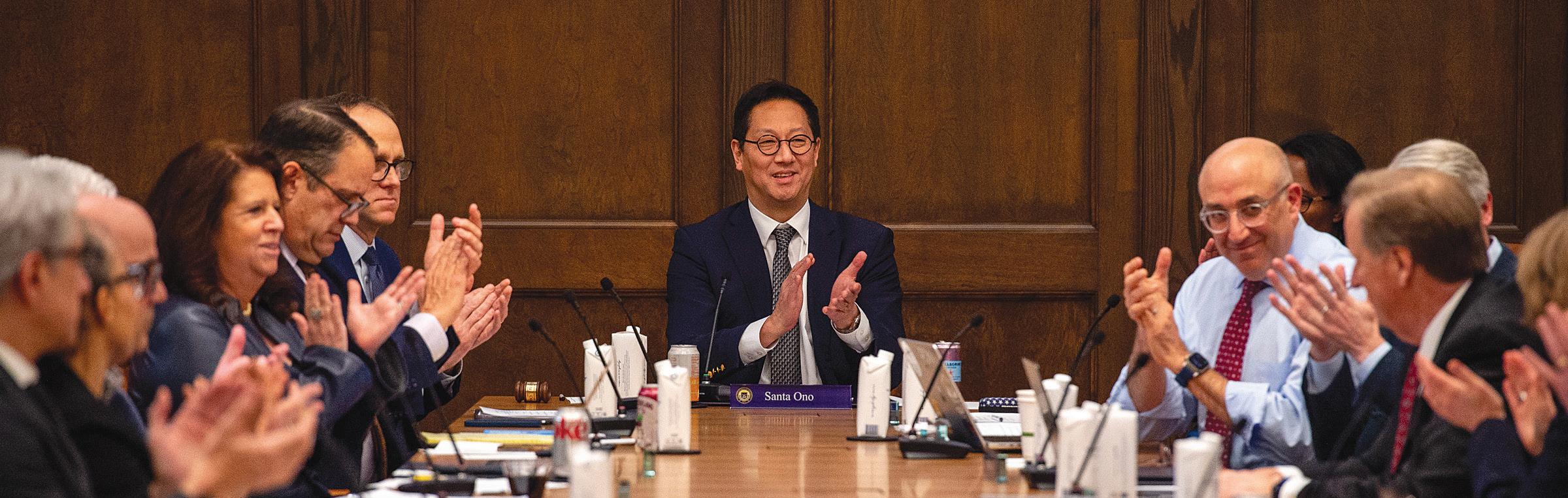
The University of Michigan’s Board of Regents met for the first time this year in the Alexander G. Ruthven Building Thursday afternoon to discuss challenges to higher education, approve the wind down of the U-M Health Plan and hear comments on increasing shared governance for students and faculty.
University President Santa Ono began the meeting with opening remarks, commenting on the uncertainty brought about by the new presidential administration’s executive orders and National Institute of Health budget cuts. Ono said the University would need to reevaluate its financial operations in the preparation for future funding cuts.
ADMINISTRATION
“Looking to the future, we’re facing a time of some challenge and change,” Ono said. “This is a critical moment for higher education. … We are taking steps to be as prepared as possible to respond wisely and quickly to any financial impacts that may lie ahead. As a public university we have a responsibility to ensure that we are efficient in our use of dollars from American taxpayers.”
Ono also said the University would continue to emphasize its commitment to freedom of speech and academic learning.
“Though we are navigating many changes, I want to make one thing very clear for the members of the University — This University will remain steadfast in its commitment to academic credence, freedom of speech and freedom of expression, ”
Ono said. “ Our distinguished faculty must be able to exchange ideas, question assumptions, challenge views and engage with a (range) of scholarly subjects and materials.”
Both the Proposed Winddown of UM Health Plan and Revisions to the Board of Regents’ Bylaws: Chapter II: University Executive Officers were passed unanimously with no abstentions.
The discontinuation of U-M Health Plan, which oversees both the Michigan Care and Michigan Care Advantage healthcare insurance plans, was announced Nov. 27. Due to consistent losses in the past five years despite efforts to reach financial stability, the University opted to wind down the plan and achieve full dissolution by 2027.
The board then heard a report from LSA senior Mario Thaqi,
Pro-Palestinian activists hold first rally since SAFE suspension
Protestors ask the community to remain focused on Palestine despite the ceasefire in Gaza
Pro-Palestinian activists held a rally outside of the University of Michigan’s Rackham Graduate School Thursday afternoon to bring attention to the ceasefire in Gaza and ask the community to remain focused on Palestine. Approximately 75 attendees gathered on East Washington Street for the protest. Engineering senior Maryam Shafie, Students Allied for Freedom and Equality co-president, spoke first. While the event was not officially sponsored by SAFE due to the limitations of its suspension, Shafie attended the event independently. Shafie said SAFE was founded in 2002 to build a community for Palestinian students and to pressure the University to divest from companies profiting off Israeli military operations.
“In 2002, a group of students at the University of Michigan
came together with a vision— to create a campus that can talk about Palestine, to build a community for Palestinian students and to hold the University accountable for its ties to Israeli apartheid,” Shafie said. “From its inception, Students Allied for Freedom and Equality has been more than just a student organization. It is a liberatory space, and a movement for justice within a corrupt institution.”
Shafie said the organization’s mission continues despite the University suspending SAFE this month after being charged with violations of three of the Center for Campus Involvement’s Standards of Conduct for Recognized Student Organizations.
“The University of Michigan thinks that by banning SAFE it can make this movement disappear,” Shafie said. “They have grossly underestimated the power of their own student body. SAFE is not just an organization. It is the people who carry its mission forward.
Our commitment to justice cannot be erased by any policy or institution. The knowledge shared, the history written and the complicity exposed over the last 23 years do not disappear with the (suspension).”
David Zeglen, lecturer of international and comparative studies at the University of Michigan, recalled 2002, his first year at Concordia University as an undergraduate.
Zeglen said he protested with Concordia’s chapter of Solidarity for Palestinian Human Rights against his university for hosting Israeli Prime Minister Benjamin Netanyahu.
“We protested an event on campus that was hosting a politician from Israel, a war criminal named Benjamin Netanyahu,” Zeglen said. “In response, (Concordia University) sent the police to beat us, the law to prosecute us and the administrators to ban us. We were disheartened, but we endured, we continued and we grew in the aftermath.”
Zeglen recalled a faculty member during that year telling him that courage comes from past struggles. He cited the Black Action Movement, LGBTQ+ activism, environmental protests, the women’s movement and the anti-war movement as past examples and promised to serve U-M students in the same ways his faculty served him.
“I vow to you that as long as I am in service to you as faculty, I will support you like I was supported as a student, in the continuing chain back through history,” Zeglen said.
CONTINUED AT MICHIGANDAILY.COM
Central Student Government president. Thaqi began by highlighting the University’s response to student protests in the past year and said a student seat on the Board of Regents would stimulate more discourse and engagement.
“Despite 2025 being labeled as the University’s year of democracy, civic empowerment and global engagement, community members have been silenced, peaceful protesters beaten and students, faculty and administrators targeted by violent, hate-driven attacks,” Thaqi said. “Such hatred and suppression have no place at the University of Michigan, especially on a campus that prides itself on a rich history of student activism. This is why my administration and others are advocating for an ex officio
ADMINISTRATION
student position on the Board of Regents, a standard practice across all other public Big Ten institutions.”
Thaqi said the student body needed a voice on the board to help address significant issues for students, including finding living spaces and affording food.
“Students are finding it increasingly difficult to afford to live on our campus,” Thaqi said, “While we are happy to see the University housing projects in progress, students will not feel the relief from these measures for years to come. Beyond housing, a large proportion of our students are also struggling with food insecurity due to rising prices and a lack of affordable grocery stores near our campus.”
Ono encouraged Thaqi’s efforts and the current CSG administration’s communication
with the board. He said conversations between CSG and University leadership would help the institution mitigate some of the problems Thaqi addressed.
“I think that kind of rapport is incredibly important between administration and students,” Ono said. “Let’s keep talking about how the University can support those very innovative efforts.”
Regent Paul W. Brown (D) followed Ono’s statement by saying the issues Thaqi brought up were important but may not be solved in the specific ways Thaqi’s administration had suggested.
“Some of the solutions may not be exactly as you envision initially,” Brown said. “But I think they all deserve attention and solutions.”
CONTINUED AT MICHIGANDAILY.COM
UMich allegedly considering moving some LSA departments to North Campus
LSA faculty concerned over potential move for physics, chemistry, earth and environmental sciences departments
participate in interdisciplinary collaborations.
In an LSA faculty meeting Feb. 3, a resolution was presented to attendees expressing concern over a widespread rumor: The University of Michigan administration may consider moving the Department of Chemistry from Central Campus to North Campus.
After hearing of the potential proposal to move the department as part of Campus Plan 2050, associate history professor John Carson posed both his resolution and an introductory letter. In an interview with The Michigan Daily, Carson alleged the LSA departments potentially moving to North Campus have expanded to include the earth and environmental sciences, physics and astronomy departments. Carson alleged that LSA Dean Rosario Ceballo confirmed the rumors at the meeting after consulting higher University administration.
“The dean of LSA substantiated most of it at the LSA faculty meeting,” Carson said. “The upper administration … confirmed three of these appointments, three of the moves: physics, chemistry and earth and environmental sciences.”
When asked about the moves, Ceballo reaffirmed the importance of a liberal arts education in an email to The Daily, writing that LSA’s Central Campus locations allow students, faculty and staff to
“Our central campus spaces are designed to encourage purposeful interaction and allow students and faculty to move between classes and labs with ease, to explore subjects like Shakespeare, organic chemistry, developmental psychology, and more,” Ceballo wrote. “Recognizing the critical role of the sciences, we are equally committed to providing state-of-the-art labs and research facilities that support our faculty to push the boundaries of discovery—all within steps of the classrooms where they teach and inspire the next generation.”
In his letter, Carson explained that moving natural science departments to North Campus could be detrimental to students and researchers, claiming the plan would disrupt interdisciplinary work. Carson told The Daily he feels the ability to engage in interdisciplinary projects is more important now than ever.
“In this intensely interdisciplinary moment, when most of the important issues we deal with have technical matters, matters involving the hard sciences, the biological sciences, the social sciences and the humanities — think about climate change, think about (artificial intelligence) — it seems to be the completely wrong moment to imagine pulling that apart rather than trying to intensify the kinds of connections,” Carson said.
In an interview with The Daily, LSA sophomore Jackson Jonker, the LSA Student Government Academic Affairs Committee chair, said students would lose key opportunities and resources to pursue collaborative learning if departments were separated.
“I think being in interdisciplinary studies allows students to have a wide breadth of academic learning and academic abilities,” Jonker said. “This university right now does an excellent job providing those opportunities for students to be well-versed in a wide range of academic affairs, which is absolutely fantastic. But with this plan so far, I think students and faculty will lose that ability to work and have the continuity of resources and academics within different departments.” Campus Plan 2050 features the Campus Connector, a proposed transportation network including an automated transit system and high-capacity bus routes that would serve the Central, North and Medical campuses. The plan faced community backlash for running through parts of the Nichols Arboretum, leaving the route over the Huron River Valley undetermined. Jonker said although the transit system could facilitate easier travel between the campuses, he worries new students would struggle to engage with the course material as a result of the change.
CONTINUED AT
Ann Arbor, Michigan
GRACE LEE Daily Staff Reporter
JOSEPHINE ANDERSON Daily Staff Reporter
MARISSA CORSI Daily News Editor
Jenna Hickey/DAILY
University President Santa Ono leads the Board of Regents meeting in Ruthven Thursday afternoon.
Former SMTD Voice Department chair violated sexual harassment policy, ECRT report finds
department and thanking Piper for his service.
Content warning: This article contains descriptions of sexual harassment.
On Oct. 4, 2023, a 2024 voice graduate walked into the School of Music, Theatre & Dance for her weekly voice lesson. An hour later, she sprinted from the building. Her professor, Scott Piper, former Music, Theatre & Dance Department of Voice & Opera chair, had just confessed his romantic feelings for her.
“How do you respond to your professor — somebody that you admire or trust — telling you that they’re in love with you while you know that he has a wife and four children, while you know that he is the same age as your own father?” she said in an interview with The Michigan Daily.
“He’s 53 years old.” The alum requested anonymity for fear of professional retaliation. In this article, she will be referred to as Jennifer.
After graduating from the University of Michigan in May 2024, Jennifer filed a complaint against Piper with the Equity, Civil Rights and Title IX office. The Daily obtained a copy of this report.
A Daily investigation, based upon a review of hundreds of pages of ECRT documents and independent testimonies, found that this incident was one of four sexual harassment allegations Jennifer made against Piper. The reported allegations ranged from inappropriate comments made toward Jennifer to inappropriate physical contact.
At the time the report was filed, on May 9, 2024, Piper was chair of the Music, Theatre & Dance School’s Department of Voice & Opera. Within weeks, on June 22, 2024, students in the department received an email from current department chair Stephen West announcing
One year later, Hearing Officer Jeff Knight announced that Piper would be recommended for dismissal from the University, effective Oct. 11, 2024.
“Dean David Gier has determined that the college will move forward with a recommendation for dismissal of Professor Scott Piper from their tenured faculty position at the University of Michigan, pursuant to Regents’ Bylaw 5.09.,” Knight wrote in the ECRT decision obtained by The Daily.
“Professor Piper’s conduct was an abuse of the power that arises from the unique 1:1 teaching context of the private studio and 1:1/general teaching responsibilities that are integral to his role at SMTD.”
Piper was placed on administrative leave, according to an email from West to students and faculty within the Department of Voice & Opera.
Piper is not the first Music, Theatre & Dance School faculty member to face allegations of sexual harassment. In 2018, David Daniels, a professor in the Department of Voice, was put on leave after he faced allegations of sexual misconduct. Stephen Shipps, the former chair of the Department of Strings and high school program director, was sentenced to five years in prison in 2022 after The Daily uncovered decades of allegations of sexual misconduct against him.
But Piper is the first known faculty member to face such allegations since the Music, Theatre & Dance School installed glass panels across the school’s buildings in response to a heightened awareness surrounding sexual misconduct prevention.
The pattern of sexual harassment allegations the Music, Theatre & Dance School has faced in the past is indicative
music conservatories across the globe. Much of this culture can be attributed to the power individual teachers have over students’ careers, according to an investigation by The Washington Post. These oneon-one relationships create a heightened intimacy that is unique to the environment of a music school. Piper took this intimacy a step further, according to multiple of his previous students in interviews with The Daily.
Section 601.22 of the Standard Practice Guide, which outlines the policies and procedures at the University, explicitly forbids covered relationships, which the policy describes as “any relationship which may reasonably be described as sexual, romantic, amorous, and/ or dating.” This policy contains no mention of the teacher’s intent behind the relationship.
“At its best, the facultystudent relationship nurtures the advancement and pursuit of knowledge and can lead to life-long professional mentorships and connections,” the policy reads. “At its worst, the inherent imbalance in the power dynamic between faculty and students can lead to real or perceived exploitation of the power differential.”
The Daily sent multiple emails containing requests for comment to West, Gier and the University’s Office of Public Affairs and Internal Communications. Both West and Gier declined to comment, and forwarded their emails to the University’s Public Affairs staff. In an email to The Daily responding to these requests, University spokesperson Kay Jarvis encouraged individuals with misconduct complaints to file a report with the ECRT Office.
“The university has systems in place to review, respond, and address behaviors that are
the values and policies of the university,” Jarvis wrote. “We encourage all reports of alleged misconduct to be shared with the U-M Equity, Civil Rights and Title IX office.”
The Daily requested comment from Piper for this investigation. His lawyer, David Nacht, responded to the request. Nacht had previously represented Robert Stephenson, former School of Nursing professor, and Stephen Shipps, former Music, Theatre & Dance School professor, both of whom ECRT similarly investigated for allegations of sexual harassment.
“Scott Piper is a good man,” Nacht wrote. “I have confidence that the President and Regents can distinguish between the unprofessional, sexually harassing behavior that truly threatens the safety of students and the circumstances of this case – where a good man expressed genuine interest in a student.”
‘Maybe this person isn’t as safe as I thought they were’
The Daily spoke with Jennifer about her decision to file a report with the ECRT Office after allegedly experiencing sexual harassment from Piper for more than a year. According to the final ECRT report, the harassment began months before Piper confessed his feelings for her.
Jennifer met Piper in spring 2020 during her first visit to the Music, Theatre & Dance School as a prospective student. Jennifer said she switched to Piper’s studio for the 20222023 school year because her previous instructor was not the right fit for her voice, and she felt this change would facilitate her vocal growth.
“I thought this would be the kind of relationship many of my professional mentors have with their esteemed teachers,”
Stanford Lipsey Student Publications Building 420 Maynard St. Ann Arbor, MI 48109-1327 734-418-4115
www.michigandaily.com
ZHANE YAMIN and MARY COREY Co-Editors in Chief eic@michigandaily.com
ELLA THOMPSON Business Manager business@michigandaily.com
NEWS TIPS tipline@michigandaily.com
LETTERS TO THE EDITOR tothedaily@michigandaily.com
GABRIEL PAREDES Creative Director JOHN ROGAN Strategy Manager
Angela Davis, Ta-Nehisi Coates speak at UMich activism talk
Renowned civil rights activist and author discuss “The Arc of Activism”
AVA PUSTULKA & HALLE PRATT Daily Staff Reporters
The University of Michigan LSA Student Government hosted a conversation at Rackham Auditorium Wednesday night on activism and racial justice as part of its annual Martin Luther King, Jr. Symposium. The event, titled “The Arc of Activism: Bridging Intergenerational Legacies” brought together Angela Davis, a renowned scholar and activist from the civil rights movement, and Ta-Nehisi Coates, an influential writer and cultural critic, to explore the evolution of activism across generations.
The event centered on the lessons past and present social justice movements can provide for modern activists engaged in the same struggles. The questions posed were written by students and faculty in collaboration with the Black Student Union and Elizabeth James, BSU faculty advisor and event co-organizer, to ensure diverse voices were represented.
James wrote in an email to The Michigan Daily that student organizers consulted with BSU, Black faculty on campus and other community members to ensure discussion questions were pertinent and meaningful.
“This truly was a labor of love,” James wrote. “The respect that the student organizers felt for the Black community led them to plan an event that celebrated the importance of solidarity among people who have been marginalized to inspire them to rise up and never give up the struggle for freedom for all.”
In the opening speech, LSA junior Ali Allam, LSA SG vice president, referenced a famous quote by King and said the activism by Davis and Coates inspired students to fight for justice in the face of President Donald Trump’s executive orders targeting diversity, equity and inclusion.
“We’ve seen campus protesters being repressed for standing up for basic human rights,” Allam said. “We’ve seen the plague of anti-Black racism producing attacks on diversity, equity and inclusion programs here at (the University) and across the nation. Their voices remind us that the arc of activism is long and it bends to justice, but if and only if we’re willing to fight for it.”
Angela Dillard, vice provost for undergraduate education, moderated the conversation. She began by asking Davis and Coates about how they understand the relationship between local struggles and global struggles, specifically in relation to the Israeli military campaign in Gaza.
“We are in a moment right now where people are asking themselves, ‘Why can’t the Democratic Party defend this assault on democracy?’” Coates said. “However you take the state of democracy in America to be, and I would submit to you that if you can’t draw the line at genocide, if you can’t fight for something that is so blatantly and obviously unjust, if you can’t oppose the 2,000 bombs dropped on schools and on hospitals, what does everything else mean?”
Davis said people use the complexity of global issues as an excuse to remain ignorant about them, using the United States’ history of segregation as an example.
“For such a long time, many people really felt as if they didn’t know enough in order to make a decision about what is right and what is wrong,” Davis said. “When Black people asked to be supported in struggles for freedom against segregation, nobody said, ‘Well, I have to first understand what happened in Africa and then the whole colonial period, slavery and so forth,’ in order to say, ‘No, we stand with Black people in the U.S. against racism.’”
In response to a question asking for advice for future generations of activists, Davis said it was important to acknowledge the changes that have resulted from the work of
past activists.
“We may not have been able to overturn the structures that (are) the underpinnings of racism and heteropatriarchy, and all of these other modes of oppression, but we’ve learned how to acknowledge the fact that they exist, and that’s major,” Davis said. “I think we have to learn how to acknowledge what we are responsible for — the changes, the radical changes that have occurred, that would not have occurred had we simply depended on elected officials, politicians. People. That’s where change comes from.”
Chase Cantrell, Taubman College of Architecture and Urban Planning lecturer, told The Daily in an interview that he admired how the conversation between Davis and Coates calmed anxieties during a stressful time.
“The world feels chaotic at the moment, and we need people and places that keep us grounded, and I feel like this kind of conversation is the kind of conversation that can ground people who are feeling very nervous and chaotic about the things that are happening right now,” Cantrell said. “So for me, this is fun, but it’s also something that can probably bring me some peace and calm in all the chaos that’s happening.”
In an interview with The Daily, Business graduate student Jumanah Saadeh, event co-organizer, said that even though the event is over, she hopes people will listen to the event recording, which will be available through March 7, and continue to engage with activism and racial justice by engaging with future conversations like this.
“Not everyone has heard about the event and we are trying really hard to make it as accessible as possible,” Saadeh said. “So we have the live stream, we have the recording. … The whole point of making this happen was that it would be as accessible as possible to folks and this was meant to really service the community. It’s not meant to be like a oneand-done kind of thing.”
USAS continues to protest wage theft of Nike garment workers who produced U-M apparel
‘We’re here saying this cannot go on anymore, we’re not going to stand for it, and we need to have our garment workers paid.’
Since 2023, United Students Against Sweatshops have advocated against alleged wage theft in Nike facilities producing apparel for the University of Michigan. Now, in 2025, USAS is still pushing for more significant action to address the wage theft and ensure justice for garment workers. At a protest held last week, USAS members reaffirmed their commitment to holding the University accountable for what they see as a lack of action to address garment worker conditions.
In 2020, workers in a Thailand factory producing U-M apparel for Nike, which has had an apparel agreement with the University since 2016, saw $600,000 of their wages stolen during work stoppages brought about by the COVID-19 pandemic. Under Thai law, employers are required to pay temporarily-suspended employees at least half of their wages during the period of suspension. Instead of honoring their wages, the factory pressured employees to sign up for unpaid leave against their will.
In an interview with The Michigan Daily at the protest, LSA senior Mark Tallents, USAS co-president, spoke about the University administration’s
response to this wage theft. In a letter to USAS in October 2023, University President Santa Ono wrote that he would have the Office of the Vice President and General Counsel contact Nike in response to a report from the President’s Advisory Committee on Labor Standards and Human Rights, which noted wage theft violates the contract with Nike.
Tallents said University leadership has yet to remediate the issue.
“(The committee) outlined the deadline at Oct. 31, 2023, but the president and the Office of General Counsel have sat on this report and they’ve done nothing to remediate this violation of our contract,” Tallents said. “We’re here saying this cannot go on anymore, we’re not going to stand for it, and we need to have our garment workers paid.”
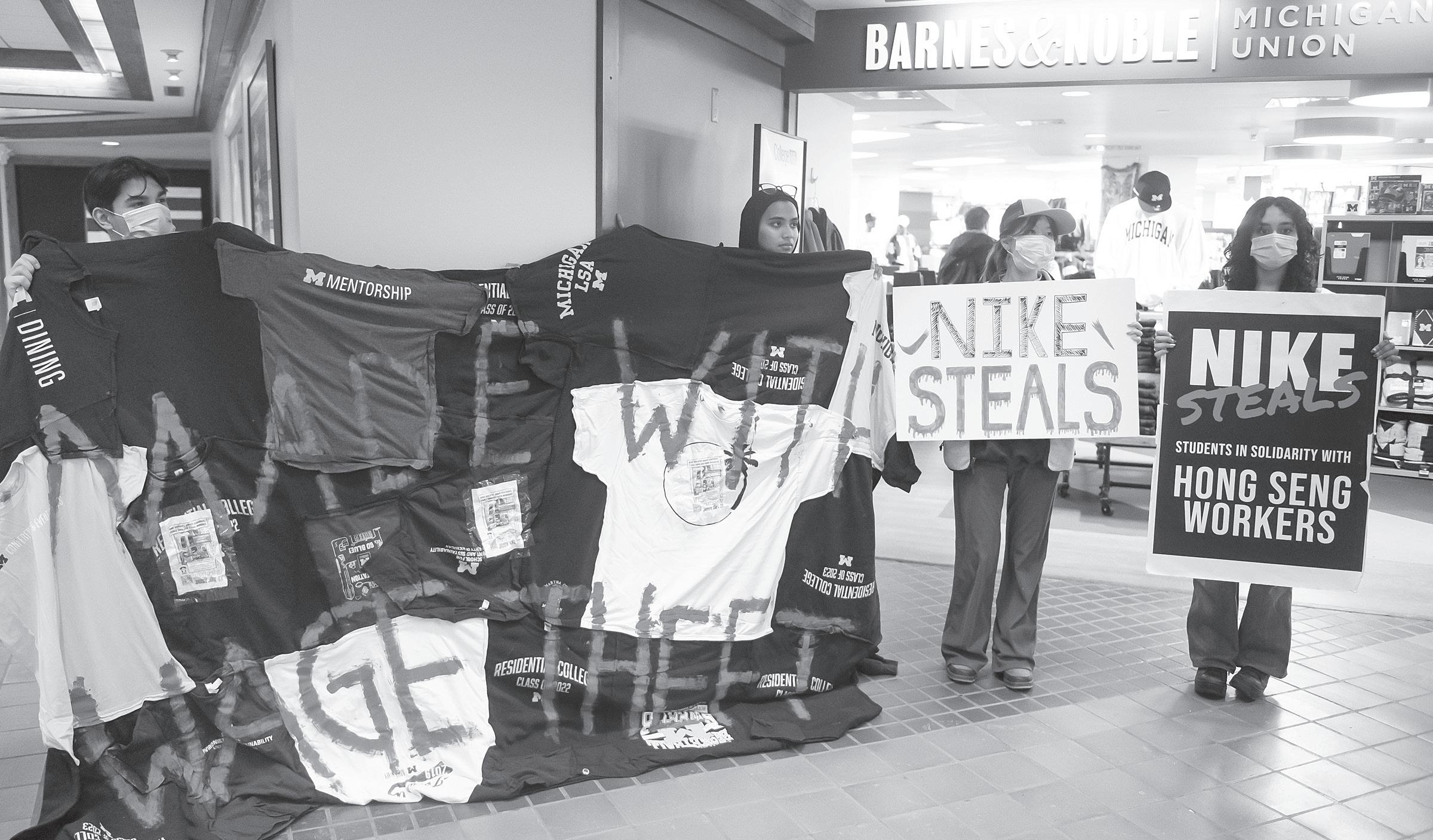
USAS members gathered Feb. 13 to protest the University’s failure to address the wage theft, standing around the entrance to the Michigan Union Barnes & Noble with a variety of signs, including a banner made of sewntogether U-M apparel with the slogan “Made with Wage Theft” painted in bright colors.
At the protest, LSA senior Alifa Chowdhury told The Daily she believed the University failed to act due to the institution’s emphasis on maximizing profit.
“Based on the other things that this University does, I think they
ignore the rules when they can and follow the rules when they want to.” Chowdhury said. “It’s very arbitrary, and at the end of the day it’s all about capital accumulation and them making some money.”
In an email to The Daily, Engineering sophomore Jonathan Zou, a USAS member, wrote that he believed standing against wage theft was something that the entire campus community should rally around.
“All people among the community want U-M to cut the contract with Nike: students who pay tuition to an institution that is complicit, staff who are treated the same as how U-M treats workers abroad, community members who can no longer wear the U-M brand with good conscience,” Zou wrote.
Tallents urged students at the University to be conscious of where their clothes come from and said they should take action to pressure the University to make more ethical decisions.
“I would say to all the students here, think about where your clothes came from,” Tallents said.
“Think about what this university represents when they put Nike on the front of their T-shirts, and do something about it and take action, because we have agency as students here.”
The University did not respond to requests for comment in time for publication.
Varun Tandon/DAILY
GLENN HEDIN Daily Staff Reporter
Jenna Hickey/DAILY
Students hold signs protesting against Nike during the United Students Against Sweatshops rally in front of the Michigan Union Barnes & Noble Thursday afternoon.
The Film Beat’s 2025 Oscar predictions
The Michigan Daily Crossword
2024 was a busy year for movies — and for The Michigan Daily Film Beat. We have diligently covered each and every notable cinematic moment — from box office bombs to instant cult classics. Our annual film coverage culminates on Oscars night, where the Academy of Motion Picture Arts and Sciences will attempt to fairly award the most outstanding films of 2024.
In preparation for this momentous night, our resident film critics have put together a thorough list of Oscar predictions. It wasn’t easy; in a year defined by meh-ness, the Oscars have somehow failed to meet our already low expectations. Nevertheless, our fearless Film Beat has waded straight into this year’s prickly Oscar predictions, taking no prisoners and bravely opining their fiery takes.
Best Picture
While last year’s ceremony was something of a display in red carpet Calvinism — the dominance of “Oppenheimer” was wholly predetermined and expected — this year’s Academy Awards is a complete reversal: It will be wholly undetermined and unexpected. There is no cinematic capstone for 2024. The films that might have seemed definitional for the year’s audiences — “Challengers” and “Dune: Part Two” — have been discarded by the Academy for not running an effective For Your Consideration campaign. Others — “I’m Still Here” and “Nickel Boys” — have been forgotten since their inception despite their obvious quality, and were therefore doomed from the start. Every other film nominated is, uh, complicated. There are the active cinematic question marks. Will the Academy award “Emilia Pérez,” a movie that is both hated around the globe
and actively harbors evil? Will the judges opt for the babygirl choice (no, not that one) and give the gold to “Conclave”? Will the Hollywood elite throw away their pretension and give the first-ever horror Best Picture award to “The Substance”?
Will the Oscar go to “Wicked,” the ugliest movie I have ever seen?
Who knows! There are the “obvious” choices (if you could call them that).
Sean Baker’s “Anora” and Brady Corbet’s “The Brutalist” feel like they should be the clear favorites — both having won big at their respective festival debuts — yet neither have built any meaningful momentum going into Oscars night. And, despite their clear quality (especially in comparison to the other nominees), neither quite goes the extra mile to truly set themselves apart as the defining film of 2024.
Throughout the year, I was heartbroken over 2024’s lackluster cinematic slate, but now? The spoonfuls of garbage we were forced to choke down have paid
us back thrice over with the most exciting clusterfuck of an awards season in living memory. Every hour, I convince myself of one nominee’s unquestionable Mandate of Oscar Heaven before reading its set designer’s racist tweet from 2019 and starting all over again.
In the interest of journalistic integrity, I’ll give a prediction: uhhhhhhhhhhhh … “The Brutalist,” I guess. Sure. Unlike other years, though, the winner doesn’t really matter. Despite me genuinely despising half of the nominated films and feeling nothing more than ambivalent toward the other half, no matter what the Academy chooses, I’ll be happy. Whatever happens, the discourse will sustain me for generations. Well, that’s unless the boring and derivative “A Complete Unknown” somehow ekes out a victory. But hey, the Academy has never done that before!
Will Win: ¯\_(ツ)_/¯
Should Win: The friends we made along the way
Best Director
We are looking at a pretty desperate Oscars season. Of the presented films — sadly none of which are Bertrand Bonello’s “The Beast” — the only justifiable win for Best Director is Brady Corbet for “The Brutalist.” It is the type of film that would sweep if the Academy was capable of reading subtitles and knew what an intermission was. Because of this, the movie has to win one single Oscar as a “here, damn,” and it’s already set up to be Best Director because no other directorial nominees are justifiable (particularly James Mangold). Awarding Corbet lets the Academy pat themselves on the back because they’re cultured enough to nominate a pretty good, “artistic,” soapy drama that they didn’t finish.
I’m also prepared for this to be the conciliatory Oscar for “Anora.”
This comes in consideration of the outrage over the usage of Artificial Intelligence in “The Brutalist” which essentially amounts to autotune in certain voiceover
scenes, something which is, for better or worse, industry standard.
Not a great year.
Will Win: “The Brutalist”
Should Win: “The Brutalist” Best Actor
In a frankly rough year for the Oscars — with snubs, drama and mishaps galore — Best Actor seems to be a bastion of peace.
Four of the five nominated actors are solidly deserving of an Oscar — sorry Sebastian Stan (“The Apprentice”), I didn’t want to watch a Donald Trump biopic with the state of American politics right now, I’m sure you gave a fine performance — and if any of them walked away with the award, I wouldn’t be upset. However, what is disappointing is that Timothée Chalamet (“Dune”) was nominated for “A Complete Unknown,” by far the less interesting of his two headlining performances this year.
While I’ve raved about Chalamet’s performance in “Dune: Part Two,” his breathy and evocative performance is the primary reason “A Complete Unknown” is at all
an enjoyable experience. Colman Domingo (“The Color Purple”), coming off an Oscar nomination last year for “Rustin,” returns to the category with a stunning and complex performance in “Sing Sing,” but it seems like it’s not his year. (Perhaps he comes back next year in the Michael Jackson biopic I just discovered is coming out).
This leaves two contenders: Ralph Fiennes (“The Menu”) with his subtle performance as Cardinal Lawrence in the pulpy drama “Conclave” and Adrien Brody’s (“Asteroid City”) imposing performance as architect László Tóth in the epic period drama “The Brutalist.” If it were possible to give them both an award, the two performances would solidly deserve it. Both actors carry their respective films on their backs, outshining stories that, at best, graze greatness. Both characters are the emotional hearts of their films, with the weight of their decisions being the driving force behind the movement and energy of every scene they are in. Both Fiennes and Brody did some of their best work in their long careers. But Fiennes did something I don’t often see in Oscar-worthy performances. Yes, he delivered his monologues well and commanded rooms full of yelling men, but, more impressively, he shows an internal self that is never communicated through dialogue. I will assuredly quote Brody’s Tóth for a long time — his “everything that is ugly, cruel, stupid” line is already a favorite of mine — but I’ll never forget Cardinal Lawrence’s quiet and subtle doubt in all of his actions. Will Win: Adrien Brody, “The Brutalist” Should Win: Ralph Fiennes, “Conclave” CONTINUED AT MICHIGANDAILY.COM
there yet?" 48. Unexpectedly 55. Sound emitted from 61-Across 57. Air bag?
58. Prompts this grid's shape, and a clue to 13-, 18-, and 48-Across 59. This, in Spain 60. Form of 8-Down
Retired Mach 1 breaker 62. What Hamilton isn't throwing away
1. Shortens, when sewing
Baker's container
Catch, as a sweater
Semi-oxidized herbal drink 7. Bill declaring guiltiness without a trial 8. "____ theft is not a joke, Jim!"
Fly larva 10. Latin lover's word 11. Crosses (out) 14. Shooting again, as a movie 15. Pa. airport north of PIT
19. Fencing weapons
23. French cream-filled pastry
24. "There was no other choice"
25. Mythological forest maidens
26. Elmo's street 27. Unlike U of M after a snowstorm 32. Leather-piercing tool
33. Lansing-based auto manufacturer
39. ASAP, e.g.
41. Wobbly Playskool toys
43. Manufactured water channel
44. Charlemagne's reign abbreviation
46. ____ A Sketch
47. Record producer and songwriter Ertegun
49. Brit. honor
50. Enemies
51. Throw
52. Thick with vegetation
53. "Do ___ others..."
54. Four-award acronym
55. Form of 8-Down
56. MLB metric of skill
Five books to read for Black History Month
Literature by Black Americans has long been a neglected cornerstone of the Western canon. While it’s crucial to highlight Black voices during any month of the year, The Michigan Daily Book Review takes a chance every year to highlight our favorite reads in honor of Black History Month. Here, The Michigan Daily Book Review presents five reads by Black authors, for your enjoyment this February and beyond.
“Gather Together in My Name” by Maya Angelou
Maya Angelou is one of America’s best-known poets and civil rights activists. “I Know Why the Caged Bird Sings,” her first memoir, rocked critics with its honesty, honeyed prose and frank conversations about identity and racism. Her second, “Gather Together in My Name,” finds Angelou a more mature writer — her poetic sensibilities pulled tighter, her sense of humor unmatched — and one willing to take risks. Where “Caged Bird” presents a fairly traditional narrative, connecting threads from the author’s childhood, “Gather Together” presents a series of thinly connected episodes from the beginning of her adulthood.
Though it covers familiar thematic ground — race and family ties return as important facets of Angelou’s life and writing — “Gather Together” never quite reaches the heights of “Caged Bird.” It is ambitious, certainly, but the overall story is less cohesive, and the reader’s understanding of Angelou is vaporous. What I love about this book, though, is its strangeness. Each episode is more unbelievable than the last: Angelou bumps shoulders
Black
Black Country, New Road has been with me since the small apocalypse — or my freshman year of COVID-19-induced online high school.
Isolation gave me permission to spend hours hunched over my laptop in my always dark bedroom, headphones on, methodically listening through each album on the /mu/core essentials list. During this process, I stumbled into the depths of YouTube music, where I discovered a live recording of BCNR from 2019. A group of British teenagers playing jazz instruments with the reckless spirit of punk fronted by some guy spitting slam poetry seemingly mid-exorcism? It was love at first listen.
The best part: BCNR didn’t even have a formal album out yet! We were brought together by my YouTube suggestion bar and the undeniable power of fate. Now, five years later, quite a few things have happened. Come April, BCNR will release their fourth album, their first without former frontman Isaac Wood, who left the group in 2022 due to mental health concerns. Naturally, this made me a little nervous. After all, Wood’s wry lyricism and crooning vocals imprinted on my 14-year-old soul, so I had a bit of a tough time letting go of him on BCNR’s latest single, “Besties.” Now, though, I see “Besties” for what it is: subtle storytelling and post-punk jazz at its finest.
OK. That was a lot. Before we get to “Besties,” let’s back up a bit. Black Country, New Road emerged in the late 2010s at the forefront of the new wave of melodramatic British rock. Think: Squid, Folly Group, Yard Act, Dry Cleaning, Ugly UK or even
with unsavory characters on the West Coast; careens into a short, doomed stint dancing with her teacher and lover RL Poole; and comes home to Arkansas, only to come into conflict with her grandmother.
Young Angelou rushes headlong from moment to moment by the seat of her pants, breezing by each without allowing a chance to pause and gawk at their absurdity. Could she have lingered on a few stories longer? Maybe. But it makes for a delightful read all the same. It’s a gambit that perfectly captures the headiness of adolescence from the arms-length wisdom of an older writer — a perfect picture of the giddy joy and the deadly seriousness of young adulthood.
“Nickel Boys” by Colson Whitehead
This past weekend, I caught a showing of this year’s Oscarnominated “Nickel Boys,” and once the lights came up, I immediately knew I had to pick up the book it was based on. Colson Whitehead’s novel of the same name tells the story of two teens who are detained at Nickel Academy, a segregated detention camp for boys. Elwood, Turner and the other children who are sent to the school suffer abuse and violence at the hands of a deeply corrupt system. But Whitehead doesn’t simply focus on the injustice and boys’ abuse, honing in instead on their narratives, their voice and their understanding of the changes being fought for during the Civil Rights era. It is not a book that is sickeningly hopeful, but rather a portrayal of the challenges of the time, alongside the sometimes perilous resignation that comes along with wanting something better.
Turner, Elwood’s friend at Nickel Academy, believes the only way to overcome is to make it through and survive however you can. But Elwood has sturdy
optimism — something Turner would call naiveté — and belief in making real change and dismantling the system however he can. Not through, but out.
The events, based on the experiences of boys at this very real school, almost read like a series of vignettes. The prose is simple and musing, but the real strength of the novel lies in its exploration of what power an individual has to make change by speaking about what has previously been left unspoken. A perfect foundation for the movie adaption, and a brief but important read for any time of year.
“The Color Purple” by Alice Walker
Alice Walker’s epistolary novel, “The Color Purple,” takes form as a beautifully tragic masterpiece set in 20th-century Georgia, following an African American woman forced into marriage and on the search for her lost sister. Winning both a National Book Award and a Pulitzer Prize, the letters written by our narrator detail hope, pain, shame and resilience in measures rarely seen in literature.
Originally published in 1982, “The Color Purple” broke boundaries by taking an intersectional point of view. Yet, while race and identity are central to the themes of the novel, they do not define the characterization of our narrator alone. Filled with joy, innocence and unabashed spirit, Celie’s hope is the most inspiring part of this novel. In spite of her traumatic backstory, her faith stays strong, acting as her anchor. Her story, told through letters, is addressed to God. Though firstperson narration can typically take on a sense of unreliability, Celie’s account is undeniably honest, essentially acting as a confessional.
CONTINUED AT MICHIGANDAILY.COM
Another argument for DVDs
GABY CUMMINGS Daily Arts Writer
Before my hands could carry, they knew how to pull. They would often reach out to grasp the portable DVD player resting on my sister’s lap just to pull it closer to my own. Watching a movie back then wasn’t just about the viewing, but the process of flipping through our binder of DVDs, arguing over which movie to choose and building a cozy corner to huddle in. My sister would suggest “Hercules” or “The Incredibles” while I’d beg to rewatch “Annie” or the newest Barbie movie. When we were finally ready to sit down and watch, we’d take turns huffing on the disc and wiping it with our sleeves, hoping the scratches would miraculously disappear. We’d carefully place the disc into the tray and cross our fingers, excitement building as the screen lit up.
When I slept over at my grandparents’ house when I was younger, we always ended the night with a movie. My nana would let me pick, so I’d dash to the living room with energy reserved solely for moments like these. I’d press on the glass cabinet next to the TV and it would pop open, revealing a collection of DVDs we had watched more than a dozen times. I’d browse the titles, pulling each one out to look closer. We both knew I’d pick “Daddy Day Care” as I had a million times over, but on some nights I’d be frozen with my newfound agency as the sole decision maker. I’d sit there with five discs in my hand trying to play eenie, meenie, miney, mo, but because I knew the pattern of the song, it was never truly up to chance. Sometimes, my nana would suggest going to Blockbuster for some fresh options and we’d hop in the car, excited to discover something new. We’d walk through the aisles and linger in the family section as I grabbed each DVD to investigate. My nana would suggest a few genres to focus my attention as my eyes darted around the store,
trying to take in each title. After a while, I’d grab the newest Roxy Hunter movie and hand it to my nana with a toothy smile.
My family went on a lot of long road trips for sports tournaments when I was growing up. To pass the time, we’d stop at a Redbox and pick up some movies to watch during the drive. Redboxes were often located inside grocery stores, so we’d pick up a snack or two along the way. Because my sister and I could still never agree on a movie, we’d both get to pick one. She’d go first, flipping through each page of titles, and I’d peer over her shoulder to try and get more time with the options. I was a notoriously slow decision-maker, so the more time I had to familiarize myself with each movie, the less likely I was to sour the journey before it even started. “A League of Their Own” and “Minor Details” caught my eye every time as the titles flipped past. When the DVDs fell into the drop box, we both clutched our selections and skipped back to the car. Again, we’d do our ritual of huffing on and wiping the disc with our sleeves, hoping the scratches weren’t serious enough that the disc couldn’t be read. As my sister reached up to open the scratchedup monitor attached to the roof of my mom’s Pacifica, my excitement turned into toe-tapping and the same toothy smile reminiscent of my blockbuster days. After the movie, we’d go through each of the special features: cast interviews,
black midi if you squint. While these acts are extremely distinct, they all share a tendency towards talk-sing punk vocals, chamber instrumentals and a general sense of disorientation. This distinct flavor of U.K. post-punk has long debated roots, at times (mis) attributed to post-Brexit turmoil or perhaps something deeper that makes modern Brit musicians tend toward the ironic and avant-garde. However, what separates BCNR from their contemporaries is chronic poor timing. With three records released since 2021, two were overshadowed by circumstances completely out of the band’s control. Their debut, For the first time, was released in February 2021 amid the COVID-19 lockdown. While it still received critical acclaim, the group was unable to tour with a record that
bassist Tyler Hyde called “made for a live setting.” By early 2022, venues were reopening and BCNR had the advantage of a small cult following just in time for the release of their sophomore album, Ants From Up There. The group was finally going to get the chance to perform for the fans they’d amassed in the last year, at least some of the band, anyway. Just four days before the album dropped, vocalist and lyricist Isaac Wood suddenly announced his definite leave from the group due to his declining mental health. For many fans (including myself), Wood was the lynchpin of BCNR’s intrigue. His earnest vocal delivery stood square between breakdown and Beat poetry, while his lyricism balanced humor with unflinching honesty.
So, there goes another tour. Sort of.
BCNR still honored their tour dates, but instead of playing material that would feel undeniably hollow in Wood’s absence, they opted for unreleased songs. This is where we got Live At Bush Hall, a sans-Wood concert album. While live albums are often gratuitous, BCNR’s live work has always been worth the listen, given their jazz background and inclination for improvisation. While Bush Hall is shockingly cohesive, it still listens like a demo tape rather than a record. I was clearly listening to the new BCNR, but Wood’s vocal absence didn’t feel quite real yet. This leads us to “Besties,” the first single from the upcoming record Forever Howlong.
At first, I was off-put by the tweeness of “Besties.” The track opens with an urgent harpsichord riff, followed by a bursting crescendo
of chamber sound: beating drums, a trumpet and some introductory choral “ahhs.” Abruptly, the track quiets for new vocalist Georgia Ellery shining over the mix of plucky guitars. On the surface, the lyrics are cloying musings on best friendship. Overall, the instrumental is rich and fun — like a brighter, poppier take on BCNR’s jazz chamber schtick. Although the track was objectively good, I was initially dispirited. I felt as though BCNR was leaning too far into the selfawareness that drew me in the first place. Corny pop-culture lines like “She had Billie-Eilish style” and “Leave Kanye out of this” didn’t bother me on previous albums. On “Besties” however, I visibly made a face during the third verse when Georgia exclaims: “I’m a walking TikTok trend.” Where was the
bloopers, anything that could keep us entertained as we drove further into a seemingly endless journey. A few years ago, I renewed my library card for the first time since I was a kid. I wanted to support my local library, and I also had the lofty goal of trying to get back into reading. While browsing the many aisles of books, I found a back wall full of DVDs. It was like a mini version of the Blockbuster my nana used to take me to, but everything here was free. I scanned the titles and a few familiar movies caught my eye while some new ones pulled me closer. Among the likes of “Hercules,” “Daddy Day Care” and “A League of Their Own” were MGM classics, Criterion films, blockbusters, non-English features — any style of movie you can think of. I grazed each title with my fingers, hoping to glean some prophetic vision of what I should choose. Even after all these years, I am still an awful decision-maker, and my nana wasn’t with me then to focus my attention. I perused each shelf, carefully selecting five movies off the shelves. I started with “Uptown Girls” for the classic unlikely duo comedy, added the French New Wave staple “The Young Girls of Rochefort” and topped it off with the life-changing drama “Tokyo Story.” I admired my stack before I checked out, forgetting my original plans and walking out without a single book in hand. CONTINUED AT MICHIGANDAILY.COM
grit? I kept waiting to feel suddenly gutted, as I often do while listening to BCNR. Turns out, I wasn’t actually listening to “Besties.” Instead, I was waiting for Isaac Wood to pop out from behind the curtain on a track wholly independent of him. After reading a few angry Reddit reactions, it seems many fans also committed this cardinal sin. To truly listen to the new BCNR, I had to loosen my death-grip on the old. Once I recalibrated, I realized that “Besties” isn’t just cutesy chamber-pop: It’s an unrequited lesbian love story.
“Besties,” like most BCNR songs, excels in its ability to portray tensions. The toothache sweetness of the harpsichord and Georgia’s too-polite voice create an unexpected atmosphere of anxiety mirroring the strain between close female friendship and queerness. Lyrics like “I know what’s expected of me / Besties night and day” can be read as childlike devotion or, after a shift in perspective, a mantra of purposeful repression. Maybe the TikTok line is less ironic and more a comment on social media’s homogenizing effect on the Queer female experience — it’s a “trend” for us to fall in love with our best friends.
Overall, “Besties” is about conflict — conflict between preserving uneasy familiarity and risking change. Perhaps this is emblematic of BCNR’s current state, wobbling at the cliff’s edge of the Isaac Wood era with no other choice but to jump and reinvent. This is not an easy task, especially considering the instant cult status of their first two records and the (very ironic) tendency of art-rock fans to reject change.
Come April 4, I hope that fans will give Forever Howlong a proper expectations-free listen.
SIENA BERES Daily Arts Writer
THE MICHIGAN DAILY BOOK REVIEW
Natasha Eliya/DAILY
Edited and managed by students at the University of Michigan since 1890.
Stanford Lipsey Student Publications Building
420 Maynard St. Ann Arbor, MI 48109 tothedaily@michigandaily.com
ZHANE
YAMIN AND MARY COREY Co-Editors in Chief
Zach
Editors
Unsigned editorials reflect the of f icial position of The Daily’s Editorial Board. All other signed articles and illustrations represent solely the views of their authors. EDITORIAL BOARD MEMBERS
Jovanna Gallegos
MEREDITH KNIGHT Opinion Columnist
One day, while working at an after school program, one of my students told me she had never eaten Korean food. Because my place of work had the resources, we decided to cook Korean food for her and her peers for dinner. This experience opened her eyes: She loved the food, insisted that we continue to cook Korean food and even expressed interest in learning Korean. Students benefit from new adventures like this, and yet they’re severely lacking in many schools. A significant portion of students in America lack access to experiential learning, and it’s up to educators to rectify this problem. We need to shift our attention to the experience gap, which refers to the idea that many students do not have the ability to develop realworld experiences outside of the bubble of their community. Experience-rich education takes many forms. Opportunities and experiences range from helping students gain confidence in their own
As President Donald Trump settles back into the Oval Office, an onslaught of his new cabinet nominees are waiting to get confirmed by the Senate. Since their announcement, the president’s picks have faced backlash, with many expressing concerns about their limited experience and lack of qualifications. From a Fox News anchor selected to lead the Department of Defense to the wife of Vince McMahon, former CEO of World Wrestling Entertaining, poised to run the Department of Education, many looked toward the Senate confirmation hearings with hope that senators, Republican and Democrat, would scrutinize the appointees’ questionable qualifications in a tempered, yet unrelenting manner. They didn’t. Instead, the hearings have become a venue for grandstanding senators fishing for screaming matches or “gotcha!” moments with the sole goal of reaching online virality. This new goal for digital stardom has turned what used to be rigorous and intense trials into reality TV-esque tell-alls full of media controversy and baseless arguments.
For as long as video sharing has been possible on the internet, it has been responsible for making and
The housing hunt
Experience is the best teacher
identities, providing electives and extracurriculars for them to participate in or utilizing technology for hands-on lessons. Learning by doing increases student motivation and investment in their education. Students with access to schools that allow them to try new things and engage with their class material develop a broader understanding of the world around them.
The experience gap largely stems from a lack of outside resources, disproportionately affecting students of Color. Research from New York University shows that schools that serve predominantly Black students don’t have enough resources, including human resources like counselors, to help them with non-education problems, such as home life, stressors outside of school and discrimination. Additionally, many students from underresourced school districts are too busy helping family or working part time to participate in afterschool programs. Such obstacles often prevent them from engaging with new experiences.
NYU’s study also dispels the myth that resources are better
in charter schools versus public schools. Their study proved that even charter schools that have racially diverse populations tend to underserve their minority students. Missions to provide equitable schooling to all students does not end at giving kids all the same classes. If schools cannot provide support for students of Color that gives them equal access opportunities for new experiences, then they are failing.
Measures of success, like standardized test scores, assume that every test taker has a standard prior knowledge. So, to address inequities in education, the solution should be to help our students gain experience through education. Additional resources to help students close the gap in opportunity is proven to keep students in school for longer, earn more and reduce instances of adult poverty. Experiencebased learning also increases test scores and encourages positive attitudes towards STEM classes. Learning by experience teaches kids to love the content rather than dread the tests.
Unfortunately, the schools
where students need the most help gaining experience and becoming excited about new things lack adequate funding. Some schools can’t provide outside experiences simply by virtue of where they live. Resources that are within walkable distance such as public libraries, museums and parks are not always available in poor urban areas or some rural areas. Then, due to their lack of physical access, the adolescents and their families in the area struggle to fill their lives with exposures to experience outside of their bubbles. Thankfully, it’s not all bad news. There are ways that we can inject personable, experience-led curriculum into our students’ schooling. They exist, but the catch is that they take time and funding. Programming requires applying for grants, searching for volunteers or asking underpaid teachers to go the extra mile in their lesson plans.
For some rural teachers who are willing to bring the opportunities to their students, encouraging students to enroll in an agricultural class allows them to join the program Future Farmers of America.
Even if students do not have time after school to consistently engage in the club, they can still learn from peers in class who do. Sometimes, all students need is a close connection to someone who knows how to find opportunities. These types of in-school peer networks helps students who don’t have resources for extracurriculars.
After-school programs are another tangible way to reach underserved students because it lifts the burden off of parents to provide students with outside opportunities. In Ann Arbor, Community Action Network is funded to help foster experience-led education for adolescents in Washtenaw County. Helping parents by providing extra reading time for students, enrichment activities and structure to their afternoons are lowcost activities, but highly rewarding for the students involved. Many parents need to work, so access to quality after-school programming gives them time and help with providing opportunities for their children.
The community should also have a say; many assistance programs are implemented in
Congressional hearings are rage-baiting you
breaking political careers and campaigns. There is perhaps no clearer example than the 2004 presidential election where, during a speech celebrating his third-place finish in the first primary election of the season, presidential contender Howard Dean let out a scream which would completely flip the race on its head. The loud yelp, now called “The Dean Scream,” went viral and immediately put an end to Dean’s campaign, turning him into the internet’s first political meme.
In many ways, Dean and his infamous “I Have a Scream” speech paved the way for many politicians today who use the internet as a way to build devout fan bases and national acclaim.
In this new wave of “influencer politicians,” none have used social media to find as much success as Rep. Alexandria Ocasio-Cortez, D-N.Y.. The representative — out of the Empire State’s 14th district — has used her confrontational character and youthful persona to amass a nearly unparalleled social media presence. Since earning her seat, she has become famous for her TikTok and Instagram Live streams and is the most followed person on Bluesky, an X clone created in response to Elon Musk’s 2022 Twitter acquisition.
Ocasio-Cortez’s online success has led to talks of a potential bid for the presidency in 2028, as she has amassed a large, national following. Ocasio-Cortez has proven that
a potent social media presence can be a powerful asset for any politician and led many to replicate her digital success by seizing opportunities aimed at aggrandizing their digital following. With this new philosophy in mind, few settings make gaining online clout as accessible and easily attainable as congressional hearings.
In most cases, these hearings are large-scale, confrontational and highly politicized events in which the media is granted an almost unrivaled presence. These attributes have led to a “perfect storm” which has fundamentally changed the nature of congressional hearings, from standard
inquiries into a candidate’s adequacy, to raucous and divisive media blitzes in which congresspeople ask irrelevant and inflammatory questions, all for the sake of getting on the trending tab. Now, partisan jabs and trick questions make up the majority of hearings that were once composed of genuine concerns and real criticisms.
This new reality for confirmation hearings has certainly been on display during the last few weeks, where various pointless questions seem more like attempts at petty political postulating than working to actually examine the appointees. This was certainly the case when Sen. Bernie Sanders, D-Vt., questioned
Robert F. Kennedy Jr., the then-prospective secretary of Health and Human Services, about a series of baby onesies sold by an organization which Kennedy had chaired. The question was only vaguely related to Kennedy’s responsibilities, and given that he is no longer even affiliated with the brand, it felt more like an attempt to start a pointless debate about a baby onesie beyond his control.
Seemingly, this attempt to “boil down” the complexity of the confirmation process reflects a decline in the quality of appointees made by the president. Unfortunately, it has allowed some alarmingly unqualified individuals to skate by as senators focus more on digging up old tweets,
communities without asking the community members what they need.
Community input is important, as seen in Youth Empowerment Services, a program created by the University of Michigan’s Institute for Firearm Injury Prevention. The institute works with the adolescents in struggling communities to help fund initiatives that the community wants. The program has helped students invest in their communities by painting murals, creating community gardens and landscaping an overgrown empty lot. Investing in space while involving students tells the community that their input matters. If parents want to replicate this at home, the curriculum is provided free of charge. Experience-rich education empowers our students and engages them in their learning. There are pragmatic ways to either increase funding, adjust lessons or include communities so all students participate in vast opportunities. Education should teach students a world where they can make a difference. There is no better teacher than experience.
while criticism over their professional record takes a back seat.
Of course, social media has allowed politicians to get in touch with their younger constituents. However, we should also work to keep our leaders accountable to ensure that they aren’t downsizing or minimizing their responsibilities in order to appeal to the tastes of social media’s algorithms. Confirmation hearings are one of the few ways in which Congress can directly shape the incoming president’s cabinet, and with such shoddy picks, it is important that they leverage their influence.
As Trump’s long list of appointees continue to funnel through the Senate’s chambers, their confirmation hearings have outlined how social media has brought the worst out of our public servants. In an attempt to reach audiences through its algorithms, social media has turned these events from the nation’s porthole into the Senate’s inner workings into a hotbed for degeneracy all with the aim of getting on your For You page. This diminishes the importance and efficacy of these confirmation hearings while reducing our public servants to “elected rage-baiters” who ask barbed and awkward questions to rile up their online fanbases. Instead, we should reject Congresspeople who try to stage conflict for views online and stop engaging with content that is tailor-made for reposts.
Erin Coleman/DAILY
MATEO ALVAREZ Opinion Columnist
Natasha Eliya/DAILY
Pete Buttigieg would be a disaster for Michigan
Analyst
After a tumultuous 2024 election season that resulted in President Donald Trump’s second victory, the Democratic party is the most unpopular it’s been since at least 2008. However, with a tense start to Trump’s second term, his net approval rating still isn’t positive and only 38% of Americans are satisfied with the conditions of the United States.
While a lot may seem uncertain, Americans have a general sense of where they are politically: They don’t particularly like either party and want someone with a new vision for the direction of the country.
Michigan will soon feel the consequences of this new political dynamic, as Sen. Gary Peters, D-Mich, announced that he will not run for re-election in 2026. Already, there has been speculation about who will run in a Democratic primary in a state with a deep Democratic bench. State Sen. Mallory McMorrow, D-Flint, appears already primed to run.
Another name that has been popping up is Pete Buttigieg, the former secretary of transportation who now lives in Michigan. There were already speculations surrounding a potential run at the Governor’s office for Buttigieg, but with a chance to make a national name for himself, a run for the open senate seat seems much more likely. This would not only make him a carpetbagger, but would also interfere with his clear presidential ambitions, both of which make him a bad choice for the Democratic nomination.
The main reason Buttigieg should not run for senate in Michigan is the apparent political motivation behind his move here. He was born in Indiana and lived there his whole life. He gained political fame for his presidential bid in 2020 while serving as the Mayor of South Bend. He only moved to Michigan two years ago. Even if he were to win the Democratic primary, he would be unlikely to win many moderate votes in the general election because of his carpetbagger status. Michigan is a swing state, and Democrats absolutely have to win back control of the Senate in 2026. It would be irresponsible for Buttigieg to throw his name in the ring and risk losing the majority to Republicans. Additionally, it seems Buttigieg wants to run for president in 2028. He has already served in former President Joe Biden’s administration and has been branded as a “Rising Star” among Democrats. Those potential optics suggest he would be using the Senate seat as a stepping stone. Every decision he makes and vote he takes would be focused on his national perception, rather than focusing on how policies affect Michiganders.
Haylee Bohm/DAILY
For example, there has been discussion about piping water from the Great Lakes to the West Coast. Michiganders have long opposed this proposal, but should the issue come up in the Senate, Buttigieg might make the choice to appeal to a broader electorate to try and bolster a future presidential campaign, while breaking with Michigan.
There is a deep Democratic bench of people that are actually from Michigan that would do a better job than Buttigieg. Lt. Gov. Garlin Gilchrist II, Rep. Haley Stevens, D-Mich. or even Gov. Gretchen Whitmer all have similar positions to Buttigieg, with some already having statewide electoral credentials.
Another advantage these candidates have over Buttigieg is their demonstrated ability to connect with the Michigan electorate. The former secretary represents a bastion of American politics that citizens have made clear is undesirable, especially after Kamala Harris, Buttigieg’s colleague and former vice president, ran a billion-dollar losing campaign.
Buttigieg follows a similar pattern as those responsible for Harris’ loss. He has an Ivy League education, was a McKinsey consultant and served in Biden’s highly unpopular administration. To then run for Senate in a state that he has never represented would be almost comically out of touch with what voters want.
Buttigieg’s highly educated background might play well in wealthier suburbs, but in a perpetual swing state with high unionization rates, there are warning signs that Buttigieg wouldn’t turn out enough working class voters to win a general election. He also struggled with Black Americans in the past, and Michigan has a substantial Black population.
Forcing a nationally relevant figure to run for Senate just because he seems to have political talents would show why the Democratic party became so unpopular in the first place. Buttigieg, the supposed political talent, shackled himself to an unpopular establishment administration. He has skills in acquiring the interests of billionaires, but that doesn’t mean he will be able to represent the people of Michigan.
In his constant, unnerving political ambition, Buttigieg has sold out to billionaires, becoming the manifestation of the corporate directionlessness that voters are unsatisfied with.
If Pete Buttigieg wants to run for president in 2028, then he absolutely should. But using Michigan’s open Senate seat as a proving ground for himself would be wrong for the citizens of the state. With an absence of a real, concrete vision for the future that is different from his predecessors, Buttigieg
‘Potential’ is not on my
ADRIANA SEAGE Opinion Columnist
During my internship application process, there is one question that stumps me — and it’s not anything regarding my skill set:
‘‘Will you now or in the future require an employment visa sponsorship?’’ I check “yes” begrudgingly, knowing full well that I’ve just sent my application straight to the rejection bin.
As a sophomore in the College of Engineering, most of the conversations I have with my peers come back to the topic of summer internships, or more specifically the lack thereof. As we get further into the semester, the pressure of finding an internship increases each day. For those without established connections or previous internship experience, the chances of acquiring a placement feel even slimmer.
I have spent countless hours on LinkedIn and Handshake, scrolling through endless internship postings. Every time I find one that I would be a perfect fit for, the bolded disclaimer screams at me: ‘‘U.S. work authorization required.”
Navigating the job market is challenging for all, especially in a competitive environment like the University of Michigan, but for international students, the challenge is even greater. Visa quotas, employer hesitancy and misinformation create barriers that domestic students simply do not have to face. When it comes to the hiring process, employers need to stop overlooking international students due to their immigration status.
International students take the same courses as domestic students, receive identical preprofessional guidance from their advisors and are part of the same extracurricular activities that enhance their social and technical skills. Moreover, these students have valuable multilingual and cultural perspectives because of their international backgrounds, yet employers overlook this due to the questions that a work
authorization can raise. A foreign-born applicant might have just as much, if not more, to offer than an applicant who is a U.S. citizen, and deserves the same chance to prove themselves — no matter their work authorization status.
Foreign-born workers are an integral part of the U.S. workforce. According to the American Immigration Council, they make up almost a quarter of all STEM employees in the country. Yet, it seems that for international students, even at world-renowned U.S. universities, the employment search is often lined with hurdles — both before and after graduation.
Many small and mediumsized companies shy away from hiring international students because of the legal complexities involved. These employers either don’t seem to understand the process or simply do not have the personnel to deal with the extra paperwork. As a result, we are now reliant on transnational corporations that have more experience with non-U.S. citizen employees. However, for internship positions, especially for undergraduates, the number of open positions decreases significantly.
Most international students who are searching for summer internships are full-time F-1 visa holders pursuing a Bachelor’s or post-graduate degree. With this visa status, there are two options for employment: Curricular Practical Training and Optional Practical Training.
Curricular Practical Training is a type of work authorization available to F-1 students. It provides an opportunity for international students to gain practical work experience while still enrolled in college. Similarly, Optional Practical Training applies to those who have already completed a degree at a U.S. institution. OPT has a 12-month limit, although students in STEM fields are eligible for a 24-month extension through the STEM OPT Extension. Designated School Officials authorize CPT
and OPT and do not require sponsorship from the employer; therefore, companies only need to provide an official offer letter and verify work eligibility through the I-9 Form, just as they would for an applicant who is a U.S. citizen.
Unfortunately, even though it’s as simple as receiving CPT or OPT, a lot of misconceptions about the hiring process result in employers’ reluctance to hire international students.
While CPT and OPT are straightforward systems that aid international students in the process of entering the workforce, many employers assume hiring non-citizen interns is an arduous process.
While CPT and OPT are straightforward systems that aid international students in the process of entering the workforce, many employers assume hiring non-citizen interns is an arduous process.
Many employers are hesitant to hire international students because they assume these interns will leave the U.S. after graduation or once their OPT work authorization expires. As a result, companies are reluctant to spend time and money training international students during their internships, which would supposedly be a wasted investment. However, this assumption quickly falls apart when you speak to a student on an F-1 visa — many of whom attest to their commitment in securing long-term employment and legal work authorization postgraduation.
In an interview with The Michigan Daily, Engineering sophomore Ana Lucia Hurtado Luperdi expressed her frustration with companies only giving importance to her immigration status.
“It can be incredibly discouraging to apply to numerous internships only to be rejected due to my international status. Some companies even specify in their applications that they do not hire candidates without U.S. citizenship,” Hurtado Luperdi said. “This makes me uncertain about my future in the U.S., even
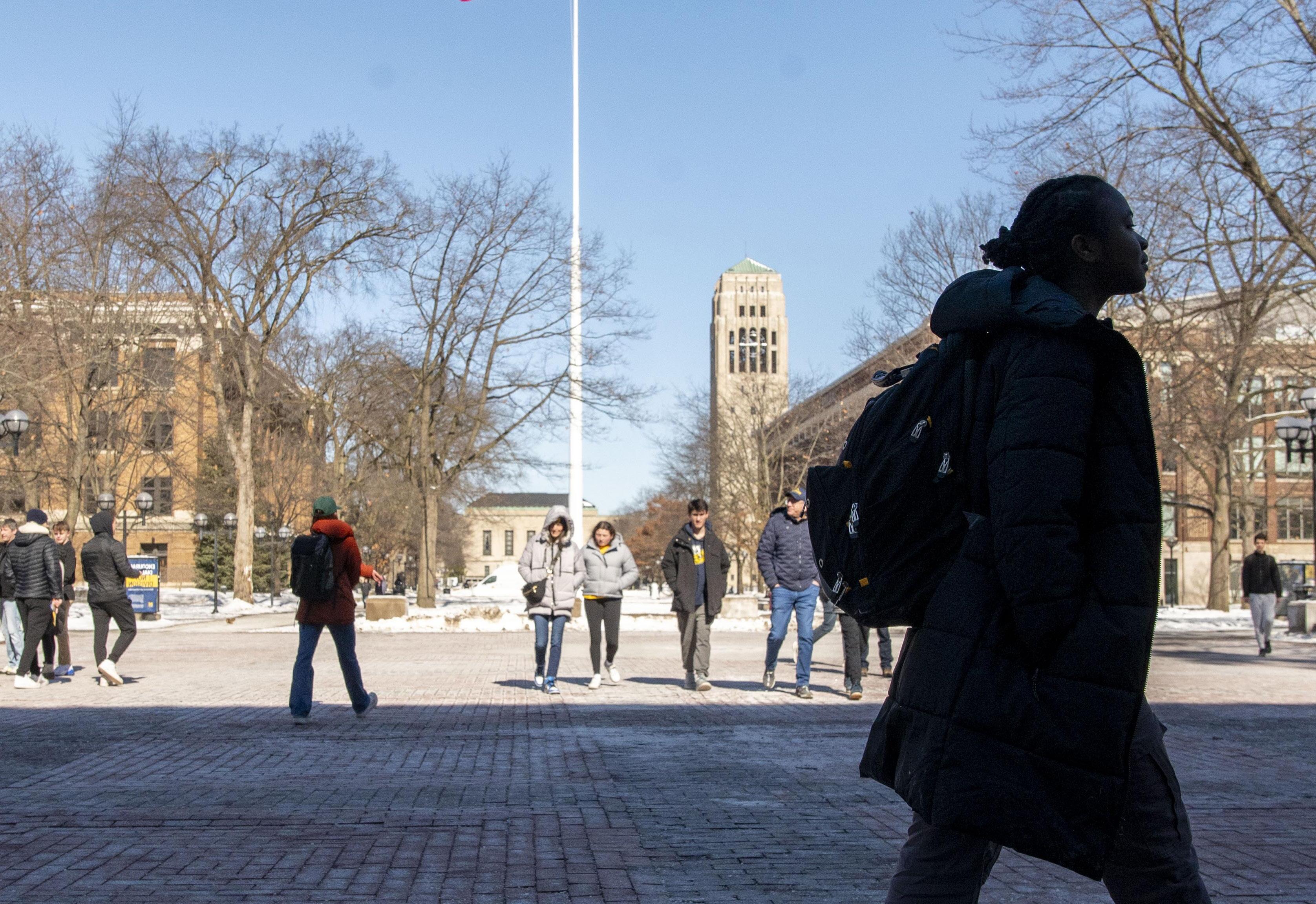
A typical Diag experience
though I would like to have that experience. Finding a company that genuinely values international students beyond the additional paperwork is difficult, and that uncertainty makes it harder for me to picture a future in the U.S.” This experience, though, is not unique to Hurtado Luperdi. Admittedly, work authorization after OPT becomes more complex for all international students, as each will eventually have to change their nonimmigrant status to H-1B status — a temporary employment authorization for individuals in a specialty occupation. Overall, the process consists of several steps and can be economically demanding for the employer. In 2025, the total fees are expected to reach $4,970 or $7,775 with premium USCIS processing.
Additionally, one of the main reasons why companies may oppose hiring non-citizens is the limited availability of work visas. In 2022, U.S. employers filed more than 480,000 petitions with only 85,000 H1-B visas available. Due to the overwhelming demand, the government allocated the visas through a lottery system, which means that companies can spend over $7,000 and still not have a guaranteed spot for their candidate.
It is understandable that companies avoid from hiring foreign-born workers, especially smaller businesses with tighter budgets — it’s a gamble many can’t afford to make. However, by allowing international students to prove themselves through internship programs, employers can see if hiring the candidate fulltime after graduation is a good investment. Additionally, employment represents an investment, regardless of required visa sponsorship. The benefits of hiring international students — multilingualism, unique perspective and crosscultural skills — will outweigh the initial cost of their employment.
CONTINUED AT MICHIGANDAILY.COM
GABE EFROS Opinion
RAHMAN MiC Columnist
One of the most utterly dystopian things I have ever witnessed was an elderly man dancing to “Calm Down” by Rema and Selena Gomez on a TikTok livestream.
My first scroll past, I dismissed it as a mere trend. It was not until he reappeared on my page a full day later, still rapidly dancing to the same song, that I looked at not only his movements but his face — wrought with the desperation of being reduced to nothing but a point of entertainment for viewers around the world, just for donations. Then I noticed his appearance: He was frail and barefoot, dressed in a plain white panjabi and prayer cap.
My father wears the same outfit on Friday afternoons for jum’ah prayer, as do many of my uncles and elders in my local BengaliMuslim community. The man behind the screen was not any of my loved ones fervently dancing at the mercy of the TikTok algorithm; yet in his appearance, I saw the reflection of almost every man who had raised me. Unfortunately, this reflection of myself and my people was the only factor that had compelled me to see the man rather than just look at him.
The development of social media has placed the world at our fingertips, while simultaneously making it easier than ever to fall into the trap of apathetic indifference. At what point do we truly begin to care and take a stance rather than passively clicking through Instagram Reels of wartorn nations and displaced peoples on our phones over breakfast? Is it necessary that the victim looks like us or is a member of our community in order to spark outrage? Tell me about yourself. Are you like me, one of “my people”? Is this Shark Tank, or the internal scale that we use to judge which tragedies and catastrophes are “worthy” of our attention? The transactional nature of empathy — the rarest, yet most soughtafter currency — feels like an unspoken rule in our increasingly desensitized world.
Columnist
A few months ago, while studying away in the Hatcher Graduate Library carrels, my eye caught something unexpected — a copy of the Boburnoma (Baburnama), fully in Cyrillic Uzbek, shelved among other books of Indian history. I picked it up and flipped through its pages, surprised to see a historical text I had always heard about but never actually read. I never expected to find the text, much less in my native language which is represented so rarely in academic spaces. My first response was the usual — to call my parents and express my wonder and excitement at the existence of an Uzbek classic hidden within my midwestern university. Then I tried to actually read the book to understand who exactly Babur was beyond the scattered facts I had informally absorbed over the years. Babur belonged to a lineage of conquerors, each carving empires out of the Central Asian lands they marched through. His ancestors, Timur and Genghis Khan, had built vast dominions through warfare and strategic alliances, and Babur inherited that legacy, along with a desire to reclaim his ancestral homeland of Samarqand. His early years were marked by struggles to hold onto Samarqand, a city he captured and lost multiple times before he was ultimately forced to abandon it. Exiled from the land of his birth, he turned his ambitions
The illusion of institutional neutrality
It is admittedly tempting to live in blissful ignorance, consoling ourselves with the lie that what we don’t know won’t hurt us. However, tragedies and horrors are not mere anomalies to be ignored. Understanding the world requires confronting its complexity and resisting the urge to dismiss what feels uncomfortable. Only by looking past the surface-level posts and empty gestures can we truly see the world, rather than just look at it.
This same principle, where concern is doled out selectively and is contingent upon relatability, not only shapes individual indifference but also institutional policy. Institutions, like individuals, often cling to the guise of neutrality as an “ethical stance” to avoid discomfort, controversy or even outright condemnation. But is it truly possible to remain impartial in a world that is anything but?
When global affairs are governed by politics, it seems unfeasible to tangibly engage them without “making it political.” Neutrality, then, is not the absence of a stance, but a silent endorsement of the status quo.
On Oct. 17, 2024, the University of Michigan’s Board of Regents unanimously voted in favor of a bylaw supporting institutional neutrality. The controversial
policy declares that although members of the U-M community can still speak their minds regarding issues, the University and the administration as a whole will refrain from making statements on sociopolitical topics not directly tied to its internal university functions. Yet, the University’s so-called neutrality has not meant disengagement — it has meant selective silence.
In a widely publicized and controversial student movement at the University, student activists held a vigil on the Diag to honor those who they believed had wrongfully fallen. They organized numerous rallies, and staged protests outside bureaucratic offices in downtown Ann Arbor. Their actions led to clashes with University administration, which faced accusations of violating students’ First Amendment rights due to handing over student and faculty records for investigation by the federal government.
The organizers faced harsh backlash, accused of disrupting education with their personal political views and were told that there was a “time and place” for civil disobedience. Critics of the movement argued it was pointless to protest against the University when the ultimate target was the presidential administration.
They even suggested protestors be sent to the region they were advocating for to experience its conditions firsthand. Ultimately, the movement resulted in 39 student protestors being arrested on charges of trespassing and civil disobedience.
These events did not transpire in 2023, 2024 or 2025 — nor were they even associated with the proPalestinian student movement. Instead, they unfolded during the late 1960s as students mobilized against the continuation of the Vietnam War. Despite the decades between them, the parallels are striking — not solely in the tactics of student activists, but also in the University’s response.
In the 60 years following the famous Vietnam War student protests at the University, student activism has been repackaged as a point of pride. What was once condemned as disruptive is now a convenient symbol of the University’s alleged commitment to student voices, to the extent that it even ironically touts community organizing and activism as one of its six Pathways to Civic Engagement and Community Change.
History is not only repeating itself; it is exposing itself. If we are taught to revere past historical instances of student activism and
Constellations of the past
southward, leading his followers into Afghanistan and then across the Indus River into India, where he founded the Mughal Empire in 1526.
His memoirs offer a personal and detailed account of his life and the world around him. Unlike many royal chronicles that glorify rulers with exaggerated stories, Babur’s writing is candid, filled with reflections on his victories, defeats and the landscapes he encountered. He dwells on the beauty of the places he traveled through — like the lush valleys of Kabul, the rivers of Hindustan, the symmetry of Persian gardens. He expresses a deep appreciation for nature, often pausing to describe flowers, fruit trees and the changing seasons.
Yet beneath his observations of the world, there is an undercurrent of loss. He writes with nostalgia for the lands he left behind, particularly Samarqand, often reflecting on the impermanence of power, recognizing that conquest alone does not guarantee stability or fulfillment. His memoirs reveal a man torn between ambition and longing, between the reality of ruling a foreign land and the memory of a home that remained just out of reach.
I wondered if I should feel pride in him. He is one of the few historical figures from my heritage known beyond Uzbekistan, but does that alone justify admiration?
Should a conqueror be a source of pride, or is that just a product of inherited nationalism? Is there value in his legacy beyond military success? His life was defined by displacement and survival, by
the challenge of maintaining his identity as he moved from one place to another. That, at least, is something I can understand.
But Babur wasn’t the part of his lineage that interested me the most. Instead, I was fascinated with his great-grandfather, Ulughbek.
Unlike the others in his family, Ulughbek wasn’t a conqueror — he was a scientist, an astronomer, a ruler more interested in the stars than in swords. In the 15th century, he built an observatory in Samarqand, a structure that still partially stands today. It was one of the most advanced observatories of its time, suggested to contain a massive sextant used to measure the positions of celestial bodies with remarkable precision. His team created a star catalog that rivaled anything in Europe, calculating the length of a year to an accuracy within a minute and two seconds of what we now know to be true.
His story is tragic. His own son, Abd al-Latif, saw his father’s scholarly pursuits as a weakness. Encouraged by religious factions who opposed Ulughbek’s secular approach to governance, Abd al-Latif led a rebellion against him. Ulughbek was overthrown, imprisoned and ultimately executed in 1449 — on the orders of his son. His observatory, once one of the greatest scientific institutions of the 15th century, was abandoned and later destroyed, its instruments lost to time.
Although Ulughbek’s contributions to astronomy faded from prominence in Central Asia after his death, his work found new
life elsewhere. His Zij-i Sultani, the star catalog detailing the positions of over a thousand stars with remarkable accuracy, was one of the most advanced astronomical records of its time. While his observatory was destroyed and his scientific influence diminished in Samarqand, the knowledge he and his scholars cultivated did not vanish entirely.
One of his students, Ali Al-Qushji, carried his teachings over to the Ottoman Empire, ensuring that Ulughbek’s discoveries would not disappear entirely. There, he became a leading astronomer and mathematician at the court of Sultan Mehmet II. Al-Qushji expanded upon Ulughbek’s observations, refining astronomical models and challenging existing theories about the nature of celestial motion. He is credited with separating astronomy from Aristotelian physics, arguing that celestial bodies could move independently of a physical medium — a radical idea at the time.
Perhaps most significantly, some historians believe Al-Qushji was one of the first scholars to advocate for the rotation of the Earth, presenting arguments for a moving Earth that did not rely on religious or philosophical justifications but rather on mathematical and observational reasoning. He was writing about and teaching these ideas sometime between 1472 and his death in 1474 — one year after Nicolaus Copernicus was born in 1473.
The timing raises an intriguing question: Could there have been a link between Al-Qushji’s ideas
protest during Festifall, blocked pedestrian pathways and created safety risks. The case also came after recent revisions to the University’s SSRR, which removed student input from the appeals process. According to the SOAR manual, the University’s Central Student Judiciary may act as a student governing body after a complaint is referred to them.
applaud their bravery for speaking out, why are today’s activists vilified for doing the same? If those who protested Vietnam are now upheld as visionaries, what does that make those fighting today? Societal perception regarding activism is a predictable cycle: The voices of activists will be celebrated, and the prejudice of institutions will be acknowledged — but only once the fight is over and the history books have been written.
On Jan. 30, 2025, Students Allied for Freedom and Equality announced that it had been suspended for up to two years and no longer recognized as a campus organization, in accordance with a Jan. 16 decision by Dean of Students Laura Blake Jones. This suspension also follows the University’s initiative to file a formal complaint through the office of Student Organization Advancement and Recognition on Oct. 31, 2024, claiming that SAFE had violated the Center for Campus Involvement’s Standards of Conduct for Recognized Student Organizations.
This complaint was filed by Stephanie Jackson, an outside consultant appointed by the University, who claimed that the protesting techniques used by SAFE, such as a die-in
and the later developments of the European Renaissance? While there is no definitive evidence that Copernicus had access to Al-Qushji’s work, the intellectual environment of the Ottoman Empire in the 15th century was one of dynamic exchange and scholarship, facilitating the diffusion of knowledge between the Islamic world and Europe.
Al-Qushji’s theories on Earth’s motion, coupled with his empirical methodology, presented an alternative to the geocentric model that Copernicus would later challenge.
Qushji’s ideas on celestial motion were part of a broader tradition in the Islamic world, where astronomers such as Nasir
al-Din al-Tusi and Ibn al-Shatir had already refined models that questioned Ptolemaic assumptions about the immobility of the Earth.
Al-Tusi, whose work was central to the Maraghah School in Iran, had already advanced the concept of uniform circular motion, which was later instrumental in shaping Copernican theory.
It is likely that the astronomical models developed at Maraghah and other centers of learning in the Islamic world, including those by Al-Qushji, had some influence on the European scholars of the Renaissance.
By the late 15th century, the Ottoman Empire had become a major crossroads of knowledge, absorbing intellectual traditions from Persia, Central Asia and the Mediterranean. While there is no direct evidence that Copernicus had access to Al-Qushji’s work, the broader
While CSJ found SAFE not responsible for 10 of 13 alleged violations in a public hearing, Jones overturned CSJ’s decision to find SAFE responsible for some of the additional violations as well. In addition to the smaller formal reprimands suggested by CSJ, Jones passed an additional sanction — a two-year disciplinary suspension against SAFE, preventing it from recognition as a campus organization with no possibility of suspension review before Winter 2026. This action of amending the SSRR was also taken without the consultation of the Student Relations Advisory Committee, Office of Student Conflict Resolution and Central Student Government. The University is technically within its authority under the Michigan Constitution to amend the SSRR without such a consultation. However, taking such an action with a lack of faculty and student input creates a dangerous and unsettling precedent in which the Regents have an overwhelming amount of power to direct University policy as they see fit. This also inherently makes the judgement of student affairs more susceptible to the influence of politicians and donors. On Oct. 6, 2024, the TAHRIR Coalition posted a leaked audio recording in which University President Santa Ono admitted that he believes universities are forced to treat reports of Islamophobia and antisemitism on campus in an unbalanced way due to pressures from Congress and interest groups. Ono also implied that the government threatened to withhold federal funding if antisemitism was not addressed. CONTINUED AT MICHIGANDAILY.COM
diffusion of Islamic astronomical knowledge into Europe is well documented. Translations of earlier Islamic texts had already influenced European scholars, and Ulughbek’s star catalog itself was studied by European astronomers in later centuries.
If Al-Qushji’s theories on Earth’s motion had reached Renaissance scholars, they would have represented one of the earliest scientifically driven challenges to the geocentric model — decades before Copernicus formally proposed his heliocentric theory. While the connections between Al-Qushji’s work and the Copernican revolution are speculative, the intellectual exchange between the Islamic world and Renaissance Europe was undoubtedly profound. Whether direct or indirect, the possibility that Ulughbek’s legacy shaped the course of modern astronomy is an open question, one that highlights the often-overlooked contributions of Central Asian and Muslim scholars to the history of science. As the Ottoman Empire became a key center of scientific exchange in the late 15th century, figures like Al-Qushji ensured that Ulughbek’s astronomical achievements were not forgotten. In a broader sense, the scientific dialogue between East and West during this period played a crucial role in shaping the future of astronomy, leading to groundbreaking discoveries that would reshape our understanding of the universe.
MUNTAHA
Akash Dewan/MiC
NGHI NGUYEN MiC Senior Editor
Every child during Tế t eagerly awaits receiving lì xì from the grown-ups, hopefully filled with a lot of money. I will never forget when one of my aunts made it a lottery, where only one red envelope was filled with $25 while the others contained a sliver of paper reading, “Better luck next year! You get one candy.”
I did not draw the lucky lì xì and there was in fact, not even one candy. Allow me to be the one who generously hands out lì xì now, as if you are at this Tế t celebration yourself, but be warned that there is no money. There is actually no tangible reward whatsoever. Treat them like my amateur slices of wisdom, my reflections on love and luck.
Lì xì #1: Gia đ ình hòa thu ậ n
– Wishing you familial harmony
To be loved by a Vietnamese mother is to be cared for in ways that are unspoken but deliberate. Love is in the grains of rice piled high in your bowl. It underlies their wishes for your success and health. After all, if you’re successful and healthy, then you are happy — their sacred philosophy. Sometimes
you feel a void in your stomach, one that is not placated by a meal devoured or a well-meaning motivational speech to keep future success at the forefront of your mind. You might not place it until you’re older, but the desire for something you are missing inflicts your childhood memories all the same. To be loved alongside an unplaceable hurt is an odd reality.
‘Yêu’ is how a lover loves, but ‘thươ ng’ is as tender and soft around the edges as a mother’s love. ‘Thươ ng’ is not romantic love, but an all-encompassing, compassionate, selfless type of love, often expressed between family members and even more so between a child and a parent. The Vietnamese immigrant parent stereotype is that, contrasted with American parents, they pour their love into the tangible: the infamous “cut fruit,” overbuying an item you expressed a positive evaluation about just once, making a traditional dish you love (even if it takes forever). It’s a tale as old as time and requires no preamble to understand. There is no hand-holding; maybe a hug here and there. A small invisible gap separates you, defined by filial obligation, a boundary that can never be crossed. It is easy to fall into that dynamic, reaping the love where it falls
On love at the East Liberty Street Sweetwaters
refreshing break from the near suffocating heat inside, one given to me from the warmth of my mother’s unwavering hands.
On love and lunar, pt. 2
and never questioning that aforementioned feeling that something is missing. Being a part of this family, and the extended cultural community, is the epitome of a love-hate relationship.
I am not the first to say that the individualistic aspect of American culture can erode the magic of community. Everyone is for themselves, which has its merits, but loneliness and isolation suspend themselves over the household, especially in a Midwestern setting like the one I live in. Of course, collectivist
cultures are not without their setbacks — the possibility of infringement and suffocation, or adults thinking they know what is best but not allowing you to breathe and be your own person. Everyone knows you if you come from a smaller town, and nothing escapes eager ears and prying mouths. Yet it feels nice to tether yourself here, becoming one of the many, submerged in the frenetic energy that surges through a night of communal hotpot and beers. Faces are flushed red, laughs are raucous, late into the night.
Drinking together is a social norm in Vietnamese culture, a cornerstone pastime with its own term: “nh ậu.” There are even certain foods you eat while you nh ậu, like ch ả giò and g ỏi gà. Drinking alone is uncommon, as there is no tangible worth — there is no point to alcohol if it is not shared with others for the purpose of social fun. My mom once told me that when I feel sorrowful, I should let her know and we can share some drinks together. This defies what is considered normal in some cultures (and would raise
concern in some Vietnamese people, too, I’m sure) but at its core is reliance on togetherness to suture wounds. It avoids the formidable concept of vulnerable conversations, but provides an alternative that is performed together. Being alone is different from loneliness, but both are supposed to be absent in Vietnamese culture. A blessing and a curse, I suppose. Sometimes you practically want to kill your family, but you know that you would also die for them. It is seldom straightforward to be a part of a family or its extended community. There is a give and take, and you deserve a lot of love and a true, genuine hug, for it is not easy carrying this role. Take what you want, as it is not necessary to accept everything that you are dealt. The sweet mixes with the bitter.
Lì xì #2: “Vạ n sự như ý”
May your wishes and dreams pan out in your favor Winter is bleak. January, then February (and however many more months postpone springtime) trudges by in slow motion. Luck during this season is opening the blinds or stepping outside to sunshine. CONTINUED AT
Interlude: the Black mother and her body (i am my mother’s daughter)
Columnist
BY ALLANA SMITH — MiC
My final visit to the Sweetwaters on East Liberty Street happened June 23, 2024. Sitting inside the cafe, I wrote a small informal eulogy of sorts to commemorate its closing as the bar slowly emptied itself of ingredients for the last time. In the months since its closing, I’ve mused about coffee (as an addict does) and my thoughts often return to the empty spot the Sweetwaters on East Liberty Street left behind. Its gutted interior, sanded-down gray walls and glass windows stripped of the iconic red circle and illustrations in paint and marker — this is an indelible remnant of my college life not for its $7 drinks, but rather for something more meaningful.
So, here is my longer eulogy, a final cheers to this café:
My first taste of coffee was not through coffee. My 5-yearold hands struggled to handle the flimsy carton containing “coffee milk” as the humidity from the Korean sauna seeped into the changing room. It was a
Perhaps this coffee-flavored milk set the first stone down in my eventual pull towards real coffee, It made my early experiences with actual coffee just a little bit easier to swallow as I stepped foot into the Sweetwaters on East Liberty Street for the first time.
There, I discovered the triple Dreamy Cold Brew, which had me wide awake while lying down in my dorm bed at 11 p.m., but became the drink I needed when essays called my name. I religiously consumed iced French Vietnamese Au Laits as I learned to enjoy their bagel sandwiches when I needed a quick bite. I indulged in a classic Charlie Brownie here and there even if it meant I had to down my coffee to counter how chocolatey it was.
Although I can ramble endlessly about the menu, it isn’t why I am so enamored with this place. I am in love with it because I fell in love here, over and over again.
CONTINUED AT MICHIGANDAILY.COM
My grandmother was a colored girl born in Birmingham, Ala. I can imagine that she was a hard-headed talking girl like me. But she was married at 19, and migrated past the Mason-Dixon line to settle into the projects of southeastern Michigan. She had children: three baby girls, one being my mother. She died at 76 in the same place.
She told me that she wanted to go to Paris.
She would — she will — never leave the Midwest.
The Black mother, and her body. She may have only been allowed value through the children she gave her husband. But her name was Brenda Joyce.
My grandfather’s mother’s name was Savannah. With her pretty hair and doe eyes, she married at just 13. She had 11 children. Born in Mississippi, she, too, died in Michigan. She was 103. Had she sat at the beaches? Seen the Gulf Coast? Did she leave home with a stranger man having never felt the sand between her fingers and toes?
We are often born into sandwich generations. And we must protect them: our parents and children, our sisters and brothers.
I’m tired, I think. As a little girl, I was tired too. I think that exhaustion may be generational.
The woman’s labor is emotional, always.
As a child I was allied with my mama, trying to watch the world — her married life — through her eyes. I had been nesting, I suppose, in my childhood home, wishing I could be inside my mama’s skin so I could nestle myself close to her heart. Be protected by her rib and muscle.
I can imagine that when they were little girls, when my mama was a little girl, when here mama was a little girl, that they had fantastic dreams. But Black girlhood is marked by harshness. We are expected nurturers, I suppose.
A Black community thrives upon togetherness. She is never individual, self-actualized, existing for herself. She has always, will always, exist for the other. Her man, first. Her children, second.
My mama was married at 31. I wonder if she regrets it.
The Black mother is a protector, a caregiver. In her affection, she teaches her daughters her strength. And in the family, her resilience is everything. The household remains her domain, even as the gaze of her husband reigns oppressive and true.
I wonder at what point does she decide to protect her daughter from him — her husband. He as a force is unstoppable; I’ve made a point to become immovable.
***
Once, I sat beside her, my mother.
“What do you wish to be, where do you wish to go?”
“I don’t know,” I want more. Something other than sacrifice.
“Are you scared?” So scared, sometimes my body feels heavy.
“Your father wants you here. But you have to live for yourself. We’ll be just fine.”
***
A Black mother loves her babies, her daughters. She may find comfort in generational, cultural sacrifice but she, too, wishes for more. I have since decided that I will be angry on her behalf. On their behalf. What do I wish to be? Where do I wish to go? I wish to matter in the ways that my kin were told they could not — to be righteous and proud.
I wish to go somewhere, anywhere.
I am a little Black girl turned woman. I, too, live in southeastern Michigan. My grandmothers are buried in Pontiac, and my mother still sits beside me. And I refuse to allow my potential to suffer an ugly death, to be a victim of the meanings ascribed to Black womanhood.
I will not plant trees here, but I will carry seeds. In search of my mothers garden.
I think that perhaps my kin are the curls upon my head, the bronze within my skin, the brown within my eyes. They are the strength in my bones, the cartilage in my elbows and knees. I will carry them just as their love has carried me.
And someday I’ll go to Paris.
Are you OVER the clinical atmosphere of traditional nursing homes? Are you TIRED of being overworked and have an insane patient load? Do you want to get back your passion in compassion?
If you’re reliable and have a positive attitude, then you may be a good fit to take care of my beautiful Mother. Schedule is 5 days a week and 5 hours per
Salary is $30/ hr. Apply by contacting me via email at Ronnie (rknighitx2@gmail.com)
Sarah Wong/MiC
Michigan freshmen shine in competitive loss to No. 2 UCLA
All season long, youth has been a key part of the identity of the No. 15 Michigan women’s gymnastics team. With four freshmen consistently in their rotation, not many programs across the country utilize freshmen like the Wolverines do in all four phases of competition.
And in front of a packed Crisler Center on Sunday, facing its tallest task of the season against No. 2 UCLA, Michigan’s freshman class excelled with a plethora of careerhigh scores in every event.
Michigan started on the vault, an event where it has occasionally struggled throughout the season. However, the Wolverines set a team-high vault score for this season — highlighted by three key freshman scores. First, Peyton Davis set the tone, setting her career-high score of 9.825.
Jahzara Ranger then followed suit, matching her career best with a excellent 9.850 score. Finally, Sophia Diaz rounded out
the trio scoring 9.850, above her season average of 9.815 in the event. Michigan hopes to use this showing as a building block for what it can potentially achieve on vault this season.
“We just have to keep trying to get better,” Wolverines coach Bev Plocki said. “This was another step on the way to being where I know we have the capability of being.”
On bars, although freshman Audrey Sanger suffered a fall, her fellow freshmen made up for it. Sophie Parenti tied her career high with a 9.825, and Diaz also notched a career-best 9.900, where she successfully stuck a difficult landing that erupted the crowd. These rookies’ improved scores provided Michigan with a boost in depth — a necessary quality for success in women’s gymnastics. The impressive total across the board helped give the Wolverines a 98.650-98.575 lead over the Bruins after the first two rotations.
The meet fell out of reach for Michigan on the beam, its strongest event of the season
before Sunday. However, it was not at the fault of the two freshmen competing, as Parenti and Ranger attained scores of 9.825 and 9.875, respectively. While the Wolverines had two falls from veterans, the freshmen proved they could stay composed and contribute clutch scores under immense pressure.
“I use a lot of self-talk,” Ranger said. “If you ever watch me, I’m usually eyes closed, feeling the music, just trying to stay in everything and block out all the craziness of the environment.”
To close out the meet, four more great freshman performances led to an above-average team floor score of 49.400. Parenti, Davis and Diaz all recorded scores over 9.800, and continuing her career night and closing strong for the freshman, Ranger contributed a near-flawless routine, achieving a 9.900.
A huge part of improving as a freshman is adjusting to the next level, especially in a high-quality conference like the Big Ten. With their performance against UCLA in a high-pressure atmosphere, the
Michigan capitalizes on holistic offensive production at South Florida Showdown
Tholl said. “We had production from everybody, up and down the lineup, and that’s our takeaway from the weekend.”
Sieler. All Conway had to do was put the ball in play.
freshmen showed they’ve made the necessary improvements to compete at the highest level.
“In the beginning, I was just trying to get used to the environment of competing in college because it’s really different
Michigan
than club,” Parenti said. “With each meet, I focus on more details.”
Of the 12 total freshman routines across the four different events, 11 of them performed above their season-long averages.
garners much-needed momentum in 31-11 win over Central Michigan
Getting runners on base has not been a problem for the Michigan softball team this season, seeing as it has recorded at least five hits in all but one of its first 13 games. But the struggle has been bringing these runners home.
At the South Florida Showdown this past weekend, the Wolverines (8-5) took to changing that narrative, sending enough runners around home to secure victories over South Florida (13-4), Kent State (3-11) and Troy (9-6) but dropped a contest to Louisville (10-5).
Down 4-0 against South Florida in the top of the fifth inning with three runners on base, sophomore center fielder Jenissa Conway was faced with the choice to either bat in a few crucial runs, or contribute to the desertion dilemma. She seized the opportunity to do the former, zipping a ball down the right-field line to spark a series of unanswered runs that buried the Bulls, 5-4, highlighting a weekend of definitive offensive production.
These runs weren’t generated from a mere one or two players either, but were rather mass produced. With seven individual players recording an RBI this weekend, the Wolverines showcased their depth and proved just about anyone can make an impact at the plate.
“I was excited to see that it wasn’t just a couple of people getting RBIs,” Michigan coach Bonnie
The heavy-hitting duo of Conway and fellow outfielder sophomore Ella Stephenson consistently led the Wolverines’ attack. The pair are second and third in the batting order and generated game-changing moments from the opportunity to hit one after another.
The action in Michigan’s 8-3 victory over Kent State was kicked off by a triple from Conway, and then immediately amplified by a single from Stephenson that brought her partner home for a score. And after Conway’s double in the game against the Bulls, Stephenson ripped a single that brought the game to four runs apiece. It was also Stephenson’s seventh-inning solo home run, complimented by a valiant relief effort from sophomore righthander Erin Hoehn, that sealed the game.
“They really did just pass the bat to each other,” Tholl said. “Jenissa is an exciting player once she gets on the bases. She gives us a chance because she can make some things happen with her legs … and Ella Stephenson’s base hit, that’s what gives us that opportunity.”
But the stars didn’t do it without their supporting cast. Against the Bulls, the table was set by a single from sophomore catcher Lilly Vallimont, a walk from senior second basemen Ella Mcvey and a single from senior left fielder Ellie
Juniors utility player Madi Ramey and third basemen Maddie Erickson added to the fire against Troy on the way to a 10-0 victory, which ended via the run rule in the fifth inning. Ramey recorded three hits of her own, most notably crushing her first home run of the season to send three runs in and put the nail in the Trojans’ coffin.
Even in the loss to Louisville on Saturday, six different Wolverines recorded a hit. However, the problem once again was a failure to drive runners home, resulting in a 5-3 defeat. The Wolverines left a significant amount of runners on base throughout the weekend, but the difference between this past weekend and their opening weekend was that, this time, failing to capitalize was an outlier. The sheer quantity and variety of production compensated for the overall trend of failing to finish that has loomed over Michigan thus far.
“We don’t have to get it done individually, right?” said Tholl. “We are a team, and if I happen to not get it done, then I can pass the bat to my teammate and know that I have really talented people around me that can get the job done.”
The Wolverines made a statement this weekend as they generated enough hits to bring runners around the bases, which they haven’t done consistently this season. It’s a trend in the right direction, and one that allowed Michigan to go 3-1 over the weekend.
With a losing record in conference play and unexpected changes in its starting lineup, the No. 19 Michigan wrestling team hasn’t necessarily had the season it hoped for. Going into their final dual meet of the season, the Wolverines had a chance to garner some much-needed momentum before they enter tournament season.
And Michigan (7-5) took advantage of that opportunity against Central Michigan (9-10) on its senior night, getting hands raised in seven of the 10 bouts to secure a 31-11 victory.
“For me, with this group (of seniors), it’s just even a little more special,” Wolverines coach Sean Bormet said. “This group has gone through a lot. So I would say it’s our most resilient group. … I know all the guys who were stepping on the mat really wanted to wrestle their best with our last one. And I feel like they delivered.”
Yet, on a night that honored its seniors, Michigan’s younger wrestlers stole the show. At 165 pounds and 174 pounds, the Mantanona brothers — No. 14 redshirt freshman Beau and freshman Brock, respectively — undoubtedly became the stars of Sunday’s dual.
Less than a minute into the second half of the meet, Beau had the Chippewa’s Chandler Amaker in a cradle, pushing for
the pin. Beau, who is “used to getting into that position,” found his opportunity to get Amaker’s shoulder blades flat on the mat.
Perhaps feeding off Beau’s energy, Brock stepped onto the mat in the following bout with immediate intensity — especially considering he was facing No. 7 Alex Cramer as a true freshman, wrestling up a weight class. After scoring a quick, first-period takedown, Brock and Cramer exchanged some back-andforth action throughout the three periods. Yet, as the clock wound down to the last 30 seconds, Brock broke through with a single-leg takedown to end with a 9-8 decision victory.
As freshmen shined, so did the veterans. No. 3 graduate Jacob Cardenas showcased his dominance once again at 197 pounds with a major decision win, while No. 8 graduate heavyweight Josh Heindselmen also pulled through with his 10th tech fall of the season to finish the dual.
“Their dominance is a reflection of how they’ve trained and how they’ve approached the sport while they’ve been in college,” Bormet said of the two graduate transfers. “Since they’ve been here at Michigan, we’ve seen so much consistency out of those two every day in training and every time they step on the mat.”
While the night ended with a large margin between Michigan and Central Michigan, the team scoreboard didn’t always look as lopsided. The Wolverines dropped their 133-, 149- and 157-pound bouts, falling behind in the team scores going into intermission. Throughout the season, Michigan has consistently struggled with certain lowerweight bouts. And while some ended with the same result against the Chippewa, there was one that finally found the spark.
CONTINUED AT MICHIGANDAILY.COM
After opening up the Big Ten Championship meet with backto-back victories in relay events, it appeared as though the Michigan women’s swimming and diving team was in prime position to claim its first conference title since 2018. While the Wolverines remained in contention for all four days of the meet, they were unable to overcome the strength of Ohio State and Indiana, and a crucial relay disqualification, en route to a third-place finish in the conference. Michigan notched 1149.5 points, behind 1313.5 points for the Big Ten champion Buckeyes and 1255.5 points for the runner-up Hoosiers.
The Wolverines spread the wealth in their individual events, with three different swimmers claiming the team’s three solo event wins. Sophomore Hannah Bellard entered the 200 butterfly as the top seed and defended that spot, opening up a big lead early and crushing the field by more than three seconds to earn her first conference title. In the 100 freestyle, senior Lindsay Flynn held second place in the first half of the race, but surged past Indiana’s Anna Peplowski on the back half to win the event by just fourhundredths of a second.
It was sophomore Stephanie Balduccini’s win in the 200 freestyle, though, that was the highlight of the individual races for Michigan. When top-seeded Peplowski began
to close the gap on the third lap of the race, Balduccini turned on the jets for the final lap, splitting the last 50 yards in 26 seconds flat to win the event in 1:41.16. Becoming the first Wolverine to win the event since fellow Olympian Siobhan Haughey, she was overcome with emotion as her entire team greeted her on the pool deck after the race.
“I think she had the confidence, knowing the work she’d done to to swim the race the right way,” Michigan coach Matt Bowe said. “So that was a great swim by Steph.”
But, the relay events were where Michigan really highlighted its abilities. Kicking off the meet Wednesday with the 200 medley relay, Flynn turned in a fantastic anchor leg to clinch the event for the Wolverines. The same
night, the foursome of Balduccini, Bellard, junior Malia Amuan and junior Christey Liang broke the championship meet record by over two seconds to win the 800 freestyle relay as well.
The next day, Flynn and Balduccini dove back in alongside junior Brady Kendall and graduate Claire Newman in the 200 freestyle relay. Michigan destroyed the field in the event, posting a new meet record as well as a new school record with a time of 1:26.13. This was one of the signature events for the Wolverines, as their time ranks among the topfive teams in the NCAA in the relay.
But disaster struck in the 400 medley relay on the backstroke-tobreaststroke transition, as senior Letitia Sim took off slightly too early on the second leg, disqualifying the
relay from a would-be third place finish. The error was crucial: Relays are worth twice as many points as individual events, putting a sizeable dent in Michigan’s point total.
“We understand that to be the best in relays is not chance,” Bowe said. “You got to practice exchanges, you got to think about tactics. We take pride in relays and we want to be good at them.”
Though the event significantly impacted the Wolverines’ hopes for a conference title, the quartet of Balduccini, Flynn, Kendall and Newman returned to the pool on the last day of the meet to defend last year’s win in the 400 freestyle relay, also breaking a meet record in that event with a time of 3:08.89.
Other strong individual performances came from Sim,
who took second in both the 200 individual medley and the 100 breaststroke as well as third in the 200 breaststroke, and Kendall, who claimed silver in the 50 freestyle and 100 butterfly. But the deficit proved too much to overcome, as Ohio State’s formidable freshman class and Indiana’s long-standing swimming pedigree propelled the two over the Wolverines.
“I’ll be honest, I think we could’ve been closer to challenging for a Big Ten title,” Bowe said. “We got beaten up a little bit and that was the difference, ultimately.”
While third place isn’t a bad finish by any means, identifiable errors in the pool left Michigan with a sour taste in its mouth,
The growth that this young group has shown — especially in a gigantic test against the Bruins — should give Michigan a reason to get excited about the future of the program and for the rest of this season.
Holly Burkhart/DAILY
Jenna Hickey/DAILY
JACK BUFFETT Daily Sports Writer
ANNABELLE YE Daily Sports Writer
DREW LENARD Daily Sports Writer
TYLER FRICK
Michigan battles back to defeat Oklahoma State following previous struggles
NATHAN GRUNFELD
With No. 16 Oklahoma State and the No. 5 Michigan women’s tennis teams splitting the first two doubles matches, the doubles point was set to be decided by a tiebreaker in the No. 1 doubles match. After losing the tiebreaker 7-4, it seemed like the Wolverines might continue to unravel following losses to No. 14 North Carolina State and No. 10 Duke. But Michigan refused to let its losing streak continue.
After losing the doubles point, the Wolverines (7-3) secured a 4-2 victory over the Cowgirls (6-5) by winning four of five singles matches, with the final one being abandoned. Despite being on the edge of back-to-back losses and the obstacle of starting the match down a point, Michigan showed resilience to battle back and win.
“We’ve had a really rough stretch,” Wolverines coach Ronni Bernstein said of their two previous losses. “I couldn’t
have scheduled any harder. … So just proud of how we came out in singles after losing a tough doubles point.”
First, junior Lily Jones and freshman Ava Bruno coolly won their No. 3 doubles match, 6-2, followed by a tough loss by sophomore Piper Charney and sophomore Reese Miller, 6-2, in the No. 2 doubles match. This left freshman Jessica Bernales and senior Julia Fliegner responsible for winning the doubles point. A competitive match where neither duo ever led by more than one game came down to a seven point tiebreaker. And with the score tied at four, Oklahoma State won the next three points to claim the lead heading into the singles matches.
“I just tried to forget it,” Fliegner said. “Doubles is only one point. There’s still six more points out there after doubles, so I just focused on getting the point that I could get.”
That focus was evident in Fliegner’s No. 1 singles match. After starting the first set down 5-1, it appeared like Michigan’s highest-ranked competitor
might lose both of her matches. Suddenly, Fliegner began to battle back, winning the first set, 6-4. From there, she never looked back, securing the second set, 6-0, and winning the last 11 straight games to tie up the match score. Fliegner’s comeback exemplified the Wolverines’ overall play to overcome adversity.
“I just kept doing what I was doing,” Fliegner said. “By the second set, I kind of learned her strengths and weaknesses, so I just kept focusing on the things I did well in the first set and refining the bad things from the first.”
Next, after freshman Emily Sartz-Lunde lost her No. 4 singles match in two sets, Jones won her No. 3 match in two — both by a score of 6-3. Immediately after, in the No. 5 match, Miller scored another point for Michigan. After a dominant 6-1 first set, she fell behind 3-1 in the second. In response, Miller won her next five games to bring the Wolverines up to a 3-2 lead, only one away from winning the match.
“I feel like these guys fight really hard,” Bernstein said.
“They care about our program and our results. … I know we’re always going to fight and try to get it done.”
At this point, only Charney’s No. 2 singles match and Bernales’s No. 6 match remained. Following a 6-4 win in the first set, Charney took the second set by the same score, winning the match for Michigan. When Bernales’s match was subsequently abandoned, she held a comfortable 4-0 game lead in the final set.
Michigan cruises to victory over Marquette in home opener
SURAJ KODALI Daily Sports Writer
The Michigan women’s lacrosse team could not have written a better script for its home opener.
The eighth-ranked Wolverines (3-1) routed Marquette (3-1) Sunday, 22-5. Starting by scoring the opening goal, the Golden Eagles were then outmatched by Michigan all day. It was a collectively dominant showing, where 13 different players found the back of the net for the Wolverines.
Following a shaky first five minutes, graduate midfielder Ava Class got Michigan on the board. That goal opened up the floodgates for the Wolverines’ attack, as Class’ finish was the first of five goals in a span of under three
minutes. Marquette found itself constantly defending for its life, as Michigan enjoyed almost all of the possession during that spell. A huge part of that was freshman midfielder Emma Burke.
“That was unbelievable,” Michigan head coach Hannah Nielsen said. “You’re going to get the ball back again and again, you can play a lot more freely offensively.”
Despite being a true freshman, Burke has already emerged as one of the team’s standout players. In just her third collegiate game, she recorded the second most draw controls in a single game in program history, with 16. She also set the tone for Sunday’s game, constantly allowing the Wolverines to keep possession and pass around their opponents.
Once it had the ball, Michigan picked the opposing defense apart inside the fan.
The Eagles’ zone defense was constantly exploited by well-timed cuts and intricate passing, leading to chances right in front of goal for the Wolverines.
And Michigan converted these opportunities, as the dynamic duo of senior attackers Kaylee Dyer and Jill Smith combined for 13 points against Marquette. They looked like they were flowing at times, with Smith pulling off an exquisite behind-the-back
Michigan unable to punctuate comebacks at the College Baseball Series
every position caught up to them, failing to come back after falling behind in every game.
On Friday, with graduate first baseman Jeter Ybarra on first base, junior second baseman Mitch Voit smashed a homer into right-center, giving Michigan an early lead and its first two runs of the tournament.
On Saturday, a powerful shot from Ybarra allowed junior left fielder Jonathan Kim to score from second base, bringing the Wolverines an early run. On Sunday, Voit sent a shot flying to the left side of the field, and a fielding error gave sophomore designated hitter Cade Ladehoff enough time to traverse halfway around the diamond to give Michigan another first-inning lead.
The Wolverines created a strong foundation to begin every game this weekend. Yet by the end, that foundation always crumbled.
The Michigan baseball team (4-3) returned from the College World Series in Arlington, Texas with three straight losses against No. 22 Texas Christain, Kansas State and No. 5 Arkansas. While the Wolverines began every game playing the quality baseball that led them to an undefeated run last weekend, their inconsistencies at
“They’ve got really good arms,” Michigan coach Tracy Smith said of the three teams. “So no matter who you’re facing, good arms make it very difficult to score.”
The Wolverines did face some of the nation’s best arms and teams this weekend. But to compete at this level, Michigan needs to be ready to fight back, even when the deficit seems tough.
The Wolverines had a strong start against their first opponent, the Horned Frogs. Following Voit’s first-inning homer, Michigan found success once again in the bottom of the second inning when Kim singled to give the Wolverines their third run of the afternoon.
Things started going downhill for Michigan in the sixth inning, though. Graduate left-hander Cade Conolly’s relief appearance lasted just three batters, during which a dropped ball by Kim gave TCU an additional two runs to tie the game, 3-3. Just moments later, an additional two runs were given up on a grounder that rolled right past the second baseman.
It was only downhill from there for the Wolverines, with its defense falling apart and an offense incapable of dragging
the team back. With strikeout after strikeout from an opponent desperately holding on to their lead, even Michigan’s best batters fell, with zero hits throughout the seventh and eighth inning. Their only additional run came from the Horned Frogs’ mistakes, and the seemingly dejected Wolverines just watched TCU put four more runs on the scoreboard in the final inning, eventually falling 10-4. It was the same story the following day against the Wildcats. Capturing an early lead was promising for Michigan, as its bats showed their might early in the game. But this time, their fall came earlier. Kansas State took two unearned runs off of the Wolverines’ errors, sending them down 2-1.
Despite only being down by one run, Michigan’s batting momentum hit a wall, with the next four innings filled with nearly successive outs. Even when a comeback seemed just in reach, the Wolverines faltered, and when the Wildcats scored an additional three runs to end the fifth inning, there was no coming back for the Wolverines. From that point on, once again, they achieved zero hits, with the final score being 5-1.
CONTINUED AT MICHIGANDAILY.COM
WOMEN’S BASKETBALL
assist before Dyer matched the flair later on, scoring a behindthe-back goal.
“The Yale game, we were a little stiff,” Nielsen said. “It’s evident when you’re playing with confidence, to throw a 20-yard, behind-the-back feed.”
That confidence clearly manifested a strong performance from the Wolverines. By the end of the first half, Michigan held a commanding 13-3 lead that wouldn’t be relinquished. And by constantly using up the shot clock in possession, the Wolverines were able to neutralize the opposition’s attack while generating more chances. It was that style of play that made the Eagles’ first-half deficit insurmountable.
After Michigan’s dominant first half, the final two quarters felt like a formality for what
was a statement victory. Burke’s continued success in the draw controls allowed the Wolverines to see the rest of the game out through their passing, facing minimal threat to their goal.
“We see it every day in practice,” Nielsen said of the Wolverines’ defensive performance. “They are still one of the best in the country.” Michigan’s double-digit lead allowed it to run off game clock in between each goal they scored and the restart. The 22-5 victory certainly told the story of the game, but the blowout could have been even larger. The marriage of attacking threat and defensive fortitude propelled the Wolverines to a win on Sunday. Michigan entered this season with high expectations, and Sunday’s performance was a glimpse into the potential of this squad.
Backed by its defensive efforts, Michigan secures 78-68 win over Penn State
make her work a little bit,” senior guard Greta Kampschroeder said.
The closest Penn State came to a lead against the Michigan women’s basketball team Saturday was when the game was tied at tipoff. That tie was short-lived — 14 seconds to be exact — as senior guard Jordan Hobbs quickly knocked down a 3-pointer from the wing to launch the Wolverines ahead.
From the jump, Michigan (19-8 overall, 10-6 Big Ten) seized control of the game over the Nittany Lions (10-17, 1-15), and the Wolverines’ dominant defensive performance propelled them to a 78-68 victory.
At the start of the game, freshman guard Olivia Olson went toe-to-toe with Penn State’s 6-foot6 center Gracie Merkle. Averaging 15.5 points and 8.6 rebounds per game, Merkle posed a formidable challenge to the Wolverines’ smaller five-guard lineup.
But that didn’t slow down Michigan in the slightest. Instead, the Wolverines continuously gave Merkle, and the Nittany Lions, different looks to keep them on their heels while Michigan slowly built a lead.
“With me being very undersized, I had to dance around her and
“But obviously, she’s a very strong player and does what she does, and is very consistent at it. She had a great game. Yulia went in and gave her a different look, which was important, and then Jordan was on her for a couple of possessions.”
By mitigating the threat Merkle posed with multiple defenders, the Wolverines gave themselves room to breathe — and room to score.
Though Michigan cultivated opportunities to score, the Wolverines’ offense didn’t initially spark, shooting just 35% at the end of the first quarter. Michigan managed to find success beyond the arc, but it couldn’t just rely on 3-pointers, it needed to penetrate the paint to widen the gap. And by ramping up their defensive aggression, the Wolverines accomplished just that.
“They were subbing in and out a lot, so we did the same thing,” Kampschroeder said.
“We had to change our strategy a little bit, depending on who was in. There were a lot of different matchups, but just trying to throw different looks at them.”
Totaling four steals in the second quarter alone, Michigan was doing everything it could to keep the ball out of Penn State’s
hands. And with so many of the Wolverines’ bench players stepping onto the court, the Nittany Lions had no idea what to expect.
Weaving into a passing lane midway through the second quarter, junior guard Brooke Quarles Daniels picked off a pass intended for Merkle, taking it down the court for another chance to score. While Michigan failed to capitalize off the steal, it kept the ball out of Penn State’s hands. That was the goal of the Wolverines’ defense all game long. While its offense may have fallen stagnant at times, Michigan wanted to make sure that the Nittany Lions fell silent too — and they did. So despite the Wolverines’ hot-and-cold offense in the first 20 minutes of the contest, they entered the half up 36-27 as a result of their defensive efforts. It turns out Michigan’s defense held strong for just long enough because, in the third quarter, its offense caught fire. The Wolverines’ suffocating defense now seamlessly transitioned into a flourishing offense as Michigan began to hit its mark over and over.
The Wolverines absolutely needed that fight against a strong opponent like Oklahoma State. Despite a recent rough patch and a shaky start to the match in doubles competition, Michigan overcame the deficit, dominating in its singles matches.
Josh Sinha/DAILY
Lila Turner/DAILY
ALINA LEVINE Daily Sports Writer
LYRA SHARMA Daily Sports Writer
STOP ON GREEN
No. 12 Michigan downed by No. 14 Michigan State in first home loss of season, losing control of top spot in Big Ten
ZACH EDWARDS Managing Sports Editor
Friday night’s clash for first place in the Big Ten highlighted both the No. 12 Michigan men’s basketball team’s and No. 14 Michigan State’s strengths and weaknesses they’ve shown all season.
Despite falling behind in the first half due to lackluster shooting from the field, the Spartans stayed aggressive on the offensive glass and in transition while bringing in different personnel to eventually drain the life out of the Wolverines. Recording 14 rebounds on the offensive glass and playing nine different players for a minimum of 12 minutes, with only one playing more than 25 minutes throughout the game, Michigan State remained in control for practically the entire second half while playing to its desired speed.
And for a Michigan that started strong but has struggled all season to keep its opponents off the glass or find consistent bench production — the once-close game
against the Spartans deteriorated into a nightmare.
In the first top-15 matchup in the rivalry since January 2020, Michigan State (22-5 overall, 13-3 Big Ten) secured its third-straight win in the series over Michigan (206, 12-3), 75-62, as the Spartans played to their strengths and exposed the Wolverines’ weaknesses, especially when it mattered most in the second half.
Even early on, Michigan State tried to find success by pushing the ball quickly in transition off of three quick offensive boards in the first five minutes to take a 13-6 lead.
Michigan burst out to as much as an eight-point lead in the first half, but the Spartans’ tenacity and speed kept both teams tight as Michigan State pulled within four going into halftime.
“The first half we were awful,” Michigan State coach Tom Izzo said. “… When I went in at halftime, I said,
transition off of a Michigan turnover — to take its first lead since the 10 minute mark of the first half. Just a few minutes later, three-straight 3-pointers from Spartans guard Tre Holloman — including two on their second change — gave Michigan State an eight-point lead with just over 10 minutes left to play.
And for a Michigan that started strong but has struggled all season to keep its opponents off the glass or find consistent bench production — the once-close game against the Spartans deteriorated into a nightmare.
Then the Spartans lost all semblance of those qualities as Michigan went on a 15-0 run led by junior forward Danny Wolf.
Wolf recorded seven-straight points to kindle the fire, before a behind-the-back assist to junior guard Roddy Gayle Jr. for an and-1 going into the under-12 timeout erupted into a dominant stretch.
‘We got a chance, because I thought we’d be about 15 down the way we played.’ ”
After Michigan controlled much of the first half and outshot Michigan State 54% to 39%, the Spartans completely took over in the second.
Michigan State hit two quick 3-pointers at the beginning of the second half — the second in
“They were quick and aggressive to the ball,” Michigan coach Dusty May said. “Those late shot clock threes were coming off long and they were able to track them down — that’s what they do. I thought they played very, very determined and … we weren’t able to keep bodies on bodies.”
Because of the Wolverines’ lack of intensity on the boards and inability to slow down the transition offense, they lost all control it once had in the first half. Extending plays with offensive rebounds and finding the open player allowed the Spartans to have 12 more shots than Michigan all game.
That didn’t completely deter Michigan from keeping it close. The Wolverines brought the game within a single possession on an and-1 from graduate center Vlad Goldin with just over five to go. But Michigan scored just three points for the rest of the game.
The Wolverines couldn’t get anything to drop and had a overfour-minute scoring drought to end the game. It especially didn’t help that in the last 1:18 of the game, Michigan State hauled in three consecutive offensive boards to seal the game with ease.
“We had a few bad offensive possessions,” Wolf said. “When that happened, all of a sudden it was a nine point game. … It seemed like the air just kind of got sucked out of the building.”
Ultimately, the Wolverines failed to keep up, never regaining the lead after losing it at the beginning of the second half. The Spartans played to their strengths all game long, collecting offensive rebounds and pushing out in transition. And when all was said and done, Michigan State walked away from Ann Arbor with sole possession of the top spot in the Big Ten.
Emily Alberts/DAILY Design by Lys Goldman
I ITIONED M M E R S ION
Designed by Maisie Derlega Lila Turner/DAILY
“Yes I said yes I will Yes” to James Joyce’s Dublin
KATIE LYNCH Statement Contributor
Living in Ireland is teaching me how to walk slower. I’m in Dublin for an exchange semester, and sometimes the change of pace is all I can think about. In Ann Arbor, I’m a fast walker, always hurrying to class, the library and back home again, headphones on as I call my parents or listen to an audio recording of my next reading assignment. But here, I feel I am given permission to take my time and to move through the day without rushing. Earlier this week, I went for a stroll along Sandymount Strand, a beach on the Irish Sea southeast of Dublin city center. It was well after sunset and the tide had gone way out, leaving behind rippled patterns in the sand and little pools of water that glistened under the nearby streetlights. I stayed close to the water line and stared out at the ocean, the warm city lights of Blackrock and Dún Laoghaire to my right and two red-andwhite-striped smokestacks surrounded by gray factory buildings to my left. Cold wind stung my cheeks and whistled in my ears, but the water’s surface remained still. I walked as slowly as I could, indulging in the salty sea air and the way my footsteps sunk into the wet sand.
As I moved down the strand, I found myself thinking about James Joyce’s Dublin. The words “Sandymount Strand” have been ringing around in my head ever since I took a class on Joyce last year at the University of Michigan and read three of his most notable works: “Dubliners,” “A Portrait of the Artist as a Young Man” and “Ulysses.” Sandymount Strand is the setting of the “Nausicaa” chapter of “Ulysses,” a sentimental and uncomfortably erotic episode that takes place at twilight and culminates in Leopold Bloom (the book’s protagonist) falling asleep in the sand. It’s also where Joyce’s semi-self-inserted character Stephen Dedalus goes for a walk in “Proteus” and spends an agonizing chapter stuck in his own head. Ever since reading these books, I’ve been so eager to see the strand which seemed to be, according to Joyce, one of the best spots in Dublin for people-watching and self-revelation. I wondered, like Stephen said in “Ulysses,” “Am I walking into eternity along Sandymount Strand?” It sort of felt like I was. The strand at twilight felt liminal, inviting me to continue walking further and more curiously along some of the scenic inspiration for Joyce’s writing.
Almost everything I knew about Dublin before arriving here in January came through the lens of Joyce’s writing, which was informed by the way the city looked in the early 20th century. Joyce isn’t the only
reason why I wanted to come to Ireland, however. Ancestors on my dad’s side were Irish, and I’ve always been interested in the country’s traditions of resistance and literary splendor, not to mention proximity to the ocean and the lush, green countryside. But still, it is undeniable that just as much as Joyce’s writing was inspired by Dublin, the city itself has in turn been influenced by his work. He is everywhere — in statues and bookstore display cases and building names. Half of the postcards I’ve seen on metal racks are adorned with Joyce quotes in cursive or photos of him wearing his iconic round glasses and a crooked top hat. It’s a bit of an odd thing to experience the real-life version of a place that I was first intimately introduced to in a literary and fictional capacity. For Joyce, having grown up in Dublin, it was almost the complete opposite — his fictional works, including the modernist masterpiece “Ulysses,” were reflective of the Ireland he already knew well. Joyce once famously said to a friend that in writing “Ulysses,” he wanted to “give a picture of Dublin so complete that if the city one day suddenly disappeared from the earth it could be reconstructed.”
His attention to detail throughout the entire text is almost absurd in its specificity, especially given that Joyce had emigrated from Ireland long before writing “Ulysses” and relied on his own memory and ex-
tensive correspondence with friends and family in Dublin to confirm the accuracy of his references. In the “Lotus Eaters” chapter, for example, a misunderstanding between Leopold Bloom and Bantam Lyons leads Lyons to believe that Bloom is trying to give him a betting tip on a horse named Throwaway in the Ascot Gold Cup. Throwaway was actually a real horse who was considered an outsider but competed in the Ascot Gold Cup on June 16, 1904 (the single day on which all of “Ulysses” takes place), and won. Throwaway as a motif continues to resurface throughout the book, and to the reader serves as a reminder of how Joyce was able to extract profound meaning from the mundane and easily forgotten details of everyday life. Now it has been more than 100 years since the book’s initial publication in 1922, and I doubt “Ulysses” would suffice as a template for reconstructing the modern city. Still, though, Joyce and “Ulysses” are enshrined all across Dublin. Beyond pandering to tourists who want nothing more than to own a bar of lemon soap from Sweny’s Pharmacy (made from the very same recipe that Leopold Bloom would’ve had!), it’s clear that Joyce’s writing means something to the Irish people. As I’ve been exploring Dubin for the past several weeks, I find my mind keeps returning to him and his writing; I cannot seem to
Photo Courtesy of Mikal Philbin
sever Joyce from the place I now inhabit. With all of this in mind, I decided to spend some time immersing myself in the Joycean landmarks of modern Dublin. After visiting Sandymount Strand, I signed up for a walking tour called the “Footsteps of Leopold Bloom” through the James Joyce Center. On a rainy Friday morning, I took the bus to Dublin’s Northside and made my way to the center. Inside, a small group of people was standing around a lit fireplace discussing how to pour the perfect pint of Guinness. It was just me and Marged, a retired psychology professor vacationing from Alabama, who would be on the tour. After we’d warmed up enough, our tour guide Josh — an American who’s been living in Dublin for the past eight years after getting his doctoral degree at Trinity College — led us back outside into the rain. In a path that Josh told us was meant to mirror the digestional tract, the tour followed Bloom’s trail through the “Lestrygonians” chapter — down O’Connell Street and across the River Liffey, past the Spire (a horrendous 400-foot-tall needle that eventually replaced Nelson’s Pillar after it was blown up by the Irish Republican Army in 1966), through Trinity College and eventually stopping in front of the National Library of Ireland. At each stop was a series of bronze placards with the silhouette of Leopold Bloom, “Ulysses” at the top and a quote from the book corresponding to the location. The placards were discreet enough that I realized I’d stepped over them several times before while walking down these streets, but as the tour progressed, we stopped in front of each of them for several moments to take in the scenery
and listen to Josh tell us about what was happening in the book at those locations.
Toward the end of the tour, we approached 21 Duke Street, the site of one of the most iconic buildings featured in Ulysses: Davy Byrnes Pub. It’s just up the street from the Burton Restaurant (now the Burton Hotel), which Bloom initially entered looking for lunch but left disgusted by the scene he came across.
“Stink gripped his trembling breath : pungent meatjuice, slop of greens,” Joyce writes. “See the animals feed. Men, men, men.”
Leaving the Burton, Bloom walked to Davy Byrnes for, believe it or not, a gorgonzola sandwich and a glass of burgundy. Now, both the Burton Hotel and Davy Byrne’s look fairly upscale, filled with plush leather booths and polished wooden tables. Peering inside their front windows, we noticed that the walls are lined with Joyce-related souvenirs — artistic renditions of Leopold Bloom, copies of “Ulysses” encased in glass, old photographs of Dublin. Davy Byrne’s even has a gorgonzola sandwich on their menu. “Ulysses” seems to be serving as an eternal source of marketing for each restaurant, and they’re definitely leaning into it, simultaneously profiting off of and celebrating the work of Joyce — “the James Joyce industry,” as Josh calls it. For reasons that I cannot quite pin down, this leaves me with a bit of an icky feeling. But even still, knowing the impact Joyce has had on the Irish cultural and literary landscape, I understand this desire to commemorate him, even if it often comes at a cost to the consumer.
CONTINUED AT MICHIGANDAILY.COM
Photos courtesy of Katie Lynch
To living like it’s going out of fashion
OUMMU KABBA Statement Columnist
My hesitant hand heats up the handle. I brace myself for the wreckage of this morning’s storm, waiting in front of the door as I ease it open. Clothing hangers, splayed out like footprints, lead me to the debris. Gray socks lie limp over my bed frame and black socks still cling together in a ball on my bed — both exiled in favor of the brown ones that matched my jacket. On my desk sit clumps of beaded bracelets and the gold necklace I abandoned because I couldn’t free it from its fairy-knotted chain. Soiled shoes like a pile of rubble spill out from the corner of my closet. From wall to wall is a fallen domino trail of toppled-over gourmand lotions, spray deodorants and a violent perfume used to pickle me in the scent of someone who has their shit together. And, in the eye of the storm, lie all the outfits I concocted in my head the previous night, which turned
rotten in the unforgiving morning light. Facing these ruins has become my daily dose of humility. More and more often, when clearing up these messes, I can’t help but ask myself if the end — these impersonal outfits — really justify the means. And to think, just a few months prior, I was gushing at the freedoms I now scoff at.
In high school, I never felt allowed to explore clothing, not because of any explicit rules, but because of the implicit standards imposed at home. My parents are modest, practical people, so I wore modest, practical clothing. I only ever went shopping with them and everything was vetted before it was bought. According to a classmate during my sophomore year of high school, I dressed like a teacher; from her tone I gathered that wasn’t a compliment. Yet, as I grew older — getting my driver’s license and starting to work — I began to explore the idea of fashion outside of the definitions my parents taught me. Once I began my first year at the University of Michigan, I was
able to throw myself headfirst into gleeful experimentation. Fashion was freedom. But anything in excess can become debilitating. As I trudge through my second semester, I find myself wondering if this liberation has become a cage in itself. Putting together an outfit does not rear nearly as much satisfaction as it once did. My curiosity has plateaued. My inhibitions are re-cemented. That childlike joy of creation has dwindled into a faint idea I keep thinking I can “style” myself back into. Putting on clothes has just become a chore I feel obligated to complete; it’s another thing to add to my ever-growing to-do list. Fashion is fatigue. So, I decided I needed a reset. Perhaps, by giving myself a break from the pressures of presentation, I could identify what made clothing feel so freeing to begin with and learn how to be grateful for it once again. Thus, I embarked on a journey: a cleansing. I set out to wear the same outfit for 10 days straight.
Day 1
If I thought picking an outfit day to day was a hassle, I wasn’t prepared to pick the outfit I’d wear for more than a week. I wanted to make sure that this outfit worked for most occasions so practicality didn’t become an overbearing concern — clothes that could be worn in class, when on the move and in play rehearsals. Initially, I looked through my basics hoping to create a Steve Jobs-esque outfit (he was notable for wearing the same black turtleneck and blue jeans every day). I’ve amassed a variety of black shirts over the years, but none seemed right. It was no easier when deciding on pants. Jeans wouldn’t be appropriate for rehearsals but leggings are a nuisance, only to be tolerated in small doses. Eventually, after it seemed a small gale hit my room, I decided on the outfit: a long-sleeve dark navy shirt, wide-legged brownish-gray pants and my go-to black shoes. I said goodbye to my gems, jewels and fancy fragrances, opting for bareness
Venus Jefferies/DAILY
and unscented products. To truly immerse myself in this experiment, I wanted my outward appearance to become more than an afterthought in my life; I took away all semblance of choice. As I went about my life that first day, I was taunted by the fact that this could be the easiest it’d get. How would I feel tomorrow, when the experiment truly began?
Day 2
I naively believed I’d accounted for everything this experiment could throw at me, but I didn’t expect the almost instantaneous longing for creative expression through fashion. Not even days prior, this same expressivity felt cumbersome. However, once I took it away from myself, I realized how much I appreciated it. Now, to be clear, I’m no fashionista. I don’t subscribe to any aesthetics or have a carefully curated style. By any stretch of the imagination, my closet is basic. Yet, as a symptom of my upbringing in an education-focused immigrant household, just getting to choose these basics is a freedom I didn’t know I desired. My parents truly did their best and always took great pride and effort in ensuring my siblings and I had good clothes, but it was always functionality over fashion. With this experiment, I returned to the same framework of viewing clothing that I grew up in. I have put myself back in that same box. It’s much smaller than I remember.
Day 4
Putting on the same clothes morning after morning has twisted my sense of time. It feels as if I am reliving the same day over and over again — never-ending, just pausing. I am in a purgatory of the mind. This warped timeline has made me attuned to how much of daily conversation is centered around clothing. It is an easy icebreaker. You can “that’s so cute” your way into a friendship. Our outfits can make silent
statements, often being the first things we “say” to others. I am artsy. I am sporty. I am casual. Aspects of personality are reflected in what pieces are put together to create a representation from the outside in. But this outfit I now don every day is a boneless sentence, a dependent clause I can’t make stand on its own. All my outfit said was, I am. But as the days went on, I had to convince myself that there is beauty in this simplicity just as there is beauty in the outfit.
Day 5
There was a quiet intimacy that I developed with these clothes. To wear the same outfit for 10 days requires refreshing, tending to and some good old TLC: Twoin-the-Morning Laundry Chaos. I became reintroduced to the contours of the cloth. I studied the shirt’s gentle ribbing. The neckline, the way it doesn’t cling or slouch but instead remains, buttery soft. A stark contrast to the pants that I wrestled out of my laundry basket, it looked like a crumpled paper bag, pruned flesh. Brown and tired. I broke out my iron and began working out all the wrinkles in the scrunched fabric, like knots in a weary back. My motions were muscle memory and it brought me back to my senior year of high school. I am sitting in a sea of food wrappers, tossed clothes (dirty and clean alike), homework and my own depravity. School starts in less than 20 minutes, I have a 10-minute drive and yet I sit on the floor of my room ironing now-invisible wrinkles out of my shirt. It feels like I am melting away all the mounting stress caving in on me with the press of the silver plate. It feels like everything will be okay because I can wear a smooth shirt and pretend to be put together, at least for a little while. It feels like control. My younger brother waits for me by the door wearing sweatpants too short for his too-long limbs and a tattered hoodie. And he doesn’t care.
Though gendered societal standards are shifting towards inclusivity, one can’t ignore the difference between the two of us. For a boy to wear the same things every day is a non-factor, an honorable show of his focus on less shallow, banal things such as clothing. But for a girl, to wear the same things is a question of one’s femininity, one’s value. Thus, I continue to press away the ugly ripples in my life. In the present, I ironed my pants. And for once, all it felt like was ironing pants.
Day 6
There is a strange illogical fear of being “caught” outfit repeating. I hadn’t let myself admit these feelings, as I wanted to believe I was immune to such an elitist mindset. But over the days, I allowed my outfit to be accessorized by an undercurrent of embarrassment, ebbing and flowing from the forefront of my mind. And in doing this experiment, I noticed that I’ve always unwittingly fed into that perspective — manifested in the self-imposed duty to cycle through different clothing combinations and create the illusion of variety. But the tide always receded from the shore when in the Mosher-Jordan Dining Hall. The constant buzz of people made it impossible to tell me from a hole in the wall. I loved it. During the dining hall’s rush hour, I was able to snag a seat and was slipping off my winter coat when I spotted a classmate at the next table over. Instinctively, I pulled the coat back on and tried to disappear. A tide of shame swung back out and pulled my feet from under me. I was overheating from the insulation of my thick coat and my reluctant embarrassment. But, more than anything, I was pissed at myself. Why did I put the coat back on? It was irrational. That classmate had seen this outfit before and would see it again. Hell, they could see it even as I shrunk inside my coat.
What was I even afraid of? Was it the negative connotations of being seen in the same clothes? Society embroiders a nasty scarlet A onto those who don’t have the privilege of a breadth of clothing options. A for abnormal, abject, abysmal. Or, was it the fear of being perceived in general? I tried to reach for an answer but felt myself slipping away as the tide swallowed me whole.
Day 8
I remember an incident in Mosher-Jordan from a few months prior. Someone dropped a stack of dishes on the floor. The sounds of smashing ceramic were drowned out only by the seconds of deafening silence that followed as everyone in purview stopped to gawk at the kid, blushing red as he rushed to clean the mess. But as I try to recall who was around me, what I was doing at that moment or even what the kid looked like, I remember nothing. And I certainly don’t remember what he was wearing. ***
As the days count down, I have grown to love the outfit I once felt neutral about. It no longer just says, I am. It also says I am powerful, unbothered, confident. And the best part: These attributes shine from the inside out for the first time. But as I stand at the cusp of day 11, I find myself feeling nervous. I am basking in how much time and energy I save without planning, adjusting and thinking about my clothing. I no longer have any obligations to press, primp, powder, polish or present myself in any particular way. In doing this experiment, I have come to discover that I never truly did. I can’t wait to get back to expressing myself through clothing, but I’m not sure I’m ready to just fully dive back into those crashing waves. And I don’t have to. I can take my time. Fashion is fluid. Fashion is fulfilling. Fashion is whatever I want it to be.
Venus Jefferies/DAILY
I
went to
a
rage room and I’m still fucking angry
ANNA MCLEAN Statement Contributor
Rage is an ugly emotion. And I feel it — a lot. I fear it too. I don’t like the way it makes it so easy for me to snap back with snarky remarks or the way I can’t hide it as it flashes across my face. I’ve always been a relatively angry young woman, but I wouldn’t classify myself as having anger issues, per se. I just feel all of my emotions very strongly and, these days, the negative ones seem to be taking the stage front and center.
Our planet is burning, our women are suffering and our children are starving but it all feels so out of my hands. So, I’m angry. I feel like a little speck among an infinite amount of other larger specks and I can’t do anything about it. No amount of managing my fury through calming self-care routines or mindful meditations can curb the way my vision blurs red every time a fresh New York Times headline drops into my inbox.
In the days following the presidential election, I found myself pondering the probability of the Western descent into fascism. I became so overwhelmed with negative emotions and desperation for our politicians to just, I don’t know, be good people that I thought about what exactly I ought to do. Organizing, protesting and getting loud about the things I believe in all require a certain level of passion that I’ve always been taught to tamper down. I’ve been “too much,” “too loud” and “too angry” before and it feels like it gets me nowhere.
In a journal entry from this past December, I wrote how I felt I needed to “get all of my wrath out” to be productive. It’s not feminine to be hateful, but the line of thought that followed this journal entry was this: I wanted to get it all out. I wanted to break some shit and then move on to action even if it meant doing it with crossed legs and a closelipped smile. Writing snippy diary entries about corrupt tech-bro billionaires felt like it couldn’t solve the problems of the world, but somewhere inside of me, I felt like shattering a glass plate might push me in the right direction, even if outward expressions of feminine anger aren’t on par with the status-quo.
So, I went to a rage room.
On Sunday, Feb. 16, Lila, a photographer for The Michigan Daily, and I walked into the most interesting room I’d ever seen. Taxidermied lions and plenty of other jungle-related decora-
tions adorned the lobby where I waited to be brought into the rage room itself.
Lila and I had decided to go to the Farmington Escape Rooms which, luckily for us, had an expansive variety of rage rooms. There were several doors leading to the escape rooms they advertised as well, some a little scarier-looking than others. I read one escape room description that said something along the lines of “surviving the evil doctor’s trials” and it all felt a little too haunted house-esque for my taste.
As I sat in this very strange lobby, I carefully curated a “Rage Room Playlist.” I’d read on the attraction’s website that participants could connect their phones to the Bluetooth speakers available in the rooms, so I made a 26-minute long playlist of songs that made me angry when I listened to the lyrics. It felt a little awkward to break, bat and bash inanimate objects in silence, anyway. A few more moments elapsed until we were finally brought back. The employees had us don suits, gloves and goggles to protect ourselves from whatever debris might fly at us in what I can only assume to be a worst-case scenario situation. We looked as if Pillsbury Doughboys were preparing for a nuclear fallout or, in simpler terms, utterly ridiculous. After putting on our objectively hilarious protective gear and placing our personal items in bins, we entered the room. As we were told what the rules were, the first things I noticed were the green LED lights and the bin containing the items I’d get to break. There were mugs, wine bottles, plates and other various ceramic and glass items. What I noticed after, though, were my methods of destruction: a heavily dented metal baseball bat and a crowbar, which caught my eye immediately.
I was itching to go to town with that baseball bat or to throw something breakable at a wall. To be completely candid and uphold all standards of journalistic integrity, I was feeling particularly emotionally heightened on this Sunday. I’d been having a rough weekend. My skin was breaking out from stress, I hadn’t slept well the night prior and all of the pent-up emotions of the past 48 hours were practically boiling over the surface of the melting pot that was my brain. I was ready to get angry, smash some plates and be done with it. I exchanged a few nervous glances with Lila and picked up a plate. I threw it as hard as I humanly could against the wall. CONTINUED AT MICHIGANDAILY.COM
Dread, panic and stand-up comedy
NOLAN SARGENT Statement Correspondent
The lights were the first thing I noticed. It was hard to notice anything else, with a battery of hot, glaring stage lights trained on my face. I was onstage at the Ann Arbor Comedy Showcase, about to perform my first-ever stand-up set at their weekly Comedy Jamm open mic night. Honestly, the harsh light stabbing into my eyes made me less nervous. I couldn’t see shit, which meant I couldn’t see the audience. This made it far easier to take a deep breath, put on my faux confidence and launch into my ill-rehearsed five-minute set. These five minutes of my life had been the subject of varying degrees of panic and dread for weeks. The issue was, unsurprisingly, my ego. I have always considered myself a funny person. In fact, it’s on my shortlist of defining traits — along with my abject stubbornness, somewhat self-aware pretension and perfectly styled hair. Taking on this challenge, I was risking more than an embarrassing few minutes in front of a handful of strangers; I was risking my own sense of identity. And of all the times I could put my identity on the line, this was just about the worst. I was juggling my responsibilities as a resident advisor, writing another Statement article with its own laundry list of roadblocks and studying for an upcoming first exam in the famously brutal Economics 401 — which ended up proving that class’s reputation to be well-deserved. On top of that, I had a case study for Statistics 250,
editor duties at the Every Three Weekly satire paper and my typical homework assignments. Writing and memorizing a genuinely funny stand-up routine would have been hard enough on top of all of this, but I also had to find somewhere to perform. With only a few weeks between receiving approval to write this piece and my due date, actually getting myself in front of an audience in time was a genuine struggle.
The Showcase is the only comedy club in town, and by the time I had found a chance to enter the random selection pool for one of their Wednesday night open mics, there was only one open mic left before my deadline. If I wasn’t selected I’d be shit out of luck. They told me I couldn’t be guaranteed a spot as that would be unfair to the other comedians, so I would have to wait until Saturday to find out if I got picked fair and square. Refusing to rely on chance, I scrambled to find somewhere that would let me perform on such short notice, becoming increasingly panicked as I considered the possibility of having nothing to turn in to my editors.
I wound up getting lucky. A guy from The Showcase called me on Saturday afternoon to let me know they had chosen me to perform on Wednesday night, with an implied “you’d better be funny, kid” occupying the space between his words. The only issue now was that I had no confidence in myself to actually be funny. That’s a pretty big issue. I know that earlier I claimed to be a funny person, but being casually funny is a very different thing than being intentionally, premeditatedly funny for an audience that already knows to expect jokes. I had
been trying to write a routine centering around my life as an RA, but with everything else going on, I just couldn’t hammer out something I was remotely satisfied with. Stalled out on my routine, I put the stand-up on the back burner. After all, I had a lot to take care of before my performance on Wednesday, including my big 401 exam the night before. I left my comedy routine to languish and my anxiety to build as I focused on more important things. Then, all of a sudden, it was Tuesday night and I had nothing memorized — not even a finished set to memorize. After my exam, I went home, opened my computer and just stared. And stared. And typed a few words. And deleted those words. And went back to staring. Eventually, I just closed the computer and went to bed, telling myself that the ideas would flow when I was better rested in the morning. They didn’t. On the morning of the performance, I was forced to reckon with a fact I had been stubbornly refusing to accept. The issue with the RA routine was that it sucked. It just wasn’t funny. I had wasted my time and effort on a set that simply wasn’t working, and now the hours until showtime were dwindling. Luckily, I had something in my back pocket. In the first semester of my freshman year, I took Linguistics 102, a seminar on the subject of humor. For that class, we were asked to write and record a five-minute stand-up set. I hadn’t looked back on it since then, but I recalled that my professor enjoyed it. Initially, I had wanted to write something new for my first live stand-up performance, but I had failed at that goal and had to admit that fact to myself.
So I dredged the old routine up from the depths of my Google Drive and blew off the dust. I read it over, cringed at the vulgarity, added a little more vulgarity and then set to work memorizing as much as I could. I arrived about an hour early for the Comedy Jamm with the modest goal of not embarrassing myself so badly that I had to leave the venue before the other comedians had finished performing. In my pocket was a paper with bullet points that I studied in the dim light of the subterranean comedy club, looking up occasionally to see the other comics filing in and chatting with ease. They terrified me. Real adults, some professional comedians, who knew what they were doing and probably wouldn’t appreciate having to share the stage with an unfunny amateur. I stayed off to the side of the room, breathing slowly and trying to keep my dinner off the floor. The schedule said I was second, slated to perform right after the MC kicked things off with her own set. Soon enough, she’d taken the stage and was welcoming the small crowd that had braved the borderline blizzard raging outside. Then, she started her five minutes, and I immediately noticed something: She was nervous as hell, a breathless quaver in her voice. I also noticed that this didn’t stop her from being downright hilarious. Some jokes fell flat, but most of them killed and one even taught me a new way to use an electric toothbrush, although I am not anatomically equipped to take advantage of that new knowledge. CONTINUED AT MICHIGANDAILY.COM
Cole Carrico/DAILY
Baked with love: my morning at ONDO
NATALIE MARK Statement Correspondent
I woke up before the sun had. It was about 1 degree Fahrenheit outside and my face was stinging. As I traipsed through the streets of Ann Arbor, I arrived at the front of ONDO Bakery. The front of the store is all glass, so you can peer through and see the plants decorating the shelves, bakery items lined along the window and the barista standing behind the counter. What you don’t see is the kitchen tucked away in the back, concealing the organized chaos of the delicious treats and drinks that are produced for customers to devour. When I entered through the front, I was greeted by ONDO’s head baker, a short Korean woman with a kind, excited smile — I was going to shadow her work throughout the morning. I remember at 5 years old, I would have cooking lessons with my mom where she taught me basic techniques and recipes so when I had to live on my own, everything would be second nature. Throughout my childhood, this knowledge grew into a real passion and suddenly I was trying to learn how to make the perfect sea bass, the perfect croissants, the perfect four-course meal you’d find at Michelin restaurants. In high school, I had aspirations to be in baking competitions, either as a judge or as a contestant — I would spend weekends looking up images of cakes, critiquing them and creating new and “improved” versions of them. I wanted to push the boundaries of conventional flavors and food by experimenting with different flavor combinations, new textures and dishes. I was super interested in specifically learning what techniques were involved in creating a scone, souffle and croissant — three items that tend to be standouts in any sort of bakery, prompting me to seek out what my favorite bakery does to create their creative flavors and new goods. At 7 a.m., there were five bakers total in the kitchen, ready to begin the day: one on cake decoration, one on tarts, one on croissant filling and two on bread and oven duty. I was introduced to each of them, who all paused momentarily from what they were doing, smiled and welcomed me into their kitchen. Everyone was quietly minding themselves and getting their jobs done, working together in seamless synchrony. I was amazed by the precision of the process. Timers would go off, and the bakers wouldn’t dare let them ring a second
time. I assumed kitchens would be chaotic because it seems to be an intense environment, as establishments want to ensure their customer’s needs are met. But while watching these bakers, I noticed everyone moved calmly, swiftly and quietly. Every once in a while, a bit of Korean would be clamored, but for the most part, the process was incredibly smooth. As I stood in the middle of the organized chaos, emulating a fly on the wall, I observed each baker momentarily, realizing that each person made a specific item. It makes sense that one baker would only work on breads, another only on frosting and another on croissants because they can hone in on their techniques and skills. The careful attention each baker gave every creation emphasized the meticulousness of their craft — it was as if they wanted to ensure each one was a masterpiece.
The head pastry chef was working on the fruit tarts. When I arrived, she had rings of short bread on the cutting board, ready to be filled, briefly explaining her methodical steps. Step one: Fill the tarts with the flavor base. She walked over to a stand mixer and grabbed a bowl consisting of whipped cream and mascarpone and began to stir in custard. Step two: Fill a giant plastic piping bag with a dollop of the cream mixture and start spiraling cream into each tart. Once the cream was all set in the tarts, step three began: decorating. She pulled out berries, kiwi and lemons from under the table and sliced them to intricately decorate each tart. I felt in awe the entire time because of her expediency and care for each piece. I’ve only seen cooking at this level on TV shows and competitions where it’s completely dramatized to entice audiences like me, but being able to see it in person was completely different from what I had imagined before: messy and chaotic.
These fruits were balanced perfectly, the cream wasn’t runny and the colors blended well with one another.
After swiveling around, I began watching the baker handling croissants. She had a similar process, practicing each step methodically: cut the croissants, fill them with meat and cheese and drizzle tomato paste on them. I think I turned around just for a second and when I glanced back, she had already transitioned into her next item. It felt intimidating watching how someone could seemingly turn on and off for these different assignments so efficiently. CONTINUED AT MICHIGANDAILY.COM