
Ann Arbor, Michigan
Santa Ono sits down with The Daily to talk U-M affairs
The University of Michigan President discussed Campus Plan 2050, DEI and campus tensions
The Michigan Daily sat down with University President Santa Ono Monday morning to discuss Campus Plan 2050, University responses to campus tensions and conversations surrounding diversity, equity and inclusion. The Daily provided Ono with the questions prior to the interview. This interview has been edited and condensed for clarity.
The Michigan Daily: The University Board of Regents voted to extend your contract to 2032. In the past two years of your tenure, what do you think was your greatest success?
Santa Ono: I brought this threevolume set of our plans. This is called Campus Plan 2050, and you can see the 3,600 acres of campus that we have multi-decade plans for. There’s not enough residence halls; we heard that from students. This is essentially bringing to life a lot of the priorities of what we call Vision 2034, which is a 10-year plan. This is really thinking about how we’re going to change and transform the campus to animate and bring to life what we’re going to do, everything from Central Campus, North Campus, to the Ross Athletic Campus. You can see some of it already happening. The D. Dan and Betty Kahn Pavilion, which is a much needed expansion of the hospital, will allow us to renovate other parts of the hospital to provide state-of-the-art care. There’s a new rec center going up, which is much needed because we don’t have enough recreational space for students. Those are just a couple of the examples.
Another thing that we’re very excited about is Marygrove College, which was an underenrolled Catholic school that, with a significant investment from the Kresge Foundation, we’ve been able to renovate those buildings.
The dormitories have been totally renovated, and an entire cohort of students from the Marsal School of Education are now actually situated in Detroit, where they can actually participate with students and faculty from other schools to impact the educational experience of K-12 students who are going through that school. Our students are there, and it gives them an outstanding opportunity to directly be involved in the
Food
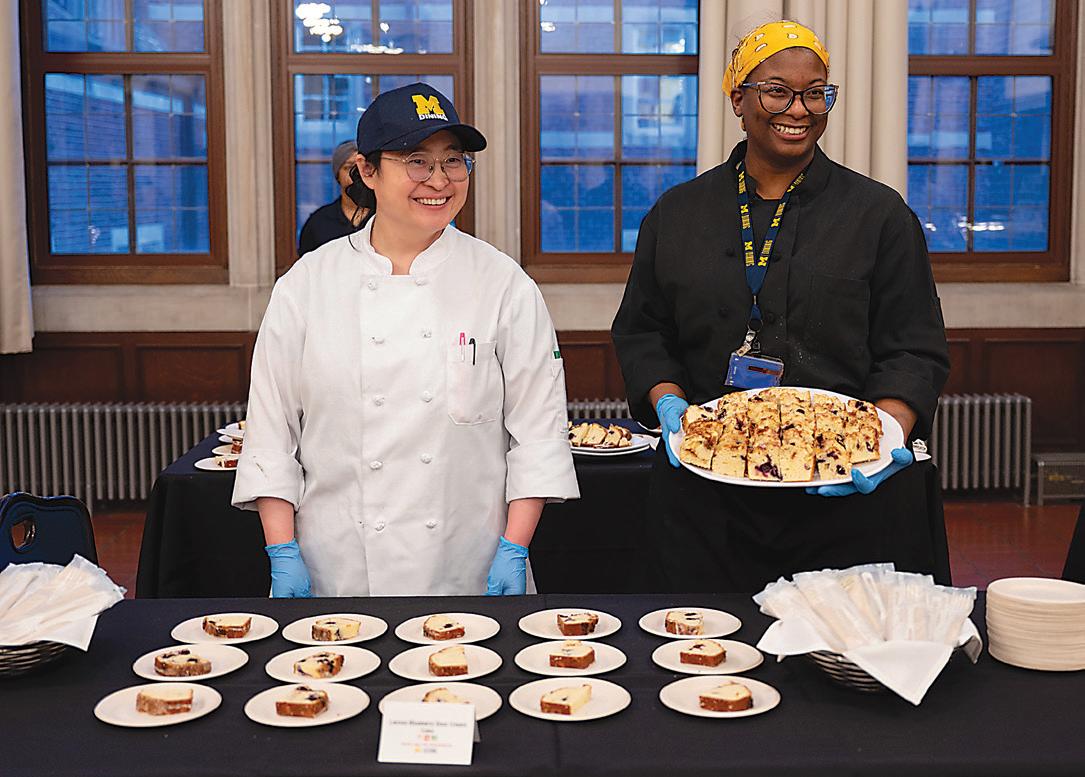
More than 75 University of Michigan students, faculty and community members gathered Tuesday evening in the Michigan Union’s Rogel Ballroom for “Food as Freedom,” featuring Tambra Raye Stevenson, a food justice activist and founder of Women Advancing Nutrition Dietetics and Agriculture. As a collaboration between Michigan Dining and the community-academic partnership course Food Literacy for All, the MLK symposium event began with a reception featuring dishes prepared by MDining staff with personal cultural connections to the food. Amanda Ewing, director of diversity, equity and inclusion for MDining, spoke to the crowd highlighting the MDining staff’s desire to see their own identities represented through the food they create.
“We really wanted to see ourselves reflected in an MLK symposium event and mark the MLK day with something that reflected our team,” Ewing said. “Throughout these conversations,

transformation of public education in a major metropolitan area.
We’ve launched a couple of new institutes as part of this vision. We very recently launched a new Institute for Civil Discourse, and we’re very excited with that. We’re going to look for an outstanding director for that program, and it’s a place where faculty, students and staff from all three campuses and all 19 colleges of the Ann Arbor campus will be able to participate in modeling of civil discourse across a set of difficult issues — but also be sort of a sandbox for faculty from all three campuses, but also hopefully from other universities and also other institutions to come to create curriculum and create opportunities to share civil discourse.
There are a number of other things that will actually animate the priorities of Vision 2034, in terms of investments and programs, and in some cases, new institutes and new buildings. That’s kind of what I’m most excited about at the University of Michigan. We’re already hitting the ground running with
actually moving forward with the implementation of some of these priorities through investments and launching new institutes and a recruitment of outstanding people to the University.
TMD: What would you have done differently?
SO: I want to be even more ambitious for the University. Some people have said Campus Plan 2050 is pretty ambitious, but this is a great university, and my responsibility is to elevate it even further.
TMD: According to a Nov. 20 letter sent to the Senate Advisory Committee on University Affairs by Senate Chair Rebekah Modrak, the Board of Regents are allegedly considering defunding certain DEI initiatives. In a Dec. 1 interview between Regent Sarah Hubbard (R) and Fox News, Hubbard explained the board would take a critical look at programs and spending to analyze DEI results. While University Provost Laurie McCauley issued a Nov. 27 letter to officials explaining that DEI will not fully be defunded, and the Go Blue Guarantee has expanded,
has the administration considered cutting DEI measures?
SO: I’m really excited about that investment in the Go Blue Guarantee. Where we are right now, the landscape is shifting quite as we speak with the executive orders. We have a responsibility as a public university to work within federal guidelines and also be true to our values. There are no decisions that I know of right now. It is true, as I think Regent Hubbard said, and perhaps others have said, that there have been conversations that the Regents, as the overseers of the University, have asked general questions. It’s true that the Provost is central with the other executive vice presidents to thinking about the transition to a new government, but I’m not aware of any decisions at this point. I think that there’s a transfer transition group that’s thinking about all these things, but I think that’s the extent of where we are right now.
TMD: At a recent meeting and in a letter sent Jan. 23, the Senate Advisory Committee on University Affairs criticized both you and the
Board of Regents for your response to former executive director of the Office of Academic Multicultural Initiatives Rachel Dawson’s firing, urging you to restore her to her post. Dawson was fired after she was accused of saying Jewish students were “wealthy and privileged” and did not need diversity services in a private conversation with two other educators. Despite receiving a warning and instructions to receive training, she was fired shortly after Regent Bernstein wrote to President Ono calling for her termination. SACUA voiced concern over regental opinions influencing the processes of investigations and discipline of University personnel and called for safeguards against the removal of members of the University for politically-charged reasons. How were you involved in addressing the allegations against Dawson?
SO: I know that it’s been stated that I responded to that situation. I don’t think I have. This is an HR matter, so I can’t say more, but thank you for this question.
TMD: The University updated the Statement of Student Rights and
Responsibilities. In the updated SSRR, the University can now act as a complainant against students, whereas before all complaints were filed by students, faculty or staff members. Why has the University decided to make this change?
SO: It’s pretty common at other Big Ten universities and many other universities that not only can faculty, staff and students make complaints when there’s a case of discrimination or wrongdoing, but as you may appreciate, sometimes it’s very hard for someone in a very difficult situation to actually make a complaint. They may not feel safe. It could be somebody who might have had sexual abuse or harassment or something like that, and there could be a power imbalance. That’s the reason why, in many universities, it’s possible for the university to complain on their behalf. I think that’s the primary driver, is to try to get into alignment with other institutions. The other change that was made was that for both the complainant and the alleged perpetrator, it was taking a very long time to go through a process, and that doesn’t help either party. It’s very difficult for someone who might have been wrong to wait for a long time, especially if they’re feeling unsafe. If you imagine that something happened to you, you want to have some kind of resolution, whatever the transgression might be. It’s also important that there’s due process — every individual who is an alleged perpetrator is actually perhaps not guilty of what has been alleged. It’s also very, very difficult for that individual to wait a very long time. For that reason, I think that the University put forward some sort of time frame to try to complete those processes.
TMD: During times of heightened campus tensions, how do you draw the line between free speech and disruption? How do you reconcile with those who feel their free speech rights have been infringed upon?
SO: This is one of the most difficult questions that even the best legal scholars globally are reviewing and writing about today. If you are a private university, you have a little bit more latitude. If you’re a public university, we are beholden to the First Amendment. It’s also true that we settle with the Office for Civil Rights. We also have Title VI obligations from the Civil Rights Amendment.

I started to envision an event where we connect our team with the symposium by making food a part of the conversation, rather than a separate element.”
Shalanda Baker, vice provost for sustainability and climate action, took the stage next, remarking the importance of rethinking global systems, including the food system, to be more equitable and sustainable.
“We know that so many of our systems, whether that be the food system, the energy system, the transportation

system, have actually operated to produce inequality, produce environmental harm and displace and dispossess (people),” Baker said. “So this program, I think, is a part of thinking through new ways to interact with the Earth, interact with each other and most importantly, how to take care of each other.”
During the talk, Stevenson outlined the historical use of agriculture to put Black communities at a disadvantage, noting how colonialism has often been enforced through revoking
cultural food and imposing food with negative health effects to gain control.
“On plantations, heavily salted rations were given not to just nourish, but to keep bodies alive for labor,” Stevenson said. “Over time, these heavily salted foods became staples and survival diets passing down generations of overconsumption that linger in our Black communities today. This legacy has resulted in chronic diseases like hypertension and stroke.”
Stevenson described how food
can be a harmful weapon used against marginalized people. She emphasized how food deserts, which disproportionately affect communities of Color, can increase health risks and perpetuate existing inequalities.
“These ingredients may be sweet, light and savory, but there’s a legacy of bitterness,” Stevenson said. “They’ve left us with metabolic diseases like hypertension, diabetes and heart disease, and they’ve turned our food into a weapon against us. The denial or manipulation of food isn’t just a
physical act, it’s a psychological weapon that reinforces power structures from the starvation of enslaved individuals to racialized food hierarchies.”
In an interview with The Michigan Daily, Engineering freshman Megan Wheeling explained how the event opened her eyes to the complexities of agricultural systems.
“My main takeaway was that food systems are a lot more complicated than we make them out to be,” Wheeling said. “This taught me that there’s a lot of intricacies affecting the current state of food and the cultural meanings behind it.” Stevenson emphasized during the event how food has the power to be reclaimed by and provide justice for marginalized people.
“Let us remember that we are not born at the table of oppression,” Stevenson said. “By understanding how food has been weaponized historically, we can better recognize the ongoing inequities in our food system and work toward food as freedom, equity and justice….History teaches us that food can also be that tool of freedom. So let’s shift to that power we hold and can reclaim.”
Former Chicago and Seattle mayors reflect on governing in times of crisis
The Ford School hosted Lori E. Lightfoot and Jenny Durkan
AANYA PANYADAHUNDI
The Ford School of Public Policy
hosted former Chicago Mayor Lori E. Lightfoot and former Seattle Mayor Jenny Durkan Wednesday evening for “Governing in time of crisis: Lessons from two big city mayors,” the most recent event in the Harry A. and Margaret D. Towsley Foundation lecture series.
Moderated by Barbara L. McQuade, University of Michigan Law School professor, the discussion focused on the two mayors’ leadership in 2020 during COVID-19 pandemic and the aftermath of George Floyd’s death.
McQuade opened by asking both mayors about their paths to public service. Lightfoot said her decision to run for mayor stemmed from observing unmet needs in the city, but especially regarding
police reform and the lack of investment in communities of Color.
“It became clear to me that the incumbent mayor didn’t have a plan to address any of those things,” Lightfoot said. “We saw the city as much smaller than it was, and I would always say during the campaign ‘Hey, we got to look at neighborhoods south of Roosevelt Road and neighborhoods west of Ashley,’ meaning the south sides and west sides, that were just literally being starved for resources.”
Following Lightfoot, Durkan described her lifelong passion for politics and early exposure to public service. However, she said running for mayor was never in her planned career path.
“One job I swore I never would do would be mayor,” Durkan said. “We ended up with a vacancy in Seattle … and we were at a really pivotal time in the city, and for me, it was a better
time — my kids were mostly grown, not totally grown, and I talked to a lot of people and I loved the city.”
Both Lightfoot and Durkan emphasized the importance of communication during crises as mayors. Durkan said good communication relies on transparency and legitimacy, and noted misinformation spreads when the public isn’t well-informed.
“You communicate for a lot of reasons if you’re a leader,” Durkan said. “Number one, your job is to be an elected representative of them … If they don’t understand what their government is doing, I think you’re denting one of the principles of our democracy. Second is how you get legitimacy — if they don’t know what you’re doing in this day and age, they will suspect the worst.”
Lightfoot said a growing majority of people don’t get their news through traditional media outlets,
explaining how her administration leveraged social media to reach residents. Lightfoot discussed how she turned viral memes of herself into campaigns promoting COVID19 safety, collaborating with local artists.
“They really kind of rose up organically, but we loved it and really leaned into it,” Lightfoot said. “We made this whole series of Stay Home, Save Lives videos that really kind of rose from the creativity of Chicago artists (and) graphic artists and then we, of course, created a few of our own.”
The conversation shifted to the Black Lives Matter protests following Floyd’s death in 2020. Lightfoot described the specific challenges Chicago faced in managing both peaceful demonstrations and violent crashes.
How a second Trump administration might affect research funding
Possible shifts under the Trump administration are changes to
federal funding for science and research
ABIGAIL VANDERMOLEN
Daily Staff Reporter
On Monday at noon, President Donald Trump stood in the U.S. Capitol rotunda and took the presidential oath of office in an inauguration ceremony. Trump’s presidential campaign promised a departure from former President Joe Biden administration’s policies, beginning with dozens of executive orders addressing climate policy, birthright citizenship and diversity, equity and inclusion. Among the possible shifts under the Trump administration are changes to federal funding for science and research.
During his first term, Trump proposed cuts to organizations like the National Institutes of Health and National Aeronautics and Space Administration. Heading into his second term, Trump, along with both chambers of Congress, has suggested cost-cutting reforms to the NIH, which invests most of its budget into medical research at institutions like the University of Michigan.
In an email to The Michigan Daily, Public Policy professor Donald Moynihan wrote that if federal research funding is cut, it could mean major changes for the University’s research funding and faculty numbers.
“For big research universities like Michigan, federal research
funding is at the heart of their budget,” Moynihan wrote. “If that is significantly reduced it will create a large budget hole that will have to either be filled in elsewhere or will mean that the university becomes smaller.”
Of the $2.04 billion that the University spent on research in the 2024 fiscal year, $1.17 billion came from federal funding. Of that, the NIH provided nearly $762 million. The University was the fifth-highest recipient of funding from the NIH among higher education institutions in FY 2023.
In an email to The Daily, University spokesperson Kay Jarvis wrote that the University’s Federal Relations Office is working with other higher education institutions to advocate for continued federal research funding.
“Whenever a new party assumes control of Congress or the White House, it raises questions about how a shifting political landscape may impact federal agencies, funding structures, national policy and the availability of federal research dollars,” Jarvis wrote. “The University’s Federal Relations Office is diligently tracking new developments and will continue to work in close collaboration with peers in higher education and other institutions to advocate for federal research funding that saves and improves lives and creates opportunities for our state, nation and world.”
In addition to direct funding, research grants also include indirect costs, which cover administrative costs that come along with implementing the grant. Moynihan wrote that cutting funding for indirect costs is one way the federal government could reduce research spending.
“Reducing those indirect rates would reduce the size of awards to universities,” Moynihan wrote. “The federal government generally offers more generous indirect rates than philanthropic funders, and so this loss would be hard to cover.”
Despite Trump’s previous attempts to reduce funding for research, his proposed budget cuts were largely rejected by Congress, and in 2018, Trump approved the largest increase in U.S. research spending since 2009. However, Moynihan believes it’s likely that the second Trump administration
will be more aggressive about cutting research funding than the first, citing an increase in loyal cabinet members and animosity towards higher education among Trump’s supporters.
“I think the second Trump administration will be generally more focused on attacking higher education than in the past for a number of reasons,” Moynihan wrote. “Many of those with senior positions in government … blame higher education for younger students holding views that they disagree with, and so want to compel universities to adopt positions more consistent with their views. The irony is that having spent years complaining that campuses do not respect free speech, they would be using government power to compel their preferred speech.”
SACUA urges safeguards against Regent influence on staff removal
A letter to the Faculty Senate Friday morning criticized the dismissal of former DEI official
SARAH
SPENCER Daily Staff Reporter
The University of Michigan’s Senate Advisory Committee on University Affairs sent a letter to the Faculty Senate Friday morning criticizing the dismissal of Rachel Dawson, former executive director of the Office of Academic Multicultural Initiatives, and urging the University to protect the academic freedom of its staff. Dawson was dismissed on Dec. 10 following a complaint filed by the Anti-Defamation League of Michigan which claimed she made antisemitic comments in a private conversation at a conference in March.
According to The New York
Times, the complaint alleged that Dawson said the University was “controlled by wealthy Jews” and that Jewish students are “wealthy and privileged.”
In the letter, SACUA wrote that Dawson denies making such statements, and a University investigation found that it was “not possible to determine with certainty whether Ms. Dawson made the exact remarks.”
“We reject the noxious antisemitism that underlies this alleged comment,” the letter read. “Ms. Dawson denies that she uttered this or other objectionable things, either at the conference in question or at any other time.”
After the investigation was completed and Dawson was ini-
tially reprimanded, University
Regent Mark Bernstein wrote to University President Santa Ono in an email obtained by The New York Times stating that Dawson should be “terminated immediately,” and she was fired shortly after.
“These facts lead us to question whether University personnel can expect the regular processes of investigation and discipline to carry weight in the face of the opinions of individual Regents,” SACUA’s letter read.
SACUA also wrote that they believe Dawson’s dismissal reflects a limitation on the ability of University faculty to publish material on contested issues out of fear of retaliation from the University’s Board of Regents.
“With Ms. Dawson’s example before us, it will be unreasonable for any of us to publish opinions that powerful figures in public life will object to,” the letter read. “Our curriculum, our teaching, and our research will be more disengaged from the most controversial and most essential questions of our times.”
SACUA urged the University to restore Dawson to her position and to better protect staff members by following the ordinary process in dealing with staff disciplinary affairs.
“We need safeguards against the removal of members of this University by regental fiat, particularly in these politically charged times,” the letter read.
Stanford Lipsey Student Publications Building 420 Maynard St. Ann Arbor, MI 48109-1327 734-418-4115 www.michigandaily.com
ZHANE YAMIN and MARY COREY Co-Editors in Chief eic@michigandaily.com
EDITORIAL PAGE opinion@michigandaily.com ELLA THOMPSON Business Manager business@michigandaily.com
LETTERS TO THE EDITOR tothedaily@michigandaily.com
PHOTOGRAPHY SECTION photo@michigandaily.com
NEWSROOM news@michigandaily.com CORRECTIONS corrections@michigandaily.com
SPORTS SECTION sports@michigandaily.com NEWS TIPS tipline@michigandaily.com
ARTS SECTION arts@michigandaily.com
ADVERTISING wmg-contact@umich.edu
Editorial Staff
CECILIA LEDEZMA Joshua Mitnick ’92, ’95 Managing Editor cledezma@umich.edu
FIONA LACROIX Digital Managing Editor
flacroix@umich.edu
ASTRID CODE and JI HOON CHOI Managing News Editors news@michigandaily.com
Senior News Editors: Audrey Shabelski, Barrett Dolata, Christina Zhang, Edith Pendell, Emma Spring, Marissa Corsi, Michelle Liao
JACK BRADY and SOPHIA PERRAULT Editorial Page Editors tothedaily@michigandaily.com
Deputy Editorial Page Editor: Zach Ajluni
Senior Opinion Editors: Angelina Akouri, Nina Attisha, Jack Kapcar, Liv Frey, Hayden Buckfire
JONATHAN WUCHTER and ZACH EDWARDS Managing Sports Editors sports@michigandaily.com
Senior Sports Editors: Taylor Daniels, Charlie Pappalardo, Lys Goldman, Sam Novotny, Eli Trese, Anna Miller
RAMI MAHDI and CAMILLE NAGY Managing Arts Editors arts@michigandaily.com
Senior Arts Editors: Amaya Choudhury, Lola D’onofrio, Cecilia Dore, Holly Tschirhart, Cora Rolfes and Mina Tobya
LEYLA DUMKE and CAROLINE GUENTHER Managing Design Editors design@michigandaily.com
Senior Layout Editors: Lys Goldman, Maisie Derlega, Annabelle Ye Senior Illustrators: Haylee Bohm, Avery Nelson, Matthew Prock
GEORGIA MCKAY and HOLLY BURKHART Managing Photo Editors photo@michigandaily.com
Senior Photo Editors: Emily Alberts, Alyssa Mulligan, Grace Lahti, Josh Sinha, Meleck Eldahshoury
ANANYA GERA Managing Statement Editor statement@michigandaily.com
Deputy Editors: Graciela Batlle Cestero, Irena Tutunari, Paige Wilson
ALENA MIKLOSOVIC and BRENDAN DOWNEY Managing Copy Editors copydesk@michigandaily.com
Senior Copy Editors: Josue Mata, Tomilade Akinyelu, Tim Kulawiak, Jane Kim, Ellie Crespo, Lily Cutler, Cristina Frangulian, Elizabeth Harrington, Nimai Talur
TIANYU “DARRIN” ZHOU and EMILY CHEN Managing Online Editors webteam@michigandaily.com
Data Editors: Daniel Johnson, Priya Shah Engineering Manager: Tianxin “Jessica” Li, Julia Mei Product Managers: Sanvika Inturi, Ruhee Jain Senior Software Engineer: Kristen Su
JOVANNA GALLEGOS and MAXIMILIAN THOMPSON Managing Video Editors video@michigandaily.com
Senior Video Editors: Kimberly Dennis, Andrew Herman, Michael Park
AYA SHARABI and SARA WONG Michigan in Color Managing Editors michiganincolor@michigandaily.com
Senior MiC Editors: Isabelle Fernandes, Noah Mohamed, Maya Kogulan, Nghi Nguyen
AVA CHATLOSH and MEGAN GYDESEN Managing Podcast Editors podeditors@michigandaily.com
Senior Podcast Editor: Isabel Dubov
MILES ANDERSON and DANIEL BERNSTEIN Managing Audience Engagement Editors socialmedia@michigandaily.com
Senior Audience Engagement Editors: Emma LeFevre, Lauren Kupelian, Daniel Lee, Dayoung Kim, Emma Lapp
MELIA PAN Culture, Training, and Inclusion Chair accessandinclusion@michigandaily.com
SOPHIA LEHRBAUM and REVA LALWANI Managing Focal Point Editors lehrbaum@umich.edu, reval@umich.edu
Senior Focal Point Editor: Madi Hammond
TALIA BLACK and HAILEY MCCONNAUGHY Managing Games Editors crosswords@umich.edu Senior Games Editors: James Knake, Alisha Gandhi, Milan Thurman, Alex Warren
Business Staff
OLIVIA VALERY Marketing Manager
Lara Ringey/DAILY
DRU HANEY
GABRIEL PAREDES
ROGAN
‘Revenge of the Tipping Point’ might be a page turner, but it probably isn’t science
CLAIRE ROCK Daily Arts Writer
“Revenge of the Tipping Point” was my first Malcolm Gladwell book. Given that it’s an extension of his first book, “The Tipping Point,” I found myself with an especially fresh perspective on his ideas and writing style. As a nonfiction lover, I was curious — I’d heard about Gladwell in relation to the social-politicalopinion-TED talk scene, and I wanted to give his work a try.
I absolutely devoured the first half of the book. And by “devoured,” I mean the flashlightin-bed kind of devoured. Gladwell is a great writer — he introduces and transitions between ideas with ease. He strikes a perfect balance between captivating anecdotes and discoveries in social science, connecting it all with his own catchy phrases and ideas.
I found myself putting my book down to look up images of Philip Esformes and buildings in Miami constructed specifically for fraud and famous bank robbers. I tried to figure out the location of “Poplar Grove,” an anonymized homogenous town he describes. Gladwell had me hooked. I liked his stories. They are interesting and topical, and he approaches them in a unique way, despite many of them having already received extensive media coverage.
However, my reading experience shifted about halfway through the novel, around when Gladwell began his discussion about his established “rule of thirds” and Harvard’s esoteric country club sports. The “rule of thirds,” which Gladwell calls “universal law,” asserts that when a minority group reaches roughly
one third of a population, it gains the power to significantly change group dynamics and to participate free from tokenism and model minority pressure. He argues that Harvard recruits so many wealthy, country-club-sport-playing students (he focuses particularly on women’s rugby, a sport in which coaches travel notable distances to find recruitable athletes) in order to prevent minority students from reaching that seemingly “magical” third, as these athletes are overwhelmingly white.
While I found his discussion of country club sports at Harvard and other Ivy League schools interesting and illuminating, I felt that Gladwell left important gaps in the story in order to favor his argument. First, I think it takes more than observations about country club sport demographics and Harvard’s racial distribution to make the claim that Harvard, while publicly pursuing diversity — even publishing its diversity programs and releasing its race data — was actually secretly and strategically introducing new sports for the sole purpose of getting more white students. This is not to say that it couldn’t be true — just that pointing out that country club sports are overwhelmingly white and wealthy and that Harvard’s minority populations fall below 30% is not enough to substantiate this kind of claim.
Moreover, he suggests using the rule of thirds in all kinds of places. Though he acknowledges some of its drawbacks, as in the case of Lawrence Tract — a neighborhood in California that had to turn away a minority family in need to maintain its balance of one third of each ethnic group in the

neighborhood, hurting those it was meant to help with finding fair-priced housing — he doesn’t acknowledge the places it might not apply. He doesn’t mention, for instance, that a truly unbiased college admissions system should have a student population that is roughly representative of the U.S. population. This is a fact that can’t be reconciled with his rule of thirds, because there isn’t a third of each minority and there are far more than three racial groups in the United States.
I mention this specific case because it was the first place I really noticed two of Gladwell’s flaws: overgeneralizing his catchphrases in pursuit of “universal law” and cherry picking data to strengthen his
arguments. His use of “universal law” and terms like “overstories” are great for readability but lead to stories and theories that are attached at times by only tenuous connections. His choice not to explore many objections or contrasting studies is also great for readability but makes his story less nuanced and certainly less rigorously proven. At this point, I began to see where some of Gladwell’s critics were coming from. He’s a great writer, but maybe not such a compelling social scientist.
While they might have slowed me down, though, these issues didn’t make reading “The Revenge of the Tipping Point” any less entertaining for me. Even though I sometimes knew what was
coming next, I enjoyed reading about the cheetah’s population bottleneck and how old TV shows like “Holocaust” and “Will & Grace” changed social dynamics. Gladwell particularly shines when he pinpoints a small, tangible change that lines up with one of his theories and links it directly to results, with evidence from more than one place. For instance, he explains the variation in opioid overdoses between similar states by a public policy which required doctors to write an extra script to notify the state of any opioid prescriptions. He uses multiple sources, including state overdose rates and Purdue Pharma’s targeted marketing plan, to prove that the policy made doctors less willing to
prescribe opioids, an effect that is still seen today in lower overdose rates in states that undertook the policy. This story, which Gladwell chooses to wrap up the novel, does a great job of tying together a few of his catchy ideas with more concrete causes and effects. After reading “Revenge of the Tipping Point,” I’ve come to the conclusion that Malcolm Gladwell is the Colleen Hoover of nonfiction — his work is tailored to a wide audience, fast-paced, engaging and maybe isn’t the most serious work in its genre, but it might be one of the more entertaining ones. If you’re looking for an interesting read, “Revenge of the Tipping Point” is for you. If you’re looking for scientific answers, though, you might want to look elsewhere.
Holding space for ‘Wicked’ ‘Didion & Babitz’ is not a biography

MAURICE TOBIANO Daily Arts Writer
From broken marriages and teary-eyed interviews to holding space for an endless marketing campaign, the film adaptation of “Wicked” has been stirring up conversation since its release. The film needed to rationalize its nearly 3-hour run time as only part one of the musical. For many theater kids like me, justification was, quite frankly, irrelevant. No matter the product planted on the screen, I would’ve sat in my green and pink getup, reserving tickets for “Wicked” part two during the previews. Yet despite my bias, “Wicked” proves its worth. Notwithstanding the imperfections, there is space to be held for the wit and wonder of “Wicked.”
Director Jon M. Chu’s (“In the Heights”) “Wicked” is the film adaptation of the musical “Wicked” (Winnie Holzman), which is an adaptation of the novel “Wicked” by Gregory Maguire, which is in and of itself an adaptation of “The Wonderful Wizard of Oz” by L. Frank Baum. These adaptations serve as prequels to Baum’s original novel and curate an origin story for the Wicked Witch of the West. The production radiates a fantastical, meticulous passion for
Oz, paying homage to the original “Wizard of Oz” film and book while transforming it into a world of its own. I was immediately captivated by the sheer abundance of variation and intricate detail. The attention given to not just the leads, but also the background characters and setting, contributes to an immersive world through costumes and practical sets. Each costume exudes individuality while paying homage to historical silhouettes and patterns, adding an alluring whimsy to each character.
I praise the dedication to building a full-scale Shiz University with a functioning rotating library, planting 9 million tulips and curating a forest, complete with real birds. The minute details are truly remarkable, and I only wish there was more time spent within the world itself. Chu’s direction feels character-centric, missing the opportunity to immerse the audience in this new fantastical world and showcase the sets they worked so hard to build. Despite the practicality of the sets, the dull lighting and diluted saturation make each shot feel like a staged scene rather than an intimate moment. Director Chu asserted that the film’s muted color palette helps make Oz feel like “a real place,” by extension emphasizing the reality of the
on-screen relationships. Yet the desaturation made Oz feel more plastic than “Barbie,” which at least chose to embrace the neon and color of its world. The main character is green for god’s sake — embrace the fantasy, increase the saturation and give us an ethereal, enchanted Oz. In general, the direction and lighting lack variety and creativity in the first two acts, making it feel like we’re at the Gershwin Theater on Broadway, watching the musical on stage instead. Chu, again, doesn’t take advantage of the medium of film, teasing the audience with his creative potential in only a handful of scenes.
On the other hand, the performances of Elphaba (Cynthia Erivo, “Harriet”) and Glinda (Ariana Grande, “Victorious”) negate all previous criticisms. Erivo and Grande bring in the depth and complexity I yearned for in the rest of “Wicked.” Through heavy use of close-ups and medium shots, Chu captures Erivo’s micro-expressions and subtle mannerisms, drawing the audience deeper into Elphaba’s character. Her performance, alongside the intimate shots, evokes profound empathy and heartbreak, adding a tender weight missing in the distance of musical theater.
Remember 2022’s “Blonde” and the controversy it stirred up? The film, based on a 2000 Pulitzer Prize finalist book of the same name by Joyce Carol Oats, is a fictionalized retelling of the life of famous actress and icon Marylin Monroe, one that focuses on the darkest themes of her life: addiction, assault and the tragedy of celebrity.
At the time, many criticized the work as an inaccurate portrait of the woman. Even those who understand its fictitiousness, they claim, will walk away with an implicit and false understanding of the real Norma Jeane Mortenson. Others, however, have praised the necessity of this imaginative adaptation. Elaine Showalter’s New Yorker piece defending the work comments that, “Oates plays with, rearranges, and invents the details of Monroe’s life in order to achieve a deeper poetic and spiritual truth.” Creating a character to impart the literary themes you want to write about makes sense, Showalter claims; as long as we understand that it’s not real, there’s more artistic worth in that endeavor than harm.
Regardless, however, of one’s personal opinion on the act of writing something like “Blonde,” which acknowledges its status as a work of fiction, imagine what it would be like for an author to create such a work, then turn around and pass it off as completely true.
It is here that we come to Lili Anolik’s “Didion & Babitz.” The book is ostensibly a nonfiction work concerning itself with the parallel relationship between Los Angeles-based 1960s writers Joan Didion and Eve Babitz, predicated on a letter from Babitz to Didion found in Babitz’s apartment after her death. Anolik previously wrote a biography of the late Babitz titled “Hollywood’s Eve: Eve Babitz and the Secret History of L.A.,” for which she conducted years of
interviews with Babitz and her family. Five years later, Anolik has returned, ready to uncover all of Babitz’s secrets hidden within the materials that she left behind.
At least, that’s what’s on the book jacket. In reality, “Didion & Babitz” is something else: a mash of personal essay, literary criticism and cultural commentary that errs on the nonsensical. All of this is in service of justifying the title — connecting Didion to Babitz, and Babitz to Didion. To construct a book like this, Anolik must do one of two things: either present the real-world relationship between Babitz and Didion via interviews and letters, or analyze the literary writings of the two, contrasting the women’s perceptions of their circumstances. There are elements of both approaches in “Didion & Babitz.” Both land unconvincingly, however, for the sole reason that Anolik has virtually no evidence behind her claims.
A good place to start is the letter — the one that’s mentioned on both the book jacket and in the preface, not to mention referenced many times throughout the book, as the leading proof that the two women had a secret, career-defining feud. In it, Babitz accosts Didion, asking, “Could you write what you write if you weren’t so tiny, Joan? Would you be allowed to if you weren’t physically so unthreatening?” The letter is framed as confirmation that the two women were antagonistic to one another concerning their respective crafts, an argument that Anolik furthers by constantly comparing their opposite approaches to writing, Los Angeles and life itself. It is the cornerstone of what the entire work is purportedly about.
But, it turns out, this isn’t strictly true. About halfway through the book, we’re told that actually the letter was never sent to Didion, which is why Anolik was able to find it in Babitz’s apartment at all. Looked at generously, this is a cheap and inconsequential rug pull — after
all, it still proves that this is what Babitz was thinking about Didion at the time she wrote it. When considered more critically, however, it’s one example in a long line of journalistic falsities and misrepresentations that characterize the book. It’s not just that Anolik massages the truth to create a compelling narrative — to an extent, most nonfiction needs to do this in order to tell a coherent story — it’s that she continually interjects her subjects’ perspectives with her own “hunches” about the situation and what really must have been going on. It’s an exhausting endeavor that leaves the reader frustrated and questioning whether or not anything in the book is “real” at all.
The structure of the book is one issue that furthers this impression. Despite the novel being titled “Didion & Babitz,” the work mainly focuses on Babitz, with brief interjections of Didion’s life presented only through Babitz’s perspective. It’s an interesting idea in theory, but it often fails in practice. In reality, Didion and Babitz didn’t interact all that much. They were friendly with each other for a period of about seven years, mainly due to running in the same Los Angeles circles. Eventually, Didion pushed for one of Babitz’s books to be published, going so far as to edit it with her husband. Babitz didn’t like the feedback that the pair gave her and then “fired” them. Much later, Babitz was involved in a devastating car fire that left her in severe pain for much of her remaining life; Didion and her husband sent Babitz a note expressing how sorry they were. Finally, Babitz called into a radio show interview with Didion. Didion laughed uncomfortably at the strangeness of reconnecting with Babitz in such a public forum, and the radio host moved on to another caller.
Abigail Schad/DAILY
GRACE SIELINSKI Daily Arts Writer
Cover art for “Revenge of the Tipping Point” owned by Little, Brown and Company.
Father John Misty misses the trees for the forest of ‘Mahashmashana’
RAMI MAHDI Managing Arts Editor
The fourth song of Father John Misty’s latest album, Mahashmashana, titled “Mental Health,” has a wonderfully lush soundscape. Soft winds, blooming saxophones and hushed accompanying vocals coalesce into a fantastical forest of sound that transports the listener into a wholly different dimension, built entirely by Josh Tillman (the man behind Father John Misty). Tillman himself then appears on the track, singing lucid and wavering lyrics like “One of these labels bound to fit / Oh, identity / your milk white shadow,” further immersing us into this religiously euphoric world — what could these harmonies be if not auditory heaven? That is, heaven until we reach the hook and Tillman croons out an impassioned “Men-tal Heeeaaalth, Men-tal Heeeaaalth / No one knows you like yourself,” each syllable accented with a complementary snare, vocally walking up the melodic scale to drive home his message.
It’s awful. In 15 seconds, two minutes of growing intensity and atmospheric production are destroyed to make way for a corny line that doesn’t even sound good. Suddenly, we feel used. Our emotional and mental
investments were spent on a climax with the nuance of a 12-year-old’s Tumblr blog. This isn’t something inherently new for Tillman — often, his lyrics sound like the alcohol-scented ramblings of the Maoist dude cornering you in the back of that venue that you (sorta) like. He muses on the nature of the self, of death and of love (with varying degrees of success and triteness) throughout his discography. The lyrics of albums like Pure Comedy and God’s Favorite Customer are equally wince-inducing, yet I still find myself returning to those albums with startling regularity.
I don’t dislike Father John Misty — in fact, much of his music routinely finds its way into my rotation. This is because those albums make room for their silly lyrics. As corny as they might be, Tillman makes sure the lyrics both blend into the foundational soundscape and fit the song’s mood. While “Their idea of being free is a prison of beliefs / That they never ever have to leave” off the song “Pure Comedy” could easily be seen as repulsively pretentious, Tillman fits the line halfway up a grand crescendo, and hits “never ever” with such a sharp marcato articulation that it’s impossible to judge him — in that moment, Tillman is no more, there is only Father John Misty.
This magic is sadly not apparent on his most recent album. All over Mahashmashana, moments betray songs. In the minutes that follow that repugnant moment on “Mental Health,” we find ourselves desperately attempting to buy back into the song, allowing the truly phenomenal instrumental to soothe us into songwriting psychosis again. And then: “Men-tal Heeeaaalth, Men-tal Heeeaaalth / Maybe we’re all far too well.” Wow. These disruptive moments in otherwise excellent songs are deeply frustrating — Mahashmashana is almost fantastic. Throughout the album, Tillman finds himself throwing an immaculate inning before sending a meatball down the lane on an 0-2 pitch.Sometimes it’s not even the lyrics on the album themselves that disrupt the flow of songs — it’s how they’re delivered. The obnoxiously electrically groovy and hiptwirling melody of “She Cleans Up” is betrayed by the constant monotone lecture of whatever the fuck Tillman is talking about. The shockingly mesmerizing lyrics of “Being You” are smashed to bits by his lazy attempt at a bored, staccato syncopated verse intonation. Often, Tillman resorts to these strange spoken word segments, attempting to
The Michigan Daily Crossword
emulate a sort of messiah, as if the stage name wasn’t enough to give it away.
When the planets are aligned and Tillman is on his game, though, he can overcome himself. Songs like the title track, “Mahashmashana,” and the swinging disco haven of “I Guess Time Just Makes Fools of Us All” are proof that, yes, he can put it all together. “Mahashmashana,” especially, is utterly magnificent. Capturing the orchestral might and overwhelming awe that he’s seemingly been chasing his entire career, the track is a nine-minute opus filled with sweet strings, lyrics just vague enough to love and a climax perfect enough to invoke the fear of God. To borrow language from Father John Misty, the resolution of the song’s longing progression finally brings us to a sort of musical nirvana.
Tillman is reciprocal in his songwriting, though. For every “Mahashmashana,” we are given a “Screamland.” With production ripped from a Chainsmokers B-side and uninspired lyrics from a half-day’s worth of meandering journaling, “Screamland” is a uniquely frustrating song on an already uniquely frustrating album.
Now I’m upset again. I must ask — why? Why is he doing this?

Why would he jam these pieces of sound together — square pegs into round holes? Why would he create an album full of negative contrast? The chunky gumbo of Mahashmashana does not go down easy; the album, filled with dozens of flavors of noise and lyricism, is overstuffed with ideas.
Part of the answer undoubtedly lies in Tillman’s desperation to live up to his selfadministered moniker of Father John Misty. Since his inception on albums like Fear Fun and I Love You Honeybear, Tillman has carefully constructed a
wide-reaching persona that, by its intense nature, has restricted his own creative ambitions. The minuscule mundane and intimate are, to Tillman, not enough. For God’s sake — the man’s first ever song with this stage name is called “Funtimes in Babylon.” In the same way Taylor Swift has unwittingly damned herself to a prison of break-up songs and Reputationlike reduxes, Tillman has found himself wondering where to go after a decade of grandiose spirituality.
‘A Complete Unknown’ falls back on mythology
GRACE
SIELINSKI & ZACH LOVEALL Daily Arts Writers
Response from another room 57. The first major tennis tournament of the year 62. 2014 Olympics city 63. Shipping dept. stamp
Dippin' ___ (sweet treat)
Disney heroine who sings "Reflection" 66. Celebrity chef Paula
Light beige
Ford muscle car, to devotees
Trademark in an arcade game
Oxford, for one
1. Actress Thompson of "Creed" 2. ___ Park, Colorado 3. First lady before Michelle 4. Wedding reception hire, maybe 5. Garfield's favorite food
6. Get one's ducks in ___
7. Healthcare prefix
8. Mayim who played Amy Farrah Fowler on "The Big Bang Theory"
9. Petition
10. "Not guilty," e.g.
11. Eve's partner
12. Hit alternative
13. "Get it?"
21. Linguist Chomsky
22. The L?
26. Zero, in soccer
27. Trojan War epic
28. Affirmative action
29. Standard
30. Old-time oath
31. Yanks' foes
32. Whispery video genre, for short
33. The Buckeye State
34. Piece that gets checkmated
38. When doubled, a 2010s dance
40. Put to work
43. TV-MA's film equivalent
44. "___ one, think that ..."
46. Daughter of King Minos
47. Teller's partner in magic
50. Hallmark.com offerings
51. ___ Scholars (some Oxford students)
54. Historical period
55. So out it's in
56. Follow as a result
57. Été month
58. Home of the Bruins
59. Central Asia's Tien ___ Mountains
60. Onion's cousin
61. Slushy drink
62. Texting format, for short

As a genre, the musical biographical picture sucks. Tied down by a reverence for the artist they intend to depict, these movies on the whole are dull, formulaic and find their only joy in the rote repetition of music mythology as historical fact. For the most part, you’d be better off binging old music videos. This history of failure is why it’s so surprising that “A Complete Unknown,” the Bob Dylan biopic directed by James Mangold (“Ford v Ferrari”), is somewhat OK. The first ingredient is the surprisingly well-acted performances. Timothée Chalamet (“Dune: Part Two”) isn’t so much a carbon-copy imitation as an impressive evocation of Bob Dylan’s odd movements, near-unintelligible speech and gravelly voice. It’s subtle, which is especially remarkable considering how easy it is to take Dylan’s quirks and raise them over the top. Chalamet’s singing is similarly effective; while no Dylan fan would ever confuse the performances of the two, the musical scenes are pleasant and evoke — without replicating — what makes a Bob Dylan song feel so gripping. In a particularly memorable scene, Chalamet stares down the camera while warbling out “Masters of War” in a dingy dive bar. Like most biopics, the best part of “A Complete Unknown” is listening to these songs at movie theater volume, even if they’re just close covers.
Even more impressive is Monica Barbaro (“At Midnight”), who plays fellow folk powerhouse Joan Baez and might give an even better performance than Chalamet. Baez’s sweet, unbelievably clear soprano feels even more difficult to imitate than Dylan’s rough-andtumble rasp, but Barbaro’s natural singing talent pushes her over the edge of believability. Together, the pair’s duets are strong enough to help an audience unfamiliar with their real-life collaboration understand why they complement each other so perfectly.
However, well-acted impressions are standard among Hollywood-level biopics, so what elevates this film? It’s not stellar direction, visual splendor or even a well-paced plot. For the most part,
“A Complete Unknown” is a bogstandard Hollywood film with simplistic static camera work and a standard script structure. Instead, it’s simply that Mangold works with inherently odd material.
A little context for a non-Dylan superfan: In 2004, Bob Dylan published a memoir of his early career titled “Chronicles: Volume One.” The book is great, filled to the brim with the strange metaphor-laced sentences that the singer is so known for, while still pulling together a cohesive picture of his life in the East Village. The trouble is that most of the stories inside are either exaggerated or completely false. Dylan biographer Clinton Heylin called it a “pack of lies” and Dylan himself claimed that his strategy for writing the book was to “take some of the stuff that people think is true and … build a story around that.” Why did he do this? Was it a joke? A form of internal myth-making? A way to augment his art by adding a fantastical persona behind his song writing? The answer is likely a bit of all of the above, but more importantly, it’s what he’s always done.
Bob Dylan’s legal name is Robert Zimmerman. Stage names are common enough for performing artists, but unlike most singers, Dylan tries to convince you that “Bob Dylan” is completely real, even after the show is over. Surprisingly, the film depicts the turmoil this strange persona-building has on Dylan’s personal relationships. To both his love interests, Dylan claims that he learned guitar in the circus, and both women refuse to believe his story. In a lesser film more concerned with boxoffice appeal to Bob Dylan fans, these conversations would never have happened, or even worse, would have been depicted as fact. Instead, Mangold addresses the fact that Dylan isn’t who he insists on being — taking a step past what’s expected of him. It’s a metatextual challenge: how does one venerate the artist while acknowledging that they aren’t who they say they are, without taking away from the beloved persona? Mangold isn’t the first to cover this ground, but to do so with arguably the most influential American singer-songwriter of all time takes some guts.
Album cover for “Mashashmashana” by Father John Misty
AYEYI ASAMOAH-MANU MiC Assistant Editor
It was 7 p.m., on a Friday night — Nov. 15 2024. And while it was more like 59 than 95 degrees on that crisp November night, the temperatures in the Trotter Multicultural Center had risen to rather unprecedented levels. Here, the African Students Association at the University of Michigan, in collaboration with its counterpart at Eastern Michigan University, put together a game called “Pop the Balloon or Find Love,” a simulation of the viral sensation YouTube show that brought contestants together and gave them one singular task: Pop the balloon or find love.
Although many variations exist across different countries and sexualities, the most popular version is led by the indelible, gorgeously dressed but always slightly messy, Arlette Amuli. I use the word messy here to mean a little outrageous, a little outof-pocket but altogether, very comedic. The Arlettes — or rather, starlets — of the University of Michigan reprisal were Ayomide Fadase and Mogbonjubola Adepoju, who kept the audience riveted and engaged throughout the night.
The premise of the game is simple: single bachelors or bachelorettes stand in line holding bright red balloons. Then eligible partners would step in and answer a series of questions, including name, age, romantic interests, pet peeves, and the like — you know, quintessential, romantic, reality TV questionnaires. The hosts would then ask a series of followup questions, to give the audience and the other contestants a greater glimpse into the speaker’s life. Questions such as what they looked for in a partner, red flags, and dealbreakers, revealed each person’s personality and, to a deeper extent, their perspective on love. Then, the balloons go off.
Was ‘Pop the Balloon’ the solution to bringing Black UMich together again?
One by one, intermittently, spontaneously. Some, to the most obnoxious things like mismatched toenails or the likeness to a Ninja Turtle. Others pop to deeper, more reasonable explanations, like differing cultures, disagreements on love languages or compatibility. Regardless, if a red flag is found, a red balloon is popped, signifying an elimination from the show.
What follows forms the crux of the night. The hosts quite literally saunter around the room, asking decliners why they popped the balloon and if the person was originally their “type” or not. Then, as if the show could not get any more outrageous, if many balloon holders remain, participants could then pop the balloons of those they wish to eliminate.
Like I said — messy. Indeed, the palatable awkwardness of the show is what makes it so entertaining. Contestants have to audibly voice why they rejected another participant with no voice or mask to hide behind. Arlette herself describes it as “kind of like a dating app, but in real life,” with no witty Tinder caption or no quirky Bumble selfie to hide behind.
The show’s structure also immediately delves into preferences in partner selection, often prioritizing physical appearances, core values and relationship goals over the small talk about one’s major or favorite artist that college students have come to expect on the first date.
In a post-event interview with The Michigan Daily, both hosts were eager to explain this more deeply.
Mogbonjubola Adepoju, the vice president of the student organization and co-host of the live show, explained: “In just one hour, participants find love, share laughs, and exchange diverse perspectives on what people value in partners within our community. I think it’s a fantastic concept,
especially for college students who often find themselves too busy to meet new people.”
Ayomide Fadase, who serves as the event coordinator for the student organization and co-host for the night, echoed similar sentiments, describing “Pop the Balloon” as “a fun and intriguing concept that the black community enjoys (because) we love to hate it.”
And I would have to agree. Frankly, there is no polite way to pop a balloon; it will be awkward, brutish, and a little crude, but at some point, it has to be done. And it makes for damn good TV.
But it got me thinking, is Pop the Balloon really setting the Black community back as many people think? Is the blunt approach that is so characteristic of reality dating shows too demeaning or superficial to facilitate real love?
Is the format of lining young, Black singles and rejecting them with a pop of a balloon too similar to a live auction, trading the sacredness of Black Love for a cheap laugh?
From observing current media culture, it’s clear that Pop The Balloon has become well-loved by Black audiences, who both feature predominantly in its cast and consume its weekly episodes. Discourse on social media such as X and TikTok are often pioneered by Black web users and consumers, whom the show seems to primarily attract and engage.
Many argue that Pop The Balloon’s popularity stems from the frustration regarding the lack of diversity in traditional dating shows. In response, Black content creators and consumers have created this web series –an outrageous, wild and slightly absurd TV show — that they feel, in some way, accurately represents their community.
No doubt, the show offers a reality TV escape that is wholly and unapologetically, Black. It is made by Black creators, often featuring an all-Black cohort of

contestants, a Black host, and primarily consumed by black viewers. Like the phenomenon of Black Twitter, now Black X, “Pop The Balloon” serves as a space where young, Black, eligible singles can go to find love while being their unapologetic, slightly problematic selves.
“Thinking about the Tyler Perry franchise, for example, there are so many things that are controversial and wrong about the franchise.” Fadase adds, “But we do see some elements of ourselves in that. I think the same goes for Pop the Balloon. These are reallife things happening (to) real people, and the fact that we can connect, even on a controversial level, helps to bring the people together.”
But by bearing all this to the world, the infamous show finds itself subject to critique. As Medium writer Faithe J Day cleverly states, these series can teach in depth about “desirability, sexual identity, Black Nationalism, and the differences between race and ethnicity,” It bears the intricacies behind the definition of love and desirability within the Black community for the world to see, exposing us in our best and
What fills my cup
our worst, in our flaws and all.
Thus, for a show that, quite frankly, reveals deep characteristics of our community — what we consider attractive, how we interact with each other, whom we desire — and places them on a pedestal for public consumption, we must be quick to question if it is indeed the right mirror we need to be out there.
As with any other reality dating show, conventional beauty standards always find a way to rear its ugly head. Male contestants on the YouTube show chiefly expressed their preference for lighter-skinned women who were fit, curvy or slim-thick, while women expressed a desire for tall, physically fit, darkerskinned men — revealing the strongholds of colorism and toxic masculinity that reside within the Black community. Contestants have revealed even more ridiculous beliefs, popping their balloons for contestants who were “too African”, had a stocky build, or had awkward knees, with each episode seemingly getting more outrageous than the next.
It is also not lost on me that, due to the virality of the show, many contestants sign up simply
to network, gain business partnerships or amass a larger online presence. Evidenced by many contestants who just reveal themselves by their Instagram handle or stage name, (the episode featuring James who only introduced himself as James from James Gourmet Pies serves as a pertinent example), it proves that the goal is no longer to find love but simply to gain clout, leaving the show an empty shadow of the very purpose it intends to accomplish. And what’s more, this new form of social climbing does so in ways that play and prey on Black stereotypes and politics— thus, setting us back, as many critics concluded. With Black creatives on the rise, many also worry that any misstep would set us in the wrong direction. In an age where the Black community at the University itself seems to be healing, from the election, a white lives matter protest, and the constant weight of being Black at Michigan, there were fears that this event and the show itself would set us back in a time when we needed to be united the most.
A Persian goodbye seemingly extends for years. I recall several childhood memories of silently tugging at my mother’s dress, whispering reminders that the sun has set, that my favorite cookie tin has run empty, that she said we’d leave an hour ago.
I hide my eagerness to discover whether the moon is truly following us, or if my father will finally confess he can see through how my siblings’ and I fake our slumber on our drives home. My mother softly rakes her fingers through my hair, and my distress briefly leaves me. I hear the zarf shirini delicately tap our cousins’ wooden coffee table, followed by the subtle placement of several cups of chai that succeed it. My mother’s face exudes a soft gleam as she whispers, “Just five more minutes.” I loosen my hold, rest my head on her dress, and accept a few truths that have become certain:
The moon’s intentions will remain elusive, my father will once again humor our charade by carrying us to our shared room when we return home, and soon I will watch the steam rise from the freshly brewed chai, listening closely as it whispers a kind apology for delaying our parting by yet another hour.
The brewing and indulgence of chai is an ancient ritual, a quiet luxury that transcends time. Each sip carries a taste of its history, a practice revered across cultures for centuries. As a child, the undeniable elegance and significance of chai was beyond my grasp. When mugs of it entered the room, I’d crinkle my nose, reducing it to a glass of boiled, tinted water. So, when hosts offered chai at the
end of gatherings, or my parents asked if they should prepare an extra glass in the comfort of our home, I politely declined. Instead, I’d shift my loving gaze toward the accessories that accompanied it; an assortment of adored Persian sweets like zaban and nan berenji and stirring spoons with engraved patterns. I even had a fondness for the small jar overflowing with sugar cubes that I’d sneak a handful of, allowing them to dissolve in my mouth when no one was watching. While I may have overlooked it as a child, in my Iranian household, chai’s presence had an unwavering familiarity. In my adolescence, I became increasingly conscious of my parent’s deep dedication to our family. Their sincere efforts were evident in both big sacrifices and in small, yet deeply meaningful ways, such as the care with which they prepared each cup of chai. Sure, there are memories of chai that remind me of my unanswered questions about the moon or my delayed bedtime; but there were other, more prominent memories, too. Ones where I watched in awe as my father separated the loose leaves from their tin, delicately placed them in the teapot, and spoke to me about the value of patience while we waited for the water to absorb a deep, saffron color. How, afterward, my mother would sit in front of me with four or five small glass cups that curved outward at the rims. I admired her warm demeanor as she poured the chai slowly, then all at once. Reaching for the nabat, she stirred in a touch of sweetness, her motion commanding the water to follow as the tea leaves that snuck through the strainer swirled and eventually settled at the bottom.
This practice became secondnature, a daily display of affection

that I honored from afar until one day it felt impossible to resist. After difficult days, stressful exams, or grueling colds, I began not just nodding at the offer of chai, but also looking forward to it. There was no need to convince my taste buds, that the first sip felt like home. Initially, I focused on the chai itself — it wasn’t until I zoomed out from the portrait of my childhood memories that I could clearly see the true value of chai. As I reflected more, it became clear that chai served as a center for family and friends to come together, fostering a sense of belonging and community. The brewing and offering of chai meant much more than a complement to Persian pastries. Chai was poured to prolong social gatherings, a way of saying, “I’m not done appreciating our conversation yet,” like standing in front of a museum painting, drowning out the noise of
eager footsteps rushing to seek the next display. Its steam rises in the morning, gently energizing you. Its warmth catches your troubles, unwinding them right before your eyes. Soothing harsh throats and even harsher truths, it relieves physical and mental troubles just as much as it draws you toward immense gratitude. Chai signaled celebration and comfort alike, a companion to hold you in difficult moments and cherish you tenfold in joyful ones.
Chai’s presence beautifully lingered, its spiced aroma — notes of bergamot, rose, and cardamom — was burned into our Persian carpets, its glassware filling half of our cabinets. More than a drink, it served as ritual, a cultural touchstone, a comfort interwoven deep into the fabric of our home.
My favorite thing about chai was the preparation of it. As much as I love Persian chai, my love poured
over to other culture’s preferred ways of brewing tea as well. Be it my friend Zoie’s mother’s masala chai she made every time I came over, or japanese matcha I ordered every summer Monday with Akemi and Adiya, trying every local cafe we learned served it (Nook Coffee became our personal favorite). Chai was the ribbon that tied together most of my fondest memories and intimate moments with people I love. In addition to being an act of service to others, chai was a means to serve and extend kindness to myself, too.
Over the summer, I immersed myself in the ritual of making tea — finding peace in the intimacy of it. Whether it was herbal at night or black in the morning, selecting the tea leaves became a quiet act of self-care. The steam rising from the boiling water softened my skin as I watched the colors infuse the water. Adding a splash of soy, I savored the world’s stillness, the only movement being the swirling hues of tea. On mornings I was graced to wake before my alarm, I had the privilege of preparing my almost daily matcha latte, gently sifting green powder into my bowl, the rhythmic whisking syncing with my soulful sunrise playlist. Years of watching my parents prepare chai have imprinted a deep sense of serenity in me. When I whisk my matcha or brew loose leaf tea, I feel their presence — it’s as though I embody them. In these quiet moments, my internal and external words align. I become attuned to the simplicity of the task, and everything suddenly feels right. There is no rush, no worry — only the comforting certainty that for this speak of time; everything is exactly where it’s meant to be. This is when I feel most myself — grounded and at peace. I don’t rush
to the reward of the tea; instead, I savor the ritual itself as well as honoring the time I get to spend with myself. My kitchen becomes a sanctuary, not defined by external expectations, but rather the stillness I’ve created in my solitude. The nutty aroma of chai, the vibrant green of matcha — each step reflects the care and attention I put into crafting a perfect cup. This simple practice resists the fast pace of my schedule, reminding me that sometimes the kindest thing I can do for myself is make something just for me, with no greater purpose than the peace it brings. As a chronic chai drinker, I feel fortunate to experience this meditative ritual — a practice so simple, yet so rich with gratitude and presence.
Looking back, I can’t fathom that there was ever a version of me deprived of her daily chai, who underestimated the profound act of love embedded in the brewing, serving, and drinking of it — for others, and for myself. Who had yet to learn that she, too, would one day heartily extend her own goodbyes. Even now, as I write this, I’m indulging in a black tea latte, and with each paragraph — like breathing — I find myself naturally reaching for the cup for comfort. Each sip soothes me, and if I close my eyes, I can almost once again smell the chai burned into our Persian carpets, the saffron hue that stained the wooden coffee table. I can hear the glasses clink, taste the zarf shirini. I feel myself tugging at my mother’s clothes, closing my eyes just enough to pretend I’m sleeping on the drive, but squinting enough to still watch the moon follow us home. And that’s exactly where chai takes me, even if I’m almost 2,000 miles away from it.
Lauren Hahn/MiC
NADIA JAHANBIN MiC Columnist
Vivien Wang/MiC
Thursday’s child has far to go
NGHI NGUYEN MiC Senior Editor
“No one is ever satisfied where he is. … Only the children know what they’re looking for.” ― Antoine de Saint-Exupéry, “The Little Prince”
***
Tea grows cold when you leave it on the counter and forget all about making it in the first place, but also if you sip from it too slowly. The perfect cup is therefore a matter of action and circumstance, a forked path with two endings. That sensation of drinking tea at your preferred temperature, whether it is a scalding heat or a soft warmth, is both comforting and a landmark of getting the “good” ending. That reliable sense of comfort is akin to feeling at home, nestled in a physical and metaphorical warmth. In my young adult years, I find that this valuable warmth that is supposed to overflow from a home is unstable and scarce. It is no longer a loyal companion and more of a recluse that is resistant to even the most desperate coaxing. My uncertainties revolving around what a true home is to me are spurred by the nature of growing up: The inevitable changes that take root and bring me further away from the dependability of the house as a home. As a child, the truism that “home does not need to be a place” would’ve been completely foreign to me. How could home be anything besides the place you live in with your family? As time accumulated between my childhood and my present, the precariousness of home became increasingly clear to me. Recently, when I sat in my room back home, I could envision my childhood self in undeniable comfort, the kind that falls easily into your lap when you feel safely at home, while I now feel more like an actor placed into a meticulously crafted movie set. I know the motions, the right things to do and say, but it feels like a pretense that leaves me melancholic. I know now that home feels less familiar, a yearning akin to a dream.
***
I am not sure if I believe in ghosts — at least, in the traditional sense of invisible, deceased beings. Ghosts have people, objects and tragedies to hang onto — to haunt, to terrorize, to mourn — that keep them tethered to a realm that rejects them. Invisible baggage that chains itself to a person, dragging with every step, is also haunting. Maybe that is considered a personal ghost. If so, maybe misery truly is company.
In “The Little Prince,” there is a quote that goes, “You know — one loves the sunsets, when one is so sad.” Is it true that accompanied by misery, one is better able to appreciate beautiful things, or that it is perhaps a thread to hold onto for the sake of sanity? I do enjoy a sunset myself, and I, too, would watch them 44 times. I waver at declaring that I hang onto such things all the time, savoring them and rationing them as sustenance for stretches of time when I need to be convinced of life’s beauty.
***
I love the date of my birthday. 123: Jan. 2, 2003. I always like to joke that although it is quite a cool date, my birthday would fail as a secure passcode — 0123 and 0102 are just too easy. My mom has told me the story of how I could have been born on January 1st instead, but being born early in the morning was just too inauspicious, and my mom wanted to start my life off on a good note. She got the okay from her medical examination to wait a little bit for her C-section, and I ended up being brought into the world in the evening the following day. Being born at night means all the animals of the zodiac are more likely to be resting or asleep, and that supposedly lowers the chances of strife in one’s life. I will
have to make note of whether this is true once I am a little (or a lot) older.
I also like to joke that New Year’s Day is just the precursor to the real celebration the very next day. I will admit, the dawning of the new year followed back-toback by my birthday wears me down a little. I tried New Year’s resolutions for maybe a year or two, then ditched the practice pretty quickly. The prospect of a new year is associated with a new start, a fresh beginning to really stick to building habits, the infamous “new year, new me.” Somehow, I always end up making myself feel a weird sense of guilt after reflecting on what I was not able to achieve or replaying lessthan-favorable moments that I hated myself for. The year is then merely a stack of torn calendar sheets that I crush into a ball and toss into the trash with an uncomfortable shame that leaves me wounded. The culmination of all this rumination is my conclusion that although I grew, I did it badly.
It is true that there is no correct way to grow well. Yet my mind is unforgiving and retracts the acceptance of a warm hug for a cold shoulder. There was always the possibility of bettering myself further and I failed to execute selfdiscipline, making the new year feel like a cruel reminder of the time I wasted in the previous year. I just can’t seem to accept that my ideations were not the only way things had to go. These ideations are the formula for happiness in my mind, and therefore, happiness is quite elusive and hard-won to me. At the core of it all, I am fearful of whether it is simply the nature of happiness to remain fleeting. Perhaps it is wishful thinking that happiness will accept my ownership over it simply because I desire its loyalty. It makes me question myself about what would actually be enough, sufficient to placate the frustration, regret, depression. The physical achievements are easy to pinpoint, eager to be added to my resume but they are never enough, just a temporary boost before another unfulfilled expectation overshadows them. There is an unceasing pull, accepting nothing and demanding everything. Nothing is ever enough, and I desperately want something to be. A tangible thing that I can cradle in my hands and say, “Finally, I am happy because I have tamed you.”
***
The bottoms of my Skechers were stained berry red after stomping on the fallen fruit littering my grandparents’ front yard. The tall trees behind the peeling fence always bore fruit during the saccharine sweetness of summer. Stepping foot outside my mom’s car felt like being dipped into the blistering heat of the sun, but it doubled as a quite literal warm greeting, its hold still managing to be a welcomed, familiar embrace.
My grandparents often left their screen door open in anticipation of my visit and the scent of their cooking greeted me before they did. If my grandma cooked that day, it would be a toss-up of smells, a bit more unpredictable depending on what she was in the mood to make. If it was my grandpa, then it would always be the same dishes: th t kho tr ng, or eggs and Chinese sausage with rice with a side of canh bí ao. They were the only dishes he knew how to cook, and they were my favorite, which I never admitted to my grandma.
My grandpa and I had a very silent kinship, a timid connection I felt in the fullness of my belly after eating his home-cooked meals. I knew he made a living from running a spare parts shop back in Vietnam to raise his kids and that his American occupation of babysitting for family friends was a big change, but more
quiet and peaceful. When I was younger, I used to wonder if that job made him happy, if it was a revised version of a dream, as that couldn’t have been it, could it? Needless to say, I still don’t know and I guess I never will, but I only wish that he truly was happy. He always seemed content to me. A smile would be on his face as he sneakily watched my childhood shows with me while I chomped on crunchy slices of watermelon, my sweat cooling from the hours I spent frolicking outdoors. He anticipated every unspoken need and did not rule with an iron fist; he didn’t need to. He was like the sun in the corner of childhood drawings of the sky, a constant presence that felt safe and warm, albeit of very few words. I liked that about us. He was always there, but never looming nor infringing. I treated him with respect, and he did the same for me.
He used to trick me into getting rid of my loose baby teeth because I always refused his help for yanking them out immediately. I was horribly scared of the dentist and had an inflated mental image of the horrors of dental pain.
“Hmmm, wiggle it a little bit for ông ngo i, let me see how much progress you’ve made with getting it out,” he would say, then proceeded to flick my wiggling finger in a way that made my tooth come flying out. I would sit there stunned, and he would somehow have my tooth in the palm of his hand.
“It is best to face what is scary with your fear hidden. It didn’t even hurt, did it? A part of growing up is being brave, Phuong Nghi. You have to try, and you will get somewhere every time.”
I like to think that I have grown up trying my best to be brave. The younger Phuong Nghi was given a much-needed lesson.
It is easy to say that I was so much happier then, and maybe I was. Home felt ever-present then, a respite from the outside world and my mind’s fears and doubts.
As I grew older, the people within my home changed — new arrivals, a couple departures, familiars became strangers. I can’t dismiss that I changed as well, perhaps for both better and worse, here and there. The hardest challenge is accepting that life goes on, and although I may leave parts of myself behind, life will never pause for me to pick up the pieces. Growing up is quite scary, and I wonder if that fear will ever cease.
***
My nostalgia has slowly morphed from fond memories tinged with bittersweetness to something akin to grief. The passage of my childhood years feels like a loss. I think about how it is a loss to not be a kid anymore and even more of a loss when I felt like I never got to truly be a child, growing up too quickly. The eldest immigrant daughter curse, I suppose, with a few extra twists and turns added in that make my story my own.
There is a certain exhaustion that crept in, settling as a subtle ache in my bones. Would this fall under the phrase “growing pains?” This weariness is quite silly to me — I am so young, and yet I have allowed myself to feel so worn down. I should be vivacious and lively, and although I can be at times, I tend to be defined by ceaseless, all-encompassing fatigue. It makes me feel guilty to have such a negative relationship with my mind and body. Life is mine to live, but I struggle to have the energy to do so. I don’t accept that perhaps that is just how life is supposed to go, how the abnormalities that I perceive as plaguing me are all part of being my “normal” self. Maybe I don’t have to eradicate them as much as I need to understand myself a little more and have some tolerance for not reaching that understanding immediately.
Seasonal solidarity
HANAN HUSEIN MiC Columnist
The last year of my life has been defined by incessant performances to prove that my people, Arabs, are worth saving. From Oct. 7 last year to November of this year, the feeling of “lessthan” has not ceased to exist but rather has manifested itself in innumerable different situations. It took months to gather a stable solidarity with those around me on campus, only for an election to take it away.
Since Kamala Harris’ loss, performative activism has made itself known after brewing underneath the surface for years. As a way to “punish” those who chose not to vote for the direct hand of genocide, some have returned to supporting businesses known to be pro-Israel. I’ve seen numerous posts of individuals boasting Starbucks drinks after boycotting for over a year. A solidarity which I have seen develop from rubble has proven to be conditional, with some choosing to stand on the right side of history until it is inconvenient. Throughout the entirety of the election season, we watched our homelands burn to ash one by one while our two candidates and the rest of America debated whether our lives matter.
Sometimes it feels like community support shifts like the leaves of the changing seasons. They flourish when the conditions are just right for them, only to fall back when the support has dried up and withered. The winter brings a cold but familiar loneliness until the conditions are right again. The sun sets earlier, inviting a weighted solitude — watching our allies retreat back into their warm shelters of comfort while we are left to navigate the prolonged
darkness alone once again. In this way, solidarity seems to be seasonal, lasting only as long as the daylight allows.
It is difficult to find someone in my life who has not been directly affected by the Israel-fed disasters of Palestine and Lebanon, making it difficult to process how a “choice” between two evils can lead to a regression in solidarity.
Our community carries a collective trauma, refreshed with each new generation. After Nov. 5, I began to question the looks of solidarity I once received from outside supporters. How can I be sure that their commitment to stand beside me won’t shrink once they face their own sacrifices?
Each day brings new challenges to justify our humanity, growing more exhausting with every reborn grief while juggling the loss of our countries and the collapse of our communities.
I’ve watched the same people that stood as human shields to protect us from police violence shame us for refusing to vouch for those who authorized that very brutality. They stood between us and the pepper spray yesterday, only to now demand we participate in the same system that paved the way for such cruelty in the first place. This contradiction reveals the frailty of their performative activism — they want to save us, but only in ways that don’t challenge their own political comfort.
There’s a pattern that rises with dividing crises — those in closer proximity with the perpetrators romanticize living in a dystopian world, devoid of material suffering. I’ve seen a few mentions from white women feeling like Katniss Everdeen from “The Hunger Games” after Kamala lost. When white women cast themselves as the protagonist
of dystopian fiction, they are fundamentally misunderstanding their own position within power structures. In actuality, the power white women possess over marginalized groups places them closer to representatives of the Capitol — beneficiaries of a system that perpetuates inequality, rather than those dismantling it. It is a profound privilege in and of itself to be able to dream about living in harsh conditions, revealing an emotional and intellectual detachment from true systemic hardships. For women of Color, societal challenges are not narratives to be imagined or costumes to try on, but a daily lived experience. There is no time to mentally prepare when the lottery places you in this virtually immobile position of power. In the original story, Katniss is forced to leave her marginalized district to fight in a brutal system that she did not choose. Her resistance is born of immediate survival and familial protection. By contrast, the people referenced are not fighting for survival, but rather performing a solidarity that centers their own emotional experience. Similarly, there’s been an increased interest in the 4B movement after the election results. In South Korea, the 4B Movement rose from systemic gender discrimination, digital sex crimes and antifeminist sentiment. It was a radical response to solid oppression — not an aesthetic choice, but a survival tactic. The Korean context demanded actual, high-stakes resistance against tangible systemic barriers. On the other hand, the American adoption of the 4B movement reveals a significant disconnect between genuine resistance and privileged performative protest.


Edited and managed by students at the University of Michigan since 1890.
Stanford Lipsey Student Publications Building
420 Maynard St. Ann Arbor, MI 48109 tothedaily@michigandaily.com
Opinion
Blinded by the car headlights
ZHANE YAMIN AND MARY COREY Co-Editors in Chief
JACK BRADY AND SOPHIA PERRAULT Editorial Page Editors
FIONA LACROIX AND CECILIA LEDEZMA Managing Editors
EDITORIAL BOARD MEMBERS
Jovanna
Zach Ajluni
Jack
Liv
Zhane Yamin
Sarah Zhang
Unsigned editorials reflect the of f icial position of The Daily’s Editorial Board. All other signed articles and illustrations represent solely the views of their authors.


If you have been driving at night over the past few years, you’ve probably noticed an alarming trend: Car headlights have become too bright. As a commuter, driving in the dark is practically unavoidable. In the winter, the sun does not rise until after 8 a.m. when I am typically already on the road, and it sets at about 5:20 p.m., well before I drive home. With little to no street lights on my drive, the only light source is often the moon and car headlights.
And yet, more often than not, I end up blinded by headlights or painfully squinting to try and see the road. The lights meant to increase our visibility as we drive and create safer driving conditions have lost their true purpose. Now, instead of illuminating the road, headlights blind drivers on the opposite side.
Car headlights are becoming brighter because of the shift in the type and size of the lights used. In 2010, car manufacturers started using LED lights because of their rise in popularity and perceived modernity. You can recognize LED headlights from their bright white-blue glow, compared to the softer, yellow lights used previously.
brighter intensity. When light is emitted from a smaller source, it is more concentrated, and thus, more intense. That is why when you are driving and see a headlight, it might not appear bright until you see it at a certain angle. Sometimes, this happens when a car is behind you, and as they approach, you might be blinded in your mirrors. This is extremely dangerous because being blinded on the road can result in accidents.
a mindset we’ve normalized.
Imagine you get a text from your friend telling you about a bar crawl happening this weekend. As you start to reply, letting her know that you’re looking forward to it, a Google Calendar invite pops up. It has a start time, end time, location and the word “Going?” followed by three possible answers: “Yes,” “Maybe” and “No.” It feels oddly formal, like a work meeting rather than a night out with friends. You accept the invite, but it makes you wonder when social plans started requiring this much coordination. When did casual events, like bar crawls, start requiring scheduling?
Close, but not quite Snow Day
Several different groups are attempting to address this problem.
The Soft Lights Foundation is pushing for a ban on these headlights, circulating a petition with more than 68,000 signatures.
Thousands of people agree that these headlights have become a dangerous problem for drivers.
However, there is no denying that brighter headlights do have benefits. Since the LED lights are more powerful than the previously used soft, yellow lights, they increase visibility on dark, night time roads. Lights themselves are not the only issue.
The lights’ placement and size have contributed to the problems we are experiencing because of their glare.
A more feasible solution to the issue would be to adopt safer protocols that are seen worldwide.
lights. While on campus this isn’t an issue many students encounter due to the lights around University buildings, it is an issue off campus. Even my neighborhood, 20 minutes away from campus, has no street lights.
Some might worry that increasing streetlights will result in increased energy use and light pollution from street lights. There are eco-friendly options, like solar-powered street lights, that can benefit communities without paying a high price for their operation.
Ann Arbor recently undertook the LED Streetlight Conversion Project that aims to transition DTE street lights from High Pressure Sodium to LED lights. These lights are more environmentally and economically friendly for the city, as they reduce emissions and costs. Grand Rapids has a similar project where they are upgrading and installing LED street lights with smart lighting nodes. Doing so will result in reduced service and labor maintenance costs because the lights can be dimmed and run on less power, increasing their lifespans and decreasing energy consumption.
Increasing the number of street lights in areas with high vehicle traffic limits the necessity of highintensity lights and the high beams drivers sometimes use. That is not the only benefit associated with an increase in street lights. A study done by the U.S. Department of Justice in 2007 found that improved street lighting was linked to a 21% decrease in crime. There need to be regulations on the headlights of cars because they pose a serious risk to drivers when left unchecked. The solution to this issue requires a direct approach, but it can also be found in how we light up our communities. While our nation continues to build more and more roads, it should not be the personal responsibility of each driver to illuminate them. Though some of our cities in Michigan rank highly in the “worst drivers in America” category, I can assure you it’s definitely not our fault. It’s those pesky, blinding headlights. Don’t send
Productivity culture has sunk its teeth into every part of our lives, convincing us that each minute of our day needs to be accounted for. Casual meetups have turned into calendar commitments because there’s so much pressure to optimize every moment. What happened to bumping into a friend on campus, grabbing an impromptu coffee or making last minute plans just because you’re free?
The truth is that by turning our social lives into color-coded Google Calendar blocks, we are unintentionally sucking the joy out of friendships. It’s time to lay off the over-planning and bring back the spontaneity that makes connections meaningful.
College life is already incredibly scheduled. Between going to classes, attending club meetings, trying to secure summer internships and working part-time jobs, our days are jampacked with commitments. But the constant busyness isn’t just caused by circumstance; it’s
Think about how regularly we try to squeeze the most out of our free time. Instead of looking at their schedule and seeing one hour between classes, some students will break it down into a series of tasks: fifteen minutes to call their mom during the walk home, twenty minutes to make and eat lunch, ten minutes to check social media and fifteen minutes to catch up with a friend on the walk to back to campus. The problem is, when we plan everything to the minute, it stops feeling like free time and starts feeling more like a chore. While we may have technically maximized our one hour, we probably didn’t get the same enjoyment or connection as we would have if we had just spent the whole time grabbing coffee with our friend. The influence of productivity culture goes beyond effective
time management: It’s working its way into our personal relationships and overall happiness. Tools like Google Calendar, designed to make our lives more efficient, only reinforce this. Evidence shows that overplanning leisure time can reduce the amount of joy we get from it. According to a 2018 study published in the Current Opinion in Psychology, activities meant for relaxation and enjoyment, such as meeting friends for dinner or watching a movie, can start to feel like obligations when they are highly scheduled. Instead of offering a break from responsibilities, these planned social outings can contribute to burnout. When every coffee date or night out is planned down to the second, it’s easy to lose the fun that comes from unstructured time with friends.
Spontaneity fosters genuine connections. Think about some of your favorite college memories. Odds are many of them happened unplanned. For me, I think of the basketball game my friend and I got last-minute tickets to and when my roommates and I did an impromptu overnight trip to Chicago. These moments stand out because they weren’t penciled into a calendar.
LED lights are highly effective for producing light and illuminating surfaces. However, these lights also have significant blue light emissions. Due to its high frequency, blue light can penetrate the retina, and overexposure to it has been linked to eye strain and potential retinal damage. Typical overexposure to blue light occurs through any device you use regularly. While occasionally staring at headlights may not cause immediate damage, exposure from multiple sources adds up over time and can contribute to permanent retinal damage.
The issue with headlights is not only the type of light used, but also the size of the light. Headlights have gotten smaller over the years, making lights appear to have a
Several European vehicles use advanced headlight technology that continually adjust their high beams to improve visibility without causing glares. These adaptive systems also have the technology to shade lights and alter the beam pattern when another vehicle is detected to prevent blinding other drivers from glares. Advanced headlights should be the new standard for American vehicles. They are proven to create safer driving conditions in Europe, and they have the potential to solve issues associated with our headlights now.
Another solution we should consider is increasing the number of street lights across the United States. If you’ve walked around Ann Arbor at night, especially around residential areas and away from the hum of the city, you might’ve noticed the lack of street
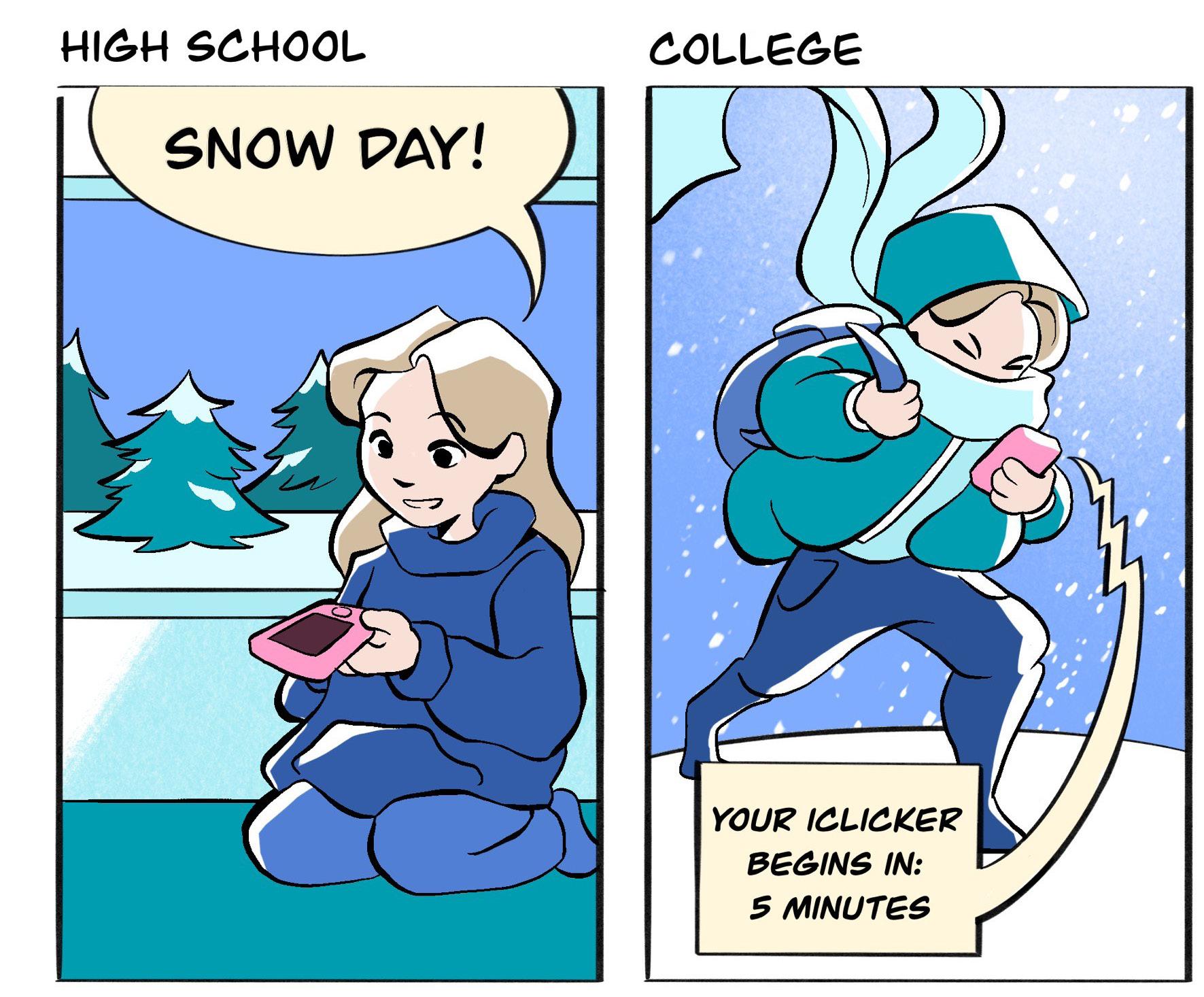
Erin Coleman/DAILY
LARA TINAWI Opinion Columnist
Michelle Peng/DAILY
TÉA SANTORO Opinion Analyst
University Housing and its semester of censorship and institutional regress
On Nov. 6, 2024, student resident advisers and diversity peer educators, collectively referred to as ResStaff, coordinated teach-ins in multiple residence halls on the history of Palestine as part of their monthly event obligations. Some members of ResStaff chose to conduct their programming themselves — a common practice for residence hall events — while others decided to conduct it alongside Students Allied for Freedom and Equality.
Despite the unexceptional nature of these events, they gained a disproportionate response on social media, where one RA event invitation made its way to Eyal Yakoby, an online right-wing commentator on X. On Nov. 4, he posted the email of an RA inviting their residents to one of the teach-ins in East Quad’s Abeng Minority Culture Lounge, a space dedicated to “advocates for positive social change.”
Standard practice for residence hall events requires ResStaff members to submit proposals for the following month’s events two weeks before the start of the month, giving Michigan Housing Leadership ample time to approve events across the University of Michigan. For these events, ResStaff submitted their proposals in mid-October, received approval, put up flyers and invited residents to join the event as usual.
A few days before the teachins were scheduled, and weeks after ResStaff’s programming proposals were approved, University Housing capitulated to smears like Yakoby’s. First, University Housing requested to audit the content of students’ presentations — an unprecedented request. Then, hours before the start of the teach-ins on Nov. 6, University Housing leadership verbally informed ResStaff in each residence hall that they
were not allowed to present any of the material. Instead, they told ResStaff to remain neutral, unbiased and not favor a viewpoint on any issues. When asked to provide guidelines or a policy to help ResStaff remain “neutral,” University Housing leadership pointed ResStaff toward The University Record article on the University’s Board of Regents’ vote to approve institutional neutrality, demonstrating a frantic scramble to justify arbitrary policy changes.
On Nov. 18, University Housing grounded their new policy agenda by sending all ResStaff an update email of their policy, demanding that ResStaff not “favor one viewpoint over another.” Further, the email stated that supervisors are free to ask “follow-up questions” and “gather information about programs” before the program begins, and that “it is expected that (ResStaff) provide this information in a timely manner.” The email further stated that events with sponsored organizations can be “moderated, not presented” by ResStaff in their community.
While the email claimed supposedly to “provide clarification” and “reminders” for residential programming, it clearly was crafted to allow University Housing leadership to claim such a policy has long existed. In reality, any neutrality requirements in ResStaff programming have been either virtually unenforced, or more likely, wholly nonexistent.
To cement their self-inflicted institutional regress, University Housing unilaterally changed their diversity and inclusion statement over the holiday break.
As recently as Dec. 17, 2024, University Housing claimed to promote “social justice education” in residence hall communities, and that it was the responsibility of ResStaff to conduct “educational, cultural and social programs that promote the values of diversity, equity, inclusion … and social justice.” Now, University Housing’s
Michigan needs to do more to retain young educators
MEREDITH KNIGHT Opinion Columnist
When I tell people that I’m getting an undergraduate degree in secondary education, the variety of their responses is very telling. Some laugh or balk, saying “I could never be a teacher!” Some instead choose to commend my pursuit: “You’re going to be a great teacher!” I’ve even had people tell me they would consider teaching during their midlife crisis after realizing their consulting job brings them no joy. Almost everyone, however, ends their response with something along the lines of: “Well … what we really need now are good teachers who want to teach!” Unfortunately, given the threats to the American education system, they aren’t wrong. With President Donald Trump promising to hack away at the U.S. Department of Education, the future of education looks bleak. Regardless if Trump’s claims turn out to be true, the sensationalism within them distracts people from long-standing, tangible issues facing American education, most critically the teaching crisis.
One thing reigns as an undeniably important aspect of providing exceptional education: incentivizing careers in education. Without well-trained, motivated teachers who plan to stay in the field, there is no education. As Trump promises to restructure educational funding and policy, Michigan must prepare to step on the gas and address root causes in the teaching crisis.
Any incoming political administration should be focusing on educational policy that works to mediate the many strifes teachers now face. Pew Research Center’s 2023 survey shows that American teachers are struggling with systemic inequities in education, which has been inflated by longlasting issues from the COVID-19 pandemic.
Chronic absenteeism, spikes in adolescent anxiety and depression and concerns with technology mean that teachers may serve
diversity and inclusion statement is a gutted version of its former self, with no mention of social justice nor programming.
With that in mind, it is clear that University Housing is exploiting its neutrality policy to bar ResStaff from teaching any Palestinian culture or history, creating an environment where the mere mention of Palestinian culture and identity is inherently controversial, problematic and, of course, non-neutral. While sponsored organizations, approved by a University Housing administrator, may still host an event celebrating Palestinian history and culture, it is important to note that the only Palestinian cultural and activist group sponsored by the University is currently facing the risk of an organizational suspension.
Thus, University Housing has rolled out and enforced policy that mutes any discussion of Palestine from ResStaff, while the University is simultaneously working to ban the only Palestinian advocacy group on campus. These efforts can only be seen in conjunction with regents altering the Statement of Student Rights and Responsibilities, an action that permits the University more repressive measures to enact on pro-Palestine advocacy on campus. The Faculty Senate, in a historically unprecedented move, has censured the regents for this alteration. The institutional and extralegal crackdowns on pro-Palestine advocacy, along with the potential suspension of SAFE, pose serious implications on ResStaff in the residence halls. As ResStaff of Palestinian descent are prohibited from presenting on their own heritage, it is natural to assume ResStaff of all identities are prohibited from doing the same, as University Housing perceives it as a threat to residence hall inclusivity. This development from University Housing raises pressing questions regarding the status of diversity efforts at the University. Why must members of ResStaff have to sup -
Aas proxy social workers, parents, therapists and leaders of their classrooms. These growing concerns in a complex educational system are amplified by factors of socioeconomic status and systemic racism.
Following the digital shift in education during the pandemic, the mantra of “we need teachers” has been more apparent, yet many districts can’t afford it. Teacher preparation programs in Michigan’s state schools are also just starting to rebound in attendance due to more monetary support from Gov. Gretchen Whitmer’s administration. While other states have been more efficient in creating competitive teacher salaries, Michigan’s efforts to address teacher shortages in the state are not feeble.
The unfortunate reality is that Michigan still lags in its teacher shortage. According to the Michigan Education Association, 10,000 teachers in Michigan quit each year, with only 5,000 new teachers coming into the workforce. Therefore, it is important for Michigan’s government and economy to entice teaching careers for students graduating from its state colleges.
Unsurprisingly, a great way to retain teachers is to pay them better. A 2024 report by Michigan State University’s Education Policy Innovation Collaborative found that Michigan placed 39th in starting teacher salaries in 2020, the lowest among the Great Lake states. The state has failed to keep up with inflation, affecting entrylevel teacher salaries the most. MSU’s report found that the early career salaries for individuals with elementary and secondary education degrees are 18% lower than other entry-level jobs requiring a college degree. This is about $3,000 less than Massachusetts Institute of Technology’s calculation for a general living salary before taxes that is needed for a single adult without children.
press their identity, history and culture in the name of neutrality?
The Edward Said Minority Culture Lounge, for instance, is the legacy lounge for SAFE, created to celebrate Palestine advocacy, culture and history. An RA can hold an event in the Said Lounge, yet ironically, as per the new guidelines, cannot present about what is written there in plain sight — instead, all attendees can simply read the text on the walls. But on those same walls, there exists no reference to the roots of the lounge, when in 2014, student activists occupied Central Student Government to demand a divestment vote, renaming the chamber the Edward Said Lounge. Just a year later, the lounge was unveiled as a clear homage to the student occupation.
While University Housing has been quick to implement new policies censoring Palestinian history, they have failed to implement tailored institutional support for Black and Arab students given the persistence of anti-Black and anti-Arab incidents in University Housing including graffiti and residence hall door vandalism. This semester, one diversity peer educator was forced to switch residence hall rooms after a series of targeted, anti-Palestine vandalism on their door, including ripping down their Palestine flag, door decorations and attaching a poster of renown antisemite, Candace Owens, on their door. Other incidents range from racist vandalism of housing spaces and bulletin boards to dangerous cases of harassment and stalking.
Since mid-September, ResStaff workers have reported over a dozen instances of anti-Palestine hate in University residence halls. Yet, University Housing has failed to provide any substantive support on all fronts. Ignoring mere recognition of these events, a single email has yet to be sent from University Housing or other administrative units even acknowledging anti-
Palestine sentiment festering in residence hall communities.
The lack of any serious response from University Housing enables hateful, racist actors to continue to spread vitriol in residence hall communities and against ResStaff. Through their inaction, University Housing is itself responsible for the continued pattern of racism plaguing residence halls.
With this new neutrality policy in mind, the role of Diversity Peer Educators — a core segment of ResStaff — is seriously jeopardized. The DPE program, previously known as the Minority Peer Advisor program, aims to cultivate a housing community that is welcoming, inclusive and actively supportive of students across all social identities. DPEs are told that this unique University program emerged from the Black Action Movements between 1970 and 1987. These movements (BAM I, BAM II, BAM III and #BBUM) confront the University’s racist policies regarding the recruitment, enrollment and campus experience of minorities at the University.
Nearly half a century later, they were regarded as among the “most challenging for university administrators and arguably the most influential in shaping the university’s diversity efforts and policies today.” Today, the DPE job description states that DPEs “strive to create an inclusive community by building relationships with residents and conducting educational, cultural, social and personal enrichment programs that promote the ideals of diversity, equity, inclusion and social justice.”
But now, with the new University Housing restrictions imposed on all ResStaff, the DPEs “cannot favor one viewpoint over another.” This thwarts many of the DEI efforts that the University prides itself on. Can DPEs, for instance, hold past events like the “Activism Alive and Well Workshop” discussing Black struggle in the U.S. — commemorated in the Martin Luther King,
Jr. Minority Culture Lounge — or is that considered a favoring of one viewpoint over another?
Can they teach residents about Indigenous struggles — commemorated in the Vicky Barner Multicultural Lounge — or is that also considered a favoring of one viewpoint over another? Will infringements on neutrality rules result in DPE discipline, or even eviction?
The University can, of course, sideline these questions by cherry-picking the events that do not threaten its institutional interests. Since pro-Palestine advocacy has clearly threatened said interests — showcased by the University’s catalog of repressive actions this past year— it is no longer considered a topic that can be freely discussed by ResStaff in their residence hall events. The University is now hiding its repressive efforts under the guise of so-called neutrality, which has trickled down from Student Life to University Housing.
In sum, University Housing’s sequence of decisions profoundly undermine decades of progress reflected in the creation of multicultural lounges and the DPE role. It leaves unaddressed concerns of anti-Black, anti-Arab and Islamophobic sentiment, allowing one-sided narratives to take precedence in University communities. Through rolling back values of social justice, University Housing’s capitulation to so-called neutrality highlights a troubling trend of stifling speech and academic freedom. When University Housing suppresses Palestinian ResStaff from dialogue on their own history and social identities, they only further contribute to making Arab, Palestinian, Muslim and Black existence more vulnerable on this campus.
University Housing must rescind its flawed programming neutrality policy, and ensure ResStaff and residents can exist without the arbitrary grips of institutional neutrality suffocating their academic lives and personal identities.
Influencers are the new mainstream media
TOM MUHA Opinion Columnist
recent Pew Research study found that 21% of American adults depend on social media influencers for their news. When considering adults ages 18 to 29, this percentage rises to 37%.
Pew conducted another study demonstrating that the audience size for traditional media — radio, print and television — is dropping, except for the biggest brands. The decline of newspaper distribution and audience levels suggests that these audiences are getting their information elsewhere. As many legacy media companies scramble to figure out where their readers are going, owners of social media companies like Reddit claim that they are becoming the new mainstream media. But that’s not necessarily true.
Influencers actually are the new mainstream media. The consequences of such a designation are stark, making the restoration of trust in mainstream media an important objective for the coming years.
When it comes to reporting the news, legacy media companies have an advantage due to their many reporters and resources. Yet it’s done nothing to tame their biases, which have bled into legacy media companies’ news reporting. The objectivity of the news expected from the legacy media continues to decline, so has the once clear distinction between the objective and subjective parts of media. As a result, the American public’s understanding of media literacy is sliding along with their trust in these legacy media companies.
As Jeff Bezos, Amazon founder and owner of The Washington Post, mentioned in his reasoning behind not endorsing a presidential candidate, there is clear evidence that trust in the legacy media in America is at an all-time low and still declining. Accusations of unfair coverage of politicians and current events have sparked distrust most recently, but the decline

began long before the last 10 years. It can arguably be traced back to the Federal Communications Council repealing the Fairness Doctrine in 1987, a law that required broadcasters to devote time to contrasting viewpoints of public importance. The doctrine’s repeal led to the emergence of 24-hour news stations that established the framework for modern opinionated news reporting.
But the 24-hour news stations weren’t the only ones who bought into the slush that has become opinionated news reporting. The Michigan Daily’s Editorial Board noted that The New York Times published an opinionated headline in a news article about Trump’s reelection. When legacy media infuses opinion into something that is meant to be an objective reporting of facts, it’s no wonder why trust in those mediums is continuously decreasing.
Although I don’t agree with Bezos’ decision to block The Washington Post Editorial Board’s future endorsements of political candidates, I agree with his criticism of bias in the news that we depend on. It makes complete sense that people have abandoned legacy
media for influencers not tied to the industry. It doesn’t seem to bother their viewers that many of these influencers don’t have any experience in professional journalism.
News that is personally catered to the viewer has now taken over. Why would someone choose a news organization that shows obvious biases while claiming to be objective over the podcaster who lets viewers know their opinion upfront?
It’s partially why Reddit’s CEO made claims that the company is becoming mainstream media. People would rather depend on each other for news instead of a corporation, regardless of how true it is.
While legacy media retains the “mainstream media” moniker, it seems influencers have come to fit the description more accurately. Despite the absence of what many in the industry require for reporting, including fact-checking and a wide array of resources, influencers have earned the title because of the legacy media’s mistakes. For any of this to happen, from the distrust in the legacy media to the embracing of regular people online, one major thing needed to change: media literacy.
The position of influencers ranging from Joe Rogan to the Pod Save America crew position in the mainstream media is here to stay, regardless of what changes in the coming years. But these companies can still rectify the issues that stem from the dependence on biased reporting by trying to resurrect media literacy. This requires more than waxing poetic about the perils of a biased media — it requires legacy media to take action and go back to its roots. While real change in the legacy media may seem a fool’s far-fetched hope, such change must begin with us. We are the next generation of reporters and columnists. The Daily and the University of Michigan have generated Pulitzer Prize winners and have alumni throughout the country’s major newspapers, from The Washington Post to The New York Times and The Wall Street Journal. Our influence, while small now, will become something substantial one day, and we must use it to promote a media readers can depend upon for objectivity. It is our future that shapes this nation — promoting ideals essential to our democracy will make it a future worth fighting for.
Evelyn Mousigian/DAILY
AYA FAYAD Statement Correspondent
Content warning: This article contains discussions of war crimes, violence against children, racially motivated violence, sexual abuse and terrorism. Language can be manipulated and exploited to skew the public’s opinion and impact their perception of world events. As we have seen throughout history, propaganda is not a foreign concept to our world, nor is it overt and straightforward in its impact on the public. Countless times, the media has been weaponized to justify and perpetuate violence in order to achieve a political agenda. The news is no stranger to being complicit in crime, death and destruction.
On a CNN segment broadcasted in late April 2024, while speaking about Columbia University students protesting the University’s investments in companies profiting off of Israel’s military campaign in Gaza, anchor Kasie Hunt refers to “a woman who was killed in Gaza.” The “woman” that Hunt refers to is a five-year-old Palestinian girl named Hind Rajab. Hind, who was trapped for hours in a car alongside the dead bodies of her six relatives — who were just killed in front of her — was injured by three bullets to her hand, back and foot. She called Palestinian authorities, begging to be saved. She waited and waited until paramedics were given the green light to rescue her, but was killed after 355 shells from an Israeli tank were fired at her and the paramedics enlisted to save her. She was afterward declared to be “found dead” by CNN, The New York Times and countless other American publications. “A woman who was killed in Gaza” — to the point, incredibly dismissive, ambiguous, somewhat confusing and nonetheless, all that could be offered for Hind. Adultification bias is a common form of discrimination used to treat and portray children as less naive and more mature than they are, and is often employed as a means of devaluing the violence that is done to these children. Adultification additionally perpetuates racial stereotypes by appealing to the bias that children of color are physically tougher, rougher, more aggressive and less innocent than other children. They are therefore portrayed to be more capable of withstanding pain, both physically and emotionally, making it seem like the violence that is done to them is in some way justified or insignificant. For instance, adultification commonly affects Black children in the United
M EGHAN DWAN Statement Correspondent
On Tuesday, Jan. 18th at 11:53 p.m., a 20-year-old University of Michigan student was walking down Tappan Avenue back to her house. You could see the 5-foot-6-inch woman on the street through security cameras in the Martha Cook Residence Hall or the Law Quad and Munger Graduate Residences. Frequently, she turns her head, as if checking on someone following her, though no one else can be seen in the security camera footage, likely because nobody is there at all. Being that girl, I know this. And yet, I can’t stop the headline “Young Woman Found BRUTALLY MURDERED on U-M Campus” from ringing in my ears, an echo of the hours of true crime I’ve consumed and internalized over the years. ***
Over winter break, my mom and I took to watching “Very Scary People,” a documentary show about the worst side of humanity. What John Wayne Gacy or Charles Manson did, theories on why they did what they did and interviews from relatives of murderers and their victims were overlaid with courtroom footage and pictures from the crime scenes, forcing the viewers to confront each heinous crime committed by these serial killers and cult leaders.
What really ignited my anxiety was learning about the Co-Ed killer, who murdered or
STATEMENT

Who qualifies for life?: The news’ dismissal of truth for agenda

States, as it leads to increased contact with authority figures, such as police officers, and often results in violence being inflicted upon them.
The adultification bias was notably used in 2014 against Tamir Rice, a 12-year-old Black child shot dead in a Cleveland park by a white police officer after a bystander called the police on him for holding a toy gun. Tamir succumbed to his wounds the day after he was shot.
The president of the Cleveland Police Patrolmen’s Association said of Tamir after his death, “Tamir Rice is in the wrong. He’s menacing. He’s 5 feet 7, 191 pounds. He wasn’t that little kid you’re seeing in pictures. He’s a 12-year-old in an adult body.”
The prosecutor, who declined to indict the officers involved in Tamir’s death, commented that his size made him look older for his age. Tamir would have been 22 years old today.
Moreover, the use of passive voice in journalism to describe violent death and intentional murder is a deliberate practice used to obfuscate and avoid assigning blame to the responsible party. Passive voice is the restructuring of a sentence to make it so that the subject is being acted upon by the verb. For instance, if someone said “the pencil was moved” rather than “Josie moved the pencil,” the subject, Josie, holds less accountability for moving the
pencil. The reader of a sentence in the passive voice processes the action differently than if it had been written in the active voice, as the passive voice downplays the activity in the sentence by obscuring who is performing the action, making its description less impactful and engaging. Readers miss out on the “who-did-what” of the sentence, rendering a consequential piece of information incomplete. In the context of violence and crime, passive voice dehumanizes victims by taking away their autonomy and making them the target of a blameless crime. When CNN chooses to use the description “found dead” in place of “shot at 355 times by an Israeli tank,” it absolves the Israel Defense Forces soldiers who shot at Hind’s car of blame and the viewers of unadulterated truth.
In 2004, former President George W. Bush famously used the passive voice in a speech while attempting to explain the human rights violations and war crimes committed by the U.S. Army and Central Intelligence Agency in Abu Ghraib prison in Iraq, where U.S. officials tortured, sexually abused and executed detainees.
“Mistakes were made,” Bush said.
Like CNN and The New York Times, Bush neglected to say who it was that made the mistakes or what the mistakes were. Instead, he opted
to use the passive voice to downplay war crimes and obscure the extent of the horror that the victims of Abu Ghraib endured.
For the CNN anchor to refer to five-year-old Hind Rajab as a “woman” and to maintain that she was “found dead” while failing to address the entity that brought about her death and how her death occurred is either gross negligence or intentional deception. There is no other way to look at it.
This passive and adultified rhetoric surrounding the Middle East has been the norm long before Oct. 7, when the Israel-Hamas war began. Writing about Lebanon in 2013, during a six-year period of Islamic State of Iraq and the Levant aggression against predominantly Muslim neighborhoods, The New York Times refers to a car bombing in Beirut’s southern suburb with the headline “Car Bombing Injures Dozens in Hezbollah Section of Beirut.” Throughout the rest of this article, The New York Times offers minimal acknowledgment that the bombing occurred in a civilian area. Instead, it frames one of the most densely populated civilian neighborhoods in Lebanon as a military base. The southern suburb of Beirut, where the attack occurred, has an approximate population of 700,000 and is home to children, families, schools, mosques, grocery
Caroline Guenther/DAILY
stores and shopping centers. But to The New York Times, this was simply “a bold attack on Lebanon’s most powerful political and military player.” The bomb, which injured 53 civilians, was detonated outside a grocery store where people were preparing to break their fast during the Islamic holiday of Ramadan.
More recently, the pager attacks in Lebanon last September — a series of explosions targeting electronic devices across the country that injured more than 2,391 people and killed 37, at least four of whom were civilians — were portrayed by American media outlets as a mere and legitimate military operation. Publications like The New York Times, Fox News and CNN failed to mention that such attacks, marked by an indiscriminate disregard for civilian life, are in fact international war crimes. Instead, these publications only marginally acknowledge that the explosions occurred in homes with children and family members present, in public spaces like grocery stores and residential streets and that civilians were injured and killed — including a 9-year-old girl and an 11-year-old boy who lost their lives.
These publications choose to cast doubt on and invalidate innocence and suffering, opting for euphemisms, inaccuracies and vague language to avoid uttering the more
Why can’t I stop watching true crime?
kidnapped women from street names I recognize in Washtenaw County. Learning that Ted Bundy mostly targeted women with a scarily similar description to my own and that the women who committed the murders for Charles Manson were my age only worsened it. I felt, and still feel like, as a woman, there’s a target on my back. It’s just a matter of time before my turn to step forward comes and this evil that lurks in the shadows finds me.
True crime truly makes me paranoid. I make my friends call me whenever I walk in the dark; I would never hitch-hike and I don’t go on runs at all because I’ve heard of crimes happening in the daylight too. And yet, I keep consuming this media, and I don’t understand why. My wake-up call came when I was walking to work early one morning before campus had woken up. I heard what I thought was a branch snapping and whipped my head around so fast my earmuffs fell off from the whiplash. Finding nothing but an empty street was humbling to say the least. I never used to be that jumpy. I can’t quite tell if it’s the true crime podcasts and the creepy YouTube stories that have put me on edge, but I can’t seem to cut them out of my life either. This fascination of mine is prevalent in other aspects of true crime too. It’s not just that people are fascinated with putting themselves in the victim’s position; many are obsessed with the murderers and victims themselves. I won’t claim to
know the complexities of cases like the Menendez brothers, but Netflix does. “Monsters: The Lyle and Erik Menendez Story” tells the story of their parents’ murder from the brothers’ perspective. After the show was released, people went on to make TikTok edits of the characters, who in actuality, are just people whose lives were put on display. Not to mention, Erik Menendez himself does not approve of the show, as don’t many of the families of other victims in true crime media their respective loved ones’ depictions. The mother of one of Jeffrey Dahmer’s victims spoke out against the Netflix show “DAHMER” and she was far from the only one. Legally, there is no obligation for a family member to approve the broadcast of their kin’s brutal and violent murder. There is zero need to ask the friends and family if they can turn their loved one’s personality and life into a sensationalized character in order to make the most money from viewers. Especially because these TV shows and podcasts need drama to make a profit, they could exaggerate a person’s character without consequence and make more money for it. An example of this defamation was a lawsuit filed by Rachel DeLoache Williams against Netflix for the portrayal of her in “Inventing Anna.” Williams was a friend of Anna Sorokin, also known as Anna Delvey, and was scammed out of thousands of dollars by Sorokin. However, in “Inventing Anna,” she’s
portrayed pretty negatively. The show uses her real name, real places of employment and many other real personal details without having Williams approve the character before it was accessible to millions of viewers. The show took liberties with how it portrayed real people and events, stretching the situation into falsehoods.
True crime already has immoral implications. People are profiting from the brutal murder of someone else. At the very least, they’re profiting from harm done to others. I just find it disgusting that someone could take someone’s pain and twist it to make the victim the villain, using their real name.
Praise for the criminal doesn’t stop there, and it didn’t just start with “DAHMER” and “Monsters” either; people have been glorifying criminals for years. The public has been calling Ted Bundy attractive or making edits of the Columbine shooters as if the families of victims aren’t alive and grieving. This praise causes copycat killings and encourages others to consider crime as a different avenue to claim fame.
Most of the time, true crime fans don’t watch it to glorify heinous criminals nor to copy them. In fact, according to Psychology Today, 80% of the audience for true crime podcasts and TV shows is female. This made the fact that, in most podcasts and TV shows I’ve watched, the violence is against women stand out to me even more.
sinister truth. This is reminiscent of the journalistic practice of referring to the Gazan Health Ministry as the “Hamas Health Ministry” or the “Hamas-run Health Ministry” as an attempt to imply that the Gazan death toll is inaccurate and unreliable by implicitly equating all deaths in Gaza with those of combatants and attempting to discredit the ministry as belonging to a military group. Such practices led former President Joe Biden to question the validity of Gazan casualties publicly, leading the Ministry to release their death report and procedure for counting deaths in October 2023. Despite how these publications frame it, the Palestinian authority — Hamas’ political rivals — oversee, fund and manage the Gazan Health Ministry, and experts consider the Gazan death toll and the Health Ministry’s system for counting and reporting deaths to be reliable.
A recent study from The Lancet actually found that the death toll in Gaza since Oct. 7, 2023, has been underreported by at least 41%, as the ministry distinguishes between identified and unidentified bodies in its numbers, and some bodies have been unable to be located under the rubble. Independent journalists in Gaza have taken it upon themselves to document their own experiences and that of other Gazans living under Israeli siege and bombardment as an attempt to prove to the world that these deaths are in fact occurring. Similarly, the practice of referring to Palestinians held under administrative detention in Israeli prisons as “prisoners” is misleading and inaccurate. Administrative detention is the indefinite detaining of a person without charge or legal representation, often without the person even knowing the reason for their detainment, under the assumption that they are a security risk or may commit an act of violence in some unforeseen future. Experts liken those held under administrative detention more to hostages than prisoners. Israel, notorious for its use of administrative detention on children as young as 14, often subjects its detainees to inhumane conditions including torture and sexual abuse. Currently, there are 3,340 Palestinians held without charge in Israeli prisons. This number excludes the thousands of detainees from Gaza held without charge that were captured since October 2023. Again, to refer to these detainees as “prisoners” is incredibly inaccurate.
My sister and I listen to the podcast “Morbid” and, on a drive up to northern Michigan, we listened to an episode about the Gilgo Beach Killer. The summer before, I had spent some time in New York, coincidentally living on the street this murderer had apparently frequented to pluck his victims off of. I eventually learned that I had been there before he was arrested and that I might have even walked by him.
We lost signal and the podcast stopped loading, leaving us in silence. I felt intensely afraid, like something was going to jump out of trees beside our car, like he was there. I realized I was giving myself anxiety over something so completely out of my control.
I could’ve been murdered and there was nothing I could’ve done about it. What used to be an interesting pastime was now just too real.
True crime, at least for a few months, became much less fun and much more tangible for me.
I wanted to learn everything about him, the Co-ed Killer and any murderer who might one day snatch me off the street. I paid attention to what victims were doing, where they were going, who they were with, searching for some pattern that made one young woman more susceptible to violence than another.
In half the true crime media
I’ve consumed, it feels like they imply the female victims shouldn’t have gotten in the car with the man or should have taken a different route home. She should have locked the windows, or had alarms, or brought a
Facing the violence so many women have experienced feels inevitable. One day, I will be caught unaware and I don’t want to have to hear someone in a podcast say that it’s just so unfortunate I didn’t think to walk five minutes out of my way before a Clorox sponsor audio. But, I also don’t want to stay home my whole life. I don’t want to disappear for a hypothetical. The last resort when preparing to face what seems inevitable is to know and understand the threat. True crime fills that need. It gives tips to be safe, discloses the killer’s motivation and delivers a story with a finite ending all in one. True crime undoubtedly has immoral reasoning, and while it’s questionable that this business thrives on the fear of women, I will keep listening nonetheless, hoping that the stories hold the key to my safe escape from what feels like my destiny. Read more at MichiganDaily.com
phone or disconnected her cell or bought a new landline. She should’ve taken her picture off the internet, taken her account down or blocked all unfamiliar social media accounts. She should’ve moved houses, or cities, or states or jobs. She should’ve disappeared before a man could make her disappear. In reality, there was nothing they could do. If that early morning I walked to work there had actually been some evil lurking around the corner, how would I have known? How do I know when safety crosses over into paranoia? Would it have really helped, to simply walk around the block instead?
OUMMU KABBA Statement Columnist
The next application is brought forth. A committee gathers expectantly for the performance. From between the lines, she emerges: painted red lips, pink cheeks, poofy tutu, perfected routine. She appears as she presents herself — a beautiful ballerina ready to enthrall her audience. The committee flips to the first question, reading, “Tell us about yourself. What are your passions? What are your interests? What makes you, you? Please answer in 250 words or less.”
She poises herself in the center of the page, taking in a steadying breath before settling into her opening pose. The show begins. ***
Who am I? I am the perfect person for this role. You can stop searching because I have all the skills, leadership and charm you’re looking for. Too cocky.
Unlike other applicants, my passions and interests lie solely in doing whatever it takes to be a part of this amazing organization! Too desperate.
On a cool October morning, I came into this world pissed off, crying and wanting to go back into the womb. Not much has changed since. Too honest.
Another application. Another slew of questions I still have no clue how to answer. How many more of these will I have to complete before I finally have my elevator pitch down? At this point, I’d rather cut the cables and free-fall six floors than try to answer these questions again. I can’t introduce a stranger, yet that is the task at hand.
I don’t know who I am, just who I’m trying to be. I, like most other students at the University of Michigan, have spent my entire academic career trying to be wellrounded, smooth. To be wellrounded, you become the best at things you don’t even care to be great at. We become afraid to let ourselves get prickly through failure and learn to avoid trying foreign things in case we rough up our skin. As a result, I’ve lived such little life and in attempting to boil it down for an application, I’m left with practically no substance to work with. I’m scraping an empty pot with my pencil, trying to find something worth showing off. I am encased in a perfectly well-rounded exterior, but when
LISKA TOROK Statement Correspondent
“It was considered weird to be straight in high school,” my friend from high school recently commented. It’s true — Denver, my hometown, is incredibly progressive, holds one of the largest Pride parades in the country each year and maintains a substantial Queer community. At my high school, many of my close friends and peers were part of the Queer community and the Queer Student Alliance, a club aiming to cultivate a sense of belonging for Queer students. Despite all this, QSA never felt comfortable or desirable to me.
I would walk past the grassy area where they held their daily lunches and only one thought crossed my mind: I’m not Queer enough for this.
The term “bisexual” has always felt, to me, that it contains an underlying meaning of a 50-50 ratio. To claim the label tells society that for every man you’ve kissed or dated or liked, you would do the same for an equal number of women. I feel like we are generally at a point in time where we largely recognize that Queerness is a spectrum. But with that, it’s difficult to find a word that captures the feeling of not being entirely straight or gay without producing any prejudgments or expectations. I use the term “Queer” to describe myself because of its open-endedness — it doesn’t limit the pool of people I can be attracted to, nor does it create an expectation about who the next person I bring home might be.
I’ve always described my sexual orientation as being
STATEMENT

The final act

applications force me to crack this shell open, I must face the fact that I am hollow inside.
After college applications, I assumed I’d be free from this song and dance. Yet, as college students, we are bombarded with applications for scholarships, clubs, internships, awards, jobs, study abroad programs, housing and the like. We are constantly trying to cram our limbs, experiences and aspirations into a word limit that feels simultaneously too long and too short. Why is it 250 words anyway? Why not 251 or 249 or 1,000 or one? The number feels as arbitrary as the decision of whether we’re good enough. In trying to craft an answer, I’m only left with more questions. I can’t introduce a stranger, but since I have to, I’ll make damn sure she sounds like the most impressive stranger one could meet.
***
She bursts from the page. Her long, fluid motions create beautiful lines that ribbon across the paper like liquid silk. Technically, these lines are not very complicated — demi pliés, elevés, a few tendus. But she dresses them up with the flick of her wrist, the baring of her smile, the flutter of a lash. And as she reaches
the conclusion, stopping in first position, the room is enamored. The rosy shine of her costume glints in the committee’s pupils. They are so distracted by the lively motion of the sparkle that they can’t see she has stilled; she is frozen inside their idea of her, one that she will never be. Nevertheless, Act 1 is complete. The committee’s shiny eyes prepare for Act 2. “What makes you qualified or a good fit for our organization? What sets you apart?” ***
I scroll, unimpressed, through my resume. Performances, volunteer work, sports, competitions, awards, jobs: a time capsule of all the badges I’ve snagged over the years. Any reasonable person would be proud to have all these accomplishments and yet that satisfaction evades me. Because I know I’m not the only one.
An average day on the University’s campus consists of obsessively refreshing Gmail inboxes and reading LinkedIn like scripture. Bags thumping against the sweaty backs of students rushing to and from the Central Campus Transit Center. The familiar crack of a can of Celsius being opened at 8:00 a.m.
and chugged like water. In an environment like this, it feels like you must go above and beyond just to get on everyone else’s level. However, when we’re all equally impressive, no one actually is.
The threshold for success keeps rising as we strive tirelessly to leap over it; our applications depend on it. We must make it seem easy, the balancing act of all our classes, jobs and activities. We must show that we can do it all and then some. Or at the very least, we must pretend to. ***
She’s still going. Spin after spin, pirouette after pirouette. Each one becomes more impressive as it compounds on the last. Her steady gaze continually snaps back to meet the committee’s as they watch in awe. A living crescendo is growing before their eyes. She gears up for the final event, a grand jeté that spans the length of the page. Time stops as she leaps through the air, back curved so far inward. The committee swears she has no spine. The group jumps up in a fit of applause.
They are so captivated by the show that they don’t even notice how it ended. Plopped in the center of the page, she sits hugging her knees to her chest, trying to remember how to breathe. She looks so weak, so small,
Caroline Guenther/DAILY
so impressive. So unready as she saw what was to come. “What is your definition of diversity? How has your experience with people of different cultural backgrounds shaped you?”
***
I thumb over the nuances of this seemingly neutral question, this coin toss. In an age of performative diversity and current executive orders to revoke diversity, equity and inclusion initiatives, it feels as if minorities only have two paths when filling out applications. The risk of being rejected due to stereotypes or accepted as a token.
Heads or tails? In or out? Nobody aspires to be tossed out, but to get in we must make ourselves sound valuable, shiny and easy to hold in the palm of a hand. I don’t want to succumb to this gilded narrative, but as I look backwards, I fear I already have.
From jobs, academic contests, scholarships and endless college applications, the recipe of these essays was always the same. Add one cup of minority experience — whether it’s being an African immigrant, a first-generation college student or a girl in a post-Roe v. Wade world. Then, slowly mix in a story of grit and perseverance in the face of such adversities. Be sure
Beyond the expectations of Queerness
attracted to attractive people. With that said, I’ve also gone out with more boys than girls in my life. A lot of this has to do with the situations I’ve been in:
I’m around more straight guys than gay girls, I’m perceived by most of the world to be straight, so I don’t get approached by girls and so forth. But this fact is often weaponized against me as a way to undermine my sexuality. There are typically three responses I hear when coming out or discussing my sexual orientation with others. First, many don’t take it seriously. If you’re a bisexual woman, many people might assume you’re “going through a phase” (and if you’re a bisexual man, you’re gay). Then comes the group of people who feel and project discomfort, whether it’s in the form of insisting you have a crush on them, not wanting to change in the same room or feeling uncomfortable dating you because of the misplaced stereotype that “bisexuals cheat.” Third, it gets sexualized. I can’t count the number of times I’ve been asked about my “dream threesome” or the number of Uber drivers who’ve seen me holding hands with a girl in the back seat and proceeded to ask if we were interested in partaking in one.
While all these responses are undeniably frustrating and deeply uncomfortable, my sexuality not being taken seriously has always hurt most for me. I’ve struggled with feeling invalidated in my Queerness since I first realized I liked girls, and hearing others verbalize one of my biggest fears causes me to wince. I spent
periods of my life dressing a certain way or wearing certain jewelry or listening to certain music in an attempt to seem “gayer.” I thought that if the rest of the world didn’t perceive and accept my Queerness, it wasn’t valid. After the COVID-19 pandemic, I began to explore my sexuality by actually going out with girls. This was the ultimate proof of my Queerness: dating and hooking up with girls. No one could deny or question it anymore, and with that came a sort of freedom. As obvious as it sounds, it took me years of doubt and struggle to internalize that Queerness has nothing to do with anyone but yourself. And with that, you don’t owe it to anyone to prove your sexuality. I’ve also realized that when someone tells me their sexuality, I don’t think back to the last person they dated or ask them how many girls they’ve kissed. We’re adults, and we know what we want most of the time. If someone is forcing me to prove my sexuality in some way, it’s out of insecurity or discomfort with the notion of bisexuality. Good people, people I want in my life, won’t care. While not easy or immediate, with time I’ve learned that when I give myself permission to feel validated in my Queerness regardless of the expectations others might have for me, everything falls into place. I have and probably will continue to date and be physical with and love women. But even if I were to be with men going forward, that doesn’t change my sexuality. I’ve had real, intense feelings for women in the past, and simply put, that in itself is enough to
make me not straight. Realizing and accepting this is what finally made me feel like I could breathe again, and that I should focus on enjoying dating whoever I’m interested in rather than feeling like I’m collecting evidence for a trial of my sexuality. With my newfound security, I realized that I also didn’t have to — and didn’t want to — express my sexuality in any one specific way. Most people assume I’m straight, and I’m okay with that as long as they don’t treat me differently after finding out that I’m not. I want to recognize that, for decades, people couldn’t express their sexuality. Being able to choose when, where and how I express my Queerness is a privilege. I know that at least one person reading this will interpret my actions as a form of internalized homophobia — choosing to hide my sexuality. In all honesty, I’ve considered this myself, and for that reason I can confidently say it’s not that. I feel most like myself when I’m not trying to be anything. I don’t dress or act a certain way for attention from any gender, be it male or female. To assume that not physically expressing my Queerness in ways society recognizes means that I’m adopting straightness isn’t fair, nor is it true. I do what makes me feel my best and the most like myself, and for me, that means femininity, which a lot of the world equates to straightness. Within the Queer community, choosing to express one’s Queerness through femininity is controversial. The backlash bisexuals face from other Queer individuals is always surprising to me. Every person in the
not to overmix, lest you lose the subtlety of your desirable diversity. Tweak the formula for the specific flavor of application. It’s a recipe that society gives minorities a taste for, then teaches us how to recreate for their enjoyment. And while it leaves a bad taste in our mouths, it satiates their hunger.
I fear that through sharing my cultural roots, I’ve left them vulnerable to being ripped out and lauded over by shallow diggers. Have I unknowingly allowed the tokenization of my experiences to play the strategic game of perfecting an application? But what can we say besides what we are? I don’t want to take these parts of me and separate them from me for the sake of pandering to a committee. Who can we be besides ourselves? Every time I fill out an application, I ask myself what I should share, hide or alter. I remold my narrative around whatever the committee is looking for in hopes that I will be the best fit for them. But if fitting in requires losing parts of myself, maybe the question I need to ask is whether they are the best fit for me. At the end of the day, this application will be due. And there will be another one to follow it. So what happens if I just present myself as I truly am — all prickly, rough, ambitious, confused and hopeful? I may very well get rejected. But at least now, the curtain will close and the lights will dim. The show will finally be over.
***
The final act starts. The committee’s blinking eyes watch tentatively from above, like blinding spotlights following her every move. But she trains her focus on her raised foot, pausing outside those rings of light that illuminate the page’s white face against her dark shadow. She has done this routine a million times before. It is perfect. She is perfect. She has mastered the art of dancing around the truth, dodging the lights and playing her part. But as she stands there with her painted red lips, pink cheeks, poofy tutu, perfected routine, she feels herself becoming what she truly is — a clown trying to entertain a crowd. She puts her foot down. Perhaps for the first time, she realizes she can. She is learning that a body was made to do more. And as she turns to leave, she finally faces the ink-stamped words displayed across the page. “I am tired of dancing.”
Queer community has faced forms of homophobia, struggled with coming out and had to navigate an entirely different kind of adolescence than straight people. But people who like both girls and boys are placed at an interesting crossroads: too gay to be entirely accepted and understood by straight people and not gay enough to earn equal respect by some members of the Queer community. When wandering around Winterfest, those crossroads became front of mind. I know that whatever organizations I choose to join, my sexuality is undeniably a part of how I show up. Whether it’s writing for The Statement at The Michigan Daily or signing up for intramural sports, the people I’m surrounded by will get to know me, and with that, my sexuality. Walking past tables, the different opportunities for Queer students are visible. But when I look at the people standing and waving flyers, I rarely see individuals who look like me. It’s a weird statement, and something that I feel a little uncomfortable admitting out of fear it’s stupid or insensitive to people who face the much harder, opposite reality: feeling too Queer to be comfortable in the almost always straight-dominated spaces. But regardless, the point of Queer spaces is to find people you can relate to, and for me it’s honestly rare in those situations.
I don’t mean to put Queer organizations down. They are undoubtedly essential for the Queer community, have saved and changed countless lives and should continue expanding as society progresses. I have other
bisexual and Queer friends who have found their homes within these organizations and I know that most members of the Queer community are not judgmental or biphobic in the slightest. However, my discomfort in joining Queer organizations stems from the way bisexuality is perceived in the world. For example, if I joined the QSA but was in a longterm relationship with a man, some of the experiences I have as a Queer woman that allow me to relate to and feel part of the Queer community disappear in their eyes. When dating men, I don’t risk facing homophobia in public or fear getting into Ubers. I have all of the privileges of a straight girl, and that’s what I mean when I say I don’t feel gay enough. Whenever I have conversations about Queer theory or the disgusting things people do out of homophobia or the countries some of my friends will never be able to visit because their very existence is illegal, I feel like an ally rather than a member. I am confident in my sexuality until I am put in situations where I feel like I am the straightest one in the room. In these situations, my sexuality gets divided: the part where I am Queer and the part where I am straight. This disjointedness makes me uneasy. I live my life expressing and embodying love, regardless of gender or sexuality or preference, but once I’m in these situations, the feeling I summarize in the word “Queer” ceases to exist. I am now, once again, fighting to feel valid in my Queerness.
ICE HOCKEY
Mackenzie Mielke: Michigan’s overtime success isn’t sustainable

MADISON— Of the 14 wins the No. 10 Michigan hockey team has collected this season, five of them are overtime victories. On top of that, the Wolverines have two ties from pushing games past overtime into shootouts. Michigan has consistently shown that it can find ways to win past regulation, but struggles closing out games in 60 minutes — and that’s its problem. If the Wolverines hope to spend the majority of March competing in the playoffs, then they have to forgo their affinity for overtime games.
The question isn’t whether the Wolverines have the skills at their disposal to win in the extra period. They have proved time and time again that in the 3-on-3 matchups, there are various players ready to jump in to finish the game and even enjoy doing it.
“Overtime is always exciting,” junior forward Josh Eernisse said Nov. 2 after beating then-No. 5 Boston University in overtime. “It favors our team, we have a lot of speed.”
While an overtime win is exciting, the novelty of those
WOMEN’S TENNIS
last-minute goals has worn down Michigan’s offense. Since winter break alone, the Wolverines have a record of 3-4-1. Two of those wins came in overtime, and Saturday’s shootout win against Wisconsin is the lone tie.
Though the overtime period is just five minutes, it’s five minutes each game that Michigan simply can’t afford. Throughout the season, the Wolverines struggled with keeping players healthy and have already seen two players depart from the program. Sophomore forward Tanner Rowe even transitioned into a defenseman for a few games because of the lack of blue-line players in Michigan’s locker room.
This puts even more stress and strain on the players over the season as the Wolverines continuously push past 60 minutes of play with a thin roster.
“We need a little bit more out of everybody,” Michigan coach Brandon Naurato said Saturday.
“If we get the best version of everybody, we’ll be in a good spot.”
Michigan ended the first half of the season with a focus on finding a second-half push to make a playoff run in March plausible. But the Wolverines statistically hold the hardest schedule in NCAA hockey. Alongside a brutal lineup for out-
of-conference games, Michigan has to face various ranked Big Ten opponents on a weekly basis. While the beginning of this schedule rewarded the Wolverines through the early parts of the season, it’s a cause for concern as they look to dig even more for their playoff hopes.
That’s not to say that these overtime wins haven’t shown Michigan’s grittiness. In their stack of extra-period triumphs, the Wolverines have conquered thenranked No. 1 Michigan State and the Terriers.
But the overtime trend becomes an issue when Michigan can’t win in three periods versus unranked and Big Ten opponents.
Though it didn’t count in the season statistics, the Wolverines needed overtime when facing the U.S. National Team Development Program. More recently, Michigan is 1-2-1 against Wisconsin, a team that has remained unranked nearly this entire season — an important factor in Big Ten standings.
Each win in the conference gives a team three points, while an overtime win drops it down to just two points. When the Wolverines aren’t able to close out games in regulation, it pushes them lower and lower in the conference to their current standing in fifth place.

If the season ended today, they wouldn’t host a home game in the first round.
Expanding past just the conference tournament, an overtime win damages Michigan in its pairwise standings as well. The Wolverines currently sit at 12th place in the pairwise, a ranking that decides their viability in the NCAA Tournament. In a different format than the Big Ten, each win counts as one point, but an overtime win counts for two thirds of a point.
In the past few years, Michigan has proved that it can string together wins at the end of the regular season to get to the Frozen Four. But those wins weren’t consistently decided in an extra five minutes of play. For the Wolverines to put together another late run, they must hold onto their early leads rather than letting the game slip through their fingers to the point of a last-minute save.
Through the overtime wins during the season, Michigan has
than relying on an extra five to win games. Because winning in overtime isn’t sustainable when suddenly those extra five minutes decide the fate of its season.
STEPHANIE CORREDOR
After sweeping Yale to open the ITA Kickoff on Saturday, the Wolverines were on a mission to secure their spot in the championship. And, that’s exactly what they did on Sunday.
With the ITA National Team Indoor Championship on the line, the No. 8 Michigan women’s tennis team (2-0) relied on the fundamentals: communication and energy. In a commanding display of grit and toughness, Michigan blanked UC Santa Barbara (1-3), 4-0.
In the opening of doubles play,
WOMEN’S TENNIS
the Gauchos struck first. In their most dominant performance of the day, UCSB broke the Wolverines’ serve to take a 6-1 victory over junior Lily Jones and freshman Emily SartzLunde. The Gauchos were in the driver’s seat — but only for a moment.
“Communication is everything,” sophomore Piper Charney said. “When you’re just positive after every point, you can keep going at a much better pace.”
Starting off strong for Michigan, sophomore Jessica Bernales and Charney came out firing, breaking the Gauchos early. With unstoppable serves
and calculated shots, the duo consolidated the break and cruised to a victory, 6-2.
With the doubles point hanging in the balance, all eyes turned to sophomore Reese Miller and senior Julia Fleigner.
Despite a valiant effort from UCSB, the Wolverines’ duo walked off the court with their heads held high. Miller and Fleigner won three straight points, clinching the doubles point for Michigan.
As the Wolverines transitioned to singles, energy was the key ingredient to their success.
“(Michigan coach Ronnie Bernstein) is really big on
Piper Charney impresses in sophomore debut for Michigan
JULIUS COHEN Daily Sports Writer
Down early in her second set, No. 18 sophomore Piper Charney played an ambitious drop shot that Yale’s Julia Werdiger just barely returned. Charney countered with a pinpoint baseline lob, before sealing the point with rocket forehands that overwhelmed Werdiger.
On Saturday, Charney did it all. She brought a polished, wellrounded game to her season debut en route to 6-1 and 6-3 wins in consecutive sets and a Michigan dual-match win.
Charney enters the season with an exciting but tall task ahead of her: to cement herself as one of the go-to competitors for the No. 8 Michigan women’s tennis team. She has big shoes to fill, as the Wolverines graduated No. 5 singles Kari Miller last season, and Miller’s doubles partner, Jaedan Brown, who together formed the No. 12 pair.
“I started out really nervous,” Charney said. “Once I got to singles, I definitely felt more and more comfortable and excited.”
Although Charney and freshman Jessica Bernales dropped their doubles match to open the morning, Charney was dominant from the get-go in singles. If any nerves lingered, they certainly didn’t show.
Charney’s versatility was on full display throughout her singles match. In the first set, she elicited cheers from the stands with drop shots that snuck over the net before practically sticking to the ground. Werdiger showed impressive mobility at times, but didn’t have nearly the range to cover Charney’s finesse. Once Werdiger adjusted, Charney responded with powerful forehands to the baseline. Charney stayed composed as she sent Werdiger from side to side. She then finished points with cross-

body winners that an off-balance Werdiger could only watch.
Michigan brings a young roster into 2025, with only one senior on the squad. As just a sophomore, Charney showed Saturday that she is ready to be a mainstay near the top of the lineup.
“Last year we were so deep,” Michigan coach Ronni Bernstein said. “(Charney) definitely deserves to be up there, and I expect her to win a lot of matches.”
Perhaps the most confidenceinspiring part of Charney’s performance wasn’t what she did when she was rolling, but how she reacted when she was down.
After a commanding 6-1 first set, Charney dropped three of her first four games in the second, falling behind 1-3.
Instead of spiraling, she kicked into a new gear. She jumped out to a 30-0 lead in game five behind powerful forehands, and continued with her strong deep shots, moving Werdiger at will while retaining her own energy.
Then she really stepped on the gas. Charney rattled off win after win, riding her versatile skill set to five consecutive victories and the set win, 6-3. This time, she used her power game to set up softer shots at the net, opposite of the first set but equally effective. Werdiger fended off forceful attacking forehands with loopy returns, which Charney calmly sliced out of Werdiger’s reach.
energy,” Charney said. “And, that has really helped.”
On adjacent courts, Bernales and Charney set the tone early, each jumping to a 3-0 lead. Showcasing her powerful forehand and lethal backhand, Bernales was the first to get points on the board for Michigan, securing a 6-1, 6-2 victory. Meanwhile, Charney dominated her match with pinpoint precision and intensity on every shot.
Just a few moments after Bernales, Charney added the Wolverines’ third point with a 6-1, 6-3 win — her second singles victory of the weekend.
MEN’S BASKETBALL
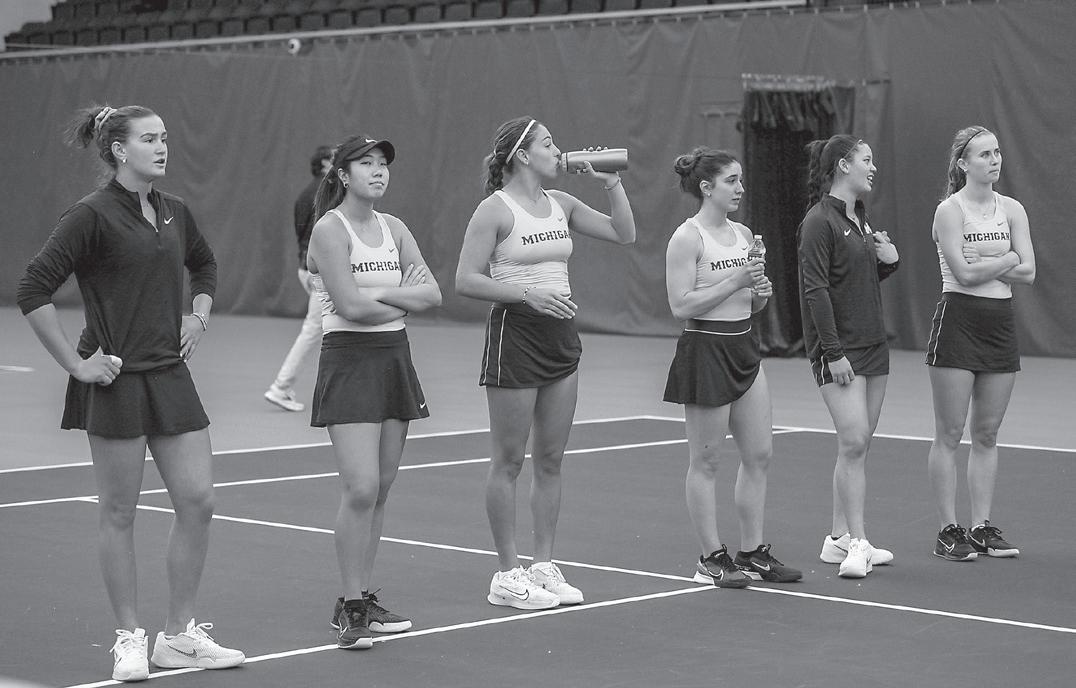
SportsMonday: Michigan is in a rut, and Purdue needs to be its wake-up
NOAH KINGSLEY Daily
Sports Writer
Three minutes and 28 seconds into the No. 21 Michigan men’s basketball team’s game against No. 11 Purdue Friday, Wolverines coach Dusty May called his first timeout.
It was an uncommon deviation from precedent for May, who has said that he prefers to trust his players during a rough stretch rather than call an early timeout in an attempt to magically stop the bleeding. It wasn’t just any rough stretch, though.
In roughly the first 3.5 minutes of the game, Michigan turned the ball over five times. The Wolverines got just four shots off, while the Boilermakers made five of their first seven. With his team down 13-2 so quickly, and with Mackey Arena only growing louder, May had little choice but to try breaking from his philosophy in search of a quick fix.
Simply put, May’s attempt at a wake-up call didn’t work. Purdue went on a 12-0 run two minutes later and the Wolverines didn’t get back within 18 points for the rest of the game. They ended up losing 91-64.
Friday’s game was a gut check for a Michigan team that started Big Ten play so hot. It was also the latest tough game in a recent rut for the Wolverines.
So to reach the heights that May shot for from the second
he was hired — the heights that Michigan has shown flashes of reaching at its best — the Wolverines need to make sure that unlike that early timeout, Friday’s game works as a wakeup call. Their response to one blowout loss needs to prevent their skid from turning into a spiral. None of Michigan’s recent performances spell doom on their own. Beating Purdue at Mackey is one of the toughest tasks in college basketball, as the Boilermakers boast a 154-17 home record over the past 11 seasons. Needing overtime to beat Northwestern at home isn’t ideal either, but the Wildcats are a gritty, physical team with a shot to play their way into the NCAA Tournament. Even the worst of the Wolverines’ three recent games, their Jan. 16 loss at then-last-place Minnesota, was followed by the Golden Gophers beating No. 15 Oregon on Saturday. Winning on the road in the Big Ten is hard!
That said, all three games put together look more like a problem. It begins to paint a picture of a team that, after a surprisingly strong start to the season, is regressing to its true level in conference play. May, amid this recent skid, has given credence to that perspective, acknowledging that Michigan has a ways to go to reach the level of the Big Ten’s top-tier teams.
“(The environment) felt different,” May said postgame Friday, “There’s a different level of energy, there’s a different level of physicality. … That’s been the theme here lately, especially with the traditional Big Ten teams. We haven’t risen to the challenge from a physicality standpoint, and we’re not there as a program quite yet, but we’re going to be obsessed with getting to the point we need to.”

Across three of the remaining four matches, the Gauchos went up 2-1, painting a concerning picture for the Wolverines. However,
junior Lily Jones stepped up to the plate when it mattered most.
Read more at MichiganDaily.com
Lila Turner/DAILY
Soyeon Kim/DAILY


EDWARDS Managing Sports Editor
EST LAFAYETTE
W— All it took was a dominant first eight minutes for No. 11 Purdue to settle Friday night’s matchup and knock the No. 21 Michigan men’s basketball team off its track.
As the Boilermakers came off the block sprinting, the Wolverines simply struggled to keep pace.
On Michigan’s first two offensive possessions, it turned the ball over — and Purdue capitalized on the other end immediately both times. By the 16:32 mark in the first half, the Wolverines had accumulated five turnovers and found themselves with a 11-point deficit.
“Turnovers, obviously, this is a theme that we’re just loose, we’re casual,” Michigan coach Dusty May said. “ … I don’t think we played well in any facet. And like I said, Purdue is extremely determined.”
Michigan simply didn’t get anything to go. Riddled by 10 turnovers while shooting 1-for19 from deep in the first half alone, the Wolverines (14-5 overall, 6-2 Big Ten) fell in too deep of a hole to climb out of as the Boilermakers (16-5, 8-2) took


care of business at home, 91-64. Already with a double-digit lead out of the first media timeout, the Boilermakers quickly added to it. Purdue made two 3-pointers back to back while Michigan missed two in a row. And to cap off a 14-3 run that elapsed for nearly the next four minutes, Purdue star guard Braden Smith lobbed up an alley-oop from the 3-point line to extend the lead. Before the Wolverines even had time to assess what was going wrong, they were down by 20 points.
“Those eight turnovers that they had in the first, I don’t know what, eight minutes, seven minutes — I thought set the tone for the game,” Purdue coach Matt Painter said.
By the midway point in the first half, Michigan had nine turnovers, 13 points and was down by 23. The combination of the Wolverines’ inability to put the ball into the net and giving the Boilermakers far more possession caused Michigan to fall behind.
“I thought our ball pressure was the difference, though, to start with,” Painter said. “Jarring them, getting a couple steals in half court, getting a couple pick sixes, that really got us going, and then they never got into what they really do.”
What made the Wolverines’ first half turnovers so detrimental
was the fact that they were forced by Purdue’s eight steals. The liveball turnovers allowed for the Boilermakers to run the floor and convert on the other end with 18 points off turnovers compared to Michigan’s two in the first half.
“When you get off to a start like that, it gets everybody going, everybody’s energy is up” Smith said. “We just did a great job turning them over. … Shots were falling, and we were able to get to our spots and run our offense, and then we were able to stop them and get transition points as well.”
By the time the Wolverines did make any sort of a run, a 6-0 run with five minutes left in the first half at that, it only narrowed the deficit from 19 points to 13. And by halftime, the Wolverines were down by 25. Michigan was just looking to knock the Boilermakers and the rowdy Mackey Arena slightly off their tracks to get something to go.
But after four minutes of the second half, it was easy to tell that Purdue wasn’t going to lose any steam. The Wolverines scored the opening field goal of the half but surrendered two quick field goals on the other end to put early nails in the coffin.
The No. 24 Michigan women’s basketball team had a chance. At home against No. 21 Michigan State — marking the first time the rivals were both ranked in a matchup — the Wolverines built up a four-point lead at halftime. Powered by defense and transition offense, it seemed like Michigan could extend its win streak to five and regain authority in the rivalry.
But then came the third quarter.
Outscoring the Wolverines (14-6 overall, 5-4 Big Ten) 31-12 in the third quarter alone, the Spartans (17-3, 7-2) dominated the secondhalf. Michigan State extended its win streak in the rivalry to three, trouncing Michigan, 88-58.
“It was a good battle, a good contest in the first half, but they were really able to make all the plays in the second half,” Wolverines coach Kim Barnes Arico said. “So I wish I could say it was a great basketball game for 40 minutes, but they kicked our butt in the second half.”
In the first quarter, though, Michigan’s typical defensive
intensity held tight. Freshman guards Olivia Olson and Mila Holloway poked the ball loose. Their active hands were enough to either knock the ball out of bounds or strip it and run coastto-coast in transition. Because of the Wolverines’ consistent success on layups, only one first-quarter make — a corner three from senior guard Jordan Hobbs — fell outside of the paint.
On the other end, the Spartans attacked downhill just as intensely, then extended possessions by utilizing their size advantage on the glass. Then after each make or Michigan rebound, they enacted their full-court press. The moment the ball touched any of the Wolverines’ hands, guards Jocelyn Tate and Jaddan Simmons pounced. Yet those collisions resulted in fouls just as frequently as steals or disrupted passes, giving Michigan opportunities at the free-throw line. With inconsistent shooting the first quarter – going just 1-for-5 from deep and 5-of-15 overall — each of Michigan’s perfect 7-for-7 free throws negated Michigan State’s strong interior finishes and resulted in a slim 18-17 first-quarter lead. But the Wolverines’ aggressive mentality soon came back to bite them


Accordingly,


ZACH