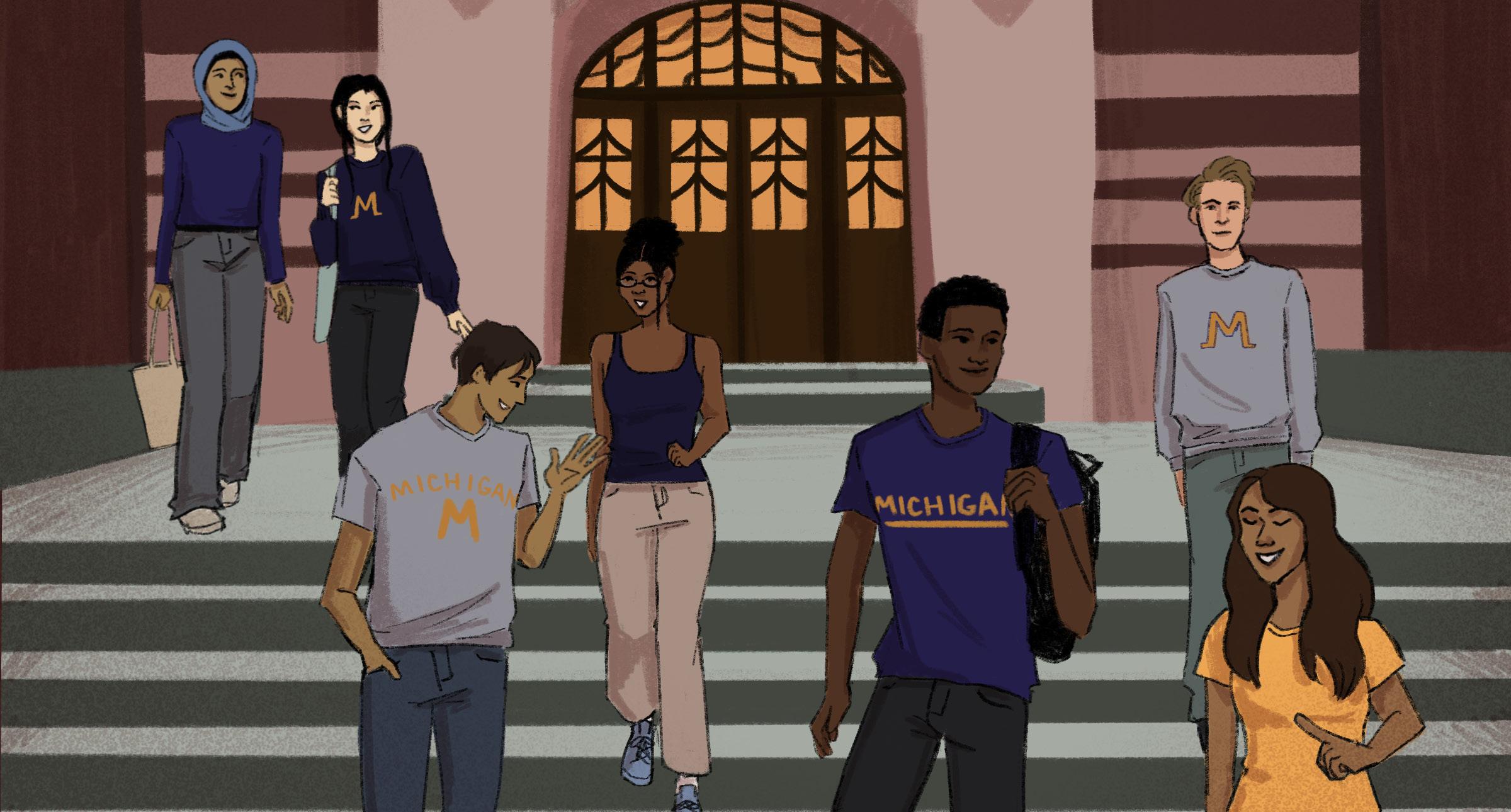
The University’s fall 2024 enrollment of 52,855 students is the largest in the University’s history. This includes 34,454 undergraduates, representing a 1.5% increase since 2023, while the 8,858 freshmen and transfer students within the undergraduate student body represent a slight decrease from the year prior. The first-year and transfer class in fall 2024 is composed of 6.1% African American or Black students, 13.3% Hispanic or Latine students, 0.2% Native American students, 0.1% Native Hawaiian or Pacific Islander students and 17.2% Asian American students. Comparably, the 2023 incoming first-year and transfer class was approximately 5.3% Black or African American students, 13.5% Hispanic, 0.2% Native American, 0.1% Native Hawaiian or Pacific Islander and 19.0% Asian American.
LSA senior Ashley Nguyen said she appreciates the diversity of the University of Michigan’s campus relative to her hometown. Coming from a mostly white community, she said she enjoyed meeting people with different backgrounds, though she believes there is still room for improvement at the University.
“Growing up in Northern Michigan — where my high school was predominantly white — I saw the University as way more diverse than anywhere I’ve been
NEWS
BRIEFS
Enrollment reaches record high in 2024
before,” Nguyen said. “But in reality, it is still very white. So, there is certainly further to go.” Nguyen has a little sister in the class of 2028. Nguyen said she hopes her sister’s time at the University will see a more diverse campus, ultimately benefiting her college experience.
“I hope that every year she is here, the campus is more diverse than the last,” Nguyen said. “She can benefit from this campus welcoming all sorts of people and becoming a more accepting space.”
In an interview with The Michigan Daily, Engineering junior Zachary Trepins said diversity on campus enriches his experience.
“There have definitely been times where I’ve met people that have views that are opposing to mine that I’ve never really interacted with before,” Trepins said. “I think it’s helpful to talk with those people. Everyone has their own story. Everything that they believe doesn’t just exist in a vacuum. It’s coming from all the things that they’ve experienced.”
The student body, which has consistently grown since 1985, has driven the need for expanded housing and dining facilities. The University started to address this demand in 2010 with the construction of its first new undergraduate residence hall in 40 years: North Quadrangle Residence Hall. The dormitory and classroom building houses about 450 students and features a dining hall.
The University prioritizes freshmen who apply before the deadline when assigning
on-campus housing. Kambiz Khalili, associate vice president of student life, said in an interview with The Daily that the University is unable to accommodate roughly 1,000 returning and transfer students who apply for on-campus housing each year.
“Our returning students are finding that it is more difficult for them to find affordable housing in the city,” Khalili said. “So we’re seeing a slight increase every year in terms of returning students wanting to come back and live with us a second year. … In that
CSG votes to impeach president, vice president
President Alifa Chowdhury and
Vice
President Elias Atkinson were
both
area, we are finding that we probably could use more beds.”
Trepins told The Daily that he feels the pressure a growing student body has placed on the University’s housing supply.
“One of my friends transferred here from community college, and the University basically told him that he would need to find housing outside of the dorms,” Trepins said. “Right now, he is living in our living room, which is not ideal.” To meet a growing demand for affordable on-campus housing, the University Board of Regents approved a new Central Campus residential development in February 2023, which will be located on the past Elbel Field site. The development will provide 2,300 beds and a dining hall
charged with incitement of violence, dereliction of duty; Chowdhury was also charged with cybertheft of CSG property
MICHELLE LIAO Daily Staff Reporter
The University of Michigan Central Student Government approved a motion in their meeting Tuesday afternoon to impeach President Alifa Chowdhury and Vice President Elias Atkinson. The motion was proposed by LSA Rep. Margaret Peterman and passed through a secret ballot with 30 votes in favor, seven votes against and one vote to abstain.
The motion included three articles of impeachment against Chowdhury and two against Atkinson. Chowdhury was charged with incitement of violence, cybertheft of CSG property and dereliction of duty. The first article of the motion read that Chowdhury’s Instagram post on the SHUT IT DOWN account, which called for supporters to “pack CSG” shortly before the meeting began, incited violence and lawless activity at the Oct. 8 meeting.
“In all this, President Chowdhury gravely endangered the security of students and the functioning of the Central Student Government,” the motion read. “They threatened the integrity of the democratic system, interfered with the peaceful consideration of legislation, and imperiled a coequal branch of Government. They thereby betrayed their trust as President, to the manifest injury of the students of the University of Michigan.”
The motion also argued
that Chowdhury engaged in impeachable conduct by committing cybertheft of CSG property, specifically “stealing the Central Student Government Instagram account.” According to the motion, on Oct. 9, Chowdhury changed the password to the CSG account and made a post expressing her frustration about the results of the Oct. 8 CSG budget vote, which the motion said constitutes a misuse of CSG resources. The motion also included a list of seven alleged
Institute for Social Research hosts
counts of how Chowdhury failed to fulfill the duties of her office, including failure to submit a required report prior to the end of the 2023-24 academic year or to nominate individuals to fill empty positions. Atkinson was charged with the same counts of incitement of violence and dereliction of duty. The fourth article of the motion implicated Atkinson in the SHUT IT DOWN Instagram post for which Chowdhury was impeached. Article five of the motion included a list of five
alleged counts of impeachable conduct, including failure to hold any University Council meeting since taking office or to complete the required training for Executive Committee members. The resolution will now move to the Central Student Judiciary, which will hear the case within five days of the resolution’s passage and determine whether the impeachment will be upheld. If the impeachment is confirmed by CSJ, Speaker of the Assembly Mario Thaqi will become CSG president.
panel on 2024 election
results
Panelists talked voting trends, campaign tactics and international perspectives
LYRA WILDER Daily Staff Reporter
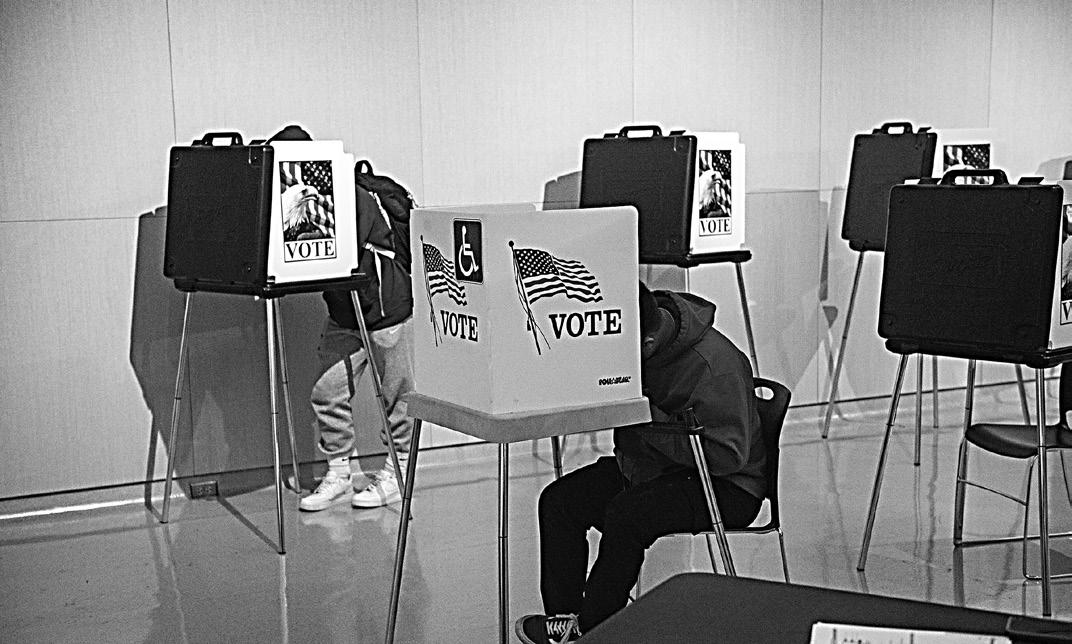
The Institute for Social Research hosted a panel Thursday evening to discuss the patterns and takeaways from the 2024 election. Almost 100 University of Michigan community members gathered in an ISR classroom to hear from ISR researchers and other panelists.
Panelist Vincent Hutchings, professor of political science, opened the panel by addressing trends among Black voters.
According to Hutchings, Black voters, who typically vote overwhelmingly for Democratic candidates, followed established patterns in 2024. According to exit polling, 86% of Black voters supported Kamala Harris this election cycle, a 1% decrease from Black support for Biden in 2020.
“The outcome of the election was surprising in a number of dimensions,” Hutchings said. “It was surprising in terms of the lack of it being close. It was surprising in terms of Trump winning all of the swing states. It was surprising in a number of other dimensions. But what was not surprising is the Black vote and the white vote, including Black men and women,
because they look pretty much like they always look.”
Hutchings emphasized that although it may seem former President Donald Trump drew an abnormally large number of Black voters, this is only because Republicans garnered a belowaverage percentage of Black voters in the past two elections.
“Trump in 2024 did about as well as you would expect any generic Republican to do,” Hutchings said. “Now, he definitely did better than he did before, but that’s mostly because he underperformed previously.
… No, Blacks are not drifting towards the Republican Party. … They are voting the way they have voted for the last almost 60 years.”
Hutchings was followed by fellow panelist Mara Ostfeld, research associate professor of public policy, who also researches the relationship between race and politics. She said Trump pulled 46% of the Hispanic vote, a significant increase from 2020.
“What’s also really noteworthy, is not just that he got a huge amount, but he got 13 percentage points more than he did in 2020,” Ostfeld said. “Also, he did so while campaigning about deporting a lot of immigrants, for a community that is composed of
many immigrants. So one question I want to engage with is, why did Latino support for the Republican candidate in this election, Trump — who spewed a lot of not only anti-immigrant rhetoric, but a lot of anti-Latino rhetoric — why did it increase so much?”
Ostfeld began her analysis by explaining the difference in the party makeup of Latine voters in 2024 as compared to 2020.
“Latino voters who supported Biden in 2020 were less likely to vote or participate in this election,” Ostfeld said. “So we’re not totally comparing the same Latino voters in 2020 to the same Latino voters in 2024— we have different electorates. What was also really interesting is there (were) a bunch of new voters — like there are every year — most of these are young voters, and these new Latino voters in 2024 broke heavily for Trump.”
Ostfeld also explained that shifting support for Trump among Latine voters affected their turnout, with young Latine voters, particularly men, leaning Republican. Her research found a 7% increase in support for Trump among young adult Latine voters, and a 19% increase among Latino men since 2020. Ostfeld explained that, though a variety of factors
could explain the increase in support for Trump among young male Latino voters, including racism, sexism, Christian conservatism and internalized stigma, economic frustration stands out.
“We see economic frustrations really standing out,” Ostfeld said. “Latino voters were the least likely of the three main ethno-racial groups looked at to say that their financial situation had improved in the last four years. And along with whites, they were fairly likely, about nearly half, (to report) that their financial situation had gotten worse over the last four years.”
Panelist Nicholas Valentino, professor of political science, focused his analysis on the Trump campaign’s use of emotional tactics. He said his research found that anger is a more powerful motivator for political action than fear.
“Anger is much more likely to lead people to take risks, to use resources that they might not otherwise want to risk,” Valentino said. “Anxiety is usually an emotional state that leads people to withdraw and evaluate information more carefully — not the kind of thing you would hope would be happening in an election
when you want to mobilize voters.”
LSA senior Phoebe Yi, an event attendee and ISR research assistant, said in an interview with The Michigan Daily that she found Valentino’s research to be the most interesting and surprising takeaway from the panel.
“I never really considered how there’s a difference between fear and anger that can change mobilization,” Yi said. “I always thought that fear was the biggest driving factor, especially with 2016 and Trump’s turnout. I feel like 2020, very similarly, I thought that fear was a really big driving factor for people to vote for Biden.”
Panelist Josh Pasek, professor of
communication and media, added an international perspective to the 2024 election, noting that global dissatisfaction harmed incumbent parties’ reelection prospects.
“In the grand scheme of how campaigns did this year … every single developed country that was experiencing an election this year had a significant loss for the incumbent party,” Pasek said. “And I think in an environment of high inflation and global turmoil, incumbent parties just didn’t get the amount that they had had previously, and that’s my guess, at least, for the story behind why Harris’ voters just didn’t turn out the way Trump’s did this time around.”
Evelyn Mousigian/DAILY
Akul Gunukula/DAILY
Ann Arbor community holds vigil marking 10 years since AAPD killing of Aura Rosser
‘Her death, along with countless others, reveals the systemic failure of policing to protect marginalized communities’
SNEHA DHANDAPANI
Content Warning: This article contains mentions of gun violence and police brutality.
Beneath scattered posters that read “Black Lives Matter” and “Aura Rain Rosser,” about 30 Ann Arbor community members gathered at Liberty Plaza in downtown Ann Arbor to celebrate Aura Rosser’s life 10 years after her killing. During the event, those who knew Rosser told her story to celebrate her life, while other speakers discussed injustices in the policing system and the importance of activism.
In 2014, Rosser, a 40-year-old Black woman, was tased and then killed by a police officer who entered her home. For six years afterward, Ann Arbor community members held annual gatherings in memory of Rosser and marched to demand an apology from the City of Ann Arbor, compensation for funeral costs and for the police officer responsible for her death, David Ried, to be fired.
Rosser was engaged in an argument with her boyfriend when two officers entered her home after the Ann Arbor Police Department received a call for assistance from Rosser’s boyfriend, Victor Stephens. Rosser approached the officers with a knife and one officer tased Rosser while the other fired their
gun, killing Rosser. The county prosecutor reviewed the events and concluded they would not bring charges against the officer who shot Rosser because he acted “in lawful self-defense,” according to the press release from Brian Mackie, thenWashtenaw County prosecuting attorney.
In an interview with The Michigan Daily, Rosser’s sister, Shae Ward said Rosser was holding a knife when the officers entered her home because she was cooking to calm herself down after fighting with her boyfriend, not in an act of violence.
“She was cooking to calm herself down from the violence of what she was going through,” Ward said. “She went to her coping mechanism. … They didn’t give you all the details of what really happened because it’s not her fault — the victim’s fault.”
Education student Nia Hall, co-chair of the Graduate Employees’ Organization, led the vigil. She told attendees the killing of Rosser was an act of unjust violence by law enforcement.
“The tragic murder of Aura Rosser by the Ann Arbor Police Department on Nov. 9, 2014 in the early morning of Nov. 10, is a stark reminder of the ongoing violence perpetrated by law enforcement, particularly against Black people and Black women,” Hall said. “Despite being in the midst of a mental health crisis, Rosser’s life
was taken by officers who responded with deadly force. Her death, along with countless others, reveals the systemic failure of policing to protect marginalized communities.”
Hall continued to talk about how the officers involved were not held accountable for Rosser’s killing, including Ried and his partner Mark Raab, who tased Rosser. Ried was promoted to sergeant soon after the investigation by Michigan State Police, according to a press release from GEO before the vigil.
“No one involved in this racist killing was held accountable, not the murderer, David Ried or his partner, Mark Raab, who is currently still employed by the Ann Arbor Police Department, the AAPD police chief serving at the time of Aura’s
killing, John Seto, was hired by the University of Michigan to serve as the director at our Department of Public Safety & Security,” Hall said.
Ward told attendees about Rosser’s aura, highlighting how people loved her as much as she loved them.
“She was bubbly, outgoing, energetic, lively,” Ward said. “You would see her come down the street. You would feel her aura. She radiated as she walked. You couldn’t not say hi to her. You could see her freckles glow.”
Ward emphasized the love Rosser spread to everyone who met her.
CSG meeting provides further insight on president, vice president impeachments
The Assembly also discussed the annual ‘Blood Battle’ against Ohio State and participated in an antiracism training
The University of Michigan Central Student Government met in the Wolverine Room of the Michigan Union Tuesday evening to vote to impeach President Alifa Chowdhury and Vice President Elias Atkinson. The Assembly also discussed Assembly Resolution 14-048, titled “Blood Drives United Semesterly Promotion & Partnership Establishment,” and participated in an Office of MultiEthnic Student Affairs training on anti-racism.
LSA Rep. Margaret Peterman asked to place the motion to impeach President Chowdhury and Vice President Atkinson on the agenda and then introduced the motion.
“The president and vice president were elected on a platform to advocate for the student body and serve their students,” Peterman said. “Since their time in office began, they’ve refused to do those duties that have been constitutionally required of them. They’ve openly degraded representatives for disagreeing with the mechanisms by which
they govern. After repeated calls for their resignation from over 40 current and former members of CSG and repeated refusals to do so, this Assembly is left with no choice but to impeach.”
Representatives voted on this motion by secret ballot. To pass, the motion required the support of two-thirds of all sitting members of the Assembly. The motion passed, with 30 votes affirmative, seven against, one abstention and one vote absent. With articles of impeachment approved, the Central Student Judiciary will hold a trial to determine if the impeachment should be confirmed. If upheld, Speaker of the Assembly Mario Thaqi will become president. After the vote, Thaqi spoke about the Assembly’s commitment to advancing the needs and interests of the entire U-M community, regardless of whether CSJ confirms the impeachment.
“We’re here to push forward what our campus wants to see, and not just, you know, a certain group of people, but for everyone,” Thaqi said. “I think going forward, regardless of what happened here tonight, and no matter the outcome, we need to be focused on what we’re here to do.”
During the community concerns portion of the meeting, Abigail O’Connell, Blood Drives United promotions chair, and Ashley Dixon, Blood Drives United president, told CSG about the Blood Battle, an annual blood donation competition between the University of Michigan and The Ohio State University. Sponsored by Blood Drives United, each university seeks to collect the most blood donations in a series of American Red Cross drives on their respective campuses during the lead-up to “The Game” between the University of Michigan and OSU. O’Connell and Dixon highlighted the challenges of securing donations since COVID19, underscoring the importance of CSG support in promoting the Blood Battle.
“We’ve been struggling to get donations since COVID, with people being more reluctant to donate blood,” O’Connell said. “The (University’s) Board of Regents and Santa Ono, the Office of the President, have been very reluctant to offer us promotion and support. Ohio State recently came into a lot of funding that we have been unable to even come close to, which is why we are seeking promotion
50.5% compared to Harris’ 48%. Both Trump and Harris targeted Michigan’s diverse voter base, including union workers, bluecollar workers and Black voters, making frequent stops in the state throughout the campaign. Harris visited Michigan 12 times, while Trump visited 14 times. Michigan, which President Joe Biden won in 2020 and Trump won in 2016, remains a pivotal battleground in the presidential election. Despite Harris earning endorsements from the Michigan Teamsters and Union Auto
Workers, she faced challenges from the “uncommitted” movement within Michigan’s Arab American community, reflecting discontent over the party’s policy on the Israeli military campaign in Gaza. In an interview with The Michigan Daily, LSA senior Alec Hughes, co-chair of the University’s chapter of College Democrats, said Democrats in the state and federal legislatures should prioritize bipartisanship
Stanford Lipsey Student Publications Building 420 Maynard St. Ann Arbor, MI 48109-1327 734-418-4115 www.michigandaily.com
DANA ELOBAID and SAMANTHA RICH Co-Editors in Chief eic@michigandaily.com
ELLA THOMPSON Business Manager business@michigandaily.com
NEWS TIPS tipline@michigandaily.com
LETTERS TO THE EDITOR tothedaily@michigandaily.com
from CSG.” Dixon then explained that the winner of “The We Give Blood Drive” — a larger blood drive hosted by Big 10 and Abbott, a global leader in blood testing — would receive a $1 million prize.
“This year, specifically, there is also a blood competition going on between Michigan and the other Big 10 schools, hosted by Big 10 and Abbott, a global healthcare company,” Dixon said. “And the winner of that wins $1 million to go towards student and or community health. So like we said, there is a lot at stake here.”
CSG Rep. Erin Neely asked O’Connell and Dixon if they would like to pass the promotional resolution in one meeting, but they declined, arguing there is still more to be added to it. The resolution currently currently states that CSG would partner with Blood Drives United to promote and market the Blood Battle in the fall semester and the Big Heart Blood Battle in the winter semester. The resolution will be deferred to CSG’s meeting next week and was motioned to be sent back to the Communications Committee for further review.
Read more at MichiganDaily.com
to achieve their legislative goals despite political polarization.
“It’s going to be hard at both the state and federal (House) levels, now that Democrats are no longer in the majority and the same thing in the (U.S.) Senate,” Hughes said. “Democrats are going to have to find ways to work with Republicans as well as the governor at the state level to get things passed.”
In a Nov. 6 press release, Victoria LaCivita, communications director of the Michigan Republican Party, wrote that Trump’s victory will allow for the reversal of BidenHarris policies that they believe have harmed the country.
“After four years under Kamala Harris, Michiganders are eager for President Trump to fix what Kamala Harris broke,” LaCivita wrote. “Starting on Day 1, President Trump and Vice President JD Vance will help to ease costs, secure the border — and Make America Great Again.”
Deputy Editorial Page Editor: Jack Brady Senior Opinion Editors: Zach Ajluni, Lucas Feller, Jack Kapcar, Sophia Perrault
NOAH KINGSLEY and REKHA LEONARD Managing Sports Editors sports@michigandaily.com
Senior Sports Editors: Lys Goldman, Charlie Pappalardo, Zach Edwards, Jon Wuchter, Taylor Daniels
CECILIA LEDEZMA and ZACH LOVEALL Managing Arts Editors arts@michigandaily.com
Senior Arts Editors: Graciela Batlle Cestero, Cecilia Dore, Mina Tobya, Rami Mahdi, Rebecca Smith, Nina Smith
FIONA LACROIX and EVELYN MOUSIGIAN Managing Design Editors design@michigandaily.com
Senior Layout Editors: Leyla Dumke, Lys Goldman, Sophie Grand
GRACE LAHTI and LILA TURNER Managing Photo Editors photo@michigandaily.com
Senior Photo Editors: Emily Alberts, Jenna Hickey, Lucas Chen, Riley Nieboer, Sarah Boeke
REESE MARTIN Managing Statement Editor statement@michigandaily.com
Deputy Editors: Liam Rappleye, Irena Tutunari, Darrin Zhou
JACKSON KOBYLARCZ and PARINA PATEL Managing Copy Editors copydesk@michigandaily.com
Senior Copy Editors: Tess Beiter, Leonor Brockey, Julia Brownell, Lily Cutler, Ingrid Hofmann, Tim Kulawiak, Josue Mata, Neeka Mehran, Sofi Mincy, Maya Segal, Jess Siegal
ANUSHKA RAHEJA and JACOB KIM Managing Online Editors webteam@michigandaily.com
ANDREW HERMAN and JOVANNA GALLEGOS Managing Video Editors video@michigandaily.com
COLE MARTIN and TINA YU Managing Audience Engagement Editors socialmedia@michigandaily.com
Senior Audience Engagement
and Inclusion Chairs
Business Staff
GABRIEL PAREDES Creative Director
ANNIKA CHINNAIYAN Sales Manager
Keith Allen-Melong/DAILY
PATRICIA LEONCIO Daily Staff Reporter
The Parental B-Side
CECILIA DORE Senior Arts Editor
Parenthood can be so many different things — for some a dream, for some a worst-case scenario. There are drag mothers and “Our Fathers” and there are parents walking their kids on leashes and pushing their fur-babies in strollers. There are family friends who decided they wanted to have children after they watched your baby-self eat spaghetti for the
first time, and there are “mom friends” who always have a bottle of hand sanitizer in their tote bag. Parents make us who we are; I have my mom’s smile and my dad’s eyes. I’m always writing like my grandma, and I’ve enjoyed my fair share of long, nerdy science fiction books like my grandpa. They can be our first introductions to the art that we might hold onto forever — Abbey Road’s medley will forever make me think of the backseat of a minivan where I heard it play everyday for months, and the “It’s Always Sunny in
Philadelphia” episode, where they go to the Eagles’ open tryouts, brings me back to my couch, laughing with my dad. For better or worse, pieces of our parents can form us, remain with us or push us in a completely different direction. Everything comes from something, and what does that mean? This is what these writers sought to answer. So, here is what I have birthed: my lovely child, born in November of 2024, weighing six articles and zero ounces, the Parental B-Side.
On motherhood, loss and overbearing expectations
MICHELLE WU Daily Arts Writer
Moms, the ones who bring us into this world and play a significant role in raising us, might have the toughest job in the world. They work in complete chaos without breaks, stay on their feet all day to meet the intractable demands of their children and — hardest of all — are either constantly negotiating or playing little mind games with bratty kids who have nasty attitudes.
I know this is how my mom feels because of all the anecdotes she shares with my sister and me about our childhood. On top of working full-time, she would have to come home, cook our meals, read us stories and put us to bed. That was just the beginning of all she had to do for us: My sister and I had so much artistic energy that it couldn’t be contained on the backs of rogue scrap paper, so my mom also had to erase the derpy colored pencil drawings my sister and I would make on the walls in our rental condo. We also disagreed a lot, so my mom would have to come in between us to stop it before it became more than just a petty catfight — especially because I used to be much bigger than my sister (sadly, I am now three inches shorter). The most heroic feat she had to accomplish, though, was intercepting any impulsively foolish decisions my sister and I were about to make, like cutting our already short hair with craft scissors or dunking our faces into the toilet for fun.
It wasn’t easy for her to raise us then, and it definitely has not gotten easier over time. I’m not as troublesome and messy as I used to be, but as I grew older and spent more time away from her at school and with friends, I started to form my own identity, opinions and values. This
created a rift between us that transcended the cultural and generational divisions. As a kid, however, I assumed the mother-knows-best narrative and obediently followed my mom’s rules and subscribed to her beliefs. I wore pink and flowery clothes because she said the style was lively and cute. I kept my hair cropped short because she told me it would keep me looking youthful as my facial features matured. I paid close attention to the educational LeapFrog DVDs she checked out from the local library because she said they would supplement my class material. Life was so simple back then. Enter middle school, and things very quickly became complicated. Compared to my carefree childhood with my sister where we would role-play in the living room, watch PBS Kids on television and make up characters to draw in our sketchbooks, my tween years felt like an eternal prison. I had a class every day of the week — regularly programmed schooling on the weekdays, supplementary math class on Saturday and Chinese school on Sunday. I also had piano lessons on Thursdays after getting out of school and private swim lessons once a week in the summer. Yes, we did have a few vacations scattered throughout the year, but for the most part, I felt that I was working more than I was playing.
Inevitably, after reaching a certain point of burnout, I wanted out. While my peers went to the mall and grabbed ice cream on the weekends, I sat in smelly old classrooms for the promise of a “better future.” Given my lack of progress in these extracurriculars, I had no idea if this future would ever arrive.
I was hardly understanding my Saturday math classes, which I only took to skip math levels to get ahead in school. I was expected to learn compe -
tition math, which was drastically different than traditional math taught in the classroom, so I would get below 50% on my homework every single time. In Chinese school, I struggled to memorize 25 new characters and phrases every week, and I felt like a disgrace walking home with a paper emblazoned with too many red Xs. When I attended piano recitals, I guiltily felt behind for not working on pieces as advanced as the other players, even though most of us had been playing for the same number of years. Despite the expensive private swim lessons, I never became fast or skilled, only learning enough to perform basic techniques and stay afloat in water.
I remember desperately begging my mom to let me quit because I wasn’t going anywhere with these efforts and felt as if I was wasting my precious time. With no awards to show for all my misery, and so much money poured down the drain, what was the point? I realize now the privilege of having a parent so invested in my development, but I was far from grateful back then. The thing is, most of the stressful pressure I felt was a result of my own doing, falling short of the expectations I created for myself, but it wasn’t until I read Amy Tan’s “Joy Luck Club” that I realized this. In the book, the protagonist June Woo is pushed to play the piano against her will, and after a failed recital, declares she is quitting the wretched instrument. The dialogue between June and her mother, Suyuan, reminds me of my interactions with my mom. Suyuan tells June that she never expected her to win shiny trophies because what she cared about most was that June picked up an interest and put her best efforts towards learning it.
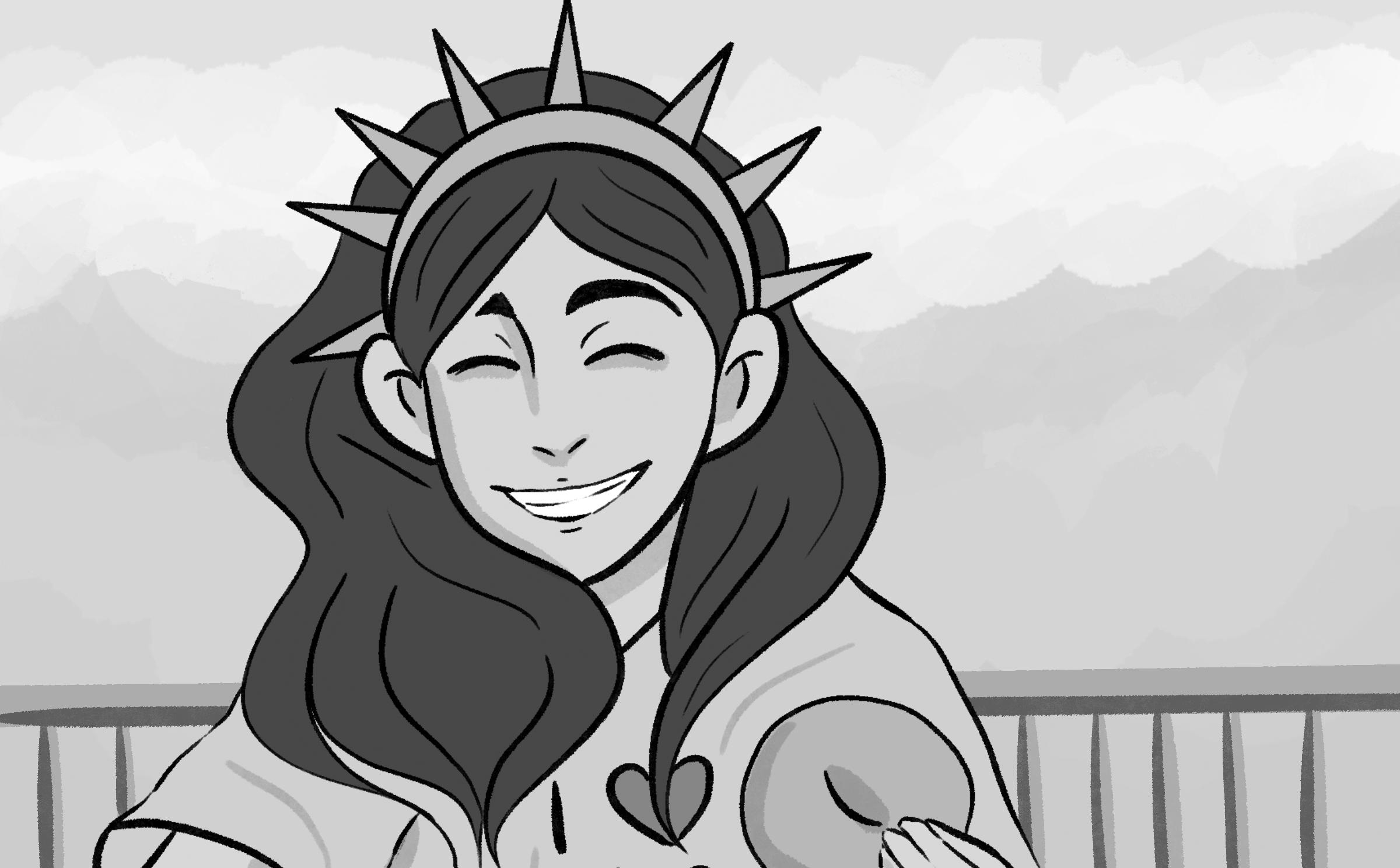
I am a mother (to a family of stuffed otters)
Rumaisa Wajahath/DAILY
A few weeks ago I convinced my boyfriend to walk to Kerrytown with me. I walked into a toy shop on the second floor of Kerrytown Market with one thing in mind: Jellycats. I knew it was time for me to finally invest in a new addition to my otter family, already five otters strong. I walked over to the Jellycat section and found my soon-to-be dearest child, Otto, a small stuffed sandy brown otter. Since his birth — or bought-cha day — I have been emotionally attached to this stuffed toy made for children.
A week later, my boyfriend came over and forgot to bring Otto with him. I almost cried. Why was I, a 19-year-old, perfectly independent girl, about to cry because she didn’t have her stuffed animal?
Because I had nothing to nurture. Nothing to snuggle and keep warm. Nothing to protect.
Motherhood and all that it entails hangs over my head like a bag full of flower petals, getting heavier and heavier, on the brink of release. The problem is, not all of them are fresh. Some of them are rotted and they’ve got an inescapable stench. I look forward to helping my future daughter put her sweaters over her head, those are the petals that are a fresh, pale pink. I think about how when I get really hot, I feel like yelling. Those are rotten. Those taint the pink petals and overpower their baby pink perfume. The weight of both the good and the bad is hanging over me, but whenever they are released, it will not kill me; I’ll just have a lot to clean up. That’s what I’m afraid of: I don’t want to shower my daughter with rotten petals. She deserves better.
I’ve seen every type of mother. The cool ones, the bad ones, the
catty ones and the ones who are so perfect I envied their daughters until I turned green in the face.
The possibility of being the one my daughter doesn’t want is sickening. I think of my future daughter so often; I think about the lessons I have learned and how I will be able to help her as she learns them too. I think about teaching her about words, the object of my greatest affection. I think about cooking her breakfast and writing notes in her lunchbox. I think about helping her through her preteens when it feels like no one gets it. I think of showing her music I love, the music that taught me how to be a woman.
But most of all, I dream of having a little girl to show the wonderful wonders of the world.
I dream of loving her so well that she accepts nothing less than gentle braids before school and sweet treats at all times of the day.
I dream of holding her hand as she leaves her adolescence behind. I dream of bringing her soup when she’s sick and buying flowers for her school plays. I dream of proving her worth to her every day, by loving her fiercely. I dream of becoming a strong mother and raising a strong daughter.
I am 19. I have no desire to be a mother right now. But I know what her name will be. I have known since my sophomore year of high school.
This isn’t unique. The sack of flower petals over my head extends to so many girls my age. Our “biological clocks are ticking.” We must think ahead. Men are never told this.
I thought I could never give up my entire life and being for someone else. I wanted to be able to pick up and do something crazy all the time. I wanted to live in a tiny apartment forever, nothing holding me back from any opportunity. I didn’t want to take the chance of hurting her, my hypothetical pride and joy. I didn’t want to say something damaging and apologize, praying that the apology assuages the sting. I didn’t want to put pressure on her to be something she’s not, and make her bear the weight of my disappointment. Honestly, though, what are we if not a recreation of our mothers with 50 generations of daughterly rage behind us?
I was born with frustration and misunderstanding in my DNA. It’s how it has always been and always will be. The rotten petals have been in that heavy bag since I came into the world as a daughter myself, before I spoke my very first rotten word. My biography does not bode well for her. But at some point, I have to realize in the same way that my mother is deserving of understanding, my daughter will come to know that, too. Although I pray she never has to.
Now despite my long-time belief I would never have kids, the mother-daughter dream feels more like an inevitability than a faraway fantasy. I think I was born to be a girl mom. To braid hair and paint nails and teach about tampons. I was born to experience conflict with my fictional daughter, and learn from it and love her even more. So, this is for you, my unborn daughter. I love you so much even though I don’t know you yet. You have a stuffed otter brother waiting for you.
I wish I could say I want to escape this truth, but I don’t. The pressure of motherhood sustains me. The fact that I will one day have the opportunity to create a safe and beautiful world for my little girl, a world I didn’t have, keeps me going. It’s a light at the end of a tunnel that is accompanied by soft infant cries. For the longest time, though, I didn’t want this. I wanted no children at all.
When I was eight, I was recruited for a spy mission that I didn’t sign up for. My mom armed me with the knowledge that I couldn’t shake a plastic Tupperware full of baby carrots, refusing to back down from her treacherous decision (encouraging healthy eating habits). My dad was the unwitting accomplice — he took one look at the “No Outside Food or Drinks” sign when I pointed it out, and gently reassured me it was fine. Then, the moment of truth: Sneaking past enemy lines to carry out our secret mission (walking past movie theater employees who probably didn’t care). Finally, we could enjoy the fruits of our labor — watching “Cars 2” in a mostly quiet theater, save for the occasional crunch. This setup was the same for every Disney-Pixar release between 2008 and 2018. My dad was at first obligated to come — and later came more willingly — to every animated movie release that could possibly exist. My mom always rejected the offer to come (real, honestly, because “Cars” gets marginally worse with every sequel and rewatch) but sent us on our way with snacks. And every time, despite the amount of whining that I must’ve done about seeing the movie, I barely remembered the actual plot of the film. I wasn’t the only family member to have a slightly questionable visual-media series as my Roman Empire. When I was in middle school, “The Voice of China” was my dad’s. At the time, he frequented this popular karaoke app, which inspired him to introduce me to different genres of music — when driving me to tennis, instead of playing Jay Chou’s “Rice Field,” he would play his own cover of “Rice Field.” After successfully earning the title of The Voice of Westford, Mass., he would bring his newfound knowledge to our weekend viewings of “The Voice of China.” I remember his impressions of the contestants more than the contestants’ performances themselves. It was mostly my mom and I watching the episodes in their entirety; he would leave the living room seemingly uninterested, only to come back 30 minutes later and roast the contestants as if he were the fifth judge. He’s famously a falsetto hater and always bases his decisions on whether artists can hit high notes. This checks out since his opinions are based on what seems impressive to the average viewer with no formal vocal training. Nonetheless, it was always entertaining to see him attempt to sing along, bailing out halfway through after realizing that he couldn’t hit any of the notes.
Our latest family obsession is food YouTube, specifically Chinese Food Tour. The host, A-Xing, wears the same hat in every video (in the manner of a main character wearing the same outfit every day) and — it’s in the title — goes around China looking for the best street food.
It always happens that we put his videos on after we’ve eaten dinner. Even though we’ve already eaten, watching A-Xing means that we’re doing a food tour of our own fridge and pantry for snacks. I’ve started quantifying my mom’s enjoyment of each video based on the height of the sunflower seed shell pile that accumulates in the trash afterward. I think the record has to be about four inches — I’ve never measured it, but that seems about right. I don’t think I appreciated these moments appropriately in the past — it’s never really been about watching the actual content. My dad watches animated film releases before I’ve even heard about them half the time, and then texts me to ask what I thought of it. On the flip side, when I’m thinking of my dad, I’ll start listening to Jay Chou. My mom randomly sends me photos of the meals she’s made, and in return, my calls to her usually consist of me bemoaning that the chicken I cooked is still raw. To my parents, who are probably reading this, I love you. Here’s to more artinspired memories together.
SARAH PATTERSON Daily Arts Writer
Natasha Eliya/DAILY
KRISTEN SU Senior Arts Editor
“Come on Nat Nat, let’s go to the library,” my mom would say. I was 3 years old, toddling in the car, reaching up high to grasp onto my mom’s hand. On sunny mornings, my mom took me to the library to check out books for her book club and find stories for us to read together. Then, I’d sit in her lap on our rocking chair as she would flip through colorful pictures, reading the English text in Mandarin. Looking back, I don’t know how she did it, deftly translating the stories into her mother’s language. My mom was born in Michigan and raised my siblings and me to speak Mandarin. Her parents immigrated to the U.S. in the 1950s to flee communist China. The move was difficult for them, as English was their second language, so their daughters grew up bilingual in Okemos. Despite belonging to one of the very few Asian families in her hometown, my mom never thought about her solitude. My mother is fluent in English and Mandarin, but reading and writing in Mandarin was challenging for her as she grew older and her parents started to improve their English. Before she and my dad had kids, she went on an intensive Mandarin-speaking program in China so she could raise her kids to be bilingual, just like her.
“I’ll always tell you the hard
truth because I don’t want you to ever doubt if I’m lying to you.”
Hi, my name is Natalie Mark, I use she/her pronouns and I play cello. I’ve been playing for 12 years and was in the Palo Alto Chamber Orchestra for nine of those years. I taught cello for four years, coached chamber groups and even volunteered abroad to teach music. Popcorn!
“You’re not in tune, Natalie. Don’t move on if it’s not correct. Stop. You’re rushing. That’s not the rhythm, there’s a dotted 16th note, come on.”
“You didn’t practice enough last week. You should have learned this by now. What were you doing?”
“I already told you that. Why did you not play it correctly at your lesson?”
My mom was a violinist growing up because her mom wanted her and her sisters to play an instrument, something she always wished she had done. So, my mom took violin lessons at Michigan State University with Professor Bodman and took piano lessons from her family friends. She was extremely talented — winning violin competitions, studying with esteemed violinists at the University of Michigan and nearly majoring in it. She told me every time I practiced, “Your instrument is going to be an old friend that you can return to when times are low. Keep playing cello because you’ll be glad that you have this talent down the line. Trust me.”
“Don’t take it personally, I’m
only trying to help you.”
I was around 8 years old. Third grade was the start of math placement in school, and I never did well on tests. My mom tried to help by giving me numerous math problems on our whiteboard, some of which never even had a solution because she made them up. It was passive-aggressive; I hated it because I never knew what I was doing, and I cried each time we did these practices. The tears only got worse when I was in trouble for crying.
this country, so do not cause any trouble; instead, quietly rise to the top. We were raised to work hard, harder than anyone else in our classes, or else we would go unnoticed.
“You have to organize yourself. You’re not disciplined enough.” I was entering high school, and I struggled with the transition. I was trying to balance harder classes, cross country, cello, orchestra and clubs. I missed having fun with my brother. It was challenging, and every once
“I’ll always tell you the hard truth because I don’t want you to ever doubt if I’m lying to you.”
“This is supposed to be easy.”
“You should have learned this already. When Gong Gong would shuttle me and Jenny Ayi from violin lessons and school, he would always ask us math questions. If we didn’t know, we got yelled at.”
“Just like what you do Mama?” I would respond.
“I don’t yell. Gong Gong yells. You don’t know what yelling is. You have it easy.”
My Gong Gong told my mom, who then told me, that Asian immigrants must work hard and keep our heads down. We should be grateful that we are even in
in a while, my mom would blame herself for my lack of “study habits.” She said if she hadn’t returned to work, she could have taught me better-studying habits that would have benefited me now. I didn’t know how to feel about that comment.
My mom’s parents divorced when she was in high school and her mom moved to California. Her single dad took care of her, working every day, yelling at her during nervous breakdowns. When my grandmother left the family, my mom was her only child who forgave her. My mom worked
hard, avoiding trouble at any cost.
I don’t know what exactly went through her mind when she saw me sitting on the couch relaxing, but it obviously was a sign that I was not working hard enough.
“I’m sorry.” When I turned 17, my mom said, “I’m sorry. I’m proud of you. I just want you to be happy and to enjoy learning.”
I was applying to college, getting ready to leave and fighting with my mom. Tensions were high, as I dealt with school, resumes, grades, cello and my mom’s constant attention. I was not happy, and I knew I wasn’t ready for higher education because I was lost and unconfident. I wanted to take a gap year, travel and see the world, and try to form my own identity separate from my family.
I thought my parents would reject the idea, but after enough bravery, I asked them if a gap year was a viable option. My mom asked why I wanted it, and she actually listened and agreed.
“You’ll do amazing things.”
I was 18 and graduated from high school, moving to Ghana for an untraditional education path. The mother who told me I was wrong, scolded my tears, unsatisfied with my performances, listened to me and let me choose. What I did not know growing up was that my mom cried whenever I did; she never let me see her cry until now. I never knew how proud she was of me until we separated when I was
abroad in Ghana and now here, at The University of Michigan, her alma mater. Before she left to go home she told me, “Have fun in school because I never did.” Since being on my own, I now understand what all these quotes from my mom really mean: They were her best efforts to ensure that the people she loves the most, her children, can be successful. While her words of wisdom sometimes hurt growing up, I am grateful for the tough love that formed me into the person I am today. Her expression of love allowed me to decipher people’s genuine words because she was my role model of integrity. The values I have discovered for myself during my time away from home come from her: a love of learning, integrity and hard work. When I raise my own daughter, I’ll hold onto her hand as we walk to the library together, share my love of learning and hold her close. As we’re sitting on the rocking chair, I’ll tell her about
___ Arbor, Michigan
Thin branch
Mexican fast-food chain common on the West Coast 40. 1986 Indy 500 winner Bobby 42. The last "w" in www 43. Prefix with figure or form 45. "Jeopardy!" host Trebek 46. <3
Affectionate tri-letter text 53. "Mind. Blown."
55. Kate of "Titanic"
60. *Sharp part of an ice skate
1. *Samurai's curved, single-edged weapon
2. Sections of some keyboards, for short
3. "My treat"
4. Black History Mo.
5. "The Little Mermaid" prince
6. Unforeseen obstacle
7. Cabinet department until 1947
8. Paper-folding art
9. Change the title of
10. *Macbeth's sticking point?
12. Musical connector
13. + or - particles
15. Component of natural gas
16. "Knives Out" director Johnson
19. Hamilton bills
22. Pitcher's asset
24. Tough spot...or a remedy for it
26. The first one was sent in 1971
28. 2014 Pulitzer Prize-winning author Donna
30. Nonprofit URL ending
31. Director Brooks
33. Language of origin for the word "behemoth"
34. Luxury hotel, familiarly
35. Opposite of wane
36. University VIP
37. National League West team, on scoreboards
38. Second wife of King Charles III
39. How investigators might proceed
40. *Fencing tool
41. Barnard graduate
42. Aren't anymore
44. *Prop for the Grim Reaper
46. "___ it going?"
47. Barbershop request
50. Saints quarterback Derek
51. Elitist
54. Liberal or conservative leader?
56. Sun, in San Juan
It was a hot summer evening in New York City, and my family and I found ourselves walking through “Jean-Michel Basquiat: King Pleasure.” As an art enthusiast, once I heardww this exhibition was in town, I couldn’t miss the opportunity to add it to our agenda for this trip. Classifying Basquiat as the face of the neo-Expressionist movement falls short of capturing how revolutionary his work is; his use of color, raw drawings and emotional depth showed me that art goes beyond the classical paintings I grew up admiring. Although my family was accustomed to me dragging them to museums on vacation, they had likely only seen Basquiat’s work referenced in pop culture or various media outlets. None of us knew what to expect upon arrival at the Chelsea show, which I can only describe as an intimate tellall on the artist’s life.
At first glance, the juxtaposition of light wooden panel walls and shockingly colorful paintings stood out, and my delight grew with every detail I noticed. From his studio and childhood home to a painted refrigerator, his curated playlist and a bar-like room with hundreds of images from his clubbing days onscreen, I felt like a kid in a Basquiat candy store. My dad did not share my sense of awe. What should have been toured in no less than an hour took him about 15 minutes. Deciding that this was not for him, he proceeded to sit at the gift shop until the rest of us finished. As soon as I noticed his absence, I looked for him to ask what had happened — to which he bluntly responded, “My 5-yearold nephew could have done all of this.”
My dad’s comment left me speechless: He had belittled not only Basquiat’s impact as an artist but also my infatuation and appreciation of contemporary art. My younger brother and mom laughed and called him uncultured, but I remained silent, realizing this reflected a grander societal and cultural issue. Why does contemporary art elicit a mocking response from past generations? Collectively, we’ve grown up learning about Da Vinci, Picasso and Michelangelo in school — but when did their work become the standard for what art should “objectively” be?
The generational gap regarding art is evident, with older
generations often appreciating classical paintings while ridiculing modern, nontraditional art. Placing myself in their shoes, I might understand why someone would feel this way about Duchamp’s “Fountain,” a banana taped on the wall or a blank canvas at a museum, yet we must work towards accepting the unknown and embracing change in the art world. Basquiat defies the boundaries of modern art by presenting a universally recognizable style that is anything but traditional. The response this art evoked from my dad strengthened my belief that newer art forms have trouble being accepted due to older generations’ preconceived notion of what is worthy, in addition to their hesitance to embrace what may be outside the box. There are exceptions — some embrace the modern and nontraditional — but most remain rooted in more traditional perspectives. Nonetheless, we are at a time when art has surpassed a mere form of status for the wealthy; now, it is created to elicit feeling, be a place for selfexpression and question what we, as a society, think we know.
Considering the societyreflecting power of Basquiat’s pioneering art, I refused to ignore my dad’s belief that his compositional ability resembled that of a 5-year-old. It can be daunting to teach an older generation that art doesn’t stop at glorified Europeans from centuries ago, but it is important to emphasize that art is more than a learned skill. When will past generations start accepting our ever-changing society? This dismissal of art through a new perspective, which bases expression on feelings rather than technique, hinders us as a society. It’s time for older generations to embrace Basquiat and modern art. We need a willingness to explore the unfamiliar while appreciating the traditional, stepping into spaces where traditional and contemporary art intersect. Many exhibitions combine both, where a Da Vinci can hang beside a Basquiat, opening doors to new genres and interests. This isn’t about dismissing the classics, but rather expanding how we define art and understanding its roots. By fostering curiosity, older generations can move beyond the rigid standards they grew up with and push themselves to question, feel and see art in new ways.
LUCIA LARACH Daily Arts Contributor
AMARA SMALL MiC Columnist
Disclaimer: While I use the word “bullet” multiple times throughout this piece, its use is intended to be entirely metaphorical and in no way is it a call for or endorsement of violence.
“If we don’t do something real soon, I think you’ll have to agree that we’re going to be forced either to use the ballot or the bullet. It’s one or the other in 1964. It isn’t that time is running out — time has run out!”
On April 3, 1964, Malcolm X delivered what is considered to be one of the greatest speeches in American history: “The Ballot or the Bullet.” In this speech, he explores the two options Americans are faced with. They can choose the ballot and simply vote, or, when faced with pressure, they can choose the bullet, a metaphoric way of explaining that people stop being polite and start being loud when under duress.
In 1963, people wrestled with a scenario similar to what modern Americans are experiencing. Civil rights issues were at the forefront of the American consciousness, and neither the Democratic nor Republican candidate for president cared about the most marginalized people in the country.
In the 1960s, the struggle for the Black vote gripped Black Americans.
HANAN
HUSEIN MiC Columnist
It is a surreal disconnect seeing people that look like me continuously reduced to fragments on social media — fathers carrying their children’s remains in plastic bags. The only thing separating me from this fate is a screen and my parents’ decision to move here 24 years ago. In the face of immense vicarious suffering, a soft, dormant gratitude awakens. Suddenly I’m reminded that every move I make is a complete privilege — both good and bad. While I stress about finding Ann Arbor housing or changing my daily schedule, those on the other side of the screen agonize over futures and homes that are permanently devastated. My burdens carry the privilege of being temporary.
Gratitude for my stresses feels almost inappropriate, a luxury itself. It is a privilege to have the space to feel grateful when others don’t have the capacity for anything other than fear and survival. I wake each morning irritated by the hums of traffic
Palestinian solidarity was a source of connection for different activist movements. The Stonewall Riots were on the horizon as more and more pressure surrounded Queer rights. Live coverage of the Vietnam War caused many Americans to realize the horrors of American involvement in war, and Black communities realized that the military was a tool for their exploitation, not their assimilation: soldiers of color were asked to commit atrocities, then disregarded in their squads and by their country instead of receiving the honor they were promised. As the smoke of 1964’s impending arrival clouded the air and the most marginalized people in America were angry, frustrated and desperate to take action, a shift in the tides began to stir.
Many of these problems are returning.
As two of the most politically charged decades in recent history, I feel that the 1960s and 2020s have a lot in common. In both decades, the same issues have been at the forefront of American consciousness. Increased access to media coverage of war has increased awareness about violence. Palestinian liberation is one of the biggest topics in the news internationally. Voting barriers and equity are a major conversation. And most importantly? The lack of representation from electoral candidates has many
The Ballot or the Bullet
people, myself included, feeling powerless and angry.
In analysis of this lack of representation, Malcolm X proposed this framework:
“The ballot or the bullet.”
People had two options to express themselves. They could complacently vote for a president that didn’t care about them, or they could step up and force compliance with their demands of liberation. In the years leading up to 1964, many people chose the former. In his speech, Malcolm X notes that people are starting to choose the latter.
I’ve found myself returning to this phrase more and more recently, angered by a scenario that forced me to choose between two candidates that don’t have the best interests of me and communities I care about in mind. As a person deeply entrenched in POC, Queer, disabled and other marginalized communities, the consequences of the election are damaging, a fact that wouldn’t have changed no matter who won. Even in a scenario where harm is “minimized,” I would be looking towards a future that sees my loved ones and their loved ones in danger of political and government violence and disenfranchisement. Between the two major candidates, there was no result that saw the adequate protection and support of the communities I care for.
The current conversation around
politics is to create a hierarchy of rights. We are asked to prioritize the needs of some Americans over the needs of others, both in the United States and in the world.
White American reproductive rights are deemed more important than explicit protections for Queer people, than defunding Israel’s genocide in Palestine, than pushing for the demilitarization of American immigration. When talking to canvassers for and supporters of Harris, I’ve expressed
frustration with her disregard for these issues and the fact that she does not have the best interests of me and others at heart. Instead of having these criticisms validated, I am told to table the concerns I have about my community for the sake of reproductive rights. We must ignore the lack of pushback against or the outright endorsement of policies that actively endanger certain communities. Further, we are pushed to ignore the way all problems and communities are
I am grateful to be stressed
outside my window, then catch myself — how obscene this annoyance seems in comparison to the staining explosions others are subjected to.
I am already late for work and missed breakfast, stressing about the hunger I’ll battle for my six-hour shift. But what is a few counted hours to months of malnourishment? I am guaranteed a meal after my momentary suffering, whether going home to fresh ingredients or scouting campus for the nearest event offering free food. What others only dream of eating, I can find in the alumni center every Wednesday morning (Welcome Wednesdays are my sustaining force). I spend the rest of my day worrying about an assignment I procrastinated, but I have the privilege of time. I am not constantly chased by the choking hand of a clock, having the luxury of planning for my future and passing down my stories. My anxiety-built day ends as it began — doom scrolling on Instagram guided by constant, graphic reminders of what could’ve been my life if I wasn’t sheltered within the “safety” of the perpetrator’s walls. I go to
sleep thinking: What can I do with this privilege? How do I carry this responsibility on my frail shoulders while attempting to continue a normal life driven by guilt?
Since last October, 123 schools in Gaza have been demolished including all 12 universities in the strip. According to the Government Media Office in Gaza, at least 11,500 students 18 and under and 750 teachers have been killed. Beyond those students who narrowly escaped death, approximately 625,000 Palestinian students are currently being deprived of their right to education. There’s a term that has stuck with me these past few months — scholasticide. As defined by the United Nations, “the term refers to the systemic obliteration of education through the arrest, detention or killing of teachers, students and staff, and the destruction of educational infrastructure.”
Witnessing this, I am unsettled by the magnitude of my privilege for an uninterrupted education. However, this privilege, if simply felt and unused, is a waste. Rather than allowing this guilt to paralyze
us, we must use it to mobilize. The privilege of education is a luxury all students here share. Once granted the physical safety of our environment, we have the capability to enact change within ourselves and our communities. This attitude has existed long before ourselves, especially at the University of Michigan where the “teach-in” was created.
In March of 1965, a group of professors at the university formed a committee to stop the war in Vietnam. They held a teach-in from 8 p.m. on March 24 until 8 a.m. March 25 in Angell Hall Auditorium with about 3,000 participants, inviting U-M faculty and other activists across the country to speak. This event encouraged debate and reminded the public of what a democracy really is. People came together to prove that knowledge isn’t just a self-help tool, but also a weapon for social justice. Others were not happy with this dialogue taking place, with bomb threats and counter protests erupting at the same time. As the antiwar movement continued, the leadership shifted from faculty to students. This tradition is still alive with recent teach-in
topics held by Students Allied for Freedom and Equality including student power in Bangladesh and Palestine and the struggles of women detained in Damon Prison.
The power of teach-ins and other acts of resistance remains in the strength of a collective voice, amplified in numbers. You cannot rely on others to fill your place in protests; your presence and voice are irreplaceable. It is not enough to simply learn in silence or remain aware in desolation. While teach-ins form a foundation for change, collective learning must be realized in collective action. There needs to be intentional involvement, committing to an action that does not diminish after a single event or a single post. Just as those who pioneered the teachins of the 1960s faced opposition and fear, we must embrace the discomfort to challenge the complacency that our privilege makes all too easy.
The reality is that privilege and suffering are two sides of the same coin: each opportunity I receive is one someone else loses; each moment of safety, someone else’s fear. With the privilege of physical safety, there is no reason
connected. While the reproductive rights of Americans are important, what about the reproductive rights of Palestinians that are
not to act. Our safety, education and empathy grant us the capacity to advocate for those who, by sheer circumstance, lack the same. While survivor’s guilt often surfaces in conversations after crises, not enough is being said about transforming that guilt into action. We have the power to use it to advocate for students deprived of education, for those imprisoned and for those lost. We live in academic shields of concrete and glass, watching the tragedy that unfolds levels below. However, the same structures that keep us “safe” also keep us separate. Like a scientist observing through a microscope, we study suffering from a clinical distance. Unlike scientists, we cannot remain objective observers. Our observation is built around our obligation to use our bird’s-eye view to not only witness, but also to map paths for change. From our safely elevated surface overlooking the destruction around us, we have a duty to dismantle the structures that sustain such disparity. With this view, we are compelled to build bridges down from our towers of privilege.
Privilege is not a possession but a responsibility to act.
When home doesn’t feel like home: Living in a predominantly white co-op plagued with white fragility
GRACE JUN WALTON MiC Columnist
In “The Wizard of Oz” Dorothy clicks her silver shoes together three times while reciting the iconic phrase, “There’s no place like home … there’s no place like home.” Dorothy has just spent the entire movie yearning to go back home to her beloved family and friends. To her, there’s no place she would rather be. This positively painted picture of home is often what’s depicted in our media. While there are individuals graced with a safe, comfortable and healthy living environment, this isn’t the case for everyone. As a woman of Color currently living in a co-op, this has never been the case for me. When the time came to graduate from the college dorms and transition to off-campus housing, finding an affordable place was a challenge at best and capitalism’s housing market working like a well-oiled machine at worst. After frantically scrounging around the depths of Facebook and looking every day on Apartments.com, I struck gold when I found a co-op to live in for under $900 at the heart of Ann Arbor. The housing cooperative nonprofit sprouted around the city beginning in the Great Depression. It became impossible for the students at the University of Michigan to find a roof to live under, so a group of them purchased a house together. This began a long
journey of developing a housing cooperative organization full of policies that supposedly emphasize democracy, socialism, equity and social change. Years later, this nonprofit co-op organization still stands. Students like myself are posted up in these houses in hopes of continuing to pursue our passions and goals while having a safe space to rest when night falls. Maybe some of us are looking for community within our homes. After all, that’s what co-ops advertise themselves as. The co-op movement in the U.S. has historically portrayed itself as one that’s radical. So, why do young Black, Indigenous People of Color find themselves continuously harmed in these co-ops? Why are there so few people of Color in the co-op houses to begin with? Why do I feel disrespected in a co-op house full of liberals who self-identify as activists? What is one to do when racism and white fragility seep their way into one of the most intimate corners of their life?
As a transracially adopted Korean American, I am no stranger to navigating sharing a home with white people. I am the only person of Color in the entirety of my immediate family. Let’s get one thing straight: I don’t think my family has ever intentionally tried to harm me. I know in my soul that they love me and consider me one of the greatest gifts they’ve been given. Like most adoptive families, they thought they were going to give me a better life than the one I would have been given over in
South Korea. However, these factors don’t diminish the constant tension I faced as a young person of Color. Having to navigate the world as a BIPOC child while having only been given guidance from white patriarchs and matriarchs led me to be an expert in placating white people and excellently playing the role of the “Good Little Asian.”
There has always been the rhetoric that it’s my job as a person of Color to walk on the eggshells of white fragility.
In my short life, I have noticed that when I, a person of Color, begin to question my white peers’ actions, more often than not, bad things come my way. It’s difficult to breach the subject of these people’s negative reactions to my dissent because it begins to stir up an unsettling feeling within them. In my gut, I feel the white fragility begin to crack, but I’m not so sure some of the white housemates who hurt me would be keen to admit this.
It didn’t end within my household though; it bled into my day-to-day life in my hometown. An aside: If you’re looking for a place to live comfortably, I suggest avoiding Traverse City, Mich. It made the Washington Post for teenagers pretending to slave trade their Black classmates. When I got into college, I packed my bags and fled to Ann Arbor in hopes of finding spaces where I would “fit.”
Cue the local co-ops.
The hotspots for wellintentioned-woke-white people.
Your co-op gets extra brownie points if it advertises itself as environmentally sustainable or LGBTQ+ friendly. When I saw that there was socialism-forward housing that places emphasis on DEI, I was sold. I excitedly drove up to the driveway of my new home and was immediately greeted by a shy but kind housemate who helped me move my belongings into my room. For a time, this house felt like my little corner of the world. Of course, typical conflicts arose in the house: noise complaints, people not cleaning their dishes, personal food accidentally getting consumed and friendships being tested. This is to be expected when you place twenty-five tenants together under one household. Though, like most fragile systems, it was only a matter of time before the cracks that people wanted to keep hidden became visible. Throughout my time in the co-op community, I and others have been at the receiving end of harmful double standards. Whether or not these standards are social or political, conflicts often end the same way for people who exist in non-white bodies. The experiences I’m about to discuss are specific to my time in my specific co-op community, but I would like to emphasize that this is a microscopic look at a larger issue that plagues other co-op organizations. For further reading, I encourage you to read this article written by another woman of Color who was harmed by a neighboring co-op in Detroit.
Similar to a graduating class, there is a unique bond that happens between tenants who move into a co-op within the same academic semester. As I write this, I look back to last spring. I had been living in my co-op house for a few months at that point. A long-term boyfriend of mine blindsided me and ended our relationship. I was in absolute shambles. Two housemates who moved in at the same time as me were there to pull me into a hug in the early hours of the morning and the late hours of the night. One of them went on countless walks with me and let me use them as a sounding board to talk about my heartbreak. It has always been clear to me that the people in my household have some level of care for me.
However, nearing the end of summer things began to shift between my housemates and me. The new kids on the block became the seasoned co-opers and took on roles of leadership within the organization and the house. I had chosen to stay in Ann Arbor over the summer and get more involved with the housing nonprofit I’m a tenant under. I held the position of a board member and transitioned to an interim vice president of DEI. My knowledge of the co-ops deepened as did my passion and love for the co-op movement. I truly believed that the movement promoted mutual aid and communities of care. Though, my faith began to waver when I witnessed the actions
of people who had once been my friends after they were elected to higher positions in the co-op. Initially, I was excited to see these people facilitate the house and lead a community of inclusion and openness. In fact, one of them succeeded my seat on the board of representatives and the other friend became one of the highest-ranking house officers. Unfortunately, things went differently than I would have hoped.
Corners began to be cut in the democratic process within our house. It started with a white and masc presenting house officer not following the proposal and voting process at house meetings. For example, formal proposals weren’t even being made nor presented. Minutes were also not being taken, so house members who could not make it to these meetings in which decisions about the house were being made wouldn’t know what had happened. Decisions that would affect other sectors of our nonprofit were being made without prior consultation. Whether this was intentional or due to a lack of knowledge of our house constitution and our nonprofit’s policies is something I might never know. What matters to me though is that the processes of the co-op, and all its members, are respected. So, I began to inquire about the actions of these members in leadership positions in our household.
Vivien Wang /MiC
CHARLIE SHANG MiC Columnist
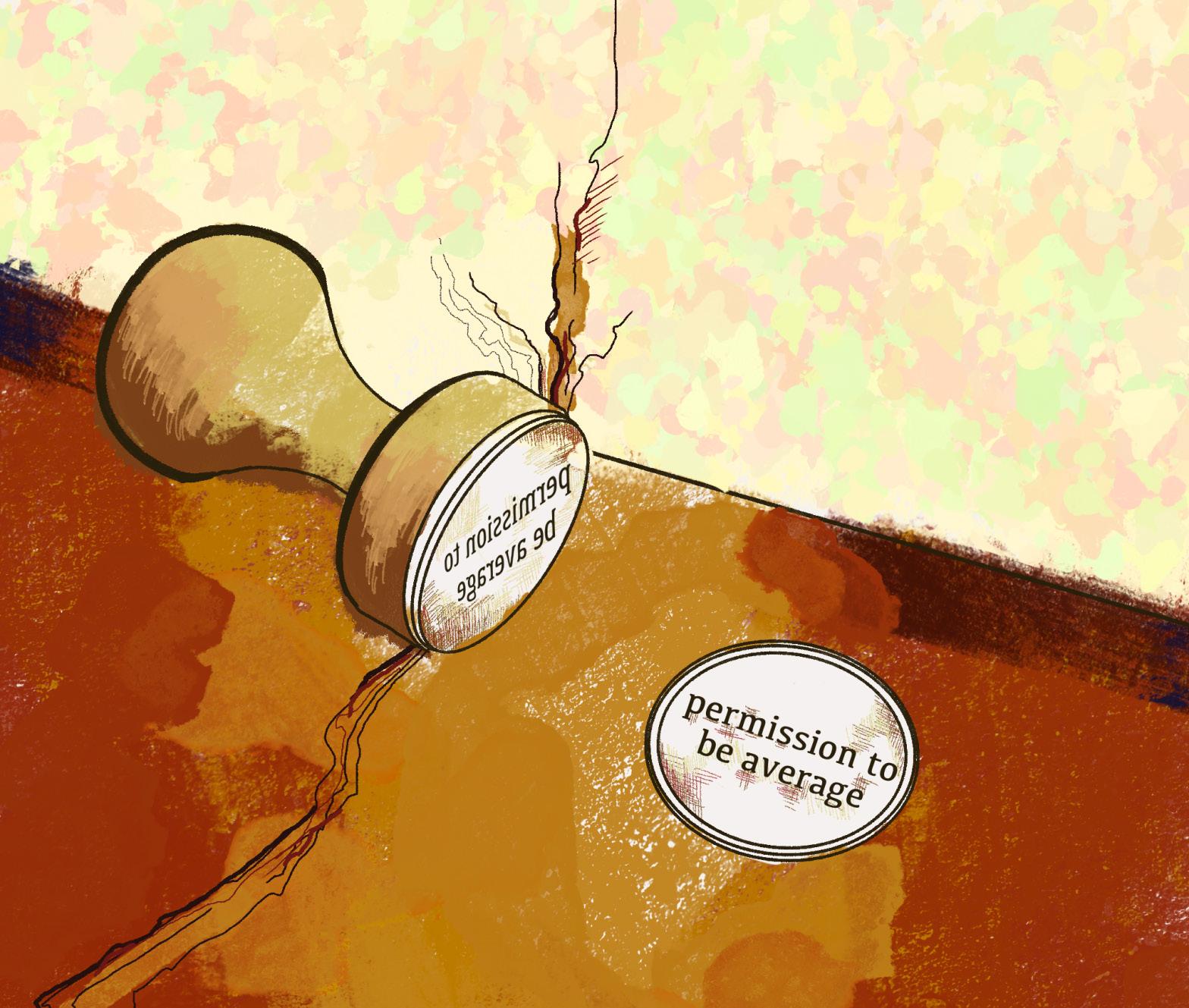
I used to hate the word average. Given how I was such a competitive perfectionist as a child, this was not a surprise. You can probably imagine what happened when my kindergarten art teacher said my apple sketch was average or when my swimming coach said my times were only average. I quit. So, I spent my childhood and early teenage years in the comfortable state of “doing what I was good at” or at least “doing what I could quickly become good at.” I would have comfortably stayed there if not for the fact that my high school required all students to participate in at least one term of Varsity or JV sports every year. For someone who has little to no athletic ability, I despised this requirement. Not only did I have to be average at something … but I couldn’t even hide from other people while I’m doing it? I ended up picking cross country because at least I know how to run, right?
Big mistake. I wasn’t even just average. I was notably below average, as in I was the slowest
Give yourself permission to be average
person on the team. Side stitches felt even worse when the varsity runners were about to lap you for the third time that week. This time I couldn’t just quit. I had to suck it up and endure the torture until the end of the season. Then I competed in my first race. It being my first 5k, I had no expectations for myself. Why would I? Yes, the weeks of training did make me faster by a little bit, but I was still the slowest person on the team, so it’s not like I mattered in the context of the race. That was my mindset, up until the point where I was approaching the finish line and caught up to the runner I’d been trying to follow the whole race. And suddenly it’s like I was a competitive little kid again: I want to pass her. Can I even do it? Maybe. Maybe not. Well shit, now I have to try. I didn’t pass her. And it should have made me feel some crushing sense of defeat but as I was crossing the finish line, the only thought in my head was I just finished my first 5k. Yes, my time was still one of the slowest on the team, but that didn’t matter as much as the fact that I, of all people, actually finished a whole 5k race.
That said, I’m not going to pretend I ever became above average at running. But it didn’t matter. It didn’t matter whether I was slowest on the team or if my times didn’t improve from race to race. What mattered was that running gave me a sense of accomplishment simply because I was doing it consistently. I was average and totally okay with that. Now, I must insert a disclaimer:
I’m not encouraging anyone to simply remain as they are and never try to improve. We all have at least one activity in which we want to excel. For me, it’s writing. I’ve written everything from fantasy stories on the back of middle school notebooks to somewhat-dramatic poetry to this not-quite-essay, not-quitepersonal-narrative you’re reading right now. For years, I’ve been working to improve my writing
because my craft is very dear to me. This also means that at some point I developed a notion in my head that I’m supposed to be “good at writing,” which translates to “No Averageness Allowed.” Everything I wrote had to become the most meaningful and stylistically beautiful piece I’ve ever created. There was no room for silliness or my angsty teenage thoughts. My writing had to be worth something to other people because otherwise, what’s the point of its existence? What’s the point of writing a piece if it’s just average? I now realize that sometimes the quality of a piece of writing doesn’t matter nearly as much as the fact that I wrote it down to begin with. I’m not always writing with the goal of creating my next best piece. Sometimes, I’m writing to process my messy emotions. Sometimes, I’m writing as a way to record ideas I want to remember. And sometimes, I’m writing because I just want to have some fun playing around with sounds and forms. Those pieces are often average or even quite bad. And that’s exactly how I expect them to be. They are starting points — the shitty first drafts that may
Introduction to linear algebra
At the risk of resurfacing neartraumatic feelings for any readers, I want to share the introduction to the first chapter of the undergraduate linear algebra textbook: Traditionally, algebra was the art of solving equations and systems of equations. The word algebra comes from the Arabic al-jabr ( ), which means restoration (of broken parts). The term was first used in a mathematical sense by Mohammed al-Khowarizmi (c. 780-850), who worked at the House of Wisdom, an academy established by Caliph al Ma’mun in Baghdad. Linear Algebra, then, is the art of solving systems of equations. … The approach generally used today was beautifully explained 2,000 years ago in a Chinese text, the Nine Chapters on the Mathematical Art (Jiuzhang Suanshu). Bretscher, Otto. “Linear Algebra with Applications.”
I remember interrupting my family’s conversation to read them what I considered to be a monumental introduction. I can imagine that for anyone else, it would have been a fun fact that contextualized the start of this mathematical field, but I felt incredibly
influenced by this little morsel of information. Growing up, my dad has always expressed his pride in our culture and shared the history of important figures and empires that our people have lived through, so al-Khowarizmi has been a household name. Though I’ve always known, I realized more clearly then that I have never found anything comparable in any other introductory science textbook: recognition for an influential Eastern polymath from history — especially one who shared my heritage and whose work is often overlooked in the broader history of science compared to Western scientists. Al-Khowarizmi was a Persian polymath from the 9th century, whose full name, Abu Abdullah Muhammad ibn Musa al-Khowarizmi, reflects his birthplace in Khorazm, a historical city still inhabited in present-day Uzbekistan. He worked in Baghdad’s House of Wisdom, a renowned center where scholars translated and expanded upon Greek, Indian, and Persian knowledge. There, al-Khowarizmi had created his pioneering texts in math, astronomy and geography, advancing in fields that Europe would only adopt centuries later. His most famous work was the
Al-Kitāb al-mukhta ar f isāb aljabr wa l-muqābala (“The Compendious Book on Calculation by Completion and Balancing”), which is the earliest systematic treatment of solving linear and quadratic equations. As mentioned above by Bretscher, the word al-jabr in the title is the origin of latinized algebra. Originally written in Arabic, this text was translated into Latin in the 12th century as Algoritmi de Numero Indorum (“al-Khowarizmi on the Hindu Art of Reckoning”), introducing his methods to Europe. We see al-Khowarizmi’s impact on the mathematical field even further through our coining of the term algorithm, taken from the latinized form of his name, Algoritmi. In Kitab al-Jabr wa-l-Mugabala, al-Khowarizmi embedded mathematics problems into realworld contexts, talking of trade, inheritance and property. He also brought Hindu-Arabic numerals to the Islamic world, a critical step that led to the adoption of the decimal positional number system in Europe, an advancement that greatly simplified calculations for all future work that followed.
These few paragraphs of alKhowarizmi’s legacy do not do his decades of work and signifi-
cance in our fields justice, yet despite his indisputable influence, al-Khowarizmi is still often overshadowed in historical accounts by European figures like Fibonacci, who built on his work. Fibonacci’s “Liber Abaci (Book of Calculation)”, written in the early 13th century, draws heavily from al-Khowarizmi’s methods, but it’s Fibonacci’s name that we recognize and credit in the West.
As an individual who has long held a goal to become a professor in my field, I believe the history of a subject is as important as the modern concepts that we’re learning and adapting from: How can we make progress if we don’t know anything about the foundations and what led us to the current pool of knowledge? I’m not saying people need to be able to name every previous scientist that has been working in their field, but rather people should have a general historical timeline of the field, and draw on how the field has ebbed and flowed and shifted throughout the decades or centuries that it has been active.
Writing about al-Khowarizmi gives me an excuse to learn more deeply about a highly influential person from my heritage but also addresses a broader issue: the importance of recognizing
Motherhood’s menu
Two turbulent flights and an hour-long bumpy bus ride later, my project team and I finally made it to the town of Zaña, Peru. It’s been a long Sunday, and as the dust settles around us, I find myself caught between exhaustion and a nagging curiosity about what awaits me.
I roll my bag up the gravel slope as sweat seeps from pores I didn’t know existed. The queasiness from travel churns in my stomach. At the top, I catch my breath, momentarily forgetting my exhaustion. The sun dips low on the horizon, painting the quiet town in hues of gold and dusty rose. Colorful houses line the brick streets, their weathered walls a canvas for the evening light.
At the center of this scene stands Flor, one of the Peruvian locals collaborating with our community partner to bring health care to remote areas. She’s been instrumental in promoting the portable gynecological examination table that my team developed, a vital tool for doctors serving patients in these communities. Flor, a woman no taller than five feet with short curls and red lipstick, greets us on the front steps with a welcoming smile. As I feel my bones about to collapse, Flor rushes over, giving us hugs, kisses and warm “Bienvenidos.”
We enter her home, our baggage (both literal and proverbial) in tow. The lime green walls adorned with beautiful paintings and pictures of people take my breath away. Then my eyes catch curried lentils on the dinner table — is that Indian food? Oh, how I’ve missed it! Flor and
the other ladies in the kitchen start heating up food, and as I observe the lively walls and colors, I’m transported home instantly and hopelessly content.
As we approach the large, family-style dinner table at the center of the room, my friends and I offer to help out, but Flor succinctly says, “No,” before ushering us to sit down and serving us plates heaped with buttered rice and curried lentils, the steam carrying a familiar, comforting aroma. Is this masoor dal? I’m not sure, but I pull out my phone to snap a picture of the meal and send it to my family group chat. My dad immediately responds with a “Looks good!” and an angel face emoji. My dad typically wears his heart on his sleeve with emoji smiles and warm, silly messages. And then my mom responds. She texts a “That’s masoor dal,” uppercase but no punctuation or emojis to hint further interest. My mom has always prioritized efficient, streamlined communication, preferring to show her love via acts of service. Food is the language we speak with each other, and she’s always shown her feelings and love through it, whether in cut fruit or healthy, homey Indian dinners. My whole family is comprised of foodies. I remember Sunday mornings hunched over my math homework while sitting at the dinner table, watching my parents cook meals for the week. The aromas of Indian spices and sounds of sizzling oil would fill up our house, and in between periods of studying, I’d curiously peek over my mom’s shoulders to watch her cooking. While the curry and carb menus would vary each week, lentils, especially masoor dal, with white jasmine
rice were a constant staple in our house — a trademark of my mom.
Masoor dal, a classic Marathi dish, is a curry of red lentils with grated coconut, onions and various other Indian masalas and spices. More importantly, it was my mom’s specialty dish that I loved the most, and she’d frequently cook and serve it for dinners. She grew up learning the recipe from her mother and eating it with family, a love language she’s continued since.
At home, when called to the dining table, I’d take my usual seat and wolf down a hearty masoor dal meal, checking my phone intermittently like the screenager I was. Every action has its equal and opposite reaction, so my mom would often nag me to be present, to slow down my eating and get off my phone, and to live in the moment of our family time during meals. But dinner, for me, was just another task of the day, something I’d rush through to get to my own academic or emotional needs. My mom, on the other hand, always chewed her food slowly, sharing stories from the day while laughing, and made dinner time feel a little warmer despite the toll of her long work days. She’d always inquire about the food she’d made, poking at us to give in to her qualms about whether the food was too salty or lacking ginger or wasn’t hot enough. In my eyes, my mom’s food could never do me wrong, and I’d follow up with the automatic, “Don’t even worry, it tastes really good!”
I remember recently when my mom had an assignment for her MBA course to write an essay about what values drove her.
“I’m duty-bound. I’m driven by serving my family, and that’s just
Eastern contributions to science. In many spaces I inhabit, I am often the only person from a Central Asian or Muslim background, which sometimes means being a walking Google for common information for my cultural upbringing and traditions by default. I don’t usually mind this, until it comes to having to defend the validity of the cultural differences that distinguish Central Asia from our geographic and cultural neighbors. When I think back on my own studies at a top school for a multitude of STEM fields, I struggle to recall classes that focused on the fundamental concepts of physics and chemistry that did not have a portion of the course dedicated to the history of the subject and the pioneers that helped advance it. How many people are familiar with Galileo and Archimedes?
Compare that to how many might be familiar with al-Khowarizmi or Ibn Sina (Avicenna), another Persian polymath from presentday Uzbekistan. Ibn Sina, considered the modern father of medicine, made significant contributions to math, chemistry and even concepts like the fundamentals of momentum. The Islamic Golden Age, flourishing from the 8th to the 13th centu-
or may not be transformed later. I’m not writing them for other people. I’m writing for myself. I still tell myself I’m supposed to be good at writing, though it sounds more like an encouragement now. I also tell myself to allow averageness to visit me every once in a while. It’s been knocking on my door more frequently, stopping by whenever I’m trying a new activity. Occasionally I still wonder, “What’s so fun about this anyway? You’re not even good at it.” That’s when I remind myself that I don’t have to be good. I have other reasons for what I’m doing. Maybe it’s to try out a new experience. Maybe it’s to spend time with loved ones. Maybe it’s to just do the activity and be average at it. We ought to appreciate the freedom that being average can grant us. There’s freedom in running without worrying about your mile times or writing a poem without overthinking every line break. So, let yourself be average at something. Write an average song. Knit an average scarf. Play an average game of basketball. Bake an average batch of cookies. Whatever you do, give yourself permission to be average.
ries, was a golden age for a reason, rich with scholars who laid the groundwork for modern science. Eastern societies have prospered for as long as we have existed, but Western geopolitics has not been to share the spotlight. It’s frustrating to see how Western societies, which pride themselves on diversity, equity and inclusion, have historically excluded non-Western contributions from their modern-day science. Giving credit where it is due isn’t just about fairness — it’s about understanding the true interconnectedness of human knowledge. The contributions of Eastern scholars, particularly during the Islamic Golden Age, provided the intellectual foundations upon which much of the Renaissance and modern science were built. Recognizing al-Khowarizmi in this short article isn’t going to change much, but at least we can acknowledge the global roots of mathematical thought. His life and works are a reminder that science is a shared legacy, one that thrives when knowledge flows across cultures and continents. And perhaps, if we paid closer attention to these legacies, the scientific community would have a richer and more complete understanding of its own history.
how I was raised,” she wrote, with a hint of bittersweet flavor. She was right — my mother was raised in India’s high-context culture, prepped and primed since birth for the duties she’d ultimately come to serve as a wife and mother. Back then, cooking was her duty, a symbol of the life and worth she’d ultimately come to have in people’s eyes. I, however, was raised in the United States’ low-context culture. My parents spent my childhood imparting lessons learned from their generation and culture while also instilling in me the privilege of confidence — to choose my future and prioritize myself and my career over the societal roles that tend to be bound to an Indian woman. The duality of cultural influences has shaped my identity, creating a bridge between two distinct ways of thought that
sometimes felt worlds apart. ***
Back in Zaña, the smell of lentils on the plate reminds me of home, the contributions my parents made to raise me as I am and how the sacrifices of motherhood transcend cultures, yet manifest differently based on circumstances. We visit a clinic to observe the effect of our exam table in rural health clinics and specifically speak to health care professionals in the gynecology ward. At the clinic, I find myself drawn to the mothers waiting for their appointments. These women had walked for hours under the scorching sun to access the clinic, the determination clear in the lines of their faces. They were driven by the desire to forge better lives for themselves and their children and break the cycle of health inequities permeating their lives.
I meet several mothers. Mothers with faces etched with wrinkles and the weariness of the long journeys and sacrifices they made to be here. One mother wraps her baby in tattered cloth, carrying the child on her back as she prepares for the long trek home. Another soothes her wailing infant with hushed lullabies, her voice a glimmer of comfort in the busy clinic. The sacrifices of motherhood transcend cultures. In my mother’s journey from India to the United States, she faced her own set of challenges: navigating a new culture, balancing career aspirations with family responsibilities and striving to give me opportunities she never had. Her sacrifice wasn’t measured in miles walked, but in the cultural bridges she built, the traditions she adapted and the dreams she reshaped.
Arya Kamat/MIC
Samyuktha Variyam/MIC
MADINABONU NOSIROVA MiC Columnist
ARYA KAMAT MiC Columnist
Edited and managed by students at the University of Michigan since 1890.
Stanford Lipsey Student Publications Building 420 Maynard St. Ann Arbor, MI 48109 tothedaily@michigandaily.com
SAMANTHA RICH AND DANA ELOBAID
Co-Editors in Chief
Zach Ajluni Jack Brady
Hayden Buckfire
Gabe Efros
Lucas Feller Liv Frey
SHANIA
EDITORIAL BOARD MEMBERS
Seth Gabrielson Jovanna Gallegos Jack Kapcar Tate Moyer Tom Muha
Sophia Perrault Maximilian Schenke
Lindsey Spencer Audra Woehle
Zhane Yamin
Sarah Zhang
Unsigned editorials reflect the of f icial position of The Daily’s Editorial Board. All other signed articles and illustrations represent solely the views of their authors.
From the Daily: Junk fees fuel Ann Arbor’s housing hell
THE MICHIGAN DAILY EDITORIAL BOARD
As November begins, so does Ann Arbor’s annual housing blitz. Every fall, students at the University of Michigan scramble to find roommates, reach out to landlords and secure a place on waitlists to sign a lease for the next school year. This process is made even more difficult by the numerous fees that accompany the process. Waitlist fees, application fees and other nondescript service fees have become unavoidable as the city’s demand for housing far outpaces its supply.
These payments, often called “junk fees,” are high and often hidden in the fine print, creating a housing hell for Ann Arbor residents. The fact that the Ann Arbor City Council hasn’t stepped in to protect prospective tenants is a glaring issue. Without sound public policy preventing the
tenant exploitation, landlords can charge as much as they want for whatever reason they want.
According to a 2023 report by The Waitlist Working Group of the Ann Arbor Renters Commission, Prime Student Housing makes prospective renters pay $9,850 just to join their waitlist. In-state tuition is nearly $18,000 per year, and out-of-state tuition is more than $60,000; books and course materials cost nearly $1,200. On top of that, students are supposed to cough up an additional $10,000 in junk fees. Sure, some people can afford these fees; the median household income of a U-M student is $154,000, and many parents cover their child’s rent. But students paying their own expenses simply can’t make this math work. Worse, while many of these fees are refundable, at least in name, it’s not uncommon for landlords to drag out the reimbursement process. The aforementioned report cites a 2022 email exchange
between a tenant and Howard Hanna Realty LLC in which the company neglected to repay a $200 waitlist fee, as was agreed upon, until the tenant threatened
meaningful legislation to curb this issue has enabled an environment where only the wealthiest can thrive. It’s a bad look for both Ann Arbor and the University.
“Waitlist fees, application fees and other nondescript service fees have become unavoidable as the city’s demand for housing far outpaces its supply.”
legal action. Beyond the basic principle that students shouldn’t have to go to court to retrieve the money they’re owed, most don’t have the time or resources to pursue a lawsuit if the need arises. City Council’s refusal to pass
Landlords are taking advantage of a housing shortage, and no one is standing in their way. For a city that supposedly cares about supporting underprivileged residents, it’s surprising they haven’t yet taken on junk fees.
In the recent past, City Council has commendably proven itself to be pro-tenant. In March of this year, its members unanimously voted to close loopholes in the Early Leasing Ordinance that let landlords pressure renters to renew their leases early. Changing the rules so that landlords can’t pressure renters into paying thousands of dollars for fees that don’t contribute to an actual service is the natural next step. Yet, despite mounting public pressure — like the Ann Arbor Tenants Union launching its “Trash the Junk Fees” campaign and petition — no one has been willing to put their foot down. Instead, Ann Arbor renters are treated to lip service and empty promises. City Councilmember Travis Radina, D-Ward 3, told The Michigan Daily in April that he was working to draft an ordinance to address the problem of “predatory rental junk fees.” Half a year later, no such ordinance has been introduced.
This city and U-M students deserve better; they deserve progress. City Council must put its money where its mouth is. Rhetoric doesn’t matter when the average rent for a studio apartment is $1,600, and students are expected to pay ridiculous fees just to be put on a waitlist. Rhetoric doesn’t help students obtain and afford housing. Action does. Fortunately, there is precedent for such action. States such as California, Colorado and New York have already banned junk fees. Grand Rapids has worked to curb their worst excesses. Ann Arbor could be the next, and hopefully not the last, city to join this list. By banning junk fees, City Council would be making life better for its constituents and setting an example for the rest of Michigan. With an election on Tuesday, this issue will surely be top of mind for students as they head to the polls. They want solutions, and they’ll vote accordingly.
A college girl’s guide to breakups
Emma Sortor/DAILY
SANGELINA AKOURI Opinion Columnist
ome of my favorite stories from my friends or drunk girls in club bathrooms usually begin with “You will not believe how we ended things.” The rest is relatively predictable, especially when the cited reasoning for the breakup ends up being: “It’s not you. It’s me.”
I don’t find joy in knowing that the life of the person pouring their heart out to me, sometimes a complete stranger, is in shambles. However, it does put a hint of a smile on my face to know that after decades, the relationship between bad breakups and cliche one liners is stronger than ever.
In my experience, many breakups nowadays consist of some form of ghosting, though it’s hard to constitute any form of separation as a “breakup” if the relationship was never truly defined in the first place. Sure, my situationships and I went on dates, but nowadays a collection of dinners or trips to the bar doesn’t really mean dating. When one or both of us decided the “relationship” had run its course, we practiced the subtle art of never speaking again and dodging each other in public. These slow fades and ghostings cause feelings of emptiness after a few wasted weeks and facilitate the idea that no matter how amazing the relationship was or how far it progressed, the ending is usually an unproductive disaster. While there’s really no nice way to dump someone, there are certainly right ways to break someone’s heart. Call me old-fashioned, but the idea of letting a relationship fizzle
out on its own, whether it’s platonic or romantic, seems spineless. It seems that, in the 21st century, young people prefer ghosting over other methods, even the tried-and-true, “We can still be friends, though.”
We live in a society where technology and dating apps make it easier for people to communicate. This can create more options for connections, but ironically, all they seem to do is give people more opportunities to avoid the discomfort that comes with a face-to-face break up. Now when someone messages to make plans or follow up on yesterday’s not so exciting date night, you simply ignore the call and switch your phone to “Do Not Disturb.” While dodging any form of confrontation seems ideal in theory, clicking “ignore” does more harm than good. Avoiding the reasons a relationship might not have worked means missing out on an opportunity for growth.
One of the boldest post-break up interactions I have ever witnessed was when my friend explained in detail why her and her situationship ended things. After I asked how she got so much information out of her “man of one month,” she pulled out her phone and showed me a Google Form. She used it to ask all her failed relationships in-depth questions as to why it didn’t work out. Needless to say, she got some pretty constructive input explaining why they decided to end things. Although some reasons were out of her control, others were completely avoidable. With each response, she found comfort in knowing that sometimes general incompatibility ends modern romance affairs. And if it does end based on things she
can control, she has the opportunity to work herself in the process.
When you think about it, barring an actual Google Form, giving the other person feedback is the best way to break up. If the person you are dumping might have deserved your time at one point, they also deserve your honesty when you head for the exit.
Ending a relationship and knowing that you were truthful and considerate of the other person’s time allows both parties to process the relationship in a more thoughtful way. An unambiguous ending forces the “exes” to evaluate what they’re truly looking for and learn what may or may not work for them in the future. It helps you understand how people perceive you, which heightens self-awareness. In turn, this can lead to an even more respectful potential relationship.
Genuine conversations that evaluate what went wrong make the closing “let’s keep in touch” or “I hope we can still be friends,” more sincere. People can be honest to a fault, or have their reasoning misinterpreted. But, as long as they’re cautious and respectful, there’s no reason a usually difficult discussion can’t be constructive. Then, the once romantic relationship can hopefully remain a friendship, avoiding the subsequent fade-out all together. Breakups are never going to be easy, but, at the very least, they should be transformative. We need to embrace them as an opportunity for personal growth that will help us form healthier relationships in the future. This way, a lose-lose situation becomes, at the very least, a chance for self-improvement. With feedback focused mindsets, we can shift the narratives surrounding breakups toward actively thriving in them, not just surviving them.
Abigail Schad/DAILY
Innovation versus impact: The implications of U-M GPT
ELIZA PHARES Opinion Columnist
Following the development of ChatGPT, the University of Michigan had a decision to make: Should it join other universities and integrate with OpenAI, or should it design its own system? After an estimated $180 million investment, a partnership with Microsoft and hundreds of hours designing and implementing the technology, U-M GPT was born.
However, as research grows on generative artificial intelligence, there are increasing concerns about its effect on the environment. AI systems require energy-intensive data centers to run complex models in real time. Data processing, storage and constant usage require significant amounts of energy. Water usage is also a concern. Generative AI uses 33 times more water than traditional software. As climate change-induced droughts plague many parts of the world, some question whether it is ethical to use water for AI rather than for drinking or agriculture.
The University does not have much regulatory infrastructure in place to address these concerns as they apply to U-M GPT.
While the development of AI tools is vital to the University’s success as a research institution, such development needs to be coupled with serious research on its environmental implications. As AI innovates, researchers can use it to decrease time spent on projects, create more customized data sets and explore the realm of possibilities generative AI models have to offer. Without serious investment in AI, the University will fall behind. Researchers won’t have access to new models and may be less productive than other researchers
who do use AI to cut research times in half. The University is in a unique position: both technological innovation and a deep commitment to sustainability are at the core of its agenda. It should leverage both of these goals to research and develop environmentally friendly artificial intelligence.
The University currently offers three unique AI tools: U-M GPT, U-M Maizey and U-M GPT Toolkit. U-M GPT most closely resembles ChatGPT. Members of the U-M community use the platform for recommendations, content production and a myriad of other tasks. U-M GPT is also designed to be compatible with screen readers,
making it more accessible than ChatGPT in that respect. U-M Maizey is a no-code platform that allows users to build their own chat programs with a combination of their own datasets and U-M GPT. U-M GPT Toolkit is designed for users who want to build an entirely new AI program. To use this program, researchers must contact U-M Information and Technology Services for access.
The University developed these services for two key reasons. The first is security. U-M GPT is a closed language model, meaning the model doesn’t store input information, nor does it learn patterns based on the information it receives. Instead, the
The price is not right: End geographical pricing in Ann Arbor
LARA TINAWI Opinion Columnist
few days ago,
Apleasantly surprised when I saw that the 6-inch sub I wanted was only $6.94, so I went to the Michigan Union for lunch. After ordering my sub, I went to pay with my Mcard and I realized that my total was close to $9. Even with sales tax, this total did not make sense. When I looked up at the menu board, I saw that the same sandwich in the Union was $8.14. I realized that my app was showing me the prices at my hometown Subway; it was only 20 miles away, but there was a $1.20 difference.
only way to make the program more advanced is for U-M ITS staff to update it. While this creates more work for the department staff, it protects the 15,000 daily U-M GPT from potential data stealing. The second reason is innovation. The University is one of six institutions that have its own AI system, and it has received 49 requests from other universities about developing their own generative AI.
The University’s AI programs have their advantages, but there’s been a lack of conversation about the environmental impacts of these new systems. The University’s new sustainability plan, Campus
Plan 2050, only mentions artificial intelligence once.
Under the core commitments in the Research, Scholarship, Discovery and Artificial Intelligence section of the University’s Campus Plan 2050, the University states, “The research enterprise at U-M generates knowledge that advances society. In the coming years, U-M will be more committed than ever to investing in new learning, design, technologies, and approaches that empower transdisciplinary research at a tremendous scale.”
While this commitment is notable, it leaves much up for interpretation. The University hasn’t committed itself
to any research about sustainable AI or the implications AI will have for the University’s sustainability goals. It also leaves a lot of room for questions: Does the University plan to count emissions from AI into its Scope 3 metrics? Will Scope 3 metrics increase?
To the campus community, many of these environmental concerns won’t be obvious. U-M GPT and other systems use the cloud, so the direct environmental impacts will be felt outside U-M campuses and the greater Ann Arbor area. The University must create a more concrete policy regarding AI to ensure that its climate concerns aren’t placed on the back burner.
That’s not to say the University of Michigan hasn’t put any thought into the environmental implications of its new systems. U-M GPT started as a partnership with Microsoft, whose datacenters have pledged to be carbon negative by 2030. Ravi Pendse, vice president for information technology, has also done extensive press interviews with local publications and radio stations to talk about this very issue. To disband generative AI efforts due to environmental concerns would be a mistake. As the number one public research institution
Be a hometown tourist
The higher the cost of living in a city, the higher the average cost of groceries is for residents. Cities like Seattle are particularly vulnerable to the exorbitant cost of groceries because of the limited commercial space in the city. There are fewer store options for residents, which allows chains to raise prices and leaves consumers spending more money because there is nowhere else for them to go.
Ann Arbor is beginning to experience the same problem. The cost of living here is 4% higher than the national average. There aren’t many grocery stores and fast food places within walking distance of campus. Consumer demand is high, which allows chains to get away with raising prices, and the Ann Arbor community either has to pay them or find a way to get to the cheaper locations.
City residents have talked repeatedly about the housing crisis in Ann Arbor. It has become way too expensive for the average person to live here. However, we have to acknowledge that it is not just housing costs that are working against the community, but also everything else that is directly impacted by geographical pricing.
Ann Arbor should not only target greedy landlords that take advantage of residents, but also the billion dollar corporations that come in and raise prices.
The city of Ann Arbor has shown its ability to influence corporations. In 2019, the Ann Arbor City Council urged the community to boycott Wendy’s because of their refusal to join the Fair Food Program, a farmworker advocacy organization. They were successful, and Wendy’s did not return to the Michigan Union when it reopened in 2020.
Geographical pricing is a business strategy that allows companies to price their products or services based on their location. This is a standard practice around the United States, where more expensive cities often have higher prices. Subway is not the only culprit — we see it everywhere in Ann Arbor, especially with chains where we can compare prices across nearby locations. Target raised prices for individual items in Ann Arbor in comparison to cities a few miles away. A Celsius energy drink from Target is 20 cents more expensive in Ann Arbor than in my hometown of Northville. There are four Chipotles in Ann Arbor, each with different prices for their items. Surprisingly, the Chipotle on State Street has the cheapest prices of the four locations; the protein choice of steak only costs $9.85. If you want Chipotle at Briarwood Mall, steak will cost you $11.00. There is only three miles between these two locations, but there is a $1.15 difference for the same item. Just by changing the location on the website or app, you can see the individual price differences these chains use to exploit consumers.
The University of Michigan chooses what companies to work with and who can have locations in their buildings. Recently, Qdoba opened in the Michigan Union after being carefully considered against other chains who wanted the prime real estate. Qdoba, unlike other chains, has the same prices in Ann Arbor in comparison to nearby cities. The same can be said for the Panda Express, another student-favorite Union spot.
Yet, Subway, another Unionresiding chain, is able to raise prices. Why is this chain allowed to take advantage of the Ann Arbor community? The University should not allow chains to operate in their buildings if they plan to raise prices just because they are in Ann Arbor. The city should also be extremely strict in what corporations it allows in, and make sure their prices are consistent with the rest of their chains in Michigan.
With the extreme prices students already face, it is time for the University and the city to try to protect them outside of housing costs. This would alleviate some of the struggles students experience by ensuring that they aren’t experiencing price gouging with food, as well.
Geographical pricing does make sense; however, in the food industry, it only perpetuates inequality. The point of geographical pricing is to maximize profits, and some companies might justify their prices because they say that the cost of operation in cities like Ann Arbor is higher. However, because of the extreme demand for grocery stores and food chains in the city, these companies are already getting optimal foot traffic and reaping high profits. Companies wouldn’t open chains in Ann Arbor if they didn’t think they could exploit the Michigan community and their needs. By getting rid of geographical pricing, we can establish a more equitable relationship between companies and consumers.
European cities; for students back in Ann Arbor or those staying in their hometowns, it’s worth it to look into what new opportunities lie in your backyard.
My last two months in Freiburg, Germany have afforded me new opportunities I would have never even imagined for myself back in the United States. In October alone, I had the privilege of seeing a production of “Swan Lake” at the Vienna State Opera for only a little more than $19, visited formerly Soviet territory in Bratislava and walked through the apartment where Sigmund Freud worked and lived for decades. All of this is made easier by the fact that Freiburg is situated in the heart of Western Europe, so trips to various European cities are possible with just a weekend and the necessary funds.
But as the weather has cooled and classes have begun, I’ve also realized that I’ve neglected all there is to see in my home base. Now that I’ve started settling in, I’m stuck in the habit of an established routine. I go to the same bars, same cafes, same study spots and same restaurants. Although I know I have another 10 months here, I also know they will ultimately pass by quickly, meaning I only have so much time to get to know this city. I’ve therefore resolved to put myself back in the shoes of a newcomer and explore Freiburg like a tourist.
When you become a tourist in a place you already know, you open yourself up to a new perspective. This doesn’t require you to be a stereotypical ignorant and oblivious tourist. Rather, it entails researching, finding new destinations and making a plan to explore your very own home.
This is not a mindset that can only be applied to Freiburg or other
A tourist mindset in your own home allows you to get to know new parts of your town or city that you might never have known of otherwise. In the past, I’ve used AllTrails to find trails well-loved by hikers and runners in my area.
After just a week on the app, I found a trail not even five miles from my home, and it quickly became a favorite spot of mine.
Essentially, putting yourself in the shoes of a tourist doesn’t necessarily mean you must partake in the hokiest attractions in your area — even though some tourist traps can actually be fun with the right outlook. Instead, it only asks that you try something new, including hiking trails, without straying too far from your home.
Beyond the benefit of finding a new favorite shop, bar, restaurant, trail or whatever else, touring in your area can also be an economically smart decision. For one, it’s often easier and cheaper than traveling to another city or state. It’s also a means of stimulating your local economy and supporting your neighbors’ small businesses.
It’s easy to think that after a few months or years in a given place, we know best. The usual restaurants and shops become fixtures in our routines because they’re tried and true — at first glance, there’s no reason to change that. But in all actuality, expanding your palate doesn’t have to come at the expense of abandoning your already proven establishments.
After visiting, for example, a newto-you restaurant, you can at the very least walk away with the
knowledge that you explored your home, even if just a bit. At best, though, you’ll add a new favorite place to your rotation. Of course, I can also acknowledge that some local travel can be easier than others.
Here in Freiburg, biking is incredibly popular, but most of the city is easily walkable or accessible by tram. As a result, it’s easier for me to get around to most destinations in the city. It’s not quite as easy in every town or city — especially in the U.S. — but that doesn’t mean you can’t get creative about how you get around. If public transportation isn’t an option, consider renting a bike or carpooling with friends as part of your next staycation. If you’re currently in Ann Arbor, it’s especially important to take on this challenge soon. The time spent in our charming college town is limited to just a few years for most, and unfortunately, that time will elapse faster than we expect. So, with classes and football games and parties, allow yourself to take in all that our temporary home has to offer, such as a scavenger hunt, a walking tour or all of our campus museums. I’ll be right there with you, taking part in all the tourist-y activities Freiburg has to offer. The next time you feel bored or have a sense of cabin fever, log onto TripAdvisor or Yelp and see what local brunch spot or boutique you might have overlooked in the past. Find what interests you, draft a plan and then make an afternoon, day or even a weekend of it — maybe even get your friends involved. Whatever it is you put on your itinerary, allow yourself to see your home in a new light by breaking out of your routine and putting yourself in the shoes of a tourist.
AUDRA WOEHLE Opinion Columnist
Natasha Eliya/DAILY
Vivien Wang/DAILY
Coping with the election results through Pioneer Theatre Guild’s ‘Newsies’
KATIE LYNCH Statement Columnist
November has been a difficult month. In the weeks leading up to the election, I’d been working with the Vote for Equality campaign, a feminist PAC that worked to mobilize the student voting population in swing states and advocate for voting blue up and down the ballot. Since early September, I’d given myself wholly over to the campaign, pushing the limits of my schedule and finding myself physically and emotionally spent by Nov. 5. I’m still exhausted.
By the end of Election Day, as we waited outside of the Michigan Union for the polls to close, serenaded by a mariachi band, we realized that our job was done. There were no lines trailing underneath the Hatcher Graduate Library from the University of Michigan Museum of Art like there had been in the 2022 midterm elections. No ballot boxes had been set on fire. Almost every person we talked to that day told us they’d already voted. There was nothing more for us to do. I went home, took a long shower and then settled in for an anxious night of refreshing the results as they came in. When I went to bed, things were looking grim, but not entirely unhopeful.
By morning, of course, the presidential race had been called: Donald Trump had won. While Nov. 5 had been hard for a variety of reasons, Nov. 6 was even harder. There was, and continues to be, a lot to be upset about. I was worried about everything a Trump presidency and the effects of Project 2025 could mean — from threats to free speech in public libraries and schools, to legislation that hinders access to reproductive health care to mass deportations. I was angry with Kamala Harris and the Democratic Party for neglecting to take a firmer stance condemning the United States’ ongoing complacency surrounding the genocide in Palestine. I was frustrated that I had to consider my vote as going toward the lesser of two evils — that I couldn’t vote for a candidate I supported enthusiastically, but rather for a candidate who was, at the very least, better than Trump. I
was devastated that after months of campaigning while reckoning with emotional and moral conflictions, the blue shift never came — not in Michigan or in any of the other swing states.
Even before the election results were announced, I had started to think about what I would do if Trump won — where I would volunteer and how I could help support my friends from red states. I figured I’d want to approach it pragmatically and make a to-do list, like I tend to do in the face of most problems.
But the void that opened up inside me on Wednesday morning was wider than I could’ve imagined.
All of a sudden, for the first time in months, I have more than 20 hours per week back to myself, and it’s given me a lot of time to think — for better or for worse. Though there were local Democratic victories in the U.S. House of Representatives and Senate, I’ve been feeling lost in the wake of a fruitless presidential election campaign. As the week came to a close, I began to understand that I needed a distraction, or maybe just something that could pull me out of this funk and remind me that my values were still
worth fighting for.
On Nov. 8, still reeling from the days before, I put on some lipstick and a black dress that I stole from my mom and went to go see the Pioneer High School Theatre Guild’s production of “Newsies.” The musical — one that is deeply sentimental and important to me — was everything I could’ve asked for and more. “Newsies” was introduced to me first as a 10 year old in the local children’s choir and then resurfaced in my senior year of high school when one of my best friends suggested we watch the Disney musical version while sick with suspected sun poisoning during our spring break trip to Florida. Then and now, I remained enamored from “Santa Fe,” the opening number, until the curtains dropped, awestruck as the actors leapt gracefully across the stage and then dove into song after iconic song without missing a beat. As the newsies came running through the aisles bearing tea lights, I was on the edge of my seat, clapping wildly. During “Seize the Day,” goosebumps ran up and down my arms. It was such a flawlessly executed show featuring such strong vocal talent that I almost couldn’t believe the cast
was made up of high schoolers.
As Act 1 went on, and then Act 2, I found myself lost in thought. Just when I began to think that the worst of the week had passed, I realized I couldn’t stop thinking about the election. It was emotional, if not cathartic, to be experiencing “Newsies” and post-election disappointment at the same time. Beyond the sheer entertainment factor that would have gripped me regardless of Tuesday’s outcome, being in a high school auditorium to watch this particular show felt so incredibly timely and important.
“Newsies” is a show set in turnof-the-century New York City about a group of young newsboys, affectionately called newsies, who form a union and go on strike in the wake of unfair working conditions set by the crooked oligarchs of the newspaper publishing industry (including the infamous Joseph Pulitzer). Based on the true story of the newsboy strike of 1899, it’s a musical that celebrates the power of protest and the power of youth — those with little tangible power in American society — to make their voices heard and demand change. Notably, the newsies didn’t take down Pulitzer — he still went on to have a prolific career as an infamous titan of the
’Tis the season yet?
newspaper industry. But what they did do was successfully stand up for the rights of working children at the time, given that they still needed to make a living for themselves or their families and learn to continue existing and working under Pulitzer’s regime.
While my group campaigned, people would often come up to us and say, “It has to be Kamala.” I believed that, too — not wanting to imagine the alternative could truly be possible. But here we are. Ideals like the ones that drove me to campaign in this election, and the ones that make me wish a candidate more progressive than Harris could ever become president, will always be something I think we should strive for and work toward, but progress on a radical scale happens slowly. It’s a difficult pill to swallow, but I still know that we need to learn how to make things work under a less than ideal system in the meantime. The reality of the next four years is that Trump will be the president of the United States. The time has passed for wishing it could’ve been somebody else. Now, it is time for us to start thinking about how we will band together — on local, state, national and international scales — to make life in Trump’s America as bearable as possible for everyone.
I wish I had some magical line to offer that would ease the suffering much of our country is feeling right now, but I don’t. What I can do, though, is share this reminder of what art can do for a community. In its many forms, art offers a space for people to be together and heal in the wake of difficult circumstances. It has the capacity to hold the total sum of possible human emotions and express them in ways that can resonate on individual and communal levels simultaneously. Art can reflect not only the tangible realities of past and present history, but also the intangible cruxes of life — love, inspiration, empathy, patience, kindness. It is liberating in the way it encourages and facilitates deep thought and expression.
Art will always sustain, even in the most oppressive and difficult of times. In the 1980s, artists like Keith Haring used their work to help redefine public perception of
the AIDS epidemic. More recently, the Black Lives Matter movement has encompassed murals and other forms of street art as expressions of unity and solidarity with the Black community.
For some Palestinians, too, poetry has become “compensation for their lack of physical power,” as Atef Alshaer, senior lecturer in Arabic language and culture at the University of Westminster, said in a 2024 interview with Time Magazine. We need to be turning to art not only as a form of comfort or escape, but as a conduit for activism. In this way, I found “Newsies” to be a reminder, however trite, of what activism looks like when it works. I needed to see this if only to remember that the road to equality in this country is a long one, and that however significant an election might be, it’s still not what the entire future of the U.S. will fully hinge on. And while there will be space now and later to pursue tangible forms of all-out activism, what the creation and consumption of art offers in the meantime is a community-engaged space that walks the line between action and grief when we can’t lean fully into one or the other. I don’t want to flatten the outcome of this election and the process of grieving it with tone-deaf optimism. There is much to despise about American government and politics that is separate from Trump and the Republican Party, but still I cannot help but see him as a symbol of ideology that is hateful and wrong and worst of all, utterly pervasive in day to day American life. I’m also not trying to say that “Newsies” is an all-revealing metaphor for the modern political scene. But what I am trying to say is that amid the time and space we take to grieve, we must prepare for the fact that time marches on and come Jan. 20, Trump will be president again. There’s no reason to spend the next four years or even another week grieving what could’ve been. Pardon my cliche, but now is quite literally the time to “seize the day.” Letting art blend the truth of reality with imaginative possibilities for the future, or even just watching “Newsies” on a Friday night with your friends, might just be the best place to start.
It’s the day after Halloween, and the squirrel-eaten pumpkins are rotting. Stray cat ears, white feathers and plastic tiaras litter the ground. The air is wet and thick with the smell of damp, fallen leaves. I stomp on them to the beat of “Have Yourself a Merry Little Christmas.”
By the first of November, doom and gloom are no longer spooky fixtures of the Halloween allure — they’re merely a reminder of the fast-approaching winter. A winter that, in Michigan, drags on for so long that you might just forget what the sun looks like. So, rather than succumb to the vengeful clutches of seasonal depression, I’m one of the many that chooses to hurl themselves full force into the holiday cheer — and it all starts with the music. In any case, people tend to have a wide variety of opinions on Christmas music. If you’re like my dad, you hold a disdain for this early celebration so deep that you might start a Facebook group called “Christmas Music Sucks.” Or maybe you’re like me and my mother: avid listeners of the local radio station that plays exclusively Christmas music from the start of November onward. Regardless of what you choose to do on your own time, there’s no question you’ll be bombarded by holiday tunes every time you leave your house. These days, if you walk into a department store in October, you’ll likely discover that the scent of balsam fir has already exploded in the home goods section.
In my quest to determine the true socially acceptable date to begin playing Christmas music, I’ve done a lot of pondering and
discussing with my family and friends. Most recently, I took to surveying University of Michigan students and other passersby on the Diag. After much consideration, I’ve broken down their various takes into several categories.
I should first note that some people don’t listen to Christmas music at all, not because they have particular feelings toward it, but because they don’t celebrate Christmas. Even so, whether you recognize Christmas, Hanukkah, Kwanzaa or none of the above, I mean to speak broadly about the lovers and haters of holiday music. Being from a secular family that doesn’t attach any religious connotations to the holiday, I’m still a fan of Christmas music because of what it means to me personally. I’m of the opinion that it’s a genre made up of songs that speak to the themes of cold weather, family gatherings, love and good food — all things that can be universally enjoyed. So although I may refer to it as “Christmas music,” I don’t believe the music of the season is explicitly meant for Christmas. The holidays always come after a grueling period of cramming for final exams, catching every illness in the book and slipping on patches of black ice. Every year, just when I’m starting to think my toes might fall off from the bitter cold, holiday music lifts my spirits. When I turn on Brenda Lee’s “Rockin’ Around the Christmas Tree,” I can practically feel the heat of my parents’ fireplace and smell my mother cooking up something delicious. I hardly even associate the memories with Christmas itself, but rather the cozy and warm feeling of being home for the holidays. It’s this vision that fuels me to make it to the long-awaited Winter Break.
Given that notion, I consider myself to be of the same persuasion of the first category: the post-Halloween people who turn on the Christmas classics the morning of Nov. 1. The second I feel that it’s cold enough to turn my heater on full blast or sit by a blazing fireplace, I’m ready to celebrate with songs that make me feel warm and fuzzy inside. You might say, “But what about Thanksgiving, Paige?” to which I would ask you to name five Thanksgiving songs. No? Case closed. If you need further convincing, I would also point out that Thanksgiving is a holiday celebrated mainly by Americans, whereas the late December holiday season is far more widely celebrated across the world. Yet, there is a group in opposition to the post-Halloween people — the Thanksgiving defenders.
This group insists that to celebrate Christmas too early is to skip over Thanksgiving entirely — this was the most popular position among the people I polled on the Diag by far. In fact, this is the approach my family usually takes to mediate our differing opinions on the matter. Even after I’ve been listening to holiday music in my headphones all November, I’ll admit that nothing hits quite like hearing the latest rendition of “Please Come Home for Christmas” through the living room speakers while I decorate my family’s tree. So, I can see an argument for this position as well. Perhaps putting the Christmas tunes off for a while makes them more impactful once it’s time to celebrate outwardly with loved ones. This brings me to the next group of people.
I’m going to dub them “the celebrationists.” This variety of people expresses that they believe Christmas music simply correlates with a celebratory
energy in general, whenever that may occur. Some told me that it’s alright to play it as soon as you begin to decorate, or at the first Christmas party of the season. I was most intrigued by a man who told me it is okay to play Christmas music on the day of the Michigan vs. Ohio State game, but only if we win. If we lose, we have to wait until the next day. I took this to mean that Christmas music is meant specifically for celebration, and so it should always be found accompanying such cheery events. This man has obviously never listened to Phoebe Bridgers’ Christmas EP. The most cynical of all were a group I’ll call “the scorned.” These people would prefer to never hear another word of “Santa Baby” for the rest of their lives, or at least only to hear it on Christmas day alone — not a minute before. This was the least popular sentiment I
heard from people, but a passionate one nonetheless. While I would be quite sad to never listen to a minute of Christmas music again, I have to admit I understand where they’re coming from. Every year, we have the same collection of about 50 songs on rotation — we’re practically asking to get sick of them. People have begun to make memes out of how repetitively we hear Mariah Carey’s “All I Want for Christmas Is You” to the point where they’re being circulated by the queen of Christmas herself. People on the internet have even begun to play a game dubbed “Whamageddon,” where one sees how far they can get through December without the iconic “Last Christmas” reaching their eardrums. I’ve tried it — it’s hard.
The final group of people, I’ve decided, are my favorite. A great number of passersby that
I asked exclaimed some version of the sentiment that they didn’t care when Christmas music was played, but not in a hateful way. Rather, they didn’t have a strong opinion because they thought that people should do whatever they please. As I write this article, I’m more and more convinced that these people have it right. Christmas songs mean a variety of different things to different people. They’re bound to induce memories of Christmas seasons past, whether those reminders are good or bad. So, whether you hold a nostalgic love or a visceral hatred for the songs of the season, I hope we can all agree that the point of the holiday season is to share in joy. If that means you listen to today’s pop hits up until Christmas Eve, so be it. But for me, it means some cozy Christmas jazz all winter long.
Abigail Schad/DAILY
Lila Turner/DAILY
PAIGE WILSON Statement Columnist
Living, dying and writing with the street poet of New Orleans
THE TRUTH
If you should see a man walking down a crowded street talking aloud to himself don’t run in the opposite direction but run toward him for he is a POET!
You have NOTHING to fear from the poet but the TRUTH - Ted Joans
She talked with her eyes closed much of the time, often rolling them back in her head, pausing to calculate her next words. She was a tough journalistic subject because there was no need — or enough airspace, really — to prod for answers. She just talked, often asking questions to herself before answering them, questions that I would have asked if she didn’t. I was at a student media convention in New Orleans. A place for young journalists — hundreds of them, like myself — to mingle about, share stories and rub shoulders with big wigs of the biz: editors and reporters from some of the most storied publications in American history.
At the Sheraton in downtown New Orleans on Canal Street, where the conference was held, there was a sticky, corporate sheen on everything. A ritzy hotel had a Starbucks in the lobby, palm trees peeking in through the streetfacing wall of glass. As I settled into the temporary digs, I felt like I was anywhere but New Orleans. Then, I went outside.
As soon as I hit the pavement, there were the great city sounds: a jackhammer shattering concrete on the street corner. A street preacher stood, shouting on the tram line about sinners. A loud, busted, stupid car rattled down the road. It was a splash of cold water on my face. It was Halloween in New Orleans — a loud, raucous time. Municipal employees dragged large plastic trashcans around, scraping on the stonework. A man in a cowboy hat sang Bob Dylan and Johnny Cash poorly. Ferries, sitting in the Mississippi River, blasted jolly music, loud enough to hear from 10 blocks away. There was chatter coming from everywhere — salesmen, tourists and partygoers — bouncing off of the wrought iron bars of the pastel, pastry-cake, centuries-old buildings.
And somewhere, tucked outside of the St. Louis Cathedral, if you turn your ear the right way, you can’t escape a certain sound. You’ll hear the click-clack of typewriter keys and the sputter of a knob turning the rubber-coated platen roller. More keys, clicking and whirring, and as a matter of course, you will hear a poet read her words aloud.
Elizabeth Rapp is not a person who can be boiled down into one paragraph, but it’s worth a shot. She is in her late 30s and hails from Arkansas. She has trained in somatic psychotherapy and East Asian history, but can be found most days of the week writing poems on her 1952 Smith-Corona M-series
in New Orleans’ French Quarter. Beyond street art, Rapp doubles as an independent journalist, using the money she scrapes together writing poems for passersby to fund a documentary about abortion rights in the South. This is, barring any legal definition of the word, her job.
Here is how she works: Someone approaches her, and she tells them she’ll write a poem for them about anything and everything, on a sort of pay-what-you-want basis. Fixed to the front of her typewriter is a hand-written sign that says simply “poems for people.” Give me a word, a person, a topic, a place, something, she tells anyone who approaches her. Then, once she knows what she’s working on, she starts asking more questions.
I watched her write several poems for people, and she often said something along the lines of “tell me everything.”
Interested, I started asking her to tell me everything.
This is how I ended up where I was, a graduating senior looking for a job in the halls of journalism, curled up into a ball, leaning against a concrete pillar and scribbling notes while a therapistturned-street-poet click-clacked away at a typewriter. I couldn’t handle the stuffy sheen and the networking of the conference. So, I was here, through some lightning flash of fate, befriending the most ambitious journalist I met while at the National Media Convention in New Orleans.
When I first approached Rapp, I had to wait in line.
Rapp was speaking with two sisters, visiting from out of state, and one of them wanted a poem for her daughter, Destiny.
“She’s my miracle baby,” the woman said to the poet. “I miscarried and lost my girl before her — I didn’t think I’d have her.”
A dark-gray cloud rolled over New Orleans. The St. Louis Cathedral, a massive, historic church first established in 1718, reached all of its spires and crosses skyward, pointing to God. The woman spoke more about Destiny. I thought about destiny, too.
Jack Sparrow, Beetlejuice and a Teenage Mutant Ninja Turtle walked past, glaringly out of place in the poet’s world of feathers and of typewriters — some remnant of the future reminding me we were here in the modern world, Halloween in New Orleans 2024.
Rapp was wearing gold jewelry — a lot of it. Her cheeks were coated in blue sparkles with blue eyeshadow wrapping over her eyebrows and a gold Chambord fanny pack draped across her aquamarine dress.
Once she finished, she read the poem back to the sisters, wrapping in a little Spanish — “destino,” she said. “Destiny.” By the end of the poem, the mother began to weep. She paid Rapp on CashApp, and Rapp didn’t care to look at how much they sent. “Do what you can,” she says to everyone she writes for. Then she reminds them, “Karma is real.”
After watching the interaction, I approached Rapp and told her I didn’t want a poem. I wanted to interview her. With some hesitance,
she let me sit and ask questions. I quickly learned that, despite her occupation, Rapp doesn’t consider herself a poet. She’s more akin to a therapist.
Not just because she is making people cry in the French Quarter, but because she literally is a therapist. She’s a trained psychotherapist who studied at the California Institute of Integral Studies — “hipster graduate school,” she called it — under Don Hanlon Johnson, a pioneer of somatic psychotherapy.
Before moving to New Orleans, she worked in psychotherapy in California, in a group home with foster kids 10 miles from the United States-Mexico border.
Now, she isn’t licensed by the state of Louisiana to practice psychotherapy. What she can do, however, is breathe.
“Every time I came down here, I felt like I could breathe. In California, I felt like I couldn’t,” Rapp said. She has moved all across the country in her life, starting in Arkansas before shipping up to Wisconsin, back to Arkansas and spending some time in New York and California before settling, for the time being, in New Orleans.
“My whole life has been about wandering, moving a lot,” Rapp said. She first came to New Orleans at 14 through a Jewish youth group. At age 11, she had already started writing quite a bit.
“I was a depressed kid and nobody wanted to talk to me, but I had a journal,” Rapp said.
“(Writing) is a way of expression, it’s a way of getting things out.” Rapp has been in New Orleans for about a year, writing poems in the Quarter for most of her time. But the poetry exercise, she said, is not her main priority.
“I’m working on an unfunded documentary about abortion in the South,” she said. It began in the heat of activist rage. She was at a protest following the Dobbs decision in Little Rock, Ark., and decided, guided by intuition, to begin interviewing someone. Her iPhone, in a yellow case with a battered screen protector, is what she started filming with. No boom mics and ring lights — just a journalist and her phone. She wanted to tell a story that mattered, so she did.
LIAM RAPPLEYE Statement Correspondent
Courtesy of McKenna Finn
Michigan carves up Oakland zone en route to 88-42 win
JORDAN KLEIN Daily Sports Writer
In Sunday’s game, the Michigan women’s basketball team encountered an unfamiliar look in Oaklands’s high-pressure 1-3-1 zone.
In the game’s first few possessions, the high-pressure and unfamiliar zone phased Michigan, which hadn’t faced a formidable zone so far during its young season.
But it took little time for the Wolverines (3-1) to adjust. They moved the ball around quickly to find holes in the Golden Grizzlies’ (1-3) zone on their way to an offensive explosion and 88-42 win.
In Oakland’s unique, aggressive defensive scheme, the defender at the top of the zone usually picked up the Wolverines’ ball handler about halfway past half court, looking to force turnovers by applying heavy ball pressure, trapping the ball handler with the wing defender and aggressively trying to get in passing lanes. Adjusting its offense to face this unique style of defense, Michigan struggled to generate good looks at first.
However, it didn’t take long for the Wolverines’ offense to click. Michigan ended the first quarter on a 15-5 run, giving it an eightpoint lead after the period.
“It took us a minute to figure out their defense and how to attack it,” Wolverines coach Kim Barnes Arico said. “… I was really pleased
with the way that we were able to figure it out.”
After going down 5-0, Michigan got the Golden Grizzlies in scramble mode by quickly swinging the ball around the wing and forcing defenders to retreat, eventually finishing with a season-high 21 assists.
Early in the first, freshman guard Olivia Olson drove into the paint, forcing the Oakland zone to collapse. She jump-stopped at the elbow, quickly finding senior guard Jordan Hobbs on the opposite wing. Hobbs immediately fired a pass to freshman guard Syla Swords in the corner, who nailed a wide-open three, giving Michigan an 8-7 lead – its first of the game. By moving the ball around quickly and moving without the ball, the Wolverines had no issues finding the soft spots in the Golden Grizzlies’ zone.
“Everyone’s always cutting off the ball or replacing, and fill behinds are great,” freshman guard Mila Holloway said. “(I made) sure I was in the right spot, finding the soft spots.”
As it emphasizes as part of its offensive philosophy, Michigan frequently got out in transition against the Golden Grizzlies, preventing them from setting up their zone. With the Wolverines trailing 5-3, Swords got a steal and immediately pushed the ball up the court to Olson. Olson went full speed ahead before finding Hobbs on the
block for an easy layup, tying the game.
Another way to exploit a zone defense is on the offensive glass, as it’s more difficult for defenders to find an opponent to box out. And Michigan took advantage — feasting on the offensive glass all game long.
“We’re gonna take shots that we’re in position to offensive rebound,” Barnes Arico said.
“Especially against the zone, when they’re not in block-out positions and they’re playing so high. They had four above the foul line. We need to get out there and have a motor to the ball.”
The Wolverines finished with 21 offensive rebounds, which resulted in 25 second-chance points. They got their first points following an offensive rebound, as senior guard Greta Kampschroder tapped out a missed shot right into the hands of Holloway, who nailed a wide-open three.
Michigan had no problems carving up Oakland’s zone defense after its early struggles. And the Wolverines kept their foot on the accelerator in the second quarter, giving themselves an 18-point halftime lead that just about put the game away and let them coast to a blowout win in the second half.
With quick ball movement, getting out in transition and tenacity on the offensive glass, Michigan sparked an offensive barrage that pummeled the Golden Grizzlies.
Nimari Burnett consistent on both sides of the ball for Michigan in win over TCU
court more effectively. Although Burnett only had one assist, his intelligence with the ball and ability to find the open player in transition aided Michigan.
this is what we expect to see going forward.”
Nimari Burnett fed the Michigan men’s basketball team with consistency. When the Wolverines were struggling, Burnett provided a level head on both sides of the ball to ground them and take down Texas Christian.
In the first half, the graduate guard shot a perfect 4-for-4 from the field, including 2-for-2 from deep to tally 10 points entering the break. The timeliness of his makes were often during spurts of offensive energy for Michigan that maintained a comfortable enough lead throughout the game. Ultimately, he missed only his seventh and final shot from the field, finishing with 16 points on the night.
“It just felt good,” Burnett said. “And do it in a team effort to get the win. We’re gonna have many more of those, collectively as a group, different guys are going to have big time games down the road as we go through the season, and we’re all just trying to get the w’s.”
Not only did his shooting come to fruition, but Burnett hauled in six defensive boards on the other end to quickly help push the Wolverines’ offense in transition. For an offensive scheme that thrives on tempo, having guards rebound on the outside helps push it down the
“Nimari just does what he does,” junior guard Tre Donaldson said.
“He’s a glue guy. He’s one of the older guys that’s been around for a long time … so him being able to do those little things like rebound and then just make open shots like he always does, that’s what we look for in him.”
What made Burnett’s impact so stark, though, was how well he took care of the ball. 16 first half turnovers from the Wolverines as a whole made it easy for TCU to make open baskets on the other end. Although every Wolverines’ player with over 20 minutes had at least two turnovers, Nimari had only one, and it was on the first possession of the game. He went another 24 minutes of play without an additional turnover.
And that’s what Michigan will lean on Burnett for, because of his poise and experience.
“He’s a guy that we really believe in and think, when he’s in the right mindset, then he can have these types of games more consistently,” May said. “He was even closer to having a real breakout game. … He’s in the gym every single day, shooting extra, working out, and he’s a great teammate. And this is,
It’s evident in the way Burnett plays that he’s willing to put his body on the line and help his team, especially as one of few returning players. On a loose ball just under a minute into the second half, he dove and hit the floor between two Horned Frogs and forced a jump ball so Michigan could retain possession.
While it wasn’t a play that will show up on the box score, it’s a testament to how he plays — and that resonates with his teammates.
“Nimari is one of the hardest workers on the team,” junior forward Danny Wolf said. “He’s always in the gym, and whenever the ball leaves his hands, I have a good feeling that’s going in. And he was reaping the rewards of how much time he puts in. It’s just exciting to see one of my teammates just be successful.”
Although Burnett didn’t play the last four minutes of the game due to foul trouble, his impact on the game was already cemented. Firmly within the starting lineup for the Wolverines’ first three games of the season, Burnett has found his stride. And finishing with 16 points, six rebounds and only one turnover, that consistent performance is something that a roster looking to gel will lean on him for going forward.
SportsMonday: Michigan’s NIL infrastructure retains talent but doesn’t lure recruits
In January 2023, the Michigan football team had just lost a heartbreaking College Football Playoff game to TCU, and a number of its key veteran players had a decision to make. Did they want to declare for the NFL Draft and start preparing for their potential highly lucrative career? Or did they want to finish what they started at Michigan and return for one more year with a shot at a national championship?
They chose to return — and their NIL opportunities at Michigan were a deciding factor. Soon after that 2022 season ended at the hands of the Horned Frogs, Valiant Management Group — the marketing arm of Michigan’s primary NIL collective, Champions Circle — announced the “One More Year Fund.” The goal was to raise money to keep key veterans like running back Blake Croum and offensive lineman Zak Zinter in Ann Arbor for another year. And the plan clearly worked. The Wolverines got their national championship, and Michigan coach Sherrone Moore continues to emphasize putting the players in his building first.
“We got to make sure that our guys are here — that’s the number one group we got to recruit,” Moore said Oct. 14. “We got to make sure they’re happy, mentally, physically and spiritually. Make sure the guys here are in a good place.”
Moore’s sentiments aren’t
just empty words. Despite massive coaching overhaul this past offseason, the Wolverines prevented a mass exodus via the transfer portal — an underrated achievement in the current era of college football. Star playmakers like junior tight end Colston Loveland and junior cornerback Will Johnson clearly bought into the Michigan culture and wanted to stick around to carry it forward. With Michigan’s NIL opportunities, doing so was a no-brainer.
Michigan has had no problem getting its already rostered players to stay. But the same system that makes those Wolverines stay put hasn’t been enough to lure top recruits to Ann Arbor. Most recently, Michigan’s push to flip class of 2025 No. 1 recruit Bryce Underwood from LSU appears to have fallen short. Underwood hasn’t officially confirmed the news, posting and quickly deleting a social media post Thursday that suggested he was sticking with the Tigers, but the Wolverines’ alleged multi-million dollar NIL package seemingly hasn’t been enough to sway him.
By throwing copious amounts of money at Underwood, Michigan showed a desire to be an NIL powerhouse. And the alleged offer and the fact that Underwood even considered flipping certainly suggests the Wolverines are at least relevant in the NIL world. But other schools have been doing what Michigan tried to do with Underwood for years.
The Wolverines may have stepped up their NIL game and found success in some aspects, but they’re still behind. And
their recruiting track record, both including and on top of Underwood’s case, shows it.
“We should be able to recruit the best of the best,” Moore said July 25 at Big Ten Media Day.
“That’s gonna be my attitude as long as I’m the head coach here.”
Michigan obviously wants top recruits, and a recent national championship should help it land them. But in the NIL era of college football, the Wolverines haven’t adapted quick enough. For a program that has
long emphasized a “transformational, not transactional” approach with its roster, these new recruiting behaviors are a different look. And so far, they haven’t panned out quite as well as Michigan would have liked or as well as they have worked for other schools.
The Wolverines are without a quarterback in the 2025 class, so presumably they will hit the transfer portal hard to find one or decide they feel comfortable handing the keys to true freshman, former four-star recruit
Jaydn Davis. And promising an experienced transfer boatloads of NIL money actually aligns more closely with how Michigan has received NIL success thus far.
The Wolverines’ championship season was built on the backs of the most veteran players receiving NIL money after they proved themselves. Promising any recruit millions of dollars before they set foot in Schembechler Hall is an extreme diversion from that approach. Whether it’s a good or bad change depends on if it works or not. But paying a transfer who’s at least produced at the collegiate level presents somewhat of a balance for Michigan. Throwing money at recruits as a quick fix amid a disappointing season is surely tempting, but it’s not a sustainable solution given the Wolverines’ current NIL situation. Michigan does plenty of things well when it comes to NIL, including retaining key talent, but as of right now, enticing top recruits is not one of those things.
ZACH EDWARDS Daily Sports Editor
REKHA LEONARD Managing Sports Editor
Emily Alberts/DAILY
Holly Burkhart/DAILY
After a 7-0 run to start the game for the Michigan men’s basketball team, Texas Christian ramped up the pressure. Following made baskets, the Horned Frogs set up a trapping full-court press that the Wolverines couldn’t handle. Turnover after turnover, Michigan succumbed to the suffocating pressure.
The Wolverines didn’t look good. They looked sloppy, out of sorts and discombobulated.
Somehow surviving its own mistakes, including 16 first-half turnovers, Michigan (2-1) ran past TCU (3-1), 76-64, thanks to a significantly cleaner second-half performance.
The Wolverines found offensive success when they didn’t allow themselves time to turn the ball
over, significantly outshooting the Horned Frogs in the first half, 52.2% to 30.3%. When Michigan got the ball into open space in transition, their offense looked solid. Coming out of the under12 minute timeout, graduate guard Rubin Jones grabbed a missed layup. Instead of pulling back and setting up the offense, he pushed the pace. Snaking through the middle of the floor, he found redshirt junior forward Will Tschetter in the left corner who knocked in a three, putting Michigan ahead, 14-10. But keeping the ball was the issue, not shooting it. Struggling
with turnovers and sloppy play isn’t new for Michigan. Wolverines coach Dusty May warned of it prior to the season, and it ultimately proved costly Sunday against Wake Forest. Against TCU, though, it reached a new level: Michigan had 16 turnovers at halftime — the same amount it had all game against the Demon Deacons — many of which came as a result of getting far too deep into the paint. Yet entering halftime, the Wolverines somehow held a 34-31 lead despite their turnover troubles.
“The over-penetration is something that we have to fix immediately, because we’re
putting ourselves in harm’s way,” May said. “And that just comes with more reps and decision making and getting used to the game. But we do feel confident that we’ll look back at the end of the year, and we’ll have a significant improvement from where we are now.”
Out of the break, though, Michigan was much more protective of the ball. And with their newfound ball security, the Wolverines watched as their lead grew. Early corner 3-pointers from junior guard Tre Donaldson and graduate guard Nimari Burnett alongside a couple fast-break buckets opened the Michigan lead to 11 points, 51-40. The Wolverines’ threatened to break away, but the scrappy TCU squad hung around. Crashing the offensive glass and creating second-chance opportunities, it cut the deficit to just four points, 60-56, with 7:22 left.
Even with the Horned Frogs breathing down its neck, Michigan stayed within itself. In the first half, the Wolverines were trying to make the huge play — many times down the floor, they’d try to force something risky, often resulting in a turnover. But the second half version of Michigan slowed down and made the easy play — it committed just five turnovers in the entire second and only one in the final 10 minutes.
Even with their lead never ballooning past seven points until the final minutes, the Wolverines took care of the ball and crashed the defensive glass. With 6:35 to play, Michigan junior forward