Faculty Senate votes to censure Board of Regents; passes motions on gender-based violence, policy transparency
The motions called on the University to be more receptive to faculty feedback on policy changes
EMMA SPRING Daily Staff Reporter
The University of Michigan Faculty Senate passed four motions on Friday, addressing a halt on changes to the Statement of Student Rights and Responsibilities, the formation of a
committee to update the Standard Practice Guide, a censure of the University’s Board of Regents and measures to enhance protocols for addressing gender-based violence and sex-based discrimination.
The Faculty Senate had previously discussed these potential policy changes at an afternoon meeting Monday.
In July, the University’s Board of Regents decided to modify the SSRR to streamline the complaint and dispute resolution process, aiming to reduce the number of individuals involved. The new motion passed by the Faculty Senate calls on the University to pause this implementation, citing concerns that the changes were made without consulting the Faculty Senate’s Student Relations Advisory Committee and conflict with the U-M community’s values.
the document’s accuracy and relevance.
The second motion established a committee to ensure formal faculty representation in reviewing and updating the SPG, intended to maintain
The Faculty Senate’s third motion formally censured the University’s Board of Regents, objecting to the Board’s alleged use of surveillance, policing, physical force and legal action in response to campus protests over the past year.
The fourth motion called on the University to strengthen protocols for addressing genderbased violence and sex-based discrimination. This includes an emphasis on prevention, enhanced support services, training, investigatory standards, independent audits and accountability measures.
The University of Michigan Central Student Government met in the Anderson Room of the Michigan Union Monday evening to discuss a resolution encouraging the University to create a new bereavement absence policy and plans to distribute funds to various committees.
Assembly Speaker Mario Thaqi started the meeting by thanking members for attending and explaining why the meeting had been moved from its usual Tuesday date.
“Even though it is an off day, I’m sure you will appreciate having the day off for Election Day,” Thaqi said. “It’s very important.”
The meeting moved to a motion to recall two members due to a lack of attendance: Medical School representative Joanna Hua and Art & Design representative Stella Moore. Law School student Vincent Pinti expressed support for Hua and said the duties of both being a graduate student and
ADMINISTRATION
a CSG representative are difficult to balance, more so than being an undergraduate.
“Grad school is going to be a big eye opener for you guys and everyone,” Pinti said. “The hours increase, the time increases, the grades become a lot harder. The exams are a lot more, there’s a shorter turnaround when you get to your next one.”
Both Hua and Moore were recalled, with Moore being recalled unanimously and with 16 votes for, four against and six abstaining for Hua.
The Rules Committee, which writes and reviews legislation regarding CSG rules and elections, then shared that CA 14-003 and AR 14-046 were unanimously sent back for review for this meeting. The Student Organization Funding Committee also delivered a report regarding general student organization funding and its plans to meet with the speaker of CSG, the Dean of Students Laura Blake Jones and Associate Dean of Students Sarah Daniels to discuss future funding. When it came to CSG President
President Eli Atkinson’s turn to report, tensions ran high as many representatives expressed concern about the executives’ attendance records and limited updates over the last few meetings.
Chowdury and Atkinson were present at the meeting but refused to answer questions posed by several members of the Assembly. Thaqi raised concerns about the fallout from the Oct. 8 meeting, which ended early due to reactions from student protesters after a majority of the Assembly voted against F24-002: The Rebuilding Education in Gaza Act. The resolution would have sent $440,000 collected in student fees to the Birzeit University Rebuilding Hope Initiative in the West Bank.
“In previous meetings when we talked about the events that happened on the meeting on the eighth of October, there was a promise made that the administration of both Alifa and Eli would reach out to Assembly representatives,” Thaqi said. “(It) seems like that has not been the
case at all. So my question is very explicit about Alifa and Eli: Have you done anything for the past two months? Anything?”
Later during the meeting, Rackham student Angelica Previero, LSA sophomore Tiya Berry and Rackham student Erin Neely were nominated as Ethics Committee members. No objections were stated, and all nominations were confirmed unanimously. Tiya Berry was then approved as a nomination as vice chair for the Policy and Government Affairs Committee. Amendments and resolutions were put out for review and action after nominations were completed. CA 14-003, a constitutional amendment to reduce the time limit for the president to decide a veto for a resolution, was passed unanimously. It will be referred to the student body in the CSG November elections.
The Finance Committee proposed recommendation FB-006, which requests a $4,000 appropriation from the Legislative Discretionary Fund toward
the Disability Empowerment and Advocacy Committee, the Sexual Misconduct Prevention and Survivor Empowerment Committee, the Policy and Government Affairs Task Force, and the Programming Committee in the Office of the Speaker. Margaret Peterman, vice chair of the Resolutions Committee, was quick to object to the proposal, stating that $4,000 is too little for the four organizations to function effectively.
“From (my) experience planning events for the Assembly last year, one even cost well over $1,000 dollars,” Peterman said. “If we want to really make meaningful changes on campus and continue to do advocacy work that we’ve been doing in the past with CSG, I don’t think this is sufficient funds.”
Members requested an increase in the funds of FB-006 from $4,000 to $5,000. After this change, the resolution passed unanimously.
AR 14-037, an act requesting that the University create a labor studies minor and AR 14-040,
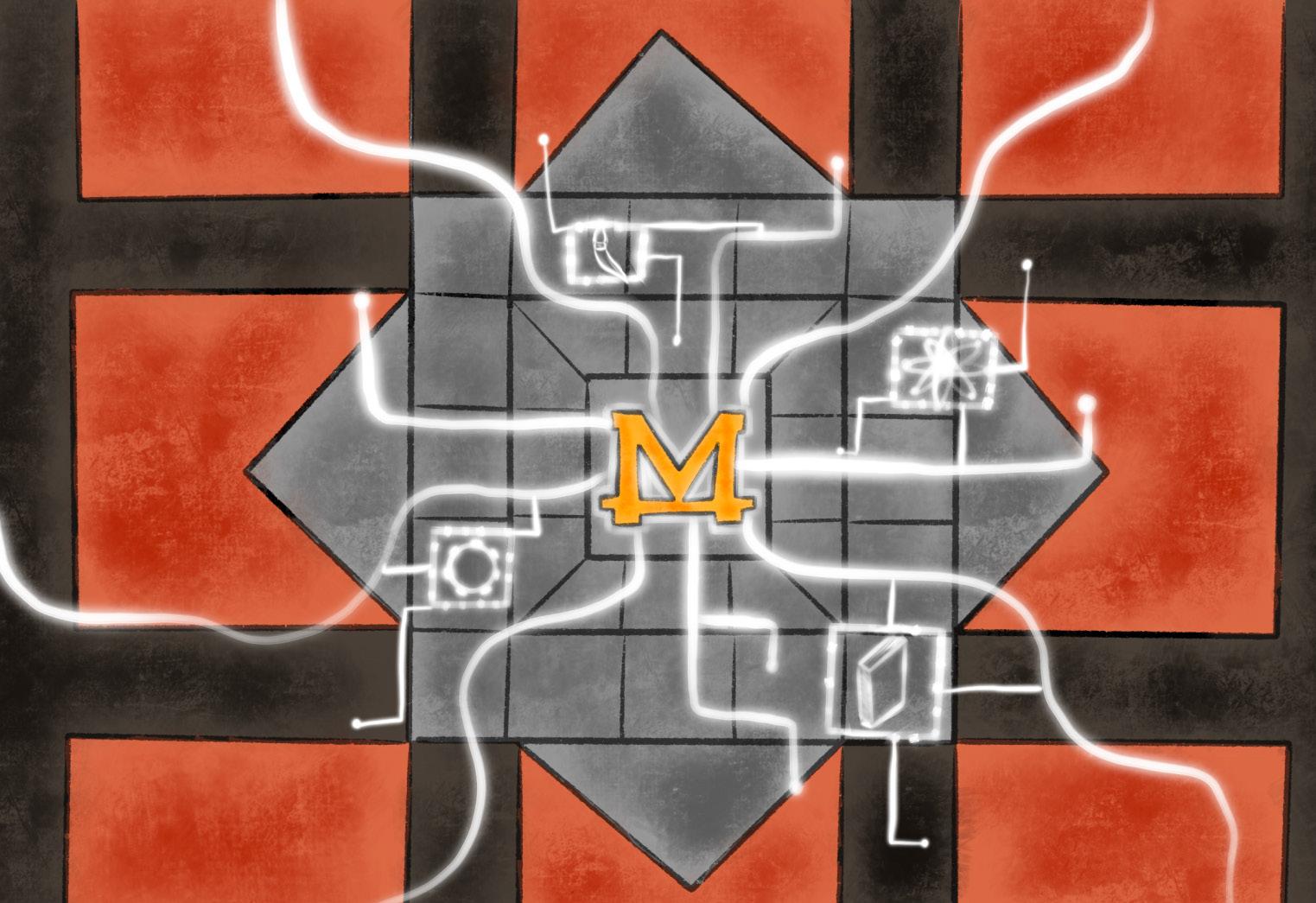
U-M GPT, one year later
the Trans Umbrella Student Protection Act, were both passed with no objections. AR 14-040 calls upon U-M administration to protect and affirm its commitment to supporting transgender, nonbinary, two-spirit and gender diverse students.
AR 14-042, the Creation of a Bereavement Absence Policy, was also introduced and passed. This policy will encourage the University to allow up to five excused absences in a two-week period for students who have experienced the death of a loved one. It will also accommodate additional excused absences for travel for those students. Although the resolution does not specify what constitutes a loved one, LSA representative Riley Kina argued passing the resolution represents progress, even if it lacks specifics. “They (the administration does not) know how to work this, and they’re looking for other places like CSG resolutions to figure this out,” Kina said. “I just wanted to push this out there again, to get it on the top of their mind.”
UMich technology experts give insights on how the AI has evolved since its release
BARRET DOLATA Daily Staff Reporter
In August 2023, the University of Michigan released U-M GPT, making it the first major university to offer its own generative artificial intelligence model. In collaboration with the University’s Information and Technology Services, U-M students, faculty and community members have had access to U-M GPT, U-M Maizey and the U-M GPT Toolkit for a little more than a year. The Michigan Daily spoke with U-M technology experts about how AI on campus has evolved in the year since its release.
After playing a primary role in U-M GPT’s development, Ravi Pendse, vice president for information technology, reflected on his initial vision for the University’s role in the AI conversation a year later.
“No other institution in the country or world currently has the kind of access that we are providing,” Pendse said. “We did not want a situation where somebody who has money gets to use some of these things and others who don’t maybe don’t get to use good tools.” Pendse said there have been many technical innovations made to the platform since its initial release. One such feature is a personal AI assistant called MiMaizey, which was introduced in September and supports students’ daily needs, ranging from class materials to dining hall options to transportation. Pendse said the University already plans to release a MiMaizey app for both Android
and Apple users early next year.
“You can just ask questions verbally,” Pendse said. “I can say, ‘MiMaizey, can you tell me how long it takes me to go from Central Campus to North Campus?’”
Pendse also described plans to release an additional platform called Go To College, aimed at helping first-year college students navigate campus. The platform would provide information on grants and funding to prospective college students in high school, which he says may help prospective students pursue their educational dreams without financial barriers.
“There are many families and students out there who sometimes struggle navigating the whole scholarship grant environment because it can be complex and often some of them don’t end up going to college,” Pendse said. “So we asked the question, ‘What should Michigan do (as) the leaders and the best?’ I said we should solve the problem.”
Nikola Banovic, U-M associate professor of computer science and electrical engineering, is a human-computer interaction researcher who specializes in human AI interaction. In an interview with The Daily, Banovic said he has researched how students at the University interact with these kinds of technologies. Banovic found a general tendency to exaggerate the competence of AI technologies across his research.
“It can easily mislead somebody to over rely on it,” Banovic said. “When I say over rely on it, that means that people are unable to check whether this technology has produced the
right output.”
Banovic emphasized potential limitations for students who lack domain expertise, and said AI literacy is not inherent, leaving students with varying abilities to assess tools like U-M GPT’s outputs. From collecting data and talking to students, Banovic found little evidence to show that students assess biases in their current uses of these technologies.
“And even when they notice certain things, maybe they stumble upon some kind of undesirable output, they rarely — or we don’t really have much evidence to show that — they then deeply engage with it and try to resolve it,” Banovic said. “What we have found is that they’re not really principled in their approach, and that is fine because there are no courses that necessarily teach them.”
Banovic said LSA students have access to a week-long, generative AI course called Generative AI Essentials: Overview and Impact that provides them a higher level of understanding of these technologies, but it does not offer insight into identifying their biases. In that class, Banovic described a lesson that aids students in understanding some of the potential biases of AI.
“We use a very classic example of feeding in a cover letter with a name that is sounding like it’s the name of Caucasian man and then the same cover letter that is signed by a name that is sounding like an African American woman,” Banovic said. “Chat GPT — or U-M GPT in this particular case — actually produces different outputs. When one reflects on
the differences, well it begs a question: Why, when the only difference truly is somebody’s name?”
Rackham student Snehal Prabhudesai, who is pursuing a Ph.D. in computer science and engineering, told The Daily that since the release of ChatGPT in November 2022, there has been a rush for universities to create their own proprietary AI models. Prabhudesai has looked at U-M GPT systematically as a part of her research and uses the platform personally.
“Maizey and other stuff U-M offers, while they offer these tools, the guidelines they provide are not very concrete,” Prabhudesai said. “ Rather they just say that, ‘Oh it’s important for students to critically evaluate the
outputs they can have, like biased responses or hallucinations,’ and sort of just shift the responsibility to students without clarifying what or how.”
Prabhudesai assessed the ways in which students interacted with the guidelines provided by U-M GPT along with the specific challenges faced by both those with limited AI knowledge and more experienced users.
Prabhudesai studied AI use by students with varying levels of familiarity and found that University guidelines on AI use were confusing for students.
Pendse stressed that the University’s AI tools are available to everyone while making clear that these tools are meant to augment and assist, but not replace.
“I’m very excited about the future as to what this technology will bring, but at Michigan, we’ll always be thoughtful about how we use it,” Pendse said. “We’ll always be mindful of its impact on the environment and collectively at Michigan, leaders and best, we will show the world how to use the technology the right way.”
“People had to default to their prior knowledge because they couldn’t get much more information from these guidelines,” Prabhudesai said. “It really exacerbated inequalities, but we saw that providing some form of structure delivered through maybe user interfaces or CS learning theories, they were led to much better support than these very vague and confusing guidelines.”
CHIARA DETTIN Daily Staff Reporter
Natasha Eliya/DAILY
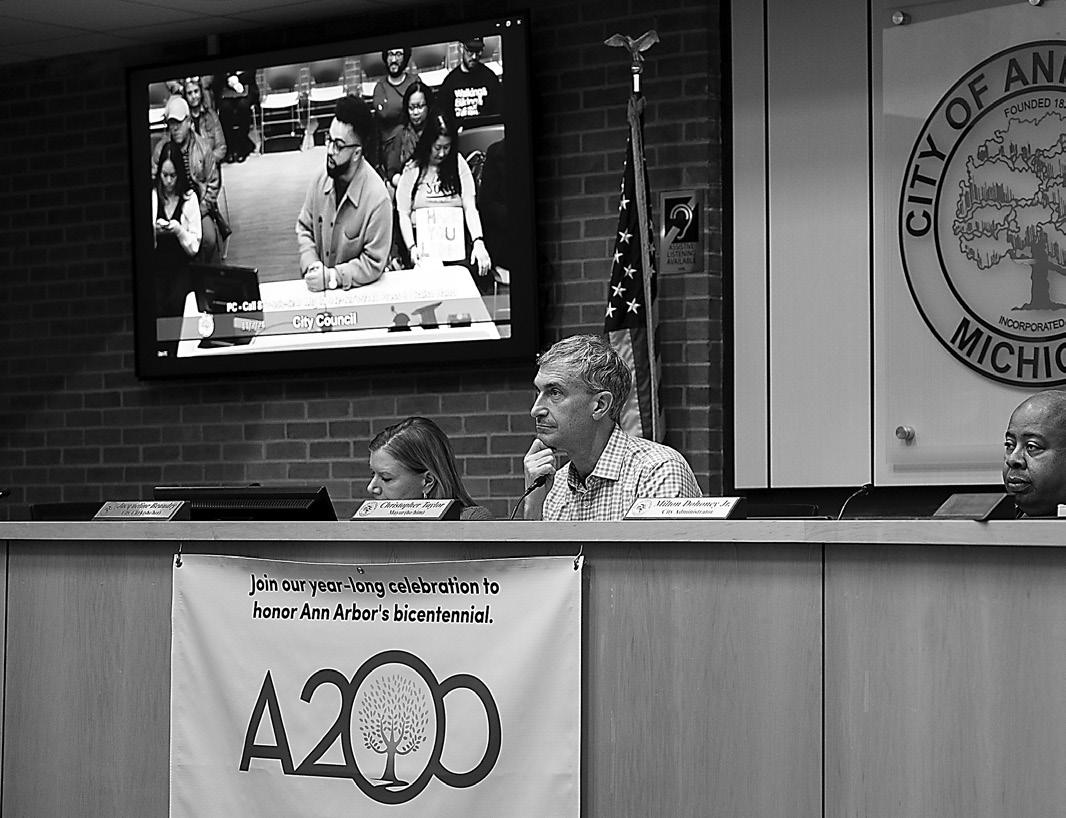
Ann Arbor City Council reflects on the departure of Councilmember Linh Song
The council also discussed amendments and the 2024 presidential election results
DELILAH DAKIS Daily Staff Reporter
The Ann Arbor City Council met Thursday to discuss amendments to Section 9:103 of Chapter 111 of Title IX and the 2024 presidential election results. Twenty Ann Arbor community members spoke in recognition of City Councilmember Linh Song, D-Ward 2, who is retiring from her position.
The ordinance to amend Chapter 111 of Title IX calls to strengthen current fire codes by making smoke detectors a requirement in Ann Arbor homes and requiring periodic fire safety inspections of nonresidential buildings by the fire marshal.
Ann Arbor resident Adam Goodman said he is in favor of amending Title IX to improve fire codes because they help decrease apartment fire deaths.
“Modern fire codes save lives,” Goodman said. “According to some data from the National Fire Protection Association, apartment fire deaths actually dropped 54% in this country from 1980 to 2022. Just 470 people died in apartment fires in 2022, and the vast majority of those serious fires actually occur in older buildings that do not have fire suppression systems like sprinklers, which are basically a requirement for new mid-rise and high-rise buildings.”
Councilmember Travis Radina, D-Ward 3, spoke about
how the council will move forward following President-elect Donald Trump’s reelection. He said that the council will work with nonprofit organizations to continue to support and protect the Ann Arbor community.
“Local leaders here in Ann Arbor and around the country need to stand ready to protect our communities, and I know that Ann Arbor leaders are ready to fight each and every day for our residents,” Radina said. “I also know that there is a network of nonprofits in our community that are ready to support the community in many ways as we move forward. Look to one another, and we can get through this. Our democracy will persevere.”
Song announced she will not be running for reelection earlier this year. Councilmember-elect Jon Mallek, D-Ward 2, was elected in Song’s place.
Song’s husband Dug Song told the council about his wife’s commitment to platforming Ann Arbor’s diverse voices. He noted that Linh Song actively worked to represent the Ann Arbor community through helping elect Councilmembers Cynthia Harrison, D-Ward 1, and Chris Watson, D-Ward 2, the council’s first Black members in 15 years.
“I know her as someone who sees public service really as a calling to create pathways for others,” Dug Song said. “She understands that true progress
requires changing not just policies but who sits at the table. Linh doesn’t talk about representation — she has actively worked to build it.”
Harrison said she appreciates Song as someone who has helped guide and support her personally. More specifically, she said she appreciates Song’s efforts to uplift people of Color in the Ann Arbor government.
“Linh has been a gracious mentor, and I deeply appreciate all that she’s done to advance inclusivity and equity through her work in government and in the community,” Harrison said.
“Thank you for your support, your generosity, but most important for believing in me.”
Ann Arbor community member Aidan Sova said Song
encouraged him to run for the Ann Arbor District Library’s board, progressing opportunities and resources for minority communities in Ann Arbor.
“You talk so much about advancing opportunities for those that are underserved or marginalized, and you are one of the few leaders I know who not only talks about it, but does it,” Sova said.
Linh Song said after leaving the council, she plans to do philanthropic work and service through the Great Lakes Housing Services.
“I’ll be continuing my philanthropic work in housing justice, the arts and social services in Southeast Michigan,” Song said.
Ford School hosts post-election analysis with UMich faculty experts
Experts discussed the events transpired on Election Day and what those actions might mean for the future
The Gerald R. Ford School of Public Policy held a Post Election Analysis discussion with University of Michigan faculty experts Friday afternoon to discuss the results of the general election on Tuesday, Nov. 5. The discussion covered the events of Election Day, potential factors in the results and what they mean for the future. The analysis was moderated by Mara Ostfeld, public policy research associate professor, and featured panelists Javed Ali, public policy professor of practice; J. Alex Halderman, Bredt Family professor of engineering; Gerald J. Hills, public policy teaching professor; Barbara McQuade, law professor of practice; and Vincent Hutchings, professor of political science and Afroamerican and African studies.
Prior to the event, LSA freshman Summit Louth said in an interview with The Michigan Daily that he
was unsurprised by the election outcomes.
“Personally, the result was expected, though very disappointing at the same time, just because it’s kind of obvious that Americans weren’t really happy with the current economic or social situation that the U.S. is facing,” Louth said.
Louth said he decided to attend the event to understand how the election results came about.
“I think it’s important to know, as a voter, what caused the results of the election, despite whatever preconceptions or assumptions I had,” Louth said.
During the 90-minute discussion and Q&A, the panelists discussed Michigan’s shifting political landscape, voter demographics, campaign strategy and election security. They also fielded questions from students regarding foreign policy, polling accuracy, Republican dominance in the polls and what the election could mean for higher education, among other
topics.
Ostfeld opened the discussion by noting that 45% of Latine voters chose President-elect Donald Trump in this year’s election, a 13-percentage-point increase from the 2020 presidential election and the highest mark reached since the United States began specifically recording Latine votes. She also highlighted that Latine voters, particularly men, were more likely than any other ethnoracial group to cite the economy as their top issue.
“To add an additional dimension to this, when they were asked who they thought could better handle the economy, Latinos broke for Trump by a pretty large margin,” Ostfeld said. “Only 30% of Latino voters said Trump in 2020. This year, 47% of Latinos said they trusted Trump more to handle the economy.”
Hills analyzed Vice President Kamala Harris’ presidential campaign, particularly in relation to change and reform. Hills said he believes Harris’ campaign
failure stemmed from her refusal to differentiate herself from past Democratic candidates, referencing Harris’ interview on The View where she said she would not have acted differently than the Biden administration over the past four years.
“(Harris) needed to run almost as a third party candidate, someone different – new, exciting, better – than the two unpopular people who had been running, Biden and Trump,” Hills said.
Hills also touched on Michigan state elections, analyzing U.S. Rep. Elissa Slotkin’s (D-Mich.) razor-thin U.S. Senate victory and predicting a Democratic Party comeback in the 2026 midterm elections akin to the 2018 midterms following Trump’s first presidential victory.
Halderman, director of the U-M Center for Computer Security and Society, addressed the mechanics and security of Tuesday’s elections.
Stanford Lipsey Student Publications Building 420 Maynard St. Ann Arbor, MI 48109-1327 734-418-4115 www.michigandaily.com
DANA ELOBAID and SAMANTHA RICH Co-Editors in Chief eic@michigandaily.com
ELLA THOMPSON Business Manager business@michigandaily.com
NEWS TIPS tipline@michigandaily.com
LETTERS TO THE EDITOR tothedaily@michigandaily.com
The University of MichiganFlint School of Nursing received a $3.94 million grant through the federal Health Resources and Service Administration in October to fund the new U-M Flint Educates Rural Nurses program. The program aims to recruit nursing students and improve healthcare outcomes in Michigan’s rural “thumb” region, which includes Huron, Lapeer, Sanilac and Tuscola counties.
Beginning in January 2025, the UM-FERN program will support a cohort of eight students each year. The four-year grant will cover the cost of textbooks, transportation and tuition for a Bachelor of Science in Nursing degree for the entire cohort. The
program will establish a physical classroom in the thumb region to host virtual classes synchronized with the main U-M Flint campus in real time. These distance-learning classes will be supervised by a faculty coordinator, who will be able to answer questions and teach nursing lab skills in person.
Megan Keiser, UM-FERN project manager and nursing professor at U-M Flint, explained to The Michigan Daily how crucial it is for the program to establish a learning space in the thumb region.
“One of the greatest barriers we’ve heard about the thumb region is the fact that there is not even a community college within a reasonable distance,” Keiser said.
“We are geographically the closest baccalaureate institution to the thumb region.” In order to be eligible for the UM-FERN program, applicants
must be highly motivated and possess a minimum 3.0 cumulative GPA and a 2.75 science GPA, according to Keiser. Additionally, applicants must reside in either Huron, Lapeer, Sanilac or Tuscola counties and contractually work in a hospital or long-term care facility located in one of the counties upon completion of their degree. The duration of the contract is yet to be determined.
Carman Turkelson, assistant director of UM-FERN and nursing professor at U-M Flint, told The Daily why the program decided to focus on recruiting students in the thumb region. She said she hopes that the program will increase the amount of people who receive higher education within Huron, Lapeer, Sanilac or Tuscola counties.
“In Huron County, 16.6% of people have a bachelor’s degree or higher,” Turkelson said. “In
Tuscola County, it’s 15.3% — compared to the state of Michigan, which is 31.1%. They have half as many people who are getting a higher degree. That probably has a lot to do with access, not necessarily desire.”
Keiser emphasized the need to recruit students to pursue the nursing profession in particular, citing nurse shortages in Michigan as well as worse health outcomes in the thumb region as compared to the rest of the state.
“The thumb area has horrible health outcomes, and again, it’s because of access to care,” Keiser said. “Even if you can get access to care into a long-term and acute facility, you’re not necessarily getting the best level of care because the
is
and the
of
ARTS SECTION arts@michigandaily.com
SPORTS SECTION sports@michigandaily.com
Editorial Staff
ADVERTISING wmg-contact@umich.edu ABBY SCHRECK Digital Managing Editor schreck@umich.edu
COLE MARTIN and TINA YU Managing Audience Engagement Editors socialmedia@michigandaily.com
Senior Audience Engagement
MEREDITH KNIGHT and NAZIM ALI Culture, Training, and Inclusion Chairs accessandinclusion@michigandaily.com
Business Staff
GABRIEL PAREDES Creative Director
ANNIKA CHINNAIYAN Sales Manager
Ananya Kedia/DAILY
5 bills to watch in the Michigan Legislature: October 2024
Each month, The Michigan Daily publishes a compilation of bills in the Michigan legislature to inform students at the University of Michigan about what is happening in their state.
The following article explains five bills that have been introduced, passed or signed into law by the Michigan Legislature or Gov. Gretchen Whitmer throughout the month of October.
1. Implementation of the Science of Reading into Michigan schools
Status: Signed by Whitmer Senate Bills 567 and 568, signed by Gov. Gretchen Whitmer earlier this month, will require the use of Science of Reading strategies in public schools. It also requires adequate testing for and support of students with dyslexia.
Science of Reading strategies are based on research conducted by the National Center on Improving Literacy, an organization dedicated to enhancing screening processes to identify and support students with reading disabilities, including dyslexia. These strategies support a teaching style based on five key ideas: phonics, fluency, vocabulary, comprehension and phonemic awareness — the ability to rearrange individual sounds in spoken words.
In a press release, state Sen. Jeff Irwin, D-Ann Arbor, cosponsor of Bill 567 and Bill 568, discussed the benefits of Science of Reading strategies for Michigan students and the plan for implementing the bills in public schools.
“These bills improve literacy by weaving the science of reading into our assessments, our teaching methods and through teacher training,” Irwin said. “By focusing on the foundational skills of literacy and emphasizing decoding skills in early grades, we can help thousands of students with characteristics of dyslexia from falling through the cracks.”
2. Protection of Black and Latine people from unequal birthing practices
Status: Recommended for Senate passage
The Michigan Momnibus Package, a set of bills aimed at addressing systemic barriers to maternal healthcare access for people of Color, was recommended to pass in the Senate earlier this month.
The bill package, composed of Senate Bills 818, 819, 820, 821, 822, 823 and 825 and House Bill 5826 was introduced in 2023 in response to data collected by the Centers for Disease Control and Prevention showing the mortality rate from to pregnancy-related causes is close to three times higher for Black women than white women.
The bill package establishes the Maternal Mortality Surveillance Program, composed of medical and public health professionals dedicated to studying pregnancyrelated deaths in Michigan to prevent future cases. The bills will also create a tool for patients to self-report racism in prenatal health care and increase access to doulas, including providing scholarships to individuals training for the role. They also protect the right for life-sustaining treatment regardless of pregnancy status, create a nonpunitive plan for families of infants affected by substance use and include midwives in Michigan’s health repayment program.
In a press release, Cassy JonesMcBryde, policy director for the State of Birth Justice Coalition, spoke about the Momnibus package’s potential to improve birthing outcomes and make care more equitable across the state.
“This critical legislation represents a turning point for maternal health, addressing systemic barriers in receiving equitable care,” Jones-McBryde said. “Today’s hearing marks an important step toward protecting the health and well-being of mothers and families across Michigan.”
3. Protection for Michigan residents from outdated debt collection policies
Status: Waiting to be Reviewed by the Finance, Insurance and Consumer Protection Committee
On Oct. 24, the Michigan Senate Committee on Finance, Insurance and Consumer Protection voted to pass Senate Bill 408, a resolution to modernize Michigan consumer debt policies by protecting assets, like vehicles and homes, from seizures. The bill would also change garnishment exemption laws — protections from taxation on certain parts of a person’s income — and provide measures to prevent the earned income tax credit from going to debt collectors.
The bill was first introduced in June 2023 in response to an increase in the Michigan Earned Income Tax Credit and relies on findings presented in a study on debt-collection lawsuits conducted by the Michigan Justice for All Commission — an organization working to increase access to the civil justice system.
State Sen. Mary Cavanagh, D-Redford Township, one of the bill’s sponsors, spoke in a press release about its benefits for lowincome Michigan residents.
“This bill package ensures that public benefits go to those in need instead of private debt collectors,” Cavanagh said. “It protects working families and seniors from ending up on the street simply because they’ve filed for bankruptcy. Everyone, regardless of their financial situation, deserves to have their basic needs met.”
4. Resolution to designate Sept. 15-Oct. 15 as Hispanic Heritage Month
Status: Signed by Whitmer
Senate Resolution 142, introduced by Cavanagh, establishes the period between Sept. 15 and Oct. 15 as Hispanic Heritage Month to honor the accomplishments of Latine and Hispanic communities in Michigan.
The resolution is a response to the rapidly growing population
of Hispanic and Latine residents in Michigan. In a press release, Cavanagh wrote about the importance of representation, especially for communities often unappreciated for their positive impacts on society.
“As Michigan’s fastest growing population, we deserve a seat at the table, and myself, along with other Latino Leaders, are ensuring our voices are heard throughout Michigan’s legislative and budget process,” Cavanagh said. “The contributions of Hispanic and Latinx Americans can be felt in every corner of our state and communities. It is an honor to celebrate and highlight those contributions by investing in historically underserved communities and showcasing opportunities for future Latinx leaders.”
State Sen. Erika Geiss, D-Taylor, a sponsor of the bill, expressed the importance of this resolution in a press release, citing the economic and cultural impacts of Hispanic and Latine residents on the state of Michigan.
“This is a vibrant, active community, and today the
Michigan Senate formally recognized their contributions to our state’s economy, culture, history and legacy,” Geiss said. “As the only Afro-Latina member of the Michigan Legislature, I am proud to share in this recognition, as we work to strengthen and celebrate diversity por todos.”
5. Increased penalties for businesses illegally employing minors
Status: Referred to Committee on Labor
On Nov. 7, Senate Bills 963, 964 and 965 were referred back to the Michigan Senate Committee on Labor after previously being passed by the committee on Oct. 30. The bill package is focused on protecting Michigan minors from illegal employment, and will increase fines for businesses illegally employing minors or subjecting them to unsafe work conditions. Additionally, the bills will give the authority of issuing work permits for minors to the Michigan Department of Labor and Economic Opportunity, a responsibility currently held by the Michigan Department of Education.
The bill would require employers to comply with the Youth Employment Standards Act, a public act requiring minors to receive work permits prior to starting a new job. Likewise, the bills update the system for YESA minor work registration through the Department of Labor and Economic Opportunity, requiring the submission of minors’ physical limitations and contact information to be able to work.
State Sen. Sylvia Santana, D-Warrendale, sponsor of S.B. 963, spoke in a press release about the importance of prioritizing the protection of Michigan’s youth in the workplace, while still allowing them to
The University of Michigan Esports team held its semesterly Community Local Area Network event in the Central Campus Classroom Building last Sunday, where about 50 students gathered to talk and play video games together.
Several student organizations, including Michigan Tetris, Michigan Chess Club and Alternate Reality Initiative, hosted dedicated spaces for students to play and learn more about their respective games.
Event attendees also watched a
live broadcast of the esports world championship for the online game League of Legends.
LSA senior Caedon Zube, U-M Esports president, said in an interview with The Michigan Daily the event got its name from the way gamers used to get together.
“They’re called LANs for ‘local area network,’ where people used to get together and wire their computers together to play games without using Wi-Fi,” Zube said.
“That’s not exactly what our LANs look like, but it’s still the type of thing we theme them around. All of the games our club plays come in with their own hosted event spaces,
so their individual communities can host their own games and hang out in person.”
Business senior Giana Mae Anguiano, U-M Esports director of event planning, told The Daily that they crafted the event with inclusivity in mind.
“I saw that there was a need for more of the casual space, because people hear ‘Michigan Esports’ and they’re like, ‘I’m not good at video games, or not good enough to make the team,’” Anguiano said. “I feel like our club should be for all people who enjoy video games.”
Anguiano added that Esports is always trying to improve upon their
events.
“I think that’s really important because then we can adapt and change based on that,” Anguiano said. “I’ll sit with our members at the end of the event and talk with them about what went well and what didn’t, and then we can implement that into our next event.”
Engineering senior Ashley Philip, co-president of Alternate Reality Initiative, told The Daily that members of the club attended the event to reach people unfamiliar with AR and virtual-reality technology.
“Most of our club members have heard about it before, and they’ve
also taken some classes and done some coding — that’s what brought them to the club,” Philip said. “This will allow a new demographic of people who maybe don’t have that type of experience to get exposed to the technology.”
Education student Grace Chamberlain said in an interview with The Daily that she appreciated the opportunity to connect with others, even without playing games.
“I am not that into gaming, so I didn’t really participate that much, but I did like the atmosphere of the venue,” Chamberlain said. “It was nice to get to meet some people that I probably otherwise wouldn’t have met.”
Zube said he believes it is important to foster in-person connections among Esports team members rather than solely playing games online.
“Competing online is something that anybody can do,” Zube said. “You can teach yourself to play online, and you’re never going to see these guys in person. You can talk over voice and win stuff. But the impact of being able to gather everybody in one space twice a year, see all your friends, and do what everybody loves to do in person is just massive. It’s easily the most important thing that we do.”
ELIZABETH FOLEY Daily Staff Reporter
Hannah Willingham/DAILY
THOMAS GALA-GARZA Daily Staff Reporter
Trash Boat’s newest album is an angsty experiment for emo-boy fall
MIVICK SMITH
Fall always feels like a sudden apocalypse of plaid scarves and pumpkin spice, but in between the Ugg boots, a heavier, more solemn subculture percolates. For the alternative, fall is an amazing season. The blistering heat of summer has dissipated, sparing the goths from heatstroke. Obviously, there’s Halloween, which is all that stands between Labor Day and jingle bells. Most importantly, though, fall brings a horde of new music. Earlier this October, the fall gifted us Trash Boat’s fourth album, Heaven Can Wait. The British skate-punk group has grown on me since their debut album in 2016, with their expansive forays into absurdism and pop culture. Many tracks on the album have a distinct contemporary alternative sound, reminiscent of the rock band Bring Me the Horizon since they’ve shoved off this “metal” coil and retreated into pop-rock. Heaven Can Wait is a mixed bag of interesting (or at least endearing) songs and a few mediocre attempts at modern alternative.
A cheeky two-song introduction begins the album: “Watching Heaven,” and “…Burn.” I usually can’t stand these linguistic antics, but while mentally preparing myself for another milquetoast induction into modern alt, “…Burn” surprised me. “Watching Heaven” sets itself up to be extended by “…
Burn,” but the two sound virtually nothing alike. The former feels distinctly nu metal, almost akin to Deftones’ slower work, but the latter’s lazy grunge tone has just enough electric distortion to place Trash Boat firmly outside of the genre. The entire album seems to be brushing up against this contemporary interpretation of nu metal, a notable shift from their 2021 indie hard-rock album Don’t You Feel Amazing?
I don’t know if I appreciate this new wave of nu metal just yet, or really think it should be called anything-metal. Still, the trend deserves a little time to settle into some semblance of organization.
Heaven Can Wait seems intent on ushering in this new genre — with the exception of “Better than Yesterday.” This mid-album track sounds completely out of place, not only within the album but in Trash Boat’s career trajectory, reverting to the self-pitying subject matter of the band’s mid-2010s material. Even the intermittent screaming and alt-appropriate pre-choruses don’t fully redeem this song.
Lyrically, “Better than Yesterday” isn’t incredibly different from the album’s other poetic lamentations. The issue comes from fusing lines like “I guess I’ll hide from something inside” with the song’s bubbly electro melody, which just leaves this song feeling like a juvenile and slightly awkward attempt at some sort of emo confessional.
Returning to their antiestablishment British roots, Trash Boat leans into an antagonistic
vocal style to rants about political injustices in “The Drip.” The song is a surprisingly optimisticsounding experiment that merges a pop-punk chorus with the brutality of a nu metal typical breakdown. A heavy posh accent preaches the injustices of latestage capitalism, while still recognizing the complacency that’s an inherent factor in being a consumer. The point of the song isn’t to judge those who participate in capitalism for the sake of their own survival, but more the entirety of the economic system itself. The message of the song, quite explicitly, isn’t to grow apathetic fighting a system that seems insusceptible to change, but to “focus on the problems you have a chance to fix.”
Nearing the end of the album, “Liar Liar” shoves forward at a breakneck pace while playfully referencing an adolescent taunt. I’m torn if I like this song genuinely or ironically. While there’s certainly something appealing about the aggressive nature of the vocals, there’s also plenty that makes me question the seriousness of the track: The refrain literally spells out “P-I-S-S-I-N-G,” for no reason besides to characterize some hypothetical lying internet troll. A song that makes fun of itself to this extent is a little endearing; it feels like an allusion to that stupidly angry pubescent mentality all teenagers have. The chorus soothes the angry, reckless instrumentals of the verses and slides through an impressively buoyant vocal range. This relaxed
vocal style is what originally interested me about Trash Boat in their 2021 indie rock, and I was impressed to see how well it played with this more hostile genre.
Whether this album really is attempting to resurrect a subgenre, or just an interesting induction into a relatively small
discography, it’s refreshing to see a group experiment with technique and style. Trash Boat has altered their sound a lot since 2015, with varying degrees of success. If Heaven Can Wait is an indicator of the band’s new direction, they’ll need to commit. I’m not willing just yet to hold
this album up to the works of nu metal staples like Korn, but I could easily see a future where the comparison isn’t difficult to make. Ideally, it’ll
‘Abbott Elementary’ Season 4 is stronger, funnier and
of
35. 2022 hit by Gunna and Future or, when parsed as three words, what must be done to six of this puzzle's clue answers
37. Mention in a social media post, say
40. Doesn't own
41. Like a vortex
43. "Are we clear?"
46. "___ dokie!"
47. Prayer ender
48. umkin atch activity
53. Early synthesizers
55. Stuntmen
56. Kermit or Elmo
58. Retired boxer Oscar
62. Open with a key
63. Fixes u, as a shower floor
64. Move in the direction of
65. Middle of Cannes?
66. Wise smurf
1. Background figure in many video games
2. Boat propeller
3.
4. Los ___ Unidos
5. Fiction heroine Doone
6. Astrological ram
7. Sports nerd's data
8. Apple computer
9. Former Yankee slugger, to fans
10. ut together, as a conclusion
11. Aziz of "Parks and Rec"
12. Subject of Newton?
13. "This instant!"
15. Suspect, to a cop
20. Country singer Clark
22. Bun contents
23. Turing of mathematics
24. Type of tomato
25. Former Brazilian F1 driver Ayrton
29. Training for a tri?
31. Donkey Kong and King Kong
32. Ice Spice Billboard Hot 100 hit
33. Sounds of relief
36. Suffix with farm or home
37. Kind of luau torch
38. Desert descriptor
39. TV show about a high school singing club
40. aul's band artner
42. Praise
43. College grounds
44. Quantity
45. Magazine whose name is its demographic
49. San Diego baseballer
50. Tidy oneself
51. Searches reviews for a restaurant, say
52. Fool, to a Brit
54. Religious faction
57. Thrilla in Manila result, in brief
59. Portuguese greeting
60. Opposite of 1-Across
61. Cute ___ button
“Abbott Elementary” is best when it sticks to its instincts — and with the incredible Quinta Brunson (“Quinta vs. Everything”) at the helm, the consistently hilarious ensemble cast and backing from some of today’s most notable names in comedy — these instincts are pretty damn good. In its so-far so-delightful fourth season, the sitcom not only sticks to these instincts, but celebrates the very fundamentals that make “Abbott” so, well, “Abbott.” Coming in the wake of a somewhat lackluster third season, the premiere, “Back to School,” is an immediate breath of fresh air. It’s what we’ve come to expect of “Abbott” — funny, heartwarming and, of course, wildly entertaining — but it also sets the stage for a different kind of season, in all the right ways. By the end of the premiere, loose ends are tied, conflicts are set up and greater themes are established — all preparing the loyal audience of “Abbott” to not only expect another hilarious season of comedy but some complex plot lines as well. From the first minutes of “Back to School,” “Abbott” subverts expectations and flexes some new muscles.
After the cliffhanger ending of season three, the relationship arc between Janine Teagues (Quinta Brunson) and Gregory Eddie (Tyler James Williams, “Everybody Hates Chris”) could have gone in a million different directions. Janine teases one of these potential choices, saying that, while they tried a relationship out, she and Gregory were better off as friends. After holding long enough to make any fan consider writing some wild hate mail to ABC, Gregory jumps in frame and the two of them clarify.
“We got y’all! We’re dating now!”
Thank GOD.
While extending the iconic will-they-won’t-they between Janine and Gregory would have been an easy route for the show, this season of the show seems determined to not only challenge its audience, but itself. Even some classic workplace-relationship conflict
— namely, dealing with HR — is quickly resolved. Season four of “Abbott” has better things to do and more exciting stories to tell. One such story is the overarching conflict of the season: the construction of a new golf course and the subsequent gentrification of Abbott Elementary’s West Philadelphia neighborhood. For a show that has struggled in the past with larger plotlines, “Abbott” is, so far, smartly handling this situation. From a hilarious introduction of Abbott’s brand-new white student to a shady deal for some new computers (who doesn’t love seeing Melissa (Lisa Ann Walter, “The Parent Trap”) lean into her mob side?) to revealing the various ways in which the golf course’s construction will tangibly affect Abbott, it’s evident that a lot of thought went into the proper execution of this season’s plot lines. While it’s certainly nice to have a grounding storyline like this, viewers turn on “Abbott” to laugh, and this season has already produced some of the funniest moments yet. The best episodes are the ones that fully utilize the immense talent of the cast, which is really what makes the second episode, “Ringworm,” such an immediate classic. Melissa wants hot tub sex (she shaved above the knee), Jacob’s (Chris Perfetti, “The Surrogate” teaching style gets compared to the Draconian constitution, Janine is off-put by Gregory’s hyper-germaphobia, Principal Ava (Janelle James, “Kite Man: Hell Yeah!”) retreats to her secret bunker and Barbara (Sheryl Lee Ralph, “Dreamgirls”) is protected by divine intervention. All the while, custodian Mr. Johnson (William Stanford Davis, “Truth Be Told”) has some of his best one-liners yet — and that’s saying something.
“Abbott Elementary” is exactly the kind of TV we need right now. It’s energetic, it’s joyful and it’s funny — a comedy that is committed to belly laughter, but not without tugging at the heartstrings every once in a while.
While I wait in suspense for the rest of the episodes to air, I can confidently predict a stellar Season four for “Abbott Elementary.” Current grade: A+.
CAROLINE CAHILL Daily Arts Contributor
Courtesy of Trash Boat
Booker Prize 2024: The Michigan Daily Book Review’s predictions
As routinely as the changing of the seasons, every year the Booker Prize — the leading literary award in the English-speaking world — is conferred to what is believed to be, in the judges’ view, the bestsustained work of fiction written in English and published in the United Kingdom and Ireland.
This year, The Michigan Daily Book Review took it upon themselves to read and review the six novels shortlisted for this year’s Booker Prize. Although the overarching goal of delicately crafted literature has never been and never will be to be minimized to a mere award, contests such as the Booker Prize decide, time and again, who the up-and-coming authors of our time are and how they have rightfully claimed their place in the literary world. Our writers have devised detailoriented reviews analyzing the literary artistry that lies behind each of these novels, deciding, in their own right, whether or not they merit their nomination. In a culminating article, our writers come together to discuss which of the shortlisted titles they believe will ultimately be crowned the winner.
We hope you’ve enjoyed this series, and thank you for sticking with us until the end.
—
Graciela Batlle Cestero, Senior Arts Editor, and Camille Nagy, Books Beat Editor
Yael van der Wouden’s “The Safekeep” is … haunting and full of desire.
“The Safekeep” is a riveting lesbian period drama set in the shadow of the Holocaust.
Debut author Yael van der Wouden navigates a variety of historical lenses with ease, from
CORA ROLFES Daily Arts Writer
examining what it means to be a Queer woman in the 1960s to navigating being a survivor of a deadly genocide in a country still struggling to acknowledge its own role in that tragedy. It’s a heavy task, especially given the subject matter. Yet van der Wouden’s writing has a beauty and lyricism that echoes great Queer novels of the past (see Radclyffe Hall’s “The Well of Loneliness” or James Baldwin’s “Giovanni’s Room”), even as she converses with personal and national memory, weaving between English and Dutch in the process. It’s undermined, unfortunately, by an ending that comes perhaps a little too easily, at odds with what is otherwise a nuanced understanding of desire and trauma. In another year, I don’t think this would prevent what is by all other accounts a polished and extraordinarily crafted novel from claiming the Booker — but Percival Everett seems wellplaced to claim the prize with his newest novel, “James,” after being shortlisted in 2022. Give van der Wouden a few years, though, and that may be a different story.
Daily Arts Writer Alex Hetzler can be reached at alexhetz@ umich.edu.
Anne Michaels’s “Held” is … beautiful but exhausting.
Anne Michaels’s “Held” is a meticulously crafted exploration of one family’s relationship with war and each other throughout multiple generations. The novel’s first half follows a couple named John and Helena and their lives before, during and after World War I. The remaining portion tracks their children, grandchildren and greatgrandchildren through their own journeys of war and peace. Michaels’s unique style, with scores of different interwoven
moments in time stacked one on top of another, lends the book an air of deep beauty, but it simultaneously creates barriers to entry for readers who aren’t willing to put in the effort and slog it out.
And, unfortunately, it is a slog. The book’s lack of clear narrative structure beyond the first novella stunts its development and keeps it just below the threshold it’s trying to breach. While it’s undeniably a technical gem, “Held” lacks the engagement factor that could elevate it into a winner — it simply doesn’t have the spark that keeps a reader reading. Ultimately, the reward does not equal the effort required to claim it.
Daily Arts Contributor Ethan Rogers can be reached at ethanrog@umich.edu.
Samantha Harvey’s “Orbital” is … deeply introspective.
Samantha Harvey’s “Orbital” explores the full weight of humanity and the meaning of our existence in a snapshot of just a single day. The powerful yet short novel highlights the lives of six astronauts on the International Space Station orbiting around the Earth while struggling to make sense of their distance from everything they know. Each of these men and women, despite coming from various backgrounds and nationalities, are united in this experience. Through this, “Orbital” focuses more on the human emotions that arise from space travel, which might seem less significant in other science fiction novels.
While there is a pure and winding beauty in Harvey’s prose, “Orbital” is a natural amalgamation of much that has already been said when it comes to writing about our humanity. Harvey’s unguided lens from space is certainly a
fresh perspective, but one that might blend into other works that make the same arguments about what separates and brings us together. Although we don’t predict “Orbital” will win this year’s Booker Prize, that does not mean it is not worth reading. With simultaneous melancholy and hope, Harvey spins together a beautiful story that reminds us that we are human no matter how far from home we may be.
Daily Arts Writers Logan Brown and Archisha Pathak can be reached at loganvb@umich. edu and archpath@umich.edu.
Rachel Kushner’s “Creation Lake” is … complex and sure to be controversial.
In the strictest of terms, “Creation Lake” is a spy novel following a woman who attempts to infiltrate a French leftist, anarcho-primativist commune suspected of acts of ecoterrorism. Oddly and delightfully, though, the book itself is more about our spy, Sadie, grappling with the challenges of her own identity. Sadie is not a good person — she lies and deceives for the good of herself and her clients without much regard for the people she has to screw over in the process.
While gathering intel on the commune’s activity, Sadie reads and intercepts emails from a mysterious thinker named Bruno, who speaks of liberating oneself from the evils of modern life by literally going back to Neanderthal roots, living in caves and darkness. Despite her almost all-consuming cynicism, Sadie is intrigued by Bruno’s conception of how all political expression boils down to a form of identity formation unless done completely privately, for oneself only. Thematically, Sadie’s espionage mission is less of a practical plot choice and more of a way for
Kushner to explore what it means to create an identity you can live with in peace.
“Creation Lake” is fascinating and filled with very good prose, but I don’t predict it’ll take home the Booker Prize. Despite its killer concept, the work is chockfull of oddities that are sure to divide readers’ opinions. Sadie’s inconsistency as a narrator, an ambiguous relationship to plot movement and a strange series of unrealistic conveniences pointed out by the book itself are all moves that will be perceived as extremely intelligent by some readers yet unbelievably distracting by others. While I am solidly in the Rachel-Kushner-isa-literary-gift camp, I don’t think all will be convinced.
Daily Arts Writer Grace Sielinski can be reached at gsielins@umich.edu.
Charlotte Wood’s “Stone Yard Devotional” is … hard to find, literally.
Obtaining a copy of this book was ridiculously complicated, but after more than a month of sitting around and waiting for it to appear on my doorstep, I am happy to report that I now possess a free advanced copy from the publisher and a full refund from a well-meaning (though slightly unreliable) book retail company. A big thank you to “Paul, Customer Support Hero” — you are as heroic as your email signature claims.
Lucky for me, “Stone Yard Devotional” is well worth the wait. It’s formatted as a series of journal entries written by a woman escaping a period of profound burnout from her busy life of social and environmental advocacy. She takes refuge in an abbey near her hometown, and what follows is a quiet, soulcleansing meditation on the meaning of human life. Wood
writes in honest, meandering prose that feels deeply authentic. It’s a story that rings true, cutting to the core of the human experience — and that’s just the first 200 pages I’ve read thus far. A full review will be out soon, but for now, believe me when I say that “Stone Yard Devotional” is formidable. Daily Arts Writer Pauline Kim can be reached at kpauline@ umich.edu.
Percival Everett’s “James” is … our winner ! “James” is subversive, exciting, uncomfortable, absurd, hilarious, tragic and everything in between. The success of the film “American Fiction,” which adapts Everett’s 2001 novel “Erasure,” has catapulted the author to the cultural spotlight in recent months. While he has an impressive backlog of critically acclaimed novels, even being shortlisted for the Booker Prize in 2022, “James” is the perfect story to finally secure him the acclaimed literary award. The novel masterfully upends Mark Twain’s contentious classic, “The Adventures of Huckleberry Finn,” focusing on Jim, the runaway slave who accompanies Huck. James, as Everett imagines him, has a rich, perplexing internal world. Everett’s inventive recharacterization is thoroughly gut-wrenching and exposes the open wounds surrounding slavery, representation and the language of the oppressed. Through James’s eyes, well-known childhood adventures become an odyssey, rife with references to Voltaire and Locke, bursts of violence and dry irony. Whether it be in the adept use of dialects, engrossing storytelling or bitingly impactful narrative, Percival Everett far and away deserves the Booker for the spectacular “James.”
‘The Third Gilmore Girl’ isn’t from Stars Hollow
In her memoir, we learn that before Kelly Bishop (“Gilmore Girls”), was dubbed “The Third Gilmore Girl,” she was a ballerina.
Bishop was raised by a woman who knew what she wanted for her daughter. When her husband refused to pay for ballet classes for young Carole (Bishop’s nonstage name), her mother bartered with the school to lend her skills as a pianist in exchange for lessons for her daughter. With the mentorship of those instructors, Bishop was eventually able to move to New York City and start her career as a dancer in the ballet corps at Radio City Music Hall. This was all long before Lorelai Gilmore stepped foot in Stars Hollow.
I don’t mean to center Bishop’s life around her perhaps bestknown role of Emily Gilmore, the steely and stubborn matriarch of the “Gilmore Girls” clan. It’s probably why most people picked up the memoir — me included —
and yet, I think it’s actually best to get its inclusion out of the way. Bishop saves her remembrance of that role for its chronological slot and devotes only 50-some pages to that chapter in her life, the majority of which are colored by her husband’s illness. While she clearly has a fondness for her time on set and the people the show gave to her, she doesn’t have all that much to say about her time as Emily. The real emphasis of the book and the more formative years of her life were the ones she spent in New York, making the transition from dancer to actor, in the show that is said to have saved Broadway: “A Chorus Line.”
It’s during this section of the book that Bishop’s prose excels. She is simple, honest and raw, capturing the energy of a conversation you have with your great aunt who you only see at Thanksgiving after she’s had a glass of wine. She has a crackling attitude, biting wit and an enormous sense of self.
It’s not that Bishop’s stories are outlandish or unbelievable — it’s quite the opposite. There’s
something comforting about the tales she has decided to invite us into. Her story is not one of overwhelming, instant success, and she doesn’t find herself stuck waxing poetic about her glory days long past. Instead, she invites us into the oscillating rhythm of her life in show business: job to job, never waiting or dreaming about the eternally foretold “big break” but eager nonetheless to work for her next role, begrudgingly grateful for receiving parts that weren’t exactly what she was seeking. I found myself admiring how Bishop was frequently willing to take the not-quite glamorous roles in soaps and tours to pay the bills, but doing so while still never sacrificing her self-worth, requesting raises or salaries equal to her male counterparts and unafraid to walk if her needs weren’t met.
Bishop has always been, if not self-assured, self-known. She understands who she is and the rules she plays by. She expresses her perhaps less honorable moments — a boyfriend strung along and a resulting affair —
right alongside moments that, to any audience, display her grit and innate sense of right and wrong.
She somewhat sheepishly recounts her refusing to leave the Broadway production of “A Chorus Line” for the tour production in Los Angeles, not wanting to let down New York audiences that had already bought tickets.
“(There were) no secondthoughts about the choice I’d made,” she recounts. “Just sadness over saying goodbye to the show, and the extraordinary people involved, that had transformed my life in so many ways.”
About 30 pages in, she recalls
It’s hard to compress life into one story, difficult to trap relationships and careers in ink.
Bishop seems to know what her memoir is about as early as the first chapter, opening with the electric workshop session that would inspire and become the book for “A Chorus Line” — a production she would go on to win a Tony for. From there, she takes us back to her childhood, and the story goes on from there. And on.
Once we reach her “Gilmore Girls” era, she struggles to grasp the story’s core, loosening her grip on the narrative. We hear about her conversations with a
performance of “Hamilton” for the anniversary of “A Chorus Line” and latches onto an ensemble dancer. Watching the kicks and turns, she ruminates that while yes, it used to be her up there, it also used to be her up there. And isn’t that so much to be grateful for? She finds the dancer after the show and congratulates her, passing the torch while also insisting the dancer enjoy and embrace it.
“I’d had my turn,” Bishop said. “And it wasn’t my torch to begin with.”
Bishop’s memoir is humbling and encouraging to read. It finds its footing in the idea that achieving success and happiness largely depends on you and your commitment to yourself. Success is not defined by glamor or fame or wealth but rather by what makes you happy, the moments you remember and cling to, and your decisions. She believes that you find your dream and “work hard
“If it’s in you,” she said. “It’s out
My intangible self
KEVIN JIA MiC Columnist
A chill carves its way down the length of my body as cool water trickles down my face. The faint vibrations of the wooden door pulses with the beat of loud music, separating me from the world outside — a world I’m a part of yet strangely disconnected from. Ironically, it’s this cramped bathroom, away from the sea of bodies and voices, that offers me an escape from the claustrophobia of being surrounded by people. A place of solace to tame my storm of thoughts …
I’ve always had a tough time conveying my feelings and ideas. No matter how many people I’m with or how much conversation fills the air, there’s this gnawing sense that no one will understand me the way I understand myself. It’s a truth that sits heavy in my chest. It’s what produces that sense of anxiety I get whenever I have to talk to someone. It’s what causes me to writhe in cold sweats laying under the light of the moon, reflecting on every conversation I had the day prior. This inability to articulate what I feel often leaves me feeling empty and alone, as if I’m encased in a cocoon but never able to break free and express my true self. In it lies the very reason I decided to pick up writing — to force myself to put those elusive thoughts into words and to practice shaping the amorphous into something graspable. Yet, even writing sometimes feels like a hopeless endeavor. No matter how carefully I craft my words, they always fall short of capturing the full depth of what stirs inside.
A couple of my friends once convinced me to take the MBTI test. I was reluctant at first, but after a couple of minutes of persuasion, along with a strong desire to not do my homework, I folded.
To be frank, I regret taking that test, even though it did have some pretty interesting questions — i.e. we got into an argument about whether logical or emotional reasoning was better (feel free to email me your thoughts).
After seeing the results, I started noticing that I was trying to mold myself around the character this website had told me I’d represented. It was as if I had been handed a blueprint for my personality, and suddenly, I felt compelled to fit into its narrow frame. I started catching myself acting and feeling the way the website told me I should, almost subconsciously. If the test said I was an “introvert,” I began to think twice before going out with friends, question-
ing whether I truly wanted to be there or if I was merely forcing myself to socialize. If it labeled me a “thinker,” I tried to suppress my emotional responses, convincing myself that being logical was the “right” way to handle situations. I figure there’s no guessing what I argued for.
No doubt that’s the reason why the results come on a continuous scale, as nobody embodies one side of any characteristic wholeheartedly. We are complex, layered beings, and each of our traits are expressed differently depending on the context. For instance, someone who identifies as an introvert may still feel energized in the company of close friends, while an extrovert may crave solitude after a day spent in constant interaction. We shift along these spectrums because life’s chaos demands flexibility; the person you are at work may not be the same as the one who lounges in pajamas on a Sunday morning.
The same goes with each interaction. In the course of a lifetime, you meet hundreds, maybe thousands of people. Some pass by in a fleeting instant, others linger for years. Each relationship is like a prism refracting a different aspect of who you are, shaped as much by
the other person’s perceptions as by your own behaviors. With this comes a new side of your narrative in every relationship.
To the woman at the coffee shop, you’re the stranger who orders the same drink every morning — a latte, no foam. She knows you by habit, by routine, by the brief smile you offer when your eyes meet hers. To her, you are a figure of consistency: the same as the grind of beans, the rush of steam from the espresso machine. She might guess at your favorite book or the fact that you sometimes tap your fingers nervously on the counter and brush your hair to one side, but she’ll never know the reason why.
To your closest friend, you’re the person who showed up at 3 a.m. when their life was falling apart. You know more about them than their parents and experienced deeper sides of them than their siblings. They’ve seen you angry, vulnerable, joyous, confused. No, you are not perfect to them — thankfully, not perfect at all — but the flaws and contradictions that you’ve shown make you that much more real. They’ve watched you grow in ways you can’t even track yourself, ways you didn’t even know of. To them, you
are a montage of old stories and shared moments, fragments of time woven together with laughter, tears and hours spent fooling around when you should’ve been studying.
Some people see you and know only your past — a sibling, a parent, an old lover. They know the echoes of the person you once were: the one who made mistakes, who didn’t know better, who tried too hard or didn’t try hard enough. Sometimes they cannot see who you’ve become; the past has too much gravity, and it pulls their vision backward. When they look at you, they only see shadows of things long gone, even as you try to cast new light.
Then there are those who know you only in passing: the professor who sees you sit in that same seat, the neighbor who knows the rhythm of your footsteps up the stairs, the commuter on the bus who recognizes your face but knows nothing of your name. These are the people for whom you are a silent breeze, a brief encounter, a blip on the radar of their day. To them, you are nothing and everything all at once: a shape, a presence, a flicker of light in the periphery of their life.
And finally, there’s the mirror —
the way you see yourself, or at least think you do. You stand before it and stare, trying to make sense of all these versions, all these scattered pieces. Some days, you are confident. You see someone kind, strong, beautiful. Other days, you are unsure, your image blurred by doubt. The person in that reflective glass feels like a stranger, an enigma you haven’t yet cracked. But the truth is, you are all of these people and none of them. You exist in fragments, in moments, in the reflections of those around you, shifting with each new encounter. And perhaps that’s the beauty of it — never being fully defined, never fixed. You are a story in progress, written by many hands, and every great story comes with its ups and downs. Each chapter you live through will offer a new lens through which you are seen. You will never be the same person to any two people, nor will you ever be exactly who you think you are. And it’s also true that this thought can be unsettling. I still find it a little hard to accept that nobody will understand me the way I do; that this venture to try and fully express myself was destined to fall short from the very beginning. But, it turns out
Navigating the seas of silence
this was just me being ignorant. Ignorant to the fact that being undefined means you are free to change, free to explore the shifting nature of who you are without the weight of rigid expectations. There’s a quiet comfort in knowing that, despite the many lenses through which others view you, your story is your own to write, page by page. It’s in those uncertain spaces between who you are to others and who you are to yourself that exists the room to breathe, to grow, to love, to lose, and to live without needing to have all the answers.
I take a deep breath and open the bathroom door, stepping back into the crowd. The music swells, the conversations blur into one another, and once again, I’m surrounded. Yet, despite the faces, the voices, and the energy of the room, I feel like an outsider looking in. I move through the space, exchanging small talk, offering a smile here and there, laughing a laugh that’s not really full. But it all feels distant, detached, like I’m playing a role I’ve rehearsed too many times. Even if I told someone, no one here will truly understand what I’m feeling. Nobody at all. I smile at that thought.
BOWEN DENG MiC Columnist
Last semester, I sensed that my old friend group — people I had known since day one of college — had changed. I had no hard evidence, but something felt off. Every time it came up, though, I did my best to push the thought away. And yet, the other shoe dropped. Throughout the winter, my friends and I had been struggling to find a house, and as time went on, I was under the impression that we would likely renew our apartment lease. On the last day of spring break, I learned through a FaceTime call they were moving out. They had found a place and signed a lease, leaving me all alone next year.
in extracurriculars, but this did little to fix the gaping hole within me. In every space, I could not shake the feelings of being an outsider looking in and with that, the sting of betrayal never subsided.
the tears that stained my pillowcase, the dull ache that was worse than any heartbreak, the spiral of insecurities that went on and on. No more running; it was time to face this problem head-on.
The remainder of last year was a blur. I stumbled through my classes, feeling everything and nothing, unable to come to terms with their actions. For the longest time, I naively thought getting a new friend group would be the solution. I got more involved
One night, after yet another unsatisfactory social gathering, I collapsed in my bed, feeling completely hopeless. As I pulled my sheets over my chest, seeking a shield from the outside world, my mind felt like a cacophony of intrusive thoughts. Curled up, I could not help but recall the fallout last winter. I could still feel
In conversations with my closest male friends, I have found an unspoken cloud of loneliness eventually surfaces. The optimist in me believes we simply do not know how to tackle such a topic, while the pessimist thinks that society has conditioned us to simply not care. The truth probably lies somewhere in between. A
post-pandemic survey shows that a staggering 70% of young men do not talk to a friend when facing a personal problem, and instead opt to rely on their parents as the first source of emotional support. Combine this with the fact that men are more likely to have stigmatizing attitudes toward mental health struggles, and it is no wonder I (and I assume many other men) have felt so unfulfilled in my friendships. Too many times, I felt I had to wear a mask of indifference to not ruin my image or the vibes of the group. My upbringing contributed to this fact; my dad constantly preached to me that “男人流血,不流泪,” something he still repeats to this day. For most of my life, I had to figure out how to process my emotional burdens alone. To my own credit, I believed I had done an admirable job in this regard, but this was entirely novel. I had lost friends due to life pulling us apart, but I never had a serious falling out with anyone.
Over the summer, under the pressing of my dad, I finally told him what was bothering me. I explained the betrayal of my friends, the emotional aftermath and my future worries. His response was about what I expected. “It’s been months, why are you still thinking about this?” he asked. I stared at the floor, already regretting my decision to open up to him. “You’re not being a man about this.”
Lying in bed that night, the pieces all came together. My upbringing created a definition of masculinity that left no room for emotions; men were supposed to be “stoic.” Anything
less than that was unacceptable. Feeling uncomfortable reaching out to anyone, I often felt left to my own devices. I internalized showing vulnerability as weakness, as much as I believed this was not true. Looking back, the changes in my friend group were now much more obvious: I barely saw them even though we lived in the same apartment building. I was the only one making any effort to reach out and spend time together. Unanswered texts became the norm. Moments like this were ripe for internal turmoil: I blamed myself, convinced my anxiety was distorting reality. Truthfully, I had tolerated a ton of disrespect, but my insecurities — specifically, being “less of a man” and the fear that they would leave (which they did anyways) — prevented me from confronting their behavior. Far from the solution, “being a man,” ironically, was the problem. My attempts to push through my emotions, rather than facing them head on, led to an even worse result. As long as I had unprocessed pain, any further attempts at meaningful socialization would be a road to nowhere.
I reintroduced myself to solitude. Late night walks allowed me to reflect. My journal became my best friend; I found solace in its pages during my toughest moments. My friendship bracelet kit reminded me to work through things one step at a time; if I rushed things, they would inevitably fall apart, just like threading every bead and letter on an elastic cord. bullshit.
Lauren Hahn/MiC
A post-election message to campus
THE MICHIGAN DAILY EDITORIAL BOARD
n the early morning of Nov. 6, 2024, Donald Trump was projected to become the 47th president of the United States. At the time of writing, Trump has won 295 Electoral College votes and Vice President Kamala Harris has won 226. Trump received Michigan’s 15 electoral votes, and appears poised to win in all seven swing states. He was also awarded another honor: For the first time in 20 years, a Republican won the popular vote.
In her concession speech, Harris promised young voters it was “going to be okay.” With tensions and uncertainty at an all-time high, this reassurance was greatly needed. The nation’s hyper-partisan politics are
about to become even more polarized. University of Michigan students have not been isolated from America’s vitriolic political atmosphere. We’ve experienced first-hand the mass unrest due to foreign policy failures in Gaza and the rising cost of living. We’ve found ourselves at the epicenter of a diversity, equity and inclusion culture war. It felt like we couldn’t go anywhere without the consequences of politics thrust in our faces.
So, we voted.
We voted to secure abortion rights for the millions of women living in states without comprehensive access to reproductive care. We voted to protect the life and liberties of all immigrants to the United States. We voted to secure the ideals of American democracy. And we lost.
This Editorial Board recognizes the flurry of negative emotions encircling
From the Daily: Three questions for our future
How did we get here? During her 107day campaign for the presidency, Vice President Kamala Harris fought a battle on two fronts: one against her opponent and the other against public opinion. Before Tuesday’s election, 56% of voters disapproved of President Joe Biden’s performance and almost two-thirds of voters reported that the country was on the wrong track. This editorial board endorsed Harris on Oct. 27 because we thought she would be better for the nation. We stand by that endorsement, but we understand why many voters chose an alternative. As the second in command of the Biden administration, high prices, illegal immigration and the unresolved bloodshed in Ukraine and Gaza put Harris in an unpopular position. To win the election, she had to effectively portray herself as a candidate of change. Evidently, she did not.
During an appearance on ABC’s “The View,” Harris was asked whether she would do anything different from her predecessor as president. “There is not a thing that comes to mind,” Harris said. Her response neglected the millions of voters who suffered under the Biden administration, and that negligence didn’t sit well with voters. Given Harris’ sometimes ambiguous commendation of the Biden administration, voters doubted her ability to lead them out of the Biden rut. In her, they failed to see a new way forward. They only saw a Harris administration that would let prices rise further, let the border crisis worsen and let more children die in Gaza. As such, when voters on the fence went to the polls, they cast their vote to disrupt the status quo — a status quo that Harris represented and chose not to distance herself from.
So, Democrats failed to appeal to undecided voters, but they also failed to appeal to the typical “Democratic faithful.” The coalition that led former President Barack Obama and Biden to victory defected from Harris in droves. This strategy left the working class, Latine and male voters behind, and they ended up shifting to the right. Selecting her running-mate also provided Harris with another opportunity to stimulate voter interest, especially among voting blocs with whom she performed worse. But vice presidential candidate Minnesota Gov. Tim Walz, while popular among the Democratic voter base, failed to galvanize support in key swing states or among young men despite his working-class background. It’s possible that North Carolina Gov. Roy Cooper or Pennsylvania Gov. Josh Shapiro could have turned their respective states for Harris, had they been tapped for vice president. Put simply, the Democratic Party is no longer the party of the people. It is the establishment — the statusquo that disillusioned voters want to fight against.
Over the last four years, the Biden administration has carried out a net-positive policy platform; but it failed to market this agenda to pocketbook voters. It talked down to skeptical Americans, upset with inflation, from a pedestal. It treated the electorate as a group that would believe whatever it was told about the state of the economy or foreign affairs. Clearly, the American people don’t take condescension well.
Biden and the Democrats positioned themselves as the party of intellectualism, a decision that
likely cost them the support of the average American voter. The party overestimated the political capital of the Bipartisan Infrastructure Deal, CHIPS Act and PRO Act; Americans care more immediately about paying for groceries, not the exact details of tariffs.
On the other hand, Trump and the Republican Party’s rhetoric was simply more effective at tapping into the modern electorate, a group that had become bitter and distrustful after years of the establishment. Its policy positions, such as instituting blanket tariffs and blaming immigrants for economic hardship, were preposterous, but appealed to the sentiments of median voters who couldn’t care less about what economics Nobel Laureates had to say. Republicans realized that Americans respond more to fear than joy and campaigned accordingly. The Trump campaign gave Americans what they wanted; it met them where they were, not where it wanted them to be.
By keeping his platform broad, Trump became a fill-in-theblank candidate for the average dissatisfied American. From abortion to tariffs, Trump’s agenda is filled with unknowns. As opposed to Harris’ vagueness, which only steeled the perception that she had no plan, Trump’s vagueness allowed anti-establishment voters of all types to see themselves in him. It granted him the opportunity to create a cult of personality that didn’t need convincing, definitive policies. The success of Trump’s movement lies in its political fervor, using fear and anger to gain support from the electorate, not hope and joy. He pounced on their fear of government takeover by progressives and their anger about
the Biden administration’s policies. Moreover, the Trump campaign tapped into a cultural dissatisfaction with social progressivism, and the Democrats fell for the trap. Rather than distancing themselves from some of their more unpopular policies, they brought out Obama to call young Black men sexist for not supporting Harris. Beyond his claim being untrue, at least generally speaking, it also drove away moderates who don’t respond well to guilt trips.
The Democrats need to take the lesson going forward. What does it mean?
Donald Trump exceeded expectations on Tuesday. Unlike in his 2016 victory, he appears poised to win the popular vote in addition to the electoral college, and America now awaits his inauguration on Jan. 20. The fact that Trump, with his history of criminal acts, misogynistic behavior and racist remarks, achieved such a triumph is the strongest possible indictment of the Democratic establishment. He didn’t receive millions of votes because Americans love every aspect of him; he received millions of votes because Americans dislike so many aspects of the current administration.
For that reason, Trump is ascending to high office for the second time. He will be the first convicted felon to assume the presidency, and it is almost guaranteed that he will face no further repercussions for the many legal battles he currently faces. The Justice Department forbids prosecution of a sitting president, and Trump has stated that he would fire the special counsel in charge of prosecuting him in two of his most consequential cases.
It also isn’t explicitly illegal for Trump to pardon himself for his remaining charges. Such acts would set dangerous precedent for abuse of presidential power. A criminal leader of the free world is not only a shockingly ironic state of affairs, but it calls into question the very sanctity of the rule of law.
With a wannabe dictator in office, many of the norms that have long defined this nation will be broken. Trump’s frequent praise of dictators, desire to have “the kind of generals that Hitler had” and threats to use the military on “the enemy within” represent a massive threat to the prosperity of our nation. His plan to radically expand presidential authority has been simplified by his newly granted broad immunity in official acts. The nonpartisan judicial officials who could have kept him in check will likely be replaced by loyalists and the power of federal agencies will be eroded, meaning the presidentelect will surround himself with “yes men” who are completely under his thumb. Such trends indicate Trump’s continued obsession with assuming dictatorial power, spitting in the face of liberty, justice and freedom for all.
The Trump administration won’t stop at denigrating democratic norms. Given his campaign promises, abortion, LGBTQ+ rights, climate change action and immigrant rights are all on the line in a second Trump presidency.
The Republicans are set to hold the presidency, the Senate and are on track to retain their majority in the House of Representatives. This would create a Republican trifecta in the federal government, allowing the Trump administration to pass virtually whatever policy
campus. We are fearful for our future. We are angry at a system that allowed this to happen. We are worried for our friends, our family and our country. Now, more than ever, it’s important that we support each other and ourselves during these unprecedented times. The ideals and ideas that define the United States are not decided by the president. They are not decreed by state governors, nor are they passed into law by Congress. They are decided by us. We determine what it means to be American. In a country that feels like it has chosen to sidestep empathy, we must demonstrate to one another just how American of a value it is. To move forward, we must ask ourselves three questions. How did we get here? What does it mean? What do we do now?
the Democrats offer in response? Abortion and anti-Trump attack ads aren’t enough. Only by focusing on workers’ rights and emphasizing bread-and-butter economic issues will they have a fighting chance during the upcoming midterm elections.
The Democratic party isn’t the only group that must rethink its approach. The legacy media has spent the last several decades bleeding credibility over its coverage of Trump. Rather than reconsidering its methodologies, however, it has doubled down on the hysteria. Yes, the president elect is bad, and yes, it’s the media’s job to hold him accountable. But there’s a way to do that without turning your entire network into a revolving door of anti-Trump content. The New York Times, for example, published this headline following Trump’s victory on Tuesday: “America Hires a Strongman.” This editorial board agrees, but that’s not the point. We do opinion journalism; it’s our job to tell our readers what we think. The news, on the other hand, is supposed to deal in the facts. If the media wants America’s trust back, they can save their adjectives and connotations for the editorial page.
it wants. The Supreme Court is also conservative-led, giving the Republican majority an extra boost. Trump will be in control of judicial nominations as well. If any justices on the Supreme Court retire or die, Trump and his Republican-led Senate can easily appoint and confirm a new justice.
During his last term, he appointed three justices, giving the Court its current conservative majority; and with liberal Justices Sonia Sotomayor and Elena Kagan aging, Trump could have the opportunity to appoint two more. Additionally, Court of Appeals and District Court judges go through this same nomination process, giving Trump the opportunity to place even more conservative judges throughout the country.
There is no doubt that Trump will use the “Chief Executive” title for his own gain, at the expense of the American people and American institutions. The effects of this choice could be felt for decades, especially given the president’s power to appoint judges with lifetime tenures. As we look toward the future of the second Donald Trump administration, the possibilities for democratic backslide seem endless. What do we do now?
The Democratic party must return to the drawing board. It must build new coalitions and make room for those left behind by the new Republican party. Moreover, the Democrats must decide what their values are. They don’t seem to have a cohesive mission statement, which makes it impossible to know what they stand for. The Republicans present themselves as the party of families, security at home and strength abroad. What do
All of this soul searching, however, is somewhat secondary to the local effects of this election. Campus is divided over what happened on Tuesday. In Ann Arbor, Trump outperformed his 2020 numbers by 17%. The amount of votes going for third party candidates nearly doubled. Some students are pleased by Harris’ loss, and many others are angry and afraid. What’s necessary now is conversation and empathy. Begrudging people for their feelings — whatever they may be — won’t help our community. In order to understand what led Michigan to flip Republican, it’s necessary to understand — without judgment — what motivated people to vote how they did. The Democratic party let down its Gen Z constituency on multiple fronts. Inflation, the housing shortage and wars in the Middle East and Ukraine all spiraled out of control on Biden’s watch. It’s not surprising young people hesitated to give their support to his vice president. They aren’t responsible for Harris’ defeat; she had to earn their votes, and she failed. For many on campus, like this editorial board, these results were disappointing and unexpected. In the days following the election, it’s more than okay to grieve, but it’s only temporary. It isn’t healthy to wallow in electoral vote-induced sadness for months, and it isn’t fair to play the “blame game” about what “cost” Harris the election. Translate this depression, this uncertainty, this anger into passion. Get involved in grassroots organizing, contribute to mutual aid networks and work toward building like-minded coalitions that can be successful in future elections. Other people are feeling the same way as you right now — use that to your advantage. We’ve already gotten through one Trump presidency; be confident that we can get through another. There is no denying that this will be hard. Trump’s previous tenure proved itself to be disastrous, from his complete mishandling of the COVID-19 pandemic to his degrading immigration policy. But we can’t let the possibility of a repeat scenario limit our capacity to persevere. Stop the intra-coalition brawls and don’t fall victim to endless doom scrolling. Trump’s Republican party wants
The American Twilight Zone: The dangers of disinformation
ZACH AJLUNI Senior Opinion Editor
There is a coordinated effort beyond that which is known to the average American. It is an effort as widespread as space, and as oppressive as fascism. It is the blurring between truth and lies; between reality and fiction; between science and conspiracy; between manufactured stories and evidence-based knowledge. It is an effort to sow doubt in the minds of citizens and prey on their uncertainty. It is a moment in time that might be called the American Twilight Zone.
“The Twilight Zone” — a TV series from the late 1950s and early 1960s — was popularized by its gripping science fiction stories through the unsettling distortion of each character’s reality. Plane gremlins, an anthropomorphic ventriloquist dummy and the personification of death as a hitch-hiker all appear in episodes of the show, which consistently pushed the boundaries of logic. The scenarios in each episode are often so ridiculous that the characters don’t know what to believe. It is that particular blend of fact and delusion throughout the series that serves as a striking metaphor for our current political climate.
The past eight years of American politics have been dominated by a similar uncertainty. The media landscape and traditional information ecosystem that Americans rely on have been poisoned by disinformation and blatant lies, making it nearly impossible for the average voter to discern what is real and what is fake.
The injection of “alternative facts” (as Kellyanne Conway, former Senior Counselor to President Trump, put it) into mainstream truths, particularly by right-wing leadership, has contributed to a rise in dangerous conspiracy theories and an overall distaste for political participation. This intentional attempt to produce chaos and confusion must end in order for American democracy to prevail.
The weaponization of disinformation has been instrumental in the collapse of democratic nations and the advancement of autocratic rule throughout history. In an interview with The Michigan Daily, Barbara McQuade, University of Michigan Law professor, explained how demagogues have used this weaponization to consolidate power.
“Limiting access to information and spreading propaganda has been used throughout history to seize power or control a population,” McQuade said. “The military strategist Sun Tzu said all warfare is deception. Hitler spread lies about Jewish people and blamed them
for a struggling economy. He undermined confidence in press by calling it the ‘lügenpresse,’ which means ‘lying press.’ Stalin edited the transcripts from confessions of his enemies to admit to things they did not do. While the method for deceiving people may have changed, the strategy has been around since the dawn of time.”
This systematic undermining of a nation’s democratic norms, as McQuade pointed out, has been around for centuries. It has led to world wars and national crises. The intentional dissemination of lies and the denigration of revered institutions is the ultimate kryptonite of a thriving democracy.
McQuade argues that this spread of disinformation could result in two equally damaging outcomes for a nation built on political participation. On one hand, those who believe the fabricated injustices become infuriated and express their anger through vigilante violence. Others may not believe the false claims, but become cynical about the state of politics. They conclude that civic engagement is hopeless, which can lead to political apathy and the ceding of their power to others.
In the United States, President-elect Donald Trump and his Republican allies have actively advanced this autocratic campaign predicated upon sowing disinformation and mistrust in our institutions.
No instance exemplifies this strategy quite like a recent video of the president-elect urging his supporters to vote early and by mail. Just four years ago, Trump railed against early and mail-in voting efforts, falsely claiming they contributed to millions of illegal votes and cost him the 2020 election. His supporters believed and trusted him, and these lies of a rigged election ultimately culminated in the Jan. 6, 2021 riot at the U.S. Capitol and dozens of criminal charges against Trump.
However, seemingly overnight, the president-elect embraced mail-in voting, disregarding his previous lies. In a social media post urging his supporters to vote, Trump advocated for the same voting strategies he once decried as rigged against him.
“This will be the most important election in the history of our country,” Trump warned.
“So whether it’s mail-in ballots, early voting, voting on the day, you got to get out and vote.”
By reversing his stance on early and mail-in voting, Trump leaves voters searching for the truth — especially those who believed his lies four years prior. This intentional use of Orwellian-style doublethink confuses the electorate, breeds skepticism of secure elections and chips away at Americans’
trust in democracy.
In a political atmosphere riddled with falsehoods and disinformation, it is often the goal of voters and the media to hold government officials accountable. After all, every politician lies, and it is only fair that they are all held to the same standard. For the most part, this sentiment holds true and could help mitigate the adverse effects of intentional deception. But amid such an unbalanced abuse of rhetoric, it is equally important to avoid false equivalencies.
This becomes clearer in the context of the 2024 election. The moment Vice President Kamala Harris clinched the Democratic nomination for president, news outlets and other media began to report on her many flaws. The challenge here is to hold Harris accountable without elevating her actions to the same level of concern as Trump’s. Many media outlets, regardless of ideological leaning, are guilty of depicting these false equivalencies.
Noting her drastic platform changes from her first presidential candidacy or criticizing the way she became the nominee were valid critiques of the vice president’s campaign. Yet, these faults pale in comparison to Trump’s threat to use the military on American citizens or his disastrous tariff plan bound to spike inflation. By framing Harris’ downsides as equally disconcerting, the media normalizes Trump’s antidemocratic rhetoric and lends credence to his damaging lies.
Voters and media alike must refrain from comparing Trump’s actions side by side with other politicians, and instead should assess each objectively, recognizing real differences without presenting them as the same. This can help reduce the impact of false equivalencies and provide a confused electorate with a clearer image of each candidate.
In order for American democracy to function at its best, the electorate must reach a mutual understanding of the truth. No longer can Americans live in two different realities where nearly all information is disputed and far fetched lies are accepted.
The rise of disinformation, deception and false equivalencies has strained American democracy for the past eight years. While it may not put a definitive end to this authoritarian strategy, Americans must reject and resist Presidentelect Trump’s inevitable abuse of the presidential bully pulpit and help our country return to a political landscape built on indisputable fact rather than contrived fiction. If not, voters may find themselves slipping further and further into an American Twilight Zone whose only “boundaries are that of imagination.”
Give back to your community by shopping at local businesses this holiday season!
Every time you make a purchase with your UMCU credit card** at a participating business through December 31st, UMCU will match and donate* 1% of the total sales (up to $7,000) to B2B Trail.
B2B Trail is a 35-mile, 10-foot wide ADA accessible trail that stretches across 6 different trail corridors in Washtenaw County. Its mission is to provide an exceptional park system and preserve ecological resources.
To learn more about B2B Trail visit their website: b2btrail.org Insured by NCUA. *A charitable donation of 1% applies during the promotional period of November 1, 2024 until December 31, 2024, for merchandise purchased at participating vendors. This promotion applies for UMCU Visa Optimum and Visa Platinum Cash Rewards cards only. For each qualifying transaction, the University of Michigan Credit Union will apply 1% to the total sale, and present the B2B Trail with a one-time payment of the sum of those qualifying transactions, up to a total amount of $7,000, after the promotional period has expired. **Offer subject to credit approval, APR as low as 8.99%; maximum APR is 18.99%, based on your credit worthiness (for new applicants). **Cash advances and balance transfers do not qualify for cashback rewards. Additional limitations, terms, and conditions apply, and are subject to change without notice. The following transaction fees apply: 1% for foreign transactions, $2 for non-UMCU/non-Co-Op ATM transactions and $2 for each overdraft transfer. Daily periodic rate, minimum of 0.0246%, maximum 0.0520%.
Scan the QR code for a list of participating local businesses. Learn how you can shop and dine for a good cause and be ONE OF
The astonishing beauty of spoken poetry
I hate sharing my poetry with people. I don’t mean that I get all sheepish and a little red in the face, but bashfully and begrudgingly do it anyway. No, I mean that I abhor it.
It’s counterintuitive, I know.
I’m a journalist and a writer, and not wanting to read my work goes against basically my whole job.
I’ve never had any issue divulging very personal details of my life for thousands to read before. Still, there’s a certain, ineffable factor that accompanies reading poetry — a sort of emotional vulnerability
I’m not quite sure that I possess, which has previously kept me from reading my journals of poems. So, naturally, in the name of journalism and making an absolute fool out of myself, I set out to do the one thing I swore I’d never do: I went to an open-mic poetry night and read my work in front of an audience.
I’ve never been a particularly shy person. In fact, I would go so far as to argue that those who know me would classify me as outspoken, opinionated and generally uninhibited. I would also argue that poetry is the most intimate form of expression.
I will give my thoughts to anyone with the confidence of a much older, more knowledgeable woman, and there’s nothing scary about that to me. However, detailing my feelings in excruciating detail is foreign waters, and I’ve never been fond of treading them.
As a woman and writer, I oftentimes feel that I have to speak loudly and boldly to make myself heard; but, along the way of finding my voice, I worried that I’d lost my softness, my vulnerability. Poetry, undoubtedly, can be loud; it can be violent and unforgiving, and these things I am familiar with. But poetry can also be a kiss on the forehead or a cup of coffee looking at the morning dew. Tapping into that side of myself,
the side who is gentle and serene, is not always something I excel at. Coupled with an unsustainable perfectionist mentality, I felt that even though I had written poems about love and kindness, I had no place sharing them with anyone, ever. If it isn’t my expertise, why try?
But, the feeling of failure or the idea that my disposition should prevent me from sharing raw and genuine emotion dissipated as I remembered that I do not owe explanations of my work to anyone. My writing is allowed to be my writing, whatever shape it may take. And logically, I knew that those who would hear me perform almost certainly wouldn’t point and laugh, saying, “She isn’t in touch with her softer emotions!”
So, during an ENGLISH 215 lecture on Oct. 28, I found myself scrolling through Facebook, looking for local open-mic events and trying to nail down exactly when I’d finally take the leap and read my own poetry aloud. I wasn’t planning on telling anyone I was doing this; the thought of performing was mortifying enough without others knowing, and I wanted to confine my embarrassment to myself and whoever would be in the audience.
But then, an event in East Lansing the very next night caught my eye. I knew I was supposed to pitch a story to my editor on that day, but it was too good of an opportunity to pass up. Plus, I figured that if I was going to do this, I might as well write about it, too.
Wearing my friend’s black, cotton turtleneck, knee-high boots and lip gloss that was a shade too red for my complexion, I found myself walking into the theater at 7 p.m. sharp on a Tuesday. I marked my name down on the sign-up sheet for the night (it was a first-come, first-serve kind of open-mic) and sat in the very front row. The venue, The Robin Theatre, is a part-time theater and event space and part-time used bookstore, and you could tell. With the rustic hardwood floors, carts of old books waiting
to be purchased and the faint tinge of laundry detergent in the air, I felt strangely at home. For the open-mic night’s purposes, the event space was cleared out and replaced with plastic rolling chairs. I sat between a woman drinking a cocktail and my friend, Abigail, who came with me to the event. I originally didn’t want anyone close to me to accompany what felt like would be the most embarrassing public spectacle of my life, but I didn’t know if a photographer would be at the event and I wanted someone to take pictures for the column, selfconsciousness aside.
I was in the middle of wiping my ridiculously sweaty palms on my miniskirt when the organizer of the event, Masaki Takahashi, took the stage.
As his greeting, he said, and I quote, “What the fuck is up, people!”
There is nothing to calm your nerves like a middle-aged man in a suit yelling enthusiastic expletives at you. Truly, though, his PG-13 fervor made me feel better.
After Takahashi shared a brief poem about his ex-wife and a Wi-Fi router to open the night, the first attendee took the stage. In my anxiety-induced haze, I can’t remember the details or topics of all of the poems that were shared. My scribbled notes, meant for me to reflect back on the event, are unfortunately unsalvageable, as I was too busy getting caught up in the chorus of “ooo’s” and “mmm’s” that were periodically elicited from the crowd of intent listeners to write legibly.
After every poem, Takahashi would take the stage and announce who was “up next” and who was “on deck,” letting the current poet meander up the stage while giving the next one time to prepare. After an unspecified amount of time, he announced that the Bare Bones Improv group was up next and that I, Anna McLean, was on deck.
I’m not kidding when I tell you that my heart nearly fell out of my chest at that moment. At this point in the night, I’d seen enough to know that I’d be supported and
cheered on no matter what, but what I hadn’t realized was that, when I put my name down, I had signed up to go after a comedy improv group. Great, I thought. Much to my dismay, they killed their set. Not to say that I was hoping they’d bomb — I can assure you I wasn’t — but how the hell was I supposed to follow that up?
I supposed I didn’t have a choice, and when Takahashi called my name, I clambered up to the stage. My hands were shaking so violently I thought I’d pass out, and I had a little bit of trouble adjusting the mic to face level. I announced who I was, what I was doing there and that it was my first time ever reading my poetry aloud. I got a lot of cheers for that, and I smiled with about as much conviction as someone afraid of heights about to skydive.
But, I collected myself as best I could, took a deep breath and started the reading.
It took me a second before I found a good rhythm, but once I did, I heard my fair share of “ooo’s” and “mmm’s” from the audience and I swear I felt like I was floating.
The poem I’d chosen to share was something I wrote for a prompt during my senior year of high school in an AP Literature class. I titled the work “An ode to who you will become but who you have always been.” It wasn’t deeply emotional or cathartic for me to share, but it just felt like the right one.
As I weaved through the verses, I felt myself steadying on stage, anticipating the next line and delivering it with just the right amount of gusto I had practiced with. I couldn’t see how people were reacting to my words in the audience — the stage light was blinding me — but I didn’t really care what anyone else thought. It was just me, my work and that microphone up there, and it was one of the most wonderfully serene moments I’ve ever shared with a group of people whose faces I could not see.
You know when you’re on a plane and you hit turbulence, how those around you will start
talking about the Jell-O theory — the visual explanation that the plane is like a person suspended in Jell-O, except that you’re in a 400-ton piece of metal 30,000 feet in the air? I felt like the plane, or the person suspended in Jell-O. But, for a couple of minutes performing spoken word, I forgot all about my unease of emotional vulnerability and just simply was. I exited the stage to a round of applause and felt freer than I had in months.
I sat down smiling and asked Abigail how I did. She said I “killed it,” to which I fist-bumped the air. As I listened to the rest of the poems (and even a few songs!) be performed, I couldn’t wipe the smile off of my face.
The night closed with an older man sharing a poem for his wife of 32 years about how he just can’t help but sing to her. I actually shed a few tears at his genuine adoration of her, and I thought it was the perfect way to end off a rizz-themed open-mic.
While I don’t remember all of the words that were spoken in every poem performed, what I do remember is the emotion, the passion and the love of art that was so profoundly expressed in each of the poets’ readings. Whether they were first-timers like me or seasoned open-mic veterans, one thing was clear: Reading poetry is an art form in and of itself.
Spoken poetry encapsulates the artist’s delivery, making sure nothing is left unsaid or unclear; thus, the relationship between listener and performer is intensified, especially in a smaller gathering space like this one. People yelled, people sang and people flung their arms around and I almost reprimanded myself for ever feeling embarrassed to share something when everyone else did it so effortlessly. I noticed that most, if not all, of the performers incorporated some sort of physical movement into their set. Not only did their voices and inflections reflect the way they wanted the lines to be delivered, but so did their bodily movements. The delicate movements that each of the
performers weaved through, hand-in-hand with their words, almost reminded me of dancing. Spoken poetry is more than just about reciting a poem — it is an art form that requires your whole body.
I spoke to several attendees and performers after the show had concluded. Driving to the event, I wasn’t sure what I wanted to talk to people about. Was it the idea of overcoming stage fright? Was it asking them what it means to them to be a poet? After reflecting on what I wanted to take away from the event, I decided to inquire about what people thought the value is in spoken poetry versus written poetry. As an avid written poetry consumer myself, I can confidently say that hearing people read aloud their work, and even doing it myself, is inexplicably beautiful. In an interview with The Michigan Daily, Michigan State University senior Asha Denny described her experience with spoken poetry.
“Whenever I write a type of poem, I feel like I write the way I speak. So it never does it justice until I speak it,” Denny said. Nodding along, we continued to discuss the value of spoken word.
“It’s almost a mix of theatrics and poetry. It’s just a different type of artistry,” she said. “Just like a song, like if you were to read a song monotone, lyric for lyric … it wouldn’t hit. But it hits different when you put the movements, you put the emotion. It’s a connection between the poet and the listener.”
I was inclined to agree with her. I myself practiced the exact movements, facial expressions and modes of delivery that I employed when I read my own poem.
“You have the listener thinking about all the things that they’ve been through, all the ideas that they have in conjunction with the poem,” Denny said. “I really prefer spoken word over written word.”
I echoed the sentiment back to her, saying to myself or her, or no one in particular, “Yeah, I think I’m starting to too.”
Courtesy of Jasper Baldwin
ANNA MCLEAN Statement Correspondent
` The Michigan (housing) difference
JULIANA TANNER Statement Correspondent
Two summers ago, I stood on the concrete steps of a turn-of-thecentury white church and checked my phone — its screen read “10:59.”
I cast a glance around the street.
The church’s bright red double doors and towering pointed arch window were in stark contrast to the accompanying rows of more typical suburban housing. Atypical to standard suburbia, however, were the dozens of white sneakers hanging from the power lines, the maize-and-blue-painted beer pong tables on front lawns and a cardboard cutout of Shaquille O’Neal peering out from the inside of a neighboring window. At 11:07, the property manager arrived with apologies and a small plastic bowl of strawberries.
“Fresh picked,” he informed me, holding out the bowl in appeasement.
Strawberry in hand, I followed as he led the way inside and down the narrow stairwell, his glasses connected by a black cord behind his neck. He told me his daughter, who had stayed on the main-floor unit previously, had recently graduated from the University of Michigan and was now doing something with biology in Japan. Halting at the door of the studio, he knocked before entering, craning his head around the room as he did so to ensure the tenant was out. Inside, the back of a dresser stuck out from the wall, cutting off the entrance from the rest of the apartment.
“This isn’t how I would arrange the furniture,” he said, circumventing the offending dresser. The studio basically resembled the pictures I had seen on Beyond the Diag, an off-campus housing
resource provided by the University.
Advertised as a “sleeping room,” the one-room basement unit was sparse, to say the least. To the left of the door was a small kitchenette featuring a mini fridge, sink and microwave. A short wooden ledge stuck out from the stone walls, repurposed as a make-shift bookshelf by the current tenant. In the window well, a typical college dorm backrest pillow basked in the sun. A silver circular drain punctuated the middle of the speckled concrete floor.
“And there’s no washer or dryer?” I asked, turning away from the toothpaste-stained sink, even though the answer was on the listing.
“No,” he acknowledged, nodding.
“But I give all the tenants a $200 laundry credit for the year. A lot of people like to use the pick-up service.”
I had looked into laundry services in the area before the showing.
Even the smallest plan for just one semester would have exhausted that fund.
Leaving the studio, we moved on to the basement floor’s shared bathroom. Though connected by a pocket door, the bathroom was divided into two separate rooms.
I got a brief peek at the room with the shower, where three vacuums were lined up against the wall. In the adjacent room, a rusted clawfoot tub sat in the middle of the floor, out of place, causing me to wonder what this basement had been used for before the church had been renovated as a rental property in 2008.
“No one uses this, but there’s nothing wrong with it,” the property manager said, referring to the tub.
Peering further in, I noticed a brown ring stain on the bottom.
I signed the lease a month later,
with a scant three weeks to spare before the start of classes. Despite its flaws, it was ultimately the only available unit that I could afford.
More urgently, I was running out of time.
Coming into the University of Michigan, I was overjoyed but also overwhelmed by the housing prospects. While it’s hard for anyone to find affordable housing in Ann Arbor, this difficulty is exacerbated as an incoming transfer student, simply due to the short span of time students have to find housing.
Many transfer students can’t compete given that most students begin their housing search months before transfers even submit their applications. While the University purports to guarantee housing to all incoming first-year students, I was advised by other transfer students not to rely on that guarantee.
According to them, my chances of getting into a dorm were slim.
By far the most difficult obstacle in attending the University of Michigan was finding housing — a sentiment felt by many students.
Simply put, the housing market in Ann Arbor is dismal. At the beginning of this year, Michigan ranked third in rent increases across the nation. Even pre-COVID, one of the many scapegoats for the current housing crisis, Ann Arbor ranked second in rising rent among college towns. And despite first years’ guaranteed on-campus housing, last fall the University was forced to convert dorm study lounges into housing for 40 incoming students.
While issues with student housing have certainly been exacerbated by the rising student population and the current economic state of affairs, this problem is far from new.
My beard, masculinity and Queerness
During my freshman year of college, my partner hated my facial hair. Hate may be a strong word; she didn’t actively despise my growing a beard, but it wasn’t something she was used to or that she was typically attracted to. For the past two years since we’ve met, I’ve never shaved. She, nor anyone I’ve met in college, has seen me clean shaven. A few weeks ago, while laying around, she began to play with the hair on my chin, then my mustache. I asked her whether she still didn’t like it. Thinking about it, she said, “It’s just a fact: Joshua has a beard.” I’ve often pondered why I decided to grow a beard. It’s not exactly a conscious decision — I didn’t wake up one day and decide I was going to emulate a certain style or protest against any one grooming or male beauty standard. Maybe it’s because of my upbringing. Out of all the men in my family, only one (my maternal grandfather) doesn’t have facial hair. My stepfather, my father, my paternal grandfather, my stepfather’s stepfather, my great grandfather, my uncle, family friend after family friend — they all have beards and mustaches of varying shapes and sizes. While I may not attach my masculinity itself to my beard, I’ve grown up associating men with facial hair. To think of myself without it instills a deep seated revulsion. Facial hair is considered an inherently masculine characteristic in our culture. Men with facial hair are perceived as being angrier, stronger and more masculine than men without facial hair.
edge of clean shaven-ness and I hate it. I know that I shouldn’t attach so much of my identity to my appearance, especially with something as transient as facial hair. I read somewhere that the mirror is the greatest curse to humanity; that we’ve abandoned the lesson of Narcissus and found ourselves torn apart by a culture of vanity as a result. Before the glass mirror, any reflection we looked at was imperfect; a clear lake or a piece of half-polished obsidian showed our face as nature perceived it. But now, mirrors are everywhere. In every bathroom, on my phone, in online classes, even in my own bedroom, I am reminded of what I look like. I can count each individual hair on my chin and opine as to why it’s redder than the top of my head. I am no longer perceived only by nature and those around me; I am perceived by myself. While I don’t actively associate my beardedness with my sense of masculinity, I find myself subconsciously injecting it into my vision of what a man should look like. On a psychological level, it’s probably linked to the men I grew up around; but, on a cultural level, I see my facial hair in an almost religious context. To be able to grow a beard and to choose not to has always felt to me, at a gut level, like a rejection of one’s male identity.
If Something’s Not Right, Say Something
Being safe at U-M requires building a culture where we all feel comfortable reporting problems so we can improve our work areas and prevent them from happening again. Every voice on campus is crucial to creating a safe research environment.
It’s important to report all types of research safety incidents — including near misses — so we can identify the causes, implement corrective actions, and share lessons learned with others across campus.
More About Reporting: research.umich.edu/research-safety
Within the online manosphere — a community on the internet that promotes male chauvinism — influencers, such as Andrew Tate, rose to fame by promoting their brand of masculinity, paired with an aggressive beard. Conservative politicians, who are taking up the mantle of masculinity and family values, have begun growing beards en masse — one only has to look to Vice President-elect JD Vance or Senator Ted Cruz. While I may not consciously attach my masculinity to my facial hair, the men in my life very well may; and if I’m emulating them, am I not trying to emulate their masculine identity?
If my decision to grow a beard back in those first few years of high school was due to laziness or inaction, my decision to keep it all these years is because, in a very real sense, I have associated my existence with it. I have a beard; therefore, I am. Ask me to describe my physical appearance and the first thing I’ll mention is the beard, followed by my eye and hair color or my height. That’s why the ease with which a beard can be shaved fills me with such unease. It is not permanent — it is mortal — and that makes identifying with my facial hair much more tenuous than identifying with any other characteristic. On those few days when I trim my beard down to keep my chin hair aligned with my sideburns, I almost don’t recognize myself. I toe the
A point of clarification: I don’t judge people for not growing facial hair. There are countless men who simply can’t and others who would be viewed by society as dangerous and threatening if they were to grow a great bushy mess. But every time I see someone who is clean-shaven, I am taken aback. Not because of my perception of them, but because I’m reminded of the “mortality” of my own beard and the concept of being without it.
Why do I feel this way?
In an essay published by NBC news, journalist Baynard Woods writes about the relationship between his Queerness, shaving his beard and the rising antitrans rhetoric around the country. To Woods, his beard, which he hadn’t shaved in 20 years, was an attempt to reject his identity and fit in with a heteronormative framework of what a man should look like. To the cisgender Queer man, the beard can serve as an in with the straight crowd, a physical mask of their identity in mainstream spaces.
“As the razor buzzed away my secondary sexual characteristics, and the hair fell onto the folded newspaper I’d placed over the counter, I thought of the countless, traumatic ways the gender identity of ‘straight male’ was forced upon me,” Woods wrote.
“This gender indoctrination was violent and constant.”
Facial hair is a visible signifier of masculinity, especially toxic masculinity. The chad and virgin meme, ancient by internet terms, has evolved over the years to represent the chad as heavily bearded and the symbol of masculinity to disaffected young men. The leaders and founders of prominent right-wing
militias, such as the Proud Boys and Oathkeepers, sport facial hair, whether it be a full beard or a goatee. As a symbol of rebellion against what they see as a liberal order that is accepting of transgender identity, Queerness and nontraditional gender roles, the beard is a powerful signifier. For Queer men who can’t or are unwilling to grow a beard, it’s become a possible tell of their identity. At the same time, there is a subtle Queerness to the beard’s brother: the mustache. Historically, the mustache has been an even more powerful symbol of nonconformity, worn by soldiers and firefighters — both prevented from growing full beards — all the way to The Beatles and other rock figures of the late 20th century. By the 1970s, the mustache became a mainstay in gay culture, worn by so many gay men that they began to be known as “Castro Clones.” As a fashion choice, mustaches were different from the goatees and rough and wild beards worn by those straight men on the right. The mustache’s power within the gay community has persisted to the present day, despite going out of fashion during the AIDS epidemic. In an article published in The Cut, Steffen, a makeup artist, said he wears a thin mustache not only as a signifier to others of his Queer identity, but to separate himself from the type of gay men — such as myself — who “try to live straight-people lives.”
While the heterosexual men who subscribe to the anti-Queer ideology of the right attempt to claim the beard for themselves as a signifier of their own masculinity, they may be playing into a tried and true cyclical trope. In The Cut, Christopher Oldstone-Moore, author of “Of Beards and Men,” said that society experiments with facial hair when masculinity is in flux. In short, men tend to grow mustaches and beards more often when society is questioning the very idea of what a man should look like. In our current society, the bearded militiamen of the far right are at odds with the mustachioed gay men of San Francisco; my own beard and identity are caught squarely in the middle. I have always struggled with the untenable fact that I am Queer. As a middle schooler and high schooler, though I acknowledged my attraction to men, I thought of myself as a “good one.” I wasn’t like those effeminate, loud, brash queens who you see on the news; no, no, I was “normal.” In a world where I associated Queerness with effeminacy, my ability to grow a beard gave me an opportunity to fit in with straight men. But I never did. Nearly all of my friends and people in my social circle for the past four years have been women and/or Queer. In that time, I’ve slowly accepted my own bisexuality, but, at times, I can forget about it. When I sent my partner a photo of my Halloween costume, Chappell Roan’s knight outfit from the video music awards. I captioned it: “I remembered I was Queer.”
JOSHUA NICHOLSON Statement Correspondent
Lara Ringey/DAILY
SportsMonday: Michigan has no shortage of problems, but coaching is its biggest one
With the Michigan football team having already matched its highest regular-season loss total since the Brady Hoke era, there’s no single aspect that should receive the entire blame.
A revolving quarterback situation, a struggling secondary without its top cornerback, an inconsistent offensive line and a recently stagnant ground game are just a sample of the problems that have hindered the Wolverines. And yes, each one deserves to be criticized for the issue that it is. But none are the main problem that has plagued Michigan. Rather, that title falls to the coaching staff. Because as they proved again against No. 8 Indiana, a game that featured shoddy clock management, confounding play calls and a lack of attention to detail, Michigan’s three top coaches — coach Sherrone Moore and his two coordinators — have made themselves the Wolverines’ biggest problem.
Start with clock management, and begin with the less consequential gaffes. Each of the past two weeks, Moore has burned timeouts early in halves. Sometimes it’s to adjust a play call, other times because the Wolverines don’t have enough players on the field, or twice, on a lost challenge. This week against the Hoosiers, that moment came when Moore challenged junior quarterback Alex Orji’s fumble. While Moore says he “got the word buzzing down” from the press box upstairs, the people upstairs should have clearly seen that the ball had already flown 3 yards out of Orji’s hands by the time his knee hit the turf. Moore wanted to “fight for his guys,” as he said postgame, so he burned a timeout. But if that’s enough of a reason for him to use one, how can he explain what happened with a minute and a half left in the game?
For context, Michigan trailed 20-15 at the time but had all three of its timeouts — seemingly a rarity these days. It’s a pretty straightforward situation: If Indiana gets
Olivia Olson looks to elevate the-already ‘hardest-working team in America’ to new heights with competitive spirit
Olivia Olson has never been afraid to put her body on the line. In addition to being a fivestar recruit and McDonald’s All-American in basketball, Olson was her high school soccer team’s starting goalkeeper. As the final line of defense for the Minnesota state champion Benilde-St. Margaret’s squad, she often found herself leaping towards the ball.
Attending one of Olson’s soccer games during her recruitment process, Michigan coach Kim Barnes Arico was impressed — and slightly concerned — by Olson’s diving habits. Even in warm-ups, she’d dive for the ball repeatedly to simulate in-game action.
“In warm ups, I was like, ‘Oh goodness, I hope this girl is okay,’ ” Barnes Arico told The Michigan Daily. “… She was diving all over the place before the game even started. Probably saved 20 balls before the game even started.” Olson’s teammates and coaches rave about that team-first attitude and unwavering will to win. In addition to sacrificing her body, she works tirelessly to improve her game, going all out in every practice and drill, and fueling competitiveness and fire among her teammates as well.
As a goalkeeper, Olson developed a skill — diving for the ball. So given Barnes Arico’s commitment to the Wolverines being the “hardest-working team in America,” emphasizing competition and making hustle plays, Michigan seemed like a natural fit for Olson.
“It’s been said around campus that we were made to play for each other,” Barnes Arico said. The competitive fire Olson has exemplified since arriving in Ann Arbor has been crucial for the Wolverines’ squad thus far. Olson is one of three highly ranked freshmen in Michigan’s starting lineup, and the Wolverines are looking to their newcomers for scoring production and leadership. While Olson is still developing as a vocal leader, her hustle and will to win set the tone and up the intensity in practice.
“She is constantly trying to see what else she can do to help your team win or make herself better through individual practice,” Tim Ellefson, Olson’s high
a first down, it can run out the rest of the clock, but if the Wolverines can keep it behind the sticks and just call their timeouts, they can get the ball back with a chance.
So when the Hoosiers picked up 8 yards on first down, it should have been easy. Moore calls timeout, Michigan regroups and gets ready for second down. Yet Moore inexplicably let 34 seconds drain away before making the call.
Here’s how he tried to explain it, at least: “Just talking about, conversations of what the play call was gonna be and what we were gonna do,” Moore said postgame. “That’s what it all came from.”
Of course, that begs the question: Why use 30 seconds of running clock to decide the play call, instead of the 30 seconds — or more — that are allocated during a timeout? And adding in the fact that the ultimate play call didn’t work, allowing Indiana to pick up the first down, how is that worth taking a third of the remaining time off the clock?
It’s not. And whether or not Michigan’s defense got a stop,
whether or not the offense would have scored a touchdown in a twominute drill, Moore’s gaffe hampered the Wolverines’ chances of pulling off the upset.
While a set of problems throughout the game got Michigan to that point, the coaches’ issue put the finishing touches on the loss.
This isn’t to say that Moore isn’t the right coach for Michigan long term, or that the athletic department should make a change right now. He’s a first-time head coach enduring a tough season, and he will make mistakes. He takes accountability each week in his midweek pressers, too, discussing how everyone needs to be better, himself included.
The same can’t be said for his coordinators, though — and the same excuses can’t be made.
Offensive coordinator’s Kirk Campbell’s play calling has been under scrutiny all season, and rightfully so. His predictable runs with Orji, lack of ability to scheme pretty much anyone but junior tight end Colston Loveland open and fascination with trick plays
have all held the Wolverines back at various points.
Yes, those runs with Orji have worked at points, particularly against Michigan State. But taking senior quarterback Davis Warren out seemingly every time Michigan gets down to the red zone doesn’t make much sense. And yes, the Wolverines have executed trick plays in the past to great effect. But when Campbell calls a flea flicker for the third week in a row, opponents are expecting it, and they don’t bite.
Not all of Campbell’s play calls have been bad, but after back-toback weeks where it’s easy to point to a game-changing illogical call, it’s clearly a big problem.
On the other side of the ball, defensive coordinator Wink Martindale’s unit might be doing better, but it also features significantly more talent. Michigan has four potential first-round NFL Draft picks on that side of the ball, and it still has taken a step backwards — particularly in terms of its tackling.
Yet — contrary to what explosive plays extended by missed
tackles for Indiana, Oregon, Washington, Southern California and more say — Martindale doesn’t see a problem there.
“I don’t think that it’s been an issue throughout the year,” Martindale said Wednesday. “I don’t want to lead that off with saying that. I think that we’ve had some missed tackles. We’ve had some games where individuals missed some tackles.” Yes, the Wolverines have had some games where individual players missed some tackles. In fact, they’ve had 10 of them. In those 10 games, the tackling has improved little. The play calling hasn’t made noticeable improvements. The clock management is getting worse. All are individual problems, but all stem from the three top coaches on Michigan’s staff, making the coaches themselves the biggest problem.
And for a program that has established an M.O. on its coaching staff squeezing every last ounce out of the talent it has, it’s a jarring turn to see this year’s staff actively holding back its talent.
Sam Gibson: For a program with a history of trusting player development, now Michigan must trust its freshmen
school coach, told The Daily. “She’s the ultimate competitor.” Michigan practices its mantra of being the “hardest-working team in America” through its practice points system. Players accumulate practice points by making plays that don’t show up on the stat sheet — taking charges, and of course, diving for loose balls, among other things. And of course, Olson wasted no time before diving on the floor upon arriving in Ann Arbor, constantly going after loose balls and making other hustle plays in practice. As a result, she earned the coveted title of Michigan’s practice points “queen” during three of its first four weeks — a feat never before accomplished by a freshman. Olson’s ability to contribute in all facets of the game displays a level of maturity and competitiveness beyond her years. And that drive is contagious.
“It shows everyone else how much of a worker she is,” Barnes Arico said. “A lot of times as a freshman, maybe you can come in and you can score, but you have a hard time winning the points because you don’t know what it takes to do the rest … people feed off her energy.” ***
Near the beginning of Olson’s final high school basketball season, the near-unthinkable occurred — Olson hurt her hand. Shaking it off and returning to the game, she took a shot, and the ball slipped out of her control. The prognosis was clear: her hand was broken.
Unfortunately for Olson, her injury meant she’d miss an extended period of time during her senior season, in which she and her team were looking to repeat as state champions. Despite originally thinking she may miss the entire season, Olson missed just eight games. And in her time off, Olson worked to make sure she remained in tip-top shape.
While her team practiced, Olson refused to sit on the side and watch. As her team ran drills and scrimmaged, Olson ran sprints along the sideline, using strict time cutoffs to push herself to her limits. In addition to her cardio work, Olson also worked on ball handling with her non-broken hand.
“We’d be doing shooting drills, shell defense or something like that,” Ellefson said.
Before the season began, Kim Barnes Arico stood on the dais and reflected on the offseason to the media. The mood was open and honest; the Michigan women’s basketball coach was well aware of the implications of losing nearly all of her starters.
For a program built on player development, the Wolverines losing almost half of their roster to the transfer portal last summer was a reality check.
“I was crushed. I was really… I was hurt,” Barnes Arico said Oct. 22. “ … We really consider ourselves, in this program, builders, and what we do may be different than a lot of other programs. We’re not a program that’s based on the transfer portal, year in, year out, and that’s not the University of Michigan. That’s kind of not the culture of our university. It’s not the culture of our program.
“And when you come in as a freshman you’re here,” Barnes Arico continued, holding out her hand flat before raising it higher, “and when you leave as a senior, you’re here.”
It’s a message that would’ve been routine coach speak had it not been for Michigan’s sinuous summer. But after an offseason that will likely be looked back upon as a watershed moment for a program that felt every shift of collegiate athletics’
ever-changing landscape, that message only works if it’s followed by change. And for the Wolverines’ best interest, that part about the freshmen can’t apply this year.
Because right now, Michigan has a stacked freshman class. Syla Swords just dropped 27 points and 12 rebounds, including six on the offensive glass, on the reigning national champions and put the women’s college basketball world on notice. Olivia Olson had 22 and 10 in the Wolverines’ exhibition. And Mila Holloway is Michigan’s first true point guard in years and has the potential to compliment Swords and Olson’s games perfectly. If the Wolverines were hit this hard by the transfer portal in any other year, the argument for player development would be stronger. But with such a talented rookie class, this year is the year for Barnes Arico to hand them the keys.
It’s not just that it gives the Wolverines their best chance to win. As Michigan learned last summer, it’s not immune to the transfer portal — but it’s not bad at recruiting, either. In terms of silver linings, bringing in the best freshmen class in program history is about as silvery as it gets.
Moving forward, what attracts five-star freshmen more than showing that Michigan is a place where freshmen get to play? More than just setting up the Wolverines for success this season, sticking with the freshmen sets up the pro -
gram for success in the future. And if there were any questions that Barnes Arico would stick to tradition even amid untraditional circumstances, she answered them by starting all three freshmen in the season opener.
With Swords, Olson and Holloway in the starting lineup, Barnes Arico showed she trusts her team’s youth. It doesn’t hurt that the other two on the floor for tipoff were the team’s two seniors, guards Jordan Hobbs and Greta Kampschroeder. That pair reinforces the decision of starting Michigan’s touted trio, providing an experienced tandem Michigan can fall back on.
Because there will be nights when the freshmen don’t play like phenoms and instead like, well, freshmen. Barnes Arico is wary of that, too.
“This year we’re in a little bit of a different position, which I think is gonna make for some WOOooOOOooo because they are freshmen,” Barnes Arico said, moving her hand up and down as if it were on a roller coaster. “As Coach Beilein used to say, ‘The best thing about freshmen is that they become sophomores.’ ” Barnes Arico called it — in just two games, Michigan’s freshmen have already gone through their own ups and downs. Holloway had five turnovers and fouled out in the Wolverines’ exhibition. Swords had trouble finding her teammates at times in that same game, and Olson went 2-for-12 from the
field against South Carolina. And Beilein is right — Michigan’s trio will only get better next year.
But right now, the Wolverines don’t really have anyone else to start. Against the Gamecocks, Michigan’s bench shot a timid 3-for-5. While freshmen can be a double-edged sword, Swords, Olson and Holloway have already shown what they can bring to the floor against premier competition. Of course, the time will come when the Wolverines’ freshmen stumble. They’ll pass on good shots and end up forcing bad ones, commit some baffling turnovers and have scattered moments on defense. But it’ll be moments like those — moments when Barnes Arico will look to her bench for a player who’s been through at least a year of college basketball before — that the Michigan coach needs to trust her freshmen. For players who are so inexperienced, minutes on the court is the best way for them to iron out those mistakes.
All of this focus on the freshmen isn’t to say that player development should be ignored this season. Without that philosophy, Hobbs and Kampschroeder wouldn’t be the veterans they are. But the practice of letting freshmen grow in practice and come off the bench isn’t practical anymore, given this year’s class. The Wolverines want to win as much as they can — and they can’t do that without trusting their freshmen.
NOAH KINGSLEY Managing Sports Editor
WOMEN’S BASKETBALL
JORDAN KLEIN Daily Sports Writer
SAM GIBSON
WOMEN’S BASKETBALL
HOO S TO BLAME?
LOOMINGTON — On Saturday, the team with the most wins in college football history took on the team with the most losses. But the former — the struggling Michigan football team — was the loser on Saturday, and the latter — No. 8 Indiana — put its history aside and triumphed.
The Wolverines (5-5 overall, 3-4 Big Ten) fell into an early hole against the Hoosiers (10-0, 7-0), but their defensive adjustments in the second half kept the game within reach. On multiple occasions throughout the game, however, Michigan fell short in the red zone, stifling its comeback attempt and
“We just left things out there, left opportunities on the table in the red zone that we should have converted,” senior quarterback Davis Warren said. “We’re trying to put the ball in the end zone. We just got to be better. You go to the red zone three times and three field goals, it’s just not winning football. So we got to go back to the drawing board and find ways to punch the ball in in those crucial moments.”
For a brief moment to start the game, the Wolverines had the upper hand. After junior defensive lineman Kenneth Grant batted down a third-down pass on Indiana’s opening drive, Michigan took over with a chance to make an early statement. Looking like a well-oiled machine, the Wolverines marched right down the field,
spreading out the ball through the air.
Ninety yards later, Michigan was poised to capitalize 3 yards from the end zone. But then Warren fumbled and brought the Wolverines back down to Earth. They recovered the fumble and salvaged a field goal out of the drive to take the lead, but the mishap was a signal of things to come.
And on the Hoosiers’ next two drives, they gashed Michigan’s defense. Indiana quarterback Kurtis Rourke threw two touchdowns, finding his receivers with good separation from the Wolverines’ defensive backs. Adding on a field goal after junior quarterback Alex Orji fumbled midway through the second quarter, the Hoosiers entered halftime with a 17-3 lead.
In the second half, the Wolverines’ defense flipped a switch. On Indiana’s first play of the half, junior defensive back Zeke Berry intercepted Rourke’s pass. Set up on the Hoosiers’ 7-yard line, the Wolverines’ offense had a ripe opportunity. But in three rush attempts, they gained just four yards, so they settled for another field goal.
“Defense fought their butts off there in the second half,” Warren said. “I think that was one of the highest-scoring offenses in the country, and (they) held them to 20 points. (But we) left some plays out there in the red zone.”
Michigan’s defense got right back to work as Berry made two key pass breakups to force an Indiana punt. Junior kicker Dominic Zvada nailed a 56-yard field goal on the
Wolverines ensuing drive to shrink their deficit to 17-9 heading into the final frame.
And Michigan’s defense only got better. With two sacks from senior edge rusher TJ Guy and a tackle behind the line of scrimmage, the Wolverines made the Hoosiers punt from within their own end zone. The punt took a Michigan bounce, too, setting up the Wolverines’ offense with excellent field position at the