A students’ guide to the 2024 Ann Arbor ballot proposals
Capital Improvements
This election cycle, Ann Arbor voters will decide whether to approve local ballot proposals focusing on sustainable energy, park maintenance, city primary elections and campaign finance.
The Michigan Daily spoke with local elected officials and advocates to understand the potential impacts of each of these four proposals.
Proposal A: Creation of a Sustainable Energy Utility
Proposal A would establish a publicly-owned Sustainable Energy Utility, a fee-based service that residents could use to supplement their current electricity, heat, cooling, light or energy with renewable sources from local solar, geothermal and battery storage systems in the city.
Proposal A would not institute any new taxes — residents could opt in to the program and pay fees based on the services they request.
In an interview with The Michigan Daily, Ann Arbor Mayor Christopher Taylor explained how the SEU would function practically for Ann Arbor residents.
“A Sustainable Energy Utility would enable us to roll out 100% renewable, reliable energy for folks who sign up, without raising taxes,” Taylor said. “It will enable the city to buy and source heat pumps and energy-efficient home improvements, for people who choose to participate in the SEU, at a cost we project to be below market value.”
Proposal B: Authorizing Tax for Park Maintenance and
Proposal B would renew the city’s current tax millage of up to 1.10 mills for park maintenance and capital improvements until 2044. A property owner would continue to pay $1.10 in taxes for every $1,000 in taxable property value to finance park improvements and replace old equipment. The current millage was approved by residents during the Nov. 7, 2006 election and is set to expire this year.
Proposal C: Non-Partisan Elections
Proposal C would eliminate primaries for Ann Arbor elections and remove any indicators of party affiliation next to candidates’ names.
Written by the Coalition for Ann Arbor’s Future after the city’s August primary had historically low voter turnout, Prop C suggests the removal of August primaries, instead relying solely on votes cast in the November general elections.
John Godfrey, spokesperson and organizer for Coalition for Ann Arbor’s Future, said he believes the proposal would boost student voices in a September interview with The Daily.
“A lot of Ann Arbor is out of town in early August,” Godfrey said. “People are not here or not paying attention. … Student support for these proposals in November will really fundamentally change the ability of students to really take an active, meaningful role in the life of the city where they’re living and studying.”
Godfrey also spoke to The Daily in September about how he believes nonpartisan elections encourage voters to research candidates’ individual platforms and values.
“Most American cities have nonpartisan elections,” Godfrey said. “This means if you’re running for office in a nonpartisan election, you don’t have a label. You can’t just say ‘Vote for me because I’m a Democrat’ or ‘Vote for me because I’m a Republican.’ You have to explain what it is you actually want to do and what you believe in. You have to connect with your constituents more, and it forces greater transparency and not reliance on a simple label.”
The Huron Valley Area Labor Federation, an organization representing 20,000 local labor union members in the Washtenaw, Livingston, Jackson and Hillsdale counties, opposed Proposal C in an August press release. HVALC president Ian Robinson told The Daily in September he believed listing party affiliations on the ballot is valuable to voters.
“It’s dangerous to eliminate parties, because at least if there’s a party structure and the party means something,” Robinson said. “There are some boundaries to what you can believe in, fight for and do if you’re going to stay in the Democratic Party. For lowinformation voters, like I was, and like most of us are — certainly most students are — it helps at least to have the party label to go by.”
Proposal D: Fair Elections Fund
Proposal D would set aside 0.3% of the city’s general fund to match donor funding for City Council and mayoral candidates’ campaigns who volunteer to receive contributions in lower amounts from only natural persons. The percentage set aside would amount to approximately
$425,000, according to Taylor. The city’s general fund aims to provide services related to areas such as public safety, recreation programs, city planning and development and housing and human service programs.
Voters Not Money, the advocacy group responsible for the “Vote Yes to Prop D” campaign, state on their website that they believe the proposal would lead to the election of individuals who better represent the average Ann Arbor resident.
“A small-donor matching fund removes financial barriers, allowing ordinary people to run for office and win,” the website reads. “By relying on small-dollar contributions from residents, public officials become more
accountable to voters — not special interests.”
The State Attorney General’s office has reviewed Proposal D and found its content and language to be incongruent with state law requirements. If passed by Ann Arbor voters, the proposal would likely face litigation at the state level.
Mayor Taylor expressed his concerns about Proposal D in an interview with The Daily, saying the city does not have money to spare for a campaign fund, and the proposal incorrectly assumes that large amounts of money are spent on local elections.
UMich Board of Regents approves institutional neutrality bylaw The Michigan Daily spoke with local elected officials and advocates to understand each proposal Ann Arbor voters will see on the ballot in November
The Board also extended University President Santa Ono’s contract to 2032
bylaw, claiming it is not always clear when faculty members are speaking as individuals versus as members of the U-M community.
were provided a transcript of the forum prior to the vote.
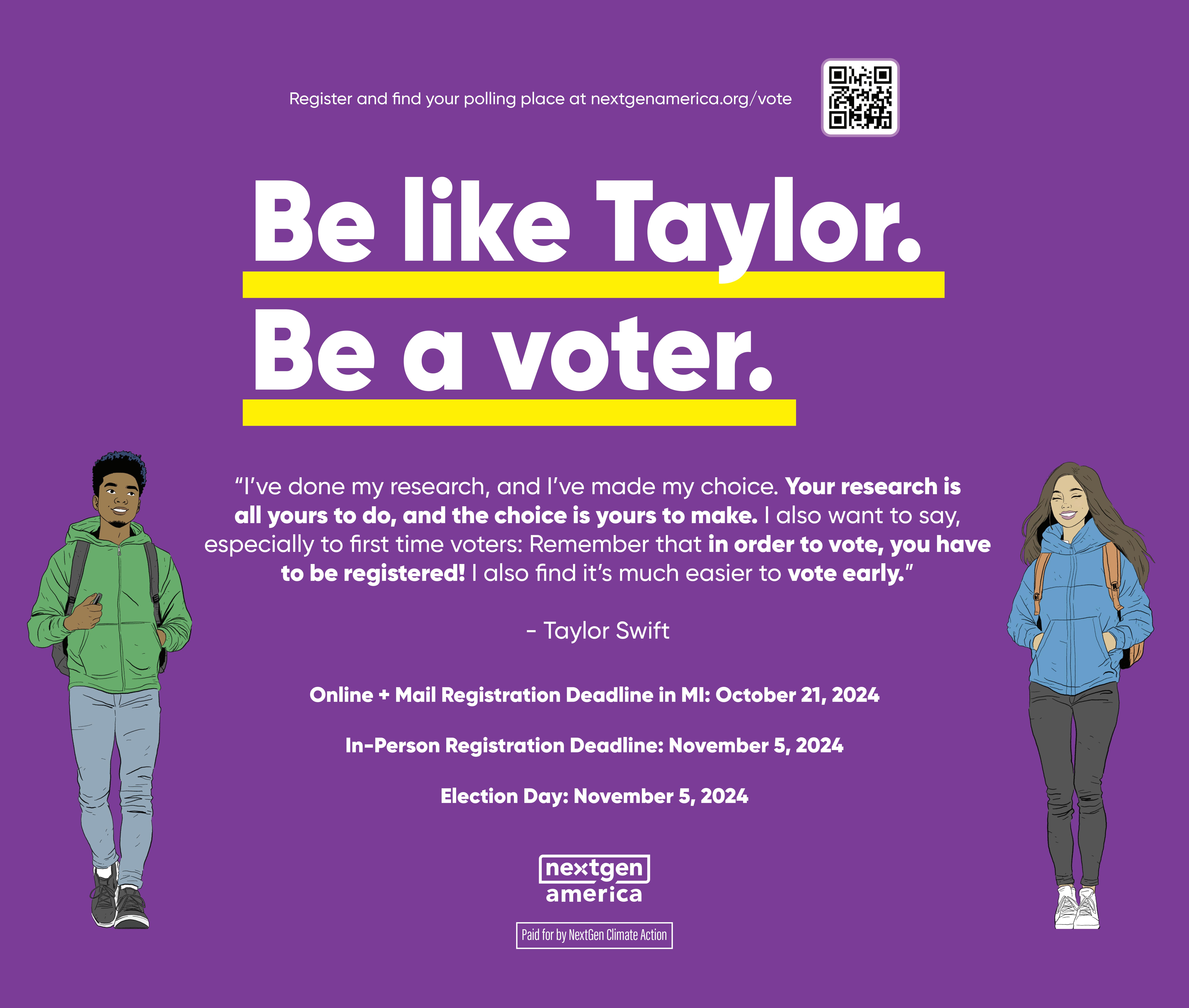
“I think it’s deeply unwise,” Taylor said. “We don’t have $425,000 to remove from services to pay for political campaigns. Further, there are no fraud protections or threshold requirements, as is common with campaign matching systems. And finally, it imagines a local-level corollary to the massive amounts spent at the federal level … big money is not in local elections.” Eligible residents can register to vote in person until polls close on Election Day, or online until Oct. 21. Early voting locations, which include the University of Michigan Museum of Art and the Duderstadt Center, will be open around the city from Saturday, Oct. 26 to Sunday, Nov. 3. Absentee ballots must be requested by Nov. 1 and returned by mail or dropbox by Election Day.
The University of Michigan Board of Regents met in Flint Thursday to vote on an institutional neutrality bylaw, a contract extension for University President Santa Ono and initiatives for the University of Michigan-Flint campus.
The board unanimously approved an institutional neutrality bylaw which prohibits regents and other University leaders from making statements on behalf of the University on issues not related to internal governance. This bylaw follows a report presented at the September Board of Regents meeting.
During the meeting, University Regent Mark Bernstein (D) spoke in favor of the bylaw, citing the University’s past instances of neutrality in the wake of major world events.
“There was no statement after the assassination of Abraham Lincoln,” Bernstein said. “There was no statement during World War I. There was no statement during World War II. There were no statements after the JFK assassination, there were no statements and on and on and on. Institutional statements are a modern phenomenon and misguided venture that portrays a public mission. As an institution, therefore, we should put up questions before answers in this policy.” Before the vote, U-M Flint professor Kimberly Saks spoke against the broad scope of the
“Sometimes lines are blurred as to when we’re speaking for those institutions and when we’re speaking for ourselves,” Saks said.
“For example, I’m the associate director of a research institution here on campus. If I congratulate someone for research related to the institute’s mission on perhaps a political or social issue, am I speaking as an associate director or myself? This is a new calculus that faculty must engage in every time they speak, putting a chilling effect on even the most basic academic speech.”
University Regent Jordan Acker (D) agreed with Saks’ concern about the bylaws’ breadth, but ultimately said that he supports it.
“I’m standing on voting yes on this with some reservations,” Acker said. “Those reservations are twofold. First, I am a little concerned about how overly broad it is, and I think we need to see how this actually plays out in real life on our campus. The second one is about our communication. Historically, the University has not been the best at communicating, and it will be very important to our faculty, to our staff, to our students, that they understand that this is not a speech ban.”
Prior to voting, University Regent Sarah Hubbard (R) said the University heard similar feedback from the public and Senate Assembly Committee on University Affairs during a forum Wednesday. All of the regents
Hubbard said the regents took the feedback from Wednesday’s forum into account. For example, some attendees expressed concerns that institutes and centers might have their speech restricted as a result of the bylaw. Following these concerns, the bylaw as approved was adjusted to not include institutes and centers.
The board also unanimously approved a contract extension for Ono which will last until Oct. 1, 2032. The extension includes a new $1.3 million base salary, an increase from his previous $975,000, along with increases in annual deferred compensation.
University Regent Denise Ilitch (D) introduced the motion, citing the University’s accomplishments since Ono took office in the fall of 2022.
“(Ono) played a critical part in the final agreement and groundbreaking for the University of Michigan Center for Innovation Detroit, which will have a profound impact in economic growth and opportunity creation,” Illitch said. “He has led our Vision 2034 and Campus Plan 2050 through which we will make groundbreaking discoveries that impact the greatest challenges facing humanity.”
The board also discussed the status of the U-M Flint Transformation Plan two years after the plan was first announced. U-M Flint saw a 6.5% increase in enrollment from fall 2023 to fall 2024, building off the 2.42% growth that the campus
MARY COREY Daily Staff Reporter GOVERNMENT
Slotkin and Rogers clash in second and final Senate debate
The two candidates talked the economy, gun violence, funding for public education and more
Content Warning: This article contains mentions of gun violence.
At the WXYZ-TV station in Southfield Monday night, U.S. Rep. Elissa Slotkin and former U.S. Rep. Mike Rogers held their second and final debate before Michigan voters send one candidate to represent the state in the U.S. Senate in November. Many of the questions asked focused on issues the candidates discussed at their last debate — the ongoing Israeli military campaign in Gaza, the economy, electric vehicles and Michigan manufacturing jobs. The candidates also discussed gun violence, student loan forgiveness and funding for public education, giving voters a fuller picture of both candidates with fewer than three weeks until Election Day.
In her opening statement, Slotkin said her campaign has been motivated by a desire to improve the lives of the middle class.
“I’m really, at the end of the day, running for Senate because I believe in my bones that we need a strong and growing middle class,” Slotkin said. “That means jobs with dignity, and that means making sure we attack the costs that are eating a hole in your pocket.”
In his opening statement, Rogers urged voters to consider their situation at the beginning of the Biden administration when deciding whether to vote for a Democrat or a Republican.
“We have to answer one question, this is the most important question we will ask during this campaign: Are you better off than
you were four years ago?” Rogers said. “I traveled the state, talked to a lot of people. The simple answer is ‘Absolutely not.’” The candidates began by discussing gun violence, which was not brought up in their first debate. Firearms are the leading cause of death among children and adolescents in the United States, killing more than 1,100 children and teens since the beginning of 2024. Slotkin, whose congressional district has been the site of two school shootings in recent years, said she believes leaders are responsible for protecting children from gun violence.
“This idea that we can’t go after the number one killer of children in America is broken,” Slotkin said. “While Mr. Rogers was off in Florida, I was representing this district where we had not one but two school shootings in my district: Oxford High School and Michigan State University. … To me, we have to, as Democrats and Republicans, gun owners and nongun owners, go after the number one killer of our children in our communities, in our schools, by suicide, by accident” Rogers recognized the impacts of gun violence and said he would focus on addressing what he sees as its root cause — teen mental health — instead of pushing for stricter gun control policies.
“We need to enforce the gun laws that we have, (but) we also need to deal with mental health issues that are happening in our schools,” Rogers said. “This generation of Americans is under mental duress and distress like I have never seen before, and it means that we’re going to have
to come together on how we get ahead of these problems. Banning guns is not going to do it.” The candidates also discussed education. In 2023, Michigan was ranked 41st in the country for education. Rogers said he believes childhood literacy rates are a pressing problem for Michigan students and proposed more intensive educational options for students who are struggling.
“This, to me, may be the biggest civil rights issue of our generation,” Rogers said. “Our kids are not learning how to read. Here in Michigan, 39.6% of third-graders could read at grade level.” Slotkin emphasized her support for public education and criticized Rogers for his ties to Betsy DeVos, former U.S. Secretary of Education under President Donald Trump.
“We have a whole generational problem with our education system, but for me, I am a believer in public education,” Slotkin said.
“Mr. Rogers and I may differ on this. One of his biggest supporters is Betsy DeVos. She is very, very clear about her theory of education that she literally wants to defund public schools. She was our Secretary of Education, but now wants to get rid of the Secretary of Education position. For me, I believe in strong public schools.” Both candidates oppose widespread student loan forgiveness, an issue President Joe Biden has continued to push for despite ongoing legal battles. Rogers said he supports forgiving student loans for people who fill certain hard-to-fill professions in the state.
Evelyn Mousigian/DAILY
First Lady Jill Biden travels to Michigan ahead of Election Day
‘As president, Kamala Harris is going to fight for you.’
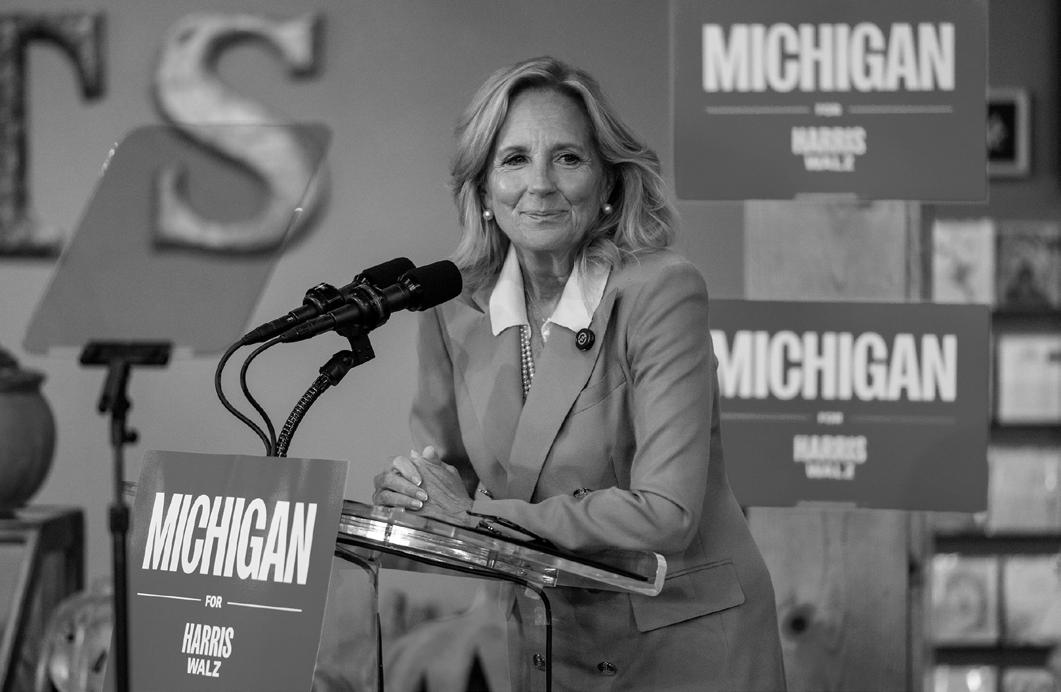
With a little more than two weeks until Election Day, First Lady Jill Biden spoke at Three Cats Cafe in Clawson, Mich., to a crowd of about 100 supporters, local elected officials, volunteers and union members.
According to recent polls, Vice President Kamala Harris leads former President Donald Trump by 6% with suburban voters nationwide. However, the Harris campaign has lost support from groups long considered reliable Democratic voters, specifically Hispanic and Black voters. The Biden administration’s response to the ongoing Israeli military campaign in Gaza has also divided the Democratic Party, with Harris struggling to gain support from Arab American and Muslim voters. With these losses, the campaign hopes to zero in on white, college-educated suburban voters to close the gap.
Oakland County Executive David Coulter opened the event and spoke to attendees about the choice they face in November. Coulter highlighted the differences between Harris and Trump when it comes to the issues that matter most to voters.
“Don’t we need a new way forward?” Coulter said. “One that lifts up the middle class and lifts up people like Oakland County and brings our country together. That’s what we’re looking for. Donald Trump and JD Vance … they’re once again bringing
out an extreme agenda that’s going to raise costs, rip away our freedoms, like reproductive freedoms, and take us backwards.”
U.S. Rep. Haley Stevens, D-Birmingham, also spoke at the event. Stevens highlighted Michigan’s role as a swing state in the upcoming election. In 2016, Trump beat out Hillary Clinton, former U.S. Secretary of State, by less than 11,000 votes, before Biden won the state in 2020 by more than 150,000 votes.
“Do not be fooled by the gimmicks because it’s all of our rights on the line,” Stevens said.
“You’re right, folks, they’re all looking at us. They’re all looking at Michigan. Everyone’s coming to town, and they’re like, ‘Which way is the state gonna go? Which is going to happen?’ Well, I got one bet — and it’s a bright blue wave.”
Anahita Maleknia, field organizer for the Michigan One Campaign and student
at the University of Alabama at Birmingham, said she felt called to this election because of what she believes are the potential implications of a second Trump presidency.
“As a young woman, I feel deeply connected to what is at stake in this election, just like many young women across Michigan and the entire country,” Maleknia said. “In fact, it became so important to me that I decided to move from my home state of Alabama and take a semester off from my senior year of college to be with you here today.”
Maleknia also highlighted the importance of women in grassroots organizing to help elect Democrats up and down the ballot in November.
“Women have always been the backbone of change in this country, and women have the power to determine this election,” Maleknia said. “But the work doesn’t stop here. We need to show our country what strong women can do by hitting the
ACADEMICS
More than 100 jury-selected artists displayed their work in Kerrytown on Oct. 12-13
enjoyed food trucks like Chapala and Cousins Maine Lobster, while having access to a variety of other drink options, such as craft cocktails from Ann Arbor Distilling Company.
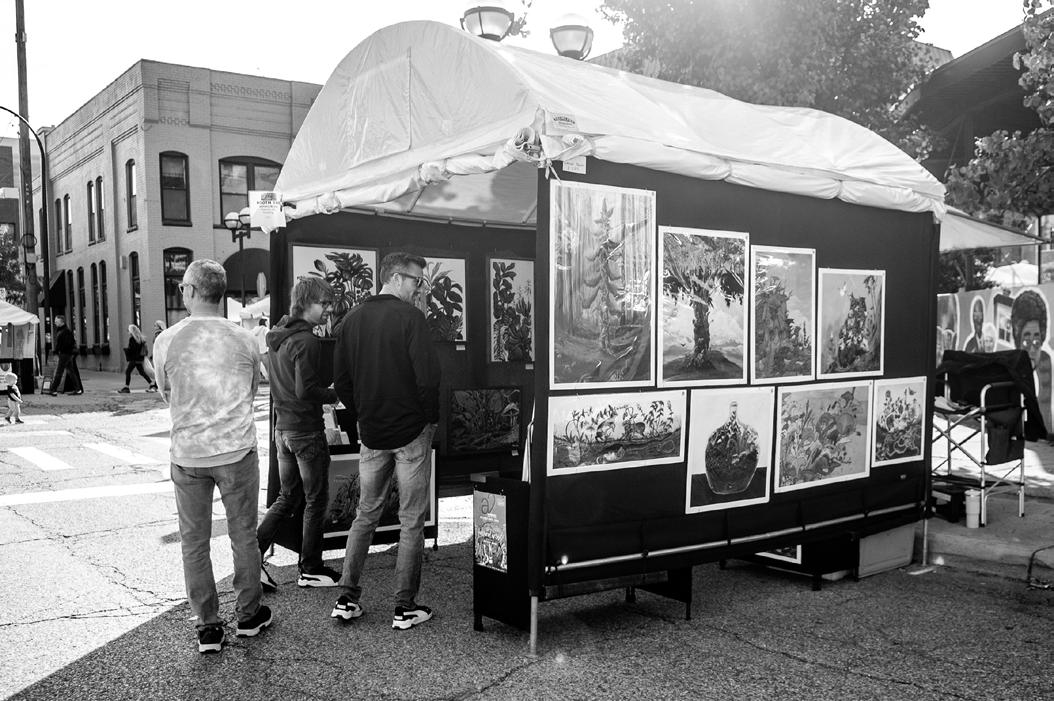
More than 100 jury-selected artists displayed their work in Kerrytown for the fourth-annual A2 Artoberfest, hosted by The Guild of Artists and Artisans on Saturday and Sunday.
The event also featured local food and drink vendors, live music, and art activities for families. Event attendees enjoyed all the fair had to offer in the fall weather in a more intimate setting than the larger Ann Arbor Art Fair.
Beginning at 10 a.m. on Saturday morning, community members sipped on morning drinks from vendors like Bearclaw Coffee Co., and browsed the various art stands while listening to handpan performances from Daniel Dinay.
Pharmacy student Gretta Mahowald told The Michigan Daily she decided to come to Artoberfest to enjoy local art with a friend from out of town.
“(I attended) on the recommendations of one of my classmates,” Mahowald said. “I have a friend in town for the weekend, and I was looking for something to do. Everything is so beautiful, it makes me wish I had more money.” In the afternoons and evenings of the festival, community members
The event had extended hours on Saturday night from 6 to 8 p.m. where community members continued enjoying food and drinks while listening to live music from ain’t dead yet, a local band, and enjoying the displays. The festivities continued on Sunday morning.
Artoberfest was designed to be a zero-waste event in order to reduce its environmental impact.
The Guild provided recycling bins and small waste bins around the event space, and artists and vendors were given educational materials and guidelines to follow in order to support the fair’s goals.
Anthony Brass, featured artist of the event, told The Daily that events like the A2 Artoberfest allow him to share his life-long passion for art.
“My art is really just an expression of the beauty I see in the world, and just being alive,” Brass said. “I take that beauty, and it’s all naturebased, and bring it into my artwork and share it with others. … It’s like a dream come true for me to be able to make my career painting.”
ground running, knocking doors, making calls and spreading the word to everyone that we know.”
During her remarks, Jill Biden detailed Harris’ specific policy proposals to lower prices and protect access to reproductive health care.
Since Harris entered the race in July, her lack of policy proposals has been a repeated subject of criticism. Jill Biden spoke about Harris’ stance on banning price gouging to lower prices on everyday goods.
“Prices spiked during the pandemic, but now corporations are keeping those prices high, making record profits, while families are paying more for groceries,” Jill Biden said. “Donald Trump wants to give those same corporations a tax cut so that they can make even more money, and that’s unacceptable. … (Harris) will fight back against greedy corporations and crack down on price gouging.”
Biden also spoke about several other campaign promises from Harris, including her support for a federal law codifying the right to abortion and her proposed $25,000-down payment assistance for first time home buyers. Biden framed the Harris-Walz ticket as champions of the middle class.
“I’ve just given you three ways Kamala Harris is going to work for you and your families,” Biden said. “Lowering grocery costs, making housing affordable and protecting our freedoms. These aren’t radical ideas, they’re just practical ways to make life easier and more fair. As president, Kamala Harris is going to fight for you.”
Halaloween presents Muslim horror films with a feminist lens
The Global Islamic Studies Center hosted the festival with films from across the globe
DELILAH DAKIS Daily Staff Reporter
The tale of a woman with a village of otherworldly beings living inside her was just one of many scary stories shared during this year’s Halaloween event, hosted by the University of Michigan Global Islamic Studies Center. Halaloween, an annual Muslim horror film festival hosted by GISC and many other departmental sponsors screens a selection of international films and short films that are made by, for or about Muslim people at in-person theaters and online.
GISC director Aliyah Khan told The Michigan Daily that while they prioritized a diverse selection of movies from across the globe, all of this year’s films have a feminist lens.
“One is from Azerbaijan, one is from Jordan, one is from Morocco and one is from Palestine,” Khan said. “They’re not necessarily related, except they all have a kind of vaguely feminist theme. They are centered around the perspectives of Muslim women and girls.”
Halaloween also included an in-person lecture and discussion led by the Jerusalem-based Palestine Fiction Council (مجلس الخيال) and its founder Ahmad Nabil on jinn, Islamic beings common in Muslim stories, myths and legends. Khan defined this type of Islamic being in an interview with The Daily as something similar to humans but living in a parallel dimension. They are commonly depicted in Muslim horror films, including at the Halaloween festival.
“Islamically speaking, there are three types of sentient beings,” Khan said. “There are human beings, angels and jinn. Amongst those, the only two kinds of beings that have complete free will are human beings and jinn. (Jinn) live in a parallel world to us where they have lives,
they marry, they are Muslim or not Muslim. The worlds aren’t supposed to cross with each other. Some (jinn) are evil and some are good and some are neutral, like people.”
Nabil elaborated on this idea in his lecture, explaining how there are different types of jinn, which act and impact people differently.
“(Jinni) are a rank of jinn that likes to mess with little human children,” Nabil said. “They tickle them, they make them laugh, they make them smile. Al’ana is the jinn that actually lives within the people. Shaytan are satan and they’re powerful. There are more powerful, which are Marid. Ifrit are the highest, most powerful ever.”
At the Fiction Council event, audience members shared their own jinn stories and supernatural experiences. LSA sophomore Ayah Dagher, who shared a story at the event, wrote in an email to The Daily that she did not grow up with a heavy emphasis on jinn but is curious about them and the encounters other audience members had with jinn.
“When I think of jinn, it’s mainly me wondering about their sociology, as funny as it sounds,” Dagher wrote. “Considering how prevalent jinn are in Muslim horror movies, I think they can be a common fear of Muslims who’ve heard stories of (or even experienced!) jinn phenomena. There’s also the aspect of the superstitions being passed down through generations; I noticed many of the audience’s jinn stories were ones they’d heard from older relatives.”
Dagher went on to write that, as a Muslim person, she experiences existential anxiety: the fear regarding the promise of eternal life in Islam. Dagher wrote that she did not feel this fear was sufficiently addressed in the films presented at Halaloween.
Stanford Lipsey Student Publications Building 420 Maynard St. Ann Arbor, MI 48109-1327 734-418-4115 www.michigandaily.com
DANA ELOBAID and SAMANTHA RICH Co-Editors in Chief eic@michigandaily.com
ELLA THOMPSON Business Manager business@michigandaily.com
NEWS TIPS tipline@michigandaily.com
LETTERS TO THE EDITOR tothedaily@michigandaily.com
Senior Audience Engagement Editors: Daniel Bernstein, Devon Silver, Emma LeFevre, Ingrid Halverson, Joanna Chait, Jonah Traub, Miles Anderson, Quinn Murphy, Sydney Lesnick
Training, and Inclusion Chairs accessandinclusion@michigandaily.com FIONA LACROIX and EVELYN MOUSIGIAN Managing Design Editors design@michigandaily.com
SOPHIA LEHRBAUM Managing Focal Point Editor lehrbaum@umich.edu
VICTOR SCHMITT Managing Games Editor vschmitt@umich.edu
The University of Michigan Board of Regents will consider an institutional neutrality bylaw at their Oct. 17 meeting. If adopted, the University will not take a stance on social and political issues that fall outside University administration functions. The Michigan Daily compiled an explanation of this bylaw’s formulation and potential impacts on the campus community.
Other universities have implemented similar institutional neutrality policies in recent months, including Harvard University, Washington State University, the University of North Carolina, the University of Pennsylvania and Stanford University. The University now joins several others, such as Columbia University and Yale University, in considering the implementation of a neutrality policy.
The concept of institutional neutrality rose to prominence with the University of Chicago’s 1967 Kalven Report, a document that argues that a university as an institution should not have stances on sociopolitical issues. The report, however, outlines two exceptions to institutional neutrality: crises threatening a university’s mission or situations in which a university must act as a corporate entity in matters of property and funding. These exceptions create a gray area of
the neutrality policy on social issues connected to finance, such as ongoing campus discourse on whether or not universities should divest from companies profiting off the Israeli military campaign in Gaza.
University Regent Jordan Acker (D) emphasized in an interview with The Daily that institutional neutrality is not a new conversation, but it was revisited in light of the U-M community’s response to University President Santa Ono’s statements on the Israeli military campaign in Gaza.
“I think a lot of people found (the) President’s statements leaving a lot to be desired,” Acker said. “I think a lot of universities realized that they could not articulate statements that wouldn’t leave a serious part of the campus community feeling isolated, alienated and without a voice, and so I think that a lot of universities went back to the drawing board on how they should respond to these sorts of
political issues that arise, and they have seen that institutional neutrality is a good way to go.”
The proposed bylaw is based on a report by the Advisory Committee on the University of Michigan Principles of Diversity of Thought & Freedom of Expression, which argues that institutional statements on a given issue undermine the University’s commitment to open inquiry and debate.
The committee, composed of 33 faculty, seven staff and two students, was established in March 2024 to recommend actions the University can take to advance goals outlined in the Principles of Diversity of Thought and Freedom of Expression statement, adopted by the Regents in January. Timothy Lynch, the University’s vice president and general counsel, chaired this committee and is now using its findings to prepare the bylaw for the Regents’ October meeting.
SEIU Healthcare Michigan reaches tentative agreement with University of Michigan
‘This state has a proud union history and this agreement with an institution like the University underscores the deep value of the workers who care for our families and neighbors.’
NOOR KHANAFER Daily Staff Reporter
University of Michigan Health avoided a workers strike scheduled for Tuesday by reaching a tentative threeyear agreement with the Service Employees International Union Healthcare Michigan. The professionals represented by SEIU Healthcare include patient care technicians, phlebotomists, extracorporeal membrane oxygenation specialists and clerical staff in clinics and ambulatory care settings.
Larry Alcoff, deputy trustee of SEIU Healthcare Michigan, discussed the critical role the union’s workers played during the COVID-19 pandemic in a statement Friday evening.
“These workers are demanding equity and parity, but also to restore benefits that they willingly
sacrificed during COVID-19,” Alcoff said. “This community would not have made it through this global pandemic without the work of these brave health care workers.” Friday evening, prior to the agreement, SEIU issued a formal strike notice for Oct. 15, which would include the work stoppage of about 2,700 health care workers. Alcoff added that although the strike would not be ideal, it would demonstrate the importance of SEIU’s demands.
“No one wants to go on strike, but sometimes the message must be loud and must be clear,” Alcoff said.
SEIU Healthcare Michigan sought increases in pay for their lowest-paid workers as well as monetary raises for those with longevity and experience. In the coming weeks, they are scheduling ratification votes among members for the agreement, which was reached Monday evening.
LSA DEI and sustainability teams collaborate at environmental justice summit
‘Environmental injustice is material and structural; it is not primarily about personal behavior.’
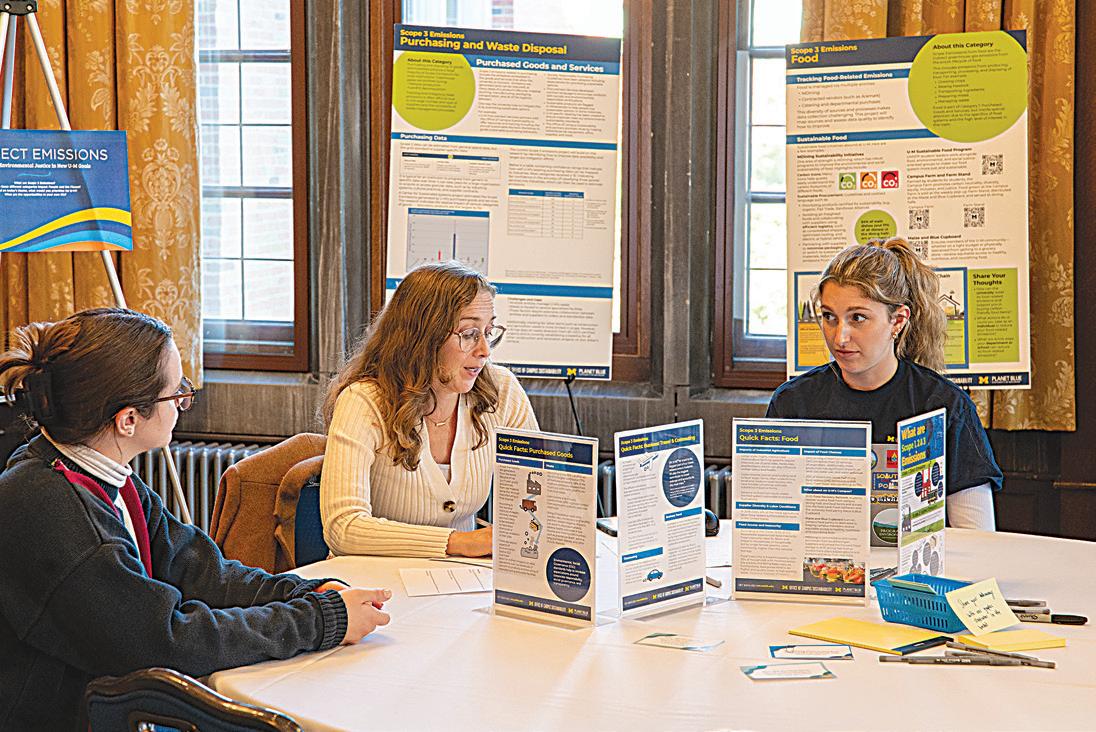
More than 250 University of Michigan students, faculty and community members gathered in the Rogel Ballroom of the Michigan Union for the LSA DEI x Sustainability Summit Wednesday. The event aimed to celebrate International Campus Sustainability Month and the second year of the University’s DEI 2.0 strategic plan, a five-year program to increase diversity, equity and inclusion across campus.
The event began with an introduction from LSA Dean Rosario Ceballo, followed by a keynote speech by Shalanda Baker, the new vice provost for sustainability and climate action.
After the keynote, a panel of U-M faculty and students discussed intersectionality, environmental justice and recognizing privilege. The summit also included several small creative workshops throughout the day, including an interactive sustainability mural and a Black Nature Walk through Nichols Arboretum.
Caitlin Jacobs, LSA sustainability program manager, told The Michigan Daily that event organizers hoped the summit would provide a space for open conversations about environmental justice.
“We wanted to make space for the personal aspects of DEI, thinking about yourself and your community as part of this, but also thinking about this environmental justice component,” Jacobs said. “I think that Michigan is full of people who want to see that.”
Jacobs said the event was designed so audience members
could evaluate the history of sustainability efforts and meaningfully discuss the intersection of systemic racism and sustainability practices.
“I think that there are a lot of people on campus who see these intersections already,” Jacobs said.
“I’m seeing a transformation in how the sustainability students I work with here talk about these issues versus how I talked about them when I was a younger person.
Doing an event like this … makes you ask questions about your own biases and how you do your work.”
Baker began her talk by highlighting the connection between sustainability efforts and inclusivity, focusing specifically on the energy systems in place that perpetuate environmental injustice.
“Racial and ethnic minorities in this country are exposed to more pollution, and the problem is structural,” Baker said. “We know this because of the design of our energy system, we have cited facilities in low-income communities, communities of Color and rural communities.”
Arthur, Texas
a
zone, or area where residents are exposed to disproportionately high levels of toxic pollution, transformed by the influence of pollution and environmental hazards due to its proximity to energy plants. Baker said her father suffered from health complications due to the poor air quality.
“He died in his early fifties, which is also
Dr. David Miller, president of U-M Health, said in a statement that the agreement, which is a first for the newly formed collective bargaining unit, reflects the University’s commitment to providing the best patient care.
“This agreement reflects our appreciation for these incredibly valuable members of our team,” Miller said. “As always, our goal is to attract and retain the best health care professionals who can provide the high quality care we deliver every day to our patients.”
In a statement posted on X, Alcoff said the agreement highlights the value of health care workers and their contributions to the community.
“We’re glad and relieved to have reached a tentative agreement with the University that allows workers to move forward and keep their focus on taking care of Michiganders,” Alcoff said.
Having seen the impact of these zones firsthand, Baker spoke about the current reality for those living in Port Arthur today. She also discussed how individuals currently living in similar communities have conflicting feelings about transitioning to greener energy sources.
Josh Sinha/DAILY
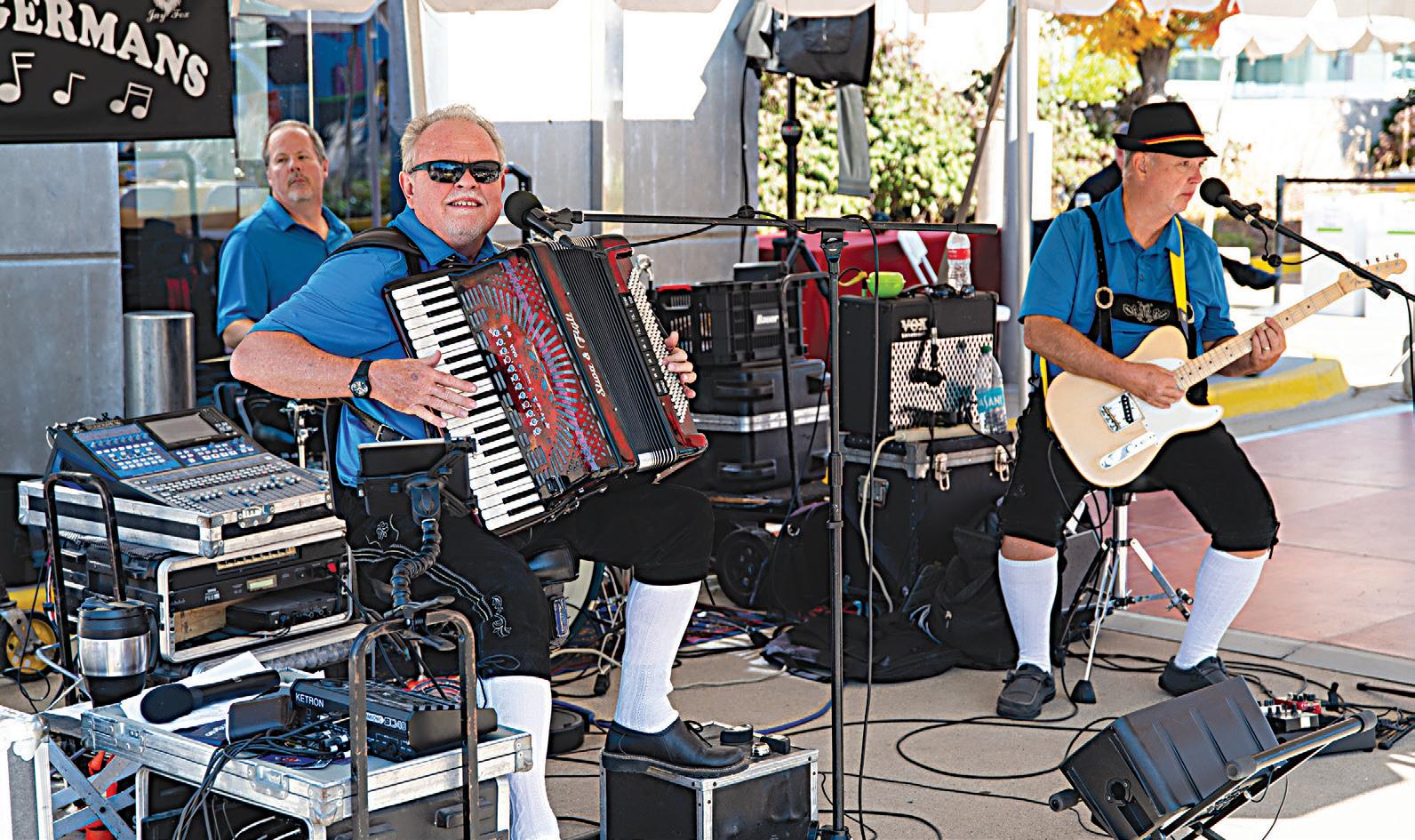
Members of Jay Fox & the jammin’ Germans perform at Oktoberfest Sunday.
Emily Alberts/DAILY
Vivien Wang/DAILY
KAELYN SOURYA Daily Staff Reporter
Prock/DAILY
The American B-Side
Do you feel that?
The cool breeze on your back. The sound of October ballparks cheering. The red-orange leaves resting against the sidewalk, the static-y radio broadcast political ads and the drunken parking lots of college football tailgates. That feeling, that floating red-white-andblue ephemeral feeling, is the closest I have ever come to patriotism.
It’s hard to define in strict terms what America feels, acts or even looks like. But paradoxically, it’s not hard to see it. I see it every nighttime drive I take, with gas stations and
billboards rising high into the cool night sky like our personal northern lights. I see it in the eyes of my local diner’s waitresses, in the wrinkles on the cheek of Iowa farmers, in the quickly-drying rivers of Nevada, in the hulking mountains of the Rockies and in the ancient ones of the Appalachians. It’s not hard to see America if you look closely enough. From sea to shining sea, in each state, country and city, there exist stories, anecdotes and folktales that pump Americana into the nation around us. It’s my hope that over the course of this B-Side — made up of 23 writers, 23 articles, 21 states and 2 territories — we can find America too.
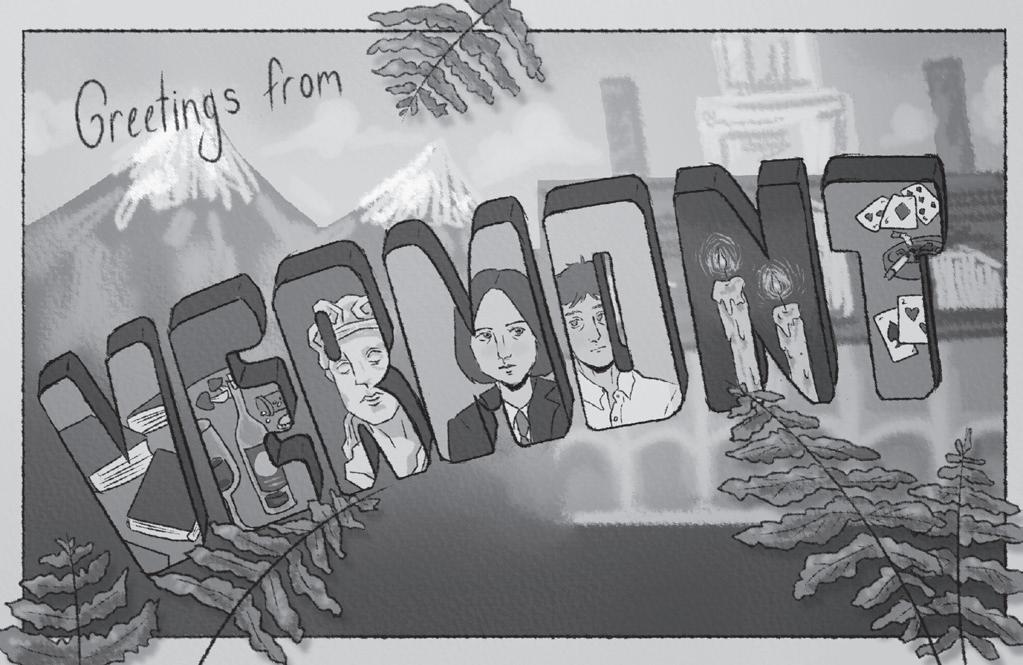
Searching for genius in Bennington, Vermont: The secret history of Donna Tartt
secret history of Donna Tartt.
Small-town genius: Escaping mediocrity and Mississippi
Here is the story most people know: In 1991, a then-28-year-old and relative nobody Donna Tartt sells what will soon become the critically-acclaimed cult classic, “The Secret History.” Shortly after its publication, the book’s overnight popularity pulls Tartt into the hazy, drug-filled world of ’90s stardom, alongside names like Robert Downey Jr., Michael J. Fox and Molly Ringwald. The world quickly becomes obsessed with this young genius: Who is she? Where did she come from? How did someone so inexperienced, so unconnected make a splash so large? Even more quickly, it becomes clear that Tartt has no interest in answering any of these questions. Many prolific writers keep their private lives more private than Tartt. What makes this case so peculiar, however, is just how badly we want to know about her — and how badly she wants us to know nothing at all. She leads an incredibly secretive life, swearing off social media and denying all requests for interviews (save for her decennial press tour whenever she releases a new book). When she does appear in interviews, her answers are often captivating, but reveal little information about her life beyond her writing. Rather than quelling anyone’s curiosity, this air of mystery surrounding Tartt has only fed into the cultural obsession with finding out who the author really is. And that nagging question, problematic as it may be, has yielded some interesting results. She’s the protagonist of a (sort of) rags-to-obscene-riches story. She’s a Southern-belle-turnedcrossdressing tomboy. She’s someone who, against all odds, seems to have made her way into the literary spotlight not by nepotism, backdoor deals or cheating her way to the top, but by rather quite literally “faking it ‘till you make it.” Oh, and not to mention by stealing — a lot. So let’s explore then, shall we? Here is the story most people don’t know; here is the
I think there’s a small part in all of us that would like to believe we’re secretly a genius. At least, I can admit there’s one in me. Who doesn’t dream of that infamous movie sequence: a stranger appearing from out of the blue to tell you that you — yes, you! — are gifted, important, special? Yet, rarely is that quiet desire actually proven true. I’m sure many of us have discovered since coming to college that, even when we’re the “special one” in our hometowns, that identity quickly falls apart after moving away. No matter how “gifted” or “important” or “special” we may be to the ones who love us, the world has a knack for showing us just how average we really are once we venture beyond those spaces.
Not so for Donna Tartt.
Born in Greenwood, Miss., in 1963, Donna Louise Tartt was raised almost as if her parents knew who and what she’d later become. Fed on classics like “The Wind in the Willows” and Robert Burns’ poetry, one could say that, as a child, Tartt was trained more than brought up. Both her mother and father — Taylor and Don, a secretary and freeway service station owner, respectively — were avid bookworms who passed their love of literature on to their eldest daughter. From keeping classics around the house to reading them while driving (as Tartt’s mother was often rumored to do), they made absolutely sure their Donna loved to read.
Though it was from her father that she got her (soon to be iconic) name, it was from her mother’s side of the family — the Bouches — that Tartt’s deep Mississippi roots stemmed. From these same Southern roots, Tartt seems to accredit some of her writing prowess.
“The American South is really a storytelling culture,” she said in a 2002 interview with The Sunday Herald. “It’s a culture of oral storytelling. It’s just extraordinary. Anywhere you go you hear a story.”
MichiganDaily.com
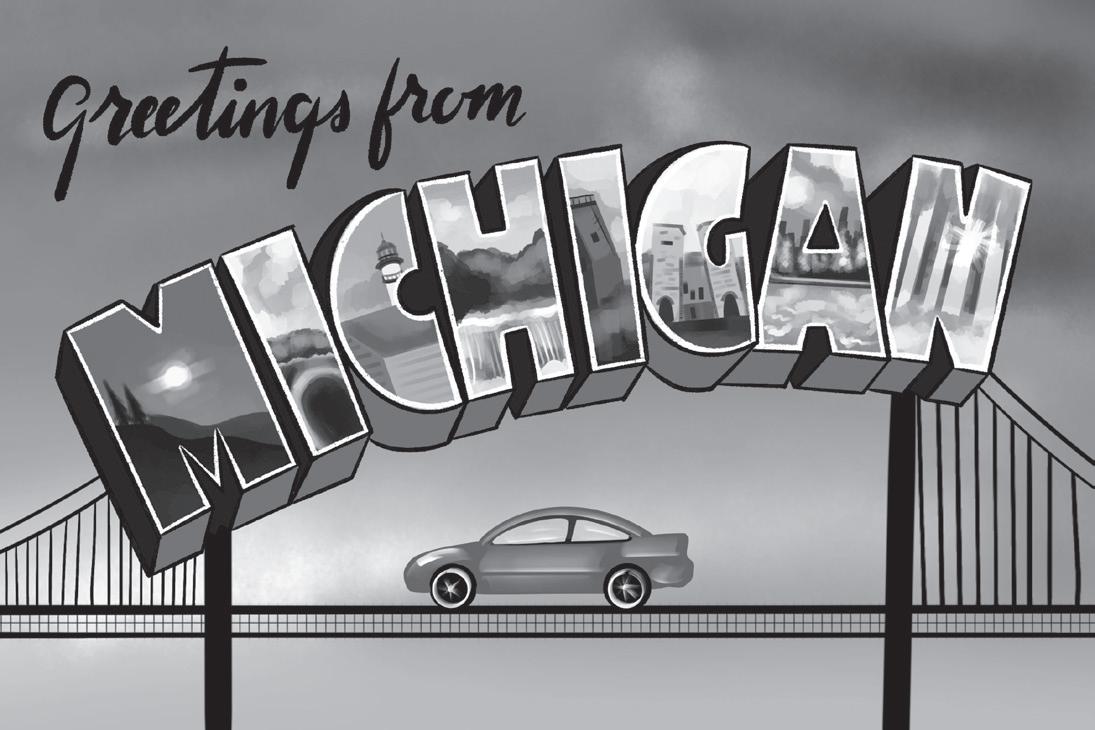
The Great American road trip exists entirely within Michigan
I talk a lot about leaving Michigan. It’s a bit of a running joke at this point; I was born here, and I would like to die pretty much anywhere else, if possible. I have physically left the state, but not for more than two weeks at a time. The vast majority of these have been road trips. I have driven to California, Washington, Oregon, Florida, New York and every state between Michigan and my destination. I’ve become a road trip connoisseur. The best road trip of all time, though, doesn’t cross through any of our neighboring states. Instead, the greatest American road trip is contained entirely within the state of Michigan.
Ann Arbor is a gilded cage, where genuine points of joy are drawn into harsh contrast against the rising cost of living and the political indifference of the city’s exceptionally wealthy older generations. It sprawls out and crawls up the surrounding hills, but somehow you need a car to get to a decent grocery store from downtown. I could say a lot about cars here, “Ann Arbor’s drivers are the worst” or “personal flexibility isn’t worth the consistent ecological damage” or whatever, but this is a road trip. You need a car. I’ve done the grocery trip with a number of cars. A 2009 Chrysler minivan, a crowded red Chevy Spark, or the most American car of all, a 2003
Honda Civic. For the comprehensive Michigan trip, you should start in Detroit, the birthplace of the car. Get dinner at Slow’s and crash in your friend’s dorm if you’d like. Important point: For the ideal road trip, you should always be late. Leave your hotel room or campsite no sooner than you must, and take way too long at every stop. Practice by staying in Detroit until 2 p.m. on accident. Your first job is to drive the most well-tread path in the state. I-94 is built on a mammoth trail, and it once bridged the two largest cities in the Midwest. Southern Michigan is historically a temperate wetland, one of the great ingredients in Michigan’s notoriously excellent roads. You’ll get acquainted with the Lower Peninsula’s flat forests, like those of the south and the midwest, serving as the setup to the
Upper Peninsula’s northern forests. You should allow yourself to get a little bored of the unaided forest to build a contrasting sense of excitement. Break off I-94 and go west out of Kalamazoo. Follow signs for South Haven. Spend an hour or two on some of the most beautiful beaches in the world. Don’t get too attached to this town — Lake Michigan is going to be your dance partner for a great deal of this trip. On the off chance you get bored of the water as scenery, try to find a place to pull over and jump in. It doesn’t have to be perfect. Then, head north along the water. This section bridges two childhood destinations: South Haven and the dunes. I only discovered the dunes in the past few years, which is a silly thing to say because I’ve been so many times. Places start to take on a new character
The Michigan Daily Crossword
ACROSS
1. Raised platform for a speaker
5. Urban planning system found in New York or Barcelona
9. Vaseline, e.g.
14. Word following "or" in a threat
15. Second largest gambling market in Nevada
16. Edmonton hockey player or onetime Houston football player
17. Florida State University athlete, familiarly
18. British mathematician Turing
19. North American pro hoopster
20. *[Location]
23. Source of H.S. stress
24. Instruction for preparing garlic or onions
25. Washington's northern equivalent
28. Like some fall days, worryingly
29. Vacation-enabling benefit, in brief
30. "As It ___" (Harry Styles single)
31. *[Weapon]
36. Big guys protecting the QB
37. Iowa State University town
38. Praiseful poem
39. Prop for some exotic dancers
40. Washington, D.C., area trio, briefly
41. *[Suspect]
45. "Call Me Maybe" singer's middle name
46. Civil rights activist B. Wells
47. Some ER workers
48. Really tick off
50. Alternative currency to crypto
52. B'way purchase
55. Case solved in 64-Across... or in this puzzle's starred clues
58. Government-issued cap or minimum 60. Danish connecting block brand
Rapper Rocky releasing an album soon
Deck for a fortune teller
Navy
64. Hasbro game that takes place in an English mansion
WNBA rookie Angel
Stark daughter on "Game of Thrones" 67. Breakfast that may be rolled or overnight
Dings
Hawaiian greeting
Small offshore landmass
First stage of plant life
Namesake for New Hampshire's nickname
Archaeological find
Nonsensical
Ding-___
"Absolutely unacceptable," slangily
ChatGPT or U-M Maizey, for example
Warm material found in the Andes
Goose formation
Mess up
Esteemed figure
Campus military org.
Trash cleaning robot
once you’re going there on purpose. You have a couple of hours along the water. This isn’t an accident. Part of the perfect road trip formula is a great running joke. I can’t say exactly what your relationship with Lake Michigan will look like at the end of all this, but it will be reiterated 10 or so times before the graceful handoff to
29. Typical autumn desserts
31. Specialized fighting group
32. Jordanian capital
33. Repeated word in Poe's "The Raven"
34. Nickname for Chief Keef
35. QB stats
39. Career achievements for runners, for short
41. Head south in the winter, say
42. Checked the license of, informally
43. Art supply brand with 148 colors
44. They may be bullets, pharaohs or carpenters
49. Alternatives to manuals
50. Less confined
51. Coming out phrase
52. Edison's rival
53. "Sauer" hot dog topping
54. Some romantic preferences
56. Disney ice princess
57. Word that forms a palindrome when it appears before "cat"
58. Three months of a yr.
59. Home to Abu Dhabi and Dubai
CAMILLE NAGY Books Beat Editor
RAMI MAHDI Senior Arts Editor
A unique liminality plagues the powerlessness of adolescent girlhood. Teen girls are expected to behave as adults and given little grace, yet granted few enough liberties that the need to rebel festers. The mix of a contradicting fear of unrealized potential with a desire to flout external expectations swirl in the internal world until it bubbles over to the surface — a desperate claw for a power that has been denied. As this internal struggle continues, young women must naturally turn to fantasy for a taste of that power.
When “typical ways of demonstrating power feel out of reach,” Tina Begnino, assistant professor of media studies at Albertus Magnus College, writes, there is “the need to conjure power from an unconventional source.” Witchcraft seems the most unconventional source. It is arguably one of the few sources of power women on screen can possess that doesn’t stem from a patriarchal system, like monarchy or money. The power afforded to witches is intrinsic to extraordinary women; it’s not a possession bestowed or taken away, but rather something as inherent to them as their blood and bone. The darkness associated with witchcraft, then, must also be an intrinsic part of the young women who wield it in fantasy and, by extension, the girls watching at home who identify with them. It cathartically externalizes emotions that young women are expected to internalize: anger, desire, despair and envy. By giving space to these universal emotions, witches embrace their darkness rather than repressing it. They are not subject to the same arbitrary confines that mortal viewers are. They are granted the power to shape the world around them, yes, but more importantly, witches are offered the freedom to rage at it and refuse to accept it in a way that young girls aren’t allowed to. Begnino affirms, “Girlhood associated with
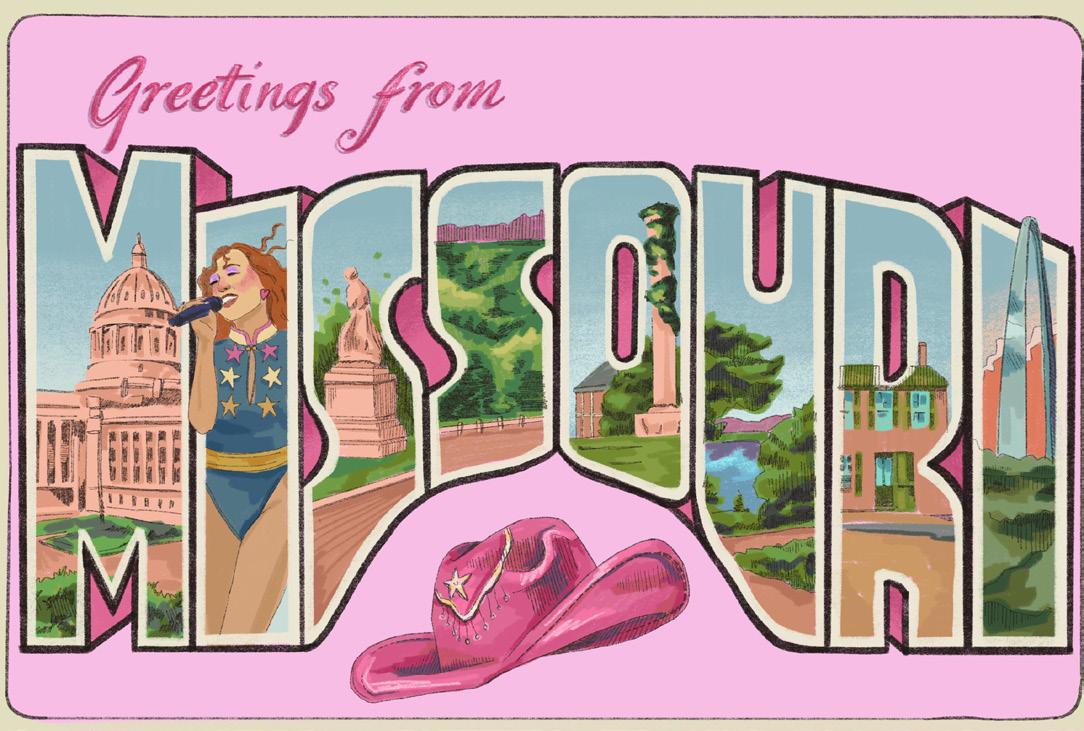
Chappell Roan and being Queer in Missouri
the supernatural witch suggests a girlhood complemented by resistance:” resistance against constraining systems, resistance against conventional behavior and, most importantly, resistance against a powerless state of being.
Whenever the idea of this resistance takes hold, there is an opposing reaction from the zeitgeist surrounding the witch. Perhaps the most infamous example are the Salem Witch Trials of the late 1600s. It wasn’t a time when women claimed power for themselves, but instead one where they were presumed to have it by a patriarchal system intent on subjugating them. These women held no real power, but the Puritans invented one to justify their imposition of women’s suffering. Salem’s court scapegoated innocents for failing crop yields and condemned 14 of them to die by hanging. These women were not outwardly defiant or even transgressive; they abided by the rules of their society. They went to church on Sundays and tended to their families, but Salem still branded them as satanic minions.
Author Marion Gibson affirms that “from the earliest times, therefore, American witchcraft had political implications, (….) witches had simply been the victims of a masculine oppression.”
These women were speculated to hold a power contradicting colonial Massachusetts’ devoutly Christian morality, yet held too little to actually resist their unjust fate. The Puritans wanted to believe that women were evil — that they were the troubles of society despite having worked to uphold it all their lives — so they came up with a story. The dominant sentiment from Salem’s Christian majority that these women deserved their fate for the good of the community was much easier for them to swallow than the idea that they had put innocents to death. Weaponizing the figure of the witch to enact violence against innocent women in Salem was the Christian majority’s way of exercising power. It is how they could relax into a dominating peacetime despite the blood on their hands.
If women were condemned as witches even without holding any of the power, reclaiming this power was itself an act of defiance by women. Any signs of dissenting female attitude could be used to brand a scarlet letter on them. But, while complacent members of society were restricted to a Stepford visage, treading outside the safety of docile empowerment slowly allowed women to bear the ugly emotions of the witch. The scarlet letter turned into a badge of honor. The allure of mystical power, completely unknown and incomprehensible to the overbearing majority that they can never strip away, pulled the witch into popular culture not as villains, but as protagonists. For teenage girls — who rarely ever feel understood by the people around them and struggle to fit into the rigid expectations of chaste femininity expected of them — it’s a way out.
The teen witch doesn’t have to feel trapped by the so-called right way for a girl to be, she can shamelessly be. Just more than 200 years after Salem, “witches had become liberal metaphors for political dissent and female self-empowerment,” according to Gibson. Tragedy befalling the women of Massachusetts turned into an important symbol for subsequent generations of women who refused the same vilification. The embrace of this darkness at the heart of American witchcraft’s foundation speaks to the shifting attitudes towards women’s liberation
Echoes of the witch through Massachusetts
MINA TOBYA Daily Arts Writer
A unique liminality plagues the powerlessness of adolescent girlhood. Teen girls are expected to behave as adults and given little grace, yet granted few enough liberties that the need to rebel festers. The mix of a contradicting fear of unrealized potential with a desire to flout external expectations swirl in the internal world until it bubbles over to the surface — a desperate claw for a power that has been denied. As this internal struggle continues, young women must naturally turn to fantasy for a taste of that power. When “typical ways of demonstrating power feel out of reach,” Tina Begnino, assistant professor of media studies at Albertus Magnus College, writes, there is “the need to conjure power from an unconventional source.” Witchcraft seems the most unconventional source. It is arguably one of the few sources of power women on screen can possess that doesn’t stem from a patriarchal system, like monarchy or money. The power afforded to witches is intrinsic to extraordinary women; it’s not a possession
bestowed or taken away, but rather something as inherent to them as their blood and bone.
The darkness associated with witchcraft, then, must also be an intrinsic part of the young women who wield it in fantasy and, by extension, the girls watching at home who identify with them. It cathartically externalizes emotions that young women are expected to internalize: anger, desire, despair and envy. By giving space to these universal emotions, witches embrace their darkness rather than repressing it. They are not subject to the same arbitrary confines that mortal viewers are. They are granted the power to shape the world around them, yes, but more importantly, witches are offered the freedom to rage at it and refuse to accept it in a way that young girls aren’t allowed to. Begnino affirms, “Girlhood associated with the supernatural witch suggests a girlhood complemented by resistance:” resistance against constraining systems, resistance against conventional behavior and, most importantly, resistance against a powerless state of being.
Whenever the idea of this resistance takes hold, there is an opposing reaction from the zeitgeist surrounding the witch.
Perhaps the most infamous example are the Salem Witch Trials of the late 1600s. It wasn’t a time when women claimed power for themselves, but instead one where they were presumed to have it by a patriarchal system intent on subjugating them. These women held no real power, but the Puritans invented one to justify their imposition of women’s suffering. Salem’s court scapegoated innocents for failing crop yields and condemned 14 of them to die by hanging. These women were not outwardly defiant or even transgressive; they abided by the rules of their society. They went to church on Sundays and tended to their families, but Salem still branded them as satanic minions.
Author Marion Gibson affirms that “from the earliest times, therefore, American witchcraft had political implications, (….) witches had simply been the victims of a masculine oppression.”
These women were speculated to hold a power contradicting colonial Massachusetts’ devoutly Christian morality, yet held too little to actually resist their unjust fate.
across time. Witches evolved in the public psyche from “satanic servant(s),” as Gibson states, to the “problematically empowered heroine of modern popular culture.”
The most striking markers of this evolution are the many incarnations of famed teenage witch Sabrina Spellman over the last 60-odd years. Her existence as a longrunning character who can exist at any time is emblematic of the shifting cultural expectations of young women and their resistance throughout time. Her essence remains the same in each adaptation, but her story’s surroundings serve as a cultural barometer. First imagined as a teen sorceress in the original Archie comics of the ’60s, Sabrina came to the screen in the hit ’90s sitcom “Sabrina the Teenage Witch” starring Melissa Joan Hart (“Melissa and Joey”). She’s the ideal ’90s American teen: a blonde, girl next-door academic who goes out for pizza with her friends and just happens to have magical powers. Her conventionally attractive, sweet-natured charm and quippy cleverness uphold the ideal of outspoken young women as amiably resolute — demanding change on small scales in ways that don’t rock the systemic boat.
“Sabrina the Teenage Witch” is marked by a postfeminist ideology and “girl power culture of the nineties,” according to Begnino. Its protagonist utilizes her magic for “improving life and removing that which causes harm,” but she does
so in misguided, individualistic ways like any adolescent would. She turns the mean girl at school into a pineapple, but at least the cheerleaders don’t rule with an iron fist for an episode before the spell is reversed. Her empathy causes her to magically make her friends’ wishes come true, until the poorly defined rules of her world’s magic prevent her from interfering in the lives of mortals. She tries to enact change to better the world around her, only to return to the status quo by the very next episode.
It sends the message that young women can be outspoken and work to reclaim power against systems that deny them of it, but they ultimately cannot enact lasting change. Their power is not as unlimited as they’d hoped, even with bottomless wells of magic. In this incarnation, Sabrina exists as an exceptional outlier to the mortal world around her. While her friends all trudge through reductive systems, Begnino affirms “the individual girl can embrace her power to overcome obstacles” that mortal counterparts would otherwise be unable to.
The teen witch, by this point, is a symbol of “the neoliberal notion of individualized greatness.” While she still represents a rebellion against a powerless state of being, she does so within the confines of a system that others without her exceptionalism cannot fight, and even then, she faces serious limits.
While pushing boundaries, the sitcom Sabrina doesn’t break barriers. She belongs to an unconventional family consisting of her two aunts as same-sex guardians; but it is a family unit that prevents complete independence all the same. It maintains a “feminist gloss” as the women thrash against restrictive ideas by speaking their minds to affirm their power, but simultaneously attempts to maintain the status quo by not straying too far outside of the American nuclear family. This family structure pushes Sabrina to act as a responsible adult, yet provides a forgiving portrayal of her teenage mistakes. Each episode revolves around well-intentioned magically induced hijinks and the
lengths she goes to rectify them, often with help from her guardians. It’s a far cry from the scapegoated villainous witch of the 1690s who would’ve been sentenced to death. Salem’s history plays a role in most witch media, and “Sabrina” is no different. Aside from her black cat familiar bearing the name Salem (Nick Bakay, “Bookie”) as a reminder of their struggle, Sabrina is the victim of multiple witch hunts in her town of Westbridge, Mass., from which she narrowly escapes. When mortals around her suspect the power she holds, they attack her, leading to her keeping her identity a secret. The backlash for holding this kind of power as a young woman is too obscene for the ’90s, so she must wield it privately. There is an isolation inherent to the teen witch which mirrors that of the average teen girl. Her place between the witch “Other Realm” and her mortal life contributes to her liminality. Liminality can be used to describe “the ambiguous state of an individual during rites of passage,” especially adolescent transitions. Sabrina is expected to hold the responsibility of her power while traversing the trials of teenage girlhood with minimal interference between the two. Unsurprisingly, this proves to be an impossible task. While trying to exist in both spheres — adult power and adolescent naivete — she is forced to embody a fast-tracked adulthood. To Megan Henesy, communication and journalism professor at Bournemouth University, “It is Sabrina’s liminality which primarily marks her as a gothic figure.” Her inhabitation of two contradicting planes is an outward manifestation of the inherent darkness in witchcraft metaphors that cannot be sanitized by neoliberal representations. This darkness takes a front seat in the 2018 Netflix horror series “Chilling Adventures of Sabrina” starring Kiernan Shipka (“Totally Killer”) as the overtly gothic modern incarnation.
In 1944, the All-American Girls Professional Baseball League completed its inaugural season in Racine, Wis., home of the Racine Belles. Immortalizing the league’s legacy in the 1992 film “A League of Their Own,” director Penny Marshall (“Riding in Cars with Boys”) creates one of the greatest sports movies of all time. Set against the background of America’s heartland, the film focuses on two sisters who have left their family farm in Oregon for the chance to play for the first professional women’s baseball league as members of the Rockford Peaches. The film pitches the idealized American dream back at audiences by celebrating the tremendous accomplishments of the athletes while also recognizing the league’s historic racism and its disrespectful treatment of players. The heart of “A League of Their Own” isn’t “women can play sports too” — that’s surface level and should be widely understood. What brings life to the film is the relationship between sisters Dottie (Geena Davis, “Thelma & Louise”) and Kit (Lori Petty, “Point Break”) and the rest of their teammates. While they compete for playing time and positions, they’re in this unique situation together facing not only the other teams, but sexism from the audience and the uncertainty of the league’s future. While a unit on the field, they all have their own personalities and goals.
Dottie, happy with waiting at home for her husband to come home from the war, only tries out
so that Kit, her sister itching to get out of their Oregon farm town, is allowed to as well. But as the season progresses, it’s evident that Dottie has a real passion for the sport and for her teammates. Kit has only ever wanted to prove herself as more than just Dottie’s sister yet, struggling to establish herself in the league, she turns her frustration towards her sister. They clash on and off the field as sisters do, though they would also do anything for each other. It’s the perfect centerpiece for a film about sisterhood in women’s athletics. They fight hard in competition, but when they step off the field they’ll always have each other’s backs.
Every character has conflicting interests that cause them to make tough decisions and inevitable mistakes, but none are looked down upon for their choices from the director’s lens. The athletes may have been forced to play in dresses and take etiquette classes but, through Marshall’s perspective, they can be messy, tough and aggressive while remaining emotional and sensitive. So often women are asked to sacrifice their femininity to be perceived as tough or strong, but the players in this movie are feminine and tough. They don’t choose between the two, nor do they have to. It starkly contrasts the reality for the players, as audience members catcall them and the league markets them as objects to ogle rather than athletes to be in awe of.
“A League of Their Own” gives space for its players to be acknowledged while also critiquing the league’s exclusion of women of Color. Black athletes like Toni Stone, Mamie Johnson and Connie Morgan played professional baseball in this period, but not for the
AAGPBL because because racist policies excluded Black women from the league. In one scene, a Black woman throws an out-of-play ball back in. Dottie, whose schtick is catching throws without a mitt with no reaction, for the first time, shakes her hand out after catching the throw. Though only a moment in the movie, it acknowledges the numerous women of Color who were phenomenal athletes but were barred from competition based on race. While there’s more story to be told of these unsung heroes of
My Second Life in Pennsylvania
For as long as I can remember, I’ve been visiting Pittsburgh.
Of course, that means literally visiting the city. Growing up, every year for Thanksgiving, my mom, sister and I would embark on our annual migration to my great-grandma’s house in the suburbs. Even now, many of my school vacations are spent holed up at my uncles’ place cooking, watching movies or exploring the city. I’ve been to all the museums, toured the colleges and seen the sights. There is no year in my living memory untouched by a quick four-hour drive down the Ohio Turnpike, greeted by the glowing red Heinz History Center sign blinking at me like the Emerald City at the end of the yellow brick road. But the turnpike wasn’t the only way I got to Pittsburgh.
I visited Pittsburgh while sitting at the foot of my mom’s couch in Michigan, flipping through an old photo album. I visited from my high school’s library, filling out college applications. I visit it every time my mom mentions one of her high school friends or when a text comes through an extended family group chat. Pittsburgh has always been more than a destination. It’s the object of my eternal fascination and mystique. It’s my big what-if.
Since I was little, I have been writing and rewriting a life for myself there, imagining what it would have been like to go to my mom’s high school, to live in a city or to grow up with my uncles a couple of minutes away, instead of a couple hours.
Would I have felt more at home? Have had a different favorite band? Rooted for the Steelers? Mostly, though, I think my
obsession with the city came from its association with my mom. It’s a heritage that has been dangled in front of me since my youth, one that I can reach out to and enjoy, but one that I can never fully claim. It’s a part of my family that I know both well and not at all.
It’s a half of my family that is still living without me, a barrier built of memories keeping them from me. I grew up hearing stories of grade school in the suburbs, of my mom and my grandpa parkand-riding into the city for work during her high school summers and of college years passing in the insulated Carnegie Mellon University campus, a small, green oasis in the steel city. Each story I received was precious, filed away in my mind under the header “Mom Before Me,” delicately stored for later visits.
So, when I later decided to apply for colleges, it was a no-brainer to extend my search to the city. Surprisingly though, my dad, who grew up in Montana and only moved to Pittsburgh for college, was the one who insisted on taking me to tour his alma mater.
The drive to the city was the same, the places familiar, but as we toured the Carnegie Mellon campus — peaking into my dad’s old dorm, visiting the basement radio station he used to work at, following his walk to class, finding his favorite places to eat — something about Pittsburgh changed.
The part of me that wanted to lay claim to Pittsburgh, to seize the pieces of my parents that they could never physically share with me — their comings-of-age — and embrace it, was both stoked and tamed. I saw the city in a way I hadn’t before. Before, it had been a fuzzy radio broadcast: word of mouth, blurry memories in my head that I had given life to
through transplanted memories, squashed them between the Mattress Factory museum trips or my uncles’ apartment. But now it was a TV set; tangible and in front of me, technicolor and real, glowing and a little painful.
The next day, on a groggy morning, we trailed behind an overenthusiastic University of Pittsburgh tour guide in the rain, and suddenly Pittsburgh was no longer a fantasy. It was a viable option. The haze, mystery and intrigue were gone, and I saw myself living in the cramped Tower dorms, studying in the stunning Cathedral of Learning, loathing a dining plan. It was like suddenly everything was screaming at me: You want Pittsburgh so bad? Apply. Move. Make your choice. That trip with my dad called my bluff. It was that trip that ultimately allowed me to confront what Pittsburgh had been to me for all those years and helped me choose to stay in Michigan for college: It was just a dream. While I may have closed one door to connect with my family, others opened — my mom also hadn’t moved far from home for university, and my dad spent a couple of summers interning in Ann Arbor. There are always going to be echoes of them in everything I do. So, I’ve stopped trying to track down every piece of my parent’s lives before me and examine them, hoarding memories away like precious jewels. Pittsburgh is a city that to me represents potential: lost and unrealized. It’s a reminder to me that we make our own path. My mom chose to move, and I chose to stay. If I ever leave, I might end up with a kid exactly like me, lamenting their mom leaving her hometown, and waxing poetic about the life they could have lived in Southeastern Michigan.
women’s sports, the scene allows audiences to understand how disparities in women’s athletics can’t be solved until all women have access to the same opportunities and resources, something that the AAGPBL didn’t offer. In the United States, the popularity of women’s sports is rising as champions like Simone Biles, Serena Williams, Katie Ledecky, Mallory Swanson and A’ja Wilson repeatedly prove themselves. Like the players from the film, as well as the real Racine Belles and
Rockford Peaches, these women are athletes. They compete, and they lead, and they do what they love even though they are continually undervalued by athletic systems and the American audience. “A League of Their Own” shows us that these athletes shouldn’t have to be the best of the best to deserve our attention (though that rarely stops them from accomplishing ground-breaking feats every time they step onto their respective stage). They are people with stories, talent and work ethic, which makes them fun to watch.
Women’s athletics represent the heart, hard work and leadership that America should champion, whether they occur in America’s heartland or while playing America’s pastime. From Racine, Wisconsin to the CPKC Stadium, women’s sports have grown greatly and will continue to grow as young girls across the country come to see themselves as athletes because of these women. They give
Colorado: Hollywood’s last frontier
LOLA D’ONOFRIO Film Beat Editor
I grew up in Colorado, at the exact point where the Rocky Mountains crash into the Great Plains. As a teenager, casual hangouts would often involve untamed foothills and tumbling mountain creeks. When my friends and I would joke that “last night was a movie,” we’d only be half kidding. There’s something innately cinematic about Colorado’s geography. Colorado is a transportative and rare place, shifting rapidly between wind-scoured deserts and dense, high-altitude forests. When I return to that environment, I feel insignificant. I shrink under Colorado’s huge bowl of blue sky. I turn transparent in the thin mountain air. It’s hard to live in Colorado without getting a little cinematic and sentimental about your own life. The land itself evokes the same feeling as a great film. That raises one serious question — where are the movies? It’s impossible to name a relevant film overtly set in Colorado. You’d think that the state would have a mile-long list of cinematic love letters. Colorado could quite plausibly be a visual shorthand for the West in the same way Midtown Manhattan is for urban America — but it isn’t.
When I go home, I wander through the foothills and picture
Colorado on film — glaciers and cliff dwellings, prairies and ghost towns. It would look pretty damn good. So why is Colorado still waiting for its defining movie moment? North Dakota has “Fargo,” John Hughes’ films celebrate Chicago, “Lady Bird” brings love to California’s Central Valley. What’s keeping Colorado out of the movies? And what might we gain from getting the state into them?
My guess is that to Hollywood producers, Colorado isn’t special enough to warrant a trip. If a script requires a desert or a mountain, it can be found in California. If they want something different, they venture one state over to Arizona or north to Vancouver. I imagine that Angeleno filmmakers choose states at random when they write Westerns. Sure, “Brokeback Mountain” takes place in Wyoming, but it could’ve just as easily been set in Colorado. There’s no personal touch, no nostalgic angle. Most films set in the American West don’t feel particularly connected to the geography they inhabit. You can tell that the filmmaker and the land don’t love each other.
Of course, Colorado isn’t in the movies. People from Colorado don’t make movies at the same rate as Californians or Chicagoans or New Yorkers. Most wealthy filmmakers see the Western United States as “flyover country” — an interchangeable blank canvas to project genre onto. Big cities
and big money get to decide what America looks like, turning the American West into one colorless, transposable swath of land. This approach saps filmmakers of their own creative personhood, leaving American film culture poorer for it. It’s up to our generation of filmmakers to upend that. The wonder I feel when I’m home is the same love others feel for Louisiana or Oklahoma. It’s not special, it’s just cinematically underrepresented. We can gain so much nuance and humanity by letting filmmakers celebrate their hometowns. If you’re an artist who loves your home, and your home happens to be somewhere uncharted in the cinematic mainstream, you still deserve to set your stories there. If I ever have the opportunity to make a movie, it’s going to be a Colorado picture to the bone. I’ll fight for specificity and nuance. I want my hometown streets and hilltops in the film — not Hollywood’s. It’ll inevitably be an uphill battle, but it will undoubtedly result in a richer story. My connection with Colorado led me into this crusade, but I know every person has their own specific entry point. No matter where you’re from or how you make your art, make it for yourself. Make it for your hometown. Don’t bow to cliches or “relatability.” We need more America on screen. We need your America.
CORA ROLFES Daily Arts Writer
Abby Schreck/DAILY
Vivien Wang/DAILY
AHMED ELKHATIB MiC Columnist
I knew I reeked of bonfire smoke, but that didn’t matter. A vigil for the recently departed Marcellus Williams, a Black Muslim man who had been executed by the state for a crime he did not commit, was being held. The street lights illuminated the path forward, and luckily I was only a few minutes late. I joined my community in mourning over the shimmering wet bricks of the Diag, weighed down by an air of frustration.
How did his execution pass, despite nation-wide objections, despite the shoddy evidence, despite all those who cried out that this may be an innocent man that is being sentenced to death? My eyes would traverse through the familiar faces in the crowd, while occasionally glancing down at the still shimmering floor.
The somber mood however, was sullied by two men sitting on the stairs of the Hatcher Graduate Library watching the vigil, laughing. As speakers went up to emphasize the degree of Islamophobia and racism required to allow Williams’ execution to pass, they gleefully chowed down on their two full boxes of pizza. They chatted throughout and remained until the vigil came to a close. The two men took delight in showing their complete disregard for the man’s life and our sentiments.
After the vigil, I waved my goodbyes and began heading home.
As I was walking back, I happened to overhear a group of students. Their conversations were equally dismissive, as they mocked proPalestinian students who were doxxed for protesting. Lightly paraphrasing, one said, “How can you complain about doxxing? Just don’t show up!” Their codename for pro-Palestinian students was a bit comical: “The pro-P Crowd.”
That night lodged a question in my mind: How was it possible to so easily dismiss someone’s suffering, and their expression of that suffering? And how was it possible to not only dismiss it, but to mock it all as well?
I have a friend who has been absolutely obsessed with Fyodor Dostoevsky since high school.
She started with “Crime and Punishment”and finished at “The Brothers Karamazov.” I had always been especially hesitant to read Dostoevsky’s books due to their intimidating length. But my friend offered me a solution. She suggested I read the excerpt “Rebellion” from “The Brothers Karamazov,” often regarded as his best work. I was surprised by her absolute confidence that this excerpt, which totaled no more than 12 pages, would convince me to read this 823-page book.
To set the stage for the excerpt,
Palestine and the University’s Entitlement: A Dismissal of Suffering
she provided me with some context.
There are two brothers who have long been separated, one a devout Christian monk, Alyosha; and the other is an intellectual atheist, Ivan.
The two, once reunited, wish to get reacquainted. Naturally, they begin discussing questions of the existence of God. One might expect Ivan to be a cynic, and although sometimes appearing disturbed, he is fully lucid. Ivan is unable to accept the world as it is, and although he would like to believe in God, is unable to due to the terms God had set for achieving “harmony.”
Before establishing his argument as to why he rejects God’s terms, Ivan haphazardly says to Alyosha, “But another man will never be able to know the degree of my suffering, because he is another and not me, and besides, a man is rarely willing to acknowledge someone else as a sufferer (as if it were a kind of distinction). And why won’t he acknowledge it, do you think? Because I, for example, have a bad smell, or a stupid face, or once stepped on his foot.”
I found myself returning to this line time and time again. The examples he provides as to why someone would dismiss his suffering, “a bad smell, or a stupid face,” are reminiscent of the idea: “Morals have an aesthetic criteria.”
But the choice of the example, “or once stepped on his foot”, resonated with me heavily. The act of stepping on one’s shoe is very often unintentional. It’s a true and honest mistake, but it could be a reason
as to why someone would dismiss your intrinsic suffering. “Existence precedes essence;” the waiter that serves you the wrong order is at the end of the day a mother or father, or a son or a daughter, trying to provide for their family.
There’s also the possibility that “the stepping on one’s shoe” could very well be intentional. Though, I’d like to think this sin of intentionally “stepping on one’s shoe” is inconsequential compared to the sin of dismissing the assailant’s suffering. In the context of our campus, whose suffering is routinely dismissed? And who decides that they must reprehend those who suffer just for “stepping on their shoe?” ***
Now, more than 40,000 Palestinians, of which at least 16,000 children 11,000 women have been killed and 95,000 wounded in Israel’s genocide on Gaza. A recent study done by Lancet states that even if a ceasefire were to occur as of July 2024, the time of the study being written, Gaza’s death toll could exceed 186,000, which “would translate to 7.9% of the total population in the Gaza Strip.”
It is thus no surprise to see Students Allied for Freedom and Equality (SAFE) and TAHRIR Coalition’s mounting pressure on the University to divest from Israel. The most recent and significant example includes the “die-in” demonstration at Festifall. The University’s response to the protest was to sic U-M U-M Division of
Seeking asylum from my own name
First grade marked the birth of my pseudonym. As an impressionable 6 year old who recently moved from the South, I told my teacher that the last letter of my first name was silent — after all, that’s what the kids in Florida used to call me. Just like that, this metamorphosis was decided on a random Thursday morning. Or was it a Monday? It was 14 years ago and the earliest independent choice I remember making. The absence of a singular letter felt more welcoming in a lottery of similar names. The extra “n” was too much to ask of silver-tongued America. Consequently, my meaning disintegrated. “Hanan” is the Arabic personification of compassion, while “Hana” means bliss. I finally felt like just another number in the lottery, indistinguishable from the rest, blissful in ignorance.
I pictured my reflection as two enemies with ears steaming: one of the West urging conformity and the other of the East celebrating my rich cultural heritage. I spent my mornings in an all-American costume, riddled with the shame of needing to, only to end my nights immersed in rich stories of resilience that have been passed down for generations. The odd sensation I thought I overcame with a quick persona change only resurfaced in different settings, revealing a
deeper conflict. Walking through a parking lot, getting picked up from school or even exchanging looks with a stranger invited a newfound sense of danger. I was a coward among soldiers in my own home, a foreign feeling for most 6 year olds. I grappled with the idea that my silence about my name was not just a personal choice, but rather a threat to my identity that has been colored by centuries of courage. I eventually began feeling guilty for sweeping my identity under the rug, contemplating whether this incognito impulse was even legal. Like a package deal, I secured my hijab with that extra letter. Fourth grade marked the rebirth of my origin. I began wearing my hijab, and this blanket of solace befriended me with a newfound acceptance. While, yes, it does “get hot on summer days,” I’ve always felt safer in the warmth. I moved schools and introduced my real name, removing the phantom of whiteness and unveiling my resurrection. Since second grade, I’ve lived in this western Iraq known as “Dearborn.” It was like living in a mirror maze, where I was surrounded by familiar faces that shared my cultural background, offering smiles of solidarity instead of stares of alienation. However, venturing even 10 minutes from this welcoming enclave invites masses of eyes and microaggressions.
While living in such a strong community of similar people fostered security, it also summoned seclusion. The close-knit
environment personified itself in a near-unconditional embrace, which was only granted under the unspoken pressure to conform to cultural norms — whether it was how I dressed, the dialect I spoke or the stories I shared. Even among those who shared the bulk of my struggles, the familiar face of isolation lingered as a constant presence in my unshared thoughts. And no man is an island; despite the necessary warmth of community, the need for genuine connection remains virtually insatiable. Identity is a shared exterior spectrum that offers familiar comfort, but it seldom allows for the expression of the personal layers that nurture individuality within it. As I grew, the hunger for something more gnawed at me. It wasn’t just the curiosity of different cultures — but also the desire to potentially find belonging beyond the confines of Dearborn. I turned to the internet, a phrase that often signals the beginning of many bad decisions. I spent hours on a website called “Omegle,” video calling strangers. Expecting wholesome friends and unaware of the infestation of creepy men, I discovered the world’s unfiltered cruelty. I often found myself talking with someone who seemed friendly at first, only for them to stage a racist breakdown once a one-sided attachment had been formed. This happened to me twice, which is already twice too many.
Public Safety and Security (DPSS) on protesters and arrest those who were technically “not students,” though the University’s statement failed to acknowledge that three out of the four arrested were strongly affiliated to the University, two being alumni, one the child of an employee.
The response serves as a clear discouragement of any proPalestinian action. It sets a precedent in the University, that if you are “impolitely” against the genocide of now at least 40,000 Palestinians, including 16,000 children, that you will be punished more severely than those who “politely” gloat over the genocide of Palestinians.
***
Returning to “The Brothers Karamazov’s” “Rebellion,” Ivan begins his argument. What does this intellectual atheist have to say to a Christian monk? In order to better make clear his argument, Ivan focuses not on the suffering of mankind as a whole, but the suffering of children. Children are innocent and are incapable of transgressing, and any suffering they endure is “incomprehensible.”
What follows are tragic, tearjerking, enraging accounts of abuse of children. “Indeed, people speak sometimes about the ‘beastly’ cruelty of man, but that is terribly unjust and offensive to beasts, no beast could ever be so cruel as a man, so artfully, so artistically cruel,” Ivan says.
Yet, nothing is artful about the torture Israel employs against its
captives. Testimonies continue to be released of Palestinian prisoners being tortured and raped, and we are meant to remain indifferent.
One released prisoner recounts, “(interrogators) made me sit on something like a hot metal stick and it felt like fire.” Meanwhile, Israeli officials contemplate if this is a justified method of torture.
Pictures of IDF soldiers wearing or playing with Palestinian women’s underwear continue to surface.
There are those who desecrate bodies, and those who are more time efficient and bulldoze cemeteries.
All of these actions show a lack of care towards Palestinian civilian life, and such casualties seem to not matter.
To honor Ivan’s argument, we will also focus on the children, though it narrows our own argument as he had acknowledged.
The name “Hind Rajab” falls on mourning ears. Hind was a 6-year old Palestinian girl girl who was killed by Israeli militants on Jan. 29, 2024 while attempting to relocate to a safe zone via car with her family.
Likely believing they had the right over life and death, they fired 335 bulwlets into the car. The tank was 13-23 meters away, making it an impossibility for the militant to not be aware of the presence of two children in the car: Hind, and her departed cousin.
Some of her last moments were recorded, as she was on call with a member of the Palestinian Red Crescent Society. Hind pleads with the woman to stay on the
line. “When someone comes, you can hang up the phone, okay?” as if she felt she was a bother to the woman who could be heard barely containing her tears. “My darling, if it were in my power, I would come to you.” There was no one else to turn to besides God, and so the woman urged her to recite verses from the Quran alongside her, “In the Name of Allah — the Most Compassionate, Most Merciful.” Hind recites it back.
“All praise is for Allah — Lord of all worlds,” Hind interrupts the recitation, pleading again, “Please get me out of here.”
While supporters of Israel routinely tout how the country remains the “only democracy in the Middle East,” Palestinian children have regularly faced violent interrogations by the IDF, some conducted in Hebrew (a language they do not understand), all without the presence of their guardians. While Israeli officials attempt to reassure us that the IDF “is the most moral army in the world,” we continue to see camps being razed to hell, with decapitated children being the net result.
“It’s precisely the defenselessness of these creatures (children) that tempts the torturers, the angelic truthfulness of the child, who has nowhere to turn and no one to turn to — that is what inflames the vile blood of the torturer,” Ivan says. At the campus “die-in”, protesters held signs displaying pictures of martyrs, including those before Oct. 7th. Throughout the protest, organizers read the names of martyrs, no doubt also naming Hind Rajab. Though the way some passing students were laughing and jeering, you would think it was a comedy routine.
A couple months ago, University regent Sarah Hubbard was spotted at the University of Michigan Museum of Art (UMMA). SAFE mobilized immediately to protest and to make her aware of their demands. Her response was to record, wave and laugh at the protesters. In retaliation to her mockery, SAFE protested at her residence. Her reaction was then even more egregious, complaining about how it was disrespectful and disruptive and taking to X (formerly known as twitter) to mock protesters’ efforts. She, of course, did not take the time to apologize for her unruly cackle, which was immeasurably more inconsiderate and disrespectful; a dismissal of real human suffering. Within the administration and some of the student body, there appears to be a belief that their lack of acknowledgment can somehow stifle our collective suffering. No better proof exists than the removal of the encampment under the guise of “safety concerns.”
My mom told me recently that getting Hazel (our dog, a tiny brown toy poodle) has made my dad gentler. It’s true. He baby talks to her, takes time out of his day to walk her and talks about her all the time. Upon hearing this, there was a gut reaction of jealousy. The dog coincidentally joining our family right as I left the house for college seemed like a cruel joke. On visits home, I watch my dad meticulously plan Hazel’s trips to the dog park and bathe her after with an uncharacteristic and unfamiliar tenderness. Why couldn’t my dad have become gentler for me? Was I not once just as much of an innocent creature in need of love? But, inexplicably, these feelings never manifest into resentment. One reason, obviously, is that Hazel is the cutest dog ever and I have nothing but love for her. The other reason is that I think I can feel in my bones how good she is for him. To see my dad shrouded in love for another is a rare sight. He has never shown much affection to me, my mom or his parents. I’ve always been told, “Of course he loves you!” but the sheer frustration and emotional toll of having to assume that rather than be shown it was always too much. I didn’t understand how I was supposed to believe that I was loved by him with no basis of a kind
gesture or words of appreciation, and my every attempt at connection being ignored. Every homemade birthday card being shoved into the bottom drawer, every conversation falling flat into disinterest and awkwardness. Instead I turned toward resenting him, which was easier. I would always blame him for our relationship — or rather, lack thereof. He was the older, wiser one; why couldn’t he put his ego aside and express his love? Even now, I don’t blame myself for my resentment. It’s undeniable that how he has treated me has hurt me.
Yet, as I peer through a crack in the bedroom door, seeing my dad and Hazel curled up together with the same peaceful expression on their faces, I can’t help but simply feel overwhelmed by the amount of love I see. It’s clear to me how good it is for him to have something he can express love towards. I understand it’s no longer about me or the resentment I held towards him. It heals me a little bit just to see that he has this potential for love inside of him. I can start to see hints of love in the moments I thought were anything but that.
The love is concealed in the moments that are a little too close for comfort, shrouded in awkwardness. When I stayed up all night making a Father’s Day cake for him, only to be met with laughter, I now know that was the only reaction he knew, and that
there are hints of appreciation in it. I know we both feel a little too seen when my mom and all our relatives point out how similar we are, from our looks to our sense of humor, knowing that we will never talk about the fact. And yet, there is love in knowing we share so much. It’s hard to have a conversation that lasts more than two sentences, but there is love in the fact that we keep trying to start one, even if he only knows how to talk about school or work. The disconnect won’t disappear overnight, I know. There is still so much unsaid. But despite all the angst and misgivings, the love he shows Hazel reveals the love he has for me at the core of our relationship. It truly shakes me to my core to admit to myself that I love my dad and he loves me, but once again, I will not turn to resentment. The hurt is there, but that’s OK. I can have compassion; compassion for the tiny brown toy poodle who doesn’t realize she immediately got the love I have craved for 18 years, compassion for the father whose heart I still intricately understand despite it never being opened to me. The younger versions of me didn’t know how to do anything but blame and resent, but I realize now that if my dad can show love to Hazel, that love must be inside him, and some of that love must exist for me, no matter how mangled it may be by our fatherhood and daughterhood.
Anjalee Raval/MiC
Hazel
HANAN HUSEIN MiC Columnist
VIVIAN PARK MiC Columnist
SAMANTHA RICH
Co-Editors in Chief
Mateo Alavarez
Zach Aljuni
Jack Brady
Gabe Efros
Lucas Feller
ZHANE YAMIN AND LINDSEY SPENCER Editorial Page Editors
Liv Frey
Jovanna Gallegos
Tate Moyer
Tom Muha
SHANIA BAWEJA AND ABBY SCHRECK Managing Editors
Sophia Perrault
Maxamilian Schenke
Audra Woehle
Zhane Yamin
Sarah Zhang
UMich needs to rethink its food sourcing
HUNTER RYERSON Opinion Columnist
Let me paint a familiar picture for you: You settle into your seat in a big lecture hall, readying your laptop or notebook for another 90 minutes of mindless note taking. As your professor begins to speak, their voice is interrupted every five seconds by the constant rattle of coughs from around the room. Your professor then starts coughing and, next thing you know, you discover that the Walgreens on State Street is running low on cough drops and Dayquil.
Everyone knows about the freshman flu, frat flu and other inevitable annual campus illnesses. While everyone gets sick and feels unwell from time to time, the degree to which students on campus are susceptible to these ailments is concerning;why aren’t our immune systems and gut microbiome better equipped to defend our bodies? One crucial factor is the food we are eating. People often take the food we consume for granted. I did, too, until I spent a summer as a volunteer farmworker on Potrero Nuevo Farm in Half Moon Bay, Calif., which grows and harvests organic produce for donation to local shelters. While I knew that donating fresh food to local shelters was a great form of charity, it was only through conversations with these workers — who, due to their financial instability, could only afford subpar processed food for themselves or their families — that I began to understand how much I took healthy produce for granted.
Several medical studies contend that food insecurity, or lack of access to healthy food, is correlated with poor health outcomes such as chronic diseases and micronutrient deficiency. At the same time, there is a growing consensus that organic
LEAH HUANG Opinion Columnist
produce is connected to reduced chronic disease risk, reduced pesticide-borne toxic metal exposure and increased micronutrients. These micronutrients play a huge role in bodily health, as a deficit can harm immune system function and lead to higher susceptibility to infection and malnutrition.
But, if the benefits of organic produce are so clear, why does it have such a minimal presence in MDining, which is the bedrock of nutrition for the thousands of students on a dining plan?
In an interview with The Michigan Daily, MDining marketing manager Kelly Guralewski relayed the sourcing philosophy of MDining and their approach to the organic versus inorganic produce question.
“The organic third-party certification is not currently a certification that (they) focus on,” Guralewski said. “Suppliers are selected and approved based on a variety of criteria, including sustainability, locality, ingredient pricing, ability to meet our volume and delivery needs, quality, et cetera.”
Notably, Guralewski suggested that many of the farms they source from may meet the prerequisites for organic produce but cannot afford the price of an official certification. She also expressed MDining’s commitment to Michigan-based suppliers.
“(MDining) currently purchase(s) a little more than 20% local and sustainable,” she said. “Eightyeight percent of purchases are from Michigan-based companies, which helps support the Michigan economy.”
As of 2021, the state of Michigan hosts more than 117,000 acres of certified organic farmland, divided up into 572 individual farms — which MDining could be sourcing from, so certified organic sources are not in short supply nor are
they monopolized. The National Resources Defense Council contends that organic farming reduces greenhouse gas emissions, improves soil carbon sequestration and increases crop resilience, all outcomes that boost sustainability.
It is therefore puzzling that, although an evident majority of MDining’s criteria are explicitly met by organic farming practices, they give it no particular weight in their sourcing process.
Perhaps this is a result of the ongoing scientific debate over whether organic produce does indeed provide benefits over nonorganic produce. Critics of organic produce point to studies showing negligible differences in the immediate nutrition of conventional and organic foods. This line of thinking misses the forest for the trees, as organic produce avoids the negative effects of pesticides, herbicides and hormones as the driving benefit, not internal nutritional efficiency.
MDining has done an admirable job in orienting its values toward efficiency and environmental sustainability. But by neglecting the distinction between organic and conventional produce both in sourcing and labeling, it is falling short of its own criteria, depriving students of the optimal standard of health and the information they need to make educated health choices.
This is especially pertinent to lower-income students. Ann Arbor is well stocked with Sweetgreen, Whole Foods and many other food stores that will provide organic nutrition for high prices. But for students from lower income backgrounds, these alternatives are not affordable, depriving them of the higher standard of health enjoyed by their wealthier peers.
Over admittance is unacceptable
LARA TINAWI Opinion Columnist
Over the last two years, college enrollment has increased across the nation following a decline during the COVID-19 pandemic. This year, the University of Michigan saw a record number of total enrollment, with undergraduate enrollment increasing from 33,730 to 34,454 since last year. More young people are pursuing higher education and, in a world where more and more jobs require a postsecondary education, this should be a good thing. However, colleges are accepting more students than they can handle, which hinders the college experience for these admitted students.
An exceptionally damaging year of over admittance to colleges can likely be traced back to one main culprit: the Free Application for Federal Student Aid. Last year, a new FAFSA form was released, and with it came issues that left students and universities panicked. The form was first available three months later than usual, and it had many glitches and errors that resulted in universities scrambling to verify applicant information and provide the right amount of aid. The botched rollout caused major delays in schools receiving applicants’ information and, in turn, distributing financial relief awards to students.
With the cost of college being a major factor for many students choosing where to attend college, a late roll out of financial aid can drastically impact their final decision. The typical May 1 deadline for college decisions was unrealistic, as most students
did not receive their financial aid package until much later. Students who could have otherwise committed to other colleges, may have instead committed to cheaper, in-state options, contributing to over enrollment. Without knowing how much money they will receive from a university, students potentially must “settle” for the schools they know that they can afford.
Financial aid is absolutely crucial for many students when it comes to deciding where they want to attend college, but the issues relating to over admittance persist long after a student enrolls in college.
This year, the University of Michigan reported an incoming undergraduate class for fall 2024 of 8,858 students. In an email to The Michigan Daily, Heather Guenther, the University’s director of communications for student life, stated that Michigan Housing reserved about 7,500 spaces for first-year students this fall. Housing demand is drastically exceeding supply at the University and in Ann Arbor, and it is unreasonable to leave new students scrambling for housing.
The University of Michigan, and colleges across the nation, should not be accepting and enrolling more students than they can accommodate in their on-campus housing.
This is not just an issue at the University of Michigan. Colleges across the country are placing their students in hotels or offering commuting incentives because they cannot accommodate for the full number they accepted. This is not the college experience they signed up for. While I certainly wouldn’t have minded staying in a cushy hotel with a private bathroom instead of an outdated dorm, students should not be forced to scramble last minute for housing because of poor university planning. The delay in the FAFSA rollout only compounded the disastrous effects of this national trend.
At the University of Michigan, over admittance is reflected not only in a housing shortage, but also in the hectic and stressful nature of class scheduling. Some of the worst moments of each semester for students happen when they have to balance their exams with scheduling classes for the next semester. There is aggressive competition between students as they try to schedule for spots in limited classes, warring against an unknown peer trying to do the same. The increasing volume of students being admitted into the University does not help this issue at all. Instead, it makes classes even more inaccessible, especially for students who come into college with no AP or IB credits. College admissions has become a fiasco that causes more stress for students at an already tumultuous time. Students have to make a huge life decision about where they want to study and what they want to do, and are now met with the uncertainty of financial aid, housing, scheduling and more. Each year, colleges have to make the difficult decision of how many applicants they accept and gamble on how many of those students will actually enroll. It can be hard to manage, but first and foremost, schools must consider the students they already have on campus. By enforcing strict enrollment limits that correspond to the University’s ability to accommodate, the student experience becomes better for everyone. It is time to focus on the quality of the college experience, over the quantity of degrees rolled out.
It’s time to pay nursing students for clinicals
That’s the reality for nursing students. Clinicals are part of the University of Michigan School of Nursing’s graduation requirement and, while they are primarily educational, they center on providing real patient care — work that, in the real world, would be paid. The Nursing School should either compensate students, decrease tuition or provide a stipend to support student nurses.
Undergraduate students at the Nursing School work anywhere from 10 to 36 clinical hours per week. As a nursing student myself, we receive far fewer credit hours than we
Picture this: You’re a nursing student who just spent 12 hours at the hospital. You’ve administered medications, helped with patient care, charted vital signs and now you’re dragging yourself home without having been paid. Your friends in business, finance and engineering are heading back from their summer internships (paid, of course), talking about how they’re using their extra cash to pay for Spring Break vacations or fun weekends on the town. Meanwhile, you’re delivering real health care in exchange for nothing more than “experience.”
actually work. Three to five credit hours are awarded for 10-12 hour shifts we work — not to mention the amount of simulation lab hours, classwork and reflections that we complete outside of clinical classes. We also have to pay for our own transportation, parking and supplies at each different clinical placement.
Additionally, some nursing students, like students of all disciplines, work a part-time job due to the high costs of student-living.
Paid patient care technician roles at local hospitals are open to students who have previously completed some introductory nursing prerequisites, as classroom and clinical knowledge tie into the
position. Prospective employees who browse these job postings may notice that a significant number of student nurses’ responsibilities — like taking blood pressures, charting intake and output, and responding to call bells — align with those of patient care technicians and nurse aides at the University Hospital. It’s unreasonable that nursing students are required to handle the same responsibilities as patient care technicians, yet are not compensated for their essential patient care.
In an interview with The Michigan Daily, Nursing junior Gina Kim discussed her challenges associated with her area of study.
“As both a patient care technician and a student nurse, I find that many of my responsibilities overlap,” Kim said. “It’s frustrating to be doing almost the same thing and get paid for one and not the other. I’m losing over $100 every clinical day since that’s what I would be making if I were paid. That’s a lot every week that I could be saving for rent and groceries instead.”
While some may argue that students shouldn’t be paid because they aren’t yet licensed, it’s worth considering that students like Kim are already paid for similar work in their hospital jobs. Given this, there’s no clear reason why they shouldn’t be paid for their work as students.
With just under 100,000 nursing students across the nation, it may be daunting to even think about subsidizing the costs of each student as if they were a student employee.
Nonetheless, other institutions have figured this out with different financial strategies. In the past year, Australia successfully mandated that not only student nurses, but also student teachers, midwives and social workers, must be paid $320 a week to ensure student wellbeing, starting in July 2025.
Some American universities have started to solve this issue as well: Mercy College of Ohio, just an hour away from the University of Michigan, successfully implemented a paid student program this past January in collaboration with its hospital counterpart, Mercy Health. Although this specific program only sponsors seven students in exchange for future employment, it is nonetheless a step towards paid clinicals — or at least clinicals with a stipend — for more students across the nation.
The reality is that nursing students have enough on their plates.
Between getting up to those 1,000 required clinical hours, studying for exams and possibly holding down a part-time job, we’re juggling a lot. We can’t just pick up a shift at a local coffee shop — our classes can start bright and early at 6:30 a.m. and go until 4:30 p.m. Nursing school demands time, focus and an immense compassion for the people we care for, and it demands these things each and every day.
If nursing students were paid a stipend or even given a tuition discount, it would ease the financial burden that many of us feel. We could stress less about making rent or
financing groceries and focus more on becoming better nurses. Reducing the financial strain would also have a significant impact on nursing students’ mental and physical health. Even though it’s important to keep U-M funding within the hospital system to maintain quality of care, even a little financial support might keep students motivated, and more importantly, encourage more people to consider the profession. And, let’s be real — with health care facing one of the
Michelle Peng/DAILY
Next Mirrorball champ?
Student government is no place for political violence
of atonement (was) near.” One representative was spat on.
We, as current and former members of Central Student Government, are appalled by the behavior that our peers and members of our campus community exhibited toward student government members at the CSG Student Assembly meeting this past Tuesday.
On Oct. 8, 2024, CSG voted to pass a student petition to resume funding to student organizations after multiple proposed budgets were vetoed by CSG President Alifa Chowdhury. The petition allocated $385,000 to student organizations and immediately made more than $80,000 available to programs like the Maize and Blue Cupboard, sexual assault and misconduct prevention, disability empowerment, New York Times and Wall Street Journal student subscriptions, MCAT and LSAT prep services, free graduation caps and gowns, student leadership scholarships and AirBus travel services, among many other services that CSG typically provides to the entire student body. A second petition, which would allocate $440,000 to rebuilding Birzeit University in Gaza, was also considered but did not pass the Assembly. After the meeting concluded, community members verbally assaulted CSG members as they walked to their vehicles, claiming that representatives would “be seeing them after class” and that they “knew where (representatives) lived.” They also made thinly veiled death threats toward the Assembly members, claiming that their “day
On Oct. 9, 2024, CSG members associated with the TAHRIR Coalition and SHUT IT DOWN used the CSG Instagram page to post a video, labeling CSG representatives as extremists. It also insinuated that the voting process was undemocratic and that CSG representatives acted in a politically corrupt or thoughtless way when voting to pass the budget. What was left out of the post was the verbal and physical harassment and intimidation CSG members faced before, during and after the vote to pass the budget.
We wholeheartedly condemn the harassment of CSG members and are alarmed by the hateful rhetoric and doxxing that many of our members have experienced as a result of the budget dispute. This rhetoric has fueled the violence we have already seen erupt across our campus and our country. At the University of Michigan, multiple students have been assaulted for their political or religious beliefs. Student videos, testimonies and this week’s recorded CSG Assembly meeting are proof of this volatile development.
While Tuesday night was a particularly challenging and troubling experience for CSG’s student leaders, it is just one example of a larger problem with inflammatory rhetoric in our government. We have always and will always work to represent the student body’s interests, but we know that the current executive administration is sacrificing Assembly members’ safety without a second thought.
We are disgusted by Chowdhury and Vice President Elias Atkinson’s
tacit endorsement of these actions, and we unequivocally condemn their complicity in the violence, intimidation and assault against our peers. As the student body’s executive officials, they were elected to serve every student, across partisan divides, regardless of personal or political disagreements. They were elected to respect and uphold the Constitution to which they are bound. We ask the CSG administration to protect student leaders, who are a part of the campus community and their constituency, and foster an environment that allows for the productive and meaningful exchange of ideas instead of promoting violence.
For these reasons, we call for the immediate resignation of President Chowdhury and Vice President Atkinson. Their inability to protect student representatives, their endorsement of violence and harassment and their misuse of official platforms to spread misinformation are direct violations of their duties and unbecoming of the office of the presidency. Chowdhury and Atkinson must take full accountability for the harm they have caused CSG representatives.
Despite Tuesday’s events, we remain committed to serving the student body. We believe that the Central Student Government has an imperative to discuss the issues of the day and respond to student concerns. We hold that it is equally important that we treat each other with respect and engage with our differences thoughtfully and empathetically rather than through means that seek to divide. We implore the student body to vote for candidates who will do the same in the upcoming elections.
CSG’s budget vote goes beyond complicity: A statement from SHUT IT DOWN
CSG until the University divests from companies complicit in Palestinian genocide.
On Oct. 8, 2024 — one year into history’s most documented genocide — a group of University of Michigan students in Central Student Government blocked a historic initiative that would have sent $440,000 to rebuild Gaza’s educational infrastructure. Had the petition passed, the money would have gone to Birzeit University’s Rebuilding Hope campaign. Before the vote, a professor at Birzeit joined the meeting virtually from the West Bank to implore the Student Assembly to support the initiative, highlighting our moral responsibility in the face of genocide and American imperialism. More than 30 students outside of CSG also voiced their support, but CSG Assembly members readily ignored them. The vote ended with 22 members against and 16 in favor.
This vote warrants reflection.
A year into the genocide in Gaza, Israel has dropped more than 75,000 tons of explosives, destroying 150,000 homes, 114 hospitals and clinics, 123 schools and universities, 611 mosques and at least three churches. As of now, 1.9 million people are displaced, and more than 40,000 Palestinians have ascended to martyrdom. Our University funds this destruction, with its deep financial ties to the Israeli economy. More than $6 billion of the University’s endowment is tied to venture capital and private equity funds profiting from the Zionist occupation and genocide. The University’s investments support drone manufacturers like Skydio, military contractors like Cobham and Ultra Electronics, and spyware firms like Oosto, which surveil Palestinians at checkpoints.
For the past year, student activists have organized at every level — from classrooms to student government, through sit-ins, rallies, encampments, teach-ins, open mics and marches. Every means of protest has and will continue to be used to fight for divestment and, ultimately, a free Palestine.
LSA Student Government itself arose from student protests during the 1970s anti-war movement. In recent years, CSG has been co-opted as an extension of the University’s administration. Sponsored by the dean of students, CSG is contractually bound to uphold university “values” — pushing back, we ask, is genocide a University of Michigan value?
The SHUT IT DOWN Party was created as an act of protest to dismantle CSG’s bureaucratic charade. Our platform is simple: Shut down
The election results spoke for themselves: a historic turnout with several SID representatives winning by massive margins. Attempting to delegitimize the success of marginalized students of Color, those in opposition filed a frivolous lawsuit through the Central Student Judiciary. We persevered and prevailed.
After the swearing-in, CSG Assembly members in opposition to SID enforced a new attendance policy. AR 13-077, unknown to SID representatives, would result in multiple recalls for missed meetings, including those held on Eid despite requests to reschedule. When non-SID members faced recall, our hypocritical opposition voted to keep them, using every chance to strip us, and only us, of power.
Despite SID representatives discussing a compromise budget, many CSG members refused to engage and clung to the status quo through cooperation with the University’s administration. Eventually, some bypassed the Assembly altogether by working with the dean of students to fund organizations directly, breaking the rules when it served their own interests.
The hypocrisy is evident. The University readily intervened to protect the interests of student organizations aligned with university priorities, but when thousands of students demanded divestment from companies complicit in genocide, our calls were repeatedly dismissed. Meanwhile, SID executive members faced the dean’s microaggressive racism, consistently dehumanizing the CSG president. The dean persistently undermined our efforts, further silencing marginalized voices and reinforcing genocide apologia.
With the University “loaning” student organization funding and $60,000 of our budget reserved for initiatives supporting low-income students, we had $440,000 left to allocate. Zionists argued to repay the “loans” — hardly necessary, given that $440,000 is a drop in the bucket for a school with a $17.9 billion endowment. SHUT IT DOWN argued for a more meaningful use of the funds, as our chance to promote reparations.
We urged the Assembly to allocate funds to Birzeit University’s rebuilding efforts in Gaza, calling on them to recognize the irony of funding student organizations twice. The University had already funded student organizations and Airbus, freeing us from institutional constraints. Our proposal was a chance to provide repa-
rations to Palestine, demonstrate that our activism extends beyond our immediate needs and contribute to a larger movement for justice. None of it worked. In the end, as people burn alive in the besieged hospitals of Gaza, our peers refused to send aid to Gaza and labeled proPalestine activists as violent, echoing the same racist tropes the administration uses to justify police brutality on our campus. They watched fellow students mourn the loss of loved ones in Palestine and Lebanon, yet prioritized the facade of normalcy over urgent humanitarian needs. Their callous indifference perpetuates a culture of quiet obedience that has delivered a full year of genocidal impunity, revealing their obscene disconnect from reality. How can we engage in the business of education when lives are being lost and futures are shattered in real time? We condemn the mischaracterization of our movement in the strongest terms. The student body demands divestment because we demand a free Palestine. CSG had the chance to do something radically courageous by sending funds to rebuild education in Gaza — to universities destroyed by bombs paid for by our taxes and the University’s investments. Assembly members had the chance to align our university’s resources with the urgent need for education and hope in Gaza, counteracting the University’s role in catastrophic, deadly destruction. The opposition to our call to action marked more than a failure to pass a petition, but a grave missed opportunity to stand on the right side of history in solidarity with our peers in Gaza, advocating for education over destruction.
For more than a year, we have witnessed unspeakable violence against Palestinians. By choosing to deny these funds, these CSG assembly members are not only complicit but active partners in genocide, similar to the Israel Occupation Force soldiers who destroy aid trucks and Zionists who sit unaffected by the suffering they bring.
To those who seek to undermine our movement: We will not be intimidated. Our commitment to justice and liberation is resolute, and we refuse to be silenced or swayed by threats or mischaracterizations. We call on all who believe in justice to stand with us, to join us in this movement. The people of Palestine will be victorious, the students of Gaza will rebuild and the Zionist entity will crumble.
Glory to our martyrs and long live the resistance. In solidarity always, SHUT IT DOWN.
MARGARET PETERMAN
KAITLIN KARMEN Opinion Contributor
Bridgette Bol/DAILY
Michigan’s adaptability leads to 3-0 sweep over Washington
STEPHANIE CORREDOR For The Daily
Coming into Friday night’s match, the Michigan volleyball team aimed to extend its best season start since 2018 and secure a home victory over Washington for the first time since 1993. A high-stakes showdown like this demanded grit, resilience and above all, the ability to swiftly adjust to the Huskies’ tactics.
“Our big word for this match was adaptability,” sophomore setter Morgan Burke said. “We knew that this team was a gritty team.”
Relying on that adaptability, the Wolverines (15-3 overall, 5-2 Big Ten) defeated Washington (13-4, 3-4), 3-0, in three sets of intense back-and-forth play. While it was a match in which neither team overpowered the other, Michigan outperformed the Huskies in the crucial moments, showcas-
ing its diverse talent and depth.
“(Adaptability) was something we touched upon in our pre-match meeting,” Wolverines coach Erin Virtue said. “We’ve had a couple of injuries, and we’ve had people step up in different roles. We talked about tactically adapting and adjusting to what Washington put out tonight.”
The Huskies opened the first set with a powerful kill, setting the intensity for the tightly contested set, which saw three lead changes and 15 ties. After splitting the first eight points, both teams were quickly forced to reevaluate their game plans. But due to Washington’s service errors, Michigan enjoyed a few moments of stability in this otherwise fluctuating set, backed by forceful kills from freshman middle blocker Jenna Hanes and sophomore outside hitter Valentina Vaulet.
Despite a valiant effort by the Huskies in the back half of the set, including a diving attempt to pre-
vent the last kill, the Wolverines took the first set, 27-25, on senior middle blocker Jacque Boney’s final kill.
Entering the second set, Washington raised the pressure on Michigan. With their longest run of the match, the Huskies took a 12-6 lead, forcing the Wolverines to reassess their strategy during a much-needed timeout. However, it appeared the break was exactly what Michigan needed to squash Washington’s momentum. After the timeout, kills from Vaulet and an ace from Burke instilled a sense of urgency in the struggling Wolverines, who responded with a 7-3 run. While both teams held the lead at different points in the set, the ending felt all too familiar for the Huskies. In a rally that forced both teams to scramble, it was graduate outside hitter Allison Jacobs’ kill that sealed a 25-23 second-set win for Michigan.
Michigan sticks to its script in 6-0 victory over Penn State
In its last seven games, the Michigan field hockey team has allowed 84 shots for just 12 goals from its opponents, all while converting 54 shots of its own. Against Penn State, the Wolverines added six more points to that tally and allowed none from their opponent.
On Friday, No. 7 Michigan (11-1 overall, 4-0 Big Ten) continued its hot streak in an aggressive matchup against the 16th-ranked Nittany Lions (7-7, 1-4). The Wolverines have found a system that’s near-perfect, having won every game since their August 30th loss against North Carolina. Through a combination of clean play, powerful attackers and consistent goaltending, Michigan has created a unit that seemingly can’t be toppled. Friday was
no exception as the Wolverines cruised to a decisive 6-0 victory. “I’m really pleased with the results,” Michigan coach Marcia Pankratz said. “I thought we played really aggressive, strong and fast. I was really proud of our team for getting a shutout, it’s not easy to play Penn State.” In just two minutes, the Wolverines made their presence known as the usual suspects marched down the field to get them on the board first. After the Michigan offense had already tested Nittany Lions goalkeeper Aby Deverka twice, it was primed to find the back of the net soon. Sophomore forward Juliette Manzur proved to be just the ticket as she settled a short pass from sophomore back Abby Burnett and forwarded the ball into the lower right corner of the goal, just outside of Deverka’s reach. Halfway through the first quarter, the Wolverines had challenged
Penn State backs with four shots on goal. This was just a taste of what was to come from the Michigan offense, because by the end of the matchup, the Wolverines had almost quadrupled that number with 15 shots against Deverka. However, Michigan’s nearbulletproof game plan was tested in the second quarter when it went down a player after freshman back Anjolie Norton received a yellow card and a five minute suspension. The loss of Norton provided the Nittany Lions with the perfect offensive opportunity, but the Wolverines didn’t miss a beat, sticking to their original attacking game plan. It didn’t matter that the unit was down a dependable defender. Michigan remained on the attack and refused to sit back, keeping the ball squarely in Penn State’s territory.
In a game as back and forth as soccer, having consistency on both offense and defense is essential to finding success. Failing to capitalize on scoring opportunities in the box or leaving passing lanes open for balls in behind can make it nearly impossible for a team to win.
On Thursday night, the Michigan women’s soccer team (2-122 overall, 1-7-1 Big Ten) learned that lesson in its 3-0 loss to Northwestern (6-8-3, 1-6-2). Not only did it struggle to put the ball in the back of the net, but it also was unable to hold off the Wildcats’ potent offense. After coming out strong, managing to keep the majority of possession and even firing off the game’s first shot, the Wolverines’ play began to falter.
Starting early, defensive mistakes plagued them. In the 21st minute, Northwestern defender Emma Phillips ran into the box unmarked and scored off a diving header. This brought Michigan’s momentum to a screeching halt.
After conceding the first goal, the Wolverines gathered in their box to discuss strategy.
“Right after the goal is scored, we come together and reflect not on what led to the goal but more of what we can do to prevent the next one,” junior defender Aniyah League said. “It’s a quick chat and usually just like ‘Watch your runner’ or ‘Check your shoulder,’ (something) simple like that because we know how to play soccer. It’s more like, ‘This is what happened. Move on. Let’s keep going.’ ” However, this talk didn’t prevent the Wildcats from bagging two more goals off defensive shortcomings. An errant pass and
a missed step to the ball led to Northwestern’s second goal in the 52nd minute, and a Wildcats’ long ball in a dangerous position gave them their third in the 66th. Playing in a 3-5-2 formation, Michigan left a lot of space in the back for potential counter attacks, which Northwestern took advantage of. And it wasn’t just defensively where the Wolverines struggled. Although Michigan had plenty of space to build out of the back, it was unable to maintain possession and score. Most corners and free kicks were taken short, often being won by Northwestern. With 36 minutes left in the second half, the Wolverines were awarded a free kick just outside the Wildcats’ box. Instead of serving the ball into the box, Michigan took a short free kick, resulting in a turnover and a counter attack the other way.
HADLEY ZANN For The Daily
FIELD HOCKEY
GRACE WRIGHT Daily Sports Writer
Jenna Hickey/DAILY
DETROIT — Probing against Oakland’s signature 1-3-1 zone, junior guard Tre Donaldson saw an opportunity — he tossed a lob to the paint for senior center Vlad Goldin who brought the alley-oop down hard to open the scoring.
The Dusty May era at Michigan had officially begun.
In an exhibition bout at Little Caesars Arena in Detroit, the Wolverines’ men’s basketball team picked apart the Golden Grizzlies all evening, winning 92-48. Michigan surgically maneuvered around the zone and Oakland had no response in the 40-point blowout.
The alley-oop was conspicuous foreshadowing. The Grizzlies’ zone wasn’t going to hold a Michigan offense full of willing sharpshooters quiet. Seldom used at the college level, Oakland’s zone notoriously wreaks havoc against unsuspecting teams. Grizzlies coach Greg Kampe utilizes the defense to defend against 3-pointers, but Sunday, it left fairly large holes behind the arc: most notably in the corner.
“You know what our zone does well is take the 3-point shot away,” Kampe said. “… Obviously, we don’t know what we’re doing in it yet if we give up 35 threes when the zone’s designed to take the three away.”
Just over six minutes into the game, the Wolverines quickly swung the ball around the top
MEN’S BASKETBALL
Michigan’s offense overpowers Oakland’s zone in 92-48 victory in charity exhibition
of the key, getting the Grizzlies’ defense stretched out to the wings. With the zone spread thin, junior guard Roddy Gayle Jr. whipped the ball to sophomore forward Sam Walters in the right corner. Fresh off the bench, Walters knocked home the triple, putting Michigan up 13-7. The flood gates creaked open. Another three from Walters, a layup from redshirt senior Will
Tschetter and a 3-pointer from freshman guard L.J. Cason gave the Wolverines a 24-12 lead midway through the first half. The floodgates were certainly open now.
Walters made himself particularly comfortable in both corners, knocking down three 3-pointers from below the break in the first half. But Michigan’s entire offense was comfortable. Donaldson consistently pushed
the break, earning several easy layups in transition, and Gayle got to the middle and converted close to the rim.
“It’s fun. I mean, just to see us being able to play fast, it opens up the court so much,” Donaldson said. “And then if they slow us down, they slow us down. But Coach preaches to me to play fast and help other guys get open.”
For emphasis on a fairly dominant first half, Gayle hoisted a
left-wing 3-pointer and watched it sink through the net as the buzzer sounded, giving his squad a commanding 48-26 lead entering the break. The Wolverines’ offense returned right back to form out of halftime. Graduate guard Rubin Jones swooped in through a confused zone boxout for a put-back dunk and hit a wide open corner three for his first five points of the evening,
extending Michigan’s healthy cushion.
The Wolverines appeared to be making a statement in the second half: Instead of the onslaught of 3-pointers — they already showed they could do that much — they attacked the rim. Getting the ball to the highpost flasher for dump downs to Goldin and crashing the glass hard, Michigan’s intent on getting the ball inside for easy buckets in the paint was clear. On the Wolverines’ offensive possessions, the ball was never stagnant. As soon as a player touched the ball, it moved to the next spot, diffusing Oakland’s zone and leading to several easy buckets and a well-balanced offensive attack.
“(We had) 21 assists on 34 made field goals,” May said. “So very pleased with the way we shared the ball in our locker room, in our coach’s office.” The Grizzlies didn’t deviate from their zone, though, so Michigan didn’t stop picking it apart with corner threes. With just under ten minutes remaining, Donaldson found Walters in the corner and he, once again, hit nothing but nylon. Donaldson joined in on the action too, hitting one from nearly the same spot on the very next possession to put the Wolverines up by 28. Michigan coasted home, punishing the discombobulated zone. The Wolverines played with pace and poise, just as May had hoped. They may not face many more zones this season, but if they do, they just proved they can pick one apart.
Experience in May’s system allows Vlad Goldin to thrive in exhibition
DETROIT — With the new season, there were plenty of questions the Michigan men’s basketball team was hoping to answer in its exhibition game against Oakland. The Wolverines intentionally used the scrimmage to understand how their new pieces fit inside of Michigan coach Dusty May’s play style — especially with his anticipated fast-paced offense.
But one player that has extensive experience in May’s system is graduate center Vlad Goldin. The only question for Goldin was how he would adapt to the new players within a system he felt comfortable with.
And in Michigan’s exhibition game against Oakland, Goldin displayed just how much of an advantage his added experience with May’s system was and will be for the rest of the season.
“I don’t think Vlad gets enough
credit for how much of a leader and unselfish he is,” junior guard Roddy Gayle Jr. said. “He’s one of the guys you want on your team, instead of going against him. He’s been great for us as far as leading us because everybody’s kind of new to Coach May’s system, but I feel like he’s been wanting to give us some insight and make it a lot more clear for us.”
When Goldin was in, May utilized him as the primary five for the Wolverines, placing him closer to the baseline within the offense. With Goldin drawing attention down low, it allowed for the remaining four players to space the floor — and to take advantage of that space.
Goldin finished the game with 11 points, four rebounds and a steal in just under 20 minutes of play — stats that don’t necessarily jump off the page. But, May’s system was executed to a point where he received plenty of attention, leaving players wide open on the perimeter.
“Vlad just brings so much versatility,” junior guard Tre Donaldson said. “I mean, he’s 7-foot-2, so you have to give him some attention. But it allows us to have that post presence, to suck the defense in and we’ll be able to shoot how good we shoot the ball. We’re able to get those kick out threes and knock them down.”
Michigan wants to shoot the deep ball. But what completes Goldin’s game is when defenders become lackadaisical covering him, seeping out toward the perimeter to prevent that deep shot. In multiple instances on Sunday, the Wolverines recognized how open he was, leading to underneath passes and flashy alley-oops, one of which marked Michigan’s first two points that ultimately set the tone for the rest of the game.
Even when Goldin isn’t on the floor, the Wolverines reaped the benefits of his impact. With May’s shorter lineup combinations, whether 7-foot junior center
Danny Wolf is the only big on the floor or if it’s sophomore forward Sam Walters, Michigan moved itself around the court and caused the Grizzlies to completely change their defensive play style.
And just when Oakland started to get comfortable, Goldin came back in and brought his physicality down low with him.
“They were physical,” Oakland coach Greg Kampe said. “They were huge inside. They were physical and they rebounded. And that’s how you win in the Big Ten. And so I think if (May) walks away from anything today, if I were in his shoes, I would feel good about that.”
The exhibition is in no way a direct indication of how the season will go for either the Wolverines or the Grizzlies. But Goldin’s first public appearance in a Michigan uniform clearly showed promise for how having someone who is experienced in May’s system will help guide and impact the rest of the Wolverines’ offense.
impact the
Matt Deschamps has been there for Michigan hockey, now it’s the program’s time to return the support
access treatment sooner.
When Adam Fantilli stopped by his old Chicago Steel rink on his way to the World Junior Championships, he didn’t just go in for a skate. He left a question hanging in the air for assistant coach Matt Deschamps to answer.
Just in passing, Fantilli asked Deschamps if he had ever thought of coaching for the Michigan hockey team. Deschamps shrugged the idea off at first, but Fantilli persisted. Once realizing the opportunity was available, everything natu-
rally fell into place for Deschamps. He underwent the hiring process and eventually made his way to Ann Arbor to join the Wolverines’ coaching staff. When all was said and done, it wasn’t a coach who sought him out for the program. It was Fantilli, a player who felt the impact of Deschamps’ hands-on coaching style, who knew he deserved a spot with Michigan.
With some knowledge of Michigan’s culture and style of play, and at Fantilli’s recommendation, Deschamps joined the coaching staff last season specializing on the team’s defense. In just his first season, Des-
champs aided the Wolverines to a Big Ten Championship and a trip to the Frozen Four. The care and passion Deschamps has for the players materializes in their accomplishments. Last season, Seamus Casey finished third in the nation for points among defensemen while earning a spot as a First-Team All-American.
Deschamps made his mark through each stop on his coaching journey, and it took just one season at Michigan to continue that legacy.
“(Deschamps) has been unreal,” graduate defenseman Jacob Truscott told The Michigan Daily. “He’s one of my favorite coaches I’ve played for. He’s just an honest coach and he’ll be hard on you when he needs to, but he really cares about every single guy. That’s the biggest thing about him, is how much he cares about us and how much he is willing to push us every single day to be better.”
Deschamps shows that he’s there to support the Wolverines beyond time spent on the rink. His office door is always open, ready to go over video with any player that asks. He always keeps a positive attitude in the locker room.
When Deschamps received devastating news almost two months
ago, it was the Michigan hockey team’s turn to be there for him.
Deschamps’ wife, Kelly, was recently diagnosed with rare inflammatory breast cancer. The tragic news put their lives on pause as they figured out the path to fighting the disease. And with how much Matt has given to the Wolverines in only one year, there was no hesitation in the Michigan community to rally behind the Deschamps family in any way they could.
“I think it’s great that every guy wants to support them,” Truscott said. “They want to do whatever they can to help out his family, because they have made such an impact on us.”
People immediately lended a hand, sending donations, prayers and food drops. Others have even come to their home to landscape for free. An online fundraiser raised over $60,000 for treatment, surpassing expectations. Each act of kindness takes one thing off the Deschamps’ shoulders as they put their full effort into Kelly’s battle.
When the Michigan hockey team heard the news, the players took a moment in the locker room to say a prayer for the family. Immediately after that, different players came up to Truscott and
the staff asking how they could help. For everything Matt contributes to his Wolverines family, they immediately stepped in to help his family at home.
Michigan will be hosting a pink out game for the first time ever on Friday against St. Cloud State to honor survivors and those fighting breast cancer. The Wolverines will hold a special place for Kelly as the Deschamps’ will be dropping the puck as a family.
Not only are the Wolverines helping in every way they can off the ice, they’re also bringing awareness on it too. And that means even more to Matt.
“It’s hard to put into words,” Matt told The Daily. “It’s overwhelming in the greatest sense of the word, to know that the university, the athletic department, (Michigan coach Brandon) Naurato and that everybody is in our corner supporting Kelly and my family.”
As Matt’s family navigates the diagnosis themselves, they have found solace in the cancer community while learning about what makes inflammatory breast cancer rare. With this form being difficult to diagnose, the Deschamps’ are trying to educate others on the importance of early detection to
Even as this disease halted their world, Matt and Kelly’s first instinct was to help others. That drive to be of service to those around him is what makes Deschamps the coach he is. His commitment to supporting his team and his family is what his players cherish about him.
“Everytime I walk out to the bench at Yost, I am so blessed and I am so lucky to be here,” Matt said. “There’s so many coaches in our business that are really good at what they do, but I get to be here at Michigan and that (feeling) has never changed. But I think the feeling becomes stronger knowing that through this process, through Kelly’s diagnosis, that the programs have been here to support us.”
Fantilli might have been the person to realize what Matt could bring to the Wolverines, but everyday Michigan reaps the benefits of his one question for Matt. Matt’s support, his commitment and his openness are all what makes him an essential coach for the Wolverines. And now as Matt and his family navigate this difficult time, the Deschamps have found a family that will return all those qualities.
MACKENZIE MIELKE Daily Sports Writer
Emily Alberts/DAILY
Grace Lahti/DAILY
Emily Alberts/DAILY
champaign problems sports
ILLINOIS 21 | MICHIGAN 7
Sloppy offense dooms Michigan as it falls to Illinois for second-straight loss
CHAMPAIGN — The No. 24 Michigan football team didn’t cross midfield until there were five minutes left in the first half on Saturday.
With graduate quarterback Jack Tuttle starting for the first time, the Wolverines tried to open up the passing offense for him. But off-target from his first throw onwards, Tuttle missed his receivers on deep shots and short passes alike early, leaving the Wolverines stuck in their own territory. And as Tuttle and the rest of Michigan’s offense played poorly, the Wolverines dug themselves a hole right away.
Michigan (4-3 overall, 2-2 Big Ten) then turned the ball over three times and managed its lowest single-game points total since 2014 as it fell to No. 22
Illinois (6-1, 3-1), 21-7. “Seven points is unacceptable,” graduate running back Kalel Mullings said. “That’s terrible. And as an offense we know that, and we understand that we have to be better. Can’t win a football game scoring seven points.” The Wolverines’ defense didn’t have a particularly pristine start either, giving the Fighting Illini 53 yards on five penalties in the first half. But they kept Illinois out of the end zone on its first three drives, holding the Illini to two field goals and a 6-0 lead. Michigan’s defense also regularly started in poor field position thanks to its offense’s struggles. The worst examples came when Tuttle and senior running back Donovan Edwards fumbled on back-to-back drives in the second quarter. Edwards’ fumble also came just two plays after a brutal Tuttle interception, where he was
bailed out by a defensive holding call.
“We’ve got 11 guys playing on their own when we really need 11 guys playing as one,” junior tight end Colston Loveland said. “Turnovers and mistakes like that, we just can’t have those.
We just got to play clean ball.” Illinois broke through after Edwards’ fumble. Illini quarterback Luke Altmyer drove his team down the field easily, before finishing the drive with a perfect ball to tight end Tanner Arkin in the back corner of the end zone to put Illinois up 13-0. Trying to respond, Michigan
went back to its key playmakers in Mullings and Loveland. The pair combined for 63 yards of offense on the Wolverines’ only successful drive of the game. Mullings then punched the ball in for a 1-yard score, and Michigan blocked a last-second field goal attempt to enter halftime only down 13-7. For the rest of the game, though, the Wolverines’ offense returned to its sloppy ways. On its first drive of the second half, Michigan lost 6 yards. That led to its special teams unit giving up 36 yards on a fake punt on the Illini’s next drive,
before Altmyer snuck the ball into the end zone four plays later and Illinois completed a two-point conversion to go up by two touchdowns. Even the Wolverines’ reliable kicking unit couldn’t get out of its own way as junior kicker Dominic Zvada had a 28-yard chip shot blocked. Michigan began to move the ball across midfield regularly in the second half, but it still couldn’t finish drives. Tuttle looked increasingly uneasy in the pocket as the game wore on — perhaps scared to risk committing another turnover — and took five sacks in the second half.
“We
NOAH KINGSLEY Managing Sports Editor
ELECTION EDITION
Cover Illustrations by Abigail Schad
Designed by Leyla Dumke
In high school, I thrived in extracurricular activities. After suppressing my extroverted personality for eight hours of class, after-school activities allowed me to unleash it. Clubs were an opportunity to find friends I would’ve never met otherwise. In my four years of high school, I served as a student ambassador, captain of the hockey team, treasurer for Habitat for Humanity and president of the German Club. At one point, I even held an officer position in the Sewing Club, which was laughable because I would’ve failed sewing class if I hadn’t bartered with my older sister; she sewed my projects in exchange for me completing her chemistry homework.
Each of the 33,488 undergraduate students enrolled at the University of Michigan had to get admitted to the #3 public university in the U.S. To be considered by the admissions office, prospective students have to not only earn excellent grades, but also participate in organizations beyond the classroom. After all, we all came with the promise of being the “Leaders and the Best.”
At the University, clubs are far more exclusive than they were in high school. Belonging to an organization grants not only networking opportunities, but career-building opportunities as well. Forget being the president — even membership in a club is barred by applications and rounds of interviews. Every student applying is already known to have excelled in high school with a strong GPA and impressive extracurriculars or they would not be on this campus; prospective members need more to stand out in the application process.
Despite the extensive list of 1,771 organizations on Maize Pages, getting involved on campus is not as easy as the Student Life Admissions homepage claims, often leaving students grappling with rejection and looking ahead to the next application cycle to try again.
Once, I was a happy fish in a small pond of 1,000-some students at North Hunterdon High School, where it didn’t take much to stand out. No one saw one other as competitors. Now, I’ve become a guppy swimming among sharks — sharks who don’t join extracurriculars for friends, but rather to get one step closer to the next opportunity.
The lost election
year battling to secure summer internships, connections afforded by membership in elite clubs seem to grant the best odds. Since organizations and connections are widely sought after, charm won’t be nearly enough to get your foot in the door.
Following my medical retirement from playing rugby,
for the match secretary as the realization of being responsible for booking flights and hotel rooms for 30 players and coaches set in.
Of course, rugby match secretary is just one of the thousands of positions within student organizations that consume hours of Michigan students’ time each week.
Now, as a senior, Page has worked up the ladder to top dog. Putting in the time early at the University is the only way to be taken seriously in any election to climb the ranks.
In an interview with The Michigan Daily, LSA senior Erin Page, copresident of Theta Alpha Psi, shared her intense time
“I would say 10 to 15 hours a week,” Page said. “And that’s divided between my co-president also, so I think if it was just one person it would be a lot more.”
As students spend the academic
hand, are like unpaid part-time jobs. I recall watching the elation of going to nationals fall into anxiety
Club elections were a low-stakes popularity contest in high school. I’m not saying I was unfit to be an officer for my high school extracurriculars, just that my campaign stratwas making friends in the clubs rather than actual policy. In college,ever, there is an enormous level of dedication expected of all members. Take Page, for instance, who joined Theta Alpha Psi in the fall semester of her freshman year. Her first leadership position was as one of the project chairs and she was later elected vice president of member development.
So when I gave my speech on why I should be fundraising chair for the rugby team, the smile on my face didn’t conceal the fact that I walked into the election knowing nothing about fundraising beyond my treasurer role from high school where I didn’t really do anything. I couldn’t bullshit my campaign like I had with the sewing club.
Upon learning that I indeed had a competitor, I immediately accepted defeat. My sense of belonging to that organization died the moment I came to my senses about stepping away from rugby. Trying to hang on with an admin position wouldn’t keep me involved.
Following my first loss in an election, all I felt was relief. Being elected as the fundraising chair would have kept me tied down to a team that I had already decided to step away from, one that I had already given so much to. My first time losing an election was a tangible representation of cutting the ties to my past identity.
Holding the position of fundraising chair probably would have taught me a good amount about the inner workings of the finances of a club sport, but nothing more. Leading merchandise sales would not serve my life postgrad in any way. What did serve my life, however, is learning to lose. In adulthood and soon graduating into the real world, I know how to find my identity rather than hanging on to something I once let define it.
With this rejection, I was left mourning, but not for the fundraising chair position — I never actually wanted it. Instead, I was faced with grieving my past self. I didn’t just lose an election for the first time, I also felt the loss of the exuberant, involved side of myself.
I don’t think I ever cared for rugby; it just spared my identity as an athlete that should’ve died when I captained my final high school hockey game. At a school with 33,488 undergraduates, I was desperate to belong to something. I became so addicted to the dopamine rush associated with athletics that my identity had become entwined with something I had no passion for. It wasn’t until I finally stopped chasing identities that I could begin growing into myself.
MIKAELA LEWIS Statement Contributor Haylee Bohm/DAILY
YouTube showed me a better way to vote
AUDREY HOLLENBAUGH Statement Columnist
It’s October 2016, and the halls of my middle school are flooded with students cheering and shouting. I’m floating among the lively crowd, not quite as rowdy as the rest, but with a smile on my face nevertheless. The results of our mock presidential election, in which the school had us all cast a vote for whom we would want as president, have just been announced over the public announcement system — Donald Trump won.
My middle school was located in a small town in Michigan surrounded by farmland, which tends to yield a lot of Republican voters. Before I moved into town, I lived on that farmland, and my father, a working-class man and Trump supporter to this day, tried to instill those conservative values in me. And it worked, to an extent — I voted for Trump in that mock election. I was still a kid, only 11 years old, and I didn’t know any of his policies. I just knew that my dad liked him. But the summer after sixth grade, that all changed.
Throughout elementary
and middle school, I loved watching brief informative videos on YouTube, made by channels like Vsauce and MinuteEarth. I constantly watched short videos about things like evolutionary biology, interesting geometric principles or mind-bending riddles in my free time. As the 2016 election consumed the internet, the algorithm eventually led me to CGP Grey and Vox.
Unlike the other channels, these two had tons of videos on government, politics, politicians and the inner workings of our country. Vox, in particular, is a left-leaning news site that happens to use explanatory journalism and takes advantage of YouTube in a manner that’s unique from other news sources. Grey, as his channel is run individually rather than by a group or organization, expressed more opinionated views in his videos than what I was used to.
I started watching videos from these channels on the American government in the middle of the night at my dad’s kitchen table. If I heard a noise from down the hall, where his bedroom was, I’d pause whatever I was watching and glue my eyes to the doorway, waiting to see if he heard. It felt like a terrible secret, sitting in the
dark, quiet house with my Android tablet, learning that the things my dad had told me weren’t necessarily true. But I loved it. The videos were easy to consume, framed in ways that were infinitely interesting, and I was learning so much so quickly. And, although I formed my new political stances from the videos on specific candidates and policies, what mesmerized me the most were the videos on voting systems.
I fell down the rabbit hole of learning how our votes are actually cast. Grey’s channel has an entire playlist dedicated to voting, and I can promise you that I’ve watched every video on it at least twice. What I’ve learned is that this spiral of deepening party polarization and increased government standstills that American politics currently finds itself in isn’t just a result of societal issues or corrupt politicians — it’s also rooted in the basic rules of our elections.
In the current system, for most congressional elections and for the presidential election, the winner takes all. It’s simple: You vote for only one candidate, and whichever candidate gets the most votes wins the seat for their district, or the country or what have you. Of course, this is made more complicated by the Electoral College, but
the concept generally holds true.
In the video “Why US elections only give you two choices,”
Vox explains how our current election method forces us to choose between two parties. When a thirdparty candidate runs, they will realistically never garner enough support to beat either of the major popular parties. They can only make an impact as a “spoiler,” taking votes away from the candidate with the most similar views to the third party, which hurts their race and helps the candidate that has views dissimilar to that of the third. For example, people who vote for the Green Party, a left-wing third party, would likely otherwise vote for the Democratic Party. Thus, left-wing voters are split between the Green Party and the Democratic Party, lessening both groups’ chances of winning a majority; this ultimately helps the Republican Party. This is known as the spoiler effect, and it’s the reason why American voters feel as though they are limited to Democrat versus Republican and feel that they have to vote strategically rather than express what they actually want.
Unlearning and relearning the 19th Amendment
MICHELLE WU Statement Columnist
In high school, I had reading phases spanning myriad genres, ranging from an intense interest in wild fantasy sagas to a soft spot for memoirs and especially a strange fixation for historical fiction novels. Page by page, I slowly expanded my worldly knowledge and cultural awareness, even if the characters, worlds and events I read about sometimes weren’t real. While my high school curriculum focused on statistics, facts and victories, the stories I read allowed me to explore people’s lived experiences.
There was one book in particular that was especially impactful. The story was about a family of Chinese immigrants traversing the Wild West in the late 1800s or early
1900s, but that’s the most I can remember about the plot. I can’t even recall the title, author or cover of that book now (trust me, I’ve Googled as much as I could, and can’t find anything close to what I read). But there was something that I learned from that book that has stuck with me until today: the realities of the women’s suffrage movement, which I was never taught in the classroom or in any of my 800-page textbooks. In history class, the 19th Amendment, which granted women the right to vote, was framed as a major turning point for the United States, and female activists like Elizabeth Cady Stanton and Susan B. Anthony were highlighted as trailblazers for the women’s suffrage movement. While I can acknowledge that this was a great achievement and milestone for our country, I didn’t realize how narrow
the scope of this newfound freedom was. White women may have been extended the right to vote with the 19th Amendment, but Black women were still barred from participating in the polls. Who else was left out of these conversations, and why did I have to learn the disheartening truth from a book targeted toward young teens of all things?
The reality is that we often ignored the contributions of nonwhite suffragists in many of our lessons and in-class discussions. We even brush away the challenges they faced because of the negative stereotypes and biases we hold about race. Even in our current political climate speaking about major women’s issues like Roe v. Wade, it’s usually white women spotlighted at the center of the fight while women of Color take on the brunt of the consequences. For instance, over-
turning the constitutional right to abortion disproportionately affects Black women and other women of Color — the very women left out of protests and conversations.
When I was taught the U.S. Constitution in elementary school, the Bill of Rights and the 19th Amendment were always highlighted and printed on the neat little test booklet I took my exams on. The others seemed more or less irrelevant in the eyes of the American education system. While this cut-anddry way of teaching made learning easier, it oversimplified and erased the subject’s nuance.
The passage of the 19th Amendment didn’t exactly follow a linear, standardized timeline. The broad assumption made with the ratification of the 19th Amendment was that the right to contribute to the democratic government was
extended to all citizens of the U.S., regardless of sex or race. Following the ratification of the 15th Amendment in 1870, which gave Black men the right to vote, the 19th Amendment should have protected the rights of all women to vote, right?
No. Despite voting discrimination being legally banned in the country, loopholes like literacy exams, property restrictions, taxes, intimidation tactics and more prevented Black women, and other women of Color, from voting. In fact, it wasn’t until the 24th Amendment was passed 40 years later that these barriers were abolished. By addressing the financial and educational hurdles associated with voting, the 24th Amendment finally allowed people of Color to exercise their constitutional right to vote fully. The emphasis on the 19th Amendment becomes oversimplified praise when further context surrounding the amendment is left out.
Events of the past are often taught to elementary-aged students with an air of certainty and lack of complexity, which made the lessons I gleaned from my independent reading even more jarring. The once fast and easy answers to my exams eventually became contorted truths I had to detangle and investigate. I wrote about how Eurocentricity pervades as a bias in learning about the Asian American Pacific Islander community in a previous article, but this distortion has wider ramifications than just one group of people. The way I relearned our country’s history from a contemporary young adult novel instead of a history book is just one example of how our educational system amplifies certain voices at the expense of others.
Sure, Susan B. Anthony was politically active in several causes like women’s suffrage and temperance, and Elizabeth Cady Stanton organized the first women’s rights convention — but what about activists of Color like Ida B. Wells and Mabel Ping-Hua Lee? Is there a reason why their stories were “inadvertently” omitted from our history pages? Mabel Ping-Hua Lee may not have been able to vote due to the Chinese Exclusion Act, which barred her from gaining citizenship, but her ability to rally the Chinese community to protest for its right to vote and advocate for educational opportunities for Chinese boys and girls are significant accomplishments. Similarly, Ida B. Wells’ work in leading antilynching campaigns and establishing the first Black women’s suffrage organization are still relevant today. Both
women worked to create significant, lasting change to the American establishment and their efforts are worthy of inclusion in every comprehensive American history class.
With the proliferation of online learning resources and the widespread nature of media in general, it’s easier than ever to bolster one’s curiosity about the world and doubt what one has been taught. While I do understand how this environment could be a breeding ground for misinformation, it also provides the opportunity to demystify halftruths taught in the classroom.
Funnily enough, that YA novel I read so many years ago is the very reason I’m writing this article and delving into deeper research on the realities of the women’s suffrage movement in the United States. Without my interest in historical fiction at the time, I never would’ve learned about how women of Color were kept from the polls even after the ratification of the 19th Amendment, or how they were overlooked in the women’s suffrage movement.
Growing up, voting wasn’t seen as a significant matter in my household. I grew up in a home and in a wider culture that believed in meritocracy and grit. We lived by the notion that hard work trumped any outside forces, including major policy changes. As a result, I wasn’t an avid reader of the news and thought I was immune to politics if my academic performance was stellar. Everything would be in my locus of control. As long as I had what I needed — a bed, food on my table and great grades — what was the point in becoming more aware of my surroundings if it didn’t concern me?
Selfish thinking, I know.
I realize now that I have a privilege that Asian American women who came before me did not. People of Color have been system atically denied the right to vote, and I have been taking my ability to voice my opinion for granted. Especially for many members of the AAPI community for whom English was not their first language, their ability to vote was pushed back to 1975 after the passing of the minority languages
provision of the 1965 Voting Rights Act.
My ability to vote as a Chinese American with immigrant parents impacts the community I belong to. After reading about anti-Asian sentiments like The Page Act of 1875 and the 1882 Chinese Exclu sion Act, my voting rights seem all the more hard-earned and necessary. I don’t exist in a vacuum, and I should use the resources given to me to further educate myself on how certain policies and proposals could affect me and any one I care about.
Some may say that ignorance is bliss. In this case, however, I’d beg to differ. Despite the fact that I have been disheartened by the way history has been taught to me, through my curiosity and love for reading, I’m glad these dispositions have helped me become not only more culturally aware but empathetic, too. Whether it be a book or a news article, I know that learning outside the classroom is a must if I want to be a fully informed citizen.
Michelle Peng/DAILY
Cats, couches and coconut trees: Gen Z has meme-ified this election
Hannah Willingham/DAILY
PAIGE WILSON Statement Columnist
Like many students at the University of Michigan, I’ll be a first-time voter this November. But as the presidential election looms closer by the minute, I must shamefully confess that I can’t name a single specific policy proposed by either of the current presidential candidates or their running mates. What I can tell you, though, is that Vice President Kamala Harris is brat, Minnesota Gov. Tim Walz is a Midwest princess, Former President Donald Trump loves cats and Sen. JD Vance loves couches. Upon realizing this was the extent of my relevant political knowledge, I began to do more research about each of the candidate’s campaigns and policies. But even in the midst of reliable resources, I still found myself caught up in the whirlwind of humorous Gen Z takes that have whipped the internet into a frenzy.
Political cartoons and satirization of candidates are nothing new, but they put on a fresh face this election and have very little to do with legitimate politics. The 2024 presidential election welcomes a slew of first-time Gen Z voters, and the internet is responding exactly as you might expect: with entirely unserious memes about the candidates. Kamala Harris is now inexplicably tied to the “brat” culture, the lime-green-cool-girl-hyper-pop aesthetic surrounding the latest Charli xcx album that has taken the internet by storm. The current president of the United States has developed an alter ego called “Dark Brandon” (who shoots lasers from his eyes, I guess?) and the Harris-Walz camouflage hat bears a striking resemblance to the merch of Queer pop star Chappell Roan. Other corners of the internet are brimming with artificial intelligence-generated pictures of Donald Trump protecting animals, and people just can’t seem to get enough of the JD Vance couch lore after someone fabricated a passage from his memoir “Hillbilly Elegy.” Right-wing voters are even associating the viral Hailey Welch (better known as “Hawk Tuah Girl”) with the Trump campaign and overall conservative values.
And — with the exception of poor Vance and his rumored furniture affair — the politicians are leaning into it. Kamala Harris’ official rapid response page, Kamala HQ, made its profile “brat” themed for much of this past summer, and its bio
reads “Providing context” — a nod to the viral and often edited clip of Kamala Harris talking about coconut trees (for reasons none of us can quite put our fingers on). Donald Trump has Taylor Swift Eras Tour themed T-shirts available in his official merch store, and has posted his own AI animal pictures on Instagram. Both candidates have discovered their avenue to connect with young voters and they are willing to do whatever it takes to see it through. I’ve certainly seen more political content than usual in my feed since these memes began to circulate, so they seem to be doing their job in terms of reaching Gen Z — but reaching them with what, exactly?
It’s worth noting that none of the viral internet content has apparent roots in legitimate political concerns of this election. So why is Gen Z perpetuating these memes in the first place? As I doomscrolled in preparation for this article, I had to step back and ask myself why exactly I was looking at a poor-quality AI-generated picture of Donald Trump on a jet surrounded by a collection of multicolored cats. I’m not exactly sure. But is it kind of funny? Yeah, it is. I enjoy the products of these trends just as much as the next chronically-online college kid, but I have to admit that — for me, at least — it’s a coping mechanism for feeling like I have no control. I want to fight for what I believe in, of course, but I can’t say any of my current candidate options make me particularly enthusiastic to vote, and that makes hitting the polls next month feel like a very daunting task. So, instead of facing up to these complicated feelings, I choose to giggle at my phone instead. And I don’t think I’m alone in this.
To me, this phenomenon seems to be something akin to Gen Z throwing their collective hands up in the air and giving up on taking American politicians seriously. After watching two geriatric men argue about golf, I think perhaps we’ve all lost a bit of faith in the system. However, there is a distinction between a lack of faith in politicians and a lack of political engagement. Even before we could vote as young adults and teens, we were active contributors to the Black Lives Matter movement, the fight for abortion rights and the push for gun control and regulation. Gen Z is highly engaged in political activism, we just seem to have a hard time taking politicians seriously right now; and, really, have they given us much reason to? It’s not that we don’t care or that we aren’t taking action for what we believe in, it’s just that sometimes we feel a bit defeated. I remem-
ber feeling a visceral frustration at the age of 16 that I couldn’t vote, and now that I finally can, it doesn’t feel very exciting because I’ve realized it’s a lot more complicated than deciding your values. You’ve got to choose someone to represent them, and sometimes we don’t exactly have the best lineup to choose from. If you ask me, this is one of those times. So, me and the rest of my peers have begun to do what our generation does best — make jokes on the internet in an attempt to avoid our anxiety about the future.
There’s more to this phenomenon than just poking fun at the candidates and the senselessness of our current political climate though. The idolization we give the pop-culture icons attached to these trending memes is beginning to extend to our politicians. The idea of a political candidate as a pop-culture icon is slightly terrifying, considering the way people tend to treat their favorite celebrities — defending their every action and consuming their content with a less-than-critical eye. When Trump was elected in 2016, as a country we stepped back from our commitment to career politicians, which was a part of his appeal to his supporters. This effect is not so different from what he and his opposition are attempting to accomplish today, as they campaign for the 2024 election. By engaging in pop culture and social media trends, politicians are humanizing themselves, and attempting to gain more support by way of making themselves seem relatable. This is why Harris supporters are so excited to see her engage with their favorite artists, and Trump supporters love to see him snuggling their favorite pet.
It’s all fun and games to joke about American political figures on the internet; but, when those same political figures begin to recirculate our entirely unserious and politically-unrelated memes — hilarious and enthralling as they may be — we have to ask ourselves whether they’re being genuine, or simply aiming to distract us from the more serious matters at hand. They’re communicating with new voters, but on a basis of humor rather than information about their political agendas. Knowing our politicians on a level beyond their favorite pet or pop singer is probably something we should look into. That said, please never stop imagining them in elaborate enemies to lovers scenarios (if you have no fans, I must be dead). I only intend to remind you that you don’t owe our politicians anything just for making you laugh — they should be doing far more than that.