‘No amount of money is going to ever make anybody whole’: Anderson survivors search for closure in settlement process
The Daily followed up with Anderson survivors about enduring a ‘chaotic’ and delayed settlement distribution process

Goldman said in an interview with The Michigan Daily. “And I was not being afforded that opportunity because the settlement (negotiation and distribution) was not being conducted the right way for these men to find absolution.” The settlement case against the University amassed more than 1,050 plaintiffs, a majority of them men of Color, whom Anderson abused over the course of his nearly 40-year tenure at the University. It is perhaps the case with the most sexual abuse allegations against a single person in United States history. After months spent protesting in front of the President’s House
by the “Hail to the Victims” campaign, the survivors reached a $490 million settlement with the University in January 2022. But for the five survivors who spoke with The Daily, a year of settlement negotiations with the University did not spell justice. Richard Goldman, Chuck Christian, Jonathan Vaughn, Thomas “Tad” DeLuca and Tony Griffiths spoke about how they were individually affected by the distribution process and initial delays in receiving their settlement money. Facing a lack of transparency about the distribution process and delays in receiving his settlement, Goldman was forced to take matters into his own hands. His background in contract negotiations helped him navigate the complicated legal system to receive his settlement. Chuck Christian’s ability to pay for expensive, lifesaving cancer treatments was severely impacted by delays in the settlement distribution process. He spoke with The Daily about how his prostate cancer progressed to stage four because he initially avoided seeking medical intervention due to fear of being abused by other physicians like Anderson. “I really need to get (money) for my treatments because my treatments are $100,000 a year to keep me alive,” Christian said. “Just to stay alive, it’s going to be $1.7 million. They didn’t give me anywhere near that. They knew that the reason I had the cancer in such a bad form was because of what Dr. Anderson had done to me.” Vaughn, a former Michigan football player who was heavily involved with the “Hail to the Victims” movement, said the settlement process was retraumatizing due to a lack of communication from the University and its attorneys. “It was very dehumanizing and retraumatizing,” Vaughn said. “Obviously, attorneys do what’s best for their clients. But when you have attorneys and a Board of Regents that show no level of remorse or empathy, it was a very traumatizing and adversarial process. And you want to know why I know that and they don’t? Because they still have not talked to the people.”
In an email to The Daily, University spokesperson Colleen Mastony said the University is

committed to aiding Anderson survivors in their healing. She added that the University offers free, confidential counseling services to survivors.
who experienced fondling were awarded a minimum settlement value of $90,000, per the
“The University has continued to offer confidential counseling services at no cost to Anderson survivors,” Mastony wrote.
“And as the University’s Board of Regents Chair stated when the settlement was finalized, ‘Our work is not done until U-M is considered the leader in creating a campus environment that is safe for everyone.’”
While all five of the survivors who spoke with The Daily have now received their settlement money, some survivors detailed how initial delays impacted their ability to process their experiences of abuse.
Four survivors, including Goldman, said the process itself failed to compensate for the trauma they experienced at Anderson’s hands.
“No amount of money is going to ever make anybody whole,” Goldman said. “You’re never going to be able to get rid of that nightmare of what has happened to you.”
“Do you think quantifying abuse like this is the correct way to go about determining each survivor’s settlement amount?”
The Settlement Allocation Methodology Protocol document, used in the Anderson settlement process by the court system to determine how much settlement money to distribute to each survivor, reads that it aims to standardize a “just, fair and reasonable distribution of the settlement fund to the survivors of Dr. Robert Anderson.”
The Daily has obtained this document.
Three court-appointed allocators were tasked with deciding how much of the settlement each survivor would receive. To do so, the allocators used each survivor’s abuse claim, profile form, an optional personal statement and other information submitted to the court to quantify information about the nature of each survivor’s experience in the Anderson case.
First, each survivor was to receive a baseline amount depending on the nature of the abuse. Survivors who experienced anal and vaginal rape by Anderson were awarded a minimum settlement value of $550,000, while survivors
According to the document, each additional “point” was initially estimated to be worth about $7,000. The Daily reached out to the three court-appointed allocators in the Anderson settlement case. William Bettinelli and Matthew Garretson did not respond to The Daily’s request for comment. Gerald Rosen responded, declining to comment. A lawyer experienced in dealing with cases concerning the sexual abuse of studentathletes spoke with The Daily about the protocol’s failure to consider how trauma affects survivors differently. The attorney requested anonymity, citing fears of professional retaliation. In this article, he will be
… How can I take this money?” Recounting his personal experience, Vaughn said the settlement process, too, was traumatizing. “Most people will never understand what it’s like to go through a process that gives you a human value of the rape that you sustain to play a sport,” Vaughn said. “To then have such an onerous settlement process and distribution process is extremely traumatizing.” Goldman further illuminated the delicate balance between awarding survivors settlement money while also recognizing each survivor’s individual experience of abuse, especially in a case with more than 1,000 plaintiffs. “You got to do something like (the settlement allocation document) because everybody’s story is different,” Goldman said. “Do you think quantifying abuse like this is the correct way to go about determining each survivor’s settlement amount? I don’t. And this is not just this case, this is every sexual assault (settlement).”
Elizabeth Chamblee Burch, University of Georgia Law School professor and author of “Mass Tort Deals: Backroom Bargaining in Multidistrict Litigation,” told The Daily she believes the legal system is incapable of recompensing survivors of abuse.
settlement allocation methodology protocol is a standard way of splitting funds among survivors in the legal system, Daniel explained it does not account for how survivors will cope with their abuse being quantified.
“To a certain extent, it is dehumanizing because they’re put on a grid,” Daniel said. “You will feel depersonalized for the purposes of calculating damages. And there’s an emotional price to be paid for that realization.” DeLuca told The Daily the Settlement Allocation Methodology Protocol made him feel he was accepting “dirty money” because of the way it numericized his abuse. “There was a process where you have to describe what happened to you and how it affected your life,” DeLuca said. “The settlement to me was a dirty word. The money was dirty.
“I think in any sort of tort case, how do we compensate somebody for something that is so fundamentally wrong?” Burch said. “And I think it’s something that the tort system struggles with, not just in sex abuse cases.”
Still, Vaughn credited the allocators for creating the settlement allocation distribution process document, which he believes was important in a sexual abuse case where so many men of Color were victimized. “No one really understands how difficult that job was for (the allocators) to create the allocation process and the numbers,” Vaughn said. “We knew that Michigan was never going to value us … because there was a very high amount (of victims), and the majority of victims were of Color and African American.” Part of the settlement methodology required the allocators to decide if a survivor would receive money from the “Common Benefit” category. This category grants extra points to survivors who took actions that “conveyed a common benefit to all plaintiffs,” including speaking with the press about Anderson’s abuse. Burch speculated about why the “Common Benefit” section was added. “(Sexual abuse) isn’t comfortable to talk about; it’s something that a lot of people don’t feel like they want to discuss publicly,” Burch said. “But by doing so, and coming forth, you’re benefiting the group as a whole. And so in that sense, I think they’re trying to do something to say, ‘Thank you, these cases wouldn’t have been possible without you.’” But not all survivors had the ability to speak outwardly about their experiences of abuse, rendering them ineligible for money from the “Common Benefit” category. Griffiths was allegedly advised by his lawyer not to speak with the press, meaning he did not qualify for the “Common Benefit” category. Though Burch explained this is common because attorneys are inclined to control the release of information in mass tort cases, Griffiths said he believes he lost out on settlement money because he was not permitted to speak outwardly about his experiences. “Me being a victim of the doctor, I’ve also become a victim of the system, more so the lawyers’ strategies that have a side effect on me,” Griffiths said. “(It’s)
Correction 4/7: A previous version incorrectly stated the year in which Goldman spoke with Canham. This article has been updated to reflect that Goldman spoke with Canham in 1983, and now specifies that they spoke in Schembechler’s office. Content warning: This article contains descriptions of sexual harassment and abuse. In 1983, Richard Goldman reported Dr. Robert Anderson to Donald Canham, the University of Michigan’s then-athletics director, for sexual harassment. Instead of taking action, as Goldman expected, Canham dismissed his complaint. “So I go to the athletics director (Canham), and I say, ‘This is happening, what are you going to do?’” Goldman said. “And he looked at me and said, ‘Go fuck yourself.’” Goldman punched a nineinch hole in the wall of Bo Schembechler’s office and walked out, knowing this neglect would enable Anderson’s continued abuse of student-athletes. Decades later, Goldman opened up about his experience for the first time to his wife of 26 years. A survivor of sexual assault herself, she replied, “What are you going to do about it?” Her support encouraged Goldman to join the Anderson settlement case as a lead plaintiff. “My job was to protect all those that came after me,”
document. Then, a survivor could be granted additional “points” based on other factors that attempt to assess how much the Anderson abuse affected them, including “Post-Abuse Mental and Physical Suffering” and “Post-Abuse Educational, Employment Issues, and Expenses.”
to as Daniel. “One of the
one
survivable
could scar somebody in a way that they never recover,” Daniel said. “I can understand
survivors would think, ‘Was it all worth it?’”
the
referred
main problems is that
person’s
incident
why
While
not to say that I was not compensated properly, but I was not allowed to speak as a victim. And that had an effect on the point system for me, which decreased (the money) I could have received.” “It just felt like it was never going to happen because we were waiting and waiting.” Before a survivor could receive their full settlement amount, all money owed to Medicare, Medicaid and the IRS, as well as any pending bankruptcies, must have been paid in full. Settlement management companies ARCHER Systems and ARX Management were appointed by the court to investigate debts and coordinate payment once any GOT A NEWS TIP? E-mail news@michigandaily.com and let us know. INDEX Vol. CXXXIV No. 22 ©2024 The Michigan Daily FOCAL POINT .................1 NEWS...........................2 ARTS.............................4 MIC...............................6 STATEMENT...................7 OPINION.......................9 SPORTS........................11 michigandaily.com For more stories and coverage, visit Follow The Daily on Instagram, @michigandaily michigandaily.com Ann Arbor, Michigan Wednesday, April 10, 2024 ONE HUNDRED AND THIRTY THREE YEARS OF EDITORIAL FREEDOM
Design by Sara Fang ReadmoreatMichiganDaily.com
REVA LALWANI, KIM LY, NIRALI PATEL & SOPHIA LEHRBAUM Investigative Reporters & Managing Focal Point Editor
The Daily breaks down LEO negotiations
History and update on possible strike
The Lecturers’ Employee Organization, founded in 2003, is a union for non-tenure-track faculty on all three University of Michigan campuses. LEO is currently in the process of bargaining for an updated contract with the University to better meet the needs of U-M workers. In this bargaining session, LEO is demanding reforms to increase faculty salaries, prohibit harassment and decrease workload.
LEO signed its current contract in 2021, which, after bargaining with the University, was ratified in 2022. In an interview with The Michigan Daily in January, LEO president Kirsten Herold, lecturer at the School of Public Health, said LEO’s advocacy work has made an impact on the union and individual lecturers.
“I would say the single biggest achievement in 2021 was to bring
lecture salaries and the starting pay for Flint and Dearborn up to the same as Ann Arbor,” Herold said. “We have gone from being viewed as temps and, in some departments, an embarrassment, frankly … we have become a more recognized partner and there is more respect for lecturers and the union.”
In an email to The Daily on Feb. 7, Herold wrote that reforms will be made in three different phases to eventually reach an agreement. Herold and the other union members are trying to reach an agreement with the University about recent negotiations.
“We opened negotiations (with the University) at the end of October,” Herold wrote. “I would say we are in the second of three phases. Phase 1: present your proposals/ goals. Phase 2 (where we are currently): get agreement/ movement on as many of the noneconomics as possible.
Phase 3: Get a strong economic agreement and resolve whatever else remains on the table.”
According to Herold, the workers on all three campuses do not make enough money to support themselves and many have to work additional jobs to boost their income. Herold said workers are demanding larger salary increases to make up for being underpaid for several years.
“LEO needs robust raises to make up for the erosion in salaries over the last three years,” Herold said. “What we are hearing from admin is that (U-M) Dearborn and Flint are in bad financial shape. If we insist on keeping parity, equal starting pay and raises, which we won in 2021, we will all get very little.”
In an interview with The Daily on April 3, Herold said there is a pay disparity between the U-M Ann Arbor, Flint and Dearborn campuses, which is a key part of current negotiations.
“Ann Arbor is now offering 5% (for a salary increase), as I said, but Flint and Dearborn are not,” Herold said. “And so people are behind and they want to catch up. They have kids to send to
the dentist, a new car they need and whatever. Our new young lecturers cannot afford to live in Ann Arbor, they can’t afford to buy a house anywhere in Washtenaw County.”
In an interview with The Michigan Daily, Rackham student Michael Mueller, a member of the Graduate Employees’ Organization, said the administration’s response to LEO demands aligns with previous responses workers and students have received from the University administration. Mueller cited the protest on U-M campus for the University to divest from companies profiting from the Israeli military campaign in Gaza, saying he believes it is necessary because the University has not listened to student voices on this issue.
Mueller said he believes this protest is symptomatic of a larger pattern of a lack of engagement between the U-M administration and the U-M campus community.
Students hold Day of Disruption to protest University’s draft policy, demand divestment
‘Our money is an institution’
ticket positions, along with 22 other Assembly seats in CSG, and received almost 4,000 votes in the executive ticket election.
Editor’s Note: Alifa Chowdhury is a former Daily staffer. Chowdhury did not contribute to this article. University of Michigan student and faculty chants could be heard throughout U-M Central Campus Thursday afternoon as protesters waved Palestinian flags and held signs demanding the University to divest from companies profiting from the Israeli military campaign in Gaza. A set of three protesters held up large, red cardboard hands around a sign addressing University President Santa Ono that read “Ono you have blood on your hands.”
More than 600 students and faculty attended “A Day of Disruption,” an emergency walkout hosted by the TAHRIR Coalition, a coalition of more than 80 multicultural student organizations. The protesters gathered to demand the University administration divest from companies profiting off Israel’s military campaign in Gaza and speak out against the drafted “Disruptive Activity Policy” and the student lawsuit challenging the results of the 2024 Central Student Government election.
The SHUT IT DOWN party was projected to win executive
The event began with a speech from Zaynab Elkolaly, Students Allied for Freedom and Equality director of activism. In her speech, Elkolaly said she believes students must continue organizing and showing up to protests to ensure the U-M administration hears their concerns.
“Your presence here is especially remarkable and especially important, given how much Ono and his administration are attempting to suppress our freedom to mobilize to assemble and speak out against their oppression,” Elkolaly said.
LSA junior Alifa Chowdhury, the projected CSG president, spoke to the protesters about the Central Student Judiciary, the judicial branch of the CSG lawsuit at the protest.
“This vague lawsuit proves our point that CSG is an extension of the larger U-M institution,” Chowdhury said. “It proves that when we organize and mobilize and threaten the day-to-day operations of the status quo, they are scared enough to fight back. We’ve seen it with Ono, we’ve seen it with the regents and we see it yet again with CSG.” Chowdhury announced that a hearing for the lawsuit will be

held Friday at 4 p.m. and said the TAHRIR Coalition and the SHUT IT DOWN party will host a rally on the Diag in protest. “The hearing for the case is tomorrow at four,” Chowdhury said. “The hearing itself has been closed to the public for fears that it will intimidate witnesses. However, we will be holding a rally at 3:30 on the Diag.”
Derek Peterson, U-M history and African studies professor, said in a speech that disruption entails challenging complacency, referencing historical student movements at the University including the Black Action Movement. Peterson said he believes students should have
a voice in how the University invests its money. “When the University tells us to keep quiet and stay out of the way, we have to say no because our money is an institution,” Peterson said. “Our financial infrastructure goes to uphold the war that is stigmatizing the relatives and friends of our own students and colleagues.”
In an email to The Michigan Daily, University spokesperson Colleen Mastony wrote that while student activism is an important part of the University’s history, protests must also adhere to U-M guidelines.
UMich students and faculty discuss the potential
fate of TikTok
U-M campus reacts to the bill on the ByteDance app
U.S. Rep. Debbie Dingell, D-Ann Arbor, who is a member of the House committee on Energy and Commerce, said she believes the bill is vital to protecting Americans on social media, especially in terms of data privacy.
buyer may be difficult, however, given the antitrust scrutiny on potential purchasers like Microsoft, Google and Meta and the possibility of China blocking the sale.
partial ownership in China.
The U.S. House of Representatives passed a bill on March 13 to demand ByteDance, the Beijing-based technology company that owns TikTok, sell the popular social media platform amid national security concerns. The vote reflects ongoing tensions between the U.S. and China over control of significant technology.
Despite TikTok’s assertion that the worries are unfounded, citing American representation on its board and data protection efforts, the bill garnered bipartisan support and passed 352-65 in the House.
The House Committee on Energy and Commerce held a fivehour hearing with Singaporean TikTok CEO Shou Zi Chew on March 23. During the hearing, lawmakers asked Chew about the app’s data privacy policies and misinformation. Chew was also questioned about his ties to the Chinese government, which he refuted by mentioning his Singaporean nationality. During Chew’s questioning,
“As screen time increases, so do inherent risks, and with the proliferation and popularity of new social media platforms, so does the potential reach of dangerous, provocative and often harmful content,” Dingell said. “I think of many ways these myriad of issues highlight the need for comprehensive data privacy legislation that would ensure the safety and integrity of every American’s data on every social media platform and mitigate potential harms.”
The legislation adds that ByteDance, and other businesses controlled by a foreign adversary, must divest from U.S. assets or sell the app within six months to a U.S.approved buyer, ensuring that the company relinquishes all control over the app and its algorithms. Failure to sell would make it illegal for app stores and web hosts to distribute or update TikTok in the U.S., with potential penalties for noncompliance. Finding a suitable
The bill is now in the Senate, where several anti-TikTok efforts have stalled. President Joe Biden indicated that he would sign the bill if it is passed by Congress. The Biden-Harris campaign has not said why it supports the bill despite its active presence on the app.
In an interview with ABC News, Vice President Kamala Harris said that their primary focus is to mitigate security concerns posed by the app’s owner rather than resort to prohibition measures.
“That is not at all the goal or the purpose of this conversation,” Harris said. “We need to deal with the owner and we have national security concerns about the owner of TikTok, but we have no intention to ban TikTok.”
In an interview with The Michigan Daily, Tifani Sadek, University of Michigan assistant professor who specializes in technology and privacy law, said that TikTok is not extremely different from other social media platforms, except for ByteDance’s
“As far as the technology goes, there’s nothing unique about TikTok,” Sadek said. “You’re basically turning everything over the same way with Instagram, Facebook or Snapchat. The only unique thing is that its parent company is owned partially by the country of China, which we are not getting along with right now.” Sadek said that Congress’ approach to potentially banning TikTok is strategic because it does not overtly violate the First Amendment.
“They’re not telling people that they cannot use TikTok,” Sadek said. “What they’re doing is telling Google and Apple, two companies, that they are not allowed to provide TikTok to people on their platforms. It’s not them telling us you’re not allowed to use it because that’s very obviously a First Amendment concern.”
In an interview with The Daily, Kinesiology junior Riley Ammenhauser, who has nearly 200,000 TikTok
followers, said she depends on monetized videos and brand partnerships to financially support herself during college. 2 — Wednesday, April 10, 2024 News
The Michigan Daily — michigandaily.com The Michigan Daily (ISSN 0745-967) is publishing weekly on Wednesdays for the Winter 2024 semester by students at the University of Michigan. One copy is available free of charge to all readers. Additional copies may be picked up at the Daily’s office for $2. If you would like a current copy of the paper mailed to you, please visit store.pub.umich.edu/michigan-daily-buy-this-edition to place your order. RACHEL MINTZ and RILEY HODDER Managing News Editors news@michigandaily.com Senior News Editors: Abigail VanderMolen, Astrid Code, Ji Hoon Choi, Mary Corey, Nadia Taeckens, Rebecca Lewis, Sneha Dhandapani LINDSEY SPENCER and ZHANE YAMIN Editorial Page Editors tothedaily@michigandaily.com Deputy Editorial Page Editor: Jack Brady Senior Opinion Editors: Audra Woehle, Jack Kapcar, Lila Dominus, Sophia Perrault REESE MARTIN Managing Statement Editor statement@michigandaily.com Deputy Editors: Darrin Zhou, Irena Tutunari, Liam Rappleye JACKSON KOBYLARCZ and PARINA PATEL Managing Copy Editors copydesk@michigandaily.com Senior Copy Editors: Cyrus Soonavala, Ingrid Hofmann, Lily Cutler, Liz Guenther, Logan Brown, Natalie Wise, Sage Marmet, Sarah Cortez-De La Cruz, Sofi Mincy, Tess Beiter, Tim Kulawiak ANUSHKA RAHEJA and JACOB KIM Managing Online Editors webteam@michigandaily.com ANDREW HERMAN and JOVANNA GALLEGOS Managing Video Editors video@michigandaily.com Stanford Lipsey Student Publications Building 420 Maynard St. Ann Arbor, MI 48109-1327 734-418-4115 www.michigandaily.com ARTS SECTION arts@michigandaily.com SPORTS SECTION sports@michigandaily.com NEWS TIPS tipline@michigandaily.com LETTERS TO THE EDITOR tothedaily@michigandaily.com EDITORIAL PAGE opinion@michigandaily.com ELLA THOMPSON Business Manager business@michigandaily.com DANA ELOBAID and SAMANTHA RICH Co-Editors in Chief eic@michigandaily.com PHOTOGRAPHY SECTION photo@michigandaily.com NEWSROOM news@michigandaily.com CORRECTIONS corrections@michigandaily.com Senior Sports Editors: John Tondora, Lindsay Budin, Liza Cushnir, Lys Goldman, Remi Williamson, Zach Edwards NOAH KINGSLEY and REKHA LEONARD Managing Sports Editors sports@michigandaily.com COLE MARTIN and TINA YU Managing Audience Engagement Editors socialmedia@michigandaily.com Editorial Staff Business Staff GRACE LAHTI and LILA TURNER Managing Photo Editors photo@michigandaily.com Senior Photo Editors: Emily Alberts, Jenna Hickey, Lucas Chen, Riley Nieboer, Sarah Boeke SRISHTI BAGALKOTI Creative Director RILEY STIPE and SNEHA DHANDAPANI Managing Podcast Editors podeditors@michigandaily.com ANNIKA CHINNAIYAN Sales Manager ADVERTISING wmg-contact@umich.edu ABBY SCHRECK Digital Managing Editor schreck@umich.edu MEREDITH KNIGHT and NAZIM ALI Culture, Training, and Inclusion Chairs accessandinclusion@michigandaily.com EVELYN MOUSIGIAN and FIONA LACROIX Managing Design Editors design@michigandaily.com Senior Layout Editors: Lys Goldman, Leyla Dumke SHANIA BAWEJA Managing Editor shaniab@umich.edu JACK MOESER and ZACH LOVEALL Managing Arts Editors arts@michigandaily.com Senior Arts Editors: Erin Evans, Graciela Batlle Cestero, Mina Tobya, Rami Mahdi, Rebecca Smith, Thejas Varma Senior Audience Engagement Editors: Daniel Bernstein, Devon Silver, Emma LeFevre, Ingrid Halverson, Joanna Chait, Jonah Traub, Miles Anderson, Quinn Murphy, Sydney Lesnick AYA SHARABI and SARA WONG Michigan in Color Managing Editors michiganincolor@michigandaily.com Senior Podcast Editors: Addiena Nicolaou, Clare Jones, Quinn Murphy ELLEN DREJZA Daily Staff Reporter JI HOON CHOI Daily News Editor ANDREW BAUM & SHANE BAUM Daily Staff Reporters Senior Video Editors: Darrin Zhou, Nick Lyskawa PAVAN KANNAN Managing Games Editor pavkan@umich.edu Senior Games Editor: Victor Schmitt SOPHIA LEHRBAUM Managing Focal Point Editor lehrbaum@umich.edu Senior Focal Point Editor: Irena Li Data Editors: Hasika Sridhar, Maya Mikelson Engineering Manager: Shin Lee Product Leads: Anca Fu, Jenny Do Senior Software Engineer: Marie Yu Senior MiC Editors: Maryam Shafie, Umaiyal Kogulan Senior Illustrators: Sara Fang, Avery Nelson ADMINISTRATION CAMPUS LIFE GOVERNMENT ReadmoreatMichiganDaily.com ReadmoreatMichiganDaily.com ReadmoreatMichiganDaily.com SAFE member Zaynab Elkolaly addresses protestors gathering for a walk out in objection to the University’s proposed Disruptive Activity Policy on the Diag Thursday. SAM ADLER/Daily
As Sexual Assault Awareness Month kicks off across the state of Michigan, University of Michigan students, community leaders and activists gathered in the Rogel Ballroom in the Michigan Union Wednesday night to stand against sexual violence in the 47th annual Take Back the Night rally and march. The event, organized by University Students Against Rape and the Standing Tough Against Rape Society, featured speakers and performances, as well as tables from various Michigan organizations connected with the cause.
Organizations present at the event included SafeHouse, the Sexual Assault Protection and Awareness Center, the Spectrum Center, Planned Parenthood Advocates of Michigan and Fems for Dems. The event also featured performances by Sophia Von Stardust, artist and burlesque performer, and the Detroit Women’s Chorus, along with a children’s book reading by drag queen Perry Dox. For the theme of this year’s rally, USAR and STARS chose to focus on the unique impact of sexual violence on members of the LGBTQ+ community. In an interview with The Michigan Daily before the event, LSA senior Courtney Banks, senior student leader of Take Back the Night, said she hoped the event would help expand the conversations around sexual assault to be more inclusive of all different identities.
“This year, we have decided to focus on the intersection between sexual violence and the LGBTQ+ community and how sexual violence can manifest differently in those communities,” Banks said. “We’re trying to broaden the scope of what
people can think of as a survivor, who survivors can be and how it can be anyone of any gender identity and sexual orientation.”
Pamela Swider, community leader of Take Back the Night, opened the event. Swider said she hoped the event would serve as a safe space for those impacted by sexual violence.
“We as humans need others for support, and we also heal as we help others,” Swider said. “This is one of the most important aspects of events like Take Back the Night: being surrounded by survivors and allies who want to support one another.”
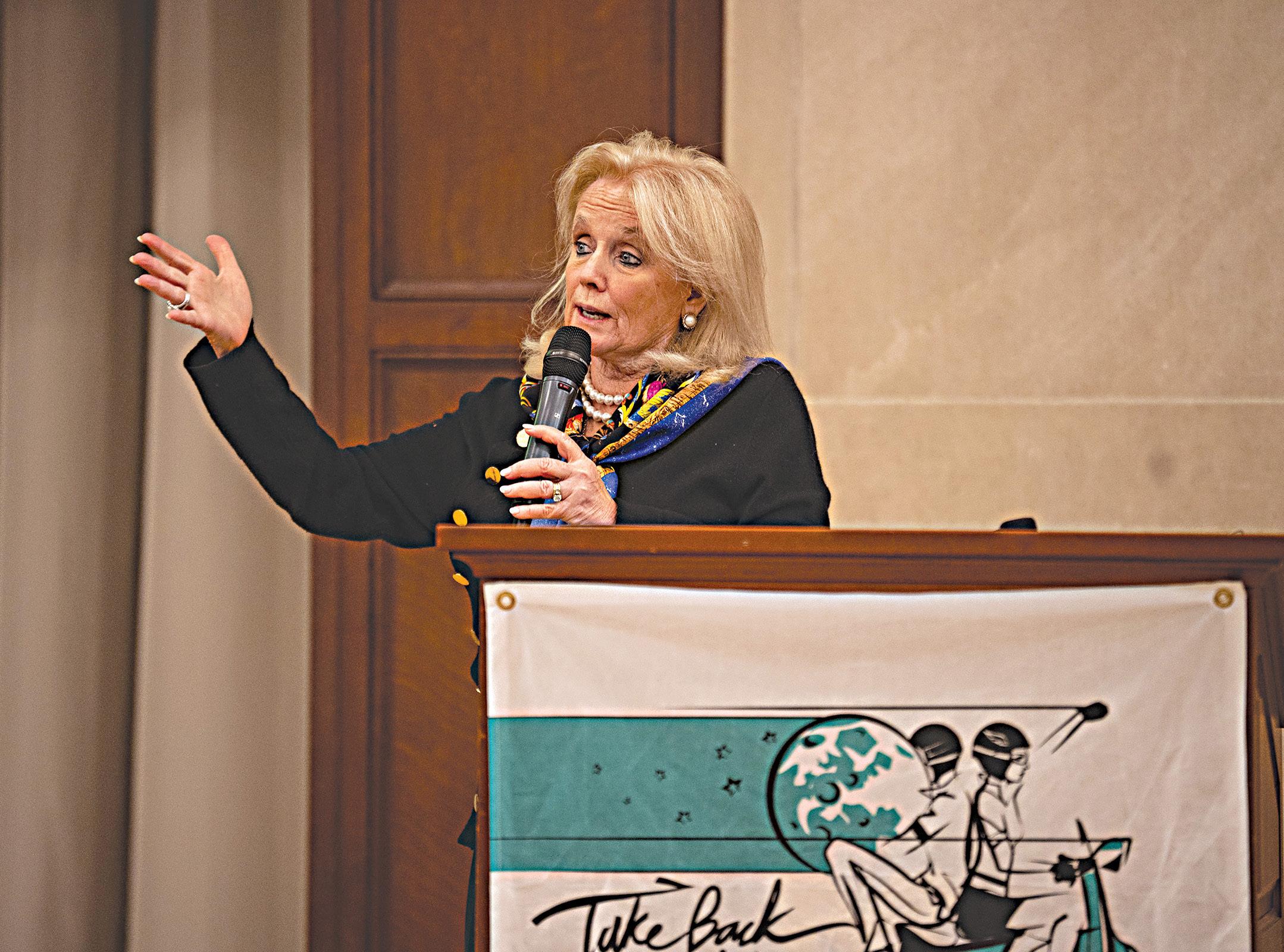
U.S. Rep. Debbie Dingell, D-Ann Arbor., was the first speaker of the event. Dingell expressed her dedication to the cause of ending sexual assault, specifically on college campuses.
“This is a fight we can never give up on and a fight that is, quite frankly, too personal for too many women,” Dingell said. “One in five women are sexually assaulted during their college years. … I have spent my life fighting violence against women, and I’m not going to stop until they bury me.”
Dingell said she hopes events like Take Back the Night will help encourage victims of sexual violence to share their stories.
“For too long survivors have suffered in silence (for) fear of retribution, attack on character, physical fear, and quite frankly, the lack of action is unacceptable,” Dingell said. “That’s why we are fighting here tonight.”
LGBTQ people, particularly LGBTQ people of Color, particularly Black LGBTQ people. With all of those identities and demographics, the realities of their existence and the navigation (of it), changes.”
Poindexter also said it was important to think about the intersectionality of sexual violence and how some groups may be more at risk than others.
“I know how to fight and advocate for myself, most people don’t,” Poindexter said. “Particularly
The keynote speaker of the event was activist Jey’nce Poindexter, vice president of the Trans Sistas of Color Project and a board member of the Michigan Chamber for Reproductive Justice. Poindexter said she chose to speak at Take Back the Night to inspire marginalized people to reach for leadership positions in which can create more change. “I did not have a Black trans woman to look up to say, ‘That’s what I wanted to be,’” Poindexter said. “I was able to see that from my own strength, through my own lens, and I was able to achieve that.”
Poindexter ended her talk by emphasizing the importance of equal rights for trans people. She said she does not want special treatment for members of the LGBTQ+ community, simply equal treatment.
“We don’t want special rights,” Poindexter said. “What I want is the same opportunity to show up, to exist, to thrive, to go after my dreams and goals. … All I need is for my humanity to be seen, acknowledged and respected for just what it is.”
After the rally, attendees participated in a march through streets around campus, ending back at the Union for a candlelight vigil in solidarity with everyone impacted by sexual violence. Banks told The Daily the march was to demonstrate solidarity with all survivors of sexual assault, even with those who may not feel ready to come to an event like Take Back the Night. Even if you’re not with us in person … we are still going to be out there marching with you,” Banks said.


The letter also called the policy unnecessary, referencing the University’s existing policies that already address disruptions to University operations, such as the Standard Practice Guide Policies and the Statement of Student Rights and Responsibilities.
While the letter acknowledged the University’s efforts to carry out its operations without major disruptions, it ultimately concluded the policy was unnecessarily punitive and should be abandoned or greatly modified.
inviting University officials to enforce the policy in a subjective or discriminatory manner.” The letter expresses concern that the policy could disproportionately discipline students of Color, increasing racial disparities in campus policing.
“We urge the University of Michigan to abandon its efforts to adopt this policy at the expense of the freedom of speech and expression of its community members,” the letter said. “The University should pursue far narrower options—many of which already exist—to address concerns about major disruptions to University operations.”
The University did not respond to a request for comment in time for publication.


ACLU of Michigan
concern over proposed ‘Disruptive Activity Policy’ Organization sends letter to Santa Ono and Timothy Lynch The ACLU of Michigan sent a letter to University of Michigan President Santa Ono and Timothy Lynch, vice president and general counsel, on Wednesday expressing concerns over the University’s proposed Disruptive Activity Policy. The letter encouraged the University to either abandon or substantially re-write the policy. The letter called the policy “vague and overbroad” and said that it threatened students’ First Amendment rights. It referenced numerous instances of language in the policy that it called imprecise and ambiguous and stated that because the policy does not explicitly state which activities are or are not prohibited, it leaves room for University officials to enforce it in a discriminatory manner. For example, the letter criticizes the draft policy’s requirement that protests not impede traffic. “In particular, the proposed policy does not define ‘impede’,” the letter reads. “It is very common for protests and rallies to peaceably assemble on sidewalks, in large public places like the Diag, or in front of University buildings. As a natural and accepted consequence of such gatherings some people will have to walk around the gathering or slow their pace to make it through … the policy’s imprecise language sweeps so broadly that it risks chilling constitutionally protected speech and expressive activity,
expresses
“Even if you’re not ready to get actively involved yourself, if you’re not at that stage in your journey, that’s OK. We see you and we hear you. You’re right there with us.” The Michigan Daily — michigandaily.com News Wednesday, April 10, 2024 — 3 47th annual Take Back the Night rally and march explores intersection between sexual violence and the LGBTQ+ community ‘We as humans need others for support, and we also heal as we help others’ CAMPUS LIFE GOVERNMENT PHOTO OF THE WEEK Rep. Debbie Dingell speaks at Take Back the Night Ann Arbor in the Union Ballroom Wednesday evening. MARY COREY Daily News Editor ANNA JEROLIMOV Daily Staff Reporter RUBY KLAWANS/Daily $31.95 reg. $39.95 plus tax & shipping • offer expires May 1, 2024 • books ship May 31, 2024 Pre-order online at Team144.ChampsBook.com cover not final CELEBRATE MICHIGAN’S CHAMPIONSHIP WITH THIS HARDCOVER COLLECTOR’S BOOK 20% OFF FOR A LIMITED TIME! With a foreword by Nicole Auerbach, senior writer at The Athletic, this all-new hardcover book “Victors” highlights The Michigan Daily’s coverage of the historic 2023 Michigan football season. This limited-edition coffee table book provides a unique perspective and combines student journalists’ on-the-ground reporting on every game, player and coach feature stories, and never-before-seen photos to tell the story of a national championship-winning team across 96 pages. Order today to save 20% and own a piece of Michigan football history. Students celebrate Holi at the Regents Plaza Sunday afternoon. KEITH ALLEN-MELONG/Daily
British rock is no stranger to the concept album. The Beatles’ Sgt. Pepper’s Lonely Hearts Club Band is cited as the album that popularized concept albums, and many of the most popular concept albums to date hail from the British rock scene, such as Pink Floyd’s The Wall and David Bowie’s The Rise and Fall of Ziggy Stardust and the Spiders from Mars. The concept album is no stranger to the eclectic and dynamic art-rock band Everything Everything (see Raw Data Feel ), and their new album Mountainhead serves as a vehicle to explore themes of classism and the death of social mobility. While they don’t quite reach the (admittedly very high) peaks of their predecessors, the band puts their own maximalist synthy-art pop spin on the British rock concept album, culminating in a charming allegory that’s bleakly fun, if not a bit simplistic.
Described by lead vocalist Jonathan Higgs as a dystopia in which the entirety of society resides within a mountain, Mountainhead
is full of critiques of capitalism and an easily-digestible metaphor, underpinned by twinkly synth. The album’s twist is that the civilians built the mountain themselves and actively uphold its infrastructure by digging themselves deeper into the hole, with the album title doubling as a term for someone who prioritizes digging downward no matter the cost. For the hell of it, Everything Everything also throws in a giant golden snake living at the bottom of the pit, serving as a constant threat to the residents who live the farthest down. The lyric’s world-building leaves little room for subtlety; the people have constructed a manmade structure in which the bottom percentile upholds the elite at the top while simultaneously attempting to keep themselves out of the jaws of a greater evil. The analogy is all too familiar, reading like an early 2010s young adult dystopia sans the boring love triangle. The simplicity, however, is surprisingly effective — or perhaps the metaphor is effective due to this simplicity. In a world that idolizes complexity to the point of nonsense, Everything Everything’s relatively straightforward approach is a breath of fresh air.
The uncomplicated nature of its central metaphor is reflected in other facets of the album. There is little variation in song structure and, at times, the lack of diversity leaves something to be desired, especially when tracks blend together sonically. Sometimes, this homogeneous yet effortlessly bright synth-pop pairs well with their bleak social critiques, but there remain vacant moments in which harsher musical tension or discordant noisiness could further accentuate the narrative. “TV Dog” serves as a welcome exception to that norm, stripping away the synth-pop they have become fond of and trading it in for Higgs’ voice floating atop string instrumentals. While “TV Dog” may come across as lyrically corny or musically uninteresting, it functions well as a reflective interlude and is precisely the type of musical respite the album could benefit more from.

Still, Everything Everything does a lot right with Mountainhead It makes the most of its nearly 55-minute runtime without dragging, thanks to a slew of tracks entirely composed of atmospheric hooks: “Wild Guess” is an entertaining and lush opener, buzzing like a sunspeckled jungle, and
31. Former child actress Lindsay
32. Vote into office
33. Title for Vader or Maul
35. Half a school yr.
37. The best service you could get before 5G
39. Packaging string
40. "___ be a fool not to!"
41. Something you might take while gambling
46. Small oil-rich country bordering Iraq
47. Not equal
48. In an affectionate way
50. More or less
52. Large supermarket chain popular in Britain
53. Dart around
54. Word with wolf or star
55. British Prime Minister Emanuel
57. Part of, as a joke
58. "Finished!"
59. Nor. neighbor
60. Government agency that oversees planes, in short
62. Did ewe say that?

“Queen of Tears” contains all the typical hallmarks of a romance K-drama: a suspenseful love triangle, hospital scenes, highstatus characters with tortured pasts and a catchy, immersive soundtrack that plays at all the right moments. But there is one aspect that sets this drama apart. Instead of internally shouting at our leads to confess their feelings for each other and have their first kiss already, we are rooting for a couple to rediscover and redefine what it means to love.
Half of all marriages result in divorce. This sobering yet false statistic is repeatedly considered an accepted fact of life as we watch a married couple of threeplus years on the brink of crisis. Marriage is now associated with an eventual parting, and rather than outright refuting this pessimistic myth, “Queen of Tears” is not afraid of playing with this idea to salvage what looks like an irreparable relationship.
Baek Hyun-Woo (Kim Soo-Hyun, “It’s Okay to Not be Okay”), a boy from a rural farm who later studies law at Seoul National University, and Hong Hae-In (Kim Ji-Won, “Descendants of the Sun”), the girl who is to inherit one of Korea’s largest conglomerates, have the “wedding of the century,” as the media puts it. The event was a fateful union of two souls from disparate worlds: One had only known the slow living of village life surrounded by honest and hardworking laborers while the other had grown up in quick-paced corporate city life surrounded by scheming business elite. What follows their union should have been a fairytale dream come true, but as Hyun-Woo and Hae-In acclimate to their newly post-wed lives, they find this couldn’t be further from the truth. After three years of hell, and Hyun-Woo wants out. Left feeling nothing but miserable living with and working alongside his nowestranged wife’s morally corrupt family (one akin to that of “Crazy Rich Asians”), he has no choice but to divorce her. That is until he is faced with the news that his wife has been diagnosed with a rare type
of brain tumor; she is set to die in just a few months.
Baek Hyun-Woo is charted for a new mission now. After learning of Hae-In’s condition, he retracts his wish to separate and instead works to woo his wife’s love back so that she will change her will before she dies. After all, it would be great to escape this marriage permanently unscathed and obscenely rich. Twisted much? Not exactly. By engaging in several over-the-top fake acts of fondness, he finds himself increasingly caring and protective toward Hae-In with each passing episode. If this were any other drama, we’d hope the flirty male lead would finally muster up the courage to express his undying love with a dramatic gesture. In this case, though, we are eagerly waiting for Hyun-Woo’s realization that his cheesy acts of service are not for a fortune anymore, but rather out of love for the cold, calculating woman he despised for the past several years. Likewise, we are sitting at the edge of our seats wondering when Hae-In will be brave and vulnerable enough to reciprocate this genuine affection.
Some may believe that knowing the couple’s extensive backstory makes the stereotypically expected romance unsatisfying because these two were once deeply infatuated with one other. We know this is a show about a marriage rescuing itself, of two individuals fighting each other to eventually overcome the odds together. Strangely enough, however, something is endearing about watching dulled-out passion gradually revive into something more beautiful and complex. Rather than taking away from the show’s intrigue, the couple’s narrative arc adds dimension to their first kiss on screen, their hugs of comfort in the pouring rain and their confrontations with “family” members who detest this ill-matched relationship. Indeed, we see here that resurrecting love after having it all is just as much a struggle as searching for it.
One can only hope that this distanced couple can once again recreate those oh-so-charmingly romantic montages from their initial stages of puppy love. Each episode sends Hyun-Woo’s and Hae-In’s relationship on an unpredictable roller coaster ride.

musical
blurry
reminding listeners of a more refined Myths of the Near Future-era Klaxons. While it does trail behind the concept album greats — and even their own work — there is an unmistakable charm to Mountainhead, especially in its attempt to create a narrative that is greater than the sum of its parts. It’s easy to criticize the blunt simplicity and heavy-handedness of the metaphor, but at the end of the day, the choice of making an uncomplicated statement is better than creating a pseudo-intellectual analogy that ends up saying nothing at all. 4 — Wednesday, April 10, 2024 Arts Everything Everything go dystopian to make social critiques on ‘Mountainhead’ The Michigan Daily — michigandaily.com AMAYA CHOWDHURY Daily Arts Contributer Recovering lost love postmarriage in ‘Queen of Tears’ MICHELLE WU Daily Arts Writer This is an image from an official clip for “Queen of Tears” distributed by Netflix K-Content. The Michigan Daily Crossword Sunday, April 7, 2024 — Puzzle by Benjamin Nayman 1 2 3 4 5 6 7 8 9 10 11 12 13 14 15 16 17 18 19 20 21 22 23 24 25 26 27 28 29 30 31 32 33 34 35 36 37 38 39 40 41 42 43 44 45 46 47 48 49 50 51 52 53 54 55 56 57 58 59 60 61 62 63 64 65 66 67 68 69 ACROSS 1. "Let me think..." 4. October birthstone 8. Sculpt 13. Greek personification of Earth 14. Like some awakenings 15. Consumed 16. Lightweight jacket often seen on a golf course 17. Marries 18. Virtual storage unit for many computer networks 19.21.23. Go from solid to liquid 24. Stan whose final cameo was in "Avengers Endgame" 25. ____ Lingus 28. Go from 0 to 60, say 31. Light type that might provide color to a bedroom 34. Luca who "sleeps with the fishes" 36. Interjection to imply sarcasm 37. ___ Bunny ("Space Jam" character) 38. Not feeling well, or a visual hint to five pairs of clues in this puzzle 42. Thailand, formerly 43. The final "w" of www 44. Respond to, as a stimulus 45. Always, poetically 46. Artist sometimes known as Mr. Rager or Moon Man 49. Highest degree attainable? 50. Plant whose seeds may be seen in a baseball dugout 51. Hornet's home 53.56. Items you might find piled up next to a bouncer 60. Plant life local to a region 61. Something walked into in many jokes 63. Dyed frozen treat 64. "_____ a Woman" famous Women's Convention speech by Sojourner Truth 65. Common N.F.L. play called as a last resort 66.67. Really bothered 68.69. United DOWN 1. A tiny margin to win
2. Cry between
toys
Palindromic title
discussing government surveillance
_____ Vallarta
Contribute (to)
"The
know the better"
Information
kept
9. Cut
two
Dip ___ in (test, as a pool) 11. Fear, to a Frenchman 12. Terminate 13.
the
3/4 of the initials of the 41st) 20. Mideast
fermented milk
the
25.
26.
penultimate “City Song” is the
equivalent of a distant sunset’s
warmth. The result is purely catchy and infectious synth-pop,
by
siblings fighting over
3.
4. Author often invoked when
5.
6.
7.
___ I
8.
best
private
in
10.
Initials of
43rd President (and
drink made from
22. Best of
best
Treat poorly
Bert's pal 27. Palindromic scanning device
29. Final year before a notable birth
30. Argument
Read more at MichiganDaily.com This is the official album cover for ‘Mountainhead’ by Everything Everything.
Combining high-stakes competition with standard convention fare, major tournaments (henceforth referred to as “majors”) are true celebrations of the fighting game genre and a permanent icon of esports. Ever since the first Evolution Championship Series (Evo) back in 1996, majors have been a cornerstone of the fighting game community and have helped the genre prosper well beyond the death of the arcade. Evo Moment 37 is the esports equivalent of the “Hand of God,” the “Miracle on Ice,” the “Blood in the Water” match or something from an American sport that I don’t know about. And, of course, it’s not just Evo. There are tons of majors each year, each unique and worth experiencing.
When I was a little boy, I was too slow and chubby to play futbol. I practiced every day for years but could never overcome that hurdle — as far as matches went, I was only ever subbed in for a few minutes so that my mom wouldn’t complain. Like every
On belonging and fighting game tournaments
other Latin American boy my age, I wanted to be a futbolero, but unlike most of them, I couldn’t kick a ball for shit. Instead, I turned to fighting games to scratch my competitive itch. Here, the physical barriers were ones I could overcome; I had no teammates to blame or drag down but still had a community to support me.
I found a great variety in the genre, from the brightly-lit stages of majors to online competitions to grassroots local tournaments consisting of 20 nerds standing outside in the Florida heat and arguing about game balance (objectively the best type of event).
I experienced some of the most cathartic moments of my life: being on stream for the first time, winning on stream for the first time, winning a local tournament, making it out of pools and seeing the Michigan scene grow. Even more importantly, I met some of my closest friends through fighting games, and it’s the fighting game community that has helped me grow from a shy, teenage recluse to a confident, adult … recluse. I’m working on it.
The first major I ever attended was Community Effort Orlando in 2017. As a 12-year-old, I was
too young to compete. My most recent is Frosty Faustings XVI (sometimes abbreviated as “Frosty’s,” but not run by a person named Frosty), held in Lombard, a suburban dystopia in Illinois, this January. Frosty Faustings is one of two Chicago-based majors alongside Combo Breaker, one I have attended for the last three years. Each time, I went into The Westin Lombard Chicago as an entirely different person, and every time, I came out a changed woman.
It’s January 2022, and I’m still a high schooler in Miami. Accompanied by my dad and his partner, I fly to Lombard. It’s my first time in the region, and I’m still too young to do it alone. It’s my first time seeing and touching snow, and I’m surprised by just how dirty it gets near the roads. This is the coldest weather I have ever experienced, well under 10 degrees, and four layers don’t feel like enough. I’m grateful for the mask mandate; I don’t have a scarf, and it lets me hide my face. The Westin Lombard, where the tournament is held, is huge, and although I have been playing fighting games for five years, I don’t have many friends here.
Kacey Musgraves’ ‘Deeper Well’ and the Soulful Depth of Contemporary Country
I sign up to play Strive and Skullgirls and don’t place too well in either game. I spend most of the weekend in the lobby chatting with my dad and his partner, trying in vain to breathe. I have a lot on my mind — IB exams, college (so far, I haven’t gotten any decisions from my top choices), the push and pull of my emerging social life during the pandemic’s peak, my transition — and it feels like everything has come to a halt for the weekend, until the moment that it all begins again.
Midway through my bracket run in Strive, the University of Michigan decisions are released. My phone is bombarded with notifications (which distracted me and, I’ll tell myself, made me lose), but the venue’s WiFi is slow and nothing loads — all I know is that I have received an email from the University. Between my matches, I run around the Grand Ballroom through dozens of little crowds to get to the water fountains and, more importantly, to try to get good enough reception to properly check my phone. Finally, I access the PDF attachment and, while the text fails to load, the yellow

and blue confetti tells me I got in. I lose my next match rather quickly and am eliminated, but my mind is somewhere else. I go to the lobby to tell my dad the news but get interrupted by FaceTime requests from my friends and classmates.
I’m shaking, and between the adrenaline and all the walking around, I can’t tell why. Saturday night, barely 24 hours after being accepted by the University of Michigan, I’m all alone again, watching Strive Top 8 in the very same ballroom. I get a Discord
message and open it to find the only thing scarier than that unread email — someone from my local scene asking about hormone replacement therapy. To put it mildly, I freak the fuck out. How’d they even find out? “I thought I’d ask you, since B found your Twitter and told me you were trans.” Well, shit. I had left my account public for too long. I answer their HRT questions and assuage their fears about the process while trying my best to ignore my own.
The tell-tale mind: Psychosis and mental health in literature
Kacey Musgraves has emerged as a luminary figure in the country genre, crafting songs that transcend genre boundaries and speak to universal truths of the human experience. Following her win at the 2019 Grammys for her album Golden Hour and the success of her 2021 album star-crossed, fans eagerly awaited this release. Surprisingly, Musgraves departs from her previous two albums’ dynamic energy and grandeur. With her latest album, Deeper Well, she embarks on a sonic odyssey of introspection and self-discovery, weaving together a tapestry of emotion, melody and lyrical depth that leaves listeners spellbound. At its core, Deeper Well is evidence of Musgraves’s evolution as an artist and storyteller, which fortifies her space within the modern country music scene as she continues the complex use of elements within country, folk and pop. In the album’s opening track, “Cardinal,” it’s clear that Musgraves is diving headfirst into the depths of her psyche, exploring the echoes of memory with a notable vulnerability. While the guitar produces a whimsical dreamscape, her rich and consistent bridge maintains a sense of groundedness. In the zine sold alongside the album, Musgraves shares that country-folk legend John Prine inspired the message and production of the opener. Lyrics like “I saw a sign or an omen / On the branches in the mornin’ / It was right after I / Lost a friend without warning” and “Are you bringing me a message / From the other side? / Cardinal / Are you tellin’ me I’m on / Somebody’s mind?” showcase the importance of this relationship in Musgraves’ life. Despite feelings of recognition and comfort evoked by the symbolic cardinal, the song carries an underlying sadness that prepares listeners for the album’s overall sound. While the album mainly consists of melodic prose set against acoustic production, Musgraves makes a brief diversion from this sound with a smooth intermission, “Lonely
money and the diamonds and the things that shine / Can’t buy you true happiness” express a desire to share life’s moments with a loved one rather than indulging in extravagance.
The message is only punctuated towards the song’s end when Musgraves repeats, “All I want is you.” While Musgraves discusses the superficiality of wealth when compared to love, the overall construction of this song is rich and jeweled, invoking the selfish aspects of both opulence and romance. Musically, Deeper Well is a story with Musgraves’ soulful vocals and impeccable musicianship shining brightly throughout. From the angelic orchestration of “Too Good to be True” to the stripped-down simplicity of “Dinner with Friends,” each track is a testament to Musgraves’ versatility. It’s an auditory journey as rich and varied as the emotions contained within the human experience, with every note and lyric working in perfect harmony to create a truly immersive escape.

Millionaire.” Sampling “Kody Blu 31” by JID, the song takes a soulful turn with tranquil swells and meditative yet reverberative guitar plucking. The production calls back to the hallucinatory sounds heard on Golden Hour and leaves listeners in a mellow state before the final trio of songs, which all follow the stripped-back theme of the album. The lyrics convey Musgraves’ willingness to spend her money on her true love; she longs for something more meaningful than the superficial trappings of wealth. Lines like “Be careful what you wish for, I see it all the time / The
Deeper Well is also a deeply introspective album, offering listeners a window into her innermost thoughts and emotions in a format different from her work on star-crossed and Golden Hour. The album maintains an intense vulnerability, and tenderness isn’t hidden through dazzling production. Through her evocative storytelling and poignant lyricism, Musgraves invites us to confront the complexities of love, loss and longing with a degree of empathy and understanding that is truly remarkable. As we journey through its enchanting musical landscape, we are reminded of the transformative power of music to touch our hearts and stir our souls.
a contamination that will plague her palms forever. The unnamed narrator of Edgar Allan Poe’s “The Tell-Tale Heart” sits in perpetual paranoia, spiraling as he listens to the ever-growing heartbeat under his floorboards pulsate beneath him. One by one, the doomed Lisbon
Charlotte Perkins Gilman’s 1892 short classic, “The Yellow Wallpaper,” which follows a woman who, after the birth of her child, is locked in a room lined with yellow wallpaper. It’s implied that she has been diagnosed with “hysteria,” which in the context of modern medicine can often be recognized as the misogynistic placeholder for postpartum depression. Though the disorder has always been common in women, the taboo around women’s mental health at the time made it difficult to diagnose and treat, leading to the condition’s most commonly prescribed solution: isolation from society. This so-called “treatment,” however, often did nothing but worsen the patient’s emotional turmoil.
and other unethical practices have ceased as ethics have come to play a greater role in the mental health system and the treatments themselves have been proven ineffective.
nothing more fascinating, tragic, frightening
relevant than the depth of the human mind. We can trace literary themes of madness back to times of mythology and oral stories, from the demise of Oedipus to the divinity of Apollo’s prophecy. Mental complexity and insanity were described poetically; the tragedy of the human mind was hauntingly beautiful. In times before mental health was studied in depth, the loss of control over one’s mind was the ultimate form of defeat, and the literature of this time reflected these sentiments. Over the years, the depiction of mental health in literature has shifted. In the modern day, we are equipped with the necessary knowledge of mental health conditions that allows us to analyze these works through a lens of science and psychology that was not available when they were first written. A contemporary lens adds an extra dimension to literature that now stands as a product of its time. An early example of mental illness in literature occurs in
Continuing into the next century, mental asylums became an even worse fate for those struggling with mental illness. Treatment in these institutions commonly took the form of unethical shock therapies and lobotomies — both of which were prevalent throughout the 20th century. Works of literature around this time similarly reflected the horrors of mental asylums, brought on by misinformation and dated medical tactics. One of the earliest examples, the 1962 novel by Ken Kesey, “One Flew Over the Cuckoo’s Nest” features the famous Nurse Ratched and her cruelty towards the men in the asylum. The novel explores themes of power dynamics, mental illness, isolation and rebellion, coalescing into a definitive critique of society as recounted by the most unreliable of narrators. Frustratingly enough, the image of this asylum is the perfect example of how deeply our perceptions of mental illness have changed. One of the characters in the novel, Dale Harding, finds himself in the asylum due to his “homosexual tendencies,” revealing the discriminatory and intolerant nature of psychology at the time. Even the treatments themselves have changed course; lobotomies
After the publication of “One Flew Over the Cuckoo’s Nest,” Sylvia Plath’s “The Bell Jar” — arguably one of the most famous literary depictions of mental illness — was published in England. The reader follows the narrator, Esther Greenwood, as she navigates life as a student in New York and the debilitating mental breakdown she later experiences. Plath’s depiction of mental illness in this novel is widely considered to be semi-autobiographical, as it is said to draw from the author’s own struggles. In fact, due to how closely the story mirrored her real life, Plath originally published the novel under the pseudonym “Victoria Lucas.” It was not published under her real name or in the United States until after her death in 1963 (with the book’s U.S. publication following in 1971). As a result, the story remains incredibly accessible — and even relatable — to a modern audience, as Esther’s diagnosis is synonymous with what we would now call bipolar disorder and depression. The novel doesn’t set out to be a direct critique of the taboo around mental health at the time, but looking at the writing through a modern lens reveals the widespread impact this novel had by making its readers feel heard and understood.
Though this time in literary history was a turning point for accurate representation of mental illness, there were still quite a few flaws with the way in which it was depicted and perceived — namely rooted in misogyny and racism — which continued to change with time. Stories released in the last thirty years have shown the most drastic change when it comes to addressing mental health.
Arts The Michigan Daily — michigandaily.com Wednesday, April 10, 2024 — 5
CAROLYN LIRA Daily Arts Contributor
ARIEL LITWAK Daily Arts Writer Read more at MichiganDaily.com Learn more about U-M’s
Wherever we go, progress follows. vision2034.umich.edu Content warning: mentions of suicide, sexual assault and mental illness. Lady Macbeth stands in a trance, staring at the blood upon her hands:
sisters find themselves drowning in a depressive haze until it eventually becomes all-consuming under the societal pressures of girlhood and family. Throughout history and
eternally interlinked topics, the human psyche has been
topic.
readers,
vision.
literature, two
an inescapable
To
there is
or
ARCHISHA PATHAK Daily Arts Writer
more at MichiganDaily.com Design by Caroline Guenther
Read
This is the official album
cover
for ‘Deeper Well’ by Kacey Musgraves.
On March 27, 2024, the University’s Office of Public Affairs circulated a campuswide email soliciting input on a “Disruptive Activity Policy” draft formulated in response to a protest during the 101st Honors Convocation ceremony. The second primary provision of the draft is as follows: “2. No Person may disrupt the University Operations of UM Facilities, including but not limited to the communications or activities of speakers or performers on University Facilities, or of any class, laboratory, seminar, examination, performance, formal proceeding, activity in a reserved space, field trip, or other educational, research, artistic, athletic, medical, operational, or service activity occurring on UM Facilities by obstructing lines of sight, making loud or amplified noises, projecting light or images, or otherwise creating substantive distractions.”
This policy would essentially grant the administration the authority to punish students and faculty participating in any demonstration, protest or rally perceived as disruptive. Consequences could extend to suspension or, more severely, expulsion and termination. The draft has not officially passed, yet its hooks are already being sunk into the student body. Three students involved in the Honor Convocation protest have received police citations for “trespassing” at a public event.
U-M seeks feedback, so here’s mine: The proposed Disruptive Activity Policy directly infringes upon our First Amendment rights. The right to protest is constitutionally protected, and our university’s own student body has a long-standing history of utilizing this precedent. Let’s call this what it truly is: an embarrassing attempt to force student protestors to put down
What we’ve earned through disruption
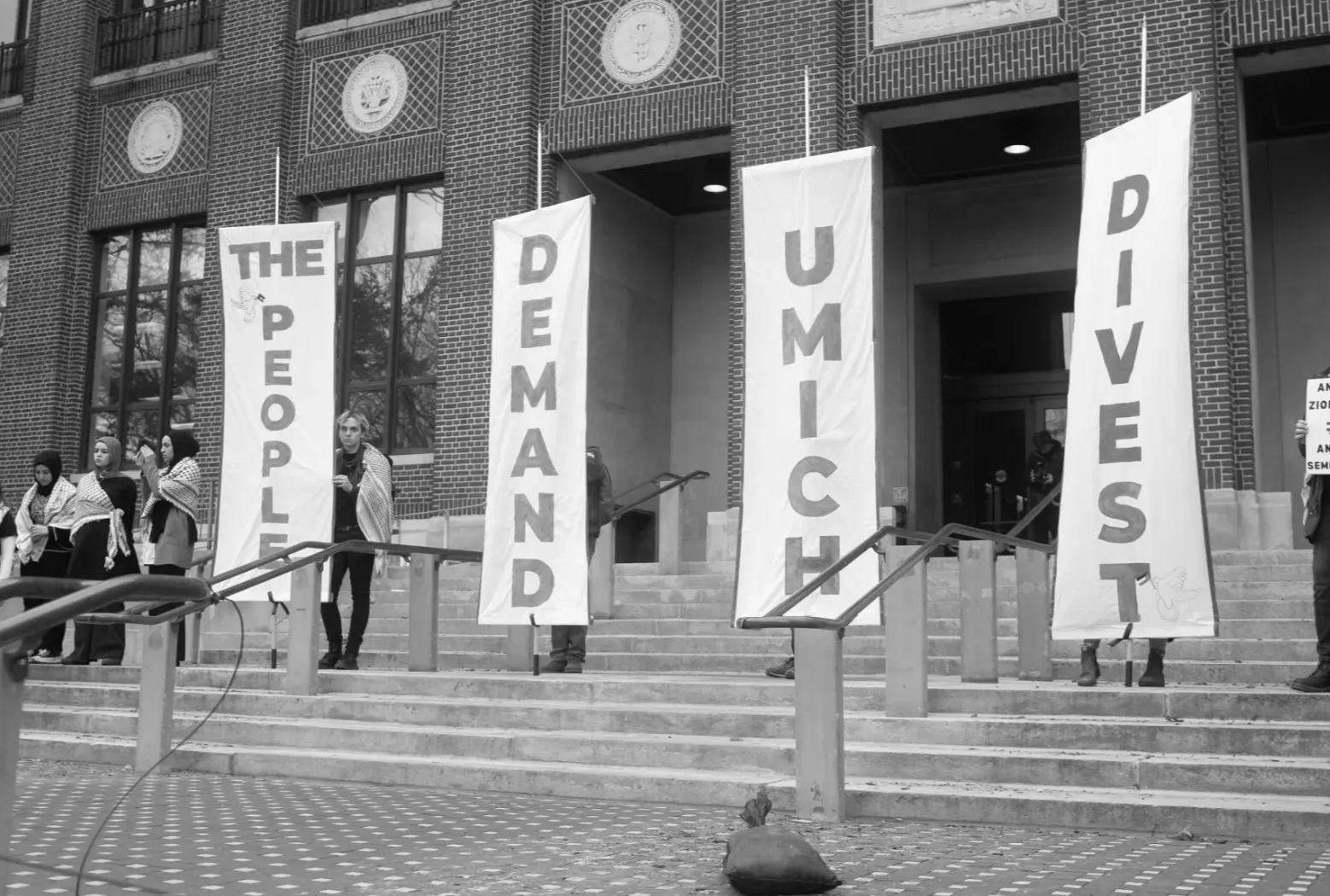
their Palestinian flags, remove their kuffiyahs, quiet their chants and become complicit in genocide. It won’t work.
Not only would this protocol keep students from protesting against the University, it would also bar us from creating civil disobedience in response to global and domestic issues, criminalizing examples of U-M student activism such as the anti-Vietnam war movement demonstrations, antiAsian hate protests in March 2021, and BLM protests in the summer of 2020, etc. Disruption works. The University of Michigan’s legacy showcases countless advancements for marginalized populations that prove this.
In 1965, a cohort of faculty members took a stand against the U.S. bombing campaign targeting Hanoi by declaring a teaching strike. Faced with the prospect of disciplinary measures if they
halted classes, they opted to intensify their teachings through around-the-clock extracurricular sessions focused on Vietnam. Faculty disruption birthed the concept of a “teach-in.” Teachins are still prolific throughout numerous campuses nationwide, educating the masses on the intricacies of political and social issues.
In 1968, on the day of Martin Luther King, Jr.’s burial, the Black Student Union took over the Administration Building (now the LSA Building) and chained themselves inside for five hours. This demonstration was accompanied by demands for increased Black student funding and faculty hires. Black student disruption led to the establishment of the Center for Afro-American and African Studies in 1970.
In the early 1970s, the Black Action Movement spearheaded
a monumental sit-in involving thousands of students and faculty, nearly bringing the University to a standstill. They prompted the University to address issues concerning admission and space allocation for Black students. Ironically enough, BAM protestors also staged a demonstration during an Honors Convocation. The Trotter House (now the Trotter Multicultural Center) and the Office of Special Services & Programs (now MESA), two essential safe spaces for BIPOC populations that spearhead much of the University’s DEI programming, only exist because of disruption. Further down the line, their work catalyzed a doubling in the number of faculty from underrepresented minority groups, a 10% increase in African American student enrollment, and heightened financial support for minority graduate students.
In 1972, after several years of Chicano student activism, Michigan’s chapter of Movimiento Estudiantil Chicano de Aztlán was formed. The chapter focused its efforts on hiring a Chicano advocate in MESA. Students were met with pushback and forced to relentlessly pressure those in power. Chicano disruption birthed MECha and propelled the hiring of a Chicano advocate in 1973.
As recently as 2022, negotiations between the Graduate Employees’ Organization and the University commenced for a new contract concerning Graduate Student Staff Assistants and Graduate Student Instructors. No agreement was reached, resulting in a strike that endured for six months. Participating GSIs refrained from conducting discussion sections and grading assignments, instead dedicating much of their time to rallying and protesting. Their disruption ultimately yielded pay increases, enhanced genderaffirming care benefits and lower out-of-pocket maximums for mental healthcare. Disruption works. A recurring theme in our university’s ironclad legacy of student activism is disruption as the voice of the silenced and underrepresented. It is rarely students and faculty’s first course of action. We initially strive for peaceful discussions and empathetic dialogue. However, when administration turns a blind eye to our concerns, we are left with no other choice but to disrupt. When student communities face oppression, disruption is a necessity. When the backbones of our institution are denied adequate compensation, disruption becomes inevitable. When you refuse to divest from a genocidal state, disruption becomes the consequence of your actions. Santa Ono, you should understand disruption better than anyone. You consistently leverage it at the first sight of conflict. In response to GEO strikes, you stripped finances from our instructors, disrupting their economic welfare. You strew dozens of police cars across the Central Campus Transit Center in response to peaceful protests, disrupting campus travel and student comfort. These officers shoved protesters, snatched off a Muslim woman’s hijab, denied student’s access to water and restrooms, and arrested more than 40 individuals for participating in a peaceful sit-in. Police violence is disruptive. Your vice president of Student Life sent a University-wide email indirectly subjecting one of our peers to national defamation, racism and doxxing. Putting targets on the backs of your own student body is disruptive. Disruption is a language you speak fluently Santa Ono. You should have no trouble understanding when we spit it back at you twice as loud. It is all we have. You will not take it away. The University wants your feedback. Give them hell.
You can take the boy out of Texas
But you can’t take Texas out of the boy. You can’t take away the salty kiss of Gulf water on my skin.
You can’t take away the fact that I tell my friends Beyoncé is like a sister to me and that you can’t make me an iced tea sweet enough.
You can’t take away stars that shine brighter than anywhere I’ve ever been before. You can’t take away summers that smell like bug spray and the sour tang of skin and sweat. I swear, I hated it but after spending so long in the cold I went home and spent three months halfnaked on the roof of my parent’s house, getting tan. No sunscreen, just me and the sun, feeling its heat under my skin and in my bones, just me and the dizzy crawl back inside through the window, just me wishing I could take an ice cold shower but having to settle for room temperature because the pipes are too hot to run cold water.
All of it felt a little silly when I moved there: too patriotic, too God-Guns-America. But now I spend most of my time in Ann Arbor and when people ask me where I’m from, I cross my fingers that they’ll ask me more when I answer. The Texas shaped steaks at H-E-B used to be the butt of my jokes on grocery runs, but now they’re a point of pride, and I’ve never cared much about sports, but I feel a sense of comfort on State Street when I see an orange Longhorn. It’s hard to pin down what loss I felt most acutely leaving Texas for Ann Arbor, but I do remember the first thing I noticed was the absence of parks. There are parks everywhere in Texas. All Ann Arbor seems to have for me is sad little clearings with a picnic table or two. Maybe a couple benches if you’re lucky. I miss parking lots with spaces all big enough to house a Ford F-250 double wide, I miss the Texas sized kids playgrounds I loitered around as a teenager. Everything that stands out in my memory about Texas feels like a symbol, a sign of something deeper.

I don’t even like barbecue but I find myself longing for it, rich meat with even richer sides, cutting through the fattiness with a squishy slice of untoasted Wonder Bread. The heaviness of it all feels like it means something. Like it’ll protect me. In Texas, people take the word of God seriously, they do everything He says and that includes loving thy neighbor. In Texas, at a barbecue place, when my mom asked a white man with a gun holstered on his hip what something on his plate was, he asked if she wanted to try some. In Texas, every neighbor on my street owns a gun, and every neighbor on my street also knows my name and what I’m studying and gives me a Christmas gift every year.
cookie cutter suburban mansions, sandwiched between old one story bungalows.
Driving in Ann Arbor, all I can think about is how tiny everything feels. Compact and so gray-brown it’s stifling, three lanes on each side instead of six or seven, parking spots that leave me cracking open the car door and squeezing out; I have yet to find sprawling ethnic neighborhoods, street signs written in Chinese and then Vietnamese and maybe English. The cramped Asian grocery stores and halfAmericanized restaurants that invariably serve orange chicken and fried rice more than anything else are a comfort, but leave me wanting so much more.
In Texas, you drive and you drive. My fondest memories are in a car, driving from one neighborhood to the next, through southwest Houston and its auto shops and bail bond agencies and into the residential streets that are just starting to get gentrified —
In Texas, culture takes up space. Chinatown was the first place I loved in Houston because it was so unlike the white towns I had grown up in — the new restaurants popping up so often an entire new Chinatown opened up, street signs
in Chinese I couldn’t read then but can puzzle through now. My favorite park, where teenagers smoke shitty weed and grandmas do tai chi, night and day. The karaoke places everyone had their birthday party at in high school. All of it, culture, sprawling but together, different from the tiny enclaves tucked away across Ann Arbor. And then I finally get asked where I’m from, and every time I’m proud to say “Texas” and yet no one seems to share my enthusiasm, regardless of how much they claim to love “Jolene” and even if they just bought cowboy boots. Instead, it’s “oh, Texas, that’s cool”, usually followed with silence, maybe a comment on how far away that is, or, from the more opinionated: “Oh wow, how’s that for you?”
They know what that means and I know what that means, and in case you don’t, let me try to translate: It’s something like, “I don’t think you’re the type of person that’s
supposed to be from Texas, and I know you’re not the type of person who’s supposed to be proud of it.” And maybe they’re right, I’m not the type of person who’s supposed to be proud of that, but, well, I am, and who decided I shouldn’t be proud of it?
But Texas is just as much loving thy neighbor as it is judgment. When I went home for the summer I packed all my camo and denim and plaid, nothing too gay, got a boring short haircut, made sure to speak in a single, flat tone to affect as much masculinity as I could muster. I had been stuck on this memory from my first Christmas home, how my roommate had painted my nails the day before my flight — baby blue, super gay — and I had received so many nasty looks in the airport alone that I spent the whole flight with my hands balled into fists. When I went back for the summer I resolved to bring back my straightest self, someone I hadn’t
been in contact with for nearly nine months, which had been enough time to turn into something — someone — new. Somehow, though, the more time I spent in Texas as Straight Noah, the further away from me he got. Three weeks after I got there, my hair had been bleached an orangeyblonde that I declared “Kraft Mac & Cheese realness”, within a month I was back in short shorts, and on my second trip to Goodwill in June, I got a t-shirt printed with rhinestones and silver lettering that I wore at least once a week. My friend wanted to paint my nails and I let her. I hung out with mostly girls. I was happy with myself. The airport looks followed Gay Noah, more or less depending on how far from the city he was, but never ceasing entirely, and yet the more looks I got the less I cared. And then I got on the plane to Detroit in August, blonde, tan, wearing tight jean shorts and unable to talk without hand gestures; strangely, somehow gayer than I’d left. Even stranger was how little I cared. And I got back, school started, and I became aware of something new but familiar at the same time. Walking down the streets of Ann Arbor — where I have always felt that I can be who I want without much consequence — I noticed that Gay Noah got just about as many looks as he did in Texas, never looks of malice — usually just confusion or curiosity. I didn’t have my real full circle moment until I went back to Texas having fully abandoned any pretense of being Straight Noah. I packed haphazardly for my trip this Christmas; throwing in whatever I wanted to wear, “too gay” or not. As expected, the looks and judgment followed except this time, objectively speaking, unchanged but to me far less malicious. Every glare or gawk mattered less and less. Texas is home to as much judgment as anywhere else in this country. But Texas isn’t cruel. Texas is kind. Texas held me tight and showed me all she had. And then she told me that I would never be like everyone else and for that, judgment would follow me everywhere I go — so I ought to stop caring about it.
6 — Wednesday, April 10, 2024 MiC The Michigan Daily — michigandaily.com JAMES SCARBOROUGH MiC Assistant Editor
NOAH MOHAMED MiC Columnist
Akash Dewan/MiC
Noah Mohamed/MiC
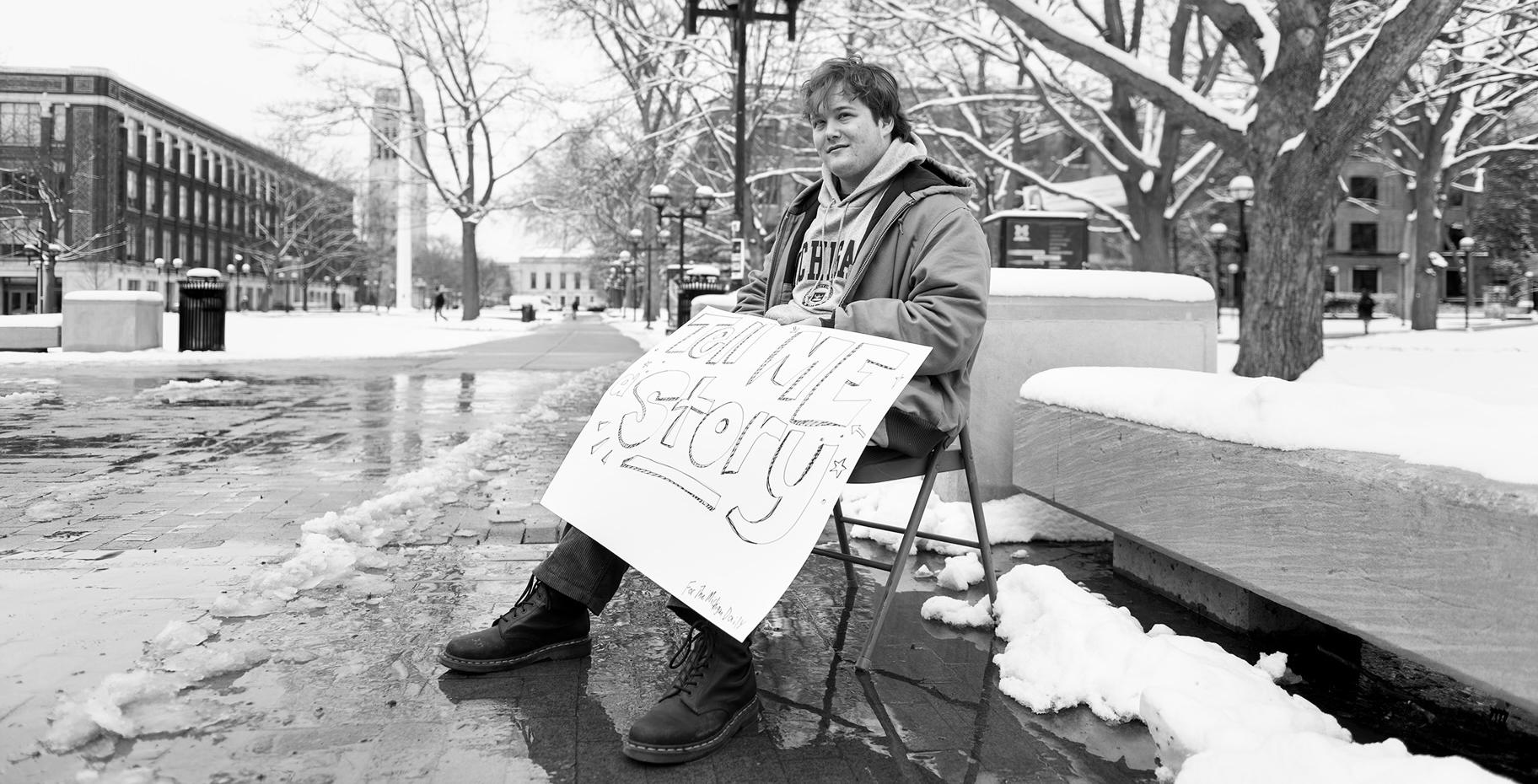
What the hell is a story? It’s a loaded word. A story is in the eye, or oftentimes ear, of the beholder. I’m not going to bother trying to define it because, frankly, I’m not even sure myself. All I know is that whatever stories are, I love them.
Storytelling is a uniquely human phenomenon. Humans evolved the ability to tell stories as part of cooperative behavior that kept us alive in our early days of existence, whether they used to communicate something as simple as, “You shouldn’t eat those berries” or something more serious like, “Holy shit! There’s a bear over there!” Human language is compositional and referential; we can use every part of grammar and at the same time refer to both ideas and reality. Our capacity for telling stories separates humanity from everything else on Earth. Our stories kept us alive and now they give us a reason to keep going.
Storytelling emerged in every culture across the globe. In Indigenous cultures, there’s a longstanding, vibrant oral tradition. Stories are used in many Indigenous cultures to preserve history, teach moral lessons and pass down creation myths. In my opinion, this is the true value of storytelling: More than filling in your friends on a night out or complaining to your parents, storytelling is the vessel by which culture and history are preserved.
Through stories, people can understand the world and see right from wrong and good from evil. Everyone has a story, and going to a massive public university has only deepened this belief. I walk past thousands of people every day — thousands of stories every day. I sought to change this and decided to let the stories walk past me. I decided to do this by publicly humiliating myself — twice. I sat on the Diag while awkwardly holding a sign asking people to tell me stories. I didn’t give any prompting on what they should tell the story about — I just asked if they could tell me a story. I chose my first day poorly. It was a Friday afternoon so there were very few classes in session, and it was, at most, 30 degrees out. The wind was blistering, and it had snowed all morning. So, in essence, it was a normal spring day in Michigan. I was sitting on my cold metal chair in two pairs of pants, four shirts and wool socks holding the sign in my ungloved hands. Luckily, though, some people decided to talk to the poor shivering guy on the Diag.
The first person to stop by was LSA freshman Sanjana Kulkarni, doing what appeared to be a task for a professional fraternity. Kulkarni agreed to tell me a story. “So I moved around, I want to say nine times throughout elementary and middle school,” Kulkarni said. “And I think the funniest thing that ever happened to me was the culture shock of learning that you don’t
call teachers by their first name. When I was in first grade, I decided to address my first grade teacher as Mrs. Becky when in fact it was Mrs. Sotero, the whole class kind of snickered at me. And that was my first introduction to first grade in, I think, Princeton, New Jersey, and it was fun. I wore a red headband on that day, and after that day, I never wore that red headband.”
I was thankful and slightly amused by the story. Even in the freezing weather, her embarrassing childhood story warmed me up for just a moment. I was stuck in my chair in the middle of the Diag. Time kept passing by, and it just kept getting colder. I could see my fingers getting redder and redder, nearly reaching purple the longer I sat outside. No one seemed to want to stop, probably because they didn’t want to spend more time outside than they had to. Thanks to the wonderful photographer who stuck around with me, I got my final story of this cold day.
LSA sophomore Noah Kanis was wearing a red coat that can only be described as rad or tubular. Kanis told me that he got the coat from his grandpa, and we bonded over raiding our families’ closets for vintage clothes.
The two of us got to talking, and Kanis was unsure of what to tell a story about. He started talking about the mice in the lab he works in, but couldn’t reveal too much thanks to those pesky research regulations.
“Do you know what you want to do after this?” I asked him.
“I’d like to go into pediatric
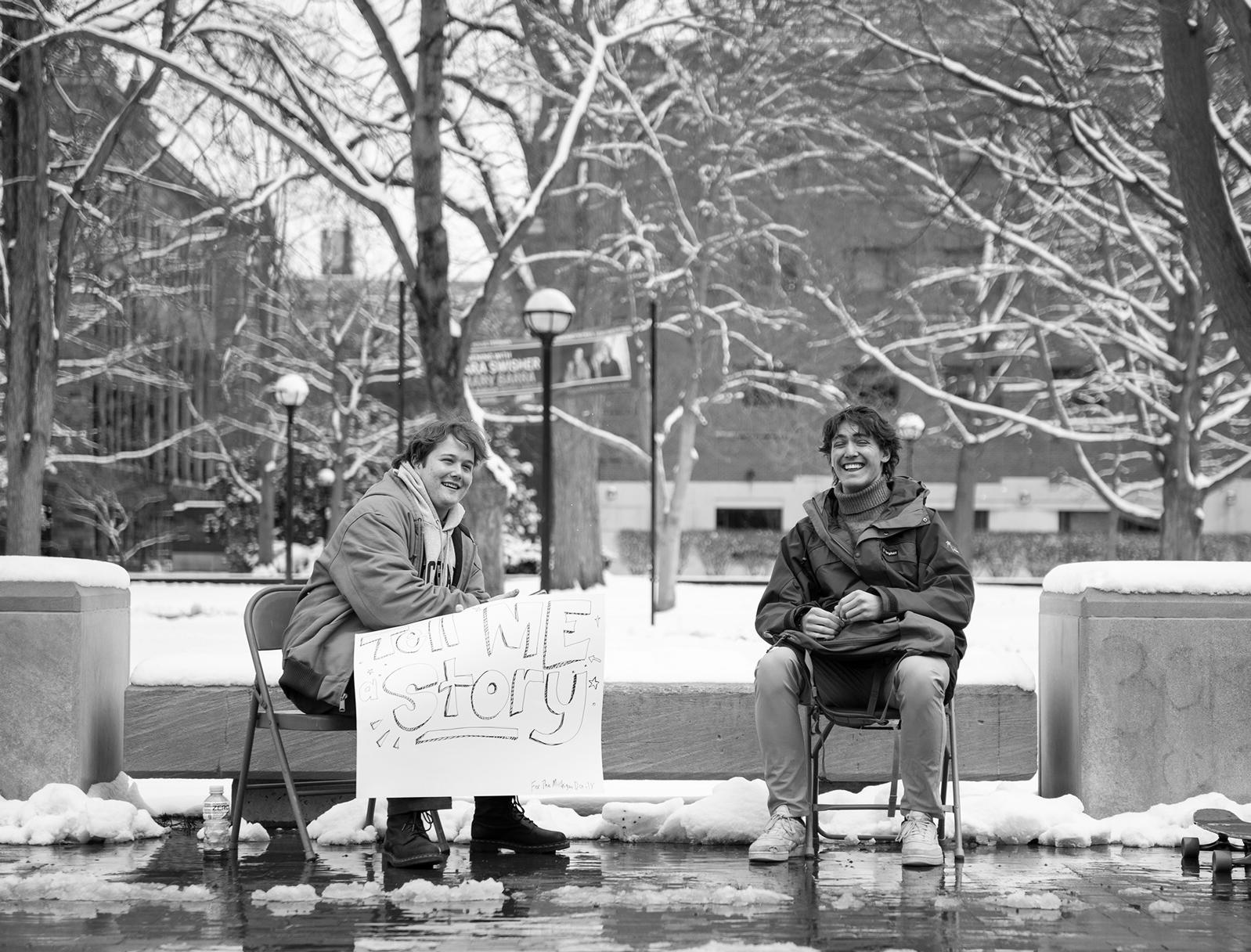
oncology,” Kanis said. “My sister passed away when I was 12 ... due to a brain tumor. And so that kind of was what really got me into the whole pediatric oncology world.” I was shocked to hear this. Here I was just a random person, and Kanis was trusting me enough to tell me this intimate story.
“I spent a lot of time in the hospital during that time, and so I just really like the connections that I made with people, like the nurses and the doctors,” Kanis said. “They were really along with me every step of the way. I just kind of want to try to do that same thing for others. It’s given me quite a strong sense of purpose, you know, that this is what I want to do.” Kanis told me how this experience inspired him to embark on the difficult journey of becoming a doctor.
“I mean, it’s gonna be a long long trek, a hard journey,” Kanis said. “And I wouldn’t consider myself the most academically strong person ever. But I’m pretty motivated, and so I work hard. I’ll see where it goes.”
Kanis’ nobility was awe inspiring. I have never had to deal with a tragedy of that magnitude in my life. His vulnerability was immensely powerful — I know that I would never be brave enough to tell a vulnerable story like this. But because Kanis could, we shared a moment together that I will never forget.
Miles Anderson sits and talks with LSA sophomore Noah Kanis on the Diag Friday, Mar. 22. Sarah Boeke/Daily. Buy this photo.
At this point, the cold began truly setting in. It permeated through my body, and it did not seem as if I would ever feel warm again. My six layers were doing nothing, and the decision to not wear gloves was biting me in my cold ass. I decided to call it, even though it had only been an hour.
I knew I would have to get more stories, so the next Monday, I went right back out to the Diag. Luckily for me (and my fingers), it was nearly 60 degrees out and quite sunny. I had a table this time, so I was able to tape the sign instead of holding it. I set myself up on the north end of the Diag and waited.
The first person to approach me was LSA sophomore Laken Pointer. Pointer seemed a little confused about what I was doing at first, but I did my best to explain it. Pointer said when she was 8, her father pulled her out of school.
“We lived in Holly, Michigan, and we moved from Michigan all the way to Florida to live on a

boat — a sailboat, to be specific,” Pointer said. Pointer told me this is her firstday-of-class fun fact.
“In Florida, I lived on, I think, a 44-footer 1984 Yamaha Stamas,” Pointer said. “It’s only like one of 26 made. It’s very rare, and I don’t know where my dad got the money for this.”
“I think he’s still paying off a loan maybe,” Pointer said. Pointer said she was homeschooled for a long time, but corrected herself.
“Not a long time. Like, maybe three months. A long time to a kid, though,” Pointer said. Pointer said after the stint of homeschooling, she went to Key Largo Elementary School in Florida, but eventually her and her dad sailed their way up to Virginia. “But in the end, we took the boat, and he fixed it up or whatever he needed to do,” Pointer said. “And we sailed it from Florida to Virginia, and now it’s in Virginia and still is in Virginia. And we go down every once in a while.” This boat meant a lot to Pointer. It was her past, and it might just be her future.
“One of the reasons I’m going to college is so I can get to a life where I can have a boat or take my dad’s boat if he passes, unfortunately ever,” Pointer said.
“I wouldn’t want that boat to just be gone. I’d want to be able to keep it up.” Pointer ended her retelling of her maritime experience quite simply.
“And yeah, that’s my story,” Pointer said.
People continued walking through the Diag in droves. The occasional tour group walked by and gawked at me as if I was standing atop the forbidden Block M. As I sat there basking like a cat in the sun, I forgot the trials and tribulations of the world. It seemed perfect for a brief moment. Then, Engineering freshman Silas Lorenz
STATEMENT
approached me and told me a story that shook my faith in the institutions we expect to care for us. “I was in kindergarten,” Lorenz said. “I had a faint memory of my teacher being a cheese thief.” He said the cheese from his and his classmates’ lunch boxes would disappear. “And I would always tell my mom, and she’d be like, ‘No, no way. Like, no way your teacher is stealing it,” Lorenz said. “It must be one of the other students.’ But I knew it was the teacher, and I would accuse her, and she’d be like, ‘No, no that’s nonsense.’” SARAH BOEKE/Daily Cheese thieves and refugees: I sat on the Diag and asked people to tell me a story MILES ANDERSON Statement Correspondent The Michigan Daily — michigandaily.com Wednesday, April 10, 2024 — 7 SARAH BOEKE/Daily LSA junior Mopelola Adigun discusses her birth story with Miles Anderson on the Diag Monday, March 25. SARAH BOEKE/Daily Miles Anderson sits and talks with LSA sophomore Noah Kanis on the Diag Friday, March 22. ReadmoreatMichiganDaily.com
I was a difficult child. When I was only 6 months old, my mother took me to the mall for the first time. This was one of the first real outings she had embarked on since I had been born, and it was supposed to be an escape from the confines of a house filled with the detritus of a newborn baby. We left Fashion Square Mall in Charlottesville, Va. only a few minutes later. I had become inconsolable upon entering the mall, screaming with such an alarming ferocity that in order to avoid the judgmental glares of adults unfamiliar with raising young children, she rushed me back to our green Toyota Camry. I think that my early reaction to the mall was indicative of my need to escape from places where I am uneasy. I am not talking about situations where there is a threat involved or locations I want to leave because I have grown bored; I am talking about ephemeral places like Amtrak platforms. Gas stations and train stops are transitory places. They are not destinations, but sites we pass through on our way to something better. At such places, I think only about how quickly I might be able to leave — escape, really. Listening to the sloshing of gas as someone fills the tank of a car, I watch other vehicles speed by on a four-lane highway, interstate or back road. The pump becomes a tether, and the gas station feels inescapable: I am waiting, while those other people in their moving cars are not. I am reminded of the ease of waiting in the stasis of the gas station. How easy it would be to sit down on a train station bench and become like the unscrupulous Bartleby in Herman Melville’s “Bartleby, the Scrivener: A Story of Wall-Street” and, when asked to leave, reply, “I would prefer not to.” How easy it is to become scared of the mandatory forward action of life. How easy it could be to sacrifice endless decision making in favor of waiting for it to become easier, waiting for when it becomes preferable.
Yet, just when I think I might understand where my apprehension

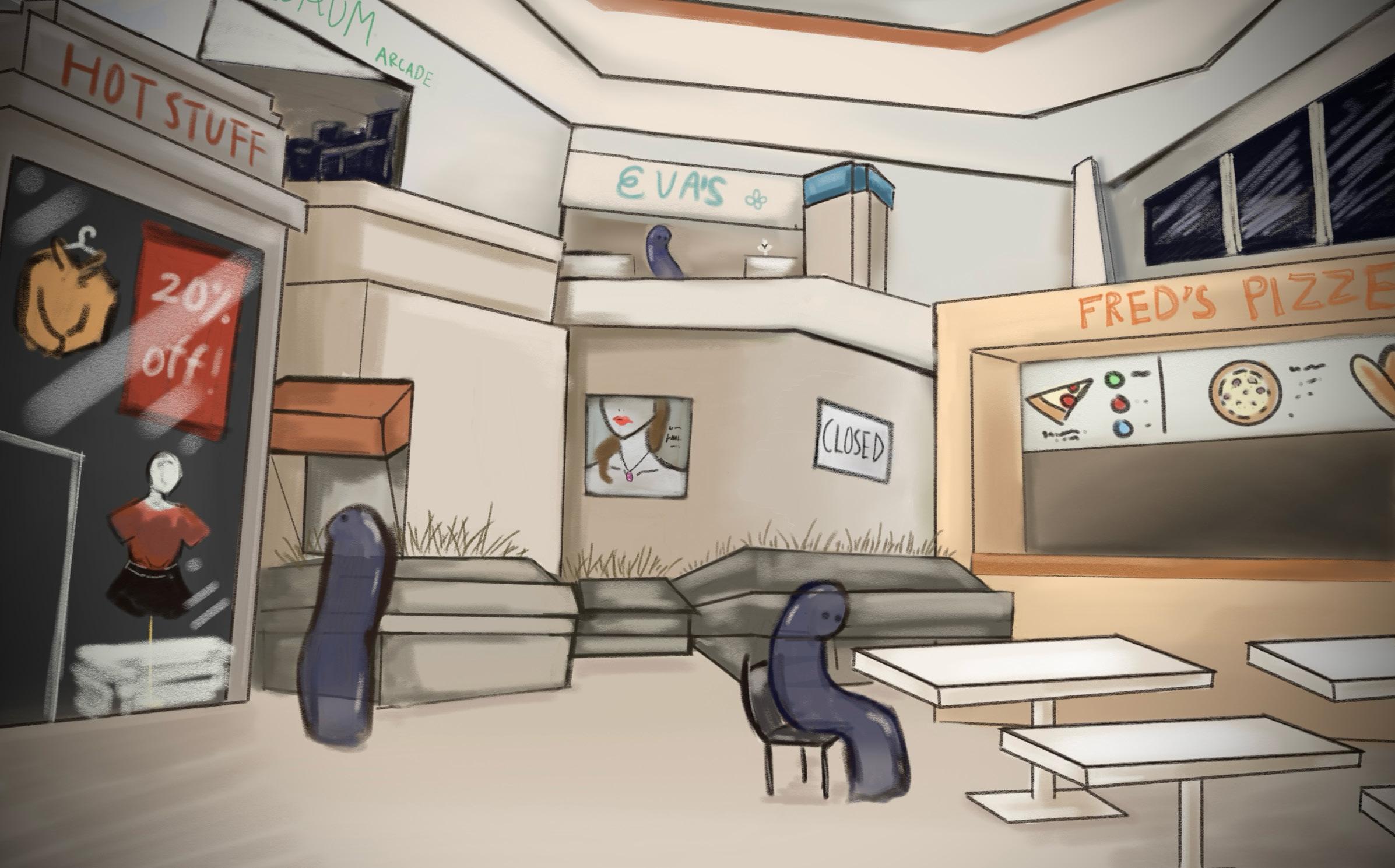
for these places comes from, I am reminded of the mall. Unlike gas and train stations, the mall is a destination. I don’t think my unease for the latter can be completely separated from my distaste for the former, and so if my discomfort with train stations and gas stations comes from their transitory nature, then I must assume that something about malls also feels transitory. But how does a place built to be a destination become a place defined by such impermanence?
The first mall ever built in the United States was located in Minneapolis and opened in October of 1956. Following World War II, the simultaneous rise of suburbanization and car ownership meant that retail spaces in downtown areas of cities began to see less patronage. In response, architect Victor Gruen suggested that department stores needed to establish a presence in the suburbs, or they would risk losing a significant portion of their customer base. He was soon hired to design one of the first malls in the United States, Southdale Center, and turned to European cities as a
source of inspiration. Gruen sought to create an atmosphere similar to what he had experienced in his birthplace of Vienna where friends would gather around fountains or at cafes while out shopping.
However, unlike many of the European cities that feature communal shopping areas, Gruen’s vision was of a place entirely indoors. He lauded the idea of a perennially air-conditioned complex in favor of fresh air, and Southdale Center was the first fully enclosed, climatecontrolled shopping center. In fact, it was not unlikely for malls to be the only air-conditioned places in town in the 1960s and ’70s. Yet, despite Gruen’s strange insistence on building a place devoid of sunlight, his desire to make malls a communal space might still be considered praiseworthy. Gruen’s earliest vision of malls was of a space that housed civic offices, community centers and apartments alongside storefronts. After traveling around the United States and observing the isolation inherent in the driving culture of the suburbs, he aspired to give American suburbia a third
place. Termed by sociologist Ray Oldenburg, a third place is a location to socialize and connect with the community. If the home is defined as the first place and work as the second place, Gruen hoped to make malls a place where Americans, so often cut off from each other, could leisurely intermingle. From their very creation, malls were a place where socialization was encouraged. It is perhaps not surprising, then, that the mall became a place young teenagers would flock to. In the mall, there existed a sort of freedom. Left unsupervised by parents, groups of friends could roam from store to store, from the movie theater to the arcade, the food court to the parking lot. Growing up in New York City, my friends and I did not go to the mall. Instead, we would often FaceTime for hours. My parents, coming into my room, seemed confused — maybe even worried — about why I didn’t see these friends in person. My mother, who grew up in Ann Arbor, would fondly recall times when she and her friends would go to the mall together on the
weekends. Would I remember these FaceTimes the way she remembered those mall excursions? It certainly seemed doubtful to her, and I had to agree that I wasn’t entirely convinced I wasn’t missing out on something. In the back of my mind, I would wonder about the mall. What had it offered my mother and her friends to bond them together so strongly that even into their 50s, they are still in regular contact? Oldenburg suggests that the importance of the third place lies in it being a location where one can entirely put aside familial or work concerns and enjoy the company and conversation around them.
However, if my FaceTime calls with friends were often made from my own room, it seems unclear whether the digital world can really count as a third place. It is not a location entirely separated from where we live or work — we so often reach for our devices in these very spaces.
It seems possible that younger generations lack a true third place in the way that my parents so clearly had when they would trek to the mall. Even so, I detest the mall every
time I go. I think the reason starts with the fundamentally clear fact that the mall is no longer what it once was. It is not a place of socialization, and it is not a place of leisurely shopping. At most, it is where one might go to make in-person returns or buy a last-minute gift. It seems easy to attribute the mall’s slow demise to the rise of the internet: With the ease of an Amazon search or click of an Instagram ad, one immediately negates the value of a physical retail space.
Yet, despite the mall’s growing loss of vitality, it remains present in much of the media we consume. Every few months, I seem to come across an article about the slow demise of the mall, and TV shows like “Stranger Things” and movies like “Mean Girls” represent the mall in ways it might have appeared in the 1980s and ’90s. So, even though I rarely enter these behemoths of cold tile and fluorescent light, I feel like I still might know what the paragon of a mall is supposed to be like.
I think this is why it is somehow always a surprise when I walk into places like Briarwood Mall: I am waiting for malls to be something they are not. I am waiting for them to become “revived” — to be how they were remembered, so that I can understand what they meant to people from my parents’ generation. Or maybe, I am so pointedly awaiting their demise that I am always surprised there are still people drifting between stores. Malls seem to remain trapped in a horrible in-between state, dying but not yet dead. The melancholy of a place that does not know what it wants to be transforms it into a liminal space where temporality reigns because, ultimately, one outcome — death or revitalization — must prevail.
And so, in malls, I am once again reminded of the stasis of life. Malls themselves are waiting. They are the Bartleby saying “I would prefer not to do anything and remain here as I am.” I dislike gas stations and train stations because I feel the pull of how easy it could be to give up on moving forward in life. I dislike malls because they are a literal representation of this stasis; they represent something that has given up, something that has refused to move forward, either toward revitalization or death.
When the pandemic first hit, most people probably turned to a wholesome, enriching hobby. Knitting, perhaps, or spending time with the family dog outside — something nice, and a normal way to cope with the lockdown. I, however, chose to spend my time in the dark, quiet hours of the night hunched over my laptop deciphering the loopy, cursive French of distant ancestors’ death
certificates.
In the pressing void where my usual amalgamation of French Club meetings, state viola competitions and lacrosse practices would be — after cranking out my precalculus and physics homework for the week — I would dutifully log into Ancestry. com to build out my family tree. I began three years ago, and as of today, there are about 9,730 individual “people” in the tree.
After an offhand comment from my mother one afternoon about how one of her cousins was trying to (unsuccessfully) trace our Irish
heritage back further than four generations, my ears perked up. I asked her if she had an account and if she remembered her password, begged her for a free trial of Ancestry Pro to be a “real genealogist” and dove right in.
and mother’s maiden name, sure, and I spent holidays, birthdays and school concerts with my maternal grandparents and aunts. But beyond that, I didn’t feel an overwhelming sense of belonging, of knowing where, exactly, the roots of my past came from — especially on my dad’s side.
minutes away.


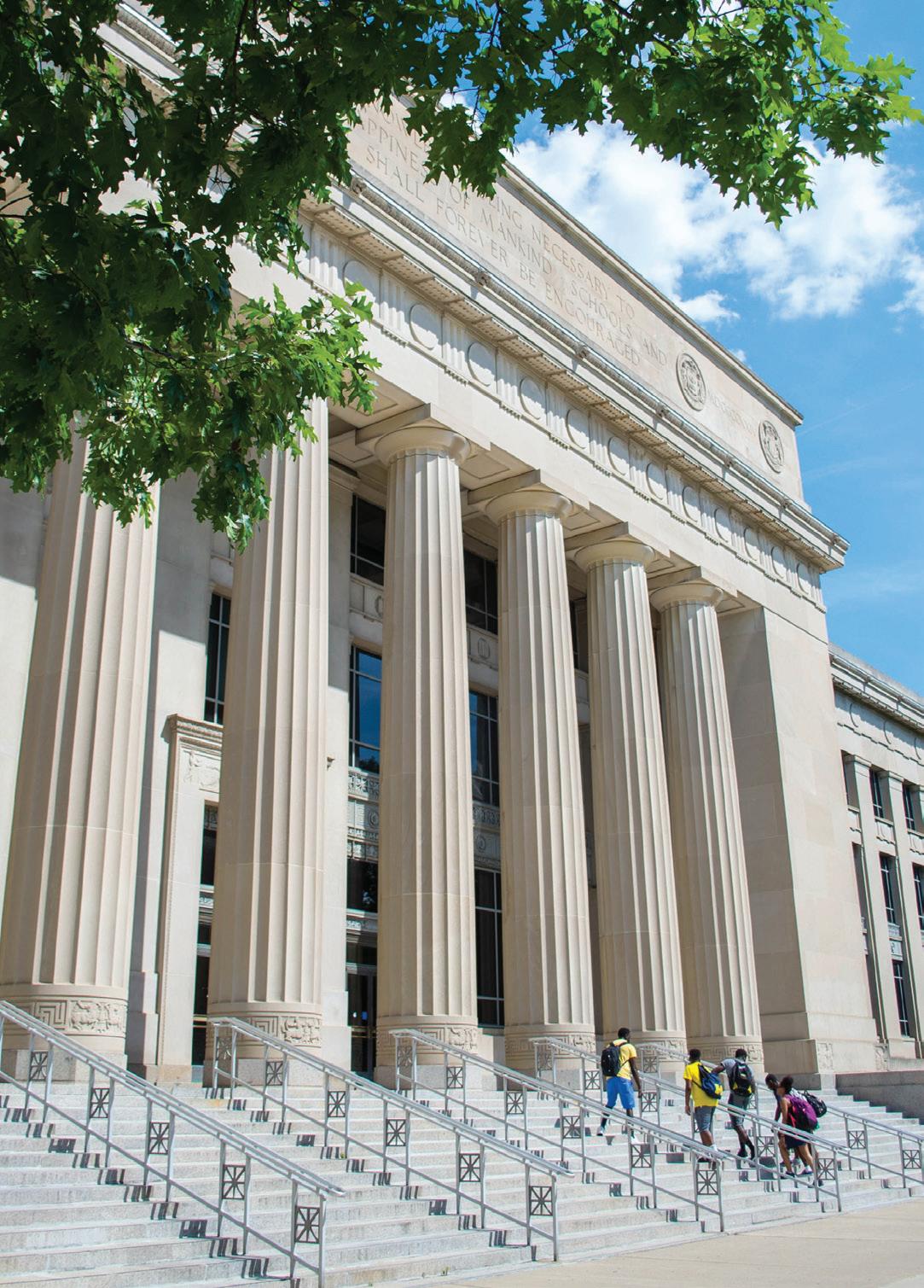
I’d stay up till 1, 2 or 3 in the morning, eyes burning as I tried to translate birth records from the Basilica of Ste. Anne de Detroit to figure out what year a certain branch of her family graced Detroit’s ribbon farms. Particular highlights included scrolling through sketchy blogs dotted with blurry JPEGs of people with haunted expressions and high collars, a Belgian cabinetmaker’s passport application upon arriving at Ellis Island and my newfound immediate search bar autofilling of FindAGrave.com upon entering the letter “F.”
At one point, I even contacted the Daughters of the American Revolution to corroborate if an ancestor was a lieutenant or captain in the Revolutionary War, corresponding with a lovely woman named Grace whom I unceremoniously ghosted upon moving into South Quad Residence Hall my freshman year. (I still occasionally receive emails from her asking if I’m still interested in “joining the family”).
In the early months, the best way I can describe my fascination was as a frenzy. It was a pure, unadulterated obsession with finding and verifying stories and wills and housing deeds, all abetted by my new hours (and hours) of free time. There was so much to learn, so much to uncover — the pseudomystery of any rabid mystery-genre fan’s dreams.
I wanted to learn as much as I could about a larger family past I’d felt vaguely disconnected from. I knew the origins of my last name
I knew the basics: He was the second youngest of six children, his family had a fascinating preoccupation with the name Francis (his grandfather, father, sister, brother and even his son had the name Francis incorporated into their full name in some way), and he was from Redford Township near Detroit. His father, a night patrolman for a local Ford plant, died the Christmas Eve after my sister was born, and his mother moved to Winter Park, Florida, soon after. He lived on Gaylord Street (then a dirt road) off 8 Mile, crammed in a shoebox-sized house. Whenever my siblings and I would complain about having to go to swim team practice or whose turn it was on the Big Wheel, he’d remind us in a grandfatherly fashion how he was too poor to have a Big Wheel or a park with a pool — his version of a pool was filling a bucket with water from a hose. We also didn’t talk to, celebrate holidays with or otherwise acknowledge his side of the family — the paternal cousins and aunts and uncles I’d never met. I never really questioned it growing up, as my maternal grandparents were amazing; their adoration, time and presence more than made up for it. Besides, they were that much more present because they were closer, I’d rationalize to myself in the car as we drove past the Detroit Zoo to their house on Friday nights. Even though my dad’s childhood home was just an additional 15
Compared to what I knew about my mother’s side of the family, the discrepancy was night and day. We had two bound books, enclosed with peeling bits of tan and green construction paper, detailing my mother’s Belgian roots in the living room buffet — my grandfather’s pharmaceutical scales in a glass container on the mantle — and plenty of “-isms” that were passed down. My dad thought he might be German, but knew he had to be French, too, because what other background would the last name “Parent” have? My mom’s sixth great-grandfather had 33 children and traded with Chief Pontiac. My dad swore he had a cousin named Gary, or maybe Jerry, or potentially Carter.
When I attended one of my cousin’s weddings via Zoom during that pandemic summer, crammed around my mom’s laptop in the dining room with my parents, sister and vaguely disinterested teenage brothers floating around behind us, I continued to think about the difference between my two families. Nearly 50 people from my mom’s family were muted on Zoom, calling into a wedding in Nebraska, and I didn’t even know how many paternal cousins I had. I watched as my dad leaned closer to the laptop screen so his clapping became visible. No matter how bleary eyed I was for my 9 a.m. AP Environmental Science Zoom classes, the late nights of digging and fact finding were worth it. With every new bit of my larger ancestral story I discovered, from the church in Pennsylvania some ancestor helped build to the brothers that served in the Union Army, it was as if a tiny engine inside me thrummed and sparked to life, urging me to keep looking — to keep digging, to just scrub
one more census record or World War I draft card to fully capture the microcosms of these lives that were long passed.
On a much bigger level, my goal was to collect enough facts about my dad’s history to balance out the wealth of love we knew and received from my mom’s side. Because, after all, didn’t he deserve that, too? To have parents that played cards with him, rather than saying they were “too tired” when approached with Tigers tickets won in a Little League raffle, or siblings that didn’t pretend to not recognize him in the Apple Store?
If these people didn’t want anything to do with someone as great as my father — my father, who watched all my field hockey games, even when I rode the bench as team manager, who cried upon reading the phrase “leaders and best” in my acceptance letter to the University of Michigan, who never missed a birthday, orchestra concert or a wish goodnight — I could care less about them. Fine with me.
As I exhausted my mom’s side of the family tree, I began to try to piece together my dad’s spotty history, accepting any profiles that popped up after undergoing my rigorous background check and verification (see: combing through census data). For all the Beaubiens and Campaus on my mother’s side, there was great-grandfather Melvin Americus, distant greatgrandfather Lightfoot John and, of course, a father-and-son Thomas Jefferson duo. It was nothing less than fascinating to me that centuries of stories — many that I had to seek out myself in the middle of the night — are still unfolding today.
My deep-rooted disdain for the American mall CHARLOTTE PARENT Statement Columnist STATEMENT 8 — Wednesday, April 10, 2024 The Michigan Daily — michigandaily.com Genealogy and discovering my parental past OLIVIA KANE Statement Correspondent Design by Vivien Wang LSA COLLEGIATE LECTURE SERIES Monday, April 15, 2024 4:00 p.m.–5:30 p.m. Weiser Hall, 10th Floor A public lecture and reception; you may attend in person or virtually. For more information, including the Zoom link, visit https://events. umich.edu/event/119770 or call 734.516.1027 URSULA JAKOB Patricia S. Yaeger Collegiate Professor of Molecular, Cellular, and Developmental Biology FRIEDA EKOTTO Lorna Goodison Collegiate Professor of Afroamerican and African Studies, Comparative Literature, and Francophone Studies Atlas of an Invisible Empire Why Do We Age and What Can We Do About It? Poetics of Peace and Quiet: One Breath at a Time SCOTT SPECTOR Rudolf Mrázek Collegiate Professor of History and German Studies ReadmoreatMichiganDaily.com
The American Dream. Decades of discourse surrounding this enigmatic concept have seen it coveted, criticized and, now, almost discarded. Gone are the days of the United States being viewed as an exponentially growing economy and the center of scientific and digital innovation. Not only is the rest of the world catching up with its technological advancements, but the America we know today is also knee-deep in an economic crisis and is so divided by politics that some, if not all, of its shine has worn off. And the cherry on top is this: Of the approximately 750,000 international students — including myself — that want to remain in the United States upon completing their higher education, only a little less than half are actually able to do so due to visa and loan issues. The number of international students in the United States seems to be reverting to heights not seen since COVID-19, and there is noth-
ing to suggest a coming drop in international enrollment rates. Take the University of Michigan, for example, where the percentage of international students is the highest it has been in the past decade. Despite all the factors discouraging international students from staying in the U.S. after graduation, there seems to be little to no effect on their willingness to go abroad for their undergraduate studies. Are students simply biting the bullet and accepting that their time in the United States will be for education only, and if so, it begs the question: How valuable is an American college education for international students?
Simply put, the United States hosts some of the most qualified professionals at some of the most prestigious institutions in the world. It’s near impossible for any other country to compete with the abundance of resources and opportunities available at U.S. universities. Beyond having access to all the latest technology, American colleges continue to emphasize crucial practices such as experimentation, teamwork and collaboration across disciplines. Institutions here also
act as a hub for research, affording students the chance to dive even deeper into their field of interest.
Nonetheless, the American education system is about far more than that. Aside from the incredible academic infrastructure in place, campus life is what sets American universities apart. Spending every single day surrounded by diverse minds, driven personalities and different cultures and perspectives makes every day on campus a learning opportunity, inside or outside of the classroom.
However, with increasing uncertainty about life after college, consistently rising tuition costs and growing concerns about safety, international students might need to accept that, after graduating, they might not be able to do much else other than go back home. So, what then? What is the point of flying back and forth for four years (which in itself is extremely expensive), if the end goal is a degree you could have gotten back home anyway? Is all the effort and investment necessary for a U.S. education worth it, if the gains are only marginal?

only amounts to $6 per hour, less than the U-M minimum wage of $15.
The status of Residential Advisers has become a hot topic across the nation, with RAs at institutions like Boston University, Tufts University and the University of Pennsylvania establishing unions in the last year. RAs at the University of Michigan have most recently joined the club, with the ResStaff Allied Organization campaigning for RAs to have a collective voice in their dorm communities, stipend pay, legal harassment protections and free laundry. On the surface, unionizing seems like an excellent idea for U-M RAs who have historically faced harassment in the dorms and lower than average pay. But, when diving deeper to look at the logistics of unionizing and potential strike, it gets complicated.
The traditional RA position at the University calls for a 20-hour work week in a 9-month period from August to April, with the promise of free room and board being used to justify low pay. RAs are responsible for maintaining open-door hours, building connections with residents, participating in weekly meetings and sometimes being on-duty, which entails being the primary contact for all residents in a building for 24 hours. However, the position description is vague, as in some instances RAs may need to work more than 20 hours a week with no indication of additional compensation. ResStaff Coordinators, who fulfill an administrative role in addition to being an RA, are paid a stipend for the additional amount of work they do, but this
The problem with both positions is that RAs and RSCs’ responsibilities differ depending on one’s dedication to the role and their residents’ behavior. Some RAs are able to skate by doing the bare minimum, hosting an event every so often and attending weekly trainings. Others go beyond the basic requirements of an RA to try and foster connections between residents and make themselves a resource. Since there’s not a structured external or internal check for RAs, some are overworked, while others do very little.
If the U-M RAs were to unionize, they would already have a major advantage over their counterparts at other universities. The Board of Regents has stated that they will recognize the union if it is formed, which isn’t the case at schools like Tufts University and Boston University. However, the University of Michigan being more willing to accept unionization doesn’t necessarily mean they will cooperate with the union’s demands. A key platform of Tufts and Boston University’s unionization is that RAs are not receiving enough meals, with Tufts RAs only receiving 80 meals and a $2,000 stipend per semester. U-M RAs already receive an unlimited dining plan so, given the rising price and limited supply of Ann Arbor housing, being an RA may become more desirable to students.
Looking at the Graduate Employees’ Organization strike last winter can give a glance into how complicated demanding an updated contract from the University can be. GEO was an already-established
union when they went on strike for a living wage last March, with the strike lasting five months. Demands were only somewhat met, resulting in an 8% increase in pay for graduate students on the Ann Arbor campus. The GEO and RAO have similar demands for compensation, with both organizations claiming that their groups were not receiving an accurate wage for the work they did, despite both RAs and graduate students being contracted for a 20hour week.
The RAO claims that RAs do not work 20 hours a week; rather, they work 24-hours a day, seven days a week because they always have some sort of responsibility to their residents. Given how competitive it is to become an RA, and the University’s history with pay increases, it’s hard to believe that they will raise compensation dramatically or provide a stipend at all.
Additionally, striking could prove extremely messy for RAs. During the GEO strike, the University withheld pay from graduate student instructors. Since RAs are compensated through room and board, the university could perhaps cut off RAs’ dining plans or deny them entry to rooms if they stop working.
During the lengthy GEO strike, the support of undergraduates towards GEO members dwindled as their test scores decreased. The same could happen to RAs if a strike persists; dormitory residents who need help from a striking RA could turn on the movement. Student support for the RAs is vital for the success of the movement, given the sheer number of RAs on campus.
Professors should use AI to future-proof themselves and their students
Last fall, the University of Michigan became the first university in the country to release a generative artificial intelligence tool with UM-GPT, a rebranded version of OpenAI’s ChatGPT and DALL-E. Given much of the discourse surrounding AI and academic integrity, the University’s decision to launch its own powerful AI toolcame as a surprise. While students generally view generative AI as a useful tool to support education, professors have mixed reactions.
Some professors advocate for the use of AI to assist with brainstorming, researching and problem solving. Other professors adopt a more oppositional view, strictly advising against using AI to supplement traditional education methods. But AI has the potential to transform the education and job market, and professors should learn to incorporate it into their curriculums.
AI could drastically improve labor productivity, but only if it is used effectively on the individual level. Understanding how AI can be used as a resource instead of a means to cheat is crucial to recognizing why professors and students should use them to their advantage.
Chatbots are not easy to use in a trustworthy fashion. It takes practice and requires users to lead the AI through a series of logically ordered prompts in order to extract the best information possible. Skills like these are becoming increasingly relevant for a job applicant’s competitiveness in the market. In the last two years, job postings mentioning AI skills have more than doubled on LinkedIn. This includes job postings for positions related to AI development, such as software engineers, and also for management or consulting jobs that list familiarity with AI as a desired skill. Resume-
Builder conducted a survey on 750 business leaders planning to use AI in 2024, and 83% said that AI skills will help existing employees retain their jobs.
Moreover, the possibility to work in fields or at companies using AI excites job seekers.
LinkedIn’s Global Talent Trends report found that in the past two years, job postings that mention traditional AI or generative AI have seen 17% greater application growth than postings without these mentions. This popularity indicates that many see industries that take advantage of AI as places of opportunity. Universities should follow suit and incorporate AI into their curriculum when applicable to student development.
It’s essential that higher education institutions notice the benefits of AI. The programs’ ability to support learning is quite evident for quantitative or computer science fields, where chatbots can help students work through problems or give examples to help explain difficult concepts. They can also be of use to students in the social sciences, serving as study partners or researching tools — not taking the place of critical thinking, but reinforcing it.
Researchers at the Harvard Graduate School of Education emphasize that teaching students how to ask good questions and providing a framework for the AI to work in tandem with students are both key to creating a productive learning environment in light of this new technology. They also highlight the importance of showing students what AI can’t do. Professors at the University should experiment with these methods themselves and find innovative ways to use AI in their courses to help students develop skills beneficial for the job market. This technology is new to everyone. Professors are no better than students at figuring out how to use AI. Fitting AI into traditional education will require collaboration between the two groups as they test new methods and exchange

feedback. Experts are optimistic about the future of education in a world with advanced AI. AI has the potential to enhance personalized support for teachers, limit fear of judgment in learning environments, improve teaching and assessment quality, and place a greater emphasis on critical thinking as opposed to memorization. AI’s place in education could be similar to the introduction of the calculator into math courses; students still learn how to do basic arithmetic, but are now able to perform difficult, complex calculations much quicker. Concerns about AI’s implications on academic integrity are
well-founded. However, in some quantitative fields, students using AI to help solve problems may not be such a bad thing, as student collaboration with AI is a useful skill and may become the norm in the near future. In more writingbased disciplines, adapting to the ubiquity of AI will require professors and teachers to find new ways to create authentic assessments. Possible solutions include asking students to engage directly with course texts, including buildup stages and asking for genuine nuance and analysis. Structuring assessments in this way will promote critical thinking, and makes it difficult for students to use AI
to cheat. Aside from AI’s potential improvements to education, professors have another reason to continually adapt to new technological developments. While there will always be a place for human interaction in education, future innovations have the potential to drastically alter the role of professors. Fifty percent of AI experts predict that general AI, which mimics the neural function of the human brain, will be released to the public by 2061. In the long term, the use of generative AI as a tutor tailored to students’ learning styles might take over the role of the human teach-
er. This structure of teaching would give students support not possible in the current model of education. From a technological standpoint, this is a ways off, and likely not something that professors will need to worry about in the next decade or two.
Still, the field of education is changing rapidly, and teachers must keep up with the latest educational innovations to continue to be effective and competitive in the job market. The University took a bold step by releasing UM-GPT and should continue to support AI’s integration into education for the benefit of U-M students and professors.
Opinion The Michigan Daily — michigandaily.com
Opinion Columnist ETHAN BITTNER Opinion Columnist
ELIZA PHARES
RUSHABH SHAH Opinion Columnist Zach Ajluni Julian Barnard Jack Brady Hayden Buckfire Seth Gabrielson Jack Kapcar Siddharth Parmar Tate Moyer Tom Muha Nick Rubeck Moses Nelapudi Maximilian Schenke Rushabh Shah Nikhil Sharma Lindsey Spencer Anna Trupiano Audra Woehle Zhane Yamin Alex Yee Quin Zapoli Stanford Lipsey Student Publications Building 420 Maynard St. Ann Arbor, MI 48109 tothedaily@michigandaily.com Edited and managed by students at the University of Michigan since 1890. Unsigned editorials reflect the of f icial position of The Daily’s Editorial Board. All other signed articles and illustrations represent solely the views of their authors. EDITORIAL BOARD MEMBERS SAMANTHA RICH AND DANA ELOBAID Co-Editors in Chief ZHANE YAMIN AND LINDSEY SPENCER Editorial Page Editors SHANIA BAWEJA AND ABBY SCHRECK Managing Editors Wednesday, April 10, 2024 — 9 Is an American college education still valuable to international students? UMich RAs: Look before you leap Design by Michelle Yang Read more at MichiganDaily.com Read more at MichiganDaily.com Design by Anna DeYoung
Ladies, imposter syndrome is not our fault
“imposter syndrome” is especially problematic, since it overlooks the systemic reasons that contribute to this mentality.
and that I don’t truly belong in the field that I’m in.”
As an aspiring economist, I am grateful to study in one of the nation’s best undergraduate economics programs. Despite my excitement for classes like ECON 485: Law and Economics and the department’s unique study abroad opportunities, I often question if I chose the right major when I see more men than women in my discussion sections or feel hesitant about the male-dominated industries that economics graduates enter. While I received advice to “not be intimidated” by the gender imbalance when applying to internships, this suggestion places the burden on me to eliminate my self-doubt and overcome my imposter syndrome.
Merriam-Webster defines imposter syndrome as “a psychological condition that is characterized by persistent doubt concerning one’s abilities … accompanied by the fear of being exposed as a fraud.” The issue with this definition is that it faults individuals for experiencing this feeling. For women, the term
In fact, when approached with the statement “I think most people at the University of Michigan are smarter than me,” 55% of female-identifying respondents agreed, while 39.9% of male-identifying respondents agreed. The gap between these figures likely stems from gender imbalances within the classroom or stereotypes about women’s abilities — factors that individuals cannot control. Therefore, we should treat imposter syndrome as a cultural issue and delve into the large-scale factors that affect this feeling.
First, underrepresentation in one’s field of study exacerbates imposter syndrome. In an interview with The Michigan Daily, Engineering freshman Nghi Nguyen spoke about her experiences as a woman in computer engineering.
“There’s a lot of men in the STEM field, and it feels isolating at times because all you see in the news about STEM advancements is that the guy did it,” Nguyen said. “That just makes me feel less than
Given that women account for 22% of engineering graduates, underrepresentation is a legitimate reason for why women lack a sense of belonging in the field. This disempowerment perpetuates cycles of isolation and self-doubt among women in the workplace and in college.
From 2016 to 2021, the most common majors for women at the University of Michigan were business, social work and experimental psychology. Meanwhile, the most common majors for men were business, general computer and information sciences and general economics. These gender imbalances have lifelong consequences, as women disproportionately major in fields that have lower-paying career opportunities. This inequality perpetuates the gender imbalance in the workforce and fuels the wage gap.
Beyond underrepresentation, identities that experience imposter syndrome — particularly women and people of Color — statistically face microaggressions on a larger scale. For women, microaggressions can confirm


biases about their skill set by spurring doubt about their abilities, and these instances can discourage women from feeling like they deserve their achievements.
In STEM, however, stereotypes tend to be implicit, creating an unwelcoming environment for women and encourages many to leave the field. Some women share experiences of being delegated administrative work instead of work on engineering projects, which reinforces generalizations of women acting as secretaries. The implicit biases and microaggressions perpetuate stereotypes that women do not belong in certain workplaces or that they have limited potential for group contributions. These expectations breed internalized biases among women, such as the seeming normalcy of occupying lower positions, and makes them question their place within academic and professional spaces.
To address this feeling, we must create a safe space for people to discuss their experiences both inside and outside of the classroom. By finding solidarity with other women, we delegitimize the concept of individual blame and recognize the underrepresentation and implicit biases that drive imposter syndrome.
To find opportunities for conversation, we can explore the University’s affinity groups. These groups are composed of members of a community that share similar experiences and provide help within a particular field of study. Nguyen commented on the support that her living-learning community, Women in Science and Engineering, has given her through peer-to-peer mentorship. “My peer mentor has been great in helping me because she has gone through most of the same experiences and would also show me a lot of resources that I can use,” Nguyen said.
Our professors deserve more
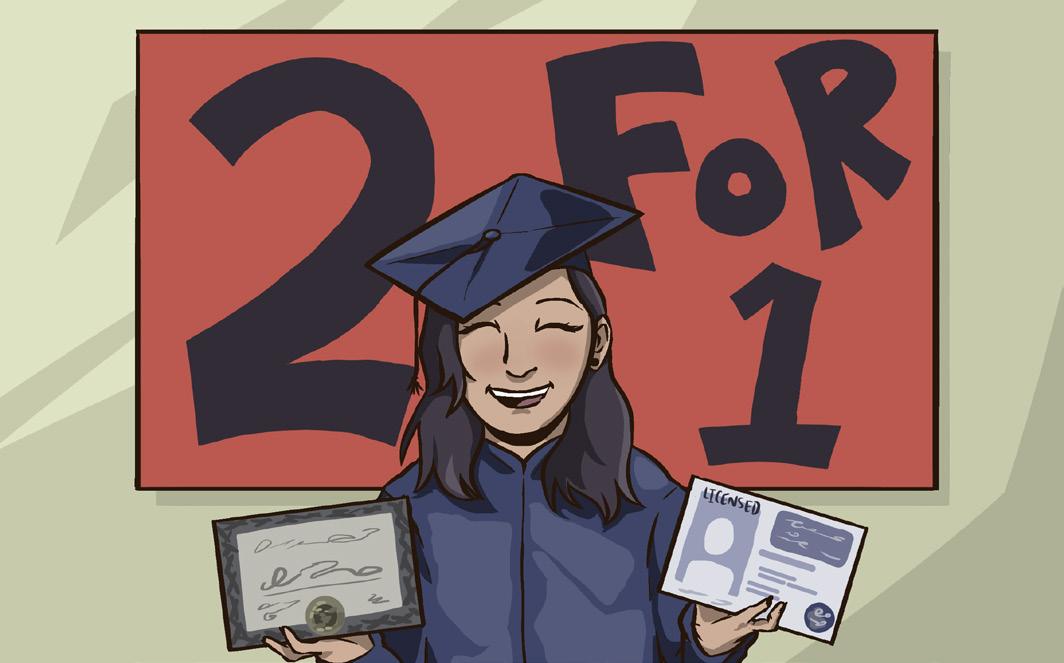
In elementary school, I had elaborate hair-braiding skills that I acquired from YouTube videos. I’d wake up early before class to weave my hair into the dutch, fishtail and rope braids that other girls quickly recruited me to do on their hair. Soon enough, I charged a quarter on the playground for my braiding services without realizing that doing so sans cosmetology license is illegal in Michigan.
In fact, receiving money from any sort of hair care, skin care, manicuring and electrology services without this license is punishable by up to one year in jail.
In states like Michigan, the ability to provide standard services or expertise in exchange for compensation is heavily regulated. Michigan occupational laws, legislated by the Bureau of Licensing and Regulatory Affairs, detail the training, tests and fees needed for more than 160 types of professionals to address before beginning their job. In turn, licensed professionals enjoy 16% higher average hourly wages than their unlicensed counterparts across high- and low-wage occupations.
Given many additional labor market advantages conferred to licensed individuals, such as longer job tenure, reduced competition and higher credibility over unlicensed peers, it makes sense to consider a pathway to licensure at some point in your academic career.
With the exception of the School of Nursing, undergraduate programs at the University of Michigan, for the most part, do not focus on credentialing.
Instead, they provide a crucial framework of classes for students to intelligibly specialize in one field — and it should remain this way.
However, graduate degree programs that don’t have an option integrated into the curriculum to provide the training, coursework and skills needed for licensure in a specific field are robbing their students.
In a labor market experiencing a tremendous job shortage and tumultuous starting salaries, a terminal degree stating that you took so-and-so classes isn’t going to cut it anymore.
Graduates of the University of Southern California’s Marriage and Family Therapy program, for example, borrowed a median $124,000 to pursue the program, and half of them earned $50,000 or less after graduation.








Opinion 10 — Wednesday, April 10, 2024 SARAH ZHANG Opinion Columnist
MOSES NELAPUDI Opinion Columnist
Read more at
The Michigan Daily — michigandaily.com
by
Design by
Read more at MichiganDaily.com
MichiganDaily.com
Design
Matthew Prock
Hannah Willingham
Lecture and symposium free and open to the public. Wheelchair and handicap accessible. ASL interpreted.
Michigan’s offense returns to inconsistency, swept 3-0 in weekend series at Northwestern
the second inning, Michigan’s knack to bounce back never kicked in.
It all seemed too good to be true for the Michigan softball team.
Back-to-back Big Ten series sweeps, a 10-game win streak with 78 combined runs and a team batting average of .348 in that span — spearheaded by their offense, the Wolverines had soared into the stratosphere.
But what Michigan has shown at times this year is that these bursts of offensive firepower, no matter how sustained or imposing, can collapse just as fast as they appear. The Wolverines (24-14 overall, 6-3 Big Ten) proved that again this weekend, tumbling back down to earth and regressing to inconsistency at the plate in a 3-0 series sweep at the hands of Northwestern (228, 8-1).
Despite a 10-1 clobbering of Indiana in its most recent game last week, Michigan’s bats started off cold against the Wildcats on Friday. After two scoreless innings by the Wolverines, some uncharacteristic shakiness from ace junior right-hander Lauren Derkowski led to two runs from Northwestern, putting pressure on Michigan’s offense to respond.
That’s no longer unfamiliar territory for the Wolverines. In four of their last six games, they’ve trailed early before surmounting the deficit and emerging victorious. But this time, down 2-0 to Northwestern after
The only scoring that the Wolverines mustered in response was off of an error. A ground ball from sophomore third baseman Maddie Erickson slipped past Wildcat shortstop Bridget Donahey’s glove as junior left fielder Ellie Sieler ran home.
After Northwestern lumped on some more runs in the third frame, ballooning its lead to four runs and then five one inning later, Michigan’s offense was moribund. All of the Wolverines’ remaining plate appearances, save a lone walk, turned into outs, and Michigan’s win streak, momentum and offensive vigor was stomped out in a 9-1 runrule loss. Wolverines coach Bonnie Tholl knew something had to change.
“The message this morning was, look, today’s a new day,” Tholl said Saturday. “We have an opportunity again today, and it requires all of us to bring that competitive energy every moment. … Who we were last night, the bases we gave them, it was not who we’ve been the past three to four weeks.”
For most of the first game of Saturday’s double header, Tholl’s message seemed futile. Freshman right-hander Erin Hoehn allowed just two hits in the first inning — but one was a homer, and the other a grand slam. One second-inning RBI single for the Wildcats later, and the Wolverines were down 6-0, desperately needing their offense to wake up in the third.

And for two more innings, that offense didn’t accomplish anything. It wasn’t until the fifth frame that it ignited. Michigan loaded the bases then stuck with the small ball it has relied on throughout the season, batting in five runs and putting the game within one without hitting a single home run. But inconsistency means highs and lows, and in this game they came in sequence. After the Wolverines’ one-inning offensive outburst, they returned to normalcy, logging two more empty frames before Northwestern clinched the series with a 8-5 win.
“We had been striking the ball fairly well,” Tholl said. “Early part of the game that we didn’t get much out of, we got doubled off. Really, opportunities that were squandered. But there were times that we put the ball in play well, but again, it was just timely hitting. We did not get those hits early.”
Squandered opportunities resurfaced for Michigan in the final game of the series, with flashes of a potent offense again overshadowed by scoreless innings. Knotted at 4-4 in the fifth frame, the Wolverines’ bats faded yet again and the Wildcats won off a walk-off walk, 5-4. When Michigan was riding the high of a 10-game win streak and rolling over defenses far from elite, scoring seemed effortless. But in Evanston, the Wolverines never got comfortable. That discomfort induced inconsistency, and Michigan walked away from the weekend winless.
Jacob Bickersteth claims 50th career win in hard-fought victory over Indiana
On the No. 2 singles court, senior Jacob Bickersteth found himself in what seemed to be an endless rally, but a forehand laced with precision and power gave him one of the hardest-fought points of the night. And even though the set was still drawn at 5-5, Bickersteth knew the tides were turning in his favor.
Still undefeated in Big Ten action, the Michigan men’s tennis team needed to keep up its intensity to defeat strong opposition from Indiana. Bickersteth’s potency in both doubles and singles play helped to extend the Wolverines’ win streak, and let him pick up his 50th career singles win. Bickersteth and fellow senior Gavin Young started the match at the No. 1 doubles court, where they have yet to lose in Big Ten games. From the start, however, it became evident that the Hoosiers’ duo of Michael Andre and Ilya Tiraspolsky set a tough draw for the 23rd-ranked pair. The visitors played close to the net, returning the ball into Michigan’s half quickly to force errors on returns. To counter, the Wolverine pair also played aggressively at the net, and although it left them vulnerable to lobs, Bickersteth’s athleticism allowed him to volley his opponents’ lobs right back at them.
Both sides’ determination at the net meant games were close, often going to 40-all, but Young and Bickersteth’s increased aggression helped them close the games in their favor, allowing them to pick up the points that really mattered.
“For the last couple of weeks, we’ve been kind of working on being more aggressive in doubles,” Bickersteth said. “(Young) and I have had a lot of success recently so we’re kind of just sticking with what’s working, so it’s been good, we’re getting better at it.”
The pair also took full advantage of service games, often putting Indiana in an uncomfortable position to start each game. When Young served, Bickersteth was
always ready at the service box, should the Hoosier receiver manage to return the serve. This was especially effective in the final game of the set, where Bickersteth’s volleys from close sealed a tough 6-2 win for the pair.
Despite the pair’s win, Michigan’s No. 2 and No. 3 duos fell short, conceding the doubles point to Indiana. Nevertheless, Bickersteth sought to use his personal momentum to help the Wolverines come back in singles play.
At No. 2 singles, Bickersteth took an early 1-0 advantage, but Hoosier Facundo Yunis’ strong serves in the next few games put Bickersteth down 3-1. At the break, Bickersteth and Michigan assistant coach Max Stew-
Michigan’s conservative pitching usage aids 2-1 series win over Iowa
In the fifth, Michigan tied the game and took the lead from Iowa off an RBI single.
ers over the 18 innings stepped up to the challenge.
Until recently the Michigan baseball team regularly used upward of seven pitchers to finish out a single game. But this weekend just five Wolverines took the mound over the entire three-game series. And that’s how they won.
The bullpen’s utility and the starting pitchers’ stability propelled Michigan to its third straight conference series win. The Wolverines’ (14-18 overall, 6-3 Big Ten) pitching endurance earned them a 2-1 weekend against Iowa (16-13, 5-4).
Freshman right-hander Dylan Vigue started on Friday night, and he threw five innings for the first time this season. An early RBI for the Hawkeyes put them on the board in the bottom of the second, but that was the only earned run under Vigue’s name for the night.
Sophomore right-hander Kurt Barr came in to relieve Vigue in the sixth and the next three innings were a pitching showdown. With both teams scoreless pushing the 2-2 game into the 10th inning. And the dam finally broke in the Hawkeyes’ favor with a walk-off 3-2 win.
And in the same fashion as the past two weekend series, the Wolverines headed into Saturday already down a game. “(It’s) who can step up,” Michigan coach Tracy Smith said. “And who can potentially reveal themselves as a guy who we can go to on the weekend and help out some of the load.”
Following that game one loss, the Wolverines’ looked for someone to follow Friday night’s strong performance and take control of the mound in their doubleheader. And a combination of three pitch-

Sophomore right-hander Mitch Voit took the first leap with his start on Saturday. Voit gave up early runs in the first two innings of the game to put Michigan back in a 2-0 deficit going into the third inning. Freshman designated hitter Collin Priest put the game back in the Wolverines’ hands with a homer that brought Voit home alongside him. After walks forced in a run, Michigan took a 3-2 lead. Voit gave up his third run in the fifth inning, but due to another walk forcing a run across the plate, the Wolverines held tight to their one-run lead at 4-3.
When Smith called once again for someone to step up, junior righthander Will Rogers ran to the dugout to drop off his catching gear and swiftly returned to the mound.
“We got two-way guys,” Smith said. “Guys catching and going into pitch to close. I think that’s the thing that stands out to me the most is just the overall embracing of whatever it takes.”
And Rogers was exactly the type of two-way guy Smith needed.
He entered in the seventh inning and closed out the second game, giving up just two hits and no runs.
But he wasn’t satisfied after earning the save. With a few innings left in the tank, Rogers took the mound once more for the second game of the doubleheader, but for the first time in the season, he didn’t relieve — he started.
Rogers pitched the first two innings of the next game and left 1-1 tie for fifth-year left-hander
Jacob Denner. But Rogers’s ability to push into the second game in the first place set the bullpen up for success rather than leaving them to scramble.
“Today doesn’t happen without (Rogers) on the back end of game one,” Smith said. “And starting the game two because that allowed us to use Denner effectively.”
After Iowa put up two runs in the third inning, Denner pitched his way through the fourth scoreless. The Wolverines rallied through the fifth and sixth innings to put up four runs from small ball play taking the lead, 5-3. An explosive eighth inning for Michigan’s bats sent the game from a close one to a runaway. With two outs on the board, the Wolverines scored five runs to close out the game, 10-6. The cohesiveness of Voit and Rogers to Denner put Michigan in a spot to minimize arms but maximize results, a delicate balancing act it hasn’t managed to achieve until this weekend. The conservative use of arms is necessary for the Wolverines to manage a successful weekend with a handful of reliable pitchers. But it’s not the desired result Smith wants. Only having a few options to call during the weekend while searching for starters during midweek games puts Michigan in a conundrum. And as the Wolverines are set to play five games in the next week, the management of their arms can be the deciding factor between a week full of losses and a week full of wins.
art came up with a new strategy. Bickersteth began using his strong forehand to stretch his opponent, forcing him to play from the corners. Through long rallies, Bickersteth kept control, and his forehand strokes proved difficult for Yunis to respond to.
The set remained close, but Bickersteth’s determination gave him a 6-5 advantage. And at the set point, Yunis was unlucky to slip while returning, giving Bickersteth a hard-fought first set victory. “Bickersteth did well to kind of change the momentum,” Stewart said. “He was down 3-5 and ended up coming back and winning that set and then running away with it. He did great and responded to adversity very well.”
In comparison to the first set, the second was more one-sided, as Bickersteth remained confident in his game plan and Yunis seemed to be getting fatigued. After taking four of the first five games, Bickersteth saw the set out with a 6-1 win, playing slow rallies in the last two games to ensure he didn’t give anything away. As he walked off his court a victor for the 50th time, he also added the Wolverines’ fourth point on the board, securing victory in the match. Bickersteth’s ability to adjust throughout his games proved to be key in his strong outing — one that gave him an important personal milestone in a difficult, must-win match.
Michigan’s Friday struggles continue despite third straight Big Ten series win
Through three Big Ten series, a pattern has appeared. In State College against Penn State, home versus Maryland and this weekend at Iowa, the Michigan baseball team failed to take home the first game of its series.
Despite the Wolverines’ inability to start a Big Ten series off with a win, they are also yet to lose a Big Ten series. Michigan loses the Friday night game and steals the next two to emerge from the weekend victorious
— that’s the pattern. Certainly, coach Tracy Smith doesn’t take a Big Ten series win for granted, but a pattern including Friday losses is not ideal.
“(The games) are all independent, but momentum is a real thing,” Smith said. “That’s tough when you don’t get that Friday win, it puts the pressure on.”
And the Wolverines’ Friday losses haven’t been blowouts — ones that can be chalked up to simply being outplayed. Instead, their series openers have all been winnable.
Two weeks ago against the Nittany Lions, Penn State took game one with a walk-off. One week ago, the Terrapins stormed
back with a five-run ninth inning to snatch the game from Michigan’s grasp. And this weekend, against the Hawkeyes, the Wolverines fell victim to an extrainnings walk off. One final piece of the pattern: close losses. With the game tied 2-2 heading into the ninth inning on Friday, Michigan had one final chance to claim the lead in regulation. Graduate second baseman Mack Timbrook doubled down the right field line, putting a man in scoring position with no outs. All the Wolverines needed was some situational hitting to bring that run across. Instead, a sac-bunt and two unproductive outs ended the inning without scratching a run. “We had our chances to get it done on Friday, didn’t happen,” Smith said. Iowa is a good baseball team — ranked in the top 25 early in the year and ranked as the top team in the Big Ten preseason. And getting a series win over a team of that caliber is a sign that Wolverines are a competitive team within the conference. Yet, leaving a winnable game on the table showed again that Michigan hasn’t broken its bad habit.
The Michigan Daily — michigandaily.com Wednesday, April 10, 2024 — 11 MACKENZIE MIELKE Daily Sports Writer Sports BASEBALL
SAM GIBSON Daily Sports Writer ANNA FUDER/Daily
ELI TRESE Daily Sports Writer BASEBALL
SOFTBALL
MEN’S TENNIS MATEO ZALLES Daily Sports Writer
EMILY ALBERTS/Daily Read more at MichiganDaily.com












continues SPORTSWEDNESDAY
ARYLAND HEIGHTS, Mo. — ‘Little brother’ had all but lost its meaning. The Michigan hockey team was riding a four-game losing streak against its biggest rival. Highlighted by a Big Ten Championship victory just last weekend, Michigan State had taken thorough control of the rivalry. The Wolverines couldn’t claim the Spartans as their ‘little brother’ anymore. In fact, Michigan State could’ve made a case to turn the moniker on its head. But on Sunday, with everything on the line, Michigan brought its meaning back. Behind another lategame surge, the third-seeded Wolverines (23-14-3 overall, 12-112 Big Ten) got their revenge over the top-seeded Spartans (25-103, 16-7-3) in the NCAA Regional Final. With the 5-2 win, Michigan ended Michigan State’s season and earned its third straight Frozen Four berth. “We came into this game with the mentality to just win a game, not for personal battles or to get involved in all that extracurriculars after the whistles,” junior forward Dylan Duke said. “We came to win a hockey game, and we did that tonight.” Although it wasn’t part of the game plan, getting involved in extracurriculars was almost inevitable in a matchup like this. Tensions ran high from start to finish, with 10 total penalties levied throughout the night. The Spartans were the first to capitalize, cashing in on an early power-play opportunity and jumping out to a
the rush, junior defenseman Ethan Edwards found space to shoot and made the most of it, sniping one past Augustine to knot the score at 1-1. Throughout the rest of the second — and especially on the penalty kill — graduate goaltender Jake Barczewski heated up in net. He turned away a number of good looks from the Spartans, preserving the tie as the Wolverines slowed down on offense. So it all came down to the final period. Twenty more minutes with everything up for grabs. A ticket to the Frozen Four was at the forefront, but for the Wolverines, revenge and name-calling rights were in the back of their minds. And in a dominant final stretch, Michigan earned it all. “If you watched our team early in the year, we had a couple of rough third periods,” Duke said. “We talked about learning from them for moments like this. We learned all year
Wolverines
advantage. It
Spartans
The Wolverines barely had time to celebrate that go-ahead goal before scoring another. Picking up a cinematic between-the-legs pass from sophomore forward Frank Nazar III, sophomore forward Gavin Brindley put Michigan up 4-2, just 12 seconds after Duke’s score. “It’s huge,” Brindley told The Michigan Daily. “I think any shift after a goal is big with the momentum. So anytime you’re on the ice after a goal, you try to keep that momentum. That was a big goal for sure.” Michigan State took another penalty in the waning minutes, giving the Wolverines their fifth power-play opportunity — and this time, they capitalized. Duke scored his second of the game, and Michigan iced the victory with just under two minutes left. “We got that big goal at the end,” Nazar said. “Yeah, we gave up two on the PK but we were able to score that one on the power play at the end and shut the game down.” Even without one of their most important players in sophomore defenseman Seamus Casey — who was sidelined after an apparent injury in Friday’s game — the Wolverines rode their third-period momentum to the final buzzer. They locked down on defense, with Barczewski standing tall behind them, and kept their season alive and well. The Spartans might hold a 4-2 record over Michigan this season, but the Wolverines showed out when it mattered most, with their season on the line. Above all else, Sunday’s victory earned Michigan another trip to the Frozen Four. But perhaps as an added bonus, the Wolverines punched that ticket by way of ending their biggest rival’s season — and with it, they finally brought meaning back to the ‘little brother’ label. LYS GOLDMAN Daily Sports Editor Michigan punches third straight ticket to Frozen Four, beats Michigan State 5-2 in NCAA Regional Final LILA TURNER/Daily Design by Lys Goldman The Michigan Daily — Page 12 Wednesday, April 10, 2024 michigan 5 michigan STATE 2
the michigan hockey SAGA
M
1-0 lead. The Wolverines created a number of quality chances in hopes of responding, but their shots either skidded wide or were turned away by Michigan State goaltender Trey Augustine. Midway through the second period, though, Michigan broke through and scored an equalizer. Spurred by quick passes on
… and it showed the past few nights.” About six minutes into the third frame, graduate defenseman Marshall Warren fired a onetimer from the doorstep and found the back of the net, giving the
a one-goal
didn’t last long, as the
stormed back with another powerplay goal. But after Michigan State pushed, Michigan shoved. Just a few minutes after the Spartans tied it back up at 2-2, junior forward Dylan Duke took matters into his own hands. Duke charged to the net, eluding three Michigan State defensemen before stuffing the puck behind Augustine.
