SHAPIRO Daily Staff Reporter
The University of Michigan’s Central Student Government held its annual executive debate Friday afternoon leading up to the 2024-25 school year election. The elections, which will be held on March 27-28, will elect the president and vice president as well as 45 Assembly members across all U-M schools and colleges. The debate gave members of the community an opportunity to hear from the candidates and about their goals for the position before the actual election.
A representative of The Michigan Daily moderated the debate, asking candidates about four main topics: administration, University affairs, student organizations and student engagement.
The presidential candidates spoke first, answering questions and explaining their campaign goals. The candidates running for president are LSA sophomore Liam Reaser, a member of the United for Michigan party; LSA sophomore Tony Liu, an independent; LSA junior Terra Lafreniere, a member of the Moment UM party and LSA senior Gabriel Ervin, a member of the Workers’ and Tenants’ Party.
All candidates emphasized the need for increased financial support for student organizations, and want to work toward addressing the area’s housing crisis as well as the lack of affordability on campus. They
ANN ARBOR
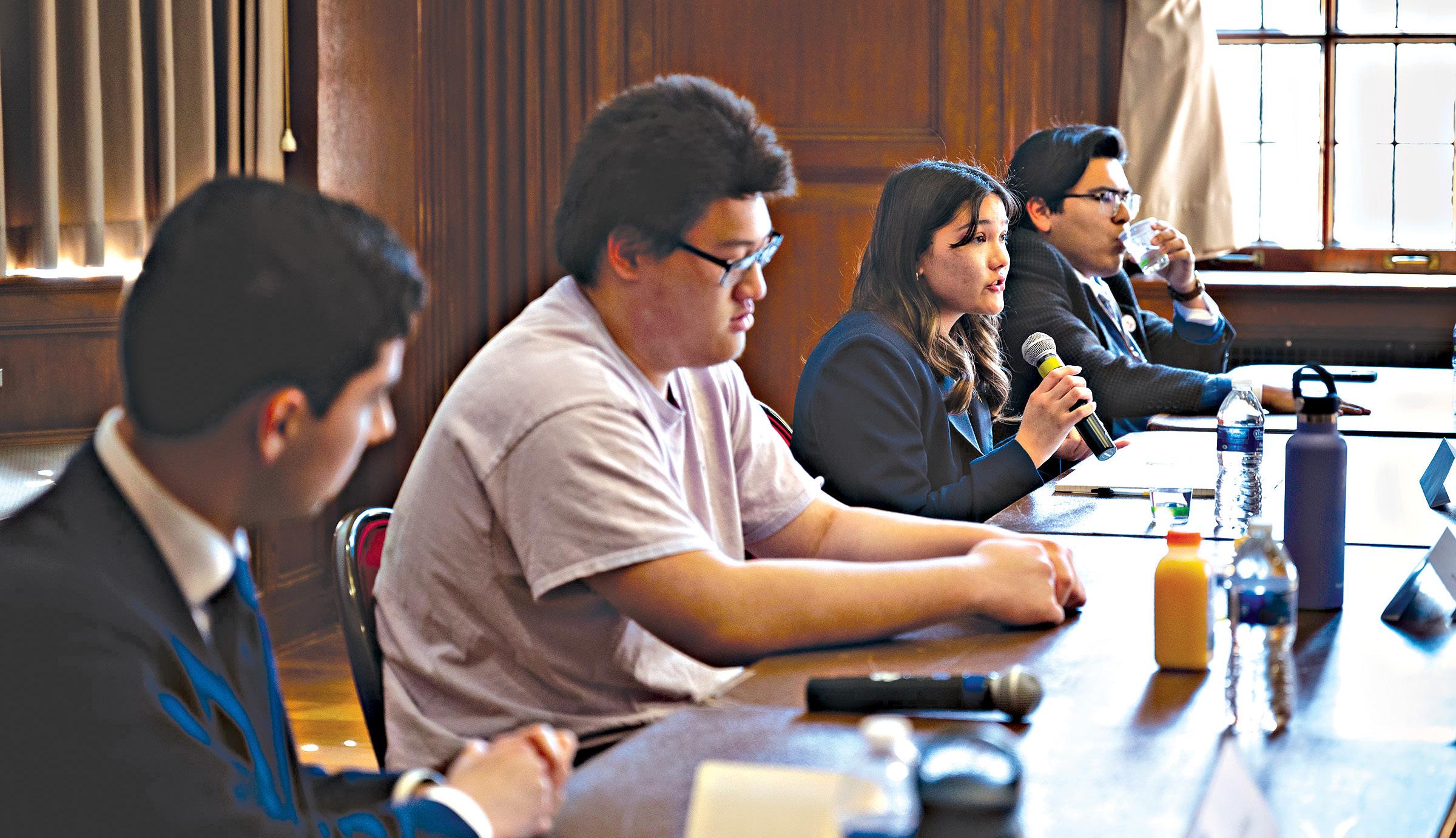
also commented on their plans for CSG fund distributions and ways to get students more involved in voting in CSG elections. Reaser said working to improve the process for finding off-campus housing is one of the primary issues of their platform, and that he has strong confidence in their proposed system.
“Our platform talks about having a student-directed coordinator who will work through CSG to ensure that when landlords are acting unfairly towards tenants, that it is recorded somewhere,” Reaser said. “And
that future tenants have the ability to look at information on a database and figure out if the person is right to house with.
I think there is a really strong potential for us to work with the University administration on accomplishing this.”
Reaser explained that past CSG initiatives — specifically Beyond the Diag, the University’s offcampus housing program — can help support the plan.
“Beyond the Diag was an initiative started by CSG, so we have (had) areas for partnership with this in the past,” Reaser
Ann Arbor Tenants Union sees revival after decades-long hiatus
The revived organization held its first meeting March 3
AMANDA VENCLOVAITE-PIRANI Daily Staff Reporter
Candidates emphasized the importance of voting and increasing communication across the student body. Ervin said if he was in power, there would not have been a vote to begin with.
“If I were president, there wouldn’t have been a referendum because I wouldn’t have focused on trying to inflame tensions on either side,” Ervin said. “I would have sat down with leaders on both sides. We all abhor human suffering and children dying — we need to start focusing on humanitarian efforts first.”
Reaser agreed that the cancellation of the vote could have been avoided with more communication between students and the administration.
the AATU. Without a funding source, the organization lost traction in 2004.
Ann Arbor resident Julia Goode worked with the AATU in the 1980s, and after her recent return to Ann Arbor, started to work with the revived AATU. Goode said she has been disappointed by the lack of progress in policy since her work with the AATU in the 1980s.
“Ann Arbor used to be a leader in having tenants’ rights legislation,” said Goode. “But there really hasn’t been any new legislation besides the early
leasing ordinance, which to the rest of the country looks like a regressive law.” U-M alum Zackariah Farah participated in the initial push to revive the AATU. Farah said he became inspired to recreate a tenants’ union after coming across a 2018 op-ed calling for its return.
“I agreed with all the points in it and I thought, ‘Okay, I’m going to start suggesting this to people,’ then I realized nobody’s doing anything,” Farah said. “So unless somebody just calls a meeting and gets this thing going, it’s not going to happen. I ended up sending out an invitation to lots of people I knew, a lot of student tenants, local activists and just asked them to come together.”
Farah’s attempts to gather interested community members eventually led to the formation of the AATU Reboot Task Force in 2023. Members of the task force worked to learn more about local renting issues, research AATU history and understand potential solutions. Now, Farah says they feel ready to start engaging with the community to take action.
“When tenants are told your rent is going up by 20% next year or sometimes even more, there’s almost no pushback,” Farah said. “They don’t even attempt to negotiate and that’s understandable because a oneon-one negotiation rarely ends in the tenants favor. … The conditions where tenants win are when they work together and they organize together and that’s exactly what we’re trying to do.”
Rackham student and AATU task force member Nathan Kim said he felt inspired by the first meeting’s turnout and energy.
“I was blown away by the kind of energy, the attendance and the

variety of people that were able to be there,” Kim said. “I think there were maybe 20 to 25 people there in total. It was much more than just students that were there.”
According to Farah, the organization has many short and long-term policy goals, including passing a renter’s bill of rights on the city or state level, which advocates are also calling for nationally. Farah said visions for this policy vary, but he would like to see protections against rent increases, greater regulation of landlord contracts and a ban on junk fees.
Housing companies in Ann Arbor have long been criticized for the cost of waitlist fees and other fees imposed on renters. Farah said that eliminating junk fees is a top priority for the union’s local policy efforts.
“Landlords have a lot of names for (them),” Farah said. “They call them holding fees, option fees, reservation fees … but essentially all they are is a fee to join a waitlist to maybe get a lease for a particular unit. That’s a junk fee. For some reason in Ann Arbor, landlords feel that they can charge $7,000 for one of these waitlist fees. That’s absurd.”
The AATU posted scans of an option agreement from Prime Student Housing Inc. on X, which shows a waitlist fee of $6,887.50. A document from Campus Management Inc. also contained a similar waitlist fee of $6,745.
LSA junior Terra Lafreniere, Central Student Government presidential candidate, said she is optimistic about the impact the AATU can have on the student body.
said. “This is something we can continue by having CSG jumpstart this initiative … so the University and CSG can work together to make sure that all students have access to reliable information about where to live off-campus (and) who the good landlords are.” Lafreniere agreed with Reaser, and pointed out that the lack of affordability on campus extends beyond housing. “We want to tackle affordability and accessibility on campus,” Lafreniere said. “Our platform talks about partnering
with the Ann Arbor Tenants’ Union to work on off-campus rent control and on-campus affordable housing. One of our broader points is a second-year guarantee of on-campus housing that is optional. … There is also a big food accessibility issue and we are going to counter that with actionable items as well.”
Candidates were asked about the cancellation of voting on resolutions AR 13-025 and AR 13-026 during the Fall 2023 CSG midterm elections, and what they would do if a similar situation were to occur under their leadership.
“Canceling a vote is not an effective way to stop tensions from being inflamed,” Reaser said. “How you address a problem is you get to the root causes. We need to ask ourselves why the petitions happened, how they got to the state of being on the ballot and why the University canceled those ballots. The answer, in my view, is a failure of leadership. It never should have gotten to the step where people’s voices were not being heard. CSG’s role on campus should be to facilitate discussion to ensure they would not feel so unheard.”
The candidates then commented on new diversity, equity and inclusion programs at the University. Liu said his personal experiences as a Chinese man on campus influenced his views and goals for DEI at the University.
ReadmoreatMichiganDaily.com
UMMA hosts third annual Queer Night for Feel Good Friday “Queer Cabaret” was a celebration for a new UMMA exhibit inspired by the ancient symbol of ouroboros
The University of Michigan Museum of Art hosted a “Queer Cabaret” Friday for their annual Queer Night. The cabaret was a celebration for the opening of the latest exhibit: “Machine Dazzle: Ouroboros,” a three-part exhibit inspired by the ancient symbol of ouroboros. The maximalist theme of the exhibit represents the eccentric designs of American costume designer Machine Dazzle. Friday night featured eight performances, from DJs to drag performers, which showcased many talents.
In an interview with The Michigan Daily, UMMA Program Coordinator Mahalina Dimacali said they believe it is important to host events celebrating Queer identities. Dimacali said they cannot think of a better way to uplift marginalized communities than through an exuberant display of art and music.
“Right now, more than ever, we deserve to see that love on a grand scale,” Dimacali said. “We deserve that always, but I think that … now, more than ever we need these spaces where we have stages, we have dance floors, we have walls and everything dedicated to the Queer community because they deserve that love and they deserve to know that.”
To ensure attendees dressed in the theme of Queer maximalism, the Student Advisory Board for UMMA hosted a Queer maximalist clothing drive leading up to the event. The drive collected clothing and accessories

to distribute to the public to wear at the event. The clothes from the drive were on display, and attendees were allowed to take any of the items available. .
One of the performers Friday evening was Weaver Levon Kafafian and artist Helana Georgis and Lavender Morin, a theatre artist and playwright, included puppetry in their performance.
Darryl DeAngelo Terrell, also known as BLKshine, played a set featuring folk, R&B and pop music. In an interview with The Daily, Terrell explained why events like Friday’s are important to the Queer community.
“Events like this, where the performers are diverse, provide a space for all Queer people at the same university,” Terrell said. “All of these Queer people who may feel invisible on campus based on their presentation or their racial identity or their socioeconomic background have the space to feel seen.”
Performance artist Jay
Orellana, known under the stage name Jezebel, strives to preserve Queer storytelling for future generations. They were the last act to take the stage Friday night for a drag performance. Orellana told The Daily that their love for drag began about a decade ago, before labels such as nonbinary were well-defined and widely understood.
“I remember back in the day before the term nonbinary was more widely used, I didn’t really have a way of describing how I felt,” Orellana said. “I think it’s wonderful to have people be able to witness this kind of radical, celebratory, honest Queerness and various displays of Queer performance.”
Art & Design sophomore Marie Hayward told The Daily she found out about the event through the Penny Stamps Speaker Series and felt it was a good opportunity to hear from diverse voices among the Queer community.
ReadmoreatMichiganDaily.com
GOT A NEWS TIP? E-mail news@michigandaily.com and let us know. INDEX Vol. CXXXIV No. 19 ©2024 The Michigan Daily NEWS ............................1 ARTS.............................3 MIC..............................5 STATEMENT.................6 OPINION..................8 SPORTS...................10 michigandaily.com For more stories and coverage, visit Follow The Daily on Instagram, @michigandaily michigandaily.com Ann Arbor, Michigan Wednesday, March 20, 2024 ONE HUNDRED AND THIRTY THREE YEARS OF EDITORIAL FREEDOM CSG hosts annual executive debate prior to 2024-25 elections The March 27-28 elections will decide the president, vice president and 45 Assembly members ACADEMICS ARUSHI SANGHI/Daily LSA junior Terra Lafreniere at the CSG debate in Vandenburg Room in the Michigan League Friday afternoon. After a decades-long pause in organizing efforts, the Ann Arbor Tenants Union is resuming its operations. The AATU was active for nearly four decades in Ann Arbor, before going dormant in 2004. The newly revived organization held its first meeting on March 3 in the InterCooperative Council Education Center. The AATU was formed in 1969 after more than a thousand renters led a strike which lasted over two years. For decades after, members and volunteers continued striking against landlords over building code violations, established a tenants’ rights hotline and set up an office in the Michigan Union. The AATU received a majority of its funding at the time from the University of Michigan Student Assembly. In 2003, however, the Assembly did not implement a $1 student fee increase approved by the student body that would have continued to fund
MIKAELA LEWIS Daily Staff Reporter
LIFE
CAMPUS
ELLIE VICE/Daily Martin Contreras, former Aut Bar owner, poses for a photo to show his outfit at UMMA Queer Night on Friday.
ReadmoreatMichiganDaily.com
MADDYN
Provost Laurie McCauley talks
free speech principles and generative AI in exclusive interview
McCauley also discussed resources for faculty and a new vice provost for sustainability and climate action
accomplishments. I don’t like to use the word “proud.” I feel incredibly fortunate to be working with a team that does awesome things, so I’ll share some of those with you.
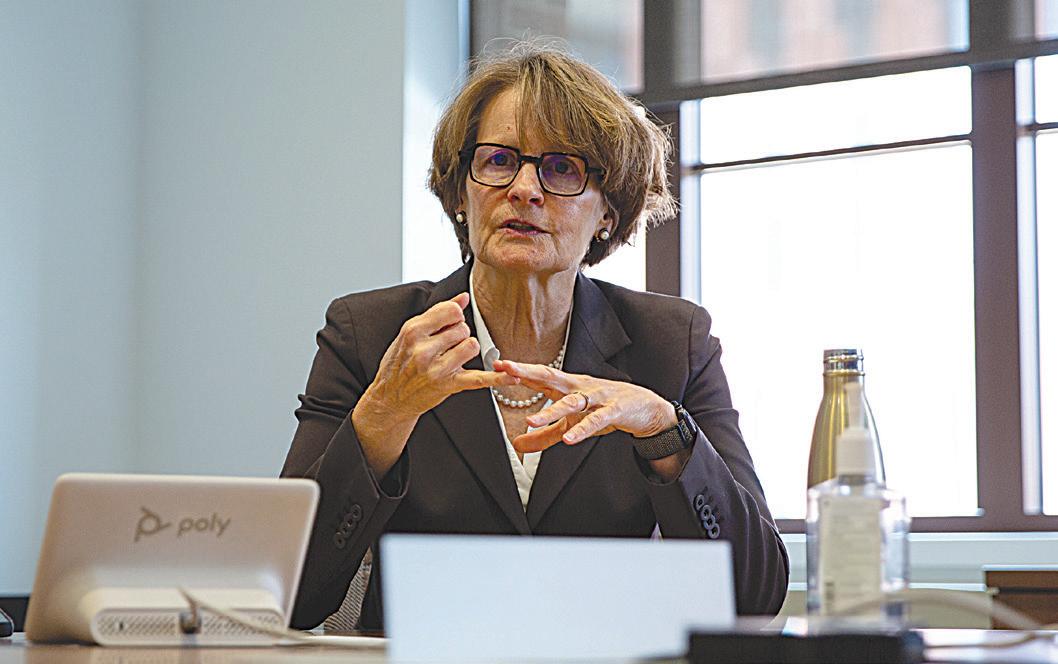
The Michigan Daily sat down with University Provost Laurie McCauley Tuesday afternoon to talk about the University’s recently-announced free speech principles and the impacts of generative artificial intelligence in academics. Appointed in March 2022, McCauley will serve her term until June 2027. She discussed the use of AI in classrooms, resources for faculty who have been harassed because of their academic work or research, a new vice provost for sustainability and climate action, and more.
This interview has been edited and condensed for clarity.
The Michigan Daily: What would you say is your proudest accomplishment over the past semester?
Laurie McCauley: Well, first I would say that we’ve had a lot of
One is that we’re getting ready to launch our strategic vision for the University, and I’ve had the great fortune to work with not only the provost’s office, but the Chief Financial Officer’s office and Dean Marschall Runge’s office, President
Ono and the Vice President for Communications. The thing that really excites me about this is that I think this is probably the most inclusive project we’ve done on this campus, at least when it comes to strategy and visioning. There have been over 25,000 engagements with faculty, staff, students, community members, donors and alumni to get their opinions of our future.
In January, our inaugural
Puentes hosts third annual Latinx Research Week
The four-day event showcased research conducted by Latinx scholars and research about Latinx populations
About 200 people gathered in the Pendleton Room at the Michigan Union on March 11 to attend the opening ceremony of Latinx Research Week. Hosted by graduate student organization Puentes, the four-day event showcased both research conducted by Latinx scholars and research about Latinx populations.
Puentes is a U-M student organization focused on fostering community among Latinx graduate students of different academic disciplines on campus through social events and networking opportunities. In an interview with The Michigan Daily, Rackham student Ariana Bueno, co-president of Puentes, said Latinx Research Week creates a space for Latinx students and faculty to share research and features work from a variety of disciplines.
“We really try to highlight the students that are Latinx or that are doing research on Latinx populations,” Bueno said. “It’s really exciting to see that we are everywhere in the University and we are doing really important research in all fields.”
According to Victoria Vezaldenos, Rackham student and co-president of Puentes,
the conference-style event has expanded from last year. “I know last year we really wanted to increase the amount of undergraduates that were presenting their research, and we have 200 or 300% more undergraduates presenting this year than in past years,” Vezaldenos said. The theme of Latinx Research Week this year was ‘Illuminating Familismo.’ According to Vezaldenos, familismo is a term that references the importance of families and relationships in Latinx culture, and was chosen as the theme because of its interdisciplinary nature.
“When we are coming up with a theme … we really try to think of things that are not specific to any particular discipline because the research that we have at the conference is interdisciplinary by nature,” Vesaldenos said. “And we want representation from across programs, departments and schools at U-M.”
The week featured an array of activities, including openingand closing ceremonies, opportunities for attendees to obtain complementary professional headshots, poster sessions and oral presentations. Many of the events were sponsored by various departments throughout the University.
Vice Provost for Undergraduate Education Angela Dillard started, and she’s going to be focusing on student success and looking at ways we can really up our game. We have fabulous students who are incredibly successful but we can see that if we look across student groups, some students do better than others, and we’re looking at ways to elevate all our students. It’s going to be very data and evidencebased because we value that on a research-intensive campus.
One of the other things that is in development is I’m really passionate about supporting structures for individuals with disabilities on our campus. I’ve been working with Chief Diversity Officer Tabbye Chavous and a group of faculty and staff across campus to look at ways we can put into place support systems for faculty and staff but also start to tackle how we can better educate our students who will be working in a workforce where one in four people has a disability.
UMich researchers develop first step cell model that resembles early human nervous system
The
A team of scientists at the University of Michigan, Weizmann Institute of Science and the University of Pennsylvania recently developed the first full model of the early embryonic central nervous system using stem cells. This new study follows one from 2019 that demonstrated how stem cells can be used to model features of the epiblast, which is the outermost layer of the embryo. This new model, however, simulates the development of all components of the central nervous system at once, something that prior models did not accomplish.
The team of engineers and biologists aimed to develop an organoid that mimicked the structure of the human nervous system to create a more accurate and useful model of how cells differentiate. In an interview with The Michigan Daily, Jianping Fu, professor of cell and developmental biology, mechanical engineering, biomedical engineering and corresponding author of the study, said the complexity of the human
brain made it difficult to use animal models to study the brain, thus necessitating the creation of a stem-cell culture model.
“Scientists have been leveraging animal models to study human development,” Fu said. “Those historical studies have been truly powerful (and) have been extremely fruitful. But nonetheless, there is still a gap of knowledge. It’s very hard to have animal models allowing people to closely study human developmental disorders.”
The research team began by placing embryonic stem cells in a specially-engineered chip containing rows of gelatin, allowing the cells to grow. The chip essentially behaved as a microfluidic device, a system that manipulates fluids using small channels to control the environment, organizing the stem cells into multicellular tissues that modeled early developmental stages of the forebrain, midbrain, hindbrain and spinal cord. The team advanced the model to a level similar in development to 11 weeks post-fertilization and were able to investigate how certain cells differentiate into more specialized cells.
www.michigandaily.com
DANA ELOBAID and SAMANTHA RICH Co-Editors in Chief eic@michigandaily.com
ELLA THOMPSON Business Manager business@michigandaily.com
NEWS TIPS tipline@michigandaily.com
LETTERS TO THE EDITOR tothedaily@michigandaily.com
EDITORIAL PAGE opinion@michigandaily.com
PHOTOGRAPHY SECTION photo@michigandaily.com
NEWSROOM news@michigandaily.com CORRECTIONS corrections@michigandaily.com
ARTS SECTION arts@michigandaily.com
SPORTS SECTION sports@michigandaily.com
Editorial Staff
NOAH KINGSLEY and REKHA LEONARD
GRACE
COLE
Business Staff
2 — Wednesday, March 20, 2024 News
The Michigan Daily — michigandaily.com The Michigan Daily (ISSN 0745-967) is publishing weekly on Wednesdays for the Winter 2024 semester by students at the University of Michigan. One copy is available free of charge to all readers. Additional copies may be picked up at the Daily’s office for $2. If you would like a current copy of the paper mailed to you, please visit store.pub.umich.edu/michigan-daily-buy-this-edition to place your order. RACHEL MINTZ and RILEY HODDER Managing News Editors news@michigandaily.com Senior News Editors: Abigail VanderMolen, Astrid Code, Ji Hoon Choi, Mary Corey, Nadia Taeckens, Rebecca Lewis, Sneha Dhandapani LINDSEY SPENCER and ZHANE YAMIN Editorial Page Editors tothedaily@michigandaily.com Deputy Editorial Page Editor: Jack Brady Senior Opinion Editors: Audra Woehle, Jack Kapcar, Lila Dominus, Sophia Perrault REESE MARTIN Managing Statement Editor statement@michigandaily.com Deputy Editors: Darrin Zhou, Irena Tutunari, Liam Rappleye JACKSON KOBYLARCZ and PARINA PATEL Managing Copy Editors copydesk@michigandaily.com Senior Copy Editors: Cyrus Soonavala, Ingrid Hofmann, Lily Cutler, Liz Guenther, Logan Brown, Natalie Wise, Sage Marmet, Sarah Cortez-De La Cruz, Sofi Mincy, Tess Beiter, Tim Kulawiak ANUSHKA RAHEJA and JACOB KIM Managing Online Editors webteam@michigandaily.com ANDREW HERMAN and JOVANNA GALLEGOS Managing Video Editors video@michigandaily.com Stanford Lipsey Student Publications Building 420 Maynard St. Ann Arbor, MI 48109-1327 734-418-4115
Remi
Senior Sports Editors: John Tondora, Lindsay Budin, Liza Cushnir, Lys Goldman,
Williamson, Zach Edwards
Managing Sports Editors sports@michigandaily.com
MARTIN and TINA YU Managing Audience Engagement Editors socialmedia@michigandaily.com
LAHTI
LILA TURNER Managing Photo Editors photo@michigandaily.com Senior Photo Editors: Emily Alberts, Jenna Hickey, Lucas Chen, Riley Nieboer, Sarah Boeke SRISHTI BAGALKOTI Creative Director RILEY STIPE and SNEHA DHANDAPANI Managing Podcast Editors podeditors@michigandaily.com ANNIKA CHINNAIYAN Sales Manager ADVERTISING wmg-contact@umich.edu ABBY SCHRECK Digital Managing Editor schreck@umich.edu MEREDITH KNIGHT and NAZIM ALI Culture, Training, and Inclusion Chairs accessandinclusion@michigandaily.com EVELYN MOUSIGIAN and FIONA LACROIX Managing Design Editors design@michigandaily.com Senior Layout Editors: Lys Goldman, Leyla Dumke SHANIA BAWEJA Managing Editor shaniab@umich.edu JACK MOESER and ZACH LOVEALL Managing Arts Editors arts@michigandaily.com Senior Arts Editors: Erin Evans, Graciela Batlle Cestero, Mina Tobya, Rami Mahdi, Rebecca Smith, Thejas Varma Senior Audience Engagement Editors: Daniel Bernstein, Devon Silver, Emma LeFevre, Ingrid Halverson, Joanna Chait, Jonah Traub, Miles Anderson, Quinn Murphy, Sydney Lesnick AYA SHARABI and JOSEPH FISHER Michigan in Color Managing Editors michiganincolor@michigandaily.com Senior Podcast Editors: Addiena Nicolaou, Clare Jones, Quinn Murphy JI HOON CHOI, DELILAH DAKIS, ANNA JEROLIMOV & THOMAS GALA-GARZA Daily News Editor, Daily Staff Reporters Senior Video Editors: Darrin Zhou, Nick Lyskawa PAVAN KANNAN Managing Games Editor pavkan@umich.edu Senior Games Editor: Victor Schmitt SOPHIA LEHRBAUM Managing Focal Point Editor lehrbaum@umich.edu Senior Focal Point Editor: Irena Li Data Editors: Hasika Sridhar, Maya Mikelson Engineering Manager: Shin Lee Product Leads: Anca Fu, Jenny Do Senior Software Engineer: Marie Yu Senior MiC Editors: Maryam Shafie, Umaiyal Kogulan Senior Illustrators: Sara Fang, Avery Nelson
and
OF THE WEEK MICHELLE LIAO Daily Staff Reporter
RESEARCH PHOTO
RESEARCH ACADEMICS MARY LANG & MATILDA SOPHIA MOTTOLA Daily News Contributors ReadmoreatMichiganDaily.com ReadmoreatMichiganDaily.com KATE HUA/Daily University Provost Laurie McCauley answers questions about admissions, sustainability and generative AI at the University of Michigan in an interview with The Michigan Daily Tuesday afternoon. RUBY KLAWANS/Daily Students get their caricature drawn at Giving Blueday 10 year anniversary carnival at LSA building Wednesday. ReadmoreatMichiganDaily.com
model is the first to stimulate the development of all components of the central nervous system at once
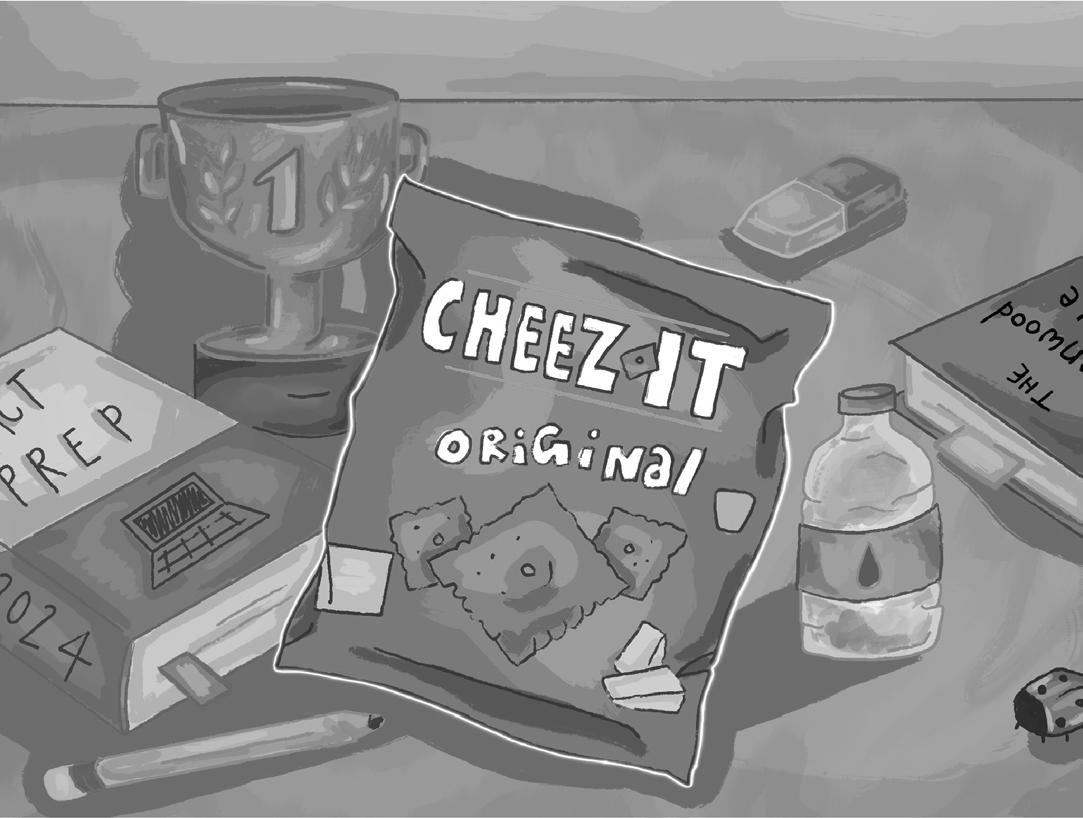
It was an August morning in rural Alabama. The humidity hung in the air. The moisture was so palpable that I could feel it beading on my skin. After performing my morning ritual of watching “I Love Lucy” while eating tater tots, it was finally time for elementary school — time to fist-bump my principal at drop-off and make ladybug houses in the playground gutters. My backpack was ready to go, filled with the necessary notebooks and pencils, but more importantly with a snack-size bag of Cheez-Its, a tiny water bottle and strawberry-kiwi drink mix. At 4 years old, I had no idea that even when life stopped consisting of braided hair and zoo animal wallpaper, I would resort back to those snacks.
Everyone who has been a 14-year-old girl knows that this age feels like a daily battle. Unlike the vibrant halls of elementary school, middle school was the survival of the fittest, and I was the antelope running away
from the cheetah. I wanted to be popular more than anything. Even trying to be popular in middle school is a full-time job. You had to reply to Snapchat messages from the boys who attended random schools 45 minutes away and ensure that you always got 100 likes on Instagram posts. If you were an amateur like me — not allowed to have Snapchat and with only 50 likes on her carefully curated posts — you did not make the cool girl group photo. You had to wear a pearl choker and Birkenstock Arizonas, and unfortunately for my extremely fragile ego, I had off-brand versions of both. School was just me, my Pierre Dumas, and my homemade pearl on a string facing eight hours of constant judgment. I endlessly sought fame and validation within the walls of my school. My personality was whatever I thought everyone else was looking for. I acted stupid in front of the boys who thought I was too opinionated and pretended to be above the girls who were too cool for me. Every day, I came home and evaluated whether or not I was closer to finally being the girl. I lay
Arts
in the comfort of my pink-striped sheets and wondered if I would ever be who I wanted to be. Was the outfit I wore that day too laid back? Did my hair remain pin-straight for the entirety of the day? Did the cool girls laugh at my jokes? Did my crush wave at me after math class? The answers were never enough confirmation that I had achieved what I wanted, so I continued adjusting the way I laughed and the way I wore my hair until I was,
physically and mentally, nothing more than a photocopy of everyone else. The only thing that remained true to me was Cheez-Its. My obsession with fitting in expanded to every aspect of my life except for what I ate. I ate them in the same small snack bags, surrounded by everyone I could never be. It became the one moment during the school day that I was simply existing as myself. By the time high school rolled around, my popularity search
had ended and became a search for academic success. It was crunch time. My ACT scores were not as good as they should have been, and pre-calculus was much more difficult than I anticipated. Amid the uncertainty, one thing remained certain: Cheez-Its would always make me feel slightly better after each of my four attempts at the brutal ACT math section. I never knew I needed a consistent snack food until I started losing sleep over how soon my life would completely change. I had been looking forward to being a college girl since I sat at my tiny desk on my first day of preschool. I received mountains of advice from people I was close with and those who really should have had no say in the matter, and eventually, I chose the University of Michigan — a school 10 hours away from everything that I had ever known. Eighteen years had to be packed into my sister’s Hyundai. The only thing bringing me comfort on the road was a grab’n’go bag of Cheez-Its. Two days before move-in day, I went grocery shopping. Cheezits were the first thing on the list. Later, I unpacked my life into a 10
by 10 room in Mary Markley Residence Hall. The time had arrived for me to create a home for myself. I taped postcards and photos of hometown friends to the wall, reminiscent of every girl I once was and the girl I had become. My makeup brushes are stored in a souvenir espresso mug from New York. I balanced my lamp on copies of “The Poisonwood Bible” and “The Perks of Being A Wallflower” littered with sticky notes and annotations. On the windowsill, a small trophy from my high school prom declared that I was the most likely to leave my hometown and never come back. Most important is the box of Cheez-Its I nestled between an oversized Mason jar and a bag of Reese’s on my snack cart. When life’s difficulties provoke my fight-or-flight response, I always return to the things I know will never fail: my perfume from eighth grade, “To All The Boys I’ve Loved Before” and Cheez-Its. They always satisfy my hunger, whether I am studying educational policy terms or watching Alex Russo tease her brothers on a sunny afternoon. Calm in the chaos, CheezIts have never disappointed.
On Jan. 31, 2024, the TikTok community underwent a tortuous change — the muting of millions of videos. With TikTok’s not-so-humble beginnings as Musical.ly, a video-sharing social media platform focused on lip-syncing top-40 hits, not to mention the entire platform still being built upon music, this loss was not taken lightly. TikTok’s 2021 Music Report even opens with the sentence “Music is at the heart of the TikTok experience,” proving the platform’s tie to music directly from the company’s mouth. With the muting of millions of videos, many users are forced to mourn the sound on their favorite vid -
eos, even ones they made themselves, with very little warning. This mass muting was caused by Universal Music Group, the largest music label in the U.S. Tons of music’s biggest artists like Taylor Swift, Bad Bunny, The Weeknd, SZA and even The Beatles — as well as countless smaller artists — are signed to UMG and impacted by this new policy affects.
On Jan. 30, UMG released a statement on its website outlining the decision. In this statement, UMG listed three reasons for removing its artists’ music from the platform: “Appropriate compensation for our artists and songwriters, protecting human artists from the harmful effects of AI, and online safety for TikTok’s users.” On the point of compensation, it pointed out
that TikTok pays musicians a much lower rate than other social media platforms, stating “TikTok is trying to build a music-based business, without paying fair value for the music.”
To the point of AI, UMG argues that users flood TikTok with fake recordings (like Lana Del Rey’s artificial intelligence-generated cover of Mitski’s “My Love Mine All Mine,” currently sitting pretty with 395.2K posts under the sound), from which TikTok takes royalties, further stripping money from the artists. They keep their last point on internet safety vague, but still point to TikTok’s extremely inefficient reporting system as another way the platform encourages AI-created music.
On the surface, this purge seems like a noble cause. Tik-

Tok does severely underpay its artists despite thriving off their music. TikTok pays musicians 0.03 cents for every video created using their song, with absolutely no compensation for views or interaction outside of TikTok’s own Creator Fund. This number also does not account for the percentage of royalties taken from any label a musician is signed to, making this already shockingly low pay even worse. AI-generated art is already a massive issue that is worsened by TikTok promoting their own AI art filters and the plenty of trending videos using AI-generated music. Though the platform introduced a label on videos using AI-generated content, there is an argument to be made that this is not nearly effective enough at tackling the problem, especially considering the amount that TikTok promotes this content. As with any social media platform, TikTok does have a horrible dark side of offensive content and an extremely inefficient reporting system, in accordance with UMG’s statement.
The issue, however, lies in how this decision backfires on the musicians that UMG claims to care about. On February 1st, Peach PRC, an artist signed to UMG that got her start on TikTok, posted a video captioned “Me after Universal mutes every single song I’ve ever created under them on the very platform they discovered and signed me from.” The video brings up an essential drawback: further lowering the visibility of smaller artists. While musicians like Swift and Billie Eilish won’t feel the impact of this loss, smaller UMG
musicians, particularly ones who first gained and still maintain a fanbase through TikTok, will be left to their own devices to market their work. As TikTok has such a great influence over trending music, artists — especially smaller ones — often turn to social media as their primary means to promote their music; stripping UMG artists of that ability puts their careers in peril. In an interview with Rolling Stone, UMG artist Conan Gray jokingly said, “My career is over for sure, I’m never gonna have a hit song ever again at this rate.” Though said with a laugh, thi sentiment corroborates the fears many UMG artists are feeling. The music purge also alienates one of TikTok’s biggest communities — the fan edit community. I’ve personally felt the loss of some of my favorite edits, their lack of sound making them unworthy of my time. While many fan edits are made for existing fans to enjoy, this content often brings new viewers into fandoms and gets people watching new media. Edits like the hugely popular Josh Hutcherson edit bring tons of visibility to newly released TV and films, so many of which have now been stripped of what makes them so fun to watch: the satisfying feeling of images moving to perfectly matched music. While there is still tons of music left to make edits with, removing such a large amount from huge, well-known artists (I mean, think about the sheer number of edits with Swift songs playing in the background you’ve seen) is sure to create a gash in fan communities. This hurts even more artists — in this case ac-
tors, directors and writers who gain viewers from these sorts of videos — and cuts short the reciprocal relationship where the musicians whose songs score the videos get more streams after these edits gain traction. After the release of UMG’s statement, TikTok put out a short statement of their own in which they expressed disappointment at the decision and claimed that UMG has “chosen to walk away from the powerful support of a platform with well over a billion users that serves as a free promotional and discovery vehicle for their talent.” While this statement does touch on the central issue with UMG’s decision, it also erases TikTok’s responsibility in the matter, with absolutely no discussion about paying their artists more or putting more energy into fighting AI-generated content. The community is left wondering if the two companies will ever agree and fearing that the platform will miss this huge selection of music forever. Though the community is already adapting to the loss of their music (if you’ve seen videos using Kahoot music or Mozart pieces in the background, this is why), it’s essential to keep an eye on the impact this decision’s original intent to “help” artists has on musicians too small to keep themselves afloat without the platform’s support. While we wait for TikTok and UMG to resolve their issues, it’s imperative to engage with musicians in ways that benefit them, including going to shows, buying merch and providing the support that UMG claims to want for them.
There are very few independent TV pilots and even fewer independent TV series. With any luck, these pilots can get picked up by a studio and renewed for season after season of incredible storytelling. For any of that to happen, though, the show has to be solid enough for a gripping seasons-long arc. “Bettendorf Talks” is one such TV pilot. Premiering at South by Southwest 2024, this reverent show within a show follows fictionalized versions of creators David Pasquesi (“Later Days”) and T.J. Jagodowski (“Shrink”) as they attempt to save a failing network talk show. Desperately trying to get back to their glory days when they were at the height of their careers, the comedic duo clashes with each other and their new crew. In an interview with The Michigan Daily, showrunner and star David Pasquesi, director Jack C. Newell (“Reporting for Christmas”), producer Shane Simmons (“Mercury in Retrograde”) and principal cast members Sadieh Rifai (“Shining Girls”) and Cassie Kramer (“Candyman”) spoke on this promising start. This interview has been edited for clarity.
The Michigan Daily: One of the
things that I really loved about this pilot is how much it surprises you. Sitcoms, especially workplace sitcoms, are a great place to explore that mundane surprise, like the scene where T.J. and David’s characters stop mid-broadcast, put on these powdered wigs to deliver a wild line and then just sit down as if nothing’s happened. Where did you draw from in crafting this specific style of comedy?
David Pasquesi: I wrote it with T.J., and we, um, we’re weird. Like you, we like to be surprised, so we just kind of wrote it with that in mind; if something comes up, you do it rather than not do it.
TMD: On the subject of you and T.J., you two have collaborated a lot in the past. What was it like to work with him on a scripted project as opposed to one more from the improvisational background that you have?
DP: T.J. and I have been working together for about 20 years, but all with improvisation on stage. We shot some shorts together along the way and tried so hard to adapt our show to the television format and I don’t think it’s possible. We enjoy working together and we enjoy TV, so (for “Bettendorf Talks”) we decided to do versions of ourselves rather than just our improvised show. That was part of the genesis of this thing. I like hanging out with weirdos, and when we call it work we get to do that more often.
TMD: Was there any part of the im-
prov background that you were able to enmesh into the script and the pilot?
DP: Well, that’s kind of how we write. We sit down and take dictation of our nonsense and that’s how we write TV.
TMD: You talk about nonsense a lot, and in these characters, there’s sort of the nonsensical idea of (how) they’re not who they’re supposed to be yet. They are very much at the start of their journey, and you can see that with David’s character in particular. There’s a scene where everyone turns to him for a speech, expecting him to be a leader and he just flatlines. It’s expecting something of a character who’s not ready to give that just yet, so how do you navigate playing with that character as an ensemble and writing them at the start of their journey with the breadcrumbs being laid out?
Jack Newell: Wow, these are fucking great questions.
DP: First of all, you watched the show. That’s rare. Thank you for that. We have an idea of what’s going to happen in the future, so we need to establish a few things along the way, but we’re improvisers. We don’t want to be locked into stuff, so that’s the strange balance. I think there’s a lot within the pilot, a lot of room for all the characters’ trajectories or journeys. They’re pretty ripe, every single one of them. We have fun ideas. We beat the first and second seasons’ script out and it’s pretty fun.
TMD: What do you see the rest of the season looking like for these characters? Maggie’s relationship with her uncle seems interesting, as does her relationship with David, which seems to hold a budding reverence. Where do you see that going? Sadieh Rifai: I was in (the show). Loved it, you didn’t ask but I just wanted to say that for the record. You talked about improv, and the great thing about T.J. and Dave, being a fan of theirs for as long as I’ve been in Chicago, is that you’re standing there just trying to keep up. My character was trying to do the same. She’s trying to be at the helm of everything, but witnessing amazing creative minds have opinions and go off in different directions. So, I would literally just sit there and watch. Tim Kazurinsky (who plays Maggie’s uncle) is maybe the kindest man I’ve ever met. He would give me rides to set, and his car was boiling hot, but he was so kind and so sweet that I could not tell him how hot it was. I love that there was a real connection between my character and her uncle. And, looking at Tim’s face, you can’t help but fall in love with him and want to comfort him.
TMD: This show feels like such a love letter to television as an art form and sitcoms in particular. What parts of being on set and having that experience were you excited to bring to life for casual viewers who don’t think about the behind-the-scenes aspects much?
JN: I always think a show within a show is a lot of fun, and that’s sort of what this is. A lot of great musicals or older movies, they’re always putting on a show. Part of what makes that fun is you get to see characters wear different masks or play different parts. Who are they as humans and who are they when they’re in the show? Workplace is fun because, even outside of show business, if you just watch people doing their work, everyone’s their one way with friends and their one way at work. That’s a really fun dynamic at play, to watch how these people treat each other and how they treat each other on set; the T.J. and Dave that are in the show, how do they act in that ‘on-TV’ version vs how do they act in their off-screen version. There’s just lots of really fun opportunities to mime.
DP: It’s also referring to old TV. I like that, too. I like older TV stuff, talk shows specifically. I was just thinking about it, I hate shows about show business.
JN: Oh, come on, don’t say that.
DP: I really do.
JN: What about “Singing in the Rain?”
DP: Shakes his head.
JN: Why did you write a show about show business?
DP: I don’t know — I’m realizing that now.
JN: Is it less about the show-biz and more about the workplace for you?
DP: Yes. For me, it’s about the in-
teractions with other people — all the weird dynamics and the power plays, but on a really tiny scale. It’s still super important, it’s not “Succession,” but it’s as important to these people.
Shane Simmons: You kind of also take a stab at fame and the biz. Maybe you’re secretly letting out your opinions there. Also, one of the most interesting things about the show — it’s super fun, it’s super silly — but it is very relevant right now. This search for fame, it’s the only way we can do what we want to do, and these guys have a lot of fun really painting that out for people to examine.
DP: We were just in Charlotte, and at the library there’s this statue with a quote I’m probably going to get wrong. “We now mistake celebrity for accomplishment.” That’s one of the themes in here, too.
JN: One of the things I really love about T.J. and Dave — to Shane’s point, it’s very fun, it’s very silly, there’s absurdity — but they take their time. All the characters take their time. In this first episode, what we’re doing is planting seeds, as you said, but not necessarily going for the joke. We want to make it funny, but there’s also character stuff that’s going on there. Letting characters explore. If that’s a funny moment, that’s a funny moment, but if that’s a serious moment, it’s a serious moment, that makes for a deeper watch in some ways.
Cheez-Its
SXSW 2024: A conversation with the hilarious ‘Bettendorf Talks’ creative team CAMPBELL JOHNS Daily Arts Contributor SARAH PATTERSON Daily Arts Contributor MINA TOBYA Senior Arts Writer
by Kat Callahan Read more at MichiganDaily.com
by Hannah Willingham Wednesday, March 20, 2024 — 3 The Michigan Daily — michigandaily.com
Love Letter to
Universal Music Group’s feud with TikTok ruins your favorite videos
Design
Design
‘Shōgun’ is the political thriller you’ve been waiting for
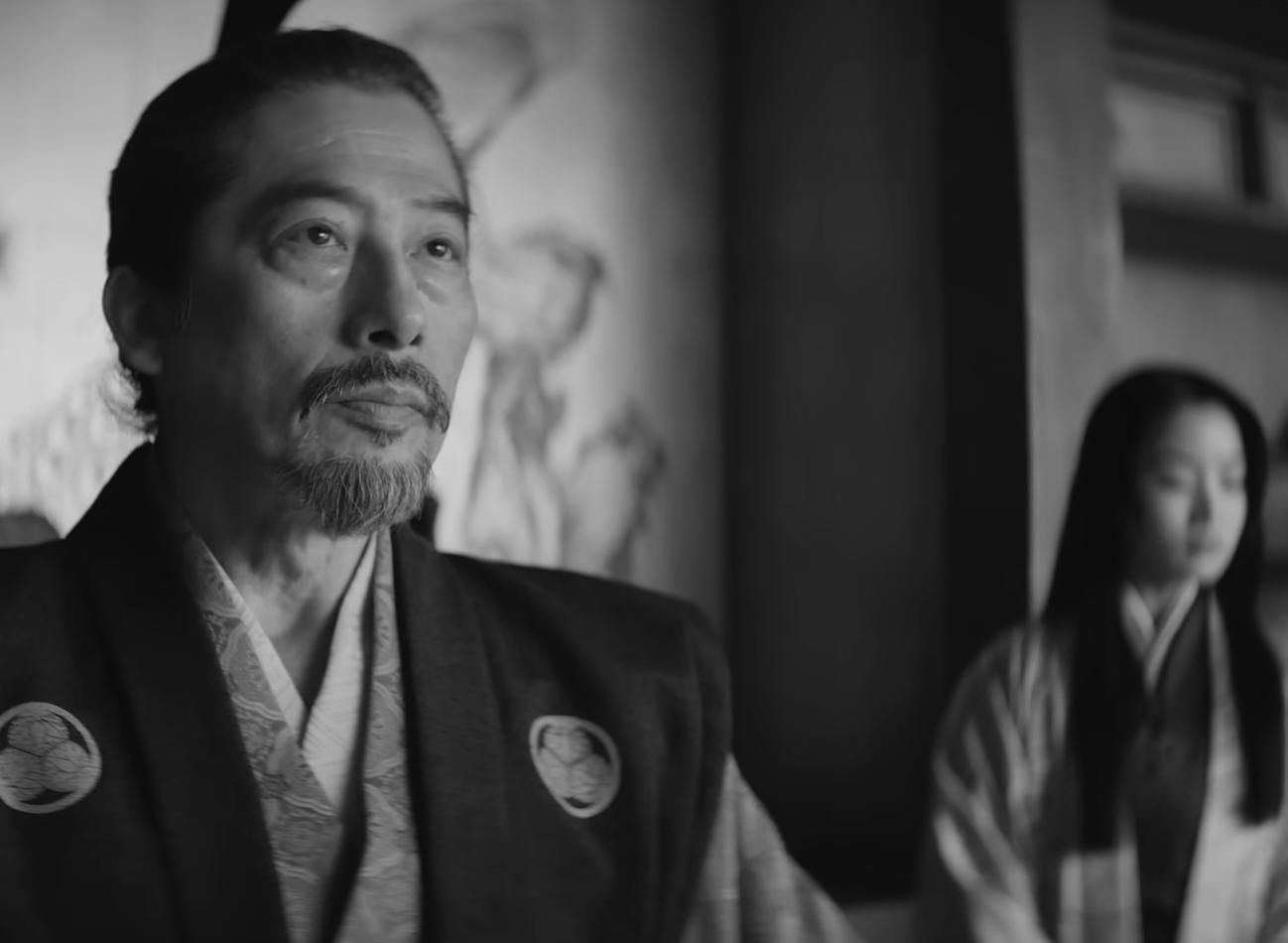
For years, I did not understand the appeal of “Shōgun.” I found the book years ago in my dad’s closet, and I couldn’t comprehend why this novel was so praised online. I initially derided it as a mediocre orientalist fantasy and placed it alongside “The Last Samurai” in my mental film rankings. But seeing it adapted nearly 50 years after its release made me rethink my hasty assessment. After watching the two episodes released so far, I am happy to report that “Shōgun” has thoroughly exceeded my expectations and explains the lasting power that the novel has.
The dramatic appeal of “Shōgun” comes from how it seamlessly blends personal and political stories. Set in 1600 Japan, Yoshii Toranaga (Hiroyuki Sanada, “Ring”), head of the Toranaga clan (based on the historic Tokugawa clan), is summoned by his fellow regents to Osaka Castle, who intend to have him tried and killed for treason. Meanwhile, Protestant privateer John Blackthorne (Cosmo Jarvis, “Lady Macbeth”) finds himself stranded on the coast of Japan while searching for Catholic missionaries. What makes the show so fun to watch is seeing a grand narrative unfold with a tight cast of characters. A pair of different conflicts occur simultaneously: Blackthorne fights the Catholic hegemony in Asia and Toranaga attempts to consolidate power over his ri-
vals. These narratives eventually overlap with one another, creating a sense of harmonious excitement. Yet throughout all this action, the show stays compelling and keeps you on the edge of your seat at all times. In episodes one and two, Blackthorne is an inch away from getting executed at all times. He’s a foul-mouthed oafish pirate and refuses to shower more than once every two weeks. His favorite hobby is picking fights with men who don’t need a reason to see him dead. It’s by Toranaga’s repeated intervention that he evades execution. Although Blackthorne makes it ashore, he now finds himself adrift in the violent sea of global politics. And while Toranaga is ostensibly one of the most powerful men in Japan, he balances on a knife’s edge. Here, “Shōgun” can successfully make courtly politics engaging. The regents wage psychological warfare on one another and play political chess to maintain their control. Toranaga’s safety net of holding the queen regent hostage is immediately undone by his main rival Ishido (Takehiro Hira, “Gran Turismo”). Toranaga openly jokes to his retainers that there is a good chance that he will actually meet his end in Osaka. Every character feels vulnerable, making for consistently excellent drama. What further enhances the drama of “Shōgun” and makes it a grand historical narrative is the incredibly high production value. On a technical level, “Shōgun” feels and looks like a movie; each episode has a deeply cinematic quality. Osaka Castle is introduced through
a sweeping aerial shot of the medieval Japanese city — Blackthorne’s boat pierces a thick morning mist as it runs aground. The show’s set design can seem grand in scale but can also be intimate. The interior castle design is full of tight, narrow corridors, which can make scenes feel claustrophobic or intimate. There is also great attention to detail within the show; true to the book, “Shōgun” attempts to adapt every detail of medieval Japanese life onto the screen. Many shots are dedicated to the ritual of getting dressed, showing the extent of the research done into Muromachi-era clothing and culture. To further capture the essence of medieval Japan, the show is bilingual, meaning that the Japanese actors speak only Japanese. While far from an innovation, a language barrier between the characters helps hammer home the themes of cultural humility. The spoken Japanese is also suitably archaic — the feudal lords address themselves using outdated honorifics that reflect the period, a small detail that sells the courtly drama.
However, while I have enjoyed the show so far, I couldn’t stop thinking about whether or not this show was guilty of rehashing trite Orientalist stereotypes. “Shōgun” was written by a white author who adapted a period of Japanese history for his historical fiction novel. Even if James Clavell did extensive research to make a period-accurate work, as an outsider to the culture, he comes in with subconscious biases. There is no clear answer to this question; it’s been a topic
The Michigan Daily Crossword
Sunday, March 17, 2024 — Puzzle by Bradley O'Brien &
of scholarly debate since the book was released. As the show continues to air, it is important to be critical of how the show chooses to adapt its source material and portray Japan.
Something that I believe swings the conversation favorably towards “Shōgun” is an emphasis on cultural humility. While John Blackthorne is one of the protagonists, he isn’t a white savior or even the hero of the narrative. Blackthorne is an abrasive character; he comes to Japan with an unearned superiority complex. Watching him tell a
samurai that he’s going to “piss on your country” only to be smacked and then urinated upon is strangely cathartic. John is humbled repeatedly, and through those experiences, he realizes that he can grow and develop as a person if he chooses to engage with people genuinely instead of scoffing or spitting at them. Characters like Rodriguez (Néstor Carbonell, “Lost”), who have lived in both Japan and Europe, let Blackthorne know that Japan is no more barbaric than the warring states in Europe. “Shōgun” makes great strides not to
sensationalize Japanese culture; the setting is neither idealized nor bastardized.
“Shōgun” is more than deserving of the praise it has received following its initial release, and I’m glad that the series changed my mind. While there is no guarantee the remainder of the series will live up to the first two episodes, I have confidence that in its eight remaining episodes, the series will continue to deliver on its promise of a grand period drama or at least show us Blackthorne getting beat up again.
‘Drive-Away Dolls’ takes the raunchy route
Ever since their debut “Blood Simple,” brothers Ethan and Joel Coen have gained something of a cult status. They have quietly penned their name in the industry by producing snappy, low-budget and award-winning features year after year. The Coens are good ol’ reliables. Their scripts burst with creativity, trademarked by a sardonic nihilism. From absurdist to realist, comedic to dramatic, the Coens have done it all — and most importantly, done it together. Whether the film was co-directed by them both or credited to just one was a matter of semantics. Everyone knew that they were in for a Coen brothers film.
Then, two became one and one. The brothers abruptly announced a creative split in 2020, and, O Coens, thou hast cleft many hearts in twain. Joel Coen adapted Shakespeare’s Macbeth in his first solo effort; Ethan Coen went to New York and directed theatre for a few years. But he’s back now, a bit… rusty. But he’s back. “Drive-Away Dolls” marks Ethan’s long-awaited return to cinema after a six-year absence.
38. Enter property illegally
42. Capital of Qatar
43. "Let them _______!" (French Revolution quote)
48. Half of a popular video app
50. Helpful computer whiz, for short
52. Often-forbidden things to worship
53. _____ Devi (India's second highest mountain)
54. Actress Wanda
56. 20% after a service, maybe
57. "On the ____" (Jack Kerouac novel)
58. "Let's just leave ____ that"
59. Nile menace
60. Precedent overturned in Dobbs v. Jackson, slangily

The new “Coen brother film” is raunchy and loose. Set in 1999, “Drive-Away Dolls” stars Margaret Qualley (“Sanctuary”) as Jamie, a rambunctious Texan with a libido as high as the Empire State Building. Oh, and she’s a lesbian. In her first scene, Jamie is eating out another woman in bright neon lighting; that lucky woman is not her girlfriend. If “ask for forgiveness, not permission” was a person, Jamie would be that, tenfold. Even worse, Jamie’s mouth works multiple times faster than her brain, a trait ripe for boundless gags. She’s the epitome of trashy, and so is the entire film, formally. “DriveAway Dolls” looks as though it was produced to hit a Netflix quota. With an experienced cinematographer Ari Wegner (“The Power of the Dog”) behind the wheel, the look is definitely intentional, however ugly. The film’s lighting is as gaudy and artificial as a Modelo commercial, lending a sense of cheesy absurdism. The use of expressive low and high angles adds to the feeling that we’re looking at the world through a concave prism where everything is magnified and upside down. That upside-down feeling basically describes Jamie’s life. Her rhythmic railing of words, and women, is never not hilarious; Qualley’s Texas accent killed the crowd. But Jamie’s chaotic tendencies do become a point of contention when her fiery girlfriend Sukie (Beanie Feldstein, “Booksmart”) discovers that Jamie has been acting too much “down there” and promptly kicks her out of their apartment.
Jamie, desperate to get away from her ex, begs to tag along with Marian (Geraldine Viswanathan, “Miracle Workers”). Marian is a simple gal.
She doesn’t exist for the sole purpose of sex, and she sure wouldn’t cheat on her partner — she is far too principled for that. Aside from being into women, Jamie and Marian have nothing much in common. But Marian is planning to go to Tallahassee, Fla. for a drive-away (the delivery of a car for money) and to birdwatch. Jamie obviously wants to bounce. Tagging Jamie along kills three birds with one stone: Marian earns some cash, gets some leisure and saves her friend all in one trip. So, she does it. Marian is a girl on the straight and narrow, the up and up, and she serves as a delightful contrast to Jamie, essentially playing the straight man to Jamie’s funny man. Viswanathan’s comedic chops all lie in her bug-eyed expressions and stark silence, balancing Qualley’s constant gesticulating and cunnilingus-fueled ribbing. The conflict between the two is, as you would expect, one of lust and restraint. Jamie wants Marian to loosen up and live life, and Marian wants to get to Florida pronto. But a Coen script can’t be that simple. Even with co-writer Tricia Cooke (“She Likes Girls 4”), Coen’s affinity for forcing their characters into unfortunate circumstances prevails. Due to a mishap at the drive-away car service, the lesbian duo take the wrong vehicle, loaded with a briefcase of hard-core, top-secret shit. The shit is so confidential that the duo gets clumsily tracked and chased down by two henchmen from across the country. It’s serious business. Coen and Cooke mirror the lesbians’ dynamic with the two goons. Arliss (Joey Slotnick, “Elevator”) is the “thinker,” Flint (C.J. Wilson, “Manchester by the Sea”) is the brute, just like how Marian plans with her head and Jamie acts with her lady bits. The two henchmen are an electric rehashing of a similar dynamic from “Fargo,” except that their scenes are all played for kicks, all the time. Not all is great, though. In an effort to emulate Y2K trash, Ethan Coen goes too far by including choppy editing transitions and abstract psychedelic sequences that actively disrupt the fun buddy-comedy road trip vibes and drag the snappy pace of the film. The editing choices are emblematic of a larger issue: “Drive-Away Dolls” is very blunt. The film lacks a thematic fullness that other Coen brothers productions would have in spades. All of its short 84-minute runtime is dedicated to fluffy humor and rarely to the blending of satire, comedy and emotion. A few pointed moments come close — “Why would anybody save Curly?” — but the film’s meandering can feel tiresome when Ethan and Cooke don’t have much in the way of a message. Even in the Coens’ most wacky film, “Raising Arizona” (1987), the joy of parenthood and the beauty of life hold the absurd elements together. Here, Coen and Cooke write for kicks and lesbian chicks. No doubt, “Drive-Away Dolls” is crude fun, and I left the theater with a big smile, but a more substantial detour should have been on the itinerary.
Arts
michigandaily.com— The Michigan Daily 4—Wednesday, March 20, 2024
BEN LUU Daily Arts Writer NICOLAS EISENBURG Daily Arts Writer
1 2 3 4 5 6 7 8 9 10 11 12 13 14 15 16 17 18 19 20 21 22 23 24 25 26 27 28 29 30 31 32 33 34 35 36 37 38 39 40 41 42 43 44 45 46 47 48 49 50 51 52 53 54 55 56 57 58 59 60 61 62 63 64 65 66 67 68 ACROSS 1. Word with spot or serve 5. Lil ___ X 8. Ending with taste or trouble 13. Vibe 14. Coup d'___ 16. Flexible 17. ___ impasse 18. Socially aware, slangily 19. Italian salami city 20. *Excessive alcohol consumption 23. What South Carolina did on December 20, 1860 24. Put on a frown 27. Wander 29. Genetic stuff 30. Contract that bars secret sharing 31. Hailing from India, Pakistan, or Bangladesh 34. *One stashing their wealth at the end of a rainbow 37. "___ you a little short for a stormtrooper?" (Princess Leia quote) 39. 1773 'party' in Boston 40. "As a ___ of my appreciation..." 41. *Traditional show featuring Irish tunes and fancy footwork 44. Depend (on) 45. Squeak (out) 46. Semi-spherical lip balm brand 47. Stable diet? 49. Scandinavian pastry 51. Promotional gimmicks 55. Holiday represented by the starred clues, for short 59. Traditional Colombian cornmeal cake 61. Theta follower 62. Goose sound 63. Reaches new heights 64. Musician Anderson 65. Shoppe descriptor 66. Mexican coins 67. Detroit-based energy company, for short 68. Those, in Tijuana DOWN 1. Bygone Swedish cars 2. Innie's opposite 3. Old Parisian coin 4. Small citrus fruit 5. F.D.R. recession program 6. Suffix with comment or decor 7. H. H. Munro's pen name 8. One might involve disappearing rabbits or playing cards 9. 007's title 10. Large reptile 11. "Mr. Blue Sky" group, to fans 12. Mens ___ (guilty mind) 15. "Big" number in Michigan athletics 21. Tokyo, formerly 22. "Citizen ____" 25. "I challenge you to ___!" 26. "_____ Boy" (Irish tune) 28. Puzzles within puzzles 29. Malfoy of the Slytherin house
Had the audacity
Actress Alexander of "Get Out"
Pirate's domain
Ballpoint or fountain
Item in a yard game
Irena Li
31.
32.
33.
35.
36.
This image is from the official trailer for “Shōgun” distributed by Hulu.
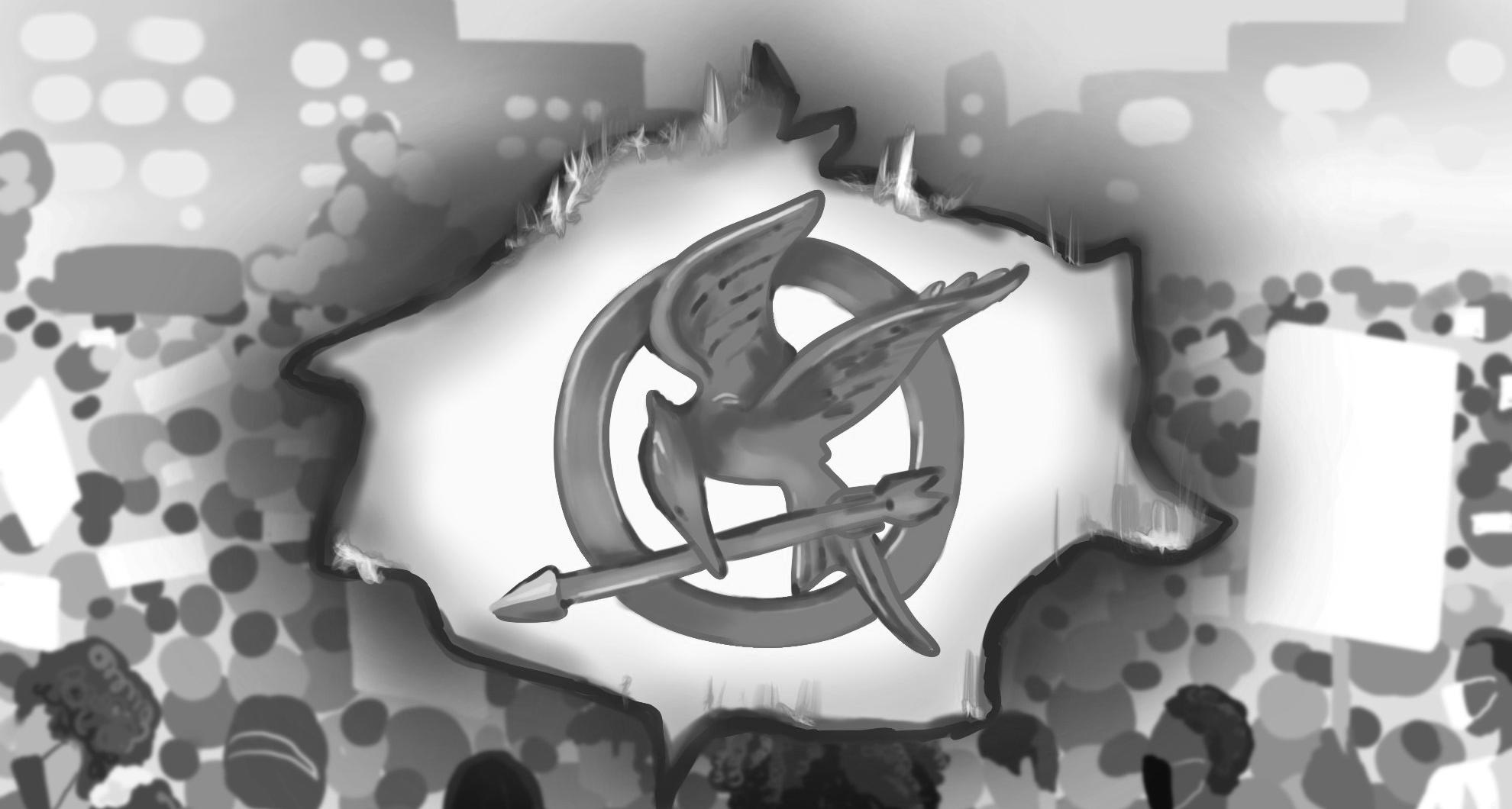
Recently a tweet by @mariyyum found its way onto my chaotic Twitter feed (Elon you will never make me call it X). At the time of this article’s creation, the tweet had nearly 200,000 likes and 26.5 million views. The post features a clip from “The Hunger Games Mockingjay – Part 1.” Jennifer Lawerence stands in front of a pillar of flames as she delivers an impassioned monologue. She reprimands The Capitol for bombing hospitals full of unarmed men, women, and children. With tears in her eyes, she echoes the sentiments that the oppressed must fight back in the face of torture, bombing, and genocide. This scene is accompanied by @mariyyum’s caption “Quick, answer me this. Is Katniss a terrorist? Maybe watching this will open some of your eyes.”
It is not difficult to see how this scene almost eerily reflects current real-world events. Israeli forces have bombed countless hospitals in Gaza. After decades of oppression, Palestinians are also working to procure their liberation in any way they can. Sectors of the public have condemned Palestinians for their violent forms of rebellion, criticizing the methods shackled people use to seek freedom.
Katniss Everdeen violently overcomes a corrupt and genocidal system and is rewarded with a million-dollar franchise, mainstream support, and a permanent spot on every white woman’s shrine of girl bosses. Real-life people of color fight back against decades of genocide and are labeled as terrorists, thugs, and the villains in their own tragedies. No one asks “What did the Districts do to deserve this treatment?”, “What are the ethical implications of District 12 meeting violence with violence?”, “Shouldn’t they have held a vigil for lives lost at the Capitol?”.
The goal of this article is not to
analyze the Palestinian genocide. Countless other writers within Michigan in Color have already done so with a level of reverence, knowledge, and empathy that I can only strive for. You can read some of their work here: “From Detroit to Palestine, police violence is a crime,” “Breaking walls, building solidarity: Unveiling the apartheid struggle in Palestine,” “The Middle East and U-M: A better way.”
My focus revolves around analyzing the difference in societal reaction to fictional rebellions helmed by white protagonists in comparison to real-world rebell_ ions led by people of Color. I am more interested in analyzing why dystopian plots and ethnic history constantly parallel one another and the inherent problems within this trend.
The most vicious atrocities white dystopian authors can fabricate are often just ethnic history in whiteface. In the Jim Crow South, there were real-life Hunger Games known as Battle Royals. Dozens of Black male teenagers were forced to enter an arena armed with nothing but boxing gloves
and the fear pulsating within their rib cages. They battled until only one child victor was left standing. The sounds of white laughter and cheering reverberated off hardwood floors. Sweat cascaded down melanin muscle and sinew.
Knuckles met sharp jaws until bone cracked. A younger brother sank his fangs into his older brother’s familial skin until blood spilled from his teeth. Teenagers left the arena with skull fractures, brain damage, partial blindness, and other permanent injuries. Children left having lost pieces of their bodies and souls. Sometimes children did not leave at all.
The real-world parallels in Collins’ work don’t end with Battle Royals. Is the overpoliced and underfunded food desert of District 12 not just an exaggerated representation of the projects? Is the recorded death of a Black child (Rue) acting as the catalyst for global protests not reminiscent of so many teenagers turned tombstones that have led to cities on fire?
Rioting, looting, and violent forms of protest echo Collins’ sentiment that if we burn, the system will
My grandma’s bodyguard
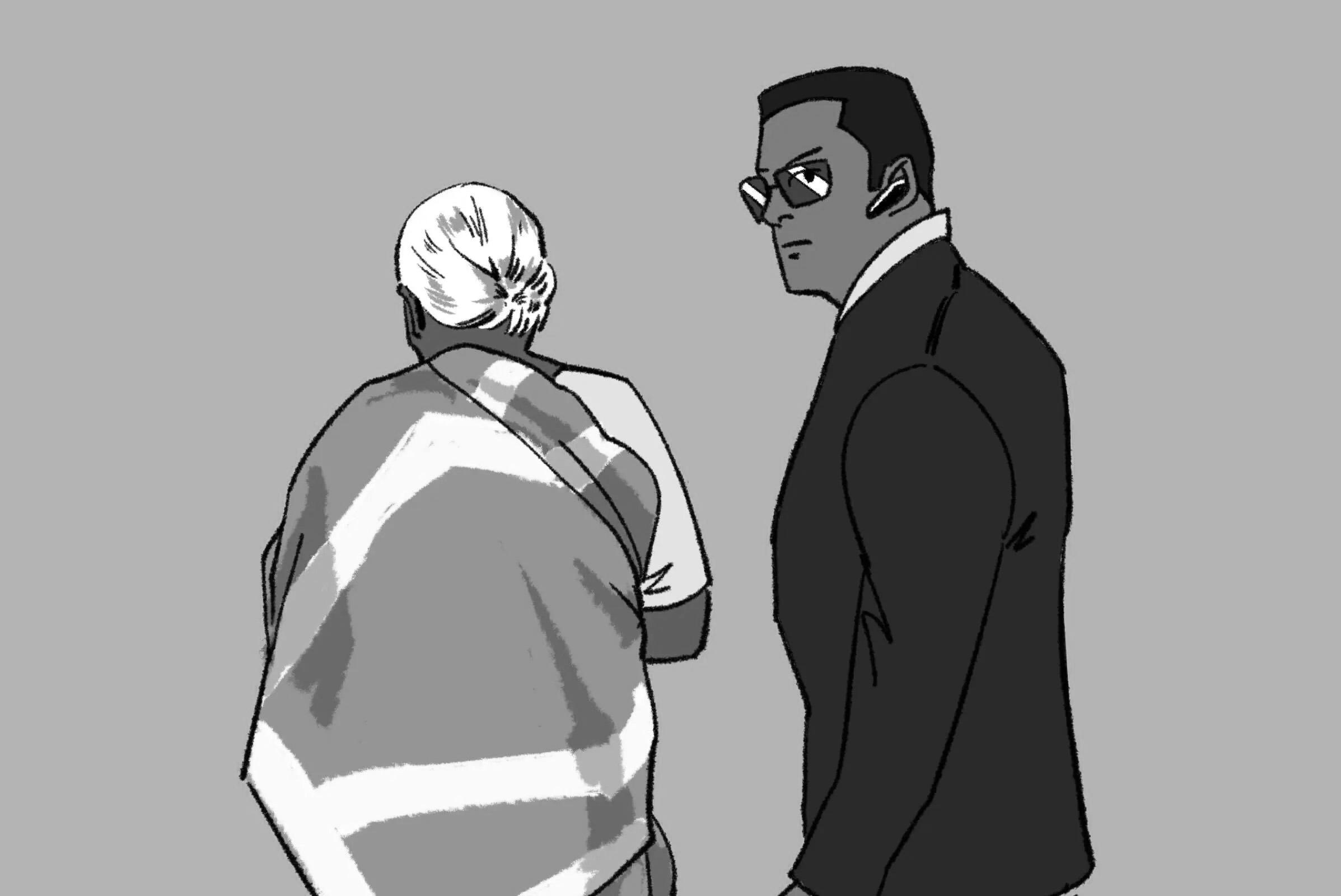
My grandma has a bodyguard. He follows her around everywhere. Not letting her out of his sight. Not because he wants to, but because he doesn’t have a choice. It is his job. A job he unknowingly signed up for 50 years ago. He is doing this job out of a commitment to love. Love, for him, is the idea that you have to stick by your person no matter what. This bond of love was created and committed to 50 years ago; their lives have wavered and frayed under stress, but the bond remains unscathed, standing the test of time. The bodyguard is determined that this bond shall not be broken, even if my grandma cannot realize how hard he is working to achieve this goal. He is the only bodyguard that my grandma trusts. There have been a slew of others, squeaking in with their rubber-soled shoes and black leather bags filled with instruments. These others are tried and tested, but they have all been kicked to the curb after some time. They are not able to take care of her in the way she needs. They pack up their bags and trudge off, finding work somewhere else. My grandma’s heart is a safe
that only her bodyguard has the key to. He holds her heart with hands delicate enough for a feather. He holds her hands with a tenderness that comes from years of comfort. She forgets everyone else’s name but his. She cowers away from anyone else’s touch but his.
As time continues to pass, my grandma doesn’t stay as young as I want her to. She forgets how old I am. She doesn’t get up from her bed to give me one of her warm hugs when I come to visit. She isn’t able to walk to the kitchen to make my favorite aloo gobi recipe. She decides not to play rummy with me as I walk into her room with a deck of cards. She, instead, spends her days laying in the warmth of her bed and her bodyguard works overtime to make sure she is protected, but he is also tired. He also wishes for the warmth of the bed, but he doesn’t get any vacation days. He is always on the clock.
The bodyguard doesn’t mind that he can’t get much time off. He always looks and cares for my grandma like she’s the only person in the world. He sleeps peacefully next to her knowing that she is okay. He does all of his duties with a smile.
The only time I hear my grandma laugh anymore is with him. They giggle about the smallest things. Her smile only comes
out when she sees him and her frowns are ever more apparent when he isn’t around. She needs him and he needs her. Fifty years of familiarity will do that to someone.
Eventually, the bodyguard is no longer fit for his job. He isn’t able to keep up with my grandma as she needs more help with simple day-to-day activities. My mom calls him into her HR office. He knows what is about to happen. He begs and pleads with his superiors, but everyone knows that his time as a bodyguard has come to an end. He knows this too. He begrudgingly hangs up his coat in the office and goes to say goodbye to his client.
My grandma doesn’t understand why he has to go. He tries to explain to her the best he can. He tells her that she needs more security, and needs to move to a better facility where they can take better care of her, with better-trained bodyguards. She does not care about the reasons. All she knows is that she is being forced away from her home, from the only bodyguard she trusts and loves.
It is hard for the bodyguard to let her go. The bond of love seems like it is on its last frayed piece when she leaves for the new facility. She does not turn back to look at her bodyguard. She goes quietly and without resistance.
burn with us.
In her prequel novel, “A Ballad of Songbirds and Snakes,” Collins features a human zoo full of tributes chosen to fight in the Hunger Games. From the early 1800s to the mid-1900s, Congolese and Native American men, women, and children were housed in zoos. People were put on display behind fences, stripped halfnaked, dressed in animal skins, and forced to participate in degrading activities for the entertainment of white onlookers.
The horrific elements injected into these novels are merely hyperbolic ethnic realities. Collins was inspired to pen the first entry into The Hunger Games franchise after flipping through television channels and consuming clips of an invasion of Iraq. She’s also on record saying: “The citizens of the districts have no basic human rights, (and) are treated as slave labor.” Luckily, Suzanne Collins does her best to feature prominent BIPOC characters within her storytelling considering she admits to being inspired by their invasions and histories of enslavement …
right? We see BIPOC characters like Thresh commit valiant acts, such as dying to save the lives of the white leads. There is also Rue, whose death catalyzes the white lead’s character development and deepens the white lead’s motivations. In the film adaptation, Black actor Lenny Kravitz portrays Cinna. Cinna also happens to die for the white lead’s development and to deepen her motivations.
Is there anything intrinsically wrong with mirroring history within the plot of your novel? Absolutely not. It can even be argued that that’s largely the point of the dystopian genre. The genre exists to illuminate flaws within our current society and paint the most drastic picture of what can persist if we don’t adjust for the better. There is no real issue there. There is an issue with white authors taking the stories of people of Color, giving them to white protagonists, and consciously choosing to exclude or kill off all notable characters of color.
Unfortunately, Collins is not alone in this. We see Margaret Atwood take a similar path in
her New York Times Best Seller, “The Handmaid’s Tale.” “The Handmaid’s Tale” follows a white woman’s journey within Gilead. In this “dystopian version of America,” white women are enslaved, forced to give birth, and treated as property. Women are kidnapped and indoctrinated into submission. Women are barred from reading and writing. Women exist only as child-bearers and property for white men and rich white women. This vileness is all legal and done under the guise of religion. If this sounds familiar, it’s because this is exactly what Black women were subjected to during American slavery.
Atwood takes Black history, sanitizes it with a white feminist filter, and to top it all off removes Black women from the plot entirely. The Handmaid co-opts a tale that is not her own, painting a plagiarized and watered-down version of the transatlantic slave trade.
Maybe these authors are aware of their audience’s tendency to gravitate towards whiteness. They are aware that so many of you are only able to muster empathy toward the oppressed in fantastical settings. Do they prey off you only supporting vulnerable populations when they’ve been rewritten to look exactly like you? Or is this some twisted form of wish-fulfillment self-insertion? A means to feel empowered by a narrative that doesn’t belong to them, and escape the guilt of being the oppressor.
Nevertheless, the populations that inspire these stories should be at the center of them. White heroines must not be lauded for leading revolutions while people of Color with corpses where their loved ones used to be are accused of terrorism and thug-like behavior. Our realities must not be glamorized and spat from the tongues of a “desirable” protagonist in order to reach mainstream acceptance.
If you’re interested in reading dystopian works by and for people of Color, I recommend the literature of Octavia Butler, N. K. Jemisin, R.F. Kuang, and Ling Ma.
An obsession explained: A different kind of green thumb
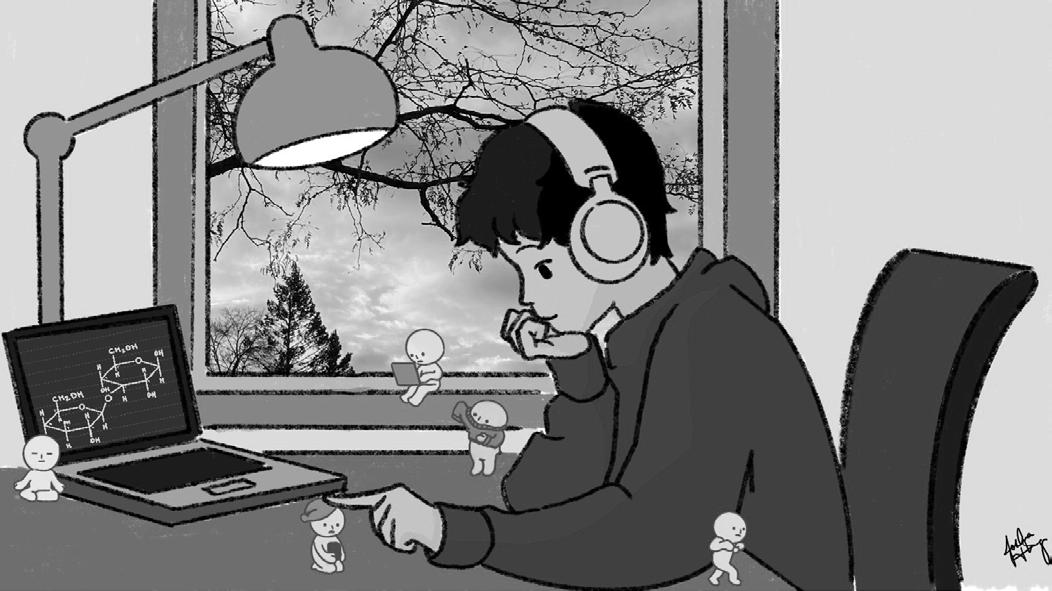
I own at least 7 smiskis. They’re a lovable addition to any household. They are little Japanese ghost figurines, obtained only through a gacha mechanic. They are designed to hide and accent the house — the cutest knick knacks. They have expressionless looks on their faces, which contrast with their many unique poses. Some of them can interact with various items of the house, making them almost lifelike. The best part, they glow in the dark.
They are a result of a crippling addiction to the blind box phenomenon. The not knowing of what you’ll get, tearing open the container and being faced with either disappointment in obtaining the one figurine you least wanted, joyous celebration in randomly picking one that contained your most desired figurine, or a neutral middle ground in which one simply feels appreciation for the cute expressionless little ghost that sits upon their palms. They bring me consistent joy and appreciation, emotions I associate with the healing of my inner child. They do nothing but sit, stare and glow, holding no purpose except for my own entertainment. Their literal existence, in its crystal physical form, unmoving, is calming, meditative.
There’s a desire for this state of nothingness for myself. This desire derived from a fascination to be unmoving in a world that moves increasingly faster as I age. Right now, the deadlines, the drama, the problems and the heartbreak have caught up. Weekdays and weekends have become indiscernible. They’re just days.
I feel as if I am constantly doing, constantly being, constantly changing, constantly this and that. The approach of isolated adulthood looms over the little remaining security of college life, but these smiskis anchor a strand of my youth while I shed the rest of my immaturities. A mental elitist would say, “That’s what the movie’s all about. To be human, is to experience all of this.” But in my opinion, I feel
like a machine. A robot, whose schedule is too busy to experience feelings of anger, sadness, pain, and heartbreak. “There are resources” says every advisor, professor, graduate student instructor, but where is the time? Suffering is what makes humans humans. Three alarms wake me up in my little room. I enter a crowded bus in the morning, having to wobble and fight for my balance as I squint, my eyelids heavy still with sleep. I want to smell the roses, to kiss his pretty lips. I want to cook salmon well. I want to draw again, to create, to detail the ripples and wrinkles of a person’s clothing as they saunter by. But the roses wither, pretty lips become an old dream, the salmon expires, and my sketchbook collects dust upon a shelf of unexplored books and unfinished journals. The smiskis don’t move and don’t change. They are. They are given a purpose straight out of the box. And I move them around my space and take them with me to study so that they don’t get bored of occupying the vacancy of my little apartment room. And despite their stillness, they shine so brightly at night. And like jellyfish in the darkness of my room, I smile at the sight of these plastic ghosts. And I appreciate these small instances of mindful gratitude.
If there’s one thing I’ll let you know, it’s that I often lose myself in reminiscence. It’s almost involuntary, triggered by the smallest things, but I’m taken to a place beyond the clouds. And the moment I am planted in my shoes again, I am drenched by a loneliness so sharp and cold.
It starts from old smells, of fresh hand sanitizer, crisp morning air, aging ink of library books, dark chocolate, tomato soup and a grilled cheese, his laundry detergent, my hands, the pond by the music school. I get lost from hearing the nostalgic laughter of little kids wandering upon campus grounds, some unaware of the tears that water the institution.
It is in the sunset and the breeze that mixes the clouds with the orange-purplish hues, creating a dazzling performance of swirls, dots, and elegant lines that stretch into the dying sunlight. It is in my mother’s voice, tired, yet so comforting, reassuring me of her presence and her undying support through the phone. It is also in my father’s voice, gently telling me to cry, but not for too long, reassuring me he is always with me in spirit and that he is rooting for me to succeed.
It is in my relationship with my brother that, after years of bickering and disagreements, has mended. We have evolved from handshakes to high fives upon departing from each other, but we are gradually working towards a hug. It is in my smiskis, and the memory of when I first opened them, signifying the moment I found something to redirect the love I have and warp it into obsession. They’re anchors of appreciation, rewards for my survival efforts. Each purchase marks a milestone of mental fortitude and emphasizes the permanence of my continued existence. From this simple (expensive) hobby, I found an entity to project my desire to smell the roses onto.
MiC
SCARBOROUGH
Columnist
JAMES
MiC
Nobody calls Katniss Everdeen a terrorist
SARA WONG/MiC
NAGWANI MiC Columnist
EESHA
MiC Columnist Read more at michigandaily.com Wednesday, March 20, 2024 — 5 The Michigan Daily — michigandaily.com Design by Sara Fang
JOSH
HUANG/MiC JOSHUA HUANG
I’ll paint my nails if I want to: Masculinity and being Queer in men’s sports
I’ve never been one to fall for inflammatory content — those petty little posts that you know are just there to make you mad. But it’s certainly enticing that at any given moment I can give my brain enough primal stimulation to the point where my heart rate spikes, my breath quickens and my vision blurs. One click of a button, really.
That’s all it takes. Click.
On Dec. 30, I took the bait. Duke basketball player Jared McCain was going viral, but not for an inhuman dunk or a buzzer-beating heave. Instead, then 19-year-old McCain was trending because he chose to paint his nails. And if I had any regard for my own well-being, I would’ve scrolled past it in blissful ignorance that maybe the online sports community was cheering him on for his self-expression. I knew that it wasn’t going to be the case, but I should’ve believed so anyways. Instead, I clicked.
“This shit is so gay.” My heart rate spiked. “Kick him out of school.” My breathing quickened. “The youngins need to get bullied.” My vision blurred.
Maybe I shouldn’t have cared, really. All I could do was yell my own thoughts into the void and preach to the choir. A tweet wouldn’t change people’s minds, but I tossed one into the universe anyway — not for McCain, but for me. Because under the guise of sticking up for him, I was standing up for myself.
I rode my bike to practice that day, feeling free, pretending my short hair was flowing in the wind in a long veil behind me, like a dress. I was humming a soft tune as my naturally rosy cheeks, soft jawline and round eyes all scrunched in the face of the evening sunset.
As I slipped my basketball bag off my shoulders and rested my bike on the small maple tree outside the gym doors, I reentered the real world. I felt comfortable in that gym, even as a freshly minted varsity player who only knew most of his teammates cordially. The high ceilings and stark smell of floor sealant provided a familiar, soothing environment —
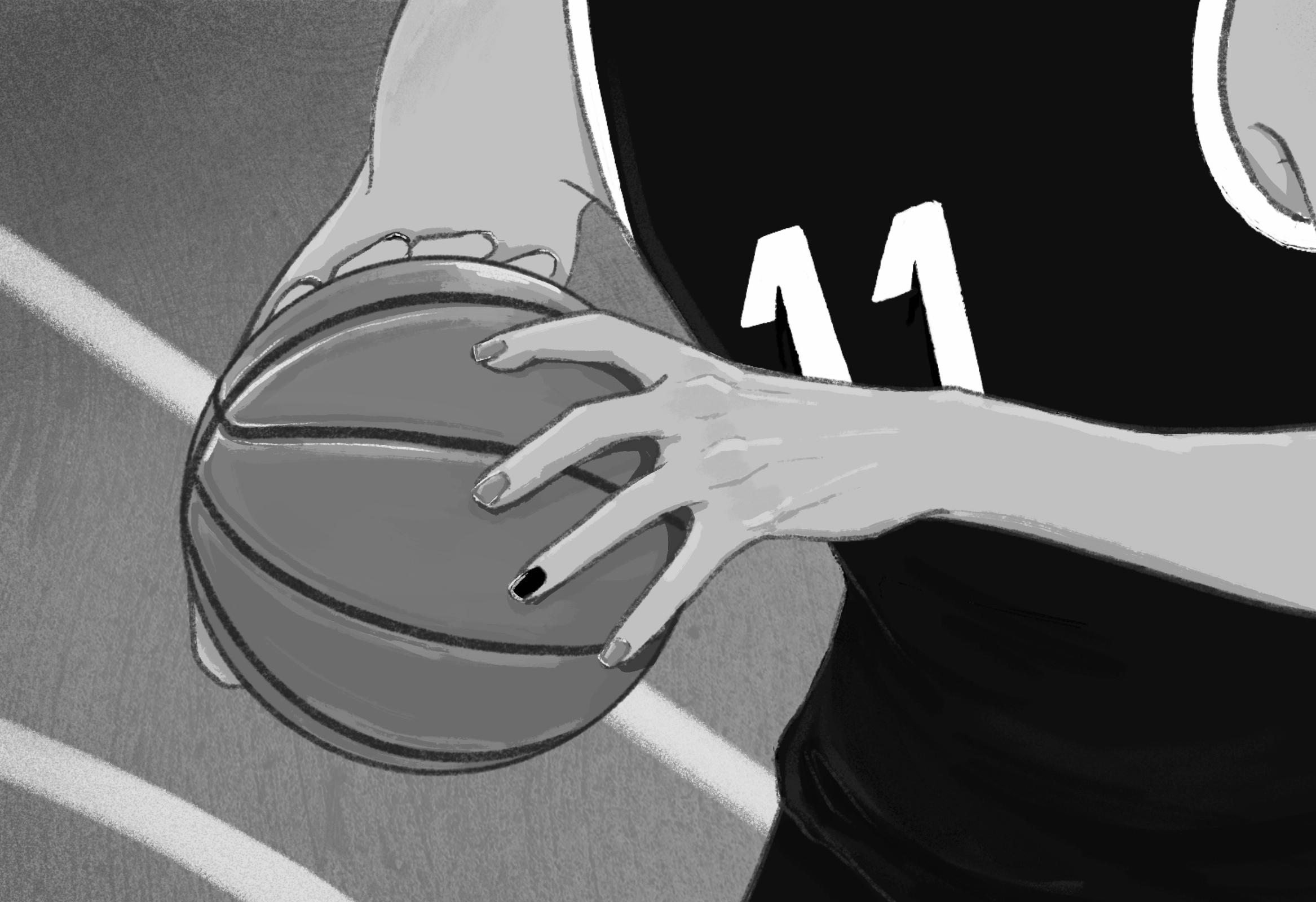
a reminder that I had been there before. I felt comfortable in the space, but, to be honest, I never really felt comfortable with the people. The team camaraderie of sports — the collective suffering and joy, the unity that comes with sweating together — often eluded me. Even then, before I truly knew the reason, I had the sinking feeling that I didn’t belong there — thoughts that start somewhere in your chest and flutter down to your waist only to sit there, waiting to be, but never actually being, acknowledged. I hadn’t quite come to understand my Queerness yet. The idea of it was still a small seed in my brain; I just knew that I didn’t think like the rest of my teammates. That day, I started to understand why. It wasn’t like the movies. Everyone didn’t burst out in snickers immediately upon my entrance: I wasn’t jeered at. In fact, people didn’t notice until I began tying my shoes.
“Oh, shit,” one teammate commented. “Eli has pink nails.”
It wasn’t a malicious comment on the surface; it was simply an observation. Each one of my nails was sloppily painted in a neon pink, except for my ring fingers, which were coated in black. It was the deepest black my friends had.
It was the type of black that I had imagined a black hole would be made of, the type of black I swore I could see my reflection in. I knew that wearing them to practice was a risk, but I didn’t really care. I was free that day.
“He’s been hangin’ out with the gays too much, man,” another teammate said.
“Faggots,” another corrected. My coach was in the room. He looked the other way. He used that word just as often as my teammates did. He had no reason to step in. Maybe I even saw the corner of his lips curl into a smile.
Those words hurt me on a level deeper than the anger I would feel for them saying slurs about others, but I wasn’t sure why. At the time, there was a feeling that, deep down, those words were describing
me. My heart rate increased, my breathing quickened, my vision blurred. But I didn’t say anything. I didn’t stand up for my friends or myself. Instead, I laughed along, agreed and locked myself in the bathroom as I scraped off the polish.
Basketball players didn’t paint their nails — not men, anyway.
Perhaps McCain didn’t experience what I did. Perhaps the Duke locker room was a much more accepting place than my semirural high school’s locker room was. Perhaps most of the hate McCain received was from lowlifes on Twitter with nothing better to do than make fun of a 19 year old. But then again, probably not, because it’s no secret that men’s sports aren’t a very accepting place.
Accepting or not, I stayed. I loved the game of basketball — its fast pace, its wit. It kept me coming back for more. But I also loved what it gave me. It put me out of harm’s way, acting as a mask to any of my un-masculine tendencies. In the locker room, I was an
actor, pretending to be a hard, emotionally closed-off jock.
It’s almost like a game of “Who can be the most masculine?” I guess it makes sense that when you throw a bunch of young, competitive guys into a room together, it morphs into an unspoken battle of being the biggest, toughest man in the room — or, just the best representation of the prototypical “manly man.” It’s natural, I suppose, but it’s a vicious cycle: each person trying to outman the one next to him. And this is the origin of “locker room talk,” the crude, often misogynistic and homophobic chatter that happens in changing rooms. It was this kind of talk that told me I didn’t belong. Despite not yet really knowing that I was Queer myself, I had a lot of Queer friends. I was part of a 20-person fiddling band, of whom a majority were Queer in some form. In a way, I found myself on both ends of the spectrum. On one end, I could be freer and more open in my expression with very little judgment at all from my music friends. On the other end, I had
On shared birthdays and sisterhood
On the eve of my 21st birthday, I sat in the padded recliner chairs of the Ann Arbor Cinemark with two of my best friends, nursing our cherry Cokes as we watched “The Ballad of Songbirds and Snakes” for a second time. Partly because it was a Sunday night, partly because I was the first of all of us to turn 21 — bar hopping is no good when no one else can get in — and partly just to see Tom Blyth again. After his last-ditch effort to save Lucy Gray from a vat of snakes, my best friends both turned to me, whisper-yelling-butreally-more-like-yelling “Happy Birthday” despite the four other focused movie watchers.
Once Tom graced us with what is arguably his best line of the film — “Snow lands on top” — we proceeded to the 7-Eleven on South Forest Avenue. At 2 a.m., nearly 18 hours before I’d be 21, I purchased a Green Apple Beatbox with my newly legal ID and chugged it to the beat of “Pump it Up” by Endor as snow slid down the windows of the car.
My usual sense of nostalgia was there — the sense that time
was slowly, carefully slipping out of my grasp, and I was marching endlessly forward — as it was with all my birthdays, but I thought I’d done a good job of avoiding it. Even though my TikTok feed was filled with girls posing next to cakes with teary eyes, proclaiming that “hot girls cry on their birthdays,” there were no tears this birthday. No spurts of melancholy at the loss of my childhood, at the startling realization that I would never again live with my friends on the fourth floor of South Quad Residence Hall.
It wasn’t until I sat in my drafty room, reading a card from best friends, that I noticed the silence surrounding me. The only noise that signified my first 24 hours of legal adulthood was the hum of my radiator. Though my parents had FaceTimed earlier to check in, there was no singing, nor barking dogs, here in Ann Arbor. This birthday was the first year I had ever had my own room, and not having my sister’s steady stream of chatter in the background felt wrong — like something was missing. My sister, Caroline, and I are 11 months apart, meaning we’re Irish twins. When we were kids, I thought this little factoid was the best thing ever, made even more appealing by
my grandmother’s Irish roots. Though it took me a second to get a hold of the term — when a woman once asked my dad in Costco if we were twins, I proudly, and mistakenly, said “yes” before he could respond — I loved that I had this special label to apply to our relationship. “Sister” seemed too informal, too distant; “twin” was factually wrong. With “Irish twins,” we could maintain our individuality while adding on a degree of closeness not afforded to every other pair of sisters.
That degree of closeness extended to our birthdays. For nearly half of my life, we’d share some element of our birthday celebration. In the beginning, I thought I had struck gold. I got to be sung to by my grandparents and family on her birthday, and, usually, even got a present, simply because she was my younger sister. Seven-year-old me felt like she hit the lottery.
More importantly, though, I got to share her special day with her, and likewise, she was a part of mine. When I was 3 years old, one of my aunts gifted me a baby doll that came in a pair of two. One for me, one for her. I was sharing the one day a year dedicated to me — to my existence — before I could even conceptualize it.
These shared birthdays weren’t always perfect. On Caroline’s 6th birthday, after we had just moved into our new house, I retired to the kitchen table to sob while everyone clapped for her. I wasn’t sure then, and I’m still not sure now, why I was so broken up. Jealousy at the sheer fact it was her birthday and not mine, I’m sure, but all I knew was that I couldn’t stand to watch her smile down at her cake, glasses sliding down her nose. I could have sworn she’d just been using eye patches yesterday — the same way my youngest brother was babbling words in his high chair, though he’d only just said his first words.
Maybe I knew that one day we wouldn’t share a room anymore, conferring late into the night about which name to assign each doll in the “American Girl Doll” catalog. That we wouldn’t listen to “Hamilton” on loop for literal days or steal each other’s mascara, that we wouldn’t sit next to each other in the viola section of the orchestra, that we wouldn’t battle for who got to be “Jazzy” on Just Dance 3.
That impermanence scared me when I was 6, and it scares me even more now to know that I will have to exist for longer periods than college semesters
without her by my side. At some point, I will share a room with a significant other instead of her. I’ll coax my future children back to sleep instead of her when my reaction to the final chapter of “The Mark of Athena” by Rick Riordan shocks me. At some point, I’ll have finally, officially left my childhood bedroom, and my new one will not be cluttered with Sonny Angel dolls or various flavors of Summer Fridays lip balms.
There will come a point in my life when new people don’t immediately associate Charlotte with Caroline, and that alone is enough to send me reeling. We are still sisters, of course, and our relationship is not invalidated by not sharing the same 120 square feet of space. But whenever we trade tales about our nights out, about her afternoons in her sorority house and my back-toback midterms, I cannot shake the distinct realization that we are slowly diverging in two different ways. We are building different communities, different homes and lives, and I am not there to see hers materialize.
We are the same age for exactly 23 days a year: Nov. 11 to Dec. 4. We share the same initials and took nearly the same high school extracurriculars (save for my dalliance with
to be very closed and purposeful with my actions and words so as to not be labeled as an outcast: an unmasculine man. I held my tongue as I heard slurs thrown around the locker room, slurs that I now know were describing me.
“If there was someone gay on this team, I’d make them change in the other room ‘cause that’s weird,” I overheard one day — an homage to Tim Hardaway’s famous quote on a radio broadcast. Everyone laughed, agreeing. Yet there I was, right in the middle of the room, but the Queer still must hide.
In fairness, I am three years removed from my final days in a competitive sports team locker room. But I am not convinced that in my three years of absence, any notable strides have been taken. Stories like McCain’s and a similar situation with former USC quarterback Caleb Williams have drawn the homophobes of the sports community out in droves.
And this toxic culture doesn’t stop when an athlete enters the professional ranks. Former NFL player Colton Underwood, who came out as gay after his retirement, says that he used to have a folder of naked women on his phone that he would claim women sent him. He did this to “fit into that alpha hypermasculine culture.” The same teams that hold pride night and preach acceptance on social media have a deeply troubling culture behind closed doors. The walls of a locker room are well-insulated to protect against any change in societal climate — to protect the fragile representation of “manliness” as a concept defined by misogyny and homophobia that they hold on a pedestal.
I wish I would’ve stuck up for myself. I wish I would’ve told my teammates that they were wrong. Sure, nothing would have changed. Maybe I would have been ridiculed until I graduated, but at least I would have done something. Instead, I upheld a culture that I felt ostracized from. The only way to change a culture is to subvert it — being Queer in sports is an opportunity to turn the entire culture on its head. It can’t be quiet suffering anymore. I’ll paint my nails if I want to, because I belong in sports.
lacrosse and field hockey). She is the “purple” sister, and I am the “pink” sister. She was born knowing me, and I was born with the promise of being a sister. As our three younger brothers arrived in rapid succession, Caroline and I were a unit. We were together, hand in tiny hand, begging to be in the same after-school program in pre-K and kindergarten, respectively, simply because we wanted to pretend we were in the same grade for an afternoon. At the local bookstore in elementary school, we both wanted to enter a drawing for a mini version of her American Girl Doll. After she stuffed her paper entry slip into the wooden box, I wrote one entry for myself, and then three others for her.
The tradition of shared birthdays faded away once my grandparents passed and we reached middle school. We fought, as all sisters do, trading vicious barbs before silently fuming for 20 minutes until one of us broke the silence by asking if the other wanted to play Animal Crossing: New Leaf. As I chased after honors English classes and she dove into social soirees, we gained a little bit of distance.
Bartender & Assistant Grill Supervisor Openings: Spend your summer in beautiful northern Michigan working at Crystal Downs Country Club in Frankfort. Competitive pay; event bonuses; housing; scholarship opportunity. Apply at www.crystaldowns.org/employment.
Design by Evelyn Mousigian
ELI TRESE Statement Columnist
CHARLOTTE PARENT Statement Columnist
6 — Wednesday, March 20, 2024 The Michigan Daily — michigandaily.com Read more at MichiganDaily.com
STATEMENT
CLASSIFIEDS
I have only been outside of North America once, during this past Spring Break when I took a trip to Ireland. Over an insufficient amount of time, my family and I drove all around County Cork, taking a brief excursion into Killarney before traversing the streets of Dublin for the final half of the week. While gazing out the window at emerald fields and quaint houses passing by, I was struck by how familiar everything looked. While I also took note of the superior food and friendly people, the element of my trip that stood out to me was that every field, every stretch of drive, looked just like those from my home in Virginia. A drive from Dublin to Cork felt like a drive from Virginia Beach to Staunton, complete with rolling hills, half-ruined barns and the occasional town. In retrospect, this shouldn’t be all that confusing. The mountain ranges that make up the terrain of Ireland and Scotland are the very same as those of Appalachia, separated by a couple million years of continental drift. Birthed by an ancient continental collision, these mountains once stood at a height equal to the modern Himalayas before the winds of time sanded their vast peaks. Now all that’s left is the reminder of an ancient past, a similar reminder as the Scots-Irish who settled the southern mountains. Due to British imperialism and unjust land policies, a fusion of Scottish and Irish culture, the Scots-Irish of Ulster fled Northern Ireland in the early 18th century. They numbered at least 250,000, making up the largest share of prerevolution immigration, situated mostly in the Appalachian region. Regardless of where they first settled, the draw of memory brought them to those rolling hills and gentle mountains so similar to home.
If the ancestry.com family tree my dad made and the work of a distant uncle is to be believed, the forefathers of my surname, the Nicholsons, once found

themselves residing in Scotland (the Irish of my family coming from my paternal grandmother), before ending up in the old Jamestown colony by the 1620s. Tracing their journey, one way or another, they ended up in what is now part of Shenandoah National Park. The chimney from their house still stands, a few hundred feet off of Nicholson Hollow Trail, attaching a physical object to my ancestry. When combined with the Irish blood of his mother — 100%, I may add; her maiden name is O’Brien — my Dad likes to claim us as Irish. Whether this is true or not, I can’t say. It’s difficult to claim an identity that’s been morphed over a century by the American machine, and even more difficult to claim when the American national identity seems to overpower all others. The Welsh have a word for what I’m feeling: hiraeth.
Hiraeth translates to “nostalgia” in English, but digging deeper, its connotation is more abstract, denoting a nostalgia, mixed with grief or sadness, for a homeland of the past. Although it’s most often used for Wales, the feeling accurately sums up the feelings of all the Gaelic and Brythonic people of the British Isles who have seen their homelands surrendered to the English.
For Irish Americans, this word can explain why they settled in the same mountains as their homeland and why they feel attachment to the culture of that distant isle. The immigration of the Irish to the United States was not done peacefully. Unlike many European immigrants of the turn of the late 19th century and the 20th, they were not only looking for reprieve from poor economic conditions or continental warfare but also a covert genocide,
perpetuated by a great famine and coinciding policies designed to exacerbate it as punishment against the Irish people. From a prefamine population of 8 million, the island has never recovered.
When the Irish diaspora arrived in the United States, they were perceived in much the same way as in the British Isles: uncivilized barbarians and drunkards, fit for little more than manual labor. The choice was clear — assimilate or die.
To the average person, it may seem like the Irish did not assimilate. Images of Irish life are visible all throughout the American zeitgeist: We celebrate St. Patrick’s day, wish on four-leaf clovers and cheer on the Boston Celtics. Among all Americans, including my family, 9.5% reported themselves as having Irish ancestry in the 2021 census, although most white Americans
will claim to have distant relatives from the “old country.” If the Irish assimilated, where did they go?
The Irish assimilated in that they replaced the fundamental aspects of their Irish identity with the central ideas of a 19th-century American one: racism. Rather than see any solidarity with Black Americans or many other immigrants and victims of imperialism, the Irish began to support slavery and conservatism, themselves becoming pro-slavery Democrats. Once they achieved positions of status in their new society, they worked as hard as possible to close the door to their Black neighbors. Despite their professed “Irishness,” this cultural shift led to Irish Americans losing a connection with a homeland suffering from subjugation and state violence.
Writing in 1843, Daniel O’Connell, a famous Irish nationalist known
as “The Liberator,” called upon the Irish in America to abandon their adopted principles.
“How can your nature be so totally changed as that you should become the apologists and advocates of the execrable system which makes man the property of his fellow man?” O’Connell wrote. “It was not in Ireland that you learned this cruelty … Over the broad Atlantic I pour forth my voice saying come out of such a land you Irishmen, or if you remain and dare continue to countenance the system of slavery that is supported there, we will recognize you as Irishmen no longer!”
More recently, in a speech condemning the Irish-American support for former president Donald Trump and American conservatism, Aodhán Ó Ríordáin, an Irish Labor politician, accused the descendants of Irish refugees of losing their identity. “These are all people that in my judgment have completely forgotten their family history … We were once the people who came to America as refugees. We were viewed by the British as being terrorists.”
Maybe this is why white Americans seem to simultaneously be one the most patriotic groups in the world and also the most insecure. Growing up, I always found myself exposed to this idea of being Irish, Italian or German, despite the peers and adults who claimed these cultures had never visited their homelands. The attempt to identify with anything other than whiteness becomes so granular that many Appalachians, including my father’s family, conveniently have a distant Cherokee grandmother no one has ever met. In case you were curious, my grandfather’s 23andMe found no trace of this mysterious kin. The anxieties of white Americans claiming Irish heritage stem from the simple fact that whiteness is not a culture. In the American machine, whiteness ends up subjugating groups that refuse to assimilate — or who can’t — while erasing the fundamental cultural identities of those who submit themselves to its cogs.
Read more at MichiganDaily.com
For fans of “The Room,” the goofy cult classic often considered the worst film of all time, James Franco’s “The Disaster Artist” may come as a shock. Based on Greg Sestero’s memoir of the same name, “The Disaster Artist” follows the troubled production of “The Room” as well as the uneasy relationship between Sestero, a co-star of the film, and director Tommy Wiseau. In one scene, Wiseau refuses to provide his cast and crew with water, air conditioning or adequate breaks, despite being trapped inside an overheating Los Angeles apartment. The film clarifies this isn’t a financial limitation — Wiseau has spent millions of private wealth to fund his passion project. Eventually, an older crew member passes out. If this weren’t bad enough, we later see the creation of the room’s infamous sex scene, where Wiseau appears to have sex with a co-star’s belly button. During production, Wiseau refuses to have a closed set and, shortly after filming begins, he explodes at his co-star for a slight patch of acne, calling her “disgusting,” and telling her to “fix it.” When the cast objects, he reveals that he’s been watching camera footage of the filming process— he knows the team has been insulting him secretly and accuses them of disloyalty.
Lest one think James Franco’s rendition is sensationalized, Juliette Daniel, the actress in question has described the Disaster Artist as a mostly faithful account of “The Room’s” production. Tommy Wiseau, abusive, controlling, yet chronically unable to recall lines of his own script, is a parody of
the stereotypical auteur. In a 1954 essay, Francois Truffaut, co-founder of the French New Wave, described auteur theory as the policy of the authors. Instead of merely staging a film, true auteurs exert complete control of every aspect of production, revealing their virtuosic, artistic vision. Now, auteurs like Hitchcock and Kubrick are also remembered for their poor treatment of actors.
Allegedly, during the production of “The Shining,” Kubrick intentionally tormented actress Shelley Duvall to evoke more realistic performances to the point she began to lose clumps of hair. Actress Tippi Hedren (“The Birds”) has accused Hitchcock of sexually assaulting her on multiple occasions. In one interview, Hitchcock glibly remarks that “a director should treat actors like cattle.”
Remarkably, “The Disaster Artist” ends with a celebration of Wiseau. During the film’s final scene, “The Room” debuts to a laughing audience, joyously consuming the train wreck of footage. The camera cuts back and forth between the actors of the film as they learn to enjoy it. Sestero and Wiseau reconcile and continue making movies — despite the fact Wiseau never apologizes.
The uncomfortable conclusions of the film represent larger convictions in the performing arts: art demands suffering. In the acting world, this conviction is often expressed as a zealous adherence to Method acting. Christian Bale lost 100 pounds and then gained it back for “The Machinist.” Leonardo DiCaprio ate raw bison liver for “The Revenant.” The Atlantic contributor Jordan Kisner briefly describes her own time at a New York acting conservatory in her review of Isaac Butler’s history of Method acting. At age
20, a teacher instructed “the tallest, strongest,” boy in class to constrain Kisner to the point of tears in order to fuel an adequately distraught performance. Unable to stop crying, “the performance was deemed a breakthrough, if a little ‘uncontrolled.’ ”
According to Butler, Method acting has its roots in Konstantin Stanislavski’s “System,” which popularized perezhivanie or “living a part.” At this point, the System emphasized full psychological commitment. Stanislavski, like Leo Tolstoy, believed art was “a means of communion” whose ultimate purpose was “to unify humanity.” Under this framework, the stakes of the acting process become world shaking.
The American Theatre director Lee Strasberg was quick to adopt these teachings, ultimately using them to create the Method. In particular, he emphasized the importance of “emotion memory” — finding real past experiences similar to the demands of a current role. Strasberg himself recognized the precarity of this technique, arguing that “the basic art of acting is a monstrous thing because it is done with the same flesh-and-blood muscles with which you perform ordinary deeds, real deeds.” Monstrous or not, Strasberg went on to found the prestigious Actors Studio, from which he would train generations of acting heavyweights such as Dustin Hoffman, James Dean, Marilyn Monroe, Al Pacino, Robert De Niro and Elia Kazan. Since 1951, almost half of the Academy Awards for acting have gone to Method actors of some sort.
As one of the country’s top performing arts colleges, questions about the fraught nature of Method acting and the art form in general, permeate the University of Michigan School of Music,
Theatre & Dance. According to several students I talked to, the Music, Theatre & Dance School emphasizes the importance of understanding multiple styles of acting — Stanislavski’s system, Strasberg’s Method, classical acting, Viewpoints — and finding what works best for them. Music, Theatre & Dance senior Kate Cummings spoke to me about the potential dangers of emotionmemory acting techniques like Strasberg’s Method. Noting horror stories like Heath Ledger’s extended isolation during the production of “The Dark Night,” she emphasized the difference between imagination and experience: “You don’t need to experience harm to understand harm.” Cummings also referenced a time in high school where she was acting out trauma which she had also experienced in real life. Hoping to enhance the performance, she drew upon her own pain, but in the end, “it was just harmful.”
Daniel Cantor, associate professor of theatre and drama, commented on the emotional challenges of depicting characters in emotionally challenging situations. While he encounters many young actors who believe they need to “enter a synonym” of the character’s emotional state, Cantor believes this is unnecessary. Instead, an actor should “live off the vapors of it.”
In 2022, Cantor performed in Tom Stoppard’s “Leopoldstadt,” which centrally explores the Holocaust. During an audience talkback, he was asked if it was difficult to constantly reanimate the horrors of the Holocaust. A method actor drawing on emotion memory might think so — Cantor, who lives off the vapors, disagreed. Auschwitz was an immovable historical fact.
But by performing “Leopolstadt,” the cast offered “an organized and
artful way to grieve.” Referencing Amiri Baraka’s seminal study of Afro-American music “Blues People,” Cantor also distinguished between “the blues as such,” and “the blues as music.” The former is the trials and tribulations of life; the latter is the joyful exorcism of those pains through art.
One of the most common criticisms of Method acting is its apparent egoism. In an infamous New Yorker profile, Michael Schulman describes the alternately awe-inspiring and alienating techniques of Jeremy Strong (“Succession”). While Strong doesn’t consider himself “Method,” he is a fierce devotee
of Daniel Day-Lewis, Dustin Hoffman and Al Pacino, who all swear by Strasberg’s techniques. Apparently once in college, Strong even bankrupted his acting organization for a chance to meet Al Pacino. During production of “The Trial of the Chicago 7,” Strong asked to be attacked with real tear gas — which director Aaron Sorkin rejected due to the risk it would pose to the large cast and crew. During “Succession,” Strong apparently repeatedly demanded personalized props from the crew, who described him as an annoying gnat.


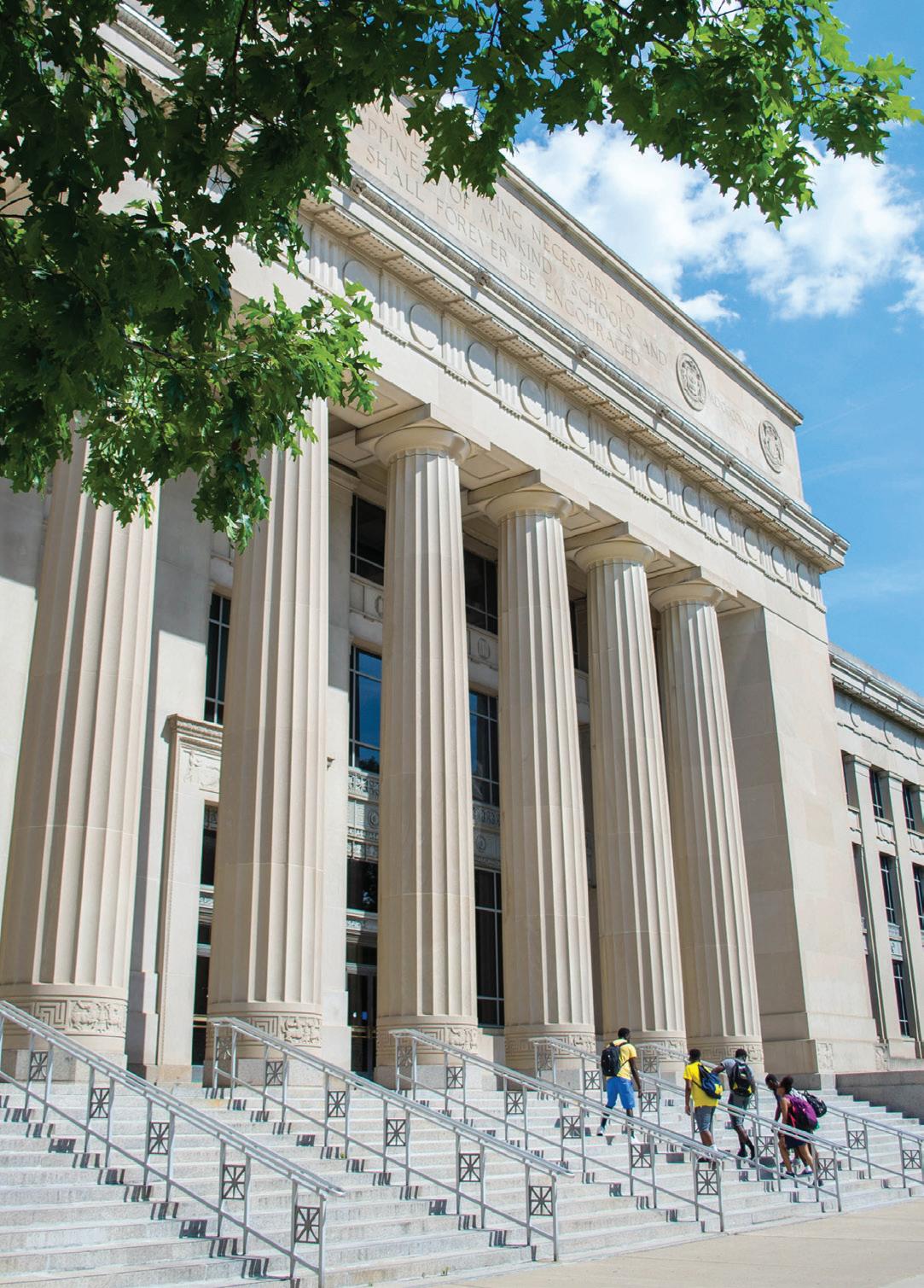
STATEMENT
Design by Hailey Kim Irish Americans and nostalgia JOSHUA NICHOLSON Statement Correspondent
Of methods and madness AWMEO AZAD Statement Correspondent Read more at MichiganDaily.com The Michigan Daily — michigandaily.com Wednesday, March 20, 2024 — 7 LSA COLLEGIATE LECTURE SERIES Thursday, March 21, 2024 4:00 p.m.–5:30 p.m. Weiser Hall, 10th Floor A public lecture and reception; you may attend in person or virtually. For more information, including the Zoom link, visit https://events. umich.edu/event/118494 or call 734.516.1027 RICHARD L. LEWIS John R. Anderson Collegiate Professor of Psychology, Linguistics and Cognitive Science ELIZABETH A. ARMSTRONG Sherry B. Ortner Collegiate Professor of Sociology The Politics of Black Scholarship: Purpose and Conviction for African American Scholars The Advent of Artificial Intelligence: What Does it Mean for Psychology, Linguistics, and Cognitive Science? Gender, Class, and Higher Education: Insights from a Longitudinal Study of College Life ALFORD A. YOUNG, JR. Edgar G. Epps Collegiate Professor of Sociology
Edited and managed by students at the University of Michigan since 1890.
SAMANTHA RICH AND DANA ELOBAID Co-Editors in Chief
ZHANE YAMIN AND LINDSEY SPENCER
SHANIA BAWEJA AND ABBY SCHRECK Managing
EDITORIAL BOARD MEMBERS
Tom
Future university plans, present student issues
If you’re walking around the University of Michigan campus in Ann Arbor, you’re likely to find construction at what seems like every corner, even stretching to North Campus. Most of the construction you see is U-M-funded projects aimed to renovate and create new buildings for students, faculty and staff.
I frequently walk by the construction site of the Hadley Family Recreation & Well-Being Center, which is set to replace what was the once crumbling Central Campus Recreation Building. This new building is set to finish around spring 2025, just in time for my senior year. I can’t help but feel a little bit of envy each time I see these multi-million dollar projects since I will hardly experience them as a student, yet my money goes to them regardless.
It is no question that advancements to the University are good things, and most are necessary improvements to outdated buildings. The new residence hall currently being worked on between East Hoover Avenue and Hill Street represents this muchneeded growth for the school. With growing undergraduate admission rates and rising demand for on-campus housing, several lounges had to be converted into rooms for students this year. This is not sustainable for a continuing rise in admissions, and the new dorm is necessary to meet demand.
However, the date for this project has been pushed, and it will not be ready until 2026, despite the initial 2025 completion date. This housing project also came at the expense of the three new undergraduate residence halls on North Campus that were set to open this fall. The Board of Regents initially approved the project, but shifted their focus to the Central Campus dorms, and the project was pushed. This project would have addressed the growing need for student housing due to the growing instability of the Ann Arbor housing market. The University chose a flashy new project that would take longer because it would benefit their future students long-term. There’s nothing necessarily wrong with trying to benefit future students, but current students are being left behind, and they clearly aren’t at the forefront of the University’s plans.
Living in the Oxford Residence Hall my freshman year, there were clear problems that needed to be addressed. I’ve had friends who lived in Bursley Residence Hall and had their bathrooms closed for weeks because of black mold issues. These dorms have flaws that need to be addressed now, and while they might serve the purpose of giving students beds, it doesn’t mean they are enough. The University has been spending money on some immediate improvements to the student experience. As a part of the $41 million project to update a production studio in
Crisler Center and scoreboards in all stadiums and arenas on campus, Michigan Stadium now has sound system improvements and two massive new scoreboards. As a dedicated football season ticket holder, I’ve seen these renovations firsthand. I remember being extremely surprised when I realized that the width added to the scoreboards didn’t actually show the game, but rather things like statistics and scores of other games. The new improvements didn’t really improve my experience, and I have a hard time seeing their function.
The University needs to do more to help current students, rather than trying to make the school more appealing to future applicants. They can start by addressing the housing issue in Ann Arbor; but there are several smaller issues that would improve current students’ experiences as well. For example, it is no secret that the food in the dining halls is not the best. By putting some money towards improving the quality of the food at the school, students would benefit immediately.
It is extremely difficult being a student and worrying about tuition rising each year — not to mention the standard $2,000to-$4,000 increase in tuition between sophomore and junior year. It is also hard to swallow the dramatic cost of getting an education at the University of Michigan and other universities across the United States.
Read more at MichiganDaily.com

their waste, ended up being an unhelpful and counterproductive scheme to keep lawmakers at bay.
Since the 1950s, plastic production has grown exponentially, increasing by more than 100% over the past two decades. The detrimental effects of plastic production are widely acknowledged. Plastic waste is everywhere, from the food we eat to the water we drink. One study suggests that humans ingest five grams of microplastic per week — the equivalent of an entire credit card. Considering more than 99% of plastics are composed of chemicals sourced from fossil fuels, the ingestion and infiltration of plastic pollution is incredibly harmful both for humans and the environment.
Unfortunately, consumers have been tricked into thinking that there is an effective solution for plastic waste management, one tactful enough that it may even counteract the guilt that accompanies indulging in single-use plastic. This “solution” is called recycling.
The recycling movement has been pushed on consumers for decades, evidenced by the famous slogan “reduce, reuse, recycle.” The phrase can be traced back to the tail end of the consumerist boom, after purchasing items on credit rose into popularity. This aligned with the start of the modern environmentalism movement and corresponding legislation, including the Resource Conservation and Recovery Act of 1976 and the first Earth Day in 1970. It was during these years that America’s concern for the issues of air pollution and declining water quality emerged into public discourse.
The plastic industry has worked tirelessly over the past several decades to convince Americans that recycling is not only effective, but also the complete solution to the plastic waste problem — one that can eliminate any reason for consumer guilt. The plastic industry has invested millions of dollars into marketing recycling to prevent bans on plastic and sell more products.
A report by The Center for Climate Integrity revealed that the plastic industry has engaged in “fraudulent marketing” practices in an effort to pause legislation that interferes with plastic production while simultaneously increasing sales of their material. The plastic industry even went so far as to create a multi-part campaign in response to ever-present threats of antiplastic legislation. This included faux investment deals and the introduction of resin identification codes, which, despite being advertised to help inform recyclers where to place
Despite the industry’s aggressive push for recycling, the majority of plastics are unable to be recycled effectively, a truth known and harbored by plastic producers for decades. Industry reports deemed recycling a costly, difficult process that is unlikely to become economically viable on a large scale.
In the 2000s and 2010s, about 22% of PET plastic, the most recyclable plastic, was recycled out of the U.S., mainly to China. Much of it was falsely counted as “recycled” despite being ultimately incinerated. In biology, there is a concept known as parasitism, a type of symbiotic relationship where one organism latches onto another, benefiting itself while harming the other.
This is essentially what the U.S. has done with plastic waste disposal. By shipping off our plastic waste to China, we were able to increase our official percentage of recycled material while forcing China to deal with our problems. However, in 2017, China imposed an import ban on solid waste, restricting the U.S.’ ability to ship our problems abroad.
This is not the only recyclingrelated parasitic relationship the U.S. is involved in. The whole scheme of consumption is dependent on wealthy individuals and large corporations exploiting fossil fuels and leaving socioeconomically disadvantaged areas to suffer the environmental consequences. Approximately 70% of all U.S. waste sites (plastic and nonplastic) are located in low-income areas. Those who are most affected by plastic pollution are not producing the waste that is impacting their communities
As of 2019, only 4% of the plastic in the U.S. was recycled, while 73% was put into landfills. For comparison, the landfill rate for the entirety of Europe was 44%. In Germany, 65% of all plastic waste must be recycled. The U.S. should be able to achieve those levels, too.
Each time a piece of plastic is recycled into a new item, its quality decreases, making the item less valuable. Recycling is prone to contamination, and when plastic is not properly cleaned or disposed of, the whole batch becomes unusable. There are a ridiculous number of ways to recycle incorrectly and cause contamination. Aspirational recycling — recycling with the false hope that the individuals at the recycling center will sort through any matter you disposed of incorrectly — is a form of contamination in itself, one that many of us are guilty of. Furthermore, ac-
Too much productivity is problematic
And the reason has nothing to do with humility.
Before coming to the University of Michigan, I was relatively unfamiliar with the terms imposter syndrome and toxic productivity. It seemed difficult to believe that there was such a thing as being “too productive.” Sure, I worked hard in high school and was no stranger to high pressure; but, as far as I can recall, I always felt like I had a decent handle on my assignments and commitments.
Back then, I probably wouldn’t have crowned myself the smartest person in the room — but I certainly wouldn’t do that now.
At the University, we pride ourselves on a “work hard, play hard” mentality and a culture of commitment to our academic and professional successes. But when considering the “work hard” component of this mantra, it’s important to identify when “working hard” becomes “working too hard.”
In my first semester here, I applied to one organization: a preprofessional fraternity. I had no reason to rush anything — I only had a vague idea of my career path and an even vaguer idea of how the club application process worked. When it didn’t work out, I told myself to take it as a sign to take my time settling into my
new life in Ann Arbor. What I didn’t realize was that settling in would later turn into feeling like I had squandered my time. My belief that I was taking a “grace” period morphed into a feeling that I had to play catch-up to fill up my resume with worthwhile extracurriculars.
It’s imperative to distinguish between moments of healthy and toxic productivity. For starters, toxic productivity is more related to a person’s mindset than how many obligations they have on their calendar. Toxic productivity causes you to begin neglecting self-care, basing your self-worth on your productivity and feeling guilt or shame when you don’t complete your todo list. When productivity and
one’s perception of their own self-worth become entangled, it can lead to imposter syndrome. Feelings of anxiety and doubting whether you measure up or not to your peers, despite being just as high-performing, can be signs that you are experiencing imposter syndrome. Productivity becomes toxic when relaxation and time to focus on yourself become things one feels they need to earn.
Students at universities across the country are feeling the effects of toxic productivity. A 2020 study by the National Cancer Institute found that imposter syndrome and feelings of workrelated stress and anxiety were prevalent in at least 56% of college and graduate students. After
talking to friends and classmates, it’s clear that feeling overextended and overworked is not a unique experience. This isn’t to label the general student body as toxically productive. Students at the University have the capability and tendency to support those around them. Attending a high-achieving institution means being surrounded by students who generally want to be involved in, and perform well at, an array of activities. Personally, as someone who is very influenced by the people I surround myself with, I know that being associated with extremely motivated peers and seeing what my classmates are accomplishing help me keep my own sights set on my goals. Comparison, how-
cording to a Greenpeace report, plastic must have a 30% recycling rate to be considered recyclable, a percentage that the leading two of the most common plastic types in the U.S. — PET #1 and HDPE #2 — fail to reach.
Recycling is not as effective as it is marketed to be, with its processes contributing to only a meager 2-3% reduction in greenhouse gas emissions. Other alternatives, like cutting down on consumption, have the potential to slash emissions by as much as 20%. In fact, recycling even poses negative environmental impacts, taking a tremendous amount of energy, chemicals and water to process. With recycling out of the picture, we have to shift our focus to reducing and reusing all types of waste. By taking advantage of companies like “Rent the Runway,” which allows consumers to rent designer clothing for major events, and Food Recovery Network, an organization dedicated to reducing food waste on campus, individuals can make a tangible impact.
A European company called “Too Good To Go” gained popularity after earning a feature by the New York Times. The company partners with grocery stores, restaurants and bakeries all over the world to sell left-over items at the end of the work day in surprise bags at a significant discount, providing a mutualistic benefit for the consumer and environment — something that is often hard to come by in the field of sustainability.
By focusing on reducing consumption and finding more mutually beneficial sustainable practices like “Too Good To Go,” consumers can reduce the harm of plastic waste on the environment. Recycling may feel empowering and effective. I know that whenever I drop a bottle into that humble blue bin, I feel quite satisfied with myself; but that empowerment is a lie, a lie that was imposed upon consumers by the plastic industry. It was created to restrict antiplastic legislation and make consumers believe that there is an environmentally healthy way to dispose of a material composed mostly of fossil fuels — an impossible feat.
The evil of recycling is not absolute, but its usefulness is contingent upon avoiding contamination. This requires cleaning out the plastic beforehand and sorting properly. Given the low likelihood of people doing this, consuming less plastic is the only way to make tangible environmental progress.
It’s time to detach from the false hope of the humble blue bin and kill the U.S. plastic consumption parasite for good.
ever, is the thief of joy. An unintended consequence of working alongside high achievers means seeing your peers reach new positions, potentially making you question your own success. Thus, the spiraling feeling that you need to have a hand in everything begins.
While it may feel difficult to imagine that the overarching culture of overworking will ever recede, there are a multitude of ways we can individually combat toxic productivity. Setting boundaries for yourself, establishing that work-life balance and reevaluating what success means to you may help you to find that incessant productivity isn’t always all it’s cracked up to be.
8— Wednesday, March 20, 2024 Opinion The Michigan Daily — michigandaily.com
LARA
TINAWI Opinion Columnist
Opinion Columnist
MARGOT BARRERA
TALIA BELOWICH Opinion Columnist
The false hope of the humble blue bin
Zach Ajluni Julian Barnard Jack Brady Jack Kapcar Siddharth Parmar Tate Moyer
Design by Matthew Prock
Muha Nick Rubeck Moses Nelapudi Maximilian Schenke Rushabh Shah Nikhil Sharma
Spencer Anna Trupiano Audra Woehle Zhane Yamin Alex Yee Quin Zapoli
Lindsey
420
tothedaily@michigandaily.com
Stanford Lipsey Student Publications Building
Maynard St. Ann Arbor, MI 48109
Unsigned editorials reflect the of f icial position of The Daily’s Editorial Board. All other signed articles and illustrations represent solely the views of their authors.
Editorial Page Editors
Editors
Design by Hailey Kim
The GOP needs to break up with DJT
For 170 years, the Republican Party has produced some of America’s most influential political figures. Former Republican presidents like Abraham Lincoln, Dwight D. Eisenhower and Theodore Roosevelt often top political scientists’ list of greatest presidents, bestowing the party with a prestigious legacy. Even after the two parties swapped ideological platforms, Republican politicians arguably remained committed to their country and promoting the greater good. By and large, members of the GOP understood what it took to fight for America, even if it meant sacrificing the interests of their party for the betterment of the American people.
With the election of former President Donald Trump, the modern Republican Party has strayed from this tradition. It has quickly devolved into a cultlike faction seemingly hellbent on demonizing marginalized groups, favoring billionaires over the working class and turning away from America’s democratic ideals. Gone are the days of bipartisanship and productivity.
In fact, the current Congress, with a Republican majority in the House of Representatives, has been the least productive in decades. Instead of legislating, the GOP has been caught up in trivial culture wars and baseless impeachment inquiries.
According to general election results, Americans do not approve of current conservative chaos. Every election since
Trump was elected has proven poor for Republicans. Whether it was the Democrats gaining control of Congress in 2018 or the absence of a widely anticipated “Red Wave” in 2022, results show that candidates endorsed by Trump have consistently failed to appeal to all voters. It is obvious that Republicans must return to the ways of moderation to facilitate meaningful change in the U.S. and recover their legacy as a loyal American political party.
Yet, recent primary election results have made it clear that Republicans are not interested in abandoning their current platform anytime soon.
Consistent with early primary outcomes, Trump dominated on Super Tuesday, winning the vast majority of states and prompting former South Carolina Governor Nikki Haley — a more traditional conservative than Trump — to exit the Republican primary. These results signal a rejection of any effort to minimize Trump’s grasp on the GOP and is a frightening signal that cooperative politics will not be back anytime soon.
One of the most stark demonstrations of Trump’s toxic influence and intention to sow chaos has been his position surrounding the southern border of the U.S. For years, there has been an extreme influx of immigrants illegally crossing the border. Not only has poor border security harmed Americans by contributing to an increase in the amount of synthetic opioids entering the country, but it also hurts undocumented citizens who are often prone to exploitation and abuse in the workplace.
These issues, enhanced by
illegal immigration, underscore the need for comprehensive immigration reform designed to be as humane and secure as possible. In 2016, Trump proposed the opposite. He ran on a cruel anti-immigrant platform, proposing the banning of Muslim immigrants and promoting the construction of an ineffective border wall to solve the crisis. Republican politicians once aligned with former Republican President Ronald Reagan’s disapproval of even the simplest border fence. In 2016, however, they loudly praised Trump for his divisive and damaging policies.
When Republicans recently had the opportunity to pass a bipartisan border security bill, extreme members refused to take action. It was reported that Trump made it clear to top Republican legislators that he did not want the bill passed, citing concerns that it would improve President Joe Biden’s record, which Trump hopes to damage as much as possible before their expected rematch in November.
Instead of providing a solution to an issue many claim to be the greatest threat facing America, Republicans bent the knee to the former president and did his bidding. A vast majority of Americans consider the border situation a top priority, according to a CBS poll, with 45% viewing it as “a crisis” and another 30% calling it a “serious problem.” But Republican legislators seemed to be more compelled by Trump’s desires than the concerns of their own constituents.
However, in a political atmosphere where Trump’s influence is so powerful, it’s easy to see why Republicans seem to
defend the former president so relentlessly. We have seen what Trump does to those he deems disloyal. Whether it is former Attorney General Bill Barr, Chris Christie, former New Jersey Governor, or even his own vice president, Trump ruthlessly destroys those who challenge his authority or beliefs, and he does so in typical authoritarian fashion. Using the same words and rhetoric as 20th-century dictators, Trump has called his political adversaries “vermin” and “communists” and has effectively ended the careers of many of his rivals.
The devout Republican understands — whether they like it or not — that they must behave around the former president, even when he criticizes their spouses, mocks veterans or calls for the termination of the Constitution. The control Trump has over the Republican party is built on fear and obedience and is contributing to the failing of the conservative political faction as a whole.
The groupthink mentality and crucifixion of those who dissent within the current Republican Party is not sustainable. Squarely at the helm of modern conservative dysfunction is Donald Trump. If the GOP fails to rein in its current extremism, America will only become increasingly divided, giving rise to more dangerous politicians who will carry on Trump’s legacy long after he is gone. For Republicans to begin their political recovery, they must cut off the head of the snake. This means rejecting Trumpism for what it truly is: a hateful, fearmongering political philosophy that has no place in American politics.

AI should improve our well-being, not just our productivity
In 1930, John Maynard Keynes, often called the “father of macroeconomics,” predicted that in the next century, people’s increased ability to meet their basic needs would lower the average work week to 15 hours. He could not have been more wrong. Although Americans today work relatively fewer hours than their parents did, they still work hundreds of hours more per day than adults in other developed countries.
The computer and internet boom of the 1990s was followed by increased consumer spending, not by people opting for more leisure. Efficiency improvements, which could have been used to improve quality of life, were used to increase economic growth. This trend of overworking to meet perceived consumption needs contributes to the range of issues correlated with working long hours, including alcoholism, depression and heart disease. Artificial intelligence promises to bring the next great productivity boom to the world. It also gives governments and societies another chance to rethink the relationship between economic growth and quality of life. While AI will increase the productive capacity of the U.S. labor force, it can be an incredibly powerful tool to offer overworked Americans more time to prioritize nonwork aspects of life that make them happy. The push toward more leisure time can happen at all levels of society. On the individual level, enterprising students were among the first groups to realize the leisure-creating power of AI, using chatbots like ChatGPT to assist with brainstorming, researching, editing and other school-related tasks. Workers can do the same, using AI to automate boring and repetitive low-skill tasks that don’t require thinking, cutting down on time spent working. In fact, generative AI can improve a worker’s performance by up to 40%. According to Christopher Pissarides, a Nobel Prize-winning economist, this would also allow people to focus on interesting and creative tasks, resulting in higher work satisfaction, a metric highly correlated to happiness. Workers should benefit from AI’s advancements in productivity, and employers should not try to squeeze every last hour of work out of their employees. Shortening the workweek would be one effective method of giving Americans more time for leisure. Numerous countries and companies have already experimented with shortened work weeks and found it highly effective. In 2022, the nonprofit organization 4 Day Week Global
and researchers at Boston College, University College Dublin and Cambridge University assessed an international trial of 33 companies experimenting with four-day, 32-hour work weeks. On a scale of one to 10, with one being very negative and 10 being very positive, the 27 companies that responded to the end-of-trial survey rated the reduced-hours system as a nine. Employees were similarly happy with the results: 97% wanted to continue with the trial. Perceived productivity increased, too, going from a pretrial baseline of 7.17 to 7.83. Most importantly, employees on reduced hours showed improvement in wellness metrics such as mental health, fatigue and life satisfaction, and they used their extra day off for hobbies, house work or personal care.
A similar experiment was conducted by Microsoft Japan in summer 2019, during which employees worked four days per week and earned their normal five-day paycheck. The company reported a 40% increase in productivity and became more efficient in other areas, including reducing electricity costs, which fell by 23%. Other changes, such as streamlined meetings and the use of collaborative chat rooms, also contributed to this boost in productivity.
If the potential gain in productivity from AI turns out as predicted, the resulting boost in GDP will make America richer than ever. The wealth generated by this technology should contribute to redistribution programs that give Americans equal and increased access to essential services like health care, education and child care services. Assisting people in meeting these basic needs would further incentivize people to trade work for leisure and improve their quality of life.
One of the most commonly cited concerns of AI’s use as a productivity tool is its ability to displace middle-class workers in automatable jobs, such as data entry, telemarketing and cashiering. A study done by McKinsey & Company estimated that 30% of hours worked today could be automated by 2030, with office support being the most affected sector. Economic researchers at Goldman Sachs estimated that globally, generative AI could expose up to 300 million jobs to automation.
While these numbers may seem daunting, it’s important to avoid adopting a fearmonger’s perspective. In the past, structural shifts from new technology in the labor market have been followed by the creation of new jobs, ultimately increasing employment rather than decreasing it.
Read more at MichiganDaily.com
Next week, I will be picking up my cap and gown. In addition to obtaining my graduation attire, I find myself tying up many other loose threads as graduation approaches.
Whether it’s having my final coffee chats with professors, ensuring I am registered to graduate or working on summer internship applications, there is a vast array of tasks I must complete in the next two months. As I go through my long to-do list, the realization that I am unprepared for life after graduation hits. Universities often do not prepare students for the aftermath of college graduation and, therefore, their future careers. Roughly one in five recent college graduates felt that their college experience did not provide them with the skills needed to perform their first post-degree job. College graduation brings about fears and anxieties about the future — fears that schools typically do not teach students how to
manage. As college seniors are getting ready to say their final goodbyes to undergraduate life, fear about where they will end up next grows. Although it’s said that students prepare themselves for their career by virtue of a college education, much of that education is centered around classroom knowledge. Students learn about topics for their vocation, but not the practical workplace or life skills needed. Practical skills, such as knowing how to file taxes and apply to jobs, are left out of the picture. The University offers minicourses on life skills and other post-graduate competencies, but this is not enough.
Externships and internships are both common routes students take to learn about what their future career might look like. Externships are meant to provide a shortterm professional learning experience. But instead of completing job tasks, externs shadow professionals to learn more about the field. Importantly, externships are not required in universities. Roughly 41% of students have had an internship while
enrolled in college. Despite this, nearly 40% of post-college graduates — ages 22 to 28, with at least a bachelor’s degree — believe their college did not help them in their transition to the workplace.
Some argue that students should not gain life skills from college classes, but rather from life experiences. Since students in four-year programs are spending a majority of their time in classes and within a campus bubble, their university is responsible for creating opportunities to learn more about life outside of university. Universities such as the University of Michigan offer courses pertaining to life skills, including financial literacy, yet these programs are not required. While there is an opportunity to take said courses, since they are not mandatory, they are often placed on the back burner. During my four years in university, I did not know that such courses existed, as there is little done by the University to market them. Thus, even though certain resources do exist, students are unaware of them.
As an institution, the University of Michigan must

do better in creating a holistic system that can teach students skills both inside and outside the classroom, whether this be through required internships or courses that teach postgrad job skills. Moreover, the University should do a better job marketing the resources that do exist. Students should not feel a heavy burden during graduation, which is supposed to be a time of celebration. After four years of earning a degree, one should be confident that their long hours and sleepless nights were able to prepare them for the days to come.
Opinion The Michigan Daily — michigandaily.com Wednesday, March 20, 2024 — 9 ZACH AJLUNI Opinion Columnist
Design by Anna DeYoung
ETHAN
BITTNER Opinion Columnist
by Natasha Eliya UMich does not prepare its students for the future
Opinion Columnist
Design
BRINA GOLUBOVIC
PAUL NASR Daily Sports Writer
SportsMonday: It was time for Juwan Howard to go, but that shouldn’t define his Michigan legacy It’s easy to type up a laundry list of things that went wrong during Juwan Howard’s tenure as the Michigan men’s basketball team’s head coach — I would know, I wrote about it just two weeks ago. Over the past two seasons, things have gone downhill in a hurry for the program he was tasked with
in 2019, a regression that led to
on Friday. The move was warranted. The Wolverines haven’t been good enough, and it was time to find a new leader. Whether it be a historically bad 8-24 season or a thirdparty probe into the program’s culture, the writing was on the wall and Michigan athletic director Warde Manuel read it. There will be new names on the reserved parking spots outside Crisler Center and a new face of the program. That’s how it goes in this business. But Juwan Howard’s Michigan legacy extends far beyond the rocky past two seasons of his head coaching tenure. It even extends far beyond his five full years as head coach which includes — dare I say it — an Elite Eight appearance, a Sweet 16 appearance, a Big Ten Championship and AP Coach of the Year Honors. It extends to his days in the Fab Five, when he
helped cement Michigan men’s basketball into national prominence. As much as Howard should be remembered for how everything fell apart, he shouldn’t be defined by it. Fans called for his job all season and they got their wishes on Friday. He was the program’s figurehead, so it makes sense that he became a pariah for this season’s shit show. But it’s over now. The season’s over and his tenure’s over, so it’s time to stop villainizing Juwan Howard. He’s moving on from this role, and so should you. Claim he ruined the program if you want. Watch YouTube highlights of your favorite John Beilein teams if you please. But you can’t claim he ruined anything if you don’t acknowledge what he had a hand in building, too. Because the Fab Five is Michigan men’s basketball’s most storied attribute, and as quick as some are to forget about it, Howard was indeed part of that. The Fab Five is Michigan’s contribution to a crowded men’s college basketball history potluck. Michigan State brings Tom Izzo. Duke and North Carolina bring their storied rivalry, one-of-a-kind venues and longtime coaching legends who just recently passed the torch to beloved alums. UCLA brings John Wooden and a nation-leading 11
National Championships. Indiana brings its iconic Assembly Hall, roots from the state of basketball and Bob Knight controversies. And Michigan brings the Fab Five. Not John Beilein, bless his heart. Not Trey Burke, as fun as he was to watch. And definitely not Crisler Center, that place is bland and lifeless. The Fab Five is Michigan men’s basketball.
The other four members of the Fab Five are considered Michigan legends for being part of it,
as imperfect as they were. Maybe having an extra timeout would leave them in even higher standing. Regardless, they’re looked at as bright lights of the Wolverines’ storied athletics history. Juwan Howard shouldn’t be erased from that. He shouldn’t have his legacy punished by trying to give even more to Michigan. The other four Fab Five members haven’t come back to work in Ann Arbor, leaving their Michigan legacies intact

Michigan basketball parting ways with Juwan Howard
After the worst season in program history, the Michigan men’s basketball program is parting ways with head coach Juwan Howard, athletic director Warde Manuel announced Friday afternoon. Manuel also added that a national search will begin immediately.
“I have decided that Juwan will not return as our men’s basketball coach,” Manuel said in a statement. “… Despite his love of his alma mater and the positive experience that our student-athletes had under his leadership, it was clear to me that the program was not living up to our expectations and not trending in the right direction. I am thankful for Juwan’s dedication, passion and commitment to U-M and for all that he, and his legacy, will continue to mean to Michigan.”
lege of coaching Michigan, my university, for these past five years,” Howard said in the statement. “… Michigan will always be a significant part of my legacy and I will be a significant part of theirs.”
A famed member of the Fab Five, Howard was hired by the Wolverines in 2019 following the departure of John Beilein. It was Howard’s first head coaching job
Throughout the season, Howard maintained that his system worked and that he would be able to figure things out in the future. But now, following a steady decline that has seemingly reached rock bottom, Howard won’t be given another chance to try to right the ship.
In a statement released through the Michigan men’s basketball X account on March 17, Howard thanked the University and reflected on his time with the program.
“I want to thank the University, Board of Regents and AD Warde Manuel for the privi-
after an NBA career, and his first collegiate coaching experience. Initially, the Howard tenure appeared promising, with Michigan performing well and making multiple deep postseason runs. But that promising start soon turned sour. Last season, the Wolverines didn’t make the NCAA Tournament for the first time since 2015, instead playing in the NIT.
But the 2023-24 season was even worse. After Howard missed the start of the season recovering from heart surgery, he returned to the sidelines in full capacity in December. His return was marked by scandal, however, as reports of an altercation with now-departed strength and conditioning coach Jon Sanderson swirled at the same time. This wasn’t the first instance of Howard’s off-court behavior causing concern, either, as he was placed under a zerotolerance policy following his striking of a Wisconsin assistant coach in Feb. 2022.
On the court, things didn’t fare much better for Howard. Michigan ended the season in the first round of the Big Ten Tournament Wednesday, concluding the worst season in program history with an 8-24 overall record and a 3-17 showing in conference play.
Throughout the season, Howard maintained that his system worked and that he would be able to figure things out in the future.
But now, following a steady decline that has seemingly reached rock bottom, Howard won’t be given another chance to try to right the ship.
SOFTBALL
from afar. Howard came back to the Wolverines after a successful run as an NBA player and coach, trying to give even more to Michigan — and for a time, he did. The Wolverines kept winning, at one point only a shot away from the Final Four.
But then he gave less glamorous moments to his alma mater, too. He struck Wisconsin assistant coach Joe Krabbenhoft, he struggled to build rosters, he let Michigan slip to last place in the Big Ten. All of it, both the good and the bad from his head coaching tenure, came after he got the job in the first place because he is such an iconic Michigan figure. He tried to build more. At times he did, oftentimes he didn’t. Both can go hand in hand — you don’t need to pick one or the other when putting a label on Howard’s legacy.
“Michigan will always be a significant part of my legacy and I will always be a significant part of theirs,” Howard said in a statement posted by the team’s X account Sunday. “Michigan Man Forever. Go Blue!”
It sounds like no hard feelings from Howard, and that should be reciprocated by Michigan and its fans. As mad as anyone wants to be at Howard for what he did as a coach, they’ll have to realize that in the scope of his Michigan career from the 90s until now, he’s given
the Wolverines far more than he’s taken away. Go ahead, add his coaching tenure to his legacy. There’s no need for the shortcomings that cost Howard his job to be swept under the rug. They’re part of his story, but they aren’t the whole thing, and they shouldn’t overshadow everything else he’s done at Michigan. Because Juwan Howard is still one of Michigan athletics’ prime exports. He tried to coach, but it didn’t work out in the end. His career with the Wolverines still did. It launched his NBA career that so many top recruits were so enamored by when committing to Michigan, and it launched the program into contender status.
So don’t treat him like an excoach who shouldn’t show his face again in this city. Because he’s not just any ex-coach. He’s Juwan Howard. If he so chooses to come back and visit the birthplace of the Fab Five, welcome him back with open arms. Show him love. Cheer for him when he’s on the screen of the Big House. You can do that while recognizing the coaching thing didn’t work out. You can have both. Because Juwan Howard was fired from his post as head men’s basketball coach, and rightly so. But he shouldn’t be fired from his positive standing in Michigan history.
Michigan offense capitalizes on runners in scoring position at Cardinal Classic
JORDAN KLEIN Daily Sports Writer
Through the first six innings of the Michigan softball team’s game against South Dakota on Saturday, the Wolverines struggled to generate much offense, scoring no runs and mustering just four hits. Entering the bottom of the final inning down 3-0, Michigan needed to generate some semblance of offense to avoid dropping the series opener.
And the Wolverines finally set the table in the bottom of the final inning.
After the first two Michigan hitters reached base via a walk and catcher’s interference, junior left fielder Ellie Sieler singled to load the bases. And then, the Wolverines feasted.
Sophomore third baseman Maddie Erickson poked a single through the left side to drive in Michigan’s first run, the start of a strong weekend at the plate for the sophomore third baseman. Senior catcher Keke Tholl kept the Wolverines’ momentum going, singling to drive in two more Michigan runs and tie the game. Then, redshirt freshman first baseman Lily Vallimont finished the job. Her walk-off single scored the fourth run of the inning for the Wolverines and clinched their 4-3 win.
Throughout the entire weekend at the Cardinal Classic, Michigan’s offense capitalized on runners in scoring position. Only hitting two home runs in four games, it
scored most of its runs by stringing together consecutive hits, walks and stolen bases. Due to the raised stakes and varying placements of the runners, many players and coaches take different approaches to at-bats with runners in scoring position. But the Wolverines are at their best when they approach each at-bat with the same mindset, regardless of where the runners are.
“There needs to be a consistent approach, whether you have people on base or you’re the lone person at the plate,” Michigan coach Bonnie Tholl said. “To be able to have a consistent approach is what is going to produce consistent results. That’s still a work in progress.”
But it didn’t take long for the freshmen in Michigan’s lineup to find the recipe to driving in runners. Freshmen designated hitter Erin Hoehn and outfielders Ella Stephenson and Jenissa Conway have become regulars in Michigan’s lineup, and they’re among the Wolverines’ most opportunistic hitters with runners in scoring position. After Lily Vallimont led off the second inning of the Wolverines’ game against Dartmouth on Sunday with a walk, Conway drove a double to center field to bring her home. And Hoehn followed suit, knocking another double to score Conway and give Michigan a 2-0 lead. Conway, who now leads the Wolverines in RBIs, homered twice in their loss to Louisville — once with the bases empty and
another time with runners on second and third, capitalizing on a Cardinal walk and error.
“You saw today and yesterday an opportunity for (Conway) to make good on some extra base hits and people in scoring position,” Tholl said. “That’s a result of the experience she’s had the last couple weekends, and she made good on it this weekend.”
Throughout the season, Michigan’s offense has struggled to supplement its stellar pitching staff, led by junior Lauren Derkowski, senior Jessica LeBeau and Hoehn. Even following this weekend, the Wolverines still rank last in the Big Ten in runs per game. On the other hand, Derkowski, LeBeau and Hoehn all rank in the top 20 in ERA among Big Ten pitchers.
But this weekend, Michigan’s offense showed signs of improvement. Besides the big bats of Erickson and Conway, who combined for three home runs this weekend, the Wolverines chipped away at opposing pitchers by stringing together hits and walks. And when runners reached base, Michigan capitalized.
The Wolverines can usually count on their stellar pitching staff to shut down opposing offenses. Their offense, on the other hand, has remained a question mark all season.
But this weekend, it feasted — driving in runners that reached base in order to put runs on the board.
pitches. And he displayed a knack for understanding the pitchers he faced against the Toreros this weekend.
In the bottom of the seventh inning on Friday, Priest struck out on three straight fastballs at the hands of Mauterer. But instead of trotting back to the dugout upset, Priest returned with a lesson.
“The first pitch was a fastball,” Priest said. “ … But I fouled it straight back. The second pitch, fouled it back. Third pitch, he got me on the same pitch again and I struck out on it. So I kind of saw
him and knew what (Mauterer’s) process was.” While his pinch hit appearance in the Friday loss didn’t go his way, Priest wasn’t deterred. After a disastrous loss on Saturday, he was inserted into the starting lineup
for the series finale on Sunday. Little did Priest know that this would be the start of a breakout performance. And if presented with the opportunity for another matchup, Priest knew that Mauterer
wouldn’t change his approach later in the series. After three straight fastballs, Priest could expect much of the same. Down 2-1 in the bottom of the ninth inning, that opportunity came for Priest. With a runner on
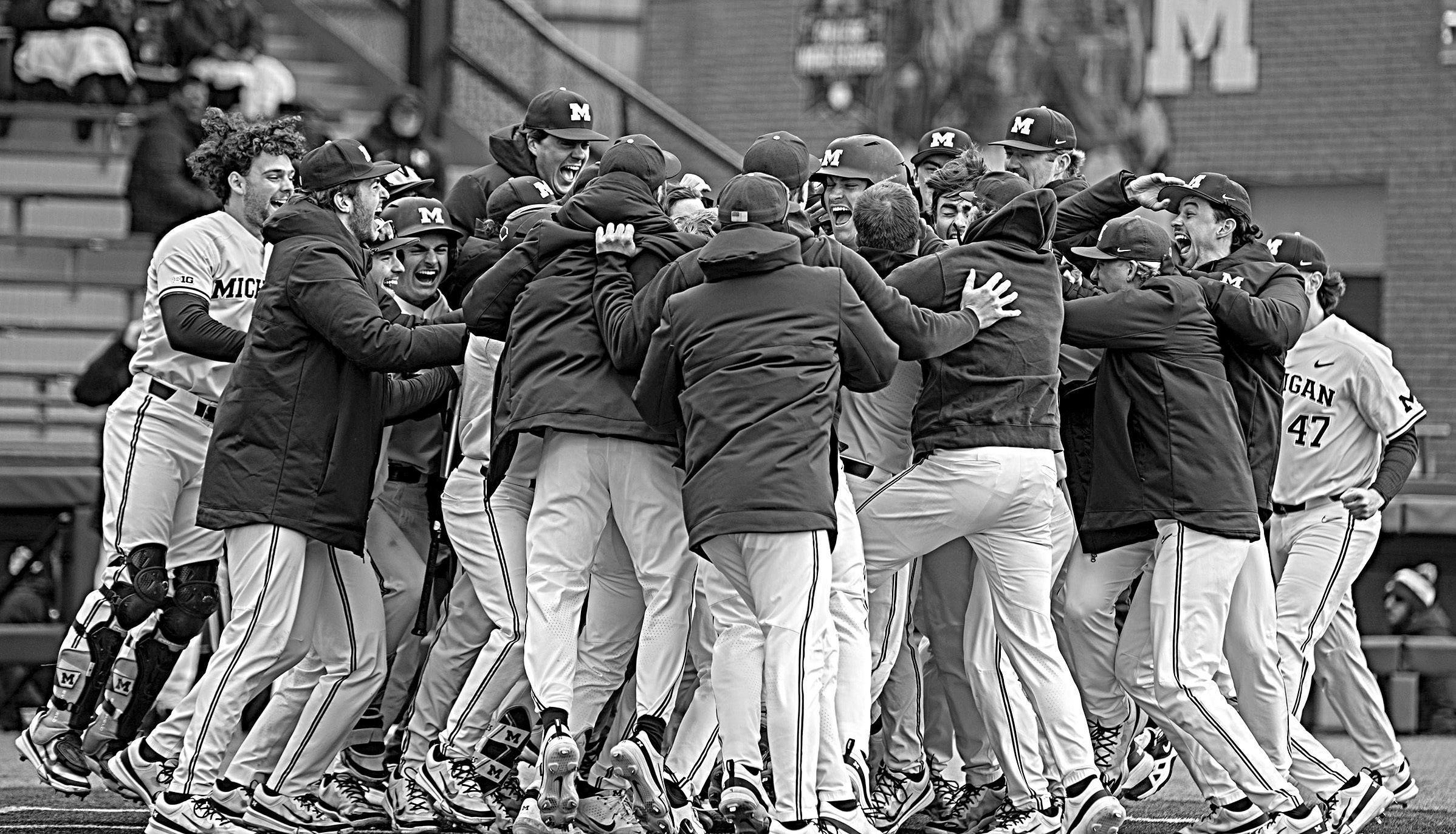
base, Priest stared down Mauterer again — he knew a fastball was coming. When it came on the first pitch, Priest crushed a deep drive to right field for a walk-off home run, clinching a win and saving the Michigan baseball team from getting swept. “I wanted to sit on this fastball and if it was right there I wanted to hit it,” Priest said “I got that fastball in that one spot where it was … down in the middle and it’s the spot that I love to crush. It’s probably my favorite pitch to hit. And I got it and I hit it really far and it’s kind of awesome.”
As Priest trotted the bases, his teammates sprung out of the dugout to celebrate with him as he touched home. But as large as the moment loomed on the game, it was just another part of a career day for Priest. Adding onto a double and a walk, Priest totaled 3 RBIs — responsible for every run the Wolverines registered on Sunday. While the remaining batters couldn’t get it going at the plate,
Priest’s efforts kept Michigan in the game long enough for him to put the icing on the cake. Responsible for three of eight of the Wolverines’ baserunners, Priest’s milestone performance was just a peek into the effort he can provide.
“Collin is a guy that’s been putting the work in,” Michigan coach Tracy Smith said. “It’s nice to see him get some results. And quite frankly with all the injuries and the loss of the speed it was a conscious decision to say hey, let’s put a guy in that can change the game with one swing. So I’m pleased for him and I think we’ll get a look at him moving forward.”
With a batting average of .292 and a 1.110 OPS, Priest has made his impact felt in just 16 career appearances and five starts. Through his limited playing time, Priest has proven to be an important building block for a young Wolverine roster. If he can continue to improve, Priest could find himself as a lineup staple. And like he did on Sunday, he might just win Michigan some games.
10 — Wednesday, March 20, 2024 The Michigan Daily — michigandaily.com
LIZA CUSHNIR Daily Sports Editor Sports
BASKETBALL
MEN’S
leading
his firing
Collin Priest’s walk-off home run punctuates breakout day Collin Priest knew it was coming — it was just a matter of when. So when San Diego pitcher Vaughn Mauterer sent yet another fastball this time, the freshman designated hitter was ready. And the rest can be chalked up to a breakout performance. To anticipate what was coming, Priest first had to learn his opponents’ go-to
GRACE LAHTI/Daily
BASEBALL
MEN’S BASKETBALL SYDNEY HASTINGS-WILKINS/Daily
ZACH
GOLDSTEIN Daily Sports Writer
Michigan scrapes by Minnesota 2-1, advances to Big Ten Championship
REKHA LEONARD Managing Sports Editor
MINNEAPOLIS — In front of a Minnesota crowd sprinkled with green to celebrate an early Saint Patrick’s Day, it was the No. 11 Michigan hockey team that seemed to have the luck of the Irish.
Of course, it was more than just luck that led the Wolverines to a Big Ten Tournament semifinal victory over the sixth-ranked Gophers on Saturday. With sustained offensive pressure, Michigan (21-13-3 overall, 11-11-2 Big Ten) wore down Minnesota (22-10-5, 13-7-4), winning 2-1 and advancing to the Big Ten Championship.
“We played winning hockey,” Michigan coach Brandon Naurato said. “It’s a tough place to play against a really good team, really good staff. We just (got) pucks behind them playing the right way. We didn’t beat ourselves — just championship hockey.”
It took the Wolverines two minutes to find their footing in the opening period, but once they did they never looked back. Three minutes in, sophomore forward Kienan
MEN’S BASKETBALL
Draper opened the scoring, putting in a rebound right in front of the crease. Shortly after, sophomore defenseman Luca Fantilli appeared to double Michigan’s early lead, but his goal was called off after a successful challenge for offsides.
The Wolverines continued to pursue pucks and win battles deep into Gopher territory, but they couldn’t find the back of the net again, despite a multitude of chances.
“We got back to our O-zone,” Naurato said. “I think the biggest thing is we laid pucks in, we weren’t turning pucks over in the neutral zone. … We were better on the forecheck, and then our O-zone was good, just puck support.”
Michigan’s offense only increased its presence in the second period — in every facet except its ability to find the back of the net. For a full minute toward the beginning of the period, the Wolverines sustained a dangerous possession in the offensive zone. Though they subsequently retreated with nothing to show for it, they did draw the first penalty of the game, putting themselves on the power play.
But another offensive opportu-
nity came and went with nothing more than shots on goal. Granted, those shots served to wear down Minnesota little by little, but Michgian needed more than chances.
Finally, with just over a minute left in the second period, the Wolverines finally cashed in. Catching the Gophers in transition, graduate defenseman Marshall Warren sent a stretch pass to sophomore forward Gavin Brindley. Brindley turned on the jets and rocketed a shot from the circle to take a 2-0 lead.
“Just (a) gamebreaking play,” Naurato said. “Nothing really going on, he gets a rush chance, quick neutral zone play and he buries it. That’s what guys like Gavin do.”
Michigan’s offense was forced to take the pressure off early in the third period as the Wolverines committed their first penalty of the game, giving Minnesota a chance on the power play. But Michigan’s defense seamlessly took the reins. A myriad of players stepped up to block shots, and graduate goaltender Jake Barczewski slammed the door in the waning seconds of the Gophers’ advantage with an athletic glove grab.
Dug McDaniel disappears in Big Ten Tournament exit loss to Penn State
JONATHAN WUCHTER Daily Sports Writer
MINNEAPOLIS — Dug McDaniel pulled up from near half-court. And with a promising and emphatic swish of the net, it fell.
Sure, the sophomore guard’s shot was made in pregame warmups and worth zero points toward the game. But it provided a glimmer of the past — a fleeting flashback before the Wolverines’ season collapsed into a catastrophe.
Exactly four months ago when McDaniel took the stage in Madison Square Garden, he left St. John’s coach Rick Pitino in awe. For a program coming off a disappointing season, McDaniel gave Michigan hope — and even votes in the AP Poll. He was the darling, captivating on a foundation of potential.
But like the promise of his pregame shot, that foundation collapsed.
“In the beginning (of the season), we were all on the same page, it looked great,” McDaniel said. “We were looking great. Then, some guys were doing this, some guys were doing that. We just could never pull it back together.”
Whether McDaniel was the head that couldn’t lead or his teammates were the floundering body that couldn’t be led, it was all the same. McDaniel unraveled, the
Wolverines unraveled and their season was left as scattered pieces of what could have been.
By the first round of the Big Ten Tournament on Wednesday, it was too late to put the thousands of pieces of that puzzle back together. And rather than try, McDaniel was silent.
In the opening moments of Michigan’s matchup with the Nittany Lions, he tried to replicate his pregame shot. Receiving the tipoff, McDaniel took the ball down the court and fired from straight on. And with an emphatic thud, the ball bounced off the front of the rim.
Racking up four more misses thereafter, McDaniel was blanked in the first half. Hounded by Big Ten defensive player of the year guard Ace Baldwin Jr. of Penn State, he did more harm than good — recording four turnovers, more than any other statline.
“(Baldwin Jr.) was just taking what we gave him,” McDaniel told The Michigan Daily. “We were messing up with some ball screen coverages and he took advantage of it. I would have done the same thing if I were him. Kudos to him, kudos to Penn State for taking advantage of our weaknesses.”
McDaniel, though, was part of the weakness.
Forcing passes, chucking up threes to beat the shot clock and failing to operate effectively out
of the pick-and-roll all marked an offensive liability. It didn’t resemble the McDaniel from just four months ago, nor the one from mere minutes prior.
“I was in my own head in the first half,” McDaniel said. “Coach Saddi Washington told me I’m playing with no emotion, that’s not me. I’m always the one to talk and show emotion.”
For a brief moment, the pep talk worked. McDaniel drained his first 3-pointer of the game to open the second half and end his scoreless night. But rather quickly, his most prevalent emotion became frustration.
The Wolverines were freefalling straight into the offseason. And by the midway point of the second half, it was already clear how far from his perch McDaniel had fallen.
With Michigan’s primary ballhandler a non-factor, graduate guard Nimari Burnett was leading the team up the court, evading Penn State’s full-court press. And senior forward Terrance Williams II was thrusting a last-ditch scoring effort from the midrange. McDaniel wasn’t as incapable as in the previous half, but he wasn’t the same frontman he had proved himself to be earlier in the season either.
Read more at MichiganDaily.com
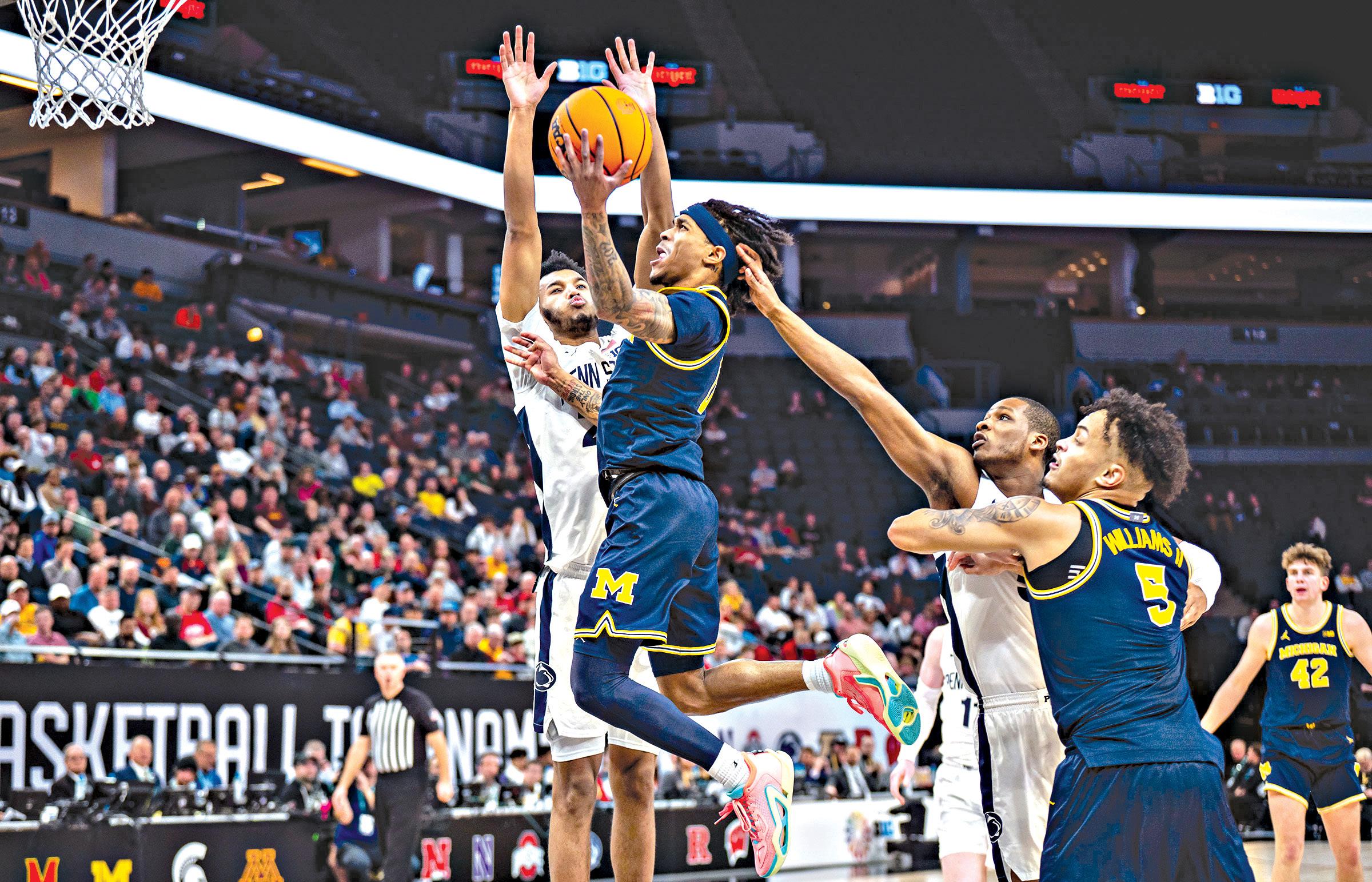
After the penalty kill, the Wolverines continued to do what they had done all game to build their lead. Though they didn’t pile on more goals, the same pressure and scrappy play that highlighted Michigan’s offense through the first two periods successfully kept Minnesota off the board through
the majority of the last one.
“It tires them out,” Brindley said. “Defensively they want to keep the puck out of their net, and they’re gonna work just as hard defensively as they are offensively. So I think we did a good job tiring them out.”
The Gophers made a last ditch effort, scoring one goal after pull-
ing their goalie, but it was too little too late as the Wolverines held on. And by prevailing over Minnesota, Michigan will now travel to East Lansing to battle Michigan State for the Big Ten Championship next Saturday — where the Wolverines will surely see more than a sprinkling of green in the crowd.
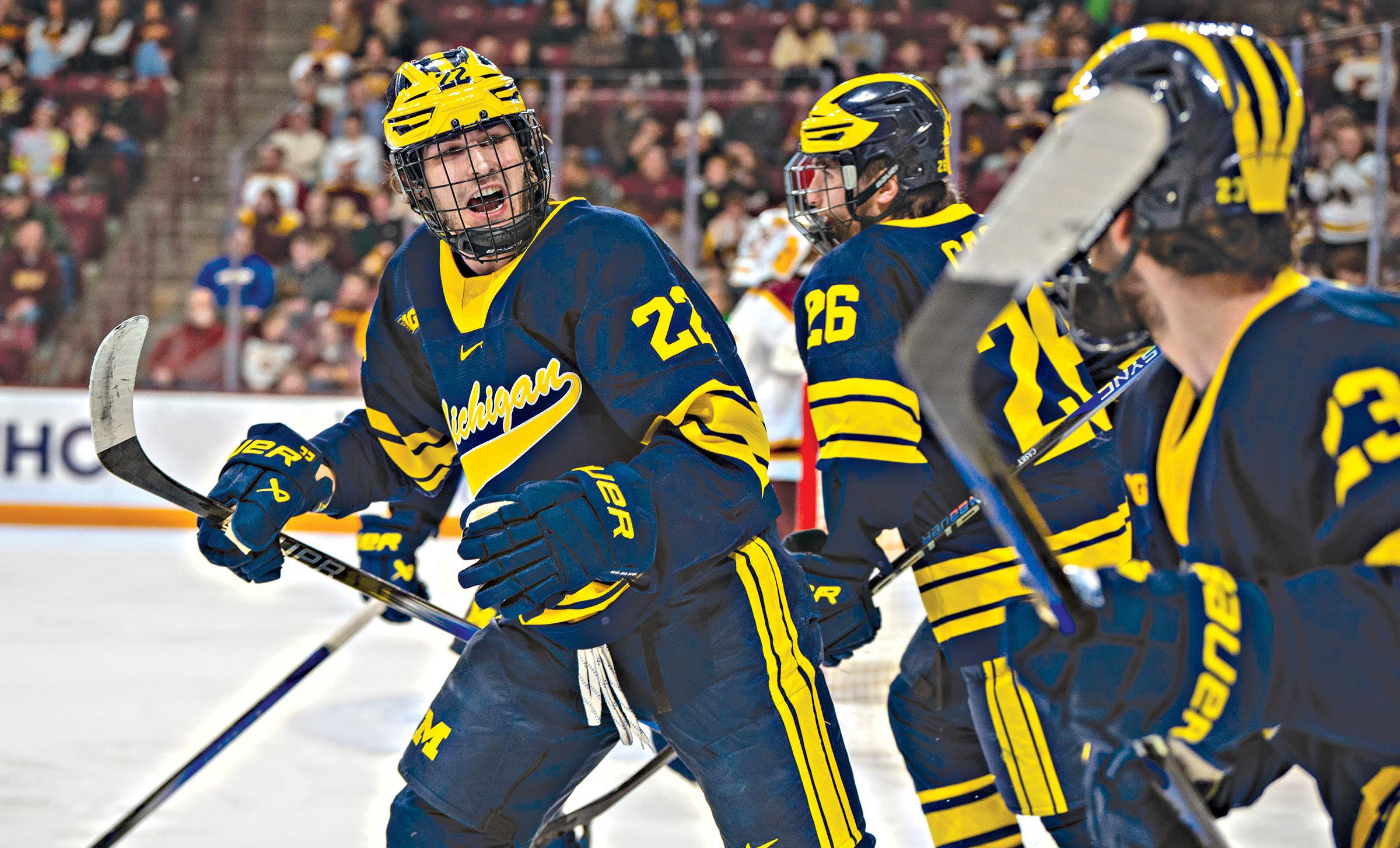
Noah Kingsley: Effort isn’t enough for Juwan Howard to keep his job

MINNEAPOLIS — As Juwan Howard went through the motions of one final press conference on Wednesday night, he had one more chance. One more chance to sum up the Michigan men’s basketball team’s abysmal season. One final opportunity to delve into everything that went wrong, to provide tangible thoughts on what needs to change in the future.
Instead, Howard only gave passing mentions of a plan for the future. He tried to chalk up an 8-24 season to a bunch of short-term issues, rather than entrenched problems within his program. He attempted to praise the Wolverines’ effort in fighting through those fleeting troubles and insinuated that Michigan would be back to its winning ways in no time.
Whether Howard wanted to believe it or not, he made excuses.
“Some of the adversity that we faced, starting with injuries, and not making excuses, but it’s a reality,” Howard said. “… Losing (graduate forward Olivier Nkamhoua), one of the best players on our team. Not having our point guard. As we were clawing and scrapping, not making excuses during that process.”
The idea of the Wolverines clawing and scrapping surfaced multiple times during the postgame period. Graduate guard Nimari Burnett cited the Wolverines’ effort amid a lost season. Senior forward Terrance Williams II discussed what Howard does behind closed doors. Michigan athletic director Warde Manuel “said it the way he’s seen it,” referring to the effort that the Wolverines have given this season.
Regardless of how many members of the program come forward to praise Michigan’s effort, though, effort behind closed doors is a moral victory at best, and nonexistent at worst. The effort that the Wolverines claim shows up when nobody’s watching disappears when there are eyes on them. It never creates tangible results.
And after three years of steady decline and the worst season in program history, that effort can no longer be enough for Juwan Howard to keep his job.
Sure, Michigan fought through adversity this year — so did most teams in college basketball. Injury luck is volatile, and losing a player like Nkamhoua certainly doesn’t help stop a losing season from spiraling further. Having their starting point guard suspended for six road games hurts the Wolverines, too.
But those injuries and suspensions only exacerbate symptoms of the disease that Howard has created.
Howard can’t control injury luck. But he can control Michigan’s immunity. His roster construction left it — a Power Six team and one of the biggest brands in the nation — short two scholarship players before the season even began, and entirely vulnerable. While those spots likely wouldn’t have been filled with players of Nkamhoua’s caliber, they at least could have left Michigan with another big to turn to once Nkamhoua went down.
Howard didn’t create sophomore guard Dug McDaniel’s academic issues, either. That’s still plenty on McDaniel himself. But it’s also on Howard and his staff to monitor the roster’s academic performance, providing the support that ensures that academic issues like McDaniel’s never progress far enough to take the player off the court. So it doesn’t matter how hard the Wolverines fought through the adversity or how much effort they
showed along the way. Because that effort was all dedicated to patching wounds that Howard helped gash open. And Howard never even slowed the bleeding.
Throughout the 21 games that Howard served as head coach, he managed an atrocious 3-18 record. The .143 winning percentage that comes with that tops even 1908-09 — the first season in program history, when Michigan went 1-4 — for a new low. It’s a record that would, and should, get any coach fired — especially when compounded with a disappointing season one year prior.
“It’s a lot to do with just not knowing how to win games,” junior guard Jace Howard told The Michigan Daily. “… Winning is a skill, and we didn’t master that skill this year. That’s just something you look to in the offseason to get better, because this isn’t acceptable.” Jace puts into words what Juwan couldn’t. He acknowledges that the Wolverines simply did not know how to win. And as their head coach, that ineptitude is on Juwan just as much, if not more, than on his players.
In the six road games that McDaniel missed, Juwan went 0-6. In 15 games with McDaniel, he went 3-12. After Nkamhoua got hurt, 0-6. Before that, 3-12. No matter how you slice it, no matter how much effort Michigan put in, it never actually won. As Jace says, that isn’t acceptable.
Read more at MichiganDaily.com
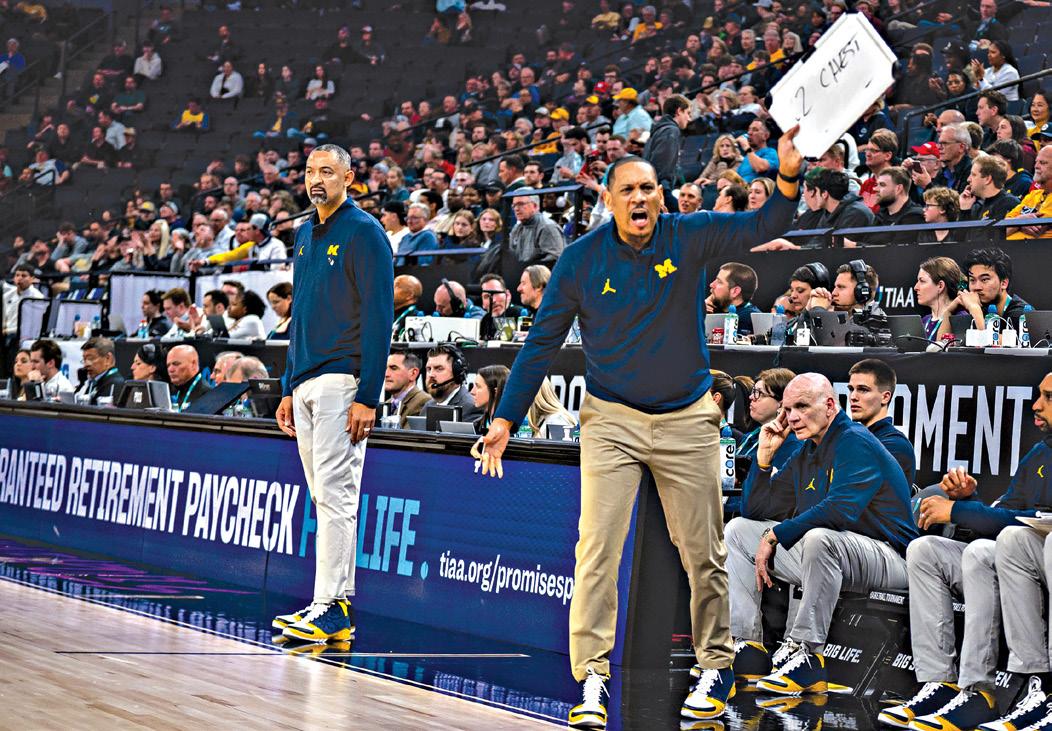
the Nittany Lions proved to be a worthy opponent.
After a slow start, the Wolverines (14-3 overall, 2-0 Big Ten) pushed through their flat performance and stretch their win streak to six matches, defeating Penn State (2-10, 1-1), 4-0.
Perhaps as a result of an
underestimation of the Nittany Lions’ abilities, Michigan almost lost the doubles point. Freshman Reese Miller and sophomore Bayley Sheinin won their No. 3 doubles match 6-3. But a loss for Wolverine seniors Jaeden Brown and Kari Miller at No. 1 doubles quickly tied doubles play at one point apiece. Eyes quickly turned to Michigan’s No. 2 doubles partnership of junior Julia Fliegner and senior Gala Mesochoritou. The two quickly punched out a 2-0 lead over their opponents but as the match went on, Fliegner and Mesochoritou briefly lost their footing and eventually the
lead as well. Penn State’s Sofiya Chekhlystova and Yvonne Zuffova crawled their way to a set score of 6-6, forcing a tiebreak. But Fliegner and Mesochoritou reestablished their footing, winning the tiebreak and the match 6-6 (7-1). Notwithstanding the win, this score alone is a product of the misjudgement of the Nittany Lions.
“Today it was a little bit flat, to be honest,” Michigan coach Ronni Bernstein said. “I think it was a little bit of a letdown today. But we talk about it all the time, the doubles is the doubles and we have to move on, whether you win the point or not. So
you have to have a short memory with the doubles.”
And have a short memory they did. The Wolverines regained the confidence and dominance they’ve exhibited all season throughout singles play.
Michigan’s second point came from Kari Miller’s win at the No. 1 singles flight. Miller avenged her doubles loss by using her experience and consistency to win 6-2, 6-0.
Mesochoritou’s No. 3 singles match portrayed the Wolverines’ determination as well. After her exciting doubles win with Fliegner, she had to refocus on the singles match at hand.
In a match filled with powerful and calculated groundstrokes, she secured the third point for Michigan, pulling the lead to a margin difficult for Penn State to overcome. “What our coach says is, ‘go into singles thinking that we lost doubles,’ because sometimes we get way too excited,” Mesochoritou said.
The Wolverines were starting to navigate through the fogginess of their slow start, doing just enough to finish business.
Just like Miller, Brown also made up for the pair’s doubles loss. Brown battled in the first set, but promptly closed out
the second set, defeating Jordina Cegarra 6-4, 6-1. With that, Brown locked up the fourth point and ended the dual. As the match progressed, Michigan tamed the Nittany Lions despite a slow and underwhelming performance. Looking deeper into Big Ten play, it’s in the Wolverines’ best interest to stay away from performances that aren’t up to its standard. Although Michigan has demonstrated its talented abilities in past matches, stooping to the level of lesser opponents and dropping early games will be detrimental to the Wolverines’ future success.
The Michigan Daily — michigandaily.com Wednesday, March 20, 2024 — 11
Sports
CALEB ROSENBLUM/Daily
Michigan pushes through a flat start to defeat Penn State After a dramatic win against No. 11 Ohio State on Friday, a dual match against an unranked Penn State seemed like a small hurdle to jump for the No. 2 Michigan women’s tennis team. However,
WOMEN’S TENNIS
ICE HOCKEY
LIBBY LE FEBRE Daily Sports Writer
GRACE
LAHTI/Daily
MEN’S BASKETBALL
GRACE LAHTI/Daily
NOAH KINGSLEY
12 — Wednesday, March 20, 2024 The Michigan Daily —michigandaily.com
months for $0. Streaming, savings, and free deliver y. New members only. Terms apply.
6
