ONE HUNDRED AND THIRTY ONE YEARS OF EDITORIAL FREEDOM
Wednesday, May 25, 2022 - Weekly Summer Edition
Ann Arbor, Michigan
michigandaily.com
CAMPUS LIFE
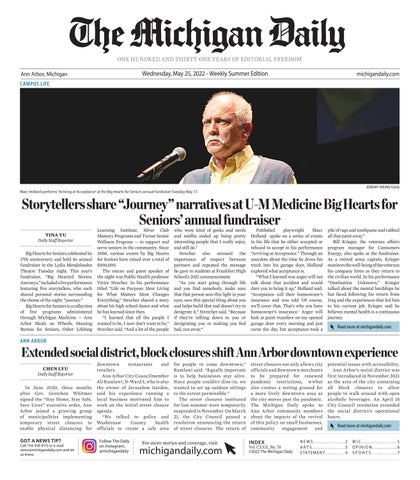
JEREMY WEINE/Daily
Marc Holland performs “Arriving at Acceptance” at the Big Hearts for Seniors annual fundraiser Tuesday May 17.
Storytellers share “Journey” narratives at U-M Medicine Big Hearts for Seniors’ annual fundraiser TINA YU
Daily Staff Reporter
Big Hearts for Seniors celebrated its 17th anniversary and held its annual fundraiser in the Lydia Mendelssohn Theatre Tuesday night. This year’s fundraiser, “Big Hearted Stories: Journeys,” included a live performance featuring five storytellers, who each shared personal stories surrounding the theme of the night: “journey.” Big Hearts for Seniors is a collection of five programs administered through Michigan Medicine — Ann Arbor Meals on Wheels, Housing Bureau for Seniors, Osher Lifelong
Learning Institute, Silver Club Memory Programs and Turner Senior Wellness Program — to support and serve seniors in the community. Since 2006, various events by Big Hearts for Seniors have raised over a total of $500,000. The emcee and guest speaker of the night was Public Health professor Victor Strecher. In his performance titled “Life on Purpose: How Living for What Matters Most Changes Everything,” Strecher shared a story about his high school dance and what he has learned since then. “I learned that all the people I wanted to be, I now don’t want to be,” Strecher said. “And a lot of the people
who were kind of geeks and nerds and misfits ended up being pretty interesting people that I really enjoy, and still do.” Strecher also stressed the importance of respect between partners and repeated the message he gave to students at Frankfort High School’s 2021 commencement. “As you start going through life and you find somebody, make sure that that person sees this light in your eyes, sees this special thing about you and helps build that and doesn’t try to denigrate it,” Stretcher said. “Because if they’re talking down to you or denigrating you or making you feel bad, run away.“
Published playwright Marc Holland spoke on a series of events in his life that he either accepted or refused to accept in his performance “Arriving at Acceptance.” Through an anecdote about the time he drove his truck into his garage door, Holland explored what acceptance is. “What I learned was anger will not talk about that accident and would dare you to bring it up,” Holland said. “Acceptance call their homeowner’s insurance and was told ‘Of course, we’ll cover that. That’s why you have homeowner’s insurance.’ Anger will look at paint transfers on my opened garage door every morning and just curse the day, but acceptance took a
pile of rags and toothpaste and rubbed all that paint away.” Bill Krieger, the veterans affairs program manager for Consumers Energy, also spoke at the fundraiser. As a retired army captain, Krieger monitors the well-being of the veterans his company hires as they return to the civilian world. In his performance “Destination Unknown,” Krieger talked about the mental hardships he has faced following his return from Iraq and the experiences that led him to his current job. Krieger said he believes mental health is a continuous journey.
Read more at michigandaily.com
ANN ARBOR
Extended social district, block closures shift Ann Arbor downtown experience CHEN LYU
Daily Staff Reporter
In June 2020, three months after Gov. Gretchen Whitmer signed the “Stay Home, Stay Safe, Save Lives” executive order, Ann Arbor joined a growing group of municipalities implementing temporary street closures to enable physical distancing for
GOT A NEWS TIP?
Call 734-418-4115 or e-mail news@michigandaily.com and let us know.
downtown restaurants and retailers. Ann Arbor City Councilmember Ali Ramlawi, D-Ward 5, who is also the owner of Jerusalem Garden, said his experience running a local business motivated him to work on the initial street closure agenda. “We talked to police and Washtenaw County health officials to create a safe area Follow The Daily on Instagram, @michigandaily
for people to come downtown,” Ramlawi said. “Equally important is to help businesses stay alive. Since people couldn’t dine-in, we wanted to set up outdoor sittings to the extent permissible.” The street closures instituted for last summer were temporarily suspended in November. On March 21, the City Council passed a resolution announcing the return of street closures. The return of
For more stories and coverage, visit
michigandaily.com
street closures not only allows city officials and downtown merchants to be prepared for renewed pandemic restrictions, wwbut also creates a testing ground for a more lively downtown area as the city moves past the pandemic. The Michigan Daily spoke to Ann Arbor community members about the impacts of the revival of this policy on small businesses, community engagement and
INDEX
Vol. CXXX, No. 78 ©2022 The Michigan Daily
potential issues with accessibility. Ann Arbor’s social district was first introduced in November 2021 as the area of the city containing all block closures to allow people to walk around with open alcoholic beverages. An April 18 City Council resolution extended the social district’s operational hours.
Read more at michigandaily.com
NEWS...................2 ARTS...................3 S TAT E M E N T. . . . . . . . . . . . 4
MIC......................5 OPINION................6 SPORTS..............7
News
2 — Wednesday, May 25, 2022 ANN ARBOR
Ann Arbor city council passes resolution to approve city budget for 2023 TINA YU
Daily Staff Reporter
The Ann Arbor City Council met on Monday night at Larcom City Hall to discuss and eventually approve the Ann Arbor city budget of approximately $525 million for the 2023 fiscal year. The budget will provide funds for social programs established to support BIPOC small business development, implement training programs for citizens to increase diversity in the workforce and improve sustainability by giving grants for home improvements. Councilmembers discussed ways to use money collected from the marijuana excise tax. From the excise tax, $75,000 will be used for exploration, community engagement and planning for a space on Catherine St. dedicated to the development of small BIPOC businesses. Councilmember Julie Grand, D-Ward 3, believes the Ann Arbor community will support this decision. “Knowing that (the area near N 4th Ave and Catherine St.) historically has been a Black business district in Ann Arbor, the idea that we could have a BIPOC small business development site or space (there) … would have a lot of resonance in the community,” Grand said. An additional $572,000 from the marijuana excise tax revenue will go towards the establishment of a Deflection Pilot Program. The Deflection Pilot Program will provide mental health services, substance abuse counseling and assistance with housing and transportation to those in need of these resources, without involving them with the criminal system. Community members, ambulance services, substance abuse treatment providers, mental health providers and the police will be able to refer individuals to the program. Councilmember Lisa Disch, D-Ward 1, said that allowing individuals to seek help without the threat of being arrested is what sets the new Deflection Pilot Program apart from the city’s current diversion and Expungement programs, which are funded by the 2022 city budget. Disch said that the goals of the Deflection Pilot Program align with the Council’s resolution (R-21-098) to use the marijuana tax revenue to improve public safety and provide support for the community.
“Deflection is important because it fuses even more closely than (the diversion program) does to Councilstated purposes for the marijuana tax revenues,” Disch said. “In contrast to diversion, deflection occurs without anyone being charged with a crime or having a criminal file built.” Councilmembers also debated the use of a one-time withdrawal of $100,000 from the marijuana tax revenue to fund the creation of a Public Works Apprenticeship Program. Many current public works job opportunities require candidates to have a commercial driver’s license (CDL). The goal of the Public Works Apprenticeship Program is to attract more people, especially students, to work in public works by paying for CDL training and offering other types of job training. Disch said the apprenticeship program will increase the workforce diversity in public works. “What this Public Works Apprenticeship Program is trying to do is to reach out and find people who would not normally find their way to a job in public works,” Disch said. “So that is about building diversity by giving (diversity) a pathway in and not assuming that (diversity)’s going to find its way to our door.” Councilmember Ali Ramlawi, D-Ward 5, said that while the Public Works Apprenticeship Program is important, the marijuana tax revenue should be used to address more pressing problems caused by drugs. “I support this apprenticeship program,” Ramlawi said. “I just believe … that this isn’t the right source of funding for that program, and I think we can find the $100,000 somewhere else.” Ramlawi proposed an amendment that would contribute the $100,000 from the marijuana tax revenue to Dawn Farm, an organization dedicated to providing long-term treatments for recovery to addicts and alcoholics. Ramlawi said that the City’s cooperation with Dawn Farm would effectively help individuals who suffer from overdose, a problem that has been increasing in severity in recent years. “Within the last two years, both years in 2020 and 2021, we’ve lost over 100,000 people to fentanyl and other overdose drugs,” Ramlawi said. “We have a crisis on our hands with overdoses in our country.”
Read more at michigandaily.com
The Michigan Daily — michigandaily.com
CAMPUS LIFE
UMich community reacts to updated COVID-19 mask policy TINA YU
Daily Staff Reporter
The University of Michigan announced in an April 27 Universitywide email that starting May 2, masks would no longer be required in indoor spaces, including classrooms and campus transportation. This updated policy is applicable to all three U-M campuses and includes campus visitors, regardless of vaccination status. The Michigan Daily spoke to U-M students about their reactions and opinions regarding this change. Some students said the spring semester seemed like the appropriate time to lift classroom mask requirements, given declining cases for the majority of April and decreased student presence on campus, but said they would personally remain masked while in class. Rising LSA sophomore Jenny Zhao said although she believes the updated mandate is reasonable, she will continue to wear a mask in the classroom out of health and safety concerns. “When I first heard about it, it did make sense because there (are) less students on campus, and classes will be smaller,” Zhao said. “I’m probably going to (keep) wearing my mask in classrooms just for safety concerns because I don’t want to get sick during the spring semester.” Rising LSA junior Aricka Croxton said that while the timing of the new policy made sense, she believes a gradual change would have been a better approach. “I think it’s around the time it should happen, but I didn’t expect it to be so abrupt,” Croxton said. “I think the school should have just leaned into it more slowly.” Croxton said the changes in the
mask mandate did not affect her experiences while communicating with instructors and classmates in the classroom. “It’s kind of still the same,” Croxton said. “I still interact with people the way I did before, and I don’t think the masks changed anything.” Rackham student Xiaosheng Guo is a Graduate Student Instructor for the spring semester. Guo said she believes the new mask mandate will not impact safety in lecture halls because the bigger classroom size allows students to maintain social distancing. “I have taught for two semesters that students have masks for the whole class,” said Guo. “I think for rooms that (are) large enough, and the students can sit separately… then it is okay that students don’t wear masks because in this way, you can still keep your social distance, and you don’t need to be that careful about getting (COVID-19) or other diseases.” However, Guo said she felt the University should adjust its policy for classes where students have to sit in closer proximity to each other. “In discussions, we prefer students to work in groups and discuss with each other,” Guo said. “In that case, it’s hard to keep the social distance in the classroom. The University should think about more ways to actually prevent (COVID-19) from spreading.” Rising LSA sophomore Abhi Shuko said while he does not personally have an issue with the new mask policy, he believes it is important to maintain mask requirements in spaces students cannot avoid, such as classrooms and transportation.
Read more at michigandaily.com
Stanford Lipsey Student Publications Building 420 Maynard St. Ann Arbor, MI 48109-1327 www.michigandaily.com
ANGIE YU
VANESSA KIEFER
Business Manager business@michigandaily.com
Editor-in-Chief eic@michigandaily.com
CONTACT INFORMATION Newsroom
Office hours: Sun.-Thurs. 11 a.m. - 2 a.m. 734-763-2459 opt.3
News Tips news@michigandaily.com Corrections corrections@michigandaily.com Letters to the Editor tothedaily@michigandaily.com or visit michigandaily.com/letters
Photo Department
photo@michigandaily.com
Arts Section
arts@michigandaily.com
Editorial Page
opinion@michigandaily.com
Sports Section Magazine
sports@michigandaily.com statement@michigandaily.com
Advertising Department
Phone: 734-418-4115 dailydisplay@gmail.com
EDITORIAL STAFF Brandon Cowit
Managing Editor
cowitb@michigandaily.com
Tess Crowley
Digital Managing Editor
crowlete@michigandaily.com
Eli Friedman and Riley Hodder
Managing News Editors
news@michigandaily.com
Quin Zapoli
Editorial Page Editor
tothedaily@michigandaily.com
Lindsay Budin and Connor Earegood
Managing Sports Editors
sports@michigandaily.com
Kai Bartol
Managing Arts Editor
arts@michigandaily.com Senior Arts Editor: Emilia Ferrante
Serena Shen and Claire Yang
Managing Design Editors design@michigandaily.com Senior Layout Editor: Lys Goldman
Sarah Boeke and Julianne Yoon
Managing Photo Editors
photo@michigandaily.com
Julia Verklan Maloney
Managing Statement Editor
statement@michigandaily.com
Abbie Gaies and Lizzie MacAdam
Managing Copy Editors
copydesk@michigandaily.com
Matthew Bilik
Managing Online Editor
webteam@michigandaily.com
Nithisha Kumar
Managing Video Editor
video@michigandaily.com
Anchal Malh and Andy Nakamura
Michigan in Color Editors michiganincolor@michigandaily.com
Mishal Charania and Martina Zacker Audience Engagement Managing Editors socialmedia@michigandaily.com
Akshara Koottala and Lola Yang Chairs of Culture, Training, and Inclusion accessandinclusion@michigandaily.com
Design by Serena Shen
The Michigan Daily (ISSN 0745-967) is publishing weekly on Wednesdays for the Winter 2022 semester by students at the University of Michigan. One copy is available free of charge to all readers. Additional copies may be picked up at the Daily’s office for $2. If you would like a current copy of the paper mailed to you, please visit store. pub.umich.edu/michigan-daily-buythis-edition to place your order.
The Michigan Daily — michigandaily.com
Arts
Wednesday, May 25, 2022 — 3
‘Come Home the Kids Miss You’ is catchy but unremarkable RYAN BRACE
Daily Arts Writer
When Jack Harlow first emerged onto the rap scene in 2015, his intangible qualities such as his swagger and trademark Southern twang worked to set him apart from the rest of the crop of rising wordsmiths. Harlow and his Louisville-based collective, Private Garden, were very much outsiders. As a goofy-looking, curly-haired white kid from Kentucky, Harlow was often not taken seriously within the rap game, and he had to earn all of the respect he has garnered since. Clips and songs from his adolescence show how dedicated he has been to rapping as a craft since he was a young boy. His major label debut mixtape, 2018’s Loose, and his subsequent project, 2019’s Confetti, display this hunger. In these first two albums, Harlow sounds raw, composed and in touch with Louisville’s underrated hip-hop scene. His beats skew towards the eclectic and psychedelic, and his natural swagger in the two tapes is apparent to listeners, as his cadence and delivery were remarkably far along for a rapper as young as he was then.
In 2020, Harlow released the single that turned him into a household name, “WHATS POPPIN.” Harlow fans rejoiced that Louisville’s favorite son was finally getting recognized by a more mainstream audience, but the song itself signified a shift in Harlow’s sonic profile from intricate, lush instrumentals to basic trap beats. This shift is quite apparent in his most recent release: the highly anticipated Come Home the Kids Miss You. The two singles that preceded the album, “Nail Tech” and the Fergie-sampling “First Class,” were catchy, if a little boring. The hunger that you could hear in Harlow’s voice on Loose and Confetti is all but gone, and it seems like the trappings of life as a mega-star have tapered his creativity and drive. His intent now seems to be making inoffensive radiorap fodder — a major deviation from his previous work. While he previously made melodic rap tracks, that aspect of his repertoire has definitely been emphasized as Harlow’s commercial focus shifted towards hunting for streams. Where Harlow’s whiteness previously served as a detriment to his career in the local scene, the mountainmoving national PR push that he has
‘Petite Maman’ is a real-life fantasy SWARA RAMASWAMY Daily Arts Writer
Celine Sciamma’s “Portrait of a Lady on Fire” was the first French film I ever watched. I had never thought that a film with sparse dialogue and devoid of a score could make me feel so many things. It was unlike anything I had ever watched before and I knew then that I was watching an artist’s masterpiece. It came as no surprise that Sciamma’s “Petite Maman” rocketed to the top of my movie list the second it was released. I watched “Petite Maman” at a nearly empty screening at Ann Arbor’s State Theatre, and yet I hardly noticed my solitude. “Petite Maman” follows Nelly (Joséphine Sanz, debut), an 8-yearold girl who has just lost her grandmother. Nelly and her parents return to clean out the house that her mother grew up in. In typical 8-yearold fashion, Nelly’s curiosity leads her to explore the house and the woods behind it, and she meets a girl of the same age named Marion, (Gabrielle Sanz, debut) with whom she has an instant and strangely familiar connection. Their connection is made
even more intriguing, given that Marion looks identical to Nelly and shares a name with Nelly’s mother. It is a story of grief, friendship and love through a child’s eyes. Sciamma’s style is at the forefront in this movie, as she once again relies on silent scenes and sounds of nature to convey emotion. It’s a film about a child, yet it’s not a children’s film. Nelly reminded me so much of myself as a kid. She conducts herself the way you would expect an 8-yearold to — full of curiosity and eager to explore — but she’s also introspective and quiet. She doesn’t quite say what she’s feeling to anyone, yet with every scene, you can tell exactly what she’s thinking. This speaks to the astounding performance of Joséphine Sanz as well as her twin, Gabrielle Sanz, who plays Marion with the same force of personality. Sciamma excels in portraying the view of the world that we all had in childhood: one where the days consisted of exploration and asking questions, there are no inhibitions and you can make a new friend by helping them build a treehouse, no introductions necessary.
Read more at michigandaily.com
benefitted from since the release of “WHATS POPPIN” is in no small part due to his “marketability” (see: white privilege). This negative transformation isn’t just a product of his aim to add more melody to his albums, as previous R&Binfluenced tracks, like Confetti’s “THRU THE NIGHT,” work brilliantly. Harlow still has a ton of natural talent; at times on this new project, his swagger and flow mitigates his poor writing and basic production choices. He also has a good sense of humor and a rare boldness and confidence for a rapper of his stature. When these intangibles come to the forefront, the album is at its best, such as on the shameless DM-slide of “Dua Lipa” and the breezy “Lil Secret,” which has the best beat on the project — a smooth, vocals-centered instrumental. “Like a Blade of Grass” also sounds like something that could’ve been on Loose or Confetti, with its bouncy drums reminiscent of early Harlow gems like “SUNDOWN,” though it would have been better if he didn’t try to sing on it. He’s not off-key or anything, but his singing lacks the signature Kentucky lilt that makes his rapping so endearing. In general, Harlow spends way
too much of the album trying to be something he’s not. He gives a halfhearted Drake impression on “Churchill Downs,” a track that also features the Canadian rapper. Drake sounds more natural than Harlow on the song, but he still isn’t excellent. Harlow has shown
tends to fall flat on Come Home the Kids Miss You. While his career may be in a better place than it was three years ago, his music has deteriorated. Without the example of his early work, Harlow seems alarmingly similar to industry plants in other genres, like Billie Eilish, GAYLE
This image is from the official album cover of “Come Home the Kids Miss You,” owned by Generation Now/Atlantic Recording Corporation
that his collaborations with talented singers can be brilliant, like Confetti’s stellar 2forwOyNE collaboration, “WARSAW,” but his own crooning
or Iann Dior. At least Eilish still can lean back on her unique voice and world-class songwriter of a brother; Harlow just sounds uninspired.
How TikTok won my silly little queer heart EMMY SNYDER Daily Arts Writer
For a very long time, I was insistent on leaving TikTok to the kids. I’m only 21, but as somebody who had to conduct a few Google searches to make sense of Instagram stories, I simply felt too old for TikTok. I finally caved when the jobs I was browsing on Handshake (you know the struggle) were asking about TikTok experience and f luency: I thought to myself, “TikTok CANNOT be the reason I don’t get a job.” I reluctantly made an account, belaboring to create a funny and clever username for far too long (and I finally made one, albeit not one that I will f launt in an interview for a grown-up job), and began exploring the app. It was relatively easy to use, with the homepage including two streams of content, one from TikTokers (rolling my eyes as I type this word) you follow and another, the For You page, containing recommended content based on your follows, views and searches. The Discover, Create, Inbox and Profile pages were also relatively
self-explanatory. I was quickly immersed in a f lurry of “We Don’t Talk about Bruno” videos that got old fast, and TikToks using “Misery” as background audio to make fun of life’s rougher moments that felt a little more my speed. Still, over the first few days, the app failed to hold my attention, and I abandoned my project as quickly as I had taken
possibility: Maybe TikTok didn’t objectively suck, and I simply hadn’t properly invested the care, time and energy to cultivate a stream of content that I enjoyed. This possibility was an exciting one; I’ve held the rest of my social media accounts for five or more years each. Maybe I had inundated their algorithms with too much information — or at least too much
Design by Jennie Vang
it up. Then the winter semester came to an end, and I found myself in that post-finals-pre-summerjob limbo. I considered another
information representative of a person I no longer see when I look in the mirror.
Read more at michigandaily.com
4
4 — Wednesday, May 25, 2022
STATEMENT
The Michigan Daily — michigandaily.com
The complex future of UMich abortion access Surely it has an expiration date EMILY BLUMBERG
Statement Correspondent
On May 2, 2022, what once seemed like a distant hypothetical became a sharply probable reality: the leaked draft of Justice Samuel Alito’s majority opinion in the Dobbs v. Jackson Women’s Health Organization revealed the Supreme Court’s plan to overturn Roe v. Wade, a historic case that has ensured federal abortion access in the United States since 1973. At some point this summer, the Supreme Court is set to release a formal decision that could drastically limit abortion access in numerous states, including Michigan. Abortion is a notoriously hotbutton political issue, tending to stir up strong emotional responses from both sides of the ideological spectrum. In the two weeks since Justice Samuel Alito’s draft was leaked, thousands of organizations have released steady streams of political analysis and commentary. In an oversaturated and often overstimulating modern media environment, politically-oriented discussions of abortion’s future can drown out the important news content designed to inform, rather than instigate. Discussions focused on national events and trends can also take away from the larger significance of the abortion debate. At the end of the day, the decision to have an abortion is one made by an individual who harbors their own unique experiences and circumstances. Though the Supreme Court’s decision will very likely shift our relationship with abortion as a
nation, it will most deeply impact the people who must navigate difficult decisions in a rapidly changing legal and medical climate. Abortion, in its everyday practice, is a starkly local and personal issue. For University of Michigan students, that impact is only exacerbated by the time and place we currently occupy. The state of Michigan has the fourthhighest rate of abortions in the United States. Washtenaw County had the sixth-highest number (755) of abortions in Michigan in 2020. On top of that, nearly 70% of reported, legal abortions in Michigan are performed on patients under the age of 29. Hence, as students in Michigan, we find ourselves in a uniquely vulnerable position. It is highly plausible that abortion access in Ann Arbor will look different by the time we begin the fall 2022 semester. If Roe v. Wade is overturned, a 1931 Michigan law could go into effect, acting as a statewide “trigger ban” on abortion care. This law, known as Act 328 Chapter III, would make administering an abortion for any reason (except preserving the life of the pregnant person) a felony. Additionally, it would make advertising, selling or publicly exposing the sale of any abortion-inducing drugs a misdemeanor. In response, significant efforts have been made in attempting to keep abortion legal in Michigan. Two weeks ago, Gov. Gretchen Whitmer filed a lawsuit with the Michigan Supreme Court asking to immediately resolve the issue of abortion within the context of the Michigan Constitution. Planned Parenthood of Michigan and Dr. Sarah
Design by Abby Schreck
Wallett, Michigan Medicine Chief Medical Officer, also filed a lawsuit, asking the state of Michigan to affirm the right to an abortion. The Michigan Supreme Court temporarily halted the enforcement of the 1931 law (assuming Roe v. Wade is overturned) to provide time for these legal proceedings. Reproductive freedom advocates, including the American Civil Liberties Union of Michigan, Michigan Voices and Planned Parenthood Advocates of Michigan, have also introduced the Michigan Right to Reproductive Freedom Initiative, which could be on the ballot in the 2022 election. The initiative would protect the right to an abortion in the first trimester and in scenarios in which the pregnant individual’s physical or mental health is at risk. Where We’re Going Though the efforts of Whitmer and citizen advocacy could eventually be effective in the long-term, the uncertainty of their timelines means Act 328 Chapter III could become active in the coming months. These dire circumstances could provoke additional stressors for U-M students, potentially adding to financial, emotional and physical burdens. It’s unfortunately unnerving, particularly for students who may not have easy access to necessary resources. As we transition into yet another semester of unclear medical and legal affordances, it is important to be aware of the various resources available and to elevate student voices on campus. The University of Michigan has created the informally-named “PostRoe Task Force,” led by Drs. Lisa Harris and Dee Ellen Fenner. The task force, according to Harris, focuses on tackling seven main questions, assuming Act 328 Chapter III becomes active: 1. In what specific situations would abortion be allowed to “preserve the life” of a pregnant woman? 2. How can Michigan Medicine assist patients in obtaining care outside of Michigan? 3. Restrictions on legal abortions could increase statewide birth rates from 5-17%, according to Harris. How can Michigan Medicine accommodate the additional maternity care, neonatal and pediatric care needs?
Read more at michigandaily.com
DANI CANAN
Statement Columnist
It’s taking me way too long to think of an opening sentence. I’ve taken a writing class every semester for two years, and my main takeaway from each of them is that creativity is hindered, even stunted, by thinking too much. Writing on a typewriter is creating pause where there should be incessant forward motion. These intricate contraptions definitely weren’t made with speediness in mind, at least not by today’s standards. Even as a lover of antiquities, a minor collector of past technological oddities, I’m worried I won’t like writing
His gargantuan legacy feels immortal in the context of today. But after the earth spins enough time since “Hamlet,” I believe the name “William Shakespeare” will mean nothing to anyone at all. This feels inevitable to me. The question is whether this is something to feel sad about. I find myself wondering if there’s a point in writing words if all of them will become nothing someday. I synthesize words now, stamp them into visibility in front of my eyes. Click, click, whirrr, badum. A typewriter sings in my ears, printing onto paper I can feel with my hands. Paper is velvety, porous and pliable. Typewriter keys are circular, solid and grounded. The words I’m writing
Design by Serena Shen
on my century-old noise machine. But I digress. I guess I can start with Shakespeare. Do you ever wonder if William Shakespeare’s plays will be forgotten someday? Romeo and Juliet alone has been done countless times. It’s the play that coined the term “star crossed lovers” — a core sentiment that consistently captivates storytellers over and over. “West Side Story,” “The Lion King” and “She’s the Man” all have ties to Shakespeare plays written centuries ago. “The Bard” is common United States academic curriculum.
are very real, and I even like what they’re saying, but behind my love for creativity is the mortality of all that I make. Water evaporates, f lowers wilt, apples decay, smiles fade, stars burn out and the glass is half empty. This sentiment isn’t super compatible with someone studying creative writing and actively essaying for their school newspaper (me). It’s not a great thought for anyone engaged in creative activities, really. Witodlice sê wordlung âcwelan ût mâna dôd tôweard. (old english)
Read more at michigandaily.com
The Michigan Daily — michigandaily.com
Michigan in Color
What will I be?
TIAN YEUNG MiC Columnist
Content warning: mention of suicide. Fourteen-year-old me was an anxious wreck with a negative outlook on life and my future. Despite my pessimism, on the day of career matching, I was hopeful that my result would ease the stress I had about choosing a career. I thought I could use this as an opportunity to finally have some idea of what to do with my life. Well, I got my hopes up for nothing because the day didn’t go as planned. A quiz from my school’s “trustworthy” career planning program told me I was supposed to be a comedian. My heart sank and my mind raced at this result. How was I, an extremely shy and introverted person, going to be a comedian? I didn’t believe I had a sense of humor. In fact, “funny” was the last adjective anyone would use to describe me, as I always wore a solemn expression. All this absurd match did was intensify my anxiety. Since the school couldn’t give me sensible advice about my future, I turned to the most credible source I had: my dad. He is a well-respected and successful professor. His career has remained stable over the years, and he seems to enjoy his job well enough. For those reasons, I decided to ask him what job might suit me best. To my disappointment, I found him to be no help at all. He simply told me to “follow what I love doing.” What did that mean? I didn’t know what I loved doing. Nothing made my heart sing enough that I’d want to build a career out of it. With no clear career goal in my mind, I went through the first three years of high school telling everyone I wanted to be a doctor. It wasn’t because I was in love with the idea of helping the sick restore their health. I was merely good at biology and didn’t hate it as much as other subjects, which, of course, was not the same thing as loving it. At the time, many of my friends also aspired to be doctors because it has always been seen as a respectable career. Consequently, I thought becoming a doctor was a reasonable target. My career goal only changed after I took a psychology course during the summer before my senior year of high school. Unlike natural sciences like biology, where information is more black and white due to concrete
results from experimentation, psychology sits somewhere in the shades of gray. I found this quality intriguing, as it reflects psychology’s seeming impossibility: trying to understand intangible aspects of human nature, such as love and happiness. Since I was trying to understand what it meant to love something enough that I’d be willing to do it for the rest of my life, I thought perhaps psychology could give me some guidance. I decided then to study the subject and traded becoming a doctor for a career more related to the human mind. However, what exactly that was, I didn’t know. My decision to study psychology lasted until I was about to graduate from college, when I had to reevaluate my life again. Another chapter break in life meant another headache. Up until recently, I was struggling with postgraduation plans. Should I continue studying psychology or try related fields, like law or social work? Or, should I take a break from school? Maybe I could find a job or an exchange program. I didn’t know how to answer these questions. The only thing I knew was that my anxiety escalated. I became an insomniac. There were days when I would stay up for 48 hours straight, worrying about what I should do with my life, before finally tiring myself out to sleep. Nothing seemed to break this unhealthy cycle, no amount of exercise, medication or chamomile tea. I felt lost and afraid of making a wrong decision about my future. Feeling like I was wasting time during the night when my mind could not shut off, I eventually decided to
do something productive. I started taking shifts as a counselor at Crisis Text Line — an online platform that provides real-time counseling — where I answered texts from people who were struggling in their lives. Surprisingly, supporting “texters” helped me gain perspective on my own situation. I realized I wasn’t alone in feeling lost; many texters felt the same. This realization eased some of my anxiety. I also learned that whenever I was able to help texters, whether by validating their feelings, connecting them to resources or talking them out of committing suicide, I felt fulfilled. I was able to apply what I learned from psychology to make a difference in people’s lives. This feeling, I realized, was what I wanted to experience in everything I did. I finally understood what my dad meant when he told me to follow what I love doing. Since most of my supervisors were licensed social workers, social work seemed to be most in line with what I was doing at Crisis Text Line. I decided to pursue it. In fact, I will be starting school next fall at the University of Michigan once again, only this time at the School of Social Work. Looking back now, I’m glad everything worked out just fine. Of course, there are still many unknowns in the future. For example, I’m not entirely sure what I will do after getting my master’s degree. However, I’m beginning to think maybe that’s the point of life: you have to live it to find out. Armed with this realization, I’m finally ready to face the future with a less anxious heart. MiC Columnist Tian Yeung can be reached at tiyeung@umich.edu.
AMY DENG/MiC
Wednesday, May 25, 2022 — 5
Sparks
ROSHNI MOHAN/MiC
ROSHNI MOHAN MiC Columnist
Coldplay’s “Sparks” first came out in 2000 with their debut studio album, Parachutes. I was extremely late to join in on the song’s acclaim. For years before, I had heard the song only in passing — a couple of times from my mother’s car radio, a dozen times through my Spotify recommendation playlists and maybe once or twice from a friend. But even though I had heard the song enough times for it to make a lasting impression, it never did. I never actually listened to the song like I would normally. I simply tuned out the music and ignored the lyrics for no particular reason instead of paying attention to the emotions it drew from me. The song went in through my left ear and out through the right. Every time I heard it, it rang a bell somewhere deep in the folds of my brain, but not loud enough for me to actually pay attention or even look at the song name or the artist. But sitting at lunch that day studying for a quiz with only my left earbud in so I could hear my friends talking changed things. For some reason that I don’t understand, at a time when it made the most sense to let the song flow in one ear and out the other, the song stuck. It melted, sticking to every structure in my brain, pooling into every space, filling every fold. The first eight seconds, while beautiful and attention-grabbing, were nothing compared to what followed. It was a buildup to the rest of the song, a calm before the storm. The song feels calming at first, like something you’d feel when closing your laptop after finishing a long assignment, sitting with your friends at night on the beach, on the car ride home after an exciting day or lying in bed after a date that went well and replaying the night in your head. It’s a song where, at first, the melody glues a gentle smile on
your face, but just 10 seconds later, the lyrics rip it off as slowly as they can, prolonging the pain you feel as you begin to feel your smile pull tightly at your skin. It’s a song that is more deeply filled with immense regret and longing. One filled with internal sadness and desperation. The lyrics focus on the character of the song dealing with his partner leaving him and emphasize how hurt he is knowing he hurt his partner, pushing her away until she had no choice but to leave. “Sparks” has quickly become one of my favorite songs, a normally hard thing for me to state with conviction given my indecisiveness. I can’t help but call it a favorite because it’s a song with so few lyrics, yet it still says so much. It’s a song that inflicts deep sadness and pain onto its listeners, but in the best way possible, allowing them to feel all the pent-up emotions they haven’t allowed themselves to feel yet. It has become a song that I have overplayed countless times, yet one that has never ceased to get old to me. And knowing the deep sadness in the song sends me into a running stream of tears every time I hear those heart-breaking eight seconds — the eight seconds I called calming that day at the lunch table. The more I listen to it, the more I realize how much I actually resonate with it recently, as I relate to the character in the song, but also the one he sings about. The lyrics “But I won’t let you down / Oh yeah I will, yeah I will, yes I will” point out both of our destructive qualities. He let his partner down by hurting her, in the same way I self-sabotage the good things in my life and hurt the people around me. He can’t promise that he won’t disappoint her when he knows he will and always does. And on the other hand, his partner has no choice but to leave. She finally prioritizes herself after a relationship that existed to focus solely on what he wanted.
Read more at michigandaily.com
Opinion
6 — Wednesday, May 25, 2022
Edited and managed by students at the University of Michigan since 1890. Stanford Lipsey Student Publications Building 420 Maynard St. Ann Arbor, MI 48109 tothedaily@michigandaily.com
VANESSA KIEFER Editor in Chief
QUIN ZAPOLI
Editorial Page Editor
BRANDON COWIT Managing Editor
Lets be tactical about the “blame game” with Roe LINDSEY SPENCER Opinion Columnist
I
n a leaked draft by Justice Samuel Alito, the majority opinion of the Court declared that Roe v. Wade, the landmark decision that protects a woman’s right to privacy to have an abortion, is to be overruled. If — or, the increasingly more likely option, when — Roe v. Wade (referred to as just Roe in conversation and this article) is overturned, federal protection of the right to an abortion will be revoked. Immediately following the leak, protests erupted and politicians began to vocalize plans of action, but the national mood amongst advocates for women’s reproductive rights was effectively crushed. It feels, to many, that all hope is lost. The initial response to hearing such news is to play the “blame game.” For incensed people, this method can feel constructive, but there is often a tendency to put blame into the wrong hands. We can’t blame Susan Sarandon because of her opposition to Hillary Clinton in the 2016 presidential election. We also can’t necessarily assign full blame to “pro-life” voters — they were not the final decision-makers when it came to overturning Roe. Assigning false accusations to make ourselves feel better in times of crisis is not effective and does nothing to inspire action. We must think clearly about who to blame, why and what we can do about it. Although a controversial issue, the right to an abortion and the survival of Roe is widely favored by the American public. Recent polls show that 54% of Americans are in support of upholding Roe, and 70% believe that the decision to have an abortion should be at the will of a woman. Despite its polarizing nature, the subject of reproductive
rights is surprisingly agreed upon by a majority of voters. With the understanding that most Americans are in support of abortion, it can come as a shock that the decision is being overturned. But, in reality, Roe and its guarantees have not been secure since its day of origin, even as opportunities to provide that security have emerged countless times in Congress and the Supreme Court. On the campaign trail, President Joe Biden made a promise to codify Roe, an action that would enshrine the right to abortion into the federal legal code. On May 11, 2022, the Senate failed to pass a bill that would further protect the right to have an abortion by codifying Roe. It is not entirely correct to place the burden of blame on Biden — any executive action he could take to protect reproductive rights would be met with legal resistance from states opposed to abortion. Sens. Joe Manchin, D-W. Va., and Susan Collins, R-Maine, though, can be assigned some criticism. Their “no” votes represented a noted opposition to abortion rights, but the failure of the bill could also be heavily attributed to the existence of the filibuster in the Senate. Time after time, legislative measures have been taken to protect reproductive rights in the United States, including the Affordable Care Act’s coverage of certain contraceptives and this recent attempt by Senate Democrats. Despite various laws and faithful efforts, we must now understand that with the failure to codify this right, the only way to assuredly safeguard the right to choose is through the Supreme Court. The politicians we have voted into office may hold opinions or introduce policy, but the justices that they appoint wield the real power when it comes to the fate of abortion.
Although insulated from public opinion, the Supreme Court should bear the brunt of our outrage. In the assumed 5-4 decision, all three of former President Donald Trump’s appointed justices, along with Justices Alito and Clarence Thomas, voted to overturn Roe due to its “weak” reasoning. In their nomination hearings, Trump’s nominees considered Roe to be “precedent” and the “law of the land,” but in the end, they voted to topple this allegedly settled decision. It is the unstable word of these lofty lawmakers that determines the future of abortion in the United States, and their action — or lack thereof — defines the future of reproductive and women’s rights. Late Supreme Court Justice Ruth Bader Ginsburg is commonly noted by the left as an inspirational feminist from recent history. Nominated by former President Bill Clinton in 1993, Ginsburg was devoted to equality of the sexes, specifically in education and lessening the wage gap. She is often attributed a legacy of being “notorious,” but in reality, her refusal to retire during former President Barack Obama’s term was the final and most burdensome threat to the fate of abortion in the United States. We have to stop ourselves from thinking of her as the media icon she became, and more as the judge that she was. By retiring in or before 2014, Obama would have been able to nominate another liberal to take her place, which would have limited Trump’s opportunity to appoint three conservative justices in his term. Ginsburg would have protected her legacy and saved Roe with her retirement. It feels good to place blame, but it only does us any good when it carries weight. Don’t blame the average
Read more at michigandaily.com
The Michigan Daily — michigandaily.com
How do we keep our community safe? Policing is not the answer. GEO’S ABOLITION CAUCUS
F
rom April 25-27, Ann Arbor hosted the Problem-Oriented Policing (POP) Conference, which is organized annually by the Center for Problem-Oriented Policing at Arizona State University and features a bevy of police officers, policing technology companies and crime researchers and consultants for an annual conference. The conference was hosted jointly by the Washtenaw County Sheriff’s Office, the Ann Arbor Police Department and the University of Michigan Police Department, which is part of the Division of Public Safety and Security (DPSS). The POP Conference embodies, promotes and attempts to legitimize the existential and everyday threats that police pose to all of us across the University’s campus, Ann Arbor and Washtenaw County. Advocates of Problem-Oriented Policing contend that police are essential to solving homelessness, mental health crises, raciallymotivated violence, intimate partner violence and other social ills — even as policing has contributed to the very problems it purports to solve. While residents of Ann Arbor often like to imagine the city as a liberal refuge from problems that only happen in “other” places, we only have to look back to 2014 in
Ann Arbor to see how police officers armed with deadly weapons and protected by qualified immunity are actively harmful to our community. On Nov. 10, 2014, AAPD Officer David Ried shot and killed Ann Arbor resident Aura Rosser in her own home. The police response to Rosser’s boyfriend’s 911 call seeking support for Rosser — a Black woman experiencing a mental health crisis — ended in her death instead. Ried was never charged for her killing, and was later promoted to sergeant by the AAPD. John Seto, AAPD chief at the time, was hired as U-M’s Director of Housing Security, where he remains to this day. As abolitionists, we know that viable alternatives to policing already exist. Rather than rebrand the same old police reforms, we believe in envisioning an unarmed, non-police emergency response in Ann Arbor, including the University’s campus. Homelessness, mental health crises and intimate partner violence are complex social issues that require supportive services that keep individuals safe, housed and fed. Policing offers none of these solutions. Rather than throwing armed police at complex societal problems, as this conference advocates, we need to fund real solutions that center on prevention and address root causes.
Read more at michigandaily.com
Who needs time travel?
Design by Opinion Cartoonist Anya Singh
The Michigan Daily — michigandaily.com
Sports
Wednesday, May 25, 2022 — 7
BASEBALL
Michigan exhausts bullpen options in regular season finale IAN PAYNE
Daily Sports Writer
With its postseason hopes locked in, the regular season’s end took a new purpose for the Michigan baseball team. Entering the day locked into the fifth seed of the Big Ten Tournament thanks to wins in their previous two games, the Wolverines took the opportunity to rest most of their typical arms — and struggled in their absence. Of course, that bullpen day was a byproduct of Thursday’s and Friday’s games, in which the Wolverines went all in with their best arms. “We are going to treat every week … from here on out like it’s tournament baseball, double elimination baseball,” Michigan coach Erik Bakich said on Thursday. “(Treat) every individual game like it’s the only game of the week.” As a result of that mentality, when Saturday rolled around there wasn’t much experience left to put on the
TENNIS
mound. Senior left-hander Jack White got the start in his fourth appearance of the season. White has struggled this season battling back from injury, and as a result he has not been the highleverage innings-eater as Michigan hoped him to be. Though he allowed two runs and only lasted 1.1 innings, it was a sentimental note for the senior to get the chance to play one last regular season game after all the years he has given to Michigan. And White wasn’t the only upperclassmen given that respect. In addition to White, some other graduating players got time on the mound. Senior right-hander Keaton Carattini — who, like White, has been sidelined by injury — made his second appearance of the year in the fourth inning. However, he also gave up two runs in his inning of work. That performance could be expected as better arms rested. But some consistent relievers made their way into the game, like when graduate left-hander Angelo Smith made his final regular season
appearance in the fifth inning. Still, the Wolverines got creative with their pitching selections. Even senior infielder Jack Van Remortel got in on the action, taking the mound for the first time in his career. Though he predictably struggled on the mound, he did notch the last two outs in the top of the ninth inning. Apart from the seniors, underclassmen also got a chance to take the bump. Sophomore righthander Brandon Lawrence — who also played Friday in the infield — had the Wolverines’ best outing of the day. He tossed 1.2 scoreless innings while allowing no hits and no walks. His outing wasn’t the only quality performance, though. Junior righthander John Torroella also had a scoreless inning of work in just his second outing of the year. In the end, though, some of the more established pitchers had less successful outings and that led to the game being blown wide open. Sophomore left-hander Logan Wood gave up three runs without recording an out, and sophomore right-hander Ahmad Harajli did
the same while only recording one. Even freshman right-hander Jake Keaser gave up four runs in one of his toughest outings of the season. Michigan’s playoff attitude worked in the first two games of the series, but after all its pitching resources
were exhausted, it struggled to put anything resembling a lid on Rutgers’ offense. The regular season is officially over, and the attention shifts to whether Michigan’s rested arms can deliver in true playoff baseball.
JULIA SCHACHINGER/Daily After using its best arms to win its first two games against Rutgers, the Michigan baseball team turned to its depth on Saturday.
Michigan’s season ends in NCAA Quarterfinals against Ohio State ABHIJAI SINGH Daily Sports Writer
CHAMPAIGN — Without a moment’s hesitation, graduate student Nick Beaty took a return off serve and smashed a ball that took one bounce over the fence. His smooth move halted Ohio State’s fiery start by giving the Michigan men’s tennis team its first doubles win. And although Beaty’s success carried over to junior Ondrej Styler at the No. 3 doubles court — who delivered a furious return off serve to clinch the doubles point for the Wolverines — that momentum didn’t extend into singles. Splitting the season series in four total matches, Michigan (25-4 overall, 8-1 Big Ten) came up short against Ohio State (28-3, 7-0), 4-2, to suffer its first postseason loss and end its season in the NCAA Quarterfinals. “I don’t think (Styler, senior Andrew Fenty and sophomore Nino Ehrenschneider) played to the level they’re capable of,” Michigan coach Adam Steinberg said. “I know they
didn’t want to play that way … maybe, in some respects, the moment got too big for them.” These players comprised one side of the courts, and each of them struggled to break away from their Buckeye opponents. After Ohio State’s Cannon Kingsley grabbed the first break point at the No. 1 singles court, Styler recovered with a break in straight points, tying the first set at three games apiece. But that mid-set success did not translate
to Fenty and Ehrenschneider. Even then, Styler could not sustain his high-energy backcourt play, and Ohio State earned three first-set victories over Styler (6-4), Fenty (6-2) and Ehrenschneider (6-2). On the other side, sophomore Jacob Bickersteth looked to galvanize his teammates by jumping out to a 5-0 lead in his first set. Before his match was moved indoors due to inclement weather, Bickersteth dropped the ensuing three games, but he knew he
TAYLOR PACIS/Daily Michigan associate head coach Benjamin Becker speaks with senior Patrick Maloney during his singles match at the NCAA Men’s Tennis Championship in Urbana-Champaign.
could give the Wolverines their first first-set win. “(The move inside) didn’t really affect too much,” Bickersteth said. “I was serving, so I knew I could come out on the winning side.” On either side of Bickersteth stood senior Patrick Maloney and Beaty, but after holding for one service game, Maloney fell in a 6-1 first-set loss. Moments later, Beaty was unable to break on a crucial deciding point that contributed to his 7-6 (11-9) first-set loss. “Beaty has been a role model for me for two years,” Bickersteth said. “He does everything right and is the heart of our team … that’s how you want to be as a college tennis player.” Before Beaty and Maloney were the last Michigan players left standing, Fenty lost in consecutive sets to the Buckeyes’ JJ Tracy — ranked No. 19 by the Intercollegiate Tennis Association — 6-2 and 6-2. Bickersteth broke the 1-1 tie by giving the Wolverines their only singles victory in the match, winning 6-3 and 6-3. The Buckeyes, however, translated
their first set success against Ehrenschneider and Styler by winning their second sets, 6-3 and 6-4, respectively. It brought them within one point of clinching an appearance in the NCAA Semifinals. With the season on the line, Beaty was unable to break Ohio State’s Andrew Lutschaunig, falling 6-4 in his second set. “I didn’t want Beaty to be (our final losing player),” Steinberg said. “He’s made me a better person and coach … but, without Beaty, we’re not here — we’re not even close.” To that point, Michigan will not allow its final loss this season to define it. “They fight so hard for each other, and … I’m impressed with them everyday,” Steinberg said. “You don’t get this far without having a special group of guys with character and heart that love Michigan more than anything.” Looking beyond their recordsetting season and the singles troubles that ended it, the Wolverines will hope that dedication to each other will stick long into the future.
Sports
8 — Wednesday, May 25, 2022 SOFTBALL
The Michigan Daily — michigandaily.com SOFTBALL
Charlie Pappalardo: Control issues doom Michigan in season-ending regional loss to UCF This weekend captured NOAH KINGSLEY Daily Sports Writer
ORLANDO, Fla. — It’s hard to win a softball game after walking in four runs. It’s one thing to give up runs when the opposition is simply hitting it hard. But by struggling to find the strike zone, the Michigan softball team’s pitchers allowed Central Florida to take an insurmountable lead early without getting many big hits. Lacking command from any of its pitchers with nine walks on the day, the Wolverines (38-18 overall, 16-9 Big Ten) fell once more to the Knights (49-12), 9-4, ending their season. Though Michigan attempted to chip away throughout the game, it could never catch UCF, falling in the NCAA regional for the fifth consecutive time. “They played all weekend,” Michigan coach Carol Hutchins said. “They gave it all they had, and we just fell short.” And from the get-go, the Wolverines’ fatigue from three long games under the Orlando sun set in. Only one day after going 7.2 innings while giving up just two runs to keep it in the game, fifthyear left-hander Meghan Beaubien quickly put Michigan in jeopardy with a shaky first frame. Outfielder Allyse Volpe opened the game with a line drive single into right field. Beaubien followed it up by inducing a flyout and two ground balls, but on both grounders, the fielders’ decision to try to get the force out at second base proved costly as the Knights slid in safely twice to load the bases. And after getting the second out, Beaubien lost her command, walking in the first two runs of the game. Beaubien’s brief start ended there, and freshman utility player and right-hander Annabelle Widra entered the circle in her place. But Widra’s command was not much better. She walked the first batter she faced on just four pitches, putting the Wolverines down three runs. “We gave them too much in the first inning,” Hutchins said. “Too many outs were given away. You just can’t let that momentum build up.” And in the top of the third inning, UCF extended its lead further. Leading off, designated
player Ashleigh Griffin crushed a ball beyond the left-field fence for a solo shot. Widra gave up a single two pitches later, ending her outing as freshman right-hander Lauren Derkowski entered. Derkowski walked her first batter on four pitches, and fell behind 2-0 to her third. Derkowski exited, bringing senior right-hander Alex Storako in just hours after she threw 90 pitches in a complete-game effort against South Dakota State. Just like the three pitchers before her, Storako struggled to find the strike zone. She finished off Derkowski’s walk to load the bases, and hit third baseman Kennedy Searcy to bring in the Knights’ fifth run. Michigan’s hole to climb out of grew deeper. “(Beaubien and Storako), they’re All-Americans. They’re tough,” UCF coach Cindy Ball-Malone said. “A lot of people swing and miss at those balls out of the zone. To walk, I’m really proud of our discipline.” Though the Knights took an early lead off the Wolverines’ pitching errors, UCF began to let them back in with errors of their own. In the bottom of the third inning, Michigan started to chip away at the deficit — largely due to the Knights’ sudden fielding issues. Widra and freshman shortstop Ella McVey reached second and third base on an infield single and two errors,
and graduate outfielder Kristina Burkhardt capitalized with a twoRBI single up the middle. The Wolverines tacked on one more run in the fifth inning on a McVey walk, a Burkhardt single and an RBI bloop single by senior first baseman Lexie Blair to cut the Knights’ lead to two. But in the top of the sixth inning, UCF blew the game back open. Storako walked three more batters and gave up three hits in the inning, including a two-run deep single to Griffin for her second big hit of the day. Outfielder Joneisha Rowe added one more run on her own RBI single. After walking her fifth batter of the day to load the bases again, Storako left the game, and Beaubien re-entered. Beaubien limited further damage to one run on a sacrifice fly in the seventh inning. “I just think they pitched their hearts out,” Hutchins said. Michigan showed signs of life once more in the bottom of the seventh inning. Junior outfielder Audrey LeClair reached on an error, and fifth-year third baseman Taylor Bump singled to bring her in. But that was all the Wolverines mustered, never fully able to recover from the early hole the pitching staff put them in. Because for the second season in a row, Michigan’s talented pitchers faltered in the biggest game of the year.
JULIANNE YOON/Daily UCF capitalized on the Michigan softball team’s pitching mistakes, eliminating the Wolverines from the NCAA Tournament.
all of Michigan
If you’ve followed the Michigan softball team throughout this past season, you likely know there is no clear cut storyline for the Wolverines. They started the season slow, streaked and CHARLIE slumped, and PAPPALARDO finished Big Ten play on fire. And throughout the rollercoaster year, I found myself confused. I had no clue how good Michigan was, because it didn’t consistently put everything together and play like it did at its best. I think the best way to classify the Wolverines’ season is to look at the way they played in Big Ten series because they almost always played out the same way. There was always one game where Michigan was firing on all cylinders and blew their opponents out of the water. In another contest their hitting would be just OK and the bats would get bailed out by their pitching staff. And finally, one game featured pitching that wasn’t dominant enough to carry the load of mediocre bats, resulting in a loss. Within these series, confusing as it may be, you get the clearest picture of who the Wolverines were. They were a team whose most glaring weakness was their constant battle with inconsistency. And in this past weekend where their season ended after they went 2-2 at the Orlando Regional, all of Michigan’s volatility was captured. There really weren’t any constants,
even within this four game sample size. Because what plagued or aided the Wolverines changed game to game. Michigan’s two wins went a similar way. They were both against the Jackrabbits, and both were highlighted by senior right-hander Alex Storako who zoomed through SDSU’s order over and over again, allowing only one run each game. But the losses were less predictable. On Saturday, senior lefthander Meghan Beaubien and the rest of the pitching staff did more than their fair share, allowing only three runs through 11 innings. But UCF outlasted the Wolverines and made them pay for costly errors and their inability to get runners on base. Saturday was a loss where the pitching staff did all it could but received no run support. On Sunday, the pitching collapsed. Of the four pitchers who entered, none could find control, evidenced by the nine walks and a hit by pitch. In just the first inning, three runners scored — All of them walked in. As the pitching collapsed though, the batters finally seemed to find some rhythm, keeping Michigan in the game by plating four runs. But throughout the game, the Wolverines had opportunities to do more damage that they didn’t capitalize on. They wasted opportunities, leaving nine runners stranded, and couldn’t save themselves. Michigan wasn’t eliminated because of just one facet of its game.
The Wolverines fell to UCF, ending their season.
Read more at michigandaily.com
FILE PHOTO/Daily