ONE HUNDRED AND THIRTY ONE YEARS OF EDITORIAL FREEDOM
Wednesday, November 10, 2021
Ann Arbor, Michigan
michigandaily.com
DAY& NIGHT 24 hours with Anderson survivors, protesters
Design by Madeline Hinkley, Photos by Michigan Daily Photo Staff
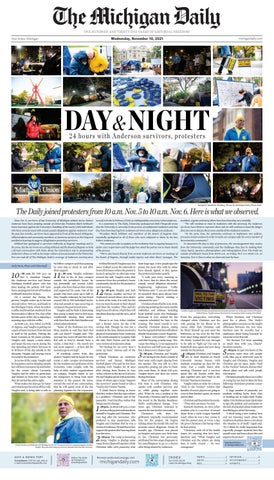
The Daily joined protesters from 10 a.m. Nov. 5 to 10 a.m. Nov. 6. Here is what we observed. Since Oct. 8, survivors of late University of Michigan athletic doctor Robert Anderson have been camping outside of University President Mark Schlissel’s house in protest against the University’s handling of the nearly 1,000 individuals who have come forward with sexual assault allegations against Anderson. Over the past few months, survivors have appeared in front of the Board of Regents, rallied students and community members at numerous protests on the Diag and testified at hearings in support of legislation protecting survivors. Schlissel has apologized to survivors indirectly at Regents’ meetings and in the press, but the survivors are asking Schlissel and the Board of Regents to hold a formal conversation with them about the University’s role in perpetuating Anderson’s abuse as well as the larger culture of sexual assault at the University. You can read all of The Michigan Daily’s coverage of Anderson, starting since Daily News, Photo and Video Staff
10
: 00 a.m. By 7:00 p.m. on Nov. 5, Jonathan Vaughn, the Anderson survivor and former Michigan football player who has been leading the protest, will have been camping out in front of President Schlissel’s house for 28 days. On a normal day during the protest, Vaughn wakes up in his tent around 6:30 or 7:00 a.m. and heads to the Michigan Union, where he orders a coffee and breakfast sandwich from Sweetwaters Coffee & Tea. One of his favorite parts of the day is enjoying a morning cigar with his coffee. At 10:00 a.m., Ann Arbor is a brisk 37 degrees, and Vaughn is getting out a pack of hand warmers from his tent to stuff in his pockets. Putting the hand warmers in his pants pockets, Vaughn said, targets a main artery and keeps his toes warm during the day. Spending anywhere between 14 to 18 hours of the day outside in the elements, Vaughn said staying warm is crucial to his endurance. In terms of the camp, Vaughn said he has gotten used to sleeping outside but will have to prepare his tent better for the winter ahead. Currently, Vaughn said he relies on generators and heaters to keep him warm, but they do not last the entire night. What makes his days go by faster and what keeps his mind off the cold, Vaughn said, is being able to talk to
his fellow campers and those passing by who stop to check in and offer their support. : 00 a.m. Vaughn estimates that in his 28 days camped outside the president’s house, he has personally met around 4,000 people who have shared their stories and supported his cause. Out of the people who have come up to talk to him, Vaughn estimates he has heard around 200 to 300 individual stories of sexual assault or rape occurring on campus in the past several years. Vaughn said he finds it interesting that young women tend to feel more comfortable sharing their stories with him than with their families and school administration. “Some of the freshmen are two, three months in and they don’t feel safe, you know?” Vaughn said. “The newness has worn off and they don’t feel safe or they’ve already been a victim. I find that — the word’s not sad, more angered — at how did the resources go so wrong?” If anything comes from this protest, Vaughn said he hopes he can create a safer campus environment for the students and professors of the University. Later tonight, with the help of other student organizations on campus, Vaughn hopes to use the manpower to bring even more attention to the protest. He notes, toward the end of our conversation, that he will spend most of the day planning logistics for the expansion.
11
news first broke in February 2020, at michigandaily.com/news/robertanderson. In a statement to The Daily, University spokesperson Rick Fitzgerald wrote that the University is currently in the process of confidential mediation and that they have been hearing from Anderson survivors since allegations surfaced: “President Mark Schlissel and members of the Board of Regents have repeatedly apologized to all of those who were subjected to abuse by the late Robert Anderson. “We cannot provide an update on the mediation that is ongoing because it is under court supervision and the judge has asked the parties not to share details of the process. “We’ve also heard directly from several Anderson survivors at meetings of the Board of Regents, through media reports and other direct messages. The
Schlissel himself, Vaughn says, has never walked across the sidewalk in front of his home where the protest is located, opting for an alternate route around the side. Vaughn notes that someone from the president’s house consistently checks for the protesters each morning. : 00 p.m. Vaughn and Jack Hanna, another survivor of Anderson’s sexual abuse, sit in chairs in front of the tents. It is cold, but the two are more focused on their shared goal than the weather. They pull six large boxes of t-shirts, which they will distribute that day and the next, out of a car. Hanna is an Ann Arbor resident and a former rower for the U-M rowing club. Though he was not a student at the time, Hanna received a physical examination from Anderson so he could compete in a regatta with the club. Both Hanna and his wife were victims of Anderson’s abuse. “It’s healing for me every time I come up here,” Hanna said of the protest site. Chuck Christian, an Anderson survivor and former Michigan football player who said he has been camping with Vaughn for 18 days after driving from Boston to Ann Arbor, returns to the site at 12:40 p.m. He and Vaughn speak with passersby, many of whom sign a large “Support the survivors” poster board or take a “Hail to the Victims” button. “I think they’re letting us know that they realize that this rape culture is a problem,” Christian said of the passersby. “And that they realize that things need to change.” : 00 p.m. At about 1:40 p.m., a man arrivesattheprotestandintroduces himself to Vaughn and Christian. The men hug after the newcomer, who preferred to stay anonymous, tells Vaughn and Christian that he was a victim of Anderson. He had flown in to support the protest after hearing about it on the news. : 00 p.m. The camp is humming along. Vaughn is playing some music from a bluetooth speaker, while Christian talks with passersby near
12
1
Chuck Christian, a football player for Michigan for the 1977-80 seasons, has been camping alongside Jonathan Vaughn. They, and other Anderson survivors, demand action from the University.
G O T A N EWS T I P? Let us know: Call 734-418-4115 or e-mail news@michigandaily.com
Follow The Daily on Instagram, @michigandaily
2
For more stories and coverage, visit
their large sign. A few people sign the poster, but most who walk by either have already signed, or they ignore the protest and mutter quietly. “I walk past every morning, so I do know that it’s about the sexual assault, sexual allegation situation,” Engineering sophomore Collin McManus said. “I can see obviously it’s peaceful, these guys always have great energy. They’re making a statement for sure.” Christian shares that he is an artist, producing paintings for many notable celebrities and athletes, including head football coach Jim Harbaugh. Everyone is very excited for the campout scheduled for later in the evening. The mood overall is very cheerful. Christian dances, noting how he is grateful that he is still able to despite his prostate cancer diagnosis. “I dance everywhere,” Christian said after hearing a catchy song. “See, ‘cause the thing is, I was supposed to be dead two and half years ago. So it’s like, I dance every chance I get.” : 00 p.m. Christian and Vaughn are sitting in the chairs outside of their tents with music playing from the speaker. The two talk to a few passersby, passing out pins to those who want them. At about 3:20 p.m, Vaughn leaves and does not return during this hour. Most of the conversation during this time is with Christian, who speaks with another survivor and us while gluing together more pins. When he was a student at the University, Christian said he painted the mural in the Bursley Residence Hall’s multicultural lounge. Two years ago, Christian returned to repaint the mural after renovations. Christian’s wife, then his girlfriend, originally recommended him for the project. He begins talking about his family life and his prostate cancer diagnosis. About 18 months ago, Christian was placed on hospice and given very little time to live. Christian has previously attributed his late-stage diagnosis to his unwillingness to go to a doctor after being abused by Anderson.
3
michigandaily.com
president, regents and many others have been listening very carefully. “We will continue to meet in mediation with the attorneys the Anderson survivors have hired to represent them and we will continue to heed the judge’s direction not to discuss the process outside of the mediation sessions. “At the same time, the university continues to implement new policies, processes and procedures in order to make our campus safer for every member of the university community.” To document the day-to-day of protestors, the encouragement they receive from the University community and the challenges they face in making their voices heard, reporters, photographers and videographers from The Daily sat outside of Schlissel’s house from 10:00 a.m. on Friday, Nov. 5 to 10:00 a.m. on Saturday, Nov. 6. Here is what we observed, hour by hour.
Jonathan Vaughn and Chuck Christian have pitched tents on South University Ave. on the grass in front of President Schlissel’s house. Vaughn has been there since Oct. 8 requesting a direct meeting with Schlissel.
From his perspective, everything changed when Christian saw his wife praying for his illness to be cured. After that, Christian said he lifted himself up and used the bathroom on his own for the first time since being placed on hospice. He slowly worked his way through to be able to “light up” his son in basketball once again and now sleep outside for the protest. : 00 p.m. Christian and Vaughn are in their element as South University Avenue buzzes with students wrapping up class for the week. Just a couple hours after meeting, Christian and a survivor speak like old friends while they glue together pins and “Hail to the Victims” buttons to hand out. Vaughn takes an order for a dozen “Hail to the Victims” t-shirts that families of soccer players are going to wear to this Sunday’s game, six maize and six blue. Christian said he prefers the maize. “They stick out more,” he said. Kenneth Stockton, an Ann Arbor resident who is a survivor of sexual abuse from a Little League baseball coach when he was a boy, comes to visit the protest once or twice a day. He gives Christian a fist bump when he first arrives. “Christian, with all of his health issues, it’s amazing that he’s here,” Stockton said. “What Vaughn and Christian and the others are doing here is really crucial — it’s very courageous.”
4
IN DEX
Vol. CXXX, No. 58 ©2021 The Michigan Daily
When Stockton and Christian pose for a photo, The Daily’s photographer remarks on the height difference between the two men. Stockton says he recently had a nightmare about being haunted by someone seven feet tall. “It’s because I’ve been spending so much time with you, Chuck!” Stockton remarks. : 00 p.m. In just two hours at the protest, more than 450 people walk, bike, jog or otherwise pass by Vaughn and Christian. Vaughn and Christian put up signs, make “Hail to the Victims” buttons, discuss their dinner plans and talk with people who stop by. Christian proudly shows us a video of a song his son had written for him following Christian’s prostate cancer diagnosis. A large number of passersby are students walking home from class or heading out to begin their Friday nights. LSA freshman Sam Lipsit stops to sign the petition and comments on the lack of education about Anderson’s horrible legacy at the University. “I think being a new student here and not knowing much about the Anderson situation shows a lot about the situation in of itself,” Lipsit said. “So I think it’s really important that especially younger students here like myself come and learn about this and support the protest.”
5
Read the full story. at michigandaily.com
NEWS.........................2 A RTS........................... 3 M IC . . . . . . . . . . . . . . . . . . . . . . . . 4
O P I N IO N . . . . . . . . . . . . . . . . . . . . 5 S TAT E M E N T. . . . . . . . . . . . . . 6 SPORTS......................7
News
2 — Wednesday, November 10, 2021
The Michigan Daily — michigandaily.com
PHOTO
Stanford Lipsey Student Publications Building 420 Maynard St. Ann Arbor, MI 48109-1327 www.michigandaily.com
CLAIRE HAO
Editor in Chief eic@michigandaily.com
TARA MOORE
Business Manager business@michigandaily.com
NEWS TIPS
tipline@michigandaily.com
LETTERS TO THE EDITOR tothedaily@michigandaily.com
EDITORIAL PAGE
opinion@michigandaily.com
PHOTOGRAPHY SECTION
ARTS SECTION
photo@michigandaily.com
arts@michigandaily.com
NEWSROOM
SPORTS SECTION
news@michigandaily.com
sports@michigandaily.com
CORRECTIONS
ADVERTISING
corrections@michigandaily.com
Editorial Staff
MADELINE HINKLEY/Daily Gov. Gretchen Whitmer speaks with The Michigan Daily at the Michigan Union on Friday, Nov. 5.
ACADEMICS
UMich releases official statement on Bright Sheng
President Schlissel, SMTD dean pledge commitment to academic freedom KATE WEILAND Daily Staff Reporter
Bright Sheng, School of Music, Theatre & Dance professor, will continue to teach composition lessons this semester and is scheduled to teach a regular course load next semester, the University of Michigan announced in a statement on Nov. 3. This comes after the situation received national scrutiny and opened up conversations on political correctness and academic freedom. Though Sheng has not been reinstated to teach the composition class in which controversy originally arose, “no sanctions have been imposed on him,” the statement reads. Sheng initially faced backlash from students for showing a video featuring an actor in blackface to an undergraduate seminar on Sept. 10. The use of this video in class caused students to speak out and criticize Sheng. Sheng, after consultation with SMTD administration, stepped down from teaching the class on Oct. 2. A different
professor took over the class in which the controversy arose and continues to teach the course. On Sept. 16, Sheng released a formal apology to the department, yet this too received backlash from students, specifically the part of the apology in which Sheng listed people of color that he has worked with. Sheng has also offered to meet with students and discuss different perspectives one-on-one. Following Sheng’s apology, students wrote an open letter to SMTD Dean David Gier calling for Sheng’s removal from the undergraduate composition seminar and an investigation into the course, citing a failure to create a safe environment. This letter was signed by 18 undergraduate composition students, 15 graduate composition students and 9 SMTD staff and faculty members. Gier responded to the letter in a Nov. 3 email to his colleagues, emphasizing that the incident opened up conversations regarding the intersection of academic freedom, freedom of speech and the importance of fostering a diverse environment for students.
“SMTD students and faculty routinely confront complex, challenging material, and consider complicated historical legacies that require purposeful discussion, critique, and analysis,” Gier wrote. “As dean I am steadfastly committed to fostering such dialogue within our School, and protecting the rights of both students and faculty to pursue lines of inquiry and express ideas without fear of reprisal, a value that is fundamental to the university’s core missions of research and education.” On Oct. 21, around 700 University faculty members and students signed an open letter addressed to Grier calling for Sheng’s return and for the administration to apologize. The University has not yet reinstated Sheng. On Oct. 20, the University’s Office of Public Affairs confirmed that the Equity, Civil Rights & Title IX Office determined they will not be investigating Bright Sheng’s course. In the Nov. 3 statement, the University says it supports academic freedom and free speech and plans to continue discussing these issues with the Office of
Diversity, Equity, and Inclusion and the National Center for Institutional Diversity. SMTD is also set to host a series of facilitated conversations to promote different perspectives on campus. University President Mark Schlissel said in a Nov. 3 statement that the University is committed to having open conversations about diversity. “Discourse that addresses conflicts among differing viewpoints is essential to higher education,” Schlissel said. “Honest and respectful discussions of ideas — even those that make us uncomfortable — help us learn and grow. These are issues we must address together as an academic community committed to inquiry and greater levels of understanding.” Provost Susan Collins and Robert M. Sellers, Vice Provost for Equity & Inclusion and Chief Diversity Officer, both said in the statement that work within the community to navigate these issues and their intersection will continue. Daily Staff Reporter Kate Weiland can be reached at kmwblue@umich.edu.
GOVERNMENT
Gretchen Whitmer talks higher education, voting rights The governor sat down with The Michigan Daily during her visit to Ann Arbor JULIA RUBIN
Daily Staff Reporter
Gov. Gretchen Whitmer sat down with The Michigan Daily in the Michigan Union on the morning of Nov. 5 while in Ann Arbor to sign the second bill repealing the state’s “tampon tax,” a term referring to the state’s value-added tax on menstrual products. In the interview, Whitmer discussed efforts to increase gender equity in Michigan, the importance of student political involvement and her vision for state-wide improvements in education, child care and infrastructure. The Michigan Daily: Yesterday, you signed a bill repealing the state’s tax on menstrual products, and you’re here today signing similar legislation. What kind of message do you hope to send, and how do you think it will benefit Michiganders? Gov. Gretchen Whitmer: (Twentythree) other states do not collect sales tax on tampons and pads. Michigan has though, and so for 10 years we’ve been trying to change this law. I actually was the author of it a couple of times in the legislature. Rebekah Warren, who used to represent Ann Arbor, was one of the first authors of it. I never dreamed that it would take
this long to get done, number one, and number two, that I’d be the one who’s signing it. But I’m thrilled because we know that the purchase of these essential items is not discretionary. It’s an absolute essential need, and when we tax it, we disproportionately hurt women and girls in Michigan, and that’s why it’s so important that we eliminate this tax: So anyone who mentrautes in the state of Michigan now will not have to pay this additional burden. People spend thousands of dollars (on menstrual products) over the course of a lifetime. This is a meaningful improvement in terms of the bottom line for people like my daughters and me, all of us who menstruate. TMD: Michigan is only the 23nd state to repeal the tax on menstrual products, while 28 more haven’t done so. What would you say to the other states that are continuing to tax these products as luxury goods? Whitmer: What I’ve said to past legislatures who wouldn’t get the bill passed is that there is an extra burden on women, and we should alleviate it. So other states should as well. But this is something that we can boast in Michigan. We’re going to have a day of action in 90 days, when this goes into effect, where we’re going to encourage people
to buy these products and give them to (shelters). TMD: After you recently vetoed a bill that would institute voter ID requirements, Secure MI Vote has begun work circulating a petition to implement these requirements without your approval. How would you anticipate students being affected by these efforts? Whitmer: We had a historic election in 2020. We had huge turnout. It was a fair and safe election despite all of these false narratives that are out there, all of these attacks on our electoral system, and it worked. The results reflected the will of the people, and that’s what our democracy is all about. Usually, the person who doesn’t win an election goes back and tries to change how they communicate, change what they focus on, and earn the support of the masses. Instead, the Republican reaction to the outcome of last year’s election is to cut people who validly voted of the ability to vote by creating barriers by making it more difficult. This is absolutely undermining our democracy, and it’s trying to turn over an election that was fair and full and has been litigated to the nth degree. They’re trying to cheat, and I’m not going to let it happen on my watch. So I’m going to
veto any additional threat to our electoral system that is designed to make it harder for people to vote, including students. We’ve recently made it easier for students to vote when we amended our Constitution. It used to be that you had to vote in-person for your first election. That had a disparate impact on younger voters, so I’m not going to let any additional threats and any additional hardship happen. I want to make it easier for students to vote, because I think students have the longest interest in outcomes of elections and they need to be able to vote. TMD: What would be the one piece of advice that you have for students who want to pursue a career in public service, but might be discouraged by the current political climate? Whitmer: Don’t get discouraged. Don’t tune out. Right now is the time to tune in. Any students who are interested should jump in and either work on a campaign or run for office themselves. Now, younger people have a tendency to think that they don’t quite have the credentials to run. That’s baloney. I encourage young people to get out there and to run for office.
Read more at MichiganDaily.com
WMG-contact@umich.edu
BRITTANY BOWMAN Managing Editor
babowm@umich.edu
JACK GRIEVE
Digital Managing Editor
jgrieve@umich.edu
BARBARA COLLINS and LIAT WEINSTEIN Managing News Editors
news@michigandaily.com
Senior News Editors: Emma Ruberg, Hannah Mackay, Calder Lewis, Jasmin Lee, Kristina Zheng, Lily Gooding Investigative Editor: Sammy Sussman FOIA Manager: Ayse Eldes
ELIZABETH COOK and JOEL WEINER
Editorial Page Editors tothedaily@michigandaily.com Senior Opinion Editors: Julian Barnard, Brandon Cowit, Shubhum Giroti, Jessie Mitchell, Evan Stern
LANE KIZZIAH and KENT SCHWARTZ
Managing Sports Editors sports@michigandaily.com Senior Sports Editors: Drew Cox, Lily Friedman, Jack Kingsley, Brendan Roose, Daniel Dash, Jared Greenspan, Jacob Cohen
ELISE GODFRYD and ELIZABETH YOON
Managing Arts Editors arts@michigandaily.com Senior Arts Editors: Kari Anderson, Drew Gadbois, Andrew Pluta, Grace Tucker, Sophia Yoon Arts Beat Editors: Lilly Pearce, Peter Hummer, Mik Deitz, Sabriya Imami, Kaitlyn Fox, Anya Soller
SHANNON STOCKING and ALLISON YIH
Managing Design Editors Senior Layout Editor: Sophie Grand
design@michigandaily.com
ALLISON ENGKVIST and MADDIE HINKLEY
Managing Photo Editors photo@michigandaily.com Senior Photo Editors: Emma Mati, Miles Macklin, Becca Mahon, Julia Schachinger Assistant Photo Editors: Grace Beal, Tess Crowley, Kate Hua, Jarett Orr, Dominick Sokotoff
ANDIE HOROWITZ
Managing Statement Editor Deputy Editors: Samantha Cole, Leo Krinsky Associate Editor: Julia Maloney
statement@michigandaily.com
MADISON GAGNE and OLIVIA BRADISH
Managing Copy Editors copydesk@michigandaily.com Senior Copy Editors: Caroline Atkinson, Anjali Chiravuri, Ethan Patrick, Kelsey Burke, Emily Wilson, Vanita Seed, Ellen Howell, Kathryn Kulie, Rena McRoy, Alison Chesnick
PARTH DHYANI and NAITIAN ZHOU Managing Online Editors
webteam@michigandaily.com
IULIA DOBRIN and ANNIKA WANG
Managing Video Editors video@michigandaily.com Senior Video Editors: Margaret Rudnick, Jordan Shefman
ANAMIKA KANNAN and GABRIJELA SKOKO
Michigan in Color Editors michiganincolor@michigandaily.com Senior Michigan in Color Editors: Noor Moughni, Maya Kadouh, Eliya Imtiaz, Jessica Kwon, Lola Yang
EMILY OHL and GERALD SILL
Managing Podcast Editors podeditors@michigandaily.com Senior Podcast Editors: Doug McClure, Max Rosenzweig, Avin Katyal
HALEY JOHNSON and ASHA LEWIS
Managing Social Media Editors socialmedia@michigandaily.com Senior Social Media Editors: Kirti Aplash, Natalie Knight, Cristina Costin, Ryan Postman, Evan DeLorenzo, Sarah Kent, Bella Morreale
NEWS BRIEFS
COVID-19 cases increase on campus
ALEX HARRING and SARAH SZALAI Co-Chairs of Access & Inclusion
accessandinclusion@michigandaily.com
Rising numbers attributed to fall break, Halloween weekend JUSTINE RA
Daily Staff Reporter
COVID-19 cases at the University of Michigan have increased over the past two weeks, according to an email sent to the campus community from University President Mark Schlissel Nov. 5. The increase in cases can be attributed to social gatherings and household exposures, Schlissel wrote. According to the U-M COVID-19 Dashboard, the recorded number of cases jumped from 68 the week of Oct.
17 to 104 cases the week of Oct. 24. Of these cases, just over two-thirds of them can be traced to the student population. The positivity rate on campus also rose from 1.3% the week of Oct. 24 to 2.4% the week of Oct. 31. The University identified two clusters this past week, which are believed to have contributed to the rising numbers. The clusters involved a total of 40 students from two different academic programs. All positive cases are now isolating. Schlissel wrote that the cluster cases
are linked to gatherings over the Halloween weekend and travel during Fall Break rather than in-person classes. “As changes in weather have driven more activities indoors, it is very important to wear a face covering, make good decisions when interacting and stay home if you’re sick,” Schlissel wrote. The University has also implemented “enhanced surveillance measures” to isolate any additional cases that might stem from these clusters, according to the dashboard. The campus community is also experiencing a rise in influenza cases,
Schlissel wrote. The University Health Service saw flu cases increase from 13 to 154 this past week. UHS said the majority of flu cases are in individuals who have not received the flu vaccine. In his email, Schlissel urged community members to get their flu shot as soon as possible. “As we’ve said before, the flu is likely to be a larger concern this year after several months of fewer in-person interactions,” Schlissel wrote. “Please get a flu shot.” Daily Staff Reporter Justine Ra can be reached at rjustine@umich.edu.
Business Staff RORI MILLER Creative Director
SCHUYLER JANZEN Sales Manager
The Michigan Daily (ISSN 0745-967) is publishing weekly on Wednesdays for the Winter 2021 semester by students at the University of Michigan. One copy is available free of charge to all readers. Additional copies may be picked up at the Daily’s office for $2. If you would like a current copy of the paper mailed to you, please visit store. pub.umich.edu/michigan-daily-buy-this-edition to place your order.
Arts
The Michigan Daily — michigandaily.com
Wednesday, November 10, 2021 — 3
The real “outsiders”
It’s an honor to be like other girls
ROSA SOFIA KAMINSKI Daily Arts Writer
Design by Kristina Miesel
EMMY SNYDER Daily Arts Writer
“You’re not like other girls,” he says. You are supposed to take this as a compliment. But what he really means when he says this is that he looks down on women and girls as a whole and you do not fit the degrading image of women he has in his mind. And of course you don’t! Because (like all other women), you’re unique and a powerhouse; these are two things that couldn’t be further from that image of women he has in his mind. This is something you’ve only learned with time, or are maybe just realizing now. If that’s you, welcome. I’m so honored to be a part of this moment with you, and we are so glad you’re here. First, the crucial question: Where does the “not like other girls” phenomenon come from? Obviously, in the general sense, it’s the product of a patriarchal society that devalues women. But the phenomenon is reinforced in a plethora of ways in pop culture as well as through interpersonal interaction (like the one with our Average Joe above). For example: despite my respect for Taylor Swift as a woman, a musician and a strategist (Swifties, please don’t come for me), the iconic and pervasive lines “She wears short skirts / I wear t-shirts / She’s cheer captain, and I’m on the bleachers” are the poster child for this trope. “You Belong With Me” shot to stardom and still has a special home in the cultural zeitgeist because it resonated with all of us, reminding us of that pang of sorrow and jealousy we felt watching our crush date someone else. Over some delightful chords, Swift says what we only wish we could have: You should be with me instead. Unfortunately, the song doesn’t just say that your crush should be with you because you’re great — it crosses a line by arguing that your crush would be better off with you because the girl he’s with now is “like other girls” and you’re not. In the equally popular cult-classic film “Pitch Perfect,” Becca (Anna Kendrick, “Love Life”) is an excellent archetype of this. She’s moody, she likes to produce music instead of singing it, she wears dark eyeliner, she refuses to partake in activities that many other women find fulfilling, she rejects the advances of the Dream Guy™ — you get the gist. While she ultimately does find love and belonging in her rela-
tionships with other girls, the film elevates her as the desired woman because she’s “not like them.” A significant period of my life was defined by my efforts to not be like other girls. I wore the same Under Armour sweatshirts as the boys in my class, I read the Warriors series when they did (you know, the completely plausible one about the warring gangs of cats), I wore the same DC skate shoes and I spent my recesses playing knockout on the basketball court instead of sitting on the bleachers talking to my girl friends. Not that there was anything inherently wrong with that. In hindsight, though, I did everything the boys did, not just out of enjoyment, but also because I thought that being “like other girls” was a bad thing (wrong) and figured the best way to be the least like other girls was to be like the boys (also wrong). As my roommate pointed out over one of our mac and cheese dinners, it has “become cringe” to say that you’re “not like other girls.” How interesting that, as the concept has been interrogated, its insidious nature exposed to the world, it is women who take the fall. Even now, the message is clear: It is the women who once fell prey to the ideology, rather than the men who cultivated it, who should feel embarrassed. From its conception, the “not like other girls” phenomenon was destined for a significantly long run before its current reckoning because it obscures the role of the oppressor in pitting women against each other, allowing for him to abscond, even now. In possibly my favorite tweet of all time, @mcapriglioneart wrote: “No, no, no. You misheard me. I didn’t say ‘I’m not like other girls.’ I said ‘I LIKE OTHER GIRLS. IM GAY.’” In another (now deleted) tweet, @MissElla wrote, “im not like other girls in their mid-twenties. Im childish like a 13 year old and moody like a 90 year old on their death bed.” These women illustrate (in the most amusing way possible) what we know to be true, now and forever: It’s not embarrassing to be like other girls. In fact, it’s an honor. I couldn’t be more proud of the ways I am like other girls. I cherish the relationships I have with the women who enrich my life, each one of them bringing something special to the table I’d be worse off without. They empower and inspire me to be the best version of myself, and lift me up and accept me on the days when I can’t manage that.
Read more at MichiganDaily.com
Loneliness, at one time or another, has played a central role in many people’s lives. Whether it is actual isolation or a fear of it, it plays into how people look at their social interactions, and at the value of their lives. How lucky we are that music exists! “Outsidership,” especially when considered through music, is strangely a very connecting experience at times, realizing you and others see the world in the same way. And there have been so many fantastic musicians (Nirvana, Radiohead, Velvet Underground) who express deeply their own personal experiences of outsidership. Much of rock, indie rock and grunge were founded around this feeling. The more specific you get, the more a general audience can relate. My anger rises when these bands (so often white, straight and cis masculine) or their fans pervert the label of “outsider” and take it only for themselves. It most certainly has to do with the feeling of being wholly individual — but everyone is a whole individual. Pop music listeners are whole individuals too. Taking the label of “outsider” and keeping it for oneself is not what most of these bands were about. Ironically, being an outsider is a shared experience. It is widely shared by women, people of color and members of the LGBTQIA+ community. I have certainly stepped into many rooms in my life full of men and instantly felt an uncomfortable twinge as I had to reconsider how to relate to them in conversation, or if I should instead stay silent. And there are many fans of these bands, and some bands themselves, that don’t fall into any of these categories and refuse to acknowledge outsider identities besides their own. Although we might all at some point feel desperately alone, there are some who are born into that and can never escape from it. This creates certain bands and listeners that thrive off making people uncomfortable. In communicating their own emotional experiences, they use too much anger, not enough empathy. In writing this, I am not trying to attack anyone’s social experiences. Some prefer to exist mostly or entirely alone. Some thrive that way and don’t need people in their everyday life to enjoy their existence. Some have become alone due to others not talking to them because they think they are different or odd, which in turn causes them to talk to fewer people, and then fewer and then barely any at all. These are not the people I am talking about, and nor would I ever want to criticize them. The ones I refer to are those who use their “outsider” mindset to suck the joy out of art for others.
I have met countless people, often men, with a superiority complex about the music they listen to. They look down on pop music, dismissing it as pap. At one point, I bought into this. Entrenched in the world of male-dominated punk before realizing how deeply problematic it is, I bought into a bitter outsider mindset that looked down on pop music, which I pronounced with special derision. Then, amid discovering the usage of swastikas and iron crosses by bands [COPY: need a link here] like the Ramones and the Dead Boys in the CBGBs punk scene in New York (documented by Legs McNeil and Gillian
feminist, and wrote “Polly” and “Rape Me” (both stories concerning sexual violence) as middle fingers to sexism. He believed that men should be educated not to rape, rather than women being asked to protect themselves. However, the lyrics to both of these songs are incredibly incendiary. While he meant them to be empowering stories of women defending themselves, that is certainly not their only or even their most obvious interpretation. Bands in such positions of prominence have a lot of influence, and when they release something, it will surely be interpreted in a million different ways.
McCain in “Please Kill Me”), [COPY: need a link for the book] or Sid Vicious of the Sex Pistols, I realized how messed up they had made this culture. The swastika, as they tried to explain it, served as a symbol to shock people. [COPY: link] Obviously, that is absolutely no excuse. In their anger, they alienated those who had already undergone trauma and trial, who had literally been cast out of society and tortured and persecuted. They claimed the outsider label as their own, making the punk scene a worse place to be for people with actual marginalized identities. As discussed in Todd Haynes’s new documentary “The Velvet Underground,” The Factory, run by Andy Warhol and producing acts such as The Velvet Underground, was a toxic place for women, a place where they were valued only for their looks. When you see a whole music scene full of white people, or full of men, it’s not because there were no marginalized identities that would have wanted to become part of the scene. It’s because there was a lot of racism or sexism or any other -ism involved. When listeners consist of a majority of men, it is worth asking oneself why. Sometimes, the culture is formed by the band. But other times, it is misinterpreted by the fans. Especially with sensitive subjects, it matters less the intent that the artist created with, and more the way the general audience will most likely interpret the lyrics. For example, Kurt Cobain of Nirvana was an avid
The source also matters; on discussing with a friend, he remarked that these probably would have come off quite differently as Courtney Love songs, rather than Nirvana songs. Even though Cobain’s intentions were good, these songs can likely serve to fuel something terrible inside some listeners and do not take into account his responsibilities as an influential male artist. Even if the mostly male, white bands that filled these genres aren’t at all bad people, not many of them considered their domination of these musical genres. It is due to this that a whole counter-movement formed (that of riot grrrl) and is still ongoing. When searching for indie rock bands in the ’90s, you have to pick through legions of white men at the forefront, before reaching people of identities that society has automatically deemed outsider. For example, Long Fin Killie, an indie rock band from the ’90s headed by Luke Sutherland, a gay Black man, has just 1,470 monthly listeners on Spotify. Although they made important strides toward inclusion in one of the whitest, most male-dominated genres of them all, his and the band’s names are virtually unknown. It is this form of sexism, racism, homophobia, transphobia, etc. that is the most prevalent: that of simply not considering how much space you take up, and whose voices are not being heard.
Design by Samuel Turner
Read more at MichiganDaily.com
Why do we gatekeep? CONOR DURKIN Daily Arts Writer
Finding hidden gems has always been an obsession of music fanatics: stuffing eager faces into dusty crates, with two fingers grazing the record sleeves alternating to and fro, leafing through hundreds of records to grab some tantalizing faded cover art and bring that forgotten music to the light. When the needle hits the wax, the question arises for the music collector: To share or not to share? Do we rush to have the song in
another’s ears, hide it away for the perfect moment to surface or keep it tucked away forever? What if it’s shared to the wrong person? What if it finds its way to the internet? What if, God forbid, it gets to a place like TikTok or Youtube recommendations? Before long, everyone’s playlists and “Now Playing” are marked with that special sound you worked so hard to find, that secret gem you kept all to yourself. These are the anxieties of a gatekeeper. It’s a perfectly normal consideration, rest assured. We might all have thought proudly to ourselves, I lis-
Finding Catholics in Early America
Susan Juster
Rhys Isaac Collegiate Professor of History
Wednesday, November 10 2021 | 4:00 p.m. | Weiser Hall, 10 th Floor
“ Mumbling Masses and Jumbling Beads”
LSA COLLEGIATE LECTURE
A public lecture and reception; you may attend in person or virtually. For more information, including the Zoom link, visit events.umich.edu/event/84264 or call 734.615.6667.
tened to them before they were cool, in response to a shared appreciation for an artist, slyly signaling that we are definitely not jumping on any bandwagon. We all desire to be just a tad bit original; we all have a little hipster inside of us that secretly delights at the discovery of an untouched piece of art that brings us the same level of enjoyment as any other. Because as much as we might like to think we are comfortable with the exposure and discourse of our favorite hidden gems, there will always be a time an album goes omitted in a discussion, a song so obscure yet so deliciously good it can’t even get extended playlist treatment, an artist we purposefully neglect to mention. Gatekeeping is less an active campaign to silence the spread of music and more of an internal plea we all have in our minds — in one way or another, no matter how loud that plea is actually voiced, the desire to keep things dear to us safe will always ring true. As much as we cheer for the success of the artists that bring us so much joy, the transition from obscurity to popularity is one without its pitfalls for devoted fans. The Japanese funk band that hasn’t found its way through the Youtube waves yet, the bedroom pop artist you’re pretending wasn’t just reviewed by Pitchfork, the 15,000 monthly listener indie-folk artists you could have sworn was only 1,500 a month ago, as much as we’d like to champion around their success, there’s a small part of us unwilling to let that go. So where does this desire to gatekeep come from? Discovery is inevitable, and it’s safe to say that gatekeepers understand that. If they have confidence in the quality of what they are attempting to gatekeep, whether that be a psychedelic pop artist from the ’70s that verges a little too hard on the abstract or an album only available on the deep reaches of Youtube, they also have the slight doubt in their mind that
quality will inevitably translate into pedestrian attention marked by Spotify curated playlists and mainstream publication reviews. Gatekeeping is impossible, yet it prevails despite futile efforts. It’s not so much a tangible ability to control the spread of information — especially in our time where it spreads at such a rapid pace — but rather an empty attempt at control for comfort. The question “to share or not to share” is not as hard for those who dig purely for their own enjoyment and pay no attention to any rise in popularity, or for those who truly don’t care for those who dig to truly expose, such as the label “Numero Group” with a model to revitalize and renew the music. Their project with Duster allowed new distribution of their music along with their newfound popularity, amongst other forgotten artists. They give them a second chance at success for their art, a second chance at exposure for their music to reach a wider audience. As for communities like Rateyourmusic.com, the music side of TikTok, Discord servers devoted to the discussion of music, subreddits and private Facebook groups, the question remains a delicate one. Gatekeeping is still a very prevalent practice in Internet communities, but it’s hard to say if their influence of popularity reaches outside their own communities, or is contained to the bickering inside a comment box. Despite the fact these are microclimates and niches amongst music communities, they speak to a very real approach to the division of artists amongst listeners. Surely, we can’t all be as perfect as an archive label, and surely, we aren’t as bad as Internet hoarders masquerading as collectors. But still, that inner hipster rests inside of us, and where does it come from? What is the obsession with “obscurify,” the engine that ranks
how “obscure” your Spotify data is, and what is the delight of having our number hit 70%, 80%, 90%? 91%? We gatekeep to prevent the music from being subject to analysis from others. In effect, when others listen to a piece of music, it changes as it gets passed around from ear to ear. No matter how hard we try, how hard
judgment of others? To conceal is to contain it in its most pure form to be enjoyed forever, on repeat: a rapture of sound at each click of that play triangle, free from outside scorn and meant just for you. When we value the esoteric quality of the work more than the work itself, what we lose is that confi-
Design by Jessica Chiu
we stay to our convictions, the seeds of doubt from Pitchfork reviews and YouTube replies and empty comments from friends will always be in the back of our minds. Gatekeeping is simply a prevention tactic until the very last moment before the pristine, delicate, perfect, untouched perception of the music we hold in our minds gets muddied by the subjection of others’ thoughts and feelings. It’s a method to stave off that second before the image of the music we hold so dear in our head, the absolute image of that music, is altered. Even guilty pleasures are a part of this treatment. On one hand, we conceal our guilty pleasure songs and artists to save ourselves the shame and embarrassment of sharing such enjoyment, but on the other, is it not to also preserve our own image of that music in our head? Do we hide our pleasure at these songs to save them from the
dence in it. This, in turn, is possibly another reason why it’s gatekept so hard: because that perfect image of the work cannot be touched by a scathing critique or the idea that the work’s quality is dependent on The virginal piece of music brought to light sacrifices the delight and pleasure of its obscurity. That’s why we gatekeep, but we also show: to feel the intimacy of introducing a friend to music never touched by their ears. Sharing music is a way of connection and communication. To share a hidden gem or an obscure piece of music special to us contains the same level of intimacy as sharing our favorite ’80s hits or our most listened to artists. The reason people gatekeep is because of this intimacy, or the fear of that intimacy.
Read more at MichiganDaily.com
Michigan in Color
4 — Wednesday, November 10, 2021
The Michigan Daily — michigandaily.com
The Certified Lover Boy: Why Drake crediting R. Kelly harms Black women MARIA PATTON MiC Columnist
Every time I think society may be making progress when it comes to protecting, respecting and standing in solidarity with women as we fight systemic abuse, I am gravely mistaken once again. As a Drake fan, it pains me to write this article, but we must talk about this issue. In his highly anticipated album, Certified Lover Boy (CLB), Drake credits R. Kelly as a writer on his song “TSU.” The track opens with a clip of DJ OG Ron C asking women “what’s going down” in a drawling voice as R. Kelly’s “Half On a Baby” gradually builds in the background. Drake did not work with R. Kelly on this song, nor is R. Kelly’s voice in the song, yet CLB producers credited R. Kelly with co-writing because they used some of his song in the production. This credit is problematic because it provides R. Kelly, an accused and convicted rapist and child molester, access to monetary royalties that could help fund his court trials for sex trafficking and sexual abuse. Drake has chosen to associate himself with this man and completely disregard how this may harm his fans who are Black women. This proves, yet again, that America couldn’t care less about the treatment of Black women, and will con-
tinue to find ways to show it. Not only has Drake created space for a celebration of R. Kelly’s music, but he has also reintroduced potential trauma for the women who have fought against R. Kelly’s power in the past years. Numerous women, many of whom are Black, have shared their stories about R. Kelly, opening up about being sexually assaulted by the singer. He married Aaliyah when she was only 15 years old, and yet he was continuously embraced in the entertainment industry and by Americans at large. The 2019 documentary, “Surviving R. Kelly,” centers the women who came forward as they describe their abusive relationships with him. These women have had to continuously relive their trauma in private and public, and people continue to deny and gaslight their truth at the hands of R. Kelly. His maintained power, despite endless claims against his humanity, is a testament to the social influence of success and the disadvantage that victims of sexual assault have when their abuser is someone with significant social wealth. Drake is considered one of the greatest musicians of all time and is the epitome of social influence and power. Once this power imbalance and influence is addressed, it becomes unbearably clear what kind of harm can come from Drake’s crediting R. Kelly on his highly anticipated album. Drake’s producer, Noah “40” Shebib was
somehow baffled by the fact that people would believe he and Drake — someone who has also been accused of having inappropriate relationships with minors — would work with R. Kelly based on R. Kelly’s past. Although Drake and Shebib claim they do not support R. Kelly, their choice to sample OG Ron C suggests otherwise. Simply, they have failed to take accountability for the harm they have caused. If they knew they would have to give R. Kelly credit, and how that credit would benefit him, why use the sample? Regardless of their intentions, the impact of their decision has major consequences for the women who are fighting R. Kelly, his wealth and his power, in this legal battle. It was recently revealed that R. Kelly has been struggling financially and has obtained a lot of debt, so Drake’s credit has provided R. Kelly with financial capital that he could use to back his court trials. Aside from simply financial capital, Drake’s cultural influence often guides social trends, so this credit has validated his fans’ support for R. Kelly’s, whether intentional or not. CLB’s theme is to embrace “toxic masculinity and acceptance of truth,” and in its first few weeks, it tied the record for most top ten hits off a single album. It has also held a top two spot on the Billboard Top 200 (albums) list for five weeks in a row. This album was all but guaranteed to reach millions of ears and
Design by Madison Grosvenor
make millions of dollars, and as a result, so did R. Kelly. R. Kelly was recently convicted of racketeering, sex trafficking, acts of bribery and exploitation of a child in New York. He also faces similar charges in other states, including Illinois and Minnesota. Drake’s blatant negligence for this writing credit’s impact is disgusting and is a perfect example of how men have the privilege to ignore the struggles women endure while still being able to succeed. Granted, it is similarly disturbing how accepting society is of such degradation for the sake of quality entertainment. While women continue to fight the treacherous battles towards gender equality, men are able to ignore our pain and continue to contribute to the root of the inequity and society lets it happen. Drake’s choice is especially difficult for me, as a Black woman, because it always feels like
no one is fighting for us when we say we are struggling and need help. Even the Black men we expect to fight for us ignore our pain with ease. It is extremely difficult to see yet another artist, who I have been supporting for years, who creates art that I love and consume on a daily basis, prove to be yet another individual who couldn’t care less about the very people who love and support them. It feels like all the advocating and boycotting that I do is pointless because society seems to be flooded with people who simply don’t care about the struggles Black women around them endure. I don’t know how much more disappointment I can take. I don’t understand why I constantly have to choose between consuming what makes me happy and fighting for what I believe in. Will Black women ever receive the respect we deserve? Or will we continue fighting for ourselves with no end in sight?
Digesting foods as racial metaphors DEVEN PARIKH MiC Columnist
I am my bedroom: neat, colorful and diverse. There, my two cultures collide. Covering my bed lies a 49ers blanket overlaid by an Indian shawl. Painted on the walls are my favorite sports teams’ colors amidst a portrait of Hindu idols, like Sai Baba and Ganesh. My closet is the same. On one side hangs a traditional kurta and on the other, a simple suit: both tailored for the appropriate occasion. Raised in America, I did my best to connect with my Indian side; I loved visiting the temple, celebrating Diwali, attending Garba and other Indian functions. Even though I had never been to India, I never felt lost. I always felt connected to both my heritage and my place of birth. When I first settled in Ann Arbor this past semester, I was delightfully shocked by the amount of Indians here, which I thought would be few based on my misconceptions of the Midwest. I was excited to join organizations like the Indian American Student Association and meet new people who share my heritage. In many of my conversations with students in the organization, we discussed what traditions or customs we grew up participating in and what it was like growing up Brown in different parts of Amer-
ica. Whenever the question about what part of India we were from arose, I would enthusiastically answer that my family was from Gujarat, but hesitantly add that I had actually never been
University of Michigan that I had never been to India, I got a new response: “So you’re a coconut.” I was confused. I’d never heard that term before. I paused for a second, and before
to India. Typically, when I tell people that I’ve never visited India, I receive comments like “So you’re whitewashed,” or “You’re basically white.” I would uncomfortably laugh off the joke, not knowing how to respond. However, this time, after telling my new friend at the
I could answer, my friend replied, “You know, white on the inside, Brown on the outside.” That phrasing seemed familiar. It then hit me; I recalled numerous instances when people throughout high school would use different colored foods interchangeably to describe people of color.
Design by Caitlin Martens
All my love to Lane Kim SARAH AKAABOUNE MiC Columnist
I stuck through “Gilmore Girls” even though Lorelai Gilmore seemed like the kind of person to tell you she didn’t study for the test when she really did, the kind to make you feel bad for pulling out a calculator to add up the bill plus the 15 % tip on top even though after dinner your mind can only do so much mental math and the kind of person to tell you she never said something so adamantly she’d make you question your own sanity for weeks on end so you’d ask yourself Did I really feel that and hear that and understand that? Over and over and over. Even though she really did say the thing she said she didn’t say.But Lorelai made up for everything in wit and it made her tolerable, charming even, so that liking Lorelai one day and despising her the next depended on the episode and your mood and whether you watched “Gilmore Girls” on a Wednesday or a Friday. Because Lorelai was so temperamental, paper-thin in that special sort of way, she rendered it almost impossible to cherish or hate or adore or even simply enjoy her in all her volatility. Her relationship with Rory was impactful, powerful, the mother-daughter duo America loved to love because Lorelai Gilmore named her daughter after herself and no one in the history of motherhood had ever done such a bold thing. It was genius, and it made watching their bond unfold and grow once a week an even more enjoyable prospect. You do not grow to despise either Rory or Lorelai because they have never been the kind of characters with enough substance to follow, to unravel, unpin and untie, until you begin to realize you aren’t really liking what you’ve found. It is an instantaneous process, it happens between the span of one episode and another for you to realize, YOU KNOW WHAT, THIS ISN’T REALLY WHAT I HAD IN MIND. You begin to understand that Lorelai is filled to the brim with immaturity and that Rory is more of a mother than she ever will be and even more so, if Lorelai is this insufferable, then Rory must be a million times more unbearable. Rory is so smart and so pretty and she’s going to become the next Christiane Amanpour and Rory is just the most perfect, thoughtful, insightful teenager this country has ever seen. Except it was never really about the kind of person Rory Gilmore was, because nothing about a normal teenage girl from the East Coast was as ragingly fantastic as everyone had made it seem for so long, but it had everything to do with the position that Rory occupied. The grandparents that paid for a private school education, Stars Hollow, the blue house with the wrap-around porch and the very entirety of white womanhood gave her charm, the unabridged power and propriety that became so synonymous with what it meant
to be Rory Gilmore. And to deny Rory such a thing is to reduce her to nothing. And what about Lane Kim? Whatever happened to Lane Kim? Rory’s best friend forever and ever, the all-star supporting character of the 20th century. Lane Kim played in a rock band, and was cool with a capital C even when she was handing out fliers for her mother’s Seventh-day Adventist Church. She was able to straddle being a first-generation Korean-American, Stars Hollow in all of its entirety and her mother’s ever-watchful eye that made most viewers forget what it felt like to have a modicum of privacy and peace, all with remarkable ease. The Lane Kim we all knew hid her childhood, her interests, the things she loved most about life in her bedroom closet and under baseboards. But most of all, Lane was never allowed to be a woman, never allowed to love or learn or grow in the way that Rory was. And when you grow up on the periphery of someone like Rory Gilmore, almost there but never close enough, when you can never seem to belong, never seem to fit or be taken as you are, never allowed to truly be without a million and one strings attached, you get Lane Kim and you get Chastity from “10 Things I Hate About You” and you get Dionne from “Clueless” and you get every other token best friend, antagonist, fairy godmother, Extra Number 23, woman of color. So instead, you aggressively champion all the Rory Gilmore’s of the world. Convince yourself you see so many pieces of you in all of them, even though they were never designed for you and never think about women like you. And no one wants to end up being a Lane Kim, with your existence undesirable in every way, mostly, your only life’s purpose existing as a means to teach Rory or Cher or Bianca how to be a better person. Lane Kim was written in a way that rendered her devoid of complexity and meaning. Show writers chose to portray her as a projection, a side extension of Rory Gilmore more than anything else. And because it seemed as if Lane Kim was nothing without Rory, much of the way her life unfolded was the will of what the show’s writers deemed a fulfilling future. And no one ever fought for Lane the way they did for Rory or Lorelai. Lane’s boyfriends were always missed attempts at love rather than full-fledged relationships. Rory had dreams, Rory went to Yale, Rory stole a yacht but it was okay because she was Rory Gilmore and Rory Gilmore has always been magnificent. Rory let her dreams fall apart on her own doing and Lane wasn’t allowed to dream. Lane never left Stars Hollow even though she so desperately wanted to and Rory came back because she really had nowhere else to go. And Rory Gilmore was allowed to fail, to fall apart and come undone, to not know any better, and Lane Kim never got the chance. All my love to the Lane Kims of the world. Because they have always deserved so much more.
Coconuts. Apples. Twinkies. Bananas. Oreos. What do these foods have in common? While these items are all just harmless foods, when used in the context of race, they become insults used to demean people of color who don’t conform to conventional or model minority stereotypes. Now, I have heard all sorts of interactions in which people hurl these words at one another. I’ve heard people from the same minority communities use them to describe each other; I’ve even heard people use these phrases to describe themselves. When people within the same communities use these metaphors to describe each other, they are effectively telling others that they are not good enough — that they don’t fit in or that they sold out. Just because I don’t watch as many Bollywood movies as you or speak as fluent Gujarati or Hindi as you doesn’t mean I’m any less Indian. On the other hand, this same logic applies to people who think others are “too Indian” or F.O.B.s, meaning fresh off the boat. It’s ironic, isn’t it? If you are seen as “too” Brown, you are pressured to assimilate. If you are seen as not “Indian enough,” you are mocked. So why do we feel the need to put groups of people into distinct categories? Henri Tajfel, a prominent social psychologist, suggests that it’s because of the social identity theory, which
states that a person’s social identity gives them a sense of dignity; thus, they subconsciously develop an “us versus them” mentality. When terms like coconut, bananas or Oreos are used, it is implied that someone has fallen out of the social groups they identify with, causing them to feel as if they don’t fit in anywhere. Whether or not someone has racist intentions, using these foods to describe someone is racist. It undermines our individual identities and assumes that all minority groups are the same. While terms like coconut or Oreos aren’t as blatantly offensive as other slurs, we need to understand the negative stereotypes these words validate. Using foods as racial metaphors based on the physical colors of our skin is not only dehumanizing for people of color but it is also illogical since our identities aren’t reliant solely on our skin tones. There is no “right” way to be a person of color. By creating such narratives, we restrict people into boxes and only perpetuate the model minority stereotypes we fight so hard to break. Just like my bedroom, I encompass pieces of both my cultures. It is important to acknowledge our history and ancestry, and there is no one way to do that. Let’s take ownership of what it means to be a person of color and recognize that existing as a person of color varies for everyone.
A3 Spotlight: Jyotsna Sreenivasan asks what Indian parents can give to their American children MEERA KUMAR Daily Arts Writer
A³ (Asian American Authors) Spotlight is a writer interview series created by TMD’s Michigan in Color and Arts sections to spotlight and celebrate Asian American authors. The goal of this series is to feature artists whose content diversifies the landscape of Asian diasporic literature. At the beginning of our phone call, Jyotsna Sreenivasan and I agree that had we met in person, we would be drinking herbal tea together. Sreenivasan — an author, English teacher and University of Michigan alum — is easygoing and lights up when we talk about books — perhaps a symptom of her passion for teaching. The author’s voice is soft but strong; it’s hard to feel nervous in her friendly presence. In her collection of short stories released this past May, “These Americans,” Sreenivasan explores the gap between immigrant parents and their second-generation children in her latest book. (Second-generation Americans in the book are defined as native-born with at least one immigrant parent.) The author sat down with The Daily to speak about “These Americans,” teaching English and being second-generation. Sreenivasan’s book “These Americans” is a collection of seven short stories and a novella , all of which feature second-gen Indian Americans grappling with what it means to live within, between and beyond two cultures. Favorites of mine include “The Sweater,” in which collegeaged Nandini learns how to knit sweaters while dealing with the all-encompassing pressure from her parents to succeed academically and attend business school; “Mrs. Raghavendra’s Daughter,” in which Mrs. Raghavendra simultaneously grapples with her grown daughter’s sexuality and her husband’s death; and “Hawk,” the novella, in which recently-divorced Manisha tries her hand at teaching at a private school in the face of what initially appears to be innocent cultural misunderstandings. The book — which often focuses on parent-child relationships — explores what it means to be a parent when cultural expectations of love (familial, romantic, friendly) don’t fully translate between generations. Sreenivasan paints ephemeral scenes filled with the weight of miscommunication; yet, despite occasional frustration at the characters, this book makes my eyes water and evokes memories of the worries my mother tried her hardest to hide from me. The love with which she writes about Indian parents makes me want to call my mom and read to her about Revati’s heartbreaking friendships lost with age in
“Crystal Vase: Snapshots,” or the overwhelmed narrator in “Perfect Sunday,” searching in Idaho for jobs that make ends meet while taking care of her kids. I’m curious about Sreenivasan about her attitude towards portraying Indian American families. She laughs, “Well, first you have to live through it, right?” She ponders for a second, “I think as a younger person, you’re only thinking of your point of view, right?” For Sreenivasan, understanding the perspective of an immigrant parent took time. A few years ago, Sreenivasan wrote a story about an immigrant father frustrated with his teenage daughter. After immersing herself in a different perspective within her work, she began to realize “how much love there was behind all of those strict rules.” As she became a mother, her perspective changed even more. “Once I had a baby,” she says, “I realized how hard it was to be a parent … My parents were trying to do the best they could, and they didn’t have a lot of Indian role models for raising a kid in a different country.” Parenthood prompted Sreenivasan to ask herself, “What’s it like from (my parents’) point of view?” “(The answer) seems to strike people in their hearts,” Sreenivasan says, which is a bit of an understatement. Every time I read the author’s perspective of a parent frustrated with their child, whether it’s Mrs. Raghavendra fighting with herself to accept her daughter, or Prema determined that her daughter will have a better life, I feel punched in the gut by the overwhelming intensity of the “parental” perspective I normally butt heads with. The author is intentional with her endings — Sreenivasan’s short stories are distinct; instead of telling an entire story, she creates vivid snapshots of families left without any sense of firm resolution that readers might be used to. At first, I found the endings puzzling, but as I continued reading the increasingly elaborate stories, I couldn’t stop thinking about them. Each of Sreenivasan’s short stories arose independently of each other. Sreenivasan had published many stories over the past two decades, but she only considered putting them in a collection within the last few years. The author played around with the order of her stories, taking inspiration from a collection by another second-generation author: Julia Alvarez’s “How the Garcia Girls Lost Their Accent.” Ultimately, she decided to arrange her stories in ascending order of the age of the second-generation subject, indicating a sense of cultural growth with age — fitting, considering how central the theme of being secondgeneration is to her works and, most importantly, her life.
Read more at MichiganDaily.com
Opinion
The Michigan Daily — michigandaily.com
The recent wave of labor strikes has been a long time coming
Edited and managed by students at the University of Michigan since 1890. Stanford Lipsey Student Publications Building 420 Maynard St. Ann Arbor, MI 48109 tothedaily@michigandaily.com
ELIZABETH COOK AND JOEL WEINER
CLAIRE HAO Editor in Chief
KEONI JONES Opinion Columnist
BRITTANY BOWMAN Managing Editor
Editorial Page Editors
EDITORIAL BOARD MEMBERS Julian Barnard Zack Blumberg Brittany Bowman Elizabeth Cook Brandon Cowit
Jess D’Agostino Andrew Gerace Shubhum Giroti Krystal Hur Jessie Mitchell
Gabrijela Skoko Evan Stern Elayna Swift Jack Tumpowsky Joel Weiner
Unsigned editorials reflect the official position of The Daily’s Editorial Board. All other signed articles and illustrations represent solely the views of their authors.
DEI trainings: the band-aid fix we need to retire MRINALINI IYER Opinion Columnist
I
n the wake of the largest racial reckoning that this country has seen in decades, initiatives focused on achieving racial equality have popped up across the country in many different forms, whether that be programs for Black and non-white students, corporate awareness of activism or, most commonly, diversity training programs. Diversity, equity and inclusion training, while wellintentioned, is often misguided, not engaging, unspecific and ultimately tends not to prompt lasting behavior changes by those that hold power. DEI training sessions on this campus do little more than allow organizations to brush off true biases and silence voices that ask for genuine change. DEI training is often unengaging and repetitive, which lowers participation and doesn’t leave room for lasting impact. Usually, training involves a quick lecture about implicit bias, accompanied by a quick activity that often centers on the idea of privilege. This formulaic approach is no longer good enough. While research shows that repetition can be helpful in memory and information retention, keeping audiences engaged is essential to improving inclusivity, especially with college-aged audiences. Whether it is a simple slideshow or a virtual activity, many of these training sessions are made up of worn-out ideas and activities that, quite frankly, become more of a chore than a time to actively engage with biases and work to fix them. Creating engaging content that focuses on problem-solving as opposed to simply lecturing will allow students to engage with biases present in their specific organization and work to fix those specific problems. Moreover, DEI efforts are often vague, choosing to focus on generic circumstances of implicit (or explicit) biases instead of tailoring scenarios to the specific program that is hosting the experience. Coca-Cola’s diversity training famously included slides on how
employees should focus on being “less white.” It goes without saying that this goal is both impossible and unnecessary, but it shows how DEI training often involves broad, vague ideas of oppression instead of concrete goals. This is counterproductive and only leads to resentment towards both the organization and minorities within it, further perpetuating the problem. A bias training session hosted for Fraternity & Sorority Life should look very different from one hosted for resident advisors, with two completely different sets of circumstances in which biases arise and need to be solved. In my three years at this university, I have been through multiple different DEI training programs across the different groups I have been involved in. One thing that has remained constant across them all has been the centering of white identities as the foundation for eventual equality. Many DEI programs involve a privilege walk, in which students will take a step forward or mark down a certain answer which sums up to account for some sort of score. It serves as a way for the more privileged people in the room to reflect upon themselves and their own privilege, but only by comparing their lives with those of people who grew up with less privilege. And since this university is approximately 65% white with a median income of $154,000, the disparities in privilege only serve to make nonwhite and low-income students feel the full weight of their own marginalization. Activities that force a contrast in privilege between groups of students are asking for marginalized students to shoulder the brunt of the burden in creating equal space. They force more privileged students to look down on less privileged ones with pity instead of allowing them to criticize the organization in which they both belong. The ensuing discussion about privilege rarely helps either with white people often monopolizing the conversations with their own first-time reckoning with privilege. Centering whiteness allows the presence of people
Wednesday, November 10, 2021 — 5
of color to be acceptable only because white people say it is. Instead, diversity efforts need to be centered not on giving white people space to become comfortable with their own prejudice, but on allowing the needs of BIPOC to be centered instead. Inclusivity should be the goal, and centering the non-white experience and allowing BIPOC to speak for themselves about their needs in an organization is crucial for effective diversity efforts. Diversity training programs can be valuable, especially on a college campus where people come from a variety of different backgrounds, and I don’t intend to entirely de-value them. They are a straightforward way to get information to a wide audience, which is why they are so common among student organizations on campus. However, without changing the cultures of exclusivity present in so many organizations, they are effectively empty words meant only to placate minority students into continued silence. Instead, these DEI programs should be replaced with sessions that give BIPOC students a voice to change their organization. Their experiences should be centered by having students of color lead and be consulted in creating teaching or problemsolving sessions. We are capable of creating true change and more inclusive organizations across this campus, but that begins with improving the way we teach and talk about diversity. Ultimately, the only way to create a more inclusive organization is to make space for voices that have been marginalized. Historically, this space has not been easy to come by, with Black and nonwhite students forced to protest or strike in order to get the visibility and space they needed. Cultures are changing, though. We now have the resources to create this space without asking marginalized people to assume that responsibility alone, and we owe it to future generations of students to create the campus they deserve.
O
ver the last few weeks, the United States has had one of the biggest waves of labor strikes that it’s seen in recent history. Thousands of workers across different industries have been striking with demands including better pay, safer working conditions and more. This parallels a large worker shortage, as well as issues across the supply chain that have been happening this year. While these strikes may seem to have come out of nowhere for some, when analyzing how workers have been treated in America over the past few decades, it’s clear to see that this has been a long time coming. The most common demand that has been seen during this recent wave of labor strikes has by far been better wages — after looking at minimum wage rates over the last few decades, it’s not very hard to understand why. Workers in the U.S. have seen barely any increases in wages over the past few decades, which is especially obvious when looking at minimum wage rates. In 1980, the minimum wage was $3.10, and which slowly increased to $7.25 in 2009 — the federal minimum wage has since stagnated. When accounting for inflation, this means that U.S workers have seen a 30% decrease in their wages over the past four decades, despite the cost of vital services like health care, housing and education increasing at the same rate as or more than inflation would suggest. This is shown by the cost of a degree more than doubling,
This shift in labor perspectives is highlighted in one of the biggest strikes that has occurred during the recent wave at John Deere. The strike started after a contract offered to the worker’s union by John Deere was considered lackluster, especially with John Deere’s profits being higher than ever (and the CEO getting a 160% raise). The main demands being made are higher wages and increased benefits that are more in line with what John Deere previously offered its employees. John Deere has offered multiple contracts in hopes to end the strike, but as of Nov. 3, these workers are still on strike. With the labor shortage that this year has seen, companies can no longer replace workers as easily as they could in the past, meaning that many workers have finally gotten the leverage to tell their bosses they deserve to be paid more by rallying with other workers and striking. What puts even more pressure on these companies is that the labor shortage has left millions of jobs open, meaning that workers can easily find new employment if they’re not satisfied with their current MADELINE HINKLEY/Daily job. This flexibility has been Even when accounting for inflation, evident, particularly in August of this this means that the average salary of year, when more than four million CEOs at the largest companies in the workers quit their jobs. The recent wave of labor strikes U.S. has tripled over the last 40 years. Workers have seen a net decrease in in the U.S., while seemingly sudden, their pay over the last 40 years while comes at a time where workers are their bosses have seen a massive finally able to fight for themselves increase — of course, they’re going after they’ve been screwed over for to demand higher wages. Despite the last 50 years. The recent labor this staggering reality, for a long shortage has created somewhat time, many workers didn’t protest or of a lightning-in-a-bottle moment strike due to fear of losing their jobs for workers to use their newfound and being replaced by someone who leverage to finally get their fair share of pay when it comes to their labor. would take that low a wage. health care expenditures increasing tenfold and the median cost of rent increasing by more than 500% since 1980. All of this makes it obvious that the U.S. minimum wage is no longer a livable wage, and hasn’t been for a while, with workers that make more than the minimum wage not doing much better. The average purchasing power for most American workers has practically stagnated over the last 50 years. Considering how American wages have been handled in recent history, widespread worker anger would already be very understandable. But, when looking at the wages of the people they work for, their anger becomes all the more justified. Since 1978, the average salary of CEOs at the 350 largest companies in the U.S. has increased by a staggering 1,322%.
What democrats are doing is a BFD DEVON HESANO Opinion Columnist
A
s has often been the case in his political career, President Joe Biden is on the precipice of spearheading legislation that would be extremely consequential — not only for its widespread political ramifications but also for the tens of millions of everyday Americans who would benefit from it. Biden, along with Congressional Democrats, is closing in on some of the biggest and most progressive pieces of legislation in modern American history. They are working to pass a $1 trillion bipartisan infrastructure bill and a $1.75 trillion reconciliation bill, just over seven months after passing and signing a $1.9 trillion rescue package. This is all being done with a bare 50-50 Senate majority, and a mere three vote cushion in the House. These are realities that should make every progressive in America enthused beyond measure. Yet, unfortunately, looking in the political Twitter-verse and inside the political beltway, I have found a fair amount of progressives in a state of sheer disappointment over what Democrats are on the verge of getting done. It is an unfortunate truth that Democrats and the White House have had to scale back some of their legislation. Groundbreaking policies
such as free community college, paid family and medical leave and dental and vision benefits being added to Medicare coverage all had to be stripped from Biden’s originally proposed social infrastructure bill. These cuts are not ‘moderate Joe’ clawing back proposed progressive initiatives. In fact, it is abundantly clear these cuts are the last thing the president wants. Free community college, for example, is a policy Biden has long supported and is especially meaningful to his family, given First Lady Jill Biden’s history as a community college professor. Rather, these cuts are bound to happen when you not only start with an extremely bold topline but also are combatting having to cater to all 50 Democrats. The vast majority of cuts are a result of either Sen. Joe Manchin, D-W.Va. or Sen. Kyrsten Sinema, D-Ariz., two relatively moderate Democrats that Biden cannot afford to lose. A problem with starting high and negotiating down is that it leaves the public feeling as though they are missing out on a lot. When all they hear about is widely supported and urgently needed policy proposals being axed, it leaves everyday Americans wondering why the president would choose to cut legislation he supported. Many Democrats have lamented just how important various policies were, and how crucial they would be in forming Biden’s legacy. When these energizing
reforms are eliminated, it leaves voters questioning what good is left in the bill. The answer: an overwhelming amount. Both congressional Democrats and progressive organizations need to champion what is left in this bill, because it can still affect an immense amount of positive change throughout the country. A big problem for Democrats is that the media are always keen to highlight when measures are cut from spending bills. It is dramatic, drives controversy and conversation and as a result is inevitably good for their programming. What isn’t so enthralling to the cable news producers is the mundane policy details that do stay in. So, Democrats nationwide must place a paramount focus on parading their policy to the public and in a digestible way. Polling shows most voters support much of the underlying policy within the bill, but are unaware of the specific contents of this plan. All they hear is that things are being removed, lots of money is being spent and the other party is criticizing the plan 24/7. Without that communication, not only is the public ill-informed on the heroic effects Democrats have worked to achieve, but the party will also find itself failing to cash in on what should be a monumental political win.
Read more at MichiganDaily.com
The fight over Critical Race Theory is a fight over democratic education LILY KWAK Opinion Columnist
S
aartjie Baartman was a fetish for European scientists. An indigenous Khoikhoi woman from South Africa, the “unique structure” of her sexual parts made her the ultimate object of interest for the 19th-century biological notion of race: During her lifetime, she was paraded as a “sexual freak” in Paris and London, standing naked before a gaping and laughing audience, and after her death at the age of 26, naturalist Georges Cuvier pickled her remains in jars for display in a Paris museum. The modern notion of race and racism was not born from innate fear, confusion or interest in peoples different from us; in the 19th century, white people justified domination through colonialism and “confirmed” the white man’s superiority with physiognomy and phrenology — a pseudoscience. Sara Baartman’s biological uniqueness, her steatopygia, was determined to be a sign of a diseased and morally degraded character—inciting fear, terror and hatred against the “inferior” races.
Horror sickened and sloshed my insides as I sat reading Sander Gilman’s Black Bodies, White Bodies for my philosophy class. Why hadn’t I known this? Why hadn’t I learned this—until now? According to Yale philosopher Jason Stanley, a fascist education glorifies the nation, omits sins of the past and impregnates a student’s heart with pride. It teaches the great mythic past, and the dominant racial group is posed against the inferior while political opponents are deemed a threat. A fascist education promotes obedience under the fascist leader who sets the rule on what is true and false by feeding lies and depriving people of critical tools to weigh in on policy. We see omissions of historical realities in Texas textbooks, where African American slaves are “workers” or “immigrants.” Former President Donald J. Trump’s response to the 1619 Project, the 1776 commission, promotes a “patriotic education” in which “our youth will be taught to love America with all of their heart and all of their soul.” One day before the first national celebration of Juneteenth this summer, Trump demonized critical race theory, a curriculum aimed to
provide an understanding of racial disparities persisting in institutions and systems, calling it “psychological torture” and a curriculum meant to “brainwash” children. Since President Trump’s executive order banning “diversity training” following protests in light of George Floyd’s death, he has used the term as a political weapon to fear monger Republicans against Democrats in a
words in recent school board fights. Last week, Michigan Senate Bill 460 passed, banning the teaching of critical race theory, the 1619 project and related “anti-American and racist theories.” In contrast to fascist education, according to Jason Stanley, a democratic education elucidates different perspectives on a nation’s complex and variegated past. It enables
new culture war. Florida Governor Ron DeSantis has since called it “state-sanctioned racism” and Republican parents parrot Trump’s
citizens to make individual judgments about policy in order to overcome divisions and make for a more perfect unity. In a democratic education, all
File Photo/Daily.
people have voices, not just those that came to dominate. The center of democracy is truth. Nikole Hannah-Jones, a Pulitzer Prize-winning journalist for the New York Times and creator of the 1619 Project, echoed the same principles at Rackham Auditorium in late September: “The classroom should be teaching us to question and have skepticism.” Hannah-Jones argued that the American education system’s emphasis on “propagandistic history” and “American exceptionalism” fails to address and critique the social inequities underlying history. German Jewish scholar Victor Klemperer’s book “The Language of the Third Reich” warns us against the dangers of a fascist education: After the fall of the Third Reich, Professor Klemperer watched as his young adult students began to fill in missing gaps in their “neglected education” as he taught concepts of culture, democracy and humanitarianism. Yet as soon as someone referenced heroic propaganda or the patriotic language of the Third Reich, the concepts would become “blurred, and we were adrift once again in the fog of Nazism,” making rational
deliberation impossible. Even young women who had not seen any military service were “clinging to Nazi thought processes.” According to Klemperer, the purpose of “The Language of the Third Reich” is to “strip everyone of their individuality, to paralyze them as personalities, to make them into unthinking and docile cattle in a herd driven and hounded in a particular direction.” Nelson Mandela told us that “education is the most powerful weapon which you can use to change the world.” Indeed, education can be a weapon when its purpose aligns with fascism and undermines America’s fundamental notion of democracy. President Trump, critical race theory is not dividing the nation. The deliberate denial and erasure of the truth and the loud cries of wolf over a curriculum that is not being taught does. We cannot commit horrific crimes and then say that educating future generations about these crimes is racist, poison and brainwashing. Critical race theory does not teach us that America is “evil.” It teaches us to learn from disgusting realities.
Read more at MichiganDaily.com
6 — Wednesday, November 10, 2021
S T A T E M E N T
The Michigan Daily — michigandaily.com
Design by Sojung-Ham, Riley Montgomery | Page Design by Sarah Chung
It’s great to be a Michigan Wolverine: Exploring the history of U-M’s mascot hesitancy MELANIE TAYLOR
Statement Correspondent
When you’re a prospective freshman touring the University of Michigan, your tour guide will tell you an anecdote about how wherever you go in the world, you’ll see a block M. Maybe it’s just new car syndrome, maybe it’s infectious school spirit, but I have seen this to be true. Whenever I’m traveling, the ever-recognizable bold block M invites complete strangers to shout “go blue” in passing, even when you’re halfway around the world. Our university’s student body has many epithets. We are Victors, Valiant. We are the Leaders and the Best. We are Wolverines. But those are just names — when a person thinks of the University, they think of the maize block M. Unlike the University of Michigan, most D1 colleges have some sort of mascot. The term mascot derived from an 1880s French opera called “La Mascotte,” loosely translating to “lucky charm.” In the opera, a struggling farmer is repeatedly visited by a young girl. In the end, the farmer produces a bountiful crop, crediting his visitor as a talisman of good luck. By the 1900s, the term “mascot” was widely used as a reference to such talismen. Eventually, the term became synonymous with the costumed pep squad members who dance on the sidelines between plays. Our biggest rivals, the Spartans and the Buckeyes, parade their mascots across the field at contentious matches to rile up the crowd. It has been nearly a century since the University embraced the wolverine as its mascot. In 1923, U-M football coach Fielding Yost was inspired by a University of Wisconsin tradition of players carrying along live badgers when the team entered the stadium. But unlike the Wisconsin badgers, wolverines are not native to the state of Michigan. The school got its mascot from the longstanding nickname belonging to Michiganders in general. The origin of this nickname is debated. Yost thought it traced back to a colonial-era fur trade running out of eastern Michigan which dealt primarily in wolverine pelts. Others think it derives from an insult waged against the gluttonous French settlers or the state’s mischievous soldiers operating during the Michigan/Ohio border disputes. All of this to say, there were no wolverines around the state when Yost went looking in 1923. Yost contacted 68 different trappers but eventually had to settle for a taxidermied wolverine named Biff in 1924.
However, after four years of searching, Yost procured a pair of live wolverines from the Detroit Zoo. The wolverines, Biff and Bennie, proved too wild for the school to subdue. The pair of wild animals chewed through their cages and were aggressive towards the staff, so they were retired to captivity after just one season. The University has not had a mascot since. Even when you acknowledge the historical basis of the mascot, the wolverine still seems like a unique, if not odd, choice. The carnivorous mammal is actually a member of the weasel family, known for its solitary, roaming lifestyle. It’s not the kind of pack animal you’d expect as a traditional mascot. Try to picture a wolverine in your head. It’s probably brown and furry, with big sharp teeth and claws, but is it the size of a dog? Is it hunched over? Does it look like this guy? Scott Hirth, co-owner and president of The M Den, believes this unfamiliarity with what a wolverine actually looks like is part of the reason why the mascot never materialized. “A long time ago, it was difficult to get a good drawing of a wolverine that could turn into an actual mascot,” Hirth said. “Everybody likes the concept of a wolverine. That’s a ferocious beast. You certainly want to be thought of that as how you play on the athletic fields, but in terms of actually selling products, that has never really moved.” Regardless, when the University was founded in the 1800s, they took on the state’s moniker of wolverine without considering its historical or biological justification, nor its implications on the school’s future branding. In the 1960s, as our rivals were workshopping foamsuited jesters to convey their school’s likeness, the University invited a pair of dogs to perform at halftime. In the 1980s, students campaigned to establish Willy the Wolverine as the school’s official mascot. And in 2011, athletic director David Brandon teased at revisiting the idea. Needless to say, none of these short-lived efforts have survived. The M Den is the official merchandise retailer of Michigan Athletics. To Hirth, the block M is just as identifiable a logo as any mascot would be. “It just speaks to what the University is,” Hirth said. “A lot of other universities have an official mascot. They don’t really stick to what classically defines Michigan or their university, and Michigan has done that from the very beginning of licensing days.” ***
When I was a kid, my dad would take me to all kinds of sporting events. We bonded over soft pretzels in between quarters or frozen lemonade at the seventh-inning stretch. I didn’t understand any of the rules, but it was exciting, and I enjoyed the company. Michigan football was a family affair. My dad and his dad would pack up the Sedan with M-printed seat cushions and rain ponchos. My brother and I would deck ourselves head to toe in maize and blue. The whole family would complain about traffic over the sound of pre-game radio as we drove to Ann Arbor. Sometimes we would stop at my cousins’ tailgate outside the steps of the Big House. My brother and I would giggle as our dad chanted “you suck” along with the student section. And after the game, we were rewarded with one item from The M Den. I remember sprinting from the stadium to beat the postgame rush, roaming through the labyrinth of coat racks amid a sea of navy blue. Many of those items were nearly identical to the ones hanging on the same racks a decade later. Hirth spent his childhood in The M Den, just like me. When Hirth was 10, his father opened up The M Den with a partner. Hirth and his other co-owners worked in the store their whole lives. After he graduated from the Ross School of Business, Hirth and his partners, Julie Corrin and Steve Horning, took The M Den over in 2013. Hirth said that the U-M branding has stayed consistent over the years. The best-sellers are always navy shirts or sweatshirts with the block M or block Michigan lettering. Hirth called these his favorite products — alongside a specialty Swiss watch which is more of a unique item. In recent years, the “sailor vault logo,” which Hirth describes as “kind of like a bear with a sailor hat on,” has risen in popularity. Hirth attributed this phenomenon to the logo’s licensing becoming looser within the last five years, allowing for companies like Nike and Champion to begin putting it on their designs. Hirth now calls it the “number three logo” behind the traditional lettering options. Yet in Hirth’s experience, other items with wolverine iconography don’t sell as well as the classics. “It’s not like we haven’t tried to carry different looks over the years,” Hirth said. “The word wolverines almost never appears on Michigan products and if it does, it usually doesn’t sell as well. That’s just the way the merchandise world is — very, very consistent over time.”
The M Den is unique in the collegiate athletics retailing industry. For one, it gets colder in Michigan than it does down south, meaning that Hirth’s team has to stock t-shirts for August and jackets for November. The M Den is also an exclusive partner with Michigan Athletics, so it has to ensure that all locations — the stadium, the mall, downtown, online — stay stocked through the year. Not to mention, there is the issue of not having a mascot. “Everybody else has a mascot,” Hirth said. “Yes, to a degree, we have that sailor vault guy that everybody loves, but it is fundamentally a different game in this industry.” Whereas other schools’ retailers will produce two batches of any clothing item or tchotchke, one with the mascot and another with the school name, U-M can only partake in the latter. Still, Hirsh said that the basics — the maize lettering on a navy background — “warm his heart.” There is a special unifying message in adorning the same block M my dad wore when he was on campus, and his dad before him. Every few years, we swap in a limited variation acknowledging our latest championship win, but for the most part it remains exactly the same. The University is a pretty old school, being that it was among the first public universities founded in the United States. It’s impressive that our public image has remained steadfast for so many years, even if the wolverine mascot is just a passing thought. “Just like there’s no advertising in our football stadium, we don’t have a mascot,” Hirth said. “I think it works for who Michigan is.” *** In the past, the University’s athletics department has dismissed the idea of a mascot, calling it “unnecessary and undignified,” and arguing it “would not properly reflect the spirit and values of Michigan athletics.” The department did not respond to requests for comment on this story. The University walks a fine line between two competing realms of collegiate philosophy: education and enrichment. People choose their college based on whether they’d like to work or whether they’d rather just have fun. The University holds a unique position in American higher education, with a decorated reputation for both athletics and academics.
Read more at MichiganDaily.com
For Michigan women everywhere JULIA VERKLAN MALONEY Statement Associate Editor
P
Of apples and trees and Wolverines LILLY DICKMAN
Statement Correspondent
When comparing myself to my mother, I can confidently claim that the apple doesn’t fall far from the tree. As far as mother-daughter pairs go, we’re about as similar as they come. We love to laugh, and we share the same quick-witted, self-deprecating sense of humor. We’re both anxious and right-brained people, operating on the “up-tight” side of the Type A-Type B spectrum. We’re curious and ambitious. We’re the lightest sleepers, and when we get hiccups, they last for weeks. We have a fascination with Hollywood, film and television. We like to complain. We love to write. We value friendships and family. We grew up in the same town. And last, but certainly not least, we’re both Michigan Wolverines. It’s as if I’m a carbon copy of my mother roaming the streets of Ann Arbor, just 30 years later. The phenomenon makes for a great experiment. If she and I are the control variable, then the year is the independent variable, and the climate, the times, and the campus culture is the dependent variable. I couldn’t help but wonder what has changed since my mom was the one frequenting the Big House, the Shapiro Undergraduate Library and Pizza House. I wondered how those changes will shape and mold two similar people differently. The first step to answering this question was pretty simple: I called my mom and started with the basics. “What was your favorite place to study when you were here?” “The Law Library.” Me too. “Favorite late-night snack?” “Pizza at Brown Jug.” Ah — for me it’s pizza at Joe’s. “Favorite spot on campus?” “The Diag and the Big House.” Me too. “Studying before the sun rises or after it sets?” “Before it rises.” Me too. I could see already that she and I were on similar pages in 1986 and 2021, and that not too much had changed in Ann Arbor to account for that. Digging deeper, I asked my mom about her major, her academic aspirations and the opportunities provided to her when she was a Wolverine. “I majored in political science because I wanted to go to law school, although I don’t think I knew why,” she reflected. “I was an English minor because I loved that — I loved writing — but I didn’t want to be a journalist and I didn’t understand how I could otherwise support myself as a writer.” I’m similar to my mom in that I love writing and being creative yet don’t necessarily know what I’ll do with that passion after college. However, it seems like a couple aspects of modern-day Michigan, if not modern day in general, will hopefully better guide me and make me way more equipped to find a satisfying career so that I don’t have to latch onto a pre-law track like my mom did.
Read more at MichiganDaily.com
refatory Monday, Oct. 25, 2021: Julia Verklan Maloney The building is compact with soft red bricks lined in stone filigree trim. Its beauty lies in the reflective dormer and casement windows, sprawling alcoves and wooden rails. Charm and feminine austere is within the patterned tiling, fanciful garden-scape and coffered ceilings. Imaginative and luxurious, exclusive and emancipating. As a female student on campus, the Michigan League was built for me. It is a building that in its creation offers the chance of fairness and freedom, two ideologies not fully realized outside its walls. A building I am trying to understand. As I sat at table 5 within the Bentley Historical Library, I had an agenda. I sought to expose, know and deconstruct the history of the first women responsible for the foundation and eventual construction of the Michigan League through their first-hand accounts. The Bentley, situated on North Campus, houses 11,000 research collections to promote the study of the histories of both the state of Michigan and the University of Michigan for researchers regardless of academic or professional affiliation. In front of me sat two foam supports, one plastic page-turner, a set of blue rubber gloves and a rolling cart holding 7 dust-proof boxes. The subjects: Ethel Fountain Hussey, the first president of the Women’s League, and Mary Bartron Henderson, leader of the Michigan League’s construction campaign. As I opened the first box, a waft of mildew escaped from the cardboard. Inside, there appeared to be over 20 leather-bound agendas with browning pages and goldembossed lettering. The remaining 6 boxes contained nearly the same contents, smell and aura — around 100 agendas and files of correspondence dating from as early as 1876. Within the leather binds and manilla folders, sprawled in purple-typed ink and smeared black fountain pen, there found are the two key aforementioned names. Hussey and Henderson dedicated their life efforts to ensure equal access and recognized existence of co-education in Ann Arbor. Their work was materially realized and documented throughout a series of letters, journals, sketch drawings and recorded skepticism. And it was all contained within the 7 boxes positioned next to me. Hussey and Henderson had both the time and inclination to keep full diaries and threads of correspondence, each outlining almost every day of their working and personal lives in Ann Arbor up until their death. According to the agendas’ prefatory, the purpose of such extensive documentation was to serve as a guide for remembrance and a potential keepsake for old age. They are books that take 5 years to fully fill yet are good for the next 100. They are letters meant for exchange between 2 people yet are conversations needed for U-M students everywhere. Books and letters that exist to inspire and educate, not to be left dormant in dust-proof boxes. look back in time Jan. 1, 1890-Sept. 29, 1915: Ethel Fountain Hussey’s Story It had been some 70 years since the school’s founding and only 20 since the first woman, Madelon Stockwell, was admitted to the University of Michigan. The female
A
population on campus was rapidly growing. Yet such a number was ignored and intentionally isolated. Female students had no designated residence halls to sleep in, forcing them to rent out local houses. They had no spaces to gather, denying them the opportunity to socialize and acclimate. Seclusion angered Ethel Hussey, wife of astronomy professor and U-M alum William J Hussey. Although not a U-M alumna herself, she was engaged in campus affairs through her husband’s work as a teacher and acclaimed administrative figure. Although tangential at first, Hussey’s involvement in campus affairs turned personal following her external view of gender-based inequity in Ann Arbor. Considering there was no building for women to congregate, Hussey felt that female students were wrongfully stunted intellectually, socially and athletically— she was sure of it. Such fervor is highlighted in her diaries, with smeared ink and quick cursive to outline her intensity. Using her husband’s connection to administration as leverage, her fiery correspondence to her male counterparts was to enable female voices beyond her own. Hussey’s push for equity was apparent, for she was unwilling to wait another 70 years for recognition at an institution pegged as being “progressive.” Eventually, with the influence of her husband, Ethel’s ferocity led to the formation of the “Women’s League of the U. of M.” in October of 1890: A female governing institution to which she would be elected the first president. It was ultimately an intangible compromise. Her persistence allowed for an equitable constitution for all college girls, serving as a sponsor for meetings, dances and lectures. With a formally recognized name and clear purpose, the League was to be a haven and home for the growing population of female scholars. And while the League’s intention was grand, it still lacked a physical space — its members met in a single office in the corner of Barbour Gymnasium. Its cramped nature may have left enough room for a small gathering, yet did not provide nearly enough footing for what was to be the coming generation of female scholars. Her next objective was simple: supervised and refined student housing for women in an effort to create a community on campus followed by a gathering space big enough to host events, lectures, meetings, dances and more. In one of her accounts, Ethel writes: “The aim is no less personal freedom, but greater personal comfort, with greater social opportunity and enjoyment available to the average girl who comes to take her chance.” Under the League, she advocated for the establishment of Martha Cook and Helen Newberry Residence Halls — a fight she would inevitably win after spearheading donation campaigns and marketing efforts. Yet it was no easy triumph. Similar to her earlier campaigns, she was met with a series of defeated responses from administrators, outlined financial barriers from the regents and social hills to climb from the general student body. From 1909 and onward, Hussey penned countless letters to University President James B. Angell, donors and professors pushing for female dormitories — all of her writings were persistent and bothering. In 1911, the building plan for Martha Cook Residence Hall was approved, with its construction ending in 1914. Her first goal had been achieved despite hardship and doubt, making way for the achievement of her second — an ample meeting space for the League. It was a goal to be
left unfulfilled, for Hussey passed away on Sept. 28, 1915. A formalized space of social opportunity had not broken ground. Jan. 1, 1926 -Apr. 26, 1937: Mary Bartron Henderson’s Story It had been four years since her first correspondence to the Board of Regents, seven years since the construction of the Michigan Union and over a decade since Ethel Hussey’s passing. Mary Bartron Henderson, U-M alumna and executive secretary of the Alumnae Council, was waiting on the approval of a $1 million campaign to construct a building for women. It was to be the sister to the Michigan Union and a closing chapter to Ethel’s objectives. The Union was built to provide students with opportunities for academic enhancement and socializing — a plan that at the time had restricted access on the basis of gender. Male students and administrators, along with a door guard, enforced inhibitory policies for female entry, closing the literal and metaphorical door to opportunity while offering no alternative. Instead of entering a space founded upon discriminatory principles, Henderson instead desired to create and open a new one of her own, leaving the door open and unrestricted for her succeeding sisters. Henderson was relentless, speaking at every event from director luncheons to national conventions, talking to anyone who would listen. It was a race to raise $1 million, a race that was anything but unaided. To raise funds for the building campaign, some female students made flapper beads out of lamp pulls to save change, others double-bunked to rent their rooms out on football weekends. Leftover savings went to the cause. Students and alumnae sold small items, including yellow pillows, “freshies” (cold cream papers), maps and League playing cards in support. Clara Clemens, daughter of Mark Twain, toured major Michigan cities performing “Joan of Arc,” donating the proceeds to Henderson’s movement. Yet the largest gift for the effort came from U-M Alumni Mr. Robert P Lamount, offering $100,000 under one condition: the money was to be used to memorialize Hussey in the form of a swanky women’s lounge. And through Henderson’s direction and endless pursuit of both wealthy contacts and small donation endeavors, the shovel broke ground in 1927. $1 million had been raised, the cornerstone had been laid. The construction of the Michigan League was a triumphant victory for Ann Arbor women. On May 4, 1929, a new door opened and was propped open for female students to enter. Nov. 10, 2021- Onward: The Future Story of U-M Women Everywhere Students can find the Hussey Room located on the second floor of the Michigan League. As a spectator walks through, they are greeted by portraits of female heroines like Joan of Arc and Judith lining the walls. At the head of the room, painted above the wood paneling and lofty curtains is the mural “Young American Womanhood.” It is the most prominent and eye-catching painting in the famed room, stretching across the northern wall. It depicts a young woman in the 1920s seen in three semblances: An austere scholar in gown and mortarboard holding the lamp of knowledge, a steely athlete in tennis garb and a graceful belle in a gown, holding roses with her left hand as she extends her right.
Read more at MichiganDaily.com
Sports
The Michigan Daily — michigandaily.com
Wednesday, November 10, 2021 — 7
SportsWednesday: Please, for the love of god, make football games shorter When I watch Michigan football games, here’s how I set it up: The game goes on my TV, I have my laptop open to watch another game and toggle through Twitter, then I have my phone to occupy the inevitable simultaneous commercial breaks with something else. Saturday’s game KENT was ridiculous. It SCHWARTZ started at 7:30 p.m. and ended at 10:54 p.m., and that was one of the shorter games of the season. Last week, against Michigan State, the game lasted three hours and 59 minutes, almost identical to the NCAA average, is averaging three hours and 24 minutes a game this season. Way back in the before times of 1996, college football games averaged just over three hours in length, almost exclusively because of the commercials. Watching college football games is losing its excitement. In a game like Saturday’s, when neither team was especially electric and tensions were low, the continuous commercial breaks kill the flow of the game. And, as a viewer, those frequent breaks make it hard to stay engaged. You can’t watch a football game for football’s sake because you aren’t actually watching football. You’re watching an ad for some auto insurance group that you’ve seen 27 times in the last month. You’re watching the
MADELINE HINKLEY/Daily College football’s excessive reviews and commercials have led to a pace of play problem that’s killing the enjoyment of the sport.
announcers come back from commercial break for 30 seconds to talk about a sponsor that the TV network lined up, just so they can send you back to commercial break to watch an ad about a drug for a disease you don’t have. If you’re lucky, you’ll see a punt or kickoff between the breaks. The college football viewing experience is no longer about Michigan versus Indiana, or watching Purdue upset Michigan State, but it’s about the
commercials. When Michigan isn’t playing, I generally don’t watch college football. When 3:00 p.m. or 6:30 p.m. rolls around, maybe I’ll turn on a couple games in order to watch the last eight or so minutes of close matchups. I want to see if North Carolina can upset Wake Forest, or if Alabama will actually lose to LSU, but the TV networks made it so only the last 15 minutes are interesting.
The football doesn’t matter. The first three-plus hours of the game isn’t fun to watch, no matter how good the teams are because I can’t watch the game. Tennessee versus Kentucky was an electric, high-scoring game. I could only watch the end of it because every time there was a commercial in the Michigan game, there was a commercial in that game, too. Commercials at the end of drives make sense — it’s a sensible ending
Michigan dealing with rash of injuries ahead of clash with Penn State the running back room is equipped to handle the potential loss of Corum and freshman Donovan Edwards, who has been out since the bye week. “There’s really good, quality players With just three games remaining on its there,” Harbaugh said. “Those guys that have schedule, the Michigan football team isn’t been preparing, they’ve been working all seasugarcoating the challenge that lies ahead. “The last stretch is the most important son and now comes their opportunity.” three games,” junior offensive lineman At this point, nine games into the season, Trevor Keegan said. “We gotta lock in. hardly anyone is fully healthy. Still, the WolHone into our assignments, hone into film. verines are embracing the injury bug as part It’s on us.” of the grind. By winning eight of their first nine “It tests your manhood,” Keegan said. “If games, the Wolverines have put themselves you’re a little banged up, we want to play, we in an admirable position want to play for each other. entering the home stretch; Coach (Harbaugh) talks a Big Ten title remains about it all the time when within their reach. The his elbow popped out path to Indianapolis — (when he was playing).” which some Michigan Keegan is no stranger players have referred to as to playing through injury a new three-game season himself. He’s battled a — begins with a daunting shoulder injury throughtrip to State College to face out the year, an issue he No. 23 Penn State. maintains has plagued It’s a game that the Wolhim since high school. Now, he says the ailment is verines may not be at full on the upswing. strength for. “It’s just getting a lot of A bevy of Michigan MILES MACKLIN/Daily treatment to try and get players departed Sat- Michigan is entering the last three games of its season with a load of injuries. your body right,” Keegan urday’s contest against Indiana prematurely, turning the pop-up leading receiver. Corum is an integral said. “You’re gonna be up at six o’clock, component to the explosive 1-2 running 6:30 every day in the facility not leaving medical tent into a popular destination. Sophomore running back Blake Corum back punch. Anthony burst onto the until nine. The biggest thing is trying to hobbled off in the first quarter and was later scene against the Spartans with an elec- play with confidence because you know seen on the sidelines in street clothes and trifying 155-yard, two-touchdown per- if you’re lagging with something, you’re not gonna be able to play with full confidonning a boot. Senior cornerback Gemon formance. Green was helped off the field before halfMissing any of them would presumably dence.” Added Harbaugh: “It’s a quality. It’s time. A pair of wide receivers — sophomore limit Michigan’s offensive capabilities. And A.J. Henning and freshman Andrel Antho- yet, they’re attacking practice as if all were something that a lot of football players take healthy. a lot of pride in. Pain threshold — some have ny — left in the third quarter. “It doesn’t change,” Harbaugh said of it, some have a very high pain threshold. It’s Most notably, Cade McNamara spent an offensive series in the tent, with Harbaugh the game plan. “It’s more of a next man-up a very good quality. I know a real football player prides himself on it.” admitting after the game that the junior mindset than changing a game plan.” For the most part, that’s because HarAgainst the Nittany Lions on Saturday, it quarterback is “working through something,” which Harbaugh also said after the baugh has confidence in the reserves to help appears as if the Wolverines will have to test Oct. 30 loss to Michigan State. fill any voids. He specifically mentioned that how high that threshold can go. JARED GREENSPAN Senior Sports Editor
And that list doesn’t even include junior tight end Erick All, who missed the game after limping off in the waning seconds of the Michigan State loss. “I don’t have any updates on injuries at this time,” Michigan coach Jim Harbaugh said on Monday. “It’s a matter of the team working every day, grinding every day. You’re refreshing, trying to have good days. Good meetings, good practice and then go play the game.” On the surface, the rash of injuries would seemingly pose challenges for Michigan’s offense. All is the Wolverines’
MASK UP
STAY SAFE
point and people are expecting to take a break. There were 11 drives in the first half of the Wolverines’ game Saturday, and 27.5 minutes of commercials each half isn’t terrible. But when a drive lasts one play because of a turnover, and they go straight back to a commercial, it feels like I’m not even watching football. Instead, the excess number of commercials comes from one main source: booth reviews. It’s one of the biggest
reasons the Michigan versus Michigan State game was four long hours — a product of eight replay reviews. Some reviews take up commercial breaks and minutes of dead air time as announcers flounder to fill the void of silence that would otherwise accompany watching slow-motion for five minutes. There cannot be replays that take minutes away from the game, removing the viewer and sowing dissatisfaction in the audience. Maybe put a time limit on replays or create a quicker process to go through replays. I don’t know, I’m not an expert, but this needs to be reigned back in. The NFL has an average game length 12 minutes shorter than college football with much less variable game lengths. So we know it isn’t about the sport itself. Major League Baseball, which is notorious for its pace-of-play problems and has been experimenting for years on how to improve it, finishes its games 16 minutes faster than college football. The audience for college football, unlike the MLB, will not shrink. Instead, its pace-of-play problem will simply prevent it from growing as average viewers will be turned off by the commercial-plus-football model of televised games. Something needs to change. Maybe the replays, maybe a shortened halftime, I don’t know what. But college football often just isn’t fun to watch anymore. Managing Sports Editor Kent Schwartz can be reached on Twitter @ nottherealkent.
Holtz adds physicality to Michigan defense inch shorter. However, he skates with his center of gravity held lower than most other skaters, and his body acts as a spring to leap out onto an opposing player. His stout hockey stance makes him On a roster as deep as the No. 2 Michigan hock- practically immovable. That showed itself on Friday, when he leveled ey team’s, players know they need to maximize their time in the lineup to maintain their spot on Spartans forward Erik Middendorf with a hit in front of the Michigan State bench. As Holtz sent the depth chart. This weekend against Michigan State, the Middendorf halfway over the boards to the erupWolverines knew they’d be without senior defen- tion of the Children of Yost, he not only took his seman Nick Blankenburg due to injury which man out of the play but also pushed the momencreated a hole in their lineup. Steve Holtz was the tum further in the Wolverines’ favor. next man up. By delivering punishing hits and playing with The sophomore defenseman suddenly found an edge, Holtz rounds out the offensively-gifted himself debuting on the first pairing with sopho- top four defensemen. On such a skill-heavy roster, more defenseman Owen Power in a tough rivalry Holtz diversifies the units that the Wolverines series against the Spartans. In the Wolverines’ can send on the ice. “(Holtz) brings a little bit of an edge, a little series sweep, Holtz cashed in on his opportunity. grit that we don’t have,” “He’s getting the most Michigan coach Mel of his debut,” junior forPearson said. “Especially ward Nick Granowicz the way teams are playing said after Saturday’s win. against us (is) so aggres“Second game and he looks like a regular.” sive, physical, and he In unsheltered ice brings that physicality.” time, Holtz rounded Not only does his size out Michigan’s defense offer a different look for with a sound physical the defense, but Holtz is game. He can be a relione of three right-handed defensemen on the Wolable option for the Wolverines’ defense, whose verines’ roster — BlankenKATE HUA/Daily bottom pairing has been Steve Holtz steps up to fill hole in lineup burg and junior Keaton a revolving door between created by Blankenburg injury. Pehrson being the others. junior Jay Keranen, freshman Ethan Edwards Lefties have a harder time pinching along the and senior Jack Summers. right side boards without exposing themselves to All weekend, Holtz delivered punishing hits big hits, but those three have an easier time hanto the Spartans’ forecheckers. Like many physi- dling that workload than most. Holtz proved he’s a good shutdown defensecal teams the Wolverines have played, Michigan State tried to dump the puck in and force man against Michigan State, and it’s a role that bad passes but Holtz’s 6-foot-4 frame meant he helps solve Michigan’s unsettled bottom pair. could take those hits and make the right play on While he doesn’t have the offensive prowess of defense, buying time for his teammates to get in the top four, he shuts down opposing rushes and position. throws his body around. That’s something Pear“I take pride in (my physicality),” Holtz said. son will look at when he calls Holtz’s name. “When I’m looking to hit someone, I’m looking “We always talk about players having money to separate them from the puck and then that in the bank so to speak,” Pearson said. “ … (Holtz) way I can create some space and some time for made some deposits, so when he goes to try to my partner.” get some money out or has an off night or tough But it’s not just his large body that creates phys- game, at least he knows he can go in there and get ical success — it’s how he uses it. Skating next to a deposit, get another chance to play. “He made a huge deposit this weekend.” Power, Holtz looked small despite being only an CONNOR EAREGOOD Daily Sports Writer
STAY WELL
SO WE CAN STAY TOGETHER *Social distancing is recommended for individuals who are not fully vaccinated.
8 — Wednesday, November 10, 2021
Sports
The Michigan Daily — michigandaily.com
‘He doesn’t believe in off days’: DeVante’ Jones’s drive to succeed never ends JOSHUA TAUBMAN Daily Sports Writer
There’s 588 names listed in the 247 Sports Composite rankings for top basketball recruits in 2017. DeVante’ Jones’s name is nowhere to be found. Jones, who hails from New Orleans, was a steady force in high school averaging 17 points, five rebounds, 6.5 assists and three steals his senior year at St. Augustine. The college offers, though, didn’t come. Louisiana is far from a fertile recruiting ground for basketball. Among that 2017 recruiting class, just two players from the state cracked the top 300 in the rankings and only seven are listed. So, hoping to improve his recruiting opportunities, he moved to Massachusetts where he played a year at Notre Dame Prep. There, his scoring average jumped to 25 points per game, but while 588 other players found offers, Jones was mostly met with silence. His recruiting profile was completely blank. He didn’t have a star rating. He didn’t have a crystal ball prediction. There was no information about official visits or offers. Now, Jones is coming to Michigan to take on a critical role with the team, as the Wolverines are lacking in guard depth. With the departure of starting point guard Mike Smith, it will be on Jones to fill in that gap offensively, and more importantly, guard the other team’s best ball handler — a role that Smith could rarely occupy. Jones, who boasts a 6-foot-6 wingspan and whose three steals per game were third best in the country last year, believes he’s up to the task. So five years later, how did Jones — a self-proclaimed “unathletic player” — go from a complete unknown to someone Michigan believes is a catalyst for a championship season? It started with a willingness to outwork everyone in his way. *** There may not have been much information on Jones, but the guard will happily give you the scouting report himself, and he won’t hide the flaws: “Me being a kid (who was) very overlooked just because I’m 6-foot-
ALLISON ENGKVIST/Daily Michigan grad student guard DeVante’ Jones steps up to take on a critical role with the Wolverines, as the team lacks in guard depth after Mike Smith left big shoes to fill.
1, not very athletic, that’s why (my height is) a knock on my game,” Jones said. “A lot of people feel like I can’t do a lot of things that other guys with crazy athleticism, crazy height can do.” One person who did feel Jones could do all those things was Coastal Carolina coach Cliff Ellis, who had a front row seat to Jones’s development. When asked to speak about Jones, Ellis gushed about his former player. “He’s a guy that’s going to bring it every day,” Ellis told The Daily. “He really doesn’t have a weakness to his game. There are only three things you do with a basketball — dribble, pass and shoot — and he can do all three. He defends hard; he’s a tough kid; fun to coach; brings it every day.” But when pushed to expand on what makes him so fun to coach, Ellis doesn’t budge: “He brings it every day.” Maybe it really is that simple. Jones is an all-around player,
and despite his shorter stature, his physicality and ability to disrupt passing lanes help him thrive among his taller peers. At Coastal, he redshirted his freshman year due to academic issues, but once he had a chance to play, he did not waste the opportunity. Jones went on to be a three-year starter with the Chanticleers — culminating in a Sun Belt Player of the Year award last season. His commitment to always putting in the extra work allowed him to reach new heights. “The funny thing about DeVante’ is he doesn’t believe in off days,” former Coastal Carolina assistant coach Patrice Days said. “There were times when we had to tell him to get out of the gym. Whatever you asked him to do, he’s done it.” Jones is just wired to go the extra mile. Other players may be flashier or possess more raw skills, but when it comes to effort, those who have
worked with him insist there’s no one quite like Jones. He lifted weights to become more of a hard-nosed defender and constantly worked on his jump shot to expand his range. It takes a certain mindset to turn yourself into a top college basketball player — especially without the expectations coming in — but Jones has it. As he transitions to Michigan, Jones is still attacking practice with the same ferocity he had when he was an under-recruited player out of high school. Much will be made about Jones’s fit as a smaller guard in a bruising Big Ten conference that features several elite big men. But size has never prevented Jones from being whatever type of player he wants to be. “I feel like my body size doesn’t really affect me,” Jones said. “I feel like I use my body very well. I’ve had comparisons to Fred Van Fleet, so I just try to implement his game using my floater, being crafty. But at the
end of the day, I can’t always get to the rim or shoot layups so that’s why I’m working on my three ball. It’s just understanding the game so a lot of studying and watching a lot of film. It’s not really as hard as people think.” That workhorse mentality is second nature to Jones, and it comes through in his words. Adding a 3-point shot. Making time for extra film sessions. He’ll shrug it off as part of the job. His teammates, though, have taken note of his relentless effort. “His mentality is that no matter how tall you are, how big, how strong, how fast, you’re not going to outwork him,” Coastal Carolina forward Isaac Hippolyte, who played with Jones the last three seasons, said. “This has been his mentality since I’ve met him and since I became a teammate with him at Coastal. He’s never going to take no for an answer. He’s never going to leave the court without coming out victorious.” Every year with the Chanticleers
he was ready to take on whatever was thrown at him, even as the target on his back grew. Jones’s stat line improved each year, going from 13 points, 3.8 assists and 3.6 rebounds as a sophomore to 17.4 points, 5.7 assists and 5.8 rebounds as a junior. Last season, Jones’s scoring average was again on the uptick at 19.3 but the rest of his numbers were more perplexing. Jones’s assists dropped to just 2.7 per game, while his rebounding skyrocketed to an average of 7.2 — good enough for eighth-best in the entire Sun Belt Conference. Jones assessed the roster and figured out what he could do to best help the team. If Coastal needed more help rebounding, then he was going to go up and get some damn rebounds. That was the attitude instilled in him. “His sophomore year, he was second in the Sun Belt in assists, so he already proved that,” Days said. “So, I told him he had to prove to people that ‘you were a winner’ so he did whatever we needed him to do. His role changed, and he adapted to it.” At Big Ten Media Day, fifthyear senior guard Eli Brooks and sophomore center Hunter Dickinson both expressed their confidence in Jones, saying he could win Big Ten Defensive Player of the Year. After just a few practices with the team, Brooks is already seeing the same traits in Jones that those at Coastal Carolina witnessed over four years. “When we play open gym and, even in practice, he’s everywhere,” Brooks said. “He brings it every single day so it’s just something that you can appreciate.” The chip on Jones’s shoulder is more of a chunk at this point. He has never fit the mold of a top prospect, but he’s worked tirelessly to earn his spot in the college basketball ranks. In 2017, he wasn’t even a blip on the recruiting radar. In 2021, he was choosing between Michigan, Texas and other top schools for the next step in his collegiate career. This year, he wants to prove that he should’ve had the attention of those programs all along. No recruiting profile can illustrate the player Jones turned out to be. He did it through hard work and never listening to the scouting report imparted on him. “He came in as a three star,” Ellis said. “He’s leaving as a five star.”
Val Nainima brings strong basketball foundation as new assistant coach ABBIE TELEGOF Daily Sports Writer
Val Nainima is a stickler for basketball basics. Passing, dribbling, shooting. As most do, she understands them to be the foundations of basketball, and having a solid foundation is key to being successful on and off the court. Throughout Nainima’s entire basketball career, she’s continued to build on her foundation in each position. Nainima hails from Rakiraki, Fiji, a small island in the South Pacific. She started playing basketball at age 13 when her mom “wanted her out of the house”. Her mother’s friend was hosting a basketball basics clinic. From then on Nainima was hooked. During her high school years, she started building her reputation as a stellar point guard. She competed both on the Fiji National Team and
the U-20 team. In both 2005 and 2007, Nainima led her teams to gold medals in the South Pacific Games. After her outstanding performance in high school, Nainima was recruited to play collegiately in America. She began her career at LIU Brooklyn under coach Stephanie Gaitley, now Fordham’s head coach. During her freshman season, she became the first player in the Northeast Conference to win both rookie of the year and player of the year in the same season. Her sophomore season provided similar success. Nainima became the fastest player in LIU history to reach 1,000 career points. “She’s one of the best, if not the best player, I think I’ve coached,” Gaitley said. “What I love about Val was when she stepped across the line, she was all business, but off the court, she was as nice as could be and had the respect of coaches and teammates. I mean, as a freshman, she was not
only rookie of the year, she was player of the year. Her humble personality and her willingness to just care about others just kind of just set her apart from a lot of people. So not only was she an unbelievable player, but she’s an unbelievable person.” Gaitley left LIU after Nainima’s sophomore season after which Nainima decided to transfer. Her success at LIU caught the eye of Dawn Staley, South Carolina’s coach and the U.S. Olympic coach. After transferring and sitting out a season due to NCAA regulations, Nainima was eager to get back on the court. The decision to transfer proved advantageous for Nainima. She received All-SEC Second-Team Honors and ended her collegiate career as one of the Gamecocks’ top 3-point shooters and point-guards. Perhaps more importantly, Nainima learned valuable lessons from Staley, furthering her foundational understanding of the game. “I’m not gonna lie, as a point guard she holds us to the highest standard,” Nainima said. “Everything is your fault. You’re accountable for every single thing. Even if you didn’t pass the turnover, you’d have to think like three, four levels ahead. And I gained so much within that amount of time that I was with her. And a level of toughness, a standard of eliteness. Of how to hold yourself at a different level compared to everybody else on a daily basis. And it’s stuck with me.” After college, Nainima decided to try her hand at professional basketball. She played overseas in Germany for New Basket Oberhausen. Spending three seasons with the team, Nainima also coached a U17 team in the organization during her time overseas. Shortly after Nainima’s stint overseas, Gaitley approached her about joining Fordham’s coaching staff. Nainima accepted and began her seven-year journey with the Rams, starting first as their video coordinator and later moving to assistant coach. “And so I said, ‘Hey, listen, why don’t you come in as a video coordinator? And then we’ll continue to move you up’,” Gaitley said. “And that’s what we did. And she just
TESS CROWLEY/Daily This year, the Michigan women’s basketball team’s mantra is all about being “the hardest working team in America.”
continued to blossom every year. And she was a terrific assistant coach with a great future.” At Fordham, Nainima was the guard-specific coach and helped the team to three NCAA Tournament appearances. Under Gaitley’s tutelage, she gained an appreciation for the details. “She’s a defensive-minded coach,” Nainima said. “Obviously, I didn’t play a lot of defense, but it was great to see it from the other side and the amount of detail that’s put in the defensive side and being able to wrap it up with who I was naturally, as an offensive player, I learned so much.” During Nainima’s time away from Fiji, she continued to compete for the Fijian National Team. To this day, Nainima remains an important member of the team. She’s been captain for the past 11 years. “It’s one of the proudest moments of my life,” Nainima said. “I would say there’s nothing compared to wearing your national team jersey and name on your chest.” Juggling playing and coaching can be a challenge. But Nainima has found a balance, and takes joy and pride in it. Playing for her national team is a great pride for Nainima, alongside coaching young women in the game she loves. Her continued experience playing for the team has helped her not only become a better athlete — but a better coach. “Everything slows down,”
Nianima said. “The more I coach, and the more I see things and the more I learn from other coaches around me, everything slows down. And then you can sort of cheat the system a bit. I know defensive formations, I know offensive formations. I know how not to work hard all the time, but smart.” She’s also applied that mindset to a different role in the realm of basketball. She worked for Basketball Fiji, a grassroots organization intent on increasing the presence of basketball in Fiji. Nainima served as the development officer and high-performance manager. She launched the first Hoops for Health program in Fiji, which introduces basketball basics to young kids and highlights the importance of a healthy lifestyle. She also set up many tournaments for high schoolers and young players in Fiji that weren’t available to her when she played in high school. Throughout it all, Nainima has understood the importance of grassroots basketball, especially considering her ties to it. Giving back to the community that has shaped her life’s trajectory is a great source of pride for Nainima. She hopes to continue to inspire kids like her from the South Pacific that basketball is possible for them. “I love working with young people, Nainima said. “I love teaching basics. I mean, if I ever
retired from coaching, that’s what I’d love to step into — more grassroots level basketball. It makes me so happy to give back to other Fijians as much as I can.” Now at Michigan, Nainima has an opportunity to yet again build on her foundation. Wolverine players and coaches alike have expressed their love for her contagious energy, and her passion for basketball. “She’s just been phenomenal for us on her first couple of months on the job,” Michigan coach Kim Barnes Arico said. “She’s working with our point guards and just doing an outstanding job.” Basketball has been Nainima’s entire life. From the start, she understood the special place basketball would hold not only in her career, but in her heart. “To me, I believe (basketball’s) a tool that’s used to impact a young person’s life or someone’s life,” Nainima said. “I think impacting a person’s life is huge. And basketball has been that tool for me. And I’ve been impacted by other people as well as, it’s not just not a one-way thing. And it’s made me a better person. “It’s made me a better coach, a better player and I hope to give back to others the same way that basketball has for me.” At this point in her career, Nainima’s foundation is sturdy. But if her winding basketball journey shows anything, the fire to build upon it remains burning inside her.