Thursday, August 5, 2021
ONE HUNDRED AND THIRTY YEARS OF EDITORIAL FREEDOM
inside
michigandaily.com
UMich mandates COVID-19 vaccination for all students, faculty & staff
NEWS
Vaccine Mandate What you need to know about UMich vaccine mandate so far
SHANNON STOCKING Summer Managing News Editor
>> SEE PAGE 2
OPINION
Demanding Equality The Daily Editorial Board seeks athlete autonomy in international sport >> SEE PAGE 4
BECCA MAHON/Daily The University announced Friday that COVID-19 vaccines will be mandatory for University students, faculty and staff.
MICHIGAN IN COLOR
20 Haikus Jasmin Lee reflects on an age milestone with haikus about her 20 years of life experiences
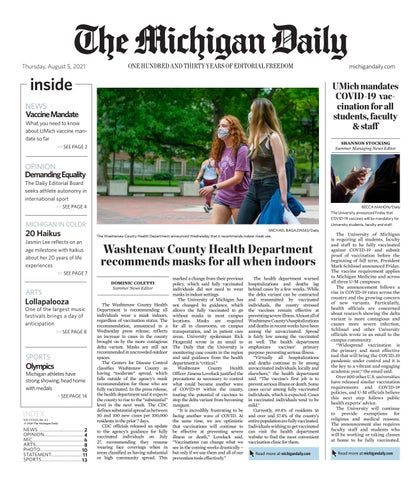
MICHAEL BAGAZINSKI/Daily The Washtenaw County Health Department announced Wednesday that it recommends indoor mask use.
DOMINIC COLETTI Summer News Editor
Lollapalooza
One of the largest music festivals brings a day of anticipation
>> SEE PAGE 8
SPORTS
Olympics
Michigan athletes have strong showing, head home with medals > SEE PAGE 14
INDEX Vol. CXXIX, No. 112 © 2020 The Michigan Daily
NEWS .................................... 2 OPINION................................ 4 MiC......................................... 6 ARTS.......................................8 PHOTO................................. 10 STATEMENT......................... 11 SPORTS.................................13
Read more at michigandaily.com
Read more at michigandaily.com
Washtenaw County Health Department recommends masks for all when indoors
>> SEE PAGE 7
ARTS
The health department warned hospitalizations and deaths lag behind cases by a few weeks. While the delta variant can be contracted and transmitted by vaccinated individuals, the county stressed the vaccines remain effective at preventing severe illness. Almost all of Washtenaw County’s hospitalizations and deaths in recent weeks have been among the unvaccinated. Spread is fairly low among the vaccinated as well. The health department emphasizes vaccines’ primary purpose: preventing serious illness. “Virtually all hospitalizations and deaths continue to be among unvaccinated individuals, locally and elsewhere,” the health department said. “The vaccine’s first job is to prevent serious illness or death. Some cases occur among fully vaccinated individuals, which is expected. Cases in vaccinated individuals tend to be mild.” Currently, 69.4% of residents 16 and over and 57.4% of the county’s entire population are fully vaccinated. Individuals wishing to get vaccinated can visit the health department website to find the most convenient vaccination clinic for them.
The University of Michigan is requiring all students, faculty and staff to be fully vaccinated against COVID-19 and submit proof of vaccination before the beginning of fall term, President Mark Schlissel announced Friday. The vaccine requirement applies to Michigan Medicine and across all three U-M campuses. The announcement follows a rise in COVID-19 rates across the country and the growing concern of new variants. Particularly, health officials are concerned about research showing the delta variant is more contagious and causes more severe infection, Schlissel and other University officials wrote in an email to the campus community. “Widespread vaccination is the primary and most effective tool that will bring the COVID-19 pandemic under control and it is the key to a vibrant and engaging academic year,” the email said. Over 600 other U.S. universities have released similar vaccination requirements and COVID-19 policies, and U-M officials believe this next step follows public health experts’ advice. The University will continue to provide exemptions for religious and medical reasons. The announcement also requires faculty staff and students who will be working or taking classes at home to be fully vaccinated.
The Washtenaw County Health Department is recommending all individuals wear a mask indoors, regardless of vaccination status. The recommendation, announced in a Wednesday press release, reflects an increase in cases in the county brought on by the more contagious delta variant. Masks are still not recommended in uncrowded outdoor spaces. The Centers for Disease Control classifies Washtenaw County as having “moderate” spread, which falls outside of the agency’s mask recommendation for those who are fully vaccinated. In the press release, the health department said it expects the county to rise to the “substantial” level in the next week. The CDC defines substantial spread as between 50 and 100 new cases per 100,000 residents in the prior 7 days. CDC officials released an update to the agency’s guidance for fully vaccinated individuals on July 27, recommending they resume wearing face coverings when in areas classified as having substantial or high community spread. This
marked a change from their previous policy, which said fully vaccinated individuals did not need to wear masks in indoor settings. The University of Michigan has not changed its guidance, which allows the fully vaccinated to go without masks in most campus locations. Masks are required for all in classrooms, on campus transportation, and in patient care areas. University spokesman Rick Fitzgerald wrote in an email to The Daily that the University is monitoring case counts in the region and said guidance from the health department is “critical.” Washtenaw County Health Officer Jimena Loveluck justified the precautions as necessary to control what could become another wave of COVID-19 within the county, touting the potential of vaccines to stop the delta variant from becoming rampant. “It is incredibly frustrating to be facing another wave of COVID. At the same time, we are optimistic that vaccinations will continue to be effective at preventing severe illness or death,” Loveluck said. “Vaccinations can change what we see in the coming weeks drastically – but only if we use them and all of our prevention tools effectively.”
2 NEWS
Thursday, August 5, 2021 The Michigan Daily — michigandaily.com
Petition to recall Councilmember Jeff Hayner fails to receive enough signatures
Here’s what you need to know about the UMich vaccine mandate GEORGE WEYKAMP Daily Staff Reporter
DOMONICK SOKOTOFF/Daily A petition to recall Councilmember Jeff Hayner, D-Ward 1, failed to receive enough signatures to trigger a recall election.
on time. LILY GOODING & DOMINICK “Losing 40 days just only SOKOTOFF made things more and more Summer News Editor & Daily Staff difficult,” Schugat said. “We Reporter took in donations with the intent to hire canvassers but when A petition to recall everything was said and done, we Councilmember Jeff Hayner, just didn’t feel comfortable hiring D-Ward 1, failed to receive canvassers with little time that enough signatures to trigger a we had left post-delay. But the November recall election by the community really came out and July 30 deadline. did the best that we could given The petition was filed by the circumstances.” Ward 1 resident Ariah Schugat Kyle Lady, the treasurer of the after Hayner posted a quote Committee to Recall Jeff Hayner, about journalists that contained said in an interview with The a homophobic slur to Facebook Daily that he got involved with in April. Hayner also quoted the the recall campaign because N-word in an interview with a he felt Hayner has not made Black MLive reporter in May, an adequate effort to represent sparking controversy, although his constituents. Lady also said that was not included in the he was uncertain of the exact petition language. number of signatures on the Organizers would have needed petition. to collect at least 2,264 signatures Schugat stressed that although from Ward 1 voters, which is 25% she felt the public response was of the Ward 1 votes cast in the last generally positive, there were race for governor. The Committee some community members who to Recall Jeff Hayner suspended alleged the recall campaign was signature collection efforts last ill-intentioned and “founded on week upon realizing they would the grounds of a dubious nature.” not be able to gather enough “I just saw a city official signatures. using their freedom of speech in Residents canvassed for distasteful ways and I felt that signatures in May, but their it was something that needed to efforts were interrupted for 40 be addressed as a community,” days when Hayner filed an appeal, Schugat said. “The dubious claiming the petition’s language suspicions are all conspiracy, was inaccurate. Hayner’s appeal at the end of the day. I went was rejected in Washtenaw in with the best of intentions County Circuit Court in mid-July. and obviously, some people are In an interview with The going to be skeptical and they’re Michigan Daily, Schugat said allowed that.” Hayner’s appeal hindered efforts Read more at michigandaily.com to meet the signature threshold
All University of Michigan students, faculty, and staff must be vaccinated against COVID19 by the time fall classes begin on August 30, President Mark Schlissel announced Friday. Here’s what the vaccine requirement means for you, and the U-M community. Who does the vaccine requirement apply to? The vaccine mandate applies to all University of Michigan faculty, staff, and students across all three campuses (Ann Arbor, Flint, and Dearborn) and Michigan Medicine. I’ll be working or taking classes remotely this fall. Do I still need to be vaccinated? Yes. The University will require all remote, temporary, and regular students, staff, and faculty to be vaccinated against COVID-19. Where can I report my vaccine? Students and faculty can report proof of their vaccination to Wolverine Access here. What if there’s not enough time for me to receive both doses of the Pfizer or Moderna vaccine before Aug 30? If you have only received one dose of the COVID-19 vaccine and will not be able to receive your second dose by the time fall classes start, report your first dose to Wolverine Access here. You will be required to wear a face-covering indoors and be subjected to weekly COVID-19 testing until two weeks after your second dose. I’m an international student/ worker and can’t get an FDA/ WHO-approved vaccine by Aug. 30. What do I do now? Those who are unable to receive a COVID-19 vaccine by Aug. 30 but intend to once they reach campus may request a deferment. If approved, you will be required to submit a negative COVID-19 test within 3 days of arriving on campus, begin the COVID-19 vaccination process immediately, undergo weekly testing and wear a facemask indoors until two weeks after they receive their second dose. The deferment process is still being developed, a University spokesperson told The Daily. Where can I get vaccinated?
The University has set up vaccine clinics on the Ann Arbor campus. To find a vaccine clinic close to you, click here. Which vaccine should I get? The University recognizes vaccines approved by the federal Food and Drug Administration and the World Health Organization. A list of all approved vaccines can be found here. Why was this decision made? Campus public health experts recommended the requirement, and it is in line with recent announcements made by university campuses, medical systems and companies across the nation as the delta variant takes hold. “Widespread vaccination is the primary and most effective tool that will bring the COVID-19 pandemic under control and it is the key to a vibrant and engaging academic year,” officials wrote in the email. They noted the increased likelihood of breakthrough infections with the highly contagious Delta variant. They also wrote that the mandate would also help protect children of University faculty under the age of 12 who are not yet eligible for vaccination, as well as immunocompromised community members for whom the vaccine does not work as well. I’m not comfortable getting a vaccination yet. Is there someone I can talk to about it? Yes! Beginning on Aug. 9, the University will make advisors available to faculty, staff and students who have questions about the vaccine. How much of the U-M community has already been vaccinated? As of July 30, 81% of UM-Ann Arbor students, 74% of faculty and 64% of staff have reported full vaccination to the University. For medical or religious reasons, I can’t receive the COVID-19 vaccine. What should I do? The University will consider medical and religious exemptions to the COVID-19 vaccines, and the exemption process will be communicated by Aug 4. For now, you can fill out this form to begin the process of requesting an exemption. Read more at michigandaily.com
420 Maynard St. Ann Arbor, MI 48109-1327 www.michigandaily.com
CALDER LEWIS Editor in Chief eic@michigandaily.com
KATIE LYNGKLIP
Business Manager business@michigandaily.com
CONTACT INFORMATION News Tips Corrections Letters to the Editor News section Photo Department Arts Section Editorial Page Sports Section Advertising
tipline@michigandaily.com corrections@michigandaily.com tothedaily@michigandaily.com news@michigandaily.com photo@michigandaily.com arts@michigandaily.com opinion@michigandaily.com sports@michigandaily.com wmg-contact@umich.edu
EDITORIAL STAFF Madison Gagne Managing Editor mbgagne@umich.edu
Allison Engkvist Digital Managing Editor engkvist@umich.edu
Christian Juliano and Shannon Stocking Managing News Editors news@michigandaily.com
Josh Taubman and Max Wadley Managing Sports Editors sports@michigandaily.com
Rosa Sofia Kaminski and Julian Wray Managing Arts Editors arts@michigandaily.com
Becca Mahon and Dominick Sokotoff Managing Photo Editors photo@michigandaily.com
Sarah Chung and Allison Yih Managing Design Editors design@michigandaily.com
Ethan Patrick and Caroline Atkinson Managing Copy Editors copydesk@michigandaily.com
Eliya Imtiaz and Lola Yang Managing Michigan in Color Editors michiganincolor@michigandaily.com
Amelia Duffy and Zoe Storer Managing Social Media Editors socialmedia@michigandaily.com
Mary Rolfes Editorial Page Editor opinion@michigandaily.com
Margaret Rudnick Managing Video Editor video@michigandaily.com
Samantha Cole Managing Statement Editor statement@michigandaily.com
The Michigan Daily (ISSN 0745-967) is published Monday through Friday during the fall and winter terms by students at the University of Michigan. One copy is available free of charge to all readers. Additional copies may be picked up at the Daily’s office for $2 per issue. Subscriptions for September - April are $250, and year-long subscriptions are $275. University affiliates are subject to a reduced subscription rate. Subscriptions must be prepaid.
Thursday, August 5, 2021 The Michigan Daily — michigandaily.com
NEWS 3
All UMich campuses receive increased accessibility on Zoom JUSTIN O’BEIRNE Daily Staff Reporter
The University of Michigan has adopted an updated version of Zoom, the videoconferencing software used for many meetings and virtual classes during the pandemic, to increase accessibility and further goals of diversity, equity and inclusion. The latest version of Zoom allows people to display their preferred gender pronouns as part of their display name. This update brings Zoom into further alignment with the University’s Information and Technology
Services Department’s stated goals to provide an inclusive environment for all people. “We commit to pursuing deliberate efforts to ensure that our campus is a place where differences are welcomed, and where every individual feels a sense of belonging and inclusion,” the new goals read. Ravi Pendse, Vice President for Information Technology and Chief Information Officer at the University, said ITS wants its contracted vendors, such as Zoom, to be as inclusive and accessible as possible. “We are always pushing for ensuring that the vendors and services are partners in accessibility issues and also
issues around diversity and inclusion,” Pendse said. “We wanted Zoom … (to allow) people to use their proper pronouns if they wish to … You can now go into and enable their proper pronoun if they wish to use it.” Ellen Meader, Assistant Vice Provost for Equity, Inclusion and Academic Affairs, said allowing people to display their preferred pronouns on Zoom will help people feel more comfortable when communicating on the video-conferencing platform. “That helps folks feel that they can identify themselves the way that they want to be identified,” Meader said. “It will give people an opportunity to express who they are.”
Engineering sophomore Shrey Saghal said adding pronouns to Zoom will make online classes and meetings easier. “This Zoom change is great for everyone because people can skip the awkward pronouncorrection conversation, making spaces safer particularly for non-cis people,” Sahgal said. “Some professors have asked all students to just stick their gender pronouns in their Zoom nickname, but adding pronouns as an actual part of the app helps make this practice easier.” The change also improves accessibility by making it easier to use live transcription during meetings and webinars. Prior to the update, a participant had to
interrupt a meeting or webinar and ask the meeting host to turn on live transcription. Now anybody on a Zoom can anonymously request live transcription to be turned on for their meeting or webinar without interruption. Pendse said the update of live transcription is likely to help all people in the U-M community, particularly people with disabilities. “We have found that (live transcription) has been used over and over again by our students and faculty and others,” Pendse said. “(For) our students who need a little bit of help with hearing, having that automatic transcription was a big help.”
Sewage spills, Gelman plume & PFAS: A deep dive into Ann Arbor’s ongoing water pollution issues SARAH STOLAR
Daily Staff Reporter
The city of Ann Arbor has a long and complicated history of water contamination, leading to the ongoing concern from Ann Arbor residents about the health and environmental threats water pollution poses to cities. Recent cases of sewage spills have led to discussions over what actions the city, state and federal government should take to address the problem. There have been four cases of sewage overflows in Ann Arbor in 2021, two of which were caused by a contractor’s sewerrelining efforts. As a result of the overflows, a total of over 10,000 gallons of sewage were released onto Main Street in February and reached Allen Creek, which connects to the Huron River. Other cases transpired within Nichols Arboretum due to root ball blockages — occurring when tree roots pierce a sewer pipe and grow within it. 1,100 gallons of water were released to the ground surface. In both cases, the sewage was treated with lime to counteract the bacteria and no sewage reached the nearby Huron River or any other waterway. In an interview with The Michigan Daily, City Councilmember Kathy Griswold,
D-Ward 2, stressed the need to fund and regularly test and repair Ann Arbor’s infrastructure to prevent pollution cases like this from occurring. “You have to fund infrastructure to maintain it, and I would say that for the last two decades, the city has underfunded infrastructure,” Griswold said. “It’s not just funding but it’s (also) having a focus on operational issues.” Griswold emphasized the importance of “monitoring” versus “managing” when it comes to pollution issues, emphasizing the need for action and consistent
stormwater and water fees for Ann Arbor residents, which will not affect the city’s general funding or result in tax increases. LSA senior Quinn Nolan, communications chair for the environmental justice organization Flint Justice Partnership, spoke to The Daily about the importance of pushing for quality infrastructure to prevent water pollution issues, which he said will continue if the problem is not addressed. “I think [the pollution issues] go to show people that any area, any place can be affected by these water issues,” Nolan said. “And
issues like this arising in different places… . I think both local and state governments obviously haven’t taken anywhere near the level of sufficient action in Ann Arbor or in Flint, and those crises are still ongoing. And I think as long as those crises are ongoing the government will not have done sufficient action.” The Gelman plume In adition to sewage overflows, the Gelman plume has long been a source of concern and controversy for Ann Arbor residents. The plume was originally linked to Gelman Sciences’ disposal of 1,4-dioxane — a possible carcinogen — from their operations aboveground starting in the 1960s and resulting in polluted runoff entering groundwater near the plant. After much discussion on whether to request federal aid, the city of Ann Arbor, with the support of the state government and Gov. Gretchen Whitmer, sent a letter to the Environmental Protection Agency in April 2021 to begin the process of assessment to be considered for the National Priorities List. Ann Arbor will also be considered for the EPA Superfund cleanup initiative. Jill Greenberg, public DOMINICK SOKOTOFF/Daily information officer at the Michigan Ann Arbor is facing water pollution challenges such as the Gelman plume. Department of Environment, Great maintenance. Griswold also I think as infrastructure issues Lakes and Energy, said EGLE’s explained that the funding for continue to arise with how old a priorities are to clean up the plume water infrastructure comes out lot of the piping systems are across site and to ensure Gelman Sciences of enterprise funds financed by the country, we’ll just have more abides by standards set by the state
and by the EPA as they conduct their cleanup. “Significant protections for public health have been put in place, such as the department establishing a lower 1,4-dioxane groundwater cleanup criterion for the drinking water pathway and the transitioning of affected residents from well water to municipal or bottled water if a drinking water well has 1,4 dioxane at or above 3.0 parts per billion,” Greenberg said. “Our ongoing work to manage the risk from the groundwater plume is part of the effort to protect the environment from further harm.” Greenberg said EGLE and the City of Ann Arbor have been in constant contact to address the situation, working with both community members and the EPA to ensure the most thorough and effective response. “EGLE actively engaged in (discussions about the letter to the EPA) to ensure that support for listing the site on Superfund and turning the site over to the EPA was shared by all communities and citizens impacted by the site,” Greenberg said. “EGLE is committed to supporting local residents and the EPA — should it list the site (as a Superfund location) — in executing the most expeditious and protective actions possible.” Read more at michigandaily.com
4 OPINION
Thursday, August 5, 2021 The Michigan Daily — michigandaily.com
Edited and managed by students at the University of Michigan since 1890. 420 Maynard St. Ann Arbor, MI 48109 tothedaily@michigandaily.com
MARY ROLFES
CALDER LEWIS
Editorial Page Editor
Editor in Chief
EDITORIAL BOARD MEMBERS Julian Barnard Zack Blumberg Brittany Bowman Elizabeth Cook
Brandon Cowit Jess D’Agostino Andrew Gerace Jessie Mitchell
Mary Rolfes Gabrijela Skoko Jack Tumoowsky Joel Weiner
Unsigned editorials reflect the official position of The Daily’s Editorial Board. All other signed articles and illustrations represent solely the views of their authors.
THE MICHIGAN DAILY EDITORIAL BOARD
From The Daily: Continue demanding equality and athlete autonomy in international sport after the Olympics conclude
A
fter being delayed a year, the Tokyo 2020 Olympics are now in their second week, with track & field events currently ongoing. But the fastest woman in America will not be running any races at these games. In early July, American track athlete Sha’Carri Richardson received a one-month suspension from the U.S. AntiDoping Agency after testing positive for marijuana use during the U.S. Track & Field trials. While the suspension recently expired, Richardson was left off the Olympic team entirely. The disciplinary action received significant pushback on social media, especially following Richardson’s sensational performance in the 100-meter dash at trials. Many people viewed this treatment to be unfair and biased. It is not the only controversial decision that was made regarding athlete eligibility and performance in the lead-up to the Olympics. Notably, two Namibian teenage runners were deemed ineligible to participate due to naturally high testosterone levels. More broadly, swim caps designed for Black hair were prohibited from use at the Olympics. This begs two questions: Why does there seem to be such a strong and disproportionate regulation on
Black athletes, and to what extent are sporting organizations entitled to control athletes’ lives? The World Doping Agency, the International Olympic Committee and many other sporting institutions are operating on flimsy and outdated standards for performance eligibility. Many scientific perspectives do not view marijuana as a performance-enhancing drug; likewise, testosterone levels are not necessarily linked with improved athletic performance, and even if they were, they would demonstrate an inherent and natural competitive edge rather than a manufactured and unfair advantage. More broadly, these institutions have unfairly presumed the role of policing the bodies of athletes and what they do with them outside of their performance in the sport, reflective of our culture of celebrity worship and our view of elite athletes as paragons of health that must be controlled. We encourage both institutions and individuals to acknowledge and evaluate the biases that may be informing their standards and decisions, and to move forward in creating rules and regulations that do not unconsciously exclude certain athletes.
Anti-doping institutions are operating on flimsy scientific standards removed from biological reality and motivated by outdated and dangerous stereotypes. There is a scientific consensus that marijuana is not a performanceenhancing drug; its inclusion on the list of banned substances seems motivated largely by the drug’s negative connotations. The image of a lazy and unmotivated “stoner” is not one pictured at the starting line, and Olympic athletes are held and marketed as the epitome of health and physical wellness. Yet even without the presence of chemically altering substances (performance-enhancing or not), implicit biases are present in the blocks and swim lanes. When the Olympic standard is seemingly on a scale of whiteness or femininity, genetic diversity becomes a competitive outlier often mistaken as an unfair advantage. In the case of the Namibian runners, dictating the level of hormone that is “normal” in a woman’s body has little to do with competitive advantage and much more to do with the stereotypical notions of femininity and womanhood combined with anthropological ignorance, a stereotype that women of color have yet to circumvent. In the case
Design by Madison Grosvenor
of the Soul Cap, its very design was meant to aid swimmers, specifically swimmers of color, with thicker or curly hair types, enabling them to get into the pool and put them on an equal playing field rather than enhance their performance. The fact that athletes are being punished for these things in 2021 is abominable, and these institutions need to update their standards quickly. More broadly, these institutions are severely overstepping the boundaries of control they have over athletes’ lives. Two of the criteria for putting a substance on the banned list of the World Anti-Doping Agency are not even related to performance, but rather to athlete health and to the “spirit of sport” — defined in vague terms as “the ethical pursuit of human excellence through the dedicated perfection of each Athlete’s natural talents.” It is not our job to police what athletes do with their bodies outside the provisions of the sport, provided it does not give them an unfair competitive advantage, and we desperately need to re-negotiate the personal boundaries of athletes. These policies create inconsistencies between marijuana and substances like nicotine, alcohol and even fast food — substances that can have impacts on health, yet whose usage is not equally monitored by doping agencies. Though athletes are celebrities of health to many, that does not mean the public can have a say in what athletes choose to do with their bodies. There furthermore needs to be a shift in how individuals conceptualize their parasocial relationships with athletes with an emphasis on recognizing the autonomy of the athlete over their personal choices in regards to their health. It is also intensely hypocritical for these agencies to turn around and demand athletes take substances to
alter their natural bodily chemistry to be eligible to compete. The case of banning the Namibian track stars Mboma and Masilingi from the Olympics because of their natural testosterone levels being above average showcases these agencies taking a 180-degree turn. These women have a natural predisposition to greater than average levels of testosterone. No medical enhancement nor drug intervention was the cause. If the worry of these agencies stems from limiting the purposeful modification of an athlete’s physicality, why are they asking other athletes to do just that in order to compete? This seems a far more severe violation to the spirit of sport than a joint. Finally, both these institutions and society at large must evaluate and acknowledge the problematic and prejudiced roots of many of these rules, and work to unroot their hold on international sports. We must hold ourselves accountable as individuals, and governing bodies must put standards in place that lessen the impact of implicit biases and stereotypes on their practices. Similarly, we can bolster athletes such as Richardson that defy stereotypes and break norms, thereby expanding our view of what “normal” means in the athletic world. While the Olympics are considered to be a celebration of the human body and spirit, many of the rules and practices surrounding the event are outdated to the detriment of marginalized athletes. If we want to uphold the Olympics as an international celebration of sport, we must do away with outdated standards and regulations and move forward in a manner that ensures we are not leaving anybody out. Our focus on equality and athlete autonomy in international sport cannot end with the closing ceremonies this Friday.
Thursday, August 5, 2021 The Michigan Daily — michigandaily.com
BENJAMIN DAVIS | OPINION COLUMNIST
OPINION 5
Decolonizing anthropology: I’m not Indiana Jones, and I don’t want to be
A
s an anthropology major, I’ve always had a love-hate relationship with the Indiana Jones movie franchise. The Harrison Ford character was an inspiration to me in my youth. His archaeological excursions were a significant part of igniting my interest in the field of anthropology. But as with most things as one ages, becoming educated unveils the problematic and gross realities of the real world. Indiana Jones is littered with colonialist, Eurocentric notions that are not in line with the contemporary redirection within anthropology to decolonize the field. The sentiments Indy spouts do not fit with anthropology today. The cultural image of Indiana Jones as a caricature of the modern archaeologist or anthropologist exemplifies the ever more pressing need to decolonize the field of anthropology. And hopefully, the fifth installment of the franchise, set to release in 2022,
will be the final nail in the coffin to the sugarcoated, Eurocentric depiction of archaeology that is Indiana Jones. One of the most contentious attitudes of the Indiana Jones character is his belief that cultural objects “belong in a museum.” While seemingly just a quote about the importance of preserving the past through curation and conservation, his words tap into the complex politics surrounding the recovery of archaeological artifacts, ownership of the past and the rights of museums — especially Western ones — to transplant artifacts from their cultural region to collection cases for the purpose of education. Most of the time Indy never realizes the transportation of the artifact to the museum; it ends up destroyed or given to the people of the area. But the underlying statement of the global cultural hegemony of Western museums exists within the films. Repatriation is the act of giving
looted cultural objects back to their country of origin. This act is meant to continue uprooting the colonial ideologies inherent in museums holding artifacts taken under colonial power. While not a resolved issue by any means, the scale is tipping in favor of past colonial powers returning some cultural objects to their place and culture of origin. The Netherlands is leading the pack with Dutch museums instituting a €4.5 million project to create a guide on the repatriation of artifacts to former Dutch colonies. This is a much different museum landscape than the one in Indiana Jones. Repatriation is a hot-button issue in museology, and it’s not as simple as Indy claims it to be. I am a proud member of the anthropology community, but I’ll be the first to acknowledge the ugly history that the field has — a history that has been glorified by the Indiana Jones films. Anthropology and archaeology were
and, in many ways, still are plagued by the practices and epistemological ideologies that were born out of the roots of colonialism. Early anthropologists were often tasked with understanding Indigenous people in the name of aiding a Euro-American power in colonial expansion. Racist, imperialist and colonialist beliefs often seeped into the ethnographies and archaeological excursions. Indiana Jones, unfortunately, perpetuates colonial talking points. The depiction of Indigenous peoples in the films is overwhelmingly negative. Indigenous people are portrayed as the savage enemies of Indy. Indian characters in “The Temple of Doom” are cartoons and the Ugha tribe in “Kingdom of the Crystal Skull” are shown employing spears through having ancient divine knowledge. Rarely portrayed in a positive light, it creates an underlying tone of colonial viewpoints of Indigenous cultures in the regions that were colo-
nized. This is out of touch with how contemporary archaeologists do and should interact with individuals of the culture they are studying. Take any theoretical sociocultural anthropology course, and the decolonization of anthropology is bound to surface. The concept started budding around the cusp of the ’90s. It rests upon altering the epistemology, pedagogy and methodology of the discipline to move away from the colonial beliefs that the discipline was birthed from. This looks different within the different anthropological subdisciplines, but a commonality is uplifting diverse voices. Furthermore, the concept and recognition of power are crucial to the movement. Read more at michigandaily.com
Benjamin Davis is an Opinion Columnist and can be reached at bendav@umich.edu.
OLIVIA MOURADIAN | OPINION COLUMNIST
I’m waiting for marriage and I’m tired of talking to you about it
I’m tired of explaining my decision to wait until marriage just to be greeted with the firm opinions of others. My lack of patience with this subject came about somewhere between my mom telling me I wouldn’t know if I was capable of having a physical connection with my partner if I waited to have sex until marriage and my dad telling me that if someone he dated had wanted to wait, it would have been a bit of a red flag; maybe it also came about between my neighbors telling me, “Good luck finding someone who’s going to do that, you’ve left yourself with, like, 3% of the male population,” and some of my friends telling me I’m missing out by not having sex. Some of these responses do have merit. It turns out my neighbors were actually pretty accurate: Approximately 5% of Americans in 2002 reported that they chose to wait for marriage. Despite what any statistics may say, however, I would never feel that it was my place to question other people on what they choose to do with their bodies. But comments like the ones I’ve received make it seem as though waiting for marriage is an open invitation for people to comment on your sex life
— or lack of one. To be exceedingly clear, this piece is not about why waiting for marriage is the right or “better” thing to do. To argue that there is one correct way to navigate physical relationships reinforces the flawed ideology that the comments I’ve heard are based on. It is annoying and quite frankly archaic to push the idea that everyone should or should not partake in sexual activities, whether that’s saying everyone should abstain from sex or saying everyone should have sex before marriage. Instead, I want to illustrate that couples who wait until marriage to be physically intimate are not at a disadvantage when it comes to long-term sexual and emotional satisfaction. While this article presents research that refutes common assumptions about waiting for marriage, they are ultimately just statistics. And despite these statistics, relationships and sex are too nuanced to assume that the same conditions will work for everyone. In a study published in the American Psychological Association’s Journal of Family Psychology, 2,035 married individuals participated in an online survey regarding how the timing of their sexual development has affected other aspects of their
relationship. Compared to people who had sex before marriage (all at varying times in their relationships), people who waited rated their sexual quality 15% higher, their relationship stability 22% higher and their satisfaction with their relationship 20% higher. While waiting for marriage is often a choice rooted in religious beliefs, these results actually remain statistically significant among different control groups, such as level of religious activity, number of previous sexual partners, education level and so on. So regardless of how religious someone is, how much sex they have had in the past and what degrees they hold, this study indicates that waiting is, on average, beneficial for a relationship. With the exception of this study, there is not a lot of research on whether waiting for marriage does or does not align with common assumptions about sexual satisfaction and relationship quality. The majority of the articles on waiting for marriage are backed by religious groups or from personal blogs. This makes sense to me: While there are universal biological aspects of sex, everyone has different perspectives on and experiences with this subject. Given the very personal role sex
Design by Erin Shi
plays in people’s lives, I don’t think any amount of research is enough to say this is what works for everyone. And yet, people constantly feel that their own personal experience makes it their jurisdiction for them to comment on what other people should be doing with their sex lives. For me, these comments have come in the form of being called a prude or people questioning why someone would be interested in me if I’m not going to have sex with them. However, coming from a small rural town, I am also potently aware that
people — particularly women — who are sexually active also receive their own share of these unsolicited comments. When a girl has sex with someone “too soon,” I’ve heard remarks such as, “Well, you can’t expect him to take you seriously if you have sex with him right away.” Read more at michigandaily.com
Olivia Mouradian is an Opinion Columnist and can be reached at omouradi@umich.edu.
6 MICHIGAN IN COLOR KARIS CLARK MiC Columnist
Pushing him left. Holding him accountable. Harm reduction. The various phrases and sayings used by voters to justify casting their ballot in President Biden’s favor. Yet eight months after the election, half a year since his inauguration and well past his first 100 days, we’ve yet to see any of these credulous claims come into fruition. Instead, we’ve witnessed the large-scale perpetuation of domestic statesanctioned violence and imperialism — overwhelming evidence indicating that the Biden administration, much like all of its previous predecessors, exists largely for the preservation and prolongation of the white power structure. As Julius Nyerere, former President of Tanzania, once famously said, “The United States is also a one-party state but, with typical American extravagance, they have two of them.” While the man in the Oval Office has changed, the mission of the United States as a settlercolonial project of mass destruction has not. As liberals and progressives alike have returned to brunch after four years of performing outrage towards Trump’s presidency, they have collectively chosen to ignore the inhumane actions committed by Biden. In the domestic realm, the
Thursday, August 5, 2021 The Michigan Daily — michigandaily.com
How’s brunch?
national eviction moratorium just recently lapsed on Saturday, leaving millions at risk of losing their homes. In the midst of the failure on the part of the House and the Biden administration to address and extend the moratorium, COVID-19 cases continue to rise steadily due to the delta variant. Disparities in the vaccinated population persist with 52% of uninsured Americans under 65 yet to receive at least one dose (per June 2021 data), and Black and Hispanic people maintaining a lower vaccination rate. In their neglect to respond to the ending of the eviction ban, the Democratic Party effectively endangers the safety and health of marginalized populations twofold. Meanwhile, real estate brokerage firms such as Marcus & Millichap and real estate investment contribute hefty donations to the Democratic Party. Billionaire chairman, co-founder and chairman of Marcus & Millichap, George Marcus has donated millions to the Democratic PACs, including House Speaker Nancy Pelosi’s and President Biden’s campaign. Marcus stands among the many wealthy interests within the real-estate industry who contribute in large sums to the Democratic Party all the while lobbying against housing equity. These firms flourish in the face of homelessness, and methods such as rent control and eviction moratoriums stand in the way of their accumulation of capital. It’s no wonder why no action
was taken on moratorium expiration until this Tuesday, when the CDC announced a new two-month limited extension (after pressure on behalf of Congresswoman Cori Bush and progressive allies). Despicably, the Democratic leadership’s grotesque leveraging of impoverished peoples’ lives doesn’t end there. Since taking office, the Biden administration has committed to expanding law enforcement agencies through additional police funding. Biden’s budget for Fiscal Year 2021 nearly doubled Trump’s last year in office’s budget of $156.5 million, requesting $388 million for the COPS Hiring Program. Thus, an administration that promised to address the ongoing epidemic of racialized oppression has done so by expanding the scope of statesanctioned violence and surveillance. This is evident through the new plans to expedite and fast-track deportation of families by allowing for the removal of individuals before hearings with a judge coupled with the thousands of migrant children still being detained — yet the cries over kids in cages have died. Additionally, new “anti-terrorism” initiatives include classifications which define anti-government/ anti-authority violent extremists as those who “oppose all forms of capitalism, corporate globalization, and governing institutions, which are perceived as harmful to society”
under the label of “domestic violent extremist.” In a regime that routinely denounces and delineates countries in the Global South as autarchic, its own authoritarianism as an ancillary function certainly makes the pot of punitive repression and control call the kettle of collectivist states “black.” But perhaps Black is the best label, as we know Black revolutionary consciousness and activity is always antagonistic to the will of Western hegemony. Going along on this global track, the Biden administration has continued to advance the settler-colonial project of imperialism. Through prolonged sanctions on Cuba, airstrikes in Somalia, Syria, and Afghanistan, and continued billion-dollar aid to Israel (including recently approving a sale for a $3.4 billion-dollar helicopter in addition to a $735 million-dollar weapons deal), we’ve witnessed time and time again that its allegiances lie in upholding white supremacy and capital. Despite Cuba having produced their own COVID-19 vaccine, the embargo establishes a barrier to their ability to effectively administer the shots to the Cuban population and beyond. The Pentagon prospers as military spending is only expected to increase even more (by nearly $13 billion from Trump’s last year) within the next fiscal year, proving that as radical Egyptian economist Samir Amin states, “the globalized ‘liberal’ economic order requires permanent
war — military interventions endlessly succeeding one another — as the only means to submit the peoples of the periphery to its demands.” But what was an atrocity in the yesteryear of the Trump administration is now what to the liberal media apparatus? The dissonance is in the details and with the disappointments of the Biden administration and its trajectory of domination and exploitation, we must come to acknowledge the truth of the office of the U.S. presidency for what it is — a tool of the ruling class, an instrument of control, an immutable mirage of the two-party system, which in its essence is an illusory system designed to maintain the internal antagonistic contradictions inherent in late-stage capitalism. Within the two party system, the Democratic Party and Republican Party function as dialectical antagonists, or complementaries. Mervyn Hartwig’s Dictionary of Critical Reasoning describes dialectal antagonists as “necessary to each other in that they are grounded in (a) common category mistake(s), yet in conflict over lesser matters (tactically complicit). So their antagonism or opposition is ultimately phony, and appears as such when overreached by a fuller conceptual formation which makes good the category mistake.” Read more at michigandaily.com
I hate Love Horoscopes ANDREW NAKAMURA MiC Columnist
In the midst of the witching hour, I call upon the mystic acuity of the cosmos to conduct my weekly ritual: writing my horoscopes column. As I consult the source of infinite wisdom, cafeastrology.com, I transcribe each planetary transit into my open Google document. Despite my heavy eyelids, I steadily observe the phases of the moon, the next Mercury retrograde phase and the upcoming sun sign ingress. The insipidity of this week’s celestial motion nearly tempts me toward the sweet embrace of slumber, until — hark! Something wicked this way comes: Venus has a transit this week. I will close my thesaurus in order to tell you that, in simple
terms, I do not enjoy writing about Venus in my weekly horoscopes. In astrology, Venus rules over the second and seventh houses of money and love respectively. I have no qualms against telling a different sign that they need to save money each week, but I do feel apprehensive about writing about each sign’s love advice. The general public tends to have a very shallow understanding of modern western spirituality. I fear that the people exclusively drawn to love readings may not be interested in fully understanding the practice. When I started talking to all my friends about astrology in high school, first and foremost everyone asked about their love life. Synastry charts and love readings are among the most popular and prominently featured pages on several astrology websites while focused readings about career and
inner-self are rarely advertised. Even beyond astrology, the large majority of the most popular tarot card readings on YouTube center around romance. Of course, love is an incredibly important part of our lives, so the high demand only makes sense. Don’t get me wrong, love readings do give extremely in-depth advice, and I don’t want to seem dismissive of love as a whole. However, most people who came to me for love readings were not interested in becoming better partners and working toward healthier relationships — they just wanted to know if their shitty exes would come back to them. This stems from the popular belief that astrology’s sole purpose is to predict the future, which I found a rather reductive view of the practice. The wisdom we gain from astrological readings
is supposed to help us uncover the parts of ourselves that have been hidden and bring them to light. Simply hearing about natal placements and astrological forecasts without acting upon the advice given will never help us advance toward our goals. Our future is up to us to create for ourselves, but we cannot improve our satisfaction with life without refining ourselves first. As The Daily has implemented search engine optimized titles into our work, I’ve been trying to make Michigan in Color Horoscopes more attractive for users. Every time I finish writing a horoscope, the temptation to market the article as a love reading is overwhelmingly enticing. I could draw in more engagement, but how many of those readers will really process the information and act upon it? Ever since the conception
of MiC Horoscopes, my main goal was always to help people understand how astrologers make judgments based on planets and signs. However, each time I write about love, I am always afraid that my audience will hyperfixate on whether or not their Tinder dates that ghosted them a week ago will suddenly hit them up again rather than trying to use astrology as a catalyst for their own self-improvement. When one of my past horoscopes hit The Daily’s “most read” section, I was so overjoyed, yet a Venus transit made love central to the messages that week. As Venus exits Virgo in two weeks, Michigan in Color’s summer production comes to an end. I am extremely blessed to have started this horoscope project, but I wonder if I have really accomplished my original goal.
Thursday, August 5, 2021 The Michigan Daily — michigandaily.com
20 haikus for 20 years JASMIN LEE MiC Columnist
At 12:11 a.m. on July 31, 2021, I turned 20 years old. Multiply 525,600 minutes by 20 and you get an inexplicably large number. Since we don’t count the minutes continuously as we g row older, how do you measure 20 years? Is it moments of laughing at horrible dad jokes or tr ying to hold tears from my f irst heartbreak? What about jumping for joy when I see my friends, frustratingly screaming when school doesn’t make sense or feeling waves of peace when meditating on life? As I go through the motions of life, all the important moments blur into one massive area of my mind. There is always something else to look towards in the f uture, but sometimes it’s hard to slow down. While frant wically texting my friend about the mind-boggling realization that my age would start with a “2” rather than “1,” she responded, “Slow down.” While I was def initely rushing to make it
to 20 years old, thinking about the changes in my life birthed an epiphany: How has each year of my life inf luenced who I am today? These haikus ref lect g row th, pain, joy and the inherent feeling that becoming an additional year old can be a beg inning and end all at once. 1 year old: Born Leo Rising, Full Head of Curly Black Hair, Skin as white as snow 2 years old: My big childhood home Big Trees and the Green Grass Grows Little sister soon 3 years old: A Baby arrives Why is she so small? I sigh Mom, what about me? 4 years old: Watch Land Before Time Barbie, Elmo, f ill my eyes
Clifford, do not cry 5 years old: Cheerios, I eat R ice and Chicken, what a treat Birthday Cake, falls down 6 years old: English, not my streng th I go to school, learn to read My life with words dawns 7 years old: Teachers inspire me, Conf idence, with words of love Bullies will still hate
MICHIGAN IN COLOR 7
One decade f inished Transformed into woman child New School and New Friends 11 years old: How Long Will This Last? Middle School is Awkward, Bad Fashion Choices Made 12 years old: Who am I? They ask Colleges will want to know I want a boyfriend 13 years old:
8 years old:
Do not Mess With Me Invincible and fearless I’m a teenager
Read R ich Dad, Poor Dad My father wants to have a Trillionaire baby
14 years old:
9 years old:
I watch Crunchyroll, Anime convention, why? All my friends are weebs
Trying to make friends “Do not say hi all the time” I bite back my tong ue
15 years old:
10 years old:
Ai Ogawa Reads Holden’s Gift, I’m trauma-
tized No longer have friends 16 years old: Why am I so dark? People say I act too white As my skin burns Black 17 years old: I found my calling, Writing helps me f ind my way anxious for f uture 18 years old: Freshman year changes, Parties, Classes, Too Much Stress Pandemic Hits Hard 19 years old: Changed majors, again, Hey Siri, who are my friends? Calling Depression 20 years old: College half way done So much lost and so much gained One Step At A Time
8 ARTS
Thursday, August 5, 2021 The Michigan Daily — michigandaily.com
JASON ZHANG Daily Arts Writer
After a year of lockdowns, festivals and concerts are finally back. Lollapalooza, one of the largest festivals in the world, celebrated its 30th anniversary in Chicago. Festival-goers and artists alike were eager to get back to live shows, and it certainly showed through brilliant sets and enthusiastic crowds. Grant Park was once again filled with thousands of people crowding the various stages for this year’s strong lineup of musicians, including headliners like Miley Cyrus, Post Malone and Tyler, the Creator. It’s hard to imagine that an event like this could still happen in the midst of a pandemic and whether it was a socially responsible decision to attend this concert is certainly questionable. Lollapalooza claims that 90% of the attendees were vaccinated, 8% showed negative COVID-19 test results, and the rest were turned away. Despite that, many health experts still warned about the “superspreader” event. Although there was a risk, hundreds of thousands still gathered
Lollapalooza Day 1: A day of anticipation for the festival. Masks were few and far between; instead, people came adorned in their favorite sports jerseys, glitter, tropical button-up shirts, and many creative implementations of fishnet. The air was filled with the smell of fragrant smoke and delicious foods. In the absolutely beautiful weather over the four days of Lollapalooza, the festival raged on. An audience gathering around Tito’s stage Thursday afternoon. Becca Mahon/Daily. Buy this photo. On day one, I arrived a little late, not used to navigating the city. I did get to catch the ending of Christian French’s performance at the Lake Shore stage. It was his debut live performance at Lollapalooza, which seemed to be a common theme this year. His youthful husky voice and knack for live performance earned him a sizable audience, despite it being so early on the first day. His music sounds great when you listen to it live, but is equally forgettable. One thing I didn’t realize fast enough was the sheer size of Lollapalooza. It takes a long while to get from one stage to another, and I definitely had to take that into account. But the trip was
worth it, as I was able to catch Ant Clemons at the Bud Light stage. Ant Clemons is among the talented new generation of R&B musicians that are deservedly rising in popularity. While he hasn’t seemed to explode in the mainstream yet, he certainly is on the radar of many other big artists like Justin Timberlake and Kanye West. Fittingly, he started with his song “Mama I Made It,” and seemed to really live in the music. His band was great, his guitar player stealing the show with an absolutely hypnotizing solo. Needless to say, the crowd was hyped. In the middle of the hot Chicago day, he managed to make Grant Park feel like a late night in a red velvet bedroom. MAX was on soon after. He arrived on stage clad in white, to a roaring audience. MAX is a great performer, full of energy and receptive to the crowd. He gave the crowd what they wanted with his hits “Love Me Less,” “Butterflies” and “Basement Party.” His saxophonist and hype man added energetic solos and flourishes to the music, although sometimes it did feel like he was trying too hard. I took a quick break to grab a bite (to be honest, the food was
BECCA MAHON/Daily Crowds entering Lollapalooza Thursday afternoon.
serviceable at best and severely overpriced). Stomach full and wallet empty, I returned to the Lake Shore stage to catch Dayglow. I loved the band’s coordinated outfit choice, Dayglow himself dressing like the fanciest red picnic table, with the rest of his band wearing the colors of the rainbow. They reminded me of a millennial version of The Wiggles. Like a lot of current indie-pop, Dayglow has a nostalgic, retro sound with just a touch of surf music. It’s
warm and invites you to dance and relax at the same time. He made a fantastic Lollapalooza debut. I decided to lay down and bask in the sun as they played “Fuzzybrain,” leading to one of the most pleasant music listening experiences of my life. Their performance had the friendly intimacy of your friend from high school’s band, leaving a big smile on everyone’s face. Read more at michigandaily.com
The careful steps of representation in Mindy Kaling and Lang Fisher’s “Never Have I Ever” MEERA KUMAR Daily Arts Writer
When referring to the representation of marginalized communities in film and TV, we throw around the expression “seeing ourselves on-screen.” It serves as shorthand for explaining why representation matters: Seeing characters who look like you on-screen is powerful. But the phrase has been used so often that it’s taken on a newer, much more literal meaning. The second season of Mindy Kaling and Lang Fisher’s “Never Have I Ever” burst onto the TV scene fully-formed this July. The show centers around Devi (Maitreyi Ramakrishnan), an Indian American teen in Sherman Oaks, Calif., documenting her social life, as well as that of the never-ending crew of her family and friends (seriously, never-ending — there are too many plotlines to explain in this article). It sounds innocent enough, like
the regular idealistic American family sitcom focusing on being a “hyphenated American.” But the inciting incident for the show is
the surface, “Never Have I Ever” is marketed as a light-hearted, diverse comedy, but underlying this is a very real story of pain and frustration.
Catch the second season of ‘Never Have I Ever’ on Netflix. This image is from Netflix’s official Youtube channel.
anything but light-hearted: Devi’s father dies at the beginning of season one, and throughout the series thus far, Devi tries to suppress the pain of losing her closest family member. On
Devi often acts out in confrontational ways, rendering her a complex character that can be difficult to support. Her story is nuanced and specific,
so at face value, there are parts of Devi’s story that felt unrelatable to some in the South Asian community — I’ve scrolled through more than a lifetime’s worth of Reddit threads and TikToks that ridicule Devi for being “unrealistic.” But what is realistic representation supposed to look like? It’s no secret that marginalized communities, including Asian Americans, are historically underrepresented in Hollywood. As we anticipate “seeing ourselves on-screen,” we’re sure that once we do see an Indian American show, it’ll represent everything about us. Yes, South Asian people are united by their heritage and cultures, but for every story or character to emulate a one-size-fits-all blanket of “representation” is unrealistic. “Never Have I Ever” is written “in the spirit” of Mindy Kaling’s adolescence, and after the first season, it faced a reckoning about the kind of show it wanted to be. Season two of “Never Have I Ever” takes a cautious step in the right direction: it gives many characters storylines that feel
meaningful, without being watered down for widespread appeal. Probably the biggest event this season is the arrival of Aneesa Qureshi (Megan Suri) in episode four. Aneesa is Devi Vishwakumar’s foil. She’s cool, collected and considerate of others. Devi and Aneesa joke about common experiences while trying to accept there’s room for more than one Indian girl at Sherman Oaks High. Aneesa’s story, as an Indian American Muslim, gives another perspective on the first season’s observations on the Indian American community; by introducing Aneesa’s character, the show steps into its own, telling a much more realized story. Suri plays a character that’s impossible not to love (unlike Devi). I mean this with love, as a fellow stubborn Tamil-American girl whose personality also gives others extreme secondhand embarrassment — Devi is a pain in the ass. There were scenes I had to mute when watching the first time around because they felt so real. Read more at michigandaily.com
Thursday, August 5, 2021 The Michigan Daily — michigandaily.com
ARTS 9
‘Stillwater’ never figures out how real it wants to be MITCHELL GREEN Daily Arts Writer
Where is the line between fact and fiction in narrative filmmaking? How much do screenwriters care about accuracy when basing a film off of a true story? Clearly, they want to bend the tale at least somewhat; if they didn’t, they would make a documentary. But how effectively can one convey realism in a story that doesn’t necessarily tell the truth? In his 2015 Oscar-winning film “Spotlight,” writer/director Tom McCarthy goes for realism by trying to stick extremely close to its source material — keeping names the same, sticking fairly close to the real-life timeline of events and making very clear in the marketing that it is the actual story of The Boston Globe team that broke the story. In his
newest film, however, McCarthy takes a different approach. “Stillwater” is based on a true story, but in a much different way than “Spotlight.” McCarthy says that his film is “directly inspired” by the story of Amanda Knox, who was convicted and later acquitted for the murder of her roommate. However, because it is inspired by the story instead of based on it, McCarthy has more room to take the story in a far different direction than reality. What he does with it is far more dramatized and, as a result, more problematic. The film follows Bill (Matt Damon, “Ford v. Ferrari”), as he travels to France to help his daughter Allison (Abigail Breslin, “Zombieland: Double Tap”) after she is imprisoned for the murder of her girlfriend/roommate. When the legal system won’t help his daughter,
Bill decides to take matters into his own hands. While there, he also forms a romantic bond with a French woman, Virginie, (Camille Cottin, “Call My Agent!”) and her daughter, Maya (Lilou Siauvaud, debut). Though the film is inspired by Knox’s story, McCarthy is far more interested in Damon’s character and the contrast in relationships between that of Bill and Allison and that of Bill and Maya. Bill has grown a lot as a person since Allison was a child and seems in a more fit state to be a good parent — a role he is able to fulfill for Maya. Despite its large bending of the truth, the film goes for a realistic tone that fits its visual presentation and the actors’ performances. However, this all makes the decision for Bill to backslide into committing a serious violent crime in the final third feel completely out of nowhere. It’s mentioned in the
film a few times that Bill has a bit of a criminal past, but what he’s done is never explicitly stated. The most we get is that it may be drug and alcohol-related when Allison asks him if he’s been drinking or using again. But the film isn’t about trying to overcome addictions and fighting bad habits even as you backslide into them. So when Bill finally finds the man that could prove his daughter’s innocence, it is unrealistic and unexpected when he kidnaps the man and tortures him locked in the basement of Virginie’s apartment building. Through this, we also find out from the man Bill kidnaps that Allison had paid him to murder her roommate, something confirmed by Allison at the end. Not only does the film conclude before thoroughly exploring the ramifications of this twist, but the twist ends up being the
most problematic part of the film. Amanda Knox posted a phenomenal thread on Twitter this past week about how her story continues to be portrayed and talked about in the media. In it she raises an incredibly important question about the consequences of adjusting real life into a fictional story: “Turns out, she asked the killer to help her get rid of her roommate. She didn’t mean for him to kill her, but her request indirectly led to the murder. How do you think that impacts my reputation?” There are people who will go into this film with minimal knowledge of the real situation and come away thinking that Amanda Knox may have actually been involved in this murder — which she was found innocent of in 2015. That blame rests solely on the filmmakers. Read more at michigandaily.com
The Shrew’s Dilemma: Unmasking misogyny in Shakespeare’s comedy of controversy DARBY WILLIAMS Daily Arts Writer
Since its debut on the Elizabethan stage, Shakespeare’s “The Taming of the Shrew” has incited controversy on all sides. A rowdy comedy replete with vim and vigor, the play has captured the hearts of theatergoers across time and space. Nonetheless, at face value, it has established itself as a hotbed for literary controversy. Despite the lighthearted comic subplot, the bare-bones plot of “Shrew” is, from the perspective of even the most fair-weather feminists, barbaric. For those of you who’ve yet to treat yourself to the cinematic delicacy that is Franco Zeffirelli’s 1967 adaptation of the play, or have somehow lived through the early 2000s without watching Heath Ledger’s iconic performance in the modern day take on “Shrew” “10 Things I Hate About You,” I’m sorry. Watch both films immediately. But if you insist on depriving yourself, I’ll provide a brief contextual summary. The original play begins with a brief induction: a dramatic framing device designed to construct a playwithin-a-play narrative structure. A sly nobleman convinces a slovenly drunkard that he is of noble birth,
then proceeds to put on a show for the drunkard’s diversion. The play depicts the respective courtships of the two daughters of Batista, a wealthy Paduan lord. His youngest daughter, Bianca, is exceptionally beautiful and well-mannered and has attracted multiple suitors. However, Batista contends that none of them are permitted to marry her until his fiery-tongued eldest daughter, Katherina, finds a husband. Bianca’s suitors enlist the help of an equally spirited man named Petruchio to woo and consequently “tame” Kate in order to free up her sister for courtship. The ensuing power struggle between antagonistic Kate and stubborn Petruchio is a saucy altercation whose syntactic craftsmanship set the precedent for romcom construction for centuries to come. The prose is as vulgar as it is vivacious, striking the perfect balance between comedic tension and relief. It’s the content, however, that has sparked an ongoing debate on authorial intent, and the limits of social satire. When examining “Shrew” through a feminist lens, the picture isn’t pretty. The placement of Katherine as undesirable due to her outspoken nature and hot temper, especially when juxtaposed with her sister’s much sought-after submissiveness, leaves scholars and
spectators uneasy, if not downright repulsed. Furthermore, Petruchio’s method of “taming” Katherine through emotional manipulation, verbal conflict and even starvation, is often interpreted as abuse. The male characters in “Shrew” see women as commodities and treat them accordingly. It’s a harsh reality to reckon with, and the common refrain is “The play was a product of Shakespeare’s time and biases.” It’s a reasonable assumption, a safe assumption. An assumption, in fact, that could be applied to any piece of literature on the planet. It’s extraordinarily reductive, and the Bard’s work is anything but. The crux of “Shrew,” from its underlying themes to its very construction, is the idea of performativity. Take the induction, for instance. It’s a common dramatic device; Shakespeare utilizes the “play within a play” trope within many of his works, most notably “Hamlet” and “A Midsummer Night’s Dream.” It predates the work of German dramatist Berchtoldt Brecht, who coined and perfected the term “theatre of alienation.” The underlying intent is to make the observer intently aware that the events presented on the stage are not to be conflated with their own experiences. Put succinctly: This Is
Not Realism. Shrew, like many of Shakespeare’s comedies, plays on the concept of disguise in the pursuit of love. Bianca’s suitors put on elaborate disguises in order to court her without her father’s knowledge. Likewise, Petruchio taunts Kate by presenting her with a new cap and gown to replace her ruined wedding dress only to have them sent away at the last moment in an act of mercurial cruelty. “Shrew” is continually concerned with the idea of switching roles and changing oneself to appeal to others. Perhaps the most poignant and disturbing transformation of the play is that of Kate in its final act. After days of battling it out with her new husband Petruchio, she finally succumbs to his will, transforming into a well-mannered bride: “Thy husband is thy lord, thy life, thy keeper / Thy head, thy sovereign; one that cares for thee,” she says in her final speech. It’s a far cry from the spirited outspoken woman we see at the play’s beginning. To Kate’s fans, of which there are many, it’s a heartbreaking volta. Her final costume change is marked by adherence to the cult of the domestic, the cult of submission. An unprecedented ingenue, crushed by the whims of the patriarchy. We ask ourselves, how could Shakespeare
betray us so? He didn’t. The creator of Lady Macbeth, Portia, Rosalind, and Beatrice would do nothing of the sort. The central thesis of “The Taming of the Shrew” can be derived from its most integral device: disguise. “Shrew” is veiled feminism. It places gender roles in front of funhouse mirrors to expose their underlying absurdity. We laugh, and often we know not why. If “Shrew” is truly a manifesto of misogynistic bullshit, why has it stood the test of time? Granted, public reception of the play has undoubtedly evolved throughout history. Spousal abuse is no grounds for comedy in a modern context, but in an Elizabethan context, all bets were off. In that way, “Shrew” is a product of its time. We can and may quibble over authorial intent, but it’s a fruitless discourse. If we choose to view the play as a living evolving entity, one whose implications grow with every passing performance, “The Taming of the Shrew” gives its audience enormous power. It’s the power to view gender roles critically, to reject patriarchally dictated measures of worth. It’s the power to ensure that the plays we watch remain nothing more than plays. It’s the power to differentiate between man and mask.
10 PHOTO
Thursday, August 5, 2021 The Michigan Daily — michigandaily.com
TESS CROWLEY
Daily Staff Photographer
Everyone who knows me knows that I have my camera on me almost all of the time, attached to the hip. Normally, I would take one look at this photo and critique the off-centered alignment. This time, I didn’t. I actually prefer it this way. This is why I love film. You don’t have unlimited tries to get the perfect shot. You can’t be picky, especially when you hand your camera off to a stranger on the side of the road and ask them to take one photo. Film does what it wants. You either love it or hate it. I have learned to love film and all of its minor imperfections — especially
Six Weeks on the Road road trip. I didn’t want finely-tuned RAW photos ready-to-be cropped and tweaked and edited by me later in Lightroom. I wanted memories. Iwanted raw photos, yes, just not the kind of RAW photos my Canon 5d Mark iii takes. I wanted imperfect, timeless film photos to remember this trip by. My Sure Shot is compact, lightweight, automatic, and ready to take a photo with the press of a button – giving me zero control over any of the settings. It was exactly the step back that I needed. Our road trip was similar to the photos that amounted from it: freeing, wild, and beautiful, but not without some bumps in the road. We drove almost 12,000 miles, visited 18 states, 22 national parks, and hiked over 200
Six weeks living out of a 2011 Toyota Sienna minivan. Somehow, I never really got tired of it. The van was our home. By the end of the road trip I felt like I had been doing van life for years. I remember feeling like the entirety of my first year of college was a fever dream. The beauty that we witnessed on our journey across the country was vast and far-reaching. Being able to see western America in all of its entirety was a once-in-a lifetime experience. I couldn’t have asked for better friends to embark on this journey with. My friend Kate tagged along for the first two weeks of the road trip and flew out of Vegas back home to Michigan while my other friend Sidney and I continued onward to California.
TESS CROWLEY/Daily
TESS CROWLEY/Daily
TESS CROWLEY/Daily
TESS CROWLEY/Daily
TESS CROWLEY/Daily
when I shoot with my 1996 Canon Sure Shot Z135. It’s a beat-up, well-used, thrifted camera, so I expect streaks and light leaks and black spots and overexposed shots. This is why I chose to bring my Sure Shot on my six week cross-country
miles, all within 44 days. We found a beautiful free camping spot to park at just outside of Zion National Park in Utah. We made a fire and stared up at the stars in the desert sky that night. Tess Crowley/Daily. Buy this photo.
The farthest south we made it was San Diego. The farthest north we went was the North Cascades National Park. Our first stop on the road trip was Rocky Mountain National Park in Colorado. We left Michigan on Friday May 14th and arrived to Estes Park
on Saturday May 15th just as the sun was rising. We decided to stop at the Indiana Dunes National Park and Gateway Arch National Park in St. Louis during our drive on Friday. I was on the late night driving shift, so I drove from midnight to around 4 a.m. when I couldn’t stay awake any longer and Sidney took over. Kansas was just as the Wizard of Oz portrays it. Windy. I felt like the van was about to tip over. I also drove through the
worst storm of the entire trip on our first night. It was pouring rain and lightning, not to mention the fact that I could barely see through the deep fog. At the same time, one of the most magical moments that occurred on the trip was when I was woken up by Sidney as we entered Estes Park. The snow capped Rockies were glimmering in the early morning sun. Read more at michigandaily.com
Thursday, August 5, 2021 The Michigan Daily — michigandaily.com
STATEMENT 11
I asked a twelfth year senior to get me excited for college BY ANNIE RAUWERDA
Design by Erin Ruark
I used to love college so much that I thought I could be a student forever. I was addicted to the electricity of a good lecture, the delirious giggles of dorm room gossip, the sweet burn of jungle juice in basements with people I hardly knew. I couldn’t imagine lunch better than the grilled cheese with brie and mustard that they made in Mojo dining hall. It was all so beautiful: the crunch of leaves on the streets near the Union, the stale smell of Lorch Hall, the bulletin boards teeming with posters made from generic design templates filled with information about guest lectures, film festivals, improv shows and volunteer programs in Ecuador. When classes went online, my affection for college faded into a loyal obligation; the honeymoon phase was over. What was once an all-encompassing experience became checking items off my to-do list like swatting flies. Take a quiz, write a discussion post, skim a textbook. Pixels arranged to show my classmates’ two-dimensional faces. Pixels rearranged to show
me my grades. Pixels rearranged over and over to become diagrams of biochemical processes. I’d pull out my phone, and new pixels would show me a stranger’s acai bowl. I didn’t feel like I was in school— I felt like I was going on my computer. I careened around the internet like a drunk driver, but I never got the satisfaction of reaching a destination. College was emails, videos and infinite scroll. College stopped being fun. When an acquaintance posted about a cheap sublet in Brooklyn, I decided to move out of Ann Arbor and into New York City for my junior year. My social media projects, which I originally started to pass the time, became more of a job. I got a boyfriend who was a few years older, and his friends spoke of stock options and weddings; they’d make fun of the raucous crowd at “intern bars” and I’d laugh along even though I was barely old enough to drink and had a virtual physics lab the next day. During a run with a fitness group in the West Village, a friend of mine announced she had
to leave early for an interview. ‘For what?’ I asked. ‘A manager who’d work under me,’ she said. I realized she’d be conducting the interview, not participating. My friends were climbing corporate hierarchies and I was taking chemistry. My undergrad status felt lowly and shameful. I stopped bringing it up. I don’t remember the first time I spoke of college in the past tense, but it became a subconscious habit. ‘I went to Michigan! I loved it!,’ I’d say at rooftop soirees to twentysomethings who made more money than my parents. ‘Go blue!’ I’d say to clean-shaven strangers in Williamsburg coffee shops sporting block ‘M’ apparel. I’d reminisce on things that had happened months ago as if they were treasured old memories, recounting beer miles and brutal exams. I walked around Brooklyn as if I were an alum, sporting more school spirit than I ever had before, and relishing my memories of a classic American college experience. Because of the people around me, I no longer identified as a student. I kept
forgetting that I have another year to finish. I’m reaching for the undying love I once felt toward classes and campus culture, but it eludes my grasp. To return from New York for another year of undergrad feels like an odd regression. I try to engineer back-to-school excitement with the attitude of scientists reviving woolly mammoths with genetic remains. I look through old photos and check campus websites for upcoming events and speakers, getting excited for passionate guest lectures and game day mayhem. To help, my boyfriend made a list of all the reasons why I should be excited to go back, populated with things like “Hearing the crowd roar during the game and thinking to yourself ‘I’m part of something,’” and “waking up on a weekend to music booming from distant speakers and thinking ‘this is gonna be the best day ever.’” They helped. But not as much as what I was about to find. On a late-night Wikipedia binge, I stumbled upon the page Perpetual
student, which describes college students who continue classes much longer than is standard: students for whom super-senior is an understatement. As I clicked through the notable examples, my eyes narrowed, and I leaned in toward the screen. There were people who had extended their college careers into careers of their own, racking up degrees with reckless abandon. A disproportionate number of them hailed from schools in the state of Michigan. Benjamin Bolger, the second-most credentialed person in history, earned his first degree from the University of Michigan in Sociology. His yearning for learning led him around the country with his mother, who was known to read his homework to him to compensate for his dyslexia. If you have a dream school, Bolger has gone there — he has fourteen graduate degrees to his name and a booming business as an admissions consultant. Read more at michigandaily.com
12
STATEMENT
Thursday, August 5, 2021 The Michigan Daily — michigandaily.com
Outlet or audience: introspections on my private story BY LANE KIZZIAH
Design by Erin Ruark
I spend a lot of time thinking forgot where I locked up my bike and different than how I would behave in about the way I’m perceived. I’m documented the three-day search to other settings. not embarrassed to admit that, find it. Another time, I couldn’t find If life is a performance, it’s easy to especially considering how many my phone and went outside with see social media as a stage. In most different ways I can be observed. my duvet cover wrapped around me parts of our lives, being observed is There’s Instagram, my main to find it. In short: I post anything a byproduct of some more concrete highlight reel. Then, there’s Facebook, I don’t think my general audience action. For example, people come to where you can find a handful of would care about. the restaurant where I work to eat, pictures I posted in 2015 and not The image I cultivate of myself not to assess my abilities as a server. much else. My Twitter is mostly for on my public story is very different Social media is one of the only spaces professional use and self-promotion. than the one I present for my closest created for the express purpose of LinkedIn is essentially just a list of friends. That sentiment is both being perceived. different positions I’ve held at The self-explanatory and much more In some ways, our online Michigan Daily and primarily used complicated than it may seem. Social performance is much more enduring to do covert research on others. My psychologist Erving Goffman’s as well. The effects of the decisions regular Snapchat story is usually book, entitled “The Presentation of we make in our offline lives — like empty, though I’ll occasionally post a Self in Everyday Life,” pinpoints the what shirt to put on in the morning or picture if I’m at dinner with friends concept perfectly. how to phrase a particular sentence or passing something scenic. Last but Goffman believes we are always — are usually short-lived. The way I not least, there’s my private Snapchat performing — when we are at the choose to present myself today has story, the only form of social media I dentist, going to the grocery store, very little bearing on how I choose consider truly exclusive. at work or even sitting at home to present myself tomorrow. On Posting on my other accounts alone. His theory suggests that we the other hand, social media can be requires forethought — there are alter our behavior, consciously or revisited again and again. You can filters and opinions from friends unconsciously, to fit whatever role go to my Instagram profile and scroll brought into play — but posting we are expected to fill at any given all the way back to 2015. You can see on my private Snapchat feels time. how I dressed, wore my hair and how much more low-stakes. The story Sometimes, our roles are clear and I interacted with my friends. is a collection of embarrassing come with a specific set of rules: As I evaluate other people’s occurrences, pictures from nights a server, there is a certain way I’m performances on social media not out, funny things my friends do and expected to speak to customers. by one decision but by a cumulative sometimes just random thoughts Sometimes we slip into different timeline of all our decisions. When that come into my head. Last week roles without even noticing it: When I decide to post something on I posted a selfie with the caption “It I’m with my friends, I don’t feel as if Facebook or Instagram, I have literally blows my mind that babies I’m putting on a performance, and to make sure it fits my role in an don’t know how to read.” Once, I yet I talk and behave in a way that’s abstract sense (is this something a
college-aged girl would post?) along with the highly specialized role I’ve created for myself (is this something that goes with my feed? My style?). As social media has grown over the years, so has our invisible audience. What began as a tool for staying in contact with people we know has become a way of making new connections entirely. I follow almost 1,500 people on Instagram, many of whom I’ve never met in real life. When our online community extends beyond our “real life” one, perfecting our digital persona becomes imperative. When a profile is the only image someone has of us, it makes sense that we’d want to make a good impression. But the course of social media history has made one thing evident: we don’t mind putting on the act. Instagram was released on the Apple App Store in 2010, though I didn’t make an account until spring of 2011. I can still remember my first post, a heavily edited photo of a Phineas and Ferb Pez dispenser. It didn’t take long to get used to the immediate external gratification of likes and comments. Before long the Pez dispenser was deleted, replaced by oversaturated photos of me and my friends that I (rightfully) assumed would get more likes. Even back then, it felt like social media was becoming
an arms race with everyone trying to top each other’s follower count. Then Snapchat came along. In July of 2011, Snapchat was released on the App Store. Ten years ago, the app was pretty simplistic — all you could do was take a picture, add text, choose how many seconds you wanted it to display and send it to someone on your list of friends. And for a while, it stayed that way. The app slowly began adding additional features, and in October 2013, the Snapchat story was introduced. I was in eighth grade at the time, and I still remember my first reaction when a friend showed me the update one day after school: Why would anyone use that? And I wasn’t alone in my skepticism. Many people who were more well-versed in the internet than I predicted the new update would fail. The basic premise of Snapchat stories — content projected to all your friends that could be viewed multiple times — felt like it was in direct opposition to the platform’s identity. While the original features of the app promoted interpersonal and impermanent communication, stories brought Snapchat more in line with more traditional social media sites. Read more at michigandaily.com
Thursday, August 5, 2021 The Michigan Daily — michigandaily.com
SPORTS 13
Wagner drafted 8th overall in NBA Draft, Livers goes in 2nd round JARED GREENSPAN Daily Sports Writer
A p a i r o f Wo l v e r i n e s w e r e draf ted into the NBA on T h u r s d a y. The Orla ndo Mag ic selected former Michiga n w i n g F r a n z Wa g n e r w i t h t h e 8 t h p i c k i n T h u r s d a y ’s 2 0 2 1 NBA Draf t. He becomes t he h i g h e s t- d r a f t e d M i c h i g a n player since Nik Stauska s went eighth overa ll to the K i n g s i n 2 014 . Wa g n e r e a r n e d A l l - B i g Ten s e cond t e a m honor s
this past season for the Wo l v e r i n e s , averag ing 12.5 points, 6.5 rebounds and 3.0 assists per game. He excelled a s one of t he n a t i o n ’s premier wing defenders, of ten utilizing h i s 6 - f o o t- 1 0 f r a m e t o j u m p passing la nes a nd f luster small opponents on the p e r i m e t e r. I n Wa g n e r, t h e M a g i c certainly know they are get ting a potential gamecha ng ing defensive player; his offense, mea nwhile, rema ins a work in prog ress but should improve vastly
under NBA t utelage. Wa g n e r t o o k a n o t i c e a b l e step for wa rd during his sophomore sea son a s a play ma ker a nd w ill look to develop a more consistent jump shot. Wa g n e r now boasts fa mily bragg ing rights, as well. He wa s selected 17 spots ea rlier t ha n his older b r o t h e r, M o r i t z , w h o m t h e La kers nabbed w it h t he 25t h overa ll pick in t he 2 0 1 8 N B A D r a f t . Wa g n e r w i l l n o w j o i n h i s b r o t h e r, who plays for Orla ndo. Isaia h Livers had to wait
a lit tle longer to hea r his na me ca lled, but he won’t be traveling fa r from home. The former Michiga n for wa rd was selected by the Detroit Pistons with t h e 4 2 n d p i c k i n T h u r s d a y ’s 2021 NBA Draf t. Livers played four s e a s o n s f o r t h e Wo l v e r i n e s , though his last t wo were derailed by i n j u r y. A stress fracture in his foot truncated his senior season a nd cast doubt over his NBA Draf t stock, eliminating a ny cha nce that he would be ta ken in t he f irst round.
Still, should Livers be able to stay on t he cour t , the Pistons are get ting a 6 - f o o t-7 f o r w a r d w h o p r o j e c t s a s a c a p a b l e n e x tl e v e l p l a y e r. L i v e r s s h o t over 40% from beyond the arc in each of his last three seasons, including a t a 4 3 . 1% c l i p a s a s e n i o r. On defense, his versatilit y enables him to defend at mult iple posit ions. Livers averaged 13.1 points, 6.0 rebounds a nd 2.0 assists per game last yea r during his senior season.
Photo by Brett Wilhelm/NCAA Photos via Getty Images Franz Wagner was selected eighth overall by the Orlando Magic.
14 SPORTS
Thursday, August 5, 2021 The Michigan Daily — michigandaily.com
Michigan athletes have strong showing in first half of Olympics JOSH TAUBMAN
Summer Managing Sports Editor
The Olympic games are halfway done and several Michigan athletes are heading home with medals. The swimming and diving program, which had produced 71 medals head i ng i nto t h is yea r ’s games, continued to be a force in the pool. Maggie MacNeil, who made headlines with her gold medal in the
100-meter butterf ly last week, continued to add to her hardware. The Canada native took br on z e i n t he 4×10 0 meter medley relay and silver in the 4×10 0 me t er f r e e s t yle r el a y. MacNeil is the first Wolver i ne varsity swimmer to earn three medals at one Olympics. She will be returning as a senior this fall. In addition to MacNeil, 2019 graduate Siobhán H au g he y, representing Hong Kong, won two
silvers in the 100 and 200-meter freestyle. Haughey became the first athlete from Hong Kong to ever medal in swimming. Another 2019 graduate, Catie Deloof, took bronze for the United States in the 4×10 0 -me t er freestyle r el a y. Michigan medaled in several other competitions as well. In diving, Michigan graduate assistant coach Michael Hixon won a silver medal in the
synchronized threemeter springboard diving event. Hixon also took silver in the same event at the Rio 2016 games. In softball, Amanda Chidester — who played for t he Wolver i ne s f rom 20 09-201 2 — suited up at right f ield for Tea m USA. The USA fell to Japa n in the gold medal game and Chidester had to set t le for si lver. On the soccer pitch, a current and former Wolver i ne w i l l h ave a
chance to win gold for Canada on Thu r s d a y. Junior defender Jayde Riviere and 2013 alum Shelina Zadorsky helped the Canadian team take down the heavily favored US Women’s national team, giving Canada a shot at its f i r s t g old i n Women’s Oly mpic soccer. Michigan athletes have a long track record of success at the Olympics, and this yea r ’s crop have kept up the winning culture.
ALEC COHEN/Daily Maggie MacNeil has led the way for Michigan athletes, picking up three medals at the Tokyo games.