Thursday, July 1, 2021
ONE HUNDRED AND THIRTY YEARS OF EDITORIAL FREEDOM
inside NEWS
Hidden New Email Regent Ron Weiser uses a new U-M email while facing email controversies >> SEE PAGE 3
OPINION
Hot Girl Summer The hot girl movement is the torch of feminism for fighting for equality >> SEE PAGE 4
MICHIGAN IN COLOR
Palestinian Reem Hassan creates a poem that reflects on the idea of what “To be Palestian is to know...” >> SEE PAGE 6
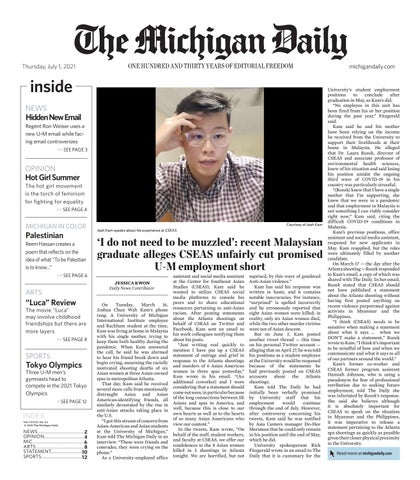
‘I do not need to be muzzled’: recent Malaysian graduate alleges CSEAS unfairly cut promised U-M employment short JESSICA KWON Daily News Contributor
ARTS
“Luca” Review
The movie “Luca” may involve childhood friendships but there are more layers
Courtesy of Josh Kam Josh Kam speaks about his experience at CSEAS
>> SEE PAGE 8
SPORTS
Tokyo Olympics
Three U-M men’s gymnasts head to compete in the 2021 Tokyo Olympics > SEE PAGE 12
INDEX Vol. CXXIX, No. 112 © 2020 The Michigan Daily
NEWS .................................... 2 OPINION................................ 4 MiC......................................... 6 ARTS.......................................8 STATEMENT..........................10 SPORTS.................................12
On Tuesday, March 16, Joshua Chun Wah Kam’s phone rang. A University of Michigan International Institute employee and Rackham student at the time, Kam was living at home in Malaysia with his single mother, trying to keep them both healthy during the pandemic. When Kam answered the call, he said he was alarmed to hear his friend break down and begin crying, mourning the racially motivated shooting deaths of six Asian women at three Asian-owned spas in metropolitan Atlanta. That day, Kam said he received several more calls from emotionally distraught Asian and Asian American-identifying friends, all similarly devastated by the rise in anti-Asian attacks taking place in the U.S. “I got this stream of concern from Asian-American and Asian students at the University of Michigan,” Kam told The Michigan Daily in an interview. “These were friends and comrades, they were crying on the phone.” As a University-employed office
assistant and social media assistant at the Center for Southeast Asian Studies (CSEAS), Kam said he wanted to utilize CSEAS social media platforms to console his peers and to share educational resources pertaining to anti-Asian racism. After posting statements about the Atlanta shootings on behalf of CSEAS on Twitter and Facebook, Kam sent an email to his work colleagues notifying them about his posts. “Just writing real quickly to mention I have put up a CSEAS statement of outrage and grief in response to the Atlanta shootings and murders of 6 Asian American women in three spas yesterday,” Kam wrote in his email. “(An additional coworker) and I were considering that a statement should come out soon, in particular because of the long connections between SE Asians and spas in America, and well, because this is close to our own hearts as well as to the hearts of so many Asian Americans who view our content.” In the tweets, Kam wrote, “On behalf of the staff, student workers, and faculty at CSEAS, we offer our condolences to the 8 Asian women killed in 3 shootings in Atlanta tonight. We are horrified, but not
suprised, by this wave of gendered Anti-Asian violence.” Kam has said his response was written in haste, and it contains notable inaccuracies. For instance, “surprised” is spelled incorrectly and he erroneously reported that eight Asian women were killed; in reality, only six Asian women died, while the two other murder victims were not of Asian descent. But on June 3, Kam posted another tweet thread — this time on his personal Twitter account — alleging that on April 27, he was told his positions as a student employee at the University would be reopened because of the statements he had previously posted on CSEAS accounts about the Atlanta shootings. Kam told The Daily he had initially been verbally promised by University staff that his employment would continue through the end of July. However, after controversy concerning his tweets, Kam said he was notified by Asia Centers manager Do-Hee Morsman that he could only remain in his position until the end of May, which he did. University spokesperson Rick Fitzgerald wrote in an email to The Daily that it is customary for the
michigandaily.com
University’s student employment positions to conclude after graduation in May, as Kam’s did. “No employee in this unit has been fired from his or her position during the past year,” Fitzgerald said. Kam said he and his mother have been relying on the income he received from the University to support their livelihoods at their home in Malaysia. He alleged that Dr. Laura Rozek, director of CSEAS and associate professor of environmental health sciences, knew of his situation and said losing his position amidst the ongoing third wave of COVID-19 in his country was particularly stressful. “(Rozek) knew that I have a single mother that I’m supporting, she knew that we were in a pandemic and that employment in Malaysia is not something I can viably consider right now,” Kam said, citing the difficult COVID-19 conditions in Malaysia. Kam’s previous positions, office assistant and social media assistant, reopened for new applicants in May. Kam reapplied, but the roles were ultimately filled by another candidate. On March 17 — the day after the Atlanta shooting — Rozek responded to Kam’s email, a copy of which was shared with The Daily. In her email, Rozek stated that CSEAS should not have published a statement about the Atlanta shooting without having first posted anything on recent violence perpetrated against activists in Myanmar and the Philippines. “I think (CSEAS) needs to be sensitive when making a statement about what it says … when we DON’T make a statement,” Rozek wrote to Kam. “I think it’s important to be mindful of how and when we communicate and what it says to all of our partners around the world.” Kam’s former co-worker and CSEAS former program assistant Hannah Johnson, who is using a pseudonym for fear of professional retribution due to seeking future employment, told The Daily she was infuriated by Rozek’s response. She said she believes although it is absolutely important for CSEAS to speak on the situation in Myanmar and the Philippines, it was imperative to release a statement pertaining to the Atlanta spa shootings as quickly as possible given their closer physical proximity to the University. Read more at michigandaily.com
2 NEWS
Thursday, July 1, 2021 The Michigan Daily — michigandaily.com
U-M and Ann Arbor NAACP hold inaugural Juneteenth symposium JUSTIN O’BEIRNE Daily Staff Reporter
In collaboration with the Ann Arbor branch of the National Association for the Advancement of Colored People (NAACP), the University of Michigan concluded its first-ever Juneteenth symposium on Saturday. The virtual symposium featured a variety of live-streamed speeches, performances and workshops occurring all throughout the week leading up to the holiday, which is celebrated on June 19. During the run of the symposium, on Thursday, President Joe Biden signed legislation marking Juneteenth as a federal holiday for the first time. On Friday, the Ann Arbor City Council also unanimously voted to recognize Juneteenth as a cityrecognized and commemorated annual holiday. Juneteenth celebrates the liberation of the last enslaved people in the United States. On June 19, 1865 — approximately two months after the Civil War ended and two and a half years after the Emancipation Proclamation was issued — a Union General in Galveston, Texas, informed the last enslaved people in the United States of their emancipation. The University’s Juneteenth symposium was sponsored by the Rackham Graduate School’s Strategic Action Lead Team, the Association of Black Social Work Students, the Department of Afroamerican and African Studies, the Center for Social Solutions and the Ann Arbor branch of the NAACP. Rackham student Kianté McKinley, co-chair of the symposium, said she felt it was significant to make the Juneteenth Symposium a campus-wide event so that all students could feel comfortable at the University. “It was important to make it a campus-wide event because the University of Michigan is a predominantly white institution, but there are Black students on this campus,” McKinley said. “To really make (Black students) feel like they belong on this campus, we should celebrate holidays that involve the Black experience.”
On Monday, at the opening livestream, William Hampton, the president of the NAACP’s Ann Arbor branch, recalled the history of Juneteenth for those attending. Hampton also looked back on the history of Juneteenth celebrations in Ann Arbor, noting that Ann Arbor has been commemorating Juneteenth in Wheeler Park for 27 consecutive years now. “Ann Arbor’s Juneteenth celebration is one of the oldest celebrations in the history of the state of Michigan,” Hampton said at the symposium’s opening. “Wheeler Park is named for Al Wheeler. Al Wheeler is thefirst, and up until now, the only, AfricanAmerican who has ever, ever held the office of mayor of the city of Ann Arbor.” Besides being elected as the first black mayor of the city in 1975, Wheeler was also the first AfricanAmerican-identifying individual to earn tenure as a professor at the University, which he did in 1959 for his work in microbiology. Wheeler was named a professor emeritus by the Board of Regents in 1982 and Wheeler Park was renamed posthumously in his honor five years later. Tuesday and Wednesday’s symposium activities included performances of spoken word by both students and professors, gospel performances and a virtual exploration of Black art and culture at the University of Michigan Museum of Art. The fourth day of the symposium, entitled “Racial Justice Call to Action,” was dedicated to student-led workshops in which participants could actively learn about and practice anti-racism, self-worth and self-care, as well as Black mental health awareness. The workshops were organized and presented by the Association of Black Student Social Work Students and the School of Social Work. Law and Rackham student Hannah Lefton, who helped run a workshop called “Showing Up for Racial Justice — White Fragility: How to be Anti-racist,” said it was important to have interactive sessions led by students during the symposium. Read more at michigandaily.com
University lifts COVID-19 spending restraints
420 Maynard St. Ann Arbor, MI 48109-1327 www.michigandaily.com
CALDER LEWIS Editor in Chief eic@michigandaily.com
KATIE LYNGKLIP
Business Manager business@michigandaily.com
CONTACT INFORMATION
JARETT ORR/Daily U-M President Mark Schilissel announced the end of University COVID-19 spending restrictions on June 18th.
JUSTIN O’BEIRNE Daily Staff Reporter
On June 18, University of Michigan President Mark Schlissel announced an end to the University’s spending restraints that began in April 2020 as a result of the COVID19 pandemic. The restraints included a hiring freeze and prohibited base salary increases. The University also permitted employees to voluntarily take an unpaid furlough or reduce their working hours. Additionally, construction projects were paused, as was non-essential travel, purchases, consultant use and advertising. Rising LSA sophomore Ava BenDavid said she is particularly excited about the return of non-essential travel because it opens up potential for guest speakers and lecturers in her classes. “Having guest speakers and lecturers and being able to hear from really accomplished people is why Michigan is such a good school,” Ben-David said. “It’s a really good thing for students to be able to experience this because (incoming sophomores) haven’t been able to see just how prestigious Michigan really is.” Rising Engineering sophomore Sam Sugarman said he hopes the increased resources available this year will help improve the quality of some of his classes. “We really needed the resources (last) year,” Sugarman said. “I think (instructors) did the best they could, but they dropped the ball in some classes… so I think (more resources this year) will be useful.” In April 2020, Schlissel said he anticipated losses between $400
million and $1 billion to occur by the end of 2020. He said this shortfall would be due to refunds of student housing contracts, loss of revenue from non-urgent medical procedures, a potential decrease in demand for classes and a potential decrease in state and federal funding. While spending restraints have been lifted, Schlissel said this June that University resources remain limited. Schlissel said the University is still encouraging fiscal prudence due to continued uncertainties regarding its financial situation. These uncertainties regarding current resources are due to continued uncertainty surrounding state funding, the duration of the pandemic and related lockdown measures, as well as the amount of resources available from federal emergency relief funds. In an email to The Michigan Daily, University spokesperson Kim Broekhuizen wrote that the amount of state funding U-M will receive may not be certain until September. The elimination of spending restraints comes amid the Lecturers’ Employee Organization (LEO) negotiating a new contract. One of LEO’s demands is pay parity across all three University of Michigan campuses. Currently, lecturers on the Ann Arbor Campus receive higher minimum pay than lecturers on the University of Michigan-Dearborn and University of Michigan-Flint campuses. Kirsten Herold, a School of Public Health lecturer and LEO President, told The Daily that she does not think the University’s new spending announcement will help LEO members as it doesn’t include adequate salary changes. Read more at michigandaily.com
News Tips Corrections Letters to the Editor News section Photo Department Arts Section Editorial Page Sports Section Advertising
tipline@michigandaily.com corrections@michigandaily.com tothedaily@michigandaily.com news@michigandaily.com photo@michigandaily.com arts@michigandaily.com opinion@michigandaily.com sports@michigandaily.com wmg-contact@umich.edu
EDITORIAL STAFF Madison Gagne Managing Editor mbgagne@umich.edu
Allison Engkvist Digital Managing Editor engkvist@umich.edu
Christian Juliano and Shannon Stocking Managing News Editors news@michigandaily.com
Josh Taubman and Max Wadley Managing Sports Editors sports@michigandaily.com
Rosa Sofia Kaminski and Julian Wray Managing Arts Editors arts@michigandaily.com
Becca Mahon and Dominick Sokotoff Managing Photo Editors photo@michigandaily.com
Sarah Chung and Allison Yih Managing Design Editors design@michigandaily.com
Ethan Patrick and Caroline Atkinson Managing Copy Editors copydesk@michigandaily.com
Eliya Imtiaz and Lola Yang Managing Michigan in Color Editors michiganincolor@michigandaily.com
Amelia Duffy and Zoe Storer Managing Social Media Editors socialmedia@michigandaily.com
Mary Rolfes Editorial Page Editor opinion@michigandaily.com
Margaret Rudnick Managing Video Editor video@michigandaily.com
Samantha Cole Managing Statement Editor statement@michigandaily.com
The Michigan Daily (ISSN 0745-967) is published Monday through Friday during the fall and winter terms by students at the University of Michigan. One copy is available free of charge to all readers. Additional copies may be picked up at the Daily’s office for $2 per issue. Subscriptions for September - April are $250, and year-long subscriptions are $275. University affiliates are subject to a reduced subscription rate. Subscriptions must be prepaid.
Thursday, July 1, 2021 The Michigan Daily — michigandaily.com
Virtual event addressing Anti-Asian hate on college campuses gets shut down following obscene interruptions from ‘Zoom-bomber’ JUSTIN O’BEIRNE Daily Staff Reporter
The University of Michigan’s National Center for Institutional Diversity and the Steve Fund, an organization working to advance positive mental health for young people of color, were forced to abruptly end a virtual Anti-Asian hate panel discussion Tuesday afternoon after an anonymous Zoom bomber began shouting obscenities and racial slurs. The panel, entitled “Anti-Asian Hate and Mental Health on College Campuses,” was set to feature expert speakers in the fields of Asian-American studies; mental health studies; and diversity, equity and inclusion. In particular, the event was intended to discuss strategies for increasing racial equity on college campuses in order to support AAPIidentifying members of academic communities. In the session’s opening remarks — which successfully finished prior to the Zoom-bombing — Dr.
you can use for supporting AAPI students,” Liu said. Kevin Nadal, the keynote speaker and a professor of psychology at City University of New York and at the John Jay College of Criminal Justice, began his address by emphasizing the importance of recognizing the diverse identities and ethnicities within the Asian-American community and the different lived experiences of each individual. As an individual who identifies as Asian American himself, Nadal said microaggressions, implicit biases and white supremacy can all contribute to making Asian Americans feel stereotyped and unsafe on college campuses. “In order for us to really ensure that people feel safe … we have to target notions of white supremacy and the ways in which many people of color are targeted,” Nadal said about 14 minutes after the panel discussion had begun. “Within minority stress is the idea of microaggression—” After Nadal said “microaggression,” he was interrupted by an indeterminate,
DOMINICK SOKOTOFF/Daily A Zoom event hosted by The University of Michigan’s National Center for Institutional Diversity and the Steve Fund was disrupted by hateful comments from a ‘Zoom-bomber.”
Marcia Liu, the event moderator and Mental Health Coordinator for Hunter College AANAPISI Project in New York City, said Tuesday’s event would help build community and facilitate support systems for AAPI-identifying students. “We hope today’s presentation discussion helps to build community, clarify information, generate some creative advocacy strategies and interventions that
high-pitched screaming noise, emitted by an unknown, unmuted participant. Nadal acknowledged the noise momentarily, saying that it “scared him,” and then continued on with his keynote address. About 30 seconds later, another, completely different short noise interrupted Nadal again, and then a longer, non-verbal groaning sound cut him off after another 30 seconds. After this third disruption,
Nadal joked about how getting “Zoom-bombed” was breaking his year-long record of not being interrupted while lecturing over Zoom. Every time a noise was made, it was unclear who was disrupting the meeting, as there were almost 150 people in attendance and Nadal was consistently the highlighted speaker. As Nadal attempted once again to continue with his address, the sporadic interruptions became increasingly more frequent. Participants began to comment on the Zoom-bombing in the meeting chat. “I think we may be (being Zoom bombed),” one wrote. “Just a sign we’re doing good work.” Nadal spoke over the noises about the importance of destigmatizing mental health care for Asian American-identifying individuals and encouraging professional counseling within Asian American communities when needed. “What we really need to do is destigmatize mental health for everyone, while also being mindful of those specific ways that Asian Americans and Pacific Islanders may face difficulties in seeking mental health treatment,” Nadal said. “I think we need to (encourage mental health conversations) at all levels: within our own families, within our friendship circles and within our communities and even within workplaces and organizations talking about mental health.” Right after this, the Zoom bomber once again repeated their loud and disruptive behavior, playing another groan-like sound effect. At this point, Liu apologized to Nadal for the disruptions. After a moment of silence, Nadal attempted to finish his initial presentation when the Zoom bomber screamed “Fuck you, bitch” in a computergenerated voice. Liu quickly apologized again, acknowledging the incident and negative effect the interruption might be having on the attendees. Liu said people were working “on the other side” to try to identify and silence the Zoom-bomber, but she did not want an outburst at an event raising awareness about antiAsian hate to go ignored. Read more at michigandaily.com
NEWS 3
Regent Ron Weiser has hidden new U-M email JARED DOUGALL Summer News Editor
Regent Ron Weiser (R) is using a new U-M email with the uniqname “dannyboi” after discontinuing his public University email amid controversy earlier this academic year. Since at least late March, emails to rnweiser@umich.edu, previously listed as Weiser’s email contact on his Board of Regents website page, have bounced back. Weiser’s youngest son is named Danny; however, whether that is the origin of his new uniqname is unclear. A source close to the board has confirmed that dannyboi@umich.edu is Weiser’s new email address The Michigan Daily also uncovered an email, riddled with cryptic messages reminiscent of those one would send to an estranged romantic partner, sent by Weiser to the entire Board of Regents on Friday, Oct. 18, 2019 at 11:21 P.M.. It has the subject line “CG.” Weiser asks the intended recipient what the point of their call was and why they decided to block him. “I called you several times. You didn’t answer. You didn’t answer cuz you were with her. I get it. I get it. I get it. I get it. I get it. I get it. I totally get it” Weiser wrote. “I can’t handle it. I’m worth more. I’m tired of apologizing. I’m tired of feeling this way.” Weiser continues, frustrated by the seemingly sudden lack of response from the recipient. “I’m not the one you are mad at. You were already mad. I was jealous. Rightfully so. Now I calm down and you won’t answer my call,” Weiser wrote. “Are you with her? Is that why? Are you working it out with her? I’m blind over here, remember? You blocked me? This is crazy.” Weiser’s message is the newest addition to a set of email controversies he has faced in the past. In February, The Daily revealed emails Weiser sent to fellow Board of Regents members calling bargaining graduate students “hired union hacks.” He also compared other Regents’ lack of support during calls for his resignation to “Germany in the 1930s.” That same group of emails
contained one sent by Weiser that only contained a photo of a bikiniclad woman with the subject line “BB.” Weiser was censured by the Board of Regents in April for misogynistic and violent statements he made at the North Oakland Republican Club in March. Weiser referred to Michigan’s top Democratic leaders, presumably Gov. Gretchen Whitmer, Secretary of State Jocelyn Benson and Attorney General Dana Nessel, as “three witches.” He also joked about the potential assassination of two U.S. House Republicans from Michigan who voted to impeach former President Donald Trump in January. Four of his Democratic colleagues on the board called on him to resign. Following his comments at the Republican Club and the Regents meeting, Weiser faced significant backlash from other members of the U-M community. A group called the Network for the Ongoing Reconsideration of Our Nomenclature at the University of Michigan (NoRon) protested at Weiser Hall by “renaming” it the “Weiser Center for Voter Suppression, Political Assassination and Witch Burning.” Despite pressure from NoRon and other members of the campus community to officially rename Weiser Hall after someone else, in June, the University announced the building would retain its name. Weiser’s remarks in March were part of a larger ongoing controversy regarding the regent, who is one of two Republicans on the eight-member Board of Regents. In January, Weiser did not specifically condemn Donald Trump’s role in the Jan. 6 insurrection in the U.S. Capitol, which led to calls for his resignation from thousands of students and faculty. Weiser was reelected Chair of the Michigan Republican Party for his third non-consecutive term with 66% of the vote at the 2021 Michigan GOP Convention. At the time of publication, neither Weiser nor a spokesperson for the University has responded to The Daily’s request for comment regarding his new email address or the 2019 email.
4 OPINION
Thursday, May 27, 2021 The Michigan Daily — michigandaily.com
THEODORA VORIAS | OPINION COLUMNIST
Edited and managed by students at the University of Michigan since 1890.
Hot girl summer is the feminist energy we deserve
420 Maynard St. Ann Arbor, MI 48109 tothedaily@michigandaily.com
CALDER LEWIS
MARY ROLFES
Editor in Chief
Editorial Page Editor
EDITORIAL BOARD MEMBERS Julian Barnard Zack Blumberg Brittany Bowman Elizabeth Cook
Brandon Cowit Jess D’Agostino Andrew Gerace Jessie Mitchell
Mary Rolfes Gabrijela Skoko Jack Tumoowsky Joel Weiner
Unsigned editorials reflect the official position of The Daily’s Editorial Board. All other signed articles and illustrations represent solely the views of their authors.
BRANDON COWIT | OPINION COLUMNIST
Why people flee Latin American countries
“
I want to be clear to folks in the region who are thinking about making that dangerous trek to the United States-Mexico border: Do not come. Do not come … you will be turned back.” That quote, despite its conservative-leaning rhetoric, did not come from former President Donald Trump or anyone from his administration. Rather, it came from Vice President Kamala Harris during a recent trip to Guatemala, where she traveled to meet with Guatemalan President Alejandro Giammattei. The statement received condemnation from many, including prominent Democrats such as Rep. Alexandria Ocasio-Cortez, D-N.Y., who called it “disappointing to see.” However, that’s not all that the vice president said on that trip — and other quotes deserve greater scrutiny. Just before her “do not come” line, she delivered a more positive-sounding message, stating that, “The goal of our work is to help Guatemalans find hope at home.” I would certainly hope that the Biden administration is able to help Guatemalans to build better lives… or at least help to lower their 59% poverty rate. However, it’s important to understand why Guatemalans currently lack “hope at home” and consider those reasons before turning them away. Put simply, much of why Guatemalans lack “hope at home” circles back to the actions of the U.S. government. Chief among those actions is
the 1954 military coup that the U.S. backed against social-democratic President Jacobo Arbenz. The U.S. backed the coup because Arbenz had the gall to redistribute land from the United Fruit Company, which essentially controlled the country and its economy at the time. This coup plunged the country into a decades-long civil war in which over 200,000 people were killed, 83% of them indigenous and 93% of them by the U.S-backed government and its paramilitary proxies. It’s regularly referred to as a genocide today. The war thankfully ended in 1996, but — even if the U.S. had done nothing to Guatemala since — backing a decades-long slaughter of Guatemala’s indigenous people would be more than enough to indict the U.S. for Guatemala’s present state. Of course, this is not the only time U.S. actions in Guatemala have led to adverse consequences. More recently — starting in 2012 — thenPresident Otto Perez Molina vastly increased the military’s domestic presence, using it essentially as an extension of the country’s police force. In 2013, the first full year of increased militarization of the country, the murder rate increased by 10%, including a 40% increase in the murder of human rights activists. The U.S. funded this murder, causing militarization to the tune of $14 million in 2012, a significant amount when compared to the country’s overall military budget of just under $300 million. This violence is almost
certainly a large part of why roughly 230,000 Guatemalans immigrated to the U.S. between 2007 and 2015. Guatemala is far from the only Latin American country where emigration can be traced to U.S. policy. A recent spike in migration from Honduras can be traced to the 2009 coup against President Manuel Zelaya that the U.S. backed. The recent uptick in violence by gangs in El Salvador such as MS-13 was in large part caused by the mass deportation of Salvadoran-American gang members back to their home country in the 1990s. This violence, as expected, caused around 220,000 Salvadorans to flee for the U.S. between 2007 and 2015. Finally, as I’ve written about before, the U.S. funded Colombian government violence that killed over 100,000 people, causing the number of Colombian immigrants in the U.S. to increase by nearly 250,000 between 2000 and 2010. All of this is to say that if the Biden administration is serious about helping Guatemalans “find hope at home,” they have a lot of work to do. While the administration has taken some promising steps, such as committing to sending $4 billion in developmental aid to Central America, other promises merit concern. Read more at michigandaily.com Brandon Cowit is an Opinion Columnist and can be reached at cowitb@umich.edu.
E
very year, as the days get longer and the temperature gets warmer, there’s a je ne sais quoi that makes people want to live their best life. That may mean spending all day at the beach, dropping a few pounds or getting the highly desirable ‘summer glow.’ Though not a new idea, the popularity of having a “hot girl summer” is not slowing down anytime soon. The tag #hotgirlsummer is being plastered all over social media with growing intensity as summer 2021 comes into full effect. The versatility and malleability of the phrase’s meaning point to women’s desire for more autonomy in every aspect of life. After over a year of a pandemic that increased job insecurity for women, pushed 47 million women and girls below the poverty line and led to stay-at-home orders that resulted in increased domestic violence against women, hot girl summer is the feminist energy we need and deserve. Backed by the anthem “Hot Girl Summer” by Megan Thee Stallion, the hot girl movement is a blend of several waves of feminism, from the body positivity movement to the empowering aspects of female entrepreneurship and professional advancement. How someone’s hot girl summer turns out is up to the individual. It could be breaking the mold of societal expectations put on women’s behavior, especially when it comes to their sexuality. It could be working hard to be financially secure and independent. However, it most notably is associated with authenticity, embracing one’s body and the freedom to do whatever you want whenever you want. Women are consistently bogged
Design by Yassmine El-Rewini
down by societal expectations; hot girl summer lets us overcome them unapologetically. One of the most liberating values behind the movement is denying socially constructed beauty standards as something that is one-size-fits-all. Hot girl summer challenges women to embrace themselves as their own definitions of beauty. This movement is especially important for women who don’t fit what society too often deems as the gold standard of beauty, such as being thin, yet having curves, having full lips and not being too tall. It preaches inclusivity and positivity. Megan Thee Stallion, whose fan base is credited with creating and popularizing the phrase, publicly stated that the ideals behind hot girl summer weren’t only applicable to women. The idea behind the phrase makes it open to anyone, regardless of their gender. That means whoever wants to have a hot girl summer, whether a man, woman or another gender identity, is more than welcome to have one. The movement also fights against the expectation that women should be quiet, should not take up space and should not be too assertive. For far too long, society has perpetuated the idea that women should be subservient. Hot girl summer allows and advocates for giving power and choice back to women. It doesn’t provide a cookie-cutter layout of how women should behave — it is completely up to them. Read more at michigandaily.com
Theodora Vorias is an Opinion Columnist and can be reached at tvorias@umich.edu.
Thursday, July 1, 2021 The Michigan Daily — michigandaily.com
MEERA KUMAR | OPINION COLUMNIST
OPINION 5
Why must taking care of one’s health make international news?
I
n case you missed it, world-famous tennis superstar Naomi Osaka was featured prominently in the media last month for withdrawing from the 2021 French Open, the premier tennis clay court championship. Osaka, who had announced earlier that she wouldn’t attend press conferences during the tournament due to mental health concerns, was threatened after winning her first match in straight sets and fined $15,000. In response, Osaka withdrew from the tournament the following day, describing her struggles with anxiety and depression on social media. Her tweet announcing her departure garnered almost 19,000 responses, more than 83,000 retweets and over 410,000 likes. Many athletes spoke out in support of Osaka, sharing their thoughts on how athletes are often forced to suffer. In contrast, many others were quick to ridicule Osaka for standing up for herself, calling her a “diva” and “narcissistic.” Obviously, the negative responses calling Osaka
privileged indicate an apathetic and perhaps naive perspective. In the process of being obsessed with the game or entrenched within institutions, many seem to have forgotten basic human decency. However, for someone struggling with mental health issues, any spotlight — be it positive or negative — can exacerbate those problems. The reason Osaka cited for skipping press conferences was anxiety. Due to the apathy of the organizers of the French Open, as well as those who found time to ridicule Osaka publicly and the subsequent media attention, Osaka has been the subject of constant press and speculation on her character, drive and ability — the very thing she sought to avoid. While they garnered much support, her social media posts announcing her withdrawal from the tournament weren’t victorious or celebratory. Osaka had no choice but to explain her decision and struggles with mental health to the millions watching after the dogged attention. Much of the positive
attention she received was still unwanted and continues to single her out specifically for her mental health concerns. The more we talk about Naomi Osaka as an isolated martyr for mental health, rather than striving to understand the systemic reasons behind Osaka’s decision, the more we make a spectacle of someone who’s suffering. To be clear: Her announcement is important. In a guest essay for the New York Times, Kelli María Korducki writes that Osaka has given a face to the growing and long overdue revolt. By speaking up, Osaka has brought attention to issues within sports and has removed some of the stigmas for future athletes who will choose to prioritize their mental health. Additionally, her prominence in the media prompts conversations about the necessity to recognize mental health as a serious concern. What is a big deal today will end up being completely regular tomorrow… hopefully. Still, normalizing anything in the public eye involves sacrifice — one that Naomi Osaka didn’t choose to
OLIVIA MOURDIAN | OPINION COLUMNIST
Your skills don’t have to be quantifiable to be valuable
W
hen asked about my strengths, my default answers are writing and “people skills.” What do I mean by “people skills?” While definitions vary, I would define them as the communicative tools used to connect with another person. I put them in quotations because these tools carry different meanings for different people. Similar to the blurry distinction between a good writer and a great writer, there is not a universal metric by which someone can be pinpointed as “great with people” versus “good with people.” This blurriness continues to create doubt in my abilities. It is easy for me to say I’m not actually a good writer and, instead, say my professors have just graded my work easily. As it is almost impossible to measure human connection, it is also easy for me to say that I’m not actually good with people. With these doubts, which are exacerbated by societal pressures to validate skills through quantifying their value, I often find myself scrambling to explain how these immeasurable skills are actually my strengths. The idea of constantly doubting my strongest abilities is both contradictory and limiting. However, the two skills I am best at both happen to be subjective and therefore more easily belittled than more objective skills. Compared to
experience with Photoshop, Javascript or statistical modeling, experience with people or writing sounds obvious and self-aggrandizing. With skills that are less quantifiable, it becomes easier to assume that the majority of people have the same capabilities with these skills because distinctions between different proficiencies in them are less absolute. The last few years have witnessed an increased emphasis on science, technology, engineering and math education and careers, a decline of humanities majors that rely more on soft skills and the resulting employability fears associated with this decline. Somewhere in the midst of this, we have mistakenly come to equate measurability — more specifically, quantifiability — to value. And considering the management system of many universities, our society’s general marginalization of soft skills can be traced back to the way our education system pits studies that rely more on soft skills against ones that emphasize hard skills. Recently, responsibility-centered management (a university budgeting system under which each department has autonomy over its revenue and expenditures) has become the budgeting model of choice for many academic institutions. Under this model, large classes — which are more profitable —
are prioritized over smaller, discussionbased classes, which typically happen to be classes that are centered around soft skills. Operating as businesses, universities further devalue subjective skills and the discussion-based classes that go along with these skills because they are not as fiscally advantageous for them. However, what is valuable to a business and what is valuable to society should not and cannot be viewed as equivalent to each other. The mere fact that classes centered on soft skills are not as profitable to universities as classes centered on hard skills does not mean soft skills themselves are not as beneficial to society as hard skills are. Despite this prioritization of hard skills, these “soft” abilities are still valued by American companies, with 61% claiming that skills like communication and problem solving are the most valued in prospective hires. In a study conducted by Boston College, Harvard University and the University of Michigan, soft skills training was found to increase worker productivity by 12%. With this additional productivity and subsequent increase in retention rates, the training produced a 256% net return on investment after nine months. LinkedIn CEO Jeff Weiner believes the skills gap associated with soft skills is the widest in the United States. It is undeniable:
make. Osaka didn’t ask to be the face of a movement. Osaka, a dedicated activist for causes including Black Lives Matter, is passionate about using her platform to speak up. That doesn’t mean she can be an advocate for every cause. Naomi Osaka is not just a famous athlete, but also a real person. As a human being, she opened up about her struggles; as a celebrity, she has been isolated, criticized and analyzed by the media for her struggles. Dealing with one’s own problems is hard enough. Osaka was in an unhealthy place when she announced her departure, and still is — she recently announced her withdrawal from the German Open. To be questioned and ridiculed for your struggles by millions is a harrowing experience that many can’t even comprehend. When we speak of Osaka’s terrible experiences at the French Open, what we should be doing is questioning the systems that have led to this unfortunate incident. We should be criticizing the ridiculously apathetic and incon-
siderate practices of the organizers and how they refuse to admit any wrongdoing. We should be trying to stop relentlessly participating in celebrity culture, where people are turned into caricatures of a manufactured persona, and, instead, we ought to treat others with respect for their health and boundaries. We should be trying to understand how existing systems are inconsiderate toward our well-being. We should be questioning how we manage to further perpetuate apathy towards well-being when we push the narrative that Naomi Osaka is a “diva” or “narcissistic” and completely ignore her struggles. It is especially troubling that in 2021, our society is in a place where taking care of one’s well-being makes international headlines and inspires such hatred. It shouldn’t be a big deal! Read more at michigandaily.com Meera Kumar is an Opinion Columnist and can be reached at kmeera@umich.edu.
ANYA SINGH | OPINION CARTOONIST CAN BE REACHED AT ANYAS@UMICH.EDU.EDU.
Vaccine hesitancy
There is ample evidence to support the argument that soft skills are valuable and capitalistically productive. Even so, justifying the importance of soft skills using statistics — quantifiable numbers — on why these skills are valuable in the workplace perpetuates and perhaps even validates our society’s obsession with numbers and hard facts. When researching why soft skills are important, the vast majority of articles are centered around soft skills’
importance in the workplace. However, the true power of soft skills lies in their unavoidable and fundamental presence in our daily lives. Self-awareness allows you to recognize your own strengths, fears, insecurities and priorities — and also those of the people Read more at michigandaily.com
Zack Blumberg is an Opinion Columnist and can be reached at omouradi@umich.edu.
6 MICHIGAN IN COLOR REEM HASSAN MiC Columnist
To be Palestinian is to know 73 years of occupation 73 years of Palestinian displacement 73 years of Palestinian death 73 years of apartheid 73 years of ethnic cleansing as facts that disgustingly seem almost as natural as air itself as facts that seem to be given, that go without saying as facts that many of us don’t know life without. To be Palestinian is to know Resistance in the face of oppression Resilience in the face of brutality Patience in the face of injustice Strength in the face of weakness To be Palestinian is to know that Palestinian resistance is not just any type of resistance It is a type of resistance that exclusively runs in the blood of Palestinians A type of resistance that perseveres even when the whole world turns away A type of resistance that spits in the face
Thursday, July 1, 2021 The Michigan Daily — michigandaily.com
To be Palestinian
of oppression A type of resistance that laughs at any attempt to be silenced And a type of resistance that thrives on the love for one’s people and the yearning for their liberation To be Palestinian is to know the feeling of disgust that arises when Zionist propaganda claims that Palestine served as “a land without a people for a people without a land” in justification for outright colonialism The feeling of disgust that arises to hear the complete erasure of my lineage A lineage that I can trace back generations and generations in Palestine A lineage that I would have not come to simply be without To be Palestinian is to know that my grandparents are older than the state of Israel That my grandparents felt the direct wraths of the 1948 Nakba That my grandparents carried the burden of being displaced forcibly removed exiled
from their homes made refugees in their own land Land and homes that they built and tended to with their bare hands To be Palestinian is to know that my grandmother, Khadija Sadeq Abdeljaber, came so close to being a victim that she tasted the bitterness of death before surviving the 1948 Deir Yassin massacre in which Zionist troops raided the village of Deir Yassin located in the outskirts of Jersualem massacring over 250 Palestinian Arabs and exiling the rest Piles of Palestinian corpses burned Individuals tied to trees and set on fire She survived but watched everyone else around her get slaughtered in the process Livelihoods stolen from right beneath them Homes never returned Booted to fend for themselves or die As if they were foreigners To be Palestinian is to know That decades later when my grandmother returned to the village her family built
she found an Israeli family living in the home she once lived in completely unchanged otherwise Same furniture Same decor Some members even wearing the clothes that were left behind but completely oblivious and ignorant to how Palestinians were massacred and displaced in order to give these settlers their homes Homes these settlers somehow still felt entitled to To be Palestinian is to know that just because my grandmother survived death does not mean her life was smooth sailing That she was subjected to a long life of displacement after displacement Being refugeed and vilified Made a second-class citizen in the land she called her own bearing raising tending to seven children of her own under occupation who went on to live the same lives as she once did
To be Palestinian is to know that my cousin, Yousef Khamees Hassan was violently killed at 32 years old after living the entirety of his short life under occupation in Jerusalem Attempting to make ends meet for his family took a job in public transportation Savagely strangled with barbed wire by a mob of Israeli settlers who attacked the bus he drove Corpse hung to be found by others Killed in cold blood No arrests made No justice given To be Palestinian is to know that I am the daughter of individuals who were born into occupation Who lived under the systemic oppression of the Zionist regime Who only knew life without freedom before it ultimately drove them into exile Serving as living embodiment of the ongoing Nakba Born into a society that once thrived But was made unlivable Read more at michigandaily.com
A class apart MEERA KUMAR MiC Columnist
April was always the most loved — and the most dreaded — month of the school year. It was the time of year that students all over the city of Hyderabad, India, would be rejoicing, screaming at the top of their lungs out of buses and school buildings that they were finally free to forget a year’s worth of knowledge. However, the arrival of April didn’t necessarily mean we were free to go back and lounge in our air-conditioned homes until the summer ended. In Hyderabad, we always had a sort of trial run for the next year of school — anywhere from 15 days to a month where we got a taste of what our next school year would be like. Throughout the month of April, we had to study in the sweltering 90-degree heat of a Hyderabad summer. Although this fact generated groans of annoyance, we secretly enjoyed the accommodations our school arranged for us during this period of time. We were delighted at the prospect
of lining up at the lemonade stands our school put together to relieve us of the summer heat and the field trips to water parks where we would be drenched in cool water as the scorching sun looked down on us. Hyderabad’s summers did not, however, always bring with them such cheerful moments. A majority of the population — especially those sects not as wealthy as us — was left to deal with the heat by fanning themselves with newspapers and getting hospitalized or dying of heatstroke. They faced such extreme conditions in their homes, their place of work or study, their travels, and their daily activities. I had been made to witness this harsh reality at the government school owned by and fairly close to my own educational institution. Only a very small portion of the students studying at my school had ever actually been to the single-story building — containing no more than five rooms — they called a school. On this particular occasion, we were going there to teach the students about first aid, despite the fact that we weren’t greatly educated about it to begin with.
Although it may sound philanthropic on my school’s part to have financed a government school, it is essential to understand that there was a substantial reason behind this magnanimity. In India, the government mandates that private schools reserve 25% of their seats for students from disadvantaged backgrounds, taking lower or no fees. However, most private schools don’t want these “unruly” kids sitting with their “polished, rich” students. So they find a workaround: They finance government schools and maintain the segregation of the classes. My private school was wealthy, and it was a well-known fact that it financed and owned a government school close by. Perhaps this goodwill tour was our school’s way of making reparations for segregating us from the government school kids for so many years. Perhaps our school thought we were doing these kids a great service by bestowing them with our presence, whether it was to teach them without actually improving their knowledge of first aid or simply to spend our “valuable” time with
Design by Meghana Tummala
them. Whatever the reason, it was an unspoken understanding among the students of the private school that this visit was made with the expectation that the government school kids would be immensely grateful for our school’s supposed selflessness. When I was 14 years old, I had been in my school for nine years by then but never once thought it was odd that
we hadn’t set foot in the government school. Nevertheless, we were excited to be going to the school because this visit meant we didn’t have to attend any of our classes that day. We were sitting in our air-conditioned bus and driving to the school in the narrow, cramped roads of Masjid Banda. Read more at michigandaily.com
Thursday, July 1 2021 The Michigan Daily — michigandaily.com
MICHIGAN IN COLOR
The film isn’t over just yet SAFURA SYED MiC Columnist
A woma n d ressed i n pi n k wa l k s dow n a red ca r pet a nd ex tends her long a r m s to wave at t he crowd t hat ha s g at hered for her. A ma n f rom t he crowd reaches out a nd ret u r n s her g reet i ng. A s she wa l k s, t he w i nd ent a ng les t he end of her sca r f w it h h is bracelet a nd forces h i m f rom t he crowd a s he fol lows her. A Bol ly wood love song ha s been play i ng si nce she stepped out of her ca r, but it swel ls a s t he ma n is ca r r ied away by t he woma n’s long sca r f — h is hea r t is ena mored w it h her, con nec ted to her a s tenuously a s t he piece of fab r ic st uck i n side h is jewel r y. Most people who g rew up watch i ng Bol ly wood movies probably k now where t h is scene comes f rom — t he 20 07 f i l m “Om Sha nt i Om .” It ca me out when I wa s just i n k i nderg a r ten , but it ha s st ayed i n my life ever si nce. Ever y yea r, my fa m i ly a nd I watch t h is mov ie toget her — somet i mes because t here is not h i ng else to watch a nd somet i mes just because we wa nt to si ng a long to t he song s — but it ha s never once got ten old for me. My sib li ng s a nd I quote pa ssa ges f rom it a s we watch , addi ng ha nd mot ion s for d ra mat ic ef fec t . I’ve watched t h is mov ie a s I have g row n up, not ici ng cha nges i n it each t i me, ma r veli ng at t he sto r y tel li ng a nd t he wonder f u l, melod ra mat ic gen ius of it . For t hose t hat don’t k now, “Om Sha nt i Om” is a cla ssic Bol ly wood t a le of d ra ma a nd love a nd fa m i ly. It st a r t s i n 1977 fol low i ng Om P ra ka sh Ma k h ija ( played by Sha h Ru k h K ha n), a ju n ior a r t ist whose d rea m s of becomi ng a big st a r a re t a r n ished by h is la st na me a nd lack of con nec t ion s. He la ment s to h is mot her a nd h is on ly f r iend about h is rot ten luck , say i ng t hat h is fat her lived a nd died a s a ju n ior a r t ist a nd t hat he wou ld too. One n ig ht , he d r u n ken ly st a nds on a box a nd g ives a Fi l m fa re Awa rds accept a nce speech , pretendi ng t hat h is bot t le is t he awa rd a nd a comb is h is m icrophone. “ If t here is no happy endi ng,” he says, h is voice slu r r i ng. “Then it isn’t t he end . The f i l m isn’t over
yet!” Despite h is disma l prospec t s, Om pi nes a f ter t he superst a r beaut y Sha nt i Pr iya (t he woma n i n t he pi n k d ress) a nd a f ter a ser ies of cha nce encou nters, t he t wo become f r iends. He fa l ls i n love w it h her, not k now i ng t hat she ha s a l ready secret ly ma r r ied a f i l m producer. The f i rst ha lf of t he mov ie pays homa ge to a l l of t he Bolly wood cla ssics wh i le si mu lt a neously sat i r i zi ng fa mous f i l m ma kers a nd ac tors i n t he i ndust r y. It ma kes f u n of it s ow n melod ra ma — Om f requent ly jokes w it h h is mot her about her bei ng too “ f i l my.” Th is f i rst ha lf set s t he cont ra st bet ween t he superst a rs of t he late ’70s a nd ju n ior a r t ist s li ke Om , a nd t he pa i n t hat comes f rom not bei ng able to succeed because of t he fa m i ly you a re bor n i nto. In t he f i l m (a nd of ten i n rea l life), ac tors were g iven roles ba sed on t hei r la st na me, not necessa r i ly because of t hei r t a lent . A nd when Om rea li zes t hat Sha nt i Pr iya is ma r r ied, not hav i ng t houg ht t w ice about t he ju n ior a r t ist i n a ny roma nt ic way, h is jea lous y t u r n s sou r a nd t he u n fa i r ness of it a l l becomes more pa lpable. Om roa m s a rou nd t he set i n a tea l sher wa n i a f ter he rea li zes t hat Sha nt i’s hea r t belong s to someone else w it h a ba l lad of u n requ ited love play i ng i n t he backg rou nd a s t he ra i n d r ives t he rest of t he crew away. A few n ig ht s later, Sha nt i a nd Om a re bot h k illed. A s a ch i ld, I wa sn’t t he big gest fa n of t he f i rst ha lf of t he mov ie. The stor ies of love a nd hea r tbrea k were com mon for a l most a l l Bolly wood mov ies, a nd t he song s f rom t h is ha lf were more rem i n iscent of “old” Bol lywood st yles t ha n t hey were of 20 07 pop. A s a recu r rent v iewer, t here is a n u n sett li ng feeli ng of k now i ng t hat somet h i ng bad w i l l happen to t he lead, t he person you a re supposed to be root i ng for because Om w i l l die soon . I k new t h is even when I wa s you ng, d readi ng t he fac t t hat Om a nd Sha nt i w i l l never be toget her. A st ra nge sor t of sad ness used to overcome me when Om died i n t he f i rst ha lf of t he f i l m — not for t he cha rac ter h i m self, but for t he life t hat he w ished to have w it h t he woma n he loved . Om’s hea r tbrea k is u nex-
pec ted because Bol ly wood mov ies a re a for m of escap ism , not rea lit y. The hero a lways get s t he g i rl. But before a ny of t hat cou ld hap pen , Om dies a nd t he f i rst ha lf ends. Here, t he mov ie t a kes a t u r n f rom a lig hthea r ted rom- com set i n t he ’70s to a da rker stor y of revenge.
h is f r iends. Om spends t he rest of t he mov ie look i ng for ways to br i ng t he k i l ler to just ice. Wh i le t he f i rst ha lf of t he mov ie pa id homa ge to t he ’70s, t he second ha lf sat i r i zes t he i ndust r y du r i ng t he t i me t he f i l m wa s relea sed . Nepo t ism wa s (a nd st i l l cont i nues to be) a n issue i n Bol ly wood,
7
by g r ief f rom t he deat h s of her son a nd husba nd on ly to be rei nv igorated by t he quest to f i nd a k i l ler. A f ter watch i ng t he mov ie cou nt less t i mes, I st i l l watch en rap t u red a s Om tel ls Sha nt i to reach her ha nd towa rds t he t h i ng s t hat she deser ves, a s Om st a nds on t he Fi l m fa re st a ge i n 20 07 a nd accept s a n
Design by Megan Young
A f ter Om dies, we see h i m a g a i n 30 yea rs later. He ha s been rebor n a s t he son of a superst a r, liv i ng t he life he had a lways d rea med of a s a ju n ior a r t ist . He wa kes up i n a la rge ci rcu la r bed w it h serva nt s slidi ng slippers u nder h is feet before t hey ca n h it t he f loor a nd a s he wa l k s to t he ba lcony to g reet h is fa n s below, more ser va nt s wa l k beside h i m a nd of fer apples a nd ora nge ju ice. Th is Om (t h is pr iv i leged rei nca r nat ion of h i m) ha s no memor ies of t he st r ug g les or t he loves he had i n h is pa st life. In stead, he ha s on ly k now n com for t . He is of fered plent y of roles, a nd even when he shows up on set late, t he di rec tors g ive h i m a f ree pa ss because of h is la st na me. But when someone t a kes Om back to t he set where he had been work i ng before he died 30 yea rs a go, he st a r t s remember i ng h is pa st life. A f ter meet i ng t he ma n who had k i l led h i m , Om remembers Sha nt i, h is mot her a nd
a nd so wa s cra z y fa n cu lt u re a nd celebr it y ent it lement . Cou nt less fa mous Bol ly wood celebr it ies — f rom legends li ke Rek ha to moder n superst a rs li ke Sa l ma n K ha n a nd A k shay Ku ma r — ma ke ca meos i n t he f i l m , some of t hem even ma k i ng f u n of t hemselves. Even a s t he stor y becomes da rker, comedy rem i nds us of what t he stor y is ac t ua l ly about — love. The love t hat bi nds Om to h is mot her, who had k now n t hat he wa s st i l l a live, h is f r iend a nd Sha nt i, who had n’t been rei nca r nated a s Om had . A s I g rew older a nd st a r ted to w r ite, I st a r ted to appreciate t he mov ie i n a whole new lig ht . Om Sha nt i Om’s cha rac ters a re wel l t houg ht out a nd sat isf y i ng to watch . A s t heat r ica l a s t hey may seem , t hey adva nce t he plot per fec t ly wh i le st i l l f u lf i l li ng bot h comedic a nd d ra mat ic roles. Om’s mot her i n pa rt icu la r st a nds out a s a woma n who wa s i n it ia l ly dest royed
awa rd t hat he had wa nted w it h h is whole hea r t , so much t hat t he ent i re u n iverse con spi red to br i ng it to h i m . It is t h is speech , t he awa rd speech , t hat shapes t he hea r t of a mov ie more t ha n t he scenes of d ra ma or love or revenge. There is si mply a desi re for a n ach ievement , a wa nt so g reat t hat even t he u n iverse is bendi ng laws to prov ide it for you . A nd t here is t he i mplicat ion t hat t h is desi re ex ist s i n a l l of us a s we a l l have t he potent ia l to f u lf i l l ou r once-i n-a-lifet i me w ishes. Maybe t hey won’t be a s d ra st ic a s Om’s, but t hey ex ist nonet heless i n lit t le va r iat ion s i n ou r da i ly lives li ke meet i ng f r iends t h roug h a coi ncidence. Om says t hat ou r lives a re li ke t he movies w it h happy endi ng s, t hat t h i ng s smoot h t hem selves out a s we move a nd live, a nd even if more t h i ng s get i n t he way, we lea r n to smoot h t hose out too. Five-yea r- old me li ked to believe i n it , a nd 13 yea rs later, I st i l l do.
8 ARTS
Thursday, July 1, 2021 The Michigan Daily — michigandaily.com
“Luca,” childhood friendship and the discourse around gay fish KARI ANDERSON Daily Arts Writer
In May, my friend and I were taking a walk when she started excitedly telling me about Pixar’s newest film, “Luca,” which would be released in a few months. As she told me more about the trailers she’d seen, I was intrigued. Sea monsters that can become human when dry but change back to sea monsters when they get wet? Beautiful animated shots of the Italian Riviera? Young friendship, with mild gay undertones? When the release date came, I was perfectly happy to pull open my laptop and enjoy a tight 95 minutes of friendship and fun. Luckily, Pixar’s 24th feature length film was just as wonderful, if perhaps a bit different, than I’d expected. The story focuses on Luca (Jacob Tremblay, “Room”), a young sea monster living with his family in an underwater community on the Italian Riviera. Luca’s life consists mostly of being a fish shepherd (fishherd?), trying to please his family
and dreaming of the surface while also being deadly scared of the land monsters — humans — who inhabit it. Enter Alberto (Jack Dylan Grazer, “It”), another young sea monster who shakes up Luca’s safe, albeit boring, world. Luca and Alberto bond over a love of Vespa scooters and the desire to explore the world; soon, the two form a kind of opposites-attract friendship that naturally pairs Luca’s shy awe and Alberto’s blustering confidence. But soon, a series of events (including a visit from Luca’s anglerfish-esque uncle voiced by Sacha Baron Cohen (“Borat Subsequent Moviefilm”), because why not) leads the two boys to run away to live with the land monsters. There, they meet Giulia (Emma Berman, “Go! Go! Cory Carson”), a brash, unapologetic Italian girl whose father Massimo (Mario Barricelli, “The Book of Daniel”) boasts a successful fishing business and an impressive bushy mustache, the former of which makes him more dangerous to the two, you know, fish people. Still, the three kids must form a team of underdogs
in order to win a “traditional” Italian triathlon — which Giulia describes, deadpanned, as “swimming, cycling and eating pasta” — to … buy a Vespa? Defeat the obnoxious defending champ, Ercole (Saverio Raimondo, “Dov’è Mario?”)? Prove something to the world? Maybe a combination of all three. Truthfully, it’s difficult to explain the plot of “Luca” — not because the plot is particularly complicated, but because it’s more of a long experience than a set plot. Moments and scenes are there to move along the relationships rather than moving a plot along. As a result, “Luca” is a different kind of Pixar film, free of some of the surprisingly abstract plots or brutally emotional gut punches that have set Pixar apart from other animated children’s movies in the past — but not in a bad way. This is not to say that there are no deeply emotional moments — the film’s climax is surprisingly intense — but “Luca” feels more like a film you can just sit back and enjoy, rather than being, as my mom would say, a “three-hanky movie.”
Courtesy of ‘Luca’
One of the best parts of “Luca” is, perhaps as expected, the animation. Everything from the Italian waterfront to the colorful transition between sea monster and human forms is incredibly vibrant and fun to watch (plus the sea monsters are frickin’ cute). My personal favorite scenes were the daydream sequences, used to depict Luca’s active imagination: gorgeous, sweeping
animation that filled the screen with stunning images. The art design is particularly impressive given that much of “Luca” was, as is slyly stated in the end credits, “produced in our slippers around the Bay Area.” The friendship between Luca and Alberto, however, is the real core of the film. Read more at michigandaily.com
Ode to “Plan B” MEERA KUMAR Daily Arts Writer
“Plan B,” directed by Natalie Morales, is ridiculously funny. Best friends Sunny (Kuhoo Verma, “The Big Sick”) and Lupe (Victoria Moroles, “Teen Wolf”) road trip across South Dakota for a Plan B pill after an awkward encounter at Sunny’s party. On the way, the normally straightlaced best friends get lost, steal, party, take numerous illegal substances, hook up with strangers, confess secrets, and ultimately get spotted by the “Indian mafia” (the benchmark of any well-spent night). Produced and distributed by Hulu, the movie is unique for many reasons: the phenomenal Indian-American and Mexican-American representation, the controversial subject matter, and the exquisite filmography. Plan B shines not just due to its premise, but because of the quiet, heartwrenchingly gorgeous moments between the major plot points as well. It’s important to consider the wave of movies dubbed a “female Superbad” in the last few years — coming-of-age teen movies with best friends who confront the regular
atrocities of teenage life with candid humor. “Blockers,” “Booksmart” and now, “Plan B.” Some of the most entertaining films I’ve seen, these movies are created by female showbiz veterans such as Kay Cannon, Olivia Wilde and now, Natalie Morales. All are love letters to a candid teenage experience — not one of romanticised ideals or sexual fantasies, but rather adolescence in its awkward, painful entirety. What does Plan B bring to the table, one may ask? Sometimes, it’s easy to shrug off hollow representation on-screen. Just like in real life, people with marginalized identities are not thought of as just characters in movies or tv. When creating representation, we make something else entirely: the manifestation of the mean of our cultural worries, something that no plausible human could ever be. It’s difficult not to roll my eyes when I see even more Indian characters defined by their exaggerated accent. But once in a blue moon, marginalized people are allowed to just be people. I went into “Plan B” expecting to see another ignorant approximation of an Indian-American girl (or in the creator’s eyes, a socially inept robot trying to get into med school). In the
opening sequence, there’s a shot of Sunny flipping through her biology textbook on her bed getting ready for school, seemingly studying the pages. My heart sank as I watched her flip further, imagining the effortlessly perfect score she was going to bag on her upcoming test until she stopped on a page depicting genitalia. Confused, I snapped back to attention. Suddenly, Sunny starts masturbating. A little confused, and very much trying not to laugh, I kept watching. From there, the movie only gets bolder: Sunny loses her virginity, a penis piercing is yanked out and Lupe hooks up with a stranger. The confrontation of sexual stereotypes is at the heart of Plan B — especially about women of color, who are often portrayed in objectifying and hackneyed ways. Quite simply, Plan B is the most honest portrayal of teen sexuality I’ve seen. Instead of being the deeply distorted projection many writers believe Indian-Americans to be, Sunny just gets to be a person with a sex drive. However, the characters don’t exist independent of their respective cultures; rather, the cultural representation found in “Plan B” is much closer to reality than the
existing cliched representation used to define Indian-Americans. While getting ready, Sunny’s mother brushes coconut oil through Sunny’s long, thick, slightly frizzy hair; an unnecessary explanation of the practice isn’t given to appease unaware viewers. At one point, when harassed by a group of men at a gas station about her vagina, who call it a taco (believing her to be Mexican), she responds, “I’m South Asian, so that metaphor doesn’t track”, telling them to say “rotis, or naan, or something.” Despite being a deeply disturbing scene, Verma delivers the line hilariously; the burden of being oversexualized while ignorant comments are made about one’s body is always present for people of color. Plan B is part of a new wave of representation — one that depicts realities in a way that doesn’t feel voyeuristic or pandering to the white gaze. Despite its larger-than-life humor, Plan B shows the characters’ lives, cultures and struggles honestly. Apart from the genuine representation, “Plan B” excels in many other areas, including the acting. Verma’s and Moroles’s slice-oflife performances as Sunny and Lupe are unforgettable; their friendship
felt deeply genuine and eerily similar to the bonds I’ve formed with peers in high school. Additionally, the romantic relationships are written beautifully (a certified bitter Scrooge, I found the diner scene of Sunny and Hunter, her love interest, extremely adorable). The queer representation is some of the first I’ve seen in teen movies that doesn’t feel distinctly prying or othering; ultimately, the chemistry is off the charts, allaround. “Plan B” can only be described by contradictions. The realistic representation is ever-present, but the humor is over-the-top in a good way. I couldn’t stop laughing the entire movie (especially with Verma’s and Moroles’ talent for deadpan delivery). The story manages to remain funny while oscillating perfectly between ridiculous and heartfelt. While in a couple of places, the script felt a little odd (like when Sunny was unable to find a pharmacist in the entire state of South Dakota who would give her the Plan B pill, or how Lupe didn’t get as much representation as I hoped), the quiet moments of love between Sunny and Lupe made my heart ache. Read more at michigandaily.com
Thursday, July 1, 2021 The Michigan Daily — michigandaily.com
ARTS 9
The lesser-known games that won my heart at E3 HARPER KLOTZ Daily Arts Writer
E3 is quite possibly gaming’s biggest annual event, and this year’s E3 was very different. There were no in-person demos, conferences, or media coverage, but the virtual events were impressive nonetheless. It’s no surprise that Nintendo’s E3 Direct was full of exciting announcements, nor is it all that shocking that the joint XboxBethesda conference was jam-packed. But what truly won me over this year was the mountain of indie games. The second annual Wholesome Direct, dedicated to cheerful indie games, was incredible, and there were some fresh faces in larger conferences as well. Fortunately for me, many of these games had demos available on Steam and other platforms. Some I got to play, some I didn’t, but here are the games that impressed me the most: Teacup “Teacup” is the first game from developers Smarto Club, whose tagline
is “developer of friendly games.” Based on the demo, this game will certainly live up to that promise. “Teacup” is a non-linear adventure game about a tea-loving frog gathering ingredients for a tea party. Gameplay consists of a variety of minigames with lots of dialogue in between each game. The demo was relaxing and filled with calming music, charming characters, and a gorgeous storybook art style. The game releases at a currently unknown date later this year, and when that date comes I look forward to exploring more of Teacup the frog’s uniquely-styled world. Perhaps it’s time for less Mario Party and more froggy tea party. Arietta of Spirits “Arietta of Spirits” is an adventure game with a retro art style reminiscent of “Stardew Valley,” featuring a highly emotional narrative, great music, and gameplay similar to early entries in the Legend of Zelda series. Sure the game isn’t exactly anything we haven’t seen before, but the artstyle is crisp and fluid and wears its influences proudly on its sleeve. The game is equal parts
cozy and mysterious, and the demo’s cliffhanger ending left me even more excited to get the game on release day. Tunic Speaking of the Legend of Zelda series, Andrew Shouldice’s “Tunic” is a minimalist “Link’s Awakening” in which you play as a fox. Combat is simple to grasp and the toy-like graphics are sleek, but what is most satisfying is the game’s sense of discovery. I was driven to explore every nook and cranny possible in the demo in order to find weapons, defeat varied enemies, and search a range of settings for useful items. Bear and Breakfast Oh, to be a bear wandering through the woods, free of responsibilities — except for reviving a long gone resort. This game is a charming, cozy management simulation in which you (as Hank the bear) help an old woman named Barbara rebuild the forest resort you stumble upon with your woodland friends. The demo was adorable and very easy to play. If the lack of “Animal Crossing” updates is
getting to you, or your Sims addiction has lessened, “Bear and Breakfast” appears to be on track to scratch that wholesome designer itch. Garden Story Releasing later this summer, “Garden Story” is an adventure game about a young grape, Concord, bringing together their community to defend against the threatening force Rot. Although I was unable to play it, a demo released last year received glowing reviews from multiple outlets, and developer Picogram has been putting even more detail into the social interactions between characters since. The day I’m able to hop on my Switch to be a jolly little grape playing the flute and saving their friends will truly be a day of peak joy, and I encourage everyone to share in this joy with me. Beacon Pines In this narrative adventure, you play as both the main character, a young deer named Luka, and the reader of the storybook in which Luka’s journey unfolds. The demo showed off the game’s beautiful hand-drawn style and
its unique choose-your-own-adventure gameplay. Key decisions in the story can be changed by inserting different words into the storybook; however, you must collect those words (known as charms) while playing as Luka to use them. Being a huge fan of visual novels, “Beacon Pines” immediately piqued my interest, because I’m not just playing the novel — I’m writing it. Yokai Inn Despite still being in the early stages of development, I perked up immediately when this game was showcased. “Yokai Inn” is a life sim inspired by the Harvest Moon and Animal Crossing series, and similar to many other games above it has a retro art style. This game looks like a peaceful autumn escape with adorable side characters and plenty of items to craft and buy. The atmosphere of the trailer feels like cozying up with a blanket and having a cup of tea with friendly magical beings, so I’ll definitely be on the lookout for development updates. Read more at michigandaily.com
Mood Valiant and attending to the little things ROSA SOFIA KAMINSKI Daily Arts Writer
“Attention is the beginning of devotion,” wrote poet and personal hero Mary Oliver, something that has held true in my experience. It is certainly a cornerstone of Hiatus Kaiyote’s work, an Australian selfdubbed “future soul” band that released its third album, Mood Valiant, on June 25. The more attention the listener pays, the wider this LP opens itself to you. Each detail falls into its puzzle place, but without feeling planned. Hiatus Kaiyote doesn’t have to give up its sense of spontaneous fun to create musical and lyrical intricacies. Instead, the songs all feel naturally produced, as if they already existed within the band members and some magnet is just drawing them out. Any sense of obligation or forcedness would go against the band’s ethos. Which is not to say that this record is approachable. They are musicians’ musicians, complex and out to please themselves and others like them with their work, rather than any sort of record company or radio station listeners. A group you would hear jazz band members obsessing over in high
school, they remain cool, tattooed and wrapped in Australian wilderness, both in their appearances and in their lyrics. They make further use of their unique style of syncopation, with songs like “Rose Water” and “Sparkle Tape Break Up” matching some rhythmic pattern that seem to be apparent to only the band. The work follows in the strangely shaped footsteps they have left themselves in their prior work, certainly breaking new ground but continuing to leave that tangerine taste that indicates their unique music style. It does not outdo their sophomore record Choose Your Weapon, but only because that was a masterpiece; Mood Valiant is still an incredible piece of work from a band who can’t seem to do anything wrong. There are the occasional shortcomings, such as latinflavored “Get Sun ft. Arthur Verocai” which, while an incredible first single, doesn’t truly fit into the album. The techno-boppy “Blood and Marrow” is also a strange choice for a closer, especially when preceded by “Stone Or Lavender,” whose grandiosity seems to bring things to a natural end. The newest album does venture further into electronic territory, the echoing tones of “All The Words We Don’t Say” and especially the electronic production of “Chivalry Is
Not Dead” serving as proof of success. This is novel for the band, not that that has ever daunted them before. The band continues to use layering as a primary signifier of their work, to different effects. Lead singer Nai Palm’s swaying, bendy voice often sings
with a chorus of herself, over complex bass lines and prominent piano. With two members being professionally trained jazz musicians, and self-trained Nai Palm raised on an eclectic mix of music from all over the world, it follows that their work is a sensory jumble so intense that it is difficult to pick out
individual influences. The occasional use of orchestral arrangements, present in songs like “Flight of the Tiger Lily,” “Get Sun,” and “Stone and Lavender,” create running ribbons throughout the album, tying the start and end of the
it encourages you to feel the emotions that make you need the embrace in the first place. The lyrics in this song and many others on the album serve as yet another testament to Hiatus Kaiyote’s thoughtfulness. “Red Room” provides a gorgeous feeling of self balance, even though the tune is somewhat uneasy, with the lyrics, “I got a red room, it is the red hour/When the sun sets in my bedroom/Feels like I’m inside a flower/ Feels like I’m inside my eyelids.” “A way to get sun when your heart’s not open” was the chorus to the first single, “Get Sun,” while “Stone or Lavender” draws you a bit closer, beginning powerfully, “Belong to love, please don’t bury us unless we’re seeds/Learn to forgive, you know very well it’s not easy.” Growth is emphasized overall, searching outside yourself in all different kinds of natural environments and asking you to accept love in this act. After all, powerful art is associative Courtesy of ‘Mood Valiant’ art, as you take it and form connections work together. They allow for a wide, to yourself and to other things you sweeping feeling, present especially love and observe in life. The beauty in on “Stone and Lavender,” which is a bit Hiatus Kaiyote’s newest work comes more accessible and traditional than not when you analytically break their other songs, with a slightly Aretha it down into individual notes and Franklin-like tilt to it. The comfort of riffs and pieces, but when you let its this tune feels like the grandest hug one Read more at michigandaily.com will ever receive, filled with solace as
10 STATEMENT
Thursday, July 1, 2021 The Michigan Daily — michigandaily.com
Wired and working: Internships and employment during a transitional summer
BY ELIZABETH SCHRINER
Design by Brianna Manzor
Summer jobs and internships I heard back from an in-person can play a valuable role in a opportunity located in Japan, student’s transition from college to but it quickly moved online and life after school. Such experiences became part-time. I decided that offer students the opportunity to the extreme time difference wasn’t establish connections, develop worth it given the limited hours, valuable skills and gain exposure so I continued with the job hunt, a in specific career fields. But what process that filled me with feelings does all of this look like during a of defeat and rejection. period of transitioning out of a Several months and a dozen pandemic? How does this change applications later, I found better the future of internships and luck turning toward local positions, summer employment for college landing a research assistant students? position at the University of In the process of applying to Michigan’s Susan B. Meister Child summer internships, jobs and Health Evaluation and Research research positions during winter (CHEAR) Center. I’ve loved the break, I watched as many of them job so far, but sometimes I wonder were moved online — or worse, how different my experience would cancelled — given the uncertainty be online. Would I have more of the COVID-19 pandemic. I was flexibility with travel and work initially thrilled with the prospect hours if my job were remote? Would of working online, which would I miss the in-person interactions? I give me flexibility location-wise so turned to U-M students to hear long as I still got work done. I also about their experiences navigating felt as though continuing to work these questions. online seemed fitting following a year of remote work and schooling. *** I wasn’t the only one seeking online opportunities, however. When it first started in 2020, It was intimidating to compete the COVID-19 pandemic had against hundreds of applicants profound effects on the U.S. across the U.S. for these positions. workforce, resulting in employers
and employees alike making the transition to working from home. Professors and students also shifted to working online — however disastrous or advantageous the adjustment was. Zoom became the new normal for meetings and classes, and Microsoft Teams replaced water cooler talk. But with news of a vaccine in development and hope for the end of the pandemic, uncertainty over what the summer would look like in terms of COVID-19 left many companies with important decisions to make early on in the 2020-2021 school year. Last summer, LSA sophomore Sara Stawarz had a virtual internship with Google. She had initially hoped to do it again. “It wasn’t possible this summer,” she said during our Zoom interview. “They were doing the internship in Chicago and I couldn’t commit to leaving the state during the pandemic.” While the U.S. continues to improve in terms of COVID-19 cases, new adjustments mark this summer as a transitional period. For some students like Stawarz, the past few months have been difficult
for finding a job or internship. She believes the decision to stay local limited her access to internship opportunities, which have begun to go back to in person. At the same time, local businesses are still recovering from the negative impact of the pandemic. While they deal with the logistics of lifted COVID-19 restrictions, there is still some hesitancy surrounding the virus. “I didn’t want to do restaurant work and some other things because my parents are older and I didn’t want to potentially expose them to a virus,” Stawarz said. She applied at the library and several other local businesses but noted that they have largely been disorganized and unprepared in bringing employees back in person. “I think there’s a lot of desperate employers out there, but it’s very hard to coordinate and organize, especially given specific circumstances,” she said, citing some of the challenges of the pandemic. LSA senior Cielle Waters has also found it difficult to find an internship this year. “I’ve applied to probably over
twenty jobs at this point,” she said in a Zoom interview. “It’s mid-June, and I was still applying for things yesterday.” Waters admitted she expects some of the jobs she applied for to have steep competition, but that doesn’t make the process any easier, especially when she easily landed two virtual internships last year. “My resume is improved, I’m learning a third language, I have proofread my resume and checked my cover letters,” Waters continued. “News outlets have been complaining about a shortage of workers, yet so many people I know who just graduated can’t find work.” The stress placed on students to find a competitive internship or land a stellar summer job is not new, and Waters is unsure why job hunting seems particularly stressful this year. Despite her challenges landing summer employment, however, she thinks highly of the changes to jobs and internships being made this summer — virtual, in person or hybrid. Read more at michigandaily.com
Thursday, July 1, 2021 The Michigan Daily — michigandaily.com
Rising “In my 30 yea rs of practice, I have never seen a ny t hing like t his before. I t hink it ’s a ll in your head.” This wa s a psychiat rist ’s expla nation of what wa s going on in my bra in while I sat in f ront of him, litera lly speechless. I had come to t he persona l, a nd uninformed, conclusion t hat I had a bra in t umor dest roy ing my f ronta l lobe. I wa s experiencing dif f iculties remembering, processing information a nd spea king in ways I had only w it nessed in people af fected by A lzheimer ’s or a t raumatic bra in injur y. Here I wa s expla ining — or t r y ing to, at lea st — sy mptoms no one could understa nd. This wa sn’t t he f irst time I’ve found myself in t his position. So instead of rely ing on professiona l a nswers, I ca me up w it h a conclusion of my ow n: eit her I wa s dy ing or my bra in wa s broken. A f ter a few mont hs, I f ina lly found a neurolog ist who wa s my sav ing g race a nd who diag nosed me w it h f unctiona l neurolog ica l disorder (FND). In shor t, FND is caused by a disr uption in how t he ner vous system sends a nd receives sig na ls. While t he sy mptoms resemble t hose seen in st r uct ura l or degenerative neurolog ica l conditions, t here is no st r uct ura l da mage or cause. Instead, t he body a nd bra in become cont rolled by a hijacked ner vous system. The prog ression of t he disorder is rapid a nd t he causes a re multifactoria l. It ha s been prev iously referred to a s conversion disorder, so it is presented w it h physica l sy mptoms t hat have a psycholog ica l root. FND a lso va ries across patients: It ca n cause a disr uption in speech, motor movements, sensor y processes or cog nitive f unctioning, chronic pa in, seizures, pa ra lysis a nd more. The comfor t of know ing what it wa s quickly faded when I discovered t here is no cure, no physica l orig in, no specif ic cause a nd no sta nda rd t reat ment. I couldn’t ma ke sense of my t houghts, let a lone
STATEMENT 11 BY ANNIKA SEVERSON
Design by Erin Ruark
my words. Aga in, I wa s lef t speechless. A not her label to simplif y my identit y; a not her diag nosis to ma ke sense of my pa in. Will I ever be able to spea k, interact a nd f unction like I used to? What would a life look like w it h a “da maged” bra in? How a m I going to live w it hout a bra in t hat ma kes me, me? But rea lly, how much pa in ca n I endure before I g ive up? My response to pa in is simila r to my response to sca r y mov ies, so my coping mecha nism is pret t y reliable: avoid at a ll costs. We a re conditioned to create a “pa in-f ree” life, so we const r uct black a nd white r ules to lead us t here. We follow a rig id pat h to f it t he idea l mold: pret t y Instag ra m pict ures, perfect GPA s, socia lly accepted identities, specia l ta lents, high sa la ries a nd env iable socia l stat us. We reject our ow n pa in a nd judge how ot hers experience t heirs. We avoid understa nding what pa in ha s to teach us because we ca n’t bea r let ting go of t he cont rolled life we a spire to have, t he life we have been taught to a spire to — one t hat comes w it h shining moments, numbers a nd titles. A spiring to a beautif ul life ha s been replaced by craf ting
a perfect one. Pride is usua lly ent renched in t his way of liv ing because we a re covering up t his t r ut h: Perfection doesn’t exist, so we a re a lso af ra id of t his t r ut h: Pa in is inev itable. We keep our pride a nd pretend instead. Our pride pushes us away f rom ot hers, but our pa in brings us to t hem. Most t rag ica lly, pride a nd a n obsessive desire for cont rol keeps us f rom hav ing a relationship w it h ourselves. I a m recovering f rom t hat way of life. Cont rol seemed like my pat h to happiness a nd “success” (whatever t hat mea nt). Then I met deep, horrible pa in. The kind of pa in t hat quite litera lly robbed me of a f unctioning mind a nd stopped me f rom liv ing. It kidnapped me f rom t he pat h of stabilit y I st rived so ha rd for. Instabilit y ha s followed me t hroughout college, hav ing had a n intense bat tle w it h persona l demons a nd menta l illness, leav ing me, more of ten t ha n not, preoccupied by how I ca n disappea r forever. When did I become so averse to sif ting t hrough pa in a nd seeing what it ha s to teach me? In t he moments of intense despa ir, I wa s most af ra id of how I wa s going to live t hrough it. I t hought pa in wa sn’t t here to teach me a ny t hing; it wa s just a n unwelcome interr uption to
who I wa s supposed to become. So I coped by replacing my pa in w it h sha me a nd covering myself in it. For me t his wa s followed by my bat tle w it h suicida l ideations — a default I hadn’t lea rned to reset. Writing now f rom a place of stabilit y t hat I never imag ined know ing, I understa nd t hat so ma ny of t hose demons g rew f rom a fea r of pa in. I wa nted rescue f rom a n inev itable huma n experienc; however, rescue wa s not what I got. I submerged deeper into t he fea r a nd pa in w it h t he a ssumption I would never leave, but instead, I rose. Pa in a nd rising a re a cause a nd ef fect relationship; I ca nnot experience one w it hout t he ot her. I lived in t he deep, horrible pa in, which in t urn gave me t he st reng t h to rise. I rose to a perspective of g ratit ude a nd a sea son of hea ling. The pa in did not kill me a nd neit her did my fea r of it. I got to know t hat my demons a nd pa in had bot h not hing a nd ever y t hing to do w it h who I a m. Pa in is born f rom wa rs we w illingly wage a nd ones t hat er upt w it hout our consent, but we have to move t hrough bot h if we wa nt to lea rn how to rise. I did not “get bet ter,” or ret urn to a “pre-illness” state. Instead, I ca me to a revelation t hat my stig matized demons a re a lso my superpowers.
Pa in opened my door to hea ling. Pa in int roduced me to resilience. Pa in taught me about huma n connection. Pa in gave me purpose. Pa in set me f ree. Pa in let me rise. I a m no exper t on suf fering, a s I, at 22, a m only spea king f rom my experiences. I wa nt to continue lea rning more about ot hers’ indiv idua l pa in, so I ca n lea rn how to be a bet ter f riend, sister a nd a lly. Stepping into someone else’s pa in is t he most powerf ul way to communicate love a nd respect. It shows t hem you see t he whole pict ure a nd choose to suppor t t heir lows just a s you would t heir highs. We a ll deser ve a n a lly who ca n brace our fa ll a nd encourage our rise. The cha llenge w ill be to not let t heir pa in sca re us. We a re a ll sca red enough of our ow n pa in, so t he best way to suppor t someone else is to help ta ke fea r out of t he equation. Be t he voice t hat reminds t hem t hey w ill sur v ive t he fa ll a nd one day w ill a lso rejoice in t he rising. This process is ha rd a nd t he timeline is unknow n, but, in order for it to work, we a ll need t hat unconditiona l, unwavering a lly. I do not know what my f ut ure holds or what pa in I might encounter, but I w ill continue to use my voice a s my superpower. I could experience a relapse of my menta l illness a nd ret urn to t hat da rkness. I could a lso lose my speech a nd face t he ot her sy mptoms my f unctiona l neurolog ica l disorder causes. However, it is just a s likely t hat neit her of t hese t hings w ill happen. Eit her way, I w ill sur v ive. I have sur v ived t hat da rkness before a nd I ca n sur v ive it aga in. I know t hat pa in is const r uctive a nd sha me is dest r uctive, so I ca n f ina lly reject judgement f rom myself a nd ot hers. I live honestly now f rom t he inside out a nd spea k my t r ut h w it hout apolog y. I no longer aba ndon myself or my persona l needs. A nd most of a ll, I know how to rise.
12 SPORTS Hillmon, Team USA win gold at AmeriCup tournament Thursday, July 1, 2021 The Michigan Daily — michigandaily.
MAX WADLEY
Summer Managing Sports Editor
A f ter a decorated sea son a t M i c h i g a n , Na z H i l l m o n w ill be adding some more h a r d w a r e t o h e r c ol l e c t i o n . Th e for wa rd made a s pl a s h i n t h e i n t e r n a t i o n a l w o m e n ’s b a s ke t b a l l s c e n e a s s h e h e lp e d l e a d t h e Un i t e d States tea m to a 6 - 0 record a n d a g old m e d a l a t t h e P a n -A m e r i c a n A m e r i C up tourna ment in P uer to R ico. Hillmon had prev iously w o n g old m e d a l s w i t h Te a m US A i n 2 01 8 a n d 2 01 9 a t t he FIBA A merica s U18 C h a m pi o n s h ip a n d t h e F I B A U 1 9 Wo rld C up, r e s p e c t i v e l y. “ We g o t a g r e a t w i n a g a i n s t a g r e a t t e a m , a n d b e i n g a bl e t o h a v e a g old m e d a l w i t h t h i s tea m a nd t his staf f ha s been a n a ma zing oppor t unit y for m e ,” H i l l m o n s a id . “ I t h i n k I had a st rong show ing. I rea lly t ried to do a ny t hing t h a t I c o u ld t o h e lp m y t e a m .”
Th e r i s i n g j u n i o r a n d r e i g n i n g B i g Te n Pl a y e r o f t h e Ye a r a v e r a g e d 1 1 . 8 p o i n t s a n d 7. 8 r e b o u n d s i n 21 . 5 m i nu t e s p e r g a m e . He r 10 rebounds in t he f ina l ga me aga inst P uer to R ico saved t he A merica n tea m f rom fa lling too fa r behind t he P u e r t o R i c a n s a s i t c l a we d its way back f rom a ha lf t ime d e f i c i t t o a 74 - 59 w i n . K now n for her domina nt pl a y i n t h e p o s t , H i l l m o n i s a n e xc e l l e n t r e b o u n d e r a n d c o n s i s t e n t s c o r e r. Sh e a v e r a g e d 2 3 .9 p o i n t s a n d 1 1 .4 r e b o u n d s p e r g a m e l a s t s e a s o n f o r t h e Wol v e r i n e s a nd w ill be ret urning next s e a s o n t o h e lp p u s h t h e prog ra m to new heights. Hillmon wa s inst r umenta l in t he p r o g r a m ’s first a p p e a r a n c e i n t h e NC A A To u r n a m e n t ’s S we e t Si x t e e n . W i t h a t r i o o f g old m e d a l s c ol l e c t e d , Hillmon will undoubtedly set her sights Michigan forward Naz Hillmon played for Team USA in the AmeriCup tournament. on a new horizon: bring ing t h e NC A A t r o ph y t o A n n A r b o r.
BECCA MAHON/Daily
Three U-M gymnasts heading to Tokyo Olympics MAX WADLEY
Summer Managing Sports Editor
The University of Michigan will have three men’s gymnasts competing in the 2021 Tokyo Olympics. Former gymnasts Sam Mikulak (’14) and Uche Eke (’19) will be representing the United States and Nigeria respectively in Japan later this summer. Senior Cameron Bock will be an alternate for the American team. Mikulak was a member of the Wolverines from 2010 until 2014, leading the team to two NCAA team titles in 2013 and 2014. He was the first Michigan male gymnast to ever qualify for the Olympics in 2012, and then he qualified again in 2016. In the 2016 Rio Olympics, Mikulak finished fifth with the American team in the team competition. He finished fourth in the high bar final and seventh in the all-around final. Mikulak has yet to win an Olympic medal despite holding six United States all-around national
titles, and he will no doubt try to bring Olympic glory back to America in his final competing season. Eke, who is now a graduate assistant coach for the Wolverine program, will be competing for Nigeria against his former teammates. No African has won Olympic gold in gymnastics and there is little doubt Eke wants to be the first to break such a streak. After missing his senior season due to injury, Eke competed in five meets in 2020 before the cancellation of meets due to the growing coronavirus pandemic. In 2019, however, Eke won gold on the pommel horse and bronze on the parallel bars in the All-African Games in Rabat, Morocco. Bock, who is a three-time U.S National Senior Team member and came in sixth in all-around the 2021 Pan-American Games, will be an alternate for the American team. While Mikulak and Bock will be competing against Eke, all three athletes will get the opportunity to represent their countries and Michigan men’s gymnastics on the largest athletic stage in the world.
FILE PHOTO/Daily Former Wolverine gymnast Sam Mikulak will be competing for the United States in Tokyo this summer.
SPORTS 13 Max Wadley: On the 49th Anniversary of Title IX, the NCAA has a long way to go Thursday, July 1, 2021 The Michigan Daily — michigandaily.com
MAX WADLEY
Summer Managing Sports Editor
The Patsy T. Mink Equal Opportunity in Education Act, more commonly known as Title IX, turns 49 years old today, and if the past year has demonstrated anything it’s that there is still a long way to go until true equality between men and women’s collegiate athletics is reached. The NCAA continues to fail the student-athletes that generate it’s nearly $20 billion dollars of revenue to this day, even as its model of amateurism begins to slowly fall apart. Time and time again, the NCAA has dropped the ball on ensuring equality for women’s athletics. There was the women’s basketball NCAA tournament gym debacle in March, which saw the organization give poor excuses for a lack of equality between men’s and women’s gym and training equipment. There was the issue surrounding the organization of the NCAA softball tournament, which saw Michigan fly to the Seattle regional (where all of its opponents were from the Pacific Northwest), play games until 2 A.M. PST, and then fly home at 4 A.M. PST after losing. Baseball teams didn’t have such problems. “We deserve better,” Michigan softball coach Carol Hutchins, a staunch fighter for gender equality in sports, said. She’s right, female collegiate athletes deserve better. So why, nearly 50 years after the passage of Title IX (which bans sex-based discrimination in any school or education program that recieves federal funding), do they still have to shout for improved equality? I think the answer is pretty simple: the NCAA doesn’t want to invest in women. Despite the fact that women’s athletics are one of the few avenues for growth for the NCAA, the organization still refuses to give women the credit, and investment, they deserve. According to an article published by the Washington Post, in the deal surrounding the broadcast rights of two dozen college sports championships, including baseball, softball, hockey and women’s basketball, the women’s basketball tournament is responsible for more than double the figure the NCAA says the tournament is worth. The NCAA states that the women’s tournament, which isn’t allowed to use the term
“March Madness,” brings in 15% of the revenue from the broadcast deal. The Washington Post says it brings in 33%. The NCAA undervalues women, and unfairly so. The NCAA will point to the disparity between men’s and women’s revenue streams as reasoning to relegate women’s athletics as a tier below men’s athletics. They’re correct, in the sense that the men’s tournament
once attracted an estimated crowd of 53,000 people in 1920 for a match. The Dick, Kerr Ladies Football Club played games in England, did a tour of games in France, and even beat an American men’s team. Unfortunately, the Football Association (FA), the governing body of association football in England, banned women from playing on any FA fields less than a year later. The FA
Everton. “The owners of the men’s professional teams complained about the game at Everton because they saw it as a threat,” Szymanksi said. “If women’s soccer became popular and could attract those kinds of gates, that would take away from the men’s professional team.” Does the NCAA parallel the FA? Is fear the driving factor behind the
at the expense of men’s athletics. As seen in professional men’s and women’s tennis, both genders can prosper in the same athletic realm. Roger Federer and Serena Williams are demonstrative of this fact. Each has their own sponsorships and level of success in their respective games. Their success is not mutually exclusive. The success of both genders in professional tennis surely means the
JULIA SCHACHINGER/Daily The women’s basketball NCAA tournament had many criticize the organization over gender inequality.
in 2019 netted around $865 million dollars in income while the women’s tournament lost $2.8 million dollars. It’s a fair point, until one looks further and realizes that the budget for the men’s 2019 tournament was almost double the budget of the women’s 2019 tournament. It doesn’t take a doctorate in economics to see that the revenue outcomes were different because the initial investments were starkly different. Powerful organizations have given women in athletics the short stick for decades. One of the earliest known female soccer clubs in England, the Dick, Kerr Ladies Football Club,
ban effectively killed women’s soccer as an organized sport internationally, since the FA was the most powerful member of the FIFA organization, until the ban was repealed 50 years later in 1971 (a year before Title IX was passed). Why would the FA ban teams that could draw thousands of people to their games? Because the women’s sport drew attention away from the men’s sport, University of Michigan economist Stefan Szymanski said on the Freakonomics Radio Podcast in 2020. 18,000 more people showed up to watch the women play at Goodison Park than to watch the men play at
NCAA’s lack of investment in women’s sports? Is the organization afraid of women’s sports eclipsing men’s sports? Is the prospect of forward Naz Hillmon being the face of Michigan basketball instead of guard Eli Brooks so terrifying? If so, the NCAA is run by idiots who cannot understand that both male and female sports can prosper at the same time without damaging the sacred “bottom line” of the “nonprofit” organization. Collegiate athletics is not a zerosum game. Men’s athletics don’t necessarily succeed at the expense of women’s athletics, and women’s athletics won’t necessarily succeed
same can apply to collegiate athletics. It’s time for the NCAA to realize this and give women the same opportunity to thrive and grow that the men have been given from the start. Until those same opportunities to succeed are afforded to women, there will be no equality in athletics, Title IX in place or not. Until the smallest instances, such as the Wolverine softball team not needing to take a 6 A.M. commercial flight hours after playing in a regional final, are corrected, the NCAA’s and Universities’ adherence to Title IX will be a facade of true, meaningful equality.