Thursday, June 17, 2021
ONE HUNDRED AND THIRTY YEARS OF EDITORIAL FREEDOM
inside NEWS
LEO Protests 50 members and supporters protest inequity across U-M campuses >> SEE PAGE 3
OPINION
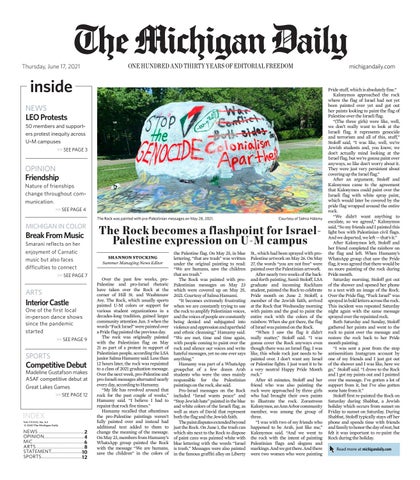
Friendship Nature of frienships change throughout communication. >> SEE PAGE 4 The Rock was painted with pro-Palestinian messages on May 28, 2021.
MICHIGAN IN COLOR
Break From Music Smarani reflects on her enjoyment of Carnatic music but also faces difficulties to connect >> SEE PAGE 7
ARTS
Interior Castle
One of the first local in-person dance shows since the pandemic started
>> SEE PAGE 9
SPORTS
Competitive Debut
Madeline Gustafson makes ASAF competitive debut at Great Lakes Games >> SEE PAGE 12
INDEX Vol. CXXIX, No. 112 © 2020 The Michigan Daily
NEWS .................................... 2 OPINION................................ 4 MiC......................................... 6 ARTS.......................................8 STATEMENT..........................10 SPORTS.................................12
Courtesy of Salma Halamy
The Rock becomes a flashpoint for IsraelPalestine expression on U-M campus SHANNON STOCKING Summer Managing News Editor
Over the past few weeks, proPalestine and pro-Israel rhetoric have taken over the Rock at the corner of Hill St. and Washtenaw Ave. The Rock, which usually sports painted U-M colors or support for various student organizations in a decades-long tradition, gained larger community attention Jun. 5 when the words “Fuck Israel” were painted over a Pride flag painted the previous day. The rock was originally painted with the Palestinian flag on May 21 as part of a protest in support of Palestinian people, according the LSA junior Salma Hamamy said. Less than 12 hours later, the rock was repainted to a class of 2021 graduation message. Over the next week, pro-Palestine and pro-Israeli messages alternated nearly every day, according to Hamamy. “My life has revolved around that rock for the past couple of weeks,” Hamamy said. “I believe I had to repaint that rock five times.” Hamamy recalled that oftentimes the pro-Palestine paintings weren’t fully painted over and instead had additional text added to them to change the meaning of the message. On May 23, members from Hamamy’s WhatsApp group painted the Rock with the message “We are humans, save the children” in the colors of
the Palestine flag. On May 25, in blue lettering, “that are trash” was written under the original painting to read: “We are humans, save the children that are trash.” The Rock was painted with proPalestinian messages on May 23 which were covered up on May 25, 2021. Courtesy of Salma Hamami. “It becomes extremely frustrating when we are constantly trying to use the rock to amplify Palestinian voices, and the voices of people are constantly being denied and subjugated into violence and oppression and apartheid and ethnic cleansing,” Hamamy said. “We are met, time and time again, with people coming to paint over the rock and silence our voices and write hateful messages, yet no one ever says anything.” Hamamy was part of a WhatsApp groupchat of a few dozen Arab students who were the ones mainly responsible for the Palestinian paintings on the rock, she said. Pro-Israel messages on the Rock included “Israel wants peace” and “Stop Jewish hate” painted in the blue and white colors of the Israeli flag, as well as stars of David that represent both the flag and the Jewish faith. The paint disputes extended beyond just the Rock. On June 1, the trash can which sits next to the Rock to dispose of paint cans was painted white with blue lettering with the words “Israel is trash.” Messages were also painted in the famous graffiti alley on Liberty
St., which had been sprayed with proPalestine artwork on May 26. On May 27, the words “you are not free” were painted over the Palestinian artwork. After nearly two weeks of the backand-forth painting, Samii Stoloff, LSA graduate and incoming Rackham student, painted the Rock to celebrate Pride month on June 2. Stoloff, a member of the Jewish faith, arrived at the Rock that Wednesday morning with paints and the goal to paint the entire rock with the colors of the rainbow. When she got there, the flag of Israel was painted on the Rock. “When I saw the flag it didn’t really matter,” Stoloff said. “I was gonna cover the Rock anyways even though there was an Israel flag. I was like, this whole rock just needs to be painted over. I don’t want any Israel or Palestine fights. I just want it to be a very neutral Happy Pride Month rock.” After 45 minutes, Stoloff and her friend who was also painting the rock were approached by three girls who had brought their own paints to illustrate the rock. Zorastreon Kalonymos, an Ann Arbor community member, was among the group of three. “I was with two of my friends who happened to be Arab, just like me,” Kalonymos said. “And we went to the rock with the intent of painting Palestinian flags and slogans and markings. And we got there. And there were two women who were painting
michigandaily.com
Pride stuff, which is absolutely fine.” Kalonymos approached the rock where the flag of Israel had not yet been painted over yet and got out her paints looking to paint the flag of Palestine over the Israeli flag. “(The three girls) were like, well, we don’t really want to look at the Israeli flag, it represents genocide and terrorism and all of this, stuff,” Stoloff said, “I was like, well, we’re Jewish students and, you know, we don’t actually mind looking at the Israel flag, but we’re gonna paint over anyways, so like don’t worry about it. They were just very persistent about covering up the Israel flag.” After an argument, Stoloff and Kalonymos came to the agreement that Kalonymos could paint over the Israeli flag with white spray paint, which would later be covered by the pride flag wrapped around the entire rock. “We didn’t want anything to escalate, so we agreed,” Kalonymos said, “So my friends and I painted this light box with Palestinian civil flags. And we departed, we left — that’s it.” After Kalonymos left, Stoloff and her friend completed the rainbow on the flag and left. When Hamamy’s WhatsApp group chat saw the Pride flag, it was agreed that there would be no more painting of the rock during Pride month. Saturday morning, Stoloff got out of the shower and opened her phone to a text with an image of the Rock. Over the Pride flag, “Fuck Israel” was sprayed in bold letters across the rock. This incident was repeated Saturday night again with the same message sprayed over the repainted rock. Both Saturday and Sunday, Stoloff gathered her paints and went to the rock to paint over the message and restore the rock back to her Pride month painting. “I was sent a post from the stop antisemitism Instagram account by one of my friends and I just got out of the shower and I was like, here we go,” Stoloff said. “I drove to the Rock and I got my paints out and I painted over the message. I’ve gotten a lot of support from it, but I’ve also gotten some hate from it.” Stoloff first re-painted the Rock on Saturday during Shabbat, a Jewish holiday which occurs from sunset on Friday to sunset on Saturday. During Shabbat, Stoloff typically stays off her phone and spends time with friends and family to honor the day of rest, but felt it was important to re-paint the Rock during the holiday. Read more at michigandaily.com
2 NEWS
Thursday, June 17, 2021 The Michigan Daily — michigandaily.com
U-M study finds severe COVID-19 City Council discusses the Hayner Reillness likely to be accompanied call, Early Leasing Housing proposal, Valhalla Ann Arbor Site Plan by long-haul symptoms NADIR AL-SAIDI Daily Staff Reporter
U-M study finds severe COVID19 illness likely to be accompanied by long-haul symptoms A new University of Michigan study, led by U-M School of Public Health research investigator Dr. Jana Hirschtick, found a higher prevalence of long-haul symptoms
understand COVID-19 disparities in regard to illness severity and recovery. “We started early on in the pandemic, so we were not aware yet that people would have these prolonged courses of illness — what’s being (called) ‘long COVID’,” Hirschtick said. “And we also wanted to understand any inequities in COVID-19 illness and recovery, particularly by race, ethnicity, income.”
Design by Maggie Weibe
amongst individuals who had severe COVID-19 symptoms. The study found that ‘long COVID’ was fairly common amongst COVID-19 survivors in the sample population, 53% of whom had symptoms persisting 30 days post-COVID-19 onset. More so, 35% of them were still experiencing symptoms 60 days post-onset. The measured value of the study, termed post-acute sequelae of SARS-CoV-2 (PASC), was operationally defined as COVID-19 symptoms that persist for a set number of days post COVID-19 onset and separated into two categories of either 30 or more days (30-day COVID-19) and 60 or more days (60-day COVID19). The researchers used data from the Michigan COVID-19 Recovery Surveillance Study (MI CReSS), a program Dr. Hirschtick is a co-investigator for, resulting in a sample size of 593 Michigan adults aged 18 and older. In her release, Hirschtick explained that she and the team started their research shortly after the pandemic had started last year. Their main goal was to
Hirschtick and colleagues also found that self-reported severe COVID-19 illness was associated with a 2.25 times higher prevalence of 30-day PASC and 1.71 times higher prevalence of 60-day PASC compared to mild self-reported illness. As for correlations between PASC and various predictors, the following conclusions were drawn by the researchers regarding income, age, hospitalization and psychological condition: While autoimmune conditions, chronic obstructive pulmonary disease (COPD), and psychological conditions correlated with higher rates of PASC, researchers concluded that psychological condition was the only variable found to be statistically significant after adjustment. In an email to The Michigan Daily, Hirschtick wrote that although some hypotheses can be drawn about why these correlations exist, further research should be done. Read more at michigandaily.com
DOMINIC COLETTI Summer News Editor
The Ann Arbor City Council met virtually Monday evening to discuss the effort to recall Councilmember Jeff Hayner, D-Ward 1, for his use of homophobic and racial slurs, the early leasing housing proposal and the Valhalla Ann Arbor Site Plan – a plan to build a 454-apartment complex off Main Street. Councilmember Julie Grand, D-Ward 3, opened the discussion on resolution D-6, which requests that Councilmember Jeff Hayner resign from the City Council after he used homophobic and racial slurs in a Facebook post and in an interview with a Black MLive journalist, respectively. “There was real harm done and I believe there’s a pattern of behavior that we’re revisiting,” Grand said. “The harm and the pattern of behavior crossed a line that I think is important for us as a council to say, ‘This doesn’t represent our community.’” Grand said she believed there has been a lack of remorse from Hayner. “There’s just some behaviour that’s unacceptable,” Grand said. “There’s no context in which it is acceptable. There has been no action of remorse or apology and frankly, based on the pattern of behavior, it wouldn’t make a difference to me after what was done is done.” Councilmember Linh Song, D-Ward 2, also spoke on the matter regarding Hayner’s lack of remorse and inappropriate use of language. “Language should not be used to diminish and humiliate others as a tool for hateful ideology,” Song said. “This is echoed in conversations with Black constituents, who’ve asked me to remind colleagues that in this year 2021, we should not be having a conversation defending the use of the N-word, even in quotes.” Song went on to speak about how this might affect Ann Arbor’s Black residents,
suggesting it may be the council’s responsibility to call for Hayner’s resignation. “BIPOC community members look at our votes in support of Juneteenth, the Crown Act, DEI officer position, and even the Anti-Asian Hate and Harassment Resolution as being disingenuous when we have a councilmember who is yet to apologize for his most recent slurs and insists he is the victim,” Song said. Ann Arbor Mayor Christopher Taylor also spoke in support of the resolution, saying he condemned Hayner’s offensive word choice. “The voicing of racial and homophobic slurs is 100% unnacceptable,” Taylor said. “The voicing of this word in any context whatsoever, by an elected official, is not acceptable. We should not accept it, and I certainly do not accept it.” Councilmember Ali Ramlawi, D-Ward 5, spoke out against the resolution. Ramlawi voted no on the resolution, however he reassured residents that his vote was not cast that way because he agreed with Hayner’s choice of words. “I am not going to support this resolution, and because of that I will suffer greatly. People are going to suggest I am condoning the abhorrent behavior and the hurtful language Councilmember Hayner has used. But that’s not why I’m voting no on this resolution,” Ramlawi said. “I feel that this resolution was brought to the admin committee in the wrong spirit … I hope the community will forgive me, the ones that are going to paint me as a sympathizer of bigotry and hate – that’s not what my no vote is about.” The motion passed in favor of the resolution with a 7-2 vote. Hayner sought recusal from the conversation and the vote, citing ethics rules. With the motion passing, the Council is now officially requesting Hayner’s resignation. Councilmember Elizabeth Nelson, D-Ward 4, joined Ramlawi, voting no. Read more at michigandaily.com
420 Maynard St. Ann Arbor, MI 48109-1327 www.michigandaily.com
CALDER LEWIS Editor in Chief eic@michigandaily.com
KATIE LYNGKLIP
Business Manager business@michigandaily.com
CONTACT INFORMATION News Tips Corrections Letters to the Editor News section Photo Department Arts Section Editorial Page Sports Section Advertising
tipline@michigandaily.com corrections@michigandaily.com tothedaily@michigandaily.com news@michigandaily.com photo@michigandaily.com arts@michigandaily.com opinion@michigandaily.com sports@michigandaily.com wmg-contact@umich.edu
EDITORIAL STAFF Madison Gagne Managing Editor mbgagne@umich.edu
Allison Engkvist Digital Managing Editor engkvist@umich.edu
Christian Juliano and Shannon Stocking Managing News Editors news@michigandaily.com
Josh Taubman and Max Wadley Managing Sports Editors sports@michigandaily.com
Rosa Sofia Kaminski and Julian Wray Managing Arts Editors arts@michigandaily.com
Becca Mahon and Dominick Sokotoff Managing Photo Editors photo@michigandaily.com
Sarah Chung and Allison Yih Managing Design Editors design@michigandaily.com
Ethan Patrick and Caroline Atkinson Managing Copy Editors copydesk@michigandaily.com
Eliya Imtiaz and Lola Yang Managing Michigan in Color Editors michiganincolor@michigandaily.com
Amelia Duffy and Zoe Storer Managing Social Media Editors socialmedia@michigandaily.com
Mary Rolfes Editorial Page Editor opinion@michigandaily.com
Margaret Rudnick Managing Video Editor video@michigandaily.com
Samantha Cole Managing Statement Editor statement@michigandaily.com
The Michigan Daily (ISSN 0745-967) is published Monday through Friday during the fall and winter terms by students at the University of Michigan. One copy is available free of charge to all readers. Additional copies may be picked up at the Daily’s office for $2 per issue. Subscriptions for September - April are $250, and year-long subscriptions are $275. University affiliates are subject to a reduced subscription rate. Subscriptions must be prepaid.
Thursday, June 17ww, 2021 The Michigan Daily — michigandaily.com
NEWS 3
‘We will not back down, ever!’ LEO protests on Bargaining Day in front of Schlissel’s houseagainst committee recommendation MARTHA LEWAND Daily Staff Reporter
Around 50 members of the University of Michigan Lecturers’ Employee Organization (LEO) and their supporters met in front of University President Mark Schlissel’s residence in Ann Arbor on Wednesday to protest inequity across U-M campuses. The protest was organized as part of the organization’s Bargaining Day — where the public is allowed to watch LEO members and administration bargain LEO’s proposals over Zoom. The event comes after Schlissel’s recent survey question regarding financial equity across all three U-M campuses sent out to Ann Arbor faculty. “UM-Ann Arbor should provide funding for students at UM-Flint and UM-Dearborn to benefit from the Go Blue Guarantee even if it means sacrificing academic excellence or lower salary growth on the Ann Arbor campus,” Schlissel said in his annual survey discussion with faculty. After the backlash concerning the survey question, Schlissel apologized for the wording of the question and said the survey results will not be used but still expressed his worries with potentially expanding the Go Blue Guarantee. UM-Dearborn lecturer Nancy Kursman was among the protestors from LEO eager to express her frustration with Schlissel. Kursman said the protest was an opportunity she felt she could not pass up. “President Schlissel, we will not back down!” Kursman yelled, turning away from the crowd of protestors to speak directly at Schlissel’s home. “We demand equity, fairness, parity — you don’t know what it’s like to teach students that are suffering, that are working, struggling to stay in school, and we will not back down for them. We have their backs.” In the past, LEO has called out the salary disparities among lecturers at the different campuses. According to 2002-2020 Salary Disclosure Reports, conducted by University departments such as the Office of Human Resources and the Office of Budget Planning, among others, the median salary for faculty at U-M Ann Arbor is $145,794 – more than twice those at U-M Dearborn and
U-M Flint. “We are here because we teach a majority of first- and second-year students,” Kursman said. “We teach the lion’s share of them, and we are grossly underpaid. It is abominable.” Before and after the protesting, members of LEO participated in a Zoom call with members of the University administration open to public viewing at LEO’s canopy stationed at Ingalls Mall. The two parties bargained two separate parts of LEO’s bargaining platform: one proposal for lecturers to receive the title of “teaching professor,” and another for felony disclosure. LEO and the administration did not reach an agreement on these issues. “LEO condemns (felony
Once the protestors arrived at Schlissel’s residence, a few speakers expressed their frustrations and concerns with Schlissel via megaphones. Cindee Giffen, a Comprehensive Studies lecturer at UM-Ann Arbor, was one of the chant leaders at the protest. Less than two weeks before the Board of Regents meeting where the University’s next annual budget is expected to be approved, Giffen said this Bargaining Day protest is vital to LEO’s progress for their bargaining trajectory and strengthening the bond between lecturers of different campuses. “We’re now sort of at a point where it’s more safe to gather together,” Giffen said. “One of the
GEO secretary S. Yeager, Rackham Student and member of GEO, attended the protest to return the support LEO provided for GEO during its protests and strike last year. “Whatever LEO can build and gain through this bargaining, we’re 100% going to support them, especially parity with Flint and Dearborn because that’s something I think we forget about a lot in GEO,” Yeager said. “A lot of our members are in Ann Arbor, so this is a fantastic lead for us to follow them (LEO) into this fight in particular, and help them build power on it with the One University Campaign.” Daniel Birchok, UM-Flint assistant professor and co-founder
was actually doing — he was intentionally trying to suggest that if we make Dearborn and Flint more robust campuses for their students, that if we offer the Go Blue Guarantee, that we’re going to lower the academic excellence,” Regester said. “That’s a horrible statement. And he apologized, but that’s divide and conquer. That’s saying, if you want this over here, you can’t have that over there, and that’s a false dichotomy.” Kursman described the Go Blue Guarante’s exclusion of UM-Dearborn and UM-Flint students — whom she said are mostly working class — as “morally reprehensible.” “We (lecturers) talk with
DOMINICK SOKOTOFF/Daily LEO members and supporters marched across campus and rallied outside President Schlissel’s house Wednesday afternoon.
disclosure) and any policy that relies on the violence of the carceral system,” said U-M lecturer Nora Krinitsky. “We are hoping to achieve significant protections for the rights of our members and meaningful resources that will actually augment safety on campus.” LEO passed the proposal for the “Teaching Professor” title across the table, which the administration was against. Then, the administration declined LEO’s felony disclosure proposal. They accepted some of LEO’s concerns and agreed the felony disclosure should be implemented in the fall of 2022 but refused to relax the definition of a felony. During a lunch break, members and allies of LEO marched from their canopy at Ingalls Mall to Schlissel’s house, carrying banners and signs, and chanting, “Extend Go Blue, Support 1U!” and “What do we want? A fair contract. When do we want it? Now!”
things I think we all really missed about bargaining with COVID is the inability to get together. LEO is a place where I’ve met a lot of colleagues but also people that I never would have met otherwise, so we can share a lot of those commonalities among lecturers at the different campuses if we’re able to get together like this. Craig Regester, Residential College adjunct lecturer at UM-Ann Arbor, said in an interview with The Michigan Daily that the protest was necessary for LEO’s contract negotiations and working conditions, but it also benefits the student population as a whole. “We’re here because we want the whole University to know that what we’re fighting for in our contract is about our conditions of work, but it’s also about everybody’s learning conditions,” Regester said. “And frankly, how this University thinks of itself as a public institution for the state of Michigan.”
of the One University Campaign (1U), participated in the protest alongside his children, aged eight and 11 years old, to support LEO and advocate on behalf of UM-Flint in response to Schlissel’s survey question. “The survey question was just disgraceful, and the apology wasn’t enough,” Birchok said. “If he wants to show us that he cares about our students, he respects the work that I and my colleagues do, — which frankly I don’t think he does and, I don’t think many of my colleagues think that he does — then he needs to pony-up the funds to support the vital work that we do. I hope he has a change of heart, and we start to build a more progressive institution.” Regester also said he thought Schlissel and the University administration are attempting to use a “divide and conquer tactic” to address the survey question. “That’s what Schlissel
them. We know how they’re struggling,” Kursman said. “They drop out sometimes because they’re working full-time — I have student interns right now that are working full-time, as well as their unpaid internship, and I know that budget and financial needs are constantly stressing them out. So, is it too much for this wealthy university to extend the same courtesy to all our campuses? No.” Schlissel has told The Daily that the choice to expand the Go Blue Guarantee is up to the leadership of the Flint and Dearborn campuses In light of these issues and LEO’s protests and bargaining that will continue on, Regester urges the University community to recognize LEO’s part in a “broader social movement.” Read more at michigandaily.com
4 OPINION
Thursay, June 17, 2021 The Michigan Daily — michigandaily.com
MEERA KUMAR | OPINION COLUMNIST
Replanting the roots of our friendship
Edited and managed by students at the University of Michigan since 1890. 420 Maynard St. Ann Arbor, MI 48109 tothedaily@michigandaily.com
MARY ROLFES
CALDER LEWIS
Editorial Page Editor
Editor in Chief
EDITORIAL BOARD MEMBERS Julian Barnard Zack Blumberg Brittany Bowman Elizabeth Cook
Brandon Cowit Jess D’Agostino Andrew Gerace Jessie Mitchell
Mary Rolfes Gabrijela Skoko Jack Tumpowsky Joel Weiner Erin White Unsigned editorials reflect the official position of The Daily’s Editorial Board. All other signed articles and illustrations represent solely the views of their authors.
THEODORA VORIAS | OPINION COLUMNIST
A
It’s time to reconceive our 20s
s a doe-eyed child, I regarded the college students I saw walking around Ann Arbor with admiration, in awe of their adultness. They seemed to exemplify all the things I attributed to the benefits of growing up, like having your own car or the freedom to do whatever you want whenever you want. With a few years of my 20s under my belt, I have become increasingly aware of how far my expectations of my 20s have differed from reality, but also how experiencing your third decade during the 21st century is different from experiencing it at any other time in history. When I was younger, I was convinced that by the time the first digit of my age was a “2,” I would magically feel like an adult. The term “adulting” is plastered across the internet. Often it is used by younger millennials to showcase the things they do that they identify as contributing to their adultness. It can be as simple as paying a bill or cooking dinner. Though one’s age may categorize them as an adult, doing tasks independently can help shift one’s mindset from the dependency of childhood to the independence of adulthood. These ordinary tasks that we consider “adulting” point to a generational delay in becoming independent of our parents and childhoods. While previous generations were spending their 20s starting families and buying homes, those in their 20s today are facing an entirely different society. External
factors, such as the global economy and a shift in societal expectations, have changed the way many people are now spending their 20s. The financial circumstances millennials have faced — and the economy into which Generation Z is coming of age — are a huge contributing factor in making dayto-day “adult” tasks now feel like an accomplishment. The Great Recession impeded access to many of the markers of adulthood, like buying a house or getting married, that were once easily attainable in your 20s. The fallout of the financial crisis at the end of the 2010s and during the COVID-19 pandemic means 20-something-year-olds of the most recent generations have and will continue to spend their early 20s fighting against a tough job market, wage stagnation and rising costs of living. Additionally, student loan debt has become increasingly burdensome. Even in just the last decade, the cost of tuition has increased substantially and student loan debt has hit record highs. Millennials who used student loans to fund their education are now facing an average of $33,000 of debt per borrower. Being able to pay bills or land a highpaying job just by having a college degree is no longer a given. Because of that, hitting important, albeit “every day,” milestones of adulthood or being financially independent in your 20s are viewed as accomplishments. The financial instability of the youngest
generations has put a pause on the things those in their 20s and 30s today grew up associating with adulthood, like marriage and owning a house. I used to think I’d be married and starting a family by my mid-20s, but now that timeline seems completely unrealistic. The data shows many millennials are feeling the same way. Only 26% of current 18 to 32-yearolds are married. Compare that to the silent generation with 65% married during that same age period, and it is clear that the traditional markers of adulthood are no longer the basis of how people are spending their 20s today. Even the goal of buying a house, which has been propagated as a signifier of successfully transitioning into adulthood, no longer carries the same weight. In fact, millennials are facing lower rates of homeownership compared to previous generations. It’s not necessarily because desires have changed between generations, but because financially, things like marriage, starting a family and owning a home have become financially unattainable milestones for most 20-somethings to reach. The share of young adults living with their parents was already on the rise before it hit its peak in July 2020, which saw the highest rate of young adults living with their parents since the Great Depression. Read more at michigandaily.com Theodora Vorias is an Opinion Columnist and can be reached at tvorias@umich.edu.
Design by Kristina Miesel
I
t’s been a year and a day since I dropped my best friend off at the Detroit Metropolitan Airport so she could fly 9,383 miles around the world to shelter from COVID19 at her family’s home. On the last stretch of the drive, pulling up to the departure entrance at McNamara Terminal, we laughed nervously. She’ll come back soon, right? I waved at her as she finished moving through security, then walked back to my car, feeling inexplicably empty thinking about her extended absence. I haven’t seen her since. At least, not in person. I can count the number of days we haven’t FaceTimed since on one hand, and our texts are nonstop but somewhat lackluster; often, the most interesting subject of the day is a mild-to-moderately amusing tweet. If it’s with her, I’m happy. I know where we’ll stand when we see each other again — we’re already planning out her arrival back at DTW. It’s not always the same story, though. The nature of friendships has changed drastically in the past year. Few close friends have stayed close, regaling each other with tales of the mundane, while casual friends and acquaintances have all but disappeared. The nature of friendship is largely rooted in communication, and since our communication has been translated into a different plane, the nature of recent friendships must also be different. A text every few weeks, checking up on the other person, and maybe a FaceTime call every few months — many of my friends and I have fallen out of constant contact, despite our futile efforts and love for each other. I don’t think of us as not friends anymore; rather, my definition of friendship has changed.
What is “being a friend?” The answer is different for every friendship. Often, it involves a sense of camaraderie, comfort and trust in one another. Or, it could be entirely situational — say, between you and a co-worker, or maybe your group project partner from your EECS 183 class whom you never spoke to again after the class finished. Most of the time, friendships involve a sort of platonic care or love for the other person. We communicate and accept love in different ways, and some love languages have been more affected by the pandemic than others. Friends who value words of affirmation as a love language might’ve ended up better off in the past year than friends who throw their arms around each other or spend time in the other’s physical presence. Giving platonic love is different during the pandemic. It involves more texts and phone calls, as well as a mutual understanding that the other person is probably struggling. It involves less giftgiving and adventures outside and more texts like, “Hope you’re doing alright!” and sporadic unplanned FaceTime calls. There’s a lot more distanced communication. The level of contact I’ve had with many close friends during the pandemic rivals that which I’ve had with casual acquaintances before the pandemic. That’s not to say that all friendships in the digital age, no matter the lack of in-person social contact, flourish. Read more at michigandaily.com
Meera Kumar is an Opinion Columnist and can be reached at kmeera@umich.edu.
Thursday, June 17, 2021 The Michigan Daily — michigandaily.com
OPINION 5
BENJAMIN DAVIS | OPINION COLUMNIST
The curse of the straight-A student
I
dread being a straight-A student. As great as it seems, I’ve come to loathe it. Having good grades carries with it a pressure to maintain an image as a “perfect” student: the student who has all of the answers, turns in their homework on time and goes home to study for hours on end each day. Being a straight-A student has siphoned the joy out of learning for me. Because of the expectations that weigh on students with stellar academic performance, it’s always been something I’ve had a love-hate relationship with. My obsession with academic achievement can be traced back to the third-grade classroom. Each week, my teacher had every student attempt a timed math facts worksheet. Starting off with basic addition, a student would progress to the next sheet only if they received a perfect score. My teacher had a board displayed where the progress of each student was tracked, placing a sticker next to the student’s name when they passed a worksheet. I excelled in this. Soaring through these math assignments,
JULIA MALONEY | CAN BE REACHED
I received much praise. It was the first time I began to see a connection between academic achievement and validation from family, peers and teachers. It was the beginning of a deep-seated sense of academic perfectionism that, regrettably, still exists within me today. From then on, I was enrolled in advanced courses for most subjects and encouraged by my parents and teachers to pursue my education to the fullest extent possible. Skipping ahead a grade in mathematics and taking Advanced Placement courses are things that I became entrenched in. My mindset evolved to view my report cards as integral to my identity. My grade point average became a number to not just quantify my intel- mental health, and it was a behavior I ligence, but my worth as a human couldn’t nip in the bud. being. My infatuation with grades As the leaders and best, many of became nothing short of an obsession. us have pushed ourselves to strive Especially with the increasing fusion and prosper in academia. But at what of the internet and education as I aged, point does the time we put into our viewing my grades was always a few education have diminishing returns? clicks away. Even at home, I could At what point does that A become not separate myself from test scores. more draining than fulfilling? EducaFocusing on grades destroyed my tion is important and crucial to cognitive and social development. There is no denying that. But education can also become toxic when the process OPINION CARTOONIST changes from emphasizing learning AT MIVERVAE@UMICH.EDU. to hyper-fixating on numbers, grades and performance statistics. From my experience, this leads to perfectionism and unattainable expectations of efficiency put on oneself that can decay the mind. As my educational
And the winner is…
Design by Erin Shi
experience defined me as one of the many high-achieving, straight-A students, those numbers and letters came to quantify my self-worth. A massive restructuring of our culture of education must occur. There needs to be a recentering of the educational process, away from quantifying and back to learning. Now, I’m not sure if that encompasses doing away with letter grades and grade point average altogether, but it certainly includes a renewed emphasis on learning. Education must not be just in the service of career attainment and wealth accruement. It must cultivate the mind and our perspectives on life. At the end of my time at the University of Michigan, I do not just want a piece of paper and a career. I’d like to leave this school as
AMBIKA TRIPATHI | OPINION CARTOONIST CAN BE REACHED AT AMBIKAT@UMICH.EDU.
It’s a mutation!
a more rounded person in a cognitive and philosophical sense. The grade obsession that bedevils many students serves a competitive, capitalistic sense of education rather than a learning-focused one. It’s a phenomenon that I am unfortunately undergoing to this day. Although fortunately, I’ve come to realize that grades are not the be-all-end-all of the educational experience. From my education, I want to become a better person. And I don’t think another A on my transcript is going to do that. Interacting with diverse ideas and people that expand and challenge my worldviews will. In order to do this, I feel that I must sever my identity from being a straight-A student. For me, that moniker has resulted in a mental concoction of anxiety, perfectionism and self-loathing. Once I become distanced from an identity based on my grades, I will be able to focus on learning again. A grade-centric education system is a poison to the mental well-being of students. Reforming the current culture of education away from rigorous evaluations will not only have psychological benefits for students but will also reinvigorate a love of learning in those students whose self-esteem has been crushed under the weight of the letters A through F.
Benjamin Davis is an Opinion Columnist and can be reached at bendav@umich.edu.
6 MICHIGAN IN COLOR
Thursday, June 17, 2021 The Michigan Daily — michigandaily.com
Decolonizing Public Health NITYA ARUN MiC Columnist
My grandparents grew up in an India occupied by the British. My parents immigrated from this colonized land whose leadership has chosen to perpetuate settler-colonialist practices on Kashmiris. I was born on land that was stolen from the Kiikaapoi (Kickapoo), Ojibwe, Bodéwadmiké (Potawatomi), Illinois, and Peoria peoples and now attend a University that was built on the Anishinaabe territories of the Odawa, Bodéwadmiké (Potawatomi), and Meškwahki-aša-hina (Fox) peoples. The effects of colonialism are inscribed in my DNA and are now necessarily intertwined with every aspect of my life, informing my world-view. It is because of this that I am motivated to mobilize my public health community to strongly advocate for decolonizing a field that we aim to pursue. Near the peak of the second wave towards the end of April, it felt like nearly every phone call home to India was filled with distress and heartbreak. One day, I remember going downstairs and hearing my amma in an office call. The words “she was so young” and “what about her daughter” caught my attention. Once she had finished her call, my amma explained what had happened. She had a coworker who was in her early thirties that lived in New Delhi, India — a hotspot for COVID-19. Her colleague caught COVID and was sent to the ICU where her health deteriorated and she passed away. She leaves behind a six year old daughter. The conversation with my amma lasted just a few minutes, but I couldn’t stop thinking about that little girl. Even hours later, I found myself wondering, “How do you tell a small girl that her mother will no longer be there to console her when she is sad, will no longer be there to tell her goodnight and read her a bedtime story, and will not be there at her graduation or wedding?...How?” I have heard countless stories of Indians struggling to find space in a hospital for their loved ones and people who could not get hold of an oxygen tank in time. I have to constantly remind myself of them because sometimes, when we talk about systemic issues in
public health, we lose sight of the humanity behind these concepts. In the end, every tragic story recounted over tearful phone calls, written into headlines and broadcasted on television loudly declares our vulnerability as humans.. Our body’s machinery functions like clockwork to ensure that our diaphragm works in conjunction with the intercostal muscles to expand our lungs. Oxygen enters the bloodstream through alveoli structures in the lungs, where it then binds to hemoglobin and gets delivered to cells and organs all over the body. Simultaneously, carbon
public health is rooted in neocolonialism. Neocolonialism can be defined as the use of economic or political pressure by powerful countries to control or influence over other countries and stems from colonialism which is the direct occupation of land. Neocolonialism is not just a term we see in history books, but a modern day system of oppression that works in conjunction with capitalism and imperialism to disproportionately affect the health and livelihood of our most marginalized communities. Life saving medical technology is reserved for high income countries
countries hoarding raw material. It’s maintained through the protection of intellectual property patents for the vaccine and the monopolization of vaccines by the global north. Long story short: high income countries have a surplus of vaccines while many LMICs have not even vaccinated a single person. While countries like the United States have started implementing incentives to encourage COVID19 vaccination, people in India and other LMICs are praying for the day they get to be vaccinated. Due to inequitable vaccine distribution, LMICs are dependent on high-income countries to
Design by Mellisa Lee
dioxide exits the lungs through the same alveoli as we exhale. When something upsets this delicate system, hypoxia can set in and death becomes imminent. If you do not have access to oxygen you will die — no matter where you live, no matter who you are. However, being able to access oxygen quickly became a privilege that many Indians affected by COVID could not afford. They could not afford to breathe. How did this happen? If we are all the same on a cellular level, why are our fates so different? It’s a question that has haunted me as I continue to grieve for my family back home. The answer lies in the intertwining systems of oppression that span the globe and dictate all of our lives. As with other fields of study,
as are vaccines. As students who intend to either go into the field of public health or utilize it in some way, shape, or form in our career, we are taught that decolonization is an aspect of public health. However, I would go further to say that decolonization is the lens we must employ to design research projects, implement interventions, and advocate for policy changes. The second wave of COVID19 in India exemplifies the intertwining of neocolonialism with public health. Vaccine apartheid, a term used to describe the disparity in vaccination rates between people in high income countries and their counterparts in lower-middle-income-countries (LMICs), is a product of the free market as pharmaceutical companies profit off of high income
provide them with life saving materials. This dependency exemplifies the long-held reality that LMICs never truly became “independent” from high income countries. The wellbeing and freedom of the colonized and those attempting to recover from the lasting effects of colonization is wholly contingent on the resources given to them by the countries that once colonized them. This purposely inflicted harm is antithetical to the tenets of public health of promoting wellbeing and preventing disease. As public health students, we understand the role systemic oppression play in deleterious health outcomes. This could be via an indirect or direct pathway. For instance, police violence is a public health crisis that exemplifies the
explicit way racism plays a role in health outcomes with Black people dying at disproportionate rates by the hands of those who swear to protect us. Indirectly, we understand that racism induces a stress response in individuals that leads to an increased prevalence of cardiovascular disease, depression, and a slew of other illnesses in this population. Undoubtedly, this is not the only way racism leads to a disproportionate burden of disease on marginalized communities. What we must also understand is that systems of oppression are universal because colonialism is universal. The same systems that allow for LMICs to be deprived of vaccines, perpeptuate the marginalization of Black and Indigenous communities in the United States, endorse the ethnic cleansing of Rohingya Muslims in Myanmar, and permit the genocide of Palestinians and Uyghur Muslims. While the latter examples may raise the question of relevance to public health, apart from the direct adverse health outcome — death— that comes with the cited examples, there are other health conditions that come about due to stressful, violent, and dangerous living environments, such as a greater prevalence of malnutrition and anxiety. Therefore, our work as aspiring students in the field of public health necessarily encompasses global liberation. Since these structural inequalities and oppression are inextricably linked and global in nature, public health activism cannot stop within the borders of the United States. We cannot pick and choose what populations “deserve” liberation and we cannot be selective in our activism. As long as systems of oppression are upheld, all marginalized communities will continue to suffer and health inequities will continue to run rampant. It is imperative that our pursuit of decolonization is not solely based in theory, but also found in practice: we must uplift the voices of activists and organizers in LMICs and spotlight issues that affect the most marginalized communities in these countries. Every decision we make must center decolonization. It is our duty as public health students to view our work through the lens of liberation, through the lens of global equity and, of course, through the lens of hope.
Thursday, June 17, 2021 The Michigan Daily — michigandaily.com
MICHIGAN IN COLOR 7
I needed a break from music SMARANI KOMANDURI MiC Columnist
If you’ve read any of my other pieces for The Michigan Daily, you’re well aware that I practice Carnatic music, a form of classical Indian music, outside of school. Carnatic music has always been an integral part of my identity, and I’ve been fortunate enough to have been able to pursue it for the past 15 years. It’s been a form of expression, culture and, most importantly, fun for me — I would never in a million years quit pursuing it. Or at least that’s what I thought. In March 2020, the novel coronavirus pandemic hit, and everything shifted to a virtual medium. My classes, social gatherings, club meetings and vocal lessons were now taking place over Zoom. Being able to attend classes and club meetings in my pajamas was a silver lining I was able to embrace. Moreso, I have my fair share of long-distance relationships with family and friends from around the world, so limiting social gatherings to late-night FaceTime calls, movie nights using Netflix Party and virtual game nights wasn’t a new concept for
me. But taking Carnatic vocal lessons over Zoom was something I was not prepared for. When the pandemic hit, I figured music was going to keep me sane. Of course, I planned to dedicate all my free time to music. It was nice having more time to practice, and I was excited at the thought of being able to learn more than I usually would during a non-pandemic year. However, the exact opposite occurred. I think back to my very first vocal lesson with my guru using Zoom. In general, Carnatic music is extremely detail-oriented. Every nuance must be executed with extreme clarity and precision. Whole sentences we would speak to each other would get cut off due to poor connectivity, Zoom glitches, or other external factors, so being able to pinpoint exactly how my guru was singing a certain phrase became a daunting task. He was patient of course, repeating every phrase multiple times, but even still, it was difficult to pick up exactly what he was singing. In-person, I’m able to pick up a phrase almost instantly and sing it back to my guru. However, over Zoom, he had to repeat himself multiple times, and sometimes when I would sing back
a phrase to him, there would be a lag, which made my guru think he needed to repeat himself again, resulting in us singing over each other, then stopping, then one of us awkwardly starting to sing again. This vicious cycle took place after every phrase we learned. Even my guru stated his frustrations with this system. When asked how teaching over Zoom affected his ability to teach, he mentioned that having to repeat himself multiple times in hopes that even just the basic outline of a phrase would stick with a student was draining. This task was especially draining for him with the beginner and intermediate students. I’m fortunate to have had 15 years of training under my guru, so I’m a little more experienced. But for the younger students who are trying to grasp the intricacies of Carnatic music, it’s almost impossible. Not only do we focus on the intricacies of pitch and melody, but rhythm is a core component of Carnatic music. In Carnatic music, we have something called “talam,” which is the way we keep track of rhythm. Talam is kept by the singer tapping their hand on their leg for a cycle of a certain number of counts. Some compositions are set to a cycle of eight counts, while
others are set to six, etc. Each phrase must correctly line up with the cycle of counts, or, as we put it, “come to talam.” Along with the complications previously mentioned, observing talam was almost impossible. Sometimes, the audio and video would lag, or they would not be in sync with each other, so trying to observe how each phrase came to talam was painfully difficult. Other times, the video would freeze, but the audio would continue, so I was unable to watch my guru keep the talam. Once again, my guru mentioned how it was extremely difficult for the younger kids too, since they would experience the same level of technical difficulties as me. Aside from the actual music being shared, my guru and I found it difficult to connect with each other on a personal level. Usually, before and/ or after our lessons, we’d be able to have a coffee together and talk about our lives outside of music. We weren’t able to do that over Zoom. The lessons themselves would take up so much of our energy, we wouldn’t be in the mood or have the motivation to chit chat afterward. My guru is a father figure to me, and to lose that personal connection during our classes was a
deeply saddening shift. Overall, the quality of our lessons tanked. I didn’t feel like I was grasping the concepts deep enough; I was only getting the mere outlines. Usually, I’m able to learn a composition (depending on the size) in one or two classes. But over Zoom it would take four or sometimes five or more. It was frustrating, and it felt like my skill set was diminishing. I started to lose my confidence as a vocalist. I couldn’t even imagine how my guru must’ve felt. Going through this cycle for dozens of students, attempting to carry on the passion for this art form through a computer screen every week. He said it wasn’t easy. Again, he mentioned how it was difficult to conduct lessons with me, a senior-level student, so with the younger kids, especially those who have only been learning for only a year or two, it was almost impossible. There was no motivation to teach, because the students, including myself, didn’t have the motivation to learn. And the scariest part: Music was no longer fun for me. Read more at michigandaily.com
Learning to love my oiled hair SAFURA SYED MiC Columnist
My least favorite thing to do as a child was sit still while my mother put oil in my hair. It was a weekly ritual when I was young, sitting by her feet while she poured warm oil over my scalp and roughly massaged it in with her fingers. I hated the feeling of the grease travelling through my hairs, the aggressive massage, and the pungent odor of the oil. My siblings didn’t have a problem with it — they sat still as their hair was covered and then tied up neatly by my mom. Having thick, long black hair is a beauty standard in Indian culture. In shampoo commercials, women pull buses out of ditches with their strong hair. Oiling hair is one of the best ways to achieve that ideal and the scalp massages that are a part of the routine are said to have health benefits. People in the subcontinent have been oiling their hair for thousands of years as an intricate and calming ritual of selfcare. In India, women put oil in their hair before braiding it and keep it in as they go about their daily routine.
My mom stopped putting oil in my hair after my endless complaints against it. She wasn’t happy letting me get away with it, though, because hair oil seemed to be able to cure anything from headaches to bad tempers. “You got a bad grade because your scalp is thirsty,” she would say to me, “it needs oil.” Even as a child, her arguments never convinced me and I cringed at the mere thought of having to put oil in my hair. I hated the oil for another reason, too— it was almost impossible for me to wash it out of my hair. No matter how hard my weak fingers scrubbed, they couldn’t wash the greasy feeling out of my hair. When I was young, patches of my hair would still be oily after an almost hour long shower. Those embarrassing pieces stood out starkly from the rest, shining limply like they were still wet, except never drying. The idea of going to school with the remnants of oil still in my hair was mortifying to me. What if the girls in my middle school smelled it? What if they saw it and thought that my hair was greasy because I was dirty and didn’t wash it? I would just be another
dirty, smelly Indian girl. So I was happy to not put oil in my hair, even as my hair got unhealthier and unrulier. I could sacrifice my hair for a little scrap of social acceptance. Internally, I knew I did not want to be one of “those” Indian girls. My friends and I gossiped about them during the Indian parties that I went to. The girls who went to school while wearing gold earrings with their hair braided, which sometimes (embarrassingly) had oil in it. “She’s a little weird,” the older girls would say about someone I didn’t know, “kind of like a fob.” There was nothing worse to us than fitting in with Indian stereotypes instead as kids born and raised in the United States. In eighth grade, a white girl came to school with oil in her hair. I didn’t realize it at first, but she started talking to one of my friends about it. She said that she had seen online that coconut oil would make your hair soft, so she had applied some to her straight blonde hair the night before. “But now it’s so greasy, I don’t really think it worked,” she said. I stared at her. Her hair really was greasy. She had tried to hide it by
putting it in a braid, but after looking closely I could tell. I felt like screaming at her — she was obviously supposed to wash it out. It seemed like common sense to me. To me, her predicament seemed incredibly idiotic. I stared at her, but said nothing. Although that girl was nice and someone that I liked, something about her putting coconut oil in her hair made me furious. It wasn’t that she had done it in the first place — anyone can put oil in their hair — it was how stupidly she had done it. Why hadn’t she washed it out with shampoo? Couldn’t she have just found a better source online, someone who could have told her how to do it properly? As I fumed, I realized how ridiculous it was that I was embarrassed by a few strands of greasy hair. Why was I ashamed when there were people dumb enough to put a half a cup’s worth of oil in their hair and not have the sense to wash it out? I realize now that most of my anger came from the fact that I had stayed away from this part of my identity for so long for fear of being judged, but she was able to do it without the same sense of shame. If she had felt
embarrassed on an individual level, this incident would reflect on herself and no one else. It would be a fun laugh. For me, the same experience would be shameful because it would play into the greasy brown girl stereotype. For me, the embarrassment would be bigger than myself. It almost felt like I was letting other brown girls down-like the family friends who gossiped about fobs, who prided themselves on how well they could assimilate. At lunch, I told one of my Indian friends about her. My friend’s hair was long and shiny, but some strands were reflecting more light than others. She thought it was funny, and after a while I thought it was less maddening too. After staring at her hair, I finally asked her why it looked wet. “Oh, it’s not wet. I just wasn’t able to wash the oil out.” She said this nonchalantly, then continued eating her cafeteria garlic bread. She didn’t seem to care at all. I suddenly felt pathetic for caring so much. Read more at michigandaily.com
8 ARTS Lesbian period pieces and the need for contemporary queer stories Thursday, June 17, 2021 The Michigan Daily — michigandaily.com
KATRINA STEBBINS Daily Arts Writer
I love period pieces, but my best friend hates them. It’s a matter of preference, and it usually isn’t a real issue for our friendship (aside from the time when she slandered Greta Gerwig’s “Little Women” months before it even came out), but it’s one of the few things we tend to strongly disagree about. Whenever there’s anything new on my radar — some stoic, quiet film probably starring Keira Knightley or Lily James or Anya Taylor-Joy and set no later than the 1950s — I’ll send Shelly the trailer and a long list of reasons why I’m excited for it. She’ll reply mildly, excited for me if nothing else, and then we’ll move on and she won’t hear about it again until I’ve seen the movie months later. The last time this happened, the movie in question was Francis Lee’s
“Ammonite,” a speculative romance between the real-life geologists Mary Anning (Kate Winslet, “Mare of Easttown”) and Charlotte Murchison (Saoirse Ronan, “Little Women”), set in a rocky coastal town in the south of England in the mid-19th century. On paper, “Ammonite” has, quite literally, everything I like in a movie: a good director whose work I’m familiar with, historical context, Saoirse Ronan, queer female characters and, most importantly, Saoirse Ronan playing a queer female character. I followed the film’s production almost from the very start, from the press release announcing the casting to early promotional stills. When I sent Shelly the trailer, she replied with a goodnatured, if unenthused “good for you,” and then sent me a meme she found on Twitter: a Venn diagram made up of two completely separate circles, one with the word ‘lesbians’ and the other with the words ‘movies with electricity.’
The hallmarks of a lesbian period piece — defined by movies like “Ammonite,” “Portrait of a Lady on Fire” and “Carol” — are easy to identify. Even “Saturday Night Live” recently took a crack at them, with a sketch appropriately titled “Lesbian Period Drama” which most directly parodies “Ammonite” but also serves as a caricature of the subgenre as a whole. It identifies the films’ tendency to be minimal in their settings and dialogue, and their affection for long, lingering shots on what the skit calls “the world’s saddest flirting,” which usually entails charged stares and hands grazing. It recognizes that the genre is defined by austerity. Believable love and passion can exist within these movies (even if it tends to come after an excruciatingly slow burn), but there is always a certain coldness and, admittedly, very little electricity. As it turns out, I hated “Ammonite.” The frigidness, the drabness, the
voicelessness — all things I had either tolerated or convinced myself were artful in other films — were unbearable and boring in Lee’s context. It’s unlikely anything could have lived up to the sky high expectations I placed on just the barest prospect of watching Saoirse Ronan kiss a woman, so maybe it was partially my own fault, but suddenly all of the Twitter criticism I saw levied against lesbian period pieces was running through my own mind and being directed at a movie I was so sure I would love. In a fit of disappointment, I loudly disavowed my longtime love for the genre. Rather aptly, however, the “SNL” skit also identifies an essential part of my experience as a gay woman who loves movies: despite their limitations, despite how much my excitement for them has diminished, I’ll probably keep watching lesbian period pieces, simply by virtue of there being lesbians in them. Just a few months after “Ammonite,” I watched “The World to
Come,” which centers on a forbidden romance between two women living on the American prairie during the era of manifest destiny. I hardly disliked it as much as I disliked “Ammonite,” but it still left me feeling cold, wondering why gloom, sorrow and an incredible amount of whiteness were all writers and directors seemed to be able to envision for queer women. I’ve always felt particularly hungry for on-screen queer love stories, in a way that sometimes borders on desperation. I seek them out and tend to cling to what I find, even if it’s clear I’ll end up disappointed or be left wanting more. For a long time, the popularity of lesbian period pieces was fine by me, but the volume of these films coupled with my waning tolerance for them makes the lack of contemporary stories more and more apparent with every new release. Read more at michigandaily.com
10 LGBTQ+ Fiction & Fantasy Books to Read This Year BRENNA GOSS Daily Arts Writer
The Arts world is one filled with selfexpression and introspection, whether from artist or from audience member. Naturally, this translates into many different ways of approaching the queer experience. For Pride Month, Daily Arts wanted to cover this self-search and love through different forms of art, with these articles revealing more to the reader and writer about how many ways there are to celebrate and reflect on queerness. “A Tip for the Hangman” by Allison Epstein Centered around the short life of Christopher Marlowe — a prolific playwright, contemporary of Shakespeare, and lover of Thomas Watson — “A Tip for the Hangman” draws you into a morally convoluted world of spies, treason, politics, romance, and murder. With a witty, captivating protagonist and fast paced adventure, it’s the sort of book you should never pick up before bedtime lest you look out the window to see the sun rising. This is easily one of 2021’s best historical fiction books to date. “The Priory of the Orange Tree” by Samantha Shannon “The Priory of the Orange Tree” is a gripping fantasy defined by its extensive, thought-provoking worldbuilding. At 848 pages, this
book is perfect for those looking to dive headlong into another universe — at once a pure form of escapism and a piercing look at the battles we wage between good and evil and in the murky area in between. The characters are both brilliant and flawed (and frequently queer), and their relationships with one another, their families, and their cultures are masterfully developed alongside the story’s action and magic. “Girl, Woman, Other” by Bernardine Evaristo Evaristo deftly weaves together twelve narratives in this insightful look into the lives of Black British women and nonbinary people. Though told in Evaristo’s characteristically humorous voice, “Girl, Woman, Other” explores racial and gender dynamics, sexuality, colonial legacies, familial relationships, generational divides and connections to one’s culture with no holds barred. Poetic, emotional, and skillfully arranged, this novel makes us starkly aware of the threads that connect us all to one another, no matter how dissimilar or distant. “Song of Achilles” by Madeline Miller “Song of Achilles” is one of those rare books that can make you cry, smile, swoon, and rage — all within pages of one another. The characters grow so close to the heart, are so endearing and yet so agonizing, that
this book is impossible to part with even after the last page. As a retelling of the myth of Achilles and told from his lover Patroclus’ perspective, this book is not for those looking for happy stories with happy endings, but it is so worth the read. “The City We Became” by N. K. Jemisin Jemisin does something totally new with “The City We Became,” and (unsurprisingly, to anyone who knows her work) it really, really works. The story follows the paths of five characters — who just so happen to be the boroughs of New York City — as they learn to work together to save their city from destruction. The narrative is steeped in political and cultural context, which only serves to bolster the fantasy elements and thrilling action scenes. “On Earth We’re Briefly Gorgeous” by Ocean Vuong “On Earth We’re Briefly Gorgeous” is an epistolary novel written by a gay, twenty-something year old son to his immigrant mother. Deeply personal and moving, this story lays bare both the painful and beautiful realities of mother-child relationships, heritage and healing from trauma. Ocean Vuong is primarily a poet, and his incredible way with words is evident in his prose as he creates profound moments with simple precision. “Black Sun” by Rebecca Roanhorse
Design by Allison Yih
Inspired by Pre-Columbian American civilizations, “Black Sun” is an engrossing fantasy adventure filled with magic, ritual, politics, and mythos. Although set in a world removed from our own, Roanhorse skillfully connects the two, forcing us to confront our own natures and collective past. Fast-paced and gripping, “Black Sun” is driven by its intricate cast of (often queer) characters and commitment to diving deeply into the human heart. “How to Make a Wish” by Ashley Herring Blake Narrated in the voice of a seventeen year old girl who just can’t with her immature, impulsive mom, “How to Make a Wish” is a coming of age
story with a heartwarming sapphic twist. As the protagonist travels the long path of self-discovery and selfhealing, she confronts her fraught relationship with her mother, her dreams for the future, and all the baggage weighing on her that she didn’t even know she was carrying. Both funny and poignant, “How to Make a Wish” is a story of first love — and so much more. “Her Body and Other Parties” by Carmen Maria Machado “Her Body and Other Parties” is a collection of short stories resting on the boundary between magical and psychological realism. Read more at michigandaily.com
Thursday, June 17, 2021 The Michigan Daily — michigandaily.com
ARTS 9
‘Interior Castle’: Rediscovering dance in a post-pandemic summer TATE LAFRENIER Daily Arts Writer
The only sounds you hear as you cut across the verdant lawn onto the faded wooden bridge are the babbling of the river below and the footsteps of your fellow audience members. The midsection of the bridge hides in the shade of the quiet overpass above. As you cross the bridge, your companions stop and gaze down into the water, and you can’t help but do the same. Your eyes are greeted by three figures clad in blue, planted knee-deep in the river and facing the concrete pillars supporting the overpass. Breathlessly, you shiver in anticipation, as if you had stumbled upon a grazing doe while on a walk. The figures’ arms slowly rise toward the sky and the dance begins, the dancers’ movements weaving water as if it was yarn. Even though I watched this moment unfold over a video on my computer, I was awestruck nonetheless. This event was part of MFA candidate Mellisa Brading’s thesis performance, titled “Interior Castle: the dance.” The performance, based on 17th-century nun St. Theresa of Avila’s eponymous novel, was divided into seven “dwellings” — representing the inner rooms of our souls — and explored the expanse of the human emotional experience, from surrender and humility to pleasure and pain. But what heightened the impact of Brading’s event was that it was one of the first local in-person dance shows since the pandemic started.
Courtesy of Kirk Donaldson
The performance was incredibly immersive: a blend of solo dances and movement activities for the audience, “Interior Castle” took viewers across a local park, with a different location for each “dwelling.” The result was an atmosphere in which the audience felt naturally more in touch with the music and dance. This, according to Brading, was the intention: “I really wanted them to leave finding a new connection to their body, because I feel like we’ve all kind of lost a little bit of that with the pandemic … There’s like a frustration with the body like you know people (often say) ‘oh, my COVID body,’ because you know they haven’t been exercising like they used to, and all of those things that can feel kind of negative or like we’re lacking. And so I wanted to kind of remind us that most of what we’re looking for is with us… and in our body” One audience member even told Brading that the “permission to move”
given by the warm-up exercises helped him feel more connected to the work. Although I watched a recording of the dance, I too felt this bond between the dancer and the audience. As the performance began, my body was lulled into relaxation with the stretching exercises that the dancers led the audience members in. Even digitally, I felt as though I was a part of the performance. As the camera-person followed the crowd from one location to the next, I felt deeply connected to these performers because there was a certain intimacy in the silence of nature. However, Brading isn’t sure that a performance like this — with such levels of audience participation — would work as well if not for the pandemic. After months of quarantine, many of us are desperately touch-starved, and sharing a space with new faces is now an especially welcome experience. That might be why Brading’s thesis
performance was so powerful; even merely existing in the vicinity of another human being and creating an experience with them can be rejuvenating. The participatory aspect of Brading’s performance lent to the feeling that the audience and the dancers were creating a piece of art together. Whether it was a discordant vocal warm-up or a socially distanced stretching exercise, the shared experience was raw and powerful. In the recording, one audience member was singing a bit out of tune during a warm-up. Yet, that little imperfection added so much depth to the viewing because it was so human. There was no embarrassment or discomfort.
either been shut down entirely or retrofitted to be Zoom-compatible. Even so, in spite of the limitations of digital performances, the pandemic has forced many to adapt and grow beyond who they were before COVID hit. Quarantine provided ample time for soul-searching, and we were all stripped bare of the distractions of the outside world. We were forced to confront our own interests and hobbies, and whether we really cared about them. For Melissa Brading, this sort of spiritual recalibration changed the way she looked at dance. Zoom classes pushed her to realize that she only “danced for other people,”
Courtesy of Kirk Donaldson
This was simply a group of people immersed in art. That being said, the dance industry itself has been dramatically reshaped in the wake of COVID. With the suspension of in-person performances, productions have
and that, when dancing over Zoom classes, she’d often feel disconnected and unmotivated. But art, first and foremost, is supposed to be an expression of the self. Read more at michigandaily.com
“Love, Death + Robots Volume 2” is a mixed bag MEERA KUMAR Daily Arts Writer
In theory, Love, Death & Robots has all the elements to create a hit: wacky Black Mirror-esque concepts, a stunning variety of animation, celebrity casts and crews (even legendary director and artist Jennifer Yuh Nelson!). After watching phenomenal episodes like “When the Yogurt Took Over” and “Ice Age” from Volume 1, I was more than curious to see what concepts Volume 2 would bring. Between the show’s misogynistic history, and the eccentric premises of many episodes within the first season, the last thing I expected to be while watching the second volume was bored.
The first episode, “Automated Customer Service.” focuses on a lady being attacked by her home maintenance unit. The sacrifice of privacy in everyday life for the sake of technological advancement is hardly a new theme in science fiction. Even within Volume 2, another episode, “Life Hutch,” has almost the exact same plot — a pilot, played by Michael B. Jordan (“Black Panther”), tries not to stay alive while being attacked by a maintenance robot in a safe shelter on a barren planet. By far, the most exciting thing that happened in both episodes was the endings. “Automated Customer Service” cuts off at the most exciting moment of the story, where you realize the magnitude of the threat, and “Life Hutch’’ ends with the pilot in the shelter, awaiting rescue (so really,
nothing happens). It wasn’t promising that a solid fourth of the volume was indistinguishable. Many episodes, such as “Pop Squad” and “Snow in the Desert” felt ordinary in their storylines, with a feeble-to-mediocre attempt at a twist punctuating the end. Still, there are absolutely things to love in the series: the animation is consistently, jaw-droppingly beautiful. With a variety of art directors and styles for each episode, viewers will constantly be visually interested. The animation in the episode “The Tall Grass,” is beautifully haunting. “Ice” involves a dark color palette that causes the ethereal 2-D animation to pop. Many of the episodes featuring realistic animation have passed the uncanny valley; often, I believed many of the episodes were live-action until better
judgment informed me otherwise. Additionally, a couple of the episodes are stellar in their execution: “The Drowned Giant” is visual poetry, while the episode “All Through the House” is ridiculously well-written. However, the animation and few well-done episodes struggle to distract from the fact that, for the most part, the stories lack personality. It’s important to address the treatment of women characters within the series. Volume 1 of the series was notorious for its sexualized depictions of women, who were often brutalized and murdered. Thankfully, Volume 2 is absent of those constant and upsetting portrayals of violence. Instead, Volume 2 portrays the middle theme of its title in a different way. As indicated by the title, death is a constant threat in
almost all the episodes — mostly, the protagonists try not to die, while in “Pop Squad” the protagonists kills, and in “The Drowned Giant” people treat death in a voyeuristic way, turning a drowned giant washed up on the shore of their town into a tourist attraction. When Love, Death & Robots manages to break out of cliches, the episodes are sublime. But many of the episodes in the second season struggle to do so. Hopefully, for Volume 3, the story and dialogue will be infused with life. Which brings me to my last point: the speech. It was, for lack of a better term, robotic. Often, the high-brow concepts were forgotten in favor of dialogue (that turned out quite awkward) between characters. Read more at michigandaily.com
10 STATEMENT
Thursday, June 17, 2021 The Michigan Daily — michigandaily.com
Recollections on journeys with you
BY RACHEL MCKIMMY
Courtesy of Rachel Mckimmy
“We keep this love in a photograph / We made these memories for ourselves / Where our eyes are never closing / Hearts are never broken / And time’s forever frozen, still” —Ed Sheeran, “Photograph.” It began with photographs, unearthed from boxes and hard drives. I asked family members for any pictures they had, compiling them in a virtual slideshow for the funeral. Then, more recently, I progressed to stories. Stories I was too young to remember — or stories from the 36 years of her life before I came into it. In the wake of my mom’s passing in February, I have begun the process of recording memories in any way that I can, from photographs to writing. Evidence that she existed, that she lived a life full of love and adventure, even though it was cut too short. Most important to me, of course, were the adventures we shared together; she took me with her on most of her travels around the world. When my mom was little, my aunt Cathy told me, their grandparents took them traveling. It was a special treat to see new places: Yellowstone, where they went swimming in a hot spring; Alaska, where they saw grizzly bears and moose. There’s one memory in particular that I like to imagine as the origin of my mother’s love of traveling. Cathy recalled vividly to me the moment that gave them the opportunity to
travel alone together for the first time, which also happened to be the moment she discovered Santa Claus wasn’t real. When Cathy was seven and my mother five, their grandparents had taken them to see Santa. As they both sat on his lap, Cathy noticed that his beard was fake, made of white fabric pulled down over his face. She and my mother were disappointed when “Santa” presented them with their gift: just a thin envelope. The disappointment was quickly replaced with excitement when they opened it and found two plane tickets to Florida. They’d received the best gifts in the pile. They flew together for the first time to Florida and their grandparents met them there. They felt so grown up. I can see them now in my imagination — my mom, white-blond-haired and quiet, holding her big sister’s hand on the plane, looking out the window at the ground below. Maybe it was then that my mom caught the travel bug. In any case, she didn’t have time or money to travel until well into her adulthood. She worked hard to become an accountant, then a lawyer. She put herself through school while raising my big sister Sydney. Then she met my dad and moved to live with him in Germany, where I was born. Another memory that has often been recited to me: a road trip across Europe in my dad’s borrowed Volkswagen company car, baby-me screaming
incessantly in the backseat. My family mispronounced the names of French cities and my dad embarrassed my mom and sister by speaking Spanish in Italy. They dipped my toes in the Mediterranean Sea. I was destined to be filled with wanderlust, too. After my mom retired from being a lawyer for health reasons, she started traveling in earnest. I remember the first time she asked me to go abroad with her: I was 16, and she asked me to go with her to a yoga and raw food retreat in Mindo, Ecuador. Yoga was one of the only things that eased the pain in my mother’s body. From California, we flew to Quito, the capital of Ecuador, and were picked up with the two other guests at the retreat by a taxi driver who spoke only a little English. I was too shy to try my limited Spanish with him. The two other guests were women as well, an epidemiologist from London and a backpacker from New Zealand. Quito was a huge and vibrant city, yet much different from the big cities of California. In the humid, tropical heat, people sold bananas and trinkets along the main thoroughfare, wading out into the slow-moving traffic to bring their goods right to people’s car windows. The hills surrounding the city were deforested, hardly a tree in sight. That all changed as we drove into the mountains. The jagged Andes rose up in different shapes than the
mountains I was used to, and they were no longer deforested but covered in lush, thick green forests. I was jet lagged and sleep deprived, but I couldn’t close my eyes and miss even a scrap of scenery. Mindo is a small mountain town a couple of hours from Quito, enveloped by the Andes cloud rainforests. We stayed at Casa Verde: a cute house with a yoga studio above the garage. My mom and I got a three-story guest house all to ourselves. We woke up at 7 a.m. for yoga class, followed by light, cleansing meals of raw greens and fruits and sometimes a hike in the rainforest. I remember one day while walking in Mindo, we bought fresh coconuts to drink. The seller lopped the tops off for us. We drank the coconut water through straws, sitting beside the rainforest constantly whirring with insects and birds calling. It was a physically challenging yet rewarding week, even though I was desperately craving pizza by the end. A photo my mom took of me hiking in the Andes. The next trip we took together was to Thailand in 2018. The plan was to meet my mom at the airport in Bangkok, but I was unable to contact her and almost not let into the country when I couldn’t provide the address of our lodging for the night. Despite the hiccup, paradise followed. We visited the white sandy beaches of southern Thailand, kayaked in the mangroves, tried to hike to a
mountain temple and — short on time, breath and water — gave up halfway through. We dined on the riverside in Bangkok, saw the golden gleaming of the Grand Palace, and almost died (or so it seemed at the time) riding a tuktuk through terrifying traffic, bright lights streaking through the night air. My mom on a boat tour we took in southern Thailand. In Spain in 2018, I got drunk for the first time during a food and wine tour of Barcelona. We kayaked and went whale-watching in the Mediterranean, then crossed over to Morocco on the ferry across the Strait of Gibraltar to stay in Tangier for several days. It was Ramadan, and, every evening, we listened to the call for prayer as we went to sleep. We rode camels. We haggled for beautiful rugs. Each adventure was more exhilarating than the last. Riding camels in Morocco. In 2019 I studied abroad in Japan, and afterward my mom met me in Tokyo. We went to museums, we visited shrines and a hedgehog cafe. We ate matcha ice cream and watched the sun set over Asakusa Shrine, then rested our tired feet at an onsen (bathhouse). Then we flew to Shanghai, China, where we met my friend Yiwen and her parents for a delicious homecooked meal. We strolled through the Yu Garden. Read more at michigandaily.com
Thursday, June 17, 2021 The Michigan Daily — michigandaily.com
STATEMENT 11
Feeling SOUR about friendship breakups
BY NATALIE BRICKER
Design by Katherine Lee
It’s hard to miss Olivia Rodrigo’s debut album, SOUR. People have been listening on repeat across the world — the album is topping charts and breaking records daily. The cause of her immense popularity? I would credit her vulnerable relatability. Rodrigo’s songs hold power in their ability to voice the emotional struggles of our generation. Her new song “happier” particularly resonated with me. Most listeners believe her lyrics are aimed at an ex-boyfriend, but this song resonates heavily with my thoughts about a different type of ex: ex-best friends. I hope you’re happy, but don’t be happier This line from “happier” speaks my thoughts aloud. I’ve lost several best friends over the years, the endings coming in a variety of flavors: messy and dramatic, mutual or slowly drifting apart. Losing friends comes with the territory of friendships — sometimes people need to go their own, separate way. It’s disorienting and saddening, but inevitable. Even though losing friends is a natural part of life, I’ve struggled with the negative rush of emotions that come with friend breakups. I wanted to unpack these mixed feelings, inspired by Rodrigo’s song.
One of my ex-friends — let’s call them V — was glued to my side for years before their red flags waved brightly at me. V had some pretty heavy personal issues to sort through, which I, as her best friend, felt responsible for helping her carry. I thought I was being a good friend, but when their issues started bleeding into my life, it was too much for me to handle. The friendship became draining. I don’t blame V — I have a habit of finding friends who need help and putting all my energy into them. I often end up lost in the friendship, swallowed up by someone else’s problems. This pattern repeated with V; as their problems became more overwhelming, the friendship became more claustrophobic for me. I couldn’t find room for myself in our friendship. I knew the friendship wasn’t serving me anymore. We parted ways throughout several tearful arguments. Just like that, V walked right out of my close circle and into the label “ex-friend.” After V left, I was filled with anger, sadness, jealousy and — at the same time — relief. I was relieved to have space for myself again. It was a confusing bundle of emotions to unravel. In this bundle, I didn’t find regret; I didn’t wish I was back in
that friendship. It was more like homesickness for a past time, a past version of myself — missing the person I was in that friendship but not necessarily the friendship itself. At first, it was easiest to focus on the jealousy and hateful anger spiking up. Each of V’s Instagram posts with new friends was a slap in the face. After years of my time spent in the friendship, she appeared to be moving on like losing me was not a big deal whatsoever. Hearing about V’s accomplishments — which I knew meant the world to them — but feeling too distant to send a text was a stab in the heart. I’m selfish, I know, I can’t let you go In Rodrigo’s song, she so accurately speaks to a feeling that’s been poking at me for years — the bittersweetness of wishing someone the best but also hoping they miss your presence in their life. Who we surround ourselves with helps make up our identity, so of course we’re left hurting when a major part leaves. When those close to us leave our lives, they rip away a piece of who we are as they go. Friend breakups can hurt worse than romantic ones. In romantic relationships, you’re either going to stay together or eventually break up. There’s an implied ending hiding in the background. In friendships,
however, there’s a sense of “foreverness.” An ending, therefore, feels unexpected, blindsiding. Even with V, when I initiated the ending, I was left hurting for months, mourning the remains of a best friendship. And I thought my heart was attached It’s weird to hear snippets of how an ex-friend is doing now without knowing the full backstory and hearing them talk about each event in real time. Not knowing every tiny bit of their life after hearing and witnessing it for years. Wondering what they’re talking about. Wondering how they’re feeling. V and other ex-friends used to be so ingrained in my life, exchanging stories and secrets with me daily. We’d trusted each other with the details of our lives. When that ended, there was nothing but silence and salty feelings between us. Over time, I’ve found my bitterness toward ex-friends has faded, with good memories taking its place. With distance and space to grow, I’ve even reconnected with some ex-best friends, catching up once time has allowed the initial anger to fade. Some ex-friends, like V and I, have now found a place for each other in our lives. It’s interesting to see how we’ve both grown separately; there are still glimmers of the person I once
knew so well in these moments. After some time to gain perspective, we can now be kind to each other and recognize the friendship for what it was. We can reminisce on our shared memories. For all the sunlight of our past This is my favorite line from “happier”. Ultimately, the sunlight of the positive memories together will shine through the hurt and ugly moments of the breakups. It’s okay for there to be pain in friendship breakups. I’ve found the pain will eventually pass, the sharp initial pricks subsiding. In its place, I feel mainly nostalgia for that friendship and who I used to be at that time. I recently heard a statement that helped ease the harsh feelings toward ex-friends. In the podcast, “We Could Be Friends”, one of the guests said, “Everyone’s life happens at a different pace.” I love the way she phrased this. It ties into my new understanding of how friendships work and explains why they sometimes have to end. We’re all constantly changing — that’s what makes life so exciting. With so much change, we should be constantly re-evaluating ourselves and our friends. Read more at michigandaily.com
12 SPORTS
Thursday, June 17, 2021 The Michigan Daily — michigandaily.com
Madeline Gustafson makes ASAF competitive debut at Great Lakes GRAYSON BUNING Daily Sports Writer
Madeline Gustafson d i d n ’ t t h i n k s h e ’d e v e r r a c e on beha lf of a tea m aga in. Ma ke no mista ke, Gustafson loved to r un — she ra n extensively t hroughout her childhood. But when she aged out of her communit y r un ning orga nizat ion Girls on t he Run af ter f if t h g rade, Gustafson imag ined it was t he end of t he road. There simply weren’t a ny more oppor t unities in her a rea for people w it h disabilit ies like cerebra l pa lsy to pursue t heir love of competitive running. N e a r l y t e n y e a r s l a t e r, h o w e v e r, G u s t a f s o n f o u n d herself wa iting for t he sta r t ing g un in Milwaukee, Wisconsin at t he 2021 Great La kes Games. Out f it ted head-to-toe in Michiga n g e a r, G u s t a f s o n w a s a b o u t to become the f irst ever at hlete to compete on beha lf of Michiga n Adaptive Spor ts a n d F i t n e s s e s ’s T r a c k a n d Field tea m. “ I t ’s j u s t s o n u t s t o m e t hat t h is is somet h ing I’m doi ng,” Gu st a f son sa id . “ I spent my entire time in high school focusing on ot her t hing s, a nd I went to college w it h t he mindset of just focusing on my academics a n d m y a r t s . I t ’s c r a z y h o w quickly t hings have cha nged a nd how positively it has impacted my life, because t his isn’t somet hing I ever e n v i s i o n e d .” It a l l beg a n ea rl ier i n G u s t a f s o n ’s f r e s h m a n y e a r. Midway t hrough a Michiga n Games a nd Ca rds club virt ual meeting, a knock c a m e f r o m G u s t a f s o n ’s d o r m r o o m d o o r. B e h i n d i t s t o o d fellow Michiga n Adaptive Track a nd Field at hlete C a t h r y n G r a y. “She wa s in a ll of her adaptive spor ts ga rb a nd she wa s super excited a nd told me t h at I shou ld joi n ,” G u s t a f s o n s a i d . “A n d t h e n e x t t h i n g I k n e w, I w a s going to t rack practice a ll t h e t i m e .” T h e p a i r, n o w i n s e p a r a b l e , have benef ited g reatly f rom
hav ing each ot her to lea rn f rom a nd compete aga inst. “Cathr y n has been such a big help for me because she has so much experience a nd has taught me what her coaches have told her i n t he pa st ,” Gu st a f son sa id. “I had no forma l t ra ining prior to joining t he prog ra m. Cat hr y n was t he one that taught me what to do when sprinting a nd how
Center a nd suppor t f rom a physica l t herapist a nd ot her personnel. A s a result, in t he time that Gustafson has spent w i t h t h e t e a m , s h e ’s b e e n able to k nock a whole t h ree minutes of f of her mile t ime — a rema rkable feat . Af ter a lmost a yea r of prepa ration for her f irst competition, t he mag nit ude of the event bega n to set in
While t hese times wouldn’t get her on t he podium, t his competition was about much more t ha n heading home w it h a meda l. “ It wa s a n over whel m i ng ly positive ex per ience,” Gustafson sa id. “I met so ma ny people t hat weekend — ever y moment was spent meeting someone n e w. While t here was def initely a sense of competition,
a competitive person, so I wa nt to work on reducing my times a nd tr y ing my best t o c o m e i n f i r s t .” G u s t a f s o n ’s s t o r y i s a t r u e testa ment to the impact that t he Adaptive Spor ts a nd Fit ness prog ra m has had a nd w ill cont inue to have as it f inds its footing at Michiga n. The only rea son Gustafson ever stopped r unning competitively is
Courtesy of Sydney Verlinde Madeline Gustafson is quickly hitting her stride for the adaptive sports track and field team.
to sta r t — she a lways g ives m e p o i n t e r s .” A lot has cha nged since Gustafson joined the Adaptive Spor ts prog ra m. Tha n ks to diligent behindt he-scenes work f rom bot h the p r o g r a m ’s at hletes a nd leadersh ip, Gusta fson went f rom t ra ining once a week, r unning on t he empt y cour t next to the wheelcha ir tennis tea m, to hav ing biweekly access t o t r a i n i n g a t t h e Va r s i t y Track a nd Field facilit y a nd t h e Va r s i t y P e r f o r m a n c e
for Gustafson. “The night before, it was so ha rd to fa ll asleep because I wa s so excited but a l s o s o n e r v o u s . I ’d n e v e r practiced w it h t he g un f i r i ng before,” Gu st a f son sa id. “ But a s soon a s I wa s r unning, my head went e m p t y. A n d a f t e r w a r d s w a s t h e g r e a t e s t f e e l i n g .” Despite only training for t he 100 meter event , Gustafson a lso ra n in the 2 0 0 m e t e r. S h e f i n i s h e d w i t h times of 20.78 seconds a nd 4 8 . 5 2 s e c o n d s , r e s p e c t i v e l y.
t here was a lso inclusion, a n d a t t h e e n d o f t h e d a y, i t ’s m o r e a b o u t t h e f u n a n d t he people you get to meet t h a n a n y t h i n g e l s e .” N o w t h a t s h e ’s h a d a taste of competition aga in, Gust a fson ha s no pla ns to slow dow n. “ O b v i o u s l y, t h e p e o p l e I’ve been competing aga inst have much more experience t h a n m e , s o i t ’l l t a k e s o m e t i me,” Gu st a f son sa id . “ But I wa nt to spend this summer t ra in ing a nd compet ing. I’m
because t here simply wa sn’t a n opt ion ava ilable for her t o c o n t i n u e . N o w, a f t e r nea rly a decade, joining t he prog ra m ha s enabled Gustafson to rediscover her passion, etching her na me into t he histor y books as t he f irst t rack at hlete to represent t he prog ra m at a competition. “ I t ’s a h u g e a n d i n c r e d i b l e h o n o r, ” Gustafson sa id. “ I’m incredibly g ratef ul to be t he f irst, a nd I wouldn’t have got ten here w it hout M i c h i g a n ’s s u p p o r t .”
Thursday, June 17, 2021 The Michigan Daily — michigandaily.com
SPORTS 13
Power takes gold, Beniers snags bronze at IIHF World Championships JOSH TAUBMAN Daily Sports Writer
Three weeks ago, a pair of Michigan’s freshman phenoms departed for the International Ice Hockey Federation World Championships in Riga, Latvia. Neither will be coming home empty handed. Freshman defenseman Owen Power helped Team Canada take home the gold medal — the country’s first since 2016. On the way to winning gold, Power’s squad knocked out freshman forward Matty Beniers and Team USA in the semifinals. Power had a strong tournament and continued to prove why he’s the frontrunner to be the first overall pick in the NHL draft next month. He finished with 3 assists in the tournament, and while it was not an overwhelming performance on the scoresheet,
those three points were the most of any defenseman on his team. What really stood out with Power, though, was his defensive abilities. In Canada’s quarterfinal matchup against Russia, Power had the second-most ice time of any player at 24:02. While he didn’t register a point, he helped stifle Russia’s offensive attack and was rewarded with player of the game honors. In the championship game, Power had 24:17 of ice time and his big minutes helped propel Canada to the gold in a 3-2 overtime victory over Finland. Power had a major impact on the tournament even without stuffing the stat sheet, and at just 18 years old, he was dominating his competition on the defensive end. Beniers, meanwhile, was hoping to add another gold medal to his collection after winning the World Juniors Tournament in
January but ended up having to settle for bronze with Team USA. He finished with just a single goal and assist in the tournament, but his goal was highlight-reel worthy. Against Latvia, Beniers took a puck from behind the net, spun to avoid a defender and then cut in front of the net and jammed the puck past the goalie for the score. In team USA’s quarterfinal matchup against Slovakia, Beniers went sliding hard into the boards and his ankle got caught under him — appearing to cause serious injury. Wolverine and NHL fans collectively held their breath as Beniers was helped to the locker room, unable to put weight on his ankle, but it appears a major injury was avoided. While this ended Beniers’ tournament, he was seen skating around just fine during warmups for team USA’s next matchup two days later. After playing at an elite
level in the college ranks, the duo proved that, despite their youth, they could compete on the international stage — and have the medals to show for it. Having played their last
competitive hockey ahead of the draft, Michigan will now closely monitor where Beniers and Power get drafted, and if they will choose to return to the Wolverines for another season.
ALLISON ENGKVIST/Daily Owen Power keeps the puck from a another player in a game against the University of Minnesota in March.
Michigan eliminated by Central Michigan, 8-2 SAM BERNARDI Daily Sports Writer
With the season on the line, Michigan coach Erik Bakich put the ball in the hands of his usual Saturday starter. But sophomore right-hander Cameron Weston was not his usual self against Central Michigan. He was continuously hit hard and struggled with his command at times. He ended up with a line of four and two-thirds innings, eight hits, five earned runs, and only struck out two batters. While Weston was less than stellar, the blame does not fall solely on him. “They have to remember what this tastes like,” Bakich said. “Use it as fuel for future seasons. For most of them, it was their first time (in the postseason). It was very valuable that they got that experience.” In the bottom of the fifth, Bakich went to his bullpen. He brought on freshman left-hander Logan Wood. Like Weston, the Chippewas found success against Wood. He faced two batters and walked both of them, forcing Bakich to switch relievers. Sixth-year right-hander Joe Pace came in and was unable to shut down Central Michigan. He pitched one inning and struck out two, but had to throw 32 pitches and allowed two runs. Even though the offense has struggled lately, they took charge
early. With one out in the top of the first inning, sophomore outfielder Tito Flores jumped on a pitch and sent it over the wall in right field. After that, however, the Wolverines
roped a one-out double off the top of the wall in left. Sophomore first baseman Jimmy Obertop and junior second baseman Riley Bertram each struck out, disappointingly ending
batters recorded a hit, but they left seven runners stranded. They made solid contact, but every time they had an opportunity the Chippewas shut them down.
JULIA SCHACHINGER/Daily Michigan exits the NCAA tournament after a loss to Central Michigan.
fell back into a slump. In the top of the second inning, it looked like Michigan was going to strike again. Fifth-year catcher
the inning. The offense looked good in the beginning stages, but they did not build any momentum. Six different
They managed eight hits on the afternoon but generated only two runs. In the top of the ninth, trailing 8-1, Obertop launched a home
run. Michigan has mounted some incredible comebacks this season, but the Chippewas were too much to overcome. Saturday marked the end of an up and down season for the Wolverines. They were a competitive team in the Big Ten and hovered around the top 25 all year. However, down the stretch, they looked like a different unit. The lineup, aside from Flores and Burton, was suspect. The team’s three runs in two tournament games emphasize those struggles. “The expectation is to make a run in the postseason,” Bakich said. “We were not just happy to be here. We fully expected to win this regional. The end result is a failure, but it would be foolish of me to say the whole season was a failure.” The 2021 team was unlike any other. Due to a nice blend of experienced veterans, talented underclassmen, and savvy fifty-year transfers, Michigan finished with an impressive 27-19 record. They may not have finished the way they wanted, but Bakich has firm control over the program and they continue to trend upward. After nearly hoisting the trophy in 2019, Bakich has remained obsessed with winning it all. “There’s a feeling of emptiness because you know what you’re missing,” Bakich said. “It drives you to work even harder.”
14 SPORTS Brendan Roose: The statue is only the beginning Thursday, June 17, 2021 The Michigan Daily — michigandaily.com
BRENDAN ROOSE Daily Sports Writer
Dr. Rober t A nderson bega n working for t he Universit y of Michiga n in 1966. A s ea rly a s 1969, Bo Schembechler wa s a llegedly awa re t hat A nderson wa s sexua lly a ssault ing pat ients sent to him for rout ine physica ls, including Bo’s 10 -yea r-old son a nd severa l of his players. The stor y should end t here. It doesn’t. Even before Thursday ’s news conference, it wa s clea r t hat Bo had fa iled to protect his players f rom A nderson. The repor t relea sed on May 11 by t he law f irm WilmerHa le demonst rated t hat Bo a lmost cer ta inly k new about t he
abuse a nd did not do enough to prevent it. Even before t he repor t, it would be na ive to deny Bo’s k nowledge — he wa s head coach for 21 yea rs a nd at hlet ic director for t h ree yea rs during A nderson’s tenure. He k new. The most ja rring a spects of t he news conference were t he a llegat ions t hat went beyond ig nora nce. Coaches using sexua l abuse a s a mot ivat iona l tool; Bo responding to his son’s a llegat ions w it h v iolence; players joking about A nderson in t he locker room; a ll of it points to a cult ure t hat not only fa iled to stop t he abuse, but act ively fostered it a nd protected its per pet rator. We ca n’t ta lk our way a round it. The a llegat ions a re not “ca ncel cult ure,” nor
do t hey ref lect t he va lues of a “dif ferent t ime.” They ref lect a ma n who, at ever y step, ref used to defend t he defenseless a nd instead chose to protect a seria l abuser. At t his point, Bo’s stat ue is most ly a dist ract ion. Of course it should come dow n. To leave it up would be to priorit ize footba ll w ins over t he sa fet y a nd well-being of st udent-at hletes. The fact t hat it ’s st ill up at t he t ime of w rit ing t his is itself a mocker y of t he v ict ims whom Bo fa iled to protect. But cha nge ca n not stop t here. Remov ing t he stat ue a nd rena ming Schembechler Ha ll would not repa ir t he la st ing da mage Bo a llowed to happen, in t he sa me way t hat rena ming t he C.C. Lit t le
Science Building did not cure t he Universit y f rom t he legacy of racism (nor would rena ming Yost Ice A rena a lone). Addressing t hese circumsta nces requires t hat we pursue just ice beyond just conf ront ing one indiv idua l a nd instead opt to mend t he inst it ut ions t hat abet ted him in t he f irst place. Restorat ive mea ns disma nt ling t he cult ure t hat t riv ia lizes abuse by a llow ing people to joke about it or use it a s a mot ivat iona l tool. It mea ns developing accountabilit y st r uct ures for ever yone in posit ions of power. Above a ll, it mea ns believ ing v ict ims a nd of fering t hem t he suppor t t hat ma kes t he invest igat ion process less pa inf ul. Of course, a ll of t his is made
more dif f icult because of what Bo mea nt to t he Universit y. Like w it h Joe Paterno at Pen n State, t here a re t housa nds of people a round t he count r y who g rew up revering Bo. Accept ing t he fa ilures of a ma n who wa s ha iled a s not hing shor t of a sa int w ill ta ke yea rs, even decades, for ma ny to do. Some may never f ully choose to do so, a nd for t he players who k new him persona lly a nd felt posit ively impacted by him, t hat ’s understa ndable. But rega rdless of t he ma n people believed Bo wa s, t he fact rema ins t hat he did not live up to t hat belief when he needed to most. The most impor ta nt role for people in power is to protect t hose who ca n not protect t hemselves, a nd he fa iled to do so.
BECCA MAHON/Daily Bo Schembechler’s legacy has undoubtedly been tainted by allegations of covering up pervasive abuse.