Thursday, June 10, 2021
ONE HUNDRED AND THIRTY YEARS OF EDITORIAL FREEDOM
inside
LSA Student Government passes resolution condemning Israeli violence against Palestinians
NEWS
Hantavirus Case First Michigan hantavirus case identified in an adult female
LILY GOODING Summer Daily News Editor
>> SEE PAGE 2
OPINION
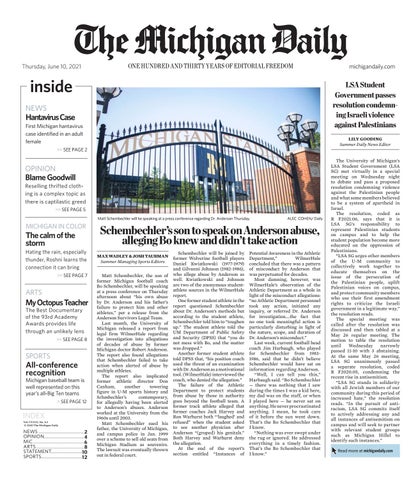
Blame Goodwill Reselling thrifted clothing is a complex topic as there is captilastic greed >> SEE PAGE 5 Matt Schembechler will be speaking at a press conference regarding Dr. Anderson Thursday.
MICHIGAN IN COLOR
The calm of the storm Hating the rain, especially thunder, Roshni learns the connection it can bring >> SEE PAGE 7
ARTS
My Octopus Teacher The Best Documentary of the 93rd Academy Awards provides life through an unlikely lens
>> SEE PAGE 8
SPORTS
All-conference recognition
Michigan baseball team is well represented on this year’s all-Big Ten teams > SEE PAGE 12
INDEX Vol. CXXIX, No. 112 © 2020 The Michigan Daily
NEWS .................................... 2 OPINION................................ 4 MiC......................................... 6 ARTS.......................................8 STATEMENT..........................10 SPORTS.................................12
michigandaily.com
ALEC COHEN/ Daily
Schembechler’s son to speak on Anderson abuse, alleging Bo knew and didn’t take action
MAX WADLEY & JOSH TAUBMAN Summer Managing Sports Editors
Matt Schembechler, the son of former Michigan football coach Bo Schembechler, will be speaking at a press conference on Thursday afternoon about “his own abuse by Dr. Anderson and his father’s failure to protect him and other athletes,” per a release from the Anderson Survivors Legal Team. Last month, the University of Michigan released a report from legal firm WilmerHale regarding the investigation into allegations of decades of abuse by former Michigan doctor Robert Anderson. The report also found allegations that Schembechler failed to take action when alerted of abuse by multiple athletes. The report also implicated former athletic director Don Canham, another towering figure in U-M sports history and Schmbechler’s contemporary, for allegedly having been alerted to Anderson’s abuses. Anderson worked at the University from the 1960s until 2003. Matt Schembechler sued his father, the University of Michigan, and campus police in Jan. 1999 over a scheme to sell old seats from Michigan Stadium as souvenirs. The lawsuit was eventually thrown out in federal court.
Schembechler will be joined by former Wolverine football players Daniel Kwiatkowski (1977-1979) and Gilvanni Johnson (1982-1986), who allege abuse by Anderson as well. Kwiatkowski and Johnson are two of the anonymous studentathlete sources in the WilmerHale report. One former student athlete in the report questioned Schembechler about Dr. Anderson’s methods but according to the student athlete, Schembechler told him to “toughen up.” The student athlete told the UM Department of Public Safety and Security (DPSS) that “you do not mess with Bo, and the matter was dropped.” Another former student athlete told DPSS that, “his position coach used the threat of an examination with Dr. Anderson as a motivational tool. (WilmerHale) interviewed the coach, who denied the allegation.” The failure of the Athletic Department to protect students from abuse by those in authority goes beyond the football team. A former track athlete alleged that former coaches Jack Harvey and Ron Warhurst both “‘laughed’ and refused” when the student asked to see another physician after Anderson “(groped) his genitals.” Both Harvey and Warhurst deny the allegation. At the end of the report’s section entitled “Instances of
Potential Awareness in the Athletic Department,” WilmerHale concluded that there was a pattern of misconduct by Anderson that was perpetuated for decades. Most damning, however, was WilmerHale’s observation of the Athletic Department as a whole in light of the misconduct allegations: “no Athletic Department personnel took any action, initiated any inquiry, or referred Dr. Anderson for investigation….the fact that no one took meaningful action is particularly disturbing in light of the nature, scope, and duration of Dr. Anderson’s misconduct.” Last week, current football head coach Jim Harbaugh, who played for Schembechler from 19831986, said that he didn’t believe Schembechler would have sat on information regarding Anderson. “Well, I can tell you this,” Harbaugh said. “Bo Schembechler — there was nothing that I saw during the times I was a kid here, my dad was on the staff, or when I played here — he never sat on anything. He never procrastinated anything. I mean, he took care of it before the sun went down. That’s the Bo Schembechler that I know. “Nothing was ever swept under the rug or ignored. He addressed everything in a timely fashion. That’s the Bo Schembechler that I know.”
The University of Michigan’s LSA Student Government (LSA SG) met virtually in a special meeting on Wednesday night to debate and pass a proposed resolution condemning violence against the Palestinian people and what some members believed to be a system of apartheid in Israel. The resolution, coded as R F2021.06, says that it is LSA SG’s responsibility to represent Palestinian students on campus and to help the student population become more educated on the oppression of Palestinians. “LSA SG urges other members of the U-M community to collectively work together to educate themselves on the issue of the persecution of the Palestinian people, uplift Palestinian voices on campus, and protect community members who use their first amendment rights to criticize the Israeli government in a legitimate way,” the resolution reads. The special meeting was called after the resolution was discussed and then tabled at a May 26 regular meeting. The motion to table the resolution until Wednesday narrowly passed 11-10 with 3 abstaining. At the same May 26 meeting, LSA SG unanimously passed a separate resolution, coded R F2020.05, condemning the recent rise in antisemitism. “LSA SG stands in solidarity with all Jewish members of our community during this period of increased hate,” the resolution reads. “In the pursuit of antiracism, LSA SG commits itself to actively addressing any and all instances of antisemitism on campus and will seek to partner with relevant student groups such as Michigan Hillel to identify such instances.” Read more at michigandaily.com
2 NEWS
Thursday, June 10, 2021 The Michigan Daily — michigandaily.com
Post-pandemic labor shortage leaves complications for a recovering economy NIRALI PATEL
Daily Staff Reporter
With increased vaccination rates, relaxed COVID-19 restrictions and increased government stimulus, businesses are looking to return to prepandemic levels of production. There’s just one small problem: some businesses can’t seem to find employees. Jack Edelstein, owner of Apothecare Ann Arbor, an organic cannabis cultivation facility, said that overall his business has run pretty smoothly during the pandemic but found that COVID19 made it difficult to secure a steady staff. “We’ve been in business for under two years, so we’re still in that startup phase, and there’s always challenges,” Edelstein said. “The most challenging one has been assembling a stable team of employees … and I guess COVID did play a role here, because it made some potential employees just unavailable for various reasons.”
attitudes.” Ashby said that people may also be hesitant to get jobs right now because of potential exposure to COVID-19. “There’s just a lot of uncertainty right now and some people aren’t sure if they want to work right now,” Ashby said. Rising LSA sophomore Sara Ojala, who also currently works in food service, said she felt that the national staff shortage was the result of a mixture of a few different factors. As a student who has experienced Zoom fatigue this year, Ojala said that it’s not very motivating right now for someone to get a full-time job in the summer. “I think that a lot of people have gotten very comfortable during the past year and a half doing things from home,” Ojala said. “(People) are more accustomed to staying home in their own bubble as opposed to putting themselves out there again.” Ojala said another reason could be that staff shortages can create an immediate stressor for new employees. “I actually think that, ironically,
Design by Megan Young
As more businesses began to lessen their restrictions in April, U.S. employment in leisure and hospitality had increased by 331,000, half of which consisted of jobs relating to food service. Incoming LSA freshman Sarah Ashby who currently works in food service experiences significant understaffing at her workplace. Ashby said she noticed a lack of productivity and staff morale as a result. “(Employees) aren’t the nicest but you can’t fire them (because of short staff),” Ashby said. “I know it gets stressful – they work long hours (so) they just have bad
it is a deterrent that businesses are short-staffed,” Ojala said. “ I know that if I were a prospective employee, I would be pretty hesitant to jump into a job that is stressful on others and would be stressful on me.” Business professor Jeffrey Sanchez-Burks said people have had a year-long reflection on the employment conditions that existed since before the pandemic. He said wage level plays a partial role in the staff shortage, which is why some organizations began increasing wages. Read more at michigandaily.com
First Michigan hantavirus case identified in Washtenaw County woman DOMINIC COLETTI Summer News Editor
The University of Michigan’s Central Student Government (CSG) gathered on Tuesday to vote on various resolutions pertaining to tricampus equality, scholarship distribution to U-M personal care assistants and a student health and wellness task force, as well as to confirm CSG cabinet positions. The Assembly discussed and passed a proposal, LDF 11-002, requesting $10,000 from the CSG budget to fund a rally for tri-campus equity. Funding for the rally includes up to 10 ADA-complaint and disabilityconscious buses to provide transportation from U-M Flint and Dearborn campuses to Ann Arbor for the protest, supplies for staging and victuals. The proposal was passed unanimously. LSA senior Joseph Lobodzinski debated in favor of the motion, referencing an article by The Michigan Daily regarding University President Mark Schlissel asking U-M faculty if they believe the University should use funds to expand the Go Blue Guarantee to the Dearborn and Flint campuses, even if it meant sacrificing ‘academic excellence and salary growth’ at the Ann Arbor campus. “(The question) pits us against our fellow students at the University of MichiganFlint and Dearborn. They are using the classic divide and conquer tactic,” Lobodzinski said. “This motion will organize about 400 students from both the Dearborn and Flint campuses to come to the University of Michigan (Ann Arbor) campus and advocate on their behalf for more funding to their campuses.” CSG also discussed two resolutions pertaining to the creation of a Student Health and Wellness task force and the authorization of the creation of an initial funding for a task force charged with producing, vetting, and gifting
scholarships to employed as personal care assistants at the University. Both resolutions passed unanimously. Tensions initially arose between the executive nomination committee and CSG President Nithya Arun after the committee released a report of disapproval for LSA junior Grace Roberts’ confirmation as Chief of Staff following their interview with Roberts. CSG member Noah Zimmerman was present at the executive nomination hearing with Roberts and reiterated the committee’s disapproval for Roberts for the position of Chief of Staff. Zimmerman said Roberts’ relationship with Arun, as well as her contradictory approach, pushed the committee to express their disapproval. “Grace made it very aware that she wanted to take a unique perspective on (the role of Chief of Staff ) and that (Arun and Robert’s) had a working relationship, but only a working relationship of the recent past,” Zimmerman said. “She thought that was a beneficial quality to have, and we disagreed on that. We do think it is a good idea to have someone who disagrees and someone that is not just a yes man … but, however, she (said she) would go with what she wanted. Those two concerns … gave us no confidence to give her a positive recommendation.” When asked about her contradictory approach, Roberts said that she would not simply follow along with the President and Vice President’s agendas as a rubber stamper. “What was communicated in the executive nominations report is not an accurate representation of what I said or what I believe,” Roberts said. “I am a voice that (President) Nithya and (Vice President) Carla trust, and I want to be able to say to them my honest opinion about things, but that doesn’t mean I am bull-headed and that I will not do the things expected of me as Chief of Staff.” Read more at michigandaily.com
420 Maynard St. Ann Arbor, MI 48109-1327 www.michigandaily.com
CALDER LEWIS Editor in Chief eic@michigandaily.com
KATIE LYNGKLIP
Business Manager business@michigandaily.com
CONTACT INFORMATION News Tips Corrections Letters to the Editor News section Photo Department Arts Section Editorial Page Sports Section Advertising
tipline@michigandaily.com corrections@michigandaily.com tothedaily@michigandaily.com news@michigandaily.com photo@michigandaily.com arts@michigandaily.com opinion@michigandaily.com sports@michigandaily.com wmg-contact@umich.edu
EDITORIAL STAFF Madison Gagne Managing Editor mbgagne@umich.edu
Allison Engkvist Digital Managing Editor engkvist@umich.edu
Christian Juliano and Shannon Stocking Managing News Editors news@michigandaily.com
Josh Taubman and Max Wadley Managing Sports Editors sports@michigandaily.com
Rosa Sofia Kaminski and Julian Wray Managing Arts Editors arts@michigandaily.com
Becca Mahon and Dominick Sokotoff Managing Photo Editors photo@michigandaily.com
Sarah Chung and Allison Yih Managing Design Editors design@michigandaily.com
Ethan Patrick and Caroline Atkinson Managing Copy Editors copydesk@michigandaily.com
Eliya Imtiaz and Lola Yang Managing Michigan in Color Editors michiganincolor@michigandaily.com
Amelia Duffy and Zoe Storer Managing Social Media Editors socialmedia@michigandaily.com
Mary Rolfes Editorial Page Editor opinion@michigandaily.com
Margaret Rudnick Managing Video Editor video@michigandaily.com
Samantha Cole Managing Statement Editor statement@michigandaily.com
The Michigan Daily (ISSN 0745-967) is published Monday through Friday during the fall and winter terms by students at the University of Michigan. One copy is available free of charge to all readers. Additional copies may be picked up at the Daily’s office for $2 per issue. Subscriptions for September - April are $250, and year-long subscriptions are $275. University affiliates are subject to a reduced subscription rate. Subscriptions must be prepaid.
Thursday, June 10, 2021 The Michigan Daily — michigandaily.com
NEWS 3
CSG approves $10,000 for tri-campus equity protest, confirms Chief of Staff NIRALI PATEL
Daily Staff Reporter
The University of Michigan’s Central Student Government (CSG) gathered on Tuesday to vote on various resolutions pertaining to tri-campus equality, scholarship distribution to U-M personal care assistants and a student health and wellness task force, as well as to confirm CSG cabinet positions. The Assembly discussed and passed a proposal, LDF 11-002, requesting $10,000 from the CSG budget to fund a rally for tri-campus equity. Funding for the rally includes up to 10 ADA-complaint and disability-conscious buses to provide transportation from U-M Flint and Dearborn campuses to Ann Arbor for the protest, supplies for staging and victuals. The proposal was passed unanimously. LSA senior Joseph Lobodzinski debated in favor of the motion, referencing an article by The Michigan Daily regarding University President Mark Schlissel asking U-M faculty if they believe the University should use funds to expand the Go Blue Guarantee to the Dearborn and Flint campuses,
even if it meant sacrificing ‘academic excellence and salary growth’ at the Ann Arbor campus. “(The question) pits us against our fellow students at the University of Michigan-Flint and Dearborn. They are using the classic divide and conquer tactic,” Lobodzinski said. “This motion will organize about 400 students from both the Dearborn and Flint campuses to come to the University of Michigan (Ann Arbor) campus and advocate on their behalf for more funding to their campuses.” CSG also discussed two resolutions pertaining to the creation of a Student Health and Wellness task force and the authorization of the creation of an initial funding for a task force charged with producing, vetting, and gifting scholarships to employed as personal care assistants at the University. Both resolutions passed unanimously. Tensions initially arose between the executive nomination committee and CSG President Nithya Arun after the committee released a report of disapproval for LSA junior Grace Roberts’ confirmation as Chief of Staff following their interview with Roberts. CSG member Noah
Zimmerman was present at the executive nomination hearing with Roberts and reiterated the committee’s disapproval for Roberts for the position of Chief of Staff. Zimmerman said Roberts’ relationship with Arun, as well as her contradictory approach, pushed the committee to express their disapproval. “Grace made it very aware that she wanted to take a unique perspective on (the role of Chief of Staff) and that (Arun and Robert’s) had a working relationship, but only a working relationship of the recent past,” Zimmerman said. “She thought that was a beneficial quality to have, and we disagreed on that. We do think it is a good idea to have someone who disagrees and someone that is not just a yes man … but, however, she (said she) would go with what she wanted. Those two concerns … gave us no confidence to give her a positive recommendation.” When asked about her contradictory approach, Roberts said that she would not simply follow along with the President and Vice President’s agendas as a rubber stamper. “What was communicated in the executive nominations report is not
an accurate representation of what I said or what I believe,” Roberts said. “I am a voice that (President) Nithya and (Vice President) Carla trust, and I want to be able to say to them my honest opinion about
of the nomination itself, stating that in the past, a person’s character was never as important as their experience and judgment. “I am also confused by the fact that her character was particularly
DOMINICK SOKOTOFF/Daily
things, but that doesn’t mean I am bull-headed and that I will not do the things expected of me as Chief of Staff.” Many members of CSG raised their hands to defend Roberts against the claims made by the committee. CSG member Zaynab Elkolaly jumped in on the discussion to defend the integrity
highlighted to begin with,” Elkolaly said. “I know that historically in nominations we focus on experience and things that relate directly to the position.” Members unanimously voted to confirm Roberts as the Chief of Staff for the CSG executive branch. Read more at michigandaily.com
President’s Advisory Committee on University History recommends removal of ‘Yost’ name from ice arena ISABELLE REGENT Daily Staff Reporter
Following many requests from the campus community, the President’s Advisory Committee on University History released a preliminary report on April 27 recommending the removal of Fielding H. Yost’s name from the Yost Ice Arena. Yost played football during his time as a student at West Virginia University and went on to serve as the head football coach at six different universities, bringing him to the University of Michigan. Yost was the University’s head football coach from 1901-23 and again from 1925-26, and he served as the University’s athletic director from 1921-41. Yost was known for his “point-a-minute” teams and led the Michigan football team to six
national championships and ten Big 10 conference titles. In 1923, the University named the Field House after Yost, and in 1973, it was remodeled into the Yost Ice Arena. The President’s Advisory Committee’s recent report asserts that Fielding H. Yost’s contributions to U-M athletics have historically been emphasized while the “profoundly deep and negative impact he had on people of color” has not been equally acknowledged. “Some who read this report will wonder if we are ‘blaming’ Yost for simply being a ‘man of his time,’” the report reads. “We reject this view because our historical analysis reveals that Yost — and others at the University in his day — had choices to make and evidence from their own times indicating the right ones.” The committee specifically cites Yost’s involvement in an
infamous incident in 1934 — while he served as Athletic Director — when the U-M football team chose to bench Willis Ward, the 1933 Big Ten Athlete of the Year and only the second Black U-M football player , in a game against Georgia Tech. Georgia Tech refused to play against the University’s team in Michigan Stadium if a Black player was allowed to play, so Yost decided to keep Ward from playing and met Georgia Tech on the field with an all-white team. In the Historical Analysis section of the report, the committee said Yost scheduled the game against Georgia Tech despite being well aware of the traditional racist rules that Georgia would expect the University to adhere to. The report also suggested that Yost was responsible for maintaining a “color line” in U-M athletic programs during his career at Michigan. It noted that Ward was
the only African American athlete to receive a varsity football letter during Yost’s 40-year tenure as head football coach and athletic director. University spokesperson Kim Broekhuizen wrote in an email to The Michigan Daily that the committee’s report was issued and made available for public comment after a year of investigating how the Ward incident and the rest of Yost’s career has impacted the campus community. “In 2020, multiple requests to remove the honorific name of Fielding H. Yost from the ice arena were received and referred to the President’s Advisory Committee on University History for review,” Broekhuizen wrote. “The committee’s preliminary recommendation comes after a year of study by the panel of university historians.” The committee invited members of the University
community to provide feedback on their preliminary recommendation by June 7 using an online portal which requires a U-M email address. The feedback the committee receives will be shared with University President Mark Schlissel, who will then be able to use it to accept, reject or modify the original recommendation. However, ultimately, any final decisions regarding whether or not to implement the recommendation must be made by the Board of Regents. A source close to the board said the name is unlikely to ultimately change. LSA sophomore Alexander Nguyen said he thinks the recommendation to remove Yost’s name shows a “positive improvement” in the University’s commitment to Diversity, Equity and Inclusion (DEI). Read more at michigandaily.com
4 OPINION
Thursday, June 10, 2021 The Michigan Daily — michigandaily.com
BENJAMIN DAVIS | OPINION COLUMNIST
Edited and managed by students at the University of Michigan since 1890. 420 Maynard St. Ann Arbor, MI 48109 tothedaily@michigandaily.com
Emojis aren’t hieroglyphs version 2.0
MARY ROLFES
CALDER LEWIS
Editorial Page Editor
Editor in Chief
EDITORIAL BOARD MEMBERS Julian Barnard Zack Blumberg Brittany Bowman Elizabeth Cook
Brandon Cowit Jess D’Agostino Andrew Gerace Jessie Mitchell
Mary Rolfes Gabrijela Skoko Jack Tumpowsky Joel Weiner
Unsigned editorials reflect the official position of The Daily’s Editorial Board. All other signed articles and illustrations represent solely the views of their authors.
BRANDON COWIT | OPINION COLUMNIST
Liz Cheney is getting kicked out by the Republican Party. You shouldn’t be crying for her.
O
n May 21, Anthony Bouchard, a Wyoming state senator and candidate for Wyoming’s 2022 at-large U.S. House seat election, announced — in an alleged attempt to get ahead of opposition researchers — that when he was 18, he impregnated a 14-year-old girl. He went on to compare the incident to Romeo and Juliet. This rightly led to widespread condemnation, including from his fellow Wyoming Senate Republicans, and will hopefully end any chance he has of making it to Congress. His campaign was notable in the first place primarily because of who it aimed to unseat — incumbent U.S. Rep. and recently removed House Republican Conference Chair Liz Cheney. Bouchard, like an evergrowing list of candidates for her seat, has taken aim at Cheney for her vote to impeach former President Donald Trump in January for his alleged incitement of the storming of the U.S. Capitol on Jan. 6, as well as her condemnation of false Republican claims of election fraud. Those actions also, as mentioned previously, led to House Republicans removing Cheney from her post as conference chair on May 12 and has made her a target of Trump’s, who has described her as “a bitter, horrible human being.” Conversely, Cheney has only become more popular among Democrats, 51% of whom view her either somewhat or very favorably, as opposed to only 20% of Republicans.
Many prominent Democrats have spoken in her defense, as well. Speaker of the House Nancy Pelosi, D-Calif., stated that “reasonable Republicans across the country must take back their party” in response to her removal. Senate Majority Leader Chuck Schumer, D-N.Y., described her ouster as a “new and very dangerous low point” for the GOP. President Joe Biden responded to the vote by saying that he doesn’t “understand the Republicans,” as well as exchanging a fist-bump with Cheney prior to his address to Congress. While the statements from top Democrats are likely a political play to exploit any remaining anti-Trump sentiment for electoral ends — which is probably pointless, given Cheney’s low favorability among non-Democrats — the fact that she enjoys such strong support among Democratic voters is deeply concerning. While Cheney was undoubtedly correct in her condemnation of Trump and his false claims of election fraud — in contrast to most of the rest of her party — she has otherwise been a poisonous political figure who has stood against all values that progressive-minded people should hold dear. Democrats should not rehabilitate her solely for standing against a few of the worst excesses of Trumpism. Rather, they should celebrate that such a consistent evil-doer has been removed from a position of influence. While Cheney has only been in the
House for a little over four years, she has consistently been on the wrong side of issues. She was a virulent opponent of the Iran nuclear deal and a staunch supporter of Trump’s policy of re-applying devastating sanctions on the country. She opposed ending U.S. support for Saudi Arabia’s brutal invasion of Yemen, which she described as “intended to help our allies defend against threats to their security.” However, the worst among her offenses was her sponsorship in 2020 of an amendment to the National Defense Authorization Act that prevented the withdrawal of U.S. troops from Afghanistan unless a number of conditions were met. Chief among those conditions was assessing if any “state actors have provided any incentives to the Taliban, their affiliates, or other foreign terrorist organizations for attacks against United States, coalition, or Afghan security forces,” an obvious allusion to the now-largely debunked Russian bounty story. Time and time again, she has stood for increased U.S. aggression around the world, sometimes even beyond what the president from her own party wanted — not to mention her strong opposition to abortion rights or her aversion to addressing climate change. Read more at michigandaily.com Brandon Cowit is an Opinion Columnist and can be reached at cowitb@umich.edu.
Design by Megan Young
I
n the age of digital media, emojis have become commonplace as supplements for standard text, and their use has exploded since their conception. Whether coinciding with or replacing texting lingo such as LOL, the visual aspect that sets emojis apart from script is part of their popularity. Emojis allow for emotion and other cues used during face-to-face interaction to be imbued into text-based conversation. With the focus on pictures in emojis, there have been claims they are the modern incarnation of Egyptian hieroglyphics. A current exhibit in the Israel Museum entitled “Emoglyphs” attempts to display a link between hieroglyphics and emojis. However, emojis are not exact recreations of hieroglyphics for the modern world. “Emoglyphs” is an example of how some people are connecting the two communication systems, but emojis and Egyptian hieroglyphics may not have the straightforward connection that the exhibit and others argue to exist. Taking cultural variation in emoji usage into account, the relationship between the ancient and modern pictographic systems becomes murky. Egyptian hieroglyphics emerged approximately 5,000 years ago and became the dominant written language in ancient Egypt. More than 700 hieroglyphs were in usage, some representing sounds and other purely grammatical functions. These symbols were inscribed on temple walls and used as decoration for objects utilized in daily life. But hieroglyphics did not forever stand alone as the only writing system used by the ancient Egyptians. Other scripts — Demotic,
Coptic and Ancient Greek — were common near the end of ancient Egyptian civilization. The last known hieroglyphic inscription is dated to the 5th century C.E. when the writing system fell out of use. The thousands of years of Egyptian writing are not a story of just hieroglyphs but a myriad of scripts that facilitated communication throughout the civilization. The history of emojis is not measured in millennia but in decades. Emerging from Japan, the first emojis were put into use during the late 1990s and they became immensely popular among the Japanese. This led to an increased interest from international communication companies in incorporating emojis into their platform. By 2010, Unicode — a group whose purpose is to establish text standardization across digital platforms — adopted and expanded emojis. Ever since then, emoji use has increased with new users, and new emojis are born on the regular. What the Israel Museum’s “Emoglyphs” exhibition is attempting is a definitive linkage between these two histories. The exhibit is described as presenting “the metamorphosis of picturewriting” from ancient Egypt to today — from hieroglyphics to emojis. The walls of the exhibit include sideby-sides of emojis and Egyptian hieroglyphics that resemble one another. The stress on the similarity is in terms of the visual aspects of the characters. Read more at michigandaily.com
Benjamin Davis is an Opinion Columnist and can be reached at bendav@umich.edu.
Thursday, June 10, 2021 The Michigan Daily — michigandaily.com
OPINION 5
OLIVIA MOURADIAN | OPINION COLUMNIST
Blame Goodwill for rising thrift store prices, not the girl on Depop
I
t’s no secret that thrift store prices have changed in the last decade, particularly at large corporations like Goodwill — as seen by comparing prices between past and recent versions of Goodwill’s Valuation Guide. After seeing these changes, my original idea for this column was to argue that reselling thrifted pieces is unethical and exclusionary. With the rise of consignment apps like Depop and Poshmark, people can buy thrifted pieces at inexpensive prices, post them to the application at a marked-up price and make a profit in minutes. While I still consider this to be unethical in certain situations, there are many circumstances in which reselling can be sustainable and fair. Common arguments I’ve found against secondhand reselling are that resellers take indemand items away from low-income communities, cause thrift store prices to increase and resell at inaccessible prices. Although there are many articles vilifying secondhand resellers as the source of these problems, the discussion of the ethics of secondhand reselling needs to be more nuanced to reflect the complexities of the $17.5 bil-
lion resale industry and its surrounding consumerist culture. Considering only about 20% of the clothing Americans donate ends up being sold to consumers, the argument that resellers create scarcity within thrift stores is a limited one. In fact, most thrift stores are restocked daily and the never-ending cycle of consumerism and fast fashion prevents the majority of thrift stores from running out of donations. And this cycle was only intensified by COVID-19, with many stores unable to accept donations due to overflow. For most thrift stores, secondhand resellers are not “taking all the good stuff” — there are still millions of tons of clothing going to waste. Another common argument against reselling thrifted clothing is that it contributes to rising thrift store prices. Although there are specific examples of local thrift stores charging steep prices, there is little research on general pricing trends in non-corporate thrift stores. Most evidence surrounding increasing thrift prices seems to come from corporate thrift stores such as Goodwill and The Salvation Army. While prices at these stores have been
Design by Mellisa Lee
increasing with the rising popularity of secondhand reselling, it’s important to note that correlation is not causation. Even considering this rising popularity, the mass influx of affluent teenagers thrifting for fun every weekend likely contributes more to rising costs than individual resellers do. Along with rising rent costs and inflation, with large thrift store chains, the incessant factor of corporate greed comes also into play. These companies are often non-profit organizations, yet their practices are far from socially
beneficial. Under the guise of being a charity organization, Goodwill operates by paying many employees subminimum wages. And with its history of anti-LGBTQ+ discrimination, The Salvation Army is not really a charitable organization to rally around, either. When rising prices at these companies are used as an argument against secondhand reselling, we must recognize all of the factors that go into retail pricing before placing all the blame on resellers. In a society that prioritizes capitalistic gain, it is shortsighted to
claim that secondhand resellers are the sole perpetrators of rising costs at these large corporations. Beyond that, given these companies’ tight-knit relationships with hypocrisy, the question of whether we should be supporting them at all must also be addressed. In addition to being blamed as the cause of rising thrift store prices, resellers are often told their own resale prices are too steep. While it is difficult to determine how much resellers typically upcharge for the items they thrift, these prices cannot be compared to prices in thrift stores without taking into account the time and energy required to comb through the thrift store, potentially clean or even upcycle the item, take quality pictures of it and post it for sale. As Alli Vera, YouTuber and former Depop seller, said in a video on the gentrification of thrift stores, “the customer is also buying that reseller’s ability to see the potential in things.” Read more at michigandaily.com Olivia Mouradian is an Opinion Columnist and can be reached at omouradi@umich.edu.
JULIA MALONEY | OPINION COLUMNIST
I
t is so hard to be form-fitting. I am not talking about body size and appearance in clothing but rather the societal norms that have created a standardized and gendered framework in paperwork. Checking boxes and signing on lines is a pain in print. Turning in papers is a seemingly mindless practice for those who fit the form, but to the students coming from single-parent or non-heteronormative households, that blank second signature line or series of boxes left un-checked represents imprinted exclusivity that the school system has mindlessly perpetuated. With an impending semester comes a series of forms looming in your inbox — the Free Application for Federal Student Aid, often called the FAFSA, being the one that causes the most dread. A process that is supposed to take less than an hour is instead a source of exhausting agony each year due to the seemingly unending pages that must be read and boxes that must be filled. Regardless of the size of the form, there is room for format improvement to streamline the
Fitting within the form
process and accommodate those who don’t “fit.” Small details are a part of almost every school form — beyond just the FAFSA — which should be addressed in the push toward achieving inclusive language and its subsequent positive effect on student morale, thus leaving no student lost in the process. Each student’s circumstance is unique, and there needs to be a comprehensive change towards adopting inclusive language down to every punctuation mark. For me and others coming from a single parent or other non-traditional household, there is a specific box and line that causes our pens to shutter and clicks to be in question: the box that requires information about our parents. When presented with a physical paper, my way of coping began with scratching out the “s” in parents as well as marking the blank line for “Father’s name” as “not applicable.” Blatant pen strokes did not fill the parental void, nor did they go unnoticed to those who received the form on the other end. Completeness is a necessity when fitting within the form and, therefore, I
was made to either feel incomplete or attention-seeking. The gendered plurality of the word “parents” is an unspoken stressor. It would be so much easier to write in two names, one male and one female, yet the second line and the letter “s” at the end of the word are intentional spaces that the form cannot begin to understand. That privilege of a “traditional” family is not one I have — in fact, it’s one most Americans don’t have. How dare the innocent 8-by-11 sheet of paper or government website assume that I am a part of the 46% of young adults living in a traditional nuclear family structure. As with all things nuclear, it’s about time the concept of the standard family being a two-parent, man-and-woman household explodes. The seats and size of my family dinner table are without labels or standard measurement, and therefore, the school system should tread lightly when inquiring about those who fill or abandon said seats. The solution lies in punctuation, and its arrival in paperwork is anything but punctual. What I and
so many others lacked was a set of parentheses and a sense of ambiguity. Specifically, the parentheses encompassing the “s” in parents were part of the educational revolution toward inclusive language that only came relatively recently. That letter encompassed by two curved brackets made having two parents optional — an option that this generation is the first to realize. Finally, being “incomplete” is an option rather than a burden. No longer should a child have to cram the names of both her mothers on one line for their field trip permission slip. No longer should a child have to submit information on an absent parent to receive financial aid. Beauty can be found in ambiguity and options. Subtle changes in keystrokes, like the addition of parenthesis encompassing the “s” in parents, are important to eliminate the idea of policy and paperwork as one-size-fits-all. In line with this mission, the Center for Research on Learning and Teaching, in tandem with LSA Inclusive Teaching at the University of Michigan, has compiled extensive resources for
instructors and administrators in the U-M community to foster an inclusive learning environment, including in every character printed on syllabi or word spoken in in-person dialogue. Faculty and U-M commitment to fostering diversity, equity and inclusion down to the punctuation in school paperwork is incredibly refreshing. A set of parentheses instituted with purpose is the “Michigan difference” I waited so long for. Parentheses around the “s” in parents mean a lot to me, and they should to you too. Hence, the collective mindset towards inclusive language is just as important as the University’s mission for supporting non-traditional students. Ambiguity and neutrality are the only way to make language onesize-fits-all, and therefore, we are to be detailed in our quest to root out exclusive words and phrases so that everyone can fit the form. Read more at michigandaily.com Julia Maloney is an Opinion Columnist and can be reached at jvmalo@umich.edu.
6 MICHIGAN IN COLOR
Thursday, June 10, 2021 The Michigan Daily — michigandaily.com
Celestial Motion 5/17-5/23 ANDREW NAKAMURA MiC Columnist
The first solar eclipse of the year lands on June 10, while the new moon is in Gemini. The new moon heralds a new beginning for the signs, and the eclipse magnifies its effects. The moon in Gemini indicates an examination of how we communicate with others and learn new information. The sun’s conjunction with Mercury on the same day adds an extra emphasis on communication. Mercury still lingers in its retrograde orbit, but perhaps the conjunction and this solar eclipse will provide much-needed clarity in these confusing times. Just be careful not to chase every pipe dream following this eclipse. Mars enters Leo on June 11, which brings immense passion and intensity. You may feel even more inspired than usual, but watch out for any fights that may break loose during this time. The moon enters Cancer on the same day, which encourages alone time and self-
healing: a calm start to a potentially chaotic period with Mars in Leo. The Venus sextile with Uranus on June 13 brings surprising gifts to all signs. On the same day, the sun squares Neptune, which may cause communication issues and overall sluggishness. The moon enters Leo on June 14, which may inspire our creative pursuits but incite petty conflicts. Saturn squares Uranus on the same day, indicating either unwanted change or the inability to change. It will be easy to feel frustrated and stagnant at this time, but try to remain level-headed and do not force change if it is not working for you. Aries (June 8-14) You may often feel that your ideas are the best, but this solar eclipse and Sun-Mercury conjunction may lead you to re-evaluate your methods of living and how you can communicate with others in a more effective way. You will feel powerful enough to do anything when Mars, your ruling planet, enters fire sign Leo. The week ends with Saturn squaring Uranus,
which means you may re-approach your friendships and consider whether or not your values align. Taurus (June 8-14) The solar eclipse may cause some sort of unexpected changes to your finances, so perhaps monitor your spending and be careful with your money. You may rearrange your living space to feel more comfortable when Mars enters Leo. When Saturn squares Uranus, you may reflect on your aspirations and come to an unexpected conclusion. Gemini (June 8-14) The new moon and solar eclipse occur in your sign. You will undergo the most major changes out of all of the signs, and you may be revisiting parts of yourself that you have hidden away in the past. Embrace the growth that comes with this new moon cycle. Mars in Leo will allow you to speak clearly and honestly. Not all introspection is easy, though; Saturn’s square with Uranus may cause you to question some of your long-held beliefs. Cancer (June 8-14) The solar eclipse indicates a boost
to your intuition, so trust yourself. You may also feel more tired than usual, and Mars’s transition into Leo may only further demotivate you. Venus’s sextile with Uranus is a great time to take a break from your solitude and connect with other people. When Saturn squares Uranus, you may reflect on your relationships and set new standards and expectations. Leo (June 8-14) You’re fulfilling an important role in your group (whether this is a community, social or professional environment), and this solar eclipse is asking you to find the courage to lead everyone on the right path. Mars enters your sign, which will give you a lot of energy for socialization and creative pursuits. The Venus-Uranus sextile also brings inspiration, but expect some setbacks when the sun squares Neptune on the same day. You may want to restructure your schedule and relationships when Saturn squares Uranus at the end of the week. Virgo (June 8-14) You may discover new
opportunities under the light of the new moon, so be open to any shifts in your career goals. You will feel more energized than usual when Mars enters Leo, but do not bury yourself in work to repress your emotions. This is a fiery period of time, so you should resolve your frustrations before you explode in anger. You may want to restructure your daily routine when Saturn squares Uranus. Don’t just aim to be more productive, but think about your own mental well-being as well. Libra (June 8-14) Reevaluate your views about life because the new moon may bestow a new revelation about life onto you. Be open to receiving these new ideas. Socialization comes naturally to you, and Mars’s transit through Leo is a perfect time to connect with others. You may find that your usual routine isn’t working anymore when Saturn squares Uranus. This is a great time to change your goals and thought processes, especially regarding love and money. Read more at michigandaily.com
Intersectional feminism is real and alive REEM HASSAN MiC Columnist
“Dear Susan Muaddi Darraj, My name is Reem Hassan, and I am a first-year undergraduate student at the University of MichiganAnn Arbor. I identify as a Muslim Palestinian American woman, and I am currently studying on a prelaw track with hopes of majoring in public policy and minoring in Arab and Muslim American Studies. I was first introduced to your piece “It’s Not an Oxymoron” during my first semester in university, where I took an introductory course to women’s and gender studies (WGS). To say the least, I found myself absolutely astounded by your work. Having registered for the course on a whim and expecting to only mildly relate to the material, I was shocked to be so completely moved by our first reading. I explicitly remember feeling as though you had taken my thoughts on the intersection of my Arab identity on my feminist experience straight out of my head and put it on paper. I felt heard. Your short piece had the ability to influence my work for the rest of that semester and inspired me to take my understanding
to new and deeper levels and enroll in our Arab American Feminists course this semester. Upon interacting with your piece yet again this semester, I was reminded of why it had such an impact on me, and how deeply I resonate with your story.” This is an excerpt taken from one of the first “Feminist Love Letters” I wrote last semester while taking an Arab American Feminists course with Professor Charlotte Karem Albrecht — an absolute icon in the WGS department. We were asked to address a “love letter” to one of the authors we had read in class, both celebrating and critiquing their work. I was immediately drawn to write to Susan Muaddi Darraj, who authored “It’s Not an Oxymoron: The Search for an Arab Feminism.” **** Although I have always considered my feminist awakening as something deeply personal, I have come to learn that many other Arab American women empower themselves in a similar experience. It is an experience where we constantly question the grounds upon which we are allowed to call ourselves feminists, where we never feel as though we are allowed to call ourselves such a phrase because
of western impositions onto the definition of feminism, and where we live an experience that we never feel like we have the right to articulate. In all truth, “Middle Eastern” (in quotations because the phrase is a colonial invention that I am not exactly fond of) or Arab women are not exactly regarded as the token feminist figures in the western lens. We are forced to carry a stereotyped reputation of arranged marriages, housework, oppression, being forced to cover up and countless other baseless tags and labels. And beyond this, even after I have finally come to understand what feminism really entailed, it was something that was treated with so much animosity by the people around me. In high school, boys amped up their “women belong in the kitchen” jokes and poked fun at the girls who identified as feminists for being “crazy.” Girls who were not interested in saying anything else only laughed with them. I remember watching in disgust and confusion as girls at my school — some of whom were even my friends — would proudly announce that they don’t consider themselves feminists just so that they’d be applauded by the boys. I could not fathom why they chose to view feminism as a surface-
level ideology, fixating on buzzwords like “man-hating” and “wage gap” while overlooking the societal benefits from the overarching goals of women’s liberation. On the other hand, I realized that feminism came so naturally to me because it did not defy the values or the practices that I was raised upon — it actually gave them a name. I grew up in a household where my sisters and I were encouraged to shoot for the stars and be ambitious with our goals, to defy gendered career expectations and to never give in to socially constructed gender roles. Both of my parents worked full time and distributed chores among themselves equally. I grew up watching my dad cook and clean and my brothers being given equal responsibility in maintaining the home. The contradictory attitudes that I encountered while coming to terms with my feminist identity motivated me to take Introduction to Women’s Studies upon starting at the University of Michigan. While much of the class was introducing and giving names to basic concepts like intersectionality, patriarchy and male-gaze, I noticed a vast difference between the backgrounds of the students who
were enrolled in the course and how that influenced the ways in which they absorbed and comprehended the course material. I found myself engaged in productive conversation with students of color more than I did with the white students in the course. During the weekly discussion sections where we would share individual interpretations of the readings based on our own experience, I was shocked by how uninformed many of my white, straight, financially privileged, cisgender classmates were about the struggles that marginalized communities confront without reflecting on their own privileges. And while I would never deny the fact that objectively, being a woman in itself is a marginalized identity that suffers from patriarchal oppression, for me and other women of color, it is our intersecting identities that really amplify the impacts of being a woman. The yearning to have conversations with more people who understood how my intersectionality impacted my feminist experience prompted me to enroll in an upper-level Arab American Feminism course during my second semester. Read more at michigandaily.com
Thursday, June 10 2021 The Michigan Daily — michigandaily.com
MICHIGAN IN COLOR 7
Time capsule ANDREW NAKAMURA MiC Columnist
The scorching summer heat blasted my entire body as I opened the door to my childhood bedroom that had been frozen in time. After I froze in single-digit temperatures for the first time ever during my first semester of college, the uncomfortable, sweltering, Hawaiian air was comforting due to its familiarity; it felt like home. My family had added new cabinets to the kitchen and painted the bathroom bright orange while I was gone, but my bedroom was exactly as I left it. The
video game posters I bought in eighth grade remained pinned to the wall that I haphazardly painted blue in tenth. On my bookshelf, my elementary school summer reading books sat next to the Shakespearian plays I always nearly fell asleep reading. A framed Pokémon drawing made by a friend in sixth grade rested on my dresser beside my high school diploma. Collared shirts that my high school’s dress code required us to wear filled my closet. Even though I spent the last few months away from home, the placement of every mundane object was etched into my memory. This bedroom was like an extra mental storage space for my memories.
Any time a memory became lost in my jumbled consciousness, I could look at an object and almost relive all of the cringe-inducing, heartfelt or devastating moments. This small, square bedroom was also my sanctuary, whether I was trying to sneakily play Pokémon under the covers without my parents catching me or staying up until 3 a.m. trying to finish a lab report. My childhood stuffed animals stared at me blankly, never judging me or expecting me to contort my personality to fit in with the crowd like I often felt my peers did. I was most free when I chose to lock myself away in my room. Yet, walking into my bedroom felt
as if I was disturbing a space that had retreated into a deep slumber. I sifted through old T-shirts from colleges I rejected and photos of people with whom I no longer keep in contact. I still hold the memories attached to each object, but I’m beginning to feel like this bedroom no longer knows me. I have no physical mementos of my first-year college experience and my internal growth in my nest of shiny objects. This room, with its old college essay drafts gathered in a pile on the ground, belongs to a version of myself that no longer exists. Everything in this room remained exactly where I left it, but I have changed. For the first time,
my bedroom has not evolved with me. After living away from home, I’ve gained more of an appreciation for the mundane. However, I know I cannot bring every single object with me into the next phase of my life. Walking back into my old bedroom felt like time traveling to the past, but now I’m looking toward the future. One day, I will leave this room for the final time, and I will not take my broken kendama or my scouting backpack with me. When that time comes, I will not be sad to let go of these relics of my childhood. Just like the old version of myself that is long gone, I think it soon will be time to bury this time capsule for good.
The calm of the storm ROSHNI MOHAN MiC Columnist
Like most kids, I used to hate the rain – the gray skies, the slight emptiness in the roads due to the forecast and the sharp chillness all before the first droplets fell. I would get this pit in my stomach, an ominous feeling that made me nauseous. I disliked everything about the rain. The earthy smell when I first walked outside right after the storm. The continuous sound of the droplets hitting the roof. But what bothered me most was the thunder. Every storm, I’d go and sleep near my mother, and turn to her asking her to stay awake. She’d ask me if I was alright and I would respond with a simple “yeah,” too embarrassed to tell her I was scared, but she knew. Nightmares, storms or just scary thoughts always led to me asking her to stay awake. But she would listen, every night, and try her best to stay up until she accidentally closed her eyes for too long. Then it was just me, alone with the thunder. Every possible frightening scenario would unfold in my head. The lightning would hit the house or the basement would flood, or worse: a tornado, since rainy season is tornado season. The power would go out, turning off my bright blue night light from Ikea and the red 3 a.m. written on the display of our alarm clock from the early 90s, and I would be left alone in darkness alongside the ear-splitting thunder. My mind continued to race until I finally fell asleep, exhausted from thinking too much. A few years later, my parents, brother and I had made the long flight
to visit our family back home in Tamil Nadu, India. We were welcomed with warm genuine smiles from my grandmother and aunt along with the heavy thunderstorm amidst 98 degree heat. The 30-minute taxi drive home felt like hours with rain constantly pouring down the windows. Our suitcases tied to the top of the car absorbed every drop of water, leaving some of our belongings wet. The storm continued with heavy rain throughout the night and scattered thunder and lightning. After reaching the flat, the downpour only got heavier, but being a little older, I was not as scared as I used to be. Although I wasn’t terrified of the thunder, it still bothered me, spending long nights awake due to the mix of the loud storm and jet lag. While I couldn’t fathom the thought of thunder and lightning as positive occurrences, my aunts, cousins and grandmother were not even the slightest bit phased by the storm; if anything, they saw it as a good thing and were grateful. The dry, droughtlike heat of Chennai was temporarily suppressed with wetness and humidity. My aunt would leave the door to the ground-level balcony open so the uncomfortably hot flat would become slightly cooler. A sense of relief grew inside of me as the heat in the room became bearable. My grandmother sat in the living room fanning herself with that week’s newspaper, while I played with my toys and watched the only English movie playing on TV, Planet of the Apes. The rain made the environment feel relaxing but at the same time, still a little uncomfortable. The same feeling of “the calm before the storm” arose except we were halfway through the
storm, which always resulted in a common power outage. Even while quickly overheating to the point of sweat puddles surrounding me from the absence of air conditioning and a working ceiling fan, I found comfort in the sense of community these outages brought. With power, everyone was off doing their own thing, cooking, working or watching TV. But with the outage, everyone quickly came
me. My aunt would nudge him telling him to stop teasing me and everyone would laugh. Then abruptly, the lights would turn back on, the conversations would end and life would continue just like that. After coming back to Michigan, I was grateful the storms here weren’t as violent as they were in India. Life went on until we reached the first storm of the season, and I was
Design by Marina Sun
together. They’d walk into the living room with a slight sigh and a quick comment: “current pochu” (Tamil for “current went”). My aunt would go around lighting the candles in the flat and the small flame would light up the room just enough to see the color of her sari. We would talk nonsense while sitting on the couch, waiting for the power to return. My cousin would throw in a few harmless jokes about how I would sit with my feet off the ground to avoid the small lizards that constantly ran through the flat or about how I didn’t like the dark in order to lighten the mood and distract
surprisingly fine with it. I reminisced about the time I spent in India, where everyone felt relieved when it rained since the air was normally dry and the family came together and made jokes and told stories. The rain brought us all together. Thinking back to this sense of togetherness brought me to finally view the rain positively, the same way I did there. A few times, my family and I were able to experience a storm during our road trips. The lightning would flash and my mother would quickly order us to close our eyes and not look at the bright streak in the sky since she
would always say the light is too bright for our eyes to handle. I would smile and nod as she said that, while directly staring at the lightning streak with dangerously wide-open eyes. I didn’t want to miss the slight purple hue that filled the sky, the beauty that I always seemed to miss since I closed my eyes and hid under the cover at the first sign of a storm for so long. The best part of most thunderstorms is when friends or family are talking to a group and a sudden burst of thunder interrupts them. We all look at each other smiling but in slight disbelief of the thunder being that loud. Someone comments “Woah” or “That was loud” and the rest lightly laugh right before resuming the conversation exactly where it was left off. The thunder was like a break midconversation. Not only does it break our conversation, but it breaks everyone in the vicinity of the storm’s conversations as well. We all hear the thunder at the same time, see the lightning at the same time and likely react to it at the same time. It’s like a forced connection between us all. It’s as if the thunderstorm was a break from regular fast-paced life itself, a midlife interruption, where we all pause for a minute and look around, before resuming back to our normal life the way my family in India does every storm. The thunder is loud, the rain makes the grass messy and the storm can be scary. But without the scariness and ugliness of the storm, there would be no purple hue lighting up the sky, no coolness in the air around my aunt’s flat and no brief moment of extra connection between us all.
8 ARTS
Thursday, June 10, 2021 The Michigan Daily — michigandaily.com
I refuse to review Bo Burnham’s ‘Inside’ ANYA SOLLER Daily Arts Writer
For the past few days, social media has been awash in reactions to Bo Burnham’s new special, “Inside.” My Twitter and Instagram feeds are a constant barrage of glowing reactions to Burnham’s introspective, 90-minute performance art piece. As I scroll through my Tiktok For You Page, songs from “Inside” play on endless fifteen second loops, worming themselves deeper into the app’s notorious algorithm the longer I listen to the lyrics repeat. When Bo suddenly announced he had a new special coming out this year, his fans, including myself, were ecstatic. After six years without performing live, no one was sure what “Inside” had in store. As someone especially moved by his 2018 film “Eighth Grade,” I was excited and also
a little terrified. I knew that, no matter what, the special’s release would be An Event. Just hours after “Inside” was uploaded to Netflix, friends and family started messaging me about what a masterpiece it was. And how weird it was. And how sad and heartbreaking and hilarious and troubling it was, which it is. “Inside” is all of these things rolled up and crammed into a tiny studio in Bo Burnham’s backyard. There is a magnitude to “Inside” that lets viewers know, from the first bars of its overture, that this is not just a momentary internet craze like “Tiger King” or “Bridgerton.” It’s meant to mean something to you and you singularly. It is addressed, signed, sealed and hand-delivered to you with a capital Y. And that’s why I refuse to tell you what I think of it. There is no denying that “Inside” is good. Objectively, it’s a creative
tour de force. The song “Welcome to the Internet” alone could have cemented the special’s place in 2021’s cultural history with its diatribes against technology-induced mania. Hundreds of thousands of people have latched onto the special’s messaging about the normalization of performance as an aspect of everyday life rather than something confined to a controlled setting, with the most vehement of those testimonials coming from social media. As Burnham snidely puts it, “The outside world, the non-digital world, is merely a theatrical space in which one stages and records content for the much more real, much more vital, digital space.” Fittingly, Burnham includes multiple scenes in which he points the camera in a mirror, capturing both himself and a reflection of the audience as we stare back at him; we are subject to the literal Black Mirror,
the veneer of a screen that’s come to signal our fear of the future and ourselves. “Inside” begs us to look inward. It’s an exasperated response not only to the absurdity of pretending Everything is Fine in a near Huxleyan dystopia (see “Funny Feeling”), but also to the inability of anyone to experience genuine self-awareness without demanding someone bear witness. Burnham levels his final challenge to the viewer in the special’s grand finale “Potential Ending Song,” daring them to question their willingness to perform the passive role of spectator, one which risks nothing and yet demands “everything all of the time”: “Hey, here’s a fun idea, how ‘bout I sit on the couch and I watch you next time?” Right now, with all of our Tiktok and Tweets and half-baked hot takes we’re doing exactly that: playing our part. In return for a spectacular piece of
entertainment, fans of Bo Burnham and “Inside” have reinforced the deeply intimate display of total artifice as consumable content for profit. It’s the exact kind of breakdown/ trainwreck/horror story we’ve been conditioned to devour. Like a reality show about how exploitative reality shows are, “Inside” has established itself as an Internet darling despite its pleas for us to put down the phone and go outside. I’ll admit critique was my first instinct as well. The second I formed a rational thought about the special, I felt an impulse to divulge immediately about it on any platform, hoping someone might listen and identify with what I had to say. Like most members of my generation, I’ve been raised to believe my voice matters and that I should be heard. Read more at michigandaily.com
The Cephalopod Chronicles DARBY WILLIAMS Daily Arts Writer
Amid the glitz and glamour of the 93rd Academy Awards, an unusual competitor emerged for the title of Best Documentary. Created by South African documentarian Craig Foster, “My Octopus Teacher” provides a poignant take on the fragility and sanctity of life through an unlikely lens. In his journey through the Great African Sea Forest, Foster details the life and times of one of the ocean’s most precocious and playful creatures: the common octopus. In the wake of a personal crisis, Foster finds himself burnt out and depressed. On a whim, he decides to return to his childhood pastime of free-diving. Among the towering fronds of kelp, he encounters a strangely gregarious octopus. He returns every day to film and interact with her, forming a touching, unusual friendship. Unlike many of its contemporaries, “My Octopus Teacher” is no mere educational vessel. While viewers will undoubtedly gain considerable familiarity with the peculiarities of the species by the end of the documentary, its purpose is far grander in scope. Our eight-legged ingenue captures
the heart of not only Foster but the world through her surprising wit and indefatigable friendliness. Foster’s choice to pursue the same animal for an extended period of time creates an intimate connection between the octopus and the onlooker. It’s an unusual tactic to utilize in a nature documentary, but only adds to the quirky charm of the film. Cephalopods are the most intelligent species of mollusk, and the octopus’ situational resilience serves as proof. We see her hunting fish using Foster as a human barrier, using shells and seaweed to conceal herself from hungry sharks, and even walking across the ocean floor with her tentacles. She is able to change shape and color in order to mimic a piece of kelp, a rock, or even another marine animal. Her incredible intelligence is juxtaposed with her corporal fragility, as her body is essentially liquid. On average, her species only live to be about a year old, hence she must learn extraordinarily quickly. The cinematography is exquisite, the calming backdrop of ocean blurred sunlight and kelpy curtains setting the stage for a vibrant miseen-scène studded with aquatic actors of every shape and size. Co-directors Pippa Ehrlich and James Reed intersperse selected
full-shots of the forest with intimate close-ups of Foster and his octopus friend. Capturing the vastness of the sea is both an insurmountable and overwhelming task, hence they elect a microcosmic approach to filmmaking. Indeed, the documentary’s greatest strength lies in the sense of intimacy it cultivates. Foster and the octopus forge a bond that can only be described as a friendship; the tone of the film is akin to that of the ever-popular dog movie. The octopus grants him the unique privilege to explore her ocean world, and become a part of her life. The occasional shot of the octopus latched onto Foster’s arm or chest is unexpectedly tender. One can’t help but wonder if she experiences, as Foster puts it, “some octopus level of joy.” The anthropomorphization of the octopus leaves both Foster and the audience emotionally invested in her wellbeing. In a nail-biting encounter with a shark, she is left wounded and incredibly weak. Foster initially does not intervene, as he wishes to preserve the boundaries of natural processes. However, he has become so attached that he eventually attempts to bring her food, hoping to nurse her back to health. Unlike most nature documentaries, Foster takes on the role of observer and participant.
Instead of a detached narrator and a faceless camera operator, we see his experience interacting firsthand with the inhabitants of the kelp forest. Through his return to the natural world, Foster rediscovers the strength and beauty of the wild. Perhaps more importantly, he finds himself personally invigorated by the sense of peace and “octopus joy” the forest grants him. His initial depression and disenfranchisement with the world lessen considerably, and he learns to enjoy life again. Paradoxically, his time with the octopus actually improves his relationships with other human beings. The unexpected humanity of the octopus truly drives the film home. The lifespan of an octopus grants us insight into the mysteries of life as a whole. An octopus doesn’t get the better part of a century to live. Everything they learn, they must learn quickly. The film concludes with the octopus retreating to her den to lay her eggs. As her journey comes full circle, we are left with the sinking feeling that accompanies nature’s inevitabilities. Her life emphasizes the cyclical nature of mortality; life is valuable because it ends, and meaningful because it continues. A few weeks after her death, Foster is free-diving with his son when he discovers a tiny
octopus floating amid the waves. It’s the right species, and the right size—it could conceivably be one of her offspring. Even in her death, she continues to give. Her journey runs parallel to Foster’s relationship with his son; parental altruism transcends the species boundary. In the film’s conclusion, we see Foster tear up slightly at the thought of his cephalopod companion. To an outsider, the occurrence seems bizarre, but the arc of the film inevitably leads to this moment, for this is not an educational film or a scientific exposé on the behaviors of the common octopus — it’s a love story. The brilliance of “My Octopus Teacher” lies in its simplicity. It’s extraordinarily subjective, extraordinarily human. Ironically enough, the singularity of the tale is what makes it universal. For Foster’s octopus is by no means standard or commonplace. Rather, she defies the characteristics of her species through her social nature, her playfulness. She is intelligent and resilient, but so are most octopi. Her defining traits are those that make her less like an octopus, and more like a human. Her defining traits are those that make her less like a teacher, and more like a friend.
Thursday, June 10, 2021 The Michigan Daily — michigandaily.com
Reviewing “The Anthropocene Reviewed” MEERA KUMAR Daily Arts Writer
I cannot buy a book before I’ve read it. Questions of limited funds aside, what if the book just sits on my shelf, unread until I move again? What if I hate the ending? The rational answer to my concern, of course, would be to return the book; however, returning a book requires effort and gas money. Besides, more than anything, buying a book is about trust — trust that it will subvert your expectations. It’s a leap of faith. So when I saw a signed copy of “The Anthropocene Reviewed” by John Green for the first time, I surprised everyone, including myself, by buying a copy. I wasn’t prepared to find a new favorite book. Wherever I move, I will be taking this book with me. Green’s collection of personal essays about the Anthropocene, our current
geologic age of unavoidable human influence, is easily digestible but incredibly complex. The book is composed of essays, or “reviews,” of different facets of the Anthropocene — anything from “Penguins of Madagascar” to “Auld Lang Syne” and “Sycamore Trees.” The idea was sparked when beloved brothers John and Hank Green found amusement in reviews of national parks on Google, leading them to come up with “The Anthropocene Reviewed,” a podcast in 2018, with episodes like “The Icelandic Hot Dog Stand and Signing Your Name 250,000 Times” or “Air Conditioning and Sycamore Trees.” Now, “The Anthropocene Reviewed” exists as a book, with excerpts from the podcasts, as well as new essays. Green is known for his wildly divisive young adult novels but has most definitely hit his stride in writing non-fiction. The connection between his YA fiction and this collection of
essays isn’t overt or noticeable (except for the parts where he mentions his books). Many of the dozens of deeply emotional and philosophical essays are around four to six pages. Due to their extraordinary nature, I’ve had to take multiple breaks reading this book. Green simultaneously paints a deeply honest roadmap of his life and the Anthropocene, focusing on coping with the condition of our deeply bizarre, ultra-modern world and unintentionally creating an unfinished list of reasons to love being alive. He writes with such unconditional love for the world — it’s no small feat to convince me that the answer to my problems is to visit Indianapolis. As expected, a common theme is the magnitude of the Earth’s temporal range or range of existence in units of time. In an essay titled “Humanity’s Temporal Range,” Green writes, “We know we are
circling a star that will one day engulf us. We’re the only species that knows it has a temporal range.” Green focuses on questions of relative temporal ranges by portraying our short but impactful time on earth and how he has come to terms with the inevitable destruction of humanity. In another essay on the Bonneville Salt Flats, Green writes, “In the age of the Anthropocene, humans tend to believe, despite all available evidence, that the world is here for our benefit. So the Bonneville Salt Flats must have a human use; why else would they exist? Nothing can grow in that dry, salty soil, but we find uses for it anyway.” Within the book, Green describes how humans manage to persevere as a species and wreak havoc upon the Earth. The Earth has existed for billions of years before us and will exist after. Humans tend to believe their impact is the most beneficial occurrence to ever happen
ARTS 9
to the Earth, but Green succeeds in making humans seem just what they are: mortal. That’s not to say the author underplays climate change. Humans, despite being clueless about the history before them, are both creative and destructive. Green also observes phenomena surrounding humans that have lasted for thousands of years. While writing of the history of the treatment of Staphylococcus aureus, a bacteria, he mentions, “[Staphylococcus] doesn’t know about people. It just wants to be, like I want to go on, like that ivy that wants to spread across the wall, occupying more and more of it.” Perhaps Staphylococcus is Green’s apt metaphor in describing humanity; always evolving into a new form, but also fundamentally creative, destructive, parasitic and neverchanging in its identity. Read more at michigandaily.com
“Cavalcade”: black midi’s procession beyond the boundaries DREW GADBOIS Daily Arts Writer
The existence of black midi as a band should be used as primary evidence that reality is simply a simulation whose source code has been written by either Kurt Vonnegut or David Mitchell. This is not because of how strange its aesthetic is, although there aren’t many acts out there that can claim to rival it, but because of how it’s managed to captivate such a large portion of music fandom with their undefinable variation of rock. For the most part, it doesn’t seem like audiences or the critical sphere knows what to make of them, aside from the fact that they are undeniably exciting. This whiplash is probably why so many were quick to place them in the same haphazardly conceived “UK experimental post-punk” movement as other bizarre rock groups from the scene. However, even on their debut record, black midi sounded slightly removed from such categorization. As if to prove that this wasn’t a fluke, their freshly released sophomore project feels like a band actively pruning itself from the musical zeitgeist. Schlagenheim challenged all of the conventions of noise and experimental rock while maintaining the youthful spirit and lack of self-importance that gave those genres their potency in the first place. It certainly has the energy of
a debut. Cavalcade, on the other hand, feels like an entirely different beast altogether. Putting aside the vast and numerous sonic departures, there is
really dive into the trenches.” Of course, there is a fine line to walk between seriousness and pretentiousness, especially with a band of their technical
Black Midi: Cavalcade album cover
a definitive atmosphere on Cavalcade that is completely removed from its predecessor. It seems as though black midi have approached the project with a heightened seriousness, as if to say “Well, we had our fun, now it’s time to
prowess, but their apparent lack of any overarching mantra naturally voids any potential pretense. Our discussion begins with the opener “John L.” If there was any resistance to the idea that black midi
isn’t out to be a crowd-pleaser, this track instantly quells it. Horns and guitars and drums are all layered precisely on top of each other often with total silence taking refuge in the space between. Every note feels like a blunted dagger being thrust through the chest. It’s one thing to take on this Frippian psychosis by itself; if one were going to do so, the Jodorowsky-meetsTeletubbies-styled music video is the way to go. But the choice to follow it immediately with easily the most relaxed and pleasant song they’ve ever done is somehow more shocking than anything that happened on “John L.” The band ventures into late 60’s era prog on “Marlene Dietrich.” This is where it becomes clear that Geordie Greep has been developing his singing from Schlagenheim to Cavalcade. It reveals a softer nuance to his voice that was previously unexplored. The middle portion of Cavalcade arguably works as one large suite that consists of several different pieces. There is a greater emphasis on transitions between songs, with the effortless glide between the dreamy soundscape of “Diamond Stuff” and the groovy punk rock of “Dethroned” being a particularly spectacular example of this. The album then finishes out with the nearly ten-minute avant prog epic “Ascending Forth”, which sees the band stretching their pathos as far as they can. Much like the
title suggests, it certainly reaches the highest peak on Cavalcade, with the final moments reminiscent of the end credit curtain roll of a 1930s musical drama (perhaps the Marlene Dietrich reference was not as innocuous as previously thought). It’s the perfect closer to a project that feels so confident in its ambition. Lyrically speaking, a first glance would suggest that black midi are working with the same cryptic and absurd messaging that defined much of their early work. But much like the first project, we would be ignoring the details that lie under the surface. Cavalcade goes even deeper, as it seems to be tying in a larger theme across its seemingly disparate track ideas. Each song presents the concept of a fall from grace in some manner. “John L.’’ tells the story of a cult leader whose members turn on him. “Slow” lays out the existential quandary that our only interaction with time is the process of it leaving us. Unsurprisingly, the track that brings this all together is “Ascending Forth,” which, aside from the clever double meaning (ascending fourths), really gets at the heart of why the band decided to focus on such a dour subject. On the track, we are told the story of Markus, an artist living among orthodox monks who is struggling to create. Read more at michigandaily.com
10 STATEMENT
Thursday, June 10, 2021 The Michigan Daily — michigandaily.com
Macklemore and his contradictions: the unruly mess he has made
BY LEAH LESZCZYNSKI
Design by Erin Ruark
In my middle-school world of Little League softball and sleepovers, I found myself listening to Macklemore’s (and Ryan Lewis’s) discussion of addiction, greed and failure throughout the album “The Heist.” Tuning out my parents’ car ride conversations and team chatter on the bus rides to basketball games, I let my headphones become the vessel into Macklemore’s much darker musings about critical issues I had not yet realized or experienced. No one in my social circle was openly gay until I got to high school, but “Same Love” introduced me to and harnessed my empathy and support for same-sex marriage, an issue I had no connection to at the time. I learned what “lean” meant after listening to “Otherside” and googling the abuse of cough syrup. Prior to hearing “Thrift Shop,” Goodwill was only a place to donate clothes, not to buy them. Before I experienced “Wing$,” I never contemplated why I preferred Nike over Under Armour. Human rights, substance abuse and consumption contribute to the central themes of the album. At the time that I first encountered “The Heist” as a relatively sheltered
middle schooler, I hadn’t devoted a lot of time to thinking about those things. Nevertheless, I found myself feeling a deep emotional connection to Macklemore’s philosophy of fighting for gay rights and battling inner demons throughout “The Heist”, a bizzare connection I could not explain with my middle-school mind. Since stumbling upon his Grammy award-winning album, I have become much more familiar with Macklemore and his music, from the nostalgic tones of “Growing Up” and “Good Old Days” to the more bizarre sentiments of “Brad Pitt’s Cousin” and “How to Play the Flute.” I have taken on the shared philosophical weight of “This Unruly Mess I’ve Made” and observed his anecdotal reflections on childhood and religion in “Gemini”. At the end of 2020, I found Macklemore’s first full-length album, “The Language of My World,” which covers, among many other topics, his childhood observations of socioeconomic strata, his first experiences with alcohol and illicit substances, and the track “White Privilege” (which would be followed by the betterknown “White Privilege II” on a
later album). The 2005 album’s discussion of social issues still present and exacerbated by the pandemic made “The Language of My World” seem like it could have been penned in 2020. “The Language of My World” fleshes out Macklemore’s personal reflections of growing up in a segregated Seattle as a well-off white kid. It provides compelling social commentaries, all of which seem to be perplexingly embodied by the track “Contradictions,” which boasts the hook: “Consumption, contradiction/ I’m conflicted with being a hypocrite/ And through these songs you can witness it/ The differences, I admit this shit, because I’m just like you/ Walking a fine line between saying and living it” Since my initial middle-school musings on Macklemore’s more palatable (or at least, commercially successful) tracks, I have been able to identify the potential contradictions of his career and artistry. After all, Macklemore is an A-list celebrity critiquing those who buy into and practice conspicuous consumption in songs
like “Thrift Shop” and “Need to Know.” Conscious consumption is somewhat of an unusual position to advocate for in popular music, and bringing it up seems like an admirable undertaking. However, he romanticizes overbuying and rocking used clothing without a mention of gentrification in “Thrift Shop.” Considering the bigger picture, Macklemore attacks conspicuous consumption in his signature song, exclaiming “Fifty dollars for a T-shirt/ that’s just some ignorant bitch/ I call that getting swindled and pimped.” Explicitly mentioning the entrapments of buying Gucci, he cautions “Trying to get girls from a brand?/ Then you hella won’t.” By his own definition, Macklemore’s been swindled by the same systems and propaganda he so famously preached against. Instagram posts and interviews reveal his adornment of Gucci and expensive accessories like Louis Vuitton duffle bags and Rolex watches. Even if the Gucci hats and shirts are fake, as he has claimed, it is a blatant violation of the ideology propagated in one of his biggest hits. Though he preaches from a perspective of conscious
consumption in “Thrift Shop,” he also admits numerous ways in which he has failed this ideal, including his being seduced by his lifelong, very American dream of buying a Cadillac in “White Walls.” Macklemore describes the sentiments attached to the purchase: “I’m rollin’ in that same whip that my granddad had/ Hello, haters, damn y’all mad/ 30k on the Caddy, now how backpack rap is that?” Taking a more contentious tone towards our economic system, Macklemore dedicates an entire song, “Wing$,” to chronicling his lifelong struggle between having a love for sneakers and addressing the relationship of such a passion with conspicuous consumption, socioeconomic inequality and shallowness. In the song, Macklemore looks in the mirror, challenging himself: “Will I stand for change or stay in my box?/ These Nikes help me define me/ But I’m trying to take mine off.” Macklemore concludes that he has learned “For a hundred dollars and some change/ Consumption is in the veins/ And now I see it’s just another pair of shoes.” Read more at michigandaily.com
Thursday, June 10, 2021 The Michigan Daily — michigandaily.com
STATEMENT 11
Reflections on Gen Z’s image
BY LANE KIZZIAH
Design by Erin Ruark
When I typed “Why is Generation Z…” into Google, the first autofill suggestion was “so soft.” The second was “so sensitive.” Next was “entitled,” followed by “different,” “anxious” and “stressed.” It feels like Gen Z — which is largely agreed to include anyone born from 1997-2012 — is quickly surpassing Millennials as the leastliked generation. Article after article details how damaged we are by any number of metrics, most using outdated phrases like “Ok boomer” we are supposed to find relatable. We’ve been called the lonely generation, the pessimistic generation, the saddest generation. For all of these various issues, there has been one essential culprit: social media. There are certain parts of this narrative that I really see myself in. I’m probably what someone of an older generation would call a liberal snowflake and am fairly active on Instagram and Snapchat. Especially in high school, I was very preoccupied with tangible markers of success like grades and test scores, supposedly another marker of our generation. Even on the statistical level, I seem to fit in. Studies have shown
we’re less likely to get our driver’s license, date or spend as much time with friends; I didn’t get my license until I was 18 and didn’t have my first boyfriend until I was 20. But there are other Gen Z stereotypes that I really don’t connect to at all. For example, I don’t see this sad, social-media obsessed loner in myself, my friends or my classmates. I talked to Nick Brdar, the president of the Wolverine Support Network, about my concerns. He struggled with his mental health earlier in high school, but by the time Nick got to college, he was looking for a way to maintain his positive mental state. Through WSN, he’s been able to not only help himself but also channel his longtime passion into a type of advocacy to help others. So, of course, he’s heard the narrative about Gen Z before. “I definitely struggle with it because … social media does have harmful impacts, especially on teenagers’ and adolescents’ mental health,” Nick said. “So there’s that. But I also am well aware that social media isn’t the one thing causing people’s mental health to look differently in this generation. … When an article is portraying that as the full story, it’s definitely
frustrating to me.” We have a lot to be anxious about — a global pandemic, the threat of global warming, conflict in the Middle East, an economic downturn as we get ready to enter the workforce — but I’d say we’re remarkably well adjusted, all things considered. Of course, there are the Greta Thunbergs and David Hoggs of the world who are already creating change on the international level, but even in my own small social circles, I’m constantly amazed by acts of resilience in the face of adversity. There was my roommate who aced her test after contracting COVID19 and quarantining in her bedroom. Or my friend who (like myself) has received one internship rejection after another this year, each time taking a moment to readjust and then crafting a new cover letter. It feels like the articles I read talk about all the times we fall down without saying how many times we get back up. Part of that resilience could be tied to our willingness to seek out mental health resources. Mental Health Awareness Month, which happens in May, began in 1949 but didn’t get widespread attention until much later. In the early
2000s, the focus of mental healthfocused organizations like the Mental Health Foundation shifted from solely addressing those with diagnosed mental health issues to promoting positive mental health for all. By virtue of growing up in an epoch of periodic economic and geopolitical crises, our generation has taken to mental health awareness more than any generation before. We’re more likely to self-report as anxious and stressed but also more likely to seek help. While it is possible that we really are the stressed and depressed generation, another possibility is that Gen Z is merely more willing to open up about their mental health. Mental health issues have existed in every generation, but our awareness today is causing us to treat things that, in the past, would have been ignored. As Nick pointed out during our call, everyone experiences change in their mental health throughout their lives; what is important is how we decide to address that change. Not only are we more likely to seek help, but we’re also more open to talking about it than previous generations. Especially in the past
year, my roommates and I have talked frequently about our mental states. I’ve been out to dinner with friends more than once when the conversation has turned to whether or not we like our therapists. Millennials got the reputation for putting only the most beautiful, well-lit versions of their lives on social media, though now it feels like Gen Z is opening up a small corner of the internet where people are willing to drop the facade. That corner is the home of crying selfies (of which I have 12 in my camera roll), self-deprecating memes and, sometimes, admissions that we’re not ok. I see friends and classmates and acquaintances frequently posting about the importance of mental health on social media. A lot of the time, it’s graphics that list statistics or resources you can look to or places to donate, but what’s struck me is how many people are sharing their personal stories. I’ve seen paragraphs of text detailing peoples’ struggles after losing a parent or a job. I know someone who made an entire Instagram account to document their recovery. Read more at michigandaily.com
12 SPORTS
Thursday, June 10, 2021 The Michigan Daily — michigandaily.
Nine Wolverines receive all-conference recognition JACK WHITTEN Daily Sports Writer
The Michigan baseball team is well represented on this year’s all-Big Ten teams, which were chosen by conference coaches and announced Sunday. Nine Wolverines — five position players and four pitchers — received recognition. Sophomore second baseman Ted Burton and redshirt sophomore left-hander Steven Hajjar both made the all-
of the Wolverines’ premier hitters (team-leading 36 RBI). Weston led all starters in ER A (2.40) and WHIP (1.12), and tossed a complete-game onehitter against Michigan State. Sophomore first baseman Jimmy Obertop and junior right-hander Willie Weiss made the third team. Obertop missed some time with an injury, but still finished with a team-leading 10 homers. Weiss made several multi-inning saves and allowed only seven earned runs all season. One player from each Big Ten
GRACE BEAL/Daily MULTIPLE WOLVERINES received recognition in the Big Ten.
Big Ten first team. Despite coming into his starting role midway through the season, Burton managed to lead the team in average (.355) and OPS (1.118), and finished among team leaders in homers (6) and doubles (12). Hajjar had a consistently excellent season, throwing five-plus innings in all of his 13 appearances and earning seven quality starts. Fifth-year catcher Griffin Mazur, fifth-year shortstop Benjamin Sems, sophomore left fielder Tito Flores and sophomore right-hander Cameron Weston made the second team. Mazur developed from a light-hitting catcher at Irvine to a slugger at Michigan (6 homers, 33 RBI), likely earning himself a selection in the 2021 MLB draft in the process. Sems made many acrobatic plays in the field and consistently contributed on offense (team-leading 41 runs). Flores overcame a midseason slump and finished as one
team earned a Sportsmanship Award. Graduate righthander Joe Pace is Michigan’s recipient. “He’s a super hard worker and a great ambassador to Michigan baseball,” Mazur said of Pace. “He’s a classy g uy. I think everybody respects him …. He’s definitely incredibly deserving of that award.” Sophomore right fielder Clark Elliott and fifth-year third baseman Christian Molfetta are notably absent from the all-Big Ten teams. Both were extremely dependable in the field and important cogs in the Wolverines’ offense. “It was a crowded ballot this year, with a lot of deserving kids on it,” Michigan coach Erik Bakich said. “I didn’t really think that those two g uys got snubbed. I just thought it spoke more to the streng th of the conference and the caliber of players in the conference.”
Baseball Beat predicts Michigan’s fate MICHIGAN DAILY BASEBALL BEAT Jack Whitten: There’s a viral video of Michigan coach Erik Bakich excitedly jumping off the team bus in South Bend. I hope he told the driver to keep it idling outside the stadium, because the Wolverines won’t be there for long. This weekend, the Michigan baseball team will need to win three or four games to win the regional. The last time it won three or more games in a weekend series was in early March against a terrible Purdue team. For the remainder of the regular season, the Wolverines failed to sweep a three-game series or win three of four, and it played only two regional-caliber teams in that time. In light of that, I will be shocked if Michigan wins the three or four games required to advance. I don’t think they can dominate an entire weekend of play against this caliber of competition. But I do see a path forward for the Wolverines. Redshirt sophomore left-hander Steve Hajjar and sophomore righthander Cameron Weston will have to go extremely deep into games — I mean eight or nine innings each — to keep the
bullpen’s best arms fresh and ready to relieve senior left-hander Ben Dragani in the third game. Michigan’s offense must carry its winning approach into every pitch, and if the Wolverines do lose a game, hitters must remain disciplined and not freak out. Michigan’s excellent defense is extraordinarily unlikely to cost it a win, but the unit could improve if junior second baseman Riley Bertram breaks out of his slump, retakes the position and moves sophomore Ted Burton over to first base, allowing sophomore Jimmy Obertop to be the designated hitter. Even if all that happens, and Michigan plays its best baseball of the year, I’m not positive it will be enough to win the weekend. But at the very least, I think the Wolverines will vindicate the selection committee’s decision to give them a bid by winning a game and losing the others with dignity. Steel Hurley: I’m a bit more optimistic about the Wolverines’ chances than Jack is; the frontline duo of Hajjar and Weston has the ability to dominate any lineup, while the offense is powerful and explosive. But too many Michigan players are trending in the wrong direction. Obertop has not been the same since his mid-season knee injury— he hit eight home runs in 22 games prior to the
injury and has just two in his 18 games since returning. Other players have fallen off a bit as well; graduate transfer infielder Christian Molfetta was hitting a scorching .349 after the same first 22 games, yet fell off to just .284 by the end of the season and was subsequently moved down in the batting order. Burton—a first team all-Big Ten selection—and sophomore outfielder Tito Flores have been on fire lately, but they can’t be asked to carry as much of the load as they have lately if this team is to make a run in the postseason. From a talent standpoint, Michigan is good enough to make it out, and everyone knows by now about the experience of the run in 2019 that this team can draw on. But the pitching depth is a bit of a question mark, even this late in the season, while the bats have gone cold for long stretches before. If Michigan drops into the loser’s bracket at any point, it will likely be too difficult to make it back. Thus, I am predicting that Michigan will fall to Notre Dame in the regional final, but this region could definitely be a wild one and I do think the Wolverines have a decent chance to make it out on the backs of Hajjar and Weston— if the team can get production from the bottom of the order. Read more at michigandaily.com
BECCA MAHON/Daily The Michigan Daily Baseball beat has low expectations for the team as they head into their NCAA tournament.
SPORTS 13 Quiet offense dooms Michigan as Wolverines fall to UConn Thursday, June 10, 2021 The Michigan Daily — michigandaily.com
STEEL HURLEY Daily Sports Writer
Graduate transfer catcher Griffin Mazur swung and skied a pop-up to center field, where it was caught and stranded a runner in the eighth inning. The out summed up the evening for Michigan, as the offense sputtered and never got going against the Connecticut Huskies. The Michigan baseball team (27-18 Big Ten) fell to the Huskies (34-17 overall, 13-4 Big East) 6-1 in the opening game of the NCAA tournament. Redshirt sophomore left-hander Steve Hajjar was on the hill for the Wolverines and had a solid outing, dominating early in the game before getting touched up late. Hajjar went six innings, allowing four runs while picking up nine strikeouts. Hajjar used his changeup very well, picking up a lot of swings and misses during his outing. “Steve has been really good lately and he gave us a chance to win, which was a good game through five innings,” Michigan coach Erik
Bakich said. “Then they scored two runs on a little squibber. … And that’s baseball, but if we were doing a better job offensively that might not have made such a big difference.” Bakich made two big lineup decisions in centerfield and at designated hitter. He elected for the experience and defense of fifthyear outfielder Christian Bullock and junior infielder Riley Bertram, who slotted in at second base and moved sophomore infielder Ted Burton to designated hitter. “We decided to play the two guys who have played in regionals before,” Bakich said. “They bring the best defense and they also can handle the bat.” Bertram proved Bakich right in his decision to roll with experience, coming up with a double to the gap in the third inning for Michigan’s first hit of the game. After a walk by sophomore outfielder Clark Elliott, sophomore outfielder Tito Flores came up with two on and two out. He pulled a line drive into the left field corner, but a leaping catch by the Husky outfielder prevented Bertram and Eliott from scoring to
keep the game deadlocked at 0. Bullock, too, delivered fantastic defense, including a spectacular diving catch in the eighth inning to rob an extra-base hit. Bullock also registered a walk in the game. Hajjar ran into a bit of trouble in the fourth, where UConn opened the scoring. With a runner on third and two outs, Flores dove for a line drive in an attempt to save a run. But he was unable to make the diving catch, allowing a run to score and giving the Huskies a 1-0 lead. Michigan responded in the next inning, as the red-hot Burton ripped a solo shot to left to even the score at 1-1. “We drew a lot of walks and had some hit by pitches tonight but we just didn’t hit,” Bakich said. “It was not a good offensive day for us and that was the difference. … We just didn’t have anything going.” UConn finally did real damage to Hajjar in the sixth. A single and a perfectly executed hit-and-run, where the runner on first stole second, forcing Bertram to cover second while the batter slapped the ball through the vacated area
between first and second, and where Bertram was put the Huskies in position to score. An RBI single from the next batter gave UConn a 2-1 lead. But the damage was not done. After catcher’s indifference set up second and third for UConn, an infield single allowed both runs to score, pushing the Husky lead to 4-1. Hajjar exited after the sixth, making way for graduate transfer
right-hander Will Proctor. But Proctor did not fare better than Hajjar. A leadoff double and a bunt single set the table for Husky Erik Stock— who was already 3-for-3 on the day. Stock improved his line further, launching a double into left field and plating both runners, forcing Proctor out of the game before he got any outs with the score 6-1. Read more at michigandaily.com
MADELINE HINKLEY/Daily
Wolverines consistently strand baserunners in loss JACK WHITTEN Daily Sports Writer
After taking a strike, sophomore designated hitter Ted Burton stepped back into the batter’s box and pulled the second pitch of his fourthinning at-bat over the leftfield wall for a solo home run. The homer, and junior second baseman Riley Bertram’s thirdinning double, looked like signs that the Michigan baseball team had figured out Connecticut starter Austin Peterson and would begin to pile on the offense. Instead, Burton’s homer would be the second and final hit registered by the Wolverines in their 6-1 loss to the Huskies. Michigan threatened in other ways, walking six times and getting hit by three pitches, but the offense completely failed to capitalize on those scoring opportunities, hitting 0-11 with runners on base. “We drew a lot of walks and
had some hit-by-pitches tonight, but we just didn’t hit,” Michigan coach Erik Bakich said. “It was not a good offensive day for us, and that was the difference.” The Wolverines put their
sophomore right fielder Clark Elliott followed with a walk, Michigan threatened a twoout rally that could change the momentum of the game. But sophomore left fielder Tito
MADELINE HINKLEY/Daily Michigan failed to bring it’s baserunners home in the 6-1 loss to the University of Connecticut.
first men on base in the top of the third. After two quick outs, Bertram’s double brought up the top of the order, and when
Flores, batting far above his usual position in the sevenhole, ended the inning by lining out.
Sophomore first baseman Jimmy Obertop began the top of the fifth by getting hit by a pitch, but his teammates couldn’t take advantage of the leadoff baserunner. Fifthyear center fielder Christan Bullock and Bertram struck out swinging and Elliott f lew out. “I think guys were trying to do a little bit too much,” redshirt sophomore left-hander Steven Hajjar said. Long swings and a lack of plate discipline have been hallmarks of the Wolverines’ worst defeats this season, including last night’s. When Flores and Burton both reached base in the sixth, they attempted a double steal of second and third in an effort to break the 1-1 tie. Flores was thrown out at third. Fifth-year catcher Griffin Mazur followed with a walk, but the second f lyout of the inning ended the threat. “I liked our preparation and I liked our approach,” Bakich said. “We made too much weak
contact and too many outs in the air.” The top of the ninth opened with yet another f lyout before Obertop and Bullock drew consecutive walks. Michigan couldn’t punish Connecticut for pitching around them; Bertram and Elliott struck out swinging to end the game, recording the ninth and tenth strikeouts in the process. The offense now has the unenviable task of rebounding in the high-stakes, must-win game against Central Michigan tomorrow. The Wolverines are confident in their ability to do just that. “If we play like we played tonight, the season is going to be over tomorrow,” Bakich said. “If I know these guys the way I think I know these guys, they’ll respond.” Added Hajjar: “I’m expecting the bats to be getting hot right about now. They’re warming them up as we speak, I think, and by tomorrow they’ll be red hot.”
14 SPORTS
Thursday, June 10, 2021 The Michigan Daily — michigandaily.com
Michigan eliminated by Central Michigan, 8-2
SAM BERNARDI Daily Sports Writer
With the season on the line, Michigan coach Erik Bakich put the ball in the hands of his usual Saturday starter. But sophomore right-hander Cameron Weston was not his usual self against Central Michigan. He was continuously hit hard and struggled with his command at times. He ended up with a line of four and two-thirds innings, eight hits, five earned runs, and only struck out two batters. While Weston was less than stellar, the blame does not fall solely on him. “They have to remember what this tastes like,” Bakich said. “Use it as fuel for future seasons. For most of them, it was their first time (in the postseason). It was very valuable that they got that experience.” In the bottom of the fifth, Bakich went to his bullpen. He brought on freshman left-hander Logan Wood. Like Weston, the
Chippewas found success against Wood. He faced two batters and walked both of them, forcing Bakich to switch relievers. Sixthyear right-hander Joe Pace came
Even though the offense has struggled lately, they took charge early. With one out in the top of the first inning, sophomore outfielder Tito Flores jumped on
it looked like Michigan was going to strike again. Fifth-year catcher roped a one-out double off the top of the wall in left. Sophomore first baseman Jimmy Obertop and junior second baseman Riley Bertram each struck out, disappointingly ending the inning. The offense looked good in the beginning stages, but they did not build any momentum. Six different batters recorded a hit, but they left seven runners stranded. They made solid contact, but every time they had an opportunity the Chippewas shut them down. They managed eight hits on the afternoon but generated only two runs. In the top of the ninth, trailing 8-1, Obertop launched a home run. Michigan has mounted some incredible comebacks this JULIA SCHACHINGER/Daily season, but the Chippewas were too much to overcome. Michigan exits the NCAA tournament after a loss to Central Michigan. Saturday marked the end in and was unable to shut down a pitch and sent it over the wall of an up and down season for Central Michigan. He pitched one in right field. After that, however, the Wolverines. They were a inning and struck out two, but had the Wolverines fell back into a competitive team in the Big Ten to throw 32 pitches and allowed slump. and hovered around the top 25 all two runs. In the top of the second inning, year. However, down the stretch,
they looked like a different unit. The lineup, aside from Flores and Burton, was suspect. The team’s three runs in two tournament games emphasize those struggles. “The expectation is to make a run in the postseason,” Bakich said. “We were not just happy to be here. We fully expected to win this regional. The end result is a failure, but it would be foolish of me to say the whole season was a failure.” The 2021 team was unlike any other. Due to a nice blend of experienced veterans, talented underclassmen, and savvy fiftyyear transfers, Michigan finished with an impressive 27-19 record. They may not have finished the way they wanted, but Bakich has firm control over the program and they continue to trend upward. After nearly hoisting the trophy in 2019, Bakich has remained obsessed with winning it all. “There’s a feeling of emptiness because you know what you’re missing,” Bakich said. “It drives you to work even harder.”
Michigan fails to produce with runners on base in season-ending loss STEEL HURLEY Daily Sports Writer
Fifth-year outfielder Christian Bullock slapped a ground ball up the middle, where the shortstop fumbled it. The bases were loaded with no one out for the top of the Wolverine order in the seventh, with sophomore outfielders Clark Elliott and Tito Flores coming to plate. After Elliott worked the count to 3-and-0, Michigan finally looked like it might get back in the game. But Elliott went down looking after three straight strikes, and Flores — arguably the Wolverines’ most productive hitter on the day — grounded softly into a double play to end the threat with no runs scored. The failure to produce with runners on base plagued Michigan all day against Central Michigan and ultimately sunk the Wolverines in a season-ending 8-2 defeat. Michigan struggled to string together timely hits with runners on base. The Wolverines recorded nine total hits but all of their runs came via the home run with two solo shots. “Not only did we not string the hits together,” Michigan coach
Erik Bakich said. “There was one inning where we strung a couple of hits together, and then missed the scoring opportunity with the bases loaded and nobody out, that was huge.” On a day where the wind was blowing out, carrying a lot of routine fly balls near or over the wall, the offense was on display for both teams — they racked up a combined 20 hits. Yet, the Wolverines struggled to break through and plate runs, even though they hit much better than they had the game before. “We had nine hits but (weren’t) getting them back to back and getting the big hit,” Bakich said. “Two home runs today but they were solo shots. (It) would have been nice to have those (homers) with runners on and we just didn’t string them together, just didn’t do it.” The Chippewa pitchers did an excellent job of throwing strikes all game, allowing no walks and no hit by pitches — muting the effect of the hits Michigan had. “They had pretty good pitchers,” sophomore infielder Jimmy Obertop said. “We just needed to compete a little more. We’ve worked so hard,
prepared for these moments, it just didn’t go our way today.” The Wolverines went 2-for-11 with runners on base and picked up no extra-base hits or RBI with runners on base. “We really don’t have any
excuses,” Bakich said. “We didn’t hit well enough to be a factor in this regional.” In the end, Michigan hitters went cold at the worst time, ending the Wolverines’ season. “The way we prepared, we
worked so hard this year,” Obertop said. “It’s a bummer, the way it ended. Our bats just went cold at the wrong time. Obviously you can’t plan for that. We’ve just worked so hard, and it just did not go the way we wanted.”
JULIA SCHACHINGER/Daily