ONE HUNDRED AND THIRTY YEARS OF EDITORIAL FREEDOM
Wednesday, April 14, 2021
Ann Arbor, Michigan
michigandaily.com
Some U-M clinics canceled, others to use Pfizer after Johnson & Johnson pause
NEWS BRIEF
J&J sites at Michigan Stadium, Dearborn and Flint to be rescheduled CALDER LEWIS Daily News Editor
JARETT ORR/Daily Ann Arbor community members protest for housing justice outside Larcom City Hall Friday afternoon.
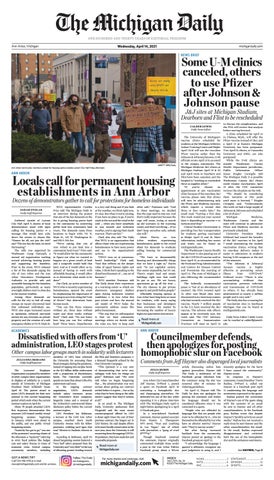
Locals call for permanent housing establishments in Ann Arbor
ANN ARBOR
Dozens of demonstrators gather to call for protections for homeless individuals SARAH STOLAR Daily Staff Reporter
Gathered outside of Larcom City Hall April 9, dozens of local demonstrators stood with signs calling for housing justice — a message that would later echo down the streets in chants like “Homes for all, not just the rich” and “The city has the land, we need the housing.” The rally was organized by Washtenaw Camp Outreach, a mutual aid organization working toward achieving housing justice and supporting the homeless. Prior to the event, WCO released a list of five demands urging the city of Ann Arbor and the Ann Arbor Downtown Development Authority to provide safe and accessible housing for the homeless population, particularly as many overnight shelters start to close due to the warmer weather. Among these demands are calls for the city to halt all camp sweeps on vacant city-owned land that unhoused individuals use. WCO also urges increased access to sanitation, enforced one-week notices for any evictions on private property and the creation of a safe emergency shelter at 721 N. Main St.
WCO representative Cynthia Price told The Michigan Daily in an interview during the protest that one of the key demands on the list is giving housing power back to the community by converting public land into community land trusts. The demands name three locations to begin with: 721 N. Main St., 415 W. Washington St. and 350 S. 5th Ave. “We’re asking (the city of Ann Arbor) to put land into a community land trust,” Price said. “It would allow for the community to figure out what we wanted to happen on a given swath of land and a nonprofit would hold that land. And so it would allow us to, instead of having to work with affordable housing, it would allow us to determine what needs to be done.” Jim Clark, an active member of WCO who is recently experiencing homelessness, opened the event by emphasizing the importance of housing to survival, citing the “rule of threes” that determines basic human needs. “You can live three minutes without air, three days without water and three weeks without food,” Clark said. “Do you know how long you can live without heat? Three hours. Hypothermia
is a very real thing and if you look at the weather, we think right now, it’s nice. But when it starts raining, if you have no place to go, if you’re stuck in the wet and the wind in the cold … when you force somebody to stay outside and inclement weather, you’re signing their death warrant. That’s not fair.” Clark also also told The Daily that WCO is an organization that allows those who are experiencing homelessness to have more power and say in the organization’s actions. “(WCO runs on a) consensusbased leadership,” Clark said. “And that reflects on the deeper value of equal human rights and value. I think that’s speaking to the disenfranchisement of … one set of humans.” WCO member Peatmoss told The Daily about their experience at a warming center — which are short-term emergency shelters open during inclement weather conditions — in Ann Arbor this past winter and how the mutual aid model of WCO helps the community address issues like police harassment. “The way that we self-organize is that we have community meetings where we decide what the rules are, how to keep each
ACADEMICS
Dissatisfied with offers from ‘U’ administration, LEO stages protest
Other campus labor groups march in solidarity with lecturers JULIANNA MORANO Daily Staff Reporter
The Lecturers’ Employee Organization was joined by members of other campus labor organizations in displays of solidarity in a march outside of University of Michigan President Mark Schlissel’s house April 10. The protest aimed to assert LEO’s demands for their new contract in this current bargaining period which ends when the current contract expires on April 20. About 70 people attended LEO’s first in-person demonstration this semester. LEO hosted weekly virtual bargaining sessions beginning in January, which were closed to the public, and one public virtual bargaining session. “Austerity has got to go,” was one of the protesters’ recurring chants of the afternoon — “austerity” referring to strict fiscal policies like budget cuts and salary freezes in times of economic crisis. Several campus community members, including
members of LEO, have criticized the University for overusing these fiscal strategies during the pandemic, instead of tapping into surplus funds or the $12 billion dollar endowment with a proportion of discretionary funds. The University currently spends no more than about 4.5% of its endowment each year. In the ongoing contract negotiations, LEO’s demands include salary increases across the University’s three campuses, longevity raises and a reversal of the University’s controversial felony disclosure policy before the current contract expires. LEO President Ian Robinson, a lecturer at the U-M Ann Arbor campus, marched down South University Avenue with his fellow protesters, wielding yard signs that read “#Invest in Students #Invest in Lecs. According to Robinson, April 9’s closed bargaining session featured a “very bad” salary proposal from the University and “very little” in the way of allocating greater funding toward
GOT A NEWS TIP? Call 734-418-4115 or e-mail news@michigandaily.com and let us know.
Follow The Daily on Instagram, @michigandaily
the Flint and Dearborn campuses — a demand frequently echoed by the One University Campaign. “This (protest) is a way now of demonstrating that we’re very unhappy with how far things are gone,” Robinson said. “We were told when we began bargaining that … the administration was very serious about getting our contract settled before it expires … but so far, what they’ve been doing at the table doesn’t suggest that they’re serious at all.” In an email to The Michigan Daily, University spokesman Rick Fitzgerald said the most recent counter-proposal offered by LEO is about eight times the cost of their previous contract, the largest yet in LEO history. He said despite efforts to be more fiscally conservative in the next year, since the University is still recovering from the ongoing COVID19 pandemic, they have made fair and reasonable proposals.
Read more at MichiganDaily.com
other safe,” Peatmoss said. “And in those meetings, we decided that the cops need to stay out. And that’s really important because the cops will come, trying to search up old warrants to the warming center, and that’s terrifying … If we don’t keep ourselves safe, nobody else will.” Adam Harris, an Ann Arbor resident experiencing homelessness, spoke to the crowd about his demands to eradicate selling housing for commercial gain. “We have to decommodify housing and decommodify things that we have a right to,” Harris said. “In our capitalist society, that seems impossible, but it’s not. There’s empty land and empty buildings right now that could be put to use. We see luxury apartments go up all the time … The city chooses to put private property and profit before people.” Affordable housing options in Ann Arbor have long been an issue for residents, with many saying that businesses and developers have overtaken the market by increasing the number of luxury high-rise apartments downtown.
Read more at MichiganDaily.com
The University of Michigan’s vaccine clinics scheduled for students at the Michigan Athletics Indoor Training Center and Mejier April 13-16 will use the two-dose Pfizer vaccine rather than the Johnson & Johnson/Janssen, U-M officials wrote April 13 in an email to the campus community. The Michigan Medicine J&J clinics at Michigan Stadium April 19 & 20 and April 14-16 in Dearborn and Flint have been canceled, and the hospital is “working to reschedule these as supplies allow.” “If you’ve chosen an appointment at any vaccination clinic because of the one-dose J&J vaccine, please note that clinics will now be administering only the Pfizer and Moderna vaccines, which require a second shot three or four weeks later,” the email read. “Getting a first dose this week would put your second dose — depending on vaccine — in early-to-mid May.” Central Student Government is providing free bus transportation for students getting vaccinated at Meijer April 15 and 16. More information, including bus routes and times, can be found on michigandaily.com. The Washtenaw County Health Department is also pausing use of the J&J COVID-19 vaccine until at least April 15, as recommended by the Food and Drug Administration and Centers for Disease Control and Prevention the morning of April 13. The state of Michigan is also following the recommended pause. The federally recommended pause is “out of an abundance of caution”, the FDA tweeted April 13, after rare blood clots were discovered in six American women who had recently received the J&J vaccine. Nearly 7 million people in the U.S. have received the J&J vaccine. The adverse side effects appear to be extremely rare, the tweet said. The CDC Advisory Committee on Immunization Practices will meet on April 14
to discuss the complications, and the FDA will review that analysis before moving forward. A clinic scheduled for April 13 in Chelsea, Mich., will offer the Pfizer vaccine instead of J&J, and a April 13 at Eastern Michigan University has been postponed. Two April 14 clinics, at Concordia University and EMU, are also postponed. While the U-M clinics are outside Washtenaw County Health Department jurisdiction, Public Information Officer Susan Ringler Cerniglia told The Michigan Daily it is possible Washtenaw County J&J clinics could resume vaccinations April 15 after the CDC committee reviews the situation on the 14th. “We should be considering them tentative at this point until more is learned, ” Ringler Cerniglia said. “Unfortunately, this week we had a large supply of Johnson & Johnson and scheduled a lot of clinics.” Michigan Medicine, Washtenaw County and the state will continue to administer Pfizer and Moderna vaccines as previously scheduled. University President Mark Schlissel had touted the benefits of the J&J vaccines in his April 7 email announcing the student vaccination clinics, writing that its one-dose delivery makes it easier to administer to students leaving U-M campuses at the end of the semester. “The Johnson & Johnson/ Janssen vaccine is highly effective at preventing severe illness from COVID-19,” Schlissel wrote. “There is also accumulating evidence that vaccination prevents infection and transmission of COVID-19 to others. It has already been administered to nearly 4 million people and is very safe.” The Daily also has a running list of vaccination sites in Southeast Michigan that can be found at michigandaily.com. Daily News Editor Calder Lewis can be reached at calderll@umich. edu.
ANN ARBOR
Councilmember defends, then apologizes for, posting homophobic slur on Facebook
Comments from Jeff Hayner also disparaged local journalists JULIA RUBIN
Daily Staff Reporter
Ann Arbor City Councilmember Jeff Hayner, D-Ward 1, posted a quote on Facebook April 10 containing a homophobic slur and disparaging journalists. He defended his use of the slur while repeating it in a phone interview with The Michigan Daily April 11 night before apologizing in a April 12 Facebook post. In a now-deleted Facebook comment, Hayner quoted excerpts from Hunter S. Thompson’s 1971 novel, “Fear and Loathing in Las Vegas,” one of which calls journalists a “gang of cruel (f*****s).” Though Facebook removed the comment, Hayner originally commented multiple times under a post in the Ann Arbor Politics Facebook group about a MLive
For more stories and coverage, visit
michigandaily.com
INDEX
article discussing online hate against journalists. Hayner told The Daily a moderator of the Facebook group informed him the comment using the slur was removed after 10 minutes for violating guidelines. On April 11, Hayner told The Daily he does not apologize for posting the comment and thinks his language should not be considered offensive since it was contained in a quote. “People who are offended by language like that are people who want to be offended by it… who let themselves be offended by it or who have an ulterior motive,” Hayner said. “They’re not my words.” But after facing increased backlash from the community, Hayner posted an apology in the Facebook group on April 12. “I acknowledge the language I quoted is offensive, recognize my poor judgement in using it, and I
Vol. CXXX, No. 29 ©2021 The Michigan Daily
sincerely apologize for the harm I have caused the community,” Hayner wrote. In response to Hayner’s comments, Councilmember Travis Radina, D-Ward 3, called out Hayner in a Facebook post April 11 condemning the language and sentiments expressed in the quote. Radina posted the screenshot of Hayner’s use of the quote along with the contents of an email he sent to Hayner and all other councilmembers. In his Facebook post, Radina wrote that despite Hayner’s “prolific activity on social media,” Radina has not received a reply since he sent Hayner and the other councilmembers the email. In the email, Radina expressed disappointment and criticized both the use of the homophobic slur and the anti-press sentiments.
NEWS.........................2 ARTS............................4 MIC...............................6
See HAYNER, Page 2 S TAT E M E N T. . . . . . . . . . . . . . . . . . .9 O P I N I O N . . . . . . . . . . . . . . . . . . . . . .1 2 S P O R T S . . . . . . . . . . . . . . . . . . . . . . . .1 4
News
2 — Wednesday, April 14, 2021
The Michigan Daily — michigandaily.com
PHOTO
Stanford Lipsey Student Publications Building 420 Maynard St. Ann Arbor, MI 48109-1327 www.michigandaily.com
CLAIRE HAO
TARA MOORE
Editor in Chief cmhao@umich.edu
Business Manager tmooree@umich.edu
NEWS TIPS
tipline@michigandaily.com
LETTERS TO THE EDITOR tothedaily@michigandaily.com
EDITORIAL PAGE
opinion@michigandaily.com
PHOTOGRAPHY SECTION
ARTS SECTION
photo@michigandaily.com
arts@michigandaily.com
NEWSROOM
SPORTS SECTION
news@michigandaily.com
sports@michigandaily.com
CORRECTIONS
ADVERTISING
corrections@michigandaily.com
WMG-contact@umich.edu
Editorial Staff
TESS CROWLEY/Daily There is a frenzy of activity on the streets of Ann Arbor as spring shows its cheerful face.
PUBLIC SAFETY
U-M student Mahnoor Imran joins UMPD Oversight Commission After winning annual election, LSA sophomore aims to push for transparency ASHNA MEHRA & MICHAEL DEETER Daily Staff Reporter & For The Daily
LSA sophomore Mahnoor Imran will serve as the newest member of the University of Michigan Police Department Oversight Committee for the 2021-2022 academic year after winning the annual election on March 24 and 25. Imran received 121 votes. Engineering junior Josh Chapnick and LSA junior Justin Yuan, who both also ran for the position, received 54 and 14 votes, respectively. In a statement to the Michigan Daily, Yuan wrote that he didn’t announce an actual campaign or even really mean to run. As a member of the Young Democrats Socialists of America along with Imran, he voted with membership to unanimously endorse Imran for her write-in campaign. “I supported and continue to support Mahnoor for the UMPD oversight commission,” Yuan said. “She’s compassionate, competent and incredibly smart.” The function of the UMPD Oversight Committee is to help people with their grievances against U-M police officers or the U-M police department. The committee has a total of six members — two students, two faculty members and two staff members — who are nominated and elected by their peers. Students serve one-year terms, while faculty
HAYNER From Page 1 “Setting aside your tirade against the free press, the thoughtlessness and disregard you displayed for our LGBTQ residents in sharing such a quote is extremely concerning and hurtful,” Radina wrote. “In 2021, LGBTQ residents – especially LGBTQ youth – in one of the most progressive cities in Michigan should never be subjected to elected officials cavalierly utilizing homophobic slurs to insult their perceived adversaries or to advance a political point of view. It is disappointing. It is harmful. And frankly, it makes me question the sincerity of your supposed support for the LGBTQ community.” Hayner said on April 11 he supports the LGBTQ+ community and is disgusted by Radina’s suggestion that he has harmed anyone. He told The Daily he made the comment because he has been harassed by the media and believes some members of the press are not trustworthy. “I feel very strongly that some media can be trusted and some can’t,” Hayner said. “I feel strongly that way because that is how I have been treated … For (Radina) to suggest in any way that I don’t support individual rights … is disgusting and disturbing and it’s offensive to me. There is no questioning my commitment to human rights, to LGTBQ rights and to move in our society forward together with equality. And for him to
and staff serve two-year terms. Imran’s platform focused around fostering ties with the Advancing Public Safety Task Force created by University administration after the Graduate Employees Organization went on strike in Oct. 2020, with defunding the University Department of Safety and Security among their demands. Though this was not agreed upon in the University and GEO’s resolution, a variety of anti-racism initiatives — including the task force — were approved. Imran hopes to advance on the task force’s work during her term. “I wanted to push for transparency and accountability in the ways that are conducive to the kind of justice that I believe in,” Imran said. “My biggest concern is upholding public safety and public health in a way that centers community concerns.” Imran said she wants the community to recognize that having organizations such as the UMPD Oversight Committee is important because of the harm policing can cause. “We need people who can advocate for public safety in a more nuanced way that acknowledges that harm,” Imran said. “It’s definitely a very interesting space to enter, but I want to listen to everyone’s thoughts and what they have to say.” Sarah Peitzmeier, chair of the UMPD oversight committee, said having student representatives on the committee is a legal
requirement and has also been very beneficial. “I certainly agree that it’s really important to have feedback and input from all different constituencies on campus,” Peitzmeier said. “Student perspectives need to be represented.” Imran agreed with Peitzmeier, saying students’ voices need to be amplified throughout campus, especially when she sees the change they are pushing for as a necessity. According to Peitzmeier, one of the committee’s main goals for this year is to expand the committee powers to increase transparency and responsibility within UMPD. Members also plan to work to adjust the committee’s bylaws allowing the committee to publish public reports on the committee’s work, for example, which they are not currently able to do because of vague wording in the bylaws. “We’re moving through the stages of negotiation processes and have had a very positive experience so far,” Peitzmeier said. “It seems like the PD is also invested in increasing community trust.” U-M Chief of Police Robert Neumann, who works directly with the oversight committee, wrote in an email to The Michigan Daily he supported expanding the committee’s power while maintaining operational efficiency. “I support any measure that enhances transparency and accountability while ensuring that legal and structural boundaries
are not compromised,” Neumann wrote. “A process is underway to evaluate the Committee’s request, and I am supportive of steps that build confidence in our accountability.” In the face of increased public attention on policing practices, Neumann identified strengthening community ties and the promotion of community dialogue as two areas in which he hopes the department can improve. He also emphasized the increased importance of public accountability for police officers. “Accountability and the perception of accountability are essential components of sustaining the community partnerships necessary for serving the needs of our community,” Neumann wrote. “I see increased public attention to policing as an opportunity to learn and grow in the ongoing work to earn trust.” Imran said she hopes to use her platform to ensure people in a position of privilege will take on this obligation to do more for their community and that the support from her community was a major factor in her decision to run. “At the heart of it all was community,” Imran said. “I would not have been able to achieve this victory without the support of my friends and community members.”
even suggest that shows how little he knows about me.” Hayner is no stranger to controversy on the council. In December, MLive reported he had added a second floor to his Ann Arbor home without a permit. Hayner maintained he did nothing wrong, but has faced angry public commenters since the addition was reported. On the 11th, Hayner also defended quoting the excerpt to The Daily by adding he has friends who are members of the LGBTQ+ community, that the slur has been in print for decades and that it was used by Thompson, an acclaimed journalist, in an important piece of literature. Hayner said he has not been contacted by community members and, because the comment was not directed at anyone in particular and claimed that because the slur itself is “archaic” and “hardly ever hear(d)” anymore, it is not offensive. “If you take something out of context to stir up outrage, then you’re gonna get outrage,” Hayner said. “If you read things in context or you know where it came from or know what kind of person I am, you’re not outraged by it. If somebody is offended by seeing that word in print, take it up with the publisher.” Councilmembers have previously raised concerns about Hayner’s behavior on social media. As of April 11, Hayner told The Daily he had not seen Radina’s Facebook post but had a reply
prepared to his email. Hayner added he felt it was wrong for Radina to publicly post about the quote before having a private conversation with him. In a comment on Radina’s Facebook post, Councilmember Jen Eyer, D-Ward 4, thanked Radina for speaking out and said she stands with the LGBTQ+ community. Washtenaw County Commissioner Katie Scott, D-District 9, posted a letter to the Ann Arbor City Council to her Facebook page the evening of April 11, urging them to “affirm the open and welcoming community we have in Ann Arbor,” and signed it from a “proud LGBTQ elected official.” “There must be a reckoning,” Scott wrote. “We have a choice to create a transformative culture here that supports each resident, or we have a choice to engage in perpetuating harmful stereotypes and being part of a regressive culture. By using quotes like this in a public forum, it paves the way for more hatred and homophobia; it legitimizes it. I’m here to stand up for the LGBTQ community today.” In his Facebook post, Radina questioned the intent of Hayner’s comments and Hayner’s unwillingness to apologize to Ann Arbor’s LGBTQ+ community. He added he feels angry and exhausted needing to respond to anti-LGBTQ+ hate a week after the anniversary of the election of Kathy Kozachenko, the first LGBTQ+ person elected to
public office in the U.S. Kozachenko was elected to Ann Arbor City Council in 1974, when she was a 21-year-old student at the University of Michigan. “I am deeply disappointed, angry, exhausted, and frustrated that just a week after celebrating the anniversary of the first LGBTQ person elected to public office, I am being forced to address and condemn the reference of bigoted and homophobic language by one of my colleagues,” Radina wrote. “This also comes less than a week after some of us on Council had to dedicate time to educating our colleagues about the threat that white supremacy and white terrorism poses to the (Asian American and Pacific Islander) community.” In a statement to The Daily, Radina said he cannot comment on the consequences he believes Hayner should face since has not yet received a reply from Hayner. However, he said it is unequivocally Hayner’s responsibility to repair the harm he has caused toward the LGBTQ+ community. “It cannot be anyone else’s responsibility (to reach out to the LGBTQ+ community),” Radina said. “That, however, also requires a genuine acknowledgement and acceptance of the harm caused, true remorse and a real willingness to learn and do better.”
Daily Staff Reporter Ashna Mehra can be reached at ashmehra@ umich.edu. Daily News Contributor Michael Deeter can be reached at deetermi@umich.edu.
Daily Staff Reporter Julia Rubin can be reached at julrubin@umich.edu.
BRITTANY BOWMAN Managing Editor
babowm@umich.edu
JACK GRIEVE
Digital Managing Editor
jgrieve@umich.edu
BARBARA COLLINS and LIAT WEINSTEIN Managing News Editors
news@michigandaily.com
Senior News Editors: Emma Ruberg, Hannah Mackay, Calder Lewis, Jasmin Lee, Francesca Duong, Kristina Zheng Investigative Editor: Sammy Sussman FOIA Manager: Ayse Eldes
LIZ COOK and JOEL WEINER
Editorial Page Editors tothedaily@michigandaily.com Senior Opinion Editors: Zack Blumberg, Andrew Gerace, Min Soo Kim, Mary Rolfes, Elayna Swift
LANE KIZZIAH and KENT SCHWARTZ
Managing Sports Editors sports@michigandaily.com Senior Sports Editors: Rian Ratnavale, Drew Cox, Lily Friedman, Jack Kingsley
ELISE GODFRYD and ZOE PHILLIPS
Managing Arts Editors arts@michigandaily.com Senior Arts Editors: Andrew Pluta, Grace Tucker, Kari Anderson, Katie Beekman, Sophia Yoon Arts Beat Editors: Elizabeth Yoon, Peter Hummer, Mik Deitz, Sabriya Imami, Kaitlyn Fox, Anya Soller
AYA SALIM and SHANNON STOCKING Managing Design Editors Senior Layout Editor: Adam Bressler
design@michigandaily.com
ALLISON ENGKVIST and MADDIE HINKLEY
Managing Photo Editors photo@michigandaily.com Senior Photo Editors: Emma Mati, Miles Macklin, Becca Mahon, Julia Schachinger Assistant Photo Editors: Maddie Fox, Luke Hales, Jeremy Weine, Gabby Ceritano, Sophia Afendoulis
ANDIE HOROWITZ
Managing Statement Editor statement@michigandaily.com Deputy Editors: Isabelle Hasslund, Marisa Wright
MADISON GAGNE and OLIVIA BRADISH
Managing Copy Editors copydesk@michigandaily.com Senior Copy Editors: Caroline Atkinson, Anjali Chiravuri, Ethan Patrick, Kelsey Burke, Emily Wilson, Vanita Seed, Sophie Kephart, Rena McRoy
PARTH DHYANI and NAITIAN ZHOU Managing Online Editors
webteam@michigandaily.com
IULIA DOBRIN and ANNIKA WANG
Managing Video Editors video@michigandaily.com Senior Video Editors: Margaret Rudnick, Jordan Shefman
ANAMIKA KANNAN and GABRIJELA SKOKO
Michigan in Color Editors michiganincolor@michigandaily.com Senior Michigan in Color Editors: Noor Moughni, Maya Kadouh, Eliya Imtiaz, Jessica Kwon, Lola Yang
EMILY OHL and GERALD SILL
Managing Podcast Editors podeditors@michigandaily.com Senior Podcast Editors: Doug McClure, Max Rosenzweig, Avin Katyal
HALEY JOHNSON and ASHA LEWIS
Managing Social Media Editors socialmedia@michigandaily.com Senior Social Media Editors: Kirti Aplash, Natalie Knight, Ria Dubey, Ryan Postman, Evan DeLorenzo, Atticus Raasch, Bella Morreale
ALEX HARRING and SARAH SZALAI Co-Chairs of Access & Inclusion
accessandinclusion@michigandaily.com
Business Staff RORI MILLER Creative Director
SCHUYLER JANZEN Sales Manager
The Michigan Daily (ISSN 0745-967) is publishing weekly on Wednesdays for the Winter 2021 semester by students at the University of Michigan. One copy is available free of charge to all readers. Additional copies may be picked up at the Daily’s office for $2. If you would like a current copy of the paper mailed to you, please visit store. pub.umich.edu/michigan-daily-buy-this-edition to place your order.
The Michigan Daily — michigandaily.com
News
Wednesday, April 14, 2021 — 3
ANN ARBOR
Ann Arbor residents debate replacing Woody Allen mural amid resurfacing of sexual assault allegations Screenwriter’s portrait is among four other writers on the painting at the corner Liberty Street and State Street CYNTHIA HUANG Daily Staff Reporter
A prominent mural on the corner Liberty St. and State St. has acted as a central hallmark for downtown Ann Arbor since 1984. The mural — commonly referred to as the Bookstore Mural — depicts portraits of five well-known writers: Franz Kafka, Hermann Hesse, Edgar Allen Poe, Anaïs Nin and Woody Allen. A new HBO docuseries, Allen v. Farrow, revisits the sexual abuse allegations against Allen made by Dylan Farrow, Allen’s adopted daughter, in 1992 when she was 7 years old. Farrow is now 35 years old. Allen is known for his career as a screenwriter, actor, author and American film director, but allegations against Allen have followed him for decades. After the #MeToo movement began gaining momentum in 2017, the allegations became debilitating. Many actors and filmmakers alike have now denounced Allen and have refused to work with him. With Allen’s sexual assault allegations resurfacing, Ann Arbor residents are engaging in a renewed debate over replacing Allen in the mural downtown. A discussion in the Ann Arbor Townies! Facebook group garnered attention from residents, raising questions of the mural’s feasibility and ethics. A majority of the residents wanted the mural taken down. The debate with Allen’s mural isn’t the only one of its kind. Especially after the Black Lives Matter protests, numerous monuments and campus buildings across America that have come under scrutiny due to its memorialization of white supremeicists. Ann Arbor resident Mikki Moscara said she would like to see the painting of Woody Allen
either taken down or repainted with a new writer. “I think Woody Allen should be replaced or removed (from the mural) mainly because of the situation that transpired,” Moscara said. “Having that (mural) up in Ann Arbor, is it really good for the reputation of Ann Arbor?”
They will be referred to as Julia and Philip for the remainder of the story. Julia called discussion around the depiction of Allen in the mural “old news.” “I don’t understand the resurgence of this culture where if someone is accused of a crime, they are deemed
only to acknowledge Allen’s work as an artist. “At the time the mural was commissioned, it wasn’t known about his proclivities,” Krueger said. “And the spirit was not even to highlight his personal life at all; it was merely to acknowledge him as a renowned filmmaker.”
allegedly had contradictory views on sex, who was described by a friend as being ““tortured by his sexual desires.” “None of the people on that painting are innocent,” Philip said. “The one person in that whole group we couldn’t say had some weird sexual tendencies is Hermann Hesse.”
DOMINICK SOKOTOFF/Daily Ann Arbor residents argue debate replacing the Woody Allen portrait in the Bookstore Mural on the corner of Liberty St. and State St. due to sexual assault allegations against him.
Allen has consistently denied the allegations and has never been tried or convicted for the sexual abuse accusations. Citing these reasons, two Ann Arbor residents who wish to remain anonymous due to fears of personal and professional retribution have told The Michigan Daily they believe the painting should be kept in place.
immediately guilty,” Julia said. “Who gives you the right to destroy something because you have a misguided idea of what happened, and you don’t even have the facts?” Ypsilanti resident Andrea Krueger, a semi-retired social worker and yoga instructor, agreed, saying she believes the mural’s original purpose was
Others like Philip, who has requested anonymity, said some of the other writers on the mural have also had their share of scandal. Edgar Allen Poe married his 13-year-old cousin when he was 27. Anaïs Nin had two husbands — one in New York and the other in Los Angeles — who each did not know the other husband existed. Franz Kafka
Allen is the only one of the five accused of sexual assault. Philip said they would like to keep the mural as a point of discussion about the past. “It’s been there since 1984,” Philip said. “If we start censoring the past, we’ll never learn from it.” Similarly, Krueger said she believes keeping Allen on the
mural can prompt critical thinking about his controversial past. “It provokes questioning, and I think that’s a very good thing,” Krueger said. “By whitewashing out Woody Allen, there’s nothing to think about, is there?” In contrast, Moscara said she believes Allen should be replaced to reflect Ann Arbor’s progressive culture. “In regards to honoring the past, … things change, and it’s okay to change,” Moscara said. “He doesn’t have to be there, I feel like it’s not as important for him to be there as it is more so to change and be a little bit more progressive.” Moscara suggested a few people she thinks could replace Allen. “I think having someone from Ann Arbor would be really great,” Moscara said. “Some people suggested Iggy Pop. Robert Frost lived in Ann Arbor for a little while.” LSA sophomore MacKenzee Van Buren said she believes adding writers of color or female writers would be a welcome addition to the mural, which currently showcases four white men. “I think there are more influential, deserving writers out there that can be put on the mural instead of Woody Allen,” Buren said. “I think removing Allen opens the potential for making a more representative mural.” Moscara also said she believes adding different writers from diverse backgrounds would better represent Ann Arbor’s diverse culture. “I think that in itself would be more progressive, and that would show Ann Arbor’s true face, or what makes Ann Arbor great,” Moscara said. Daily Staff Reporter Cynthia Huang can be reached at huangcyn@umich.edu.
ADMINISTRATION
Has Ron Weiser been ‘canceled’? Following recent calls for regent’s resignation, use of ‘cancelation’ ties into political, social connotations ALEX HARRING Daily Staff Reporter
MEGAN OCELNIK/Daily
BUSINESS
Ross School of Business Dean steps down from position
Scott DeRue to enter private sector after five years at University LILY GOODING
Daily Staff Reporter
Universit y of Michigan Ross School of Business Dean Scott DeRue announced April 9 he would be stepping down from his position on May 23 to take on a new role as a senior executive in the private sector. There is currently no replacement dean following DeRue’s departure. Universit y Provost Susan Collins will appoint an interim dean at the end of the semester, who will work closely with DeRue to ease the transition. DeRue became the Business School Dean in 2016. In the time since, every prog ram in the Business School rose to a Top 10 ranking while
others made it even further. In a personal message to the Business School communit y, DeRue said he felt very fortunate to have had this role. “Serving as your Dean for the past f ive years has been the g reatest professional honor of my life,” DeRue wrote. “Because of your commitment to excellence and passion for our mission, over the past 5 years, we have been able to achieve g reat things, for which I am extraordinarily proud of and g rateful for all of you.” While DeRue has been Dean, he wrote the Business School also made sig nif icant strides to become more inclusive, with an 20% increase in enrollment and introducing Diversit y, Equit y, and Inclusion requirements
into the core curriculum.. However, many students have called out the business school for its lack of diversit y. Moving forward, DeRue wrote he was conf ident that the Business School is heading in the right direction. “The road ahead will be full of new opportunities and challenges, all of which I am excited about, especially knowing that I will continue to have the Universit y of Michigan and Ross School communit y in my corner, supporting me ever y step of the way,” DeRue wrote. In his message, DeRue said Collins will release more details about the interim dean soon. Daily Staff Reporter Lily Gooding can be reached at goodingl@umich.edu.
Before the Board of Regents voted to censure one of their own, Ron Weiser (R), for statements he made referring to presumably Gov. Gretchen Whitmer, Secretary of State Jocelyn Benson and Attorney General Dana Nessel as “witches” and contemplating the assassination of Republicans who voted to impeach former President Donald Trump, he offered a statement in defense of his words. “I take full responsibility for what I said,” Weiser said at the April 2 meeting. “I agree with part of this resolution, but I will not resign… I will not be canceled.” The majority of the Board of Regents went on to vote in favor of his censure — with Katherine White (D) absent from the meeting and Weiser and Sarah Hubbard (R) both abstaining — and called on him to resign. Weiser seems to have left the Zoom call shortly after the resolution passed, and he did not respond to The Michigan Daily’s request to comment. Weiser said he would not be “canceled,” which is a phrase that has been used online since at least 2013 but began to take on new political meanings with Trump’s election, academics say. It started as slang among Black Twitter users, and since has become a nebulous term that refers to calling out people for words or actions deemed harmful, racist or inappropriate. The term “canceled” has developed different uses across political and social spaces, typically meaning people should remove support for high-profile figures due to their behavior. Celebrities have been “canceled” for racist, sexist and illegal actions — and they have lost sponsorships and platform monetization as a result. For politicians, the impacts of “cancelation” typically end with
online shaming, since it becomes difficult for those doing the “canceling” to translate internet buzz to real-world change in the form of recalls or resignations. Born on Black Twitter, “canceled” takes on different meanings Though Weiser used the word canceled to liken his situation to ongoing conversations around free speech and accountability, canceling began with a far different meaning — it was slang specific to Black spaces on Twitter. Phrases like “dragging” someone or something or “reading” them, which both refer to a type of sharp rebuke, have similar origins to “canceling.” These phrases began to pick up traction in majority Black online spaces for being catchy, according to Lydia Kelow-Bennett, an associate professor in the Department of Afroamerican and African Studies. As these phrases started getting used more and more on social media, they eventually got picked up by mainstream culture, though the meaning of the term shifted slightly. Early on, “canceled” was used simply as a term to refer to celebrities like cook-turned-TV star Paula Dean, who was called out for racist behavior and lost her Food Network contract. The phrase then went on to become a “culture” as early as 2013. When the term transformed into a more mainstream culture, this inspired “moral panic” within predominantly white spaces, Kelow-Bennett said. “It’s just the word that we use to say, ‘I don’t want to pay attention to you anymore,’” Kelow-Bennett said. “To call it a ‘culture’ is to suggest that it has more firm meaning and more practice behind it than it actually does. By calling something a culture, you consolidate it in a way that makes it easier to have a panic about.”
When performed collectively, “cancel culture” is a form of online boycotting, says Montana Miller, an associate professor in the Department of Popular Culture at Bowling Green State University. This form of protest provides people — those who, unlike Weiser, do not hold elected seats or their own businesses — with an avenue for publically voicing their qualms, Miller said. Though the term can be meant frivolously when used to call out celebrities, she said the cancellation of businesses or public officials is often the product of meaningful online grassroots organizing. “The whole purpose of cancel culture is that a wide swath of real people who do not sit in seats of power can voice their displeasure with powerful people who do horrible things,” Miller said. The politics behind cancel culture In recent years, politicians, usually those right of center, began using the phrase to decry what they see as an attack on their right to free speech or unnecessary concern with their lack of political correctness. Michael Traugott, research professor at the Center for Political Studies who has taught in both the Communication and Media and Political Science departments, said Weiser and other conservatives will apologize for what they were “canceled” for saying but will maintain that they had a right to say it. These politicians will also attempt to frame the cancellation as a challenge to their freedom of speech. The argument that cancellation is a political weapon used by liberals is exacerbated by the nation’s hyper-polarization, Traugott said.
Read more at MichiganDaily.com
Arts
4 — Wednesday, April 14, 2021
The Michigan Daily — michigandaily.com
The things we see and watch when we’re young tend to make deep impressions on us. “The Growth B-Side” is here to honor the ways that art — from the shows we watched to the books we read to songs we listened to — has changed us as we’ve grown. We’re here to talk about the things that brought comfort during a difficult time, represented personal experiences or influenced life in unexpected ways. And even as we pinpoint the things that influenced us the most, we continue to grow and learn more about ourselves in the process. Kari Anderson, Senior Arts Editor Design by Sarah Chung
Queer cartoons made me gay How do you describe something that you feel within yourself but are scared to look at? This feeling that you can poke and prod while understanding that examination would lead to rumination would lead to turning your whole life upside down? Fleeting thoughts percolate on the banks of memory and pull little by little; the silt builds and builds until it can’t be ignored. I’m sure I’m not the only one who has felt this way, as the past year of quarantine provided everyone with ample opportunities to self-reflect and face issues that had long been on the back burner. The pandemic also allowed me to watch a lot of television — specifically, a lot of cartoons. Since January 2020, I have watched 14 animated TV shows and about 30 movies (including the entire Studio Ghibli catalog). Something about the medium of animation captured my attention and provided stability for me throughout an unstable, unprecedented year. When I commit, I commit hard: My most recent binge-watch was all 274 episodes of the acclaimed Cartoon Network epic “Adventure Time.” Now you may be thinking, what’s the math? Why is this adult writer talking to me about something I watched in fifth grade and promptly forgot about? I promise you it makes sense. Just tuck yourself in, snuggle under a freshly knitted blanket and allow me to regale you with a story about how cartoons helped me come to terms with myself. It’ll be mathematical and cuckoo banana pants, I promise.
episodes around mid-February, I hopped into the more controversial sequel series, “The Legend of Korra,” and found myself enamored. These shows were my comfort food: wellwritten stories matched with gorgeous animation to create a feast for the eyes and brain. Both shows are worth the watch, yet what caught me off guard with “Korra” was the series finale’s implication that the female lead, the eponymous Korra, ended up not with her male love interest Mako, but her gal pal Asami. Something as small as two women holding hands on network TV (sadly, the best they could do in 2014) filled me with immense joy. And I didn’t know what to do about it. So, I ignored it. I finished up my semester smiling on the outside and spiraling on the inside, unable to talk about my personal crisis because the world was on fire. So much was going on in those early months of 2020 that I felt guilty taking the time to think about myself. Then I watched “She-Ra and the Princesses of Power,” and my walls began to crumble. Silt was tumbling all around me, and with nowhere else to turn, I had to focus on it. “She-Ra,” a Netflix reimagining of the popular Filmation series of the 1980s by showrunner Noelle Stevenson, is gay. There’s simply no other way to say it. The content of the show is fantastic — it’s a riveting adventure full of twists and turns and iconic characters — but that doesn’t stop it from being queer to the core. Adora is caught in a will they-won’t they relationship with her fre-nemisis Catra, Bow has two lovely gay librarian dads and Netossa and Spinerella are the lesbian “moms” of
It all comes back to that feeling, that discomfort of something not sitting right with your brain before you hide it away and hope it fades. That started for me around my freshman year of college. I started thinking of questions that challenged my heterosexuality, so naturally, I said “Nope!” and forgot about them for a while. Just like anything else, these questions resurfaced a year later with a vengeance and demanded my attention. Being a busy college student, I took my time answering them and never got around to a satisfactory response. How could I question my sexuality after living one way for 20 years? It was like waking up one day and questioning if gravity existed: absurd, stupid and obviously a silly waste of time. As a distraction, I decided to do a rewatch of “Avatar: The Last Airbender,” which truly is as great as people say. When I ran out of those
everyone’s dreams. That’s not even mentioning the pan/bisexuality of just about every single character or the groundbreaking non-binary representation of the shape-shifting, actor-forhire Double Trouble. Watching just after the fifth and final season aired, I followed the Best Friend Squad of Adora, Bow and Glimmer all around Etheria as they tried to stop the Horde. There’s something so refreshing about a show being so chock-full of queer characters but not making a big deal out of it: In Etheria, love is simply love. Full stop. I found that I related to nearly all of these characters (I’m a HUGE Catradora supporter), but I was particularly drawn to Double Trouble. There was something so enticing about being outside our standard gender binary, about choosing where you identify more one day over the next.
M. DEITZ
Digital Culture Beat Editor
Design by Grace Aretakis
Starting “Steven Universe” right after finishing “She-Ra” (and forcing just about everyone I knew to watch it) affirmed one thing: Queer stories made me feel at home. There was something so comfortable about the openness and unabashed love they had for queer characters. They weren’t a token, an exaggeration or a two-second kiss that could be cut for the international release — these sapphic, bi, non-binary, gay and aromantic/ asexual characters were whole people. It was now June, three months into my journey of self-discovery, and though I was more comfortable with the idea of my changing identity, I had no solid ground to stand on yet. There were no labels I felt comfortable identifying with since the ideas were so nebulous and dynamic. During Pride month, I didn’t feel like I could join in because I had no idea where to slot myself into the community. It was lonely. Thankfully, cartoons came to my rescue once again. Episode 37 of the first season of “Steven Universe” is called “Alone Together.” In it, Steven fuses with his friend Connie to form a singular person stuck smack dab in the middle of being masculine or feminine. When they show off their fused form (named Stevonnie) to the Crystal Gems, Pearl sees it as unnatural, Amethyst compliments them and Garnett walks up to them and says, “You’re not two people and you’re not one person. You are an experience. Make sure you’re a good experience.” To Garnett, it doesn’t matter who Stevonnie is, it matters that they enjoy being. I paused the episode and took that in. I didn’t need to know how to make a sandcastle out of the silt yet; I could simply enjoy being around it. Labels are well and good, but it’s also more than okay to exist liminally, to be between labels as you take time discovering which one fits you best. I was content not knowing. Cartoons allow for the abstraction of complicated concepts like death, love and gender. They have to so that they can get past the harsh censorship of Cartoon Network, Disney and Nickelodeon executives. But this abstraction also more accurately portrays the queer experience. For most people, myself included, the process of coming to terms with one’s queerness is not a straight line. The journey is bumpy and twisty and confusing, but abstractions can act as a homing beacon to help us find our way back. Even if everyone’s journey is different, we still understand the important aspects that connect us, and there’s no better medium to express that than cartoons. It wasn’t until August when I was watching the underrated and thankfully queer “Harley Quinn” that I came out to someone. Even then, I didn’t have all the answers about what I wanted to be called or who I wanted to love, but I was okay not knowing at that moment. I was thankful to have someone who, even if he didn’t understand me, heard me. And that was enough. If I’m being honest, I don’t even have all the answers now, just about a year after my selfexamination started. That’s okay. The journey doesn’t really end, so it’s a good thing I’ve got plenty of diverse cartoons to watch in the meantime.
How ‘Rick Steves’ Europe’ helped me grieve NORA LEWIS
Daily Arts Writer
Ah, summer vacation. The sacred threemonth period of underpaid jobs, midday naps and in all honesty, too much TV. Although some may find this assessment pessimistic, it’s an accurate summary of my past two summers (minus being able to secure a job — sorry Mom). Last summer, constrained from most productive activities by the pandemic and low personal funds, I opted to embrace the latter pursuit of TV-watching. My program of choice, you may ask? The one and only “Rick Steves’ Europe.” This wasn’t my first time watching the PBS travel show. In fact, its jovial theme song has been ingrained in my head for what seemed like eons. Over the last few years, my grandmother came over to my house almost daily so my mom could care for her. She suffered a decade-long battle with Alzheimer’s and it was practically impossible to pass the time with things she still enjoyed. Bingo and puzzles, the usual fare for elderly pastimes, were a no-go. Although my grandmother used to paint beautiful Monet-inspired landscapes, she couldn’t quite operate the paintbrush anymore. Even going on walks around the neighborhood was out of the question. The only activity that seemed feasible was watching TV. So each afternoon, like clockwork, I parked myself on the couch, and we alternated between the Turner Classic Movies channel and “Rick Steves’ Europe.” After watching copious amounts of the former, I learned that old movies could really be hit or miss. As a kid, I thought that any movie made before 1960 had to automatically be good, but after a while, the plot-lines get flimsy, the acting gets overthe-top and the Mid-Atlantic accents become grating. Hey, we can’t all be “Citizen Kane,” right? But watching “Rick Steves’ Europe” was different. It was a breath of fresh air, an opportunity for me to live vicariously through host Rick Steves as he ambled across the Swiss Alps or the Cinque Terre. I may have been sitting in the Long Island suburbs, trapped in the grips of mid-summer lethargy, but watching “Rick Steves’ Europe” felt like an almost educational experience. I now held a surplus knowledge of European travel, and most importantly, my grandmother seemed to be somewhat satiated. We breezed through at least five episodes a day, touring the Tuscan countryside and Norwegian fjords. I was amazed at the ease with which Rick struck up a conversation anywhere he went, discussing street food recipes and the country’s political climate with locals like they were old friends. Rick, mild-mannered and sincere, never missed an opportunity to provide a thoughtful social and historical commentary as he restauranthopped or took in spectacular views. The show doesn’t veer toward gimmicks or generalizations, and you get the sense that Rick really loves what he does. On days when the toll of my grandmother’s illness was particularly dispiriting, “Rick Steves’ Europe” felt like something to escape
into, even if it was just for an hour or two. Some of these days proved more difficult than others. I watched as it became harder for her to walk, eat and speak like she used to. Despite seeing her almost every day, I hadn’t really had a conversation with my grandmother for over two years. This didn’t stop me from asking her which medieval castle from the past episode she liked best or whether she’d been to that city with my grandfather before. Because even though things were different, even though I knew she didn’t understand every word I said, I still saw that flicker of love and humor and spunk behind her eyes. My grandparents had loved to travel, and watching “Rick Steves’ Europe” felt like a way to remind my grandmother of that happiness. Dusty photo albums are hidden away in cabinets and boxes chronicle my grandparents’ travels through Europe. I have memories of them bringing back Eiffel Tower keychains from Paris and small enamel jewelry boxes from Lisbon to give my siblings and me when we were kids. I always knew that they loved Europe, from the Carmen opera records we danced to in their basement to the French cuisine my grandfather cooked. As the children of immigrants who grew up in Depression-era Queens, their ability to travel later in life always felt meaningful. She passed away two months ago, and I never really got to say a proper goodbye. I wasn’t living at home when it happened, so I mourned away from the rest of my family and away from the place that I had shared so many hours with her. It was a strange feeling, not having any clear last words or images to remember her by, but then again, our relationship had never really been about the words. On a random night a few weeks after it happened, I was struck with the sudden impulse to turn on an episode of “Rick Steves’ Europe.” Despite watching over 10 seasons of the show, I realized that I’d never actually watched it alone; it was always an activity shared between my mom, grandmother and me on hazy summer afternoons. I scrolled through Prime Video and settled on an episode from Season 2 called “The Best of West Ireland.” I had seen it millions of times and would probably have heavily protested watching it only a month prior, but it felt right in that moment. My grandmother’s mother had grown up in the same emerald hills Rick traversed on screen, and I realized that watching him again helped me mourn. He had become so synonymous with that time spent with my grandmother that I found immense comfort in just the cheery swell of the show’s theme song. We had probably watched “Rick Steves’ Europe” on our last day together, and although it seemed unnatural to do so alone now, it was strangely cathartic for my grieving process. “Rick Steves’ Europe” is a safe haven for me. My grandmother and I spent most of our time in the confines of my living room, but watching the show never once felt like a chore. I’m forever thankful for the quirky, khaki-donning travel guide who helped create a connection of love between my grandmother and me, even when we didn’t have the words to do so.
One Direction and growing up within an online community LAURA MILLAR Daily Arts Writer
I was only 12 years old when my older sister and I first danced in my kitchen to “What Makes You Beautiful” by One Direction. We baked cupcakes and dyed icing pink and replayed the song until we knew every word. We discussed choosing favorites: Mine was Liam and hers was Niall. I can’t pinpoint exactly when my total obsession with the boy band happened. All I know is that after that day, the trajectory of my teenage years was drastically altered by five pop stars with luscious hair and British accents. Over the course of four years, I traveled throughout the East Coast with my sister to see One Direction 15 times in six states and I noticed something: I was seeing the same people at every concert I went to. Together we formed a smaller, in-person community outside of the wider One Direction fandom that only existed on social media. I referred to real people by their Twitter handles. I met online friends in person; we teamed up while camping out for NBC’s “Today” show and ABC’s “Good Morning America” in New York City for days at
a time. We loved every second of it. Being a member of the One Direction fandom became my personality. My sister and I would stay up late and talk about their albums, their personal lives or the next time we were going to see them. One Direction was the spark in my friendship with my sister, and I’m not sure if we would be this close today without them being our primary topic of conversation for over four years. I grew up with One Direction as my biggest influence, whether it be their music or the people they brought into my life or their upcoming performances. Having an online community waiting for me at home was a blessing during middle and high school. I felt closer to the online fandom than I did to some of my “real” friends. I was exposed to diverse people from around the world, and it was not uncommon for our relationships to start off revolving around One Direction before gradually transforming into something more personal. We would talk to one another about where we were from and what we were going through. These conversations played a significant role in
developing my understanding of different cultures and lifestyles while simultaneously showing me that shared interests can help bridge the gap between those different groups. Because I lived on Long Island, Manhattan was only a train ride away — meaning that any time One Direction was staying in the city for a concert or event, my sister and I were on the next train. Whether or not we had tickets, we would try and catch a glimpse of our idols.
to be completely honest, I’ve waited for days at a time behind a barricade outside several of Manhattan’s most expensive hotels, and I’m not ashamed. I know what you’re thinking: That’s weird. And it is. But it’s also how I learned to be independent, social and self-sufficient. When you’re waiting outside of a hotel for hours on end with strangers, there’s not much else to do but talk. And when you have to get from one side of the city to the other, you have to learn how to navigate the subway. I attribute 100% of my subway skills to being a fan of One Direction. Who knew that being a Directioner would equip me with street smarts? When I wasn’t busy navigating Manhattan, I took it upon myself to watch as many interviews and read as many fanfics as possible. Fans would write full-length novels and publish them on Wattpad for other fans to read. It was somewhat Design by Sarah Chung embarrassing to be caught reading The rush I felt when I checked Twitter for a fanfic, but I couldn’t consider myself a true updated information on their travel plans was fan if I wasn’t consuming every piece of One unlike any other. It may sound creepy and a Direction-related media I could find. little strange, but the thought of catching a Today, I listen to One Direction’s music glimpse of my icons was thrilling. If I’m going and I’m torn between feelings of joy, nostalgia
and heartbreak. Yes, I’m still grieving over their breakup. But the warm memories outdo the sadness, and I’m reminded that all good things come to an end: a lesson that everyone must learn. The five pop stars that were more or less forced into a certain genre of music broke out of their boyband bubble to explore their own music styles, and I don’t blame them. That’s a part of growing up too. For them, the process entailed exploration. For me, it required understanding. From attending concerts to navigating the subways to meeting new people from around the world, One Direction has profoundly impacted who I am today. I enjoy talking to people from different backgrounds. I’m comfortable figuring out how to get around a new place. Most importantly, I’m extremely confident that I will always remember the day I met Harry Styles as the best day of my life. It’s quite upsetting that I hit my peak at age 13, but that’s fine by me. I wouldn’t take back any of my boyband-related shenanigans because I know that, when I reminisce on my teenage years, One Direction will be responsible for a solid chunk of my most meaningful memories.
Arts
The Michigan Daily — michigandaily.com
Wednesday, April 14, 2021 — 5
Noticing “her”: The sapphic love song ROSA SOFIA KAMINSKI Daily Arts Writer
Some things escape your notice until they’re pointed out to you, and then they become all you can think about. This was the case with the first girl I ever really noticed as beautiful — not beautiful, attractive. And it’s the case with every love song sung by a woman that I’ve listened to, where she uses the word “she” or “her” to reference her lover. The thing is, heterosexual love songs don’t seem particularly gendered until you realize that you don’t quite fall into that realm all the time. Or even most of the time. And you don’t notice how unusual it is to hear LGBTQ+ romantic songs until the word “she” pops out of absolutely nowhere, making you sit down and stare at absolutely nothing — feeling your thought patterns exploring this word and selfinserting as you rewind the song. Like many pansexual or bisexual people, I started off thinking that my first “thing” for a girl was something that would happen maybe once or twice in my life. “I’m not bisexual, I just like girls sometimes,” I would insist. Let’s just say that’s something to laugh about now. Music surrounded the first girl I realized
I was attracted to. We found that we had the same favorite lyric in a particular song, something about God and swimming pools. My Spotify was a portal to getting to know me, she told me. I insisted to myself that my feelings for her were a rare one-off in my life; I created percentages of attraction in my head, weighted toward men. In reality, breaking love and other feelings down into math, just like with music, makes them lose some of their meaning. And slowly, I began to notice when women sang about female lovers. Sometimes, the songs were passionately centered on the anger of the woman-lovingwoman experience, using sex as defiance against those who would hate them because of their love. In Rett Madison’s “God is a Woman,” Madison describes her knees as “shaking” and “purple” as a woman kissed them. The uncertain, nervous trembling contrasted with the sureness of the romantic experience laid out a story in my head to match my feelings. I would lie awake in bed at night, listening to “Lorraine” by Big Thief over and over and over again. The “soft burning hands” mentioned didn’t belong to a man. They couldn’t. There was something about Adrianne Lenker’s quiet singing, thinking about a woman in a way
filled with desire, but without the force of a man, that made me shiver. The possibility of hands touching me that didn’t belong to a man — of saying “This is my girlfriend,” of tucking a girl’s long hair behind her ear — all presented themselves to me as new possibilities. They were scary to explore and dream up on my own. So, a variety of female musicians did it for me. Slowly, I began to look for women singing about female lovers. In “She,” Dodie sings hesitantly and sweetly about noticing all the different things that make you crush on someone — and, for the first time, noticing them about a woman. The woman she dreams of smelled of “lemongrass and sleep,” and I wondered what sleep smelled like. “Georgia” by Emily King is a song born from heartbreak like many others, except that she is begging a female lover to return. And, of course, “Graceland Too” by Phoebe Bridgers filled me to the brim and then spilled over a bit every time I listened, especially when I finally listened closely enough to realize that it was about a woman. Just like that, it was as though some puzzle had been solved. Had other songs I hadn’t listened to closely enough also contained sapphic stories? Were there many more to listen and dream to? Was it just one big gay
‘And it was all weasel’: Defining a relationship through music CARTER VEILLEUX Daily Arts Writer
One of my proudest moments at four years old was memorizing all the lyrics to “Hang Me Up To Dry” by The Cold War Kids. I sang it confidently to my parents one evening, a cappella. Along with The Cold War Kids, my father force-fed me music by the Rolling Stones, The Black Keys and Red Hot Chili Peppers, among others. He did everything he could to make sure that his music taste was ingrained into my head. Every night, the lullaby my father sang me was his own rendition of “Yellow” by Coldplay — except in his version, “yellow” was replaced with “weasel,” his nickname for me when I was young. Cartoons and movie nights were replaced with music video watch parties. My favorite DVD was “Slowboat to Hades,” an interactive rendition of music videos and concert clips accompanying the release of the Gorillaz album Demon Days. My Christmas gift at six years old was a firstgeneration iPod Nano, pre-downloaded with all of my father’s favorite songs. I stayed up well past my bedtime replaying “Brick” by Ben Folds Five and listening to Radiohead. Looking back, passing down his knowledge of music was one of the few hobbies my father could easily share with me. My father has been in a wheelchair for my entire life, so teaching me how to play sports, cook or use tools was out of the question. Listening to music was something to bond over and an activity he was always able to partake in. His music taste stuck with me throughout my early adolescent years, up until middle school when I decided that I had been deprived of listening to the “Top 40” played repetitively on the radio. As I began to branch out into an entirely new
realm of music — boy bands, indie-pop and eventually rap — the shared interest between me and my father diminished. Our common ground developed into me complaining about listening to Iron & Wine at dinner, and him complaining about playing J. Cole and Kanye in the car. At the beginning of high school, the relationship between my father and me strayed even further. After a surgery, he was placed into long-term in-patient care. I saw him every other night for dinner. We caught up about what was happening at school, how cross country was going, what I was going to be up to over the weekend — the basics. There was little time for mindless bickering about the legitimacy of electronic music and why I should listen to a “real band” like Nirvana. Our similarities naturally lessened, and we began to grow apart. A couple months later, when my father was finally allowed to continue his care at home, I was already immersed in the world of alternative R&B, trap music and EDM. The lyrics to “Hang Me Up To Dry” had faded from my memory and the songs from my iPod were entirely left out of my Liked Songs on Spotify. Conversations about music became few and far between with my father. The only time it was brought up was when my father would decide to test me on my music knowledge while one of his playlists looped during family dinner. As the years went by, my guesses for “Who sings what?” became more inaccurate. During my senior year of high school, my father was in and out of the hospital for weeks at a time. One morning, as I sat half asleep in my 8 a.m. statistics class, I received a call from an unknown number. Much to my surprise, it was my father calling me from the hospital. With more pep in his voice than normal and a slight sense of urgency, he asked if I could do him a “huge favor” — bring his headphones over to the hospital after school.
That afternoon, I stayed with him in his hospital room until the sun set. I sat next to him doing homework while he caught up on all the new album releases he had missed while in the hospital. Every now and then, he would insist that “I had to hear” the song he was listening to. I reluctantly listened to them and secretly enjoyed all of them. He then had me help him create a new playlist. I titled it very literally, “Made with Dad in the Hospital.” During the creation of the playlist, his song additions sparked some of my own suggestions for the playlist. We began to banter again about various songs and artists. I vouched for some of my favorite songs while he did the same for his, and we surprisingly agreed on an extensive list of songs. I came to the realization that my father’s music taste had rubbed off on me a little more than I would’ve liked to admit. All it took was one playlist to spark a period of growth within our relationship. Our love for music converged once again. I began to revert back to my roots, from R.E.M. to Beck. I actively searched for music that I enjoyed, in the hope that my father would too. Our conversations were no longer filled with small talk about our days. Instead, they were characterized by drawnout discussions of new albums, music videos and performances. I even relearned the lyrics to “Hang Me Up To Dry.” Though music was not the defining factor of me and my father’s relationship, it functioned as a kind of guide, marking the different stages of our bond. Our likes and dislikes amplified the highs and lows of our relationship. Our growth was reflected in our music. As the relationship matured, the breadth of our music scapes overlapped more and more. Music was never the sole reason we grew apart, but it was the turning point in finding our way back to common ground, and to each other.
My love letter to theater and the things it’s taught me KATRINA STEBBINS Daily Arts Writer
In one of my clearest childhood memories, I’m standing in the wings of a stage. I’m eight years old and I’m a little out of breath, having just sprinted from the dressing room to the stage. I’m nervously rolling and unrolling a comic book — my only prop, which I took very seriously — in my hands as I wait for the lights to go down and the scene to transition. The last note of a song rings through the theater, the spotlights turn off, the crowd cheers. The stage manager waves a hand urgently, I straighten the vest that I’d been put in for my little role as a citizen of River City, Iowa, and I step out to find my mark. Back then, I had aspirations of becoming a Broadway star. My Design by part as a background townsperson in this Cara Jhang community production of “The Music Man” was enough to get me dreaming. Maybe this was just the first step. Maybe I’d get an even bigger role in the next show, and things would fall into place from there. Everything in the world was possible and wide open then. If I worked hard enough, what would stop me from doing anything I wanted to do? It was never even about fame — something I could hardly conceptualize at the time — but the fun of performing, of stepping out in front of other people and telling a story. But I got older, and my ability to be comfortable on a stage shrank as I lost
the self-assurance kids are blessed with. I stopped performing. My dreams shifted away from being a Broadway star and gradually worked their way down to earth. Eventually, after so long with my head in the clouds, I found myself with two feet on the ground. The great big world of possibilities shrunk to fit between the narrow walls of my own capabilities and other people’s expectations. There’s probably a connection there between how I stopped being able to express myself both as an actor and in real life. The ability to wear every emotion plainly and feel them deeply became harder to do in real life as it became impossible to do on a stage. No one told me that growing up would make me reticent, more afraid of my own feelings, more afraid of what other people would think about them. But I kept theater with me, even though I moved from the stage to the audience. Of all the things that I loved in my childhood, it’s the only one that’s grown with me. I can’t count how many productions I’ve seen, but they span years and continents. Musicals make me less jaded, even when getting older demands pessimism and weariness. I don’t know another medium that allows, if not requires, the same kind of frank emotional exposition. In order for the story to move along, everyone has to say exactly what they’re feeling so that the audience can feel it too. The Phantom has to tell everyone how ugly he is; Jenna has to mourn the person she used to be; Evan has to apologize as his lies unravel; Bobby has to reconcile with his loneliness.
Whenever I sit in a theater, I let my guard down. When I do, nothing can command my attention the way that a good show can. Even though the nature of an audience involves being surrounded by other people, I find the theater a solitary experience. My phone stays off. I don’t move from my seat until curtain call, even during intermission. I don’t say much to anyone who comes with me. For two or so hours, I’m completely content to be alone in my head. Letting the theater’s darkness settle over me like a weighted blanket and letting all of the emotions coming from the stage — no matter how dramatic or over-exaggerated — allows me to experience everything with more emotional clarity. Most of the time, I have what I think must be a life-changing realization about myself or the world or the universe after I’ve seen a show. It’s never actually as profound as I think it is, but it means that I’d let go of some of my reticence and hesitation, at least for a little while. Basking in the loneliness — welcoming it rather than shoving it away — invites me to feel everything more acutely than I normally would. It’s strange, but I think I owe it to the people performing. They put on such displays of emotion that it makes me think it’s only fair for me to feel my own in return. Personal growth isn’t linear, but sometimes I think I’ve only regressed from the person I was when I was eight — the person who let herself feel everything, who was so excited to perform because she was totally undaunted. The theater makes me feel like that person again; it lets me take a step back in order to move forward with greater clarity. I learn — or, maybe, relearn — something about myself every time I’m in an audience. I leave the theater having grown into my own skin just a little bit more.
Design by Grace Aretakis
treasure hunt? Even now, when I am fully confident in calling myself pansexual and when I often notice women more than men, these songs leave me with the same sense of awe and shy interest that they always did. The casual wonder with which Bridgers views her lover eating saltines on her floor mimics the way I have looked at a girl I care about when she frowns at her homework or watches a streetlight change from behind the wheel. Devotion of any kind is about small attentions, noticing the things that others won’t. Dodie, Bridgers and countless other women have marked down all the little ways that their partners are unique and special. With love songs that relish in the privilege of noticing the small things about the women they adore, they
mark the individuality of their lovers. And it is important to me, and I’m sure to other listeners, that sometimes these individuals are women. With each different gay love song I found, a new path of dreaming presented itself. For a while, I admired the boldness and assuredness with which they addressed themselves. But for a while, personally, I didn’t want my sexuality to be a lens through which I was perceived. Though I’m no songwriter, nowadays, I nevertheless find ways to explore queerness in my creative work (obviously). It’s funny how the love of others makes you consider the love within yourself. It’s funny how lucky their wonderful music makes me feel to experience the same love.
‘High Fidelity’ and the illuminative power of rewatching ROSS LONDON Daily Arts Writer
There is much to be said about a film’s ability to influence the viewer. We all have a movie that gave us chills and stayed front-ofmind long after we left the theatre. When I saw the 1985 film “Come and See,” I couldn’t understand how people stood up so quickly when the credits began to roll. I had been immobilized by the apocalyptic imagery of Nazi brutality and sat slack-jawed as fellow movie-goers gathered their things and discussed dinner plans. Movies like this have the potential to change the way we perceive and comprehend the world. But sometimes, it is the viewer who changes the film. As we grow and change, our understanding of a movie will change with us. I recently watched “High Fidelity” for the third time. The movie, released a few months before I was born in 2000, introduces the audience to Rob Gordon (John Cusack, “Being John Malkovich”) as his girlfriend Laura (Iben Hjejle, “Defiance”) is walking out the door. Rob, a former DJ and Chicago record store-owner, is no stranger to breakups. Throughout the film, Cusack breaks the fourth wall as Rob directly addresses the camera, walking us through his romantic history and quest to understand why he is fated to be rejected. Rob is something of an antihero. Viewed according to 2021 standards, the film capitalizes on antiquated tropes about heterosexual relationships and a hefty dose of misogyny. By 2000 standards, this is just another movie about male dysfunction. Scott Tobias of The Guardian says that Rob “is kind of a jerk,” and describes the Nick Hornby book on which the movie was based as an “incisive dissection of the pop-addled male brain.” To put it more simply, Rob is a man-child with ill-founded ideas about women and their role in his life. “High Fidelity” is not life-changing, and it hasn’t altered the way I perceive anything. Except, maybe, Jack Black’s ability to cover Marvin Gaye. What has changed, however, is my perception of the film itself. When I first watched “High Fidelity,” I was 13 or 14 and had recently discovered the world of collecting vintage vinyl. If I recall, I was disappointed to learn that the movie poster was a bit misleading: The film was more about record store-owner than record store. This explains why I more clearly recall the Championship Vinyl scenes than I do the scenes in bars and restaurants. My next encounter with “High Fidelity” took place a few years ago, when I was probably 17 or 18. This time, with my initial delusions dispelled, I knew what I was getting into. No longer focused on the vinyl aspect, I actually appreciated it more. Rob has pretty good taste, and boy, can Jack Black sing. Reflecting now on my first rewatch, my memory seems to fixate on Rob’s dysfunction. I may have seen too much of myself in self-conscious Rob for comfort, and as an anxious teenager, I was a bit disconcerted. Rob is sad, selfish and more deserving of pity than sympathy. I did not want to be Rob. Now, rewatching “High Fidelity” again, I still see myself in Rob, but not as the selfish mope. When Laura leaves, Rob undertakes the reorganization of his large record collection “autobiographically.” In order to find a song, he’d need to scour his memory for the person or event to which that song is attached. This is a very minor plot point, and it is meant to support the point that Rob has an obsessive personality. I was struck by this scene, not because I heal emotional wounds through reorganization (if only it were that easy), but because there is something poignant about turning that sorting compulsion on one’s own personal history in a time of crisis.
Rob is still a problematic character on the third watch. His ironically simultaneous fears of commitment and rejection are likely to linger despite his making up with Laura at the film’s conclusion. The insecurity and selfishness which struck a minor chord with my 17-year-old self have been replaced by my identification with Rob’s desire to find and create order in a disordered world. “High Fidelity” is defined by lists. Rob is always making them, often with his friends, otherwise for the camera. In fact, the narrative structure is oriented around Rob’s Top Five Worst Breakups — you see here a hint of his misogyny as he reduces women to ordinal items. Music is the source material for most of the film’s lists, with one example being “Top Five Songs for a Monday Morning.” If you’ll indulge me, and in no particular order: “Feeling Good” by Nina Simone, “7 AM” by Jacqueline Taieb, “Sunday Morning” by Amanaz (ironic, I know), “It’s Summertime” by Morcheeba and “Beggin’” by Frankie Valli and the Four Seasons. Rob’s list-making is shown as a symptom of his dysfunction. We get hints of this obsessive quality elsewhere in the film, like Rob’s hypocritical focus on Laura’s postbreakup sexual activity and the way he seeks absolution from obsession over the “top five” exes. Rob is not a healthy man, but there is something else at work here. The characters gloss over his record reorganization, but it reveals an interiority that is lacking in the rest of the movie. To construct this “autobiographical” system, Rob must draw on a mental timeline of emotional memory. His musical catalog becomes a playable chronicle of his life. His new system will be totally nonsensical to the outsider, suggesting that Rob sees his now Laura-less apartment as a sanctuary and extension of himself.
Design by Mellisa Lee
And sweetest of all, when he sits down to make Laura a mixtape at the end of the film, he must first make a sort of memory playlist, curating an emotional experience for Laura from events that may even predate her. “High Fidelity” is about much more than a self-loathing and obsessive-compulsive record store owner. The viewer is welcomed into an emotional world defined by music, arranged like a setlist and highly curated, for better or for worse. This was lost on me when I first watched and then rewatched the film. On the first go, my initial misconceptions left me dialed into the music alone, generally uninterested in Rob’s romantic woes. The second round was subconsciously sour, as Rob’s insecurities hit too close to my own and left a bad taste in my mouth. Now, I watch his romantic incompetence with pity while focusing on his pathological need to impose order. On the third go, the film is much more interesting. Rob’s lines and lists are the same as they were when I was 14. All that has changed is me. From viewing to viewing, I traversed setting and superficiality toward plot and character, and beyond to subplot and consequence. I only imagine that next time I will come full circle to the superficial and spend the whole time trying to identify the many Chicago and suburban filming locations. “High Fidelity” is no cinematic masterpiece, but my experience with the film embodies one of the ways that personal growth can alter our perception of art and media.
Michigan in Color Why I stopped calorie counting
6 — Wednesday, April 14, 2021
VICTORIA TAN MiC Columnist
Content warning: Mentions of eating disorders. The voice in my head sneered, Still too high, you’re a failure, as I yanked on the fat of my stomach. I was in my bathroom, trying to calm myself down and stop the moisture overpowering my eyes. My mom had bought a different type of yogurt that week at the store because it was on sale, but it was 30 calories more than the usual brand. An unpeeled apple is 90 calories, six almonds are 42, one cup of cooked broccoli is 35, two eggs are 180. Total calorie intake: 650. My mind was scrambling to recalculate: Well, if I take out the almonds and exercise for an extra 20 minutes tonight, I can still make my calorie goal, I rationalized. *** Last week, while scrolling through my Instagram Explore page to avoid homework, I came upon a video that showed how to make something called “nature’s cereal.” I was curious and so I did more research. Originally created by Tik Toker Sherwayne Mears, nature’s cereal consists of coconut water poured over a mix of blackberries, blueberries, raspberries and pomegranate seeds. This trend blew up when singer Lizzo shared a video on Tik Tok trying it for the first time. Now, I love an unexpectedly delicious food combination (trying ketchup on mac and cheese was truly a life-changing experience). And if Mears and Lizzo love nature’s cereal, who am I to judge? But the underlying issue with the nature’s cereal trend is that it can be misinterpreted, especially by impressionable youth, to demonize regular cereal with milk for being unhealthy while inadvertently idolizing nature’s cereal for being lower in calories. If we are continuously bombarded with content proclaiming that cereal is making you fat or that switching
from full-fat milk to skim milk will aid weight loss, we start to subconsciously label certain foods as “bad.” Gradually, we might start to avoid them or feel that we have to “earn” these foods through exercise. Even if we were able to enjoy these foods blissfully in moderation before, we might now feel guilty for eating them or that we need to substitute “bad” ingredients in a recipe like butter or sugar for “good” alternatives like avocados or apple sauce. Take, for example, the Instagram handle for the account on which I first saw the dish: @eatthisnotthat — a page is filled with posts that encourage you to suppress your cravings for unhealthy food with “clean alternatives” to cut calories. Nature’s cereal is full of antioxidants, vitamin C and other essential nutrients, but we should take it for what it is: fruit in water. We must avoid putting certain foods and meals on pedestals. To function, our bodies require many different nutrients that come from a balanced diet made up of a variety of foods, including ones that make us happy. The set of beliefs that idolizes thinness, perpetuates fatphobia and vilifies “unhealthy” foods is known as “diet culture.” It goes farther than to tell us to cut back on donuts and fried foods. Instead, it creates a fear of food and not exercising which can lead to disordered eating habits and potentially full-blown eating disorders. Diet culture taunts: “You can’t have a flat stomach if you snack in-between meals.” “Stop eating by 8 pm.” “Don’t eat fruits that are high in sugar.” “Keep away from unnecessary carbs.” “Never ever let your discipline waver.” While writing this, I am reminded of a time when I used to spend every minute of every day fixated on food, calculating every calorie, every gram of carbs, ultimately telling myself what I could and couldn’t eat. All in the name of hitting a number on the scale, this toxic mentality stole my time, happiness and ironically, my health. Hours wasted poring over
online restaurant menus, trying to decide what I would order the next day when I went out to eat with my family. If I couldn’t meticulously precalculate my calories for the meal based on grainy images of online menus, I would eat a small portion of it, feigning fullness. The next day, I would heavily restrict my food intake to under 900 calories and spend countless hours exercising, regardless of whether I really had the time to or not. Sometimes I would make excuses and cancel dinner plans altogether. Instead of studying for an exam, I would be googling things like, “How many calories are in toothpaste?” When the numbers on the scale fell, my friends praised me for my “willpower” to be healthy. I was constantly terrified of losing control, but the truth was I already had. I liked feeling the gnawing hunger pangs in my stomach because I equated it to success. The first thing I did every morning was rush to the mirror to see if my stomach was flatter or my thigh gap bigger. What I saw would determine my mood, what I would be allowed to eat that day or how long I would spend on the treadmill that night. I thought that tracking every single calorie on calorie-counting applications and sticking to a strict two-hour workout seven days a week meant that I was strong. The reality was that I was being controlled by diet culture, brainwashed into thinking that once I hit a certain amount of pounds, I would finally love myself — that I would finally be happy. Growing up, I learned about how the media distorted our image of beauty, but that didn’t stop me from trying to conform to that “perfect” body type. It reinforced in me that to be “fat” was a fate worse than death. Diet culture has brainwashed many of us into thinking that a healthy lifestyle means salads, detox smoothies and always telling ourselves “no pain, no gain” when offered cake at a birthday party. It has convinced many of us that eating when we feel hungry is a failure
and that we should instead distract ourselves to divert hunger cues and chug water to feel full. Our social media pages flood with infographics about the warrior diet, the egg diet, the baby food diet, the cabbage soup diet and the list goes on. Not only do these weight loss plans often contradict each other — the infamous IU diet calls for one apple for breakfast and two sweet potatoes for lunch while the keto diet tells you to avoid most fruits, potatoes and highcarb foods altogether — they are not sustainable. Being healthy entails not having to obsess over what foods you can and cannot eat. Anyone can be manipulated by diet culture. Yet, disordered eating is frequently presented as an issue that solely affects white women. Research has shown that Women of Color in the United States are less likely to be diagnosed or receive treatment for eating disorders. Studies have also found that those who identify as LGBTQ+ are at a higher risk to develop these disorders. Nonbinary abolitionist and organizer Da’Shaun Harrison voices because they were Black, fat and perceived as male, doctors refused to acknowledge that an eating disorder was possible. They write, “Not a single doctor or other medical professional that listened to me talk about my relationship to food and eating considered that I might have an eating disorder. In fact, when my mom once named ED as a possibility to one of the doctors, without hesitation, he responded: ‘That’s not likely, as eating disorders aren’t typically seen in boys, especially when they are African-American and overweight.’” It is important to recognize that disordered eating has to do with more than just outward appearance but also mental health. You can’t tell when someone is struggling with a single glance. Often, diet culture works menacingly in the background, slowly poisoning our relationships with food and our bodies. Particularly after New Year’s Day, diet culture becomes ubiquitous: ads
The Michigan Daily — michigandaily.com
for gyms, weight loss programs and pills that promise to “burn fat fast” appear as an ode to the infamous “New Year’s resolution.” Fitness influencers upload “How to Get that Summer Bikini Body” videos, implying that there’s some perfect body we should be striving to attain and that we are not worthy until we do so. Celebrities like the Kardashians promote waist trainers, “appetitesuppressing lollipops” and Flat Tummy Tea in spite of being notorious for editing their social media photos, having access to personal trainers and professional nutritionists as well as the many speculations of them undergoing weight loss surgery and other treatments. If you’ve ever seen a “What I Eat in a Day” video, ask yourself why they are always accompanied by thumbnails of girls in bikinis and include clips of body checking “progress” throughout the day, as if aesthetic pleasure is the purpose of self-care and exercise. Fundamentally, seeing a larger number on the scale doesn’t mean you aren’t healthy nor does seeing a lower number mean you are healthy. “Before and after diet photos” can also be problematic. On the left, there is a frowning individual. On the right, they appear to have lost weight and are smiling, seemingly much happier overall. These images may be motivating to some who want to lose weight out of genuine health concerns, but oftentimes, these comparisons portray individuals as “success stories,” worshiping thinness and equating it to happiness. But there is no one diet or one exercise regime that will give everyone a “perfect body.” Trends change and what society proclaims is the “perfect body” will always change. 150 pounds will look different on everybody, and no amount of weight loss will solve a lack of body appreciation as a result of society’s indoctrination of fatphobia. Here’s the truth: Even if we all ate and exercised the same, our bodies would still look vastly different from one another’s.
So, the next time your nosy Aunt Jenny feels the need to comment on how many potatoes are on your Christmas plate, remember that like our personalities, our bodies are all different and need different things in order to function. We will have less energy to work out sometimes, and we might feel hungrier some days and we don’t need to justify that to ourselves or anybody else. Our bodies are smart; we should listen to them. Eat more vegetables and fruits for physical health, and don’t forget the ice cream and potato chips for mental health too. Diet culture is everywhere, but so is body positivity — if we know where to look for it. Despite the clickbait-y video titles and thumbnails, Linda Sun’s Youtube channel was one place that never failed to remind me that what made me special had nothing to do with what I looked like. Likewise, Victoria Myers’s Instagram account encourages intuitive eating and teaches us how to navigate a world obsessed with diet talk. Actresses Lana Condor and Gabourey Sidibe remind us that no matter how perfect someone’s life seems on the surface, body image issues are so much more common than we realize and that ultimately, we are not alone in our struggles. Model Ashley Graham pushes back at people who call her “brave” for posting her un-photoshopped bikini pictures. Catherine Pawley’s TED Talk, “Life’s too short to weigh your cornflakes,” reminds us how joyful life can be if we silence the poisonous voice in our heads that tells us we need to engage in destructive behaviors in order to feel safe and in control. A slice of birthday cake is not a shameful 370 calories or 32 grams of carbs or 22 grams of sugar. That slice of cake is more than just numbers. That slice of cake is laughter with family, unforgettable memories with friends and happiness for the tastebuds. We must deconstruct and reconstruct our relationships with our food and our bodies and embrace that our bodies change over time.
Their personal Google Translate HANNAH NGUYEN MiC Columnist
SUDOKU
puzzle by sudokusnydictation.com
Release Date: Wednesday, April 14, 2021
Los Angeles Times Daily Crossword Puzzle Edited by Rich Norris and Joyce Nichols Lewis ACROSS 1 Treble symbol 6 “Do the __!” 10 Toppers with visors 14 Siri’s Amazon counterpart 15 Felipe of baseball 16 “The Thin Man” canine role 17 Monument on one end of the National Mall 20 Cathedral recess 21 Expected-in hr. 22 At first, say 23 Falsehood source 25 Rice-like pasta 26 Eleven-yr.-old insurance law 29 Singer of the 2019 #1 hit “Señorita” 34 Mall cop’s ride 36 “Brava!” 37 Schoolbook 38 O. __ 39 __ rub: BBQ spices 40 One with a need for speed 41 Bread spread 42 Bro’s sib 43 Mexican state south of Veracruz 44 Local political gathering 47 “Acid” 48 Capricorn critter 49 Poker variety 51 Chosen groups 54 Watched 55 File format for digital books 59 Upscale restaurant’s offering 62 Christian on a label 63 “Marriage Story” actor Alan 64 “We didn’t do it” 65 Tall tale 66 Itchy red area 67 Foe found phonetically in four puzzle answers DOWN 1 Lavish party 2 Film segment
3 Many a Zeiss product 4 Shine 5 Toy retailer __ Schwarz 6 Meditation word 7 __ mater 8 Piggy in a crib 9 “It’s weird, but just do it” 10 Ecological levy 11 Himalayas locale 12 Education orgs. 13 Bargain hunter’s delight 18 Patrick __, Vermont senator since 1975 19 Cinq plus six 24 to an at olda 28 Words One shared chap 25 Sole 26 Had __: was still in the running 27 Songwriter Green 28 Nixon’s first veep 30 Razzie Award adjective 31 Hot rod attachment 32 Management bigwigs 33 Highly coveted violin
35 Right that isn’t right, e.g. 39 Paleo __ 40 Tortellini topper 42 Five-armed ocean creature 43 When a football may be snapped 45 Springfield bar 46 Old Testament prophet 50 Exorcist’s target 51 Jacuzzi effect
52 Kylo Ren’s mother 53 Composer Stravinsky 54 Criteria: Abbr. 56 Best of the Beatles, once 57 Word on U.S. coins 58 At it 60 __ carte 61 Omaha-to-St. Paul dir.
ANSWER PUZZLE: ANSWER TO TO PREVIOUS PREVIOUS PUZZLE:
04/07/21 04/14/21
By Julian Lim ©2021 Tribune Content Agency, LLC
WHISPER WHISPER “How can you expect anyone to do work when it is 70º in Ann Arbor?”
“You cant.”
04/14/21
“How many would you like?” “Ba muonốmay cái?” “Please fill this out with your date of birth and address, then sign at the bottom with today’s date.” “Má phai ốdienố vô ngày sinh, ốốdia chiố nhà, ký tên roiốviet buanay là ngày may.” This is how a lot of shopping trips, doctors visits and phone calls go for my family. Someone asks my parents something. My sister or I translate it. My parents respond to us. We translate back. And I hated doing this. Like, hated it. It was embarrassing for 10-year-old me. I felt like a burden to the workers and thought I was slowing everything down. So every time my mom told me to order food over the phone, I’d feign busyness just so I wouldn’t have to. She’d tell me to sit with her while she’s on the phone with the doctor’s office, and I would grumble and sigh. I’ve always been proud to have grown up in a bilingual environment, being immersed in two languages that come naturally to me. And I knew that it made my parents proud too, especially when other Vietnamese parents would compliment me and my sister’s seemingly native Vietnamese fluency. Adults would ask us if we were born in Vietnam, and I knew my parents were beaming with pride behind their humble smiles. I liked talking to my parents in Vietnamese when we were out and about because it made me feel like we were telling a secret no one else would hear, but not when someone was waiting on the other end for a response. I dreaded the deafening silence of someone standing and anticipating a response as I translated what they said to my parents, waited for my parents’ response and formulated their words back to English. Thinking about it now, I can’t pinpoint an exact reason for having felt that way. Was it because I was afraid someone was going to mock me as some kids did in elementary school? Or was it because I had yet to understand how my translations gave my parents a sense of security? When I asked her why she would have us translate, my mom told me that it made everything easier, but she emphasized how it made her more comfortable. She feared people would assume our family was “fresh off the boat,” as people say, and hated the feeling of asking employees to slow down their speaking. Her past
experiences taught her to expect that these “inconveniences” would be met with impatience and rudeness. Having my sister and I speak up would signal to people that we know just as much English as any other American, though that should not determine whether or not we are treated with respect. As I got older, I learned more and more about my parents’ immigrant stories. For years, my mom sat in her evening ESL class after tirelessly working multiple jobs during the day, trying to perfect her “th” sounds and the “r” in words like “earth” (which still require my gentle guidance). My dad failed many writing assignments because he could never fully express in his writing what he wanted to say. He can still picture himself sitting in the library studying until midnight while his classmates played football outside, solely because he couldn’t understand what he was reading. Once I put myself in my parents’ shoes, I began to understand their immigration experience with broken English and their constant “uh”s, “um”s, and “oh, never mind”s when talking to English speakers. The “Where I go?” instead of “Where do I go,” or the “Look nice” instead of “That looks nice.” They were foreigners doing their best with the English they knew, but what they didn’t know created another challenge for surviving in the United States. I’ve learned the best I can do is help ease any burden my parents may feel. Now, I embrace translating for my parents by taking initiative with small gestures I know they appreciate, even if they don’t voice it. I call the doctor’s office instead of just sitting there and only interjecting when I have to. I order the food without my mom asking. I see my dad having difficulty explaining what he’s looking for and jump in for him instead. I think speaking Vietnamese has done more for me than simply helping me communicate. It has allowed me to understand and value things my parents keep close to them. My mom radiates happiness when she sees me reading her cookbook filled with scrawls and scribbles from her attempts to perfect each recipe. My dad sits back with a nostalgic look on his face as I read notes he used to write for my mom when they were dating. Without a language barrier, my sister and I are able to stay in touch with my grandma and older relatives. It’s as if we have become our parents’ own personal Google Translate, and that’s not such a bad thing. I love you. Con thương ba má.
Michigan in Color
The Michigan Daily — michigandaily.com
Wednesday, April 14, 2021 — 7
A statement from MiC on anti-Asian violence MICHIGAN IN COLOR Columnists & Editors
Disclaimer: When we refer to Asian and Asian American communities, we intend to name East and Southeast Asian and Asian American communities specifically. Asia and Asian diasporas are not a monolith, nor are the People that we are speaking alongside in this piece. On March 16, 2021, a white man purchased a handgun and opened fire on three Asian-owned spas in Atlanta, Ga., killing Delaina Ashley Yaun, Xiaojie Tan, Paul Andre Michels, Hyun Jung Grant, Yong Ae Yue and three other women whose families have requested their names remain private, along with another victim left wounded. Cherokee County Sheriff’s Capt. Jay Baker, who has previously expressed antiAsian and generally racist beliefs on social media, justified the attack, asserting it was simply “… a bad day for (the suspect).” This refusal to attribute the attack’s nature to its true origins in antiAsian racism, white supremacy and oppression is a reflection of our governing institutions’ denial of these aforementioned systems permeating through the very foundation of our country. Xiaojie Tan, 49, was a massage therapist and the owner of two local Georgia businesses, including Young’s Asian Spa. Her ex-husband, Michael Webb,
remarks that “she was full of smiles and laughter. She was just a pleasure to be around.” She would have turned 50 on March 17, one day after her death. Hyun Jung Grant (maiden name: Kim) was a single mother who dedicated herself to her two sons. She worked relentlessly at Gold Spa. Hyun Jung’s favourite dish to make was kimchi jjigae, and she loved spending time with her sons at the aquarium. After Yong Ae Yu was laid off due to the pandemic, she worked as a licensed massage therapist at Aromatherapy Bar. Yong Ae moved to the United States from South Korea in the 1970s and was the mother of two sons. She was a great cook and a fan of noraebang, Korean karaoke. Delaina Ashley Yaun, 33, was on a date at Young’s Asian Massage with her husband, Mario Gonzalez, for a couples’ massage. A server and grill operator at the Waffle House, Yaun often shared eggs and grits with homeless people during her early morning shifts, and a friend described a “light around her” that drew people in. Paul Andre Michels, 54, was working on maintenance and hardware for Young’s Asian Spa. Kikiana Whidby, the mother of Michels’ godson, reflected on his kindness in an interview with CBS News. Michels was a Detroit native and his brother, John Michels, remarked that he was considering opening his own massage business. Three other lives were lost,
and one man was wounded. Their families have requested that their privacy is honored beyond these facts. Here are the correct pronunciations for the names of Hyun Jung Grant, Yong Ae Yue and Xiaojie Tan. Please honor their lives and legacies with this in mind. Between March 19, 2020 and February 28, 2021 alone, Stop AAPI Hate has recorded 3,974 firsthand accounts of anti-Asian violence in 47 states and the District of Columbia. According to the report, Asian women are 2.3 times more likely to be assaulted compared to Asian men. It is important to note that lowincome Asian women in service industries are particularly at risk to these attacks, demonstrating the intersectionality between gender and class in rising anti-Asian violence. While the form of attack ranges from spitting to verbal or even physical harassment, the majority of assaulters targeted violent attacks to one of the most vulnerable within Asian communities in the U.S.: elders. Despite this data, it is impossible to measure the severity of anti-Asian sentiment, as incidents frequently go unreported within Asian communities in the U.S. Among these attacks, on Jan. 28, Vicha Ratanapakdee, an 84-yearold Thai American man, was pushed to the ground and killed while taking a morning stroll in his San Francisco neighborhood. On March 19, Xiaozhen Xie, 76, was punched in the eye in downtown
San Francisco before crossing the street. Though she was able to valiantly defend herself with a wooden stick, her family reported that Xiao was “very traumatized” and became scared to leave her home. After her grandson raised almost $1 million for medical expenses through her GoFundMe, Xie decided to donate all of the funds towards supporting Asian American communities to combat the deeply-rooted anti-Asian racism present in society at large. In response to this violence, police departments nationwide have increased police presence in areas with high Asian populations. However, experts have discovered that more policing does not necessarily lower crime rates. Instead, the vast history of abuse toward the most vulnerable members of the Asian community — including those with undocumented immigration status, mental health issues, women and migrant sex workers — has instilled a legitimate fear of law enforcement, exacerbated by the possible difficulty of overwhelming language barriers and cultural stigma. For Asian and otherwise marginalized peoples, the police prove to be a deadly force. In December 2020 alone, two AsianAmerican men suffering mental health crises were murdered by the police. Pennsylvania State Police fatally shot Christian Hall, 19, while his hands were raised. Angelo Quinto, 30, died after an officer
pressed his knee on his neck for over eight minutes. Additionally, police presence has specifically targeted Asian massage parlors, including two of the three targeted in the Atlanta shooting, which has proven detrimental. Yang Song, a 38-year-old Chinese woman and employee at a Queens massage parlor, was sexually assaulted by a man that claimed to be an undercover cop. In 2017, Song died after falling four stories from her apartment during a New York Police Department raid while officers were attempting to arrest her for engaging in sex work. The argument that the police officers were simply doing their jobs only exposes a larger systemic issue of the inherent corruption and harm of law enforcement, as well as the violence of criminalizing sex work. These cases prove that the police are oppressive, masquerading as protectors while continuing to perpetuate the harm they pretend to subvert, placing Asian communities in further danger under the guise of protection. The misconception that violence and hate perpetrated against Asian Americans is new, or has only surfaced amid the pandemic, is far from true. Racialized fear mongering and hatred against Asian Americans has existed for hundreds of years. The 1871 Chinese Massacre — where a mob of white men tortured and killed 19 Chinese immigrants — is one of countless examples in history of senseless violence towards Asians
in the U.S. However, this violence is far more inherent to American society than civilian attacks, as it has been rooted in political schemes to colonize and exclude Asian populations globally. The first anti-Asian legislation passed was the Page Act of 1875. This law banned Chinese women from entering the country, due to a negative stereotype that these women were sex workers riddled with diseases, a seed of fetishization of Asian women that still can be seen today in much of mainstream media representation. In 1882, the Chinese Exclusion Act was passed — the first and only major act of legislation barring immigration from a specific nation — banning the immigration of Chinese immigrants and barring Chinese Americans already in the country from naturalizing. Its impact is an indelible mark on U.S. history, preventing Asian immigrants and their children born in the U.S. from becoming citizens (and thus from voting) until 1943. During World War II, over 110,000 Japanese Americans, including over 66,000 U.S. citizens, were forcibly incarcerated in subhuman conditions for years. Its devastating impact is grossly neglected in history as roughly 1,862 Japanese Americans died of disease in these camps, and every prisoner lost their livelihood during their internment.
Read more at MichiganDaily.com
On The Enduring Legacy of Dr. Amy Chang SARAH AKAABOUNE MiC Columnist
Four lab benches constitute the Chang Lab in the Molecular, Cellular and Developmental Biology Department at the University of Michigan, and Dr. Amy Chang — or Amy, as she prefers to be called — knows every single crevice and corner of them in the same sort of comforting familiarity that comes with knowing one’s home. Amy can often be found bustling around her lab long after the sun has set, tending to her painstakingly cultivated yeast cells, a gel waiting to be run, a fussy serological pipette, while maybe reading a New Yorker cartoon or that week’s issue of The Washington Post in slivers of downtime. More
importantly, these lab benches are Amy’s ultimate domain, and she gives every single one of them a kind of remarkably unrestricted love not always seen within the rigid confines of scientific academia. Watching Amy work is like watching a seasoned artist in action; she flits from one task to the next with a methodical tenacity, all while telling me about the new crockpot she bought, her beloved son Tim or how joining a sport is one of the most important things a scientist can do, because it teaches you how to win and lose. Her workspace is strewn with bottles of buffers and growth mediums, tubes of cells, scrawled dates and a stopwatch on constant detail, and mostly a kind of beautiful unorganized chaos that no one but Amy has seemed to grasp an innate
understanding of. To inherently make sense of the complexities of Amy’s lab and her life’s work, it’s important to start with Amy first. After all, a lab is an extension of the scientists operating it. Amy, a New York native, graduated from Harvard University with a degree in biochemistry, received her doctorate in cell biology from Yale University and completed her postgraduate training at both Yale University and the Whitehead Institute at the Massachusetts Institute of Technology. After sitting down with her last week, I also learned she was a fan of “Pride and Prejudice” and found a Buddha statue at a long-closed consignment shop that she still thinks about often when approaching her research. Amy’s foray into science began
PISCES
ARIES It’s a very intelligent, thought-driven week for you, Aries. Venus’ arrival in your values zone sets you thinking about what truly matters to you – and you may discover that you have more to be grateful for than you realized.
TAURUS
The arrival of Venus in your sign on Wednesday boosts your charm and your social skills to no end, making this a very good week for finding new friendships. In love too, this influence attracts lots of attention – you are an emotional open book at the moment, but this can make you feel vulnerable when dating.
YOUR WEEKLY
WHISPER
Family matters get a real boost from the arrival of Venus in your home zone on Wednesday. Difficult relatives become easier to deal with, and peace – of sorts – descends upon the family. Enjoy it while it lasts!
“Michigan students, we’re almost done!” CAPRICORN This should be a feel-good week for sure. With Venus moving into your joy zone on Wednesday, it’s time to enjoy yourself. Make a deliberate effort to do more – much more – of whatever makes you smile the most.
“HONEY, WHERE is my SUPER SUIT!”
CANCER With Venus arriving in your social zone on Wednesday, Cancer, it goes without saying that you’ll feel open, friendly and keen to mix with people for much of this week.
LEO Venus shifts into your status zone on Wednesday, which is an interesting placement – on the one hand, it makes it easier for you to charm your way ahead at work, but on the other, it does create quite a snobbish vibe around you.
This is a very good week for opening up to other people and sharing your feelings. With Venus moving into your communication zone on Wednesday, that should become easier. If you’ve had any kind of talking therapy recently, this week should start to show results.
AQUARIUS
GEMINI When Venus moves into your spiritual zone on Wednesday, Gemini, you’ll crave some peace and solitude, so don’t be surprised if you feel less sociable than normal. It’s fine to take some time out or to turn down invitations – even Geminis are allowed some quiet time!
with a long commute from Queens, N.Y., to The Bronx High School of Science and was heavily influenced by her scientist father, who nudged her from the ground up to pursue a career centered around the pursuit of scientific discovery. Ultimately, Amy told me that what she loves about her job lies in something much deeper than the coursework she had pursued at the Bronx High School of Science, Harvard, Yale or M.I.T. Rather, it lies in the highly intimate, physical and voracious nature of her work. You see, research is invigorating, groundbreaking, dynamic and ever-changing; more importantly, it seems research is a career path that works in perfect tandem with Amy’s committed, hands-on, intuitive approach to life. Because Amy just seems to know when her yeast cells
SAGITTARIUS
“WHY DO YOU NEED TO KNOW.”
VIRGO Venus’ arrival in your travel zone on Wednesday opens up all kinds of lovely possibilities – including a potential romance while on vacation, if you’re single. Take up any educational opportunity this week too, as this is another avenue for potential love.
LIBRA Venus shifts into your intimacy zone this week, so you’ll want lots of privacy with your special someone for sure. This is helpful, because later in the week, your relationship may come under extreme pressure.
Relationships with colleagues get a boost this week as Venus arrives in your everyday work zone. This area of your chart also refers to your health, Sagittarius, so a calming, soothing vibe should do wonders for your stress levels.
SCORPIO Focus on your love life this week. With Venus moving into your love zone on Wednesday, it will probably be difficult for you to think about anything else! This is a deeply sensual and emotional vibe, which touches your very soul.
Read your weekly horoscopes from astrology.tv
are in need, when the culture she grew them on lacks just the right amount of glucose or leucine or when their time in the incubator is up, even without the guiding hand of a clock. Amy is a daughter of immigrants and the only woman of color on faculty in her department. And being a scientist at one of the biggest, highest funded research powerhouses in the country — the University of Michigan — comes with its own unique set of challenges. Scientific discovery is cutthroat, in that dutifully researching the same metabolic pathway out of love for years is simply not enough. Competition is stiff, and studying that metabolic pathway requires money, space and ultimately power. According to Amy, “you feel a lot of elbows” on your way to the top. In
likening research to the principles of business, Amy said, “you have to sell yourself” — a practice of which Amy is a veteran. Her work has completely redefined the way academia views endoplasmic reticulum stress response as well as mechanisms of protein folding capacity. And ultimately, her findings are trailblazing, profound and very much reminiscent of Amy. Though young Amy had other ambitions too: her dreams consisted of one day being a violinist, and she has a soft spot for studio art. In our conversation, she lamented about what could’ve been had she carried out those aspirations instead. But I’d like to counter that Amy is an artist in her own right, because the work she does every day is art, in its own unique, pioneering, Amy-esque way.
A journey through my journal KARIS CLARK MiC Columnist
A lunch date on September 2, 2019. A class skipped on January 21, 2020. A Zoom meeting on February 17, 2021. Years and years, days upon days of experiences compressed into several bullet points on a notes application. Ever since I was young, I’ve found solace in journaling. During my early years of high school, a particularly troubled time in my life, I recall drowning in the judgments of others, allowing the discriminatory attitudes of other people to affect my own identity — to control my narrative. Back then, I relied on the act of expressive writing to help me take back that narrative and rewrite my own story in a way that was constructive, truthful and looked at the whole picture. Fast forward to today, deep into an ongoing global pandemic with no discernible end in sight, the continued act of journaling has sustained me throughout these especially uncertain times. But what is it about this mere act of what Jose´ van Dijck would describe as “writing the self as mediated memory” that gives way to such productive potential? Evidently, the health benefits of expressive writing are extensive. Van Dijck claims that autobiographical writing allows us to construct “continuity between past and present while keeping an eye on the future.” In other words, we write so we remember, and by remembering we allow ourselves to realize and keep in touch with our true nature. In a study by Daniel
L. Schacter and five others on “The Future of Memory,” his group’s findings suggest that a link between “remembering the past and imagining the future” allows us to simulate future events with greater specificity and improves our ability to emotionally regulate. When we have an accurate account of our past experiences — what we’ve done, who we’ve seen, where we’ve been — we’re able to better imagine what our anticipating circumstances will be, even in the face of adversity and uncertainty. The sheer act of writing in a journal reinforces our thought patterns allowing us to develop healthier coping mechanisms. I’ve personally experienced this myself. Journaling over the years has gradually helped me understand my perspectives towards life and the subtle ways they shift over time. It’s helped me recognize my values, my attitudes and my beliefs frozen in the context of time and place, and prevented me from falling victim to hindsight bias. I look back on past experiences, good and bad, and am able to accept what happened for what it was holistically. Sometimes we feel compelled to lie to ourselves, to forget or deny events and actions in our pasts in order to feel better about who we are in the present. I strive to subvert this by cherishing even struggles, and looking for what I can learn in the pain, since it is often our suffering that takes us to where we need to be by forcing us to become better and make progress.
Read more at MichiganDaily.com
Michigan in Color Finding community and healing
8 — Wednesday, April 14, 2021
The Michigan Daily — michigandaily.com
ELIZABETH SCHRINER MiC Columnist
My own crown SIMONE ROBERTS MiC Columnist
Even more than before, the pandemic has resulted in social media being a creative outlet, a way to pick up new talents or a place to experiment in hobbies you have never tried before. I tried to pick up new techniques when styling my type 4 coily hair, a thick hair texture that consists of tight curls or springlike coils. Representation of hair and hair products have increased over the years, such as on Pinterest where a color spectrum was added, which included hair and skin, to ease hair and fashion searches. However, bigger loose curls known as type 2 and 3 are represented more than coily hair in the media, making it hard for Black women to find products to assist in their natural hair journey. This issue is only the tip of the iceberg of struggles within the hair industry. Media has taught Black women for years that to be beautiful, you must straighten your hair, get a perm or have looser curls. There is miseducation around type 4 hair: It cannot grow, it’s not “good” hair and it’s nappy. Those statements are not true and only degrade and make it increasingly difficult to be confident with one’s
natural hair, as natural hair is met with judgement and otherwise negative connotations. I remember being in middle school and everyone was obsessed with having the straightest hair possible or getting relaxers. If their fingers got stuck once, it was considered nappy. There was, and still is, an obsession with having the straightest, shiniest hair instead of embracing the magic our hair encompasses. I never got a relaxer, which at the time seemed like a burden, but I am forever grateful to my mom, who wanted me to appreciate myself. Even other Black girls would run their fingers through another girl’s hair, an infamous “don’t do.” The COVID-19 pandemic gave women with coily hair an amazing opportunity to fully express themselves by advertising more styles and hair products on social media, resulting in type 4 hair being regarded as beautiful. However, regardless of if the media loves my hair, I have taught myself to love all of me without societal validation. All curls are beautiful no matter if one type is easier to style or more desirable, because our crowns are uniquely beautiful. After all, they were made for us. I had to learn to love my hair regardless of whether it was long, short, super curly or straight — a
Design by Ahmad Kady
lesson many young Black girls will have to face as they continue on their hair journey. As poet Alyestal once spoke, “My skin absorbs the sun’s rays and my hair defies gravity. You can’t tell me I’m not magic.” Our hair, no matter the texture, is magic. The world may not give curly hair the love it deserves, but it is not our emotional burden to continuously teach others not to touch our hair or defend the realism of our locks. Many of us can’t fully understand how our hair reacts, but we must lift each other up by not judging others on how they decide to wear their hair. History has taught us to manipulate our hair, but it has always been in our power to braid it, lock it or even straighten it. May we all cherish the power that comes from the crowns on our heads no matter our curl pattern. May we cherish our curls as a way to show self-love. When we aren’t able to express ourselves through our words, our hair often speaks for us, whether it’s saying we just woke up, that we haven’t touched it in way too long or that we’ve put hours of care into our hair as a commitment to ourselves. It’s time we learn to appreciate and love everything that our hair is, type 4 or not. Never tell another queen how to change her crown, only how to uplift it.
Chairs and X-marks drawn in chalk stood six feet apart. Small, battery-operated tea lights flickered in the dwindling light. As I listened to the vigil’s speakers discuss racism, violence and healing, I felt overcome with emotion. Unexpectedly — and more than once — I grew mistyeyed, not from the cold wind that numbed my fingertips, but from the strong sense of community amidst such tragedy — a community that seemed to say “you are not alone.” By vigil, I’m referring to the event on March 27 hosted on the steps of Angell Hall by the University of Michigan’s United Asian American Organizations, a coalition of more than 23 AsianAmerican student groups on campus. The vigil provided the U-M community with a way to grieve the lives lost in Georgia and simultaneously stand in solidarity against anti-Asian hate. Throughout the vigil, thoughts reeled in my head in a dizzying fashion. I thought back to my middle school years, during which jokes and absurd questions accompanied my identity as the only Asian American in my grade. Simultaneously, I struggled with feeling inauthentic as an Asian American during those years. I ate grilled cheese, ice cream and french fries more often than pancit, chicken adobo or steamed stuffed buns. I carried my mother’s East Asian eyes, but I didn’t speak her native tongue, which meant being separated by what felt like a million miles during get-togethers with Filipino friends and family. When I visited my mother’s hometown in the Philippines, I was too white and too American; yet, in my own hometown, I was too foreign and too Asian. At a young
unchecked violence in the form of “othering” on the playground had manifested into targeted violence rooted in hate and racism. Then again, such violence has always been there. Discriminatory attitudes surrounding around Asian Americans were real then and remain real now. All my life, I’ve struggled with finding a sense of belonging. It took time to find my place in the AsianAmerican community, and my heart pangs for the damage we have been dealt. Each day, I read about the torrent of racist violence and feel grief for the Asians and Asian Americans harmed — whether physically, mentally or emotionally — and left to cope with the devastation of years of systemic racism and other issues across the country. The need for a vigil represents lives that should never have been lost, the lack of security and support we feel in our communities and a reality of violence and hatred we shouldn’t have to bear witness to and experience ourselves. There is another message I received from the vigil, however: one of solidarity and healing. The rise of targeted violence and racism related to perceived associations with COVID-19 drive home the importance of promoting space and healing. In so many ways, we have been living in tumultuous times for over a year. Our normal coping mechanisms — loved ones, hobbies, social activities — have been altered if not completely stripped away, leaving us with limited ways to cope healthily through each day. Throughout these challenges, hi it’s difficult to find ways to in S r E by Design practice radical self-care, let alone feel joy, peace and wholeness. But Flu” from government leaders, I witnessed the it is damaging to not take care consequences of letting such history of oneself, just as it is unfair to individually shoulder the burden of go ignored. Standing in front of Angell Hall dealing with the consequences of amidst people who shared some broader circumstances and social of these conflictions, I considered structures. how so much had changed since Read more at my middle school days, and yet MichiganDaily.com nothing had changed. What was age, I learned that being caught in between two worlds usually meant never being fully embraced by either one. Such self-awareness, if you could call it that, led me to wonder what it meant to be a “hyphenated American,” as University alum Dim Mang said during the vigil. Loosely attempting to assimilate or adapt to situations — whether in the Philippines or the U.S. — at the expense of my mixed AsianAmerican identity led to a disconnect with who I was, generating conflict between my own needs, feelings and realities. I began to desire a discernment of who I was within the Asian-American community, a community full of rich histories and cultures I didn’t entirely understand but was inexplicably linked to. In high school, I started to read about parts of Asian-American history no teacher had ever taught me — such as the Chinese Exclusion Act of 1882 — in hopes of better understanding where I belonged in my own country. Then, in college, amidst rhetoric of the “Chinese virus” and “Kung
The essentiality of anti-capitalist self-care YOON KIM
MiC Columnist
Growing up as a first-generation Korean American in the Korean church, I was taught to think of others first: take care of the younger ones in our community, be on standby to help my parents whenever needed, don’t start eating until the eldest at the table takes the first bite. In my family, love was often, and almost always, sacrificial. And while I am incredibly grateful for my background and recognize the character and values it has instilled in me, I think it also gradually conditioned me to disregard myself and my own needs. I quietly taught myself I never needed to be at the center. Seeking help was unnecessary, self-indulgence was never the answer and the extent of my daily productivity was a measure of my internal strength. I grew up never allowing myself to be “that person” who needed to take a day off at work or gratify their whims, and I remember thinking as a child that the last thing I should even do was ask my mom to buy me a candy bar or some other trinket displayed on the sides of the cashier line. So when the term “self-care” resurfaced in popular media several years ago, I naturally scoffed and brushed it aside as just a trend for the privileged — those who could afford to splurge on Lush bath
bombs, essential oil diffusers or ten-step skincare routines. In my mind, self-care was just another way for rich people to make excuses for themselves, and to be honest, I regarded it as an activity only white people participated in because I had only seen it as such. But especially after attending the teach-in hosted by United Asian American Organizations (UAAO) for Asian American and Pacific Islander Heritage Month on March 31 about burnout and anti-capitalist selfcare, I have come to understand that self-care is not for the privileged but, in fact, for all — and it is especially for the marginalized, for those who cannot afford to think twice about their self-preservation. As explained in UAAO’s presentation, though self-care has been commodified into a tenmillion dollar industry by U.S. capitalism, the origins of self-care actually stem from anti-capitalist roots in the Black Power movement of the 1960s and 70s. The Black Panther Party championed this idea during the Civil Rights Movement, with legendary leaders Angela Davis and Ericka Huggins utilizing mindfulness techniques like yoga and meditation while in prison. For these organizers, often Black queer women, the idea of maintaining their health and preserving their existence was not only a means of survival but an act of political warfare.
Self-care quickly became community care, a term illustrated by Deanna Zandt that describes larger methods of maintaining the health and safety of one’s community and collectively resisting the oppressive nature of our capitalist society. In 1972, the Black Community Survival Conference held in Oakland, Ca. provided resources about the Party’s free community-service programs, such as healthcare clinics, local transportation and free breakfast programs that became a means of survival and support against the harassment and violence inflicted upon Black people by the police and federal government. In a whitedominated, capitalist society where leaders, institutions and systems failed to protect and fulfill their needs, active self-care translated to caring for one’s community in a way that would ultimately lead to structural change. While I used to roll my eyes at the phrase “self-care” and only throw the term around lightly, I realized the weight of what true self-care for me meant when I could no longer afford to dismiss it— when I physically could not breathe under the immeasurable distress caused by the reality of our society. When I heard about the Atlanta shootings on March 16, I needed to stop whatever I was working on and do something, anything, that would offer me some semblance of solace and healing.
Design by Sarah Chung
That night, my roommates and I had a long discussion about the news and talked for several hours. All of us were at a loss of words and still processing what had happened, and I think we all knew we needed to simply be together in that space. In the days following the shooting, as more news sources started revealing the names of the victims and social media exploded with threads of who and what was responsible and which organizations to support, the weight of what had happened continued to steadily creep into my being. I had an online interview for a summer internship scheduled two days after the event, and I remember the coordinator reaching out to the applicants the morning of March 17 to give us the option to reschedule in case we were not in the right headspace for an interview. While I genuinely appreciated the email and recognized that it would be helpful for many, I told her I was fine. I could handle it, I thought to myself. There was no need for the hassle of altering this other person’s schedule for my own convenience. The night of, I reserved a study space on campus to get some work done and practice for my interview a few hours before its scheduled time. After I had rehearsed a few times with a little over an hour or so left until my time slot, one of my friends texted me about a vigil held by Red Canary Song, a grassroots organization of Asian and migrant sex workers based in New York City. I decided to join the livestream for as long as I could before my interview. In the vigil, activists, students and massage workers spoke against the anti-Asian violence that had occurred and the larger intersectional issues that the incident was borne from. In the last segment I saw, Yuh-line Niou from the New York State Assembly wept as she spoke about her mothers, sisters and aunties that could have filled those names. And then I started bawling. There I was, uncontrollably shaking and sobbing in that empty room, ten minutes before my interview. I can’t remember many times in my life that I have felt this level of emotion and grief — it completely seized me. I took a few deep breaths and slowly
proceeded with the interview, and I was fortunately able to carry an honest and genuine conversation with the interviewer, a fellow Asian woman who told me she had been grieving as well. After I got home that night, I quickly went to my room and wrote down everything I could remember from how I had felt during the vigil and past several days. I listed the names of the victims, which I will not share here as not all families have consented for these names to be publicly circulated. I wrote about the wave of grief and sorrow I had felt, thinking about the unimaginable pain endured by the victims’ families every waking second. I wrote about the genuine fear I felt for my own mother and other Asian women in my life — how these victims could be my middleaged neighbor, my family friend who has recently become a parent, even the three-year-old girl I babysat last summer. I am not saying that I should have rescheduled my interview or that there was, or is, always a correct route to making one choice or the other. But what I am saying is that grief is real and self-care is absolutely essential. Through having conversations with my roommates, journaling my feelings and prioritizing my mental health in the days and weeks following, self-care was more than merely a beneficial leisure activity — it became something that was demanded from my body and mind. And I have since understood that the discipline of preserving myself and my well-being is something that I, as an Asian woman, need to actively and consciously practice — if not solely for my well-being, then for the sake of resisting the whitedominated patriarchy that we live in. On March 26, UAAO held a vigil — in person and via livestream — for the victims of this anti-Asian violence, and I played a small role in helping organize it. On the steps of Angell Hall, we shared a moment of silence to honor the victims and had numerous student organizers and other activists from the community speak about issues such as the destigmatization of sex work and the need for global solidarity. We lit over two hundred candles,
listened to several resonant poems of Carlina Duan’s and closed out the night with a poignant performance of Bob Dylan’s “Blowin’ in the Wind” by two students. At our final debriefing meeting after the event, our check-in question was to simply share about how the vigil was for us and how we were feeling in its aftermath. I watched as, one by one, every person in the room spoke about how planning and attending the vigil had brought them a sense of peace and healing, almost catharsis. In light of the rise of anti-Asian hate crimes this past year and the devastation of the eight lives taken in Atlanta, I, and countless others, have grieved. We have taken the time to drop what we were doing, take care of ourselves and simply, breathe. And in that same breath, we have checked in on our loved ones and processed through our emotions as a collective, deciding how to move forward and organizing communitybased efforts to counteract this violence and its predacious systems. And it is in these moments that I realize that true self-care and community care often go hand in hand, necessitating one another out of shared love and solidarity. When an entire community is confronted with an enormity of grief and faces even the daily manifestations of our oppressive society, we recognize that we must try to take care of ourselves, as an individual and inherently as a community. In a typical week, self-care for me looks like intentionally setting aside time to maintain my mental health, whether I feel like I need it at the moment or not. It looks like journaling, reading a poem (or two) before bed or simply making myself a cup of tea to start my morning. It looks like prioritizing the time to cook healthy meals for myself and making sure I get adequate sleep. It looks like being honest with my emotions and communicating with others my boundaries and capacity, in the words of Zandt, saying “yes” or “no” when I really mean it. And it looks like recognizing that even, and especially, in the day-to-day, we must choose to preserve ourselves for our own sake and for others’. “Our existence is resistance,” as is famously said, and I believe this to be true.
statement
The Michigan Daily — michigandaily.com
Wednesday, April 14, 2021 — 9
How women student athletes navigate college life BY MAGDALENA MIHAYLOVA, STATEMENT CORRESPONDENT
T
his March, outcry arose during the NCAA March Madness tournament when Sedona Prince, a forward for the Oregon Ducks women’s basketball team, posted a TikTok comparing her team’s weight room to that of their male counterparts. The men’s weight room was an expansive gym full of machines, equipment and free weights. The women’s weight room was a single rack of dumbbells and yoga mats. The NCAA claimed it was a space issue, but the TikTok clearly shows that the women’s area had ample room for a full gym. And while the internet exploded in discourse and debate, many women athletes expressed that these disparities are nothing new. Indeed, this controversy is a reflection of a greater issue in sports and in society overall. Women athletes, and especially women athletes of color, are not only paid less for the same or better work, but they are denied equal economic resources and facilities, do not receive fair marketing and coverage and suffer stereotyping, sexualization and discrimination. Despite the passage of Title IX in 1972, women athletes today — at the club, high school, collegiate and professional levels — face substantial roadblocks to true equality. And while the University of Michigan does a good job supporting its student athletes who are women, the institution of sport overall is still skewed to support men and their success. As a woman who grew up playing competitive soccer, I am well aware of the social disparities that occur on and off the field — less fans coming to the women’s games, having to prove yourself while the men do not and the pressure to look good after sweating for 90 minutes straight, for instance. I wondered, then, how these realities play out on the collegiate level, where one’s sport is not a hobby but a job in the public eye. Student-athletes are already under a lot of pressure from having to balance schoolwork, games and practice, so how do their differing identities — like which sport they play, their gender, race and socio-economic status — and the intersectionality of these identities impact their ability to thrive in athletics and academics, as well as their self-esteem, identity and worldview? I spoke with seven women from six different sports — track & field and cross country, gymnastics, rowing, field hockey, softball and lacrosse — in the hopes of learning about their experiences as women student athletes at the University. As a nonstudent-athlete, I have witnessed within myself, and among other peers who don’t play college sports, a tendency to make assumptions or stereotypes about studentathletes, especially with gendered, racial and sport-specific lenses. And while these seven women graciously allowed me a look into their academic, athletic and personal lives with common themes linking their experiences, this article is merely a glance into the diverse, complex institution of sport. Dr. Ketra Armstrong, professor of Sport Management and director of Diversity, Equity & Inclusion for the School of Kinesiology, touched on the idea of a universal student-athlete experience during a Zoom interview. “I’m always hesitant to paint that experience as a monolith,” Armstrong said. “It differs if they’re a Black student or a student of color. Or if they’re a student of color, and they’re female and they’re an athlete playing what is considered a ‘masculine type sport.’ So there’s a multiplicity of identities that are at play when you look at those two buckets of being a student and being an athlete.” Indeed, identity impacts experience; even so, there are the typical obstacles most women athletes face every day. Sexist comments. Body image issues. Social and political engagement. Viewership disparities. These are encountered in the classroom or while competing; women athletes suffer many of the common grievances of the patriarchy and those that come with their sport. “They’re trying to deal with a lot,” Armstrong said. “They’re trying to be students, they’re trying to be athletes and they’re trying to be citizens … citizens of the campus, citizens of the community, citizens of the world. So that’s a lot to ask of a person to do and to do it successfully and impactfully.” And yet, just as they do on their field, court, track or floor — they push through, they persevere. “Athletes, particularly, they’re high performing,” Armstrong said. “They’re resilient, first and foremost, let’s not forget that. They’re resilient.” *** he University of Michigan has 13 men’s and 14 women’s varsity sports, but if you’re not an avid sports fan, you are probably only familiar with two: men’s football and men’s basketball. Indeed, these teams are central to our campus spirit and identity: The fall football season builds a sense of camaraderie even for those who barely watch the
T
ILLUSTRATION BY EILEEN KELLY
games, and the March Madness tournament is another excuse to get drunk and excited over a maize-colored jersey. Much of these sports’ popularity comes from American culture and tradition, as well as the history of the athletic program, but it is sustained through powerful marketing and resourcing — which is possible, considering these sports are the major drivers of revenue for the University. The NCAA’s model, which has shifted from providing holistic academic and athletic opportunities to optimizing profit, has led to the cuts of many D1 athletic programs and hindered the growth of already existing ones. For women’s athletics, this model can be an even deeper threat, as retaining popularity and viewership has proven difficult for these teams in the past. Not only do women athletes have to break through patriarchal stereotypes about who sport is for (traditionally, men) and which sports are “better” to watch (i.e. claims that men’s games are more exciting), but they have to fight for equal representation in marketing and media. The NCAA was criticized this year not only for the weight room fiasco but also because of its March Madness Twitter account. Its bio reads: “The official NCAA March Madness destination for all things Division I NCAA Men’s Basketball.” It seems unfair to claim that “just not enough people like watching women’s sports” when there’s barely a mention of the women’s tournament — how are you supposed to get new fans if people aren’t aware of the games? It’s a phenomenon that LSA fifth-year senior Nadine Stewart, a lacrosse player studying Biopsychology, Cognition and Neuroscience, described to me over a Zoom call. Stewart explained how the University’s women’s lacrosse games are not televised; rather, they are streamed on Big Ten Network Plus, which requires a paid subscription. “Some people obviously don’t have (BTN Plus), so they can’t watch, so we can’t really get a huge following,” Stewart said. This lack of proper representation is also visible in the sports media. In one study of sports news in Southern California, it was found that while women and girls make up 40% of all athletes, they received only about 4% of news coverage. More so, the researchers found “a stark contrast between the exciting, amplified delivery of stories about men’s sports, and the often dull, matter-of-fact delivery of women’s sports stories.” Again, it seems unfair to claim that women’s sports are inherently “less exciting” when they have been preemptively characterized and marketed as a boring, required subset of men’s sports and not in their true, action-packed nature. While the U-M Athletic Department, which did not respond to a request for a comment by the time of this article’s publication, makes an effort to uplift both their men’s and women’s teams — a point that every woman I interviewed made — the systemic inequalities in coverage and representation are difficult to fully unweave from the collegiate level. Business senior Kragen Metz, a field hockey player, touched on this theme when we spoke over Zoom. “I think, at the University of Michigan, we get such unprecedented experience and exposure,” Metz said. “Playing on such a high-caliber team has been an incredible opportunity and I’m so appreciative of that. However, there are such discrepancies where it feels like you’re less valued than the men’s program, like you saw with the NCAA March Madness for women’s and men’s basketball. I feel like that just goes to show, if you’re not making money, you’re not valued as much as the men’s sport.” She described how these discrepancies are a result of both cultural and institutional factors, and are commonly reflected in athletic and professional life alike. “I think that Michigan is working on this, (but) I think that they have a lot of work to do, especially having been in the
Business School and then on the field hockey field,” Metz said. “There’s a lot of people who just don’t get what it means to be a woman in these male-dominated spaces. I think that women have to put in a bit more work to be recognized the same, and that recognition is so hard to come by, especially from top leadership. Like, Warde Manuel does not really visit us often, Michigan Athletics social media doesn’t feature us very often, on BTN we don’t have commentators. All that stuff would be unheard of for a men’s team.” Business sophomore Sierra Brooks, a member of the women’s gymnastics team, described one way she deals with the often difficult experiences of being a woman student athlete and the discrepancies that arise with it. “I think one point where I really realized that, in general, being a female athlete was different than a male athlete, was coming to college and just hearing about all the viewership issues and even just seeing how much money gets put into this program versus a different program,” Brooks said. “Those were times when … I tried to leverage my sense of community with other female athletes, because I’ve met so many, and we’re all so different. And I’ve loved learning about that, because there’s stereotypes with certain female athletes of certain sports … but everyone’s different, and that’s something that I’ve loved to see.” These stereotypes that Brooks described are deeply-rooted in a centurieslong gender ideology that presumes what is feminine and what is masculine. “The gender ideology that has long pervaded the institution of sport, and the culture of sports, it has impacted men and women,” Armstrong said. “Men who are playing in certain sports, they’re affected as well.” The gender ideology Armstrong mentioned has created a theoretical spectrum, with one end delineating stereotypically “masculine” sports, which are centered around power and contact, and the other with stereotypically “feminine” ones, which focus on aesthetics and nonaggression. This impacts women who play stereotypically-masculine sports — they are often classified as “butch” or “buff” — and men who compete in stereotypically-feminine ones, who are labeled as “gay.” For women athletes, this is known as the Female/Athlete Paradox, which “states that athletic women face a dilemma; they are expected to succeed in their sport while maintaining hegemonic femininity.” One presumed “masculine” characteristic is strength. All athletes have muscles in some form or another, due to frequent practices, conditioning and lifting sessions. Their bodily strength, which is an asset while competing, suddenly becomes a negative feature for women when they enter any space other than an athletic one. Business senior Lexi Munley, a member of the track & field and cross country teams, described this collateral of the Female/Athlete paradox over a Zoom call. “When I’m wearing a T-shirt or something, you can see my arms, and because I’m more muscular … sometimes people make a comment, they’re like ‘oh, you do a sport,’ ” Munley said. “And I don’t tone it down, but it’s something that’s there and not necessarily something I always want to be out there … I don’t know what exactly it is, but it just draws attention in a way. And maybe the root of that is wanting to feel more lean and feminine and not just as a strong athlete.” But this immediately changes when competing, Munley said, laughing: “But when you’re on the track, you’re like, ‘Yes, look at my arm, I will destroy you.’ ” Indeed, the expectations for women to be small, passive and harmless do not align with the definition of athleticism, which centers around power, activity and confidence. Interestingly, female gymnasts exist in a space of both strength and fitness
while also relying on elegance and aesthetics. While other sports, like track and field, emphasize a lean body type, gymnasts are usually more muscular; this contradicts the Western feminine ideal of thin women. And yet, gymnastics is known as “feminine” because of the aspect of appearance that goes along with the sport — in the leotards and glamorous makeup and hair, for instance. Olivia Karas, alum of the U-M women’s gymnastics team, discussed how people perceive gymnasts, particularly in regards to their bodies. “Something that men will never understand about women, and specifically athletes won’t understand about female gymnasts, (is) when it comes to literally putting your body out there on a balance beam or on a floor, under the lights in front of 10,000 people in a crowd on TV, you’re really out there, and it’s open for interpretation,” Karas said. “And it’s open for discussion of potentially your weight, or how your body is formed or whatever, and so that’s something about being a woman that’s just really difficult in the gymnastics space.” Similar to Munley, Karas described moments of insecurity when it came to her muscles outside of the athletic space. “In high school, a lot of people would say things to me like, ‘You look like the Hulk,’ or like, ‘You have the perfect man body, like a V’, ” Karas said, noting that this changed during college. “It’s a little embarrassing because it’s like, why can’t I fit in this dress, or when I’m in a swimsuit, it’s just like, ‘look at her back’, and … it makes you self conscious, because then you see … these women, traditionally-looking women, and that means dainty, I suppose, if that’s what people want to associate women with, and it shouldn’t be that way.” The Michigan women’s gymnastics team after getting their first score over 198 in the athletic program’s history. The link between strength and masculinity also plays into the perception of women athletes, especially those with visible muscles, as violating gender norms and contradictory to heteronormative gender expectations. One paper on the Female/ Athlete Paradox describes how this impacts perceived sexuality. “Associating female athletes with lesbianism has been a common theme in the United States and ‘follows a belief in the myth of the masculinization and mannishness of athletic women,’the paper states. “Females’ sexual orientations are often judged according to their physical build; those who exhibit a more muscular body type are more likely to be labeled ‘dyke,’ ‘butch,’ or ‘lesbian.’” LSA senior Lou Allen, a softball player studying Political Science, commented on how these perceptions were present even from a young age. “There’s actually a saying in softball called ‘No Bow, Lesbo,’” Allen said. “Back when I was in my travel ball, when I was younger … it was a legit thing, like if you didn’t wear a bow, everyone was gonna assume that you were a lesbian.” Allen, who is bisexual, described questioning the practice as she got older and began exploring her own identity. “I got to the point where I was wearing like cheerleader bows, like these huge, huge things, so that it would be known,” Allen said. “And then like I went through my phase, I’m bisexual, so I went through all of that and I’m trying to figure out my identity and everything so I even got to a point of like, do I wear a bow? Am I supposed to? Am I supposed to be involved in this? Does this mess up my identity, because I don’t know what to do here, I like both. So what am I supposed to do?” The dissonance between identity and expectation is one that is especially contoured not only by gender and sexuality, but also race. LSA junior Haven Essien, a member of the women’s rowing team studying French as well as Molecular and Cellular Developmental Biology, discussed
the various stereotypes she encounters as a biracial woman. “From what I’ve encountered, how male athletes are accepted or approached versus how female athletes are accepted or approached, is there’s always this additional physical aspect,” Essien said. “Even in high school, or even in middle school, it wasn’t about my work ethic, or it wasn’t about how much time I was putting into something, nobody ever thought about that. It was almost solely an aspect of physicality. I mean, again, I’m different, so I am perceived to be a stereotype, because I’m biracial, but I’m presenting Black. So, it was always, ‘Oh, you have African legs, that’s why you’re so fast’, or ‘Oh, your height, this makes sense.’ “ This idea that women athletes are bodies first and athletes second represents how women are perceived generally: As bodies first, people second. Our identity is, according to society, inextricably linked to our sexuality and subservience to men. Athletes especially are in a vulnerable spot, because their bodies and what their bodies do are central to the form of entertainment that is sport. As Karas mentioned regarding the “invited” scrutiny of the woman gymnast’s body, athletes are historically viewed as attractive bodies meant for us mere mortals to watch and appreciate. But what seems like an appreciative experience can actually reduce athletes to one dimension and purpose, often a sexualized or fetishized one; and once you add the contours of race and gender, this perception becomes even more sinister. “These athletes tend to be seen as something for them (non-athlete consumers), because they’re already shown on the entertainment. That’s kind of what the NCAA and Big Tens and ESPN Sports in general is showing athletes as: props for entertainment and less about people,” Essien said. “So I think that also comes into people not necessarily seeing them (athletes) as human beings and then just seeing them as, like, ‘Oh, I’m going to college, and I want to hit up like a cute Black football player.’” Essien also discussed how when people perceive athletes as one-dimensional, this creates the false notion that they are only admitted to the University because of their athleticism; this often overlaps with racist stereotyping. “I’ve heard: ‘Oh, that makes sense,’.. like, (that) I got into Michigan because I’m an athlete?” Essien said. “I think, for men of color, it’s almost assumed that you are an athlete or that you’ve gotten in with some sort of scholarship or whatever.” As the United States is undergoing a political and social reckoning, the positioning of athletes as simply bodies for our entertainment is quickly wearing out. And while athletes have been vocal in political movements for the entire history of sport, there was a page-turning moment in 2016 when NFL player Colin Kaepernick began taking a knee during football games to protest police brutality against Black people. In the years that followed, we have seen increased activism from notable players such as LeBron James — who was told to “shut up and dribble” after discussing being Black in America and talking about former President Donald Trump — and Megan Rapinoe, who has been an advocate for LGBTQ+ rights and gender equality, among other things. We have witnessed multiple teams in the WNBA lead social-justice movement in sports, being the first teams to wear “Black Lives Matter” shirts before games and helping push the vote and flip a Senate seat. When it comes to social justice leadership or striving for gender equality, athletes at all levels and of all genders and races are banding together to push a new movement. Armstrong, who has worked in all types of sport spaces, commented on her hope for the future generation of athletes. “I’m reluctantly hopeful, but I’m also happy when I see high schoolers standing up and saying, ‘You know, this is not right. This country has to change. I’m not standing up in support of this flag,’ ” Armstrong said. “It’s like when I see high schoolers having conversations about race. I listened to a conversation of these high school students talking about anti-racism, and like wow — that’s pretty special.” The links between sport culture and society are clear and necessary to observe. “Sport is an entity in society, it mirrors and reflects society,” Armstrong said. “Some of the things we see in the world, we definitely also see them in the institution of sport.”The experiences of women student athletes in social or academic spaces, as well as the institutional and philosophical pressures that define their identity and sense of belonging, can be easily extrapolated to the nature of womanhood in American society. We are constantly forced into impossible spaces, paradoxes that tell us to be one thing but not the other — but only in certain circumstances, certain settings. In understanding how these processes impact women and further our inequality with men, we can begin grappling with the systems and ideologies that prevent our society from true equality.
10— Wednesday, April 14, 2021
Becoming Alice
statement
The Michigan Daily — michigandaily.com
BY ANNIE KLUSENDORF, STATEMENT CORRESPONDENT
ILLUSTRATION BY MAGGIE WIEBE
I
like to joke that I-94 and I-80 are my second homes. I’ve spent thousands of miles on them, miles that trade scenery for ease — hop on and drive, no directions needed. The “check engine” light on the dashboard of my old car kept me company, a constant presence lingering in the corner of my vision. It was accompanied by a symphony of other warning lights who came and went as they pleased. My brain felt a lot like that dashboard: internal problems and topics I didn’t understand simmering away under layers of metal and avoidance. “It’s when the lights aren’t flashing that something’s actually wrong,” I’d profess to nervous passengers with a laugh. “She runs just fine.” Of course, she didn’t. My car, referred to by friends as “the Deathbox,” eventually ended up in the shop, a mechanic instructing my parents to never let me drive it again. “The frame’s rusted out,” the mechanic told them. “If she gets hit, the car will basically disintegrate.” Turns out, an inadvertent car crash is what happens when you bushwack through life on someone else’s rules. I’d had warning lights simmering in my body for years, finally coming into themselves during my first years of college. My warning lights looked like nervous shots of Svedka in my dark kitchen while my boyfriend drove to my house, my first time looming, unspoken, between us. It’s easier when you’re drunk, obviously. And more fun. Or, later, anxiety attacks on the cold concrete floor of my workplace, my body pulled to the ground by guilt and shame after hooking up with a longtime male friend. Or a journal page, folded away from even my closest friends, where I’d written, “I feel as if sex is something I owe to my partner — I’m not doing it against my will, but I don’t understand how it’s supposed to make me feel.” Or finishing a movie next to a boyfriend, wondering how long I could watch the screensaver camera pan over the Sahara before we’d have to go to bed. I felt defective. I shook during every physical interaction, a small but noticeable tremble, and I told partners to ignore it. And ignore it, we did. Following my friend’s examples, I tried everything to fix this part of me. I pined after a friend for two years, went on an almost-blind date that turned into a six-month relationship, even initiated a friends with benefits situation during my semester abroad (trying everything doesn’t quite lend itself to originality). Each was manageable — which isn’t the same as enjoyable. I thought casual hookups would be empowering — in a society that profits off women’s sexualization through advertising but punishes them for taking ownership of their bodies through sex work, casual dating and hookup culture makes more sense. Women don’t need a relationship, which deems sex appropriate and private, to enjoy themselves. I’ll shout from the rooftops about sex positivity, and actually have, but it wasn’t helping me get anywhere. *** never had a successful relationship in high school, and I find it perplexing that some people start college with zero relationship experience and others come convinced they’d already found their life partner. What an odd world to enter: By age and education level college students are mostly on the same page, but emotionally, we’re all over the map. At 18, I was convinced I was emotionally and sexually stunted, and that was no way to enter college. The spring of my senior year, a friend and I spent our afternoon watching the girls’ tennis matches, then drifted over to the risers next to the baseball field. She’d been dating the same person for several years, and still is, though we’ve lost contact. At the time, I found her long-term relationship baffling and jealousy-inducing. “Isn’t a part of you, even a tiny part, just, like, internally screaming the whole time?” I asked. “Uh,” she said, visibly confused. “No, I think that’s just you.”
I
Right. And before my mother makes a note in the margin saying, You’re 18. Eighteen. Still in high school. Calm down. I can’t help it. My brain stampedes forward, content only when worrying over what I’m doing wrong. As I was heading into college and hookup culture, including casual dating, friends with benefits and the inevitable “talking” stage my generation is famous for, I didn’t know how any of it worked. For me, it was more like watching a movie with my high school boyfriend in our basement, my parents asleep upstairs because they trusted me. They were right not to worry — not because I was responsible, but because I couldn’t cuddle with my own boyfriend without that inevitable tremble. I felt afraid of something, but I had no idea what it was. “Are you cold?” he asked. Nope. *** ears later, I spent a summer pandemic night driving from Ann Arbor to St. Joseph. Technically, my body was controlling the car: my right hand on the bottom of the steering wheel, my left foot shoeless, propped up on the seat, knee resting against the door. Some of my brain understood I was on a highway, but most of it had checked out miles ago, wandering off beyond my control. It was picturing a future — mine, apparently — but in the hazy, slow-motion montage Hollywood adores. A highlight reel had surfaced from my subconscious, ready to debut years of secret musings. The reel spun, revealing scenes of my life, only with one key change: In every scene, a woman was next to me. A woman? Aided by semi truck headlights and my own anxiety, I tried to scrape my brain away from its own movie. A woman? That doesn’t make sense. I couldn’t name any woman that I’d been sexually attracted to, any time during hookups I’d imagined that scenario or any “sexual awakening” queer people laugh about. And yet, the big picture made immediate sense. The rest would follow, I assumed. A woman? I pulled into my parents’ driveway, parking my Subaru in a tangible place I knew well, while falling into an intangible world I’d accidentally unearthed — a wonderland, still to be determined. A woman? I turned the car off. Well, shit. I guess I better do something about that. *** ooking back, I’m not sure why I never considered I might be queer. Actually, I had thought about it and reported to my mom that I was “hopelessly straight” in a phone call we now laugh about. The idea that I could be someone else always existed, of course. I watched several friends from high school disappear into their lives, deep in college or a new city, before emerging with a same-sex partner. Their initial Instagram photo, showing a happy couple, seemed to be posted with ease, taking its place in a grid of photos peppered with ex-boyfriends. Later, I went back to these people’s profiles, looking at the thin white lines between their posts. That’s where the real work lies: the therapy appointments, whiskeylaced confessions of wanting to kiss girls, rehearsing coming out moments, unpacking hookups with partners that felt obligatory and quiet assumptions we make based on what feels real. The idea that I could be someone other than who I’d always been was liberating, but mostly alarming. I had 10 years of culture — social media, Hollywood, the internet, music — teaching me how to think about and pursue heterosexual relationships. I knew what straight sex “looked” like when I was far too young. I spent my teenage years learning what made me attractive or unattractive, how to do my makeup to be deemed pretty, what clothes can say about my body,
Y
L
what to post on social media, what makes someone “easy,” what makes someone desirable, what to do before, during and after sex and maybe the worst part: that we’re supposed to enjoy it all. More than once, I ended up on my therapist’s couch wondering what was wrong with me. There was the physical aspect, but also that internal scream I hadn’t yet figured how to quiet. In college, I put the knowledge to use. I followed the rules. My old journals drone on for pages about my body and letting other people see it, people who weren’t picking it apart inch-by-inch but it didn’t matter. I’d do it for them. I’d long figured out how to dress myself to cover everything I hated — years of scars from summers spent outside paired with parts of my body that just never felt right. I’ve spent a long time with just myself, I wrote, not feeling like I need to have my body ready for someone else. I turned the lights off and kept my eyes closed. I grew up in a world that sees women as a commodity, dispensable if not perfect. And I bought into it, largely passively, letting it fester and rot my sense of self into oblivion. I pressured myself into being palatable and desirable for others. I hear my mother’s voice again. Annie, you’re 22. You can’t talk in the past tense like you’ve got it all figured out — of course, I’m not done. But naming it is the first step. And one day, all those rules I was taught will be obliterated. Except, all that knowledge I find completely toxic had been my safe space for years. I hated that I knew what I was “supposed” to do, but I also relied on it to get me through six years of dating men. I had no rulebook on how to date women, and for once, I desperately wanted one. *** ended up back on my therapist’s screen complaining that I’d already gone through the years of anxiety before my first time with a male partner, and here I was doing it all again. I threw a tantrum in the privacy of my one-bedroom apartment, read Glennon Doyle’s “Untamed,” and downloaded TikTok, whose algorithm decided I was queer in about ten minutes. And I can’t lie, the miles of videos I scrolled through helped. I hadn’t come out yet — I didn’t even know what to come out as. But now I could learn this new world. It involved several trips to Urban Dictionary as I learned the lingo and new Spotify playlists of queer artists, kept secret. After a couple weeks, two things grew: the fire under my ass and imposter syndrome. I called one of my good friends, Olivia, who’d already walked this road. I like to say we met 15 years later than we should’ve. She barreled into my life at full force, a perfect mess of black curls and red lipstick, the confidence I only dreamed of having and stories of ex-boyfriends in Chicago and Grand Rapids, men who were years older, heartbreaks that had shattered her. When she turned up one day with a girlfriend, not one part of me was surprised. Liv does what she wants. “I think I might like girls,” I said, pacing around my apartment, a glass of honey whiskey in my left hand. The hazy image I’d seen on my drive was encouraging but didn’t give me much to start with. “Well, obviously,” she laughed. “I’ve known that for five years.” “What? What do you mean? Why didn’t you tell me?” “You had to figure it out for yourself!” she said, still giggling. “I’ve been waiting!” Are you f-cking kidding me. Obviously, she was right — about both things. I gave myself a few minutes to lament the past six years of boy-induced stress, but it doesn’t take a therapist to know that of course, I wouldn’t have ended up frantically calling my friends, asking about women, asking if it made sense, without those years. Over the next six months, the pieces would start
I
falling into place. I did fall in love with someone. It wasn’t easy, and it ended sooner than we both wanted. But it was finally the right kind of hard, the kind Glennon Doyle wrote about. I spent two days straight with her, and wanted more, when I’d once considered four hours with a boyfriend too much. I’d find my hands in hers or resting on her legs, always quietly reaching for her. We discussed body image long before taking our clothes off, savoring each other’s empathy. We ate dinner on the Chicago river, unpacking our internalized homophobia. My scream quieted. By mid-September, a safe distance after my I-94 awakening, I decided it was time to tell my parents. It was mostly prompted by the large pride flag hanging from the flower box outside. I’d ordered it in late summer, feeling like I’d graduated to a new level in the gay world. It came twice as large as expected, and I was three nails deep in the layers of white paint before realizing ripping it down was the only way to hide it. So I called them. While the phone rang, I typed a quick script into my Notes app. Hi, Mom. I just wanted to let you know I’m dating someone. Her name is Emma. *** ven from the first realizations, I knew this step would be much less painful than other people’s. I’m incredibly lucky. My parents taught me to work hard but also to play hard, that nothing good ever happens after midnight and that inclusion makes us better. But when your kid calls and complains about being straight, then five months later phones with the opposite message, a certain amount of whiplash is permitted. I’m not a parent, of course, but I do have two and a decent prediction of how they’d react. My mother taught me how to write, gave me a loud voice and strong opinions and an expectation that I’d use them. My dad taught me that the first step to solving most problems is listening to music while drinking a beer in the sun, our favorite activity. She had an idea of how my life would go; my dad wanted me to be safe, secure and happy. It took her a few minutes to mourn the life she’d envisioned for me. I’d done the same, though in the privacy of my own mind. The future I assumed I’d inhabit, built by familial and societal expectation, plus watching my friends graduate and move into the world, following the rules we’re taught based on what we decided is normal, no longer seemed so inevitable. I’d like to think my mother realized that my habit of incessantly questioning my surroundings and pressing for better ones came from her. Something like this was bound to happen. My dad never cared who I brought home, as long as that person treated me well and appreciated a good red wine. My parents fell asleep upstairs because they’d put a good head on my shoulders and trusted I’d use it to unlearn the rules of the world we’d all grown up in. Compulsory heterosexuality is a tricky thing. I’d retreated from normal dating situations, believing I was always better off alone, that something was fundamentally wrong, that it was my fault. I built amazing friendships with men I love dearly, but friendship seemed to be all I was capable of. In an ideal world, our lives would mirror the narrative structure we’re taught in elementary school. After that drive down I-94, I’d fall in love with a girl, my body would relax, my brain would rest. I’d be normal. When Glennon Doyle’s life took a sharp left turn, she was more frustrated that her book’s plot had been ruined than her life. In the past six months, my scream has softened, but it didn’t disappear. I still keep the lights off whenever possible. And every once in a while, a tremble trickles out of my body, remembering the years that it protected me. Be here now, my therapist tells me. And I add: Take up space. Trust your body. Nothing good ever happens after midnight (well, maybe 2 a.m, Dad). Ask questions and be grateful for the answers — especially when they’re not perfect.
E
statement
The Michigan Daily — michigandaily.com
Wednesday, April 14th, 2021 — 11
ILLUSTRATION BY EILEEN KELLY
Do you listen to girl in red?: Femme queerness on TikTok BY GRACE TUCKER, STATEMENT COLUMNIST
D
ating tip: If you want to really get to know someone, take a scroll through their TikTok “For You” page. From there, a stream of 15-second video and audio clips will teach you about the many little idiosyncrasies and bizarre interests you might need to know to move things along with that prospective special someone. I gave this a try recently, sheepishly offering my niche “For You” page tab for my date to peruse. Looking over her shoulder as she surveyed the likes of my meticulously-cultivated, liberal-parents/ outfit-of-the-day/iced-coffee/wlw (women loving women) “sides” of TikTok, I quickly realized the majority of the videos that the app’s algorithm had strung together for me were all tinged with a certain level of, well, gayness. Like many other Gen Z-ers, I first bought into the TikTok craze in those fateful months leading up to the shutdown of public life midMarch, when the COVID-19 outbreak was officially declared a global pandemic. A few months prior, I had begun frequenting the app as a kind of Youtube-esque platform that seemed to cater to the rapidlyshrinking attention spans of people my age with its pocket-sized videos. And it was also around this time that I first began to seriously question my (non) heterosexuality, talking to my LGBTQ+ friends about their experiences and tip-toeing into the sphere of gay dating apps. After having been sent home, along with all of my other peers, I unintentionally entered a kind of real-life case study testing the following variables: quarantine isolation, sexual identity formation and a platform called TikTok that had proliferated the global digital sphere. Having just separated from the LGBTQ+ community I found at the University of Michigan, midquarantine TikTok meant I could continue learning about and seeing diverse representations of queer femmes across the world. With this, I could circumvent the kind of reductive representations of queer women long broadcasted to me across mainstream media. Upon my own reflection and after numerous conversations had with other queer-identifying Gen Z-ers on and off campus, I can say with confidence that these non-heterosexual ideations have always existed. TikTok has simply concreted and digitalized the breadth of queer experience — from finding your style to “coming out” to navigating your first queer relationship. And this visibility carries invaluable significance to LGBTQ+ Gen Z-ers across the world who, due to their religion or familial background or local community, may not be able to find any other, relatable queer content to consume.
A crash course on queer community and cultivating safe spaces The need to access cultural content representative of queer identity has been a fundamental struggle within the LGBTQ+ community, which has been forming our own spaces separate from heteronormative culture for decades. From the century-long proliferation of New York City’s ball culture, a performance phenomenon developed by and for queer people of color, to the advent of Queercore punk music in the 70s and 80s, the cultivation of subcultures distinct from heteronormative norms has been a trademark of forming and nurturing queer identity. TikTok’s ability to digitize this formation of queer subculture is not entirely unprecedented — the online platform Tumblr accomplished a similar feat when it gained prominence among Gen Z-ers in the 2010s. In an article for the Cinema Journal, American Studies professor Allison McCracken likens Tumblr to “an alternative, tuition-free classroom, a powerful site of youth media literacy, identity formation, and political awareness that often reproduces cultural studies methods of media analysis. Tumblr’s design makes today’s progressive youth subcultures (including ‘LGBTQ-identified fans’) ‘on the ground’ visible to us.” The idea of “on the ground” queer visibility, or completely authentic portrayals of queerness, is exceptionally important for a community that has been historically stigmatized and caricatured by mainstream media for decades — specifically for queer women. Lesbian representation reflected in TV and movies during my childhood met a dead-end of pixiehaircut and flannel-clad stereotypes. Platforms like Tumblr and TikTok are so successful in countering these types of reductive tropes because they place the power back in the hands of content-creators — real-life gay women whose mere existence and visibility dismantle heteronormative stigmas of femme queerness. Towa Bird, Avery Cyrus, Marthe Woertman, Sof Adelle and countless other leading queer content creators on TikTok are showing us that women-loving women come in every shape, size, color and gender presentation — and you don’t even need cable TV to access that level of representation. Emma Carey of Them Magazine elaborated on the significance of this particular lineup of creators. “Through sapphic TikTok and its numerous fandoms, young queer women and femmes are carving out a space to connect with each other, especially at a time when many physical LGBTQ+ spaces are inaccessible due to the pandemic,” Carey explained. “(Towa) Bird and her contemporaries are more than just
relatable influencers, heartthrobs, or icons of the moment. They are the vanguard of a community greater than themselves, within which queer youths are redefining what safety and belonging can look like online.” The typified “gay” genres of TikTok content have become so much more than little viral videos — they’ve become spaces of community and solidarity. And the effects of the sapphic community in particular are being felt across campus, with queer femmes finding their own ways into coveted, queer TikTok algorithms. “It is so hard to find interesting and relatable queer communities on other forms of social media (other than TikTok),” LSA junior Marlon Rajan wrote in an email to The Michigan Daily. “The queer tiktok community … at least, the cottage/diy/ lesbian/non-binary side of TikTok that I’m on … continues to grow and change as my interests do the same.” For LSA sophomore Anastasia Hernando, the nature of the app — with the algorithm crafting genres of content dubbed the “sides of TikTok” — has allowed digital connections to translate into prospective friendships with other queer people. “Sometimes I feel as though these ‘Sides of TikTok’ have really made it easier for people to be exposed to more welcoming areas (of the Internet),” Hernando wrote in an with The Daily. “I think (TikTok) has really provided those who have never been able to access a queer community the ability to relate and even make mutual social media friends. Especially since you can follow someone on Instagram through the TikTok app very easily, people have been connecting on multiple platforms.” LSA sophomore Abby Christian acknowledged TikTok’s queer femme community as both a safe space and an area for education and continued introspection. “I think TikTok has helped me feel more comfortable in figuring out or being in the in-between space on certain queer identities,” Christian wrote in an email to The Daily. “Especially in regards to gender identity, I’ve been trying to figure out what feels right for me and it’s so comforting to know that others are having the same experience and I’m not alone.” TikTok has cracked the queer code In conjunction with the app’s ability to foster queer communities, TikTok’s “on-the-ground” queer visibility has been characterized by a considerable shift toward candid depictions of queer presentation. That is, it’s begun to democratize the physical “codes” that signify that a person, (in this case, a female-identifying person) is … you know. In my experience, the jewelry box of queer femme “signals” promoted
on TikTok contains the following: Chelsea boots, tattoos, nose piercings, cuffed jeans and a primitive affinity for indie-sad-girl artists like Julia Jacklin and Phoebe Bridgers. When I see any one of or a combination of these things, I can usually assume that a female-identifying person’s response to the weighted “are you gay?” question is affirmative. Carey elaborated on this phenomenon of queer femmes asking the question in a kind of secret, coded language and the ways sapphic TikTok has concretized this experience. “Sapphic TikTok has grown to develop a distinct culture of its own, and queer signaling has been an important way for users to find each other through a coded language of identification,” Carey said. “‘Do you listen to girl in red?’ — a reference to the lesbian Norwegian pop star Marie Ulven — is a stand-in for asking a woman if she’s queer. Other signals include using the cello theme from ‘Portrait of a Lady on Fire,’ wearing Doc Martens, making wacky earrings, and so much more.” While today these typified queer “codes” have been packaged into 15-second TikTok videos and catchy audio clips, their origins prove much more serious in nature, once used as a means for avoiding antigay violence and homophobia. Researchers in a study by the National Library of Medicine noted the role of appearance in the perception of queer identity. “Given the vulnerability gay men and lesbians face in terms of anti-gay violence and prejudice, perceptual accuracy provides self-protection, both on a physical level and on a cultural level, as queer people attempt to convey their sexuality outside of the awareness of heteronormative society,” the study reads. Before “listening to girl in red” and “cuffed jeans” were a thing, queer people found many other inconspicuous ways to express their non-heterosexuality. Common practices included asking someone if they were a “friend of Dorothy” in the 50s or following the hallowed “hanky code” of the 70s and 80s — which allowed queer men to express their sexuality via the pre-determined color-code of their handkerchief. With these kinds of “secret signals,” LGBTQ+ people were able to circumvent being on the receiving end of explicit homophobia and transphobia while still making their queerness known to the folks who mattered: other queer people. Thus, while this phenomenon has always existed in some form within the LGBTQ+ community, TikTok has widely democratized and concretized the experience — curating a tangible set of images, audios and texts that queer people can consume and learn as widely-recognized “signals.” And for people like me who continue to sort out their place in the LGBTQ+ sphere, TikTok’s treasure trove of ac-
cessible resources has been essential in learning and adapting to this secret language. All about the algorithm: Avoiding the “wrong side” of TikTok I would be remiss not to acknowledge one of the severe disadvantages of a platform like TikTok that seems to instantaneously filter and distribute content: falling into the wrong algorithm. With a highly-intricate “recommendation system” that has been coded to respond to what kinds of videos you like, comment on and even quickly scroll past, the idea is each user’s algorithm would be highly-personalized and effectively infinite. You like dog videos? And then you press “heart” on a dog video? Welcome to an algorithm that pushes endless dog videos, better known as the “dog video” side of TikTok. This also means that, after pressing one wrong “heart” or clicking on one wrong hashtag — like #straightflag or #superstraight — you can quickly land yourself in a not-so-favorable algorithm. This motivates detrimental effects for queer folks who would rather not come across homophobic slurs or transphobic sentiment like “pick a gender” just one swipe after their regularly-scheduled, queer programming. The good, the bad and the gay In the process of creating this “thinkpiece” of sorts, I posted a poll on my Instagram story just to gauge interest among my LGBTQ+ peers: “Do you think TikTok (and the LGBTQ+ community it’s fostered) has increased the rate at which/amount of young people coming out as LGBTQ+?” Within minutes, my direct messages were peppered with new, blue notifications from friends and peers I hadn’t heard from in months (some of whom I never even knew openly identified as LGBTQ+). In their messages, they spoke candidly about TikTok’s queer community and the increase in LGBTQ+ representation and even how the app has sparked a queer curiosity in them they hadn’t channeled before. TikTok and other Gen Z-centric platforms like it have been thoroughly criticized for their lack of true, human connection. But all I know is this: In the age of virtual classes and breakout rooms and heartless niceties sent via Zoom chat, I found my first blip of something that felt like a real connection via TikTok. It was this globally-resonant little dance app that led people I hadn’t spoken face-to-face to in over a year into my Instagram DM’s — opening up about something as personal as sexuality. And for that, I am forever grateful for TikTok, and all the good, the bad and the gay it brings.
Opinion
12 — Wednesday, April 14, 2021
The Michigan Daily — michigandaily.com
SAM WOITESHEK | COLUMNIST
Edited and managed by students at the University of Michigan since 1890. Stanford Lipsey Student Publications Building 420 Maynard St. Ann Arbor, MI 48109 tothedaily@michigandaily.com
ELIZABETH COOK AND JOEL WEINER
CLAIRE HAO Editor in Chief
BRITTANY BOWMAN Managing Editor
Editorial Page Editors
EDITORIAL BOARD MEMBERS Julian Barnard Zack Blumberg Brittany Bowman Emily Considine Elizabeth Cook Brandon Cowit
Jess D’Agostino Andrew Gerace Krystal Hur Min Soo Kim Jessie Mitchell Zoe Phillips
Mary Rolfes Gabrijela Skoko Elayna Swift Jack Tumpowsky Joel Weiner Erin White
Unsigned editorials reflect the official position of The Daily’s Editorial Board. All other signed articles and illustrations represent solely the views of their authors.
From The Daily: Weiser must resign
A
t a March 25 gathering with the North Oakland Republican Club, Regent Ron Weiser (R) called three female Democratic officials “witches” and referenced “burning them at the stake.” He also joked that the only way to get rid of two anti-Trump Republican congressmen, besides voting, was assassination. On April 2, the University’s Board of Regents censured him and called for his resignation, leading Chairwoman Denise Ilitch (D) to strip him of his committee assignments. On campus, his actions have led to the mock renaming of Weiser Hall and many have called for his resignation.
This is far from the first time Weiser has spurred outrage with his words and actions, not only on campus but across the state of Michigan. His misbehavior has ranged from sending regents an email containing only a picture of a woman wearing a bikini with no context to urging fellow regents to support him during earlier calls for his resignation, prompting them to “remember Germany in the 1930s.” Weiser also faced backlash for his initial response to the Jan. 6 Capitol riot and failure to condemn former President Donald Trump. He has failed to attend a single regents meeting in 2021, other than the meeting in which he was censured. It is obvious that his continuing to serve on the Board of Regents undermines the University of Michigan’s character, and if he cared about the University he would resign from his position immediately. Nevertheless, he has made it clear that he has no intention of doing so, accusing those calling for his resignation of engaging in cancel culture. In light of this, we have chosen not to write this editorial to call for his resignation, as such an attempt would obviously be futile. Instead, we implore our state’s voters — the people who elected Weiser to this position of power — to more heavily scrutinize future candidates for the Board of Regents, at this university and others, and consider how they might affect the universities and the state of Michigan at large. The only avenue to remove Weiser prior to the 2024 election is an unrealistic one — The Daily’s article regarding calls for a resignation states, “(Michigan Secretary of State Jocelyn) Benson would have to file an official petition. No later than 25 days following the filing of the petition, Benson would then have to declare if the petition has enough signatures for a recall or not. To trigger a recall election, the number of signatures on the petition needs to equal 25% of votes cast by Michigan residents in the 2020 general election.” Therefore, voters must think critically about who they cast their ballot for in 2022.
ALEX NOBEL | COLUMNIST
W
The content of Weiser’s remarks has been specifically harmful and in a politically divisive atmosphere like the one we live in today, any semblance of violence should be avoided. There have been several acute instances of political violence, and threats of political violence, in the past year, ranging from a right-wing plot to kidnap Gov. Gretchen Whitmer last fall to the armed riot at the Capitol on Jan. 6. It has even happened recently here in Ann Arbor. A week ago, a group of right-wing “boogaloo bois,” armed with large rifles, planted themselves in front of Ann Arbor’s city hall in an anti-government protest, despite cold reception from the community. Though this thankfully did not escalate into a larger conflict, the fact that it is normal in America for armed protestors to congregate outside of government buildings represents the deeply toxic political environment that exists in our country. Even in a time of political tranquility, it would be abhorrent for a member of our Board of Regents to joke about assassinating members of the government. The fact that violence is seen as a valid means of political action by so many only underscores why Weiser’s charade was so dangerous. Weiser’s use of the term “witches” is particularly problematic since this misogynistic word has historically been used to undermine influential women. In 2016, people circulated images online of Hillary Clinton dressed in a black hat and holding a broomstick. The term is harmful because it connotes an evil figure who should not be trusted, so when someone uses it to describe a powerful woman, such as Gov. Whitmer, they are undermining the legitimacy of the referenced woman’s power. And when someone as influential as Weiser uses this sexist terminology, he gives his listeners the language not just to criticize the government — which should be encouraged in any democratic society — but to take it a step further and delegitimize the governor’s power on the basis of her gender, a reprehensible and ominous message.
During the board’s meeting, Weiser apologized for his comments but pointedly refused to resign, saying instead that he would “not be canceled.” This refusal to resign demonstrates that, at best, Weiser misunderstands the harm his comments caused, and, at worst, that he values the power that comes with being a regent more than his responsibility to the University’s students and the state’s voters. In electing Weiser as an administrative member of its secondlargest university, Michigan voters gave him a legitimate prominent platform on which to speak as a public official. Everything Weiser does are the actions of a representative of Michigan, rather than the actions of a single citizen. The comments would be problematic even if they came from a private citizen, but in being uttered by a University Regent — and the Michigan GOP chair — those comments will travel further and be more harmful to the well-being of democracy in Michigan. In removing Weiser from his position as a regent, his constituents have the ability to demonstrate there will be repercussions for the flagrant and antidemocratic language he perpetuated. It is obvious that Weiser should resign. He has repeatedly acted in ways that are entirely unbecoming of a regent, and these latest remarks, with their harmful connotations, are simply the icing on the cake. His reprehensible comments are rooted in misogyny and a clear disregard for democratic values, and these actions have and will continue to negatively impact the Michigan community. However, given that Weiser appears entirely content to remain on the Board of Regents until he goes up for reelection in 2024, it is important to remember the power that voters have. Both University students and Michigan residents should maintain high standards and demand more from their representatives. Though the Board of Regents may not be the highest-profile election on the ballot, voters should keep Weiser’s actions in mind as we approach the 2022 elections and choose candidates accordingly.
The grind hasn’t stopped this year — that’s a mistake
B
ack in September, when the University of Michigan announced there would no longer be a spring break for students and faculty, I figured I would be fine. COVID-19 did not appear to be slowing down anytime soon and, with the semester concluding on April 30, I would benefit more from an extended summer than a week in March. All in all, it seemed to be a good deal. After the fall semester, I was drained. The transition from high school to college was strenuous, amplified by the challenge of studying remotely. Our month-long break was much needed, but in many ways, the hecticness from the first few months remained. I never felt as though I was truly “shutoff” from the daily grind of a college student. Now, with a little over a month to go before the academic year ends, I am wishing the administration granted us, students, those seven coveted spring days. Alas, the University thought of “Wellness Days” to compensate for the persistent workload we’ve received since Martin Luther King Jr. Day. And they come in twos — separately, of course! This will surely alleviate our stress and fatigue, right? Not even close. In February, my wellness day was spent studying for my upcoming Math 115 exam. A few days ago, it was spent writing a paper for my BCOM 250 class. If “wellness” is somehow defined by the security you experience in knowing that you’re a little more prepared than you were before or taking the necessary steps to finish an assignment on time, then mission accomplished. However, that is not the case. “Wellness,” as defined by the Merriam-Webster dictionary, is described as “the quality or state of being in good health especially as an actively sought goal.” In our current era of isolation and social distance, I cannot think of a greater priority than maintaining our mental health. Yet, if that was truly the University’s goal, they failed miserably. Instead, they should have labeled them for what they really were: 24-hours-without-class days. Understandably, that’s not as catchy. Many of us, including myself, are feeling psychologically taxed and constrained right now. The Zooms and phone calls I’ve had with upperclassmen friends to catch up, which used to last at least half an hour, now barely crack 15 minutes. What was once
a welcomed release for both parties is now viewed as a distraction from the contextualized task at hand. Moreover, all correspondence usually ends the same way now: “Yeah I know we’re all super busy and things are super hectic so I don’t want to take up any more of your time. Talk to you soon, bye.” I don’t fault the students or the professors for this educational strain we’re all experiencing; we’re all fulfilling our commitments to the University and to each other. However, anyone who’s learned a thing or two about productivity knows that you can’t work people to their limits for four consecutive months. It simply cannot be done. Let’s do some math. Research conducted by psychologists shows that our productivity is maximized when matched with our ultradian rhythms. Therefore, we are most efficient when we work in longer sessions of approximately 90 minutes, followed by 15 to 20-minute breaks. Out of a given 105 minutes, we are working between 80 and 85% of the time, but operating at peak productivity. By attending classes alone, students of the University of Michigan are “working” nearly every day of the semester. The only reprieve from this work is during — you guessed it — those golden Wellness Days. I understand that we’re students, not professionals. Yet, our otherwise prettydarn professional university expects a certain level of professionalism from us. This university houses some of the world’s best and brightest future leaders — don’t we want to see what we’re capable of when we operate at the fullest capabilities? I know I sure do. Hopefully, this will all be a moot point in the fall. In a perfect world, when the majority of society is vaccinated, we can quit worrying about the potential health consequences of spring break. Hopefully, then we can have fun and truly unwind for a week, much to the enjoyment of everybody here in Ann Arbor. For now, however, let this serve as a cautionary tale. We shouldn’t be overworked and expected to grind for four months straight. Our attention will drift, our guard will slip and everyone will be left to suffer the effects of a stressed-out, fatigued campus population. How’s that for a Wellness Day? Sam Woiteshek is an Opinion Columnist and can be reached at swoitesh@umich.edu.
One tree two tree, red tree dead tree
hile billions of people worldwide have had their lives uprooted and drastically transformed by COVID-19, many societal practices from the pre-pandemic world have continued. Some of these practices are beneficial like getting an education and improving medical knowledge, while others continue to have devastating results on public health and the environment. One of these harmful practices that has not only continued but worsened during the pandemic is deforestation. We have seen deforestation efforts increase globally last year, leading to catastrophic health effects on the environment, climate, people’s everyday lives and pandemic prevention. This practice must be put to an end in order to ensure that people and the planet are safe and healthy. 2020 was a devastating year for forests as global deforestation efforts increased by 12%. The estimated area of woodlands torn down was 10 million square acres — equating to roughly the size of Switzerland or Rhode Island, Delaware, Connecticut and New Jersey combined. The country that included the largest spike in tree removal was Brazil with an increase in deforestation by 85%. The most harmed areas were parts of the Amazon rainforest, which happens to be one of the world’s largest absorbers of carbon dioxide. The next logical question to ask is why is deforestation increasing? To answer that, we must look at why deforestation occurs at all.
There is no sole reason as forests are removed for everything from infrastructure expansion, land-use changes, urbanization and wood extraction. The logging and forest removal industry is estimated to produce between $30 billion and $100 billion each year. The massive profits from this sector cannot be overlooked as they are one of the factors fueling the increases we have seen this past year. Deforestation’s effect on the environment is vast and incredibly damaging. Removing trees decreases precipitation, which disrupts the water cycle and causes changes to river and stream flows. Water is not only vital for forests but almost every living thing on the planet. A decrease in precipitation could leave species and entire ecosystems without water, forcing them to fend for themselves or migrate. The drop in the amount of water in the ecosystem also allows for potential droughts, which can disrupt ecosystems by reducing food supply. Dry conditions also contribute to an increase in forest fires, as the lack of water makes it easier for flames to catch and spread. Deforestation contributes to soil erosion, as tree roots help anchor the soil, and the trunks and branches help protect it from wind and water. Soil erosion has many negative impacts, from loss of fertile land to worsened flooding, as the ground can no longer absorb floodwaters. Between disrupting the water cycle and eroding the soil, deforestation has countless consequences on the environment.
Like many of the ways humans interact with our environment, deforestation also contributes to climate change. Not only does clearing forests release carbon dioxide stored in the trees into the atmosphere, but it also eliminates organisms that absorb carbon. The United Nations Food and Agriculture Organization found that deforestation accounted for about 20% of greenhouse gas emissions, making it the second-largest contributor to climate change. Forests, as a whole, absorb 10 million metric tons of carbon dioxide annually, roughly equivalent to the emissions from two million cars. Essentially, deforestation makes global warming worse and adds to climate change on two different levels. The ramifications of deforestation extend beyond the environment and the climate, as it affects human public health as well. Removing trees and forests directly contributes to an increase in infectious diseases that could potentially turn into epidemics and pandemics. When forests are demolished, animal habitats are destroyed and their natural inhabitants are forced to migrate into new areas. Whether those areas are near humans or just around different animals, germs and diseases are spread and can become outbreaks. Sixty percent of all infectious diseases that affect humans originate in animals. Moreover, when forests are destroyed, animals are forced to move closer to humans increasing the likelihood of disease spread.
This has been observed in Brazil where experts believe that the rise in malaria cases is directly linked to deforestation. Between 2003 and 2015, scientists and researchers found that an increase of 10% in yearly forest loss corresponded with a 3% jump in malaria cases. One year that saw an additional 618 square miles of forests being removed resulted in an extra 10,000 cases of malaria. Clearing forests directly leads to an increase in infectious disease and increases the chances that another pandemic — like the current one — ravages the world. Aside from the harmful effects of deforestation, forests also offer many benefits to people and public health. One major reason is that forests are home to 300 million people and 80% of terrestrial biodiversity. Another 1.6 billion people depend on forests for their livelihoods and survival. Forests are also huge mitigating factors when it comes to climate change and acts to lessen the future effects. They function to increase clean oxygen levels in the atmosphere as well as moderate global temperatures. Deforestation is a dangerous practice that must cease before even more damage is done to the environment and global health. I urge you to speak for the trees, for they have no tongues and one day you will wish there was something you could have done. Alex Nobel is an Opinion Columnist and can be reached at anobel@umich.edu.
DAVID FORSEE | OP-ED CONTRIBUTOR
The impact of the Order of Angell
T
he Order of Angell, formerly known as Michigamua, has disbanded without any serious reparation for the years of indignity and harm caused to Indigenous peoples. The work of BIPOC Order alumni and students has been instrumental in stopping this institution’s perpetuation. At the end of their website’s apologetic history page is a link to the Bentley Historical Library’s Order of Angell records. You can’t view the actual materials online, but if you request them ahead of time, helpful staff will bring the records out to warmly lit reading desks for you. No pens are allowed, liquids are prohibited and gloves are provided. The records have the name “Michigamua” crossed out on the large boxes and replaced with “Order of Angell” in Sharpie. Call number 87248: a collection of musty boxes and oversized folders that hides an insidious history. Nearly a century of archival materials kept in the Bentley Historical Library does more than just document the organization’s misdeeds. I have sifted through these materials numerous times, trying to understand the blueprints that layout tomahawk wall-accents on their custom-made “wigwam” in the Michigan Union tower. Trying to parse through each member, each of whom has a dedicated “Indian name” such as Silver Throat and Dick Weake on the yearly pride’s roster. There are so many small moments in their sprawling history: letters between friends, initiation blindfolds and pictures of old white men at outdoor banquets in front of totem poles. The sheer enormity, the utter banality, the paper trail of white supremacy was right before me looking at the Michigamua archives. While photographing these records, a library aide came up to me and asked me if I’d like to see a sculpture in the back garden of the Bentley. In this library’s graveyard of unwanted icons was a stone tomahawk medallion. Without any collection number, two feet wide, it lay covered in moss on the ground. We both stared at it for a moment. No one wanted to deal with the now-culturally insensitive relic, and now it was in the care of the library. Michigamua’s true legacy was an opportunity for predominantly white Michigan students to bastardize Indigenous culture. One only needs to go to the Bentley and see for themselves the photographic evidence, as well as the excuses and artifacts of U-M’s home-grown white supremacist organization. The following comes from an account of Rope Day, an initiation ritual for Michigamua, taken directly from the Bentley records: “Our rope day ceremony started at the rooms. We covered ourselves with dry paint mixed with water and donned an Indian blanket, a head dress of feathers, and a jook strap. We ran, skipped and howled down the State Street side of the campus carrying a long rope. Most of the braves were so winded that we had to stop and rest several times. We would sit down and ‘hold a pow wow’ intermingled with occasional war whoops. “The young bucks gathered at the foot of the Tappan Oak at Six booms. We circled the tree with the rope, binding them against it, tore their shirts off and doused them (with) dry paint and water. Then we started beating them with snow shoes, rope and barrel staves.” I will pause here to let anyone who wishes to see the mark of Michigamua look at the red-stained bark of the Tappan Oak in our Diag. Stopping just past human height, the paint stains the tree even after all these years. Michigamua, even in disbanding, still manages to disappoint — disbanding will never erase its past. In their letter issued after disbanding, they claimed that, “We realized that any actions we could take would not be adequate in healing the past and improving the future of the organization. Ultimately, the historical lack of transparency and sufficient action prevent the achievement of this core mission.” While acknowledging their past is a positive step, they must go further. Past members must engage in some measure of reparation and restorative justice before their organization is allowed to fade into the miasma of “past mistakes.” As of right now, the only legacy Michigamua has left behind is within the Bentley Library and the harm they’ve done. It is critical for our community to remember this harm and ensure that another organization will not find a place on our campus. David Forsee is a graduate of the BFA InterArts Performance program. They can be reached at dforsee@umich.edu.
Opinion
The Michigan Daily — michigandaily.com
Wednesday, April 14, 2021 — 13
SIDDHARTH PARMAR | COLUMNIST
L
ISABELLE SCHINDLER | COLUMNIST
In defense of open majors
ast week, University of Michigan students started backpacking courses for the spring, summer and fall 2021 terms and eagerly checked their registration appointment times on Wolverine Access. Usually, students have a fair idea of what to expect based on past semesters, but this semester has been a little different. The University recently announced (via an email) a change in how they will assign these appointments: Credit obtained via AP or IB (International Baccalaureate) coursework is no longer a factor in determining one’s registration time slot. While it was an overdue change to level the playing field, the sudden announcement divided opinions on campus. While students now know when they can begin registering for courses, the true impact of the change on course availability remains unknown. For students studying computer science, the uncertainty is problematic. CS is a rare major in that it is offered both by the College of Engineering and LSA. It is also one of the most popular and fastest-growing majors — for example, EECS 280, a required course to declare the major, has about 1,200 students enrolled in winter 2021.
IB credits no longer know if they’ll be able to get into their planned courses at all. This has reignited another discussion on the overcrowding problem within the major — and for good reason. Whenever overcrowding gets brought up, a few suggestions are made, like capping the number of students in the major (by direct admissions or a competitive admissions process, similar to the Ross School of Business) or increasing the prerequisite requirements (by increasing the required grade point average cutoff). The University of California-Berkeley has a 3.3 GPA requirement across its prerequisite courses, which includes all attempts, as opposed to our 2.5 GPA requirement that only considers final attempts, meaning you can take the class as many times as you need to satisfy the grade requirements. Additionally, the University of Washington has a Direct to Major admissions process for CS and advises students who aren’t admitted directly to consider attending another university if they are set on pursuing CS. Both are notable examples of these suggestions in action. The University of Michigan’s Electrical Engineering and Computer Science department takes a different approach — one based on a
Design by Man Lam Cheng
This is no surprise given employers’ high demand for CS graduates and the high starting salaries of those positions. However, CS departments across the nation are struggling to keep up with demand. CS at the University has a few required upper-level electives in high demand but with huge waitlists due to limited space. Here’s where the new change complicates matters: Junior and senior CS majors with AP/
commitment to keep the major accessible. Some might argue that this stance is not pragmatic enough. After all, there is a nationwide shortage of CS professors, with departments shortstaffed at numerous universities. The small percentage of people opting to get a Ph.D. in CS and the competition for experts from the industry contribute to this problem. In this context, is it feasible for the University to continue like this?
The case for D.C. statehood
Actually, yes. Dr. Westley Weimer, a professor in the EECS department, provided an in-depth analysis of the waitlist issue. The case of “overenrollment” where there aren’t enough seats for everyone to graduate on time is the main worry with an open major. The University’s CS program finds itself in a place with “enough seats in electives for people to graduate.” There is a caveat of having long waitlists at the start of the semester (a consequence of no limits on waitlisting courses) and the possibility of not getting your first preference all the time. Currently, everyone who majors in CS can graduate in four years. The University can continue like this for now, but this begs another question: Should we continue like this? Berkeley and UW chose their measures to reduce enrollment into the major and ensure they can keep up with the demand. That approach skews the accessibility of the major heavily in favor of students with CS experience during high school. High school coursework can cover parts of the prerequisites, giving certain students a head start, and direct admission into the major would inherently favor those luckier few. For a field notoriously lacking in diversity, such a move would aggravate the problem. A capped major would also deprive the world of many exceptional computer scientists. Think I’m exaggerating? University alum Bill Joy, a co-founder of Sun Microsystems and creator of the vi program, says in Malcolm Gladwell’s book “Outliers” that he initially planned on majoring in biology or math. He was enamored with CS in his freshman year, changed majors and then went on to change the world. Any limit imposed on the major — direct or indirect — is imperfect. Given the choice between imperfect systems, one that prioritizes access is perhaps the best. It is certainly the least disruptive. Consequently, our focus should shift toward improving the current system. Be it an increase in faculty — which the department was pursuing before the pandemic-imposed hire freeze — or exploring remote/hybrid course options, many measures can be taken to improve the student experience. Until then, students can rest easy that despite the registration policy change, they will be able to graduate on time. Siddharth Parmar is an Opinion Columnist and can be reached at sidpar@umich.edu.
ILANA MERMELSTEIN | COLUMNIST
Go ahead, pee in the shower
A
s a columnist for The Michigan Daily, I’m not supposed to discuss internal Daily issues in my work. However, the debate frequently reignited at our elections has arisen yet again, and I feel the dilemma is too important to keep from our readers. So, to our audience, I pose the question: Is it acceptable to urinate in the shower? Perhaps I will receive backlash for this position, but, nonetheless, I must remain loyal to my morals and proclaim that I take the affirmative stance in this debate. Peeing in the shower promotes environmental consciousness and personal hygiene, and those who do so should not be viewed in a negative light. To do your part in protecting the environment, save a trip to the toilet for your shower. While a toilet flush uses between 1.28 and seven gallons of water, a shower urination only uses around .875 gallons of water, which means substituting a toilet flush for a minimally longer shower saves somewhere between 0.405 and 6.125 gallons of water. It may not seem like much, but that slight change in behavior could support the average person in Mali for up to two days. Unlike those in Mali, though, the average American uses around 156 gallons of water each day. Given the average person urinates six to eight times per day, we can assume that between 7.68 and 56 of those gallons are used in toilet flushes. Eliminating one daily toilet flush, then, could reduce daily water consumption significantly, prolonging our dwindling water supply and saving you money on your water bill. For many of us, emptying the bladder constitutes the use of toilet paper. On average, we
use between eight and nine sheets of toilet paper per trip, meaning we flush 48 to 72 sheets each day. Saving a trip’s worth of toilet paper each day by peeing in the shower can significantly reduce deforestation by making each roll of toilet paper last longer, reducing the need for as much toilet paper production. So, by peeing in the shower, we not only save water, but we save the trees. Despite the environmental benefits of relieving oneself in the shower, it seems as though the primary argument against the practice is that it’s somehow unsanitary. However, most medical experts dispute this claim. Urine is mostly water, so rinsing it down the shower drain is not dissimilar from rinsing soapy water down the drain. Urine is not actually sterile, but the bacteria it contains is safe for the body, like the bacteria found in one’s mouth or intestines. Peeing in the shower is only a risk if you have a urinary tract infection, and a very low one at that, as the bacteria can spread to the surrounding environment. In a normal, UTI-free circumstance, however, saving a toilet trip for the shower is perfectly safe. In my experience, though, some are less concerned about the medical safety of peeing in the shower and more about the general “grossness” of it. To put it bluntly, they don’t like the idea that, by peeing in the shower, they’re peeing on themselves. However, I would argue that if you pee in the shower prior to cleansing your body, urination is less “gross” when done in the shower than when done in the toilet. Depending on one’s anatomy, when peeing in the toilet, one generally either uses toilet paper to rid the body of any remaining urine, or they do not
use anything at all. Conversely, by peeing in the shower, one fully washes their body with soap and water after urination, which is arguably a more effective method of cleansing than toilet paper or nothing at all. The reasons why peeing in the shower is cleaner than peeing in a toilet do not end there, though. Research indicates that only 31% of men and 65% of women wash their hands after going to a public bathroom, so one can only imagine that these numbers are much lower in a private setting. However, urinating in the shower essentially forces you to wash your hands, as you follow the emptying of your bladder with a thorough washing of the entire body, hands included. Peeing in the shower rids your body and hands of urine and other bacteria more effectively than peeing in a toilet does. None of this is to say you should pee exclusively in the shower — I would venture to guess that would be inconvenient for most adequately hydrated people. I am simply suggesting that you relieve yourself each time you shower to minimize toilet flushes. It’s good for the environment, it’s good for your wallet and it’s perfectly sanitary, so why wouldn’t you? Given that this debate remains a heated one in The Daily’s newsroom, I encourage any of my fellow Opinion columnists with the opposing viewpoint to write a response — some internal issues deserve to be made public, especially ones with such importance and urgency as this one.
W
ashington, D.C., is home to our country’s most important democratic institutions. Yet, those living in our nation’s capital lack both their own representation in Congress and full control over their local government. Congress must address this issue and push for statehood to ensure that D.C. residents have the same representation and autonomy as other Americans. The issue of D.C. statehood is not new. For centuries, residents of Washington, D.C., have advocated for statehood or some other form of increased congressional representation. However, the issue has brought more attention to it over the past few years. The arguments for D.C. statehood are clear. There are nearly 700,000 people who live in Washington, D.C., which makes it more populous than the states of Vermont and Wyoming. People living in D.C. are citizens, pay taxes and serve in the military, yet they lack proper representation in Congress. Washington, D.C., has one non-voting delegate in the House of Representatives and no representatives in the Senate. This means that, despite being citizens of the United States, residents of D.C. do not have any voting representatives advocating for their interests in Congress. Washington, D.C., also does not have control over many aspects of its local government because the federal government has almost unilateral control over it. The district cannot control its budget or pass legislation without approval from Congress. The role that the federal government plays in D.C. has been demonstrated through recent National Guard responses. In all other states and territories, the governor can call up the National Guard during times of crisis. However, in Washington, D.C., the National Guard is controlled by the executive branch, specifically the president. During the violent Jan. 6 insurrection at the U.S. Capitol, D.C. Mayor Muriel Bowser wanted to call in the D.C. National Guard to assist capitol police in subduing the violence. However, former President Donald Trump refused to send in the D.C. National Guard. The fact that citizens of D.C. who are serving their nation in the National Guard were not allowed to protect one of their district’s most important landmarks is reprehensible and demonstrates
the lack of autonomy that D.C. should rightfully enjoy. Washington, D.C.’s lack of representation has often been referred to as a clear form of disenfranchisement against minority voters. Over 50% of the residents of Washington, D.C., are people of color, with 46% being Black or African American. Bowser recently mentioned the statehood issue in relation to the demographics of the city, saying statehood is “one of the remaining glaring civil rights issues of our time.” Past attempts to establish D.C. as a state have been thwarted by Republicans in Congress. During a recent hearing on statehood, many Republicans in Congress came up with bizarre reasons to argue why D.C. should not be made into a state. Some claimed that D.C. did not have a car dealership or landfill. Others argued that D.C. residents already have influence over members of Congress through their political lawn signs and bumper stickers. If this was indeed the case, you would think that the D.C. license plates, which read “no taxation without representation” would have already moved the needle on the statehood issue. Another colorful argument against statehood came from Sen. Mike Rounds, R-S.D., who argued that the Founding Fathers did not intend for D.C. to be a state when they created the country. This argument was especially comical given that South Dakota — the state that Rounds represents — was also not around when the U.S. was founded and is therefore not part of the Founding Fathers’ vision either. A more serious argument against D.C. statehood is that voters in D.C. are overwhelmingly liberal, meaning turning D.C. into a state would likely lead to two more Democratic senators. This would help Democrats keep control of the Senate. While it is important to consider the partisan lean of D.C., a community’s political preference is no reason to deny it the right to be represented in its government. It is ludicrous that there are 700,000 people living mere miles from our Capitol who have no representation in an entire branch of our government or true control over their own local government. Politics and this issue must be addressed through the admission of D.C. as the 51st state. Isabelle Schindler is an Opinion Columnist and can be reached at ischind@umich.edu.
MADELYN VERVAECKE | CARTOONIST CAN BE REACHED AT MIVERVAECKE@UMICH.EDU
Ilana Mermelstein is an Opinion Columnist and can be reached at imerm@umich.edu.
EVAN STERN | COLUMNIST
O
The Biden administration needs to up its game on foreign policy
ver two months into Joe Biden’s presidency, his administration has met challenges on multiple fronts. The hurdle facing President Biden that has perhaps garnered the most attention is the troubling immigration crisis at the Southern border with Mexico, but Biden’s problems go far beyond his improper handling of the border crisis. Less discussed but equally concerning is the administration’s consistent foreign policy mishaps. If not corrected, these blunders threaten to undermine the United States’ relations with our allies as well as exacerbate tensions with adversaries. The Biden administration’s foreign policy got off to a shaky start almost immediately after the president’s inauguration. By early February, only weeks into Biden’s term, newspapers reported the president had still not called Israeli Prime Minister Benjamin Netanyahu despite phoning the leaders of numerous other nations like Britain and Japan. Although Biden finally called Netanyahu in mid-February, the nearly one-month delay sparked concern — and for a good reason. The U.S.-Israel relationship is important for stability in the Middle East as well as across
the world. While it is plausible to assume that Biden was holding off because of his differences with Netanyahu, as well as the prime minister’s poor relations with former President Barack Obama, he should have established relations with the Israeli leader far sooner in order to achieve both his personal goals and diplomatic stability. The president could have opened relations between Netanyahu and his administration while still disagreeing with him. This error may make it more difficult for Biden to accomplish his goals in the Middle East, including a potential twostate solution between Israel and Palestine. While Biden has left out some world leaders from his phone conversations at times, he himself has been completely left off other calls. Media reports confirm that instead of Biden, Vice President Kamala Harris has been on solo calls with certain world leaders. The fact that the elected president of the United States has not been on some of these calls, for whatever reason, warrants tremendous concern. Every past presidential administration has established that the president, in addition to being the commander in chief, is the chief diplomat. The president is the figure
that represents the nation at all times and is expected to be at the forefront of all diplomatic relations and negotiations. If this trend in the Biden White House continues, it may erode confidence in Biden among our allies and other world leaders. Unfortunately, the administration’s foreign policy blunders are not limited to these two concerning incidents. Perhaps the most glaring mishap has been Biden’s recent comments on Russian leader Vladimir Putin. In an interview with ABC News, the president accused Putin of being a killer. These unexpected remarks kicked off U.S.-Russian relations under Biden on a strikingly bad note, and Moscow quickly reacted with anger. A spokesperson for the Kremlin said “there hasn’t been anything like this in history,” charging that Biden had no interest in improving the U.S.-Russian relationship. Soon after the comments, Russia made the decision to recall its U.S. ambassador, and the true extent of the damage Biden caused began to emerge. There is no doubt Putin is a figure that Biden shouldn’t praise. Russia is certainly not our ally and has recently taken a number of problematic actions, including likely interfering in the 2016
presidential election. Russia, according to charges from the U.S. and European Union, also poisoned Russian opposition leader Alexey Navalny with a fatal nerve agent, an action that is clearly reprehensible. But Biden’s words threaten to stoke tensions further in our alreadyinflamed relationship with Moscow, and will only spell more trouble in the future. Rather than making these remarks, Biden should be acknowledging the wrongdoing of nations like Russia while still trying to foster productive conversations. These recent comments did the exact opposite. While Russia is undoubtedly an American adversary, perhaps our greatest world adversary is China. With a population of over 1.4 billion people, our relations with China are critical for both political and economic purposes. The COVID-19 pandemic and questions surrounding the origins of the novel coronavirus are the latest signs of how vital it is that stable U.S.-Chinese relations are maintained. But rather than move our critical relationship with China in a promising direction, the Biden administration’s preliminary talks with Beijing are off to a concerning start. The White House held a
recent summit with Chinese officials in Alaska, and while the two sides held conversations about numerous issues, the talks broke down as American and Chinese diplomats verbally attacked each other. Luckily, the Biden administration is relatively young, and the president has many more opportunities to improve American relations with China. But the White House must learn from this summit and change its strategy. China has the potential to be a defining issue in Biden’s presidency, with some experts warning the U.S. is entering a Cold War with China. Moving forward, our negotiations with Beijing must be handled more thoughtfully. As President Biden enters the final stretch of his first 100 days, his administration has plenty of time to correct these foreign policy mishaps. But the Biden White House has considerable work to do if it wants to truly “elevate diplomacy” and make America a leader on the world stage. That work must start immediately. Evan Stern is an Opinion Columnist and can be reached at erstern@umich.edu.
Sports
14 — Wednesday, April 14, 2021
The Michigan Daily — michigandaily.com
For Isaiah Livers, time runs out JARED GREENSPAN Daily Sports Writer
Isaiah Livers stood on the bench in sweats, hands in his pockets and a long expression on his face. Michigan’s season was coming to its end and Livers could only watch helplessly as the waning moments of his collegiate career faded into the abyss. He dared to follow the arc of Franz Wagner’s last-second 3-point attempt, a heave that carried with it the Wolverines’ fate. The shot fell short. Livers bowed his head. Two-and-a-half weeks earlier, on March 12, Livers’s season had already ended. A wellorchestrated Maryland fast break caught Livers, the lone man on defense, in an awkward position; he committed a foul and came up lame. He didn’t know it yet, but he had just suffered a stress fracture in his right foot, an injury that would ultimately require surgery and six months of rehabilitation. A day later on March 13, Livers hunched forward in his chair, eyes darting around and eluding the camera. He walked through the aftermath of the injury — upon learning of the diagnosis, he couldn’t help but wonder if his collegiate career had reached its conclusion. But Livers didn’t want to dwell on the possibility. “I don’t want people to write me off yet,” Livers insisted. “Still gonna rehab and work my butt off to get back with this team because I know we’re going to make a run and I’m gonna be there for it.” He was there, just not in the fashion he had hoped. Prior to Michigan’s clash with LSU in the Round of 32, Livers watched warm-ups from the bench, hands on his hips. While the starting lineups were introduced, he rocked back and forth, doling out high-fives. His spot came. The public address announcer sent the words “Brandon Johns Jr.” echoing throughout Lucas Oil Stadium. The end of the road is cruel for all college
athletes, with only a select few fortunate enough to go out victorious. But there’s an extra layer of cruelty to Livers’s story, his career evaporating out of his control, forced to watch the seconds tick away from the sideline
themselves floating up a ladder on the first Monday night in April, scissors in hand, basking in their immortality. As freshmen, the pair fell one game short of living out their dream when Villanova drubbed
forefront of his decision. “I feel like I had some more to prove,” Livers told the NCAA’s Andy Katz in July. “The motto was, ‘unfinished business.’ One last ride with coach Howard and the boys.”
ALEC COHEN/Daily
After a junior year plagued by injuries, Isaiah Livers thought this season would be different. However, in the middle of March his college career met its end with an stress fracture.
“I can’t even imagine what Zay’s going through,” freshman center Hunter Dickinson said on March 13. “Seeing the work he put in ever since he decided he was gonna come back for his senior year, just coming into practice, I’d come an hour early and he’s already got a full sweat going in his workouts with the manager.” Livers geared early-morning workouts, post-practice film sessions and everything in between toward the same goal — winning a national championship. He dreamt about it alongside Jordan Poole, his freshman-year roommate and closest friend. They painted hypotheticals, envisioning
Michigan in the national championship. After the loss, Livers sat deep in his locker, a Gatorade towel draped over his head. A few feet to his side, Poole did the same. Still, their youth played in their favor, three more hurrahs on the horizon. One by one, those years fizzled without glory. In 2019, Texas Tech stymied Michigan’s season to a screeching halt in the Sweet Sixteen. Last year, COVID-19 shelved the NCAA Tournament entirely, prompting Livers to contemplate his future. After testing the NBA Draft waters, he opted to return to Ann Arbor, the thought of winning a championship at the
Buoyed by Livers, Michigan seemed primed to make the ride a special one, a national championship certainly within the realm of possibility. If Gonzaga and Baylor were entrenched as 1a and 1b, the Wolverines established themselves as 1c, penciled into the Final Four. “It just shows that he was destined for this,” Poole told The Daily in February, a day after Livers netted 16 points in Michigan’s 79-57 demolition of No. 8 Iowa, a win that pushed the Wolverines to 17-1. “He’s built to carry a team, put a team on his back.
“ … Him being able to carry the team and put the team on his back, figure out anything that needs to be done in order for those guys to win and put themselves in the championship — he’s gonna make sure he gets that done.” After a junior season derailed by nagging injuries, he vowed to show “a new Isaiah.” And he did, improving his performance in every major statistical category, no longer merely the 3-and-D player from his first two seasons. The new Livers, a senior captain, became more vocal. He filled the leadership void left by Zavier Simpson, serving as the program’s public face both after losses and in more prevalent matters, like speaking out against racial injustice and the lack of compensation for college athletes. On March 4, Michigan secured the outright Big Ten regular-season championship against Michigan State on Senior Night. During his portion of the postgame festivities, Livers walked across the court with tears in his eyes, shaking his head in disbelief; a moment that always seemed so far away had arrived. He hugged Juwan Howard. In the stands, John Beilein watched on with a smile. Livers understood his career had reached its twilight. Yet, at the same time, all he aspired to achieve was laid in front of him. “I want the natty, too,” Livers said after the game, his voice exuding determination. “I got my outright, we’re going to win the Big Ten championship, have a March Madness run, fingers crossed, and go get that natty.” And it all seemed feasible until the injury. Livers’s career-long dream had not been put on hold; rather, at once, gone down the drain. “The world is full of possibilities,” Livers maintained the day after his injury. “You never know, I could be back out there.” But after Tuesday’s heartbreaking loss to UCLA, Livers’s career ended with a whimper and a limp. He hobbled into the tunnel and out of sight, a Wolverine one last time.
Student-athletes continue to vie with the NCAA for rights BRANDON TRACHTENBERG Daily Sports Editor
Just a day before March Madness started, the biggest NCAA event of the year, college basketball players tweeted out “#NotNCAAPropterty” in protest of the NCAA denying them the ability to profit out their name, image and likeness (NIL) and for their service on the court. NCAA President Mark Emmert and the rest of the organization had previously agreed to finally allow student-athletes to benefit from their talents and efforts. Nearly two years later, that promise is left unfilled. Due to the delay, student-athletes continue to voice their frustrations. “There’s really no reason why it can’t happen almost immediately,” former Michigan defensive back Hunter Reynolds told The Daily back in August. “In my opinion … they are trying to drag it as long as possible to … tone it down and keep as much control as possible, and by virtue, as much money as possible.” The protest on Twitter prior to the NCAA Tournament was just one occurrence of the unrest players feel. The leaders of that movement — Michigan senior forward Isaiah
Livers, Rutgers guard Geo Baker and Iowa guard Jordan Bohannon — did in fact meet with Emmert. But, little came of it. “Our meeting was the same thing he’s doing in the public,” Bohannon told ESPN. “A lot of talk and he’s waiting on Congress to decide on legislation.” The angst to get these rules passed is mainly rooted in the financial benefit — like getting a small piece of the $800 million pie that the NCAA Tournament generates — but there is more to it than that. Throughout the summer, student-athletes of every sport, race, gender and ethnicity pitched their support for racial equality. They used their social media and their platform to speak out. “Athletes need to learn they have a voice and don’t need to be suppressed, because they signed a contract to a university,” Livers told The Daily in November. “ … At the end of the day, people are always going to see us as athletes, so that’s why we need more athletes to speak up.” Opinions on student-athletes varied widely, but it is not something new. For a while athletes have built their brands, whether it be on social media or through their play-styles on the court or field. “The days of ‘Shut Up and Dribble’ should
Advertisement Ann Arbor, MI - April 12, 2021, Do You See What I See? is an art exhibition featuring four graduating seniors from the Penny W. Stamps School of Art and Design at the University of Michigan. Isabella Brand, Olivia Prado, Riley Parrish, and Sophie Linden will be showcasing their work which includes sculptures, paintings, installations, and a book. The title Do You See What I See? comes from a shared interest in exploring our own individual perspectives and how that can influence our understanding of reality. By posing the question “Do You See What I See?” we are asking our viewers to take a moment to reflect on our artwork in a way that nudges them to let go of their preconceived notions and see the world through a different lens. This exhibition will be held at the OpenFloor space at 213 S. State St., Suite 2, Ann Arbor, MI 48104. The space will be open for viewing from April 12th through April 22nd. Opening ceremonies will be held at the following times: * Tuesday, April 13 from 6 - 9 pm * Saturday and Sunday, April 17 & 18 from 11am - 4 pm, 6 - 9pm * Thursday, April 22 from 6 - 9 pm Opening events will be held for hour-long intervals with a maximum of 15 people attending per hour in order to maintain the Covid-19 safety regulations. From April 12th - 22nd, people can to the exhibition for up to 30 minutes from 12 pm through 6 pm. The link to google sheets gallery reservation times is provided below. We want to thank our sponsor Arts at Michigan and our generous donors from GoFundMe. Our exhibition would not have been possible without their support. Check out our info: https://linktr.ee/srioinfo
be long, long gone,” Michigan Regent Jordan Acker (D) told The Daily. “The more that student-athletes are able to express themselves creatively, politically (or) whichever way they choose to use their platforms. I think it is really helpful.” They did not need the approval of the NCAA to show their personality and stick out. Student-athletes are not requesting that. They simply want the support. When asked about what role the University of Michigan would play if NIL rules were passed, Acker simply responded that they would treat student-athletes the same way they treat any other student. He added: “Those of us who are lucky enough to have these sorts of platforms have to use them, in that way though, to make the student experience fairer because that’s ultimately (what) this is about. It’s not really about me. It’s about making sure that this system which is not fair becomes more fair.” The University’s main mission is to support its students. Despite some differences in opinion among the administration, Acker stated that there is a “general consensus” of individuals — including President Mark Schlissel and Athletic Director Warde Manuel — to support the student-athlete community.
The actual rules and laws are yet to be decided, but regardless, it is a priority to make them fair to all athletes no matter their sport, gender or ethnicity. “There’s going to have to be lots of discussion about how the money comes in and how do we make sure that we don’t create more ‘haves’ than ‘have nots,’ both from campus to campus, as well as within our own campus,” Acker said. “But ultimately, I think there are going to be different incentives and one of them is going to be creativity and that alone may balance the field a little bit.” Name, image and likeness rules already passed in the NAIA and already showing positive results. For example, Aquinas College volleyball player Chloe Mitchell broke ground, earning the first sponsorship deal for $3,000 from a beverage company called Smart Cups. It is not a shattering amount but it is a start. Mitchell has already amassed over five thousand followers on YouTube, around 50 thousand followers on Instagram and an astounding 2.6 million followers on TikTok. Her sponsorship with Smart Cups will barely make a dent in tuition, but as stated in the CNBC article, she hopes that eventually she can leverage her platform into paying for
MADDIE HINKLEY/Daily Isaiah Livers and other student athletes have expressed disappointment in the NCAA’s continued lack of support when it comes to NIL rules.
school and maybe even a career one day. ESPN estimates that top student-athletes could turn profit anywhere from a couple thousand dollars — like Mitchell — to even a million for the few top-tier athletes. Livers, Bohannon and Baker would likely fall in between $5-to-$20 thousand in ESPN’s estimation. These rules have the potential to truly change the lives of student-athletes, financially and beyond. Without the NCAA’s help though, that won’t be possible.
Bakich and Paige stress the importance of diversity and inclusion SAM BERNARDI Daily Sports Writer
For redshirt junior right-hander Isaiah Paige, his playing career has already seen a plethora of highlights. During the 2019 campaign, the Michigan baseball team made it to the College World Series final, falling to Vanderbilt in three games. Paige started and lost game two, but he only allowed one run on three hits in four innings. More importantly though, he and his opponent, potential 2021 number one overall pick Kumar Rocker, made history that night for more than their on-field production, becoming the first two Black Americans pitchers to start in a College World Series final. Despite his achievement, Paige knows it was just the first step of many. “That’s a little bit of history that I was glad to be a part of,” Paige said in a discussion with the University of Michigan’s School of Kinesiology on Tuesday. “But, my view of baseball hasn’t changed at all. It doesn’t matter who I’m playing against or who I’m playing with, it’s all for the love of the game. I just want to give back to the game in any way I can.” That is a sentiment that Wolverines’ coach Erik Bakich has emphasized, too. “There’s a lot of people that talk and they
don’t do jack squat,” Bakich said. “They just like to complain or to post. Isaiah is about action. We actually get out in the community; when we are allowed to have camps, we do bring underprivileged kids in here.” For Bakich, success is predicated on far more than just wins and losses. He leads a program that prides itself on its off-field abilities as much as its on-field ones. He tries to produce young men who will make an impact for years to come, particularly in their communities. The team is a family that looks after one another and seems to genuinely care about making a difference. The baseball program hopes to imbue those attributes in its athletes for life, creating a tightknit community focused on making those differences. And for Bakich, opening up those opportunities to people of color is something always on his mind. From Bakich’s perspective, with all that baseball has to offer kids, it is unfortunate that so many children will never pick up a bat. For many lower-income families, little league is but a pipe dream. “I think baseball is missing a huge opportunity to target some of the best future players,” Bakich said. “Kids that don’t even know that you could be making millions in baseball, because they’re forced to pick a different sport. Baseball, like many sports in the United States,
has fallen victim to the ever-growing funds of travel leagues. Many parents find themselves paying thousands of dollars so their kids can play. For some, this is nothing more than a mere hindrance. For others, it can alter their athletic courses forever. “I think it’s ridiculous the cost of travel ball and some of these showcases,” Bakich said. “It negates opportunities for a lot of kids. We want to have a diverse roster and we want to provide as many opportunities for kids all over the country that we can.” Diversity is probably not the first word that comes to mind when thinking about baseball. However, for many kids, seeing an inclusive roster could be the start of a career. Younger players must find role models to stimulate their love for the sport — just as Paige did when he was first starting. “As an outfielder at a younger age, I was always attracted to guys like Torii Hunter and Curtis Granderson,” Paige said. “How do you combat that when you look around the game and you don’t see anybody who looks like you?” As Paige continues to succeed in Ann Arbor, he serves as a role model for other children who will one day want to be Paige the same way he once wanted to be Hunter or Granderson. With Bakich’s vision for his program, those dreams may become realities sooner rather than later.
Sports
The Michigan Daily — michigandaily.com
Wednesday, April 14, 2021 — 15
Michigan’s ‘Strong Girls’ power through road series NICHOLAS STOLL
Daily Sports Writer
The Michigan softball team has been predictable. Most games are headlined by star pitchers Alex Storako and Meghan Beaubien. And while the Wolverines often squeak out a win with just enough runs to outscore their opponent, the offense isn’t normally something to marvel over. Batters make contact and get on base, but there is rarely the power to send them across home plate. It’s been the same story for years. But this weekend, the offense proved it had it in them. It outscored Ohio State by a margin of 23-4 across a slate of four games in which No. 23 Michigan took three of four from the Buckeyes. Those runs weren’t scored on bloops in the gap, sacrifice bunts nor standard singles, rather a majority of them came via homeruns. The Wolverines launched seven homers over the course of the series in Columbus, which is half of the total
homeruns the team has hit this season. “Well, you know, hitting is contagious so once you bust it open, I mean, it was just kind of like a domino effect after that,” senior first baseman Lou Allan said. “I think that we just were really focusing on trying to hit the ball hard, and that was the whole kind of what the game plan was. We wanted to hit the ball as hard as we could, and really focus on that.” The team certainly struck with power, with Allan at the forefront. She hit one over the fence all three days of the series and in three out of the four games. Allan walked away with four hits and five RBIs on the weekend, bringing her OPS up to .976 on the year, second behind junior outfielder Lexie Blair. Blair had a strong weekend herself, nabbing at least one hit in each game of the series, extending her hitting streak to 20 games — all of this year’s games — including her own homer on Sunday. The biggest hit in the series came in the most lopsided game, one where Michigan found itself winning 11-0 with three total homeruns. The hit was delivered by senior
infielder Taylor Bump, who launched the ball far past the fence and into the wall of the building adjacent to the field.Bump has been banking on this type of a weekend for a while now, putting her faith in her teammates to come through. “Our Strong Girls, and I’m one of them, we’re supposed to hit the ball far and that’s expected from us. We’re supposed to hit the ball hard,” Bump said two weeks ago. On who the “Strong Girls” are on the team, Bump had more than just a few names: “Lou Allan, Hannah Carson, Lexie Blair, Keke Tholl, who is a young freshman, but can hit, she can hit for some power. Sierra Kersten, obviously, can drive the ball. Haley Hoogenraad can get a hold of the ball. Juju (Julia) can get a hold of the ball too.” As for homeruns this weekend, Allan? Check. Blair? Check. Sophomore infielder Julia Jimenez? Check. Junior catcher Carson walked away with two doubles on the weekend, and Kersten walked away with a double as well. All in all, the “Strong Girls” showed up to hit.
STEEL HURLEY
Daily Sports Writer
KATE HUA/Daily Connor Johnston’s 6-3, 6-4 victory fueled the No. 17 Michigan men’s tennis team against MSU.
Redshirt junior outfielder Danny Zimmerman stepped into the box and uncorked a missile over the wall in left field for a three-run home run. Zimmerman broke open the inning, plating three of the nine runs scored in the frame. The No. 25 Michigan baseball team routed Ohio State behind a balanced and explosive offense. The Wolverines recorded 17 hits in total, and nearly the entire lineup contributed to the damage. Eleven different batters reached base, with 10 of them recording a hit and 11 of them scoring. “There were just a lot of guys having quality at-bats,” Michigan coach Erik Bakich said. “Our offense is very capable of exploding for a lot of runs.” Graduate transfer infielder Christian Molfetta led the way offensively, collecting a walk to go with three hits, including a solo blast to left field in the fifth inning. Graduate transfer catcher Griffin Mazur also notched two hits and a walk. Zimmerman pinch-hit for sophomore infielder Ted Burton in the fifth inning and lifted the team with a walk and two hits, including his three-run shot in the eighth inning. “We’ve had a lot of big innings throughout the year and that was our biggest one so far,” Bakich said. “The guys were just finding ways to get on base. Not trying to do too much, just guys getting on and running the bases, one quality at-bat after the next.” The Wolverines also got significant production from the bottom of the order, with sophomore outfielder Clark Elliott picking up two hits and a walk and sophomore outfielder Tito Flores getting a hit and a walk. Junior infielder Riley Bertram also recorded a hit and a walk and Flores recorded a sacrifice fly while Bertram laid down a sacrifice bunt. “We’re trying to just pass the baton, string quality at-bats together and good things will happen,” Zimmerman said. “Just trying to hit the ball hard, get on base, stuff like that. And that’s exactly what we did.” Redshirt sophomore outfielder Jordon Rogers also got in on the action, notching two hits and a walk. Graduate transfer Benjamin Sems, who later left the game with an injury, came up with a timely bases-loaded single to give Michigan a 2-1 lead in the third, a lead which Michigan would never relinquish. “The guys just go up there trying to have hard contact,” Bakich said. “In the last couple of days, there’s been such a high priority on competing pitch to pitch, I just felt like the guys were really locked in, giving their best effort, their best focus.”
his serve helped him a ton because he was holding easily and serving really well.” At No. 1 singles, Michigan State’s Nick Williams was hitting huge serves and took every opportunity he had to rush the net against junior Andrew Fenty. Yet Fenty’s debilitating returns never let Williams gain control. “(Fenty) hit some incredible returns,” Steinberg said. “(Williams) started missing his first serve because of it, (and he) was trying to overhit. With (Fenty) you really have to hit your spots and serve the right way otherwise he’s going to
LUKE HALES/Daily Michigan sophomore infielder Tito Flores notched one RBI and two runs in Sunday’s game against Ohio State.
ALEC COHEN/Daily Michigan first basewoman Lou Allan showed her power over the weekend.
It wasn’t all home runs and power hitting, though, as Michigan lost Saturday afternoon is a less-than-stellar showing. “That game was on the offense. Because Meghan pitched her heart out,” Michigan coach Carol Hutchins said. Still, this past weekend was an improvement for the Wolverines, whose key to success going forward just might be a group of really strong girls.
Michigan dismantles MSU in fourth straight shutout ALEX WALKON
Daily Sports Writer
After racing out to a 4-0 lead in the first set, fifth-year Connor Johnston coasted to a 6-3 victory over Michigan State’s Jarreau Campbell. But the second set was a far different story as Campbell came out ultraaggressive, ripping serves at Johnston. As the two players traded blows, it was Johnston who delivered the knockout punch, breaking Campbell’s serve and volleying his way to a 6-4 second-set victory. Johnston’s 6-3, 6-4 victory fueled the No. 17 Michigan men’s tennis team (13-2 overall, 13-1 Big Ten) to a 7-0 shutout over the Spartans (5-11, 5-9) at the Varsity Tennis Center. It was the fourth shutout in a row for the Wolverines. “This sounds counterintuitive, but I tried to go after his hard serves,” Johnston said. “If you let him come after you, he’s going to stay aggressive. I took two steps back and tried to be aggressive and go after his serves.” Johnston was not alone in strategically countering Michigan State’s aggressive play with finesse at the baseline and strong groundstrokes. At No. 2 doubles, Michigan State’s Reed Crocker and Drew Keene relentlessly charged the net. Senior brothers Kristofer and Mattias Siimar utilized pinpoint lobs and passing shots to dominate, 6-2.
“They had great control of the ball,” Michigan coach Adam Steinberg said. “When they have a target, something to hit through, they’re tough. If you come in, you better bring something extraordinary or else they’re going to beat you through the middle, they’re going to dip the ball, or they’re going to be able to lob.” Johnston and freshman Nino Ehrenschneider followed up with a 6-2 victory of their own, securing the doubles point for the Wolverines. Ehrenschneider followed his doubles performance with a swift 6-0, 6-1 victory over Michigan State’s Luke Baylis at No. 5 singles, pushing Michigan’s lead to 2-0. Freshman Jacob Bickersteth put on a groundstroke clinic at No. 4 singles, defeating Graydon Lair, 6-0, in the first set, highlighted by a backhand winner at setpoint. Unforced errors from Bickersteth allowed Lair to stick around in the second set, but Bickersteth kept his composure en route to a 6-3 victory in the second. After a dominant first set victory, senior Nick Beaty found himself down 3-2 in his second set, struggling with a strong serving performance from Josh Mukherjee at No. 3 singles. But Beaty was able to serve his way back to 4-4, before grinding out a 6-4 victory to take the match for the Wolverines. “I thought he served great today,” Steinberg said. “He always fights as hard as he can. I thought on the return game he was inconsistent in the second set, but
Balanced offense leads Wolverines past Buckeyes
hurt you on the return for sure. He turns defense into offense quickly.” In a match in which Michigan didn’t drop a single set, the one moment of adversity was the weather forcing the match inside, just after Michigan had gained some momentum from winning the doubles point. Judging by the score, however, the Wolverines didn’t miss a beat. “I don’t think it hurt us at all,” Steinberg said. “The guys were super excited about this match. Indoors, outdoors, it didn’t matter.”
Through her floor routine, Wilson finds her passion and voice JACOB COHEN
Daily Sports Writer
Gabby Wilson’s floor routine is an excellent encapsulation of who she is as both an athlete and an advocate. In her 90 seconds on the mat, Wilson dives into themes of race that would have been taboo to speak of, much less present in competition, as recently as a decade ago. And, all the while, she throws in powerful dance moves and athletically impressive tumbling passes which only serve to emphasize the overarching message of Black power that she seeks to convey. The sophomore describes her sharp movements during the second song of her routine, which is, appropriately, an instrumental from the Black Panther soundtrack, as showing how much more work Black Americans have to do to be at the same point as white people, and people in general. She then furthers her statement as the music transitions to an excerpt from the Us soundtrack, another movie which focuses on racial themes. “And then the last part is kind of interesting, because in the movie Us, everyone has their doppelganger who is evil,” Wilson said. “And I think for me, that was something they were always trying to combat, and I feel like my doppelganger is what people want me to be, what they perceive me to be. I’m constantly trying to combat that and not let that just be me, and that’s what I’m showing in that section.” These two messages, as well as the general air of self-proclaimed “confident, beautiful arrogance” and powerful movements and tumbling passes that Wilson incorporates into her routine lend an evocative quality to her routine that her final pose hammers home. She leaves the audience one last reminder of her routine’s motif as she thrusts her closed fist toward the sky. “It’s really symbolic because it’s at the end of the routine,” Wilson said. “I feel like if I had it in the middle, it would kind of be just glazed over, so I really like
that it is literally the last pose. It’s saying, ‘Even though my routine is over, this is a fight that I’m going to have to fight when I leave this arena, when I get off the floor, when I go to school, when I go to the grocery store.’ So it’s symbolic based on the fact that this fight isn’t over, even though my routine is over. It’s still a thing that we need to be conscious of.” The moment Wilson makes her powerful closing statement is in and of itself a notable signal of progress in the wider world of sports, but it exists amid a long and checkered history of race in gymnastics. Like nearly every sport at the college and professional level, gymnastics presided as a predominantly white sport for much of its history. Laws and customs of racial segregation in the U.S. kept opportunities out of the hands of Black Americans for decades, just as they did in every major sports league in the country. In 1966, Keith Coleman broke Michigan’s gymnastics color barrier, but this did little to move the meter in terms of sustained diversity. The sport of gymnastics has a more troubled history than most; people of color didn’t reach the highest level until 1992. It is only then that Dominique Dawes and Betty Okino became the first two AfricanAmerican women to represent the United States at the Olympic games. “I think that gymnastics was (primarily white) for a really long time because it is a relatively expensive sport,” Michigan coach Bev Plocki said. “It’s the lessons and the training, the uniforms and all the travel. The higher level you get the more travel there is, both across the United States, and, depending on how good you are, internationally.” Things began to change, though, when Dawes and Okino tore down the Olympic color barrier. In stepping onto the mat in Barcelona, the pair began a demographic shift that brought with it household names like Simone Biles and Gabby Douglas, as well as a number of collegiate gymnasts of color, but
has not made as grand of an impact in percentages as the success of those like Biles and Douglas would suggest. Social structures of inertia have thus far kept gymnastics a predominantly white sport, and signs of change are only just starting to appear, as the percentage of Black collegiate gymnasts has increased from 4.5% to slightly under 10% in the last decade.
the heights that she has — a prominent figure on a top-five team in Division I gymnastics — but this humble statement belies the trailblazing qualities of what Wilson does with her position. While most in gymnastics see the floor exercise as a place for expression and individualism, Wilson is among the first, if not the very first, in the NCAA to incorporate such a
ALLISON ENGKVIST/Daily
Michigan sophomore Gabby Wilson is using her floor routine to speak to who she is as a Black woman.
Despite the slow tides of progress, though, Wilson credits her presence to those women of color who have established themselves in the sport. “It wasn’t even just like, ‘Okay, Gabby Douglas went to the Olympics, so I can win a national championship,’ ” Wilson said. “That’s not even how I thought about it. But it was more so seeing them do what they’re doing and being successful at it; I didn’t have a reason to think that I couldn’t do it. “I think that’s more so where empowerment comes from, because I was the only Black person on my team several times and for several years in a row, but even in that, I do think subconsciously because of gymnasts like Simone Biles, Dominique Dawes, Gabby Douglas, I didn’t feel like I didn’t belong. I didn’t feel like I couldn’t be as successful as other girls.” *** Wilson credits those who came before her for enabling her to reach
direct and powerful social message into her routine, according to Plocki. And this makes a great deal of sense when one looks at what Wilson does when she is off the mat. In talking about Wilson’s off-themat actions, both Plocki and assistant coach and floor routine choreographer Maile’ana Kanewa-Hermelyn rush to praise a video Wilson recorded talking about current racial issues in the United States. “I am so proud of not only Gabby, but Sierra (Brooks) and many other members of our team, as well, for some of the statements they’ve made,” Plocki said. “But, in particular, Gabby made an incredible video that I just thought was unbelievably outstanding. She did it all on her own, and it was an incredible message.” Beyond even this high praise, Plocki’s decision to nominate Wilson to serve as a representative on the NCAA Diversity Committee for
Women’s Gymnastics signifies Wilson’s commitment to social justice. The nomination occurred this past summer, during heightened tensions in the wake of George Floyd’s death. Such a situation clearly called for thoughtful, insightful voices to take the NCAA forward on a better path as the United States experienced a racial reckoning. Wilson did not disappoint. “The feedback that I’ve gotten from my other coaching colleagues that are on that committee is that she’s been unbelievable as one of the studentathlete representatives,” Plocki said. “And so I really applaud her and I’m very, very proud of her for the stance that she’s taken and the thoughtfulness and the passion that she’s put into all of this.” The way Plocki sees it, this comes as no surprise. Wilson raises the Black Power fist at the end of her floor routine because she is an advocate, through and through. And while she would be quick to point out that she is one in a growing line of Black women carving out their place in gymnastics, she goes to extraordinary lengths, both on and off the mat, to see that place expand. In 2020, Gabby Wilson was one of just 102 Black female gymnasts among a total of 1,087 competitors, but she delivers a message true to herself in hopes of inspiring other women of color to feel confident in expressing themselves through gymnastics. *** Wilson’s actions off the mat certainly exist in the larger trend of athlete and student-athlete pushes for social justice, but her actions on the mat lie within a greater trend as well. According to Plocki, the range of expression available to studentathletes in their floor routines has widely expanded in recent years. Remembering a time when all routine music was played by an in-house pianist, Plocki explains that the relatively recent introduction of full instrumentals has broadened the musical selections available to student-athletes in a way that allows for diversity of messages as well. In a
bygone time where piano music was the only option available to gymnasts, Wilson’s routine would not have been possible, but modern liberty over music choice allows her to make a statement. “In college, it’s a lot about entertainment, but also about being a role model and spreading really positive messages,” KanewaHermelyn said. “I think it’s awesome that they don’t have to do it in an interview, to talk about what the message they’re trying to get across or the statement they’re trying to make. They don’t have to do that verbally, they can do it through their dancing and their emotion.” As the saying goes, actions speak louder than words. “It’s not just dance, it’s a performance,” Kanewa-Hermelyn said. “It is a message and it is their own. It’s their voice.” And in cases like these where the messages can reaffirm somebody’s value of and belief in themself, they can have powerful effects. “I think you see a lot of hype around that on social media with different routines from different universities really spreading positive messages,” Kanewa-Hermelyn said. “They give the younger gymnasts and the younger athletes something to look up to and look forward to to be able to create their vision of what they’re going to want to be one day as a college gymnast.” *** As college gymnastics becomes a more and more diverse space, routines like Wilson’s give further push to that trend by staking a claim for people of different backgrounds in the landscape of gymnastics. People of more and more backgrounds will see a place for themselves in the sport as they have role models to look up to that represent their experience and show them the power of being themselves. And in that way, when Wilson thrusts her fist into the air in each of Michigan’s meets, she does for a younger generation of Black American gymnasts the same thing that Dawes, Douglas and Biles did for her.
Sports
16 — Wednesday, April 14, 2021
The Michigan Daily — michigandaily.com
Michigan has the talent, can it end a super regional drought? With 12 College World Series appearances, and winners of the first national championship east of the Mississippi River in 2005, Michigan softball has earned its reputation as a storied program. Its postseason results since the graduation of legendary infielder Sierra PAUL Romero in 2016, though, may not NASR show it. The Wolverines have consistently dominated the Big Ten since then. They have held at least a share of the regular-season conference championship in 11 of the last 12 seasons, with the only blemish being a second-place finish in 2017. Early on, Michigan looks on pace to continue its in-conference success. It currently stands at 16-4, winners of 10 out of its last 11 games heading into its homeopener against Michigan State. It’s in the postseason where things have gotten tricky. In the three postseasons since their 2016 College World Series run, the Wolverines have failed to advance past the regional stage, including the most recent NCAA tournament in 2019 where they lost to James Madison on their very own Alumni Field. For an ordinary softball program, three consecutive NCAA regional appearances is nothing to look down upon. Michigan coach Carol Hutchins does not run an ordinary softball program. With over 1600 wins, Hutchins entered this season as the winningest D1 softball coach in history. Since leading the Wolverines to their first
College World Series appearance in 1995, in only their third trip to the NCAA Tournament, Michigan has not missed the playoffs. These last three years mark the longest super-regional drought the Wolverines have ever endured since becoming postseason staples in 1995. Add in the pandemic-shortened 2020 campaign, and Michigan is at a point by-far furthest removed from playoff success in the last quarter century. Stuck on being consistently good for almost a half-decade, the Wolverines are now at an inflection point. They have what it takes, within their current roster, to take the program back to the College World Series. To be great. They just haven’t shown it yet. They have shown bits and pieces of a formula destined for success, one seen in the likes of the 2013-2016 teams, when Michigan went to the College World Series in three out of four years, the 2009 College World Series squad or the 2005 National Champions. Those bits and pieces include one of the most dynamic pitching-duos in the nation: junior right-hander Alex Storako and senior left-hander Meghan Beaubien. Together, along with three innings of support from senior right-hander Sarah Schaefer, they have propelled the Wolverines to a nation-leading .90 ERA, and have placed Michigan as the only program in the country to hold a team ERA under one. That’s not only dominant, it’s a proven recipe for success. The pitching rotation has held batters to a .158 batting average so far this season. That number is a full .28 points below the average opponent batting average of Michigan’s last five College World Series teams and is on-par with the
2005 champions’ numbers. “Our pitchers have done a fantastic job of doing their part,” Hutchins said. “They keep us in every game, we’ve had a chance to win every game we’ve played.” When it comes to a formula that can return the Wolverines to an elite national program, as opposed to a consistent Big Ten powerhouse, pitching is certainly found in the equation. So is fielding. When batters do make contact with balls thrown by Beaubien or Storako — a relatively rare occurrence as they both sit in the top nine in the nation for strikeouts per game — the balls make it to a defensive unit boasting a top-25 fielding percentage. With such success on one side of the ball, the question turns to where Michigan can go to become elite once again: What’s missing from this team’s equation that teams from years past have had? The answer runs deeper than just to hit better, it lies in whether or not the Wolverines actually have an attainable path to providing enough run-support to make use of Beaubien and Storako’s elite skill-sets postseason play is the real question at hand. Luckily for Michigan, they do. As the game of softball evolves towards an emphasis on power-hitting, a common argument has been Michigan’s inability to keep up with the changes. However, recently, the Wolverines’ bats have shown serious pop. Over the past weekend at Ohio State, for example, they blasted seven home runs, and are now tied for third in the Big Ten with 14. Obviously, no conversation about the Michigan offense can take place without mentioning junior outfielder Lexie Blair. No matter how the
offensive unit as a whole has played, Blair has consistently delivered. She’s recorded at least a hit in all 20 games this season, and boasts an astounding .478 batting average. That’s even higher than Romero’s average in 2016, when she led the Wolverines’ last College World Series team in batting. “Is she one of the best hitters here at Michigan ever? She’s definitely in that conversation,” associate head coach Bonnie Tholl said. “Anytime she steps into the box, you can expect something exciting to happen.”
ALEC COHEN/Daily
Michigan coach Carol Hutchins is looking to take her team past the regionals for the first time in five years.
That 2016 team, the last team to reach what has been a standard for the program, had productive sticks up and down the lineup. They had three batters hit over .400 on the season, and their entire starting lineup hit at least at a .300 clip. To make it back to the College World Series, the 2021 team doesn’t need to match the batting averages of teams that made it to the World Series before them in order to reach that elite level themselves. They have
Scientific method: Meghan Beaubien’s analytical approach to softball NICK STOLL
Daily Sports Writer
After eight innings, senior left-hander Meghan Beaubien stepped off the rubber. The biomedical engineering student walked off the field with her fifth collegiate complete game no-hitter, this time with an extra inning tacked on. The 2-1 credited win over Nebraska marked her 73rd as a Wolverine, surpassing Kelly Kovach for ninth-most in Michigan history. Beaubien’s work on the diamond was over for the day, but she still had work in three classes — senior design, upper level occupational biomechanics and advanced math for engineers — to look forward to. For most student athletes, let alone students, such a schedule would cause anxiety by just looking at it. Beaubien, though, considers this not only a light course load, but one of the easiest semesters she’s had in college. Being a pitcher that understands high level engineering, mathematics and biology has its advantages. It gives Beaubien a deeper understanding of why a ball spins, what makes it move, how she can generate the most force off the ground and what push off angle allows her to throw the hardest ball possible.
ALEC COHEN/Daily
Michigan senior left-hander Meghan Beaubien uses her analytical mind in both softball and school work.
It’s also a large reason why Beaubien describes pitching the way she can. “I don’t want a high angle with the ground, and I want (my front foot) as low to the ground as possible,” Beaubien said. “If I want to be technical about this, that’s because if we’re imagining a force vector from that drive foot, from my left foot, if it’s going too far up then I’m wasting force and wasting energy in the vertical direction when I want to maximize the horizontal force.” Her intellectual perspective isn’t overlooked by Beaubien’s coaches either, who embrace and adapt their coaching to fit her unique approach. “It is fun to have a mind like Meghan’s because most students and even coaches don’t speak the same way Meghan does,” Michigan associate head coach Bonnie Tholl said. “The terminology’s different, the vernacular is different.” Michigan pitching coach Jennifer Brundage asks Beaubien questions instead of telling her what’s wrong. She’s learned that having Beaubien solve the problem in her head or out loud is a way to facilitate her learning and adjustment. Essentially, Brundage prompts Beaubien to find the solution herself, which is not the way she approaches coaching other pitchers. When asked about Beaubien’s biomechanical view of softball, junior catcher Hannah Carson
chuckled before responding. “She is very analytical,” Carson said. “So when you start to talk to her about how pitches move and the trajectory of the pitch, sometimes she’ll start talking to me and I don’t even know what she’s saying. Like she’ll start talking about angles and speed, and then I just have to be like ‘OK, yeah. That one just seemed a little bit faster than the one before.’ ” Beaubien’s fellow pitcher, and the right hook to her left, junior Alex Storako, called Beaubien’s method “hilarious” before going into how she and Beaubien approach pitching problems differently. Storako called Beaubien mechanical and analytical, while stating her own style relies more on how things look and feel. Mechanical and analytical is the most accurate description of not only how Beaubien comes at softball, but how she goes through life. *** It was a Sunday morning in Newport, Michigan. Jason Beaubien sat at the helm of the vehicle with his hands on the steering wheel, eyes on the road and over four hours of driving ahead of him. Newport to Chicago, every weekend, and all for his 14-year-old daughter sitting in the backseat. She wanted to play on the best travel team she could, and that meant long hours on I-94. Typically, a long car ride might offer a parent a chance to bond or spend some time talking with their otherwise-busy daughter. At least that’s what other people told Jason. “For us,” Jason said. “… There was no time.” Instead, Meghan had her books sprawled out across the car and her eyes locked in on the pages. She had a four-hour practice in front of her and another long drive back home to end the day. She didn’t have much time during the week either, so this was her opportunity to study and do her homework, and she was determined to get it done. Though it made for some lonely drives, that behavior is exactly what Jason and Kim Beaubien preached to their daughter. Each day, Meghan would go out to her uncle’s barn to pitch, driven to get better, and every day her father would catch for her. But first, there were some questions. When do you want to go pitch? How much homework do you have? When are you going to do it? “They kind of held that standard,” Meghan said. “Like, ‘OK, well we’re not going to go pitch if your homework isn’t done, but at the same time, you know you’re on travel softball teams. You’re expected to get your pitching in.’ ” In the Beaubien household, academics weren’t an afterthought. Both Meghan and her younger brother, Matt, were held to a high standard. That didn’t mean they needed all A’s, but they needed to do their best. So Meghan did her best. That included studying on car rides, homework before pitching and working late at night. “She was so busy with her academics, and even in high school it would be routine for her to be up to one, two o’clock in the morning getting her homework done,” Jason said. It turned out that when Meghan tried her best, even though all A’s weren’t expected of her, she got them. Through middle school she breezed by, receiving perfect marks without much effort. In high school at Saint Mary Catholic Central, Meghan graduated in 2017 as valedictorian with a 4.7 GPA and a 34 on the ACT while taking every AP class that fit into her schedule. Her academic success never slowed down her
a historically dominant pitching tandem, all they need to do is seize the potential that the current lineup holds, and the promised land can return to sight for the Wolverines. The improvement doesn’t have to be dramatic. With the offensive surge last weekend against Indiana, Michigan showed promise up and down its lineup. The team has already brought its previouslydismal team batting average up to .302, and now have five batters hitting north of .295.
progress on the softball field. Meghan posted outstanding individual achievements including Michigan Gatorade Player of the Year and FloSoftball First Team All-American in 2015, as well as the two years after that. Additionally, she was a four-time Michigan All-State selection with a 100-11 career record and 1,442 strikeouts, becoming the FloSoftball No. 6 overall recruit in the country. On the team side, Meghan also found success. She left high school as a three-time state champion and a two-year team captain. In 2016, she tossed backto-back perfect games in the state semifinal and championship games. With the Beverly Bandits, her travel ball team, Meghan won the 16U PGF National Championship in 2016 and was runner up in 2015. At the end of it all, she had a smattering of D1 offers to choose from. For her decision, it came back to academics. “When I was being recruited, I wrote out … colleges that would be kind of on my dream list,” Meghan said. “My top two criteria were how’s their softball program, and how are they academically. And honestly, I might say that academics were weighted maybe even a little higher than the softball program.” So when it came time for Meghan to decide on her commitment, Michigan came out as a clear winner. It was a place where she wouldn’t have to sacrifice either one of her passions to pursue the other. A place that let Meghan keep being Meghan. “She was just a kid that loved school,” Jason said. “It’s strange to say, but she loves school and she loves softball. … and I think that’s molded her into the young lady she is.” *** “I got to college and I was like, ‘Oh wait, I’m not as smart as I thought I was,’ ” Beaubien said. Because as smart as she is, her academic and athletic success is more a product of her effort and organization than her inherent intelligence. Because of this wake-up call, something countless students at Michigan have experienced, Beaubien plans her entire week out down to the hour. She knows when she needs to leave for practice, when to go to a meeting, when she’s going to start an assignment — one that is often not even due until over a week later — and when she’s going to hang out with friends. Planning, though, is one thing. Following through and excelling at it is another. That’s where all the lessons about balance and hard work Beaubien learned when she was younger pays off. “She’s the kind of kid that you have to reign her in a little bit,” Brundage said. “If I didn’t put a maximum number of pitches on a workout for her, she would throw too much all the time because she’s just a workhorse that way. You can tell her work ethic. She’s not afraid of hard work and she’s not afraid to put in the hours.” That’s more emblematic of Beaubien than anything else. Not her GPA or valedictorian status. Not her no-hitters or total strikeouts. Not her state championships or player of the year awards. It’s her work ethic and drive to do her best no matter what. “No one was tougher on Meghan than Meghan,” Jason said. “She was very determined, whether it was studying for a math exam, or winning a spelling bee. … No matter what it was, she was just determined to win and be the best she could be and that carried her.” Whatever obstacle stands in front of her, Beaubien keeps going. Trying, analyzing and trying again until she has it down to a science. That’s Beaubien’s approach. That’s her method.
“We are upward trending in offense,” Hutchins said on March 28. “And again, once again, hitting becomes contagious.” As they gain momentum in the batter’s box, those numbers aren’t too far off from the 2015 team, who lost in the College World Series final to Florida in three games. Their pitching tandem, meanwhile, held a 1.74 ERA, far higher than Beaubien’s and Storako’s. As opposed to praying for a
miraculous upsurge in hitting, where the entire team is batting over .300 for example, in order to play elite softball, the Wolverines just need further in-season improvements from players already starting to get hot. This includes senior infielder Natalia Rodriguez. She entered the series against Indiana batting .231 and ninth in the lineup. She now hits .309 and watches leadoff-hitter Blair from the on-deck circle. A continued upswing from her can provide a lethal onetwo punch that will produce ample support for Michigan pitchers. Pair Rodriguez with batters like senior first baseman Lou Allan, who smashed three home runs over the weekend, and the offense begins to take shape. Add in a crop of young Wolverine hitters that are getting more and more comfortable with gained experiences, such as sophomore Julia Jimenez whose batting average has swelled to .295 and continues to rise, and all-of-a-sudden this Michigan team starts to look like the dominant ones of years past. “We’re working our offense hard,” Hutchins said. “What they can do better is just focus on their one-pitch moment, and that’s all we can ask of them.” Whether the offense will continue to improve remains in question. Michigan softball is at a crossroads between being Big Ten bullies and national stars. They’re at an intersection between a quarter century of continued success and a future that is far from certain. They have the missing link in their grasp: a roster beaming with potential, a roster capable of steering the program back toward consistent appearances in softball’s biggest stage. Toward greatness. They just have to harness it.
Michigan fails to capitalize on early scoring run MARK PATRICK
Daily Sports Writer
After a 20-9 defeat against Maryland on Feb. 20, the Michigan men’s lacrosse team looked to even the season series on Saturday. Against the nation’s second-ranked squad, Michigan needed a fast start to assert itself and send Maryland a message that it came to play. That message was delivered early by the Wolverines as they jumped to a 5-0 lead seven minutes into the game. Michigan’s quick start saw it play its best team lacrosse all season, forcing the Terrapins into their largest deficit of the year. But then it fell apart. The Wolverines (2-6 Big Ten) failed to finish, falling 18-12 to No. 2 Maryland (8-0). It didn’t take long before the Terrapins flipped the switch. They proceeded to go on a blistering 16-0 scoring run while flexing their defensive mettle, holding the Wolverines’ offense off the scoreboard for 27 minutes. “We’ve got to stop the runs,” Michigan coach Kevin Conry said. “The most important thing that we can do is come out of the third quarter with some fire. … If you’re not dialed in 100% of the time — and the most disciplined team on the field, the most physical team on the field, the most attentive to all the details — you will lose. We lost because we gave up those runs.” During that run, Maryland maintained possession and kept the ball out of the Wolverines’ hands. Michigan began the game with a 9-2 shot differential. By the time the game ended, though, Maryland dominated in shots, outpacing the Wolverines 39-23. “We gave them an outlet, and we allowed them to find out who they were again: The No. 2 team in the country,” Conry said. “When you play Maryland, and if you want to beat them, you have to over execute for sixty minutes. And in that twenty-seven minutes, they had the ball and we couldn’t make a stop. Maryland was over executing, and we were not meeting our standards.” Michigan appeared to regain momentum late in the game by going on a 7-2 run, but the Terrapins’ earlier burst proved to be too much for the Wolverines to overcome. Maryland’s offensive surge was keyed by arguably the best player in the country in senior attackman Jared Bernhardt. During its 16-0 scoring run, Bernhardt netted five goals while assisting on two others. His off-ball presence made it very difficult for defenders to predict his move. “He’s one of the best players in the country for a reason,” junior defenseman Andrew Darby said. “He is an unbelievable player, and he works really hard. Going up against him is definitely a good learning experience for us. We tried different things to stop him. I love to play against players that good because it can only make you better.” Key contributors to this game included junior attackman Bryce Clay, who knotted a hat trick and an assist, and sophomore attackman Josh Zawada, who tallied two goals and three assists for the day. On Saturday, the Wolverines hung with one of the nation’s best programs. Despite a valiant effort, Conry’s squad will need far more than moral victories as the season reaches its apex.
ALLISON ENGKVIST/Daily
Junior attackman Bryce Clay scored three times vs. Maryland.