ANN ARBOR, MI | WEDNESDAY, MARCH 31, 2021 | MICHIGANDAILY.COM
ADMINISTRATION
Four Regents call for Ron Weiser’s resignation from Board of Regents Acker, Behm, Bernstein, Brown say MI GOP chair should step down from position after violent, misogynistic comments CALDER LEWIS & EMMA RUBERG Daily News Editors
Four members of the University of Michigan’s Board of Regents — half the Board — called on Regent Ron Weiser (R) to resign in the days following his comments at a March 25 North Oakland Republican Club meeting, during which Weiser called top Michigan Democratic lawmakers “the three witches” and made references to political assassination. These comments — likely made in reference to Gov. Gretchen Whitmer, Michigan Attorney General Dana Nessel, Michigan Secretary of State Jocelyn Benson and two Michigan Republican Congressmen who voted to impeach former President Donald Trump — drew criticism on social media from various Regents and student groups like the Graduate Employees’ Organization. Washtenaw County prosecutor Eli Savit also criticized Weiser on Twitter, calling Weiser’s comments as “misogynistic and violent.” While Weiser has been the subject of criticism from students and faculty for months due to his initial response to the Jan. 6 attempted insurrection at the U.S. Capitol, his role as chairman of the Michigan Republican Party and the surfacing of inappropriate emails to the board, March 26 marked the first time other regents explicitly called for his resignation or criticized him directly. Weiser is one of only two Republican regents on the board, joined by Regent Sarah Hubbard (R), who was elected to the board during the November 2020 general election. Weiser and Hubbard could not be reached for comment in time for publication. Regent Katherine White (D) could also not be reached. University President Mark Schlissel issued a statement Saturday afternoon condemning Weiser’s remarks and emphasizing the comments do not represent the Board of Regents. “Such words are particularly abhorrent in a climate where so recently the use of language has engendered violence and attempted violence directed at elected officials, our democratic institutions, and the individuals who guard them,” Schlissel’s statement said. “It is never appropriate to raise the specter of assassination or perpetuate misogynistic stereotypes against anyone in any setting. Elected officials must adhere to a higher standard regardless of the context of their remarks.” The statement also noted regents are elected in a statewide ballot and recalling a regent would be handled by the Michigan Secretary of State’s office. In three March 26 tweets, Regent Jordan Acker (D) called on Weiser to resign and said his “reckless and dangerous language” is not a reflection of the University Board of Regents and inappropriate following the Jan. 6 violence at the U.S. capitol. “Comments about removal by ‘assassination’ are a literal attack on our Democracy, and are incredibly dangerous in light of the January 6th insurrection at the Capitol … and the FBI-thwarted attacks on our Governor,” the tweet reads. “Furthermore, sexist language referring to the Governor, Attorney General, and Secretary of State as ‘witches’ has no place on our campus. This language and behavior is incompatible with service to the University of Michigan.” Regent Mark Bernstein (D) told The Daily in a text message he believes Weiser should resign, calling the comments “blatantly sexist.”
ADMINISTRATION
Regents disinvest from holdings related to fossil fuels, oil reserves
ONE HUNDRED AND THIRTY YEARS OF EDITORIAL FREEDOM
STYMIED MEN’S BASKETBALL
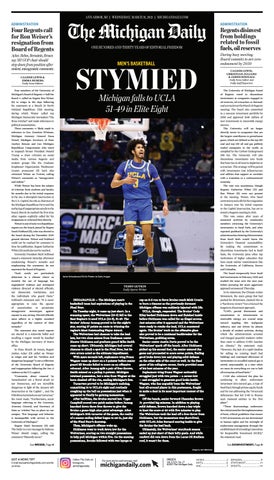
Michigan falls to UCLA 51-49 in Elite Eight
Jamie Schwaberow/NCAA Photos via Getty Images
TEDDY GUTKIN Daily Sports Writer INDIANAPOLIS — The Michigan men’s basketball team had aspirations of playing in the Final Four. On Tuesday night, it came up just short. In a stunning upset, the Wolverines (23-5) fell to the East Region’s 11-seed UCLA (22-9), 51-49. The Bruins’ Johnny Juzang proved to be the night’s star, scoring 27 points en route to winning the region’s Most Outstanding Player Award. The Wolverines had chances to take the lead late, but two close misses from freshman center Hunter Dickinson and graduate guard Mike Smith came up short. Ultimately, Michigan had several chances to clinch a spot in the Final Four, but its own errors acted as the ultimate impediment. With mere seconds left, sophomore wing Franz Wagner came up short on a 3-pointer before senior guard Eli Brooks failed to score on an offensive rebound. After Juzang split a pair of free throws, Smith missed on a pullup 3-pointer. Michigan retained possession, but a miss from Wagner at the horn clanked off the rim, sealing Michigan’s fate. Turnovers proved to be Michigan’s undoing, committing 14 to UCLA’s eight and routinely coughing up the ball on possessions just when it appeared to finally be gaining momentum. After halftime, the Bruins started hot. Tyger Campbell scored two quick makes before Juzang knocked down three free throws to give the Bruins a game-high nine point advantage. After Michigan’s 10th turnover of the game, the reality of a season ending defeat began to set in, just shy of the Final Four’s doorstep. Then, Michigan’s offense woke up. Dickinson went to work down low for the Wolverines, scoring on two straight possessions to help pull Michigan within five. On the ensuing possessions, Brooks followed with two layups to
cap an 8-0 run to force Bruins coach Mick Cronin to burn a timeout as the previously dormant Michigan offense was suddenly injected with life. UCLA, though, responded. The Bruins’ Cody Riley backed Dickinson down and finished inside before Dickinson was called for an illegal screen. Just minutes after it appeared and the Wolverines were ready to retake the lead, UCLA countered again. The Bruins’ work on the offensive glass also proved to be a continual backbreaker for the Wolverines, grabbing seven. Senior center Austin Davis proved to be the Wolverines’ spark off the bench. After Dickinson picked up his second foul, the senior entered the game and proceeded to score seven points, finding good looks down low and playing solid defense on the other side of the court as well. In the final game of his collegiate career, Davis provided some of his best minutes of the year. Sophomore wing Franz Wagner noticeably struggled just with two points — a career-low — and struggled to generate good looks inside. Wagner, who has arguably been the Wolverines’ best all-around player in this postseason, fought to make a dent in its most important contest of the year. Off the bench, senior forward Chaundee Brown Jr. provided big minutes. In addition to playing solid defense, Brown knocked down a key triple to knot the score at 46 with five minutes to play. The Wolverines took the lead off a free throw from Dickinson, but the momentum was short-lived, with UCLA’s Jules Bernard scoring inside to give the Bruins the lead back. Tess Crowley/Daily Ultimately, the Wolverines’ storybook season ended up just short of their lofty goals. And while confetti did rain down from the Lucas Oil Stadium roof, it wasn’t for them.
See WEISER, Page 4
During busy meeting, Board commits to net-zero endowment by 2050 CALDER LEWIS, CHRISTIAN JULIANO & JARED DOUGALL Daily News Editor and Daily Staff Reporters
The University of Michigan Board of Regents voted to discontinue investments in companies engaged in oil reserves, oil extraction or thermalcoal extraction at the March 25 Regents meeting. The board also committed to a net-zero investment portfolio by 2050 and approved $140 million of new investments in renewable energy sources. The University will no longer directly invest in companies that are the largest contributors to greenhouse gases, which are defined as the top 100 coal and top 100 oil and gas publicly traded companies in the world, as compiled by the Carbon Underground 200 list. The University will also discontinue investments into funds that have ties to oil reserve depletion or extraction. This strategy will be paired with investments into infrastructure and utilities that support or correlate with a transition to a carbon-neutral economy. The vote was unanimous, though Regents Katherine White (D) and Ron Weiser (R) were not present at the meeting. Weiser, who faced controversy and calls for his resignation in January over his initial response to the Capitol insurrection, has yet to attend a Regents meeting in 2021. This vote comes after years of sustained activism by community members criticizing the University’s investments in fossil fuels, and after repeated pushback by the University’s administration claiming disinvestment from fossil fuels would harm the University’s financial sustainability. By making the commitment to discontinue investments tied to fossil fuels, the University joins other top institutions of higher education that have made similar commitments like the University of California, Brown and Columbia. The board temporarily froze fossil fuel investments in February 2020 and studied the issue over the next year before pursuing the more aggressive approach announced Thursday. In its statement, the Climate Action Movement, the main group that had pushed for divestment, claimed this as a “hard-won victory” but criticized the long-term divestment approach. “U-M’s partial divestment and commitment to reinvestment in renewable energy are crucial steps toward toppling this malignant industry, and one driven by almost a decade of student activism, during which the administration arrested and charged peaceful students rather than meet to address U-M’s inaction on climate,” the statement read. “However, the lack of a rapid timeline for selling its existing fossil fuel holdings and continued allowance of investments in so-called natural gas is utterly unacceptable, at a time when we must do everything we can to halt all extraction of fossil fuels.” CAM also criticized the plan for continuing to allow endowment investment into natural gas, a type of fossil fuel, through private equity funds and for not addressing the “structural deficiencies that led U-M to finance such immoral entities in the first place.” “These shortcomings underscore the critical need for the implementation of basic, ethical guidelines that ensure U-M’s investments are not detrimental to human rights and for oversight of endowment management through the establishment of a Standing Committee for Responsible Investment (SCRI),” the statement read. See DISINVESTMENT, Page 4
Design by Jack Silberman
GOT A NEWS TIP? E-mail news@michigandaily.com and let us know.
Follow The Daily on Instagram, @michigandaily
For more stories and coverage, visit
michigandaily.com
INDEX
Vol. CXXX, No. 27 ©2021 The Michigan Daily
NEWS.........................2 ARTS............................5 MIC ...............................7
O P I N I O N . . . . . . . . . . . . . . . . . . . . . . .9 S TAT E M E N T. . . . . . . . . . . . . . . . . .1 1 SPORTS ......................14
News
2 — Wednesday, March 31, 2021
The Michigan Daily — michigandaily.com
PHOTO
Stanford Lipsey Student Publications Building 420 Maynard St. Ann Arbor, MI 48109-1327 www.michigandaily.com
CLAIRE HAO
TARA MOORE
Editor in Chief cmhao@umich.edu
Business Manager tmooree@umich.edu
NEWS TIPS
tipline@michigandaily.com
LETTERS TO THE EDITOR tothedaily@michigandaily.com
EDITORIAL PAGE
opinion@michigandaily.com
PHOTOGRAPHY SECTION
ARTS SECTION
photo@michigandaily.com
arts@michigandaily.com
NEWSROOM
SPORTS SECTION
news@michigandaily.com
sports@michigandaily.com
CORRECTIONS
ADVERTISING
corrections@michigandaily.com
WMG-contact@umich.edu
Editorial Staff
TESS CROWLEY/Daily Being a freshman is overwhelming, but I am ready to take on the rest of the semester and any new challenges that may come along in stride.
CAMPUS LIFE
UAAO hosts vigil mourning lives lost in Atlanta, rise of anti-Asian hate To crowd of more than 200, speakers talk ending historical context, solidarity NINA MOLINA & MAANASA BOMMINENI Daily Staff Reporter and Daily Contributor
Beneath a cloudy sky at dusk, more than 200 people gathered in front of the steps of Angell Hall Friday to grieve the victims of anti-Asian violence in the Atlanta area earlier this month and reflect on the implications of the attack for the Asian American community. Just over a week after a 21-yearold white man killed eight people in Asian-owned massage parlors in Atlanta, the vigil aimed to create a space for healing for those in the University of Michigan community. The vigil, organized by the United Asian American Organizations, an umbrella organization for campus Asian American groups, was also livestreamed on UAAO’s Facebook. Six of the eight victims on March 16 were women of Asian descent, sparking discussion over the historical violence against and fetishization of Asian women in Western imperialist culture. Since the beginning of the COVID-19 pandemic, hate crimes against Asian Americans have also skyrocketed and antiChina sentiment has increased. According to the Stop AAPI Hate Coalition, nearly 3,800 incidents of anti-Asian hate have occurred since March 2020, 68% of them against Asian women. During the vigil, LSA senior and UAAO President Anna Dang said it is necessary to consider the political climate which enabled shooting to happen. From the beginning of the pandemic in spring 2020, former President Donald Trump frequently used anti-Asian rhetoric when referring to the coronavirus, leading to an increase of online hate speech targeted against Asian-Americans. “And so today, at this vigil, I not only grieve, but I am in the politics that come with my AsianAmerican identity,” Dang said. In her speech, Dang also highlighted the irony of the vigil’s location. Former University President James B. Angell, who Angell Hall is named after, helped negotiate a treaty that curtailed Chinese immigration in the U.S. and acted as the precursor to the Chinese Exclusion Act. “We are standing on a concrete structure, on stolen lands, that represents antiAsian violence,” Dang said. “I see many parallels between the toxicity of (this) historically white supremacist institution and the white supremacist violence that occurred in Atlanta.” Dang said the question that is on her mind — and should be on everyone’s minds — is: “How do we stop this violence?” Dang said she supports abolishing institutions and practices that perpetuate violence, like the prison-industrial complex
and waging war against countries deemed “third world.” She also again noted the political rhetoric around the pandemic. “Racializing a pandemic is violence,” Dang said. Dang cited the historical exclusion and scapegoating of Asian Americans as the beginning of the country’s tumultuous relationship with people of Asian descent. The daughter of Vietnamese refugees, Dang said that her presence at the vigil was the result of violent American colonialism and imperialism. “We cannot separate last Tuesday’s loss of life from this political call to action,” Dang said. “On this campus and at large, we need to take our position as a responsibility to form an abolitionist agenda.” Frances Kai-Hwa Wang, lecturer in the Department of American Culture’s program in Asian/Pacific Islander American Studies, emphasized this violent history by retelling the killing of Vincent Chin in Detroit. In 1982, Chin, a Chinese American, was killed by two white men during a night out after they suspected him of being Japanese — one of the men had recently lost their job in auto manufacturing and blamed his unemployment on the rapid growth of the Japanese car industry in the 1970s and 1980s. Wang said the lack of punishment Chin’s killers received shows the criminal justice system has a history of not recognizing violence against Asian Americans. “And in the end, (the killers) were sentenced to $3,000 fine, and three years of probation,” Wang said. “To this day, they have not not spent a single day in jail.” A multi-racial movement formed in response to Chin’s death, which expressed outrage over the justice system’s handling of the case. In Detroit, Chinese American journalist Helen Zia and others formed the pan-Asian American civil rights group American Citizens for Justice in 1983, shortly after the light sentencing of the two men who killed Chin. Wang said this ethnically diverse coalition shows the hope that sprung from the tragedy, noting that multiracial and multiethnic coalitions are still very present today to combat crisis and violence. “There’s this amazing project called Letters for Black Lives where young Asian Americans explained Black Lives Matter to their elders, and translated it in all the different languages so that we literally have the words to talk to our elders and explain it to them,” Wang said. Wang emphasized that this was not just about “one angry, young man” who caused the deaths in Atlanta. Rather, she said, this violence is systemic. Wang noted that unemployment, poor quality education, lack of access to health care and gentrification
are just some of the many issues impacting the most vulnerable Asian Americans as well as other marginalized groups across the country. “We need to come together and work with social and economic justice for all of us,” Wang said. LSA senior Anju Jindal-Talib spoke at the vigil on how the stigmatization of sex work by the media and broader culture perpetuates violence against marginalized groups, particularly Asian women. Certain media outlets have equated the massage workers to sex work, though authorities have not found any evidence of sex work in the massage parlors where the shootings took place. However, given the shooter’s perceptions of the women as sex workers, Jindal-Talib said centering the protection of sex workers is crucial to ongoing conversation. “The assailant described the attack as eliminating his temptations,” Jindal-Talib said. “Rather than seeking help or evaluating his own toxic masculinity, the assailant felt not only motivated but rightfully justified to exercise brutal violence against these individuals.” Jindal-Talib also urged participants to notice how the media portrayed the crime, particularly the media’s hesitancy to label the killings as a hate crime. “There’s been a hyper focus on the assailant’s sex addiction instead of the interplay of stigma around sex work and a racialized fetishization of women of color, in particular Asian women,” JindalTalib said. The fetishization of the victims was not limited to the attacker, Jindal-Talib argued. Both Aromatherapy Spa and Young’s Asian Massage, two spas where the shootings took place, have more than 200 Google reviews including racial slurs and lewd comments about the employee’s bodies. “These comments highlight not only white male entitlement but how Asian women are eroticized and made a vulnerable target for violence, especially when they are viewed as sex workers,” JindalTalib said. Music, Theater & Dance freshman Owen Scales attended the vigil and said the frequency of these hate crimes disturbs him. “I think it’s disgusting that its not treated as something that is terrorism or a hate crime,” Scales said. “(It’s) kind of terrifying how numb we kind of grow to it.” Music, Theater & Dance freshman Kate Cummings said she attended the vigil in-person to offer support to the Asian American community. “I’m here tonight to support the AAPI community, not only here in Ann Arbor, but nationwide and worldwide,” Cummings said. “I think that this is a beautiful opportunity for us to all come together and mourn the loss that
the families have gone through … I think it’s really important that we stand beside our AAPI peers and band together as a community right now more than ever.” In a Facebook post, State Sen. Stephanie Chang, the first Asian American woman to be elected to the Michigan state legislature, wrote that as a University alum herself, she was thoroughly impressed by the University students who organized the vigil. “Out of the Stop AAPI Hate events in Michigan I’ve been to so far, their vigil was by far the most incredible,” Chang wrote. “They covered everything from fetishization of AAPI women, Vincent Chin, sex worker issues, economic inequality, to police issues and solidarity with other BIPOC communities, had a great call and response affirmation, and even had a talented vocalist!! All within about an hour.” Artistic expressions of mourning and hope were provided by performers like Music, Theater & Dance junior Helen Shen who sang “Someday” from “The Hunchback of Notre Dame.” Later in the evening, Music, Theater & Dance senior Levana Wang read poetry from University alum Carlina Duan’s “I Wore My Blackest Hair.” Ending the vigil were Music, Theater & Dance seniors Erica Ito and Thani Brant, who performed Bob Dylan’s “Blowing in the Wind.” LSA junior Natalie Suh spoke at the vigil about how the violence in Atlanta flooded her with a lot of different emotions. “This violence brought up my own experiences with racism, sexism and fetishization of Asian American women,” Suh said. “So if you’re feeling emotionally or physically tired, or too overwhelmed to even think about yourself this week, we see you.” Suh also stressed the importance of learning about the lives of the victims. “They were mothers, grandmothers, daughters, friends, wives, co-workers, neighbors, maybe even regulars at a restaurant or a market,” Suh said. UAAO is still collecting donations to distribute to community organizations and the victims’ families through @ uaao_2021 on Venmo. According to Dang, they hope to keep coalition-building and “existing through resistance” with these donations. To conclude her speech, Wang said to the audience that those who identify as Asian American should embrace their identity and push back against Anti-Asian rhetoric amidst the Atlanta tragedy. “There is power in calling ourselves Asian Americans,” Wang said. “We are Americans. We belong here.” Daily Staff Reporter Nina Molina and Daily Contributor Maanasa Bommineni can be reached at nimolina@umich.edu and maanasab@umich.edu.
BRITTANY BOWMAN Managing Editor
babowm@umich.edu
JACK GRIEVE
Digital Managing Editor
jgrieve@umich.edu
BARBARA COLLINS and LIAT WEINSTEIN Managing News Editors
news@michigandaily.com
Senior News Editors: Emma Ruberg, Hannah Mackay, Calder Lewis, Jasmin Lee, Francesca Duong, Kristina Zheng Investigative Editor: Sammy Sussman FOIA Manager: Ayse Eldes
LIZ COOK and JOEL WEINER
Editorial Page Editors tothedaily@michigandaily.com Senior Opinion Editors: Zack Blumberg, Andrew Gerace, Min Soo Kim, Mary Rolfes, Elayna Swift
LANE KIZZIAH and KENT SCHWARTZ
Managing Sports Editors sports@michigandaily.com Senior Sports Editors: Rian Ratnavale, Drew Cox, Lily Friedman, Jack Kingsley
ELISE GODFRYD and ZOE PHILLIPS
Managing Arts Editors arts@michigandaily.com Senior Arts Editors: Andrew Pluta, Grace Tucker, Kari Anderson, Katie Beekman, Sophia Yoon Arts Beat Editors: Elizabeth Yoon, Peter Hummer, Mik Deitz, Sabriya Imami, Kaitlyn Fox, Anya Soller
AYA SALIM and SHANNON STOCKING Managing Design Editors Senior Layout Editor: Adam Bressler
design@michigandaily.com
ALLISON ENGKVIST and MADDIE HINKLEY
Managing Photo Editors photo@michigandaily.com Senior Photo Editors: Emma Mati, Miles Macklin, Becca Mahon, Julia Schachinger Assistant Photo Editors: Maddie Fox, Luke Hales, Jeremy Weine, Gabby Ceritano, Sophia Afendoulis
ANDIE HOROWITZ
Managing Statement Editor statement@michigandaily.com Deputy Editors: Isabelle Hasslund, Marisa Wright
MADISON GAGNE and OLIVIA BRADISH
Managing Copy Editors copydesk@michigandaily.com Senior Copy Editors: Caroline Atkinson, Anjali Chiravuri, Ethan Patrick, Kelsey Burke, Emily Wilson, Vanita Seed, Sophie Kephart, Rena McRoy
PARTH DHYANI and NAITIAN ZHOU Managing Online Editors
webteam@michigandaily.com
IULIA DOBRIN and ANNIKA WANG
Managing Video Editors video@michigandaily.com Senior Video Editors: Margaret Rudnick, Jordan Shefman
ANAMIKA KANNAN and GABRIJELA SKOKO
Michigan in Color Editors michiganincolor@michigandaily.com Senior Michigan in Color Editors: Noor Moughni, Maya Kadouh, Eliya Imtiaz, Jessica Kwon, Lola Yang
EMILY OHL and GERALD SILL
Managing Podcast Editors podeditors@michigandaily.com Senior Podcast Editors: Doug McClure, Max Rosenzweig, Avin Katyal
HALEY JOHNSON and ASHA LEWIS
Managing Social Media Editors socialmedia@michigandaily.com Senior Social Media Editors: Kirti Aplash, Natalie Knight, Ria Dubey, Ryan Postman, Evan DeLorenzo, Atticus Raasch, Bella Morreale
ALEX HARRING and SARAH SZALAI Co-Chairs of Access & Inclusion
accessandinclusion@michigandaily.com
Business Staff RORI MILLER Creative Director
SCHUYLER JANZEN Sales Manager
The Michigan Daily (ISSN 0745-967) is publishing weekly on Wednesdays for the Winter 2021 semester by students at the University of Michigan. One copy is available free of charge to all readers. Additional copies may be picked up at the Daily’s office for $2. If you would like a current copy of the paper mailed to you, please visit store. pub.umich.edu/michigan-daily-buy-this-edition to place your order.
The Michigan Daily — michigandaily.com
News
Wednesday, March 31, 2021 — 3
STUDENT GOVERNMENT
ACADEMICS
Win comes after controversy in another campaign
for anti-Asian racist book covers
Arun, Voigt of IMPACT win CSG Law School Dean presidency and vice presidency publicly apologizes MARTINA ZACKER Daily Staff Reporter
Public Health junior Nithya Arun and Engineering junior Carla Voigt will serve as president and vice president of the University of Michigan Central Student Government’s 11th Assembly, according to the student government elections preliminary results. The pair received 1,574 out of the 3,067 votes that were cast, according to preliminary election results obtained by The Daily. Arun and Voigt ran with the IMPACT party, which endorsed candidates in representative elections for nine schools. Their platform had nine policy areas which included initiatives that addressed anti-racism, health and wellness as well as affordability and accessibility. Both Arun and Voigt have been involved with CSG since their freshman year. Arun has served as a policy advisor for the past two years, while Voigt filled a vacancy as Speaker of the Assembly in Fall 2020 after the previous speaker was removed from the position. Following notification of their victory, Arun and Voigt thanked voters and the candidates who ran with them in a statement to The Daily. “After the many challenges our campus has faced during this time we are incredibly grateful for the opportunity to represent the student body,” their statement read. “This would not have been possible without the immense support we have received from our friends and the entire Michigan community. Thank you to all
of the candidates who ran. We acknowledge that this campaign season was contentious, but your passion and will to represent your fellow students was nothing short of inspiring. We are so excited to serve, advocate, and affect change with the student body.” This victory comes after controversy with the ORGANIZE party’s vice presidential candidate Sam Burnstein, LSA junior, resulted in his resignation from the race hours before voting began. Burnstein dropped out after tweets from 2017 he had liked — that included included xenophobic, anti-immigrant and anti-Muslim rhetoric — surfaced the day before elections. Burnstein’s running mate, LSA junior Sujin Kim, ran alone as the presidential candidate on the ORGANIZE executive ticket and came in second place with 1,384 votes. Due to rules surrounding when the ballot could be edited, Burnstein’s name continued to appear next to Kim’s on the ticket throughout voting even though he had officially announced his departure from the race by the time it began. Despite the ORGANIZE executive ticket losing, candidates for the Assembly were elected across both campaigns. In a statement to The Daily, the ORGANIZE campaign thanked their supporters and said they are proud of the coalition of campus activist organizations and students they built and look forward to continuing to work with them. “We want to thank everyone for believing in our collective potential, and for dedicating so much of their lives over the last
Apology comes three years after one student first advocated for change RONI KANE
Daily Staff Reporter
Courtesy of Nithya Arun and Carla Voigt
few weeks to working towards making it a reality,” their statement read. “Though we are of course disappointed that the results were not what we’d hoped for, we are proud of our team, and we are proud of what we have accomplished together.” With 241 votes, LSA juniors Abner Santiago and Nicole Lin from the CHANGE party came in third place and ran without endorsing a representative slate of candidates for the Assembly. Santiago and Lin did not respond to The Daily’s request for comment in time for publication. Along with voting for an executive ticket, students also selected representatives for their respective colleges: 15 for LSA, seven for Rackham, six for College of Engineering, three for the Business School and one for each of the remaining 14 colleges. Party affiliations were not listed on the representative ballots and some candidates were not endorsed by IMPACT or ORGANIZE. Approximately 6.5% of students voted in the Universitywide election, which could be accessed online by all students. This percentage was an increase from 5% in 2020, but a decrease
from the 11.9% who voted in 2019. During the CSG presidential debate, Arun said she will work hard throughout her tenure as president and live up to her campaign promises to make the University an equitable community. “I cannot wait to start working on a large fund to help students meet daily expenses, subsidize grocery delivery subscriptions and increase funding to SAPAC, among many, many other things,” Arun said at the debate. “Put simply, I cannot wait to impact Michigan.” During the vice presidential debate, Voigt said while the student body will continue to be confronted with challenges, she and Arun are ready to fight for the students. “The problems before the student body are complex and multi dimensional, the legacy of an IMPACT administration then will be the building of an army of students that works hand in hand to overcome any and all challenges,” Voigt said. Daily Staff Reporter Martina Zacker can be reached at mzacker@umich.edu.
GEO, Councilmember Nelson look to change leasing laws ANN ARBOR
New Ann Arbor city ordinance would ease student housing hunt SHANNON STOCKING Daily Staff Reporter
Every August, Ann Arbor is filled with a rush of commotion as students return to campus. Moving trucks line the inner streets, and students begin the tedious process of lugging mattresses up steep flights of stairs and turning a house into a home for the year. Yet not even three months after settling in, many students begin the hunt for the next Augustto- August lease cycle. Students, though sometimes unsure of what their living situation will look like for the next year, often sign leases simply to ensure that they’ll have a place to stay on or near campus — sometimes with people they aren’t friends with one year later. Ann Arbor’s city ordinance — established in 2006 — currently requires that landlords wait 70 days after tenants sign their lease before showing the property to others or asking the current tenants if they want to sign again. For most students, this means if their lease begins in August, their landlord can begin searching for tenants for the next year starting in late October. This practice continued even during the COVID-19 pandemic last fall, when some students were forced to sign leases without knowing whether classes next year would be online or in-person. To alleviate rampant student frustration with the Ann Arbor student housing market, the Graduate Employees’ Organization has been collaborating with Ann Arbor City Councilmember Elizabeth Nelson, D-Ward 4, in hopes of implementing a new ordinance that requires landlords to wait at least 240 days before signing or showing a property for the next year. Rackham student and GEO secretary Amir Fleischmann said his landlord approached him in
early November asking him to resign his lease, putting him in a difficult position of resigning for convenience or having to search all over again for a place to live. “I ended up not wanting to be in that apartment for the following year, and it was not possible for me to get out of them,” Fleischmann said. Most undergraduate and graduate students sign a lease without knowing what their plans are for the coming year, Fleischmann said. Some students decide to travel abroad or take the semester off to pursue an internship later on in the school year, leaving students bound to a lease regardless of if they decide to reside in the house. “This forces tenants to make a commitment that is very difficult to get out of, and it puts a lot of pressure on people who really do not know where they’re going to be that far in advance, and it forces people to make difficult decisions that they’re really not prepared to make at that time,” Fleischmann said. “As this current ordinance stands, it gives landlords legal license to bully tenants into resigning their lease before they’re ready.” Rackham student Ember McCoy said she has experienced problems every year with the housing market since she first moved to Ann Arbor for her master’s degree. In the six years of living in Ann Arbor, McCoy said she has been approached five times by landlords asking her to renew her lease in October. After their lease started in August 2020, McCoy said she and her sister were approached by their landlord on Oct. 19, which was before the 70-day ordinance currently in place and thus illegal. McCoy said she was asked to renew her lease, notified of an increase in rent and given five days to decide if she and her sister would be living there the following year. McCoy said her sister was in the process of applying to graduate
school and was uncertain if she would be staying in Ann Arbor for the following year. The pair did not see the email from their landlord when it was first sent out five days earlier, and when they opened the email, they realized they had 24 hours to make a decision. “We just needed more time,” McCoy said. “They gave us 24 hours, and obviously nothing changed about our circumstance within 24 hours, and so they signed our lease to someone else the first week of November for August 2021 to 2022. That was the first time I was hurt by the system. I had known this was an issue and it was always really frustrating to me, but this is the first time that I was personally impacted by it.” Nelson, who said she has never experienced the Ann Arbor rental market, said she was unaware of the 70-day ordinance before GEO asked for her help. Because an ordinance already exists, Nelson said the next step would be to introduce a resolution or ordinance amendment for a City Council vote. “When I read the (current) ordinance, I realized we actually took a stab at creating a timeline and it was pitifully short,” Nelson said. Nelson said the city is legally allowed to restrict the time period that landlords have to wait before showing a property, making this proposal possible. Nelson said she has met with the city staff in charge of enforcing rental regulations and found that the current ordinance is not heavily regulated. No one has been taken to court or questioned about their violations, Nelson said. At most, the city has received phone calls from tenants reporting their landlords for violating the ordinance, but landlords are rarely held responsible, Nelson said. “The reason there hasn’t been any meaningful enforcement probably is because the standard is so low that we’ve kind of set the bar so that everybody can easily
meet (the 70-day limit), there’s little temptation to follow (the current ordinance) because (70 days) already is such a low bar,” Nelson said. Nelson said this issue involves finding a balance between both the landlords and their tenants, both of whom have stake in the housing market. Nelson said she is collaborating with city coordinators to determine the limits of the possible new ordinance and how to enforce it. “This is one of these situations where we’re balancing the interests of the person who owns the property, and the person who is renting the property,” Nelson said. “If we passed a regulation that said the landlord can’t show the property and can’t even ask for renewal until 24 hours before the end of the term of the lease, that would be indefensible because a property owner could argue (that) we had made it impossible for them to use their property.” Nelson said she met with a landlord who rents out one house in Ann Arbor who said that she never feels the need to harass her tenants because the market is hot, making her confident she can eventually find a student who will be interested in renting the property. A different landlord, Margaret Wyzlic, marketing manager of Oxford Companies, said that if the number of days required to re-lease changes, they will adhere to the days and continue to respect the city of Ann Arbor’s leasing regulations. “If that number changes it would give students more time to make a decision,” Wyzlic said, “I think that’s kind of integral to the idea of extending the time frame, which (…) depending on what person you are in the equation may have benefits or drawbacks.. We’re just really happy to support whatever decision is made.”
Read more at MichiganDaily.com
When University of Michigan Law student Courtney Liss first sat down in the Robert B. Aikens Commons for orientation, she said she listened eagerly as Law School Dean Mark West, professor of Japanese law, was introduced to the incoming class. As West formally welcomed Liss and her peers to one of the most prestigious law programs in the country, out of curiosity, Liss pulled out her phone and looked up West’s published academic works. Liss, who identifies as mixed Vietnamese, said she was shocked to see the covers of his books portraying sexually suggestive representations of Asian women. “I personally have been haunted by these book covers and this very visible example of racism since I came to the University of Michigan Law,” Liss said. “Literally, sitting in orientation, I remember pulling up his work and looking at them and being like, ‘What? How did I end up here?’” Asian women have long been fetishized and hyper-sexualized in Western culture. The sexualization of Asian American women — and the anti-Asian racism inherent in these stereotypes — gained national attention last week when eight people, including four women of Korean descent and two of Chinese descent, were killed in mass shootings at Asian-owned massage parlors in the Atlanta area. Now in her third year at the University, Liss said she has privately contacted Law School administrators throughout her three years about the covers while publicly advocating for West to take responsibility for them. So when West released an email statement March 17 on behalf of the Law School condemning the Atlanta shooting, Liss decided to tweet about West’s book covers. Liss’s tweets led to pushback against West throughout the Michigan Law community. Three days after her tweet, West issued a formal apology for the book covers in an email sent out to the Michigan Law community and obtained by The Daily. “(The book covers) reinforces a view of women founded on damaging stereotypes,” West wrote in his March 20 apology. “And while contributing to a harmful narrative was not my intent or understanding at the time, I understand it now, and I understand that my intent does not excuse or lessen the harm.” When contacted for comment on West’s apology, University spokeswoman Kim Broekhuizen sent The Daily University President Mark Schissel’s March 17 statement in response to the spa shootings as well a statement from Rob Sellers,
chief diversity officer and vice provost for equity and inclusion. In his March 20 apology, West acknowledged that his work hurt members of the University community. West announced the publisher of one of his books, “Secrets, Sex, and Spectacle,” has removed the cover photograph from their website as of March 20. West said he is actively working with his publishers to amend the other covers as well. In an email to The Daily, West said academic publishers rarely make these sorts of changes to previously published work on account of author requests. “I had many conversations regarding deletion of existing artwork and replacement with new artwork,” West wrote. “I am pleased to share that two publishers have responded by changing the covers.” In December 2020, West was named the inaugural David A. Breach Dean of Law after a $5 million gift from the Breach family established the position. Pending the Board of Regents’ approval, West intends to work for the remainder of his deanship to support new racial justice initiatives at the Law School. In his apology email, West said as “one in a position of leadership,” he regrets not considering the harmful effects the cover images might have on Asian American communities. West admitted that he was questioned by students about the juxtaposition between his public denunciation of the Atlanta attacks and his book covers in the days between his two statements. Liss said she emailed West on June 6, 2020 for a variety of reasons, including the book covers. “Over the last two years, I have mentioned that these book covers make me uncomfortable to (the Asian Pacific American Law Students Association), to (several law deans), to many professors, both tenured and non-tenured,” Liss wrote to West in her email, a copy of which was shared with The Daily. “Many of them knew and looked at me awkwardly and guiltily … many of them didn’t know and expressed honest shock.” After Liss’s June email, West arranged a Zoom meeting with Liss and two other Deans on June 10. At the meeting, Liss said when she challenged West about the book covers, he conceded that the photographic cover of “Secrets, Sex, and Spectacle” could be considered offensive and personally apoligized to her. Liss said West defended the other contested covers and said they were reprints of famous Japanese art. West did not specifically comment on Liss’s description of the June 10 meeting when asked by The Daily.
Read more at MichiganDaily.com
News
4 — Wednesday, March 31, 2021
The Michigan Daily — michigandaily.com
RESEARCH
Experts explain local COVID-19 vaccine supply chain Michigan Medicine, health department work with state to receive doses KAITLYN LUCKOFF Daily Staff Reporter
As vaccines are becoming more and more accessible, Michigan Medicine has been a key distributor responsible for vaccinating hospital staff and patients as well as some students and faculty in Ann Arbor. Each week, the number of vaccines available nationally varies, which inf luences the supply chain and ultimately how many doses local health systems have access to. Michigan Medicine has the capacity to vaccinate up to 24,000 individuals per week. However, the amount of vaccinations actually distributed each week depends on the amount of doses allocated to Michigan Medicine by the state, according to Mary Masson, Michigan Medicine director of public relations. “Michigan Medicine does not order a specific amount of vaccine doses from the state of Michigan, the state determines how much to distribute to us,” Masson wrote in an email. “If our supply of vaccines increases, we could do 12,000 doses per week and ramp up to 20,000. During this week, the week of March 15, we received enough vaccines to open 4,400 first-dose appointments.” The University of Michigan has been vaccinating through the Michigan Medicine system since vaccines were first made available in the state in December 2020. Marisa
WEISER From Page 1 “Regent Ron Weiser’s comments are dangerous, disgusting and damaging to our state and the University of Michigan,” Bernstein wrote. “His reference to Governor Whitmer, Attorney General Nessel and Secretary of State Benson as “the three witches” is blatantly sexist. Suggesting that the work of a political party should enable ‘burning’ these three women ‘at the stake’ is even worse.” Bernstein wrote that Weiser’s reference to the “assassination” of members of Congress in the context of political rhetoric has no place in society. “This isn’t and shouldn’t be a partisan issue,” Bernstein wrote. “It’s about rejecting violent, reckless rhetoric.” Bernstein added that the regents’ job is to be responsible stewards of the University — a responsibility he does not believe Weiser has fulfilled. “In doing so we must protect democracy, honor public service and support our students,” Bernstein wrote. “Regent Weiser has failed to do so. Our University and the people of this state deserve better. He should resign.” Regent Mike Behm (D) told The Daily in a phone interview he would ask Weiser to resign. Behm said he found the misogyny of Weiser’s statements about Whitmer, Nessel and Benson alarming. “Misogyny has no place in our society and is antithetical to his role as a Regent, and also to the mission of the University of
DISINVESTMENT From Page 1 Regent Jordan Acker (D) addressed students after the announcement was made. Acker praised student activists for their diligence in pushing the University to move towards divestment, saying activism on this matter has made the University a better place and he was “proud to vote yes” on the effort. “Likely, there are moments that you felt that you were yelling into the void about the most important issue of our generation, the threat of climate change,” Acker said. “Your activism matters. Your voice matters. Your passion matters. And yes, your viewpoint matters.” Later, Acker tweeted that the $140 million in carbon neutral investments was a “good start,”
Eisenberg, University associate professor of epidemiology complex systems and math, explained the federal and state tiers of the vaccine distribution pipeline. “The way that (the vaccine pipeline) works is that there’s a federal allocation and the Michigan Department of Health and Human services puts in orders each week to the federal system,” Eisenberg said. “There’s been a shift in the way that the state has been distributing vaccines, so it was initially more heavily relying on hospital systems, and then to try to make more equitable vaccine distribution, they shifted towards a more local health department based model and using pharmacies.” Eisenberg said the way vaccines are chosen to be distributed to regions is based on the social vulnerability index, which is a percentile used by the Centers for Disease Control and Prevention to determine the vulnerability of communities to stresses that negatively impact health. As of 2016, Washtenaw county had an SVI score of 0.2557, which indicates low to moderate vulnerability. However, areas of the county with more Black and Latinx residents have lower SVI scores compared to other areas, so the county health department set up popup vaccination clinics earlier in the month specifically focusing on these communities. According to Masson, Michigan Medicine spent a few
weeks allocating their doses to patients who had already received their first doses, since the Pfizer and Moderna vaccines require two doses spaced 3 or 4 weeks apart for maximum immunity. This is what caused previous pauses in first-dose appointments, though recently Michigan Medicine has been receiving enough weekly doses to resume first-dose appointments. “We have continued to offer vaccine clinics weekly, although we had some weeks where we couldn’t offer new first-dose appointments because we didn’t have the vaccine supply,” Masson wrote. “We continue to work with other health care systems, our local health departments, and the state on distribution.” Eisenberg works on the state’s COVID-19 response and focuses on infectious disease modeling. She echoed Masson and said the decreased availability of firstdose appointments at Michigan Medicine is due to delays in vaccine supply. “The reason for Michigan Medicine’s pause is that they just haven’t been getting much in the way of supply,” Eisenberg said. “And so for a while, I know that they were really mostly just focusing on finishing out second doses from the people who they had already gotten first doses for, and so that, I think, reasonably they shifted back towards doing more first doses again. I think they finished up that round of second doses and then, now they’re starting to get
rolling on first doses again.” Susan Ringler-Cerniglia, the Washtenaw County Health Department public information officer, discussed the process of receiving and requesting vaccines for the county as a whole. “We only provide a request number for the second doses we need each week,” RinglerCerniglia said. “Then, we take everything that is available to us, so (there is) zero decision making. Our doses come through the state health department (MDHHS). The state allocates vaccine supplies to local health departments and health systems/hospitals.” LSA senior Sabrina Corsetti is involved in COVID-19 modeling
research. She believes that vaccine opportunities as well as students having a positive mindset going into the Fall 2021 semester is critical for having a return to normalcy in the fall. “I know that the University was initially concerned that they might not be able to vaccinate students until really the fall,” Corsetti said. “But since supply has been ramping up, I think there is a lot more optimism about vaccinating students sooner.” Once supply of vaccines is stabilized, Corsetti said she thinks the University should focus on ensuring that vaccine distribution for students is a safe and easy process.
“So obviously, a lot of it is supply dependent, making sure that you know the most vulnerable populations are vaccinated … prior to just the general student population,” Corsetti said. “I think a lot of it comes down to making sure that we minimize vaccine hesitancy in the student population. I think that once the supply is taken care of, just making sure that students feel comfortable and safe going and getting it and also publicizing where they can go to get the vaccine and what methods they can follow to go get it.”
Michigan,” Behm said. Behm added that he thought a publicly elected official should never use the word “assassination” in a speech. Asked why he thought Regents were just speaking against Weiser now despite months of calls from many in the campus community for his resignation, Behm said Weiser’s January oral surgery could have been a factor in the remarks where he claimed ignorance of the Capitol insurrection. “(March 25’s speech) is quite different from that,” Behm said. “Those were planned remarks in front of a group of people.” Regent Paul Brown (D) called on Weiser to resign in a March 27 text message to The Daily and said the comments were “misogynistic, divisive and reckless.” “I was sickened to see the Republican State Party Chair refer to our state’s three highest elected officials, and my friends, as “witches” to be “burned at the stake,” and for the audience to cheer in support,” Brown wrote. “These statements are at odds with everything this great University, our state, our country and good people hold sacred. Degrading and inflammatory speech by any public official is inexcusable and should not be tolerated by good people.” Brown added that he was saddened to have to condemn Weiser, noting Weiser’s contributions to Michigan Medicine that have “saved lives and will save countless more in the future.” “Although we hold different political beliefs, I’ve known Regent Weiser to be an
exceptional regent, completely dedicated to the University and its noble mission,” Brown wrote. “I know Regent Weiser loves the University of Michigan. He has been extremely generous to the University’s three campuses and hospital.” Brown said he believes in redemption and forgiveness, and so hoped the initial reports of the comments were inaccurate or that Weiser would release “a since apology.” “Disappointingly, I have since learned that the reporting is accurate and Regent Weiser’s follow up statement is anything but an apology,” Brown wrote. “So, particularly at this moment in our history when such extreme rhetoric from too many political leaders has sewn deep division in society, hurt individuals, and threatened our democracy, I can only come to the conclusion that any official, including Regent Weiser, who would unrepentantly engage in such speech should not remain in public office, especially at an institution like the University of Michigan, which so values upholding gender equality and protection of women’s rights.” Regent Denise Ilitch (D), chair of the Board of Regents, condemned Weiser’s comments but stopped short of calling for his resignation in an email to The Daily. “Despite any differences among its eight members elected by the State’s voters, we have worked constructively on advancing the institution without destructive politics getting in the way,” Ilitch wrote. “That is why it is so disturbing to learn of the repugnant language used
by a member of our Board when addressing a political group. His use of violent imagery crosses a line that is inconsistent with what should be our shared values. There should be no place for physical threats by elected or political leaders on our Board or in our State.” Prior to Acker, Bernstein and Behm and Brown’s calls for resignation, in a phone call with The Daily, University spokesperson Rick Fitzgerald said the University is aware of the reports of March 25’s North Oakland Republican Club meeting but declined to comment on any of Weiser’s comments. Weiser was not at March 25’s Regents meeting — and has not attended a single meeting in 2021— but Fitzgerald dismissed any criticism of Weiser’s attendance at meetings being unusual. Fitzgerald said Regents have conflicts with Board meetings from “time to time,” and noted Regent Katherine White (D) has also missed the last two meetings. “Those conflicts often collide with each other and those things are sort of inevitable,” Fitzgerald said. A source close to the Board told The Daily that Weiser was at Michigan Republican Party Headquarters during the February Board meeting, and Weiser said March 25 that he was recruiting a Republican candidate for Michigan State University’s Board of Trustees during the March 25 meeting. Behm said Weiser has “not been engaged” on the Board since January, pointing to his absence at both of the Board’s 2021 meetings.
“He has been less engaged on the Board, and so I don’t know if he will remain on the Board in name only or not,” Behm said. Behm added that he was able to attend March 25’s meetings all day despite being out of town. “That’s what you sign up to do when you run for the Board,” Behm said. Weiser said he would not resign from the Board in a statement posted to Twitter March 26. “I made some comments that are clearly being taken out of context,” Weiser wrote. “While I should have chosen my words more carefully, anyone who knows me understands I would never advocate for violence…. I will not be resigning from the University of Michigan, and our focus at the Michigan Republican Party remains the same—winning in 2022.“ The Michigan Democratic Party released a statement calling on Weiser to resign from the Board of Regents on March 26, saying Weiser’s comments are not appropriate for his elected office. “As a member of the University of Michigan’s Board of Regents, he oversees millions of taxpayer dollars,” Michigan Democratic Party Chair Lavora Barnes said in the statement. “It’s clear his comments do not reflect the values of the university’s board, faculty, and student body. His statements are not only sexist but markedly dangerous and will only serve to damage the institution’s reputation.” State Sen. Jeff Irwin, D-Ann Arbor, also called for Weiser’s resignation in a tweet March 27. “Ron Weiser should resign,” Irwin’s tweet said. “His recent
statements are an embarrassment to the University and a danger to our liberal democracy. The University of Michigan deserves better.” Whitmer responded to Weiser in a tweet with a quote from author Lindy West. “For a long time, a certain set of men have called women like me ‘witches’ to silence and discredit us,” Whitmer’s tweet said. A spokesperson for the Michigan Department of State labeled the comments “horrifically reckless and unconscionable,” in light of the October plot to kidnap Whitmer and the Jan. 6 violence at the U.S. capitol. “Secretary Benson and her colleagues have experienced firsthand how this rhetoric is later used as justification for very real threats made against government officials, election administrators and democracy itself,” the statement reads. “Any leader who does not resoundingly denounce this kind of behavior and attitude is complicit in their silence. If we’re ever going to be able to move forward and begin solving the problems facing the people of this state in a bipartisan manner, comments like this need to stop.”
and that the University “should and will do much more.” The University’s commitment to a net zero endowment is the first from an American public university, Regent Mark Bernstein (D) said at the meeting. “It’s been said that we are the first generation to feel the effects of climate change, and the last generation that can do something about it,” Bernstein said. “This is a big and complicated problem, and the University of Michigan is in the business of solving big complicated consequential problems; leaders don’t shy away from hard challenges. We must do this, as President Kennedy once said about a different daunting challenge, ‘We have to do this not because it is easy, but because it is hard.’” University President Mark Schlissel said the University is committed to this shift in
investments, which can be seen through the magnitude of the $140 million investment. “So make no mistake, we’re serious about the change in direction,” Schlissel said. “This strategy is informed by the growing risk of investments in fossil fuels during the essential transition to a lower carbon economy.” The board approved three separate investments totalling up to $140 million, with the first being a $30 million investment to renewable energy projects from D.E. Shaw, an investment firm. Schlissel provided specific details into the $140 million the University will invest in renewables. Later in the meeting, The Board of Regents approved the investment requests unanimously. “U-M will shift its natural resources investment focus away from oil extraction
reserves toward renewable energy investments with an attractive risk adjusted return profile,” Schlissel said. “We also will pursue infrastructure and services investments that support more efficient resource utilization, as well as investments into other emerging technologies that support the transition to a carbon neutral economy. The research investments into renewable energy and sustainable infrastructure development will be presented shortly for a vote of the board.” University Chief Financial Officer Kevin Hagerty said the University would be the only endowment investor in the fund, as D.E. Shaw has not historically pursued foundations or endowments as investors. “We think we will be able to help this manager identify technological improvements over time, creating additional
upside for both the endowment and the environments,” Hagerty said. Hagerty also requested the committal of $50 million to an investment firm called Aplomado Partners. Aplomado is an investment manager that works with solar developers to help maximize their efficiency in utility solar projects. “Working with Aplomado allows solar developers to use their time and capital much more efficiently, which enables solar projects to be built far more quickly than is typical,” Hagerty said. The Board then approved a commitment of up to $60 million, from the University’s long term investment portfolio, to Cresta Sustainable Infrastructure. Cresta Fund Management, a firm based in Dallas that focuses on infrastructure, transportation and sequestration, is an existing U-M investment manager.
“The fund has a broad investment scope, all of which is focused on developing energy transition strategies and technologies, and sustainable infrastructure,” Hagerty said. “We anticipate, for example, that the first two projects the fund will actually make will be a renewable gas project, and a carbon sequestration project.” The President’s Commission on Carbon Neutrality released one week prior a series of 50 recommendations to move the University towards complete carbon neutrality in the coming decades. Schlissel said March 25 he will announce action on the items in the coming months.
Design by Allison Yih.
Daily Staff Reporter Kaitlyn Luckoff can be reached at kluckoff@umich.edu.
This article has been updated to include comments from various regents, University President Mark Schlissel and other public officials released after the article’s initial publication. Daily News Editors Calder Lewis and Emma Ruberg can be reached at calderll@umich.edu and eruberg@umich.edu.
Daily News Editor Calder Lewis can be reached at calderll@umich.edu. Daily Staff Reporters Christian Juliano and Jared Dougall can be reached at julianoc@umich.edu and jdougall@umich.edu.
Arts
The Michigan Daily — michigandaily.com
Wednesday, March 31, 2021 — 5
Guilty pleasures at the University of Michigan DYLAN YONO Daily Arts Writer
When I first sought out to understand the University of Michigan’s students’ experiences with guilty pleasures, I expected to find an underbelly of U-M students dumping their parents’ credit cards into VTuber donations or OnlyFans subscriptions. After seeing my post looking for interviews about the topic on Facebook, a close friend messaged me, “I do feel like I need to turn on a private Spotify listening session when I listen to Drake LOL.” I responded back, “c’mon, DRAKE, who’s gonna bully you for that?” Drake is one of the most popular artists of all time, I thought. What could be guilty about that? But as I began to ask more friends about guilty pleasures, I got more and more seemingly mundane answers. “The Bachelor,” a powerhouse media franchise with enormous cultural impact, was a common response. So was country music, an extremely popular genre. Not that obscurity makes something guilty — but if it’s something that makes you feel embarrassed, it couldn’t be mainstream, right?
“I’m thinking to myself, ‘I should not be enjoying this right now.’” Engineering freshman Tom Sherman is talking about Taylor Swift. Swift just won her third Album of the Year for folklore at the Grammys and ranks in the top 10 best-selling artists of all time. “I’m sure when you looked at me, you weren’t thinking, ‘oh my gosh, he’s like, (a) Taylor Swift fan right here,’” he said. Sherman was right — I wasn’t expecting his guilty pleasure to be Taylor Swift. But that was because I was expecting something more … unexpected, like a shoujo manga obsession or a Bella Thorne OnlyFans subscription. If he were a writer for Daily Arts, liking Taylor Swift would practically be a prerequisite. As we began to talk about it a little more, though, I started to better understand why it might be a guilty pleasure for him. “When I was rushing fraternities, I wasn’t advertising it there … Judgment is part of school. I rushed, and I applied to all these clubs this past semester,” Sherman said. “The reality is, there’s a lot of times when there’s a certain number of spots, and not enough room. And if you say
something that is a little off-putting to one person, it could cost you.” Listening to Sherman’s experience, I began to recall my own time as a freshman at the University doing my best to get involved on campus. In my first semester, I applied to five consulting clubs, all of which denied me after stressful interviews. I also attended the mass meeting for a business fraternity that I walked out of halfway through, in tears on my way home from the League. The pressure to impress people was so terrifying for me that I couldn’t share a shred of my personality. At the root of it? A gnawing fear that my (very mainstream) interests were lame. That I wasn’t what people were looking for. And in that context, I understand how Sherman’s Taylor Swift addiction is one that he preferred to keep on the down-low during rush. To Sherman, it was his male identity that made him feel guilty for liking Taylor Swift so much. I could see how in the judgmental context of rush and club recruiting, Swift could suddenly feel like too feminine of an interest to celebrate. “I think the only reason it is a guilty pleasure is because of my demographic,” he said. “If I was
different, it wouldn’t be a guilty pleasure. It would just be a pleasure.” Sherman’s experience felt tied to the pressure of fitting a masculine image or narrative. When he felt comfortable with his own enjoyment of Taylor Swift, he happily shared it with some friends. It was in certain campus contexts that he felt hesitant to open up about it. But what about the guilty pleasures that genuinely feel like a moral compromise to enjoy? LSA senior Isabel Saville described her first guilty pleasure, fantasy novels and worldbuilding, similarly to how Sherman spoke about Taylor Swift — just something you enjoy that you feel hesitant to tell some of your friends about. Her other guilty pleasure is more complicated. “I think that one (guilty pleasure) that I would feel shame for no matter what is music that’s derogatory towards women,” Saville said. “When you’re working out or you’re in a group setting and you’re listening to music that’s like, ‘fuck bitches,’ you know, it just feels bad.” Saville cited Tyler, the Creator’s early music (full of violent and abusive lyrics, often directed toward women) as an example of music that felt guilty to enjoy: “That is
a guilty pleasure, because I don’t like what it perpetuates about me.” Saville’s experience can’t be uncommon. Sexism in music is so pervasive, and often swept under the rug — it’s not as if men are privately enjoying lines like, “If she’s sucking on the barrel, you can’t hear her scream,” from Ameer Vann on “HEAT” by BROCKHAMPTON. Frankly, I have the song on all my party-hosting playlists and never thought twice about who I play it around, or what it means that I enjoy it so much. I didn’t even notice the line until Saville quoted it in our conversation. “It’s emotionally draining to hear things like that and notice them, recognize them and have to work through them,” she explained. For myself and other men, listening to music tinged with sexism rarely requires turning your brain off to enjoy. The casual “fuck bitches” lines are still practically invisible for me, although in the last couple of years, I’ve begun to feel shame for some songs I used to enjoy. I’d find myself listening to tracks like “Xxplosive” by Dr. Dre and doing a double-take at sexist lyrics that are so heinous they make
Ameer Vann’s edgiest lines sound PG-rated. There are two sides of shame that come with both enjoying and recognizing problematic music. Internally there is shame for enjoying it, but there can also be external shame for voicing that discomfort. Despite Ann Arbor’s self-proclaimed wokeness, trying to open a dialogue isn’t always welcomed with open arms in Saville’s experience. “It’s always really annoying when I try to enter conversations with friends who are like, ‘you’re just being the progressive feminist all the time,’” Saville said. “It’s just like, ‘you all say you’re feminists too! And I know you support equality.’” Paraphrasing one of her professors, Saville explained, “The music we listen to perpetuates cultural norms and ideas, so it’s important to listen to things that echo how you feel.” I share that sentiment — it’s the dissonance between the music we listen to and how it makes us feel that can make for a guilty pleasure.
Read more at MichiganDaily.com
‘Glee,’ fandom and loving something so much it’s embarrassing KATRINA STEBBINS Daily Arts Writer
When I was 11, I walked out of the mall with the complete box set of the first season of “Glee” on DVD. I had begged my mom to buy it for me for months. She was reluctant, not only because of the price (you can get them now for less than $10 at Walmart, but back then it cost closer to $50) but because she’d heard about the show and thought it might not be appropriate for an 11-year-old. It took some cajoling, and I think I remember something about a promise that I would stop watching if anything inappropriate happened, but as I walked back to the car with the DVD case tucked under my arm, I was already half in love with “Glee” solely because of the anticipation I’d built up for it in my head. As it turns out, I didn’t so much love “Glee” as I did attach a piece of my soul to its first three seasons. Aside from being the source of my love for musical theatre, the source of my gay awakening and the only reason I know all the words to Black Kids’s “I’m Not Gonna Teach Your Boyfriend How to Dance with You,”
it was also my gateway into fandom, something which has taken up more space in my brain than I’ll ever be comfortable admitting. When you’re young and you think you might be gay and the internet is still fun and not totally awful, wanting to engage with other fans online is inevitable. In 2010, it was almost impossible to be young, gay, online and not on Tumblr, the nucleus of all fandom activity at the time. I was impressionable and excited and overwhelmed by the amount of content that was already there when I joined. Especially when “Glee” started to go off the rails, it was a place where people could yell with — or at — each other about it, where users wrote fanfiction that changed painful canonical endings, where fans took to Photoshop to create hyper-realistic edits of their favorite couples. The longer “Glee” dragged on, the more entrenched in the fandom I became. It’s hard to describe exactly how in it I was, but it was probably to an unhealthy degree. I wholeheartedly engaged in the online discourse. My love of reading became applicable almost exclusively to fanfiction. The way that a storyline played out for my favorite character Santana (played by
the late Naya Rivera) in an episode could drastically alter my mood for better or for worse. But as much as I loved the show, as much as I sometimes felt like I could burst from my love for it, nearly all of my feelings were contained to the internet. Fandom was taboo and liking “Glee” had certain social implications. There was an overlap there as well. The queerness of “Glee” is obvious, but the inherent queerness of fandom shouldn’t be understated. The online spaces that I occupied were almost entirely queer, loving and working off of the gay relationships “Glee” depicted (primarily Klaine and Brittana), but also pairing straight characters together in romantic gay relationships and creating hoards of content about them. Thousands of queer people have used fandom, in part, as wish fulfillment. When I first got involved, the state of gay issues in the United States was in a strange, in-between place. Acceptance was growing, but gay marriage hadn’t been legalized yet. Everyone was starved for validation, and we projected our identities onto characters we loved. This was not only applicable to “Glee” or other shows with explicitly queer characters but
The Hunger Games critiques celebrity culture, America’s guilty pleasure MEERA KUMAR Daily Arts Writer
There’s only one way to describe The Hunger Games series: explosive. Never, in my 19 years, have I read books so thrilling, fast-paced and addictive. There are bone-chilling horrors, swoon-worthy love interests and immersive action. To this day, I have yet to read a sequel better than “Catching Fire” (some might argue that “The Hunger Games” was simply the set-up for the second book, and I would agree). It’s genuinely ridiculous how enthralling the series is. The Hunger Games books are my guilty pleasure … but the more I read them, the more I realize they critique the very idea of a “guilty pleasure.” I can talk about The Hunger Games for hours. In fact, I did over winter break. Embarrassingly, I fell back into my middle-school passion — I reread the books and bothered my older brother and a good friend into rewatching the movies with me. They nodded along awkwardly, trying to pay attention to the screen while I gave them a steady stream of commentary filled with movie trivia and Reddit fan
theories. (I’m sorry, Ashvin and Julia.) All of this is to say, I (and many others) find the series binge-worthy. The sheer brutality of the story alone makes it impossible to stop reading. The extremely popular yet skeptically viewed series details the duration and aftermath of the 74th annual televised Hunger Games, where children from the 12 impoverished Districts are forced to murder each other for the Capitol’s entertainment. When the series first gained popularity, I remember quizzes titled “What Hunger Games District Are You From?” would pop up online, with questions like “Do you like to swim?” or “Are you popular?” that, when answered, placed readers in districts based on their supposed personalities. While fun at the time, these quizzes are the antithesis of The Hunger Games. The characters in the series don’t get to choose their education, career or life — they don’t get the luxury of deciding their fate. Most readers of The Hunger Games, despite identifying emotionally with Katniss Everdeen’s story, cannot relate to the struggles of the Districts. It’s easy to hate the Capitol, the prosperous governing city that puts on the Games. Within the story, it’s Design by Caitlin Martens
clear the Capitol is the enemy. The Capitol (including the Gamemakers and government) watches the brutal Games indifferently while choosing tributes to support, viewing them as no more human than a beloved TV show character or player in a video game. They binge-watch the Hunger Games like it’s lowbrow entertainment — their “connections” to the tributes are trivial. Upon rereading the series, it’s apparent that we, the readers, are the Capitol. We can’t look away from the story because its descriptions of love and suffering entrance us. We watch with nervousness and anticipation, rooting for our favorite characters to win, mesmerized by the danger and action. We marvel at the descriptions of rich districts while bristling with discomfort and surface-level sympathy when reading about the abject poverty Katniss, our protagonist, experiences. We romanticize their stories, ignoring the barely included details of genuine hardship. Our guilty pleasure is consuming their pain. The Capitol’s adoration of Katniss’s romantic relationships can easily be compared to our society’s obsession with the love triangle between Katniss Everdeen, Peeta Mellark and Gale Hawthorne (Peeta forever!). The author, Suzanne Collins, has stated in interviews that the romance is supposed to be indicative of Katniss’s worldview: Peeta symbolizes hope and diplomacy, and Gale represents violent and efficient solutions. However, the often quoted “The Death of the Author” piece by Roland Barthes comes to mind — truly, it is the critic’s job to interpret a work of art. Therefore, if someone views The Hunger Games as a tale of romance, that is their right as a critic, and it’s a valid interpretation.
Read more at MichiganDaily.com
also to intensely heterosexual shows like “Supernatural,” “Teen Wolf” and “Sherlock.” The gay pairings Destiel, Sterek and Johnlock were completely fanmade, the results of rather egregious instances of queerbaiting, but that didn’t keep them from becoming some of the most popular relationships across fandoms. For me, fandom, queerness, secrecy and shame were intertwined. I never felt guilty for loving “Glee,” but I felt incredibly guilty about how much I loved it and the ways in which I expressed that love. How could I possibly explain how much of my personal happiness was contingent upon how certain characters were treated on a TV show? I didn’t want to answer all of the questions that could come with any offer of an explanation, because I knew it could reveal a part of myself that I wasn’t ready for other people to see. My friends knew that I really liked “Glee,” but I never told them how Finn outing Santana had sent me reeling for days. I put an innocuous slushie sticker on my binder and saved a lot of the music to my playlists, but I never let anyone in my real life know the true extent of my deep emotional investment in the show. I loved the
fandom, the creativity that it inspired in people and the space it gave me to express that creativity freely, but I still read all fanfiction in a private tab, never saved any bookmarks and was careful to log out of my Tumblr account after I was done scrolling through my dashboard. Things are sort of different now. Fandom no longer resides in a shadowy place that the light doesn’t touch. We’ve entered a time in which “Euphoria” directly references not just fanfiction, but the cultural phenomenon that was Larry Stylinson. Celebrities and YouTubers make videos reading and recreating fanfiction written about them. Hollywood makes successful franchises out of “Twilight” smut. The ubiquity of big franchises and the way that they not only allow but encourage fans to speculate about and create around them has done a lot to normalize letting entertainment take up more brain space than it should. What’s more, us once content-starved girls and gays have grown up, become self-aware and moved onto different social media platforms. We love to make fun of ourselves, the media we used to consume and the way we used to consume it.
Admittedly, I’ve never totally fallen out of fandom. After half of the characters (all the good ones, really) graduated at the end of season three, I fell out of love with “Glee,” but my dependence on the comfort of an online community and the content it created remained. For a while, I felt like I had been cut adrift; I floated from fandom to fandom, trying to figure out where I might feel the same intense love and care for a single thing again. I still haven’t loved a TV show, movie or character in the same way (and that’s probably for the best), but that three-year obsession is the reason Tumblr is still downloaded on my phone and the reason I still read fanfiction when I’m bored. With those old tendencies, some of the old shame still lingers. There’s a recognition that fandom exists, but it’s still sort of tucked away in the corner of pop culture. The fact that people care about fictional characters and worlds so much that they write novel-length fanfiction about them or create museum-worthy art is still thought of as strange.
Read more at MichiganDaily.com
Dissecting the guilty pleasure of 2000s music nostalgia KARI ANDERSON Senior Arts Editor
One of the most unexpectedly delightful moments of my high school career occurred in my senior year Advanced Placement Biology class. The class was a collection of friendly acquaintances who inevitably bonded while staring at paramecium, cutting sheep brains into slices and not understanding what the Calvin Cycle was. It was during one of our grueling weekly one-and-a-half-hour block periods when it happened. I don’t remember the context well, much like I don’t remember most of the material from that class. What I do remember is someone (or maybe multiple people) quietly and inexplicably breaking out into the opening lyrics of Usher’s 2004 hit “Yeah!”: “Yeah, yeah, yeah … yeah, yeah … ” And in a completely unplanned moment, a large percentage of our 20-person class quietly chimed in with the last and most emphasized word of the phrase: “Yeah.” Incredible stuff. As we broke out into peals of laughter, I couldn’t help but think that there was some level of significance to that moment. Despite the years that had passed since “Yeah!” had last been relevant, this group of very different people were able to recall the (albeit very simple) lyrics. It made me think of all of the other songs, terrible or otherwise, that have stuck with me from when I was growing up. Thus, my “Bops for 12-year-old Me” playlist was born. I’ll admit, the playlist’s title is a bit of a misnomer — the songs are from many different points in my adolescence, from the songs I passively heard on the radio that embedded themselves into my head to the Top 100 hits that the DJ played at my middle school dances. Even if I was a toddler when they came out, they’re songs that I remember from some context or another growing up. This collection of nearly 300 songs, for better or for worse, is part of my
Design by Ahmad Kady
childhood landscape — everything from Rihanna to Sean Kingston to Katy Perry to, say, the High School Musical soundtracks. So why do I feel so embarrassed listening to it? When I first made the playlist, I was oddly gleeful about it. Maybe it’s because songs like Iyaz’s “Replay” or Fergie’s “Fergalicious” make me laugh even as I find myself singing along to every word. But after the initial playlist-creation rush wore off, I found myself in an awkward situation: How do I justify listening to these songs? In a world where art seems to always be focused on “what’s next,” it seems harder to justify consuming music that is a decade past its prime. Maybe it’s the sensory associations, or maybe it’s just the distinctive 2000s music production, but there is a special slice of music that people my age link to that kind of nostalgia. In all honesty, some of the titular “bops” are songs that I didn’t like much when they came out, but they still managed to form such an indelible impression on me that I had to include them. Others I legitimately love to the point that if they came out in 2021, I would unironically listen to them all
the time, guilt-free. But listening to music associated with the big names of 2000s pop and R&B comes with an odd sort of risk. Clearly, this playlist is not universal — “Bops for 12-year-old Me” is based around my childhood, tailored to my memories of the 2000s and early 2010s. There may be overlaps, but not every song will slot perfectly into someone else’s experience the way it does into mine. Because of this, there are moments when I am painfully aware that the songs from my childhood might not elicit the same reactions from others — there’s something uniquely awkward about putting a playlist on shuffle and having someone say, “I hate this song.” Every time I offer to take the aux cord and play “Bops” I find myself making the same caveat: “If you ever want me to skip a song, just let me know, and I’ll skip it.” It’s easily my most popular playlist: I have 13 followers, some of whom are probably strangers, and one of my friends told me once that she listens to it while she codes.
Read more at MichiganDaily.com
Arts
6 — Wednesday, March 31, 2021
The Michigan Daily — michigandaily.com
Six Black-authored books to read next Daily Books Writers
The Ann Arbor District Library is a magical place. In fact, any local library, bookstore or streetside lending library is likely to have the best, most authentic book recommendations. The Daily’s Book Review writers certainly think so — so, in the same spirit of small city book recommendations, we offer our small list of books by Black writers that might have slipped past the New York Times Best Sellers list. Some of these books are non-fiction, others are literary fiction and some are poetry collections and fantasy. Please peruse our small list for your next spring read. — Elizabeth Yoon, TMD Book Review Editor “Sag Harbor” by Colson Whitehead — Recommended by Daily Arts Writer Trina Pal “Sag Harbor” isn’t Colson Whitehead’s most well-known novel. “The Underground Railroad” or “The Nickel Boys” would take those titles. Yet, the light charm of “Sag Harbor” makes it my favorite among all of
Whitehead’s books. “Sag Harbor” follows a group of Black teenagers at their summer retreat in Sag Harbor, Long Island, adjacent to the wealthy, predominantly-white East Hamptons. The plot is lighthearted and airy, but Whitehead’s writing is razor-sharp. Most of all, the novel is just plain funny. Read “Sag Harbor” this spring for a glimpse of Whitehead’s more comedic but no less adept work. “For Black Girls Like Me” by Mariama J. Lockington — Recommended by Daily Arts Writer Lilly Pearce Mariama J. Lockington’s debut novel is a heartbreaking novel told from the perspective of Makeda, a young, adopted, Black girl who struggles with her identity. It’s an important story that tackles racism and mental illness, while also exploring the complex and powerful relationships between families and friends. Lockington incorporates several styles of writing — prose, poetry and letters — that create layered dynamics between the
characters and helps demonstrate the complexity of discovering who you are. While targeted toward young readers, people of all ages will be captivated by this coming-of-age story — it’s a poetic rendition of an essential tale. “Beyond Survival: Strategies and Stories from the Transformative Justice Movement” — Recommended by Daily Arts Contributor Brenna Goss “Beyond Survival” is a collection of essays by a variety of organizers, activists and authors of color that lays out the steps we must take to replace punitive mass incarceration with community-based transformative and restorative justice practices. It’s an incredibly important read for anyone interested in racial justice, criminal justice, public health and safety. “Homie” by Danez Smith — Recommended by Daily Arts Writer Lilly Pearce “Homie” is Danez Smith’s latest collection of poems, a radiant array of themes that involve remarkable explorations of friendship and grief
to thunderous examinations of the violence and xenophobia that infect our nation. Within these themes lie other corporeal narratives that touch on race, queerness and illness. Smith crafts beautiful intersects between their poems that result in a perfect constellation of poetry. It’s the kind of book meant to be read again and again, shared among friends and held close. “Homie” is a profound work of love that Smith easily achieves with their unparalleled language and craft. “Dread Nation” by Justina Ireland — Recommended by Daily Book Review Beat Editor Elizabeth Yoon “Dread Nation,” by Justina Ireland seamlessly incorporates zombies into U.S. history, spinning a believably complex, exciting and honest story of two girls caught in an absurd reality. While the U.S. is divided fighting the Civil War, the zombie apocalypse begins. To address the growing number of deaths, the U.S. drafts the “Native and Negro Reeducation Act” to train children as bodyguards
Design by Meghana Tummala
for the wealthy. Beyond being a fantastically addictive read, Ireland tackles complex identity issues with great asexual and bisexual representation. “A Song of Wraiths and Ruin” by Roseanne A. Brown — Recommended by Daily Arts Contributor Brenna Goss Roseanne A. Brown’s novel is a wonderful YA book filled
with magic, myth, tragedy and redemption. Both of the main characters are captivating in their own right and even more so together — even though they’re both trying to kill each other. Brown created a beautifully written narrative filled with West African folklore, adventure and a thrilling battle of wits. It will keep you glued to the page until the very end.
Cottagecore, a beautiful aesthetic with issues to address HARPER KLOTZ Daily Arts Writer
I was that kid who collected rocks and sticks on the playground and made magical potions out of leaves in my backyard. Even now as a fullgrown adult, it’s still on my bucket list to stumble upon a fairy circle. Recently, I discovered that there are aesthetics that embrace this love for nature and desire for simplicity. However, I also discovered that there are a myriad of problems with these aesthetics and their communities. “Cottagecore” is an aesthetic — a type of style that encompasses clothing, interior design and hobbies — that was born and raised on the internet, but is centered around an idyllic, isolated country life. For some,
it’s simply about fashion and visual art. However, as it has gained traction, others have expanded this aesthetic to include a guiding set of principles. In essence, to be cottagecore is to live as though you reside in a quaint cottage in the forest or on a farm. The lifestyle aspect of the aesthetic encourages crafting, sewing, growing plants (both for food and enjoyment) and living simply. Cottagecore has been used for positivity and activism in a number of ways. Many cottagecore fans are insistent that the aesthetic’s reliance on nature implies that all who embrace it should be active environmentalists. The trend has also been embraced by the LGBTQ+ community due to what some say is an imagined escapism from heteronormative society. For some, cottagecore is a response to the
SUDOKU
puzzle by sudokusnydictation.com
exhausting, anxiety-inducing culture of constant productivity that comes with capitalism; therefore, many fans consider themselves anti-capitalists. Though the trend bills itself as idyllic and, to some extent, utopic, it isn’t free from criticism. Those who disapprove of cottagecore doubt that fans of the aesthetic realize the true hardships of rural life. Visuals tend to be very polished and beautiful, failing to acknowledge how messy life in nature can truly be. And, whether or not it does so purposefully, the trend romanticizes a lifestyle that comes with unique hardships, unimaginable to cottagecore fans born and raised in urban and suburban areas. Cottagecore chooses not to acknowledge rural poverty and lack of resources, along with the heavy labor involved in the upkeep of a farm.
A quick search of cottagecore shows mostly similar images: white women in impractical dresses standing in fields. There is a lack of visible people of color, along with a lack of discussion around the implications of land ownership. The few POC creators that embrace the trend are buried under the Eurocentric images that social media tends to favor due to biased censorship. The line between reclaiming countryside life and a history of racism, sexism and colonialism is at times uncomfortably thin. It’s also perplexing that, although these aesthetics advocate for sewing and thrifting clothing, they can get expensive. Cottagecore has a large presence on Etsy, where skirts, dresses and blouses typically sell for anywhere from $30 to over $100. Due
to the high cost of homemade clothing, many people have turned to fast fashion, which is known to horribly exploit workers (especially those who are POC) and the environment. Knowingly supporting this seems to be in direct opposition to the inviting, eco-friendly stances of cottagecore fans. What is most intriguing and confusing about these aesthetics is that they advocate for a simpler life — living off the land in isolation — and yet there exists the prerequisite of being visible online and up to date with trends. Although the term cottagecore originated in 2018 on Tumblr, today it has an enormous presence on platforms like Instagram and TikTok. In order to be aware that one’s aesthetic could be described as
“cottagecore” in the first place, they must discover the term either online or through friends who’ve discovered it online. In fact, this reliance on social media is causing the trend to be inaccessible to those who inspired it. Pew Research Center’s “Social Media Fact Sheet” states that, as of 2019, only 66% of adults in the rural United States use social media. The root of this problem lies in internet access. Currently, only 65% of Americans in rural areas have high-speed, consistent internet access, and this number drops to 60% on Tribal land. The digital divide is isolating rural people from an aesthetic designed to romanticize them.
Read more at MichiganDaily.com
Release Date: Wednesday, March 31, 2021
Los Angeles Times Daily Crossword Puzzle Edited by Rich Norris and Joyce Nichols Lewis ACROSS 1 Toronto Raptors president of basketball operations __ Ujiri 6 “Ditto!” 11 Qatar’s capital 15 Largest members of the dolphin family 16 B’s equivalent 17 Iridescent gem 18 2010s sci-fi crime drama starring Michael Emerson 21 Two after epsilon 22 Full Sail offering 23 “Rats!” 24 Completed in haste 30 Bill collection? 32 Diva’s numbers 33 Stalls 35 NBA official 37 “I’ll skip it” 38 Noodle output? 39 Equine sprinter 42 Leave speechless 44 “Silly me!” 45 Discouraging words 46 NBC drama with two pronouns in its title 48 Brass in parades 52 Name that’s also a Roman numeral 53 Pull-and-peel food item 57 Dresden denial 59 Castle queenside, in chess notation 60 “Atonement” author McEwan 61 “Start at the beginning,” and a hint to the four other longest Across answers 67 Smoothie berry 68 Traffic cop? 69 More loyal 70 Ping-Pong supplies 71 Kids 72 Showing one’s claws, so to speak DOWN 1 Fuel-efficient bikes 2 Playground rebuttal
3 Prescription, to a layperson? 4 Remote batteries 5 Prefix with metric 6 Take to task 7 Did in 8 Whom Clay became 9 Fellow 10 Wednesday kin 11 TV explorer with a monkey named Boots 12 Hygienist’s request 13 Can really play 14 Ctrl-__-Del 19 Photographer Goldin 20 Freezer aisle brand 25 Shutout feature 26 Crossing the pond, say 2726 Pronoun-shaped Chatted with, but girders 28 Hurry 29 Emmy winner Cicely 31 Anti-traffic org. 34 Crying need Red Velvet and 36 Cold coat 37 __ Challenge: soft drink 31 Acrobat maker promotion
39 Shake in fear over 40 Series of dates 41 With 66-Down, nest egg option 42 Cardinal letters 43 Metaphor for a treacherous situation 47 Ain’t right? 49 Lebanon’s capital 50 How flatware is soldemail 48usually Unwanted
51 Guard at the gate 54 Time being 55 “We Got the Beat” group 56 Trig. ratio 58 Goddess with cow’s horns 61 Ceiling fixture 62 Big bang letters? 63 Mare’s meal 64 Really bug 65 Consumer protection org. 66 59 See Store41-Down door nos.
ANSWER ANSWERTO TOPREVIOUS PREVIOUS PUZZLE: PUZZLE:
Ann Arbor-based artist Lily Talmers hopes to be remembered as holy CECILIA DURAN Daily Arts Writer
03/25/21 03/31/21
By Joe Deeney ©2021 Tribune Content Agency, LLC
03/31/21
WHISPER WHISPER “Who made these crosswords so hard?”
Lily Talmers
“Am I bored or am I just hungry??!?!?”
About a month ago a friend of mine recommended — or dare I say passionately coaxed me into finding — an artist who “I would love”: Lily Talmers. Indeed, I loved her — so much so that last Friday I had the pleasure of sitting down with her to talk about her latest album release, Remember Me As Holy, which came out Feb. 11 and has since been the soundtrack of my life. It is now my turn to expose you to the talent of this 24-year-old, Ann Arbor-based, Birmingham, Mich.born and University alum singersongwriter who writes from the warmest corners of her heart and the coldest places of her mind. I am not sure if it was the cover art that drew me in, reminiscent of other great records with nostalgic childhood pictures such as Big Thief’s Capacity or Angelo de Augustine’s “Time,” or the first note of the song “Maybe It’s Madness,” but when I researched Talmers for the first time I stopped everything I was doing to delve into her 12-song LP. I began listening to track after track, reading all the lyrics along the way. I embarked on a voyage of oscillating emotions: I cried with “Francis,” gasped at “Middle of America,” stared blankly at the wall in disbelief during “No Woman,” replayed “Into the Air” six times in a row and stopped to take a break with “The Push and Pull of It.” My poor heart! A style of songwriting evocative of Joni Mitchell and a mode of storytelling as beautiful as Leonard Cohen’s, Talmers considers herself to have been influenced by the sonic quality of many 60s artists. Her second studio album is an ode to her roots in folk music, roots she said she respects so much she wouldn’t dare seek to
ever emulate them authentically, but ones which certainly live within her nonetheless. I was interested in finding out the meaning behind the record’s title, Remember Me As Holy, which is a line in the song “Francis.” “It’s being scared that you affect people and that they have memories of you that you can no longer control and wanting to control those memories like a form of love,” Talmer told me in her sit-down interview with The Daily. “If you’re no longer in someone’s life, for whatever reason, at least there’s hope to be remembered as something good.” Her words expressed a vulnerability of thought which stung while at the same time dampened my mouth with a sweet taste — such a wondrous notion had never before crossed my mind. Just about a year after releasing her first LP, Temple Down, Talmers describes Remember Me As Holy as being “more self-aware and at the same time more accepting of me leaning into production, as a mode of artistic expression.” Talmers pointed out that she is somewhat afraid of recording her songs because pinning them down means they’re not breathing anymore. However, when embarking on the journey of recording this album, which began in October 2020, Talmers was sure of the people she wanted to work with. The record was co-produced by University of Michigan alumni Geoff Brown and Ian Eylanbekov and mastered by Elie Curtis, who is currently in the School of Music, Theatre & Dance. Brown also did the mixing and engineering and Eylanbekov, along with Ben Green and David Ward (from the band “Sabbatical Bob”), handled the instrumentals.
Read more at MichiganDaily.com
Michigan in Color
The Michigan Daily — michigandaily.com
Wednesday, March 31, 2021 — 7
20 mph toward an unpromised future HANNAH NGUYEN MiC Columnist
Listen and learn KARIS CLARK MiC Columnist
Last Friday, Kota the Friend released his sixth studio album in collaboration with Statik Selektah. And much like his previous releases, put any track of his on shuffle and you’ll be instantly engulfed by the effortless flow and phenomenal production quality of his music. What makes this 28-year-old Black, Brooklyn-born rapper stand out the most, however, are his lyrics. Being an independent act, Kota clearly takes full creative liberties with all of his work, which is shown through his words. In his music, he often speaks on themes of (male) emotional vulnerability and connection to our inner spirit. These themes came up in his latest album, To Kill A Sunrise as well as in his prior discography. Despite his lyrics being often vulnerable in nature, they still resonate with positivity. Vulnerability begets strength. And Kota is strong in showing the softer sides of himself. In his track, “The Cold,” he states, “Water in my soul, the pressure on my back / Pushing through my lows.” And in the following track, “The Love,” he says, “I’m giving it to you broken / And still, you cherished and want it / You love me openly homie / And that’s exactly what love is.” In “Live & Direct,” he starts the second verse with, “Me and my brothers speak about our trauma ... How long can a man carry a world before he cry for help?” Later on in the aforementioned “The Love” Kota states, “Love is patient, perseverance, consideration.
ARIES
If there is something you would rather not have become public knowledge, Aries, you will need to be careful what you say this week. Your own urge to brag, boast or simply gain attention could sabotage your need to keep some things private.
TAURUS
Try not to get friends involved in your financial situation, if you can help it. It’s your own private business, but if you borrow money, or ask for help, you may find things not quite so private anymore.
Deeper than appearances, quick to air out imitation / Bring out your power and pushing you past your limitations, taking you to your destiny and your liberation.” Kota successfully draws the connection between the emotionally vulnerable nature of love, and that vulnerability is what ultimately brings us in touch with our higher purpose. With every track he elicits the ongoing battle towards selfattunement. Ultimately, Kota never fails to remind us that the “point of our existence isn’t physical.” Going back to his track, “The Cold,” he says, “I’m living my life in tandem with all the shit I believe / Movin’ in unison with my spirit, toward the dream,” and “I’m focusin’ past the physical, hear it and take it literal.” In “What ya Sayin,’” he proclaims, “I’m genuine in spirit even when I’m dead wrong.” And in his last track of the album, “Sunset,” he raps, “I kept my spirit high when my frequency was low.” These references to the spirit serve as a reminder of our broader purpose beyond the material world. Kota often conveys his contradictory tendencies to value money and material possessions and how those distractions keep him from being who he truly is. We see this in the way he discusses his ego, which he also makes many references to throughout. In “Go Now,” he says, “Pull off on my heart and leave my ego on the curb,” and in “Day Glow,” he states, “I put my ego on the shelf, so she can love me for free.” Here, we see this inner spiritual battle between being proud of oneself versus remaining modest.
Design by Jessica Chiu
In his previous album, Lyrics to Go, Vol. 2, in the song “Santa Barbara” we hear him remark, “Say that I want happiness but it seem like I’m scared of that, so I’m never idle or I might get suicidal” followed later by, “I just sit and wonder what is holding me back and why it feel impossible just for my soul to relax / And I’m feeling so conflicted ‘bout this shit that I’ve been given, I’m livin’ to get up out of this cycle that’s turning’ vicious, for real.” In this song, he illuminates the allure of grind-and-hustle culture that pushes us away from being the divine beings that we are. While Kota recognizes that it’s important for us (especially Black males) to have a sense of selfaffirmation, he also recognizes the importance in staying humble. When I hear his music, I feel like he’s speaking directly to me as a Black man, allowing me the courage to affirm my own existence as an African-American in an extremely anti-Black world. His track “For Colored Boys’’ from his album FOTO epitomizes this the most. In this song Kota speaking to his newborn son claims, “We are creators; we don’t go beggin’ for placement where we are not wanted,’’ later followed by, “Why conform to a society that hates you, and spent all they energy tryna break you?” Much like his previous work, To Kill a Sunrise carries with it this same radical confidence and confirmation necessary to brilliantly and boldly be who you want to be.
Read more at MichiganDaily.com
PISCES
YOUR WEEKLY
LEO If you have hidden resentments towards friends, colleagues or acquaintances, your true feelings may not say hidden for very much longer.
Something from the past seems to be holding you back at the moment, especially when Mercury squares up to Mars. It may be a lack of confidence, especially if your family was not that supportive to you as you grew up.
AQUARIUS
WHISPER
It’s difficult to focus this week, especially if you’re not enjoying your job, your studies or your other responsibilities. The urge to run away is strong, especially when Mercury squares up to Mars.
“Nerds are not bad things!”
CAPRICORN It’s easy to make mistakes this week, Capricorn, especially if you are very busy and/or life is very chaotic.
“Should we make it up for the time we’ve been missing?”
CANCER Too many questions leave you wondering what you can rely upon this week. If you are religious, expect to feel unsure about your own beliefs – you may even experience something which directly contradicts them, leaving you deeply unsettled.
SAGITTARIUS There is discomfort this week between your blood family and your partner or your in-laws. This is not at all pleasant and you may feel very much stuck in the middle, especially when Mercury squares up to Mars and communications turn sour.
“Focus on your own success. That is my key to happiness.”
VIRGO Expect a certain amount of conflict this week between the pressures of work and the pressures of your relationship.
sun as it starts to set while the sky turns into hues of orange and pink. So if you asked me now what I want to be, I’ll tell you I want to be a psychologist. But in my mind, the sole thing that I really want is to be content with myself and the environment that I am in. It may sound cliché, but I feel it’s a thought that can resonate with a lot of people, but it’s also not something that I feel we take the time to think about. The future is so unpromised I find it hard motivating myself to continue pursuing a major. It’s hard to decide what I want to dedicate the rest of my life to when I’m not even 20. If I could, I would pack up my bags and live in NYC or Seoul for a bit with no exact plan in mind until I feel like it’s time for the next destination. If I could, I would live in the now and not with my head calculating the steps of my future. Lately, I actively remind myself to slow down. To take a break from school when I can and dedicate that time to activities that help me enjoy life, even in a pandemic. Whether that be going on a walk with my family or looking out the window when my parents are driving instead of being consumed by my phone, I think soaking in my surroundings is just as fulfilling as that adrenaline rush. For now, I’ll be going cruising through life at 20 mph towards an unpromised future. And I’m okay with that.
Design by Jessica Chiu
GEMINI You may be expected to toe the line or conform in some way this week, especially in your working professional life. When Mercury squares Mars, you face having to choose between what is expected of you versus what you’d really like to say. Choose wisely.
On the highway, I could easily “put the pedal to the metal” and cruise at 80 miles per hour towards my destination. Watching trees pass by. Windows down. Music blasting. The problem is when I don’t know where that destination is. I’m going fast, but I don’t even know where I’m going. Looking back, it feels like life went by fast even though I’m still only 18. I remember when I got stitches on my lip and chin like it was just last week even though it was 11 years ago. I can still vividly picture the moment I got disqualified at a swim meet because I didn’t flip-turn correctly and lost the first place title even though it happened when I was 12. The same is true when thinking about what I wanted to be. Growing up, my dream job changed at the same speed that I hit snooze when I hear my alarm blare: fast. I would want to be a teacher one week, a chef the next. The possibilities were endless, but at the same time, these possibilities weren’t promised. This wasn’t Aladdin. There’s no Genie that grants my wishes for what the future holds. None of it is for certain. Not only does it feel like life is moving fast, it feels like everything is getting faster and faster. We can
look something up on Google and get answers within seconds. We order food and it comes to us in a short amount of time. But time itself is still staying the same. There’s still 60 seconds to a minute, 24 hours to a day. The result: we, as a collective society, are losing our ability to slow down. And I don’t mean this in terms of driving speeds. I mean this in the sense that many people chase the adrenaline rush –– that blood pumping feeling where, even if just for a second, you can do anything in the world. In school we’re always go, go, go. At work we’re always go, go, go. It’s hard to take things at a slower pace as the world becomes more workcentric, so we feel that we have to constantly be doing something productive in order to be doing something worthwhile. But as a result, we miss out on moments that happen in those same milliseconds that we’re speed-walking to class or stressed out about an upcoming deadline. In the example of driving a car, some people choose to go 20 or 30 miles per hour past the speed limit when there’s no other cars around. But if you slow down, go at the speed limit, you’ll see all the things you were missing along the way. You’ll see the children playing together outside. You’ll notice how the cloud twists and turns into different shapes. You’ll absorb the energy of the warm
LIBRA Are you feeling stuck in a rut, Libra? When Mercury squares up to Mars this week, you may feel tired of doing the responsible thing, or the expected thing, and you will yearn to walk on the wild side.
SCORPIO Risk-taking, especially emotional risks, is high on your agenda this week, for some reason. It’s almost as though you’re tempting fate, willing something to go wrong. Emotionally, this is very difficult territory, especially when Mercury squares up to Mars.
Read your weekly horoscopes from astrology.tv
A thread of my mother’s YOON KIM
MiC Columnist
During a workshop I participated in last summer, we were each asked to share our “immigration story.” I didn’t end up sharing with the group as I didn’t necessarily feel like I had much to say: My parents immigrated here from South Korea in the late ’90s, and I was born and raised in the U.S. End of story, at least on my end. I recently wondered, however, if my parents have ever been asked this question. Have they — my mom in particular — ever had the space to recall the past 20-plus years of lived experiences in this country? Have I ever asked them — or her — to share it with me? This past week, I set up an “interview” of sorts with my mom to genuinely ask her about her immigration to the U.S. and everything that followed. My mom was taken aback by my request and sheepishly told me she would jog her memory, and then she told me her “immigration story” for the first time in my life. It was 1999 in South Korea, she said, and my dad had gone to the U.S. a year prior. Originally, the plan was for them to live in the U.S. while my dad furthered his education and then return to Korea a few years later. When I asked her about how she felt on her plane ride to the U.S., I thought she would tell me about how she had felt scared, nervously anticipating the future that lay before her as a 29-year-old. Instead, she laughed and told me that the whole time she had only been thinking about how to occupy my older brother for the duration of the 14-hour plane ride, as he was just over
two years old at the time. She said she had just been so excited to see her husband on the other side. When she landed in Portland, Ore., my dad was excited to take her home in a real American car. It was an old 1984 Buick and, despite his enthusiasm, she said it buckled and spewed and could barely last more than an hour’s drive. She laughed at him endearingly while sharing this story, telling me that she had wondered to herself if this was what the rumored U.S. was really like. My mom arrived in the U.S. with my older brother on July 3, 1999, and she believed the people around her who told her that the fireworks the next night must have been to welcome her into this new land. For the first three years or so after their immigration, my parents lived in Eugene, Ore., where I was born. My dad had been attending graduate school at the University of Oregon at the time, and my family lived in the housing complex for graduate students and their families. Eugene was the perfect place to be, she said, a gorgeous Pacific Northwestern city with a breezy smalltown feel. Surrounded by trees everywhere and only an hour’s drive from the ocean — which was good, because the Buick couldn’t take any more than that — she recalled this period of her life in blissful memory. I listened to her tell me about the huge lawn that stretched between the student apartments, how she would spend her days barefoot on the grass and read at the picnic tables while letting me crawl around.
Read more at MichiganDaily.com
Michigan in Color Stop leaving Her out of the conversation
8 — Wednesday, March 31, 2021
MEGHAN DODABALLAPUR MiC Columnist
Disclaimer: The author of this piece is not a Black trans woman. This piece is intended to address other readers who do not identify as Black trans women and call upon their urgent allyship and action. Happy Women’s History Month! I’m sure you’ve seen cute graphics of women floating around your Instagram explore page. Or maybe your Twitter timeline is flooded with celebrities acknowledging the important women in their lives. This month intends to celebrate the accomplishments and strides towards equality women have made throughout the world, as well as celebrate the impact women have in all aspects of life. While it’s quite admirable to look at the muchneeded improvements we have made in relation to gender equality, it has become increasingly apparent that this month fails to shine light on the women who are continuously left out of the conversation: Black transgender women. The intersectionality of being Black, transgender and a woman disproportionately make these women targets of hate crimes and state-sanctioned violence. During the summer of 2020, six Black transgender women –– Brayla Stone, Merci Mack, Shakiie Peters, Draya McCarty, Tatiana Hall and Bree Black –– were killed within nine days. The National Council for Transgender Equality U.S.
Transgender Survey revealed that 47% of the survey’s Black respondents “reported being denied equal treatment, verbally harassed, and/or physically attacked in the past year because of being transgender.” While 22% of transgender people reported experiencing biased harassment from police officers, 38% of Black trans people reported this kind of harassment. Given that transgender women of color are disproportionately victims of hate crimes, it can be assumed that Black trans women are experiencing violence all the more frequently due to the intersection of transphobia and ongoing anti-Black oppression. Kimberlé Crenshaw, Black feminist who coined the term “intersectionality,” says the term aims to acknowledge and account for the fact that “many of our social justice problems like racism and sexism are overlapping, creating multiple levels of injustice.” Intersectionality fundamentally helps to acknowledge the role oppression plays in the formation of discriminatory policies and its subsequent effect on Black trans women’s identities. The violence that Black trans women experience not only exists interpersonally, but also systemically, as Black transgender people disproportionately experience high rates of unemployment and poverty. The unemployment rate for Black trans people in the United States is 26%, which is four times greater than that of the general population. Black trans people also experience homelessness at a rate
A treatise on failure
SARAH AKAABOUNE MiC Columnist
Today I am wishing that more people were honest about failure, because I sprinkle my own into conversation like candy. I failed a quiz last week, and I slipped on ice taking out the trash. I dropped a class my first semester of college. I quit gymnastics and figure skating and violin and painting classes because I could never master any of their outcomes just right. The New Yorker has rejected my work more times than both fingers can count, and I still submit my stories anyways. I have never been the bearer of perfect grades. Not once. Not even in middle school. There are halffinished puzzles in my basement and plans of a treehouse that I’d convince my father to build me one day, in notebooks I’ve barely ever used. I didn’t call my grandmother back before she died. However, I feel as if my beloved college newspaper is the only place in the world where failure is no longer relegated to an extension of the self, a personal shortcoming and a deficiency of the soul. Failure here is too-squeaky doors, and bikes that rust in the rain, and milk accidentally left out to curdle –– utter mistakes, and much more deeply, a thing that is an unequivocally and wholly accepted facet of the human condition. I have failed many times here, submitted work I’d feverishly written an hour before noon, and more so, work that is not my best. I have haphazardly placed commas where I’ve felt they belong rather than where they actually belong and left my editor Maya hanging for five days on occasion because her texts had slipped my radar. In meetings, I am guilty of silence even though I’m brimming with thoughts, words and
ideas, like “ANAMIKA I LOVED YOUR PIECE ON PAATI AND SPONTANEITY” and “MAYA AND ANAMIKA AND GABRIJELA AND CLAIRE HAO YOUR EDITS AFFORDED ME THE DIGNITY OF BEING HEARD,” and yet in this space, I am still a writer. I am a writer who receives suggestions and good-jobs and wow-I-didn’tknow-you-could-do-thats and when I speak here, the room listens, and I allow myself to take up space for the first time because I am a columnist for The Michigan Daily. I send my work to my mother and to my two friends Siri and Duaa, who tell me my words make them feel something, and sometimes my father comes home with a fleshand-bone copy of this paper in print and flays it open on the dining room table to read by himself. In high school, a boy from my AP U.S. History class in room C-326 said that I was far too stupid to be there, and my friends laughed for months on end behind my back. I was girl-that-didn’t-know-theanswer-when-called-on and girlwho-was-least-likely-to-succeed. And I knew nothing about Manifest Destiny, too little about trickledown economics, and the AIDS crisis, and Edward Hopper and American solitude. There was nothing that was mine and only mine. No robotics or track-andfield or dance or Science Olympiad or theater. Nothing that granted me respect or acknowledgment or validity or belonging, and I simply existed and mostly I was girl-whowas-a-failure. This publication and the people within it have never demanded perfection from me, never asked for anything more than myself, and I have been in search of such a feeling, this special sort of requiem for a dream, my entire life.
five times greater than the national average. While these statistics are generalized to Black trans people as a whole, it is an inescapable fact that low-income Black trans women are victimized by violence at even higher rates, both interpersonally and through state-sanctioned means. More specifically, women as a whole earning between $15,000 and $24,000 reported a third more occurrences of domestic violence than women who earn more than $75,000. Because Black trans women face difficulties regarding employment and poverty, they are likely to fit within this income bracket that correlates to higher rates of domestic violence. 80% of trans women also reported experiencing discrimination while working, which creates an unsafe and unstable environment. For many Black trans women, economic insecurity corresponds with higher rates of intimate partner violence –– these women are less likely to report cases of violence due to their distrust in the criminal justice system, as the existing legal system inherently upholds ideals of white supremacy. For one example amongst many, Black people are incarcerated at five times the rate of white people while also making up 47% of wrongful convictions. The legal system uplifts the white majority through policy and law while systematically ensuring that marginalized groups, including Black trans women, continue to experience violence and poverty. In order to economically empower Black trans women, new
VICTORIA TAN MiC Columnist
Disclaimer: Though there is still a long way to go, movements that push for marriage equality have swept through Asia in the last decade. It is important that we take an active role in condemning homophobia and discrimination on the basis of gender identity. Note that I use the general terms “bride” and “groom” throughout in reference to my own experiences with my uncle’s wedding. Since turning 20, the questions from my parents and extended family have shifted from “Where do you want to go to university?” or “How are your grades?” to “Do you have a boyfriend? Are you seeing anybody? When are you having kids?” and so on. While I don’t know how to respond to their questions, I’ll admit that I often think about getting married. My parents are from Malaysia and Singapore. This means I not only imagine wearing a white lace ball gown, but I also see myself walking down a banquet hall adorned with glowing red paper lanterns and walls that shine with golden Chinese characters which promise good fortune. Back in 2013 when my uncle got married, I was fortunate enough to get to witness some of our unique wedding traditions in action that I hope to repeat when it’s finally my turn. From the seemingly wacky to the traditional, each ritual emphasizes the importance of family and promises a prosperous future. Starting with the date of the wedding, it is a fairly common practice for couples to seek the advice of a fortune teller monk
The Michigan Daily — michigandaily.com
policies must be put in place across the board. Universal basic income has the potential to keep Black trans women above the poverty line, which would allow them to leave the “economic threshold” that is associated with the highest rates of violence. Affirmative action in relation to employment for Black trans women could also improve their job outlook, consequently minimizing unemployment rates and promoting safer work environments. Allowing Black trans women to have representation in creating policies that will benefit their community, such as those outlined by Trans Agenda of Liberation, is another effective starting point for promoting upward mobility. Despite the fact that violence against Black transgender women is unfortunately common, there is hardly any policy in action preventing their loss of life. Violence towards trans people increased drastically during the Trump presidency. His administration also enacted isolating policies, such as eliminating protections from health care discrimination for transgender patients and rescinding gender-identity based protections for transgender students –– including Title IX policy reversals, which no longer safeguarded rights of transgender students in public schools to use facilities in accordance with their gender identity. Additionally, the Trump administration appointed several anti-LGBTQ+ political judges and policy makers. Discriminatory practices are also maintained at the
Design by Janice Lin
state level –– South Carolina recently removed gender and sexual orientation from their hate crime bill, leaving Black trans women and other members of the LGBTQ+ community unprotected in South Carolina. The large negative reaction to this, however, caused lawmakers to add it back in five days after it was removed. Though sexual orientation protection was added back to the hate crime bill, the initial decision to exclude the LGBTQ+ community shows that this community isn’t on the forefront of policymakers’ minds when deciding who to advocate for. And in Michigan, a bill has been introduced in the state legislature limiting public high school students to compete on sports teams based
only on their “biological sex.” This bill very obviously targets transgender students, particularly transgender women, denying the legitimacy of their identity, and in doing so, uses sports as a means to misgender young trans women. This bill perpetuates transphobic falsities that cisgender women are “losing opportunities” to transgender women and subsequently, that trans women are not women. Federal and state governments perpetuating violence against an already marginalized community leave Black trans women without the protection they need.
the bed to bless the couple with fertility. My brother and I were assigned this job in 2013. The best part? My aunt and uncle gave everyone who participated in the ritual lucky red envelopes filled with money, which are known as “hong bao” in Chinese. Based on the birthdate of the bride and groom, going down to the exact minute, the fortune teller monk came up with a unique and detailed analysis of what zodiac animals were considered auspicious for my aunt and uncle. Fortunately for me and my brother, we were just the zodiac animals they needed. We got special tasks during the wedding such as opening doors for the couple and holding the bride’s dress, which earned us extra red packets. Unfortunately for my cousins, who were both zodiac animals considered inauspicious for the couple, they weren’t allowed to participate in some of the smaller activities like jumping in the bed. Before the couple returns at the end of their wedding day, a chicken and rooster might also be kept under the bed. When released, if the rooster emerges first, it is said that the couple’s first child will be a boy. If it is the chicken that runs out first, the first child will be a girl. The night before the wedding, the hair combing ceremony took place. The bride’s mother or an invited “lady of good fortune” will comb the bride’s hair three times while saying three Chinese phrases. The first is something along the lines of “May you stay together all your life.” The second is “May your hair and eyebrows turn white together,” meaning that the couple will grow old together. Finally, the third is “May
your home be filled with lots of children and grandchildren.” This touching ceremony symbolizes that the bride is entering a new stage of adulthood, and she might wear white to represent purity. It’s at this point in my future wedding that I imagine I’ll be tearing up while my mom is full-on crying. Everyone will indulge in tang yuan –– a simple dessert that consists of chewy and colorful glutinous rice flour balls served in a sweet soup infused with pandan leaves. My description doesn’t give this dessert justice, but trust me — it’s delicious. My favorite is when they’re filled with red bean paste or ground peanuts. Also eaten during other festive occasions such as the Lunar New Year, the round shape of the balls represents the full moon which, in turn, symbolizes wholeness or completeness. In my opinion, the wildest tradition is the wedding gate crash. On the wedding day, my uncle went to his bride’s house and, with the help of his groomsmen, had to prove his love and commitment to his bride and her family. Only after completing a list of oftentimes embarrassing and disgusting tasks — such as waxing the hair of your legs, learning ridiculous dances, eating bizarre food combinations and trying to pick the right key out of a pile from a bucket of freezing water — was he able to see her. Anybody is also allowed to demand bribes from the groom to let him pass the front door, which I unfortunately didn’t discover until after the game was nearly over.
Read more at MichiganDaily.com
I Do
or feng shui master to choose an auspicious date based on the couple’s zodiac signs and birthday details. The lunar month of March is considered an unlucky time to get married because it is the month of the Qingming festival, also known as “Tomb Sweeping Day,” that honors deceased relatives. Generally, from my experience, any talk about death — even as a lighthearted joke and especially on special occasions — is highly taboo and likely warrants you stern or horrified looks and might even put you at risk for being the subject of the next neighborhood aunties’ tea group. Likewise, couples might avoid the lunar month of July because of the Hungry Ghost Festival, in which it is believed that the gates of the afterlife are opened up for spirits to roam. Lucky dates include the numbers eight and nine because their pronunciations in Chinese are similar to the words “prosper” and “long-lasting,” respectively. For example, my parents got married on the 19th in the year 1999. A couple days before my uncle’s wedding, the An Chuang, loosely translated to “bed-setting,” took place. During this ritual, the groom’s parents and grandparents will make the matrimonial bed with new sheets and blankets in a lucky color — typically red or pink to represent the start of a new life. This job might also be undertaken by a “lady of good fortune,” someone who is happily married and has many healthy children and grandchildren, as she is said to pass on the good fortune. The bed will then also be decorated with dried fruits to represent a “sweet” marriage as well as other grains and nuts. Children might also be invited to roll and jump on
Read more at MichiganDaily.com
‘Say Her Name... Too’: Bridging dance and social activism EASHETA SHAH & YASMINE SLIMANI MiC Columnists
This Sunday, the University of Michigan’s student organization Creatives of Color hosted a powerful discussion and movement workshop, which was moderated over Zoom by Dr. Antonio C. Cuyler, associate professor of arts administration and director of the MA Program at Florida State University, and Lawrence M. Jackson, associate chair and associate professor of dance at the University of Alabama. The conversation was centered on how dance can serve as a vehicle for social activism. CoC was created by student and filmmaker Drew Metcalf in 2017 through OptiMize’s Social Innovation Challenge. The intention was to unite and foster a community of artists of color across campus. The event began with a speaker introduction by LSA
senior and current CoC President Tiffany Harris, who introduced the viewing of the dance film “Say Her Name… Too.” Choreographed and directed by Jackson, this short screen dance combined cinematic elements with choreography to explore the lives of five Black women who died at the hands of law enforcement: Natasha McKenna, Sandra Bland, Michelle Cusseaux, Atatiana Jefferson and Breonna Taylor. In the compelling six-minute performance, each of the five University of Alabama dancers embodied their respective “character” portrayals through intentional movement and the use of symbolic props. The organic emotion of the dancers and their interpretations inspired an engaging discussion surrounded in love and empathy for the rest of the event. As Jackson explained, “(dance is) an embodiment of all the arts.” Each solo section was introduced
by reiterations of each of the killed woman’s last words, a creative decision made by Jackson, as he later explained, to attribute the lives of Natasha, Sandra, Michelle, Atatiana and Breonna to their respective dancer’s flow. Jackson and the dancers sought to give life to these women and their voices, explaining that they were “not ever trying to speak for them, but having them speak for themselves.” ** Following the viewing, Jackson and his dancers demonstrated the creative process that went into their performance by leading the attendees through an immersive movement workshop. For Jackson, it was important to find a common thread among the women portrayed in this piece and all people of color brutalized by law enforcement at large. Upon choreographing the piece, he found this connection through a three-step movement phrase.
Movement phrases, he said, act similarly to literary phrases with a beginning, middle and end. Dancers use these movement phrases to convey the meaning of certain words and experiences through their art, using them as a starting point in formulating their movements. When he considered the encounters that these women had with law enforcement, he came up with three foundational words to visualize the emotions they had likely experienced: “what?”, “me” and “arrested.” During the demonstration, Jackson guided the viewers through his choreographing process wordby-word, connoting a physical movement with each phrase. For “what?”, he instructed the audience to put their hands up: the typical, intuitive response following being confronted by the police. The next movement represented the word “me” and was communicated by pointing his index finger to his chest,
encouraging the audience to do the same. Finally, he portrayed the phrase “arrested” by curling his hands into fists and crossing his arms across his chest to represent the action of being handcuffed as audience members mimicked his movement. While the three-part phrase is constructed of rather mundane movements he described as “pedestrian,” Jackson explained how these simple steps could be transformed into more complex dance moves as well as manipulated and stylized to convey different emotions by altering the pace, energy and space used to perform those gestures. According to Jackson, movement explorations served as a crucial component that Jackson and his dancers utilized to cultivate a largely virtual creative process. Through Zoom, they were able to use movement phrases while collaboratively experimenting with
in-time movements, angles and facial expressions through remote rehearsals. ** During the discussion, Jackson emphasized the importance of dancers doing their “due diligence” as visual artists, which involved thorough research on the lives of the women they were portraying in order to create an authentic representation of their experiences. However, he also noted that though it’s easy to get caught up in all the research, they must never lose sight of humanizing these women and connecting beyond whatever information is found through news articles or other sources — not only capturing who they were as people but also expressing how they may have felt by recounting their own lived or understood experiences with injustice.
Read more at MichiganDaily.com
Opinion
The Michigan Daily — michigandaily.com
Wednesday, March 31, 2021 — 9
NATASHA VATALARO, VIVIAN KIM, AMELIA FRANCISCO, RINNY SINGH, LUNIA ORIOL | CONTRIBUTORS
Edited and managed by students at the University of Michigan since 1890. Stanford Lipsey Student Publications Building 420 Maynard St. Ann Arbor, MI 48109 tothedaily@michigandaily.com
ELIZABETH COOK AND JOEL WEINER
CLAIRE HAO Editor in Chief
BRITTANY BOWMAN Managing Editor
Editorial Page Editors
EDITORIAL BOARD MEMBERS Julian Barnard Zack Blumberg Brittany Bowman Emily Considine Elizabeth Cook Brandon Cowit
Jess D’Agostino Andrew Gerace Krystal Hur Min Soo Kim Jessie Mitchell Zoe Phillips
Mary Rolfes Gabrijela Skoko Elayna Swift Jack Tumpowsky Joel Weiner Erin White
Unsigned editorials reflect the official position of The Daily’s Editorial Board. All other signed articles and illustrations represent solely the views of their authors.
KATHERINE KIESSLING | COLUMNIST
A
I do not care how “nice” you are.
round 9 p.m. on March 3, 33-year-old Sarah Everard left her friend’s house in London to walk home. She wore bright clothes, walked on well-lit streets and called her boyfriend along the way. In other words, she did everything right. Yet, on March 12, it was confirmed that her remains had been found in a wooded area of Kent, England, over fifty miles away from her home. Sarah had been abducted and murdered by a police officer. A man whose profession is fundamentally based on keeping the public safe had used his position to attack a vulnerable woman. Following the horrific murder of Sarah Everard, numerous hashtags began trending, including #TextMeWhenYouGetHome. These hashtags depict the demoralizing and frustrating reality women must face when alone. Like me, many women in college can understand what Sarah Everard was thinking while walking home. The anxiety when someone is walkingalittletooquicklyfrombehind or when a car begins to slow beside you. We are taught to leave before dark, never wear both headphones, share our live location, know who is behind us, have keys in hand, an alarm within reach — the list continues. However, these are all reactionary and do not guarantee safety in a disgusting game of luck. It is the reason fathers fear for their daughters. They know what other men can do when given the opportunity. On March 16, a gunman traveled to several spas in Atlanta and murdered eight women, six of whom were of Asian descent. When questioned, the gunman claimed the attack was to combat his sex addiction by ridding himself of temptation, further encouraging the ignorant belief that racism and sexism are fundamentally separate issues. During a press conference, Captain Jay Baker, Cherokee County Sheriff’s Office spokesman, said the gunman was having a “bad day.” How insensitive does one have to be to try to invoke pity for a misogynistic murderer? Eight women had suddenly lost their lives, and Baker thought it would be appropriate to defend the man that
had caused this immense tragedy and pain. Excuses are consistently made for perpetrators, while victims are questioned for their behavior and clothing. It is a phenomenon that has seen little evolution over the last century. Men, inspired by the actions of other men, feel empowered to order women around. In the 1970s, “The Ripper” was causing chaos across Britain that led to women being instructed to always have a male companion or risk being blamed for their own death. The ideology that women should be the ones to alter their behavior ignores the fact that women are in no manner responsible for the actions of sexual predators and, therefore, should not be forced to change their conduct. In early March, the release of a report by the All Party Parliamentary Group for UN Women revealed that 86% of British women between the ages of 18 and 24 have experienced sexual harassment in public spaces. Due to the timing of its release, the report has been discussed in conjunction with Sarah Everard’s death to demonstrate how frequent sexual harassment and assault are in daily life for women. However, the subsequent “#97percent” that began trending on Twitter and TikTok has faced retaliation with the assertion that “not all men” are predators. The “not all men” movement is an inherently selfish act intended to redirect the conversation and dismiss the experiences of women. When a woman has the courage to talk about what happened to her, you listen and support her. There are a range of behaviors that can be classified as sexual harassment and all of them can have an emotional toll. “If you immediately respond with ‘not all men’ rather than digest the facts and information or actively think about how to be part of the solution, then you are in fact part of the problem…” is how Twitter user @casiahcagan responded to the revitalized “not all men” movement. Casiah Cagan’s post reflects the mentality of many women across the internet toward #NotAllMen because it is simply unhelpful to talk about how you’re a nice guy in this situation.
PHILIP EIL | OP-ED CONTRIBUTOR
I
didn’t know much about the Freedom of Information Act when I was an undergrad at the University of Michigan. I was too busy drinking beer, screaming myself hoarse on Saturdays at the Big House and trying (in vain) to keep up with the readings for my English major classes on the American novel and Jane Austen. But not long after graduating and pursuing a career in journalism, I became entangled in a yearslong battle over public records that stemmed from a true crime book I was — and still am — trying to write about a medical school classmate of my dad who was sentenced to life in prison for prescription drug-dealing. Once the trial ended in that case, my seeminglystraightforward requests to see the evidence were met with denials, delays, arbitrary fees and excessive redactions. All told, it took me more than five years and the help of two pro bono attorneys to wrestle those exhibits free. This years-long battle for access to evidence from a high profile trial — which I once called “the single most disillusioning experience of my life” — turned me into a FOIA Guy: someone who writes, talks and tweets about government transparency, and, in one case, flew to Brazil to appear on a panel about access to public records. So I was disturbed by a story from earlier this month, first reported in the Washington Post and then in The Michigan Daily, about University President Mark Schlissel and other Big Ten school administrators’ attempts to shield their deliberations about how to handle last year’s mid-pandemic football season from
For a woman walking on the street, there is no time to distinguish between the good men and the bad because there is no way to know, so being wary of all men is yet another security measure women use to protect themselves. Obviously, women know not all men are predators, but it is impossible to know which men are for sure problematic or not until it is too late. Dismissing the commonplace experiences of women because of what you perceive your own character to be shifts the focus toward you instead of continuing a necessary conversation. To any male reader that adopts this approach: in Women’s History Month alone there have been numerous targeted attacks on women, and you have the arrogance to tell me not to worry because you’re a “good” guy? This isn’t about you. I don’t care how nice you are because if you are not actively combating violence against women, you are perpetuating its normalcy. Instead, listen to what women have to say. Don’t become defensive or shift the discussion away from its main topic, make excuses for the behavior of other men or claim a woman is overreacting. Not being a perpetrator or a victim does not justify writing the issue off as something that has no impact on your life. Far too often, unacceptable behavior is brushed aside and allowed to spread rampantly across society. We all need to learn to have empathy so that more women can come forward without fear of cross-examination or victim-blaming. While some women may have not experienced sexual harassment firsthand, the fear of it is instilled at an early age. Sexual assault and harassment can happen to anyone at any time and the best a woman can do is follow the same unwritten rulebook as Sarah Everard. In order for sexual assaultandharassmenttobeaddressed, there has to be an understanding that there are many opportunities men take for granted, because they are typically not the victims of genderbased violence. It may not be all men, but sexual harassment and assault certainly impacts every woman.
Call for divestment and carbon pricing in the University’s lacking climate plans ** Editor’s Note: This op-ed was published three hours before the University announced their plan to fully disinvest from holdings related to fossil fuels by 2050. he final report from the President’s Commission on Carbon Neutrality, released March 18, states that the University of Michigan’s plans to become entirely carbon neutral across all three campuses by 2025 for Scope 1 and Scope 2 emissions, which would include all power purchased by the University and produced on sites like the Central Campus Power Plant. Slightly over a year ago, the University froze all future investments in the fossil fuel industry in order to reconsider its own contribution to climate change. Despite these commitments, the University’s reliance on fossil fuels trounces through investments and how energy is consumed on campus. As our organizations waited for the final recommendations by the PCCN, we saw how other student and faculty groups have responded in strength. Climate Action Movement at the University calls for a fiveyear divestment from the fossil fuel industry. Voices for Carbon Neutrality urges revising of investment policies to align more closely with carbon neutrality goals. The Michigan Ross Energy Club supports implementing carbon pricing before 2025 and environmental, social and corporate governance metrics for endowment investment decisions. As members of two sustainabilityoriented clubs, we resonate with these requests. The ESG Sustainability Committee adopts and creates awareness of sustainable practices across the College of Engineering, and Citizens’ Climate Lobby at the University of Michigan seeks to create the political will for a national carbon fee and dividend. Coupling two of the many emerging strategies — divestment and internal carbon pricing — is an especially promising way to guide the transition and propel the University to the forefront of national leadership and commitment to carbon neutrality. Despite the rapidly-increasing market for renewables, many institutions like ours are still stuck in the past. In 2019, the University’s investments in “natural resources” totaled roughly $1.3 billion, or about
T
9% of their total investments. Most of this investment is in fossil fuels, such as oil and gas. We are all aware of the detrimental effects the burning of fossil fuels poses on the environment, public health, agriculture, national security and more. Although we hope the Board of Regents listens to the ethical arguments, divestment is often weighed more by today’s economic factors. We couldn’t agree more with Regent Ron Weiser (R) when he acknowledged that “the long-term risk of investing in fossil fuels is substantial.” The University’s split from the industry would remove itself from the growing negative stigma surrounding fossil fuels, sending a signal to other universities that the industryisbecomingathingofthepast. Widespread public stigmatization might change the behavior of our markets and governments. Fund managers and investors could start “negative screening” fossil fuel companies, and banks may even stop lending to fossil fuel companies. Moreover, the government may be pressured to place legislation on fossil fuel companies such as a carbon tax or outright ban. This, in itself, would have a more significant effect on fossil fuel companies than any other method. If creating a stigma around the use of fossil fuels isn’t a good enough incentive, then consider the continuously decreasing price of solar and wind power. Renewables accounted for the newest United States electricity-generating capacity so far this year, and they’re only expected to grow. The University of California fully divested from fossil fuels in 2020 and is reinvesting in renewable energy over a five-year time span. It is absolutely possible for the University to divest from fossil fuels as well as continue this positive change in market norms. Even if the University cannot fully divest within five years, there are many policy tools at our disposal to accelerate the transition. What especially caught our eye in the PCCN report was the mention of an internal carbon pricing system. This bipartisan, globally-supported policy has proven to be effective and scalable at many other universities, including Yale, Arizona State, Princeton and the University of California, Los Angeles. An internal
carbon pricing system at the University, functioning in tandem with a Revolving Energy Fund (synonymous to a Revolving Loan Fund), could reduce utility expenses, raise revenue for sustainability projects and build the momentum for state and national carbon pricing. Investing in the fossil fuel industry no longer corresponds to longterm growth. Oil and gas stocks have underperformed and are only expected to become increasingly volatile. By integrating internal carbon pricing with investment decisions, the University can avoid future losses from the fossil fuel industry and stay in line with the Paris Agreement while emerging as a climate leader. Regent Mark Bernstein (D) stated so himself in the Wall Street Journal: “We have to do everything we possibly can to disrupt the flow of carbon into the atmosphere, and that includes disrupting the flow of capital to the fossil-fuel industry.” We can leverage divestment to inspire new research across campus, increase shareholder power in up-and-coming technology and eliminate our dependence on and support for the fossil fuel industry. With the support of an internal carbon pricing initiative, the University can harness the power of market-based solutions to meet decarbonization goals and address climate change head-on. It’s time to prove that we are the high-caliber institute we claim to be. *** As we wait for the Regents to share “concrete next steps” in the planned transition to a low-carbon economy, let’s not slow our momentum. Until then, here are links to the CAM Petition, to the CCL Nationals and to ESG. The authors are all members of ESG Sustainability or the Citizens’ Climate Lobby. Amelia Francisco is a junior in the College of Engineering and can be reached at framelia@umich.edu. Vivian Kim is a freshman in the College of Engineering and can be reached at vivkim@umich.edu. Lunia Oriol is a senior in the College of Engineering and can be reached at leorio@ umich.edu. Rinny Singh is a sophomore in the College of Engineering and can be reached at rinnysi@umich.edu. Natasha Vatalaro is a junior in LSA and can be reached at vnatasha@umich.edu. MARIA DECKMANN/Daily
Katherine Kiessling can be reached at katkiess@umich.edu.
Schlissel’s shameful attempt to skirt FOIA laws public view. As the Post reported, Schlissel suggested moving the conversation to a private Big Ten-affiliated communication system that isn’t subject to transparency laws, and at one point asked University of Wisconsin Chancellor Rebecca Blank, “If you simply delete emails after sending, does that relieve you of FOIA obligations?” When she explained that deleting emails would be a breach of records laws, Schlissel responded, “That’s really interesting and difficult. Thanks for explaining.” By now, other transparency advocates have weighed in on this story. Adam Marshall, an attorney for the Reporters Committee for Freedom of the Press interviewed by the Post, called the behavior from top administrators “shocking” and “troubling.” On Twitter, Ted Bridis, a former Associated Press investigative reporter who teaches journalism at the University of Florida, described it as “outrageous.” But, in my capacity as a lifelong Wolverine and a public records nerd, I wanted to weigh in on why I was bothered by it — and why you should be, too. First, a bit of background. The Freedom of Information Act is far more than just a punchline from the movie Dodgeball. Since the law’s passage in 1966, it has helped perform the invaluable democratic service of revealing uncomfortable truths about our society. The FOIA has helped inform us about the FBI’s campaign to surveil and subvert Martin Luther King Jr., the force-feeding of detainees at Guantanamo Bay, the Pentagon’s arming of local police departments with military-grade weaponry and sillier things like complaints
about Amtrak’s cafeteria cars. As I recently reported for Columbia Journalism Review, over the last four years, the FOIA helped expose some of the worst corruption and dishonesty of the Trump era. In 1985, the late New York Times columnist William Safire wrote that the law “has done more to inhibit the abuse of Government power and to protect the citizen from unlawful snooping and arrogant harassment than any legislation in our lifetime.” One of the FOIA’s most important legacies is the fact that it inspired 50 similar statelevel laws in the decades after its passage. In 2015, freelance journalist Brandon Smith used the Illinois Freedom of Information Act to pry free a previously-withheld dashcam video of Chicago police fatally shooting a black teenager, Laquan McDonald, which led to a series of reforms, resignations and criminal charges. More recently, state-level records laws helped high school students in Kentucky publish a police-training slideshow that favorably quoted Adolf Hitler; there, too, a high-profile resignation followed. Michigan’s Freedom of Information law was passed in 1976, and because the University of Michigan is a public institution, the school is subject to requests. (You can read more about this via this page from the provost’s office.) This has led to the publication of the contracts for Jim Harbaugh and former men’s basketball coach John Beilein, and valuable reporting by The Daily on pricey nondisclosure agreements offered by the school to former employees and hefty fees charged for
the fulfillment of records requests. And this is the kind of transparency that Schlissel was trying to evade. While Schlissel’s words are bad enough on their own, there are two additional things worth highlighting. First is that Schlissel occupies a position of enormous power: As of 2018, he took home a salary of more than $850,000 and he leads an institution with tens of thousands of students and employees, a $9 billion operating budget and its own police force. He is, functionally speaking, a politician. (He’s also a trained physician and medical researcher, which adds an interesting layer to his COVID-19 response.) Moreover, the Big Ten’s move to cancel the football season, and then reverse course, was a decision that affected the lives of players, fans, coaches and countless others, and involved tens of millions of dollars in potential revenue. Additionally, it even included America’s demagogic president, Donald Trump, who had turned the season’s un-cancellation into a talking point. It was, in other words, the perfect example of why freedom of information laws exist: to provide a check on powerful people making decisions of great public importance. For Schlissel to try to evade those laws not only reveals a disturbing ignorance of, or antipathy toward, laws that protect the public’s right to know, but it also raises the question of what other conversations and decisions he might be trying to shield from legal public oversight. Though we’re only a few months into 2021, these actions make Schlissel a leading candidate for one of this year’s “awards”
from transparency-focused organizations for FOIA failures. (In 2019, Michigan State University received a “Golden Padlock” from Investigative Reporters and Editors for its “unrelenting commitment to ensuring transparency was avoided” with regard to the serial sex offender and disgraced USA Gymnastics team doctor Larry Nassar.) Embarrassing as this episode is, though, Schlissel’s FOIA flub can be turned into a teachable moment if it inspires folks to educate themselves on national and state-level freedom of information laws. As a starting point, I recommend one of MuckRock’s anthologies of FOIA-produced documents, historian Jon Wiener’s book about his decades-long fight for the release of John Lennon’s FBI file, the Freedom of the Press Foundation’s Twitter “FOIA Feed” or Article 19’s FOI-law training manual for public officials. Perhaps this incident will even inspire you to file a request of your own, or write to Schlissel to express your disappointment. More than anything else, this moment is a reminder of something I didn’t grasp until years after leaving the University: Public access to records is as vital a democratic principle as anything enshrined in the Bill of Rights. Any attempt to evade such laws is behavior unbecoming of the president of a school that calls itself the “Leaders and the Best.” Philip Eil is an alumni of the University of Michigan, class of 2007. He is now a freelance journalist and an adjuct college instructor in Rhode Island. He can be reached at philip.edward.eil@gmail.
Opinion
10 — Wednesday, March 31, 2021
The Michigan Daily — michigandaily.com
MEGAN WILSON | OP-ED CONTRIBUTOR
COVID in custody — one year into the failed pandemic response in Michigan’s prisons
I
n the year since the COVID-19 pandemic hit Michigan, 63% of Michigan’s prison population has tested positive for the virus and 139 people have died. In total, more than 25,900 incarcerated people and 3,800 corrections staff have tested positive. Incarcerated people are routinely exposed to illness and unable to follow Centers for Disease Control and Prevention guidance in cramped, shared spaces. Sanitation and ventilation are inadequate, and quarantine practices have been lackadaisical. Additionally, visitation to all Michigan prisons has been suspended since March 13, 2020. Advocates have been urging the Michigan Department of Corrections to take meaningful action to contain the virus since the pandemic began. A white paper published last summer by researchers from the American Friends Service Committee and the University of Michigan, of which I was a co-author, detailed the dire conditions. Nearly 300 pages of prisoner letters showed example after example of horrifying conditions of facilities compromising their safety day to day. A year later, not much has changed. Cases surged again in November, and Michigan now ranks first in the nation in COVID-19 cases per 10,000 prisoners. What was true then is still true today. MDOC’s response is inadequate, but in fact, no safe pandemic response is possible, given the existing unsafe conditions in Michigan’s prisons even before the pandemic. And due to their continued inaction, new outbreaks are still ongoing. Meanwhile, MDOC claims to be taking additional safety measures and denies responsibility for officer deaths. Letters from the inside, however, suggest that MDOC is more concerned with its public image than with the well-being of those in its custody. Action could and should have been taken a year ago. As long as prisons are hotbeds of transmission, the whole state of Michigan remains at risk. The only response that truly supports public health is reducing our prison population and removing as many people as possible from this hazardous environment. Masks and Cleaning Supplies. In prison, mask use is expected at all times, except while eating, sleeping or showering. According to the letters, many incarcerated people received only two masks, not three as MDOC claimed. Officers have written misconduct tickets aggressively for mask non-compliance while
failing to wear the masks properly themselves. Masks have become one more tool for officers to wield power over prisoners and make incarceration even more punitive. Additionally, according to MDOC, “cleaning products are available to clean commonly-used areas and phones before and after use” and “all prisoner areas and bathrooms have plentiful access to soap.” But at Chippewa Correctional Facility in Kincheloe, Mich., Jody Hill reported that no additional soap was available. Regarding bleach, “the officers just spray it a couple of times on one rag and give it to the porter. Then he uses the same rag to go around and wipe every single thing.” Toilet paper too was carefully rationed. Social Distancing, Meals and Ventilation. In a two-person cell or an eightperson cube or a 160-bed pole barn (large buildings housing low-security prisoners in open dormitory-style bunks), the living quarters are so close that social distancing is impossible. While it is true that fewer people are allowed into the chow hall at one time, meals are rushed, served at odd hours and nutritionally inadequate. At many facilities, it appears that no one disinfects the dining area between uses. Many prisoners report receiving half portions or even less. Vegetarians like juvenile lifer (a person sentenced to life without parole while still under 18) Yusef “Q” Qualls, have it even worse: “They make these bean patties using leftover veggies & sometimes leftover beans too. … They make them then stick them in the freezer until they need them, then then they reheat them & serve them to us… They are either soggy, or they are dust.” The resulting widespread hunger has also contributed to rising tensions. Ventilation issues abound as well. In the Upper Peninsula’s overcrowded pole barns, summertime temperatures reached up to 100 degrees Fahrenheit. But MDOC directed Kinross Correctional Facility in Kincheloe, Mich., to shut off all its fans, supposedly to prevent cross-contamination between quarantined and non-quarantined air. At Macomb Correctional Facility in Lenox Township, Mich., quarantined units were not allowed outdoors at all for over a month. The lack of fresh air and exercise compounded prisoners’ stress levels. At the Michigan Reformatory in Ionia, Mich., a 30-person brawl broke out in the yard over the use of a fan. Issues like these have no easy fixes: They are built into
ISABELLE SCHINDLER | COLUMNIST
Continued voter suppression
V
oter turnout in the November 2020 election was the highest in American history with over 158 million people voting. However, instead of celebrating this increased electoral participation, Republican state legislatures across the country are enacting laws to make it harder to vote in a blatant attempt to support Republican candidates by disenfranchising voters. Due to COVID-19, many states expanded early and absentee voting, which made voting much more accessible. In typical years, finding time to vote had been very difficult for many. Election Day falling on a Tuesday hurts many voters, especially hourly workers who may not be able to take time off of work or find child care. Voters without access to reliable transportation also face barriers making their way to the polls. The additional options of absentee and early voting alleviated these issues and made it much easier to vote. Despite these clear benefits, Republican state legislatures across the country are attempting to enact new legislation to restrict absentee and early voting to make it harder in general for people to vote. Georgia is one of the states at the forefront of this effort to restrict enhanced voting access. In 2020, Georgia surprised the nation by going blue in the presidential election for the first time since 1992. Georgia voters provided another political upset in early 2021 when they elected Sens. Jon Ossoff, D-Ga., and Raphael Warnock, D-Ga., in the Senate runoff. These two critical wins flipped control of the United States Senate to the Democrats. In the wake of these defeats, Georgia’s Republican-controlled state Senate has passed legislation that specifically targets Democratic voters by making it more difficult to vote absentee. These bills, among other things, restrict who can use an absentee ballot, shorten the early voting period and limit the number of absentee ballot drop boxes. Sixteen years ago, Republicans in Georgia passed no-excuse absentee voting, which allowed anyone to vote absentee without a reason. However, now the Republican legislature is attempting to reverse this policy and require voters to have a specific excuse to receive an absentee ballot. This change is clearly in response to the increasing number of Democrats in Georgia who prefer to vote by mail, which the state GOP views as a threat against their attempt to reclaim and retain office. The election bills in Georgia are especially concerning as they also promote disenfranchisement for voters of color. African Americans are one of the largest Democratic voting blocs in Georgia. One of the most successful mobilization efforts
of African-American voters is the Souls to the Polls program, where parishioners would go to vote together after their Sunday morning church services. In the 2020 election, African Americans made up a higher percentage of Sunday voting than other days of early voting. The proposed Georgia legislation would allow counties to not hold early voting on Sundays, severely damaging the Souls to the Polls program. Stacy Abrams, Georgia voting rights activist, has emphasized the racial aspects of the Georgia bill, calling it and similar bills, “Jim Crow in a suit and tie.” Other states have also taken steps to restrict voting access. In Iowa, the Republican governor signed legislation that shortens the early voting period, requires absentee ballots to be received rather than just postmarked by Election Day and makes the polls close an hour earlier at 8 p.m. Another very concerning aspect of the Iowa legislation is that voters who skip a general election and don’t register again will be purged from voter lists. This provision will lead to the disenfranchisement of many voters who likely will not know that they were unregistered if they miss an election. Arizona, another state that flipped for President Joe Biden, has also advanced new voting restrictions. They have attempted to pass legislation that would reduce the number of absentee voters and require additional identification for absentee voting. A state representative in Arizona recently went viral for comments saying that Republicans “don’t mind putting security measures in that won’t let everybody vote — but everybody shouldn’t be voting.” This statement demonstrates the clear motivations of Republicans in these states and potentially others. They are not actually concerned about the nonexistent voter fraud. Instead, they saw how increased voter participation led to Democratic wins. However, instead of trying to motivate their own voters, Republican state legislatures are targeting voting rights and attempting to make it harder to vote. In order to address this issue, the U.S. Congress must pass the John Lewis Voting Rights Advancement Act. This bill, named after the late civil rights icon U.S Rep. John Lewis, D-Ga., would strengthen the Voting Rights Act and help combat voter suppression. This bill is our best option to stand up to disenfranchisement. The right to vote is one of the most sacred rights we have. For anyone in our government to restrict those rights for political gain is unconscionable and must be opposed at every level. Isabelle Schindler can be reached at ischind@umich.edu.
the very architecture of the prison. Testing and Quarantine. MDOC has performed over 800,000 tests for COVID19 and maintains an information repository on Medium showing coronavirus numbers by facility. But prison crowding and poor quarantine practices mean that all that testing has done little to curb the spread of the virus. Gus Harrison Correctional Facility in Adrian, Mich., managed to avoid an outbreak until early April, when MDOC decided to transfer prisoners who had tested positive at several other facilities to a satellite unit there. Within a week, several men fell ill. Within a month, over 600 people at Gus Harrison had tested positive. By now, out of 1,955 prisoners tested at Gus Harrison, 1,466, or 75%, have tested positive. After an officer died of COVID19, the facility was investigated and ultimately fined for failing to adhere to safety measures. And the numbers get even worse: at Chippewa, Kinross, Carson City Correctional Facility, Marquette Branch Prison, Michigan Reformatory, Muskegon Correctional Facility and Newberry Correctional Facility, over 80% of the incarcerated population has tested positive. The lack of safe quarantine spaces results in inhumane conditions for those who test positive. At Women’s Huron Valley in Ypsilanti, Mich., prisoners who tested positive were placed into segregation, and in other places, they were quarantined in the field house. While in separation, they received no toilet paper, blankets or shower access. At Macomb, prisoners were transferred in and out of quarantine with little regard for their symptom status, leading to crosscontamination. At 21 of Michigan’s prisons, over 100 staff have tested positive. But that doesn’t mean sick staff are staying home. Incarcerated people across the state have reported that staff were working while actively symptomatic. Likewise, incarcerated people with jobs like food preparation or sanitation have continued to work for 17.5 to 32.5 cents per hour while symptomatic, for fear of losing their job or being sent to isolation. Medical Care and Visitation. Long before the pandemic, incarcerated people have had to deal with substandard medical care. Now, many are unwilling to admit feeling sick, while others die after repeated medical requests go ignored. People who are sick must
pay a $5 copay (equivalent to $300 in free-world earnings at minimum wage) to see a nurse. They generally receive only Tylenol, so many don’t bother. MDOC is required to provide only a minimum standard of care and has a history of denying patients costly treatments. No one in Michigan’s prisons has seen their family for a year. Programming has been canceled, including in-person educational programming and treatment programs required for parole. For a few months, prisoners were allowed two free, five-minute phone calls per week. Now, incarcerated people receive two JPay stamps and some fee reductions, but this hardly compensates for the gaps left by the protracted lack of visitation or programming. This is one area where there has been some improvement: Video visits have been rolling out at some facilities since October, and on March 12, MDOC announced that modified in-person visitation will resume this Friday. While this is a step in the right direction, it does not negate the trauma of a year’s isolation from their loved ones. Summary. Prisons are liabilities to public health at the best of times. Prior to the pandemic, Michigan has suspended visitation during outbreaks of influenza and scabies. In 2019, a group of women incarcerated at the Women’s Huron Valley Correctional Facility filed a federal lawsuit over a long-standing black mold infestation. The introduction of COVID-19 into this already hazardous environment is a recipe for disaster. Vaccination, while necessary to control this particular outbreak, is not enough. The same conditions that have made COVID19 so severe in correctional facilities will leave prisons equally vulnerable to the next public health crisis. None of this can be addressed while MDOC continues to evade responsibility for its bungled pandemic response. So, what can be done? First, immediately reduce the prison population through executive clemency. Overcrowded pole barns pose a particular risk. Reducing eight-person cubes to double occupancy would allow for a greater possibility of physical distancing. The
Design by Erin Shi
governor should also issue an executive order requiring MDOC to calculate the statutory parole guidelines for anyone who has served at least 15 years of a life or long-term sentence. This would make more people eligible for a parole review, especially those who have already served many years. In January, the Michigan State Appellate Defender Office recommended several other ways to increase paroles and commutations. Second, cease processing new people into such a high-risk environment. This moment is a prime opportunity for judges and prosecutors to seriously consider alternatives to incarceration. Similarly, reducing arrests for traffic tickets and other minor offenses will reduce jail cycling, a prime factor in community spread. Because unsafe conditions in prison facilitate community spread through corrections staff, they are a threat to public health in the free world, too. Even a mass vaccination program in MDOC will be only a Band-Aid on the deeper problem we must face: that our prisons are inhumane, unsafe, cruel and a health risk to us all. The only long-term solution is one that reduces the size and scope of the carceral system and builds a safer and more just alternative. Megan Wilson is a Ph.D. candidate in the Department of Classical Studies and is a researcher with the Carceral State Project. She can be reached at wilsonms@umich.edu.
EMILY LAWSIN | OP-ED CONTRIBUTOR
Gaslighting and retaliating against survivors are systemic, bipartisan problems
T
he Atlanta murders have drawn long overdue attention to the problems Asian women face with racist and heteropatriarchal violence. Because this broader subject has been a focus of my intersectional scholarship over the past three decades, I will have more to say about these matters. The following article, written before the Atlanta murders, addresses the problem of gaslighting that has become a central concern of Asian American women as the police, politicians and media have questioned whether the murders were racially motivated. Andrew Cuomo, the Democratic governor of New York, is facing calls to resign and an impeachment inquiry after multiple women have come forward with complaints of sexual harassment and inappropriate behavior. Since 2016, we have watched Donald Trump rise to the presidency and command loyalty from leading Republican Party figures despite a long record of misogynistic and racist statements on top of numerous allegations of sexual assault and harassment. Getting Trump out of the White House was thus a necessary and important step. For all who care about social justice, however, we know that the struggle is far from over. We can’t let a focus on Trump’s horrific conduct preclude us from seeing the systemic problems we must address. Indeed, institutions with a liberal reputation often use rhetorical commitments to diversity, equity and inclusion as a smokescreen for deep, structural problems with how they handle sexual misconduct, including retaliation against complainants and survivors. Earlier this academic year, I accepted a request from the United Asian American Organizations to serve as a faculty ally and advocate for student survivors of sexual assault and harassment. In carrying out this work, I do so as part of my general public advocacy against discrimination and harassment and without singling out any person or entity as the sole example. Our advocacy for survivors must address the central problem of retaliation. For instance, the U.S. Equal Employment Opportunity Commission has reported that “75% of employees who spoke out against workplace mistreatment faced some form of retaliation.” We need to recognize that lawyers, administrators and behind-the-scenes officials who claim to care about survivors are frequently acting to uphold the status quo that protects offenders and perpetuates rape culture. Individuals and institutions facing charges of sexual assault and harassment often deliberately hire women defense attorneys to give the appearance of sympathy with survivors. Indeed, there is a perverse form of marketing and branding within corporate law firms to present white women and people of color as gender and race experts to help wealthy and powerful clients fight off sexual misconduct or civil rights complaints.
One of the most notorious examples in recent history was Lisa Bloom’s work on behalf of Harvey Weinstein. The daughter of the prominent feminist attorney Gloria Allred, Bloom built her own national reputation as a media figure and attorney advocating for survivors of sexual harassment and abuse. Bloom offered all of that expertise, including intimate knowledge of how to prey on the vulnerabilities of survivors, in the service of helping Weinstein destroy his accusers at the rate of $895 an hour. Bloom’s retaliation strategy memo to Weinstein, uncovered by New York Times reporters Jodi Kantor and Megan Twohey, provides what a Quartz article called “a roadmap for how accused predators stay in power.” It should be studied by anyone seeking a better understanding of any institution that has covered up rampant problems with sexual assault. Bloom began by telling Weinstein, “I feel equipped to help you against the Roses of the world, because I have represented so many of them.” Although “(t)hey start out as impressive, bold women,” Bloom knew how to expose their “weaknesses.” The step-by-step process begins with “friendly contact” with the survivor to discern what she wants, while simultaneously carrying out a “(c)ounterops online campaign” to seed “well placed articles” that “push back and call her out as a pathological liar.” Bloom also proposed using hardball legal tactics to intimidate survivors, while offering to partner with Weinstein on a “pre-emptive interview” that would make him appear “the hero” of his story by demonstrating his professed empathy. The “headline-grabbing” hero stories would go even further with the next step: starting a charitable organization dedicated to gender equity or pledging to increase the representation of women in film. Although Bloom has since apologized, Rose McGowan, one of the Weinstein survivors, responded, “The evil that was perpetrated on me and others was mind bending and illegal. Lisa Bloom should be disbarred.” Sadly, disbarring Bloom would only lead to someone just like her filling that void. Famed liberal attorney David Boies, who represented Al Gore in Bush v. Gore and successfully brought the issue of marriage equality to the Supreme Court, had a longer business and legal relationship with Weinstein that has led him to be viewed as a key “enabler.” Boies arranged for ex-military intelligence operatives to run “an undercover surveillance operation targeting journalists and alleged Weinstein victims.” These are the types of memos the public rarely sees because they are generally shielded by attorney-client privilege. But we’ve witnessed more than enough examples of institutional misconduct to be skeptical of all internal investigations and PR statements of reform.
Larry Nassar’s survivors were gaslit by a sham Title IX investigation that was followed by the investigator being promoted to work in the Michigan State University Office of General Counsel. Thus, the ostensibly neutral Title IX investigator was put in a position where her inside knowledge of survivors and their complaints could be deployed to aid MSU’s defense against expected lawsuits. The Nassar case should raise alarms about the prospect of purportedly neutral “institutional equity” offices directly or indirectly collaborating with the attorneys representing the broader institution. At the University of Oregon, at least two students who went to the campus counseling center for assistance dealing with reported rapes later discovered that university defense attorneys accessed their patient records. Citing a loophole in the Family Educational Rights and Privacy Act or Health Insurance Portability and Accountability Act privacy laws, the university lawyers compelled the counseling center to turn over private clinical records — all without the knowledge or consent of the survivors. Sen. Ron Wyden, D-Ore., and Rep. Suzanne Bonamici, D-Ore., stated, “The last thing sexual assault victims should have to think about is whether their own words could be used against them when they seek help.” These incidents raised red flag warnings for survivors of sexual assault, racism and other protected class violations to be wary of what they tell any employee of an institution in which they have been harmed. As a faculty member who has focused on race and gender equity throughout my 21-year career at the University of Michigan, I am committed to promoting truly independent methods of investigation that get to the root cause of problems without the conflicts of interest we have seen in the examples above and too many other cases nationwide. For example, GRACE provides third-party investigations into patterns of abuse within churches, employing professionally trained staff who address both individual and institutional accountability. At my alma mater, the University of California, Los Angeles, multiple civil rights complaints led to the formation of a systemic investigation led by a retired federal judge followed by an implementation agreement for structural reform with then-Attorney General Kamala Harris. While this is just a start, it is the type of work that must take precedence over performative acts and token measures in order to hold those wielding power accountable. It is the least we owe survivors and our ancestors who never received justice. Emily P. Lawsin is a Lecturer IV in the Department of Women’s and Gender Studies, the Department of American Culture, and the Asian/ Pacific Islander American Studies Program. She can be reached at elawsin@umich.edu.
statement
The Michigan Daily — michigandaily.com
Wednesday, March 31, 2021 — 11
What happens when you can’t trust your own brain? BY ANNIE KLUSENDORF, STATEMENT CORRESPONDENT
T
he first semester of my senior year was, academically, the worst semester of my life. I was enrolled in only six credits but found myself in a deep depression spiral, unable to do anything — to focus, do any work, care about my passions like writing and The Michigan Daily, but mostly I couldn’t take good care of myself. Writing and photography are the only things that come naturally to me and are what I want to spend my life doing. But when my journalism professor messaged me on Slack to say, “We missed you in class today. Could you respond to this message so I know you’re okay?,” my partner had to draft a response as I drifted away, lost in the shame and embarrassment of it all. “I can’t have another semester like this one,” I said to her after she sent the message. “I know. You also don’t have to. It doesn’t have to be this bad,” she said. And after months of resisting, believing I deserved it all, that was the advice that clicked. I made a psychiatry appointment to see what was happening in my head. Hopefully a doctor would know. It was certainly a deep depression slump, something I know well, but also a new surprise: an ADHD diagnosis. Combined, the two knew exactly how to turn my brain into scrambled eggs, but I didn’t believe the therapist, and I didn’t want medication. How can a deficiency of norepinephrine in my brain cause me to lose my object permanence; brown out or dissociate during sober, everyday conversations; forget to eat and struggle to even start basic tasks? I understand the chemical imbalance of my depression, and I’m finally starting to accept that it is, in fact, an imbalance, and not me making it up. But the day I was diagnosed with ADHD, I left the Zoom call, closed my laptop, and thought, I know ADHD exists, and I wouldn’t doubt someone else who has it, but for me, it’s not real. The therapist was personable and the session informal. I sat there fidgeting, worrying I was wasting her time, wasting insurance money and calling attention to myself. My partner, of course, found the right words again: “Whether or not you believe the diagnosis, or whatever the diagnosis is, you just don’t have to struggle like that,” she said. That’s true, I thought. I can accept the help while retaining the stubbornness my mother gave me. “I’ll try medication temporarily,” I said, “But this isn’t a long-term thing. And I don’t believe that everyone’s brain doesn’t work like this.” I’ve watched my mother’s organizational habits my entire life, haunted by her ability to just cross things off lists and get things done. Coupled with her inability to understand how I can’t just do the same, I’ve chalked it up to having less self-discipline. I’ve come back to the feelings of laziness and incompetence. Or, people will scoff at the topic and say something along the lines of, “Well, now everyone has ADHD apparently. Did you know that diagnoses have skyrocketed lately? It’s just ridiculous.” There’s even an Atlantic article professing that ADHD is actually just childhood narcissism. But in reality, there are around 4 million, or about 50-75% of women, living undiagnosed with ADHD in the United States. There are two realms of the disorder: hyperactive and inattentive. Hyperactive is the stereotypical image of a young boy who can’t sit still in his seat, is loud and can’t focus enough to get work done. This demographic was the preliminary demographic for the first ADHD clinical studies in the 1970s. In her Atlantic article “ADHD is Different for Women,” Maria Yagoda quoted Dr. Ellen Littman, who explained these initial studies.
sign studios, fueled by her hyperfocus. At times, it can be the secret ingredient in the work process, especially if the work is creative. And I wouldn’t be able to call myself a writer without it, because honestly, I would never finish an article. *** uark and I spoke over Zoom, of course, and she walked me through her thoughts. We were diagnosed around the same time, but following the statistics, it should’ve been much earlier. “I first started to suspect things back in high school, because I would have these moments where I’d be trying to talk to someone one-on-one. I’d want to show them that I’m listening and be attentive, but I could not stay focused during our conversations,” Ruark said. “It was really frustrating. And I did well in school. I still do well on tests. And I was polite. So before I was diagnosed, people really doubted it a lot.” “And that was part of what made it difficult for me to feel like I should go get help,” Ruark continued. “It’s a little delegitimizing,” I chimed in, too excited that someone was sharing my thoughts while trying to remember proper interview etiquette. “‘You’re doing well in school,’ they say. And I’m saying, ‘Yes, but my brain is scrambled eggs. It’s not good up here!’” Ruark’s face lights up on my computer screen. “That’s exactly what I say!” she laughs. I’m at a point now, several months into working with a psychiatrist, where I’ve started to see improvement. But the stigma around ADHD runs deep — far deeper in myself than I’d anticipated. I couldn’t do basic tasks, like keep track of due dates or my keys, and the endless to-do lists weren’t helping. But the worst part was my explanation for these stresses: that they were my fault. I was lazy, unmotivated, apathetic and incompetent. Except, I did care. Why couldn’t I get the two forces in my brain to cooperate? I didn’t want to turn in a paper late, but it felt like I wasn’t the one in control. I wrote emails to my professors, explaining that I did care about their class, time, profession and respect, and apologized over and over. I must just be a bad person. Shah explained this feeling of operating outside the realm of normal and feeling as though it’s our own fault. “We’ve created a school system in a world that is really well-designed for neurotypical individuals,” Shah said. “But I think there are also people that will think outside the box, think of another way to do it, will question why you’re doing it. I think that there are all these strengths that we don’t necessarily value.” The idea that a person didn’t “care” because they didn’t reach expectations was something I’d internalized long ago. It seemed to be the only explanation I was offered, and when you’re operating like a neurotypical among neurotypicals, it’s impossible for others to understand something like badly wanting to start a paper, but feeling physically unable to begin. Or forgetting a deadline for your favorite class, and being so consumed by letting your professor (and yourself ) down that you can’t attend the next class and look them in the eye. “I have a really hard time writing emails to professors. It’s my worst nightmare,” Ruark said. “It’s like, if I bring this up now, I’m going to just sound like I’m trying to get out of something. So sometimes I just don’t bring it up. And it’s my fault. But it’s also a little bit like a stigma thing and a guilt thing?”
R
ILLUSTRATION BY MAGGIE WIEBE
“These studies were based on really hyperactive young white boys who were taken to clinics,” Littman said “The diagnostic criteria were developed based on those studies. As a result, those criteria over-represent the symptoms you see in young boys, making it difficult for girls to be diagnosed unless they behave like hyperactive boys.” But for women, ADHD may present itself differently. Dr. Priti Shah, a professor of psychology at the University of Michigan, explained to me that women are more prone to the inattentive type of ADHD, making us more forgetful, scattered, sometimes impulsive and, more importantly for diagnosis, introverted. I call it my scrambled egg brain. And it wasn’t until reading this article that I realized how much cultural expectations for girls had delayed my diagnosis. “Whereas boys with ADHD tend to externalize their frustration, blaming the ‘stupid test,’ acting up and acting out, girls are more likely to blame themselves, turning their anger and pain inward,”Rae Jacobson of the Child Mind Institute writes. “Girls with ADHD are significantly more likely to experience major depression, anxiety and eating disorders than girls without.” All of this results in later diagnoses, conflation with other mental health issues and a starkly shaped self-esteem for young women. “It’s this sense of not being able to hold everything together,” Littman said. Art & Design junior Erin Ruark began running into problems during her first semester of college. She only pictured the aforementioned stereotypical ADHD that many of us are used to imagining, and that still causes problems in her coming to terms with her own diagnosis. “I’m torn between (feeling like) an imposter,” Ruark said. “Maybe I’m just faking it. Maybe I’m exaggerating these problems. Maybe it’s not a big deal. And I’m just going to be wasting everyone’s time.” It was as if she’d plucked the words from my own mind. *** ike many others, I’ve spent a decent chunk of the past year scrolling through TikTok. I’d initially resisted downloading it, but a friend made me an account when I wasn’t paying attention. So I dipped my toe in. And I found people living all sorts of lives, showing them to others in 1-minute increments. I stuffed my liked videos page with people explain-
L
ing their mental health symptoms, as I slowly realized other people’s brains do work like mine. One video was a woman with ADHD explaining her concept of time. “It’s either ‘now,’ or ‘not now,’” she said. And again, someone’s explanation clicked. Unless something is pressing — as in currently in my hands, due in the next hour or in my line of sight — it’s part of the “not now.” And “not now” tends to be a wasteland of forgotten dates and deadlines, unanswered texts, unwashed dishes, coffee gone cold, leftovers abandoned in the microwave, four dramatic lost wallet stories, bags of spinach gone moldy and Trader Joe’s frozen food for when I forget to eat until 6 p.m. I explained my theory of time to LSA senior Ellie Scott and watched her laugh on my computer screen. “I’ll clean my room or I’ll eat or something,” Scott said. “And then I think to myself, why do I have to do that again? Didn’t I just clean my room, didn’t I just eat lunch? Why is my room dirty again? Why am I hungry again? But it turns out (with my room) it’s been two weeks and it’s been three hours (since I last ate).” What began as an interview turned into a conversation between two girls in their bedrooms, and at times the Zoom screen became a mirror. I wish, like a lot of other things in life, that I could’ve been handed a manual next to my diagnosis. “Here are the things that are ADHD,” it would say. “Mark which ones happen to you, and now you know why, and you can start fixing it.” But that obviously didn’t happen — so I made my own. It’s a running Notes list in my phone called “Is it ADHD or am I just weird,” currently resting at 500 words. It always elicits a laugh when other people see me adding to it. But I’m genuinely confused at what’s normal anymore, and since I have ten seconds before it becomes “not now,” I have to write it down. “I constantly have struggles that people don’t realize are part of ADHD, like I have no object permanence, I have tics and am just constantly moving around … and people think it’s just not being able to focus,” Scott told me. I agreed. The second half of the Notes title seems like a joke, but I genuinely don’t know what is normal anymore. I’ve spent 22 years in this brain — of course it’s all normal to me. “It’s just so frustrating and it feels very unfair that other people are born with normal brains that function and have the right amount of chemicals and do all the right stuff at the right time,” Scott said during our conver-
sation. “And I have to take a bunch of pills to even everything out and then have to deal with side effects. It’s a whole other arena of life that I have to constantly monitor.” That said, it’s not all bad, of course. “There seem to be some strengths associated with ADHD,” Shah told me. “There has been a lot of speculation over the years that people with ADHD are more creative than the typical person, and also that they sometimes have these special abilities to focus even more.” ADHD and creativity is something that sparked Shah’s interest nearly 20 years ago. She and her team at the Basic and Applied Cognition Lab began studying college students with ADHD compared to those without using standardized measures of creativity, like “thinking of as many uses that you can for a bucket,” she said with a laugh. The students with ADHD had come up with more ideas for the bucket and more creative ones than the students without. But Shah also went on to test reallife creativity by having two groups of students invent a new kind of cell phone. And, as she’d expected, the group with ADHD “created more unique, novel features of cell phones and things that hadn’t been invented, but were still thought of as useful.” “So students with ADHD also had greater creative achievement in life,” Shah said. “We have a series of papers that show that people with ADHD performed better on creativity survey measures and laboratory tests.” Shah and her team also began studying hyperfocus, a part of ADHD that can be both helpful and harmful. My hyperfocus mostly strikes when I’m supposed to be doing something else — if I have all the time in the world to think about my photography, it’s more of a task. But if I’m avoiding something else, it’s an indulgence. Hyperfocus is something that’s commonly talked about with ADHD, but there wasn’t much research on it until a few years ago. Consulting with her colleagues, Shah developed a scale to measure it, and determined that there are both positive and negative aspects to exhibiting symptoms of hyperfocus. “Sometimes it can be negative, when you’re going down a rabbit hole on the internet and come out and don’t do your homework,” Shah said. “But it could also be a positive, like you’re able to write a new piece of music because you’ve been able to focus on it so deeply.” Ruark told me about her afternoons spent in the School of Art & De-
Read more at MichiganDaily.com
12 — Wednesday, March 31, 2021
statement
The Michigan Daily — michigandaily.com
ILLUSTRATION BY EILEEN KELLY
“They did not mean me when they said disabled” BY MARISA WRIGHT, STATEMENT DEPUTY EDITOR
T
hey tell me I look so healthy. They tell me I’m just so young. They just cannot believe it. They ask me if I’m really sick, like am I really sure? They ask me if I’ve actually received a diagnosis. They tell me it’s in my head, that it’s psychosomatic. They tell me it’s part of being a woman. There are so many things people tell me about my own body. If they’re not telling me, they’re second-guessing the information and descriptions I share. Me disclosing an illness or disability that is invisible, which is to say it is not observable or evident in any readily apparent sense, often leads to these kinds of reactions. Without the ability to observe my condition, many people question or refuse to believe its validity. Aside from any symptoms, the reality of living with an invisible condition is that people — doctors, family, friends, professors, coworkers and so on — simply won’t believe you. They will label you as overdramatic, tell you that you’re just lazy or call you a liar. LSA senior Cheyanne Killin, who has multiple chronic illnesses stemming from a rare genetic connective tissue disorder called hypermobile Ehlers-Danlos Syndrome (hEDS), shared her experience with this reality in an email to The Michigan Daily. “Because I do not look visibly disabled, many people often assume that I’m not actually sick, or, worse, that I’m actually only mildly sick and exaggerating my conditions for personal gain and/or malicious intent,” Killin wrote. In medical settings, this kind of disbelief can have extreme consequences. Proper diagnosis and treatment are predicated by a doctor taking their patient’s concerns and description of symptoms seriously. When they don’t, patients can suffer unnecessarily. It is easier for a doctor’s unconscious biases to play a greater role in their evaluation and course of treatment, particularly when conditions are not visible to a doctor, which is the case for 96% of the nearly 133 million Americans with at least one chronic illness. In this way, a doctor’s biases about one’s identities can stand in the way of proper treatment. Doctors are less likely to believe and properly treat women’s pain than men’s. Doctors also undertreat Black Americans’ pain relative to white Americans. Black women in particular are harmed by doctors who dismiss their concerns and improperly treat them: ProPublica reports that “a black woman is 22 percent more likely to die from heart disease than a white woman, 71 percent more likely to
perish from cervical cancer, but 243 percent more likely to die from pregnancy- or childbirth-related causes.” Doctors’ bias against fat people and queer people also leads to worse health outcomes. Killin has felt this acutely when treated by male physicians. “I was often told that I was just anxious, stressed, or pregnant,” Killin wrote. “If those were negated, like a negative pregnancy test, I was just shown the door without options or treatment. I’ve been sick since October 2017, and I am just now finding out exactly what is going on with my body.” For my own primary condition endometriosis, patients typically face a diagnostic delay of seven to 10 years from the onset of disease. In my case, a doctor misdiagnosed me with appendicitis — for which I underwent an appendectomy — seven years before I received my proper diagnosis of endo. For those seven years, my pain was untreated and the progression of the disease continued. While part of this diagnostic delay is due to doctors’ lack of training on conditions that are traditionally associated with the female reproductive system, it is also certainly caused in part by doctors who dismiss their patient’s pain as “part of being a woman.” Art & Design senior Anna DeLuca, who has endometriosis and chronic migraines, shared a similar experience in trying to receive a proper diagnosis and having doctors dismiss her pain as a woman. “Especially if you initially go in for painful periods, you are often dismissed because you know, periods are supposed to be painful or whatever,” she told me in a Zoom interview. DeLuca described the impact this dismissal had on her. “And then you’re sort of hit with that wall and then you can’t say anything else,”DeLuca said. “When you are immediately dismissed I shut down, I feel like I sort of I can’t say anything else because you know they’re not going to listen and so, then you try it again with another doctor and you get the same experience.” In addition to complicating diagnosis and treatment in medical contexts, the pervasiveness of disbelief of invisible conditions affects issues of access to resources for chronically ill and disabled people, including government benefits and accommodations at school or work. At the University of Michigan, the laborious process required to prove a need for accommodations through the Services for Students with Disabilities office can leave a lot of students out. DeLuca explained how the form SSD
requires to request accommodations is “so long” and requires that your doctor complete most of it. When DeLuca needed to renew her request with SSD before her second year, she was uninsured, so the possibility that her doctor might charge her for filling out the form meant she didn’t feel like she could request accommodations through SSD. “I couldn’t (get the form completed) in time, and at that point, I sort of just looked at the reality in front of me,” Deluca said. “I felt and still feel like this is not for me. They did not mean me when they said disabled.” In addition to an arduous process to prove one’s disability status, internalized ableism about who and what counts as a disability can lead to feelings of unworthiness when it comes to seeking accommodations. Writer and journalist s.e. smith wrote about not feeling “‘disabled enough’ because there was nothing outwardly wrong,” which ultimately meant smith felt unable to ask for accommodations. The issue of who “counts” as disabled has come into sharp focus with the distribution of COVID-19 vaccines. Across the United States, vaccine eligibility has been structured in phases with the most vulnerable receiving the highest priority to receive a vaccine. When people with underlying health conditions became eligible for the vaccine, young people with invisible conditions subsequently faced invasive questions about why they qualify for the vaccine. Their underlying condition is not visible, and so others, often ablebodied people, feel entitled to know their personal health information as some sort of justification. Even within the disability community itself, evidence (or the lack thereof ) of an illness or disability can create tension. “Some call it the hierarchy of disability; the complex calculus of who is ‘more disabled’ that some people seem to enjoy engaging in,” smith explained. “Those with very evident disabilities are at the top of this hierarchy, while those who can pass as nondisabled are somewhere toward the bottom.” Ann Heffernan, an LSA collegiate fellow in the Department of Political Science, teaches a course called “Disability: A Democratic Dilemma.” She spoke to me over Zoom about the effort to include different types of disabilities, such as chronic conditions and mental health conditions, within the community. “The initial disability studies and disability rights movement tended to privilege visible disabilities, and I think it’s only recently — as in the last twenty or
thirty years — that conditions that are disabling that may have varying visibility have become part of the analysis of what we mean when we talk about disabilities,” Heffernan said. While this historical privilege still plays into our conceptions of disability today, it is also important to acknowledge that there is a different and important kind of privilege accorded to those with non-evident disabilities. With disabilities that are evident, stigma is pervasive. Heffernan has cerebral palsy and spoke about times in her life when she has felt “pressure to not look so disabled.” For those of us with nonapparent conditions, we can mostly move through the world with the ability to pick and choose who, how and when we disclose our status/conditions. This is advantageous simply for the sake of privacy, but since disclosure of disability status can affect job outcomes and relationships, it is also a privilege with huge consequences. Recognizing this privilege, Killin noted, “If I’m in an ableist environment (even though it’ll be painful), I carry the privilege of being able to ‘pretend’ that I’m able-bodied. I can present research, meet professors, go to job interviews, etc., with the option of disclosing my disability or not.” The reason these privileges exist is not a hierarchy created or perpetuated by disabled people. They are created by ableism in our culture that advantages being able to “pass” as able-bodied. It is the same ableism that questions people’s lived experiences with chronic illnesses and disabilities just because they aren’t immediately observable. Ultimately, this problem will not be solved if ableism continues to be perpetuated, mostly by able-bodied people. At the end of my interview with DeLuca, I asked her what she wishes able-bodied people knew about her experience. “I wish people had respect for situations or perspectives that they do not know anything about, and that can be said for so many different identities,” DeLuca responded. “It’s just sort of that moment of like, I just want to exist peacefully as a disabled person, but I cannot, that is not an option.” After a moment of silent contemplation, she went on, “I just want the basic respect to not have to explain myself every day for you to validate me … I want people to have that perspective of even if you are frustrated that I need a specific thing, I am infinitely more affected by this. And I think that kind of just comes down for people to understand that this is not about them, this is about me.”
statement
The Michigan Daily — michigandaily.com
Wednesday, March 31, 2021 — 13
Letting the body write BY ALEXANDER SATOLA, STATEMENT CORRESPONDENT
F
or people who write regularly, one of the most disheartening experiences is that of “writer’s block.” It is an unpleasant feeling, to say the least. No matter how hard I try, the words do not come. Or, they come in fits and starts, only to be censored before they reach the page. Words, the building blocks of the written product, seem to reside somewhere in my mind. They float around up there, waiting for me to scoop them up and spread them around. But writer’s block is a dam for words, gunking up the passageway that brings the abstraction of thought to fruition in the material world. This is, at least, how I have pictured the problem of writer’s block. My fears and anxieties attached to writing seem to come from mental obstructions. Most of the time, I attribute the lack of consistency and clarity in my written work to brain fog, tiredness or carelessness. At worst, the harshness with which I critique my work — even while I am still in the process of drafting — results in me charging myself of intellectual dishonesty; not plagiarism, but dissociation from my own writing because it does not represent what I want to say. What you intend to write is full of lies, half-truths and sophisms, I tell myself, as I continue to stare at the blank page in front of me. Where do these damaging thoughts and emotions about my writing come from? And where might they end? *** n general, I believe my fears and anxieties about writing stem from my equating of writing ability to intelligence. I have been prone to say that a “bad” piece of writing functions as proof of an intellectual failure on my part. The same can be said of almost any exam, test or paper I have turned in: These are “tests” in the sense that they measure something about me, not merely my knowledge about a particular subject. This is a counterproductive way of thinking about assignments, academic or otherwise. It presupposes a binary of comprehension — either you understand completely, or not at all — and obscures the role of practice and active engagement with the subject matter at hand. Though the ultimate source of this “Caesar or nothing” attitude towards writing is ambiguous, I do have some intuitions about its provenance. At university, I started to study philosophy and began to internalize the long philosophical tradition of privileging the mind over the body. For many philosophers, this has amounted to a repudiation of the body as the site of innumerable aches, pains, lusts and other biological hindrances. Though there is debate around this issue, Plato often talks about suppressing bodily desire in order to cultivate the soul [psuchê], which is similar to our contemporary notion of mind as something inanimate and potentially transcendent. The same themes of denying oneself pleasure and ignoring the body are explored by later schools of Greek philosophy, early Christian philosophers and, in some cases, in the moral philosophy of Immanuel Kant. Though philosophers have had a somewhat strained psychological relationship with their bodies, many have also been skeptical about trusting sense experience altogether. This elevation of the mind over the body can be traced to the Platonic theory of forms, though in my view it was stated most succinctly by the French philosopher René Descartes in his “Discourse
I
on the Method.” The “Discourse” contains the famous logical formulation je pense, donc je suis, (“I think, therefore I am”), the result of the philosopher’s search for an indubitable truth. Or, rather, in training his sights on pure reflection, free of the biases of the senses, Descartes seeks the truth in avoiding error. Similarly, in the “Meditations on First Philosophy,” he writes that, in order to avoid deception, “I shall imagine myself as if I had no hands, no eyes, no flesh, no blood, no senses at all, but as if all my belief in these things were false.” The Cartesian mode of thinking amounts to a denial of the role of the body in grasping the truth. For me, however, this brand of body denial has led to innumerable confusions regarding the articulation of thoughts through the process of writing — a process that involves drawing from the well of pure reflection only to sully the waters. My reading of Descartes here is admittedly condensed, though it points towards broader questions about the relationship between my thoughts and my written work. If Descartes were in front of me today, I would have two questions for him: Why have you dared to write philosophy, if writing can only be achieved by means of the body? Why have you written, given that the human body is the cause of so many deceptions against humanity? In fact, especially in the “Meditations,” Descartes does describe the considerable effort required to abandon his old ways of thinking that were influenced by bodily senses. Despite his best efforts, the philosopher admits, “a kind of laziness brings me back to what is more habitual in my life.” This laziness resembles a half-sleep, one in which the dreamer is partially aware that he is in a dream but wants to preserve the pleasant illusion. Thus, tiredness of the body represents an obstacle to contemplation. But even in those moments where Descartes seems to grasp the truth, relying only on his mind, the act of writing brings these reflections into the physical world. How did Descartes relate to his arms, his quill and ink, his parchment, and all the other physical “things” that permitted him to communicate his ideas to future generations? What anxieties may he have held about the subjection of the mind, the “thinking thing” [res cogitans], to the instruments of language, writing tools and the body itself; the material things [res extensa] on which writing depends? I am not sure what Descartes thought about the act of writing, but I do know other thinkers have expressed their reticence about it. The 20th century philosopher Jacques Derrida, for instance, expressed anxiety about challenging authority in his own writing. “Nothing intimidates me when I write,” he explained in an interview for a documentary. “I say what I think must be said.” However, Derrida goes on to describe the self-doubt that invades his psyche when he is away from his papers. Especially at the moment when he is falling asleep, an internal voice admonishes him for his arrogance. The philosopher is suddenly seized with the destructive desire to burn all of his papers and start over. Fortunately, these moments of crisis occurred away from his desk. But what if he had allowed those moments of censorship to invade the practice of writing itself? During the act of writing, we make decisions about what to say and what not to say as we go; there is not a clear line between the writ-
ILLUSTRATION BY EILEEN KELLY
ing process and the editing process per se. But writer’s block, at least for me, represents the counterproductive disciplining of the mind and body in the creative process. My block is not just in the mind but reverberates throughout my entire body. The physical aversion of writing utensils and devices complements the mental aversion of error, resulting in a perfect storm of stagnation. *** reaking writer’s block, then, is not a movement that happens solely in the mind; the act of writing is just that — an act — and must be performed at the physical level as well as in the quiet of one’s mind. Perhaps that is not a remarkable realization, but for a writer like me who is trapped in the equating of writing and intellect, it represents a way to engage the body in order to free the mind. In this framing, writing is not a means of liberating the mind from the body, but of strengthening their connection. For one way of thinking about writing is to see it as a neutral medium for the presentation of ideas, and another is to regard writing as part of the process of thinking itself. Letting oneself write is an act of generosity, too, because it allows an inner dialogue to materialize without immediately censoring the outcome of this dialogue in the written product. When I am in the flow of writing, there is indeed a feeling of necessity that drives the flushing of words onto a screen or wherever else I happen to be recording my thoughts. Writing anxiety blocks the overall process of making my mark on the world around me, trapping my thoughts “inside” of my body despite my will to mark them down somewhere on the outside. Etymology provides a clue to this traditional sense of writing as a cutting, marking, or scratching of the world which bodies inhabit. Roughly speaking, the Old English verb writan, as well as the Latin scribere, were related to the physical notion of scoring, outlining or drawing. To take a broader view, historians believe that the first full writing systems in history were
B
formed independently between 3400 and 600 BC, in Mesopotamia, Egypt, China and Mesoamerica. The evidence, of course, is from the inscriptions of pictures, characters and scripts made onto various writing surfaces. These ranged from the first clay tablets in Sumer to the invention of reed brushes and ink in Egypt and beyond. Writing as “making marks,” however, no longer conforms to a broad and inclusive conception of the craft. Technological advancements have dislodged the historical connection between writing and marking, especially with the introduction of typewriters, keyboards and word processors. Further, the ancient practice of dictation, where I verbally dictate what I want to write to a scribe, no longer has to involve another human. Modern speech-recognition technology such as Dragon NaturallySpeaking provides a technological method for translating verbal speech into the written word. This, too, is writing, according to a conception of writing that emphasizes the general rapport between humans, written expression and the mode of written expression, without presupposing a particular configuration of the three. History, as well as my own experience, has shown that writing can take on an indefinite number of forms. This leaves the definition of writing ambiguous, and I think that is ultimately a good thing. Experimenting with the writing process in this open-ended manner has been helpful for me as an “un-blocking” mechanism, particularly by engaging my mind with my body. Even though I usually have Google Docs or Microsoft Word open as I write, if I feel stuck it helps to scribble on a few PostIt notes or draw out an outline in my journal. Recently, I have taken to recording voice memos on my phone that I can later use to jog my memory. My use of these different writing technologies has constituted a hybrid creative process, one that emphases the materialization of my ideas rather than the protection of their mental purity. I recognize, however, that the employment of these technologies
as an able-bodied person is a privilege that not all writers enjoy. The design of the standard computer keyboard, for example, can be an impractical writing medium for some people with visual or physical disabilities. These keyboards are designed for two-handed typists, not people with the use of one hand; some functions require pressing two keys at once, which is difficult for people who have difficulty with fine motor control; small keys and little to no separation between them present difficulties for people with motor, vision and cognitive difficulties. Writing, therefore, is an accessibility issue, though not one that is limited to the availability of certain technologies. The ambiguous practice of writing implies a nonneutrality of writing instruments and launches questions about the design of things that have become a part of many people’s everyday lives, but that do not necessarily take everyone’s needs and preferences into account. *** veryone has the right to self-expression — writing, for example — but not everyone employs the same means of self-expression. The reasons for this are not limited to the abilities allowed of the body, but it can be argued that writing and the body are inseparable. I used to frame writer’s block as an obstacle of the mind, but reframing it as the engagement of the body in a habitual activity has increased my sensitivity to the possibilities of writing practice. Especially in philosophy, there is sometimes a tendency to erase, ignore and reproach the body that contributes to anxieties about its role in intellectual activity. For me, however, the image of the embodied writer represents a door to empathy, from writer to writer, even though the individual writing experience of each remains unique. Nevertheless, here is an invitation to reflect on my own writing practice and connect it to that of others, remaining altogether grateful for the opportunity to make my mark, however that happens to manifest itself.
E
Sports
14 — Wednesday, March 31, 2021
The Michigan Daily — michigandaily.com
The NCAA messed up. Michigan’s players are paying the price. In an extraordinary year, the Michigan hockey team looked like it might make it to the end. Everything the world could have thrown at the Wolverines, it did. An insanely long offseason. An athletic BRENDAN ROOSE departmentwide shutdown. A season-ending injury. At each turn, they’ve proven time and again that they’re capable of playing through unprecedented circumstances. Sitting as a two seed and the No. 8 team in the country, they had a real shot to make some noise in the NCAA Tournament. But on Friday, just hours before the puck dropped on its first game, Michigan was forced to withdraw from the NCAA Tournament due to COVID-19 protocols. Before anything else, let’s put this into perspective. The Wolverines have been practicing since July. According to coach Mel Pearson, the team hadn’t had a single case of COVID19 between then and the Big Ten Tournament. In that span, Michigan went through some rough patches performance-wise, but ultimately entered the postseason with a respectable 15-10-1 record and playing some of its best hockey. Then, in an instant, it was over. For the senior class especially, it’s
downright tragic. For the second straight season, they’ve had a promising postseason campaign suddenly and unceremoniously wiped out by the pandemic. “The first time was really tough last year, because it was so sudden, and everybody’s healthy, and there’s no issues,” Michigan coach Mel Pearson said. “Once we found out there was an issue within our program (this week), you know, all bets are off. I think there was some real concern amongst our team.” Last season, nothing could’ve kept the season from ending the way it did. It was the very beginning of the COVID-19 pandemic in the United States. A shutdown of college sports was, at the time, inevitable. But this year? It was entirely avoidable. As with virtually everything else the NCAA has done in 2020 and 2021, the plan for how to approach the college hockey postseason fell woefully short. According to the NCAA’s Return to Championship Guidelines, players were expected to test negative prior to departing for the tournament, then test negative again upon arrival. Any player who tested positive would be sent to a designated quarantine location for 14 days, along with any close contacts. But disease detection is not disease prevention. The expectation, apparently, was that the 16 teams would all arrive at their respective regional sites and simply have no positive tests. Or, if there were positive tests, they would
JULIA SCHACHINGER/Daily
After over seven months without a positive COVID-19 test, the Wolverines left Fargo without playing a single postseason game.
just be limited to a few players and not cause problems with contact tracing. That worked for 14 teams, but for three others, there was no backup plan. Sure, there’s no way to completely eliminate the risks involved with playing a tournament during a pandemic, but there are definitely ways to mitigate them. One such way is a mandatory quarantine period, a protocol that the NCAA has bafflingly refused to implement for any of its tournaments. It’s really not that complicated: Have everyone arrive one to two weeks before games are scheduled to start to prevent outside contact, test everyone each day and isolate anyone who tests positive.
Sure, there would be logistical hurdles, and there’s no guarantee a quarantine period would have prevented Michigan’s removal from the tournament. But it’s hard to argue that it wouldn’t have helped at this stage. It should have happened for the men’s and women’s basketball tournaments, and it should have happened for hockey. “Absolutely. (A quarantine period) would have absolutely helped,” Pearson said. “Now, do I think we should do that across all sports? That’s above my paygrade, but it absolutely would have helped. Or similar to basketball, they go into a bubble. But I know with expenses, and everything else that’s going on — again, that’s way above my paygrade.”
In response to a request for comment, NCAA associate director of communications Greg Johnson referred to the Return to Championship Guidelines, the NCAA COVID-19 Advisory Group and the Resocialization to College Sports page. Pearson may have also inadvertently hit on a major issue at play: money. Namely, men’s basketball draws national attention and, thus, brings in more money. Of course, the March Madness bubble in Indianapolis has its own problems, but at least they have a bubble. For more context, the men’s basketball tournament had one team out of 68 drop out because
of COVID-19. For the men’s hockey tournament? Three of 17 involved teams have withdrawn. If the approach for basketball was imperfect, the plan for hockey was unacceptable. Part of that comes from a lack of central guidance. For most of the college hockey season, each conference has had its own health and safety guidelines and protocols, and that didn’t change leading up to the tournament. Lacking consistent standards across conferences for testing and dealing with positives can cause confusion for coaches and players trying to navigate playing hockey during a pandemic. “I sure wish we could’ve used the Big Ten protocols,” Pearson said. “… I can’t even tell you what they are in the NCAA.” But at the end of the day, there’s no incentive for the NCAA to fix its problems. It’s college hockey — there’s no massive TV audience missing the games, no national media calling the league out for its failure. If the players spoke out about the protocols, they might make a few rounds on Twitter, or have some student papers or college hockey blogs write on it, but that’s about it. And that’s a damn shame, because the players are affected all the same, regardless of the popularity of the sport. Just ask Michigan’s seniors. Roose can be reached at rooseb@ umich.edu or on Twitter @ brendanroose.
How Michigan’s season ended JACK KINGSLEY Daily Sports Editor
About four hours before the Michigan hockey team’s scheduled NCAA Tournament game against Minnesota-Duluth, Michigan coach Mel Pearson got a call from assistant sports administrator Josh Richelew. He knew the news wouldn’t be good. Richelew informed Pearson that the game would be canceled due to a positive COVID-19 test and contact tracing within the Wolverines’ travelling party. While Pearson was disappointed, it didn’t come as much of a surprise given the events that transpired in the days leading up to Michigan’s departure for Fargo. The Wolverines hadn’t had a positive COVID-19 test since the beginning of July, but prior to leaving for Fargo on Tuesday, a Michigan player was left behind due to COVID concerns. “At that point, we knew we could have some issues,” Pearson said.
But when the Wolverines arrived, every member of their travelling party tested negative, and Michigan athletic trainer Brian Brewster took measures to ensure that the team would have no further issues. Brewster determined which players were cleared to practice in North Dakota and made additional hotel arrangements to limit close contacts between players. But even though everyone with the program attempted to keep the Wolverines safe in order to allow them to play, Pearson clearly had some doubts. “We’re here,” Pearson said following Michigan’s practice on Thursday. “Between our athletic training department and our sports medicine department, they just tell me … if we’re good to go. … I hope they get to play.” Later that day, another cloud was cast over the game’s status when another player experienced COVID-19 symptoms, and a subsequent test came back positive, putting the status of Friday’s game in question. But even at that point,
Pearson believed that Michigan had enough healthy players to field a team. “At that point we thought we were still in good shape,” Pearson said. “We had 24-25 healthy guys who were testing regularly and had no issues. But obviously that wasn’t good enough for the NCAA.” Despite the positive test, the Wolverines went to sleep on Thursday believing that they would take the ice against the bulldogs on Friday. Prior to Pearson’s conversation with Richelew, the players were in their hotel rooms, preparing for the game like they would on any other game day, preparing to leave Scheels Arena at 12:45. But at 11:30, Pearson called a team meeting to inform his players of the cancellation. According to him, the team already suspected the bad news to come. While the team was disheartened, Pearson said they handled it well — especially the seniors, whose college careers may have just come to an end
EMMA MATI/Daily
COVID-related issues within Michigan’s program prevented the Wolverines from facing Minnesota-Duluth on Friday, putting a premature end to their season.
following two consecutive seasons with abrupt finishes. “I think initially just shock,” Pearson said. “Then comes the disappointment obviously about the future, what the future holds. The first time was really tough last year, because it was so sudden. I think once we found out there was an issue within our program, our team, then … there was some real
concern amongst our team. But I think they’ll move forward quickly. They’re young, and they have to. We can’t change what’s happened, but we have a say in what’s going to happen in the future and how we react to it.” Put simply, Michigan’s season came to a devastating end on Friday following a hectic week. In a season full of uncertainty due to the
ongoing pandemic, the Wolverines largely avoided any COVID-19 related issues. But at the worst possible time, it all came crashing down. “I just wish we could have completed the journey,” Pearson said. “Or at least had the opportunity to compete on the ice. “It just is a real shallow feeling to be beaten by COVID.”
Leigha Brown comes up just short for Michigan ABBIE TELGENHOF Leigha Brown dribbled down the lane after catching the ball off the inbounds pass. Forgoing her signature mid-range jumper, the junior wing brought the ball all the way down to the block for a layup. The ball rolled out of her hands and into the hoop with just 19 seconds left in overtime. Down by three, the Michigan women’s basketball team needed someone to
step up and make a big play. Brown, like she’d done all second half, was the one to do so. Though the No. 6 seed Wolverines would end up losing 78-75 to No. 2 seed Baylor, Brown’s second half nearly powered them to another upset. In the Sweet 16 matchup, Michigan needed its offense firing on all cylinders. Early on, the offense fell flat, relying solely on junior forward Naz Hillmon. Facing an aggressive Baylor
Photo by C. Morgan Engel/NCAA Photos via Getty Images
defense, Brown had struggled throughout the first half to play a big offensive role. Typically the onetwo punch with Hillmon, Michigan needed Brown to step up in the second half to help turn the tide. Coming out of halftime, Brown did just that. As the Bears continued to double down on Hillmon, Michigan needed someone else to produce on offense, as has been the case so many times this season. Brown started the second half with just four points. She ended the game with 23. Flaunting her signature mid-range jumper, Brown created space for herself on offense. “Obviously all of you guys see the offense that she brings to the floor,” Hillmon said. “When I’m drawing a lot of attention, her eyes light up … she takes over any chance that she has the opportunity to.” Pushing the ball in transition, Brown racked up some transition points, alongside a clutch 3-pointer late in the second half. She also went 4-for-4 from the free-throw line, most of which came on driving layups in the lane. Up until the end of the game,
Baylor led the Wolverines, gaining a 12 point lead early in the first half. Throughout the second half, the Bears struggled to hold onto their lead as Brown continued to light up their defense. “You guys see how special she is,” Michigan coach Kim Barnes Arico said. “Such a dynamic 1-2 punch with her and Naz and so many teams just focus on Naz that it really opened things up for Leigha. She’s an incredible, incredible player. She’s a competitor.” At the end of overtime, after a Baylor player stepped out of bounds with the ball, Michigan had one last chance to salvage the game. Cutting toward the inbounder, Brown received the pass a couple feet behind the 3-point arc. With 0.9 seconds left on the clock, Brown only had time to turn and shoot over her defender. Chucking up a shot that narrowly missed the rim, Brown could only stand and watch as the ball landed on the court and time ran out. Brown might have carried the Wolverines through the second half, but when push came to shove, Brown just wasn’t enough.
IF THEY ONLY KNEW Informing Blacks and Whites about the Racial Wealth Gap
VINCENT HUTCHINGS Hanes Walton Jr. Collegiate Professor of Political Science and Afroamerican and African Studies
An online lecture. For more information, visit events.umich.edu/event/81873 or call 734.615.6667
Online Event: Wednesday, March 31st, 202 1 | 4:00 p.m.
Daily Sports Writer
Sports
The Michigan Daily — michigandaily.com
SportsWednesday: A new era for Wolverines Kim Barnes Arico was sitting at the podium with tears in her eyes. Her voice was cracking and she was explaining what drove her here, to Michigan. In this moment, at least, she could have said anything, and you would have believed it. At that moment, though, she was talking about winning championships. “When everybody comes to play at the ETHAN University of Michigan, their goal is to win a SEARS championship,” Barnes Arico said. “Most teams at the University of Michigan have won a championship. But the fact that Michigan women’s basketball hasn’t is what drew me here, what made me leave my life of 40 years, because I believed in Michigan and I believed that we could create something special. “But it doesn’t matter what I believe. We need players in our program that believe the same thing, players that could have gone anywhere else in the country and chose Michigan because they believe that they could come here and they could make a difference. They believed that they could come here and they could win a championship.” After Saturday, you’d be wrong not to believe that, too. The Michigan women’s basketball team’s season ended less than an hour before Barnes Arico said that, but the way it ended ... Wow. If you’re new to women’s basketball, let me explain something: Upsets don’t happen in women’s basketball. At least not anywhere near as often as on the men’s side. There’s a reason the same few programs — UConn, Baylor, South Carolina, Notre Dame — seem to win the championship every year. The gap between Michigan and Baylor, a 6-seed and a 2-seed, is supposed to be pretty big. The spread was 14 points in Saturday’s Sweet 16 game. But then the unexpected happened: Michigan started hanging around. Junior wing Leigha Brown started hitting shots. Baylor took a 12-point lead and threw it away and all of a sudden people who hadn’t watched a minute of this team’s season were getting to their TVs. And then senior Hailey Brown was throwing an entry pass over the head of a defender and Naz Hillmon was tying the game and the Wolverines were on the verge of the kind of win that gets talked about around here for years and years and years. “We had them on the ropes,” Barnes Arico said. “I actually thought we had them for a period of time there.” Barnes Arico has put in the work here. This was her ninth season. It took six until the Wolverines were a consistent NCAA Tournament presence. She took the job knowing it would be a process, and built the program up slowly, steadily, working toward a day like Saturday. “You go back and look through the records of Michigan women’s basketball,” she said, but then redirected the thought. To
finish it: The records of Michigan women’s basketball are, arguably, the ugliest of any program at the school. So to have these Wolverines where they were this weekend, headed into overtime with the defending national champions, keeping pace in a game that hung on a knife’s edge, with Michigan’s two best players in foul trouble, in a one-point game with 15 seconds left. It’s hard to overstate what that means. It’s also hard to get around what happened next. The Wolverines were unable to foul for another seven seconds. Graduate guard Akienreh Johnson lost control of her dribble off the inbound and hoisted a half-court shot with four seconds left to try and avoid traveling. Somehow, it nearly went in. Another heave with one second remaining fell short. Baylor came out alive, 78-75, and left Michigan feeling like a once-in-a-decade opportunity slipped through its fingers. That’s why Barnes Arico was sitting there with tears in her eyes, telling reporters about junior guard Danielle Rauch sitting in the locker room: “She said, ‘Man, I made a mistake here, man, I could have done this, man, what if I had done that, if I had that possession back.’ ” Afterward, Barnes Arico said Baylor coach Kim Mulkey came up to her and complimented her team’s character. “I never saw a team that played that hard, that played for each other, with fight, never quit,” Barnes Arico recalled her saying. For a coach whose favorite cliche is that Michigan wants to be the “hardest working team in America,” that must have been one hell of a compliment. It’s also why Barnes Arico and the Wolverines will be able to get over this. It might feel like the sort of opportunity that may not come around again, but it will. This program is taking strides. If they could do this in 2020-21, when COVID-19 forced them into multiple shutdowns, when Leigha Brown missed 39 days midseason, when center Izabel Varejão missed the entire season unable to get into the country until February, then you better believe they’ll be back. “I don’t know if I’ve ever had a team like this,” Barnes Arico said. “I felt really good about ‘em. … You and everybody else out there that doubted us so many times, or we said disrespected us so many times, because we hadn’t played enough games or because we were shut down, on pause again, or because we had another student-athlete that was out with COVID. Pretty much we were thrown into every difficult situation all season long. “If the rest of the country didn’t see that we’re one of the best basketball teams out there, I don’t know what you have to do to get that kind of respect.” But all of that underscored something about this team, about this program. Something that you couldn’t say in the past — unless you were trying to speak it into existence. Something that’s now true. “They’re winners,” Barnes Arico said. “They’re winners.” Sears can be reached at searseth@umich. edu or on Twitter @ethan_sears.
Wednesday, March 31, 2021 — 15
Funk thriving in new role as coach for Michigan ABBIE TELGENHOF Daily Sports Writer
In observance of Women’s History Month, The Daily’s sports section is launching its fourth annual series aimed at telling the stories of female athletes, coaches and teams at the University from the perspective of the female sports writers on staff. Daily Sports Writer Abbie Telgenhof continues the series with this story. Lexi Funk never wanted to coach. In fact, she was vehemently opposed to it. But after COVID-19 derailed her senior season on the Michigan women’s gymnastics team, she knew she wasn’t done. During her career at Michigan, Funk was a distinguished athlete. In 2019, she was named second-team All-American on beam. She helped lead the team to two national championship appearances in 2017 and 2019 and three Big Ten team championships from 2017-19. But in 2020, like almost every other sport, gymnastics got shut down. “I always said that I didn’t want to coach when I was in college and people asked me what I wanted to do afterwards,” Funk said. “... But with everything that happened with COVID, ending our season a little bit too early, missing out on championships and stuff in the 2020 season, I kind of just felt like I wasn’t done with the sport.” Because of COVID-19, Funk no longer had a solid plan for what she wanted to do after
school. So she turned to what she’d always known: gymnastics. “I reached out to (Michigan coach) Bev (Plocki) and asked if there was any way that I could come and kind of stay part of the team and help coach,” Funk said. “And she was really willing to help me figure that out.” Plocki offered her a volunteer assistant coaching position, and Funk immediately took it. Originally, Funk was nervous about the transition from athlete to coach. After all, she’d be coaching athletes she’d once been teammates with. But shortly after she started, she learned she had nothing to worry about. “It’s a lot of fun, I’m still able to joke around with them and have fun, but they’ve really respected the new role that I’ve taken on,” she said. “And I made it clear from the beginning that I needed their help to transition into the coaching role rather than the fellow teammate role. And everyone has been on board with that. So it’s been pretty smooth actually.” Her former teammates are always ready to hear her advice, something she says helped with the transition. Funk was also a team captain her senior year, so the shift in leadership role was a natural transition. “Absolutely, I think a lot about being a captain is taking that leadership role and being in front of the team, and getting everyone going, and keeping the energy up, and being the liaison between communicating between what the athletes are thinking and saying and what the coaches want and are saying,” Funk said. “So I think that definitely helped in the transition as
ALLISON ENGKVIST/Daily Michigan’s Lexi Funk is transitioning into coaching after her senior season was cut short due to COVID-19.
well, because the girls had already seen me in a leadership role. So it wasn’t like some new big role that I was taking on as a coach.” Funk is loving the new, expanded role she gets to play in the program. Being a coach has given her a different perspective, one in which she is better able to appreciate all the hard work her former teammates put in. “I think it’s really fun to get to see all the hard work that everyone is putting in the gym day in and day out,” she said. “I think as an athlete you’re always rooting for your teammates, and you’re always cheering for them and stuff.”
Read more at MichiganDaily.com
3-point shooting falls just short for ‘M’ MAX WADLEY
Daily Sports Writer
“It’s tough.” Those were the words of Michigan coach Kim Barnes Arico in her opening statement after the team’s loss to Baylor. The last shot in Michigan’s historic season was a missed 3-point attempt. Junior wing Leigha Brown had less than one second to get the shot off. Down by three in overtime against Baylor, the shot determined whether the Wolverines’ season ended or if the team would compete in double overtime. She missed. Michigan’s loss was not caused by Brown’s missed shot, but rather the Wolverines’ poor 3-point shooting throughout the earlier parts of the game. Their desire to knock down more long-range baskets than usual dug them into a hole that was tough from the team to climb out of. They left too many points on the board by shooting too many 3-pointers. Michigan is not a renowned 3-point shooting team, only shooting 30.1% from behind the arc. The identity of the team does not revolve around their accuracy from deep nor is it based upon the number of shots they take from behind the arc. 3-point shooting has always been a complementary part of the offense, but never the sole driver. In the loss against Baylor, however, 3-point shooting seemed to take precedence in Barnes Arico’s game plan. The team, which averages 17 3-point attempts per game, shot 24 times from behind the arc, only making nine of those shots. The Wolverines started cold from the field.
In the first half of the game, senior forward Hailey Brown went 1-for-5 from the 3-point range, and the team went 3-for-13. Poor shooting wasn’t because of a lack of open looks or even rushed attempts, the rapid ball movement that Michigan had showcased all year created many open opportunities for the team; it just couldn’t capitalize on those opportunities. In the second quarter, junior forward Naz Hillmon drew defenders into the post before bouncing the ball out to graduate guard C. MORGAN ENGEL/Getty Images Akienreh Johnson, who was cutting out to Michigan forward Hailey Brown’s career the baseline. Johnson, upon seeing Baylor ended in the Sweet Sixteen. defenders in the area, passed the ball quickly out to Leigha Brown who then dished it to a Immediately on their next possession, junior wide-open Hailey Brown who was waiting at guard Danielle Rauch also knocked down the 3-point line. Brown missed the wide open a three. Coming into the second half, and shot. especially after Johnson’s and Rauch’s shots, The entire passing sequence only lasted a the team was fired up and ready to go. few seconds but was long enough for Brown “I’m complimenting Michigan because I to get open and take what should have been haven’t seen them on film shoot the three ball an unpressured 3-point basket. A 35.2% like that all year. But it’s tournament time, it’s 3-point shooter on the year, Brown failed to playoffs, it’s do or die,” said Baylor coach Kim close on the opportunity handed to her by her Mulkey. “They had kids who barely averaged teammates, a pattern that was repeated in the scoring and they were hitting threes. (They) first half of the game too frequently. almost doubled the number of threes they The second half was when the Wolverines averaged all year.” recovered their shooting skills. Despite the second half revival of the Going 6-for-11 in the second half, including team, the Wolverines were not able to change overtime, Michigan saw multiple players their identity over the course of one game. By knock down threes. Each long-range shot focusing on knocking down 3-point shots at seemed to instill more confidence into the the beginning, Michigan left plenty of points team as they fought back to compete with on the board and allowed Baylor, at one point, Baylor. to build up a 12-point lead. Johnson sank a three to start off the second While they were able to come back and half, demonstrating that Barnes Arico’s bring the game to overtime, a leopard cannot team would not go down without a fight. easily change its spots.
The apple doesn’t fall far: Naz Hillmon and her mother share basketball, a competitive spirit and All-American status LILY ISRAEL
Daily Sports Writer
In observance of Women’s History Month, The Daily’s sports section is launching its fourth annual series aimed at telling the stories of female athletes, coaches and teams at the University from the perspective of the female sports writers on staff. Daily Sports Writer Lily Israel continues the series with this story. Naz Hillmon sat in the back of her mom’s car on the way home from her first AAU basketball tournament as a middle schooler. She asked a simple question. “Mom, are you an All-American?” Her Mom replied yes. A few minutes went by. Then, another question. “Mom, what’s an AllAmerican?” Most children with a parent of NaSheema Anderson’s pedigree wouldn’t have to ask a question like this. But that’s just how Anderson wanted to raise her daughter. Anderson played college basketball at Vanderbilt from 1994-98, where she earned All-American honors and became a staple in the college basketball world and continued playing professionally in the American Basketball League for one season. Fast forward to present day, the junior star forward not only knows what an All-American is, but is one herself, becoming the first Michigan women’s basketball player to ever receive the honor.
The basketball roots in Hillmon’s family extend far beyond her mom. Including herself, her extended family has won seven Ohio basketball high school state championships and racked up many other awards. There are countless uncles, aunts and grandparents Hillmon could have leaned on to learn the game from. But it is Hillmon’s relationship with her mom that stands out. From an early age, Anderson wanted Hillmon to find her own path and be her own person. Though Anderson jokes that Hillmon and her two brothers have been dribbling basketballs since before they were born, no one pressured Hillmon into playing basketball. Her mom wanted her to grow into the sport herself, no matter how much restraint Anderson had to show. “A lot of it was my husband and I had to have him to back me up. He said, ‘You’re overbearing, you’re aggressive. She’s not you,’ ” Anderson said. “He’s like, ‘she doesn’t understand the X’s and O’s that you’re saying. But I’m telling him I believe she does. Her IQ is very high. Like, you know, I can see things in her. But at the same time, she just more or less wanted to be with her friends.” Hillmon played basketball from an early age. One year in middle school, her team didn’t have a coach. Her mom desperately wanted her to be able to play, so she decided to coach the team herself. Anderson’s coaching career came to an end after one season when
she realized it wasn’t such a smart idea to coach her daughter along with a handful of other kids just learning to play the game. Hillmon has been consistent in her pursuit of basketball, except for one small moment when she was in middle school. In seventh grade, Hillmon’s desire to play basketball hit what Anderson calls “a brick wall.” Instead, Hillmon wanted to run track and play volleyball. “That’s probably one of the only times where I had a complete meltdown,” Anderson said. “I could not get myself together. For the first time I saw this person that could articulate why they didn’t want to do something.” Hillmon could articulate those feelings because of the lessons her mom had instilled within her from a young age. This is when Anderson learned how to better balance her role as mom and coach. Anderson’s husband and Hillmon’s dad Victor kept her in check from being too overbearing or too aggressive. Anderson lived and breathed basketball, but, at that point, her daughter didn’t. Hillmon’s physical attributes were always there, but it took some time for her mom’s fiery passion to catch up to her. “The mom-coach role was difficult, to say the least, because I lived, slept and ate basketball and of course she didn’t,” Anderson said. Basketball has, without a doubt, bonded the two women together. Hillmon and Anderson share many similarities — namely their love for basketball — but these similarities manifest
themselves in very different ways. “She’s like a mini me, but with a nicer version,” Anderson said. “Naz is one of the sweetest, kindest people that you’ll ever meet, and it’s genuine. Other people say, ‘Naz gets to be nice and not aggressive because her mom is not nice and aggressive.’ For me to have a child that’s totally opposite of me is hilarious. Even though people say we look alike and we sound alike, we definitely don’t act alike.” Anderson believes her daughter became the humble player she is because of the way she grew up. Hillmon has always been the person who brings other people together. She prefers to settle arguments within her family by leaning on faith instead of fighting and fussing. She always brings people together with love. From an early age, Anderson learned that her daughter was very communicative, responding better to nonverbal cues than vocal aggression. Out of this was born the pair’s 24-hour rule. For a full 24 hours after every game, the mother-daughter duo don’t talk basketball with each other. Win or lose, Anderson texts her daughter asking more personal things like how she feels, what she ate before the game and how she slept. This one day of space gives both the time they need to process the game. For Hillmon, it gives her time to decompress from the game. For Anderson, it gives her time to cool off and not become a coaching figure when she strives to be a mom.
“It works for us because I always want her to know I’m her mom first, and basketball (is) secondary,” Anderson said. “If she never picked up a ball again the love that we have for each other would be the same.” As much as the two have a mother-daughter relationship, they see each other as equals and are best friends. Hillmon acts as a conscience for her mom. Anderson can always hear her daughter’s voice in the back of her head imploring her to be nice and say something nice. Hillmon also gives her mom a taste of her own medicine, telling her things about taking the higher road just as Anderson taught Hillmon when she was younger. “Sometimes I have to remember that she’s 20 because my instinct, both of our instincts, are always to call one another when something good or bad happens,” Anderson said. “She’s the first person that I think about to call or the last person that I think to text when I go to bed.” The relationship built on love and mutual trust inherently has a competitive element to it. The two spent the first part of their quarantine together rewatching countless amounts of old film, including some from Anderson’s career. When Anderson watches Hillmon play, she is always the loudest one at the game, taking it upon herself to argue with the refs from the stands so her daughter doesn’t have to.
Read more at MichiganDaily.com
ANN ARBOR, MI | WEDNESDAY, MARCH 31, 2021 | MICHIGANDAILY.COM
SPORTSWEDNESDAY
END OF THE ROAD MEN’S BASKETBALL
Michigan’s season comes to a close in the Elite Eight CONNOR BRENNAN Daily Sports Editor
Just like that, the dream ended. Two hours earlier, the Michigan men’s basketball team hoped to be cutting down the nets en route to their second Final Four appearance in four years. Unfortunately for the Wolverines, UCLA had other ideas. Now, in the wee hours of Wednesday morning, a dichotomous visual took shape on the court at Lucas Oil Stadium. On one side, a dejected Michigan team shuffled off the floor and into the offseason. On the other, the 11-seeded Bruins celebrated the continuation of an unlikely run from a play-in game to the first weekend of April. While the Wolverines, as the Big Ten regular-season champions and the East region’s No. 1 seed, held lofty expectations heading into the Big Dance, falling one game short of the Final Four is not a failure by any means. Instead, it serves as the punctuation mark on a successful season for secondyear coach Juwan Howard. Coming into the season, Michigan was picked to finish as low as ninth in the Big Ten by some media outlets. The Wolverines blew these expectations out of the water. The return of key contributors like senior Isaiah Livers and sophomore Franz Wagner on the wings and senior guard Eli Brooks, coupled with the infusion of talented newcomers who joined the program as transfers and freshmen, propelled Michigan to a dominant regular season. As of March 1, the Wolverines trailed only undefeated Gonzaga in the AP top-25 poll. “I was excited to see that we were seeded number one because it proved that this team of players and staff have worked so hard to get to this point right here,” Howard said when the bracket was revealed on March 14. “It’s been a very long journey, at times it’s been stressful but the highs are outweighing the lows. Our guys have worked so hard, so they deserve to be in this position so I’m so proud of them.” Under Howard’s tutelage, freshman center Hunter Dickinson burst onto the scene and earned Big Ten Freshman of the Year honors. Dickinson claimed the starting center position from fifth-year senior Austin Davis five games into the season and never looked back. Barring the unforeseen, Dickinson should return for his sophomore campaign — a scary proposition for the rest of the Big Ten. “For a player like me, I think it’s an understatement to say I’ve enjoyed this season,” Dickinson said on March 17. “I really think this season has been special for me because I’ve met my teammates and I love hanging out with them. … I try to do my best to just help out as
much as possible because that’s kinda my love for them, I wanna do my part and help them win as much as I want to win.” The post-Zavier Simpson era at the point guard position also began without a hitch. Columbia transfer Mike Smith filled the void left by Simpson with aplomb, averaging 10 points per game, shooting 42% from 3-point range and leading the Big Ten in assists. Thanks to the family-like culture Howard has worked so hard to instill in his short tenure, Dickinson, Smith and sixth-man spark plug Chaundee Brown Jr. — a transfer from Wake Forest — assimilated immediately. Michigan’s success reflected genuine chemistry. Throughout the season, it was demonstrated by the Wolverines’ bench cheering on their teammates and expressed in every media availability. “Almost every team now or every organization will say to you, culture and values and family and all this other stuff,” associate head coach Phil Martelli told reporters in November. “And being perfectly frank, I think sometimes it’s bullshit. They’re the catchphrases so I’m supposed to say it. “But to Juwan’s credit, he does live by those cultural beliefs. He really does see everybody involved in the program as family and he understands that in families you treat each other fairly but you do have to treat each other a little bit differently.” The positivity surrounding this program is palpable from the outside. Even after early-season struggles against Oakland, losses to Illinois and Michigan State at the end of the season, and dramatically bowing out of the Big Ten Tournament in the semifinals, the Wolverines never seemed like a divided bunch. To lose on the precipice of the Final Four is undeniably disappointing, but that, in-and-of-itself signifies that the Wolverines are in good hands. When Howard took over for John Beilein in May of 2019, few expected the transition to be this smooth. Howard’s taken an already strong foundation and added his own touches to it. “I never forget going back to my press conference,” Howard said on March 14. “When I said I have unfinished business, (a title) is the unfinished business.” Howard’s business may still be unfinished, but if the Wolverines’ 202021 season is a sign of things to come, it won’t be for very long. “They could say it’s me being me, but I really do believe that he’s a can’t-miss,” Martelli said. “He will coach a national champion before he leaves Michigan.”
Howard’s business may still be unfinished, but if the Wolverines’ 2020-21 season is a sign of things to come, it won’t be for very long.
Photos courtesy of Trevor Brown Jr./NCAA Photos via Getty Images