ONE HUNDRED AND THIRTY YEARS OF EDITORIAL FREEDOM
Wednesday, November 18, 2020
Ann Arbor, Michigan
michigandaily.com
HEALTH
Michigan Medicine anticipates spike in COVID hospitalizations
Chief medical officer: ‘We never stopped preparing’ to handle increase in patients PAIGE HODDER
Daily Staff Reporter
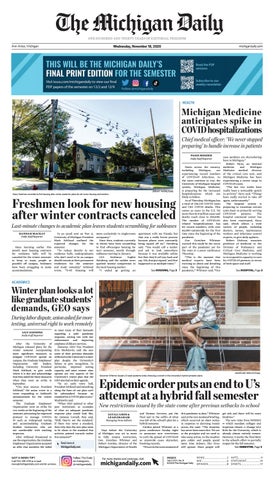
JEREMY WEINE/Daily Many freshmen scramble to find housing after winter academic plans do not renew housing contractions.
Freshmen look for new housing after winter contracts canceled
Last-minute changes to academic plan leaves students scrambling for subleases HANNAH MACKAY Daily Staff Reporter
Since learning earlier this month most housing contracts for residence halls will be canceled for the winter semester to keep as many people as possible off campus, freshmen have been struggling to make accommodations.
In an email sent on Nov. 6, University of Michigan President Mark Schlissel outlined the expected changes for the semester. “To reduce density in our residence halls, undergraduates who don’t need to be on campus should remain at their permanent residences for the semester and study remotely,” Schlissel wrote. “U-M Housing will
move exclusively to single-room occupancy.” Since then, students currently in dorms have been scrambling to find off-campus housing for next semester, mostly through subleases starting in January. LSA freshman Sophie Steinberg said the sudden news sparked intense competition in the local housing market. “I ended up getting an
apartment with my friends, but that was a really hectic process because places were constantly being signed off on,” Steinberg said. “You would call a realtor and ask to look somewhere because it was available online but then they’d call you back and say, ‘Oh, that just signed,’ and that happened to us multiple times.” See HOUSING, Page 3
States across the country, including Michigan, are experiencing record numbers of COVID-19 infections. As the cases continue to rise, the University of Michigan hospital system, Michigan Medicine, is preparing for the increased hospitalizations which are likely to follow. As of Thursday, Michigan has a total of 236,235 COVID cases and 7,811 COVID deaths. This comes as cases in the U.S. hit more than 10.8 million cases and deaths reach close to 250,000. The number of COVID-19related hospitalizations has hit record numbers, with over 65,000 nationwide for the first time since the beginning of the pandemic. Gov. Gretchen Whitmer warned this could be the worst part of the pandemic yet for the state at a press conference Thursday. “This is the moment that medical experts have been warning us about and dreading since the beginning of this pandemic,” Whitmer said. “Our
case numbers are skyrocketing here in Michigan.” Robert Hyzy, an internal medicine and Michigan Medicine medical director of the critical care unit, said Michigan Medicine has been experiencing a recent surge in COVID-19 cases. “The last two weeks have really been a noticeable uptick in activity,” Hyzy said. “Things have really started to take off again, unfortunately.” The hospital system is preparing to transition certain units back to primarily serving COVID-19 patients. The hospital command center has also been reactivated, Hyzy said, which allows a wide variety of people, including doctors, nurses, maintenance workers and infectious control experts, to give daily updates. Robert Dickson, associate professor of medicine in the Division of Pulmonary and Critical Care Medicine, said Michigan Medicine is working to re-expand its capacity to care for COVID-19 patients, in terms of both space and staff. See HOSPITAL, Page 3
ACADEMICS
Winter plan looks a lot like graduate students’ demands, GEO says During labor dispute, union asked for more testing, universal right to work remotely LILY GOODING
Daily Staff Reporter
After the University of Michigan released plans for the winter semester incorporating more significant measures to mitigate COVID-19 spread on campus, the Graduate Employees’ Organization told leaders, including University President Mark Schlissel, to give credit where it is due and acknowledge that they asked for these measures when they went on strike in September. “Cite your sources President Schlissel,” the union wrote in a tweet responding to Schlissel’s announcement for the winter semester. The Graduate Employees’ Organization went on strike for two weeks at the beginning of the semester, advocating for improved protocol to manage COVID19 such as widespread testing and accommodating Graduate Student Instructors who are not comfortable with teaching in-person. After Schlissel threatened to sue the organization, the Graduate Employees’ Organization accepted an offer that members felt failed
to meet many of their demands regarding a safer pandemic response, cutting ties with law enforcement and improving employee childcare services. However, GEO Vice President Erin Markiewitz said she sees some of their previous demands reflected in the University’s winter plan despite the University’s failure to give recognition. In particular, improved testing capacity and more remote class options are two aspects of the University’s winter plan that the GEO also had on their agenda. “In an early town hall, President Schlissel said something along the lines of: our plan can’t be substandard because no standard for a COVID plan exists,” Markiewitz said. “When GEO pointed to other peer institutions as examples of what an adequate pandemic response plan would look like, for instance Cornell, they said, ‘Well, they’re not the standard.’ If there was never a standard, then why does the new plan seem to be closer to the standard that activists pointed towards earlier this semester?”
GOT A NEWS TIP? Call 734-418-4115 or e-mail news@michigandaily.com and let us know.
Read more at MichiganDaily.com Follow The Daily on Instagram, @michigandaily
MADELINE HINKLEY/Daily
Epidemic order puts an end to U’s attempt at a hybrid fall semester Governor Whitmer issued a 3-week epidemic order, throwing a wrench in the University’s hybrid semester plans.
New restrictions issued by the state come after previous setbacks to school SAYALI AMIN & LEAH GRAHAM
Managing News Editors
Days before the University of Michigan was set to move to fully remote instruction, Gov. Gretchen Whitmer and Robert Gordon, director of the Michigan Department of Health
and Human Services, put the final nail in the coffin of what was left of the school’s plan for a hybrid semester. Gordon joined Whitmer at a press conference Sunday night to announce new restrictions to curb the spread of COVID-19 as statewide cases skyrocket, breaking records. “We are in the worst moment of
For more stories and coverage, visit
michigandaily.com
INDEX
this pandemic to date,” Whitmer said at the rare weekend briefing, which occurred on short notice in response to alarming trends across the state. “The situation has never been more dire. We are at the precipice and we need to take some action. As the weather gets colder and people spend more time indoors, this virus will spread. More people will
Vol. CXXX, No. 8 ©2020 The Michigan Daily
get sick and there will be more fatalities.” The new rules from MDHHS — which mandate colleges end in-person classes — change very little for the University, which is already almost entirely remote. However, it marks the final blow to the school’s effort to partially reopen for the fall semester. See SEMESTER, Page 3
NEWS.........................2 MIC............................6 OPINION.....................8
ARTS .........................11 S TAT E M E N T. . . . . . . . . . . . . . . . 1 4 SPORTS . . . . . . . . . . . . . . . . . . . . . . .17
News
2 — Wednesday, November 18, 2020
The Michigan Daily — michigandaily.com
Stanford Lipsey Student Publications Building 420 Maynard St. Ann Arbor, MI 48109-1327 www.michigandaily.com
ELIZABETH LAWRENCE Editor in Chief esla@michigandaily.com
ANITA MICHAUD
Business Manager ammichau@michigandaily.com
NEWS TIPS
news@michigandaily.com
LETTERS TO THE EDITOR tothedaily@michigandaily.com
EDITORIAL PAGE
opinion@michigandaily.com
PHOTOGRAPHY SECTION
ARTS SECTION
photo@michigandaily.com
arts@michigandaily.com
NEWSROOM
SPORTS SECTION
734-418-4115 opt.3
sports@michigandaily.com
CORRECTIONS
ADVERTISING
corrections@michigandaily.com
Design by Cara Jhang
Pandemic complicates college application process for seniors
Canceled ACTs, campus visits create new obstacles in navigating applying to U-M GEORGE WEYKAMP & RONI KANE For The Daily
A high school senior’s fall is typically marked by road trips to college campuses, waking up early on the weekends to take standardized tests and rushing to finish an endless stream of essays by Halloween. Throw in a global pandemic and everything changes. The University of Michigan has made a number of key changes to the college application process this year. Most notably, the University has adopted a “test-flexible” policy and extended the early action deadline two weeks. Early action applications are now due Nov. 15 as opposed to the traditional Nov. 1 cutoff. Because of the pandemic, this year’s application cycle will look different for both applicants and the admissions department. The Michigan Daily talked to
high school seniors, college admissions counselors and U-M administrators to understand what it’s like to be a high school senior applying to the University of Michigan this year. Test-flexible policy leaves some relieved, but others with questions In July, the University announced it would transition to a “test-flexible” policy for the upcoming application cycle, which allows students to submit standardized test scores other than the ACT or SAT, such as the PSAT, PLAN or AP exams. The University will also accept self-reported scores given that students submit official scores by the end of the enrollment process. The policy still strongly encourages applicants to submit a test score, but increases flexibility in the method of reporting and the type of exam. If a student is unable to take a test altogether, they can still be considered for admittance.
Several high school seniors expressed relief in response to the more accommodating testing policy. Roy Huang, a senior at St. Andrews College in Ontario, Canada, will be applying earlyaction without a test score. He said he felt relieved by the flexible policy after all Canadian Scholastic Aptitude Test dates were canceled. “(The new policy) reduces a lot of the anxiety around getting a test date and needing to keep on studying for the SAT,” Huang said. “Now, I can focus more on supplements and writing the common app essay.” Not all seniors reacted as positively to the flexible policy. Catherine Hwang, a senior at Forest Hills Northern High School in Grand Rapids, Mich., said the University should consider adopting a “test-optional” policy instead. Test-optional policies, which do not require or encourage submitting test
scores, are endorsed by other peer institutions, such as New York University. “There’s definitely potential for (the University) to be testoptional,” Hwang said. “I think that NYU and (the University) fall under the same competitiveness when you look at their acceptance rates, so (the University) could provide some other options for students.” Students and high school counselors expressed confusion about what exactly a “test-flexible” policy entails. Laura Hollyer-Madis and Norman Hurns, high school counselors from the Bloomfield Hills, Mich., and Birmingham, Mich., school districts respectively, shared similar frustrations over the ambiguity of whether or not admissions officers will expect test scores. Hollyer-Madis equated the policy to a “moving target.”
WMG-contact@umich.edu
Editorial Staff ERIN WHITE Managing Editor
ekwhite@michigandaily.com
SAYALI AMIN and LEAH GRAHAM Managing News Editors
news@michigandaily.com
Senior News Editors: Barbara Collins, Claire Hao, Alex Harring, Ben Rosenfeld, Emma Stein, Liat Weinstein Investigative Editor: Zayna Syed Assistant News Editors: Iulia Dobrin, Julia Forrest, Jasmin Lee, Calder Lewis, Angelina Little, Hannah Mackay, Sarah Payne, Emma Ruberg, Julia Rubin, Jenna Siteman, Varsha Vedapudi, Kristina Zheng
EMILY CONSIDINE and BRITTANY BOWMAN Editorial Page Editors
tothedaily@michigandaily.com
Senior Opinion Editors: Elizabeth Cook, Zack Blumberg, Krystal Hur, Min Soo Kim, Joel Weiner
THEO MACKIE and ETHAN SEARS Managing Sports Editors
sportseditors@michigandaily.com
Senior Sports Editors: Daniel Dash, Lily Friedman, Connor Brennan, Brendan Roose, Kent Schwartz, Lane Kizziah, Rian Ratnavale Assistant Sports Editors: Jared Greenspan, Nick Stoll, Drew Cox, Aidan Woutas, Abby Snyder, Jack Kingsley
JOHN DECKER and JULIANNA MORANO Managing Arts Editors
arts@michigandaily.com
Senior Arts Editors: Jo Chang, Elise Godfryd, Zoe Phillips, Jonah Mendelson, Ally Owens Arts Beat Editors: Samantha Cantie, Dana Pierangeli, Andrew Pluta, Cassandra Mansuetti, Anish Tamhaney, Sophia Yoon
CHRISTINE JEGARL and LIZZY RUEPPEL
Managing Design Editors design@michigandaily.com Senior Design Editor: Hibah Mirza
See APPLICATION, Page 3 ALLISON ENGKVIST and ANNIE KLUSENDORF Managing Photo Editors
photo@michigandaily.com
Senior Photo Editors: Madeline Hinkley, Asha Lewis, Miles Macklin Assistant Photo Editors: Julia Schachinger, Ryan Little, Emma Mati, Sophia Afendoulis, Becca Mahon
MAGDALENA MIHAYLOVA
Managing Statement Editor statement@michigandaily.com Deputy Editors: Andie Horowitz, Marisa Wright
MADISON GAGNE and SADIA JIBAN
Managing Copy Editors copydesk@michigandaily.com Senior Copy Editors: Olivia Bradish, Sophie Kephart, Silas Lee, Olivia Sedlacek, Ellie Scott
PARTH DHYANI and SIMRAN PUJJI
Managing Online Editors webteam@michigandaily.com Senior Web Developers: Abha Panda, Rohan Prashant, Jonathan Liu
ALEC COHEN and ELI SIDER
Managing Video Editors Senior Video Editor: Iulia Dobrin
Tel Aviv University Sackler School of Medicine New York State/American Program The Sackler School of Medicine-New York State/ American Program offers an outstanding four year medical school curriculum, taught in English, leading to the M.D. degree. The Program is chartered by the Regents of the University of the State of New York and is accredited by the State of Israel. Students do their clerkships and electives in the hospitals in Israel, the U.S. and Canada. One of these hospitals, Sheba Medical Center, was selected by Newsweek magazine as one of the top 10 hospitals around the world. Graduates participate in the National Resident Matching Program and return to the United States for their residency training. Since its commencement in 1976, over 2,000 alumni have completed their residency training at the most distinguished hospitals in the United States and Canada. www.sacklerschool.org provides extensive information about Sackler SOM. For further information, e-mail sacklermed@sacklermed.org
Applications for the Class of 2025 will be available on our website on Tuesday, January 5, 2021
video@michigandaily.com
MAYA MOKH and DEVAK NANUA Michigan in Color Editors
michiganincolor@michigandaily.com
Senior Michigan in Color Editors: Zoha Bharwani, Lora Faraj, Ayomide Okunade, Gabrijela Skoko
SAMANTHA SMALL and SONYA VOGEL Managing Podcast Editors
JOHN GRIEVE and BEN KORN Managing Social Media Editors
Senior Social Media Editors: Kristina Zheng, Ria Dubey, Ryan Postman, Haley Johnson, Atticus Raasch, Asha Lewis
Business Staff MOLLY WU
Creative Director
RYAN KELLY Sales Manager
The Michigan Daily (ISSN 0745-967) is publishing weekly on Wednesdays for the Fall 2020 semester by students at the University of Michigan. One copy is available free of charge to all readers. Additional copies may be picked up at the Daily’s office for $2. If you would like a current copy of the paper mailed to you, please visit store. pub.umich.edu/michigan-daily-buy-this-edition to place your order.
The Michigan Daily — michigandaily.com
HOUSING From Page 1 This was more difficult for students who had already left due to the two-week stay at home order issued in late October. LSA freshman Dora Usdan, who moved back home earlier in November, plans to live in an offcampus apartment next semester with her roommate. “But we just had to sign the lease on an apartment that we’d never seen before because we’re not in Ann Arbor,” Usdan said. “It was really stressful because even as I was on the phone with real estate agents, I’d be looking at a property and the agent would say, ‘Someone just signed that lease 30 seconds ago in my office, it’s gone.’” Many students left during the stay-in-place order because they were offered partial housing refunds if they moved out by Nov. 3. LSA freshman Sara Stawarz was one of them. She said she didn’t expect the situation in Ann
APPLICATION From Page 2 Hurns agreed, saying different U-M representatives and sources have stressed the importance of including test scores differently. “Originally, they were saying, ‘Well, we want to see something, even an AP score, a PSAT score, something,’” Madis said. “And then the last presentation I saw, it seemed to be leaning more towards test-optional. So, I’m not exactly sure (what the University wants).” In response to concerns over how the University would fairly evaluate applicants without test scores, Erica Sanders, director of undergraduate admissions at the University, said in an email to The Daily that no individual student would be at a disadvantage in the admissions process. “As is the case every cycle, each student is evaluated individually and holistically,” Sanders wrote.
SEMESTER From Page 1 University President Mark Schlissel and Provost Susan Collins wrote in a Monday email to the campus community that the University would shift all coursework, except any associated with training medical professionals, to be conducted remotely to follow the state’s guidelines. This only affects the three days before Thanksgiving break. Previously, under the University’s initial plan, all undergraduate classes were scheduled to go fully remote after the holiday through the end of the semester on Dec. 18, but the state order shortened that timeline. “Over the past several months, we have been asked to continually adjust our activities to help protect the health and safety of the larger community,” Schlissel and Collins wrote. “We know this will cause some disruptions in a few courses and labs that were meeting in person through Friday – and we appreciate everyone’s continued diligence and resilience as
HOSPITAL From Page 1 “We have expanded our capacity in a number of ways,” Dickson said. “We converted what was recently a moderate care unit into a fully functional ICU, we have put additional ICU physicians on the service and we have provided additional training for moderate care nurses to provide critical care to patients.” As cases continue to rise and hospitals continue to prepare, some specialty hospitals in Southeast Michigan have begun to offer their extra space to major health systems. On top of this, some non-health care businesses have also begun to offer space for low-acuity patients. ‘We never stopped our preparation and planning’ Compared to the spring, Dickson said Michigan Medicine
News
Wednesday, November 18, 2020 — 3
Arbor to change so rapidly while she was gone. “It’s been kind of stressful because I left with the knowledge that I would be coming back next semester and that this wouldn’t be the last that I’d see of my friends until August, which is the situation now,” Stawarz said. For some out-of-state students, leaving early during the twoweek stay-in-place period has left them in a difficult situation now that they cannot return to their dorms next semester. The University has recommended two options: returning to campus to empty out their rooms themselves, or hiring John’s Pack & Ship moving company at a minimum cost of $500 to do it for them and mail or store the belongings. In an email to The Michigan Daily, University Housing spokesperson Amir Baghdadchi wrote students are allowed to sign up for a time slot to return to campus and pack up their belongings. The dates for move out range between Nov. 30 and Dec. 6. If necessary, students may also move out after Dec. 6
and before the start of winter semester if arranged ahead of time with University Housing. “We understand moving out can be a challenge, and we’re ready to be flexible and offer students options,” Baghdadchi said. LSA freshman Nadir Gerber is at his permanent residence in California and reached out to Housing to explain his predicament. “I did mention that I was in California so it wasn’t feasible for me to come out and pick things up from my dorm and their first recommendation was that I come out and pick things up from the dorm myself,” Gerber said. “I am potentially looking at flying back out to Michigan and just getting everything myself, but doing that while I’m still trying to attend class is not only a huge financial commitment but also really gets in the way of my schooling.” Usdan, who had moved back home to New York, said this was an unreasonable expectation for students and their families, saying students essentially have two choices: “Com(ing) back with
their parents who are more at risk to pick up their stuff or paying a really high fee.” “That’s super inconvenient and they didn’t tell me to move out all my stuff when I left Oct. 24,” Usdan said. Baghdadchi also wrote that students are able to authorize someone to pick up their belongings on their behalf if they are unable to do so themselves. He wrote that the best option for some students may be to use a third party to pack, store or ship items, and they are able to use John’s Pack & Ship to do so. Students who want to remain in the residence halls next semester can apply for an exception. Stawarz said she felt the space allotted to tell the University why she should stay was insufficient to get the message across. “I had to write them in 500 characters or less, why for my mental health I should go back,” Stawarz said. “It was so hard to get the full scope of the issue in 500 characters, and I genuinely am afraid that they won’t take me back.” Several students have
expressed disappointment with the University’s response to COVID-19 this semester, attributing the closing of the residence halls to a lack of preparedness and a shortage of testing availability. Stawarz said she wishes the University had tested more students earlier in the semester before the stay-in-place order was implemented. “It’s pretty disappointing, especially knowing that all of this could’ve been prevented if they had just done weekly testing. They let it go way too far and only implemented these things when it was unimaginable for them to not do so,” Stawarz said. As part of the University’s plan for the winter semester, testing capacity will be increased to about 12,000 to 15,000 tests per week. According to the plan, students living in University Housing or participating in on-campus activities in winter 2021 will also be tested on a regular basis. Over the summer, the University’s Board of Regents voted to increase tuition and
increase room and board fees by 1.9% in the 2020-2021 budget, despite receiving backlash from the campus community for raising tuition during a global pandemic. This was in response to a projected University budget deficit due to COVID-19. Other students said they were more concerned about the prospect of paying full tuition for the winter semester while going to school online and living at home. LSA freshman Yitzi Zolty said he wonders what students are paying for when the capacity for campus learning is so limited. “I doubt this was a decision that was made overnight — there’s nothing wrong with full transparency,” Zolty said. “I think the main thing, at least on my mind, is that we’re still paying full tuition as out-ofstate students, and part of their spending plan is to upkeep facilities. But if none of those are going to be in use, why are we paying so much?” Daily Staff Reporter Hannah Mackay can be reached at mackayh@umich.edu.
“We do not compare individual students to each other.” New deadline allows more time to perfect application Though students expressed mixed feelings about the changes to the testing policy, seniors and administrators were generally in favor of the extended Nov. 15 early action deadline. With the new deadline, early action applicants are guaranteed an admissions decision of accept, reject or deferral to the regular decision pool by late January, about a month later than previous years. Despite admissions decisions being delayed to January, Riley Hodder, a senior at Oxford High School in Oxford, Mich., said the extended application deadline has allowed her to devote her efforts after Nov. 1 entirely to her U-M application. “It was a major benefit to be able to put off U-M for a few days and focus on (other applications) that needed to get done,” Hodder
said. According to The Wall Street Journal, the Common Application, which is used by the University and more than 900 other schools, saw 8% less first-year applications and 10% fewer applicants through Nov. 2 compared to the same period last year. Some high school administrators, including Ann Arbor Public Schools counselor Christopher Kasper, said they felt concerned the extended deadline would encourage students to procrastinate on their applications. However, Groves High School Counselor Lilianne Kowalchuk did not anticipate students would delay working on their applications more than usual. Kowalchuk has recommended her students treat the additional two weeks like a “safety net.” She said she wants them to have their applications completely done by Nov. 1 and to use the extra time
to double-check that everything has been properly submitted and received by the University. “The kids who procrastinate are going to procrastinate no matter what,” Kowalchuk said. Pandemic causes students to consider college options closer to home The lack of physical college visits, admissions tours and other traditional recruiting events have further affected the information students have access to as they determine which college is right for them. Anna Partalis, a senior at Bloomfield Hills High School in Bloomfield Hills, Mich., said even though she is applying to several out-of-state universities, the University remains her top choice due to the pandemic’s cancellation of campus visits. “I feel like if I were able to do in-person tours, I would be more attached to other out-ofstate schools,” Partalis said. “The
experience for students in person is really important to me, so I feel like I’m definitely more attached to my in-state schools.” Nosheen Ahmed, a senior at Niles North High School in Skokie, Ill., said while she had previously wanted to go out-ofstate for college, both financial issues and the possibility of the University still being virtual for the Fall 2021 semester have made her strongly consider in-state options. Ahmed said though she is still applying to the University, the ongoing pandemic has brought new factors into the equation of deciding where to attend. “(The University is) switching to online school and restricting the dorm options, but they’re not lowering tuition, and that doesn’t make sense to me,” Ahmed said. “My mom was at risk of losing her job, and we’re going to have three kids in college (next year), so I just don’t want that financial burden.” University promotes holistic
evaluation of applications, with concessions for COVID-19related setbacks With diverse grading systems, inconsistent access to standardized tests and mental health challenges posed by COVID-19, the U-M admissions office, known for its selective acceptance process, faces unprecedented challenges as they decide who they will grant admission to for the Class of 2025. The University accepted 26.1% — approximately 17,000 out of more than 65,000 for a 6,900-student class — for the Class of 2024. Sanders said she is optimistic about the admissions department’s ability to contextually review a student’s application and consider any external factors that may affect how that student appears on paper.
we work to slow the spread of COVID-19.” The state’s three-week epidemic order is not the first time the school’s operations have faced significant disruptions in an effort to curb the spread of the virus. Administrators have had to switch gears several times over the semester to deal with unforeseen circumstances stemming from the pandemic, ranging from lockdowns to labor disputes. Schlissel started off the year on an optimistic note, saying in August, “I think it’s more likely than not that we will make it through the semester,” even as other colleges reversed course on their reopening plans. The choice to move forward with reopening sparked criticism from students, staff and faculty, who complained about the lack of testing and called for more stringent restrictions regarding campus operations. “It’s not realistic that students are going to come back on campus and not bring COVID with them and spread it amongst themselves,” Rackham student Gabby Sarpy said at a protest in August.
The semester began with about 78% of classes taught remotely, but outbreaks on campus in September and October prompted Washtenaw County to issue a stay-inplace order for undergraduate students on Oct. 20. The order carved out several exceptions for students, including attending class. Courses that were significantly enhanced by in-person learning did not have to move to remote instruction under the county’s October order. According to the University Record, 90% of undergraduate courses are now being taught remotely. Students raised doubts about the stay-in-place order, even calling it a targeted “anti-party ordinance.” The order, however, seemed to work. When it was first issued, COVID-19 cases associated with the University represented more than 60% of local cases. Two weeks later, University students accounted for about a third of cases in the county. According to Schlissel, the University saw an “unacceptable level of COVID-19 cases” among undergraduates, both
on campus and off. He said the experience pushed the University to shift away from the model used for fall. Now, the plan for winter will offer increased testing, and no instructor will be required to teach in person. Residence halls will be closed to students who do not present a compelling need to stay on campus. Many of the components of the winter plan align with demands voiced by the Graduate Employees’ Organization earlier in the semester when Graduate Student Instructors went on strike. “In some ways, it feels like the admin has come to their senses, but really I think this was a calculated business decision — ‘We were willing to risk community safety to maintain tuition and housing revenue, but doing that hurt us so we’re shifting course,’” GEO member Dom Bouavichith said in a previous interview with The Daily. In addition to graduate students, residential advisers went on strike due to the working conditions in residence halls. Some dining hall staff also spoke out in protest of the
University’s handling of the reopening. The pandemic also threw a wrench in the University’s research apparatus. The University placed nonessential research largely on hold in March. Activities slowly ramped up throughout the year, with adjustments made for large spikes in cases in the community. At the start of the school year, only senior students already trained in their respective research could resume work in person, but by mid-October, all undergraduates were allowed to participate again. The county’s stay-in-place order limited research activities for undergraduates shortly after they were allowed to return, leaving many students feeling as though they were back at square one. While the state’s new rules do not limit the University’s research, Schlissel and Collins noted they would adjust operation policies out of an excess of caution. Research laboratories will continue to operate at 60% density, and undergraduate students can still help out with in-person
research. However, according to a Monday update from Vice President of Research Rebecca Cunningham, certain human research studies “should prepare to pause in-person activity” with research participants by Friday at the latest. Cunningham also noted that 12 researchers who had been working in person have tested positive for COVID-19 in the past seven days. As cases continue to rise across the state, Michigan Medicine is preparing for another rise in hospitalizations. “We’re more prepared because we’ve seen this movie before,” said Robert Dickson, associate professor of medicine in the Division of Pulmonary and Critical Care Medicine. “We didn’t know what to expect in March really, at that point all we had were anecdotes from our colleagues in Asia and Europe. By now we have a luxury of lots and lots of experience, randomized controlled trials and rigorously done observational studies.” Managing News Editors Leah Graham and Sayali Amin can be reached at leahgra@umich.edu and sayalia@umich.edu.
is more prepared now for a rise in cases. “We’re more prepared because we’ve seen this movie before,” Dickson said. “We didn’t know what to expect in March really, at that point all we had were anecdotes from our colleagues in Asia and Europe. By now we have a luxury of lots and lots of experience, randomized controlled trials and rigorously done observational studies.” Michigan Medicine has also gained specific medical knowledge in the past months of the pandemic that will help the hospital provide better care to COVID-19 patients, Dickson said. “I think we’re smarter about what not to do as much as we are smarter about what to do,” Dickson said. “I do think one thing we learned over and over, is that more important than any given drug for COVID, is outstanding meticulous evidence
based critical care practices.” Jeffery Desmond, chief medical officer of Michigan Medicine, said Michigan Medicine never stopped preparing for a rise in cases. “We never stopped our preparation and planning,” Desmond said. “Even when we were on that plateau during the summer and early fall.” Desmond also said Michigan Medicine has been at the forefront of preparations and use of new knowledge since the beginning of the pandemic. “We were one of the early hospitals in the country to require masks for everyone in the hospital,” Desmond said. “We did that because we felt the data was suggestive that it would be protective for our employees and for our patients … and it turns out universal use of masks really provides protection for employees and for patients.” This moment in the pandemic
is also different, Desmond said, because Michigan Medicine is continuing to treat regular patients and COVID-19 patients, which they didn’t do in the spring because of Gov. Gretchen Whitmer’s executive orders restricting nonessential treatment. “We have reverted back to more normal care,” Desmond said. “Now, we’re in the midst of managing COVID patients and non-COVID care simultaneously in the hospital.” However, Desmond said he believes Michigan Medicine is more than capable of rising to this challenge. Desmond also said Michigan Medicine has recently been able to somewhat recover from the poor financial performance of the summer and early fall. He said the hospital system has been able to reinstate retirement match and professional development funding.
Nursing sophomore Britney Nguyen agreed with Desmond and Dickson, noting that there is a more widespread understanding of how the pandemic should be handled now than there was last spring. “I think we’re more prepared,” Nguyen said. “I think everyone just being on the same page with the pandemic has really helped and just getting a Universitywide consensus on what steps we need to be taking.” Health care workers ask students to follow public health guidelines Both students and medical professionals in Ann Arbor said they see the role students can play in slowing the spread of COVID-19 — and are asking them to remain vigilant as cases rise. Nursing senior Joyce Lee wrote in an email to The Michigan Daily that nursing students have had to be open to changes while completing
Read more at MichiganDaily.com
clinical hours in the hospital. “As a nursing student we have to be flexible in general and especially during a pandemic,” Lee wrote. “As with most students, most formats are virtual, and clinical are in-person. For one of my clinicals I am a contact tracer and there have been moments of more contacts at certain points.” Hyzy also said it is important for students to be safe and make good decisions to mitigate the spread of the virus. “I would implore your readers to be good citizens,” Hyzy said. “You might get by with a milder case of COVID but … people are dying and more people will die, though admittedly fewer than the spring. But this is very serious stuff. And I’m telling you, it’s starting to really take off again.” Daily Staff Reporter Paige Hodder can be reached at phodder@umich.edu.
News
4 — Wednesday, November 18, 2020
The Michigan Daily — michigandaily.com
Incarcerated people talk future of criminal justice In light o f nationwide protests, abolition movement gains momentum EMMA STEIN
Daily News Editor
As protesters took to the streets across the nation to fight police brutality and systemic racism in the name of Black Lives Matter this year, calls for the abolishment of not only the police but the larger criminal justice system have gained momentum. The Michigan Daily spoke with currently and formerly incarcerated people about their experiences in prison and what the future of criminal justice should look like. Parallels between slavery and the modern prison system Dion “Bantu” Dawson, who is currently incarcerated in Macomb Correctional Facility in Michigan, has been in prison for 18 years with a sentence of natural life without the possibility of parole. He is the president of the Macomb Prison branch of the NAACP. Dawson said prisons are “designed to contain and control the Black body.” Further, Dawson drew parallels between slavery and the prison system today, calling it a “modern-day slave plantation.” “There is almost an identical system in place as it relates to property relations between the prisoner and the prisoner state just as it was the slave and the slave master,” Dawson said. Dawson said there is an inherent violence in both systems, with violence so common that it has become normalized. In his time at Macomb and previously at Ionia Correctional Facility, Dawson said he’s seen fellow inmates beaten, suffocated and chained to their beds.
“Both systems naturalize the violence that they impose on their subjects,” Dawson said. “Prison staff, for example, find it almost impossible not to subject us to violence in the form of threats. They have to always instill this fear in us.” Dawson also found similarities between the aggression he’s experienced in prison and police brutality today. “Just like Black men and women today are being subjected to police brutality, we are very much subjected to brutality as well by the correctional officers,” Dawson said. He also noted prison staff feel a strong allegiance to their fellow staff, which can lead to increased intimidation and violence against prisoners –– a phenomenon also seen during recent BLM protests and the trials of police officers. The illusion of autonomy in prison Lacino Hamilton, who was released from prison in September after being wrongly convicted of murdering his foster mother, said he had very little autonomy to make his own choices. He was incarcerated for 26 years. “It was dehumanizing in the sense that it (prison) micromanages down to a point where there’s no necessity for thought,” Hamilton said. “Everything is pre-programmed, all decisions are stripped away.” Another inmate at Macomb, Gregory Tyrone Alexander, who has been incarcerated for 23 years with a life sentence without parole, echoed Hamilton’s thoughts and said autonomy in prison is an illusion. “There’s a way to make
those who are being controlled believe that we are somewhat in control, and so we go about our daily existence thinking that the choices we make are solely ours, but all along there is an invisible hand who dictates our movement, even our thought process,” Alexander said. Alexander said even his family on the outside has experienced small doses of the control the criminal justice system exerts — for example, when they call for information or when they try to send him material items for support. “There always seemed to be a block, an obstacle, that had to be traversed,” Alexander said. “What they think to be a simple gesture of support or love was always blocked or put some type of resistance on, so as I said before, there’s a sense of control which is somewhat subtly applied to those who are constantly within the system. But for them (family on the outside), since they don’t witness it on a daily basis, when they do experience it, it’s almost shocking.” The current movement for abolition While there may be similarities between the carceral state and slavery, Hamilton said it is not a productive comparison and does not help modern day social justice movements gain momentum. The prison system is violent not because of the physical violence people experience inside, but because it violently isolates inmates from their communities, according to Hamilton. “Prison is inherently violent because it is a separation of a
DESIGN BY CAITLIN MARTENS
person from their family, their community,” Hamilton said. “That’s violent. Everything about it in that sense, so everybody in prison experiences violence.” Alexander addressed the racism he experienced growing up in Battle Creek. At first, he said he didn’t recognize the systemic racism he faced, but his perspective changed once he was incarcerated. “When (racism) is subtly applied, I think psychologically we have a tendency to dismiss it and almost are able to argue that it is non-existent, and that was my stance for a long time,” Alexander said. “However, when I started to be involved in the criminal justice system, which started before being imprisoned, I was able to then understand how race played a major role in the trajectory of not only myself but those who look like me and so, experience life differently than what others experience.” Calls to abolish the police
and the prison system gained traction over the summer, as opposed to previous notions of reforming the carceral state. Dawson referred to reform as “window-dressing” and said it would not solve the problems. Abolition is the only solution, he said. “(Abolition) isn’t just about tearing structures down, but also talking about building new structures up,” Dawson said. “So in that way, I think abolition is about imagining a new world, a more equitable world that isn’t just about caging people.” Hamilton also expressed support of the abolition movement –– he said prisons were designed to be “inherently racist” and to make a profit, and they are achieving that goal. “I think a lot of times when we say a system is broke, it means it’s not benefiting someone,” Hamilton said. “It’s broke, it’s not working. I think that (the prison system) only exists because it benefits someone … I think
it is doing exactly what it was designed to do, regardless of the harm it does to communities.” Alexander said, because of the stigma around being currently or formerly incarcerated, most people do not take the time to really listen to what inmates have to say, but he encouraged people to take it upon themselves to do their own research and find the “answers that are often not given freely.” “Incarcerated women and men should not be identified by probably one of the worst mistakes they’ve ever made, which is sometimes just a bad decision, which we are often identified by,” Alexander said. “We are labeled generally, instead of individually, because we are grouped as convicted felons, and we are the group of society that no one wants to understand.” Daily News Editor Emma Stein can be reached at enstein@umich. edu.
AG Nessel co-signs letter Students discuss losses opposing visa restrictions from ongoing pandemic
Document condemns proposal to limit international students in U.S. EMMA RUBERG Daily Staff Reporter
After the Trump administration proposed a new rule to increase restrictions on international student visas, Michigan Attorney General Dana Nessel co-signed a letter with 21 other state attorneys general opposing the policy. In a Friday press release, Nessel condemned the proposed rule and said the suggested timeline was unrealistic. “For decades we have allowed international students to remain in the U.S. until their studies are completed, and this proposed rule shows a blatant disregard for the positive impacts these students have on our economy and our cultural diversity,” Nessel said in a statement. “The reality for many students is that obtaining a college degree may not happen within four years, so to propose a rule which could limit that achievement and stifle the value of a culturally enriched experience within our universities is damaging to the U.S.’s reputation as a world leader.” This follows multiple other possible policy changes for these visas from earlier this year. In July, the Trump administration tried to limit visas by requiring new international students to take in-person classes to stay in the country, despite the fact that most universities, including the University of Michigan, had moved classes online because of the COVID-19 pandemic. After multiple lawsuits, the policy was rescinded. If enacted, the proposed rule would significantly limit international student visas, most dramatically for students from 59 countries. Four of these countries — Iran, North Korea, Sudan and Syria — are included based on claims from the Department of Homeland Security that their governments are state sponsors of terrorism. The others are included
largely due to visa overstay rates of more than 10% from last year’s DHS report, with 36 of these countries being in Sub-Saharan Africa. It would also limit the time for which student visas are active, making them apply for only twoor four-year fixed terms, both for under and post-grad programs. As with U.S.-born students, many international students take longer than 2-to-4 years to complete their education. According to the letter from the Attorney General’s Office, 53.2% of all international students, of which there are more than 700,000 in total, were enrolled in bachelor’s or Ph.D. programs in 2018 with a minimum duration of four years. Under the current policy, known as “duration of status,” students can generally stay in the U.S. for as long as necessary to complete their educational program, assuming they remain enrolled at an accredited institution and are meeting general progress requirements toward a degree. If the new policy is enacted, students will only be allowed exceptions to the rule for compelling academic reasons, documented medical illnesses or circumstances beyond students’ control. Engineering junior Tony Pan, an international student from mainland China, said the fouryear time limit was too short, as international students may face additional challenges in finishing their degree as quickly as U.S.based students, especially if they are not fluent in English. He said he has thought about pursuing a Ph.D. in robotics in the U.S. but does not know if that would be possible under this timeline, saying it would be impossible to complete meaningful research in that time frame. He added that international students also come from different cultural backgrounds. “Many (international students)
may not even have the exposure like a lot of American students had when they were in high school,” Pan said. “Maybe they wanted to explore (different subjects) for the first year … Also, I really want to mention: it takes a long time to adapt to any environment with culture shock.” University President Mark Schlissel, in a letter submitted to DHS and co-signed by Provost Susan Collins, opposed the proposed rule and asked for its withdrawal. Schlissel echoed claims that the timeline was unrealistic and said it should be up to the University to examine student progress. He wrote the proposed regulation represents a severe misunderstanding of how higher education in the U.S. works. “All of our students, regardless of their country of citizenship, should have the same opportunities,” Schlissel wrote. The University’s International Center submitted a similar letter on behalf of the University. The 22 attorneys general provided numerous reasons to abandon the proposed rule in their letter, arguing it could cause a sharp decline in international student enrollment, as only 41% of students at U.S. colleges and universities complete their bachelor’s degree within four years. In his letter, Schlissel explained the importance of international students’ contributions to the U.S. “Although the United States long has been the top destination for international students, scholars and faculty, there has been a nationwide decline in their numbers over the past few years, and this proposed regulation would undoubtedly result in a further decline,” Schlissel wrote.
Read more at MichiganDaily.com
Lost lives prompt calls for social distancing, mask-wearing CYNTHIA HUANG Daily Staff Reporter
Graduate student Jeffrey Grim’s last moments with his grandparents consisted of Zoom calls and waiting outside their room in the hospital. Despite following public health guidelines, both of Grim’s grandparents, Jacob and Doris Bender, contracted COVID-19 this summer. “The hardest part was not being able to do anything,” Grim said. Doris and Jacob, who worked in the Army, married in 1958 after meeting in Hawaii . They moved to Jacob’s hometown, Sharpsburg, Md., where Doris worked in a hair salon and Jacob worked for Jamison Door Company. Doris also became a small-time celebrity for crocheting more than 2,000 hats for newborns. The residents from Sharpsburg remembered the couple as always willing to lend a hand. This summer, both of Grim’s grandparents died two days apart from each other, separated by two rooms. Grim is one of many Americans experiencing loss from the coronavirus pandemic. More than 230,000 people have died from COVID-19, with researchers projecting another 180,000 deaths by Jan. 1. While both of Grim’s grandparents were in their 80s, they had differing preexisting conditions: asthma and prior heart damage for his grandmother and recovery from prostate cancer for his grandfather. Grim said both of his grandparents had to be hospitalized as their conditions worsened. Patients who contract COVID-19 have extremely limited physical contact with close family, where the only
form of contact allowed is calling through a mobile device. Grim recounts using Zoom to have 15-minute interactions with his grandparents, even if they were sedated. This form of contact included a sobering interaction in which Grim had to say his final goodbyes to both of his grandparents. On college campuses, images of college students partying without wearing a mask or social distancing have been prevalent. LSA sophomore Junhyoung Kwon said he thinks people aren’t taking the pandemic seriously due to lack of understanding of COVID-19 and the consequences of contracting the virus. “If you hear about other people getting affected, that doesn’t necessarily mean you’ll be able to … sympathize with it unless it actually happens to you,” Kwon said. Centers for Disease Control and Prevention guidelines to combat the virus include wearing a mask and social distancing at least six feet apart, but these recommendations have been ignored by some individuals. Grim said he feels outraged when he sees people without masks or not adhering to the CDC guidelines to combat COVID-19. “If there’s someone not wearing a mask, I think it’s just so selfish, because it’s people like that that probably spread it to my grandparents,” Grim said. “And so, for people to think, ‘I’m not going to be hurt by it,’ that’s not necessarily true … you could pass it on to other people, especially people who are working, especially older people, and it’s just really selfish.” People who show no symptoms may not feel the detrimental effects of COVID-19 but can still spread it to others. People who are asymptomatic may not know if they have been
infected, and wearing a mask regardless of showing symptoms can prevent others from getting infected. LSA sophomore Sally Hwang said she knows several people who have tested positive for the virus. “It is so heartbreaking and sad that there’s nothing you can really do besides wait it out,” Hwang said. Despite the increasing number of students on campus testing positive for COVID-19, Hwang expresses her frustration when some students continue to downplay the threat of the virus. “I hear people outside of this apartment partying every single night next door and in the building next to us,” Hwang said. “It’s really disappointing, because it honestly seems like there’s not a lot of people taking it seriously on campus, and I really just feel like that brings the reputation of the school down.” Grim, who is in his sixth year as a doctoral candidate, notes how his school life has been impacted after the deaths of his grandparents. “Besides impacting my family’s life and my life significantly, it’s made it really hard to do school work. It makes it really hard to work on my dissertation,” Grim said. Grim said he hopes his story will motivate others to take the consequences of the pandemic seriously. “I really hope that from me and my family sharing our story about losing two really important people, that maybe it might personalize things for others so that they take better care, if not for themselves but for others,” Grim said. “I would do anything (to have) my grandmother back.” Daily Staff Reporter Cynthia Huang can be reached at huangcyn@umich.edu.
The Michigan Daily — michigandaily.com
News
Wednesday, November 18, 2020 — 5
Whitmer stops oil, gas pipeline in Great Lakes Enbridge must halt Line 5 operations by May 2021 due to environmental concerns EMMA RUBERG Daily Staff Reporter
ILLUSTRATION BY MADISON GROSVENOR
Campus religious groups adapt activities due to ongoing pandemic
COVID-19 health guidelines limit practices for many faith-based student organizations as they seek to build community through virtual interactions SAFURA SYED For The Daily
The ongoing pandemic and the switch from in-person to online events have affected religious organizations on campus that previously relied on face-to-face interaction to build a sense of community. Before the pandemic, organizations like the Sikh Students Association fostered friendship through social events like cider mill trips or Kirtan nights, when members would play traditional drums and sing together, but COVID19 put a stop to these activities. SSA’s leadership had to find ways to work around the restrictions that prevented large indoor gatherings. LSA junior Ramneet Chauhan, co-president of SSA, said the organization is
conducting meetings over Zoom and had a socially-distanced field day at Palmer Field. “We’ve seen a lot of first years coming to our events, even to the Palmer Field event,” Chauhan said. “Everyone had a lot of fun so I think the sense of community is still there.” Organizations have also adapted religious holidays and festivals. LSA senior Deepali Desai, Hindu Students Council co-president, said her organization had to cancel their Holi event because of the initial shut down in March. The first day of Diwali, a major Hindu festival, occurred this past Saturday. In a COVID19-free year, Desai and her fellow members would organize a large Diwali party, including a buffet with food from a local Indian restaurant. This year, they are focusing on a smaller Zoom call for members only to
celebrate. “On the day of Diwali we’re just going to dress up and get together on Zoom, and we’re going to watch a movie or a TV show or play some games,” Desai said. “We just want to celebrate with each other, which is something we really haven’t been able to do over the past few years, because we’d usually be so busy with planning the banquet and making sure everything’s running smoothly during that.” Other holidays, like Rosh Hashanah, also had to change. But LSA junior Sarah Pomerantz, the chair for the undergraduate student governing board of Hillel, said the organization continues to try to create “a holistic experience” for Jewish students. Hillel organized Shofar blowing, a Jewish tradition of blowing a horn to announce
the new year, in the Nichols Arboretum. Every half hour, a group of at most 25 people would listen to the service while social distancing, leaving before the other group came. Hillel is also hosting online events like trivia nights and learning programs. LSA sophomore Nomi Rosen, an executive board member of I-LEAD, encouraged students to take part in the virtual events. I-LEAD is a student organization that facilitates conversations about issues related to the State of Israel. “I think it actually makes it a lot easier for students to participate because it’s easier to do through the platform of Zoom and technology,” Rosen said.
Read more at MichiganDaily.com
A controversial oil and gas pipeline in the Straits of Mackinac is losing its ability to operate on the bottom of the lake, Michigan Gov. Gretchen Whitmer announced Friday. Michigan’s Department of Natural Resources will terminate a 1953 easement agreement with Enbridge, the company traditionally supplying petroleum and natural gas to Mackinac Island. Whitmer said the company’s 67-year-old dual pipelines presented “unreasonable risk” to the state’s residents. Enbridge has repeatedly been criticized by environmental activists, who call for an end to the pipelines’ operation. These activists fear the pipeline could rupture, leading to a massive oil spill in a waterway that connects Lake Michigan and Lake Huron. The pipelines are subject to several other concerns, including allegations Enbridge has not complied with Michigan regulations and a lack of transparency during inspections. Supporters of Line 5 see it as an essential source of natural gas and propane for people in the Upper Peninsula and other parts of the state. According to a Friday press release, Whitmer and DNR Director Dan Eichinger say the action is a result of a violation of the public trust doctrine, which requires Michigan to protect and preserve the shores of the Great Lakes. The termination is based on the company’s “persistent and incurable violations” of the terms and conditions of the agreement. Whitmer said in a statement the company was putting Michigan residents and the Great Lakes at risk. “Here in Michigan, the Great Lakes define our borders, but they also define who we are as people,” Whitmer said. “Enbridge has routinely refused to take action to protect our Great Lakes
and the millions of Americans who depend on them for clean drinking water and good jobs. ... Most importantly, Enbridge has imposed on the people of Michigan an unacceptable risk of a catastrophic oil spill in the Great Lakes that could devastate our economy and way of life.” Enbridge argues Line 5 is a vital piece of infrastructure. In a statement Friday, Enbridge executive Vern Yu said there was no credible basis for terminating the easement. “This notice and the report from Michigan Department of Natural Resources are a distraction from the fundamental facts,” Yu said. “Line 5 remains safe, as envisioned by the 1953 Easement, and as recently validated by our federal safety regulator.” Yu added that the company is confident that Line 5 is operating safely. “We will continue to focus on the safe operation of the dual Line 5 pipelines at the Straits of Mackinac, ensuring the Great Lakes are protected while also reliably delivering the energy that helps to fuel Michigan’s and the region’s economy,” Yu said. Michigan Attorney General Dana Nessel filed a complaint in the Ingham County Circuit Court to validate the governor’s action. Nessel also specified the pipeline must be shut down within 180 days. “I commend Gov. Whitmer and Director Eichinger for their forceful actions today to address the grave threat posed by Enbridge’s unlawful operation of its pipelines in the Straits of Mackinac,” Nessel said in a Friday statement. “With the steps they took today, Gov. Whitmer and Director Eichinger are making another clear statement that Line 5 poses a great risk to our state, and it must be removed from our public waterways.”
Read more at MichiganDaily.com
Three U-M professors to aid Biden-Harris transition
Michael Barr, Betsey Stevenson, Barb McQuade will volunteer in Department of Treasury, Justice committees EMMA RUBERG & SARAH PAYNE Daily Staff Reporters
Three University of Michigan professors and Obama administration alums will help President-elect Joe Biden transition to power in Washington, D.C. The group selected to evaluate various federal agencies and get them in line with the goals of the Biden administration is a who’swho of academics and former government officials. The Biden-Harris transition team announced the list on Tuesday. Michael Barr, dean of the Ford School of Public Policy, previously served in the Department of Treasury as assistant secretary for financial institutions when President Barack Obama was in office. Barr will serve as a volunteer on the Department of the Treasury committee of the transition team. In a Sunday email to students, Barr congratulated Biden and Vice Presidentelect Kamala Harris on their victory, calling it a historic moment for the country. “I also think it is fair to say, that those who have worked with President-elect Biden, from across the political spectrum, whether or not they agree with him on policy or politics, view him as a person of great personal integrity,
decency, and compassion,” Barr wrote. Barr helped craft the DoddFrank Wall Street Reform and Consumer Protection Act of 2010, a massive piece of financial reform and oversight legislation passed in the aftermath of the 2008 financial crisis. Before his Senate confirmation, Barr was also a member of the National Economic Council in the White House. Before that, Barr worked in former President Bill Clinton’s administration. Barr researches and writes about issues in domestic and international financial regulation. He is also a professor at the Law School, where he taught financial regulation and international finance. Betsey Stevenson, a professor of public policy and economics, will also help review operations at the Department of Treasury in a volunteer capacity. In a press release Tuesday, the Biden-Harris campaign emphasized the diversity of the transition team, calling it one of the most diverse agency review teams in presidential transition history. “Of the hundreds of (agency review team) members to be announced, more than half are women, and approximately 40 percent represent communities historically underrepresented in the
federal government, including people of color, people who identify as LGBTQ+, and people with disabilities,” the release reads. “The Presidentelect and Vice President-elect are committed to building an administration that looks like America.” In a 2018 panel at the Ford School, Stevenson discussed the need to diversify the field of economics, stressing the importance of increasing the number of women in the profession. “We have a cultural shift that needs to take place,” Stevenson said. “And one of the few ways to get cultures to shift is to change the people in the culture, so I do think that improving the pipeline and getting more women into economics is an important part of this.” Stevenson previously served as a member of the Council of Economic Advisers from 2013 to 2015. She advised thenPresident Obama on the labor market, social policy and trade issues. From 2010 to 2011, she was the chief economist of the U.S. Department of Labor, where she advised the Secretary of Labor on labor policy. Law professor Barb McQuade will be a volunteer on the Department of Justice committee of the transition team. From 2010 to 2017, she was the U.S attorney for the Eastern District of Michigan,
ALEC COHEN/Daily
Students study in the Law Library before the COVID-19 pandemic.
the first woman to serve in the role. McQuade was appointed by Obama and oversaw cases involving fraud, public corruption, terrorism and civil rights, among other issues. She resigned in March 2017 at the request of President Donald Trump. McQuade has been a frequent critic of the Trump administration, accusing the current president of working to undermine the rule of law. In a statement to The Daily, McQuade said she was excited to aid in the transition process. “I am honored to be part of
the Biden-Harris transition team and eager to help ensure a smooth transition at the Department of Justice,” she wrote. The Associated Press declared Biden the winner of the presidential election on Saturday morning, and students took to State Street to celebrate. President Trump has refused to concede and his campaign has filed lawsuits challenging the validity of the election in numerous states, without citing evidence of fraud or wrongdoing. On Monday, the Trump administration told agency
officials not to cooperate with the Biden transition team, as the president has yet to concede the election. Various agency officials had previously prepared briefings and reserved office space for members of the Biden transition team. Instead, they are now being instructed to wait until the General Services Administration officially begins the transition to a Biden administration. Daily Staff Reporters Sarah Payne and Emma Ruberg can be reached at paynesm@umich. edu and eruberg@umich.edu.
Michigan in Color
6 — Wednesday, November 18, 2020
The Michigan Daily — michigandaily.com
The death of a blue silk dress SARAH AKAABOUNE MiC Columnist
Noor Al-Fikhri was buried in a shallow grave under a fig tree ten minutes before noon, after her left ankle gave out in an attempt to hang her blue silk dress to dry while climbing the rusty, half-removed ladder that led to the roof. My 12 year old grandmother found her sister half-splayed, cats and flies lapping at what little remained of the dried blood, her knees disjointed and contorted in the special sort of way that could only be found on a dead woman. The women in their building wailed and cried for three nights and three days, her body on their kitchen floor as they partook in the Islamic ritual of ghusul every Muslim body must go through after death. My grandmother said their grief was so heavy and viscous that it crept across every hallway and corridor, trapping, toes and the balls of feet, so that even climbing one flight of stairs became the most arduous task. Noor was buried in an expert fashion, a ritual the three men of the graveyard had perfected over the years and years they had held the job, plowing into the thick and hardened dirt, angling the shovel up, and down, and everywhere in between. My grandmother tells me that the earth would not accept her that day, that the men got down on their hands and knees and scraped and clawed at the ground with their own hands, dousing it with water, and forcing the land to open its bowels with pieces of rusted metal, in a furious and haphazard fashion, for there were five more women
Graphic by Meghana Tummala
and men and children expected to be buried that day and they were expected at the mosque soon afterwards for late afternoon prayers. Noor’s death became the sort of story only told as a caution-
ary tale to misbehaving boys, a sad anecdote so frequently told over a meal, that the mere mention of her name caused the tea to sour and the fruit to bloat. My grandmother tells me the landlord ordered the most
expensive and sophisticated of cleaning supplies from France, squatting down on all fours in a pressed suit and the finest of leather shoes from Istanbul, to scrape and scour the splatter of blood that remained as the final
indicator of Noor’s existence. The inhabitants of the building gathered around him in a big, unmoving mass, the men yelling that he must scrape the ground harder and the women reminding him that he had missed a
spot. Over the years my grandmother among many tried her hand at lifting the stain from the tile. Scrubbing and scraping, dabbing and praying and smoothing, and yet the stain never ceased to exist.
What the heart wants AAKASH RAY MiC Columnist
SUDOKU 8
1
5
7 3
6
Edited by Rich Norris and Joyce Nichols Lewis
7
8 5
5 5
8 3
3
2
2
5
7 2
7
Los Angeles Times Daily Crossword Puzzle
6 1
4
Release Date: Wednesday, November 18, 2020
9
1
7 6
8
2
puzzle by sudokusnydictation.com
ACROSS 1 1978 Peace co-Nobelist 6 Officiates 10 Painter of limp watches 14 Spanish Olympian’s goal 15 Other, in Oaxaca 16 Turkey neighbor 17 *Mind reader’s obstacle, some believe 19 Expansive 20 Caddie’s bagful 21 Cruel 22 Trigger, for one 23 St. whose name is part of its capital’s name 24 *20th-century political symbol 26 Tattoo tool 28 Took a time out 29 They’re shifted often in cities 30 Vicinity 33 *Metaphor for a failure 38 Ages and ages 39 Italian fashion house 42 Port ENE of Cleveland, OH 47 Closed in on 48 *Symbol of inherited wealth 52 Coke alternatives 53 Jazz drummer Cozy and a king 54 Reasons 55 FDR’s dog 56 Business envelope abbr. 57 Rock genre ... and a hint to the starts of the answers to starred clues 59 Full of pizzazz 60 Alleviate 61 Dino’s love 62 Slow Churned ice cream brand 63 Seals, to sharks 64 Elements in playground banter
DOWN 1 Backdrop 2 Property recipient, in law 3 Fait accompli 4 Kennel sounds 5 Also 6 Loggers’ contest 7 Actor Hawke 8 Swiss capital 9 Lush 10 “Replace all __”: golf course Hollywood” actor reminder 11 Mount in Genesis 12 Heroic TV dog 13 Have in mind appointment to a 18 ’50s Hungarian Nagy 10 premier Away from shore 22 Longtime Eur. realm 24 To whom Rick said, “We’ll always have Paris” 25 Caspian Sea feeder 27 Hip-hop Dr. 30 Blood-typing letters 31 Hightailed it 32 29 Over-the-street Many a dad joke transports
34 Cherished 35 Inviting store window sign 36 U.K. singer Rita 37 Ishmael, in “Moby Dick” 40 Announce 41 Much of Google’s income 42 Break out 43 Ran amok 44 “Do your best” response expansive
45 Decathlon’s 10 46 Latin foot 47 Like an eavesdropper, say 49 Talk a blue streak? 50 New moon, e.g. 51 Yiddish “Yikes!” 55 Disaster relief org. 57 Cool, once 58 Bonkers Hamlet
ANSWER ANSWER TO TO PREVIOUS PREVIOUS PUZZLE: PUZZLE:
11/18/20 11/12/20
By Kurt Krauss ©2020 Tribune Content Agency, LLC
WHISPER “Is it too early to watch holiday movies?”
“Of course not.”
11/18/20
Dil Chahta Hai (“What the Heart Wants”) is my favorite movie of all time. Ask any of my closest family members, and they will tell you of my persistent (annoying) love for this timeless movie. Whenever there was a movie to be watched, everyone knew instinctively what my first choice would be, even before the words left my mouth. Fortunately for my family, I outgrew this fervent infatuation once I entered college, having less time to devote to Bollywood movies. However, to this day, Dil Chahta Hai is a film that stays close to my heart. The movie has not only stood the test of time for many South Asian audiences but was a trendsetter for the entirety of the Bollywood industry at the time of its release in 2001. Back then, movies were largely focused on a single protagonist and their journey towards a cathartic resolution, whether it be finding the perfect girl or finally robbing the bank. Instead, Dil Chahta Hai focused on the interconnectedness of three friends through raw emotion and layered storytelling. With a debut director, Farhan Akhtar, and equally young cast members, the movie was often regarded as “fresh” and “original.” The narrative is told both as flashback and in real time in Bombay, India, when two of the main characters, Sid and Sameer, recall their first couple years out of college with their third friend, Akash. While Bollywood movies often insist on portraying cheesy, over-thetop scenes of friendship and romance, Dil Chahta Hai stood as a non-conformist, instead focusing on internal conflicts each character suffered from in response to societal standards. Every character has their own difficulties with what exactly their heart wants: love. While Sameer believes there is only true love, Akash doesn’t believe in love at all, and Sid is convinced no one will understand his definition of love. In the arc of the story, each
character slowly draws away from their initial understandings, finding that love is not so black-and-white. The character growth seen in the film is gradual and subtle, in stark contrast to the many Bollywood movies that leave character growth solely in the last 20 minutes. Additionally, film shots are often much longer than in regular Hindi movies, allowing the actors to truly set their characters into their surrounding environments. While Sameer sleeps in a small, intimate bedroom meant to showcase his desires for emotional connection, Sid stays in a reserved, upstairs loft with no windows, revealing his social timidity. Simply put, while many Bollywood movies are plot-driven, leaving the audience to guess what will happen next, Dil Chahta Hai is character-driven, inviting the audience to live alongside the characters themselves without the need for extravagant disasters like car crashes or sudden deaths. Equally important is the stark diversity in personalities that really allows the movie to be relatable so many years after its initial release. Each of the three main characters embody different levels of human nature. Akash epitomizes our desires for pleasure, often displayed via conduits of impulsivity, humor and action while Sid is the complete opposite, someone who is cautious, rational and introspective. This leaves Sameer to constantly mediate between his two best friends while trying to understand his own self in the process. Like them, many audiences have been influenced to act based on certain emotions, making Dil Chahta Hai very engaging to various audiences. Human nature is exemplified by these rather normal characters in ways that transcend what South Asian movies usually did at the time. While I can’t say you will love this movie, I think whoever is reading this should take a shot and see what the best of Bollywood brings to them. Regardless, I know that Dil Chahta Hai will be one of the best movies I’ll ever watch.
Michigan in Color
The Michigan Daily — michigandaily.com
I don’t know how to play Monopoly,
and I’m not sorry about it
GRACE GARMO MiC Columnist
My friend Grace and I arrange ourselves around her kitchen table after deciding to play a board game to pass time during another murky day in quarantine. I sit idly by as she distributes colorful paper money while her brothers argue over who gets to play as the top hat. Before I know it, the board is set up, cards neatly stacked and all. Grace looks up and nonverbally ushers me to begin when a pretty important fact dawns on me: I have no idea how to play Monopoly. I confess this to Grace, and as I anticipate, I am met with complete shock. “How could you not know how to play Monopoly? Literally everybody knows, it’s like American common knowledge.” Despite both of us sharing our Middle Eastern heritage — and even a name — our “common American knowledge” couldn’t have been more different for one reason: My parents are immigrants, and hers aren’t. Her dad taught her how to play Monopoly while mine was learning English. Things like this happen quite often in my daily life. Whether it’s not being able to recognize a Beatles song from the first few chords, missing a reference from a classic movie like “The Sound of Music” or showing up to a friend’s graduation party and not being able to recognize a game of cornhole, my experience as an American is atypical from a traditional one. Being raised by two immigrants has enhanced my life in indescribable ways, and I’ve been lucky enough to grow up in an environment with a unique cultural duality that most of my friends didn’t get. However, this has caused a disconnect between myself and my peers whose parents were also raised in the United States. Even though, in one way or another, many immigrants have been “Americanized” throughout their time in this country, they often relay the experiences of their upbringings onto their chil-
dren, resulting in an altered American experience. Logically, I know that my friends aren’t more American than I am — we were all born in the United States and have lived here for nearly the same amount of time; yet, I often find myself suffering from imposter syndrome, shrouded in feelings of shame for not being more connected with American culture. The normalization of the second-generation and beyond’s American experience has made it increasingly difficult for first-generation Americans to feel the same level of comfort in the United States. In fact, much of the normalized American experience belongs to white Americans. Stereotypical American culture encompasses baseball games, hot dogs, Disney World, denim jackets and country music. However, much of what we associate with being “American” is really just being a white American, or at least being raised by other “Americans.” Since moving to Ann Arbor, I’ve found that I’m not as independent as my older friends’ experiences made me think I would be. For them, moving out of the house and onto campus meant that they could let go of past inhibitions and fulfill their wildest college desires. In fact, their parents encouraged this behavior. After talking with many of my white friends, I’ve found that their parents’ expectations of college behavior were vastly different from those of my parents. During their goodbyes before officially moving into their dorms, their parents sent them off with fake IDs and birth control, while mine eerily left me with the mantra “remember your values” before returning home. Even though I technically could engage in whichever behaviors I want behind my parents’ back, I’ll never be independent from my culture and the expectations that come with being part of it. Despite the fact that I don’t necessarily believe that certain actions are morally corrupt, I’m constrained by feelings of guilt and the fear of deteriorat-
TAURUS
Venus sweeps into your romance zone this week, Taurus, so whatever else happens you’re likely to at least find peace and comfort in the arms of your lover. Your calm and measured approach to life works well in all kinds of interpersonal communication.
MiC “Off the Record” Blogger
Illustration by Mellisa Lee
ing my family name. Though I am the youngest of my siblings, I’m the first to go to a four-year university directly after high school and live outside of our home as a teenager. Part of me wants to be the cool, carefree and reckless Big Ten college student that the movies romanticize. Yet, I face constant trepidation and am internally bound by the moral and cultural obligations that dictate nearly every decision I make. Transitioning from high school to college life is tumultuous in itself, and for second-generation immigrants, this anxiety can be tremendously bolstered. We need to expand the meaning of what it means to be American in order to keep up with the inclusivity that modernity requires. If we really want to call ourselves a “melting pot,” we need to recognize the nuanced environments and circumstances in which each of us were raised.
YOUR WEEKLY
LEO Hold on to those good vibes for as long as you can because your luck could turn sour when Venus in Libra squares Saturn in Capricorn on Thursday. Your sunny streak is suddenly covered by dark clouds. Expect some disappointments or losses.
Surround yourself with new people or visit new places in an effort to curb a somewhat restless vibe this week, Pisces. If you’re forced to stick with the same old, same old, at least try to vary your daily routine and enjoy some spontaneity.
AQUARIUS
WHISPER
You’re feeling unusually ambitious but ask yourself what your true goals are. Much more materialistically motivated than normal, Aquarius, you may make decisions you normally wouldn’t have, based purely on money. Is that where you want to head?
“Distance makes the heart grow fonder? Right??”
CAPRICORN
“There are too many bagels in my kitchen.”
CANCER You’ll be feeling fun and flirty this week, Cancer, which is good news for your love life but not necessarily such great news if you have a lot of work on. Don’t dodge your career responsibilities – delegating to someone else is not an ideal solution.
Nobody should feel less American than someone else because their background doesn’t fit America’s cookie-cutter expectations. The notion of white picket fences and a cute little golden retriever on the front lawn doesn’t accurately encompass Americanness. To be American means that despite ethnic background, we share a national ethos separate from politicized ideologies — we believe in new beginnings, compassion and dedication. Not surprisingly, this is exactly what immigration represents too. The United States is more racially and ethnically diverse than it has ever been previously, and our interpretation of what it means to be American must follow suit. My parents may not have ever taught me how to play Monopoly, but they’ve given me the opportunity to be their American Dream. For that, I will forever be grateful.
PISCES
GEMINI Expect to feel slightly lazy and physically run down this week, Gemini. You’re probably not getting enough sleep and you might be enjoying a bit too much in the way of food or drink. Lethargy can be countered with plenty of fresh air.
No, homosexuality is not ruining the ‘Black family unit’ CAMILLE MOORE
ARIES Slow things down in your love life and focus on old fashioned dating, sensuality, courtesy and romance, Aries. This is a week for exploring passion and desire but keep an eye out for jealousy and obsession too. Check your motives in love.
Wednesday, November 18, 2020 — 7
This Halloween, the rapper Lil Nas X paid tribute to his idol, Nicki Minaj, by donning her iconic look from her 2010 music video for ‘Super Bass.’ Among the Twitter replies and Instagram comments filled with compliments from fans and people in the entertainment industry Doja Cat, Tierra Whack and Lauren Jauregui, Lil Nas X has received a lot of homophobic pushback. While many of the homophobic tweets have now been reported and deleted, I noticed a specific trend among them. Some claimed they weren’t being homophobic but were worried about how Lil Nas X’s actions could affect the young Black children who look up to him. This is because his song, ‘Old Town Road’, was very popular among kids across the country and he even visited some elementary schools to perform. But why should any of this matter? The fears that queer representation in the entertainment industry will ‘make kids want to be gay’ is unfounded and, yes, homophobic because there is absolutely nothing wrong or abnormal with homosexuality or any sexuality. Heterosexism is so ingrained in our culture that it is not questioned or seen as an avenue to sexualize children. Telling a male child that he’ll grow up to be a ‘womanizer’ is seen as a funny joke but anything outside of the norm, such as wearing makeup or dresses, is suddenly sexualized and bad for children to experience. Children should be allowed to try out new things and be themselves without adults connecting them to sexuality. The backlash that Lil Nas X and other queer Black folks face is hypocritical as well. In an entertainment industry where many people believe that Black men can only gain success by wearing a dress, we have to think critically about why drag or cross-dressing is humorous for heterosexual Black men but not appropriate for queer Black men. Why are Tyler Perry, Eddie Murphy and Martin Lawrence able to gain success for their cross-dressing performances that degrade and make fun of fat Black women, but when Lil Nas X pays tribute to a successful Black woman it’s a problem? It further ties into deeply rooted sexism towards Black women. They can be seen as objects to mock by straight Black men but not icons to praise by gay Black men. This entire argument is a cover to oppress LGBTQ+ people and it stems from patriarchal and white supremacist ideologies. To have a meaningful conversation about why homophobia is present in
Black communities, we need to understand where the dominant idea of masculinity stems from. Some people link homosexuality to the emasculation of Black men in America as a larger goal of white America to ruin the Black family and therefore the Black race. There are multiple reasons why this argument doesn’t hold up. Being gay does not mean you cannot be a supportive and loving parent and being straight does not mean that you will automatically be a good parent either. Sexuality does not matter, how you treat your children matters. On top of that, we cannot downplay the role of government policies that have harmed Black families such as a criminal justice system where Black men are disproportionately represented and violent economic disparities. I don’t believe any amount of individual or behavioral change can dismantle these oppressive policies that break up Black families. While I can’t pretend to know what it is like to be a Black man in America, I do know that the social norms we’ve been taught throughout our lives are not inherent, yet social constructions of race and gender result in very reallife experiences. The oppression of Black queer folks from Black heterosexual men on the basis of ‘morals’ only furthers white supremacy. Patricia Hill Collins’ “Black Feminist Thought” urges us to reexamine how we think about masculinity and femininity in a white supremacist society that has done everything it can to create a false dichotomy between Blackness and whiteness. If white heterosexual men have made themselves the standard to uphold, then anyone outside of those identities must be ‘othered.’ Under this way of thinking, white is good, Black is bad. Men are strong, women are weak. Heterosexuality is natural, homosexuality is deviant. The push from some Black people in the community to emulate what is seen as the ‘standard’ in the United States ultimately upholds patriarchal, white supremacist and homophobic ideologies that just aren’t true. Lil Nas X should not be responsible for teaching children ‘morals,’ and his queerness and their possible queerness should not be seen as negative or harmful. We cannot blame Black queer people for the disrespect that white people have always directed towards Black folks. We cannot blame them for the lack of accurate Black media representation or compare the stability of Black families to the existence of queer Black men. Homophobia is distracting us from the real reason why Black men aren’t treated the same as white men: systemic racism.
Look for new friendships this week, Capricorn, as Venus moves into your social zone and helps you find your tribe. If you’re looking for love, don’t be too hasty to dismiss someone as being not your ‘type’ – keep an open mind!
SAGITTARIUS Your imagination is one of your strong points this week, so this is a very good time for writers, artists, poets and dreamers of all kinds. Your manifestation skills are growing, Sagittarius, so look into what more you can do to create the kind of life you want.
“I am allergic to cats. I want one more than anything.”
VIRGO Your persuasive skills are off the chart this week, Virgo, which is excellent news if you work in sales, marketing, politics or any other field where you need to get people on board. In your personal life, however, sincerity matters more than sweet words.
LIBRA There’s a strong urge to spend this week as you’re drawn to luxury and to items you can’t really afford, Libra. Try to reign in the spending. Venus brings you good financial news, but the sensible thing to do is to wait and see before squandering your cash.
SCORPIO With Venus arriving in your sign, your personal magnetism is soaring – if you’re looking for love, Scorpio, you may have to fend off admirers! However, at work, not everyone is impressed with your charms. It’s important to put in some hard work.
Read your weekly horoscopes from astrology.tv
Image from Lil Nas X’s twitter account
Opinion
Wednesday, November 18, 2020 — 8
The Michigan Daily — michigandaily.com
DAVID LISBONNE | COLUMN
Edited and managed by students at the University of Michigan since 1890. Stanford Lipsey Student Publications Building 420 Maynard St. Ann Arbor, MI 48109 tothedaily@michigandaily.com
ELIZABETH LAWRENCE Editor in Chief
BRITTANY BOWMAN AND EMILY CONSIDINE Editorial Page Editors
ERIN WHITE Managing Editor
EDITORIAL BOARD MEMBERS Ray Ajemian Zack Blumberg Brittany Bowman Emily Considine Elizabeth Cook
Brandon Cowit Jess D’Agostino Jenny Gurung Krystal Hur Min Soo Kim Lizzy Peppercorn
Zoe Phillips Mary Rolfes Gabrijela Skoko Joel Weiner Erin White
Unsigned editorials reflect the official position of The Daily’s Editorial Board. All other signed articles and illustrations represent solely the views of their authors.
FROM THE DAILY
O
Skepticism for winter 2021
n Nov. 6, the University of Michigan announced a plan for the winter semester that included major changes to on-campus housing, class formats and testing protocols and accessibility. Most notably, the University will be converting on-campus housing into single-occupancy units, with undergraduates required to provide a reason to stay in one. Additionally, COVID-19 testing will be made mandatory for all students living in on-campus housing or participating in on-campus activities, and an even larger proportion of classes will be moved online than were during the fall semester. Upon releasing the plan, University President Mark Schlissel stated, “The changes we’ve made for winter semester reflect what we’ve learned and what we must do to keep our community safe.” It’s no secret that both the administration and the students made mistakes this semester. We’ve recorded thousands of cases of COVID-19, which resulted in a countywide shutdown of undergraduate activity. Now is the time to prove we can do better. The University needs to expand housing to accommodate students with special cases and make their criteria to stay on campus more widely known and accessible for those not able to move home. The University also needs to release a clear and comprehensive plan to actually implement effective COVID-19 testing, which did not happen this fall. Students need to take this opportunity to make responsible decisions going forward. The looming uncertainty of housing security haunts freshmen, causing them to seek off-campus alternatives instead of re-applying for residence halls where they will also avoid mandatory testing by the University. While the new plan was implemented in hopes of reducing off-campus social gatherings — citing that there is “little evidence” that on-campus activities largely contribute to the spread of the virus — it seems that the new plan is doing just the opposite. Furthermore, the University’s plan could encourage those who have neglected social distancing guidelines to push parties further underground, while those who have honored the University’s policies are left in the dust. And while the University is allowing select students to return to campus housing if their circumstances qualify them for need-based on-campus housing and they applied by Nov. 11, the requirements appear muddy. The qualifications for need-based housing include students who are taking a necessary in-person class, who have financial needs, who have wellness or safety concerns, international students and ResStaff. However, the University neglects to precisely define “wellness or safety concerns,” which could potentially exclude students with mental health concerns if they aren’t prioritized. In addition, the closing of residence halls disproportionately affects marginalized students who don’t have the privilege of signing a lease with five days of notice, as well as students who cannot afford to take a gap year or gap semester due to financial aid that requires them to enroll as a fulltime student. The University is scapegoating freshmen as the culprits of the “unacceptable” levels of COVID-19 cases this fall rather than admitting to their own wrongdoings. As predicted by the graduate student employees in the beginning of this semester, the University’s plan for the fall was insufficient to prevent the spread of COVID-19 and strict changes
are necessary. While students do have agency of their own, by relying on students to socially distance on a campus designed to promote socialization, the University is at fault for the rise in cases we have experienced this semester. Earlier, the Graduate Employees’ Organization strike campaigned for the Division of Public Safety and Security funds to be relocated to the implementation of COVID-19 protections and for mandatory testing. Instead of blaming freshmen, the University should have listened more to the demands of the GEO strike, or at least have credited them in the plan for the winter semester. The University’s announcement for the upcoming semester contains plans for more robust testing, including testing all on-campus residents and attendees of in-person classes or research. However, the breakage of all residence hall leases that has pushed on-campus students to scramble for sublets and winter leases decreases the number of students the University would be responsible for testing. While the increased availability of asymptomatic testing will increase overall testing, students off-campus are unlikely to make the effort to get tested often without enforcement, especially as the weather becomes colder. Many other universities across the nation have managed to increase testing numbers through penalizing students for not getting tested or even offering prizes and rewards for getting tested. The University should consider implementing similar systems to encourage more widespread testing. The University witnessed a spike in third-party testing this semester. Many students have voiced concerns over being forced into the infamous isolation housing and difficulties in getting tested through the University Health Service. The winter 2021 testing plan does guarantee “weekly asymptomatic testing available for all students … who are not otherwise covered by a mandatory program.” For this policy to be effective, however, the University must make it easy for students to sign up for testing, offer different testing locations for accessibility to off-campus students and encourage all students to get tested routinely. The success of the University’s plan to control COVID-19 during the winter 2021 semester cannot rely upon administrative efforts alone. We, as students, must be willing to follow public health guidelines, including the sacrifices that entails. While many students have been staying socially distanced, a large portion of undergraduates have continued to engage in unsafe activities. Fraternity & Sorority Life members continue to host and attend large indoor gatherings and hold in-person
recruitment events. As a result, FSL has experienced COVID-19 outbreaks. Students also continue to gather in large numbers in and around bars and restaurants near campus, including the Brown Jug, which became a COVID-19 hotspot earlier this semester. And as Michigan football began its delayed season, the “Overheard at umich” Facebook page featured several images documenting large and unmasked tailgate events. While the University has failed us with an insufficient plan for fall semester, we have also failed each other. Many students have expressed frustration that administration is shifting blame onto uncooperative undergraduates, but we need to stop giving them this option in the first place. Though administration bears the ultimate responsibility, we should engage on an individual level — the same way many environmental activists view individual climate action. Just as no one person can stop climate change, no one student can control the COVID-19 pandemic. But the combination of individual efforts sends a collective message to the University that we are willing to make sacrifices and concessions for our community, and we expect nothing less from them. Finally, we need to hold one another accountable with student-led initiatives, similar to the “F*ck It Won’t Cut It” campaign spearheaded by Boston University undergraduates. Wolverines should collectively encourage one another to stay COVID-conscious this winter — and should productively call one another out when we don’t. The winter 2021 plan presents significant changes to life at the University next semester. In many ways, this plan has been the one the community demanded for fall — limited on-campus housing, widespread testing and courses held remotely whenever possible. But transitioning to this plan in the middle of the school year will cause disruption for many students. Moreover, the fumbling of the fall semester by administration has created skepticism toward the University’s ability to pull off the revamped winter plan. Ultimately, next semester will be an exercise in trust-building for students, both with administration and with each other. Will the University prioritize students over profits to keep us safe? Will they take full responsibility for their missteps rather than shifting blame onto students? And will students be willing to make personal sacrifices to demonstrate that they take this crisis seriously? The failures of this fall have sown animosity and distrust within our community. The winter plan may be the first step toward improvement — but it could also make things even worse.
I
imagine that for the political aspirant, there’s a great deal to learn from this election regarding campaign strategy, polling accuracy, voting patterns and a myriad of other facets of electoral politics. As ever with an eye for history, I ignored this and went back to watch Sen. John McCain’s, R-Ariz., concession speech from 2008. It demonstrated with startling clarity and eloquence the aspect of today’s politics I find most despairing: The bygone virtues of mutual respect and agreement. While a concession speech may seem entirely antithetical to compromise, insofar as only one candidate wins the race, McCain’s speech conveys the fundamental essence of compromise. The very notion of compromise necessitates concession, as coincidental as that wording may be. But to reach an agreement in which both parties believe they’ve gained or lost does not demand a weak will or loosely held convictions. In fact, it’s the opposite. Compromise is never easy, and surely not for those so stubborn to the point of absolute immobility. Change is incremental and cooperative; such is the nature of our county, of our government and of people. Thankfully, we live in a system that doesn’t enforce a universal belief set. We are free to pursue, maintain and change our own convictions however we see fit. This invites discord and the idea of opposition, but disagreement should not premise a refusal to compromise. In his concession, Sen. McCain said just that: “Sen. Obama and I have had and argued our differences, and he has prevailed.” He also said, “I urge all Americans who supported me to join me in not just congratulating him, but offering our next president our goodwill and earnest effort to find ways to come together, to find the necessary compromises, to bridge our differences and
On compromise help restore our prosperity.” As foreign as his words may sound today, they serve only as conclusions, not solutions, to the question of compromise. So, what then is this fundamental essence of compromise? It’s mutual respect for the person on the other end of the table, and it’s an appreciation for a collective association greater than any political party. Critically, such respect does not exist without integrity and decency. Reading and listening to Sen. McCain’s speech, it is remarkable the degree to which his character shines. In commenting on his life as a public servant, McCain said, “I would not be an American worthy of the name, should I regret a fate that has allowed me the extraordinary privilege of serving this country for a half a century.” Suchis reverence for his work makes clear that his words on compromise were said wholeheartedly. In congratulating his opponent, he said, “A little while ago, I had the honor of calling Sen. Barack Obama — to congratulate him on being elected the next president of the country that we both love.” When the crowd in Arizona began to boo after hearing Obama’s name, McCain held out his hands, imploring his supporters to refrain. Later, he said, “I hold in my heart nothing but love for this country and for all its citizens, whether they supported me or Sen. Obama, I wish Godspeed to the man who was my former opponent and will be my president.” All of this brings me to where we stand today. In the 12 years since McCain’s speech, we seem to have forgotten how to compromise. Divided government has become a byword for stagnation when, instead, it should foster compromise. Speaker of the House Nancy Pelosi refused to move on stimulus negotiations this past October, leaving talks at a complete impasse.
In 2016, regarding Judge Merrick Garland’s Supreme Court nomination, Sen. Mitch McConnell, R-Ky., said, “One of my proudest moments was when I looked Barack Obama in the eye and said, ‘Mr. President, you will not fill the Supreme Court vacancy.’” McConnell’s statement is far beyond a refusal to compromise, and calling it indecent is a dramatic understatement. President Trump has yet to formally concede and give a concession speech. He instead took to Twitter, commenting, “this election is far from over.” When — or if — he gives a concession speech, I can only imagine how it might differ from any such congratulatory speech we’ve seen before. Joe Biden has run a campaign centered on unity and spoke further about those ideals in his victory speech this past Saturday evening. I hope his drive to unify and heal American divisiveness is genuine, such that we may rekindle the respect, integrity and decency for one another I fear we’ve lost. Compromise, as it exists in the legislative process and in the structure of our government, serves as a check on the majority and ensures the beliefs of the minority are heard. At the Constitutional Convention in 1787, Benjamin Franklin spoke truths equally of woodworking as of compromise: “When a broad table is to be made, and the edges of planks do not fit, the artist takes a little from both, and makes a good joint.” As a nation and as individuals, we are the sum of innumerable influences. In the same way, two halves of an arch cannot stand without its keystone. A citizenry of split ideas cannot stand without embracing compromise and the respect, civility and decency it so commands. David Lisbonne can be reached at lisbonne@umich.edu.
LYDIA STORELLA | COLUMN
T
Joe Biden won, but America lost
he last American president to lose a reelection campaign was President George H.W. Bush in 1992. On election night, Bush conceded to thenGovernor Bill Clinton and gave a speech thanking his supporters and wishing the future president well in the White House. Bush spoke of ensuring a smooth transition of power and asked Americans to “stand behind our new president regardless of our differences.” The American people have not yet heard such a speech from President Donald Trump, and it is unlikely that we ever will. Instead, the president of the United States has recklessly tweeted, retweeted and spoken of baseless accusations of voter fraud and claims to have won the election. While many individuals may likely understand that there is no evidence to back up these false accusations, it remains true that a large portion of the country believes Trump when he says that he won the election. Though Joe Biden has won the requisite 270 electoral votes to declare victory and will become the president on Jan. 20, 2021, it is unclear how many Trump supporters will view Biden as a legitimate president. Some of these supporters are high-profile elected officials, who have not only refused to congratulate President-elect Biden, but also repeat Trump’s rhetoric about the illegitimacy of this election. Sen. Lindsey Graham, R-S.C., and Sen. Ted Cruz, R-Texas, have both appeared on Fox News since Biden was announced the winner to call into question the legitimacy of the election and to argue that Trump still has a path to reelection. It is bad enough that so many people believe that Biden stole this election from Trump, but even worse is that people such as Graham and Cruz, two well-known
senators, are allowing people to continue believing it. Belief in the electoral system is key to American democracy, and two senators are participating in accusations that reject that belief with no evidence. Regardless of what you might think of Biden or Trump and who you think should be the president, it has become clear that America lost this election. Regardless of partisanship and who would perform better as president, when a candidate announces he won when he didn’t and accuses states of voter fraud with no evidence, and people believe him, that country’s democracy is in trouble. American democracy is in trouble.
Elections only work if everyone involved respects the outcome.
We shouldn’t really be surprised that Trump has refused to concede. He’s said repeatedly that he wouldn’t necessarily accept the results of the election if he lost, and he’s said in the past that he might try to run for a third term in 2024. On the other hand, it’s almost surprising that prominent Republicans, including former president George W. Bush and Sen. Mitt Romney, R-Utah, have come out against this rhetoric and congratulated Biden, considering that many Republicans have spent much of the last four years only condemning the president when absolutely necessary. But elections only work if everyone involved respects the outcome. If everyone who lost
an election claimed they won, people would have no faith in the electoral system and would not trust any election. As Americans, we should be appalled and concerned that our president, along with the many who support him, refuse to participate in a peaceful transition of power and instead deny this pillar of American democracy. I am worried about the future of America. As the country becomes more entrenched in our political dichotomy and aggressively stereotypes people on either side of the political spectrum, it becomes more likely that our democracy will be in trouble. As long as there continue to be political fig ures who encourage this type of thinking and cast doubt about the integrity of our elections, we will remain on a dangerous path both in terms of our democracy and in terms of what it means to be an American. A Biden presidency could help to heal some of the damage that has been done to the U.S. due to rifts between identities like race, gender, geography and political affiliation. But if the Republicans who refuse to condemn Trump’s efforts to remain in power continue to do so, the healing of our nation will be an extremely difficult job, if not an impossible one. If the Democratic Party continues to ignore the thoughts of the white working class, especially those in rural America, people will continue to want what Trump brought to the White House in our government. You can either celebrate or mourn the end of the Trump presidency. But you must accept the results of this election and all other elections if you want the U.S. to continue to be a functioning democracy. Lydia Storella can be reached at storella@umich.edu.
Opinion
The Michigan Daily — michigandaily.com
MARGARET RUDNICK | COLUMN
JESS D’AGOSTINO | COLUMN
It’s time to pass the ERA
The terrifying world of ants puts humans in perspective
A
nts are small, numerous and have taken over the surface of the world. These seemingly innocuous, tiny creatures are deadly in their world of thievery, conquest and warfare. In a way that corresponds to human nature, some species of ants beg, borrow and steal from neighboring colonies to survive. Argentine ants, in particular, have spread throughout the world to every continent except Antarctica in a global imperialistic invasion. Many parallels can be drawn between the behaviors of ants and humans that can allow us to examine our own behavior in a new light. We can and should learn from the inner workings of ant society. Animals in nature often commit what we today would view as war acts without remorse, tearing other animals limb from limb and eradicating neighboring tribes or nations; ants are no exception. They pillage rival anthills, killing millions of their kind almost every day. Some ant species resort to downright exploding themselves to take down foes. This kills not only the larger attacking ant but the attacker themselves. This ant’s only purpose at this moment is to die for its tribe, despite its lifelong work of collecting food, sustaining itself and being useful to its colony. The ant’s sacrifice will benefit the colony but at the extreme expense of taking its own life. Ants commit the ultimate individual sacrifice for the sake of the colony without hesitating or knowing the enormity of their actions to their community. We like to think that humans are strong and brave for rising above our built-in selfish natures by committing small acts of altruism, but this perception needs reconsideration. The average human isn’t self less when compared to almost any ant in existence.
Another perception that needs changing: Humans are the ultimate social creature on Earth, collaborating to erect massive works of architecture and complex intellectual theories. You guessed it. Ants are one of the most social creatures on Earth — more so than humans. In fact, they’re hive creatures (the scientific term for this is eusociality). They do things for their colonies that most humans wouldn’t dream of doing for their own countries without major consideration. There are more than 16,000 different ant species on the planet today. In fact, scientists estimate a total of 20,000 species of ants in existence on Earth, which means about 4,000 species have yet to be discovered. Behavior varies between the different species (e.g. some ant species focus on foraging for plants while others almost exclusively raid other nests and insects). Despite great physiological diversity among species, almost all individual ants exhibit a willingness to sacrifice for the entire nest more than an individual human would for a town or country, bringing us back to the point that human selflessness as a construct lags behind that of ants. As well as being more selfless and more social than humans, ants do war better than we do. Among the 16,000 total ant species discovered, there is an “army ant” sect that consists of 200 ant species. These aggressive species raid other animals to obtain food, attacking prey with enormous numbers. Warrior ants such as the Argentine ant and the red imported fire ant are waging wars daily, killing and consuming hundreds of thousands of prey animals per day. Humans have taken over the world in the sense that we have conquered most of the available land on Earth, and it’s interesting to think that ants have already done this; after all, they’ve had 160 million years of existence to
spread themselves around the world. This is the consequence of perfectly synchronized sociality and sacrifice. We praise the qualities of social achievement and altruistic behavior, but from ants we have learned that these qualities are not good for an animal in the extreme. If groups of humans were fully social or completely altruistic, we could have mass war on our hands — and everyone can agree that that is not a good thing. Army ants have very few means of communication relative to humans. Visually, they can tell night from day and distinguish almost nothing more than that. They can’t even form an image of the world around them, relying on their senses of smell and touch for detecting vibrations. Their only tool for communication is the use of pheromones. However, warrior ants are still capable of amassing huge groups for raids, sometimes even more than 100,000 individuals — amazing given how difficult it is for humans to organize ourselves with all five of our senses. Their behavior can even inform how computers should be organized, because it’s miraculous that they can successfully function socially given their limited forms of communication. The world of army ants and their ant neighbors is vicious. We should care about ants because their behavior so closely mirrors our own. War, cooperation, sacrifice: Ants do each of these things better than humans ever have. Ants are the meta-social epitome of what we don’t want human society to become. Every day, thousands of ants die as their colonies bring chaos and violence upon other unassuming prey. Their environmental niche drives them to kill millions of other animals weekly. This is the terrifying world that exists under the feet of our civilization. Margaret Rudnick can be reached at rudnickm@umich.edu.
JESSIE MITCHELL | COLUMN
Affirmative action is here to stay
D
onald Trump may be on his way out, but the war on affirmative action remains ongoing. Despite the fact that lawsuits against universities for their admissions policies have been largely unsuccessful, both the Department of Justice and private conservative activist groups continue to file them. In early October, the Department of Justice filed a lawsuit against Yale for race-based discrimination, adding another high profile affirmative action case to the mix. Though the Supreme Court has ruled four times in the last forty years that affirmative action is constitutional, Harvard, the University of Texas at Austin and the University of North Carolina at Chapel Hill are all fighting similar suits. The fight for schools to remain race-conscious in an effort to maintain diversity and reach their educational goals has been fought and won many times in the nation’s highest courts. While every new lawsuit alleges that taking race into account is discriminatory and ruinous to the meritocratic principles of this nation, time and time again, the data does not bear this out. It makes me wonder if Students for Fair Admissions, one of the primary groups bringing these lawsuits, has heard of legacy preference. A lawsuit, brought by Students for Fair Admissions against UNC’s admission criteria, is continuing to a federal trial this week. The suit alleges that race is used “at every stage” of determining the admission decisions of Black and Hispanic students. However, statistical analyses of the admissions decisions differ substantially, showing that race accounts for under 1% of decisions to up to 42% of in-state Black applicants. UNC denies that race is more than one of a multitude of factors used in admissions.
Though the Supreme Court has held that racial quotas are unconstitutional, aff irmative action and admissions or hiring practices that consider race as one of many factors were deemed permissible. Students for Fair Admissions arg ue that diversit y could be achieved by concentrating admissions decisions around geog raphy or socioeconomics instead of race — a “race-neutral” approach. UNC and Har vard, who has also dealt with recent challenges to its consideration of race in admissions, both claim this proposed change would only ser ve to reduce diversit y. There is plent y of evidence to suggest that UNC and Har vard are correct. Chicago Public Schools used racebased admissions as a way to diversif y its test-in high schools until 2009, when it turned to socioeconomicbased admissions af ter a court mandate to integ rate students based on race, def ining them as either “‘white’ or ‘minorit y,’” was lif ted. Socioeconomic status as a factor for admissions to these selective high schools was intended to help maintain the racial diversit y of the schools. Socioeconomic factors are applied to census tracts in the cit y, desig nating each census tract tier 1-4. Schools then take a certain percentage of their student populations from each tier, with 30% of the seats going to the top scorers, regardless of their tier. From 2009 to 2019, the percentage of white students at Walter Pay ton College Preparator y High School, one of the cit y’s top public high schools, has increased from 36% to 44%, while the percentage of Black students has decreased from 26% to 11%. For context, the district was about 11% white in 2019, compared to almost 36% Black.
Wednesday, November 18, 2020
Not only are “race-neutral” approaches to achieving racial diversity in schools ineffective, they are also nonsensical. As argued in the “Journal of Law Reform” at the University of Michigan, “a ‘race neutral alternative’ only makes sense when the goal itself is race neutral.” For as long as schools hold racial diversity as important to their educational mission, it makes sense to be race conscious during the admissions process. But what about the poor victims of affirmative action? Depending on where you are and who you ask, these are usually either white or Asian American students. At Harvard, where the affirmative action suit hinges around admissions policies that are allegedly unfair to Asian American students, even if all Black and Latinx applicants were eliminated, the percentage of Asian American students admitted would rise by only about 1%. In California — where affirmative action has been banned in the University of California university system since 1998 — the share of Asian students has declined, suggesting that they were beneficiaries of affirmative action. In the case of UT-Austin, the white plaintiff in Fisher v. The University of Texas was denied admission, but so were 168 Black or Latinx students with grades as good or better than hers. Affirmative action has been a huge boost to white women specifically, and it is also worth noting that at elite colleges, preference for legacy admits plays a far larger role than race and disproportionately favors white students. In other words, if you didn’t get into your dream school, it’s far more likely that a white kid took “your” spot. Jessie Mitchell can be reached at jessiemi@umich.edu.
Design courtesy of Yassmine El-Rewini
T
he Equal Rights Amendment was first introduced to Congress in 1923 by suffragists Alice Paul and Crystal Eastman. In 1972, it passed in Congress, but the necessary number of states failed to ratify it by the 1982 deadline. Since then, it has incited a great deal of debate on both sides of the aisle. In the revolutionary and arguably electric atmosphere we’re living in, the Equal Rights Amendment should finally be ratified and added to the Constitution. The Equal Rights Amendment is a proposed amendment broken down into three sections. The sections read as follows: “Section 1: Equality of rights under the law shall not be denied or abridged by the United States or by any State on account of sex. Section 2: The Congress shall have the power to enforce, by appropriate legislation, the provisions of this article. Section 3: This amendment shall take effect 2 years after the date of ratification.” Supporters of the ER A argue its necessity is borne out of a lack of Constitutional interpretation of the rights of women as an identity deserving of equality even within the 14th Amendment. Further, the ER A is meant to clearly codify women and men as of equal class — guaranteeing “equal justice under law” on the basis of sex. Section 1 of the ER A would be the first explicit mention of “women” in the Constitution. Many who disagree with the ER A use the 14th Amendment and the Equal Pay Act to argue that it would be a superf luous, even redundant, amendment.
This is not the case. The 14th Amendment was ratified after the Civil War and was meant to specifically address the immense racial injustice in 1868. If it had effectively acknowledged women as an equal sex, women (at least white women, considering that most women of color were not granted suffrage until decades later) would have been granted suffrage then as opposed to 52 years later with the 19th Amendment in 1920. Without the Equal Rights Amendment, current legal protections, like that of the Equal Pay Act, can theoretically be removed by a single vote. Delving even deeper, ratification of the ERA would emphasize the consideration and protection against sex-based discrimination legally. We must secure a better foundation of constitutional equality through explicitly stating the necessity of legal equity; without the ERA, this cannot happen. Judge Amy Coney Barrett’s confirmation as a Supreme Court Justice was met with unease and apprehension from many pro-choice women (and men). In the already turbulent, near-apocalyptic atmosphere, the possibility that the progress made by determined feminists — such as the late Associate Justice Ruth Bader Ginsburg — could potentially be undone is enough to pass an amendment that will protect the major advances in women’s rights. Despite having received ratification by the required 38 states, the ERA has been met with many legal challenges that have prevented its certification as an official part of the United States Constitution. While it gets a bit complicated the more that you attempt to untangle this political and legal conundrum,
it gets boiled down to this: there are two strategies for the ratification of the ERA. The first is through the Constitutional Ratification Process in Article V of the Constitution; a two-thirds majority vote in the Senate and the House of Representatives is required before it is sent for three-fourths of state legislatures to ratify. The second mode is known as the “Three-State Strategy” which emphasizes that only three more states were needed in addition to the 35 existing ratifications that supporters argue should be deemed legally viable. It is imperative that we ratify this amendment. By declaring a “zero tolerance” message, the Equal Rights Amendment gives a megaphone to the millions of activists who have fought for and passed the legislation that has continued to work toward equality for all people. Since its inception in 1923, the ERA has remained an active component in the political conversations of equality and feminism. Presidentelect Joe Biden — an avid supporter of the ERA — has personally co-sponsored the ERA ratification nine times. Directly on his campaign’s website, Biden includes extensive information about his agenda for women; within this agenda, it explicitly states: “as President he will work with advocates across the country to enshrine gender equality in our Constitution” in reference to passage of the ERA. With our first female Vice President-elect Kamala Harris alongside Biden, it is time to learn more about the ERA and finally see it in our Constitution. Jess D’Agostino can be reached at jessdag@umich.edu.
MADELYN VERVAECKE | CONTACT CARTOONIST AT MIVERVAE@UMICH.EDU
Wednesday, November 18, 2020
Opinion
The Michigan Daily — michigandaily.com
EVAN STERN | COLUMN
The forgotten segment of society: rural America
M
Milwaukee and Madison carried Democrats to victory too, with Biden edging Trump by a margin of 20,000 votes. Minnesota, which voted 52.5% for Biden, tells a similar story. Outside of the Midwest, the same trend is even more apparent. Biden easily won New York’s 29 electoral votes with nearly 60% of the vote, even though the map of the Empire State has vast swaths of red. Pennsylvania, which was seen as a battleground for this presidential election, narrowly handed its 20 electoral votes over to Biden. The former vice president unsurprisingly ran the table in Philadelphia and Pittsburgh, while nearly all of the rural areas in Pennsylvania turned out in massive numbers for Trump. Finally, as this trend continues in the Midwest and Northeast, it has picked up steam in recent years in Southern and Western states, making it increasingly difficult for Republican politicians to gain traction. One of the most obvious examples of this is the state of Virginia. According to UVAToday, “Virginia in 2000 was a solid red state,” and this year, “its metro areas turned it blue for the fourth consecutive election.” While President George W. Bush picked up a comfortable 52.5% of the vote in 2000 against Democratic candidate Al Gore, Biden had a commanding lead in the same state, winning it by 54%. Now, political scientists theorize that Georgia is the next Virginia. Like Virginia, Georgia used to be a solidly red state. But the growth of the Atlanta metropolitan area has moved the state from a Republican stronghold to a tossup. While Trump won Georgia by comfortable margins in 2016, Biden just barely prevailed over Trump in 2020, garnering 49.5% of the vote. In the future, it is quite plausible that like Virginia, Georgia will be a solidly Democratic state as the population continues to shift to urban and suburban areas. Georgia isn’t the only state that is demonstrating these population shifts. For example, as Arizona’s sole urban center of Phoenix continues to enlarge, the state has moved from the Republican column in most elections to an apparent toss up. Trump also took Arizona easily in 2016 but lost to Biden by slim margins in 2020. Nevada, with the growing Las Vegas metro area, and North Carolina, with the Raleigh and Charlotte metropolitan areas, are additional clear examples of this accelerating trend. While Trump won North Carolina in 2016 with little trouble, the state was so close in 2020 that it took days to call. As the 2020 presidential election becomes a distant memory and time goes by, this trend will not only continue where it has already started, but it will also likely become more common in areas where it has not. While increased urbanization and suburbanization may be seen as very favorable to the Democratic Party, since America’s cities vote reliably Democratic, the deepening urban-rural divide creates problems on the national scale. For one, rural America continues to deal with
issaukee County, a secluded community in the northern Lower Peninsula with a population just edging 15,000, is a long way from Detroit. According to Google Maps, Missaukee County sits over 200 miles from Motor City, a distance that can be covered in about 3 hours by car. At first glance, there’s nothing extraordinary about Missaukee County. It’s just another rural community barely noticeable on a map. But dig a little deeper, and there’s something about Missaukee that stands out: It is one of the most conservative counties in the state of Michigan. According to 2020 election results, Missaukee voted 75.9% for President Donald Trump; 75.8% for Republican U.S. Senate candidate John James; and 78.6% for U.S. Rep. John Moolenaar, R-Mich. By contrast, Detroit — the largest city in Michigan and a solid blue community — voted 93.5% for former Vice President Joe Biden; 90.9% for Sen. Gary Peters, D-Mich.; and 92.3% for Rep. Brenda Lawrence, D-Mich. This vast political divide between communities like Detroit and Missaukee is a phenomenon becoming more common across the country. As urbanization continues and cities and suburbs grow rapidly, rural areas continue to lose both population and power. It is becoming increasingly normal for one or two concentrated urban areas — which usually are predominantly Democratic — to wield control over an entire state. While urban areas continue to expand, taking representation away from sparsely populated areas, our country is forgetting and neglecting rural America. In Michigan, this trend has been prominent for decades. Metro Detroit, according to the land boundaries delineated by the Detroit-Warren-Dearborn Statistical Area, has a population of 4.32 million people. This means that the greater Detroit region, which covers less than 7% of Michigan’s land area, accounts for over 43% of its population. In the November general election, the two largest counties in Metro Detroit (as well as Michigan), Wayne and Oakland, voted 68.0% and 56.2% for Biden respectively. Votes for the Democratic presidential candidate from vastly urban areas are arguably what put Biden over the top in our state, securing him Michigan’s 16 electoral votes; the same is true for Peters, who also secured Michigan by narrow margins. There is significant evidence for this phenomenon in other Midwestern states, too. Take Illinois, for instance. Illinois has a population of roughly 12.7 million, but the Chicago metropolitan area accounts for a staggering 75% of that tally, even though it takes up a miniscule 13% of Illinois’ land area. In the presidential election, Illinois voted 55.1% for Biden, even though Trump neared 80% of the vote in many of the state’s rural counties. In Wisconsin, which borders Illinois to the north, the state’s urban areas like
MAX STEINBAUM | COLUMN
RILEY DEHR | COLUMN
L
iving in a hyper-divided post-election nation, it’s easy to forget the feeling of unity that existed at the beginning of the pandemic. Whether it was rallying around our essential workers or sharing our desperate search for toilet paper, a common enemy seemed to unite us, if only for a moment. Perhaps my favorite example of this is the strangest. Throughout the spring and early summer, in Denver, where I am spending my semester, people let out their inner wolf for a minute each evening. At 8 p.m., as the sun would begin to set, a series of scattered howls would slowly rise into a cacophony that echoed through the entire city. Originally intended as a sign of support for essential workers, it slowly grew to become a community-bonding event. As we all felt the grueling effects of social isolation, calling out to each other, especially in such an unconventional way, felt like the perfect way to express frustration and solidarity during a pandemic. While this habit has since ended, the howling effect may have had a lasting effect on some Coloradans as they were casting their ballots this election. On Nov. 3, Colorado citizens voted for the reintroduction of gray wolves into their state. Proposition 114, which requires the Colorado government to reintroduce wolves into the Western Rockies by 2024, was the first successful voter-based initiative to reintroduce wolves into any U.S. state. Colorado will join the rest of the Northern Rockies states, as well as Wisconsin, Minnesota, Washington, Oregon, New Mexico, the Carolinas and Michigan to be one of the few remaining states with wolf populations.
Read more at MichiganDaily.com Evan Stern can be reached at erstern@umich.edu.
Design courtesy of Erin Shi
Oh, howl no! Before European colonization, wolves lived in every U.S. state except Hawaii. Centuries of deforestation and the carrying out of programs aimed at their total elimination pushed wolves out of every region but two slivers of northern Minnesota and Michigan by the 1930s. After being declared an endangered species in 1978, gray wolves slowly began to repopulate the Northern Great Lakes. Wolves immigrating from Canada or introduced through conservation projects expanded the gray wolf population to include the Upper Peninsula of Michigan and northern Wisconsin. With an estimated population of 4,400, about two-thirds of the U.S’s wolves now live in these three states. Nearly 700 wolves in 143 packs currently roam the Upper Peninsula of Michigan. They have so far remained in this sparsely populated section of the state, yet to resettle the Lower Peninsula. Even so, wolves have been found in the Lower Peninsula in two incidences in the past few decades — the most recent in 2015. With studies indicating that the Upper Peninsula has nearly reached the maximum number of wolves that it can sustain, the likelihood that these rare examples may one day result in the recolonization of the Lower Peninsula is increasing. If wolves were to reestablish themselves on the Lower Peninsula, researchers guess that they might end up in one of the various state parks that line the tip of the mitten. Already home to red foxes, whitetail deer and black bears, the area contains vast forested territories that the wolves would need to survive. In their absence, much of the nation
has experienced an overexpansion of deer populations and the dominance of the invasive coyote as a primary predator. Here, they would once again fulfill their role as the ecosystem’s top predators, keeping both populations in check. Despite these benefits, spending centuries teaching people to hate wolves has made convincing them to welcome wolves into their communities an expectedly daunting task. Even in Colorado, where Republicans were heavily outvoted by Democrats, Proposition 114 passed by 1.2 percentage points. Proponents of the initiative were surprised by the slim margins, expecting Denver and its liberal suburbs to push it to an overwhelming victory. It reflects people’s widespread suspicions toward an animal many of us are first introduced to as “big” and “bad.” Republican politicians have long played into these misconceived notions in order to persecute the canines. When they were briefly stripped of their endangered species classification, and the federal protection that comes with it, in 2012, Wisconsin Gov. Scott Walker seized the opportunity to drastically reduce his state’s wolf population and there was even an anti-wolf committee in the Dep. of Natural Resources. During the three hunting seasons the state carried out before a federal judge redesignated their endangered status in 2014, more than half of the state’s wolves were killed.
Read more at MichiganDaily.com Riley Dehr can be reached at rdehr@umich.edu.
We haven’t seen the last of Donald
fter the tide turned against his conquest of continental Europe, Napoleon was decisively defeated by a coalition of European powers in the spring of 1814. The French emperor was then exiled by the victors to the small island of Elba, off the western coast of Italy. As the coalition powers met to determine the postwar balance of power in Europe, Napoleon, conscious of his popularity in France, slipped out of exile, returned to Paris and, until his final defeat at Waterloo, resumed the imperial throne. When the royalist government that replaced Napoleon caught wind of the former emperor’s landing in southern France, it deployed the military to stop his march towards Paris. Near the city of Grenoble, some of the royalist soldiers encountered Napoleon’s forces. Napoleon walked up to them and ripped open his coat. “If there is one among you who wishes to kill his emperor,” Napoleon supposedly said, “here I am.” None of the soldiers fired upon him. In fact, they defected, and joined with their emperor’s forces on his march towards Paris. 206 years later and one Atlantic Ocean away, Americans contended with their own emperor. The people
have spoken, and King Donald I has been dethroned. Now that President Donald Trump will not occupy the Oval Office come Jan. 20, 2021, a civil war is coming. Not that kind of civil war, thank God — a civil war within the Republican Party. Where does the GOP leadership go from here? Do they try to smother the Trumpian populist movement, drop the lame duck president like a hot orange potato, slowly distancing themselves from a disgraced Trump, in favor of a return to establishment normalcy? Or do they still champion Trumpism, allowing the outgoing president’s movement to continue to define the party? “You know how to make America great again?” asked Sen. Lindsey Graham, R-S.C., in 2015. “Tell Donald Trump to go to hell.” Sounding like a Democrat, Graham continued by calling then-candidate Trump “a race-baiting, xenophobic, religious bigot,” and defiantly pronounced that Trump “doesn’t represent my party.” Graham, being the spineless shill that he is, later became one of Trump’s most vocal supporters in the Senate. But will he, and others in his position, now turn their backs on the president again? With Trump now trumped, what’s the expedient move?
It’s hard to predict the behavior of hypocrites like Graham, because hypocrites, being hypocrites, are unpredictable by nature. In the coming weeks, however, the rhetoric of these folks will be telling as to the direction of the Republican Party. But what will the two sides of the Republicans’ civil war be? And more importantly, who will ultimately win the soul of the GOP? My best guess is the Old Guard — the Mitch McConnell, Lindsey Graham and Kevin McCarthy types — will slowly and surely distance themselves from Trump. Not an outright rejection, but a cautious, wakeless troll in the direction of normalcy. The problem — the futility, really — with this approach is that the party’s base, its soul and core, is so hopelessly anchored to Trump that to shed the naked emperor would be to shed its identity. Once Trump became the Republican Party nominee in 2016 and the likes of Graham decided to become his loyal minions, the GOP became married to Trump. Trump’s loss in 2020 will not mean a clean divorce. In fact, it won’t even mean a separation. The New York Times’s David Brooks said it well in August 2020. Even in the event of a failed re-election, Trump will “still be the
center of everything Republican. Ambitious Republicans will have to lash themselves to the husk of the dying czar if they want to have any future in the party. The whole party will go Trump-crazed and brain dead for another four years.” With the exception of a few (and far between) principled stands against Trump’s lunacy (courtesy of John McCain, Mitt Romney and Jeff Flake), the GOP sold out to a bombastic charlatan who peddled lie upon lie upon lie for 48 straight months, and made “the greatest country on Earth” the dumpster-fire laughing stock of the world. Miraculously, Trump still remains highly popular amongst Republicans. Republican leadership — like everyone in their profession — are nothing if not self-preservational. So long as Trump remains popular with the Republican base, he’ll remain popular with the Old Guard that ultimately embraced him. The toothpaste is out of the tube; Trumpism will triumph. Biden restored the professionalism and dignity befitting of a presidential administration.
Read more at MichiganDaily.com Max Steinbaum can be reached at maxst@umich.edu.
Anti-Jewish Pogroms and the Origins of Multiculturalism
JEFFREY VEIDLINGER Joseph Brodsky Collegiate Professor of History and Judaic Studies Director, Frankel Center for Judaic Studies
Online Event: Thursday, November 19, 2020 | 4:00 p.m.
A
staggering poverty rates, which advocacy group Save the Children has called an “emergency.” In 2016, according to NPR, almost a quarter of American children growing up in rural areas were poor; meanwhile, rural areas have been plagued by a lack of quality health care options for years, a crisis exacerbated by the pandemic. Rural areas continue to be increasingly forgotten, and these regions aren’t getting the representation they deserve. More and more, conservative areas of our country are voicing their opposition to liberal power centers far away; rural Americans are tired of being left behind. In left-leaning Oregon, which voted overwhelmingly for Biden, a group of red counties successfully passed a ballot initiative to set in motion a process by which they may leave Oregon and join Idaho. In Illinois, a proposal has been discussed by conservative areas to break off from liberal Chicago. While these conversations are nothing new, they have gotten renewed attention over the course of the COVID-19 crisis, as Democratic governors set regulations for entire states, which includes red areas, to curb the spread of the coronavirus. There is no easy solution to solve this problem. It clearly sets a bad precedent to allow several counties in one state like Illinois or Oregon to secede. If that were the case, it would only be a matter of time before state boundaries in the continental U.S. looked radically different. Meanwhile, such a trend would have drastic logistical and political consequences. As the urban-rural divide continues to exert its influence more and more, some people are expressing interest in Nebraska and Maine’s congressional district method to allocate electoral votes in presidential elections. While most states, including Michigan, are winner-take-all, different presidential candidates can win different congressional districts in Nebraska and Maine. If the Electoral College were reformed to operate on the basis of congressional districts instead of entire states, it would take away much of the influence of predominantly urban areas, since rural districts in blue states would typically be won by Republican candidates. Such a change could hurt the Democratic Party in some regions, but it would help both Republicans and Democrats in obvious ways. For example, Texas, Florida and Ohio all awarded their electoral votes to Trump in the 2020 presidential election, but all three of these states have significant blue territory in urban areas. In a reformed Electoral College, while Democrats would be harmed in blue states like New York and Illinois, they would be able to acquire more electoral votes from urban centers that aren’t represented in red states.
An online lecture. For more information, visit events.umich.edu/event/75456 or call 734.615.6667.
The Michigan Daily — michigandaily.com
Arts
Wednesday, November 18, 2020 — 11
BOOK REVIEW
‘The Mirror and the Light’ fits the political climate TATE LAFRENIER Daily Arts Writer
Her head makes a dull thud as it hits the platform, rolling a couple feet away as her body teeters and lurches forward, swimming “in a pool of crimson, the blood seeping between the planks.” Queen Anne Boleyn, the second of King Henry VIII’s six wives, has just been executed on charges of high treason, incest and adultery. This is the note from which Hilary Mantel’s novel, “The Mirror & the Light,” kicks off. Mantel’s beautiful prose and attention to detail builds an immersive atmosphere, and her rich characterizations resurrect long-dead historical figures, their tics and quirks shining through to paint distinct portraits. Eight years in the making, “The Mirror and the Light” is the final installment of Mantel’s “Wolf Hall” trilogy, which documents the rise and fall of Thomas Cromwell, a blacksmith’s son from Putney who became King Henry VIII’s most trusted advisor, before being executed on charges of treason in 1540. Thomas Cromwell is often snubbed by recorded history, which typically remembers him as a conniving, villainous and traitorous lackey of Henry VIII, and, indeed, in Mantel’s historical fiction trilogy, Cromwell has few friends and many enemies. But Mantel casts Thomas Cromwell in
a less one-dimensional and more positive light, as an ambitious underdog trying to survive the whims of a murderously mercurial monarch. Eleven years after beginning this trilogy, Mantel’s grasp on Cromwell has ascended beyond that of a mere biographer. Mantel inhabits Cromwell’s psyche, wrestling with his doubts, fears, regrets and wishes, portraying them so convincingly that the reader takes on those same fears and wishes. The psychological portrait Mantel paints of Cromwell is absolutely mesmerizing, and it is the foundation of this tour de force of a novel. The reader chases after Cromwell as he tries to navigate a highly volatile political landscape, bodies dropping left and right. In spite of the details and outcome of Cromwell’s story being well known, Hilary Mantel manages to keep the reader on edge, constantly looking over their shoulder, waiting for the dagger to plunge into their back, as it inevitably will into Cromwell’s. She does this so well by constantly circling back to past grudges and mistakes, and keeping all those whom Cromwell has crossed within his immediate vicinity. As Cromwell continues to dance around the incompetent aristocracy around him, Mantel draws out the tension in every communication, setback and even victory over Cromwell’s enemies. She makes the reader well aware of the disgust Cromwell’s peers
have for him and his lowly birth, hostility shining through word choice and descriptions. This sense of foreboding pervades every chapter, and what soon becomes clear is that time, whether it’s the past, present or future, is vindictive, and no one escapes its grasp. Mistakes of Thomas Cromwell’s past echo throughout the novel, and there’s a sense that he can never quite escape those he’s lost along his path to survival. Cromwell is a man of many talents, and tries to not focus on the past, but, unfortunately, “the past is always trickling under the soil, a slow leak you can’t trace.” Shadows of his deceased mentor, Cardinal Thomas Wolsey, flit across his memories at night; the oppressive presence of his abusive father looms over him in his darkest moments; memories of the warmth of his dead wife and daughter taunt him at his most emotionally vulnerable. “The dead,” Cromwell reflects, “are crowding us out.” The years weigh heavily upon Cromwell, and you, the reader, feel it. But a few of Thomas Cromwell’s spectres are the same ones he sent to the grave himself. After Henry VIII grew tired of Queen Anne Boleyn and set his eyes on another woman (a pretty common occurrence for the king), Cromwell was the man tasked with trying to dissolve the marriage. Though the king was the one who wanted Anne dead,
Cromwell was the one who helped build the case that resulted in the execution of her and several of her alleged lovers. Not only does Boleyn’s ghost haunt Cromwell’s conscience, but her former allies do as well. Cromwell is keenly aware of this, and, even as he rises through the ranks of the English court, he’s never certain of when his sins will catch up to him. Even as he tries to temper Henry VIII’s worst impulses, there’s an uneasy sense that the ground could crumble beneath him at any moment. One slip up, one miscommunication, one failed alliance, and Cromwell might be on the chopping block himself. Mantel summons this fog of uncertainty by wielding the ambiguous motives of Cromwell’s peers to her advantage. With favor of the elite constantly shifting, it’s difficult for the reader not to feel as unsteady as Cromwell does. It’s oddly reminiscent of our current political landscape, in which lives are subject to the whims of an unpredictable leader, and established officials are ousted day-by-day. As one of Cromwell’s allies puts it: “We both know what it is to serve this king. We know it is impossible. The question is, who can best endure impossibility?” It’s almost comforting, knowing that the turbulent times we’re currently experiencing aren’t unprecedented, but Mantel ruthlessly exploits the undercurrent of fear, engrossing the reader further in the story and
driving home the consequences of such a turbulent atmosphere. The fear isn’t unfounded, either. History tells us that the life of Thomas Cromwell does not end happily: After orchestrating Henry VIII’s third marriage, and then failing to dissolve that marriage when Henry found his bride unattractive, Cromwell is charged with treason, and sentenced to die. The reader knows this from the outset, and it’s just a matter of time until that actually happens and Cromwell falls from grace. The reader’s foreknowledge of his fate makes the last section of the book all the more poignant: After Thomas Cromwell, a nobody from nowhere, is made the Earl of Essex by the king, it seems that he has finally made it out of the woods. “He had thought the sands of time were running out: running through the cracks in the shining bowl of possibility he holds in his
COMMUNITY CULTURE REVIEW
hands. ‘Now all is mended,’ he says.” Cromwell, after a lifetime of anxiety, would finally be able to focus solely on effecting change, rather than on merely surviving. But history ripped the rug out from under him, and Mantel ensures her readers feel the force of that fall. Henry VIII orders Cromwell imprisoned, and the vultures who have been circling Cromwell the entirety of the novel are finally able to descend. It’s difficult not to admire Cromwell, so it’s devastating, even infuriating, when the futility of all his efforts becomes apparent. All of these elements — the atmospheric, the emotional, the political — coalesce into a gripping historical drama. Hilary Mantel had me enamored with this beautiful conclusion to her trilogy. Daily Arts Writer Tate LaFrenier can be reached at tlafren@umich. edu
MUSIC NOTEBOOK
New York Times architecture critic Lana Del Rey and talks social change at Taubman the mesh mask BEN VASSAR
MADELEINE GANNON
Why does architecture need a critic? Intention is never outcome, and a building’s meaning is never fixed. As the stage for all of our lives, its subtle impacts can’t be overlooked. The Michigan Daily sat down virtually with Michael Kimmelman, architecture critic at the New York Times, to talk preservation and affordable housing ahead of his virtual visit to Taubman College Monday night as this year’s Raoul Wallenberg Lecturer. Starting off with the question of preservation — What is its value? What does it safeguard? In discussing a piece he wrote about the Strand Bookstore last year, Kimmelman said, “It’s not just the building itself — the container — but what it contains that is actually the repository of the community’s identity and memory.” Now, Kimmelman isn’t discounting the look of a building — that’s obviously important. He brings up the issue, rather, because current preservation practice is centered around just that — cosmetics. The NYC Landmarks Preservation Commission, founded in 1963, is, in his words, an “architectural bulwark” against alterations to its city’s historic facades. It lays no claim, however, to interiors nor the institutions that occupy them. On second thought, this makes sense. A government agency shouldn’t be playing favorites in the private sector. But Kimmelman points out that it’s not unprecedented nor nontraditional to the way our government functions on the level of the individual: “It’s really dangerous territory when the city begins to favor some kinds of private businesses over another, but we have to do it anyway, with tax incentives and other kinds of benefits,” he said. “Places like San Francisco, where businesses are also threatened by runaway rental costs, have created funds and other mechanisms to provide a handful of businesses the opportunity of getting some assistance,” said Kimmelman. “It’s essentially intended to say
Editor’s note: Del Rey responded on Nov. 17 to clarify that the mask worn during the book signing included a plastic lining. Her response can be found on Twitter. It all started at a book signing in Los Angeles, Calif., where pop icon Lana Del Rey read passages of her new poetry book, “Violets Bent Backwards Over the Grass.” Pictured on Twitter: Lana Del Rey in a mesh face mask. Then all hell broke loose. In a move surprising to none, criticism from fans came down hard and fast. Most (if not all) of the comments emphasized the irresponsibility of Del Rey’s choice of mask during a global pandemic. The nature of the event made the incident more incriminating –– a book signing by nature involves intimate one-on-one social interaction, and multiple photos of Del Rey posing with fans only added fuel to the fire. Swift as a California forest fire, Del Rey’s Twitter fans tore her down. Here, a familiar pattern breaks out: cancel culture. Social media has allowed a system of extremes to develop, an environment where declarations of allegiance are a necessity to claim “citizenship” of “woke culture.” If you don’t love somebody, you have to hate somebody –– the middle ground is no longer acceptable. Judgement calls can be made by anyone, anywhere, anytime. Online platforms act as personal megaphones. Often, the loudest voices are not the most accurate voices. And when it comes time to bring the gavel down and mete out justice, it becomes the shot heard around the world. Can we still love our icons when they become “problematic?” This is often asked in a global culture which is increasingly black-and-white when it comes to identifying what behavior is right and what behavior is wrong. Questions whispered in layered guilt by fans who have found their favorite icons suddenly struck from favor. In a way, online justice feels as fickle and unyielding as that of an emperor or king. Now, Del Rey stands before the chopping block, and her legions of fans watch in fear and
Daily Arts Writer
Daily Arts Writer
WIKIMEDIA COMMONS
to businesses on the cusp of closure, ‘we’ll give you enough to tide you over, but you’re not going to become a public institution.’” Kimmelman is referring here to San Francisco’s Legacy Businesses Program started in 2015. Through it,
We can’t continue to be in a situation where we don’t invest in affordable housing for people, because the ramifications are enourmous on the rest of the economy. businesses open 30 years or longer can apply for grants if they can also prove they’ve made “a significant impact on the history or culture of their neighborhood.” It’s by no means collusion, but it is a bit of favoritism. Moving on to affordable housing, I told Kimmelman about Ann Arbor’s Proposal C on the ballot on election day. Prop. C was a one-mill property tax for the construction of approximately 1,500 units of
affordable housing over the course of 20 years, and it passed with a 73% vote. In lieu of these promising results, I asked him if he thought New York City had sufficient rent-controlled and subsidized housing. “Well, that’s a short answer: no,” he said. Subsidized housing had been largely in the hands of private developers since the Nixon administration. This has undeniable advantages, but also makes public good dependent on private profit. In short, he eventually said, “we can’t continue to be in a situation where we don’t invest in affordable housing for people because the ramifications are enormous on the rest of the economy. Health problems, homelessness problems, problems of policing and crime, mental health problems…” the list goes on. Kimmelman has been waving the red f lag on issues like these since his first piece under his current role in 2011 called, “In a Bronx Complex, Doing Good Mixes With Looking Good.” In that piece, he wrote about Villa Verde, an unusual public housing project for its distinguished look, amenities like an on-site health clinic, and, correspondingly, a high cost per square foot. Noble as its aims may have been, such expenditure didn’t come without criticism for the 252-unit complex in a neighborhood with 66,450 people per square mile — almost 40% living below the National Poverty Line. “If you’re a housing advocate, and there’s such a
shortage of housing, that extra money could have gone to more units instead of to better design. So there was some debate as to whether it was an efficient use of funds, I think there’s an argument that it was,” Kimmelman said. The architects and developers wanted a project that signaled what public housing could be. Kimmelman suggests that it achieved that — it doesn’t blend into its context, it sits loudly at the foreground. It shows what happens when architects and developers meet community members where they are. As he says in the article, “What is that worth?” Kimmelman acknowledges in his writing that architecture itself doesn’t solve poverty and unemployment. But it has immeasurable value in uplifting the spirit and instilling a sense of pride in place. This extends far beyond housing: “public space, streets, parks, schools, transportation… they all work together to provide a decent, healthy life for people,” he said. Kimmelman will be speaking in greater depth on these issues Monday night at 6:00 p.m. with Taubman College Dean Jonathan Massey as well as the college’s Dimensions and Agora student publications. As the Wallenberg lecturer, the conversation will be centered on “architecture as a humane social art.” Registration is free and open to the public via this link. Daily Arts Writer Ben Vassar can be reached at benvas@ umich.edu
anticipation to see if her “head will roll” next. Does a mesh mask disqualify her from our love? It seems such an insignificant misstep for an idol who the world has cherished for so long. But the pandemic has killed hundreds of thousands of people –– a number so large, it seems unfathomable. Mask etiquette has become synonymous with compassion, intelligence and human decency. Del Rey’s fashion choice feels like a slap in the face for those who have been intimately hurt by COVID19 and for those who wear their masks without issue. Celebrity status does not exclude Del Rey from responsibility. Other whispers online have suggested that Del Rey glamorizes abusive and toxic relationships; some have accused the artist of being a secret “Trump supporter,” going so far as to say that Del Rey’s American vintage style is indicative of her personal politics (“Harken, ye old glory days”). However, all of these accusations and musings on the internet are just that –– whispers. One can’t help but wonder if fans and critics alike are simply fishing for some fresh meat to bite. With tensions high and safety protocols demanding frequent isolation, the spotlight turned towards the internet. Everyone loves a good Twitter fight, too. Should Del Rey be deemed “problematic” by the “high courts” of the internet? Do we abandon her completely? Do we shun her music and her poetry? Does this become a hard break-up, with deleted phone numbers and zero contact? Or is it a cowardly retreat, where Del Rey is publicly shamed and ostracized in daylight while the world continues to indulge in her music as a guilty pleasure. This article poses a lot of questions, I know. Cancel culture paints itself as progressive and self-reflective: On the positive side, society has learned to hold the powerful accountable, to critique the heroes and reflect on how their larger-than-life reputations actively shape reality; on the other hand, cancel culture can be triggerhappy, overeager to place blame while enabling (sometimes anonymous) individuals to boost their own egos by tearing
Read more online at
michigandaily.com
Arts
12 — Wednesday, November 18, 2020
michigandaily.com — The Michigan Daily
Netflix’s ‘Jingle Jangle’ makes Xmas exhausting ANDREW WARRICK Daily Arts Writer
Christmas comes earlier every year. The day after Halloween, nowadays, plastic trees and twinkle lights fill store shelves, DJs across the world queue up Mariah Carey’s classic Yuletide anthem and Starbucks puts gingerbread in their coffee. In 2020, this seemed like a welcome distraction. The Holiday Season began as a warm, colorful respite from the pandemic and election uncertainty. Then came the Netflix film “Jingle Jangle.” Watching “Jingle Jangle” is like being dragged behind the Polar Express, curbstomped by Ebenezer Scrooge and, finally, run down by Santa’s sleigh, all while the shrill laughter of elves fills your ears. Forest Whitaker (“Rogue One: A Star Wars Story”) plays an inventor named Jeronicus Jangle,
who has lost the Christmas spirit and turned his once wonderful toyshop into a dilapidated pawn shop. It is up to his granddaughter, Journey, played by Madalen
Watching “Jingle Jangle” is like being dragged behind the Polar Express, curbstomped by Ebenezer Scrooge and, finally, run down by Santa’s sleigh, all while the shrill laughter of elves fills your ears.
Mills (“Reality Cupcakes”), to breathe festive life into his dusty heart and even dustier
store. They live in a place called “Cobbleton,” which is appropriate, as the story is completely cobbled together from other Christmas films. The power of belief from “The Polar Express,” Santa’s toyshop and a barely remixed version of “A Christmas Carol” are thrown into a fauxiron pot with a large helping of steampunk flavor and musical numbers a step below even the worst madefor-TV movies. Whenever the music swells, one braces for it. Every song goes on at least a minute too long, and the lyrics and instrumentation are the kind one hears waiting in line at a crowded, sweaty department store, last-minute gifts in hand, wondering if this whole Christmas thing is really just an expensive waste of time. It could’ve worked. Whitakter is great in the film, as are Madalen, Keegan Michael Key (“Key and Peele”) and the rest of the cast.
NETFLIX
The set design, costumes and visual effects are immaculate. The movie’s snowy, clockwork Victorian aesthetic is unique, and quite beautiful. There’s a robot named Buddy 3000 who, even if he skews a little too close to WALL-E, is absolutely adorable. Still, “Jingle Jangle” is almost sickening, like a pile of over-iced Christmas cookies shoved right in your face. The film is devoid of any sort of bite. There is not one scene in “Jingle Jangle” where one wonders, even just for a moment, if things will turn out alright. There’s just smiling, and singing, and smiling and singing, and more smiling and more singing. It’s exhausting. “Jingle Jangle” may be
marketed for a younger audience, but that doesn’t mean there shouldn’t be conflict. Christmas classics like “Frosty The Snowman” and “Rudolph the Red Nosed Reindeer” still have active antagonists, and moments of threat or peril, to give a hint of winter chill that makes the Yuletide warmth of Christmas so comforting. In November 2020, sugary sweet won’t cut it. Additionally, the sci-fi element of the movie ranges from silly to disturbing. The magic system of Jangle’s word is a mixture of math and mysticism: Characters draw glowing equations in the air (a la “Doctor Strange”) and perform equations like the “Square root of possible.”
That’s the silly bit. More upsetting is a sentient toy named Don Juan, bizarrely played by Ricky Martin (“American Crime Story”), who is created, and (spoiler alert) shut off, essentially “killed,” by Jangle at the end of the film. Jangle says Don Juan will be reprogrammed to be more obedient. A life with agency, emotion and sentience is extinguished, and everyone smiles away. Whenever I watch “A Christmas Story,” the last thing I say is “This needs just a bit more existentialist horror.” If one is looking for a Holiday escape, stay far, far away from Cobbleton. Daily Arts Writer Andrew Warrick can be reached at warricka@umich.edu.
Highlights from this year’s virtual Polish film festival ROSS LONDON Daily Arts Writer
In its 27th year, the Ann Arbor Polish Film Festival has been virtualized as a result of COVID-19. The slate of shorts, feature films and documentaries are streaming on the Michigan Theatre website in lieu of live screenings. One of this year’s feature films is “Jak Najdalej St d,” or “I Never Cry” in English. Written and directed by Piotr Domalewski (“Silent Night”), the film explores the cruelly ubiquitous loss of a parent through the eyes of a young woman. “I Never Cry” prompts the viewer to reconsider their role in the lives of others. Ola (Zofia Stafiej, “25 Years of Innocence”) is seventeen years old, and desperately wants a car. She has failed her driving test three times (though the last failure was definitely not her fault), and can’t afford to take the test a fourth time. She wouldn’t be able to afford a car, either, but her father promised to send her the money as soon as she gets her license. Ola’s dad is in Dublin, working for a shipping company and sending money home to Poland where Ola lives with her mother (Kinga Preis, “53 Wars”) and brother (Dawid Tulej) who has a disability. Coincidentally, Ola misses a call from her father during driving test number three, and finds out later that same day that there was an accident involving a shipping container. Her father had been crushed. Thus begins Ola’s journey.
ADREV PUBLISHING
Since her mother does not speak English, Ola must be the one to fly to Ireland and retrieve her father’s body. At 17, Ola must rescue a man she hardly knew from the purgatorial bureaucracy of death. Confronted by long lines, expensive cigarettes and unfeeling doctors, the Polish teenager must grapple with the life lived by her father, independent of his role as absent patriarch. Through such a struggle, Ola gains perspective on
for Ola as she faces her father’s flaws, flaws which help Ola come to terms with her father’s interiority and selfhood. A life only appreciated in death is the film’s sad irony. As a coming of age tale, the film has an unconventional rawness. The challenges faced by the protagonist are not contrived, rather all too real. Ola’s growth culminates in a moving catharsis at the film’s end, as her relationship with her father is grounded in personal significance. As a criticism of a verycontrived bureaucracy, the film lands precise blows. Investigating all of the gratuitous processes surrounding death, civid, sacred and social, Domalewski recenters the emotional. Watching Ola endure the death of her father in international isolation, those of us in some degree of COVID isolation may be able to empathize. Those who have lost a parent can empathize with Ola on another level. No matter one’s situation, the viewer is encouraged to pause and appreciate the lives of others, especially the lives of our parents. As we tumble through even the most quotidian bureaucracies of modern life, seeing the interiority and humanity in one another demands a concerted effort, one we all ought to eagerly make. Contrary to popular belief, the multi-cam sitcom isn’t dead. Daily Arts Writer Ross London can be reached at rhorg@umich. edu.
One of this year’s feature films is “Jak Najdalej St d,” or “I Never Cry” in English.
herself in relation to others. “I Never Cry” is a poignant meditation on loss and the sometimes strange distance between kin. As she meets the people who knew him, Ola seeks to reconcile the father she knew with the man she did not, but comes away with little more than limp placation: “He did his best.” Despite the mundanity of this remark, uttered first by the foreman of the shipping company where her father worked, it becomes something of an anchor
‘B Positive’ puts a darker spin on multi-cam sitcoms
CBS
BEN SERVETAH Daily Arts Writer
Contrary to popular belief, the multi-cam sitcom isn’t dead. Several cameras centered around one set to simultaneously record a scene. It’s an easy, painless setup that was popularized in 1951, when “I Love Lucy” won the hearts of the American public and left a permanent imprint on our digital culture. Since then, the multi-camera setup has given birth to some of the most iconic moments of our country’s history. From “Seinfeld” to “Friends” to “The Big Bang Theory,” it is impossible to discuss the story of television without it. Yet, throughout the last decade, the cultural relevance of this production style has undeniably dwindled. Single-camera comedies like “Community” and “The Office” have ushered in a new norm for television humor, without laugh tracks or flat visual styles. It’s a medium that has fared far better among younger audiences. I hadn’t introduced myself to a new multi-cam sitcom in years. Nevertheless, pressing play on the pilot for CBS’s latest “B Positive” felt strangely comforting. There’s a sentimentality in the style. It can be argued that it exists purely on nostalgia, but the palatable format just makes starting a new show so … effortless. It’s ironic, then, that a series so seemingly lighthearted is built around such a dark, dramatic premise. Drew (Thomas
Middleditch, “Solar Opposites”) is a divorced father in need of a new kidney. Facing his potential death, he struggles to find someone supportive enough to give him their own. That is, until he runs into Gina (Annaleigh Ashford, “American Crime Story”), an airheaded substance abuser with a heart of gold. At a mutual friend’s wedding, Gina drunkenly re-connects with Drew over a vague high school
“B Positive” exists in a weird space of time where the future of multicam comedies is uncertain.
friendship and spontaneously offers him her own kidney. Thus, an odd couple is formed. If Drew wants to live, he must help Gina stay sober. If Gina wants to do good, she must defeat her addiction to drugs and alcohol. Along with a heavy setup, the pilot teases at jokes that stray far from where its peers are often comfortable going. When the doctor recommends a family member for the kidney transplant, Drew remarks, “Oh great, a Republican kidney.” There are references to Xanax use, visible bongs and even
cocaine dust. The show’s opening credit sequence, most notably of all, is fantastically disturbing and gory. (Seriously, check it out). Politics, gore and drug abuse are all things that you don’t often find directly in multi-cam sitcoms. In no way would I call the first episode a failure (I am certainly intrigued to see where they take it), but I’d have to imagine it’s not going to be easy to strike a working groove with the medium chosen. Even so, I’m glad to see risks taken and envelopes pushed in a format that so many consider outdated. “B Positive” exists in a weird space of time where the future of multi-cam comedies is uncertain. Though “The Big Bang Theory” put up numbers as high as “Game of Thrones” last year, there is most definitely a feeling in the air that the style has lost its vigor. While I’m not overly optimistic that “B Positive” will be the show to change that stigma, some genuinely interesting seeds were planted. I hope they continue to take risks and find their foothold in the Golden Age of Television. To say that this past week was stressful is an understatement. I found it difficult to focus on anything, whether it was homework or watching a lecture for more than 30 minutes. But recently I’ve rediscovered something very special: the Charlie Brown holiday specials. I know these are important parts of the holidays, but for whatever reason I had completely forgotten about them — until now. Daily Arts Writer Ben Servetah can be reached at bserve@umich.edu.
Arts
The Michigan Daily — michigandaily.com
Wednesday, November 18, 2020 — 13
The K-pop queens of vocals stage a forgettable return JASON ZHANG For The Daily
The goddesses of vocals, Mamamoo, return for their crown with their new minialbum, Travel. Their recent track of success with “HIP” and Hwasa’s “Maria” created incredibly high expectations for this album. Aptly titled, the project takes inspiration from a plethora of music from around the world, ranging from the ’70s aesthetic in the U.S. to traditional Middle Eastern music. They were quite adventurous with their internationally inspired stylistic choices; some of them were used to a great synergistic effect, although other times the results sounded tacky. While their vocals are perfect, as always, there is an overall sense of complacency and mediocrity across the album — two things that do not represent Mamamoo well at all. The mini-album begins with “Travel,” a laid-back, chill
summer-bop with the cliché high-pass filter. It’s nothing revolutionary. Moonbyul’s melodic rap perfectly weaves in and out of the otherwise very ordinary and basic song. The song has the classic Mamamoo slowed-down beat rap verse in the middle of the
While their vocals are perfect, as always, there is an overall sense of complacency and mediocrity across the album — two things that do not represent Mamamoo well at all.
song, then ramps back up to the chorus. Even the bridge is very formulaic, the instrumentation is more sparse and the vocalists trade lines. Overall, “Travel” is as forgettable as it is unoriginal.
The next song makes up for it, though. “Dingga” is everything “Dynamite” by BTS wished it was. The bouncy bassline is infectious and invites the listener to groove with the song. Strings join in for the chorus which has a really full and rich sound, and it’s really groovy. It combines bass drum hits on every beat with syncopated disco elements that create a compelling rhythmic drive. Hwasa’s and Wheein’s voices lend well to this song, as Hwasa brings her sexy sultry style, and Wheein really comes into her own as a distinct voice in the group. The title track, “Aya,” seems to rely more on the word “Aya” than an actual melody to be catchy. The flute motif of “Aya” pervades throughout the song and carries it melodically (I definitely can see it becoming the subject of many TikToks and memes). The build-up of the pre-chorus to the chorus generates great expectations, but the anti-drop of the chorus is anticlimactic and disappointing. The third and fourth verses are the silver lining of the song. The
WIKIMEDIA COMMONS
introduction of the low brass in the beat gives it a sort of Latin pop flavor — it’s definitely a killer combination. The faster tempo dance break seems tacked on, like a last-ditch effort to generate some sort of variety within the song, and the ending is sudden and dissatisfying. “Chuck,” “Diamond” and “Goodnight” carry the album. “Chuck” is a unique sound for K-pop: It starts with a breathy, raspy, quieter singing style complemented by a stripped back synth beat. The chorus features heavier instrumentals, but it’s incredibly catchy. It is such a dramatic and effective sound when the group harmonizes and slides up to a chord, and it really
showcases how wonderful they are as vocalists. “Chuck” also highlights a sexier side of Solar’s voice that we really only got a glimpse of in her single “Spit it Out.” “Diamond” is badass. The beat is slow but confident. The lyrics are slurred and seem to form one long string of beautiful melody. There are some really funky harmonies in there too — the pre-chorus to the chorus shifting from the G major to A major 7 gives a dreamy, ethereal quality to the music. The queens of the emotional ballad strike again with “Good Night,” and do not disappoint. In an oversaturated field, filled with incredibly talented K-R&B artists, Mamamoo
still manages to stick out. Mamamoo fills the song with their angelic voices, and heaven may actually sound like this. Travel fails where it needs to succeed; its most important songs, the first and the title track, are lackluster and leave a lot to be desired. The other songs on the album are fantastic but don’t quite make up for it. Mamamoo has consistently been putting out music throughout quarantine, and frankly some of the songs on this album sound like they are burnt out. Maybe they should take a well-deserved break. Daily Arts Writer Jason Zhang can be reached at zhangjt@umich.edu.
‘The Shadow King’ on our memory of war, violence ELIZABETH YOON Daily Arts Writer
The author of one of the Guardian’s “10 Best Contemporary African books” has made a triumphant contribution to the literary world with her pre-WWII epic “The Shadow King.” Shortlisted for the Booker Prize for Fiction, Maaza Mengiste remakes and rebirths Homeric mythology in 1930s Ethiopia, embarking on an evaluation of war, trauma and memory. Covering a lightly fictionalized Second Italo-Ethiopian War, Mengiste documents Mussolini’s invasion of Ethiopia and the people’s resistance. Usually war novels attempt to hold your heart and emotions hostage, harming you with an onslaught of devastating events. However, Mengiste’s novel is a beautiful and relatively nontraumatic read. Pulling from both history and Greek tragedy, Mengiste transforms her forgotten conflict into a new Iliad, complete with capricious higher powers, irresponsible kings and fighting women. By including mythic elements (repeated Greek chorus chapters, allusions, etc.), Mengiste helps muffle the dark topics native to wartime: war, rape, assault, extreme violence. On one side, fascist Italy is ramping up their late imperialism. With better weaponry and technology, the Italians hope for an easy victory. However, Ethiopia is not an easy prize to be won, plundered and stolen. Out of necessity and national pride, Ethiopian generals and households rally for war, echoing the Greek Basileus (kings) who kept their oath to retrieve Helen of Troy in Homer’s “The Iliad.” The epic begins with the main character Hirut fingering through a box of photos taken by an Italian war photographer. Through the pictures, Hirut and Mengiste recall trauma and violence. And it is through Hirut that Mengiste interrogates how one can physically survive battle and emotionally cope with its trauma. Hirut begins untouched and unmarred before the beginning of the war. She lives a small existence on the edge of an Ethiopian estate. Having lost
her parents, she has seen little of the world beyond the estate she works on. Over the course of the novel, her naivete hardens and she evolves into a soldier. However, Hirut is an abnormal protagonist. Mengiste is not pracious with Hirut. Often, her narrative leaves Hirut behind to explore other, more interesting characters. In one scene, Hirut is pointedly ignored by two embracing characters. While another author might delve into Hirut’s feelings of rejection and confusion, Mengiste does not indulge Hirut. Hirut is not clever or particularly pretty. She is not the center of the story. By excluding Hirut’s feelings from the narrative, Mengiste signals that Hirut herself is tertiary to the larger tapestry of war, plunder and Ethiopia being woven. Menguste’s disregard for
Is there a way to escape war physically and mentally intact? Are there metaphysical human conditions that get torn out of ourselves during wartime? Hirut is brilliant. It’s one of the most daring literary choices made by an author in a long time. Goodreads reviews reacted to Mengiste’s tactical disregard by taking umbrage, misinterpreting Mengiste’s distance from Hirut as negligence. Usually, main characters are celebrated or special in some way. Mengiste does not coddle Hirut or indulge her thoughts and hopes. Instead, Mengiste deposits the same opaque, archetypal figures from myth into her story. Just as you do not know Achilles or the Euripides’ constant thoughts, you are similarly shut out from Hirut’s perspective. Like Homer and Aeschylus, Mengiste makes you privy to Hirut’s primal rage and confusion but keeps her psychology a secret. She does this to cleave Hirut and the Ethipidans closer to legend. She forces the audience to observe and question the impact of violence and wartime.
If enduring is only one way through violence, how can we ensure that the violence doesn’t pillage our bodies and person? Is there a way to escape war physically and mentally intact? Are there metaphysical human conditions that get torn out of ourselves during wartime? As a contrast to Hirut, Mengiste also follows Ettore, a Jewish Italian war photographer whose psyche and psychology is very clearly laid out. He is an invader on the other side of the war, commissioned to photograph the triumphant Italians. But within the war and the Italian front, he is unsafe. Anti-Jewish sentiment seeps from Italy into Ethiopia and Ettore is anxious and morally conflicted about the atrocities commited against the Ethopians. However, paralyzed by fear that Italy’s violence will be turned against him, Ettore tries to keep his head down as he documents the war. At his best, Ettore is uncomfortable. At his worst he is complicit. Whereas Hirut and her cohort become immortalized, Ettore remains desperately small and human, a witness to others’ greatness. If Hirut and the Ethiopians represent the subjects of the mythology, Ettore is the scribe. Continuously taking photos and documenting the war, Ettore keeps the themes of legacy and legend alive. His photography facilitates the Second Italo-Ethiopian War’s transformation into a legend, using his camera and viewfinder to create main characters and sell a narrative to Europe and Ethiopia, producing propaganda and stories to sate curiosities. Mengiste, through a variety of angles, transmutes her novel and national history into a myth. Whereas most myth retellings try to turn the myths into a novel, Mengiste does the reverse. She immortalizes the fighting females of Ethiopia in the form of lyrical prose. She constantly and cleverly embeds allusions and includes a Greek chorus in her novel, planting a consciousness of legacy and legend. Startling, mythic and vivid, Mengiste’s novel wakes up your senses without harming you. Daily Arts Writer Elizabeth Yoon can be reached at elizyoon@ umich.edu.
Finding warmth in Charlie Brown holiday specials
PIXY
JUDITH LAWRENCE For The Daily
To say that this past week was stressful is an understatement. I found it difficult to focus on anything, whether it was homework or watching a lecture for more than 30 minutes. But recently I’ve rediscovered something very special: the Charlie Brown holiday specials. I know these are important parts of the holidays, but for whatever reason I had completely forgotten about them — until now. It is wonderful that there are three specials for three notable holidays of the fall and winter (Halloween, Thanksgiving and Christmas), especially because they’re perfectly spaced out. In October I watched “It’s the Great Pumpkin, Charlie Brown,” and this weekend I watched “A Charlie Brown Thanksgiving.” I thoroughly enjoyed both and was smiling the whole time through. I’m used to watching Disney-Pixar movies where the animation is crazy detailed and creepily realistic. Charlie Brown is the opposite of this, but to me, it’s still incredibly immersive. Movies like “Monsters Inc.” and “Toy Story” are gorgeous and comforting in their own right, but Charlie Brown feels particularly nostalgic. Its simplistic animation is whimsical and
endearing, and I think part of Charlie Brown’s everlasting charm. There’s a reason Charlie Brown has remained a favorite for so many after all this time. It’s rather obvious what makes these specials so delightful, but since I hadn’t watched either of them in so long, I was surprised at how much I still liked them. The animation and color palette are beautiful and feel like
Full of nostalgia and joy, these Charlie Brown specials are a sure-fire way to lift anyone’s spirits, and who doesn’t want that?
they’re right out of the comics. That silly spirit is captured so well through the icons that are Charlie Brown, Lucy, Sally, Snoopy and more. They exist in a world where their parents’ voices are replaced by a muted trombone. These specials are solely from the perspective of children. This adds to their dreamlike quality, making them truly feel like an escape. One thing that absolutely defines these specials is Vince
Guaraldi’s music. Guaraldi initially composed for Charles M. Schulz for a documentary about the Peanuts comics called “A Boy Named Charlie Brown,” and since then he has become integral to the Charlie Brown legacy. After watching the specials, I found myself putting the soundtracks on while I studied because they’re so peaceful. I also appreciate how short these specials are. At 30 minutes each, watching one of them is not a big commitment. Finding time to watch anything is difficult, and especially at times when focus is hard to come by. During election week in particular, anytime I tried to sit down and relax I was instantly distracted by my phone to check the polls. “A Charlie Brown Thanksgiving” is only 30 minutes, and it goes by so quickly! As soon as December comes, I’m going to watch “A Charlie Brown Christmas,” and I highly suggest that you do too. We’re all unsure what these coming months will look like. This semester has been so different from what it should have been, and I know I’ve been trying to find ways to make things feel normal. Full of nostalgia and joy, these Charlie Brown specials are a sure-fire way to lift anyone’s spirits, and who doesn’t want that? Daily Arts Contributor Judith Lawrence can be reached at judelaw@umich.edu.
“ t l T
g s v D a i
statement
When thousands share one emotion
14 — Wednesday, November 18, 2020
The Michigan Daily — michigandaily.com
BY ANNIE KLUSENDORF, STATEMENT CORRESPONDENT
Last Saturday I stood in Chicago, across the river from Trump International Hotel & Tower, surrounded by a crowd of strangers. I’d found out the election results half an hour earlier, by way of a CNN push notification, on the 23rd floor of my dad’s apartment building. Within minutes, the honking and cheering pouring through the 12-inch glass window was too loud to ignore. I saw the camaraderie as an undeniable invitation to the celebration, ditched the homework I’d begun only minutes before, grabbed my camera and jumped in the elevator. I arrived onto the scene at Wacker Drive, a little out of breath after sprinting down Michigan Avenue. Small clusters of people milled around, eyeing each other excitedly. A woman walked past in front of me; noticing we had the same mask and smile hidden behind it, I raised my camera to take her photo. She paused mid-stride and looked directly at me, framed almost perfectly by the raised Wabash bridge beyond her. The irony was too good. (The Wabash Bridge, the only way to the base of Trump Tower, has been raised on and off for weeks “as part of a precautionary measure to ensure the safety of residents.” The street remains closed down a block beyond the tower, enforced by a multitude of maskless Chicago police officers.) The woman passed through the frame, then, seeing the excitement in my eyes and body language, turned around to chat. “I didn’t know where to go or what to do!” she said, breathlessly. “I just found out the results and I wanted to be with people, so I came here.” She wasn’t alone in that sentiment. I stayed, watched and photographed for two hours on Wacker as more people streamed in, taking note of the growing festivities: Cars pulled over to take videos, three different people popped bottles of champagne, someone played “The Wicked Witch is Dead” over their speaker, the crowd sang “We Are the Champions” not once but twice, a drummer set up shop, a city worker dedicated his shift to driving his street cleaner back and forth, honking relentlessly. Oh, the joy. It radiated from everyone in the crowd, almost none of whom knew each other. Eventually, the police blocked both sides of the street to traffic, triggering an impromptu block party. It seemed as if in that moment, like the woman I briefly spoke to, everyone wanted to be with people. But why? *** In times of high emotion, whether positive — like joy, excitement or relief — or negative — like loss, pain or grief — humans have always come together. We hold protests, vigils, riots, rallies, and celebrations, among many other gatherings. LSA senior Amytess Girgis, a student organizer who works with the Lecturers’ Employee Organization and a variety of student organizations fighting for equity and justice, has helped organize many different functions for these purposes. “Our primary focus, when organizing gatherings is to create pockets of liberation, where people can envision the world as it should be,” she said. “And so what that looks like is creating accessible spaces. Spaces where folks with any kind of need can have a presence and not feel like some kind of burden or unwelcome. We create spaces of joy … and then, of course, it’s bringing speakers in that can inspire folks and tell stories. But ultimately, the types of community gatherings I want to be a part of are the ones that tell the story of who we want to be and help people believe that that’s possible.” The emotions I felt on Wacker Drive were exactly that: I was seeing, and participating in, a future that I hadn’t thought was possible four years ago. First and foremost, it was a collective sigh of relief that our democracy wouldn’t be toppled. Then, at least for me, it was a reinforcement that love, acceptance, inclusion, diversity, morality and empathy were still alive and persevering in our country. This wasn’t an organized protest, or even
PHOTO BY ANNIE KLUSENDORF
an organized gathering. It was a completely spontaneous gathering of people of every ethnicity, sexuality, gender identity and age. We’d previously only felt that joy in microcosmic spaces we’d deliberately constructed. Suddenly, those spaces bled together in the Chicago streets as a celebration of shared freedoms. “To me, fundamentally, humans reach their most joyous selves with other humans,” Girgis told me. “And when we gather in spaces to celebrate our ties, even if those ties are from common struggle, we are creating the hope that, at least at the end of the world, we can still love each other.” Yet as endearing of a sentiment that is, our nation is as divided as we’ve ever been. There was an entire demographic of the country not celebrating in America’s streets last Saturday — one that instead had their moment in November 2016. The concept of celebrating shared principles and values isn’t limited to one side, but right now, it seems to be one side at a time. The Black Lives Matter movement, founded by Alicia Garza, Patrisse Cullors and Opal Tometi in July 2013, has long used protesting in the streets to form coherence around the treatment of Black people in America. This past year, America exploded into anger after the killings of George Floyd in May and Breonna Taylor in March, with 74% of Americans saying they support the protests and 15 to 26 million people participating in them. But the movement quickly fell prey to the “Black is thug” narrative, which evolved into “Black protest is riot.” By definition, rioting is a form of gathering. Sometimes it’s a crowd out of control. Sometimes it’s a deliberate tactic of deterrence, like at the University of Mississippi in 1962, when a white crowd rioted to block James Meredith, the first Black student at Ole Miss, from attending classes. Rioting’s historical significance and current narrative have been marred by those who deem it an illegitimate form of expression. “The reason why the Black Lives Matter protests were immediately billed as riots is because of how we define violence in a country like America, and in many other places that lean heavily on capitalist ideologies and racist ideologies,” Girgis explained. “And by that I mean that violence on property is the equivalent to violence on real bodies. Vio-
lence on the stock market is the equivalence of violence on real bodies.” It’s true that small riots have spurned from protests this past year. But it’s also true that historically, rioting has been perpetrated by people of all races, not just Black communities, and as a movement, Black Lives Matter has largely decided to fight inequity and injustice with love and community. “By combating and countering acts of violence, creating space for Black imagination and innovation, and centering Black joy, we are winning immediate improvements in our lives,” their mission statement reads. Its principles are clear, and its materials readily available for people to utilize in organizing a community event, rendering the movement impossible to pin down. It can’t be eradicated — it’s not just an organization, but a community of people who believe in a better future, organizing tangible spaces where that belief rings true. Joy has been part of Black resistance for a long time. “We can actively trace the spatial and temporal control of Black expression from slavery and colonialism through to today,” wrote Chanté Joseph in Vogue this past summer. “This is why the act of joy is resistance and as we use our physical bodies to protest, march and demand change, we must also use them to experience the pleasure of joy.” For BIPOC in America, and around the world, just existing is an act of resistance. Girgis pointed out how central oral traditions are to these communities — music, dance and art are embedded in their protest. “‘We Shall Overcome’ is one of the most famous movement songs of all time that sort of carries the waves of the civil rights movement,” she said. On Saturday, the music leaned a little more toward “FDT” by YG and Nipsey Hussle — cars drove past with the song blaring, drenching the crowd in an energy and freedom they’d been missing. That energy couldn’t be contained. And perhaps “FDT” is less traditional than “We Shall Overcome,” but the sentiment still remains the same: A community’s art and culture is woven into the way it decides to gather together. In the Candlelight Revolution of 2016 and 2017, millions of South Koreans took to the streets every Saturday for 20 straight weeks, demanding President Park Geun-hye’s resignation and the upholding of democracy.
The protests were entirely peaceful, focusing around art and entertainment. Youngju Ryu, associate professor of Asian Languages and Cultures at the University of Michigan, teaches a class titled “The Candlelight Revolution: Democracy and Protest in South Korea,” and spoke to me about the impact of the incredibly successful demonstrations. “Throughout the day, this space became the destination for anyone who wanted to express themselves,” she said. “You had a lot of homespun posters, a lot of performances, like puppet shows, you had incredibly satirical examples of what we would call ‘laughtivism.’ So people could go and just walk around and enjoy all these examples of creative and politically engaged voices, and then collectively come together in the evening, listen to speeches by prominent figures and sing together.” She continued to speak about a sort of collective effervescence found in these scenes. “The spectacularity of a million people, holding up those candles together ... is something that became an essential part of showing, first of all, how many people there are, and how beautiful it is … I think what helped the protests is, again, kind of understanding the nature of a large crowd like that, and making sure that they remain entertained.” Almost a third of South Korea’s population turned out in the cold winter, week after week — so much so that Ryu noted a sense of loss after the impeachment was victorious. After 20 weeks of turning out together in pursuit of a common goal, they suddenly found themselves with free Saturdays. “What’s bringing people together?” Ryu asked. “A strong sense of mission for protecting democracy that was hard fought and hard won ... faith in the power of the masses to bring about such a change, because they’ve done it before.” She continued, “They have this kind of relationship to democracy that I think is more visceral because they experienced authoritarianism in their own lifetime. Many of them fought against earlier, authoritarian regimes in their youth. And so the democracy that they have is something that they have to protect — that they won with their own hands.”
Read more at MichiganDaily.com
statement
Gazing into my great-grandfather’s shadow
The Michigan Daily — michigandaily.com
Wednesday, November 18, 2020 — 15
BY SAMMY SUSSMAN, STATEMENT CONTRIBUTOR
Editor’s Note: The following article is an excerpt from a book the author is currently writing titled “The Search for Marcel.” n January 15, 2020 — a day that history will remember for the grim procession delivering two articles of impeachment to the Senate of the United States — I first read an article written in 1937 by my greatgrandfather, Otto Schirn, titled “Chancellor Schuschnigg’s Work.” Four months earlier, I had come across a strange document in my grandmother’s photo album about her father’s European life. Though I had always thought of my great-grandfather as an AustrianJewish refugee — a simple academic who was incredibly lucky to escape in 1941 with his life — the yellow, faded document claimed that he was so much more than that. “As a journalist,” it said. “Dr. Schirn had spoken against the Nazi government.” I never met Otto; he died six years before I was born. His life had affected me only through the loving memories he left with my grandmother and mother. But as soon as I read those words, I knew I would have to dedicate months of my life to rediscovering Otto’s history. It hinted at a story too powerful to be left untold. From my grandmother’s files, I learned that Otto turned to journalism after four years searching for an academic post. A member of the Vienna University’s inaugural economics doctoral class, Otto would later write to my grandmother of the “casual anti-Semitism” that made a teaching career impossible. Otto spent a year studying journalism in Brussels before he was hired as the Viennese correspondent for “L’Indépendance Belge,” a left-wing Belgian newspaper. He was given the pen name Marcel Legrand to disguise his Jewish identity. From May 1937 to February 1938, he chronicled the fall of Austria’s right-wing fascist party as Austria became part of the Third Reich. In his reporting before “Chancellor Schuschnigg’s Work,” Marcel began to establish two dominating themes that would carry through the rest of his reporting. The first was the hidden motive behind all Austrian political developments: Austria’s fight for independence from an increasingly aggressive German state. Marcel wrote of this struggle as the tragedy it would soon become. The second theme was the increasingly violent strain of anti-Semitism that was taking root both inside and outside Austria’s borders. It was an aggressive institutionalization of the casual anti-Semitism Otto first witnessed in his days at the Vienna University. As he wrote in his second article, Europe would soon face a “Jewish problem” as Britain closed Palestine’s borders to European Jews and Germany sought to instigate the next diaspora. This reporting took place against a backdrop of domestic unrest. Austria’s chancellor, Kurt Schuschnigg, was a noted authoritarian. History would later describe Schuschnigg’s brand of far-right Austrian nationalism as Austrofascism. His predecessor, Engelbert Dollfuss, had
O
photo courtesy of sammy sussman
seized power by forcing the police to suspend Austria’s legislature. After Dollfuss’s assassination by 10 Austrian Nazis, Schuschnigg’s chancellorship became focused on maintaining Austrian independence, quashing Austrian Nazism and suppressing political dissent. Though in the beginning Marcel supported Kurt Schuschnigg, he did so without acknowledging his anti-democratic tendencies. He wrote of Schuschnigg as the defender of Austrian independence, the defender of Austrian Jews in the face of the violence that lurked on the other side of Austria’s border. But in the article I read on January 15, I watched my great-grandfather’s opinion evolve. For the first time, he admitted his support for an illiberal political figure. “Authoritarianism without dictatorship!” read the article’s subtitle. I wondered if it was written with any sliver of sarcasm. “After the tragic death of Dollfuss,” Marcel began. “Austria found itself at a very dangerous turning point in its postwar history. The whole country was still under the impression of the National Socialist coup d’état.” In two sentences, Marcel summarized Schuschnigg’s powerful response. “Although naturally hostile to the ideas of dictatorship and violence, [Schuschnigg] understood that Austria’s exceptional circumstances warranted an authoritarian government. This is what he achieved without resorting to measures of violence that would be repugnant to the Austrian people.” I was horrified by the contradiction I found in this paragraph, a contradiction that carried through Marcel’s full body of reporting. It was the same contradiction that I see taking place today, the slick realpolitik that sacrifices precedent and principle for the perception of raw political power, the failure to defend the underlying principles of our electoral system in hopes of avoiding the wrath of an outgoing party leader. For my great-grandfather, of course, the stakes could not have been higher. In 1945, he learned that his sister had died of
pneumonia. A few months later, he learned his parents had during their transport to Auschwitz. Though he remembered them, Josef and Tauba, they died at 61 and 62, two names among the thousands transported from Malines that day. While writing as Marcel, I believe my great-grandfather thought Schuschnigg was the only person that could prevent the Nazis from destroying his homeland. Marcel was willing to give up his belief in checks and balances, legal rights — the very principles of democracy — in hopes that Schuschnigg might preserve Austria’s independence. He was willing to sacrifice all moral principles in hopes of preventing history’s inevitable outcome: the Anschluss, the fall of Austrofascism and the rise of an Austria Nazi government. As I questioned this moral equivocation, I thought about the life Otto went on to lead in the United States. Why did Otto Schirn, the Austrian-Jewish refugee behind the Los Angeles Holocaust Memorial, once supported an authoritarian chancellor? Why had this academic, who lectured on behalf of civil rights in the early 1950s, support one of the main perpetrators of Austrofascism? Marcel’s position required a cynicism and realism I found chilling. Didn’t he believe that Austria could choose between democracy and Nazism? Couldn’t he see that Nazism would only grow stronger, that it would become more normalized in the sinking democratic power vacuum Schuschnigg’s party had helped create? The comparisons to the politics of contemporary America, Otto’s adopted home, seemed obvious. There was the normalization of racism that accompanied the confirmation of judges, the degradation of ethical norms that accompanied minor tax cuts. Decades of moral principles sacrificed for modest policy advances, a deeply-entrenched political party putting forward a platform of blind fealty. As I look at the choice Otto once made to forfeit morality in pursuit of an end goal, I see a reflection of the choice America’s leaders make every day. I can only hope they do so while knowing how hard
it will be to rebuild. But the more I compare these two devil’s bargains, the more I am forced to acknowledge their differences. In Otto’s case, he was a fake Belgian journalist, an Austrian Jew writing under a pen name. It was Hitler’s Nazism, not Schuschnigg’s nationalism, that forced Otto to become Marcel. Unlike our contemporary leaders, Marcel’s reporting did not normalize “very fine people” on both sides of Austria’s existential fight for independence. Marcel acknowledged Schuschnigg’s authoritarianism for what it was. He did this while drawing a distinction between nationalist illiberalism and hate-based racism that would soon turn into genocide. Nevertheless, I imagine Otto spent the rest of his life questioning his support for fascism in the buildup to the Anschluss. After nearly a year spent researching Otto’s life, I’ve come to accept that I will question my great-grandfather’s decision for the
rest of my life. And after watching America’s voters defeat the strongest, most blatant assault on American democracy in recent memory, I realized that many politicians and civil servants must be asking themselves the same question. How did they allow their desire for power or their fear of speaking out to eclipse their allegiance to our Constitution-based democratic system? Over the past week, various political leaders have attempted to cast doubt on the factual underpinnings of this election. Lawyers have worked tirelessly to peel away votes from a specific candidate. Though my great-grandfather’s reporting makes me fearful for the health of our democracy, I take solace in the 5 millionvote margin that separates our government from the fragile ego and destruction of one man. In Marcel’s world, after all, there was no election to save morality. Schuschnigg and his opponents could operate without any fear of a referendum on their policies. Once lost, Austria’s political morality could not be easily rebuilt. As if to prove this point, I noticed a phrase in an article Marcel wrote a month before the Anschluss. The goal of this article was to summarize Schuschnigg’s political legacy; toward the end, Marcel mentioned Schuschnigg’s most recent domestic policies. In all the documents that I’ve read about Marcel’s time, I can think of no better example of the everlasting damage of compromised morality. I fear that America’s current political climate has similarly paved the way for dictatorial destruction in the years to come. Marcel still supported Schuschnigg’s fascism at the time of his penultimate article. He viewed it as a bulwark against the Nazis. But it was of Schuschnigg’s legislation before the Anschluss, not Hitler’s genocide after the Anschluss, that Marcel wrote of a chilling new political development: “the threat to confine all disturbers of social peace to concentration camps.”
statement
An ode to the coffeehouse crawl 16 — Wednesday, N
The Michigan Daily — michigandaily.com
BY GRACE TUCKER, STATEMENT COLUMNIST
I don’t consider myself a religious person, but I had the closest thing to a spiritual awakening when I first climbed up the olive steps leading to South Fourth Avenue’s most charming hideaway — a place with tingling espresso aromas, walls adorned with matchacolored greenery and a heavenly soundtrack of scholarly chatter and prickly indie tunes: Literati Coffee. It was my first semester of college, and per a self-made tradition, I had set aside every Wednesday afternoon before my Women’s Studies lecture to explore the abundance of coffee shops Ann Arbor had to offer. Every Wednesday, one shop at a time. This week’s pick was a fancy-sounding place called Literati Coffee, tucked just above its sister storefront, Literati Bookstore. I reached the top of the bookstore’s worn steps, only to turn the corner and discover a strikingly peaceful corner of campus I never even knew existed. The experience felt transcendent: I had crossed the threshold from a university town buzzing in the excitement of changing fall colors and an anticipated football season to the serene nirvana found just above Literati Bookstore. And so, I entered, perhaps floating a foot off the ground all the while. True Literati enthusiasts will tell you that securing a window seat is a challenging yet noble task. The general makeup of the coffeehouse’s customer base consists of astutelooking millennials and pensive bibliophiles. So, inching your way to one of the store’s treasured window-hugging tables means shuffling through a sea of wool coats, plaidpatterned winter wear and finicky ceramic espresso cups. Yet, I suppose my spiritual awakening had ushered in a kind of serendipity, and so, upon crossing the divide from University-haze to Literati-nirvana, I had a glistening window seat waiting just for me. With an iced, almond-milk latte — my goto order, sitting contently next to my Spanish coursebook — I was convinced I had found my own little slice of happiness on campus. I spent the afternoon catching up on classwork and humming along to my favorite playlist, blissfully content with the lingering taste of espresso that rested on my tongue. Later in the afternoon, as if planted by a divine spirit or maybe even a romantic movie producer, a young man walking on the street below caught my eye contact and waved. I couldn’t help but feel elated by that small exchange — it was the purest little demonstration of love I had experienced since moving to Ann Arbor earlier that fall. During my freshman year, leading up to and after my Literati discovery, I approached my coffeehouse crawl with a particular zeal. With weeks of scouting out Ann Arbor’s best coffee joints, starting with the everconvenient Espresso Royale then venturing to other shops sprinkled across downtown, I quickly discovered that my quest was about something more than coffee. It was in these
varied spaces that I had some of my best hustled study sessions, feverishly outlining my next Spanish paper or studying for an upcoming statistics exam. More importantly, these spaces also allowed me to engage in mindful experiences: a lovely interaction with a friendly barista, spending a few minutes gazing at the colorful patrons passing in and out, or even sneaking pictures of the art that kissed the walls. In this way, I think coffeehouses occupy a truly unique purpose somewhere between the frigid atmosphere of University academic buildings and the commercial craze of Ann Arbor’s retail and dining scene. These shops serve as a safe haven away from the busied streets of campus, offering a sacred kind of anonymity I began to really cherish. As a Residential College student part of intertwined living and academic communities, it became difficult to draw the boundary between work and play within East Quad Residence Hall, where the RC is housed. So, when I started to venture beyond East University Avenue and explore coffeehouses all across town, this ritual became my time to decompress and observe the culture of the city beyond my RC bubble. Ultimately, one of the coffeehouse’s most impressive assets is its versatility. While I might frequent these shops to indulge my reclusive romantics, they also serve as a hub for social gathering and even political discussion. This beloved “coffeehouse culture,” actually dates back to the 16th century, when Oxford academics would gather in coffeehouses — hotly referred to as “Penny Universities” — and partake in the elitist, scholarly conversations. London’s coffeehouse culture continued to grow in popularity into the 18th century as Londoners sought leisurely conversation, political debate and networking amid their stuffy work lives. With the distribution of newspapers becoming more widespread in the city, coffeehouses were soon positioned as hubs of printed news and up-in-coming intelligence. In 1675, King Charles II went as far as proclaiming the shutdown of all coffeehouses, stating they “produced very evil and dangerous effects,” and were a “disturbance of the peace and quiet realm.” However, his outcry proved ineffective: The people continued to gather, drink coffee and indulge in an café-bred sense of authenticity. And they continue to gather today, just with more laptops and less top hats involved. U-M students have utilized the city’s offering of coffeehouses in a myriad of ways, christening the coffeehouse space as a kind of library turned living room turned campus hub. LSA sophomore Nicole (Nori) Pham frequented the late Espresso Royale on South University Avenue for all sorts of reasons, from studying to drinks with friends to networking. I sat down with the fellow coffee lover (via virtual call) to discuss all things Ann Arbor coffee, wanting to hear how she
chose to utilize these spaces. “I always went to the South U (Espresso Royale) because I love the atmosphere there,” Pham said. “There was a basement, (and) I would just sort of sit there in between my Bio class and my Physics class. … I would spend almost every day there.” Pham even became a regular with the baristas, which eventually earned her “large (drinks) even when I ordered a small. They were just super friendly.” As a pre-Med student, Pham also valued the way Espresso Royale offered a space for professional pursuits. “I would always set up interviews and stuff at Espresso Royale,” she said. “It was just a very convenient location to have, (where you could) have fun with friends, or study, but also have that professional side where you could connect and network with other members of the Michigan community.” Other coffeehouses, like Literati, can serve a different niche for students who, like me, are a sucker for the romantic nature of the space. Public Policy senior Miriam Chung, another member of the unofficial official Literati fan club, told me about her passion for the shop. “I love the smell and touch of books,” Chung said. “Even though I wouldn’t buy them because I’m broke constantly, I would linger around the store and pick up books, read the first few pages, move on, repeat.” She reminisced on the same, divine Literati bookstore-to-coffeehouse threshold that I once crossed as a freshman. “What (I) mainly miss about it, it’s that the most interesting people used to come into Literati — people watching provided a fantastic break from studying,” Chung said. “I loved how people from all ends of the spectrum of interests and book tastes would congregate together in that packed, teeny upstairs space.” From the sleek, scholarly tables of Literati Coffee to the endearingly worn booths of Espresso Royale, University students are finding their own corners of solitude or happiness or community. And with this great variety of espresso-centered environments comes a need to differentiate between all that Ann Arbor “coffeehouse culture” has to offer: Are you team Literati? Espresso Royale? Vertex Coffee Roasters? RoosRoast? Lab? Sweetwaters? As a freshman, I made the bold attempt to differentiate between all these spaces through a ranking built on the following criteria: the quality of their iced, almond-milk latte (my signature drink), the strength of their Wi-Fi and the amount and type of seating offered. After extensive on-site study and coffeehouse scouting, I collected the following data: The Espresso Royale on South University had pretty average Wi-Fi but great seating if you could snag a booth upstairs. Comparatively, the Espresso Royale on State
Street had an extremely finicky Wi-Fi signal but a plentiful offering of cushy booths, tables, and couches. Lab had minimal seating but is often championed as the best coffee on campus (personally, their roast is too strong for me). Alas, with its insanely tasty lattes, reliable Wi-Fi signal, and overall serene atmosphere, I ultimately decided on Literati Coffee as the supreme coffeehouse on campus, and have been a proud member of team Literati ever since. Perhaps via less formalized ranking systems, other students have secured their “goto” spots as well. Engineering sophomore Paul Balko has been frequenting Lab since he first visited on his tour of campus. Now, he says, “Lab is my favorite just because of the atmosphere and their big selection of fun, different lattes and house-made syrups.” He, too, said he has has been able to differentiate between campus coffeehouses in ways that are, perhaps, more practical than mine. “To blatantly compare (Lab) to Espresso Royale, I think the coffee is higher quality. I never really liked Espresso Royale. My first impression of it was that the name was really bad.” Whether the name was bad or not, the signature, yellow “Espresso Royale” slogans still remain emblazoned on their storefronts, like sad fossils from a pre-pandemic campus. And other coffee joints including Literati have joined Espresso Royale in a similarly tragic fate, closing their doors to adhere to Washtenaw County COVID-19 regulations. To coffeehouse enthusiasts or many U-M students, this news means a lot more than just grappling with a world where one can’t purchase an over-priced latte every day. For students like Balko, closed coffeehouses means, “the loss of a convenient and multi-functional space.” And for Nori Pham, a boarded-up Espresso Royale means terminating an opportunity she once always had to decompress between classes and exchange niceties with friendly baristas. Ultimately, during a semester where students are already feeling the edge of virtual learning and struggling to stay motivated, the loss of the coffeehouse feels like another harsh blow against a version of college some of us already had a taste of. As cheesy as it may sound, just searching for pictures of Literati Coffee’s interior to inform this article elicited a dull pang in my heart. I see these images and can almost feel like I’m there again climbing a flight of stairs toward a tucked-away nirvana as if Literati was placed there just for me — a wandering freshman from Indiana struggling to become acclimated in a new city on a new campus. I know — or rather, I hope — that one day these spaces will be available once again, for other unknowing freshmen to discover and cherish and maybe even learn more about themselves in. Because, if done right, the coffeehouse crawl can be a truly magical thing.
ILLUSTRATION BY MAGGIE WEIBE
Sports
The Michigan Daily — michigandaily.com
Michigan handles Arizona State, 3-0, to sweep series JACK KINGSLEY Daily Sports Writer
Following an 8-1 win on Saturday in which the Michigan hockey team controlled play for nearly the entire game, it was fair to wonder if the Wolverines could do it again. The Wolverines put those questions to bed almost as soon as the puck dropped Sunday night. It only took two and a half minutes for the Wolverines to get on the board. After they opened play controlling the puck in the offensive zone, freshman forward Thomas Bordeleau threw a soft backhand on net from the right circle. Sun Devils goaltender Cole Brady gave up a long rebound that freshman forward Kent Johnson quickly deposited in the back of the net. No. 12 Michigan (2-0) continued to dominate play in the offensive zone, resulting in a 3-0 win over No. 15 Arizona State (0-2). “Everything’s executed really well. Lots of skill,” junior goaltender Strauss Mann said. “Every team gets a certain amount of opportunities a game but when you have as much skill as we have offensively and also on the D end, it’s pretty likely to go in the net.” The story for the Wolverines was once again their freshmen. After Johnson tallied their first goal, he was crucial to their second. Over the final two minutes of the first period, the line of Johnson, freshman forward Matty Beniers and senior forward Jack Becker was dominant on the forecheck and spent over a minute controlling the puck in the offensive zone to wear down the Sun Devil defense. Eventually, with five seconds left in the period, Beniers found sophomore forward Eric Ciccolini in the slot from behind the net. Ciccolini made the most of the opportunity and wristed a shot past Brady.
“Matt and Kent really have some chemistry, and Jack does with the line too, but those two guys seem to have some special chemistry with each other,” Michigan coach Mel Pearson said. “But I like how they play. They’re good with the puck, but I really like how hard and what they’re doing and how smart they’re playing without the puck.” The Wolverines spent little time in their defensive zone. The only time Arizona State sustained possession in its offensive zone
Managing Sports Editor
When Jim Harbaugh spoke with the media following Michigan’s 49-11 evisceration at the hands of Wisconsin on Saturday night, his message was accountability. “We were thoroughly beaten in every phase,” Harbaugh opened, still settling into his place at a lectern beneath Michigan Stadium. “Didn’t really do anything well. And did not play good, did not coach good. “… Not a good place as a football team right now and that falls on me.” For Harbaugh, it was a unique tone to match a unique low point of his tenure. In past defeats, his lesson has been myopic. Michigan has had bad games, showings where Harbaugh felt his own performance wasn’t up to snuff. But rarely has he taken a macro view of his team and admitted that the Wolverines simply aren’t very good. On Monday morning, that’s the message he carried into meetings with his players. “We’re not very good this year, as our record shows,” Harbaugh said, according to junior cornerback Gemon Green. Harbaugh wasn’t telling his players anything they didn’t already know. On Monday, both Green and sophomore safety Daxton Hill acknowledged that Michigan isn’t where it needs to be. “This is really my first (time), having a losing record and all that,” Green said. “Even growing up in PeeWee I never had a losing record.” But the point of Harbaugh’s
Kent Johnson already looks the part
to the locker room. Beecher did not return, and while Pearson said he seemed fine after the game, his injury status is unknown. Wilson was called for a charging penalty, giving Michigan a five-on-three and a golden opportunity to extend its lead to two, but Brady came up with big save after big save for the Sun Devils. He robbed Beniers with a diving stop off a rebound and saved multiple one-timers from freshman forward Brendan Brisson from point-blank range. MADELINE HINKLEY/Daily
In his debut weekend with the Wolverines, freshman forward Kent Johnson racked up five points.
JOSH TAUBMAN Daily Sports Writer
MADELINE HINKLEY/Daily
Michigan moved to 2-0 with a 3-0 win over Arizona State on Sunday.
was following Johnson’s goal. The Sun Devils challenged Mann with two shots while the Wolverines’ defensemen could not get the puck out of the zone, until junior defenseman Nick Blankenburg took a hooking penalty. But on the ensuing power play, Arizona State failed to attempt a shot. The Sun Devils constantly turned the puck over, spending nearly no time in the offensive zone until too many men on the ice penalty negated the final minute of their power play. “My team in front of me played really well, blocked shots,” Mann said. “Especially today, you could see that at the end.” With Blankenburg’s penalty about to expire, Arizona State defenseman Jacob Wilson laid a big hit into sophomore forward Johnny Beecher, sending Beecher
But despite not scoring on the power-play, the Wolverines had regained momentum and were in control the rest of the way. They outshot the Sun Devils 47-17 on the night. Even though Michigan could not find the back of the net in the second period, it spent much of the frame on offense and outshot Arizona State 16-3 in the period. Johnson and Beniers led the way, regularly on the ice for long offensive zone shifts. It wasn’t until the third period that the Wolverines scored again, when junior forward Jimmy Lambert converted on a power-play to seal the game. While the score didn’t reflect it, Michigan played nearly as dominant of a game on Sunday as it did on Saturday, with its highlytouted freshmen leading the way.
Harbaugh’s message after blowout loss: ‘We’re not very good right now.’ THEO MACKIE
Wednesday, November 18, 2020 — 17
message wasn’t to kick his team while they’re down. It was to tell them to take advantage of this adversity. It’s a situation Michigan didn’t expect to be in — its Big Ten title hopes, New Years’ Six Bowl hopes and more out the window by week four — but the Wolverines “still have the opportunity to be the best players we can be,” according to Green. “It’s a faith in each individual player and each individual coach,” Harbaugh said. “And collectively as a team … keep pushing. You’re gonna find a way. You’re gonna find out what works, you’re gonna break through. I think there’s so many athletes that have realized greatness in athletic performance and in sports, a lot of areas of life isn’t perfection, it’s overcoming adversity and obstacles. That’s what we’re striving for.” And for a team filled with underclassmen starters, proving yourself for the future — as a team and as individuals — means something. “I wanna lead (the players),” Harbaugh said. “I want them to hear my voice and understand what the objectives are gonna be each and every day.” Right now, the first objective is changing the energy surrounding this team. It’s painfully clear — to Harbaugh, to his players, to anyone watching on TV — that the Wolverines’ body language Saturday night embodied a losing team. From Joe Milton’s first interception on Michigan’s first offensive snap, Harbaugh stood with his hands on his hips, staring forward. His team ref lected that energy, reacting to their rare positive plays with muted claps and to the far
more common negative ones with drooped shoulders and silence. “We came out f lat, so just gotta continue changing the energy,” Hill said. “Not keeping the same energy but changing the energy on the sideline in the game, come out strong. That’s the biggest key of this game, whoever has the momentum first is gonna determine the outcome of this game.” It’s jarring to hear a Michigan player say energy is key to the outcome of a looming game against Rutgers. In Harbaugh’s five years, the Wolverines have outscored the Scarlet Knights, 256-37. This year is different. On the season, Rutgers has been outscored by five fewer points than Michigan has. Unlike the Wolverines, the Scarlet Knights beat Michigan State. Both schools have lost to Indiana, but Rutgers did so by one fewer point. Still, Michigan is 81 spots higher in ESPN’s SP+ rankings. It opened as a 10-point favorite and a loss, even in Piscataway, would be somewhat shocking. But it’s imminently possible in a way it never previously has been. “Who knows what next Saturday (holds),” fifth-year senior defensive tackle Carlo Kemp said Saturday. “We might be in a dogfight, we might be winning by a lot, might be losing by a lot.” To avoid the third option, Harbaugh knows his message needs to click. “Eventually (the objective) is going to be Saturday, winning that football game,” Harbaugh said. “Everything that we can do by all means necessary to put ourselves in a position to win.”
An emphatic scream echoed throughout the mostly-empty Yost Ice Arena. Kent Johnson had glided into the offensive zone, picked up a rebound that floated into the slot and fired a puck into the back of the net. Before the goalie could even react, the freshman forward was already heading to the corner, cheering in jubilation with his hands in the air. “It was just pure joy,” Johnson said. “It was just so much fun to play with the guys.” Johnson’s first career goal capped off a memorable debut weekend for the winger. After totaling four assists in the season opener on Saturday — where Michigan blew out Arizona State 8-1 — Johnson’s goal set the tone early as the Wolverines captured their second win of the season, 3-0. Michigan looked like the stronger, faster team all weekend, and Johnson was emblematic of that on Sunday. He was flying around the ice displaying flashy dangles, and was a constant scoring threat. “Kent’s a hockey player, he’s
a rink rat,” Michigan coach Mel Pearson said. “He enjoys being at the rink and works on his game a lot. He’s got very good hands and a high hockey IQ.” The instant offensive explosion should come as no surprise. Johnson tallied 41 goals and 60 assists last year in the British Columbia Hockey League — the most in the league by a wide margin. For most freshmen, the transition from juniors to the college level can be difficult. Even the most talented players can face some growing pains as they adjust to the physicality and speed of the college game. But Johnson already looks a step ahead of his competition. As a projected top ten pick in next year’s NHL draft, he’s starting to prove that the hype is real. “Obviously everything happens faster, and I won’t have as many scoring chances as I did last year,” Johnson said. “But I feel like I can just play my game, and it’s really fun.” Johnson was also expected to be a boost to the Wolverines’ power play unit, which was middle-of-the-pack last season. He didn’t record any power play points on the weekend, but featured prominently
throughout Michigan’s six man-advantage opportunities. Playing at left wing, Johnson spent most of the game on a line with another well-touted freshman: Matthew Beniers. The duo worked in lockstep and generated several scoring opportunities throughout the game. At one moment in the second period, Johnson corralled the puck behind the net and threw a behind the back pass to Beniers, who was sitting in front. Beniers’ shot was eventually blocked, but the play showed the potential those two have to be a special pairing all season. “I think we’ve got some great chemistry,” Johnson said. “Definitely really nice to play with him.” Added Pearson: “They complement each other well. You got some size, you got some skill, you have some speed. Everything you’re looking for on a line.” The Wolverines now turn their attention to Thursday’s matchup with Wisconsin. Johnson will hope to be a big part of the offense and find his way into the stat sheet again. “He’s a fun player, fun to watch,” Pearson said. “Probably not fun to play against.”
Mira Shane aims to foster Michigan’s next generation in coaching role
FILE PHOTO/Daily
Former Michigan women’s lacrosse goalkeeper Mira Shane is returning to Ann Arbor as a volunteer assistant coach, following a season coaching at Harvard.
HAYDEN GRIJNSZTEIN For The Daily
For four years, Mira Shane was the best goaltender in Michigan women’s lacrosse history. And now, just 18 months later, she’s making the return to Ann Arbor. Shane finished her career as Michigan’s all-time leader in career victories, saves and save percentage. Now, Shane is returning to her college town as a volunteer assistant coach to help out the Wolverines’ goalkeepers. After spending last season coaching at Harvard, Shane hopes to bring her “energy” and “good vibes” to Michigan. Aside from simply helping build enthusiasm on the field, Shane is looking forward to creating strong bonds with the goalkeepers, helping them improve both on and off the field. She also understands that her athletes have lives outside of their sport. “Every other coach told me that I wasn’t able to do
my music,” Shane said. “I wouldn’t be the player that I had been without music. I (knew that I) would have support staff and a coaching staff that would see that (music) was important to me. I had other facets to who I was as an athlete.” Now, as a coach, Shane recognizes that relating to the goalies and asking them how they’re doing is just as important as improving technical aspects of goalkeeping. “Going from Harvard to here, I’ve kinda taken the page of listening to my goalies,” Shane said. “I think it goes back to that point about really trying to relate with whatever the athlete is going through.” At the end of the day, athletes walk away from the game with memories and feelings, not just the physical skills. It’s something she experienced first-hand during her collegiate playing career. In the last three minutes of her final game, a NCAA Tournament matchup on her
home turf, Shane dove in an attempt to make a save, dislocating her shoulder on the play. By this time, the Wolverines were losing by an insurmountable goal differential. With tears in her eyes — maybe due to her physical pain, maybe due to the sadness of her college career ending — Shane was f looded with the many memories of her time at Michigan: memories of making amazing saves on the field, of hanging out with the members of her a capella group, of advocating for mental health awareness across campus and of speaking up for social justice and opportunity for all. Mira Shane returns to Ann Arbor with years of playing experience and a season of coaching under her belt, and she’s ready to support her athletes both on and off the field. It was the support that made the difference for her as a player. Now, it’s the same support that will help shape Michigan women’s lacrosse.
Sports
18 — Wednesday, November 18, 2020
The Michigan Daily — michigandaily.com
Michigan’s road to this point started in 2017
T
alk to people from Jim Harbaugh’s first Michigan team, and you’ll hear stories about a man that no longer seems to exist. There’s the four-hour practices and the submarine. There’s that time he got ETHAN stopped at SEARS the door of the Mormon Tabernacle Church in Utah for wearing cleats, and that time he gave a speech from Shakespeare before the Ohio State game. You’ll hear how he got so involved in drills that he pulled a hamstring at practice, and staffers who followed him from Stanford will tell you about how he ran them off the racquetball court. It’s a picture of intensity, focus and competitiveness — and a man who enjoys it all. It’s also a picture that could sell to recruits. Because back then, back when everyone assumed hype would crystallize into reality, Jim Harbaugh recruited like he was running a program that could compete with the Ohio States of the world. His 2016 class featured the No. 1 player in the country, Rashan Gary, a current NFL star in Devin Bush Jr., and contributors up and down the board. Ben Bredeson became a captain. Mike Onwenu, Khaleke Hudson, Sean McKeon and Josh Metellus were multi-year starters. Lavert Hill and David
MILES MACKLIN/Daily
Coach Jim Harbaugh’s Wolverines fell to Wisconsin by a score of 49-11 at Michigan Stadium on Saturday, falling to 1-3 on the season.
Long were stalwart corners. Carlo Kemp, Chris Evans and Nick Eubanks are three of the team’s best players now. On signing day, Harbaugh held an event at Hill Auditorium that featured Derek Jeter, Tom Brady, Ric Flair, Todd McShay, Lou Holtz, Mike Shanahan and a veritable stable of other celebrities. Then a year later, he signed a class that ranked even higher, according to 247Sports. Never has that felt further away than Saturday night, when Harbaugh got to his Zoom press conference after a blowout 49-11 loss to Wisconsin and was out of positive things to say about his team. “We were thoroughly beaten in every phase,” Harbaugh said. “Didn’t really do anything well. And did not play good, did not coach good.
“Not in a good place with the execution, not in a good place adjusting and what we were doing schematically. So not a good place as a football team right now and that falls on me.” The bricks on Michigan’s road to a 1-3 record — to a perpetual bottom that keeps falling out — were laid in that 2017 recruiting class. The stars from that group, for the most part, are either gone, or have failed to live up to their potential, or both. And, after a disappointing 8-5 2017 season, the hype that fueled Harbaugh’s recruiting fizzled out. Michigan went from fifth to 22nd in the recruiting rankings, per 247Sports’ composite score. The Wolverines didn’t take a defensive tackle in 2018 and took just three defensive ends. Lo and behold, on Saturday, with both their starting ends out with
In lopsided loss, Michigan falls flat on its face
injury, Wisconsin made a living off running jet sweeps and endarounds. “We didn’t set an edge all night in that,” Harbaugh said. “And as I said, there’s things that we weren’t containing.” That cornerback group that struggled in perpetuity against Michigan State and Indiana? The highest-rated recruit Harbaugh managed to get at the position in 2018 was Myles Sims. He plays for Georgia Tech now. The two four-stars Harbaugh got in 2017 — Ambry Thomas and Benjamin St-Juste — aren’t with the program anymore. As much as the misery of Michigan football in 2020 comes down to failures in coaching, execution and togetherness right now, this wasn’t especially hard to see coming. If you don’t recruit at a high level — and if you don’t
recruit depth — you’re going to struggle. Simple as that. And if the high-level talent you do recruit either leaves or fails to pan out (Aubrey Solomon, Drew Singleton and Luiji Vilain were three top-100 recruits in 2017, to name a few), it’ll get even worse. Not every recruit will pan out. But this isn’t good enough. The average upperclassman the Wolverines started on offense Saturday had a .8782 composite score on 247Sports — firmly in three-star range. On defense, it was .8923 — just barely above the four-star threshold. Want to find where this program’s struggles start? It’s right there. You can trace a line straight through to the late hours of Saturday night, when Harbaugh sat in front of a Zoom camera and said, “Every part is
Daily Sports Writer
MILES MACKLIN/Daily
DANIEL DASH
Daily Sports Editor
Two weeks ago, the Michigan football team reached its lowest point at the Big House in Jim Harbaugh’s six-year tenure with a shocking loss to three-touchdown underdog Michigan State. It stooped even lower on Saturday night, this time to the tune of a 94-year record. For that, it has only its own lack of execution to blame. The Wolverines were chased off their own field from the opening kickoff. By the end of the second quarter, Michigan trailed No. 13 Wisconsin, 28-0 — its largest halftime deficit in the history of Michigan Stadium, which opened in 1927. It only got worse as the night went on, resulting in a 49-11 loss. For much of the first half, Harbaugh stood on the sideline, bent over, hands on his hips. It was a far cry from the coach who triumphantly returned to Ann Arbor in 2015 and wore his heart on his sleeve. On the field, his players appeared to do the same. The Wolverines gained a mere one yard of total offense in the first quarter, and junior quarterback Joe Milton didn’t even complete a pass to his own team until the Badgers led 28-0. Things weren’t much better on the defensive side of the ball, as Wisconsin strolled into the end zone with little resistance on multiple occasions. Asked to put his finger on
where things went sideways, fifthyear senior captain Carlo Kemp shrugged. “Things just happened,” Kemp said. “Things played out like that.” Added Harbaugh: “We were thoroughly beaten in every phase. Didn’t really do anything well. And did not play good, did not coach good. Not in a good place with the execution, not in a good place adjusting and what we were doing schematically. So not a good place as a football team right now and that falls on me.” The words echoed Harbaugh’s sentiment following last year’s trip to Madison. After getting blown out 35-14, he proclaimed Michigan was “outcoached and outplayed.” The same words applied on Saturday night. The storyline leading up to this game was whether or not Badgers’ quarterback Graham Mertz would play after his recent bout with COVID-19. As it turns out, that barely mattered. Michigan seemingly folded in the first quarter, and by the end of the night, its body language spoke louder than the lopsided scoreboard. Playing for pride in the second half, the Wolverines tarnished their only spark — a four-play touchdown drive led by backup quarterback Cade McNamara — with a running into the kicker penalty on fourth-and-five. The ensuing dejection was apparent. With heads hanging low, the Wolverines finished the fourth quarter with zero yards of total offense. By contrast, their porous
defense surrendered 163 in a lifeless garbage time showing. Understandably, the results left Harbaugh floored. “All things, thoroughly, (are) not where they need to be in terms of execution,” Harbaugh said. “So that starts with, as I said, starts with me, starts with our coaches, and also every person here. Understand what we’re supposed to do and then going and executing it. “If somebody’s not executing it, then why is that? Are we communicating, are we coaching it well enough? There’s nothing right now to say that an acceptable job is being done right now. Players or coaches.” Following Saturday night’s embarrassment, Michigan is 1-3 for the first time since 1967. More specifically, it is 1-3 in Big Ten play for the first time since 2014. Harbaugh’s predecessor, Brady Hoke, was fired after that season. The next month could determine whether or not Harbaugh endures the same fate. He has the back half of a pandemic-shortened season to fix things, and at this point, it seems the best place to start is in his own players’ heads. “Right now, my concern level’s nowhere near worried or nervous or anything,” Kemp said. “… Am I worried? No. We’ve shown in the last three weeks, even though what the outcome has not been what we wanted at all, we’re still here.” Michigan is quickly learning that showing up isn’t enough.
Sears can be reached at searseth@umich.edu or on Twitter @ethan_sears.
Injuries aren’t an excuse, they’re an indictment ARIA GERSON
A dejected Michigan team showed little fight in Saturday night’s 49-11 loss to No. 13 Wisconsin.
not close to where it should be.” Some of that is out of Harbaugh’s control. The pandemic hastened departures for Thomas and receiver Nico Collins. Starting tackles Jalen Mayfield and Ryan Hayes, and starting defensive ends Kwity Paye and Aidan Hutchinson, missed Saturday’s game with injuries. But the lack of ability to withstand such losses falls on Harbaugh’s shoulders. So, too, for that matter, does the bad body language — hung heads and sullen looks — and failure to react to adversity and the complete, utter mess we’ve seen for the last three weeks. All of that is on Jim Harbaugh, and $8 million a year should buy Michigan more than this. Here’s a challenge: Name three good things about the Michigan football team right now. There’s Ronnie Bell, who continues to defy any reasonable expectation. Then there’s … well, punter Brad Robbins seems to be doing a good job. Five days earlier, Harbaugh bristled when a reporter asked about his lack of a contract extension, and whether he wants to be at Michigan over the long term. Those questions will keep coming now, in waves. But if Michigan keeps playing like this, the question can’t be whether he wants to be at Michigan over the long term. It needs to be whether Michigan wants him.
Three weeks before the Big Ten’s season began, Wisconsin lost its starting quarterback. With all that’s happened since, it’s easy to forget. But Jack Coan, a steady if unspectacular starter for the Badgers in 2019, injured his foot in practice and was declared out indefinitely. His replacement was sophomore Graham Mertz, a fourstar recruit. In Wisconsin’s first game, he lit up Illinois, completing all but one of his passes. After that game, the Badgers took another hit — a COVID-19 outbreak that infected 12 players and 10 staffers, including Mertz, his backup and coach Paul Chryst. While Mertz was back for Saturday’s game, several other starters had yet to be cleared, including cornerback Rachad Wildgoose, running back Garrett Groshek and defensive end Garrett Rand. Watching Wisconsin play against Michigan, you couldn’t tell. The final score was 49-11, a beatdown in every sense of the word. Wisconsin was better at every position (except punter). Most notably, what both teams put on the field was a depleted version of their normal selves. The Badgers could make sure that didn’t derail the game. The same couldn’t be said of Michigan. The Wolverines took the field without both their starting tackles (Ryan Hayes and Jalen Mayfield) and both their starting defensive ends (Kwity Paye and Aidan Hutchinson, the latter of whom is out for the season) due to injuries. Boy, was it obvious. “There’s guys that, they came to Michigan cause they wanted to play,” Michigan coach Jim Harbaugh said Monday. “Some are playing earlier than they thought they would, and there’s been some good play. Those are some of the areas ... to build upon.” In other words, the replacements need improvement. Without its anchors, the offensive line struggled to open up holes for the running game. The Wolverines gained just 47 yards on the ground. On defense, the effect was equally catastrophic. Michigan as a whole has struggled to get pressure
on the quarterback all season, but at least Paye was everywhere on the field. Fifth-year senior Carlo Kemp (normally a defensive tackle) and junior Taylor Upshaw handled the primary duties at defensive end. They combined for seven tackles, one tackle for loss and one sack. As a comparison, Paye finished with five tackles, a tackle for loss and a quarterback hurry against Indiana — a game he left early with an injury. “There’s a lot of room for improvement,” Upshaw said last Monday. “Obviously when you have Aidan and Kwity, two guys you really rely on, go down, it’s gonna affect the game, but I have
rushing yards, and that was without Groshek — its leading rusher against the Illini. The Badgers’ top rusher Saturday was Jalen Berger, a true freshman playing in his first college game ever. He had 87 yards. John Chenal, a fullback with three career starts, had 71 yards. Danny Davis, normally a backup wide receiver, had 65. “If you’re not embarrassed with those numbers, then you shouldn’t be part of this fricking game,” defensive line coach Shaun Nua said on the Inside Michigan Football radio show Monday night. “I can’t sleep, can’t eat. It’s just unacceptable. ... That is not Michigan football.” But right now, it is Michigan
MILES MACKLIN/Daily
Defensive end Taylor Upshaw tried to make up for key absences on Saturday.
confidence in the backups and even the guys behind me so it’s just gonna have to be one of those things where you have to step up.” While Michigan’s issues go beyond the injuries, it’s clear that the loss of Hayes, Paye, Hutchinson and Mayfield is really hurting it. That’s not to say it’s an excuse. Losing three of the best players on your team all at the same time is bad luck, but the way the Wolverines have played without them is an indictment of their depth. Back in 2018, Michigan had Rashan Gary and Chase Winovich at defensive end, both of whom are in the NFL now. Both struggled with injuries at times that season, but the Wolverines had Hutchinson and Paye behind them to step in. On the offensive line, players like fifth-year senior Andrew Vastardis, senior Chuck Filiaga and Hayes backed up stalwarts like Jon Runyan, Ben Bredeson and Cesar Ruiz as recently as last year. This year, they’ve had to give starts to true freshman Zak Zinter. On Saturday, Wisconsin had four different players garner at least 50
football. With the kind of depth the Badgers have, and the kind the Wolverines don’t, they barely had a chance. If Paye, Hayes and Mayfield are able to return soon, the Wolverines will get a boost. But that boost will mean little for a team that’s already 1-3. Wisconsin is a shining example of a team that has depth and knows how to use it, the exact sort of team equipped to do well in the COVID19 era. Michigan used to be that kind of team, too, but now, it’s the sort of team that throws things at the wall and prays something sticks. That’s not an excuse, it’s reality. It’s an indictment of coaching, development, recruiting, retention, all things a top Big Ten football team has to have. One thing is clear: The Wolverines are no longer a top Big Ten football team. ____________________________ Gerson can be reached at amgerson@umich.edu or on Twitter @aria_gerson.
The Michigan Daily — michigandaily.com
THEO MACKIE
Managing Sports Editor
Thirty minutes before Michigan was set to kick off against No. 13 Wisconsin on Saturday night, senior safety Brad Hawkins walked to the back left corner of the end zone and knelt to offer up a prayer. If it had anything to do with football, it was not answered. By halftime, the Wolverines trailed, 28-0 — their largest halftime deficit in Michigan Stadium’s 94-year history. When the game came to its merciful conclusion two hours later, the score had ballooned to 49-11 and the Jim Harbaugh era reached yet another nadir with a third-consecutive loss. Through four games, Michigan has been outscored by more points than Rutgers. Their current three-game losing streak is the longest single-season losing streak since 2014. Outside of the Brady Hoke and Rich Rodriguez eras, it’s a stretch not seen at Michigan since 1967. So as Jim Harbaugh looked up at the scoreboard late Saturday night, he could only bring his hands to his hips and stare blankly forward. It was the same look he wore a quarter earlier when Wisconsin went up 35-3, two quarters earlier when quarterback Joe Milton was stopped on fourth-and-goal, and three quarters earlier when the Badgers jet-sweeped their way around Michigan’s defense. “Not a good place as a football team right now and that falls on me,” Harbaugh said. Peppered with questions over the next 12 minutes, Harbaugh’s search for answers continued. Asked about Michigan’s threegame free fall, he emphasized re-evaluating. The same refrain held true when discussing junior quarterback Joe Milton, who finished with 98 yards and two interceptions before getting benched for Cade McNamara. “We gotta evaluate all things,” Harbaugh said. After Saturday, the Wolverines don’t have another option. The latest iteration of their recurring nightmare started before it even began. Milton’s first pass of the game slipped through fifth-year senior tight end Nick Eubanks’ hands for an interception. Six plays and a Wisconsin touchdown later, his second throw found the Badgers’ Leo Chenal over the middle. Twenty yards from the nearest Wolverine, Chenal met his opportunity with equal surprise and gratitude, taking it back to the Michigan 14-yard line. By the time Milton completed his first pass
Sports
Wednesday, November 18, 2020 — 19
two drives later, Wisconsin’s lead was 28-0. Michigan’s drive chart, to that point, read: interception, interception, three-andout, three-and-out. Including penalties, the Wolverines finished the first quarter with negativefour yards of offense. The Badgers had 129. “The game started off with two turnovers and we as a defense had a chance to get stops and stop them and hold them to field goals,” fifth-year senior defensive tackle Carlo Kemp said. “And that’s something we didn’t end up doing.” For Kemp and the Wolverines’ defense, it was a familiar story. In last year’s 35-14 loss to Wisconsin, the Badgers ran for 359 yards on 57 carries. “Things just don’t go how you planned it,” Kemp said then. A year later, Michigan’s run defense improved — by 18 yards. This time around, Wisconsin, sans Jonathan Taylor, gained 341 rush yards on 51 carries against a Wolverines’ defensive line that sorely missed Kwity Paye and Aidan Hutchinson, both out with injuries. Over the past two years, the Badgers have now outgained Michigan, 700 to 87, on the ground. “We didn’t set an edge all night,” Harbaugh said. “There’s things that we weren’t containing.” In the passing game, Wisconsin quarterback Graham Mertz wasn’t asked to do much. But unlike Milton, he avoided mistakes, finishing with two touchdowns and no interceptions. “That’s something we really have to look at. Did Joe understand the keys, where he was looking?” Harbaugh said after the game. “I mean, threw a ball right to another guy.” Meanwhile, Mertz — despite missing two weeks of practice with COVID-19 — said he “didn’t feel rusty,” buoyed by a Michigan secondary that has struggled to stay tight in coverage all season. For the Wolverines, it was a familiar story. Another loss, another game without answers, another week of wondering where to go from here.
MILES MACKLIN / DAILY
20 — Wednesday, November 18, 2020
The Michigan Daily — michigandaily.com
Stream your favorite movies, TV shows, and Amazon Originals. Start your 6-month trial, no cost to you
amazon.com/UofMichigan