ONE HUNDRED AND THIRTY YEARS OF EDITORIAL FREEDOM
Wednesday, November 11, 2020
Ann Arbor, Michigan
michigandaily.com
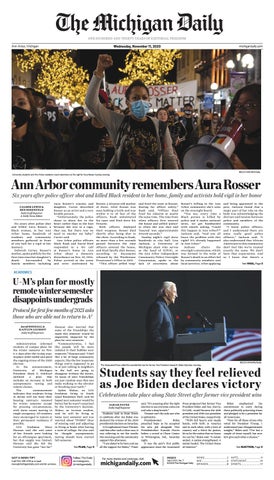
BECCA MAHON/Daily University students and Ann Arbor residents march downtown at the vigil for Aura Rosser Sunday evening.
Ann Arbor community remembers Aura Rosser
Six years after police officer shot and killed Black resident in her home, family and activists hold vigil in her honor CALDER LEWIS & BEN ROSENFELD Daily Staff Reporter & Daily News Editor
Six years after police shot and killed Aura Rosser, a Black woman, in her Ann Arbor home, hundreds of students and community members gathered in front of city hall for a vigil in her memory. Deborah Carter, Rosser’s mother, spoke publicly for the first time since her daughter’s death. Surrounded by family members including
Aura Rosser’s cousins and daughter, Carter described Rosser as an artist and a very lovable person. “Unfortunately, the police chose to shoot her in the heart rather than in the foot because she was in a rage, they say, but there was no need to murder my baby,” Carter said. Ann Arbor police officers Mark Raab and David Ried responded to a 911 call at Rosser’s home in Ann Arbor about a domestic disturbance on Nov. 10, 2014. Police arrived at the scene and were confronted by
Rosser, a 40-year-old mother of three. After Rosser was seen holding a knife and was within 6 to 10 feet of the officers, Raab unholstered his taser and Ried drew his firearm. Both officers deployed their weapons. Rosser died shortly after being shot in the chest. According to Raab, no more than a few seconds passed between the time officers entered the house, and Ried fatally shot Rosser, according to documents released by the Washtenaw Prosecutor’s Office in 2015. “This officer yelled ‘stop’
and fired the taser at Rosser, fearing for officer safety,” Raab said. “Officer Ried fired his sidearm at nearly the same time. The time from when officers first entered the house and yelled ‘police’ to when she was shot and Tasered was approximately 5-to-10 seconds.” Sunday night’s vigil drew hundreds to city hall. Lisa Jackson, a University of Michigan alum who serves as the head of ICPOC, or the Ann Arbor Independent Community Police Oversight Commission, spoke to the lack of awareness about
Rosser’s killing in the Ann Arbor community she’s seen on the oversight board. “You see, every time a Black person is killed by police and it makes national news, we get bombarded with emails asking, ‘Could this happen in Ann Arbor?’” Jackson said. “And you all know the problem with this right? It’s already happened in Ann Arbor.” Jackson chairs the oversight commission, which was formed in the wake of Rosser’s death in an effort led by community members and local activists. After applying
and being appointed to the post, Jackson found that a major part of her role on the body was acknowledging the distrust and tension between police and members of the community. “I know police officers, and I understand there are some really good police officers,” Jackson said. “I also understand that African Americans in this community don’t feel like we’re treated exactly the same. We don’t have that expectation. And so I know that there’s a See VIGIL, Page 3
ACADEMICS
U-M’s plan for mostly remote winter semester disappoints undergrads Protocol for first few months of 2021 asks those who are able not to return to A 2 Jared DOUGALL & KAITLYN LUCKOFF Daily Staff Reporters
Administration informed students of campus plans for the winter semester on Nov. 6 — days after the 14-day stayin-place order ended and amid the ongoing stress of the 2020 election. In the announcement, University of Michigan President Mark S. Schlissel outlined a plan that includes an increase in both asymptomatic testing and remote classes. The announcement indicates that students living in dorms will not have their housing contracts renewed for winter semester except for pressing circumstances, with dorm rooms moving to single occupancy. All students were encouraged to remain at their permanent residence if possible. LSA freshman Macy Hannan said she and some of her friends were looking for an off-campus apartment, but that supply was limited. Hannan said she felt the University has gone “too far.”
Hannan also worried that some of the friendships she made this semester would be negatively impacted by the plan for next semester. “Community-wise, I feel like people will be more isolated in their bubbles next semester,” Hannan said. “I feel like a lot of huge community aspects, like the few in-person things you’re supposed to go to or just talking to neighbors in the hall are going to disappear without the dorms. So many of your friendships are just random ones that you make walking to the elevator or brushing your teeth.” Ayden Makar, an LSA freshman living in South Quad Residence Hall, said he hoped next semester would be better, but he wasn’t surprised by the University’s decision. Makar, an in-state student, said he will be living at home next semester and was worried about “FOMO” (fear of missing out) and adjusting to living at home after having a taste of college. He also said he thought asymptomatic testing should have started fall semester.
GOT A NEWS TIP? Call 734-418-4115 or e-mail news@michigandaily.com and let us know.
See PLAN, Page 3
Follow The Daily on Instagram, @michigandaily
BECCA MAHON/Daily
Students say they feel relieved as Joe Biden declares victory The Associated Press called the presidential race for former Vice President Joseph R. Biden Saturday morning.
Celebrations take place along State Street after former vice president wins SARAH PAYNE
Daily Staff Reporter
Students took to State Street to celebrate after Joe Biden was declared the winner of the 2020 presidential election on Saturday. LSA sophomore Grace Timmer said that after such a close race, it was relieving to see the results this morning and the community support this afternoon. “I am elated to be here and see all the support for Biden,” Timer
said. “It’s amazing after the tight election to see everyone come out and take a deep breath.” Timmer isn’t the only one who is optimistic. President-elect Biden preached hope as he accepted his new job alongside Vice President-elect Kamala Harris before a crowd at Chase Center in Wilmington, Del., Saturday night. It was the pair’s first public appearance since the Associated
For more stories and coverage, visit
michigandaily.com
INDEX
Press projected that former Vice President Biden and Sen. Harris, D-Calif., would become the 46th president and 49th vice president of the United States, respectively. “With full hearts and steady hands, with faith in America and in each other, with a love of country and a thirst for justice, let us be the nation that we know we can be,” Biden said. “A nation united. A nation strengthened. A nation healed. The United States of America.”
Vol. CXXX, No. 7 ©2020 The Michigan Daily
Biden emphasized his commitment to unity during these politically polarizing times and pledged to be a president for all Americans. “Now for all those of you who voted for President Trump, I understand your disappointment tonight,” Biden said. “I’ve lost a couple of times myself, but now let’s give each other a chance.”
NEWS.........................2 MIC............................6 OPINION.....................8
See ELECTION, Page 3
ARTS .........................11 S TAT E M E N T. . . . . . . . . . . . . . . . 1 4 SPORTS . . . . . . . . . . . . . . . . . . . . . . .17
News
2 — Wednesday, November 11, 2020
The Michigan Daily — michigandaily.com
Stanford Lipsey Student Publications Building 420 Maynard St. Ann Arbor, MI 48109-1327 www.michigandaily.com
ELIZABETH LAWRENCE Editor in Chief esla@michigandaily.com
ANITA MICHAUD
Business Manager ammichau@michigandaily.com
NEWS TIPS
news@michigandaily.com
LETTERS TO THE EDITOR tothedaily@michigandaily.com
EDITORIAL PAGE
opinion@michigandaily.com
PHOTOGRAPHY SECTION
ARTS SECTION
photo@michigandaily.com
arts@michigandaily.com
NEWSROOM
SPORTS SECTION
734-418-4115 opt.3
sports@michigandaily.com
CORRECTIONS
ADVERTISING
corrections@michigandaily.com
MICHAEL BAGAZINSKI/Daily
U-M released its plans for the winter semester Friday.
What you need to know about U-M’s plan for winter semester Administration releases details of protocol for classes, operations in 2021 JASMIN LEE, DOMINIC COLETTI & CALDER LEWIS Daily Staff Reporters
On Friday, the University released plans for the Winter 2021 semester. Here’s what you need to know. What does this mean for housing? Undergraduate students currently living in the residence halls will have their housing contracts canceled. To live on-campus next year, they will have to apply for housing. The University has listed health concerns, financial and academic needs, international status, employment as Housing ResStaff and other extenuating circumstances as potential justifications for living in the dorms. The University will only house one student per room in residence halls. The specific process for reapplying will be shared with on-campus students. Graduate and professional students can continue living in their current housing because of low case numbers in their communities. Most undergraduates, including those living off-campus, are strongly encouraged to stay at their permanent residences and
access instruction remotely. Will there still be in-person classes? Yes, but only classes more effectively taught in person or essential to licensure will meet in person, continuing with the University’s guidance since the stay-in-place order. No instructor will be required to teach in person. There will be fewer hybrid classes because of feedback from instructors on the format’s difficulty. What will COVID-19 testing look like? Undergrads living in residence halls, attending in-person classes or activities, using U-M buildings, working or doing research on campus will undergo mandatory weekly testing. Other students, faculty and staff will have access to weekly asymptomatic testing. Residence halls will require students to test negative for COVID-19 before moving in or out. Overall, the University said there will be “major increases in asymptomatic testing for all members of the campus community.” How will public health policies be enforced? The University will take a stricter, no-tolerance approach to public health policy violations. Gatherings of three or more in residence
halls will result in automatic probation, and students who violate policies in quarantine or isolation housing will have their housing contract terminated. Off-campus students who violate COVID-19 restrictions will be referred to the Office of Student Conf lict Resolution and/or the Washtenaw County Health Department. Will there be a spring break? While Spring Break is still canceled for the Winter 2021 semester, the University will have two mid-week, one day “well-being breaks” on Feb. 24 and March 23 without any scheduled academic activities. Will the University buildings still be open? Yes, the libraries, Unions and recreational sports buildings will remain open in the winter semester, though hours will be modified. Lounge spaces in University Housing will be available through reservationonly. Will the dining halls offer dine-in services? No. Dining halls will continue to offer “grab-and-go” dining only. What mental health resources will be offered? Counseling and Psychological Services will expand their staff by eight new
counselors to combat long wait times. Wolverine Wellness and CAPS will continue to offer their services virtually. Student Life will also offer a wide range of virtual extracurricular programs and events related to health and well-being. Why did the University change course from the fall semester? University President Mark Schlissel wrote that the fall semester saw an “unacceptable level of COVID-19 cases among” undergraduate students that threatened to strain public health capacity. The top concerns moving forward are the cold and f lu season and colder weather that may move people to congregate indoors, as well as the surge of COVID19 cases across the state and country. While the stay-inplace order reduced student cases in Washtenaw County, they remain high overall with a weekly test positivity rate of around 4%. The University also cited community feedback including continued requests for more testing, public health guidance and lessons from the current semester. Daily Staff Reporters Jasmin Lee, Calder Lewis and Dominic Coletti can be reached at itsshlee@ umich.edu, calderll@umich.edu and dcoletti@umich.edu.
Washtenaw County sees record levels of voter turnout in election
Nearly 19,600 Ann Arbor residents out of over 42K registered voters cast a ballot
Editorial Staff ERIN WHITE Managing Editor
ekwhite@michigandaily.com
SAYALI AMIN and LEAH GRAHAM Managing News Editors
news@michigandaily.com
Senior News Editors: Barbara Collins, Claire Hao, Alex Harring, Ben Rosenfeld, Emma Stein, Liat Weinstein Investigative Editor: Zayna Syed Assistant News Editors: Iulia Dobrin, Julia Forrest, Jasmin Lee, Calder Lewis, Angelina Little, Hannah Mackay, Sarah Payne, Emma Ruberg, Julia Rubin, Jenna Siteman, Varsha Vedapudi, Kristina Zheng
EMILY CONSIDINE and BRITTANY BOWMAN Editorial Page Editors
tothedaily@michigandaily.com
Senior Opinion Editors: Elizabeth Cook, Zack Blumberg, Krystal Hur, Min Soo Kim, Joel Weiner
THEO MACKIE and ETHAN SEARS Managing Sports Editors
sportseditors@michigandaily.com
Senior Sports Editors: Daniel Dash, Lily Friedman, Connor Brennan, Brendan Roose, Kent Schwartz, Lane Kizziah, Rian Ratnavale Assistant Sports Editors: Jared Greenspan, Nick Stoll, Drew Cox, Aidan Woutas, Abby Snyder, Jack Kingsley
JOHN DECKER and JULIANNA MORANO Managing Arts Editors
arts@michigandaily.com
Senior Arts Editors: Jo Chang, Elise Godfryd, Zoe Phillips, Jonah Mendelson, Ally Owens Arts Beat Editors: Samantha Cantie, Dana Pierangeli, Andrew Pluta, Cassandra Mansuetti, Anish Tamhaney, Sophia Yoon
CHRISTINE JEGARL and LIZZY RUEPPEL
Managing Design Editors design@michigandaily.com Senior Design Editor: Hibah Mirza
ALLISON ENGKVIST and ANNIE KLUSENDORF Managing Photo Editors
photo@michigandaily.com
Senior Photo Editors: Madeline Hinkley, Asha Lewis, Miles Macklin Assistant Photo Editors: Julia Schachinger, Ryan Little, Emma Mati, Sophia Afendoulis, Becca Mahon
MAGDALENA MIHAYLOVA
Managing Statement Editor statement@michigandaily.com Deputy Editors: Andie Horowitz, Marisa Wright
MADISON GAGNE and SADIA JIBAN
Managing Copy Editors copydesk@michigandaily.com Senior Copy Editors: Olivia Bradish, Sophie Kephart, Silas Lee, Olivia Sedlacek, Ellie Scott
PARTH DHYANI and SIMRAN PUJJI
Managing Online Editors webteam@michigandaily.com Senior Web Developers: Abha Panda, Rohan Prashant, Jonathan Liu
ALEC COHEN and ELI SIDER
Managing Video Editors Senior Video Editor: Iulia Dobrin
JULIA FORREST & VARSHA VEDAPUDI Daily Staff Reporters
Washtenaw County reported record levels of voter turnout this election, according to the Washtenaw County elections site. Nearly 19,600 Ann Arbor residents out of the more than 42,000 registered voters across the city cast a ballot in the election, a voter turnout rate of nearly 50%. Students also turned out at a rate of around 15% in Ann Arbor, with 7,368 expected student ballots cast. The Michigan Daily obtained voting rate predictions from Neighbors for Democracy, an organization aimed at increasing voter turnout in Ann Arbor for the 2020 election. Final results demonstrated that turnout outperformed the organization’s original predictions by 16% for registrations and 10% for votes cast. Neighbors for Democracy predicted that
7,368 students would cast ballots, with numbers from the University of Michigan Museum of Art satellite polling station. Ann Arbor City Clerk Jacqueline Beaudry said there were 5,412 registrations and 8,501 ballots turned in at the
Daily survey of nearly 1,900 students from last month, out of the 1,845 University students registered to vote, only 33.3% were registered in the city of Ann Arbor. Overall, nearly 20,000 ballots were cast from all five wards. As of now, it is estimated that about
“It was really exciting to see young people not only stepping up and voting but also stepping up to make phone calls, send texts and volunteer to get out the vote.”
University of Michigan Museum of Art, a satellite polling station that opened in late September. According to a Michigan
WMG-contact@umich.edu
7,368 University students cast their ballots in Ann Arbor for the 2020 general election. In 2016, about 16,740
students voted in the general election out of about 25,557 who were registered. Grace Hermann, president of the University’s chapter of College Democrats, wrote in a statement to The Daily that students recognized the importance of their vote in this election and that efforts by student organizations helped increase voter turnout. “In general, I think a lot of students on campus understood how much their vote meant this year, especially in a state as critical as Michigan, so it was really exciting to see young people not only stepping up and voting but also stepping up to make phone calls, send texts and volunteer to get out the vote,” Hermann said. K.P. Unnikrishnan is a volunteer at Neighbors for Democracy, an organization that aimed to increase voter turnout in Ann Arbor for the 2020 election. See TURNOUT, Page 3
video@michigandaily.com
MAYA MOKH and ANA MARIA SANCHEZ CASTILLO Michigan in Color Editors
michiganincolor@michigandaily.com
Senior Michigan in Color Editors: Zoha Bharwani, Lora Faraj, Ayomide Okunade, Gabrijela Skoko
SAMANTHA SMALL and SONYA VOGEL Managing Podcast Editors
JOHN GRIEVE and BEN KORN Managing Social Media Editors
Senior Social Media Editors: Kristina Zheng, Ria Dubey, Ryan Postman, Haley Johnson, Atticus Raasch, Asha Lewis
Business Staff MOLLY WU
Creative Director
RYAN KELLY Sales Manager
The Michigan Daily (ISSN 0745-967) is publishing weekly on Wednesdays for the Fall 2020 semester by students at the University of Michigan. One copy is available free of charge to all readers. Additional copies may be picked up at the Daily’s office for $2. If you would like a current copy of the paper mailed to you, please visit store. pub.umich.edu/michigan-daily-buy-this-edition to place your order.
The Michigan Daily — michigandaily.com
VIGIL From Page 1 place somewhere for us to do better.” Dwight Wilson, a community member who served an integral role in advocating for police reform after Rosser’s death, traveled around the country observing other cities’ methods of police reform and oversight to bring back to Ann Arbor. Ultimately, efforts by community members culminated in the formation of ICPOC. “I have no idea how many officers cross the line, but relatives and friends who are law enforcement officers are clear that they know of no force, including their own, where 100% of the officers walk the straight line. Their reputations are protected when the disreputable are held accountable. As for the victims of killings, brutality and disrespect, police oversight is our best hope,” Wilson wrote in a statement to The Michigan Daily in November of 2019. In a memo released two months after Rosser’s killing in January 2015, Washtenaw County Prosecutor Brian
TURNOUT From Page 2 Unnikrishnan said he became interested in this work when he found out that President Donald Trump won in Michigan by about 10,000 votes, the same number of people who did not vote in his own neighborhood of Ward 1 in Ann Arbor. “I needed to do something to increase voter turnout,” Unnikrishnan said. “We
ELECTION From Page 1 While several states are still counting ballots, political analysts have said it is “mathematically, nearly impossible” for Biden’s trajectory in key states to change. Harris thanked enthusiastic supporters for their hard work leading into election day. “Thank you for turning out in record numbers to make your voices heard,” Harris said. “For four years you marched and organized for equality, justice, for our lives
PLAN From Page 1
Mackie labeled the incident as justifiable homicide, citing a section of the Michigan Criminal Code stating that if a person’s belief that deadly force was necessary was genuine at the time, it does not matter if they were later proven to be wrong about the level of danger they were facing. Rosser’s killing prompted a series of protests in Ann Arbor. At one of the gatherings Rosser’s sister, Shae Ward, spoke about her sister’s death. “My hope is that I can get strong enough to speak for her,” Ward said at a January 2015 protest. “Because I know her person. She would have never attacked Officer Ried. She would have never made him feel that he would have to take her life to defuse the situation. That is just outlandish. It totally is outlandish.” In the years since, University students and Ann Arbor community members have continued to honor Rosser’s memory, holding vigils on the anniversaries of her death. Members of the Black community in Ann Arbor have cited several incidents of over-policing and misuse of force before and since
Rosser’s death, including increased police presence at multicultural fraternity tailgates and alleged racial discrimination at local bars. In the fall of 2017, the violent arrest of 16-year-old Ciaeem Slaton at the Blake Transit Center sparked a protest of more than 100 Ann Arbor residents outside of city hall a week later. Ann Arbor resident Shirley
Beckley, who at 78-years-old has lived through decades of protest movements in Ann Arbor and was in attendance at the vigil, said the city hasn’t progressed as much as it thinks it has in terms of racial justice. “I think all of you need to understand Ann Arbor
wanted to take on voters that were unlikely to vote in 2020 and pursue them till the end, until they had cast their ballot, either absentee or otherwise.” Though the organization’s initial goal was to achieve a 75% voter turnout, the student voter turnout in 2020 was about 50%, as seen on a giant thermometer posted in front of the UMMA counting the percentage of the votingeligible student body that had voted.
isn’t what it pretends to be,” Beckley said. “And we need everybody’s help to bring that forth, to make this the place that it ought to be — that they say it is.” Beckley said it is difficult to rebuild trust between local authorities and the community when Rosser isn’t recognized as much as she should be. “You know, I don’t know
Wednesday, November 11, 2020 — 3
how they think we’re gonna bridge the gap between the community and the police when you won’t even recognize Aura Rosser’s name,” Beckley said. “How are we gonna mend and heal when you don’t even recognize the woman that you killed, who is the mother
of three children? How are we going to bridge that gap?” After community members spoke and led several rounds of “Say her name!” “Aura Rosser!” chants, the crowd lit handheld candles and observed six minutes of silence: one for each year since Rosser’s death. During those six minutes, as the sky overhead darkened, Ann Arbor resident Julius Theophilus II said his mind was set on justice. “I was thinking of ways that the family and the people that this continuously happens to — what justice looks like to them, what it looks like to me, what it looks like to the country, what it looks like for Black people collectively,” Theophilus said. “And if it’s even possible.” After the silence, the crowd moved swiftly through downtown Ann Arbor, marching down Main Street and Liberty Street. Along the way, several outdoor diners showed support with raised fists and cheers. LSA junior Rose Sproat said the visibility of the event was important for those in downtown Ann Arbor at the time. “It’s really important that we’re showing them what
we want and that they can participate too,” Sproat said. When the marchers stopped at the corner of Liberty and State Street, several danced in a circle to accompany chants, trumpets and trombones. “Black joy is also a form of protest,” one person said. Next, the crowd stopped in the shadow of the Burton Memorial Tower to hear a carillon piece, “Enough is Enough: Never Again Sketches,” played by Music, Theatre & Dance professor Tiffany Ng. The piece, coming from the bell tower, used a musical alphabet code to spell out the names of victims of police violence. Rosser’s name was played in measures 91 and 92, toward the end of the piece. After ref lecting, Theophilus explained what justice looks like to him. “The people that have suffered the most, they are in a position of power,” Theophilus said. “That’s what justice looks like to me.” Daily Staff Reporter Calder Lewis and Daily News Editor Ben Rosenfeld can be reached at calderll@umich.edu and bbrosenf@umich.edu.
Unnikrishnan said the turnout started at about 32% at the start of early voting and increased as Nov. 3 approached. He said he wishes the University’s administration offered more clarity on how students could vote. “We put enormous pressure through Faculty Senate and even talked to the Board of Regents,” Unnikrishnan said. “President Schlissel sent an email to all students, and the email was two pages long.
Nobody reads two-page-long emails. It could have just read: ‘Students, you just need your MCard, go to UMMA, change your registration and vote on the spot.’” Nick Schuler, LSA sophomore and spokesperson for the University’s chapter of College Republicans, wrote in a statement that he was happy with the organization’s efforts to get out the vote. “We saw work on both sides of the aisle to turn
out the vote and I’m glad it worked,” Schuler said. “Voting is a God-given right in the United States and we should use that. Voting is more important than for who. We look forward to the 2022 midterms and continuing our efforts to elect Republicans all across the state.” Andrew Schaeff ler, co-founder of the student organization Students for Biden, said the group was excited that so many students used the UMMA to vote.
“We are super happy to see the large amount of turnout among students, even as some of these numbers might lag behind what turnout was expected,” Schaeff ler said. “(We) hope that the University sees this as a building block for making voting more accessible, and continues to utilize this..” Daily Staff Reporters Julia Forrest and Varsha Vedapudi can be reached at juforres@ umich.edu and varshakv@ umich.edu.
and for our planet; and then you voted.” Harris acknowledged her historic ascent as the first woman to be elected to the vice presidency. “While I may be the first woman in this office, I will not be the last, because every little girl watching tonight sees that this is a country of possibilities,” Harris said. Harris said the election was a decisive mandate of support for their campaign. “You delivered a clear message,” Harris said. “You choose hope, unity, decency, science and yes, truth. You choose Joe Biden as the next president of the United States
of America.” Biden broke the record, set in 2008 by former President Barack Obama, for the most votes for a presidential candidate with more than 75 million cast. As of Saturday, Americans are still waiting for final tallies from swing states like North Carolina and Georgia since Tuesday evening when polls closed across the country. President Donald Trump issued a statement shortly after the Associated Press called the race, refusing to concede, pointing to lawsuits his campaign has filed in battleground states.
“We all know why Joe Biden is rushing to falsely pose as the winner, and why his media allies are trying so hard to help him: they don’t want the truth to be exposed,” the statement reads. “The simple fact is this election is far from over … Legal votes decide who is president, not the news media.” The Trump campaign’s lawsuit before the Michigan Court of Claims was dismissed as it is “unlikely to succeed on the merits” and the campaign’s request for immediate relief were denied. Despite Trump’s baseless claims of fraud and insistence
that the election still has not been decided, the former vice president urged the nation to come together in his address Saturday. “This is the time to heal in America,” Biden said. “Now that the campaign is over — what is the people’s will? What is our mandate? I believe it is this: Americans have called on us to marshal the forces of decency and the forces of fairness. To marshal the forces of science and the forces of hope in the great battles of our time.” In Ann Arbor, students shared Harris and Biden’s excitement about the results of the race.
Music, Theatre & Dance sophomore Brock Boze celebrated on State Street this morning and said it was exciting to see everyone come together in a safe way. “I’ve been getting about three hours of sleep all week waiting for all this to come in,” Boze said. “... It’s been a really cool experience, everyone is socially distanced and masked up and I am loving the enthusiasm.” Daily Staff Reporter Alec Cohen contributed reporting. Daily Staff Reporter Sarah Payne can be reached at paynesm@umich.edu.
were not up to par with other universities.” Jennifer Rayman, class of 1994 and a mother of a freshman living in a dorm this semester, said she felt “betrayed” and “blindsided” by the University. She also expressed concerns as an alum that the University isn’t doing enough to support undergraduates during the COVID-19 pandemic. As of Monday afternoon, more than 800 parents of University students have signed an open letter criticizing the University’s handling of fall semester and its plans for winter semester. “As an alum myself I cannot believe these are the actions of the place I used to call home,” Rayman said. “The experience my child is having seems to not be a fraction of the one I have had and (the University has) perpetuated this situation... (The dining experience) has been despicable. Mental health? (The University) has done literally nothing for the isolated students.” Soneida Rodriguez, a resident adviser and LSA senior, said she’s been experiencing anxiety after her family lost their home during the height of the COVID-19 pandemic, and keeping her job as an RA was “high stakes” for her. Rodriguez also said she felt the precautions for
next semester are “in the right direction” and should have been implemented earlier, but also maintained the importance of having on-campus housing options. She said students should have a “seat at the table” when decisions are being made. “I think if nothing else, this pandemic has revealed the importance of having student voices heard, giving students a seat at the table, especially student staff members.” Rodriguez said. “Because at the end of the day, all of these decisions, and the lack of response could have been prevented if students had a seat at the table. Students could have helped the University respond in real time to the issues that we were seeing like a lack of testing and enforcement of social distancing and other safety measures.” In an interview with The Daily Monday, University of Michigan President Mark Schlissel said he does not regret choosing to make classes in-person for the fall semester. “I think that we deserved as a community a chance to try our very best to have a good mix of remote, in-person and hybrid classes, and to have as many people as possible remain healthy and make it through the end of the
semester,” Schlissel said. “Most people were successful at doing this and some groups were less successful at doing this. So I don’t regret trying. The world keeps changing in the setting of the pandemic, it’s novel. We’ve never been through this before as a university. Although the basic principles are clear about how to prevent transmission, we didn’t know until we tried to figure out how our community would respond, how much compliance we would get, where the weak points turned out to be.” Overall, the announcement brings drastic changes for many students living on campus. Engineering freshman Ashwin Saxena said he now has to pack up his dorms in the middle of midterms. “The announcement about the winter semester really throws off everything,” Saxena said. “I think the University’s decision to bring us back this semester was not well thought out and the twoweek lockdown was necessary. Personally, I would be sad that I won’t be able to come back, but I realize this decision is important for the health of the community.” Daily Staff Reporters Jared Dougall and Kaitlyn Luckoff can be reached at jdougall@umich. edu and kluckoff@umich.edu.
“I think all of you need to understand Ann Arbor isn’t what it pretends to be. And we need everybody’s help to bring that forth, to make this the place that it ought to be — that they say it is.”
From Better Health to Improved Lethality: Controlling Crystallization of Pharmaceuticals and Explosives
ADAM MATZGER
Charles G. Overberger Collegiate Professor of Chemistry
Online Event: Thursday, November 12, 2020 | 4:30 p.m.
“I was really confused as to why we’re just now implementing asymptomatic testing for next semester,” Makar said. “I have friends at other schools like Ohio State, another big public university, where they get tested weekly, and it’s mandatory. I was curious as to know why we didn’t implement that beforehand.” Alison Roberson, another LSA freshman and South Quad resident, said she was “shocked” by the plan for next semester. Roberson stated she returned home a month into the fall semester, but intended to come back next semester. Roberson said she was disappointed by the decision but that she felt it was the right decision, even though she felt “kind of just sad.” “Even though we’re all disappointed, I think that it is the right decision.” Roberson said. “But I do think that they had to make that decision impulsively because of a lack of safety that they took in the first semester. First semester, I thought the way U of M was handling COVID was kind of bizarre because we were told that they were going to take safety precautions and they
News
LSA COLLEGIATE LECTURE An online lecture. For more information, visit events.umich.edu/event/75455, or call 734.615.6667.
News
4 — Wednesday, November 11, 2020
The Michigan Daily — michigandaily.com
International students talk virtual challenges Remote learning brings time zone difficulties, altered social scene SHANNON STOCKING For The Daily
This semester looks different: masks are required, most classes are virtual, social gatherings are limited and exploring the streets of Ann Arbor is regulated by laws and limitations. But for some, being a University of Michigan student this semester means sitting at their computer dressed in maize and blue, and trying to stay awake during a lecture while 12 hours ahead of Ann Arbor’s Eastern Standard Time. The University allowed students to return to campus this fall with limited in-person classes, but for many international students, traveling became more difficult during the ongoing COVID-19 pandemic and the restrictions that differ from country to country. Time zone differences put international students on new schedules For LSA sophomore Rachna Iyer, who is currently living in Mumbai, India, the biggest adjustment has been managing the time difference. Iyer is on Indian Standard Time, which is 10-and-a-half hours ahead of Ann Arbor. “One of the biggest differences is having a different structure in my day,” Iyer said. “If someone’s in the same time zone, it’s easier to have a more normal structure of the day or like you wake up, you go to classes, you have lunch, you do homework and then you see friends. But for people living in a different time zone.” Iyer completes most of her school work during the late hours of the night in Mumbai. Students can complete homework and asynchronous classes during the day, but some class functions
require synchronous activities. “My new thing is that I need to wake up before the sun sets here,” Iyer said. “I can at least pretend to maintain a little bit of sanity. If I wake up, and it’s dark outside, I would lose my mind.” The time differences have been an issue across the board for international students at the University, according to International Center Director Judith Pennywell. Pennywell said the use of asynchronous class, a strategy that allows instructors to publish work and students to complete it at their own pace throughout the day, has allowed students more flexibility than if they had every class at a scheduled time. “While many instructors have changed from a synchronous to asynchronous style or rescheduled their classes to times of day to better accommodate international students, others have not,” Pennywell said. “It requires some international students to be available for synchronous classes very early in the morning or late at night, at times when they might normally be asleep.” Though asynchronous classes allow more leeway in mitigating time differences, international students said there are still other problems that going asynchronous doesn’t automatically fix. Engineering junior Jingxuan Wu is learning from China, 12 hours ahead of EST. Wu said the issue can extend beyond class time into things like scheduled exam times. Wu has taken midterms that started anywhere from 2 a.m. to 4 a.m. “For the exam time, there’s no time alternatives, so you can’t change anything, you just need
to go,” Wu said. “Midterms are usually scheduled during class times, or after class. What seems like an ideal time for a midterm for Ann Arbor students, is quite different for international students.” LSA freshman Shiryn Anissa Noor Affendi said taking a class asynchronously as an international student can also create barriers in trying to get help. Affendi said she often has to rely on email to communicate with her instructors. “My asynchronous classes are definitely more challenging just because I’m mostly teaching myself the material,” Affendi said. “I can only get help via email, so each problem I face really boils down to, ‘Can I answer this myself, or am I willing to wait two business days for them to reply?’” LSA senior Jing Dong, who is taking classes from China, said Graduate Student Instructors will typically have delayed responses to questions because her usual work time is the middle of the night in Ann Arbor. However, despite this inconvenience, Dong said there aren’t many other notable differences in learning this year. “Because I’m a computer science major, personally, I don’t think taking classes online would be any different from taking classes offline because even if I’m in person, I would probably watch lecture recordings, but I guess that’s pretty specific to my major,” Dong said. Taking classes at night allows international students to use their time during the day to prioritize what’s important to
! m a F r in you
FOR EVERY FAN
New format of learning brings challenges in time management
The holidays are serious business. Mom, Dad, Grandma, Grandpa, Sis, Bro – there are some legends on your gift-giving list this year. So before the semester ends, come to The M Den. We’ll help you check off your most essential holiday gifts. When you shop at The M Den a portion of every purchase you make goes to supporting the University of Michigan’s athletic programs, including our athletes and coaches. Visit your local storefront or shop online anytime at MDen.com.
The M Den on Campus 303 South State Street
Ann Arbor
The Victors Collection by The M Den 307 South State Street
Ann Arbor
The M Den on Main Street
Ann Arbor
The M Den 12 Oaks Mall
Novi
The M Den in and around the Stadium on game day
The M Den The Victors Collection by The M Den Briarwood Mall
The M Den
The M Den The Victors Collection by The M Den 55 Columbia Street
in Crisler Center – 2 locations
The Official Merchandise Retailer of Michigan Athletics
Ann Arbor
Detroit
DESIGN BY MICHELLE FAN
them, according to Dong. She said having the new schedule has allowed her to take on new roles such as a research assistantship because of the flexibility. Affendi uses the time she has during her day to spend time with family and friends. Being off-campus changes learning, social experience In addition to the time difference, there are a variety of global, social and environmental elements that have altered students’ learning environments. For Iyer, one is the heat in India that makes it hard to focus. “Giving a timed exam is harder, virtually you just don’t really know what circumstances someone’s in,” Iyer said. “It’s really hot in India, for example, and to be giving an exam at this time, it’s just really hot, which makes it harder to focus.” Academics is only part of the experience of being a college student — and international students said they missed the experience of being in Ann Arbor. Besides not being on campus, the virtual events hosted by clubs and organizations often don’t accommodate international students’ time zone differences.
Wu said it is particularly difficult to work with libraries and shared spaces. “The main thing I miss about campus is libraries and in-person office hours,” Wu said. “I think it’s more convenient and it’s also harder to connect with classmates and friends when you’re abroad in another country.” Outside of school, Affendi, who lives in Malaysia and is 13 hours ahead of Ann Arbor, said it has become nearly impossible to make friends. She feels like she would have to sacrifice getting sleep to be able to attend extracurricular meetings. “I’ve always loved school for the friends I gain in and outside of class,” Affendi said. “It’s hard to approach a stranger when everyone is virtually in their own bubble. I really miss the support system of friends in my classes and lately it just feels like it’s every man for themselves, which makes me feel really lonely.” Iyer hasn’t been able to see any of her friends in person since classes ended last March. Dong said she has not been able to participate in many sorority events because they are
not virtual. She said she feels especially sad for freshmen, who have never had time on campus to make connections. “If you’re not on campus, social life is hard,” Dong said. “I would imagine there’s a big hole in the experience for freshmen, and I feel sorry for them.” The University has put on many virtual events and lecture discussions in order to create community, but international students are still finding these difficult to participate in, Iyer said. Pennywell said the International Center is working to create a virtual community that accommodates international students and their time zone differences. “We have made an effort to record certain University programs, such as the IC and Ginsberg Center’s Understanding the U.S. Presidential Election,” Pennywell said. “There are many wonderful UMS Digital presentations, so students overseas can enjoy them at their leisure.” Daily News Contributor Shannon Stocking can be reached at sstockin@umich.edu
Schlissel discusses winter semester, recent election U-M President says ‘I don’t regret trying’ regarding fall plan EMMA STEIN, JASMIN LEE & CALDER LEWIS Daily News Editor & Daily Staff Reporters
The Michigan Daily Administration Beat sat down with University of Michigan President Mark Schlissel to discuss the plan for the winter semester, why the University changed its approach on testing and enforcement policies, regulating Fraternity & Sorority Life and the impact of the election on campus. This interview has been edited and condensed for clarity. TMD: In the announcement about winter semester plans, you said the University had an “unacceptable level” of COVID19 cases. In your opinion, how did that happen? MS: Well, I would say the vast majority of students have been following, as strictly as they can, the guidance we put out about masks and distancing and small groups and hand washing. But when we investigate the cases, we find that people let their guard down and the cases are being transmitted in social circumstances where too many people are getting together, they’re not wearing their masks and they’re causing clusters of infection. And when that happens at a high enough rate of many, many new cases a day, it runs the risk of exceeding our capacity to do case investigations and to quickly isolate people who are infected and to track down their contacts to keep it from spreading even further. And that’s actually what resulted in the public health order that we cooperated with on the campus as a whole, first on Mary Markley Residence Hall, but then more broadly on the undergraduate students. TMD: So do you regret opening the dorms and everything for the semester, given the “unacceptable level?”
MS: I think that we deserved, as a community, a chance to try our very best to have a good mix of remote, in-person and hybrid classes, and to have as many people as possible remain healthy and make it through the end of the semester. So I don’t regret trying. We’ve never been through this before as a university. Although the basic principles are clear about how to prevent transmission, we didn’t know until we tried to figure out how our community would respond, how much compliance we would get, where the weak points turned out to be. I also think people are suffering a little bit from (what) someone termed COVID fatigue, the sign of relentlessness of having to always have your mask on and always being in small groups and always washing your hands. It just wears on people, so I think it’s gotten tougher as the semester’s gone along, and all of those things have led, I think, to more cases. TMD: Many colleges pursued a strategy similar to U-M’s 2021 winter semester in the fall, and many elements of the new plan for winter semester, like the right to work remotely and more testing, are things the Graduate Employees’ Organization asked for during their strike in September. Why didn’t you agree to these provisions then? MS: Back in September, we started out the school year with 80% of our classes remote, and the rest were either hybrid or in person. As the semester’s gone on, we’ve become more remote and less in person. We worked with the GEOs and basically got to the stage where any graduate instructor that didn’t feel comfortable working in person, we were able to accommodate. And the good news is there have been few, if any, infections amongst our graduate students. It’s largely undergrads, and it’s largely
freshmen and sophomore undergrads, which is where most of the transmission has been. In terms of testing, we’ve ramped up our capacity through the semester. We’re at the highest point now we’ve been. In hindsight, you know, there are some schools that made a big early investment in testing. They’ve had some good success and some less good success … So testing is one component that’s important to place a lid on the number of cases and to prevent their spread. But if you don’t wear masks, stay in small groups, keep distance from others, you can test all you want, and there’ll still be lots of disease. You know, back in the very beginning of the semester, there was an option to purchase large amounts of testing from commercial companies. But at the time, the turnaround time on those tests was between three days and seven days. If it takes you that long to get a result, the testing doesn’t prevent the spread of disease because all the people who have the disease didn’t find out about it for almost a week So commercial testing in the early days of the semester would not have helped us, but through the semester, working with a local startup, we’ve made the investments that have ramped up the level of testing, and we’re now at a capacity around 9,000 or 10,000 tests a week. And by the time the new semester begins, we’ll be up to 12,000 to 15,000, and if we need to, we can go further than that. So we’ve built the capacity. TMD: Can you explain more about how mandatory weekly testing will be administered and enforced for those who live off campus but use on-campus facilities next semester?
Read more at MichiganDaily.com
Multimedia
The Michigan Daily — michigandaily.com
Wednesday, November 11, 2020 — 5
An intimate look at the 2020 Presidential Election THE PHOTO STAFF For The Daily
MADELINE HINKLEY/Daily
Annie Klusendorf - Managing Photo Editor In early February, I found myself in a high school gym in Cedar Rapids, Iowa, watching an energetic Elizabeth Warren bop around the stage in her textbook blue cardigan and black pants. She spoke of her days as a teacher, her husband Bruce and her dog Bailey, as well as her plans for the country. The crowd, made up of mostly women and young girls, sat tightly packed together, every eye focused on the Senator. I was in Iowa for 48 hours weeks before the Democratic caucuses — and before the pandemic began. At the time, the crowd’s worry was focused on the caucus less than two days away, not their job security, healthcare, the Supreme Court or social distancing guidelines. We went to three campaign rallies that
JARETT ORR/Daily
have faced a series of unexpected events this fall, adding to the chaotic election season. Supreme Court Justice Ruth Bader Ginsburg died Sept. 18, allowing President Trump to both nominate and confirm three Justices over the course of his term, a legacy that will outlast his presidency for decades to come. On Oct. 2 the president, his wife, his son, his press secretary, his campaign manager, the chair of the Republican National Committee, White House housekeeping and military staff, members of the vice president’s staff, Stephen Miller, Kellyanne Conway, and Hope Hicks all contracted coronavirus. Even though COVID19 cases are at an all-time high and on the rise, CDC guidelines for socially distanced crowds and mask-wearing are not being followed. The chaos on the season further ensued locally on Oct. 7 when a domestic terrorist group ALLISON ENGKVIST/Daily Ann Arbor’s famous violin-playing wolf howls and plays music for students waiting to vote outside of the UMMA Tuesday afternoon.
trying — albeit unsuccessfully — to get people to wear masks. Nevertheless, some may think that the photographs I took at the rally were taken a year ago given the large crowds, lack of social distancing and minimal mask wearing. A prayer kicked off a series of speakers intended to hype up the crowd. Celine Dion’s greatest hits, a selection of Broadway classics and CeeLo Green’s “Crazy” seemed to keep the crowd in good spirits. Trump danced to the Village People’s hit “YMCA” which I thought was an exaggeration made by the members of Saturday Night Live on a recent Weekend Update bit. They were not joking.
Students for Biden share their support on campus Tuesday afternoon weekend — Elizabeth Warren, Bernie Sanders and Joe Biden — and stopped at a myriad of other events. I drove back to Michigan hopeful, after watching Warren kneel down to pinky promise a little girl, talking with a family who brought their newborn to see Bernie speak and listening to John Kerry stump for Biden. Iowans are proud of their place in politics — being “first in the nation” isn’t something they take lightly. I left the weekend exhausted, but I also remember feeling confident that our democracy was alive and well. Allison Engkvist - Managing Photo Editor Flash forward a month from the Iowa caucus: Senator Warren has dropped from the race and Senator Bernie Sanders takes a trip to Ann Arbor.
expressing their support for Trump’s message in other ways. They are Americans, just like us. I don’t think that the majority of the people at the rally are bad people. Yes, they may have adopted some negative beliefs propagated by social media and the Trump presidency, but they are humans. Things aren’t going to change overnight. Becca Mahon - Assistant Photo Editor Attending rallies for both Joe Biden and Donald Trump within a 24 hour period made the differences in the two candidates plainly clear. To me, the starkest contrast was in the
GABBY CERITANO/Daily
plotted to kidnap Gov. Gretchen Whitmer. Perhaps the eeriest feeling of all was watching the Oct. 15 presidential debate that was originally planned to take place here, right on campus. Uncertainty has triumphed. As we barrel into an election that is preemptively contested based on false claims of voter fraud, the United States could find itself in the midst of a national meltdown, regardless of the candidate you support. Our democracy as we know could slip into utter chaos, or perhaps not and everything will be fine. That is the reality of 2020. Emma Mati - Assistant Photo Editor On Tuesday, Oct. 27, on assignment for The Daily, I attended one of President Donald
ANNIE KLUSENDORF/Daily A band plays for students waiting in line to vote at the UMMA on Election Day. Not a naturally gifted orator compared to his predecessor, it was clear when Trump would abandon the teleprompter to rally the crowd. He dropped an F-bomb. At one point, Trump berated his son-in-law Jared Kushner, calling him “Mr. Inside” because he didn’t want to stand in the freezing cold rain listening to his father-in-law’s speech. It seemed that Trump supporters didn’t come to the rally to hear his plans to end the COVID-19 pandemic or revive our nation’s economy, but rather to see a show, the Trump show. But politics aside, Trump’s rallies are going to go down in history. Trump is a populist president and the way in which he rallies his supporters is indicative of that. And whether Trump wins or loses the election, it is important to keep in mind that his supporters aren’t going anywhere. I saw many families with young children donning MAGA hats and plenty of people my age
VOTE! It’s the week of the Democratic presidential primary election, or informally known as the week our world went straight to hell. Students begin to express concern over a pending pandemic, but life still feels normal. We gather on the Diag, cheering for Bernie, not a mask in site. We wait in line outside of our polling location without standing six-feet apart. We sit around the TV with friends waiting for the primary results, exceeding the ten person limit. We go to class. We hug our friends. Then suddenly, we’re packing our bags and heading home. Well, we all know how the rest of the story goes. But here we are, back on campus for one of the most important elections of our lives thus far. Everything looks different this year. It’s the distanced lines. The face masks. The posters, begging people to vote. The hope. While everything may look different, the meaning of election day holds true: using our voice to help guide our country’s future. This is Election Day 2020 through the eyes (and lenses) of the Michigan Daily photo staff. Maddie Fox - Staff Photographer 2020 is truly an unreal reality. The world has never felt more uncertain, eerie and bleak. We
interactions between the candidates and their respective supporters. Biden’s Detroit event was attended by a couple hundred people, who were encouraged to stay in their cars and honk in lieu of applause. The next day at a rally in Macomb, Trump spoke to a crowd of a few thousand people packed tightly around the stage. When he pointed out the media area behind them, referencing what he called the “fake news”, the crowd turned and chanted “CNN lies!” at the press, while Trump watched silently from the stage. Being on the receiving end of this was unsettling to say the least. Visually, this year’s election day certainly looks different. However, the importance of voting and being present during trying times is something that drove this election and will continue to drive every election to come.
LUKE HALES/Daily Trump’s final campaign events in Lansing, Mich. My expectations for the rally were largely formulated by late-night shows mocking events like this one and clips of the President’s most notable — and most outrageous — moments that appeared on my social media feed. In the final few days of the campaign, I wanted to see a Trump rally for myself. The rally, unique in its own right, was much like a concert of a musician mostly adored by my parents’ generation. Devoted fans waiting in a seemingly never-ending line for hours just to see their idol from afar. Unattractive merchandise being sold outside the venue, indicating that you were there. When I arrived at the rally at 6:30 a.m., Trump supporters had been camping outside the venue for hours. It was cold and raining. You could find just about any piece of MAGA merchandise available. I realized that Make America Great Again is not just a rally cry, but a manipulating marketing technique as well. Shirts that read “Jesus is my savior, Trump is my president” and “Talking to you reminds me to clean my gun” seemed to ref lect Christian evangelicalism and free speech that had been made “great again” by Donald Trump. Inside the rally, few in the crowd were wearing masks, although it is important to note that volunteers were taking temperatures and
Your Neighborhood Theater!
Shows after 6pm
Shows b/w noon - 6pm
Shows before noon Ticket includes a FREE 46 oz. Popcorn!
5 $ 99 4 $ 99 3 $ 99
Safety Plan in Place #CinemaSafe
10% OFF
Bring this coupon to Quality 16 to receive 10% off your entire concession order. Offer valid one transaction per person. Not valid with any other offers. Valid only for concession items at GQT Quality 16. Expires 12-23-2020.
Michigan in Color
6 — Wednesday, November 11, 2020
The Michigan Daily — michigandaily.com
The authenticity of corporate activism MARIA PATTON MiC Columnist
The murders of George Floyd, Ahmaud Arbery, Breonna Taylor and numerous other innocent Black people this year sparked a revolution yearning for change Black people have needed for many years. With worldwide daily protests and heavy social media conversations about race, it feels like the world is finally waking up to the injustices Black people have faced for centuries in America. But how much reform can there really be in systemic racism if the systems that encourage this oppression fail to change? Individuals are constantly being told to fix the racial biases present in this country when most of the blame should be shifted towards corporate performative activism. It is easy for brands to say that they want to see change and are in solidarity with those who are suffering from the systemic challenges of this country. It is easy to post an Instagram picture condemning racism to make themselves look good. But if there is no real change or accountability being taken for their contributions to the systemic challenges marginalized communities face, the preached activism is useless. The reality of this corporate performative activism has resulted in the continued oppression of marginalized groups of people. It’s great that brands like Aunt Jemima and Uncle Ben recognized the racist foundation of their brands, but the surface level activism only further establishes the very institutions we are trying to get rid of. Were all the promises from brands and corporations to do better genuine? Or were they just stunts used to
keep consumers coming? Following the protests and pledges from brands to do better for the Black community, Sharon Chuter, Founder of Uoma Beauty decided to question these claims. She launched an Instagram campaign called #pulluporshutup where she challenged these pledges of solidarity by asking companies to release the number of Black people they have in positions higher than field and retail levels. With there being an average of 10% of Black college graduates in America, Chuter wanted to see how many brands have at least 10% of Black representation in those higher positions. As I followed this campaign, I have been shocked to see just how many brands that I support still have little to no Black voices in leadership positions. Even some of my favorites who have voiced their support for diversity, including Netflix, Apple and Nike, all surprised me in how little Black representation they have. Netflix has only 7% Black representation across the organization, 8% in leadership roles and none in executive positions. Apple has only 3% of Black voices in leadership roles, and 9% Black representation throughout the company. Nike has no Black representation in executive positions, and only 4.8% in corporate levels. These brands thrive on Black dollars, but can’t hire these same people to lead their companies? Some brands pledged to increase their Black representation and donate to HBCUs and foundations fighting for Black lives after being called out. Unilever, which is home to businesses including Dove, Vaseline and Lipton, committed to making their workforce more diverse with only 8% of Black repre-
SUDOKU
puzzle by sudokusnydictation.com
sentation across the corporation and 17% in leadership roles. They are also donating over $1 million dollars to bail funds and organizations fighting for Black lives. Coty Inc, which is home to beauty brands including Covergirl, Sally Hansen, and Rimmel London, has 17.2% of black representation across the board and 2.9% at executive levels. Covergirl has committed to amplifying Black beauty influencers on their platform and donating money to Black Lives Matter and the NAACP Legal Defense Fund. There are even some companies that have been successful in implementing more than that bench mark of 10% in their leadership positions. ELF cosmetics’ leadership team is 14% Black and 45% diverse. P & G, which is home to Old Spice and Pantene, has 13% Black representation in leadership positions and plans to do more. Progress has been made with businesses seemingly taking accountability for the part they play in systemic racism, but is this just more corporate performative activism? In a survey of 2378 people conducted under Chuter’s same campaign, 70% have not seen any of these changes happening in their company, and 69% have seen their companies lose momentum since June when they said they would make these changes. Statements committing to change look good on paper, but it is interesting to see just how many companies have no intentions of improving their faults. In July, actress Aisha Dee released a statement calling out her show The Bold Type for its part in the lack of Black representation in Corporate America. The Bold Type is one of my favorite shows to watch because
they have difficult conversations about race, sexuality and gender. But what is communicated on screen is not always carried out behind the scenes. Dee revealed that it took two out of the show’s four seasons to get a writer of color. In forty-eight episodes, only two of them were directed by a Black woman, and it took three seasons for someone who knew how to do textured hair to appear in dressing rooms. The presidents of Universal TV and Freeform, where the show is housed, have Black women presidents, but there is still little representation in the production crew that creates this show. If the need for social change is embraced on screen, why isn’t it practiced behind the scenes? If what is preached on camera isn’t translated in the real world, the activism is performative and hypocritical of the messages they try to teach viewers at home. It further contributes to the oppression of marginalized groups. I am happy to see how many people seem to be in solidarity with Black voices that have been silenced for so long. I have also been eager to be introduced to and support so many Black owned brands through the Instagram account @blackownedeverything. But the presence of corporate performative activism does more harm than it does good if corporations are unable to acknowledge their own faults. Marginalized communities have suffered for too long. Plans for change are no longer suggested, but rather demanded and expected. If 2020 has taught us one thing, it is that life is unpredictable — it is okay and also necessary to change the principles companies were founded on. We need real change.
Release Date: Wednesday, November 11, 2020
Los Angeles Times Daily Crossword Puzzle Edited by Rich Norris and Joyce Nichols Lewis ACROSS 3 Poetic twilight 1 Instances of night 4 Official records vision? 5 Oaty breakfast 7 What crooks may mix beat 6 Injury often iced 11 QB targets 7 Battle of Britain gp. 14 Washing aid for 8 Fish food plant pupils 9 Left on a cruise 15 Balm ingredient 10 Shipping routes 16 Mil. branch 11 Wields, as a disbanded in baton 1978 12 Torments 17 Balancing point 13 Grim Reaper 20 “Pronto!” tool 21 If all goes wrong 18 Fish with 22 “Four score vermilion fins and seven 19 Spine abbr., years __ ... ” maybe 25 “A Walk Among the Tombstones” 22 Cartoon maker of Dehydrated star Neeson 15 Alone, at a party Boulders 27 Islamic deity 17 Christian sch. in 23 Rink success 28 Be convenient 24 All: Pref. 32 Fr. holy woman 26 Miss in an advice 33 Tailless cat column 34 Like Erik the Red 29 Midterm, e.g. 36 Director Kazan 30 Drop off 37 Sweets ... and, 31 Hang out on a in three parts, a line hint to the four 35 Vampire longest Across Weekend lead answers vocalist Koenig 39 Veers off sharply 43 Phil or Steve with 37 “__-ching!” 32 The Redboard Baron, 38 Flight Olympic slalom abbr. medals in the same race 45 Knight neighbor 46 Cut for an agt. 49 Transports to a new location 53 2000s first lady Bush 55 Low on the Mohs scale 56 Ending for Gator 57 Pinball players’ haunts 60 Usually fuzzy tabloid pics 62 Anti-aging procedure 67 Jimmy Eat World genre 68 Bull or boar 69 Parlor piece 70 Identity thief’s target: Abbr. 71 Sommer of movies 72 English teacher’s stack to grade DOWN 1 Solstice mo. 2 Corned beef bread
40 Davenport’s home 41 Provoke 42 Scottish isle 44 Scholar’s world 46 Finishes second 47 Billiards shots 48 Jojo’s Arizona home, in the Beatles’ “Get Back” 50 Markers in a pot 51 Flow out
52 Mall directory listings 54 Farm butter 58 Lat. shortener 59 Hose material 61 Some PX patrons 63 Biscuit middle? 64 One of four rhyming Greek letters 65 Daisy Ridley’s role in three “Star Wars” films 66 “I agree”
ANSWER PUZZLE: ANSWERTO TOPREVIOUS PREVIOUS PUZZLE:
11/11/20
11/04/20
By Bryant White ©2020 Tribune Content Agency, LLC
11/11/20
WHISPER “Racism isn’t over this is just the starting point.”
“my heart’s been broken 2 many times by chinese restaurants here”
Photo by Ivan Aleksic via Unsplash
No vulnerability, no learning KARIS CLARK MiC Columnist
Critical learning requires a degree of vulnerability from the learner and the teacher. But when the traumas of systemic oppression are unaddressed in the classroom, marginalized students aren’t given the chance they deserve to show their own vulnerability, and thus aren’t given the chance to engage in a wholly authentic and meaningful learning experience. First, let’s make no mistake: Being vulnerable means being courageous. We often underestimate how courage translates in a classroom setting. Critically engaging with material requires putting ourselves in a state in which we’re open to potential failure. This is especially true in the arts and humanities which ask us to draw from our own lived human experience during the learning process. Although drastically understated, the daunting challenge of arts courses is being emotionally vulnerable. For students impacted by trauma, this vulnerability can be a difficult commitment to make, for any class. Educators should strive to cultivate a learning environment in which students tap into their own vulnerability in order to succeed. This means removing the punishment from education which manifests itself in the formal and hidden curriculum. Western Philosopher Louis Althusser in his piece Ideology and Ideological State Apparatuses first describes the ways in which the punitive or repressive nature of educational institutions serves as a means to reproduce class inequality. He asserts that this repression and punishment shows up in both the “formal curriculum” which refers to the official courses, lessons and academic learning taught to the student — as well as in what educators call the “hidden curriculum” which refers to the transference of conventions, norms and beliefs in the classroom. The formal curriculum’s punitive nature manifests itself in American schools by its design; strict yet often arbitrary and superficial grading systems cause students to focus on the completion of assignments rather than engagement in material. Mechanical memorization and rhythmic repetition establish an environment in which students are afraid to take risks and become what Paulo Freire describes in Pedagogy of Freedom as “slaves to the text.” In this current academic environment, largely attributable to what Freire refers to as the banking model of education, critical capacity, the curiosity of the learner and the autonomy of the learner are essentially non-existent. Students learn under coercion rather than out of a pure interest for knowledge about the wondrous world we live in. When the threat of a poor grade takes precedence over learning, the likelihood of cheating, dis-engagement, dropping out and other adverse behaviors in the classroom increases. The hidden curriculum’s punitive nature, on the other hand, manifests itself more subtly, yet still is just as disparaging. Colonized classroom management punishes students for tardiness and absenteeism (which fails to apply a holistic approach to the underlying reasons as to why students might be late or have to miss class) and punishes students
for not following rules in class or misbehaving (rather than re-directing or seeking to understand the root cause of a student’s insubordination). Discipline disparities for Black students as well as students with disabilities persist before pre-K, and overall, Latinx, Black and Native/Indingenous students are given disciplinary punishment at disproportionate rates, contributing to the ongoing school-to-prison pipeline nexus that plagues our communities to this day. Additionally, Althusser’s notion of education serving as a reproduction of class inequality allows us to see how students of higher socio-economic status are able to be more vulnerable and take more risks in the classroom. With access to technology, tutoring, academic support, prep-courses and highly educated parents students at their disposal, wealthier students are put at a significant advantage before even stepping foot in the classroom. Couple this with the immense amount of opportunities that students of higher income are able to take advantage of. High school clubs such as Speech and Debate and Model United Nations, summer camps, private dance and vocal lessons, club sports and many other prominent, enriching opportunities all require money, time, access to transportation and resources. Many of us take for granted how these activities cultivate our intellect, and thus, allow us to achieve at high levels. All these activities require a degree of courage (and vulnerability) in order to participate which aids us in the long run. Outside of systemic barriers, marginalized students are grossly underrepresented in the classroom, which contributes to their inability to be emotionally vulnerable in learning spaces. An underwhelming 2% of educators are black males, whereas nearly 80% of the teaching workforce is comprised of white Christian women. Without representation, without an educator who can authentically understand your identity, and your struggle, and your oppression, the critical learning process cannot fully take place for anyone. As an aspiring educator of color, gaining current experience in Crescendo Detroit, where I teach acting, establishing a pedagogy that empowers students to engage at a critical level in which they are able to be vulnerable is key. This entails preparing a curriculum that favors the autonomy of my student, cultivates their inner curiosity and draws on their own lived experience in an uplifting manner. Having a trauma-informed, intentional approach about who is being represented in the material, what themes and ideas the material discusses and how the material is accessed (especially in this virtual setting), are all necessary efforts in education. While there’s a lot educators can do to allow students to be more vulnerable in classes, we as students should keep in mind the critical role we play in aiding our own learning. Learning is a lifelong, dynamic process. As the Leaders and Best, fortunate enough to receive a topnotch quality education at the No. 1 ranking public school in the nation, we should always strive to make the most of our academic journey, with the hopes that one day, a critical learning experience will be available to all.
Michigan in Color
The Michigan Daily — michigandaily.com
Wednesday, November 11, 2020 — 7
‘Answer’
JESSICA KWON MiC Columnist
The question hit me a few weeks ago: When my parents die, will I choose to wear black or white to their funerals? Or rather, would they have wanted me to wear black or white? Because the color can symbolize death, it’s traditional for Koreans to wear white to funerals, but until last month I had only ever thought of this as a novel fun fact that existed solely outside of myself. I’d never connected this custom to my own heritage because I felt so deeply entrenched in American life. For context, I was born and raised in the Midwest, but my parents moved back to Korea my freshman year of college. Subsequently, I lived with them in Busan for nearly half a year this past summer, forcing me to face an unfortunate reality: The rest of my parents’ lives would be spent across the world in a country that would never feel like home to me. Like most people, I don’t like to think about dying, or death or mortality, but this black or white question forces me to realize that, no matter how I feel, I need to educate myself on these real customs because they’re an inescapable part of me and my family. I’d pondered the afterlife and the brevity of our existences many times, just like any other boring, responsible adult would, but I had never thought much about death in the context of my own culture. My experiences with broader Korean attitudes toward dying include a small handful of rites which I had to be gently coached through as an ignorant child. I thought about death for the first time in the summer of 2008. I was seven years old and I remember taking a long car ride with my family to a mountain that had been carved into terraces. On every level was row after row of evenly spaced mounds of earth coated in a layer of grass, and I asked my mom what they were. She told me they were dead bodies. We walked around the cemetery trying to locate my grandpa, or as we know him, halabeoji. I was more fascinated than horrified by the hundreds of mounds surrounding us
because, at that age, death didn’t even seem like a genuine possibility to me. I caught onto the somber mood of the occasion and tried to be as quiet and still as possible (but, knowing me, I was probably neither quiet nor still), and when we got to his mound, my family prepared a makeshift shrine of sorts. They poured soju on his mound so he wouldn’t thirst, set his favorite foods in front of him so he could eat and even bought him a packet of cigarettes because he smoked in life. We stood in silence for a moment, and I felt the first vague, heavy sense that this man I never knew had been a real person just like me -- after all, he ate my favorite snacks, Peperos and sweet breads. I can usually ask my mom for any food I’m craving and she obliges, despite voicing some choice remarks about my health and weight gain — maybe it’s because I’m the maknae, or the youngest child, but she can never seem to tell me no. That day, however, I remember her gently saying that none of this was for me. Soon after that, we left. None of this had been explained to me beforehand, but what I had participated in that day was called a jaesa, a ceremony traditionally held on every anniversary of a loved one’s death. We remember and honor them, and we bring them sustenance to eat and drink and enjoy in the spirit world. The next time I participated in a jaesa, I was 15 walking through that same winding terrace; I remember feeling sick, unable to look up from the flat ground beneath my feet, terrified that my hand might graze one of the mounds by accident. Nothing makes me feel more mortal than walking through a Korean cemetery. Coming from a country where graveyards are intricately plotted fields strewn with commemorative headstones of varying shapes and materials, or even statues and monuments for the wealthier deceased, these identical mounds were impersonal to me. They made me feel as if, no matter how I lived my life, I was no different than anybody else, and that thought disquiets me. I say this after much reflection and a deeper analysis of these photos and my memory, but during the
jaesa, all I wanted to do was get the hell out of there. In our history, death is followed by funeral rites which were born out of the fear that our souls might be lost and unable to pass peacefully into the afterlife. It’s difficult for me to read about these customs without the curious intrigue of a complete outsider. I read texts as “their way of life” and “their customs,” and I detach myself from the narrative, detangle myself from any real responsibility. I read that the main duties fall to children of the deceased, and I don’t connect that this will be me and my sister someday down the line, trying to mourn and guide our parents’ spirits to the afterlife. Korean funeral customs reflect our rich history and our belief in the value of family. Pineun mulboda jinhada. Blood is thicker than water.My halabeoji was a quiet man who didn’t like jokes: I don’t know how he managed to get along with my dad, who was always the rowdy class clown. I don’t know if halabeoji would have gotten along with me, who inherited so much of my dad’s happy irreverence. My mom is a lot like halabeoji: They both loved to read, a trait which was then passed down to me; they had strong work ethics, but could never understand those who didn’t. They were serious about their education, had no tolerance for people who didn’t use every minute of their days productively and had no qualms about telling them so. They were both artists. Maybe mom was halabeoji’s favorite because they were so similar, or maybe they were so similar because she was halabeoji’s favorite. But either way, he spoke to her more than his other children, two boys and two more girls, during a time when sons were the typical favorites (as they were to my halmeoni), and he talked to my mom with dignity and respect. Halabeoji wore many hats: He was a police detective who solved murders, an aspiring judge who failed the bar, a high school teacher whose students, not knowing the relation, complained about him to their friend, my mom. He was bright, he went to college at a time when it wasn’t the norm to do so, especially in impoverished Korea. He was a prolific writer and an art-
ist whose wife, my halmeoni, never one for sentiment, threw away his work after he died without telling my mom. Halabeoji was politically conservative which formed a rift between him and my mother, a rift she would later regret. He was highly knowledgeable about the world. He visited America once when I was two, my sister six, and he asked her if she knew where the Mississippi River was, which terrified her. He refused to call the Japanese anything but “those bastards,” and he had a lifelong hatred of communists for murdering his family, seizing his land and leaving him in squalor when he was young. The one time he got to meet me in 2003, he told my mom I looked just like she did when she was two years old. My halabeoji passed away in July of 2003, weeks before his wife’s birthday. He died without warning. There was no diagnosis which would allow him to make amends or say his goodbyes. One day, he went out for a jog and then he fell and then he was brain dead. My mom was the fourth of five children, and her siblings had to argue over whether or not to turn off the machines which kept his body alive. Her oppa said, “He’s never going to wake up anyway,” and her unnies asked him, “How can you do this to our own father?” She was in America when this happened. I was two years old, and it was almost the third anniversary of their move to a country she didn’t want to be in. Aunt Gyeonghwa was the one who
PICES
ARIES With growing confidence, Aries, this is a very good week to make your move, career-wise. All eyes are on you, but you have what it takes to shine. Take on a big role and make it your own. In an interview, be clear about how much you can offer.
Photo courtesy of Wikimedia commons
YOUR WEEKLY
Expect to widen your social circle this week as all kinds of interesting people cross your path, Pisces. There’s good financial news too, or at least your motivation to shore up your position increases. It’s a good time to think about job hunting.
called her and broke the news. My mom didn’t know airlines made exceptions for the bereaved, so she stayed behind in America, mourning alone while across the world, traditions were upheld and eventually everyone was able to collect themselves, without her. She sewed pillowcases and sofa coverings alone to cope with her grief. I’ve never had a real connection with halabeoji, so I’m unsure why, in the past year, I’ve thought about him so often — almost obsessively — and tried to imagine what loss was like for my mom. I’ve tried to picture her feeling compelled to do this one simple task in the midst of her grief, driving to Joanne’s, purchasing yards of burnt orange fabric, and upholstering a couch. But I can’t, or maybe it’s just too difficult for me. The truth is that I see a lot of myself in Mom now that my parents live in Korea and I live in Michigan. We are living in a global pandemic. Traveling is not easy. If my mom goes out for a jog and then she falls and then she is brain dead, will I be able to lie next to her in bed, to hold her one last time before we turn off the machines? Or will I remain in America, will I have to buy a skein of yarn and learn to knit a blanket instead? Halabeoji was, to me, nothing more than my dead grandpa for so long. I didn’t think about him. I never used to ask my mom any questions about her appa. Maybe I care about him now because, if my mom were to pass away unex-
The death of a blue silk dress SARAH AKAABOUNE MiC Columnist
AQUARIUS
TAURUS
Your humanitarian instincts are re-activated by this week’s cosmic energies and you’ll feel driven to make a difference, Taurus. Look into charity or volunteer work or investigate small, everyday ways you can help to make the planet a better place.
Your eyes are opening to a wider range of spiritual understanding than you previously thought possible, Aquarius, which is fascinating and exciting. You’re very keen to share what you’ve learned, so find a new tribe that understands where you’re going.
GEMINI
CAPRICORN
Seek therapy for a long-standing fear or phobia this week, Gemini, as the odds are good that you’ll be successful in overcoming it. Social events are especially welcome now as you’ll feel more and more alive the more you mix with others.
Jupiter and Pluto in your own sign could manifest a life-changing opportunity around now, Capricorn. Look for family support as you make an important decision. People around you may have to make sacrifices, but they will be happy to do so.
CANCER
SAGITTARIUS
Everything is looking good: From a surge of romance and fun in your love life to a bold new confidence in your career, Cancer, things are coming together for you this week. Enjoy the taste of success; it’s an acknowledgement that you’re on the right path.
LEO New healthy habits or a new exercise regime can be successful this week as your motivation is high and your willpower is strong, Leo. It’s also a good week to travel, or to make plans for a major vacation. Don’t be held back by your surroundings.
Good financial news is on the way, Sagittarius, especially if you’ve recently taken a chance on a new business or the creation of a secondary income stream. Your hard work is about to pay off, but don’t go mad with the spending. Firm up your position first.
VIRGO Being brave and bold will bring rewards this week so drag yourself out of your comfort zone and try something new, Virgo. Whether it’s your love life or a new sport or hobby, you’ll benefit from stretching your capabilities.
LIBRA Great news within the family is a joy this week, and there’s also an increase in passion in your love life too – what’s not to love about that? If you’re single, Libra, don’t be afraid to actively look for love. It’s not going to beat a path to your door.
SCORPIO An upsurge in your physical energy and vitality is very welcome and this gives you the impetus to power through a huge to-do list. With enough energy to exhaust everyone around you, Scorpio, you can make enormous progress this week.
Read your weekly horoscopes from astrology.tv
pectedly soon, I would want my child to care about her halmeoni in a way that I never cared for halabeoji when I was a girl. I text my mom for her recipes; I get her opinion on the clothes I shop for or the makeup looks I apply; I want her advice on every decision; I suddenly need to know what that job was that my halabeoji had wanted but he never passed the test for; I ask her where she was during the Gwangju Uprising and what she thought when she saw me for the very first time. I will continue to have those questions even after she’s gone, but then I will receive no answers. Asking myself what color to wear at her funeral is just one of those questions I need to ask her soon or I’ll never know. Last week I finally asked her the question, carefully framing the situation as hypothetical even though we both understood it to be a very real decision I will someday have to make. She told me I should wear whatever I want to wear because she doesn’t think it matters, and told me not to worry because my family will be around for a long time. Later, when she hung up, she told me how much she loved me, that she was so proud of me. I realized then that even after she is gone and new questions arise, these are the answers which will sustain me through every moment of private mourning and solitude. I know I won’t receive all the answers I want, but that’s okay. The most important ones will always stay with me.
Noor Al-Fikhri was buried in a shallow grave under a fig tree ten minutes before noon, after her left ankle gave out in an attempt to hang her blue silk dress to dry while climbing the rusty, half-removed ladder that led to the roof. My 12 year old grandmother found her sister half-splayed, cats and flies lapping at what little remained of the dried blood, her knees disjointed and contorted in the special sort of way that could only be found on a dead woman. The women in their building wailed and cried for three nights and three days, her body on their kitchen floor as they partook in the Islamic ritual of ghusul every Muslim body must go through after death. My grandmother said their grief was so heavy and viscous that it crept across every hallway and corridor, trapping, toes and the balls of feet, so that even climbing one flight of stairs became the most arduous task. Noor was buried in an expert fashion, a ritual the three men of the graveyard had perfected over the years and years they had held the job, plowing into the thick and hardened dirt, angling the shovel up, and down, and everywhere in between. My grandmother tells me that the earth would not accept her that day, that the men got down on
their hands and knees and scraped and clawed at the ground with their own hands, dousing it with water, and forcing the land to open its bowels with pieces of rusted metal, in a furious and haphazard fashion, for there were five more women and men and children expected to be buried that day and they were expected at the mosque soon afterwards for late afternoon prayers. Noor’s death became the sort of story only told as a cautionary tale to misbehaving boys, a sad anecdote so frequently told over a meal, that the mere mention of her name caused the tea to sour and the fruit to bloat. My grandmother tells me the landlord ordered the most expensive and sophisticated of cleaning supplies from France, squatting down on all fours in a pressed suit and the finest of leather shoes from Istanbul, to scrape and scour the splatter of blood that remained as the final indicator of Noor’s existence. The inhabitants of the building gathered around him in a big, unmoving mass, the men yelling that he must scrape the ground harder and the women reminding him that he had missed a spot. Over the years my grandmother among many tried her hand at lifting the stain from the tile. Scrubbing and scraping, dabbing and praying and smoothing, and yet the stain never ceased to exist.
“My g randmother said their g rief was so heavy and viscous that it crept across every hallway and corridor, trapping, toes and the balls of feet, so that even climbing one f light of stairs became the most arduous task.”
Opinion
Wednesday, November 11, 2020
The Michigan Daily — michigandaily.com
Edited and managed by students at the University of Michigan since 1890. Stanford Lipsey Student Publications Building 420 Maynard St. Ann Arbor, MI 48109 tothedaily@michigandaily.com
ELIZABETH LAWRENCE Editor in Chief
ERIN WHITE
BRITTANY BOWMAN AND EMILY CONSIDINE
Managing Editor
Editorial Page Editors
EDITORIAL BOARD MEMBERS Ray Ajemian Zack Blumberg Brittany Bowman Emily Considine Elizabeth Cook
Brandon Cowit Jess D’Agostino Jenny Gurung Krystal Hur Min Soo Kim Lizzy Peppercorn
Zoe Phillips Mary Rolfes Gabrijela Skoko Joel Weiner Erin White
Unsigned editorials reflect the official position of The Daily’s Editorial Board.
ILANA MERMELSTEIN | COLUMNIST
A
Winter blues are common, but they shouldn’t be downplayed
s the winter months approach, we begin to expect colder weather, holiday festivities, cozy nights in and the like. But for many, the earlier sunsets and barren trees foreshadow something far less jolly: seasonal depression. If you find yourself feeling more lethargic, less motivated or inclined to stay in bed for longer than usual as temperatures drop, you may have a case of the winter blues. If your symptoms are more intense, such as loss of interest in normally enjoyed activities, hopelessness and the inclination to isolate yourself from friends and family, you could be experiencing a more extreme form of the winter blues known as Seasonal Affective Disorder (SAD). Symptoms resulting from the change in season can be expressed in varying intensities, ranging from a mere low mood to a crippling depressive episode. If you’re experiencing symptoms of the winter blues, it’s important that you not only recognize such signs, but validate them and take positive steps toward a healthier holiday season, regardless of the severity. If these symptoms sound familiar, the good news is that you’re not alone. According to Rush, about 6% of Americans experience SAD, and about 14% of Americans experience the winter blues. Conversely, only around 7% of American adults have experienced at least one major depressive episode, making the winter blues approximately twice as common as major depressive disorder, and even more so in the northernmost regions of the country. Furthermore, women are more likely than men to struggle with SAD or the winter blues. Because of the commonality of the winter blues, many people assume that they should be able to simply handle the symptoms,
as so many others do. Many may also think that spring will come soon, so seeking help or treatment is a waste of time. However, symptoms of the winter blues can be debilitating and interrupt normal patterns of your daily life, no matter how long they last or how many people around you experience them. Your motivation to seek help, in any situation, should not be dependent on whether or not others do the same. If you’re struggling, you shouldn’t be afraid to ask for help. Of course, actively seeking support is easier said than done, but taking steps toward improvement is an important skill that should be practiced nonetheless. The easiest steps to improving your mood during the winter can be derived directly from the widely accepted causes of seasonal depression. Both SAD and the winter blues result from the disruption of our circadian rhythms by the darkening of the skies during the season. Our bodies recognize that it’s nighttime by the amount of light that can be detected. When there’s less light, our brains recognize that it’s time to rest, and our bodies secrete melatonin, the natural hormone that allows us to sleep. Usually our bodies are right in their assumptions about when to fall asleep, however these assumptions begin to falter during the winter months. The darkness consumes more of the day and our bodies, thinking it’s nighttime, continue to release melatonin, causing daytime lethargy. Cue: the winter blues. Most scientists accept that the lack of natural sunlight is the culprit. Fortunately, a solution exists for those who can access it. Light therapy simulates natural light, resetting our bodies’ internal clocks and mitigating the symptoms of the winter blues. The process simply requires one to consistently
sit or work near a light box for around half an hour each day. Light boxes provide the natural light that prevents the secretion of melatonin at the wrong times, targeting the primary cause of the winter blues. The University of Michigan allows students to access light boxes around campus at no cost. These can be found at the Counseling And Psychological Services Wellness Zone in Pierpont Commons, as well as on the lower level of Shapiro Undergraduate Library. However, with COVID19 limiting accessibility to light boxes in public spaces, students may find more success in purchasing their own light boxes if they can afford it to treat symptoms of the winter blues. This year, though, the winter blues may hit a little harder than in past winters. Feelings of isolation are already widespread as a result of COVID-19 and the onset of the winter blues for many will only make them worse. As the winter approaches, make sure to safely stay connected with friends and family through socially distanced or virtual events. Also, given that so many experience symptoms of seasonal depression, don’t be afraid to talk to others about your feelings and reach out to your loved ones to help them better handle the lethargy of the season. The winter blues are common, especially here in the northern part of the country. If you’re feeling more down than usual with the impending winter, you’re in the same boat as many others around you. However, this doesn’t mean you should simply grin and bear it. Your struggles are valid, regardless of who does or does not share them, so take steps to make the season a little more jolly for yourself and for your loved ones. Ilana Mermelstein can be reached at imerm@umich.edu.
ISABELLE SCHINDLER | COLUMNIST
T
his semester has been particularly difficult for many students. The typical pressures of challenging classes, midterms and online learning combined with current events have created an extremely stressful semester. The lack of any school breaks that offered respite from schoolwork has worsened the situation. This needs to change for next semester. Due to COVID-19, the University of Michigan canceled the typical fall and spring breaks. Colleges across the country introduced this change to prevent students from traveling back and forth between campus and home, therefore running the risk of spreading COVID-19 back to campus or to their hometowns. Canceling breaks is an important step to help stop the spread of COVID-19. However, the University must take meaningful steps for next semester to make up for the increased academic pressure caused by these changes. The Central Student Government has come up with a proposal to help address this issue. They are proposing a week in the winter term where students will have no high-stakes assignments. In the proposal, CSG defines high-stakes assignments as any assignment that makes up more than 10% of the course’s grade. This week would give students a much-needed break from schoolwork without enticing students to go home. In-person instruction has been replaced by countless Zoom meetings, a format that many students find unconducive to
Design courtesy of Man Lam Cheng
Give us a break
learning. The switch to online school has left many students feeling that their instructors are assigning far too much work and making it impossible to stay on top of things. Most extracurricular activities have also been moved online, removing the fun from the typical out-of-class experiences that students enjoy. Last year, my clubs served as a much-needed break: a time to hang out with friends who care about similar issues. Although many clubs are making efforts to make online meetings enjoyable after a long day of Zoom classes, it can be difficult for students to overcome Zoom fatigue and attend a club meeting which is, yet again, online. These academic constraints have been combined with everything happening in the world around us. Concerns about our health, the health of others and the state of our world are ever-present. We have to deal with the stress of changing government orders and social isolation. The election has also been a major stressor for students. Living in a swing state where almost every commercial, YouTube advertisement and mailer is focused on the election has made it impossible to tune out the noise. Students who could be negatively impacted by the results of the election have felt the pressure of it on top of our academic and health-related stressors. The winter semester may be even more difficult than this one. Winter is always drearier than the fall. Given the high likelihood of a second wave of COVID-19 cases in the winter, it is likely that students will be stuck in their homes most of the time.
With cold weather and short dark days, students will also be unable to do many stress-relieving outdoor activities, such as exercise, picnics on the Diag with friends and group studying in the Law Quadrangle. Having a week without highstakes assignments would be extremely helpful. Students could use this time to catch up on work or take a much-needed mental health break. During this time, students would still attend online classes and could have small assignments. Therefore, the University would not need to worry about students traveling back and forth between their hometowns and campus. Some might argue that this break would hinder instructors’ ability to teach, but it would be a welcome respite for them. They are also experiencing unique issues related to the pandemic, such as learning new technologies and adapting to new teaching styles while balancing their family lives. A week without having to grade tests and assignments would also be a break for them. We keep hearing platitudes from the University about how they support us. However, what we really need is action. College on its own is tough, and when combined with our current situation, it is completely understandable why students are struggling. By adopting the CSG proposal, the University would show a commitment to student mental health and wellbeing. Isabelle Schindler can be reached at ischind@umich.edu.
ZACK BLUMBERG | OP-ED
Phony authoritarianism: How Donald Trump stopped himself
Online Event: Tuesday, November 17, 2020 | 4:00 p.m.
Build The World’s Most Powerful Microscopes for Discoveries
BING ZHOU Donald A. Glaser Collegiate Professor of Physics
An online lecture. For more information, visit events.umich.edu/event/77615 or call 734.615.6667.
E
ver since Donald Trump was inaugurated back in 2017, much of American politics has revolved around a fundamental question of political science: What exactly defines authoritarianism, and does Donald Trump fit within that mold? Though it’s obvious that Trump harbors anti-democratic ambitions, a defining feature of his presidency is that although he might want to be an authoritarian, he’s bad at actually achieving his ideological and political goals. Looking back on the past four years, it is obvious that the person who has done the most to stymie Trump’s authoritarian instincts, via a combination of political ineptitude and sheer laziness, is Trump himself. While effective anti-democratic leaders work to consolidate and expand their political control through economic populism, disciplined attacks on democratic policies and opportunistic power grabs, Trump has repeatedly failed to do this, rendering him a phony, failed authoritarian. Before evaluating what he’s done (or failed to do) as president, it’s important to acknowledge Trump’s rhetoric — which is undeniably antidemocratic — as a way to understand his authoritarian tendencies. Since taking office, Trump has consistently flouted democratic norms and expressed a willingness
to undermine the integrity of our elections by claiming the electoral system itself is rigged against him. After the 2016 election, which he won despite losing the popular vote, Trump baselessly claimed on Twitter that, “in addition to winning the Electoral College in a landslide, I won the popular vote if you deduct the millions of people who voted illegally.” Similarly, in the leadup to the 2020 election, Trump has falsely claimed that voting by mail produces widespread fraud (it doesn’t), and therefore the election results may be illegitimate. After a group of far-right individuals plotted to kidnap Gov. Gretchen Whitmer, Trump downplayed the severity of the situation and laid the blame on Whitmer, saying she was unpopular and should reopen the state by lifting COVID-19 safety measures. Lastly, and most alarmingly, he has refused to commit to a peaceful transition of power. These collectively demonstrate Trump’s distaste for democracy, lack of respect for political opponents and potential willingness to turn to authoritarian measures. However, despite all of his authoritarian rhetoric, Trump has demonstrated a consistent inability to implement anti-democratic measures or advance his power in meaningful ways. While apt and cunning
authoritarian leaders use their powers to centralize control over the government and cement their rule, Trump has largely failed to do this. In addition, he has appointed a cabinet of partisan hacks, prioritizing personal loyalty over actual ability. This is the largest extent to which he has actually implemented anything resembling authoritarianism. Crucially, Trump has failed to centralize his power in several ways but primarily through his inability to appeal to the people and failure to extend the federal government’s reach. An oftoverlooked aspect of effective authoritarian leaders is their ability to gain preliminary support through economic populism and other measures that actually appeal to the people. Authoritarians around the world and across history, from Benito Mussolini to Viktor Orban, have understood that; they (and most other authoritarians) utilized fiscal and economic policies which promoted growth among the working class and reduced unemployment. Although Trump talks a big game about economic populism, his only major economic accomplishment to date is a tax cut for the wealthy, which is both unpopular — even among Republicans — and perhaps the quintessential example of an
anti-populist policy. To top that off, Trump initiated a trade war with China, which has ultimately both hurt farmers and failed to bring back manufacturing jobs. This is reflected in Trump’s approval ratings; although he frequently rails against “coastal elites” and positions himself as a protector of the working-class, he is more unpopular among lowerincome people than any other socioeconomic group. In addition to his economic shortcomings, Trump has also struggled to advance his authoritarian ideals for a second reason: his inability to move the levers of power within government. For the Trump administration, this has come to the forefront primarily when dealing with the Supreme Court. Although the court has a conservative majority, Trump and his administration have repeatedly lost cases which appear politically winnable because of their desire to cut corners instead of constructing coherent arguments.
Read more at MichiganDaily.com Zack Blumberg is an Opinion Senior Editor and a junior in the College of Literature, Science & the Arts and can be reached at zblumber@umich.edu.
Opinion
The Michigan Daily — michigandaily.com
Wednesday, November 11, 2020
ALEXANDER NOBEL | COLUMNIST
What is the future of the EPA with a Republican Senate?
W
ith polls having closed and the result in — albeit, after a painfully long wait — it appears as though former Vice President Joe Biden has won the presidency while Democrats have kept the House of Representatives but fell short of taking back the Senate for now. Controlling the White House and the lower chamber of Congress while not having the Senate will complicate matters when it comes to climate change, which Biden called the “number one issue facing humanity.” Add in a 6-3 conservative majority in the Supreme Court following the confirmation of Amy Coney Barrett, and potential-President Biden will be facing a tough road ahead to pass any meaningful legislation to fight climate change or protect the environment. Without the support of either the Senate or the Supreme Court, Democrats will need to rely on the Environmental Protection Agency for environmental regulations and protections. On its own, the EPA cannot pass any legislation that would allocate money and resources toward an environmental project. However, it does have the power to pass regulations as well as enforce existing laws with fines and sanctions. The EPA can also take companies to court if they fail to comply with the protections. Since the EPA is defined as a “regulatory agency,”
it is granted power under the Code of Federal Regulations to establish rules that people and corporations are required by law to follow. President Donald Trump and his appointed EPA administrator Andrew Wheeler have completely gutted environmental protections. They have rolled back 72 different regulations and are in the process of removing 27 more, bringing the total number of regulations overturned to 99. Against the advice of many scientists, Trump’s EPA rejected a strict standard for improving air quality. Back in 2019, Trump weakened the Endangered Species Act, making it easier to take a species off the list and decreasing protections for animals on it. About one year later, Wheeler revised the Clean Water Act, making it easier for coal plants to pollute neighboring rivers. Trump and Wheeler also threw away limits on methane restrictions at oil and gas sites. Trump has used his four years in office to devastate the environment — among many other things — putting pressure on the next administration to clean up the mess. When Biden is sworn into the presidency in January of next year, it will be extremely telling who he brings into his administration with him. Under Obama, the EPA administrators were Lisa Jackson, a chemical
engineer, and Gina McCarthy, an environmental health and air quality expert. If a Biden administration looks anything like Obama’s administration, then Biden, at the very least, will not nominate a former coal lobbyist like Trump has. Who Biden decides to nominate for EPA administrator will tell us a lot about how he will govern his four years as president. A name that has been floated numerous times for the position is Sen. Tom Carper, D-Del., who has been friends with Biden for almost 50 years. Carper serves as the top Democrat on the Environment and Public Works Committee and has joined Biden in calling the climate crisis the “the greatest crisis we face right now on our planet.” Carper also boasts a 100% voting record according to the League of Conservation Voters. Another name being floated is U.S. Rep. Donald McEachin, D-Va., whom Biden trusted to put on the Biden-Sanders unity task force for climate change. McEachin serves on the House Committee on Energy and Commerce, the Committee on Natural Resources and the Select Committee on the Climate Crisis. Other names that have been floated include Washington Gov. Jay Inslee, former Democratic Nominee and Secretary of State John Kerry, U.S. Rep. Alexandria OcasioCortez, D-N.Y., and Sens. Bernie
Sanders, I-Vt., and Ed Markey, D-Mass. Biden’s pick will tell us a lot about how he will deal with the environment and climate change. He can pick a more moderate choice like Carper, McEachin or Kerry and the next four years will be filled with small, incremental changes. He could opt for a progressive option like Ocasio-Cortez, Sanders or Markey and the EPA can lead with bold, aggressive sweeping changes that will clean up our environment and greatly improve public health. While Sanders has called Biden “the most progressive Democratic nominee since Franklin Delano Roosevelt,” his EPA choice will tell us a great deal about the truth to that bold statement. While the EPA will be a necessary and vital tool for environmental policy during the next four years, it will also tell us how far left Biden is willing to go. During the debate, when Trump stated that Biden will “listen to the scientists” as an attempted insult, Biden needed only one word to respond, “yes.” Biden has repeatedly said he will “follow the science” despite refusing to commit to banning fracking, which a majority of scientists believe is destroying the environment and public health. Biden must make a progressive EPA pick in order to truly “listen to the scientists.” Alexander Nobel can be reached at anobel@umich.edu. Design courtesy of Cara Jheng/Daily
MAX STEINBAUM | COLUMNIST
A
t 2:47 a.m. on Nov. 9, 2016, Wolf Blitzer said 12 words that mortif ied half the republic: “R ight now, a historic moment. CNN projects Donald Trump wins the presidency.” As a member of the mortif ied population, by 2:48 a.m., I was already looking ahead to 2020. Anticipating — correctly, as time has shown — the damag ing scourge a Trump presidency would represent, I, like many of my appalled Democratic brethren, circled a date on the calendar buried deep in an alien f uture: Nov. 3, 2020. The bitter shock to Democrats wasn’t just that Trump won; it was that he won, and we didn’t see it coming. We got T-boned by a M AGA truck. Most Democrats, and perhaps even a good deal of Republicans, expected Hillar y Clinton to win the election; as terrif ying as the specter of a Trump victor y was, we knew it would never come to fruition. Hillar y, f lawed as she might have been, was going to win, and the dumpster f ire that was the Trump campaig n would be rightly relegated to the landf ill of histor y. 2016 was already licked, sealed and stamped. It was a numbers game, a question of statistics, and it lulled us into a naive complacency. By most polling metrics, Hillar y should have cruised to victor y on Nov. 8, 2016. FiveThirt yEight, one of the most reliable election forecasters, gave Hillar y a 70.9% chance of winning on the eve of the election — not
No country for old Dems a shoo-in, but comfortable odds if you were on the blue team. Predicting more than 300 electoral votes for the Democratic nominee, FiveThirt yEight believed Wisconsin, Michigan, Pennsylvania, Iowa, Ohio, North Carolina and Florida would cast blue electoral votes. All of these states went red, and in doing so delivered Trump a healthy electoral college victor y. Is the 2016 phenomenon playing out again? As of Wednesday, Oct. 28, FiveThirt yEight g ives Joe Biden an 88% chance of bring ing home the bacon. The bitter memor y of 2016 should remind Democrats, though, that victor y is not assured. Wisconsin, Michigan and Pennsylvania do lean blue according to the polls and if that holds, Biden should win. But Wisconsin, Michigan and Pennsylvania leaned blue according to the polls in 2016, and if that held, Hillar y would have won. Look how that turned out. We have to be war y of putting too much faith in these metrics, and we can’t be surprised if a similar scenario unravels again. If Trump holds the swing states in the South — Florida, Georg ia and North Carolina — as well as Ohio, all of a sudden he’s well within striking distance. There are a million ways the electoral map could play out, but the upshot is that this thing could be a lot closer than many seem to believe. While Biden should win, we shouldn’t be shell-shocked if Trump does.
So, what happens if 2016 happens again? Even if Trump f inesses another upset victor y, Biden will almost certainly have still captured the popular vote, and likely to the tune of several million. If this is the case, the Democratic Part y ought to prioritize the abolition of the Electoral College — a move that more than half of Americans favor — to be replaced with the popular vote. And it would be entirely justif ied. Since 2000, the Republican nominee will have won the popular vote, indicative of the real will of the voting public, only one time in the past six presidential contests. Despite this, the Republican candidate will have won three out of the past six elections. Does that sound like healthy democracy to you? But for the Democratic Part y, there are also bigger, harder questions they will have to face in the event of a loss. Questions of identit y — the soul of the part y. In the past t wo presidential elections, Democratic primar y voters would have tapped the “safe,” moderate establishment candidate — Clinton and Biden — and lost. It’s more than just identif ying that the “safe” candidate isn’t the surest route to victor y: it’s identif ying that Trumpian populism invigorates people, and hardly anyone actually gets excited about voting for Biden. For many voters, Biden is simply the lesser of t wo evils; they are against Trump, and they are consequently for Biden. A part y def ining itself by
what it is against more than what it is for is sure to excite no one. I recog nize that these are exceptional times, and that the 2020 presidential election was always bound to be a referendum on Trump. But if the Democrats lose again, they’ll need a facelif t. There’s clearly an appetite for populism in the republic, and they need to be better salespeople. Only by incorporating some of the part y’s lef t-wing elements — the Bernie Sanders/ Alexandria Ocasio-Cortez faction — can the Democrats gain a clearer sense of identit y. Republicans will scream, as some already are, that the Democrats have become socialists, and they will appeal to Americans’ primal fear of socialism à la Eugene McCarthy. Let them say what they will. To associate the lef t wing of the Democratic Part y with the hammer and sickle is an anti-intellectual cop-out, a way to protect conser vatives from having to actually debate their ideas. But this is really a different discussion for a different day. And perhaps, in the event of a victor y, the Democrats will not have to consider a reconf ig uration of their part y’s identit y. But if Biden loses fair and square on Nov. 3, one thing becomes clear: if the moderate wing of the part y can’t beat someone as incompetent and insane as Trump, it’s become no countr y for the old Dems. Max Steinbaum can be reached at maxst@umich.edu.
EVAN DEMPSEY | COLUMNIST
I
Target acquired
know something Michigan State University has that we don’t. It’s something that, despite the interconnectedness of our campus with downtown Ann Arbor, the city has not managed to acquire. It’s something that would be a major convenience to students and other residents of the downtown area, something that would increase downtown foot traffic and stimulate downtown businesses. It is: a grocery store. In July 2019, supermarket chain Target opened a “small-format” store in downtown East Lansing. The store is essentially a scaleddown version of a typical Target supermarket, with the exception of reduced children’s clothing and toy sections. Otherwise, all of the clothing and home goods that can be found at the average supermarket can be found there, with a quarter of the store devoted to food and groceries. The (relatively) new store’s best feature? It’s located on Grand River Avenue, which is in the heart of East Lansing’s downtown area and is right across the street from MSU’s campus. After two years of living here, I’m surprised that Ann Arbor doesn’t have its own downtown supermarket. There’s the Ann Arbor Farmers Market in Kerrytown, which sells plenty of local produce but is, of course, only a seasonal offering. There’s a Walgreens on the corner of State Street and North University Avenue, but unless you are committed to fulfilling the college student stereotype of surviving solely on instant ramen, you can’t live off of what is sold there. Instead, anybody living near downtown Ann Arbor who wants to do any sort of substantial, reliable grocery shopping is consigned to making a trip to Meijer, Target, Trader Joe’s or another grocery store well away from the city center. For many students, the distance to even the closest of these destinations is impractical to travel without the help of a bus or car. This configuration is by no means unusual in American cities, but that doesn’t mean that relocating supermarkets and grocery stores won’t benefit communities, especially a college town like Ann Arbor, where high concentrations of students — many of whom don’t own cars — live close to downtown. The most obvious benefit of downtown supermarkets is convenience. Given a downtown shopping location, students would easily be able to incorporate shopping into trips to and from class or work. The epic journey down Ann Arbor-Saline Road to Meijer, on the other hand, takes around 10 minutes by car, and isn’t on the way to anything but a couple of nearby fast food places. If a small-format Meijer was located on State Street, for example, students could pick up the week’s produce on the way home from class at Mason Hall, with only a block’s worth of extra walking, rather than having to carve out an hour or two of their time a week for a trip to Meijer’s current and
closest location. Other downtown businesses would benefit from a nearby grocery store as well. As wellloved as local independent businesses like Dawn Treader Book Shop and Underground Sounds are, most people would consider their need for food to be greater than their need for fine literature; a supermarket would bring to the downtown area people who might not otherwise patronize downtown small businesses, helping to keep the local institutions that give Ann Arbor its unique character in robust health. It’s clear that the addition of a supermarket to the downtown area would benefit both students and Ann Arbor residents and businesses. But why would supermarket companies be interested in making such an expansion? As it turns out, downtown areas provide them with a unique opportunity for growing their businesses. According to an article from the Michigan Retailers Association, urban regions could serve as vital areas of expansion for chains like Meijer. As Cindy Ciura, principal of Bloomfield Hillsbased consulting firm CC Consulting, said, “If I’m a Meijer, how am I going to grow my business? I’m everywhere I want to be in suburbia.” Opening stores downtown would also help businesses adapt to trends of increasing urbanization. According to data from the Southeast Michigan Council of Governments, Ann Arbor and Detroit led the region in new residential permits in 2016. The vast majority of the new permits were for apartments (95% in Detroit and 85% in Ann Arbor) signalling an increase in high-density residential areas. These increasing urban populations will need expanded retail and grocery offerings to meet their needs, and supermarkets can increase revenue by opening more downtown locations to fill this growing demand. The Michigan Retailers’ Association article does concede that the costs of building, owning and operating businesses in downtown areas are higher than in suburban areas, and that some supermarket chains, like Walmart, have failed to construct a successful business model around small-scale stores. The fact that there are plenty of businesses that are still willing to try, however, shows that the potential benefits are well worth those costs. Target’s move into East Lansing, for example, was part of a larger effort to expand its number of smallformat stores from 65 to 130 between 2018 and 2019. Today, Target only has 100 small-format stores, but those that have opened have continued to be financially successful, and plans are underway to construct more. The City of Ann Arbor should take advantage of Target and other companies’ willingness to invest in a new format of grocery store, and provide our community with an alternative to suburban supermarkets. One that will bring more people downtown and increase the vibrancy of our urban community. Evan Dempsey can be reached at evangd@umich.edu.
Opinion
Wednesday, November 11, 2020
SAM FOGEL | COLUMNIST
America’s failure to topple Bolivia’s sovereignty
T
he United States historically has been eager to meddle with Latin American affairs. From the Monroe Doctrine to the overthrowing of the democratically elected Salvador Allende in Chile, American imperialism has a long and storied history. Our penchant for interfering didn’t stop when we entered the 21st century, with Venezuela and Bolivia as the newest targets. Just recently, former President Evo Morales’s Movement for Socialism Party won an election with a wide margin of victory. This is following a U.S.-backed coup in the country that brought a right-leaning leader, Jeanine Áñez, in power. Her party’s loss is a victory for the people of Bolivia and is an example of a spectacular failure of the U.S.’s meddling in Latin America. But to understand why and what it means, we must look at Morales and his party. Morales is a deeply popular figure in Bolivia, not only for the good work he’s done but also for what he represents. Morales was Bolivia’s first-ever ndigenous president. He started his political career as a leader of a coca-growing union and has kept that as a point of pride during his tenure as president. As president, he established infrastructure and instituted regulations that prioritized native
farmers in the rural area for economic stability. Last year, in the rural province of Chapare, Morales received 90% of the vote. He rewrote the Bolivian constitution to enfranchise more people and to solidify the rights of indigenous peoples all over the country. The average annual GDP increase under Morales was nearly 5% per year, and he halved poverty from 36% to 17%. Morales nationalized the oil and gas industry and redistributed millions of acres of land. Through the nationalized industry, he built more than 4,500 schools in rural and impoverished areas. Other socialist policies he instituted included a pension for low-income people aged 60 and above and welfare policies for uninsured young mothers. Morales changed Bolivia for the better. Why would the U.S. want to overthrow someone who brought stability and prosperity to their country? One of the main motives was the aforementioned eagerness to nationalize industry. Bolivia holds one of the most abundant deposits of lithium in the world, an element necessary to create products like batteries and solar panels. In 2019, Morales reportedly won the election with a 10.1-percentage-point lead in votes, just barely a tenth of a
ZOE ZHANG | CONTACT CARTOONIST AT ZOEZHANG@UMICH.EDU
percent higher than the lead needed to prevent a runoff election. The Organization of American States led an investigation shortly after accusations of electoral fraud were slung around, and concluded that they found “serious irregularities.” The problem with the OAS is that it has historically been used as a tool for the U.S. to advance their own goals, especially throughout the Cold War. The OAS was notably complicit with the U.S.’s infringement on the national sovereignty of Guatemala when they tried to nationalize the fruit companies. Banana republics were assets to the U.S. given the revenue they generated. Another notable example was during the Cuban Missile Crisis, when the OAS collectively agreed to impose a quarantine on Cuba, preventing anything or anyone from crossing the country’s borders. They are historically a political tool for the U.S. and didn’t prove themselves any different here. In the end, the discrepancies were easy to refute but Evo was forcibly removed in another instance of American imperialism.
Read more at MichiganDaily.com Sam Fogel can be reached at samfogel@umich.edu.
SIERRA ÉLISE HANSEN | COLUMNIST
Michigan legislature must revise its labor statutes
O
ur nation’s leaders have long been engaged in a deadlock due to disagreements over the new coronavirus federal aid package. America is at a juncture of crises and there is one critical solution: providing relief through ease of access to necessary assistance. If its legislature does not do something to this end for the improvement of unemployment conditions, Michigan will likely see a deadly and costly mental health catastrophe substantially worsened by a rapid increase in homelessness. The agonizing uncertainty of waiting for unemployment benefits or other forms of government assistance to process is an issue affecting the American people on an unprecedented scale. Without timely access to unemployment benefits, many Michigan residents will be evicted, go hungry and lose access to critical care. With people waiting for five months or longer to receive any unemployment assistance at all — even after being approved — bills will not be paid. Resulting evictions along with other life-shattering changes caused by financial hardships could have repercussions for years to come. This week, I spoke to labor lawyer and University of Michigan Clinical
Assistant Professor of Law Rachael Kohl. She was able to explain why Michigan is falling short of adequate emergency provisions for its residents. Perhaps more importantly, she was able to shed light on what our state government can do, now and in the future, to remedy these shortcomings. Kohl currently serves as clinical director of the Workers’ Rights law clinic at the University of Michigan Law School. Her colleagues and the law students under her supervision provide pro bono assistance to Michigan residents from across the state — they have helped many residents fight to receive adequate and timely funding. For some, these emergency funds represent a critical lifeline for staying afloat in an unprecedented crisis — for others, a depiction of the money as a lifeline is terrifyingly literal. Michigan residents are facing eviction and food shortages. There has been a devastating rise in the number of overdoses and suicides with the looming threat of more mental and physical health crises. Under our current system, health insurance is not ubiquitously available to pay for potentially lifesaving treatment. For many residents, their health insurance is tied to employment. Kohl detailed how many of these Michigan residents not only
navigated a system they may have never encountered before but have also been forced to navigate a system ill-equipped for unemployment numbers that would have seemed inconceivable only a year ago. As she described Michigan’s current unemployment crisis and how it stacks up against similar scenarios playing out around the country, she provided a comprehensive picture of precarious and unforgiving realities unemployed Michiganders can face. “It’s been an overwhelming need for unemployment in the state,” she said. “That need is only exacerbated by the fact that the unemployment insurance agency had to try to figure out a way to process more claims, in the last seven months, than they’ve had to process in combination (over the) past six or seven years.” Kohl further stated that the way unemployment insurance is funded pilesevenmorebureaucraticprocedures on top of already urgent and dire conditions shaped by a global pandemic. “The way that unemployment insurance is funded is based on the last quarter’s unemployment rate, and so the federal government didn’t give states more money to increase its ability to hire more people and train more people until well into the actual need,” she said. This particular mention of federal
funding sounded like a harbinger of more explanations to come, concerning federal impediments to funding. Trumpian and national right-to-work politics have hindered workers’ ability to seek legal recourse to statutes. But the reasons some Michigan residents have been suspended — in limbo and without relief — extend much further back than the overwhelming, dystopian climate of a Trump presidency. Zach, a junior in LSA studying economics whose name has been changed to protect his privacy, said he applied for unemployment back in May, when he would have started his summer lifeguarding job had it not evaporated due to the COVID-19 pandemic. He received the first round of the Coronavirus Aid, Relief, and Economic Security Act funds relatively quickly and reported encountering a relatively short two-and-a-half week delay before receiving another round of emergency funding, which he applied for at the beginning of August to purchase the school supplies he needed. However, he described encountering consistent barriers to clear communication. He said he experienced high levels of anxiety while waiting for other funds to come in because he did not have the possibility or safety net of
another income. In July, after Zach fixed what he described as a “stupid error” over the phone — the worker he spoke to told him Zach had switched his first and last name — the same worker told Zach he’d be receiving his funds shortly. But Zach said he is still stuck on the “pending payment” status, according to his online unemployment portal, and has not received any funds. He continues to call each week and says that most times he is not able to get through to anyone at all — his calls will often go to an automated voicemail box and the agency’s computer will hang up. During our conversation, Kohl outlined the litany of ways our Michigan legislature has historically failed to update state labor statutes that govern the distribution of unemployment funds in the state, which have in turn harmed workers. Moreover, she declared the statutes were encoded in a notoriously unreliable computer system that has harmed Michigan’s workers in the past. She provided an abundance of statistical evidence supporting the claims that Michigan’s state statutes frequently undermine the well-being of the workers who need it most, including the students who may depend on a second
what it means to be a man — are rampant. A study surveying the attitudes and beliefs among college men on body image and ideals found that they feel heightened pressure to have a muscular body. In addition to being preoccupied with building muscles, they were also very focused on obtaining a very low level of body fat, and the more dissatisfied they were “with their muscularity and body fat, the more they engaged in
unhealthy behaviors.” It should come as no surprise then, that we’ve seen “bigorexia” enter the eating disorder scene in recent years. Also referred to as the Adonis Complex, this eating disorder is characterized by an obsession with one’s body, specifically a desire to build more and more muscle, known as muscle dysmorphia. Body dysmorphia is also a crucial component of it in that individuals
income stemming from work that no longer exists because of the pandemic. “One of the biggest issues through Michigan for unemployment ... I’d say it’s a two-fold issue. The first issue is the Michigan statute ... is incredibly restrictive,” Kohl emphasized. “It is one of the most restrictive state statutes governing unemployment out of any of the rest of the country. We are in the bottom, I’d say bottom five to bottom ten states for how many workers we actually cover and how well we cover them.” Kohl stated a failure to account for inflation plays a large role in Michigan’s unemployment statutes lagging far behind the rest of the states. “We have one of the lowest weekly benefit amounts meaning the most you can get in the state is $362 per week,” she said. “... It used to be tied to inflation and then in 2002 it was removed from being tagged with inflation, so it’s just remained stagnant for almost twenty years. $362 in 2002 represented about 58% of the average weekly wage of the state, now it’s less than 35% of the average weekly wage of the state.”
Read more at MichiganDaily.com Sierra Elise Hansen can be reached at hsierra@umich.edu.
NYLA BOORAS | COLUMNIST
T
Dismantling flex
oxic masculinity and its dangers are becoming more known, and you likely already know of examples embodying it, from nonsense that “men don’t cry” to certain things being deemed “gay” with a demeaning connotation. Yet, the intersection between toxic masculinity and eating disorders, specifically ones that revolve around fitness — think the avid gym-goer that won’t eat a bit outside of their macros for the day — is undeniable. Toxic masculinity boasts a message of what a man should look like physically, equally as much as it sends messages discouraging the prioritization of emotional and mental health. In fact, culture of suppressing one’s emotions and feelings, which is a crucial component of toxic masculinity, could not exist alone; it has to be paired with physical strength. In other words, the physically strong appearance of men is the outer shell, housing their equally tough inner-self, which they have been socialized to believe is necessary for manhood. To meet these physical and behavioral expectations, they grasp for things they can control. Food and exercise are examples of these things, and in my experience, turning to them for a sense of control can quickly turn into misuse or abuse and a strained relationship with two things that are needed to live a high-quality life. Furthermore, unless these behaviors are addressed early on as being actually harmful to holistic health, men will continue to engage with it under the guise that in doing so,
they’re leading a healthy lifestyle. You likely already know that sufferers of eating disorders tend to be female. But, the usually lower number ofmalessufferingfromeatingdisorders is likely underreported. There are a few reasons for this, but a main one being the stigma around eating disorders that can lead to feelings of shame or embarrassment. However, I want to dig beyond this into the population of males who might not even think they have an eating disorder or on a path of disordered eating — guys who are pure muscle, live at the gym (or wherever their choice setting of workout may be) and track everything they put in their mouth. While current statistics say men make up 25% of those suffering from anorexia, there is reason to believe this number is actually higher because of the tendency for anorexia to be defined in its most narrow, outdated form as merely severe restricted eating. This doesn’t include atypical anorexia, which may still include severe restricted eating — which isn’t atypical at all — nor anorexia athletica, which is specifically relevant since its defining characteristic of excessive exercise is the feature also present in toxic masculinity. With toxic masculinity promoting a pursuit of strength, it is completely understandable that guys have turned to exercise, specifically weight training, to pursue this because it’s the most tangible avenue under their control. And I can’t dispute the benefits of strength training, nor do I want to. What I want to call attention
to is the culture that encourages it to its extreme, more often than not also leading to disordered eating patterns, if not full-fledged eating disorders, and for all the wrong reasons. Reasons of physical appearance and wanting to feel stronger are not “bad” in and of itself, but when you are conditioned to believe that you have to attain a certain physique before you can be anything more, and that you have to be stronger because of some notion that you have to be ready to fight at a moment’s notice — all of which today’s males are conditioned to believe, in short — it becomes increasingly difficult to engage in activities like weight training that would otherwise be beneficial to your holistic health, without these detrimental underlying reasons. Even if one is truly pursuing weight training for all the right reasons, disassociated from toxic masculinity, this person is likely in the minority. It is incredibly difficult for people to fully abstain from societal expectations and social and gender norms because it’s human nature to want to meet them. Most people then, naturally, have fallen to the various pressures that exist, and will continue to do so until we change the norms, pressures and cultures themselves, rather than berate the individuals merely trying to successfully exist under them. A look into the thoughts men hold around their bodies and how exercise and fitness plays a role then shows that the wrong reasons discussed earlier — the ones rooted in harmful and largely unhealthful beliefs about
Design courtesy of Lauren Kuzee/Daily
suffering from it view themselves as “weak” or “small” even when they are very visibly muscular to others. This then leads them to engage in more extreme behaviors (e.g. anabolic steroids) to build even more muscle.
Read more at MichiganDaily.com Nyla Booras can be reached at nbooras@umich.edu.
The Michigan Daily — michigandaily.com
Arts
Wednesday, November 11, 2020 — 11
MUSIC REVIEW
‘Clockface’: Costello’s aim is the same KAI BARTOL For The Daily
Though the title track of Elvis Costello’s latest album describes him in a battle against time, the English songwriter definitely has a habit for creating timeless listening experiences. In a career spanning over 40 years, Costello has earned the reputation of being a musical chameleon. While in his earlier years he cemented himself as a pioneering punk rock rebel, his more recent work is characterized by experimentation in a variety of styles from jazz to bluegrass. Regardless of the musical form he takes on, Costello has always stayed consistent with his sharp, witty vocals and offbeat persona. Costello’s latest album, Hey Clockface, represents a continuation of his sonic exploration. Rather than delivering high energy, angsty punk rock tracks, Hey Clockface continues upon many of the ideas introduced in Costello’s earlier album, Look Now. The songs in Hey Clockface have a much slower tempo than what is typically found in Costello’s discography, allowing the tracks to relish in their rich instrumentation
and production. If Costello has been known to deliver some burning shots of tequila, Hey Clockface serves the audience a full glass of fine wine. Three of Hey Clockface’s tracks were recorded in Helsinki, while the rest were recorded in Paris along with a full band led by longtime Costello collaborator, Steve Nieve. The tracks recorded in Helsinki have an urgent, lo-fi sound. Costello’s voice sounds pent up as if he struggles to deliver the lines. “No Flag,” which was recorded in Helsinki, is full of cynical lyrics which match exceptionally well with the feel of the song. In contrast, the songs recorded in Paris are slower, jazzier and more subtle. These songs range from “I Do (Zula’s Song),” a slow jazz ballad with excellent woodwind and brass lines to “The Last Confession of Vivian Whip,” a sweet, slow piano tune which tells an interesting story through Costello’s emblematic songwriting mastery. Listening to Costello sing on much slower tracks allows the listener to appreciate the subtle textures of Costello’s voice. His delivery of the bluesy political anthem “We Are All Cowards Now” is raspy and pleading as the character laments for a time before society became soft and vain.
The powerful spoken word on “Revolution #49” and “Radio is Everything” demonstrate Costello’s impressive tonal range and ability to create interesting moods within his track lists. Though the individual tracks on Hey Clockface demonstrate Costello’s mastery of the craft of songwriting, the overall production of the album is severely underwhelming. There are many thematic and musical links between the tracks on this album — such as the recurring theme of communication incongruities within relationships — but Costello’s album suffers from a severe lack of cohesion. The track list ricochets from lighthearted tunes with sweet lyrics to more serious songs interwoven with complex melodramatic textures. Though both songs are great in their own right, “No Flag’s” punchy, overdriven production doesn’t sound all too good on the same side of the richly produced and indulgent “I Do”. The result of this mismatch makes the album feel like a collection of b-sides left on the cutting room f loor at multiple points in Costello’s career, stitched up and packaged for release. The quality also varies jarringly between tracks on the
album. Aside from the obvious tonal divide between the songs recorded in Paris and Helsinki, the difference in production quality from track to track is noticeable. In one extreme example, the vocals on “Radio is Everything” sound half baked, almost as if Costello’s voice was recorded through a laptop microphone. I even listened to this track through multiple audio sources to make sure the issue wasn’t just with me and it sounded just as uncomfortable no matter what I listened to it on. The unfortunate result of this lack of quality control is that the impact of the more brilliant moments and beautiful lyrics is reduced by distracting production. Though it’s a bit of a mess, it’s a beautiful mess nonetheless. Hey Clockface proves what we already know about Costello: He’s a master at creating beautiful songs with compelling, intricate lyrics. Though Hey Clockface may not cut out to stand out among the many titans of Costello’s discography, it is certainly an album worth paying attention to, especially if you are looking to learn from a true master. Daily Arts Contributor Kai Bartol can be reached at kbartol@umich.edu.
DIGITAL CULTURE NOTEBOOK
On TikTok and Penelope Scott CLAIRE ARP For The Daily
For as long as the modern music industry has been around, the idea of scenes has been critical to understanding how the artform evolves. Geographic regions and even individual cities are often tied to a certain subgenre, from the east coast vs. west coast era of hiphop to the incredibly influential Chicago house scene. It’s no surprise, then, that in the digital era, new music scenes are popping up on different websites and apps. The mid-late 2010s were, after all, dominated by the lo-fi trap sounds of “SoundCloud rap.” Despite SoundCloud’s work in establishing the internet as a viable place to develop new innovative sounds, few people saw TikTok’s rise to dominance over the music industry coming. TikTok is a social media app, primarily aimed at Gen Z kids, that succeeded Musical. ly as the number one source for short videos of people dancing. It is wildly successful, ranking alongside giants like Twitter and Instagram as one of the most popular social media platforms. But don’t let TikTok’s surface appearance as an inconsequential trend platform, like Vine before it, trick you. TikTok is much more than just dancing videos, and has clearly made an impact in everything from politics (TikTok was where thousands of teens organized to reserve seats at a high profile Trump rally, contributing to the embarrassingly low turnout) to the music industry itself (“Old Town Road,” one of the biggest pop songs of all time, started as a TikTok song). TikTok is scarily good at personalizing content for the user. The almighty algorithm is nearly mythical in the way it is revered by users, allowing anyone who regularly uses the platform to end up in incredibly specific niche areas. It is within these many sides of TikTok that indie musicians can thrive. It’s hard to overstate how much one viral TikTok can change a musician’s career. “Vices,” a single by Mothica, hit number two on the iTunes chart off nothing but TikTok hype, materializing a music career for Mothica out of nowhere. Previously obscure Swedish indie musician Girl In Red’s lo-fi sapphic love songs have become so well known in the LGBTQ+ corner of the app that “listening to Girl In Red” has become synonymous with being a lesbian. After seeing the influence TikTok has had over the music industry, many may ask questions like “Does TikTok music have a
specific sound, like SoundCloud before it?”, “What is it like for those who make it big off of a minute-long viral video?” and of course, “How much staying power do these musicians really have?” Well, ask no longer, because I sat down over Zoom with college student, amateur musician and overnight success story Penelope Scott to get her take on the TikTok effect. Scott gained rapid popularity on TikTok under the username @worsethanithot after her song Born to Run went viral. This interview has been edited for clarity and concision. The Michigan Daily: My first question for you is: what was your original motivation to join TikTok? When did you join it? Did you join it intending to post music content on there, or did you just join it as a social media and end up doing music later on? Penelope Scott: I definitely did not join it expecting to post music. I joined it mostly to see content. I thought the jokes were funny and I wanted to see the memes. And I also wanted to see what my friends were doing. And some of them were on tiktok. So I thought that was a good thing to be in touch with … I posted a lot of videos of my friends, and then I posted a few of music. And when it started to become a music account, I took all the videos of people that maybe didn’t want to be part of my brand off of it and kind of transformed it into that account. But that’s definitely not how it started. TMD: So what was your original motivation to start posting music related videos? What was the first thing you posted? Why’d you post it? PS: Oh, I think it must have been some of the homework projects I was making for my music class at the time ... I go to a school that has some music equipment. And when COVID happened a lot of the students had to go online. We had to switch to a free software that everyone could use. And so we used LMMS 1.2.1 And it’s like just the free open source software. I like it a lot. And I have a lot of other software that I use to edit audio that I used to edit my voice. But all of the beats on the new, like the backdrops on the new songs are in LMMS. TMD: Really? PS: Yeah. Yeah. So that’s what a lot of the first ones were because I was doing homework regularly so I would turn in like a piece. And then I would extend that into a song and put it on the Internet. TMD: Yeah, I will definitely get into that when we talk about the album. So generally, can you give me an overview, a summary
of how your career has changed or even come to be if you didn’t really have one before? Like, how has in the past ... like you said, you started during COVID, so in the past couple months of making music and putting it on tiktok, how has your career changed? PS: I guess it’s just been a crazy trajectory up of people knowing about the songs that I make. And I guess it would have started — so Sweet Hibiscus Tea, the video, blew up in late May. And Born to Run blew up around the same time. But it travels very differently online because the audio got banned. So that’s a lot more people spreading it without it being attached to me and finding out later like where it comes from. And then sweet hibiscus tea is pretty straightforward. So from that point on, it’s just been like this rapid growth of numbers and the amount of people that I’m interacting with. I used to be able to answer everybody’s comments and questions and kind of be very personal with people. And now it takes a lot longer to get to the bottom of the DMs. So that’s definitely a big change. Yeah. It’s been a pretty steady, very stable upward trend on Spotify, which I think is a good sign. TMD: So to provide some perspective for people who are not as familiar with online culture things, who know the more traditional music industry ... have you seen any success with that? Has anybody, like, tried to reach out to you for like record deals or stuff? Have you gotten any more traditional music career things? PS: Yeah. So I have had a few record labels reach out to me. Not necessarily ... I think, I think making a deal is more ... That’s a little in the past at this point. They kind of just want to trade contact information and keep you kind of in their orbit so that if you have a request, you can make it. And then you’ll settle on a deal. I haven’t settled on a deal with a record label because I use a distributor called Distro Kid, which works for me. And they just put all the things that I make onto Spotify and Apple, and they do it for about thirty dollars a year, which is pretty cool. TMD: So that’s how your career changed. How has like ... And obviously, you don’t need to go near too many personal details if you don’t want to. How has your life changed? How has your personal life been affected by this sudden growth? PS: Well, it’s weird because because it’s so online, my day to day life isn’t that much different. I’m still going to school, still studying politics, still doing all the normal things I was going to
do. But it is, like, a significant part of my day, checking social media. And when I was putting out the album, that would take hours out of the day to just kind of set up my little recording area in the room, knock out a song, edit it. And it’s also interesting to have people who have not seen me or talk to me in a while realize that they recognized my voice on one of the songs that they’ve heard somewhere else and kind of like circle back and be like, Hey, are you doing music now? And I’m like, I am. And it’s weird that you know that. But thank you. TMD: So, you’ve obviously been in the music world or at least aware of what’s going on in music for a few years, even if you’ve not been super successful and active in making music that whole time. How do you think the music industry itself has changed the past couple years with things like TikTok and especially recently with COVID, which you’ll have more experience with that ... PS: Well, I definitely think that it’s a lot more artist friendly and a lot more user friendly. I think artist friendly platforms like Bandcamp are a big deal. The idea that things are pretty straightforward and you can kind of just do this on the side and not have it take up a lot of your day. And then if it starts to pick up, then you can choose to allocate more time. But I also think that TikTok especially is a really interesting one, because it kind of paves the way for other platforms that might link audio. And like, you can trace a meme back through a song. That’s really interesting to me. I think it has a huge impact on tying various pieces of art that relate to one song together. And that’s pretty cool. It’s definitely helped me get in touch with people who are, in the future, going to do my album art, because someone does a drawing or something to your song and then you have the ability to reach out to them and say, hey, this is my song, and you drew a picture to it and I like it. We can work together. So very connected. TMD: That entire scene of TikTok music, of all these individual songs and sometimes artists in general just making huge success. I know there are some stylistic trends that seem to be more popular on TikTok. And it makes me think about a phenomenon of the mid to late last decade of SoundCloud and SoundCloud rap and that scene. Do you think that would be a fair comparison between TikTok and SoundCloud?
BOOK REVIEW
‘Real Life’ is raw, complex
SEJJAD ALKHALBY Daily Arts Writer
Something no one tells you about being an adult is that, at the end of the day, no one is going to make you do anything. No one is going to make you get a job, make you pay your bills, make you eat healthy or just generally make you get your life together — at least not in the way your parents made you clean your room when you were a kid. Sure, you might have friends and family who will be genuinely concerned when something seems to be going wrong, but as an adult, you’ll rarely ever be forced to do anything about it. It’s ultimately up to you whether you pay any mind to other people’s concerns about you. This, in a word, is responsibility. Brandon Taylor’s debut novel “Real Life” explores the tension between responsibility and the psychological dysfunction resulting from childhood trauma. The story is told from the perspective of Wallace, a gay Black man from Alabama who has recently begun his PhD program at a predominately white Midwestern university. Though one may imagine plenty of dramatic tension arising from this situation alone, it plays a far more subtle role than anticipated. Broad social commentary takes a backseat to the minutiae of Wallace’s subjective experiences. Rarely does Wallace’s race or sexuality play an explicit role in his interactions with people, remaining an easily ignorable shadow for most of the novel, only to periodically cut through with a force backed by the entirety of America’s injustice against Black and queer people. Conf lict arises as Wallace attempts to navigate a number of delicate social situations. Challenging situations with his friends and colleagues force Wallace to confront many of his neuroses. One of these conf licts is with Dana, a new member of Wallace’s PhD program who he suspects sabotaged one of his lab experiments in retaliation for what she perceived as Wallace talking down to her; this culminates in a heated verbal argument. Wallace is an introverted, conf lictaverse person, so dealing with this situation causes him emotional stress. Another one of these tensions, which looms over the entire story, is his friends’ reactions to the recent death of his father. Taylor suggests that Wallace has a tumultuous relationship with his parents, so he doesn’t go to the funeral or even think much about the death, which occurred a few weeks prior to the events of the novel. Wallace tells just one of his friends about it, and only because he was somewhat forced to. Hours later, his entire friend group knows, but Wallace doesn’t know how to handle their sympathy. He doesn’t feel particularly sad about it, and doesn’t really
know how to feel about it at all. So when his friends offer their condolences, expecting him to be sad, he has trouble reacting in a way that would ease their discomfort. He finds himself managing their emotions more than being supported by them. These are just a few of the social challenges Wallace faces that prompt him to confront his own inner conf licts. Being the focus of a character-driven novel, these inner conf licts are Taylor’s most captivating plot device. Wallace’s primary drive is to avoid thinking about the traumatic events in his past, particularly a sexual assault and the resultant poor relationship with his family. Wallace dodges these memories by focusing all his attention on his graduate work and avoiding situations where he needs to open up and feel vulnerable. Consequently, Wallace’s inner monologue fills most of the space of the book, but as he is thrust into various interpersonal conf licts, his efforts to isolate himself from others become increasingly fraught. Despite the lack of an eventful plot, the book doesn’t lack drama. Wallace is a particularly keen observer of both himself and the people around him, which makes for some detailed narration. We watch him pickup on all sorts of emotional subtleties while simultaneously blocking out negative emotions related to his past trauma. With the
“Real Life” is a powerful character study. Taylor perceptively depicts a layered, complex persona in Wallace. story taking place over just a weekend, the novel has a slow pace, but the incredibly rich narration keeps the reader engaged throughout. Readers who skim Wallace’s long inner monologues will inevitably miss an important observation, a poignant emotional moment or a dramatic shift in tone. There are few lines that feel superf luous, making the slow pacing worthwhile. “Real Life” is a powerful character study. Taylor perceptively depicts a layered, complex persona in Wallace. The story is gut-wrenching and moving, giving the reader much to think about as they watch Wallace grow. “Real Life” is impressive in its own right, but even more so considering that it’s Taylor’s first novel, making me eager to see what else he might have in store. Daily Arts Writer Sejjad Alkhalby can be reached at salkhalb@umich.edu.
Read more online at
michigandaily.com
RIVERHEAD BOOKS
Arts
12 — Wednesday, November 11, 2020
The Michigan Daily — michigandaily.com
DAILY DANCE COLUMN
SMTD’s Brendan Ryan at the sideline and on the stage ZOE PHILLIPS
Daily Arts Columnist
I’m aware that I am not alone in missing Michigan football — I do believe, however, that my specific reasoning for missing football is more unique than most others, because I do not miss the actual game. I barely know what a fourth down is, and I could not tell you our quarterback’s name. I also do not miss tailgates, or the smell of beer on State Street, or my brother’s inevitable depression whenever we lose to Ohio State. But I do miss the marching band running out of the tunnel, the voice of James Earl Jones on the loudspeaker and the flight of cheerleaders as they’re tossed into the air. Most of all, though, I miss our dance team. Each year, I pay for a full season ticket package of entrance fees so I can march down State Street, climb into the bleachers and spend all four quarters of every gameday watching the dancers spin and jump and cheer with impeccable precision. One of those dancers is Music, Theatre & Dance senior Brendan Ryan, who currently serves as a 2020-21 team captain. Pre-COVID-19, one could easily spot him by looking for the lone male on the sideline of female dancers — when he was recruited out of high school, Ryan became the first man to ever join a Big 10 dance team. Superlatives aside, his spot on the field was well deserved: What he lacked in hair flips he made up for with dynamic facial expressions and absolute sass. Rain or shine, win or lose, Ryan’s dancing was always a joy to watch from the bleachers. “I can’t picture myself doing anything but performing,” Ryan recently told me over a FaceTime call. He phoned from the couch of his Ann Arbor apartment, backed by a massive Block M flag and
wearing a Michigan t-shirt. His maize and blue pom poms hung on the wall off to the right. The decor was probably a good metaphor for the zealous dedication required of any successful dance team member. He and his teammates dance at every football and basketball game, through the supposed breaks of timeouts and halftimes. To do so, every dancer must memorize more than 60 sideline routines, each of which is assigned a codename. On gameday, when the band begins to play, the captain will yell out a code (it might be “Pineapple!” or maybe “Bubble!”) and the dancers have less than three seconds to begin dancing, on the beat, synced with the rest of their teammates. “We constantly get referred to as ‘Oh, they’re just there to look pretty on the sidelines,” Ryan said, “and that is so not the case.” The system requires an immense amount of prep — practices start in early August, a month before classes begin, during which new members must learn all 60 routines. Throughout the year, they continue to clean each sideline, aiming for more precision and better positioning each time. Simultaneously, the team also learns and cleans three full-length routines — jazz, hip hop and a school-spirit-based game day program — for competition at the Universal Dance Association collegiate nationals in January. Their performances often become contenders for the top ten placement and this past year, they made the hip hop finals for the first time since 2013. “We’re cheering on our sports teams and having a season of our own at the same time,” Ryan said. During the school year, the group works like any other sports team: four days of two-and-a-half hourlong practices alongside two more days of cardio and strength training at the University’s athletic facilities. “The only day we have off
MICHIGAN MARCHING BAND PHOTOGRAPHY
is Saturday,” Ryan said, “but those are typically game days.” It’s a full-time, physically demanding gig, but 2020 marks only the ninth year that the University will classify its dance team under athletics. Ryan’s coach, Valerie Stead Potsos, worked diligently to build the team’s reputation to the point that they could receive funding from the athletics budget. “That was huge,” Ryan said, “She worked so hard to get us looked at as a sport.” Potsos’ fight represents a larger effort for dancers to be recognized as the physical practitioners that they are — to raise awareness for the athleticism behind the accolades, and push for more people to peer down from the stands of the Big House and cheer in awe of the work that goes into the precision of each dancer’s movements. To go for the football and stay for the dancing. But even inside the dance world, Ryan walks a tightrope between two
different microcosms — he is one of six team members to also pursue a BFA in dance. “It’s two different worlds,” Ryan said. Athletic facilities converge with conventional studios that teach theory, history and composition. The two denominations do not always get along: “We have professors here who have danced all their lives and have somewhat of a traditional view of dance,” Ryan said, “and they kind of roll their eyes when they hear about dance team stuff.” As a result, Ryan and his team members can often find themselves contending with a double-edged sword. Outside the dance world, they defend their right to be viewed as a sport. Inside the dance world, they defend their right to be viewed as dance. The melee between both sides can be quite common for those who work in creative fields structured through competition. Where does the dancing stop and the sport begin? To Ryan, this question may not entail a
strict line in the sand. In fact, there might not be a linear answer at all. After four years of competitive and concert dance, he sees himself as an embodiment of the back-and-forth overlap between the two. “Being in both worlds, I know what it takes, and I respect both viewpoints,” Ryan said. Now, as he looks to the future, this overlap will inform his professional dance career. To start, he hopes to join the ranks of a growing number of men in NFL and NBA cheer teams. “I think there’s at least 20 males now, nationwide,” Ryan said. Just a few years ago there were none. From there, the sky will be the limit. “I don’t know, backup dance for Lady Gaga one day?” Ryan said, or maybe Broadway. The open-ended career options come from the breadth of styles he tackled while here at the University. He is sports, art and hard work wrapped up into one. Daily Arts Columnist Zoe Philips can be reached at zoegp@umich.edu.
MUSIC REVIEW
Sam Smith’s ‘Love Goes’ is a new, unbalanced sound GIGI CIULLA
Daily Arts Writer
Sam Smith won the hearts of the world over with their 2014 album In the Lonely Hour. Smith has a sultry, powerful voice, one that can make a listener experience the exact emotions Smith is singing about. Songs like “Stay with Me,” “I’m Not the Only One” and “Lay Me Down” are classic pop ballads that remain popular six years later. From addressing their sexuality and gender identity to discussing body image issues, Smith has become a beacon of hope for many struggling with the same issues. In the five years between their first studio album and the release of Smith’s 2020 album Love Goes, Smith has established themself as both an icon in the music industry as well as an outspoken public figure. Smith’s Love Goes is a well-timed album about the cruelty of the world around
them. Smith actually initially planned for the album to be named To Die For but changed the title after taking the global pandemic into consideration. The album addresses heartbreak, difficult memories and the general pain in the world. Smith starts the album on a strong note with the acapella track “Young,” which gives their unbelievable vocals a chance to shine through without being overshadowed by any backing tracks. Smith sings wistfully about wanting to “Get a little wild, get a little high, kiss a hundred boys and not feel like I’m tied to them.” The song is a reflection on their youth and realizing that they do not deserve to be judged off the things they did as a young person in the public eye. From this point on, unfortunately, the album loses its momentum. Smith tangles the thread, shifting from a synthy pop track to a slow ballad over and over again. There is very little consistency throughout the record, which is something that Smith’s In the Lonely Hour didn’t struggle with, on the other hand. It seems as if Smith is
split between wanting to experiment with upbeat dance tracks and wanting to stick to their signature crooning vocals on top of piano instrumentals. While experimenting with new sounds is something that every maturing artist should feel entitled to do, this type of stark contrast in sounds on the same record ends up making the album feel confusing and directionless. The strongest tracks on the record tend to be the ones that most closely resemble Smith’s first album. “Love Goes,” featuring Labrinth, is a catchy, slow song that shows off the strength of both artists’ vocals. “For The Lover That I Lost” is a heartwrenching ballad that reminisces about an old love. Those tracks could have easily fit on In the Lonely Hour, and they’re proof that maybe Smith’s strongest sound is the one they’ve been using since the beginning. The five bonus tracks at the end of the album also throw off the balance of the record. Three of the songs (“Dancing With A Stranger,” “How Do You Sleep?” and “I’m Ready”) are huge radio hits that sound over-produced. It’s clear they were
CAPITOL
added to the end of the album simply to boost its popularity, and they simply don’t fit into the rest of the tracks. Smith should have just decided to end the album on “Kids Again,” a simple, sweet song that brings the album full-circle to the idea of youth that Smith introduces in “Young” at the beginning. The album is clear evidence that Smith is continuing to change with every project
they put out. While they have a lot of trial and error to go through to discover what sound works best for them, Smith is an undeniable vocal powerhouse who will likely continue to shine in the music industry for years to come. Daily Arts Writer Gigi Ciulla can be reached at gigishea@umich.edu.
FILM REVIEW
JEFFREY VEIDLINGER Joseph Brodsky Collegiate Professor of History and Judaic Studies Director, Frankel Center for Judaic Studies
Online Event: Thursday, November 19, 2020 | 4:00 p.m.
Anti-Jewish Pogroms and the Origins of Multiculturalism
An online lecture. For more information, visit events.umich.edu/event/75456 or call 734.615.6667.
‘The Undoing’ is the thriller we need JESSICA CURNEY For The Daily
The elements that make an excellent psychological thriller are subjective, but “The Undoing,” an adaptation of the novel “You Should Have Known” by Jean Hanff Korelitz, is guaranteed to meet your expectations. The pilot opens with the soft, smooth jazz of “Dream A Little Dream of Me” and a montage of children innocently playing in the opening credits. “The Undoing” has a way of captivating its viewers with its strong elements of mystery and compelling themes. Miguel Alves (Edan Alexander, “Succession”), runs down the street in a hurry, he opens the door to a shop where he stands, frozen, immediately drawing the viewers attention with the suspense of this one scene. Grace Fraser (Nicole Kidman, “Big Little Lies”), a psychiatrist married to oncologist Jonathan Fraser (Hugh Grant, “Big Little Lies”), lives in a wealthy, upper-class area of New York. Together they raise their son, Henry Fraser (Noah Jupe, “A Quiet Place Part II”), who attends an expensive private school along with the children of Grace’s girlfriends. As a part of the school’s committee, Grace and her girlfriends have a meeting to plan a fundraiser when outsider Elena Alves (Matilda De Angelis, “The Big Other”) straggles in. The next day, Elena is found dead by her son Miguel in a gruesome bloodbath in her art studio. And Grace’s husband? Nowhere to be found.
The episode subconsciously lures the viewer into the world of the one percent and compels them to believe that all that glitters is not really gold. A rich family may seem perfect on the outside, but there is always an ugly truth that lies beneath the surface. This show doesn’t necessarily make you want to shout “Eat the
The episode subconciously lures the viewer into the world of the one percent and compels them to believe that all that glitters is not really gold. rich!”, but it does you reveal that people in a place of privilege have secrets — and they are capable of hiding them much better than the average joe. On the other hand, there’s a contradiction between Grace’s career as a couple’s psychiatrist and her own life, where there’s something obviously wrong with her marriage. To society, considering everything the wealthy may be able to acquire through their way of living, everything may seem perfect on the outside. So it makes one think, do people of higher
statuses only pay attention to one another on a surface-level basis? In other words, do they feel the need not to be more involved with their partner’s lives because they’re blinded by wealth and money? Could Jonathan be involved in an affair with Elena? It’s odd that Elena was instantly drawn to Grace as if she had some sort of unknown connection towards her. However, it’s too soon to make final conclusions on such a situation. Additionally, the music in this episode was the perfect vehicle for the tone. Throughout the episode, there were constant scores of ominous, orchestral music, working wonderfully to prepare the viewer for a sudden event. It helped push the show into its narrative of suspense. All the actors and actresses were dedicated to their roles and portrayed their characters exceptionally well. However, the cinematography was bland. For certain scenes that were meant to illustrate a dark and foreboding tone, the lighting stayed consistent and did little to help set the scene. For those who have a love for suspense and thrillers, “The Undoing” is the perfect match. With its appealing way of drawing the viewer in throughout the entirety of the episode, it’s bound to keep your attention and leave you wanting more. The commentary on the underlying issues within the upper class only adds to the mystery and makes it all the more ominous. Daily Arts Contributor Jessica Curney can be reached at jcurney@umich.edu.
The Michigan Daily — michigandaily.com
Arts
Wednesday, November 11, 2020 — 13
Serendipity, storytelling at AA’s West Side Book Shop NINA MOLINA Daily Arts Writer
For Jay Platt, bookselling has always been about stories and serendipity. Celebrating its 45th year on September 21, his store West Side Book Shop opened at 113 W Liberty Street in Ann Arbor in 1975, a few years after Platt graduated from the University with a degree in naval engineering. Last week, Platt sat relaxed in a leather swivel chair, sipping water out of a small styrofoam cup as he described how this store began with just a few bookshelves, pointing out the rows and stacks of scattered books. Though originally from Virginia, Platt stayed in Ann Arbor after graduation to be amid the political fervor of the late 1960s. “It was a pretty crazy time,” Platt said. “I didn’t really know what I was wanting to do. I didn’t want to be in engineering, to be behind a desk all the time. And so I got into books. I feel very lucky that I found something I really like to do.” Around 1970, while still in college, a friend of Platt’s took him into a bookshop in New York City — Booksellers’ Row on Fourth Avenue. Surrounded by the towering
shelves of used and rare books, Platt got “bitten by the bug.” The mysteries and histories hidden within those old covers drew him in. Platt is also fascinated by faroff travel, and this is reflected in the West Side Bookshop’s collection — especially polar explorations. Platt asked me if I knew anything about the history of the Antarctic. When I said no, he sat up to tell me a story. “Relatively early 19th century, no one even knew the Antarctic existed. No one had even cited it until the 1820s,” Platt explained. He cited books by Ernest Shackleton, one of the most famous explorers from the “Heroic Age of Antarctic Exploration” — the book of the same name is one of Platt’s favorites. His eyes lit up while recounting Shackleton’s expedition, barely stopping for a breath at the Endurance’s (Shackleton’s ship) peril on the ice. “He (Shackleton) made that decision to do it and not take the glory. He’d rather save his men. Anyway, later on, the pole had been reached by a couple of explorers. Shackleton wanted to be the first across the Antarctic continent. The Endurance got stuck in the ice and was crushed ... And long story short, he saved those men. Nope, not one life was lost. It was just an
incredible story ... It probably got me started,” Platt said. The West Side Book Shop also has a sizable collection of children’s books, literary first editions and books on Michigan state history. “That’s one thing about the book trade. You have to have curiosity. You have to know a little bit about everything. And you’re always learning because there’s always something new,” Platt said. Building a collection of over 20,000 books has kept Platt busy for the last 45 years. When I asked him if he keeps an inventory of all these books, he simply tapped his forehead. He remembers it all without notes. Platt acquires many of these books from people who are moving or acquaintances of someone who has recently died. He also attends book fairs all across the country. During non-pandemic life, the events take him to Chicago, Minneapolis, Washington, Boston, San Francisco, Los Angeles, St. Petersburg, Floridam and Austin, Texas. There is also usually a book fair at the ballroom of the Michigan Union. “Every now and then you find your little gem. I mean, it kind of keeps you going,” Platt said. One of his favorite finds was from five years ago when someone from the western side
COURTESY OF NINA MOLINA
of the state brought in a book published in 1498. Any book published before 1501 is called incunabula, Platt explained — the word comes from the Latin for “swaddling clothes.” This was one of those gems. Part of the West Side Book Shop’s history is in the building itself. Built in 1888 in Ann Arbor’s originally German neighborhood, the former owners, the Haarrars, sold German newspapers and carried German school books. They also had a photography studio in the back. Now, thanks to the passion and expertise of Doug Price, the back room retains its photographic roots, but as a gallery of vintage photography. “I started buying and selling vintage photographs from say 1840, up to about 1930. So that’s
really the bulk of my business,” Price said. One of his favorites is a photograph of the 1908 International Brotherhood of Teamsters convention in Detroit. The panoramic shot includes all the attendees in front of the Grand Army of the Republic building. “Photographs like this contain a great number of stories. They’re like anthologies, they’re like novels, there’s texture. There’s human complexity, there’s ambiguity, there’s both subordinate and dominant points of fact in the photograph. That’s all interesting to me,” Price said. Unfortunately, like all businesses threatened by COVID-19, the West Side Book Shop fell on tougher times this year. The bookstore was closed for three months, from March to
mid-June. In April, Platt’s wife set up a GoFundMe. Luckily, on top of the online donations, a stranger dropped off a $2,000 check a few days ago. “It worked out pretty well,” Platt said. “A lot of people come in and say how much they love it. There’s nothing like this. I’m proud of this. Just the fact that I try to carry good books, you know, I mean, hopefully pretty well chosen.” With the afternoon light filtering in through the windows and onto the photographs, the room feels steeped in history. When I commented on how I enjoyed the disarray and homey feeling of the store, Platt said, “It adds to the serendipity — discovering something.” Daily Arts Writer Nina Molina can be reached at nimolina@umich.edu.
2020’s ‘Rebecca’ is the wrong kind of haunted KARI ANDERSON Daily Arts Writer
Around this time of year, we become invested in ghost stories. Stories of haunted houses and paranormal activity fill the screens as people deliberately scare themselves. But there are different kinds of haunting beyond vengeful spirits — hauntings by past actions, by decisions, by expectations. And, in the case of “Rebecca,” being haunted by those who came before. Based on the 1938 novel by Daphne du Maurier and the 1940 Hitchcock film that followed, this 2020 “Rebecca” has many shades of the original. The film is set in the same time period, giving it a subtle period piece feel, and the plot as a whole remains nearly identical: a young woman (Lily James, “Baby Driver”) meets and marries Maxim de Winter (Armie Hammer, “Call Me by Your Name”), a wealthy widower, but finds herself struggling to overcome the shadow of his deceased wife, Rebecca. The young woman is never given a first name, referred to only as “Mrs. de Winter” after her marriage to Maxim — the only name that is important, it seems, is Rebecca. Rebecca’s face is never seen, but her presence is everywhere at Manderley — everything the new Mrs. de Winter sees, from the unopened mail to the items emblazoned with a signature “R,” seems to belong to Rebecca. Mrs. Danvers (Kristin Scott Thomas, “Only God
NETFLIX
Forgives”), the housekeeper and former confidant of Rebecca de Winter, has a sinister vendetta against the new lady of the house: She ominously lurks in corners, sabotages Mrs. de Winter’s attempts to try new things in the house and continuously tells her how special and revered Rebecca was. Between the emotional ghosts and psychological grudges, Mrs. de Winter feels like an imposter in her own home. The film is undoubtedly stunning: The gorgeous shots of gardens in Italy and cliffs in England, combined with the delightful 1930s-inspired clothing, create a vibrant color palette that jumps off the screen. Creative directing and editing create an effect of fluidity in memories and dreams — flashes of moments make their way into the story, but it’s occasionally unclear if they are images of what is to come or images of a past that the unnamed protagonist did not see. Yet the film still falters. In general, there’s some solid acting from James and Hammer — and, pleasantly, Hammer’s British accent isn’t atrocious, which is more than I can say for some American actors — but little to no substance in any of the characters. The portrayals of women are particularly disappointing. Mrs. Danvers is so one-track minded that she becomes one dimensional. Mrs. de Winter is the cliché kind of unique — she’s an orphan who knows about cars and reads lots of books, which of course is surprising because what woman would ever read or know about cars? But despite her
intelligence and capability she is always at the mercy of others. And Rebecca, despite her looming presence, is little more than an idea. The biggest issue, however, is the manifestation of the plot. While some imagery finds a strong foothold in the story, there are moments that feel like important foreshadowing but end up being meaningless. The rising tension doesn’t quite reach a point that makes sense; because of this, the climax feels hollow and undeserved in context. At one point, as more details are revealed, the story shifts so abruptly that it feels almost like two separate films, one right after the other. Even the ending feels a little off, like the moral of the story doesn’t match the story itself. The question that remains is why — why recreate the awardwinning Hitchcock adaptation of “Rebecca” from 1940? Though I haven’t seen the original, it seems odd to do a remake without adding anything particularly new or interesting. Instead, this “Rebecca” is a film, soaked in an exorbitant amount of dramatic rain, that isn’t much more than two attractive leads in an exquisite house dealing with psychological gothic horror and/or maybe solving a murder mystery (depending on which half of the film you’re watching). One can’t help but think that, like Mrs. de Winter, “Rebecca” is also haunted — haunted by the superiority of what came before. Daily Arts Writer Kari Anderson can be reached at kariand@umich. edu.
‘Magic’ adds yet another feather to Lopatin’s cap
WARP
DREW GADBOIS Daily Arts Writer
To say that the musical career of Daniel Lopatin (aka Chuck Persons aka Kaoss Edge aka Oneohtrix Point Never aka OPN) is complex, well, is a bit of an understatement. Though each moniker comes corresponds to a distinct style, Lopatin’s work is deeply entrenched in mythos — his projects connect in a way that creates a canon. Naturally, some of this lore comes from fan discourse, but a large majority of it feels intentionally crafted by Lopatin himself. Particularly as Oneohtrix Point Never, every project of his provides some new way to view his artistry. He is fixated on how aura and feeling manifest themselves within sounds, a fixation which has led him to craft some of the most experimental and innovative pieces of the last decade. Because of how truly alien so much of his music sounds, one might think of him as the type of avant-garde that deepcut historians who spend most of their time in record stores or rateyourmusic forums would brag about “discovering.” However, despite all signs pointing toward maintaining a career outside the establishment, OPN’s trajectory has put him not only at the vanguard of experimental electronic music, but as a frequent mingler with the mainstream. Within the last few years, he has been able to catch the attention of and collaborate with many well-known artists, including FKA Twigs and The Weeknd,
as well as soundtrack several movies, including “Good Time” and “Uncut Gems.” Perhaps the greatest testament to the quality of his music is that these artists don’t want to work with him because of his accessibility (OPN is many things, but accessible is not one of them), but because his artistic intention remains clear. They want to collaborate with him despite the challenging nature of his work and the chaos of his vision. A question that many had was how this explosion of exposure would affect his music. Would he try to incorporate a more accessible structure to his sound, or would he further embrace the unpredictable aesthetic he has built for himself? Magic Oneohtrix Point Never provides the answer: both. In his last album Age Of, there were slight signs of a change in methodology. Chiefly, it used Lopatin’s voice as a tool. The fact that there was actual singing going on created the perception that the music was taking on a more traditional format, but on closer inspection, the singing was actually used as a way to discover new ways of displaying unconventionality. With Magic, he appears to explore his own voice even further, flirting closer and closer with traditional song structure. This traditionality also shows up in the various collaborations across the album, including features from The Weeknd, Caroline Polachek, Arca and NOLANBEROLLIN. However, this is only one aspect of the album. Almost as if it’s
in response, the other half of the album contains some of OPN’s most experimental and aesthetically complex music to date. The way the experimental pieces are arranged in the album can make it seem like they are the “filler” that take up the space between the more songish tracks, and yet they somehow contain a plethora of ideas and feelings. As an artist, Lopatin might be one of the best at unveiling meaning from within that which seems vacant. If there is one thing that has remained constant throughout OPN’s career, it is Lopatin’s obsession with the potency of memory. Often this sense of memory may seem strange, even alien, but never unfamiliar. Magic presents itself as the summation of the discoveries he’s made through his exploration of the topic. In many ways, it feels like this is the first time Lopatin has looked back. There are so many callbacks to his prior works (the plunderphonics of Replica, the incongruity of R Plus 7, the nostalgic angst of Garden of Delete), and they all function as a self-reflection and also an obituary. The chopped up radio interludes really bring this point home. In them, you hear the voices of announcers speaking in pseudoLynchian dialogue, there’ll only be a memory of music and this dream is the sound. And this dream will self-destruct in 3 … 2 … Everything fades and gets replaced eventually, memory, dreams and, as Lopatin is trying to establish, so too will his music. Daily Arts Writer Drew Gadbois can be reached at gadband@umich. edu.
“ t l T
g s v D a i
statement
Reading Marx in Ann Arbor
14 — Wednesday, November 11, 2020
The Michigan Daily — michigandaily.com
BY ALEXANDER SATOLA, STATEMENT CORRESPONDENT
I
n the course of an undergraduate education here at the University of Michigan, there are just some things one is bound to encounter at some point or another. The Big House, the Shapiro Undergraduate Library, the block ‘M’; not to mention Zingerman’s, Hatcher Graduate Library and Angell Hall; these are the perennial names, spaces and places that make the Uexperience what it is today. If we look a little closer, however, there is another figure that tends to receive a considerable amount of attention here as well: His name is Karl Marx. Marx was one of the most influential thinkers of the 19th century and one of the most important critics of the economic system of capitalism. At the center of the Marxian critique is the inverse relationship between the accumulation of capital and the misery of the working class, a critique that seems to have no less credence today than it did in Marx’s time. However, to reduce his impact to this particular effort would be a mistake. More than an ideological founder of communism, Marx’s writings touched practically every corner of social life. During the University’s fall 2020 semester alone, courses in fields as diverse as cultural anthropology, classical civilization, French, German, political science, sociology, women and gender studies, and philosophy mention Marx in the description of advanced junior and senior-level courses. Any student majoring in these fields, as well as someone taking a course in these fields to meet requirements or for persona; curiosity, would be hardpressed to avoid Marx or exploring Marxist thought in an academic setting. In one sense, being exposed to radical new ideas, such as those presented by Marx, is just part of a “liberal” education; one in which, while studying a given subject, students also acquire critical thinking skills they can apply in a broad range of situations. Michigan students, so says the mission of the University, are expected to “challenge the present and enrich the future.” The LSA website propounds a similar belief about the task of thinking: “thinking doesn’t have to be elegant — it can be messy, it can shake up the status quo and it can set minds in motion. Evolution, after all, is rarely neat.” Both the materialist notion of setting minds in motion and the call for students to “challenge” or “shake up” the preconceived ideas of their time express a commitment to social change of which Marx would have approved. I can only wonder whether the author of these words had next to them a copy of Marx’s “Theses on Feuerbach,” originally written in the spring of 1845. In the “Theses,” Marx expressed his own frustrations with academic pursuits that lacked practical application, writing that “philosophers have only interpreted the world, in various ways; the point, however, is to change it.” Let me not overstate my point, however. Marx is a controversial figure, and there is not a general acceptance of Marxist thought or practice in any academic institution. What is undeniable is the scope of his impact on the minds of the world in general, and the minds at the University in particular. o, what is the impact of Marxism on the University? As with any ideology or body of intellectual contributions, the tangible effects are difficult to measure. Nevertheless, there seems to be a conservative hypothesis that neo-Marxism runs rampant on college campuses across the United States, with harmful consequences. For example, a Fox News article laments the “lopsidedness of the social sciences,” referring to the high proportion of faculty who self-identify as Marxists, leftists, or simply, Democrats compared with conservatives. Similar articles repeat the refrain that nowdefunct 20th century economic Marxism mutated into the cultural and literary theories of postmodernism, which they argue, are too often obsessed with identity politics and privilege. Riffing off a New York Times article on the mainstreaming of Marxist ideol-
S
ILLUSTRATION BY MAGGIE WIEBE
ogy, the Foundation for Economic Education accused Marxist ideas of fleeing to “English departments and other more abstract disciplines,” while still exercising a detrimental effect on the good sense of university graduates. I think these and other accusations of Marxist indoctrination fundamentally miss the mark. Liberal arts colleges are not like churches; they do not preach a singular, unified gospel that worshippers are then expected to spread far and wide. While it is true that universities in the U.S. lean left, in my experience, professors have no interest in indoctrinating their students. Particularly in the humanities, it is hard to survive if you never question the intellectual authorities. For example, in my phone conversation with Rackham student Deven Philbrick, he explained how his teaching was political in nature, but not in the normal sense of the word. “In terms of who people vote for, what governments are in power, who is in those governments, things like that … nothing that I have in my teaching is very interested in those problems,” Philbrick said. “Although, certainly, I do teach sort of critical thinking skills that could then be applied to such problems, but that’s not what I’m asking students to do in my classes.” What, then, is expected of students in Philbrick’s courses? Part of the answer lies in the intellectual legacy of Marxism. When I asked Philbrick if he had drawn any particular ideas from his reading of Marx, he explained that the most important idea Marx instilled in his subsequent attitude was the need to “engage in ruthless criticism of all that exists.” “In my teaching, I try to show my students that one of our tasks is to criticize in this academic sense of picking something apart, but that we want to do that to everything,” Philbrick said. “That is, to think radically, in the strict technical sense of radical; to get to the root of the things that we’re talking about.” The idea of “ruthless criticism of all that exists” comes from Marx’s 1843 letter to the German philosopher Arnold Ruge, in which he commends his countryman for leaving the
stifling atmosphere of Germany for the relative freedom of Paris. In the letter, he argues that any improvement in the condition of mankind requires an inquiry of critical understanding into the prevailing conditions, an inquiry that the government in Germany allegedly suppressed. He writes that, in contrast, “we do not dogmatically anticipate the world, but only want to find the new world through criticism of the old one.” Philbrick’s use of the word, “radical” reinforces the pedagogical goal of ruthless criticism. “Radical” comes from the latin radix, meaning “root.” To get to the root of something is certainly a laudable goal, an “end” in the sense that after that you can go no further after achieving the root. Today, however, there is a stigma attached in the U.S. to radicalism and radical political movements. The criticism emanates from the right and center of the political spectrum, seeking to ideologically separate the so-called radical from the mainstream. However, the poetic meaning of this word should give us pause; is it not the goal of any problem-solver to get to the root of their problem? And would society not be improved if more people thought critically, or “radically” in this way? o, if there is a fundamental shared intellectual goal between Marxism and the University, it is to engage in “ruthless criticism of all that exists,” or, in the slightly watered-down version, to “challenge the present and enrich the future.” However, in drawing a comparison between these two general practical commitments, it is not my intention to hide the more “hardcore” versions of Marxism that exist on our campus. While the University as an institution does not explicitly endorse any political affiliations, there is no shortage of students, faculty or organizations that support the continued study of Marx and different aspects of Marxist thought. In fact, a Michigan student who is curious about Marxism would probably do well to start asking their peers; some of them already hold a lot of knowledge on the subject. I talked over the phone with LSA sophomore Garret Ashlock, who started reading
S
Marx while in high school. He explained how Marx was the first thinker with whom he seriously engaged, opening his eyes to brand new ideas and ways of thinking. “Especially for a period there, I tried to read all the Marx that I could,” Ashlock said. “That included, of course, ‘The Communist Manifesto,’ but also ‘Capital,’ the ‘Grundrisse,’ ‘The German Ideology,’ even a lot of his earlier texts I was very much interested in.” Though the University consistently offers courses related to Marx, Ashlock has conducted much of this intellectual exploration outside of school. The sheer volume of Marx’s writings requires this level of selfstudy, especially if Marxist ideas constitute only part of the syllabus, as is the case in most courses. That being said, Ashlock also touted the social aspect of reading Marx along with an interested group of peers. “I certainly have a lot of people that I talk to about Marxism,” Ashlock explained. “You know, certain circles or social groups where we’ll read secondary texts and share comments on them.” Ashlock admitted that a lot of the contemporary conversation on Marx errs more on the side of literary and cultural theory, though he disputed the claim that Marx’s critique of capitalism had been vanquished with the fall of the Soviet Union. There are, he argued, some notable Marxist political economists out there today, and plenty of reasons to study Marxist economics in the 21st century. To learn more about this, I spoke with Rackham student Alejo Stark, coordinator of the Marxisms collective at the University. The collective, composed mostly of graduate students and professors, was formed in 2011 in the wake of the 2007-08 financial crisis. With the collapse of the global economy due to intertwined speculative bubbles in housing and banking, many University students turned to Marx as an explicitly political and economic thinker.
Read more at MichiganDaily.com
statement
Parents, COVID-19 and pushing policy at the ‘U’
The Michigan Daily — michigandaily.com
Wednesday, November 11, 2020 — 15
BY LOLA YANG, STATEMENT CORRESPONDENT
W
hen I first arrived to campus as a freshman, I was brimming with a sense of conflicting excitement and agitation. As an international student from Canada, most of my knowledge of the American college experience came from “Pitch Perfect” and online forums like Reddit and College Confidential. While I was looking forward to making friends and socializing, I also carried with me a little anxiety about where I would fit in. Football was never a part of my life before college and the thought of living alone away from home scared me. Luckily, after a semester of exploring Ann Arbor restaurants and bonding, I found a group of people I love and made memories that I could cherish for a lifetime. It seemed all of my preoccupations dissipated into worries I once knew. However, the class of 2024 may not be as lucky as I was. To contain the spread of COVID-19, most University social spaces and facilities were closed, drastically reducing opportunities for freshmen to form their own communities. Students can no longer meet for lunch in South Quad dining hall, or study for classes together in the Shapiro Undergraduate Library. Consequently, some parents began to petition for the University to reopen dining halls and implement further in-person instruction to improve the University’s students’ mental well-being. As someone who deeply sympathizes with the freshmen’s situations, I reached out to a few of these parents and invited them to share their stories. Nanci Bramson, the mother of an LSA freshman, expressed her concerns to me about the aforementioned challenges exactly. She explained that the lack of COVID-catered social spaces or programming in such isolating times is problematic for students trying to make their way. “(The University is) not giving any opportunities to these 18- and 19-year-olds to socialize, and instead they are just penalizing them,” Bramson complained. “And the only ways they can socialize are absolutely dangerous.” She reprimanded the University for not treating students as human beings with social needs and the lack of available socially-distanced programs such as book clubs, study groups and game nights. Bramson pointed to another large public university, the University of Pittsburgh, which has established shelter pods within residences to help students better transition into campus communities in a public health-informed manner. “The University is really failing them. It’s just taking their money for nothing,” Bramson said. “There could’ve been social opportunities. (The University) should’ve engaged their RAs more, help(ing) them create relationships with the kids.” And while Bramson acknowledges the lack of support residential staff received from the University in the beginning of the school year, she also laments their lack of involvement in freshmen’s transition. Indeed, in early September, more than 100 residential advisers went on
strike, demanding increased COVID-19 safety measures and accessible testing. As a result, most RAs were not able to provide students with guidance during the time when many new students needed it the most. According to Bramson, both of her daughter’s two RAs quit: one within the first week of school and one at the beginning of the stay-in-place order. The absence of RAs and lack of community-wide engagement has created another barrier for freshmen to socialize safely. Robert Liu, the father of another LSA freshman, also shared the stories of his daughter’s social difficulties. While he understands the University’s preference for online modes of instruction, he considers in-person interactions and public dining spaces crucial to the college experience. He told me that he thinks the University is doing a satisfying job in containing the virus, and feels hopeful about the reopening of dining halls in the future. But Liu is afraid that since the class of 2024 are the first generation of people born after 9/11, these students may be more susceptible to mental health issues. “I was just hoping that nobody looks down upon this freshmen class as snowflakes or over-sensitive people,” Liu explained. “Any mental health issue is justifiable.” However, while parents like Bramson believed that the administration had completely failed its students in both physical and mental health, Neil Cadman is appreciative of the University’s caution. Cadman, whose daughter is a freshman living in East Quad Residence Hall, told me that his daughter has had an amazing experience in dorms. Though Cadman’s daughter has rarely interacted with her RA, she was able to form a small group of close friends in her marching band via Zoom over the summer, and maintained these relationships throughout the semester. “I know that there are so many kids who are having such difficult social issues, but our daughter has really acclimated through the band and (from) having a roommate she really likes,” Cadman explained. “The stars really fell into alignment for her.”
because they did not want to be isolated in a facility that has roaches and hallways crowded by trash. Creating a safe space for students to study and socialize is the foundation of our mental health, and because of the University’s vague and inconsiderate policies, the administration has lost the students’ trust since the first month of the semester. But just like what Bramson, Cadman and Liu believe, this doesn’t mean we should not hope for better or make our voices heard. On Friday morning, when I took a break from monitoring the election and typing this piece, I received an email from Schlissel regarding the University’s winter 2021 plan. Though I appreciated the University for listening to student concerns and enhancing safety measures, ILLUSTRATION BY MAGGIE WIEBE the updated housing Cadman stated that one of the reaterms, which included sons why he felt comfortable sending his limited residence and canceling of windaughter to campus was because of Uni- ter contracts, caught me off guard. As a versity President Mark Schlissel’s back- result, I quickly followed up with the inground in immunology. Cadman had faith terviewed parents again to see if their imin an administration that understands and mediate reactions changed their perspecmakes its decisions based on science. tives. Liu told me that her daughter was “When my daughter moved to the dorm, greatly upset by the news and concerned we essentially signed an agreement with the about her work-study position. University,” Cadman explained. “(Schlis“I feel for my daughter, her friends and sel’s medical background) was part of our everybody at the (University of Michigan) reasons for feeling comfortable sending her. community,” he said. “I told her that the (The fact) that the leader of the university University is trying to look after everywas a medical doctor, and that he under- body’s health, and (my daughter said that) stood that science has to run this.” she cares more about her mental health.” Yet he also acknowledged that perhaps On the other hand, Bramson was scrambecause his own daughter is doing better bling to get her hands on available offmentally than the majority of freshmen, campus housing options for the upcomhe appreciated the University for placing ing semester. Cadman also expressed his safety of the community as a first priority. concern about the potential deterioration Indeed, though the University has exercised of his daughter’s mental health at home. a certain degree of caution in its fall reopen- However, he completely respects the Uniing plan, bringing students back on campus versity’s policies and puts his daughter’s has also drastically increased the population decision first. density in Ann Arbor. Along with the start of “I actually feel worse for the class the flu season and escalating student gath- of 2021, because those seniors are goerings, test positivity rate in Washtenaw ing through what the class of 2024 went County has surged from 1.7 percent on Aug. through in high school last year. And I 28 to 4.1 percent on Nov. 5. know how hard that is,” Cadman lament“The difference in going to a place like ed. “At least my daughter has maybe three Michigan is in those things that you can’t years of normal college.” measure,” Cadman stated. “I feel horrible, The University’s cautious winter plan but not enough to make the universities may put us back on track to return to norall go back though, and put everybody at mal for fall 2021, but parents’ concerns risk!” of students’ exacerbated mental health Since most of them view the Univer- are not baseless. Just recently, a student sity’s situation from a distance, each par- at Grace College in Indiana passed away ent shared a different perspective on the alone in her dorm room, with COVID-19 policies. However, as a student who’s ex- being one of the contributing factors periencing a hybrid semester firsthand in to her death. In the most recent winter Ann Arbor, I share a mix of their concerns. 2021 plan, the University has merely inWhile it is certainly difficult to maintain a troduced two academic “well-being day” good balance between mental health and breaks and an expansion of Counseling physical safety, I think the University has and Psychological Services team to supfailed us in both. port student mental health. Though such Ever since mid-September, I have re- passive initiatives can relieve students’ ceived 17 notifications of positive cases stress and depressive feelings, they do not in East Quad, where each notification in- actively address the source of these mendicated one or more cases. I see students tal health difficulties: isolation. While the who eat in indoor lounges without social faster things return to normal the better distancing, mainly because they have no- our college experience will be, the Uniwhere else to go. I know people who sus- versity must recognize the existing issues pected symptoms but did not get tested at hand and resolve them individually.
statement
I’m sick of learning from old white men
16 — Wednesday, November 11, 2020
The Michigan Daily — michigandaily.com
BY WILLA HART, STATEMENT COLUMNIST
T
his week, I was on a Zoom call listening to one of my professors drone on about Sinclair Lewis, when I realized that every single professor I have this semester is a white man. The realization wasn’t totally abrupt — it crossed my mind before. Last semester, I remember thinking that it seemed disproportionate how many white professors I had, but it was never an issue I’d spent much time investigating. This week, after hearing my white, male professor talk about how a white man author was “kind of racist, but still worth reading,” I got fed up and decided to look at the statistics. I started with my classes from this semester. I went down the list. History, yes. English, yes. Philosophy, yes. Creative writing, yes. The only instructor of color I have this semester is the discussion leader for my history class, and I have no female instructors. Last semester was the same: white male professors only. Then I busted out my records — screenshots of old class schedules, Canvas archives — and realized that in almost four years at the University of Michigan, I’ve had only three professors who weren’t white men: Two were white women, one was an Asian man. In my major courses, every single one of my professors was a white man. I’ve never taken a single class with a professor who was a woman of color, or with any professor of an underrepresented minority. Maybe this shouldn’t have been a surprise to me: academia is, and always has been, dominated by white men. This disparity can be worse in some fields than others. For example, disciplines like women’s studies and sociology tend to have better representation of women than fields like mathematics or physics, which are particularly gender-stratified. My own major, philosophy, is one such subject area. Of course, many universities, including the University, are aware of this disparity. But even when efforts are made to fix the diversity gap, changes often come at the level of lower faculty, diversifying non-professorship before professor appointments and adjunct positions before tenure or tenure-track jobs. For example, the front page of the University’s diversity statistics touts a faculty and staff composed of 44% women and 26% ethnic minorities, numbers at least somewhat close to representative of the U.S.’s general population (which is composed of 51% women and 40% ethnic minorities). But the numbers for diversity among professors lags behind faculty and staff diversity as a whole. An in-depth report in 2019 showed 73% of all professors are men, and though 23% are racial or ethnic minorities, only around 8% belong to underrepresented minorities, a crucial distinction to make. The term “racial or ethnic minorities” generally refers to people belonging to racial or ethnic groups which are not the majority group in
their societies — in the U.S., this means nonwhite groups. However, underrepresented minorities refers to people who are disproportionately excluded from a setting or field — in this case, academia. At the University, that includes people who identify as Black or Hispanic/Latinx, Native Americans and Native Hawaiians/Pacific Islanders — groups which collectively compose a full third of the U.S.’s population. Another University site said 49% of the University’s tenure-track faculty are white men as of 2018. This may be, in part, due to the built-in delays in the tenure system which prevent older professors from being replaced. Once a professor receives tenure, it’s very difficult to fire them. More and more professors are working past the standard retirement age, resulting in an aging workforce that, due to historic disparities in hiring, remains primarily composed of white men. But regardless of the reasons behind it, it’s still a problem. Firstly, a lack of representation in higher education can be discouraging for minority students and female students. When diverse students don’t see themselves reflected in their teachers, they can feel dissuaded from pursuing a particular field of study or pursuing post-graduate education. They can also often struggle to connect with professors. Young women and people of color may feel less comfortable speaking to older white men than their white peers. This can become a barrier to education, but it can also limit networking opportunities or the growth of mentor-mentee relationships, which can lead to letters of recommendation down the line. LSA junior Sophia Raines, an African American woman, described this phenomenon in a phone interview. “It takes me a while to feel more comfortable with (white male professors) than I think it would if I were a white person,” she said. “I’m in a lot of writing classes, and when I write my script, I think they definitely tend to be more (written from) my perspective as a Black woman and my identity, and so I usually am very wary of what the professors have to say and kind of more on guard with them.” There’s also the issue of content. White male professors may be less likely to teach material from or about women and people of color. Take, for instance, an English class I’m enrolled in this semester. Taught by a white man, the syllabus includes 13 authors that we’ll read in depth. Of those 13 authors, nine are white men, three are white women and only a single author is a man of color. Research has shown that white male professors are less likely than their diverse peers to assign readings by diverse authors. Even when professors try to diversify their syllabuses, it’s often with one of a few oft-cited women or minority voices. It will probably come as no shock that the single author of color in my English class is William Carlos Williams — a very popular author whose work is often taught in both high school and college.
ILLUSTRATION BY EILEEN KELLY
There’s also the fact that white men teach content differently than women and people of color — they teach from a white man’s perspective. This reinforces the structuring of knowledge on their terms and allows the view of the white man to become the baseline which other perspectives are seen as branching off of. The predominance of white male professors can also lead to specific problems when discussing issues of gender and race. For example, earlier this semester, I remember one of my professors commented admiringly on a book saying that, “this author is one of my favorites, because his women characters read like real people, which was not common at the time.” I heard that and thought: is that it? Is that really where we’re putting the bar: that women are written about as “real people”? If that’s truly the standard by which we define great books, it seems like we should read more books by women with more realistic women characters. And that’s a relatively benign example of the bias of white men: others can become much more problematic. In our interview, Raines also recounted in a phone interview
an incident that occurred in a history of film class taught by a white man. “There was this one instance, we were talking about … this movie called ‘The Jazz Singer,’ (which is) about minstrelsy and the guy puts on blackface to become a minstrel performer,” Raines said. “And the professor … he goes cursorily over the movie, but he doesn’t talk about those elements, and I felt that it was a little problematic. And I said something in the chat (on Zoom), and he sent an email out saying he saw what we put in the Zoom chat and wasn’t delighted by that and wanted us to read this article that discusses the film and what cultural work it does. And I was like, ‘cultural work?’” Raines explained that the next day, they had a discussion about it in her class. “(I said) I think it’s important to acknowledge that this movie is inherently racist. And he kept throwing out questions and more, like, discursive topics, and I was like, ‘I don’t want to discuss it. I just want you to admit that this film is racist.’”
Read more at MichiganDaily.com
Kerryt wn MARKET & SHOPS
Bring a bit of Ann Arbor home for the holidays
OVER TWENTY ONE-OF-A-KIND MERCHANTS ALL UNDER ONE ROOF!
The Michigan Daily — michigandaily.com
Sports
Wednesday, November 11, 2020 — 17
Harbaugh was hired to take Michigan out of the Hoke era. Six years later, it’s back.
ALLISON ENGKVIST/Daily
Six years on from Michigan Football’s dark ages under former coach Brady Hoke, the stuggles have returned with Jim Harbaugh at the helm. The team has started the season 1-2, with losses to Michigan State and Indiana.
T
here’s been a refrain in Ann Arbor for the past five-plus years. It’s persisted even as Jim Harbaugh’s lost thrice as a home favorite to Michigan State. It’s persisted with just one bowl win in his tenure. And yes, it’s persisted through five straight losses to Ohio State by a combined 95 points. Michigan hasn’t been able to penetrate THEO college MACKIE football’s elite, but “Look at where it was in 2014,” the logic goes. In Brady Hoke’s last season, the Wolverines went 3-5 in the Big Ten and 5-7 overall. That won’t happen under Harbaugh, we were told. Well, step right up and greet
the 2020 Wolverines. Through three weeks, the sixth iteration of Harbaugh’s Michigan is 1-2. If you’re looking through the record books for the last time that happened, you won’t find it in the Hoke era. You’ll have to go back to Rich Rodriguez’s first season, when the Wolverines finished 3-9. In Rodriguez’s defense, that 1-2 start came at the hands of Notre Dame and an undefeated Utah team. Last week, Michigan lost to Michigan State. After the Spartans lost 49-7 to previouslywinless Iowa on Saturday, it’s fair to say they might not win another game all year. This week, the Wolverines were toppled by Indiana. The Hoosiers are a dangerous, well-coached outfit. But that damning fact still holds: They hadn’t beaten Michigan since 1987. So where does this leave the Wolverines? The answer will be familiar
to anyone here back in the dark ages, from 2008 until Harbaugh was hired in December 2014. With two losses, Big Ten title hopes are vanquished. Beating No. 3 Ohio State? Forget about it. Even a .500 record would be surprising ahead of matchups with Wisconsin, Penn State and the Buckeyes. At this point, Maryland and its 2-1 record could pose a threat. “Personal feeling is that we’re close to doing it,” Harbaugh said when asked if he plans on making any changes. “You see it done. You see it happening and then it’s going to take the next step of happening in the games.” Right now, it’s hard to see that happening. On Saturday, Michigan gained all of 13 yards on 18 carries. Its quarterback, junior Joe Milton, alternated otherworldly plays with mystifying mistakes. And then there’s the matter of Don Brown’s much-maligned defense, which, the less said, the better.
“Yeah, I do (have confidence in Brown), very much so,” Harbaugh said. “I love all of our coaches. … Their schemes are really good. And they coach them good.” After the Wolverines’ defensive showing against Indiana, it’s hard to agree with any of that when it comes to Brown. Through three weeks, his defense ranks 65th in total yards allowed, 104th in pass yards allowed and 85th in sacks. Mainly due to defensive mishaps, Michigan as a whole ranks 105th in penalties. None of that screams “really good” schemes or “coaching them good.” There’s a reason that it would be mildly surprising at this point to see Brown on the sidelines in 2021. But Michigan’s issues are far more macro. In year six of the Harbaugh era, it’s near impossible to see the Wolverines competing for a Big Ten title or College Football Playoff berth anytime soon.
Far easier is imagining a team that spends the next half a decade toiling in mediocrity. Five-star quarterback J.J. McCarthy serves to muddle Michigan’s despair. But in six years, Harbaugh — praised as the quarterback whisperer when he arrived — has yet to develop a single NFL-quality signal caller. And sure, four-star in-state running back Donovan Edwards might be joining him. But last week, Andrel Anthony — a three-star receiver commit from East Lansing — told the Detroit Free Press that Michigan’s loss to Michigan State “did open a lot of eyes. I can tell you that.” If you’re Edwards, choosing between Michigan and a slew of programs on the doorstep of a national championship, staying home becomes a difficult sell. “Donovan has goals,” Ron Bellamy, Edwards’ high school coach, told The Daily in September. “He’s a winner, he wants to win. He wants to
go to a football program that embodies that family culture, a football program that has the opportunity to win.” Right now, Michigan isn’t that program. All of which begs the question: What makes 2020 Michigan any different than 2014 Michigan? Over the next five weeks, Harbaugh needs to come up with the answer. Because if he can’t, athletic director Warde Manuel will be staring down one remaining year of a contract that just paid $8 million for mediocrity. And if that’s the case when he’s deciding whether or not to extend Harbaugh, letting him walk would be a lot easier to justify than paying another $52 million for seven more years of this.
Mackie can be reached at tmackie@umich.edu or on Twitter @theo_mackie.
THIS YEAR, UMCU IS GIVING BACK TO THE MICHIGAN FOSTER CARE CLOSET Before you leave campus for the holidays, visit UMCU.org to learn how you can shop for a good cause this holiday season and be ONE OF FIVE LUCKY MEMBERS TO WIN
$1,000!
*
Insured by the NCUA. *A charitable donation of 1% applies during the promotional period of November 1, 2020, until December 31, 2020, for merchandise purchased at participating vendors. This promotion applies for UMCU Visa Optimum and Visa Platinum Cash Rewards cards only. For each qualifying transaction, the University of Michigan Credit Union will apply 1% to the total sale, and present the Michigan Foster Care Closet with a one-time payment of the sum of those qualifying transactions, up to a total amount of $5,000, after the promotional period has expired. Additionally, each qualifying transaction will automatically enter the credit card holder into a giveaway to win a grand prize of $1,000. (5 grand prize winners total) No purchase necessary to enter. For official rules contact UMCU or visit UMCU.org.
Sports
18 — Wednesday, November 11, 2020
ETHAN SEARS
Managing Sports Editor
BLOOMINGTON — Before Indiana even left its locker room, they were celebrating here. The students weren’t allowed into Memorial Stadium, but they showed up in the parking lot to sing their fight song, to chant “We Want Bama,” and to serenade Michigan goodbye. Here, on a night where a 24-game losing streak was snapped, there will be COVID-19 safety protocols broken and memories made. The Wolverines will be left to a long, silent trip back to Ann Arbor and a handy 38-21 beating at the hands of Indiana (3-0), a school it has dominated for three decades, to reflect on. “You push forward, with toughness,” Michigan coach Jim Harbaugh said. “Every single guy here, every single player here, every single coach here has experienced that in their life where they’ve taken the adverse and turning it into an advantage.” But after a week filled with
cliches and insistence that the Wolverines (1-2) would bounce back from their loss to Michigan State, they came out flat, and now stare down the possibility of a calamitous season. It is their second straight loss, both as favorites, both games in which Don Brown’s defense seemed overmatched and unequipped to deal with a better, faster offense. And it was evident from the jump. In the first half alone, Indiana completed drives of 74, 75 and 96 yards for touchdowns. All featured Michigan repeatedly jumping offside when the Wolverines tried to time the snap count, handing Hoosier quarterback Michael Penix Jr. free plays, two of which resulted in touchdown passes. All featured the defensive backs that got beat in coverage by the likes of Ricky White last week struggling to keep up with Ty Fryfogle and Whop Philyor. None featured a sack. Michigan’s defense has now gone two games without one, and saw star defensive end Aidan Hutchinson leave Saturday’s game in the first quarter. Asked about the team’s
struggles, particularly in the secondary, Harbaugh said it was about players trusting their technique and ability — what he at one point called their “innate greatness” — so that strong performances in practice would translate to the games. “Third downs we had many opportunities to get off the field,” sophomore safety Daxton Hill said. “Penalties, lackadaisical things, we do need to fix those and play the ball a lot better.” The offensive side wasn’t blameless either. Junior quarterback Joe Milton finished 18-of-34 for 344 yards and was lucky not to have thrown more than his two interceptions. Michigan ran for all of 13 yards. An offensive line that was missing two starters in tackles Ryan Hayes and Jalen Mayfield struggled all day, particularly in the run game. The Wolverines repeatedly put themselves into third-and-longs, then struggled to convert. And when Michigan most needed Milton to step up, the deficit at 10 early in the fourth quarter and the defense having
The Michigan Daily — michigandaily.com
finally gotten a stop, he threw an ugly interception to Indiana’s Jaylin Williams. “Every snap he takes … he’s getting a lot put on him,” Harbaugh said. “Playing from behind and having to play in those kinds of situations.” Nobody labored under the illusion that beating Indiana would be easy this year. Still, that does little to brace the impact of this. Asked about the mood of the team, receiver Cornelius Johnson — the only offensive player to speak on Saturday — took a long pause. “I don’t really feel like answering that question right now, if that’s OK with you,” he finally said. Brown, in particular, will be under pressure to turn things around after Saturday. Since 2018’s 62-39 loss at Ohio State, there have been whispers about his ability to ready his defense for big games. Now, there will be shouts about his ability to ready his defense, period. “Yeah, I do, very much so,” Harbaugh said when asked if he had confidence in his defensive coordinator. “I love all of our coaches. Every coach on this staff.
They work extremely hard. Their schemes are really good. And they coach them good.” Finding positives to harp on will be laborious for the coaching staff. The Hoosiers scored 38 points and gained 460 yards from scrimmage. After Michigan opened the second half with a composed scoring drive to cut the deficit to 10, the defense kept itself on the field by committing pass interference on third down. Then it left Indiana’s Jacolby Hewitt open for a 32-yard catch, setting up running back Stevie Scott to punch in a touchdown from a yard out. That was the first of two secondhalf touchdowns for Scott. The next came after Milton’s second interception, when Michigan had a chance to make it a one-score game. After completing the processionary eight minutes and 40 seconds of football that followed, the Wolverines left Memorial Stadium with their heads hung, leaving behind a town in celebration and looking toward a season in desperate need of a turnaround.
PHOTO COURTESY OF INDIANA ATHLETICS
Sports
The Michigan Daily — michigandaily.com
Five-star forward Moussa Diabate commits to Michigan JARED GREENSPAN Daily Sports Writer
Moussa Diabate, a fivestar power forward from IMG Academy, committed to Michigan on Monday. The news was first reported by Tipton Edits. Diabate is currently the 20th-ranked recruit in the 2021 class, according to 247Sports composite rankings. He chose the Wolverines over offers from Kentucky, Arizona and Alabama. At 6-foot-10 and 215 pounds, Diabate is a physical interior player. He is known for his shot-blocking capabilities and
presence on the offensive and defensive glass. Diabate becomes the second five-star to commit to Michigan in the past two weeks, joining forward Caleb Houstan, who committed to the Wolverines on Oct. 30. Even before Diabate’s commitment, Michigan’s 2021 class was already listed as the top in the nation, according to 247Sports. Along with Diabate and Houstan, the class includes four-star guards Frankie Collins and Kobe Bufkin, fourstar forward Isaiah Barnes and three-star forward Will Tschetter. It is unknown whether Diabate will sign his national
letter of intent on early signing day, this Wednesday. Speaking to reporters over Zoom on Monday morning, Michigan coach Juwan Howard spoke of his recruiting philosophy. “We try to go get guys that we feel fit our culture,” Howard said. “And fortunately enough, last year’s class and now this upcoming class, 2021, these guys want to be here at Michigan. We want them here. We’re looking forward to building something special, a winning, competitive group.” Asked later if the signees planned to ink their letters of intent on early signing day, Howard only said, “We’ll see.”
Aidan Hutchinson has fractured leg, likely out for season ARIA GERSON
Daily Sports Writer
According to Jim Harbaugh, junior defensive end Aidan Hutchinson will require surgery on his leg for a fracture. Although Harbaugh did not specify a timetable, Hutchinson is presumably out for the season. Hutchinson suffered the injury early in the first quarter on Indiana’s first drive. He was attempting to bring Hoosiers quarterback Michael Penix down after a pass. Hutchinson eventually walked off under his
own power but was later shown on TV in street clothes with a boot on his right leg, sitting with his mom. With Hutchinson out, Michigan’s defense will take a significant hit, as Hutchinson was one of the best players on a defense that has struggled early. On Saturday, Hutchinson was replaced at defensive end by senior Luiji Vilain. Hutchinson is a potential draft pick for 2021. If he chooses to return to school, he would have two years of eligibility remaining as 2020 does not count against eligibility for any player.
“He’s worked so hard, he’s put so much into it and playing really good but I know he’ll come back stronger, faster, better,” Harbaugh said. “Just the way he is, he’s so high drive that this is not something that’s gonna be a detriment to his career. He’s young, he’ll heal fast and he’ll come back even better and stronger and faster.” Harbaugh did not have an update on junior tackle Jalen Mayfield, who has a high ankle sprain, according to the Detroit Free Press, or junior tackle Ryan Hayes, who did not travel to Indiana because of an undisclosed injury.
Milton struggles with consistency at Indiana ETHAN SEARS
Managing Sports Editor
BLOOMINGTON — Cornelius Johnson kept his answers brief when he spoke to reporters. But when asked about the identity Michigan’s offense wants, he was clear. “To be explosive and control the game and make plays on the perimeter, make plays when balls come to you and ultimately to win ball games, helping contribute to the team,” the sophomore receiver said. “That’s our goal as a group and that’s what we envision.” In fleeting moments Saturday, Michigan embodied that ideal. Johnson’s firstquarter touchdown came on a 37-yard post route that showed everyone exactly what junior quarterback Joe Milton could do. Later in the game, Milton led a touchdown drive that featured two big plays by Ronnie Bell — the second of which included Milton throwing as he veered left for a 52-yard gain. In that sense, the preseason prognostications surrounding the talent of Michigan’s quarterback have come to pass. No one has any doubt that Milton is capable of making plays. But through three games, Milton has run into the problem of consistency. For all the plays where he makes the ball sing with a flick of his wrist, there seem to be more where he overthrows his receiver by 10 yards or throws into double coverage. He finished Michigan’s 38-21 loss to Indiana a modest 18-of-34 with 344 yards, three touchdowns and two interceptions — which came on the Wolverines’ final two drives, when Milton tried to lead a comeback. “It’s not always on my shoulders,” Milton said of the fourth quarter. On those drives, though, as Milton took ambitious shots that resulted in two ugly interceptions and the end of Michigan’s chances, it seemed as though he was acting like it was.
“My whole process is not to be the hero, just take what they give me,” Milton said. “If they back up, just come out to my checkdown. They come close, take a shot.” In Michigan’s seasonopener, a dominant 49-24 win over Minnesota, Milton’s performance was notable for what he wasn’t asked to do: Win the game for the Wolverines. Offensive coordinator Josh Gattis set up the offense with bubble screens and short passes; designed quarterback runs and deadly RPOs. The kinds of plays that can make things easy for a talented, but inexperienced, quarterback. Rarely was Milton asked to make downfield throws. Since then, Michigan has largely eschewed the bubble
has gotten beaten easily. No one would point the finger towards Milton for the Wolverines’ losses. Still, his limitations have come into focus. Mainly, the downfield accuracy that reporters have been asking about for years. Milton is currently averaging 8.1 yards per attempt. The muchmaligned Shea Patterson averaged 8.0 in 2019. That doesn’t tell the whole story, but much like Patterson, Milton has thus far been a perfectly fine quarterback who hasn’t been able to change games for Michigan. Unlike Patterson, Milton is three starts into his career — and should only get better. Especially if the Wolverines can put him in better positions.
ALLISON ENGKVIST/Daily
Joe Milton has struggled with his deep ball accuracy this season.
screens. Milton has been asked to do more — though part of that is dictated by the fact that the Wolverines have found themselves in losing positions that require them to throw the ball downfield more often. “Every snap he takes, quarterback playing his third game, he’s getting a lot put on him,” Michigan coach Jim Harbaugh said. “Playing from behind and having to play those kind of situations. It’s an offense, it’s a unit that each has got to support the other.” Harbaugh’s right. It does Milton no favors that the Wolverines ran for 13 yards, the offensive line was banged up or that Michigan’s defense
“The run game, we’ve got to make some improvements. No question about it,” Harbaugh said. “The offensive line was very much reshuffled as you saw in the game. I thought guys did extremely well. (Andrew) Stueber went from right guard to right tackle. Zak Zinter, true freshman, started at right guard. I thought redshirt freshman Karsen Barnhart did some really good things as well (at tackle). “All the things — a slow start, playing from behind, having some passes dropped, forcing some things toward the end. All of those things contributed (to Milton’s performance).”
Wednesday, November 11, 2020 — 19
Harbaugh shutting out the noise as rumors swirl
ALLISON ENGKVIST/Daily
Michigan coach Jim Harbaugh said he would “let the actions speak” when asked about contract rumors.
THEO MACKIE
Managing Sports Editor
It’s November in Ann Arbor, and for Jim Harbaugh, that means questions about his future. For the past five years, they’ve primarily come in the form of rumors that he’ll leave for an NFL job. This year, there’s a unique tenor. Specifically, will athletic director Warde Manuel extend Harbaugh’s contract, which is set to expire after the 2021 season? For high-level college football coaches, entering the final year of a contract is virtually unheard of. Recruiting players who won’t step on campus for multiple years becomes difficult without longterm stability. But that’s the situation Harbaugh and Michigan find themselves in. Before the season, it seemed like an understandable quandary. In July, Harbaugh said there are “bigger fish to fry” than his contract extension — a justifiable position as he tried to navigate the COVID-19 pandemic. Plus, an extension seemed inevitable. Despite the persistent rumors, Harbaugh and Michigan always seemed happy with each other. But after a 1-2 start, their marriage is leakier than ever. So on Monday, the questions were back. “Again, it’s your willingness and interest in listening to what ‘they’ say,” Harbaugh responded. “I don’t
really have anything to say because I don’t have any real interest in listening to that kinda stuff. I think you know me by now. I always like letting the action speak for what you have to say. I have always thought this, that your actions speak so loudly that people can’t even hear what you’re saying. I’ll let the actions speak as they always — as they have in the past.” For five and a half years, this has been Harbaugh’s operating method. There are not “people close to the situation” when it comes to Jim Harbaugh, because Harbaugh won’t allow it. He operates as he wants to operate. When he eventually leaves, it will almost certainly be swift and surprising, like it was when he was hired. For now, Harbaugh says he wants to be at Michigan for a long time. “Those are the actions,” Harbaugh said, his frustration at this repeated refrain seeping through. “And no matter what I say to you, I’ve been here for five and a half, almost six years and I’ve experienced this. No matter what I say, the next day, something else is said or the next year, the same thing comes up.” He paused, letting out an exasperated laugh. “No matter what I tell you, tomorrow something else will be written by somebody else. I’m gonna let my actions speak loudly. You know me. My actions have
been consistent.” True to his word, Harbaugh’s actions have been consistent, even amid Michigan’s disappointing start. Remember, when these rumors cropped up last year, Harbaugh sent a letter to players’ parents that amounted to a blanket denial of any NFL rumor with his name attached. “His whole life is Michigan football,” fifth-year senior offensive lineman Andrew Stueber said. “It’s noticed in how he talks to players, how he carries himself, how he jumps into the meetings. He’s always the one sitting in the meetings, whether he’s in the corner or the front row, he’s always jotting down his notes. … His commitment to the team is unquestioned. He’s committed to every single player here.” That commitment lends itself to a robotic persona. Rarely will Harbaugh abjectly criticize his team. Never will he deviate from the process that’s worked for him so often in the past, even if it appears to be failing him now. On Monday, when he was asked how to maintain Michigan’s focus after two straight losses, his response was, “Get prepared for this game coming up. This is the most important thing.” It’s not a complex psychological answer because Harbaugh’s focus is singular: Preparing for the next opponent. And as always, that means shutting out the noise.
How will Michigan replace Aidan Hutchinson? ETHAN SEARS
Managing Sports Editor
The position group has struggled in the last two games, both losses in which the defense assumed much of the blame. “It’s a huge opportunity for me,” he said. “You guys probably know I haven’t received the playing time that I would’ve wanted, but now it’s a do-or-die situation, so I’m happy I get to showcase my skills to the nation.” Defensive coordinator Don Brown has built his system around blitzing, pressuring the quarterback and supplementing it with press-man coverage. That hasn’t worked so far this year, in part because of inexperience in the secondary and in part because there hasn’t been pressure. Upshaw added that the line has seen more max protections and
Kris Jenkins to step up. Harbaugh also named defensive tackles Chris Hinton, Jess Speight and Mazi Smith on Monday when asked about the pass rush. “Giving all those guys the opportunity to go and see if we can’t generate more pass rush,” he said. He repeatedly referred to making tweaks in order to fix the problems that have the Wolverines below .500. When asked for specifics, he mostly demurred, saying it would include giving reps to guys who haven’t played, as well as minor schematic changes. “Guys like Kris Jenkins and David Ojabo (are) really ready to play and play fast,” Harbaugh said. “Just get in there and give some
It’s been eight quarters since the Michigan football team recorded a sack. And on Saturday, things got worse. Junior defensive end Aidan Hutchinson will miss the rest of the season and requires surgery to repair a fracture on his leg, Michigan coach Jim Harbaugh said Monday. ESPN reported that Hutchinson will be out for four months. “He’s worked so hard,” Harbaugh said. “He’s put so much into it and playing really good, but I know he’ll come back stronger, faster, better. Just the way he is. He is so high drive that this is not something that’s gonna be a detriment to his career. And he’s young, he’ll heal fast and like you said, he’ll come back even better and stronger and faster.” Hutchinson, a team captain and an NFL prospect, was one of the loudest voices in Michigan’s program advocating for a season to be played this year. For a defensive line that was already struggling, it’s hard to quantify what the loss will mean, and it might be exacerbated if Kwity Paye misses extended time. Paye, another NFL prospect ALLISON ENGKVIST/Daily who starts opposite Hutchinson, Defensive end Aidan Hutchinson is out for the season, a blow for limped off in the second half of Michigan’s struggling pass rush. Saturday’s loss to Indiana. He reps and get the lip quiver a little also left the Michigan State game chip blocks this year. When one part of the defense bit and snot bubble coming out of with an injury but returned. Paye and Hutchinson combined for 10 doesn’t go as planned, it’s hard the nose. Go play aggressive, play to compensate. When both don’t, hard, free plays and then come sacks in 2019. “Obviously when you have you get results like the last two out and you’re playing well, get Aidan or Kwity, two guys that weeks, in which Michigan’s another three (downs).” If that doesn’t work, it’s hard we really rely on, go down, it’s defense gave up 460 and 449 gonna really affect the game,” yards to Indiana and Michigan to see where Michigan can turn next. The defense is at a crisis junior defensive end Taylor State, respectively. In years past, the defensive point after Saturday and just Upshaw said Monday. “But I have confidence in the backups and the end group has been deep. Last lost one of its best players for the guys behind me so it’s just gonna year, for example, Michael Danna season. And the schedule doesn’t be one of those things, we have to and Josh Uche were able to spell get any easier. “We have to get back there,” Paye and Hutchinson. This step up.” Upshaw, who had a tackle for year, Brown will need unproven Upshaw said. “At the end of loss against Indiana, is now a de players like Upshaw, Dave Ojabo, the day it’s on us. If we’re not facto starter on the defensive line. Luiji Vilain, Gabe Newburg and producing we have to improve.”
20 — Wednesday, November 4, 2020
The Michigan Daily — michigandaily.com
College is hard. Snacks help. Get FREE delivery. Start your 6-month trial, no cost to you
amazon.com/UofMichigan