ANN ARBOR, MI | WEDNESDAY, OCTOBER 28, 2020 | MICHIGANDAILY.COM
ONE HUNDRED AND THIRTY YEARS OF EDITORIAL FREEDOM
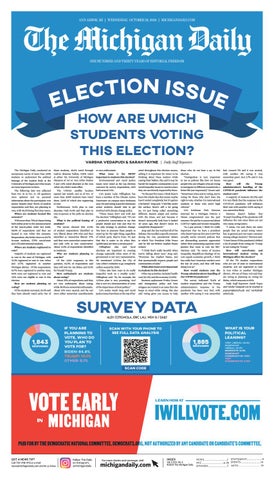
How are UMich students voting this election? Varsha VEDAPUDI & SARAH PAYNE | Daily Staff Reporters
The Michigan Daily conducted an anonymous survey of more than 1,900 students to understand the political leanings of the student body at the University of Michigan and what issues are most important to them. The following data was collected from Oct. 16 to Oct. 21. All questions were optional and no personal information about the participants was stored. Results show 96.4% of student respondents said they are planning to vote, with 45.2% being first time voters. Where are students located this semester? With more than 78% of classes being held online prior to the announcement of the stay-in-place order last week, 85.8% of respondents said they are located in Ann Arbor this semester. Respondents also broke down to 60.7% in-state students, 37.9% out-of-state and 1.5% international students. Where are students registered to vote? Majority of students are registered to vote in the state of Michigan, with 33.3% registered to vote in Ann Arbor and 47.7% registered in another Michigan district. Of the respondents, 15.7% were registered in another state, 0.6% were not registered to vote and 2.8% were not eligible to vote in this election. How are students planning on voting? Of the students surveyed, 54.1% said they have already voted early. Out of
those students, 40.4% voted through mail-in absentee ballots, 10.9% voted at either the University of Michigan Museum of Art or Ann Arbor Station 5 and 2.8% voted absentee at the Ann Arbor city clerk’s main office. The UMMA satellite location opened last month, and as of Oct. 13 more than 3,000 students have voted there, 2,600 of which also registering to vote. Furthermore, 31.6% plan to vote absentee. Only 14.4% said they plan to vote in-person at the polls on election day. What is the political leaning of students? The survey showed that 42.8% of student respondents identified as very liberal, about 33% who said they identified as ‘somewhat liberal,’ 7.7% said they were somewhat conservative and only 3.8% as very conservative. About 12.8% of respondents identified as moderate. Who are students planning to vote for? Of the 1,846 responses to this question, 84.5% of respondents said they will vote for Joe Biden and 10.1% for Donald Trump. How enthusiastic are students about voting? About 25% of respondents said they are very enthusiastic about voting, while 39.3% are somewhat enthusiastic. About 14% were neutral, and the rest were either somewhat unenthusiastic
or very enthusiastic. What issue is the MOST important to students this election? Environmental and racial justice issues were voted as the top election concerns by survey respondents, with both around 24%. LSA junior Luke Dillingham has been a member of the Climate Action Movement on campus since freshman year. He said voting is just the minimum action students should take to get involved with climate change policy. “These issues don’t end with just the election,” Dillingham said. “It’s not a productive conversation to say that people should just vote and that it’s the only strategy to produce change. You have to pressure these people to stand up for the right thing, regardless of which party they’re from. It’s just that this is easier to do when they (politicians) are from a certain party.” Dillingham also said local elections are important in creating change, especially when most of the government is not very representative. He mentioned A2Zero, the City of Ann Arbor’s initiative to go completely carbon neutral by 2030. “Cities also have ways to do really impactful work on a smaller scale,” Dillingham said. “So, for example, the A2Zero plan is very promising. And that is sort of a demonstration of some of the importance of local politics.” LSA senior Sarah Jeng said racial justice issues have been at the top of her
mind throughout this election season, adding it is important for voters to be thinking about these matters while casting their ballots. She said it may be harder for majority communities to see racial inequality issues in America since they are not directly impacted by them. “In the past few years, I think there’s been this whole idea that racism maybe hasn’t ended completely, but it’s gotten a lot better,” Jeng said. “I feel like under the surface, there’s still a lot going on, it’s just being called something different. Racism adapts and evolves with the times, and just because it doesn’t necessarily look how it looked 40 years ago, that doesn’t mean it’s completely disappeared.” Jeng said she has watched all of the debates. She recalled a specific moment during the vice presidential debate in which Vice President Mike Pence said he did not believe implicit biases existed. “I think that’s really harmful when you’re talking about race,” Jeng said. “Everyone has implicit biases, and that automatically impacts people and communities of color.” What other issues were important to students in this election? Other top priorities included health care (16.2%) and the economy (13.8%). Business sophomore Prisha Grover said immigration policy and how refugees are treated is an issue that she keeps in mind while voting. She also said voting gives you access to help
those who do not have a say in this election. “Immigration is very important to me so policies like how we house people who are refugees who are trying to immigrate to different countries for a better life (are important),” Grover said. “Sometimes when you’re voting, you’re voting for those who don’t have the right to vote, whether it is international students or those who aren’t legal citizens.” LSA freshman Nick Martens interned for a Michigan District 6 House congressional race the past summer. He said he is concerned about LGBTQ+ rights and income inequality. “As a gay person, I think it’s really important that we have a president who doesn’t just say he’s pro-LGBT but actually works towards policies that are dismantling systemic oppression rather than nominating supreme court justices that want to ruin my life,” Martens said. “In terms of income inequality, Republican ideology of tax cuts equals economic growth, I think has really hurt American workers over the last 40 years, and they still keep doing it to us.” How would students rate the Trump administration’s handling of the COVID-19 pandemic? The survey indicated 76.6% of student respondents said the Trump administration’s response to the pandemic has been very bad, with another 10% saying it was somewhat
bad. Around 5% said it was neutral, with another 5% saying it was somewhat good. Just 2.7% said it was very good. How will the Trump administration’s handling of the COVID-19 pandemic influence the student vote? A majority of students (51.5%) said it is very likely that the response to the COVID-19 pandemic will influence their vote with another 18.6% saying it was somewhat likely. Martens doesn’t believe that Trump’s handling of the pandemic will influence the vote since there are not very many swing voters. “I mean, I’m sure there are some people that are actual swing voters but, in general, just not super common among college students,” Martens said. “I don’t know if (the pandemic) shifted a lot of people from voting for Trump to not voting for Trump.” How will out-of-state and international student voting in Michigan affect the election? Of the 751 student respondents who are out of state or international students, 428 are registered to vote in Ann Arbor or another Michigan district. 378 out of these 428 said they are voting or planning on voting for Biden, which amounts to 88%. Daily Staff Reporters Sarah Payne and Varsha Vedapudi can be reached at paynesm@umich.edu and varshakv@ umich.edu.
SURVEY DATA ALEX COTIGNOLA, ERIC LAU, WEN SI / DAILY
1,843 responses
IF YOU ARE PLANNING TO VOTE, WHO DO YOU PLAN TO VOTE FOR? BIDEN: 84.8% TRUMP: 10.1% OTHER: 5.1%
SCAN WITH YOUR PHONE TO SEE FULL DATA ANALYSIS
1,885
responses
WHAT IS YOUR POLITICAL LEANING? VERY LIBERAL: 42.8% SOMEWHAT LIBERAL: 32.9% MODERATE: 12.8% SOMEWHAT CONSERVATIVE: 7.75% VERY CONSERVATIVE: 3.75%
SCAN CODE
GOT A NEWS TIP? Call 734-418-4115 or e-mail news@michigandaily.com and let us know.
Follow The Daily on Instagram, @michigandaily
For more stories and coverage, visit
michigandaily.com
INDEX
Vol. CXXX, No. ©2020 The Michigan Daily
NEWS.........................2 MIC ........................ OPINION .....................
STATEMENT............. ... SPORTS ....................... .................
2 — Wednesday, October 28, 2020
News
The Michigan Daily — michigandaily.com
What’s on the ballot in Ann Arbor?
Find out more about the candidates and proposals that residents will vote on HANNAH MACKAY & SARAH PAYNE Daily Staff Reporters
The Michigan Daily has put together a 2020 general election guide to help Ann Arbor voters understand what is on their ballot. Look below to see what options you have from the two major parties in local races this November. Voting in Washtenaw County and Ballot Drop Boxes Early absentee voting in Michigan began on Sept. 24 and will continue through Nov. 2. The deadline to register to vote absentee is Oct. 19 and people can register to vote in person up until Election Day on Nov. 3. As of Oct. 12, nearly 50,000 absentee ballots have been issued in the city of Ann Arbor. All ballots received by 8 p.m. on Election Day will be counted. Washtenaw County residents can return their ballots to drop boxes as an alternative to mailing them in. Drop boxes are located in the following places: Outside of Larcom City Hall at the north entrance at 301 E. Huron St. Outside of Larcom City Hall by the customer service drop box on Ann Street, just east of Fifth Avenue. Parking lot of Veterans Memorial Park Ice Arena and Pool 2150 Jackson Ave. Outside of the Ann Arbor Fire Station 5 at 1946 Beal Ave. Outside of Cobblestone Farm/ Ann Arbor Parks and Recreation Customer Service Center at 2781 Packard Road Northwest side of Ann Arbor Fire Station 6 at the Eisenhower entrance at 1881 Briarwood Circle A satellite clerk’s office at the University of Michigan Museum of Art will remain in place until Election Day where students and community members can register to vote, vote early and return absentee ballots. Ballot Proposals Washtenaw County Proposal This proposal will authorize a property tax of one-fourth of a mill, or $0.25 per $1,000 of state assessed property valuation. The revenue generated from this tax will go to the Board of Commissioners to purchase natural land areas in order to preserve them. The tax will cover the purchase, maintenance and preservation costs of these lands. The tax would go into effect on Dec. 1, 2021, and remain in effect for 10 years. The proposal would increase a previously approved tax for the same purpose by 0.0159 mill. Ann Arbor Municipal Proposal A This proposal would implement a property tax for Ann Arbor residents of $2.125 per $1,000 of assessed property value, to repair local streets, bridges and sidewalks. If passed, the proposal would replace the previously levied identical tax that funded street, bridge and sidewalk repair and construction from 2017-2021. Some portion of this revenue may also be used by the Ann Arbor Downtown Development Agency and the Washtenaw County Brownfield Redevelopment Authority. Ann Arbor Municipal Proposal B This proposal would authorize a new property tax for Ann Arbor residents of $0.20 per $1,000 of property value to fund the construction of sidewalks from 2021-2026. Some of this revenue could be taken and used by the Ann Arbor Downtown Development Agency and the
Washtenaw County Brownfield Redevelopment Authority. Ann Arbor Municipal Proposal C This proposal would authorize a property tax for Ann Arbor residents of $1 per $1,000 of property value. The revenue from this tax would be used to construct, maintain and acquire new affordable housing units for low-income residents and families. Low-income individuals are those who make less than 60% of the Ann Arborarea median income. The revenue from this tax would also be used to provide social services to the low-income residents of the housing units from 2021-2041. Some of the money may be taken and used by the Ann Arbor Downtown Development Agency and the Washtenaw County Brownfield Redevelopment Authority. The proposal has been endorsed by the Ecology Center, the Chamber of Commerce, Packard Health and Avalon Housing. Michigan Proposal 20-1: Use of State and Local Park Funds Amendment This proposal would amend the Michigan Constitution to allow the state to collect revenue from oil and gas mining taking place on state-owned land and create, protect and maintain parks, nature areas and public recreation facilities with the money. This amendment would let the State Parks Endowment Fund continue receiving money from the sales of oil and gas mined on state property until its balance reaches $800 million. Other oil and gas revenue generated from state-owned lands would go to the Natural Resources Trust Fund. The amendment would also change how this state revenue gets spent: 20% of the Endowment Fund’s yearly spending would go toward improving Michigan State Parks, 25% of the Natural Resources fund’s annual expenditures would contribute to parks and public recreation areas and another 25% would be used for land conservation. This proposal is supported by several environmental groups including the Michigan Environmental Council, Michigan League of Conservation Voters, Natural Resources Defense Council and Michigan NAACP Environmental and Climate Justice Committee, among others. However, the Sierra Club and the Green Party of Michigan do not support this proposal because of its dependence on continued oil and gas drilling for funding. Michigan Proposal 20-2: Search Warrant for Electronic Data Amendment This proposal would amend the Michigan Constitution to mandate that a search warrant be necessary to gain access to personal electronic records and communications. Searches and seizures of a person’s electronic data would be prohibited without a warrant, and conditions for obtaining one would be the same as those required to search an individual’s house or belongings. Both the Michigan State Police and the American Civil Liberties Union have expressed support for this proposal. Ann Arbor Elections Ann Arbor City Council The City Council legislative body that is responsible for governing the city consists of the Mayor and 10 council members who each serve four-year terms. Citizens are only eligible to vote for the City Council candidate in the ward in which they reside. Given Ann Arbor’s preference for Democratic candidates, many of the people running
in the November election are unopposed after winning the August primaries. Ward 1 Lisa Disch is the Democratic candidate for Ward 1. She has prioritized a commitment to Ann Arbor’s sustainability and carbon neutrality goals, as well as affordable housing in her campaign. She is being challenged by Eric Sturgis, who is a write-in candidate. Ward 2 Linh Song is running as the Democratic candidate for Ward 2. Song supports the improvement of Ann Arbor’s city services and ensuring that all residents have equal access to them. Ward 3 Travis Radina is the Democratic candidate in Ward 3. He has campaigned on creating affordable housing and promoting diversity and inclusion in the city. Ward 4 Jen Eyer is Ward 4’s Democratic candidate. Her platform promises to support equity in water and sewage treatment improvements across Ann Arbor and to stop flooding and power outages in her ward. Ward 5 Erica Briggs is running as the Democratic candidate for Ward 5. She supports responsible housing and transportation growth as well as Ann Arbor’s carbon neutrality goals. Ann Arbor District Library Board of Trustees There are five people running under no party for four positions on the Ann Arbor District Library Board of Trustees. Molly Kleinman, Onna Solomon, Scott Trudeau and Jamie Vander Broek are running together as a slate of candidates. Rich Foley Foley has run the academic and public library division of Gale Library Reference. He wants to use his business perspective to face the library’s challenges, which include resource needs and navigating the budgeting process. Molly Kleinman Kleinman has an American Library Association-accredited degree in Information Science, as well as a doctorate in Higher Education Policy. She has worked as an academic librarian at the University of Michigan for three years. Onna Solomon Solomon is a social worker who wants to continue the library’s emphasis on inclusion, community and innovation, saying she appreciates the library’s exceptional services as a small business owner, mother, writer and community arts organizer. Scott Trudeau Trudeau has worked as a digital technologist for publishers and non-profit organizations. He has also served on the Ann Arbor City Planning and Transportation Commissions. His platform aims to continue the library’s work and support innovation. Jamie Vander Broek Broek has served on the Ann Arbor District Library Board since 2015 and acted as president for two years, and currently works as a librarian for the University of Michigan. Her platform promises to provide resources and materials digitally and promote community engagement online during the pandemic. Ann Arbor Public Schools Board of Education There are nine candidates for three trustee positions on the Ann Arbor Public Schools Board of Education. The Board consists of seven members, each serving a
four-year term. Krystle R. Dupree Dupree received a bachelor’s degree in Social Work from Eastern Michigan University followed by a master’s degree in Social Work from the University of Michigan, and she currently works as a Youth and Program coordinator for Avalon Housing. Dupree’s platform calls for a student advisory committee to be present at board meetings and aims to address the resegregation of schools and unequal access to qualified teachers and highquality curriculum, focusing on consistency in education across the district. Jeff Gaynor Gaynor was a teacher for 38 years, 32 of them in the Ann Arbor Public Schools, teaching grades 1-8 as well as occasionally acting as a high school substitute teacher. He says this experience and his first term on the Board have given him an understanding of the issues facing the district and that he is committed to making decisions that reflect equality and social justice. Jamila James James is a nurse who has been a parent in the Ann Arbor School District for 16 years. James’s platform prioritizes preparing students for the world and giving teachers more autonomy over their lessons while providing students with more control of their education. Maggi Richards Kennel Kennel, a clinical research coordinator, attended Ann Arbor Public Schools, has three children in the Ann Arbor Public Schools system and has served as president of the Parent Teacher Organization. Kennel’s platform says she will work to provide equitable education, proactively plan support services to meet the needs of students, align school green initiatives with the city’s A2Zero plan and lead responsibly by maintaining transparency during the review and implementation of the Board’s budget. Ernesto Querijero Querijero graduated from the University of Michigan with a bachelor’s degree in English, then from the University of Pennsylvania with a master’s degree in Education. He has 15 years of teaching experience in Advanced Placement and regular English classes at Tecumseh High School. Querijero says he can provide insight into learning in a virtual environment and wants to implement policies to advance long-term fairness, inclusion and representation. His platform says he will strengthen student support services and community outreach programs. Angie Smith Smith is an educator who has worked at all levels of schooling and been a parent in the Ann Arbor Public Schools system for 17 years. She has served on and chaired multiple local councils and organizations, including the Washtenaw County Food Policy Council and a high school parent-teacher organization. She says she wants to redefine measurements of achievement to enable success for all students and prioritize safety in physical and mental health, water, infrastructure and climate. John Spisak Spisak is a parent in the Ann Arbor Public Schools system, as well as an educator and administrator at Centria Autism. His goals for the Board include building an equitable educational system that can withstand future challenges. Daily Staff Reporters Hannah Mackay and Sarah Payne can be reached at mackayh@umich.edu and paynesm@umich.edu.
Stanford Lipsey Student Publications Building 420 Maynard St. Ann Arbor, MI 48109-1327 www.michigandaily.com
ELIZABETH LAWRENCE
ANITA MICHAUD
Editor in Chief esla@michigandaily.com
Business Manager ammichau@michigandaily.com
NEWS TIPS
news@michigandaily.com
LETTERS TO THE EDITOR tothedaily@michigandaily.com
EDITORIAL PAGE
opinion@michigandaily.com
PHOTOGRAPHY SECTION
ARTS SECTION
photo@michigandaily.com
arts@michigandaily.com
NEWSROOM
SPORTS SECTION
734-418-4115 opt.3
sports@michigandaily.com
CORRECTIONS
ADVERTISING
corrections@michigandaily.com
WMG-contact@umich.edu
Editorial Staff ERIN WHITE Managing Editor
ekwhite@michigandaily.com
SAYALI AMIN and LEAH GRAHAM Managing News Editors
news@michigandaily.com
Senior News Editors: Barbara Collins, Claire Hao, Alex Harring, Ben Rosenfeld, Emma Stein, Liat Weinstein Investigative Editor: Zayna Syed Assistant News Editors: Iulia Dobrin, Julia Forrest, Jasmin Lee, Calder Lewis, Angelina Little, Hannah Mackay, Sarah Payne, Emma Ruberg, Julia Rubin, Jenna Siteman, Varsha Vedapudi, Kristina Zheng
EMILY CONSIDINE and BRITTANY BOWMAN Editorial Page Editors
tothedaily@michigandaily.com
Senior Opinion Editors: Elizabeth Cook, Zack Blumberg, Krystal Hur, Min Soo Kim, Joel Weiner
THEO MACKIE and ETHAN SEARS Managing Sports Editors
sportseditors@michigandaily.com
Senior Sports Editors: Daniel Dash, Lily Friedman, Connor Brennan, Brendan Roose, Kent Schwartz, Lane Kizziah, Rian Ratnavale Assistant Sports Editors: Jared Greenspan, Nick Stoll, Drew Cox, Aidan Woutas, Abby Snyder, Jack Kingsley
JOHN DECKER and JULIANNA MORANO Managing Arts Editors
arts@michigandaily.com
Senior Arts Editors: Jo Chang, Elise Godfryd, Zoe Phillips, Jonah Mendelson, Ally Owens Arts Beat Editors: Samantha Cantie, Dana Pierangeli, Andrew Pluta, Cassandra Mansuetti, Anish Tamhaney, Sophia Yoon
CHRISTINE JEGARL and LIZZY RUEPPEL
Managing Design Editors design@michigandaily.com Senior Design Editor: Hibah Mirza
ALLISON ENGKVIST and ANNIE KLUSENDORF Managing Photo Editors
photo@michigandaily.com
Senior Photo Editors: Madeline Hinkley, Asha Lewis, Miles Macklin Assistant Photo Editors: Julia Schachinger, Ryan Little, Emma Mati, Sophia Afendoulis, Becca Mahon
MAGDALENA MIHAYLOVA
Managing Statement Editor statement@michigandaily.com Deputy Editors: Andie Horowitz, Marisa Wright Associate Editor: Isabelle Hasslund
MADISON GAGNE and SADIA JIBAN Managing Copy Editors
copydesk@michigandaily.com
Senior Copy Editors: Olivia Bradish, Sophie Kephart, Silas Lee, Olivia Sedlacek, Ellie Scott
PARTH DHYANI and SIMRAN PUJJI
Managing Online Editors webteam@michigandaily.com Senior Web Developers: Abha Panda, Rohan Prashant, Jonathan Liu
ALEC COHEN and ELI SIDER
Managing Video Editors Senior Video Editor: Iulia Dobrin
video@michigandaily.com
MAYA MOKH and DEVAK NANUA Michigan in Color Editors
michiganincolor@michigandaily.com
Senior Michigan in Color Editors: Zoha Bharwani, Lora Faraj, Ana Maria Sanchez Castillo, Gabrijela Skoko
SAMANTHA SMALL and SONYA VOGEL Managing Podcast Editors
JOHN GRIEVE and BEN KORN Managing Social Media Editors
Senior Social Media Editors: Kristina Zheng, Ria Dubey, Ryan Postman, Haley Johnson, Atticus Raasch, Asha Lewis
Business Staff MOLLY WU
Creative Director
RYAN KELLY Sales Manager
The Michigan Daily (ISSN 0745-967) is publishing weekly on Wednesdays for the Fall 2020 semester by students at the University of Michigan. One copy is available free of charge to all readers. Additional copies may be picked up at the Daily’s office for $2. If you would like a current copy of the paper mailed to you, please visit store. pub.umich.edu/michigan-daily-buy-this-edition to place your order.
The Michigan Daily — michigandaily.com
News
Wednesday, October 28, 2020 — 3
The Michigan Daily’s state and federal election guide Learn more about the different options that will be at the top of the ballot for voters living in Michigan this November HANNAH MACKAY & SARAH PAYNE Daily Staff Reporters
The Michigan Daily has put together a 2020 general election guide to help Ann Arbor voters understand what is on their ballot. Look below to see what options you have from the two major parties in federal and state races this November. Federal and State Elections President and Vice President of the United States Joseph R. Biden and Kamala Harris (D) Biden is the Democratic presidential nominee. The former Vice President served in the White House during the Obama Administration and previously served as a U.S. Senator from 19732009. Biden’s campaign “Build Back Better” plan focuses on creating a strong economic response to the pandemic, improving racial equality, providing the infrastructure needed for clean energy and reforming the country’s immigration laws. Harris is the Democratic vice presidential nominee. She ended her personal presidential bid late in 2019 to endorse Biden and was named as his running mate in August. As a U.S. Senator for California, she is on the Homeland Security and Governmental Affairs Committee and the Committee on the Judiciary, among others. She previously served as an assistant district attorney and later became the Attorney General of California. Donald J. Trump and Mike Pence (R) Trump is the Republican presidential nominee and 45th president of the United States. A businessman, Trump is the first president to be elected without prior military or government experience. Trump’s “Make America Great Again” campaign is focusing on building a strong economy and lowering taxes. Since the start of the coronavirus pandemic, however, the economy has suffered as small businesses around the country have closed and millions of people have lost their jobs. Trump recently contracted COVID-19 himself but has since recovered. The Trump campaign has also been vocal about introducing harsher immigration policies, particularly on the southern border. Pence is the Republican Presidential nominee and is the 48th vice president of the United States. He previously represented Indiana in the House of Representatives from 2001-2013 and was the Governor of Indiana from 2013-2017. U.S. Senate Gary Peters (D) Peters is a lifetime Michigan
resident seeking reelection to the Senate. He is finishing his first term in the Senate where he was ranked the fourth most effective of all Democratic Senators. Peters previously served in the U.S. House for three terms. After serving in the U.S. Navy Reserve for more than a decade, Peters is the ranking member on the Homeland Security and Governmental Affairs Committee and also sits on the Armed Services Committee. Peters is focused on strengthening the Michigan economy, protecting the Great Lakes and national security. In an interview with The Daily this summer, Peters said that protecting the Affordable Care Act, promoting affordable higher education, tackling racial inequality and a public-health informed COVID-19 response are at the top of his agenda. John James (R) A University of Michigan alum, veteran and business owner, John James will be challenging Peters in November, facing a Democratic incumbent for the second time after challenging current U.S. Senator Debbie Stabenow in the 2018 election. James’ campaign is unique, as he is the only Black Republican running for a seat in the Senate in this election cycle and he has received national recognition for his tremendous fundraising campaign. He has faced criticism for his support for the president, but has declined to disavow Trump. James is focused on building an innovation-driven economy by cutting regulation, securing borders to protect national security and utilizing incentives for private corporations to limit pollution and protect the environment. U.S. House of Representatives U.S. Rep. Debbie Dingell (D) Dingell is seeking reelection to the United States House of Representatives. The Dingell family has held office in Michigan’s 12th congressional district for more than 80 years. She was preceded by her late husband John Dingell Jr. and his father John Dingell Sr. Dingell serves on the House Committee on Energy and Commerce and the House Committee on Natural Resources. She has long been an advocate for liberal causes from accessible health care to the environment. Jeff Jones (R) Jones is challenging Dingell as a Republican. Jones currently serves as a pastor and works in financial services at MassMutual. Jones has challenged Dingell in the past three election cycles and is focused on reforming the health care system, improving veterans affairs and senior care this election cycle and, if elected, wants to break from the status-quo of politics to transform policy to work more effectively for 12th district residents. Michigan House of Representatives, 53rd District
DESIGN BY MEGHANA TUMMALA
Rep. Yousef Rabhi (D) Rabhi is the Democratic Floor Leader in the Michigan House of Representatives and is currently serving his second term representing the 53rd State House district. He has been a consistent progressive voice in Lansing, advocating for single-payer universal healthcare, enacting Green New Deal policies at the state level and reversing cuts to funding for public schools and universities. Jean Holland (R) Rabhi’s challenger Holland works professionally in IT consulting and as a software developer and engineer. Holland is a strong advocate for Second Amendment rights and supporting the growth of businesses across the state. Michigan Supreme Court While candidates for the state Supreme Court are nominated by parties, they run in nonpartisan races in the general election. Bridget Mary McCormack McCormack was elected to the Michigan Supreme Court in 2012 and currently serves as the Chief Justice. McCormack has been endorsed by U.S. Sen. Gary Peters, U.S. Sen. Debbie Stabenow, U.S. Rep. Debbie Dingell and many
other democratic local and state elected officials. McCormack previously served as a professor and associate dean at the University of Michigan Law School. McCormack currently teaches at the Law School and sits on the Board of Washtenaw County Families Against Narcotics, working to address the opioid crisis. Elizabeth Welch Welch is a Michigan attorney serving individuals, nonprofits and small businesses. Welch is a longtime East Grand Rapids School Board Trustee and is the former president of the Michigan League of Conservation Voters. Welch has been endorsed by the Detroit Free Press and numerous prominent Democrats, including U.S. Reps. Debbie Dingell, D-Mich. and Dan Kildee, D-Mich. Welch plans to bring her diverse set of experiences to the court if elected and is focused on and passionate about the fight for equity in public education. Mary Kelly Kelly is a graduate of Michigan State University and received her law degree from the Detroit College of Law. Kelly previously served as a prosecutor in St. Clair County, as an attorney and as a general practitioner in private practice with an emphasis on domestic
cases, civil litigation and criminal matters. Kelly’s platform said she is focused on holding individuals accountable for their actions if elected to the Michigan Supreme Court. Brock Swartzle Swartzle has been endorsed by more than 85 local officials and the Farm Bureau AgriPac, Michigan Chamber of Commerce and Michigan Realtors. Sawrtzle plans to put politics aside and focus on the law if elected, particularly to respect the federal governing bodies but legislate for Michigan as a separate sovereign. University of Michigan Board of Regents Mark Bernstein (D) Bernstein has been on the board of regents since 2012 and is a University of Michigan alum. He supports providing accessible public education while promoting diversity and protecting labor and the environment. Over the summer Berstein voted in favor of a tuition increase in this year’s budget and has expressed his support in aligning the University with Ann Arbor’s carbon neutrality goals. Shauna Ryder Diggs (D) Diggs also graduated from the University of Michigan as an
undergraduate and has served on the board of regents for the last eight years. She supports efforts to make college more affordable and to provide more equitable funding across the University’s three campuses. Diggs voted against the budget this summer that included a tuition increase and has been receptive to the Climate Action Movement and One University’s criticism of the Board’s response to climate change. Carl Meyers (R) Meyers, also a University alum, has previously run for the Board of Regents numerous times. He supports resuming athletics and returning to in-person activities, in addition to calling for a tuition freeze. Meyers has also said he would prioritize protecting civil liberties and free speech on campus. Sarah Hubbard (R) Like Meyers, Hubbard is an alum who wants to fight increases in tuition and backs returning students to in-person classes. Hubbard is also a vocal supporter of the Second Amendment and prolife movement, claiming that these voices need to be heard more at the University.
Students can still vote under stay-in-place order
Washtenaw County clarifies U-M undergraduates can participate in election-related activities despite COVID-19 restrictions ANGELINA LITTLE Daily Staff Reporter
University of Michigan undergraduates can vote and participate in election activities as well as study by themselves in designated areas on campus, according to a Friday update to the stay-in-place order from the Washtenaw County Health Department. Registering to vote, working at polling stations and participating in campaign outreach are all allowed.
Students can also go on campus to access “essential technology” at designated areas with single person study spaces. Permitted activities include studying, printing or participating in virtual classes. The order still prohibits studying in groups or going to study at coffee shops, restaurants or “other establishments where multiple students/people may gather, even if they are on campus or in U-M buildings.” Students must follow social distancing guidelines and wear face masks if they leave their homes.
The stay-in-place order issued by the county Tuesday to prevent further spread of COVID-19 initially included a number of exceptions for students to leave their residences, including voting. The University continues to encourage students to vote. University President Mark Schlissel stressed this exception to the order in his weekly COVID19 update email Friday morning. “The Washtenaw County Health Department Stay in Place order specifically exempted election related activities at polling places, including going out
to register to vote and to vote on or prior to election day,” Schlissel wrote. “Additionally, the order exempts working or volunteering, which could include working at a polling place, to the extent the work cannot be done remotely and you have the approval of the employer.” Students are encouraged to continue to make use of the Ann Arbor City Clerk satellite office in the University of Michigan Museum of Art, which opened last month to assist students in registering and voting in the upcoming election. As of Oct.
13, more than 2,600 students registered to vote and around 3,000 voted in-person or returned their absentee ballot at the UMMA. With 11 days to Election Day, UMMA will extend its hours to remain open on Saturdays from 8 a.m. to 4 p.m. beginning on Saturday. Macy Lighthall, assistant manager at the UMMA store, said she has observed some difference in student traffic since the stayin-place order took effect but says it remains unclear how exactly it will affect the number of students
voting. “The day before the stay-athome mandate, or order, we had a line for voting… almost to the street … along with full capacity inside the building,” Lighthall said. “And then today, for a very nice day on Friday, around noon, it’s been very quiet. We don’t have a full line, we are not at full capacity, so… I guess I would say there’s definitely been a difference but I don’t know the numbers exactly for the week.” Daily News Reporter Angelina Little can be reached at angelit@ umich.edu.
News
4 — Wednesday, October 28, 2020
The Michigan Daily — michigandaily.com
BOARD OF REGENTS Candidate Profiles
PHOTO COURTESY OF MARK BERNSTEIN
PHOTO COURTESY OF SHAUNA RYDER DIGGS
MARK SHAUNA BERNSTEIN RYDER DIGGS
(D) INCUMBENT (D) INCUMBENT CALDER LEWIS
JASMIN LEE
COURTESY OF SARAH HUBBARD
SARAH HUBBARD (R) EMMA STEIN
Daily Staff Reporter
Daily Staff Reporter
Daily News Editor
University of Michigan Regent Mark Bernstein (D) says he’s running for reelection this November to settle unfinished business. In his first election bid in 2012, he drove a school bus around the state covered in slogans like “Keep College Affordable” and “Higher Education, Lower Cost.” “I’ve had some success in that direction, and I’ve kept that promise, but there’s still a lot more to be done,” Bernstein said in an interview with The Michigan Daily. Bernstein pointed to the Go Blue Guarantee, which offers free tuition to in-state students coming from families making $65,000 a year or less, as a major initiative he’s championed. He also said the University has reduced net tuition for most Michigan families since he was elected in 2012. Affordability isn’t the only issue facing the school. The University is being sued by both sexual assault victims and a former student accused of sexual assault in high-profile lawsuits. An independent report found accusations of decades of sexual misconduct by Martin Philbert, the former provost who rose to the second highest office at the University despite knowledge of allegations by numerous administrators. Bernstein said misguided interpretations of fiduciary responsibility often lead organizations to work against victims’ interests. His campaign website says the University must be “victim and justice centered” and that “our bias should be towards the victims, not the institution.” “It’s in the long-term interest of the institution to address these issues in a way that’s focused on making things right for the victims — for people who are harmed by the institution — because then you are preserving the integrity of the institution in the long run,” Bernstein told The Daily. After this summer’s 1.9% tuition increase as part of a budget Bernstein voted for, some students advocated for drawing from the endowment to keep tuition frozen. Bernstein supported the tuition increase in June, explaining that it would only be students who could afford to pay tuition who would be bearing the brunt of the policy.
University Regent Shauna Ryder Diggs (D) is running for her second term on the University of Michigan’s Board of Regents to expand financial aid initiatives and provide her expertise as a practicing physician to the board amid the ongoing COVID-19 pandemic. Ryder Diggs and fellow incumbent Regent Mark Bernstein (D) are running to keep their seats against challengers Sarah Hubbard (R) and Carl Meyers. Hubbard is participating in her first election for Board of Regents, while Carl Meyers is running in his third. As a University alum and the child of college professors, Ryder Diggs said her family commitment to education makes her a valuable member of the board. She also has experience serving on other community boards such as the Detroit Institute of Arts and Blue Cross Blue Shield Foundation of Michigan. Ryder Diggs said the accomplishment she is most proud of during her time on the board is supporting and expanding the Go Blue Guarantee. Ryder Diggs said she wants to ensure the legacy of the Go Blue Guarantee and other initiatives that will benefit students in the future. “There’s more work to be done and you have to be at the table to keep past accomplishments going,” Ryder Diggs said. After the board decided to freeze future fossil fuel investments amid consistent demands from the Climate Action Movement, Bernstein announced at the October regents meeting that the board will be looking into possible avenues to divest from the fossil fuel industry. Ryder Diggs said she is hopeful experts can find a path that allows the University to divest without sacrificing revenue for financial aid. “What many people say is that we need our investments to bring the best return possible so that we can be able to give the financial aid that we want to give and expand the Go Blue Guarantee to give it to Flint and Dearborn,” Ryder Diggs said. “That definitely resonates with me, but I don’t think the two things are mutually exclusive.”
Sarah Hubbard, Republican candidate for the University of Michigan’s Board of Regents, is looking to balance the political powers that she says are hindering the board’s ability to have a robust discussion about issues affecting students. Hubbard is one of two Republicans challenging Democratic incumbents Mark Bernstein and Shauna Ryder Diggs for their seats on the board in the upcoming November election. Currently, Regent Ron Weiser (R) is the only Republican on the eightperson board. According to Hubbard, the University’s response to COVID-19 is the most important topic for students right now. She said, despite Tuesday’s stay-in-place order from Washtenaw County specifically directed at undergraduate students, instruction should be in person. She noted that attending class or other University-related responsibilities are not the reason for the recent spikes in COVID-19 on campus, according to school leaders. “Students are spending a lot of money to get that education, and they never really plan to get it all remotely,” Hubbard said. “There needs to be in-person learning opportunities in a way that can be done safely for everybody. Students need to get the value for their tuition here.” Hubbard, who owns Acuitas LLC in Lansing, holds two University of Michigan degrees and has a history of working in Republican politics. Her platform aims to protect freedom of speech on campus, lower tuition and bring more diversity of thought to the board. Part of Hubbard’s reason for running is because she wants to even the playing field. “I think my experience is the kind of thing that the board needs right now,” Hubbard said. “You have a real imbalance on that board from a Dem-Republican perspective. And I think that I could help bring balance back to that board and those discussions.” Hubbard said her background in politics has taught her how to develop strong, bipartisan relationships, though she leans right. She has previously donated to both Democrats and Republicans running for office in Michigan, including the Michigan Republican Party and Michigan Democrats U.S. Rep. Debbie Dingell and Sen. Gary Peters.
READ MORE ONLINE AT MICHIGANDAILY.COM
COURTESY OF CARL MEYERS
CARL MEYERS (R) DOMINIC COLETTI Daily Staff Reporter
Carl Meyers is in the middle of his third campaign for regent at the University of Michigan. Meyers also made a bid in 2014 but didn’t get enough votes at the Republican State Convention to get through to the general election. He hasn’t changed his message much since his first campaign in 2004, and he said he feels his policies are more relevant than ever. “I ran for the Board of Regents in 2004 predicting that if we didn’t slow the growth of the budget and put Michigan families and Michigan students first … that many middle-class families would be priced out of higher education, (which) would severely impact diversity, inclusion and access,” Meyers said. “Here we are in the middle of a pandemic, and shame on the (Board of Regents) for raising tuition … and shame on the administration.” Meyers took several opportunities to discuss the 1.9-percent tuition increase approved over the summer and said he has made access to higher education a theme of his campaign. His goals include a tuition freeze and a rollback of this year’s increase. When discussing the practicality of his tuition freeze, Meyers pointed to his background as a financial adviser, saying his experience on nonprofit boards and with investments makes him more qualified than the current board. He said he would push for a larger portion of the endowment to be distributed to meet operating expenses in addition to finding inefficiencies throughout the University. Currently, 4.5 percent of its value is distributed annually. “U of M is … a massive hospital system, a massive sports complex, a massive academic (operation),” Meyers said. “It’s inherent with any operation that there are opportunities to become more efficient. I’m not saying you’ve got to cut, but I’m saying you’ve got to operate with a heck of a lot more efficiency.” Meyers said Regents don’t focus enough on cutting student costs. “It’s going to take a seismic cultural change to do that, and I think COVID is going to be the impetus for that,” Meyers said.
The Michigan Daily — michigandaily.com
News
Wednesday, October 28, 2020 — 5
Big Ten Voter Challenge increases student participation
Concerted effort plays significant role in promoting turnout and involvement among college kids ahead of election JULIA FORREST Daily Staff Reporter
In 2016, LSA senior Cory Dubin, a high school senior at the time, walked into his local polling station in White Lake, Michigan. Under 18 at the time, he wasn’t there to vote, but to be a poll worker. He said he walked out of the polling station with new insights on existing barriers to voting. “Having worked at the polls, there were certain things where I noticed that people were missing the opportunity to vote,” Dubin said. “Not because they just didn’t know there was an election or something but because of mainly, voter (mis)education … People who want to vote should have the right to do that — and there should be nothing standing in the way.” Dubin became an Andrew Goodman Foundation ambassador his junior year of college. In this role, he works with the Ginsberg Center for Community Service and Learning and the Big Ten Voting Challenge to increase voter registration across the University of Michigan campus. The Big Ten Voting Challenge,
founded in 2017, aims to produce civic engagement and increase voter participation among students across the 14-school conference, including the University. Ahead of the 2020 election, the Big Ten Voting Challenge has worked with the Ginsberg Center and other organizations across campus to increase voter participation among University students. Michigan is a state where students could prove to be especially important, since it is considered a key battleground state in the 2020 election. In 2016, President Donald Trump beat then-Democratic nominee Hillary Clinton by just more than 10,000 votes in Michigan. In 2016, 37,456 University students were eligible to vote, and about the same number or more are eligible to vote in this upcoming election. However, only 25,557 were registered in 2016 and only 16,740 ended up voting. Usually, Dubin and the Ginsberg Center would table and talk directly to students. Because COVID-19 has made traditional methods of voter outreach unsafe, the group has launched an Instagram page and
other virtual outreach campaigns to encourage voters to participate in the electoral process. “What I would say is that students really (have started to) realize their votes do make a difference,” Dubin said. “And whichever candidate you’re voting for, you can either extend that lead or minimize it. (So we need to make) sure that regardless of party, people do know that their votes do matter, and they actually can impact the results.” LSA professor Josh Pasek, who focuses on political communication and how media influences political attitudes, said social media can be a useful tool to disseminate and receive voting information. “In addition, social media tends to display voting as a more normative behavior,” Pasek said. “So you’re less likely to see other people doing democratic participatory acts just walking around than you are to see them on social media.” Due to efforts by organizations like the Big Ten Voting Challenge, in the 2018 midterms, the average number of registered student voters in the Big Ten conference hit 43%, 3% higher than the national average
student voting rate and more than double the rate in 2014. At the University, the number of average voters more than tripled from 2014 to 2018, going from 14% to 41%. The passage of Proposal 3 in 2018, a voter initiative that amended the state constitution and expanded voter rights of Michiganders and voter education efforts, also helped organizations like the Big Ten Voter Challenge reach students and get them registered to vote. The proposal allowed future elections to have same-day registration and absentee voting without an excuse. This year, the Big Ten Voting Challenge has also launched the campaign “Student Orgs Vote!” which partners with student organizations to encourage their members to make a voting plan. Public Policy junior Lena Hoppe, philanthropy chair for Beta Alpha Rho, a pre-law and public policy fraternity on campus that has joined the campaign, said her organization had a meeting dedicated to sharing resources from the campaign. “Especially for younger students or freshmen, I think it can be overwhelming for first-time voters … That’s why it’s important to lay
everything out there,” Hoppe said. “And if you can vote, and here are all your options and your ways of doing this, we’re not forcing you to do it, just (encouraging) you to do it.” Members of the Big Ten Voting Challenge also volunteer at the Ann Arbor City Clerk’s satellite office at the University of Michigan Museum of Art. The UMMA satellite office opened on Sept. 22, National Voter Registration Day, after efforts by campus organizations like the Creative Campus Voting Project to increase student voter registration and engagement. One of the volunteers, Public Policy senior Meredith Days, said it is encouraging to see students of all ages volunteering, registering to vote and casting their ballots at the UMMA. “There’s just a lot of people signed up to (to volunteer), which is great, and has been really exciting to see because it’s a lot of people that I don’t know,” Days said. “Like younger students, which is great because I feel like I know a lot of people who are seniors, but I’m glad that underclassmen are signing up to do this well.” Jacqueline Beaudry, city clerk of
Ann Arbor, said in an email to The Michigan Daily that the satellite office has registered 100 to 200 student voters every day for the past 40 days. “Student volunteers at UMMA with the Big Ten Voting Challenge have helped work the line, answer questions and hand out forms,” Beaudry said. “This has been a great assistance to the City Clerk staff working the registration tables and issuing ballots as quickly and efficiently as possible.” Dubin, who also interns with the clerk’s office, said this year’s momentum in increasing voter turnout and emphasizing the importance of voting will impact future elections. “I do not think it’s going to be limited to just one election, where it’s like, ‘Okay, we voted, our candidate won, let’s call it a day,’” Dubin said. “Regardless of what happens in the election, you’re going to see voters, or potential voters really making sure that they continue to engage with the democratic process.” Daily Staff Reporter Julia Forrest can be reached at juforres@umich. edu.
Results could take a while with record mail-in ballots
Final tallies unlikely to come in on the night of the election, people overwhelmingly turn to absentee and early voting EMMA RUBERG Daily Staff Reporter
In previous election cycles, results have been reported on election night as precincts tally their votes, with a winner being declared hours after polls close. This year, however, a final result may not be available for days or weeks after the election. With concerns around the safety of in-person voting, a record number of voters are using absentee ballots. The restrictions on when and how election officials count absentee ballots, as well as an expected increase in voter turnout for the particularly contentious election, make it unclear how long voters will wait for a result. This will be a particularly important factor in Michigan, a key state in the 2020 election, which had the smallest margin of victory in the 2016 election and had record turnout in the August primary. Michigan’s ballot-counting plan In 2018, Michigan legislators passed a no-excuse absentee voting law, meaning anyone can request an absentee ballot without providing their reasoning, likely resulting in an increase in the number of absentee ballots. Michigan Secretary of State Jocelyn Benson also mailed applications for mail-in ballots to every registered voter using funding provided by the federal government through the Coronavirus Aid, Relief and Economic Security Act. The goal is to prevent the spread of the coronavirus, ensuring “no Michigander has to choose between their health and their right to vote.” In recent weeks, the rate of spread of COVID-19 has increased in Michigan. In an Oct. 21 press conference, Michigan Gov. Gretchen Whitmer said the COVID19 situation in Michigan is getting worse and that she was “sounding the alarm.” “I’m just going to be frank: our numbers are not good,” Whitmer said. “They’re moving in the wrong direction.” In the August primary, more absentee voter ballots were cast than in any other Michigan election. Out of the 2.5 million total votes cast in Michigan, 1.6 million of those were from absentee ballots. The previous record for absentee ballots was 1.3 million in the 2016 presidential election. Benson has said she expects at least 2.4 million people to vote by mail in the Nov. 3 election. The rules for handling these absentee ballots, however, may result in vote counting delays. Clerks
cannot begin opening and counting ballots until 7 a.m. on Election Day, the same time the in-person polling locations open. With so many votes being cast by mail, this will likely take longer than in previous years. Not only will more absentee ballots be cast, but more votes will likely be cast overall. The 2.5 million votes in the August election was a record for primary election votes, and election officials said they believe approximately 5 million Michigan voters are expected to participate in the general election. Benson has discussed the likely delays on Election Day, explaining in an NBC interview there will likely not be full results on election night. “We should be prepared for this to be closer to an election week as opposed to an Election Day,” said Benson. “The bottom line is that we are not going to have the full results and accounting of all of our ballots on election night. We already know that. We’ve asked the legislature to make changes to the law to give us more ability to be prepared and count those ballots more efficiently — they have not acted, for reasons I don’t fully, completely understand.” She also discussed the steps election officials are taking to count voters more quickly and efficiently, while stressing the importance of accurate reporting. “We’re increasing tabulators, we’re increasing capacity to more efficiently and securely count those ballots — but I’m also laser focused on accuracy,” said Benson. “If it takes a few extra days to make sure we have a full and accurate counting of the results of every race, that’s what it’s going to take. We’re going to be transparent throughout that whole process to make sure every citizen knows exactly where we are in the counting process and how many more ballots we have to get through.” Washtenaw County Clerk Lawrence Kestenbaum said he believes many election offices, and certainly those in Washtenaw County, are equipped to quickly count ballots and provide results. He also acknowledges some Michigan cities, such as Detroit and Flint, will likely have a harder time providing results quickly, as they have opted not to pre-process ballots. “So, there’s been a lot of thought put into these things and we’ve made a lot of progress,” Kestenbaum said. “I’m very confident that it should go smoothly, at least in Washtenaw County. Contrary to some of the rumors that are going around, there’s not going to be a
delay in counting absentee ballots. Absentee ballots will be counted on Election Day at the same time as other ballots and they’ll be reported on election night the same as other ... precincts.” Kestenbaum said he does not agree with claims in the media about Michigan being one of the last states to report.. He believes the results will be in by the next morning. In other elections, such as the March primary, results were reported before 10 p.m., only hours after polls closed. Concerns circling around mail-in ballots Some are concerned about an increase in voter fraud in this election cycle, particularly resulting from the increase in absentee voting.. Others are concerned ballots will be invalidated because of strict laws surrounding how mail-in ballots are placed in the envelope and signed. Though Trump’s administration has planted seeds of doubt about the legitimacy of mail-in ballots, voter fraud in the United States is very low. Nick Schuler, vice chair of College Republicans at the University of Michigan and LSA sophomore, discussed how he thinks in-person voting can be made safer and how mail-in voting can still happen, while reducing the risk of voter fraud. “I think we should do voting as usual, but obviously with increased sanitary measures at the polling places, ...,” Schuler said. “But should someone not feel comfortable voting in person, despite those measures, I think they should be able to request a mail-in ballot like you can every other election … I don’t see the need to just automatically send (applications) to everyone when you can request one like normal (which would be) way less prone to fraud because you have to go through that process.” Regina Egan, LSA and STAMPS junior and communications director of College Democrats, wrote in an email to The Michigan Daily she believes mail-in voting is especially important in light of the COVID-19 pandemic. While she is not concerned about voter fraud, she is apprehensive about results being challenged and the focus of scrutiny centering on mail-in ballots. “All Americans deserve to be able to vote freely and safely,” Egan wrote. “In the middle of a pandemic, the ability to vote absentee or by mail is even more crucial in preserving American democracy and protecting American lives. I
absolutely trust the mail-in voting system to be safe from things like voter fraud. What I am worried about is the fact that the large number of mail-in ballots is so unprecedented, which means that if the election is narrow enough, then those mail-in ballots will be highly contested in a long drawn-out, polarizing and partisan way.” In the August primary, 10,600 ballots were rejected. 2,225 were rejected because the envelopes were not signed or the signature of the voter did not match that which the election office had on file. Because of Michigan’s importance in the election, these rejected ballots have become a concern for many voters. Trump won Michigan with only 10,704 votes in 2016, almost the same number of ballots that were rejected in Michigan’s August primary. Kestenbaum tried to alleviate concerns about signature laws, explaining the ballots rejected as a result are a small proportion of ballots received. He also said clerks will try and contact voters to rectify problems with their ballots. “In Michigan, if it’s your signature and your handwriting, it’s not gonna be thrown out for being different,” Kestenbaum said. “The proportion of signatures and absentee ballots that fail signature matching is tiny. Historically, you know, it’s not a large percentage, by any means. The most common problem with the ballot is if someone forgets to sign it, the outside envelope. And the rules now are that if there’s time before the election, the clerk will contact the voter to have them know that they can come in and sign it or do something to remedy the problem.” Anxieties regarding the United States Postal Service Many voters and elected officials have also expressed doubts about the United States Postal Service, both in their ability to deliver ballots on time and to handle the sensitive nature of mail-in ballots. In the August primary, 6,400 of the 10,600 ballots rejected were received after election day, and therefore could not be counted. USPS told Michigan and 44 other states in August they cannot guarantee mail-in ballots would arrive on time to be counted in the November election. These issues have largely arisen over the past few months, as the amount of mail and packages has increased during the COVID-19 pandemic. Trump also appointed Louis DeJoy, a vocal Republican donor and Trump supporter, as
Postmaster General in May of 2020, after the pandemic had already complicated voters’ ability to cast votes in person. DeJoy has made many changes to the agency, including limiting overtime hours, removing about 15% of high speed processing machines, reshuffling top leadership and implementing restrictions on transportation, all of which seem to be increasing delivery times. Eleven high speed delivery bar code sorters were removed from Detroit, a city many believe will have difficulty processing ballots on election day. Benson has discussed the steps Michigan is taking to ensure mail in ballots are received on time and the controversy surrounding USPS, including constant communication with postmaster leaders and creating drop boxes. “But we’re now also facing a perception issue — that the changes in the postal service, if nothing else, have created confusion and chaos where none existed prior,” Benson said. Despite an initial court ruling that would have allowed Michigan ballots postmarked by Election Day that arrived up to 14 days after to be counted, the ruling was overturned by an appeals court earlier this month, reinstating the 8 p.m. Election Day deadline. Kestenbaum said more absentee ballots have been returned earlier this year, possibly eliminating some concerns that large proportions of ballots would not arrive on time. He also suggested those who have not returned a mail-in ballot yet to drop it off at a city or county clerk’s office. Many Republican politicians believe the increase in mail-in ballots through USPS will result in an increase in voter fraud, as Trump has often claimed. Kestenbaum explained clerk’s offices have procedures set up to ensure no ballot tampering occurs and have multiple people working together on sensitive tasks. “We have a very good record in Michigan of administering elections in a completely clean and fair way,” Kestenbaum said. “Poll workers, by the way, have to identify their parties so you have two poll workers of different parties doing every sensitive task. So if it involves handling ballots, you have a Republican and a Democratic coworker together, doing whatever needs to be done with the ballots.” Schuler referred to a case in New Jersey where a USPS worker was arrested for allegedly dumping mail, including election ballots. But
most experts say when problems arise with mail-in voting, they do not give either party an advantage and do not lead to a false election outcome. “I have all the respect in the world for the postal service, but I don’t think a simple postal worker should be in charge of delivering 200,000 ballots that could swing a state and then swing the election,” Schuler said. Kestenbaum disagrees with the concerns about USPS handling ballots, saying poll workers will handle ballots correctly. “Postal workers are busy and they’re dealing with a tremendous quantity of mail all the time,” Kestenbaum said. “And the idea that they would single out a piece of mail, out of the thousands of pieces that they’re dealing with at any given point and say, ‘aha, this is someone from the wrong party, so I need to get rid of their ballot.’ — they don’t have time for that. ... So I think the American postal service is trustworthy.” When asked how he expects election results to unfold and how Trump will react, Schuler said he thinks the president will respect the election outcome, but that the way it is decided will certainly be interesting. “I think that the president will respect the outcome of the election,” Schuler said. “But again, that being said, this election is going to be interesting. Who knows what’s gonna happen, when the results are coming. You know, we could have a Gore-Bush scenario where the Supreme Court has a lot of sway, so we’ll see.” Egan also mentioned the drawn-out 2000 election between former Vice President Al Gore and former President George W. Bush, explaining she thinks a clear result would help reassure people the government is still functioning correctly. “Concerns about US electoral processes go back even before 2016 to 2000 with Gore and Bush,” Egan wrote. “I believe Americans want fast and clear results after election night because it proves that American democracy is safe and working, and the 2000 presidential election was anything but that. If a large number of ballots is invalidated for technicalities, then this points to some part of our electoral process that is not working because American votes are not getting counted.” Daily Staff Reporter Emma Ruberg can be reached at eruberg@ umich.edu
6 — Wednesday, October 28, 2020
Michigan In Color
An Ethics professor, a plate of lasagna and a president walk into a bar... ELIYA IMTIAZ MiC Columnist
Zoned out in my 10 a.m. ethics class, I was doodling with my pen until the professor said a phrase heard all too often: “This is your truth, and this is my truth.” As I recalibrated into the classroom discussion, I assumed this was mainly about being empathetic to different perspectives we may confront and generally thought it made sense. He repeated again, “The phrase this is your truth and this is my truth drives me absolutely bonkers.” Now I was confused — what’s wrong with this seemingly harmless idea of holding different viewpoints? He continued, “There is only one truth — one set of facts about every situation, crisis and historical event. The idea that multiple opposing truths can simultaneously exist brings about the degradation of our sense of reality in politics, media and everyday life.” Whether or not he had put too much weight onto a simple phrase, the notion stuck with me. No one’s ever taken a minute to step back and inquire- what does that phrase even mean? Doesn’t the idea of truth varying from person to person contradict its very essence? In today’s day and age, that very lack of accountable questioning may be a contributor to what’s made our political system what it is now, and the implementation of which may be a partial solution to bringing back a semblance of honesty. Amidst the current swarm of political rhetoric
this election season, it seems like both parties are capitalizing on similar grievances to attract voters, yet voters are more polarized than ever before. The same accolades are lauded from figures in both parties — somehow they all lowered the unemployment rate, they all brought jobs back to the United States and they all provided Americans with the best healthcare, education and infrastructure. Donald Trump ironically still applauds the United States’ response to the pandemic, claiming we boast “numbers better than almost all countries” — which, when taking population sizes into account, is exceedingly far from the truth: following Chile, America has more cases than any other large country as of Aug. 17. The tendency to spout false rhetoric is so normalized and undisputed in our politics that it often seems as though we’re living in a post-truth America. Alarmingly, this assumption is evidently becoming reality with current news headlining the idea that a peaceful succession of power may not happen following the election. How did we get here as a nation? From the same United States in 2000 in which candidate Al Gore encouraged citizens to accept the highly-contested Bush v. Gore results, what brought us to the point of suspecting absentee ballots — initially enacted through bipartisan efforts — of being fraudulent attacks on our democracy? The rabbithole of social media seems to have contributed largely to our tendency to cherry-pick sources of information on
both ends of the spectrum; we search for whichever outlet can most effectively satiate our confirmation bias. Realistically, this can’t solely be blamed on human psycholog y, but also the innate algorithm of many platforms that recalibrates to present us with the most personalized content, mainly boiling down to topics, politics and groups we already know and love. As a society, we’ve discussed the causal factors of the post-truth world that we live in, but further tend to mull over ways in which we can combat the downward spiral of ‘alternative facts.’ In the end, it seems solely rhetoric will rise above the ashes of whatever’s left of political accountability in the 21st century. Currently, there are important initiatives in place to combat the blatant lying we see among politicians — live fact-checking by reporters, fact-check captions at the bottom of news broadcasts and fact-checking articles. You get the idea — we have fact-checking in the armory right now. An additional measure our media must take to prevent the degradation of truth focuses on the framing of questions to political figures. Journalists must integrate unquestionable truths and established paradigms into their questions, leading already with an indisputable foundation that respondents can’t avoid. An example of the exact opposite of this recently took all news outlets by storm, with President Trump’s answer to whether or not he’ll commit to a peaceful transfer of power being “There
won’t be a transfer; frankly, there’ll be a continuation.” The effect of his response was widespread enough for members of the Republican party (even Mitch McConnell) to step back and assure Americans otherwise, but the initial aspect of this exchange is what I want to focus on. Why is he even being given the opportunity to amplify something so inherently unconstitutional, so universally disavowed, in the first place? The conditional phrasing of the question gives rise to the following response — “will you commit” — opening the possibility for him not to commit, as he clearly did so. Our political system has a lot of questionable facets, from the electoral college to the permissibility of gerrymandering, but the few aspects that are unwavering in providing legitimacy to our government should not be suggested, but already implied. As a child I was a notoriously picky eater, disliking random food with no rhyme or reason, from bell peppers to even lasagna (I now look back in shock with the latter). However, every so often when lasagna was on the dinner table, my mom wouldn’t kindly request me to bestow the honor of eating her lasagna, but instead ask how I’d go about eating what was made for dinner — the already established bottom line. Today’s political journalists may need to follow suit from my mom’s techniques, because at the end of the day, you could be damn sure I sat down with that lasagna in my plate, one way or the other.
The Michigan Daily — michigandaily.com
The myth of the Latino vote KATHERINA ANDRADE OZAETTA MiC Columnist
A growing trend has caught the attention of U.S. politicians and no, it’s not Qanon. It’s the rise in the number of Latinx voters, which political pundits refer to as the Latino Vote. The Latino Vote is an elusive creature that many politicians have tried and failed to catch, insisting on trapping it, but failing to realize that it’s less like a fish and more like the Loch Ness Monster: It isn’t real. The Latino Vote is a gross generalization of Central and South Americans that ignores the diversity of thoughts and values within such a varied body of people; there is no one “Latino Vote.” The narrative perpetuated by the media that all Latinx voters vote straight ticket blue is incorrect for several reasons and harmful to any campaign that believes in it. My mother and my uncle immigrated from Ecuador as children. When they moved, they both did not know English and went through the ESL program in their public school. They both attended the University of Michigan. Though they had the same upbringing and same immigrant experience, they could not be further apart in ideology. My mother is a moderate, Elizabeth Warren type of Democrat. My uncle is a raging Independent that responds positively towards Trump-like politicians. After the comments Trump made about Mexico sending rapists and criminals, I assumed my uncle would be offended by the situation. He was not. This experience displays several issues with the myth of the Latino Vote. Though there are common experiences, such as immigration, ESL and cuisine, Latinx voters do not always view themselves as a uniform group. Rather than identifying as Latinx, some will refer to themselves specifically as Chilean or Puerto Rican. Within these identifications, there are values
held that are not held by the rest of the community. For instance, fiftyeight percent of Cubans identify as Republican in comparison to thirtyeight percent of non-Cuban Hispanics. This disparity can be attributed to the issues each group prioritizes; according to the Pew Research Center, Cuban voters consider foreign policy, health care and violent crimes more than non-Cuban Hispanics. Foriegn policy is a major issue for Cubans, because a hardline foreign policy against Cuba means that Cubans have a harder time visiting family still on the island. This is not as much of a problem with nonCuban Latinx as U.S. foreign policy with Cuba changes more frequently in comparison to other Central and South American countries. Latinx voters also hold varying positions on social issues. Religion is an important factor that affects voting patterns for the Latino Vote. More Latinx Americans are actively religious (i.e. going to service regularly) as compared to their non-Latinx counterparts. Typically identifying as Christian, many consider criminalization of abortion to be a crucial aspect of the party they are voting for; older Latinxs hold anti-abortion views to a much larger degree as compared to younger Latinxs. This creates a separation over this single issue alone. Across the board, Latinxs identify as liberal significantly more than other nonLatin Americans and are considered equally as accepting of the LGBTQ+ community as non-Latin Americans. Considering the variation in views of these different social issues, it is hard to determine what factors sway the Latino Vote right or left. As we move forward into the election cycle, it’s important that politicians consider all the oversights that come from categorizing the Latinx population into one vote. As diverse as the community is, the views within are even more diverse and have the power to greatly impact the outcome of the election.
To all Arabs planning on voting for Trump — Don’t NADA ELDAWY & MAYA MOKH MiC Staff Editors
Unfortunately, this immigrant mentality that hard work equates to success is wildly inapplicable to real life. Not everyone who puts their all into succeeding is actually afforded the opportunity to make it — it is the explicit responsibility of all Americans, but particularly immigrants and people of color, to dedicate themselves to uplifting those who, for whatever reason, couldn’t even grab a chair, let alone join you at the table. Voting is the first step to exercising that responsibility. From casual conversations with community members both in Michigan and in Florida, we have gleaned that Arabs who support Trump tend to do so for two main reasons — they don’t want to pay more taxes, or they agree with his more conservative social views. These Arabs also might distrust both candidates and the political process, or just believe Trump’s discriminatory policies won’t impact them in any way. However, no matter what your religion or how white-passing you are, being Middle Eastern/Arab inherently paints a target on your back. If you are lucky enough to vote based on taxes or socially conservative values, we would like to remind you that your success, while definitely hard earned, comes with an element of privilege. For these issues to be your deal breaker, you are neglecting all of the harmful effects of another Trump presidency on those less lucky than you. With the election nearing, we Arabs must recognize what is at stake for our communities. As people who are historically neglected and left out of census data, showing up to vote — and voting in our best interest — is crucial. Many Arab Americans voted for Trump in 2016, and it appears many could be voting for him in the
upcoming election as well. To better understand why this is occurring, we have compiled a list of the most common reasons we’ve heard as reasons why Arabs are supporting Trump or not voting at all, along with rebuttals we can use to encourage our fellow Arabs to vote for Joe Biden. Debunking Reason 1. I support him fiscally, at least he’s not raising my taxes! Arabs are very entrepreneurial people. We’ve all heard the narrative of “coming to America with nothing but $5 and the clothes on our backs,” building ourselves from the ground up. Donald Trump is a businessman who promotes the individualism and independence championed by so many Arab Americans. So it comes as no surprise that wealthy Arabs support his narrative, not wanting to fork over their hard-earned cash. What they don’t seem to realize is that under Biden’s plan, only the wealthiest of Americans, those making more than $400,000 annually, will experience hikes in their taxes — and analyses of Biden’s tax plan find that the percentage of earners who would experience these tax increases is less than 2%. Even then, those between the 95th and 99th percentile in the income bracket will only experience a tax increase of about 1%, which is too insignificant a difference to influence your vote. The truth is, if your taxes increase marginally, you’ll survive. Not only that, but coming from a culture that highly prioritizes charity and giving back, you can rest assured that any extra taxes you may pay will be going towards noble causes, like public infrastructure, child care, education, housing and healthcare accessibility. While you will survive either way, the same can’t be said for our Arab and POC brothers and sisters who are more directly targeted by Trump’s racist and xenophobic rhetoric and legislation. The detriment to your bank account should not influence your vote more than the lives
of those most vulnerable to Trump’s ideologies. Debunking Reason 2. But I agree with his social policies and his values. Another major reason Arabs support Trump is for his more conservative social views, particularly the way he adamantly opposes LGBTQ+ rights and abortion. Regardless of our own views on these issues (which are not the purpose of this piece), to champion Donald Trump as a savior of good values is, in our opinion, a very illegitimate rationality. Let us be clear — Donald J. Trump is a sexist, bigoted, racist, Islamophobic, xenophobic and genuinely awful human being. Must we remind you of his various sexual assault charges and derogatory comments towards women? How about his mocking of disabled folks? Even if you don’t believe the women who alleged sexual assault against him, there is video evidence that he’s encouraged sexual assault, saying “grab them by the p****.” Though you may share some similarities with Trump’s baseline conservative views, we hope your values don’t align with his, because he represents the complete opposite of good Christian (or Muslim or ANY) values. No religion or belief system has the foundation of hate that Trump has spread throughout the nation and the world. Debunking Reason 3. Okay, but this just doesn’t affect me. The next point we will address is the misconception that Trump’s hateful rhetoric just doesn’t apply to these voters. Put simply, it does. No matter how well off or white-passing you are, the wellbeing of your community, your people, is at stake. A misconception we have seen from Arab and Middle Eastern Christians is that Trump is their savior, targeting the same Muslims who may have targeted them back in their home countries. Without needing to get into Middle Eastern politics, all we ask is that you recognize that, as
minorities, none of us are safe. And if that doesn’t work, here are ways Trump’s policies actually do affect you. First, while commonly known as the Muslim ban, Executive Order 13769 targeted all migrants coming from Iran, Iraq, Syria, Libya, Yemen, Sudan and Somalia regardless of religious background. Also, white nationalist hate groups have increased by 55% since Trump took office. These terrorists will not ask about your beliefs before perpetuating hate crimes — they will see your skin color or hear your accent and that will be enough. Another Trump term also brings about a question of safety, for yourself and also for your children. Trump has consistently sided with the NRA and gun lobbyists despite his term seeing the deadliest mass shooting in U.S. history and 263 shootings at schools. To further elucidate the dangerous impact of Trump’s ideologies, the murderer in the Christchurch Mosque shooting in New Zealand quoted Trump as justification for his violence, casting him as “a symbol of renewed white identity and common purpose.” This is not the only example. Trump serves as a beacon of hope and empowerment for violent white supremacists everywhere. In addition, the Trump administration’s current response (or lack thereof) to COVID-19 affects us all. Trump knowingly downplayed the seriousness of the virus instead of acting in the early stages, admitting to slowing down testing to reduce COVID numbers. He rushed to reopen the economy without ensuring safety measures or a solid plan to control the disease. He eliminated a White House office set up by the previous administration to combat pandemics and made cuts across other areas of the federal government. As a result, the U.S. has about seven times more COVID deaths than any other developed country, and hundreds of thousands of lives have been need-
lessly lost. Voting for Trump means no end in sight for the pandemic, no return to our normal lives any time soon, and continued suffering and death of Americans. Don’t let the (singular) stimulus check fool you. As long as there is no COVID plan, the economy remains in a state of disarray. Debunking Reason 4: The Obama Administration had record deportation numbers and was notorious for war crimes — we don’t want another Democrat in office. In reality, the president has very little influence on domestic policy. Where he does have a tremendous amount of influence, however, is foreign policy. And Trump’s foreign policy thus far has been disastrous. Let’s take the “Middle East peace plan” for example — led by Trump’s son-in-law, a fervent Israel supporter, this plan has an explicit goal of further meddling in our countries and depleting the Palestinian state even more than it already is. Or the fact that he encourages American companies to sell bombs to Saudi Arabia so they can further destroy Yemen. Trump has also passively accommodated Turkey’s extension of influence into Syria, Iraq, Qatar and Libya. He callously strengthened an embargo against Iran, so that Persians — regardless of religion — could not access medicine for COVID-19 patients, even threatening to go to war with Iran when his poll numbers were low. The list goes on and on. While Joe Biden’s work and attitude towards the Middle East are nothing to applaud, especially during the Obama administration which saw disastrous effects on Iraq and Afghanistan, at this point, there is no good option for Arab foreign policy. We must assess both of our (albeit threatening) options and choose the lesser of two evils. Biden has called for an end to U.S. support for Saudi war in Yemen. While his policy towards Israel still errs on the
side of Zionism, he has been vocal in his opposition to annexation of the West Bank and his support for a two-state solution. The Democratic caucus has also discussed conditioning the billions of dollars in aid to Israel depending on their actions and human rights violations. At the end of the day, Biden is not particularly a friend to Arabs either. But his policies leave way more room for growth and political pressure, meaning we could get more out of his presidency than we ever could with Trump. Our countries should not be a game for American politicians to toy with. We deserve agency — the ability to make our own decisions free of foreign interference that does not have our best interests at heart. Out of both options, Trump certainly does not have our best interests at heart. In conclusion… No one’s asking you to pull up a seat for everyone yourself. All we’re asking is that you scoot over and make some space for others. A vote for Trump not only prevents your POC brothers and sisters from joining you at the table, but it also makes your privileged seat all the more precarious. Voting is not the answer to all our nation’s problems. But it is a place to start. We have the power to put someone in office who will at least try to make things better for us and give real activists a foot in the door to affect real change. Right now, when millions of lives are at stake; when the pandemic is still ripping at full speed through our nation with no sign of relief from the current administration; when millions of Americans are still unemployed or barely making it; when our brothers and sisters are being separated, incarcerated and killed; it is not the time to be apathetic. Our vote does count, so we hope that you show up to the polls and vote for Biden.
Opinion
The Michigan Daily — michigandaily.com
Wednesday, October 28, 2020 — 7
ANDREW SCHAEFFLER | CONTRIBUTOR
Edited and managed by students at the University of Michigan since 1890. Stanford Lipsey Student Publications Building 420 Maynard St. Ann Arbor, MI 48109 tothedaily@michigandaily.com
ELIZABETH LAWRENCE Editor in Chief
ERIN WHITE
BRITTANY BOWMAN AND EMILY CONSIDINE
Managing Editor
Editorial Page Editors
EDITORIAL BOARD MEMBERS Ray Ajemian Zack Blumberg Brittany Bowman Ajit Chilukuri Emily Considine
Elizabeth Cook Jess D’Agostino Jenny Gurung Cheryn Hong Krystal Hur Min Soo Kim
Zoe Phillips Mary Rolfes Jack Roshco Gabrijela Skoko Joel Weiner Erin White
Unsigned editorials reflect the official position of The Daily’s Editorial Board. All other signed articles and illustrations represent solely the views of their authors.
FROM THE DAILY
I
Vote yes on Proposals 1 and 2
n addition to the candidates on the ballot, Michigan voters will decide the fate of two statewide proposals in this year’s election cycle. Proposal 1 would alter the way that the state of Michigan uses royalties and revenue from gas and oil extracted on public lands, directing revenues from this practice to conservation efforts and the state park systems. Proposal 2 is a proposed constitutional amendment, aimed at protecting Michiganders’ online data and communications from warrantless search and seizure. Voting ‘yes’ on Proposal 1 would earmark additional oil and gas revenue for the purpose of protecting and further developing Michigan’s parks. As it currently stands, when the State Parks Endowment Fund reaches its $800 million cap, any additional revenue generated from oil and gas extracted from public lands would be free for the legislature’s unrestricted use. Proposal 1 will eliminate the $500 million cap on the Natural Resources Trust Fund and require that all revenues from oil and gas be directed to the NRTF after the State Parks Endowment Fund reaches its $800 million ceiling. In addition, Proposal 1 will specify how the funds can be spent requiring that at least 20% of the Endowment Fund annual spending will go toward the improvement of state parks, at least 25% of the NRTF’s annual spending will go towards parks and public recreation areas and at least 25 percent of the NRTF’s annual spending will go towards the conservation of land. Proposal 1 is endorsed by a multitude of Michigan and national environmental organizations
including the Michigan Audubon Society, the Michigan NAACP Environmental and Climate Justice Program and the National Wildlife Federation. The Sierra Club is notably the only environmental organization in opposition, saying that “requiring revenue from a non-renewable source to go to ongoing, increasing funding needs creates financial problems, it doesn’t solve them. If we are to mitigate climate change, we need to protect and preserve land, and we need to find new revenue sources for the MNRTF as we work to get ourselves off of fossil fuels.” The Michigan Daily Editorial Board wishes to stress that the state of Michigan must transition away from relying on gas and oil revenues to finance parks and should not have to tax oil and gas companies, those polluting “Pure Michigan,” to fund conservation efforts. Green energy must become a priority to protect the environment and create longterm sustainable jobs in the state of Michigan. However, due to the reality of park funding in this moment and due to the
requirements Proposal 1 will place on the legislature’s delineation of revenues raised by the extraction of oil and gas on state lands to engage in conservation, The Daily Editorial Board endorses voting “yes” on Proposal 1. Proposal 2 is a constitutional amendment that, according to the proposal’s language, would “require a search warrant in order to access a person’s electronic data or electronic communications.” As more of people’s identities and personal information is stored online, states across the nation are beginning to consider similar constitutional amendments or legislation. While the U.S. Constitution’s 4th Amendment is designed to prevent unreasonable or unwarranted searches and seizures, the 4th Amendment does not explicitly include electronic data or communication. Voting ‘yes’ on Proposal 2 would amend Michigan’s constitution to explicitly include electronic data and communications as requiring warrants for law enforcement to access.
FROM THE DAILY
Bernstein, Ryder Diggs for Regents
W
ith regards to the upcoming University of Michigan’s Board of Regents election, The Michigan Daily’s Editorial Board unanimously endorses incumbents Mark Bernstein (D) and Shauna Ryder Diggs (D). This unanimous decision was by and large the result of how their talking points directly concern issues affecting students in the University community across all three campuses. There are some key areas where Bernstein and Ryder Diggs contrast with the other candidates’ viewpoints on the issues.
Bernstein infamously championed the Go Blue Guarantee while voting in favor of increasing tuition this year — one of his key talking points in response to a recent survey. While Bernstein claims tuition increases only affect those who can already afford to pay tuition, there is the lingering question of what Bernstein means when he says he’s championed the Go Blue Guarantee. The board noted that expanding the Go Blue Guarantee could possibly do more to increase affordability for the University’s high-quality education. However, Bernstein maintains he and Ryder Diggs are united in favor of “aggressively advanc(ing their) Democratic vision for affordable, accessible and excellent public higher education, while embracing diversity, honoring labor and protecting the environment.” When addressing months of public concern about the University’s environmental impacts in February, he announced the board would freeze any new investments in fossil fuels and reevaluate any ongoing investments in the same.
In that meeting, Bernstein also advocated for the University’s consideration of aligning its capital projects with one of its stated longterm goals — to achieve carbon neutrality by the year 2030. One possible point of contention leading up to the Regents’ election is Bernstein’s withdrawal of a $3 million donation to the Trotter Multicultural Center in July 2016 to prevent the building form bearhing his name. Bernstein has stated that his decision to withdraw the donation was in response to concerns expressed by members of the University community — concerns that notably included the fact that the Center is the only building on campus named after an African American (it honors activist and newspaper editor William Monroe Trotter). Bernstein has stated his intention was not to “diminish or erase” Trotter’s legacy. Ryder Diggs has also discussed how she championed the Go Blue Guarantee before its inception. Further, she’s spoken at length
about why she’s an advocate for its expansion, citing concerns about and the importance of the University’s affordability. Her own experiences with taking out loans to afford the University — Ryder Diggs attended the University for college, medical school and residency — as well as her being raised by two University professors, have played a major role in the formation of her views on public education. In accordance to her stated views, Ryder Diggs voted against the recent tuition increase. With regards to public comment at board meetings, in a December 2019 meeting where Climate Action Movement and One University members expressed their frustrations due to a lack of response to their concerns, Ryder Diggs was the only regent to respond to them directly. She noted the board does take into account public comment and sympathized with their positions.
Read more at MichiganDaily.com
Voting should be easier, and that starts here on the U-M campus
T
hroughout the country, we have seen efforts to make voting more difficult, many of which target vulnerable populations, including students. From the closures of polling places to address and ID requirements, these efforts emphasize how appreciative we should be of Michigan officials like Secretary of State Jocelyn Benson who have made it easier to vote. However, these efforts should be the tip of the iceberg. With just more than a week until the U.S. presidential election, it is nothing short of a travesty that the University of Michigan hasn’t done anything beyond an ambiguous one-line reference in a mass email to encourage voting. The University administration should take many actions in the next few days to provide its students with valuable information related to casting their ballots, as described below. It’s important to first look at the context of voting on campus. In 2016, only 44.7% of students voted, which isn’t a number to dwell on but one to build on. However, it is hard to say we’re building on that, as only approximately 2,600 students have registered so far at early voting locations on campus and only 2,900 have voted (according to estimates from officials). We have been afforded the incredible opportunity to not just have the University of Michigan Museum of Modern Art as an early voting location, but to also have drop boxes throughout campus where students can place their ballots. However, for students to vote, they need to have information
about how and where to vote: What should they bring? What did the Oct. 19 deadline mean? Can they still register if they’re out of state? These questions and more could be easily answered by an informative email sent to every student from the University. I encourage the University to send out an email publicizing the hours, days and locations of early voting in Ann Arbor (at Ann Arbor City Hall and the UMMA), as well as what documents
There’s no centralized place where students can go for information are needed to vote. Also crucial is a reminder that students can vote during the stay-in-place order. This information should also be posted on the @UMich Twitter, Instagram and Facebook accounts, where students can both see it and share it. Sending all of this information in one, easy-to-follow infographic or email to every student would cause more students to fulfill their civic duty and empower students to share this information with others. I also encourage each department to request professors spend 30 seconds at the beginning of every class from now until the election
providing a reminder about early voting. Constant reminders are scientifically proven to drive up someone’s chance to vote, and this is a simple way to do it. Also, in synchronous classes, students can ask questions in the Zoom chat that can be answered on the spot, which is much more feasible (and, hopefully, more reliable) than students searching for these answers on the internet where specific, studentfocused information is much harder to find. It can be argued that this information is already out there and blasting out another email to “go vote” would be futile. However, these resources have been promoted almost exclusively through the work of student organizations and The Michigan Daily. Students who are not frequently on social media or on campus might miss many of these reminders. Furthermore, there’s no centralized place where students can go for information, with much of it coming in the form of Instagram graphics that tell half the story, or leave students with questions but no way to answer those questions. On top of this, no on-campus organization attempting to share information has the network, reach and influence that the University does, whether in a social media post or in an email to every student.
Read more at MichiganDaily.com Andrew Schaeffler is a sophomore in the College of Literature, Science & the Arts and can be reached at aschaeff@umich.edu.
FROM THE DAILY
Vote Debbie Dingell and Gary Peters
T
he race for a seat in the U.S. House of Representatives for Michigan’s 12th congressional district is effortlessly dominated by incumbent Dingell. Closely tied to the University of Michigan’s campus, Dingell was one of the politicians who vocally endorsed the Graduate Employees’ Organization’s strikes earlier this semester.
The pandemic, the loss of her husband and presidential attacks bringing nationwide attention have not hindered her work to improve the state of Michigan — she persisted in her steadfast advocacy for the Coronavirus Aid, Relief and Economic Security Act and the Payment Protection Program and Health Care Enhancement Act. Prior to the pandemic, she exemplified her support for union workers by joining the United Auto Workers strikes in 2019, pressuring General Motors to raise wages, narrow the pay gap between new and veteran workers and reopen closed plants. Dingell believes that every American has the right to health care, values the automotive industry and its contributions to Michigan’s economy and supports the Great Lakes Restoration Initiative which protects our freshwater lakes from pollution, invasive species and other impacts of climate change. She has also supported the Bipartisan Background Checks Act of 2019, closing important loopholes in purchasing firearms and leading the Zero Tolerance for Domestic Abusers Act, which further prevents domestic abusers from obtaining firearms. Due to her history of relentless support for issues critical to Michigan’s prosperity, the Michigan Daily Editorial Board is proud to endorse Dingell. Opponent Jeff Jones is challenging Dingell for the third time, yet still lacks any semblance of the political stronghold necessary to win the race. His only online presence is his Facebook page, which fails to describe what his platform is for this election. In miscellaneous posts answering constituent questions, he has expressed his disbelief in the science behind mask-wearing and most of the public health measures implemented to mitigate
the spread of COVID-19. Jones is anti-abortion in a state that is already in grave danger if Roe v. Wade is overturned. His chances of winning the election are negligible, making Dingell almost guaranteed to be victorious. Gary Walkowicz is running for the U.S. House of Representatives seat for the fourth consecutive election cycle, but without any preconception that he will actually win the election. After running as an independent in 2014, he successfully petitioned for the Working Class Party to be put on the ballot and subsequently ran under the Working Class Party in 2016, 2018 and 2020. He is firmly against the two-party system and believes that no party can adequately represent the working class besides the working class themselves. *** There are many reasons why The Michigan Daily Editorial Board stands firmly in its support of the reelection of Sen. Peters, D-Mich., but one of the most prominent is the unqualified candidate against whom he is running: Detroit businessman John James. James, who was defeated by incumbent Sen. Debbie Stabenow, D-Mich., in 2018, is running as an outsider, despite his presence as a fixture in Michigan politics dating back to 2014, and despite his campaign receiving $9 million from a super PAC led by allies of Senate Majority Leader Mitch McConnell, R-Ky. He was considered by President Donald Trump as a candidate to replace Nikki R. Haley, former ambassador to the United Nations, in 2018, but the position ultimately went to Trump megadonor Kelly Craft. That James is Peters’s opponent is in and of itself enough to warrant casting your ballot for the latter. While Peters keeps his head down,
passing legislation and working on behalf of his constituents, James has boasted that he is “2000%” for Trump. The Senate has its share of avid right-wing Trump supporters; it does not need another. Much like Michigan, the Senate needs a man like Peters, the third most bipartisan Democratic senator of the 116th (and current) Congress. The last thing Michigan needs is to add to the Senate a man like James, who equates abortion rights to genocide or who is endorsed by the NRA, when, as of July, non-fatal shootings in Detroit have increased by a factor of 52% since 2019. James is another Republican military veteran who distorts and exploits his military record for political gain. James claims to have been an Army Ranger, but he never served in the 75th Ranger Regiment of the United States Army. James served honorably in the U.S. Army for eight years; his discharge tells us as much. That he still feels the need to embellish his record begs the question: If he feels the need to mislead Michigan voters about his own record, how can we trust him to tell his constituents the truth about matters that affect them? At a time when Michigan needs a decent, hard-working senator who understands the challenges faced by Michigan families, the GOP has nominated a man who is self-serving, propped up by DeVos, Koch and McConnell super PAC money and supportive of policies that would further divide our communities and our country. That James opposes the death penalty is not enough to excuse his other stances — while Peters has not taken a firm stance on the death penalty since joining Congress in 2009, he also doesn’t hold a series of other problematic views or lie repeatedly about his record.
8 — Wednesday, October 28, 2020
Opinion
The Michigan Daily — michigandaily.com
Editorial Board endorses
JOE BIDEN for President of the United States
While The Michigan Daily Editorial Board’s vote on this matter was unanimous, we debated whether to publish an endorsement for a United States presidential candidate this November. After all, Washtenaw County has voted overwhelmingly blue in the past, the University of Michigan student body tends to lean liberal and our endorsement of Sen. Bernie Sanders, I-Vt., in the presidential primaries this past March did not effectively influence the outcome of the race. We were not sure what our voices would add to the conversation. An endorsement of former Vice President Joseph Biden for U.S. president is likely unsurprising to our readers and may prove meaningless in swaying undecided voters. However, this deliberation over whether to publish an endorsement does not reflect apathy from the Editorial Board. For many of us on the board, this feels like the most important election of our lives so far and potentially the most important election we will ever have the opportunity to participate in. The focus on this race is intense and the perceived consequences of this election are dire. Now is not the time for avoidance. That is why we have decided to publicly endorse Biden and Sen. Kamala Harris, D-Calif., for U.S. president and vice president, respectively. Much of our motivation for this endorsement comes not so much from a particular love of Biden, but a deep disapproval of President Donald Trump. We work for a news organization, like the ones whose credibility Trump repeatedly attacks with tweets, speeches and the courts. We represent and work with students of color and LGBTQ+
The focus on this race is intense and the perceived consequences of this election are dire. Now is not the time for avoidance. students, demographics Trump has repeatedly threatened and endangered. His discrimination, misogyny and reluctance to condemn white supremacy are well-documented. We cannot, in good conscience, support Trump’s actions or even provide a minute’s doubt as to where our support lies. We may not agree with every one of Biden’s policies, but he is a significantly more qualified candidate for the position of U.S. president. Biden has outlined a plan to address environmental justice and reach net-zero emissions by 2050, while Trump does not seem to believe in climate change. Biden would make it easier to immigrate to the U.S. and commit to a fair and humane immigration system, while Trump has reduced legal immigration nearly in half since becoming president and has blocked refugees and asylum seekers at every turn. Biden wants to reduce the number of people incarcerated, focus on restorative justice and eliminate the race, gender and income-based disparities in the current justice system. Trump wants to hire even more police officers and end cashless bail. The Editorial Board has already made clear that we do not support expanded policing, unjust immigration policies or climate change ignorance. If we, as students, do not vote in this election, it means conceding the election to Trump. If we do not actively endorse Biden, it means we indirectly endorse Trump. We will not remain silent. We detest Trump’s behavior and the policies for which he stands. The Michigan Daily Editorial Board unequivocally endorses Joe Biden for president and Kamala Harris for vice president of the United States. Join us in making sure our country does not repeat 2016’s mistake.
Alec Cohen / Daily Design by Jack Silberman
The Michigan Daily — michigandaily.com
statement
Wednesday, October 28, 2020 — 9
On Kamala Harris: A moment of redress for women BY MARISA WRIGHT, STATEMENT DEPUTY EDITOR
I
n 2016, just four years shy of the hundred-year anniversary of the ratification of the 19th amendment, Americans witnessed history as the first woman ever was nominated as a presidential candidate by a major political party. America also saw her lose, and for many, it was all hell breaking loose. Never mind the apparent misogynist who was her opponent, many Americans were heartbroken and hopeless seeing a woman rise so high, reaching a place where no woman had been allowed to ascend before, only to be rebuffed so brazenly and with such hostility. On top of the heartbreak of coming so close to making history and breaking one of the last intact glass ceilings, many were fearful of what the next four years would look like — and rightfully so. On election night 2016, I tried my best to stay awake, even as moods darkened when supposedly blue-leaning swing states swung red. Even then, as I drifted off to sleep, there was absolutely no doubt in my mind that I was finally going to see a woman elected as the president of the United States, and thankfully, one who was guided by feminist principles and advocated for progressive policies. When I woke up the next morning, my heart sank into my stomach and my throat felt like it was closing; like so many women and other marginalized people, I knew exactly how high the stakes really were. It was devastating, soul-crushing and deeply distressing. Now, nearly four years later, there is once again a woman making history at the top of the ballot. On Aug. 11, former vice president Joe Biden selected Sen. Kamala Harris, DCalif., as his running mate. Introducing her at their first press conference together as his ticket’s vice president, Biden said, “One of the reasons that I chose Kamala is that we both believe that we can define America simply in one word: possibilities.” Even before any vote is cast, Harris’s nomination is historic: She is the both the first Black woman and the first Indian woman to be nominated for vice president by a major political party. If Biden is elected president, she will be the first woman to serve in one of the highest roles in our nation as the first female vice president. Nodding toward this legacy, Biden also said, “This morning, all across the nation, little girls woke up, especially little Black and brown girls, who so often feel overlooked and undervalued in their communities. But today
ILLUSTRATION BY MAGGIE WIEBE
just maybe they’re seeing themselves for the first time in a new way: as the stuff of presidents and vice presidents.” In an effort to understand the impact of Harris’s nomination, I spoke to several University of Michigan students about their thoughts on Biden choosing Harris to be his running mate and what her vice presidency might mean. In an email to The Michigan Daily, Jake Riegel, an LSA sophomore studying American Culture and a member of Students for Biden on campus, wrote about what Biden’s selection shows. “... The Democratic Party is proving itself to be the party of diversity and inclusion,” Riegel wrote. “I do feel more excited (to vote for Joe Biden), because Senator Harris was my preferred vice presidential candidate.” Riegel also commented on the historic nature of her candidacy. “It is significant that Joe Biden picked Kamala Harris, both because she is Black and South Asian, as well as a woman, but I am more excited because of her qualifications. She is ultimately qualified for both the position as vice president and president.” While many are excited about the progress Harris’s nomination means for women in politics, others are a bit more cautious. LSA freshman Eva Hale, also a member of Students for Biden, touched on this idea in an interview. “A woman still hasn’t been elected (as president), and if Joe and Kamala win, she still wouldn’t have been elected,” Hale said. “The fact that a lot of women were competitive for the presidential nomination this year is great — I guess it shows we’re getting there, but we can’t say we’re there yet.” While Harris’s nomination makes her a trailblazer for women’s political representation, she is not, however, the first woman to be nominated as a vice presidential running mate. In fact, there have been two women before her who were selected to be on a major party ticket. The stories of these two women’s nominations could not be more different, but the country’s reaction to them provides important context for Harris’s nomination and potential election. In 1984, then-Congresswoman Geraldine Ferraro, a Democrat from New York, was selected by Walter Mondale to be his running mate. Before this selection, Ferraro, a former schoolteacher and sex crimes prosecutor, quickly rose in the Democratic party’s leadership, becoming the Secretary of the House
Democratic Caucus. It was not long before she faced misogyny on the campaign trail. On top of sexist coverage about her clothes and her hair, she was asked by a voter if she could bake a blueberry muffin because “down here in Mississippi the men don’t cook.” On Meet the Press, one moderator questioned whether she could push the nuclear button and if Mondale would have chosen her if she weren’t a woman. Articles were written asking if America was “ready” for a female vice president, something pundits continue to ask to this day, just as they asked if America was ready for a Black president when then-Senator Obama ran in 2008. The sexism didn’t only come from the press; it also came from her opponent’s campaign: Vice President Bush’s spokesperson, Peter Teeley, said, “She’s too bitchy. She’s very arrogant. Humility isn’t one of her strong points, and I think that comes through.” Ambitious women frequently receive these sorts of remarks from men like Teeley — men who view women who dare to step out of their socially-constructed place with contempt and vitriol. Indicative of the tightrope she was forced to walk as a woman vying for one of the highest offices in the land, Ferrero often referred to herself as “a housewife from Queens.” She could not be too openly ambitious. She needed to be careful not to be perceived as threatening the status quo of men holding almost all political power. She could not even defend herself against sexist attacks; in 2008, she reflected on the experience saying, “In 1984, I couldn’t say, ‘Stop it,” because I couldn’t look like I was whining or upset about it.” On top of the criticism she faced solely as a result of being a woman, Ferraro’s nomination, while historic, was essentially doomed from the beginning. Trailing Reagan, Mondale decided he needed to shake up the race by picking a female running mate, an effort to clinch the excitement of Democratic voters. The effort failed, though, in part due to Mondale’s own strategic blunders, resulting in the Mondale-Ferraro ticket only winning 13 electoral votes in the Electoral College. While Mondale’s own candidacy was illfated from the beginning due to the country experiencing short-term economic growth from the Reagan-era tax cuts, picking a woman to be your running mate as a last-ditch effort to save your candidacy is nothing to be applauded. It is objectifying and indicates a level of contempt for women voters by thinking that they will rush to your side for picking a lady to be on the ticket. And yet, 24 years later, another woman was selected as a vice presidential running mate for the same reason: Sarah Palin. In 2008, then-Senator and candidate John McCain selected Palin to be his running mate, though his first-choice pick was Joe Lieberman, a centrist from Connecticut. He ultimately picked then-Governor of Alaska Sarah Palin because, as one GOP strategist said, he “clearly felt like (the campaign) needed to shake this race up and go for broke.” Picking a
woman to be his running mate as a Republican nominee certainly raised eyebrows, but also initially elicited positive feedback, with McCain’s campaign receiving a bit of a boost in the aftermath of this selection. Again, though, Palin was set up to fail. At the time of the pick, McCain was consistently trailing behind Obama in polling, dragged down for his party association with Bush as the economy barreled toward collapse in the fall of 2008. McCain needed a splashy pick to try to bring some enthusiasm and new interest to his campaign. On top of tasking her with saving his declining candidacy, McCain thrust Palin into the spotlight with relatively little vetting and preparedness. Of course, as a governor, there was little excuse as to why Palin could not name a single newspaper or magazine she regularly read in a now-famous interview with Katie Couric, where she said she read “all of them, any of them.” Still, the McCain campaign famously failed to fully vet Palin as they had scrambled to find a pick after several other candidates fell through, using her as less of an equal partner or colleague and more as a shiny new toy to dazzle voters and the press. Despite the time between Ferraro’s history-making nomination and Palin joining McCain’s ticket, female candidates were still subject to similar instances of sexism by the media and voters on the campaign trail. In reflection on the 2008 campaign, which also included Hillary Clinton’s first presidential run, Ferraro said, “Even when (the media was) so sexist to Hillary, and we said something about it, they still thought we were whining or acting like sore losers ... But I never thought we’d have the opportunity to see another woman go through it, this same election cycle, after the press had been put on notice,” referencing when Charlie Gibson of ABC News asked Palin how somebody could manage a family of seven and the vice presidency. It is true that one’s political party rarely protects female candidates from sexist coverage or attacks, but a female candidate’s political party, particularly due to the policy preferences she holds, are decisive in determining whether her election is a victory for women and for feminism. Though some who are not particularly well-read on feminist scholarship will claim the election of a woman — any woman — automatically means progress for women’s rights, this assertion is deeply misguided and factually wrong. The election of Sarah Palin, an anti-choice, farright Republican, would not have been a win for women. As vice president, she would have advocated for positions in the McCain administration that would have systematically stripped women, as well as other marginalized groups, of their rights and liberties, particularly on issues of reproductive justice, voting rights, environmental justice and economic justice. Women’sRead political interests more at are only benefitted when women who will work toward MichiganDaily.com gender equality and autonomy are elected.
10 — Wednesday, October 28, 2020
statement
The Michigan Daily — michigandaily.com
A lesson about voting from my father: an immigrant and American
BY FRANCESCA DUONG, STATEMENT CONTRIBUTOR a preexisting condition — voted for the first time ever. 016 hit a record breaking 200 million total registered voters, yet only 61.4% voted. According to the Pew Research Center, 15% of registered nonvoters identified a “lack of interest or a feeling that their vote wouldn’t make a difference” as the reason for not voting. Surely one vote can’t make a difference — at least that’s what my father used to think. And yet, a single vote can. NPR details close calls in election history, including an incident in 2017 in Virginia. In an election for a seat in the House of Delegates, a tie was broken by placing the candidate’s names in a canister and picking one out. A more wellknown example is the 2000 elections when Al Gore lost the electoral college to George W. Bush due to a narrow 0.009 margin in Florida. It might not seem like your vote matters, but that’s what hundreds of other people are thinking, too. That’s what my father thought at first. Imagine the power if all these voices spoke together instead of staying silent. Our democracy only works if everyone plays their part. We can’t assume someone else will fight our battles, and if there is a cause that you believe in, you need to vote to help uplift the voices of those who can’t. We can only create progress if we continue to fight for what we believe in. In terms of elections, every vote is key when deciding each state’s electoral college votes. Out of 50 states, 48 utilize the winner-takes-all system. The system itself is highly controversial, with people arguing it is anti-democratic and it waters down the value of a single vote. However, these controversies demonstrate that’s all the more reason why your vote matters. We need to continue fighting and not use these controversies as an excuse. Hillary Clinton lost the electoral college in 2016 despite winning the popular vote, costing her the presidency as a direct result of this phenomena. Regardless of which side you fall on the political spectrum, the close nature of Clinton-Trump and Gore-Bush elections demonstrate the power of the electoral college. Even more important are battleground states, also known as swing states. Battleground states teeter between red and blue party affiliations during election seasons, and are usually watched closely by news organizations trying to map election results. Politico has identified Georgia, Arizona, Florida, Michigan, Minnesota, North Carolina, Pennsylvania and Wisconsin as swing states for the upcoming election. These states were also identified as swing states in the 2016 election.
2
M
y father jumped out of his seat the moment I entered the living room. With a glowing smile, he proudly announced that he had finished registering to vote for the upcoming presidential election. Each day that followed, whenever I trekked to the mailbox and dropped our mail on the table, he would shuffle through the array of letters, hoping to find his absentee ballot. My father became a United States citizen approximately 25 years ago. He first landed in Canada after moving from Vietnam, and then relocated to Michigan after meeting my mom at a friend’s wedding. Despite this, he had never fully engaged in U.S. politics, and instead focused more on his profession and building a life for his family. He usually tuned in to NBC Nightly News after dinner to stay up-to-date with current events, but his engagement ended with the closing segment. I always secretly hoped he’d grow more interested in current events, but I understood he was extremely stressed from the pressures of work. After moving back home from college in March due to the COVID-19 pandemic, I noticed a shift in the political atmosphere in my home. Over the two and a half years I had been away, my father had developed his own voice. I watched as he tried to converse with David Muir through the monitor, exclaiming “what do you mean?” or “how could this happen?” Instead of passively
ILLUSTRATION BY EILEEN KELLY
listening like he did in the past, he was fervently engaged. I was filled with pride as I watched my father sit on the edge of his seat, waiting to hear what the news anchor would say next. While moving back home and seeing this change was exciting, that time period was also marked by anxiety. The pandemic is no joke for my family. My father has a preexisting condition, and when I moved back home, we couldn’t fathom engaging in behavior that would put him at risk. We wore masks like it was our armor from the deadly virus and scrubbed doorhandles clean with Clorox wipes. After every trip to the grocery store, my mother and I would come home with mountains of food to limit the number of times we went out. My father was absolutely ecstatic when Michigan Secretary of State Jocelyn Benson assured Michigan residents could vote by mail. As Benson said, he thankfully didn’t have to worry about choosing between his health and his right to vote. Our ballots coincidentally arrived on the same day. My father’s face lit up with excitement as he took his ballot to his home office with a pen in hand. He was determined to exercise his right as a newly informed, engaged U.S. citizen. Fifteen minutes later, he emerged victorious with a completed ballot, sealing it up and placing it back in the mailbox to be shipped off the next day. It was official. My father — an immigrant with
Since we live in Michigan, my father and I both know that our vote will be critical in determining what color Michigan will appear on the map, and in turn, decide who will receive Michigan’s electoral college votes. This year, the U.S. has already beaten 2016’s record of early voting by 140%. While I agree the numbers are shocking, I’m also not surprised. Every time I open up social media, my feed is flooded with voting initiatives. My friends post on Instagram and Snapchat flaunting their voting stickers. It seems to me like this election cycle is generating a powerful push to increase voter turnout, a push greater than ever before. There’s no denying that 2020 has been jampacked with political discourse. The world was pushed into a new reality as COVID-19 wreaked havoc, disrupting our daily lives. Following the death of George Floyd, national news organizations broadcasted protestors flooding streets across the country as brave voices stood strong for the Black Lives Matter movement. Our country lost Supreme Court Justice Ruth Bader Ginsburg, a women’s rights pioneer and icon, creating a vacant seat on the Supreme Court. The legitimacy of absentee voting itself has been battled by politicians. There is so much at stake, now more than ever. That’s why my father is voting — he knows his vote can make a difference. But it’s important to note that he can make a difference in any election, not just this one. This incredible push for exercising our voting rights shouldn’t end at the 2020 election. Every new administration, and all of the changes in positions beside the presidency that each cycle brings, creates lasting effects on our lives. We live in a continuously changing world, and different economic and social issues will constantly be in flux. There will always be something for us to voice our opinions on, and voting for a candidate you believe in can be a tangible method to initiate change. We need to recognize that voting is an incredible privilege that was heavily fought for in the U.S. and around the world. We are fortunate to have a say in our government and we must keep exercising our rights rather than rendering them obsolete. With this upcoming election, I’ve watched my father transform before my eyes. I’ve never seen him this passionate about politics, or this excited to vote. He left his home country in search for a better life — a life with more freedom and opportunities. Now, 25 years later, he gets to play a direct part in our democracy.
Kerryt wn MARKET & SHOPS
Bring a bit of Ann Arbor home for the holidays
OVER TWENTY ONE-OF-A-KIND MERCHANTS ALL UNDER ONE ROOF!
statement
The Michigan Daily — michigandaily.com
Wednesday, October 28, 2020 — 11
We’ve been through this before: When 2020 feels like 2016 E
very morning I wake up and realize that we’re one day closer to the general election on Nov. 3. Whether it be from a New York Times notification or a new mark on my calendar, the start to each morning feels like a ticking time bomb. With each conscious realization of Election Day’s proximity comes an unavoidable pit of anxiety. This uneasiness is not foreign to me; in fact, it’s a feeling that I’ve felt before — four years ago, to be exact. It’s what my therapist likes to call political anxiety. To me, it feels more like political deja vu. On the surface, it makes sense that emotions similar to those I was experiencing in the fall of 2016 are reemerging now. After all, both 2016 and 2020 are election years, and they both involve the ruthless presidential campaign — filled with misogyny, xenophobia and racism — of Donald Trump. But the most unsettling similarity between the 2016 and 2020 election is internal; my thoughts, feelings and anxieties suddenly feel eerily familiar to those I had four years ago. Let me explain. In the fall of 2016, I was an overlyambitious, tired-eyed 16-year-old with a growing interest in politics. My parents have always been vocal political junkies, conditioning my brother and I to adopt the same interest in the topic. I followed this passion throughout my high school career: I was the president of our Model Congress club, vice president of the Political Debate Forum and editor of the Millburn Observer — the high school’s political newspaper. That fall, I was enrolled in what would become the best class I have ever taken, college included: AP Government and Politics (GoPo, for short), taught by Mr. Raymond. Mr. Raymond would regularly devote parts of class to analysis of the year’s election. He never disclosed his party affiliation or personal beliefs, and instead offered us objective and detailed examinations of debates, historical trends and news coverage. He taught us how to both properly listen to and process information from media outlets. This meant identifying bias and drawing conclusions based on evidence, whether the source be Fox News, MSNBC or CNN. I had never been both so knowledgeable about and immersed in American politics. I valued Mr. Raymond’s lessons more than any course before: I would spend hours after school every weekday rereading my class notes, jotting down individual analysis and later referencing them when engaging in out-of-classroom debates. I began reading RealClearPolitics and Nate Silver’s FiveThirtyEight every day. I watched the news from stations that leaned politically in both directions, whether it be delivered by Rachel Maddow or Chris Wallace. I researched ways I could get involved in my own community, which led me to canvas and phone-bank for the Clinton campaign. I was always a Hillary Clinton supporter, but I was also extremely disgusted by Trump’s behavior. This disgust morphed into a grenade of anger following the 2016 October Surprise, when an Access Hollywood video was released of Trump telling then-reporter Billy Bush to “grab ‘em (women) by the pussy.” I cried to my dad as I watched the video, hearing a presidential candidate glorify, explicitly participate in and perpetuate rape culture. I couldn’t remain silent anymore. I quickly grabbed my computer, locked myself in my room and wrote a piece titled “An Open Letter to Donald Trump,” plead-
BY ANDIE HOROWITZ, STATEMENT DEPUTY EDITOR
ing for people not to vote for him. I couldn’t imagine a world in which Trump was president. But four years later, here we are. The similarities from then to now are almost uncanny. I am a junior in college now, continuing studying my civic interests through a major in political science. I channel my anxiety into Get Out the Vote efforts, studying and planning how to increase voter turnout in a course called “POLSCI 389: Detroit Votes” or through phone-banking independently. While I am no longer Mr. Raymond’s student, I still keep in touch with him via email. I still learn from his analysis when I feel too overwhelmed to adequately sort out my thoughts. I have been tracking the progress of the 2020 general election since the summer of 2019, still relying on RealClearPolitics and FiveThirtyEight for political news. I still write about politics as a form of catharsis.
were swaying in favor of Clinton, they were creeping dangerously close to the margin of error. Still, I tried my best to maintain a cautiously optimistic perspective. That afternoon, I drove an hour and a half away from my hometown with my mom and a friend of mine to go door-to-door canvassing in Bethlehem, PA — a swing city in a notorious swing state. We knew we had to get out the vote on the day that mattered most. We drove back home around 5 p.m., making it back in time for my political debate club’s election party. A mix of 20 juniors and seniors met at a club member’s house to eat good food, make predictions and hopefully celebrate our country’s first female president. Mostly everyone there was a Hillary supporter, with the exception of one or two Trump supporters. We ate goldfish and crackers while drinking sparkling apple cider, packed together on the
sire to leave the country. The fear grew stronger with each return update. It was getting late, and the situation was only getting worse by the second. Around 11:15 p.m., I had my best friend Kyle drive me home — I didn’t want to cry in front of my peers. In the car, I got a CNN update that Trump had won Wisconsin. That put him over the edge of winning the Electoral College, and I knew it. I told Kyle to pull over as we approached a spot in our town that overlooks New York City. It’s usually a place of comfort for him and I, showing us how small we are on the grand scale of things. Tonight was different, though. Everything felt huge and scary. Once he put his car in park, he took a deep breath and looked at me. I began to weep. Everything we had fought for, everything we had hoped for was at risk. People’s rights were at risk. People’s lives were at risk. And ILLUSTRATION BY EILEEN KELLY instead of bigotry receiving its deserved ending — defeat — Trump was being rewarded for his dehumanizing, vulgar, oppressive behavior. I looked at the city in front of me but could barely see out of my teary eyes. Even as Kyle held my hand and told me it would be OK, I didn’t know how it could be. After 10 minutes, Kyle dropped me off at home. The only possibility of Hillary coming back was with a deadlock. I once again emailed Mr. Raymond, holding onto any small shred of hope I had left. “There’s no chance even with Michigan?” His reply said it all: “Go to bed.” don’t talk about that day often. It hurts too much to relive it. I tried to piece the details back together as well as I could remember it, reaching out to Kyle to fill the gaps I missed. When texting him for answers, he responded with a succinct but all-telling “i’m sorry hahaha i blocked too much of that out.” It seems a lot of us did. As much as I’d like to forget the darkness of that night, its effects linger everyday with the aftermath of living under a Trump presidency. Multiple sexual assault allegations. An impeachment. Continuous support of hate groups. Xenophobic legislation. The furthering of a white nacouch and floor. We switched between news tionalist agenda. Dehumanizing, disgraceful outlets in an attempt to get bipartisan coverage. rhetoric. Perpetual lies. Science denial. CrimiAdrenaline filled the air as the results flooded nalizing dissent. A failure to acknowledge or back in, at first reporting positive signs. We handle a global pandemic. A catalyst of hunwere laughing and gossiping, unaware of what dreds of thousands of innocent deaths. was to come. This is just the beginning — I can’t even try Suddenly, the returns from Florida started to create an all-encompassing list of the unto tip in Trump’s favor. Dangerous. The room acceptable things Trump has done in the last started to get a bit quieter, beside the over- four years. The rage and distress I feel is inwhelming joy coming from the Trump support- describable. And the anxiety surrounding the ers. Most of us were very tense, sitting with our upcoming election is unavoidable. A weight of fists clenched as fear crept into our minds. helplessness lies on my shoulders as I wait for He could win this thing. Nov. 3, praying to anyone and anything that The betting odds on FiveThirtyEight re- we vote him out. freshed to hit a new high — 80% in favor of It would be easy to give into those feelings, Trump. I emailed my teacher on behalf of the 18 especially when it felt like all of my efforts to of us, nervously typing: elect Hillary in 2016 were done for nothing. “When should we start crying? We are pray- But I know that’s the attitude that results in ing for a miracle. Eighteen of your students are complacency. We must keep pushing, even already in shambles, including me. We saw the when at our most cynical. I may not be optilatest 538 poll, and we are unstable.” mistic, but I believe in actionable change. I And as soon as it started to look like he was will do everything in my power to help shape going to win Wisconsin, my friend Arik started a better future. his application into McGill, a university in CanElection Day 2020 needs to end differently ada — an action symbolizing his newfound de- than it did in 2016.
I
I am just as, if not even more, scared for another Trump term as I was before. The political instability in the United States combined with little effort to control the pandemic right now is dangerous. Our country is in an extremely volatile state, and I am at a loss for ideas when I try to think about what else I can do about it beside traditional GOTV efforts. I’ve been racking my brain about this for a while, as the situation gets more pressing with each news bite. And while canvassing can be effective, I can’t help but feel an undeniable sense of dread when envisioning Election Day because I cannot guarantee my desired outcome. My anxiety paints Election Day up as sort of political Armageddon. How could it not when the president has actively tried to suppress voter turnout, all while claiming he won’t concede if he loses. And if it’s anything like 2016, I cannot get my hopes up only to be let down. Though I try to forget, I remember that day like it was yesterday. ov. 8, 2016 was a day the country long anticipated. I had been following the polls, and while they
N
12 — Wednesday, October 28, 2020
statement
The Michigan Daily — michigandaily.com
What are you voting for? W
hen it comes to voting and elections the most common question anyone gets is: Who are you voting for? Yet, reading the breaking news headlines every morning, watching the Climate Clock in New York City tick, hearing of Justice Ruth Bader Ginsburg’s death or living through the ongoing COVID-19 pandemic, I am reminded of the importance of using my vote as a means of advocacy and voice in this election. While filling out my absentee ballot I found myself not thinking about who I am voting for, but rather what I am voting for. I am voting for policies that don’t place a monetary value on human life. I am voting for the belief in science — to save our planet and the lives of so many Americans amid a pandemic. I am voting for a woman’s right to choose. I cannot talk about women’s rights without briefly mentioning RBG’s legacy and the confirmation of the new SCOTUS, the former United States federal judge Amy Coney Barett. RBG was a champion of women’s equality, along with many other progressive ideals. RBG particularly advocated for women’s rights, seen specifically when she continuously protected the precedent established in Roe v. Wade — the right to an abortion — during future cases that may have potentially threatened the ruling. In Roe v. Wade, the court framed the right to an abortion as a matter of privacy. Even though RBG was not on the court at the time of this decision, she cleverly and accurately framed her opinion on the case as a matter of gender equality, rather than privacy. Even though overturning a Supreme Court case is both highly unlikely and challenging, more recently, the possibility of overturning Roe v. Wade has become reality. With RBG’s death leaving a vacant seat in the Supreme Court of the United States, the intersection between the election and the battle over the vacant Supreme Court seat surfaced. While Republicans pushed to fill the seat before the election, Democrats argued that we are in the midst of an election, and the seat should not have been filled until after the Presidential election. Democrats plead that with the new SCOTUS nominee nearly half a century of legal precedent has the potential to be overturned — the right to choose, the right to vote, dreamers who are risked of being expelled from the only country they have ever known, union workers who are at risk of losing their right to collectively bargain. Democrats plead that because millions of Americans have already cast their ballots, they deserve to have their voices heard. Did President Trump think appointing an attractive young woman will indemnify the loss of RBG? President Trump’s decision to nominate Amy Coney Barrett was strategic: Put a woman on the Supreme Court to fill RBG’s seat to appear progressive and equate her role. Maybe it would be if Barrett could follow, or even more importantly enhance, RBG’s legacy. However, Amy Coney Barrett will do just the opposite. Amy Coney Barrett’s confirmation means two things: The court will shift to a 6-3 conservative majority, and the potential of Roe v. Wade to be overturned is real — as a law professor Judge Barrett was a member of an anti-abortion group, Faculty for Life, where she expressed her
BY MARISSA SABLE, STATEMENT COLUMNIST
ILLUSTRATION BY EILEEN KELLY
skepitcism for the decision and her willingness to revisit the case. I found myself asking what this means with an election around the corner, and the answer came all too quickly: As a woman, my rights are on the ballot. I was curious about what students of different identities than mine would say in response to the same question. However, I was surprised to find a common denominator in the responses from everyone I spoke to: While all these students are voting for something, they are foremostly voting against something. For LSA junior Katharine Boasberg, this election means voting against hate and ignorance. In a phone interview with The Daily, Boasberg explained that the fact that “Black Lives Matter” is political speaks to the value we put on human life, or lack thereof. “We don’t value the lives of women, minorities or poor people. All we value are the lives of the people already in power,” Boasberg said. “Because morality has been politicized, we are fighting a battle against humanity and hate.” Due to this, Boasberg said that “[she] is voting against using race, gender and socio-economic status as a means of putting a level of value on human life.” Similarly, Ross junior Oliver Ginns stated that this election means “voting against divisiveness, against a lack of empathy and, most importantly, for human decency,” in a phone interview with The Daily. To LSA senior Alexa Bates, this election means voting against the rhetoric of hate. In a phone interview with The Daily, Bates explained that she is aware hate
will not necessarily go away just because of a change in office. Nonetheless, she is voting to “take away the power and authority that gives people the notion that hate is OK.” For some, voting represents a departure from their past education or family life; it allows for largely autonomous decision-making in the face of difficult policy points. In a phone interview, LSA junior Allison Gonzalez said that this election means voting against what she was indoctrinated to believe in her previous education of attending an all girls Catholic school. For Gonzalez’s whole education, she has been taught that Roe v. Wade should be overturned. Now, however, she can make her own decision. “I began to be critical about my education,” Gonzalez said. “I was able to form my own opinions on issues I realized are important for me: women’s rights.” n the final presidential debate on Thursday Oct. 22, Joe Biden said, “character is on the ballot.” The president’s character has the ability to either encourage or hinder hate. Ginns was cautiously optimistic when explaining that if Biden is to win the election, saying “things won’t be fixed with a snap of the fingers.” However, Ginns noted that we, as a country, will be on the trajectory to fixing things. Like Ginns, I am well aware that this election is not going to automatically fix the many injustices in our society, the economy or the fact that we are in the midst of a pandemic. Nor do I expect it to. However, this election is a testament for what the future holds. This election is not
I
a matter of being a Democrat or Republican — it is not a partisan issue. It is a human rights issue. It is difficult for me to prioritize one issue in this election because there is so much at stake, and there is a connectedness amongst every issue. There is an intersection between the economy and racial justice; there is an intersection between climate change and the economy. It is not merely a coincidence that when the economy shut down because of COVID-19, we began to see clearer skies and higher air quality. It is not merely a coincidence that low-wage workers and single parent households, many of whom need unemployment insurance (because they lost their work due to COVID), cannot get it. It is not merely a coincidence that COVID-19 hits low-income, minority communities the hardest. All of these issues will not magically be remedied with a favorable election outcome. What this election will do is ensure they are seen as issues and treated like issues that must be addressed and resolved. It is undeniable that this is a symbolic election. There is much more on the ballot than just a candidate, just as there is much more power behind simply shading in the name of a candidate. Our vote is a form of speech. It allows us to express what we condemn and what we condone. As John Lewis, former civil rights leader and former U.S. Representative compellingly said at the prescient commencement speech he gave in 2016, “The vote is precious. It is almost sacred. It’s the most powerful non-violent tool we have in a democratic society and we’ve got to use it.”
statement
The Michigan Daily — michigandaily.com
Wednesday, October 28, 2020
The long, stressful wait for Nov. 3 I
BY ALIX CURNOW, STATEMENT COLUMNIST
can’t stop listening to the news. I can’t stop reading the news. I can’t stop thinking about the news. Election Day is Nov. 3, and consuming any type of media about the dreaded date sends me spiraling into cycles of fear and doubt. Though the news causes me anxiety, I feel a responsibility to keep myself informed about the happenings of the world around us. However, with each headline I am reminded about how little control I have over the fate of this election. I can’t change the fact that neither of the people running for president would be my first choice. Nor can I change the fact that I live in a country with a two-party system. I can’t eradicate the Electoral College. I can’t stop Donald Trump from refusing to denounce white supremacy. The list of things that are out of my control goes on and on and on. Not feeling in control of the world around me isn’t something I want to get used to because, to a certain extent, we all have plenty of control in how we want to shape the world. We can shape our world through actions as small as how we interact with our neighbors, peers and friends, through what we choose to post on Instagram and how we work at the ground level
to rebuild our own communities. Yet, when it comes to the election season, I feel like all I can control is who and what I vote for, as well as convincing others to vote and talking to the Republicans in my life about why they should vote blue. Though I don’t consider myself a Democrat, I have voted for the Democratic Party in every election that I am eligible. Many of my leftist ideals are not encapsulated in the policies of the Democratic Party — I am in favor of the common ownership of the means of production as well as a direct democracy. However, voting Democrat in this election will bring the administration closer to my viewpoints rather than voting for a third-party candidate or for the Republican Party. I have noticed that I have been feeling more anxiety regarding this election than ever before. Perhaps it’s because I am more knowledgeable about politics at the age of 21 than when I was 17, or maybe it’s because this is the first presidential election I am old enough to vote in. It might also be that this year feels entirely different than years past. In my senior year of high school, I could have never predicted that my last year of college would be spent social distancing because of a pandemic. In the days leading up to the first presidential debate earlier this month, I stayed up late at night playing out all the possible worst-case scenarios in my head. I bit my nails to a nub waiting in line to vote early at the city clerk’s satellite office at the University of Michigan Museum of Art. Like many voters this year, I opted to vote early to avoid exposure to COVID-19 in overpopulated Election Day lines. However, voting early gave me as much anxiety as the potential exposure to COVID-19 would. It’s hard for me to trust that my vote
will be counted when the Trump administration is actively engaging in voter suppression and relying on it to win the election. Since last year, I’ve developed the bad habit of twirling my hair into small knots whenever I’m stressed. In light of news such as this, I’ve cut out at least ten stands of my twisted hair. This habit reminds me of how I felt on the night of the election in 2016. I was sitting in a coffee shop with my best friend, my anxiety at an all-time high, as I switched between tabs on my computer with college applications and the polls. When I saw Trump gaining more electoral votes than Hillary Clinton when states like Michigan were called, I expected my heart to sink in disappointment. Yet, I was only numb. I guess this was my way of coping with fear. Cynicism as a result of anxiety about the election can lead to political apathy, which has caused many eligible voters to opt out of voting. I too have felt and recognize the feeling of a lack of control that election season brings, and the cynicism that follows. The day after Trump was elected, I walked around school like a zombie. I listened as my fellow classmates screamed “Trump 2016” from the corners of the hallways of my public high school in Marshall, Mich. I teared up in my economics class only to have my teacher pull me aside and say, “It’s alright … he has Mike Pence as his VP. Pence is a good man.” The words weren’t comforting then and they still bring me feelings of unsettlement now. I’ve dealt with generalized anxiety for most of my life. The battle to defeat the worrisome thoughts and troubling fears is a lifelong one. During election season, this battle seems all the more daunting, especially amid a pandemic. However, not voting because of my anxiety during election season is giving up what little control I do have as an American citizen. I wish I could say casting my ballot a few weeks ago eradicated my anxiety completely, but that is far from the case. I’m not sure I ever won’t feel anxious about the state of our nation. Our country’s politics terrified me when I was 17 and they terrify me even more now. Perhaps it will get better and perhaps it won’t. I’m hoping for the former, yet I’ve grown accustomed to accepting the latter.
Lessons from Ethnography
Online Event: Thursday, October 29, 2020 | 4:00 p.m.
Can Ethical Critique Change Society?
WEBB KEANE George Herbert Mead Collegiate Professor of Anthropology
An online lecture. For more information, visit events.umich.edu/event/75454 or call 734.615.6667.
ILLUSTRATION BY MAGGIE WIEBE
14 — Wednesday, October 28, 2020
Sports
The Michigan Daily — michigandaily.com
‘We’re all just really excited to exercise our right’: Athletes registering to vote BRANDON TRACHTENBERG Daily Sports Writer
Vote. A four letter word and a simple action, yet one with a lot of power behind it. But in America, it is an action that is often neglected. In 2016, only 55.7% of eligible people turned out to vote, a number bested by 26 other developed democratic countries. It wasn’t just the 2016 election though — voter turnout for Americans has been around 50-60% for the last few presidential elections and much less for the off-year congressional midterms. This year, there seems to be a change of tides as a dangerous virus spreads effortlessly, an uprising against racial injustice and political tensions continue to divide the country. “A lot of people right now feel helpless because there are a lot of bad things in the news,” Michigan volleyball sophomore middle blocker Jess Robinson said. “Life is pretty insane right now, but one thing we can change in this world is our government — the people representing us — and the way to do that is voting.” This renewed energy to participate in the oldest institution of political participation has become an exciting opportunity to Robinson and her teammates. As of this week, the entire team — barring international players — have registered and plan to vote in the November election. “When we found out it was 100%, we were just so happy. We were so
O
proud,” Robinson said. “The people who weren’t registered to vote were freshmen. We helped them through it. That was sort of a fun thing to do with them on getting their absentee ballots mailed to their new homes in Ann Arbor. So that was a big milestone for them and it was a big victory for the team.” Robinson is one of several Michigan student-athletes leading initiatives to help register the rest of their teammates. Defensive
linemen Kwity Paye and Carlo Kemp helped register the football team by organizing tables where players could sign up after practice. Men’s basketball senior forward Isaiah Livers helped get the rest of the men’s basketball team registered. “We just wanted to do our part,” Paye told The Daily last month. “Make sure that we’re voting. Just because the stuff that’s going on right now, it’s just ridiculous.”
These valiant mobilization efforts made by these studentathletes reflect a larger movement boiling beneath the surface — one among the youth. “We’re the people who are going to inherit this world,” Robinson said, “so we should make it the best one we can, because right now it’s not looking too good. We’re the ones who have to stay (here) the longest, so I think that young people should try and get into (everything).”
With volleyball unlikely being played in the fall, voter registration has become a team-building activity for the Wolverines. Robinson and her teammates were excited to register and get involved. They even treated it as a way to help integrate the freshmen into the team. “We only get this chance once every four years,” Robinson said. “This is my first time voting because I just turned 18 in the last year, so it was a pretty big deal for
ALEC COHEN/Daily
Sophmore middle blocker Jess Robinson is one of several athletes who led initiatives to help their teammates get registered to vote ahead of the Nov. 3 election.
me and is for a lot of people on this team. We’re all just really excited to exercise our right because we just feel like a lot of things have to change and this is the best way to do it.” As the election date looms, people everywhere are joining mobilization efforts and getting themselves prepared to vote. On Michigan’s campus, athletes’ voices ring loudly. They recognize the special attention their platform brings them, and they’re making the most of this responsibility. “We get out to thousands of more people than what a normal student would,” women’s basketball sophomore forward Naz Hillmon told The Daily at a student-athlete led protest in August. “I really think that we are taking advantage of our platform, just trying to get information out there and just trying to put our thoughts out there. … Just trying to put out positive information and correct information.” Robinson and the other many student-athletes want their initiative to be seen to help motivate others. They understand the power and influence their actions and voice can have. For voting, they are excited to reveal their accomplishment and hope it inspires others to do the same. “(Voting is) just really important to everyone,” Robinson said. “No matter what your opinion (is), it’s that your opinion is being heard and that you (are) at least registered, voting, … casting your ballot and ... being a part of the democratic (process).”
Athletes remember Breonna Taylor
n March 13, 2020, three plain-clothed Louisville Metro Police Department Officers — Jonathan Mattingly, Brett Hankison and Myles Cosgrove — forced entry into the apartment of Breonna Taylor, a 26 yearold Black woman, executing a search warrant. The officers BRANDON shot their TRACHTENBERG firearms 32 times with six of them killing Taylor. Taylor’s murder reached the mainstage of the public eye when protests erupted after the horrific death of George Floyd. She became a rallying cry for the suffering of the Black community, specifically Black women, in protests against generational systemic oppression. Around the country, the sports community has become a leader in the fight against racial injustice to an extent it never has before. When the NBA travelled down to their Disney World bubble in early July, many players diverted their press conferences and used their platform to discuss these issues, echoing names like Breonna Taylor. So too did WNBA players at their bubble in Bradenton, Fla., some 120 miles away. In Ann Arbor, several University of Michigan athletes have used their own platform to speak up. In August, football senior defensive back Hunter Reynolds joined forces with Eastern Michigan linebacker Tariq Speights to organize a Black Lives Matter rally with hundreds of attendees. “Well I think we’re in a unique position where we have a lot of people looking at us for what we do for athletics and what not,” Audrey LeClair, a sophomore on the softball team who participated in the protest, said. “And we represent this school and therefore we have a platform
ALLISON ENGKVIST/Daily
Athletes from Michigan and Eastern Michgian organized a Black Lives Matter protest in Ann Arbor this August to remember victims of police brutality, such as Breonna Taylor, and advocate for reform.
that we can use and it’s really important. And just it’s important to use it because we have a certain voice that a lot of regular students don’t have. … As you saw, we’re all more than an athlete.” The same chants passionately screamed at many protests against social injustice could be heard at this one — one of them calling for the memory of Taylor: “Say her name!” “Breonna Taylor! As more time passed, many continued to place pressure on Kentucky Attorney General Daniel Cameron to arrest the officers who killed Taylor. On Sept. 23, a grand jury indicted Hankinson on wanton endangerment charges for the 10 shots fired inside Taylor’s residence. Cosgrove and Mattingly were not criminally charged and the death of Taylor was not placed on any of the
officers. Another uproar of emotion flooded the streets in Louisville, Chicago, New York City, Los Angeles, Washington, D.C. and hundreds of other cities. The same chants and signs proclaimed anger toward the failure of the justice system. And, once again, athletes were at the center of the movement. Former Fab Five star Jalen Rose used his position as a commentator on ESPN’s NBA Finals broadcast to display his frustration with the decision made. “When Kyle Rittenhouse, in Milwaukee as a 17-year-old, kills two people, yet three cops aren’t directly charged with killing Breonna Taylor ... it shows you how they feel about Black lives in America,” Rose later said. It became too overwhelming for him to solely focus on
basketball during such a momentous and emotional time in the United States. Other NBA players shared in that struggle, as the league stopped play for two days as a result of the Milwaukee Bucks boycott, later joined by all the other playoff teams. “So, we are starting a game ... It’s 400 years of slavery to 0,” Rose said during the pregame show. “We know we’re not (going to) win, but you still gotta continue to move the ball forward and put people behind you in a position to be successful, and that’s what we’re here to do today. … That’s what the NBA players are doing today, and that’s why I applaud them because while they’re out, they’re performing with heavy hearts trying to win a championship. I understand that this is really painful, to show up to work and still try to entertain.” Michigan defensive graduate
assistant and and former player Mike McCray also displayed his outrage by tweeting his displeasure, as well as consistently sharing information about Taylor’s murder. Ambry Thomas, another former Michigan player, also joined the flurry of furious athletes. To honor Taylor’s memory, we must listen to Thomas, McCray, Rose and so many more: The lack of justice in the case of Breonna Taylor once again proves the troubling reality of the presence of racism in America. There are so many names — whether they are publicly known or not — that exemplify the horrors of police brutality against Black people. Wickedly, many of them result in the same unfulfillment as Taylor. It is important to remember these people so that they are never forgotten. The deaths of Breonna Taylor, Ahmaud Arbery, George
Floyd and Jacob Blake must spark change, as their examples have provided an awakening for many Americans. Athletes have played an integral role in the awareness of these victims, as they have that ability to reach a large portion of people. Their voice carries weight and will continue, especially as a momentous and critical election nears. Whether their viewpoints and opinions are in agreement with the people listening, the subject matter is non-negotiable. The case of Breonna Taylor demonstrates that racism is real — and it is not a political topic that can be argued over. As Rose said, the game is “400 years of slavery to 0” and there is a lot more work to do to achieve true equality. Trachtenberg can be reached at btrach@umich.edu and on Twitter @brandon_trach.
The Michigan Daily — michigandaily.com
Sports
Wednesday, October 28, 2020 — 15
Hunting Gophers
Behind high-powered offensive attack, Wolverines beat Minnesota in season opener, 49-24 THEO MACKIE
Managing Sports Editor
MINNEAPOLIS — There were 10 months of alternating hope and despair, and at the end of it, there was a swarm of white jerseys in a barren stadium in Minneapolis, congregating on the 20-yard line to celebrate a season-opening victory. That was the scene Saturday night at TCF Bank Stadium, closed to all but 589 family and friends due to the COVID-19 pandemic that delayed the start of Big Ten play by eight weeks, after No. 18 Michigan beat No. 21 Minnesota, 49-24. It was a moment cemented by 58 minutes of the Wolverines answering every question they’ve faced for the past eight months. “I’m really, just really proud of our team,” Michigan coach Jim Harbaugh said. “I believe in them and I respect them and I trust them. And I just wanted to go out there tonight and just let it rip and they did that.” In the opening moments, though, Michigan didn’t have it so easy. A promising opening drive was derailed by a pair of negative plays before a blocked punt set up an easy Gophers’ touchdown. As the Wolverines trotted off the field down 7-0, it was easy wonder if they were mired in the same place they were 297 days ago, when they rang in the new year with a Citrus Bowl loss that made you wonder how anything would ever change. The 10 months since have only added to that frustration. Michigan had to replace its twoyear starting quarterback, Shea Patterson, and 12 other starters, all while navigating a pandemic that temporarily canceled the season back in August. And then suddenly, over the course of a few first-quarter minutes Saturday night, everything changed. At the center of it all stood junior quarterback Joe Milton, guiding Michigan through one last hurdle.
“Joe, he’s always cool and collected,” junior running back Hassan Haskins said. “He don’t get worried like that. You know he’s gonna do his thing. So that’s why we got all our trust in him. We know he’s gonna do his job.” Beleaguered for his lack of experience, Milton was a commanding presence all night, finishing with 277 total yards and no turnovers in his first career start. Famed for his arm strength, he helped Michigan pull away in the first quarter with a thirddown touch pass into the heart of Minnesota’s defense followed by a smart, simple toss to senior fullback Ben Mason for an eightyard touchdown. “(Milton) handled everything with aplomb,” Harbaugh said. “His accuracy in the passing game, real command of the offense.” But on a day that was regarded as Milton’s reckoning, he often took a backseat to the Wolverines’ run game, spearheaded by an offensive line featuring four new starters. It’s a unit that’s faced an offseason of constant skepticism, but throughout it all, Michigan remained confident. Ten plays into the game, skepticism evaporated in the form of a perfectly executed power run that sophomore running back Zach Charbonnet took 70 yards untouched into the end zone, tying the score at seven. Three drives later, the defense got on the board. Junior VIPER Michael Barrett came off the edge to fold Gophers’ quarterback Tanner Morgan in half on the precipice of his own goal line, leaving the ball spilling away from his splayed body into defensive tackle Donovan Jeter’s open arms for a Michigan lead. “(Defensive coordinator Don Brown) put a gameplan to give some looks that we haven’t gave before,” Barrett said. “It definitely made an impact on them. You can tell that they started checking, being extra cautious. So yeah, it
definitely had an impact on the game.” The Wolverines never looked back, scoring five touchdowns in their next six drives, four of them on the ground. But with the sense of occasion marred by an eerie silence that could only meet game-changing plays with a murmer, Michigan’s jubilation never fully boiled over. There were high fives and hugs, but never scrums spilling onto the field in celebration of Harbaugh’s most decisive away win over a ranked opponent. And at the end of it, the only sign of a dejected home crowd was Minnesota’s parents turning toward the exits en masse, a small trickle where a river would normally flow. On the other side of the stadium, Michigan’s parents gravitated down towards their sons, who headed into the locker room. There, the Little Brown Jug awaited, providing confirmation that their first game in 297 days had finished with their first win in 336.
ARIA GERSON
Daily Sports Writer
Twenty minutes after Michigan wrapped up a blowout win over Minnesota — on the road, against a ranked team, no less — Josh Gattis left a short message on Twitter. “1-0,” he wrote. “We will clean it up and keep working!” Last year when Gattis made similar remarks, they sounded like excuses for an offense that was inconsistent and made too many mistakes. This time, they felt like a nitpick. Sure, there are always things for an offense to clean up, but the offense that showed up in Minneapolis Saturday felt far removed from that of Gattis’ first year. The Wolverines put up 49 points, more than they did against any team last year except Rutgers. They didn’t have a single turnover. Ten different players had a run or pass play of at least 10 yards. Four of seven third downs were
converted. A year after Gattis came to Michigan preaching “speed in space,” here it finally was in all its glory. Finally, the Wolverines seemed to have a cohesive gameplan designed to fit its offense — and executed it. “It feels great for me because I don’t have to do too much,” junior quarterback Joe Milton said. “I’ve got a lot of playmakers. Give those guys the ball because that’s what they’re here for, they’re gonna make a play.” Indeed, Milton wasn’t asked to do a lot. Despite Milton’s well-known arm strength, he attempted few deep bombs Saturday. Instead, he tossed screen passes and end-arounds and ran the ball himself. But the reason Milton didn’t need to get too fancy was because the plan worked. He finished 15-of-22 for 225 yards on the night. Whether it was junior wide receiver Ronnie Bell breaking tackles en route to a 30-yard run
COURTESY OF THE MINNESOTA DAILY
Minnesota coach P.J. Fleck was left without answers as his defense gave up 49 points to Michigan on Saturday.
in, senior fullback Ben Mason cartwheeling the ball into the end zone, junior running back Hassan Haskins barreling through defenders or Milton keeping the ball himself, each play seemed like it was catered to the person making it. “Our gameplan going in was just, make big plays, you hear me?” Haskins said. “We’ve got playmakers, we’ve just gotta make big plays. We’ve got all the tools. … Everyone gonna touch the field, when you’ve got so many you can just go to whoever you want. Everybody get their shine on, everybody do their thing and just go like that.” Last year, Michigan largely lacked an offensive identity. Against teams like Penn State, Wisconsin and Ohio State, it played too sloppy and turned the ball over too many times. Meanwhile, it consistently came up short in big moments. Saturday was, of course, one game. The next step for the Wolverines is doing it again and again. But the win over the Golden Gophers showed what Michigan’s offense can be — one full of playmakers and capable of getting those playmakers the ball consistently. “I just trust them and I just wanted them to do that because they’re talented guys,” Michigan coach Jim Harbaugh said. “Just put talented guys out there … and see what happens and let everybody be surprised at how good he does. That’s what I envisioned, that’s how I visualized this game.” Just put talented guys out there and see what happens. If the Wolverines can do that every Saturday, they could have an offense capable of making noise against good teams. That’s credit to Gattis and his offensive philosophy that seems to finally be coming to fruition.
In an impressive first start, Joe Milton vindicates Michigan’s process
COURTESY OF THE MINNESOTA DAILY
Junior quarterback Joe Milton was 15-for-22 for 225 yards and a touchdown with 52 rushing yards and a rushing touchdown in his long-awaited debut.
THEO MACKIE
Managing Sports Editor
MINNEAPOLIS — Joe Milton didn’t think he’d be emotional. He had prepared for this moment for the better part of three years or, in some senses, a lifetime. He thought that meant he would be stoic on Saturday, when he was set to suit up as Michigan’s starting quarterback for the first time. So Milton embarked on the same routine he’s carried out as the Wolverines’ third stringer for the past two years. He walked into the locker room, dressed head to toe in blue Michigan warmups, save for a pair of all-black Nike Air Force 1s and a white beanie emblazoned with the logo of The Uniform Funding Foundation. Over the beanie, he played music through a pair of black headphones. When he got into the locker room, Milton sat down and removed his headphones, immersing himself in the
surroundings of TCF Bank Stadium’s away locker room. That’s when it hit him. “I started tearing up,” Milton said, “because it’s real.” Four hours later, he had commanded a convincing, 49-24, win over No. 21 Minnesota, the biggest road win over a ranked team in the Jim Harbaugh era. Milton completed 15 of 22 passes for 225 yards and a touchdown, adding 52 yards and a score on the ground. For Milton, it was a dream debut. For Michigan, it was the vindicating culmination of four years of scouting and development. The Wolverines first heard about Milton in part due to his high school coach’s connections on the Michigan staff. Immediately, Milton, a converted wide receiver, caught the eye of Harbaugh and thenoffensive coordinator Tim Drevno. “His arm strength was huge coming out of high school,”
Drevno told The Daily this week. “He was a guy who could make a play where there was no play to be made.” That much is lore by now — the 80-yard throws in practice, the passes delivered with such force that they mangle receivers’ hands. But shrouding the talent was a unique lack of production. While most four-star high school quarterbacks are leading their teams to state titles, Milton never eclipsed a 50% completion percentage at Olympia High School. His weaknesses, according to Drevno, ranged from dropback technique to going through his reads. And yet, excitement in their new recruit bubbled at Schembechler Hall. “You don’t want to get the guy that’s already polished,” Drevno said. “You wanna know a guy, what’s his ceiling? How much better is he gonna get?” In Milton, Michigan had that to the extreme. So from the moment he arrived on campus
in the winter of 2018, the Wolverines had a development plan. Initially fourth on the depth chart behind Shea Patterson, Dylan McCaffrey and Brandon Peters, Milton still saw an outsized share of the workload in practices to acclimate him to the speed of college football. “They knew what he was capable of,” Kyle Grady, a walk on quarterback who was with the team during the 2018-19 school year, told The Daily. “And they did a good job of getting him in there, getting him physical reps.” But more important at first was his work in the film room. Over the course of his first year at Michigan, Milton worked with Pep Hamilton, the Wolverines’ passing game coordinator at the time, to improve his understanding of defenses. That development course accelerated in Jan. 2019, when Michigan replaced Hamilton with offensive coordinator Josh Gattis and
promoted offensive analyst Ben McDaniels to quarterbacks coach. According to Grady, McDaniels had a different approach to Milton’s development. McDaniels started from square one, making Milton re-learn the most basic defensive schemes — Cover 0 and Cover 1 — and building up to obscure and disguised variances of more flexible schemes like Cover 2 and Cover 6. “That was huge for all the quarterbacks’ development, but Joe specifically to go from square one, ask questions he needs to ask and really thoroughly understand what the defense is trying to do to you,” Grady said. By last fall, when McCaffrey suffered a concussion that forced Milton into backup duty, his progress was tangible. He showed the touch that Harbaugh has repeatedly emphasized on multiple occasions, including on his first career touchdown pass against Rutgers. “There’s different ball flights, different appropriate throws,” Harbaugh said then. “Not everything is a line drive fastball.” Early in the first quarter on Saturday, it was that development that crystalized itself on the most important play of Milton’s young career. Tied at seven on the edge of field goal range, Michigan faced a key early third-and-5. Freshman receiver Roman Wilson lined up in the slot to the left, running a post route over the middle, where Milton delivered a perfectly placed touch pass in between the dropping linebackers and converging safeties. A drive later, it was Milton’s decision making on display. Rolling out to his left from the eight-yard line, Milton had Wilson and sophomore tight end Erick All running routes in the end zone. When both players were covered, he sold a fake to All and found senior fullback Ben Mason in the flat, allowing Mason to make an acrobatic
play for the touchdown. “He was on target all night and played with the poise of a savvy veteran,” Harbaugh said after the game. “Had a great command of the offense.” There were times, too, when Milton’s innate duality shone through. With 22 seconds left in the first half, he misread the defense, throwing to All in double coverage on a four verticals concept and narrowly avoiding an interception. After the game, Harbaugh said, “He went through his reads extremely well. Maybe he missed one that I can think of,” likely in reference to the play. Milton, though, regrouped and made the type of throw that had the Wolverines salivating over him as a high school prospect. Rolling to his left away from pressure, Milton flicked his wrist and delivered a 45-yard pass across his body, inches away from sophomore receiver Giles Jackson’s outstretched arms, only foiled by Jackson’s indirect route to the ball. A quarter later, Milton made a similar play, only more within the realm of human possibility. Stepping up to his left again, he found All in the flat. Harbaugh later called it a “perfect” throw, on a play that he said Milton wouldn’t have been able to make a year or two ago. It came a play after Milton jumped sideways down the Michigan sideline, with his left arm on his hip and right arm pointed toward All in celebration of a surefire touchdown only to see his pass drop through All’s hands. When it fell, Milton briefly dropped his head in dejection, before jogging back to the huddle and trying again. Two plays later, the Wolverines were in the end zone anyway, thanks to their new quarterback, and the three years that turned his promise into reality. “I was pretty impressed with myself,” Milton said through a thin smile. “I’ve been working on that a long time.”
Sports
16 — Wednesday, October 28, 2020
M
The Michigan Daily — michigandaily.com
Gattis’ offense is now Michigan’s identity. Enjoy.
INNEAPOLIS — There was a notion coming into Saturday that this season was supposed to serve as an in-between period of sorts for the Michigan football team. The past two years have been THEO defined MACKIE by Shea Patterson’s presence, even as he devolved into a divisive figure. Next year, there’s the much-anticipated arrival of five-star quarterback J.J. McCarthy, along with the maturation of star-studded 2019 and 2020 recruiting classes. Both eras carried boundless hope and optimism. This year was supposed to have neither. And then, on Saturday night, Michigan found its identity. “I just wanted to go out there tonight and just let it rip and they did that,” Michigan coach Jim Harbaugh said after the Wolverines dispatched an overmatched Minnesota, 49-24. What exactly does letting it rip entail? Not what you might think. If you’re conjuring up images of junior quarterback Joe Milton chucking the football 70 yards downfield, you won’t get what you’re looking for in Saturday’s tape. What you will get is a masterclass in offensive efficiency, thanks to the game plan of offensive coordinator Josh Gattis. And in the end, you get 481 yards on 56 plays, good for an eye-popping 8.6 yards per play. It started with a swing pass to
running back Blake Corum that went for 24 yards through the heart of the Gophers’ defense. Blake Corum? On the first play of the season? Isn’t he a freshman? Fair questions, but Gattis won’t have it. This is how he wants to operate: in a true meritocracy. That became evident quickly with freshman wide receiver Roman Wilson and scantlyused senior fullback Ben Mason getting key first-quarter targets. For all the murmurs about who would start at running back, five players saw at least four carries and none saw more than eight. The situation was similar in the passing game, where nine players caught a pass with none securing more than four. “I’ve got a lot of playmakers and get those guys the ball, because that’s what they’re here for,” Milton said. “They’re going to make a play.” The reason they’re able to make a play lies in the expertise of their offensive coordinator. He consistently maximized his weapons’ skill sets, designing bubble screens for Bell, slants for Wilson and end-arounds for speedy sophomore wide receiver Giles Jackson. It was the type of offensive performance Michigan has spent the past half-decade watching from afar or, more problematically, from the opposing sideline. It was also the type of performance that was promised when Harbaugh hired Gattis in Jan. 2019. In Gattis’ first season, though, the Wolverines’ identity remained the same. There were hints of his intentions here and there, in the form of a new read-based offense, but
ALEC COHEN/Daily
Offensive coordinator Josh Gattis saw his offense work at full force at Minnesota on Saturday, when the Wolverines scored 49 points in an emphatic win.
Gattis was often handicapped by his personnel. Even at his best, Patterson was a remnant of a previous regime and often struggled to make the reads Gattis asked of him. His offense, therefore, was often uncreative, and Michigan’s identity remained its increasingly erratic defense. This year, Gattis has his guys — or at least those like Milton, whom his staff has molded for the better part of two years. “We’re gonna run our offense and build it around who we
have at the quarterback position as well as who we have at skill positions,” Gattis said on Sept. 23. “We’ve got a number of different skill players that are going to be exciting with the ball in hand. We’re gonna be well-rounded.” And as a result, Michigan is finally a realization of Gattis’ vision. For the first time in the Harbaugh era, its identity lies in an explosive offense. That was the promise back in Jan. 2019, in the wake of backto-back games in which the Wolverines allowed a combined
103 points despite boasting the second-best total defense in the country. Those games were a wake-up call for Harbaugh, a sign that defense alone can’t be an elite program’s identity in the era of spread offenses. On Saturday, that identity revolution was finally complete. At least, it looked like it for the first time. It’s a transition that’s enabled games like Saturday’s, when the Wolverines can dominate despite defensive inconsistency. Bigger tests, of course, lie
ahead. Wisconsin and Penn State are on deck in the next month. Neither will see a prospread offense and roll over, like Minnesota did. I won’t even mention the opponent on Dec. 12, because why be a killjoy? But regardless of what comes next, Michigan will be better prepared than ever to adjust when things go south. And for that, it has Gattis and its new identity to thank. Mackie can be reached at tmackie@umich.edu or on Twitter @theo_mackie.
FOOTBALL
Barrett shows he can change games at VIPER DANIEL DASH
Daily Sports Editor
SUDOKU
puzzle by sudokusnydictation.com
Release Date: Wednesday, October 28, 2020
Los Angeles Times Daily Crossword Puzzle Edited by Rich Norris and Joyce Nichols Lewis ACROSS 1 Word with support or enemy 5 Dance wildly 9 Miller’s salesman 14 Princess loved by Hercules 15 “Have __ Right?”: Honeycombs hit of 1964 16 Maine town on the Penobscot 17 Graceful swimmer 18 Tommy Dorsey, e.g. 20 Bonny one 21 Paving supply 22 How silverware is often sold 23 USN rank 24 __ man 25 Agree to less 26 Word with more or less 28 Tabled, for now 30 Bernie Taupin’s forte 32 Flor del amor 33 Face on a fin 36 Car with a trishield logo 37 IRA options 38 Shell lining 40 Like give and take: Abbr. 41 Tony Hillerman detective Jim 43 Like year-end financials 44 Utter 45 Navy Midshipmen’s mascot Bill, e.g. 46 Coffeehouse orders 49 Either “The Ballad of Buster Scruggs” filmmaker 51 Obamacare, briefly 54 Sci-fi invaders 55 Hogwarts mail carrier 56 “Riiiight!” 57 Flowerlike marine animal 59 Knucklehead 60 Spot for a pot 61 Barely gets (by)
62 Bakery fixture 63 Stand in a studio 64 Ukr. and Est., once 65 News article intro DOWN 1 Chapel divider 2 Martin’s TV partner 3 School outing 4 Little chicken tenders? 5 Snowsuit clip-ons 6 Others, in Tabasco 7 Griddle tenders 8 Verbal hesitation 9 One in danger of going off 10 Richly decorated 11 Humid, say 12 First name in photography 13 Dark time in Pisa 19 Foundation for an argument 24 Unofficial means of communication 27 Juice box brand 29 Turndowns 30 WSJ news item 31 “Sho’ ‘nuf”
33 Superior to ... and what can go with the starts of 3-, 7-, 9- and 24-Down 34 Maidenform product 35 Slithery swimmer 37 Head of Cuba? 39 Prefix with -gram 42 “Steppenwolf” author Hermann 43 Forever young, it seems
44 Bundle on the farm 46 Tricky pool shot 47 “Get Here” singer Adams 48 Torino farewells 50 One with a deed 52 Gave up formally 53 Observe Yom Kippur 56 Object of adoration 58 Abril, por ejemplo
ANSWERTO TOPREVIOUS PREVIOUS PUZZLE: PUZZLE: ANSWER
10/28/20
By Frank Virzi ©2020 Tribune Content Agency, LLC
10/28/20
WHISPER “Did you watch the debate?”
“Yeah, I found out that Trump is not Abe Lincoln!”
During Michael Barrett’s freshman year in 2018, Michigan defensive coordinator Don Brown decided to think outside the box. At the time, Barrett was still bouncing around between different positions. He was recruited as a general athlete following a stellar high school career as a quarterback in Georgia. When he signed with the Wolverines, Jim Harbaugh compared Barrett to former All-Pro wide receiver Anquan Boldin, while others expected him to settle in as a running back. For a while, nobody knew for sure where Barrett would fit in. So when Brown asked Barrett to go through a series of defensive drills, it didn’t seem like a big deal. But when Brown watched Barrett ace coverage workouts, it forever changed Barrett’s trajectory. From that point forward, he was a VIPER in traiwning, waiting in the wings as Khaleke Hudson blossomed into a star. Before Hudson, Heisman finalist Jabrill Peppers dominated the position. On Saturday night, it was Barrett’s turn to step into the role that has defined Michigan’s defense since Brown arrived five years ago. Now a redshirt sophomore, Barrett seized the moment, assembling a highlight tape of game-changing plays in the 18th-ranked Wolverines’ 49-24 win over No. 21 Minnesota. It didn’t take long for Barrett to make his presence known. Less than eight minutes into the game, he rocked Gophers’ quarterback Tanner Morgan on a blindside blitz. The jarring hit popped the ball out of Morgan’s possession and into the hands of senior defensive lineman Donovan Jeter, who returned it 15 yards for a go-ahead touchdown. The Wolverines never trailed again from that point on, thanks in large part to Barrett’s steady production at the heart of the defense. “Where I’ve seen Mike Barrett improve most is just
consistency,” senior linebacker Josh Ross said. “He’s always had the athleticism, he just made small mistakes all the time. Now, he’s consistent, he does everything right and he takes advantage of his opportunities. He’s going to have a really big year. … For me, it’s just the consistency in doing everything the right way in practice and displaying it in the game.” After a Minnesota field goal trimmed Michigan’s lead to 14-10, it was Barrett spearheading the Wolverines’ response. The Gophers’ ensuing kickoff landed in front of Barrett in no man’s land, but he scooped it up, powered through the teeth of Minnesota’s special teams unit and picked up a sideline block on his way to a 66-yard return. By the time he was pushed out, he’d set Michigan’s offense up with a first-and-goal. Between the strip-sack of Morgan and explosive kickoff return, Barrett keyed two of the Wolverines’ three first-quarter touchdowns. A year after turning heads with fourth-down trick play conversions against Army and Maryland, Barrett continued to produce on special teams. In addition to his 66-yard return, he recovered a crucial kickoff fumble to keep Minnesota at bay. With Michigan leading 35-24 at the time, his heads-up play helped avoid a costly error that would’ve given the Gophers a chance to make it a onepossession game. Barrett’s special teams prowess isn’t new. On Saturday night, it was his production as the starting VIPER that raised eyebrows. He forced a crucial turnover and finished with seven tackles — 1.5 of which came in the Gophers’ backfield. “I felt great,” Barrett said. “It felt good to finally go out there with the guys I’ve been working with, (linebackers) Cam (McGrone) and Josh and go out there and let it loose. It felt great. I felt like a new man.” With Hudson and Peppers now in the NFL, Barrett entered this fall hoping to continue a strong lineage. Following Saturday night, it looks like the Brown may have found his next star VIPER pupil.
Sports
The Michigan Daily — michigandaily.com
Wednesday, October 28, 2020 — 17
Erick All shows promise at tight end Run game explosive against Gophers DANIEL DASH
Daily Sports Editor
Even on a night that saw a surefire touchdown slip through his fingers, Erick All still showed promise in the Michigan football team’s season-opener. In the 13th-ranked Wolverines’ 49-24 win over Minnesota, the sophomore tight end finished as one of four Wolverines with multiple receptions — hauling in two catches for 33 yards as Michigan opened its season without senior tight end Nick Eubanks. Beyond the box score, the drop sticks out like a sore thumb. Offensive coordinator Josh Gattis set him up about as well as he could have, using a 12 personnel set to dupe the Gophers’ defense. Junior quarterback Joe Milton took the shotgun snap, tucked the ball and drifted to his right. But instead of keeping it himself, Milton planted his left foot, reared back and threw a strike to All as he streaked through a gap between Minnesota’s two deepest defensive backs. Milton’s throw hit All square in the hands, but he turned his head upfield before he could reel it in. In one of a couple blunders on an imperfect night for All, who also failed to bring in a back-shoulder throw in the end zone a few drives earlier, the ball fell to the turf. “He had the opportunity for a touchdown,” Michigan coach Jim Harbaugh said Monday.
“He’s such a good catcher, so natural to catch it that he pulled his head away as the ball was coming in. He just expects to catch everything and always does.” Maybe not always. But on the next play, the Wolverines went right back to him. As Milton rolled left, he found All in the flat. He did the rest of the work, taking it 27 yards before going down at the Gophers’ four yard line. “Oh, man, after that play, I thank God because after dropping that ball, I was just way too excited,” All said during a Zoom with reporters Monday. “I feel like the coaches knew that and they gave me the second opportunity. If it weren’t for that second play, I never would have been able to redeem myself and I think it would’ve been in my head. “They just had the confidence that I don’t really drop balls. I don’t know. But thank God that the coaches believed in me and I was able to get out there for the second play and do what was right.” Though All’s hiccup might have been a defining moment of the night, his performance as a blocker didn’t go unnoticed. With All’s help, Michigan’s offense firmly controlled the line of scrimmage throughout the game. It’s something he’s worked on diligently since arriving in Ann Arbor last year, and in the grand scheme of things, significantly more meaningful than a drop here or there.
For All, the most important development in his blocking came in the weight room. He’s gained nearly 15 pounds of muscle since playing last season at 229 pounds, which has allowed him to be more physical in the trenches. The result? A better understanding of concepts taught by tight ends coach Sherrone Moore and an ability to implement them immediately. “When it comes to old school and new school blocking, I really couldn’t even tell you the difference to be honest,” All said. “I just know that when you hit somebody hard, they don’t like it. … Whatever coach Moore teaches me, I know it’s right because this man is a genius when it comes to football and blocking and doing things the right way as a tight end.” Added Harbaugh: “I thought (All) was really impressive. The unheralded player, probably of the entire offense, his blocking was phenomenal, in line, on the perimeter, just tremendous.” On Saturday, All showed he belonged. He’s a player the staff has praised for the better part of the last year, and even when Eubanks returns, his blocking could be enough to carve out a meaningful role. “Those first-game jitters are finally out of the way and we’re ready to roll,” All said. If Michigan’s 49-point effort was merely a way of shedding jitters, it makes you wonder about its offensive ceiling — and All’s role within it.
ALEXIS RANKIN/Daily
Sophomore tight end Erick All started on Saturday with senior Nick Eubanks unavailable due to injury.
ETHAN SEARS
Managing Sports Editor
Of the drums the Michigan football team beat publicly during this abbreviated fall camp, one of the loudest and most resounding was the need for more explosive plays in the run game. Running backs coach Jay Harbaugh first mentioned it back in May. His father, Michigan coach Jim Harbaugh, and others have harped on the subject while sitting in front of their webcams with reporters as well. When Jay Harbaugh spoke to media again in early October, it came up again. “We just need to take the next step forward in terms of creating explosive runs,” Jay Harbaugh said. Instead of a step, consider it a leap. And it took all of two drives before becoming evident. Down a touchdown after allowing a disastrous punt block early in Saturday’s game against Minnesota, the Wolverines lined up on their second drive and punched open a hole for sophomore running back Zach Charbonnet. It was wide enough for him to run 70 yards all but untouched, to the house. That spot — down a touchdown after an unforced error — is one where Michigan has come undone in the past. On Saturday, it was long forgotten by the time the clock hit zeroes and the Wolverines left TCF Bank Stadium with a 49-24 win. “Their defense was misaligned and we were able to get (senior guard) Chuck Filiaga, I think
PICES
ARIES The Full Moon urges gratitude for what you already have, rather than what you would like to have. With Venus shifting into your love zone too, Aries, it’s the obvious time to show your sweetheart how much you care for them.
ALEC COHEN/Daily
Running back Zach Charbonnet scored a 70-yard touchdown on Michigan’s first play from scrimmage Saturday.
YOUR WEEKLY
Venus moves into your intimacy zone this week, which is good news for a blossoming relationship or for reviving the magic in a long-standing partnership. But, Pisces, the Full Moon suggests some minor communication issues.
he blocked the backside safety from what I was looking at,” Jim Harbaugh said of Charbonnet’s run. “You don’t expect that, but great job by Chuck to get up on the backside safety and make that thing go the distance.” A defensive error, yes. One that Michigan would have capitalized on in 2019, perhaps not. Michigan came into Saturday with four new starters on its offensive line, four running backs capable of getting touches and little time to have made it all work. It left having answered questions up front, and having proved that questions in the backfield are merely semantical. (Junior quarterback Joe Milton led in carries with eight; of the four running backs, it was nearly an even split). The Wolverines averaged 8.3 yards per carry and those explosive plays, they came when needed. Towards the end of the third quarter, junior Hassan Haskins broke one for 66 yards, setting up a Chris Evans touchdown minutes later that ended the competitive portion of the proceedings. In 2019, the first year Josh Gattis held the reins as offensive coordinator, Michigan ran for over 250 yards twice in 13 games. On Saturday, the Wolverines ran for 256 and averaged over two yards more per carry than they did in any game in 2019. “We got a lot of players that can do great things on the field,” Haskins said. “We got a lot of playmakers on the field in every single position group. Everybody can do it.” That it came on the road,
Wolverines donning social justice decals JACOB COHEN
Daily Sports Writer
TAURUS
The arrival of Venus, your ruling planet, in your own sign, is a real confidence-booster for you. This should be a very laid back and relaxed week, Taurus, with Venus arriving in your indulgence zone too. Watch out for too much of a good thing!
AQUARIUS
WHISPER
Charming Venus in your career zone now does you no harm when climbing the professional ladder. However, you’re not as cautious as you normally are – the Full Moon in your risk zone brings out your reckless streak. Be careful, Capricorn!
“Bao Boys is the best food truck in Ann Arbor.”
GEMINI Venus arrives in your dating zone, Gemini, but the Full Moon shines from the most private part of your chart, so don’t b surprised if you don’t feel all that sociable. Face to face meetings may not on the cards, but messaging a potential new date could be fun.
CAPRICORN
“progressivevotersguide.com”
CANCER Venus’ arrival in your home zone encourages you to tidy up, redecorate or beautify your home, Cancer. Meanwhile, the Full Moon in your social zone suggests plenty of entertaining – but be aware that one particular friendship may have run its course.
LEO The Full Moon in your career zone suggests a crisis where you’re forced to take charge. As un-fun as that sounds, Leo, it showcases your skills, and is a good thing in the long run. Meanwhile, Venus helps you to turn on the charm just when you need it.
Charming Venus in your career zone now does you no harm when climbing the professional ladder. However, you’re not as cautious as you normally are – the Full Moon in your risk zone brings out your reckless streak. Be careful, Capricorn!
SAGITTARIUS A Full Moon in your health zone suggests a minor health scare – just enough to get your attention, Sagittarius, so that you can start paying better attention to your wellbeing. Socially, the Full Moon puts a friendship in the spotlight.
“GO VOTE!”
VIRGO Venus’ arrival in your money zone finds you focusing on ways to create extra income – or indeed to spend it. You’re in an unusually materialistic frame of mind, Virgo, but the Full Moon in your philosophy zone may cause some guilt over your level of privilege.
LIBRA With Venus, your ruling planet, now back in your own sign, you’re at your confident best. This is a brilliant week to date someone new, attend a job interview or otherwise make a fabulous first impression – but the Full Moon proves unexpectedly emotional.
against a ranked opponent, albeit one that was missing a starting linebacker and had turnover at other positions, should not go unnoticed. “Our backs, all of them played extremely well,” Harbaugh said. “I don’t know how many different people scored touchdowns, but it seemed like a lot.” It was, to be exact, six — with Haskins, Charbonnet, Milton and fifth-year senior Chris Evans scoring five on the ground. In a game anticipated to showcase Joe Milton’s ability as a passer, one of the strongest takeaways was ability to affect the run game in a way Shea Patterson never could. Gattis had no problems calling designed runs for his quarterback, slowly setting up a sure touchdown that sophomore tight end Erick All dropped when Michigan faked the same power run it had given Milton all night. (All quickly made up for his error with a 27-yard catch and run that led to a Milton rushing touchdown). Even freshman Blake Corum, the fourth man in most of the running back discussions due to his youth, got in on the act. He took an early bubble screen 24 yards and finished with 24 rushing yards on five carries. It’s one game, but that it took that short a time for Michigan to create a new expectation for the run game says something unto itself. “Just every time our guys needed to step up and make a play and get that momentum back, they did tonight,” Harbaugh said. “It was really impressive.”
On Thursday afternoon, the Michigan athletic department announced via a press release that all of its varsity teams will wear social justice decals on their uniforms and pregame warm-ups during the 2020-21 academic year. This announcement comes following the success of a studentathlete-led initiative to create two designs that reflect campus unity and diversity, one of which will be seen by those watching Michigan football take on Minnesota the night of Oct. 24. The Michigan football team will be wearing a helmet decal depicting six raised fists, each of a different skin tone, along with the word “EQUALITY” beneath them. Each team will independently vote on whether to wear a similar “EQUALITY” logo to that which will be debuted this Saturday or a “BLM” logo on its uniforms. Additionally, Michigan studentathletes voted to approve seven other slogans and themes to be worn on warm up apparel: “Stand Together,” “WAR (Wolverines Against Racism),” “Say Their Names,” “No Justice, No Peace,”
“Justice,” “Hear Us” and “Unity.” “The thing I love the most about this initiative is that they sent this out to everyone — not just studentathletes of color, not only specific people — so that everyone was able to be a part of the process,” men’s track and field graduate student Roland Amarteifio said in a press release. “Everyone got an email that encouraged them to vote and suggest their own ideas.” The addition of social justice messaging to Michigan uniforms comes in light of the NCAA Playing Rules Oversight Panel approving rules that allow programs to include patches or decals in their uniforms in late July. Since then, the student-led initiative, which was coordinated by Briana Nelson, a graduate student on the women’s track and field team, has worked diligently to prepare designs for the fall. “I’m excited because this is an opportunity for us to step outside of sport and advocate while also competing,” Nelson said in a press release. “It’s something that will draw attention during big games and on television. Essentially, it’s spreading the message, even to people who are just watching us for sport, that this is bigger than sports.”
SCORPIO The Full Moon shines from your love zone, Scorpio, highlighting a relationship issue which needs urgent attention, compassion and honesty. At the same time, Venus shifts into your privacy zone, so be careful how much you share on social media.
Read your weekly horoscopes from astrology.tv
ALEC COHEN/Daily
The Michigan football team is wearing helmet decals promoting social justice.
Michigan In Color
18 — Wednesday, October 28, 2020
The Michigan Daily — michigandaily.com
‘I’m Boss Up Here’:
The importance of ‘Night of the Living Dead’ in Black horror history CAMILLE MOORE
MiC “Off the Record” Blogger
Content Warning: The following piece contains spoilers of the films “Night of the Living Dead” and “Get Out” I’ve never been a fan of old horror films. Though I can understand why people love movies like “Psycho” or “Frankenstein,” I can’t seem to find them satisfying or entertaining to watch. That was until I watched the 1968 independent horror film, “Night of the Living Dead.” The black and white film is a classic horror story. A mysterious zombie apocalypse plagues the country and strangers are forced to band together in order to survive from the man-eating creatures. The film starts off with Barbara, played by Judith O’Dea, running from a herd of zombies after her brother was murdered by one of them. She arrives at an empty house in complete despair. I was annoyed with her nonsensical actions at this point in the film and felt myself getting bored until a new character made his entrance. A tall Black man named Ben, played by Duane Jones, arrives at the house and quickly jumps into action, unfazed by Barbara’s state of shock. Ben quickly became my favorite character. He wasn’t overcome with fear at the horrors outside of the house. As more people joined the group, he adapted to the situation and became a natural leader. He was boarding up the house, making plans and ensuring the safety of others. He got shit done. Until recent years, I hadn’t seen many horror films where the token Black characters weren’t playing a trope or a villain. So to have a Black lead as the responsible, smart, bad-ass leader of a group of white people in a movie from the 60s was shocking. My jaw dropped multiple times throughout the film at his assertiveness and bravery. When Ben proclaimed “I’m boss up here” to a hardheaded group of white folks, I understood why so many Black viewers love this movie. “Night of the Living Dead” holds an important space in Black history. Duane Jones was one of the first African Americans to have a lead role in a mainstream horror film. This is even more notable because there is no mention of Ben’s race in the film. The director George Romero said that, though the character wasn’t written to be a Black man, Duane Jones had simply given the best audition, so they hired him. In a time period as tumultuous
as the late 1960s when Black people were participating in sit-ins, planning marches and receiving violent push back from white America every step of the way, Ben was taking charge and leading a group of white people to safety. Duane Jones’ performance as Ben showed audiences around the country and the world that Black people could be dynamic leaders. We could play more than side characters or troublemakers, and our storylines should hold more substance than just making a social commentary stance. I found myself really enjoying the movie despite my admitted disdain for old movies until I reached the ending. As I had hoped, Ben was the last survivor. Throughout the film he didn’t make rash decisions, he put himself in danger to help others and he tried his best to find a way out of the house and to a nearby military base for safety. He earned his sur-
Black people in rural America in the 1960s. His murder was unjustified and felt a little too familiar to the lynchings of Black folks throughout American history. The imagery of his body being carried by smiling white men was jarring. I couldn’t help but make a connection to those old photos of lifeless Black men hanging from trees or their mangled bodies held up like trophies with a crowd of smiling white people in the background. Despite how I felt about the ending, I wholeheartedly believe we need more characters like Ben in horror films. Horror is not a film genre that Black folks are usually given the chance to shine and be the hero. But nearly fifty years after “Night of the Living Dead,” Jordan Peele’s “Get Out” changed the narrative. The widely successful 2017 film tells the story of Chris, played by Daniel Kaluuya, who finally meets his white girlfriend’s parents on a weekend getaway trip only to find out the family has a disturbing secret hiding in the basement. To me, “Get Out” is one of the most well-written and thought-out horror films of all time — Jordan Peele won the Academy Award for Best Original Screenplay for his creative brilliance. While the film remains an exception and not the standard representation of Black people in horror, its major success shows white-run studios that there is a demand for movies that are actually representative of the people that watch them. And one of the most impactful aspects of the movie is the fact that Chris survives in the end! Not only does he avoid going to jail and murder, but he defeats the racist white family and is rescued by his best friend, another Black man. Peele’s intentional decisions to turn the presence of Black horror characters completely around is why Chris’ ending feels so different to Ben’s. “Get Out” challenges the stereotypical, white supremacist image of Blackness while “Night of the Living Dead” purposefully remains colorblind. White people stealing the bodies of Black folks is not a new story of America but in this case Chris is the hero. He became the survivor that Ben didn’t have a chance to become. It’s a triumphant ending and I think it really shows how far Black horror has come and how far the Black community has come as well. We are the creators, leaders and heroes of our own stories.
While ‘Get Out’ remains an exception and not the standard representation of Black people in horror, its major success shows white-run studios that there is a demand for movies that are actually representative of the people that watch them.
vival. In the last few minutes of the film, a rescue/zombiekilling team made its way toward the house. Ben crept upstairs from his hiding spot in the basement. He laid low in the house and waited for help to come his way. Instead, the armed mob shoots Ben in the head and kills him after mistaking him for one of the undead. The film ends with a slide show of stills as the mob carries Ben’s lifeless body to be burned with a pile of dead zombies. My heart sank to my stomach. I sat in front of my screen in disbelief as the credits rolled to the end. Of course, many good horror movies end in a ‘gotcha’ death of the protagonist but knowing that didn’t make me feel better. Ben made it all that way, and in the end he was still murdered. Not by the undead, but by a gun-toting mob of white men. A truly horrific sight for
DESIGN BY MEGHANA TUMMALA
On love and loss
PHOTO COURTESY OF THE AUTHOR
SARAH AKAABOUNE MiC Columnist
As she braids oil and red thread through my hair, my grandmother tells me that her greatest fear is dying alone in her own home. Because her home had no longer remained a home, rather it was simply a place of half remembered dreams and visions of a life once lived, of a certain sort of stale and heavy air that rendered the tea no longer sweet and the soup sour, lining your throat with itchy cotton and sticky honey so that screams and cries and laughter became muffled. It was a place of rusty banisters half removed from plaster, of too low ceilings, of water that took hours to heat, and her body half splayed and contorted in only the way a dead woman could be after she had died from a stroke 3 days before my freshman year of college. My grandmother had prepared me for the expectation of her own death well, lodging it into the dough she kneaded for bread and the patterns and spirals of henna she left on the palms of my hands. A day I soon came to dread as I had learned of the inevitability, the definiteness and the great equalizing power of loss over the years, and more so, because while my own grief is tightlipped and silent, restricted to only bathroom tile and the confines under my bed, my mother’s grief is loud, the kind of grief that shatters mirrors and fractures concrete, the kind
of grief that covers the wedding china in a thin film of bitter yellow pulp, and peels back the corners of the dining room wallpaper, bloating it so that it begins to stretch and sag, until it comes undone from the wall in faded strips. Her tears flood the kitchen floor, lapping at the edges of the cabinets, surging into drawers so that the forks and knives, spoons and whisks, hole punched reward cards, and the free matchbooks from a hotel in Cannes begin to float. Submerging the hallowed space under the fridge where our left feet kick ice cubes, and toe crumpled coupons for a diner on its third grand reopening, or have-you-seen-me? missing child notices for a girl from Texas, or Arkansas, as left feet always tend to do. Flowing past pink construction letters of unrequited love, and unvalidated parking passes in an angry flurry of bubbles and salt, and finally choking the radiator, trickling into greasy crevices and rusty corners, rendering it so that it can longer make the loud, croaking, clanging, guttural noises it could never cease to do in the hours after midnight. The death of a grandmother is an expected one. A death that doesn’t cause cars to swerve off roads and corner stores to shutter their doors. A death that doesn’t prompt morbidly excited watery phone calls of did-you-hear-so-and-sodied-how-tragic. It is a death that is crudely thrown around, the grief it leaves behind so crass and paper thin, it functions as mostly an excuse out of a paper due at
midnight. But the death of my own grandmother meant the final loss of what little connection I had left with the homeland. Because there is a special sort of finality that comes after a body is buried in the ground and I’d like to think that the earth would not accept my grandmother. That the gravediggers who had 5 other bodies to bury before noon, heaved back and forth on rusty shovels, angling them this way and that way to no avail. That they clawed at the dirt with fingernails and cardboard and pieces of glass, pouring water, showering it with kisses and prayers in the hopes that maybe the splintered land would fall apart. Now there are there are vultures circling my roof, their talons scraping away at tile and chipping at plastic siding, perched in the gutters and edges of storm drains, so many that even the neighborhood cat named Max keeps his distance, and the girls that play never ending games of jump rope in the middle of the street moving only for cars and groups of brisk walking women retreat indoors. Because I have lost the love my grandmother tied in necklaces around my neck and in scarves around my hair and she only appears in my dreams asking me why have I not stood at her grave, why have I not made prayers for a soul in purgatory, why have I not done so many things and I feel bare and raw and alone and as if my skin could give into the power of the sun and turn red and cracked in a way that it never could before.
An ode to everyday Devis BOUDHAYAN BARDHAN VIA UNSPLASH
SUBARNA BHATTACHARYA MiC Columnist
In the coming week, Bengali Hindus around the world will begin Durga Puja celebrations. Durga Puja is an auspicious period where we offer our devotion to Maa Durga, the Mother Goddess. Durga exemplifies strength and victory as the slayer of the demon Mahishasura. The days are filled with light and laughter, religious rituals and, of course, a million different types of sweets and food. We worship our Maa Durga because of her strength, resilience and love for all of her children (the people of the world). In this way, Durga is an embodiment of the greater female representation: the supreme being we refer to as Devi. This year, I’m thinking about the way Devi exemplifies all of the women in my life. When I was younger, my mom told me that Devi lives in every single woman on this earth. I remember feeling awestruck at the fact that we all carry a bit of magic in us. I was filled with
wonder at the thought that all of the women in my life, from my mom to my aunts to my grandmothers — and even myself — are an embodiment of the goddess we collectively place our love and trust in. At the time, my imagination sent me to a place where I could see all of the women I knew with mini goddesses sitting inside of them, ready to defeat evil and spread goodness instantly, almost like our own version of Tinker Bell. Now, I’m starting to realize the true meaning of Devi inhabiting all of us. I see Devi in the way my mother, like the tenhanded goddess Durga herself, balances her busy life of taking care of her family, sending us off to school each morning and even now, reminding me that she is just one phone call and a 30 minute drive away if I need anything. I saw Devi in her when she braved the fear of COVID in the early months of the pandemic so my brother and I wouldn’t be exposed at the store while our father was stuck across the border in Canada. I see Devi in her when she sits down to sing, her
melodic voice floating through the house and finding its way into our hearts, giving our whole family the security of knowing that we have a mother’s love following us forever. Most importantly, I’ve grown up seeing Devi in her, in the way she has overcome all obstacles of immigrating to a new country and successfully raising a family in this foreign land. Every year, we offer endless prayers and resources to our gods and goddesses in ceremonies that last the whole day; the entire community rejoices in celebrations for the entire week. We wait all year for Durga Puja to come around so we can spend our days eating good food and enjoying new clothes, but the older I get, the more and more I’m realizing that the goddess we worship so fervently isn’t just some distant mythical figure; in showing our love to Maa Durga, we are also promising our own mothers and female figures in our lives that we commit to loving and respecting them throughout the course of our lives.
The Michigan Daily — michigandaily.com
Arts
Wednesday, October 28, 2020 — 19
FILM REVIEW
TV REVIEW
Review: ‘The Chicago Seven’ ‘Someone has to die’ is compelling ANDREW WARRICK Daily Arts Writer
On the night of Aug. 15, 2020, a Black Lives Matter protest marched through downtown Chicago. Hordes of police officers descended upon them, encircling small groups of people in a process known as “kettling.” They sprayed eyes with tear gas, beat limbs with batons and indiscriminately shot rubber bullets and arrested Americans whose only crime was exercising their First Amendment rights. Does this sound like America? Unfortunately, it should. While the fascism on display in Chicago and many other American cities in the summer of 2020 may have seemed shockingly foreign to many Americans, it’s nothing new. It’s all happened before. Aaron Sorkin’s (“Molly’s Game”) “The Trial of The Chicago Seven” is about another time when police smashed their way through American citizens: 1968, outside the Democratic National Convention in Chicago. A coalition of left-wing groups met to protest the Vietnam War and were denied permits by Chicago’s Mayor Richard Daley. When thousands of people took to the streets anyway, it didn’t take long for police officers to remove their badges and start smashing skulls. Nights of violence followed. The left was blamed, of course. After Richard Nixon won the Presidency, his administration held a show trial for seven disparate left-
wing leaders whose organizations attended the protests, including Tom Hayden from Students for a Democratic Society (SDS), played in the film by Eddie Redmayne (“Fantastic Beasts and Where to Find Them”), Jerry Rubin, played by Jeremy Strong (“Succession”) and Abbie Hoffman, played by Sacha Baron Cohen (“Borat”), of The Yippies and Bobby Seale, played by Yahya Abdul-Mateen II (“Watchmen”), of the Black Panthers. They were accused of planning a “radical left” conspiracy. The language of reactionary conservatism hasn’t changed, and neither has its baselessness. There was no conspiracy, and the groups behind the “Chicago Seven” simply protested together. That didn’t stop the trial from going on for months, though, and ruining entire lives. “The Trial of The Chicago Seven” is the rarest of courtroom dramas: one that shows the limits, and even total failure, of the American justice system. The performances roar with urgency, especially the scene-stealing Yahya Abdul-Mateen II. Sacha Baron Cohen also effortlessly inhabits the radical, drug-fueled Yippie Abbie Hoffman who, like Cohen in real life, stirred up trouble to display the absurdity of the American establishment. For a writer and director known for his unrelenting, machine-gun dialogue and idiosyncratic characters, Aaron Sorkin shows an unusual amount of restraint here. Unlike “The Newsroom,” his characters rarely
sound like Aaron Sorkin. Sorkin, for the most part, keeps all the brouhaha to a minimum and instead lets history take the stage. The fluidity of his direction, which allows the camera to drift from a closeup to a long take in one shot, also keeps scenes riveting when the dialogue inevitably piles up. “Chicago Seven” has moments of cheese that might make a cynical eye roll, but even the most schmaltzy of its scenes have a gobsmacking power in this nation’s current, troubled atmosphere. While Sorkin made the genius choice to intercut scenes with news footage and photographs from ’68, rooting the film in brutal reality, there are moments, especially when downtown Chicago is filled with tear gas and riot-geared national guardsmen, that the movie could be about the summer of 2020. “The Trial of The Chicago Seven” is a call to arms that could not have come at a better time. Released just weeks before the 2020 election, it shows how corrupt, racist, oppressive and downright silly the American government can be at a time when it’s at its most corrupt, racist, oppressive and downright silly. The film displays the destruction wrought when America’s law enforcement and justice system overstep their bounds and persecute who they should protect. It shows how the American right to protest is vital to democracy, and how it can perhaps even save America itself. This is the history lesson this country needs right now. Daily Arts Writer Andrew Warrick can be reached at warricka@umich.edu
Rating pop culture’s canines MAXWELL BARNES Daily Humor Columnist
The phrase “all dogs go to heaven” has been tossed around a lot. Most notably, the popular 1989 animated film of the same name leads us to believe that all dogs, regardless of behavior or upbringing, are deemed “good” in the eyes of society. This is simply and unequivocally false. Some dogs are good. Others aren’t. Today, I’d like to review the profiles of some recognizable canine characters throughout popular culture in order to deduce whether or not these childhood icons are worthy of our reciprocated affection. Toto from “The Wizard of Oz” The Cairn Terrier that portrayed Dorothy’s companion Toto in the 1939 film “The Wizard of Oz” was in fact a dog actress named Terry. In classic prima donna fashion, Terry was paid a salary of $125 per week for her work on the film. I’m pretty sure that’s more than what the Munchkins got offered. Surprisingly enough, her toe was accidentally stepped on and broken by a Munchkin actor, so they didn’t even use her for the whole movie shoot – lame. After the film’s success, her owner had an autobiography published for her titled “I, Toto,” which is pretty egotistical, even for a dog. Terry passed away in 1945, but her grave was later demolished to free space for the ventura highway in Los Angeles. Evaluation: Terry was a classic Hollywood elite, and is therefore a Bad Dog. Balto The 1995 animated movie “Balto” is inspired by the real life story of a Siberian Husky of the same name. A sled dog belonging to musher Leonhard Seppala, Balto gained fame in 1925 after leading his sled team on a medicine run from Anchorage to Nenana, Alaska, in order to combat a diphtheria outbreak. Ten months later, a statue of Balto was erected in New York’s Central Park, where he was present for the statue’s unveiling. After Balto died in 1933, his remains were mounted by a taxidermist and donated to the Cleveland Museum of Natural History, where his body still resides today (creepy). Evaluation: Controversy still surrounds whether or not Balto was actually the lead dog on his own sled team, based on other mushers’ claims about the dog’s track record. Still – it’s much easier to live in blissful ignorance and assume that Balto is in fact a Good Dog. Clifford the Big Red Dog Clifford is a big red dog. What more is there to say? He is a menace to society. His size is often inconsistent: While he is shown being about 25 feet tall from paws to head, Clifford can appear much larger in picture books and television. His owner, Emily Howard, often rides him like a horse. The two live in New York City, where keeping a dog of
normal proportions is already a logistical nightmare. The creators of the show of the same name have confirmed that Clifford can grow and shrink depending on the life force of the children around him. I can only deduce from this information that Clifford must be a mutant. Evaluation: Clifford is a monstrosity, a mistake of human hubris. He must be stopped. He’s a Bad Dog. McGruff the Crime Dog McGruff the Crime Dog is an anthropomorphic animated bloodhound created by advertising agency Dancer Fitzgerald Sample in the 1980s to spread crime awareness and personal safety information, usually through the ad council. The same advertising agency is famous for inventing the Wendy’s commercial tagline “Where’s the beef?”. McGruff sounds like he smokes two packs of cigarettes a day and labels himself as a crime “Pre-tective,” which is not a job. Aside from being a total narc, I don’t think McGruff ever prevented any real crimes, and was merely a totem to deal with manufactured public fear over rising homicides in the late 1970s. Evaluation: As much as I’d love to follow his advice and “Take a bite out of crime,” I am admittedly very frail. No amount of preparation could equip me to defend against a home invader. And for the most part, I trust my neighbors – Bad Dog. Air Buddy After some research, I discovered that Air Buddy is the true name of the athletic golden retriever featured in the 1997 sports comedy film “Air Bud.” Prior to being given his franchise name, he was known as “Old Blue,” and serves as the companion of an alcoholic clown. I wish I was making that up. After being given to and consequently rescued from the pound, his new owner Josh discovers his uncanny ability to play basketball. Buddy ends up leading Josh’s middle school team to a championship victory. The movie grossed $28 million dollars, and the rest is history. In the 1998 sequel, “Air Bud: Golden Receiver,” it turns out Buddy is also incredibly skilled at American football. Evaluation: I am glad this dog is not real because he’s clearly much more coordinated than me. Good Dog. Scooby-Doo Scooby-Doo is the eponymous character and protagonist of the animated television franchise “ScoobyDoo,” created in 1969 by the American animation company Hanna-Barbera. He is a male Great Dane and lifelong companion of his owner, amateur detective Shaggy Rogers. The duo love to eat tall stacks of club sandwiches and run away from monsters. He can also talk sometimes, which is pretty cool. The 2002 live action film “Scooby-Doo” — y’know, the one where the gang travels to a haunted resort island, and Scooby’s pure protoplasmic soul is nearly sacrificed via cult ritual — remains a hallmark of early
2000s cinema. Evaluation: How can you not love Scooby? Good Dog. Scrappy-Doo Take everything you love about Scooby-Doo and throw it out the window. Scrappy-Doo is the complete opposite. Introduced to the franchise in 1979 as Scooby’s nephew, Scrappy is quite possibly the most annoying addition to any children’s cartoon franchise. Scrappy has no basic, subtle, relatable or even recognizable character traits with which viewers can connect. His whole schtick is that he can talk without a speech impediment, unlike his uncle Scooby. While his smarts often help to advance the plot, Scrappy’s shrill and high-pitched voice gets easily rattled into your brain. Even after encountering hundreds of lifeor-death situations, he still thinks he can beat up the monsters himself as per his signature one liner: “Let me at ’em!” Evaluation: The idea for this dog should’ve stayed in the boardroom. Bad Dog. Snoopy If you have no clue who Snoopy is, I don’t know why you bothered to get this far into my article. Snoopy is a beagle who belongs to Charlie Brown, the main character from a comic strip franchise that hasn’t made anything new in a very long time. I digress. Snoopy is a black and white beagle who spends his free time imagining alternate lives, including being an author, a college student known as “Joe Cool,” an attorney and a British World War I flying ace. He constantly refers to his owner as “that round-headed kid” and has seven brothers. Snoopy’s red doghouse defies the laws of physics, and is shown to be bigger on the inside than the outside. Evaluation: Snoopy might be a dog, but his acuity for extreme wonder and boredom encapsulates the vast expanses of the human condition. Begrudgingly, he’s a Good Dog.
BEN SERVETAH Daily Arts Writer
Dressed in expensive fashion, the first characters we meet in the new Netf lix mini-series “Someone Has to Die” are Cayetana (Ester Expósito, “Elite”) and her brother Alonso (Carlos Cuevas, “Merlí. Sapere Aude”), who pass time shooting pigeons at their family range. Cayetana tells her brother that someone named Gabino has finally returned to marry her. He freezes. Before we can decide whether it’s out of anger or worry, Alonso takes aim, screams and shoots. Frantic violins guide us through a wealthy home. Regal, yet sinister. It’s a place where appearances are kept, traditions are prioritized and unadjusted newcomers are not welcome. So it’s no surprise that when Gabino (Alejandro Speitzer, “Enemigo Íntimo”) returns with Lázaro (Isaac Hernández), an attractive Mexican ballet dancer, their friendship becomes a magnet for accusations of homosexuality. “Someone Has to Die” is the follow up effort of Manolo Caro, who debuted his critically acclaimed dramedy series “The House of Flowers” in 2018. With this new three-episode mini-series, Caro has ditched the humor and amped up the drama for a period piece about wealthy conservatism during Spain’s Franco regime. Ten years before his return, Gabino was sent to live in Mexico. His arrival in Spain marks the first time anyone has seen him since he was a child. Within the context of the series, the two countries represent very different ways of life. Spain is a world where manners and practicality pump through its veins like venom. There are strict expectations of how one should behave, and if anyone dares try to wrinkle its “perfect” image, every pillar of its structure is designed to eradicate them. Mexico represents the opposite. It’s a free world with less money, less rules and more personal expression. To Spain, its very existence is a plague to be spat on and forced into submission. Gabino’s time there has given him pride and clarity: two traits that prove particularly dangerous. He’s not insecure about his sexuality or his right to express it. He’s able to see his family’s manipulation for what it is, and his refusal to submit to it means that it’s only a matter of time before the systems of Spain weed him out. To make matters far worse, Gabino’s father, Gregorio (Ernesto Alterio, “Unknown Origins”), also happens to be in the least convenient
profession possible: managing a facility that imprisons, overworks and tortures homosexuals. This dynamic of being a homosexual in a world that is hell-bent on destroying anything different is where most of the show’s tension comes from. It’s a structure that is so simple and so effective that it stands to point out how limited stories there are about the plight of LGBTQ+ members. Whether in Spain, America or anywhere else in the world, there is so much more progress that needs to be made in the fight for gender and sexuality justice. There are two sides to Gabino’s family, and their contrast is not unlike the one between Spain and Mexico. Gregorio is a product of his mother. Cold-blooded, and deeply instilled with the virtue that business and beliefs come before love. Gregorio’s wife, Mina (Cecilia Suárez, “The House of Flowers”) is more in line with Mexico. She’s passionate, understanding and prioritizes her love for her child over all else. To Gabino, Mina is the only human being in their rich Spanish society that accepts him for who he is. In this way, she is the sole beacon of hope for his happiness. There is so much about this show that works well. It’s carefully constructed, sufficiently engaging and unafraid to make artistic choices when it wants to deliver an emotion. The score, as mentioned before, is fantastic. Recurring haunting, anxiety-ridden strings paint such a vivid portrait of aff luent tension. In fact, there’s no aspect of the show at all that comes off as particularly weak. However, “Someone Has to Die” lacks a certain vigor which keeps it from being one of the more memorable projects to debut this year. The culprit may be its format. With only three, approximately hour-long episodes, the finale feels rushed. The first two episodes were wonderfully paced, but by its ending I wished that Caro had taken it further. So many interesting seeds were planted for each character that never got the pay off they deserved. Because of the lack of time, the series became more plot-focused than character-based, and it lost out on a lot of opportunities for hard-hitting moments as a result. Though it may not have reached its full potential, “Someone Has to Die” does a compelling job at exploring an important piece of LGBTQ+ history.
With this threeepisode mini-series, Caro has ditched the humor and amped up the drama for a period piece about wealthy conservatism during Spain’s Fraco regime.
Daily Arts Writer Ben Servetah can be reached at bserve@umich.edu.
LIGHTING ROUND (NO REASONING WILL BE PROVIDED) Marley from “Marley and Me” – BAD Blue from “Blue’s Clues” – GOOD Old Yeller – GOOD Spuds Mackenzie – GOOD Dogbert from “Dilbert” – BAD Gromit – GOOD Beethoven – GOOD Beethoven 2nd-5th – BAD The Dog from “Duck Hunt” – BAD Beverly Hills Chihuahua – BAD Dalmations 1-79 – GOOD Dalmations 80-101 – BAD Pluto — GOOD Goofy — BAD Marmaduke – BAD Muttley from “Wacky Races” – BAD Snoop Dogg – GOOD Daily Humor Columnist Maxwell Barnes, a senior studying Communication and Media and the proud owner of a Betta fish named Lebron, can be reached at mxwell@umich.edu.
NETFLIX
20 — Wednesday, October 28, 2020
The Michigan Daily — michigandaily.com