ONE HUNDRED AND TWENTY-NINE YEARS OF EDITORIAL FREEDOM
Monday, March 23, 2020
Ann Arbor, Michigan
michigandaily.com
Students, faculty discuss difficulties of time zone differences in adjusting to online classes Scheduled class time, examinations occur at inconvenient times for certain learners KRISTINA ZHENG Daily Staff Reporter
After the first week of transitioning to remote learning platforms, some University of Michigan students and faculty faced scheduling adjustments, particularly related to difficulties with time zones. LSA sophomore Sydney Lum moved back to her home in Kailua, Hawaii. She shared her experience with transitioning to online courses in Hawaii-Aleutian Standard Time, which runs six hours behind Eastern Standard Time, the time zone in Michigan. “With the time difference, I’ve had to start my classes at four in the morning,” Lum said. “So on Monday, I had my (sociology) midterm at 4 (a.m.), and the teacher was like, ‘Yeah we have to do it all at the same time, there’s no exceptions.’ So that’s definitely a negative, like waking up really early, especially trying to have time with my family at night, because I have to go to bed really early.” Lum’s courses currently include live discussion sessions, in which students call into class through online platforms like BlueJeans or Zoom. Lum said she thinks these live
Design by Cara Jhang
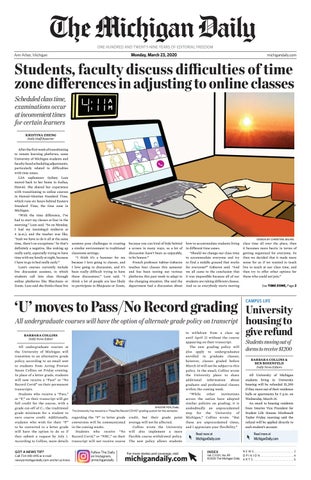
DESIGN BY CHRISTINE JEGARL
sessions pose challenges in creating a similar environment to traditional classroom settings. “I think it’s a bummer for me because I love going to classes, and I love going to discussion, and it’s been really difficult trying to have those discussions,” Lum said. “I think a lot of people are less likely to participate in Bluejeans or Zoom,
because you can kind of hide behind a screen in many ways, so a lot of discussion hasn’t been as enjoyable, to be honest.” French professor Sabine Gabaron teaches four classes this semester and has been testing out various platforms this past week to adapt to the changing situation. She said the department had a discussion about
how to accommodate students living in different time zones. “Should we change our class time to accommodate everyone and try to find a middle ground that works for everyone?” Gabaron said. “And we all came to the conclusion that it was impossible because all of our students are taking different classes. And so as everybody starts moving
‘U’ moves to Pass/No Record grading
All undergraduate courses will have the option of alternate grade policy on transcript BARBARA COLLINS Daily News Editor
All undergraduate courses at the University of Michigan will transition to an alternative grade policy, according to an email sent to students from Acting Provost Susan Collins on Friday evening. In place of a letter grade, students will now receive a “Pass” or “No Record Covid” on their permanent transcripts. Students who receive a “Pass,” or “P,” on their transcript will get full credit for the course, with a grade cut-off of C-, the traditional grade minimum for a student to earn course credit. Additionally, students who wish for their “P” to be converted to a letter grade will have the option to do so if they submit a request by July 1. According to Collins, more details
GOT A NEWS TIP? Call 734-418-4115 or e-mail news@michigandaily.com and let us know.
MADDIE FOX/Daily The University has moved to a “Pass/No Record COVID” grading system for this semester.
regarding the “P” to letter grade conversion will be communicated in the coming weeks. Students who receive “No Record Covid,” or “NRC,” on their transcript will not receive course
Follow The Daily on Instagram, @michigandaily
credit, but their grade point average will not be affected. Collins wrote the University will also implement a more f lexible course withdrawal policy. The new policy allows students
For more stories and coverage, visit
to withdraw from a class up until April 21 without the course appearing on their transcript. The new grading policy will also apply to undergraduates enrolled in graduate classes; however, classes graded before March 10 will not be subject to this policy. In the email, Collins wrote the University plans to share additional information about graduate and professional classes within the coming week. “While other institutions across the nation have adopted similar policies on grading, it is undoubtedly an unprecedented step for the University of Michigan,” Collins wrote. “But these are unprecedented times, and I appreciate your f lexibility.”
michigandaily.com
Read more at MichiganDaily.com INDEX
Vol. CXXIX, No. 89 ©2020 The Michigan Daily
class time all over the place, then it becomes more hectic in terms of getting organized for everyone. So then we decided that it made more sense for us if we wanted to teach live to teach at our class time, and then try to offer other options for those who could not join.” See TIME ZONE, Page 2
CAMPUS LIFE
University housing to give refund
Students moving out of dorms to receive $1200 BARBARA COLLINS & BEN ROSENFELD Daily News Editors
All University of Michigan students living in University housing will be refunded $1,200 if they move out of their residence halls or apartments by 5 p.m. on Wednesday, March 25. An email to housing residents from Interim Vice President for Student Life Simone Himbeault Taylor Friday morning said the refund will be applied directly to each student’s account.
Read more at MichiganDaily.com NEWS.........................2 OPINION.....................4 ARTS.........................6
News
2 — Monday, March 23, 2020
The Michigan Daily — michigandaily.com
Stanford Lipsey Student Publications Building 420 Maynard St. Ann Arbor, MI 48109-1327 www.michigandaily.com
ELIZABETH LAWRENCE Editor in Chief 734-418-4115 ext. 1251 esla@michigandaily.com
ANITA MICHAUD
Business Manager 734-418-4115 ext. 1241 ammichau@michigandaily.com
NEWS TIPS
news@michigandaily.com
LETTERS TO THE EDITOR tothedaily@michigandaily.com
COURTEY OF JORDAN SCHULER & SELENA BAZZI
EDITORIAL PAGE
LSA juniors Jordan Schuler and Sai Pamidighantam are running against LSA juniors Selena Bazzi and Josiah Walker for the positions of president and vice president for the LSA Student Government.
LSA student gov’t candidates talk platform, previous work
The Daily sat down with students running for the positions of president, vice president for each ticket ahead of elections this week BRAYDEN HIRSCH Daily News Editor
Beginning Wednesday morning, University of Michigan students will be able to vote for the LSA Student Government president and vice president. The Michigan Daily spoke with the candidates of each ticket to learn more about their past work and their platforms. Ticket #1: Jordan Schuler (President) and Sai Pamidighantam (Vice President) Jordan Schuler is a junior majoring in Organizational Studies and Philosophy, Politics and Economics. Schuler has been a part of LSA SG since his freshman year. He said he has used his time on LSA SG to build a community within student government. Sai Pamidighantam is a junior majoring in Biopsychology, Cognition, and Neuroscience with minors in applied statistics and Gender and Health. Pamidighantam has been part of the LSA SG for three years. She served as an associate representative and then moved up to be the vice chair of the Diversity Affairs Committee.
TIME ZONE From Page 1 Gabaron said several language departments decided to offer students the opportunity to tune into live lectures or discussions at different section times other than their original time. This offers students who live in different time zones a chance to engage in live discussions at reasonable hours of the day, Gabaron explained. “As the schools were closing it became challenging for people to work from home with
The theme of Schuler and Pamidighantam’s platform is being relationshipdriven and inclusivityfocused. They said their goal is to be able to collaborate with a variety of multicultural organizations and politically-focused organizations on campus. According to Schuler, diversity and inclusivity are at the center of their campaign. “I think the most important piece of our campaign is that we don’t want things like diversity and inclusivity to just be buzzwords, but to be a promise and something that we follow through on,” Schuler said. “Something that we’re committing to doing for the year to come is making people on our campus, regardless of their background or their identities, feel welcome in our government and have a commitment to projects that show that we mean it.” If they win the election, Schuler and Pamidighantam hope to create a General Learning Center, where students could go to get free tutoring in any subject. They hope to promote transparency with students about the costs of courses,
and would like to continue working with the Maize & Blue Cupboard. Ticket #2: Selena Bazzi (President) and Josiah Walker (Vice President) Selena Bazzi is a junior studying biomolecular science with a double minor in Art & Design and Community Action and Social Change. Bazzi has been part of student government at the University for three years. Josiah Walker is a junior studying political science and has not previously been involved with LSA SG. Bazzi said her time in LSA SG working with student groups and administration has helped her gain a lot of knowledge about various groups and institutions within the University. “I feel like I’ve gained unique institutional knowledge to understand how the University functions, where it’s lacking and where things are going well,” Bazzi said. “And my three years of student government experience have given me insight on how to make the changes that I want on campus.” Walker chose to take his experience throughout his three years on campus and
apply it to the LSA SG. “I decided to run because I’ve been heavily involved in other organizing spaces on campus,” Walker said. “I think merging student government efforts with efforts made by other organizing spaces on campus will have a much more tangible impact on the causes that both groups care about.” Bazzi and Walker said their platform focuses on fostering a more affordable university through resources such as free test prep and cheaper textbook costs. Bazzi said their goal is for finances not to be a barrier for students. “So, in terms of academics, we want to promote a textbook affordability initiative,” Walker said. “We know that a lot of textbooks from some of the upperlevel classes or some of the STEM classes and even the language classes can be costly. I want to work with the dean and other university resources to figure out how to make the material more affordable for students.” Reporter Brayden Hirsch can be reached at braydenh@ umich.edu.
a new family situation,” Gabaron said. “So that was also a little bit difficult but I think it was great because students were very much understanding of the instructor’s situation and the instructors were very understanding of the student situation. So I really felt that what happened this week was very strong in terms of emotions, but also in terms of bonding and understanding of each other. ” LSA freshman Neil Kapadia is from Mumbai, India. He said his professors have been understanding and accommodating for his
math classes. “So far, the transition has been quite smooth, it hasn’t been as bad as I thought it would have been,” Kapadia said. “I mean, this is obviously not an ideal situation, but professors are at least trying their best to make it the same. For my math class, they’ve shared the worksheets, they’ve extended deadlines, and they’ve given us the opportunity to collaborate with everyone else because that’s what math class is about.” However, Kapadia said there still remains a barrier to attending online office
hours with professors whose time zones are in a country across the globe. Eastern Standard Time is 10 hours and 30 minutes behind the time zone in Mumbai. “The only thing I find a little tough with the time zone is with office hours and all, because the timings are not going to change,” Kapadia said. “They’ll probably be around midnight, but that will be okay I guess, for like one or two nights to stay up.”
Read more at MichiganDaily.com
opinion@michigandaily.com
ARTS SECTION
PHOTOGRAPHY SECTION
arts@michigandaily.com
photo@michigandaily.com
SPORTS SECTION
NEWSROOM
sports@michigandaily.com
734-418-4115 opt. 3
ADVERTISING
CORRECTIONS
dailydisplay@gmail.com
corrections@michigandaily.com
ERIN WHITE
Editorial Staff
Managing Editor
ekwhite@michigandaily.com
SAYALI AMIN and LEAH GRAHAM Managing News Editors
news@michigandaily.com
Senior News Editors: Barbara Collins, Claire Hao, Alex Harring, Ben Rosenfeld, Emma Stein, Liat Weinstein Assistant News Editors: Francesca Duong, Julia Forrest, Brayden Hirsh, Jasmin Lee, Hannah Mackay, Parnia Mazhar, Alyssa McMurtry, Emma Ruberg, Julia Rubin, Michal Ruprecht, Arjun Thakkar
EMILY CONSIDINE and MILES STEPHENSON
Editorial Page Editors
tothedaily@michigandaily.com
Senior Opinion Editors: Alanna Berger, Brittany Bowman, Zack Blumberg, Timothy Spurlin, Joel Weiner
THEO MACKIE and ETHAN SEARS Managing Sports Editors
sportseditors@michigandaily.com
Senior Sports Editors: Aria Gerson, Bailey Johnson, Ben Katz, Jacob Kopnick, Anna Marcus, Rian Ratnavale Assistant Sports Editors: Connor Brennan, Lily Friedman, Lane Kizziah, Brendan Roose, Kent Schwartz, Molly Shea
JOHN DECKER and JULIANNA MORANO Managing Arts Editors
arts@michigandaily.com
Senior Arts Editors: Jo Chang, Elise Godfryd, Zoe Phillips, Jonah Mendelson, Ally Owens Arts Beat Editors: Samantha Cantie, Dana Pierangeli, Andrew Pluta, Cassandra Mansuetti, Anish Tamhaney, Sophia Yoon
SHERRY CHEN and CHRISTINE JEGARL
Managing Design Editors design@michigandaily.com Senior Design Editor: Lizzy Rueppel
ALLISON ENGKVIST and ANNIE KLUSENDORF Managing Photo Editors
photo@michigandaily.com
Senior Photo Editors: Keemya Esmael, Asha Lewis, Miles Macklin Assistant Photo Editors: Olivia Cell, Ryan Little, Emma Mati, Alexandria Pompei, Alexis Rankin
MAGDALENA MIHAYLOVA Managing Statement Editor
statement@michigandaily.com
Deputy Editors: Emily Stillman, Marisa Wright
MADISON GAGNE and SADIA JIBAN Managing Copy Editors
copydesk@michigandaily.com
Senior Copy Editors: Olivia Bradish, Sophie Kephart, Silas Lee, Olivia Sedlacek, Ellie Scott
TIM CHO and SIMRAN PUJJI
Managing Online Editors webteam@michigandaily.com Senior Web Developers: Parth Dhyani, Abha Panda, Rohan Prashant, Jonathan Liu
ALEC COHEN and ELI SIDER
Managing Video Editors Senior Video Editors: Joseph Sim
video@michigandaily.com
MAYA MOKH and ANA MARIA SANCHEZ CASTILLO Michigan in Color Editors
michiganincolor@michigandaily.com
Senior Michigan in Color Editors: Zoha Bharwani, Lora Faraj, Ayomide Okunade, Gabrijela Skoko Assistant Michigan in Color Editors: Cheryn Hong, Anamkia Kannan, Vaishali Nambiar, Sean Tran, Angela Zhang
SAMANTHA SMALL and SONYA VOGEL Managing Podcast Editors
JOHN GRIEVE and BEN KORN
Managing Social Media Editors Senior Social Media Editors: Jessie Norris, Mya Steir, Kristina Zheng
Business Staff MOLLY WU
Creative Director
RYAN KELLY Sales Manager
LILLY HANSON Senior Account Executive
ANALISE DOORHY Senior Account Executive
TARA MOORE
Senior Account Exeucutive
The Michigan Daily (ISSN 0745-967) is published Monday through Friday during the fall and winter terms by students at the University OF Michigan. One copy is available free of charge to all readers. Additional copies may be picked up at the Daily’s office for $2. Subscriptions for September-April are $250 and year long subscriptions are $275. University affiliates are subject to a reduced subscription rate. On-campus subscriptions for fall term are $35. Subscriptions must be prepaid.
The Michigan Daily — michigandaily.com
Michigan in Color
Monday, March 23, 2020 — 3
Not A Muslim Girl’s Cosmoplitan MAYA KADOUH MiC Columnist
REINHOLD MÖLLER /Wikimedia Commons
Heads Up
Two storks build a nest atop a monastery chimney.
NOOR MOUGHNI MiC Columnist
Amidst the chaos of the world, I looked up to the sky and witnessed a flock of birds carelessly soaring. To them it was just another day. The outbreak of a virus, cancellation of classes, disruption of routine meant nothing to the birds as they remained unfazed. The birds didn’t have to worry about grocery store stocks running low, or the possibility of losing their jobs. They found their versions of toilet paper and hand sanitizer in nature. They didn’’t worry about how the virus would hinder their ability to have financial security. The birds placed their trust in nature and continued to live in unison with it. The only structure they followed was that of the Earth, and their routine relied on the conditions of nature. I admired the birds’ autonomy. It showed me that a reliance on systems had stripped me from my ability to live confidently with nature. I depended so heavily on manmade structures like school and work to feel fulfilled. I was so out of touch with nature that when something natural like a virus prevented certain institutions from functioning, I too, felt unable to function. I felt that if I was not going to school everyday and working from morning to night that I would not feel satisfied. I felt that success was quantified by the amount of work I produced for those systems and anything that stopped me from producing was a problem. My feelings are foreign to birds as the only structure they subscribe to is nature. They eat from nature, find shelter in nature, work with nature, and live as nature. Though structure and routine are necessary for human life, I still wish people depended more
on nature and less on structure. I wish manmade systems were more prepared for the wild capacities of nature. I wish that people could live independently; live more like birds. Birds are aware of the structures around them, yet they do not depend on nor are they controlled by them. Some have even taken the liberty of building nests on stores, houses, and power lines. Humans have developed far more than birds and have surpassed other species in every way possible, yet in the wake of something as natural as a virus, we are subject to complete destruction. All our developments and structures were shaken by nature and if the coronavirus has proven anything to me, it is that in the face of nature, man does not stand a chance. With the future dependent on the course of the virus, the Earth will remain in control and there is no manmade structure, object, or system that can withstand its strength. This pandemic, though unfortunate and chaotic, has shown its value. People are learning to live while connected with nature. Enabled to be productive, people are prioritizing their physical and mental wellness. Worried for the health of the elderly, people are caring for and connecting more with their parents and neighbors. Encouragement of self-isolation has led people to travel within their own minds, meditating and contemplating their lives. These times are uncomfortable and stressful, yet humans have managed to thrive. We will come out of this situation, stronger and wiser, leading a life more like the birds.
View an accompanying video at MichiganDaily.com
For years, Cosmopolitan has been the biggest female-focused millennial brand in the world, influencing and shaping the lifestyles of women. Cosmopolitan’s captivation of society essentially created this idea of a “Cosmo Girl,” a bold, independent, fashion forward woman — an idea which consequently inflicts harm on society, because we can’t all be a cosmo girl. Meet Amani Badran, a trailblazer for Arab and Muslim women, Dearborn native, Ross MBA, an engineer at DTE and someone who lives in a cosmo world but is not exactly a cosmo girl. Badran is bold, independent and fashion forward, just like a cosmo girl. Her boldness, independence and style choices are not a result of the Western standards that Cosmopolitan champions, but rather what she likes to call “a happy medium” between her Muslim and American heritages, which she describes as “not exclusive.” This happy medium is nonexistent in Western brands, and causes many
Muslim girls to feel displaced, less beautiful and discouraged; Badran was one of those girls growing up, and now wants to create a brand and space where Muslim girls are able to feel beautiful, inspired and empowered. Badran is currently in the works of creating an online magazine where Muslim women are able to share their stories and interests on topics ranging from fashion, family, fun/travel, finance/career and food/fitness. “Every Muslim girl is unique in her own way—each of us coming together in this platform like a perfectly, imperfect mosaic,” Badran said. Badran’s personal experiences led her to want to create this space. Growing up, Badran loved reading lifestyle magazines, and had a goal of becoming editor in chief of Cosmopolitan, despite its complete disregard for her identity. She internalized what Western media propels is beauty and decided her hijab strays too much from the set precedent. However now, Badran is unapologetically comfortable and proud of her identity, and realizes the unnecessary struggle she endured getting there. “I wish I had embraced my hijab
for what it was—unique and different, and a symbol of strength, rather than trying to morph it into something that others would understand,” Badran said. “I wish I had a platform, a space, where I saw the beauty of being a Muslim girl, where I saw how to style my dress in a way that aligned with my values, where I saw more Muslim women succeeding in education and career.” For Muslim girls like myself, this brand representation is much needed and long over due. It is time for us to make seeing people that look like ourselves and lead similar lives a normal occurrence, instead of an anomaly. More importantly, it is time for us to have a platform to showcase our art, our writing, our voices and our accomplishments in an authentic way with no adaptations made or questions asked. It is time that we make sure the next generation of Muslim girls do not have to grow up looking at Western norms and thinking this is what could be, and instead, embrace their identity. Soon it will become necessary that we as a society reinvent our understanding of what it means to be and to look American. We will no longer have room for exclusivity.
Muslim Disney Princesses
Dearborn Youth Theater’s Production of Frozen Jr. and the Importance of Representation HIBA DAGHER MiC Columnist
In Reel Bad Arabs, Jack Shaheen explored the portrayals of Arab and Muslim characters in film. After analyzing a thousand different films from 1896 to 2000, he found that 12 films had positive depictions of Arabs and Muslims, 52 neutral, and 936 negative. And representations of Arabs and Muslims haven’t gotten better in the past twenty years. There may be crumbs of decent representation since, but Shaheen’s work is still relevant. Nestled in Dearborn, Michigan, a town with the largest concentrations of Arabs and Arab Americans outside of the Middle East, the Dearborn Youth Theater program, is trying to change all of that. Director Rashid Beydoun, musical director Vanessa El-Zein and assistant director Lisa Cronin work to encourage and include students of all backgrounds in their productions. In January, I attended the Dearborn Youth Theater’s production of Frozen Jr. Sitting there, in the thousandand-some-change seat auditorium, I was fixated as a cast of more than 60 students performed the classic Disney story. Coming in, I didn’t expect to fall in love with the show as much as I did — like many older siblings and cousins, I fell victim to constant reruns of “Let It Go” for a good four years after the movie was released in 2012. My love for the show didn’t come from the music or the dancing but from the cast. For the first time in forever (get it!) Anna and Elsa were played by two incredible Muslim, Arab American actresses. It was then that the story took on a completely different meaning for me. I loved seeing such strong female characters played by Arab, Muslim women. It created a reality and possibilities that I had only dreamt of. Dearborn High School junior Nadia Gellani, who played Elsa, and Fordson High School senior Jenna Kobeissi,
played their respective characters as funny, angry, ditzy, free-spirited, temperamental, reserved, silly, hurt, excitable, optimistic, awkward, calm, regal and most importantly — normal. It’s rare for Arab, Muslim American women, and especially Arab, Muslim American women who wear the hijab, to be portrayed like this. Even now I find it kind of silly with how much I resonated with this show. Like, it’s Frozen, of all things. But as someone who has loved the theatre — pretty much for as long as I can remember — it was jarring to actually see two Muslim teenage girls perform on such an enormous stage. Throughout High School, I watched as the other (and conveniently nonmajority PoC) high schools in the district performed Into the Woods and Little Shop of Horrors and be afforded with opportunities to attend state-wide theater conferences, while my group of friends performed Shakespeare in the French classroom because it was the cheapest, and therefore only, thing we could do (which, by the way, no hate at all to Shakespeare, I was the one pushing us to do all his plays in the first place). I was never able to “see” myself on stage — which is probably why seeing this show meant so much to me. “The best part,” Gellani told me after the show, “is when the kids come up to you and they’re like ‘Hi Anna’, ‘Hi Elsa’ that’s really special.” Speaking to the Gellani and Kobeissi, they really asserted how comfortable they felt working on this production, and it was unlike any other productions that they’d ever worked on — even in Dearborn. Kobeissi said working with Rashid was “the first time that I’ve ever felt included, where things like where my parents came from or my religion didn’t matter.” Anna and Elsa weren’t the only stars of the show. Hans was played in the Glacial cast by Edsel Ford senior Jameel Baksh and in the Arctic Cast by Edsel Ford sophomore Amen
Salha. And both actors have been with Rashid since his very first shows at Stout Middle School: Jameel with Schoolhouse Rock, and Amen with Hairspray. When asking both of them about what it was like working on a show with Baydoun, Amen had this to say: “You feel pushed. Rashid pushes us to our limit, and he knows that we can give even more than we think can.” Jameel similarly had this to say: “We learn so much about acting, I think it shows — I’ve never taken a dancing class, I’ve never taken a singing class, I’ve never taken an acting class, all of my experience comes from Baydoun and after 4-5 years of doing it I can tap into these wells of experience.” It’s not only representation that’s important, though.It’s the space where representation is created. And director Rashid Baydoun has dedicated his life to creating brave, generative and most importantly, inclusive spaces that allow for folks from all backgrounds to participate. A show is composed of so many people working behind scenes, and it’s their support — the costume designers that designed the modest yet faithful transformation dress for Elsa’s “Let It Go” number, the “drama mamas” that helped along the way, the backstage crew, composed of Arab and Muslim students — that make the show. “Casting should be inclusive of all people,” Baydon said. “Period. Don’t tell me you can’t do something. ‘I can’t’ is not in my vocabulary.” It’s easy to be consumed by all the negativity that surrounds our lives. It’s even easier for the nicer things about the world around us — the people striving to make real change, the innovators and artists constantly at work, the communities that band together — to fall through the cracks, but that doesn’t mean they don’t exist. The Dearborn Youth Theater company, as small or inconsequential it may be in the grand scheme of the universe, is a perfect example.
Opinion
4 — Monday, March 23, 2020
The Michigan Daily — michigandaily.com
ISABELLE SCHINDLER | COLUMN
How to counteract Trump’s war on the environment
Edited and managed by students at the University of Michigan since 1890. Stanford Lipsey Student Publications Building 420 Maynard St. Ann Arbor, MI 48109 tothedaily@michigandaily.com
ELIZABETH LAWRENCE Editor in Chief
EMILY CONSIDINE AND MILES STEPHENSON
ERIN WHITE Managing Editor
Editorial Page Editors
EDITORIAL BOARD MEMBERS Alanna Berger Zack Blumberg Brittany Bowman Emily Considine Jess D’Agostino
Jenny Gurung Cheryn Hong Krystal Hur Ethan Kessler Zoe Phillips Mary Rolfes
Michael Russo Timothy Spurlin Miles Stephenson Joel Weiner Erin White
Unsigned editorials reflect the official position of The Daily’s Editorial Board. All other signed articles and illustrations represent solely the views of their authors.
ANIK JOSHI | COLUMN
T
Endorse this
he newspaper formally stopped the practice endorsement, like after 1928. USA Today has the appendix, is a done it only once in its 30-odd relic of a simpler year history (and time that is not even that was particularly useful more of an antitoday. However, endorsement like the appendix, than an the endorsement affirmative one). persists. Before Though the looking at the process for history of the the Times’ endorsement, it’s endorsement worth considering has changed ANIK its efficacy in recent throughout JOSHI years. In 2016, The the years, its Michigan Daily endorsed most significant alterations former Secretary of State came this year. For one, the Hillary Clinton and then Ohio discussions were no longer Gov. John Kasich in their off the record — instead, respective primaries. The they were on HBO. And when Daily then endorsed Clinton the Times actually decided in the general election. on endorsing, rather than Impressively enough, all picking one candidate, they three of these endorsees sensibly picked two because, lost their race — Clinton lost as we all know, everyone Michigan in both the primary gets two ballots. Of course, and the general and Kasich the endorsement was about barely managed to come in as helpful as a white crayon third place in his primary. and both of their endorsees In 2020, The Daily endorsed saw respectable third- and Sen. Bernie Sander, I-Vt., in sixth-place finishes in the the primary and from looking primaries prior to dropping at the results, it appears the out of the race. Midas touch continues apace. For the sake of Vice President Joe Biden’s campaign, I would suggest he avoid the endorsement if he hopes for success in this year’s general election. The ostensible point of an endorsement is to swing voters by successfully making a case for a candidate. However, voters are not always willing to listen to these outlets, especially when trust in the media is low. As a result of this, it might make sense to stop endorsing candidates until public trust So why do these is reestablished. endorsements persist? It is The history of the because newspapers and newspaper endorsement, similar types of institutions unlike an actual endorsement, have been unable to reckon is fascinating. While there with their recent loss of may be other papers that power. However, continuing did it sooner, The New York to endorse candidates is Times has been endorsing unlikely to address this and candidates for President since will instead exacerbate the 1860. The Times is one of the problem. The lack of trust bigger newspapers that still discussed earlier is partially endorses candidates today because people believe the — the Wall Street Journal media has its thumb on
An endorsement is both unlikely to sway voters and also likely to continue to burn trust.
the scale for some candidate or cause. Though people can scream until they’re blue in the face that there’s a line between editorial and hard news, there appears to be bias on both of those angles to many readers. Thus, an endorsement is both unlikely to sway voters and also likely to continue to burn trust, neither of which are admirable goals. However, some might say that the point of an endorsement is more than getting a candidate elected. John McCormick, editorial page editor for the Chicago Tribune, has said that the electoral side is one part of the reason for the endorsement but it is not the whole point. In his view, the point of an endorsement is to “explain to the world what that publication is, what it advocates, how it thinks, what principles it holds dear.” However, McCormick and those who think like him might ref lect on the 2016 election a little bit more caref ully before continuing on with these proclamations. If it is true that the endorsement represents what publications think, what they advocate and what they hold dear, the fact that the American public decided to vote against all of that might be a cause for concern. Beyond this, 2016 should have been the death knell for the idea that endorsements matter. Trump stacked up a total of only 19 newspaper endorsements and was still elected president. If endorsements are about values and not politics, that’s f ine. It’s not good, however, for our democracy, as we need a press that the populace believes in. Since endorsements can’t get votes, it is worth considering whether or not they should amble on — the appendix in black in white. Anik Joshi can be reached at anikj@umich.edu.
O
ur environment is under attack by the Trump administration. Through the repeal of critical environmental regulations and the systematic actions that have been taken to weaken the Environmental Protection Agency, the federal government is failing the American people and the planet. It is more important now than ever that people raise their voices and push for environmental protection at every level of government. Since winning the presidency, President Donald Trump and his administration have boasted about slashing environmental regulations that they viewed as restricting the abilities of businesses to grow. However, many of the regulations that have been repealed were vitally important. The Trump administration ended a requirement for oil and gas companies to report methane emissions, even though methane is a greenhouse gas that contributes greatly to climate change. It has also scaled back a rule designed to limit toxic emissions from major industrial polluters and reversed a rule that prevented coal companies from dumping mining debris into local streams. There have also been many changes to regulations specifically designed to help prevent catastrophic situations. The Trump administration repealed an Obama-Era rule that required braking system upgrades for trains hauling f lammable liquids. It also scraped regulations on offshore drilling put in place after the 2010 BP oil spill. This catastrophic oil spill killed 11 people and spewed over four million barrels of oil into the Gulf of Mexico. The Trump administration has even cut regulations that were widely accepted and agreed upon. Recently, it was announced that the administration would change the way health benefits from regulations are calculated. This step will help pave the way for power plants to release large amounts of mercury and other toxins. Even major energ y companies have disagreed with this change, saying they do not want the Trump administration to change this rule, arguing that it is not necessary and will be detrimental to the environment. Despite this opposition for the groups this rule is supposed to help, the Trump administration has pushed ahead with this dangerous policy change. In addition to cutting regulations, the Trump administration has worked to significantly curtail the power and resources of the EPA. Trump’s two EPA directors have had deep ties to energ y lobbyists. Additionally, Trump has continued
to chip away at the EPA’s budget, proposing a 31 percent cut in 2019. Each of these actions taken by the president and his administration endangers the safety of all Americans and the safety of our planet. It is ludicrous that they are putting the interests of big business ahead of the interests of everyday Americans. We want clean water, we want to be safe from oil spills, we want to curtail climate change. Yet the president is ignoring all of that so he can claim a pro-business, anti-regulation approach. Given the federal government’s total disregard for environmental protection, it is more important than ever that we look to other levels of government to help protect our environment. Michigan Gov. Gretchen Whitmer recently put out a proposed 2021 budget, which calls for critical funding for environmental programs and protection. The proposal asks for $40 million for climate-resilient infrastructure grants, $4 million for legal efforts under the Attorney General to protect residents from chemical contamination of drinking water and commercial pollution and $20 million for rapid environmental contamination response. This funding is critical to help ensure the protection of our environment and the safety of all Michiganders. The money for the rapid environmental contamination response is imperative for dangerous situations, like when earlier this year a green liquid containing cancercausing chemicals began leaking onto I-696 in Madison Heights, MI. Climate resilience funding can help prepare cities for the impact of climate change, such as f looding, which is likely to get more severe. The money to the Attorney General’s office helps to demonstrate the state’s commitment to fighting for clean drinking water, especially following the discovery of lead that led to the Flint water crisis. We all have the power to help promote important policies and funding, especially on the local and state level. If you are appalled by the actions of the Trump administration and are terrified of the looming threat of climate change and environmental degradation, then make your voice heard. Call your local and state legislators, advocate for policies that you believe in and vote in all elections. Through these actions, we can help hold our leaders accountable and help put our nation on a path toward greater environmental stewardship. Isabelle Schindler can be reached at ischind@umich.edu.
CONTRIBUTE TO THE CONVERSATION Readers are encouraged to submit letters to the editor and op-eds. Letters should be fewer than 300 words while op-eds should be 550 to 850 words. Send the writer’s full name and University affiliation to tothedaily@michigandaily.com.
Opinion
5 — Monday, March 23, 2020
MARY ROLFES | COLUMN
What COVID-19 is uncovering – and what we can learn from it
J
ust over a month ago, I contributed to a Michigan Daily Editorial Board article on the COVID-19 outbreak, a piece which primarily warned the community not to panic. In light of recent events, it’s almost surreal to think about sitting in that room now, jokingly passing around hand sanitizer and casually discussing what I then believed to be a novel issue that would not have any major impact on life at the University of Michigan. And coverage did die down, for a time. But now, COVID-19 seems to be the only thing anyone is talking about — and for good reason. On Wednesday, March 11, University President Mark Schlissel announced on Twitter that all classes on the University’s three campuses would be canceled for March 12 and 13 and would move to an online format from March 16 through the end of the semester. Events of more than 100 people were canceled, along with all spring and summer study abroad programs. This announcement followed similar decisions by schools across the country, including the University of Washington, Harvard University and Michigan State University. Also on Wednesday, the World Health Organization declared the coronavirus outbreak to be a global pandemic as it continues to spread rapidly. Sporting and cultural events — including the 2020 NCAA men’s and women’s basketball tournaments — are continually being postponed or canceled, and on March 12 Gov. Gretchen Whitmer announced all Michigan K-12 schools will close through at least April 5. All of this demonstrates how COVID-19, a story I and many others thought would be lost to the 24-hour news cycle, has rapidly developed to impact life on campus, in Ann Arbor and across the world in a massive and seemingly unprecedented way. Despite everything that’s happened in the past few days, however, I stand by the original message the Editorial Board published in February — don’t panic. This is easier said than done when it feels like the world is crumbling around you. It certainly seems that way for me. As a junior transfer, my limited time at the University has been cut even shorter and the social network I was growing has been blunted. My spring study abroad is canceled and I won’t be spending this March making brackets or watching games. Of course, COVID-19 is much greater than any individual biography. With this outbreak playing out on such an expansive — indeed, global — scale, broad actions must be taken. Likewise, something widespread is being revealed. This viral event is highlighting the fundamental errors in the way we live and the way our societies are structured. If we pay close attention to what is being uncovered and respond with meaningful action, the COVID-19 outbreak can be a learning opportunity.
The development of COVID19 has coincided with the 2020 presidential primaries, and one of the key talking points in the goal to unseat President Donald Trump is health care reform. Editorial Board endorsed candidate Sen. Bernard Sanders, I-Vt., argues this outbreak has shown America the necessity of adopting Medicare for All. When a health crisis has the potential to impact everyone, it becomes clear that everyone should have access to high-quality care. While some insurers have pledged to cover the cost of the coronavirus test, the expense of further testing and treatment that will accompany a positive result may prevent individuals from seeking the care they need. Moreover, not everyone has access to health insurance — in 2018, 27.5 million Americans were uninsured. And many of those with insurance have prohibitively expensive barriers to accessing coverage, such as high deductibles, copays and out-of-network costs, all factors which are especially salient given the current economic crisis that has accompanied COVID-19.
COVID-19 has fully exposed the flaws of a largely private insurance market. Even long before the outbreak began, the American health care structure has been shaping how this or any other public health concern would play out. Millions of Americans are denied the preventive care and knowledge that could support improved outcomes in a crisis, such as regular check-ups and diagnoses of chronic or underlying conditions. Health care is a human right and no one should be denied the opportunity to achieve their best health — or survive a pandemic — based on their socioeconomic status. COVID-19 has fully exposed the flaws of a largely private insurance market and an overpriced medical system. It has given us evidence of an urgent need to entirely restructure how we design and distribute health care. Beyond treating coronavirus, the wide-scale preventative measures enacted to slow the disease’s spread provide a chance at a re-evaluation of how we work in America. Several of the world’s largest companies, including Michiganheadquartered Ford and General Motors, tech giants Amazon and Google and financial firms JPMorgan, Chase and Goldman Sachs, have instituted workfrom-home policies for at least some employees. Like the University, a substantial number of academic institutions are transitioning to remote
learning. It seems COVID-19 has finally motivated the world’s largest and most influential institutions to consider policies that disability advocates have been pushing: more expansive, accessible work-from-home policies. These remote policies can spur innovation which will shape a more accessible working landscape for all people of varying abilities. We can discover that it is entirely possible to be productive from home — for some, it may be far more productive than sitting in an office. We can build a more flexible schedule in which productivity is not limited from nine-to-five. We can even reconstruct the concept of productivity, acknowledging the importance of work across the gamut of pay grades and pushing for living wages. Of course, not all work can realistically be done remotely — retail and customer service are notable examples. For these roles, we must mandate paid sick leave, as illness should not prevent one from making rent or putting dinner on the table. In customer-facing roles, especially those involving food, people should not be working when sick — for their own health and for the health of others. Across the board, we must normalize the often-chastised concept of taking a sick day. Our current working environment pushes for self-sacrifice for the goal of productivity, but a rapidly spreading and potentially deadly virus is a grave reminder of our limited time and the importance of prioritizing the well-being of ourselves and of others over material gains. This outbreak is a call to reconsider how we view work in our global society and to rediscover a healthier work-life balance. COVID-19 is having radical impacts on both local and global communities, and the ramifications will be felt for years to come, fundamentally changing the way we live. And where there is change, there is opportunity. It’s absolutely justified to feel like the world is falling apart and to have the associated panic for a period of time — my now-private Twitter feed is a primary example. But if we adopt a mindset of acknowledging the flaws of modernity which COVID-19 has brought center-stage and strive to take action in response, we may emerge from the chaos on the path to a society that is more fair and equitable than the one we had before. In this period of temporary social distance, it’s especially critical to keep in mind that it’s not me, it’s us. Let’s capitalize on this opportunity to think and act radically for a better future. This contemplative approach is imperative to emerging successfully from COVID-19 — along with washing our hands for at least 20 seconds. Mary Rolfes can be reached at morolfes@umich.edu.
The Michigan Daily — michigandaily.com
EVAN STERN | COLUMN
The 2020 primary results you’ll never hear about
S
ince the 2020 presidential primary season kicked off almost two months ago with the Iowa caucuses, millions of Americans have carefully watched as the Democratic candidates fight for the chance to face off against President Donald Trump in November. With an original field of 23 candidates, the race on the Democratic side has proven to be turbulent and unpredictable. While Sen. Bernie Sanders, I-Vt., a self-proclaimed “Democratic socialist,” enjoyed a considerable lead early on, former Vice President Joe Biden has managed to emerge as the frontrunner after impressive performances across the country. And though Sanders remains in the race for now, Biden — who has marketed himself as a moderate wellpositioned to defeat Trump in the general election — now has a clear, undeniable path to the nomination. But amid all of the action playing out between the Democratic candidates, few have taken note of the trend on the Republican side that points to major problems for the Democratic standardbearer in November. While Biden, Sanders and the rest of the field have constantly tried to trample each other and make their pitches to the American people, the most impressive candidate of all remains the current president. Many Americans consider the Republican primaries to be dull and uninteresting. After all, for all practical purposes, the current president is running unopposed for the Republican nomination. However, the truth is that regardless of what happens on the Democratic side, Trump has consistently stunned political pundits who see his performance as a “red flag for Democrats.” From the beginning of the wearisome primary process, the current president has racked up a tremendous, unprecedented amount of support from Republican voters in both red and blue states who are energized to reelect the president for a second term. Democrats have great reason to be concerned about how this enthusiasm will translate to the general election later this year. The mainstream media wouldn’t bother to report on this, but Trump’s support at the polls this election season is unprecedented on multiple levels. We all know that former Presidents George W. Bush and Barack Obama were relatively popular incumbents who went on to secure second terms. In particular, we have more recent memories of the level of support that Obama received from all corners of the country. What most of us don’t know, though, is that voters are turning out in higher numbers for Trump than Obama, Bush and other successful incumbents in their own primary races.
In the New Hampshire Republican primary this year, Trump received about 130,000 votes, more than double the number that both Obama and Bush captured in their respective reelection bids. In Vermont, a traditionally leftleaning state, Trump beat every past Republican and Democratic incumbent in the last 40 years. Additionally, in Tennessee, early indications revealed that voter turnout from the competitive 2016 Republican primary dipped only 3 percent, a clear display of the level of support the president has been able to maintain throughout his first term. At the same time, while the president continues to perform exceptionally well compared to past incumbents, his total number of votes in inconsequential races threaten the levels of support that the current Democratic candidates have secured amid a divisive primary process. In the Texas primary, nearly 1.9 million voters cast their ballots for Trump, while Biden, who won that state’s Democratic competition, only captured about 700,000 votes. Texas may be a state that is typically friendly to Republican candidates, but nobody can deny the fact that the president, during a pointless primary, captured almost triple as many votes as the Democratic frontrunner did. What makes this even more significant is the fact that Texas is considered by many to be turning increasingly purple. Trump has extended this impressive performance to other states as well. In Alabama, Trump won almost 700,000 votes, while Biden only managed to collect roughly 290,000. In fact, only about 450,000 turned out to cast a vote for any Democratic candidate at all in the state. The numbers tell a similar story in Arkansas. In the end, it has never been so clear that Americans across the country want four more years of Trump. The remarkable energy and enthusiasm the president — who ran on a platform to “Make America Great Again” — has gathered is truly unrivaled in modern political history and should deeply worry the Democratic Party. Ultimately, we shouldn’t be paying attention to the daily movements of the Democratic race, because at this point, it couldn’t matter less whether Biden or Sanders emerges as the standard-bearer. The real story is the unprecedented political movement that Trump began when he first announced his candidacy, the movement that propelled him into the presidency in 2016 and the movement that will win him a second term this November. Evan Stern can be reached at erstern@umich.edu.
SUBMIT TO SURVIVORS SPEAK The Opinion section has created a space in The Michigan Daily for first-person accounts of sexual assault and its corresponding personal, academic and legal implications. Submission information can be found at https://tinyurl.com/survivorsspeak2020.
The Michigan Daily — michigandaily.com
Arts
Monday, March 23, 2020 — 6
ALBUM REVIEW
Conan Gray’s debut is all about love in the digital age lonely, melancholic ache that comes with adolescence. Every track feels a bit delicate and unsure. I first happened upon Conan Gray’s By way of capturing that uncertainty music as I would any great discovery: on of adolescence, Kid Krow feels like the a YouTube binge. An e-boy poster child second you’ve shut your bedroom door: The with a mess of hair and a killer pout, record is a soundtrack to the movie reel of I immediately wanted to dislike him. memories your mind plays when you’re Instead, I clicked on music video after alone. It’s intimate enough to know all of music video, impressed that he could your insecurities on “Heather.” It’s petty be so melodramatic yet extremely self- enough to understand your outlandish aware. Gray’s debut album Kid Krow feels dreams of revenge on “Checkmate.” Gray’s like staring at a glowing laptop screen — lyricism feels close in a way that only a kid dizzying and addictive. raised by the Internet can be. It’s obvious It’s no surprise, then, that Gray got his that he’s scrolled through years worth of start as a YouTuber. A video titled “Let Me oversharing — Kid Krow is his opportunity Introduce Myself” shows a young, 2013 to contribute. Conan innocently waving at the camera; According to an interview with People, by 2016 he hit Gray’s best millions of friend told views, and has him he was since followed like a crow: a similar mysterious, trajectory to watching, fellow YouTuberknowing. turned-popstar “Kid Krow,” Troye Sivan. therefore, Unlike Sivan, became Gray’s however, Gray superhero alter Conan Gray has stayed rooted ego. On “The in the culture Story,” for Republic Records he’s helped example, Conan cultivate. His narrates the sad recent videos endings of kids highlight him whose “parents making art, were evil” from getting his ear a bird’s eye view. pierced and Gray worries shopping, all that “that’s just activities that the way the further his brand as not only a vulnerable world works / it ain’t funny, it ain’t pretty, singer-songwriter, but as someone it ain’t sweet,” but he stays hopeful. He accessible enough to be thought of as a doesn’t trivialize brooding, he embraces it. friend. But Gray’s music isn’t constrained to The hours he has spent building an moody 3AM listen. On “Maniac,” he has audience shows up most explicitly on fun calling out an ex who’s told everyone Kid Krow’s interludes “(Online Love)” that he’s the crazy one. “Wish You Were and “(Can We Be Friends?).” Vignettes Sober” is intoxicatingly bouncy. The flip of internet love, these soft, breezy tracks side to the hours I picture Conan laying treasure the careful kindling of long- in bed overthinking, is lots of dancing. distance relationships. On the latter, Gray Thankfully, being emotional doesn’t always sweetly threatens to “knock (the) teeth have to be so sad and lonely. Besides, Gray out” of anyone who messes with his fans. recognizes that all of this drama is kind of It’s charming. funny. The rest of Kid Krow lives in the gray — A week before the album’s release, the almost love, the chase of an unreachable Conan tweeted that he “wrote this whole crush, the understanding that you’re being entire album about someone (he) never led on, the terrifying acceptance that you dated and never kissed.” Speaking for a like it. On “The Cut that Always Bleeds” generation that Internet-stalks, Snapchats, Conan pleads for a on-again off-again lover and texts as much as we talk in person — if to leave, then ends up begging them to Conan’s tweet isn’t upsettingly relatable, I stay. “Comfort Crowd” acknowledges the don’t know what is.
TV REVIEW
KATIE BEEKMAN Daily Arts Writer
Kid Krow
WIKIMEDIA COMMONS
HULU
Exposing microaggressions in ‘Little Fires Everywhere’ still inside and what would drive them to such violence in what appears to be a Daily Arts Writer picturesque community? If you ever say something and then find “Little Fires Everywhere,” while full yourself thinking, “Was that racist?”, odds of artful suspense and beautiful writing, are, it probably was. That self-awareness of also places viewers in a constant state prejudice and microaggressions may seem of discomfort with dialogue rife with ref lexive to some in 2020, but in 1997, that awkward attempts at political correctness. may not have been the case for everyone. Elena, insecure in her internalized racism, And it certainly isn’t for the characters of frequently brands herself as accepting “Little Fires Everywhere.” despite her intense distrust of Mia and Set in the Shaker Heights suburb of inherent biases as a highly privileged Cleveland, “Little Fires Everywhere” white woman. follows two families separated by class and Based on the best-selling novel of the race. In the summer of 1997, the wealthy, same name, this miniseries examines not white Richardson family begins renting only the racial tensions of the late 1990s one of their properties to struggling but also the very American tragedy of artist Mia Warren (Kerry Washington, suburban living. Mia, who prides herself “Scandal”) and her daughter Pearl (Lexi on going with the f low and remaining Underwood, “If Not Now, When?”). Elena unattached, finds herself in the middle Richardson (Reese Witherspoon, “Big of a neighborhood so orchestrated and Little Lies”) immediately seeks to befriend organized that it feels as if the oh-so Mia, whom she rented to in a moment of permanent walls are closing in. Despite her white guilt after accidentally reporting resistance to embrace the Shaker Heights her to the police philosophy of for trespassing. complete control Despite over chaos, her Elena’s fumbling love for her attempts at daughter tethers gaining her her to what she friendship, sees as a prison Mia resists of tranquility. making ties Because of this with anyone in commitment, the exceedingly Mia and Pearl planned are stuck inside community, as a system of Season 1, Episodes 1-3 she has spent weakening her entire life social strata as Hulu moving from the threat of the Now Streaming city to city every eventual fire few months. looms over the While tensions audience. With heighten each strained between Mia interaction and Elena, their between children, now them and the attending the Richardsons, same school, “Little Fires become close friends and bring their Everywhere” shows how the build-up of families together. Soon, Mia agrees to take intense pressure can lead to a destructive a job as the Richardsons’ housekeeper in explosion. order to protect Pearl and study the hidden This show, while only beginning, has rifts in the seemingly perfect family’s already constructed an intricate web of relationships. personal relationships and largely owes The first few episodes released of “Little its success to the incredible performances Fires Everywhere” have been a lengthy of Washington and Witherspoon. As f lashback meant to set up the eventual the series continues to unfold and the arson of the Richardson’s mansion months characters further unravel, Elena and after Mia and Pearl’s arrival in Shaker Mia’s complex dynamic will remain Heights. With this knowledge in mind, the center of a thrilling story and pose the audience is left wondering who would questions to viewers about how even set a house on fire with a family of five sparks can start wildfires. ANYA SOLLER
Little Fires Everywhere