Thursday, July June2,11,2020 2020
ONE HUNDRED TWENTY-NINE YEARS OF EDITORIAL FREEDOM
inside
Transgender rights at risk in new policy
NEWS
Students go to bars Experiences & opinions of students going to bars that reopened amid COVID-19
Rules from the Trump administration and Supreme Court seemingly at odds
>> SEE PAGE 2
OPINION
Deconstruct America’s youth
JULIANNA MORANO Daily Staff Reporter
Commentary on the histories of Tulsa, Juneteenth and east Oklahoma. >> SEE PAGE 4
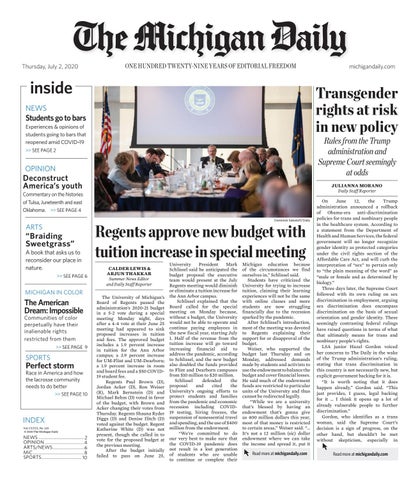
Regents approve new budget with tuition increase in special meeting
Dominick Sokotoff/Daily
ARTS
“Braiding Sweetgrass” A book that asks us to reconsider our place in nature. >> SEE PAGE 6
MICHIGAN IN COLOR
The American Dream: Impossible Communities of color perpetually have their inalienable rights restricted from them
>> SEE PAGE 9
SPORTS
Perfect storm
Race in America and how the lacrosse community needs to do better >> SEE PAGE 10
INDEX Vol. CXXIX, No. 120 © 2020 The Michigan Daily
NEWS .................................... 2 OPINION ............................... 4 ARTS/NEWS..........................6 MiC......................................... 8 SPORTS................................ 10
michigandaily.com michigandaily.com
CALDER LEWIS & ARJUN THAKKAR
Summer News Editor and Daily Staff Reporter
The University of Michigan’s Board of Regents passed the administration’s 2020-21 budget in a 5-2 vote during a special meeting Monday night, days after a 4-4 vote at their June 25 meeting had appeared to sink proposed increases in tuition and fees. The approved budget includes a 1.9 percent increase in tuition for the Ann Arbor campus; a 3.9 percent increase for UM-Flint and UM-Dearborn; a 1.9 percent increase in room and board fees and a $50 COVID19 student fee. Regents Paul Brown (D), Jordan Acker (D), Ron Weiser (R), Mark Bernstein (D) and Michael Behm (D) voted in favor of the budget, with Brown and Acker changing their votes from Thursday. Regents Shauna Ryder Diggs (D) and Denise Ilitch (D) voted against the budget. Regent Katherine White (D) was not present, though she called in to vote for the proposed budget at the previous meeting. After the budget initially failed to pass on June 25,
University President Mark Schlissel said he anticipated the budget proposal the executive team would present at the July Regents meeting would diminish or eliminate a tuition increase for the Ann Arbor campus. Schlissel explained that the Board called for the special meeting on Monday because, without a budget, the University would not be able to operate and continue paying employees in the new fiscal year, starting July 1. Half of the revenue from the tuition increase will go toward increasing financial aid to address the pandemic, according to Schlissel, and the new budget also doubled the funds provided to Flint and Dearborn campuses from $10 million to $20 million. Schlissel defended the proposal and cited the University’s ongoing efforts to protect students and families from the pandemic and economic recession including COVID19 testing, hiring freezes, the suspension of nonessential travel and spending, and the use of $400 million from the endowment. “We’re committed to do our very best to make sure that the COVID-19 pandemic does not result in a lost generation of students who are unable to continue or complete their
Michigan education because of the circumstances we find ourselves in,” Schlissel said. Students have criticized the University for trying to increase tuition, claiming their learning experiences will not be the same with online classes and more students are now struggling financially due to the recession sparked by the pandemic. After Schlissel’s introduction, most of the meeting was devoted to Regents explaining their support for or disapproval of the budget. Weiser, who supported the budget last Thursday and on Monday, addressed demands made by students and activists to use the endowment to balance the budget and cover financial losses. He said much of the endowment funds are restricted to particular units of the University and thus cannot be redirected legally. “While we are a university that’s blessed by having an endowment that’s gonna give us 400 million dollars this year, most of that money is restricted to certain areas,” Weiser said. “… It’s not a 12 million (sic) dollar endowment where we can take the income and spread it, put it
Read more at michigandaily.com
On June 12, the Trump administration announced a rollback of Obama-era anti-discrimination policies for trans and nonbinary people in the healthcare system. According to a statement from the Department of Health and Human Services, the federal government will no longer recognize gender identity as protected categories under the civil rights section of the Affordable Care Act, and will curb the interpretation of “sex” to pertain only to “the plain meaning of the word” as “male or female and as determined by biology.” Three days later, the Supreme Court followed with its own ruling on sex discrimination in employment, arguing sex discrimination does encompass discrimination on the basis of sexual orientation and gender identity. These seemingly contrasting federal rulings have raised questions in terms of what that ultimately means for trans and nonbinary people’s rights. LSA junior Hazel Gordon voiced her concerns to The Daily in the wake of the Trump administration’s ruling, stating that trans discrimination in this country is not necessarily new, but explicit government backing for it is. “It is worth noting that it does happen already,” Gordon said. “This just provides, I guess, legal backing for it … I think it opens up a lot of already vulnerable people to further discrimination.” Gordon, who identifies as a trans woman, said the Supreme Court’s decision is a sign of progress, on the other hand, but shouldn’t be met without skepticism, especially in
Read more at michigandaily.com
2 NEWS
Thursday, July 2, 2020 The Michigan Daily — michigandaily.com
Students flock to bars after reopening After restrictions lifted, lack of social distancing, face masks reported JASMIN LEE AND SARAH PAYNE
Summer Managing News Editor and Summer News Editor
The University of Michigan hosted a virtual town hall titled “Constructive Conversations for Societal Change” on Friday, in solidarity with the protests that have erupted across the nation against racism and police brutality. The town hall was moderated by Robert M. Sellers, vice provost of equity and inclusion and chief diversity officer, and focused on providing a platform for the University of Michigan community to come together. “Our conversation today marks our collective recommitment as individuals and as a university to ending systemic racism in our society and within our institution,” Sellers said. “In doing so, we affirm that Black lives matter. We recognize that this conversation is not the solution, nor can it be our response, our only response, to the senseless killing of George Floyd and far too many other African Americans. It’s only a necessary start to acknowledging our collective pain and outrage.” LSA senior Darlena York shared her experiences with racism on campus, citing a survey from a political science class she took and the effect of the survey on students’ mental health. “It makes students not want to participate in class, not want to go to class, because it’s very detrimental to our mental health, detrimental to how we want to perform in class and it’s detrimental to our overall well-being as students,” York said. “A lot of my experiences aren’t that positive when reflecting on racial inequality on campus. It’s very exhausting as a student leader sometimes, having to constantly combat those things.” Rackham student Naomi Mae Wilson, who has been a community organizer for the past 10 years, spoke about her involvement in fighting systemic racism at the University of California at Berke-
ley, New York University and in her communities at the University of Michigan. She emphasized that fighting for change can be exhausting and traumatic. “Having been in the work for 10 years, it’s not really, really long but it’s a lot for me. My experience and my feelings are both exhaustion and also a deep, deep fire in my spirit to fight for justice and to make sure that we have change,” Wilson said. “Young people are out there and they are dedicating their childhoods for justice which in some ways, in a lot of ways, is beautiful and in a lot of ways is incredibly sad that we lift up these young folks who are out there, to march and demand for their lives to matter.” Riana Anderson, an assistant professor at the School of Public Health, spoke about the link between systemic racism and the disparate impact of COVID-19 on the Black community and the effects of the protests on mental and physical health, making people more susceptible to the dangers of COVID-19. “My work shows how racial acts exact a toll on psychological outcomes like anxiety, depression and trauma, even if it’s not personally happening to us, as is the case with so many of the virtual experiences we viewed online,” Anderson said. “Our bodies also react through physiological processes, like increased blood pressure, quickened heart rate and heightened production of stress hormones, eroding our physical health and wreaking havoc on our normal stress responses including regulated breathing, which of course ties back to COVID.” Eddie L. Washington Jr., the executive director of the Division of Public Safety and Security, shared his emotional reaction to the video of George Floyd’s murder. “When I saw the video, the first thing I thought about was just the loss of life. And I think about the loss of life and the impacts that that has directly on (Floyd’s) family, on the community, on Blacks specifically,” Washington Jr. said. “It causes a spark of images that I think about for most of my life, images from the 60s and the 70s. I think about
Read more at michigandaily.com
420 Maynard St. Ann Arbor, MI 48109-1327 www.michigandaily.com
EMMA STEIN Editor in Chief enstein@michigandaily.com
ANITA MICHAUD Business Manager ammichau@michigandaily.com
CONTACT INFORMATION
Design by Cara Jhang
Graduate students rally for protection GEO expresses concerns about fall semester and teaching KRISTINA ZHENG Summer News Editor
The challenges that international students face in attending American universities are plentiful, ranging from intense culture shock to rising tuition fees. Add the COVID-19 pandemic, which comes with strict travel restrictions, troublesome flights home and visa issues, and those challenges double. The University’s International Center Director Judith Pennywell told the Daily that over the past few months, the center has received numerous requests for help regarding the pandemic and uncertainty for the fall semester. “Students are wondering about the availability of remote learning opportunities for fall and whether there are visa or immigration related implications,” Pennywell said. “Some students have expressed concerns about internship offers being revoked in light of COVID-19.” Second-year Information student Chengyue Qiu, an international student from China and the secretary for Graduate Rackham International (GRIN), a studentrun organization at the University meant to support graduate students on campus, mentioned how since the pandemic hit, her peers have faced both academic and career obstacles. “I have a lot of friends who had their internships canceled because
of COVID,” Qiu said. “That’s a really common thing.” Engineering alum Mohammed Majid had his offer as an upcoming software engineer at Uber rescinded due to the pandemic. Majid, an international student from India, shared his story on a LinkedIn post that spread widely throughout the University community. “Hi Everyone!” the post begins. “Yesterday, I received a phone call from my recruiter: my new grad SWE offer from Uber was rescinded due to COVID-19, with 90 days left to find employment or risk deportation.” Upon graduation, international students who do not want to return home usually apply for Optional Practice Training, which allows students to stay in the U.S. for a maximum of 12 months for employment-related training in their field of study. But not all companies choose to sponsor international students and some organizations related to defense or national security seldom hire or interview non-U.S. citizens. Students who are granted OPT are only allotted 90 days of unemployment. In an interview with The Daily, Majid spoke about the grueling fall job recruitment process and how difficult it was to do it all over again last month. Back in September, he said he applied to as many as 100 jobs and by November had a couple of offers — three months of applications, phone calls and interviews.
Read more at michigandaily.com
News Tips Corrections Letters to the Editor Photo Department Arts Section Editorial Page Sports Section Magazine Advertising Department
news@michigandaily.com corrections@michigandaily.com tothedaily@michigandaily.com photo@michigandaily.com arts@michigandaily.com opinion@michigandaily.com sports@michigandaily.com statement@michigandaily.com Phone: 734-418-4115 dailydisplay@gmail.com
EDITORIAL STAFF Devak Nanua Managing Editor dnanua@michigandaily.com
Jasmin Lee & Francesca Duong Managing News Editors news@michigandaily.com
Brittany Bowman Editorial Page Editor tothedaily@michigandaily.com
Nick Stoll & Kent Schwartz Managing Sports Editors sportseditors@michigandaily.com
Emily Yang Managing Arts Editor arts@michigandaily.com
Madeline Hinkley & Julia Schachinger Managing Photo Editors photo@michigandaily.com
Hibah Mirza Managing Design Editor design@michigandaily.com
Olivia Bradish Managing Copy Editor copydesk@michigandaily.com
Cheryn Hong & Gabrijela Skoko Managing Michigan in Color Editors michiganincolor@michigandaily.com
John Grieve & Ben Korn Managing Social Media Editors
Alexander Cotignola Managing Online Editor webteam@michigandaily.com
Iulia Dobrin Managing Video Editor video@michigandaily.com
Andie Horowitz Managing Statement Editor statement@michigandaily.com
The Michigan Daily (ISSN 0745-967) is published Monday through Friday during the fall and winter terms by students at the University of Michigan. One copy is available free of charge to all readers. Additional copies may be picked up at the Daily’s office for $2 per issue. Subscriptions for September - April are $250, and year-long subscriptions are $275. University affiliates are subject to a reduced subscription rate. Subscriptions must be prepaid.
Thursday, July 2, 2020 The Michigan Daily — michigandaily.com
NEWS 3
New guidelines still restrict research Students criticize 2020-2021 tuition increase, added fees
Undergraduates deemed ‘non-essential in-person visitors’ in labs, cannot participate
Design by Hibah Chughtai
Survey data shows a majority expected a discount CLAIRE HAO AND MEGAN SHOHFI Daily News Editor and Daily Staff Reporter
A proposal to increase tuition by 1.9 percent for the 2020-2021 school year and add an additional $50 COVID-19 student fee failed to pass at the University of Michigan Board of Regents meeting Thursday morning. The decision was widely talked about by students on social media, with many saying they were shocked by the University’s attempt to raise tuition, especially since the majority of students in a representative survey of the student body said they expected a tuition discount. University spokesman Rick Fitzgerald described the motivation behind the proposed 1.9 percent increase in tuition in an email to The Daily. “The administration proposed a 1.9 percent tuition increase on the Ann Arbor campus to balance the budget, provide higher levels of financial aid, and adapt to the COVID-19 pandemic,” Fitzgerald wrote. “The budget also included continuing the Go Blue Guarantee and contained a 5.6 percent increase in undergraduate financial aid. That additional $12.8 million increase in aid would have meant most in-state undergraduates receiving need-based grant aid would have seen no increase in tuition costs in the coming year.” University tuition and fees have increased 42.05 percent for the last 10 years, including the same 1.9 percent last year for in-state under-
graduates and 3.7 percent for outof-state undergraduates. University President Mark Schlissel has noted this trend in rising tuition is to maintain the University’s commitment to academic excellence, especially as inadequate state funding for higher education continues to decrease. This year, as Michigan struggles with coronavirus, state appropriations are likely to be further reduced as the state faces a $3.2 billion budget deficit. “The university has long been committed to affordability,” Fitzgerald wrote. “Significant university resources are directed toward financial aid. Last fiscal year, we provided $344 million in grant and scholarship support for students. Only 1 percent of that support was directly funded by the state, 10 percent by federal sources, and 6 percent by private sources. The remaining 83 percent was from university resources, including general fund, endowment support and athletics.” Though students have lamented tuition increases in the past, this year’s strong opposition centers around students hesitant to pay increased tuition without receiving the full benefits of in-person instruction. Though the University’s recently released decision describes their plan as an “in-residence, public-health informed” fall semester, all classes of over 50 people will be held online, and each department and school will make the final determination. Last month, some students filed a lawsuit seeking compensation for the move to online classes in March. The University said they do not owe students money for switching formats due to academic freedom principles that give the University alone the power to decide mode of
instruction. Additionally, LSA sophomore Becca Stachel told The Daily that tuition is already a huge obstacle for many students attending the University. Stachel finds it difficult to justify paying the same tuition for online classes in the fall, especially for students impacted most by COVID-19. “A lot of people aren’t financially stable (after the pandemic) and tuition is a huge burden on a lot of students,” Stachel said. “So, to have a lesser quality of education, but still have to pay the same amount of money when you likely also took pay cuts because of the pandemic, seems unfair to me.” In early June, Central Student Government members Public Policy senior Damian Chessare, Rackham student Hayden Jackson and Architecture student Lauren Conroy put together a survey gauging student sentiment on tuition and enrollment in light of the COVID19 pandemic. Their report found the majority of students surveyed expected a tuition discount of just under 20 percent to be acceptable if classes were in a hybrid format. 59.4 percent of the students surveyed said a discount decision would affect their enrollment decisions at least a moderate amount. Over 40 percent projected that their future financial circumstances were either “very insecure” or “somewhat insecure.” LSA junior Annie Mintun, a LSA representative to CSG, created a petition calling for the University to decrease tuition after Thursday’s Regents meeting. As of Friday afternoon, the petition has over 2700 signatures.
Read more at michigandaily.com
KRISTINA ZHENG Summer News Editor
While many University of Michigan students use the summer months to gain experience from internships and jobs, others engage in various research projects across campus to gain critical skills for career development. But in a matter of weeks, those plans to participate in cuttingedge research at the No. 1 public research university in the U.S. were halted as the COVID-19 pandemic shut down all non-essential in-person research activity. Since then, the University has started ramping up non-essential research. Furthermore, members of the research community have begun to resume in-person lab work in phases, while following procedures to protect the health and safety of researchers. However, undergraduate students, who are heavily involved in many labs across campus, are still restricted from returning to labs under Gov. Gretchen Whitmer’s current guidelines, which classifies undergraduate students as “non-essential in-person visitors.” LSA sophomore Kylie Schache, a UROP student during the school year, said she was planning on working in a lab that studies Alzheimer’s disease for the summer. The lab work was a full-time paying position in which she would work 40 to 50 hours per week. These plans, however, came to a halt when COVID-19 prevented undergraduates from returning to labs –– and it doesn’t seem like this will change anytime soon, Schache said. As a result, Schache said she is considering taking a semester off to gain additional research experience at the University in hopes of preparing her for a career in research. “I’m actually considering that I might need to take a gap semester,” Schache said. “The fact that the University of Michigan is the number one public research university is the primary reason why
I chose to attend there and really the definitive reason why I’m willing to attend the most expensive public university in the United States. So the loss of research opportunities kind of called into question whether attending the University merits the cost at this point. I can take the classes and I can get the degrees, but ultimately what’s going to prepare me for what I want to do with my career — which I want to do a career in research — it’s the research opportunities that are most important.” University spokeswoman Kim Broekhuizen reaffirmed in an email to The Daily that undergraduates are unable to participate in laboratory research at this time due to Whitmer’s latest executive order. Broekhuizen also noted the University’s efforts to develop principles to protect the health and safety of researchers as they begin to resume work amid COVID-19. “The university must adhere to state regulations, and so we will closely monitor any updates to the governor’s executive order as it relates to laboratory research,” Broekhuizen wrote. As of June 26, the University completed the laboratory research re-engagement waves, and more than 95 percent of the University’s lab workforce is now re-engaged, according to an update from Rebeccca Cunningham, vice president for research. While researchers continue to resume in-person activity, labs are to remain operating at about 30 percent capacity at any given shift. Gary Luker, professor of radiology, biomedical engineering, microbiology and immunology, conducts research focusing on molecular imaging of cell signaling in cancer. Over the course of his entire time working in the lab, Luker has had roughly 35 to 40 undergraduate students participate in their research.
Read more at michigandaily.com
4 OPINION
Thursday, July 2, 2020 The Michigan Daily — michigandaily.com
Edited and managed by students at the University of Michigan since 1890. 420 Maynard St. Ann Arbor, MI 48109 tothedaily@michigandaily.com
EMMA STEIN Editor in Chief
BRITTANY BOWMAN Editorial Page Editor
EDITORIAL BOARD MEMBERS Alanna Berger Zack Blumberg Brittany Bowman Emily Considine Elizabeth Cook
Jess D’Agostino Jenny Gurung Cheryn Hong Zoe Phillips Mary Rolfes
Michael Russo Gabrijela Skoko Timothy Spurlin Joel Weiner Erin White
Unsigned editorials reflect the official position of the Daily’s Editorial Board. All other signed articles and illustrations represent solely the views of their authors.
FROM THE DAILY
T
Understanding intersectional Pride
hroughout the month of June, the 50th anniversary of Pride Month is being boldly and unapologetically celebrated by members of the LGBTQ+ community and its allies across the globe. As Pride has become a widespread protest and celebration internationally, the United States government has made some major strides in granting basic human rights to LGBTQ+ identifying people, like the legalization of same-sex marriage in 2015 and the recent Supreme Court ruling protecting the LGBTQ+ community from employer discrimination.
D
espite these historic events, the traction made hasn’t applied to all members of the community. In 2019 alone, “advocates tracked at least 27 deaths of transgender or gender non-conforming people in the U.S. due to fatal violence, the majority of whom were Black transgender women,” according to The Human Rights Campaign. As the Black Lives Matter protests continue, many activists are calling for justice for Riah Milton and Dominique “Rem’mie” Fells, two Black trans women killed during the month of Pride. Furthermore, on June 12, the Trump administration finalized a rule to reverse nondiscrimination protections for trans individuals in the Affordable Care Act. The rule is set to go into effect this August. When over half of the U.S. public already believes that gender is determined at birth, this rule sets trans people up to face even more harm at the hands of the U.S. healthcare system. These inequities are often particularly worse for Black trans individuals, who experience the racial disparities of the U.S. healthcare system exacerbated by COVID-19 in addition to transgender discrimination. In order to understand the significance of Pride month and the Black Lives Matter movement, one must
comprehend the inherent definition of intersectionality — while there is variation in definitions, a key explanation is coined by American law professor Kimberlé Crenshaw. Crenshaw’s intersectionality theory essentially allows users to see how categories of analysis (race, class, gender) coalesce. She believes those who are at an intersection of identity, for example being both Black and a woman, tend to be failed by institutions of law or medicine and overlapping experiences of systemic oppression — for example, a combination of racism and sexism. Crenshaw heavily argued that the social institutions and policies in the United States create and exacerbate women of color’s vulnerability to violence and abuse, and this situation is equally as applicable to the LGBTQ+ community and Black people. The history of the fight for LGBTQ+ rights has been heavily whitewashed and has unfortunately erased much of the efforts by people of color, especially trans Black women, who paved the way of American LGBTQ+ rights. While many credit the Stonewall riots as the spark of the LGBTQ+ rights movement, the first clear event that placed the transgender community on America’s political history originated in San Francisco’s Tenderloin neigh-
borhood, at Gene Compton’s cafeteria in 1966. In a community where many trans women and drag queens lived openly, with full self-expression, individuals would consistently face harassment, abuse and arrest from local police officers. While the specific date of the riot is unknown, it is said that a trans woman, fed up with the constant aggravation and use of force by the police, threw a cup of coffee at an officer, igniting a riot. Three years later, in New York City, police raided one of the few places people of the same sex could dance together without harassment, the Stonewall Inn. The Stonewall riots quickly erupted as patrons fought to defend themselves against police violence, throwing bricks and bottles, marking the tipping point for the LGBTQ+ liberation movement. However, instead of crediting LGBTQ+ activists of color who were heavily involved and constantly fought against unjust police raids, such as Marsha P. Johnson and Sylvia Rivera, people often focus on the mystery of who threw the first brick, or if Judy Garland, a white cisgender actress, was the inspiration for the riot. On the one year anniversary of the Stonewall riot, the first Pride march was held. These historical events that paved the way for future activism are often mistold,
whitewashed and misunderstood, yet are somewhat collectively acknowledged as the origin of Pride Month. There continues to be major disparities in rights for the trans community, especially in medical care. There is a higher prevalence of clinical depression, anxiety, somatization, current smokers, former alcohol or drug use to cope with mistreatment and attempted suicides. According to the 2015 U.S. Transgender Survey, about a third of trans respondents reported having a negative experience in the previous year with a health insurance provider related to being trans. Also, as a result of America’s history of muting the contributions made by Black trans women for modern LGBTQ+ rights and silencing these women’s voices, Black trans women struggle the most in the trans community. Over a quarter of Black trans respondents reported avoiding a healthcare provider when they needed it in the past year due to fear of mistreatment and 40 percent reported avoiding a healthcare provider because they could not afford it. About 20 percent of Black trans individuals are uninsured, compared to 14 percent of trans people overall and 11 percent of the total U.S. population. Over 40 percent of Black trans individuals reported experiencing recent psychological distress, over eight times the rate of the U.S. population. Black trans individuals also reported higher rates of suicide attempts. At the same time, Black trans individuals reported experiencing elevated rates of discrimination and verbal, physical and sexual assault at the hands of police officers. Overall, 22 percent of trans people who have interacted with police have reported police harassment, which jumps to 38 percent for trans people who are Black. These high numbers strongly point to implicit bias law enforcement holds against both trans and Black individuals, and makes it no surprise that many trans individuals and Black LGBTQ+ individuals, in particular, do not want police presence at Pride celebrations and in other LGBTQ+ spaces meant to be safe for all members of the community.
And as people of color who are also in the LGBTQ+ community, Black trans people are at the intersection of racism and homophobia in institutional systems. The Center for American Progress shows how only 35 percent of LGBTQ+ Black women have had mammograms in the past two years, compared to the 57 percent of all LGBTQ+ women and the 62 percent of all heterosexual women. The distrust in the medical system creates a higher risk for people of color in the community, as 30 percent of LGBTQ+ Black adults are likely to delay or not get needed medication compared to 19 percent of all Black heterosexual adults. These health disparities also apply to other communities of color, as 25 percent of LGBTQ+ Asian or Pacific Island adults experience psychological distress at a rate four times higher than heterosexual Asian and Pacific Islanders, and 2.5 times more than the general heterosexual population; and 60 percent of LGBTQ+ Latinx adults report more alcohol abuse in comparison to the 33 percent of the Latinx heterosexual population. As university students and as members of The Michigan Daily Editorial Board, we urge our fellow students to examine these systems of oppression and to analyze their own biases that may impact the lives of minorities one day. We stand in solidarity with all individuals celebrating Pride Month and we urge those individuals to continue to fight for the most oppressed, marginalized and intersectional communities within each space. Understanding the complexities of each identity is essential to building a progressive, inclusive and worthwhile society for each individual. This conversation must continue beyond the month of June and after celebrations adorning rainbow flags and colorful outfits fade. Realizing the real trauma and pain, while also acknowledging the radiance and individuality of each community member, is critical to gaining a deeper understanding of the importance of intersectionality. Graphic by Hibah Chughtai
Thursday, July 2, 2020 The Michigan Daily — michigandaily.com
ELAYNA SWIFT | COLUMNIST Theta Chi’s party threatens an on-campus fall
I
’ll be honest — signing a lease next to one of the largest fraternities on campus was a massive mistake, especially as someone unaffiliated with social Greek life. Over the past year, I’ve learned to fall asleep to the thumping of the bass on Theta Chi’s speakers on random Tuesday nights and adjusted to routinely throwing their trash back into their backyard from mine, only to watch squirrels and other wildlife rummage through their abandoned beer, food, boxes and plastic containers. Admittedly, I should have considered who my neighbors would be before I moved into a house with the fraternity’s satellite houses in its backyard. I haven’t complained much throughout my time living here for that reason. However, observing their behavior amid a pandemic has been revolting. In fact, this column was inspired by the large party that gathered in their backyard on Thursday, June 25, mirroring what fraternity parties looked like on campus before COVID-19. While on a slightly smaller scale, their backyard was flocked with people dancing and, needless to say, not bothering to follow social distancing guidelines. Frankly, this isn’t at all surprising. There’s a constant plethora of controversy surrounding both University-affiliated and unaffiliated fraternities on campus. Many of our fraternities have countless accusations of alcohol abuse, sexual assault, racism and hazing. In 2018, six fraternities, including Theta Chi, voluntarily disaffiliated from the University of Michigan due to changes in Ann Arbor zoning requirements that would force them to actually face repercussions for their irresponsible and loathsome actions. Still, I had some hope that these fraternity brothers, who are receiving a world-renowned education from a university with one of the best public health programs in the world, would act somewhat responsibly and display at least a hint of their high-quality schooling during this pandemic. The party I involuntarily witnessed from my bedroom window proves not only my own naivety but also University President Mark Schlissel’s. Theta Chi’s latest disappointing displays of entitlement and foolishness are likely a result of Schissel’s recent announcement to have an in-residence fall semester. Although it’s clear to any knowledgeable being that these plans are only provisional — reliant on a continued flattening of the curve — these brothers still believe that the best way to respond to the University’s recently announced plans for the fall semester is to throw parties. Schissel’s faith in students, especially those involved in social Greek life, to continue social distancing after returning to campus shows that his ignorance nearly matches that of the Theta Chi brothers.
His false optimism, if left unchecked, will lead to even more parties like these throughout the upcoming semesters. Unfortunately, as stated above, Theta Chi has made their determination to avoid any consequences for their actions clear by disaffiliating with the University, making it all the more difficult to hold them accountable. For affiliated fraternities, the University and the Interfraternity Council can — and should — ban all social engagements and Greek life activity in general for the upcoming semesters. Clearly, if left to their own devices, many of these students will prioritize their desire to binge drink and party excessively over the health and safety of their peers as well as faculty, staff and residents of Ann Arbor. Their inability to care about anything outside of themselves will be on full display. However, for Theta Chi, other unaffiliated fraternities and those that will inevitably disaffiliate when told that they have to forego their precious parties, this selfishness will lack consequence. In order to change that, the city of Ann Arbor holds the responsibility of enacting and enforcing ordinances that will discourage large parties from occurring — not only for fraternities but also for co-ops and house parties thrown by the general student population. Currently, this would require police to increase patrolling the city for parties. Hopefully, the city can enlist a committee of sorts independent of the police to enforce this. Until the University defunds and divests from their police department, though, they’ll likely be on party patrol. Undoubtedly, if we are to have an inresidence fall semester, the University should place as many bans as possible on both affiliated and unaffiliated fraternities in order to discourage parties. Outside of that, and in addition to action being taken by the city of Ann Arbor, the campus culture should normalize condemning large parties in the name of public safety. We must discourage our friends and classmates from attending and call out our fraternity neighbors for throwing them (I’m looking at you, Theta Chi). It’s imperative that we force Greek life to face their hypocrisy of throwing these parties despite their desire to return to campus this fall. They must be reminded that they aren’t the only students on campus or the only residents of this city. I’m well aware that I sound like the last person you’d want to invite to a party. Believe me, I don’t want the invite. I’ve enjoyed my fair share of fraternity parties and nights out in Ann Arbor.
Read more at MichiganDaily.com Elayna Swift can be reached at elaynads@umich.edu.
OPINION 5
MAX LUBELL | OP-ED
W
The final $2.50 Wednesday latte
hen I first learned Espresso Royale was closing all of its locations in early June, it felt like just another thing fighting for my attention. Amid the global COVID-19 pandemic and Black Lives Matter protests following the killings of George Floyd and Breonna Taylor — only two examples of white supremacy that have sparked recent uprisings — the news that the coffee chain was closing seemed rather insignificant. That’s not to say Espresso Royale’s closing, or the closing of any business predicted to not make it through the pandemic, won’t have a real impact for some of the 38.1 million Americans employed in the service and retail industries hit the hardest. Still, Espresso Royale’s closing did not seem like the greatest cause for concern at the time. As I have had more time to reflect on the news, I am left with all of my memories sitting at Espresso Royale, an incredibly important place for me and many of my peers throughout college. It was where we would study on countless mornings, afternoons, evenings and late nights; met with friends in between classes; went on or observed awkward first dates and organized to work on group projects. Espresso Royale was a reliable study spot where you were bound to run into people you knew. While my peers and I ostensibly went to Espresso Royale to study, my favorite memories there were when we barely got any work done at all. You could always count on finding someone to talk to when you were avoiding homework. As a very extroverted person who loves to procrastinate, I would often go to Espresso Royale between classes, even when I had no work to do, just to take refuge from the cold and find someone to chat with for a couple of minutes. While I stared at blank Word documents hoping my essay would type itself, I got to talk with friends or acquaintances about what was new in our lives, how we felt about school, where we were coming from and where we wanted to go. Since Espresso Royale was open until 11 p.m., we took shelter there for hours on end. During my junior year, I found myself bewildered by how much time my peers and I had spent at Espresso Royale’s State Street location, or ERSSL as we would commonly abbreviate it. It was impossible to walk into ERSSL without seeing at least three people you knew. One night — while I was once
again procrastinating completing my course readings — I took this bewilderment online. On Feb. 20, 2017, a fellow Michigan Daily opinion editor and I started the Espresso Royale (State Street) Fan Club Facebook Group, an unofficial fan page for people — mainly myself — to post Espresso Royale memes and commentary. The posts in our unofficial fan club ranged from a variety of topics: jokes about Espresso Royale’s renovations or the infamous “coffee12” wifi password, photos of people drinking Espresso Royale in their 8 a.m. class, questions about how much to tip for a $2.50 latte and general posts about the Espresso Royale experience. There weren’t any rules dictating what was appropriate to post, as long as it was Espresso Royale-related. Despite the page never gaining more than 342 members, I reveled in the local fandom and small-town popularity the group provided me, loving the attention I got from strangers who grew to know me as “the Espresso Royale guy.” While it was all just for fun, our devotion to Espresso Royale left me with the same question that inspired me to start the page in the first place: Why the hell do we spend so much time at this coffee shop? My peers and I must have clocked hundreds of hours each at ERSSL. Given the wide array of coffee shops in Ann Arbor, I don’t think it’s controversial to say that Espresso Royale was not the greatest option in town. This is no fault of Espresso Royale. After all, how is one to compete with the likes of Literati Coffee or Roos Roast? Still, even without these elite alternatives around to serve as points of comparison, it’s not as if Espresso Royale was trying very hard. The coffee, service and seating, albeit reliable, were all just okay. One day during the summer after I graduated, I went into ERSSL with some friends to work on job applications only to find the A/C was out. This memory is representative of many ERSSL experiences: Showing up only to find something massively uncomfortable, yet staying for at least an hour anyways. While I would never go on the record saying ERSSL was perfect, the popular Zucchini bread, strong cups of coffee and camaraderie kept me coming back. With so many other great cafes to choose from, why did so many of my peers consistently congregate at ERSSL? There are certainly some pragmatic reasons. Espresso Royale’s State Street location was rel-
atively accessible, convenient and open late. Espresso Royale’s prices were not radically different from other options nearby, such as Starbucks, but they generally let you use their space without buying anything. Their openness to letting people loiter in addition to the charm and $2 Latte Wednesday deal — a tradition celebrated like a holiday in the Espresso Royale Facebook group — made it a sufficient college study spot. You could find several friends in ERSSL on Wednesday mornings even when, to our collective horror, the latte deal was raised to $2.50 Latte Wednesdays. I am certainly not saying Espresso Royale’s storewide policy was to let anyone loiter. Although baristas tended not to care about people loitering, or were just too busy to notice, I have still seen Espresso Royale staff ask homeless residents to leave. The best solution to the lack of places to go without spending money in a city as unaffordable as Ann Arbor — whether to study, see friends or simply take refuge from the rain — is increased investment in affordable housing and public community spaces, not private coffee shops. Still, even though Espresso Royale was not perfect, I worry that the next coffee shop to pop up will create just another unaffordable space in the city. The loss of Espresso Royale creates a vacuum for simple and lowcost places for Ann Arbor residents to meet, work and caffeinate. While practical considerations drew me to Espresso Royale’s State Street location, the real appeal came from the space it provided to spend time with friends under the guise of getting work done. Espresso Royale made socializing easy. I would often go there to meet friends, many of whom I don’t catch up with anymore, without even telling them to show up. The closing of Espresso Royale, a coffee shop that served a strong cup of coffee and an even stronger sense of community, is a massive loss to Ann Arbor. I could always count on finding an extra chair to pull up across the coffee-stained carpet to a table of friends, a $2 Wednesday latte and vegan Zucchini bread in tow. But now, with Espresso Royale gone for good, those wobbly chairs are left empty and cheap coffees are a thing of the past. Max Lubell is a graduate of the University of Michigan and can be reached at maxlubell@gmail.edu.
6 ARTS
Thursday, July 2, 2020 The Michigan Daily — michigandaily.com
SUMMER SERIES
BOOK REVIEW
My mother’s copy of ‘The Bluest Eye’ LILLY PEARCE Daily Arts Writer
When my mother was in college, she would spend hours at the campus bookstore. She would browse the stacks of books assigned for literature classes that she was not taking. She would spend her money buying other people’s mandatory reading, and later would fall in love with the books she found. This was how she came across Toni Morrison and “The Bluest Eye,” and how I came to find it in my bookshelf. I asked her why she never actually took these literature classes, especially when I realized that numerous books left to me were a result of her bookstore prowl, and her answer was simple. She didn’t like the analysis of the books, much like her disdain for the analysis of poetry. She couldn’t ever derive the deeper meaning of what she thought to be insignificant details, and she did not care to delve into the motifs of revered classics. It would strip her of the enjoyment of these books and discourage her reading habits. So when she read “The Bluest Eye,” she was only privy to her own interpretations. “It was a punch to the gut.” Set in Lorain, Ohio, in 1941, the book begins with narration by Claudia MacTeer, a woman describing events that happened around the time she was nine years old. That fall, her young friend Pecola was having her father’s baby. Claudia recollects how she and her sister Frieda planted marigolds in hopes that their success would signify the health of Pecola and her baby. But they did not bloom. No marigolds bloomed that fall in Lorain, and Pecola’s baby did not survive. “What is clear now is that of all of that hope, fear, lust, love and grief, nothing remains but Pecola and the unyielding earth.” The autumn the year prior, Claudia’s family had taken in Pecola temporarily after her father tried to burn down the family home. Pecola is a quiet and awkward little girl, obsessed with Shirley Temple and the belief that whiteness is beautiful, her own Blackness inherently ugly. Morrison uses Pecola to show “how something as grotesque as the demonization of an entire race could take root inside the most delicate member of society: a child; the most vulnerable member: a female.” Pecola moves back home to live with her unstable, alcoholic father, Cholly, distant mother Mrs. Breedlove and a runaway brother, Sammy. Pecola cannot escape. She begins to think it is the life she deserves because she is ugly, a belief reinforced by how she is treated in her community: She is invisible to the adults in the community, she is teased by boys at school and is framed for killing a boy’s cat. Pecola starts to believe she could transform her life if only she were prettier. She prays for blue eyes
in an effort to change how the world views her, and she the world. One night, when Pecola is 11 years old, Cholly returns home drunk. He sees her washing dishes and experiences several heavily conflicting emotions: tenderness, hatred and lust, all fueled by guilt. He rapes Pecola and leaves her unconscious on the floor. Her mother finds her, disbelieves her story and beats her. Pecola, now pregnant, visits a self-proclaimed psychic with her wish for blue eyes. He tricks her into killing a dog, and tells her its sudden death means her wish will be granted. After this, Claudia tells us how she and her sister learned through gossip that Pecola was pregnant. Pecola, who can no longer go to school, believes everyone’s disregard for her is rooted in their jealousy of her blue eyes. “A punch in the gut” is an understatement. This novel stuns you — not only because it is blatantly apparent in its exposure of how the innate discrimination of society destroys young souls, but also purely by how it is written. The form and structure is incredibly lyrical and evocative. Morrison chose to break the story into distinct parts that, although divided by each season, are mostly narrated non-chronologically. It is the objective of the reader to reassemble the story. This choice was Morrison’s solution to centering the novel on Pecola, who is an incredibly delicate and vulnerable character. By giving the reader greater responsibility, Morrison hoped to provoke an “interrogation of themselves” rather than lead them into the comfort of pitying Pecola and ignoring the greater issues at hand. There are many frequent shifts between narrators and perspectives that emphasize Pecola’s shattered world. This ever-changing structure forbids the dehumanization of the characters who hurt Pecola, and shifts focus onto the systemic nature of the issues that occur. I found the structure to achieve its purpose, and was surprised by Morrison’s claim in the forward that “it didn’t work: Many readers remain touched but not moved.” The quick shifts prevented me from becoming numb to the discomfort. Each distinct portion of the novel induced a sense of uneasiness, and forced me to acknowledge where this vexation was sprouting from: In each part, the same underlying beast was pulsating. I could trace my discomfort back to the root of the issue, the discriminatory system, that was responsible for the characters’ suffering. The shattered world was explicit. For a reader not to be moved means the reader was not paying attention.
Read more at michigandaily.com
Sewing and palace intrigue in ‘Dusk’ LIZZIE YOON
Daily Arts Writer
Elizabeth Lim’s second novel in the Blood of Stars series, “Unravel the Dusk,” reaches deep into your prefrontal cortex and implants a strong desire to embroider and to create. She makes sewing exciting, infusing time consuming, mundane tasks with danger, dignity and purpose. In the world of “Unravel the Dusk,” embroidery and tailoring is regarded and honored as capital-A Art. The highest title of Master Tailor is reserved only for accomplished men. Women, while able to practice the craft, are hampered by sexism. In the first book, “Spin the Dawn,” Maia rebels against the status quo. Taught by her aged father, once a Master Tailor, Maia struggles to keep her family shop open after her brothers are drafted into war. After the war ends, Maia has two dead brothers, a crippled brother and a fragile father. When her father is called upon by the emperor to craft clothing for the future empress. Maia worries that her father would not survive the arduous trip. To save what remains of her broken family, Maia passes herself off as her brother and goes to the capital in her father’s place. If her deception is discovered, Maia would be executed. Aided by a divine pair of heirloom shears, Maia undergoes three trials to do the impossible. Maia must retrieve divine materials to craft three legendary dresses: one from the laughter of the sun, one from the tears of the moon and one from the blood of the stars. Edan, the emperor’s enchanter, assists her as they travel to the far-flung corners of the land. Edan is revealed to be a jinn, a magician turned genie, bound to a thousand years of servitude. He serves as Maia’s love interest and as a prime example of Lim’s cross-cultural exchanges. While the Blood of Stars duology focuses on a single kingdom, the world Lim creates is vast. She allows Chinese folktale and Persian mythol-
ogy to interact and exist side by side. Jinn magic is not native to the Sino-inspired kingdom; thus, Edan is introduced as an enchanter. The cultural diffusion recalls historical cultural diffusion that occurred because of trade routes like the Silk Road. The small details help anchor Lim’s fantasy world and lends it verisimilitude. In the second book of the series, Lim focuses more on developing a tight narrative and less on lateral world building. Court politics takes center stage, with Maia attempting to uphold the tenuous peace and her own sanity. In the first book, the three divine dresses serve as Maia’s questing goal. They are mythic and unattainable yet vital to preserving peace. In the second book, Maia’s central conflict is within herself. She no longer needs to continue crafting with the threat of life or death. Maia already peaked in her tailoring career. At the conclusion of the first book, the Kingdom plunges back into war with the rebel commander, aided by demonic forces. Maia must rally her allies to combat the demonic threat. Thus, in “Unravel the Dawn,” Maia is less a seamstress and more a demon, an agent of war. While crafting takes up less space in the second novel, “Unravel the Dawn” still reminds us that there is dignity in working with our hands, producing labors of love, beauty and sweat. Having fewer crafting moments was disappointing but Maia’s character transition from creator to destroyer was exciting to read. Throughout the Blood of Stars duology, Elizabeth Lim unflaggingly stresses the magic of beautiful art and trade skills while bringing the suspense and drama. She depicts a robust world, fraught with political and social tension. For Maia, sewing is not compliance with the patriarchy. Rather, every stitch is a rebellion, a stand against the patriarchal status quo and looming demonic powers.
Read more at michigandaily.com
Thursday, July 2, 2020 The Michigan Daily — michigandaily.com
SUMMER SERIES
SUMMER SERIES
Reflective moment for ballet on Juneteenth ZOE PHILLIPS Daily Arts Writer
‘Braiding Sweetgrass’: connect with nature TRINA PAL Daily Arts Writer
Every time I see someone tread off a beaten trail, crushing plants in their wake, my heart crumples inside. “They’re just plants,” is the usual response I’m met with, words that cut inside me further. Plants may seem insignificant, partly due to their size and their position below our eye level. Humans are fascinated with animals larger than themselves — elephants or killer whales, for example — but aren’t thrilled by a small shrub. But have we forgotten that plants give us life? Plants are the reason we can roam this Earth. Or, in the words of Robin Wall Kimmerer, plants give us “the privilege of breath.” I wonder how often we think of plants and trees in this way, how regularly we view the world as animate and directly responsible for our own lives. How different would our world look if we saw the non-animal lives around us as our greatest teachers? In her book “Braiding Sweetgrass,” Robin Wall Kimmerer shows us just how beautiful that planet could be. “Braiding Sweetgrass” focuses on the space between indigenous knowledge and scientific thought, where both thrive and complement each other. Kimmerer belongs to the Citizen Potawatomi nation, but is also a distinguished botanist. Lending her voice to both the scientific and indigenous perspective, Kimmerer reconciles two worlds drifting apart, and uses her knowledge of both to envision a more sustainable future. When I picked up “Braiding Sweetgrass,” spring was knocking on my door.
ARTS 7
Lime-green shoots were beginning to peek out of the earth, the endless winter finally ceasing. I remember walking through the forest and seeing right through it — the towering trees weren’t yet filled with leaves, but buds were starting to sparkle in the dim sunlight. I read as the world was waking from its slumber, and Kimmerer’s words provided the perfect commentary. Kimmerer’s intricate understanding of the natural world isn’t intimidating, but rather comforting and gentle. You don’t have to be an ecologist to understand her writing and take something from it. Chapters are told as first person narratives, but by the end you’ve inadvertently learned enough about pond eutrophication or the utility of wetland cattails to confidently explain it to someone else. Early on, Kimmerer challenges our private, capitalist worldview, and instead urges us to think communally. The world isn’t rich for individual taking, but instead generous with resources that sustain lives and communities. As is the tragedy of the commons, our species often ends up taking more than our share, and as a result we see whole ecosystems — rainforests, wetlands, tundras — disappear. Kimmerer gives a good reason for why we do this: The Western world still fails to recognize the world as animate. Indigenous languages such as Potawatomi are about 70 percent verbs, while English is only 30 percent. The verb “to be” applies to much more than just humans in Potawatomi, and thus many more things are considered alive.
Read more at michigandaily.com
This week marked four months since San Francisco Ballet first cancelled a performance due to coronavirus. In early March, the company was one of the first in the country to feel the effects of stay-at-home orders and their muchhyped run of “A Midsummer Night’s Dream” came to a screeching halt. Soon after, SFB cancelled four more productions, locked their rehearsal spaces and spearheaded a series of online programming that, like most other companies, established Instagram as a quasi-home base. Over the last four months, SFB’s feed shifted from a uniform presentation of professionally staged photography to a rather endearing hodgepodge of at-home studios, amateur lighting and IGTV streams of digital seasons. This collage of imagery was no different two weeks ago on June 19 when the company took part in the #JuneteenthDanceBreak initiative started by Theresa Ruth Howard, founder of the organization Memoirs of Blacks in Ballet. A week and a half prior, Howard had challenged the global dance community to join her in “lifting up the legacies, contributions, accomplishments, and stories” of Black artists. The task was simple: On June 19, “dedicate your feed to the display of the beautiful diversity of Blackness” with at least four separate posts throughout the day. Howard’s proposition was one of the many initiatives born of a burgeoning awareness for the Juneteenth holiday. The date commemorates the day that the last enslaved people finally received news of their freedom on June 19, 1865. The event took place two and a half years after the Emancipation Proclamation and its history, like many other facets of Black history, remains largely absent from our public awareness. This year, ongoing protests against racial injustice have emboldened arguments for America to recognize the date both as a federal holiday as well as a chance to reflect more generally on the systemic issues of racism that still exist today. Juneteenth thus has multiple angles: It celebrates the freedom of Black Americans while also offering somber perspectives on the progress that we have yet to achieve. Howard distilled these two meanings in her creation of the Juneteenth Dance Break — she wanted to make space for Black people’s “beauty, creativity, ingenuity, elegance, power, and perseverance.” To celebrate, but also to learn. SFB was one of many organizations that partook in Howard’s project. Their June 19 feed started with an Instagram Live stream of dancer Kimberly Marie Olivier and her fatherin-law, principal bassoon player Rufus Olivier. The two Black artists took an hour to talk about ballet, bassoons and Black history. The rest of the company’s posts were a mixture of shorter
videos and still photos. All in all, SFB shared over an hour and a half of content and multiple paragraphs of information about Black dancers, choreographers and musicians who form part of SFB’s past and present. The result was an impressive use of the dance world’s quarantined predicament — an insightful yet fully digital combination of education and celebration with the timely and timeless lens of redefining racial perceptions of ballet. The outpouring from other organizations was also impressive: The celebration cut divides of hierarchical status and spanned the distance between institutions like American Ballet Theatre all the way to smalltown dance studios. When the sun rose on June 20, the world suddenly had access to a wide-reaching archive of information about Black dancers of past and present and their profound effect on our stages today. In an added bonus, the resources were (and still are) easily accessible in one place under the #JuneteenthDanceBreak hashtag on Instagram. Howard quickly took to her own account to thank everyone for their “enthusiastic and creative participation.” Indeed, the celebration had uncovered something rather unprecedented: Dance history, let alone Black dance history, is a dwindling field. The Juneteenth Dance Break gave a voice to marginalized stories within an oft-forgotten domain. “This is history,” Howard said, “this is world history. This is dance history. This is not just Black history, it’s history. It’s American history, and it’s all of ours. It belongs to all of us.” But Howard was also clear: “It’s just a start. And I hope that this is the beginning.” June of 2020 operated almost as a highlight reel of dance companies dedicating and rededicating themselves to racial justice in the performing arts industry. The process started with messages of #TheShowMustBePaused on Blackout Tuesday, moving to initiatives like #BalletRelevesForBlackLives or #NoJusticeNoDance and most recently the #JuneteenthDanceBreak. These are, of course, only hashtags — they do not replace updated policies and real change, but they do seem to have provided a start for some. The even murkier side of this movement, however, lies in what hasn’t even made it to Instagram at all: the companies that waited until their only Black dancer complained of racist policies to release a solidarity statement, the companies that didn’t acknowledge Juneteenth or the ones that only posted one haphazard photograph to jump on the bandwagon. Actions speak louder than words, even though words are much better than silence.
Read more at michigandaily.com
8 MICHIGAN IN COLOR
Thursday, July 2, 2020 The Michigan Daily — michigandaily.com
The American Dream: A person of color’s impossible pursuit JENNY CHONG MiC Staff Writer
Graphic by Cheryn Hong
The overglorified Disney+ Hamilfilm CHERYN HONG
MiC Managing Editor
On July 3, Disney+ will be exclusively streaming Lin-Manuel Miranda’s hit musical, “Hamilton,” also known as #Hamilfilm. Ever since 2015, “Hamilton” has been highly praised because it features solely BIPOC singers and actors on the Broadway stage telling the tale of the American Revolution. I myself am a huge fan of musicals and Broadway history, so when “Hamilton” came out, I couldn’t help but sing along to the Schuyler sisters and wished one day I would be able to accrue enough money to squeeze myself into the Richard Rodgers Theatre. Recently I noticed a lot of criticism toward the musical, and recognized how ironic and inappropriate the whole concept was: people of color, whose very existence was threatened by the people they were portraying, in a business which also has a history of excluding those who weren’t rich and white. Many before me have recognized the several issues “Hamilton” fans often glaze over. Writer Gene Demby noticed when he attended the show how there were only a handful of POC between him and the actors, and notes how “Hamilton” particularly attracts white audiences. Theatre has a history of segregated seating, plays with racist caricatures and minstrel shows. Along with the historical white audience, the exorbitant high ticket prices and constant sold-out status of the shows prevent the working class and BIPOC from attending as well. Even with a primarily white audience and a musical being held in a historically racist production setting, my biggest critique of “Hamilton” is its historical inaccuracies. While I understand the musical is purely entertainment, and it could be bold for me to assume that people would believe in the portrayal of past white historical figures, when it comes to conversations of racism, slavery and how BIPOC were treated in colonial America, it wouldn’t surprise me if people
become misinformed. Historian Lyra Monteiro notes how Miranda conducts a strategy called “Founders Chic,” representing the founders of America as relatable or cool people. This strategy distracts from the fact that the Founding Fathers were enslavers. In regards to Hamilton specifically, who is decorated as a great anti-slavery abolitionist, it is not mentioned that he once worked on a slave ship. There were actually few white people who were opposed to slavery, especially in the Carribean, and there is no historical accounts or statement to back up that Hamilton was anti-slavery. One of the reasons why Hamilton didn’t own slaves was because he was a poor immigrant, thus it was rather a practical addition rather than a moral protest. Furthermore, the beautiful, intelligent and independent portrayal of the Schuyler family and sisters, while entertaining, distracts from their grand involvement in the business of enslaving. Elizabeth Schyuler was able to sing tunes such as “Helpless” at the ball and attract Hamilton because she had several enslaved people to prepare her. And on the note of the Schuyler sisters, “Hamilton” is also criticized for not passing the Bechdel test — while it seemingly features strong women, all the dialogue and plot revolve around the men. Another core feature of the musical, which is also extremely problematic, is Miranda’s usage of the bootstraps immigration narrative. Hamilton is depicted as a rags to riches story. While it can’t be denied Hamilton may have worked hard for his success, it heavily denotes his other success factors and gaslights the struggles of other immigrants who may have worked just as hard but had societal oppressors keeping them from the same level of success. Factors such as structural racism, predatory capitalism and policies which prevented citizenship which...
Read more at michigandaily.com
In the second grade, my teacher asked the class to explain why people immigrated to the United States. My hand shot up with enthusiasm — I wanted to share my family’s story. “My parents came here because they wanted freedom and a better life,” I answered patriotically. At the time, I believed America was the land where hopes and dreams would come true for everyone — where “all men are created equal” as the Declaration of Independence claims. My parents left their small village in Guangdong, China, and immigrated to New York with the same determined mindset. They wanted to prove anything was possible in America, and attest to the validity of the rags to riches fantasy. To their dismay, achieving the American Dream was harder than they’d expected as non-English speakers without a college education. Sacrificing this dream for their blue-collar jobs, they passed these aspirations down to my siblings and me, pushing us to pursue higher education so we would obtain high paying jobs. In becoming successful, they believed we would also live a happy and comfortable life. I find skepticism in that sentiment, however. As long as I am a person of color in America, I will never live comfortably because racism will remain an ailment hanging over me. As long as the color of my skin is the main determinant of how society treats me, I will never be able to fulfill the American Dream. Coined by James Truslow Adams in his book “The Epic of America,” the American Dream is a dream in which an individual can be recognized “for what they are, regardless of the (unanticipated) circumstances of birth or position.” This has encouraged lower class Americans and immigrants to work harder and seek higher education in order to live a
prosperous life, but it fails to acknowledge how one’s race plays a role in economic success or societal acceptance. The United States has a history of systemically oppressing communities of color and immigrants in an effort to protect its white Americans from foreign influences. The Immigration Act of 1924 barred all Asians from entering the country and set quotas for countries outside of the Western Hemisphere. After the attack on Pearl Harbor, over 127,000 Japanese-Americans were forced to relocate to internment camps because Americans feared they were spies for the Japanese government. More recently, the Trump administration ordered three variations of Muslim bans, the latest of which blocks people from seven countries, five being predominately Muslim, from traveling to the U.S. The ban also denies Temporary Protected Status (TPS) for Somalia, Sudan, Yemen and Syria — leaving refugees vulnerable to deportation back to countries in the midst of war, natural disasters and humanitarian crises. Restricting rights for communities of color is no different than upholding white supremacy. Black Americans have borne the brunt of centuries of systemic oppression. Despite the abolishment of slavery and segregation laws, American policies manage to covertly discriminate against the Black community across many facets of life, ultimately maintaining many characteristics of the slave institution. The American Dream fails to recognize that not everyone is given an equal opportunity to succeed, and it would be naive to believe otherwise — however the glorification of the dream itself nurtures the idea that everyone who comes from some sort of struggle has an equitable chance at acquiring said dream, but this is far from true.
Read more at michigandaily.com
Graphic by Hibah ChughtaiI
Thursday, July 2, 2020 The Michigan Daily — michigandaily.com
MICHIGAN IN COLOR 9
Home is me / Kill me dirty country GABRIJELA SKOKO MiC Managing Editor
HOME IS ME home is me. stubborn. scared of your own soul. so the Soul maintains itself. unsure if home should be insanity or if you are insane. and so only the Soul is maintained. I know I am insanity because you will not call me citizen.
KILL ME DIRTY COUNTRY
dirty water. dirty water. dirty water. cleanse this skin of bullets spring— ing off our brothers’ backs, into our mother’s home— we all return, yet we prefer to think of home nostalgically. “Remember spring.” we do not feel safe anymore so we cling onto season like it is our mother’s home.
Graphic by Hibah ChughtaiI
dirty country sing. dirty women come in spring. you see that we are thirsty for what is beneath us. yet, we remain
null of spring to drink from. to heal with. to bathe in— dirty water. dirty water. dirty
water. Sprung.
Read more at michigandaily.com
Finding my place: the power of change GRACE GARMO MiC Staff Writer
As I showed my mom my outfit for school in the morning, she performed her routine check. She nodded as she scanned me up and down until she noticed a new piece of apparel. After months of pleading and convincing, I was finally wearing a pair of ripped jeans. I held my breath in anticipation for her order to change my outfit, but she reluctantly mumbled, “Looks good.” I heard traces of disbelief in her voice. Why anybody would want to pay full price for “destroyed” clothing was beyond her, but I think in that moment she finally grasped how much it meant to me. In Lebanon, her home country, clothing like ripped jeans was always rejected and out of the question. My mom’s acceptance, though reluctant, was a sign of accepting a piece of American culture and realizing how I was raised in the United States, not the Middle East. I’ve always had an underlying frustration with who I am, but I came to terms with my identity struggle when I began high school. Having come from a middle school surrounded by other Middle Eastern students, I never stood out in the classroom. Because of this, I experienced a culture shock when I entered my dominantly white high school. I felt as though everybody around me was raised on a completely different planet with different cultural values. For instance, dating in Middle Eastern culture is highly frowned upon, especially as teenagers. I spent my entire life being told I was never
allowed to engage in a romantic relationship. I was shocked when I began high school and my peers all around me were dating, even kissing in the hallways. I have never been allowed to wear leggings or cropped shirts, yet it seemed to be the preferred style among my female classmates. Even though I lived and grew up in Metro Detroit just like the other students, I had never felt more alienated. I felt like a foreigner in my home country. Eventually, I tried to voice my concerns to my parents. I found this difficult because their high school experiences were drastically different from the “typical” American’s. My mom was raised in Lebanon and my dad was raised in Iraq, where the purpose of secondary education was simply to do homework and graduate. Events like spirit week, Friday night football games and homecoming were nonexistent. Though my parents never held me back and encouraged me to be active in my school community, they never actually experienced any of these activities themselves. When I first tried to have a talk with my parents about my struggle to fit in, they had no idea how to react. My mom and dad had raised my older siblings with traditional Middle Eastern values, and no questions were asked. I was the first of their children to spark conversation about our values. I became frustrated when my parents accused me of attempting to abandon my culture. “Why are you going against the ways we raised you? Why aren’t our ways good enough for you?” Time after time, I exasperatedly retaliated with “That’s not how it works
Graphic by Hibah ChughtaiI
in this country!” I have never been ashamed of being Arab-American, but as I spent my entire school career being asked about my “radical” culture and accused of being a terrorist, I could not help but think about how much easier it would be to be like everybody else. I did not choose my ethnic background. My parents made the choice to immigrate to the United States, and I have to deal with the consequences. For instance, I was once approached by an elderly woman while I was browsing through a department store. She gave me a silent, disgusted stare before yelling, “You filthy Arab! How dare you come to my country! You make me sick!” I often reflect on this incident and constantly wonder if it would have occurred had I looked differently. The most heartbreaking part of this experience was looking at my mom and seeing the utter devasta-
tion in her expression. The guilt she felt was palpable. She never wanted her children to experience the discrimination and isolation that she received when she first arrived in the United States. Little by little, I attempted to prove to my parents how adapting to American culture was not a rejection of my ethnic background, but rather a means of creating an identity for myself as an ArabAmerican. My mom and dad slowly allowed this change, and each new opportunity was a personal victory. As a 15-year-old sophomore, I finally attended my first highschool party. Of course, I had to dress conservatively, text my mom every five minutes and be home by nine. I accepted these unsurprising terms and celebrated this step in the right direction. That night, I came to a realization: I hated parties. This was extremely disappointing to me, but an absolute
relief for my parents. Near the beginning of my junior year, I attended my first dance with a date. Just two years before, my parents and I discussed that boys were, simply put, “bad news.” Yet, here I was, walking into a school dance with a boy. I smiled as I reflected on this personal victory, and though my parents were miles away, I could hear their worried thoughts as if they were standing right next to me. My parents have always emphasized the importance of maintaining my Lebanese-Iraqi roots. I was brought up speaking Arabic and practicing traditional Middle Eastern values, which was something that my high school peers were not familiar with. I grew up listening to Arabic music and watching Arabic television programs.
Read more at michigandaily.com
10 SPORTS Director of counseling Harden retires after 34 years Thursday, July 2, 2020 The Michigan Daily — michigandaily.com
KENT SCHWARTZ
Summer Managing Sports Editor
After 34 years at Michigan, Greg Harden, who served as both executive associate athletic director and director of counseling has retired, Angelique Chengelis from the Detroit News reported Monday. Harden joined Michigan after being hired by Bo Schembechler 1986 and grew the prevalence of the mental wellbeing of athletes throughout his years at the University and established the importance of mental health to athletic achievement. “So from the moment that our student athletes step on campus every year they participate in a multitude of different trainings,” assistant director of athletic counseling Abigail Eiler said in an interview with The Daily in April. “One is the high impact training, another is a welcome home event where a counseling team does a lot of psycho-education about taking care of themselves and utilizing
retiring this summer, it isn’t the first time he’s thought about it — Harden considered retirement in 2016, but with the hiring of new Athletic Director Warde Manuel, he stayed on for a couple more years to smooth out the transition. Now, he leaves behind a department that is larger and more vital to success than ever before.
that wholistic perspective — it’s complaining and start doing.” His to “control the controllables.” A not just your physical health, it’s story is one that can be told by the simple mantra, it transcends sport your mental health, emotional hundreds of athletes he meets with into life, powerfully resonating a year, who claim he is the “unsung with athletes who are struggling health and beyond.” with something outside a field, Throughout his time in Ann hero” of Michigan athletics. Harden’s philosophy he court or rink. Arbor, Harden has worked with While Harden is officially athletes like Tom Brady, Desmond bestowed on the athletes was Howard, Jalen Rose and Michael Phelps to help them through rough periods of their lives, but has also worked with less high-profile athletes. His department doesn’t just show up to football practices, but they have counselors attend track meets, hockey games and other smaller sporting events. “We will be working with teams on high performance,” Eiler said, “all the way up to working with students individually that are experiencing severe and persistent mental illness and so because there’s that spectrum there are so many different entry points.” Desmond Howard said in a 2014 60 Minutes interview without Harden, he wouldn’t have won the Heisman Trophy during the 1991 season. Tom Brady, in an interview MAX KUANG/Daily with the Detroit News, said Harden set him on a path to “Stop Director of counseling Greg Harden helped athletes with mental health issues across his 34 years with the Wolverines.
Michigan releases athletic budget, projects $26.1 million deficit KENT SCHWARTZ & NICK STOLL
Summer Managing Sports Editors
The University of Michigan Athletic Department released its budget projections Monday, predicting a deficit for the next fiscal year. For the current fiscal year, the department expects a one million dollar surplus as a result of reduced team activities and operations expenses following the COVID-19 pandemic. The official department revenue comes out to $187.4 million while accruing $186.4 million in costs. During the 2020-21 fiscal year, beginning on July 1, the athletic department expects its revenue to drop to just $135.8 million while its expenses decrease to $161.9 million, which would lead to a deficit of $26.1 million. The revenue decrease is based mainly on a 50 percent decrease in spectator admissions revenue, while the expenses are dropping due to a mixture of decreased expenditures in all
areas, including team and game expenditures, and a salary cut for senior level employees — including 10 percent reductions from athletic director Warde Manuel, football coach Jim Harbaugh and men’s basketball
coach Juwan Howard. “Full-time staff members earning between $50,000$100,000 will have salaries reduced by 5 percent, and employees earning between $100,001-$150,000 will have
wages reduced by 7.5 percent during the same period,” the University said in a statement. “Staff earning less than $50,000 will not see any reduction in pay.” One expense that is not projected to have cuts is student-
ALEC COHEN/Daily
Athletic Director Warde Manuel is predicting a $26.1 million deficit for the athletic department’s budget in 2020-21.
athlete financial aid: “That category will see an increase of $0.8 million,” the release said. “Primarily due an increase in the number of student-athletes remaining on scholarship following the cancellation of the 2020 spring athletic season and anticipated increases in tuition.” Perhaps the most lofty goal is a decrease in admissions revenue by just 50 percent, in a time when the United States is experiencing a second wave of COVID-19. Most of that revenue comes from football game days, and until Michigan and the Big Ten create a policy on how many spectators are allowed within stadiums, that number will remain an optimistic projection. Michigan, with one of the largest athletic departments, is better-suited to withstand the detriments of the current crisis than smaller programs. Still, the downriver effects may be significant, especially with the uncertainty surrounding whether there will be fans in the stadium — or sports at all.
Thursday, July 2, 2020 The Michigan Daily — michigandaily.com
SPORTS 11
‘The perfect storm’: Mbogo Mwangi speaks on race in America today, and how the lacrosse community needs to do better DREW COX
Daily Sports Writer
Growing up on Manhattan’s Upper East Side, Mbogo Mwangi never dealt with race as an issue. St. Stephen of Hungary, the private Catholic school that the junior defenseman attended, was a microcosm of New York City’s melting pot. Because Mwangi and his classmates all came from different ethnic backgrounds, race became a moot point. No one was ever treated differently because of how they looked or dressed. But in 2011, his family left the city for Radnor, Penn., a predominantly white, aff luent suburban community on Philadelphia’s Main Line. That was where Mwangi first learned that he would not go through life without being judged by the color of his skin. Transferring to Radnor Middle School, a school that was 99 percent white, Mwangi struggled with cases of subtle racism daily. People touched his hair. Curious eyes glanced over at him during his history teacher’s measly day-and-a-half lecture on racism and slavery. He was excluded from social events because his classmates
feared their parents would be mad that he looked or dressed “differently.” “As a black kid growing up in this environment, you are slowly, calmly and subtly reminded that you are different because of the color of your skin, and you will be treated differently because of that,” Mwangi told The Daily. “It’s difficult, because when you don’t have anyone that looks like you around you, there’s nobody to really talk to. You don’t go home and talk about the issues you have with your parents because (the issues) are so small. … They are just kind of this undertone that walks around with you with every single interaction that you have.” Sometimes, it wasn’t so subtle. He remembers playing a game with a ball on a trampoline in eighth grade with three of his closest friends at the time. When the ball fell out and onto the ground, one of Mwangi’s friends suggested that he go get the ball. When he refused, the friend called him “his slave” and the n-word. It was the first time anyone had called Mwangi that word. “In that moment, it was as if I was in a Matrix-type space where it was just all white around me and I was just kind of
shook to the core,” Mwangi said. “It was one of those moments that I’ll never forget. … It seems like time kind of stops. You go within yourself and just start to question everything. It doesn’t seem real. And until you have had an experience like that, I can’t really explain what it means.” The Main Line is one of the hottest lacrosse breeding grounds in the country, and all of Mwangi’s friends at the time were playing the game. He thought it seemed like fun, so he decided to give it a shot. But even Mwangi’s first encounter with lacrosse was touched by racism. Playing a sport where only 4.4 percent of its NCAA Division I student athletes were black in 2019, he was judged by the color of his skin from the instant he stepped on the field. Mwangi had never even picked up a stick before, so he naturally struggled at his first tryout for Radnor Youth Lacrosse. Unable to pick up ground balls with his stick, he crouched down every time the ball came towards him and picked it up with his hand. “I was the worst out there obviously,” Mwangi remembered. “It was very evident that I was definitely out
PHOTO COURTESY OF MBOGO MWANGI
Defenseman Mbogo Mwangi has dealt with racism since he moved out of Manhattan and began playing lacrosse.
of my element.” The next day, one of Mwangi’s classmates came up to him and asked him why he went to the tryouts. Instead of offering words of encouragement, his classmate suggested that Mwangi should go play basketball instead because “he’d probably be better at that.” “As a Black person in America, you kind of learn what people mean when they say certain stuff,” Mwangi said. “That was one of those things when (I realized) that I’m not going to be able to play this sport without my race being a part of it.” Mwangi stuck with lacrosse, and as he grew older, his skills developed rapidly. Still, he was treated differently on the lacrosse field due to the color of his skin. Opponents yelled racial slurs at him on the field. He was cut from his summer club lacrosse team twice, suspiciously in favor of players Mwangi deemed less talented, before finally making it on his third try. When he decided to attend the Haverford School, an all-boys prep school and lacrosse powerhouse near Radnor, many people told him that he wasn’t good enough to go there and that he would never play. But Mwangi used Black professional lacrosse players like Kyle Harrison, the first Black man to win NCAA lacrosse’s Tewaaraton Award, as his inspiration to keep pushing forward. Any comments that doubted his ability or stake in the game were absorbed and used as motivation. Harrison’s legacy showed Mwangi what was attainable for Black men who play lacrosse. When Mwangi arrived at Haverford, he met his best friend, Isaiah, who is half-Black. For the first time since leaving Manhattan, he finally felt like he had someone to talk about the racial injustices he was dealing with. For the first time since moving, he found someone like him. “Having my best friend also be Black helped with (all that) because (I was) with someone who (looked) like me,” Mwangi said. “We dealt with the issue of subconsciously being reminded
that you’re not gonna be like everyone else (together).” And on the lacrosse field, Mwangi saw the merits of his hard work pay off. The Fords won three consecutive InterAcademic League championships during his four years on the team. In 2018, Michigan coach Kevin Conry offered Mwangi a spot on the Wolverines’ men’s lacrosse team, making him the only player from his middle school class that would go on to play Division I lacrosse. *** Two weeks ago, Mwangi led a Zoom video call with his coaches and teammates. The topic of conversation surrounded the issue of race in America, a response to the murder of George Floyd and ongoing Black Lives Matter protests. Having felt the burden of racism on his shoulders his entire life, he finally felt like he had an opportunity to speak on the issue. “I never really thought that I’d have a platform to speak on this,” Mwangi said. “Prior to everything going on, if you would’ve asked me if I would be the one to stand up and speak to a group of people that I trusted and are my friends about the idea of race, I would’ve told you that you were lying.” Over Zoom, Mwangi shared his experiences as a Black man. After explaining how he gets pulled over by the police in his friends’ neighborhoods back home; after revealing that he has had job applications ignored because of his name; after pouring his heart out about how this is an issue of human rights, not politics, Mwangi hoped his coaches and teammates would begin to take the time to listen, to educate themselves and to pursue a more active role in the fight for racial justice. Mwangi spoke of the idea of a “perfect storm,” in which the culmination of three “waves” have allowed the previously apathetic white population to become cognizant of the ongoing racial injustice that has festered in the United States for 400-plus years. See ‘THE PERFECT STORM’, Page 12
12 SPORTS
Thursday, July 2, 2020 The Michigan Daily — michigandaily.com
‘THE PERFECT STORM’ From Page 11 Mwangi’s first wave was the product of COVID-19 and the disproportionate mortality rate between Black and white Americans exacerbated by disparities in healthcare access and employment opportunities. The second and third waves were based on the police’s double standard in managing its altercations with Black and white individuals: The absence of aggression towards armed, white protestors who stormed state capital buildings in opposition to stay-at-home orders versus the brute force used in Floyd’s murder and recent BLM protests. “(The white population has) embraced it as part of their fight,” Mwangi said. “For so long, it’s been our fight to burden, but this perfect storm illustrates that after what has happened, you cannot dispute that the systems that enable racism are alive and well. Their involvement is what is allowing for this change to happen, and for it to happen so loudly.” Despite his positivity regarding the status of white activism, Mwangi was dissatisfied with his teammates’ response to recent raciallyfocused events prior to the Zoom call. Many of them reached out
to him personally but had not been vocal on social media. “They’ve expressed their views to me, and that’s been good,” Mwangi said. “But at the end of the day, I’m not the one who needs to hear that they’re with me. I need them to let their white friends and family members know that they stand with me. … For me, to have someone text me and ask if I’m okay, that’s nice, but it doesn’t solve the problem.” According to Mwangi, his white teammates have a larger platform because of the color of their skin, so they need to use their privilege to take on a more significant role in the movement. “White people have a voice, and they are heard, unlike Black people,” Mwangi said. “Being silent is being compliant. By not saying anything, you are saying something, and it’s loud. It speaks volumes. … Their involvement is crucial to any change happening.” *** The topic and issue of racial equality in lacrosse extends far beyond the scope of Michigan’s team. Concerns about diversity in the sport and socioeconomic barriers to playing have long been ignored. Despite the game’s origins in Native American culture, it has been captured by
the stereotype of the ‘lax bro:’ a white preppy kid with long hair who comes from an aff luent background. “The history of (lacrosse) has been stripped away and the game has become this separate entity,” Mwangi believes. “There needs to be an active effort to increase the diversity of the game, grow the game more and educate ourselves on the history of the game. Because it didn’t start at white prep schools; it’s much deeper than that. To many groups of people, it’s a way of life. … So we need to respect that wholeheartedly in order to play the game the way it was intended to be played.” Lacrosse is one of the fastest growing sports in the United States. In 2018, nearly 1.1 million boys and girls played in a youth lacrosse league. In the state of Michigan, lacrosse saw the greatest increase in participation rate of any high school sport in 2019. Yet the game’s growth has not been equitable. Many communities, particularly in cities, have been unable to adopt the sport because of its incredibly high associated costs. In Philadelphia, only ten out of 42 city public high schools had a varsity lacrosse program in 2019. In Washington D.C., only two schools had programs. While many high school
PHOTO COURTESY OF MBOGO MWANGI
Mbogo Mwangi guarding now-sophomore midfielder Jake Bonomi in a University of Michigan lacrosse practice.
PHOTO COURTESY OF MBOGO MWANGI
Mwangi huddles with Michigan lacrosse teammates.
football programs are funded by the schools themselves, and playing basketball only requires a pair of shoes and a ball, purchasing lacrosse equipment can cost hundreds of dollars per person. Since very few schools provide lacrosse equipment for their student athletes, it is often up to the individual to buy their own gear — an enormous financial burden to middle and low-income households. Aware of his own privileges to be able to afford his lacrosse equipment, Mwangi also acknowledged the high cost of playing for a summer club team. The club teams provide access to summer tournaments and showcases, where the majority of college recruiting is done. The inability to afford membership dues for one of these club teams could make or break a player’s chances of playing at the collegiate level. In spite of these hurdles, several groups across the country are working to boost racial and socioeconomic diversity in lacrosse. Liam McIlroy is the head coach of the boy’s lacrosse team at Cass Tech, the only Detroit public high school currently offering lacrosse as a varsity sport. Last May, after watching his student athletes fall in love with the game during their debut season, McIlroy joined forces with Christianne Malone,
a longtime advocate for lacrosse in Detroit, to co-found Detroit United Lacrosse — a club dedicated to growing lacrosse in the city by giving male and female student athletes a platform to develop their skills outside of the regular season through summer tournaments and recruiting showcases. “We’re building community, not only with playing experience, but also the fact that when we go to different tournaments, showcases and scrimmages we are the only team that is a majority team of color,” McIlroy said. “We represent a very diverse cultural team. (And) we are going to continue to work with the players that we have and help them build their own root systems in their neighborhoods and find their own identity within the game.” After only one season of existence, Detroit United has had five of its student athletes commit to play lacrosse in college — all five having never played lacrosse one year prior. Respectively, America and the lacrosse community have a long way to go to reverse the tides of institutionalized racism and inequality. But right now, as Mwangi says, the perfect storm has presented both with an opportunity to make a difference. Whether or not they will, though, is up to them.