ONE HUNDRED AND TWENTY-NINE YEARS OF EDITORIAL FREEDOM
Monday, November 11, 2019
Ann Arbor, Michigan
michigandaily.com
Blanked
Michigan takes just one of six points against Minnesota on the weekend as offensive struggles come to a head.
» Page 1B COMMUNITY
Group builds relationships, aids homeless population in A2 Michigan Movement partners with businesses, orgs for Project Connect
DESIGN BY LAUREN KUZEE
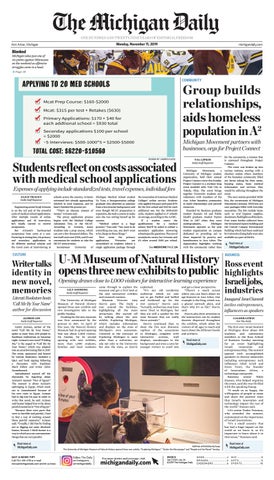
Students reflect on costs associated with medical school applications Expenses of applying include standardized tests, travel expenses, individual fees ALICE TRACEY
Daily Staff Reporter
Engineering senior Ryuji Arimoto is on the tail end of the stressful cycle of medical school applications. After multiple rounds of online applications and 10 interviews, he’s finally started to receive acceptances. But Arimoto’s hard-earned acceptances have come at a cost. Factoring in testing fees, his primary and secondary applications to 40 different medical schools and the travel costs of interviewing at
schools across the country, Arimoto estimated he’s already approaching $10,000 in total expenses, and he hasn’t finished the process yet. “That’s an obscene amount of money,” Arimoto said. The pricey application process begins with the Medical College Admission Test, or the MCAT. According to Arimoto, many students take a prep course, which can cost a few thousand dollars. The test itself costs over $300, and it’s not uncommon for students to take the MCAT several times. Second-year University of
CULTURE
Writer talks identity in new novel, memories Literati Bookstore hosts ‘Call Me By Your Name’ author for discussion JASMIN LEE
Daily Staff Reporter
André Aciman, author of the novel “Call Me By Your Name,” spoke to more than 400 people in Rackham Auditorium on Saturday night. Aciman’s new novel “Finding Me,” is the sequel to “Call My By Your Name,” which was adapted into an award-winning film in 2017. The event, sponsored and hosted by Literati Bookstore, included a Q&A and book signing following a discussion with Rackham Merit Fellow and writer Zahir Janmohamed. Janmohamed started off the discussion by inquiring about Aciman’s memoir “Out of Egypt.” The memoir is about Aciman’s upbringing in Egypt, which stuck out to Janmohamed because of his own roots in Egypt. Aciman had to dig into his past in order to write that novel, he said. Aciman said humor helped him write about painful memories in “Out of Egypt.” “Because there were parts that were so horrible and painful, I had to find a way of working around those painful moments,” Aciman said. “Usually, I did that by finding out or digging out some disclosed humor, because I think humor is a way in which you can communicate things that are very painful.
Read more at MichiganDaily.com GOT A NEWS TIP? Call 734-418-4115 or e-mail news@michigandaily.com and let us know.
Michigan Medical School student Vy Tran, a first-generation college graduate who identifies as someone from a low-income background, said even though MCAT preparation is expensive, she took a course to make sure she was setting herself up for success. “Medical school is a huge process,” Tran said. “You want to do everything you can, you don’t want to be cheap on these things.” Next come the primary applications. Primaries are streamlined so students submit a single application package through
the Association of American Medical Colleges’ online service. Students who applied this past cycle paid $170 for the first school and $40 for each additional one. For the 2019-2020 cycle, students applied to 17 schools on average, according to the AAMC. If a student meets the qualifications for a medical school, they’ll be asked to submit a secondary application answering school-specific questions. The cost of secondaries varies, but Arimoto said it’s often around $100 per school. See MEDICINE PAGE 2A
TAL LIPKIN
Daily Staff Reporter
Michigan Movement, a University of Michigan student organization, held their annual Project Connect event this Sunday. Project Connect is a six-hour long event modeled after Tent City in Toledo, Ohio. The event brings together University students and volunteers with members of the Ann Arbor homeless community to build relationships and provide resources. Founded by Business graduate student Hussain Ali and Public Health graduate student Payton Watt in 2017 when they were undergraduates, Michigan Movement operates as the only student organization on campus dedicated to providing aid to those impacted by poverty and homelessness in Ann Arbor. The organization highlights working with the community rather than
U-M Museum of Natural History opens three new exhibits to public Opening draws close to 1,000 visitors for interactive learning experience LILY GOODING
Daily Staff Reporter
The University of Michigan Museum of Natural History opened three new exhibits and two investigative labs to the public Sunday. Funding for the new museum was first announced by the provost in 2011. In April of this year, the Natural History Museum had its grand opening that saw about 3,000 visitors. On Sunday, for its second opening with new exhibits, more than 1,000 students, families and local residents
came through to explore the museum and get a first look at the new interactive exhibits and research stations. Museum Director Amy Harris gave The Daily a tour around the facilities, highlighting all the main attractions. She started off by talking about the new exhibit, Exploring Michigan, which includes information and displays on the state of Michigan’s own ecosystem. Centered at the entrance of Exploring Michigan is none other than a wolverine, an ode not only to the University but also the state, as Harris
explained. “It’s our old taxidermy wolverine which we sent out to get fluffed and buffed and freshened up for the 21st century,” Harris said. “Actually, wolverines may have never lived in Michigan, but they are still a symbol for the state because they are really fierce animals.” Harris continued then to show the five new dioramic replicas of the ecosystems in Michigan, complete with interactive screens, wall displays, soundscapes in the background and even a cave for younger visitors to crawl into
and get a closer perspective. “There’s a touch screen where you can learn about ice age features in Ann Arbor. One example is the Diag, which was a glacial outwash plain, and that’s why it’s so flat,” Harris said. Harris also drew attention to the interactives run by student docents dispersed throughout the exhibits, which allow for visitors of all ages to touch and learn about the different fossils and artifacts.
Read more at MichiganDaily.com
for the community, a mission that is conveyed throughout Project Connect. The event was broken up into various stations, starting with a check-in station where members of the homeless community filled out forms asking for their name, housing status, basic medical information and services they would be utilizing throughout the event. The next station provided MIM kits, the cornerstone of Michigan Movement’s mission. MIM kits are care packages filled with everyday necessities. The kits include items such as oral hygiene supplies, deodorant, flashlights and blankets. Free water bottles collected from the Intramural Sports building and the Central Campus Recreational Building which had been sanitized by University dining halls were also available as a part of the kit.
Read more at MichiganDaily.com
BUSINESS
Ross event highlights Israeli jobs, industries Inaugural Israel Summit invites entrepreneurs, influencers as speakers CALDER LEWIS For The Daily
The first ever Israel Summit at Michigan drew about 100 students and community members to the Ross School of Business Sunday morning for an event highlighting Israeli innovation and entrepreneurship. The summit opened with accomplished speakers in diverse industries including entrepreneur tech influencer Inbal Arieli and Sivan Ya’ari, the founder of Innovation: Africa, a technology non-profit. Business senior Nikki Hassan, who helped organize the event, said she was thrilled with the speaking lineup. “It made us so happy, the willingness of people to come and share the positive ways that Israel’s innovation and technology impact the rest of the world,” Hassan said. LSA senior Nadav Neuman, who attended the summit, commented on the importance of Israeli innovations. “It’s a small country that has had a huge impact on the world as we know it, so it’s important to learn about it in that sense,” Neuman said.
SOPHIA AFENDOULIS/Daily The University of Michigan Museum of Natural History opened three new exibits , “Exploring Michigan,” “Under the Microscope” and “People and the Planet” Sunday.
Follow The Daily on Instagram, @michigandaily
For more stories and coverage, visit
michigandaily.com
INDEX
Vol. CXXIX, No. 26 ©2019 The Michigan Daily
NEWS.........................2 OPINION.....................4 CROSSWORD. . . . . . . . . . . . . . . .6
Read more at MichiganDaily.com MIC.....................3 ARTS...................5 SPORTS.................1B
News
2A — Monday, November 11, 2019
MONDAY: Looking at the Numbers
TUESDAY: By Design
WEDNESDAY: This Week in History
The Michigan Daily — michigandaily.com
THURSDAY: Twitter Talk
FRIDAY: Behind the Story
DESIGN BY TAYLOR SCHOTT
FIND ME
Stanford Lipsey Student Publications Building 420 Maynard St. Ann Arbor, MI 48109-1327 www.michigandaily.com
MAYA GOLDMAN
TOMMY DYE
Editor in Chief 734-418-4115 ext. 1251 mayagold@michigandaily.com
Business Manager 734-418-4115 ext. 1241 tomedye@michigandaily.com
NEWS TIPS
news@michigandaily.com
LETTERS TO THE EDITOR tothedaily@michigandaily.com
EDITORIAL PAGE
opinion@michigandaily.com
PHOTOGRAPHY SECTION
ARTS SECTION
photo@michigandaily.com
arts@michigandaily.com
NEWSROOM
SPORTS SECTION
734-418-4115 opt. 3
sports@michigandaily.com
CORRECTIONS
ADVERTISING
corrections@michigandaily.com
dailydisplay@gmail.com
Editorial Staff EMMA MATI/Daily André Aciman reflects on his past works nd discusses his new book “Find Me” at an event held by Literati Bookstore at Rackham Auditorium Saturday evening.
MEDICINE From Page 1A The U-M Medical School charges $85. After secondaries, Arimoto said his total application costs were already in the range of multiple thousands of dollars, not including MCAT-related fees. “Secondary is a cash grab,” Arimoto said. “Obviously, you don’t need a hundred dollars from every single applicant for them to send you, what, two essays?” Without family support, Arimoto said, he would have been in financial distress at this point in the cycle. “Even before my interviews started, I would’ve just been drained monetarily,” Arimoto said. “There would have been no question about that.” Steven Gay, assistant dean for admissions at the U-M Medical School, said though secondaries are expensive, the school-specific aspect makes sense. “Every school has its own secondary, and I think that’s very appropriate,” Gay said. “Just like students are looking for certain
SHANAHAN :)
things in schools, we should be attempting to get the best students to succeed in our curriculum, to become the type of physicians we feel it’s our mission as an institution to create.” Gay acknowledged the cost of secondaries, noting the U-M Medical School does try to alleviate it by offering fee waivers to students who reach out and demonstrate need. In addition, Gay said when the University began accepting a “people skills” test called CASPer as part of medical school applications, the Office of Admissions did not raise secondary fees, recognizing that students were now paying to submit those scores. “We’ve worked to keep our secondaries lower in terms of the top institutions,” Gay said. There are also some scholarships available through the AAMC. For instance, Tran said she was able to get 15 or 16 schools worth of primary and secondary application fees waived, covering all the schools she applied to. As a final step, qualified applicants hear back from medical schools with interview invitations. Arimoto said
puzzle by sudokusyndication.com
someone who applies to 20 schools might expect to get five interviews if they’re fortunate. The travel costs are not reimbursed. “If you’re lucky enough to get interviews, they don’t pay for your interviews,” Arimoto said. “If you have to fly out to California from Michigan, it’s like $500, and then you have to buy a hotel, that’s $200 a night, and if you have to spend two nights there, then you’re already at a grand for one interview.” Gay said medical schools have some ways of mitigating the cost of attending interviews. Schools in similar locations may try to coordinate interview dates so students only have to make a single trip. In addition, Gay said the U-M Medical School works to provide interviewees with more affordable housing, food and transportation options, as well as travel reimbursements for some applicants. “We tend to give travel reimbursement for our students who are low-income so that it’s not an issue to travel,” Gay said. “We have an extensive program where students can stay with other students on their visits and aren’t paying for places to stay.” Tran received a $200 reimbursement from the University to support her interview. She also tried to offset travel costs by grouping interviews in similar locations. “I tried to group my interviews together,” Tran said. “There are things like that that you can do, but that being said, sometimes you don’t have that choice because the school will pick a date for you.” Tran said hearing back from the University of Michigan, one of her top schools, by early October spared her the cost of additional interviews. In addition to seeking out schools that offer a quick turnaround, she said applicants should think carefully about what schools are truly a good match, rather than just applying to as many as possible. “There are some people who don’t need to apply to that many, and there will be people applying to schools that are not a good fit for them,” Tran said. “Just think about what the school’s values are.” Gay echoed Tran’s sentiments,
noting the “one-size-fits-all” primary application, which allows prospective medical students to apply online to dozens of schools at once, may encourage people to apply to more schools than necessary. He said applicants should narrow down which schools actually match their interests. For instance, some schools might better prepare students for medical research, while others might fit students aspiring to become primary-care physicians. “Part of applying to medical school, just like applying to undergrad, is the onus of when it’s easy to apply to all of them, you just apply to all of them,” Gay said. “There is responsibility on the student to be an informed consumer with some discretion, saying, these are actually the things I want.” Gay said increasing the number of schools one applies to doesn’t necessarily improve the chances of getting an interview. Medical schools have specific criteria, so Gay said applicants need to be honest with themselves about what schools they are likely to be accepted to. “The application process isn’t a lucky thing,” Gay said. “Students do the very best they can to prepare themselves to be the best candidates for medical school. But once they have done that, it’s important to assess what you look like as a candidate and have others with experience frankly assess what your candidacy looks like.” One thing medical schools can do to help applicants make educated choices, Gay said, is to be open with pre-med advisers and prospective students about what requirements and values they’re looking for in an applicant. “All of us, as medical schools, should be transparent in our processes,” Gay said. “We should be very open with letting students know how we are trying to assist them, knowing that finances can be a significant barrier to the application process. But students, equally, should work hard to pick schools they feel they have not only the best opportunity of getting into but fit who they wish to be.”
Read more at MichiganDaily.com
FINNTAN STORER Managing Editor
frstorer@michigandaily.com
GRACE KAY and ELIZABETH LAWRENCE
Managing News Editors news@michigandaily.com Senior News Editors: Sayali Amin, Rachel Cunningham, Remy Farkas, Leah Graham, Amara Shaikh Assistant News Editors: Barbara Collins, Julia Fanzeres, Claire Hao, Alex Harring, Angelina Little, Madeline McLaughlin, Ben Rosenfeld, Emma Stein, Zayna Syed, Liat Weinstein
JOEL DANILEWITZ and MAGDALENA MIHAYLOVA
Editorial Page Editors tothedaily@michigandaily.com Senior Opinion Editors: Emily Considine, Krystal Hur, Ethan Kessler, Miles Stephenson, Erin White
MAX MARCOVITCH and ETHAN SEARS
Managing Sports Editors sportseditors@michigandaily.com Senior Sports Editors: Anna Marcus, Aria Gerson, Ben Katz, Mark Calcagno, Theo Mackie, Tien Le Assistant Sports Editors: Bailey Johnson, Bennett Bramson, Connor Brennan, Jacob Kopnick, Jorge Cazares, Rian Ratnavale
ARYA NAIDU and VERITY STURM
Managing Arts Editors arts@michigandaily.com Senior Arts Editors: Clara Scott, Emma Chang, Cassandra Mansuetti, Sam Della Fera, Trina Pal Arts Beat Editors: John Decker, Sayan Ghosh, Mike Watkins, Ally Owens, Stephen Satarino, Izzy Hasslund, Margaret Sheridan
ROSEANNE CHAO and JACK SILBERMAN
Managing Design Editors design@michigandaily.com Senior Design Editor: Sherry Chen
ALEXIS RANKIN and ALEC COHEN
Managing Photo Editors photo@michigandaily.com Senior Photo Editors: Alexandria Pompei, Natalie Stephens, Alice Liu, Allison Engkvist, Danyel Tharakan Assistant Photo Editors: Miles Macklin, Keemya Esmael, Madeline Hinkley, Ryan McLoughlin
ANDREA PÉREZ BALDERRAMA Statement Editor
statement@michigandaily.com
Deputy Editors: Matthew Harmon, Shannon Ors
SILAS LEE and EMILY STILLMAN Managing Copy Editors
copydesk@michigandaily.com
Senior Copy Editors: Dominick Sokotoff, Olivia Sedlacek, Reece Meyhoefer
CASEY TIN and HASSAAN ALI WATTOO
Managing Online Editors webteam@michigandaily.com Senior Web Developers: Jonathon Liu, Abha Panda, Ryan Siu, David Talbot, Samantha Cohen
ELI SIDER
Managing Video Editor video@michigandaily.com Senior Video Editors: Ryan O’Connor, Joseph Sim
NA’KIA CHANNEY and CARLY RYAN
Michigan in Color Editors michiganincolor@michigandaily.com Senior Michigan in Color Editors: Lorna Brown, Samuel So, Ana Maria Sanchez-Castillo, Efe Osagie, Danyel Tharakan Assistant Michigan in Color Editors: Harnoor Singh, Nada Eldawy, Maya Mokh
CATHERINE NOUHAN Managing Podcast Editor
MADALASA CHAUDHARI and HANNAH MESKIN Managing Social Media Editors Senior Social Media Editor: Allie Phillips
Business Staff MOLLY WU
RYAN KELLY
Creative Director
ZELJKO KOSPIC
Sales Manager
Special Projects Manager
ROBERT WAGMAN
ANITA MICHAUD
Marketing Consulting Manager
Brand Manager
The Michigan Daily (ISSN 0745-967) is published Monday through Friday during the fall and winter terms by students at the University OF Michigan. One copy is available free of charge to all readers. Additional copies may be picked up at the Daily’s office for $2. Subscriptions for September-April are $250 and year long subscriptions are $275. University affiliates are subject to a reduced subscription rate. On-campus subscriptions for fall term are $35. Subscriptions must be prepaid.
Michigan in Color
The Michigan Daily — michigandaily.com
Monday, November 11, 2019 — 3A
Fulfilling expectations
Life is a little less funny YASMEEN LUDY MiC Blogger
“Cause my love goes BANG BANG BANG!” Tuesday night, many John Witherspoon fans felt their hearts go bang bang bang. The world receives heartbreaking news that the legendary actor and comedian John Witherspoon had passed away. John was only 77. News took several celebrities by shock. No one wanted to believe the man they called “Pops,” or “Granddad,” had passed on. When well celebrated actors such as John Witherspoon pass, I always ask myself, “Why does this hurt so much?” The answer is simple. The loss of any Black icon hurts. It’s one less person we look up to in the world and one less image of Black representation on TV. Another person that looks like you, talks like you, understands you, or even made it out of the same turmoil you endured, is gone. That’s what hurts. I remember when I first heard John Witherspoon’s voice echoing from my TV. I was a child and it seemed like I heard his voice before I actually saw him pop up on the screen. In the beginning, I wondered, “Who is this crazy man talking like this?” But that was the beauty of it. John left a legacy that would never be forgotten simply because his sound, his voice, and his comedic ways were left unmatched. Whenever I heard John Witherspoon’s voice, I could
easily identify him. He had a distinct tone and you didn’t even need to hear the lines, “Don’t go in there for about 35, 45 minutes.” You just knew it was him. He meant something to the Black community. Like several iconic Black figures, he was needed during a time when Hollywood was notorious for crafting films centered around stereotypes and producing films with black people as perpetrators. With beloved bodies of work like Friday, The Wayans Bros, and The Boondocks, John blessed us with comedic Black dad representation, but also taught us valuable lessons. He didn’t embody the stereotypical narrative that Hollywood likes to push, and he wasn’t a perpetrator or a victim. He was a dad who just was and just lived. John created his own flare with every character he played, he embodied originality, and that was something that was needed in the black community. His characters shined in a light of relatability, and reflected a sense of connection. I remember watching Friday as a child and hearing the lines, “Everytime I’m in the kitchen, you in the kitchen.” Those words lingered in my house growing up and to this day. It was something I never stopped hearing my mom say, and to this day, I’m always in the kitchen when she’s in the kitchen. John’s character’s voiced the beauty of our community and he said things that several people grew up with. With all the comedy in the world, he included Black culture in his
work. He kept his community close. John’s exaggerated characters and physical comedy weren’t what made him unforgettable. He took advantage of quiet moments and blessed our screens with valuable wisdom. It wasn’t loud and silly, it slipped through quietly, soft, and raw. He was the kind of TV dad that mastered both comedy and life. “You win some, you lose some, but you still live to fight another day,” was a line he recited in Friday, when he saw his son Craig holding a gun that he bought for protection. This scene was important for the Black community, specifically because Hollywood had normalized the portrayal of Black men and violence. John’s voice rang through the character Willie, as he taught his son that you didn’t need a gun for protection nor does it make you a man. The jokes that danced from John’s mouth were always followed by a lesson. I remember when he scolded Craig in Friday for not wanting to eat his cereal without milk. As a child I found the scene hysterically funny, but in the midst of it all, I felt it. The scene wasn’t just for kicks and giggles, his character reminded a younger generation of their privileges––having food on the table. I even remember Willie making Craig eat the dry cereal. He made a valuable lesson funny and lighthearted. And when I think about pouring cereal, it’s ingrained in my mind to always check if we have milk. His role in Friday was so
important to Black culture because it pushed back against the stereotype of laziness. He was a hardworking family man trying to do right by his son and although the movie was filled with jokes, one message rang clear: every parent wants the best for their child, no matter how old they are. Throughout Friday, Willie constantly pushes his son to do better and take responsibility not only for his actions, but his life. The major lesson Willie tried to teach his son was hard work and the true meaning behind being a man. His embodiment of relatable characters with goofy and charismatic tactics is a timeless force in the Black community. John didn’t just touch the hearts of people who grew up with him. His legacy lives on from my mama who doesn’t want me in the kitchen while she’s in the kitchen, to the 21 year old me that still enjoys hearing Witherspoon’s voice shine through “Granddad” from The Boondocks, and to my 9 year old niece whose favorite movie is Friday. John Witherspoon is not only mourned for his death, but the death of an era, and the loss of representation. He taught us that life will give you cereal with no milk, but you still have to eat it and that you may fail, but living to see another day is one of the most triumphant things you can do. In a statement issued the day he died, his family said, “John used to say ‘I’m no big deal,’ but he was a huge deal to us.” He really was.
ARIELLE MCENTYRE MiC Columnist
In the era of Megan Thee Stallion and Cardi B, it can be easy to assume that Black women want to learn how to dance like them. I’ll admit, it can be fun learning the newest dance to a hit song in the comfort and privacy of your home with your friends. However, the situation that I am about to describe serves a reminder of how stereotyping that all Black women can dance a certain way can be debilitating. Recently I attended a party with one of my friends who is also an African American young woman. Although it didn’t bother me, we were the only visibly Black women in the room. When we arrived at the party we befriended two girls who are not Black which was fun at first, but then the party got boring. As soon as the party began to die down, the two girls who were supposed to be our new friends kept pressuring us to “shake our a**.” At first I thought it was funny, but when they continued to do it, I felt peer pressure to actually dance in a way that I don’t feel very comfortable with. After that I felt very compelled to leave the party. It is known by my friends that I am not comfortable
dancing like that, and luckily my friend that I was with took over and stole the attention away from me. I was able to stay at the party until it got shut down, but the situation that occurred never escaped my mind. What if I was there by myself and someone pressured me to dance like that? I think that I probably would have done it. There
It’s like you lose the ability to say “no” aren’t any words to describe what goes through your mind when you are being pressured in that way. It’s like you lose the ability to say “no” or “I don’t want to.” It was an experience that I hope to never have again. I think that if Black women weren’t held to stereotypes such as being able to twerk, we would be able to feel more comfortable admitting that we listen to certain types of music or actually enjoy certain things that are considered outside of the “norm.”
Comfort in the abyss ROBERTO SANCHEZ MiC Blogger
The clock ticks and ticks. My eyes are lasered onto the small hand as it approaches 9. I can’t afford to continue looking at it, but I can’t look away. Feeling every second that passes, my body reacts with a fidget, a leg shake or that creeping angst. In front of me: a laptop open to too many tabs, two books with scattered highlighting and all of my notebooks filled with lead to the brim. It’s midterm season and the misery in the air confirms it. My calendar is full
of steep assignments, but I also have tests and classes per usual. This is without mentioning extracurriculars, my internship, and attempting to hold together some sort of a regular human life. It seems as if so much is going on at any given moment, yet there is so much more I still need to do. Time now seems to pass by quicker, the clock’s ticks have shorter intervals, and a cold warmth slithers through my skin. My heartbeat is more noticeable, my breaths feel heavier and I’m too uneasy to keep still. What do I do? What do I focus on? Maybe I need to calm down and stop enthralling over my concerns.
But I must be concerned for a reason. I begin pacing around the room, but all of this is surely making matters worse. I try to sit down and make myself work but I can’t. My headspace makes me claustrophobic, it is void and silent. What do I want from myself? Why do I feel this way? There is a draining doubt and burning insecurity; nonetheless, this isn’t my first time at the rodeo. My third year around, I’ve acquired methods to tame my demons. Once I began drowning in my thoughts, I had to learn how to swim. Let us take a dive: I stop…
Queer Representation in Euphoria ‘Rules’
and I take a second. Actually take a second. Then follows a breathe. One where the wave of air seeps in like a tsunamistrong. Like the form air takes, I become nothing, I think of nothing, absolutely nothing. It’s impossible, but I do it anyways. Next: with open arms I allow my embodied anxiousness to enter my thoughts, I greet it and acknowledge it. Facing it does not mean fighting it, each time I must understand that it is but another emotion and it is valid. Now I gracefully plummet and bask. Bask in pure gratitude, bask in pure appreciation, bask in pure realization. I think
CAMILLE MOORE MiC Blogger
When most people think about the new HBO show, “Euphoria”, it’s often categorized as a racy high school television show that brings you into the lives of teenagers dealing with problems such as substance addiction, identity, sex, and of course, daddy issues. Although these themes are at the forefront of the show, and they definitely hit you like a ton of bricks right off the bat, I can’t help but be pulled in by the interracial queer love story between the two main characters, Rue and Jules. Seventeen year old Rue, played by Zendaya, is our protagonist and narrator. As her character navigates her struggle with drug addiction and sobriety, she meets and falls in love with the new girl at school, Jules, played by Hunter Schafer. Both complex and intriguing characters, their two worlds collide and they discover their friendship which develops into something more. Despite the fact that this storyline is very cliche, writer and director Sam Levison does an amazing job of portraying it in a way that feels refreshing and enlightening, even drawing from personal experiences of his battle with drug addiction.
previously being with guys nor do we see Jules tell Rue and other classmates that she’s transgender. In many cases, I don’t believe those conversations need to be had on screen, and some people even believe they aren’t necessary at all. Teenagers should be able to live freely without having to label themselves. What’s also cool about the show is that the relationship that we see unfold is also interracial. It further represents the fact that Black LGBTQ+ folx exist and their stories exist with equal importance to white LGBQT+ folx. Rue’s life is complicated and challenging but, still, her character arc is not primarily focused on her racial identity. Her Blackness isn’t magnified or stereotypical, it just is what it is. New interpretations of queer relationships are important and a big step in the direction of more inclusive media. I hope the story of Rue and Jules inspires more writers and casting directors to think outside of current Hollywood standards and bring more diverse, intersectional portrayals to light. Euphoria is an exciting and emotionallyinspiring show to watch, and I can’t wait to see what season two has in store for Rue and Jules. (#rules4eva)
toxic habits with beneficial ones. We should live our lives with ourselves as the protagonists, we should be selfish, but the most selfless egoist there are. Live for our pleasures; while also prioritizing the pleasure of creating that within others. No other warmth comes close. And to you- you’re reading this, and you’ve come this far. If you were looking for that sign, here it is: you’re greatness. You are owed nothing yet deserve all you’ve earned. Your hard work does not go unnoticed, your genuine character does not go without recognition and at the end of the day, this will all be worth it.
Year after year RAHIMA JAMAL MiC Columnist
(He is now fourteen years clean.) Of course, there have been similar relationships on TV before, such as Santana and Britney from Glee, a high school couple who played a major role in expanding the portrayal of interracial queer love to mainstream media. I think it’s fair to say that most representations of LGBTQ+ people in relationships focus on the struggles of coming out or dealing with homophobic loved ones. These stories are important to have on-screen because it is a reality for a lot of queer folx. On the other hand, we need stories about queer couples that don’t focus solely on their sexual orientation but also branch out to show how LGBTQ+ people navigate the struggles that all teenagers in high school face, such as unrequited love. This is what makes Rue and Jules’s relationship unique. Rue simply falls in love with someone who doesn’t love her in the same way. It’s a story that is relatable for many but it’s so refreshing to see it portrayed through a queer lens. It could be possible that writers feel the need to explain the complexities of sexuality and gender, but there’s also power in letting things be. We never see Rue come out to her mom, despite only
about those who’ve raised me, how much they mean to me, and how much I mean to them. I stop and think about my friends, the last time they left me laughing inexplicably, the last time they were the sole reason I felt at home. I think about the immediate present, the now, my tangible existence. I’ll be the first to agree that you shouldn’t expect somebody to pat you on the back for doing things you’re already supposed to be doing — but goddamnit should you be patting your own back any chance you get. Everyone should take that break when they need it, replace
They look on as her lush, green fields are plowed over Year after year, she works hard to provide the animals a place to graze They look on as her freshwater is contaminated by the Keystone pipeline, affecting minority communities Year after year, she cleans and recycles the water to provide humans with nutrients to flourish They look on as her tall, brown trunks are ripped from the ground Year after year, she tries to regrow those trunks for the air to be rich with oxygen
They look on as her deep blue waves are trashed with plastics and garbage floating everywhere Year after year, she pushes and pulls these waves to help the humans move their cargo They look on as her delicate sky is fogged with fumes and chemicals Year after year, she provides the world with her sunny skies or rain to soothe a drought She looks on as they build all over her land, replacing the greenery with dark black roads She looks on as they kill off her animals, using them for decor or clothing She looks on as they fight each other, killing the innocent and torturing the rest
She looks on as they slowly change her world from green and blue to death and despair Year after year, we take advantage of everything she has provided us with Her land, her water, her animals, her air, her sky, her mountains, and her valleys Soon, she will grow tired of replenishing us with all of her gifts And then year after year, we will mourn the loss of what we used to have And then year after year, we will reminisce about the times she had provided us with all of her beauty And then year after year, we will live to see our future die, right in front of our eyes
Opinion
4A — Monday, November 11, 2019
The Michigan Daily — michigandaily.com
KATIE OPPENHEIM AND VICTORIA HOCH | OP-ED
U-M hospitals are great. So why is parking such a pain?
Edited and managed by students at the University of Michigan since 1890. Stanford Lipsey Student Publications Building 420 Maynard St. Ann Arbor, MI 48109 tothedaily@michigandaily.com
MAYA GOLDMAN Editor in Chief
MAGDALENA MIHAYLOVA AND JOEL DANILEWITZ
FINNTAN STORER Managing Editor
Editorial Page Editors
EDITORIAL BOARD MEMBERS Alanna Berger Zack Blumberg Emily Considine Emma Chang Joel Danilewitz
Emily Huhman Krystal Hur Ethan Kessler Magdalena Mihaylova Mary Rolfes
Michael Russo Timothy Spurlin Miles Stephenson Joel Weiner Erin White
Unsigned editorials reflect the official position of The Daily’s Editorial Board. All other signed articles and illustrations represent solely the views of their authors.
NOAH HARRISON | COLUMN
A
Democrats cannot abandon the truth
t the second Democratic debate, when pressed to defend the cost of Medicare for All, liberal Sens. Bernie Sanders, I-Vt., and Elizabeth Warren, D-Mass., accused their more moderate opponents of repeating “Republican talking points.” The regrettable phrase resurfaced at the latest Democratic debate, when Sen. Amy Klobuchar, D-Minn., criticized Warren for dodging questions about the cost of her proposed programs. The cost of Warren and Sanders’s extensive proposed reforms warrant scrutiny, but their casual dismissal of fiscal realities is far more disturbing. The exact fiscal impacts of Medicare for All would depend on the plan’s finer details, but any single-payer system would boost government expenditures by trillions, and a few neutral analyses predict total costs would increase. These are facts, not “Republican talking points,” and Warren and Sanders’s refusal to be transparent about the costs of their proposed programs is troubling. If the progressive candidates continue to use the phrase “Republican talking points” to rebuff criticism, then the phrase could become equivalent to President Donald Trump’s mantra of “fake news.” Trump’s refusal to accept facts and his brazen denial of inconvenient truths is why nearly two-thirds of Americans believe he is dishonest. Trump’s untruthfulness is not a strength, and it is certainly not a quality Democrats should try to emulate. If Democrats are to prevail in 2020, the nominee must be perceived as honest, well-tempered and likable. These are all traits the public believes Trump lacks, and Trump’s poor character evaluation is a major reason for his dismal approval ratings among independents, who are the key demographic for 2020. Trump won the group in 2016, but their dim views of Trump’s character and their high disapproval of his job performance is advantageous for the Democratic nominee in 2020.
However, this advantage assumes that the Democratic nominee is viewed more favorably. Trump’s character ratings were about as low in 2016 as they are now, but former Secretary of State Hillary Clinton was also perceived as untrustworthy and unlikable, enabling Trump to overcome his low favorability ratings. To avoid a repeat in 2020, the Democratic nominee must build a reputation of trustworthiness and authenticity, and it is fair to question whether Sanders and Warren are capable of this task. Aside from their “Republican talking points” line, both candidates have come under scrutiny for dishonesty and evasiveness. Sanders has been frequently corrected for repeatedly overstating U.S. health care costs relative to other developed countries, and his campaign’s evasiveness following his recent heart attack drew scrutiny. Warren, for her part, has
If Democrats are to prevail in 2020, the nominee must be perceived as honest insisted she has substantial Native American ancestry throughout her professional career, but a DNA test last year proved otherwise, forcing Warren to apologize to Native American groups and eliciting mockery from Trump. Warren also created controversy after claiming she was forced out of a teaching job for being pregnant, which seemed to contradict previous statements and board records. Sanders and Warren’s untruthfulness reflects a larger trend on the progressive left in the Trump era. Rep. Alexandria Ocasio-Cortez, D-N.Y., a leader of the progressive movement, has frequently disregarded
the facts during her advocacy for progressive reforms. In December 2018, Ocasio-Cortez grossly mischaracterized the nature of Department of Defense accounting errors, claiming that the funds supposedly unaccounted for could have funded 66 percent of singlepayer health care. The claim was rated “Four Pinocchios” by the Washington Post’s factchecker, but when pressed on the claim in an interview with Anderson Cooper, OcasioCortez defended herself, saying that “there’s a lot of people more concerned about being precisely, factually and semantically correct than about being morally right.” Ocasio-Cortez’s defense was troubling — being morally and factually right are not mutually exclusive. Furthermore, her defense essentially excuses lies told for some greater purpose, which sounds suspiciously similar to the logic used by some Republicans to defend Trump’s lies. Of course, this problem is not exclusive to the progressive wing of the Democratic Party. Joe Biden has come under fire for grossly exaggerating and even fabricating stories on the campaign trail. After factoring in Biden, all three Democratic frontrunners have spotty recent records when it comes to the truth. This trend is alarming, since the Democrats’ greatest advantage against Trump is the president’s poor character. Trump has told a staggering 13,400 lies in less than three years, accounting for 76 percent of his total public statements, according to PolitiFact. The facts are on the Democrats’ side – it is unnecessary and irresponsible to distort the truth. If the Democratic nominee cannot earn a perceived “character edge” over Trump, the president could very well ride the strong economy and his incumbency edge to re-election. Now is not the time for Democrats to abandon the truth. Noah Harrison can be reached at noahharr@umich.edu.
LENA SISKIND | CONTACT CARTOONIST AT LENASISK@UMICH.EDU
T
he hospitals at Michigan Medicine are the best in the state and among the best in the entire nation. So why is it so hard to park here? The story of Michigan Medicine over the past two decades is a story of continual expansion: more hospitals, clinics, academic buildings, patients and employees. It’s painfully obvious that if you spend hundreds of millions of dollars to add buildings and people to an already crowded medical complex, you need to put some thought — and resources — into more parking, more shuttle buses and other transportation options. Unfortunately, the University administration does not have a firm understanding of the obvious. The result is considerable pain for patients seeking care and for workers whose jobs are to provide that care. By pain, we mean patients who must arrive at their appointments an hour or more ahead of time, adding another toll to what may be an already stressful experience associated with health care appointments. By pain, we mean nurses leaving their homes at 5 a.m. to arrive for a 12-hour shift beginning at 7 a.m. Since a U-M “Blue” employee parking pass — which costs more than $700 a year — is nothing more than a license to hunt for a parking space, many nurses, house officers and other employees arrive by 6 a.m. to snag a spot and catch a nap in their cars until their shifts start. Resident doctors and dentists, meanwhile, often visit the hospital and one or more clinic sites during a typical workday. When parking is a nightmare, that means precious minutes — or hours — are wasted driving around looking for a space instead of seeing patients. Is that any way to run a hospital? To be clear, as elected leaders of unions representing nurses, resident doctors and dentists at
Michigan Medicine, we’re glad to see our hospitals and clinics grow and expand. Our members are deeply committed to providing quality health care, and it’s great to see the University offering more services in more places to more people. A new, 264-bed, state-of-theart hospital tower sounds terrific. The building, however, won’t take care of people by itself. To remain a great hospital, U-M needs great doctors, nurses, technicians and support staff. But you can’t attract top people with miserable working conditions. Can a nurse who has to nap in their car before starting work really deliver top quality care? Can hospital staff do their best when a 12-hour shift stretches to 16 hours or more because of a two- or three-hour commute in each direction? There are currently nearly 29,000 Michigan Medicine employees, but only 10,000 parking spaces on the medical campus. Those spaces serve patients, visitors and employees. The new hospital tower will add about 1,600 new employees, along with more patients. So, when University officials brag about adding 1,000 new parking spaces next year, the math just doesn’t add up. The problem isn’t just that we don’t have enough spaces. It’s that University administrators — who have privileged “Gold” passes allowing them to park steps away from their offices — seem to have no idea what’s needed to meet the needs of a facility that operates 24 hours a day, 365 days a year. Not everyone can park next to the hospital or clinic where they work. But shouldn’t administrators of a university with an $11.9 billion endowment be able to keep remote parking lots well-maintained and well-lit for the safety of employees who work shifts around the clock?
Of course they should — but they don’t. They also have failed to provide enough shuttle buses to get workers to and from remote lots in a reasonable time frame. Thankfully, there’s progress on that front: After months of employee complaints, Michigan Medicine has announced that more shuttle buses will be coming online, for exclusive use by health service employees. It’s not as though we didn’t see these problems coming. Parking has been a terrible problem at U-M hospitals for decades. We knew it would get worse when administrators first announced a plan last March to convert an onsite employee lot to more convenient parking for patients (which patients need and deserve). Our unions immediately asked to negotiate about how this plan would be implemented, as part of our responsibility to bargain over working conditions. University administrators said no. We asked for information about parking pass utilization for all employees and executives. Again, University administrators said no. No wonder the frustration boiled over in October, with hospital workers chanting and carrying signs outside the groundbreaking for the new hospital tower. We’re sorry if we intruded on a celebration for major donors and blue-chip guests, but we’ve got a job to do: taking care of patients. To do it properly, we need safe, accessible parking so we can get to work on time. This issue isn’t going away — and we’ll keep making noise until the University gets it right. Katie Oppenheim, RN, is chair of the UM Professional Nurses Council and Victoria Hoch, MD, is president-elect of the House Officers Association and a resident physician in Emergency Medicine. They can be reached at katie.oppenheim@minurses.org or rtarter@med.umich.edu.
VALENTINA HOUSE | OP-ED
The difference between education and indoctrination
A
re we being educated or indoctrinated in the classroom? Education stems from a fact-based and openminded presentation of history and ideas. Indoctrination is an opinionbased presentation of those ideas. The average college student today will tell you that President Donald Trump has created deep divisions along party lines. However, studies show that the U.S. became increasingly more polarized during Barack Obama’s administration. I often wonder if this development is the effect of a one-sided education system that borders on indoctrination. Students and especially professors at a majority of colleges share more liberal ideologies than conservative ones. As a result, those who don’t share in these beliefs seem extremely different from them, and as a nation, we feel more polarized. As Americans, our two-party system has forced us to view the opposite party as the enemy. We stop listening to each other when we hear we’re from different sides of the political spectrum. In reality, though, we are much more similar than we are different. We all want everyone to have human rights, our kids to be safe in schools, legal immigrants to come to our country and to not die from a planet on fire. Conservatives and liberals differ in their strategies for attaining these goals, but they ultimately want the same things. It’s no secret that liberal ideas are threaded into our everyday lives — CNN, MSNBC, ABC, NBC, CBS, NYT, WAPO, public school teachers and most of Hollywood lean left. Most people also believe their social media leans left. Consistently, only one side’s strategy is given the spotlight. Is the only way to achieve the America we all want through Democratic candidates and their legislation? Are conservative points of view even necessary anymore? Conservative speakers face extreme public outcry on campuses if they try to share their views. If liberals have all the answers, is there really any need for debate? Any political theory course will teach you debate is vital to discovering the truth. Philosophers like John Stuart Mill encourage us to challenge our beliefs constantly with opposing arguments in order to refine our
beliefs and ensure they ring valid and true. Some may think the only value in debate is to “convert” conservatives rather than learn anything from them. Today, we discuss our views only with those who reinforce them. Rallies and strikes have taken the place of discussion and compromise. In college — precisely where we should experience interchange of thoughts and ideas free of bias — professors shouldn’t also lean to one side. However, they often reveal their left-leaning biases throughout their courses. My political science professors will primarily begin their courses by saying they won’t try and convince us of their political views. In practice, the effort often falls short. It’s not uncommon, for example, that professors will banter back and forth with students about how much our president sucks in a “come on, we all think this, right?” kind of way. I’ve had professors assign me satire readings poking fun at the Republican party and its old, white, bigoted male members. These viewpoints are valid, and I’m not saying I didn’t gain insight from them. However, once in a while, it would be nice to see the other side represented. I’ve also been taught there’s been more U.S. homicides in the past few years than ever before. If you look at any given chart online, however, it’ll actually show homicide rates have declined since their 1980 peak. I don’t think professors have any malicious intent to make conservative views obsolete. In fact, they may not even be aware that the way they teach their content leaves little room for debate. They probably think that everyone shares the same liberal ideology and therefore, there’s no need to acknowledge the other side. Conservatives may speak up against liberal claims, but they’re put in a position where they feel like outcasts in the room. The Washington Post has a slogan that reads “Democracy Dies in Darkness.” Freedom of speech and press are crucial aspects of our democracy. From these rights, we gain a wealth of knowledge. Historically, slaves were not permitted to learn to read as a tactic to reduce their power and potential. Their suppressors feared that any gained knowledge or skills would incite them to rebel. Political
party affiliation aside, it should be in everyone’s best interest to protect our freedom of expression to preserve our democracy and strengthen our knowledge. This entails everyone having a voice, not just the majority. The problem with the manifestation of similar beliefs and like-minded groups is that any opinion, even slightly contrary, seems extreme. Author George Orwell warned us all of the dangers of groupthink, and one of his warning signs is that any unpopular opinion will stand out like a sore thumb. Some may already feel like this in class, but there’s still hope. As it is now, when a conservative voice speaks up, about 10 other liberal students will raise their hands in defense. The enthusiasm is there, but let’s make sure to address — rather than attack — the claims that are being made. I’ll argue liberals have shifted more left on the political spectrum due to constant reinforcement. As liberal opinions become more circulated, those widely spread views produce the baseline for comparison. As a result, views that were once considered extreme now seem more moderate. It’s become more popular, for example, for students to be in favor of socialism, open borders and sweeping gun legislation. In contrast, conservative views seem more extreme because they are shared less frequently in the classroom. The perspective that illegal immigration is a crime or that background checks are more effective than gun bans might seem controversial now just because they stand out starkly against popular notions. Unpopular beliefs can be true, though, and with greater interaction, they can be realized. For instance, most liberals reference other countries with tighter gun laws as evidence that gun laws work. New Zealand is the exception, then, because in March of 2019, they had two consecutive mass shootings in which 51 people died.
Read more at MichiganDaily.com Valentina House is a sophomore studying Political Science and Communications and can be reached at valhouse@umich.edu.
Arts
The Michigan Daily — michigandaily.com
Monday, November 11, 2019 — 5A
FOOD COLUMN
ALBUM REVIEW
Joe’s Pizza: The real story ELI RALLO
Daily Food Columnist
FLICKR / DECCA RECORDS
Jeff Goldblum makes jazz? MADELEINE GANNON Daily Arts Writer
“There may be trouble ahead,” Sharon Van Etten warns us — and certainly when it comes to Jeff Goldblum, one can always expect a spark of mischief. Right off the bat, his new album makes a bold promise to secrecy and playful roguishness. Between Van Etten’s ominous vocal opening, and the title of his new album, I Shouldn’t Be Telling You This, there certainly seems to be something special in store. Please, Jeff, tell us more — or rather, tell us anyway! As always, we welcome Goldblum’s brand of trouble with open arms. For those of you wondering: Jeff Goldblum and jazz — what the heck? Here’s a quick recap in the wacky misadventures of everyone’s favorite “Jurassic Park” hot scientist: The suspect was last seen here within the pages of the Arts section for a review of his 2018 debut album, The Capitol Studio Sessions with The Mildred Snitzer Orchestra. As Goldblum’s first public foray into jazz performance, the album — a mix of traditional smokey-jazz club and stand up comedy — featured a range of performers, from the hypnotic vocals of Haley Reinhart to the witty quips of comedian Sarah Silverman. I Shouldn’t Be Telling You This does a good job of recycling what worked well in The Capitol Studio Sessions without bogging the album down with boring repetition. What made Goldblum’s debut remarkable was his ability to meld comedy and music in a single album; the comedy didn’t intrude upon the act of musical performance, and neither did Goldblum take himself too seriously. Alongside good-natured, witty chit-chat between songs — The Capitol Studio Sessions was a live recording — the album managed to add some much-needed life to a genre considered to be “dying,” if not dead already. Just as he did the first time around, Goldblum finds his stride is the core foundation of his revitalization of classic hits with a modern touch. I Shouldn’t Be Telling You This features a range of covers with a more robust roster of celebrity guests: From big names like pop-icon Miley Cyrus and Sharon Van Etten, to more obscure artists Fiona Apple and Gregory Porter, Goldblum invests in greater artistic diversity on his second run. Like a classic Hollywood blockbuster, half the fun of the album comes from Goldblum’s class of musical A-listers — who wouldn’t want to hear Miley Cyrus sing her version of blues legend B.B. King’s songs? Goldblum also nails the tricky tightrope walk between nostalgic indulgence and reinvention. Nearly every song on the album is a cover, but each cover is able to stand on its own. “Let’s Face The Music and Dance,” the opening song in the album, features Sharon Van Etten’s slow, honeydripping voice. A touch ominous and romantic, Van Etten flips the tables by emphasizing the
somber undertones of the lyrics, rather than the traditional upbeat, energetic versions of Nat King Cole and Frank Sinatra. More significantly, the song recalls a famous scene of Fred Astaire and Ginger Rogers’s 1963 movie “Follow the Fleet.” In sorrowful serenade, Astaire coaxes Rogers into a final dance, all parts romantic, longing and beautiful. As Rogers and Astaire spin across the stage, coming together and then falling apart just as quickly, Van Etten’s version of the classic “Let’s Face The Music and Dance” captures the tragic essence of Rogers and Astaire’s original version. The fun doesn’t stop there: Other notable songs (and there are many) include “The Sidewinder/ The Beat Goes On,” featuring the vocals of Inara George. Bright and energetic, George’s wispy, alluring voice totally transforms this all-toofamiliar hit into a convincing old-time swing song. Famously performed by Sonny and Cher in 1967, “The Beat Goes On” wasn’t originally a jazz tune — until Jeff Goldblum came along, that is. “Make Someone Happy,” featuring Gregory Porter, offers an uplifting spin on a melancholy song through Porter’s earnest, rich vocals and the smile-inducing backup singers who chime in throughout. Goldblum’s cheerful, somewhat eccentric spirit is infused to the very essence of his new album — just like the last and, I’m sure, like the next one too. Last time I wrote of Goldblum, I noted that fun is what permeates Goldblum’s music — and fun is everywhere to be fun in I Shouldn’t Be Telling You This, too. When it comes to reviving a genre — jazz is so much more than a genre — Goldblum may be exactly what we need. Fun is what jazz is, and fun is what might just “save” jazz from the dark clutches of becoming yet another “Ew, that’s something my parents like, no thanks!” Maybe what Goldblum “shouldn’t be telling us” is that jazz, like a lot of old things, can be cool. Moreover, it can be ours. While we spend our limited time on Earth fighting every war we can find, there is still life to be enjoyed. Maybe in the great generational clash of the 21st century, we can find some common ground in jazz. After all, “while there’s music, and moonlight /And love and romance / Let’s face the music and dance.”
I Shouldn’t Be Telling You This Jeff Goldblum & The Midlred Snitzer Orchestra Decca Records
“I’m going to tell you, like, the true story. Nobody got the story right yet. We haven’t told any press this whole thing yet,” said Ian Lafowitz, co-owner of Joe’s Pizza (all five New York City locations and the new Ann Arbor one). This is just what I hoped would happen — just like the pizza, I’d come to Joe’s in search of the true authenticity I knew was there. I’d let the dust settle between Joe’s Ann Arbor grand opening and my strategic entrance to the Diag-adjacent pizza spot. I knew if I let press go crazy in the first week of business for the sake of the “timely lead” or what have you, I’d afford myself a more meaningful interaction with the new restaurant weeks into the future. I was right. “A food columnist or critic knows better than to show up on opening day,” Lafowitz said next. He is a Michigan graduate (’00) and was awaiting the perfect moment to disclose the Joe’s Pizza story. I grew up on the stuff — Joe’s pizza, that is. Us Mid-Atlantic dwellers have been familiar with the famous slice since birth. I’ve already bridged the topic of New York pizza in a former column, but haven’t revisited the topic of pizza since having received some emails deeply defending the Detroit slice. I haven’t changed my opinions, and it’s finally time to talk about something more important than the pizza pie, and that is the simple slice. A good pizza eater knows well the difference between a pizza that’s supposed to be purchased and consumed as a whole pie and a pizza that’s meant to be purchased and consumed as an individual slice — on a white paper plate, grease seeping from crust to palms. Joe’s is the latter, and it has an easy, inexpensive, quick persona which lends itself well to a college town on the go. “Joe’s opening in Ann Arbor, Michigan makes zero fucking sense,” Lafowitz began, when I asked how they wound up selecting Michigan as the first state to open in after finding such success in New York. “But it made sense to me,” he said. Lafowitz is one of very few non-family members working alongside the Joe Pozzouli family within the Joe’s pizza-making business. “I had no restaurant experience when I got into this, I was a writer working in New York after graduating from U of M in 2000. Joe’s Pizza had been going religiously on Carmine Street since 1999,” he said. I can picture the location well in my mind, having grown up eating there with my father, and spending many nights this past summer as the sky went purple, standing in line at 2 a.m. for a slice of New York’s best pizza. Lafowitz had an apartment right near the Greenwich Village Joe’s location until he moved to the Upper West Side and suddenly struggled to find good pizza just miles away from his former apartment. “Within two weeks I was like, there’s literally no good pizza on the Upper West Side. I asked all my friends up there where they got good pizza, and they were like oh, easy, we go to Joe’s.” From there, Lafowitz decided he was going to approach the Joe’s family, having no prior connection to them to ask if they’d want to open a second location up on the Upper West Side. He saw a potential and passion within Joe’s that seemed too special to contain on one New York street corner. It seemed like a pretty simple feat, but with no tangible menu and no website, it was pretty much impossible to track down the family. After a few months of grafting, he found an email address and managed to get on a phone call with Joe Jr. — the son of famed Joe Pozzouli, the patriarch of pizza. “He was really responsive to my ideas. I was like I think you guys should open up another location and I want to help. I can do the real estate or the
money. I was basically like you guys have given me so much in my time living in New York and for that I want to help you guys, what can we do,” Lafowitz said on his early conversations with the family. Lafowitz and Joe Jr. aligned at the best time — Joe Jr. was one of the only direct descendents to go to college over going right into the pizza making business. Being back in New York, he was fired up, young and interested in Lafowitz passion for his family’s business. “For a year we went back and forth on phone calls. Finally, we met at the Starbucks on 6th Avenue. I didn’t know what I was getting into, but Joe Jr. was basically like I really like you, I believe in these ideas, let’s go meet my father — and I said ‘right now?’ And he said ‘yep, right now.’” Joe Jr. warned Lafowitz that his father would either want to listen to what he had to say or turn away and be uninterested. This would be Lafowitz’s one and only chance to make an impression on Joe and would change the fate of the pizzeria forever. Joe Sr. spoke broken English, mostly Italian, and never missed a day working in the pizzeria. Pino “Joe” Pozzuoli Sr. immigrated from Naples, Italy in 1950 and opened his first pizzeria in Boston. Since 1975, Mr. Pozzuoli has been making pizzas every single day in Greenwich Village, New York City. Sal and Pino Vitale (Joe’s grandsons) and cousin Giovanni Carollo have been huge parts of the Joe’s pizza pilgrimage as well. The day Lafowitz met the family in the back of Joe’s, Pozzuoli took immediate liking to him. Lafowitz claimed he “just started talking, and Joe Sr. listened.” “I work with a three-generation family of pizza makers. I’m one of the only people who work with them that isn’t blood. They are so incredibly passionate — and every single one of them has experiences and stories that make this family and this pizza what it is,” Lafowitz said, “Joe Sr. is 83 and that man makes pizzas seven days a week. The family is what’s ‘in the sauce.’” Lafowitz and the Pizzouli family immediately made plans for the future of Joe’s. Together they opened four New York locations: 14th Street, Brooklyn, Times Square and Fulton St. Joe’s blood runs each and every location for authenticity sake. Lafowitz knew, as the other New York locations proved successful, that the next step would be to open out of state. “We thought about a lot of places. I’d been to D.C., Boston, Miami and Philly to think about opening somewhere else.” Somehow, though, they landed in Ann Arbor, Mich. “I was back here at a football game last year,” Lafowitz said, “and I saw the place where Joe’s is now and I felt like it was this underserved part of town. I mean when I was here the only quick and easy place to eat in the South U area was Subway. So I looked at my friend, another Michigan graduate, who owned Michigan alumni bar Professor Tom’s in New York at the time, and I said, ‘If I got serious about opening Joe’s in Ann Arbor would you sell your bar and help me?’ And he immediately said yes.” Pete Levin, another Michigan graduate, is Lafowitz’s partner in the Ann Arbor location. Next steps included having the whole family come experience a weekend in Ann Arbor to “get them hyped,” as Lafowitz puts it. “You can’t force anyone. Everyone has to sign off on these things. I brought them to football games and basketball games and showed them the campus and everyone fell in love with it here.” Suddenly the Manhattan constant was to be the first New York street slice in Ann Arbor. The foodie in me wanted to talk recipe, so of course, I went there next.
Read more at MichiganDaily.com
NEW MEDIA REVIEW
An ode to the classics: The Outer Worlds is incomparable ELI LUSTIG
Daily Arts Writer
Like any medium that slowly transitions into sophistication, modern video games are increasingly paying homage to the classics. As the age of the average gamer gets older and computing technology becomes more sophisticated, any reminder of the old days taps into a deep-rooted nostalgia that warms the heart of those old enough to remember. No other game in 2019 better exemplifies this reverence to the past than The Outer Worlds. A space-western themed adventure, The Outer Worlds doesn’t try anything new. Instead of attempting to amaze you with new cutting edge features, The Outer Worlds just simply reminds you what makes video games fun in the first place. Within the first few hours of The Outer Worlds the player is immediately hit with reference after reference to older classics of the RPG genre. The character creation at the beginning is shockingly similar to any Fallout game, and the intro sequence steals numerous shots from the intro to Bioshock. The time dilation power, a mechanic that lets the player slow down time, is identical to the Dead Eye mechanic in Red Dead Redemption. These are just a few notable ones — veteran gamers will undoubtedly spend
The Outer Worlds Obsidian Entertainment Private Division Nov. 25, 2019
hours finding all the little tributes littered throughout the game. However, despite the constant copying, The Outer Worlds still maintains its own distinct identity. Like a Quentin Tarantino movie, The Outer Worlds remixes successful aspects of older games and merges them into a ‘40s art deco-inspired space frontier that carries a dark humor while also being whimsically cute. You play as a space colonist who, after being frozen in cryo-sleep for years, is awoken to a galactic frontier controlled by feudalistic corporations. After establishing their bearings and acquiring a spaceship, the player is free to explore the galaxy. Open world but not truly an open world, The Outer Worlds is split into planets, dividing the game into smaller regions of exploration. This means you can’t aimlessly walk to the edges of the world in search of adventure. Rarely did I find serendipitous encounters, and most exploration felt contrived, but it was never to the point to make me stop playing. Fortunately, each planet has its own unique feel — some have exotic wildlife and megafauna, while others boast futuristic cities and sweatshop-like factories. With exploration limited, the core of your adventure is the relationships you forge with characters and factions within the world. Some characters can become your travel companions, aiding you on mission and in combat. The Outer Worlds has a surprising amount of depth in its companion customization. Companions have their own skill trees, equipment loadouts, combat perks and special abilities. Refreshingly, noncombat skills actually seem to matter. Missions can sometimes be completed diplomatically and a shrewd choice of words can unlock secrets that combat never could. Mastery of dialogue, engineering, hacking, and other non fighting based abilities had tangible effects on the game world. You’ll be regularly mixing and matching different companions based on the context of the mission because nothing is ever one size fits all. In a traditional Fallout fashion, the decisions
you make tend to lie within morally grey territory and ultimately have an effect on the outcome of the story. Nothing you ever do, however, is so drastic as to permanently change the game. The Outer Worlds isn’t trying to push edges — it just wants the player to have fun. Though the choices will always be moral quandaries, you’ll always come back even if you made a supposedly “wrong” decision. It’s hard to come by a game like The Outer Worlds in 2019. In an era where most games are trying to be experimental or change the industry, many forget that fun should always be the focus. Borrowing successful elements from classic titles, The Outer Worlds is a good ol’ fashioned video game. With all its homages, it reminds gamers of the fun we used to have as kids and assures us that this fun still lives today.
FLICKR
Arts
6A — Monday, November 11, 2019
The Michigan Daily — michigandaily.com
FILM REVIEW
TV REVIEW
‘Sleep’ is a horror must-see ANDREW WARRICK Daily Arts Writer
NETFLIX
‘End’ is f***ing sensational SOPHIA YOON Daily Arts Writer
Two years ago, British television network Channel 4 released a show on Netflix that said “screw you” to the teenage romance genre and made a fresh series about two teenagers who run away together. While it sounds “Moonrise Kingdom”-esque, there’s so much more that differentiates it from your average “Romeo and Juliet” adaptation. Those fateful two years ago, the show left off on a painstaking cliffhanger that left fans wondering whether the show was meant to end on an open-ended note. Then, “The End of the F***ing World” came back into the picture quite suddenly, with Netflix releasing its trailer only two weeks before the new season was to come. The show tells the tale of James (Alex Lawther, “Alex’s Dream”) and Alyssa (Jessica Barden, “Jungleland”), two teenagers from a small town who are learning to navigate through their unfortunate life circumstances. It has a cliché premise but strays far from tropes: In the first season, James thinks he’s a psychopath and aims to kill Alyssa, who at the time was a pessimistic, impulsive girl who dates James because he seems interesting. They run away together, kill a man whose house they were squatting in, run from the cops, fall in love and the rest is history. James gets shot at the end of Season 1, and the curtains close. When we come back in Season 2, we’re introduced to Bonnie (Naomi Ackie, “The Corrupted”), a tortured woman who seeks out to avenge the death of the Professor Clive Koch (Jonathan Aris, “The War of the Worlds”), the man Alyssa and James killed, who, by the way, had previously tried to rape Alyssa and several other women. One of the main concerns with the new season was the looming question of whether it was even meant to exist. The entertainment industry, particularly streaming platforms, has a nasty habit of renewing television and movies until they’re way past overkill, which fortunately isn’t the case for this series. Season 2 maintains and enhances all the elements that Season 1 had to begin with — the drama, the suspense, the unpredictability, the relatability and the comedic elements that imitate the comic book from which the show was adapted. They talk about how trauma impacts romantic relationships in ways that are hardly
seen on television, and while James struggles to tell Alyssa that he still loves her after all the time apart, Alyssa says “I am not the answer,” making it clear that she can’t fix his trauma in the way that he expects her to. Identical to the first season, the second comes out with a short eight episodes, each a half-hour long. Both seasons can be easily binged in one full day of work or a long Friday night, but they’re nonetheless complex and three-dimensional. No important character is left behind — each one has a complex story behind their actions that was introduced in succinct ways that didn’t require the show to waste precious screen time. With a high production value, the show never slacks on providing us with effortless visual artistry and screenshot-worthy scene arrangements that add to the plot in ways that need no explanation. While they leave room for a season three, the way the show’s writers weave the plot together doesn’t call for one. They wrap up all the loose ends in a neat little bow, and all the unanswered questions from season one are presented smoothly and sensibly. It is unpredictable at every turn, but not enough for it to fly off the rails like some crime shows think they can get away with. You’ll find yourself empathizing with every character (except hopefully Clive Koch) in ways you wouldn’t expect, even characters like Bonnie who are conventionally “the bad guy.” It goes by so quick — there’s no reason not to watch this show during your office job or your boring lecture. It’s heartbreaking, hopeful, funny and all the other positive adjectives associated with good television and it’s definitely worth a snippet of your time.
The End of the F***ing World Season 2 Netflix Streaming Now
Classifieds
Call: #734-418-4115 Email: dailydisplay@gmail.com
Release Date: Monday, November 11, 2019
Los Angeles Times Daily Crossword Puzzle
FOR RENT
Edited by Rich Norris and Joyce Nichols Lewis
ACROSS 1 Craftsy website 5 Regarding 10 Like a bug in a rug 14 “I understand now” 15 Crime boss John known as “The Teflon Don” 16 Letter before kappa 17 Spaghetti sauce brand 18 Composer Ned 19 Inside look at a hospital? 20 Sheepless nursery rhyme character 23 Clod chopper 24 Letter after kappa 28 Usain Bolt race pace 31 Bric-a-__ 33 Tokyo dough 34 Irish allegiance shout 36 British sports car, familiarly 37 Cold and damp 38 Many millennia 39 Auditioner’s goal 40 Over-easy item 41 End of a proverb embodied by three monkeys 45 Regret 46 __ legs: rear pair 47 Twins Ashley and Mary-Kate 48 Episodic story 50 WWII female 51 “Why are you laughing?” 58 Apple’s virtual assistant 61 Refill, as a partly drunk drink 62 Actress Falco 63 Day to beware 64 Make used (to) 65 Spy __ Hari 66 Milne’s “The House at __ Corner” 67 Police car warning 68 Scratches (out)
DOWN 1 Jimmy Carter’s middle name 2 Bangkok native 3 USAF NCO 4 Sarcastic “Could that be more obvious?” 5 Go along with 6 __ tube: TV 7 Mexican “other” 8 Sch. near the Rio Grande 9 Streaming delay 10 Typical dinner hr. 11 Country with fjords: Abbr. 12 Actress Hagen 13 Carefree 21 Like 1,225-page “War and Peace” 22 Apiece 25 Quaint exclamation 26 Add (a player) to the poker game 27 Mike Trout’s team 28 Passover meals 29 Czech capital city 30 Dead __: lookalike
31 __-shouldered 32 Captain, e.g. 35 “Where have you __?” 39 2004-2011 TV series about firefighters 41 Ousted Iranian leader 42 Core exercise system 43 Sign on a new store
44 Norwegian saint 49 “If only” 52 Author Morrison 53 Egg on 54 “No prob” 55 Minn. neighbor 56 Nick at __ 57 Nays’ opposites 58 Drink sampling 59 Altar affirmative 60 Rock’s __ Speedwagon
ANSWER TO PREVIOUS PUZZLE:
By Kevin Christian ©2019 Tribune Content Agency, LLC
11/11/19
11/11/19
At the end of Stanley Kubrick’s “The Shining,” Jack Torrance, a struggling writer turned psychopath, freezes to death while chasing his wife and son. As Wendy and Danny Torrence escape the secluded Overlook Hotel, it too is consumed by a swirling blizzard. In Stephen King’s novel, Jack and the Overlook explode in a ball of fire. King frequently cites this as the reason he hates the film: In the movie the hotel freezes, and in the book it burns. This works as a comparison. The film version of “The Shining” is humanity at its coldest and most remote, and the novel is humanity at its most passionate and conflicted. Kubrick’s Jack Torrance is detached from the start, and his transformation into a violent sociopath is never surprising, however much ghosts have to do with it. King’s Torrance fights insanity for the sake of his family, most of which seems to come from The Overlook itself, not his own soul. This mischaracterization, as King sees it, has haunted him since “The Shining” was released. To him, Jack Torrance is more than just a character. The book was written while King was suffering from alcoholism, and struggled to see the light at the end of the tunnel. He used Jack to explore this battle, detailing how it strained his creative pursuits and relationships with his wife and children. It’s no wonder King wanted the adaption to get it right. The problem is, “The Shining” as a movie is too good to be written off for one inaccuracy. The cinematography, production design and performances are all too wonderful to ignore. So, how does one reconcile the personal core of the novel with the cinematic gravitas of the film? Mike Flanagan’s “Doctor Sleep” is how. “Sleep” centers on Danny Torrence (Ewan Mcgregor, “Star Wars: The Phantom Menace”),
“Doctor Sleep” is more than just a cash grab or nostalgia fest. It’s an artistic reconciliation, aesthetically blending the two respective horror masterpieces it comes from along with the psychological ideas that made them both so compelling.
The Michigan Daily loves its readers a LATTE
Warner Bros. Pictures Ann Arbor 20+ IMAX, Goodrich Quality 16
a grown-up version of Jack’s son. Like Jack, he suffers from alcoholism. He also has what’s called “The Shining,” a psychic ability that allows him to read thoughts from the living and the dead. He drifts from dive bar to dive bar, sleeping under bridges and trying to forget the trauma he endured at the hands of The Overlook and his father. When he meets a young, powerful girl named Abra (Kyliegh Curran) who’s being hunted by a nefarious cult led by Rose the Hat (Rebecca Ferguson, “The Girl on The Train”), he has to face his demons to save her. Danny Torrence possesses the heart that was lacking in the original film, asking very human questions that come from King’s novel. How does one live on after horror? Does one try to escape it altogether, or meet it head on? Will it consume them regardless? Flanagan wrestles with addiction, trauma, and family dysfunction in a nuanced way that would make King proud. While Flanagan’s script suffers from some hyperbole and simplistic dialogue, the plot moves along well enough, with some great twists and horrifying punches sprinkled throughout. It is his directing that really shines, though. Flanagan’s cinematography is endlessly inventive, making every scene, from the mundane to the cosmic, intoxicating. There are moments in “Doctor Sleep” that are searingly terrifying, that will haunt one when they lay alone in the dark, trying to sleep. Yet I still found it to be one of the most uplifting movies of the year, showing how people can band together and reach for something higher. “Doctor Sleep” has the scares of Kubrick, with the heart of King. “Doctor Sleep” is more than just a cash grab or nostalgia fest. It’s an artistic reconciliation, aesthetically blending the two respective horror masterpieces it comes from along with the psychological ideas that made them both so compelling. It is simultaneously dark and empathetic, terrifying and heartwarming. No horror fan should miss it. However much it throws Kubrick’s canonical imagery at the viewer, engendering some of the powerful, but fleeting, feelings that nostalgic movies like “The Force Awakens” do, one difference is key: At the end of “Doctor Sleep,” finally, after decades, The Overlook can finally burn. It’s a sight to see.
COMMUNITY CULTURE NOTEBOOK
On making my own hoMe NATALIE KASTNER Daily Arts Writer
7 Person House for fall 2 bath, 7 parking spaces, nice house, 1 block from CCRB, $5,895 plus util. (734) 646-5548
Doctor Sleep
I’m thankful for home. My lack of one, precisely. Let me clarify: I’ve never really felt at home anywhere. I could say that Los Angeles is my home because that’s where the majority of my extended family is from. We spend Christmas there. We lived in a little blue house in Lunada Bay when I was in elementary school. I could say I’m from Florida because I was born there, but we left when I was only a few months old on a plane with Linda Ronstadt sitting next to me and my mother. The place I lived the longest was Alabama. I lived there through middle school and learned how to respect those older than me, but also gained a sense of strict, unwavering gender roles. I could say I’m from Virginia, where I went to high school, because my parents still live and work there now. The places I’ve listed are the major ones. I’ve lived in 10 different “homes” in my life. I could say that my home originated with my ancestors in Greece, Southern Germany or Scotland. We still eat all the food from before my grandparents emigrated, and the languages were sprinkled into my life. I’ve never had a hometown. I don’t have a place that I’m really “from.” I’m from the United States I suppose, but if there’s one thing I’ve learned, it is that our country is boundlessly different depending on where you hail from. From common vernacular to basic morals and beliefs, the most influential people in my life would be foreign to each other. When I think of home, I think of a place that’s nowhere specific, but my family is there: My mother, father and brother are there. We are all laughing about how hilarious it is to be all together. Preferably, we are on a beach, but maybe it’s at a diner. I’m grateful for the people that fill up my life, the ones that are far more important than the places and material things that shape them. I will never long for a certain lifestyle because I’ve known so
many. Moving around has allowed me to be free from some of the prejudices or biases that come with being from any one place. I’ve learned how to be compassionate. Pain is still pain and love is still love regardless of where you are from. When people ask me where I’m from, I still pause. It shouldn’t be a hard question; it’s just that whatever my response is, no matter how succinct or clever, will never give that person an actual sense of who I am. But now, I like to think of it as more of a secret weapon than a downfall. Now, I’m from Ann Arbor just as much as I’m from anywhere else. I’m addicted to the notion of the University being referred to as “hoMe.” People from all over the world, not just the country, congregate here to share ideas and tackle the world’s wicked problems. I’m sure there are countless students here that think home is more about the people you love rather than a place. That’s what’s so great about this rapidly globalizing world in the first place, right?
I’m from Ann Arbor just as much as I’m from anywhere else. I’m addicted to the notion of the University being referred to as “hoMe.”
SPORTSMONDAY Michigan FALLS TO MINNESOTA TIEN LE
Daily Sports Editor
Johnny Beecher’s body language said it all. The freshman forward had a breakaway with senior forward Jake Slaker running the ice on the opposite side of the neutral zone in the first period. But Beecher swung the pass too early and Slaker crossed the blue line with the puck while Beecher was already in the offensive zone, causing an offsides call. It was just one wasted chance in a game of many — ultimately leading to a 3-1 loss for the Wolverines (3-5-2 overall, 0-3-1-0 Big Ten) against the Golden Gophers (4-4-1, 1-1-2-2). But the frustration of wasting such perfect opportunity was too much for Beecher in the moment. He swung his head back and stared at the silver panels on the ceiling of Yost. As Beecher claimed his place on the bench, Slaker sat next to him and patted the freshman’s hanging head. It was early in the game. Opportunities were a dime a dozen, and there would be plenty more chances to score. But as the period dwindled and the remaining periods dawned onward, those chances came. The much-needed goals themselves, however, would not. “If you look at the last four periods, we played pretty well,” Michigan coach Mel Pearson said. “And you have not much to show for it. You can’t fault the effort. You can’t fault the opportunities we got. They created.” And by the end of the game, after an empty-net goal by Minnesota forward Sammy Walker put a win out of reach, there was no veteran player, no alternate captain or reliable presence to calm the mounting frustration. As the horn sounded, Beecher slammed his stick against the ice. Slaker slammed his stick against the empty net. It broke in two, much like the spirits of the remaining Michigan players. “We’re not getting those bounces,” said senior defenseman Luke Martin. “A lot of posts, a lot of weird plays around their net and ours. It’s hard not to get frustrated.” All game, the Wolverines created highdanger opportunities — ones where a simple tap in from a rebound or another step before the extra pass would have been the difference between the offense getting shut down and dominating a toss-up matchup. Michigan outshot Minnesota in the first period, tied it in the second period, and again, outshot it in the third, totaling 39 shots on net. The players were getting good looks. They were finding the open man. They just couldn’t take advantage of it. “It’s frustrating for us watching as coaches,” Pearson said. “I know that. All you can do is put yourself in a position to get good scoring opportunities and take your chances.” Even on the penalty kill, such as in the first period, the Wolverines stemmed the tides and turned a disadvantage into a Grade-A scoring chance when Eric Ciccolini returned to fiveon-five play. While the Gophers were focused on attacking on the power play, Ciccolini hopped out the box and broke away for an uncontested confrontation with the Minnesota goaltender when the power play ended. He dangled the puck here and there, but in the end, couldn’t convert. The scoring drought was only amplified by the fact that, while it was seemingly outplaying the Gophers the entire night, Michigan was down by at least a goal for the majority of the game. Slammed sticks, constant head shaking and visibly frustrated Wolverine players offered a good explanation of what occurred.
Monday, November 11, 2019 | michigandaily.com
HE SHOOTS, HE SCORES Michigan 1 Minnesota 1 (2 OT) Michigan 1 Minnesota 3
READ MORE ON MICHIGANDAILY.COM Alexis Rankin & Miles Macklin / Daily
Design by Jack Silberman
INSIDE SPORTSMONDAY SPORTSMONDAY COLUMN: The meaning of a big brother SEE PAGE 4B HOCKEY COVERAGE SEE PAGE 2B
SportsMonday
2B — November 11, 2019
Defense, goaltending not enough against Gophers ROHAN KUMAR
MEN’S BASKETBALL
After late-game issues, ‘M’ looks for composure
Daily Sports Writer
There’s a saying in sports that the score of a game doesn’t always reflect how close it was. Sometimes misused, it was emblematic Saturday night when the Michigan hockey team fell, 3-1, to Minnesota. The third goal the Wolverines gave up was an empty netter in the final minute, while the second was the result of a fluke play where sophomore goaltender Strauss Mann tried to collect a rebound off the boards behind the goal line, but the puck bounced too far to an opposing player in the crease. And chance played a pivotal role on the first goal, too. The Golden Gophers were on a two-on-one against freshman defenseman Cam York, whilst redshirt junior forward Luke Morgan hustled back. Both players dove to choke the passing lane, but the puck ultimately bounced off York, then off Morgan’s left skate to a Minnesota forward near the crease. If any of those bounces went another way, the game could have had a different tone. Thus there is weight behind the saying. But this raises the question, what kept the game close to begin with? And the answer to that is, undoubtedly, the defensive effort. “The one nice thing, not nice, but the one underlying thing here is we’re playing so hard defensively and doing a lot of things on the right side of the puck,” said Michigan coach Mel Pearson. “So when we do start to score, we’ve already got that mentality of how we need to play away from it, and how hard we have to play defensively.” While the offense struggled to score till late, the defense was cohesive. On the penalty kill, the players skated in unison to block shooting lanes. There were many more dives throughout the game than
The Michigan Daily — michigandaily.com
CONNOR BRENNAN Daily Sports Writer
ALEXIS RANKIN/Daily
Sophomore goaltender Strauss Mann played well this weekend, but it wasn’t enough as Michigan took just one of six points.
those on the conceded goal — many that actually worked. For instance, following a faceoff in the Wolverines’ attacking zone late in the opening period the Gophers got a quick rush, but sophomore defenseman Jack Summers went on all fours to keep the game close early on. “I think that’s been real key for us we’re not scoring a ton right now but we’re playing great defensively,” Mann said. “And my defensemen are playing really great in front of me which is great and that’s really a recipe for success in the future.” A substantial portion of Minnesota’s scoring chances weren’t due to mistakes in the defensive zone, but rather simple giveaways on the attack that led to oddman rushes. This was evident late in the third period when junior forward Dakota Raabe took a weak slap shot from
near the blue line. Due to the lack of pace, forward Blake McLaughlin grabbed it out of the air, and thus Michigan had to defend another rush. “We’ve got control of the puck and we whiff on it and they poke it and they’re gone and it ends up in the net. It’s frustrating,” Pearson said. “It’s really frustrating. I feel bad for our guys, actually, because they’re working hard. They’re working their tails off and we don’t have anything to show for it.” Mann was the backbone of the defense. Ignoring the gaffe on the second goal, he made key saves all night. Seven minutes into the game, junior forward Jack Becker lost possession right in front of the Wolverines’ net resulting in an easy chance for the Gophers, but Mann deflected the puck upward to get out of harm’s way. Late in the second period, he
You look at the goals against and we can’t fault (Mann).
made a stellar glove save off a two-on-one attack to keep his team within one. And he stayed calm despite the mishap on the second goal. This was pivotal midway through the final frame, when Minnesota moved the puck back and forth from near the left circle to the slot. Mann maintained his position and moved quickly to block the shot when it finally came. “I feel bad for him because he’s losing games,” Pearson said. “And you look at his record and if you didn’t know his goals against you wonder, ‘Oh this kid just keeps losing, why do we keep playing him?’ But he continues to do a great job. … You look at the goals against and we can’t fault him on any of that for sure.” Not faulting Mann and the defensive unit is the most logical, as without them the Wolverines likely wouldn’t have had any shot at winning. But Michigan must also complement it’s defensive unit with a better attack, otherwise the efforts will continue to go to waste and the team will have to keep residing to mere sayings.
When both Michigan and Appalachian State players shuffled off the court towards their respective benches at the 11:05 mark of the second half on Tuesday, everything was going according to plan for Juwan Howard. The Wolverines held a 26-point advantage, seemingly setting the new coach up for his first victory. Michigan’s leading scorers on the night, senior center Jon Teske and junior guard Eli Brooks, were subbed out for sophomores Colin Castleton and Adrien Nunez — things looked that good. Then, that cushion evaporated into thin air. Over the next ten minutes, the Mountaineers whittled the Wolverines’ lead down to just five. “We just got away from the little things,” Teske said. “Things got a little tense, we just had to relax. I mean we were up 30 points. “We were trying to make a quick shot. We had a lot of one-pass possessions where we tried to take a quick shot or make a quick move.” The fastbreak opportunities and easy buckets of the first half gave way to half-court sets and a lack of offensive cohesion. Against the 3-2 zone that Appalachian State implemented at halftime, Michigan turned the ball over nine times and couldn’t hit any of the open looks it was given. In the face of the offensive collapse and the surging Mountaineers, the message inside the Wolverines’ huddle was simple: composure. “They’re gonna give you open shots in a zone,” Howard
said. “ ‘You just gotta be patient.’ That’s exactly what I was telling our guys. ‘Be patient with the zone. Let’s make sure that we work the basketball around and move. And at times you see seams, drive it.’ ” While the rest of Crisler Center may have been panicked and frustrated, Howard remained positive and calm in his first experience commanding a huddle as a head coach — something his team recognized. “He was more of a motivator than anything,” Brooks said. “Coach Howard was definitely talking the most. He did a good job of controlling the huddle.” Similar directives came from the team’s veterans. Senior point guard Zavier Simpson, junior forward Isaiah Livers and Teske tried to keep the team focused and confident. “You kinda expect us to hit a bump,” Brooks said. “Not everything is going to go smoothly with a new coach and new system. It was just keep moving forward, next play mentality. Just get back to what was successful at the beginning of the game.” Michigan never fully regained its offensive efficiency from the first half, but it scored when it needed to. Livers converted a follow-up layup from underneath and Brooks went 5-for-6 from the foul line. The Wolverines escaped what would have been a disastrous start to their season and Howard’s tenure. The late-game conversations may not have been the sole reason Michigan survived, but Howard got a small taste of high-stakes coaching on Tuesday night. And, in a new role and a rebuilt roster, that might not be such a bad thing.
Offensive struggles continue for Wolverines Michigan drops opener WRESTLING
MOLLY SHEA
Daily Sports Writer
The game was right there on Jimmy Lambert’s stick. He cut toward the net and into the left faceoff circle, alone and waiting. The scrum on the other end of the zone resulted in Johnny Beecher caressing the puck away from the battlefield of bodies, and the freshman forward was looking to pass. And he found Lambert, whose extended stick indicated he was ready for the pass and looking to score the easy goal — one that would break the 1-1 tie and win the Michigan hockey team the game. But the puck slid toward Lambert. Then it slid past him. He whiffed on the shot and tumbled down onto the ice, sprawling on all fours as he looked to the distant puck, left to wonder what could have been in the eventual tie. Only a minute later, the puck made its way back over to Lambert for a chance to redeem himself, all alone in the faceoff circle with his stick readied. He found himself in a similar position as before. This time, Lambert connected
with the puck, but it didn’t even come close to being on frame. He sailed his shot wide right, and another scoring chance was wasted. “He fell,” said Michigan coach Mel Pearson. “Nobody around him. Good opportunity coming down the slot, just whiffs on it. He had three or four (whiffs). Once you’re not scoring and you’re a forward, you really start to press. It can get in your head.” But Lambert wasn’t the only Wolverine who couldn’t capitalize on opportunities; the team as a whole proved unable to finish pucks on net. The Wolverines’ lone goal came in the third period off a tipin by graduate transfer forward Jacob Hayhurst off a shot from senior defensemen Luke Martin. It seemed their offense had finally made it over the hurdle. But it was a false hope. Hayhurst’s goal was followed up by a string of missed opportunities. One came from senior forward Jake Slaker, who fired the puck directly into the skate blade of a Golden Gopher. Another came from Hayhurst. And then three of four from Lambert. It didn’t
matter the offense was getting significantly more shots to the net than in the previous period because it couldn’t finish on them. “We’re struggling offensively right now,” Pearson said. “Boy oh boy, I wish I had some answers, but we just have to make sure we’re playing well defensively. The offense is gonna come, it’s just a matter of time, but we’re in a funk right now.” On top of the fanned shots and overpassing, Michigan’s offense has been generated by a small group so far this season. On Friday night, that was apparent. Overall, it had 34 shots on net, but most came from a select group of four of five players including Slaker and freshman defenseman Cam York, who collectively had eight shots. “We don’t score a lot of goals,” said Michigan coach Mel Pearson. “We’re gonna have to find a way to all chip in. We have to start doing a better job of that. We had some open looks and guys whiff on shots, guys falling down. Great opportunities. We’re just really, really struggling on the offense.” Contrasting the onslaught of offense in the third, in the second
period Michigan fell flat. It tallied only five shots on net despite attempting 14, a stark contrast to the 18 shots it registered in the following 20 minutes. Rather than shooting the puck, the Wolverines opted to pass. And pass. And pass. When they did manage to put the puck on net, it sailed wide or over the crossbar or didn’t even connect with a player’s stick. And it was the wasted chances that plagued Michigan. Too many times had the extra pass across the crease fail and frustrate players. The hard-gripped sticks only got gripped a little tighter each and every failed attempt. “We’re just not burying opportunities,” said Hayhurst. “We’re getting chances. As you can see we had a ton in the third, we’re just not putting them on the net.” After losing three straight and tying Minnesota, but surrendering the extra point, it’s obvious Michigan’s offense needs to regroup. What’s less obvious is whether the Wolverines will be able to do so before their standing in the Big Ten suffers even further.
MILES MACKLIN/Daily
Sophomore forward Jimmy Lambert whiffed on an easy scoring chance Friday night, encapsulating the Wolverines’ offensive frustrations on the weekend.
ABBIE TELGENHOF Daily Sports Writer
When sophomore heavyweight Mason Parris dislocated his finger in the midst of his match, there was no doubt in his mind that it would not affect the rest of his wrestling. The crowd went silent as the trainer stepped onto the mat to reset the finger. Parris, after a quick flex of his fingers, was ready to wrestle again. It was a gruesome embodiment of the mentality the Michigan wrestling team has adopted early this season — effort and confidence. But, in an up-and-down first dual meet against North Carolina, the Wolverines struggled to maintain this resiliency, losing 19-17. After a dominant performance from redshirt sophomore Jack Medley at 125-pounds, winning 10-2, the match-up leveled off, with the Tar Heels winning the next 2 matches. “(Jack Medley) wrestled a kid who he maybe wasn’t supposed to beat, but he really took it to him, and I was impressed by that,” said 197-pound fifth year senior Jackson Striggow. Things seemed to be looking up for Michigan when redshirt freshman Nick Freeman took the 149-pound match, gaining eight points from a near fall and two take-downs. However, his individual win couldn’t spur enough momentum for the Wolverines, especially since his match led into intermission, giving UNC a chance to re-group. “It was definitely a match that we thought we were capable of winning, and again it goes back to wrestling hard all three periods and forcing your offense on an opponent,” said Michigan coach Sean Bermot. “(Freeman) is really capable of doing that. He kind of held off until the 3rd
period.” The Tar Heels came out of intermission strong, winning the next four individual matches. The most detrimental matchup for Michigan was the 174pound match between redshirt freshman Max Maylor and UNC redshirt sophomore Clay Lautt. Lautt gained advantage quickly and executed a fall just two minutes and 20 seconds into the first period ending the match and giving the Tar Heels an extra six team points. After two wins for the Wolverines from Jelani Embree and Jackson Striggow, it was left to Mason Parris to finish out the night, who faced UNC’s Andrew Gunning in the heavyweight match. Down by five team points, Parris would have to complete a fall in order to win the match. Parris fought hard, and won the match 4-0, with a takedown late in the third period, but it was not enough as Michigan fell two points short. The Wolverines were also unable to capitalize on bonus points, something heavily emphasized by the coaching staff. They split the matches evenly with the Tar Heels, each team winning five, but the difference in team score was in bonus points. “I think bonus points are always big,” Bermot said. “We’ve been working on that stuff a lot. We do have some younger guys in the lineup, and first-time guys competing at (Cliff) Keen Arena. I think as they continue to become more confident, more aggressive, we’re going to see more bonus points.” While the dual result ended in a loss for Michigan, both players and coaches were hopeful for the rest of the season, ready to get back to practicing. Ready to metaphorically reset the finger.
There were still a lot of things we need to work on.
The Michigan Daily — michigandaily.com
SportsMonday Cruising
November 11, 2019 — 3B
Led by Dilk, Hillmon, Michigan weathers third-quarter comeback to beat Bradley, 77-57, move to 2-0 JACK KINGSLEY Daily Sports Writer
In the second game of the season, the Michigan women’s basketball team showed again that it has many weapons on the roster that can step up and score. The Wolverines got off to a fast start in their 77-57 win against Bradley on Sunday, going on a 7-0 run to start the game. Sophomore forward Naz Hillmon led the way in this stretch with four points and two offensive rebounds, and Michigan made three of its first five shots. “I thought Naz just had a different mentality altogether today,” said Michigan coach Kim Barnes Arico. “She came out from the tip just being super aggressive. I don’t even mean if that was her getting touches with the basketball, I just mean from a rebounding perspective, she was all over the place from the beginning of the game.” A Braves timeout two minutes into the quarter slowed Michigan’s momentum, and a bucket was hard to come by for the rest of the quarter for the Wolverines. Michigan made just two of its last 15 shots, and only led Bradley by seven after the first quarter. The Wolverines continued to struggle offensively early in the second quarter, but with 6:45 left, sophomore guard Amy Dilk hit a jump shot in the paint that sparked a 7-0 run for Michigan over a twominute span. While Dilk carried the load offensively, scoring all seven points, the Wolverines’ entire lineup played stingy defense, forcing three turnovers. Michigan closed out the half with strong shooting, highlighted by 3-pointers from Dilk, junior guard
Priscilla Smeenge, freshman center Izabel Varejão and sophomore forward Emily Kiser. The team took a 38-21 lead into the half, and after shooting just 25 percent from the floor in the first quarter, the Wolverines made 50 percent of their shots in the second, and shot fivefor-seven from 3-point range. The beginning of the third quarter saw Hillmon take over. She scored eight of Michigan’s first 10 points, six of which were in the paint. Hillmon finished with 16 points and 12 rebounds. But three minutes into the quarter, Bradley showed life. The Braves were able to outscore the Wolverines in the third quarter due to stellar 3-point shooting, making six and cutting the deficit to 14. The shift in momentum continued into the fourth quarter. Bradley guard Gabi Haack drew a foul on a made shot under the basket and hit her free throw, narrowing Michigan’s lead to 11. Hillmon picked up her third foul on the next possession, giving the Braves an opportunity to cut the lead to single digits on the next possession. But the Wolverines quickly quieted any chance of a comeback. They forced a turnover on the ensuing possession and freshman guard Michelle Sidor drained a 3-point shot, catalyzing a 12-2 run that gave Michigan a 21-point lead and put Bradley away. “It was nice to see us have to rally and have to get a stop on the defensive end, and … have to be able to execute some plays down on the offensive end,” Barnes Arico said. “We don’t have a tremendous amount of experience in terms of senior minutes played or junior minutes played, so a lot of these kids are going through stuff for their first
time, and I thought they responded really well tonight.” Sidor accounted for eight points during this period after shooting one-for-four in the first half and spending an extended period of time on the bench — finishing with 11 points in just 17 minutes. “The confidence … that she has, to not hesitate after missing a couple shots, being out, and then having to come in and boom, you got a touch, now you gotta make a play,” Barnes Arico said. “For a freshman to have the confidence in themselves to be able to do that I think is just tremendous.” Added Dilk: “She can obviously shoot the ball but also she works off of the bounce as well. So just having those two options, it puts the defense in a threat, so you don’t
BRENDAN ROOSE Daily Sports Writer
After jumping to a ninepoint lead early in the second quarter, the Michigan women’s basketball team’s offense hit a rough patch. The Wolverines endured three scoreless minutes, marked by unforced errors and turnovers. So naturally, they turned to one of their leaders — sophomore guard Amy Dilk — for a spark. She responded. In a span of less than two minutes, she hit a mid-range jumper, a layup and a 3-pointer, stretching Michigan’s lead to 12 and putting the Braves’ run to bed en route to a 77-57
ALEC COHEN/Daily
Freshman guard Michelle Sidor made an impact off the bench with outside shooting in Michigan’s win on Sunday.
really know what way her scoring is coming from.” While early shooting woes hurt the Wolverines, their ability to catch fire at any moment meant the result was never in doubt.
victory on Sunday. In a game with strong performances across the board, Dilk and sophomore forward Naz Hillmon led the team with 13 and 16 points,
respectively. For Dilk, Sunday’s game was mostly a continuation of her play from Friday night against Western Michigan, where she registered 12 points and 11 rebounds. But for Hillmon, a big game Sunday was crucial to her confidence, as she was mostly limited Friday because of foul trouble. “It feels really good just to be able to get my feet wet,” Hillmon said. “Sometimes when you’re in foul trouble, it messes up your rhythm a little bit. You have to figure out a couple of things from the bench, but it was definitely a great opportunity for me in the beginning of the season to actually get in the rhythm of things.” Dilk and Hillmon’s contributions on the glass were just as crucial to the victory as their scoring. Hillmon led the team with 12 rebounds — eight of which came off the offensive glass — earning her first of likely many double-doubles this season. Dilk followed suit on the defensive side, picking up nine rebounds, falling one short of her second consecutive double-double. While putting up big numbers off the glass is nothing new for Hillmon, Dilk has drastically improved her rebounding thus far after
averaging 3.7 rebounds per game last season. If she can continue to pick up boards at this rate, it could open up opportunities for her teammates to run in transition and lead to some personal accolades for Dilk. “I think the challenge for (Dilk) is ‘Hey, you could be a triple double. You can get a triple double every night,’ ” said Michigan coach Kim Barnes Arico. “ … Defensive rebounding is effort. You gotta go in there, you gotta mix it up, and you gotta get the effort to go to the ball, and she has made great effort the last two games of being able to do that.” The effort was certainly there for both Dilk and Hillmon, even beyond their rebounding numbers. A number of times throughout the game, Dilk was the first down the f loor on the fast break or off a Bradley turnover to pick up an easy bucket in transition. Meanwhile, Hillmon led a punishing interior on defense, one that held the Braves to just 18 points in the paint — a number dwarfed by the Wolverines’ 34. This trend will need to continue for Michigan to improve on its No. 148 ranking in scoring defense from last year. But for now, the Wolverines at least know they can count on these two in tough situations.
Hey, you could be a triple double every night.
Set piece dominance paves way ‘M’ drops heartbreaker to Penn State JACK WHITTEN Daily Sports Writer
Does ‘the hot hand’ exist? Apparently it does – if only on the field hockey turf. All signs of this statistical question mark were confirmed as Penn State (8-12 overall, 4-4 Big Ten) – a team that opened the season with seven straight losses – came within an overtime goal of stealing the Big Ten Tournament championship from the likes of top-seeded Maryland and Iowa. The first stop of this improbable march was a 2-1 victory last Thursday against Michigan (13-6, 5-3) a team which has experienced nearly the opposite trajectory of the Nittany Lions. The Wolverines endured one of the toughest regular season schedules in the country. Victories against Connecticut, Maryland and Iowa were Michigan’s most notable notches on the rifle. Less surprising was a 3-1 victory at home against a seemingly hapless Penn State squad a few weeks ago, marked by four periods of consistent possession and even scoring. The Nittany Lions returned the favor with a home win of their own, knocking the Wolverines out of the conference tournament and threatening to abort the remainder of their 2019 campaign. But after
four uneasy days, Michigan found itself a beneficiary of an at-large bid for the NCAA tournament. The team will travel to Trager Stadium in Kentucky to take on Louisville in their first round match this weekend. The Michigan field hockey program declined to make coach Marcia Pankratz or players available to The Daily for this story. The Wolverines’ aggressive tactics made them a tough out. Michigan coach Marcia Pankratz began making substitutions just six minutes into the contest and would continue to do so throughout – in total, 18 players received minutes. The numerical results were similar to those from the meeting of these two teams a few weeks ago: Michigan recorded consistent quantities of shots on target and penalty corners every quarter, no doubt thanks to the fresh legs created by frequent player replacement. On the defensive side of the ball, the Wolverines managed to stymie the Nittany Lions for 57 out of 60 minutes. The three-minute lapse was all Penn State would need, forcing a pair of penalty corners in the third quarter’s first minutes. The danger of the first was mitigated by the Wolverines’ defensive five before a shot on target was recorded, but Michigan could not drive the ball out of its defensive third before the
second penalty corner was created. This one would prove troublesome. Sophomore goalkeeper Anna Spieker saved the first shot, but not the following attempt by Paityn Wirth. Minutes later, off another penalty corner, Meghan Reese scored on a onetouch volley well within the circle. The Wolverines struck back late in the third quarter thanks to a penalty corner of their own. Junior defender Halle O’Neill notched her second goal of the season thanks to her direct receipt of the corner from sophomore midfielder Kathryn Peterson. Michigan’s control of the game, the two penalty corner episodes notwithstanding, propounded the frustration of a close loss in an important context. The Wolverines outshot the Nittany Lions nine to four, racking up at least one shot per quarter. Penn State goalkeeper Brie Barraco made eight saves, keeping the Nittany Lions afloat despite the apparent incompetence of their back line. With four minutes to play, Pankratz called Spieker out of goal in a last ditch effort to tie the game. The decision failed to move the needle offensively, and the Wolverines ducked out of State College – and the conference tournament – as the first victims of Penn State’s hot hand.
ALEXIS RANKIN/Daily
Junior defender Halle O’Neill notched her second goal of the season as Michigan lost to Penn State on Thursday.
HOCKEY From Page 1B The first goal of the game went against Michigan and was scored from a drive by Minnesota forward Ben Meyers. He took a shot but it was blocked by freshman defenseman Cam York, who sprawled on the ice to prevent the shot or pass. The
puck leaked away from the net, but redshirt junior forward Luke Morgan, who had also instinctively laid out on the ice, accidentally kicked the puck toward the net and to a waiting Gopher, unguarded and ready. Brannon McManus tapped the puck in for an easy redirect goal. And the second goal was one unlike anything Pearson had seen in his 30 years at Michigan.
On a dump-in, the puck hit the boards but bounced off in an awkward fashion. Strauss Mann had been waiting behind the net for the puck to curl around as it normally does. But the puck instead bounced in front of the net — an empty net — and allowed for an easy scoring opportunity for the Gophers. The third period saw an offensive-zone dominance by
LILY ISRAEL
Daily Sports Writer
A hard-fought scoreless battle going into the second half put the third-seeded Michigan women’s soccer team in a familiar position. Sunday’s match against fourth-seeded Penn State (15-6-1 overall, 8-3-0 Big Ten) mirrored the Wolverines’ (15-5-1, 8-2-1) semifinal win two days earlier. In an overtime battle, the narrative was similar but the result was not, as the Wolverines fell to Penn State, 2-1, in the Big Ten Championship game. The elation of an overtime outcome was for Penn State to enjoy. The 82nd minute alone made up for 81 minutes of a lackluster game. The 0-0 deadlock changed within the span of 40 seconds. In a somewhat controversial call, Penn State committed an own goal when sophomore midfielder Raleigh Loughman passed from the left side into the middle. Intended for redshirt senior defender Sura Yekka, the pass ricocheted off midfielder Payton Linnehan’s foot into the goal. The goal was initially called back for offsides, but after review, Michigan was on the board. The Wolverines did not hold the 1-0 lead for long when, 40 seconds later, sophomore midfielder Skylar Anderson was called for a foul. This set up a penalty kick for midfielder Sam Coffey. The outstretched hands of junior goalkeeper Hillary Beal just missed the ball. Michigan’s lead was gone, and the game was, once again, tied. For the second time in three days, Michigan was headed to overtime tied 1-1. Once again, all the action happened within a few seconds. In a beautifully developed play, Loughman passed the ball into the middle, putting junior midfielder Sarah Stratigakis in perfect position for a header — landing just wide of the goal. The Nittany Lions took this
the Wolverines. Nineteen shots on net, and midway through the period, one finally found its intended target, a much-needed break. Beecher corralled the puck off the boards and cut around the net. He created separation between and the pursuing defenders and surveyed the ice. A quick pass to an open Emil Ohrwall resulted the Wolverines’
ALLISON ENGKVIST/Daily
Junior midfielder Nikki Hernandez impacted all facets of the game.
miss immediately down the field, where Linnehan looked to avenge her own goal, finding herself alone in front of the net. Beal was aggressive and came out of the goal to try and steal the ball. Linnehan chipped the ball over Beal’s head for the game-winner. “(It was) two very good teams very organized and disciplined,” said Michigan coach Jennifer Klein. “You just got to handle the ebbs and flows of the game, and I thought the team handled it well. Towards the end of regulation, I thought we got a little bit flustered. We regained our composure and they just got an opportunity and they took advantage of it.” Playing overtime in two consecutive games is no easy feat, but Klein believes her team was not overworked. During the first half, neither team could take advantage as they shared the time of possession and were even with seven shots. The Wolverines then came out of halftime strong and controlled the ball for the beginning of the half. The defense helped by making a few big stops. Klein made a personnel change to help her defense, shifting junior midfielder Nicki Hernandez to center back. Hernandez made an impact in all facets of the game, taking two of the team’s 14 shots. “One of the best qualities about Nicki is her work rate on both sides of the ball,” Klein said. “She has a
great defensive presence so we made the switch.” Beal’s play was pivotal in making the game as close as it was. The goals were tied for the most she has allowed this season, but her five incredible saves bailed the Wolverines out on multiple occasions. “I think she really made some unbelievable saves and was just a bit unfortunate for the goal at the end,” Klein said. “I’ve just been so proud of her throughout the season and the growth that she’s had at her time here at Michigan.” The Wolverines suffered a minor set back in the 28th minute when sophomore midfielder Meredith Haakenson was subbed out after an apparent ankle injury. Haakenson returned in the 75th minute. Their inclusion in the NCAA Tournament is all but guaranteed, merely awaiting their location and opponent. The Wolverines will find out their postseason fate during the selection show on Monday. If you look back as little as two years ago, Michigan was in a very different place. “This year I asked them what makes it Michigan,” Klein said. “They established the habits of what we want this culture and program to be. They’ve done the work to be a team that is competing for championships. Hopefully, it will carry through the NCAAs.”
first and only goal of the night. The barrage of attacks that followed, and the pressure created, would be ruled meaningless as an empty-net goal in the dying seconds of the game ended any chances of a comeback and the words of Pearson and the players after the game rang clear. “We’re doing so many things well right now,” Martin said. “And just have to keep our focus
on those and trying to — because the tide’s gonna turn. The floodgates are gonna open.” Added Pearson: “The offense will come.” The shared sentiment was that as long as they continue to play defense the way they did, the goals will come — and presumably, the wins will as well. But on Saturday, neither did.
CAM McGRONE
BECOMING BIG BROTHER Max Marcovitch Managing Sports Editor
Lynn Redd sat and waited for an inevitable call. It was July 4, 2018, and her two sons were out at a nearby fireworks show in their hometown of Indianapolis. For many, it’s a routine Independence Day venture. For sophomore linebacker Cameron McGrone and his younger brother, Aaron Redd, it was a monumental step. What is routine for many is not routine for Aaron. When he was four years old, Aaron was diagnosed with autism. He’s 10 years old and attends public school with some accommodations, but Lynn estimates his development aligns more closely with that of a second or third-grader. Throughout his life, these challenges have manifested largely in outbursts triggered by big crowds with loud noises — a commonality for many on the spectrum. Cameron has long been steadfast in his desire to help his brother and lead him to new heights. Last summer, his break from football coincided with July 4th; he saw a window of opportunity. “(Aaron has) always loved the look of fireworks,” Cameron said, “just the sounds he could never get over.” When Cameron speaks about his younger brother — about his challenges and feats, his personality and gifts — he does so with an inimitable pride. He is, in other words, like many doting big brothers. There are things Aaron has accomplished that Cameron never thought possible, and he wears those feats as a collective badge of pride. What’s clear, in speaking with his family, is that Cameron has been as instrumental in forging those feats as anyone. July 4, 2018 was a prime example. As was her natural instinct, Lynn’s mind sprang to the possible downfalls that evening. She clung to her phone. Could Aaron really
handle this step? Or would he be overwhelmed? Would Cameron be able to handle a meltdown? As the fireworks began lining the sky, Cameron pulled out his phone, opened Snapchat and turned it around. Aaron scanned the skyline, his head craned squarely ahead, soundcancelling headphones attached to his ears. He was locked in. After taking a quick video, Cameron typed out “Lil Bros first firework show” with two heart emojis. He saved it and sent it along to his mother. Lynn opened up the text from Cameron, watched the video and started to cry. “I know when David (Redd) and I are long gone, Aaron will be taken care of,” Lynn said. “Because Cameron loves him and he’s loyal to him, and he’ll make sure he’s taken care of.” When Cameron was young, he always wanted a little brother — a companion to run around in the yard or play games with. At nine years old, he was elated when Aaron was born. It didn’t take long for the family to realize something in Aaron’s development was awry. At a few months old, he started crying frequently, “being kind of inconsolable,” Lynn describes. He was mute until the age of four, forcing Cameron and his parents to find alternate ways to communicate. They started using sign language, but there were still gaps, particularly for a boy desperately hoping to forge a relationship with his lone sibling. Lynn taught Aaron to call Cameron “Bubby” because Cameron was too hard to pronounce. In time, Cameron started referring to Aaron as “Lil Bubby”. “Cameron didn’t know — he was frustrated mostly because he wanted to play with his brother, but sometimes Aaron would have temper tantrums and fits where we all couldn’t control him,” Lynn said. “We couldn’t get him to calm down.” At first, Aaron’s school deemed his condition “a sensory issue,” as he continued to hit the requisite physical milestones. At the age of four, though, the doctors at Riley Children’s Hospital
AN EVENING WITH SAFA AL AHMAD NOVEMBER 19, 2019 | 7:30 P.M. | RACKHAM AUDITORIUM
FREE | NO REGISTRATION | WALLENBERG.UMICH.EDU
Photos courtesy of Lynn Redd
in Indiana decided to run the gamut of tests and eventually came to their conclusion. “(Cameron) didn’t understand why his brother was kind of delayed,” Lynn said, “and I just told him ‘Your brother’s a little different. He learns a little different. Everybody learns things at different times of their lives.’ ” That understanding did little to quell dayto-day struggles. When Cameron was in eighth grade, he was an ascendant wrestling star, eventually winning the county title. Scouts flocked to see him wrestle. One afternoon, he was slated to wrestle in Pemberton Heights, a particularly high-profile meet near the end of the season. Aaron was having a good day, Lynn recalls, so she brought him along. It was always a guessing game, evaluating the pros and cons of a given environment, coming to a conclusion then keeping her fingers crossed. That day, she brought Aaron into the gym. Things subsequently went south. “Aaron just started bucking and screaming and crying, and I just couldn’t stay in there,” Lynn said. “Because a lot of people don’t know, they just stare at you and, ‘Gosh, why doesn’t she make that little boy be quiet?’ Or, ‘That boy needs to be spanked.’ You hear people whispering. “And Cameron just had this look on his face.” That was hardly abnormal. Aaron struggled with the noises and crowds at Cameron’s sporting events — the buzzer at wrestling meets, the gun at track meets, the whistles at football games. “There were situations like that where I’m not sure if Cameron was looking into the crowd to look for me, but I know there were several times he was looking for and didn’t see me there,” Lynn said. “So he was like, ‘Were you even at my game?’ ” There was never any bottled-up resentment baked into that frustration for Cameron, but during high school something changed for him. Cameron wanted his brother to be able to go places, do things, have those experiences that embody childhood. And, despite the nine-year age gap, he wanted them to share those ventures together. As brothers do. So Cameron took matters into his own hands. One afternoon, Cameron asked his mom if he could stay after school to watch a volleyball match. Lynn went down to the school to pick up Aaron and await the end of the match, so she could bring Cameron, too. But this day, Cameron decided, would be different. “I fully planned on going out there and hanging
Design by Jack Silberman
out in the parking lot, like I’d always done,” Lynn recalled. “Then Cameron was like, ‘Bring Aaron in here.’ ” With his mom apprehensive, Cameron brought Aaron into the gym. The two watched the game together, Cameron sure to prep Aaron when a buzzer was imminent. Aaron loved hanging out with his big brother. Cameron cared deeply about his progress. It didn’t take long for Cameron to realize it was working. “Cameron would point up to the shot clock,” Lynn recalled, “and be like, ‘OK, Aaron, 20 seconds til the buzzer.’ And Aaron would be like ‘OK, 20 seconds.’ “He would keep saying to himself over and over and over ‘Here comes the buzzer. The buzzer’s coming.’ Or, ‘They’re gonna blow the whistle. They’re gonna sound the buzzer.’ He would say it out loud and repeat it over and over to himself, and Cameron would do it too, to try to prep himself for the noises so he wouldn’t be so scared.” Going to games together became a regular venture, a brotherly bonding experience in more ways than one. “Even though we’re like nine years apart, it kind of feels like we’re twins sometimes,” Cameron said. “We go everywhere together, we laugh at everything together. It seems like we just do everything together. “And especially when he was diagnosed with autism, I just wanted to keep him around me to make more memories and build a better bond, so that he really knew I was there for him. When he was developing autism, it kind of kicked us into the next gear with our bond and relationship.” Slowly, Aaron grew more comfortable in big crowds and with loud noises, so long as he had advanced warning. Instead of a yell, Aaron would confront his anxiety with a nervous chuckle. The progress was real and tangible. During Cameron’s junior year, Aaron started attending his football games, a direct result of Cameron’s efforts. At that point, McGrone was rapidly evolving into a star. Aaron would come to games, at times still wary of potential pitfalls, but thrilled to see his brother. When Cameron’s team would score a touchdown — fireworks and cannons booming — Lynn would often see Cameron turn around to look at Aaron’s reaction.
READ MORE ON MICHIGANDAILY.COM