ONE HUNDRED AND TWENTY-NINE YEARS OF EDITORIAL FREEDOM
Wednesday, October 23, 2019
Ann Arbor, Michigan
michigandaily.com
statement
Town hall looks at logistics of ‘U’ launches hosting 2020 presidential debate 22 startups in
2019, breaks former record Business portfolio includes artificial intelligence, medicine, car safety HANNAH MACKAY Daily Staff Reporter
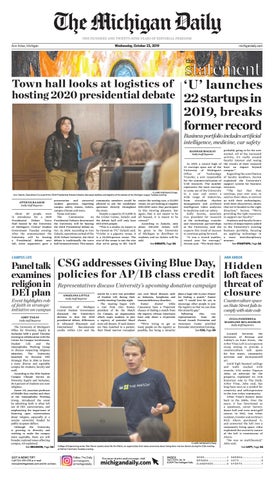
CLAIRE MEINGAST/Daily Ann Zalucki, Operations Co-Lead of the 2020 Presidential Debate Initiative discusses facilities and logistics of the debate at the Michigan League Tuesday evening.
ATTICUS RAASCH Daily Staff Reporter
About 60 people were in attendance for a 2020 Presidential Debate Town Hall hosted by the University of Michigan’s Central Student Government Tuesday evening. After the announcement the University will be hosting a Presidential debate next fall, event organizers gave a
presentation and answered student questions regarding campus safety, venues, tickets, campus climate and more. Venue and seats The Commission on Presidential Debates determined the University will be hosting the third Presidential debate on Oct. 15, 2020. According to Ann Zalucki, operations co-lead of the 2020 Debate Initiative, the third debate is traditionally the town hall formatted event. This means
community members would be allowed to ask the candidates questions directly throughout the event. Despite a capacity of 13,000 in the Crisler Center, Zalucki said the debate hall will only host 800-1000 people. “This is a studio, its meant to be viewed on TV,” Zalucki said. “Crisler is a gigantic venue, it is a 10,000-person venue. The size of the venue is not the size that we’re going to fill. You’ll
notice the seating size, a 10,000 venue, we are looking at roughly 800-1000 seats that participate in this viewing pleasure. But again, that is not meant to be all housed, it is meant to be viewed.” According to Zalucki, only about 100-200 tickets will be given to the University of Michigan to distribute to students and no tickets will be sold. See DEBATE, Page 3A
In 2019, a record high of 22 startups spun out of the University of Michigan’s Office of Technology Transfer, a unit responsible for the commercialization of U-M research. The number represents the most startups to come out of the University in a year and covers a wide range of industries, from circadian rhythm management and artificial intelligence video analytics to medicine and car safety. Kelly Sexton, associate vice president for research at the technology transfer and innovation partnerships at the University, said she expects this trend of success to continue going forward. “It was a record number, record year for startups,” Sexton said. “We think that’s
Panel talk CSG addresses Giving Blue Day, examines policies for AP/IB class credit religion in Representatives discuss University’s upcoming donation campaign DEI plan CAMPUS LIFE
ANGELINA LITTLE
Event highlights role of faith in strategic initiative on campus ABBY TAKAS
Daily Staff Reporter
The University of Michigan’s Office for Diversity, Equity & Inclusion held a panel Tuesday evening in collaboration with the Center for Campus Involvement, Student Life and the Islamophobia Working Group to discuss respecting religious identities. The University launched its five-year DEI Strategic Plan in 2016 to foster a more diverse and equitable campus for students, faculty and staff. According to the 2016 Student Campus Climate Survey on Diversity, Equity and Inclusion, 38.4 percent of students are nonreligious. Samer Ali, associate professor of Middle East studies and chair of the Islamophobia Working Group, introduced the event by admitting faith is often left out of DEI conversations, and emphasizing the importance of fostering open conversations about religion, especially at a secular university funded by public taxpayer dollars. Although the University is growing in diversity and working to make the campus more equitable, there are still broader, national issues affecting campus, Ali explained. See RELIGION, Page 3A
GOT A NEWS TIP? Call 734-418-4115 or e-mail news@michigandaily.com and let us know.
Daily Staff Reporter
University of Michigan Central Student Government discussed the University’s decision to host the 2020 presidential debate, differences in Advanced Placement and International Baccalaureate credits within LSA and the
search for a new vice president of Student Life during their weekly meeting Tuesday night. The meeting began with a visit from Alex Ramer, president of Be the Match On Campus, an organization which urges students to join a registry of potential blood stem cell donors. If such donors are then matched to a patient, their blood marrow transplant
can cure blood diseases such as leukemia, lymphoma and immunodeficiency disorders. Ramer shared while Caucasians have a 77-percent chance of finding a match from the registry, African Americans have only about a 23-percent chance. “We’re trying to get as many people on the registry as possible, but being a minority
plays a huge role in your chance for finding a match,” Ramer said. “I would love for you to encourage other people to join the registry so that we can close this minority gap.” Following this, two representatives from the Sexual Assault Prevention and Awareness Center provided bystander intervention training. See CSG, Page 3A
CLAIRE MEINGAST/Daily College of Engineering senior Alex Ramer speaks about Be the Match, an organization that raises awareness about being bone marrow donors during the CSG meeting at Palmer Commons Tuesday evening.
Follow The Daily on Instagram, @michigandaily
For more stories and coverage, visit
michigandaily.com
INDEX
Vol. CXXIX, No. 16 ©2019 The Michigan Daily
probably going to be the new normal. All of the increased activity, it’s really around faculty interest and seeing the results of their research have an impact beyond campus.” Regarding the contribution of faculty members, Sexton explained the University’s support system for business ventures. “The fact that they continue, year over year, to send us their ideas, to entrust us with their technologies, with their discoveries, shows that we’re headed in the right direction,” Sexton. “We’re providing the right resources to support our faculty.” Students and faculty from a variety of departments added to the University’s existing business portfolio, focusing on applying technology in a more interdisciplinary manner. See STARTUPS, Page 3A
ANN ARBOR
Hidden loft faces threat of closure
Counterculture space on State Street fails to comply with state code JULIA FANZERES & MADELINE MCLAUGHLIN Daily Staff Reporters
Located between the entrances of Bivouac and Ashley’s on State Street, the Arbor Vitae Loft is a six-person co-op aiming to provide a counterculture safe space for live music, community activism and do-it-yourself art. Amid high beamed ceilings and walls stacked with records, LSA senior Tegwyn John, an advocate for the property, explained its rich historical role to The Daily. Arbor Vitae, John said, has long been seen as a symbol for creativity and self-expression in the Ann Arbor community. Arbor Vitae’s history dates back to the 1800s. Over the years, it has functioned as a speakeasy, corset factory, dance hall and even mini-golf course. In 1962, Ann Arbor resident, traveler and architect Rich Ahern purchased it, and converted the loft into a community living space. John explained the eccentric nature of the loft is reminiscent of Ahern. “He was so multifaceted,” John said. See LOFT, Page 3A
NEWS.........................2 OPINION.....................4 CLASSIFIEDS................6
SUDOKU.....................2 ARTS...................5 SPORTS.................7
News
2A — Wednesday, October 23, 2019
MONDAY: Looking at the Numbers
TUESDAY: By Design
WEDNESDAY: This Week in History
The Michigan Daily — michigandaily.com
THURSDAY: Twitter Talk
FRIDAY: Behind the Story
Public Favors Impeachment for President Nixon October 23, 1973 WASHINGTON – Demands for impeachment of President Nixon or his resignation mounted yesterday in Washington as a scientific poll showed a thin plurality of Americans favoring impeachment. NBC News said the poll showed 44 per cent in favor of impeachment, 43 percent opposed and 13 percent undecided. The Oliver Quayle organization contacted nearly 1,000 persons for the poll. THE POLL was initiated after Nixon fired special Watergate prosecutor
Archibald Cox. It showed 75 per cent of those questioned opposed to that action, 16 percent approved and 9 percent undecided, NBC said. The network said that 48 per cent of those questioned since Saturday night believe Nixon should step aside “and let someone else run the country,” while 43 per cent said he should not resign and 9 per cent were undecided. MEANWHILE, the new acting attorney general pledged vigorous pursuit of the Watergate investigation. House Speaker Carl Albert and other congressional,
leaders worked on plans for how to proceed with impeachment resolutions promised by angry members in the wake of Nixon’s firing Saturday night of special Watergate prosecutor Archibald Cox. Nixon, first at the White House and then at his Camp David, Md., retreat, considered using a televised speech to present his side of the case to the nation. U.S. SOLICITOR General Robert Bork said the staff and evidence assembled by Cox would be used to pursue the Watergate probe. Bork became
acting attorney general when Atty. Gen. Elliot Richardson quit and Deputy Atty. Gen. William Ruckelshaus was dismissed Saturday night over Cox’s firing. He put the investigation under the supervision of Henry Petersen, the assistant attorney general in charge of the criminal division. Bork said he retains “ultimate authority and responsibility” for the investigation. When Nixon fired Cox, he also abolished the office of special prosecutor, which had handled the case since May. WHILE WHITE HOUSE
aides sought to mollify critical senators and congressmen with explanations of Nixon’s action, criticism of the move continued to pile up-a significant amount of it from Republicans. The AFL-CIO’s national convention in Miami Beach, Fla., shouted approval to a resolution calling for Nixon to resign or be impeached if he didn’t. Sen. Daniel Inouye (D-Hawaii), a member of the Senate Watergate committee, told the convention Nixon should resign because Americans “have suffered
enough” and “must be spared this new pain and trauma.” THE PUBLIC f looded Western Union with telegrams to Washington. Some 8,000 were sent to Cox’s former office. A new Gallop Poll taken before Saturday’s events showed Nixon’s confidence rating with the public at a new low. The president of the American Bar Association urged Congress to reestablish the office of the special prosecutor, a move a number of senators and representatives also advocated.
TA U B M A N P R I Z E AWA R D E D
Stanford Lipsey Student Publications Building 420 Maynard St. Ann Arbor, MI 48109-1327 www.michigandaily.com
MAYA GOLDMAN
TOMMY DYE
Editor in Chief 734-418-4115 ext. 1251 mayagold@michigandaily.com
Business Manager 734-418-4115 ext. 1241 tomedye@michigandaily.com
NEWS TIPS
news@michigandaily.com
LETTERS TO THE EDITOR tothedaily@michigandaily.com
EDITORIAL PAGE
opinion@michigandaily.com
PHOTOGRAPHY SECTION
ARTS SECTION
photo@michigandaily.com
arts@michigandaily.com
NEWSROOM
SPORTS SECTION
734-418-4115 opt. 3
sports@michigandaily.com
CORRECTIONS
ADVERTISING
corrections@michigandaily.com
KELSEY PEASE/Daily Professor Sir Stephen O’Rahilly receives the Taubman Prize for his contribution to new understanding of obesity and metabolic disease during the Taubman Institute Symposium in the Biomedical Science Research building Tuesday morning
International Studies faculty reflect on past decade of major, discuss future
Students, professors celebrate 10th anniversary of program’s founding in 2009 ALEX HARRING Daily Staff Reporter
The international studies major, run by the University of Michigan Program in International and Comparative Studies, is celebrating its 10th anniversary. In 2005, the Center for International and Comparative Studies was founded by Professor Ken Kollman. The minor in international studies was created to provide undergraduate students an interdisciplinary, globally focused course of study. Due to the minor’s success, the major was created in 2009. Students enrolled in the major can select one of four sub-plans: international security, norms and cooperation; political economy and development; comparative culture and
BE TRUE BE YOU
identity; and global environment and health. Kollman said the major was created based on the requirements for the minor. “It started very small, but it’s become a really important program on campus,” Kollman said. “It’s very much engaged in student experiential learning and tries to encourage students to go places, study abroad and learn languages, but also to think about things in a very intelligent, structured way.” As soon as the major was announced it became popular, quickly reaching over 700 students, according to Robert Franzese, director of the program in international and comparative studies. Currently, the international studies major is the eighth largest within LSA. Franzese said the major was created to give undergraduate students a global background.
puzzle by sudokusyndication.com
The Center for International and Comparative Studies was renamed the Program in International and Comparative Studies to better align with its mission of providing undergraduates with an internationally focused education. While other majors with some overlap in areas of study, such as public health and public policy, began springing up after the major’s creation, Franzese said international studies is unique because of its focus on understanding large-scale issues and intersections within different areas of study. “The students are primarily driven by this problem that they want to understand and begin to do something,” Franzese said. “They’ll want to learn from the disciplines, what they can take from the disciplines to understand the problem, and understand what might be the start of certain solutions. So, sometimes I would say that the international studies student is not interested in the substantive realm of politics, per se, they’re interested in the realm of a particular problem or dynamic that challenges them.” The major is assembled from courses across numerous departments, with two core lecturers teaching the only three International Studies courses — an introductory course, intermediate course with offerings based on subplan and an advanced seminar. The students’ other coursework is composed of courses from across the University’s schools and departments. Because the coursework is pulled from many departments, Kollman said students graduate with a strong understanding of the
various disciplines that play a role in studying international issues. “Good disciplinary training makes good interdisciplinary training,” Kollman said. “Students are getting a number of skills, but also a kind of grounding in some of the core social science disciplines.” Nataša Gruden-Alajbegovic, global projects manager at the University’s International Institute, said creating a curriculum based on course availability is a challenge for program faculty. But she said the ability to pull from a wide range of courses, paired with the opportunity to select a submajor that more aligns with each student’s interests, contributes to the major’s opportunities for personalization. Gruden-Alajbegovic said there is a pre-approved list of more than 400 courses which satisfy International Studies requirements offered each semester. She said there is also an option for students to come to advisers and request a course not already on the list be added. “Interdisciplinary is a very key word,” Gruden-Alajbegovic said. “It’s almost like putting together your own major with different disciplines that you decide to focus on.” Franzese said putting together the coursework is an administrative challenge each semester, but there is never a shortage of courses being taught among the schools and departments at the University. There is also a third-year language requirement, which goes two semesters beyond the four-semester language requirement in LSA. This can also be fulfilled by a student taking four semesters of one language and two semesters in a second language.
Read more at MichiganDaily.com
dailydisplay@gmail.com
Editorial Staff FINNTAN STORER Managing Editor
frstorer@michigandaily.com
GRACE KAY and ELIZABETH LAWRENCE
Managing News Editors news@michigandaily.com Senior News Editors: Sayali Amin, Rachel Cunningham, Remy Farkas, Leah Graham, Amara Shaikh Assistant News Editors: Barbara Collins, Julia Fanzeres, Claire Hao, Alex Harring, Angelina Little, Madeline McLaughlin, Ben Rosenfeld, Emma Stein, Zayna Syed, Liat Weinstein
JOEL DANILEWITZ and MAGDALENA MIHAYLOVA
Editorial Page Editors tothedaily@michigandaily.com Senior Opinion Editors: Emily Considine, Krystal Hur, Ethan Kessler, Miles Stephenson, Erin White
MAX MARCOVITCH and ETHAN SEARS
Managing Sports Editors sportseditors@michigandaily.com Senior Sports Editors: Anna Marcus, Aria Gerson, Ben Katz, Mark Calcagno, Theo Mackie, Tien Le Assistant Sports Editors: Bailey Johnson, Bennett Bramson, Connor Brennan, Jacob Kopnick, Jorge Cazares, Rian Ratnavale
ARYA NAIDU and VERITY STURM
Managing Arts Editors arts@michigandaily.com Senior Arts Editors: Clara Scott, Emma Chang, Cassandra Mansuetti, Sam Della Fera, Trina Pal Arts Beat Editors: John Decker, Sayan Ghosh, Mike Watkins, Ally Owens, Stephen Satarino, Izzy Hasslund, Margaret Sheridan
ROSEANNE CHAO and JACK SILBERMAN
Managing Design Editors design@michigandaily.com Senior Design Editor: Sherry Chen
ALEXIS RANKIN and ALEC COHEN
Managing Photo Editors photo@michigandaily.com Senior Photo Editors: Alexandria Pompei, Natalie Stephens, Alice Liu, Allison Engkvist, Danyel Tharakan Assistant Photo Editors: Miles Macklin, Keemya Esmael, Madeline Hinkley, Ryan McLoughlin
ANDREA PÉREZ BALDERRAMA Statement Editor
statement@michigandaily.com
Deputy Editors: Matthew Harmon, Shannon Ors
SILAS LEE and EMILY STILLMAN Managing Copy Editors
copydesk@michigandaily.com
Senior Copy Editors: Dominick Sokotoff, Olivia Sedlacek, Reece Meyhoefer
CASEY TIN and HASSAAN ALI WATTOO
Managing Online Editors webteam@michigandaily.com Senior Web Developers: Jonathon Liu, Abha Panda, Ryan Siu, David Talbot, Samantha Cohen
ELI SIDER
Managing Video Editor video@michigandaily.com Senior Video Editors: Ryan O’Connor, Joseph Sim
NA’KIA CHANNEY and CARLY RYAN
Michigan in Color Editors michiganincolor@michigandaily.com Senior Michigan in Color Editors: Lorna Brown, Samuel So, Ana Maria Sanchez-Castillo, Efe Osagie, Danyel Tharakan Assistant Michigan in Color Editors: Harnoor Singh, Nada Eldawy, Maya Mokh
CATHERINE NOUHAN Managing Podcast Editor
MADALASA CHAUDHARI and HANNAH MESKIN Managing Social Media Editors Senior Social Media Editor: Allie Phillips
Business Staff MOLLY WU
RYAN KELLY
Creative Director
ZELJKO KOSPIC
Sales Manager
Special Projects Manager
ROBERT WAGMAN
ANITA MICHAUD
Marketing Consulting Manager
Brand Manager
The Michigan Daily (ISSN 0745-967) is published Monday through Friday during the fall and winter terms by students at the University OF Michigan. One copy is available free of charge to all readers. Additional copies may be picked up at the Daily’s office for $2. Subscriptions for September-April are $250 and year long subscriptions are $275. University affiliates are subject to a reduced subscription rate. On-campus subscriptions for fall term are $35. Subscriptions must be prepaid.
News
The Michigan Daily — michigandaily.com
LOFT From Page 1A “He traveled the world a couple times on tours of innerAsia — Afghanistan, Pakistan, in 1952 you know, when people weren’t doing that … He was trained as an architect at MIT in Mechanical Engineering, worked as an architect and community planner but his passion was drawing — drawing buildings and arts, and his life mission was to advocate for world peace.” Since taking ownership of the space, Ahern has hosted bands, artistic performances, political organizing meetings and event lectures at Arbor Vitae. In advocating for world peace, Ahern was the first person to invite the Dalai Lama to Ann Arbor. John, a Buddhist, explains her connection to the loft is largely due to its role as a safe space for all religions. “Part of the reason why I feel connected to this space is because I am Tibetan Buddhist,” John said. “So, a huge part of my personal identity, I feel I kind of owe to this place and to Rich for literally making a place for these, non-traditional, countercultural thoughts to be talked about and discussed. “ Now, almost half a century later, Arbor Vitae is in danger of being shut down as several aspects of the loft’s infrastructure have not met building code standards established by the state. John said when Ahern converted the loft into a living space, his relationship with the property owners allowed the lack of infrastructure to go unaddressed. Yet, after the shift in property management to Oxford Companies and Ahern’s death in 2004, the
DEBATE From Page 1A
“The CDP, not the University, controls the tickets U-M is going to receive,” ” Zalucki said. LSA freshman Daeveonna Middleton said she was disappointed by the low number of tickets being given to the University. “I know they said something about how 1,000 students could help volunteer for events, but that’s not guaranteeing us from being able to go there and working directly with the debate,” Middleton said. “I was kind of disappointed, but I also have to realize this is an international event. But I wish there was more opportunity for students to be able to experience this because it’s kind of like a once in a lifetime thing.” Student involvement According to Dean of Students Laura Blake Jones, there will be various student engagement volunteer positions surrounding democratic engagement, programming, campus climate, safety and student activism. The event staff volunteers will work in the coming months to help prepare for the debate. Jones also said students can attend the next Presidential Debate Town Hall next Wednesday, Oct. 30, to sign up for the various engagement teams and get involved. “I would imagine that this is going to continue to evolve, and in the next town hall meeting that we’re holding on the 30th, when we get into groups, specifically, those of you that do want to come back to the next meeting and want to actually engage and be a volunteer can start working in these areas,” Jones said. “There are five major areas of involvement, and there’s overlap and connections between the five areas.” Campus accommodation According to Zalucki, the University is preparing to accommodate up to 5,000 different members of national media and says students should anticipate having the option to interact with media entities as the debate draws near. “We’re going to have about 1,000 to 3,000, up to 5,000 different media center media entities from around the world,” Zalucki said. “That’s huge. A 40,000 square foot tent is gigantic, and we are ready to
building has come under scrutiny. “(Arbor Vitae) was based on Rich’s own communication power, after he died, people who lived here were intimidated by the city and property management companies and felt less and less agency to advocate for this place,” John said. “And that’s part of why it’s so under the radar now … tenants have kind of shrunk and tried to hide.” Earlier this year, as the tenants were attempting to negotiate a new lease, the new management company ordered an inspection on the loft. Arbor Vitae’s facilities failed to meet building code standards on infrastructure such as internal heating. “Oxford is the property management company, the people here were working to get a new lease, and a city inspection happened during that process,” John said. “They came in, and I think it was an inspector, and they threw the book at the place. Which is kind of understandable.” The residents promptly received an eviction notice on Aug. 27. Lizy Michealson, a current resident of Arbor Vitae and University of Michigan alum, felt a sense of loss at the thought of losing Arbor Vitae. “When we first found out, it was just in a very emotional stage,” Michealson said. “Essentially, we felt this very intense loss … A lot of things have changed in Ann Arbor and the entire world, and this place has been a witness to that.” The Daily reached out to Oxford Companies for comment but did not receive a response in time for publication. LSA junior Solomon Medintz said saving Arbor
host such a large event because that means they’re going to also be on campus talking to all of you. We give you opportunities that you wouldn’t have every day.” Zalucki said it will be the equivalent to six College Game Day stages placed in the Ingalls Mall area in order to accommodate the major media networks prior to the event. “Think when ESPN is here for game day, just multiply that by six,” Zalucki said. “And I’m sure all the excitement… (will lead to) smaller pop ups from some sort of social media sites as well. So, the media presence on campus for those four days will be quite extraordinary and a real opportunity for student voices to be heard.” Campus services When asked about how the debate will impact on-campus services, Jones compared the shift in operations to hosting another special event, like a large football game, and said the University will strategically assign tasks to make sure campus services remain functional. “We’re being very strategic about who is going to be involved with which things related to the debate,” Jones said. “When we know we have a football game, the hospital steps up in ways that are very different than our normal operation, so that we can anticipate and plan for medical emergencies that might be affiliated with that. So, I would imagine in many of our areas, we’re going to do the same sort of planning to step up and be ready.” Zalucki said the University will also be bringing in outside vendors to assist with day-today operations and facilities on campus. “We are also bringing in any types of vendors who do this regularly,” Zalucki said. “On a regular basis, you want to go to school, you want to be fed, you want the lights on and you want to get internet. As we start to ramp up, there will be improvements and resources just to supply and support these types of activities on campus, so your internet won’t fall down, things like that, we are anticipating.” Carver said arrangements are being made to ensure faculty who are helping plan the debate, particularly on the core team, will have replacements or ways of ensuring academics and normal course curriculum are
Vitae is important for the Ann Arbor community because of both its rich history and also because of its affordability. “Arbor Vitae has this amazing history of community space and organizing and art,” Menenditz said. “So many amazing conversations and meetings have happened there. That space should be preserved. (Arbor Vitae is) one of the only affordable options — housing options — on our campus, and I think we should be preserving all of the affordable housing options we can.” In the face of complete shut-down, community activists and tenants rallied around the issue. On Sept. 3, a GoFundMe page was created to save the loft. The proceeds would go to possible renovations, preserving Ahern’s memorabilia. At the time of publication, the page had raised a little over $4,000, almost a fourth of its fundraising goal of $20,000. John described her sense of urgency in saving the loft because it is one of the only counter-culture spaces left in Ann Arbor. “I mean if this place goes, it’s the last nail in the coffin of Ann Arbor turning into a neo-liberal hell-hole,” John said. “From my perspective as a townie, this is the secret beating heart of Ann Arbor.” Michealson ref lected on why she is fighting to keep the Arbor Vitae alive. “This place is like our family member,” Michealson said. “You don’t let your family member go. You fight for them. You make sure that they can stay and be healthy and impact other people’s lives.”
Read more at MichiganDaily.com
not falling behind. “From a curriculum and other management standpoint, everybody that has been pulled on to the core team, for example, you know, there’s a recognition that the person is not doing their regular job and steps are being made to take care of that,” Carver said. Business freshman Karma Karira said she is most concerned about the functionality of student facilities during debate week. “The most pressing issue to me was how it would intrude on my ability to be a student on campus,” Karira said. “The resources that are still available to students and how that’s separated from the presidential debate, and, just in general, I pay for going on those busses and having those study spaces, so those concerns are most pressing.” Student safety and wellbeing When asked about student health and well-being, Jones said student involvement, particularly from the engagement volunteer teams, will be critical in ensuring the students’ needs are met. “So, I think I sort of started to talk about in terms of anticipating the needs of our students and student life,” Jones said. “That group is focused on campus climate and safety and well-being. But we might be thinking from administrative perspective, what can we do? How can we staff up availability of counselors and CAPS for example, right? But (students) may have other very tangible ideas about what we could be doing, and so that’s where (student) input is going to be really, really important.” According to John Seto, Division of Public Safety and Security deputy director, there will be an increased security presence around campus buildings as the debate approaches to ensure the safety of students and faculty. “Is it going to bring out some new challenges? Absolutely,” Seto said. “But I am here to tell you that based on the foundation that we built and the partnerships that we’ve built, I’m very confident that we can provide that safe and secure environment, right.”
Read more at MichiganDaily.com
RELIGION From Page 1A “Is it safe to visibly be religious on a campus like this, when nationally the country is facing white supremacy and gun violence?” Ali asked the audience. Kelly Dunlop, associate director for campus involvement, led a panel of five students who came from various religions and backgrounds. The event began with a moderated discussion and then opened to questions and comments from the audience. In response to the national political climate, the panel discussed how religion can be used as a mechanism to bridge divides and facilitate healing. Social Work student Stephanie Morgan-Sterenberg was raised in a secular Jewish household and attended the Tree of Life temple in Pittsburgh, which fell victim to a domestic terrorist attack when a white supremacist killed 11 people in a shooting last year. “It was shattering in so many ways to think that we just keep experiencing this barrage of violence, and it’s condoned by this culture of white supremacy,” said MorganSterenberg. Morgan-Sterenberg said
CSG From Page 1A The training included defining sexual assault, consent, coercion and the nuances within each of these topics. They then discussed intervention strategies using different scenarios to display how to enact these strategies. CSG President and Ford junior Ben Gerstein’s report included planning for the upcoming 2020 presidential debate to be hosted at the University. Gerstein discussed the importance of ensuring the environment around the debate is safe and inclusive for all students. “A couple of things to be cognizant of in discussing this debate is this experience is an exciting opportunity to engage in history but then it’s also an experience that brings legitimate concerns
STARTUPS From Page 1A One of the new companies, Applied Morphomics Inc., was founded by University faculty member and surgeon Stewart Wang to collect and apply CT scan biological data. “A CT scan is basically a three-dimensional, digital record of a person’s body, and there’s a huge amount of information in there,” Wang said. “We developed a very rigorous system of anatomic indexing to go through and separate out all the body parts, label them and use that annotated ground truth.” Wang elaborated on the initial automotive application of his technology and the shift in focus to Applied Morphomics’s current goal of improved, personalized patient care. “The data I produce in my laboratory is used to produce the virtual crash dummies that the automotive industry uses,” Wang said. “If I’m asked to treat you or another person, if I can somehow understand what their body came from and has been through in the current condition, I can be a much better doctor … What we do is we go and we extract actionable data from each patient’s body using this medical imaging.” Another interdisciplinary startup is Arcascope, a digital application created by research fellow Olivia Walch to help individuals correct disruptions in their circadian sleep rhythms. Walch initially created the app while pursuing her Ph.D. in mathematics, using research to help travelers adjust to time differences. “A lot of factors can affect your circadian clock, but the very first one and the
Wednesday, October 23, 2019 — 3A this experience pushed her to communicate with people of various religious backgrounds in order to unpack their experiences of facing religious discrimination. The panelists also reflected on their experiences in the classroom and around campus. Law School student Areeba Jibril discussed the exhaustion she has experienced as a visible Muslim because of her hijab. Jibril said our society has normalized the idea people of color are there to enrich white lives, and it is important to remember the people on the other end of questions are human. The panel also deliberated how the University should address religious-specific issues going forward. Many of the panelists agreed professors should work on lifting the burden from the religious minorities in the room, and instead explain these narratives through readings from authors from those religious groups. LSA senior Armind Chahal proposed underclassmen undergo religion-focused workshops, in addition to the mandatory race/ethnicity course requirement. In an interview with The Daily after the event, Rackham student Lauren White said she agreed with the focus on how
faculty can improve campus climate. “A good takeaway was that they were talking about faculty involvement and talking with staff about how they can better assist and be with students who are students of faith and not be offensive,” said White. LSA junior Lorna Brown, who is a Michigan in Color editor for The Daily, grew up Methodist in a Black family that valued attending church every Sunday and praying every evening. She explained the close relationship between her race and her religion, and reflected on her experience in the dorms her freshman year when racist slurs were written on dorm door name tags. “That was where we really started doing our marches and going and saying we need that support,” Brown said. “That is something I continuously see, and I know that’s the case for a lot of people.” Marlanna Landeros, Division of Public Safety and Security program manager, oversees DEI and student program collaboration with DPSS. When asked what DPSS was doing to address and prevent events like this, Landeros explained it is an ongoing process.
Read more at MichiganDaily.com
on campus,” Gerstein said. “I think we all recognize what the divisive climate of the 2020 election is, the potential for that to encompass several weeks of the campus experience and our students is important to be reminded of.” Gerstein, who is a student representative on the 2020 presidential debate planning committee, said he will work to ensure the committee understands student concerns. The first town hall meeting regarding the upcoming debate was held this Tuesday. The second will be held next Wed. Oct. 30. Gerstein also discussed the upcoming Giving Blueday, a fundraiser for University student organizations held December 3. This year, CSG will be fundraising for the Leadership Engagement Scholarship, a scholarship created by CSG with the goal of providing assistance to
students who face financial barriers to pursuing leadership positions at the University. Gerstein emphasized this stipend will benefit students hoping to take on leadership positions in organizations across campus, rather than just CSG. LSA sophomore Sam Braden discussed a project focused on the LSA Advanced Placement and International Baccalaureate policies regarding class credit. “LSA is not only the only school at Michigan that treats AP and IB policy differently. It’s also the only university in America where this happens,” Braden said. “I met with (Director of Academic Standards and Academic Opportunities) Conway-Perrin and she agreed this change needs to happen.”
most important is still light exposure,” Walch said. “You can adjust faster if you get light at the right time and, sort of equally importantly, you avoid it at the wrong times.” Walch spoke on her work modifying the initial idea to be more user-oriented and practical in its function to help everybody, not just travelers. “I just started working on the problem myself from the perspective of how to make the math work better for real people,” Walch said. “What we do now is just that, using math to help people expose themselves to light and take action steps to help them live better.” Walch said her current focus is on finding ways to implement their technology to help cancer patients strategize the best times for treatment. “(A) place it could be useful is helping people time when they should take medicine,” Walch said. “Because your body changes over the course of the day, it prioritizes healing and metabolism and immune response at different times.” A sizable portion of the University’s portfolio this year was composed of tech startups like Voxel51, co-founded by computer science professor Jason Corso. “My group focuses on research related to video understanding, and this is somewhat unique in the world of computer vision where most people tend to focus on just like image understanding, image recognition,” Corso said. Corso explained the process of building his startup independently and the decision to incorporate the University in the business. “When we began, we were completely, sort of, divorced from the University,” Corso said. “There’s a lot
of mentoring and strong experience that the University brings as well as a good network of marketing and so on, so we felt it was the right thing to do to really reengage, and so we actually did ultimately form a relationship with the University.” Wang also described the integral role the University played in facilitating the creation of Applied Morphomics by licensing back his intellectual property. “When I talked to (the University) about what I wanted the technology to do, what I was hoping that it would be able to do out in the real world, they worked very hard with me to figure out a way to arrange this,” Wang. Arcascope also was developed with the help of the University’s resources, according the Olivia Walch. “This is very much a company that’s been incubated at Michigan, took its first steps with Michigan holding its hand,” Walch said. “They could’ve, in 2014, come in and been like, ‘We own the technology, so we’re going to do whatever we want with it,’ and they’ve been very clear that they put the inventors in the driver’s seat.” LSA sophomore Sahil Kapur who co-founded a watch company called Recrire Vie at U-M to fund his nonprofit Help to Fight Hunger, also emphasized how the University facilitates startups at all levels. “There’s definitely a lot of resources that the University offers, and they’re all very wide-spread and equally spread, and I think it depends on you, whatever you want to choose,” Kapur said. “Even if you’re not taking a class at Ross, I feel like there’s so many other opportunities around the school that you can make a difference.”
Read more at MichiganDaily.com
Opinion
4A — Wednesday, October 23, 2019
The Michigan Daily — michigandaily.com
NOAH ENTE | COLUMN
The NBA commits a flagrant foul on free speech
Edited and managed by students at the University of Michigan since 1890. Stanford Lipsey Student Publications Building 420 Maynard St. Ann Arbor, MI 48109 tothedaily@michigandaily.com
MAYA GOLDMAN Editor in Chief
MAGDALENA MIHAYLOVA AND JOEL DANILEWITZ
FINNTAN STORER Managing Editor
Editorial Page Editors
EDITORIAL BOARD MEMBERS Zack Blumberg Emily Considine Emma Chang Joel Danilewitz Emily Huhman
Krystal Hur Ethan Kessler Magdalena Mihaylova Max Mittleman Timothy Spurlin
Miles Stephenson Finn Storer Nicholas Tomaino Joel Weiner Erin White
Unsigned editorials reflect the official position of The Daily’s Editorial Board. All other signed articles and illustrations represent solely the views of their authors.
FROM THE DAILY
How Trump is constructing a closed America
I
n the most recent installment in the crackdown on immigration, the Trump administration announced that they will be denying visas to immigrants who cannot prove that they can afford healthcare.
This proclamation comes in conjunction with the planned expansion of DNA testing on immigrants detained near the federal border. This testing is separate from the rapid DNA testing used to prove parentage to detect potential traffickers who pose as family members of children in order to avoid prolonged detention. Rather, this new testing will be used to provide extensive DNA profiles of potential convicts, and the results will be shared with other United States law enforcement agencies. Both policies are deeply rooted in negative stereotypes of immigrants, and such measures can seriously harm a marginalized population that is already vulnerable to various forms of xenophobia. Through these policies, President Donald Trump characterizes the U.S. as an elite nation that is exclusive and intolerant of underprivileged, low-income and nonCaucasian populations. The implementation of these policies is an extension of the Trump administration’s callous treatment of immigrants, particularly those from Latin American countries. Moreover, the process of immigrating to the U.S. is already extraordinarily difficult. The addition of further obstacles, such as the health insurance requirement, show a profound insensitivity to the fraught immigration process. Effective on Nov. 3, 2019, this proclamation will allow consular officers to deny visas for those who do not have approved health insurance or those who cannot prove their financial ability to afford health care in the U.S. This proclamation will also disqualif y immigrants who already live in the country and applied for subsidized coverage, rendering their status illegal. The Trump administration has justified this classist policy with the claim of “protecting American taxpayers” and “promoting self-sufficiency” among immigrants. By using health care — a basic human right millions of Americans already struggle to afford — as a litmus test to assess one’s eligibility to be American is both exploitative and unjust. It implies that only those who enjoy financial privileges are allowed to become American citizens and furthers the elitist and racist undertones in American immigration policies. Similarly, the DNA testing policy evokes a sense of
class stigma that aggravates the racialized immigration policies of our border. The implementation of DNA collection was initially permitted through the DNA Fingerprint Act of 2005, but the detainees were exempt from the law due to an agreement by the Obama administration — until now. To justif y this measure, the Trump administration has cited whistleblower complaints that accused the Customs and Border Protection of failing to comply with the act to fully carry out DNA collection. Nevertheless, the policy provides no basis for such infringement of personal privacy and equates immigrants to dangerous criminals.
Both policies are deeply rooted in negative stereotypes about immigrants In addition, since most of the DNA pool will be composed of Latinx individuals from the Southern border, it subscribes to and furthers the incorrect conception that a disproportionately large number of criminals are Latinx. This policy also raises concerns regarding the government’s extensive usage of technolog y and the limits — or lack thereof — of such innovation. While providing securit y for our own citizens, these technolog ies are also capable of sur veilling an exploited population. This is akin to what we have seen in the Xinjiang province of China with regard to the Uighur Muslims or the Chechnya crackdown on LGBTQ individuals. Vera Eidelman, a staff law yer with the American Civil Liberties Union’s Speech, Privacy, and Technolog y Project, said to the New York Times, “(this) kind of mass collection alters the purpose of DNA collection from one of criminal investigation basically to population surveillance, which is basically contrary to our basic notions of a free, trusting, autonomous society.” The administration’s announcement of these new policies does not necessarily mean they will actually come to fruition, but their mere proposal holds weight. On paper, these policies are meant
to curb illegal immigration. In reality, they will simply make the legal immigration process much more difficult and disincentivize legal immigration. The accompanying statement to these proposals contains the phrasing that too many non-citizens were taking advantage of the U.S.’s “generous public health programs” and that immigrants augment the country’s “uncompensated health care costs.” This manner of thinking further vilifies the immigrant population, clearly using them as a scapegoat for the massive health care crisis in the U.S. Additionally, the collection of DNA from mig rants crossing U.S. borders provides no tang ible benef it to U.S. societ y and thus only f urther demonizes those seeking to immig rate to the U.S. In these instances, Trump is simply reaff irming his campaig n promises of removing all undocumented immig rants and limiting legal immig ration. Policies such as these ones only deepen the divide bet ween “desirable” and “undesirable” populations in the U.S. in already extremely divisive times. Any effort to curb legal immig ration is the antithesis of what American values were meant to stand for. The U.S. has stig matized its immig rant populations for the majorit y of its histor y, as demonstrated by the formation of the Know-Nothing Part y in 1849 against Irish and German immig rants, the 1882 Chinese Exclusion Acts and 1924’s Johnson-Reed Act, which limited immig rants from all over the world — except Asia, which was completely excluded. These policies are just a modern iteration of anti-immig rant ideals against another g roup. They are far from the f irst to show a preference for white, highincome immig rants. Under the current administration, the rhetoric used against Latinx populations has been racist, fear-mongering and xenophobic. Policies like the DNA collection and health care reg istration are meant to criminalize Latinx immig rants and will do nothing to address the inf lux of illegal immig ration on the border. Though it is likely these new policies will be challenged in some capacit y before they go into effect, the attempt to implement them is a g rossly offensive attack on legal immig ration.
CONTRIBUTE TO THE CONVERSATION Readers are encouraged to submit letters to the editor and op-eds. Letters should be fewer than 300 words while op-eds should be 550 to 850 words. Send the writer’s full name and University affiliation to tothedaily@michigandaily.com.
O
n the eve of a preseason basketball exhibition game in Tokyo, Daryl Morey, general manager of the Houston Rockets, sent out a tweet that reverberated around the globe. Morey expressed support for the pro-democracy protesters in Hong Kong, with a graphic that read “Fight for Freedom, Stand with Hong Kong.” Such a sentiment has bipartisan support from many in the United States and while Morey quickly retracted it, the message garnered many positive and negative responses. The global significance of Morey’s single tweet revealed a great deal about China and the NBA, and brought into question the tensions between free speech and business practices. China’s government, people and business sectors have been overwhelmingly angry about Morey’s since-deleted tweet and sought for Morey to be censored in addition to other consequences. In the days since the general manager’s tweet was posted, Chinese state-run media have pulled Rockets games from television, basketball apparel stores have removed Rockets merchandise, and fans have pulled their support for the Rockets and, in some cases, the NBA as a whole. All of this has forced the NBA and the Rockets into a full-scale cleanup operation. The NBA issued a press release apologizing for any offense caused by Morey’s purportedly insensitive comments. Houston’s owner Tilman Fertitta publicly emphasized that his team is “NOT a political organization” and that Morey “does NOT speak for the @HoustonRockets.” Even Morey himself sent out a two-part tweet apologizing to anyone who was offended and reaffirming his team and the league’s commitment to China moving forward. All of these responses and more sprung out of one seven-word tweet. China is the NBA’s largest foreign
market, with millions of fans who purchase merchandise, tune into games and actively engage with the league. The Houston Rockets – often associated with China since 2002 when Houston drafted the 7-foot-6 Shanghai-native Yao Ming with the first overall draft pick – have been historically beloved in the country. Many of these Chinese fans have expressed willingness to take their team loyalties and expenditures on sports elsewhere. The league has viewed it as a wise business strategy to cater to the will of China and its people by avoiding any sort of critical political statements from league employees and has acted accordingly in the Morey affair. Yet the NBA’s self-abasing behavior regarding China and its political sensitivities is deeply concerning. By using the Chinese economy and people as a weapon, the totalitarian Chinese media and government have just been granted the power to stifle American speech, even outside of Chinese soil. Instead of prioritizing values of free expression, NBA Commissioner Adam Silver and the league placed the economic interests of what is essentially a multi-billion-dollar business ahead of the constitutional rights of their own employees. In the past, the NBA has had no trouble taking action in accordance with its stated morals. The league was willing to pull an All Star game from Charlotte, North Carolina — where one of its teams, the Hornets, is based — because league officials strongly disagreed with the state’s “Bathroom Bill.” Yet in their responses to Daryl Morey’s tweet, the NBA would not dare to risk offending President Xi Jinping or Chinese fans. Though Silver later made an effort to clarify the league’s position and show support for free speech, the damage of capitulation had already
been done, and the precedent had already been set. This incident from last week begs the question of how much American companies could soon be forced to cave to the demands and sensitivities of the Communist Party of China. What sorts of discussion topics could soon be off limits to U.S. citizens for fear of losing their jobs? It is frightening to think that authoritarian limits to free speech in China could be forced on anyone around the globe, especially in America, and that businesses would fall in line in their efforts to simply follow the money. This recent news also brings about a final question as to how U.S. consumers — still the majority of the NBA’s market — should respond in the face of last week’s events. While Chinese fans continue to grow upset over Morey’s expression of his beliefs, American supporters should hold the league accountable for its weak handling of the situation and willingness to throw a member of its community under the bus for simply utilizing his right to free expression. The NBA, which often speaks of its core values, has a choice to make between living up to such morals or not having any. If league executives decide to forget about their ethical commitments once their profits stand to take a hit, they will have granted tremendous and dangerous power to Xi and his regime. If Americans truly consider free speech to be a fundamental value, we must be willing to vote with our wallets and TV remotes. A policy of appeasement from our companies toward China is equally disturbing and as inappropriate as it would be for our government. Noah Ente can be reached at noahente@umich.edu.
CHAND RAJENDRA-NICOLUCCI | COLUMN
O
Stop blaming encryption
n Oct. 4, Attorney General William P. Barr wrote a letter to Facebook with counterparts from Britain and Australia calling for the company to halt plans to implement strong encryption across all of its messaging services. This is the latest episode in the long-running debate over government access to encrypted data. Beginning in the 1990s with the introduction of strong encryption software such as Pretty Good Privacy, the United States government and governments around the world have fought for “backdoors” in encryption. A U.S. proposal for a universal backdoor was defeated in the ’90s, but as the Snowden leaks showed, the government’s public defeat only made it pursue a backdoor covertly. The U.S. government used a combination of secret hacking, coercion and subversion to achieve a de facto backdoor. Following the Snowden leaks, companies have strengthened their encryption and security practices and have been less publicly willing to cooperate with government requests for data. Barr’s letter is the latest contribution to this polarized debate. First, what is encryption and why does it matter? Broadly, encryption transforms data into a string of bits whose original state can only be revealed with a specific key. For example, if you were sending a message with the data “I love The Michigan Daily,” encryption would transform the data into something like “hfoahdjdsh90112aofa00” — intelligible only to those with the appropriate key. Encryption is the foundation of much of what we do online, enabling the flow of confidential information like our banking and health data by keeping it hidden and secure. It protects dissenters, journalists and everyday people from prying governments, organizations and individuals. As more parts of our lives move online, privacy and security are increasingly important. We expect what we say and do in private won’t be surveilled or exposed. The same should be true of our private discussions, activities and existence online. Weakening encryption weakens privacy and security online and threatens people’s freedom,
safety and well-being. With all the benefits of encryption, what are governments’ arguments for a backdoor, and what is a backdoor? Generally, it is a mechanism built into encryption systems that allows a third party to decrypt data when needed. Governments argue that as strong encryption becomes more common, criminal activities are increasingly able to “go dark,” or become hidden from law enforcement, undermining the rule of law and endangering us all. To combat this, governments argue that companies need to create ways for law enforcement to access encrypted data when they need it — through backdoors. In most cases, however, government arguments for backdoors are far from convincing. Privacy and security experts argue that backdoors threaten the security and privacy of all users, and a bipartisan congressional report concluded that backdoors would “(work) against the national interest.” Forcing companies to build backdoors would only make everyday citizens less secure, while doing nothing to prevent criminals from using encryption. Any backdoor created for governments could be exploited by hackers through either targeting the backdoor directly or stealing access from governments. Additionally, the technology to use strong encryption is already out there. Building backdoors into everyday applications will put everyone at risk while doing little to stop tech-savvy criminals from using strong encryption. There are some situations where the debate about law enforcement access to encrypted data is less onesided. As our phones become the “everything” tool and strong encryption is more common, evidence such as calendars, notes, pictures and videos has become increasingly difficult to obtain, even with a warrant. Local law enforcement often lack the resources and expertise to bypass a device’s strong security and encryption systems on their own, and they don’t have many options for help. Compelling suspects to
provide access to their phones would undermine the Fifth Amendment and be useless in situations where suspects are unable or unwilling to help. Additionally, companies are less willing to help law enforcement access data and are designing devices to be warrant proof. This combination of inadequate capabilities and unavailable help can render suspects’ devices useless to investigations. As privacy becomes a selling point for technology companies from Apple to Facebook, their increasingly absolutist positions should be taken with a grain of salt. A narrow solution that protects privacy and security while providing law enforcement access when appropriate is not impossible as tech companies often argue. Tech companies already comply with the vast majority of government requests for data, though they don’t publicize it. Also, there are a number of existing proposals to address locked out devices. If representatives of companies, privacy advocates and the government engage in good faith discussions, a narrow, communitarian solution should be possible. Unfortunately, absolutism is often simpler and more popular. There are certainly some situations where the debate over encryption is less lopsided. However, they are narrow cases where policies and system design are essential, not encryption capabilities themselves. Proposals to directly undermine encryption with “backdoors” are misguided, lazy and dangerous. Instead of fear mongering to justify a dragnet, governments should engage privacy advocates and companies in good faith discussions about limited solutions. Strong encryption is the foundation of much of the modern internet, and protecting it protects everyone and everything online. Turning encryption into a marketing symbol or national security scapegoat undermines that protection and makes us all the more vulnerable. Chand Rajendra-Nicolucci can be reached at chandrn@umich.edu.
Arts
The Michigan Daily — michigandaily.com
Wednesday, October 23, 2019 — 5A
DIY COLUMN
CONCERT PREVIEW
Cox’s Corner: Diversifying DIY through The Cohort RYAN COX
Daily DIY Columnist
THIRD MAN RECORDS / YOUTUBE
LaFarge to play The Ark MADELEINE VIRGINIA GANNON Daily Arts Writer
There’s gonna be a riot in the streets of Ann Arbor this Sunday night. He captured our hearts as a headliner at the 2019 Ann Arbor Folk Music Festival last winter, then crushed them after a cancelled March show at the Ark. Now, Pokey LaFarge looks to return to lamplit streets of Ann Arbor Oct. 27 at The Ark. Lafarge embraces the legacy of his predecessors, and has refashioned music of eras gone by for a contemporary audience. No small feat, given that many modern listeners would scoff at listening to the music popular in parents’ and grandparents’ time. His magic comes from his ability to blend vintage and modern effortlessly. LaFarge looks like an old folk musician right out of Nashville’s 1950s heyday — almost amusingly out of place in the 21st century crowd. His voice has a tinge of the classic country warble; lyrics recall the old-timey jazz of the South. Yet while harmonica riffs and lyrics recall the music of the past, guitar riffs and swing rhythms wield a sharp, enjoyable edge that elevates LaFarge’s music from a mere rehash of old hits. At times, his music
echoes the style of classic French or Spanish music, echoes which are softly carried in the picking of a guitar. And while LaFarge’s music remains distinctly familiar, he manages to defy expectations in all regards. Traditional song structure is bucked, bent and then twisted round to suite LaFarge’s wicked, musical mastery. The Ark’s intimate performance space is perfect for LaFarge. His music, which often features plenty of instrumental breaks and riffs, and his unique style of singing both lend themselves to a venue like The Ark. Every seat is the best seat in the house when you’re down at Ann Arbor’s local live music joint. Whether you’re ready to gear up for his upcoming performance this weekend, or you’re looking to jump into the world of LaFarge for the first time, start with “Goodbye, Barcelona,” “La La Blues” and “Riot in The Streets.” For a more classic feel, go to his earlier albums, like Beat, Move & Shake, then switch it up to LaFarge’s modern twists with Something In The Water. Maybe, if this preview does its job, I’ll see you in the audience this Sunday night. Until then, indulge in the old-fashioned with the world’s coolest time traveller, Pokey LaFarge.
Pokey LaFarge Oct. 27, 2019 @ 5 p.m. The Ark
Summer tends to be a season of new discoveries for me, especially in terms of finding new music. The summer after my freshman year, I was fully invested in the Ann Arbor music scene, but wanted to explore what the broader DIY scene had to offer. I spent much of my time poking around Bandcamp and the related artists section for some of my favorite artists on Spotify and found some groups I really liked, and some that I didn’t. Three projects that stuck out to me were Snail Mail, Soccer Mommy and Clairo. I was mesmerized by the lush melodies, beautiful harmonies and overall fantastic songwriting I heard, despite the fact that none of these artists had a full-length release under their belt yet. I sent my friends demos, covers and EPs from these artists because I really enjoyed their music, so much so that I actually wrote an application sample for this paper on Soccer Mommy’s Collection. At the end of the summer, The New York Times published an article titled, “Women are making the best rock music today. Here are the bands that prove it.” The article featured several projects that I either knew or would come to know like Snail Mail, Sheer Mag, Diet Cig in addition to many others, and discussed the underrepresentation of women in the genre. After it was published, I started to see other publications post about “women in indie rock” in a way that almost felt tokenizing. But nonetheless, it still exposed audiences to voices that are often underrepresented in the scene. DIY has often been accused of being a bit of a boys club, and if you go to a few shows, it’s not hard to see why. Most of the bands consist of an all-male lineup with a pretty stark underrepresentation of people of color. Even the crowds present at these shows can sort of embody this masculine energy at times, which creates a space that feels exclusive. But how can we change this? The Cohort is a new, independent organization on campus that seeks to promote and protect the art and work of women, POC and the LGBTQ+ community. Think of them as less of a club and more of an artist-based union. Started by LSA junior Delaney Cavanaugh and Stamps senior Victoria Rinaldi, the group is still in their beginning stages, but is already starting to put on events and meetings. “I just really wanted to provide more of a platform for more marginalized people. I feel like
there’s a lot of times where I’m the only woman in the space, or I’m the only non-white person in the space, and it can be really uncomfortable … I just want to provide a place for people that wouldn’t normally have that,” Rinaldi said in an interview with The Daily. Cavanaugh added that she was discussing some local bands with a group of her friends and came to the realization that along with Victoria’s band, Big Vic, there was only one other womenled local DIY band, Landline, that really was active in the DIY scene. “And we were like, ‘why is that?’,” Cavanaugh said. “And we just kind of came to that realization that, oh, there’s not a lot of women, or just diversity in general within the scene.” Part of what contributes to this gap is the omnipresence of masculine energy in these spaces. Rinaldi said that even when she plays with a group of her male friends, she sometimes feels uncomfortable. “No matter how much I like them, and how much we get along, I still feel like I have to prove myself,” Rinadli stated. “I identify as a woman, or like, I’m even on the more feminine side of the spectrum so it’s just kind of like ... it’s like you have to hold it up. Yeah, it’s like I feel like I have to prove myself, even though nobody around me actively makes me feel that way.” Cavanaugh followed up, saying, “The point of the group is to have a space where women and underrepresented groups feel safe and are like, ‘Oh, I’m attached to this group of people who will support me; I feel more confident to go out there book myself or play a show,’ or whatever it may be.” The group aims to provide resources for these underrepresented artists and expose these artists to a larger audience. From helping with booking and providing practice spaces for groups to making playlists featuring a diverse group of artists and creating a community to identify with, their services really vary. But if you don’t identify as a member of a marginalized group, The Cohort still welcomes your support. “We’re not going to, like, exclude anybody, so our thinking is that you’re here to support everybody else if you’re identifying with The Cohort. You are going to be here to be an ally, which means that we may not choose your art first (if you don’t identify with these marginalized communities) because we want to support these other people first. But it’s still completely welcome,” Cavanaugh said. There’s still a ways to go before the Michigan DIY scene can be called diverse, but through increased efforts from groups like The Cohort, progress is slowly being made.
BOOK REVIEW
Distinction and halves in ‘Falling Toward the Moon’ ANDREW PLUTA For The Daily
Robert M. Drake and R.H. Sin deliver an uplifting pep talk in their poetry collection “Falling Toward the Moon.” In their respective halves, Drake and Sin shower the reader with affirmation through their messages of self-love and perseverance. Despite their collective thematic effort, the poets manage to maintain their own unmistakable voices in their presentations of encouragement. Given these different styles, one inevitably ends up favoring one section of the collection to the other, and many will prefer Sin’s for the greater degree the complexity he includes. In the first half of the collection, Drake opts for a direct approach, typically writing brief excerpts in which he relies almost entirely on emotion to captivate and move the intended audience, which implicitly fluctuates between the collection reader and a more specific former or current lover. Some excerpts incorporate greater complexity, whether it be in the form of anecdotes from Drake’s own life or the integration of more involved analogies, like one of a returning soldier in “Fight Wars.” These portions are far and away the most engaging for active readers as they attempt to unpack at which point in Drake’s timeline of distant and recent relationships the segments apply. By comparison, the more transparent emotional streams of consciousness come off as somewhat simplistic. The reason for their inclusion is entirely sound, as they are able to explicitly convey the themes needed to give context to Drake’s more thought-provoking poems. They are the crucial mortar to more substantive bricks of Drake’s subtler works. Unfortunately, the majority of a building should not be mortar. While initially emotionally charged, the excess of direct emotional commentaries causes several poems to lose their potency, diluting them to the level of platitudes printed on motivational posters. Granted, it is clear that Drake’s poems come from a place of strongly pinpointed emotion for past and prospective lovers. For readers still pining over what could have been or those who above all else want the best for a current partner, Drake’s direct poems may be better received. When poems are as narrowly tailored to a subject requiring the reader’s experience on the matter, all others can feel alienated since they cannot even cling to the author’s creative depiction. For those yearning for a more ambitious and well-rounded presentation of similar subjects, Sin’s portion is likely to be more gripping. Similarly to Drake, Sin implements a blend of direct exposition of feelings and comparatively hidden sentiments. Few would be able to mix up one author’s poem for that of the other, though. Sin’s ratio of mortar to brick is more palatable for an involved reader, and, often times, even Sin’s more simplistic works feature an easily understandable metaphor or other means of spicing up his work while maintaining the desired straightforward tone. The complexity of most of Sin’s poems goes a step beyond this base level and forces the reader to more closely inspect each sentence or stanza, but the tactic benefits Sin — especially as it juxtaposes against his co-author’s work. Sin does not come off as
Falling Toward the Moon R.H. Sin, Robert M. Drake Andrews McMeel Publishing Oct. 22, 2019
pretentious for obscuring or complicating his emotions. Instead, the approach comes off as endearing. His feelings become more human as he depicts them in a more alien nature. Few are able to accurately understand the exact way they feel, much less the cause of their emotions. Consequently Sin’s sometimes foreign descriptions and extended metaphors add credibility to the feelings of overwhelmedness, love and perseverance that he conveys. Sin’s “Crowded Minds” discusses overwhelmed feelings towards interactions with a chaotic tone and idiosyncratic descriptions like the interactions being “noisy on the soul.” On the contrary, in “Entire Life,” Drake approaches the same sentiment as Sin but from the perspective of a therapist or motivational speaker, consoling the audience. While heartwarming, the technique fails to create the authenticity of Sin’s poems. Granted, perhaps Sin is so able to take on less straightforward depictions of emotion because Drake transparently introduced these emotions in the first half of the collection. Even still, Sin’s poems are more developed and enjoyable in isolation. Fans of love poems, especially those in need of a pick-me-up, should not hesitate to let gravity take hold in “Falling Toward the Moon.” Others should not avoid giving it a chance, but should keep in mind that getting through the first half may not be so invigorating — luckily, the direct nature of many of the poems in this half expedite the process.
Fans of love poems, especially those in need of a pick-me-up, should not hesitate to let gravity take hold in “Falling Toward the Moon.”
ROBERT M. DRAKE / YOUTUBE
Arts
6A — Wednesday, October 23, 2019
The Michigan Daily — michigandaily.com
FILM REVIEW
TV REVIEW
‘Tigers’ is deeply magical JULIANNA MORANO Daily Arts Writer
FACEBOOK WATCH
‘Limetown’ tries too hard ANYA SOLLER For The Daily
The first two episodes of “Limetown” want you to know one thing: This show is weird. In fact, it’s so weird, it can make producing a podcast seem interesting. “Limetown” follows unstable journalist Lia Haddock (Jessica Biel, “The Illusionist”) as she documents her search for a secluded town’s population that mysteriously disappeared. Once a research facility and private community of expert neuroscientists, Limetown has stood vacant for fifteen years following a lengthy investigation into how and why the three hundred residents vanished without a trace. Lia, motivated to find her uncle, (Stanley Tucci, “Spotlight”) a former resident of Limetown, produces a podcast documenting her own search for the truth. Although she faces resistance from her boss on why a fifteen-year-old story is relevant today, Lia persists and is ultimately contacted by a former resident who is ready to share her experience. Upon meeting this woman, Lia discovers the research conducted in Limetown may be connected to the mass disappearance. The woman recounts her life in the town and her eventual realization that her new home was not as idyllic as it seemed. Now armed with more information from the source, including the location of another survivor, Lia sets off to uncover the conspiracy. Despite a violent attempt to intimidate her into dropping the story, Lia commits to following her leads and finding the rest of
Limetown’s citizens. Throughout the first episodes of the series, the plot focuses mainly on setting up Lia as a damaged and slightly unhinged antihero who has become obsessed with the town and its residents. In doing so, the show becomes less about the search for truth and more about unnerving the viewer through constant plot reveals and overly dramatic character building. “Limetown” is begging the audience to be scared. In fact, it throws every trope it needs to at the wall just to see what will stick. A cult-like gated community? Sure. A public execution of a town leader? Okay. A secret tunnel system of caves underneath the whole city? Alright. Possible mind control? Sounds good. “Limetown” has got it all. Despite the twists and turns, the show is still mostly scenes of Lia holding a microphone or having an emotional breakdown. While “Limetown” has radical elements that would make any story eye-catching, the show doesn’t need to try so hard. When the main plot involves a mass conspiracy, no one needs multiple scenes of Jessica Biel being creepy to really hammer home the show’s spooky atmosphere. While “Limetown” wants to make the point that this mystery would “drive anyone insane,” it all seems a bit excessive. “Limetown” has a lot of ingredients to be a pop culture sensation. The star power of Biel and Tucci, source material from a popular podcast and captivating story could easily carry the show into mass popularity. However, if “Limetown” continues to divert its focus from the beauty of a convoluted, slightly campy plot, it’s unlikely to reach its potential as a truly wild, trippy look into a mind-altering thriller.
Issa Lopez (“Todo Mal”) opens “Tigers Are Not Afraid” with statistics on the adult death toll of drug trade-related violence in her native Mexico, then follows these with an anti-statistic of sorts: the unknown number of child casualties. Calling attention to these unrecorded numbers and the unwritten stories of ruined lives behind them, then writing one herself, is the chief accomplishment of Lopez’s film. Released in 2017 in Mexico and stateside in 2019, “Tigers Are Not Afraid” imaginatively narrates and underlines the toll that the drug trade in Mexico takes on children. In Lopez’s depiction, death literally follows children around. She transitions from the opening statistics to the middle school classroom of the film’s female protagonist Estrella (Paola Lara), who just barely survives an outbreak of gun violence on her campus, only to walk home and bypass a dead body on the sidewalk and arrive to an empty home. We later learn Estrella’s mother has been abducted by the Huascas, a gang that runs the local and seems to have all other local institutions at their beck and call. On her walk, though, something abnormal happens: A stream of blood coming from the corpse Estrella passed follows her around, and will for the rest of the film. I’m hesitant to call this moment in the film simply fantastical or magical or horrifying — instead, it’s a brilliant, appropriate merger of genres that represents the intersection of childhood freedom with adult terror. In that way, “Tigers Are Not Afraid” reminds me of 2018’s “Capernaum” in its devastating saga and its close attention to and respect for its child protagonists. Unlike the latter, however, “Tigers” capitalizes on every opportunity to celebrate the unique gifts children have to care extraordinarily for one another, to express themselves, to cope with
inexplicable evil and boundless loss. Scenes like an energetic soccer match between the children in an abandoned mansion where they hide from the Huasacas, or an umbrella dance under the water channeled through a gutter, stand out amid the darkness of the film that is overwhelming at times. Instead of walking away disconsolate, as many viewers surely did after watching the story of young Zain in “Capernaum,” Lopez includes scenes that let light in, recoloring the characters’ lives as well as viewers’ perceptions of them. As much as “Tigers” is a feat of narrating childhood traumas, it is also a feat of visual storytelling. One of the most innovative manipulations of visuals in the film, and also the source of critics’ descriptions of the film as using “magical realism,” takes the form of the film’s animated graffiti art. Both Estrella and the male protagonist of the film, El Shine (Juan Ramón López), take to the alleys with cans of black spray paint and render their sorrows and fantasies on the walls. The English title of the film is drawn from the illustration Estrella makes of a tiger, invoked thereafter as a motif of courage and survival despite impossible conditions. Shine, leader of the band of orphaned children that take Estrella in after she loses her mother, rendered portraits of himself as well as the other boys in his pack of orphans. And like the portrait of Dorian Gray, the likenesses of the young children, as well as the various tiger illustrations, grow more menacing as they turn increasingly to violence in order to survive. I would argue Lopez does more with this plot device than Oscar Wilde originally did, using it to depict moral erosion as a result of young people’s social circumstances and not the other way around. “Tigers Are Not Afraid” is horrifying and magical, mystical and deeply troubling. Lopez deftly cross-pollinates these genres and in their product, discovers a new way to tell the story of young children impacted by grownups’ crimes and self-concern.
Tigers Are Not Afraid Filmadora Nacional, Peligrosa Michigan Theater
Limetown Series Premiere Facebook Watch Now Streaming
COMMUNITY CULTURE REVIEW
Katayama at the UMMA STEPHANIE GURALNICK For The Daily
Classifieds
Call: #734-418-4115 Email: dailydisplay@gmail.com
Release Date: Wednesday, October 23, 2019
Los Angeles Times Daily Crossword Puzzle
HELP WANTED
Edited by Rich Norris and Joyce Nichols Lewis
ACROSS 1 Victoria’s Secret purchase 4 US Open stadium named for a US Open winner 8 Calm 14 Couple’s word 15 Ostrich relative 16 Swaps 17 Treats for a comedian? 19 Scold harshly 20 Blacken on the outside 21 Name in the makeup aisle 23 Mars rover org. 24 Young newt 26 Treats for a teacher? 28 Headboard pole 32 “I’m down with that” 33 More likely to cause skidding 34 Santa’s reindeer, e.g. 36 Family game room 39 Semicircle, e.g. 40 Treats for an oil tycoon? 42 Wild way to go 43 Lawyer’s advice 44 Prefix with personal 45 Blender maker 47 “True Detective” rating 48 Browned in butter 50 Treats for a submarine pilot? 54 Pontiac muscle car 55 Way out there 56 Bel __: creamy cheese 58 Miranda __ of “Homeland” 62 Destroyed, as documents 64 Treats for a fisher? 66 Clothes line 67 Snakelike fish 68 Feel crummy 69 Drove on the trail 70 Some stay at home 71 Pooh pal
DOWN 1 Supervisor 2 Old character 3 Bizet’s “Habanera,” e.g. 4 Genesis vessel 5 Units in a ream 6 “His,” to Bierce 7 Bridge seats 8 Runner in the raw 9 Victorian __ 10 Like porcelain teacups 11 Estes’ ticketmate 12 Give body to, as hair 13 “¿Cómo __?” 18 __ de chine: light fabric 22 Actors, often 25 Let bygones be bygones 27 Informs on 28 Media critic’s concern 29 Linen hue 30 They’re spotted in casinos 31 Taqueria order 35 Michael of “SNL” 36 “It’s a __!”
37 Weapon with two accents 38 Unlikely candidate for prom king 41 Not charted 46 Brownstone porch 47 Fine line 49 Antediluvian 50 Item on a wrist 51 Earlier than, to poets
52 Not as common 53 Put in stitches 57 Miracle Mets’ stadium 59 Drop from an eye 60 Jazz __ 61 Sonja Henie’s birthplace 63 Play for a sap 65 Message afterthoughts: Abbr.
ANSWER TO PREVIOUS PUZZLE:
BIOCHEM 212 TUTOR WANTED Text/Call Judy (312)-678-6736
SERVICES HELP ELDERY W/HSHLD TASKS WalktoUM, (734)-276-6797 $10/hr
10/23/19
Question: What goes great with your morning coffee?
Answer: michigandaily.com By Gary Larson ©2019 Tribune Content Agency, LLC
10/23/19
Human hair is not often found in stockings. Neither are rings, cotton balls, jewelry, glitter or nail polish. But hanging ominously in the Irving Stenn Jr. Family Gallery of the University of Michigan Museum of Art, several pairs of stockings are stuffed with these items and synch the waists of white pillows cradled in a twine hammock. The sculpture hangs across most of the room, eerily displaying fractured parts of body-image culture. To the left of this sculpture are three large photographs of a hunched woman, whose naked back is to the camera. The viewer can’t tell if over the course of the images she is turning toward the viewer or away from them. The woman appears again on hauntingly beautiful photographs on the back wall. She poses in various settings, draped in a peculiar sculpture that strings together multiple fabricated limbs into one garment for her to wear. She looks at the viewer with a complex certainty, a striking invitation for the viewer to look closer. Mari Katayama, an up-and-coming Japanese artist, is both model and artist in much of her work. Born in 1987 with tibial hemimelia (a rare developmental condition), she has two fingers on one hand and had to have her legs amputated at nine years old. She has worn prosthetics ever since. The young artist’s work feels incredibly intimate. She showcases her disabled body along with hand-sewn sculptures (usually of limbs or body parts she is missing), which makes her body seem like a material she is also sculpting.
As an artist, she has taken complete ownership of her medium: herself. Nothing feels candid, but every piece feels deeply honest. It’s as if by crafting intricate, staged scenes, the artist reveals a direct line to herself. By leaning into the fantastical and strange elements of her art, she tells her truth more honestly than a candid photo ever could. Her gaze, in particular, is what caught me in each photo. Everything else — from her posture to her props to the color palette — feels otherworldly and staged. But her gaze cuts through the artifice, allowing you to view the captured moment through her eyes; you are immersed in a fabricated world that is true to her, however seemingly absurd or strange it seems. The effect of this is an inward one; her work forces the viewer to reconsider how their own bodies fit into this strange, body-obsessed culture we’ve found ourselves in. Katayama owns her body, but it never feels trivial or glamorous or superficially celebratory. Rather, her work presents herself as one entity, as one spirit that fits perfectly into her own body. It’s blunt and asks important questions: How do we live honestly when we are cajoled into cramming our bodies into the latest fashion? What happens when your body and your spirit are the same entity? There are no clear answers for society at large, but Katayama presents an answer in every secretive glance she gives the camera: she lives with power. Despite years of body image culture and typical notions of femininity attempting to exert power over her, she lives well. She lives as herself, as her art, as her materials and her spirit, and she invites her viewers to do the same.
Mari Katayama The UMMA Oct. 12, 2019-Jan. 26, 2020
Sports
The Michigan Daily — michigandaily.com
Wednesday, October 23, 2019 — 7A
Late penalty kick lifts Wolverines ‘M’ finishes 11th at Nuttycombe past Notre Dame on the road, 1-0 JACK WHITTEN JARED GREENSPAN Daily Sports Writer
With a shade over a minute remaining in regulation, Nebojsa Popovic steadied himself 15 yards from the goal, readying for a penalty kick. The game’s fate hung in the balance. Michigan’s hopes rested firmly in his right foot. When the Wolverines needed him most, the graduate transfer forward delivered. Popovic buried the game-winning kick past Notre Dame’s goalkeeper Duncan Turnbull in the 89th minute, giving the Michigan men’s soccer team (7-4-3 overall, 2-1-2 Big Ten) a 1-0 victory over Notre Dame (7-6-1, 1-5 ACC) on Tuesday. To his teammates and coaches alike, there was never a doubt that Popovic would take care of business in the clutch. “I was really confident that Nebojsa was gonna put it away,” said senior goalkeeper Andrew Verdi. “He stepped up, he’s been
working on it in training. I knew he was gonna tuck it away and we were gonna walk out with a 1-0 win.” If Popovic played the role of hero, then senior forward Jack Hallahan was his sidekick. Returning from a two-game absence, Hallahan offered a needed boost to the Wolverine offense. In fact, it was Hallahan who forced his way through the teeth of the Fighting Irish defense, drawing the foul that set the stage for Popovic’s heroics. “(Hallahan) was definitely electric tonight,” said Michigan coach Chaka Daley. “Caused some problems for them and eventually got dragged down in the box. It was definitely a game-changing moment for him. He did a great job.” While not able to capitalize until the game’s final minutes, the Wolverine offense created numerous opportunities through aggressive play up front. Popovic and sophomore
MILES MACKLIN/Daily
Graduate transfer Nebosja Popovic scored the lone goal in the 89th minute.
forward Derick Broche had three shots apiece for a Michigan team that out-shot Notre Dame, 13-9. On the defensive end, Verdi keyed the shutout with another stellar performance, recording five saves on the night. “I was pleased that I was able to respond when called upon,” Verdi said. “Just like in any game though, the goalkeeper’s performance is really reliant on the line of guys in front of him. All (10) put in a heck of an effort in front of me today.” Michigan’s effort against Notre Dame stood in stark contrast to its performance last time out against Western Michigan, a 2-1 loss on Thursday. The Wolverines let their emotions get the best of them in what was a chippy, foul-filled contest against the Broncos. This time around, though, the team remained composed amidst the Fighting Irish’s physicality, which came in the form of 20 fouls, two yellow cards and a late red card. “Our attitude and approach to calls and adversity was much stronger,” Daley said. “You know, we really worked on having conversations about what that looked like, and how to stay involved and engaged in the game despite the ref’s call.” Daley also lauded the resiliency the team displayed in rebounding for a difficult road win after consecutive losses. With just three games left in the regular season, getting back in the win column was imperative. “Today we had great energy, great spirit about us, came out with fire,” Verdi said. “We put the team under pressure in the first half and followed that in the second half, so it just really boosted our confidence. “The team’s definitely hungry for more.”
For The Daily
An event that included representatives from four of the Power Five conferences — as well as some lesser known but equally potent foes from around the country — was the perfect place to make a statement with just weeks until conference championships. The No. 18 Michigan men’s cross country team showcased its abundance of depth, as well as high levels of individual consistency, with an 11th place showing at the Nuttycombe invitational in Wisconsin last Friday. The 33-team field included 15 units ranked in the top 25 of the Coaches’ Poll. The Wolverines featured one of the tightest spreads of the field, with all seven runners crossing the line within 45 seconds of one another. After a predictably fast first two kilometers, junior Devin Meyrer, freshman Nick Foster and
junior Joost Plaetinck split low and even throughout the remainder of the race to move up the pack and finish in that order. Meyrer, a transfer from Baylor, noted a desire for teammates who would challenge him as a primary motivation for his change of scenery. “I realized that if I wanted to be the best runner I could be, I needed to have more guys to train with,” Meyrer said. The last pair of kilometers were the most chaotic, with a large diversity of times leading to a shuffling of runners, especially outside the top 10. The geography of the course contributed to this statistical consistency. “The race didn’t really crack open until 6k,” Meyrer said. “The course caused a lot of guys to bunch up ... it was hard to get up and keep pushing.” The late-race frenzy cost the Wolverines some points in the back half of their lineup. Junior
Jack Aho and sophomore Ben Hill, running in the crucial displacing roles, tumbled in the standings after losing steam in the latter half of the race. Michigan coach Kevin Sullivan remarked that this is one of the areas the team needs to improve on going into championship season. “Once we get a couple guys moved a little closer to the front, that’s gonna put us in a much better position,” Sullivan said. Shouting his responses above the din of a satisfied team postrace, Meyrer noted the importance of cooperation and teamwork in what appears, at first glance, to be a sport rooted in individual practice and performance. “We have a group of seven guys and countless others all working together,” Meyrer said. “When someone’s feeling bad, we’ll pull them along, and when someone’s feeling good they’ll pull along someone else.”
KATELYN MULCAHY/Daily
The Michigan men’s cross country team finished 11th at the Nuttycombe Invitational this past weekend.
Jones and Wetterstrom shine in Michigan rotates players in win important win over Penn State ABBIE TELENGHOF For The Daily
The noise at Crisler Center oscillated between deafening roars and eerie quiet. The up-and-down third set orchestrated which pitch would come next. Penn State’s Jonni Parker’s kill late in the set ushered silence over the arena, but Sydney Wetterstrom ended the sense of unease with a kill to close the set, 25-17, in favor of Michigan. During those few minutes of the third set, anticipation for a win was palpable in Crisler Center. Unfortunately for the Michigan volleyball team, those few minutes were the only ones worth celebrating. A 3-1 loss for the Wolverines against the Nittany Lions on Friday shut the crowd up once and for all. “We did a great job of fighting back in, but at that point you’re down by seven and eight, it’s a tough battle against a really good team,” said Michigan coach Mark Rosen. While all four sets were plagued by defensive miscommunication and poor
serving returns from Michigan, Wetterstrom and Jones stood out on an otherwise forgettable night. Wetterstrom had two careerhighs against the Nittany Lions — 16 kills and three blocks. She also contributed 13 digs, and two service aces, becoming a key all-around player for the Wolverines. She is topfive in four categories — kills, assists, service aces and digs. Additionally, she contributed 17.5 points for Michigan. “I thought (Wetterstrom) played the most complete game I’ve seen her play this year. Offensively, she was really really good,” Rosen said. “I thought she was just really dialed in tonight and played really well. She certainly played like a veteran.” On Friday night, Jones was the difference-maker in the third set, when she went on a seven-serve run, extending Michigan’s lead over Penn State to seven points. She also had a career-high 16 kills on the night. Like Wetterstrom, Jones is also top-five in five categories — assists, service aces, digs, kills and blocks. She
holds the team-high in kills with 226. “She got going, I thought she started a little slow and then I thought she really got into a rhythm which is something Pagie does a very good job of,” Rosen said. “She’s very good at keeping her composure.” Composure, though something the Wolverines usually excel at, was lacking Friday night. From multiple back-row miscommunications to missed blocks, Michigan often found itself in deep holes, trailing the Nittany Lions by seven or eight points at times. As the Wolverines look towards the rest of their season, filled with tough conference opponents, they’ll need to continue to capitalize on key players like Jones and Wetterstrom. Along with the rest of their starting lineup, if the Wolverines can find composure, Friday’s performance against Penn State can be the exception as opposed to the norm. “Being in those hot battles, being in the fire, it makes you stronger,” Rosen said. “What doesn’t kill you makes you
ALLISON ENGKVIST/Daily
The Michigan volleyball team rotated through all 17 players in its bounceback win over Rutgers on Sunday.
NICHOLAS STOLL For The Daily
Seventeen — the amount of Wolverines who touched the court on Saturday night. Also the total amount of active players on their roster. The Michigan women’s volleyball team (13-5 overall, 6-2 Big Ten) rotated through its entire lineup on its way to a 3-0 victory over Rutgers (6-13, 0-8). The win was reassuring, snapping a twogame losing streak and making a statement about the depth of its lineup. The non-starting players upheld a dominating performance over the Scarlet Knights — the closest set being 25-16. The Wolverines had no trouble amidst their substitutions, siding out at .814 and ending with a .462 hit percentage — two impressive tallies. With so many substitutions, a drop in production is to be expected, but Michigan’s performance didn’t dip. The 17 players who touched the court for Michigan was 10 more
than opponent Rutgers, who stuck to their starters the full match. Additionally, Michigan’s non-starters finished the match with a .421 hit percentage — .382 higher than Rutgers starters’ lowly .039. “Everyone was really good about staying dialed in,” said junior libero Natalie Smith. “I think everyone came in and did a great job. I think we executed really well.” The Wolverines approached with an aggressive strategy to get out to a quick lead with their starters in order to rotate in players from the sidelines. And once the substitutions were made, starters were working to set up opportunities for teammates who don’t play as often. “It always comes from the older players and the leadership in the program,” said Michigan coach Mark Rosen. “I thought it was a really selfless match.” Amidst the chaos of substitutions, the Scarlet Knights struggled to contain the potent Michigan attack. With
Everyone was really good about staying dialed in.
ALLISON ENGKVIST/Daily
Sophomore Paige Jones had a career-high 16 kills, but couldn’t quite lift Michigan past Penn State on Friday.
each switch, Rutgers struggled to settle in against the new personnel. Once it did, the new Wolverines had already taken the court, ready to play. Most of all, Michigan’s play was clean. It ended with just seven attack errors, only one of which was committed by a nonstarting player. Sequences were converted without a hitch, most landing a kill after merely one return by the Scarlet Knights. All done in the process of creating opportunities for less experienced players. The players’ attitudes were important to note. The Wolverines appeared relaxed but in control, smiling and laughing with each other in between sets as well as encouraging one another after conceding a point. “When they came in you could see how excited they were,” Rosen said. “They were playing for each other. As a coach that’s one of those warm fuzzy feelings where you’re like, they’re getting it.” Many positive things could be taken away from Saturday’s match, but Rosen kept his focus on the girls’ camaraderie. It was his main source of pride postmatch. “That’s the kind of team I want to coach.”
Sports
8A — Wednesday, October 23, 2019
Perhaps too late, offense settles in ETHAN SEARS
Patterson shows fight in PSU loss MAX MARCOVITCH
Managing Sports Editor
Managing Sports Editor
It took a loss, 26 quarters and a 21-7 deficit heading into the 27th, but we finally know what speed in space looks like. Senior quarterback Shea Patterson slinging it. Freshman running back Zach Charbonnet bursting through open holes. A talented receiving corps getting put to use. Run-pass options and tempo wearing down the opponent. Explosive plays putting an exclamation mark on the whole thing. It was easy to forget as Michigan football slogged through its first six games of the season with one unconvincing offensive performance after another, as coaches and players faced media and seemed to ignore the obvious issues right in front of them. But this was what offensive coordinator Josh Gattis came to Ann Arbor advertising 10 long months ago. And for the last two quarters in a whiteout at State College on Saturday night, against a Penn State defense that came into the game ranked top-10 in SP+, the Wolverines lived up to the billing. “Everybody saw it,” said senior left tackle Jon Runyan Jr. “(Being) able to move the ball with ease, running RPOs, wide receivers getting open, catching the ball. Really important, we weren’t getting in those second and thirdand-longs. “We were able to run our style of offense that we wanted to. Banging out the explosive plays, I think we had five explosive runs and seven explosive passes.” It is, of course, no mere footnote that football games last four quarters, not two. Nor is it trivial that Michigan ultimately came up short, losing, 28-21, and as a result, those first 26 quarters where the offense looked lost will likely cost the Wolverines all of their goals. A College Football Playoff is out. A Big Ten title would require a lot
ALEXANDRIA POMPEI/Daily
The Michigan offense outscored Penn State, 21-7, in the second half.
of dominos falling in Michigan’s favor. The jury is still out on Gattis as a coordinator, though, and Saturday was the first time, sans-Rutgers and Illinois, that his offense looked like what was promised. Michigan went on the road and outgained Penn State, 417-283. Patterson commanded the pocket like he hadn’t all year, throwing for 276 yards with one costly mistake, an interception to Tariq CastroFields. The Wolverines ran over 80 plays and by the end of the game, the Nittany Lions were gassed. “That’s kinda sorta the confidence we’ve had all year,” Patterson said Tuesday in a surprise appearance in front of reporters. “No matter how many times that happened, just so proud of our O-Line. ... Charbonnet had a great second half on the ground. The receivers were getting out on the perimeter and making big-time plays. It was really exciting.” It’s hard to reconcile that with the loss and all it means, with the cold hard fact that the needed offensive progress ultimately came too late in the season. The most Michigan can reasonably hope to get out of the next five weeks are feel-good wins over its three biggest rivals. As much as that would mean (particularly beating Ohio State), it isn’t a Big Ten trophy. The offense, ultimately, holds a lot of the fault for that. Even against Penn State, dropped balls,
penalties and an early failure to convert a fourth down will haunt the Wolverines. They had four drives end in Nittany Lion territory without a point, and a fifth at midfield. Even in what was arguably his best game since taking the job, there are spots to nitpick Gattis’ performance. Yet, it’s hard to argue with tangible progress. “I feel like our guys just went out there and played loose,” Patterson said. “I was battling some injuries all year, and for the first time, I think I went out there and was 100 percent healthy. I felt good, and our guys felt good.” For much of the season, Michigan has harped on how the offense has worked in practice and merely not translated into games. Otherwise, the Wolverines pointed to a lack of outside knowledge on an offense that came into Saturday’s game ranked 53rd in offensive SP+. Outside of two games against the Big Ten’s bottom-feeders, Saturday was the first time the offense backed up those claims to the naked eye. “We were just moving the ball,” said junior receiver Nico Collins. “We were focusing on our deals, fundamentals. And it worked.” It worked. And Michigan lost. If Gattis is to succeed over the long term, he’ll need greater consistency than his unit has shown thus far. But Saturday was at least a step in the right direction.
The Michigan Daily — michigandaily.com
Confident, excited about it. Likes being in that type of atmosphere and playing in that type of game. Sense it from everything about him.” It’s the kind of praise Harbaugh has heaped on his signal-caller all year, through the good and bad. Patterson’s performance in the first six games underwhelmed relative to high external expectations, undoubtedly hindered by an oblique injury suffered on the very first play of the season against Middle Tennessee State — a play that resulted in a Patterson fumble. Tuesday, Patterson noted the game in State College was “the first time I think I went out there and was 100 percent healthy.” It would help explain the newfound agility and tenacity that was readily on display last season. A little swagger, too. In those six games, he made no such excuses, though. He regularly demanded better, both from himself and his team, and took the blame when things went awry. On the converse, Patterson was hesitant to accept any praise in the aftermath of a 28-21 loss to the Nittany Lions. “Any time you don’t win, for me, I’m trying to do everything I can to win it for that locker room,”
Patterson said. “And this offense is doing everything it can to win because we hate losing. It really doesn’t matter how I played. All that matters is the end result, and we didn’t win.” A reinvigoration of Patterson’s season would be at once encouraging and deflating for a two-loss team now ostensibly eliminated from Big Ten- and College Football Playoffcontention. It’s not difficult to envision a second-half resurgence lifting this Wolverines offense to new heights — a strong close to the season, maybe some important rivalry wins. Who knows where this season, Patterson’s last, might be if he had found his footing earlier in the year. Or if he’d never taken a hit to the oblique in the first place. Ask him, though, and he’ll tell you it’ll take a whole lot more than an index finger in his eye to stop fighting. “We have an opportunity — we have a decision to make,” Patterson said Tuesday, very matter-of-factly. “Our goal is to win every game the rest of the season. I love this team. We’re all so close, and we trust each other, and we love playing together. “I don’t think there is any other goal than to just win.”
Michigan was scrapping and clawing, and its senior quarterback was leading the charge. Down 28-14 on Saturday, Shea Patterson marched his team down to the one-yard line in the middle of the fourth quarter, facing a fourth-and-goal with the game in the balance. The Wolverines called Patterson’s number, a quarterback sneak, in hopes of muscling their way to a one-possession game. There was literal scrapping, clawing — and, apparently, gouging. “The dude has his index finger up my eye, in my eye socket, for like 10 seconds,” Patterson said Tuesday, unable to identify which Penn State defensive player. “That wasn’t good. “I was trying to reach the ball across the plane, and for a good while I was screaming for my life. I wasn’t too happy about that.” After the referees finally signaled for a touchdown, the lengthy quarrel finally dispersing, Patterson walked over to the sideline, vision blurred, with tears streaming from his eyes. His team had life, if only temporary. Some hindered vision would not deter him. It is in that context — complementing his 24-for-41, 276-yard performance — that the praise for his best performance of the season takes on a new meaning. “Each game, Shea’s getting better and better,” said junior wide receiver Nico Collins. “During the season, he had a couple turnovers and he learned from turnovers. That’s hard. We want Shea back right now. He’s the quarterback and we all trust in Shea. He believes in us.” Added Michigan coach Jim Harbaugh: “I think Shea has been playing great football. ALEXIS RANKIN/Daily Heroic. Really pleased. He’s into Senior quarterback Shea Patterson threw for 276 yards in Saturday’s loss. it, his demeanor every game.
Play with Pearson: Jack Summers’ game-winner The Daily brought a white board and let Michigan coach Mel Pearson explain Jack Summers’ game-winning goal TIEN LE
Daily Sports Editor
The Daily sat down with Michigan coach Mel Pearson on Monday and pulled out a hockey whiteboard. “Okay good,” Pearson said. “Some X’s and O’s.” Pearson drew up the intricacies of a play from last weekend’s matchup against Lake Superior State that led to a Jack Summers goal. He broke down where players went with the puck, what they were thinking with the play they made and how it all went down — with the X’s and O’s on a whiteboard. The Daily deciphered the board and pieced together a series of drawings that represent what Pearson had to show. Here’s what he drew up. *** Saturday, the Lakers scored back-to-back goals in the second period to bring their deficit to 3-2. With tension in the air and momentum against them, the Wolverines breathed a sigh of relief when Summers scored an insurance goal to bring the Michigan lead back up to two. The sophomore defenseman’s tally would later turn into the game-winner after Lake Superior State scored a third, the final score, 4-3. TMD: I was wondering if you could walk us through what happened with Jack Summers’ goal. Starting from the point when it was brought into the zone. Pearson: Yeah. So what happened is, the thing about Summers’ goal is the shot itself. You see a lot of guys when they receive the puck, the first instant is you take it from your forehand to your backhand and then back to your forehand. And even just that split second, it allows a goalie to get in position or slide over. Pearson: And you see Summers, he just goes in. You’ll
see (sophomore forward Nolan) Moyle, if you look at a two-onone, gets it here, but instead of just shooting, he gets it and then he goes like this — brings it
Beecher), who tries to pass it. Instead he probably should have went and shot it. Pearson: So (Summers) is coming up, like we tell one of
here and they don’t have a guy back. Pearson: Jack just sneaks in here and they have two guys that come back too hard. Beecher’s
down into coverage. You know, if he does get a pass like this, they got a guy right here and he blocks so that you don’t have any room. He was more patient. The
sense, which you can’t teach. You try to work on it, but it’s hard to teach. I think it just wasn’t easy for him, but wasn’t the hardest, hardest play. It’s sort of mid-
back like that, and then shoots. Summers, when you watch him, just comes in and just shoots it. So the goalie is moving in and it’s not a great shot. It’s not top shelf. I mean it sort of beats him here, but the goalie’s moving and he just can’t stop it. He’s not set and it just beats him because he got it away too quick. Pearson: But on the goal, it happened to be a two-on-one, so they’re like this, (junior forward) Mike Pastujov and (freshman forward Johnny
our defenseman to be the fourth player in the rush. So he’s coming in here and Becker’s on this side and Becker comes in later but after the pass fails, it goes in the corner. Pearson: Mikey goes and stays with it. Beecher comes with him, so Beecher picks it up at this point after the failed pass across. He just bumps it to Mike Pastujov. Mike’s here and we actually have it sorted... it’s like a two-on-one down low, so his defenseman is
drifted into this position. Sort of this lane or gap here. Mikey sees it and (Summers) just finds the open ice, and comes in here and does it. Pearson: But he’s aware because he is the fourth guy up on the rush, but he’s not. He doesn’t get too involved and then when he sees Mike actually have some time and space, he jumps into a lane and a hole there. I mean it’s a really good shot so like I said, the important thing is you know they stayed after the puck, these two guys. Jack is patient. He doesn’t jump in too soon to close down the lane or jump into coverage. Pearson: A lot of times, we shrink the zone too much for a defenseman, so they’ll move
coverage shrunk down on Becker here and when it comes to him, he’s got time and space to shoot it. So it’s a good play. TMD: How hard of a read is that for Mike Pastujov to make? Pearson: It was a lot of things going on. And I think first, he had to get the puck and then get his head up in order to realize he had time and space. Then once you get that, Mike’s really good. He’s got really good hockey vision and
level, you know. Toughness and understanding about what’s going on on the ice, who’s open and and then you have to make the play too. You have to execute. I mean, we had a three-on-one. You can tell when they don’t make the play, it’s a bad pass or something. Mike makes a good pass there. And that’s the other thing I mean, there’s a good shot, but it was a good pass. A nice pass where he put it in an area where Jack could just one-time it.
He’s not set and it beats him because he got it away ...
... he put it in an area where Jack could just one-time it.
When we set the world on fire,
statement T H E M I C H I G A N DA I LY | O C TO B E R 2 3 , 2 0 1 9
will you burn out with it?
ILLUSTRATION BY MAGGIE WIEBE
2B Wednesday, October 23, 2019 // The Statement
statement T H E M I CH I GA N DAI LY | O C TO B E R 2 3 , 2019
Waiting for the “i”
Managing Statement Editor Andrea Pérez Balderrama Deputy Editors Matthew Harmon Shannon Ors
Designers Liz Bigham Kate Glad Copy Editors Silas Lee Emily Stillman
Associate Editor Eli Rallo
Photo Editor Danyel Tharakan Editor in Chief Maya Goldman Managing Editor Finntan Storer
BY MATT HARMON, DEPUTY STATEMENT EDITOR
I
told Tinder I was bisexual before I told my mom. This was three weeks ago now. After deleting and redownloading the app for what must have been the tenth time, I began typing the shorthand “bi” into my bio. I had mentally prepared for an hour, repeating over and over that this was right, that this was what I wanted. The “b” came with ease. One letter down, one to go. Then, my thumb recoiled, hovering over the “i” like a claw machine waiting to wrap its metal fingers around a prize. All I had to do was push the red button on the joystick. But a cold burning in my stomach stopped me from finishing the word. It took years to even get to that moment. I wish I could say I knew I was bi since I could walk. Unfortunately, I wasn’t afforded that level of personal understanding. Throughout high school, parents, teachers and friends alike assumed if I was anything, it definitely wasn’t straight. I always auditioned for school plays. I vehemently shopped in the women’s clothing section. I would spot my friend Michael from the end of the hall, run towards him, and jump into his arms before class. In our heteronormative society, I was an outlier.
between Allen Ginsberg and Neal Cassady, soaked in repressed male love? Why was I so inspired by Amy in “Booksmart” coming out as gay when she was in the 10th grade? At the last second, my defenses kicked in. “Nah, I’m not.” For the rest of the bus ride home, I could feel my quickening heartbeat reverberating in the pit of my stomach. This feeling is familiar; it happens about four or five times a week at this point. I feel it whenever I see a couple holding hands, or embracing each other before they part ways for class, or laughing together over steaming cups of coffee while I study a few PHOTO BY DANYEL THARAKAN tables away. Any act of public intimacy makes me shrink Whenever I heard that someone thought inside my garish outfit of the day. While I continued to make small talk I wasn’t straight, I was compelled to prove them wrong. Instead of exuding main- with my new friend and give her what stream masculinity, I leaned even heavier little advice I could about how to find into their assumptions, being as boisterous clubs, I could only concentrate on my and goony as possible. I wanted to prove stomach pains. There were no couples I could be an outlier while still claiming in sight, no interwoven fingers dangling I was heterosexual, that two sides of the between the felt-covered seats, no Facespectrum aren’t mutually exclusive. Time conversations about how each othA friend once told me I was “the most ers’ days went, and yet I could hardly queer straight guy” she knew. From that breathe. day on, I told myself that’s what I was. For the following weeks — even while At the beginning of this semester, I was writing this article — I teared up every on the bus heading back from North to Cen- time I thought about that moment on the tral Campus, chatting with a new friend bus. I could have confirmed my identity from class. She was a freshman and wanted to someone else on my own terms. No rumors echoing down the long, thirdto get involved in some LGBTQIA clubs. “Can I ask you a personal question?,” she mortgage-gray high school hallways, just an earnest question from a newasked. I choked out an affirmative response, found friend. I was given the opportubeads of sweat lining my hairline. I knew nity to share a moment of intimacy with what was coming. another person and, instead, I threw it “Are you queer?” away. I was ashamed and wouldn’t let I almost said yes. A gut instinct tried to myself forget it. take over and all of the questions I have But even if I had said, “Yes, I am queer asked myself about my history with my and I’m goddamn proud of it,” it wouldn’t queer identity flooded in. Why is my favor- have mattered because I hadn’t told myself ite Frank Ocean song “Good Guy”? Why yet. Embracing who you really are takes did I pour over the written exchanges
insurmountable faith and self-confidence. Convincing myself I was straight for so long meant, when it finally came down to being proud of my bisexuality, I had to reckon with the years I spent denying myself happiness and self-love. There’s a healthy amount of guilt in this too. How could I have given into peer pressure and heteronormativity, purposely sabotaging any chances of being myself? In her book “All About Love: New Visions”, author bell hooks writes, “Giving ourselves love we provide our inner being with the opportunity to have the unconditional love we may have always longed to receive from someone else … When we give this precious gift to ourselves, we are able to reach out to others from a place of fulfillment and not from a place of lack.” Rapper Kendrick Lamar confirms this sentiment in his song “Real” with the line, “What love got to do with it when you don’t love yourself?” I have my stomach aches to thank for clueing me in to my bisexuality. I do believe hooks and Lamar are right when they say the acts of loving yourself and loving others are inseparable. If my stomach turns when I see public displays of affection, a healthy dose of self-love will do more than a Tums. Being honest with myself about my sexuality is a good first step. Weeks after that fateful afternoon on the blue bus from North to Central, I waited for the “i” in my Tinder bio. But frankly, I was tired of waiting. I’d spent too many years waiting. As I took a deep breath and typed the word “bi” in my Tinder bio, I felt a surge of warmth from my stomach to every extremity. If the shoe fits … While reading over this piece just a few days ago, making sure every word got across what I was trying to say, I listened to the new Avett Brothers album. My dad had recommended it, claiming it was “exceptional” and “def worth the time.” On the second track, the Brothers sing, “Tell the truth to yourself / and the rest will fall in place.” I stopped editing and grinned like an idiot into my reflection in my coffee. Here’s everything falling into place. *cue “I’m Coming Out” by Diana Ross to play us out*
A story about pie I
BY SHANNON ORS, DEPUTY STATEMENT EDITOR
should have gone for the easy recipe. I should have listened to Ina Garten’s signature quip — “store bought is fine.” Had I added the adjective, “beginner,” in the google search bar, my Sunday would have likely been much less involved. But I couldn’t seem to help myself. When I opened my browser, I wasn’t thinking about my technical ability, or the fact that every time I make mac and cheese, the pot of water bubbles over. Perhaps my overconfidence was a consequence of watching one too many YouTube episodes of Clare Saffitz’s, “Gourmet Makes.” Saffitz’s candid approach to reverse engineering Sour Patch Kids or Twinkies make cooking seem meditative. A sort of “anything goes” outlook where when you add too much milk to that bechamel, you just whisk in more cream. Oh, how naïve I was. t was one of those drizzly September afternoons described by local weatherman as “scattered showers.” The type of forecast that offers no insight whatsoever and subsequently makes you question the usefulness of anchormen waving their arms in front of a radar map. The brisk air had flipped the page to the season of burning your tongue on hot tea and cringing from the sensation of slipping on jeans again. An unexpected urge to bake a pie simmered inside of me. Once my eyes devoured the golden crackle of Bon Appetit “Best Apple Pie,” I knew I could stop my recipe search. I had found the pie. All it took was that cover photo. It was the sort of pie whose crust looked like it was kissed by mother nature. I wandered downstairs to recruit a sous-chef … my mom. I knew her years of peeling apples for my school lunchbox would be essential to my success. It had taken me so long to peel a golden delicious apple the night before, that my dad had boiled a tea kettle before I finished. When my mom nodded her head and granted me access to the kitchen, I was giddy. What could be more quintessential than a mother and daughter baking a pie? It was a moment cut straight from the Mrs. March’s kitchen in the “Little Women” playbook. scan of our pantry confirmed my suspicions — we are not a baking family. No mason jars clouded with flour ready for measuring when an inclination to bake strikes. It seemed the only head start I was getting were the expired sugar crystals at the bottom of the Domino
I
Wednesday, October 23, 2019 // The Statement 3B 3B
tub from last year’s holiday sugar cookies. A trip to the grocery store was necessary. While strolling the aisles, I came to realize the complexity of the recipe I had selected. This should have been obvious with the first item on the ingredient list — vanilla bean pods. Not vanilla extract, the actual pods. A 10-minute scavenger hunt through the produce section led me to the vanilla bean pods — located right above shitake mushrooms priced at $6.99 for two pods. That was the only sign I needed to tell me I am going to skip the step of scraping the seeds of the vanilla pod to infuse apple cider. And then came the next item, cardamom. My fifthgrade history class interactive activity about the Silk Road and the spice trade had not prepared for me for the sticker shock, nearly $11. I was beginning to think that homemade was not necessarily cheaper in the realm of baked goods. I decided to pursue my backup plan and head to the bulk foods aisle where I scooped a spoonful of spices into a plastic bag and sheepishly headed to the cashier. I am pretty sure I paid more for the plastic baggy than the spice itself. It was time to head back to the kitchen. e decided to divide and conquer — my mom would make the apple filling and I would make the pie crust. In all honesty, this decision was driven more by poor apple-peeling skills than cooking efficiency. As I began to combine
W
the butter and flour, it became clear to me why people buy the neat Pillsbury pie crust instead. I was staring at a bowl of crumbles; the dough was not dough. It was a pebbly bowl that, no matter how much I mixed, refused to form. My mom was humming along, and I started to worry that we were going to end up making applesauce instead of pie. No dough meant no pie. So, I mashed the bits of dough rounds together and prayed that the carefully timed choreography of chilling the dough in the fridge, then the freezer, the room temperature would yield something rollable. he pie took much longer than anticipated. I credit this to my failure to read through the recipe before deciding to commit. Vanilla beans? Cardamon? Three hours of chilling? I guess this is the life of an apple pie baker. But, in the whirlwind of expensive ingredients, pebbled dough and a carefully timed dance of setting, heating and cooling, a pie came out of the oven. After a week of exams, there was something satisfying about spending an entire afternoon doing something that could be gone in a couple bites. While I should have probably heeded my mom’s advice and added that adjective “beginner” to my recipe search, there is something to be said for going for the romance of an oozy, delicious, crystallized pie. Apple crumble just wasn’t going to cut it that rainy afternoon.
T
A
ILLUSTRATION BY MAGGIE WIEBE
4B Wednesday, October 23, 2019 // The Statement
I
’ve always liked to think I’d know what to do during an apocalypse. I read exclusively dystopian novels growing up — Divergent, Delirium, The Hunger Games, The Maze Runner, The City of Ember, The 5th Wave, Station Eleven, The Handmaid’s Tale — so I figured I was well-read on the subject. Through these books, I thought I already knew how it felt to experience societal collapse — the rush of surviving the initial fall, defending myself with a weapon I found on the street, running from the zombies or possessed humans or crazed religious extremists, the secret escape plan, the group of unlikely friends, the inevitable unknown. It was interesting, traumatic, exhilarating. At least, I thought this was how it would unfold. Then I learned about climate change. The real-life apocalypse doesn’t happen all at once; instead of using gas and a lighter, we’ve set the world on fire with a single spark that’s grown too large for us to escape. It’s just subtle enough that it’s never urgent or breaking news. We think we can sweep it under a rug, turn around to focus on something else, and before we know it we’re trapped in the flames. I recently tried rekindling my love for dystopian novels with a book called “History of Bees”, which describes a future after our bees become extinct. I would spoil it and say it doesn’t end well for humans, but I couldn’t even get through the first chapter describing a woman pollinating crops by hand to survive. Just thinking about this not-sodystopian future felt like its own act of labor. The book still sits on my shelf as a reminder, or maybe a threat. It’s hard not to feel personally responsible for climate change when I know humans are the direct cause. Today, extreme weather is the most common way people experience climate change, but the under-the-rug crisis could arguably be more alarming. We’ve killed 50 percent of the world’s coral in the last three decades. Sea levels are rising. The Arctic is rapidly warming. We rely on bees to pollinate crops for 90 percent of the world, but environmental changes are making them die faster. While we’ve been policing ourselves to do better with our vegan diets and sustainable clothing brands, 71 percent of global carbon emissions since 1988 are directly linked to just 100 firms. Climate activists are quite literally carrying the burden of the world on their shoulders, shouting at each other at rallies to do more
and do better, when the biggest culprit of climate change is systemic greed. It’s the CEOs who refuse to sacrifice revenue for sustainable practices, the government officials who make it easier for firms to pollute with minimal consequences, and the universities (including the University of Michigan) that still have over $1 billion invested in fossil fuels despite students calling for action. Climate change will affect younger and minority populations more than it will affect the older and richer, who are typically the drivers of the crisis. Those in power have no reason to limit carbon emissions this year, or any year before the crisis is irreversible in 2030, as they will either be gone or rich enough to still live comfortably. The rest of us become fighting crayfish in an aquarium, while the culprits watch us drown from the other side of the glass. Thinking about all of this on a daily basis really does feel like drowning. Is the crisis out of my hands, or is it my responsibility to somehow hold those in power accountable for their actions? How do I even do that? Greta Thunberg, 16-year-old environmental activist from Sweden, calls for us to be angry, to skip school and fight, while others say to start preparing for our inevitable indolence. It seems like everyone and no one is talking about it simultaneously — climate change wasn’t mentioned once during the Democratic presidential debate in October but it’s all I see when I open my Twitter feed or talk with my friends. @ScottWesterfeld tweeted on March 20, 2014: Plot idea: 97% of the world’s scientists contrive an environmental crisis, but are exposed by a plucky band of billionaires & oil companies. @StephenAtHome tweeted on November 19, 2014: Global warming isn’t real because I was cold today! Also great news: World hunger is over because I just ate. I tweeted on January 31, 2019: me during the 2014 polar vortex: *snowflake emoji* it’s
Modern Love: When we set the world on fire, will you burn out with it?
BY HANNAH BRAUER, STATEMENT COLUMNIST too cold outside for angels to fly *music notes emoji* me during the 2019 polar vortex: OUR RESOURCES ARE DIMINISHING, THE GOVERNMENT IS IN SHAMBLES, AND CLIMATE CHANGE IS MAKING THE SEASONS MORE EXTREME. WELCOME TO THE APOCALYPSE! made a rule with my roommate that we can only have “nihilist hours” after midnight. Every night, we go through the same routine: she comes home from class, I put on Maggie Rogers and scratch her head while she lays in my lap, and one of us usually has an existential crisis to discuss. Which, without fail, will bring us to climate change. We both have a bad habit of referencing the issue at inappropriate times. “I’d love to travel more when I retire. Too bad we’ll all be gone from climate change,” she’ll say. “I wonder what my kids would be like, you know, if we actually had time to raise kids,” I’ll say. “Bringing another human into the world is the worst thing you can do for the environment,” we both joke. But it isn’t really a joke. To save our mental health, I made a rule that we could only save this mindset for after midnight. Neither of us obey it very well. The more I learned about climate change, the more I felt myself subconsciously dissociating
I
from things that brought me joy. I convinced myself that because I wouldn’t have a future, I didn’t need to form new relationships or continue my passions. I regretted trying so hard in the past. The threat surrounded me so frequently that I believed the world would start burning at any given moment, and the only way I could cope was making dark, nothing-matters-anymore comments in person and on social media that concerned everyone around me. I thought it would be better this way, to protect myself from forming close relationships or finding a new passion or getting married and having kids. After all, the more you have before the apocalypse, the more you have to lose when it hits. (Or at least that’s what happened in The Handmaid’s Tale.) But it’s possible that climate change won’t affect our generation until the end of our lifetimes, so why was it bothering me now? I’m not alone in feeling this “eco-anxiety” — young people all over the country are choosing not to have kids because of climate change. Some are dropping everything to become climate activists and others are somewhere stuck in the middle, like myself and my roommate. She expressed to me recently, “I have nowhere to relieve my anger, my sadness, my disappointment, my dread, and my fear. We don’t have systems set up to help us process that.” Other students at the University of Michigan feel similarly — Music, Theatre & Dance senior Alissa Martin feels a looming guilt that she must constantly be learning about and working against climate change. “It feels like my generation’s responsibility to turn the crisis around, but it’s a responsibility none of us asked for, and the stakes are so high that the pressure can be truly taxing,” Martin said. “To be completely honest, when I start thinking about the future of the planet, I often shut down the thoughts because it’s overwhelming — and then immediately feel horrible for doing so. It feels like avoiding the elephant in the room in favor of smaller, more immediate stressors.” But even those who do make the effort to learn about the crisis are still burdened with the same anxieties; Martin considered dropping her environmental studies class this semester because the depressing statistics were so mentally exhausting. Learning about the end of the world can be especially draining for those majoring in environmental studies and are faced with this reality every day in and out of their classes. Evan Hammon and Camilla Lizundia, both seniors studying Program in the Environment, agreed they found it difficult to stay hopeful for rapid change. Yet, despite it all, they’re both able to cultivate love and joy. “My mind can often spiral,” Lizundia said. “But with
darkness, there is light. The irony is that if our world was not in peril, I wouldn’t seek to see the beauty that still exists. The trees speak to me, and their voices give me hope in my moments of despair. They cleanse my soul and restore my power to persist in achieving positive climate action.” Hammon remarked how important it is to him to look for the beauty in his friends, the earth and strong leaders that are working to make a positive impact. Other students expressed similar methods of healing: LSA senior Alexandra Niforos said she tries to maximize her time doing the things she loves. Hailey Martin, a sophomore at Loyola University Chicago, decided to stop feeling guilty and channel her fear into making a more sustainable lifestyle. Veronica Stafford, a senior studying chemistry at Stanford University, has started to focus on her appreciation for the resources we have rather than what we’ve lost. Hearing from these students has made me understand something my existential dread wasn’t ready to grasp: You can’t stop living because you’re afraid of dying. In fact, it just might be the reason to lean into love more than ever. hat I loved most about dystopian novels wasn’t experiencing the apocalypse itself, but the intense passion the characters found despite the complete inversion of society. Every book had a love storyline: Katniss and Peeta in The Hunger Games, who chose each other when they were supposed to be hunting each other; Lina and Alex in Delirium, who hid their relationship from a society where love is prohibited; Evan in The 5th Wave, who falls for Cassie despite being possessed by an alien who wants to kill her; Kirsten in Station Eleven, who pursues her passion for theatre by performing Shakespeare plays even after the flu wipes out the population. Though reading these novels didn’t tactically prepare me for how to survive the apocalypse, they did teach me the importance of love and relationships in unsettling times.
Wednesday, October 23, 2019 // The Statement 5B
My roommate once told me we need to be around people who are just as confused as we are to survive. I think she’s right. Love is what’s left even after everything else is gone, and cultivating that joy in the age of climate change is in itself an act of resistance. This resistance is just as much about relationships as it is about self-love. Our practices should be sustainable both for the environment and for ourselves; in the same way eating red meat isn’t sustainable for the environment, nihilistic thoughts aren’t progressive for our well-being. It only distances ourselves from the real impact we could have if we could recognize ourselves as more than just a crayfish in a tank. I’m inspired by the incredible youth advancements in climate activism. In addition to Greta Thunberg’s huge impact, Liza Goldberg, a high school senior, is working at NASA to map out the global effects of climate change. Young activists of color are fighting climate change and advocating for marginalized communities: Jamie Margolin, a queer, Jewish, Latina activist is working for indigenous rights and against the destruction of the Amazon rainforest; Isra Hirsi, the 16-year-old daughter of U.S. Rep. Ilhan Omar, D-Minneapolis, is working as the co-executive director of the U.S. Youth Climate Strike; and Mari Copeny, a 12-yearold activist from Flint is bringing attention to the water crisis and the systemic effects of environmental racism. These are just a few names of hundreds, if not thousands, who give me hope. For the rest of us who can’t completely devote our lives to climate activism, education will make us more powerful, despite how difficult it is to digest the information. We can change your actions on a small scale. Nature can heal us while it’s still here. I often find myself saying I’m “burned out.” Burned out from imagining a hopeless future, burned out from not knowing how to fix things, burned out from scrolling through Twitter until my thumbs are sore. But the sensation of “burning” is one rooted in passion. As the ethereal witch goddess and singersongwriter Maggie Rogers sings in “Burning, “And if you’re giving up, would you tell me? / I’m gonna keep this love if you let me. In the chorus, she belts, Let me help you open up / I’m in love, I’m alive / Oh, I’m burning.” In a time when everything seems to be on fire, it is healing to focus on the good kinds of burning. The burning passion. The burning love. The burning hope. Even burning discomfort can be a sign of growth. So, if you’re going to be making any lifestyle changes because of climate change, make sure you harvest this sustainable burning. Keep that love and hold it close. Lean into your relationships and the things that bring you joy. Plant the seeds now and watch them grow while they’re able. And if the apocalypse really does come, someday, then let it come knowing you’ve loved — and lost — as much as you possibly can. Because that will be the only way to prepare.
The more I learned about climate change, the more I felt myself subconsciously dissociating from things that brought me joy.
W
6B
Wednesday, October 23, 2019 // The Statement
A loss of meaning BY ALEXANDER COTIGNOLA, STATEMENT COLUMNIST
M
That holy site — the center of my faith and moral creed — was violated. The santicity of the church was destroyed in that instant, its status as a place of comfort forever lost. The man who was the gatekeeper of that community was taken from us. It seemed like no one was protecting its status as a place to feel in the presence of God. The one man in my life who I truly believed was devoted to God with all of his heart, and took that commitment as a priest seriously, was no longer there to provide me guidance. I truly thought he was God’s shepherd, leading his f lock to the path of righteousness. When he spoke on issues of Catholic morality, I felt he had full credibility. There was no outward hint of hypocrisy, either in his intensity or his actions. Hearing him speak, I felt like I could actually follow God’s path and devote myself to Him. Without that voice in my life, the spiritual journey felt far lonelier and more difficult. How could I follow Christ if God took away from me the only holy man I knew? How could God let a good man who had done nothing wrong die a horrible death? And so began my path of disillusionment with the Church, his death sparking a long chain of events that would seemingly pull me further away from my spiritual commitments. What made Father Ed such a wonderful man was not just his enlightening sermons; he put his homilies in succinct, clear terms that any follower could understand. While I certainly appreciated the fact that Father Ed always had me home from Mass in under an hour, I felt like a shorter Mass allowed me a stronger grasp on the meaning of that day’s readings. Soon after his death, Mass became longer, the homilies more drawn out, the singing more frequent and seemingly extraneous. Even worse, the Vatican changed many of the responses in 2011 with an update to the Roman Missal, the series of sayings and responses that guide the Mass. Ironically, the Church was trying to make the responses more in line with the traditional Latin Mass, but instead it made the Mass harder to follow and it alienated people like me from participating. We now had to say “And with your spirit” in response to the priest saying “May the Lord be with you,” instead of responding “And also with you.” The Mass I had grown to look forward to had changed, adding insult to the injury of no longer hearing from Father Ed. The meaning of ILLUSTRATION BY JACK SILBERMAN the Mass became muddled,
y mom was standing on the front lawn of my best friend’s house surrounded by hundreds of other parents. I rushed into her arms, glad to be in the safety of her care. News helicopters whirred overhead as they passed through the grey sky, its dourness casting a shadow over the whole day. We were being evacuated from school, and being only in fourth grade at the time, I had no idea why. All I knew was that the quaint world of suburban New Jersey was no longer a safe place of serenity and security. That day, 10 years ago, was the day the pastor of my church, Father Ed, was found dead in the church rectory. He had been stabbed 43 times, though my parents didn’t tell me that at the time. For the first few days after his death, I thought he died of natural causes, like all the old people in my town. There hadn’t been a murder in Chatham in over 50 years, and surely my Catholic school wasn’t the place for that trend to be broken. But, unfortunately, it was.
and I was no longer as receptive to the speaker, since Father Ed wasn’t the one standing at the lectern. The situation became much worse when I went to high school. I was separated from my tight-knit Catholic community for the first time since preschool and now attended school where most people were not Catholic and sometimes outwardly hostile to religion. In my 11th-grade world history class, we had to read a book in which the author argued that religion was just an ideology to bind people together; it had no higher moral purpose or reason for existence. I tried to argue that religion helped fill in the gaps for what science could not easily explain, like what existed before the universe was formed. The only person who came to my side argued not in favor of religion but by using a scientific argument. People tried to undercut my beliefs by using quotes from the Bible and arguing that Christianity was just another system built to oppress women. Arguing in favor of my faith became a lonely fight, and it seemed like I never had a good answer. This was a situation where Father Ed surely would have known what to say. It didn’t help that my process for receiving Confirmation had very little religious content. Instead of taking religion classes every Sunday, my church mandated an all-weekend retreat, which we spent mostly singing non-Catholic songs and eating candy. I was hungry for how my faith could add deeper meaning to my life, but instead, I felt unprepared to commit to the Catholic Church as an adult. I wanted to answer the most pressing question: How do I apply my faith to the challenges of modern life? I tried to answer that question myself by spending nearly 30 minutes in confession during that part of the retreat, harkening back to my fifth-grade days when I tried to be the last one to leave our quiet ref lection time. But this time, I didn’t seem to find that meaning in my ref lection. Instead, I felt empty. Nowadays, there seem to be few links tying me to the Church. Sure, I still attend Mass, but only on the big holidays like Christmas and Easter, and mostly out of tradition. Last year was the first time I truly gave up something for Lent in a while. The pain of not being able to enjoy all of the great cuisine Ann Arbor had to offer, while strong, offered me the first deep connection to my faith in a long time. I felt like I truly made a commitment, and stuck to it for once, something I had lost in the mad dash of life. While I am hopeful this will one day lead me to commit more to my Catholic faith, those issues with the Mass remain, and every day it gets harder and harder to commit myself to the Church. Though I may not attend church much anymore, I still try to have the moral code of Catholicism guide me, even if I often fail miserably. I just hope holy people like Father Ed can one day forgive me.
7B Wednesday,January October16, 23,2019 2019////The The Statement 7B Wednesday, Statement
Lessons from a bike ride through Michigan D
uring exam season last semester, I was chatting with my friends Kartik and Nav in a café. We were talking about finding time to meet up over the summer. Kartik, always up for spontaneous plans, joked that he and I could bike from Ann Arbor to visit Nav at her house in Saginaw. Nav and I gave a passive chuckle and nodded to his idea, and I returned to my hometown north of Chicago with the understanding that no such trip was going to happen. I mean, who would bike 103 miles — 206 miles counting the ride back — in mostly unknown, rural areas just to hang out with your friends for a day? After coming back home, I was sitting in my basement on a yoga exercise ball starting an essay that was due the following morning when I got a text from Kartik. It read, “Let me know when you’d like to begin planning the trip.” It would be a lie if I said I was totally confident in our ability to bike over a hundred miles in one day and do it again a day later, but I went along with the plan anyway. There was something exhilarating about the idea of a bike ride across a state I’d only been living in for about a year. It’s easy to stay within the comfort that a college town like Ann Arbor provides, but a journey like this would widen our perspective of Michigan and the Michiganders who live beyond Washtenaw County. Besides, there weren’t any direct buses, and it would at the very least be a killer workout and a great way to strengthen my bonds with close friends. We typed in Nav’s address on Google Maps and found a feasible route from Kartik’s house to Saginaw. We couldn’t see all of the roads on Street View, but since the app had a bike route option, we trusted the algorithm would direct us to ride on the flattest paved roads possible. It was hard to determine how much supplies we would need to survive a day trip in which we would likely burn thousands of calories, but I figured that a handful of energy bars, a couple of Gatorade bottles, a half-dozen bagels and a jar of peanut butter would suffice. After two train rides from Chicago with Metra and Amtrak conductors eyeing me with distaste for taking up seats with my bike, I arrived in Ann Arbor on June 20, ready to bike over a hundred miles. We were up at 6 a.m. the next day. We wanted to cover as much ground as we could in the light, and we estimated we’d be biking about 10 to 11 miles an hour, which would get us to Saginaw before 7 p.m. The start of the journey was slow, as we configured our phones to save the route and speak to us through our headphones. After passing the Diag and the League and taking a few turns, we were biking downhill heading west from
BY ARJUN THAKKAR, STATEMENT COLUMNIST
the hospital. I stood up on my pedals to enjoy the breeze, and as I swung my head around to make sure Kartik was following, I saw him standing over his bike squinting at his phone in his hand. I turned around to see what was up. “I think we missed a turn,” he said. “Where?” I responded. I went up to his side and squinted with him. If we kept going down the hill, we would’ve run into a dead end about a mile later. I looked west toward where the route pointed and saw a small paved black trail that led into a forest clearing. It seemed a little sketchy, but since we had decided to trust the minds behind Google Maps to keep us on the right path, we had no other option. Those early frustrating moments served as a microcosm of the entire trip — every few miles, we would miss a turn and have to pause to check where Google wanted us to go. At times Kartik would stop in the middle of an intersection to check, and I would have to gesture for him to come to the side and get out of the way of traffic. Soon after our hospital debacle, we biked a few miles alongside Argo Cascades, a set of small interconnected waterfalls flowing into the Huron River. Though I had been to the Nichols Arboretum, I didn’t know Ann Arbor had such a calm natural site just beyond Kerrytown. We paused to take a few photos before continuing on our way. About six miles later, the serene trail opened up onto Whitmore Lake Road, and it was here that I learned that all of my elementary school geography teachers lied to me for years about the Midwest being “pancake flat.” A more apt name for the road would’ve been Whitmore Hills as there was no flat pavement at all. Each time we somehow pushed ourselves up one steep hill, we would spot another five awaiting us with gradual downhills in between. Our legs grew heavier with each rotation. We stopped to rest at the top of one hill, which happened to be next to a cemetery. I took out my water bottle and lay down on the grass, imagining my fourthgrade geography teacher, Ms. Pemble, burying me there under a mound of dirt. After a few more miles on Whitmore Lake, we took our planned stop at a gas station to use the bathroom and to learn that we were about 30 minutes behind schedule. We pushed ourselves to try and catch up, attack-
FILE PHOTO
ing each hill with double the resolve. That resolve didn’t matter once we turned the corner onto Kearney Road and found ourselves on a dirt road with our tires caked in wet mud from a rain shower the day before. While my bike was a hybrid designed for both road and off-road situations, Kartik’s was a racing bike meant exclusively for pavement, so we pedaled slowly and just walked whenever we encountered a hill. He had to stop a couple of times to clear up the mud that clogged the space between the bike frame and his tires. While we were taking a break on the side of the road at one corner, a red pickup truck rounding the turn slowed down as it approached us. We hadn’t seen a house for at least a couple of miles and were surrounded by trees. Plenty of cars had passed us, but none of the drivers ever stopped to interact with us. “Well,” I thought, “I’ve had a good life.” We must be trespassing or something. There’s no way that an Indian American and an Indian are going to be received well in the middle of nowhere. Once the truck came to our side, the driver pulled down the window and peered out at us. “You guys OK? You need anything?” I saw concern in his eyes but was too stunned to reply, so Kartik thanked him and told him we were all good and just taking a break. He nodded and drove on, slinging mud back with his truck’s tires. This hospitality was one of the few con-
sistent traits we encountered on our trip. Whenever we stopped to take a break or reevaluate our route along the side of the road, instead of being met with hostility, we encountered strangers who shouted friendly or supportive remarks at us. One woman in Howell asked us if we wanted any water as she saw us wheezing after walking up one hill. Another parked his car a few hundred yards ahead of us and ran over to us, offering to help us repair our bikes. Every truck driver helped me understand that, contrary to the popular narrative, those who don’t live in cities or suburban communities aren’t automatically hateful or ignorant. You’d think that being in unfamiliar territory in rural Michigan would unsettle me, but the longer we spent biking through fields and farm territory, the more comfortable I felt as Michiganders welcomed us with open arms. By six o’clock, we had just passed through Howell, then Durand and still had over 30 miles separating us from Saginaw. We invoked the backup plan and called Nav to see if she could pick us up. The clouds seemed to pop out of the sky when we saw her van pull up beside us. Having a friend support you is great, but you really feel humbled after she saves your life and her family welcomes you into her home after a sweaty 60-mile bike ride. Read more online at
michigandaily.com
8B
Wednesday, October 23, 2019 // The Statement
VISUAL STATEMENT SOSSUSVLEI, NAMIBIA
BY ANNIE KLUSENDORF
I’M CURRENTLY STUDYING ABROAD IN CAPE TOWN, SOUTH AFRICA AND TOOK A ROAD TRIP THROUGH NAMIBIA WITH SOME FRIENDS BEFORE OUR EXAMS START. THE COLORS AND SAND WERE UNLIKE ANYTHING I’D SEEN BEFORE. I’VE SEEN HUNDREDS OF PHOTOS OF DUNES ON INSTAGRAM AND BY OTHER PHOTOGRAPHERS, SO I WAS TRYING TO BALANCE THIS NEW EXPERIENCE WITH MAKING PHOTOS THAT WERE UNIQUE TO THE PLACE.