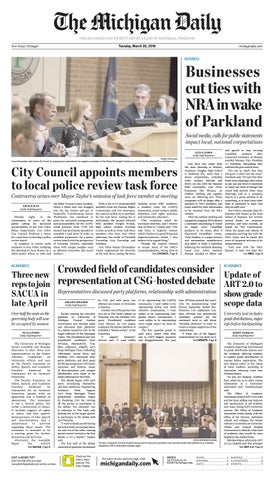
ONE HUNDRED AND TWENTY-SEVEN YEARS OF EDITORIAL FREEDOM
Tuesday, March 20, 2018
Ann Arbor, Michigan
michigandaily.com
BUSINESS
Businesses cut ties with NRA in wake of Parkland Social media, calls for public statements impact local, national corportations JULIA FORD
Daily Staff Reporter DARBY STIPE/Daily
Councilmember Jack Eaton (D-Ward 4), proposed an amendment to reaplce a member of the Police Oversight Taskforce with Shirley Beckley at City Hall Monday.
City Council appoints members to local police review task force
Controversy arises over Mayor Taylor’s omission of task force member at meeting GRACE KAY
Daily Staff Reporter
Monday night, in the culmination of years of the public calling for increased accountability of the Ann Arbor Police Department, Ann Arbor City Council finalized a roster for a task force to develop a police review board. In response to recent racist incidents in Ann Arbor, including the shooting of Aura Rosser by a white police officer in 2014 and
the Blake Transit Center incident, where a Black teen was dragged into the bus station and put in handcuffs, Transforming Justice Washtenaw has continued to press for increased transparency and accountability for the AAPD. Amid pressure from TJW, the council had previously decided to assemble a task force in order to establish parameters for a police review board with the perspective of everyday citizens, especially those with unique insights such as affected minorities and social workers.
With a list of 13 recommended members from the Human Rights Commission and two alternates, the council settled on 11 members for the task force. Among the 11 individuals, the council selected HRC member Dwight Wilson, high school student Keyshon Cotton as well as three task force members who have Ann Arbor addresses, but reside in Pittsfield Township, Scio Township and Ypsilanti. Ann Arbor Mayor Christopher Taylor emphasized the diversity of the task force, saying the force
includes active HRC members, a member from the LGBTQ community, social workers, public defenders, civil rights attorneys and community educators. “The resolution asked for increased diversity, and I believe that we have it,” Taylor said. “The task force is majority women which I believe is a good thing and majority-minority which I also believe to be a good thing.” Though the council seemed to accept many of the HRC’s recommendations, taking nine of See COUNCIL, Page 3
Less than two weeks after the mass shooting at Marjory Stoneman Douglas High School in Parkland, Fla., more than a dozen corporations, including Delta Airlines, MetLife and Hertz cut ties with the National Rifle Association. Ann Arbor businesses like Bivouac, an outdoor clothing and supplies store, are following suit. These companies will no longer offer a discount to NRA members, and many asked for their information to be removed from the NRA website. After the outdoor clothing and equipment company REI released a statement announcing it would no longer carry CamelBak products in its stores after it discovered CamelBak’s owner, Vista Outdoor, is a major firearm and ammunition manufacturer and failed to make a statement following the Parkland shooting. Local Ann Arbor business Bivouac decided to follow suit
and agreed to stop carrying CamelBak products after concerned customers of Bivouac emailed Bivouac Vice President AJ Davidson, demanding they confront the gun control issue. “It’s not so much that they sell guns — that’s not the issue,” Davidson said. “It’s just that after these mass shootings, they refuse to put out any kind of statement or make any kind of change that would help prevent these mass shootings, and as a company, they’re in a prime position to do something, or at least issue some kind of statement to show that they actually care.” Jerry Davis, associate dean for Business and Impact at the Ross School of Business, has written several books on corporate activism, and most recently, an article for The Conversation. Given the speed and volume of companies severing ties with the NRA, Davis said he found this wave of corporate activism to be unprecedented. “And now with the NRA boycott, it took two days (for See NRA, Page 3
Crowded field of candidates consider Three new Update of reps to join representation at CSG-hosted debate ART 2.0 to
ACADEMICS
ACADEMICS
SACUA in late April
Representatives discussed party platforms, relationship with administration
Over half the seats on the governing body will now be occupied by women
Parties running for executive positions on University of Michigan Central Student Government met Monday night and discussed their platforms in a debate hosted by CSG in the Rogel Ballroom of the Michigan Union. The presidential and vice presidential candidates from MVision, MomentUM, True Blue, eMpower, aMplify, Let’s Keep Michigan Time, Defending Affirmative Action Party and Serfdom USA discussed their party platforms and their goals for the upcoming year. CSG’s prior successes and failures, issues of discrimination, and campus affordability were some of the topics addressed at the event. The debate began with each party introducing themselves and their platforms. Engineering freshman Noah Tappen, Let’s Keep Michigan Time’s presidential candidate, began by thanking CSG for inviting all the parties to participate in the debate. His comment was in reference to The Daily only hosting five of the larger parties to participate in the debate held last Thursday. “I want to thank you for having me at this event, as you may know, me and two of the other running parties weren’t invited to the first debate — it’s a shame,” Tappen said. The first half of the debate consisted of questions formulated
JULIA FORD
Daily Staff Reporter
The University of Michigan Senate Assembly met Monday afternoon to elect three new representatives to the Senate Advisory Committee on University Affairs and vote on the Faculty Statement on Safety, Speech, and Academic Freedom Endorsed by Committee for an Inclusive University. The Faculty Statement on Safety, Speech, and Academic Freedom Endorsed by Committee for an Inclusive University passed with no opposition and a handful of abstentions. The statement is not a formal policy, but rather a declaration of values. It includes support of rights to safety and free speech, denouncement of hate speech and discrimination and a commitment to activism regarding these issues. The statement is intended to be a starting point for further discussion and activism. Afterward, the Assembly began the SACUA See SACUA, Page 3
GOT A NEWS TIP? Call 734-418-4115 or e-mail news@michigandaily.com and let us know.
AMARA SHAIKH Daily Staff Reporter
Check out the Daily’s News podcast, The Daily Weekly
by CSG, and each party was allotted one minute to formulate a response. Another one of the parties who was not at The Daily’s debate on Thursday was the Serfdom USA party. Presidential candidate Liam Stewart, an LSA junior, explained the parties platform to establish a “feudal society” at the University. “I support diversity,” Stewart said. “I want nobles
to be representing the LGBTQ community, I want nobles to be representing ethnic and racial minority communities, I want nobles to be representing nongender binary communities. I want nobles to be representing every single aspect we have on campus.” The first question posed to each party asked what they saw as CSG’s biggest successes and disappointments this past
year. MVision praised last year’s CSG for demonstrating what diverse leadership looked like. However, LSA sophomore Izzy Baer, MVision vice presidential candidate, pointed out the continued need to talk about “invisible identities” in order to create a campus supportive of the student body. “I think one of the biggest improvements we can draw on is See DEBATE, Page 3
RYAN MCLOUGHLIN/Daily
Parties running for Central Student Governemtn executive positions met and discussed their platforms in a debate hosted by CSG in theUnion Monday night.
For more stories and coverage, visit
michigandaily.com
INDEX
Vol. CXXVII, No. 94 ©2018 The Michigan Daily
show grade scope data
University tool includes grade distributions, major info before backpacking REMY FARKAS
Daily Staff Reporter
The University of Michigan’s Academic Reporting Tool released its grade distribution feature over the weekend, allowing students to explore grade distributions of courses before registration. The new feature caters to the voices of many students, according to Innovation Advocacy Lead Amy Homkes-Hayes. “As you can imagine, students have asked for us to show course information in a Universitysanctioned tool,” Homkes-Hayes said. The Office of Academic Innovation created ART 2.0 in 2016 and has been adding new features and mechanisms to aid students ever since, listing 9,273 University courses. The Office of Academic Innovation works closely with the Office of the Provost, individual schools and colleges, the Senate Advisory Committee on University Affairs and Central Student Government to identify what kind of academic data would be most helpful to the student body. Homkes-Hayes referred to ART 2.0 as a helpful tool that attempts See ART 2.0, Page 3
NEWS.........................2 OPINION.....................4 ARTS......................6
SUDOKU.....................2 CLASSIFIEDS...............6 SPORTS....................7
News
2 — Tuesday, March 20, 2018
MONDAY: Looking at the Numbers
TUESDAY: By Design
WEDNESDAY: This Week in History
The Michigan Daily — michigandaily.com
THURSDAY: Twitter Talk
FRIDAY: Behind the Story
CASEY TIN/Daily
C A R E E R PA N E L
420 Maynard St. Ann Arbor, MI 48109-1327 www.michigandaily.com
ALEXA ST. JOHN
NATHAN GUPTA
Editor in Chief 734-418-4115 ext. 1251 alexastj@michigandaily.com
Business Manager 734-418-4115 ext. 1241 nathankg@michigandaily.com
NEWS TIPS
news@michigandaily.com
LETTERS TO THE EDITOR tothedaily@michigandaily.com
EDITORIAL PAGE
opinion@michigandaily.com
ARTS SECTION
PHOTOGRAPHY SECTION
arts@michigandaily.com
photo@michigandaily.com
SPORTS SECTION
NEWSROOM
sports@michigandaily.com
734-418-4115 opt. 3
ADVERTISING
CORRECTIONS
dailydisplay@gmail.com
corrections@michigandaily.com
Editorial Staff MATT VAILLIENCOURT/Daily
University alumnus Daniel Sack speaks about his job searching and career experiences during an international studies alumni career panel hosted by various LSA departments and the Sigma Iota Rho International Studies Honor Society at Weiser Hall Monday.
University Council meets with admin to discuss future calendar changes Body of student governments also lobbies to cancel classes on Election Day CARLY DURIS For the Daily
University Council assembled Monday night to discuss the University of Michigan’s academic calendar and Election Day. The meeting started with a presentation from Sarah Daniels, associate dean of students, Lisa Emery, senior associate registrar, and Christine Gerdes, special counsel to the provost. They spoke about the possibility of starting the 2020-2021 academic year before Labor
YOU GOT THIS!
Day. Without this revision, the last day of the fall semester could be as late as Dec. 24, 2020, creating travel difficulties as students scramble to get home before Christmas. The conversation then turned to whether it would be better to have a longer Fall Break or a longer Thanksgiving Break. Daniels asked the group about their uses of Fall Break. Public Policy senior Sammi Lawrence, representative for the Ford School of Public Policy, spoke about how especially as a freshman, Fall Break was incredibly important. “Thinking back to when I
puzzle by sudokusyndication.com
was a freshman, that natural break in the middle, where everything is so hectic: starting new classes, new environment, massive school … To have just a couple days was incredibly beneficial,” Lawrence said. For freshman and upperclassmen alike, Fall Break is vital for students’ mental health. CSG Vice President Nadine Jawad, a Public Policy senior, emphasized this point. “There is an extra push during those two days for students to take care of themselves,” Jawad said. Business senior Grace Nasr, representative for the Ross School of Business, and Rackham student Kirstie Hostetter, representative for the School for Environment and Sustainability, also noted the importance of Fall Break from a career standpoint, as both schools utilize those two extra days to find internships and use them as a career check. Daniels ended the presentation by highlighting the fight to fit everything into the calendar. “It’s all part of one big puzzle,” Daniels said. “We are not in a place where it’s a kind of ‘We’ll give you this if we get this’ situation. It’s not that give and take per se, it’s kind of all these things are on the table … It’s (seeing) how we can fit the pieces together so that it fits the needs of all constituents.” The second half of the meeting focused on Election Day, with Law School student Tom Allen, a representative for Promote the Vote. The Fall Break
debate was revisited, since it had been previously noted that Election Day should potentially be a day off, instead of one of the two Fall Break days. Allen noted the “pathetically low voter turnout” among the age group composed of college
DAYTON HARE Managing Editor
haredayt@michigandaily.com
RIYAH BASHA and SOPHIE SHERRY
Managing News Editors news@michigandaily.com Senior News Editors: Andrew Hiyama, Carly Ryan, Kaela Theut, Matt Harmon, Maya Goldman Assistant News Editors: Jordyn Baker, Remy Farkas, Riley Langefeld, Elizabeth Lawrence, Rachel Leung, Molly Norris, Maeve O’Brien, Shannon Ors, Amara Shaikh, Katherina Sourine
ANU ROY-CHAUDHURY and ASHLEY ZHANG
Editorial Page Editors tothedaily@michigandaily.com Senior Opinion Editors: Elena Hubbell, Emily Huhman, Jeremy Kaplan, Tara Jayaram, Ellery Rosenzweig
MIKE PERSAK and ORION SANG
Managing Sports Editors sportseditors@michigandaily.com Senior Sports Editors: Laney Byler, Mark Calcagno, Robert Hefter, Max Marcovitch, Paige Voeffray, Ethan Wolfe Assistant Sports Editors: Aria Gerson, Ben Katz, Tien Le, Anna Marcus, Ethan Sears, Jacob Shames
DANIELLE YACOBSON and MADELEINE GAUDIN Managing Arts Editors
arts@michigandaily.com
Senior Arts Editors: Becky Portman, Sam Rosenberg, Arya Naidu, Dominic Polsinelli Arts Beat Editors: Danny Hensel, Erika Shevchek, Matt Gallatin, Naresh Iyengar
ROSEANNE CHAO and CASEY TIN
Managing Design Editors
design@michigandaily.com
ALEXIS RANKIN and KATELYN MULCAHY
There is an extra push during those two days for students to take care of themselves
Managing Photo Editors
photo@michigandaily.com
Senior Photo Editors: Amelia Cacchione, Emma Richter, Evan Aaron Assistant Photo Editors: Claire Meingast, Sam Mousigian, Aaron Baker, Ryan McLoughlin, Alec Cohen
BRIAN KUANG
Statement Editor statement@michigandaily.com Deputy Editors: Colin Beresford, Jennifer Meer, Rebecca Tarnopol
FINN STORER and ELISE LAARMAN Managing Copy Editors
copydesk@michigandaily.com
Senior Copy Editors: Emily Stillman and Allie Bopp
BOB LESSER and JORDAN WOLFF
students. The Council came to the consensus this low turnout was largely due to the three-hour wait at the Michigan Union or other local voting centers, which interferes with classes for students and professors alike. Allen said students are often put in a situation where they are “deciding between going to class or waiting in line.” Allen further spoke about other reforms to Michigan election laws, which he noted are some of the most restrictive in the country. “Students, for their first time voting, have to be in person,” Allen said. “This revision would allow anybody to get an absentee ballot for any reason, even if it’s just that you are working all day and don’t have time to get to the polls. It’s all sort of common sense reform … To make it as easy as possible for everyone to vote.
Managing Online Editors lesserrc@michigandaily.com Senior Web Developers: Patricia Huang, Abna Panda, Hassaan Ali Wattoo, Rebecca Tung
IAN HARRIS
Managing Video Editor video@michigandaily.com Senior Video Editors: Abe Lofy, Robby Weinbaum, Jillian Drzinski, Danielle Kim
JASON ROWLAND and ASHLEY TJHUNG Michigan in Color Editors
michiganincolor@michigandaily.com
Senior Michigan in Color Editors: Lorna Brown, Zainab Bhindarwala, Christian Paneda, Nisa Khan, Na’kia Channey Assistant Michigan in Color Editors: Angelo McKoy, Kareem Shunnar, Maya Mokh, Priya Judge, Efe Osagie
ANNA HARITOS and KAYLA WATERMAN Managing Social Media Editors
Business Staff EMILY RICHNER Sales Manager
DEANA ZHU and JEFFREY ZHANG
CLAIRE BUTZ
Business Development Manager
JULIA SELSKY
Marketing Managers
Local Accounts Manager
CAROLINE GOLD
SANJANA PANDIT
Media Consulting Manager
Production Manager
The Michigan Daily (ISSN 0745-967) is published Monday through Friday during the fall and winter terms by students at the University OF Michigan. One copy is available free of charge to all readers. Additional copies may be picked up at the Daily’s office for $2. Subscriptions for September-April are $250 and year long subscriptions are $275. University affiliates are subject to a reduced subscription rate. On-campus subscriptions for fall term are $35. Subscriptions must be prepaid.
News
The Michigan Daily — michigandaily.com
ART 2.0 From Page 1 to bust myths that students cannot do well in certain classes. With this data, students can evaluate the difficulty of courses and evaluate when they should take a course and how to best build a schedule that works for them. “When we talk about ART 2.0, one of the things we talk about is myth-busting,” HomkesHayes said. “Our intent to show (grade distributions) was because students demonstrated they wanted to see it and we can de-mysticize any information about how grades are distributed.” The ART 2.0 team worked directly with Vice Provost James Holloway’s office in order to develop the tool and utilize accurate data. For example, they will only show substantiated data in classes with enough information to do so in regards to instructor ratings and scores so in a class with fewer grade samples, the distribution doesn’t deter students from registering for certain classes with smaller class size caps. “We are being really intentional about what has been shown and we will follow the guidelines of the Provost’s office in order to do so,” Homkes-Hayes said. The Office of Academic Innovation continually engages with students and faculty to identify the future areas where they can help students. Homkes-
DEBATE From Page 1 talking about and creating policies for invisible identities on campus — survivors of sexual assault, students of low (socioeconomic status), members of the LGBT community,” Baer said. “These identities are not as seen within our assembly right now because they aren’t talked about. Something we can improve on is talking about policies and cultures surrounding these groups on campus and with that, that’s how we create platforms and policies that positively affect them.” MomentUM lauded voter registration as one of CSG’s greatest successes from the past year. However, vice presidential candidate Charlie Bingham, an LSA junior, pointed out the tokenization of minorities as one of the largest failures in CSG. “I think the biggest failure of CSG is we still, in this organization, have a culture that makes students of color feel that they are only wanted because of the color of their skin,” Bingham said. “We still have representatives sitting on this assembly right now who have done incredible work who feel they have been used in this election to get votes — that is not acceptable.” The debate went on to focus on what each party viewed as the
COUNCIL From Page 1 the 13 recommended members, TJW continued to press for changes in the council’s resolution. In a press release, TJW called the council to task, demanding the council establish TJW member Lori Saginaw as chair of the task force. Several Ann Arbor citizens called for Saginaw’s instatement as chair, including Amory Vhou, who praised Saginaw’s leadership abilities. “As chair, she will elicit and synthesize everyone’s best contributions,” Vhou said. In a last-minute change prior to the meeting, Taylor attempted to appease TJW by placing Saginaw as a co-chair with University of Michigan Law School professor Richard Friedman. Amid contention over the selection process for the task force, Taylor explained his selection process by saying not only was it a difficult process, but there were many factors the council took into consideration throughout. “There are more people in Ann Arbor with skills and abilities than there are places to serve and that was the case with the task force,” Taylor
Hayes mentioned potential alumni data for showing students pathways they can take following degree completion as an idea for future ART 2.0 updates. Engineering junior Kevin Zheng works with the program, analyzing the data ART 2.0 collects and comparing the grades between schools, subjects and courses. He also works to improve interfaces for instructors to get feedback from students. Zheng pointed out the workload metric could provide skewed results because students in difficult, lower-level courses have a high proportion of students rating it as “high workload” but higherlevel, more self-selective courses are less likely to have this workload rating.” “Providing grade distributions is especially useful because students can use it in conjunction with the workload metric,” Zheng wrote. “In some situations, the workload metric is less useful under the assumption that students in different levels of a subject may perceive workload differently. Grade distributions help to reduce some of this uncertainty.” Zheng uses ART 2.0 during backpacking and registration and said the new grade distribution element helps him evaluate which courses to take. He checks ART’s student evaluations, instruction evaluations, class size outputs and which courses students take before or during this course. “I use ART during backpacking and registration all the time,”
Zheng wrote. “Grade distributions would fit nicely into my workflow using ART to evaluate whether a course is a good fit for me. I imagine myself looking at the grade distributions to help balance my workload so that I don’t overload myself.” Despite excitement from students, faculty members have historically had some concerns about the tool, which was originally only available to faculty members. When the original tool premiered in 2016, SACUA member and Kinesiology Professor Stephen Symanski said he was worried the effectiveness of ART 2.0 would change when it opened to user input. “Among people of goodwill, there are never problems really,” Szymanski said. “But sadly, we are not 100 percent goodwill.” According to Tim McKay, LSA professor and director of the Digital Innovation Greenhouse, some faculty members also think making grade distribution data available may lead students to chose classes based solely on that information. “There is little evidence, on any campus, that this actually happens, but I think it’s a well intended concern,” McKay wrote in an email to The Daily. “Personally, I trust students to consider information like this wisely — at least as wisely as anyone would.
most relevant issues facing the campus, which were also within CSG’s power to control. Let’s Keep Michigan Time called on CSG to use their influence on campus to speak out against issues like gun control through forms of organized protests. “CSG has so much power, CSG can organize protests not just at the University but of Washtenaw County and the area to keep us safe,” Tappen said. “Gun control isn’t a huge issue just for school shootings but suicides too. Gun control is by far probably one of the biggest issue affecting us and CSG has the power as an organization to be protesting, going against the norm and saying what we really want.” The Defend Affirmative Action Party followed on the theme of national issues and emphasized their stance on raising awareness about issues of discrimination, immigration and sexism with CSG influence. “The school needs to send out a warning if ICE (Immigration and Customs Enforcement) is on campus, they need to protect our profs, they need to protect our students that are remanding residence,” LSA senior Lauren Kay, the Defend Affirmative Action Party candidate, said. “It’s unacceptable that they do not already do things like this.” The next question asked about
the kind of relationship each party sought to have with the University administration and Board of Regents. Law School student Matthew Williams, vice presidential candidate for aMplify, discussed their party’s hope to leverage their ties with the administration in order to establish a partnership, which would then allow them to pass resolutions. “If we’re going to move forward, we’re going to move forward in partnership with the administration,” Williams said. “They have power to block our initiatives, and we have to be able to partner with them.” However, Kay had a less diplomatic approach to dealing with the administration. The party emphasized their desire to ensure the University complies with the wishes of the student body, and not vice versa. “How are we going to work with the administration?” Kay said. “The administration has to work for us first. We do not deny our own power, the anti-war movement, the civil rights movement, the various campus protests of the 1960s and 1970s the students took action and power into their own hands and didn’t ask for the administration to give them permission.”
said. “There will be other opportunities to serve. Even if you weren’t selected your role is not done.” Taylor’s statement, which was in reference to the contested omission of Shirley Beckley, was met with controversy from residents as well as council members. Councilmember Jack Eaton, D-Ward 4, attempted to amend the resolution to include Beckley by arguing for Beckley’s vast experience as an activist in Ann Arbor. “One of the things that have driven the process from the very beginning is our friend Shirley Beckley,” Eaton said. “Ms. Beckley has a historical grasp on why this community needs to have a civilian review process. She needs to be a part of the task force.” Despite cheers from the crowd at Eaton’s declaration as well as support from Councilmembers Sumi Kailasapathy, D-Ward 1, and Anne Bannister, D-Ward 1, Eaton’s amendment did not pass. Taylor explained his reasoning in excluding Beckley, referencing an incident from more than two years ago when Beckley called the council out regarding a lack of consequences for Officer David Ried after he shot and killed Rosser. “If you won’t at least fire officer Ried, then … Let’s string him up,” Beckley said in a quote
to MLive during a previous meeting. Taylor said Beckley disqualified herself from the task force through her statement of violence towards Ried. “This drew applause from the audience,” Taylor said regarding Beckley’s previous statement. “A call for violence against an officer or a call for violence against city staff is unacceptable in my view and a disqualification for participation.” Even after the council passed the finalized roster for the task force — one that excluded Beckley — TJW members continued to call for Beckley’s reinstatement in the task force. Saginaw argued Beckley was not only a valuable member of the task force, but her words and anger were understandable. “We know that Officer Ried is not, nor will ever be in danger of being lynched by Shirley Beckley,” Saginaw said. Beckley even came to the podium to defend herself and her statement from more than two years ago during the public comment session, refusing to apologize for her words towards Ried. “Back then it was very hurtful to see a Black woman killed and not helped, especially when she was a mental health patient and you all know that,” Beckley said. “My ancestors have been
Read more at MichiganDaily.com
Read more at MichiganDaily.com
NRA From Page 1 corporations to sever relationships with the NRA),” Davis said. “Amazing. Nothing happens in two days, but two dozen companies basically cut ties with the NRA on the threat of a boycott, not even an actual boycott. So that just seemed pretty remarkable.” While Davis said corporations typically shy away from political statements, it becomes increasingly difficult to avoid taking a stand in 2018. With social media, consumers have a louder voice, making corporate practices and partnerships much more visible and subject to scrutiny. “The speed of concerns or grievances to go viral or to become really well-known, that’s the biggest one,” Davis said. “The fact that Applebee’s fires a hostess because she posted something funny about a customer on Instagram, and this becomes some (issue of controversy) with thousands of people flooding Applebee’s with negative comments. That couldn’t happen before social media.” Though social media has had a monumental effect in corporations renouncing the NRA recently, several mass shootings have occurred in the age of Twitter and Facebook without the same response from businesses. This time is different, as Stoneman Douglas students have gone viral for their videos, speeches and social media posts for the #NeverAgain movement, challenging powerful adults in Washington, D.C. and the NRA. Davis noted the role of the Parkland survivors has likely
SACUA From Page 1 representative elections. Six assembly members were nominated to fill the three seats being vacated at the end of April by SACUA members Dave Wright and Stefan Szymanski, and SACUA Chair Robert Ortega. All nominated assembly members presented a short speech to the Assembly immediately preceding the vote. Currently, only two women sit on SACUA, but beginning April 30, five of the nine members will be women. At the close of the meeting, assembly members were given the opportunity to vote, and after the ballots were counted, Colleen Conway, Sarah Lippert and Deirdre Spencer were awarded the three seats. Conway, professor of music education, noted in her speech that she works in the School of Education as well as in the School of Music, Theatre and Dance, which broadens her understanding and connections across the school.
strung up, lynched, run over, babies cut out of their bellies, families separated. We’re still looking for families. I’m not going to apologize for my anger. Yes, I’m angry. Yes, I’ve been here 75 years. No, I haven’t seen any progress. We have made progress to have a task force and I’m happy about that. It doesn’t really matter if I’m on there or not. The fact that you did it is a plus, and I’m very happy about that.” Despite tension regarding the selection of task force members, citizens and council members agreed the assembly of task force members was a long-awaited step in the right direction. Councilmember Graydon Krapohl, D-Ward 4, said the AAPD is ready for a change. “I’ve spoken to many within the force who are looking forward to this process,” Krapohl said. Councilmember Julie Grand, D-Ward 3, went on to say the next police chief would be chosen in line with this vision of racial justice in the AAPD. “We are putting off our search for our police chief because we respect this process,” Grand said. “It will be such a key part of the role that we will not even post the position until we know what this commission will look like.”
Tuesday, March 20, 2018 — 3
changed the conversation. “The narrative seems to be that this is an unusually well-spoken group of kids that were clearly victims of this life-changing event, and they were speaking from an untarnished place,” Davis said. “It wasn’t that they came in with an agenda. They did not choose to be in this situation, and now they’re trying to find a way out of it. And that just has a moral clarity that’s hard to find.” In the wake of the Parkland shooting, Dick’s Sporting Goodsannounced that it would no longer sell firearms or ammunition to anyone under 21 and that it would also end its sales of assaultstyle rifles. Though LSA junior Ryan Roose said he was encouraged to hear about Dick’s Sporting Goods’s statement, this same act can turn other customers away. “My brothers and I talked about how Dick’s is doing that, we thought it was good, and we just supported that, and we want to shop more at their stores now,” Roose said. “We had friends that they didn’t want to shop there anymore because they didn’t think that Dick’s should be making political stances.” While Davidson said Bivouac vocally supports environmental nonprofits, such as the Leslie Science and Nature Center and the Conservation Resource Alliance, they do not make overtly political statements or support political candidates as a business. Davidson echoed Roose’s concerns about deterring individuals with differing political opinions from purchasing products from Bivouac and said there’s a balance businesses have to strike to be competitive but also speak out on issues.
“It’s always a fine line of, once again, we feel like we know there are two beliefs on some things, and as a business you don’t want to do too much to discourage a group of people from shopping in the store,” Davidson said. Part of toeing the fine line for Bivouac is giving customers the option to support different social causes. At the checkout line, customers can buy a Pincause pin for causes such as the National Student Walkout, the Women’s March and animal rescue. Though some consumers want companies to tread lightly on politics, Roose said he wants corporations to be openly political because he wants to align his shopping choices with his ideology. “I definitely prefer when companies come out and make political statements,” Roose said. “I think users, for one, should know what their company stands for, and I think companies should be able to stand for what they want.” While some consumers, like Roose, enjoy forthright political stances from companies, Davidson said Bivouac tries to support its values without being too “in your face.” However, he also said U.S. gun violence is not an issue in which to remain silent. “I think there are certain issues that are so important and so big and so crucial to the future of America that at some point you got to say something, and you’ve got to take a stand somewhere,” Davidson said. “And I think this is one of those issues where it’s getting out of control. We need to start making change, so we’re going to do what we can do, as small as it might be, to show where we stand and where our values are.”
She also has student teachers working in schools across the area, which she attributed to her knowledge of the region and offering her additional perspectives. “I also believe that my work specifically with education crosses over the boundaries,” Conway said. “Most of my colleagues in the School of Music, Theatre and Dance are in the creative arts areas only.” Lippert, associate professor of art history, and the only nominee from the U-M Flint campus, spoke to the lack of representation from her campus. “As a matter of fair representation, it is time for Flint to have a seat at the table,” Lippert said. Lippert is the chair of the Tri-Campus Task Force, a board of representatives from all three University of Michigan campuses aimed at improving faculty governance. “Recent newsworthy events means that our place within the institution needs to be heard, and we hope that (SACUA) contact will help us overcome our challenges that
are unique to the Flint campus, as students and as community partners,” Lippert said. Deirdre Spencer, librarian for History of Art, emphasized in her speech she always lobbies for resources for the Flint and Dearborn campuses, and highlighted racial tension and bigotry on campus. All three campuses have suffered spates of racist vandalism and bias incidents in year following the 2016 presidential election. “Historically, the University of Michigan is a champion for cause of humanity and social justice,” Spencer said. “This has led to the creation of new areas of scholarship, and new programs and services, which have benefitted many. As a university, we have come so far and done so much. But progress is cyclical. Each generation fights new versions of the same battle. For excellence to continue during this period of escalating uncertainty, representative leadership is needed.” Conway, Lippert and Spencer will serve three-year terms on SACUA.
Opinion
4 — Tuesday, March 20, 2018
The Michigan Daily — michigandaily.com
IAN LEACH | COLUMN
Pending doom of the newspaper industry?
Edited and managed by students at the University of Michigan since 1890. 420 Maynard St. Ann Arbor, MI 48109 tothedaily@michigandaily.com
ALEXA ST. JOHN Editor in Chief
DAYTON HARE
ANU ROY-CHAUDHURY AND ASHLEY ZHANG
Managing Editor
Editorial Page Editors
EDITORIAL BOARD MEMBERS Emma Chang Joel Danilewitz Samantha Goldstein Elena Hubbell Emily Huhman Tara Jayaram
Jeremy Kaplan Sarah Khan Lucas Maiman Magdalena Mihaylova Ellery Rosenzweig
Jason Rowland Anu Roy-Chaudhury Alex Satola Ali Safawi Ashley Zhang
Unsigned editorials reflect the official position of the Daily’s Editorial Board. All other signed articles and illustrations represent solely the views of their authors.
LUCAS DEAN | COLUMN
G
Facing our fears
rowing up, my family sheep were. I will never forget had a lot of different the look of pride he had, animals, but perhaps a nd when I a sked why he one of the most sat t here instead memorable to me of bring ing t he was the big ram sheep home, he we called Evander. simply replied: “I Evander was a wa nted to savor mean old ram and t his moment.” wouldn’t hesitate Upon being to let you know it. found, Evander My brothers and I had apparently were terrified of charged my Evander, as we had brother (didn’t see LUCAS all been run down that one coming), DEAN on more than one and having few occasion. When we were other choices, my brother was feeling especially brave, forced to fight back. After we would play a game of what was recounted as an chicken with him, but these epic battle, my brother had games almost always started managed to down the big g uy with a dare (who can back and then lay on top of him down from a double dog to keep him down. Or maybe dare?) and ended with one of it was to teach him a lesson. us in tears and an unhealthy The story depended on if my amount of bruising. While mom was listening or not and we liked to think of it as a definitely had nothing to do game, it didn’t do much to with the fact that she might change the fact that we were have loved those sheep more still scared to death of him. than she loved us. After the One day, all the sheep had managed to get loose, probably by some negligence involving the chain keeping the gate in place ( hey, don’t look at me, I wasn’t the last one to lock them up). They had meandered down into one of the neighbor’s fields and after several hours we had rounded up all of them but Evander, so we split up and had a search party for him. After a couple hours, I stumbled into a field a couple miles from home and sitting at the edge of the field was my brother, lying on top of a sheep. As I approached, I could see he was covered in sweat and breathing pretty heavily — both he and the
incident, Evander’s pride was so hurt he never bothered my brother again. Shortly after, I too downed Evander in order to partake in the benefit of not getting run down anymore. This was my first experience that I can remember stepping out of my comfort zone and ultimately becoming a better person for it. Flash forward to when I was accepted to attend the University of Michigan, and I found myself feeling a very familiar fear. I was terrified of going so far from the place I called home and leaving behind everyone and everything I knew. When it came down to making the final
college decision, I liked to tell people it was a money matter. With the scholarship help from the University, it simply made sense. Deep down, I knew it had a lot more to do with facing my fears and forcing myself to dive headfirst into something about which I knew very little. This allowed me to take a huge step outside of my comfort zone. I remember thinking about the story of Evander whenever I began to doubt myself, thinking about the pride and feeling of accomplishment I saw in my brother and later experienced myself. As a firstgeneration student, I have had to step out of my comfort zone time and time again. Many times I have found myself in a very unfamiliar situation and each time I take that extra step, I become a slightly better person for it. As evolving students, we must always try to push ourselves. We need to face our fears, try new things and step outside that comfy circle we often find ourselves becoming complacent in — and not just when it’s convenient for us, but whenever we have the opportunity. Without challenge, there will be no growth, and without growth, how can we possibly expect to create and contribute to the change and progress we wish to see? Because I faced my fears and stepped outside my comfort zone, I was able to achieve a new sense of pride I wouldn’t change for the world. A Wolverine pride. Lucas Dean can be reached at lbdean@umich.edu.
SARAH NEFF | CONTACT SARAH AT SANE@UMICH.EDU
JOIN OUR EDITORIAL BOARD Our Editorial Board meets Mondays and Wednesdays 7:15-8:45 PM at our newsroom at 420 Maynard Street. All are welcome to come discuss national, state and campus affairs.
E
very time I log on to my Facebook feed, I usually click on roughly four or five articles from publications like Vox or Politico. They’ve made it easy for me and practically every news consumer to read the news. With the development of the Instant Article on Facebook, I can now click on specific articles and they will open without a load time. While traditional outlets have tried to adapt by using many of these same methods, it’s clear that the tide is chang ing for these news sources like our local newspaper and national media outlets like The New York Times. One doesn’t need to turn to the “newspaper death watch” to know that newspapers are in trouble from increased competition and a chang ing readership. Perhaps you’re one of the younger millennials like myself, who, until recently, never had the opportunity to pay for news. Like every generation before us, we’ve grown up reading or watching whatever our parents did — whether that was the local news, CNN or perhaps nothing at all. Unlike our predecessors, however, when we have earned the opportunity to actually pay for the news, we have been inundated with free media options. One could easily be informed without ever having to pay for a news story. The internet dramatically shifted how we consume our news on top of the websites we visited to do so. With the change from print, radio and TV to the internet came a dramatic shift in ad revenue services. In the newspaper industry, it’s fairly obvious: The company would make money by having you pay a nominal subscription fee and make more money by selling
advertisements and space in the classified ads. The goal, at least theoretically, was to write a product so well that consumers would pay for it and view advertisements inside it. “Page One: Inside the New York Times” is a documentary about the newspaper, and it shows the rollout of the paywall online. Before 2010, individuals could access the news freely, without having to pay for an article at all. In order to make up for the decreasing revenue, The Times decided that making readers pay for their articles online was paramount to their survival, but many consumers simply decided to change their news source.
One could easily be informed without ever having to pay for a news story. This phenomenon of changing news sources came from the expectation of not having to pay for anything on the internet. Because of the expectation that consumption would be free, users pushed back against the idea that they would have to pay for a news source that could easily be found somewhere else. And this trend is growing. Individuals are increasingly turning to social media to get their news. A survey from Pew Research Center showed that the gap between people who consume news online and those who read print is closing dramatically. Another statistic from that same survey
suggests this trend isn’t going anywhere either: A majority of individuals ages 18 to 29 get their news online as of 2017; in 2016 it was 50 percent. The concern regarding the changing news landscape is how critical newspapers have been over the past 100 years. A segment on “Last Week Tonight with John Oliver” covered the importance of newspaper journalism. In this piece, he includes a hearing against Google’s ad revenue service in 2010, where you hear from a public official: It’s a great time to be a corrupt local politician. And the host John Oliver is right to say that a large share of coverage for the news is derived from the newspaper industry. But all over the country, newspapers are closing down or restructuring. Over the past 10 years, newspaper employment has dropped by 37 percent. This means there are fewer journalists to cover the perhaps mundane — but important — local proceedings that oversee the day-to-day workings of political life. And without that watchdog role of those proceedings, it can be reasonably assumed that corrupt political maneuvers could be happening without us ever knowing about it. There is hope for newspapers, though. Despite these closings, online subscriptions have gone up for The Times. No one knows exactly where the news is heading if the newspaper industry collapses, but they’ve adapted before and will hopefully adapt again. I can only hope that the newspaper industry finds a way to coexist with the digital world.
Ian Leach can be reached at ileach@umich.edu.
RISHABH KEWALRAMANI | COLUMN
I
An open letter to the French Department
’m writing today because I am a good student, but I am scared. I’m writing today because in all my time at the University of Michigan, I have believed that my classes follow the tenets of an effective meritocracy where one can be successful if he or she puts in the work. However, that is not the case for one program here. Every day when the clock turns to 4 p.m., I transform from a student who thrives to a student who struggles to survive. I don’t think it would come as any surprise to you that French 231 is my 4 p.m. class. Last week, my classmates and I got the opportunity to do a midterm course evaluation, and we relished the opportunity because so many of us honestly dread walking into that classroom on a daily basis. However, when our lecturer recapped the review, it quickly became clear that nothing would change when it came to the terrifying structure of the French language program at this University. However, it is important to note that the lecturers have very little autonomy when it comes to the curriculum. Thus, they do not bear the brunt of the responsibility for these shortcomings. Nevertheless, here are just a few of the grievances my classmates and I described: 1. Workload: We were told at the beginning of the semester to expect to spend two hours outside of class for every hour in class, which brings us to an expected eight hours a week of just French outside of the classroom. On most days, my classes go from 8:30 or 10 a.m. to 5 p.m. With the amount of French work allotted, that would mean my day does not effectively start until 7 p.m. At a university that aims to create a wellrounded student and person after college, this leaves little precious time to do those things that would enrich my education. Not to mention that if every four-credit class had the same amount
of coursework, that would be 32 hours of outside work, or almost a full-time job. 2. Flipped Classroom: A f lipped classroom can be described as an inverse of traditional learning environments, where students learn through hands-on activities at home instead of through lecture. I understand that there are teaching theories that say that a f lipped classroom is better for learning. However, they are without a doubt inherently unequal when grades are involved. Just like in economic terms where the
It takes a special amount of arrogance on the part of a whole program to believe nobody in your class has earned an A. rich can get richer because they can invest their wealth, students who are “better” at French going into the course get more out of a f lipped classroom, because a f lipped classroom puts the onus on the students to learn the language themselves. I have no doubt in my mind that if you were to give a test on the first day of class and one on the last day of class, the distribution of scores would remain the same, meaning the highest achiever on the first day would most likely be the highest achiever on the last day. When you take grades into account, you could tell who was going to get an A based on the first day of class. 3. Harsh Grading: When compared to other University courses and other language courses at the University, the French grading system comes across as truly draconian. In French 232 during the Winter Semester of 2015, 60 percent
of students got a B or higher. That same number was 87 percent, 74 percent and 86 percent for the same level class in Italian, Spanish and Latin, respectively, and the comparison looks worse when looking at the number of As and A-s. From looking at this data, you could reach one of two conclusions: either French students are objectively worse students than their peers or the French program as a whole is too harsh. In fact, in that same semester, only 5 percent of students received an A, or one in 20. That means that fewer than one person per section got an A. It takes a special amount of arrogance on the part of a whole program to believe nobody in your class has earned an A. By requiring language courses, for students who wish to continue their study of French they started in high school, the University has essentially required me to get something less than an A. I am a high-achieving student with big dreams. Just the other day, I sat in my academic adviser’s room discussing my law school plans where every 100th decimal place of my grade point average matters. I have found this University to be more than fair to me in almost every respect, except for the French program in the Department of Romance Languages and Literatures. That program stresses me out, causes me to panic and makes me honestly furious. I am generally a content person, but when someone needlessly messes with my future, I am inclined to speak out. So, this is me saying something: Stop being the reason for my stress, and make it fun to learn a language again. Finally, to students choosing which language they want to learn here, I strongly advise you to stay away from French until real changes are made. Though the language is beautiful, the program couldn’t be more ugly. Rishabh Kewalramani can be reached at rkew@umich.edu.
Arts
5 — Tuesday, March 20, 2018
EVENT REVIEW
The Michigan Daily — michigandaily.com
FILM REVIEW
SETH ALLEN / MAIZE COLLECTIVE
WARNER BROS.
Maize Collective’s panel ‘Tomb Raider’ is a shining advises hopeful musicians star of a truly awful genre DANNY MADION Daily Arts Writer
On Wed., March 14, Maize Collective — in partnership with Universal Music Group and Innovate Blue — hosted the first of a series of three music business panels titled “Industry Insight: Songwriters, Producers and Studio Musicians.” Held at the University of Michigan Museum of Art’s auditorium, the panel provided aspiring Ann Arbor artists with tips for success in the music business and featured an array of musicians, including Yungblud, a new signee to Geffen Records and rising hip-hop star, Evan Haywood, a musician and multimedia artist based in Ann Arbor, Kasan Belgrave, a Jazz Studies sophomore concentrating in clarinet and alto sax and DeNero Montez, a Detroit native singer and songwriter who has written for Justin Bieber. The panel, moderated by Veniece Session of Ann Arbor’s Neutral Zone, addressed songwriting techniques, royalties, musical influences and the overall daily life of a career musician. Yungblud, who performed a few hours later at the Majestic Theatre in Detroit, was given the most immediate attention before leaving early for his show. His charismatic persona and unfiltered stream of consciousness was enticing, providing an example to the many aspiring musicians in the crowd of a young and fresh
musician who successfully “made it” in the music business while maintaining his rambunctious attitude. When asked by Session — who herself has experience working with independent artists — if signing to a major label has hindered his creative process, Yungblud replied, “To be honest, I figured
The panel provided aspiring Ann Arbor artists with tips for success in the music business
out who I was before I got signed. And, if you know that and you deep down know who you are, then how are they going to change that? They signed you for a reason, because they like you and like your sound.” Next, Session asked Montez to elaborate on the songwriting process. He offered an easyto-comprehend explanation of songwriting and the business of copyright, stressing the importance of submitting your
work to BMI (Broadcast Music, Inc.) or ASCAP (American Society of Composers, Authors and Publishers) as well as registering your lyrics with the Library of Congress. Haywood also interjected, advising the crowd to always run paperwork by a lawyer before signing, avoiding any chance that you as a songwriter would lose the rights to your masters. Later, after Yungblud left for his show and the panel grew more intimate, the floor opened for audience questions and the panel was asked to speak on how they remain original in their music while having artists they admire. Belgrave raised a point that was met with nods of agreement from both the panelists and the audience, saying, “Automatically, we are subject to music that comes before us so we are automatically paying homage to music before us. Music is always moving, always evolving so I think you have to hear things from the past to create new sounds.” The panel closed with Haywood offering young musicians a word of advice: “Keep making music, keep putting it out in any way,” he said. “No one will hear it at first and eventually you’ll start getting traction and building a fan base. Those fans will stick with you if you’re a nice person. Be kind and open and caring. Support your friends and make a community. Then, when you get that success, you will have friends holding you up.”
FILM REVIEW
NETFLIX
‘Benji’ will make you cry SAMANTHA NELSON Daily Arts Writer
Is it really a dog-movie if it fails to make us cry? Throughout the years, cinematic portrayals of the unbreakable bonds between humans and dogs have, without fail, included a moment or two — if not an entire plotline — dedicated to tugging at audiences’ heartstrings. “Benji” is no exception. The
most recent of numerous adaptations of the original 1974 picture, this 2018 remake is proof of the perception that the storyline of a loyal dog and an endangered human companion is timeless. Though the instances of innocent cuteness in “Benji” will illicit more than a few “aww” reactions from viewers, the unexceptional characters and predictable plotline make everything else in the film come off rather dull. Consistent with its
predecessors, the storyline that “Benji” adheres to is fairly simple. Two spirited and independent middleschool-aged siblings, Carter (Gabriel Bateman, “Lights Out”) and Frankie (Darby Camp, “Big Little Lies”), find a stray dog on the New Orleans city streets, forming a special bond with their newfound friend and naming him Benji. Matters escalate quickly, however, when a robbery occurs while the kids are
JEREMIAH VANDERHELM Daily Arts Writer
“Tomb Raider” may very well be the greatest video game movie ever made. Of course, I say this as someone who believes that there has never, in the history of the medium, been a good video game movie and as someone who is about to give the film at hand a predominantly negative review. But the basic competency on display here places “Tomb Raider” head and shoulders above dreck like “Assassin’s Creed,” “Warcraft” or “Resident Evil: The Final Chapter.” Only rarely could such baseline mediocrity be something to be celebrated, but that’s the state of the video game movie genre. “Tomb Raider” takes most of its inspiration from the 2013 reboot of the popular series, following adventurer Lara Croft (Alicia Vikander, “Tulip Fever”) as she goes on a search for her father years after his disappearance. After being shipwrecked on a mysterious island, she becomes a prisoner of Mathias Vogel (Walton Goggins, “Vice Principals”) and must fight to finish what her father started: Sealing a tomb that, if opened, could bring about the end of the world. Most of the watchability of “Tomb Raider” comes down to Vikander’s performance in the titular role. From the first scene, she brings to life the
visiting a local pawn shop, a place they frequent in hopes of purchasing back their deceased father’s old watch. Carter and Frankie find themselves victim to a robber’s stupidity, which transforms a plain, economically-driven act of theft into a full-blown kidnapping. One of the only witnesses to the incident, despite his being a dog and an inferior to the — ironically — consistently clueless adults around him, Benji must lead the mission to save Carter and Frankie and prove his loyalty and devotion. The shining moments that emerge from “Benji” are not those that add to the forward momentum of the plot, which becomes quite foreseeable within the first 30 minutes of the film. Given the repeated remakes that this storyline has undergone, without significant adjustment to plot, character or tone, it can be surmised that director Brandon Camp’s intentions are not to shock audiences or push boundaries. Instead, “Benji” finds another way to grab viewers’ attention by evoking pity on Benji’s behalf. The interspersing of sequences that show an unwanted Benji trotting along with sad eyes and a hunched back are especially effective in puncturing even the coldest of hearts, warming any viewer
independence and strength of the character with relative ease, and her dedication to performing many of her own stunts pays off during the action scenes. While the script gives her increasingly little to do as the film wears on — by the third act, she’s been reduced mainly to grunting
“Tomb Raider” Warner Bros. Pictures Ann Arbor 20 + IMAX, Quality 16 and screaming — she still anchors much of the movie around her, even as it commits the cardinal sin of wasting Walton Goggins as a one-note villain. It’s in the storytelling department where you’ll find most of “Tomb Raider”’s shortcomings. At different points, it plays like a combination of “Indiana Jones and the Last Crusade” and “The Lost World: Jurassic Park,” and while that may sound fun at first, Roar Uthaug (“The Wave”) is no Steven Spielberg; his film lacks the sense of wonder and discovery that both of those films brought to bear at their best. There’s some fun to the treasure hunt, but many scenes feel like a non-interactive video game, denying the audience the opportunity to feel like they’re solving the puzzles along with
up to the canine protagonist and giving viewers a reason to connect with the events unfolding on the screen before them. In the opening sequence, audience members observe in distress as Benji’s mother and littermates are discovered by a dog-catcher, locked up and taken to the pound, leaving puppy-Benji helpless and alone.
“Benji” Netflix
Stunned with pity for Benji, it becomes virtually impossible for viewers not to emotionally gravitate towards and invest in the poor, lonesome puppy before their eyes. Thus, even once the main, uninventive plotline of the film kicks in, audiences find themselves rooting for the rescue of the detained children, not out of complete, genuine concern for Carter and Frankie’s fate, but rather out of a desire for Benji to finally find the home and the love that he has been searching for. Empathy felt for Benji’s pure intentions of finding a family aside, viewers cannot help but impatiently await the arrival of the end of the film, an end that from the start, was
Lara. That’s most of the fun of any movie like this, and it’s completely missing here. For all Vikander’s talents as a physical performer, the action falls prey to Uthaug’s mishandled direction, as well. They aren’t potential health hazards like the action of a “Resident Evil” movie, but the fights in “Tomb Raider” are still wildly overcut and incomprehensible. It’s impossible to have any sort of appreciation for what Vikander is pulling off when you can’t tell what on Earth she’s doing in the first place. Even when the editing slows down, scenes like an extended bike chase through London or a foot chase through the docks add nothing to the story and instead simply pad the runtime. Again, this sort of thing might be fun with a controller in your hands — your average video game campaign runs about 10 to 20 hours and thrives on smaller scale action like this — but in a movie, it’s just a distraction from the plot. Uthaug’s fumbled direction is ultimately what dooms “Tomb Raider” to the purgatory between good and bad. There’s nothing to outright hate here, but there’s also little that’s memorable. Given that most video game movies are memorable only for their aweinspiring lack of quality and apathetic performances and writing, “Tomb Raider,” in all its normality, may represent a small step forward.
far too obviously set-up to be a happy one. Though audiences are blatantly aware of where the children are and how to find them, “Benji” proceeds to include segments in which the authorities take stabs at detective work, attempting to solve a mystery that audiences already know the answer to for what feels like a painfully boring and frustrating eternity. What is fundamentally problematic with “Benji” is that, though it is able to evoke temporary emotional responses from audience members, that is all it is able to do. The mixture of pity and hope that moviegoers experience simply is not enough to sustain attentionspans for the duration of the film. Unlike contemporary dog-movie genre f licks such as, “Marley and Me,” “Hatchi” and even “A Dog’s Purpose,” “Benji” is not a film that can be thoroughly enjoyed by everyone. Though younger audience members will almost certainly find entertainment through this family-friendly adventure, no amount of commiseration or desire for redemption for “Benji” can induce any viewer beyond the age of 10 to ignore the tedious nature and severe lack of imagination that “Benji” possesses.
Arts
6 — Tuesday, March 20, 2018
The Michigan Daily — michigandaily.com
BOOK REVIEW TV REVIEW
‘I’ll Be Your Blue Sky’ is a magical, resonant read JULIA MOSS
Daily Arts Writer
NETFLIX
Netflix has another teen hit with ‘On My Block’ Olivia (Ronni Hawk, “Stuck MAITREYI ANANTHARAMAN in the Middle”), who moves in Daily Arts Writer with Ruby’s family when her parents are deported. There are story beats that feel If the weeks in the wake familiar — drama surrounding of Parkland have taught the school dance, complicated us anything, it’s that high love triangles, the pressure of schoolers are a lot sharper, family expectations. But there a lot cooler and a lot tougher are also plenty of elements we than they’re given credit for. That’s probably not news to “On My Block” Netflix, which has quickly put together an impressive arsenal Netflix of original programming featuring young characters — from smash hits “Stranger don’t often see on television Things” and “13 Reasons Why” that keep the show original to sleeper favorites “Everything and fresh. Cesar struggles to Sucks!” and “American Vandal.” break away from the gang life “On My Block,” a new half- men in his family are forced hour comedy-drama from into; Olivia is crushed that her “Awkward” creator Lauren parents won’t be around for her Iungerich, is a welcome quinceañera. addition to the lineup. It’s a It all makes for a show that’s sharp, moving series set in tonally interesting. Storylines South Central Los Angeles that are full of laughs, like and centered around children Jamal’s madcap quest for buried of color, who — though pop treasure stolen from a roller culture might lead you to rink, find themselves alongside believe otherwise — actually much heavier arcs, like Monse’s search for her biological mother. come of age, too. The show follows four Fortunately, for the most part, lifelong best friends as they the show’s young stars have the navigate their freshman year of acting chops to pull it off. It’s largely thanks to them high school. There’s headstrong tomboy Monse (newcomer that “On My Block” manages Sierra Capri), high-strung that emotional whiplash quite Jamal (Brett Gray, “Rise”), well. The constant teetering suave Ruby (Jason Genao, “The between comedy and drama Get Down”) and sensitive Cesar gives rise to some expositionwriting and stiff (Diego Tinoco, “Teen Wolf”). heavy The quartet is joined later by performances at first, but the
show’s ambitions pay off by the season’s final episodes, when everything really falls into place. And the initially disparate narrative strands converge and crescendo in a genuinely shocking finale that begs for a second season. The show’s real strength lies in its characters, who feel immediately real and lived-in, as if they’re old friends we’ve known our whole lives. It makes every triumph they experience a little sweeter and every disappointment a bit more heartbreaking. Monse, Jamal, Ruby, Cesar and Olivia aren’t the types of characters whose stories usually get told on television, but they’re each so compelling that it’s impossible not to fall in love with them. And though the show doesn’t make any mention of politics, there’s something about watching teenagers of color take up space and speak their mind that feels almost revolutionary. It’s no surprise that some of the most affecting, enjoyable works on screen in the past year — from “Lady Bird” to “Dear White People” to “Love, Simon” — have been modern portraits of young adulthood in all of its joy and confusion and awakening. “On My Block” brings more needed diversity to the coming-of-age canon, and does so with a charm and charisma that’s simply irresistible.
Classifieds
Call: #734-418-4115 Email: dailydisplay@gmail.com
RELEASE DATE– Tuesday, March 20, 2018
Los Angeles Times Daily Crossword Puzzle
FOR RENT
Edited by Rich Norris and Joyce Nichols Lewis
ACROSS 1 Affectionate sideline greeting 6 “I understand now!” 9 Mud bath coverings 14 Gal pal, in Genoa 15 Searchlight used by Gotham police 17 One changing pitches 18 “Are you declining?” 19 “Tell me!” 21 Response to a tasty treat 22 Understand 23 “Va-va-__!” 24 Long Island town 26 Dog-tired 28 605, to Seneca 30 Stop, to swabs 33 Circle segment 34 “Humble” home 36 “Why would __?” 37 Dealer’s query 39 Class with smocks 40 Punctuation in many lists 42 Sign of disuse 43 Like yoga teachers 45 Many a craft beer, for short 46 Online box filler 48 Cough up the cash 49 Enterprise rival 50 KitchenAid appliances 52 __ colada: rum drink 54 Old vitamin bottle no. 57 Shiba __ : Japanese dog 58 Scored well under par, in golf lingo 61 Bart Simpson’s “Holy cow!” 64 “Love Me Like You Do” singer Goulding 65 Apple Store support station 66 Preps, as potatoes 67 Icon tappers 68 Bashful 69 Risky rendezvous
DOWN 1 Fashionable Kentucky Derby array 2 “My turn to bat” 3 Handheld cleaner 4 Spotted wildcat 5 Thomas of “That Girl” 6 Somewhat 7 Polishes off 8 Legal dept. staffers 9 2006 cop drama set in Florida 10 Star’s rep. 11 Hose mishap 12 Welles’ “Citizen” 13 Schedule opening 16 Six-time Super Bowl coach Don 20 Website with film profiles 24 Hosp. fluidadministration methods hidden in 3-, 9-, 31- and 34-Down 25 __ Alto, Calif. 26 Tampa __ Buccaneers 27 Slowly wear away 29 West Virginia natural resource
31 Reagan Library site 32 Allegro, largo, lento, etc. 34 Like much Norton software 35 Bluesy James 38 Japanese golf great Aoki 41 Remote batteries 44 Promote aggressively 47 Dunham and Olin
49 Buck horn 51 Anesthetizes 53 Bumbling 54 Sauce brand with an accent on its last letter 55 Salon colorings 56 OXY 10 target 58 Suspicious (of) 59 Art store buys 60 Wild or Old area 62 Balloon filler 63 Scrooge’s scoff
2 & 4 Bedroom Apartments $1400‑$2800 plus utilities. Tenants pay electric to DTE Showings scheduled M‑F 10‑3 w/ 24 hour notice required 1015 Packard 734‑996‑1991
ANSWER TO PREVIOUS PUZZLE: 5 & 6 Bedroom Apartments 1014 Vaughn $3000 ‑ $3600 plus utilities Showings scheduled M‑F 10‑3 w/ 24 hour notice required 734‑996‑1991
ARBOR PROPERTIES 03/20/18
Award‑Winning Rentals in Kerry‑ town Central Campus, Old West Side, Burns Park. Now Renting for 2018. 734‑649‑8637 | www.arborprops.com
FALL 2018 HOUSES # Beds Location Rent 6 1016 S. Forest $4500 4 827 Brookwood $3000 4 852 Brookwood $3000 4 1210 Cambridge $3000 Tenants pay all utilities. Showings scheduled M‑F 10‑3 w/ 24 hr notice required 734‑996‑1991 By C.C. Burnikel ©2018 Tribune Content Agency, LLC
03/20/18
I have a theory that all good books fall into one of two categories. Some are good like Oreos or Amanda Bynes movies: They probably won’t win a Pulitzer Prize anytime soon, but they’re compelling and comforting and impossible to put down. Others are good like quinoa and Oscarwinning documentaries: They might be a little bit less accessible, but they offer something real and sustaining, and they change the way you move through the world. And then there are the rare, best books that can do both, making you a better person in painless, wildly entertaining ways. That’s Marisa de los Santos’s gift. Her books are consummate page-turners, imbued with all the mystery twists and will-they-or-won’t-they tension of a beach read, but they’re also beautifully crafted, deeply felt and consistently life-affirming. While de los Santos’s latest novel, “I’ll Be Your Blue Sky,” might not shine quite as bright as those that came before it, it still has that signature cocktail of wit and wonder that makes de los Santos great. “I’ll Be Your Blue Sky” revisits the characters of de los Santos’s earlier novels, “Love Walked In” and “Belong to Me,” a few years down the road. Clare Hobbes is all grown up and about to marry Zach, a man who is, “So generally, generically marriageable it was almost funny.” Zach is smart, handsome and determined to be a good person despite his troubled
past, but Clare can’t shake the feeling that their relationship isn’t quite right. On her wedding day, she serendipitously meets Edith Herron, an old woman who gives her the courage to follow her instincts and break off the engagement. Weeks later, Clare discovers that Edith has died and left her a New England beach house, a safe haven where Clare
“I’ll Be Your Blue Sky” Marisa de los Santos William Morrorw Books Mar. 6, 2018 can pick up the pieces of her broken heart. But everything at Blue Sky House isn’t what it seems, and Clare and her childhood friend Dev set out on an adventure to unveil the mysteries of Edith’s past. It would be easy to pigeonhole this book into the ill-defined and commonly maligned category of “women’s fiction,” where so many good stories go to die. Ignoring for the moment the larger problem of how our society values content aimed at women, “I’ll Be Your Blue Sky” does conform to some of the clichés of the genre. It’s clear, within the first few chapters, who Clare will end up with (which points to another cliché — the idea that the heroine has to end up with anyone at all). The female
relationships are lovely and supportive and aspirational, but they struggle to pass the Bechdel test. The story is interested in love — its complexities and paradoxes and purities — more than anything else, at the expense of hard-hitting social criticism or intellectual theorizing. But within that “women’s fiction” framework, de los Santos works magic. She’s a sharp observer of the details, “All the small, scattered pieces of the precious and luminous ordinary,” and as a result her world and its characters buzz with life and authenticity. If the relationship-centric subject matter seems cliché, it’s executed with such clear-eyed sensitivity as to be completely irresistible, even to a card-carrying cynic. De los Santos writes fiction like a poet, every word lovingly chosen, and in her capable hands even the simplest things sparkle. Rather than “women’s fiction,” it might be more accurate to categorize this book as magical realism. The parameters of Clare and Edith’s world are certainly different than our own: No mystery is unsolvable, no coincidence is impossible and happy endings are guaranteed. But does it really matter if this fantasy world she creates, where the people are all a degree better than we know ourselves to be, isn’t as realistic as realistic fiction would like? It’s still delightful, clever and emotionally resonant in a way that continues to echo long after the final page. I’ve had enough of reality. Bring me more magic, please.
COMMUNITY CULTURE REVIEW
Langhorne Slim puts on enigmatic show at The Ark LAURA DZUBAY Daily Arts Writer
Last Thursday, folk fans from Ann Arbor and beyond gathered at The Ark and settled into the seats closely surrounding the stage. The scene was a familiar one for anyone who has spent time at The Ark in the past: People chat with each other and sit down with drinks and popcorn, the lights go dim. It’s a special kind of atmosphere, whether or not you’re very familiar with the artist of the night, because it’s easy to feel the community for the evening already beginning to take hold. That night, the performance in question was that of Langhorne Slim, with an opening set by Christian Lee Hutson. And while the usual feelings of an Ark folk show were all there — the community, the emotion and the attentiveness — these particular artists seemed to extend their talents into other modes of entertainment as well. Both performances were punctuated by storytelling and comedy that had almost everyone in the audience cracking up at one point or another. Hutson took the stage first, wearing a bright, retro orange shirt indicative of his Los Angeles origins. Hutson warmed up the crowd with a wide variety of songs from his repertoire, ricocheting easily and naturally between moody love songs, folksy reflections and alt rock irony. One of the highlights was, unquestionably, the humorous post-breakup song, “The Kid,” with a refrain that just about made everyone present laugh: “It doesn’t matter what you did / I think that we should have a kid.” The charismatic carelessness of this song was perfectly reflective of Hutson’s persona between songs: Candid and vulnerable, goodnatured and shameless. There were also moments that dug a little deeper, like his performance of “I Just Can’t Fucking Do It Anymore,” a toned-down ode to the bittersweet nature of
resignation and closure. Slim took the stage next, with a range of songs just as eclectic. What’s more, each new song seemed to hint at a new facet of Slim’s personality; even after the entire concert was over and people were starting to file out, it was difficult to know what to make of him, how to sort all of the different scraps and fragments he’d shown us into a picture that felt complete. One thing that can definitely be said about Slim is that he was social. Like Hutson, he was able to command the entire venue easily, despite having no band behind him. He was just a single man with a guitar, yet it didn’t take long before the audience was hanging on to his every word and chord. He even brought it up at one point, remarking, “This is a listening room.” He praised the audience for listening so respectfully, but also encouraged everyone not to feel suppressed, to know they were more than welcome to sing along if they knew the words. People laughed at this; undoubtedly nobody had realized they were being so quiet — we’d been so hooked on the performance that we didn’t notice. And people did sing along; the soft voices of audience members filled the room during the hits “Changes” and “Life is Confusing,” and rose in volume for more exuberant numbers like “Wild Soul.” But they also fell back into pools of captivated silence during some of the broken-up periods between songs, when Slim would tell lengthy, varied stories about his life and experiences, interspersed with jokes. He joked about Graham Nash, who had performed at The Ark recently and left his setlist behind; Slim would often consult the setlist (on the back of which he’d written his own) and wonder aloud how his performance was likely living up to Nash’s. He also told the room about his childhood summers in Ocean City and the love he had for his grandparents. He then sang “Ocean City (For May, Jack & Brother John),” a short but
poignant song about growing up that resonated so much more due to the context. Above all else, he had an astounding capacity to switch abruptly from one mode to the next. One minute, he would be giving a moving performance or telling a story about his grandparents that could make half the people in the room tear up, and the next he would swivel into a cheerful, exciting new song, and pull the audience right along with him. Each second was just as soulbaring as the one that came before it, with honest, poetic lyrics that made it feel as though we were almost having a conversation with Slim, rather than simply being entertained by him. Lines like, “If I had somebody to love me / Then I’d have somebody to love,” from “Funny Feelin’,” were so playful, poetic and relatable that it was impossible not to be immersed in the moment. All of this reached its peak at the very end of the concert. For his encore, Slim had The Ark turn the lights on. We’d been engulfed in pitch-darkness for the entire performance, and it felt a little jarring to suddenly see each other in all the light. Then he did the encore while walking around the aisles between the rows, making eye contact with everybody and nodding and singing, high-fiving people and grasping their hands. Artists do sometimes walk around with the crowd while performing, but for him to do it with all of the lights on — everyone able to clearly see each other as if it were daytime — felt much more bizarre, unique and oddly touching. From what he showed us that night, Langhorne Slim is a musician, as well as a storyteller and a comedian. He has a great love for the people around him, singular thoughts and (more importantly) the ability to articulate them, and an awed, specific memory. It is difficult to understand him fully based on these pieces, but we don’t need to; maybe it is enough, as an audience, to value what he has given us, and to hope that we have given him something back.
Sports
The Michigan Daily — michigandaily.com
Season, careers come to an end for Wolverines ADAM RICH
Daily Sports Writer
Like father, like son, the old cliché goes. And this was never more true for Michigan wrestling coach Joe McFarland than it was Saturday night. The Wolverines capped a wildly successful regular season Saturday night in Cleveland, finishing tied for fourth place at the NCAA Wrestling Championships with 80 team points. Although the team failed to take home any first place finishes, Michigan placed five wrestlers on the podium, all of whom garnered All-American honors. Among them were redshirt sophomore 133-lb Stevan Micic and fifth-year senior heavyweight Adam Coon, each the runner-up at their
respective weight class. But for McFarland, the magnitude of the night went far beyond the team’s success. For McFarland — who retired following the championships — the story began in Cleveland, many years ago. Joe McFarland Sr., McFarland’s father, settled in Cleveland following service in World War II. He retired there following 33 years as a firefighter. Saturday, his son, Joe McFarland Jr., retired in Cleveland — the city where he was raised — after 33 years as a wrestling coach in a pseudo-tribute to his father. While recounting the similarities, McFarland could not help but get nostalgic, and said the parallels to his father’s career made the moment all the more special.
“I’m forever grateful for that and this great opportunity.”
Also special — as he has been all season — was Coon, who steamrolled his way through the preliminary rounds before falling to Olympic gold medalist Kyle Snyder of Ohio State in the championship round. In the wake of McFarland’s retirement, Coon sang praises of his coach and mentor. “Coach McFarland has definitely given me lots of opportunities,” Coon said. “He gave me the great opportunity to wrestle here at Michigan, so I’m forever grateful for that and this great opportunity he gave me. And I just appreciate everything he’s done for the program, as well as helping me grow as an athlete.” For Coon, the night was nostalgic, too. Following his dual’s completion, the curtain closed on his Michigan wrestling career. But despite
“I hope I’ll be remembered as a good person and a man of faith.”
MAX KUANG/Daily
Michigan coach Joe McFarland announced his retirement after Michigan’s finish at the NCAA Tournament.
Michigan sweeps Iowa, Nebraska 6-1 and 4-3 wins mark strong start to the Big Ten season PAIGE VOEFFRAY Daily Sports Editor
Michigan can breathe a sigh of relief. After weeks of struggling on the court, the women’s tennis team snapped a five-match losing streak to start its Big Ten season with two straight wins. “We’ve talked all week that really our season is starting again,” said Michigan coach Ronni Bernstein. “We’re just going to take it one match at a time and see what we can do, there’s still a lot to play for.” The Wolverines were on the road against Iowa and Nebraska, winning 6-1 and 4-3, respectively. Friday evening saw Michigan (2-0 Big Ten, 5-8 overall) revert back to typical form. It clinched the doubles point easily with No. 1 and No. 3 doubles earning victories and dropping just four games between them. Braced with the 1-0 advantage, sophomore Brienne Minor took the court for her singles match and defeated Hawkeye Zoe Douglas — earning her first singles win at No. 3 since her NCAA Championship victory and subsequent knee surgery. While she has been back to full health for some time, her confidence was lacking. This may have been the breakthrough she needed, a sentiment the rest of the
Wolverines can understand. “The thing we talked about is just forgetting what’s in the past,” Bernstein said. “We can’t go back to any of those matches. I think the biggest thing was to just change our presence. “When things are difficult, what are we gonna do — be tough and fight through it or are we gonna go away.” With the Iowa victory under its belt, Michigan took its newfound toughness and put it to the test against a strong Nebraska (13-3, 2-1) squad. At first, it appeared the Wolverines were lost once again. Senior Mira Ruder-Hook was locked into a cross court rally, but in her attempt to keep the ball away from the net player RuderHook’s inside-out forehand sailed wide. Michigan had dropped the doubles point. While not ideal, it wasn’t the nail in the coffin. But then the first singles match to finish was a 6-0, 6-2 loss from Ruder-Hook. The Wolverines were in a 2-0 hole. But their confidence didn’t waver. The next four Michigan players were victorious, with
junior Kate Fahey securing the team win. Fahey’s consistency was the guiding light through the Wolverines’ rough patch, but Sunday, she didn’t have to carry the team alone. “It’s unbelievable at the top spot to know that Kate is going to come through,” Bernstein said. “But I think the biggest thing is all the pressure can’t be on her all the time. We needed other people to step up. … That’s going to help us play looser and freer and that’s how we’re going to get better as a team.” With the rest of the team catching up to Fahey, the team chemistry may just be starting to click for Michigan. The Wolverines have chosen the perfect time to get their season back on track, and the hopes of winning the Big Ten no longer seem so far-fetched. Maybe Michigan’s season really is just beginning.
“We’re just going to take it one match at a time.”
DARBY STIPE/Daily
Junior Kate Fahey clinched Michigan’s win over Nebraska on Sunday.
his impressive collection of accolades, Coon, rightfully so, wanted to be known as more than simply a great wrestler. “What I’ll be known for I hope is for my work ethic and just what I brought to the team in being a leader and just working hard every day to give everything I had,” Coon said. “I hope I’ll be remembered as a good person and a man of faith, and that’s all I can hope for, that people will remember my personality and what it was like rather than all the accolades and stuff like that.” McFarland recognizes Coon’s importance, too. Back in October, when his star heavyweight was just returning to form following a year off due to injury, McFarland complimented Coon by saying “he leads by example more than anything.” In addition to leading by example, Coon’s personality was a huge factor in the team’s growth throughout the season, and enabled the team to mesh as a collective unit. “This was a different team because it was such a close-knit bond between everybody on the team,” Coon said. “It was great to see how everyone grew with their technique and their work ethic in the practice room. Individually everybody knew how to step up their game to get more out of practice and out of competitions than I’ve seen in all these guys’ recent past so it was great to see everybody pick it up one more level.” It speaks volumes to Coon as a leader that he is more concerned with his legacy off the mat than on it. Then again, Coon is just following the example set by his legendary, and now retired, coach.
Tuesday, March 20, 2018— 7
MEN’S TENNIS
‘M’ beats in-state rival to start Big Ten season AKUL VIJAYVARGIYA Daily Sports Writer
The No. 8 Michigan men’s tennis team (11-2 overall, 1-0 Big Ten) got to four points so quickly against Michigan State (6-9, 0-1) that the coaches let the Wolverines play out the rest of the matches on court, resulting in a 7-0 senior-led sweep of the Spartans. Riding a seven-match win streak into the conference play, the Wolverines had the Spartans’ number right from the get-go. Using their own boisterous chants of “GO…BLUE” and suffocating doubles play, Michigan won the first point in twenty minutes with 6-0 wins at No. 1 and No. 3 doubles. “I think third doubles was a big lift for us,” said Michigan head coach Adam Steinberg. “They got off to a great start and just lit the fire for everybody else. We needed that. “We’ve been up-and-down (in doubles). We’ve had some good moments and some bad moments, but we are not going to be a great team until we start dominating the doubles point. That was great to see.” But the Wolverines were not done, as senior Carter Lin used the energy of the home crowd to propel himself to a 6-1, 6-2 win at No. 4 singles. “Carter Lin has been fantastic this year,” said senior Alex Knight. “We always go into a match thinking we are already up because he does such a great job. He battles super hard and he’s a great team guy. We look to him to lead on the singles court
and he always does that.” With Michigan up 2-0, Knight was locked in a grueling first set at the No. 2 singles spot with Michigan State’s Josh Mukherjee, squeaking out a 7-5 win before making adjustments and asserting his dominance with a 6-0 second set to close out the Wolverines’ third point. “I had so many deuce points and I was a little anxious going into it. We had a big crowd,” Knight said. “Once I realized, ‘Hey, you’re getting the balls you worked for. You’re just getting them a lot earlier than the players you typically play against,’ then it was easy from there.” Senior Davis Crocker followed up Knight’s triumphant effort with one of his own at No. 5 singles, winning the fourth point and sealing the win for the Wolverines 6-2, 6-3. However, the most special moment of the day occurred when senior Runhao Hua — who normally competes at No. 2 singles — cranked out a gutsy three-setter, 3-6, 6-3, 10-8, at the No. 1 position to start off his final season. “(Hua) has had a great year. He’s on a big winning streak. I felt like he’s a senior. Let’s give him a chance to play one before he graduates,” said Steinberg. “He’s earned it. He’s been playing unbelievable, so we felt like this is a time we can make a change and give him a chance. I think he’s deserving of it.” Michigan isn’t getting complacent as there is a long Big Ten season ahead. But the Wolverines will enjoy this rivalry win for now.
“They got off to a great start and just lit the fire.”
Sports
8 — Tuesday, March 20, 2018
The Michigan Daily — michigandaily.com
Robinson takes on mentorship role for blossoming Livers MAX MARCOVITCH Daily Sports Editor
Duncan Robinson heard the whistle and knew just what that meant. He walked off the court with 2:07 left and the score tied against Houston on Saturday night — fouling out for just the fourth time in his career — knowing it could be his last time doing so in his Michigan career. But Robinson didn’t sulk or let the moment get to him. He had one specific message for one specfic person: Isaiah Livers. “Duncan told me when he fouled out, ‘Isaiah, there’s a reason why we’re both out here, why we both play the game,’” Livers recalled in the aftermath of Michigan’s second-round win over the Cougars. “ ‘You have talent, so believe in yourself. Have all confidence.’ ” This has become a theme between the fifth-year senior on his way out the door and the freshman just scraping the surface of what he can become. It’s hardly an uncommon phenomenon for a veteran to take a younger player under his wing, to share words of wisdom and help guide what’s to come. But even for two mildmannered players, this closeknit relationship is one bred of unusual circumstances. Robinson started the season the clearcut starter at the ‘4’ far more out of necessity than fit. He’s vascillated between a starter and an offensive bench threat his entire Michigan career. Never known for his defensive prowess against quicker and more athletic opponents, the ‘4’ was a peculiar fit borne out of positional scarcity after D.J. Wilson left unexpectedly for the NBA Draft. “We all know Duncan Robinson is a mismatch ‘4,’ that we don’t have another answer right now, right?” said Michigan
AMELIA CACCHIONE/Daily
Fifth-year senior forward Duncan Robinson and freshman forward Isaiah Livers have grown a relationship despite competing for the same position.
coach John Beilein after an early January game in Iowa. “D.J. Wilson was the answer this year, and he’s not here.” So why not Livers? “I mean, if you saw some of our practices (early in the season), you would question why we gave him a scholarship,” Beilein said. But Livers was on scholarship, and the only scholarship player with a natural fit at the ‘4’ at that. If circumstances had been different, the freshman likely would have seen limited minutes, if any at all. Instead, his opportunity blossomed into real growth quicker than Beilein
could have imagined. Real growth led to real minutes. Real minutes led to real production. In a six-game stretch in January, Livers shot 10-of-16 from 3-point range, averaging 9.3 points per game in that span while providing a physical upgrade defensively. This, coupled with prolonged shooting struggles from Robinson, soon sparked a competition for the starting role. It was a team captain fighting the demons of a disappointing senior season up against a freshman starting to figure out how he could help right away.
“ ‘You have talent, so believe in yourself.’ ”
Livers was the “stretch-four” of the future and the stopgap of the present. On Jan. 13 against Michigan State, Livers offically won out. Beilein inserted him in the starting lineup at Breslin Center in an 83-73 upset win over Michigan State. And he hasn’t left the starting lineup since, aside from a minor ankle injury that kept him out of a January win at Wisconsin. For Robinson, the benching was rock-bottom, further sending his senior season spiraling out of control. Until it wasn’t.
Since that Wisconsin game, Robinson has re-discovered his shot, shooting 49 percent from 3-point range and scoring in double-figures in seven of 11 games. Despite Livers’ regular role in the starting lineup, Robinson has regained the bulk of the minutes, earning more playing time than Livers in 14 consecutive games. But through it all, the relationship between sage veteran and eager youngster has only strengthened. “I always try to be in his ear,” Robinson, increasingly introspective by the week, said early Sunday morning. “His
“His biggest thing is he doesn’t realize how good he is.”
biggest thing is, he doesn’t realize how good he is, how talented he is. Once he can tap into that, his whole career will take off. He’s been so good for us already, but he’s just getting going. He’s got to continue to chase it, chase it, like he was when he was coming for the starting spot that he ultimately ended up winning. I’m happy that I’ve got a guy, when I foul out, that can go in there and battle the way he can.” Added Livers after the first round of the Big Ten Tournament: “I don’t know why, I don’t know what it is, but people were just saying, ‘Maybe they don’t get along. Maybe they do.’ No way. We get along. It’s his senior year. I wanna do it big for him. … All love. We talk all the time, he helps me all the time. Just a great leader and a great veteran.” Either could have let the competition breed resentment. Robinson could have sulked after being benched for a freshman, just as Livers could have questioned his decreasing role as the season winds to a close. Neither happened, and now both are better off for it. Which brings us back to Saturday night and the moment the mentor needed the mentee to help prolong his career. Livers, throwing the inbound dart right on the money to senior guard Muhammad-Ali Abdur-Rahkman, certainly did his part in the miraculous win. “I didn’t want Duncan to go out that way,” Livers said after the game. “That’s my guy. Senior fouling out like that, I couldn’t (let it) go.” That wasn’t Isaiah Livers’ response to helping save Robinson’s career or how he felt coming into a tight game with the season on the line. That was Livers’ answer, unprompted, on how it felt to be going to Los Angeles.
Three keys to Michigan’s first round matchup with Northeastern BENJAMIN KATZ Daily Sports Writer
JACOB SHAMES Daily Sports Writer
ROBERT HEFTER Daily Sports Editor
On Sunday afternoon, the Michigan hockey team celebrated an NCAA Tournament bid in year one of the Mel Pearson era. The Wolverines (20-14-3 overall), the third-youngest team in college hockey, won just 13 games a season ago. In midJanuary this year, they were just 27th in the PairWise rankings. Just reaching the dance is a monumental accomplishment in and of itself. But if Michigan has learned one thing from playing in the Big Ten, arguably the nation’s best conference, it’s that success — no matter how unexpected — that only has so many rewards. With that said, the Wolverines’ first-round draw against No. 3 seed Northeastern (23-9-5) seems almost preordained. On paper, the Huskies, PairWise’s ninthranked team, are a brutal matchup for Michigan. They possess a dangerous offense and a staunch defense, ranking fifth and sixth in the country, respectively. Their power play is better than all but two teams nationally. And stud freshman goaltender Cayden Primeau is the owner of a pristine .932 save percentage. Much of this might sound familiar to Wolverine fans. In fact, Northeastern is a team constructed like the last team they played. Ohio State earned a No. 1 seed in the NCAA Tournament with an efficient offense, lockdown defense and goaltending and terrific special teams play — like the Huskies. Michigan played the Buckeyes five times this season and lost all five. There are still positive signs, however. On Mar. 10, the Wolverines, riding a seven-game winning streak at the time, took Ohio State to overtime in the Big Ten Tournament semifinal, by far their best showing against the Buckeyes. If that
performance showed anything, it’s that Michigan is peaking at the right time. But to take down Northeastern, that must continue. The Daily looks at three things the Wolverines must do this Saturday to advance to another national championship. Better defense against the Big Three The Wolverines may have the ‘DMC’ line — the dynamic forward combination of seniors Tony Calderone and Dexter Dancs and junior Cooper Marody. But Northeastern has the Big Three. Hobey Baker finalists Adam Gaudette and Dylan Sikura as well as captain Nolan Stevens make up the Huskies’ top forward line, a lethal combination of speed, skill and power — and a possible nightmare for an ever-fluctuating Michigan defense. Gaudette, the Hockey East Player of the Year and newlyannounced Walter Brown Award nominee, led the nation with 30 goals, 60 points and eight multigoal games. The junior also
notched 11 power play goals, two shorthanded tallies and two hat tricks. Not far behind is Sikura, whose 52 points — 20 goals and 32 assists — rank third-best in the country. He’s also tied for second in college hockey with 5.09 shots on goal per game. Stevens rounds out the trio with 24 goals and 17 helpers in 37 games. Tied for seventh-worst nationally in goals allowed per game with 3.35 and ranked 35th in team defense, the Wolverines will need a stalwart backline to combat the Huskies’ offensive juggernaut. While Pearson was quick to point to Northeastern’s top line, he stressed the overall importance to lock down defensively. “D-zone coverage, a lot of back pressure and tracking, just getting ready to play hard without the puck,” Pearson said. “We’ll play hard with it, we just have to make sure we have the mindset that we have to play extremely hard without the puck.” More robust scoring
In the first round of the Big Ten Tournament, the Wolverines swept Wisconsin in a masterful showing of offensive output, tallying 13 total goals over two nights. Where that output came from, however, was different both nights. In game one of the quarterfinals, Calderone scored four times to lead Michigan to a 6-5 victory. But the team that took the ice the next night looked nothing like the team from a night before. Michigan found twine from all over the ice in that fateful second matchup, as skaters like sophomore defenseman Griffin Luce made it past Badgers goaltender Jack Berry. From the forwards, freshmen Jack Becker and Dakota Raabe alongside junior Brendan Warren all contributed as well, proving that the Wolverines boast an eclectic front line. However, a week later in the Big Ten semifinal matchup against Ohio State, Marody netted both of
Michigan’s goals. While there’s nothing wrong with the Wolverines’ two best scorers doing what they do best, if Michigan wants to make a run deep in the NCAA Tournament, it will have to exude the versatile style of play from the second matchup against Wisconsin rather than the first. After all, if Calderone and Marody are the only two skaters that can produce, powerhouse teams like Northeastern and Cornell will figure out how to shut down two of five. “Everyone on the roster has to work hard” — which stands as the perennial sentiment from coaches around the country — may just not be enough in the Tournament. Killing penalties and blocking shots, which Wolverines such as Raabe and Becker have championed, is just the tip of the iceberg. Everyone needs to produce results in the scoring summary if Michigan wants to see its name slated for the Frozen Four.
ALEC COHEN/Daily
Freshman defenseman Quinn Hughes and the rest of Michigan’s defense needs to be clicking on all cylinders in order to stop Northeastern’s dynamic offense.
Stay out of the box This might be the most important key — because it doesn’t only apply to Saturday’s game. Michigan’s penalty kill — in the kindest possible language — is a mess, and has been all year. The Wolverines rank 57th out of 60 teams in the country when down a man. Their timid approach to killing penalties has constantly left shooters open and sophomore goaltender Hayden Lavigne out to dry. Even last weekend at Ohio State, that showed no signs of changing, as the Buckeyes’ two goals in regulation came with the extra man. Northeastern’s power play, meanwhile, has scored on 27.2 percent of its chances this season. Sikura and Gaudette have combined to score 24 goals with the man advantage themselves — for comparison, the Wolverines have scored 26 as a team. The power play might be the Huskies’ biggest strength, and it feeds straight into Michigan’s greatest weakness. The Wolverines have two options here. One is to unleash the speed of players such as Jake Slaker, Warren and Raabe to create havoc and possibly even shorthanded scoring opportunities. Michigan caught a glimpse of what that might look like back in February against Wisconsin, where Raabe was a one-man wrecking crew, drawing two penalties against the Badgers in their own zone. The second option is not to commit penalties in the first place. In this regard, the Wolverines have been fine — ranking 24th in the nation in penalty kill attempts per game — barring four preventable penalties last weekend against the Buckeyes. Obviously, staying out of the box is the best option, but it’s one of those things that is much easier said than done. While the Wolverines’ roster might have the talent to be at least an effective penalty kill, that ship sailed a long time ago. With at most four games left in the season, Michigan is what it is. If the Wolverines are to beat Northeastern, it almost certainly will come in spite of their special teams, not because of it