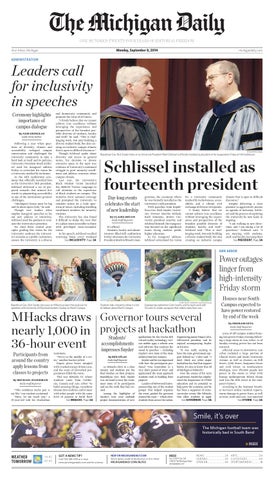
ONE-HUNDRED-TWENTY-FOUR YEARS OF EDITORIAL FREEDOM Monday, September 8, 2014
Ann Arbor, Michigan
michigandaily.com
ADMINISTRATION
Leaders call for inclusivity in speeches Ceremony highlights importance of campus dialogue By SAM GRINGLAS Daily News Editor
Following a year when questions of diversity, climate and accessibility reshaped campus conversation and challenged the University community to take a hard look at itself and its policies, University President Mark Schlissel used his inaugural address Friday to articulate his vision for a University marked by inclusion. In the Hill Auditorium ceremony that officially installed him as the University’s 14th president, Schlissel delivered a set of prepared remarks that minced few words in pinpointing accessibility as one of the institution’s greatest challenges. “Michigan’s house must be big and its doors open wide,” he said. Though new leaders often employ inaugural speeches to lay out new policies or initiatives, Schlissel used the podium to evaluate the University’s priorities. He cited three central principles guiding this vision for the University: embrace the University’s mission as a public institution, ensure the University is a diverse
and democratic community and promote the value of all voices. “I firmly believe that we cannot achieve true excellence without leveraging the experiences and perspectives of the broadest possible diversity of students, faculty and staff,” he said. “This is challenging work. Not only building a diverse student body, but also creating an inclusive campus climate that is open to difficult discourse.” Though Schlissel spoke about diversity and access in general terms, his decision to devote extensive space to the topic was evidence of University’s continued struggle to grow minority enrollment and address concerns about campus climate. Last year, the University’s Black Student Union launched the #BBUM Twitter campaign to call attention to the experience of Black students on campus. The initiative drew national coverage and prompted the University to consider action on a wide spectrum of issues, including troubling enrollment numbers for minority students. The University has also found it difficult to shake the view that it’s a place most accessible to those with privileged socio-economic status. In his speech, Schlissel recalled returning home every weekend See INCLUSIVITY, Page 3A
RYAN REISS/Daily
Republican Gov. Rick Snyder looks on as University President Mark Schlissel is officially installed as president at his inauguration Friday at Hill Auditorium.
Schlissel installed as fourteenth president Day-long events celebrates the start of new leadership By CLAIRE BRYAN Daily Staff Reporter
It’s official. Students, faculty and administrators filled Hill Auditorium Friday afternoon for University President Mark Schlissel’s inau-
guration, the ceremony where he was formally installed as the University’s 14th president. With speeches from Republican Gov. Rick Snyder; University Provost Martha Pollack; Ruth Simmons, Brown University president emerita; and Schlissel himself, the inauguration focused on the significant issues facing modern public higher education. In his inaugural address, Schlissel articulated his vision
for a University community marked by inclusiveness, accessibility and a vibrant civil exchange of diverse viewpoints. “I firmly believe that we cannot achieve true excellence without leveraging the experiences and perspectives of the broadest possible diversity of students, faculty, and staff,” Schlissel said. “This is challenging work. Not only building a diverse student body, but also creating an inclusive campus
climate that is open to difficult discourse.” Despite delivering a clear promise to aggressively pursue an agenda of inclusion, Schlissel said the process of exploring the University he now leads in ongoing. “I am walking in new directions, and I am asking a lot of questions,” Schlissel said. “I am meeting with students, staff, and faculty, learning their See PRESIDENT, Page 3A
ANN ARBOR
Power outages linger from high-intensity Friday storm PHOTOS BY VIRGINIA LOZANO/Daily
Republican Gov. Rick Snyder discusses an MHacks project that analyzes his speeches with University of Maryland students Sunday on North Campus.
Students take a break by riding in a hot air balloon above North Campus.
Engineering sophomore Colin Szechy and his team work with Chrysler to create a program that collects data from cars.
MHacks draws Governor tours several nearly 1,000 in projects at hackathon 36-hour event Participants from around the country apply lessons from classes to projects By MICHAEL SUGERMAN Daily Staff Reporter
“This Goldman Sachs pen is my life,” one student exclaimed. “Here, let me teach you,” a 15-year-old told his Hackathon
teammate. “We’re in the middle of a crisis,” another hacker yelled. Empty pizza boxes mingled with crushed energy drinks cans, and the scent of unwashed programmers filled the room. This was MHacks IV, where students came from California, Canada and Ann Arbor “to build amazing things, transform dreams into realities, and to meet with other people with the same level of passion to build their See MHACKS, Page 2A
Students’ accomplishments impresses Snyder By BEN ATLAS Daily Staff Reporter
As MHacks drew to a close Sunday and students put the final touches on their projects, Republican Gov. Rick Snyder was on hand to tour the event, meet some of its participants and see the work they had created. Among the highlights of Snyder’s tour were multiple project demonstrations of new
applications for the Oculus Rift virtual-reality technology, various mobile apps, a robotic arm and software that analyzes the mood in speeches — including Snyder’s own State of the State address from last January. Snyder said he was impressed with how the participants produced “true innovation in a very short period of time” and appreciated the team approach students took in building their projects. Leaders of MPowered Entrepreneurship, one of the student groups that helped organize the event, guided the governor around the expo — which drew students from across the nation.
Houses near South Campus expected to have power restored by end of the week By SHOHAM GEVA Daily Staff Reporter
Engineering junior Diego Calvo, MPowered president, said he enjoyed accompanying Snyder on his tour. “It was really exciting to have the state government support behind us,” Calvo said. “I don’t think any other major hackathon has had that support before. It’s nice to know that all of Michigan is behind it.” Over the course of his term as governor, Snyder has emphasized the importance of STEM education and its potential to help grow the economy, and he has been a supporter of extracurricular events like MHacks that allow students to apply See GOVERNOR, Page 3A
Areas of off-campus student housing lost power Friday evening following a large storm in Ann Arbor. As of Sunday evening, power has not been restored. Affected areas in downtown Ann Arbor included a large portion of Church Street and South University Avenue, as well as clusters on Hill Street, Sybil Street, Benjamin Street and Arch Street. In Southeastern Michigan, over 350,000 people lost power in the storm in what DTE Energy Spokesperson Eileen Dixon said was the 10th worst in the company’s history. According to the National Weather Service’s online incident reports, storm damage to power lines, as well as trees, roofs and cars, was reported See STORM, Page 2A
Smile, it’s over The Michigan football team was historically bad in South Bend
» INSIDE WEATHER TOMORROW
HI: 82 LO: 62
GOT A NEWS TIP? Call 734-418-4115 or e-mail news@michigandaily.com and let us know.
NEW ON MICHIGANDAILY.COM Storm leaves swath of destruction in Ann Arbor MICHIGANDAILY.COM/BLOGS
INDEX
Vol. CXXIV, No. 124 ©2014 The Michigan Daily michigandaily.com
NEWS......................... 2A SUDOKU.....................2A OPINION.....................4A
ARTS........................... 5A CL ASSIFIEDS...............6A S P O R T S M O N DAY. . . . . . . . . .1 B
News
2A — Monday, September 8, 2014
MONDAY: This Week in History
TUESDAY: Professor Profiles
WEDNESDAY: In Other Ivory Towers
THURSDAY: Alumni Profiles
ADMINISTRATIVE DEBATE
The University re-opened the post of woman’s advocate, a post previously closed because the last advocate left the position for “personal reasons.” The re-opening followed much debate over whether the University still needed an advocate for women, leading to a lengthy reevaluation of the position. The Office of Special Services and Programs launched an 11-member search committee appointed by OSSP director Libby Davenport. At the date of the article, the team was already sifting through more than 50 applications.
Twenty years ago this week (September 8, 1994) Following an alleged sexual assault inside of the Michigan Union, building officials announced their plan to re-evaluate the entrance policy and overall safety. Many students expressed fear over the standing policy, specifically when allowing non-students into the building, as both the survivor and alleged perpetrator were not affiliated with the University. In response, the University implemented more I.D. checks at night and checks on “people that look like they don’t belong,” James Smiley, Department of Public Safety captain, said.
FIELD HOCKEY
SOCCER
New facilities
Out of luck
BY JASON RUBINSTEIN
BY NATHANIEL CLARK
Saturday marked the inaugural game at the field hockey team’s newly renovated Ocker Field. The $13.5 million facility gave the team a needed boost in their match against William and Mary. The Wolverines scored the first two goals on the new turf on their way to a 2-0 win.
The Michigan men’s soccer team struggled early against Columbia, falling two goals behind within the first 20 minutes of play. Despite a late surge in the last 30 minutes, during which the Wolverines outshot the Lions 5-4, Michigan recorded a 3-0 loss.
GOLF
CULTURE
BY DANNY VARGOVICK
BY GILLIAN JAKAB
Kyle Mueller and the men’s golf team captured both the individual and team titles, respectively, at the Wolverine Invitational, which finished play on Sunday. Both Mueller individually and the team collectively finished the event at seven under par.
As international diplomacy becomes increasingly contentious, art and culture stands in a place to build bridges and mend old wounds between nations. However, cuts in funding could threaten the nature of such “cultural diplomacy.”
RYAN REISS/Daily
ROTC students prepare to leave for their training week at the University of Michigan-Dearborn Friday at the School of Dentistry Building.
WHAT: Need to decorate your new living space? Check out the poster sale, featuring more than 2,000 different designs of all types and styles. WHO: Center for Campus Involvment WHEN: Today from 9 a.m. to 5 p.m. WHERE: Pierpont Commons
WHAT: Author Jesse Walker will discuss his book about the legacy of conspiracy theories in American culture, “The United States of Paranoia”. WHO: University Libraries WHEN: Today from 4:00 to 5:30 p.m. WHERE: Hatcher Graduate Library
CHECK OUT OUR WEBSITE! WWW.MICHIGANDAILY.COM
Sudoku Syndication
News Tips news@michigandaily.com
Corrections
Letters to the Editor
corrections@michigandaily.com
tothedaily@michigandaily.com
Arts Section
Editorial Page
arts@michigandaily.com
opinion@michigandaily.com
Sports Section
Photography Section
sports@michigandaily.com
photo@michigandaily.com
Display Sales
Classified Sales
dailydisplay@gmail.com
classified@michigandaily.com
Online Sales
Finance
onlineads@michigandaily.com
finance@michigandaily.com
Open house WHAT: New graduate students and faculty alike are invited to tour the Hatcher Graduate Library and learn about the resources it offers. WHO: University Library WHEN: Today from 3:00 to 4:30 p.m. WHERE: Hatcher Graduate Library CORRECTIONS l Please report any error in the Daily to corrections@ michigandaily.com.
THREE THINGS YOU SHOULD KNOW TODAY
1
President Barack Obama has announced meetings with Congressional leaders and a televised address this week to address military policy regarding Islamic State militants and future counterterroism efforts, Detroit Free Press reported Sunday.
2
The Michigan football team was shut out for the time since 1984 on Saturday at Notre Dame, 31-0. It was the last scheduled game between the two teams. >> FOR MORE, SEE SPORTSMONDAY
3
Apparently opting to protect his party’s policital security in the upcoming November elections, President Barack Obama announced he would postpone executive action related to immigration policy, the New York Times reported Saturday.
8
7
4
7 5
6
5
9
2
9
2 1
3
1 2
Megan McDonald and Daniel Wang Editorial Page Editors
9 7
1
2
1
5
5
8 7
weakling.
1
3
8
2
opinioneditors@michigandaily.com
SENIOR EDITORIAL PAGE EDITORS: Aarica Marsh and Victoria Noble ASSISTANT EDITORIAL PAGE EDITORS: Matthew Seligman and David Harris
Greg Garno and Alejandro Zúñiga
Managing Sports Editors sportseditors@michigandaily.com
SENIOR SPORTS EDITORS: Max Cohen, Alexa Dettelbach, Lev Facher, Rajat Khare, Jake Lourim and Jeremy Summitt ASSISTANT SPORTS EDITORS: Max Bultman, Minh Doan, Daniel Feldman, Simon Kaufman, Erin Lennon and Jason Rubinstein
John Lynch and Akshay Seth Managing Arts Editors
jplynch@michigandaily.com akse@michigandaily.com
SENIOR ARTS EDITORS: Giancarlo Buonomo, Natalie Gadbois, Erika Harwood and Alec Stern ASSISTANT ARTS EDITORS: Jamie Bircoll, Jackson Howard, Gillian Jakab and Maddie Thomas
Teresa Mathew and Paul Sherman Managing Photo Editors
photo@michigandaily.com
SENIOR PHOTO EDITORS: Allison Farrand and Ruby Wallau ASSISTANT PHOTO EDITORS: Katherine Pekela, Virginia Lozano, James Coller, McKenzie Berezin, and Nicholas Williams
Carolyn Gearig and Gabriela Vasquez Managing Design Editors
design@michigandaily.com
SENIOR DESIGN EDITORS: Amy Mackens and Alicia Kovalcheck
Carlina Duan Magazine Editor
statement@michigandaily.com
DEPUTY MAGAZINE EDITORS: Max Radwin and Amrutha Sivakumar STATEMENT PHOTO EDITOR: Ruby Wallau STATEMENT LEAD DESIGNER: Amy Mackens
Mark Ossolinski and Meaghan Thompson Managing Copy Editors
copydesk@michigandaily.com
SENIOR COPY EDITORS: Mariam Sheikh and Alisha Qiu
Austen Hufford
Online Editor
ahufford@michigandaily.com
VIDEO EDITORS: Paula Friedrich and James Reslier-Wells SOCIAL MEDIA EDITOR: Brianne Johnson
BUSINESS STAFF Madeline Lacey University Accounts Manager Ailie Steir Classified Manager Simonne Kapadia Local Accounts Manager Lotus An National Accounts Manager Olivia Jones Production Managers Nolan Loh Special Projects Coordinator Jason Anterasian Finance Manager The Michigan Daily (ISSN 0745-967) is published Monday through Friday during the fall and winter terms by students at the University of Michigan. One copy is available free of charge to all readers. Additional copies may be picked up at the Daily’s office for $2. Subscriptions for fall term, starting in September, via U.S. mail are $110. Winter term (January through April) is $115, yearlong (September through April) is $195. University affiliates are subject to a reduced subscription rate. On-campus subscriptions for fall term are $35. Subscriptions must be prepaid. The Michigan Daily is a member of The Associated Press and The Associated Collegiate Press.
around six hours during the 36-hour event, remedied in part by the consumption of caffeinated brownies. A lack of rest was common among the weekend’s hackers. The Hackathon also featured guest speakers ranging from Reddit Co-founder Alexis Ohanian to Grace Choi, founder of Mink, a 3D makeup printing company. The keynote speaker at the event’s ending in Rackham Auditorium was John Maeda, the former president of the Rhode Island School of Design. Maeda told students to remember the importance of their work rather than worrying about more trivial matters, namely money. “Try not to forget that you are part of a grand mission where technologists, designers, people like yourselves are shaping culture in a way that can be hugely positive or hugely negative, depending on the choices you make,” he said.
Dixon said. “However, there will was turned off as precautionary be small clusters of customers measure. She said dealing with http://sudokusyndication.com/sudoku/generator/print/ with individual service prob- the outage has been a confuslems until Tuesday or Wednes- ing and frustrating experience, day.” especially as a first-time renter. LSA sophomore Sagar Sada“With school just starting, across the state. A severe storm warning for the Ann Arbor sivan, a Sybil resident who lost classes getting time-consuming, area, cautioning of 70-plus hour power, said the loss has been it’s been a headache,” she said. wind, was issued Friday eve- inconvenient, though the mild “For people who it’s their first EASYning. Wind speeds reached 50 weather dampens the effect. time living off campus, for some“The only thing is it forces us thing like this to happen you’re miles per hour in Ann Arbor, and up to 70 miles per hour in other to go out of the house because kind of at a loss for resources areas of Southeast Michigan, we have to charge our phones, and there’s not really anyone you according to a CBS report. charge our laptops, you need can talk to.” Both Sadasivan and Gohil Dixon said on Sunday after- Wi-Fi for homework,” he said. noon that most affected areas “It could be worse, if the weather were initially told they wouldn’t should have power by Monday was extremely hot or extremely have power returned until evening. cold.” Thursday, but were told Sunday “The vast majority of outages The water supply for LSA that power might be returned as we expect to be taken care of by junior Radhi Gohil, a South For- soon as tonight. Dixon said several priorithe end of tomorrow evening,” est resident who also lost power,
ties influence when power is restored. It depends on the consumers’ power circuit and their power needs. For instance, hospitals and police and fire stations are likely to receive power first. “We look to repair the circuit that has the most customers affected. If we can get several thousand customers back up in one repair, that’s where we want to focus our efforts.” Another Sybil Street resident who lost power, Engineering graduate student Garrett Cullen, said he was disappointed by the delay. “Understandably, (DTE) has a lot on their plate right now,” Cullen added. “I expected a lot quicker service.”
Kim won the first place accolade, which included a Dell tablet and $4,000. He led a project called Power Glove, which expanded the capabilities of a preexisting simulation video game called Surgeon Simulator 2013. As its name might suggest, the game allows users to simulate surgery by controlling the doctor’s hand with keyboard functions. Kim’s twist: there’s no need for an external keyboard. He used a so-called “invention kit” called MaKey MaKey, a device that allows household objects to be converted into touchpads. Power Glove uses a digital hand to follow his own movements exactly, including even the flexing of individual fingers. “I never expected this,” Kim said of winning the competition. “During the expo, I was just having a good time. When I got a call to (be in the top 14), I was like, ‘Damn, did I break a rule or something?’”
The other creations in the top three included Android for iPhone, an app to run Android operations on iPhones, and Smash Connect, which detects a user’s movements and translates them into attacks in the classic Nintendo 64 game, Super Smash Bros. Another finalist included an app called Spudy, “your speedy reading buddy,” which allows users to take pictures of text from books, eliminate extraneous images or figures and quickly convert the passages into wordby-word plaintext for easy, more efficient reading. There were, of course, hundreds of projects that did not make the top 14. One, created by a group of sophomores from Carnegie Mellon University, involved the use of floppy disks to make an instrument. The disks emit a noise when activated; the team aimed to control both the timing and the pitch of the disks to form what
STORM From Page 1A
5 9 3
jcalfas@michigandaily.com
SENIOR NEWS EDITORS: Ian Dillingham, Sam Gringlas, Will Greenberg, Rachel Premack and Stephanie Shenouda ASSISTANT NEWS EDITORS: Allana Akhtar, Neala Berkowski, Claire Bryan, Shoham Geva, Amabel Karoub, Emma Kerr, Thomas McBrien, Emilie Plesset, Michael Sugerman and Jack Turman
SUDOKU
2
kgburke@michigandaily.com
would be a 21st century piano. Another project, pioneered by Engineering junior Jennings Jin, was originally called Crapp (the crap app). Users take inventory of items they no longer use, measuring the number of items and their collective weight and cost. At the time of his interview, Jin said he was “in the farting stage of Crapp,” which he had come up with at 2 a.m. that morning. He decided to rename the project Heapp. As to how he and friends had generated the idea: “It’s just like an, ‘Eh, why not?’.” Engineering juniors Connor Grieb and Jake Glass designed an app based on their passion for skiing and called it “Rusty the Local.” The project assumed the role of a local mountain man on the slopes, and allowed users to denote particularly good or bad parts of a given ski trail and broadcast them to fellow skiers, among other functions. Grieb and Glass each slept
awesome with it.” With this in mind, it’s not surprising that there were a smattering of high school students in attendance. One of these was Cole Hudson, a ninth grader at Fremont High School. His mother drove him to the Hackathon from their small town in western Michigan. “I’m here to learn,” Hudson said. “Experience, I guess, is what I’m looking to get out of this experience. I mean, I’ve never been around nearly this many people interested in computer programming. It’s just awesome to be around this much creativity and just to be able to pick up a little bit of that would be cool.” Sponsor representatives, ranging from Facebook to Chrysler, stand behind booths, offering free merchandise, encouraging engineers to use their programming interfaces and talking to students interested in internships. Engineering sophomore Daniel
future,” according to the event’s website. The 36-hour Hackathon, where roughly 1,000 students neglected sleep and, at points, personal hygiene in the name of creating hard and software, ran this weekend: Sept. 5-7. Last year’s MHacks event centered on Detroit. Information sophomore Vikram Rajagopalan, the director of MHacks, said prior to the event this Hackathon would have a learning focus. “We are really focusing on learning — not in watching a course, but learning by doing,” he said. “We’re gonna have Oculus Rifts. We’re gonna have a Tesla. Similar to before, we’re giving people awesome new technology and a chance to play with the technology you haven’t played with before and build something
Newsroom 734-418-4115 opt. 3
Katie Burke Managing Editor Jennifer Calfas Managing News Editor
Book lecture
WHAT: The first LSA Theme Semester event, “Game Plan: Achieving Success at Michigan and Beyond,” will feature a panel of athletic coaches, administrators and professors. WHO: LSA Theme Semester WHEN: Today from 7:00 to 8:30 p.m. WHERE: Rackham Bldg.
Business Manager 734-418-4115 ext. 1241 dougsolo@michigandaily.com
EDITORIAL STAFF
Poster sale
Sport and the University
Taking the title Int’l relations
MHACKS From Page 1A
Howard King, a prominent attorney for many music icons, including Dr. Dre and Metallica, asked the University to restrict access to the notorious file-sharing site, napster.com. King also asked 10 other universities to also restrict access to students to avoid potential copyright law infringement. Napster CEO Hank Barry urged students not to listen to King as they are not liable for potential illegal action. “Students who engage in person-to-person file sharing are not copyright infringers,” Barry said. — ALLANA AKHTAR
420 Maynard St. Ann Arbor, MI 48109-1327 www.michigandaily.com PETER SHAHIN DOUGLAS SOLOMON
Editor in Chief 734-418-4115 ext. 1251 pjshahin@michigandaily.com
Fourteen years ago this week (September 12, 2000)
CAMPUS EVENTS & NOTES
ON THE WEB... michigandaily.com
FRIDAY: Photos of the Week
ROLL CALL
‘U’ considers woman’s advocate Forty years ago this week (September 11, 1974)
The Michigan Daily — michigandaily.com
© sudokusolver.com. For personal use only. puzzle by sudokusyndication.com
STOP BY ONE OF OUR OPEN HOUSES! Sunday, September 14 Tuesday, September 16 6:00 PM @ 420 MAYNARD BY THE CUBE!
Generate and solve Sudoku, Super Sudoku and Godoku puzzles at sudokusyndication.com!
News and Arts
The Michigan Daily — michigandaily.com
PRESIDENT From Page 1A aspirations, what they are most proud of, and what they are anxious about as we move forward together.” Pollack, the University’s provost, gave opening remarks welcoming the community and introducing the University’s governing Board of Regents, deans and faculty, as well as Schlissel and his extended family. She also stressed the responsibility Schlissel has to respond to the challenges and trials facing public higher education. Following her speech, Snyder noted Schlissel’s eagerness to learn, alluding to the new president’s recent trip around the state. He added that Schlissel will serve as the cornerstone of humanity at
INCLUSIVITY From Page 1A as an undergraduate freshman to work at a supermarket. Those earnings — in concert with needbased scholarships and student loans — helped put him through school. Today, he said too many students face a more challenging climb to afford a university education and pledged to keep tuition affordable for all. “Talent is uniformly distributed across the populace,” he said. “But opportunity most certainly is not. We must encourage every talented high school senior in Michigan to apply here. Students and their parents must hear clearly and rest secure that the University of Michigan values curiosity and intellect, not zip codes or family income.” According to data from the University’s Office of the Registrar, 63 percent of incoming freshmen in fall 2011 reported family incomes exceeding $100,000. The figure was 72 percent for nonresident students. The median family income in the United States is $51,324, according to a 2012 survey conducted by the U.S. Census Bureau. Though Schlissel cited the University’s commitment to raise $1 billion for financial aid as part of the ongoing Victors for Michigan development campaign, tuition has continued to rise. LSA in-state tuition increased by 60 percent and out-of-state tuition by 55 percent between academic years 2004-05 and 2013-14, due in part to declining state support for institutions of higher education. In the inauguration’s keynote speech that ignited the auditorium with applause, Ruth J. Simmons, the former Brown University president, called on college presidents to continue charging toward the “Great Society” laid out by President Lyndon Johnson in his 1964 commencement address at the University. In that speech, Johnson called for a renewed fight against poverty and racial injustice that would push America closer toward a society “where every child can find knowledge to enrich his mind and to enlarge his talents.” “In our time, I see no better site to join that battle than universities and I see no better generals for that battle than university presidents,” Simmons said. In an interview with The Michigan Daily outside Hill Auditorium, Simmons said, like Schlissel, she chose to discuss community and diversity after this summer’s tension in Ferguson, Mo. struck her as indicative of the issues faced by communities across the country. “These very fundamental attributes of kindness and generosity and respect — we give short shrift to that — and yet when (conflict) explodes, that’s what it comes down to.” Simmons said these challeng-
the University. “What makes the University of Michigan a truly special place is not one area or sectors, it is the humanity of the University, the people,” Snyder said. In an address that elicited thunderous applause multiple times, Simmons, who served as the president of Brown University and appointed Schlissel it’s provost, called on universities to devote more attention to ensuring students leave prepared to resolve conflict and treat others with respect — even as they increasingly push forward new innovations in science and technology. “Respect for others is a goal worth setting and worthy of presidential leadership,” she said. Regent Kathy White, who is the chair of the Board of Regents, outlined a history of past University presidents, concluding with Schlissel’s formal inauguration.
es are especially prevalent on college campuses. “It’s very hard to benefit properly from an excellent learning environment if you’re feeling alienated, disrespected, unimportant,” she said. “I don’t have any problem with people disagreeing with me; I do have a problem when there’s nobody there who looks at me and says I understand that this is difficult for you and I feel for you,” she said. Schlissel, too, made the case for creating a community built on respect and dialogue, especially amid disagreement. He cited an incident at Brown last year when protest prevented New York City Police Commissioner Ray Kelly — who pioneered the controversial policing policy called “stop and frisk” — from delivering a talk on campus. Schlissel said turning from the people we disagree with or denying them the opportunity to speak robs the community of valuable learning experiences and the chance to challenge ideas. “People have stood on this very stage and voiced unsettling opinions,” he said. “Ross Barnett was the governor of Mississippi and a segregationist. He opposed the civil rights legislation of the 1960s and the integration of his state’s flagship university. He was booed here, in 1963, but he was allowed to speak. This is what great universities do: We encourage all voices, no matter how discomforting the message.” Last spring, a proposal that asked the Central Student Government to support University divestment from companies allegedly involved in human rights violations in Palestine propagated tension across many corners of campus as groups delved into a debate that was at times divisive. While Schlissel didn’t refer to that controversy, he emphasized the role of universities in encouraging debate that’s respectful of diverse viewpoints and a community that’s open to criticism, even when the conversation is challenging for individuals or for the University. “That is why I want Michigan to be known as a place where mutual respect does not require agreement, where differences of perspective are treated with sensitivity, and where we all become advocates for, and experts in, civil discourse.” Schlissel is not the first president to address these issues in an inaugural speech, though many of those addresses devoted considerably less space to the topics. Toward the end of her 2003 inaugural, University President Emerita Mary Sue Coleman highlighted the University’s pending cases before the U.S. Supreme Court regarding the use of race, among other factors, in university admissions. “No matter what the outcome may be — as an institution, we shall remain committed to the ideal of a diversely interactive community, dedicated to the
The crowd gave an overwhelming standing ovation. An hour before the inauguration ceremony, Schlissel joined the regents, executive officers, deans, faculty and representatives from 100 other universities for a formal robing ceremony held in Rackham Auditorium. In an interview with The Michigan Daily during the ceremony, Schlissel said he was impressed by the number of guests who came to represent their university, department or college. “It is one of the most amazing days of my life,” he said. “I’m humbled.” Though he technically assumed the presidency in July, Schlissel said the past week has been an experience apart from the rest of his time at the University. “It really changed a lot when the students came back to town a few days ago,” he said. “I’ve been
highest standards,” Coleman said. “If we win, we will have a hollow victory unless we renew our commitment to learning with, and learning from, diverse others every day, in every action, in every classroom, in every living arrangement, in every research and public service endeavor. The nation will be looking to the University of Michigan for leadership and inspiration, however the decision of the Court is crafted.” Though the court ultimately upheld part of the University’s affirmative action admissions policy, a 2006 statewide ballot proposal outlawed the consideration of race in public higher education admissions. Despite Coleman’s inaugural promises to uphold the University’s commitment to diversity, Black enrollment has hovered around six percent in recent years. James Duderstadt, who served as the University’s 11th president, also articulated the University’s responsibility to ensure equal opportunity in his 1988 inaugural. “If we do not create a nation that mobilizes the talents of all our citizens, we are destined for a diminished role in the global community, increased social turbulence, and most tragically, we will have failed to fulfill the promise of democracy upon which this nation was founded,” he said. Still, ensuring expansive and equitable access to the University has proved elusive — despite the promises of multiple presidents who promised progress in their inaugurals. Though Simmons, who tapped Schlissel to serve as her provost, said she can’t be sure how he plans to implement the vision established in his inaugural speech, she said his vow to prioritize diversity and dialogue is not for show. “Communities are not helped by people who say one thing over here and another over there or who say things that are convenient to be said at convenient times,” she said. “What we know is he’s not a person to do that. He will always move in the direction of clarity. He won’t compromise in expressing his views and that to me is an excellent beginning.” After listening to the inaugural address, Public Policy junior Hattie McKinney, the Black Student Union’s programming chair, said she can tell Schlissel understands the climate he’s stepping into and is ready to take the steps necessary to create tangible improvements. However, she said it’s a speech that represents Schlissel’s intentions, and though administrators often know the direction they want to head, it’s not always achieved. “The goals and the visions he laid out are not an overnight deal,” McKinney said. “The process will be ongoing. It’s something he can’t do alone. We’ll all have to come together to make this vision a reality and it’s going to take time.”
JOIN THE DAILY!
Mass Meetings @ 7:30 PM, 420 Maynard. Nothing to lose but your sanity and good health. (Clearly, we know how to market ourselves.)
THURSDAY, SEPTEMBER 11 SUNDAY, SEPTEMBER 14 MONDAY, SEPTEMBER 15
running into students all across the campus. The energy level went up a notch and it’s just really exciting.” However, Schlissel said there’s more he can do to become further acquainted with the campus community. “I have to continue my efforts to getting to know people, getting to know the faculty, students and staff and what their aspirations are and how I can add to the work of the University to make it better,” he said. After the ceremonial robing process, a processional of hundreds of gowned academics and officials marched down the steps of Rackham Auditorium and through the Diag, ending at Hill Auditorium. Students and members of the community who lined the pathway cheered and applauded. Some event attendees reached for mem-
Monday, September 8, 2014 — 3A bers of the processional, including President Emerita Mary Sue Coleman, to snap a photo. In the Diag, student volunteers in maize T-shirts created a tunnel for the processional to walk through. Students chanted, “It’s great to be a Michigan Wolverine” and sang Hail to the Victors. When Schlissel exited the student volunteer tunnel, many students jumped at the opportunity to give him a high five and take a selfie. Dozens of those participants also took positions in a postinaugural community festival set outside the auditorium. A few hundred people gathered for University-sponsored food and music set up around Ingalls Mall. LSA sophomores Kasey Wright and Stephanie Saravolatz served as event volunteers earlier in the day and helped cheer on the processional as it passed through the
Diag. “I am a scholarship student here and this was something I could do to give back to the University (that) has given me so much,” Wright said. “Students started joining even though they didn’t have t-shirts and I thought that was pretty cool and I think everyone enjoyed it a lot,” Saravolatz said. LSA junior Joe Murray, another student volunteer, said he was impressed with Schlissel’s inaugural speech and his push for valuing all voices, despite conflict or disagreement. “I would love to see him implement those ideas he talked about as far as making sure the University stays really open to people and that we seek people from Michigan and around the country and the world, making sure everyone who deserves to go here has the opportunity to.”
ARTS
‘El Pintor’ unsuccessful By ADAM THEISEN Daily Music Editor
The fact that the title of Interpol’s new record is simply an anagram of the band’s name is Bactually an El Pintor appropriate Interpol metaphor for the music Matador itself. El Pintor certainly sounds like Interpol, minus bassist Carlos D. and with a few small tweaks to the group’s style. However, even though the album features many of Interpol’s strengths, the pieces rarely seem to fit together as they should and it ends up sounding like an inferior mish-mash of the band’s stellar classics. El Pintor is still the Interpol you know and (may) love, but listen to it with its seminal debut record Turn on the Bright Lights still stuck in your head after all these years and something will seem wrong. Perhaps it’s unfair to criticize a band just for releasing its best stuff too early in its career, but Interpol doesn’t do itself any favors by sticking with almost the exact style that made it famous. Of course, when you arrive on the scene as fully matured as Interpol did, it’s hard to do very much more growing, but the ghosts of early-2000s New York City indie rock haunt El Pintor. The Joy Division-esque bass is still turned all the way up, guitars continue to drone and screech, and Paul Banks’s chilly moan of a voice remains — which I suppose is great if Interpol is your favorite band. But Interpol’s brand of melancholy rock needs all of its parts to be perfectly executed to avoid being grating, and unfortunately, there are too many missteps on El Pintor.
GOVERNOR From Page 1A their classroom knowledge to build things of their own. “We really need to figure out how to highlight (events like) this and package it to the general public so they can see how important this is and how we can put more resources towards it,” he said. Sunday was not Snyder’s first event at a STEM-related event at the University. In 2013, Snyder delivered the keynote address at the University’s Robotics Day, which was sponsored by FIRST — For Inspiration and Recognition of Science and Technology. This past June, he hosted the winners of the state’s high school robotics competition held by FIRST as he signed his education budget for fiscal year 2015 The $15.8 billion education budget for next year includes $2 million in grants for the robotics program, but the Governor hopes that STEM and its related subfields can become an even more prominent part of K-12 and higher education in the state. “(STEM education) hits all those attributes about innovation, teamwork, collaboration and really could lead to great businesses and long term relationships,” he said.
That’s not to say there aren’t bright spots. Lead single and opening track “All the Rage Back Home” is a very good rock song that hits all the points that you would expect. With a drum part that makes the number somewhat danceable, and admirable fill-in bass-playing from Banks, the only complaint to make is how predictable it is. Much like its contemporaries The Strokes did with their most recent record Comedown Machine and its first single “All the Time,” Interpol wants to excite its fans by giving them what’s familiar. And while that’s a perfectly fine thing for a band to do, the rest of El Pintor follows the same path Comedown Machine did by basi-
Lacking fun and catharsis cally proving beyond a doubt that, even though Interpol still has the talent, it’s lost the spark. The music of El Pintor basically lacks two key elements: fun and catharsis. Though nobody ever really thought of Interpol as a “fun band,” its old indie hits like “PDA” and “Evil” had Banks singing sneakycatchy melodies in his deadpan voice and contained powerful choruses that would always go over well at festivals. And when the band wanted to go in a different direction, they let out all of their moody emotions in gorgeously bleak tracks like “Untitled” and “NYC.” On the new album, the band just broods. The songs often meander and the instruments don’t seem to fit together right. Songs like “Same Town, New Story” features drums that are trying to drive the band onward, but the
guitar part just noodles off on the side, meaning that instead of pushing forward, it’s more like Interpol is on a treadmill. El Pintor doesn’t pick up nearly at all until it gets to the homestretch. Here, the guitars have some added muscle, the drums pound harder and Banks’s voice, in some places, gets even more detached and ghostly. The last two songs, “Tidal Wave” and “Twice as Hard,” mostly add to the positive feelings. Both are the exact brand of enigmatic melancholy that made Interpol famous when it released its debut, and have uncharacteristically interesting lyrics. Banks’s voice seduces you in while the beat keeps you self-consciously on your toes. It’s a shame, though, that despite the nice groove, both tracks go on for a bit too long, and leave you feeling relieved that they’re over. Listening to El Pintor, I had a really tough time putting my finger on what exactly made the music feel so empty when compared to Turn on the Bright Lights and Antics. The new record is very much the same familiar Interpol template, and despite losing Carlos D. the band still has loads of talent and songcrafting skill. However, ever since they’ve established themselves, the members of Interpol have had large expectations to fulfill. Despite there being no change in style, there’s an anxiety in the new music, a refusal to just let things happen as they will. When Interpol arrived on the scene, they were young and experimental, influenced by post-punk legends but still creating something starkly different. Back then, there was no pressure to be Interpol. Now, it seems impossible that the band will ever be able to escape that pressure long enough to top its masterpieces.
LIKE US ON FACEBOOK! facebook.com/michigandaily
FOLLOW US ON TWITTER! @michigandaily
Opinion
Page 4A — Monday, September 8, 2014
The Michigan Daily — michigandaily.com
AKSHAY SETH | MICHIGAN IN COLOR
Edited and managed by students at the University of Michigan since 1890. 420 Maynard St. Ann Arbor, MI 48109 tothedaily@michigandaily.com PETER SHAHIN EDITOR IN CHIEF
MEGAN MCDONALD and DANIEL WANG EDITORIAL PAGE EDITORS
KATIE BURKE MANAGING EDITOR
Unsigned editorials reflect the official position of the Daily’s editorial board. All other signed articles and illustrations represent solely the views of their authors.
I
The Big Apple in Tree City
took a trip to New York City recently to visit a friend who lives in the predominately African-American and Hispanic neighborhood of northeast Brooklyn known as Bushwick. Though bordering the relatively affluent hipster-mecca of Williamsburg directly to the east, about 32 percent of Bushwick’s residents live at or below the poverty line, AUSTIN according to a community DAVIS district profile in 2007. Walking around Bushwick, I began to notice several hipsteresque pop-up businesses in the area attempting to compete with the neighborhood’s discount stores. Though nothing too impressive — just some run-of-the-mill student bars and restaurants filled with chain-smoking collegeaged kids — these establishments appeared to be thriving. My friend scowled as we walked past one such bar. He attributed its success to its upper-middle class clientele of young, twenty-something gentrifiers. Gentrification: it’s become the dirty buzzword being thrown around in major cities all across the country. Wealthy young people move to impoverished neighborhoods and set up shop. They found new establishments and build high-rise housing developments, often in an attempt to better the area. Most of the time these attempts have adverse effects. While attracting new, wealthier demographics to the area, these establishments drive up rent prices, ultimately forcing the neighborhood’s original populations to the undesired outskirts of the city, or in some cases, to the streets. New York serves as an example of the process. According to Patricia — a 65 year-old prostitute with whom I had lunch at a small restaurant in the heart of East Harlem — Blacks and Hispanics have been pushed to the outer boroughs for years as a result of gentrification in Manhattan. The Upper East Side, for example — a predominately white Manhattan neighborhood which spans from the eastern boarder of Central Park to the East River — has in recent years increasingly encroached upon its traditionally working-class neighbor to the north, East Harlem. The New York Housing Authority has attempted to combat growing poverty and
A
homelessness in East Harlem — a neighborhood with an unemployment rate of 52 percent, with 32 percent of the residents living at or below the poverty level — by building new, more affordable public housing projects. Despite this, rent prices along the border of East Harlem and the Upper East Side have continued to skyrocket. A three bedroom apartment on the south end of East Harlem was recently listed at $9,195 a month. Patricia had long since moved out of Manhattan to Queens by the time I had spoken with her. But because of rent inflation and increasing property taxes, Patricia had to abandon her home in Queens as well, effectively becoming homeless. She is currently sleeping on the couch of relatives in an East Harlem apartment. I returned to Ann Arbor a few days after speaking with Patricia to find an eerily similar scene occurring at a startling rate in Ann Arbor. High-rise student apartment complexes such as Varsity, Zaragon Place, Zaragon West and Sterling 411 Lofts cater to wealthier, outof-state students who are willing to pay outrageous amounts to live near campus. This forces students without means outward into the residential Ann Arbor neighborhoods surrounding campus and downtown, putting a strain on the non-student residents of the city, whose rent prices have been inflated to compete with pricey student accommodations. The result is a paradox in Ann Arbor reminiscent of what is occurring in New York. Ann Arbor, a city that once had a manufacturing economy and diverse population, now has an overwhelmingly white population, with 70.8 percent wielding a college degree. Despite this, 21.9 percent live in poverty, and chronic homelessness in the area increased by 12.5 percent between 2011 and 2013. The gentrification process of New York is rapidly staking off the city for wealthy elites. Within the much smaller boundaries of Ann Arbor, however, the process is happening even faster. Expensive housing developments meant to better the city are paradoxically harming it by creating an inaccessible housing market. Without rent control and more affordable student housing developments, Ann Arbor will soon become an elitist college town, inhospitable to those without means who seek higher education and upward mobility. - Austin Davis can be reached at austchan@umich.edu.
Engaging in the world
fter the 2012 presidential election, Politico published an article citing a Tufts University study that found Mitt Romney may have gotten away with his plans to call the White House “home” were it not for those meddling kids. Nationally, 67 percent of young voters cast ballots in favor of President Barack Obama in 2012, while Romney secured only 30 percent. TYLER According to the report, SCOTT Obama won at least 61 percent of the youth vote in the so-called “swing states” of Florida, Virginia, Pennsylvania and Ohio. Thanks to the intricacies of the Electoral College, had Romney been able to earn a split decision among young voters he would have nabbed those states — and the presidency — from Obama. The next presidential election is still two years away, but the truth about the youngest voting bloc’s newfound significance is an important lesson to learn. At a young age, the millennial generation has cemented itself as an active and concerned demographic, whose numbers in 2012 continued the trend of increasing young voter participation since 2004. The importance of our own political consciousness doesn’t lie where we choose to pin ourselves — individually or collectively — on the political map. We’re at the dawn of the defining day of our generational adulthood, where the actions taken by and on the behalf of millennials could result in changes to laws, policy and culture in the short term, with limitless future potential. This generation is far from the first group of people to call for equal rights and social justice. For decades, members and advocates of the LGBTQ community have been fighting for their own civil liberties, the same can be said for feminists, and not long ago the legalization of marijuana was a far-fetched pipe dream of those furthest left. This is the work of previous generations, ideals that are now gaining unprecedented progress. Progress that is, at least partially, due to sweeping support from us — the youths. As a demographic, millennials are wholly buying into the notion of our own ability to influence society. With the issues mentioned
above, we have already made an impact. Yet other problems persist, like the uncomfortable reality of being institutionally pigeonholed into gambling our futures on the present by taking on massive debt for an education in hopes to achieve relevance, security and livelihood in a changing economy. We are still young enough to have not had the time to earn the revenue, nor forge the relationships, to control our own future. Yet, our needs are real. Ultimately, if millennials continue to hold stock in the idea that we all have political significance regardless of resources it may become truer. Because with pockets thin or thick, one vote is still a vote, and for any aspiring politician, a collective body of youngsters that consistently show up at the polls could present the possibility of a heck of a lot of votes for discount rates. Of course, it all hinges on whether young America continues to reach higher levels of social and political fusion not just on the biggest stages of presidential elections, but all of them. Every election in every town is a chance for more millennials to cast ballots and to become a bigger percentage of America’s voting public, as we did in 2012. That will only lead to more time being spent figuring out what causes us to vote. For example, if more students head to the polls, maybe Ann Arbor will end up electing a mayor with a more favorable view towards student life. Not to say it will not result in an overnight redirection of political sympathies in the United States — it won’t. But the time to define what a generation means to society is a very narrow window that just happens to be open now. It’s not that millennials own some special ability. It is important to be sure the chance to make a difference isn’t squandered. Referring his own generation, author Stephen King wrote, “We had a chance to change the world, and opted for the home shopping network instead.” Millennials have that same chance. Take note from those that did grasp at the opportunity for change and left a lasting impact on the world. Regardless of the cause, if enough energy is put forward, there will be an effect. Become engaged and change the world. - Tyler Scott can be reached at tylscott@umich.edu.
My mother’s language Inspired by Cameron Esposito’s “Home alone: Lost in your work” “The senses, moving toward their appropriate objects, are producers of heat and cold, pleasure and pain, which come and go and are brief and changeable; these do thou endure, O traveller. Take heed. Match eyes with darkness. Because only time will march by thy side, guiding thee unto an endless unknown.” — Bhagavad Gita: chapter 2, verse 14 The last thing you remember is the way your index finger clings to the pages. Fixed eyes dart from left to right as silent lips trace the outlines of your mother’s language. You’re spread-eagle on your grandparents’ bed. You can smell sticks of incense sizzling into embers on a side table. You hear younger cousins gasping to climb trees in the summer heat. But the best part of you knows you’re nowhere near. You’re in the air. You’re floating. Arjuna’s chariot smolders. The horses stampede, their manes rippling in the feral, blood-choked stench of carnage. Metal grating, sparking against the tides of battle. The hooves’ deathly cadence drumming in your ears. A water-propelled cooler throws cold air across your face. The breeze caresses still limbs as your grandfather enters the room. He asks what’s in your hands and when you show him, you can’t help but notice a distinct pride lighten the time-worn creases on his face. He asks where you found it. You point with enthusiasm at his cupboard. When he sees you answer, he can’t help but notice a distinct fire liven the curiosity in your eyes. He teaches you the meaning of knowledge. He teaches you the meaning of hard work. He tells you why it separates the weak from the strong. He tells you his story. So you keep reading. You read about things you never even knew existed. You read about things that still don’t exist. You see the power that breathes through good storytelling. You question why certain devices leave you writhing in anticipation while others dust you with morsels of confusion. Slowly, very slowly, you learn the importance of a flawed character. You learn about conflict. Your eyes search with more confidence. Somewhere, that moment where you read your first curse word is still preserved, where you can still hear your gasp turning into a sigh, and then laughter. You wonder where the stories come from, about the people who wring them from life and tame them onto a page. You wonder if you can see them in their work. You wonder if you will ever truly understand what they’re whispering, let alone be one of them. Time passes. You move away. Your parents tell you it’s for your own good. You see your grandparents once every two years. You miss how the sticks of incense smelled. Nothing looks the same. People don’t look the same. V-necks. Sweater vests. Leather boots. Mustard stains. People speak in strange accents. They make fun of yours, the way you pronounce your T’s and R’s, the way you say “ve” instead of “we.” No one knows your mother’s language. You only hear it at home, but the best part of you can grasp some semblance of beauty in the way it lilts through the walls, shielding you from this strange new world of grocery stores and white people. Your accent changes. You’re thankful it does. There’s a pang of regret because you’re thankful. Eventually, suddenly, you stop hearing your mother’s language altogether. Months pass by before you notice any signs of its disappearance. You wonder if this is what growing up feels like. You finally meet people who look like you. You try talking to them in her tongue, but they stare at you politely, embarrassed for you, and explain how they were born here. You understand why they feel embarrassed for you. You sense anger coursing in you. When they notice stereotypes surrounding them, again they say “we were born here and have never even had a chance to visit there.” They reiterate why, on the inside, this makes them as American as blonde hair, blue eyes and white skin. So what does that make me? They celebrate your culture, but the worst part of you says they’re pretending. You want to tell
them this, but never do. Time passes. You go back home — your real home. You hug your grandparents longer than they’re used to. You swipe sugary blobs of milk cake from the pantry. Your fingers toddle along brick walls. On the roof, your aunt unfurls a tartan blanket. She presses out chili peppers, to be seared dry under the sun’s glaring heat. In your cousins’ stares, you catch snubby ruptures of hesitation. You try scribbling into speech all the ways you’ve changed. You fumble. Knees buckle as gagging mouthfuls of acrid self-doubt stalks down the back of your throat. You don’t use your American accent when you talk to them in English. Air collapses inside your neck in the moments before you catch yourself swerving between dialects. There’s a brief shock accompanying the realization that you can switch. You switch. You’re ashamed of this. Your tongue dries. Your lips purse. You swallow, the way you would if nervous saliva perched in the fleshy parts of your cheeks. You switch back. You pick up your favorite book, the one your grandfather so gently put in your hands all those summers ago. You see dancing, mocking letters. The writing that once let you scale faraway realms now escapes you. The words still drip through the corners of your mouth but on the page, they’re blurred, alien, distant. You knock. No one answers. You keep knocking. You panic. You pound harder. That’s what your grandfather taught you. You feel an entire world drifting away, and the worst part of you lets it. The table is set. It always is. The chairs pushed in. Your grandmother is sitting on the ground, her back against the doorway, her legs swept out on the kitchen floor, hands plunged in a goopy mess of coconut powder, brown sugar and khoa. You watch in silence as she molds the batter, parceling each sticky little goop into its own little envelope of bread. Deft fingers seal the envelopes before tossing them in a hissing fryer. They beckon to you, pass you a cake. Oil still bubbles on its surface. They brush flour across the spine of your favorite book. When she offers to give you lessons, you say “yes.” You sit across the table from her, shins wobble in anticipation. She watches you say the letters out loud. EIIIIII. AHHHHH. EEEEE. She laughs when you fuck it up. Smiles when you don’t. In time, you learn how to scribble “MY NAME IS AKSHAY SETH” in massive block letters. That dinner table/makeshift classroom is where she speaks with what you are, not what you used to be. Where you speak with her. But then you have to leave. You have to go back home. You’re at college. One of your co-workers is really convinced he’s a great guy. The starchy collar on his button-up shirt bobs up and down, nodding enthusiastically with his head, a gleeful leer carved across it. He wonders out loud if you can still speak your mother’s language. You don’t make eye contact. You press your forehead on the window. Look at moisturized shadows condense as you exhale. “Yeah isn’t it crazy how I still remember the words I said over and over again for seven years? And then 14 after that.” He tells you he’s impressed. But isn’t convinced. He asks you to say a sentence in her tongue. The collar’s still bobbing. He wants to give you a high-five and chuckle at the novelty of hearing something alien. You want to punch him in the face but you smile wide and reply “Akshay Seth thinks you should go fuck yourself, you condescending little shit” in your mother’s language. You tell him it means “my name is Akshay Seth and I am an engineering major.” As time passes, it becomes harder to switch between the two languages. Sometimes you catch yourself speaking with those accents or pronunciations so often used to pigeonhole your culture. Because screwing up just one term, no matter how little it may be — “golf,” “won,” Thai,” “salmon” — means you’re “faking.” That you’re not really from here. It means the smirking fuckface always there to correct you. It means having to laugh along awkwardly. The hot blood exploding on your face in patches of delicate shame. Other times, you catch yourself
saying your mother’s words without the inflections that once lived, breathed between your lips. You think about that wall you hit when you’re angry or emotional, unable to articulate anything going through your mind because it’s playing tug-ofwar with two languages. How you’re left sitting there, smothering this belabored stammering, retraining it with silence until you glimpse those brief glimmers — glimmers of your mother smiling, knowing. The understanding in her eyes. You never tell her how much that understanding means. So you speak in English. You read in English. You write in English. You get better at painting yourself through words. You make your own stories and sometimes, when you’re feeling brave, you want to place them, gently, in front of your grandfather’s eyes. You never do. Then it’s too late. You don’t understand why the tears never come when you tease out memories of that afternoon with him years ago. When you do cry, it’s done in private where no one can judge. You wonder if this is what growing up feels like. For brief moments, you find yourself thinking about what it would be like if you went back and never left. It’s a romantic idea. Like the chai wallahs. The coolies hauling luggage across sunbathed railway stations. Like that time your grandfather took you to a leatherworker’s street stall. You remember the tiny space, the beaten walls. The watch straps and tattered purses and old belts he liked to collect. While you waded in the strangeness, he chuckled at the clunky confusion seeping through your eyes, down your cheeks, in a pool thickening on the dust-layered floors. He examined you intensely and unblinking. He didn’t say anything wise before going back to sniffing the damaged cellphone case in his hand. You remember your grandfather, as if in response, motioning, nodding silently in acknowledgment, admitting “he does know everything about leather.” You remember how you believed him. You know that venturing back into this world would mean never being accepted as part of it. You’ll always be seen as that outsider who asks what the letters on the road signs mean. You will always be the deserter, the family that never came back. You exist in a state of halves, and slowly, you come to the realization that this means no one will ever truly claim you. When your uncles ask if you like your new home better than India, you always indicate America, but deep down you’re still half unsure, as if maybe there’s some deeper meaning in the question — thrust in your hands so often — still escaping you. Eventually, finally, you say “I don’t think I’m the same person who left.” You never repeat those words again. You decide to stop letting your background define you. You decide that if you try hard enough, you’ll get past all the rage, all the blaming so many of your people think is the answer to inequality. You realize why peace escapes those who defend themselves by directing generalizations in the other direction, those who infect serious discussion by hiding behind phrases like “[color] people are ...” In more ways than not, you’re still one of them. You try hard not to be. You see why harmony doesn’t matter when you’re basking in vats of congealed self-regard. Only its pursuit. You see the ways understanding can caress rigidity into change. Why hatred stifles it. So you help them understand. You don’t pander. You don’t condescend. You tell them your story. Plaster it in front of curious, dilated pupils. Dust off its cracks. Highlight the flaws. Scorch them with humanity. And then you place your index finger on the page. It clings to your mother’s language, whispering silent flight into still wings. You soar. You brush along clouds of a distant sky, feel sheets of moisture trickle toward mumbling lips. As your eyes drift low, regret wraps you in its stiffening embrace, but in that pain you feel the gusts, the winds of strength carrying you forth. You accept that this is what growing up is. Akshay Seth is an Engineering senior.
EDITORIAL BOARD MEMBERS David Harris, Rachel John, Nivedita Karki, Jordyn Kay, Aarica Marsh, Megan McDonald, Victoria Noble, Melissa Scholke, Michael Schramm, Matthew Seligman, Paul Sherman, Allison Raeck, Linh Vu, Meher Walia, Mary Kate Winn, Daniel Wang, Derek Wolfe
Arts
The Michigan Daily — michigandaily.com
Monday, September 8, 2014 — 5A
TV/NEW MEDIA COLUMN
MOVIE REVIEW
Summer’s ‘Extant’ effect
MAGNOLIA
We all wear masks, metaphorically speaking.
‘Frank’ challenges Social Media Age Gleeson and Fassbender succeed in indie drama By ZAK WITUS Daily Arts Writer
“Frank” is a film about the confrontation between the mainstream and the alternative, normalcy and the B+ avant-garde and one bor- Frank ing keyboard- The Michigan ist and an edgy punkish Theater rock band. Magnolia Jon (Domhnall Gleeson, “About Time,”) represents an uncomfortable element of modern society — the obsession to “fit in” and striving to conform to the norms. Jon would be a boring person to be friends with, but as a character he’s cute, endearing and funny in a quirky/awkward kind of way. Jon, a lame keyboardist with a passion for social media, spontaneously joins a cool but volatile punk band called the Soronprf bs for a concert and then goes off with them to a secluded cabin in the Irish woods to “cut an album,” all the while led by the eccentric band leader/prophet/former mental patient with a papier mâché head named Frank (Michael Fassbender, “12 Years a Slave”). Throughout the second act of the film, while his band mates focus on creating an album — they’re “in the moment,” creatively speaking — Jon, unbeknownst to the rest of the band, pursues ulterior motives of publicizing their “creative experience” through YouTube videos, tweets and blog posts. Jon is the archetype of the social media generation, the ones who believe that if a tree falls in a forest and no one is there to tweet about it, it doesn’t make a sound. Jon’s view clashes with the view of his band mate, Clara (Maggie Gyllenhaal, “The Dark Knight”), who believes that the meaning and importance of the
Experience (and the Music) lies in the hearts and minds of the band members, or else the Soronprf bs collectively. When she learns that Jon has been publicizing the Soronprf bs via “behind the scenes” YouTube videos and blog posts, she feels betrayed. For her, the voyeurism of the masses violates the sanctity and beauty of their “creative experience;” the “peeping” undermines its value and meaning by entering the public space. Frank is the standard mad genius. He is at once messianic and psychotic. He saves a German tourist (in the biblical sense) by showing her “the new truth;” Jon and Don (Scoot McNairy, “Argo”), long-time member of the Soronprf bs, worship him as a prophetic musical virtuoso; but, then again, keep in mind that Frank wears a weird papier mâché head everywhere he goes (even in the shower). Frank’s head is his “symbol of individuality and belief in personal freedom,” like Sailor’s snakeskin jacket in David Lynch’s “Wild at Heart.” The head signifies what psychologists sometimes call the problem of the “black box;” that is, not being able to directly observe how the mind (e.g., Frank’s mind) works, but having to infer its hidden processes by less direct means. But the head also signifies the problem of the underspecification of identity, by which I mean that we’re never given enough information to actually know a person, so that we have to largely imagine or create who they are by making guesses based on our learned expectations. Speaking of expectations, the movie as a whole can be viewed as the gradual unpacking of Jon’s expectation of what being in a band is like. From the first time the Soronprf bs’s van door opens, Jon has to begin facing his preconceptions and prejudices and start revising his naïve worldview. It turns out that most of the answers supplied to Jon by his society in order to fill in the blanks
about “what the world is like” have to be corrected. The film is about radical individuality in an age of social media conformism. For some people, like a couple of gumchewing, hair-twirling music festival representatives that the band encounters, mainstream conformism works just find and they’re happy being material girls in a material world. But one thing this movie does is show that being “indie” or “alternative” is OK and sometimes better. In our society, we’re told that we should want Fame and Fortune: we define success on these terms. But this movie suggests that Fame and Fortune sometimes, maybe most of the time, don’t mean success. Sometimes they mean failure. The movie seems to be arguing that success (and by extension happiness) ought to be defined more individually and that we should be wary of the answers that our culture pushes on us. What’s radical and rebellious about the Soronprf bs is that they don’t care about what anyone else thinks. They make music and do their thing, not strictly or necessarily for themselves. They do it for the sake of doing it, not for performing for others. The film’s central conf lict is the characters’ (Jon excluded) disinterest in the approval of others versus civilization’s push to make the individual subordinate to the opinion of the masses. In the final scene, watching the Soronprf bs improvise in a lonely, godforsaken bar, Jon realizes that the band is in its right place. Without sacrificing their individuality or compromising their genius, they’ve found where they fit in. Jon sees that the Soronprf bs don’t belong on YouTube or Twitter, they belong in the grungy bar with a handful of “regulars” half asleep and barely paying attention. The band doesn’t fit the paradigm of success that Jon’s mainstream ideology prescribed, but they fit their own paradigm, and that’s what’s important.
DO YOU BELIEVE YOU CAN FLY? YUP FOLLOW @MICHIGANDAILY
If you’re anything like me, there’s a slew of TV series that premiere in the warmer months, after school ends and responsibilities fall by the wayside, that you wait around all year for. “True Blood,” perhaps? “Orange Is the New Black?” Maybe it was “Weeds” or “The Closer?” Or maybe it ALEC will be “The STERN Leftovers” or “The Strain?” To some, summertime equals vacations, beaches, sunshine. But to us, it’s all about television. It wasn’t always like that. Years ago, the months between May and September were a TV wasteland, back during a time when the broadcast networks — the likes of CBS, NBC, ABC and FOX — were all that existed and people would actually go outside and enjoy what the season had to offer. Since the advent of cable — and with it, quality summer offerings from dozens of providers — the old fashioned broadcast nets have been forced to play catch-up. But as I watched the latest episode of “Extant,” perhaps the biggest investment a broadcast network has ever made in the lower-rated season, I couldn’t help but think … this is the best they can do? “Extant” is CBS’s expensive 13-episode sci-fi epic, executive produced by Steven Spielberg and starring Halle Berry in her first regular television role since 1989. That sentence alone is enough to make any TV executive drool, so, not surprisingly, the drama was ordered straight-to-series, bypassing the pilot stage and ensuring a comfortable launch date accompanied by a significant marketing campaign. However, when “Extant” finally hit the screens on July 9, its critical and commercial reception was more or less a resounding shrug. By episode four, the series’ timeslot had already been shifted and its ratings were losing out to “Sharknado 2: The Second One.” This from the man who gave
us “ET,” “Close Encounters of the Third Kind” and the perennially underrated “AI: Artificial Intelligence,” and the woman who made history as the first black Best Actress recipient. Despite a cable-sized episode order, a summer launch and Academy Award winning talent — both behind and in front of the camera — “Extant” is just further evidence of the broadcast network’s continued struggle to compete with the likes of FX, AMC and HBO. And as we grow more and more accustomed to having our televisual expectations shattered — in the last year alone we’ve seen “Game of Thrones,” “True Detective,” “Mad Men,” “Fargo,” “Masters of Sex” and the final season of “Breaking Bad” boldly push the bounds of storytelling — broadcast’s situation is even more dire. Middling just doesn’t cut it anymore.
This is the best they can do? The biggest hurdle facing the broadcast networks in their struggle for relevance is unfortunately a defining piece of their DNA. Because broadcast networks cater first and foremost to advertisers, the standards and practices are much harsher — after all, if Walter White were slinging crystal meth on a free network at 9 o’clock on a school night, it would be pretty hard for Applebee’s to sell their wholesome, eatin’ good in the neighborhood routine at the commercial break. Rather than let the creatives simply create, there’s a lot more corporate intervention at the broadcast level. Commercial breaks also create their own challenges. Which is to say, commercials are the worst. The more interruptions within a program, the harder the show has to work to keep viewers engaged. On broadcast, where it can feel like advertisements eat up half the running time of your favorite show, writers are forced to write for interludes, delivering mini cliffhangers and climaxes over and over throughout the
Classifieds
hour. If you’re not a “Scandal” or a “Blacklist,” on which the constant crazy twists and turns are justified, the forced frenetic pacing and artificial story lines can be a deal breaker. (Looking at you, “Nashville.”) For a series like “Masters of Sex,” consistently breaking the narrative would hinder its slowbuild, making its tense writing seem boring or eventless. It also doesn’t help that the ratings expectations are still much higher on a network like CBS or ABC. Even the critical successes on broadcast — that are few and far between — are marred for failing to attract the massive audiences a series like “ER or even “Desperate Housewives” once garnered. The best broadcast series (see “Hannibal,” “The Good Wife,” “Hannibal,” “Parenthood,” “Hannibal”) aren’t rewarded with undying network support, but rather labeled as “bubble” series on the chopping block every year. (Seriously, watch “Hannibal.”) The general message sent to audiences: a great show with bad ratings on cable is still a great show, but a great show with bad ratings on broadcast is a failure. “Extant” isn’t a great show. Far from it. At best, it teeters the line between entertaining and something marginally more substantial than that. Despite the caliber of talent and early enthusiasm from the network, it’s proven to be nothing more than a product of its environment. The sophistication is half-baked, the storytelling is impatient and creator Mickey Fisher’s vision seems to have been meddled with. It’s even more disappointing to think how good this series could have been. Instead of forging its place somewhere in the heightened zeitgeist, “Extant” seems destined to exit quietly after just one season. (Ironically, the definition of extant is to continue to exist.) But if it has just one lasting impact, the series has simply highlighted broadcast television’s quality free-fall — and how powerless the networks might be to stop it. Because ultimately, if Steven Spielberg, Halle Berry and mysterious alien pregnancies can’t do it … what can? Stern still loves Halle Berry. If you do too, e-mail alecs@umich.edu.
Call: #734-418-4115 Email: dailydisplay@gmail.com
RELEASE DATE– Monday, September 8, 2014
Los Angeles Times Daily Crossword Puzzle
PARKING
Edited by Rich Norris and Joyce Nichols Lewis
ACROSS 1 In addition 4 Infielder’s statistic 10 Mop for a deck 14 “The Tell-Tale Heart” author 15 Casual slacks 16 __ San Lucas: Baja resort 17 Frying pan spray 18 Dodger pitcher with three 1960s Cy Young Awards 20 Compare prices 22 Classic autos 23 Very overweight 24 Blokes 26 Replacements for flat tires 27 Prison sentence shortener 29 Restful resorts 31 Friar from Assisi 33 “Over here!” 37 Honors with a fancy party 38 National Gallery architect I.M. __ 39 Second film in a 2000s horror franchise 40 Soviet news source 41 Short exercise dash 43 Charge per day, e.g. 44 Mall booths 45 Late-night pioneer Johnny 49 Tight spots 50 Hilo howdy 51 50-and-over org. 53 Sign of sleepiness 56 X-ray imaging technique 59 Zodiac lion 60 “Put up your dukes” duke 61 Cut while shaving 62 Faux __: blunder 63 Middle-earth creatures 64 Diners 65 Cloud locale DOWN 1 iPhone add-ons 2 Ark captain 3 Blue-staters 4 Cooling units, briefly
5 Wrinkly Chinese dog 6 Trig ratios 7 Prefix with European 8 Versatile beans 9 Cluck of reproach 10 __ diver 11 Communion bread 12 Degrade 13 They’re stacked in moving vans 19 “How clumsy of me!” 21 Text messaging devices 25 Oct. contest whose winner goes to the World Series 26 __ Diego 27 Dying-out sound 28 Region 29 Heated argument in public, say 30 Settled up 32 Rotating cooking rod 33 Make fun of 34 Region including the Matterhorn 35 Kitchen fixture
36 Little songbirds 39 Rotate like a top 41 Pale 42 Ship’s captain 43 Waterfall sound 45 Luigi’s drink with latte 46 With 57-Down, multifunctional office machine suggested by this puzzle’s circles 47 Yank out of bed
48 Flu season precautions 49 Penniless 51 India’s continent 52 Bank holding: Abbr. 54 Frail from the flu, say 55 Minding business that’s not your own 57 See 46-Down 58 NFL gains
ANSWER TO PREVIOUS PUZZLE:
RESERVED PARKING AVAIL. at 828 Greene St. $70/mo. 734‑418‑2050 info@828greene.com
FOR RENT ! NORTH CAMPUS 1-2 Bdrm. ! ! Riverfront/Heat/Water/Parking. ! ! www.HRPAA.com ! WWW.CARLSONPROPERTIES.COM 734‑332‑6000
HELP WANTED
xwordeditor@aol.com
09/08/14
TUTOR NEEDED for 1‑on‑1 tutoring for math and sciences call 734‑434‑1228
CHILDCARE SUBSTITUTE AND POSSIBLE part‑ time work available at anAnnArbor child care center. Experience in child care is re‑ quired. Contact Nancy at nrosen‑ zweig@stpaulannarbor.org
SERVICES
By Brock Wilson ©2014 Tribune Content Agency, LLC
09/08/14
THESIS EDITING. LANGUAGE, organization, format. All Disciplines. 734/996‑0566 or writeon@iserv.net
6A — Monday, September 8, 2014
Advertisement
The Michigan Daily — michigandaily.com
SportsM nday B
The Michigan Daily | michigandaily.com | September 8, 2014
LORD HAVE MERCY Michigan 0 Notre Dame 31 PAUL SHERMAN/Daily
The Wolverines and Fighting Irish have met sporadically since 1887, but Saturday the rivalry came to an end for the forseeable future. Notre Dame commanded a 21-point lead at halftime and Michigan never threatened in the second half of the loss.
PAUL SHERMAN/Daily
Devin Gardner accounted for four turnovers in the Fighting Irish’s shutout win.
A nightmare in South Bend Notre Shame: Good, bad and ugly S TERESA MATHEW/Daily
A full house at Notre Dame Stadium celebrated the Fighting Irish’s 31-0 win over Michigan, the first time the Wolverines have been shut out in the series.
It wasn’t all bad. But there were far more negatives than positives By GREG GARNO Managing Sports Editor
We could have titled this “The not as bad, the bad and the ugly,” after the Michigan football team was shut out by Notre Dame on Saturday, 31-0. We didn’t, but there was plenty that went wrong in the Wolverines’ first shutout since 1984. The Daily football beat picks out the good, the bad and the ugly from this week. The Good
A comfortable 70 degrees Fahrenheit on Saturday night with a perfect sunset and not a cloud in the sky. It looked good on TV and was great for tailgating. Aside from that, there wasn’t much to be positive about. The Wolverines’ run defense shined as it limited the Fighting Irish to 54 yards and one touchdown on 31 carries. That number includes minus14 rushing from quarterback Everett Golson, though. And most of those carries came in the fourth quarter, when Notre Dame had the game safely in hand. Junior wide receiver Devin Funchess was the lone bright spot for the offense, finishing with 107 yards on 11 receptions, but he wasn’t always given the chance to jump up for the ball.
The weather was nice.
SOUND OF SILENCE
n In 2011, Brady Hoke’s bold answers inspired a fanbase. Now, the arrogance falls on deaf ears. SportsMonday Column, Page 2B
The Bad
Michigan’s rush offense still posted a 100-yard game, but it failed to get a single runner over 30 yards and, most importantly, failed to score a touchdown. The combination of sophomore running backs Derrick Green and De’Veon Smith wasn’t bruising enough to barrel over defenders, and the offensive line didn’t open up holes. And the offensive line didn’t do much to protect fifth-year senior quarterback Devin Gardner, who was sacked just twice but forced to run away even more. He fumbled the ball after the protection broke down and didn’t have the time to sit in the pocket to pass to Funchess. The Ugly
Senior kicker Matt Wile had a forgettable game in a season that isn’t looking optimistic. Wile finished 0-for-2 on field goal attempts, making him 1-for-4 on the season. He couldn’t manage to get the ball close to the goalpost on his second attempt, slipping on his plant foot. Michigan coach Brady Hoke said Wile’s job wasn’t in jeopardy, but backup kicker Kenny Allen was warming up on the sideline at times. Gardner didn’t do much to help Wile out, though. Gardner and the rest of the offense failed to make it to the red zone and put him within a safe range. Gardner finished 19-of32 with 189 yards and four turnovers on the night. He started the game 6-for-6, but struggled for the remainder of See UGLY, Page 2B
OUTH BEND, Ind. — I’ve always been told you’re supposed to start columns with a scene. But sometimes there is no scene. There’s a nightmare that lasts three and a MAX half hours. It was COHEN supposed to live up to its billing as the last game between two behemoths of college football, Michigan and Notre Dame, two teams that have provided fans the moments they won’t forget. Someone was supposed to provide the moments that Denard Robinson, Desmond Howard and Raghib Ismail did, the ones you can relive as if they were yesterday.
A WELCOME HOME
n Playing for the first time at a renovated Phyllis Ocker Field, the Michigan field hockey team went undefeated. Page 3B
Not all endings are fairytales, though. Sometimes endings have three interceptions and a fumble from your starting quarterback, a secondary with more sieves than all of the opposing goalies to ever play at Yost and an offensive line that has no answers in sight. Sometimes, endings are 31-0 drubbings. The beginning of the end was innocent enough. The Wolverine offensive line looked capable and Notre Dame used two timeouts in the first two and a half minutes of the game. Devin Gardner completed his first six passes and the game resembled nothing close to a blowout. Toward the end of the beginning of the end, there were two pass interference calls and they led to Notre Dame’s first touchdown. The end came quickly. With See NIGHTMARE, Page 2B
SportsMonday
2B — September 8, 2014
The Michigan Daily — michigandaily.com
SPORTSMONDAY COLUMN
The quiet arrogance of a Michigan Man
Erik Bakich’s young son Colt rushed onto the infield grass and to his father’s side, tugging on the first-year Michigan baseball coach’s pant leg. Bakich looked down, smiled and spun Colt around. Even though Michigan ALEJANDRO beat the ZÚÑIGA Ontario Blue Jays 8-5 in Bakich’s first game in Ann Arbor, it was hard for him to maintain his festive mood. Bakich wasn’t satisfied. During the 14-inning exhibition on Tuesday, the Wolverines made seven errors and had four wild pitches. The Blue Jays, an under-18 team that showcases Canada’s top young baseball talent, scored two of their five runs off of the mistakes, helping them control a lead until the bottom of the eighth inning. In the third inning, with a runner on second base, a throwing error by freshman second baseman Jacob Cronenworth brought in Ontario’s first run. In the fourth inning, the left side of the infield faltered. Freshmen third baseman Travis Maezes made a throwing error on a softly hit ground ball. The next hitter dribbled a potential double-play ball to shortstop, where it snuck through the legs of sophomore Dylan Delaney. Luckily for the Wolverines, they escaped the inning without giving up a run. In the fifth inning it was more of the same. A wild pitch and a throwing error were charged to junior right-hander Alex Lakatos. Two more errors ocured in the top of the 10th inning, one on a throw by junior pitcher Logan McAnallen, and another on a dropped line drive by sophomore second baseman Eric Jacobson. The sloppiness was a common
Erik Bakich’s young son Colt rushed onto the infield grass and to his father’s side, tugging on the first-year Michigan baseball coach’s pant leg. Bakich looked down, smiled and spun Colt around. Even though Michigan beat the Ontario Blue Jays 8-5 in Bakich’s first game in Ann Arbor, it was hard for him to maintain his festive mood. Bakich wasn’t satisfied. During the 14-inning exhibition on Tuesday, the Wolverines made seven errors and had four wild pitches. The Blue Jays, an under-18 team that showcases Canada’s top young baseball talent, scored two of their five runs off of the mistakes, helping them control a lead until the bottom of the eighth inning. In the third inning, with a runner on second base, a throwing error by freshm
Erik Bakich’s young son Colt rushed onto the infield grass and to his father’s side, tugging on the first-year Michigan baseball coach’s pant leg. Bakich looked down, smiled and spun Colt around. Even though Michigan beat the Ontario Blue Jays 8-5 in Bakich’s first game in Ann Arbor, it was hard for him to maintain his festive mood. Bakich wasn’t satisfied. During the 14-inning exhibition on Tuesday, the Wolverines made seven errors and had four wild pitches. The Blue Jays, an under-18 team that showcases Canada’s top young baseball talent, scored two of their five runs off of the mistakes, helping them control a lead until the bottom of the eighth inning. In the third inning, with a runner on second base, a throwing error by freshm
ERIN KIRKLAND/Daily
Fifth-year senior quarterback Jack Kennedy (left) and redshirt junior wide receiver Joe Reynolds (right) will have their song “Hundred Level” played Saturday.
theme throughout the game. The Blue Jays capitalized on Michigan’s litany of mistakes, scoring two of their five runs on wild pitches. “We obviously have a lot of things to work on and a long way to go,” Bakich said. “It gave us a good idea of things to focus on. It was tentativeness, and you could sense it in batting practice because it’s our first game. Guys are nervous, guys are anxious. They didn’t look comfortable or confident. I could get that feel just by their body language.” Senior center fielder Patrick Biondi echoed Bakich’s assessment, saying that the Wolverines were nervous and “played really tight.” “In normal practices we have been playing really clean baseball. I think you can see it
in some of the young guys’ eyes, and even the veterans, that we weren’t relaxed and we weren’t as confident as we should be. It’s just a matter of getting those guys to come out with a little more swagger and confidence.” Despite their defensive woes, the Wolverines were also able to capitalize on the Blue Jays’ mistakes, turning Ontario’s three errors and four wild pitches into four runs of their own, resulting in four of Michigan’s eight runs. The Wolverines said they’ll know that they will need to clean up their game, as the Blue Jays are well below the average level of a Big Ten team. The veterans and the newcomers have a sense of optimism about the team and its future. Bakich’s methods and style have meshed well with the Wolver-
ines, by all accounts. Bakich is focused not only on this teams success but on the program’s future. “The players are buying into the enthusiasm and the style that we bring,” Bakich concluded. “Our program will have an identity, we don’t have an identity right now, but I think all great organizations know exactly what they stand for.”
FOOTBALL
Gardner reverts to old self By GREG GARNO Managing Sports Editor
SOUTH BEND, Ind. — Devin Gardner went for it when it was too late. He didn’t need to drop back and scan the field, not with seven seconds left. He didn’t need to make the pass, not then. He was past a chance to salvage the game; two interceptions and one fumble too late to do anything. And he didn’t learn the lessons his coach and teammates said he did. He didn’t see it all come down until he looked into the black pellets of a new turf field. The fifth-year senior, with his helmet buried in the hard, rough turf, lay alone on the 43-yard line, with only himself to reside in and only himself to get off the field. The Notre Dame football team raced to the end zone and Michigan chased after, watching a horrific game come to a horrific end. And there in the middle of the field was Gardner on his stomach, who had come from a perfect 6-for-6 start to this moment. He had felt this pain before, during a 2013 season filled with pain and disappointment, and now he was back in a familiar position. Within hours, his 13-of-14 performance against Appalachian State was forgotten. “When the game gets out of hand, you have to try to do as much as you can,” the quarterback said. His line was a 19-of-32 showing with three interceptions and one fumble. It looked as if he were a version of his former self, the one who tried to run away from defenders seeping through a porous line. Or the same one that tried to sling the ball across the middle. At first, Gardner showed a fleeting moment, staying in the pocket just long enough to watch sophomore slot receiver Dennis Norfleet break free. That move paid off in a first down. But he didn’t replicate after that. Even with a new offensive
coordinator set to save his offense, Gardner ran out of the pocket after he held onto the ball too long, absorbing each hit from the Fighting Irish. His fumble on the second down was the result of scrambling into the heart of defenders. “We held the ball a little too long,” Gardner said. “A lot of things happened we wish we could have done better.” The chance to make a play wasn’t during the final seven seconds. It was on a third-andseven at the start of the third quarter when a touchdown brings the game within reach. Or when the drive starts at the 20-yard line. But those moments ended with interceptions where the defender saw it coming. “One was a miscommunication, I know for sure,” Gardner said. “Another one might have been trying to do too much. “They brought pressure when we didn’t expect it. When we did expect it, they didn’t bring it. They had a good game plan, and they executed.” By the time he got up there was a crowd there and no one clapping for reassurance. His team was headed off the field without him, each hanging head more despondent than the next filing out. “He’s a quarterback,” said Michigan coach Brady Hoke. “We’re going to play some other really big games on the road this year, and for him to keep improving, he needs to play quarterback.” But he’ll have to do it with his head out of the turf.
SportsMonday
2B — September 8, 2014
The Michigan Daily — michigandaily.com
SPORTSMONDAY COLUMN
The quiet arrogance of a Michigan Man
P
icture this: It’s Jan. 12, 2011, and you’ve just been named Michigan’s new head football coach. You’re standing behind a podium at your introductory press conference, and it’s time to field ALEJANDRO questions. ZÚÑIGA The guy you’re replacing wasn’t a Michigan Man, but you are. You were raised in the heart of the Wolverines’ biggest rivalry. You were an assistant here. You dropped everything and “would have walked” to Ann Arbor if that’s what it took to accept your dream job. Because you’re a Michigan Man. You’re bold and arrogant, and you can be, because you’ll win. You’ll guard the new Fort Schembechler, and few will complain, because when you win, there aren’t too many doubters. So when a reporter asks you about the state of the program, which has become a national punchline under your predecessor, you reply with a brash statement about being elite and continuing to be elite, because this is Michigan, fergodssake, and now that there’s a Michigan Man in charge, things will be right again. *** Brady, it’s time to stop the charade. It’s not 2011 anymore. The fanbase is turning on you, people are calling for your head, and it’s your fault. In case you were already preparing the post-game speech to your team, here’s
NIGHTMARE From Page 1B cornerbacks Raymon Taylor and Jabrill Peppers injured, Michigan’s secondary looked helpless. By halftime, the Fighting Irish led 21-0. Quarterback Everett Golson completed 16 of his 21 passes — Michigan’s pass rush nonexistent. He was the one who had the happy ending on this night. For Michigan coach Brady Hoke, the ending came slowly. He stood on the sideline through it all, alternating between crossing his arms and putting his hands on his hips. When his team needed encouragement, he lent them a few claps. There was no shortage of necessity. Leading up to the game, Hoke repeatedly said he had a plan when it came to his offensive line. It seemed he had more plans than the coolest kid on campus. But then Saturday, the coolest kid on campus had what had to have been one of the worst nights of his coaching life. It was brutal, it was unrelenting. Think of one of those nights you’ve had in college, the ones where the bad news doesn’t seem to end. When your girlfriend dumps you at
UGLY From Page 1B the game. Sometimes he held on to the ball too long. Other times, not enough. He didn’t stay on the field very long, leaving a secondary that
***
PAUL SHERMAN/Daily
Brady Hoke faces a slew of questions after the Michigan football team suffered its worst loss to Notre Dame, and his snark answers aren’t helping, writes Zúñiga.
how Saturday’s embarrassment ended: With 1:20 left and Michigan toiling through a meaningless drive, the Notre Dame student section began singing “Na Na Hey Hey.” Soon, the entire stadium joined in the mocking chorus. In a futile effort at retaliation, the Michigan Marching Band blasted “The Victors,” 31-point deficit be damned. The fans chanted louder. Time ran out. Game, set, rivalry. Twenty minutes later, Brady, you walked through the bowels of Notre Dame Stadium to your press conference. You were arrogant and terse, like you were in 2011, but that attitude
doesn’t cut it when you’ve just endured the most lopsided loss Michigan has ever suffered to the Fighting Irish. Brady, reporters asked, were you surprised by the score? “Yeah,” you replied, then waited for the next question. Brady, your biggest road victory is at Northwestern last year. You haven’t won at Michigan State, Ohio State or Notre Dame. What does Michigan need to get over the hump? “Winning,” you replied, then
dinner and then your fraternity party is broken up by the cops. Then when you go to Skeeps to salvage the night, your fake ID is taken. Hoke must’ve felt even worse than that after the game, when he swore his team would bounce back. He said he has seen what they’re capable of in practice. But nobody else has seen it. His players showed little at the end of this rivalry, a game they all said they wanted to win badly. We saw sacks, hurries and pressures on offense. We saw Notre Dame defensive lineman Jarron Jones throttling Michigan center Jack Miller backwards, forcing a Gardner fumble. We saw a defense that looked out of its league in the passing game. We saw cornerback Blake Countess get beat on a move off the line of scrimmage by receiver Will Fuller with 34 seconds left in the first half. When Countess finally caught up in the end zone, we saw Fuller catch the touchdown over his shoulder. We saw wretched special teams, too. We watched Michigan kicker Matt Wile miss two field goals that seemed consequential at the time. In the end, they weren’t. We saw the end of the Wolverines’ streak of not being
shut out. It was 365 games, now it’s back to zero. Sometimes endings rip up the record books. Endings can be as cruel to the body as they are to the mind. Michigan’s players exited the stadium with chicken sandwiches, the pheasant Hoke compared Notre Dame to when the Fighting Irish decided they didn’t want to play his team anymore. Chickens in hand, the Wolverines were badly bruised. Taylor had a boot on his leg. So too did star wide receiver Devin Funchess. Defensive end Frank Clark’s right hand was wrapped up. If you were looking for smiles, the exit to Notre Dame Stadium wasn’t the place. On Michigan’s last offensive play from scrimmage, Gardner threw an interception. All hope was lost, but Gardner didn’t care. He chased after Elijah Shumate while he sprinted toward the end zone. But then Gardner was flattened in his pursuit, staying on the ground while the clock ticked toward zero. He won’t get another shot at Notre Dame and neither will Michigan. Instead, all they get is this nightmare.
was depleted by injuries and torn to pieces by Golson. Senior cornerback Raymon Taylor went down early and never returned, and his replacement sophomore Jourdan Lewis was called for two pass interference penalties. Freshman defensive back Jabrill Peppers never
played. Finally, Michigan coach Brady Hoke deserves some blame for an ugly game, in which he failed to make use of sophomore tight end Jake Butt, find a way to stop the Fighting Irish’s passing attack or even score.
waited for the next question. Then you offered similarly empty answers until we gave up asking and you returned to the locker room. And Brady, that’s not fair. The snide answers aren’t fair to the fans, who wanted explanations for Saturday’s horror. Mostly, they’re not fair to you, because we know how much you care. You might say you don’t mind what others think, but you’re kidding yourself, because
The snide answers aren’t fair to the fans, who wanted explanations
Cohen can be reached at maxac@umich.edu and on Twitter @MaxACohen.
DAYS SINCE MIAMI (OHIO) LAST WON A FOOTBALL GAME: 681 DAYS SINCE MICHIGAN FOOTBALL LAST GOT SHUT OUT: 2
this is the school you love and the program you love and the fanbase you love. You told us that yourself on Jan. 12, 2011, and then you showed us that November when you beat Ohio State, and again the following fall when you beat Michigan State. If this were an elite program, if your teams kept winning, then Saturday’s answers would be fine. The criticism is quieter when you’re winning, after all. But Brady, this isn’t an elite program, and it hasn’t been since Shawn Crable’s late hit against Troy Smith in 2006. The Wolverines are still a joke. Everybody else realizes it, and so should you. It’s time to start acting like it.
Brady, picture this: It’s Sept. 6, 2014, and it’s your fourth year as Michigan’s football coach. Your team just entered the history books by failing to score a single point, snapping an alltime NCAA record. You’re the last one to leave the locker room, and you walk out alone to the four officers who are waiting to escort you to the team bus. As you slip by Gate A onto Notre Dame’s campus, a group of Michigan fans spot you. You turn away, perhaps expecting vitriol, but instead, the voices are positive. “Good luck the rest of the season, coach!” yells one, and another shouts, “Beat Ohio State — that’s all I care about!” So you slow down but don’t stop, and you raise your hand in acknowledgement of the support that has become increasingly rare since the 2011 Sugar Bowl. Then you spot your wife, so you give her a hug, then a kiss, then a longer embrace. She’s been there for tough days since your first head coaching job in 2003, so maybe she knows it’s best to stay quiet, and you don’t say anything, either. But Brady, losses like this aren’t new to Michigan anymore. And as convenient as it may seem, silence is not the answer. Zúñiga can be reached at azs@umich.edu and on Twitter @ByAZuniga.
For updates from today’s press conference,
Check MichiganDaily.com throughout the day and follow us on Twitter @theblockm for live commentary.
Gardner reverts to old self Quarterback’s night ends in stadium turf By GREG GARNO Managing Sports Editor
SOUTH BEND, Ind. — Devin Gardner went for it when it was too late. He didn’t need to drop back and scan the field, not with seven seconds left. He didn’t need to make the pass, not then. He was past a chance to salvage the game; two interceptions and one fumble too late to do anything. And he didn’t learn the lessons his coach and teammates said he did. He didn’t see it all come down until he looked into the black pellets of a new turf field. The fifth-year senior, with his helmet buried in the hard, rough turf, lay alone on the 43-yard line, with only himself to reside in and only himself to get off the field. The Notre Dame football team raced to the end zone and Michigan chased after, watching a horrific game come to a horrific end. And there in the middle of the field was Gardner on his stomach, who had come from a perfect 6-for-6 start to this moment. He had felt this pain before, during a 2013 season filled with pain and disappointment, and now he was back in a familiar position. Within hours, his 13-of-14 performance against Appalachian State was forgotten. “When the game gets out of hand, you have to try to do as much as you can,” the quarterback said. His line was a 19-of-32 showing with three interceptions and one fumble. It looked as if he were a version of his former self,
PAUL SHERMAN/Daily
Devin Gardner threw four interceptions, and Michigan was held scoreless.
the one who tried to run away from defenders seeping through a porous line. Or the same one that tried to sling the ball across the middle. At first, Gardner showed a fleeting moment, staying in the pocket just long enough to watch sophomore slot receiver Dennis Norfleet break free. That move paid off in a first down. But he didn’t replicate after that. Even with a new offensive coordinator set to save his offense, Gardner ran out of the pocket after he held onto the ball too long, absorbing each hit from the Fighting Irish. His fumble on the second down was the result of scrambling into the heart of defenders. “We held the ball a little too long,” Gardner said. “A lot of things happened we wish we could have done better.” The chance to make a play wasn’t during the final seven
“A lot of things happened we wish we could have done better.”
seconds. It was on a third-andseven at the start of the third quarter when a touchdown brings the game within reach. Or when the drive starts at the 20-yard line. But those moments ended with interceptions where the defender saw it coming. “One was a miscommunication, I know for sure,” Gardner said. “Another one might have been trying to do too much. “They brought pressure when we didn’t expect it. When we did expect it, they didn’t bring it. They had a good game plan, and they executed.” By the time he got up there was a crowd there and no one clapping for reassurance. His team was headed off the field without him, each hanging head more despondent than the next filing out. “He’s a quarterback,” said Michigan coach Brady Hoke. “We’re going to play some other really big games on the road this year, and for him to keep improving, he needs to play quarterback.” But he’ll have to do it with his head out of the turf.
SportsMonday
The Michigan Daily — michigandaily.com
‘M’ wins home opener By BRANDON HANDELSMAN Daily Sports Writer
September 8, 2014 — 3B
MEN’S GOLF
Freshman Mueller tops at tournament By SAMANTHA LEMMEN
Coming home to the newly renovated Phyllis Ocker Field proved to be well worth the wait. After delayed construction left the Michigan field hockey team on an extended road trip to start the season, it wasted 0 CMU no time 6 MICHIGAN breaking in its new home stadium. The 17th-ranked Wolverines were flat-out dominant in their return to Ann Arbor this weekend, posting back-toback shutouts on their way to completing a home sweep. Michigan followed its victory over William & Mary in the home opener with Sunday’s 6-0 drubbing of Central Michigan. The Wolverines’ offense was firing on all cylinders against the overmatched Chippewas, outshooting them 16-2 and outcornering them, 5-2. “It was a good weekend,” said Michigan coach Marcia Pankratz. “We were on the road a long time. They love playing at home. This is a phenomenal facility and a phenomenal homecourt advantage.” Michigan (2-2) stormed out of the gates Sunday with three goals in the opening six minutes of the match, the first coming at the 2:14 mark when junior forward Shannon Scavelli redirected a shot from freshmen forward Courtney Enge. While Central Michigan’s goalkeeper Sadie Reynolds managed to save Enge’s initial attempt, a diving Scavelli was there to tip the ball past her off the rebound. Just three minutes later, junior back Jaime Dean received the ball in the circle and lobbed it over Reynolds to give the Wolverines a 2-0 edge. Michigan tacked on another just 36 seconds later off of Enge’s effort. The freshman saved the ball from going out
Daily Sports Writer
Kyle Mueller arrived in Ann Arbor just two weeks ago as the sole freshman on Michigan men’s golf team. Saturday, he made his career debut as a Wolverine. And after registering five birdies over a six-hole span in his first round of collegiate golf, it was safe to say Mueller looked comfortable at his new home. “Through his first 12 holes he was doing well and making a lot of pars, but he felt like he was playing a little bit tentative,” said Michigan coach Chris Whitten. “And so we actually talked about trying to birdie every hole for the rest of that round — which is not really a realistic thing most of the time.” But for Mueller, it was. The freshman ended the first round with a score of 67, shooting four under par. Mueller stayed consistent as he followed up with a one-under 70 in his second round. He shot five under and was tied for second place overall behind junior Chris O’Neill. Mueller exited Saturday having contributed heftily to his team’s 16-stroke lead. Mueller had played his home course just four times before teeing off at his first event — Michigan’s only home event of the season. “It was kind of an advantage ... going to the golf course for the first time you just kinda pick out your spots and hit it, you don’t really pick out the trouble,” Mueller said. “That helped clear (my) mind a little bit.” Despite limited exposure to collegiate golf, the freshman
carried his high-caliber play into Sunday, shooting one-under on the front nine and a birdie on the first hole of the back nine, tying himself for first place with San Jose State junior Cody Blick. After 15 holes and a Blick bogey, Mueller stood alone on the leaderboard — two-under par for the day and three holes away from winning an 11-team, 66-player invitational in his first event with Michigan. Again, Mueller proved consistent as he shot par on his last three holes, saving the 18th with an eight-foot sinker. The freshman ended the day two under par with a score of 69. Through three rounds, he shot a collective score of 206 and seven under par for the tournament. Sitting in first place, Mueller could only wait as Blick rounded out his play, birdying the first two of his last three holes and positioning himself one stroke ahead of Mueller. Blick then proceeded to double-bogey his last hole, finishing one stroke behind Mueller for the weekend. “I think for him to start in this first event was a confidence boost for him,” Whitten said. “And then to play as well as he did here ... more than anything I think we’ll just stay focused on his process and keep playing well, and we’ll let the results and the scores take care of themselves.” Not only did Mueller win the individual field, but he also propelled the Wolverines to a team victory. “It really hasn’t sunk in yet, it’s still kind of a shock to me,” Mueller said. “It definitely feels good to get the first tournament under my belt ... but it hasn’t sunk in.”
“It really hasn’t sunk in yet.”
ALLISON FARRAND/Daily
Shannon Scavelli and the Michigan field hockey team scored early and often in Sunday’s blowout of Central Michigan.
of bounds by centering it off of a Central Michigan defender and into the back of the net. The fortuitous bounce capped the Wolverines’ offensive flurry. “We came out hard, just with the mentality of putting everything out there on the field,” said senior midfielder Ainsley McCallister. “We just really wanted to set the tone early.” While Michigan’s goal-scoring opportunities were not as fruitful as the half wore on, the defense held Central scoreless to take a 3-0 lead into the half. “It’s a confidence booster for our goalkeepers to get another
shutout,” Pankratz said. “They’re doing a great job communicating and controlling the defense. I’m pleased with their performance.” The Wolverines’ offense exploded again early in the second half, capitalizing on two of their four total penalty corner opportunities. Fifth-year senior back Leslie Smith hammered home both penalties from the top of the circle on assists from freshman midfielder Veerle Lubbers and McCallister. “We’ve been working on (penalty corners), we’ve been practicing them a lot,” Pankratz said. “Leslie, she’s really been piping them in practice, so we’ve
“They love playing at home.”
been calling her number because she’s been scoring. She’s very talented.” The win was punctuated by a fast-break goal at the 56:13 mark from sophomore Sina Lampe, who carried the ball from Michigan’s side all the way into the Chippewas’ circle. Reynolds came out of goal in an attempt to stop Lampe, but the sophomore beat the goalie and crossed the ball from the left side into the right corner of the net. “Getting a good win under your belt is always a confidence booster,” McCallister said. “Taking it forward, we’re just going to continue finishing. That’s the biggest thing. We know that when we get into the circle, we’ve got to get corners and finish. We know we can do that now.”
Youth, inexperience doom Wolverines By RAJAT KHARE Daily Sports Editor
Down 17-21 in the third set, it was the Michigan volleyball team’s last chance for a late push to keep its chance intact to sweep in the Big Ten/ACC Challenge. And it obliged. After a long exchange between the 20th-ranked Tar Heels and Wolverines, the rally ended with an emphatic block by freshman outside hitter Adeja Lambert, bringing the dormant crowd at Cliff Keen Arena back to life. “I loved the way Adeja came in and was aggressive,” said coach Mark Rosen. “Late in the match, we decided to make that change and she was ready. She came in right off the bat and had a great block, two great kills and that was a great sign for her. She really created some great momentum.” The Wolverines (3-2) rode the momentum, tallying four straight points, tying up the game at 21 and forcing a North Carolina timeout. After the break, the Tar Heels (4-1) scored two points before Michigan answered back with three of its own, taking a 25-24 lead and earning the opportunity to push the match to a fourth set. The comeback was not to be though. A net violation against the Wolverines tied the score before the Tar Heels scored the final two points on a kill and a hitting error. “I loved the fact that our team has come back and after the first set, has been better,” Rosen said. “They’ve continually gotten better as the match has gone on.” The Wolverines got off to a lackluster start, falling behind 7-2 and forcing themselves into an uphill battle for much of the first set. “I didn’t think we were communicating as well in the beginning as well as we did yesterday (against Duke),” said junior outside hitter Ally Davis. “It could have been better by just talking
to each other and keeping up the energy.” The Tar Heels pressed their advantage, never allowing Michigan to eliminate their lead and won the first set, 25-16. Michigan bounced back in the second set, exchanging the lead five times with North Carolina. The Wolverines got off to a quick start and took a 6-2 lead early on. North Carolina battled back, though, tying the game at eight before Michigan began to pull away, tallying four straight points at 14-12, the last on a Davis kill. North Carolina staged a run of their own, though, trimming Michigan’s lead to two at 19-17, forcing a Michigan timeout. The Tar Heels won the next point, cutting the lead to one, before freshman right side hitter Katherine Mahlke brought the lead back up to two with a kill. Along with Davis, she led Michigan with nine for the match. The Tar Heels and Wolverines went back and forth until, tied at 24, Michigan committed two hitting errors, giving the set to North Carolina, 26-24. “When the game gets close, a
lot of the hitters just go up and try and bang the ball,” Davis said. “And it’s a good thing to learn from because, in the heat of the moment, we need to know that, that’s not always going to be the best decision and we were trying to crush the ball to end the game and that’s something that we need to work on.” Just five games into the season and playing without their lone senior setter Lexi Dannemiller and a recuperating junior outside hitter in Kelly Murphy, the ACC/ Big Ten Challenge allowed this young Michigan team to gain experience against a seasoned North Carolina squad. Early on, the Wolverines decision-making highlighted their inexperience but the team continued to compete and created opportunities in both the second and third set to extend the match. As the season continues to mature and the team gets healthy, this young team could surprise come Big Ten play. Though this weekend provided a good measure of where the team currently stands, ultimately it’s the last game of the season that truly matters, as Rosen put it.
MCKENZIE BEREZIN/Daily
Caroline Knop transitioned to the outside, but Michigan fell in straight sets.
PAUL SHERMAN/Daily
Michigan coach Greg Ryan has allowed freshman Megan Hinz to compete for a starting job over Taylor Bucklin.
Hinz earns two shutouts By BRAD WHIPPLE Daily Sports Writer
Last year, Taylor Bucklin made a name for herself as the most successful rookie goalkeeper in Michigan women’s soccer history. But that doesn’t guarantee her a starting spot this year. “If you perform well, you get to play,” said Michigan coach Greg Ryan. “If you’re off, somebody else is playing. Nobody has a spot.” On a roster with five talented goalkeepers, the competition is fiercer than before. Ryan — who has stressed the irrelevance of past seasons — is keeping things simple. And Bucklin learned that the hard way, when she gave up five goals during the Wolverines’ trip to California last weekend. The poor performance landed her a spot on the bench this weekend. Bucklin’s replacement, Megan Hinz, is a freshman now taking the reigns of a defense still in its developing stages. Hinz played all 180 minutes this weekend and posted consecutive shutouts to help her team rebound from two blowout losses. “They’re competing, and that’s the way it’s going to be this year,” Ryan said. “They’re competing every time they step on this field. … (Hinz) had a good weekend, she
gets the next start. If she can keep putting these games together, she’ll keep playing. Taylor’s got to wait (for) her chance.” Friday against Toledo (3-21), Hinz made just two saves in Michigan’s 4-0 victory. Her performance didn’t waver in the slightest Sunday, when her two saves were good enough for a 3-0 shutout over Central Michigan (1-3-1). The pair of shutouts comes after the Wolverines gave up eight goals through two games last weekend, two of which were allowed by Hinz. Nonetheless, she got the starting nod over Bucklin. Now, with three starts this season, Hinz will be in the net for the Wolverines’ (4-2) opening Big Ten homestand, assuming the trend continues. Up to this point, though, Hinz hasn’t felt much intimidation. “Being able to play behind such a great team helps, and I didn’t really have to do all that much this weekend,” Hinz said. “Coming into it with such a strong team really helps my confidence.” Within the final minutes of Sunday’s game against Central Michigan, though, the back line broke down and Hinz was tested. In the 81st minute, Chippewa midfielder Emily Cooksey snuck past Michigan’s right back, and crashed the net. Instead of wait-
ing for a shot, Hinz charged from the net and struck the ball away from Cooksey inside the penalty box. Had Hinz mishandled the shot, it would’ve resulted in a goal. But she looked confident enough to ensure that wouldn’t happen, which is why she made the same play a minute later. “Dealing with balls coming in behind, it’s always nice to have an aggressive person that’s going to come up and get the ball that the defense can’t,” Hinz said. “I try to provide that, so that way they’re not always sprinting back while I hold my line, because if they get a shot off that close, you never know.” According to Ryan, Hinz’s aggressiveness is her biggest strength and the main reason she was recruited. “Being that aggressive can be good or bad,” Ryan said. “If you use it at the right time, it’s great. If you’re overaggressive, you can beat yourself … If (Hinz) can use that aggression effectively and not give away anything, she’s going to do really well.” In the five games Hinz has played this season, she has given up just two goals, better than Bucklin’s three during the first six games of 2013. But that doesn’t mean much, because, as Bucklin learned, good things can come to a quick end.
SportsMonday
4B — September 8, 2014
The Michigan Daily — michigandaily.com
Five things we learned: ‘M’ vs. Notre Dame The Irish exposed plenty of holes in Michigan’s game plan Saturday
pressure on his right leg, but the junior wide out shook it off and made an appearance on the field during the Wolverines’ last drive. However, after one play he took himself out and following the game Hoke “wasn’t going to talk about any of those injuries.” Funchess was seen wearing a boot as he exited the stadium. Early last week, Gardner said Funchess could be the best receiver to ever play at Michigan. And while his words may not ring true considering the program’s storied crop of receivers, the praise is warranted — two weeks in, Funchess is the best player on this team.
By ALEXA DETTELBACH Daily Sports Editor
SOUTH BEND, Ind. — After a dominant showing in week one against Appalachian State, the Michigan football team stalled on the road yet again. The stage was set in South Bend, a rivalry game between two historic programs for the last time, under the lights. But the Wolverines severely under performed and were shut out, 31-0, for the first time since 1984. After an ugly performance, it was evident that some of last year’s fundamental problems have yet to be fixed.
5. The Wolverines will have a chip on their shoulder against Miami (OH):
1. Brady Hoke needs to go back to the drawing board: This isn’t a huge mystery following Michigan’s disaster on Saturday night, but it still rings true. The Wolverines struggled in all three phases of the game, on their way to their first shutout in 30 years. The offense was unable to convert in the red zone, the few times it got there, and the running game transitioned back to its 2013 woes. Fifth-year senior quarterback Devin Gardner turned the ball over three times — a fourth being called back — and spent an extended amount of time running for his life behind a porous offensive line. The defense gave up big plays throughout the night, didn’t force a turnover and only sacked Notre Dame quarterback Everett Golson once. After the game, senior middle linebacker Jake Ryan said it’s critical the defense gets off the field on third down. And to round out the performance, senior kicker Matt
PAUL SHERMAN/Daily
The Michigan football team has the good fortune of playing in a mediocre Big Ten, meaning their season isn’t necessarily in ruins because of Saturday’s loss.
Wile missed two field goals bringing him to 1-for-4 over two games. The coverage unit also struggled at times and missed tackles, which led to good field position for the Fighting Irish. 2. The offensive line is still struggling: Following a strong performance against the Mountaineers in week one, where the running backs rushed for more than 350 yards, spirits were high on Michigan’s biggest area of need this season. But after Saturday night’s debacle, the jury needs to reevaluate its early season excitement. Though the line only gave up two sacks, Gardner was flushed from the pocket multiple times. The running game wasn’t efficient. Four backs
combined for 35 rushes for 100 yards, including sophomore Derrick Green’s 13 carries for 25 yards. It appears that Green and sophomore running back De’Veon Smith’s coming out party began and ended with Appalachian State last week. 3. Michigan needs to force turnovers:
pointed to his defensive line and his secondary making more plays. Against Notre Dame, it appeared those words didn’t resonate as the secondary struggled mightily and the defensive line was unable to pressure the quarterback. On multiple occasions, Golson had time to set his feet and release the ball, rarely making a bad decision on the night. With just two games left before the conference slate begins, Michigan needs to find a way
Some of last year’s fundamental problems have yet to be fixed.
It’s been two weeks and the Wolverines have yet to force a turnover. Last week, defensive coordinator Greg Mattison
to create pressure and force turnovers if it’s to have any success. 4. Devin Funchess is the best player on this football team: There was one bright spot in Michigan’s 31-0 whopping and it came in the form of a dominant 6-foot-5 receiver. Amid all that was ugly Saturday night, Funchess came away with nine receptions for 107 yards. And the Wolverines can be thankful that their best player was able to bounce back after an apparent leg injury. Toward the end of the fourth quarter, Funchess went down in front of Michigan’s bench after a sideline catch. Medical staff attended to him after he appeared unable to put
Unfortunately for the Red Hawks, Michigan should come out motivated this coming Saturday. After 30 years, and 365 games, the Wolverines were shut out. Plus, to make matters worse it was the last matchup in a rivalry series. In short, it’s going to be a long day for Miami (OH) because Michigan has a lot to show its fans.
BY THE NUMBERS Michigan football shutouts
1984
The Wolverines fell to Iowa, 26-0, as part of a 6-6 season.
1977
Under Bo Schembechler, Michigan fell to Minnesota but finished 10-2.
1967
Bump Elliott’s Wolverines finished 4-6. including a five-game losing streak.
1963
Elliot’s team went 3-4-2, including a 6-0 loss to the Golden Gophers.
STAFF PICKS The Daily football writers do their best to predict, against the spread, what happens in the 2014 football season.
Alexa Dettelbach
Alejandro Zúñiga
Greg Garno
Max Cohen
Jeff Okala, Drum Major
Michigan at No. 16 Notre Dame (-3.5)
Michigan
Michigan
Notre Dame
Michigan
Michigan
Florida Atlantic at Alabama (-40.5)
Alabama
Florida Atlantic
Alabama
Alabama
Alabama
No. 7 Michigan State at No. 3 Oregon (-12.5)
Oregon
Michigan State
Oregon
Michigan State
Michigan State
No. 4 Oklahoma at Tulsa (+24.5)
Oklahoma
Oklahoma
Oklahoma
Oklahoma
Oklahoma
San Jose State at No. 5 Auburn (-32.5)
Auburn
Auburn
Auburn
Auburn
Auburn
Virginia Tech at No. 8 Ohio State (-11)
Ohio State
Ohio State
Ohio State
Ohio State
Virginia Tech
Memphis at No. 11 UCLA (-23)
Memphis
UCLA
Memphis
UCLA
UCLA
No. 14 USC at No. 13 Stanford (-2.5)
Stanford
USC
Stanford
Stanford
USC
No. 15 Ole Miss at Vanderbilt (+20)
Ole Miss
Ole Miss
Ole Miss
Vanderbilt
Ole Miss
No. 17 Arizona State at New Mexico (+25)
Arizona State
New Mexico
New Mexico
Arizona State
Arizona State
No. 20 Kansas State at Iowa State (+12)
Kansas State
Kansas State
Kansas State
Kansas State
Kansas State
East Carolina at No. 21 South Carolina (-16.5)
South Carolina
East Carolina
South Carolina
South Carolina
South Carolina
San Diego State at No. 21 North Carolina (-15.5)
San Diego State
North Carolina
North Carolina
San Diego State
North Carolina
No. 24 Missouri at Toledo (+3.5)
Missouri
Missouri
Missouri
Missouri
Missouri
This Week
7-6
5-8
6-7
4-9
6-7
Overall
19-11
18-12
17-13
15-15
6-7
THE MICHIGAN DAILY TOP-10 POLL 1. OREGON: The Ducks would normally get props for racking up 46 points. But they did it aginst a team from the Big Ten. Does that even count?
5. OKLAHOMA: It’s hard to gauge OU when they’re playing teams like Tulsa. The Sooner they play a real team, the better.
2. FLORIDA STATE: Jameis Winston threw for 256 yards and two touchdowns to crush the Citadel. He didn’t steal anything in the process.
6. TEXAS A&M: The Aggies’ quarterback calls himself Kenny Trill. Until he flips off the, err, Washington Football Team, we’ll call him Kenny Poser.
3. ALABAMA: The Tide used two quarterbacks in their 41-0 win over Florida Atlantic. Can the Daily borrow one when we play the State News? 4. GEORGIA: The Bulldogs had the week off before playing South Carolina. Facing opponents on fresh legs could come back to bite the Cocks.
Each week, Daily sports staffers fill out ballots, with first place votes receiving 10 points, second-place votes receiving nine, and so on.
7. AUBURN Tigers kicker Daniel Carlson outscored the entire Michigan team this weekend. He had one 27-yard field goal.
9. LSU: Leonard Fournette struck a Heisman pose on his first career touchdown run. Against Sam Houston State. Stay classy, Baton Rouge.
8. BAYLOR: Despite their main act having a back injury, Bryce Petty’s Heartbreakers beat Northwestern State 70-6.
10. USC: Some would call the Trojans’ 13-10 win over Stanford a big win for the program. We call it deforestation.
JOIN THE DAILY NOW! There’s a spot here for you unless you dislike Taylor Swift. Because if you don’t, go listen to her songs, reconsider your taste in music, and then come back to this ad.
MICHIGANDAILY. COM/JOIN-US