ONE HUNDRED AND TWENTY-SEVEN YEARS OF EDITORIAL FREEDOM
Tuesday, November 28, 2017
Ann Arbor, Michigan
michigandaily.com
CAMPUS LIFE
Juuling rises on campus after library ban on e-cigs Students seek smokeless alternative while studying, experts warn of addiction KENNEDY WERNER Daily Staff Reporter
RUCHITA IYER/Daily
Georgia Representative and civil rights activist John Lewis discusses his graphic novels at Hill Auditorium Monday.
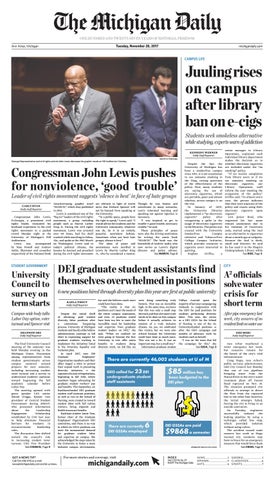
Congressman John Lewis pushes for nonviolence, ‘good trouble’
Leader of civil rights movement suggests ‘silence is best’ in face of hate groups CARLY RYAN
Daily Staff Reporter
Congressman John Lewis, D-Georgia, a prominent civil rights leader, recounted his firsthand experience in the civil rights movement to a packed crowd Monday night at the University of Michigan’s Hill Auditorium. Lewis was accompanied by Nate Powell and Andrew Aydin, illustrator and co-author respectively of the National Book
Award-winning graphic novel “MARCH,” which they published in 2013. Lewis is considered one of the “big six” leaders of the civil rights movement, a group including people such as Martin Luther King Jr. During the civil rights movement, Lewis was arrested over 40 times, had his skull cracked while marching in Selma, Ala., and spoke at the 1963 March on Washington. Lewis said in today’s political climate, the lessons he learned and preached during the civil rights movement
are relevant in light of recent news that Richard Spencer will not be banned from speaking at the University. “In a public space, people have the right to speak,” Lewis said. “I would advise the students and the University community, whatever you do, do it in an orderly, peaceful, nonviolent fashion. Sometimes when you have hate groups, silence is best.” The ideas of peace and nonviolence were instilled in Lewis by Martin Luther King Jr., who he considered a mentor.
Though he was beaten and unwelcome in many scenarios, Lewis reiterated learning and speaking out against injustice is necessary. “I was inspired to get in trouble — good trouble, necessary trouble,” he said. These principles of peace were also the driving motivation for writing the comic book “MARCH.” The book was the brainchild of Andrew Aydin, who now serves as Lewis’s digital director and policy adviser. See MARCH, Page 2
Despite the fact the University of Michigan has been a smoke-free campus since 2011, it is not uncommon to see someone smoking in the Diag, raising questions of the effectiveness of the policy. Now, many students are saying the use of electronic cigarettes, which are portable, quiet and almost odorless, across campus is on the rise. In January of 2015, the University libraries implemented a “no electronic cigarette” policy after recognizing a spike in the usage of electronic cigarettes in the libraries. The policy was created with the University Smoke-Free Campus initiative and Tobacco-Free College Campus Initiative, which provides resources to cigarette users interested in quitting. Stephen Griffes, a
senior manager in Library Operations, explained each individual library department makes the decision as to whether electronic cigarettes are included under the “no smoking” policy. “If we receive complaints from library users or if we see someone smoking an electronic cigarette, our Library Operations staff inform the user smoking the e-cigarette of the policy,” Griffes said. “In almost every case, the person indicates that they were unaware of the policy and ceases using their electronic cigarette upon request.” LSA junior Brad, who requested his last name remain anonymous due to his violation of University code, started using the Juul as an alternative to cigarettes about a month ago at tailgates. Because the Juul is sleek, small and discreet, he said he has used it in the Shapiro Undergraduate Library while See RISE, Page 3
DEI graduate student assistants find University A2 officials Council to themselves overwhelmed in positions solve water
STUDENT GOVERNMENT
CITY
survey on term starts
6 new positions hired through diversity plan this year are first at public university
Campus-wide body talks Labor Day option, voter turnout and Spencer visit
Despite the initial thrill of obtaining paid student diversity labor positions after a contentious bargaining process, University of Michigan students and faculty alike believe administrators continue to fall short in expressing support for graduate students working to implement the initiatives listed in the Diversity, Equality and Inclusion plan. In April 2017, over 250 Graduate Employees’ Organization members and their allies staged a sit-in to protest their unpaid work in promoting diversity initiatives — the capstone of a year of negotiations, beginning in fall 2016, where members began advocating for graduate student workers’ pay and benefits. This September, six Rackham-funded DEI graduate student staff assistant positions, as well as two in the School of Nursing, were created to reward student labor with full tuition waivers, living stipends and health insurance benefits. Rackham student Jamie Tam, former chair of the Graduate Employees’ Organization’s DEI committee, said there is no way in which six GSSA positions can meet the monumental demand for graduate student labor and expertise on campus. She acknowledged the steps taken by the University to foster a more inclusive campus environment,
SHANNON ORS
Daily Staff Reporter
The final University Council meeting of the semester was held Monday evening in the Michigan Union. Discussion among representatives from student governments across campus centered around projects for next semester, including increasing student voter turnout and a survey to understand students’ opinions toward beginning the fall academic calendar before Labor Day. The meeting opened with guest speaker LSA senior Micah Griggs, former vice president of Central Student Government during 2016-17, who presented information about the Leadership Engagement Scholarship established by CSG last year to help eliminate financial barriers for students in extracurricular leadership roles. The discussion then shifted toward the council’s role in increasing student voter turnout. CSG Vice President See COUNCIL, Page 3
GOT A NEWS TIP? Call 734-418-4115 or e-mail news@michigandaily.com and let us know.
KAELA THEUT
Daily Staff Reporter
but said she believes much more could have been done. “The reality is that six positions can’t meet the needs of the entire campus community, and even 23 positions would have been too few to meet the incredible need for leadership and expertise from graduate student leaders on DEI,” she said. “When we realized we were going to become the first University to ever offer union benefits to students doing diversity work, we felt like we
For more stories and coverage, visit
were doing something truly historic. That was an incredible high. At the same time, we knew that this was only a small step forward, and that a lot more work needs to be done on this campus before it actually achieves its mission of a truly inclusive climate. So, yes, we celebrated this victory, but we were also critical because the University could have done so much more. This was not a lot. It was an important step, but a small one.” Information graduate student
michigandaily.com
Vidhya Aravind spent the majority of last year campaigning tirelessly in conjunction with the GEO for paid positions for students performing diversity labor. This year, she serves as a DEI GSSA for the School of Nursing — one of the six University-funded positions — after the GEO campaign and months of advocacy work by students such as herself. “I was on the team that led the campaign for this,” she See GSSA, Page 3
DESIGN BY OLIVIA STILLMAN
INDEX
Vol. CXXVII, No. 37 ©2017 The Michigan Daily
crisis for short term
After pipe emergency last week, city assures of no resident limit on water use ISHI MORI
Daily Staff Reporter
Ann Arbor weathered a water emergency last week, but concerns remain for the future of the city’s vital infrastructure. Craig Hupy, Ann Arbor’s public services administrator, told City Council last Monday that one of two pipelines bringing water from the Huron River to the city’s water treatment plant off Sunset Road ruptured on Nov. 18. The situation prompted city officials to attempt to divert the f low from the ruptured line to the other line; however, the initial attempts failed, forcing the city to bring in an outside contractor. On Tuesday, engineers successfully isolated the leaking pipeline by using a technique called line stop, which provided isolation without using valves. The accident caused some concern last week as Hupy warned city residents may have to brace for an emergency measure that would force them See CRISIS, Page 3
NEWS.........................2 OPINION.....................4 ARTS......................6
SUDOKU.....................2 CLASSIFIEDS...............6 SPORTS....................7
News
2 — Tuesday, November 28, 2017
The Michigan Daily — michigandaily.com
ON THE DAILY: ALL OF ME HATES OSU Acclaimed musician and Ohio-native John Stephens, known to fans as John Legend, lost some University of Michigan fans this weekend by tweeting about his love for Ohio State University during The Game. Legend, who attended the University of Pennsylvania but grew up in Ohio, has not kept his Buckeye love a secret. A 2011 interview with ESPN proclaims OSU stickers cover “almost every inch of Legend’s piano.” However, his Saturday tweet alarmed many of Legend’s fans who side with the maize and blue. “Chrissy asked me how is this a rivalry if Ohio St has won 13 of the last 14. Excellent question,” Legend tweeted. The tweet was in response to a video Legend’s wife, model Chrissy Teigen, tweeted earlier in the afternoon of Legend and their daughter, Luna, dancing
around the living room after rivalries of college football. tweet. OSU scored a touchdown. “I’m a Michigan man but Some fans completely I’m a bigger fan of you so - MAYA GOLDMAN denounced the couple after I’m staying,” Bauer wrote in their tweets, even going so far response to Teigen’s second as to unfollow them on Twitter. Teigen posted a second tweet bemoaning the loss of her own followers because of Legend’s status as a Buckeye fan. Twitter user Cindy Geer similarly worried this had to be the end of her love for the family, and begged Teigen to tweet something proMichigan, or at least something to establish her neutrality. Others, like Twitter user Matt Bauer, stood strong. Bauer proclaimed ARNOLD ZHOU/Daily his allegiance to The Multiethnic Student Affairs and Native American Student Association holds Michigan but decided a discussion on the history and relationships between the University of Michigan his love for Teigen and and the Native American community in Angell Hall Monday. Legend went beyond the
allie a cell @_acell_
U NIVE R SIT Y HISTORY
when ur parents claim umich classes are easy because they got an A when they took it 30 yrs ago <<< john decker @_johndecker my chinese teacher just walked back towards my dorm with me to discuss coffee shops in ann arbor and practice chinese with me...my heart is swelling
CAMPUS EVENTS & NOTES National French Toast Day
Giving Blueday WHAT: Give to any or all of your favorite University-affiliated organizations on the University’s largest day of philanthropy. WHO: HSSP WHEN: All day WHERE: Anywhere in the world!
Frankel + Kelsey: Jews and Artifacts at the Museum
Winnie (2017) WHAT: Join the Department for Afroamerican and African Studies for the next installment of its Diasporic Film Festival. This film focuses on the life of Winnie Madikizela Mandela. WHO: Department for Afroamerican and African Studies WHEN: 4 p.m. to 6 p.m. WHERE: Hatcher Graduate Library, Gallery Room 100
WHAT: Five Frankel fellows from the Judaic Studies Department will discuss five different artifacts from the Kelsey Museum Collection. WHO: Judaic Studies WHEN: 4 p.m. to 5:30 p.m. WHERE: Kelsey Museum of Archaeology
MARCH From Page 1 Inspired the Montgomery Story, a comic book edited by and based on Martin Luther King Jr., Aydin decided Lewis deserved a book of his own. Though Aydin’s idea was a tough sell on the Hill and to publishers, he said the narrative they told is necessary. “We weren’t just making these comic books to tell John Lewis’s story, we were making them because we believed there needed to be a new nonviolent revolution in this country,” Aydin said. These comic books were also made with the hope that education of the civil rights movement could be strengthened. All three speakers agreed the civil rights movement isn’t taught enough at all levels of schooling. Most students, they said, carry on the “nineword problem,” or knowing only buzzwords “Rosa Parks,” “Martin Luther King” and “I Sudoku Syndication have a dream” in the context of
WHAT: Join Bursley and Markley dining halls as they celebrate National French Toast Day. WHO: Michigan Dining WHEN: 7 a.m. to 11 a.m. WHERE: Bursley Hall and Mary Markley Hall
the era. All three speakers agreed the civil rights that required bloodshed to obtain are often taken for granted. They hoped a graphic novel would provide the intimacy needed to appreciate the movement. Powell said in education, many important narratives aren’t included in discourse, especially the messier inconvenient truths of the era that most people don’t want to confront. “(Education) is about seeing actual equality as being in everyone’s interest, and that shouldn’t be a controversial statement.” Aydin said he grew out his beard in an attempt to sensitize people to his Muslim roots. He hoped that in giving people a visual, they would understand more quickly –– he applied that same idea to the comic. Aydin knew that to revitalize a social movement for a new generation in a new world, he would need to use a largely unprecedented platform. He said that giving a complex story continuity with illustrations would keep the
Networking and Elevator Pitch Workshop
2
7
3
9
4
3
5
1
1
6
8
3
3
2
5 8
6
7
3
7
5
2
9
7
1
3
6
7 4
MIDNIGHT MADNESS IS THIS FRIDAY WE CAN. NOT. WAIT! . . . #annarbor #downtownannarbor
WHAT: Come learn how to accentuate the positive leader WHAT: Come to this integrative workshop to develop within yourself, regardless of the role you inhabit, at this interactive a pitch that improves your workshop. networking abilities. WHO: Engineering Human WHO: Rackham Graduate Resources School WHEN: 1 p.m. to 4:30 p.m. WHEN: Noon to 1 p.m. WHERE: Lurie Robert H. WHERE: Student Activities Engineering Center, Johnson Building, Career Center Rooms
Trombone Studio Recital
WHAT: Learn about all the steps you need to take to prepare for the Winter Career Fair, and eat a free dinner. WHO: Michigan Engineering Transfer Support WHEN: 5 p.m to 6:30 p.m. WHERE: Herbert H. Dow Building, Room 1005
WHAT: Professor David Jackson’s students will perform solo trombone works by a variety of composers. WHO: School of Music, Theatre & Dance WHEN: 8 p.m. WHERE: Earl V. Moore Building, McIntosh Theatre
cc: @MainstreetAA @ KerrytownShops
Keith Fore @H8spvmt Love you brother @WiltonSpeight can’t wait to see where you will be a leader next.. all the way to Sunday!!
civil rights movement story from seeming like an unreality. “If we’re going to teach you
420 Maynard St. Ann Arbor, MI 48109-1327 www.michigandaily.com
Education is about seeing actual equality as being in everyone’s interest, and that shouldn’t be a controversial statement
EMMA KINERY
Editor in Chief 734-418-4115 ext. 1251 kineryem@michigandaily.com
NEWS TIPS
NEWSROOM
tothedaily@michigandaily.com
EDITORIAL PAGE
734-418-4115 opt. 3
Managing Photo Editors
ALEXA ST.JOHN
Managing News Editor alexastj@michigandaily.com Senior News Editors: Riyah Basha, Lydia Murray, Nisa Khan, the fundamental lessons of the http://sudokusyndication.com/sudoku/generator/print/ Sophie Sherry civil rights movement, we have Assistant News Editors: Jordyn Baker, Colin Beresford, Rhea to do it in your language.” Cheeti, Maya Goldman, Matt Harmon, Andrew Hiyama, Jen Meer, Ishi Mori, Carly Ryan, Kaela Theut When speaking of “your
ANNA POLUMBO-LEVY and REBECCA TARNOPOL tothedaily@michigandaily.com
Senior Opinion Editors: Anu Roy-Chaudhury, Ashley Zhang, Max Lubell, Madeline Nowicki, Stephanie Trierweiler
BETELHEM ASHAME and KEVIN SANTO
Managing Sports Editors sportseditors@michigandaily.com Senior Sports Editors: Laney Byler, Mike Persak, Orion Sang, Max Marcovich, Ethan Wolfe, Chris Crowder Assistant Sports Editors: Rob Hefter, Avi Sholkoff, Matthew Kennedy, Paige Voeffray, Mark Calcagno, Jacob Shames
ANAY KATYAL and NATALIE ZAK
Managing Arts Editors arts@michigandaily.com Senior Arts Editors: Dayton Hare, Nabeel Chollanpat, Madeline Gaudin, Carly Snider Arts Beat Editors: Danielle Yacobson, Danny Hensel, Erika Shevchek, Matt Gallatin, Naresh Iyengar
MICHELLE PHILLIPS and AVA WEINER
EMILY RICHNER Sales Manager
JUEUI HONG
Special Projects Manager
CAROLINE GOLD
Media Consulting Manager
ADVERTISING
dailydisplay@gmail.com
AMELIA CACCHIONE and EMMA RICHTER
rebler@michigandaily.com
Business Staff
SPORTS SECTION
sports@michigandaily.com
corrections@michigandaily.com
Editorial Staff
Managing Design Editors
ARTS SECTION
arts@michigandaily.com
CORRECTIONS
opinion@michigandaily.com
Editorial Page Editors
Business Manager 734-418-4115 ext. 1241 nathankg@michigandaily.com
photo@michigandaily.com
LETTERS TO THE EDITOR
Managing Editor
NATHAN GUPTA
PHOTOGRAPHY SECTION
news@michigandaily.com
REBECCA LERNER
language,” Aydin was speaking in part about social media, which he said should be able to unify HARD activists in unprecedented ways. Regarding the civil rights movement, now decades old, he said translating the story in a modern way should help inspire organization and unite young activists with Lewis. “What would MLK tweet?” he asked. “What would Gandhi post? You have the capacity to organize on a scale the world has never seen before.” The graphic novels are being used widely in schools and inspired Heidi Morse, University lecturer in the Department of Afroamerican and African Studies, to attend the event. “I’m teaching a course © sudokusolver.com. For personal use only. for DAAS, the Art of RIP TURKEY puzzle by sudokusyndication.com Protest, and I asked my See MARCH, Page 3 Generate and solve Sudoku, Super Sudoku and Godoku puzzles at sudokusyndication.com!
SUDOKU
Ann Arbor DDA @A2DDA
Positive Leadership: It’s in Every One of Us
Get Ready for Your Internship Search
Follow @michigandaily
Tweets
photo@michigandaily.com
Senior Photo Editors: Zoey Holmstrom, Evan Aaron, Alexis Rankin, Zach Moore Assistant Photo Editors: Claire Meingast, Katelyn Mulcahy, Aaron Baker, Sam Mousigian, Kevin Zheng
LARA MOEHLMAN
Statement Editor statement@michigandaily.com Deputy Statement Editor: Brian Kuang, Yoshiko Iwai
ELIZABETH DOKAS and TAYLOR GRANDINETTI Managing Copy Editors
copydesk@michigandaily.com
Senior Copy Editors: Marisa Frey, Ibrahim Rasheed
DYLAN LAWTON and BOB LESSER
Managing Online Editor lesserrc@michigandaily.com Senior Web Developers: Erik Forkin, Jordan Wolff
ABE LOFY
Managing Video Editor video@michigandaily.com Senior Video Editors: Gilly Yerrington, Matt Nolan, Aarthi Janakiraman, Emily Wolfe
JASON ROWLAND and ASHLEY TJHUNG
Michigan in Color Editors michiganincolor@michigandaily.com Senior Michigan in Color Editors: Christian Paneda, Adam Brodnax, Halimat Olaniyan, Tanya Madhani, Sivanthy Vasanthan
ELLIE HOMANT
Managing Social Media Editor Senior Social Media Editors: Kayla Waterman and Anna Haritos
design@michigandaily.com
CAYLIN WATERS Brand Manager
CLAIRE BUTZ
Business Development Manager
JULIA SELSKY
Local Accounts Manager
SANJANA PANDIT Production Manager
The Michigan Daily (ISSN 0745-967) is published Monday through Friday during the fall and winter terms by students at the University OF Michigan. One copy is available free of charge to all readers. Additional copies may be picked up at the Daily’s office for $2. Subscriptions for September-April are $250 and year long subscriptions are $275. University affiliates are subject to a reduced subscription rate. On-campus subscriptions for fall term are $35. Subscriptions must be prepaid.
News
The Michigan Daily — michigandaily.com
THE M E RRY WIVES OF WINDSOR
Alexandria Pompei/DAILY UM Productions crew begins loading the set for The Merry Wives of Windsor at the Power Center Monday.
COUNCIL From Page 1 Nadine Jawad, a Public Policy senior, cited turnout as only 14 percent in the last midterm election on campus in 2014. The University Council discussed how it can contribute to the success of the “Turn Up Turnout” initiative, an on-campus organization working on increasing the University of Michigan’s ranking in the Big Ten Voting Challenge. Jawad also explained how the council should plan to distribute information about the free TurboVote service students can register for to receive reminders about election dates, poll locations and absentee ballot requests. “What a lot of people maybe don’t understand is that our vote means arguably more in a midterm election because that is direct representation for our state,” Jawad said. “We should just want our voices heard from all political ideologies, backgrounds, and identities, but it just seems very lost because students are busy.” The council also discussed a project to a compile a supplemental resource list on syllabi, including information such as Title IX and caregiver resources. Jawad introduced the initiative to include Counseling and Psychological Services resource information on all syllabi took a lot of effort, and she hopes this resource list will be a more realistic solution to help students understand other resources. An update on the pending Richard Spencer visit request was brief ly discussed. Representatives discussed a resolution on the CSG docket scheduled for Tuesday night concerning the body’s position on the visit. The meeting concluded with an update from LSA senior Nicholas Fadanelli, president
CRISIS From Page 1 to limit their water use for two to three days. Though Hupy assured the council that treated stored water would be safe to drink, city officials feared a water shortage may adversely affect residents’ Thanksgiving plans and the football game against Ohio State University. The pipeline leak occurred at a time when Ann Arbor and municipalities across the United States are looking to revamp their outdated infrastructure. For instance, a majority of members on City Council are in favor of relocating the city’s Amtrak Station from Depot Street to Fuller Park, arguing Ann Arbor needs a new station to match projected ridership increases in the future. And repairing Michigan’s nonfederally funded roads, 56 percent of which is in poor condition, is a hotly contested topic in this year’s gubernatorial elections. Nationally, the Trump
of LSA Student Government, who explained the registrar recently sent out two separate academic calendar proposals for the 2020-21 school year. Fadanelli explained the first option proposes the regular start date after Labor Day with
We should just want our voices heard from all political ideologies, backgrounds, and identities, but it just seems very lost because students are busy
fall semester exams ending on Dec. 24, 2020. The second proposal has a start date one week before Labor Day to begin Winter Break earlier. Fadanelli then discussed the results of a survey included in the recent LSA election ballot that concerns the academic calendar. “A little over 900 individuals voted and 70 percent said, ‘Yes, I support starting before Labor Day,’ approximately 20 percent ‘No, I do not,’ and 12 percent said they were indifferent,” Fadanelli said. The remainder of the meeting included the council’s plans for sending out a survey to collect opinions of students from all other University schools to gain an informed opinion before the council drafts a resolution with their position on the academic calendar start date.
administration promised about $1 trillion in infrastructure improvements, but specific plans remain elusive. However, the American Society of Civil Engineers estimated the government would need to spend $4.59 trillion to even reach an acceptable level of infrastructure quality. The United States’s aging bridges, tunnels and dams are in need of repair; already, more than 188,000 people were forced to evacuate after damage was found at the Oroville Dam in California earlier this year. Though the council has not indicated whether the water treatment plant in question would need an overhaul, Hupy estimated creating an entirely new line would cost the city tens of millions of dollars. A project of that size would add to the city’s other priorities like storm water management, road improvements, environmental protection and the projected $85 billion station, if it were to be built. The future of Ann Arbor’s rising infrastructure costs remains to be seen.
RISE From Page 1
studying. “I used to do it very sarcastically, like, ‘Hahaha, I’m smoking my Juul in the UGLi,’” he said. “I think it’s becoming more so acceptable. I see a lot of people Juuling in the UGLi. It’s not that I’m craving it, it’s just that whenever I have it on me, it is just natural to put it to my mouth. When I don’t have it, it’s out of sight, out of mind.” Steve, a University Business junior, also found the Juul to be a useful study aid. The Juul started as crutch to quit smoking cigarettes and marijuana, but shortly afterward became something more.
GSSA From Page 1 said. “I think I was a big part of getting more students of color on board with the contract campaign in general, and then getting a lot of the white students who were already on board with the contract campaign on board with the DEI portion of it. I gave a few speeches and stood up on stage a few times to try to build solidarity around this one issue, and I think that the contract campaign was such a success because everyone was ready to walk out just over DEI stuff — even if we got other things.” Though she is excited about the position and the opportunities it offers — such as free tuition and health care benefits — Aravind noted there are fundamental problems within the structure of the DEI plan that prevent the GSSAs from fully being able implement their ideas within their respective programs. “I’m really glad I get to do this work. If I wasn’t doing this I would be teaching a class I don’t care about. Instead, I’m doing work I’m passionate about, and have health insurance and don’t have to pay tuition — which is a lot. However, DEI feels like an afterthought. DEI feels like it’s glued onto every program instead of being a central mission, and I think that reorganizing the office of DEI and reorganizing the way DEI works is the only way to fix that.” Aravind further emphasized the need for the University to create more GSSA positions to divide the amount of labor more evenly among students. With the current number of GSSAs, Aravind said immense amounts of work often fall upon a small number of people — rather than pushing the entire campus community to foster a more inclusive climate. “Every time there’s any kind of inclusion work it gets put to the GSSAs or to our bosses. There’s too much work for the number of people doing DEI work, and I think that may be true across academic units — it’s certainly true in the units I know about. I wish they would hire more of us. I think that there’s more demand, and there’s more students like me who need funding and aren’t getting it who are really, really capable of this, and I think figuring out how to reorganize labor should be an eventual solution, reorganizing labor so everyone is contributing to inclusion. But, a stop gap would be hiring more of us so less of us are key people for huge piles of labor.” Despite student calls for the creation of more GSSA positions, Chief Diversity Officer Rob Sellers, vice provost for equity and inclusion, said the University is waiting to create more positions
MARCH From Page 2 students to consider attending because John Lewis’s life story and involvement has been important for our course as well as a minicourse I’m teaching.” For Art & Design freshman Leila Mullison, Lewis’s rhetoric held importance outside the classroom and pertains more to campus climate. “I know there have been
Tuesday, November 28, 2017 — 3
“Sometimes (the Juul) just helps me focus; keeps me wired or serves as a little mental extra kick when I’m studying, which is usually in the library. I always have it on me because sometimes it helps with anxiety, so I have it available every time I study, but I probably only use it one of three times,” he said. Kent Berridge, professor of psychology and neuroscience at the University, studies the basic brain mechanisms of desires and full-f ledged addiction. He said e-cigarettes can be as addictive as the generic cigarette if used in similar patterns. However, he noted e-cigarettes may not pose as great of a threat of cancer and lung disease as regular cigarettes do. “E-cigarettes deliver all
the right combination of cues, sensory experiences and pulses of nicotine needed
I am probably addicted. Am I concerned about the health risks?
to be addictive, especially if used in intermittent bingelike patterns that deliver high doses,” Berridge said. “That’s not to say that everyone who uses them will become addicted. There are powerful individual differences in susceptibility to addiction. Many people, and probably
most, who try them will remain able to give them up without much difficulty.” Currently, the main University campus has only banned “combustible tobacco products” according to the Smoke-Free Campus initiative website. All tobacco products, including e-cigarettes, are banned from medical campuses. Brad described waking up after smoking a cigarette as feeling like “rocks on my chest.” The Juul, however, has not had the same effect, making it an attractive alternative, he said. “I am probably addicted, I am addicted. Am I concerned about the health risks? I know that they’re there, but I know it’s a better alternative than cigarettes,” he said.
until there is proof the GSSAs are able to successfully carry out specific initiatives within the DEI plan. “The decision was made as a pilot project to see whether or not we could provide support for GSSAs who are interested in DEI work and whose efforts fit within different schools and college’s DEI plans. It was important that the positions link up with the needs articulated in the specific DEI plans. We also wanted to make sure that the positions provide some educational value to the graduate students who were in the position,” Sellers wrote in an email interview. “As always, the university strives to be leaders and best. We believe that our DEI plan is unique and innovative. In a similar manner, we hope that the GSSA positions will be successful and thus become a model for other universities to follow.” He further explained the importance of evaluating units at the end of the semester and using these evaluations to reforms the program before hiring more graduate students. “At this point, we want to make sure that the program is working most effectively and that there is a demand from the units that is being met, before we consider expanding the program,” he wrote. “We will be collecting some evaluation data from both GSSA’s and the units at the end of the semester to help us assess the success of the program. In particular, we plan to identify those aspects of the program that are most successful as well as those aspects of the program that are in need of reform.” However, despite Sellers’s decision to address the student demands head-on, Tam said she thinks the University is being publicly scrutinized for its response to bias incidents due to delayed administrative response. As student groups have been calling for paid diversity labor for quite some time, she believes administrators should act sooner rather than later in responding to such student concerns. “There are reasons why the University has come under public scrutiny, and why Teen Vogue and other news outlets have been covering not only the racist incidents but the poor administrative response. We need to recognize that there are some really fantastic activists on campus who have been highlighting these issues and doing the work,” Tam said. “Organizers — including Students4Justice, the 4%, Collective Against White Supremacy — have been consistently raising these issues to University leadership and to the broader public for a while.” Tam emphasized the need for more paid student labor and leadership, especially in
the wake of the past year’s bias incidents. “What we realized from these racist incidents and the administration’s low capacity to effectively address them, is that there’s even more need for student leadership and expertise than we thought,” she said. “Student leadership and expertise is so necessary, and recent events have shown how much more effective student leaders are at making the community feel safe than administrators. But student leadership needs to be valued through compensation.” Tam also expressed disappointment in the failure of the DEI Task Force, which she served on this summer, to issue recommendations regarding how to address potential areas for diversity labor on campus. This task force, comprising graduate students and DEI strategic plan implementation professionals, was initially created by the administration to increase graduate student engagement in implementing DEI initiatives. “To date, that task force has not issued any recommendation, and that’s been really disappointing because that task force, which I worked on over the summer and which was part of the original deal back in the spring during negotiations — the University wanted to address this question of uncompensated graduate student diversity labor by convening a task force that would issue recommendation,” she said. “It’s well into November, and those recommendations still have not been pushed forward.” In an email interview with The Daily, Rackham student Jennifer Piemonte, the current GEO DEI committee chair, reiterated Tam’s argument and further explained the need for the University to demonstrate a renewed commitment to the DEI plan. “I would encourage the administration to consider how DEI is a unique arena of service and labor, especially given the recent climate on campus,” she wrote. “The administration should prioritize it in ways that directly benefit people at the Department level: the level where climate is most tangible for individuals in a community.” She affirmed many graduate students willing to do diversity work currently exist, yet do not have the energy or resources to fully immerse themselves without compensation from the University. “For example, graduate students want to commit significant time and energy to DEI initiatives, but cannot afford to do so on top of classes, research, and teaching,” Piemonte wrote. “If the administration wants that labor
(and they should, as the Graduate Student position and perspective are unique and valuable) then we would expect institutionalized policies or positions that serve to free up one area of the Graduate Student’s responsibilities in exchange for DEI labor.” Despite pushback from University administration, Aravind said she believes a substantial amount of support exists among students and faculty for the University to create more paid GSSA positions. During the negotiations last year, 42 organizations and over 1,100 students, faculty and staff signed a petition calling for paid diversity labor on campus. “I think less conversations are happening upstairs about it,” she said. “GSSAs are expensive because tuition and health care are expensive, which is unfortunate, but I think that a lot of ground level support exists and I think that the more and more we can demonstrate our value, the more and more we’ll see slowly more departments hire graduate students for this and realize that these GSSA positions contribute as much to learning environments as GSIs do.” She explained the diverse projects various DEI GSSAs are working on this semester and said she enjoys hanging out with a group of women as passionate about diversity labor as she is. “I’m really excited about the work I’m doing. I’m working on a professional development certificate for the School of Nursing, and developing curriculum, things like that — that’s a lot of fun. I’m really excited there’s a cohort of us, we all hang out together pretty regularly,” Aravind said. “It’s mostly women of color, which is really exciting, that got these positions. We get to hang out, talk about our work together, everyone is doing really cool things.” Ultimately, Aravind emphasized how diversity labor is integrated throughout her everyday life, and she is skilled at this work because of her own lived experiences. Due to this intersection, she believes it is only natural that the University compensates students for their work. “I want to mention there are a lot of us who are very good at this work because of our lived experiences, and that need the help because of our lived experiences, we need the support of these benefits — who also love doing this work and are doing it constantly all the time for free, like teaching people in lounges and in our classes that we’re taking and in every space we occupy. A lot of us just do social justice education, so I think it makes sense to pay for it.”
a lot of events happening around campus and around the country where there’s issues of violence and there’s issues of discrimination. Especially with Richard Spencer coming to speak at the University, I think it’s really important to get knowledge from someone who has lived through things like that and who has lived through peaceful protests and who has expertise in the situation,” Mullison said. LSA junior Nick Eidsmoe
agreed with Mullison and said Lewis’s status as a civil rights legend should help direct young activists. “John Lewis is such a positive figure, and I’m glad he said you can ignore the other side while still respecting their rights and being nice to them,” Eidsmoe said. But even with racial issues prominent on campus, Lewis said, activists shouldn’t become jaded or hateful. Even after experiencing violence on
multiple occurrences, when asked if he feels any differently toward white people, Lewis said he carries no hatred. “I don’t have any hate. I don’t hate anyone or dislike anyone because of what I went through.” In addition to maintaining a peaceful outlook in regard to activism, Powell said a sense of urgency needs to be instilled in young voters. “This is not a drill and it never was.”
Opinion
4 — Tuesday, November 28, 2017
The Michigan Daily — michigandaily.com
EVAN SIRLS | COLUMN
Edited and managed by students at the University of Michigan since 1890. 420 Maynard St. Ann Arbor, MI 48109 tothedaily@michigandaily.com
EMMA KINERY Editor in Chief
ANNA POLUMBO-LEVY
and REBECCA TARNOPOL Editorial Page Editors
REBECCA LERNER Managing Editor
EDITORIAL BOARD MEMBERS Carolyn Ayaub Megan Burns Samantha Goldstein Emily Huhman Jeremy Kaplan Sarah Khan
Max Lubell Lucas Maiman Madeline Nowicki Anna Polumbo-Levy Jason Rowland Anu Roy-Chaudhury
Ali Safawi Sarah Salman Kevin Sweitzer Rebecca Tarnopol Stephanie Trierweiler Ashley Zhang
Unsigned editorials reflect the official position of the Daily’s Editorial Board. All other signed articles and illustrations represent solely the views of their authors.
BEN CHARLSON | COLUMN
T
In defense of my phone
hanksgiving tends to bring out the best and worst in my family. Between the highs of food and football and the lows of long car rides and uncomfortable sleeping arrangements, we get in our fair share of arguments during the holiday. Yet out of all our bickering, the most frequent debate is over cellphone usage — a conversation that typically results in my parents yelling at me for my phone obsession and me defending my behavior, an effort that proves futile nearly every time. I’m addicted to my phone. I will always be the first to admit it, and those around me often know it’s true. Facebook, Instagram, Snapchat — you name it, I’ve probably checked it within the past five minutes. I’m also aware there are places and times when being on the phone is not appropriate; the classroom and the dinner table are two where I restrict my otherwise impulsive desire to refresh every form of social media possible. But I also believe that for college kids like myself, going through an instrumental and challenging time in our lives, the cellphone holds more value to us than those from older generations might imagine. And parental criticism of our phone usage, during a time when technology is at the forefront of education, science and communication, is a generational conflict with no easy solution. My parents, much like many others, scold my phone obsession as if it is analogous to nicotine addiction. In some ways, they are right — my phone is the first thing I check when I wake up and the last thing I see before I go to sleep, like cigarette smokers who need their final drag before they can call it a day. My Snapchat streaks are imperative to my well-being, and no email or text can go unread for more than a minute after I receive it. The joy I get from a Facebook notification parallels that of receiving a good exam grade or a call from my parents — and don’t get me started on Twitter. Exaggerations? Maybe. But the truth of the matter is that social media is an
addicting platform, especially for millennials who grew up during the heart of the world’s technology revolution. The instant gratification supplied by notifications and texts, piling up constantly through different media outlets, is a biological desire backed by the dopamine receptors in our brains. We crave the euphoria of an Instagram “like” or a retweet on Twitter, so we check back again and again to see if we have another. But apart from our biological tendencies toward phone addiction, which the same could be said for computers, video games or gambling, I argue that the cellphone is an important internal stabilizer for many kids like myself who see college as an uneasy and complicated time. When I traveled from Chicago to Pittsburgh for Thanksgiving last week, I felt the urge the check my phone more often than normal. With work to do over the break (thank you University of Michigan professors), home friends being together without me and a decision over whether I should return to school early looming in the back of my mind, general stress felt like a rain cloud above me during an otherwise enjoyable week. So, I turned to my phone. I’ve found that communication during times of high stress can be key to relieving that underlying anxiety. Though some people would call my desire to talk to those not physically present “FOMO” (fear of missing out), I think that interpretation undermines the benefits of long distance, immediate communication. There is comfort to be found in friendships where contact is constant and quick — our phones happen to supply a vessel through which we can strengthen these bonds, especially important when they provide an outlet for stress relief. Research shows that 1 in 6 college students have been clinically diagnosed with anxiety. However, there is no doubt that the other 5 in 6 students are struggling with some form of social or academic stress, though they might not report it to a doctor.
JOE IOVINO | CONTACT JOE AT JIOVINO@UMICH.EDU
When we are away from home, grappling with a homework problem or simply in a mental funk and anxieties are running high, a Snapchat from a close friend can go a long way. Late night FaceTimes are common among my friends — to see a friendly face in a difficult time can make all the difference. Given all these benefits, why are our parents so critical? Though there is no singular answer, I think a clear culprit lies in the generational and technological divide that separates college kids from their elders. “When I was a kid, we didn’t have cellphones,” is a phrase I hear from my mom frequently. Judging our phone usage from an outsider’s perspective is frustrating and frankly unfair. I’m more than happy to accept criticism from a friend who thinks I’ve been on my phone too much recently. But I find it much harder to accept from my mom or dad, who didn’t experience the power a cellphone can have during the uncertainty of young adulthood. Who is to say that our parents’ generation wouldn’t care about group chats or Snap Stories given the opportunity? In fact, I’ve seen an increasing number of parental Instagram accounts since entering college — a possible sign that the generational gap might be closing. When I return home for Winter Break, I’m sure that the debate over phone usage will continue. To my parents’ enjoyment, I’ve made strides to quit my phone obsession — a suggestion from a close friend to change my screen to black and white made checking social media a lot less appetizing. Vibrate and ringer are now always off, and group chats are generally muted. But there are more times than not where I will defend my addiction and the genuine benefits I get out of my iPhone. Staying in touch through cellphones is now more important than ever — a prospect that may take some time for older generations to grasp.
Ben Charlson can be reached at bencharl@umich.edu.
I
You talkin’ to me?
was having a conversation I give myself a pep talk in the with some friends the other mirror and prepare myself for a day when suddenly Susie real conversation. — these are fake Unfortunately, names for the sake of this is not a problem anonymity — said to unique to me. In 2015, John, “You know, I the average American think I’m going to put sent and received you on my call list.” five times more texts “What’s a call list?” than phone calls in a I asked, jealous that I day. For millennials hadn’t been offered to in particular, a be put on it myself. survey found that 75 “It’s a list of percent would rather EVAN people I call on the text than receive or SIRLS phone whenever I make a phone call feel like talking and having a because it’s easy, convenient, conversation,” Susie replied. less stressful, less invasive and “Wait, you call people? And superior to voicemail. talk to them?” I asked in a mix of Though texting offers a certain bewilderment and disgust. “Why level of comfort, it has its flaws. not just text them?” For those who are antisocial like At the time, I thought that myself, texting fosters our ability Susie was crazy. In this day to be antisocial. It’s impersonal and age, why would anyone be willing to put themselves through actual, real-time human interaction? Talking to someone is hard. It requires quick thinking, adept skill at feigning interest in the other person, actively planning transitions to carry on the conversation and the occasional awkward silence. I think that my aversion toward talking to people on the phone stems from my integration into a social mediadominated society in which and eliminates the small talk, regular personal interaction is formalities and awkwardness becoming increasingly scarce. of a real conversation. But these When someone other than are all the aspects of human immediate family decides to interaction that make them give me a call, I’m caught off human rather than robotic, and guard and subconsciously view allow people to build up the it as invasive. What could they skills necessary to make real possibly want that they can’t conversations desired rather communicate with me over than dreaded. text? The first thought that goes Additionally, smartphones through my head is, “They better have blessed us with the have lost a limb.” ability to simply hide behind Once I eliminate this as a a keyboard. With texting, one possibility, I have an internal isn’t as sympathetic toward war about whether to pick up other’s emotions because the phone. After shedding a few they’re nothing but a screen. For drops of sweat, I finally decide example, it’s much easier to turn to answer. If I text, “What’s up?” down someone’s invitation for in 10 minutes, they’ll know that dinner when it’s over text instead I avoided their call. Therefore, of a call. Perhaps texting’s most
Though texting offers a certain level of comfort, it has its flaws.
frustrating quality, however, is its evolution into another tool for procrastination. People have no problem pushing texts aside and answering them whenever time is available — whether it be minutes, hours, days or even weeks later. Unlike texting, calling someone on the phone is personal and can establish a bond that would otherwise be difficult to establish through the digital curtain. Talking to another human being allows for that crazy phenomenon of actually hearing a laugh rather than reading a typed out “lol” or “haha.” It allows for the identification of tone and emotion that cannot always be accurately represented through emojis. I’m not saying that people should make calls whenever they need to get in touch with someone. That would be impractical. Texting will most likely always remain my preferred and primary mode of communication. However, I’m ashamed that the concept of “calling” has become so foreign to me — and it appears that it has become foreign to others as well. I know it seems like a lot of work, but talking to friends on a regular basis outside the realm of texting could help to enhance relationships. Believe it or not, some people still value verbal communication and view it as a sign of respect. With these thoughts in mind, following my conversation with Susie and John, I decided to take a leap of faith and give one of my friends — let’s call him Mike — a call just to catch up. The phone rang for about 10 seconds but eventually went to voicemail. I hung up my phone and was about to put it in my pocket when I got a text from Mike. “What’s up?”
Evan Sirls can be reached at esirls@umich.edu.
ROI LIVNE | OP-ED
I
University dodges responsibility
n 1954, the U.S. Supreme Court ordered the desegregation of public schools in the country. Yet Jim Crow advocates knew how to push against the letter and spirit of the law, drawing on the power of local government. In order to win their most basic civil and human rights, African-American leaders and their allies had to repeatedly appeal to the Supreme Court, whose rulings bore far less power in the South than local sheriffs’ batons and attack dogs. Northerners, of course, had their own strategies to maintain segregation: moving to the suburbs, sending their children to private schools and suffocating public education funding, allowing people of color minimal opportunity to join universities like ours. But when it comes to the civil rights of neo-Nazis, abiding law and protecting its letter (not spirit) obsessively is almost always the default. In 1978, the American Civil Liberties Union defended neo-Nazis’ right to march in Skokie, Ill., a Chicago suburb where a large community of Holocaust survivors resided. They did so in the name of free speech, of course. Now, the University of Michigan Board of Regents has reluctantly began work on scheduling Richard Spencer’s talk on our campus. Spencer rose to public consciousness after the 2016 elections, when he was filmed in Washington, D.C., yelling “Hail Trump!” and toasting to Nazi salutes from a crowd of supporters. His speech at the event included statements such as “To be white is to be a striver, a crusader, an explorer and a conqueror” and “We don’t exploit other groups. We don’t gain anything from their presence.” His corollary political agenda — a “peaceful ethnic cleansing” of non-white and non-Christian people from the United States — all but mirrors the German Nazi Party’s agenda from the early 1930s. The murder of Heather Heyer in Charlottesville, Va.,
last August is testimony that he and his followers do not only speak violence: They practice it. Here is University President Mark Schlissel’s response, in a letter explaining why the administration would let Spencer speak in campus: “a democratic society without free speech is unimaginable.”
Allowing Spencer to speak would give him no less attention. Schlissel is misrepresenting the substantive meaning of free speech. Rejecting Spencer would not take away his right to speak freely, but only deny his request for a microphone and stage in a specific university — something that the First Amendment does not explicitly protect. Spencer, unfortunately, will continue speaking freely throughout the country: Neo-Nazi websites give him better access to free speech than most of us will ever have. It is also hard to understand how letting Spencer speak will achieve anything like protecting democracy. We are left with Schlissel’s second reasoning: “we are legally prohibited from blocking such requests based solely on the content of that speech, however sickening it is.” I am not a legal expert, and I trust that Schlissel receives excellent legal advice. It is unsurprising that U.S. law prioritizes neo-Nazis’ right for a stage and microphone at a public university over the safety of this university’s community. It may also be the case, however, that a viable legal strategy exists, since other universities chose a different path: Michigan State University, Ohio State University, Penn State University, the University of North Carolina and Auburn University denied
Spencer’s requests. Their leaders made Spencer work harder to propagate hate and violence, though not as hard as white supremacists made civil rights advocates work for racial equality. And what if Spencer wins in court? Appeal. And if he wins in the Supreme Court? Ignore the decision. Show your utter contempt of court and willingness to resist a law requiring universities to give microphones and stages to violent neo-Nazis. Lock buildings’ doors and shut off power. Instruct campus police to arrest Spencer and his followers for disturbance of peace if they show up. Let Trump send U.S. marshals to escort Spencer to his lectures, Ruby Bridges style. You can do it as a university president. Public officials in the South had done similar things, and it will clarify who stands on which side of history. President Schlissel’s last argument was that “denying the request would provide even more attention to the speaker and his cause and allow him to claim a court victory.” This is a fair point, but a week after the board’s decision, it seems clear that allowing Spencer to speak would give him no less attention. He can also claim victory in a battle he won without fight. Schlissel recommended that students “ignore” Spencer, “deprive him of the attention he needs to survive and deny him the crowds he craves.” Spencer’s crowds, however, are not from our university: He brings them from the outside. They could march in our streets with hoods, torches and swastikas, and they might murder — all things they did in Charlottesville. Some students will counterprotest. Others will lock their doors, shut their windows and follow the news with fear. But respectfully, I do not think anyone can expect them to ignore that neo-Nazis are coming to our city. Roi Livne is an assistant professor of Sociology.
The Michigan Daily — michigandaily.com
Arts
ALBUM REVIEW
5 — Tuesday, November 28, 2017
FILM REVIEW
ONE LITTLE INDIAN
FOX SEARCHLIGHT
Björk seeks a new ‘Utopia’ ‘Three Billboards’ is as humorous as it is somber She comes to this world with a newfound maturity, of Daily Music Editor course. Björk has not forgotten that pain, and though her wounds have healed, they have In the first still scarred. Utopia month of 2015, “Losss” and when, in Iceland, “Sue Me” are the Björk the moon is out saddest she gets One Little Indian longer than the on Utopia, and sun, Björk’s sonically, they eighth studio could fit easily album Vulincura was leaked. on Vulnicura. Arca — who has The album, like the season, is co-produced nearly all of these bleak and devastating. It’s a tracks — is clearly present powerful expression of trauma here, using his trademark by the avant-garde artist, the industrial blasts and booms musical accompaniment to a to evoke feeling. These songs breakup that left her lost, angry sound similar to his sophomore and distraught. This was her album, Mutant, a primal first pairing with Venezuelan scream of a work. Björk’s experimental producer Arca, softer voice cushions the effect a master of dark soundscapes, though. There’s anger on these and the two plunged into the tracks, and loss, certainly, but depths on Vulincura, creating Björk tries to push into happier a work that seethed with pain territory, using delicate harps and screamed at the one who wronged her. The Reykjavik-based talent thrives on consistent unpredictability. But Vulnicura still stands out as the moment when all the peculiarity became clear. It was a watershed, and for the first time in a decade her feelings were more powerful than the disguises under which she so often hides. On that album, she breaks free, naming her suffering more plainly than ever: “My soul torn apart / My spirit is broken.” These are the words of someone who has exploded and has just begun to assess the pieces. Björk, though, is not just anyone, and if we’ve learned anything from the era of reality television and celebrity breakdowns, it’s that suffering for the famous is never a personal affair. The public must have its share. Björk elaborated and flute choirs to frame Arca’s on this in an interview with Id run wild. The conflicts The Guardian, in which she that unfold here, this tension discusses guiltily drinking between her past pain and champagne after a particularly her more current optimism, morbid show, the audience makes these two of the most in complete tears while she, fascinating tracks on Utopia, rather than emotional, was especially sonically. simply drained. The show, and Because of the scars from by extension the pain she once her past, Björk is, in turn, felt, was no longer for her, but both more cautious and more the audience. The title of that loving. There is just no time to album, Vulnicura, is translated not fall in love with the mist, to “Cure for Wounds,” and to not throw herself entirely perhaps nearly three years in, into these flirtatious games — sitting with and touring those because they might be gone in songs, she found the release a moment, and she knows what they aimed to provide. it’s like to be without these That release of pain seems small joys. She knows what to be the thesis of Utopia, her it’s like to walk the street and ninth studio album. This is think of nothing but her own an album about rediscovery, hurt, retreating into herself when your open cut finally but wanting to be free. On heals and you begin to let “Stonemilker,” the opener to yourself try and fail again. Vulincura, she wonders, “And The result is nearly childlike, if one feels closed / How does sometimes teenage, as she one stay open?” On Utopia, she remembers the excitement of answers this question, forcing new relationships. The small herself out into the world moments are enormous on again. Her first single, “The this album, and even the most Gate,” offers the most direct minimal of flirtations can leave response: “My healed chest her on cloud nine. On “Arisen wound / Transformed into a My Senses,” the opener, a kiss gate / Where I receive love realigns her entire cellular from / Where I give love from.” makeup. The first verse of Her wound has now become “Body Memory” is full of her weapon, and though she forceful assertions about the has moved past it in so many beauty in the world: “Adore ways, she keeps it around as a this mystical fog! This fucking reminder for the future. mist!” These are experiences — This means looking worlds of feeling — that she may outwardly, too, which she does have once known, long ago, but aptly. She sees her own breakup that she lost somewhere along reflected in broader societal the way. Never on Vulnicura did issues, and, as a mother of two, she take time to love the mist. she uses this as an opportunity Here, she claims it back, and for teaching. This is her chance with vigor. Utopia is obsessed to do what she can to change with the thrill of finding these the tide. The track “Tabula feelings again. Rasa” (a Latin phrase meaning MATT GALLATIN
[Björk] sees her own breakup reflected in broader societal issues, and, as a mother of two, she uses this as an opportunity for teaching
“blank slate”) offers such a lesson to her children. Björk knows she can’t save them from the world, acknowledging that they’ll “have to deal with shit soon enough,” but she can help them, and so she warns against the fuckups of fathers, the pointlessness of following anyone’s footsteps but your own. For Björk, that nonconformity has implications that extend beyond her own personal life and the lives of her children. Utopia, subtly but importantly, is also a protest album for women as a collective, and she sees the struggle against assimilation as inherently tied to the struggle of women trying to carve their own way against the barrage of men who abuse their power and privilege. In a recent Facebook post, the often otherworldly musician gave her own personal narrative in light of the wave of women telling their stories of injustice by men in power. She wrote that after a troublesome relationship with a Danish director, “i became aware of that it is a universal thing that a director can touch and harass his actresses at will and the institution of film allows it.” With Utopia, she attempts to reclaim that identity; one which she often subverted, as she embraced a genderless aesthetic at least partially to protect herself. She turns this around, personifying music as clearly female on “Saint,” calling songwriting her matriarchal savior, one who “has entered me thousandfold often.” In the more aggressive “Sue Me,” she sings blatantly about the lawsuit her husband filed against her, seeing it as a continuation of disrespect for women: “He took it from his father / Who took it from his father / Who took it from his fathers.” This is laid bare over enormous, angry production, with bass that fills the room and demands attention. It’s classic, peak Arca, who is perfectly suited for such a rebellious sound. The producer has made a career of responding to traditional masculinity with grotesque, powerful FuckYous — two foot heels and an unapologetic queerness. This is a lot for a single album to tackle: renewed optimism, minuscule appreciations, continued loss, female empowerment. Björk has always aimed for the grand, and she goes for it here, and often does it well. But the problem with a non-narrative album which has so many competing ideas is that it can become overwhelming, even confusing, and Utopia certainly has moments when it’s not entirely sure where it’s stretching. Sonically heavier tracks like “Claimstaker” can feel at odds with the prior wispiness of “Arisen My Senses” and “Utopia,” and there lacks a story or a transition to bring it together in the same way that Vulnicura manages. Of course, Björk doesn’t really care about simplicity or clarity in her music, and there’s a certain joy as a fan in trying to decode the complexity. This album is as fleeting as the artist who made it. It confounds and frustrates. And still, it calls the listener back, if only to try to figure out the puzzle, destined to be unsuccessful.
situation and the respect he garners in Ebbing, Mildred’s insistence Daily Arts Writer despite his illness only escalates the town’s anger at her. Officer Jason Dixon begins as an Martin McDonagh’s (“Seven unprofessional bigot who abuses Psychopaths”) dark comedy his role as law enforcement. His “Three Billboards Outside Ebbing, history of profiling black citizens Missouri” captures anger with and violent outbursts makes a simultaneously humorous and him an unlikely anti-hero. Yet heartbreaking McDonagh weaves touch. Mildred the transformation “Three Hayes (Frances of Dixon into the McDormand, “Hail, story so smoothly Billboards Caesar!”) puts up his transition from Outside Ebbing, villain to sidekick three billboards Missouri” denouncing the feels seamless. local police’s Much of this Fox Searchlight incompetence after seamlessness is her daughter’s rape owed to Rockwell Michigan Theater and murder goes who has previously unsolved. This bold collaborated with move turns the town, the police McDonagh and Harrelson in and Mildred’s family against her. “Seven Psychopaths.” In “Seven Her grieving son Robbie (Lucas Psychopaths,” Rockwell plays Hedges, “Manchester by the Sea”) a similarly neurotic and violent and abusive ex-husband Charlie character. However, in “Three (John Hawkes, “Winter’s Bone”) Billboards” he adds another both implore her to drop the cause, dimension that catapults the role of but Mildred presses on fueled by Officer Dixon to his best so far. her unabiding anger. While Rockwell’s performance McDonagh’s brilliant script deserves applause, McDormand’s balances multiple storylines to build no-nonsense attitude and biting a complete universe within the film. sarcasm carries the film from Not only is Mildred’s perspective beginning to end. Although explored, but also those of Chief Mildred engages in questionable Bill Willoughby (Woody Harrelson, methods, the determination “Now You See Me”) and Officer and grit McDormand so clearly Jason Dixon (Sam Rockwell, “The projects makes her character the Way, Way Back”). Willoughby is one to root for. McDormand also the target of Mildred’s billboards. switches impressively from humor However, he is sympathetic to her to drama in the blink of an eye. One mission and, ultimately, distracted moment she delivers a stinging by his terminal cancer diagnosis. jab at Officer Dixon and the next Due to Willoughby’s unfortunate she sobs beneath her precious MEGHAN CHOU
billboards. McDormand expresses Mildred’s anger in many forms from impeccable monologues to physical humor. The talented cast and wellwritten script make “Three Billboards” one of the best films of the year. Not enough praise can be given to the actors. However, the billboards themselves should not be overlooked. These three signs serve as a character themselves: always
McDonagh’s brilliant script balances multiple storylines to build a complete universe within the film
present and motivating conflict. The directness of these billboards in detailing the frustration of a mother seeking answers to her daughter’s tragic death echo the breakneck speed of the plot. “Three Billboards” never slows down, never lets go of its angry engine and never breaks its hold on the audience’s attention, even after the credits roll.
TV NOTEBOOK
Black Friday & television MORGAN RUBINO Daily Arts Writer
Ah, Thanksgiving. The beloved American holiday where we celebrate being grateful, stuffing our faces with as much food as humanly possible and sitting in front of the TV for 10 hours straight. In my house, gathering around the TV has become as big of a Thanksgiving tradition as breaking the wishbone and dodging the annual, “So, do you have a boyfriend yet?” interrogation session from grandma. I have vivid, joy-filled memories of waking up a few hours earlier than normal, turning on the Thanksgiving Parade and being joined — slowly but surely — by the rest of my family in the living room. After Santa officially rings in the holiday season and closes out the parade, my brother hijacks the remote and switches to the football game, where the entirety of the state of Michigan gets revved up just to watch the Detroit Lions lose (again). This is the part where I usually retreat to my room, having minimal interest in the game more than finding out which pop star would be singing the National Anthem this time around. Staying very on brand, I use this escape to indulge in some of the Thanksgiving-themed TV greats, ranging from the
quintessential “A Charlie Brown Thanksgiving” to the treasured “Friends” episode when Joey gets a raw turkey lodged on his head. Once most of my family makes their way into the kitchen to prepare for the future feast, it becomes my rightful time to be in control of the remote. Admittedly, I stay back and flip on the National Dog Show (which the rest of my family loves to hate), but come on, who could possibly resist the opportunity to gawk over a pageant of puppies? And finally, after a long day of stress-cooking and the consequent stress-eating, the whole family once again returns to the living room as the TV adds essential background noise to our night of storytelling and pie eating. Year after year, the familiarity of the Thanksgiving TV lineup has been a central uniting and calming factor of an otherwise chaotic holiday. But Thanksgiving TV has changed in recent years — and not for the better. I can’t help but notice more and more Black Friday advertisements taking over the airwaves and rudely interrupting that regimented family viewing time. Shouting voices announcing “Black Friday Doorbuster Sales” and “50% off the entire store!” Fluorescent lettering and strobe light effects. Sirens and explosion sounds. Now, yes — mission accomplished — those ads have surely captured the attention of millions. But the frequency and
overall loudness of Black Friday commercials not only annoyingly impedes our regularly scheduled programming and familial bonding, but also perpetuates a harmful holiday message. After all, nothing says “Happy Holidays” quite like ditching Thanksgiving dinner to line up outside of the mall and fist-fight a stranger for the last flatscreen on the shelf. Black Friday has become its own “holiday” of sorts, except it celebrates consumerism, retail rage and the art of snagging a deal. In the days and even weeks leading up to Thanksgiving, our inboxes, screens and minds are infiltrated by ads encouraging us to jumpstart the holiday season by opening our wallets, defeating the true purpose of the most wonderful time of the year. Not only does Black Friday completely overflood and drown out media in November: I also see it as gradually working to make Thanksgiving go extinct. With retailers opening earlier and earlier on Thursday and the demand for the hottest big-ticket items growing, Black Friday has begun to cut the Thanksgiving festivities and memories short for both consumers and the sacrificing employees who have to handle the feisty squads of shoppers.
Read more at MichiganDaily.com
6 — Tuesday, November 28, 2017
Arts
The Michigan Daily — michigandaily.com
COMMUNITY CULTURE PREVIEW
Dr. Awdish to speak on medical life at Literati Health System’s Medical Director of Care Experience. In her novel, she details the events following her arrival at Ford as a patient, pregnant I’ve grown up around and near-fatal. Losing her more than my fair share of child and clinging to her own doctors. My grandparents, my life, Awdish recounts the ways cousins, my mom — they’re in which her profession both all in medical professions, saved and failed her. and they’ve all “It really taught me more changed my Literati about empathy perspective of presents Dr. than anyone how healing else ever could. happens,” Dr. Rana Awdish’s I think there’s a Awdish said in a “In Shock” misconception phone interview that all with The Daily. Thursday, physicians are “Before I got November 30 @ 7 detached or sick, I thought p.m. indifferent to the it was just about humanity of their the medicine and Literati Bookstore careers, despite the treatment. Free the profession After I got sick, lending itself to I realized how being one of the much healing most compassionate, human really needs to happen in the ways of going through life. context of the relationship. In her book, “In Shock: Although the healing potential My Journey from Death to of medicine is remarkable, it Recovery and the Redemptive can’t function in a vacuum.” Power of Hope,” Dr. Rana She ref lected on hearing Awdish details this gap — the phrases like, “she’s trying to cavity that exists between die on me,” and the moments what practicing medicine in which she realized that the can be versus what it often failures happening to her as a is. It’s a first-hand account of patient were her own failures her switch from physician to as a physician as well. dying patient. Striking in its “We get the clinical sentiment and unf linching aspects of care right, but our in its honesty, the novel patients can end up scarred is a roadmap for medical by our words and how we caregivers, telling a story communicate,” she said. that’s all too familiar yet hasn’t In sharing her experience, been properly listened to. Dr. Awdish hopes to tap into Dr. Awdish currently the human aspect of medicine works as the Director of the that’s often overlooked. Pulmonary Hypertension “The hospital that I work Program at Henry Ford at, Henry Ford, had asked Hospital in Detroit, and she me to speak at the National was recently named the entire Sepsis Day (in 2014),” she ARYA NAIDU
Daily Arts Writer
remembered. “They really wanted a patient’s perspective on sepsis. Sepsis was one of the conditions that I had had, and I realized when I was preparing the talk that everything I wanted to say was really about communication.” She notes the turning point in which she knew she needed to put pen to paper. “When I did that presentation in front of my hospital, I put words on the screen of things that I had heard. That was really the moment that I realized there was value in telling the story,” Dr. Awdish ref lected. “So many people approached me afterwards and just had similar stories or times when they were providing care that they didn’t feel went well, and they carried so much guilt about that.” Dr. Awdish still has faith in medicine. This conviction is part of what makes her story so compelling, so resilient and so inspiring. She understands the inherent benevolence of medical professions, and she understands the work that needs to be done to preserve it. “I still think that medicine is one of the most beautiful career options that exists,” she said. “There’s a lot of talk about burnout in medicine, and that it’s not how it used to be, but it’s still one of those magical places where science and humanity and people really come together in a beautiful way.” Coming to discuss “In Shock,” Dr. Awdish will speak at Literati this Thursday at 7 p.m.
BOOK REVIEW
‘Future Home’ an eerie look at our possible future relationships with her adoptive and birth families and her Daily Arts Writer romance with her baby’s father. Let’s get this out of the way: if the plot sounds familiar, that’s No matter where on the because it is. It’s eerily close political spectrum you land, to Margaret Atwood’s “The we can all agree that the last Handmaid’s Tale,” fresh in the two years have been chaotic at popular consciousness after best and, at worst, downright Hulu’s successful adaptation terrifying. The for TV earlier this line between year, which also “Future Home truth and lies has speculates about been increasingly the subjugation of of the Living and deliberately women following God” blurred, the a natural disaster validity of both that reduces Louise Erdrich the free press and reproductive November 14 the government viability. But has been called this isn’t to say Harper into question and that Atwood the stakes for fans should skip continued human existence on Erdrich’s version altogether; this planet have never seemed what “Future Home of the higher. That’s some heavy stuff. Living God” lacks in originality However, there’s a glimmer of of plot, it makes up for in a light at the end of the tunnel: clear-eyed understanding of 2017 has been manna from our current sociopolitical and heaven for dystopian fiction environmental circumstances, writers and fans. Louise an intersectional focus on Erdrich’s latest novel, “Future feminist issues and Erdrich’s Home of the Living God,” comes remarkable compassion for at a perfect time, when our human power and frailty. day-to-day routines are forced “Future Home of the Living to coexist with a moment of God” offers what feels like it profound social, political and could be an uncomfortably existential anxiety. on-the-nose portrait of life at “Future Home of the the end of the world. Erdrich is Living God” tells the story a staunch realist; what makes of Cedar, a woman of Ojibwe her dystopia so terrifying is that descent adopted at birth by it’s also so plausible, even in its white Minneapolis liberals. most outrageous aspects. The Cedar discovers that she’s foundations of her vision of the pregnant at the same time apocalypse — the takeover of that evolution begins to move fundamentalist religious sects in rapidly backwards for all of the mainstream politics, the hyperearth’s organisms, including legislation of women’s bodies humans, and pregnant women and the cultural understanding are claimed as property of the of pregnant women as public state, hunted down and forced property, and the progression into hospitals and prisons. To of climate change past the protect herself and her unborn point of no return — are all child, Cedar must go into hiding so predicated on reality that as she navigates her shifting her more outrageous claims JULIA MOSS
— the reversal of evolution, disembodied voices and government omniscience — all feel disturbingly unremarkable. Erdrich’s dystopia is even more plausible because of the way it acknowledges racism as an undercurrent in the disintegration of society (an element that is notably less prevalent in “The Handmaid’s Tale”). For example, people of color disappear from the media almost overnight, and the unborn babies of white parents are prioritized over all others. Perhaps the most unnervingly realistic element of the novel, however, is the way that the end of the world seems to be happening in the background as many elements of normal life carry on. Erdrich writes, “This is how the world ends, I think, everything crazy yet people doing normal things.” Erdrich fuses this with an understanding of how privilege can, for a time, shelter some people from the events of the apocalypse more than others. Cedar is aware of the fact that, in the enclave of her white, wealthy family she is able to ignore events that are apocalyptic for more vulnerable people. In this way, Erdrich offers a compassionate criticism of the way many of us cope with global tragedy and change in our own world. Ultimately, this is a novel not only about the end of things, but about beginnings: birth in the midst of death, life moving forward even as evolution moves backwards. Erdrich’s comfort with this ambiguity, and her ability to see her characters both critically and compassionately, make “Future Home of the Living God” a valuable contribution to the growing canon of dystopian fiction as we move into a brave new world.
FILM REVIEW
POLISH FILM FESTIVAL
‘Afterimage’ skillfully tells of an artist’s tragic story been overtaken by communism. The only art that the regime Daily Arts Writer allows is socialist realism that promotes the ideals of the political goals of the republic. The famed Polish filmmaker Strzeminski vocally opposes Andrzej Wajda (“The Promised the regime’s stronghold on Land”) was often regarded as artistic freedom and creative “Poland’s man of memory.” His expression leading to a series of films depict life in Poland with a hardships imposed on him by keen eye, detailing the government struggles from that the artist “Afterimage” World War II to must overcome, Polish Film Festival the Cold War. but not at the The last film he expense of his Michigan Theater made before his individuality. The death was also regime gets him the last screening at this year’s fired and bars him from any job Polish Film Festival at the in an artistic field, leaving the Michigan Theater. “Afterimage” artist impoverished, starving (“Powidoki” original title) tells and sick with tuberculosis. the life story of the avant-garde The artist that once held painter Władysław Strzeminski, court with modern art geniuses who lived in communist like Marc Chagall, Wassily Poland and stuck to his artistic Kandinsky and Kazimir individuality despite political Malevich died with little to obstacles. nothing in his name, aside from Strzeminski (Boguslaw Linda, the work that escaped the hands “Blind Chance”) is a crippled of the communist regime. While artist living in post-World War II Strzeminski proves his talent Poland and teaching at the Lodz as an artist and teacher, he fails school of art. Sometimes the film at raising his young daughter feels like an extended art history from his marriage to fellow class with long-winded speeches artist Katarzyna Kobro. Their by Strzeminski accompanied by daughter, Nika (Bronislawa a handful of eager students. He Zamachowska, “Persona Non poses philosophical questions Grata”) spends most of her time on the meaning of art while his on screen taking care of her fanclub of students worship father and warning him that he the ground he hobbles on. smokes too much. However, the While Strzeminski preaches his young actress perfectly captures philosophies on art, Poland has the curiosity and responsibility BECKY PORTMAN
Classifieds
that Nika must take on as the daughter of a sick, dying mother and a distracted, handicapped father. A poignant moment in the film occurs when one of Strzeminski’s former students comes back to visit him. She is a Polish Jew, a survivor of the atrocities of the Holocaust who is fleeing to Israel. She asks her teacher if she can take with her the collages he made between 1945 and 1947 titled, “To my Friends the Jews.” The series captures a unique perspective of an observer with a guilty conscious. The collages are laid out for the viewer to take in, a beautifully tragic array of morbid photographs of death camps and skeletal corpses and Strzeminski’s famous squiggles. Hania, Jennifer Lawrence’s Polish doppelganger, is played with passion and endearing naivete by Zofia Wichlacz (“Warsaw 44”). The young artist is desperately in love with her teacher and decides to type his work into what is now known as his revolutionary magnum opus, “The Theory of Vision.” Wajda’s last film is certainly a testament to his work as a historian and filmmaker alike. The film provides a much deserved look at an underrepresented time in Polish history and a man, like Wajda, who put his art and integrity before everything.
Call: #734-418-4115 Email: dailydisplay@gmail.com
RELEASE DATE– Tuesday, November 28, 2017
Los Angeles Times Daily Crossword Puzzle
FOR RENT
Edited by Rich Norris and Joyce Nichols Lewis
ACROSS 1 “House” actor Epps 5 Plant-sucking insect 10 Gala affair 14 Went by bus 15 Wear away 16 __ Day VitaCraves Multivitamins 17 Sunbather’s spread 19 Spelling contests 20 Intended 21 Lend support to 23 Wrestling surface 24 “In case you weren’t listening ... ” 26 Like lambs 28 Pat-on-thebaby’s-back intended result 29 Cards to bet on 32 Cut and pasted, say 35 New York Harbor’s __ Island 36 Penpoint 37 Tough problem 39 Evergreen tree 42 Jelly beans, e.g. 43 Waiting for customer support, often 45 Brunch dish 49 Singer Fitzgerald 50 Speak from the soapbox 51 “Help!”-ful pot scrubbers? 54 Texter’s “I’m shocked!” 55 Down in the dumps 58 Glee 59 Movie “Citizen” 61 Coupe-back contraption 65 Yet again 66 “Ditto” 67 Try to persuade 68 “Women and Love” writer Shere 69 What Buffy does 70 Lowly worker
4 Proof of purchase 5 Insurance giant 6 Bit of expert advice 7 “__ about that!” 8 It’s in your head 9 Cold-cuts seller 10 Songwriter Dylan 11 Iron-poor blood condition 12 Womack of country 13 Withstood wear and tear 18 Consumes 22 Wilde’s “The Picture of __ Gray” 24 German automaker 25 Large, innocentlooking peepers 27 VCR format 28 Batman player Affleck 30 Dutch airline 31 Red Muppet 33 “My Cup Runneth Over” singer 34 Eat in style 38 Cholesterol letters
39 Instructions next to a perforated line ... or a hint to 17-, 29-, 45- and 61-Across 40 Afflictions 41 Nutritionist’s fig. 42 Camp bed 44 Warms, as canned soup 45 Pipe smoked in trendy bars 46 Fashion designer Giorgio
47 Fridge sticker 48 Peppermint Patty, for one 52 Farm facilities 53 Opposite of post56 Hugging limbs 57 Paces-andpistols encounter 60 Meadow mom 62 LIRR overseer 63 In the past 64 Boxing count
ANSWER TO PREVIOUS PUZZLE:
xwordeditor@aol.com
11/28/17
ARBOR PROPERTIES Award-Winning Rentals in KerrytownCentral Campus, Old West Side, Burns Park. Now Renting for 2018. 734-649-8637 | www.arborprops.com
FALL 2018 HOUSES # Beds Location Rent 11 1014 Vaughn $7700 9 1015 Packard $6525 6 1016 S. Forest $5400 6 1355 Wilmot Ct $5075 5 935 S. Division $4000 4 509 Sauer Ct $3000 4 827 Brookwood $3000 4 852 Brookwood $3000 4 1210 Cambridge $3400 Tenants pay all utilities. Showings scheduled M-F 10-3 w/ 24 hr notice required CAPPO/DEINCO 734-996-1991
HELP WANTED
DOWN 1 Poet’s planet 2 Stooge with Larry and Curly 3 Tracy/Hepburn battle-of-theBy Agnes Davidson and C.C. Burnikel sexes comedy ©2017 Tribune Content Agency, LLC
ATTENTION FOODIES, CHEFS, and happiness makers- Lucky’s Market is hiring! Socially conscious, fun grocer seek ing amazing team members for produce, grocery, deli, and more. Apply online at luckysmarket.com. 11/28/17
The Michigan Daily — michigandaily.com
Sports
Tuesday, November 28, 2017 — 7
2017 Season in Review: Quarterbacks ORION SANG
Daily Sports Editor
With the Michigan football team’s 2017 regular season in the books, the Daily looks back at the performance of each unit this year and looks ahead to the future in 2018. In this edition: quarterbacks. Boy, that was a turbulent year for Michigan quarterbacks. The Wolverines saw three different players take snaps from under center. One cracked three vertebrae in September, missed the rest of the season and decided to transfer. One filled in for an injured teammate, eventually lost his job, then returned to the spotlight for the biggest game of the year. And the last — the only member of the trio who will be on next year’s roster — wrested the starting job away midseason and flashed his potential a few times before suffering a nasty concussion. Rarely has Michigan seen such misfortune and upheaval at the most important position on the field. Yet that is hand that Jim Harbaugh was dealt in 2017. And if there’s one thing that fans will remember from an otherwise mundane 8-4 season, it will be the trials and tribulations that Wilton Speight, John O’Korn and Brandon Peters each went through this fall. The season began with Speight — a redshirt junior and the incumbent — as the starter following a heated competition throughout spring practice and fall camp. By all accounts, Speight was supposed to serve as a veteran presence for an offense that featured seven new starters this year. And for a while, he did — though there were some growing pains. Through the first three games, Speight completed 54.3 percent of his passes, averaging 7.17 yards per
AMELIA CACCHIONE/Daily
Redshirt freshman quarterback Brandon Peters emerged as the team’s best signal caller until he fell victim to injury, a common theme for Michigan this season.
attempt, with three touchdowns and two interceptions. Those numbers were off the pace he set in his first year as the starter. But Speight wouldn’t get a chance to return to his prior form. Early in the fourth game of the year, he took a hit to his lower back and didn’t get up. He left that game and didn’t return for the rest of the season. Then on Sunday afternoon, he announced his plans to transfer elsewhere for his final year of eligibility, removing himself from the equation for next year. Into Speight’s absence stepped O’Korn. He led the Wolverines to a comeback against Purdue after Speight’s exit. The following three-game stretch, though, saw him struggle as Michigan dropped games to Michigan State
and Penn State. Things came to a head when O’Korn started slowly against Rutgers. In came Peters, the highly-touted redshirt freshman the fanbase had been clamoring for. He helped polish off the Scarlet Knights — and then mostly watched as the running game took over in wins over Minnesota and Maryland. Of course, the Wolverines’ good fortune at quarterback wouldn’t last. In the midst of a competitive battle at Wisconsin, Peters took a shot that knocked him out. He was carted off the field and O’Korn stepped back in. Michigan dropped its final two games of the regular season. HIGH POINT: For all his struggles later on, O’Korn’s debut was marvelous. He re-ignited a
stagnant offense, throwing for a season-high 270 yards to lead the Wolverines to a 28-10 win over the Boilermakers. In that moment, O’Korn looked capable of taking then-No. 8 Michigan to greater heights. Of course, that proved to be a mirage. Then there was Peters. He had the fewest passing attempts of the three — yet posted the highest quarterback rating. He wasn’t asked to do much, but he completed short, easy passes, took care of the ball and occasionally made impressive throws downfield. It’ll be hard to forget the roar of the crowd when he entered a meaningless game against Rutgers. It’ll be hard to forget the moxie he played with on the road against the fifthranked Badgers, as well, when he
completed 9-of-18 passes for 157 yards before his untimely exit. If Peters can come back for the bowl game to build on his first few performances, Michigan’s coaching staff might have its quarterback of the future. LOW POINT: Speight’s injury stands out. So does Peters’. Both were brutal plays that saw the quarterback down on the turf for an extended period of time. No coach or team ever wants to see the man under center go down, and it’s up to Michigan to protect its quarterback better going forward. There are many other moments throughout the season that stand out, as well. In the season opener, Speight threw two consecutive pick-sixes to make an easy game against
then-No. 17 Florida that much harder. Against Michigan State in a monsoon, O’Korn tossed interceptions on three straight drives. The next week, O’Korn completed 10-of-20 passes for just 58 yards. Most painfully, inconsistent quarterback play doomed the Wolverines against No. 9 Ohio State. Plays that should’ve gained big yardage turned into incompletions. Then, with one final chance to win the game, O’Korn misread the Buckeyes’ coverage and threw an interception. There was no Michigan receiver nearby. THE FUTURE: Speight’s transfer removes one big piece of the puzzle. O’Korn’s graduation removes another. Peters, with three-and-a-half games of starting experience under his belt, would appear to be the favorite. But don’t underlook freshman Dylan McCaffrey, who redshirted this year. McCaffrey earned high praise from defensive coordinator Don Brown for his work on the scout team this fall, and he was a highly-touted recruit like Peters. The two will be the favorites in the starting competition next year. Redshirt junior Alex Malzone, who served as O’Korn’s backup against Ohio State, remains on the roster. But he’ll be facing an uphill battle — he fell behind Peters on the depth chart, and if McCaffrey had not redshirted, he might’ve been ahead of Malzone as well. The Wolverines are currently slated to bring in two freshmen next year in four-star Joe Milton, who recently tweeted that he would enroll early, and three-star Kevin Doyle. One thing’s for sure: there’ll only be more quarterback intrigue between now and next season’s opener at Notre Dame.
Poole finally getting feet wet for ‘M’ Speight explains decision to leave FOOTBALL
MARK CALCAGNO Daily Sports Writer
For a few seconds on Sunday, Jordan Poole played like one of his idols: Kobe Bryant. In the second half of Michigan’s win over UC Riverside, the freshman guard cocked his arm back — his head seemingly floating just below the rim — and emphatically rejected a layup attempt. Seconds later, Poole jogged up the floor and found himself with the ball two feet beyond the three-point line. The ball went up, arced and swished through the net. It was the loudest Crisler Center had been all afternoon. “Shooters shoot,” Poole said. “I think it was a quote Kobe said, he said he’ll go 0-for-30 before he’ll go 0-for-8.” The sequence was an introduction for the former fourstar recruit, who scored 11 points on 4-of-9 shooting Sunday. “It was a big-time play,” Poole said. “Just the environment itself…I don’t know, it was
unreal.” Added redshirt sophomore forward Charles Matthews: “It was so exciting. Just seeing those guys work so hard — they might not get the opportunities others get — so when you do see the success those guys had, you’re very happy for them.” Despite coming in as the Wolverines’ top-rated freshman, Poole fell far behind his classmates in coach John Beilein’s rotation. In fact, Poole was best known for his creative bench celebrations, as he watched both point guard Eli Brooks and forward Isaiah Livers receive significant playing time. According to Beilein, Poole struggled to cut down on “normal freshman” mistakes such as turnovers and poor defensive positioning. Then, just before the Wolverines left for the Maui Invitational, the light turned on for Poole. “Up until that point, it was kind of up-and-down,” Poole said. “I was a little inconsistent in
practice. But I think I went four or five straight practices where I was just doing everything right. ... Just being able to do what they wanted me to do and not having to think too much, it clicked.” That showed during Michigan’s second-round game in Hawaii against Chaminade. In nine minutes, Poole scored 10 points while adding an assist and steal in his first action since the season opener. Poole says he’s become more relaxed in Beilein’s system, and after another game in double figures, that certainly appears to be the case. “(I feel) way more comfortable,” Poole said. “Obviously (I’m) going through the freshman struggles, and I’m still trying to learn the offense a lot. But then obviously just working on the craft, it started to flow. I think it’s starting to become more natural.” But the road to more playing time is far from clear for Poole. For one, he’s still competing with sophomore Ibi Watson for
EVAN AARON/Daily
Freshman guard Jordan Poole has shown that he could be a key asset to Michigan on both ends of the court this year.
backcourt minutes — a battle that Beilein hopes will produce a clear-cut option to provide a spark off the bench. After rotating within the Wolverines’ practice squad a season ago, Watson has also displayed flashes of an improved offensive ability with an air of confidence that wasn’t there his freshman campaign. Sunday, Watson connected on two pullup jumpers — a shot he’s made with relative frequency thus far — for four points in seven minutes. “Jordan Poole and Isaiah (Livers) and I thought Ibi had a good day too,” Beilein said. “It’s up for grabs, and it’s still up for grabs. Every game, I’m going to go, ‘Who practiced well? Alright, he practiced well, he practiced well — go in.’ ” Added Poole: “I heard some stuff where it’s like, either Ibi’s gonna play, or I’m gonna play. But at the end of the day, we just try to go out there and make each other better.” Perhaps what will boost one of them over the other is the improvements each makes on the defensive end, where both have had their struggles. In the first half against UC Riverside, for example, Poole switched to the wrong guy on a pick-and-roll, leaving the Highlanders with a wide-open 3-point look. “Like most freshmen, defense and value for the basketball is really difficult,” Beilein said. “And he’s shown great strides in that area — very talented player. But we don’t want him to be the MVP in our games. He’s learning how to play defense, how to take care of the ball — and he’s really got some things that you can’t teach.” The shooting is there. The question is if Poole’s defense can catch up. Still, Poole’s sequence of brilliance Sunday shows what might happen if the two blend together. “Being able to knock down a three in such a big moment,” Poole said, “obviously, is giving me positive energy going forward.”
ORION SANG
Daily Sports Editor
Wilton Speight is moving on from Jim Harbaugh and Michigan with no hard feelings. In an interview with WXYZ’s Brad Galli Monday night, the redshirt junior explained his decision to transfer, which he announced Sunday afternoon. Speight emphasized there was no particular reason behind his choice. He called it a “gut feeling” where he simply had to “leave home.” “It’s not because Brandon Peters went in and established himself, or that the fans were calling for my job, or anything like that,” Speight said. “It really didn’t come to anything in particular. It’s just one of those gut feelings, feelings in my heart.” In his four-year career at Michigan, Speight finished with a 13-3 record, 3,119 passing yards, 21 touchdowns and nine interceptions in 16 career starts. After winning the starting quarterback competition for the second straight year, Speight led the Wolverines to a 3-0 start this season before leaving a Sep. 23 contest against Purdue with a back injury. Speight was cleared to practice for the final two weeks of the regular season, but never returned to the field for Michigan. When asked why he decided to leave, Speight was quick to say that it wasn’t because of another quarterback competition. “There’s certain things that are really hard to put into words,” Speight said. “I have always been in quarterback competitions. At the bust last year, Coach Harbaugh said that I’m going to be a top quarterback in all of college football this season. Then
the first spring practice happened and I was splitting reps with the other quarterbacks, and it was a whole (other) competition all over again. “So it wasn’t that I’m not coming back because of the competition thing, and I think that’s what a lot of people maybe think. Because I’ve done that. I’ve proven time and time again I love competition. I came out on top two years in a row. Been here for four years. It’s just one of these feelings where it’s just time, I think, to move on.” According to Speight, there is “no bad blood” between him and his coach. He says Harbaugh was surprised when he learned of Speight’s intentions to transfer. “Initially, he asked me, ‘Was this something that I did? Is this something between us that I can fix, or we can talk through?’ ” Speight recalled. “And I immediately was like, ‘That’s my biggest focus of this conversation right now. I don’t want you to think this has anything to do with you or about our relationship.’ “Obviously, you’re going to butt heads sometimes with your coach, and especially when he was so successful at this very position at Michigan and in the NFL. Yeah, we butted heads every once in awhile. But every player (and) coach does. That always made our relationship stronger. He had my back through literally everything.” As a graduate transfer, Speight will be eligible to play immediately at the school of his choosing. He says that “multiple teams and programs” have already reached out to him. Neither Harbaugh nor the athletic department have yet to publicly comment on Speight’s impending transfer.
It’s just one of those gut feelings ... in my heart
Sports
8 — Tuesday, November 28, 2017
ICE HOCKEY
‘M’ has last chance for learning lesson ROBERT HEFTER Daily Sports Writer
“We’ve got to learn from it and we’ve got to grow from it,” said Mel Pearson. “There’s a lot of hockey left.” After losing three of the last four games, the Michigan hockey coach chalked up this weekend’s embarrassing sweep to Ohio State as a learning experience. With an exhibition against the U.S. National Team Development Program U-18 Team coming up this Saturday, the Wolverines expressed that they would be working on ironing out the kinks of what fans saw as a stagnant offense and an underperforming defense. “It just gives us a week to work hard and get back to the basics,” said senior forward Dexter Dancs. “You saw this weekend we got outworked basically in every sense of the game, so we have an extra week to kind of work on the things we weren’t good at this weekend.” However, the young Michigan front is too far into its season to still be learning from its mistakes. The Wolverines have already been tested. They split their matchups against Penn State, Minnesota and Wisconsin – three teams that required them to play at the height of their capabilities. So, why wasn’t a similar outcome feasible? The blemishes, as Pearson put it Saturday, should have been uncovered before the puck dropped Friday rather than in the locker room Saturday. And now that they were revealed – highlighted by just three goals scored and eight against – the Wolverines were left scratching their heads. “The good teams in the country find ways to win close games like tonight,” said senior
The Michigan Daily — michigandaily.com
3
BY THE NUMBERS
Losses Wolverines have in their past four games
Michigan Hockey Team
8
Goals Ohio State scored against Michigan in its series sweep
21
Goals scored by Cooper Marody, Tony Calderone and Jake Slaker out of 49 total
defenseman Sam Piazza after Friday’s 3-2 loss. “So that’s something we’re gonna have to figure out if we want to have a good season.” Piazza is right, after all. The next time Michigan finds itself in a close game with a heavy contender, it can’t be struggling to find the answer to an unaddressed problem. After the upcoming offweek, the Wolverines will find themselves facing off against Michigan State, Notre Dame and Minnesota in foreign territory. They will have little, if any, time to recover from momentous mistakes. The picture is not all gloomy, though. This week off – save for an exhibition matchup – could not have come at a better time. “We’ve got one more Big Ten series (this calendar year) and it’s gonna be a huge one,” Pearson said. “So, we’ve got to use that game to help prepare for that series against Michigan State.” The Wolverines will be able to figure out who else can spearhead the offense other than junior Cooper Marody, senior Tony Calderone and sophomore Jake Slaker – who has netted seven goals – and remedy this weekend’s defensive lapses. “You learn that we’re limited.” Pearson said. “I think that was one of the concerns going into the season: Who’s going to score? And it’s no secret that Cooper Marody and Calderone have really been pulling the cart.” While this week is the opportune time for these fixes, it is also an essential time. Michigan will most likely not find another situation this season when it could take this type of reflection period. Pearson, and the rest of the coaching staff, have their work cut out for them.
24 hours. 1 celebration. Give for the future. Join over 100 student organizations and teams as we celebrate U-M’s 200th birthday and Giving Blueday. Spread the word... by becoming an M-bassador and sharing news on social media.
Increase your impact... through matching funds* and other giving opportunities during Giving Blueday.
GivingBlueday.org #GivingBlueday *Rules and conditions for matching funds can be found online at GivingBlueday.org.
Thank supporters... via social media for their support and Giving Blueday gift.