your one stopRestoration Shop

At Cliff Avenue, there are no shortcuts, only craftsmanship. With decades of experience, we’re known for precision restorations, from original bolts and correct plating to flawless upholstery and show stopping paint. Whether you want a concours-level original or a one-of-a-kind custom build,


Doing Business for Over 20 Years With over 130 years combined experience


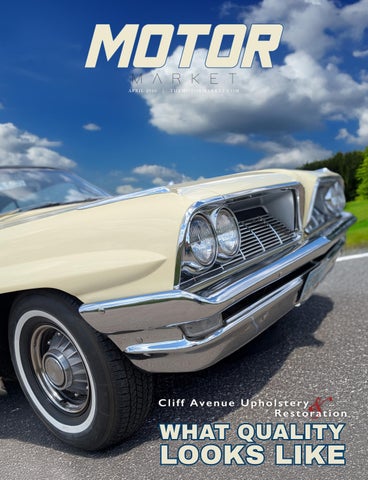
WHAT QUALITY LOOKS LIKE

By Joseph Cottle | Photography by Cliff Avenue Upholstery & Restoration
In 1962, Jim Besko saw a Pontiac Catalina Hardtop at a used car lot. The slick, creamy yellow sedan reached out to him in a way he didn't quite understand at the time, and it was a heck of a deal for a car just one model year old. He drove it off the lot and picked up his recent girlfriend, Mavis. On every date they had together afterward, they drove in that car. They drove away in it after their wedding. Some 40 years later, it was still in Jim's garage, full of stories from countless trips across town, across South Dakota, and into Minnesota. It was also starting to fall apart.
So, Jim reached out to Ennis Lund.
"About 23 years ago, I got a call from Jim," Ennis remembers. "He told me he had a '61 Pontiac he'd bought from a used car lot, and he and his wife had dated in this car."
Jim didn't just want the car fixed. He wanted it restored, brought back to life in a way that honored everything it had meant to him and Mavis over the decades. But when Ennis came to look at it, the car's story took a turn.
At a glance, it was a classic. Underneath, it was something else entirely.
"When I took it apart, I found that the frame was bent," Ennis explains.
The car had been in an accident before Jim ever bought it. Someone had patched it just well enough to sell it again, but not well enough to make it right. Jim had driven it for decades like that, never quite understanding why one front tire wore faster than the others, or why it never handled the way it should have.
That's where the real restoration began. And that distinction, between what's good enough and what's actually right, is everything.
Ennis didn't patch the problem. He erased it.
"I actually bought a car in Oklahoma and put the frame from that car under this one," he notes.

“We
just did the entire car,” Ennis says. “Every screw, nut, bolt, and bearing.”
It was the kind of decision that defines the difference between repair and restoration. One makes something work. The other makes it right. It costs more. It takes longer. And 23 years later, it's exactly why the car is still winning.
From there, the project unfolded piece by piece, down to a level of detail most people would never see but would always feel.
"We just did the entire car," Ennis says. "Every screw, nut, bolt, and bearing. I have every screw and every bolt back in the hole it came out of. They're all replated exactly the way they were back then."
That level of precision isn't common, and Ennis knows it. At 83, he's been in the trade long enough to watch what happens when corners get cut, and long enough to know that quality, done once and done right, outlasts everything else.
For Aaron Mosterd, the Catalina project marked the beginning of a long and meaningful career.
"When I got here, the major body and metal work were done," Aaron says. "I helped finish up the body work, and then I actually ended up painting the car. It was the first car I painted professionally outside of school."
Aaron had been hired at Cliff Avenue Upholstery and Restoration fresh out of school, stepping into a trade that demands patience, precision, and a willingness to learn from someone who has mastered it. The Catalina became his proving ground.
It wasn’t just about putting paint on a car. It was about understanding what the car was supposed to be.
Together, Ennis and Aaron pushed the restoration beyond the original factory build, not in a way that changed the car's identity, but in a way that completed it. The Catalina left the factory without the eight-lug wheels or the tri-power setup that represented the best Pontiac had to offer in 1961. This time, it would have them.
"We put eight-lug wheels on it, and I put a tripower on it. That's three carburetors," Ennis explains. "Everything we did was an upgrade you could have gotten from the factory back in '61."
They sourced parts from across the country, long before online marketplaces made that easy, relying on decades of relationships built at national meets and through a network of collectors and specialists. Even air conditioning, rare for a car like this, was carefully integrated from a donor vehicle, complete with the proper dash, so everything looked as if it had always been there.


“I had connections all across the country,” Ennis shares.
By the time the work was done, the Catalina wasn't just restored. It was realized, brought to a version of itself that might have existed if every option had been checked and every detail perfected right from the factory floor.
The project took between a year and a half and two years to complete, but the real measure of the work wouldn't show up until much later.
More than two decades later, it still stands.
"The car's been restored for over 20 years now," Aaron says. "It just took first place at a show in Watertown."
That kind of longevity is not an accident. It is the direct result of decisions made at the beginning to replace the frame instead of welding it, to replate every fastener instead of swapping in hardware store bolts, to do the job as if it would be judged not in a week, but in a generation.
"The same work that was done 20 years ago still won best of show," Ennis says. "That was because we restored it properly."
That is the return on investment Jim Besko didn't know he was making when he handed over the keys. The cost of doing it right wasn't just money spent on a car; it was money well spent on something that would last, that would still be worth showing, still be worth driving, still be worth everything it cost, decades down the road. That is what quality workmanship actually delivers: value that compounds over time instead of quietly disappearing.
"Everything is throwaway today," Ennis says. "Back in the day, everything was about master quality craftsmanship."
At age 83, Ennis Lund is still at it; still restoring vehicles the right way, still outworking shops half his age, still refusing to cut corners on cars that deserve better. His shop, Cliff Avenue Upholstery and Restoration, carries that standard forward in the people he's built alongside him.
"Aaron is a master," Ennis says. "He can figure out anything, and he does it with the utmost craftsmanship."
For Aaron, that standard was set early on a car that mattered deeply to its owner and demanded that same level of care in return.
"To me, it was the first car I learned how to do restorations on," Aaron shares.


Like the car itself, that lesson has lasted.
The Catalina today carries more than its original story. It carries the story of a farm couple who built a life together, of a craftsman who has spent a lifetime refusing to do things the easy way, and of a young professional who learned what true restoration looks like by doing it.
When Ennis talks about the car, there is a sense that it represents more than metal and paint.
"It’s a work of art. I am beyond proud of how the car has lasted," Ennis says, "because quality in the long run pays off. We don't see quality like this much anymore."
The car is proof. Twenty-three years after the restoration was finished, it is still winning. Still turning heads. Still telling the story of what it looks like when someone does the work right.
This is what quality looks like. This car actually won best in show in Watertown two or three years ago after all those years.

It wasn’t just about putting paint on a car. It was about understanding what the car was supposed to be.


SPEED SHOP


Events
HOT RODS AND HARLEY’S SWAP MEET
Hot Springs Battle Mountain American Legion Riders
April 18, 2026 - 8am-12pm
Hot Springs, SD alr71hotspringssd@gmail.com | 707-280-0150
16TH ANNUAL SHOW & SHINE OPEN HOUSE
Western Iowa Tech Community College
April 22, 2026 - 4pm-8pm
Parking Lot 2 - Sioux City, IA
CAR SHOW TEST & TUNE
Event by I-90 Speedway
April 25, 2026 - 9 am-2 pm
18th Amendment - Sioux Falls, SD
BANDIT SPEEDWAY KICK OFF
April 25, 2026
1611 Hwy 14-16, Box Elder, SD banditspeedway@gmail.com
TIGER STRIPES GARAGE CAR SHOWCASE
May 2, 2026 - 4pm-7pm Harrisburg High School
1300 W. Willow St., Harrisburg, SD
BLACK HILLS TRUCK INVASION
May 2-3, 2026
The Thunderdome - Sturgis, SD
42 ND ANNUAL SPRING AUTO PARTS SWAP MEET Cars for Sale Corral
May 3, 2026 - 7:30am-1pm Fairgrounds Parking Lot
700 N. Maple St., Monticello, IA

-SPONSORED BY -
JON CHACOPULOS COLLECTION AUCTION
Classic Car Auction Group
May 9, 2026 - 10am ONLINE ONLY - classiccarauction.us
SD DRIFT
Season Starts May 16-17, 2026; June 13-14, 2026; July 11-12, 2026; September 19-20, 2026
1 Drift Drive, Rapid City, SD southdakotadrift.com
4TH ANNUAL BLACK HILLS MOTORCYCLE SHOW
May 23, 2026
Deadwood Mountain Grand - Deadwood, SD
CARS & COFFEE OF SIOUXLAND
May 23, 2026 - 8am-11am Lincoln County Airport - Tea, SD
25TH ANNUAL THUNDER ON THE PRAIRIE
Route 385 Cruisers Car Club
Rod Run May 29-31, 2026
Car Show May 30 - 11am-4pm Alliance Central Park - Alliance, NE
HUB CITY AUTO PARTS
SWAP MEET & CAR SHOW
May 30, 2026 - 8am-2pm
Brown County Fair Grounds - Aberdeen, SD
CHROME & STEEL SHOW & SHINE
Frankman Motor Co.
May 30, 2026 - 10 am-3pm
26874 SD Hwy 11, Sioux Falls, SD

WHEEL JAM
June 4-7, 2026
Huron, SD
LOWDOWN ROUNDUP
CUSTOM CAR & TRUCK SHOW
June 5-7, 2026
Water Works Park, Des Moines, IA
ENERGY CAPITAL OF THE NATION CAR SHOW
June 5-7, 2026
Cam-Plex Multi Event Facility - Gillette, WY
ALL FORD 40TH ANNUAL CAR SHOW
Sioux Empire Ford Club
June 7, 2026
Sioux Falls Ford - Sioux Falls, SD
6TH ANNUAL REMEMBERING ED CAR & BIKE SHOW
June 7, 2026 - 11am
Riverside Park - Sioux City, IA
8TH ANNUAL CUSTER OFF ROAD RALLY
June 12-14, 2026
Custer, SD
20TH ANNUAL PLAINVIEW CAR, TRUCK, MOTORCYCLE & TRACTOR SHOW
June 13, 2026 - 11:30am 402-992-1291 | highway20hotrod@gmail.com
14TH ANNUAL SPRING ALL CAR “CRUISE-IN”
June 13, 2026 - 10am-3pm Fleet Farm - Rapid City, SD

BROOKINGS CAR SHOW
June 14, 2026
Brookings, SD
BLACK HILLS CAMARO RALLY
June 17-20, 2026
Spearfish, SD
22 ND ANNUAL TEAFEST SHOW AND SHINE
Powered by Octane Ink
June 19, 2026 - Tea, SD
JESSE JAMES CAR SHOW
June 19-21, 2026
Garretson, SD
KING SERIES SUMMER SHOW
June 19-21, 2026
King Series Facility - Emery, SD
WILD BILL DAYS COLLECTOR CAR & MEMORABILIA AUCTION
McPherson Auction
June 20, 2026
Deadwood Mountain Grand - Deadwood, SD
AUTOMANIA
Presented by Valley Corner Bar
June 27, 2026 - 12pm-4pm
Broadway Ave., Valley Springs, SD
CALENDAR Events
QUARRY DAYS
June 28-27, 2026
Dell Rapids, SD
HEDAHL’S AUTO VALUE CAR SHOW
July 11, 2026 - 11am-4pm
Redfield, SD
55TH ANNUAL BLACK HILLS CORVETTE CLASSIC
Tour the Black Hills
July 15-18, 2026
Spearfish, SD
SCENE OF THE CRASH CAR AND BIKE SHOW
July 17-18, 2026
Dakota Thurston County Fairgrounds
Dakota City, NE
VETTES IN THE PARK
University of Okoboji Corvette Club
Sampson Corvettes - Sanborn, IA
July 24, 2026 - 11am-3pm
Arnolds Park, IA
July 25, 2026 - 8am-2pm uofocorvetteclub.com
CARS & COFFEE OF SIOUXLAND
July 25, 2026 - 8am-11am
Lincoln County Airport - Tea, SD
NYBERG'S ACE
HOT CLASSICS NIGHT
July 25, 2026
Sioux Falls, SD
CANTON CAR SHOW FOR GENERATIONS
July 26, 2026 - 11am
Canton, SD

- SPONSORED BY -
COUNTS CAR CLUB
VINTAGE DIRT DRAGS IN DAKOTA
July 31, 2026
Bandit Speedway - Box Elder, SD
D.A.D.’S AUTO REPAIR SHOW & SHINE
August 1, 2026
Beresford, SD
CHASERS 16TH ANNUAL CAR SHOW
August 1, 2026 - 3pm
Chasers - Sioux Falls, SD
SIOUX FALLS CLASSIC CAR AUCTION
August 1, 2026 - 10AM
Denny Sanford Premier Center
Sioux Falls, SD
86TH ANNUAL STURGIS RALLY
August 7-16, 2026
Sturgis, SD sturgis.com
SERTOMA SHINE AND SHOW
August 9, 2026
Cars For Sale Parking Lot
Sioux Falls, SD
KOOL DEADWOOD NITES CAR SHOW
August 18-19, 2026
Deadwood, SD
3-DAY CLASSIC CAR AUCTION
McPherson Auction
August 20-22, 2026
Deadwood Mountain Grand Deadwood, SDd, SD

WES RICK MEMORIAL AND BANDIT SHOOTOUT
Presented by Yoder’s Speed Shop
August 21-22, 2026
Bandit Speedway - Box Elder, SD
TERRY KOCH’S RACE SHOW CRUISE NIGHT FUNDRAISER
August 22, 2026
Sioux Falls, SD
STURGIS MUSTANG RALLY
SHOW & SHINE
September 1-6, 2026
Sturgis, SD
MONTANA CLASSIC CAR AUCTION
Classic Car Auction Group
September 5, 2026
ONLINE ONLY - classiccarauction.com
STUDEBAKER CAR SHOW
September 6, 2026
Custer, SD
RIBS, RODS & ROCK N’ ROLL
September 11-12, 2026
Vermillion, SD

VINTIQUES ROD RUN & CAMPOUT
September 11-13, 2026
Watertown, SD
8TH ANNUAL MIDWEST HOT ROD RALLY
September 11- 12, 2026
Woodbury County Fairgrounds
Moville, IA
HY-VEE CAR SHOW
September 12, 2026 - 11am-3pm
3000 Minnesota Ave, Sioux Falls, SD
Bernie Tyrell - 605-350-8585
CARS & COFFEE OF SIOUXLAND
September 12, 2026 - 8am-11am
Lincoln County Airport - Tea, SD
SHOW & SHINE
September 12, 2026 - 1pm-6pm
Pressler Park - Humboldt, SD
43RD ANNUAL BLACK HILLS SWAP MEET
September 13, 2026
Central States Fairgrounds - Rapid City, SD

Historical Survivor
By Bob Schmeichel
As 1967 ended with drag racing coming on like gangbusters, America’s big three auto manufacturers were taking notice that the public wanted more speed, while not realizing that it was the beginning of a new muscle car era. Late in 1967, Chrysler jumped right in creating their lightweight versions of both the Plymouth Barracuda and Dodge Dart. Both versions were set up with their basic 425HP 426 cubic inch hemi to begin with, and had intentions of running in a new Super Stock class. In order for these to be legal in the Super Stock class as a production car, a minimum of 50 of each had to be built.
Chevrolet wasn’t as aggressive with building drag race cars, but dealerships on the East Coast saw the need and actively got involved, knowing that if you race a car on Sunday and win, you can sell a car on Monday. Don Yenko in Canonsburg, Pennsylvania, started the trend at his own dealership by ordering what is called a “COPO” car that bypassed engine restrictions and enabled installing 427s in Camaros and Chevelles with a few performance upgrades, along with 4.11 rear-end gearing. The idea was to get a competitive edge at the drag strip in the new evolving Super Stock class in 1968. Baldwin Chevrolet in Baldwin, Long Island, New York, saw the writing on the wall and pretty much did the same thing as Yenko, ordering COPO cars
and creating a new partnership within their dealership that did further modifications and called it Baldwin Motion. The whole idea between these two businesses was to build what Chevrolet wasn’t doing and create cars capable of running 120 mph in 11.5 seconds that could be competitive in the new Super Stock class, and again, while building at least 50 vehicles to be legal.
After hearing the buzz that was going on, Bob Tasca of Tasca Ford in Rhode Island decided he wasn’t going to be left behind. So, he special-ordered 50, 1968 ½ Ford Mustangs listed as a “135 Series” with the way they were built and being lightweight with a 428 Highway Patrol block and later, 427 heads, in front of a 4-speed Top Loader trans. Bob, being a hard-core Ford guy with his crew, did their own little tweaks that were legal, the way everyone interpreted the new Super Stock rules at the time. Later, they even got some engine advice from Carol Shelby during the time he was competing against the Ferrari Team in the 24-hour Le Mans races in Europe.
The Tasca crew was bound and determined to make these lightweight Ford Mustangs, later to be named the 428 Super Cobra Jet, was destined to be competitive with anything. Before any of these modified Mustangs moved, Bob Tasca decided that
these Mustangs would be delivered only to select dealers all around the country, with the understanding that they were going to be drag raced in both stock and the new Super Stock class.
One of the first ones to be delivered to the Midwest was number 45 out of the 50 built, and went to the Tracy Motor Company in Tracy, Minnesota. The owner of the business allowed his son to drag race the car without really understanding the car’s potential or limitations. Lacking experience, the son apparently blew the engine up with its first chance on a track at Thunder Valley in 1968. Not really knowing what to do with the car after that, since it was strictly a race car without a warranty, Deinema Ford in Canton, South Dakota, bought the car with the blown engine. As time went on, the engine was rebuilt for Deinema Ford by Jim Smith and Bill Hassenbrock, who eventually became the owners of the car with rebuilding the engine, racing it, and having Deinema Ford as their sponsor.
Gene had to go to the Tracy Motor Company to get the title for the car since it had never been transferred in the last six years of racing the car. Gene was excited to get the Mustang since it had only 2,200 miles on it and had a 390 Ford engine to put into it, so he could drive it. Once he had it together and drivable, Gene started looking for a real Super Cobra Jet engine. It didn’t take long, and he found a newly pieced together short block that was verified as a real, complete, correct numbers 428 Super Cobra Jet short block in Howard, South Dakota.
Once you are on top, you have to push it to stay there.
They raced the car for a few years and did extremely well, even becoming the Top Eliminator in “F” Super Stock at the end of the 1972 season, running 11 seconds at 115mph and beating the Hairbender II Barracuda in the final round. As it turned out, the next season proved stressful. Once you are on top, you have to push it to stay there, but after the engine blew up again with the continuous pressure of racing, Jim and Bill had a falling out because of the issue. They decided to sell the body with the blown engine to a third party, which they did to the present owner today, who is Gene Sandager, in April of 1974, for $1,700.
After buying the short block, Gene got together with Bill Smith, and they rebuilt the usable heads off the blown engine and put everything back together with the new short block while freshening the whole drivetrain up to be as it was when it was new from Tasca Ford. Gene pulled all the stickers off the car that it was lettered with when being drag raced and waxed it clean.
That was 52 years ago, and now, still with only 16,000 miles on the odometer, it is still a complete factory race car in its original form from Tasca Ford with its ram air hood scoop and air cleaner, to the special intake manifold, the Holley carburetor, the Sun Tachometer, the Hurst shifter, the Lakewood traction bars, the heavier springs, the original paint and interior, but still very healthy for its age when it comes to moving forward at a rapid pace, yet Gene prefers it as a proven performer that does not have to prove anything but to enjoy the ride as a driver today at a slower pace.


A farm boy from Salem, Bob’s family moved to Sioux Falls when he was 12 years old. After graduating from Washington High School, he attended USD, where he majored in Commercial Art. A lifelong auto and art enthusiast, Bob wanted to combine his passions into a career. A self-taught mechanic, bodywork, welder and painter, he worked in the industry for seven years. He later went to work for Horner Waldorf Box Company, where he worked for the next 33 years, retiring as Package Design Manager for Smurfit Stone Container. Bob has built dozens of street rods over the years, doing everything except the upholstery work. Bob started the Great Plains Street Rodders Car Club in 1985, and today the club has over 340 members. You can see more of Bob’s paintings and car features on the club’s website: www. greatplainsstreetrodders.com


All In the Family
By Tanya Manus
CAR YEAR-MAKE-MODEL: 1969 Dodge Charger R/T
ENGINE: 440 Magnum
TRANSMISSION: Console shifted 727 Torqueflite
SUSPENSION: Front torsion bar, rear leaf
EXHAUST: Dual XLlerator exhaust by AP

This red 1969 Dodge Charger R/T has been cruising the streets of Clark, South Dakota, for 57 years now and is something of a legend. All the locals know it as “Nordy’s car” for its first owner. But for 50 years, the classic muscle car has been owned and loved by the Mack family.
Lifelong Clark resident Roger Nordhus bought this car new in May 1969 for his high school graduation from Audus Motors in Clark. Roger initially wished to order the 426 Hemi, but was told by the dealer to run the 440 Magnum since it was a better fit for the street. Roger didn’t order power steering, air conditioning, or disc brakes since he just wanted to go fast. The Charger was delivered with steel red wheels and dog dish hubcaps, but the car left the dealer’s lot wearing shiny chrome Cragar SS wheels. But interestingly, he did order an AM/FM radio, which was uncommon for the time. His main goal was to cruise it and race it. In its bright red, gleaming paint, it was a flashy car for the dealership and the small town of Clark, gaining a lot of local attention.

Roger was ready for an update and purchased a new Pontiac Grand Am. And by 1976, Elaine Hollatz, a high school student, needed a car and bought the Dodge Charger for $700 at the local General Motors Dealer. Her boyfriend, whom she later married, Bob Mack, is a mechanic who has been helping Elaine fix and maintain her car for the last 50 years.
“My favorite part about the car is its history. When being out locally, almost everyone remembers “Nordy’s Car” and is always eager to share a fond memory from riding with Roger. Hearing all the great memories is what really makes the car a great member of the family,” adds RJ Mack, Bob and Elaine’s son.
“My mother held onto the car, and we had it all through my childhood, cruising it on weekends and fun family things,” RJ shares.
By about 2000, the car was still in good shape but starting to show

wear and tear, and RJ was old enough to spend a great deal of time working and tinkering on the car. He and his dad decided to restore it, ensuring the car was as “period correct” as possible.
“The car wasn’t in real bad shape, but we wanted it to look nice again,” RJ notes, adding that the car looks like the day it rolled off the dealer’s lot.
Father and son rebuilt the engine, and Kirk Harrington at Ritter’s Repair in Clark did a majority of the body work and paint, taking the car down to bare metal and repairing the few rust issues. Kirk refinished it in PPG R-4 Bright Red basecoat/clearcoat, which is its original shade. He also applied the beautiful white/R/T stripe to finish it off.
Bob and RJ collected parts and kept fixing up the car until they finally finished it around 2006. They still enjoy maintaining and tinkering with it. These days, the Charger is mostly a show car. In February, it was exhibited for the first time in Rapid City as part of the 26th annual Counts Car and Cycle Show, where it gained quite a bit of attention.
RJ is especially proud that, in 2022, the Mack family, along with the Dodge Charger, was invited for a special indoor display at the largest allMopar event in the world, the Carlisle Chrysler Nationals in Carlisle, PA.
“I loaded up the Charger and made the 20-hour trip to Carlisle and spent a great time in Pennsylvania, enjoying the sights along the way. It was a super awesome event, well worth the trip,” RJ explains.
RJ notes that Nordhus always cherished the Charger and dreamed of owning another one until he sadly passed in 2025.
“It’s had quite the life,” RJ says of the Dodge Charger. “We as a family love showing and going with this one and have hopes to continue on for many generations to come. This Mopar is definitely a huge part of the family.”
NAME: RJ Mack


Few maintenance tasks are more essential to your vehicle's longevity than regular oil changes, yet many drivers either overlook them or rely on outdated advice about when they're actually needed. Engine oil lubricates moving parts, reduces heat, and carries away contaminants, but it breaks down over time and loses effectiveness.
WHEN DOES YOUR VEHICLE NEED AN OIL CHANGE?
By ArticleBiz.com


Neglecting timely changes can lead to costly engine damage that far outweighs the price of routine service. With manufacturer recommendations varying widely by make, model, and driving conditions, knowing when to change your oil isn't always as straightforward as it used to be. Here's what every car owner needs to know.
Your vehicle's owner's manual contains the prescribed oil-change intervals recommended by the manufacturer. All information needed to guide car owners, including oil-change schedules, appears here.
Newer vehicles often have internal systems that track driving conditions and notify owners when maintenance is needed, rather than relying solely on mileage benchmarks. Intervals vary greatly by make and model, so consult the owner's manual or manufacturer's website for specific recommendations.
As motor oil deteriorates over time, changing it at recommended intervals is essential for maintaining engine health. Older or classic vehicles may require more frequent changes to extend their lifespan. Whether you drive regularly or infrequently, knowing when to change engine oil helps keep your car running smoothly.
WARNING SIGNS
Notice an oily smell inside your vehicle? Check your engine's oil level immediately. A burning smell while driving may indicate engine overheating due to low oil. Smoke from the tailpipe also warrants an oil check.
Classic cars should use conventional motor oil, the type their engines were designed for. Vehicles running synthetic oil can often go up to 15,000 miles between changes due to increased efficiency.
Modern engines typically require oil changes between 7,500 and 10,000 miles. The old 3,000-mile standard is outdated, thanks to improved lubricants. Most manufacturers now recommend intervals between 5,000 and 7,500 miles.
Some automotive experts suggest the 3,000-mile interval primarily benefits service shops through increased business. However, many mechanics recommend changing oil sooner than the manufacturer’s specifications for added safety.
For city driving with about 6,000 miles every six months, changing oil annually may suffice. But even if you drive infrequently, far below recommended service intervals, change oil at least twice yearly because oil breaks down over time.
If you don't drive under harsh conditions, follow the manufacturer's recommended intervals, which usually include filter changes. New cars driven
regularly at consistent speeds are good candidates for extended intervals.
Newer engines with less frequent oil changes require monthly oil-level monitoring and topping off as needed. Some newer cars have electronic oil-monitoring systems instead of traditional dipsticks for manual checking.
If you are changing the oil yourself, reset the oil-life monitor following the instructions in your owner's manual. If you are scheduling maintenance, most modern car-care facilities, like the experts at Graham Tire, can complete oil changes quickly.
Vehicles typically have two types of maintenance

recommendations depending on driving history. For a new vehicle's first oil change, follow the manufacturer's manual recommendations.
Monitor your oil level monthly and watch for warning signs like unusual smells or smoke. Regular oil changes, whether DIY or by professionals like the skilled technicians at Graham Tire, keep engines running longer with more power and help you avoid expensive repairs.
The key is consulting your specific vehicle's manual for the most accurate guidance, as recommendations vary significantly among makes and models. When in doubt, changing oil more frequently is safer than waiting too long.


2025 and down take off bumpers. For a quick response, text or call!

2013 Royal office trailer custom built 4 ac's. Asking $22,500.


Take off F150 boxes. Text picture of what you are looking for.


Ram Dually Boxes 2002-2009


Take off dually boxes. Will separate, dually fender's, tail gates & lights.


Used Tailgates Take off super duty from bumpers. Text a picture of what you are looking for.
Take off Chevy bumpers 2025 and down with and without sensors.
Ford 2011-2016 Used Boxes All Colors
2025 and down Chevy and GMC, Boxes. Long, shorts & dually
Take off Ford Dually boxes. 2025 through 1999
2025 and down, take off boxes, bumpers and tailgates
2011-2016 Ford Long Boxes. Taken Off When New, Put In Building
Dodge, Ram, Chevy, & GMC Rear Bumpers
Ford Super Duty Rear Bumpers 1999-2025
2025 & Down Tailgates Ford, Chevy, GMC, Dodge Ram
Ram Boxes 2010-2025 New and Used
Take off boxes, Ford, Chevy, GMC, Dodge Ram
2025 and down Ford, Chevy, GMC, Dodge Ram. Boxes, bumpers tailgate
Ram Mag Cab Dually Boxes 2006-2025
REDUCED!


Rules of the Road
By Sgt. Travis Olsen

Flashing lights in your rearview mirror or approaching from an intersection can be a moment of confusion for even experienced drivers. Do you pull over immediately? Or keep moving until you find a safe spot? What if the emergency vehicle is on the other side of the road? These are questions that most drivers rarely think about until they are suddenly face-toface with the situation, and making the wrong split-second decision can have serious, even fatal, consequences.
Traffic safety laws surrounding emergency vehicles exist for good reason: to protect first responders, roadside workers, and the public alike. In South Dakota, these laws are clearly defined, carry real penalties, and apply to a wider range of situations than many drivers realize. Whether you encounter a police cruiser with lights blazing on the interstate, a tow truck working the shoulder of a two-lane highway, or an ambulance racing through an intersection, the law spells out exactly what you are required to do.
What should I do if I see an emergency vehicle with flashing lights? When is it required to pull over?
SDCL 32-31-6.1. Occupying highway shoulder or stopped— Requirements for approaching vehicles—Penalty.
Upon approaching from any direction, any stopped authorized emergency vehicle making use of red visual signals meeting the requirements of this title, the driver of a motor vehicle shall come to a complete stop before reaching the stopped emergency vehicle and may, unless otherwise directed, proceed with caution only after ascertaining that it is safe to do so.
Upon approaching from any direction, any vehicle that is either stopped or occupying the shoulder of the highway, and

using amber, yellow, or blue warning lights, the driver of any other motor vehicle must:
1. If driving on an interstate highway or other highway with two or more lanes traveling in the same direction as the vehicle, merge into the lane farthest from the vehicle at least three hundred feet before the vehicle and proceed with caution, unless otherwise directed; or
2. If driving on a two-lane highway, at least three hundred feet before the vehicle, slow to a speed that is at least twenty miles per hour less than the posted speed limit or five miles per hour when the speed limit is posted at twenty miles per hour or less, and proceed with caution, unless otherwise directed.
A violation of this section is a Class 2 misdemeanor and has a minimum fine of two hundred seventy dollars.
SDCL 32-31-6. Duty of other motorists upon approach of emergency vehicle—Violation as misdemeanor.
Upon the immediate approach of an authorized emergency vehicle making use of audible or visual signals meeting the requirements of this chapter, or of a police vehicle properly and lawfully making use of an audible or visual signal only, the driver of every other vehicle shall immediately drive to a position as near as possible and parallel to the righthand edge or curb of the highway, or in case of a one-way highway the nearest edge or curb, clear of any intersection of highways, and shall stop and remain in such position unless otherwise directed by a police or traffic officer until the authorized emergency vehicle shall have passed. A violation of this section is a Class 2 misdemeanor.
SDCL 32-26-15 states, “Yielding right-of-way to emergency vehicles--Duty of driver of emergency vehicle not to exercise right-of-way arbitrarily—Violation as misdemeanor.

The driver of a vehicle upon a highway shall yield the right-ofway to police and fire department vehicles and ambulances if they are operated upon official business and the drivers give an audible signal by bell, siren, or exhaust whistle or visual signal by flashing, oscillating, or rotating beams of red light or combinations of red, blue, or white light visible one hundred eighty degrees to the front of the vehicle.
The rules, at their core, are straightforward. When an emergency vehicle is approaching with lights or sirens, pull to the right and stop. When a vehicle is occupying the shoulder with amber, yellow, or blue lights, move over a lane or slow down significantly, starting at least 300 feet out. These actions take only a few seconds but can mean the difference between a close call and a tragedy.
As you drive South Dakota's highways and two-lane roads, make it a habit to stay alert, keep distractions out of your hands, and always be scanning ahead for warning lights. Slow down, move over, and give emergency responders the space they need to do their jobs and get home safely.
Have a traffic safety question?
Email hello@michelscom.com with your inquiry, and Sgt. Travis Olsen will offer an explanation in his monthly Motor Market column.


At Mitchell Technical College, your tomorrow begins today. With more than 35 career-driven programs, you’ll learn by doing, not just listening. From hands on labs to real-world experience, every step prepares you for a high-demand career.
This fall, take the next step toward your future. There’s no better way than experiencing Mitchell Tech for yourself.

Visit us in person or online and see how you can get ready at Mitchell Tech.


The Hidden Power of a Harmonic Damper
When designing and building a performance engine, it is important to look at all aspects of the engine. It is easy to bolt on all the shiny new components and believe that it “runs better” because of the design of the part or the advertised gain in the engine system. Imagine, if you will, installing an engine part that doesn’t directly build power but releases power to the drivetrain by eliminating wasted energy in the form of vibration and by decreasing crankshaft twist, vibration, and bearing scuffing.
In my years of engine building, I have seen many cases of premature bearing wear and crankshaft flex. Most people have a hard time believing that the crankshaft can flex and twist, but it absolutely does, and this gets even more apparent and severe when the engine power is increased. You see, when the cylinder fires, it sends a massive shock from the explosion against the piston, through the connecting rod, and to the crankshaft. This force will slightly twist the connecting rod journal in the direction of the rotation, and moments later the crankshaft will flex back the


other way back into its original position. These pulses in a V-8 engine happen every 90 degrees, so the erratic torsional twist of the crankshaft will resonate, rob energy away, and keep the engine from making power.
This torque and resonating frequency effect can be multiplied as the engine runs and causes component failure, premature bearing wear, and excess vibration that transmits into the cylinder block and valvetrain, robbing power, and possibly breaking parts. To help to counteract and control this comes the harmonic damper.
Is it a damper or a balancer? They are one and the same in the racing crowd, but there is a difference. Harmonic damper refers to the method of dampening the crankshaft vibrations caused by the combustion process. Harmonic balancer refers to the addition of an external weight to aid in the dynamic balance of the rotating assembly. Both terms describe the same part, and both aid in the control of harmonics.
There are many options available with these components, but this is one area where it is


wise to invest in a quality product. OEM dampers are elastomeric style, using a rubber polymer between the inner hub and outer ring. These are widely available in performance versions as well. Some dampers are designed using a freefloating inertia ring, and the housing uses a very thick silicone fluid that dampens the vibrations. If higher horsepower and engine RPM are intended, it is wise to use a SFI rated damper to eliminate the possibility of the damper coming apart and damaging things that it may come into contact with. Other options to consider are construction material, diameter, and weight, all of which can affect engine performance
At Sehr Performance, we look at many different factors that will increase power and reliability in your engine. We care about your project just as much as you do, so if you want to get the most out of your dollar, come see us, and experience the "Extra Mile” that we always provide in all that we do.


ASK THE MOTOR MEDICS®
TUNE-IN AND TUNE-UP!®


Dear Motor Medics,
My vehicle is starting to rust under the hood on my strut towers and under the back on the rear axle mounts, and my shop tells me that, in their opinion, it is no longer safe to drive. It's a 2001 Dodge Caravan, and other than the rust, it looks great. It only has 105k miles on it, so I'm reluctant to part with it. How dangerous can it be, and can it be repaired for a reasonable price? If I don't fix it, what are my options?
Thank
you
James in Bartlesville, Oklahoma
Dear James,
Up here in our home market, we see a lot of these vehicles rusting as you describe, but don't hear much about them in your condition down by you because there is less road salt and milder temps. When they get so bad that a shop feels that it's dangerous to drive, it's time to take a serious look at the van. The strut towers do rust through and if they give way, and they can, you can lose control of the van. The same goes for an axle that breaks its mounts due to rust. Repairs can run thousands of dollars, and we don't see many performed. Get the advice of someone local, but if it turns out that it is time to remove it from the road for safety, a local auto recycler will be able to help you through the process of recycling your van.
Take care, The Motor Medics

Dear Motor Medics,
I've got an issue with my fuel gauge in my 2004 Chevy Tahoe. All the other gauges work great, and the fuel gauge does for the most part, but ever since I had the instrument cluster replaced due to a failed speedometer and oil gauge. The gauge reads one-eighth tank, but it runs out of gas at almost the exact time that the low fuel light comes on. I mean, I have run out of fuel, and ten seconds after the light appears. Once I was driving and saw the light pop on, and just a few seconds later, it died. I thought that when I got the new instrument cluster, I would be done with the gauge issues. It used to turn the light on when I still had one-quarter tank left.
Thank you
Dear Mark,
The first thing we would do is not let the tank go below half full. It seems obvious, but it definitely would solve the running out of fuel issue. As for the gauge issue, we can solve that, too. These vehicles have had a history of failed instrument clusters needing to be replaced. They get mass remanufactured, and the quality, while very good, is not perfect. It sounds like they got the needle of the fuel gauge installed too high so that it reads fuller than it is. Your mechanic may be able to adjust it down a bit.
Take care, The Motor Medics


with The Motor Medics ® Shannon Nordstrom, Russ “The Super Tech” Evans, and Chris Carter
From the Hosts of the Under The Hood radio show.
Mark in Fort Morgan, Colorado

HERE’S A SHOUT OUT TO THE TOPPERS CAR CLUB FOR THEIR RECENT CAR SHOW IN SIOUX FALLS! IT’S GREAT TO HAVE A WINTER CAR SHOW IN SIOUX FALLS AGAIN!


We displayed these two just-finished builds, and the reception to each was outstanding. We are proud to say that each one received an award at the show.
We especially enjoyed visiting with everyone who stopped by our display. Over the weekend, our team was pleased to answer questions and explain our process to many of you. We trust that you were able to see the quality of our work by taking a close look at these two beautiful examples.
Restorations are our priority. We also do upholstery, custom fabrication, painting, sandblasting, and mechanical services. We invite you to call or stop in with your project ideas. (Our schedule is filling rapidly, so contact us soon.) Call Zach Smith, owner, at 605-214-1193 or email zachstraightlines1@gmail.com