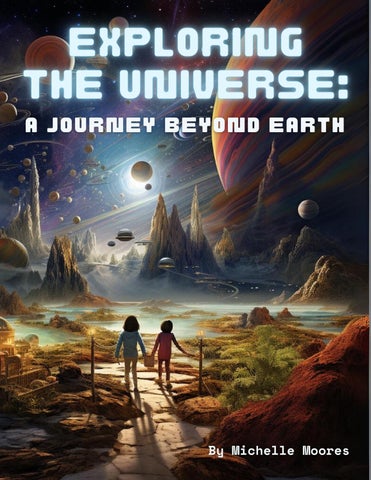
Dedicated to Dr. Matt Stanley. Published by Sagan & Co. Publications.
Welcome to a voyage through the vastness of space and the realms of imagination. Here, we embark on an adventure to distant worlds and uncharted territories, where the possibilities of life stretch beyond our wildest dreams. From the icy oceans of Europa to the swirling winds of Neptune, the red deserts of Mars to the lush forests of distant exoplanets, join us as we traverse the cosmos in search of life's incredible diversity. Each page is a gateway to new discoveries, where science and imagination meet to explore the unknown. 1
Chapter 1: The Mysterious Oceans of Europa In
the
dark,
icy
depths
of
Jupiter's
moon
Europa,
a
wondrous
underwater world thrived, unseen by human eyes. Here, in the vast subterranean ocean, lived the Luminars - a species of bioluminescent creatures whose bodies glowed with a myriad of colors, illuminating the eternal darkness around them. The Luminars communicated through a symphony of light, creating dazzling displays to express their thoughts and emotions. They navigated the frigid waters with an elegance that belied the harshness of their environment, their movements as fluid as the ocean currents themselves. One young Luminary, Luma, was known for her insatiable curiosity. Unlike her peers, she was fascinated by the world beyond their watery realm. She often ventured close to the icy ceiling of their ocean, gazing longingly at the promise of mysteries above. One day, while exploring a particularly vast cavern, Luma discovered a strange object unlike anything she had seen before. It was a probe, sent from distant Earth, seeking to uncover the secrets of Europa. As Luma approached the probe, her bioluminescent glow reflected off its surface, sending a burst of light through the water. This chance encounter marked the beginning of an extraordinary friendship. Through her interactions with the probe, Luma learned about the world beyond Europa, and the humans who had sent this messenger across the stars. She became a bridge between her world and ours, sharing the wonders of the Luminars with humanity. The story of Luma and her discovery captivated the children of Earth, inspiring them to dream of the vast, unexplored frontiers of space and the potential for life beyond their home planet. 2
2
3
4
Science Explained: Europa’s Subsurface Ocean Europa, one of Jupiter's moons, is a fascinating subject for astrobiologists due to its subsurface ocean. Scientists believe this ocean exists beneath a thick layer of ice, possibly warmed by tidal heating caused by Europa's gravitational interaction with Jupiter. This heating could create a liquid water environment, a key ingredient for life as we know it. The potential for hydrothermal vents on Europa's ocean floor, similar to those on Earth, could provide the energy needed to support life. The exploration of Europa's ocean is crucial in the search for extraterrestrial life, as it represents one of the most promising environments in our solar system where life might exist.
5
Chapter 2: The winds of neptune In the swirling, vibrant skies of Neptune, a realm of perpetual storms and fierce winds, there existed a unique form of life - the Aerovians. These graceful beings resembled floating jellyfish, but with thin, sail-like appendages that allowed them to glide through Neptune's turbulent atmosphere. Their bodies, composed of gas-filled bladders, enabled them to float and navigate the powerful wind currents. The Aerovians communicated through pulses of light and subtle changes in their body shape, creating a mesmerizing dance in the sky. Each day, they gathered in the upper atmosphere where the light of the distant Sun reached them, absorbing its faint energy to sustain their ethereal forms. Their peaceful existence was occasionally disturbed by Neptune's violent storms, yet the Aerovians had learned to harness these tempests, using the powerful winds to travel vast distances across the planet. In their harmonious dance with the elements, the Aerovians embodied the beauty universe's most unlikely places. 6
and
resilience
of
life
in
the
7
Science Explained: the winds of neptune Neptune, the eighth planet from the Sun, is known for having some of the strongest winds in our solar system, reaching speeds of over 1,200 miles per hour. These intense winds are thought to be driven by Neptune's internal heat, as the planet emits more energy than it receives from the Sun. The composition of Neptune's atmosphere includes hydrogen, helium, and traces of hydrocarbons and possibly nitrogen, but lacks a solid surface. The concept of life forms like the Aerovians in the story would be a creative speculation, as the extreme conditions on Neptune present significant challenges for life as we understand it. Neptune's atmosphere and weather patterns, however, continue to be a subject of interest and study in understanding planetary atmospheres and dynamics.
8
9
Chapter 3: The Desert life on mars 10
In the dusty red deserts of Mars, hidden beneath the surface, lay a microscopic world teeming with life. These were the Marsmites, resilient microorganisms that had adapted to the planet's harsh,
arid environment. Marsmites harnessed energy from underground chemical reactions, thriving in a world devoid of sunlight. They formed complex communities, interacting and communicating through chemical signals. Their existence was a testament to life's incredible adaptability, proving that even in the most extreme conditions, life could find a way to endure and flourish. 11
12
Science Explained: the possibility of life on mars Mars, with its cold desert-like environment, presents a challenging but intriguing prospect for life. The planet's thin atmosphere, primarily composed of carbon dioxide, and the presence of water ice at its poles, hint at the potential for microbial life, especially in its past. Mars's surface shows evidence of ancient rivers and lakes, suggesting it may have once harbored conditions suitable for life. Recent missions to Mars aim to uncover signs of past microbial life, exploring the subsurface where liquid water and microbial life could possibly exist, shielded from harsh surface conditions.
13
As we conclude our journey Beyond Earth, we reflect on the wondrous possibilities of life in the cosmos. Our adventure across different worlds reveals the endless potential for diversity in the universe. While these stories spring from imagination, they are rooted in our growing understanding of astrobiology and the conditions for life. Our search for extraterrestrial life continues, driven by curiosity and the profound realization that we are but a small part of a vast, mysterious universe. Each discovery brings us closer to answering the age-old question: Are we alone? As we gaze at the stars, we remain hopeful and eager to uncover the secrets of the cosmos.
14
15