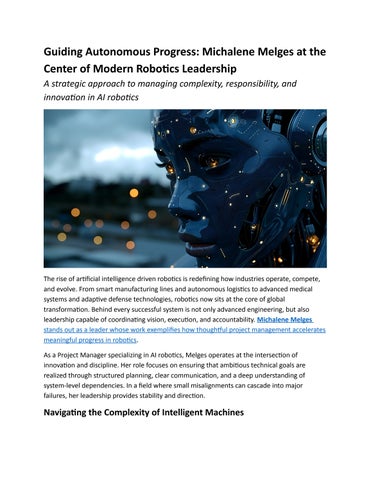
Guiding Autonomous Progress: Michalene Melges at the Center of Modern Robotics Leadership
A strategic approach to managing complexity, responsibility, and innovation in AI robotics

The rise of artificial intelligence driven robotics is redefining how industries operate, compete, and evolve. From smart manufacturing lines and autonomous logistics to advanced medical systems and adaptive defense technologies, robotics now sits at the core of global transformation. Behind every successful system is not only advanced engineering, but also leadership capable of coordinating vision, execution, and accountability. Michalene Melges stands out as a leader whose work exemplifies how thoughtful project management accelerates meaningful progress in robotics
As a Project Manager specializing in AI robotics, Melges operates at the intersection of innovation and discipline. Her role focuses on ensuring that ambitious technical goals are realized through structured planning, clear communication, and a deep understanding of system-level dependencies. In a field where small misalignments can cascade into major failures, her leadership provides stability and direction.
Navigating the Complexity of Intelligent Machines
Modern robots are no longer single-purpose tools. They are integrated systems combining hardware, software, perception, learning, and decision-making. Managing this complexity requires more than coordination; it requires foresight.
Melges approaches robotics development with a holistic mindset. She ensures that mechanical design, AI models, sensor systems, and control architectures evolve together rather than in isolation. By aligning development timelines and dependencies early, she helps teams avoid costly rework and late-stage integration challenges.
This systems-focused perspective allows projects to move forward with confidence, even as requirements evolve and new insights emerge through testing and iteration.
Translating Innovation Into Operational Reality
In robotics, innovation is only valuable when it functions reliably in real-world conditions. Laboratory success does not automatically translate into field readiness. Melges plays a key role in bridging this gap.
She emphasizes validation at every stage of development. Prototypes are evaluated not only for performance, but also for durability, usability, and safety. Feedback loops between testing and design are carefully managed to ensure learning is applied efficiently.
By keeping operational context front and center, Melges helps teams design systems that perform consistently outside controlled environments. This focus strengthens stakeholder confidence and accelerates deployment timelines.
Strategic Risk Management in AI Robotics
Risk in robotics programs is multifaceted. Technical uncertainty, regulatory requirements, ethical considerations, and supply chain dependencies all influence outcomes. Melges integrates risk awareness into everyday project execution rather than treating it as a separate exercise.
She works with teams to identify potential vulnerabilities early, whether related to data bias, sensor limitations, or system interactions. Mitigation strategies are incorporated into schedules and resource plans, reducing the likelihood of unexpected disruptions.
This proactive stance allows innovation to proceed responsibly, balancing speed with reliability. It also fosters a culture where potential issues are surfaced early rather than hidden.
Enabling Effective Cross Discipline Collaboration
Robotics programs bring together professionals with vastly different expertise. Engineers, data scientists, designers, and operations specialists must work toward a shared goal, often under tight constraints. Melges excels at creating alignment across these groups.
She establishes communication structures that promote clarity and shared understanding. Technical discussions remain precise, while project goals and constraints are communicated in ways that resonate across disciplines. Regular integration checkpoints ensure that progress remains cohesive.
By fostering collaboration rooted in respect and transparency, Melges helps teams solve complex problems more effectively and with fewer delays.
Process Design That Supports Creativity
Contrary to the belief that structure limits innovation, Melges views process as an enabler. Her project frameworks are designed to provide clarity without stifling experimentation.
She adapts Agile principles to fit the realities of robotics development, where hardware lead times and safety requirements demand flexibility. Milestones are defined to support iterative learning rather than rigid compliance.
Progress tracking is detailed and transparent, allowing teams to adjust priorities based on real data. This balance between structure and adaptability keeps projects moving forward while preserving room for discovery.
Investing in Team Growth and Leadership
High-performing robotics programs depend on motivated and capable teams. Melges places strong emphasis on professional development and mentorship.
She encourages team members to expand their skills beyond narrow specializations, promoting systems thinking and leadership awareness. Constructive feedback and recognition reinforce accountability and collaboration.
This people-centered approach not only improves project outcomes, but also strengthens organizational capability over time. Teams led under her guidance often emerge more resilient and prepared for future challenges.
Responsibility and Ethics in Autonomous Systems
As robots gain greater autonomy, ethical responsibility becomes inseparable from technical success. Melges integrates considerations of safety, transparency, and accountability into every phase of development.
She advocates for responsible data practices, clear human oversight mechanisms, and alignment with regulatory standards. Human interaction with robotic systems is carefully considered to ensure trust and usability.
By embedding ethics into project planning, Melges helps ensure that advanced technologies serve societal needs rather than undermine them.
A Lasting Impact on the Robotics Landscape
The influence of Michalene Melges extends beyond individual programs. Through her leadership philosophy and execution excellence, she contributes to shaping how robotics projects are managed in an increasingly complex world.
Her work demonstrates that sustainable progress in AI robotics depends on leaders who combine technical awareness with strategic clarity and human insight. As industries continue to adopt intelligent systems, professionals like Michalene Melges will remain essential in guiding innovation toward responsible, reliable, and impactful outcomes.