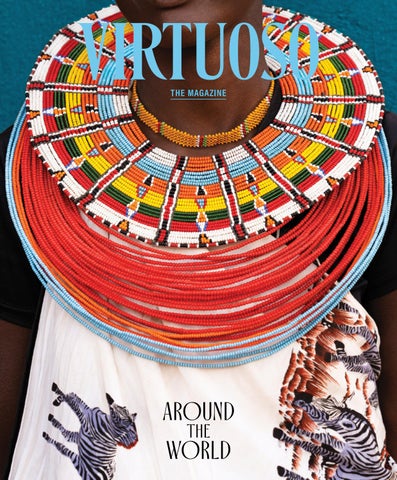
THE MAGAZINE
AROUND THE
WORLD
FIRST-TIME CALLER Dialing into Kenya’s safari scene delivers a savanna’s worth of surprises.
PHOTO CREDIT
A flamboyance of flamingos and (opposite) Elewana guide Raphael “Rapha” Gahaile.
100 September October 2026
PHOTO CREDIT
BY SARAH GREAVES-GABBADON Photography by Korena Bolding
virtuoso.com 101
FIRST-TIME CALLER Dialing into Kenya’s safari scene delivers a savanna’s worth of surprises.
PHOTO CREDIT
A flamboyance of flamingos and (opposite) Elewana guide Raphael “Rapha” Gahaile.
100 September October 2026
PHOTO CREDIT
BY SARAH GREAVES-GABBADON Photography by Korena Bolding
virtuoso.com 101
FROM OUR BUSH PLANE , Kenya’s Tsavo West National Park presents as a massive expanse of sheared wild grass, punctuated with muddy brown water holes like beads of spilled chocolate milk. But on the ground, trundling along a dusty path in a Land Cruiser, things feel much more … arid. Black volcanic rocks, scrubby acacia trees, and tangles of brown bushes line the road, their spiky limbs promising instant pain should a rogue elbow out the window brush against them. “Simama!” Our safari director, Peter Githaka, shouts the Swahili word for “stop” to the driver. At first, I don’t see a thing. And then a zebra emerges from the bush, its sootblack hooves delicately navigating the stone-riddled turf. More of them follow, trotting across the road in a black-and-white, camouflaged dazzle (the term for a group of zebras, inspired by the optical illusion their stripes create), their tails swishing behind them. I hear someone let out a joyful, childlike squeal, and I realize that person is me.
From far left: Micato safari director Peter Githaka, Tsavo from above, and a Maasai Mara dazzle.
102 September October 2026
CONFESSION: I CAN APPRECIATE the animal kingdom, but seeing the “big five” has never ranked high on my list. I like my hotels less “rustic camp,” more “aggressively air-conditioned.” I love art and fashion and could easily lean into Lagos shopping or Dakar gallery-hopping, meeting the West African people from whom (via the Caribbean) I’m descended. So no one’s more surprised than me that, on my second day in Kenya, I’m snapping an irrational number of photos of a Masai giraffe walking toward our four-wheel drive, graceful yet ungainly, its knobbed head bobbling above the tree line like a twin-masted ship. If there’s an ideal first-timer’s safari, it’s this one – a ten-day Micato Safaris tour across Kenya, the country where the concept of a trip to observe animals in their natural habitat first originated in the early 1900s. Our itinerary, which will take us from Tsavo West north to the high-altitude Laikipia, then southwest to the Maasai Mara, is designed to capitalize on the country’s diverse ecosystems (lush forests, dry scrublands, windswept savannas), giving us the best chance of spotting some of
virtuoso.com 103
FROM OUR BUSH PLANE , Kenya’s Tsavo West National Park presents as a massive expanse of sheared wild grass, punctuated with muddy brown water holes like beads of spilled chocolate milk. But on the ground, trundling along a dusty path in a Land Cruiser, things feel much more … arid. Black volcanic rocks, scrubby acacia trees, and tangles of brown bushes line the road, their spiky limbs promising instant pain should a rogue elbow out the window brush against them. “Simama!” Our safari director, Peter Githaka, shouts the Swahili word for “stop” to the driver. At first, I don’t see a thing. And then a zebra emerges from the bush, its sootblack hooves delicately navigating the stone-riddled turf. More of them follow, trotting across the road in a black-and-white, camouflaged dazzle (the term for a group of zebras, inspired by the optical illusion their stripes create), their tails swishing behind them. I hear someone let out a joyful, childlike squeal, and I realize that person is me.
From far left: Micato safari director Peter Githaka, Tsavo from above, and a Maasai Mara dazzle.
102 September October 2026
CONFESSION: I CAN APPRECIATE the animal kingdom, but seeing the “big five” has never ranked high on my list. I like my hotels less “rustic camp,” more “aggressively air-conditioned.” I love art and fashion and could easily lean into Lagos shopping or Dakar gallery-hopping, meeting the West African people from whom (via the Caribbean) I’m descended. So no one’s more surprised than me that, on my second day in Kenya, I’m snapping an irrational number of photos of a Masai giraffe walking toward our four-wheel drive, graceful yet ungainly, its knobbed head bobbling above the tree line like a twin-masted ship. If there’s an ideal first-timer’s safari, it’s this one – a ten-day Micato Safaris tour across Kenya, the country where the concept of a trip to observe animals in their natural habitat first originated in the early 1900s. Our itinerary, which will take us from Tsavo West north to the high-altitude Laikipia, then southwest to the Maasai Mara, is designed to capitalize on the country’s diverse ecosystems (lush forests, dry scrublands, windswept savannas), giving us the best chance of spotting some of
virtuoso.com 103
At Ol Jogi, a suite with a view and Maasai moves.
the 25,000 animal species that live here. And if there’s any operator fit to turn a tentative safari-goer into a total convert, it’s Micato. The family-run, Nairobi-founded outfitter (which leads safaris across East and southern Africa) took its first group of guests – a family of five – to the Maasai Mara in 1966. It was the first safari company to hire local guides, and today it’s the only one that provides each of its small-group or private tours with a dedicated safari director throughout the entire journey. During the month before my departure, Micato’s team dispatched a steady stream of pre-trip swag to my Miami home: packing lists, Kenyan coffee, reading materials, a wheeled duffel. And even though I arrived in Nairobi after midnight, Peter picked me up at the airport. He ordered a late-night dinner to my room at Hemingways Nairobi, where a safari hat, jacket, and prestamped postcards were waiting for me. The next morning, Jane Pinto, who founded Micato Safaris with her late husband, Felix, was waiting for me in the lobby. “We’re delighted to have you here,” she said, hugging me. She greets every Nairobi-originating guest when she can. It’s a tally that’s somewhere in the tens of thousands.
bedtime, he reassures me that time is understood through natural rhythms. His wisdom and wit make him the “funcle” everyone wants to be around. My West African DNA is traceable to the countries enslaved people were taken from to labor on Caribbean sugar plantations. On two previous visits to West Africa, though, I hadn’t felt the kinship I’d expected. But here, in Ol Jogi’s hammam, as the kind, silver-haired Miss Alice scrubs, buffs, and anoints my skin until it looks like polished mahogany, I reveal worries I’d share only with a close friend, and
ON THE LAIKIPIA PLATEAU, a sprawling, 6,500-foot-high wilderness in the Mount Kenya foothills, a group of about 20 Maasai women and warriors join us during a dinner at the Ol Jogi Wildlife Conservancy. The women dance in formation, rocking back and forth, making the large, beaded collars around their necks bounce and jingle in sync. The young male warriors jump in place, springing effortlessly upward, as if their heads are attached to invisible bungee cords anchored in the night sky. They’re all trying to leap the highest – a centuries-old demonstration of fitness and masculinity designed to impress unmarried Maasai women. A warrior steps forward to offer a benediction, and we chant “A-yee! A-yee! A-yee!” in response, folding our outstretched fingers into our palms and drawing our hands toward our bodies to catch the Maasai blessings. We’re the only guests at Ol Jogi, an over-the-top, former family home surrounded by a 58,000-acre exclusive-use conservancy. To call this any kind of a game camp is a stretch: Handmade wood furniture fills my peaked-roof suite; Hermès toiletries rest on the bathroom counter near ornate stained-glass windows. Just outside is a water hole, where zebras, giraffes, and elephants often swing by for a drink. Amos Tininah, a Maasai elder, leads our twice-daily game drives around the reserve, an expanse that’s home to lions, rhinos, and 20 percent of the continent’s 3,000 endangered Grévy’s zebras, among other marquee species. He shares facts about the nomadic Maasai people (they believe God lives in nature, not church), dispenses wise words liberally (“You’re never alone with a fire”), and offers up uses for dried elephant dung (if you soak it in water, you can use the resulting liquid to soothe a sunburn – I’ll pass). When my companions tease me about my early
104 September October 2026
virtuoso.com 105
At Ol Jogi, a suite with a view and Maasai moves.
the 25,000 animal species that live here. And if there’s any operator fit to turn a tentative safari-goer into a total convert, it’s Micato. The family-run, Nairobi-founded outfitter (which leads safaris across East and southern Africa) took its first group of guests – a family of five – to the Maasai Mara in 1966. It was the first safari company to hire local guides, and today it’s the only one that provides each of its small-group or private tours with a dedicated safari director throughout the entire journey. During the month before my departure, Micato’s team dispatched a steady stream of pre-trip swag to my Miami home: packing lists, Kenyan coffee, reading materials, a wheeled duffel. And even though I arrived in Nairobi after midnight, Peter picked me up at the airport. He ordered a late-night dinner to my room at Hemingways Nairobi, where a safari hat, jacket, and prestamped postcards were waiting for me. The next morning, Jane Pinto, who founded Micato Safaris with her late husband, Felix, was waiting for me in the lobby. “We’re delighted to have you here,” she said, hugging me. She greets every Nairobi-originating guest when she can. It’s a tally that’s somewhere in the tens of thousands.
bedtime, he reassures me that time is understood through natural rhythms. His wisdom and wit make him the “funcle” everyone wants to be around. My West African DNA is traceable to the countries enslaved people were taken from to labor on Caribbean sugar plantations. On two previous visits to West Africa, though, I hadn’t felt the kinship I’d expected. But here, in Ol Jogi’s hammam, as the kind, silver-haired Miss Alice scrubs, buffs, and anoints my skin until it looks like polished mahogany, I reveal worries I’d share only with a close friend, and
ON THE LAIKIPIA PLATEAU, a sprawling, 6,500-foot-high wilderness in the Mount Kenya foothills, a group of about 20 Maasai women and warriors join us during a dinner at the Ol Jogi Wildlife Conservancy. The women dance in formation, rocking back and forth, making the large, beaded collars around their necks bounce and jingle in sync. The young male warriors jump in place, springing effortlessly upward, as if their heads are attached to invisible bungee cords anchored in the night sky. They’re all trying to leap the highest – a centuries-old demonstration of fitness and masculinity designed to impress unmarried Maasai women. A warrior steps forward to offer a benediction, and we chant “A-yee! A-yee! A-yee!” in response, folding our outstretched fingers into our palms and drawing our hands toward our bodies to catch the Maasai blessings. We’re the only guests at Ol Jogi, an over-the-top, former family home surrounded by a 58,000-acre exclusive-use conservancy. To call this any kind of a game camp is a stretch: Handmade wood furniture fills my peaked-roof suite; Hermès toiletries rest on the bathroom counter near ornate stained-glass windows. Just outside is a water hole, where zebras, giraffes, and elephants often swing by for a drink. Amos Tininah, a Maasai elder, leads our twice-daily game drives around the reserve, an expanse that’s home to lions, rhinos, and 20 percent of the continent’s 3,000 endangered Grévy’s zebras, among other marquee species. He shares facts about the nomadic Maasai people (they believe God lives in nature, not church), dispenses wise words liberally (“You’re never alone with a fire”), and offers up uses for dried elephant dung (if you soak it in water, you can use the resulting liquid to soothe a sunburn – I’ll pass). When my companions tease me about my early
104 September October 2026
virtuoso.com 105
I’ve spent six nights of my life in a tent and always swore there wouldn’t be a seventh, but I make an exception for this.
I start to wonder if Ancestry.com got it wrong. The next day when we say goodbye, I hug her as tightly as I would my own mother. Tears stream down my cheeks as we drive away, and I want to believe that it’s some rogue genetic strand of connection that makes me feel so at home here. Clockwise from top left: Members of the Chui Mamas, a women-led conservation group in Loisaba; a Maasai Mara crossing; Ol Jogi guide Amos Tininah; a cheetah in the Mara; junior Maasai warriors near Tsavo West; Loisaba calves; the Maasai’s traditional beaded crown; and a southern masked weaver. Opposite: A coffee break on Mount Silali.
106 September October 2026
PETER PROVES HIMSELF to be the ultimate fixer: a trove of knowledge, a master of surprising and delighting. A proud Kenyan with a penchant for dad jokes, he’s been with Micato for 13 years, and when he’s not explaining the mating habits of impalas during a game drive (one male can have a harem of up to 50 females), he’s on the phone with Micato’s “mission control” in Nairobi, fine-tuning logistics, coordinating sundowners and dinners, and having the sneakers I’d forgotten back in the city waiting for me at our second stop. Every ask is met with a confident and cheerful “100 percent!” or “Sawa sawa!” – the Swahili phrase for “All good.” One morning at Elewana Loisaba Tented Camp, we wake to word of a helicopter waiting. The surprise excursion takes us over the East African Rift Valley, above a swooping flamboyance of flamingos in flight and crocodiles swimming below – all before touching down for coffee served on the edge of a caldera at Mount Silali. Laikipia’s 90-square-mile Loisaba Conservancy sits in the middle of a critical elephant migration corridor, some 20 miles north of the equator. Staff operate a black rhino sanctuary and regularly dispatch anti-poaching units. Loisaba employs more than half of the area’s Indigenous communities, including the semi-nomadic Samburu herders, who are closely related to the Maasai people. Inside my canvas tent, with its polished hardwood floors, my queen-size bed’s headboard is made of artfully arranged stripped branches. The shower is bigger than my entire bathroom at home. I’ve spent six nights of my life in a tent and always swore there wouldn’t be a seventh, but I can make an exception for this. Our lanky, twentysomething Samburu guide, Raphael “Rapha” Gahaile, inspires my envy with his scarlet-and-black-checkered shuka (wrap); stacks of intricate, colorful beaded strands around his neck, chest, waist, and wrists; and headpiece made of glass beads, chicken feathers, and multicolored faux roses. Over a sundowner on our first evening, Rapha helps me tie my own shuka like his. “We’re twins,” I pronounce. He laughs. The feathers on Rapha’s headpiece flap furiously in the breeze as he navigates our Land Rover across the green, hilly landscape. Impala harems and zebra dazzles
virtuoso.com 107
I’ve spent six nights of my life in a tent and always swore there wouldn’t be a seventh, but I make an exception for this.
I start to wonder if Ancestry.com got it wrong. The next day when we say goodbye, I hug her as tightly as I would my own mother. Tears stream down my cheeks as we drive away, and I want to believe that it’s some rogue genetic strand of connection that makes me feel so at home here. Clockwise from top left: Members of the Chui Mamas, a women-led conservation group in Loisaba; a Maasai Mara crossing; Ol Jogi guide Amos Tininah; a cheetah in the Mara; junior Maasai warriors near Tsavo West; Loisaba calves; the Maasai’s traditional beaded crown; and a southern masked weaver. Opposite: A coffee break on Mount Silali.
106 September October 2026
PETER PROVES HIMSELF to be the ultimate fixer: a trove of knowledge, a master of surprising and delighting. A proud Kenyan with a penchant for dad jokes, he’s been with Micato for 13 years, and when he’s not explaining the mating habits of impalas during a game drive (one male can have a harem of up to 50 females), he’s on the phone with Micato’s “mission control” in Nairobi, fine-tuning logistics, coordinating sundowners and dinners, and having the sneakers I’d forgotten back in the city waiting for me at our second stop. Every ask is met with a confident and cheerful “100 percent!” or “Sawa sawa!” – the Swahili phrase for “All good.” One morning at Elewana Loisaba Tented Camp, we wake to word of a helicopter waiting. The surprise excursion takes us over the East African Rift Valley, above a swooping flamboyance of flamingos in flight and crocodiles swimming below – all before touching down for coffee served on the edge of a caldera at Mount Silali. Laikipia’s 90-square-mile Loisaba Conservancy sits in the middle of a critical elephant migration corridor, some 20 miles north of the equator. Staff operate a black rhino sanctuary and regularly dispatch anti-poaching units. Loisaba employs more than half of the area’s Indigenous communities, including the semi-nomadic Samburu herders, who are closely related to the Maasai people. Inside my canvas tent, with its polished hardwood floors, my queen-size bed’s headboard is made of artfully arranged stripped branches. The shower is bigger than my entire bathroom at home. I’ve spent six nights of my life in a tent and always swore there wouldn’t be a seventh, but I can make an exception for this. Our lanky, twentysomething Samburu guide, Raphael “Rapha” Gahaile, inspires my envy with his scarlet-and-black-checkered shuka (wrap); stacks of intricate, colorful beaded strands around his neck, chest, waist, and wrists; and headpiece made of glass beads, chicken feathers, and multicolored faux roses. Over a sundowner on our first evening, Rapha helps me tie my own shuka like his. “We’re twins,” I pronounce. He laughs. The feathers on Rapha’s headpiece flap furiously in the breeze as he navigates our Land Rover across the green, hilly landscape. Impala harems and zebra dazzles
virtuoso.com 107
108 September October 2026
PHOTO CREDIT
PHOTO CREDIT
Loisaba royalty and (opposite) the acacia-dotted Kenyan bush.
virtuoso.com 109
108 September October 2026
PHOTO CREDIT
PHOTO CREDIT
Loisaba royalty and (opposite) the acacia-dotted Kenyan bush.
virtuoso.com 109
dot the savanna around us. Rapha sees something the rest of us don’t and accelerates. We bounce along to a mound of ocher earth; a male lion lies on top, less than 30 feet away. Nobody says a word. “Soon he’ll start calling to other lions to join him,” Peter whispers, as we stare, slackjawed. Right now, though, he seems bored: He yawns and then, like a giant housecat, settles his chin on his crossed front paws. For about ten minutes (which feel like an eternity), I don’t move, my body tense, barely daring to breathe. And, then, just as we collectively decide to head back to the lodge, the lion gives us what we’ve been waiting for. He turns his jaw to the sky and, his rib cage contracting and expanding, lets loose a series of roars that vibrate in my chest. Goosebumps blossom on my forearms. If he wanted to, this beast could make supper of me before I gather enough sense to flee. Even though Peter tells us that lions are lazy, opportunistic hunters, this is why they’re the undisputed kings of the savanna. As we head back to camp, a blurry moon rises in the darkening sky. I reach for my shuka and snuggle into it, overcome and overwhelmed. Sawa sawa.
An Ol Jogi sundowner.
Quintessential Kenya Micato Safaris showcases Kenya’s diverse landscapes year-round on a series of smallgroup departures (capped at 12 people) or bespoke private itineraries like the one in this story, hopping between lodges, tented camps, and exclusive-use reserves via bush plane, a safari director in tow. On a 13-day, round-trip-from-Nairobi safari, for example, travelers spend time in Tsavo West, Laikipia, and the Maasai Mara. Every Nairobibased trip includes a visit to meet local schoolkids at the Harambee Community Centre, run by Micato’s education-focused nonprofit, AmericaShare. Departures: Any day through 2027.
110 September October 2026