
Contraception may be available to Miami students starting next fall

ABBY BAMMERLIN MANAGING EDITOR
In the fall of 2021, Miami University first-year Clara Hemrick was killing time.
She was in Martin Dining Hall’s market waiting for some food she had ordered and began browsing the shelves full of snacks and convenience store-type items. Hemrick walked past the aisle housing toiletries and personal care items. She found toothpaste, allergy medication, condoms and pregnancy tests.
“I feel like there's kind of a gap here,” Hemrick thought to herself.
The missing piece?
Emergency contraception.
An idea is born
Miami students, faculty and staff have been getting the same email for the past month.
“Reminder to take the Miami University Campus Climate Survey,” the subject line reads.
But many Miami community members were left with the same question: what is the Campus Climate Survey?
Evaluating perceptions and experiences
The survey was distributed to all Miami students, faculty and staff and asked questions related to diversity and inclusion. It was conducted by Miami’s Office of Institutional Diversity and Inclusion (OIDI).

The survey which opened on Jan. 25., is now closed. But OIDI is now reviewing the results.
The survey asked questions about the respondent’s major, academic college, how they pay for school and why they chose Miami. It also evaluated the respondent’s thoughts on the city of Oxford.
The survey further asked questions about identities surrounding religion, disabilities and political views. It included identity questions about the LGBTQ+, Black, Indigenous and people of color (BIPOC) and international communities, as well as questions regarding inclusivity in course content and comfortability in classrooms.

The collected data will help OIDI identify areas at Miami that need additional initiatives, programs and actions to represent the community.
Cristina Alcalde, vice president for institutional diversity and inclusion, wrote in an email to The Miami Student, that her team hopes to have an executive summary by the summer.
“Data from the survey will help us identify areas of strength and areas in need of improvement,” Alcalde wrote. “Based on information from the survey, we can amplify or develop interventions, initiatives, and programs to reflect our commitment to being an inclusive community for all.” Despite its purpose, campus recognition varies
Jacqueline Rioja Velarde has been a faculty member at Miami for 20 years, and currently serves as associate director of the Global Initiatives Center for American and World Cultures (CAWC). She participated in the university’s last campus climate survey in 2017 and did not notice many differences in the survey itself from six years ago. However, she has noticed the work that has been done at Miami since the last campus climate survey such as the restructuring of
OIDI, the new diversity statement and the implementation of DEI in academic departments.
Rioja Velarde works specifically with international students at the CAWC, and she encouraged students to take the survey so the university can become a better place for them.

“I think it is important, not only because of what the institution is going to do with [the results], but because it will reflect in [the students’] personal experience[s],” Rioja Velarde said.
Brooke Noss, a first-year accounting and entrepreneurship double major, said none of her professors mentioned the survey.
“I have nothing against the survey,” Noss said. “I just don’t hear very much about it.”
Noss said she likes the idea of having a survey that evaluates the climate at the university, but as of Feb. 22,
CONTINUED ON PAGE 3
Miami faculty, students and alumni share ‘Bittersweet’ culture in new documentary
LUKE MACY ASST. CAMPUS & COMMUNITY EDITORPaula Smith was raised in Oxford, Ohio. Her parents, who founded the Allen Foundation which offers refuge to Black Miami University students, both worked for the university. Although Smith attended Ohio University for her undergraduate degree, she did come back to Miami for her Master’s.
Smith represents one of the few Black people associated with Miami’s Oxford campus. Based on data from Oct. 15, 2020, Black and African American students account for only 3.6% of the Oxford campus student population. Compared to the 75.5% of students who identify as white, this makes Miami a predominantly-white institution (PWI).

Smith was the oldest living person interviewed in a new documentary, titled “Bittersweet,” which was created by faculty, staff, students and administrators at Miami. Smith was one of the first people interviewed for the documentary. By the time the documentary was released, however, Smith was losing her memory.
Part of the purpose of the documentary was to try to capture stories
from Black Miamians like Smith before they disappeared.
The documentary was part of a project called Lived Experiences which seeks to explore the lives of Black students at a PWI. The project was funded through Miami’s Boldly Creative program, which invested $50 million to projects that usher “a new generation of academic excellence,” the website reads.

The documentary was co-produced by Seth Seward, assistant director of alumni relations, and Andy Rice, assistant professor of media and communications and film studies. Rice also directed the documentary, which combines footage, interviews and photos that detail the lives

of Black Miami students, faculty and staff, past and present.
The documentary premiered Feb. 22, in the Shideler Hall multimedia auditorium to a full room. The film was followed by a Q&A session with Rice, Seward and two students who helped produce the film, Anika Elias and Maggie Peña.
During the Q&A, Rice shared that Seward was integral to the documentary’s creation. He also said Paula Smith, the oldest living interviewee featured in the film, played a similar role.
“[Seward and I] worked on all the interviews together. Seth was, for the most part, the person asking the questions, the glue to make that film
CONTINUED ON PAGE 2
Mina Kimes and Sarah Thomas visit Miami University

JACK SCHMELZINGER

SPORTS EDITOR
Mina Kimes and Sarah Thomas, two of the most prominent women in the sports world, visited Miami University on Monday, Feb. 20, as a part of the University Lecture Series.
Kimes is an award winning journalist and an NFL analyst. She currently works for ESPN, where she appears on TV often and co-hosts her own NFL podcast, “The Mina Kimes Show featuring Lenny” (the other host is her dog Lenny). She is one of the first women and Asian Americans to be an NFL analyst. Thomas became the first fulltime woman official in NFL history in 2015. She became the first woman to officiate an NFL playoff game in 2019, and in 2020 she was on the officiating crew for the Super Bowl.
The two trailblazers participated in a seminar at Hall Auditorium, ate dinner with select students at the Goggin Club Lounge, and then gave a talk on Title IV and women in sports at Hall Auditorium. Finally, the pair traveled to the second floor of McGuffey Hall for a reception with anyone who wanted to attend.
Kimes and Thomas were joined on stage for their talk by Miami Associate Athletic Director Jennifer Gilbert, who served as the moderator. The three discussed Kimes’s and Thomas’s roads to success and the obstacles they overcame on the way there.

Kimes talked about her beginnings in the sports industry.
“I started with this fantasy football show that was at 6 a.m. that even my parents didn’t listen to,” Kimes said. “I would prepare about 40 pages of fantasy football notes and use
Hemrick, now a sophomore, came up with an idea to provide Miami students with emergency contraception on-campus. She brought the idea to sophomore Ryan Parker, a friend she met through both of their involvement in Associated Student Government (ASG). Parker agreed there was a need for accessible emergency contraception.
Emergency contraception can be used to reduce the chance of pregnancy up to 72 hours after unprotected sex. Once the medication is taken, it prevents or delays ovulation which prevents the release of an egg from the ovary.
The two brought their ideas to Steve Large, assistant vice president for Student Life, who focuses on health and wellness at Miami.
“He was super in favor of it,” Parker said.
The idea of having emergency contraception available on college campuses isn’t new. Other universities like Cornell University, George Washington University and Boston University have all invested in offering emergency contraception to students.
After doing some research, Parker and Hemrick settled on a vending machine-type model, similar to Boston University, instead of offering it in Miami’s markets.
“[This] is almost preferred because with the markets, it’s only open for a certain number of hours,” Parker said. “But with this we’re hoping to get it someplace with 24-hour access.” Making contraception affordable Parker and Hemrick also hope to make emergency contraception more financially accessible. While it’s available at large chains like CVS and Walgreens, it can cost more than $50. The pair aren’t sure how much it will cost for students, but they’re hoping it will be less than larger chains in the area.
“If a college student is unable to afford buying Plan B, they're not going to be able to afford raising a child …” Hemrick said, “and all the other expenses that come with it.”
Between the cheaper price and on-campus location, they hope more students are able to use the medication if needed.
“Even though it’s an ‘over-the-counter’ medication, it might not physically be on the shelf,” Large wrote in a statement to The Miami Student. “Shoppers may need to ask a store clerk for assistance, which can be intimidating.”
Large wrote that while the location of the machine hasn’t been determined, it will be discreet and convenient for students.
Parker and Hemrick have already attained the funds, $3,500, to pay for the machine and first round of emergency contraception. They’re currently waiting on the university to work out the details of the project. They said the machine could be available to students next fall semester.
“We're still kind of working out those logistics with a bunch of different departments on campus, but everyone has been overly supportive so far,” Parker said.
Since plans for the machine were made public, Students for Life of America has started an online petition opposing the project. It’s not clear how many signatures the petition has garnered.
Other than the petition, the two said they haven’t had much negative feedback from the majority of students.
While Miami will be the first university in Ohio to offer emergency contraception, it may not be the last. Parker said the pair has heard from Ohio State University’s student government which hopes to add a machine of its own.
“So many people share this passion with us about reproductive choice and reproductive freedom,” Hemrick said.
SPORTS
players give their takes - page 9
How to make hockey financially viable for everyone? Miami hockey
@abby_bammerlin bammeraj@miamioh.edu
ALICE MOMANY CAMPUS & COMMUNITY EDITOR
Volume 151 No. 11 ESTABLISHED 1826 OLDEST COLLEGE NEWSPAPER WEST OF THE ALLEGHENIES Miami university — Oxford, Ohio THURSDAY, MARCH 2, 2023
CONTINUED ON PAGE 3 In this issue HUMOR How does the outside world perceive Miami University? - page 12 PHOTO Pop-up shop highlights local Black entrepreneurs - page 14 STYLE Gender doesn’t dictate fashion: non-binary style at Miami and in the world - page 13 FOOD A night with Chabad - page 7 OPINION We have not done justice. Today, we take steps to change that. - page 16 ENTERTAINMENT Miami’s performing groups experience cultures through music - page 6 CAMPUS & COMMUNITY From objection to recollection: Miami’s relationship with Freedom Summer - page 5
GRAPHIC BY MACEY CHAMBERLIN JOURNALISM AND SLAM MAJORS STEVEN PEPPER, A SOPHOMORE, AND ANDREW RELVAS, A FIRST-YEAR, INTERVIEW MINA KIMES AND SARAH THOMAS FOR MIAMI TELIVISION NEWS. PHOTO BY JACK SCHMELZINGER
GRAPHIC BY ERIN MCGOVERN
THE ''BITTERSWEET' DOCUMENTARY SHOWCASES THE LIVES OF BLACK FACULTY, STUDENTS AND ALUMNI AT MIAMI UNIVERSITY. PHOTO BY LUKE MACY
COSETTE GUNTER-STRATTON EDITOR-IN-CHIEF

Things to do
CORRECTIONS

all come together,” Rice said. “For me, he’s the soul of the project. Paula’s the structural backbone.”
Rice also said some of Smith’s photos made him realize that even though the documentary required a large amount of research, it’s only able to capture a limited part of history.
“It got me wondering how many more photos are in those basements somewhere that have this rich history that could just fade away,” Rice said. “It takes commitment and resources to put a project like this together.”
Rice elaborated on this idea, saying how the documentary helps to preserve history, using the footage from the film of an interview with three Black administrators at Miami as an example.
“Having these interviews was invaluable,” Rice said. “The initial interview with the three African American administrators, those three people, they’ve all passed. That’s it. There’s not going to be another conversation with those folks. And so to be able to piece together institutional history in the trenches was incredibly valuable.”
Elias, a senior political science and strategic communications major who served as co-editor for the film, agreed with Rice.
“It’s kind of like an ‘If not now, when?’ question,” Elias said. “We’re on a time crunch in terms of trying to preserve this history and trying to make it so people of my generation and generations after us can understand what happened to the people that came before us.”
Even though the documentary uses research to provide historical background on Black life at Miami, it also gives a glimpse at how that has shaped life today, Seward said.
“We have to capture history while it’s there,” Seward said. “Folks are saying stuff now [that] provides more context to that, and [we] see how things came about, how things are still the same, maybe how things may have changed a little bit.”
The documentary, Seward said, aims to show how campus life has evolved at Miami for Black students.
Yvette Harris, the psychology program coordinator at Miami who is Black herself, worked on the Lived Experiences core project team. After the screening, Harris said even though the documentary is historical, its importance is in the present.
“The historical and contemporary perspectives are incredibly important,” Harris said. “The story still continues in terms of similarity. It’s just the decade in the context that changes, but the experiences as students of color tend to persist.”
The film emphasizes the idea of taking the history into the present by incorporating footage from early screenings of the documentary, followed by discussions from current Black Miami students.
Seward said these scenes are important because they allow current students to give their voice alongside past Miami students.
“They’re still having issues here,” Seward said. “It’s not a perfect situation for them. They’re still having some experiences, and some others, they’ve found their community, they’re having a good experience”
While working on editing the documentary, Elias and Rice had to find a way to piece together a narrative from footage, research and stories ranging from the first Black students on campus to present day interviews.
Elias said the key was finding connections between their stories.
“You see so many people who have recurring experiences, like the KKK marched here in 1958, but they also marched here in 1993. People not wanting a Black student to be their roommate, that happened in 1970, but that also happened today,” Elias said. “Figuring out how we wanted to approach that was really interesting.”
The documentary’s title, “Bittersweet,” which is said multiple times in the film, also plays an important role in tying these stories together.
The title represents a theme, that Black students at Miami, while sometimes able to find community, still struggle in various ways to live at a PWI.

“Black folks are trying to make the experiences work,” Seward said. “We see the similar themes of minority representation of faculty and staff and the experiences in the classroom. We see that that’s the same experiences that we’ve had over the years and some of the painful experiences of that. But we also acknowledge the public ivy, the top 50 public schools in the country, very successful alumni that come out of the institution.”
Allison Sifri, a senior political science major, came to watch the premiere because one of her classes was offering extra credit for attending. Sifri also knows Elias.
Sifri said the documentary was insightful for her because of its in-depth research.
“Anyone with a brain could see that there’s a lot of racism here, and the Black students here are very isolated and oppressed in a lot of ways,” Sifri said. “The history, though, was something I didn’t really know about because you can’t Google that history, and a lot of what they talked about was all something that they had to dig up with archives.”
Seward reinforced the importance of the documentary, saying it gives a more accurate and multi-faceted depiction of Black life than other forms of media.
“What people see, you know about Black people from popular media, and that’s not always authentic,” Seward said. “The Black experience is not a monolithic experience, what you see through media. We don’t all believe the same; we don’t speak the same.”
The full documentary will be posted to the Lived Experiences website at a later date. In the meantime, the website has documentary shorts called “Trailblazers” of Black Miami faculty and staff who “changed Miami and the larger community for the better.”
Maggie Peña is an editorial staff member of The Miami Student.
@lukejmacy
Most awarded college newspaper in Ohio at the 2020 Regional Mark of Excellence Awards by the Society of Professional Journalists.
Advertising information: ankenedw@miamioh.edu Send us a letter? eic.miamistudent@gmail.com The Miami Student is published biweekly during the school year by the students of Miami University in Oxford, Ohio. The content of The Miami Student is the sole responsibility of The Miami Student staff. Opinions expressed in The Miami Student are not necessarily those of Miami University, its students or staff.
Miami Student is committed to providing the Miami University community with the most accurate information possible. Corrections may be submitted up to seven calendar days after publication. Abby Bammerlin Managing Editor Macey Chamberlin Soren Melbye Design Editors Lexi Whitehead Senior Campus & Community Editor Sean Scott Alice Momany Campus & Community Editors Jack Schmelzinger Sports Editor Ames Radwan Opinion Editor Devin Ankeney Asst. Opinion Editor Luke Macy Maggie Peña Reagan Rude Megan McConnell Chloe McKinney Asst. Campus & Community Editors Erin McGovern Hannah Potts Asst. Design Editors Emily Hogan Caitlin Dominski Danielle Silver Designers Teddy Johnson Patrick Sullivan Humor Editors Maggie Peña Sean Scott Entertainment Editors Reece Hollowell Asst. Entertainment Editor Claudia Erne Social Media Editor Ames Radwan Food Editor Jake Ruffer Photo Editor Jessica Monahan Asst. Photo Editor Sarah Grace Hays Audio Editor Hannah Horsington Video Editor Skyler Perry Magazine Editor Devin Ankeney Business Manager Fred Reeder Jr. Faculty Adviser Sacha Bellman Business Adviser Aim Media Indiana Printer
POLICY The
macylj@miamioh.edu
Mock Shaadi
8
McGuffey Hall 322 This festival describes a traditional Indian wedding and will include games and food. 3/3 Fri RECON 2023 All Day Armstrong Student Center Join the League of Geeks for its annual convention! Friday through Sunday. 3/3 Fri Narcan Harm Reduction 7 p.m.8 p.m. Kreuger Hall 319 Learn how to properly use Narcan with Harm Reduction Ohio and receive two free Narcan. 3/7 Tue Rebecca Nagle: Tribal Sovereignty 101 6 p.m.7 p.m. Shideler Hall 152 Join Cherokee Nation citizen Rebecca Nagle as she discusses the rights of tribes in the U.S. 3/8 Wed Spring 2023 SBP and SBVP Debate 7 p.m.9 p.m. Armstrong Student Center Participate in student government by meeting the next two SBP/SBVP candidates. 3/8 Wed Cantus Concert 7:30 p.m. Hall Auditorium Come hear the vocal stylings of Cantus and the Miami Men’s Glee Club. 3/11 Sat THURSDAY, MARCH 2, 2023 Coming Up... 2
6 p.m. -
p.m.
CONTINUED FROM FRONT
Miami faculty, students and alumni share ‘Bittersweet’ culture in new documentary
Miami University’s OIDI provides Cultural Resource Guide
EVAN STEFANIK STYLE EDITORMiami University’s Office of Institutional Diversity and Inclusion (OIDI) created a Cultural Resource Guide in August 2022 as part of its diversity, equity and inclusion (DEI) efforts. Anyone can access it on OIDI’s website.
The guide serves to acclimate new minority students, faculty and staff to Miami by providing information about diverse facilities, like restaurants, community spaces and educational programs on campus, in Oxford and across the nation. It also grants insight for campus organizations to improve their DEI efforts.

Hiram Ramirez, senior director of Miami’s DEI Strategic Initiatives, sourced the guide based on Miami’s broader campus climate strategy. He communicated with likely users of the guide throughout the area to gather their needs.
“The guide is being used as a
resource during faculty and staff searches,” Ramirez said. “We have also circulated this resource widely among our councils, which have shared this resource with faculty, staff and students across the institution.”
Ramirez researched and developed it over a period of months, modeling it after institutions and colleges with similar projects. Various Miami stakeholders thanked him for the work and the guide impacted Miami once it came out.
“We decided the Miami community could benefit from this type of resource,” Ramirez said.
“So far, it seems to be a resource that many individuals have appreciated.”
Miami Hillel’s vice president of programming, Delaney Towers, approves of the organization being in the guide, especially with concerns of rising antisemitism.
“It makes a lot of sense,” Towers said. “It makes antisemitism feel much more real, and it’d be great for Miami to promote the
State of the University address provides campus updates
guide more as a support network for students if something were to happen.”
Towers also appreciates the publicity because it brings awareness to the opportunities Hillel offers for Jewish students.
Another campus organization, the Black Student Action Association (BSAA), plans to promote the document internally. BSAA’s political action chair, Jared Perkins, commended Miami for the resource.
“It’s to show people that Miami actually is invested in [DEI],” Perkins said. “It’s also to show that Miami doesn’t have [all] the same type of people.”
Overall, Perkins thinks Miami took a step in the right direction with the guide.
“There might be some minority groups that can do great things,” Perkins said. “We find it helpful in educating ourselves on how many there are on campus.” stefanec@miamioh.edu
Mina Kimes and Sarah Thomas visit Miami University
CONTINUED FROM FRONT
about one. But people noticed and remembered that when it was time to consider me for my next opportunity. I learned to embrace what made me different. I became comfortable acting how I acted in the green room or at dinner. I realized my annoying laugh wasn’t something to hide.”
Thomas was talking to her brother one day and asked what he was doing later that night.
“He said he was going to a football officials’ meeting,” Thomas said. “I said, naturally, ‘can girls do that?’ and he said ‘I guess so.’ I joined him there, I had no idea that women weren’t officiating football, no idea that we got paid. I was 23, so I’m knocking on nearly 30 years of officiating football.”
On Christmas Eve 2016, Thomas was officiating a game between the Minnesota Vikings and the Green Bay Packers. She broke her wrist with about seven minutes left in the fourth quarter but returned for the rest of the game.
“I got trucked by Kyle Rudolph [a 6-foot-6-inch, 265 pound former Vi-
is
kings tight end],” Thomas said. “So I go back to the sideline and they tell me I have a broken wrist. I look up at the TV monitor and there’s four minutes left in the game. I just put the splint on and said ‘I’m going back into the game.’ … NFL security said you’re not serious. But I came back out because why wouldn’t I finish the game? …Scott Edwards was my deep wing official and he said ‘I was so glad you came back in because I had no idea what I was doing on the line of scrimmage.’”
Thomas now has a plate, seven screws and a pin in that wrist.
“My boys, when I called, they were like ‘Mom, are you ok?’” Thomas said. “And I said ‘yeah, I just have a broken wrist.’ And they said ‘well you do know that you just got run over by Rudolph on Christmas Eve.’”
Kimes and Thomas faced questions from the crowd after their talk finished up. Thomas said she couldn’t answer a question about the holding call against James Bradberry from the game winning drive of the Super Bowl. Kimes answered a question about how she thought the Indianapolis Colts 2023 season would go.
She wasn’t particularly optimistic. Both women gave answers to students looking for advice on careers, mindsets and handling being a woman in male dominated areas.
As public figures and women working in football, one of the most male-dominated industries out there, both have faced hostile attitudes toward their work. Both are pros now at handling it.
“Don’t try to prove people wrong,” Thomas said. “You’re going to be exhausted for all the wrong reasons. Prove to yourself that you belong where you are.”
Kimes gets backlash on social media, but she doesn’t think it’s nearly as bad as when she started. She said she loves when a man tweets at her to disagree with her take.
“Now that’s progress!” Kimes said. “That’s normalization.”
@jackschmelznger schmelj2@miamioh.edu
LEXI WHITEHEAD SENIOR CAMPUS & COMMUNITY EDITOR
In his State of the University address for the spring 2023 semester, Miami University President Greg Crawford updated the Miami community on initiatives surrounding diversity, equity and inclusion (DEI), sustainability and construction on campus. The address, held in Hall Auditorium on Feb. 23, highlighted recent accomplishments by faculty, staff, students and alumni.
Crawford began his address by providing details on student applications to the university for 2023.
“Applications this year are at an all-time high. We have 35,000 applications plus, about 5,000 applications above the previous record years,” Crawford said.
Along with total undergraduate application numbers, the number of applications from international students, minority students and first generation students increased as well. Crawford noted that although graduate student application numbers are down, the number of graduate students committing to Miami is up.
After recognizing the accomplishments of multiple students, faculty, staff, alumni and programs at Miami, Crawford turned his attention to research. He said research funding at Miami has doubled since 2017, when $15 million was invested in research.
Miami raised $25 million for research in 2021 and $35 million in 2022. For 2023, the university has raised $24 million so far, with a goal of $37 million.
Crawford then discussed DEI at Miami and encouraged everyone to take the Campus Climate Survey. He specifically brought attention to initiatives from the Center for Student Diversity and Inclusion, as well as the Lived Experiences project, which chronicles the experiences of minority students and alumni in a website and documentary.
“We’re always practicing inclusive excellence at Miami University, pushing that forward,” Crawford said. “And what that means is that DEI is not the sole responsibility of one person or the chief diversity officer, but all of our responsibilities.”
Crawford also used his address to update the community on several construction projects Miami is working on. College@Elm, an interactive space for students to pursue entrepreneurship, officially opened last week.
Construction on two current projects, the Clinical Health and Wellness building and the Richard McVey Data Science building, will
finish in April and December, respectively. After that, Crawford said the university will begin working on renovating Bachelor Hall and the Center for Performing Arts.
Next on the agenda was sustainability at Miami. Crawford outlined the university’s sustainability plan, which goes to 2050. He said Miami plans to continue converting to geothermal energy and move toward other forms of renewable energy, like solar and biogas. Under the current plan, the university hopes to be carbon neutral by May 2024. The sustainability committee is also working to increase sustainability education and improve Miami’s recycling and composting programs.
Miami was one of several universities to be invited by the White House to participate in a University Climate Action Network.
“We’re happy about that,” Crawford said. “They recognize what we were doing and the progress that we made in our own ecosystem.”
Before closing his presentation, Crawford talked about Miami’s Power of Will campaign, which was announced in October 2022. He said the university has raised about 60% of its $1 billion goal and plans to invest 84% of the amount raised into academics.

“Our donors are excited about Miami University,” Crawford said. “They love this place, and they show it with their passion and generosity.”
Abby Lamacchia, a senior marketing major, enjoyed how the presentation featured many accomplishments from students and others across all of Miami’s campuses.
“I really enjoyed just all the student accolades,” Lamacchia said. “I think those are things that I didn’t even realize were happening as a student and so to learn what my peers are doing, the amazing accomplishments that they are taking on was just a really neat thing to have showcased.”
Kenzie Bryant, a graphic designer with University Communications and Marketing, echoed Lamacchia’s appreciation of the highlighted accomplishments.
“It’s really exciting to see the Power of Will and see that campaign come to light,” Bryant said, “and see all the great things that not only our faculty and staff are doing, but our students and alumni.”
@nwlexi whitehan@miamioh.edu
learning’: Miami University launches 2023 Campus Climate Survey
CONTINUED FROM FRONT
she hadn’t taken the survey herself yet. She thinks Miami could be doing more to increase the visibility of minority students.
“I feel like [Miami] could have more events catered specifically to diversity and inclusion,” Noss said.
Olivia Onyett, a sophomore emerging technology in business and design major, also said that none of her professors have encouraged students to take the survey. However, unlike Noss, Onyett took the survey after receiving an email about it. Onyett also said her resident director encouraged the students that live in her residence hall to take it.
Onyett said it was important for her to take the survey so incoming students can see the results and determine if Miami is a campus that will accommodate them. “I took it because I know when I
space
was deciding on colleges it was really important for me to see the numbers behind things and see if it was a place
I’d feel welcomed at,” Onyett said. “I want incoming students or people who are considering Miami to have the honest numbers too.”
Onyett said it took her about 20 minutes to complete the survey, and she thought the questions were thorough. However, she would like to see the survey conducted more often.
“I think at least putting it somewhere between every other year would be good,” Onyett said. “I feel like six years is kind of a long time to go without doing it.”
Onyett said she hopes one of the changes OIDI makes following the results of the survey is hiring more diverse faculty. She said she has noticed a disparity between the number of male and female professors and professors of color. She also agreed with Noss about the need for an increase in
events and programs for students to learn about other identities.
Rioja Velarde said she hopes the OIDI team remembers there is always room for improvement when they evaluate the survey results.
“There is always a space for learning from each other,” Rioja Velarde said. “One of the things that I hope they can emphasize as much as possible is creating spaces of intercultural engagement where we feel that our individual identities are recognized.”
Previous results and what’s next
The 2017 Campus Climate survey had a response rate of 24%, but surveys that were at least 50% completed were included in the final analyses. Of the responses, 69% said they were “very comfortable” or “comfortable” with the climate at the university, 20% said they had personally experienced “exclusionary, intimidating, offensive, and/or hostile conduct” and 54% of faculty and administrators
said they had “seriously considered leaving” the university in the past year. The agency team in charge of conducting the survey analyzed the results and established a Task Force to implement changes that would create a more inclusive environment at Miami.
In six years, Miami has accomplished a lot to create a more encompassing campus such as the creation of a Cultural Resource Guide and the launching of a new DEI Officers Leadership Council for nonacademic units, but the Miami community has also experienced the aftermath of many national tragedies like the death of George Floyd in May 2020, a mass shooting at a LGBTQ+ bar in Colorado in 2022 and a mass shooting in 2023 targeting Asian Americans celebrating the Lunar New Year in Monterey Park, California. Alcalde said that this year’s survey
includes more questions that better reflect Miami’s community.
“All draft questions were sent out to Miami content and area experts from faculty, staff, and students,” Alcalde wrote. “Questions include topics such as classroom experiences, job satisfaction, and experiences connected with belonging.”
Alcalde wrote that the campus climate survey is just one tool that OIDI is utilizing to help Miami’s campus become more inclusive. A new LGBTQ+ TaskForce will launch this semester, and OIDI is focusing on additional DEI workshops, facilitated discussions and resource development.
@alicemomany
momanyaj@miamioh.edu
THURSDAY, MARCH 2, 2023 3
GRAPHIC BY SEAN SCOTT
RESIDENT GREG CRAWFORD HIGHLIGHTED APPLICATION NUMBERS, DEI EFFORTS AND RESEARCH FUNDING IN HIS SPRING SEMESTER ADDRESS. PHOTO BY LEXI WHITEHEAD
‘There
always a
for
Campus and Community
University Senate works on new procedures for violations of free speech on campus
plan to curb bike theft
EVAN STEFANIK STYLE EDITOR
The Miami University Police Department (MUPD) is testing out a new way to take on last semester’s uptick in bike theft.
According to its February 2023 newsletter, MUPD created a Formstack where students can report the serial numbers and descriptions for their bikes, e-bikes and scooters. MUPD then enters that information into a national database, allowing other law enforcement to investigate stolen property that shows up for matches.
While still inaccessible to the public, MUPD will put the Formstack both on its website and as a QR code sticker on bike racks for the start of the fall 2023 semester. In the meantime, MUPD recommends students lock their bikes with U-bolt locks, which are harder to cut.
“Our hope is that as students are bringing their bikes back to campus in the fall, their parents see [the QR code] and they put [information] on the bike rack form,” MUPD Administrative Sgt. Sharon Burkett said.
Every mid-May after students leave campus, MUPD usually collects more than 200 bikes in its annual roundup. Most of those have no known owner. Burkett said most students never register their bikes or record their serial number.

First-year exploratory studies major Gabe Finta had his e-scooter stolen last semester and plans to fill out the Formstack for the new one he bought. He stays cautious with it now, parking it in more secretive spots than right outside his residence hall or in parking garages.
Finta advised other students to act responsibly and avoid reliving his situation.
“Get a lock, make sure it’s always locked and have the key,” Finta said. “Don’t take locations for granted that you think it might not get stolen.”
The Oxford Police Department (OPD) has no system like the Formstack because that requires someone to maintain the data, according to OPD Lt. Lara Fening. Plus, this issue typically only comes in waves for the city, when recurring criminals steal for their own convenience. However, some paint the bikes, making them impossible to identify.
“Maybe we see someone that we know on a new bike and know they don’t have a new bike,” Fening said. “But we don’t know who it belongs to because there is no report made.”
As the higher number of e-bikes on campus last semester resulted in increased theft, Fening said any concerned Oxford residents can call in with the details of their bike for police to gather and cross-reference if necessary.
stefanec@miamioh.edu
CHLOE MCKINNEY ASST. CAMPUS & COMMUNITY EDITORMiami University is changing the way it handles free speech violations on campus.

Last year, the Ohio Legislature passed Senate Bill 135, which requires all universities to have a process for reporting instances where freedom of speech is violated and a procedure for dealing with those reports.
While students and faculty at Miami have been able to file reports through EthicsPoint since 2016, the University Senate is still working on new procedures to investigate complaints of free speech violations on campus. Amy Shoemaker, vice president and general counsel for Miami, expects these procedures will be in place before the next school year.
On Jan. 30, University Senate held a working session to discuss plans to implement an investigative process. The new policy would add a standing Hearing Committee and a Hearing Committee Administrator both appointed by the provost. Then, the panel made up of three committee members would decide how to handle the case.
During the Senate working ses-
sion, faculty members expressed concerns about how the panel will reach its decisions. Some faculty even mentioned that they feared losing their jobs over false complaints.
Vicka Bell-Robinson, director of residence life, said she can understand the fear around the new policy.
“I think it is reasonable for people to be nervous about it,” Bell-Robinson said. “Nobody wants to go through a process, even if you are completely [proven] to not have done any wrongdoing.”
However, Bell-Robinson said it would take “the perfect storm of circumstances” for a faculty member to lose their job over limiting speech. Yet, the same circumstances have happened at other universities in the U.S. At Hamline University in 2022, a professor named Erica López Prater was let go after showing pictures of the Prophet Muhammad in her classroom, despite academic freedom and multiple warnings to students before presenting the image.
In response to faculty concerns, Shoemaker said the new procedures are not being made to punish people. She believes adding a process for dealing with reports of limited speech will be a positive change.
“This process isn’t necessarily set up to discipline anybody,” Shoemaker said, “but it is an opportunity for
students and faculty to have a process for remediating violations of freedom of expression.”
Shoemaker said details will be provided about how the university plans to remedy instances of limited speech on campus when plans are finalized.
Lucas Orlando, an Associated Student Government (ASG) senator and sophomore political science major, said he wasn’t aware Miami was changing its reporting process. Still, he trusts Miami to be unbiased and make good decisions.
“I have no reason to think they wouldn’t behave in a fair and equal manner,” Orlando said.
Despite his trust in the university, Orlando said people may take advantage of this new system.
“There’s always a possibility of people misusing things,” Orlando said. “Do I think it will happen? I can hope not.”
Orlando said freedom of speech is fundamental on college campuses, and having a campus free speech policy is important. If speech was limited, Orlando said, then universities would be pointless.
“Universities are places of higher thinking, critical thinking,” Orlando said, “and if we can’t discuss those thoughts, then why even have them?”
Shoemaker said she realizes
GRAPHIC BY ERIN MCGOVERNchange can be unsettling. However, she believes free speech violations will be rare.
“My hope is that we as an institution have already been really mindful about allowing free speech and freedom of expression to occur,” Shoemaker said, “such that it’s not a process that would be utilized very often because we’re already responsive and protecting freedom of expression.”
mckinn15@miamioh.edu
How faculty diversity plays out across the university
REAGAN RUDE ASST. CAMPUS & COMMUNITY EDITOROut of all Miami University faculty, 83% are white. Although a large majority, this proportion is only slightly more than most higher-education institutions in the U.S. But industry-wide problems don’t always require industry-wide solutions.
Andrew Jones, an assistant professor of chemical, paper and biomedical engineering, said it’s important to have diverse faculty that can act as mentors for students of all backgrounds.
“That doesn’t mean that people that [are white] can’t be those role models and mentors,” Jones said. “It just makes it a little more difficult because we haven’t lived the same experiences and can’t always relate in the same ways.”
Jones, a Pell Grant recipient, said his background coming from a lower socioeconomic status has helped him build rapport with some of his students.
“I’ve had students that have shared that they’re in that space where I’ve been able to say that I also came from a low-income family as an undergraduate,” Jones said. “And that’s not something you can tell by looking at my faculty profile.”
Beyond student interaction, Jones said having diverse faculty can directly affect policy making.
“We need diverse voices in the room while those decisions are being made,” Jones said. “Somebody to say, ‘We shouldn’t require students to take 19 credit hours in a given semester.’ And somebody from a wealthy background might say, ‘Well, just take 16 and take a class over the summer,’ but might not realize that the $3,000 it costs to take that class is not an option for a lot of students.”
Diversity can have benefits in other areas besides teaching positions as well. Tammy Brown, an adjunct clinical instructor in the Department of Speech Pathology and Audiology, said her experience growing up in poverty helps her treat and interact
with the socioeconomically diverse community in Oxford.
“I have patients come in all the time who are farmers or factory workers, who are having difficulty with their kids or with understanding hearing loss and speech impediments, and I can relate to them,” Brown said.
Brown said her ability to relate to her patients helps them trust her, allowing them to work together to get to the root of problems and identify solutions.
Taylor Rothman, a senior chemistry major with minors in marketing and general business, said most of her professors in both the Farmer School of Business (FSB) and the College of Arts and Science (CAS) have been predominantly white and male, but she’s had more female faculty in her business classes.
“It’s nice when I have a female professor because I know her specific experiences are kind of unique to what I’ve experienced as a woman,” Rothman said. “When [a faculty member’s] background or their experiences align with yours it’s helpful, no matter what class it is.”
Rothman said while she’d like to see more diversity in her faculty, she wonders if the lack of such is connected to the lack of diversity in Miami’s student body, which is 76% white.
“I think Miami’s reputation is predominantly white, and maybe the school attracts more white professors for the same reasons it attracts more white students,” Rothman said.
Stephanie Danker, an associate professor of art education, said bringing on more diverse faculty could improve Miami’s student diversity as well.
“It says a lot about the values of a department, of a college, of a university, to have diverse representation of faculty members,” Danker said. “I think it makes a difference when prospective students are looking at our faculty makeup and they’re deciding between colleges.” While Miami’s faculty demographics have homogenous aspects, they’re comparable to similar nearby public institutions. At Ohio University, for instance, members of minority
groups make up 16% of total faculty, roughly equal to that of Miami.
Jones said part of a school’s demographics may be due to factors like location.
“The universities I’ve been at looked pretty similar [to Miami],” Jones said. “Especially considering we’re a rural public school in Ohio. I think if you were to look at an elite private school in, say, Boston, they likely have a faculty and a student body that’s more diverse.”
Other factors, however, are more controllable. Danker said she’s been impressed by the efforts of the Office of Institutional Diversity and Inclusion (OIDI) and the College of Creative Arts (CCA) to increase faculty diversity, equity and inclusion (DEI).
“There are all kinds of training being offered,” Danker said, “which are super important for faculty to be encouraged and required to take to recognize their own biases and really become more open-minded and better colleagues and better mentors to students.”
To bring diversity into her own classroom, Danker partners with The Myaamia Center, whose co-teachers come in to teach students about Myaamia culture.
Christy Carr, assistant teaching professor in communication design, said increasing faculty diversity may require financial solutions.
“I think in order to attract a demonstrably diverse community of educators, you have to be willing to invest in them, in their salaries and their professional endeavors,” Carr said. “There are probably other organizations out there who are willing to invest in it and put the dollars behind it.”
Although gender diversity has notably improved, there’s still a sizable difference in the proportion of female tenured faculty compared to non-tenure-track. At Miami, women make up 57% of non-tenure track faculty and 38% of tenured faculty.

Carr said part of this gap may be because the burden of domestic labor often falls on women.
“I’m Gen X, so I’m part of a generational system that rewarded people who didn’t have to interrupt their
careers or their research or studies to care for their children or family,” Carr said. “I’m hopeful that that’ll change.”
Carr was working as an associate professor at the Art Academy of Cincinnati when she earned a sabbatical, and chose to take a full year off instead of six months to care for her two kids. She said many women who take time off for domestic responsibilities lag behind their male counterparts in salary for most of their careers.
“You see the pay inequity,” Carr said. “We’re still not making anywhere close to what men make on the dollar. And then we have interruptions because the responsibility of family falls on us, and it creates a glass ceiling.”
Carr, who previously worked in consulting, said the private sector allows for salary negotiations, where applicants can leverage their experience for a higher salary. At Miami and similar institutions, these negotiations aren’t prohibited, but they don’t often boost salaries for contracted positions.
“It’s like, this was the job that was advertised. This was the salary that corresponds with that level of employment. And whoever accepts that position, that’s the salary,” Carr said. Carr said deeper conversations about diversity at Miami may be needed to see progress.
“If we want diversity, then we have to be looking at the system by which we’re bringing people in and is it fair, and what ways could it be made more equitable,” Carr said. “We’ve got to start acknowledging the elephant in the room.”
If faculty diversity is improved, some think it could affect which students choose to enroll at Miami. Jones said a more inclusive atmosphere for faculty may improve the experience of diverse applicants as well.
“Miami admits a large majority of people that apply and then get a pretty low yield off of that,” Jones said. “And the question is, if we get people to campus, can we show them an environment that makes them want to come here?”
rudere@miamioh.edu
THURSDAY, MARCH 2, 2023
4
Miami
announces
MUPD IS INTRODUCING A SYSTEM TO TRACK BIKES. PHOTO BY
Join us! Visit miamistudent.net Are you a: • writer • photographer • designer • or illustrator? SOURCE: NCES
Police
GRACE AXLUND
From objection to recollection: Miami’s relationship with Freedom Summer
REAGAN RUDE ASST. CAMPUS & COMMUNITY EDITORWhen a university buys a college, does it buy its history too?
Miami University bought the Western College for Women, now Miami’s Western campus, in 1974 — 10 years after the privately-owned college hosted the training of 800 college students from across the country on how to register Black voters before they headed to Mississippi.
What was Freedom Summer?
In Mississippi, the students took part in a voter registration drive organized by civil rights organizations including the Congress on Racial Equality (CORE) and the Student Non-Violent Coordinating Committee (SNCC).
The drive in Mississippi would eventually be known as Freedom Summer. Prior to their journey south, volunteers attended week-long orientation sessions held from June 14 to June 27 on the Western College campus.
The sessions involved teaching students non-violent resistance, preparing volunteers to register Black voters and teaching literacy and civics at Freedom Schools.
Miami absorbed Western a decade later, and though the university now offers programming based around Freedom Summer, it was not involved with the push to register voters at the time.
Miami and Oxford protest the project
Jacqueline Johnson, university archivist, said that not only did the Miami and Oxford community play no role in the training, residents had mixed feelings about what was happening on Western’s campus.
“Some of the residents welcomed the trainers, trainees and students, others didn’t,” Johnson said. “They thought they were troublemakers.”
Although some residents had strong feelings about what was happening on Western’s campus, others didn’t even know it was happening.
“Since the arrival of the students coincided with the influx of Miami’s summer school students, most Oxford residents are only vaguely aware of the village’s current role in civil rights advancement,” an Oxford Press article from June 1964 read.
Other locals, however, were vocal in their opposition to the training.
Richard Momeyer, a retired professor of philosophy at Miami and a trainer
for Freedom Summer, remembers several editorials criticizing the project, including one by Bob White, the owner and editor of the Oxford Press.
“[White] wrote an editorial lamenting the assault on the good citizens of Oxford by the hippies who had invaded Western College and their provocative mission to disrupt the social order in Mississippi,” Momeyer said. “He was upset about that, and I suppose that represented a certain element of the community.”
While some opposed the trainings on ideological grounds, others were more concerned with safety. Jason Shaiman, curator of exhibitions for the Richard and Carole Cocks Art Museum, said many residents feared the students may attract violent instigators.
“We’re not far from some Klan country in southeastern Indiana,” Shaiman said. “And we’re only a couple miles from the border. So there were some concerns about issues and problems that could take place.”
Shaiman, who has conducted research and interviews with firsthand witnesses for several Freedom Summer photography exhibits, said the relative isolation of Western’s campus kept local opposition at bay.
“There was a dining hall, they stayed in the dorms because it was during the summer so Western students by and large weren’t on campus,” Shaiman said. “I think it helped to keep them separated from the locals so that there weren’t any clashes.”
Some residents, however, were more sympathetic to the cause. Headed by Arthur Miller, about 60 Oxford residents took part in the Friends of the Mississippi project, which provided moral and financial support to the volunteers.
“Some of them adopted individuals that they then exchanged letters with all summer,” Momeyer recalled. “What I remember most was [Miller] and others coming the day we were leaving for Mississippi to help wire shut some of the hoods of the cars. Because if you had to stop at a Mississippi gas station for gas, you did not want that attendant lifting the hood to check your oil or water.”
But it wasn’t just the local residents that were largely indifferent to Freedom Summer as it was happening. Miami, too, had little interest in being associated with it.
“The general attitude was ‘Thank God it’s over there and not here. They’re so weird over at Western Col-
lege anyway,’” Momeyer said. “‘I hope people don’t think because those people are in Oxford that it has anything to do with Miami.’”
Alongside the administration, many Miami students were disinterested in the civil rights movement as a whole. Ed Bernstein, a Miami alum who attended in 1964, wrote in a letter at the time that the mood of Miami was “an incredibly conservative, Greek-dominated, conformist, and fairly stifling student environment.”
“I never got the sense of the Miami student body being either interested or concerned about for the most part in the civil rights movement,” Bernstein wrote in the letter, which is currently held in the university archives. “I don’t even remember it being discussed much in the classroom.”
Johnson said it’s important to remember the civil rights movement was not viewed in the same light then as it is now.
“[In the 1960s] no one wanted to be a part of civil rights, social justice,” Johnson said. “Now, everyone wants to be a part of it.”
Remembering
Freedom Summer
Although Miami didn’t play a part in Freedom Summer when it happened, it has had a significant role in conveying the event’s history and legacy to future generations.
Western College for Women went bankrupt around 1973 and was bought by Miami in 1974. But it wasn’t until the initiatives of James Garland, Miami’s president from 1996 to 2006, that the university began the process of memorializing Freedom Summer.
Part of that initiative was the creation of a memorial to honor those involved in the Freedom Summer training, as well as three volunteers
who were killed by the Ku Klux Klan in Mississippi.
James Chaney, Andrew Goodman and Michael Schwerner disappeared on June 21, 1964, just days after departing from Oxford. Their bodies were discovered 44 days later, buried in an earthen dam.
The memorial, an outdoor amphitheater located next to Peabody Hall, is dedicated to “the slain activists, other volunteers, and ideals of the Freedom Summer movement,” the memorial’s Ohio Historical Marker writes.

“Long story short, the university’s response to Freedom Summer was indifference, embarrassment at worst,” Momeyer said. “Relief that they weren’t really part of it. And then a gradual recognition and ownership and finally, admirable celebration.”
Momeyer said it’s important to inform new generations about the history of Freedom Summer, and hopefully, they may take pride in being at an institution that celebrates it.
The limited reach of programming
While Miami has worked with the Western College Alumnae Association to preserve Freedom Summer’s memory, some Miami students go through their entire college careers without ever hearing about it.
“It’s surprising how many students are on this campus for four years and know little or nothing about it, and I wonder if a part of it is because Western campus is sort of over there,” Shaiman said. “It’s not in the middle or near the hub of campus.”
Sophie Kwiatkowski, a sophomore English literature major, said she’d heard of Freedom Summer while living in a Western campus residence hall her first year, but doesn’t know much about its history.
Love. Honor. Pride: A safe space for LGBTQ+ students
both in name and pronoun choice from their professors. They experience issues with securing funding for their education, and having older students that live in close proximity can be very helpful in navigating those rocky waters.”
Fenton, who has only been here for one full semester, said Miami could do better in helping LGBTQ+ students on campus. “I’m not really impressed with Miami’s treatment of the LGBT community, particularly because of how they went about treating the LHP, like the possibility of getting rid of half of us,” Fenton said. Both Perry and Fenton emphasized the importance of having a safe space on campus. And for both, that means having fellow LGBTQ+ upperclass students and returning LHP residents, in their living space.
“When I first applied to Miami, I thought there was going to be more of a recognition of its history, and I thought my UNV 101 class would go through it but they never did,” Kwiatkowski said. “I wish there was more education because [Miami] prides itself in its Miami plan, worldview education, but they don’t acknowledge their own worldview.”
The course description for University (UNV) 101, an introductory course required for first-year students, makes no mention of Miami’s history as a part of its curriculum.
Shaiman doesn’t think Freedom Summer should be used as a selling point for Miami, but he said incoming students should be presented with information about it — some advocates are even trying to get “Training for Freedom”, a 30-minute documentary about Freedom Summer, incorporated into first-year orientation.
“When Miami University is recruiting students, I wouldn’t say hype it up, but I think they should mention it,” Shaiman said. “Even though Oxford at the time wasn’t necessarily welcoming to it, it has become part of this history of Oxford and Miami, and it’s a major source of pride now.”
Momeyer said he hopes the memory of Freedom Summer will inspire today’s young adults to fight against today’s problems.
“It’s really important for students to know how powerful they can be if they organize and take action against oppressive policies,” Momeyer said. “We need to convey this history because it was a time in which young people really had influence on and made a difference in changing the world.”
rudere@miamioh.edu
dents can still return, and any student of any year is still allowed to apply to live in the residence hall.
Though Lee Asada, a sophomore architecture major and resident in LHP, will not be returning to the LLC next year, they appreciated having mentors in the LLC.
“They’ll pass knowledge on to the younger students, but also just be like a goofy, older sibling; not bully the younger students, but have the jesting relationship between one another,” Asada said.
For Fenton, the community aspect has been the best part of living in Stonebridge.
“I feel like it’s stereotypical to say [my favorite part is] just the people I’ve met,” Fenton said. “Sometimes there’s problems because people are people and people have differences, but I feel like there’s maybe less problems in LHP than some others.”
And as someone with a disability, Fenton also appreciates the intersectionality of the LLC.
MAGGIE PEÑA
ENTERTAINMENT EDITOR
Zephyrus Fenton, a first-year psychology student, first started taking testosterone in 2019. Their mother always gave them the injections; they were too scared to do it themself — it is a needle, after all. Then 2022 rolled around, and it was time to begin college.
A new daily routine. A new home away from home.
A new life.
How would they get their shots without their mom?
“That was a really scary experience,” Fenton said, “because I was in a new place for the first time, and I’d never done this myself.”
Luckily, Fenton found other transgender students to teach them how to give themself the injections, and they’ve been doing it alone ever since. “I don’t think I would have been able to do that without their help,” Fenton said. “I really appreciated that.”
Fenton may not have had that help if they had not been in their Learning Living Community (LLC) — Love. Honor. Pride (LHP).
History of LHP
LHP is an LLC “dedicated to creating a gender-inclusive space for LGBTQIA+ students and their allies during their residential experience at Miami,” according to the Residence Life page on gender-inclusive housing. Historically, the LLC has been housed in Stonebridge Hall on Western Campus. Next year, though, LHP will move to Dorsey Hall on East Quad.
This move didn’t come without its challenges.
As LHP has grown over time, the housing spaces have started to run out. Stonebridge also houses students in the Honors College Program, and rooms are limited. Last semester, on Dec. 5, the Monday of finals week, LHP community members received an email introducing what came to be known as the “no-returner” policy.
“Due to a high demand of students wishing to return to the Love. Honor.Pride LLC last year and a need to increase space for incoming first-year LHP students, we will not be able to offer a returner option for LHP next year,” read the email from Sarah Meaney, associate director of residential academic initiatives. The “no-returner” policy would
mean students currently living in LHP could not reapply for the LLC and could not live there past their first year. In the email, Meaney suggested upperclass students who wished to remain together could look into a Student-Created Community and offered resources for assistance with the process. Pushback to the “no-returner” policy Sean Perry, a senior music education and violin performance double major, LHP resident and transgender man, was not happy with this decision.
“Not allowing students to return to their safe space community during their upperclassmen years is simply not acceptable,” Perry wrote in a response to Meaney’s email. “If there is higher demand for placement in LHP, that demand should be met.”
Perry lived in Peabody and Tappan his first and second year, respectively. In both halls, he felt out of place. LHP, on the other hand, has been a safe space for him.
“By and large, the community on campus is not LGBT friendly,” Perry said. “A lot of the students here experience bullying, they get disrespected,
The community moves
After many conversations between residence life staff and a committee formed in LHP, a compromise was made — the LHP LLC will move to Dorsey Hall.

Despite facing uncertainties about their future living situation, Fenton is glad the university listened to their concerns and apologized for the incident.
“I do appreciate them listening to us because they could have just ignored us,” Fenton said. “And they did apologize because it was horrible timing — It was the Monday of exams.”
Meaney is grateful the students reached out in the first place.
“It was a little rocky getting there, but we’re there,” Meaney said. “It was cool to get the student input. I usually don’t get that much student input on community placement and how community structure works, but it was great and it’s definitely a need, and I wanted to respond to students … They love their community, which is exactly what I want.”
The new LLC location will still have the same application policies. Incoming first-year students can still sign up for LHP, current LHP resi-
“At least with the LGBT community, you’re never going to have somebody question your existence,” Fenton said. “They’re always more courteous towards other minority groups, and they try to give thought to everyone, and I feel like that’s a quality that is unique to minorities.”
The future
While the future of LHP is set for now, the students hope change continues to be made.
Some, like Perry, think the LLC should expand across campus, removing the chance of being an easy target for discrimination.
Others, like Fenton, would prefer the LLC stay all-together to keep the community aspect.
For Asada, they just hope LHP continues to grow and that Miami continues to support it.
“We have a giant LLC, which just shows how important it is and how necessary it is to have that large community and family,” Asada said. “So maybe eventually, I guess dreaming is having an entire dorm dedicated to LHP.”
THURSDAY, MARCH 2, 2023 5
penaml@miamioh.edu
A MEMORIAL
STANDS IN HONOR OF ARTHUR MILLER, WHO LED THE FRIENDS OF MISSISSIPPI PROJECT. PHOTO BY GRACE AXLUND
GRAPHIC BY LUKE MACY
for Sikh students at Miami
the Myaamia Center
When Nav Chima moved from California to Ohio, she was used to a certain type of environment.
Chima, a senior majoring in international studies and political science, grew up surrounded by others that knew and understood her religion and ethnicity. In many cases, they too, were Punjabi Sikh.
Sikhism is an Indian religion that was founded in the Punjabi region. The religion functions on a basic belief that one must honor God by honoring others, as well as the earth.
When Chima and her family moved to Cleveland, she missed the community she had come to love so much. When it came time for her to choose a college, it was a major factor in her decision.
“There were so many diverse peoples [in California],” said Chima. “Having people who understood me and what I believe in was really important to me when deciding where to spend the next four years.”
Chima was drawn to Miami because of the beautiful campus and professor-student relationships the university fosters. When she got to campus, though, there was no formal organization for Sikh students to find one another.
So Chima started one — the Miami University Sikh Student Association (MUSSA).
“I realized there was not any sort of organization here at Miami,” Chima said. “So me and a couple friends started it, just to have space … representation, and to create community.”
On top of her work advocating for the Sikh student population at Miami, Chima is a fellow for Multifaith Engagement for Transformative Action. Prior to joining this organization, she worked closely with the Interfaith Center for two years. Both organizations operate on the principles of finding commonalities between different religions and belief systems.
“We can all bond over our differences,” Chima said. “We are truly all the same.”
While she has seen progress in the last three years surrounding Miami’s diversity, equity amd inclusion efforts, she knows there is still room for improvement.
“I know Miami has a lot of work to do, and that starts with listening to students who have things they are really passionate about,” said Chima. “I can’t speak for everything the university needs to improve on … however, I think inclusion of different people and voices are really important.”
reieram@miamioh.edu
ABBY BAMMERLIN
MANAGING EDITOR
During senior year of high school, Mia Bowles was in the midst of applying to college. She, like thousands of students across the country, was beginning to fill out the Common Application. However, unlike many in her community, hers included an extra step.

“It asked for your tribal ID when you put in the CommonApp, and I’m a member of the Miami Tribe of Indiana,” Bowles said.
After filling out the application for Miami University, she received an email from Kara Strass, the director of Miami Tribe relations for The Myaamia Center. Strass invited Bowles to campus for a visit and explained some of the programs Miami offers for Native students.
Before Strass’s email, Bowles had no idea there was a connection between the university and the Miami Tribe of Oklahoma.
“I grew up always knowing I was Myaamia,” Bowles said. “But I never had the opportunity to be surrounded by other people who were like me, especially growing up.”
While she learned about her relationship with the tribe from her family when she was younger, Bowles didn’t have the opportunity to meet many others in her community that were part of the tribe.
“People often didn’t believe me
when I said that I was Native American because they didn’t really understand the concept of it,” Bowles said.
After coming to campus, meeting Strass and learning about The Myaamia Center, Bowles decided to commit to Miami.
So far, Bowles said working with The Myaamia Center has been rewarding. In just under two semesters on campus, she’s been able to participate in ribbon work artwork, play traditional games and learn the Myaamia language.
Bowles is a recipient of a scholarship through the Myaamia Heritage Award Program. The program provides enrolled citizens of the Miami Tribe of Oklahoma or members of the Miami Nation of Indians of the State of Indiana a four-year scholarship. Along with keeping a minimum GPA and a 12-hour course load, recipients are required to take eight single-credit semester-long classes called Heritage courses.
Through the programs offered by The Myaamia Center and her classes, Bowles has been able to connect with other members of the Miami Nation.

“All the students are just super nice and welcoming,” Bowles said. “And we’re all different kinds of people, all majors, and we share this one thing in common, and it’s truly like a community.”
Bowles said she hasn’t experienced any bias or prejudice because of her identity. Instead, she said peo-
ple are often unaware of the center and the tribe, especially professors and staff on campus.
“They definitely are super curious,” Bowles said. “They want to know more about my experience, and they understand how important it is for me to attend these events and deepen my understanding, which helps [because] if I understand more then I can share with other people.”
Bowles said The Myaamia Center has done a great job in its outreach on campus. Recently, the center has brought in speakers like Sterlin Harjo, creator of “Reservation Dogs,” a show streaming on Hulu. This year, Bowles said she’s seen more activity around the center because of Miami’s 50-year anniversary celebrating its relationship with The Miami Tribe of Oklahoma.
“The center has gotten so good at creating these events and creating new opportunities for other students to learn besides the Myaamia students,” Bowles said. “That makes it inclusive for all.”
bammeraj@miamioh.edu
Ian Fisher spends his free time watching YouTube and playing basketball.
Well, whatever free time he has, that is. Fisher is a sophomore human capital management and leadership major. He’s also the president of the Multicultural Business Association (MBA), a member of the International Student Advisory Council (ISAC), a tutor and a full-time student.

Before attending Miami University, Fisher had a connection with the campus — he had attended two pre-semester programs (Discovery in Business and Bridges) and talked with his god-sister about her experience at Miami. He had also heard of the reputation of the Farmer School of Business (FSB) and knew he wanted to study there.
“It sort of helped my transition having known some people that were going to be there, having met some staff already that were going to be there,” Fisher said. “So all of that sort of helped ease the decision.”
One of those staff members was
Michelle Thomas, director of student engagement and diversity in FSB.
Though the experiences of Black men and Black women aren’t the same, he said it’s important to have someone in his corner academically, professionally and personally.
Before coming to Miami, Fisher talked with his parents about the long-term impacts of attending a predominantly white institution (PWI).
They explained that he “may have a greater sense of camaraderie” with other Black students.
Having gone to public schools in Pickerington, Ohio, though, Fisher was already acclimated to being a minority student.
“I’m generally pretty used to being one of the only Black people in my class or area, so that made it less of a culture shock being on campus at Miami.”
So far, Fisher said his experience at Miami as a minority student has been average.
“I can’t take it in any specific direction, positively or negatively,” Fisher said.
“I haven’t perceived my identity to impact me significantly one way or another … It’s definitely an interesting opportunity being a minority student.”
His leadership role
and
organization. Fisher acts as the face of the group and has to be available to give his input to students when it’s needed.
For Fisher, being a leader is how he prefers to spend his time.
“[I’m] trying my best to give my time, energy and effort into helping people in these orgs and trying to use our resources to help the organizations be the best they can be,” Fisher said.
Fisher also helps with the professional development committee of the ISAC, which provides resources and a support system for international students at Miami.
Both organizations have provided Fisher a chance to meet new people.
“It is important to meet people that not only look like you but meet people that don’t look like you,” Fisher said. “And I think that my involvement in these two multicultural orgs has allowed me to do that, and it has allowed me to become closer with them and to become broader in my understanding.”
And just like Thomas was a mentor for him, Fisher hopes to pay it forward in these leadership roles.
“Having somebody tangibly invest in you that way is really significant.” penaml@miamioh.edu
KASEY TURMAN
THE MIAMI STUDENT
Not everyone can say they’re a first-generation student from Ghana serving in the National Guard. Charles Tetteh can.
Tetteh is a junior majoring in economics and international studies. He moved to the U.S. from Ghana at the end of his senior year of high school.
“I don’t want to say it’s the American Dream,” Tetteh said. “It’s a lot of adjusting and different things. I’d rather live in America than Ghana. America provides opportunities for people.”
Tetteh moved to Columbus, Ohio directly from Ghana. He proceeded to receive his GED outside high school. Tetteh then enrolled at Columbus State Community College, and it was there that he enlisted in the National Guard.
“I lacked motivation,” Tetteh said. “I wasn’t getting good grades or doing my homework. I thought the National Guard would help with that. It has helped me adapt.”
After the 2021-2022 academic year, Tetteh transferred to Miami University, desiring a four-year institution with more student support. Miami gave him that opportunity with its use of resources.
“All the teachers and staff here [at
Miami] want me to succeed,” Tetteh said. “There’s so much support from everyone. I feel more confident here.”
When Tetteh arrived on campus, he took in his surroundings as any new student would. But the demographics, in particular, stood out to him.
“Coming to the school I knew I would see mostly white people,” Tetteh said. “But I saw about one Black person … out of 100 without trying to exaggerate.”
Tetteh had heard this before transferring schools.
“I don’t blame the school,” he said. “It’s just who goes here. It has a stigma attached to it as a white school.”
Upon his arrival on campus, Tetteh joined the African Student Union (ASU), an organization that represents the African community on campus.
“It’s where I see the most Black people,” Tetteh said. “It’s a way to learn about African culture and background.”
When considering his different life experiences so far, Tetteh does not think anything has changed his endeavor as a college student in Oxford, Ohio.
“I’m just another Miami Student,” Tetteh said.
 ANNA REIER THE MIAMI STUDENT
THURSDAY, MARCH 2, 2023
6
Campus and Community
NAV CHIMA STARTED THE MIAMI UNIVERSITY SIKH STUDENT ASSOCIATION. PHOTO PROVIDED
NAV
BEFORE APPLYING TO MIAMI UNIVERSITY, MIA BOWLES DIDN’T KNOW THERE WAS A CONNECTION BETWEEN THE UNIVERSITY AND THE MIAMI TRIBE OF INDIANA, WHICH SHE IS A PART OF. PHOTO PROVIDED BY MIA BOWLES
“We can all bond over our differences”: Nav Chima advocates
BY
CHIMA.
‘We’re all different kinds of people’: Mia Bowles finds community through
CHARLES TETTEH IS A FIRST-GENERATION AT MIAMI WHILE SERVING IN THE NATIONAL GUARD. PHOTO PROVIDED
BY CHARLES TETTEH
‘I don’t want to say it’s the American Dream’: From Ghana to Columbus to Miami
turmankd@miamioh.edu
‘It’s definitely an interesting opportunity being a minority student’: Finding belonging at a PWI
MAGGIE PEÑA ENTERTAINMENT EDITOR / ASST. CAMPUS AND COMMUNITY EDITOR
in the MBA requires a lot of communication
IAN FISHER IS INVOLVED IN VARIOUS ORGANIZATIONS, TUTORS AND IS A FULL-TIME STUDENT. PHOTO PROVIDED BY IAN FISHER
SEAN SCOTT CAMPUS & COMMUNITY EDITOR
On Tuesdays and Thursdays, David Peters drives 130 miles to sit in class for two hours at Miami University.
Peters is used to long drives — he used to be a truck driver. For the 33-year-old student, commuting from New Carlisle to Oxford isn’t fun, but it’s not breaking any records for distance.
At 15, Peters’ dad died. Both of his parents struggled with addiction. Peters wanted to be a lawyer, but he had to put off college to work or else his mom would face eviction.
Originally from Kansas City, Peters has moved 40 times, most before he was 18. During his freshman year in high school in 2004, he and his family lived in a duplex on a low-income street near a lake surrounded by million-dollar houses.
“The smell of Abercrombie Fierce will never leave my nose,” Peters said. “Everybody was so rich
and preppy and stuck up, and if you didn’t have the nicest newest stuff, then nobody would talk to you.”
At Miami, where more students come from the richest 1% of families than from the poorest 20%, Peters found more of the same.
“Coming to Miami, it feels like I’m reliving that a little bit,” Peters said.
As a nontraditional student, Peters said it’s been impossible to make friends on campus. He remembers one girl handing out flyers to every student who passed her, but when he walked past, he was invisible.
That’s why he reached out to the Office of Institutional Diversity and Inclusion to start an organization for older students at Miami. Peters is graduating in May and said progress on the initiative has been slow, but he hopes the group will help other students like him.
“All I want to do is hopefully make a change so that the next 30-year-old student who comes here doesn’t have that kind of experience,” Peters said.
The university has work to do
in preventing age discrimination among its students, Peters said. He recalled one staff member telling him the administration couldn’t help how students act.
“Would that really be acceptable if it was a racial minority?
Or a gay minority?” Peters asks.
“You can’t just tell me that, ‘The students, well, we can’t worry about what they do.’”
During Peters’ drives, he’s had a lot of time to think about why he’s here.
His mom died a few years ago, and his siblings are all adults. He made almost six figures as a trucker, and he said he’ll likely make less than that after graduating with his degree in urban and regional planning.
Still, it’s worth it.
“I always thought that there was something else I was destined to do in this life,” Peters said, “and that starts with graduating from college and getting a degree.”
scottsr2@miamioh.edu
something that should set them apart. However, they emphasized how the lands upon which the school is built hold a special significance to them.
“Being a Myaamia person, it definitely influenced the way I see the world,” Hartleroad said. “[I] feel a connection with the land in which I come from.”
To further connect with their culture, Hartleroad said they attended powwows across the country where they performed as a dancer to share Myaamia culture and tell various types of stories.
“When I’m out there [dancing] I can be what I want to be depending on what kind of story I want to tell,” Hartleroad said. “I can be a warrior. I can be someone out on a hunt. I could be playing a game of lacrosse. It just really depends on what kind of story I want to tell.“
Hartleroad emphasized the importance of bringing energy to the arena to dance because it inspires other young people to dance and take an interest in their culture as well.
They want everyone to keep an open mind when it comes to learning about Indigenous peoples and said no one fits a stereotypical image of an Indigenous person.
When Monnica Gay and other executive members of UNIDOS, a Latinx and Hispanic organization, were selling quesadillas as a fundraiser, a student asked if they worked at Fiesta Charra, a popular Mexican restaurant Uptown. That wasn’t the first racially-targeted comment Gay has encountered during her time at Miami University.
Gay, a sophomore social work and urban and regional planning major, is the vice president of UNIDOS. She’s used to being yelled at and has noticed within the past year, people are saying bolder things to her.
“It’s always motivated, whether it’s a racist thing, whether it’s a homophobic thing, people say just out-of-pocket things all the time,” Gay said.
TEDDY JOHNSON CO-HUMOR EDITOR

Growing up, first-year environmental earth science major Pimyotomah Hartleroad had a strong connection to their culture as a member of the Miami Tribe of Oklahoma.
When Hartleroad came to Miami University, they learned that not every student had the same knowledge of their Myaamia culture, history and language.
“I was blessed to have some instilled within me when I was young,” Hartleroad said. “But a lot of these kids, they’re coming in here, they don’t know nothing.”
Fortunately, the Myaamia Center offers plentiful opportunities for Myaamia students to reconnect with their heritage.
“We have a special program where Myaamia kids from all across the country can come here, learn our language, our culture and our history,” Hartleroad said.
Even though Hartleroad is a member of the Miami tribe, they don’t see their identity as
“Education around Indigenous people is very limited,” Hartleroad said. “Lots of people have this image in their head of what an Indigenous person should look like, and they might look at me and be like, ‘Oh well [they] don’t fit that image,’ but nobody fits the stereotypical image of any group.”
Hartleroad said most Indigenous people and others from different cultures are understanding and willing to have conversations.
“Don’t be scared of asking what you think is a stupid question,” Hartleroad said.
Hartleroad said many instances of bias or prejudice come from a lack of understanding. For Miami to help remedy this, they suggested that the university should provide more opportunities focusing on Myaamia and other Indigenous peoples.
“Indigenous people,” Hartleroad said, “even though we have this perceived identity of what we have to be, we can be whoever we want.”
john1595@miamioh.edu
As a queer Latinx woman on a predominately-white campus, Gay said she tries to surround herself with people of similar identities.

“I surround myself with a lot of diversity … and I have a lot of friends that have similar experiences like me,” Gay said. “It’s just really sad that those experiences aren’t that great, especially on Miami’s campus.”
In addition to being a full-time student and having an executive role with UNIDOS, Gay is the director of ambassadors for the Diversity Affairs Council, vice president of recruitment for the multicultural sorority Sigma Lambda Gamma National Sorority Inc. and a student intern in the Center for Student Diversity and Inclusion (CSDI).
Despite receiving degrading student comments, Gay said Miami offers different communities that she can rely on. She has grown close with her colleagues at CSDI and appreciates Latinx representation in administration.
“I’m really lucky that I work in the CSDI, and I have a really great support system with that,” Gay said. “The Office of Institutional and Diversity and Inclusion has a lot of Latinx people, so I’m very fortunate in that.”
IN ADDITION TO BEING A FULL-TIME STUDENT, MONNICA GAY HOLDS LEADERSHIP ROLES IN MULTIPLE CAMPUS ORGANIZATIONS.PHOTO BY HANNAH HORSINGTON
But Gay acknowledges that many students of historically-marginalized identities might not have the same support.
“I know that there are a lot of people that also don’t have that, and Miami hasn’t yet made the moves towards getting that, which is awful,” Gay said.
While not every experience at Miami has been positive, Gay said each occurrence, both good and bad, has helped her grow closer to her friends and embrace her identity.

“I won’t say that my entire experience is terrible,” Gay said. “I have found a lovely community … and I have a lot of really close friends that are always there for me because of the shared experiences.”
Additional reporting by Video Editor Hannah Horsington momanaj@miamioh.edu
THURSDAY, MARCH 2, 2023 7
‘All I want to do is hopefully make a change’: Coming to Miami as a 33-year-old student
DAVID PETERS IS A 33-YEAR OLD STUDENT THAT COMMUTES TWO HOURS FOR CLASS AT MIAMI UNIVERSITY. PHOTO PROVIDED BY DAVID PETERS. Are you a: • writer • photographer • designer • or illustrator? Visit miamistudent.net to Join the TMS Team! PIMYOTOMAH HARTLEROAD EMBRACES THE MIAMI TRIBE AS APART OF THEIR IDENTITY. PHOTO PROVIDED BY PIMYOTOMAH HARTLEROAD
‘Influenced the way I see the world’: Student embraces Myaamia culture on campus
the time’: Leading a multicultural organization on a predominantly white campus ALICE MOMANY CAMPUS & COMMUNITY EDITOR
‘People say out-ofpocket things all
THURSDAY, MARCH 2, 2023 8
entertainment THE MIAMI CHORALIERS PERFORM MUSIC FROM ALL DIFFERENT CULTURES. PHOTO CONTRIBUTED BY THE MIAMI CHORALIERS
SEAN SCOTT CAMPUS & COMMUNITY EDITOR
During his time at Miami University, Nico Hollander has found himself learning Latin, Swahili and Korean. The fourth-year political science major didn’t seek out the languages in his academic schedule, though. Each language came to him in song through the Men’s Glee Club.
“Directors generally always do incorporate music from different cul-
tures,” Hollander said. “International music is very universal.”
Hollander and his peers may not be fluent in the languages they sing in, but an international repertoire plays an important role in connecting musicians at Miami to different cultural experiences from around the world.
“It’s a form of human expression,” Hollander said. “And I think that we are all trying to express our universal feelings — be it love, happiness, sadness, mourning, whatever it is — I think that’s what makes it universal.
It’s the feelings and the passions that
come out of it.”
Jeremy Jones directs the Men’s Glee Club and Miami’s Chamber Singers.
When choosing a repertoire, his goal is to help both the singers and the audience connect with the message of the music and relate it to their own experiences, even if on the surface they don’t seem to relate.
In two weeks, the Glee Club is performing a program titled “We Are United” for the Intercollegiate Men’s Choruses National Seminar. Jones said the program is about people from diverse backgrounds uniting to improve the human condition.
It’s a theme well-suited to be shared through music.
“When you couple text and music together, it really just adds sort of gravitas,” Jones said. “It adds emotional connection to the narrative programming … and to what we’re trying to communicate.”
Before any ensemble can put on a concert, each member needs to understand the meaning and context of the pieces they perform. Robyn Lana, a visiting faculty member and director of Miami’s treble choir, the Miami Choraliers, said the group’s repertoire

is an opportunity for education, not just to perform.
“A big thing in choral music and the arts in general … right now is making sure you’re recognizing and celebrating the culture and the things that are special from people that are outside of your immediate culture,” Lana said, “exposing the world to the world beyond.”
Last semester, the Choraliers performed “Hold On,” a spiritual written by Stacey Gibbs. Spirituals are religious folk songs with roots in the African American community during the 1800s and are tied to America’s history with the enslavement of Black people. Gibbs, a Black composer, uses phonetic spelling to accentuate the pronunciation of the lyrics, with the first phrase of the song reading “Keep yo’ han’ on de plow an’ hold on.”
“There’s always an authentic nod to the history, the pronunciation of words,” Lana said. “[But] if you don’t know he’s an African American composer, you might have singers think you’re doing some cultural appropriation.”
Catherine Madden, a senior music composition major and Choralier, said the group learned about the history of spirituals and the genre’s ties to slavery before learning the piece. Still, only 3.6% of the Oxford campus is Black, and Madden said they had conversations about feeling uncomfortable using African American Vernacular English to perform.
“Sometimes as white people we feel not comfortable reading those out the way that they’re written out,
but that’s the way that the composer wants us to perform their piece,” Madden said. “We have a duty as performers to do justice to what the composer wanted.”
Lana said she works to quickly earn the trust of each ensemble she works with so they understand that every piece is being performed respectfully. Miami’s music department also regularly invites guests to speak about their work and provide opportunities for students to learn about music from different cultures.
Last semester, Jones invited Rollo Dilworth, a Black composer and professor at Temple University, to visit Oxford. Some of Miami’s vocal groups performed Dilworth’s spiritual “Great Gettin’ Up Mornin’” together in the fall.
“It’s really great to make sure that what we’re doing is authentic … and so to have him on campus speaking with our students and learning from him about the African American tradition of gospels and spirituals was impactful and meaningful,” Jones said.
For Madden, the music itself is a way to learn, even without meeting every composer.
“Music is really one of the first ways that people engage with other cultures,” Madden said. “Some people will hear music before even meeting someone who belongs to that culture … especially because every culture has music.”
scottsr2@miamioh.edu
‘Cocaine Bear’ is a stunning masterpiece the likes of which cinemas have never seen or attempted to reach for before
ABBEY ELIZONDO SENIOR STAFF WRITER
Marvel needs to be taken out to pasture.
And yes, this has been a long time coming.
“Ant-Man and The Wasp: Quantumania” was my first movie of 2023. Keep in mind, the last movie I saw before the pandemic was “Sonic the Hedgehog,” and somehow that movie made me laugh more than this twoand-a-half-hour Marvel movie.

The one positive element of this movie, which took a while for me to pick out from the cluster of plotlines, is the twist ending. I won’t spoil it for all the devoted Marvel fans, but the directors call back to themes from “Infinity War” about which side is the right one, questioning if that group made decisions based on the right assumptions.
Now it’s time for me to complain — my favorite part.
The director and writers could not have shoved more cliché tropes into this story. This includes elements from Star Wars, Batman and oddly enough Ferris Bueller, but not in a “take life’s opportunities” way, more an “I did some questionable things without realizing the consequences” way. Paul Rudd began the movie with this weird narration walking sequence. In case you didn’t watch the three other movies (why would they assume this?), here’s a quick recap from our favorite Avenger, Spider-Man — wait, I mean Ant-Man.
Then, the only reason this storyline begins is that Janet van Dyne declines to tell her family why to avoid the quantum realm at all costs. If she
had discussed her — wait for it — thirty years in the quantum realm, then her family and Scott Lang’s daughter, Cassie, would know to avoid researching a dangerous place.
“Drink the ooze” was my least favorite line, said by the stereotypical weird character found in the quantum realm among a group of bandits. It’s a substance that allows Ant-Man and his daughter to understand the people in the quantum realm.
Does it help them continue their journey? Yes.
But at what cost to the quality of the movie?
I distinctly remember both of my friends asking me how much time was left multiple times during the movie. No transitions or time markers were used to ground the audience, and before you say that they’re in the quantum realm, that’s no excuse.
“Guardians of the Galaxy” is one of my favorite Marvel movies, and it does a great job of giving the audience clues as to where they are in the universe with a vague sense of time based on Peter Quill’s age and experience.
“Quantumania” just said, no, they don’t care anyway, it’s the quantum realm. Nothing matters.
If only I could give the same expectations to my own writing.
Marvel has a dedicated fanbase that will appreciate anything it produces at this point. If you want to go see a movie that won’t make you cringe and want to escape into a different version of the multiverse, consider skipping “Ant-Man and The Wasp: Quantumania.”
Rating: 1/10
SEAN
SCOTT CAMPUS & COMMUNITY EDITOR
MAGGIE PEÑA ENTERTAINMENT EDITOR
It’s Friday night, and the theater is packed. Sold out, to be exact. The crowd seems like it’s going to be rowdy, and that’s before the movie even starts.No, it’s not the latest Marvel entry or a $100-million budgeted Tom Cruise flick (Maggie and Sean are both anti-Tom Cruise and did not watch “Top Gun: Maverick”).
It’s “Cocaine Bear.”

Against all odds, this mid-budget horror-comedy, which exists purely to show, in gory detail, what would happen if a cocaine-addicted bear went on a murderous rampage, sold out the Hamilton AMC theater.
There’s not all that much to “Cocaine Bear.” An insane drug dealer throws duffel bags of cocaine out of an airplane above Georgia, and a bear finds the bags before authorities or the smuggler’s associates can.
Murder ensues when a Swedish couple, two little kids playing hooky from school, three teenage hooligans, a drug dealer and his reformed partner, a park ranger and
her lover, a mother, two ambulance drivers and a southern detective converge on the park for various reasons.
Surprisingly, “Cocaine Bear” even manages to squeeze out a central theme amidst the carnage in the importance of parenthood. One father in the story forces his son into the drug dealing business, and the primary plot beyond “Bear does cocaine” is a mother trying to save her daughter in the woods (and bringing a small child deeper into the coked-up-bear-infested-forest for some reason???).
Even Cokey the Bear is just looking out for her kids, two little cubs also addicted to cocaine.
The movie isn’t flawless (though it is close). It peaks with the ambulance scene teased in the trailer, which occurs about halfway through the film. While the rest of the movie is still fun, it starts to drag a bit.
It also lacks much rewatch value. If we hadn’t seen it in a packed theater where the audience clapped every time the bear killed someone, it may not have been nearly as enjoyable the first time, either (Maggie disagrees with this — she plans to rewatch it at least once a year).
But the kills. Oh my god, the kills. If you’re not prepared for gore, you should not watch this movie.
GRAPHIC BY
Blood and limbs everywhere, at all times. If that’s your thing, though, the violence in “Cocaine Bear” is funny and unique.
There are also countless little comedic details throughout the movie. The detective is clearly lonely, and he tries to get a dog to help but ends up with a shih-tzu instead of a labrador. He then spends the rest of the movie both upset that he didn’t get a fun dog and sad that he has to leave her behind to go look for cocaine in the woods.
And don’t even get me started on the traitor character in this film. That person might have ruined this otherwise nearly-perfect movie for me, Maggie.
At one point, the detective shoots off two of the drug dealer’s fingers: his pinky and his middle finger. How did the bullet miss his ring finger? The characters are just as confused as us.
Overall, despite the shocking amount of gore and drugs, the movie was aight.
Rating: 7/10
scottsr2@miamioh.edu
penaml@miamioh.edu
@earlgreyincense elizonar@miamioh.edu
“Ant-Man and The Wasp: Quantumania’”
The downfall of Marvel
Miami’s performing groups experience cultures through music PAUL RUDD STARS IN MARVEL’S FIRST 1/10 MOVIE. PICTURE CREDIT: MTV INTERNATIONAL, CC BY 3.0, VIA WIKIMEDIA COMMONS
MAGGIE PEÑA
Plant-based brand “Rootberry arrives at Miami
their first Ohio location.
The brand has sneakily been starting to appear across the Miami campus this semester. It started with two innocuous desserts in the refrigerator case of Emporium — blueberry oat bars and chocolate chip cookies — and has, just this week, spread to a variety of meals in both Emporium and Market Street at MacCracken.
foodie, I naturally had to try all seven samples.
Out of the five meals, in my opinion, the tikka masala took home first place. The tofu was wellcooked without being mushy, it looked good, it tasted good and it had a kick without being too spicy.
AMES RADWAN FOOD EDITOR
When self-described meat eater Kahleigh Wiest picked up a sample from a table handing out food in Armstrong Student Center on Wednesday, Feb. 22, at first she thought she was eating chicken.

But it was tofu. And, even better, she liked it.
“I was very surprised because I don’t like tofu, like, at all,” said Wiest. “They told me I ate tofu and it didn’t taste like tofu. It tastes like chicken!”
For the first time, Wiest was encountering rootberry. It’s an entirely plant-based brand based mostly out of St. Louis, but its food is sold in various places around Missouri, Illinois and Wisconsin. With their recent arrival to Oxford, Miami University has officially become
For instance, in Emporium, plant-based eaters can find entirely vegan tikka masala and macaroni & cheese in the freezer case located in the back left corner of the market.
This sudden appearance of an entirely plant-based brand in multiple spots on campus is a welcome addition to Miami’s previous vegan and vegetarian options. I am no stranger to struggling to find vegetarian/vegan food on campus, and I was thrilled to see Miami adding more for its plant-based students.
And, on Feb. 22, rootberry took over a space just outside of Armstrong’s first-floor food court to hand out delicious samples of five of their plant-based meals: the teriyaki bowl, Aztec enchiladas, macaroni & cheese, tikka masala and the fajita bowl (as well as samples of both aforementioned desserts).
As The Miami Student’s resident Food Editor and plant-based
This was then followed by the fajita bowl, the macaroni & cheese, the teriyaki bowl and, in last place, the Aztec enchiladas — which were good, sure, but the other ones were all better. Plus, I’m not a big fan of tortillas in microwave meals — they’re never quite as good as fresh ones — but, hey, as far as microwaved tortillas go, these were pretty darn good.
As for the two desserts, both were delicious. The chocolate chip cookie was literally just a tasty cookie — it was hard to tell it was even plant-based! — and the blueberry oat bar packed a flavor punch of berry yumminess. I’m not often a fan of oat bars, but this one is something I will be buying again.
Even better, as the Food Editor, I got the chance to take home and sample four more Rootberry products: the baked vegetable ziti, the kung pao cauliflower, the fettuccine alfredo and the chocolate brownie. Of these, the cauliflower and fettuccine are not nut-free and both contain cashews.
The kung pao cauliflower mixed spicy and sweet in a balance that I thought was just perfect — it also had rice in it, and you can never go wrong with rice. I also quite enjoyed
the fettuccine, which had mushrooms and broccoli mixed among the pasta, although the sauce was not particularly creamy. As for the brownie, it was a bit dry for my taste, but I’m also very picky about my brownies — and the flavor was decent.
But the baked ziti blew the rest out of the water, packing a punch of smoky vegetable goodness and topped with creamy “cheese.” If they stocked it in the markets at Miami, I’d get it at least once a week, if not more. Alas, it doesn’t seem like rootberry has plans to sell it at Miami anytime soon.
It’s safe to say that, whether you’re plant-based on the regular or not, those rootberry meals which are stocked here in Oxford will be a delicious option for your Miami meals in the future.
When asked if she would purchase rootberry meals from the Miami markets in the future, Wiest responded immediately with yes.
“Those fast, quick meals are really helpful for stressful nights,” Wiest, who enjoyed samples of the Aztec enchiladas, the tikka masala and the fajita bowl at the rootberry pop-up, explained. “Especially, like, this week — I might just stop in Emporium and just get one for dinner tonight because I’ll probably be in studio late.”
Welcome to campus, rootberry! From plant-based students and meat eaters alike, we hope you stay awhile. radwanat@miamioh.edu
A night with Chabad
side the Jewish tradition, I had never tried matzo ball soup before. One bite of matzo ball soup in, and I knew I had found a new favorite soup: it tasted hearty, with a dumpling-like consistency and delicious croutons for texture.
When students from Chabad are sick, the Greenbergs often send a cup of matzo ball soup to help remedy them.
For the third course, it was time for Rabbi Yossi’s famous falloff-the-bone chicken.
“The chicken is bomb,” sophomore Max Montalbano told me.
I couldn’t agree more: it was the best-cooked chicken I had ever had.
Montalbano, an architecture student from New York, initially came to Chabad to connect with his roots. “It started off as a way to connect to my heritage, but then it became a family.”
Strangers quickly become family at Chabad dinner. Students pass each other helpings of food, fill up each other’s cups of grape juice and sparkling water and introduce themselves without hesitation. Twenty minutes into the dinner, I felt as if I had known the students for months.
Student recipe: Fiona’s oatmeal
MEREDITH PERKINS COLUMNIST
Every Friday night, 40-50 students gather at the Chabad House for a beloved weekly tradition: Shabbat dinner.
Chabad, a worldwide Jewish outreach organization with a large presence on college campuses, was introduced to the Miami community in 2013 by Rabbi Yossi Greenberg and his wife Mushka, who wanted to create a home away from home for Miami’s Jewish students.
At Miami, Jewish students comprise 6% of the student population. For junior media and communication major Maya Mehlman, moving from her predominantly-Jewish hometown to Miami was a culture shock.
“Coming to Miami, I was the first Jewish student a lot of people met,” Mehlman, who spends her Thursday evenings helping in the cooking club for Shabbat dinner, shared.


After coming to Chabad, Mehlman quickly found a sense of belonging.
“Chabad is homey. It’s welcoming,” Mehlman said.
Many students echoed the same sentiment.
“I’ve been coming since my first semester,” first-year Lindsey Toph said. “It’s family here.”
Miami Chabad does not subscribe to labels: Chabad is a community for all, no matter what sect of Judaism or religious background guests come from.
As a first-time visitor of Chabad, I was warmly welcomed by the Greenberg family and student volunteers, who guided me as I learned
new recipes and the ins-and-outs of running a kosher kitchen.
As a Jewish household, Mushka keeps a kosher kitchen: meat and dairy are stored and prepared in separate locations with separate utensils, and all ingredients are kosher certified.
In a community like Oxford where there are neither kosher grocery stores nor kosher restaurants, the Greenbergs ship in kosher meat from Chicago and home-cook nearly every meal. For Jewish students with kosher lifestyles, having no kosher dining halls at Miami poses hardships.
When senior Maggie Bogomolny tried keeping kosher during the holidays, it was “close to impossible” to eat kosher on campus.
At Chabad, students can enjoy a four-course, home-cooked kosher meal free of charge for the Shabbat, or Jewish sabbath. As I helped prepare staple Shabbat dishes — such as kugel, a Jewish noodle dish — I chatted with first-year math education major Kayle Sacksteder, who guided me through Chabad dinner classics.
“We have challah, chicken, matzo balls, sushi salad…the s’mores pie is the best,” she commented. Sacksteder, who was raised in a Jewish and Christian household, started coming to Chabad first semester as she identified more with her Jewish roots. “I had grown up around so many Jewish people, so not having a community here was weird,” she explained as we decorated birthday cupcakes together. This week’s Chabad dinner was extra special: the Greenbergs’ oldest child was celebrating his tenth
birthday.
When I walked into the Greenbergs’ living room for Shabbat, the room was bustling with excitement: old friends chatting, new friends meeting and children running around playing games.
During Shabbat, students take a break from their phones and enjoy the fellowship of the Chabad community, sharing stories from their week and chatting about their plans for the rest of their night.
Dinner opens with prayer songs, spoken in either Hebrew or English, and netilyat yadayim, a hand-washing ritual done before eating challah, a Jewish bread. Before anyone eats, a prayer is given to thank the woman of the home, Mushka, for her hard work in preparing our four-course feast.
For the opening course, the table was lined with challah, pecan salad, coleslaw, noodles and — a crowd favorite — sushi salad, an amalgamation similar to a poke bowl with rice, fish and cucumber, made by Bogomolny.
“I love cooking with Mushka and hanging with the kids,” Bogomolny said. Her sushi salad, similar in flavor to a california roll, was an excellent start to the meal.
For the second course, Mushka brought out matzo ball soup. Growing up out-
As we ate, Rabbi Yossi had us share a happy moment from my week. Students shared fond memories, good test scores and job offers. For me, the highlight of my week was dinner.
For dessert, we enjoyed birthday cupcakes: fruity-pebble-flavored, at the request of the birthday boy. At the end of the dinner, Chabad closed with singing classic Jewish songs and offering a prayer.
Chabad dinner is more than just a dinner: it is a family, a tradition and a home. Chabad makes sure that Jewish students can enjoy the cuisine that reminds them of home, even if home is hundreds of miles away.
perkin16@miamioh.edu
THE MIAMI STUDENT
It is hard to cook for yourself while being a full-time student and part of different clubs and organizations. A lot of college students only consume snacks or food that they ordered on DoorDash; however, eating out all of the time is expensive and not the healthiest option.
Fiona Halloran, a junior audiology major, has to balance being a full-time student, having a parttime job, being president of the water polo team and her other extracurricular activities. She is a busy person and said that “knowing how to whip up a quick meal is essential if I want to eat.”
Everyone should have at least one simple recipe that they can make. Halloran has a special oatmeal recipe that she loves to cook, as it is “quick and easy to make.”

She usually makes this oatmeal for breakfast, lunch or as a late-night snack.
“I first made this my freshman year when I didn’t want to go to the dining halls or cook. My mom suggested making oatmeal because it is quick and filling,” Halloran said. “I have made this recipe ever since.”
Halloran prefers making this oatmeal as opposed to eating out because she knows what she is putting into her body, and it does not put a dent in her bank account.
This oatmeal recipe is really tasty and nutritious. Best of all, it is so easy to make that it can even be made in a residence hall. The only tools you need to make this recipe are a microwave, a bowl, a paper towel and a spoon. The ingredients themselves are fairly cheap, so this recipe is extremely affordable and anyone can make it.
Another perk is that these ingredients have a fairly long shelf life, so you will not have to waste time by going to the grocery store every week.
Here are the ingredients, all of which are available at Kroger:
• Steel-cut oats
Your choice of milk (Halloran uses oatmilk)
Frozen blueberries
Brown sugar
• A banana Granola
And now for the recipe!
Step 1: Mix 1 cup of oats with 1 cup of milk and a handful of frozen blueberries into a bowl.
Step 2: Cover the bowl with a paper towel so that it retains moisture and does not explode. Microwave it for around 2 minutes.
Step 3: Slice your banana and add it and a handful of granola to your oatmeal. Add as much brown sugar as you want on top. Top off with more milk if you like your oatmeal consistency to be thinner.
Step 4: Mix and enjoy!
ashbycl@miamioh.edu
THURSDAY, MARCH 2, 2023 9
FOOD
THE OPENING MEAL ON SHABBAT CONSISTS OF SALAD (PICTURED ABOVE), CHALLAH AND FISH. PHOTO BY MEREDITH PERKINS SOPHOMORE MEREDITH PERKINS (LEFT) AND FRESHMAN KAYLE SACKSTEDER (RIGHT) MADE DISHES TOGETHER SUCH AS KUGEL AND CUPCAKES AT THE CHABAD DINNER ON FEB. 24. PHOTO BY MEREDITH PERKINS SOPHOMORE ARCHITECTURE MAJOR KAHLEIGH WIEST (LEFT) IS PICTURED TASTING SAMPLES AT ROOTBERRY’S FEB. 22 POP-UP IN ARMSTRONG. PHOTO BY AMES RADWAN
CALLIE ASHBY
JUNIOR AUDIOLOGY MAJOR FIONA HALLORAN HAS CRAFTED A PERFECT OATMEAL RECIPE THAT IS BOTH EASY AND CHEAP. PHOTO PROVIDED BY CALLIE ASHBY
The top five athletes in Miami University history
 JACK SCHMELZINGER SPORTS EDITOR
Current students might find this hard to believe, but Miami University actually has a rich, storied athletic history. Our school has produced a dozen legendary football coaches. World champion synchronized skating teams. World Series winning baseball players. Gold medal olympians. Through over 100 years of intercollegiate athletics, Miami has seen some incredible moments and some incredible athletes. Here are the top five:
Note: This list mostly only considers accomplishments during an athlete’s time at Miami.
Patricia “Tish” Bucher, Swimming and Diving, class of 1984
Tish Bucher is the only woman Mid-American Conference (MAC) swimmer to ever win MAC Most Outstanding Swimmer in four consecutive years (1981-1984). She won 17 individual MAC championships during her career at Miami and added another four with relays. At one MAC championship meet, she won five MAC titles, which is still the conference record for most in one championship meet.
Travis Prentice, Football, class of 1999
By the end of Prentice’s career at Miami, he owned 35 career and single season school records. He was and is first in school history in rushing yards (5,596), points (468), and
touchdowns (78). His rushing yard total still ranks sixth in NCAA history. When his Miami career came to an end, he held the NCAA record for rushing touchdowns with 73, but Montee Ball broke that record with Wisconsin in 2012. Prentice is still second all-time. He scored a touchdown in 35 games during his career and two touchdowns in 25 games. He had over 1500 receiving yards in three consecutive seasons. He was the first NCAA athlete ever to complete those feats.
Sue Brozovich, Tennis, class of 1988
Brozovich remains the only woman in MAC history to win four straight singles crowns for the conference (1985-1988). Miami tennis also won the MAC championship in each of Brozovich’s four seasons at Miami.
Ron Harper, Basketball, class of 1986
It’s tough to figure out where to start listing Ron Harper’s accomplishments at Miami, but I’ll give it a shot: Harper won All-Mac honors in his sophomore, junior and senior seasons. He was MAC player of the year in each of his last two seasons. He was an All-American his senior season. Miami made the NCAA tournament in 3 of his four seasons.
He averaged over 24 points twice and holds a career average of 19.8 points per game, which is first in Miami history. He did that with a career field goal percentage of 53.4%. He’s Miami’s all time leading scorer and rebounder with 2,377 points and 1,119 rebounds. His 173 blocked shots is still first in Miami history. Harper
went on to get selected ninth overall by the Chicago Bulls in the 1986 NBA draft. He won five NBA championships after that, three in a row from 1996-1998 with Michael Jordan’s Bulls, then back to back in 2000 and 2001 with Kobe and Shaq’s Los Angeles Lakers.
Karen Bakewell, Track and Field, Class of 1987
When Karen Bakewell won the NCAA national championship in the 800 meter run in 1986, she set an NCAA for the event, finishing at 2:00.85. She is still one of only 15 women ever to finish the 800 meter dash in less than 2:01.00. The year before Bakewell was the MAC champion in the 400 meter dash. She won the national championship in June, but she’d only been running the event competitively since March.
All five of those athletes did incredible things during their time at Miami. It was really hard to cut this list down to only five, so here’s some honorable mentions: Wayne Embry, Basketball, Class of 1958: Embry won First Team AllMAC honors twice in his Miami basketball career, and he still holds the school career record in rebounding average with 15.5. He went on to become the first black general manager and team president in NBA history. He won NBA executive of the year twice as the general manager of the Cleveland Caviliers in 1992 and 1998.
Bob Schul, Track and Field, Class of 1968: Schul won the gold medal in the 5000 meter race at the 1964 Tokyo Olympic Games, while a student at Miami University. Enough said.
Kristy Burch, Softball, Class of 1990: Burch still holds the Miami career ERA record with a stingy
1.00. She won All-MAC honors twice during her career and finished her senior season with a record of 25-9 and a 0.74 ERA.
Buddy Schultz, Baseball, Class of 1993: Shultz set one of the craziest records I’ve ever seen, one that still stands today, back in 1971 when he struck out 26 Wright State batters in a nine inning game. For context, there’s 27 outs in a game. After recording the first 26 outs of the game via strikeout, the 27th guy bunted, and Schultz fielded it and threw him out. His record will never be broken (and if it is I’ll eat crow, or do literally anything else. Because it will never be broken). Schultz finished his career
WES PAYNE THE MIAMI STUDENT
On April 23, 2022, everything changed for Karli Spaid.
The visiting University of California Golden Bears had proven a tough test for a RedHawks softball squad in the midst of dominating the Mid-American Conference (MAC). After a close win against Cal the previous night, the Miami University RedHawks found themselves struggling, trailing 5-1 entering the bottom of the seventh inning.
In a blink, the RedHawk’s fortunes changed. Back to back homers and another two-run blast evened things up, and a walk put a runner in scoring position. Then, Karli Spaid stepped out of the on deck circle.
“I’ve never thought of myself as a clutch player because I get very stressed out and very jittery,” Spaid said. “But that one, I could just feel how calm I was.”
Bottom of the seventh, two outs, tie game. Spaid entered the batter’s box, took a deep breath, and readied her bat.
She knew as soon as she made contact. Spaid threw down her bat in celebration, her teammates gathering around home plate to watch the ball she had just crushed sail over the fence at Miami Softball Stadium. Vic-


tory, RedHawks. Spaid didn’t know it at the time, but she had just unlocked a new, more confident part of herself. She finished that season a member of the All-MAC first team and as a third team All-American, the first in Miami softball history.
A junior sports management major from Irving Park, one of many neighborhoods in Chicago, Spaid began her softball journey at the age of five the way most do: with tee-ball.
Growing up, her family’s involvement highlighted her early softball days.
A seven-year-old Karli Spaid stepping up to the plate during a teeball practice (Photo courtesy of Karli Spaid).
“My dad was always the assistant coach,” Spaid said. “He was the fun assistant coach instead of the mean assistant coach.”
Softball wasn’t always her main sport, though. Spaid spent her high school years as a multi-sport athlete, competing in basketball as well.
“I’d play fall travel softball, start practice for basketball, play basketball all winter, and still practice with my travel softball team on weekends,” Spaid said. “I was always busy but I enjoyed it.”
Her hard work paid off. Spaid had an illustrious high school softball career, and was even on track to match
or break Illinois state records before the COVID-19 pandemic caused her senior season to be canceled.
Even though she didn’t get to play that spring, Spaid made the decision on where to go next: Miami.
“I loved campus, and the girls were just so welcoming,” Spaid said. “The really nice facilities were also a major selling point.”
Her first year happened to coincide with Head Coach Kirin Kumar’s first year in Oxford. Coach Kumar recalls struggles Spaid had as a firstyear.
“On the second or third weekend she got in trouble in the dugout for goofing around, and she got benched for a few games,” Kumar said. “One day at practice I thought the message had been sent, and she’s been out there ever since.”
Spaid received the message loud and clear. Her first season ended with her being named MAC Freshman of the Year and to the All-MAC first team. A chance to go international followed, being named to Team USA’s Junior National Team for a World Cup in Peru. “My gold medal is hanging in my room,” Spaid said. “Being able to represent your country is an amazing experience that I had never even dreamed of.”
As a sophomore in 2022, Spaid
focused her mindset on winning and self-improvement. With the reality of college softball having settled, Spaid learned to move past failure and how to grow from it.
“I gave myself a bit more grace than I had the year before,” Spaid said. “I learned to not let the little things, like the occasional strikeout, bother me.”
As Spaid grew as a player, the RedHawks continued to find success on the field. Her first two seasons featured back to back NCAA Regional appearances, one in Lexington, KY and another in Blacksburg, VA.

Her experiences in both regionals were a bit different.
“Freshman year in Lexington, I was shaking every time I entered the box, and I don’t think I really believed in myself at that point,” Spaid said. “Having that experience really helped because I was much more calm and confident when we got to Blacksburg.”
Now entering her third season at Miami, the pre-season accolades have racked up. ExtraInningSoftball rated her the second best third baseman in the country, and D1Softball.com rated her the 32nd best player in America. Spaid says the accolades have been humbling.
“It’s crazy because you dream of it when you’re little,” Spaid said. “I
with a 1.77 career ERA and won All-MAC honors twice.
Andy Miele: The only Miami athlete to ever win national player of the year honors, Miele won the 2011 Hobey Baker award and helped lead Miami to its only national championship appearance in any sport in 2009, when the RedHawks lost a heartbreaker to Boston University. The Terriers scored two goals in the final minute of the 2009 National Championship to force overtime vs Miami before winning 4-3.
@jackschmelznger schmelj2@miamioh.edu
thought it was just a dream.”
After her playing days at Miami are over, Spaid isn’t sure where life will take her.
“If the opportunity arises, I’d love to stick with softball,” Spaid said. “If not, something in sports, maybe sports marketing, but I really don’t know.
Wherever she ends up, Spaid knows she has grown as a player and person at Miami. Her coach agrees. “She’s matured because I think she knew she could do it, but didn’t know she could do it at this level,” Coach Kumar said. “Even when she makes a mistake, she admits it and gets over it quickly, and that’s what leaders do. Her confidence has grown a lot as well.”
The RedHawks have started this season 10-2 and are riding an eight game winning streak. Through 10 games, Spaid has a .424 batting average, five homers, and 13 RBIs. Miami softball continues its season at the DeMarini Invitational in Palo Alto, CA, on March 3, against the University of California Golden Bears.
@wespayne_19
paynetw@miamioh.edu
THURSDAY, MARCH 2, 2023 sports 10
MIAMI UNIVERSITY’S ATHLETICS HALL OF FAME IS HONORS MANY
LEGENDARY SPORTS FIGURES
PHOTO BY JACK SCHMELZINGER
KARLI SPAID WON ALL MAC FIRST TEAM HONORS IN HER FIRST TWO SEASONS AT MIAMI PHOTO CONTRIBUTED BY MIAMI ATHLETIC DEPARTMENT
KARLI SPAID HIT 28 HOME RUNS FOR THE REDHAWKS IN 2022 PHOTO CONTRIBUTED BY MIAMI ATHLETICS EXTRAINNINGSOFTBALL.COM RANKED SPAID THE NO. 2 THIRD BASEMAN IN THE COUNTRY THIS SEASON PHOTO CONTRIBUTED BY MIAMI ATHLETICS D1SOFTBALL.COM RATED SPAID THE NO. 32 PLAYER IN THE COUNTRY PHOTOS CONTRIBUTED BY MIAMI ATHLETICS
‘I thought it was just a dream’: Karli Spaid becomes one of the best softball players in the country
WILL KEHRES
THE MIAMI STUDENT
Is hockey truly for everyone?
Ice hockey is a sport that has historically lacked diversity.
According to the National Hockey League’s (NHL’S) 2022 diversity and inclusion report, 83.6% of people employed by the NHL or its teams identify as white, 61.86% as male, and 93.14% as straight/heterosexual.
In recent years, the NHL has made a serious effort to address this issue, primarily through the Hockey is for Everyone initiative that the league launched in 1998. Through Hockey is for Everyone the NHL has taken legitimate strides toward making the sport more inclusive, many of which are highlighted on the league’s website.
While there has certainly been progress across the globe toward making the hockey community more welcoming and inclusive, the financial barrier to entry for the sport remains prohibitively high for many families.
The costs to play
The equipment required to play is one of the largest financial barriers to the sport. Purchasing a full set of equipment for a young child costs about $500, and that expense roughly doubles when purchasing a full set of goalie equipment.
Equipment costs increase substantially as players get older and grow out of youth sizes. A quality pair of adult hockey skates often costs between $500 and $1,000, roughly matching the expense of an entire set of equipment for younger players.
Beyond equipment costs, team fees for organized youth hockey programs can be expensive. Most youth players either join house league teams (similar to recreational leagues in other sports) or AAA programs (comparable to travel baseball, AAU basketball, etc).
While house league hockey is considerably cheaper, it remains quite expensive relative to other sports largely because of the cost of ice time. With far fewer ice rinks than soccer and baseball fields, that time usually comes at a premium price.
For families with AAA players, travel costs are a major expense as well. Depending on where they are located, many AAA teams travel every weekend throughout the sea-
son to play in various tournaments.
Across a whole season, those travel expenses often end up well into the thousands.
According to a 2019 survey conducted by Scotiabank, nearly 60% of hockey parents spend at least $5,000 per season on the sport, with 16.5% spending over $10,000. Furthermore, 87% of those surveyed said that they were concerned with how hockey impacts their personal finances. Clearly, the cost of hockey is a significant issue.
Tackling the cost issue
Fortunately, efforts are being made to address these cost issues, allowing more children to participate in the sport. Several Miami hockey players shared their thoughts on some of these initiatives as well as their own ideas for lowering the financial barrier to entry for young hockey players.
Carter McPhail, a senior goaltender with the RedHawks, mentioned a program developed by USA Hockey, the national governing body for ice hockey in the U.S., which helps attract new players to the game at a young age by allowing children to try the sport without paying for any equipment or ice time.
“I believe it’s USA Hockey that does a ‘Try Hockey for Free’ program,” said McPhail. “Basically, you sign up and come out, they give you all the gear, and you get to try it out and see if you like it. Spreading that program out would help even more people get out there, see what it’s like, and decide whether or not hockey could be for them without breaking the bank. It helps people get fully equipped with skates, sticks, and everything they need, but at a lower cost.”
The primary advantage of “Try Hockey for Free” is that it allows children to try the sport without their parents paying the high equipment costs up front. This eliminates any concerns among parents about the large initial investment that the sport demands. If a child decides not to continue playing hockey after trying it out, then that child’s family can move on without wasting hundreds of dollars on equipment.
While the program has certainly increased exposure to hockey across the U.S., it does not take care of any cost issues once a child decides to play organized hockey. However,
Jackson Kenyon: The Spark Off RedHawks Bench
local hockey programs across the country are beginning to address these challenges directly. Many organizations are putting together gear exchanges that accept donations and allow parents to outfit their children in used equipment for no cost. Equipment rentals are growing in popularity as well.
Senior forward Ryan Savage shared that he has seen many of these initiatives taking shape. He said, “When I was growing up, I remember there wasn’t really anything even being looked into for this. Now, I’ve seen a bunch of rental companies come in that have pop-up practices and things where you can join for a weekly or monthly basis just to see if you like it or not.”
“You can definitely start to see that people are looking into this and investing into it, [and] it’s good for the game,” added Savage.
Blake Mesenburg, a first-year forward, pointed out that there is also an opportunity to use some resources that are usually wasted by high-level hockey organizations that receive gear in bulk from various companies throughout each season.
“There are a lot of minor, junior and professional leagues that have an excess of gear, especially at the end of the season, and that gear often goes to waste,” said Mesenburg. “I think reducing that waste and giving that [equipment] to those communities that are more in need could definitely help expand the sport. That could also expose hockey to other groups of people that haven’t previously been exposed to it at a young age.”
Certainly, much is yet to be done to make hockey legitimately accessible for a greater number of low income families. However, the situation is certainly trending in a positive direction. By building on the programs that are already in place and finding new, creative ways to lower the cost of the sport, perhaps hockey really will be for everyone in the near future.
kehreswe@miamioh.edu
STEVEN PEPPER STAFF WRITER
With 10:46 left in February seventh’s game against Western Michigan, fifth-year guard Mekhi Lairy crossed left and pulled up from 10 feet out. He missed the shot; however, senior forward Jackson Kenyon was there to clean it up to put the RedHawks ahead by double figures.
The whole bench went wild, feeding off the energy that Kenyon’s physicality brought. Unfortunately, his night did not last much longer because Head Coach Travis Steele subbed him out for the rest of the game.
After the game, the team presented Kenyon with the EGB chain in the locker room for his winning efforts. Despite only clocking four minutes on the court, the game felt his presence; he snagged four rebounds along with the basket.
Kenyon’s playtime is limited because he is a walk-on. A walk-on is someone on a collegiate team that does not receive an athletic scholarship.
Although Kenyon did not walk on until his junior year, his ties with the program go back to the beginning of his college life.
After finishing up a good playing career at Deerfield High School, where he was the squad’s third-leading scorer in his final two seasons, Kenyon felt that his playing days were not over. When he visited campus, he talked to the coaching staff about walk-on opportunities.
“I felt like I just finally kinda stopped growing around my freshman year,” Kenyon said. “I wanted to try to develop more.”
Keyon has been playing basketball since he was three years old. His family, including his grandfather, a former Boston Celtics draft pick, believed that he could also take his skillset to the next level.
Not wanting to let himself and his family down, Kenyon became the team’s manager during his first year. At the time, there were two junior walk-ons on the team. Therefore, he had to wait until they graduated for him to be in their place.
A two-year timetable before being allowed to be a walk-on asked Kenyon for a lot of dedication, but the wait did not bother him. When COVID-19 restrictions prevented him from being around the team much of his sophomore year, he spent much time practicing his game at the rec or lifting.
“I knew I couldn’t fall behind even though I wasn’t going to be around those guys,” Kenyon said.
When Kenyon’s junior year finally rolled around, his coaches awarded him a walk-on position. Since being given the opportunity, he’s enjoyed every moment of it.
“I love being on a team,” Kenyon said. “Even though knowing as a walk-on you don’t expect to get good minutes, just being on a team, being in practice, finding a way to contribute like through scout team and things of that nature definitely kept
me going.”
One of the most significant roles of a walk-on is to be on the scout team during practice. The scout team is a group of players on a team that simulate the playstyle of future opponents to prepare the starting crew for the next match.
Kenyon has embraced the scout team responsibility because he aspires to be a teammate who pushes his peers to prepare for victory.
“Being a walk-on is being the best teammate you can be,” Kenyon said. As a senior, Kenyon has taken on the additional job of mentoring the underclassmen.
“I got to make sure that guys are ready [and] act as a mentor for some of them,” Kenyon said. “And tell them what to expect about college basketball [and] help them develop their basketball IQ.”
Kenyon classifies his on-the-court role as someone who comes off the bench to bring energy through rebounds and physical play. He always sticks to his role instead of trying to be a superhero to win more playing time.
“If you are playing hard, playing smart, trying to do what the coaches asked of you to the best of your ability, then you can say you left it out on the line,” Kenyon said.
When Kenyon converted on his put-back attempt against Western Michigan, he never thought about what that moment could mean for him, even with the bench going crazy. Instead, he sprinted back to the other end to prevent the Broncos from scoring quickly.
“At the moment, I’m not really thinking about [the basket],” Kenyon said.
Kenyon is the definition of a selfless basketball player. Instead of thinking about his individual goals to end the season, all that is on his mind is his team winning out to give them the best shot at a MAC tournament bid.
“Focus on ourselves [and] go win these next two games because that’s all we can do,” Kenyon said.
When the RedHawks 2022-23 campaign is over, Kenyon’s attention will shift to his future employment. He will graduate as a supply chain and operations management major and wishes to work close to home in Chicago.
Even though graduation would conclude his basketball journey, Kenyon believes his experience as a walkon working with a diverse team will benefit him in the workforce.
“Just being part of a team,” said Kenyon. “You learn so much about your teammates. There are guys from so many different backgrounds, whether they’re from a different country or different socioeconomic backgrounds.”
You can catch Kenyon bringing needed energy for the RedHawks this Friday, March 9, when the team travels to Buffalo for the final game of the regular season. Tip-off is at 7 p.m., streaming on ESPN+.
@stevenpepper38 pepperse@miamioh.edu
JON SCHOOLEY THE MIAMI STUDENT JACK SCHMELZINGER SPORTS EDITOR
It didn’t take much time for Morgan Safford, a Columbus, Ohio, native, to settle in at Miami.
Safford spent the last three seasons at Wofford before transferring to Miami this summer. He was not listed as a top transfer prospect last offseason, but his play this season has shown critics why he belongs in Mid-American Conference (MAC) basketball.
Safford plays very comfortably and at his own pace. He said his time at Wofford was beneficial to his game in many ways.
“My redshirt year and in my freshman year, I had a lot of older guys show me the ropes,” Safford said. “I played with a point guard that went on to play at USC, so you learn a lot from those guys and had great coaches around me too. So I definitely think it gave me a foundation to help get me to where I am today.”
Safford, a captain for Miami this year, has used his experiences from Wofford to become one of the vocal leaders on this RedHawk team. Mi-
ami has won four straight games at the most critical point of their season. Before the season, most people had the RedHawks pegged as the worst team in the MAC. At one point this season they were 2-11. All of a sudden, they’re one of the hottest teams in the MAC and sitting in a spot in the conference postseason tournament.
Miami Head Coach Travis Steele commends Safford as an impressive worker. Someone who leads by example. “We have what we call the Black jersey,” Steele said. “So basically it’s a player of the week in practice and we track missed shots, made shots, rebounds, charges, fouls, draws, turnovers and and this equation spits out basically who the player of the week was. Well, he’s won nine times this year, I have never had a guy win that many times in my career. But it just shows you he’s the same guy every day.”
According to the Miami basketball Twitter, Safford has actually won the award twelve times this year.
When you’re watching a Miami game, you can see that the other players on the court gravitate toward Safford.
“I just play hard, you know, playing with tenacity and competitive-
ness,” Safford said. “It just carries me throughout the court. I think when players have that, they’re hard to guard, and definitely hard to scout. So, I think that’s probably my best attribute. I feel I’m a high IQ player.”
If a teammate commits a turnover, Safford is there immediately with a chest bump and a little hug, along with a stern look. When someone makes a good play he’s in their face even faster. When Safford is at his best, the Miami bench seems just a little more lively. Safford is conscientious in his own game too. He’s not flashy, but night after night, he fills up the stat sheet and makes an impact on all facets of the game.
“I try to find the right shots on the court and just get to my spots and knock it down,” Safford said.
This mindset is exactly what allowed him to be a top scorer this season and have a standout performance against conference front-runner Toledo when Safford put up 25 points, 11 rebounds and four assists back on Jan. 31. More recently, Safford dropped 24 points on 5-for-9 shooting in the team’s biggest win of the season to this point, on Feb. 25 against Ohio.
Morgan Safford: a compliment for Steele’s Philosophies
Steele emphasizes that his team must play selfless-team basketball. In order to play for Steele your play must be team based rather than individual.
“We want to build walls around that ball constantly and we don’t want the ball to touch the paint,” Steele said. “That’s our goal. Good things happen when we don’t let it touch the paint. On the other end we want to promote ball movement and player movement and we want to share the ball. Always said the go to guy for us is going to be the open guy.”
Steele, in describing what he expects from his team as a whole, believes Safford is the prime example of a Miami basketball player.
“Competitive is the first word that comes to mind when I hear Morgan Safford,” Steele said. “His ability to take information and apply it is incredible. He’s really hard on himself, which I love because it means he cares. He just loves to compete. In practice he will ask me, ‘Coach, who’s got the record in this drill?’”
This is Steele’s first season at Miami University. The RedHawks have played well this season despite their 11-18 record, losing only 6 games
by more than 10 points. After losing game after game to start the season, Miami has won four straight. All of a sudden, the RedHawks control their own destiny in the MAC standings.
Safford is a standout player for the Redhawks this season. He’s averaging 15.5 points per game, 6.0 rebounds per game and 2.4 assists per game so far. Safford, a versatile and athletic guard, often defends the other team’s best player.
Looking towards the future Steele and Safford have one thing on their mind as March approaches: winning. After two big Conference wins last week against Bowling Green and Ohio and another crucial victory on Tuesday over Western Michigan, Miami is one win away from clinching a spot in the MAC postseason tournament.
Miami basketball is making its way back to the top of the MAC one day at a time. As long as Morgan Safford is around, rest assured: They’ll keep moving forward.
@jschool_22 schoolj2@miamioh.edu

THURSDAY, MARCH 2, 2023 11
How to make hockey financially viable for everyone? Miami hockey players give their takes
ITEM COST $$$ Skates Shin gaurds Pants 200$-400$ 30$-80$ Shoulder pads Elbow pads Gloves Stick Helmet Bag Jockstrap League fees Neck gaurd 50$-100$ 30$-75$ 15$-50$ 50$-100$ 25$-200$ 100$-175$ 50$-100$ 20$ 250$(rec)-1000$(travel) 20$
‘He’s the same guy every day’; Morgan Safford’s leadership crucial for RedHawksJACKSON KENYON BRINGS ENERGY TO MIAMI BASKETBALL THROUGH HIS PHYSICAL PLAY PHOTO CONTRIBUTED BY MIAMI ATHLETICS
How to Ace Green Beer Day (and your Next Exam)
How does the outside world perceive Miami University?
CONNOR OVIATT THE MIAMI STUDENT
Green Beer Day. A Miami tradition we all love and honor. Despite being born out of the cruelty of the previous administration, Green Beer Day has become a beneficial addition to Miami University.
Unfortunately, many Miami professors aren’t quite as festive as us college students. These grouchy professors hold exams or other events that hold a major weight over a person’s grade the day after Green Beer Day.
Before you ask why your crusty old professor hates their students (and you in particular - yes, this is an attack on YOU) just listen to the foolproof advice that I’m about to provide you. I have experienced a number of Green Beer Days, and consider myself an expert on how to earn an A on the next day’s exam.
The following techniques have been developed through decades of research (and a bit of trial and error).
Tip #1: Get as little sleep as possible
While this tip goes against conventional wisdom, research actually shows that getting as little sleep as possible before your exam is the most effective way to get an A.
I typically recommend staying up all night studying. Over the past few years, I have found that the brain actually increases knowledge retention, problem solving skills, critical thinking skills, and alertness when facing extreme sleep deprivation. Not to mention, your body will be running on high after making eye contact with the girl across the bar for half a second (she was definitely into you).
So, while a bit of an unorthodox method, the lack of sleep on Green Beer Day will propel you to the next level on your exam.
Tip #2: Drink at least a case of beer the night before your exam
GRAPHIC BY EMILY HOGAN
Not only will your brain get a boost from the lack of sleep, but the minimum 12 beers you slam down will kick your thinking into overdrive. As everyone knows, alcohol slows down the firing of neurons. This proves to be incredibly beneficial to occur during an exam. You will be able to relax your thinking and take a bit more time than you usually would.
As in many facets of life, this slowed pace leads to much more logical decisions during an exam. No longer will overthinking be an issue. Instead, you will easily be able to make calm, confident decisions. I recommend drinking the 12 beers as close to your exam as possible, or drink additional beers (so long as mommy and daddy are willing to pay for it). That way, your brain will be slowed to desired levels for your exam.
Tip #3: DO NOT study for your exam
If you are studying on Green Beer Day, you are incredibly uncool and completely wasting your time. If you drink the night before an exam, you are enabling your brain to forget about the previous night and remember topics that you learned about a week, nay months ago.

Thus, studying would actually be harmful towards your grade, as that time could be spent drinking and remembering other things. Also, if you aren’t Uptown on Green Beer Day, you are obviously a nerd who needs to get with the times. You are only in college once, so you should enjoy it. While this is the time to make reckless decisions, staying in my residence hall and studying is not a risk I am willing to take.
If you are wise and cool enough to follow these tips, not only will you have an amazing Green Beer Day, but you will ace your next exam. And remember, be sure to bring your fictitious ID, talk to as few girls as possible (especially ones you find attractive), and keep the beer flowing. I’ll see you out there.
oviattcc@miamioh.edu
LILY WAHL THE MIAMI STUDENT
Miami University students were bombarded with the influx of admitted students and their parents, siblings, grandparents, aunts, uncles, third, fourth, and seventh cousins to campus over the last week. Patrons of Maplestreet Commons watched in horror on Monday as three hundred guests armed with red lanyards and “Brick and Ivy” bags descended in the middle of the lunch rush.
Guests gushed about campus.
“It’s so gorgeous here. All of the buildings look the same, and most of the vomit has been cleaned off of the sidewalks since Saturday,” an admitted student’s grandmother said to The Miami Student.
A mother, standing on the corner of High Street and Poplar Street at 5 p.m., asked a reporter from The Student, “Do you think they’ll let me into the Brick? They might think my ID is fake, who would believe I’m forty nine?”

With the Campus Climate Survey occurring recently, the question arises– what does the outside world think of Miami?
“This place is awful,” one man said, storming out of Armstrong Student Center with his family trailing behind him.
The Student decided to poll a selection of people with no direct connection to the university to gather information about the perception of Miami.
“Miami University, that is a wonderful place. A Public Ivy! A Place for Those Who Will! Love and Honor!” Said exactly zero participants.
Roughly 23% of participants praised the beach access and local Cuban cuisine. Oxford residents may find this statistic confusing, but it can be clarified by the 64% of participants believing that Miami University was in Miami, Florida. Coincidentally, 2% believed Oxford to be located in England.
Among the participants that were aware that Miami University is located in Oxford, Ohio, some were aware of Oxford’s infamous bar. This bar is, of course, known to anyone
Headline Dump
Breaking News: the “Campus Climate” is a tornado
Oxford Dictionary redefines the word, “willpower” as “the power of Will Weisman”
About 34% of Make it Miami students say they choose Miami because fraternities threw Fireball shooters at them during their tours
Millennials tired of being called Millennials try to get word “Millennials” recognized as a slur
Student refuses to attend class after tornado passes: “What if it comes back?”
Wicked Witch of the West pays a visit to Helen Peabody
Exclusive: George Santos opens up about his time at Farmer School of Business
Woman who is proposed to under Upham Arch tells fiance to “Grow up” and “Stop wearing your frat pin, you’re 34”
Humor editors rejoice with addition of new writers; have more time to focus on finding girlfriends
New Humor writers find that writing jokes will not get them girlfriends or increase Rizz
OPINION: Thought I was depressed, turns out I just hate the cold
over the age of thirty that are trying to be cool as “the Brick.” Almost 49% of these very cool and fun people worried that alcoholism prevented students from focusing on their schoolwork.
Following the completion of this survey, The Student decided to survey the families that had attended programs for admitted students in the last year.
Of attendees, 87% of families claimed to be from Chicago, but were actually from surrounding areas up to three hours outside of the city.
Over 77% were deeply confused by the fact that the Western campus is on the Eastern side of the school; 90% did not set foot on the northern campus during their visit.
When it came to the dining halls, 65% reported liking the food, and 45% reported disliking the glares they received from students as they occupied every single table and did not stand in a single file line to get food. Good taste must not have been an admission factor.
After seeing “The most beautiful campus that ever there was” plastered on signs all across campus, 35% googled Robert Frost. Approximately 67% marveled at the quality of the buildings that they visited– which included Armstrong Student Center, Farmer School of Business, Pearson Hall, The Rec, and Maplestreet Commons.
The tour did not include many of the other academic buildings, but one student asked to visit the History Department in Upham Hall. He noted that it looked like the basement of his middle school.
When asked whether or not she planned on attending the university, one of the polled students said that she did. She told The Student which dorm she would like to live in, saying that “My last name is on the building, so I wasn’t overly concerned about getting in.”
wahllm@miamioh.edu @wahllily
Is Punxsutawney Phil spreading fake news? Weather reports show “6 more weeks of winter” was a lie
Oxford Police just obtained a fake ID-sniffing K9; underclassmen everywhere terrified Gym Bros celebrate that the New Year’s rush has finally ended by literally throwing the weights around
Mirror pics at the Rec down 55% in February as people abandon New Year’s Resolutions
Miami Dining chili cookoff leads to thousands of dollars of plumbing damage
Miami students cut back on drinking expenses to save up for March Madness gambling
Tornado reveals in exclusive interview that it was “bribed by several leading greek life members” to avoid hitting Uptown Oxford
Brick Street revealed to be power-washing the floor twice as often after Miami’s second semester sex week wraps up
OPINION: Maybe the real tornado was the friends we made along the way
To the surprise of nobody, humor writers don’t take part in sex week
As midterms begin, online tic-tac-toe and chess game rates drop across Miami
humor
THURSDAY, MARCH 2, 2023 12
AMES RADWAN, PATRICK SULLIVAN, TEDDY JOHNSON, LILY WAHL, CONNOR OVIATT, MICHAEL PATTEE, AND REECE HOLLOWELL THE MIAMI STUDENT
GRAPHIC BY MACEY CHAMBERLIN
Gender doesn’t dictate fashion: non-binary style at Miami and in the world
Fashion - The Unifying Miami Experience
AMES RADWAN OPINION EDITOR
Let’s make one thing clear: what’s in your pants doesn’t determine if you can wear them.
It has never been this way, so before anyone starts saying that pants are a “guy thing” and skirts are a “girl thing,” let me direct them to the bevy of historical examples that state that clothes are clothes and one’s genitals shouldn’t dictate the shape of fabric that covers them.
From Roman togas to Scottish kilts, men have been wearing dresses and skirts for basically all of history. The trend is certainly booming today, especially on the red carpet, where big-name celebrities such as Lil Nas X, Taika Waititi, Jared Leto, Pete Davidson, Brad Pitt and, my personal favorite, Billy Porter — just to name a few — have proudly sported non-pant fits for the ages.
(Side note, if you haven’t seen Billy Porter’s iconic tuxedo dress from the 2019 Oscars, you need to. It is easily my favorite celebrity fashion piece from any award show ever, and as if the gown wasn’t enough, Porter was also carried by six shirtless men into the Oscars on a litter. Iconic. But I digress.)
Women in pants is also not just a modern concept. In ancient times, Amazon warrior women wore pants (and did a whole lot of other things that modern women do today, much to the chagrin of ancient and modern men alike). Fashion activist and suffragette Amelia Bloomer popularized the idea of American women wearing pants in the 1800s — through style journalism, actually!
And, of course, the idea of women wearing pants is viewed in most parts of the U.S. as completely natural today, whether in the workforce or on the red carpet.
The first pantsuit for women was introduced in Yves Saint Laurent’s 1967 collection, and fashion icons such as Grace Jones and Hillary Clinton aided to popularize it to women all across the USA. Nowadays, it’s not uncommon to see A-list women such as Blake Lively, Leslie Jones, Miley Cyrus and Zendaya rocking pants at award ceremonies or premieres.
But what about people who identi-
fy as neither a man nor a woman?
Non-binary people have existed for centuries, if not longer. The earliest documented person thought to be nonbinary or genderfluid was Thomas(ine) Hall, an intersex person living in 1600s colonial Virginia who was said to identify neither as a man nor a woman. A non-binary preacher from the 1700s, known as the Public Universal Friend, is another example of genderlessness in history. The Public Universal Friend was said to have worn “a combination of male and female clothing, including vests, neckties, and skirts” (according to nyhistory.org) — and had a mullet.
Today, of course, identifying as non-binary is much more publicly widespread. With so much historical (and present-day) strictness towards gendered clothing, however, how does a non-binary person dress to fit their identity?
When an AFAB non-binary celebrity such as Janelle Monáe, Demi Lovato, Amandla Stenberg or Bella Ramsey wears a suit on a red carpet, multiple news outlets will praise it as “breaking gender stereotypes” or being a “powerful woman.”
Hell, when Janelle Monáe came out as non-binary in 2022 and stated that they use both they/them and she/her pronouns, multiple news outlets — such as Rolling Stone and the Los Angeles Times — reported on the development. Except, with the one exception of a lone “their” in the LAT headline, Monáe is almost exclusively referred to with she/her pronouns.
In an article about them coming out as non-binary.
It is my opinion that, when someone tells you they use a pronoun other than their birth pronouns, you should try to at least use it some of the time. But I digress — my frustration with improper use of pronouns is an article for another time and another section of The Student. Right now, let’s get back to fashion.
Using fun fashion to express a gender other than male or female isn’t just a thing for red carpets and A-listers — in fact, there are non-binary people right here on Miami’s Oxford campus who use fashion to express themselves.
Non-binary first-year psychology

and computer science double-major Chrysanthemum “Chrys” Riley is one such Miami student. Rolling up to an interview in all black, with statement pieces such as earrings made from muskrat jawbones and brightly colored bluish-purple sunglasses, Chrys doesn’t let others’ opinions of their outfits hold them back.

“There was one time where I was just feeling more feminine and just wore a set that my mom got me that was this nice sports bra top and yoga pants. I got called a whore by another student when I was just walking into my dorm,” Chrys said.
They also said that what they wear depends on the day — and depends on what they feel like dressing as, whether that be more masculine, more feminine or something completely different.
“I like hopping around from aesthetic to aesthetic. One day, I want to look as masculine as possible. The next day, I’m like, ‘No, I’m feeling more feminine,’” they said of their own style. “I try to make [a piece of clothing] more distinctly queer when I wear it. I like putting in earrings, doing eyeliner, contacts… I gotta put on sunglasses because, you know, sunglasses look dope.”
Many non-binary people enjoy using style to display their own personal interpretations of gender, which could be masculine, feminine, both, neither or anywhere in between. Gender, and fashionable interpretations, are a spectrum rather than a binary.
“I think that clothes are just genderless, but at the same time, I think it’s very possible to look feminine in a masculine way,” Chrys said. “Every single time I say that to a cis person, they’re like, ‘What the fuck are you talking about?’”
As for what Chrys wants to say to non-binary students trying to find their style, they have one phrase as much of a statement as their muskrat jawbone earrings: “Just fucking go for it.”
Wear what you want. Wear what you choose. Experiment and try new things and find fun styles.
Clothes don’t determine your gender and your gender shouldn’t determine your clothes.
radwanat@miamioh.edu
LANDON MORRISON THE MIAMI STUDENT
Miami University’s fashion student organizations are some of the biggest and best places for diverse ideas to flourish on campus.
Miami University Fashion and Design (MUF&D) prides itself on being one of the largest student organizations on campus stating on their website, “Miami University Fashion & Design , [is] Miami University’s largest student organization with over 800+ members… MUF&D is most known for its annual fashion show that is completely student-run and draws in an audience of over 1,100.”
On The Hub, MUF&D lists 891 members, and their Instagram following falls just below 3,000.
Into MUF&D’s Instagram, you will find diverse models in posts and other materials.
In many of the campaign materials you will find photoshoots with a wide range of models in all shots. Most posts are group photos with all unique models where no one looks alike.
With the recent announcement of the annual MUF&D fashion show theme, “Ethereal,” I am anticipating the diverse crowd of clothes and models that will be wearing them. While anyone can model for promotion material for MUF&D, “Icons” for the fashion show go through a rigorous audition process of a headshot and group runway catwalks.
Looking through MUF&D’s reels you will find testimonials from “Icons’’ that have been serving as models for the annual fashion show for varying amounts of time. Many of them being diverse and telling about how the organization has been a part of their Miami Journey.
MUF&D consistently recruits diverse “Icons” from all walks of life on campus, making for exciting and vibrant shows.
UP Magazine at Miami is a fashion and lifestyle publication that highlights queer and minority communities.
Ava Shaffer, co-Editor-in-Chief of the magazine, said inspiration for content often comes from marginalized communities.
“A lot of fashion comes from Black and LGTBQ communities,” Shaffer said. “You can never pay too much respect to those communities.”
One area that the organization is particularly proud of is its new model archive system.
Traditionally, UP keeps archives of either male or female models, but with recent diversity, equity and inclusion (DEI) efforts, the organization has made strides to make a non-gendered model archive. This allows gender non-conforming individuals to apply to model for the magazine and be in the archives for future issues.

“As a queer person myself it is important to include stories from queer individuals.” Shafer said.
“We had a male model cover for the first time in a while who was also wearing makeup,” Shaffer said about UP’s most recent publication, “Reverie.”
The model featured on the front page of “Reverie” is Malcom King who is pictured with heavy blue eyeshadow, a green turtle neck and whimsical lighting highlighting his bold features.
“Reverie” is described as “REVERIE is about exploring the unexplored, traveling farther than you would while awake, hand in hand with other dreamers.” on UP’s website.
The edition featured many diverse models, articles on the Oxford drag community and much more on Miami and Oxford’s diverse community.
Fashion organizations continue to be the largest and most diverse group on campus. You will be hard pressed to find one person alike in a fashion organization here on campus.
On the walk of life, we come together with one shared expression–fashion.
morri390@miamioh.edu
style THURSDAY, MARCH 2, 2023 13
NON-BINARY FIRST-YEAR PSYCHOLOGY AND COMPUTER SCIENCE MAJOR DOUBLE MAJOR “CHRYS” RILEY DOESN’T LET OTHERS’ OPINIONS OF THEIR OUTFITS HOLD THEM BACK. PHOTO BY AMES RADWAN
THE MOST RECENT ISSUE OF UP FEATURES MODEL MALCOLM KING STYLED BY BRENNENMCGILL AND LUCIA AMAT AYALA AND PHOTOGRAPHED BY CLARE MAZZEI. PHOTO BY ALICE MOMANY
Pop-Up Shop Highlights Local Black Entrepreneurs
LEXI WHITEHEAD SENIOR CAMPUS & COMMUNITY EDITOR
On the afternoon of Thursday, Feb. 23, the atrium in Armstrong Student Center was lined with vendor booths selling clothes, baked goods, art, jewelry and more, while music echoed throughout the building.


This was the second BlackOwned Pop Up Shop at Miami University, organized by Miami Activities and Programming (MAP) and the Center for Student Diversity and Inclusion (CSDI).
Sophia Wine, a junior supply chain and operations management major and MAP’s director for inclusive outreach, said the event was held for the first time last year, and due to its success, MAP decided to bring it back.
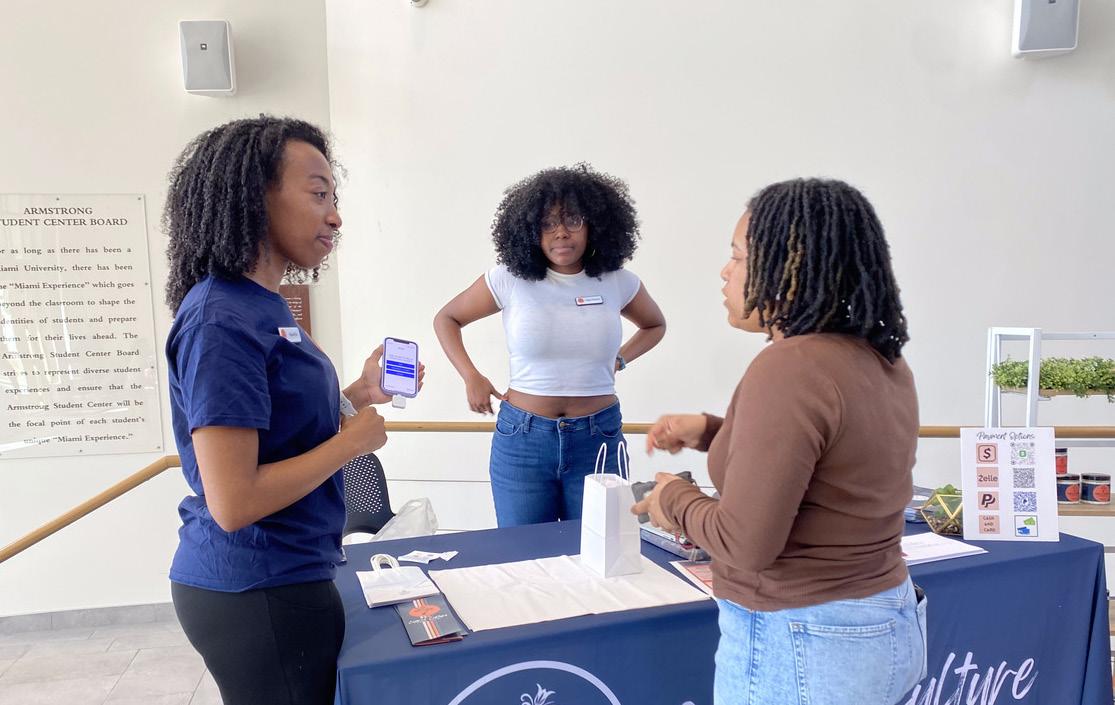
“This event happened last year, and it was a really big hit,” Wine said. “And since it is Black History Month, we wanted to make sure that we were getting the awareness that … all these businesses deserve.”
The pop-up showcased local Black-owned businesses. Wine said each vendor sold products at the pop-up individually, meaning they could take home all their profits.

Most participating vendors came from Cincinnati-based businesses, but some student businesses were also featured. Wine said MAP tried to invite a variety of businesses, so the shop wouldn’t be all clothes or all food.
VaLanDria Smith-Lash, a senior speech pathology and audiology major, was one of the students who participated in the event with her business, Coarse Culture. Coarse Culture is a skincare business that specializes in shea butter products, which Smith-Lash created when her mom was diagnosed with Lupus.
“In efforts to ease her discomfort from skin irritation and hair loss, I
developed a solution to her problem, which was the issue with chemical ingredients,” Smith-Lash said. “So Coarse Culture products are completely chemical free and they only are comprised of about six ingredients, which makes it really cool and it gives it a lot of versatility to be used from hair to toe.”
Smith-Lash, who sells products on her online store and Amazon, said she wanted to participate in the pop-up to bring more attention to her business and build relationships with other Black business owners.
“I felt like it was a really good opportunity to connect with other black entrepreneurs such as myself, as well as a good chance to get more exposure to my brand to Miami students,” Smith-Lash said.
Another business at the pop-up was the Most OutGROWING LLC, a Cincinnati-based apparel and art instruction company. Adoria Maxberry, founder of Most OutGROWING, said its main goal is to inspire people through art.
Maxberry’s booth sold Most OutGROWING shirts, buttons and an art book. She decided to accept the invitation to participate in the pop-up shop because she’s had good experiences at Miami before, having hosted a paint party on campus.
“I’ve been to campus before, and it was always a great experience, so I wanted to come out to be able to speak to the students here and to experience being amongst other vendors and supporting them especially during Black History Month,” Maxberry said.
Catherine Madden, a senior music composition major, purchased a sequined jacket and a cheesecake brownie from the pop-up shop. She said she decided to stop by after seeing a poster for the event, and people from her class encouraged others to go.
“I think it’s a great event, both as a way to celebrate Black History Month and as a way to expose students to local businesses, so it kind
of serves a double purpose,” Madden said.
Buike Nduaguba, a senior computer science major, came to the shop in Armstrong because he knew some of the participating vendors, like Smith-Lash. He was glad to see an event being held to support Black entrepreneurs and bought some clothes, shea butter and a necklace.
“It is definitely a benefit to such a small community like ours,” Nduagaba said. “It’s a way to give a voice [and] a platform for such a small community but such a powerful and innovative and influential community.”
To customers, MAP and the business owners, the pop-up shop was a success for the second year in a row. Maxberry said she sold lots of clothes and books, but more importantly, made plenty of connections with people on campus.
“We’ve been inspired by those that have stopped by,” Maxberry said. “Just as we’re trying to inspire others through our story, we’re also being blessed by the presence of all the students and faculty.”
Smith-Lash also had a successful sales day and was thankful for the opportunities Miami has given her. Coarse Culture is one of the first businesses to have a space in the new College@Elm innovation center.
“One thing that I wish other students knew about Miami, the help is there. You just have to find it and be willing to put in a little bit of effort to access it,” Smith-Lash said. “Since introducing Coarse Culture to the campus community … I get opportunities like this to get more brand exposure. And there’s just so many people willing to help you but a lot of students don’t know that.”
@nwlexi whitehan@miamioh.edu
photo story THURSDAY, MARCH 2, 2023 14
STUDENTS HOVER AND TALK WITH THE OWNERS OF THE SMALL BUSINESSES THAT VITALIZED ARMSTRONG’S ATRIUM ON THURSDAY. PHOTO BY JAKE RUFFER. SHANEQUA JOHNSON, OWNER OF CINCINNATI BEAUTY STUDIO AND BOUTIQUE BARCODE GLAM, SOLD CLOTHING, SUNGLASSES, LASHES AND OTHER BEAUTY PRODUCTS. PHOTO BY JAKE RUFFER. CINCINNATI ART COMPANY IN FLY WE TRUST SHOWCASED WALL ART AND COLORING BOOKS. PHOTO BY JAKE RUFFER. WITH TIME TO SPARE BEFORE CLOSING SOME BUSINESSES WERE ALREADY PACKING UP, HAVING SOLD OUT EARLY. OTHERS CONTINUED TO RECEIVE THE STEADY WAVE OF STUDENT SHOPPERS. PHOTO BY JAKE RUFFER. THE EVENT, ORGANIZED IN LARGE PART BY MAP’S INCLUSIVE OUTREACH DIRECTOR SOPHIA WINE, FEATURED SEVERAL BUSINESSES FROM CINCINNATI AND THE SURROUNDING AREA. PHOTO BY JAKE RUFFER. THE EVENT, ORGANIZED IN LARGE PART BY MAP’S INCLUSIVE OUTREACH DIRECTOR SOPHIA WINE, FEATURED SEVERAL BUSINESSES FROM CINCINNATI AND THE SURROUNDING AREA. PHOTO BY JAKE RUFFER.
Fusion showcases Asian American talent at Miami

RILEY CRABTREE THE
MIAMI STUDENT
The Asian American Association hosted their largest event of the year on Feb. 25. Hall Auditorium was filled with eager friends, family and other Miami University students there to experience one of the largest cultural events on campus.


Fusion 2023 featured a mix of modern and traditional performances from various Asian countries including Japan, Thailand, South Korea and India. Amongst the 17 performances, watchers experienced traditional Japanese fisherman routines, Bollywood dancing, martial arts, modern pop and even a cello and violin duet.
The event was organized to showcase the various and often underrepresented cultures at Miami.
First-year history and fashion design major Marie Spruance enjoyed the event and the various performances from Miami’s extensive list of participating clubs. She thought the organizers, Mia Baker and Amber Atkinson, did an excellent job organizing the event.
“You were able to see so many events in such a short time,” Spruance said. “I really enjoyed how they collaborated and put on a modern performance and then a more traditional one. I thought it was really interesting to see Western and Asian cultures colliding and forming such a meaningful interaction.”
Spruance appreciated the display of various Asian cultures throughout the two-hour performance.
“Being a predominately white institution, it’s nice to see other cultures and that a place can be created for those who aren’t in the majority,” Spruance said.
Anastasija Mladenovska, a first-year political science and Russian, East Europe and Eurasian Studies major, attended as part of the Diversity Affairs Council. Being an international student herself, Mladenovska feels passionate about the importance of events like this on campus.
“I know a lot of those people that were on stage, and it’s important to support our community here, especially at Miami, because there aren’t a lot of international students,” Mladenovska said. “We need to have a supportive network.”
Mladenovska also talked about the impactful message cultural events on campus send to students and the community.
“The act of it is very powerful to say, ‘Hey. We’re here and we are proud of it,’ Mladenovska said. “I think there’s a lot of power in taking what you are and owning it.”
The performers practiced months in advance of the event. Daniella Morales danced with the group Seoul in Miami (SeMi), who performed K-pop at the event. Morales was excited to see a large turnout for the event and felt they put on a great performance.
“We practiced and practiced,” Morales said. “We even practiced from 4-10 p.m. [the night before], but I think it was worth it. I think it went really smooth.”
Morales even went so far as to say she felt they “slayed the performance.”
“It’s really important to have events like this,” Morales said. “To have diversity at a mostly white institution it’s important to incorporate every little aspect of diversity we can. It showed something new not only to the performers who prepared it, but to everyone that came to the show too.”
crabtrr@miamioh.edu
THURSDAY, MARCH 2, 2023 15
MIAMI’S TAIKO DRUMMING CLUB TOOK THE STAGE BY STORM, BOOMING THROUGH HALL AUDITORIUM. JOSHA BONSU (LEFT), CHRIS NANKERVIS AND LUKE FREUDENBERG BANG OUT “KAWAMOTO MATSURI. PHOTO BY JAKE RUFFER. DANCERS HOP OVER AND BETWEEN BAMBOO STALKS IN A FILIPINO PERFORMANCE CALLED “TINIKLING.” PHOTO BY JAKE RUFFER. THE
A
20 STUDENTS
DRESSED IN THE TRADITIONAL GARB OF A COUNTRY AND BEARING ITS FLAG. PHOTO BY JAKE RUFFER. MARTIAL ARTS ORGANIZATION RED DRAGONS DEMONSTRATED MULTIPLE STYLES OF COMBAT. THE FIGHTERS BROKE BOARDS AND SPARRED AGAINST EACH OTHER. PHOTO BY JAKE RUFFER. MIAMI’S NISHAANA BOLLYWOOD FUSION DANCE TEAM PUT ON A MEDLEY OF DANCE NUMBERS MEANT TO TELL A TALE DERIVED FROM THE MOVIE PITCH PERFECT. PHOTO BY JAKE RUFFER.
PERFORMANCE OPENED WITH
FLAG CEREMONY. MORE THAN
MARCHED
We have not done justice. Today, we take steps to change that.
THE EDITORIAL BOARD

The following reflects the majority opinion of the editorial board. We haven’t done our job to the best of our ability. That changes now.
Miami University has a reputation for being undiverse. With some of the weakest diversity statistics among public colleges in Ohio, our student body is wholly unrepresentative of both the state’s and the nation’s populations at large.
The Miami Student’s editorial board believes we need to change our coverage for the better when it comes to diversity on campus and in Oxford.
Historically, our stories on diverse topics have not been done with enough care. Seeking out too few or underqualified sources and, on some occasions, tokenizing people with diverse backgrounds and identities has left this news organization with a less-thanacceptable track record on these
topics. We have made mistakes. However, that does not mean the future of this organization must follow the path upon which we have set it. Today, we are setting a precedent for better, regular and more accurate coverage of diversity and inclusion.
While Miami is comparably and statistically less diverse than other Ohio schools, that does not mean this campus is devoid of diverse voices. All students, faculty, staff and community members come from different backgrounds and have different identities.
On this campus and beyond, jokes are regularly made about our status as a predominately white institution at the expense of Miami’s diversity. This minimizes the real diversity that exists in our community, and we’re committed to seeking out these stories. The more these jokes persist, the less Miami’s diverse voices can be heard.
We aim to support the diverse voices of RedHawks, not just in spite
of the popular narrative but because of it. We will seek out nuanced stories and not simply seek stories about problems with diversity on campus. We will seek stories that showcase the true breadth of voices unheard in our community. We will seek to hear voices previously unheard.
We want to provide coverage with empathy. The Student thrives with steady and strong relationships with the community because our entire staff and the editorial board are rooted in and care for this community.
The relationship between a news organization and the people it covers is hugely important. The Student can be an advocate for voices unheard, for people with backgrounds and identities not well known or understood. Despite prior difficulties in maintaining good relationships with all groups in our community, this is our goal.
Our newspaper is focused on solution-oriented journalism. This
means we hope to see results based on the coverage we publish.
The heart of this type of coverage is seeking out diverse voices both from within The Student and outside of it. Our newsroom must ultimately reflect and respect the community about which we report. Whether it’s better awareness of the diversity we do have on campus, the DE&I efforts of the university or more specific ideas like the
GRAPHIC BY MACEY CHAMBERLINlack of wheelchair accessibility all over campus, The Student will continually aim to improve the lives of RedHawks.
We want our community to see what we at The Student envision today: better, more accurate and empathetic solution-based journalism.
We have not done justice.
Starting now, the status quo will no longer be accepted. Your voices will be heard.
Paying tribute to the friendships we form: To Marie
ANASTASIJA MLADENOVSKA THE MIAMI STUDENT
It is perhaps a bizarre occurrence that the first article that I am ever writing while studying abroad in the U.S. is about friendship. I am not someone who can firmly describe myself as a good friend, at least not in the modern sense of the word. I am, however, an observer and a friend of actions, and I like to give credit where it is due.
By this, I mean that I owe my transformative Miami journey to some of the great people I met here — people with whom I had dinner on Wednesdays after class last semester and who still never fail to bring about a smile on my face whenever I see them.
One of them is my dear Marie Spruance, a promising historian and my “little authentic gal.” She is almost always tiptoeing around campus, yet ultimately discernible — not so much because of her appearance, but of her aura. (Yes, I am that person. I will talk to you about auras and take you to a tarot reading.)
You look at Marie and you just know she is good. Bewitchingly kind. Yet, me and my Spruance more often than not connect over two things:
either our commonalities or the shenanigans we think of day to day in the endeavor to survive college.
Now, think about it: if you tried to think of one thing that each individual has in common with all of the other people in the world, you would come to a conclusion that the only thing that unites and separates us from each other is the fact that we inhabit the world. Not only do we populate the planet, but we also construct concepts, meanings and objects that are instantaneously dependent on our creation and that place us in an environment where it is impossible to exist without one another.
Therefore, we might persuade ourselves that we have an advantage in a world where we could always begin anew, but I have heard the phrase “I will always carry a piece of you with me” too many times to believe that the former is true.
From an economic perspective, it would be specialization that makes us hyper-dependent on each other for goods and services so that we would actively run around attempting to sell and consume. From a psychological point of view, dependence is usually defined as a negative phenomena, taking roots in our insatisfaction with ourselves — or sometimes even with the world around us where we can

find no tranquility — so we are often given the advice to grow our beings by becoming emotionally stronger or becoming experts and entrepreneurs so that we can successfully sell our intellect. Being caught up in this chaotic thought process, one may realize that the former is quite paradoxical in its execution. That is, by trying to break free from our dependency on others, we eventually become even more dependent; putatively, the individual that specializes in something so that they would be able to sell themselves and the person that tries to grow out of dependency at last end up at the same destination. That is, they have not at all escaped dependency, but have transformed themselves into a more socially acceptable or healthier model that, when startled with the approving feedback from others, forms an obsessional relationship with this flattering criticism.
Essentially, they once again develop dependency on the affirmation and validation of others.
On the other side, politically speaking, there is one form of dependency that is distinguished by the preceding one and this is depending on others for words and deeds.
It is no surprise that, in politics,
we continue listening to politicians’ promises although we have no intention of hearing them and we eagerly yearn for conversations that will shape, calm and give us an understanding of our concern for the world. In my opinion, it is not dependency that we should be looking at and/or examining, its negative or positive effects on our place in the world because dependency is characterized by natality.
Just as a newborn has to be guided through the beginning stages of life no matter its species, so do we naturally exist in a dependent correlation with our world. This is not supposed to scare us, to drift us apart from the shore of handshakes and romance into an abyss of selfdefinition like philosophical antiquity would desire.
We are free among others and the world which we inhabit together, not in introspection, to use Arendtian words. However, I am interested in dependency, and what really astonishes me in our world is our ability to be friends with each other.
Friendships are not a state of dependency, they indicate a much stronger alliance — codependency. To be in a relationship of codependency with one another is to respect and acknowledge the vibrant input of
those involved into the maintenance of the friendship. You are saluting this input every time you acknowledge your friends and yourself as the different sides of the same coin — that is, you are paying tribute to their existence without you which you must accept as beautiful and valid.
I think that our capacity to build friendships is truly astonishing and should have a reserved spot on a resume or at least it should constitute an integral part of our identification, not simply because we are able to form them, but because we are able to either form or destroy ourselves through this coalition.
In the end, we probably do end up carrying pieces of different people around with us, but we hardly ever notice because we have either internalized these parts as our own or confiscated them as “objects of the past” that help us appreciate the world in its current setting.
As for me, I hope that one day I will end up with pieces of my college friends in my pockets and my life, and I know that these pieces are going to make me feel lighter because they are going to be a tribute to my identity and my exhausting, yet beautifully rewarding, college experience. mladena@miamioh.edu
Vinyl is back in Oxford...finally
minute not spent in a record store.
The narrow store fills the former shoes of The Oxford Copy Shop and does so in a way that makes you believe it couldn’t have ever been anything but a record shop. Hundreds, maybe thousands, of albums line either wall with boxes of jewelry in the middle and cases of posters under the record shelves.
Vinyl isn’t just for old farts and old souls who’ve pressed on like upon the beaches of Normandy to bring back the long-beloved market. The market for vinyl is everyone who loves music.
needed to drive to either Hamilton or, more likely, Cincinnati to get to a decent record shop.
This new business fills a muchneeded gap in the market for Miami University and for Oxford, allowing for easy access to a product that makes up over 40% of album sales today.
DEVIN ANKENEY ASST. OPINION EDITOR
For 17 consecutive years, vinyl record sales have increased annually. The physicality of holding a beloved album cannot be matched by a digital album, whether streamed or downloaded.
Black Plastic Oxford has brought the vinyl market back to Oxford after
TEDDY JOHNSON CO-HUMOR EDITORSometimes life deals you a hand of cards that absolutely sucks. Well, in my case, I dealt myself a bad deck of cards and had to pay the price.
About two weeks ago, I broke my phone. While I will not disclose how I broke my phone, I will tell you that it stopped working completely. No parts of it shattered but I could only see a black screen on the screen of my phone. It wouldn’t even turn on.
At first, I thought to myself, “Well, shit. This sucks.” But this seemingly unfortunate situation turned out to be an incredible blessing. Since I no longer had a phone,
years without record stores Uptown.
And, if I may say, it’s about damn time!
For record collectors, vinyl enthusiasts and people who just love holding something in their hands, this is a more-than-welcome business.
Behind us are the days of driving to the recently-relocated Main Street
Vinyl in Hamilton to scratch the itch that comes along with every passing
Taylor Swift, Harry Styles, Olivia Rodrigo and Kendrick Lamar encompass the artists that sold the most albums on vinyl in 2022. These are hardly the genres exclusive to those stuck in past generations of media consumption.
However, the store’s plethora of brand-new, sealed records has recently been accompanied by a few shelves of used vinyl holdovers from Black Plastic’s primary location: a bone for those of us who primarily seek out older pressings of albums.
Before Black Plastic Oxford, I and other connoisseurs would have
While used records likely make up 95% of my record collection, they only make up a few shelves out of dozens in the store. I hope this ratio changes, though I wouldn’t dare complain about a business that both aptly fits my interests and surprised me when I heard about it.
I have a record collection of over 250 albums and growing, not helped by the compulsive desire to continue that trend.
Maybe Black Plastic will act like a fix for an addict, but I can’t be bothered to care even if I end up spending hundreds more than I needed to during my time here at Miami.
As streaming becomes ever-more popular, compressed, lossy audio fills the vast majority of our ears the vast majority of the time. Not only does
Living off my laptop
my only way to communicate was through texting, FaceTime or Snapchat (though I couldn’t open or send snaps). This left me with only one choice: dealing with the fact that I would have to look like an absolute goober carrying a laptop around to communicate in today’s digital age.
While I did look like a goober, I gained an incredible amount of time from not checking my phone 24/7. With this extra time, I was able to stay more present in the moment, do more activities I enjoy and get tons of schoolwork done.
Staying present in the moment proved to be the most beneficial part of not having a phone. A day or two after my catastrophic loss, my first test occurred at a date party. I went
without any form of communication, which can turn complicated if you lose who you came with.
Going out with no phone felt freeing. I never felt that anxiety that someone is texting me or that I am needed elsewhere. I felt like the moment was exactly where I needed to be. I engaged in better conversations, took in the sights, smells and sounds of the environment and just felt better about myself since I wasn’t constantly checking my phone. In a similar fashion, my time in the gym or time working at Bar 1868 felt more satisfying without a phone. My workouts went quicker and challenged me more, because I focused less on what music I needed playing or checking what Snapchats
I’d received. At work, I felt like I could engage with customers and coworkers more and like I was working harder. This, in turn, made my shifts feel quicker and made me feel proud of the work I’d done that night.
Now that I have my phone back, I can’t help but feel a little bit of a weight back on my shoulders. The constant urge to check my phone has returned. I’ve been fighting it as much as I can and I hope my experience without a phone will remind me to unplug and stay present in the moment.
Some steps I am going to take to reduce my phone usage (and hope you will try as well) include the following:
First, do not check Snapchat. I do not need to see a picture of someone’s
bringing this market to more people provide collectors like me a chance to further our collections, but it also allows for music-lovers to discover the overwhelming beauty within a physical LP.
Spinning your favorite album for the first time is a feeling like no other. You’ll hear things within your favorite songs that you’d never heard before, and you’ll never go back.

As I write, I have spinning Tom Petty and the Heartbreakers’ second album “You’re Gonna Get It!” As my second purchase from Black Plastic and first time spinning this incredible early LP from Petty, I can tell you confidently that the feeling never goes away.
Hearing impossible depths to the vocals and an all-encompassing feel to every song and album spun, vinyl breathes life into everyone’s ears.
Simply put, it feeds the soul.
Black Plastic is a morethan-welcome addition to the overabundance of restaurants and vape shops that line our streets, and I hope it’s here to stay.
ankenedw@miamioh.edu
forehead every two minutes.
Second, put your phone in a different room. You’ll be amazed at how much time you gain back if you leave your phone at home during a workout or put it in a different room when you try to study.
Finally, try going out or hanging out with friends phoneless and encourage friends to do the same. The conversations will flow, you could learn something new about someone and even meet a new person who could impact your life greatly.
10/10 recommend breaking your phone and living off your laptop. john1595@miamioh.edu
Opinion THURSDAY, MARCH 2, 2023 16
ASST. OPINION EDITOR DEVIN ANKENEY CAN NOW BOLSTER THEIR VINYL SETUP (SHOWN ABOVE) WITH NEW LOCAL SHOP BLACK PLASTIC OXFORD. PHOTO BY DEVIN ANKENEY