
ANNA
REIER MANAGING EDITOR
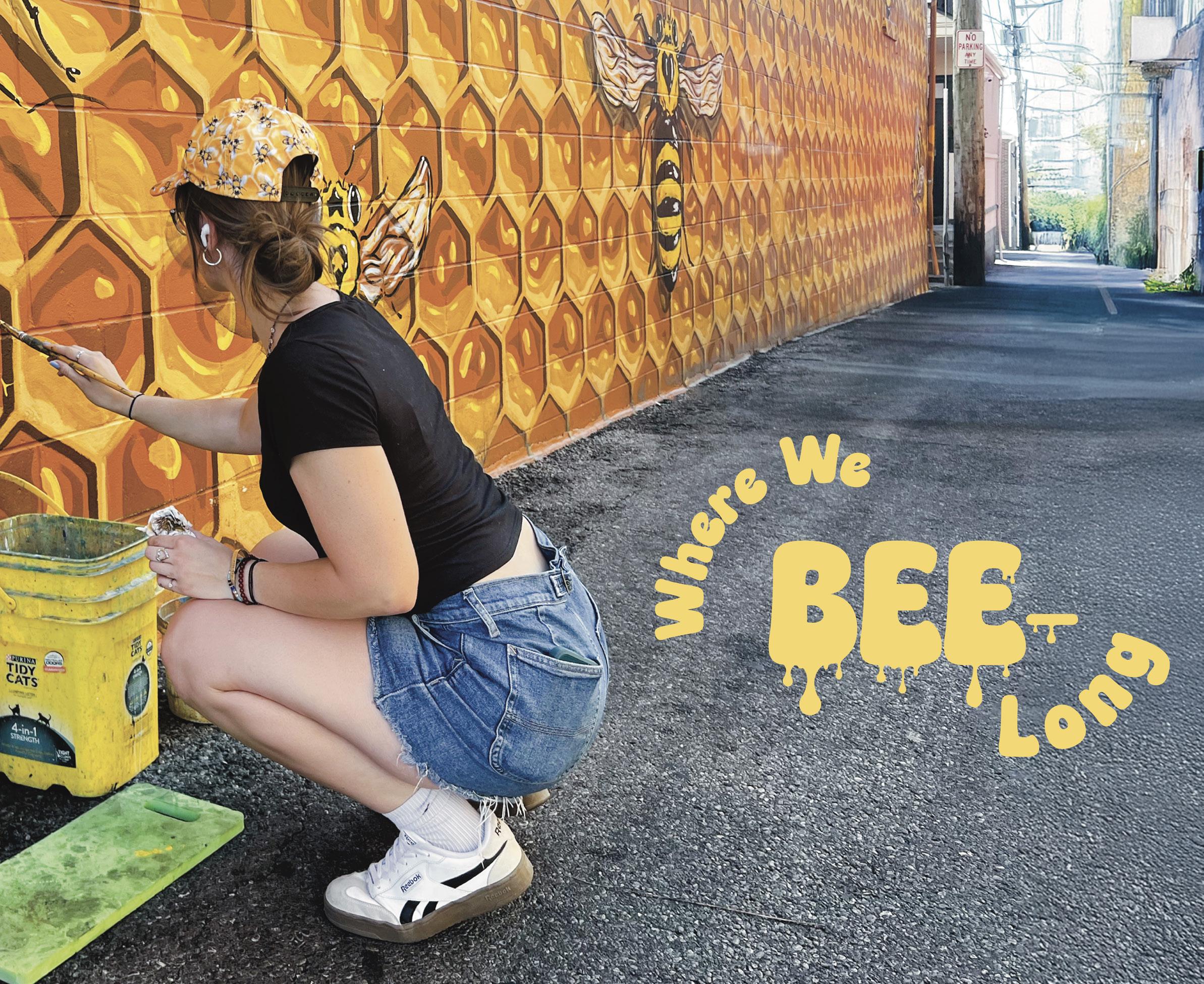
Joe Prescher has always been an artist. He’s taught high schoolers in Iowa and Texas and college students at Miami University, as well as selling his work professionally. So, when the opportunity arose to permanently

place his work in his hometown, he did not hesitate.
“They’re hungry for public art,” said Prescher, the mastermind behind the mural located in the alley between CJ’s and Mac & Joe’s. “The community reaction has been amazing. Everybody’s been in here since this started.”
Prescher started the mural last August, with the initial creation wrapping up in November when the weather turned. Now, with the help of students, community members and other professional artists, he is back for only one week to fnish up the mural.
“I’ve been waiting all year to get back in here and fnish up the stuf I
missed,” Prescher said. “I’m adding in a couple more bees, cleaning up some of the wear and tear and fnishing areas that were left undone.”
Since he started, Prescher has recruited all sorts of new artists. Some, like Natalie Natusch, paint for a career.
CONTINUED ON PAGE 5
KETHAN BABU SPORTS EDITOR
When the University of Florida Gators won the NCAA men’s basketball championship on April 7, fans were met with a seven-month wait until the 2025-26 season began. In late August and early September, teams across the country announced their full schedules, giving supporters a glimpse at what can be expected come November.
While the Miami University RedHawks have announced their conference schedule, their non-conference schedule still awaits fnalization, something that head coach Travis Steele said is a good problem to have.
“Scheduling has been tougher this year,” Steele said. “When I frst got here, there was a line from here in Oxford all the way to Cincinnati to play us, and now nobody will play us
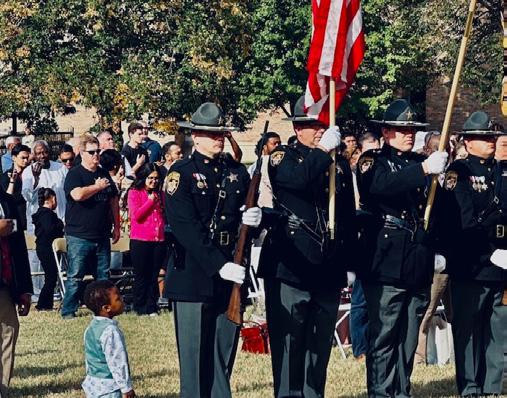
To celebrate the founding fathers signing the Constitution in 1787, from Sept. 15 to 22, Miami will host a series of on-campus events and programs aimed at exploring the legacy of the Constitution, the political and legal system and the rights and responsibilities of members of a pluralistic democratic society, according to a press release. Since 2005, under federal law, all universities that receive federal funding must commemorate the anniversary of the Constitution being signed on September 17. However, John Forren, the executive director of the Menard Family Center for Democracy, said Miami goes above and beyond its required programming.
… We’re signifcantly better. Everybody’s using these analytical numbers to schedule now, and we’re in this weird area where teams are told not to really play us, which has made it difcult.”
Scheduling for the RedHawks is more challenging largely because of the success of the program last season, Steele said. Miami fnished its 2024-25 campaign at 25-9, its best record since 1998-99. The team made it all the way to the Mid-American Conference (MAC) championship, its frst appearance since 2007, where it lost by two points to the University of Akron Zips.
Steele said the team celebrated its success in the spring, but the RedHawks quickly wiped their memories of last season in preparation of the new year, knowing that they can do more.
“It was a big step forward from where we’ve been,” Steele said. “I’ve
said this before, [we’re] obsessed with trajectory and not necessarily the result. We had a good year, but we want more. How do we continue to grow? Where are we going from here?”
Despite losing three players to the transfer portal, Steele said Miami’s retention is at an all-time high. Starters Eian Elmer, Peter Suder and Antwone Woolfolk all return, as well as standout players Evan Ipsaro and Brant Byers, who averaged 8.4 and 6.9 points, respectively. Similar to previous seasons, Miami relied on its young players in 2024-25. Byers and freshman guard Luke Skaljac averaged 17.6 and 13.9 minutes, respectively, and both played signifcant roles in the team’s shooting success, especially from range.
CONTINUED ON PAGE 7
“The idea of what became Citizenship and Democracy week was the idea [that] this is really an opportunity for us to get our community thinking about what it means to live in a democracy, what it means to live in a democratic society and what our rights and responsibilities are as members of that society,” Forren said. “So it was based on a sort of faculty interest in using it as a learning opportunity.”
Forren added that the Menard Center coordinated the events with the intent of staging a broad range of programs to reach audiences beyond political science and history.
Some of the free events in Oxford include an appellate hearing by the Ohio Court of Appeals in the Armstrong Student Center on Monday, Sept. 15. For Constitution Day on
Sept. 17, there will be a United States District Court naturalization ceremony, where roughly 100 new citizens will be sworn in by a federal judge, and later that day, Ohio Supreme Court Justice Jennifer Brunner will hold a public lecture.
“We're hoping people just come to watch [the naturalization], because it's just an amazing thing to see,” Forren said. “... The other thing I would say to come see [is the] court appeals hearing. What I keep stressing to people is this is not a simulation. This is not a mock trial. This is a real court with real judges, attorneys and real cases. And so it's a chance for students who are interested in law, for instance, to see what this really looks like.”
SARAH KENNEL GREENHAWKS EDITOR
In spring of 2025, Senate Bill 1 (S.B. 1) sent the Ohio world of higher education into a frenzy. Signed into law by Governor Mike Dewine, the bill impacts several aspects of higher education.
Most notably, it eliminates Diversity, Equity and Inclusion (DEI) programs in public universities, implements academic requirements, such as the centralized public posting of course syllabi and restricts professors from taking a stance on several “controversial topics” named in the legislation.
One of these “controversial topics” is climate policy.
Professor of biology David Gorchov teaches Principles of Environmental Science (IES 275), a course that heavily discusses both climate science and climate policy. Despite campus-wide changes from this legislation he said he believes Miami University’s climate education will remain largely unchanged.
“I don’t think it’s going to change it very much,” he said. “It’s not going to change the way I teach environmental science.”
This is due to the key distinction between “climate science” and “climate policy” in the legislation. The scientifc consensus that the climate is changing and warming due to increased concentrations of carbon dioxide and other greenhouse gases primarily caused by human combustion is not considered controversial – only specifc policies addressing this phenomenon are classifed as such.
“Climate science is not a controversial scientifc topic, so I’m not going to treat it as such,” Gorchov said. Elise Radina, associate provost for faculty afairs, also said it is unlikely that S.B. 1 will impact climate education at Miami, as the bill does not restrict the topics that can be included in academic courses. Instead, faculty are expected to encourage students to come to their own conclusions on “controversial” topics.
“Creating a classroom environment that fosters healthy discussion and the exchange of ideas does not mean that the introduction of challenging or controversial material should be curtailed,” Radina said in a statement to The Miami Student. “The expectation is that faculty will create the opportunity for students to express their intellectual diversity and reach their own conclusions on ‘controversial beliefs and policies.”
Gorchov said he has always encouraged students to discuss climate policy amongst themselves, read diferent perspectives and come to their own conclusions, and he will continue to do so. He often has students read diferent articles relating to a specifc climate policy, or uses current events as a way to initiate conversation on policy.
“Miami remains committed to freedom of expression, as required under our institutional Campus Free Speech policy,” Radina said in a statement to The Student.
Gorchov said his biggest concern with S.B. 1 is the way it manages university activities. He said this level of oversight will cost money, keep administration busy and give faculty extra work.
“The state was already governing Miami and other public universities, but to have these specifc measures… it’s just state government overreaching and micromanaging,” he said.
J.D. Wulfhorst, director of the institute for the environment and sustainability, said the university is working to be proactive about meeting S.B. 1 requirements. One requirement is the centralized posting of course syllabi. He said software will be piloted this year to ensure the system is running smoothly by the time it is required.
Wulfhorst said that he does not anticipate S.B. 1 to bring cumbersome additions to his job or curtail classroom discussion. However, he said discussion around the bill has caused cultural shifts in the feld and led to staf anxiety.
“It’s a doable task, but it’s also a changing culture, because as faculty and instructors, we’re not used to thinking that way,” Wulfhorst said.

OLIVIA PATEL EDITOR IN CHIEF
MADELINE BUECKER
ANNA REIER
MANAGING EDITOR
TAYLOR STUMBAUGH
CAMPUS AND COMMUNITY EDITOR
KETHAN BABU
SPORTS EDITOR
TAYLOR POWERS
OPINION EDITOR
STELLA POWERS
CULTURE EDITOR
CONNOR OVIATT
HUMOR EDITOR
SARAH KENNEL
GREENHAWKS EDITOR
OLIVIA MICHELSEN
DESIGN EDITOR
SARAH FROSCH
DIGITAL MEDIA EDITOR
KISER YOUNG
SOCIAL MEDIA EDITOR
Advertising information: Smith646@miamioh.edu
Send us
ASST. DESIGN EDITOR
LAUREN AURIANA
PHOTO EDITOR
SHANNON MAHONEY
PARKER GREEN
ASST. CAMPUS AND COMMUNITY EDITORS
AYLA PEDEN
ASST. CULTURE EDITOR
JEFFREY MIDDLETON
ASST. SPORTS EDITOR
AUSTIN SMITH
BUSINESS MANAGER
FRED REEDER JR.
FACULTY ADVISER
SACHA BELLMAN
BUSINESS ADVISER
AIM MEDIA MIDWEST PRINTER
are not necessarily those of Miami University, its students or staf. CORRECTIONS POLICY
The Miami Student is committed to providing the Miami University community with the most accurate information possible. Corrections may be submitted up to seven calendar days after publication.
2024 and 2025 Corbin Gwaltney Award Best All-Around Student Newspaper in the large school category, beating out every student paper at a university over 10,000 students in Ohio, Michigan, West Virginia and Western Pennsylvania
2025 Ohio Society of Professional Journalists (SPJ) Best Journalism Contest: First Place in the Best College Newspaper
2024 Ohio Society of Professional Journalists (SPJ) Best Journalism Contest: Second Place in the Best College Newspaper
2025 Ohio News Media Association Awards
First Place in Best Collegiate Website
2025 Ohio News Media Association Awards
First Place in Best Collegiate Opinion Writing
2025 Ohio News Media Association Awards
First Place in Best Collegiate Sports Writing
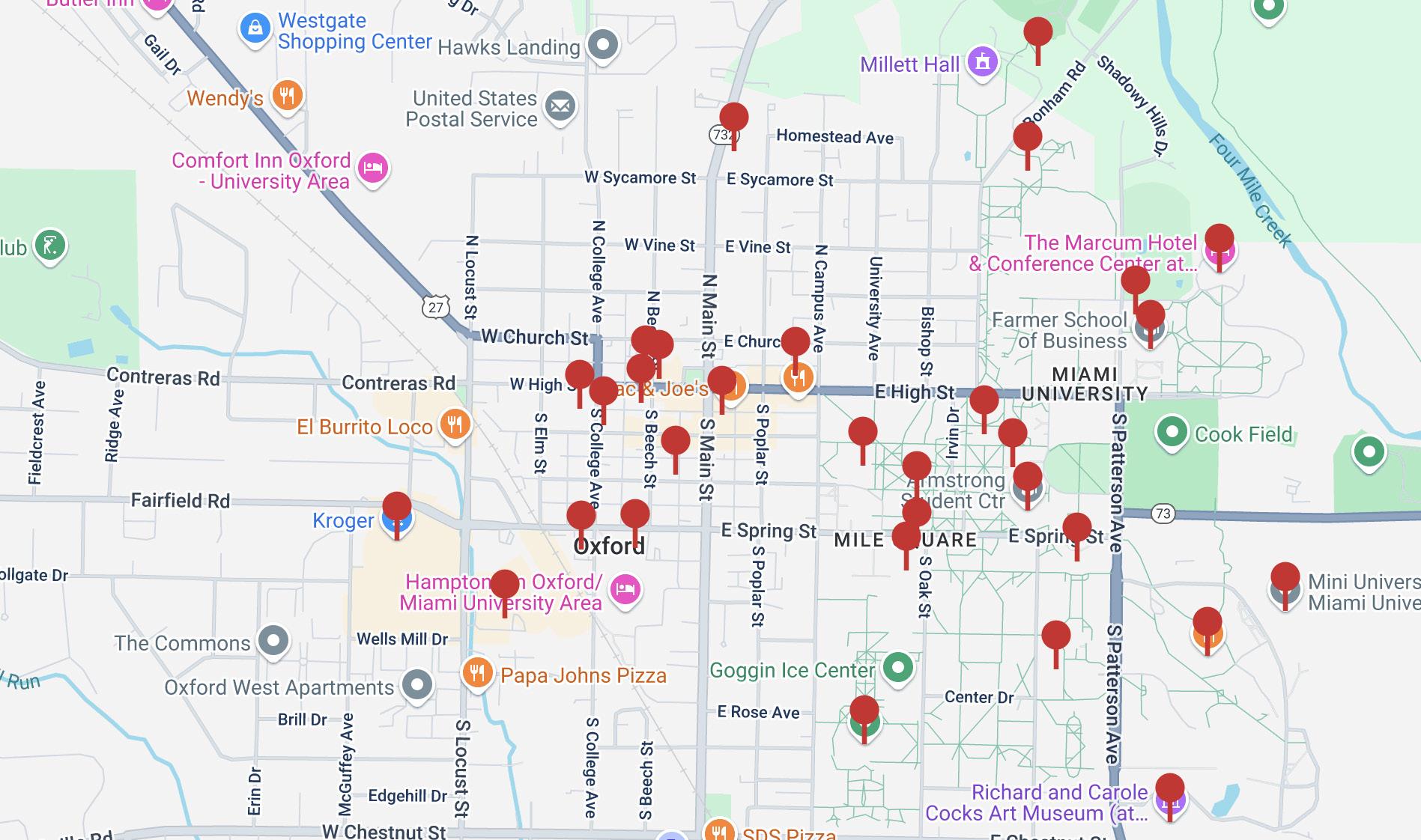
You can find The Miami Student printing locations at the spots marked with a red dot


FRIDAY, SEPTEMBER 5
FRIDAY, SEPTEMBER 19
FRIDAY, OCTOBER 3
FRIDAY, OCTOBER 24
FRIDAY, NOVEMBER 7
FRIDAY, NOVEMBER 21



Pennsylvania
conducting a routine foot patrol when a male walked toward them with two open containers of alcohol. Ofcers stopped him and gave him a citation.
On Aug. 30 at 2:27 a.m., in the 700 block of High Meadow Lane, ofcers were dispatched for a female who
ofcers responded to an alleged assault. A report was taken, and the investigation is ongoing.
Later that day, at 10:08 p.m., at the intersection of West High Street and North Beech Street, OPD ofcers stopped a vehicle for running a red light. Ofcers then discovered the driver had an active warrant through the Hamilton Police Department (HPD). HPD arrived at the scene and arrested the driver.
On Aug. 31, at 5:43 p.m., in the 30 block of E. High St., ofcers responded to a female who reported fraudulent charges on her debit card after losing the card at an Uptown bar. On Sept. 1 at 12:43 a.m., in the 100 block of N. Beech St., ofcers responded to a
and
male. He was transported to the
TAYLOR
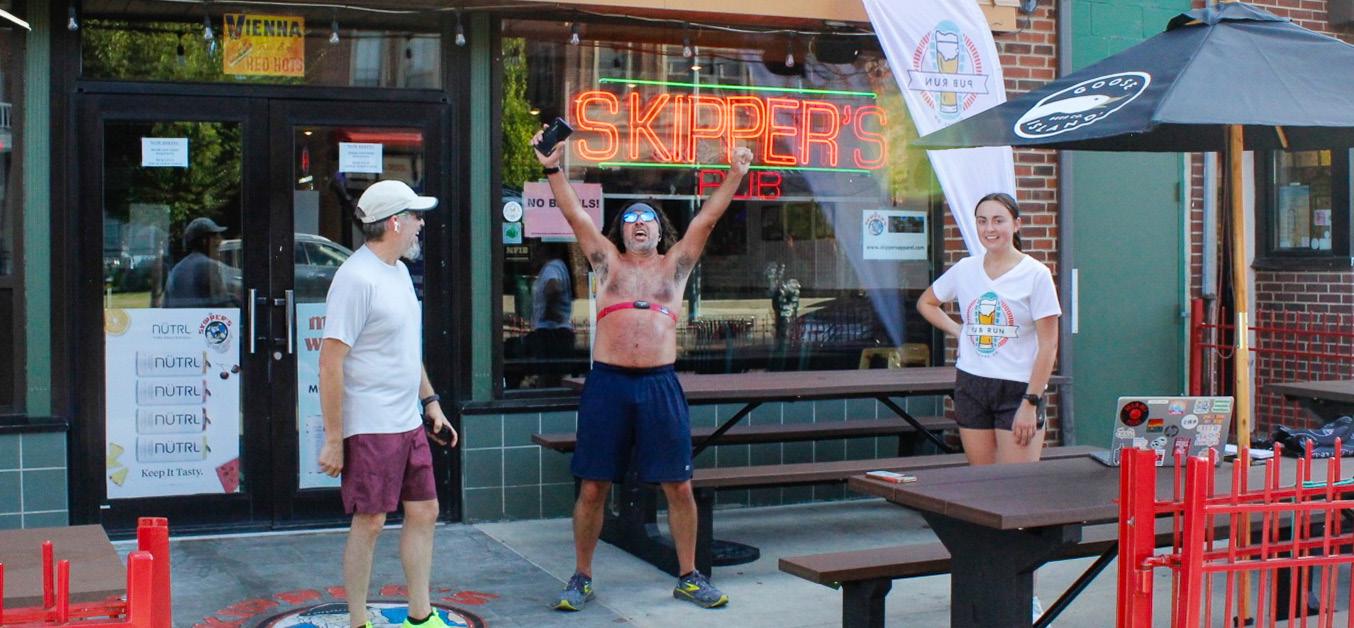
A pack of eight runners began their jog at Enjoy Oxford and followed the pre-planned route down Main Street, over the Black Covered Bridge, onto the Oxford Area Trails (OATS) through Leonard Howell Park and then toward Bonham Road until, one by one, they ended up at Skipper’s Pub back on High Street.
Some were sweaty and others out of breath, but all of them regrouped after 15 to 20 minutes with smiles on their faces by the Pub Run sign outside of the bar.
They don’t always end up at Skipper’s, though; sometimes it’s Left Field Tavern, and before it closed in early August, Church St. Social was a popular stopping spot, too.
Bill Levenderis, an avid runner since the pandemic started in 2020 and part of the Tuesday night Pub Run for roughly three years, said the club started in 2019.
“All you gotta do is show up,” he said. “Walk. Run. Jog … and then get together for merriment afterwards.”
The goal of the weekly Pub Run is to exercise with others who like to run or walk in the Oxford community, according to the website, but with a fun twist.
After someone attends 10 times, they get a free T-shirt. Savannah Perry, a graduate student earning her English master of fne arts in creative writing, said she’s been part of the running club since last fall when her friend asked her to join. Perry showed up to this week’s run in one of the free T-shirts.
“[My friend’s] graduated now, [but I kept coming back] for the community,” Perry said. “It’s nice having someone to run with.”
She added that her favorite part was fnding the diferent routes to run on campus. The diferent options can lead down slant walk into campus, onto the OATS trails or up and

SHANNON MAHONEY
ASSISTANT CAMPUS AND COMMUNITY EDITOR
The Oxford Farmer’s Market vendors are still putting the fnishing touches on their stands at 8:45 a.m., but a line has already formed at the Bigham Artisan Bread and Pastry stall. By the time the market opens at 9 a.m., the number of patrons has grown, stretching toward the edge of the parking lot.
James Bigham started working at the farmer’s market as a teenager, helping his brother with his produce stand. After attending the market for a couple of years, Bigham decided to step up and fll a hole that had opened when three vendors who had been selling baked goods left the market.
“I started the business when I was 16,” Bigham said. “This has been my only real job … I’ve done it professionally for over half my life now.”
When Bigham frst began his business, he was baking out of his family’s home kitchen. Two years ago, he was able to build a professional kitchen. His mother and aunt now run a second pastry stall at a farmer’s market in Richmond, Indiana, while Bigham and his sister Jessy operate at the Oxford Farmer’s Market. He added that his mother was a huge supporter of his dream, and she encouraged him to start his business in the frst place.
“I’ve fnally kind of gotten to the point where I can trust that we’re going to be busy every week, because for the frst seven years, I would have this fear that this is going to be the week when nobody shows up,” Bigham
said. “I’ve fnally gotten confdent in my customer base. They are going to show up for me.”
The Bigham Artisan Bread and Pastry stand has some staple items, like the chocolate-almond croissants and cinnamon sugar crufns, but also ofers a rotating menu of seasonal items.
During the fall, Bigham ofers favors like apple and pumpkin, and said he creates his pastries by relying on whatever crops are in season. Additionally, he tries to source his ingredients locally whenever possible.
“We get all of our apples from Downing Fruit Farms, which is just around the corner here,” Bigham said. “A lot of times we get peaches and cherries from them as well. Berries we get from a little, tiny farm stand close to us.”
Sally Henson, owner of Abbott Ridge Farm, runs her own stand at the market. When Bigham frst began experimenting with baking, the two kindled a friendship over bread and pastries.
“We would sit there, every Saturday morning for three hours, 28 weeks out of the year, so we just kind of would chat about bread and talk about diferent things,” Henson said.
“Then he would ask questions about how I did things.”
At the time, Henson baked and sold bread products both at her stall and to multiple restaurants. She was baking upwards of 950 loaves a week, and after a time, felt like she was ready to move on. Henson said she recommended Bigham attend the San Francisco Baking Institute and
take a course on breadmaking.
Bigham took several courses at the institute, including ones on pastry making. When he returned to the Oxford Farmer’s Market, he began to include more signature pastries, like his croissants and danishes.
“He was ready to pick up the mantle,” Henson said. In the nine years since he frst began, Bigham has gained a dedicated base of loyal customers. His unique pastries attract everyone from Oxford locals to university staf and students.
Matthew Siegel has regularly attended the Oxford Farmer’s Market since moving to Oxford in 2019. He said he had been coming for a chocolate almond croissant every week for a number of years.
“They’re my guilty pleasure,” he said.
Sofa Folchi, a senior kinesiology major, attended the farmer’s market with her roommate and purchased a bacon gouda danish from the Bigham stall.
“The line was super long,” Folchi said, “We were like, ‘It’s gotta be good.’”
Bigham’s stall will be at every Oxford Farmer’s Market during the year. He is now looking ahead to the next few weeks when pumpkin-favored pastries can make their appearance.
“It’s been really, really fun to see him grow as a person,” Henson said. “It’s just been really interesting to see how it’s gone and to see him excel.”
mahones5@miamioh.edu
around T.J. Maxx on Locust Street.
“You get in the habit of running the same loop over and over again,” she said, “so it’s nice to get some exposure to diferent places.”
Judy Eaton, a 65-year-old walker and a Miami University employee in the research ofce, said after a year and a half in the club, she decided she likes the route through campus the most because the sidewalks are the most reliable.
“I’ve worked at the university for 23 years, and [someone] told me about [the Pub Run], and I was like ‘I never heard of that,’” she said. “I like to walk for exercise, so I said, ‘Yeah, let’s do this.”
exercise she can do, so
with a group of people or even one other person and building camaraderie is nice.
“It’s [not just] for people that are really hardcore training – it’s for everybody,” Levenderis said. “... If you want to walk, there’s walkers. Sometimes there’s more walkers, and sometimes we’ve had people with strollers, with babies. So here we got a favor of everything, and everyone’s invited.”
stumbata@miamioh.edu

KYLIE BUNN
THE MIAMI STUDENT
KIERNAN PFENNIG
THE MIAMI STUDENT
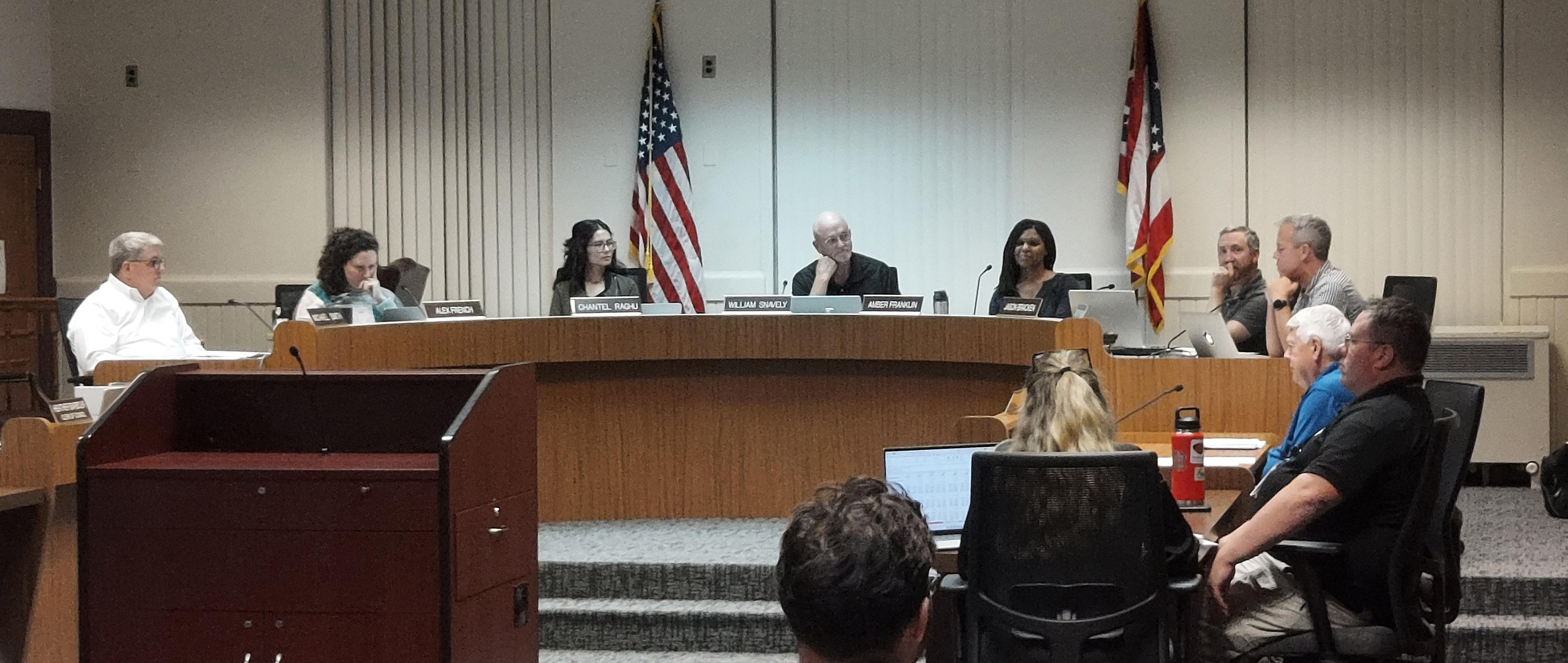
Oxford City Council approved an ordinance concerning a conditional use for an indoor golf simulator entertainment facility located at 10 N. Beech St. and expressed its desire to dissolve the Student Community Relations Commission at its Sept. 2 meeting.
Revamping the old Prin-
cess Theater’s location
The site of the golf simulator, once home to the beloved Princess Theater, has been a topic of conversation in Oxford for almost a decade. After being bought out and then shut down in 2014 after a fre, residents fought hard for revival.
“I raised my kids watching movies at The Princess … we took it for granted,” council member David Prytherch said.
After The Princess closed, Prytherch started a Facebook page called “Save The Princess” in an efort to gain support for the cause.
Instead of a revival, the space transformed into student housing following its closure.
“It’s a sad story of a community
that tried, but ultimately just couldn’t pull it together,” Prytherch said.
Despite the disappointment, he said he is excited to see new entertainment of value relevant to 2025.
Prytherch spoke directly to the project pioneers in attendance at the meeting, recent Miami graduates and owners of Fitness on High and OxVegas Chicken, Tyler Storer and Jackson Trester.
“I think [the current developers] can write a new chapter for the building,” he said.
Other council members were excited by the prospect of flling the vacant space, but emphasized the need to preserve the historical aspects of the building.
“This is our one chance, I’m not going to support this without a new marquee on the building,” council member Mike Smith said.
Other conditional use terms include evaluation of potential efects to the surrounding buildings and getting a building permit.
Storer and Trester sought out architect Scott Webb for assistance in requesting conditional use approval from the city.
“We really appreciate the support from the planning commission … I am excited to represent Jackson and Tyler [and] anxious to start a new
venture,” Webb said to council.
The foor plan includes nine golf simulator bays, a bar and seating areas. Branded T-shirts and golf accessories will also be for sale. Although no food service will be provided, the owners intend to allow food to be brought in or delivered from other local businesses.
This indoor hub has the potential to attract not only Oxford residents and nearby families, but also Miami University students, due to its attractive nature to college-age students.
Council members announce decision to dissolve the Student Community Relations Commission
The Student Community Relations Commission (SCRC), made up of Miami students, serves as an advisory board to city council to help address student and community issues.
Originally formed in 1986, Assistant City Manager Jessica Greene asid the commission has struggled with attendance and failed to create actionable suggestions for the city council. The city aims to remove the SCRC and promote other avenues for student civic engagement.
Greene presented the proposal to disband the SCRC. She highlighted the city’s strengthened relationship with the President’s Ofce, Ofce of
Student Life and Associated Student Government as proof of the city’s determination to work with Miami students and staf.
Additionally, the proposal aims to encourage students to participate in other advisory commissions through an annual campaign.
Council member Alex French supported the proposal and emphasized Oxford’s commitment to the community.
“This is not ending our relationship or our conversation with the students and the Miami Community…” she said.
French went on to invite Miami students both in the audience and listening on the livestream to propose new advisory boards and to get engaged with city council. French said she approved of the proposal’s plans to increase student involvement and address student and community issues.
Council member Amber Franklin said the SCRC brings a “false comfort that something is happening,” and hopes that the dissolution of the commission will lead to a more efective system with higher student involvement.
Prytherch described the SCRC as a noble efort that was “cumbersome in its design.”
Prytherch went on to express his concerns that with the SCRC gone, Miami students would no longer know where to go when faced with a community issue. He also said the limited number of positions on advisory boards could limit student participation.
An annual “State of the City” address was suggested by council member Jason Bracken, where the city could express its goals for the year, increasing transparency and creating a clear dialogue between the city and the community. This would be modeled after Miami’s “State of the University” address, given by President Gregory Crawford annually.
While some councilors have concerns over student civil engagement without the SCRC, the council expressed overall optimism in the strong relationships it has built with Miami students and staf organizations.
“Sometimes sunsetting something allows for the rebirth of something that’s newer or better,” Franklin said. Council will meet again on Tuesday, Sept. 16, at 7:30 p.m. at the Oxford Courthouse.
pfennikp@miamioh.edu bunnkm@miamioh.edu

“I randomly met Joe at an art show that I [hosted] recently,” Natusch said. “He said he needed some help with a refresh, and I ofered to come out.”
Others, like Ava Suarez, a senior studying painting and arts management, stopped by to help paint on the way home from class.
“She came by, told me she was an art student and asked if I needed help,” Prescher said. “So I said, ‘Sure,’ and she’s been painting for the last hour.” Suarez spent her hour in between classes painting in three of the honeycombs that were left blank last November.
“This is a great way to get more involved with the community,” Suarez
said. “My friend [helped with the mural] last year and told me all about it. There are all sorts of people coming in and helping when they can. It’s a great way to bring people together, and it’s so cool playing even a small part in it.”
As her hour break wrapped up, Suarez headed back to campus, much to Prescher’s protests, but she promised to return later.
“I do actually have to go to class,”
Suarez said, “but I can come back tomorrow. Will you be here around 11 a.m.?”
“Can’t you skip class?” Prescher replied. “I probably know the professor and can get you extra credit.”
But art students aren’t the only people ofering to jump in.
On her way back from lunch at Mac & Joe’s, Gail Stark, a 1962 Miami
alumna, expressed her approval for the mural.
“This is the best thing that Oxford ever did,” Stark said. “I had my son and daughter-in-law come visit from San Francisco, and they both painted on it. They absolutely loved it.”
After a little encouragement from Prescher, Stark added her own painting to the mural.
“Come on, it’ll only take you fve minutes,” Prescher said. “Maybe even three. Natalie here will walk you through everything.”
Natusch walked Stark through the entire process, and after fve minutes, Stark left the mural as a contributing artist.
“You just want to put a little paint on the brush like that,” Natusch said to Stark. “It’s just like putting makeup on.”
Some go as far as to purchase entire bees for the wall, which Prescher will paint and name in their honor. For $1,000, individuals and organizations have had bees on the wall painted in their name. While he was reluctant at frst, Prescher started selling the bees to fund the mural project.
“I had to fgure out a way to pay for this thing,” Prescher said. “I started a GoFundMe, and it did pretty well. But once the honeycomb was done and the bees were coming in, I decided to charge people a fat fee for a bee.”
Some of the bees on the wall were painted in honor of wives and daughters. Others were purchased by community organizations, such as Enjoy Oxford and the Oxford Community Arts Center.
“The frst one I sold was to a dad visiting his daughter,” Prescher said. “We were just talking of the cuf, and he said that he wanted one. We’ve even had someone running for state senate buy a bee.”
Prescher said after this last round of touch-ups, the mural is complete.
“After this week, it’s done forever,” Prescher said. “But, the town is becoming more interested in public art. The mural has piqued the town’s interest. I’ve got another project down the street and hopefully more coming next spring.” For now, Oxford’s hunger for public art can be appeased by a fnished bee mural, one year in the making.
reieram@miamioh.edu
KETHAN BABU SPORTS EDITOR
This week’s schedule doesn’t get any better for the Miami University football team (0-1), as the RedHawks are once again on the road to face a Big Ten opponent, this time the Rutgers University Scarlet Knights on Sept. 6.
Last week’s season opener against the University of Wisconsin-Madison Badgers found Miami trailing 3-0 by halftime. However, two touchdowns for the Badgers in the second half and mistakes on offense kept the RedHawks down 17-0 by the end of the fourth quarter.
At a press conference on Sept. 1, Miami head coach Chuck Martin said the team was largely uninjured by the Wisconsin game, a requirement if the RedHawks want a fghting chance against Rutgers.
“Moving forward to Rutgers, obviously it’s a diferent challenge,” Martin said. “Ofensively, a totally diferent animal than the team we just played from a style and experience [standpoint], and they got a lot of guys back on ofense that were really good a year ago. They run it, they throw it, they’re really physical.”
The Scarlet Knights will welcome their second consecutive Mid-American Conference (MAC) opponent after facing the Ohio University Bobcats, last year’s conference champion, at SHI Stadium.
Rutgers played a dominant second quarter against Ohio, scoring 24 points, including a touchdown after returning a blocked punt. The Scarlet Knights extended their lead over the Bobcats 31-17, but a scoreless third quarter for the home team allowed the visiting MAC team to even the game 31-31.
With the ball in their hands at the start of the fourth quarter, the Scarlet Knights retook the lead after senior kicker Jai Patel nailed his 26yard feld goal. Ohio was forced to punt on its next drive, and Rutgers ran the clock to take their 34-31 win.
Senior quarterback Athan Kaliakmanis threw 252 yards and two touchdowns while maintaining a 78.3% completion rate (18 completions on 23 attempts). As the starter
last season, Kaliakmanis fnished with 18 touchdowns and 2,696 yards total.
Kaliakmanis favored junior receiver Ian Strong, who had seven receptions for 100 yards against the Bobcats. Sophomore KJ Duf and senior DT Shefeld caught a touchdown each and combined for 139 yards together.
The Scarlet Knights began the 2024 season with four-straight wins, but they quickly returned to .500 after dropping their next four matchups, including a 42-7 decision to Wisconsin. They won their fnal regular season game against the Michigan State University Spartans to take ninth place in the Big Ten. Rutgers earned a spot at the Rate Bowl, where it lost by three points to the Kansas State University Wildcats.
Kaliakmanis, a former transfer from the University of Minnesota, returned in 2025 alongside Strong and Duf, giving the Scarlet Knights familiar quarterback-receiver connections from the jump. Rutgers did lose its leading receiver, Dymere Miller, who is now a New York Jet. Miller compiled 737 yards and four touchdowns last season.
Running backs Antwon Raymond and Samuel Brown V also rejoined Rutgers after last year’s campaign. Last week, Raymond rushed for 87 yards and one touchdown. 2024’s leading running back on the roster, Kyle Monangai, who fnished the season with 1,279 yards and 13 touchdowns, was drafted in the seventh round by the Chicago Bears.
The Scarlet Knights played a close game against Ohio. For Miami to have a chance in its second-straight game on the road against a Big Ten team, the RedHawks will need to correct their mistakes on ofense against Wisconsin while maintaining their strong defensive showing from last week.
This weekend’s matchup will be the frst meeting between Miami and Rutgers. Kickof is scheduled for 3:30 p.m. EST in Piscataway, New Jersey, and the game will be streamed on Peacock.
babukc2@miamioh.edu
Middleton’s Musings: The Miami hockey team has improved, but so has everyone else
JEFFREY MIDDLETON
ASST. SPORTS EDITOR
Welcome to Middleton’s Musings, a new weekly sports column on all things Miami sports from Assistant Sports Editor Jef Middleton. We’ll talk about all the current goings-on within the Miami sports universe, and we (may) have some disagreements along the way, both in print and online!
***
Last year’s Miami University hockey team was another in a long line of disappointments, especially considering the new face behind the bench in head coach Anthony Noreen. His frst press conference in the Club Lounge of Goggin Ice Center provided promising statements of what he wanted the team to look like and, more importantly, where he wanted the team to be.
But, as the saying goes, Rome wasn’t built in a day.
A 3-28-3 record with no conference wins meant signifcant changes were abound, and thanks to the transfer portal, the Miami coaching staf was able to bring in more than a handful of new faces. But, while that was happening, the teams around the RedHawks in the National Collegiate Hockey Conference (NCHC) also utilized the portal and recruitment to bolster their teams, making next season all the more interesting.
While the ofcial roster isn’t fnalized yet, there are more than 20
KETHAN BABU SPORTS EDITOR
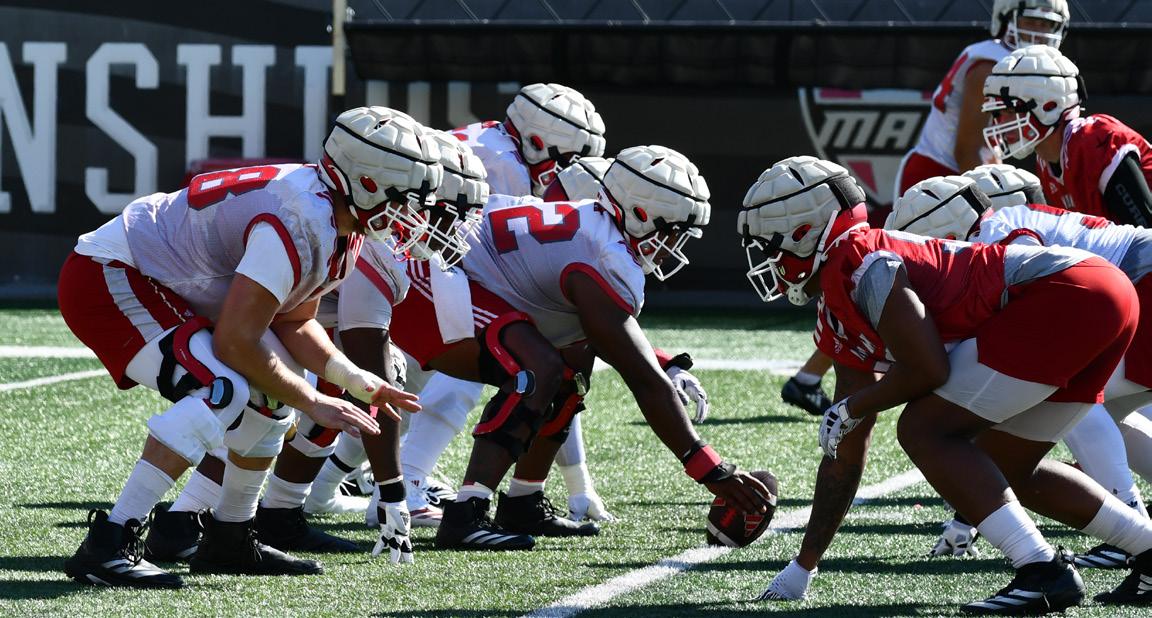
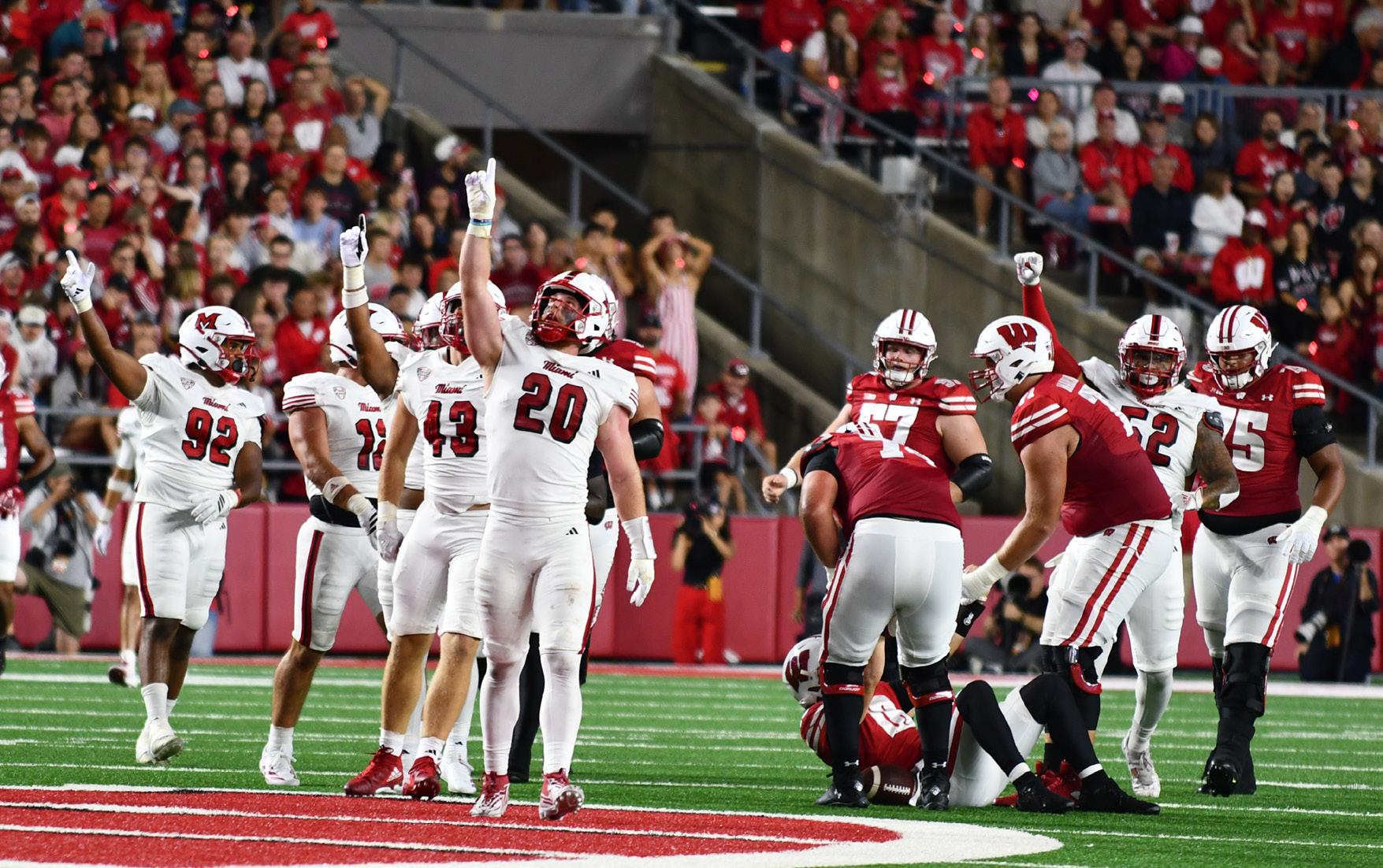
When the Miami University RedHawks football team entered Camp Randall Stadium to open the 2025 season against the University of Wisconsin Badgers, it expected a tough battle. In the week leading up to the game, head coach Chuck Martin and the RedHawks acknowledged the strength of its Big Ten opponent and knew Miami would need to put forth its best efort.
When the clock ran out in the fourth quarter on Aug. 28, Miami managed to hold the Badgers to 17 points. However, after 60 minutes of play, the RedHawks couldn’t impact the scoreboard, giving Miami a 17-0 loss on its record to start the season.
At a press conference on Sept. 1, Martin spoke about the importance of moving forward after a shutout.
“Mentally, you gotta be tough to handle it because no one likes losing,” Martin said. “No one likes getting sand kicked in their face. There’s some guys that got some sand kicked in their face and got overwhelmed physically, but there’s also some guys that did great.”
Some of the players that performed great, Martin said, were on the defensive side of the ball. The RedHawks held Wisconsin to three points going into the second half. The Badgers received to start the third quarter and marched towards the endzone, but a Silas Walters goal-line interception reinvigorated Miami’s ofensive eforts.
“Defensively, I just thought we played hard,” Martin said. “I thought we got of blocks. I thought we played north and south. I thought we played on edges. I thought we did a lot of good things defensively, [but] there’s still plenty of things to
being NHL draft picks. The University of Nebraska-Omaha based most of its ofseason in Canada, adding 15 new players, none from NCAA programs and all as either freshmen or from diferent programs in Canada.
Welcome to the new college hockey world.
new names gracing the Miami athletics hockey roster subpage. The player turnover from last season is an exciting start to a new era of Miami hockey. The upgrades have been matched by those who are already powerhouses in arguably the best conference in all of college hockey. The national champion, the Western Michigan University Broncos, went right back to work following their champagne-flled ofseason, acquiring 2023 Columbus Blue Jackets third-round pick William Whitelaw from the University of Michigan, who scored 18 points in 35 games last season. They also brought in sophomore forward Zaccharaya Wisdom from Colorado College and sophomore forward Theo Wallberg from Ohio State University.
Arizona State University, Miami’s matchup on Halloween weekend, added a familiar face in their transfer class of four. Former Miami forward John Waldron headed to Tempe in favor of the Sun Devils, along with frst-year forwards Logan Morell and Noah Powell from Michigan Tech University and Ohio State University, respectively.
Arizona State also received the commitment of Connor Hasley, who may become the best goalie in the NCHC after posting the best numbers in all of college hockey last season with Bentley University.
Instead of making moves in the portal, the Denver University Pioneers instead added 10 freshmen to their 2025-26 roster, eight of which are from north of the border and fve
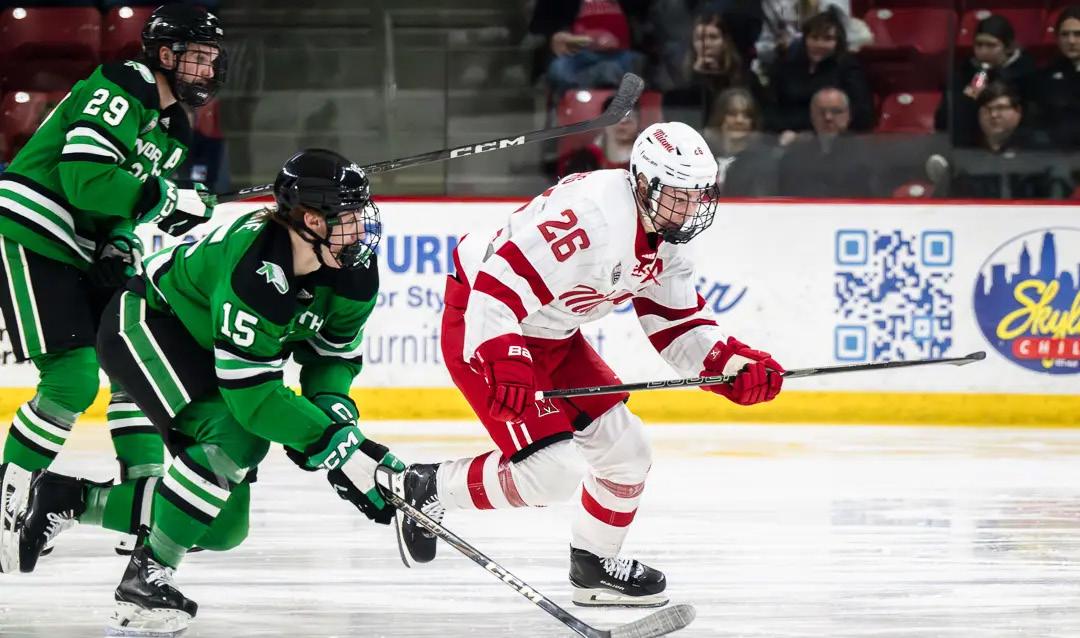
The University of North Dakota Fighting Hawks had a down year in 2024-25, and after fring head coach Brad Berry in late March following their loss in the NCHC semi-fnals to the Broncos, the program looked for a new direction. New head coach Dane Jackson joined the roster alongside Bryn Chyzyk as general manager. With a new front ofce, North Dakota added fve high-profle players in the transfer portal. Those names include University of Minnesota-Duluth (UMD) sophomore forward Anthony Menghini and two new goaltenders: sophomore Gibson Homer from Arizona State and UMD junior Zach Sandy. However, the biggest name to join the Fighting Hawks is Ellis Rickwood, a junior forward from Clarkson University, who scored 35 points in 39 games on a strong Golden Knights team.
The Fighting Hawks’ portal class would have been better as they initially received a transfer commitment from sophomore Michigan Tech forward Isaac Gordon, but he made the decision to stay with the Huskies just two weeks into new head coach Bill Muckalt’s tenure.
North Dakota did lose Chicago Blackhawks 18th overall pick Sacha Boisvert to Boston University in the portal, but these additions are helping them to sweat a little less. And, some might even argue that they got better outside of the portal than they did within it.
Chyzyk added two of the biggest names in Canadian junior hockey over the ofseason: Cole Reschny and Keaton Verhoef.
Reschny was the 18th overall se-
clean up defensively. There’s things, when you watch the tape, that we can do better and have to do better moving forward.”
Despite the opportunity, the RedHawks punted three minutes later. The Badgers took their frst touchdown of the night when backup quarterback Danny O’Neil found senior receiver Vinny Anthony II in the endzone with four minutes left in the quarter. Now down two scores with 15 minutes to play, Miami’s ofense needed to right its ship. The RedHawks hadn’t yet reached 100 offensive yards going into the fourth quarter. Miami went three-and-out on its next two drives, and a Wisconsin punt found the ofense at its own 10-yard line. Sixth-year quarterback Dequan Finn threw his frst interception of the night to graduate student safety Preston Zachman, setting the Badgers up a short distance away from another touchdown.
O’Neil’s rush and senior kicker Nathanial Vakos’ extra point added seven to Wisconsin’s total. With the RedHawks down 17 in a hostile environment with less than seven minutes remaining, a comeback for the Red and White was unrealistic.
Finn’s second interception, also to Zachman, ended Miami’s ofensive showing for the night. The Badgers earned four frst downs to run the clock out, taking their shutout by 17.
“We played fast, played hard in spurts,” Martin said, “but [we] were more overwhelmed than anything ofensively. It looked like a bunch of frst-time starters, that’s how we played. We’ll look like a bunch of second-time starters this week.”
In his frst game with the RedHawks, Finn threw nine completions on 18 attempts for 83 yards, as well as two interceptions. Three
lection of the Calgary Flames in the 2025 NHL Draft after posting 92 points in 62 games with the Victoria Royals in the Western Hockey League, and Verhoef is the projected second overall pick in the 2026 NHL Draft behind only Pennsylvania State University’s Gavin McKenna. The latter, a 17-year-old, 6-foot-4 defenseman, scored 21 goals and 45 points in 63 games for the Royals and scored a point per game in both international competitions he participated in with Team Canada.
North Dakota was not satisfed with its ffth place fnish last season and had not just the best ofseason of any program in the NCHC, but one of the best in all of college hockey.
The three schools between North Dakota and Miami – Colorado College, Minnesota Duluth and St. Cloud State University – added 10 players from the portal in total, only three more than the RedHawks. The Tigers added 12 freshmen to their roster, with the Bulldogs at seven and the Huskies with six.
Now that I’ve dumped all of this transfer portal information on you, you might be asking yourself: where does Miami stand relative to all of these programs? Why do any of these names matter?
of his targets went towards redshirt sophomore receiver Cole Weaver, who led the roster with 35 yards.
Martin said it wasn’t just Finn that underperformed: the ofense in general made mistakes, and he took responsibility for the team’s showing against the Badgers.
“There’s things that he didn’t do well in the fourth quarter that he’s got to work on,” Martin said, “but it’s 30 ofensive players and about 10 ofensive coaches. We all gotta grind together and get everything cleaned up. It was everybody’s fault, starting with me.”
When the Badgers last welcomed Miami to Camp Randall in 2015, they pummeled the RedHawks 580. Miami’s defense kept the Badgers from reaching that same height. Adam Trick led both teams with two sacks, while Nasir Washington brought in one of his own. After the frst two quarters, Wisconsin only managed one feld goal and was forced to punt three times.
Washington acknowledged the defense’s performance, but he said the RedHawks could have held the Badgers to zero.
“We held a Big Ten team to 17 points,” Washington said. “That’s good on our end, but obviously our goal is to keep them to zero points. We can always do better. There’s no perfect defense, no perfect game. From the flm, we can always pick out little things to do better.”
Overall, Martin said the team as a whole looked like a lot of new starters: Miami’s roster on both sides of the ball is largely made of freshmen and transfer players. He said some players weren’t prepared for their frst college game, and that they will need to be when the RedHawks visit Rutgers University on Sept. 6. babukc2@miamioh.edu
Well, frst, knowing how already-stacked the NCHC was before, it’s safe to say the likelihood of it only getting better with the infux of talent is pretty high. But, from a Miami standpoint, it means that the RedHawks weren’t the only ones seeing tons of turnaround, regardless of record.
Miami was at a point heading into the ofseason where the roster was at a crossroad, and upgrades were not only desired but necessary. And while Miami was building the necessary foundation, the teams around it, for the most part, already had that and were busy building skyward.
Of course, that doesn’t mean Miami can’t be competitive with these programs. It just means the RedHawks are still at a point where they’re playing catch up. The NCHC is still going to be a talented bloodbath, as it is every year. The RedHawks earned themselves some high profle transfers and recruits for the upcoming season because of the vision being pushed by the coaching staf. But don’t let the number of names or NHL team logos next to them keep the big picture away.
middleje@miamioh.edu
BRYAN MILLER THE MIAMI STUDENT
It’s a new era for Miami University football.
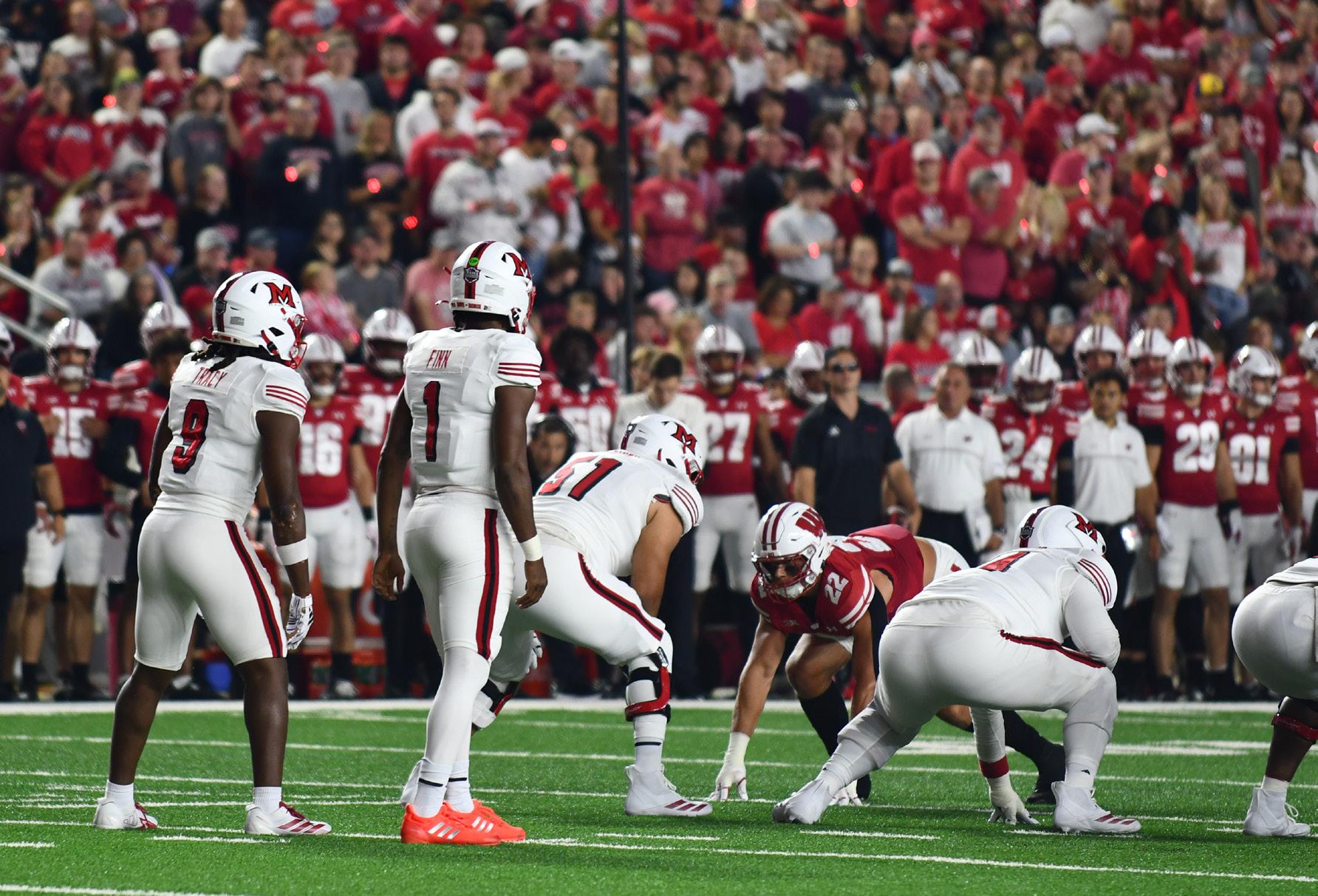
Since 2019, Brett Gabbert has been the RedHawks’ starting quarterback. After two Mid-American Conference (MAC) championships and three appearances respectively, the keys to the RedHawk ofense will be held by a new driver.
While the quarterback may be new to Miami, his name is certainly familiar to MAC fans.
Dequan Finn spent his frst fve seasons at the University of Toledo, before spending the 2024 season at Baylor University.
For many RedHawk fans, it may take some getting used to seeing a former opponent now donning the
Red and White. However, in today’s era of college football, it’s a new reality. Miami will look to embrace the new, yet crucial member as it looks to get back to the MAC championship game for the third consecutive season in December.
After a high school career at Martin Luther King High School in Detroit, where he won a state championship and was named Mr. Football of Michigan in 2018, Finn originally committed to the Central Michigan University Chippewas. However, after a coaching change, Finn decommitted and instead took his talents to Toledo.
In fve seasons with the Rockets, Finn played in 45 games, threw for more than 7,000 yards and 63 touchdowns, and ran for another 1,840
yards and 25 touchdowns. His 2023 campaign was his last – and best –season with Toledo. He threw for more than 2,600 yards and 22 touchdowns while rushing for another 25 touchdowns enroute to a Vern Smith Leadership win for the most valuable player in the conference.
He faced the RedHawks twice that season, once in the regular season at Yager Stadium and once at Ford Field for the MAC championship, which Miami won.
After an injury-forced shortened season at Baylor last season, Finn’s entrance in the transfer portal coincided with a quarterback opening for Miami, and a natural connection emerged.
“He was in the portal for a month, and he was doing his thing, we were doing our thing,” head coach Chuck
For Steele, having those players get that experience early on helped the team make it to Cleveland.
“I said, ‘Fellas, you’re no longer freshmen,’” Steele said. “Once it got to league play, you’ve played enough games, you played enough minutes. You’re no longer a freshman, we need you to operate like a sophomore.”
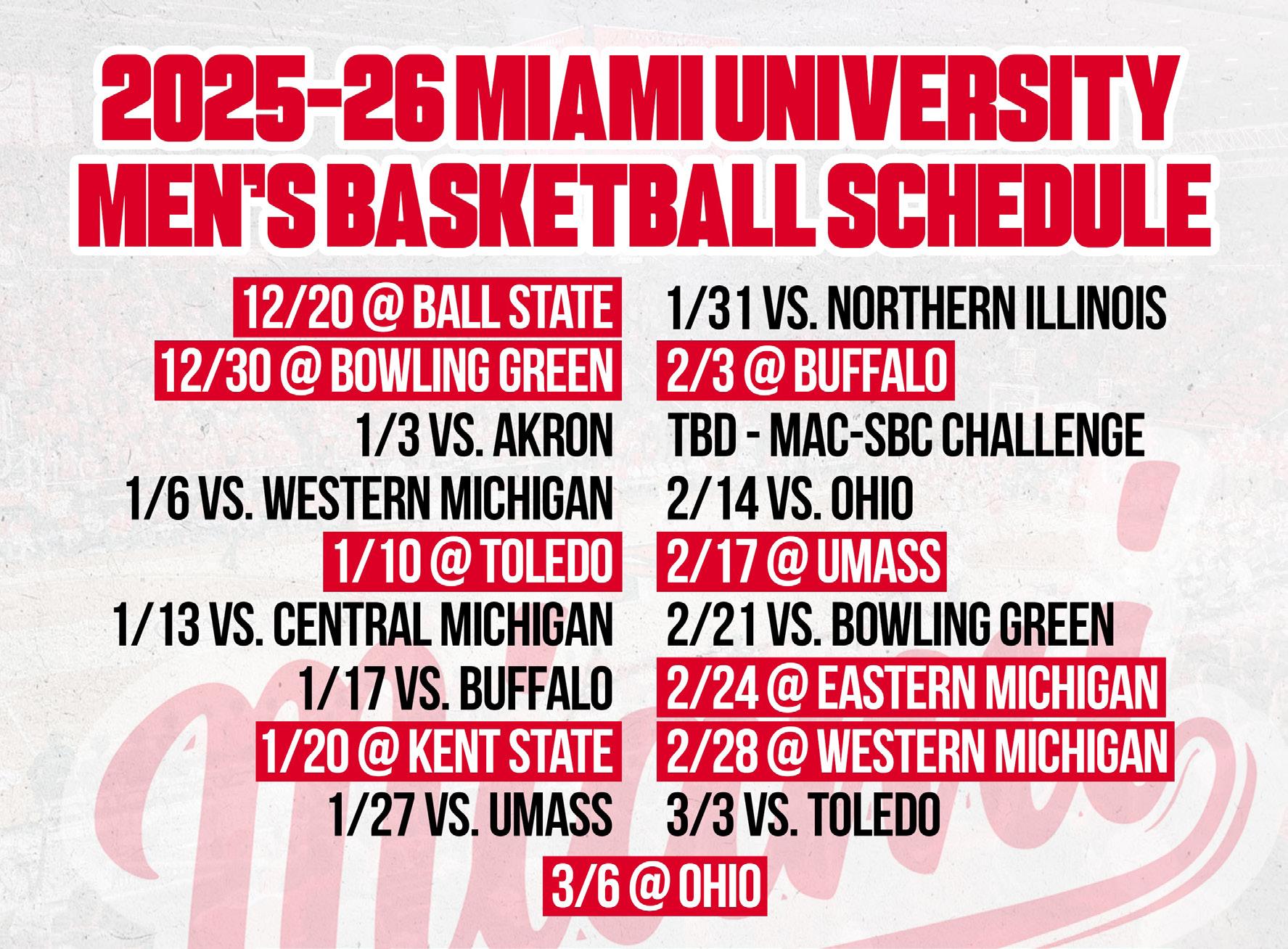
While Miami’s non-conference slate hasn’t been announced yet, the RedHawks will greet Old Dominion University at Millett Hall on Nov. 3 for the fall MAC-Sun Belt Conference (SBC) challenge.
The RedHawks close out December and 2025 with their frst two MAC opponents, both on the road. They frst travel to Ball State University, whom they beat on the road as well as in their last home game last season, on Dec. 20. On the penultimate day of the year, they drive north to Bowling Green State University, whom they also beat once last year.
Early in 2026, Miami plays arguably its best conference opponent at Millett. The RedHawks will welcome Akron on Jan. 3 in a rematch of the 2024-25 MAC championship. The schedule doesn’t get any easier, as Miami hits the road one week later to face the University of Toledo Rockets, who fnished fourth in the conference last season.
“I think we’re going to approach everything the exact same way,” Byers said. “We have a process in the way we do things. But I think it’s exciting to have specifcally those two
games early on in the year. We’re going to see what we’re all about as soon as conference play starts.”
Other notable games for this MAC slate includes a road trip to Kent State University. The RedHawks defeated the Golden Flashes three times last season, including in the MAC tournament semifnals.
Following the Kent State game, Miami welcomes the MAC’s newest addition: the University of Massachusetts (UMass) Minutemen on Jan. 27.
“I think the MAC’s going to have an up year,” Steele said. “[With] UMass in the league as well, Frank Martin, he’s a tremendous coach. It’s only going to add to our league. I think it’s going to be ultra competitive.”
Following the second MAC-SBC challenge matchup on Feb. 7, Miami and Ohio University will engage in its Battle of the Bricks at Millett on Feb. 14. The RedHawks went 1-1 against the Bobcats last year, including a 7369 win on One Miami Day.
Miami closes out the regular season with rematches against previous opponents except for its frst game against Eastern Michigan University.
The RedHawks’ last two games of the season will likely be tough matchups against potentially MAC-tournament qualifers, taking on Toledo at home and Ohio on the road.
The RedHawks hope to replicate their regular season success from the previous year using the returning players and the fve frst years, but Steele emphasized that the main goal is to set the team up for success
to win three games in three days in Cleveland.
In the meantime, the team works together eight hours a week in the preseason. The RedHawks’ frst practice will be on Sept. 22. In that time, Steele said the team needs to identify what it can do better than any other team in the MAC.
“I’d say number one [is] developing an identity as a team,” Steele said. “I think that’s really important, fguring out what we can be the best at in our league. Every team’s a little diferent. Last year, I thought we were the best shooting team in our league by a mile. What can we be the best at? We got to form an identity on both ends of the foor, ofensively and defensively. When you watch us, it should be very crystal clear: Boom, this is what they’re trying to do.”
Freshman guard Trey Perry, who played at Lakota East High School in Liberty Township, said he’s ready for the intensity of college basketball and to play for a program he grew up less than an hour away from.
“It’s defnitely been challenging because college is a faster pace,” Perry said, “but when you come to a program like Miami, you know what to expect. Every day, you’re working hard, you’re learning something. The coaches are very encouraging. The other teammates, older guys [are] encouraging. The development through the summer has defnitely been good going into the season. We’re excited to get it going.”
babukc2@miamioh.edu
Martin said. “He was looking at some other places, and he didn’t like his options that were in front of him. He had some good options, but he was looking for something more specifc.”
Once those initial conversations happened, it didn’t take long for Finn to become a RedHawk. For him, the familiarity with the Miami program and the MAC, as well as his ft in the ofense, played a major role.
“I know the tradition here, and I know [Martin’s] mindset,” Finn said. “I know he’s a winner. That was really the main reason why I chose Miami, and just understanding the type of system that he has: it’s a quarterback-friendly system.”
Finn’s arrival concurs with a completely new ofense for the RedHawks. Miami returns zero starters from last year’s ofense, resulting in a group that will have to learn quickly and on the fy.
“He’s still learning, and we’re still learning from him,” Martin said. “If you come in with a new quarterback, but everyone else returns, it’s a lot easier to ft just one guy in. But we got new receivers, new o-line, new tight end: Everybody’s new.”
That learning process is an ever-evolving one as everyone tries to get on the same page quickly. Veteran leadership often comes from the quarterback position, and while Finn is still new to the program, he’s starting to fnd his voice.
“I think he’s done a really good job, just rallying the troops, rallying the ofense,” redshirt senior Deion Colzie said. “Before every team period, before every one-on-one, he always gets us together and gives us a talk. It’s obviously important for the quarterback to be the leader of the team, and I think he’s done a good job of that so far.”
While Finn continues to work on his vocal leadership skills with his new squad, he also hopes to bring a rushing threat from the quarterback
position.
Finn provides a diferent skill set compared to Gabbert, who primarily served as a pocket passer during his six seasons at Miami. Gabbert never rushed for more than 151 yards in a season (2021) and had six rushing yards last season. What makes Miami’s coaches excited this year is Finn’s ability to make a play even in the most dire of situations.
“I think his biggest strength is when things break down and [he makes]a play out of nothing,” quarterbacks coach Gus Ragland said. “When a play breaks down, when someone gets beat and when he leaves the pocket, great things happen.”
Finn eclipsed more than 500 rushing yards in each of his three seasons as Toledo’s starter. He is the only quarterback in Rocket history to do that while throwing for more than 2,000 yards in three seasons.
He said while he wants to be a pass-frst quarterback, he will run when he has to. He added that he believes that will open things up for the entire ofense, including the lead running back for the RedHawks, Kenny Tracy.
What impresses the coaching staf the most, however, has been what Finn does outside of practice.
“He works really hard.” Ragland said. “He spends a lot of extra time, whether it’s in the flm room, whether it’s throwing after, whether it’s getting extra weight room work in: that kind of makes him who he is, that’s why he’s had success in his life [and] that’s why he’s had success in his career.”
After Miami’s opening game at the University of Wisconsin, Finn and the rest of the RedHawks will look to rebound on Sept. 6 against the Rutgers University Scarlet Knights. mill2361@miamioh.edu
ELISA ROSENTHAL
THE MIAMI STUDENT
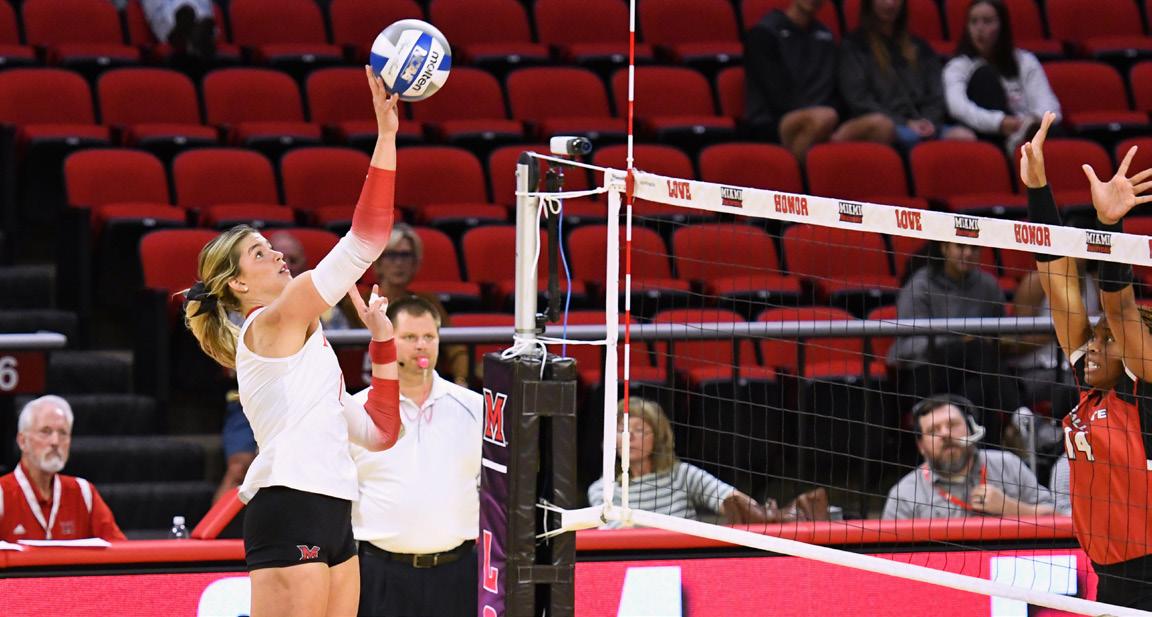
Raegan Lantz is part of less than 1% of people in the United States living with Type 1 Diabetes. Not only does she live with it, she perseveres and plays for the Miami University volleyball team as an outside hitter, not missing a single game last season.
Type 1 Diabetes (T1D) is a chronic autoimmune disease that afects people of any age. People diagnosed with T1D live with it for the rest of their lives, but with careful management, can still lead healthy lives.
In T1D, insulin production is inhibited because the immune system attacks the pancreatic cells that produce insulin, the hormone that converts food into energy for your body.
Treatment involves monitoring fuctuating blood sugar (glucose).
Many people with T1D manage their blood glucose levels with continuous glucose monitors from brands like Dexcom, whom Lantz has a partnership with.
Lantz is a part of Dexcom’s Name, Image and Likeness (NIL) program called Dexcom U, which aims to break stereotypes about T1D and empower athletes to achieve their goals in college sports. The program consists of 21 athletes from a range of universities competing across various sports.
She receives compensation from the agreement in product and has built a platform online to teach others about diabetes and how it impacts her as a person and an athlete. Lantz said having an opportunity to infuence others has been especially meaningful for her.
“It’s given me a platform to show kids, not only kids with Type 1, but anyone with any obstacle that they face, that it doesn’t stop you from achieving your dreams,” Lantz said.
“So don’t let anybody tell you otherwise.”
Lantz still practices and plays in games at full capacity with the team whenever she can do so healthily. Her coach, Haley Davidson, said she only ever steps of the court to monitor her glucose and does so in a time-
ly fashion, missing minimal practice and game time.
Since her diagnosis at 14, Lantz has learned over time the best ways to manage her diabetes on a day-today basis.
“Having Type 1 is a job: 24/7, no days of,” Lantz said. “I wear my Apple Watch when I play, just so it’s easier to be able to check my numbers every so often, but if I start feeling bad, I always have some sort of quick gummy or Gatorade on the sidelines from the trainers.”
The volleyball team as a whole has grown to support Lantz as a teammate regardless of her diabetes and how it may or may not afect her. Teammate and setter Kamryn Utley highlighted that for teammates with any kind of setback, focusing on their abilities instead of their disabilities is key.
“It’s very important to meet them where they’re at and to understand their boundaries and what they can do as a person,” Utley said. “They don’t like for it to hold them back, so I think having that balance is super important.”
Lantz has educated her whole team about what her condition is and how she manages it, giving them all a lesson in perseverance and strength against the odds.
T1D is very commonly misunderstood, since diabetes is often connected to unhealthy eating habits or a sedentary lifestyle. Type 1 can occur in young people, and although the exact cause is not known, diet and exercise are not typically the cause.
Dexcom U sets out to bash these misconceptions, proving how strong T1D athletes really are. Lantz is an example of this ideal, continuing to play the sport she’s passionate about at a high, competitive level, all while managing her health at a more involved level than most.
“You can still accomplish all that you want to,” Lantz said. “Just because it didn’t work out one day, you can still fnd that grace and that peace and continue to surround yourself with good people.”
rosente2@miamioh.edu

ZIMMERMAN STAFF WRITER COLUMN
After two years of dating, Taylor Swift announced her engagement to Travis Kelce on Aug. 26. The duo went public in the summer of 2023, with Kelce attending her concerts and Swift watching his football games.
Swift announced their engagement in a post on Instagram, captioned “Your English teacher and your gym teacher are getting married,” with her song “So High School” playing over the photos.
This was a complete shift from her previous relationship with actor Joe Alwyn, who maintained a low profle with Swift. The British actor and Swift dated from 2016 to 2023. Alwyn was the subject of a plethora of Swift’s hits, such as “Don’t Blame Me,” “I Think He Knows,” “invisible string” and more. Yet following their breakup, Alwyn was the alleged subject of her heartbreaking lyrics in “You’re Losing Me” and “So Long, London.”
What is diferent about Swift’s engagement compared to other celebrity relationships? Part of it may be tied to her longtime brand built on writing about the men she has dated.
Although many artists release music inspired by life experiences, they also clarify that it’s more important for fans to interpret their work through the lens of what it means to
them, thereby releasing it from their personal story and allowing fans to make it their own.
Do celebrities get imposter syndrome from the art versus the artist?
In Swift’s case, she said on a “New Heights” episode, the Kelce brothers’ podcast, that their relationship is the love she’s been writing about for the last two decades. Swift said she was drawn to Kelce’s public pursuit of her, calling his “wild romantic gesture” the kind of thing she has written songs about since she was a teenager.
Of all the men she’s written love songs about in the last two decades, Kelce is the frst to step up to the plate and marry her.
But why do people care so much about it?
Maybe consumers pay too much attention to celebrities. However, celebrities are part of the culture and culture infuences how we interact with everyday life.
How does it relate to her longtime infuence on millennial and Gen Z women? What we store on the inside comes out on the outside in the way we act. Women and young girls who listen to Taylor’s songs internalize her lyrics as a part of their sense of self.
No girl listens to “Mine” and doesn’t envision a future with the love of her life on her mind. I don’t play “Midnight Rain” without allowing the song to make me think about the choices that accompany diferent outcomes in life.
My prediction is that those who

have gone through long-term breakups will pick up on the “forever girlfriend” idea — the concept that men don’t marry the love of their lives, they marry the woman in front of them when they’re ready.
This reminds me of people who break of lasting bonds, but then marry the next person they’re tied to for a shorter period of time (i.e., Justin Bieber dating Selena Gomez for years, yet marrying Hailey Rhode Bieber; Austin Butler and Vanessa Hudgens breaking up after dating for 10 years).
Maybe spending years with someone who didn’t commit to them made people like Swift realize how valuable their time is. Their relationship could prompt both men and women to refect on how they spend their time together – or lack thereof.
Going back to “The Tortured Poet’s Department” album, “So Long, London” supports the invaluable sentiment of time spent on the one who didn’t commit.
“And I’m pissed of you let me give you all that youth for free/…You swore that you loved me, but where were the clues?/I died on the altar waiting for the proof.”
Unlike Swift’s last serious relationship, Kelce didn’t leave her to wonder. His intentions were clear; he showed pride in her, and he put a ring on it in a third of the time that she spent waiting for Alwyn.
zimmer82@miamioh.edu

My name is Hailey Craver, and I’m a senior studying journalism and political science at Miami University. For the past year and a half, I’ve managed a food review account on Instagram (@cravercravings), where I’ve developed a passion for exploring and evaluating local dining experiences.
In this column, I will review Oxford’s staple – and underrated – restaurants every other week, focusing on four key criteria: taste, atmosphere, service and affordability. The goal is to provide readers with thoughtful, reliable insights into Oxford’s dining scene and highlight the establishments that contribute to the community’s unique food culture.
***
Nestled on High Street between Insomnia Cookies and Salon Signature, Sushi King is a go-to spot for both students and locals craving something beyond the usual Oxford bar fare. It’s known for its half-price rolls at the start of the week, expansive Japanese-inspired menu and casual ambiance.
But, does it live up to the hype or fall short?
To start, I ordered crab rangoons and miso soup, two of the restaurant’s most popular appetizers on DoorDash. The miso soup came out frst, and as a self-proclaimed miso soup connoisseur, I was impressed. Miso broths often range from no favor to a very pungent bitter taste. Sushi King’s had a great balance, with a salty umami favor. The top-
pings-to-broth ratio was excellent, featuring large tofu cubes and green onions. It had a nice salty favor, especially at the low price of $3.50. Six crab rangoons were then set in front of us. They were crispy, with a creamy and warm cream cheese flling. They came with sweet and sour sauce and ran for just $7 – a great appetizer for the table to get your meal started.
Moving on to the main event: the sushi. I opted for the shrimp tempura roll, which was $8 for eight pieces ($4 with the Sunday through Tuesday half-of discount). I wouldn’t say it burst with favor, but it defnitely did the job. The shrimp tempura had a nice crunch. It was topped with a spicy mayo; some pieces were a little too drenched, while others weren’t at all, but at only $1 a piece, I can’t complain too much. Finally, I decided to try out one of the hand rolls and went with the spicy tuna. The fllings were wrapped in a seaweed cone. This defnitely gets messy as it is jampacked with tuna, cucumber and rice and drizzled heavily with spicy mayo and eel sauce. It comes in at just $3, and it was defnitely worth the price.
So, is Sushi King the king of sushi?
Nationally? Probably not. But for a sushi restaurant in a quaint college town like Oxford? Defnitely. It delivers exactly what Oxford needs — afordable sushi that hits the spot without draining your wallet.
Overall score: 7.5/10
craverhj@miamioh.edu
which have infltrated my recent musical diet a bit more than I’m willing to admit. But my hope is that there are some new songs on here that you have never heard before, and may add to your daily rotations – even if it’s just one or two.
All that being said, my Spotify “on repeat” has been quite the trip recently. Buckle up, you’re in for a wild ride!
The ‘Death Becomes Her’ Original Broadway cast recording
Anyone who has spoken to me even once in the past few months has likely heard much more than they cared to about “Death Becomes Her.”
The musical, based on the hit 1992 flm, has quickly taken over life, music consumption and, unfortunately, my bank account.
“For the Gaze,” the frst song performed by Megan Hilty’s Madeline Ashton, has been on repeat constantly, accompanied by Jennifer Simard’s “Let’s Run Away Together,” but the entire soundtrack has occupied my streaming activity for the past few months. If you aren’t familiar with the show, defnitely give the soundtrack a listen — it’s life-changing.
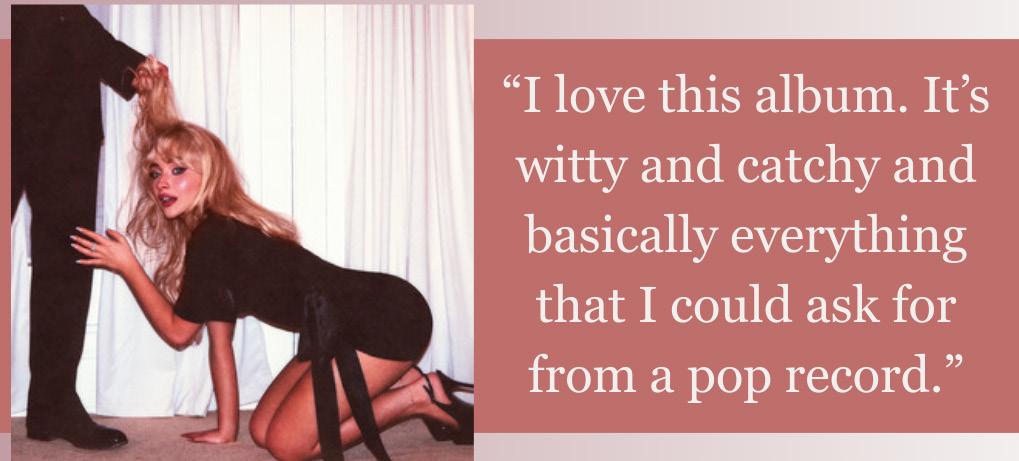
‘Man’s Best Friend’ — Sabrina Carpenter Look, I know the album cover caused a lot of controversy online, but the album itself is absolutely brilliant. Not that I think Carpenter is even capable of missing when it comes to her music, but “Man’s Best Friend” is the defnition of a “no skips album.” My personal favorite track on the album
is “Goodbye,” but I’ve had the album on repeat since its release, and there isn’t a single track that I’m not absolutely obsessed with.
‘Bite Me’ — Reneé Rapp
Since its release on Aug. 1, “Bite Me” has been in constant circulation on my Spotify. I love Reneé Rapp more than life itself and, needless to say, her latest album did not disappoint. It’s peak lesbian music, and I would expect nothing less from Rapp. I know it’s the lead single and therefore probably the most popular track on the album, but “Leave Me Alone” may be my favorite from this one. The ‘Smash’ soundtrack In case listening to “Death Becomes Her” constantly didn’t give it away, I’m a little obsessed with Megan Hilty, which led to me binge-watching the NBC series “Smash.” I’ve mostly just been streaming her songs from the soundtrack, but the show is flled with Broadway-like hits and catchy pop covers, perfect for any vibe. Needless to say, the “Smash” soundtrack has seriously infltrated my recent streams.
‘Don’t Cry For Me Argentina’ — Rachel Zegler If Rachel Zegler has no fans, I am dead. Look, I’m not the biggest fan of Jamie Lloyd musical revivals (no hate), but I will be seated for anything involving Zegler. Maybe not literally, because the production is in London and I am stuck in Ohio, but as soon as her version of “Don’t Cry For Me Argentina” dropped, I made sure to
stream. A lot. Her vocals are so fantastic that I truly believe she could rock any song, but she performs this one fawlessly.
‘No One Mourns the Wicked’ — Ariana Grande and the “Wicked” Movie Cast When the “Wicked” movie came into my life last November, my life was changed. I grew up loving the musical and anything related to Oz, so fnally getting to see it on the big screen? Count me in. I am obsessed with any version of this soundtrack, but Grande’s Glinda is truly of the charts. Megan Hilty may always be my favorite Glinda, but since there’s no way to stream her versions of the songs on Spotify, the movie soundtrack makes a great close second.
Literally anything by Kesha Like any kid who grew up playing Just Dance and watching “Victorious,” I have spent a bulk of my life listening to Kesha’s music. “TiK ToK” has been a favorite of mine for as long as I can remember, and over the summer, I decided to go see her in concert. Finally hearing these songs I have loved forever (as well as some new fre ones) was a life-changing experience, and so worth being stuck outside during a tornado warning before the concert. I fear it may have revived my childhood obsession with Kesha.
powers40@miamioh.edu
While Sabrina Carpenter may not be “Man’s Best Friend,” I would so let her be mine.
On Aug. 29, the pop sensation released her seventh studio album to the begging hands of anyone who has ever had to deal with a “Manchild,” and let me tell you, I was excited.
Much like her last album “Short n’ Sweet,” many of the songs were produced and co-written by Jack Antonof, who has worked with other artists such as Taylor Swift, Kendrick Lamar, Lorde and more.
The album starts of with the hit lead single, “Manchild.” The beginning of the song always makes me laugh. To start of the album with her exasperated, but amused, “Oh boy,” truly is great foreshadowing for all the nonsense that men put her through. Moving along. The next song, and
single, is “Tears,” a disco-inspired track that is defnitely not talking about the kind of tears that you are thinking of. I probably should’ve mentioned this, but Carpenter loves an innuendo, and she manages to include one in almost every line.
Now, while you might be thinking, “Gee, Ayla, that has to get tired after a while.” And to that I say that you, my friend, are incorrect. This whole album is 12 songs worth of the most comical lines found in pop music in the past decade or so.
“My Man on Willpower,” “Sugar Talking” and “We Almost Broke Up Again Last Night” give us a look into some of the toxicities that both Carpenter and her partner exhibit in their relationship. These songs take on a slower, more mellow feel, which is a great contrast to songs like “Tears.”
The sixth track, “Nobody’s Son,” brings out some more of Carpenter’s self-deprecating humor, which makes it a personal favorite of mine. Throughout the song, she talks about
‘Honey
how she cannot fnd luck in love and “there’s nobody’s son” left for her to actually fnd love with. During the song’s bridge, the singer addresses not the boy who hurt her, but his parents, who couldn’t raise him to be a loving partner.
Now, here’s where the writing room went up in fames because of how fre the latter half of the album turned out to be.
As soon as the pop star covered the emotional side of her life, she was ready to give the audience some sexy, high-energy tracks, starting with “When Did You Get Hot?” which talks about the moment when you realize that someone you know suddenly had a glow up.
Carpenter’s comedy reaches a new peak, which continues to grow stronger with each new song. In verse two, the artist sings, “I bet your light rod’s like bigger than Zeus’/Hey, wait, can you lift my car with your hand?/You were an ugly kid, but a sexy man.”
Even while praising a man for his

SHANNON MAHONEY
ASST. CAMPUS AND COMMUNITY EDITOR
COLUMN
Whether you’re a frst-year student or a senior, coming back to campus is a time to reconnect with old friends and – hopefully – make some new ones. It can be easy to feel alone, so here are my top recommendations for books about friendship to help you feel a little less lonely. Some are slightly tragic, and some more hopeful, but all of these books have helped me feel more connected to those around me.
‘Klara and the Sun’ - Kazuo
Ishiguro
This dystopian book follows the life of Klara, an Artifcial Friend (AF), as she fulflls her role as friend, guardian and caretaker to a young girl, Josie. Ishiguro explores the ideas of who is allowed to be a friend and what it means when those lines are crossed.
Ishiguro also addresses thoughts about remembering and losing friends. The last 20 pages of this
book are some of the most intense, thought-provoking literature I’ve read this year.
‘The Emperor of Gladness’Ocean Vuong This is the newest book from one of my absolute favorite writers. The book follows a young man working a minimum wage job and desperately trying to support both himself and the older woman he lives with and cares for.
The novel is part fact, part fction, and aspects of the story are similar to an earlier piece of creative nonfction published in the Adroit Journal. Vuong focuses on the intense relationships formed in the workplace and how those friendships defne and shape our lives.
‘Bad Friend’ - Tifany Watt Smith
This book is a blend of historical nonfction and personal memoir that examines the history of female friendships, and how ideas about what makes someone a “good friend” have changed over time. This book made me re-evaluate
my own ideas about what it means to be a friend and how I can be better to those I care about.
Smith’s ideas about the importance of casual friendships helped me to realize that I can choose to enjoy the bonds I’ve formed now and trust that even if I drift away from some people, they will have played an important role in my life, for which I am very grateful.
‘Beautiful World, Where Are You’ - Sally Rooney
Rooney’s ability to create such rich and complex characters never ceases to amaze. After her iconic “Normal People,” “Beautiful World, Where Are You” is my favorite Sally Rooney book.
Rooney follows four characters connected by friendship and shared experience. She emphasizes the important roles friends play in each other’s lives, weaving their stories together until it is obvious they can never really extricate themselves from one another.
looks, she still has to make sure his ego doesn’t become too infated. I love it.
“Go Go Juice” is a catchy, relatable song about drinking juice (wink) to cope with a bad breakup. The best part, in my opinion, is the end when she starts slurring her words – which is a great detail – and makes you feel like you’re talking with your friend after she has had a fun night.
Another song in the lineup that I absolutely love is “House Tour.” This song would’ve been perfect for the “Barbie” movie (2023), especially with the line: “My house is on Pretty Girl Avenue.”
To end the album, Carpenter gives us “Goodbye” — an ABBA-inspired melody that perfectly wraps up this fabulous album.
I love this album. It’s witty and catchy and basically everything that I could ask for from a pop record.
However, this doesn’t mean that it is without faults.
The production is very formula-
SYDNEY MULFORD STAFF WRITER COLUMN
Margaret Qualley (Honey O’Donahue) and Aubrey Plaza (MG Falcone) star in a new murder mystery movie, where the title itself answers the question of whether or not to see it.
O’Donahue is a private investigator in a small town in California, investigating the recent murder of a woman in town. The woman seems to have questionable connections to the community church, Four-Way Temple, led by Pastor Drew Devlin (Chris Evans). While investigating, O’Donahue forms a relationship with Falcone, who works for the police department.
I had high hopes before watching “Honey Don’t.” I was excited to see Qualley and Plaza star in a movie together, and while both actors were hilarious and great on screen, the ending of the movie left me confused.
“Honey Don’t!” started out great. There were murder mystery elements; there was a questionable, cultist church; there was O’Donahue’s family drama; and there was the relationship between O’Donahue and Falcone. However, by the end of the movie, the murders might have been solved, but the rest of the plot points just ended – there was no sense of conclusion or payof.
Four-Way Temple was a signifcant plot point throughout the movie – there was more happening than
ic, which has often been a critique of Antonof’s work. Multiple times throughout this album, the music completely cuts out to just have Carpenter’s vocals shine through in the chorus. Normally, I wouldn’t mind this, but it happened far too many times for me to be able to ignore it. Also, some of the songs are quite forgettable. There is a reason why I didn’t include songs like “Never Getting Laid” and “Don’t Worry I’ll Make You Worry” — I couldn’t remember them. Trust me, I listened to this album a lot, and I still have trouble recalling what they sounded like. Despite those critiques, I still have to recommend this record. It’s short, sweet and easy to listen to. I couldn’t recommend it enough.
Rating: 8/10
pedenae@miamioh.edu
just worship, and the church seemed to be connected to everything. Devlin had questionable leadership style and practices, which O’Donahue briefly touched on. However, he led her astray, and she never discovered any of the behind-the-scenes activities.
She gets distracted when her niece, Corinne, goes missing. Now rerouted to fnd her niece, she discovers the murderer to be Falcone, who held Corinne hostage in her basement. Falcone admits to killing women for their involvement in the church. This seemed to be a strange reason to fuel the plot of the movie, especially when O’Donahue never seriously looked into the church.
And, just to add another plot point, O’Donahue’s estranged father shows up. First, he scares away O’Donahue’s niece, who thinks he is stalking her. Next, he shows up at O’Donahue’s house and attempts to apologize for his past mistakes. Then, the movie never mentions him again.
Finally, a French woman, Cher, was continuously mentioned in regard to the afairs of the church, but nothing was ever revealed or concluded about her role. However, at the end of the movie, Cher and O’Donahue meet, and then the credits roll. Overall, the movie had entertaining aspects, but the ending ruined the movie. There were too many plot lines unfnished at the end which left me disappointed.
Rating: 5/10
mulforsj@miamioh.edu


ELISA ROSENTHAL STAFF WRITER
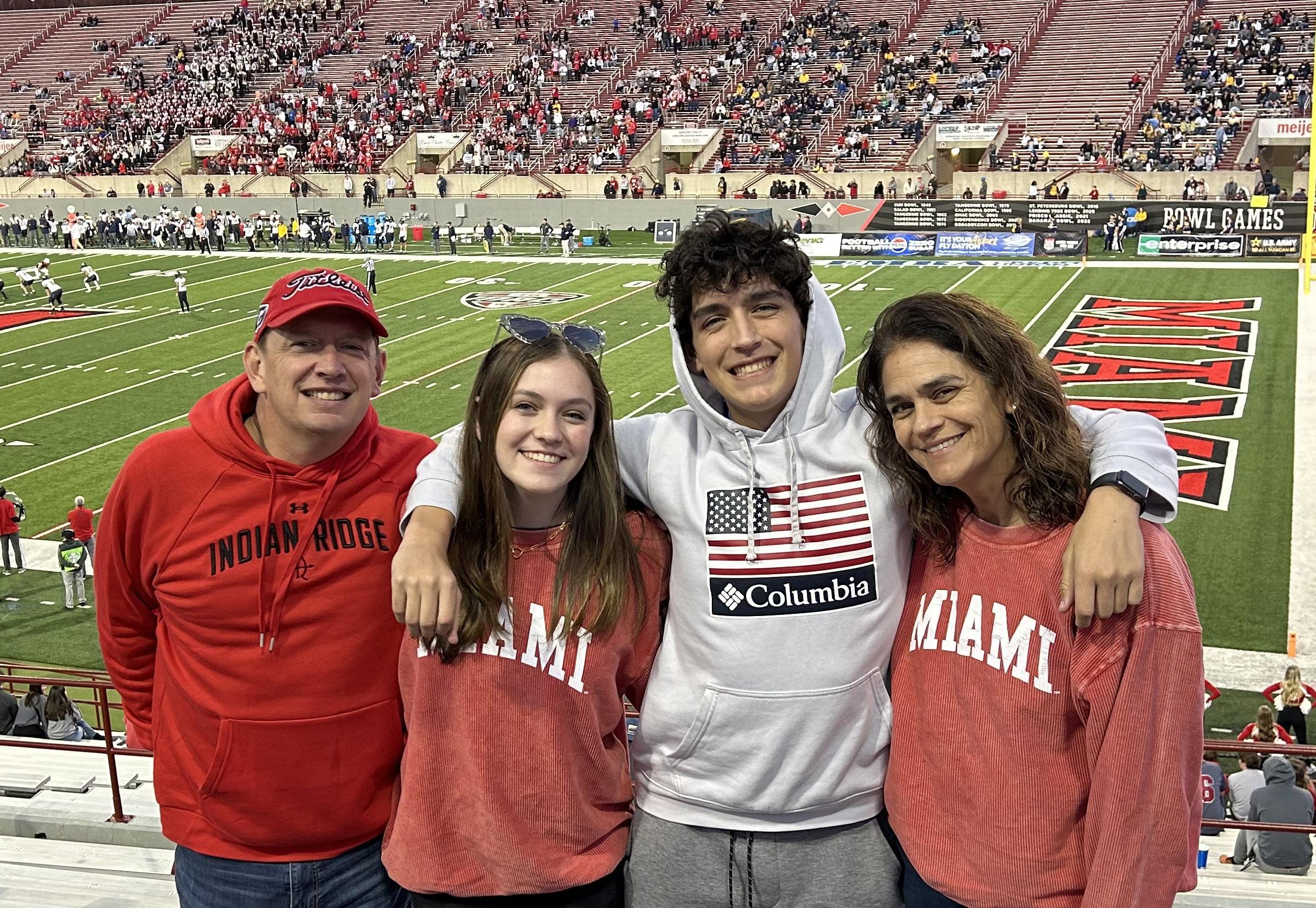
On Sept. 14, 2024, the Miami University RedHawks football team faced its rival Cincinnati Bearcats at noon on a beautiful, sunny Saturday afternoon. Attendance peaked at 24,717, according to cumulative statistics from the 2024 season.
A mere month later, the same Miami team faced Ohio University, another rival, on a pleasant fall afternoon during Parents Weekend.
The 3:30 p.m. game reached 17,021 attendees, just over half of Yager Stadium’s 30,000 capacity, as some Miami students chose to spend their afternoon at bars and fraternity parties instead.
Miami’s school spirit at sporting events is severely lacking, overshadowed by the drinking culture and the looming intrigue of the bars Uptown.
It’s no secret that Miami has a huge drinking culture, and the infuence of frat parties reaches much further than that of our football team. Despite a winning record of 9-5 and a Mid-American Conference (MAC) championship one year prior, our RedHawks averaged about 12,000 attendants over six home games last season.
I’m willing to give the beneft of the doubt that, naturally, fewer people are going to show up to a midweek game in the middle of November. However, only two of our home games were midweek. If those outliers are removed, the average is still only about 15,000 attendees.
It’s hard for me to accept this average when I know a nearly 25,000 maximum could be reality. While I’m not expecting Power Four levels of attendance, a couple of extra thousand students at games would make a world of diference. At the Cincinnati game, the Miami Activities and Programming organization and the Miami Interfraternity Council (IFC) pushed attendance through their tailgates. The IFC tailgate had every fraternity involved, which resulted in fewer parties and higher attendance at Yager.
Tailgating is the key to getting students more involved with sports here. As a girl raised on SEC football, tailgating feels like a given to me – it engages people before the game and allows them to drink outside of the stadium, where drinks are inevitably more expensive. Growing up, my dad took me to
countless games in Athens, Georgia, to cheer on the University of Georgia’s football team. Every time, rain or shine, no matter the weather, we attended a tailgate before the game.
As a child who couldn’t have cared less about the outcome of a football game, the tailgate was always my favorite part. What’s not to like? Tailgates have food, drinks, activities and so many people to talk to.
Is that not ideal for a social college student looking for a place to drink and hang out on a Saturday afternoon?
Why would you want to stand around at Brick Street Bar, pay for expensive drinks and not have access to snacks, all while listening to mediocre music and watching a game on a screen?
Perhaps it’s just the standard or the culture. Perhaps students just don’t know the potential of an awesome tailgate. Perhaps the Miami student population just needs to experience the joy of an SEC tailgate to truly know what they’re missing out on. I know our potential as Miami students can go beyond packing Brick and make the shift to pack Yager. You don’t even have to stay for the whole game! Text your friends, set
rosente2@miamoh.edu

Two years ago, I sat before a Miami University committee deliberating on Title IX Case #20223189. My case.
I thought my raw honesty about sexual assault would be enough to secure justice. I described physical trauma, isolation and the way violence had reshaped my entire worldview. Instead, my sexual assaulter faced no consequences, and I learned a harsh lesson: institutions don’t want messy, complicated victims who demand accountability. They want victims who ft neatly into its crisis management playbooks – grateful, composed and, most importantly, not disruptive to a carefully-crafted image. Now, as a senior ready to graduate with two degrees, I’ve learned a lot. I’ve discovered that the same dynamics that silenced me as a survivor are deployed against faculty and staf who dare to speak up about working conditions, fair wages and educational quality.
Sociologist Nils Christie wrote about this decades ago. The “ideal victim” is innocent, passive, grateful and pure. I was none of these things. My
rage and refusal to be gracious violated expectations of virtuous sufering. Worst of all, my demands for systemic accountability threatened the institution’s preferred story of an “isolated incident” rather than a structural problem.
Faculty and librarians face the same impossible bind. They’re expected to be passionate enough about education to work for below-market wages, but not so passionate that they demand the resources and class sizes necessary to do their jobs well. They should care about the students, but not so much that they criticize administrative decisions that harm educational quality.
I have never felt more supported than when my professors and librarians showed up for me – not in ofcial procedures, but through ebook recommendations, in quiet ofces and whispered encouragements: “We believe you.” My lived experiences and sociology studies have taught me that they face the same institutional struggles, though in diferent forms. Their union is working toward a university that values its people over public relations. In their struggle, I recognize my own.
Anthropologist James C. Scott
describes the diference between metis (practical wisdom from lived experience) and techne (bureaucratic knowledge divorced from lived reality). Faculty and librarians possessed metis – they understood my needs because they’ve worked directly with students experiencing hardship. Administrators operated from techne –following protocols designed to minimize liability rather than maximize human fourishing.
Faculty and librarians know what students need. Survivors know what justice looks like. Yet when we speak with conviction, we are deemed threats to the institutional image.
Writer and scholar Sara Ahmed wrote about how institutions perform diversity and care for branding, while weeding out anyone who might challenge the system. Historian and philosopher Hannah Arendt warned of the “banality of evil,” the way harm is carried out not by villains, but by everyday people who choose loyalty to procedure over moral courage.
We see this every time a survivor is told, “We’re sorry you were harmed, but we can’t take sides.” We see it every time a professor is told, “We value your work, but there’s no budget.” My case was framed as an isolated incident requiring individual healing
rather than systemic reform. Faculty concerns are dismissed as labor disputes unrelated to the educational mission. This separation is strategic as acknowledging the connections would demonstrate how thoroughly the institution prioritizes self-preservation over “Love & Honor.”
The solution isn’t better individual performance within an exploitative system. It’s recognizing these intersecting struggles and building solidarity across them. This looks like supporting survivor advocacy and faculty unions not as separate causes, but rather interconnected fghts against institutional powers that prioritize image over justice and proft over education.
Sexual assault survivors may never truly get justice from these institutions, but we can build something better: a community that chooses truth over performance, solidarity over silence and love over fear.
So this is where I stand now: broken in some ways, but unbowed. I reject the performance of the “ideal victim.” I reject the narrative that asks faculty, librarians and survivors alike to
one can transform both. We are fghting for a reality where care is real – not staged – and where justice is about the people, not liabilities.
menezepa@miamioh.edu
ELIZA SULLIVAN STAFF WRITER
On Wednesday, Aug. 27, the Edgewood Middle School auditorium in Trenton was full. Over 500 people attended, according to an article by the Cincinnati Enquirer. Warren Davidson, Ohio’s 8th Congressional District House Representative, was holding a town hall meeting.
From the frst question he answered, it was clear the crowd was unhappy with him. Throughout the event, many of his statements were
met with angry boos, shouts and accusations of dishonesty and cowardice. It’s hard to convey nuance when shouting at a politician from the back of an auditorium. At one point, in response to Davidson touting this administration’s border security policy, the crowd erupted into angry shouts. He responded that we must like open borders. I believe this was an intentional misinterpretation of our response, but just in case, I’ll lay out exactly what I took issue with in his immigration rhetoric.
First, as Davidson himself admitted, immigration – and illegal immigration especially – isn’t a pressing issue in Ohio. According to the Migration Policy Institute, Ohio has just over one percent of the nation’s immigrants. We are home to 89,000 unauthorized immigrants, which amounts to .7% of our population.
Despite this, Davidson continuously returned to the idea of a “secure border” as a beneft to Ohioans. He also continuously used dehumanizing language, calling undocumented immigrants “illegals.” This terminology strips them of their humanity.
The Associated Press stylebook –which The Miami Student follows –says people should not be described as “illegal,” because only an action can be illegal. Someone can immigrate illegally to a country, but that does not make them “an illegal.”
Davidson repeated a common idea that immigrants should just “come here legally.” That sounds like a great idea. However, according to Newsweek, the United States Customs and Immigration Services has a backlog of 11.3 million pending applications, and it can take months or years to receive a visa. Davidson had nothing to say about how to reform the system, so that people who want to come here legally can do so in a reasonably timely manner.
According to the UN International Organization for Migration, most people migrating to North America do so for economic reasons, with a smaller percentage migrating to be with family or escape persecution. When researching why people migrate, it becomes easier to understand why people in need of a job, missing their family or fearing for their lives might choose to bypass the complicated, burdensome and lengthy legal immigration process.
Davidson’s concern over immigration conveniently excluded the reports of human rights abuses oc-
curring in deportation proceedings.
Amnesty International has called on President Donald Trump to stop mass deportation, arguing that it is violating several rights, including due process, protection from refoulement and freedom from arbitrary detention, among others. The International Rescue Committee alleges that recent mass deportation initiatives have violated the due process of many immigrants, especially children.
The treatment of immigrants is an issue that directly afects all Americans. We should be appalled by the lack of due process in immigration proceedings. It is what keeps us free. It entitles you to fair legal proceedings and protects you from being unjustly deprived of life, liberty or property by the government. And it applies to everyone interacting with the U.S. justice system – whether or not they are a citizen.
On a university campus, mass deportations and the backlog of pending visa applications afect us directly. I have heard several international classmates express doubt over their ability to return to campus. One person cancelled a trip abroad for fear that he would not be able to return to the country, despite having a visa. But this data isn’t just anecdotal – according to NPR, early data has shown a signifcant decrease in international student enrollment at U.S. universities this fall. International students also bring money to Miami University. In the 2023 cohort, there were 623 undergraduate international students. Those students were paying the non-resident tuition, which was about $20,000 more per year than tuition for in-state students. This totals to an estimated $12,460,000 of extra tuition money from international students every year. More importantly, international students are an invaluable part of the university ecosystem. They bring

JOSIE ZIMMERMAN STAFF WRITER
“Slay!” “Valid crash out.” “Pop of, queen!” Some words can be identifed with certain age groups. Other words are altered to avoid ofending people.
George Carlin’s 1990 special, titled “Doing It Again,” coined the term “soft language” in his stand-up comedy, describing the words that were sterilized over time.
“I don’t like words that hide the truth … words that conceal reality,” Carlin said. “I don’t like euphemisms.” Carlin uses the transition from “shell shock” in World War I to “battle fatigue” decades later to “operational exhaustion” to “post-traumatic stress disorder” (PTSD).
Today, we hear “diferently abled” instead of “disabled.” Died became “deleted” (or in the case of the FBI, “neutralized”).
So, where did soft language come from?
Political correctness emerged from leftist circles in the ’70s and ’80s and made its way to the corporate world in America.
The term “politically correct” originated in Marxist-Leninist vocabulary after the 1917 Russian Revolution, initially referring to strict adherence to the Communist Party’s policies. In the United States, it became associated with debates between communists and socialists, often used to accuse individuals of dogmatism.
During the 1970s, it was adopted by activists on the New Left and in social movements as a form of self-parody, often used ironically to challenge
the social power of language. Later, it evolved into a term used by conservatives to criticize sensitivity or censorship on the left.
Whether or not people agree with these terms, the use of soft language translates into politically correct terms that illustrate the divide it causes between people and reality. People clash not only on difering beliefs, but also on how they express their thoughts. In other words, we talk past each other. Why does this matter? Words are just words. They have no meaning. Wrong. Words are how we interact with reality – or don’t. Often, these words are used to shield people from the truth or, in some cases, from responsibility. The irony of soft language is that people are sensitized to use

brutal, direct language for less serious matters, whereas nicer, more palatable phrases downplay difcult topics.
When politicians reference “collateral damage” in a crime or natural disaster, it’s less efective than “civilian deaths.”
Some see politically correct language as inclusive; others see it as evasive. Either way, it’s still a form of soft language. Language associated with being “politically correct” – such as using gender-neutral or inclusive terms –is a form of soft language. Both approaches use careful word choice to soften the blow.
This way of speaking – especially with the overlap of soft language and political correctness – sidesteps both the weight of the truth and the responsibility of delivering it. No one in
diferent perspectives and life experiences, allowing for a richer learning environment. According to our mission statement, Miami aims to “foster a diverse, inclusive, and welcoming community.”
Our international students are a vital part of that community.
So, to Warren Davidson, I say this: stop panicking about illegal immigration, which has a negligible impact on Ohio. Instead, focus on ensuring that students can continue coming to our universities, where they contribute directly to the economy and to the education of Ohio students.
And, if you want extra points, prove that you support the Constitution, and the rights of all Americans, by speaking out against the rampant due process violations being perpetrated by this presidential administration. sullivei@miamioh.edu
corporate America wants to be liable for saying what they mean. Your last company didn’t fre you … you were laid of. It doesn’t matter that both result in the same outcome – removal from the workplace outside of one’s free will. Hospitals don’t report a patient dying; they cite a “negative outcome.” Politicians avoid admitting they raised taxes by calling it a “revenue enhancement.”
On social media, people say someone was “unalived” instead of “killed” to dodge getting blocked by the algorithm. These phrases soften the emotional punch or shield institutions from liability, but they also blur our ability to grapple with the reality underneath.
Are we using words to clarify reality, or to cushion it? If the latter is true, should we feed into people’s increasing sensitivity to the raw truth?
Maybe we’re more capable of hearing the truth than society gives us credit for.
zimmer82@miamioh.edu
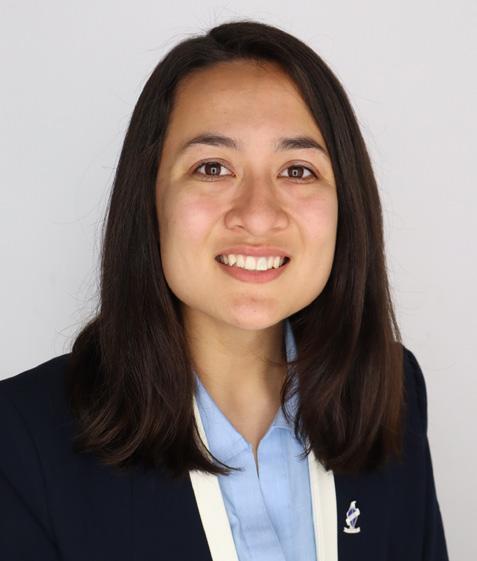


CONTINUED FROM FRONT
“We’re not used to trying to say,
‘Oh I’m gonna put my syllabus out there for the world to see,’ because we think of it as a social contract with our students in that course.”
Gorchov said he has also been at the forefront of this uncertainty. Another worry of his is that some good professors will decide not to bother with these regulations and choose to teach in other states. However, he believes the student classroom experience will not be afected much.
It was an earlier version of S.B. 1 that caused him to worry about climate education. The bill has since been revised.
“Early on, that draft that had climate science listed as controversial was really upsetting to me,” Gorchov said.
Gorchov said this concern prompted him to contact a state rep-
SARAH KENNEL GREENHAWKS EDITOR
Sophomore Zoology major Victoria Gerencser has a unique campus job: cleaning the bones of dead animals. After beetles eat fesh of the bone, they are handed over to Gerencser, who takes the bones through several steps to ensure they are clean and ready for display. This involves scraping remains of and bathing them in hot water, dish soap and ammonium to draw out the grease and smell.
This is just one part of the student labor that goes into the Hefner Museum of Natural History.
Senior anthropology, biology and individualized studies major Lauren Doty does similar hands-on work. As fuids collection manager, she preserves reptile and amphibian specimens in chemical solutions that will ensure their quality.
“It genuinely changed my life,” Doty said.
Doty has accumulated over 300 hours of work at the museum, and
resentative to express that climate science was not controversial, and that he was relieved to see this proposal changed early on in the process.
Wulfhorst said that as the bill stands now, he is confdent that classrooms will continue to use scientific principles while promoting open discussion and healthy dialogue. As director, he said hopes to support IES faculty and students who are feeling uncertainty about climate education at this time.
Facing this air of uncertainty head on is also important to Wulfhorst, who said he hopes broader conversations about climate education will continue both in and out of the classroom, so individuals understand what is actually changing and how to respond.
kennelse@miamioh.edu
she has seen doors open for a career in museums.
On the frst foor of Upham Hall lies a little room full of animals, big and small. Frozen in time stands a towering Kodiak bear, the extinct passenger pigeon and more. The museum’s collection has been growing since 1809, and it now aims to ofer a breadth of learning opportunities.
This semester, the museum will host its annual lecture and welcome the arrival of several new specimen.
This year’s annual Hefner lecture, entitled “Prehistoric Predators: Using the Past to Inform our Future,” will be given by award-winning scientist Larisa DeSantis. Her work involves the Dream Lab, which uses fossil records to trace ecological and evolutionary responses to climate change.
“It’s a great time because we get to come together and hear this fun, all ages, all disciplines lecture,” museum director Steven Sullivan said. DeSantis will discuss animals such as polar bears, coyotes, cougars and saber tooth cats. Two new specimens will debut as a part of the lecture series, following the event.

While Sullivan is looking forward to these notable events and new arrivals, one of the most exciting parts of the fall semester is getting to see new students experience the museum for the frst time. He said that students of all disciplines begin to trickle in and make realizations about how their areas of passion relate to the natural world.
“My favorite thing is just to see these students make the connections, so that as they become leaders, they are making a holistic better world,” Sullivan said. “It’s just really fun every semester to be a part of that.”
As students take away their own epiphanies from the museum, they oftentimes become more involved, participating in the stewardship of natural history and working on projects that help keep the museum running.
Gerencser was one of these students. She said she has learned a lot from the process, including a better understanding of anatomy and a greater appreciation for how complex the natural world is. “I fnd it interesting to know all
sorts of diferent aspects about animals,” Gerenscer said. “I’ve learned a lot of anatomy just from cleaning bones.” Junior biology major Maria Olson aspires to go into the dental feld, and said she also learned valuable skills from bone cleaning.
“Working with your hands is really important for [dental], and bone cleaning has been just such a great way to work with my hands and just improve on that,” Olson said. Olson said working at the museum also improved her communication skills, and it gave her the opportunity to create a research project which will lead to a future publication. The project lays out a timeline of on-campus historical events atop the rings of a 100-year old tree stump. It is expected to be on display following its completion this semester.
Sullivan said he hopes that as new events, specimens and exhibits food into the museum this semester, more students will get involved and take advantage of what the museum has to ofer.
“All of this work is funded through
grants and donations, and so it’s really important too for the community to step up and support…” Sullivan said.
“We do a lot of outreach to the local schools.”
Students have also taken the initiative in local outreach. Meet Patel, a microbiology and individualized studies major, is the president of MU Labs, a volunteer organization that holds hands-on workshops for local middle schoolers.
After working with Sullivan, Patel was able to run a sustainability workshop that taught middle schoolers how to sort between recycling, composting and trash items.
“This was really nice because the kids were able to fgure out what to do with each item, and then they also connected it with how they lived in their homes,” Patel said. Sullivan hopes that as the semester goes on, new students will have similar experiences at the museum – discovering passions, gaining new knowledge and even taking selfes with the beloved Kodiak bear. kennelse@miamioh.edu

SHANNON MAHONEY
ASST. CAMPUS
When the time slot to register for my sophomore year dorm fnally arrived last semester, I was dismayed to see the limited number of rooms left. Worried that we would be left homeless if I didn’t act swiftly, I registered for a room in Stanton Hall on South Quad.
After being here a few weeks, my roommate and I have the same question on our minds: does anyone live here at all? Despite my best eforts to say ‘hi,’ I can probably count on my hands the amount of people we’ve
seen in the dorms. The number of other students who have actually stopped to talk to us is in the single digits. I’m not expecting a welcome committee, but this just feels bizarre. Hallways and common areas are almost perpetually empty. Sometimes it’s convenient, like when I need to run a load of laundry, but after a while, it starts to get a little boring.
Here are a few ways I’ve managed to make my own fun in a dorm where no one seems to live.
Bowling Sadly, Stanton Hall did not come equipped with a bowling alley in the basement, but that’s no match for my ingenious innovations. First, you
MICHAEL PATTEE STAFF WRITER
For those of you who know me well, you know that I plan on going to law school and being a lawyer. However, if for some reason this path weren’t to work out, there’s only one career path for me: spoof scriptwriter. Below, I share some of my best ideas (flm department people, don’t even THINK about stealing them).
The Emperor’s New Groove - The Emperor Learns to Whip and Nae Nae
For the casting of this movie, I’m thinking of a Star Wars crossover by bringing back Emperor Palpatine to play the Emperor. And rather than turning into a llama, Palpatine is turned into the rapper Silentó, 45 minutes before he needs to perform on stage. Naturally, Palpatine has no clue how to Whip and Nae Nae until his stage hand Kronk, played by Dwayne “the Rock” Johnson, and his following of pet squirrels teach Palpatine just how to do it. Superman - Mediocreman With the Superman movie having just come out this summer, the time is right for a spoof. Who wants to see a chiseled white guy in spandex and a cape fying around anyway?
People want reality, Mediocreman, a Walmart manager of six years, whose most intense fghts are saying no to the last two slices of pizza at 2 a.m. and trying to muster up the courage to talk to Savannah “Hot Stuf” Smith, Mediocreman’s Walmart-crush. Mediocreman also engages in combat on occasion, fghting villains like the goons from the Irritating Revenue Stealers (IRS for short) who attempt to brainwash Mediocreman into pay-
ing his taxes! Finally, Mediocreman’s archnemesis is Targeto, the ruthless opposing manager at the local target.
50 Shades of Grey - Just
1 Shade of Pink (PG)
Despite not having watched this movie before, I think I’ve got it. Rather than having to put the audience through 50 diferent shades of grey (I mean, what is this, a Sherwin-Williams or Benjamin Moore commercial???), the audience simply gets to have 1 shade of pink on screen the whole time. It could be paired with some light, relaxing instrumental music playing in the background, and would be the type of movie you could put on for your little kids when it’s their nap time.
Die Hard - Live Soft
Do you think the snowfake generation can Die Hard, or even Live Hard? Not according to the number of Viagra commercials on TV this summer. But, since the older generations (those people who can call “unc”) have never lived a day in the shoes of a snowfake, why not give them a chance to see what it’s like?
Naturally, the movie will start with a brief reference to Christmas so that everyone can incorrectly dub this a Christmas movie. Then it will follow a teenage girl during a family Christmas party, as she gets passive-aggressive DMs, is told to get a job and instructed to spend time with her family right as it’s time to BeReal. Naturally, the movie will include many explosions (shouting matches), bad guys (family members who care), and near-death experiences (almost forced to delete TikTok) to keep audiences on the edge of their seats for this action-packed movie.
patteemj@miamioh.edu

need a ball of some sort (basketball, soccer, softball, whatever works. I use a volleyball). Next, prop up some books on their end. I like to use my composition notebooks and leave them slightly open so they’ll stand on their own. Set up the books in whatever formation is pleasing to you; after all, no one else is there to tell you you’re doing it wrong. Then, bowl away!
Karaoke
While I may not be an acappella star, I do enjoy singing along to my favorite tunes. While a shocking lack of actual residents in my dorm may at times feel like something out of a mystery novel, it does provide me
with an excellent opportunity to sing as loud as I want in the shower. On a related note, it’s impossible to feel creeped out by the dead atmosphere when Shakira is on full blast.
Race your roommate Ever wondered whether you or your roommate would survive the zombie apocalypse longer? Now there’s an easy way to test it. Race across the whole foor with reckless abandon — bonus points if you make an obstacle course with all the furniture that’s not bolted down. Just don’t tell the kid who claims he was the fastest on the playground in sixth grade. Call Opinion Editor Taylor
Powers and go ghost hunting
Is that rattling noise a broken AC unit or a haunting spirit? You may never know unless you suck it up and confront it. Grab your camera and ask Taylor Powers, our trusty TMS opinion editor, to come with you for safety in numbers. She’ll probably turn it into an episode for her podcast, but who knows, maybe you’ll be the frst ones to prove that ghosts really do exist!
Editor’s Note: DO NOT go ghost hunting if you are in Peabody Hall. I’ve seen Helen twice, and would not wish it upon my worst enemy.
mahones5@miamioh.edu

CONNOR OVIATT HUMOR EDITOR
If you struggle with small talk (as I do), going into ofce hours can be intimidating. But, as my boomer grandparents told me, the easiest way to get an A is to walk right into the professor’s ofce and demand it. So, I make it a point to introduce myself to all of my professors who teach classes in which I want to earn an A. And while that list may be short, these topics stole the hearts of the professors I approached.
Topic 1: The crippling debt you’re going into to pay their salary
Nothing breaks the ice like saying, “You should give me an A because my comrades and I feed your family.” And yes, I did say this to one of my Miami Plan professors who happened to be fresh out of graduate school. He clearly related to my struggle, as I ended up getting an A++. Although if you are in Farmer, I wouldn’t rec-
ommend taking this route. When I used the same talking point with my economics professor, he said,“Clearly, paying to put food on my table is desirable to you. If you really didn’t want me to eat, you wouldn’t be here”.
Topic 2: Your favorite place with sticky foors Uptown
Each of your professors was in college at one point or another; odds are they probably were in college longer than you will ever be. So, be sure to talk about your favorite place to spend time between the hours of 9 p.m.and 2 a.m. Uptown. This is particularly important if you are a frstyear student; you should already have all of the bars ranked and prepared an essay for them, justifying your opinions. Nothing is more relatable than going into your 75-year-old professor’s ofce and talking about what you did at Brick Street on Friday.
Topic 3: The meaning of life
The ol’ stand by. The frst thing I do when I meet a professor is ask them for every philosophical/theological opinion that they have. When
they ask why I’m in their class, I turn the question onto them and ask why we exist. When they often get defensive, I tell them that nobody likes a fence sitter and I will be dropping their class. When I inevitably show up to the next session, I tell them that I had a vision I needed to be in their class, and act as if nothing happened. Topic 4: The weather If all of the above fail or don’t feel right, then go ahead and mention the weather. Not only will most of your professors enjoy the efort, but it is also great practice for when you reach the real world. I spoke about the weather about 17 times per day at my internship this summer, and I was only able to do so because of the practice I’ve had with my professors. You’re welcome for the free tips on how to get an A. But, don’t all of you