ESTABLISHED 1826 — OLDEST COLLEGE NEWSPAPER WEST OF THE ALLEGHENIES
Volume 171 No. 3
Miami University — Oxford, Ohio
FRIDAY, SEPTEMBER 18, 2026
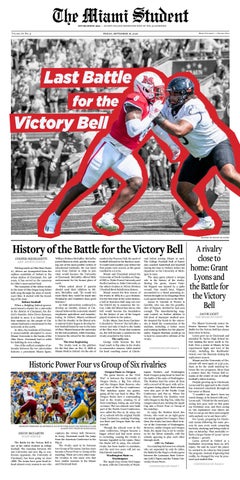
GRAPHIC BY SYDNEY MULFORD
History of the Battle for the Victory Bell COOPER MENEGHETTI ASST. SPORTS EDITOR
Driving south on Ohio State Route 27, drivers are transported from the endless cornfields of Oxford to the urban skyline of Cincinnati. For 138 years, it has served as the causeway for Ohio’s most storied feud. The inception of the oldest rivalry in the state of Ohio began long before bells rang through the skies of southwest Ohio: It started with the founding of the state. Before football When a fledgling federal government issued a charter for a university in the district of Cincinnati, the district’s founder, John Cleves Symmes, decided to move it to Oxford. From that moment on, the people of Cincinnati harbored a resentment for the university in the north. In 1822, the residents of Cincinnati unsuccessfully attempted to move Miami University to the banks of the Ohio River. Cincinnati had to settle for building its own college. One of the earliest examples of animosity between the two universities features a prominent Miami figure,
William Holmes McGuffey. McGuffey joined Miami in 1826, quickly becoming one of the most prolific writers of educational textbooks. He was lured away from Oxford in 1836 to join what would become the University of Cincinnati. McGuffey offered little endorsement for his former place of work. When asked about if parents should send their children to Miami, McGuffey said, “[It would be] more likely they would be made into Drunkards and Gamblers than good Scholars.” As both universities continued to develop an identity, donors of Cincinnati believed the university should emphasize agriculture and manufacturing. In Oxford, Miami continued to find its identity in the liberal arts. A natural rivalry began to develop before football found its way to the state of Ohio. Miami became the university for the rich academic, while Cincinnati became the school for the educated laborer. The true beginning The rivalry took to the gridiron for the first time on Dec. 8, 1888 at Miami Field in Oxford. On the site of
modern day Pearson Hall, the sport of football debuted in the Buckeye state. It would need another year before the first points were scored, as the game resulted in a 0-0 tie. Miami and Cincinnati joined the University of North Carolina at Chapel Hill vs. Wake Forest University and North Carolina vs. Duke University as the oldest rivalries in NCAA Division I Football Bowl Subdivision history. Miami earned the first victory of the rivalry in 1889 in a 34-0 shutout. For the first time in the series history, a bell in Harrison Hall rang out over the Oxford sky to announce the victory. Little did Miami fans know, this bell would become the foundation for the history of one of the longest played rivalries in the nation. In the 1890s, fans from Cincinnati decided to “borrow” the bell after a victory and take it back to the banks of the Ohio river. From that moment on, the bell became a symbol for the rivalry awarded to the victor. The early era George Little became the first head coach to flip sides in the rivalry in consecutive seasons. Little started his head coaching career at Cincin-
nati before joining Miami in 1916. The College Football Hall of Famer also coached basketball and baseball during his time in Oxford, before his departure to the University of Michigan in 1922. The 1923 game played a unique role in the history of the rivalry. During the game, James Gamble Nippert was injured by a spike wound. One month later, Nippert succumbed to a blood poisoning infection brought on by droppings from a pre-game chicken race on the field. James N. Gamble of Procter & Gamble, who was also the grandfather of Nippert, decided he had seen enough. The manufacturing magnate wanted no further athletes to fall afoul of improper medical care. He donated the funds to the university to finish the construction of the stadium, including a locker room and training facilities for the players’ safety. Nippert Stadium would go on to host 61 consecutive editions of the rivalry. CONTINUED ON PAGE 6
Historic Power Four vs Group of Six rivalries
REDSHIRT FRESHMEN QUARTERBACK DAVID MCCOMB SCANS THE DEFENSE IN GAME AGAINST PITT. PHOTO BY ELISE HANNA
DEVIN MCCARTIN STAFF WRITER
The Battle for the Victory Bell is one of the oldest rivalries in college football. The matchup between Miami University and now Big 12 conference opponent, the University of Cincinnati, has been going on since 1888. The teams have gone head-tohead almost every season to see who
captures the victory bell. However, in 2023, Cincinnati made the jump from the American Conference to the Big 12. The rivalry used to be between two Group of Six teams, but has since become a Power Four vs. Group of Six matchup. There are a few other notable rivalries in this same vein that have similar tensions to the Miami and Cincinnati feud.
Oregon State vs. Oregon The game known as the “Civil War” is between the University of Oregon Ducks, a Big Ten school, and the Oregon State Beavers, who are a part of the Pac-12 conference. This matchup spans 129 games, going all the way back to 1894. The Oregon Ducks have a commanding lead in the rivalry, winning 70 of their matchups, losing 49, and tying 10 times. The two schools were both part of the Pacific Coast Conference, now called the Pac-12. In 2024, ten of 12 schools left the original Pacific Coast Conference, making Washington State and Oregon State the only two left. Though the schools were in the same conference, Oregon became a bigger school and had more access to recruiting, causing the rivalry to become lopsided in the 1990s. Since the Ducks left in 2024, the schools’ rivalry has been harder to maintain, and the next two years will not see this historic matchup. Washington State vs. Washington The Apple Cup rivalry first began in 1900, with the University of Wash-
ington Huskies and Washington State Cougars going head-to-head for the battle of the state of Washington. The Huskies lead the series all time with a record of 78-34-6, with 118 total games being played. Both schools were also part of the Pacific Coast Conference and Pac-12. When the Pac-12 dissolved, the Huskies went with Oregon to the Big Ten, while the cougars stayed put, turning the Apple Cup into a Power Four vs. Group of Six matchup. In 1959, the Huskies hired Jim Owens, who went on an eight game win streak against the Cougars. Since then, the rivalry has been tilted in favor of the University of Washington. However, unlike Oregon and Oregon State, the Apple Cup is set to continue for the future annually, with the schools agreeing to play each other through 2028. LSU vs. Tulane In a matchup between two schools who are separated by only 81 miles, the Battle for the Rag is a rivalry game between the Louisiana State University (LSU) Tigers and the Tulane University Green Wave. CONTINUED ON PAGE 7
A rivalry close to home: Grant Lyons and the Battle for the Victory Bell JACOB LIGHT
THE MIAMI STUDENT For Miami University senior defensive lineman Grant Lyons, the Battle for the Victory Bell has always been close to home. Lyons grew up in Cincinnati and attended St. Xavier High School before making the move north to Oxford. Now a senior at Miami, he has experienced highs and lows of the rivalry, including the RedHawks’ victory over the Bearcats during his sophomore season. Miami and the University of Cincinnati will meet again at 3:30 p.m., Sept. 19 for the 129th matchup between the two programs. More than a century later, the Victory Bell remains at the center of one of college football’s oldest rivalries. Despite growing up in Cincinnati, Lyons said his approach to the rivalry has remained consistent throughout his career at Miami. “I wouldn’t say there’s been too much change, to be honest with you,” Lyons said. “I think for the most part, seeing how guys took on that game my freshman year, and then seeing us win sophomore year shows me that we can go out there and compete with anybody we’re out there with.” For Lyons, preparing for Cincinnati means following the same process he uses every week: preparing his body, studying and being ready to play on Saturday. That mentality reflects a larger theme of Lyons’ career at Miami — growth. Lyons arrived in Oxford as a linebacker recovering from an ACL injury. He said he wasn’t the player he wanted to be when he first joined the program. Instead of ignoring that reality, he changed the way he practiced and studied film. CONTINUED ON PAGE 6
FYI
2
FRIDAY, SEPTEMBER 18, 2026
Our Awards
THE MIAMI STUDENT STAFF SHANNON MAHONEY EDITOR-IN-CHIEF
ELISA ROSENTHAL
KISER YOUNG
MANAGING EDITOR
SOCIAL MEDIA EDITOR
EVELYN DUGAN
CAITLIN WONG
OWEN MARTIN
ASST. DESIGN EDITOR
PARKER GREEN
AYLA PEDEN
CAMPUS &
REN CHAFFEE
COMMUNITY EDITORS
2025 Ohio News Media Association Award for First Place in Best Website 2024 and 2025 Corbin Gwaltney Award for Best All-Around Student Newspaper in the large school category
ASST. CULTURE EDITORS
GRAHAM YOUNG
COOPER MENEGHETTI
SPORTS EDITOR
2025 Ohio Society of Professional Journalists (SPJ) Award for First Place in the Best College Newspaper category
VINCENT JOLLIFF
TAYLOR POWERS
ASST. SPORTS EDITORS
OPINION EDITOR
ABE HAGOOD
STELLA POWERS
ASST. OPINION EDITOR
CULTURE EDITOR
IVY KLEINMAN
CARLEY RAPP
PHOTO EDITOR
HUMOR EDITOR
AUSTIN SMITH
SARAH KENNEL
BUSINESS MANAGER
GREENHAWKS EDITOR SYDNEY MULFORD
JOE SAMPSON
DESIGN EDITOR
FACULTY ADVISER
ELISE HANNA
SACHA BELLMAN
DIGITAL MEDIA EDITOR
BUSINESS ADVISER
EMILY CLARK
AIM MEDIA MIDWEST
PHOTO EDITOR
PRINTER
2025 Greater Cincinnati Pro Chapter Society of Professional Journalists (SPJ) Excellence in Journalism Award in the College Student Publication category 2025 Ohio News Media Association Award for First Place in Best Website
Advertising information: Smith646@miamioh.edu Send us a letter: eic.miamistudent@gmail.com The Miami Student is published biweekly during the school year by the students of Miami University in Oxford, Ohio. The content of The Miami Student is the sole responsibility of The Miami Student staff. Opinions expressed in The Miami Student are not necessarily those of Miami University, its students or staff.
2025 Mark of Excellence Award (SPJ) for First Place in Best Affiliated Website
CORRECTIONS POLICY
The Miami Student is committed to providing the Miami University community with the most accurate information possible. Corrections may be submitted up to seven calendar days after publication.
University Senate debates Center for Artificial Intelligence at Miami
KYLIE BUNN
STAFF WRITER The University Senate discussed the Center for Artificial Intelligence at Miami, changes to the graduate council and student government updates in its meeting on Sept. 14. Provost Trent Gould shared several institutional updates regarding technology and academic processes. The University will end the 18-year-old competitive technology fee process to prioritize direct student technology support. The fee was intended to provide technology opportunities that support students in their education. “Participation in the tech fee process has significantly decreased, while costs to provide core services and technology have increased,” Gould said. “The competitive tech fee will end in order to ensure that we can continue to provide technology, including classroom upgrades, software licensing and [Information Technology] support for student use.” Dennis Cheatham, associate professor of graphic and experience design, proposed a Miami Center for Artificial Intelligence.
This proposal aims to support interdisciplinary teaching and research. The center plans to offer faculty support through curriculum development assistance, grant review meetings, professional development programming and industry partnerships. Cheatham said this program could boost Miami as it continues to compete with other colleges and universities. “When we lose students that don’t come here, oftentimes they go to Indiana University … Since 2020, [they’ve received] 60 million dollars in grants because of a concerted effort and a focused effort on AI,” Cheatham said. Cheatham also clarified that this body would be advising, not making policies. Senator Madelyn Detloff raised concerns about the conflicts of interest in funding the center. “We might learn other things about AI that aren’t as lovely, like the impact on power grids and water tables,” Detloff said. “How are we going to maintain the ability to research this from an environmental or social science aspect if we are dependent on AI providers to fund the center?”
Cheatham said it will be important to focus on the ethical components and who the partnerships will be with in order to avoid those issues. Senators also questioned the center’s future relevance, claiming the rapidly changing technology may change the need for this specific addition to the university. Jason Abbitt, interim dean of the graduate school, provided an update on the graduate council. The council is currently off its three-year term rotation due to previous vacancies. Abbitt proposed a two-year term for upcoming elections in order to realign the cycle. Senators discussed whether representation should be adjusted to ensure widespread department leaders are included in the committee. Carol Fabby, associate teaching professor of physics, introduced a project to modernize and clarify the University Senate bylaws and policies. The goal is to resolve inconsistencies across digital documents. Fabby proposed a target date of March 1, 2027. Charlie Merrill, Associated Student Government president, addressed the senate with his first updates of the school year.
THE MIAMI STUDENT NEWSPAPER
THE UNIVERSITY SENATE DICUSSES A CENTER FOR AI AT MIAMI. PHOTO BY KYLIE BUNN
Merrill discussed the positive turnout from the recent Mega Fair and ongoing efforts to recruit more senators. He also asked the senate for support in an upcoming event organized to encourage students to get off their phone. “An idea that we had was to create a space where students can come, put their phones away and just establish that eye-to-eye connection,” Merrill said. “Something that’s super
Are you interested in.... Reporting
Opinion
Culture
Video
Sports
Design
Humor
Social Media
valuable is long term relationships, because texting, Snapchat all goes away one day or another, so stay on the lookout because we’d love to get as much support as we can for that event.” The University Senate’s next meeting will be at 3:30 p.m. on Monday, Sept. 28, in the Joslin Senate Chamber. bunnkm@miamioh.edu
JOIN TODAY! miamistudent.net
GAMES
3 FRIDAY, SEPTEMBER 18, 2026
The Miami Student Games Crossword
Sudoku
Anagram
R E A C T D
How to play: Unscramble the letters to reveal possible word combinations! The number of possible answers may be greater than the number of answer spots provided, so pick your favorite words to use.
Across 1. A thick coagulated milk product 5. A distinctive talent or style 6. An archaic exclamation meaning “look;” often used with “and behold” 7. Acronym for “voice over” 8. To remove the top of a pen, container or drink 10. The prize for winning the Miami University vs. University of Cincinatti matchup
6 POSSIBLITIES
Down 1. A person or thing that looks or acts identical to something else 2. An acronym for “undergraduate assistant” 3. What the University of Cincinatti is to Miami; a nemesis 4. A small unit of precipitation; to release something from a great height 5. To mess up
10 POSSIBLITIES
15 POSSIBLITIES
8 POSSIBLITIES
Oxford police respond to overdoses, racial slur vandalism and fake IDs AUSTIN SMITH
BUSINESS MANAGER Between Sept. 7 and Sept. 14, police officers responded to 23 incidents, according to the Oxford Police Department report. On Sept. 7, at 12:42 p.m., in the 600 block of S. College Ave., officers met with a resident about a vandalism complaint. Officers took a report and identified a suspect. The investigation is ongoing. That night at 9:21 p.m., in the 5000 block of College Corner Pike, officers received a report from a resident who said that sometime overnight, an object was thrown through their living room window. Officers have not identified a suspect. On Sept. 8, at 1:51 a.m., in the 5000 block of College Corner Pike, officers were on routine patrol when they noticed a suspicious vehicle in the parking lot of an apartment
complex. Officers detained a male as he exited the car. Officers found the car had been reported stolen by a neighboring agency. The suspect was arrested and transported to Butler County Jail. That same day at 1:07 p.m., in the 5800 block of K Bell St., officers and paramedics responded to a suspected overdose. Narcan was administered, and drug paraphernalia was confiscated at the scene. Officers filed a report, and charges are pending. Later that day at 2:23 p.m., in the 5700 block of College Corner Pike, officers responded to a report of shoplifting at Walmart. Officers learned that the suspect had stolen a pair of sunglasses and refused to stop when store security asked. Officers identified the suspect through video surveillance and requested a warrant for their arrest. On Sept. 9, at 9:22 p.m., in the 0 block of Reaghs Way, officers ar-
rested a male with three outstanding warrants. He was then transported to Butler County Jail. On Sept. 10, at 12:34 p.m., in the 0 block of E. Park Place, officers responded to a report of a male who had carved a racial slur into a tabletop. The suspect was charged with criminal mischief. On Sept. 11, at 12:04 a.m., in the 0 block of E. High St., officers observed a male vomiting in an alley. After making contact, officers discovered the male was underage and had a fake ID. Officers cited the male for underage consumption, disorderly conduct and possession of a fake ID. That same day at 1:08 a.m., in the 0 block of E. High St., officers responded to a female who fell and hit her head on the sidewalk. Officers discovered she was underage and in possession of a fake ID. She was transported to the hospital and cited. On Sept. 12, at 12:39 a.m., in the 0
GRAPHIC BY MACY CHAMBERLIN
block of E. High St., officers stopped a male with an open container of alcohol. Officers discovered that he was under 18 and issued him a citation for an open container and underage consumption. On Sept. 13, at 12:37 a.m., in the 0 block of N. Main St., officers found a highly intoxicated male asleep in a truck bed. When officers made contact, they discovered the male was
underage. The male was evaluated by a medical squad and cited. Later that day at 2:58 a.m., in the 0 block of E. High St., officers responded to a report of a highly intoxicated female possibly in need of assistance. Officers discovered she was underage. Officers cited her and transported her home. smith854@miamioh.edu
CAMPUS & COMMUNITY
4
Daybreak Coffee truck opens in Oxford
More than a Midwest school: Miami attracts students from across the nation SOFIE TERLESKY
THE MIAMI STUDENT
PEOPLE ORDER DRINKS FROM DAYBREAK COFFEE TRUCK OUTSIDE OF SHADEMAKERS GARDEN CENTER. PHOTO BY CAROLINE GNEUHS
KENZI PERKINS
THE MIAMI STUDENT The Daybreak Coffee truck, a pull-behind camper turned coastal coffee shop, made its debut from 8 a.m. to 2 p.m. on Sept. 5 in the lot behind the ACE Hardware on West Spring Street. By the time the truck opened, a line was already forming at the order window, a mix of students and community members waiting to try the featured drinks on the menu. Two hours in, that line had grown to stretch across the gravel car lot and spill over onto Spring Street. Reese Paudicz, a sophomore accounting major at Miami University, was at the opening. “My friend and I had heard about [Daybreak] and got up early so we’d be there when they opened,” Paudicz said. “We got there five minutes after eight, and I guess everybody was really excited about it, because we ended up waiting in line for 30
minutes.” They weren’t the only ones excited for the grand opening: The owners’ excitement has been building up over the last three months. Owners Maya Robinson and Alexandra Mcfall share a long-lasting friendship and a passion for coffee. They began planning for the business in June 2026. The soft, coastal theme for the coffee shop was inspired by the time they spent in Charleston, South Carolina and the coffee shop they worked in while living there. Their mission was to bring the “beachy vibes” they enjoy to Oxford. “It’s like when you go on vacation and find the best cup of coffee of your life, but after you leave you can’t get that for another year,” Robinson said. “So we decided to source beans, source syrups, source everything possible from the South and bring it here so you could have a little piece of your vacation.” They’ve made plans to put down roots for the semester, ensuring that
Oxford residents and Miami students will have access to a little taste of the coast — even in landlocked Ohio. Some customers, like senior psychology major Kiara Amador, have already become regulars at Daybreak since its opening weekend. “I tried it for the first time the Sunday they opened and absolutely loved it.” Amador said. “Anytime someone wants to meet for coffee or something, I suggest Daybreak so I can get it again. It’s so great they’re here for my last year; I’m looking forward to getting so many more coffees.” Mcfall and Robinson are looking forward to the future of Daybreak following the promising opening weekend. They’ve since established a permanent location for the semester at 304 W. Collins St., beside Shademakers. They’re open Wednesday through Sunday from 8 a.m. to 12 p.m. perkin41@miamioh.edu
FRIDAY, SEPTEMBER 18, 2026
Miami University brings together students from all different backgrounds. For some, it’s a 45-minute drive from home; for others, it’s a sixhour plane ride. Regardless of the distance, many students come to see Miami as their home away from home. This year, Miami welcomed the more than 4,000 students in this year’s freshman class. Thirty-four percent of those students are not from Ohio. “Miami is a national institution, it’s nationally and globally known,” said Assistant Vice President of Admissions Bethany Perkins. “We have a lot of students who are coming from each of the coasts, as well as from the Midwest.” While academics at Miami motivate many incoming students to join the community, there are several other incentives that inspire non-Ohio students to enroll. “We should be really grateful for how strong athletics are,” Perkins said. “The news that our basketball team made, and also that our fans made, really made a difference. It put Miami on the map … for maybe some students and families who hadn’t necessarily heard of Miami.” Beyond the press, financial scholarships can change the game for many out-of-state students looking to attend Miami. “Scholarships are certainly one of the factors students consider when deciding to enroll, particularly as the overall cost of attendance differs between in-state and out-of-state students,” said Senior Director of the Office of Student Financial Assistance Beth Johnson. Just as the college experience varies between in-state and out-of-state students, the scholarships they are offered vary as well. “Miami has different types of institutional aid, including merit scholarships, need-based grants, donor-funded scholarships, and each has its own eligibility criteria,” Johnson said. So while it may seem like students receive more in terms of scholarships,
it’s balanced out by tuition, need and merit. Beyond scholarships, Miami also works to connect with prospective students outside of Ohio through targeted outreach efforts. Miami has several territory managers who create relationships with high school counselors and community organizations that work with students. “They travel to high schools and college fairs and do panel presentations, just like our Ohio-based representatives do,” Perkins said. For some students, the first introduction to Miami doesn’t come from a high school visit or college fair, but from their own online searches. “I found [Miami] on a list of top 50 or top 25 schools for game design majors,” said senior games and simulation major Reese Hausman. “I came and visited [Miami], along with a couple other schools, and I just really liked the vibes.” Reaching out-of-state students is only the beginning of the process. Once these students arrive at Miami, their experience can look a lot different from that of students who call Ohio home. “I don’t know that much about other things to do,” Hausman said. “I kind of rely on people who are from here to show me cool places outside of Oxford for day trips and stuff like that.” For students who live farther from Oxford, exploring the area can also be a necessity, as going home for the weekend is not always an option. “I can’t really relate to the people who are going home a lot,” Hausman said. “I kind of only go home maybe once or twice a semester for things like Thanksgiving and Christmas.” The distance from home can be difficult, but for Hausman, the distance has also become an important part of learning to navigate college life on her own. “Having the distance is kind of nice in some ways because I am very much on my own,” Hausman said. “It probably has helped me grow a little bit to be even more responsible for myself.” terlessk@miamioh.edu
FAM frustrated as negotiations with university drag on
FAM MEMBERS PROTEST ON THE ACADEMIC QUAD ON WED., SEPT. 16. PHOTO BY SEAN MCGLYNN
SHANNON MAHONEY EDITOR-IN-CHIEF
The Faculty Alliance of Miami (FAM) is still bargaining for a new contract after nearly six months of ongoing negotiations. Their former contract, which was reached in spring of 2025, ended on June 30, meaning faculty began classes this academic year without raises. The two issues FAM and the university are still negotiating about are faculty pay raises and health insurance. The cost of living and the cost of healthcare have both risen in recent years, which has added additional pressure during negotiations as faculty worry about their savings. Benjamin Sutcliffe is a professor of Russian and faculty associate with the Havighurst Center for East European, Russian and Eurasian studies. He is also a member of FAM. Sutcliffe said he’s seen an erosion of trust between the university and the faculty since coming to Miami in 2004. “We all want what is best for Mi-
ami,” Sutcliffe said. “That’s the administration, and that’s also the faculty, so it’s just that apparently it’s becoming two different versions of what will make Miami great.” Sutcliffe isn’t the only professor who feels like the university priorities don’t always reflect the needs of the faculty. Theresa Kulbaga, professor of English and president of FAM, said she believes the university should be able to offer its faculty more in terms of wage increases than it currently is, especially considering rising inflation that has led to a higher cost of living in recent years. “They are spending a lot of that money on other things besides the academic mission, like sports arenas and external lawyers,” Kulbaga said. “We would like to see some of that money go to the academic mission, including faculty.” FAM planned a “Teach Out” event for Sept. 2, which encouraged its faculty to take their classes outside that day to show the work they do and to celebrate Labor Day. The holiday itself has strong ties to labor activism,
which Kulbaga said is one of the reasons FAM decided to create the event. The university administration, however, had other ideas. On Sunday, Aug. 30, FAM members received a letter from Jazmyn Barrow, an external attorney contracted by the university to engage in FAM negotiations. The letter instructed FAM to call off the “Teach Out” event and hold classes in their regularly assigned classrooms. According to the letter, the event violated FAM’s Collective Bargaining Agreement and Ohio Senate Bill 1 and was considered an “unauthorized strike.” An unauthorized strike “includes any such action, absence, stoppage, slowdown, or abstinence when done partially or intermittently, whether during or after the expiration of the term or extended term of a collective bargaining agreement or during or after the pendency of the settlement procedures,” according to Section 4117.01 of the Ohio Revised Code. FAM leadership disagrees with the university administration’s characterization of the event and with the
university’s response. “It is retaliation against the union for an action that was planned to celebrate our labor and mobilize our people to celebrate Labor Day,” Kulbaga said. “Doing this in the middle of contract negotiations is an attempt to intimidate our faculty and engage in union busting.” On Monday, Aug. 31, faculty received an email from the Office of the Provost reiterating that professors were to teach their classes inside. The email also said professors would be required to get approval from their department chair if they wanted to take their classes outside. This policy is not listed in Miami’s University Policy Library, however, the Class Attendance Policy does stipulate that instructors should include course-related activities that occur out of the regular classroom on the syllabus or send a written notification to students as early as possible. “The concern is not the outdoor location itself, but the use of instructional time or activities to subject students to a concerted union-organized
labor action, which is prohibited by state law, university policy, and faculty members’ professional and ethical responsibilities,” Provost Trent Gould wrote in a separate email to The Miami Student. On Sept. 1, FAM leadership sent an email to its members that canceled the “Teach Out” event, but urged members to wear their FAM shirts and attend the faculty assembly that same day as a show of support for the union. Around 40 FAM members showed up, Kulbaga said. Still, not every FAM member was moved to anger by the university’s stance. Steven Conn, W.E. Smith professor of history, said when he read the first email he laughed, because the reaction seemed so disproportionate to the proposed event. “This was an embarrassment for Miami,” Conn said. “It made news around the country … This made Miami look bad. It made it look silly and petty.” mahones5@miamioh.edu
CAMPUS & COMMUNITY Miami University professor alters course after backlash about AI chatbot LIAM CLARKE STAFF WRITER
A Miami University professor was forced to reconstruct his class after a failed attempt to integrate an Artificial Intelligence (AI) chatbot. The attempt to enhance learning overwhelmed students. Students across all sections of Intro to Managerial Accounting (ACC 222) voiced concerns to Farmer School of Business about the use of AI in class and on assignments, ac-
cording to a statement from Dean of Farmer Jenny Darroch. She said the Department of Accountancy worked with the professor, Matt Cobabe, to alter the class structure. Cobabe created a detailed chatbot to help students in ACC 222 apply concepts by simulating data applications of a fictional company. He said its purpose was to separate data analytics work from accounting, since analytical skills were not a focus of the class. “I think there are kernels of good
ideas,” Cobabe said. “After talking to people in my department, [they said] interesting idea, wrong level.” Carson Meagher is a sophomore marketing and supply chain major in the class. Meagher said he was instructed to interact with the chatbot to set up the problem, but ultimately students could use it to complete assignments for them. “I would get a perfect [score] on the assignment, but I didn’t learn anything,” Meagher said. “He told us to get the answers from AI.”
Excused absence, but at what cost: How minority religions celebrate PARKER GREEN
CAMPUS AND COMMUNITY EDITOR Imagine a world where Miami University’s six-week long winter break didn’t fall in the winter at all, and was instead placed in September. Instead of having a project due in the fall, your professor schedules an important presentation on December 25. How does this impact your holiday plans? Will your family gather without you? Maybe you’re an out-of-state student or international student. Will you get accommodations to miss the presentation? How does that affect your ability to study? For many students on Miami’s campus, this isn’t a hypothetical line of questioning. For students of non-Christian faiths, this is a reality that is addressed every school year. Abby Zahl is a senior social work and women’s studies major. She’s also Jewish and a co-president of the Chabad Student Board. Chabad is a Jewish-faith organization on campus. She said coming to Miami was somewhat of a culture shock. “I’m from New York, and we had off on Jewish holidays, public schools had off,” Zahl said. “I never had school on Rosh Hashanah or Yom
Kippur, but that’s not the case here. We do have classes, and it’s definitely difficult, especially on Yom Kippur.” Yom Kippur is a High Holiday in Judaism, often considered the holiest day of the year and a time for atonement. Part of that atonement is a fast, where practicing Jews do not eat or drink for roughly 26 hours. While difficult, Zahl said that teachers are usually very respectful about the day and let students take it off. Other religions also have holidays that include fasting. In Islam, the holy month of Ramadan is observed with a fasting period that lasts from sunrise to sunset over the course of 29 to 30 days. Mohsin Chheena is a cybersecurity management major and the president of the Muslim Students Association (MSA). “[Ramadan] is always a struggle because part of it is we’re waking up early to have our last meal before we fast for the rest of the day … often before 6 or 7 a.m,” Chheena said. “Your day starts an hour before it should, and you have to be awake the whole time.” Chheena is originally from Pakistan, and he said that while he attended school there, he would be let out from classes around 11 a.m. He could then sleep before breaking his fast after the sun went down.
Beyond the physical demands of certain holidays, students of non-Christian faiths must also navigate the emotional toll that comes with being apart from their families or simply living in a place where their religious experience is not the majority. “Family is a huge part of all the holidays we celebrate, and we try our best to make sure that our [MSA] community feels like a family, but of course, it’ll never replicate the actual families that these people have,” Chheena said. “Personally, I’d say it affects me mentally as well, but it’s almost like the fact you have school masks it a bit. It forces you to think that there isn’t anything too different happening.” Zahl had a similar experience, but said she does enjoy attending religious services at Miami. “We can’t just go home, and that’s very difficult, but coming to services here feels like home,” Zahl said. “I personally enjoy services here more than I do at home. They’re a lot more fun here, and [Chabad] always makes it so elaborate and enjoyable.” Some students, like Harshini Ramesh, a senior pre-med psychology major and member of the Hindu community, don’t notice the difference at all. “I’m from California, so I wouldn’t have gone home anyways,” Ramesh
5 FRIDAY, SEPTEMBER 18, 2026
Cobabe said he likes to make accountancy fun, but he has a tendency to get ahead of himself. He said the chatbot proved too complex for the intro-level class. “That’s probably the big thing that caused the kerfuffle,” Cobabe said. Cobabe switched to packet-based assignments in response, which Meagher said has been a significant improvement. “It’s day and night how much better it is,” Meagher said. “I feel more engaged because it feels like he’s engaged.” One thing Cobabe kept, however, was a chatbot called “Explain it Back,” where students walk AI through problems to help with concept retention. “It asks follow-up questions like an individual, and it helps me drill down some of the concepts in the
class,” said Billy Collins, a sophomore finance major. “It’s one of the things that was actually effective.” AI has become fundamental to students’ experience at Miami as the university races to figure out how to use it to enhance learning and prepare students for their careers. Cobabe said AI is on track to reduce the need for humans to analyze accountancy data and allow accountants to focus on conceptual expertise, which will become increasingly critical to the industry. “I can focus on the creative aspect, the part where I’m bringing threads together and creating something new instead of spending eight hours on a spreadsheet,” Cobabe said. “I think that is a really cool and interesting outcome.”
said. “I’m not going to fly home for the holiday in particular.” She said that while she was used to having Diwali, a multi-faith festival of lights, off as a public holiday, she doesn’t really notice a difference here because Miami doesn’t give time off for other traditional public holidays, like Presidents’ Day or Indigenous Peoples’ Day. If a student wants to take off for religious purposes, they are allowed to do so per Miami’s official attendance policy. It requires a written notice at least one week before the requested absence. All students interviewed said they had no problems with this policy, but that doesn’t mean they all take it. “I find it just like it’s not worth it for me [to take off] because the only reason I would take it off is if [I were fasting],” Ramesh said. “My parents never encouraged me to take the days off because we have more holidays than just Diwali.” For Chheena, it’s more of a practicality issue. “They’re required to give you the days off, but I always felt like it is putting me at a disadvantage, because you know the people are going to be in class and I won’t be, and if that’s the case, then that implies that I’m going to be missing something,” Chheena said. “I appreciate the fact that [accommodations are] there and they’re a lifesaver for a lot of people, but you still feel almost excluded to an extent because you know everyone else is in class and you’re not.” Regardless of when the holidays are, all students recognized the im-
portance of celebrating as a community. “On Eid, we partnered with MU Dining to have an Eid event at Western Dining Hall,” Cheena said. “All the Muslim students got to eat for free, and they got to try local dishes.” Other MSA events included organizing daily prayers and Iftar, the time to break fast during Ramadan. The Indian Students Association, which Ramesh is the president of, organizes festivals that include the diverse faiths of Indian students, encompassing Hindu, Sikh, Jain and Buddhist traditions, to name a few. Chabad, and other Jewish organizations on campus, help provide a sense of community during the holidays through both religious and secular means. For Alex Blitzer, a senior marketing major and vice president of the Chabad Student Board, it’s all about remembering what’s important on the holidays, despite the rush of school. “No work done on the holidays is good work. You know, you’re supposed to take off. … That’s what my grandparents always told me, at least,” Blitzer said. “You know, you’re not supposed to work on Shabbos. Not supposed to work on the holidays. That won’t be productive work, and yeah, I really believe that, and I really, really appreciate Miami’s inclusion of all of us, and just love for everyone from all walks of life to enjoy the holidays.”
clarkelt@miamioh.edu
greenpt@miamioh.edu
SPORTS
6
FRIDAY, SEPTEMBER 18, 2026
Bring the Bell home: RedHawks need you in Cincinnati
Miami & UC writer predictions The Miami Student Graham Young Miami 33, Cincinnati 28 Devin McCartin Miami 31, Cincinnati 28 Cooper Meneghetti Miami 45, Cincinnati 42 Vincent Jolliff Miami 23, Cincinnati 21 Pete Hartlage Miami 26, Cincinnati 23 Elisa Rosenthal Miami 31, Cincinnati 27 Ivy Kleinman Cincinnati 45, Miami 13
PRESIDENT CRAWFORD EMBRACES SWOOP IN ENDZONE DURING GAME AGAINST HOLY CROSS ON SEPT 12. PHOTO BY IVY KLEINMAN
ZOE FLEISCHER
THE MIAMI STUDENT Few things in sports are worse than empty stadiums, even venues with a lot of fans rooting for the other team. Students should travel to pack TQL stadium for the Battle of the Victory Bell. On Sept. 19, the Miami University RedHawks (1-1) will face the University of Cincinnati Bearcats (2-0) for the Battle of the Victory Bell at Cincinnati’s TQL stadium, home of FC Cincinnati. This will be the first college football game played at TQL stadium. Missing this game is missing history. As a result of a scheduling gap last year, the teams did not meet. However, the rivalry is back in full force this year for the last time. Now is the perfect time for students to witness the rivalry for themselves. What better way to experience it than in person cheering on the RedHawks in Cincinnati? Junior business analytics major Billy Bremyer is happy to have the
rivalry back on the schedule. “I was disappointed when they were not on the schedule last year, because they are one of the easier teams to beat outside of our conference, and a win over them would look great,” Bremyer said. Ian Dow, a senior finance and accountancy major, is confident in his prediction that Miami will bring home The Bell. He thinks the team has what it takes this year. “I think Miami is going to win 2810; they’ve been looking good,” Dow said. A lively atmosphere can make or break a game. Eliza Kammann, rifle manager of the Miami University Color Guard, has first-hand experience after attending football games for the past two years. “When there are a lot of people there the players are way more confident, I’ve seen them do backflips to get [the crowds] attention after a good play,” Kammann said. The players are less likely to show off for the crowd if there is no crowd to show off to. Kammann said the players’ attitudes are noticeably dif-
ferent when there are larger crowds. She believes they have a better mindset throughout the game through the way they carry themselves and how they engage with the crowd. “As far as morale, it’s way harder to get hype if not many people are there,” Kammann said. This goes for both the team and the band. Large attended crowds hype up the band so the band can hype up the team. Since the TQL stadium is in Cincinnati, the Bearcats have a geographical advantage, but RedHawk fans in attendance can still create a home-team advantage on neutral ground. “This is the historic Battle of the Bell ... [the last Miami-Cincinnati game] was really well attended by UC people on our home field, and we can’t let them show us up this year,” Kammann said. In addition to creating a winning atmosphere, attending the game will bring opportunities for tailgating, hanging out with friends and exploring Cincinnati. At the game itself, the marketing teams work hard to
History of the Battle for the Victory Bell
design fan engagement activities like in-game contests, free T-shirts and raffles. Miami students have seen record highs in the past, the most recent being our last meet against Cincinnati. 8,469 Miami students were in attendance out of a total 24,717 fans. Surprise appearances are a possibility as well. During the previous basketball season, then Cleveland Browns defensive end, Myles Garrett attended a game. His assistant, Shey Olaoshebikan, is a Miami alum creating a connection to the team. Garrett brought a professional camera, contributed to in-game pictures and hung out with the team in the locker room after the game. “I think this will be a closer game, [but] I am excited to see,” Bremyer said. The Oxford bubble can feel small sometimes, but this game provides an opportunity for students to grab their friends and head down to Cincinnati to cheer on the RedHawks.
The News Record Colin Kunz Cincinnati 24, Miami 10 Denise Meads Cincinnati 38, Miami 20 Hajra Munir Cincinnati 41, Miami 17 Aubrey Wineinger Cincinnati 34, Miami 13 Avery Padgett Cincinnati 52, Miami 13 Maggie Huss Cincinnati 38, Miami 24 Chaz Timko Cincinnati 42, Miami 13 Allesandro Sosa Cincinnati 7, Miami 6
fleisczm@miamioh.edu
A rivalry close to home: Grant Lyons and the Battle for the Victory Bell
DEFENSE TACKLES A PLAYER IN GAME AGAINST PITT. PHOTO BY ELISE HANNA GRAPHIC BY TESSA KLEMP
CONTINUED FROM FRONT In the 1930s, the bell would mysteriously go missing until it reappeared in the lobby of Miami’s Murstein Alumni Center in 1946. While the original was missing, both teams used a replica trophy for the rivalry. The replica is still in use today. The legends era College and Professional Football Hall of Famer Sid Gillman came to Oxford in 1942 and was named head coach in 1944. Miami played a significant role in Gillman’s impressive 80% win rate before he took his talent south to coach Cincinnati in 1949. He would finally leave the rivalry in 1954, taking his high-flying offense to the pro ranks. The 1950 season became a historic milestone for Miami. A young upstart head coach named Woody Hayes led the RedHawks to victory against Gillman’s Cincinnati in the midst of a snowstorm. Miami took home the Mid-American Conference (MAC) title and defeated Arizona State University in the Salad Bowl. Hayes’s coaching talent caught the eyes of Ohio State University, which lured him away from Oxford. Miami followed up the Hayes era, piling up the wins against its rivals under several legendary coaches. Ara Parseghian and John Pont led the RedHawks throughout the 1950’s. They turned to Hayes who recommended his young assistant Bo Schembechler for the open role. In his six seasons at the helm, Miami went 40–17–3. In the 1968 edition of the rivalry, Miami jumped out
to a 21-6 lead before the Bearcats high-powered offense came to life. Jim O’Brien nailed a 47-yard field goal to end Schembechler’s Miami career in defeat. Michigan then called on Schembechler to coach the Wolverines where he would battle his former boss in the legendary 10 Year War. The return to Oxford Three years later, the battle would leave Nippert and return to Oxford. The series would begin to alternate host venues each year. Miami dominated the first 15 games of the new look series, suffering just three losses in that stretch. The Red and White achieved an Associated Press top 25 ranking in three of those seasons. In 1983, Miami moved from Miami Field to Yager Stadium where the RedHawks still play today. During the rivalry, the RedHawks have not fared as well in the new stadium as they did at the original host site. Legendary Miami quarterback Ben Roethlisberger led the RedHawks into an all-time classic in 2003. The 3-0 Bearcats could not stop Roethlisberger through the air as he threw for 377 yards and two touchdowns in what would finish as a 42-37 shootout at Yager Stadium. The modern era Two years later, the RedHawks would dominate Cincinnati 44-16 before the Bearcats began their run of dominance. The team was overseen by former Michigan State University head coach Mark Dantonio and former University of Notre Dame and Louisiana State Univer-
sity head coach Brian Kelly, among others. Cincinnati rattled off 16 consecutive victories against the RedHawks. Cincinnati’s success in the 21st century culminated in a playoff appearance in 2021 under Luke Fickell. In 2023, the RedHawks stole a 31-24 overtime upset at Nippert Stadium. This edition featured a game-tying field goal, Brett Gabbert touchdown and a game-saving field goal block from Yahsyn McKee, who sealed the victory with an interception. Cincinnati bested Miami in the most recent iteration of the rivalry, as it took its first lead in series history since 1911. With no more matchups scheduled, the RedHawks have one last chance to tie the series record at 61 games apiece. The Battle for the Victory Bell has spanned three centuries of Ohio history. It is a fire fueled by the division of rich from the poor, legendary coaches, long runs of dominance and most recently the divide between the upper and lower tiers of Division I football. As Miami prepares to take on Cincinnati for the final time, the rivalry looks like it will not lose its fire. The words of head coach Chuck Martin sum up the sentiment best. “It’s the biggest game of the year for the Miami faithful,” Martin said. “We know how important it is to everyone that has anything to do with Miami football. This is our game of the year; this is what [we] live for.” meneghcj@miamioh.edu
CONTINUED FROM FRONT “I realized that I needed to alter how I went about practice, alter how I went about film, and I had to get better,” Lyons said. “The biggest thing is to not shy away from it.” That approach helped Lyons transition from linebacker to defensive end and eventually become a starter on the RedHawk defensive line. Defensive line coach Isiah Dunning said Lyons’ experience has made him especially valuable. As a new coach working with the defensive line, Dunning has relied on Lyons’ knowledge of Miami’s defense and the program. “He’s been through it, the ups and the downs with this program in that defensive line room,” Dunning said. Dunning also said Lyons’ leadership and communication has been crucial for the group. During practices and games, Lyons is often the player making sure the rest of the defense is on the same page. “He’s the one that’s going to get the guys going,” Dunning said. “He’s the one that’s going to say the right stuff to make sure guys are on point.” Lyons’ path to becoming a starting defensive end has not been based solely on physical ability. Dunning said Lyons demonstrates how preparation and consistency can matter as much as traditional measurements of talent. “He’s not the biggest, the strongest, the fastest [or] the most athletic, but there’s a reason he’s our starting defensive end,” Dunning said. “He can execute and do his job at a very high level.” Dunning has also seen Lyons improve physically. When he first eval-
uated the defensive line, he wanted Lyons to become more physical on the edge. Since spring practice, Dunning said Lyons has made significant progress in that area while continuing to develop as a pass rusher who can contribute from multiple positions. Lyons has challenged himself away from football as well. He is pursuing two majors, finance and real estate, all while balancing the demands of Division I football. For Lyons, the biggest lesson from being a student athlete goes beyond the time-management skills that come with balancing school and football. His experience taught him the difference between simply completing something and trying to become great at it. “Mediocrity is pretty easy,” Lyons said. “To choose to be great and to choose to try to strive to get A’s and also be a great football player, you have to wake up with a mindset and intent that ‘I’m not working to be just average. I’m working to be the guy.’” That mindset now brings Lyons back to a rivalry he has known since the beginning of his Miami career. For Dunning, the history and proximity between the two schools make the matchup unique. It also gives Miami’s players an opportunity to compete against a program from a larger conference while continuing a rivalry that has lasted for over a century. As he enters the final stretch of his Miami career, that consistency reflects the growth that has taken him from an injured freshman linebacker to an experienced senior leader on the defensive line. lightje@miamioh.edu
SPORTS
7 FRIDAY, SEPTEMBER 18, 2026
Chris Hudson and Zane Ries headline Miami’s coaching continuity
COACHES TALK TO THE PLAYERS DURING A TIMEOUT IN THE SEPT. 12 GAME VS. HOLY CROSS. PHOTO BY ELISE HANNA
PETE HARTLAGE STAFF WRITER
Chris Hudson and Zane Ries’ time at Miami University began long before they donned the head sets. Their time at Miami began on the playing field. The two are great examples of the cohesion that head coach Chuck Martin loves to have on his team.
“There was just so much continuity when it comes to family here and relationships, and that’s what I’m built on as an individual as well,” Hudson said. Coach Hudson is the running backs coach for the RedHawks. He briefly played for Miami as a wide receiver in 2015. After suffering a career-ending injury, he graduated
from Miami in 2020. In 2023, Hudson returned to Oxford as a coach. When Hudson played wide receiver in 2015, he was coached by Bill Brechin, who is the current defensive coordinator for the RedHawks. Martin was the only coach to offer Hudson a scholarship out of high school. After his injury, Martin let Hudson stay home to heal. This al-
lowed them to build up a strong relationship, which Hudson credits for propelling him to becoming a coach. “He is who he is, there’s no faking,” Hudson said. “What you see is what you get from him, and that’s what I love. From the first day I met him and talked to him on the phone to this day, he’s not wavered in who he is, so that’s what makes you know the great dude that he is.” Coach Ries is the safeties coach for the RedHawks, and he previously played for Miami as a quarterback in 2022. Before his time at Miami, he was a three-year starter at quarterback for Ohio Wesleyan University. “Miami was a dream school for me,” Ries said. “I was not good enough to come here out of high school. Fortunately, for my fifth year, I got to come here, and then obviously with the history and rich tradition of this program and all the coaches that have come through here, there would be no place I’d rather be.” Ries began coaching at Miami in the spring of 2023, right after his playing career concluded. He started out as a graduate assistant and has worked with the linebackers and the defensive line. Coach Ries credits Martin for being a huge impact on his adult life, since Ries has been working with Martin in some capacity since 2022. Ries says Martin was an impactful coach because of the standard that Martin expects from all of his players daily and his dedication to the program.
“It’s still fire and passion every single day,” Ries said. “Just the amount of work that he puts in and how much he truly cares about us, this program, his players and everybody around him. Obviously, as a player, you don’t spend as much time with him as you do as a coach, so that’s something that I’ve really noticed.” Hudson and Ries both now coach to their players what Martin originally taught them. For Hudson, it’s about teaching the approach, making sure his players are feeling the right way and that they are thinking positively about the situation they are in. “You just have to make sure that your guys have the right approach or right mindset to come out here and practice the right way because that’s how they’re going to get better,” Hudson said. “If they approach it the wrong way, then they won’t get better.” Ries shares a similar coaching philosophy. He believes it’s important to make everything count to get better every day. “Practice matters and every rep matters,” Ries said. “That’s something as a player that he’s going to get the best out of you every single day, and I’ve kind of tried to carry that on to my position room in terms of just making every day count, making every rep count, making every drill count and having the mindset that it will pay off.” hartlapo@miamioh.edu
Historic Power Four vs Group of Six rivalries CONTINUED FROM FRONT This matchup has occurred 93 times, with the first matchup dating back to 1893. Both schools were part of the original South Eastern Conference, but LSU began to dominate the rivalry in 1949 after it beat thenranked Tulane. Since then, LSU has won 24 straight. When Tulane left the conference in 1966 to join the Conference USA, LSU dominated all aspects of the rivalry, as the Green Wave downsized their program. The Green Wave has since moved to the American Conference, joining in 2014. The name of the rivalry comes from a flag that merges the colors of the two schools together, thus the Battle for the Rag. In 2009, the in-state rivalry series was put on hold, and their next matchup is scheduled for 2030. Navy vs. Notre Dame Since 1927, the United States Naval Academy Midshipmen football team has gone head-to-head against the University of Notre Dame Fighting Irish. This rivalry became the longest uninterrupted matchup in college football until 2020, when the COVID-19 pandemic cancelled the game. The rivalry started when the Navy set up training programs on Notre Dame’s campus to help soldiers during World War II and keep the university afloat when they were struggling financially. This contributed to a mutual respect between the two programs, and after the game, the two universities come together to sing each other’s alma maters.
Notre Dame leads the rivalry and held a 43-game win streak against the Midshipmen from 1964 to 2007. The Irish have won 82 out of the 96 meetings, showing pure dominance. Although Notre Dame has never been part of any conference, they have always been a strong program and have gone against high-end talent, competing against Power Four schools consistently. The Naval Academy, however, was also independent until 2015, when they joined the American Conference. Many of these rivalries have been geographical matchups. These games lead to high tensions to see who “wins” their respective state. Games such as the “Egg Bowl” between the University of Mississippi and Mississippi State University, along with the “Iron Bowl” between Auburn University and the University of Alabama are some notable in-state games that occur yearly and are highly-anticipated matchups. Due to schools switching conferences and some schools tilting these rivalry games in their favor, many have started to discontinue annual matchups in favor of higher ranked opponents. Miami vs. Cincinnati is a matchup that all Miamians love and one that Miami University pushes to continue as the oldest rivalry game in Ohio. The 129th Battle for the Victory Bell will take place at 3:30 p.m. in TQL stadium in Cincinnati, a neutral site for both teams. It will be aired on ESPN+. mccartd6@miamioh.edu
REDSHIRT FRESHMEN QUARTERBACK DAVID MCCOMB THROWS ON THE RUN IN GAME AGAINST PITT. PHOTO BY ELISE HANNA
SPORTS Beyond football: Why the Victory Bell matters in all sports 8
FRIDAY, SEPTEMBER 18, 2026
VINCENT JOLLIFF
ASST. SPORTS EDITOR It is no secret that the football rivalry between the Miami University RedHawks and the University of Cincinnati Bearcats is as intense as it gets. The Bearcats hold the slightest edge in the series, leading 61-60-7. But the rivalry exists far beyond the football field, or any field for that matter. Miami and Cincinnati, established in 1809 and 1819, respectively, have been competing as athletic teams and institutions for over 200 years. They have competed for students, professors and influence in the southwest Ohio area for as long as they’ve been around. This year’s rendition of the Victory Bell will be the last for the two universities on the gridiron, while the rivalry has subsided in other sports recently too. The Miami men’s basketball team has not squared off against the Bearcats since the 2022-23 season. This year will mark four seasons since the squads matched up. The women’s team has also experienced a lull in the past years, but the teams have begun playing again. Last season, the RedHawks won the game 75-71. This year, the two teams will play in Cancun, Mexico as a part of the Riviera Tournament. With a win, Miami will tie the all-time series at 18 wins apiece. The rivalry still persists in baseball. The RedHawks and the Bearcats have faced off six times in the past four years, typically during midweek action. Volleyball has seen less consistency with the rivalry. The 2022 season is the last time the teams faced off on the court.
Since Cincinnati moved from the American Conference to the Big 12 Conference the Bearcats have seemed less inclined to play the RedHawks, whether it be on the field, court or any other venue. Do the administrators and coaches at Cincinnati now see Miami as inferior? In October 2022, the Big 12 announced a $2.28 billion television rights deal with ESPN. Does that have anything to do with the sudden downtick in the schools competing? The sharpest decline in matchups appears to be in the sports most commonly shown on TV. There are many factors that go into scheduling opponents. One of them is the quality of the team; do the RedHawks recent successes impact Cincinnati’s scheduling process? The Bearcat men’s basketball team has not competed in the NCAA men’s basketball tournament since 2019. The RedHawks accomplished that feat last season and were a last-second shot away from making an appearance in 2024-25. The Bearcat women’s basketball team has not gone to the “Big Dance” since 2003. Miami participated in the tournament last season. Cincinnati has not achieved much football success since joining the Big 12. Its conference record currently sits at 9-18. Conversely, Miami has had immense success in the Mid-American Conference since head coach Chuck Martin took over in 2014. Last season, the Bearcat men’s basketball team finished the season 18-15 on the wrong side of the tournament draw. A potential win against a team like the RedHawks would have pushed Cincinnati closer to the tournament. On the flip side, Miami struggled all year to earn national respect due to a weaker schedule. A
Red-hot rivalries: Decades of Miami tradition
MIAMI FANS CELEBRATE DURING THE 2024 BATTLE FOR THE VICTORY BELL . PHOTO BY JESSICA MONAHAN
potential win against a power conference team like Cincinnati could have helped to solve that issue. Rivalry games bring out all the fans too, especially ones that are so geographically close. The 2024 version of the Battle for the Victory Bell drew over 24,000 fans into Yager Stadium, a figure that has not been matched since. The same concept applies to other sports. In 2023 the Bearcat baseball team hosted the
RedHawks and drew 2,500 fans, the second most ever for Cincinnati baseball. When fans care and there is genuine dislike for the other team, they show up. No matter what the current dichotomy of the collegiate sports world is, Miami and Cincinnati hold a rivalry that must stand the test of time. It has persisted through war, disease and whatever else the world has to offer. The Victory Bell has taken place
over two centuries on battlefields that extend far beyond the football field. It has impacted the lives of thousands of athletes, coaches, students and fans. Without the Victory Bell, both Miami and Cincinnati lose a part of their history, and thus, a part of what makes the universities whole. jollifvm@miamioh.edu
5 unforgettable RedHawk moments in the Battle for the Victory Bell
GRAPHIC BY KEEGAN PEREZ
ELISE HANNA
DIGITAL MEDIA EDITOR Rivalries are what sports are built on. There’s a certain feeling when it comes to two teams facing each other year after year, and storylines live off of that energy. Miami is no stranger to rivalries, and the Battle of the Victory Bell is just one of many. Between stolen trophies, fistfights and cheeky shirts, emotions tend to run high for players and fans alike. University of Cincinnati, Battle of the Victory Bell The University of Cincinnati is one of Miami’s most notable rivals, and it’s not difficult to understand why. With about 40 miles separating the two Ohio stadiums, it has built up a rather impressive contest over the years. The name itself stems from a physical bell, which formerly hung in Harrison Hall and was rung during Miami victories. In the 1890s, students at UC “borrowed” the bell, and it became a traveling trophy, awarded to the winner each year. The original bell went missing in the 1930s, and since then, a painted replica serves both as the game’s symbol and reward for the yearly victors. UC leads 61-60-7, and the teams will face off at TQL Stadium on Sept. 19. Ohio University, Battle of the Bricks Staying on the theme of in-state rivalries, Athens, Ohio is home to both the Bobcats and years of competition. The Battle of the Bricks is another one of the biggest rivalries in the history of Miami football and has spread to basketball as well. The last win for Miami occurred at the end of Miami’s historic season last year where they won 110-108, finishing the season undefeated. The historic rivalry started in 1908 when the Miami football team
scored five points to Ohio’s zero. The teams maintained a fierce rivalry, causing an all-out brawl between the Miami football team and Ohio’s Marching 110 alumni in 1992. Miami leads 56–44–2 and will face off against the Bobcats at Yager Stadium on Nov. 10. Marshall University football Despite this matchup not having an official name, the feeling of rivalry stands strong, especially in those who witnessed it in its prime. Beginning in 1905, Miami won 350, and holds onto that winning record to this day. Miami played Marshall consistently during the days when Marshall was in the Mid-American Conference (MAC) from 1997-2004. Marshall has since moved to the Sun Belt conference and does not regularly play the RedHawks anymore. Ball State University, Red Bird Rivalry The last notable rival of Miami is Ball State University. Both teams have a red-colored bird as its mascot, the Miami Redhawks with Swoop and Ball State with Charlie Cardinal. The matchup has been taking place since 1930, but the name “The Red-Bird Rivalry” didn’t dawn until the 1970s. The rivalry heated up when Ball State joined the MAC in 1970. Now, the Red Bird Rivalry Trophy is awarded to the winner each year. The matchup used to take place during the storied “Rivalry Week” that occurs annually the week of Thanksgiving. During this week, teams from all over the country face rivals in years-old matchups that capture the attention of many. This year Miami will play Western Michigan University, the team that handed the RedHawks a 23-13 loss in last season’s MAC Championship. Miami currently leads 25-13-1, and is not slated to play Ball State again as of now. hannaer@miamioh.edu
SCOOP SMITH KNEELS TO STAND AFTER MAKING IT TO THE ENDZONE. PHOTO BY ELISE HANNA
COLIN MCDONALD
THE MIAMI STUDENT The Battle for the Victory Bell is not only a historic rivalry for Miami University, but for the sport of college football. Miami and the University of Cincinnati Bearcats have been facing off since 1888, making it one of the oldest rivalries in college football. There are many moments that stand out from this game’s history, but five define Miami’s history in the rivalry. 1917: Miami wins 40-0 Miami’s defense was incredible all year, as it did not allow a point the entire season. The win over the Bearcats helped Miami finish the season undefeated, but also served as a testament to its dominance early in the program’s history. While this game happened over a century ago, it still remains an iconic piece of Miami football lore. 1998: Miami wins 41-0 Miami traveled to Cincinnati and triumphed over the Bearcats 41-0. The 41-point win remains Miami’s largest margin of victory over Cincinnati in the rivalry. The game was a great example of Miami’s control of the rivalry during the 1990s. The RedHawks were able to win the Victory Bell five times during the decade. 2003: Miami wins 43-37 One of the most memorable players in Miami football history is former quarterback Ben Roethlisberg-
er. His final game against Cincinnati was not disappointing. In the 2003 rendition, Roethlisberger was able to throw for 377 yards and two touchdowns, completing 31 of 49 passes during the game. Miami jumped out to a big lead, with the score 42-17 after the game’s third quarter, but Cincinnati launched a massive comeback. The Bearcats cut the lead to 42-37, making the ending a lot more stressful for Miami fans. With only 40 seconds left in the game, Cincinnati fumbled a punt, allowing Miami to take control and run out the clock. The RedHawks held on for the 42-37 victory. Roethlisberger was later selected in the first round of the NFL Draft by the Pittsburgh Steelers. He is considered one of the greatest quarterbacks of all time. His final game against Cincinnati is just one part of his legacy as a RedHawk. 2005: Miami wins 44-16 Two years later, the RedHawks were able to continue their success against Cincinnati, winning 44-16 in 2005. The win gave Miami its fourth win in five years over the Bearcats. This was a particularly memorable win because it would be the final time Miami held the Victory Bell before its losing streak. At the time, Miami fans could not know how long it would be until the Bell was back in Oxford, but it
is evident now that the 2005 victory played a major role in the history of the rivalry. It was the end of one of Miami’s most successful streaks against Cincinnati. 2023: Miami wins 31-24 The most recent Miami victory over the Bearcats might be the most exciting. After losing 16 straight games to Cincinnati, Miami was able to end the skid in 2023 with a 31-24 overtime victory. The game had an incredible ending, including Miami tying the game late in the fourth quarter, and defensive back Yahsyn McKee blocking a potential Cincinnati game-winning field goal with only seconds remaining. That sent the game to overtime, where Miami got the ball first and long-time quarterback Brett Gabbert found wide receiver Joe Wilkins Jr. for an eight-yard touchdown. Cincinnati had a chance to answer, but McKee picked off a fourth down pass in the end zone to seal the win, bringing the Victory Bell back to Oxford. The Victory Bell rivalry has lasted long enough to create many amazing moments for Miami fans. With the rivalry coming to a conclusion on Saturday, Sept. 19, the RedHawks hope to deliver one more unforgettable moment against Cincinnati. mcdona97@miamioh.edu
CULTURE
10
FRIDAY, SEPTEMBER 18, 2026
Sports movies that make you feel like part of the team
COMMENTARY REN CHAFFEE
ASST. CULTURE EDITOR
If you’re like me, you don’t always understand the appeal of watching sports. However, if you still want to be involved in the feelings that sports promote, I recommend watching a good sports movie. This gives you the best of both worlds: An engaging plot that can get you tearful, along with involvement in the sports world. ‘Cool Runnings’ This is a 1993 comedy film loosely based on the real story of the first Jamaican national bobsled team to compete at the Olympics. This movie holds up well. It has a high rewatch value, is extremely quotable and has great needle-drops, such as, “I Can See Clearly Now” by Johnny Cash. This is a feel-good comedy classic that is sure to give you a sense of team spirit that is difficult to replicate. ‘A League of Their Own’ This is a historical fiction film taking place during World War II, when all of America’s young, athletic men are deployed. In their place, an all-female professional baseball team starts up in the Midwest. This movie is immersive in its
level of pro tournaments to get him out of a losing streak. In this new environment, he finds himself standing across the net from his ex-best friend, who is also Tashi’s ex-boyfriend. ‘Field of Dreams’ It feels appropriate to end this list with “Field of Dreams,” a beloved sports movie. An Iowa farmer, Ray Kinsella, hears a voice telling him to turn his cornfield into a baseball diamond. He risks his family’s farm and money to follow his heart. The voice’s directions don’t stop, even when the ghosts of dead baseball players start showing up on his field. GRAPHIC BY REN CHAFFEE No matter what kind of movie characters, dialogue and story arc. you like, there is no doubt that there It’s a fan-favorite for a reason. is a sports movie out there that will fulfill all your desires and make you ‘Moneyball’ To continue the list is another feel like a part of the team. baseball-centric movie. Oakland A’s chaffele@miamioh.edu general manager has the challenge of running a baseball team on one of the lowest salary constraints. He turns the entire thing around by assembling a baseball team using computer-generated analysis to choose new players. ‘McFarland, USA’ After losing his job as a football coach, Jim White, played by Kevin Costner, moves his family to a new school where he turns seven underdog students into one of the best cross-country teams in the area. While this movie does follow a tried-and-true sports movie formula, the emotional depth, good writing and emotional elements overcome that to still create an original and enjoyable viewing experience. ‘Challengers’ Ren Chaffee is a sophomore Anyone who is on the internet strategic communication maknows about “Challengers.” This jor with a minor in rhetoric/ might not be your typical sports writing and has a passion movie, as a huge central part of the for writing and music. In her plot is a love triangle, but it was infree time, she enjoys reading, sanely popular for good reason. writing, spending time in naThe movie begins with Tashi, ture and hanging out with her played by Zendaya, a former tennis dog. player who is now a tennis coach, placing her husband in the lowest
About Ren Chaffee
Ayla’s Adventures: Paris is not for the weak COMMENTARY AYLA PEDEN
ASST. CULTURE EDITOR
As soon as I found out that I would be studying in Luxembourg for the fall semester, I immediately started planning one trip: going to Paris for my 21st birthday. Over the weekend of Sept. 12, my plan finally came to fruition. On Friday, after two transfers and a ride on the high-speed train, we made it to Paris. My friends and I had a jam-packed schedule, and we were trying to see as much as possible. We stopped at our Airbnb and changed before heading to the jazz bar featured in “La La Land,” Caveau de la Huchette. After reading reviews and advice online, we arrived an hour before the doors opened, as the line can sometimes wrap around multiple blocks. When we walked in, we were met by a room that could’ve once been a wine cellar. The walls were made of stone, and the ceiling curved overhead. Throughout the night, we danced to a live jazz band. However, heed my warning if you ever decide to do this yourself: Bring a portable fan. I think the entire club would’ve burst into flames if another person stepped on the dance floor. The next day we got up bright and early and made our way to La Maison d’Isabelle for pastries. I had a strawberry tarte, and it was divine. It was covered in a light sugar glaze that was the perfect balance of sweetness. Along our walk, we took in the city. We saw the Panthéon, Notre Dame and the Seine on our way to the Louvre, where we had tickets
Saturday soundtrack: The perfect game day playlist
for a 10:30 a.m. visit. Before leaving for Paris, I was told that as someone with a student visa in the European Union, I could get into the Louvre, or any museum in Paris, for free. Even though I had been to the museum before, I was just as stunned to see it again. Photos and written accounts don’t do its size justice. We spent three hours walking through its halls, and we only saw the third floor. We mostly stuck to the places that I had already seen, like the Italian and French galleries where the “Mona Lisa” is held. However, we did get to see the Napoleon Apartments, which I had looked forward to seeing ever since I heard about them. The walls were covered in paintings and velvet, and the trim was covered in gold. Truly the most lavish room I’ve ever been in. After making it out of the maze that is the Louvre, we decided to grab lunch on the go, as we still had many shops and activities lined up for the day. One piece of advice for anyone who plans on seeing Paris in less than 48 hours: see everything you really want to, but remember to sit and enjoy the city that surrounds you. We didn’t relax much on this trip — we walked around 26,000 steps on Saturday alone — and that worked for what we wanted to see in the short time we had. However, if I had to go back and redo one thing, I would stop every once in a while and take in the fact that I was standing in Paris with my friends during my birthday weekend. For the rest of the day, we walked around the town, stopping in shops we had been dying to see, and eventually we made our way to the Eiffel Tower and got on a Seine River
cruise. When we got there, the line to board the boat seemed to be a mile long. The tickets for this cruise line, Bateaux Parisiens, let us board anytime from 10 a.m. to 9 p.m. So, when we got there for the last cruise of the day, everyone else had the same idea. Somehow, we managed to get on a boat. While on the boat, we got to see the tower sparkle at the start of every hour. It was just as magical as you would imagine. The next day, we didn’t have nearly as much planned. Most of the shops in Paris, and across Europe, close on Sundays. However, that didn’t stop us from hitting up some more notable spots. In the morning, we headed toward the Arc de Triomphe. It is so much bigger than I could have ever imagined. There are statues on the sides of the arch, and I believe I was about the size of one of the statues’ legs. It truly astounds me that someone had to chisel that out of stone. Just before we left, we took a tour of the Catacombs of Paris. I didn’t realize just how many bones were held in the tunnels. Behind the initial wall of bones, which were held together by femurs and skulls, there were piles and piles of human remains. Let’s just say I enjoyed my time, but I’m not eager to visit the Catacombs again. Despite just leaving the city, I cannot wait to go again. Paris is one of those places you can’t just see once, or, I guess, twice. pedenae@miamioh.edu
About Ayla Peden
GRAPHIC BY STELLA POWERS
COMMENTARY ELISE HANNA
DIGITAL MEDIA EDITOR Music is an integral part of players’ pregame ritual. Watch any warm-up, from the pros to your local little league, and I guarantee you’ll hear something pumping from the speakers. But you know who really needs the hype songs? The people choosing to stand and watch other people run around for hours on end. Luckily for you, I’m an expert on the perfect playlist to keep you energized for when all the tailgate hot dogs start sending you into a food coma. ‘Delta Dawn’ — Tanya Tucker Now, I know this isn’t exactly the hype song you were promised, but hear me out. The song’s correlation to college football begins with a simple edit shared on Instagram, which quickly became a trend. Content creators flooded to post scenic clips of college tailgates, players and stadiums, and very quickly, the two became linked. Even though it’s not the most energetic song on the list, I think it deserves a spot. The song encapsulates the calm before the storm in such a beautiful way. ‘Baba O’Riley’ — The Who If the Georgia Bulldogs know anything, it’s how to kick off a football game. The synth blasting from any speaker, whether it’s massive ones of Athens or simply the radio in your car as you drive to the game, builds the anticipation college football was born on. It’s impossible not to feel hyped up and ready to watch people run into each other for hours after screaming the lyrics: “Out here in the fields, I fight for my meals.” ‘Mr. Brightside’ — The Killers Another incredibly scream-worthy song, “Mr. Brightside” has taken every college football game and bar by storm, specifically becoming a tradition at the University of Michigan. It’s impossible to stand still while the crowd around you screams the chorus, and let’s be real, why would you want to? The energy you get while the guitar plays the opening riff is powerful enough to give anyone a second wind. ‘Jump Around’ — House of Pain Speaking of getting that second wind, how about a song that quite literally forces you from your seat? Pack it up and pack it in, because
when “House of Pain” begins, the entire tailgate gets up. It’s punchy, it’s fun and it demands to be obeyed. ‘Sweet Caroline’ — Neil Diamond If you’ve ever been to any large event, you know the power “Sweet Caroline” holds over the general public. You’re expected to join in for the rousing chorus or you’ll risk being shunned and kicked from the tailgate (trust me, I’ve seen it happen). ‘We Will Rock You’ — Queen This classic is another one that gets you ostracized for non-participation; if you somehow find your feet staying still during the opening stomps, please also find your way out of my tailgate. Queen is and has always been a staple of any event, and college football is absolutely no exception. From the iconic stomps to the commanding vocals of Freddie Mercury, there’s no way you can ignore this banger. ‘Enter Sandman’ — Metallica Once again, I am stealing from an already established college tradition. Virginia Tech was absolutely on fire when they introduced this as a pregame tradition, and I encourage you to also add it to your personal playlist. Enjoy screaming along to the raspy vocals and intense chorus, and get ready to watch your favorite team take the field. Now, with this perfect playlist, you’ll be the talk of the tailgate. Get up and get hype, because it’s officially college football season. hannaer@miamioh.edu
About Elise Hanna
Elise Hanna is the Digital Media editor and a sophomore strategic communication major. Alongside writing, she is involved in Kappa Alpha Pi, a resident assistant and enjoys the Detroit Lions, the Muppets and learning about the Watergate scandal.
THE MIAMI STUDENT NEWSPAPER
AYLA PEDEN IN FRONT OF THE ARC DE TRIOMPHE IN PARIS. PHOTO BY EMILY CLARK
Ayla Peden is a junior sociology and journalism major with plans to pursue a career in law. She is the assistant editor for Culture and spends way too much time in the newsroom. In her free time, she enjoys crocheting, reading and chatting with friends at a coffee shop — basically any old-lady activity.
Are you interested in.... Culture?
Reporting?
Sports?
Humor?
Opinion?
Video?
Design?
JOIN TODAY!
Social Media?
CULTURE Football and fashion: A guide to DIY game day fits
11 FRIDAY, SEPTEMBER 18, 2026
Game day diets: foods and sports associations
Basketball Whenever I think of a basketball stadium, I think of the viral videos of angry or excited fans jumping up and spilling popcorn everywhere. Besides just the comical effect that popcorn can add to a game, it’s a perfect snack for basketball. Part of the big correlation between popcorn and basketball comes from the Golden State Warriors’ Stephen Curry and his obsession with popcorn. He famously reports on and ranks popcorn across different arenas. No matter what sport or team is your favorite, there will always be a delicious treat for you to eat.
GRAPHIC BY REN CHAFFEE
PEOPLE WATCH A GAME IN MIAMI HELMETS. PHOTO BY IVY KLEINMAN
COMMENTARY ELISE HANNA
DIGITAL MEDIA EDITOR
If there’s anything you need to know about college, it’s that any event can be used as an excuse to dress up. From the classic going-out top to brunch with friends, students will always look for an opportunity to put on a cute outfit. But what happens when your gameday fits don’t make the cut? You make some more, of course! Here are the best fashion tips and tricks to make sure your DIY gameday fit steals the show. Slice team spirit shirts You remember those free T-shirts they literally threw at you at the beginning of the year? Make use of those bad boys now. Simply cut the neckline off of a shirt you like the design of, and stretch it to your shoulders to relax the fit, and just like that, it’s ready to wear. While you’ve got the scissors, you can also crop the bottom of a shirt. It helps add movement to the shirt and functions to show off that cute belt I know you just had to buy at the thrift store. For either of these, I also recommend flipping the shirt inside out before cutting. The hemline tends to roll, and by doing it inside out, you can force the roll to look more intentional. If you’re feeling extra scissor happy, you can also make a no-sew halter top to instantly upgrade any T-shirt with a design you like. I’ve found this one works best with tops that are a little too big to be worn regularly. Customize plain clothes Customization of premade clothing has been a popular trend in college culture lately, and it’s not hard to see why. There is a certain appeal to being able to take a shirt that fits well and decorate it exactly how you want, and oftentimes, it ends up being cheaper and more fun to do. Embroidery is easy to learn and doesn’t require many materials. Simply grab some embroidery floss at any craft store, and you can add anything from simple collar stitching to more complex patterns. If you’re really feeling fancy, I love the reverse appliqué technique. Pin a piece of fabric inside a shirt or sweatshirt, embroider letters or a design, and then cut out the letters on the top layer.
Over the summer, I used this technique to create a Miami spirit sweatshirt for my boyfriend, and it only took about a day of work to create something he wears often. Buttons Another trend that I am completely in love with is wearing buttons to accessorize an outfit. They’re a simple, fun touch that can be easily reused without having to wear the same thing. You can buy pins online, but it’s so much more fun to make your own. Gather some friends, some coloring supplies and a button maker. You can also print off photos, or make designs online and print them if that’s more your style. Makeup and face paint I will start this one off with a warning: Those eyeblack stickers they give out are destined to give you an evil tan line. That being said, there are plenty of easy ways to utilize makeup and face paint to decorate for the game, without having the dreaded eyeblack sticker semi-permanently etched on your face. Use eyeshadow in team colors to add spirit subtly, or if you’re feeling extra, use face paint in order to draw on dots or colorful eyeblack. With these tips and tricks, you’re sure to have some of the best outfits in the game, and that’s even compared to the people all wearing matching jerseys. hannaer@miamioh.edu
About Elise Hanna
Elise Hanna is the Digital Media editor and a sophomore strategic communication major. Alongside writing, she is involved in Kappa Alpha Pi, a resident assistant and enjoys the Detroit Lions, the Muppets and learning about the Watergate scandal.
‘Film bro’ movies that are actually worth your time
GRAPHIC BY STELLA POWERS
COMMENTARY REN CHAFFEE
ASST. CULTURE EDITOR
Eating food and watching sports go hand in hand. While you are sitting back watching athletes work up their appetites, you might as well join in and get a snack. If you ever feel lost on what to grab, the good thing is, the most popular sports have a snack that’s almost mandatory to get. Baseball The first classic food that comes to mind with baseball is a hot dog. It’s almost a tradition, and it’s an extremely convenient food choice since you don’t need utensils. To show how ingrained hot dogs are in baseball culture, sports writer Chris Landers wrote an article for Major League Baseball (MLB) explaining the progression and significance of hot dogs with regard to baseball.
Another item that comes to mind is the novelty MLB team helmets that are often served with a scoop of ice cream or nachos. What’s better than eating a delicious snack while representing your team of choice? Football While it may not always be in the stadium, football has a long, extensive list of food typically eaten while watching a game. Most of these are finger foods or dips, which can include nachos, wings and buffalo chicken dip. An at-home watch party of a football game or the Super Bowl wouldn’t be the same without the food aiding these social traditions. Hockey Maybe it’s because hockey arenas are cold, but the first thing that comes to mind when thinking of hockey is a hot, fresh soft pretzel. Nothing could be better than enjoying a warm snack while watching players race around the chilly rink. Plus, soft pretzels are easy to hold and share with a friend.
chaffele@miamioh.edu
About Ren Chaffee
Ren Chaffee is a sophomore strategic communication major with a minor in rhetoric/ writing and has a passion for writing and music. In her free time, she enjoys reading, writing, spending time in nature and hanging out with her dog.
The lost art of creating art COMMENTARY AUGUST HUMPHREY THE MIAMI STUDENT
The guidelines for creating art only get stricter as we get older, and dictating what is or isn’t art can be costly for everyone. As young children, our creativity and curiosity knew no bounds. Not only were we continuously encouraged to question everything in our environments, but we were also pushed to create; we were given the opportunity to draw anywhere our hearts desire, with an amount of crayons, colored pencils and markers any professional artist would have to spend a fortune to get. As we get older, we begin to be limited by what we’re allowed to make; in order to make art accepted by our peers, we now have to follow certain rules. At this stage, it’s only appropriate to color within the lines, and making the sky purple is now an unfathomable crime that requires being punished. Gone are the days of scribbling the ideas bursting in our tiny heads, because making art now has criteria it needs to fulfill. In middle school, the divide between “art” and something that we came up with in our free time only gets bigger; everyone has to follow the same directions of an art project that’s been reused for decades to a T, or risk getting an F because we
COMMENTARY LAYLA NORRIS STAFF WRITER
We all know that guy who calls movies “films,” says he is going to the “cinema” and refuses to watch an animated movie. Pretentious men who look down at us common movie watchers have fueled this “film bro” stereotype. Their favorite movie is always “The Godfather,” and they most certainly have a “Pulp Fiction” poster in their room. Yet much to my dismay, I can admit they have good taste — sometimes. Here are typical film bro favorites that are actually worth watching: ‘Fight Club’ (1999) The number one rule of “Fight Club” is: don’t talk about “Fight Club,” so I’ll keep this brief. This movie is an absolute classic, and the aesthetics and characters tell a captivating story that you’ll always want to come back to. If anything, watch it for the wonderful human that is Helena Bonham Carter. ‘Point Break’ (1991) This movie is my dad’s all-time favorite, so I must pay homage. Keanu Reeves plays a young FBI agent who gets tangled up in crime with surfer dude Patrick Swayze. There is action from beginning to end, and the drama beats any rom-com. ‘Seven’ (1995) Two detectives played by Brad Pitt and Morgan Freeman (an amazing duo) team up to find a serial killer
strayed too far from the directions. Every stroke of the paintbrush needs purpose — everything must be intentional and must be well thought out. Soon after the coveted formative years of our lives, comes the required high school art credit that everyone either completes their first year or waits until the very last minute to get done. This happens for a couple of reasons: people want to get something they find boring over with, people are endless procrastinators, people want to jump right into something they love or people just stop caring about something they can never be themselves in. Is it even realistic to expect someone to want to create anymore, when anything they ever create is judged by a rubric? What’s even more terrifying is that by the time college rolls around, the number of people who enthusiastically show up for an art class seems to get smaller and smaller. On top of art being such a critique-filled field, pursuing art just isn’t “realistic” anymore. Who in their right mind would willingly want to participate in something that seemingly adds “nothing” to their lives? That moment — the contemplation between giving up art forever and pursuing a degree for the sole purpose of a high-paying job — is when we need to stop. That’s the moment when we need to go back and think of the little kid who was
excited for everything — that little kid who couldn’t wait to create something new. When we give up on expressing ourselves through art, we give up not only on the child who would do anything for another sheet of paper, but the adult who has lost the ability to see the world in color. That’s just not something humanity can afford to lose.
who seems to be replicating the seven deadly sins. The dialogue is amazing as the dynamic between these two detectives plays out. The final plot twist will leave you thinking of this movie for days. ‘Once Upon A Time In Hollywood’ (2019) If you want to be a film bro, you have to know your Quentin Tarantino movies, and this is one of the only enjoyable ones. This star-studded cast gives a glimpse into 1960s Hollywood with all its glamour and darker secrets. The build-up hooks watchers, and the ending will leave you staring at your screen long after it’s over. ‘Whiplash’ (2014) This is a classic story of an artist going mad. Miles Teller plays an aspiring jazz drummer and begins a job at an elite music conservatory. His obsession with being the greatest musician eventually comes back to harm him. You will never look at J.K. Simmons the same after this. This movie actually started as a short concept film, which you can still find on YouTube. ‘The Odyssey’ (2026) I grew up obsessed with Greek mythology and history, so I am quite upset the film bros have claimed this one. In an effort to reclaim it, this movie is one I will urge everyone to watch. While it may not be the most accurate, the beauty of a Christopher Nolan film cannot be denied. The action is immersive, and the acting is phenomenal. This story will always be important, and the movie is an oppor-
tunity for everyone in the world to see that now. Hopefully, fellow movie enjoyers can take this list and begin their journey into the film bro world. Don’t be intimidated by them — they’re just movies. At the end of the day, enjoy what you want.
humphrdk@miamioh.edu
About August Humphrey
August Humphrey is a firstyear undecided student at Miami, minoring in German. When she’s not studying, you’ll most likely find her at home in bed with her cat.
norrisl3@miamioh.edu
About Layla Norris
Layla Norris is a sophomore double majoring in political science and professional writing, with minors in history and human capital management and leadership. Alongside writing for The Miami Student, she is involved with Kappa Alpha Pi and RedHawk Radio.
OPINION
12
FRIDAY, SEPTEMBER 18, 2026
Sydney Sweeney’s newest ad is a mockery of women in sports
ELISA ROSENTHAL POSES ON THE SIDELINE WHILE SHOOTING THE UGA VS. CHARLOTTE GAME ON NOV. 22, 2025. PHOTO PROVIDED BY ELISA ROSENTHAL
ELISA ROSENTHAL MANAGING EDITOR
If you haven’t seen Sydney Sweeney’s latest controversial ad, in which she’s naked and promoting sports betting, I envy you, and I fear for you after the Google search I know you’re about to endure. The actress, best known for her role in the hit series “Euphoria,” is no stranger to controversy. Just last year, her “good jeans” slogan in an American Eagle jeans commercial sparked a major online discussion about beauty standards and accused her of promoting eugenics. This new ad, for the sports trading company Novig, shows Sweeney
mostly nude holding or wearing a variety of athletic equipment that just barely covers the necessary bits in order to run the footage on television. It’s so rare to see a joint effort of entire demographics coming together to fight a specific cause, but the reactions from women across so many different sports and professions prove how damaging this has truly been. I’ve seen videos from every corner of the women’s sports community showing how valuable sports are and what they mean to women. Diminishing our love for sports by making a nude commercial is not only hurtful but harmful. The community at large — fans
Becoming an adult when everything’s so expensive is a nightmare ELIZA SULLIVAN STAFF WRITER
As a kid, going to the grocery store with my mom was an opportunity to beg her to buy fruit snacks and ice cream. This year, when we went on our annual back-to-school grocery stockpiling quest, it felt different. At least a dozen times during our shopping trip, I heard her repeat something I’ve heard every adult in my life say these past few years: “Wow, everything is so much more expensive than it used to be.” According to data from USA Today, food is now 34.8% more expensive than it was in January 2020. According to the Associated Press, the rise in grocery prices since the pandemic is the largest increase in 50 years, caused largely by the pandemic itself, tariffs, avian flu, geopolitical conflict and climate change, combined with reluctance from producers to lower prices once they’ve risen. This increase in food prices means that some people simply can’t afford to eat. According to the U.S. Department of Agriculture, 13.7% of households were food insecure in 2024, an increase of 3.5% from the historically-low food insecurity rate of 10.2% in 2021. Even those who can afford food are negatively impacted by rising grocery prices. According to an APNORC poll, in 2025, 53% of survey respondents said the cost of groceries was a “major source” of stress in their lives. It’s not just food prices that are rising (although, as a hungry college student, these are definitely the price increases I feel the most acutely). According to data from OCity, the cost of living in Cincinnati increased 8% from 2021 to 2026, with housing prices increasing 10.5% during the same time. At Miami University, in order to afford the cheapest meal plan and dorm, a total of $7,220 per semester for the 2026-27 cohort, an undergraduate student would have to work the maximum allowed 22 hours per week every week of the semester at a rate of $21.88 per hour. According to Miami’s student pay zones, the highest rate an undergraduate can be paid is $14 per hour. Even as the cost of living increases, wages do not. Ohio’s minimum wage is $10.45 an hour and increases annually with inflation, which is much higher than the federal minimum wage of $7.25 an hour. However, Ohio’s minimum wage is still significantly below the $15 that the Fight for $15 movement has been pushing for as a livable minimum wage since 2012. $15 in January 2012 is equivalent to $22.10 in July 2026, according to the U.S. Bureau of Labor Statistics. This economic squeeze causes widespread pessimism. A 2025 Pew Research Center survey showed that 74% of Americans believe that today’s
children will be worse off financially than their parents were. I see the effects of this economic anxiety in my peers: My fellow humanities majors joke about not being able to find jobs after graduating, people online say just paying rent makes them feel like they’ve been irresponsible with their money and my friends discuss someday owning a house as a far-off fantasy, the same way we used to talk about becoming pop stars or astronauts when we were little. These issues aren’t just limited to young adults. This year, 55% of Americans said their financial situation was deteriorating, a percentage that has been increasing since 2021, according to a Gallup poll. The “American Dream” — a nuclear family, stable job, homeownership and retirement — now seems like a ghost of the past. Many people are rightfully upset with the economy. But just being frustrated is not a plan of action. We should be demanding real action from our elected representatives to reduce the cost of living. Policies such as expanding the Supplemental Nutrition Assistance Program, raising minimum wages, encouraging affordable housing developments and lowering tariffs that drive up the cost of essential goods are key steps policymakers can take toward making a real difference in the affordability crisis, according to the Urban Institute. We can also organize our communities and workplaces to demand better pay. Historically, unions lead to decreased economic inequality, according to the National Bureau of Economic Research. Here at Miami, we can support unions like the Faculty Alliance of Miami, which often holds demonstrations that are open to all. In the meantime, to anyone reading who remembers when prices were lower, stop telling younger people about it. We’re tired, and honestly a little jealous. sullivei@miamioh.edu
About Eliza Sullivan
Eliza Sullivan is a junior studying international studies, Russian and data analytics. She writes for the Opinion section of The Miami Student, is a managing editor for The Miami Student Magazine and is president of Model Arab League.
and players alike — is already somewhat misogynistic to begin with. Women’s sports hardly get the same recognition men’s do. Women in broadcasting get the spotlight significantly less than their male coworkers, usually being subjected to sideline interviews instead of true commentating. According to an AP Research Study, about three in 10 U.S. adults follow women’s sports, and overall, men’s sports at collegiate and professional levels draw in significantly more viewers and followers. Even here at Miami University, our Mid-American Conference champion women’s basketball team only drew in half of the viewers as the men’s team at their most-attended game, according to reporting from The Miami Student. In sports journalism, although the numbers are rising, women make up barely 21% of reporters and make 98% of what men earn, according to a report from Zippia. In addition to receiving fewer jobs, women endure hate speech. In a study by three communication sciences professors at the University of Málaga in Málaga, Spain, 71.6% of female journalists report being affected by hate speech on social media or online platforms, while only 28.4% of their male counterparts were affected. Harassment also affects female sports journalists, with 89.6% of those interviewed reporting being harassed. Of those cases, 76.9% were rooted in misogyny.
As journalists, we understand that people will always question our work. But being doubted for your credibility or opinion simply because of gender is a common struggle that female sports reporters should not have to deal with. Women who are fans receive similar judgments. It’s a common experience to have your knowledge questioned, and when wearing a jersey or T-shirt supporting a team, have someone approach you to ask you to name five players. On social media, a current trend has emerged in the wake of Sweeney’s ad where women and girls post videos of themselves enjoying or participating in sports to show what they truly mean to them. The stereotype of women in sports already suffers from oversexualization, and women are always doubted whether they’re on the field, the sidelines or in the stands. Sweeney’s new ad perpetuates these stereotypes and pushes women back in a fight that we’ve made so much progress in. “Coming from a girl who LOVES sports… the Sydney Sweeney sports betting ad is exactly why women in sports aren’t taken seriously,” one user wrote on TikTok. The ad objectifies women. It diminishes women to sexual objects. It mocks women in sports. Female fans, athletes and journalists are being affected by the idea that our place in the sports world is just to be a pretty face. While I’m certainly open to people thinking I’m pretty, I want to be respected for my ideas and
opinions too. I want to be obnoxious at a game and not get chastised for being too loud. I want to wear a jersey or T-shirt to proudly represent my team without being accused of being a bandwagon fan. I want to put on a cute outfit for a game and not have people assume I’m there as an outlet for playing dress-up. These age-old stereotypes need to stay in the past where they belong. Sweeney does not represent us and our talents, skills and meaningful additions to the sports world. Women belong in sports. rosente2@miamioh.edu
About Elisa Rosenthal
Elisa Rosenthal is a senior Spanish education major with a passion for writing and storytelling. She’s originally from Georgia and writes sports articles for The Student, honoring a long family love for college sports.
Finding Miami’s AEDs shouldn’t be a scavenger hunt
AN AED OUTSIDE THE ENTRANCE TO BRICK AND IVY IN THE SHRIVER CENTER. PHOTO BY LANDON FORD
VEDIKA KAUSHAL
THE MIAMI STUDENT During the second week of classes, I was talking to my friend Olivia about settling into Miami University as first-year students when we got onto the topic of first-aid, CPR and automated external defibrillator (AED) training. We’d both gone through training back home, so we talked about how strange it felt to know what to do in an emergency but not really knowing what resources we’d have around us. That got us wondering: Where are the AEDs at Miami? I realized I had no idea. AEDs are those machines mounted on walls around campus. They can deliver an electric shock during certain cardiac emergencies. But knowing how to use one only helps if you can actually get to one when you need it. And I understand why Miami doesn’t have them everywhere. As The Miami Student reported in April, Miami uses a risk-based approach to AED placement. Residence halls are considered relatively low risk because the people living in them are generally young. AEDs are instead placed in locations such as police cruisers and emergency response vehicles. The logic makes sense. College students are young, and sudden cardiac arrest is rare among us. But “unlikely” and “unnecessary” are two very different words. A nationwide study of NCAA athletes from 2002 to 2022 found 143 cases of sudden cardiac death among 1,102 deaths studied. According to the American Heart Association, sudden cardiac death was the most common medical cause of death among the athletes studied. Our caffeine habits are worth
considering, too. A 2026 American Heart Association scientific statement found that while moderate caffeine consumption is generally safe for most adults, higher doses, particularly those found in energy drinks, can raise blood pressure and contribute to abnormal heart rhythms. That does not mean Miami students are walking around one energy drink away from cardiac arrest, but our age does not make serious medical emergencies impossible. This is not an argument that every student consuming caffeine is putting themselves in cardiac danger. It is simply a reminder that “young” does not mean “nothing can happen.” I think the case for accessible basic first-aid kits is even easier. Students get hurt. We play sports and pickup games. We bike around campus, cook in dorm kitchens, fall, burn things and occasionally make decisions that seemed much better five minutes earlier. NCAA data covering 25 sports recorded 3,183 severe injuries over six academic years, according to a 2017 study. It defined a severe injury as one that kept an athlete out for at least 21 days or ended their season. Most Miami students aren’t NCAA athletes, obviously, but a firstaid kit is not unreasonable to have around. Bandages, gauze, antiseptic supplies and other basic materials could be useful long before an ambulance is necessary. I don’t think Miami needs to put an AED in every residence hall just because it would be nice to have one. The university is probably right that cardiac arrest is rare among students. But emergency preparedness is a strange thing to measure by how often something happens. We don’t keep fire extinguishers around because we expect our build-
ings to catch fire every Tuesday. We keep them around because if something does happen, waiting for someone else to arrive is not much of a plan. Maybe the answer is more strategically placed AEDs, better awareness of where existing AEDs are and basic first-aid kits in every residence hall. We may never need to use them, but if something does go seriously wrong, students should not have to wonder where to look or whether the tools to help are somewhere across campus. Miami should have a better answer. kaushav@miamioh.edu
About Vedika Kaushal
Vedika Kaushal is a firstyear student studying political science and economics. She is an aspiring journalist and international relations researcher. She spends time reading research on the politics of India and the Middle East. Beyond academics, she enjoys reading poetry, playing chess and finds joy in the kitchen.
OPINION
13 FRIDAY, SEPTEMBER 18, 2026
Fan base vs. fandom: The gendered difference
More than supplemental readings: Students aren’t meant to teach themselves KENZI PERKINS STAFF WRITER
GRAPHIC BY SAMANTHA MEDINA
LAYLA NORRIS STAFF WRITER
Everybody is a fan of something: movies, books, bands, games and teams. It becomes a hobby, a lifestyle, a piece of self-identity. With every fan base comes a stereotype about them. Football fans are passionate; they never miss a game, have countless jerseys, watch old highlight reels and even bet money on the outcome. This is accepted as normal behavior. Bands typically also have notorious fan bases. Specifically, boy bands are known for having predominantly teenage girl fan bases. These women are also passionate; they buy merchandise, watch interviews on YouTube and spend up to thousands of dollars on concert tickets. However, these similar fandoms have extremely different connotations. In fact, the word fandom itself shows this difference. A fandom is any subculture of people who share the same interest. Throughout time, this word has become synonymous with “crazy” female fan bases, who are obsessed with a pop band or a singer. Young women have been ridiculed for decades simply because they’re fans. They are looked down upon for liking Taylor Swift, One Direction or Beyoncé. Yet they are typically not doing anything problematic. On the other side, male sports fan bases rarely receive this kind of publicity. Yet the news shows significantly more sports celebrations turn violent than any female crowds celebrating their favorite singers. Last summer, the New York Knicks won the NBA championship. Times Square rampaged with celebration, which quickly turned into violence. School buses were set on fire and beaten with bats, and a 17-year-old boy was shot in the foot, according to CBS News. The
New York Police Department said 63 people were arrested, and 10 members of their department were injured. This is just one example of sports-related violence. Most of this violence is caused by men — research from the Silicon Valley Sociological Review shows that competitive sports stimulate violent urges, especially in young men. Sociologists found correlations between violent sports and “sexual aggression,” and “various sports are associated with the common theme of violence.” This violence does not just include vandalism — it infiltrates the homes and lives of other people as well. After a team loses, domestic violence between intimate partners increases. Research published by the National Library of Medicine shows that after a team experiences an unexpected loss, at-home violence increases by 10% between men and their female partners. There is no data found about female fan bases increasingly facilitating domestic or any physical violence after their favorite artist lost an award show. Their reactions usually consist of online feuding and harassment posts, but not violence. There are however instances of female fan bases causing harm to society. On “stan Twitter,” harassment is not unheard of. After Billie Eilish lost at the Grammys in 2025, her brother Finneas told fans to “be at peace.” “I don’t wanna see ANYONE with a photo of me or Billie as their [profile picture] gettin’ in fights with other artists’ fans in comment sections!!!” Finneas posted on Instagram. There is bullying, death threats and “doxxing,” where someone will publicly expose an individual’s private identifiable information without their consent. This behavior should not be excused — but it also should not define every women-dominated fan base. Nor should
we ignore the violence and disruption caused by male sports fan bases. Why can men slip free from societal judgement, but every movement of young women is scrutinized? These girls are not ridiculous or hysterical — at least, not any more than their male counterparts are. Being a part of a fan base provides a sense of belonging and community. It becomes part of who we are. This passion should be able to roam freely within societal standards. Yet the restraints on those standards should be the same for every person, no matter their gender. At the same time, society must remove the negative stigma around female fan bases, but raise awareness around the undesired actions from male fan bases. Nobody should feel ashamed to admit what they like for fear of being looked down upon. norrisl3@miamioh.edu
About Layla Norris
Layla Norris is a sophomore double majoring in political science and professional writing, with minors in history and human capital management and leadership. Alongside writing for The Miami Student, she is involved with Kappa Alpha Pi and RedHawk Radio.
College students are responsible for funding their higher education in some way or another. For the huge amount of money we pay for our classes, we should get our money’s worth. College comes with certain baseline expectations: You pay tuition to take classes that fulfill your graduation requirements, and you anticipate your professor will teach you what you paid to learn. At least, these were my expectations coming into college. Unfortunately, my experiences haven’t all been that way. I’ve had many professors who were incredible at their job and a joy to learn from. My favorite thing about taking classes with so many different instructors is that each of their teaching styles is different. Some prefer to lecture to the class, some prefer discussion-based lessons and others even lean towards small-group work. Each style has something great to offer, and it has helped me become flexible with how I learn. Something I just can’t get behind, though, is leaving all the teaching up to the textbook. I’ve been in multiple classes where we were assigned to read several textbook pages and complete corresponding exercises based on the material covered. Then, I’d show up to class, ready for further instruction building on the chapters’ foundations. Instead, what I’d be met with was a run-through of the correct answers and a list of assignments from the book for next time. In these situations, it felt like the textbook did all the teaching, and the instructor was left to simply act as an answer key. This semester, I’m in a 200-level Latin course (it’s for a CAS requirement, okay). Latin can be difficult to understand because of the sheer amount of grammatical information you need to memorize to translate a simple sentence. Of course, I’d already taken Latin classes for two semesters, so even though my skills had rusted a little over the summer, I figured I’d be alright. Let’s just say I was more than a little off. In previous semesters, the professor took the time to go through each chapter of the textbook and provided her own explanations to each portion. She was a phenomenal instructor, and I learned a lot. This time around, I haven’t been so lucky. From the first day, my classmates and I were thrown into pages filled with excerpts of original Latin. We were expected to recall everything we’d learned before (fair enough), but now that we’re moving on to new material, we have to teach it to ourselves. The classes usually open with a review of the homework (exercises from a textbook) from the last meeting. Then we do a few translations from
the textbook in small groups, and we’re dismissed with six to 10 pages of reading, plus exercises to complete before the next class. Throughout the “lecture,” the only instruction we’re given is which page to turn to. Don’t get me wrong, I understand the importance of supplementary readings — they’re an extremely helpful resource to add deeper context to a professor’s instruction — but it’s a different story if the chapters alone are the source of our education. According to an EBSCO article about self-directed learning (teaching yourself) and student performance, self-regulated learning can be an effective way to learn. The article actually shows it can increase overall academic performance and help overcome academic procrastination. However, in the same article, it’s pointed out that to be good at self-directed learning, one must already possess well-developed motivational and discipline skills (initiative and openness to learning opportunities). To leave students on their own with a textbook is assuming they all have these skills — spoiler alert, they might not. This puts students who do have them at an advantage, and sets students who haven’t had the chance to develop those skills behind. If the goal of open education is to ensure students of all backgrounds have the same opportunities, then pawning instruction off to a textbook isn’t going to work. I don’t like the idea of paying for an education that I’m supplying myself. As a student at Miami University, I would love the opportunity to learn from people, not from black words on a white page. Leave the teaching to the professors, not to the textbook. perkin41@miamioh.edu
About Kenzi Perkins
Kenzi Perkins is a sophomore journalism major with a fashion minor from Somerset, Ohio. She writes for Opinion and Culture at The Miami Student. She is an active member of the Miami University Chapter of Delight Ministries and Cru. Kenzi is also on the communications team for UP Magazine.
The Battle for the Victory Bell games should continue
FANS CHEER AT THE BATTLE OF THE BELL GAME ON SEPT. 14, 2024. PHOTO BY SARAH FROSCH
JAMIE GOWANS STAFF WRITER
The most recent Battle for the Victory Bell, held in 2024, ended in an unfortunate loss for Miami University. It also happened to be the first college football game I got to experience. The Victory Bell battle I attended was engaging and exciting to me because some of the University of Cincinnati team had gone to the same high school as me. The game gave me a chance to understand what it was
like to be on the opposite side of the same players who helped make my high school football games so memorable. Before that day, I was never invested in collegiate sports, but the energy at that game was so contagious that I continued to attend every Miami home football game that season. The rivalry between Miami and UC, which started in 1888, is the longest-standing, non-conference rivalry in college football. Since then, only 11 games have been canceled, and only
because of global reasons like World War II. The two teams have met every year since 1945, minus 2020 due to COVID-19, to fight for the Victory Bell. As of now, the meetups are set to end this year on Sept. 19 for the foreseeable future. The Battle for the Victory Bell has been a staple in both Miami’s and UC’s football seasons for decades. There have been 128 football games, and Miami has 60 wins to UC’s 61; throughout the rivalry, there have only been seven ties.
The upcoming game will be the 129th and last matchup. This is Miami’s final chance to secure a win and end with a tie for the record. For years, the Battle for the Victory Bell was scheduled in a home-tohome contract between the schools. This contract allowed the games to be consistently scheduled every year, while alternating the location between Yager Stadium at Miami and Nippert Stadium at UC. Shockingly, Miami initiated the end of the rivalry, according to Bearcat Journal, and the 2026 matchup was scheduled at TQL Stadium, a neutral location, instead of either college’s fields. UC decided to discontinue the home-to-home contract as well. There is no real published reasoning for why Miami decided to end the contract with UC, but sources told WLWT in a 2024 article that Miami was not receiving compensation for the matchup. The unfortunate end to such a traditional and loved rivalry might affect the number of Miami fans present at home games. Miami’s turnout at home games had a significant decrease in the 2010s, but the latest Victory Bell battle brought back a full and energetic stadium, according to reporting from The Miami Student. Since 2024, I have not seen Yager Stadium as crowded as it was during the last Battle for the Victory Bell. In 2024, it seemed like the Battle for the Victory Bell match set the tone
for the rest of Miami’s season. While many of the games I attended in the 2024 season still had low attendance, it felt more energetic than the 2025 season without rivalry. Win or lose, the Battle for the Victory Bell brings out a contagious, positive energy throughout all of campus. Miami should be fighting to keep this tradition alive and to hold the Victory Bell trophy in the RedHawks’ locker room. gowansj@miamioh.edu
About Jamie Gowans
Jamie Gowans is a junior in the Farmer School of Business. She is a marketing major with a history minor. She has been a writer for The Miami Student since her first year.
GREENHAWKS
14
FRIDAY, SEPTEMBER 18, 2026
One man, one year, two hundred birds
HARRISON SHUPE SEARCHES FOR NEW BIRDS TO ADD TO HIS LIFE LIST. PHOTO BY ZOYA BESSLER
CAMERON MURRAY THE MIAMI STUDENT
At the beginning of the year, Harrison Shupe set a goal: to observe and identify 200 unique bird species in Ohio before the end of December. On Aug. 31, he found his 201st.
Shupe, a first-year masters student in the Department of Biology, only began studying the invasive European starling this fall, but his interest in birds has been a lifelong passion. He was inspired to stretch his birding skills by having a “big year,” a popular challenge among birders,
in which the goal is to find as many unique birds as possible within a defined geographic region in the span of a year. “I’ve been bird-watching for the last couple of years, and really the only major difference is that I was more focused this year,” Shupe said. “If I typically go bird watching in a certain wildlife area or park, I’m seeing the same things there. I’ve diversified where I go.” To help him find new birding spots, Shupe used eBird, an online citizen science platform from the Cornell Lab of Ornithology where birders can share their sightings at different locations. “If I see that someone saw a peregrine falcon at this park and I’ve never been there, I’m gonna go check that out,” said Shupe. “Then I have a better chance of seeing that new bird that I don’t have as well as seeing a park that I’ve never been to … Now I’ll get notifications of a rare bird being seen in an area, and I’ll go try to chase that if it’s something I’m compelled by.” Shupe achieved his goal when he found a Baird’s sandpiper, a small migratory shorebird, in a flooded field in Preble County. On the same outing, he found birds 201 and 202, other species of sandpiper. “It was funny because … people were [reporting] seeing that species in this spot 20 minutes from here for a week,” said Shupe. “I just gotta go up and see if I can see it. The moment I stopped the car, boom, there it is.” Harrison Shupe may have seen
his 200th bird, but he’s not done with his “big year” yet. “I have had a couple nemesis birds this year,” he said. “One of them is a yellow-bellied flycatcher. They are fairly common in migration, but I have yet to see one ever, actually. That would be a life bird for me. I’m hoping to see one at Hueston Woods this fall.” Hueston Woods is an excellent place for Miami students to look for birds. Shupe volunteers with the Avian Research and Education Institute (AREI), a local non-profit that runs a bird banding station in Hueston Woods. “Our mission is to protect and conserve avian species through research, education and advocacy,” said Jill Russell, a retired Miami University professor and the executive director of AREI. “As part of AREI’s mission, bird banding sessions and other bird-related events are open to the public.” Russell also said the outreach has expanded to engage further audiences through filmmaking. “We work with a documentarian who just produced a documentary a year ago on our banding station activities and the community conservation around it,” she said. “He’s previewing his next documentary, which is about our partners in Ecuador and putting up the Motus tower [to track birds]. That will preview the last week of September.” Russell estimates around 16 undergraduate students are currently conducting research projects with
AREI. She said she welcomes any curious students to attend events, check the events page or email her at jillrussell@avianinstitute.org. “Come, reach out and come see what bird banding is all about,” she said. Students can also find support and community with the Miami University Audubon Society (MUAS). Anyone can join the club to play bird trivia, learn from guest speakers, go on field trips to find birds and help conserve their natural environment. “With bird club, we get people from all over the map of experience,” said Michelle Baker, MUAS president and senior biology student. “What I love about our community is that it’s never focused on comparison. It’s focused on connection, and I think learning from one another is one of the best ways to build community … and one of the best ways to build new skills.” Miami Audubon Society meets every other Friday in Shideler Hall. Finding 200 birds is quite an accomplishment, but Shupe also found a community in birding. “There have been many instances where I just ran into someone and introduced myself and they’re like, ‘Oh, I recognize you from eBird,’” Shupe said. “Use the resources that are out there, and don’t be afraid to meet new people.” murra195@miamioh.edu
Following the trail: The caretakers of our natural areas
STUDENTS CUTTING AMUR HONEYSUCKLE, AN INVASIVE SHRUB, AT REDHAWK DAY OF SERVICE. SEP. 2025. PHOTO BY NANCY FEAKES
VENEZIA MCHENRY
SENIOR STAFF WRITER One thousand acres of natural areas surround Miami University’s campus and contain miles of interconnected paved and dirt trails for students to use. Fallen trees, invasive plants and broken bridges cause these paths to be inaccessible for hikers. A small Natural Areas team dedicates their time every week to ensure
the trails are safe and enjoyable for everyone. Natural Areas Field Manager Rob Atkinson and four Miami students are in charge of addressing the trail maintenance. Atkinson started his position at the beginning of the academic year, but works hard to provide a safe and beautiful place for students to explore. As Natural Areas manager, he has many responsibilities and every
day is different. “Yesterday I was out in the woods cutting back brush and trees, getting them out of the way,” Atkinson said. “I also do repairs to the trail surface itself and take care of erosion or tripping hazards. I operate chainsaws, weedwhackers and hand tools, and also maintain all our equipment.” David Gorchov, professor of biology, is chair of the Natural Areas Committee and works to make decisions for any issues that arise with maintenance and management of the Natural Areas. Gorchov said one of the biggest problems for the trails is storm damage. High winds bring fallen trees that block paths and create broken bridges that are unsafe for hikers. Floods cause water to rush up the trails and litter the walkways with debris. Atkinson and his team focus on solving these issues every week. He also said the maintenance of the Natural Areas is fully funded by donations and endowments. They do not receive any income from the university. “The university supports us with in-kind support, so if we need a load of gravel delivered to a trail head the university will do that free of charge,” Gorchov said. “The university helps out in a lot of ways, but there are no student tuition dollars, no student fee money and no taxpayer of Ohio money supporting the Natural Areas; It’s all donations.”
Alex Miller, sustainability engagement coordinator, is also a part of the Natural Areas Committee and works to get Miami students and organizations involved with the Natural Areas. One thing she focuses on is the “adopt a trail” program where people can adopt their own trail with a paid sponsorship. Adopters host volunteer opportunities for organizations and help maintain their assigned trail. Miller said that Atkinson and his team try to attend to all the issues, but with 1,000 acres, it can be hard to maintain everything. This is where the volunteers help by working to clean their trail at least three times a year. “It’s a huge help for our staff and the people from the Natural Areas team,” Miller said. “Getting students outside is also really important, and it gives people service hours, and I think it’s one of the more fun service projects on campus.” Miller also said the Natural Areas raised funds for a storage shed for all the trail adopters and their organizations to get materials and tools for their events. She said it gives students more autonomy and frees up time for Atkinson to complete other projects. Britain Kandel, a senior environmental science major, and Chloe Trimmer, a senior finance major, are two student workers who assist Atkinson with maintenance of the trails every week. Trimmer said she got involved
because she loved trail running and wanted to begin participating in the actual trail maintenance. The work they do largely depends on the season, so their routine varies from day to day. “There is a ton of basic mowing and trimming that needs to be done, because the trails are overgrown,” Trimmer said. “We could have anything from giant fallen trees that we’re having to take down for the safety of everybody, to building a bridge, to putting in steps or water bars.” Kandel said he also leads volunteer groups, student organizations and fraternities and sororities that help with invasive species removal and build stairs for the trails. He said he likes the community aspect of teaching people about the Natural Areas. “There’s also more to do out here than just walking around on the trail,” Kandel said. “I’ve gone fishing, I’ve taken rafts and slid down the dam. Even if people are into flipping rocks and finding fish, just go for it.” Atkinson said his main message as Natural Areas manager is that the Natural Areas are there for students, and they can utilize them in many different ways. “If people like to hike or need to get away, they can find some peace and quiet,” Atkinson said. “It’s literally right there, and it is so easy to get to.” mchenrvg@miamioh.edu
Going long: Miami’s waste management this football season and beyond
TRASH CANS SIT COURT SIDE AT MILLET HALL. PHOTO BY LANDON FORD
JULIA HALL
THE MIAMI STUDENT As the Miami University RedHawks kick off another football season, Miami sustainability advocates are making plays of their own. With waste management in mind, Miami is working to minimize and correctly dispose of waste generated at Yager stadium. Food waste reduction is an integral part of this. Geno Svec, senior director of dining services, said this is
an area addressed by dining services’ Concessions Division which works to sell all prepared food and reuse anything left over. “[Following sporting events,] any remaining unserved, prepped food that meets strict food safety, temperature and [Hazard Analysis Critical Control Point] standards is moved to the dining commons,” Svec said in an email statement to The Miami Student. “These items are then integrated into daily dining hall menus rather than discarded.” Another part of minimizing food waste from Yager is anticipating fan
turnout. “Weather plays a major role in guest purchasing behavior,” Svec said. “We closely track local forecasts leading up to game day to adjust our concession inventory, prep levels and menu offerings accordingly.” While Dining Services handles concessions, Miami’s sustainability department looks at the trash and recycling generated in the stadium. “[We] try to collect data and have an understanding of the amount of waste generated in athletics and then continue to use that data to advocate for better waste practices during the games,” said Olivia Herron, director of sustainability and adjunct professor of sustainability. This data collection is done in the form of waste audits. Although waste audits have been performed at other sporting events, such as basketball games at Millett Hall, a home game this November will be the first audit at Yager stadium, with the exact date to be determined soon. With this waste audit, Miami will be participating in the GameDay Football Zero Waste Touchdown Challenge. This competition requires colleges to submit the amount of recycling, food organics and trash collected at a home game. Winners will be determined by recycling rate, diversion of food waste and food rescued. In addition to contributing to the
challenge, sporting event waste audits are helping inform the type of waste infrastructure needed for the new sporting arena being built on Cook Field. “We definitely noticed in Millett that the trash cans were a little bit small,” Herron said. “If the trash cans got completely filled, then we were observing people starting to put their trash in the adjacent recycling bin, which is a huge problem with contamination.” As arena plans developed, Herron began working with other staff members to prevent this issue in the new design. “I have already been having meetings with the campus architect about the new arena,” Herron said. “We [can] make sure the bins are big enough [so] that we avoid that problem.” However, athletics is just a portion of Miami’s waste reduction efforts. According to Herron, Miami is working with the national organization Post Landfill Action Network (PLAN) to develop a comprehensive waste reduction plan. PLAN also runs the Atlas Fellowship for students. “[The Atlas Fellowship] is meant for students to be trained to collect data and then ultimately develop a waste reduction plan for a college campus,” Herron said. Two of these Atlas Fellows are
master of environmental science students Shannon Albert and Will Sayner. The Atlas Fellowship is broken down into three stages: Atlas Zero Waste Certification, Strategic Visioning and Action Planning. The work lasts a total of five semesters. Albert and Sayner are currently in phase two of the program, which highlights the importance of education, but also infrastructure changes for effective waste management. “People come from different states where they have different standards,” Sayner said, “so you can’t expect people to know what to do [with waste].” With this in mind, Sayner and Albert are aiming to construct a plan that will help people on campus navigate these often confusing standards. “A big focus of the Atlas project [and] the emphasis for what our recommendations will end up being is on infrastructure — making proper waste management the most convenient and obvious option for patrons,” Albert said. Once completed, the Atlas Fellows hope this comprehensive waste-reduction plan will have lasting impacts on Miami’s entire campus, sporting facilities included. halljp3@miamioh.edu
HUMOR
We came, we saw, we got paid: Diary of the cupcake team
15 FRIDAY, SEPTEMBER 18, 2026
The black sheep of the newsroom
GRAPHIC BY CIANNA FERRANTE
ELISE HANNA
DIGITAL MEDIA EDITOR Now listen, I know what you’re thinking — we’re going to get killed playing a Power Four school. You’re probably right. The thing is, there’s a lot of fun team bonding that goes into the locker room when both death and an embarrassing loss hang over your head, and the team charter bus there feels like leading a lamb to slaughter. On the bright side, it makes for great gambling. Our wide receiver room has a bet of how many bones will be broken, over/under four. My money’s on over. We also have one about who’s going to lose the most teeth. Currently leading that one is our star quarterback, and given the way our O-line is looking, I added about $40 to the pool. In addition to experiencing what will probably be the most embarrassing defeat of my life, I also get the chance of being on national television, which has been a lifelong dream of mine. It was either I got on TV for this or by committing some heinous crime, and frankly, I suspect my family would have preferred the latter. If I’m lucky, they’ll even be sure to
cut away the camera as they cart me off the field with a busted open head, but hey, even if they don’t, it’s great advertising to be an extra in some late-night crime show. Speaking of busted heads, we’ll be incredibly lucky to make it home with all our players, AND all their limbs still on their body. Thank God our recruitment team has been working overtime to fill in the gaps — those poor rookies. One of our team dinners this week was spent writing out letters to our next of kin. I personally wrote to my mom, but I know some guys who wrote to their girlfriends, grandparents and siblings. One even wrote out a list of changes to make to his Wikipedia page. HAH! Like we get one of those. I mean at the end of the day, it is a pretty good deal. That big scary school is coughing up a pretty penny to kick us around a football field for a couple hours — that million they’re giving us might even be enough to cover our punters’ medical bills. This football season, remember to thank your local cupcake team. We might be small and weak and incredibly easy to beat… Yeah that’s it. hannaer@miamioh.edu
The road to hating electric cars
HUMOR EDITOR CARLEY RAPP SITS IN NEWSROOM. PHOTO BY ELISE HANNA
CARLEY RAPP
HUMOR EDITOR If you walk into the Miami Student newsroom on any given day of the week, you will find clusters of humanities students working on important, up-to-date stories that are relevant to everyday life. Then, tucked away quietly in the corner is me: the random biology major that probably shouldn’t even be there. As a STEM major who edits part of the newspaper, I am proof that if you nod your head confidently enough, you can barge your way into any room you don’t actually belong in. To say I am the black sheep of this organization would be an insult to actual black sheep, who at least contribute their wool to society. Nobody knows me If you asked half of the TMS staff who I am, they would ponder for a moment, then realize that they have absolutely no idea. It would probably go something like this: “Never seen her, but next time she’s around will you let her know the trash is full and we need a good vacuum going?” The truth is, nobody knows who I
am because I’m never around. I’m in the cool-kid groupchat, but I’m too intimidated to even send as much as a reaction emoji, terrified that my emoji choice might expose me as an imposter. (Was the laughing emoji too unserious for a professional position?) I have access to the newsroom, but I’m afraid to walk in and get asked, “Who are you?” Then, I have to go through the awkward explanation that I edit the section they don’t even know we have, and they proceed to ask, “Right. So… who are you?” To be fair, on production nights, I am technically in the room for those four hours. But I hardly engage in social interaction because I’m too busy writing my prelabs and eating the free pizza. Writer’s block I’m pretty sure the right hemisphere of my brain completely withered away as soon as I decided to go into STEM. Everytime I go to be creative with my writing, I just stare at the wall because my brain won’t stop reciting alkanes and resonance structures to me. To show you just how great I am at
my job, I didn’t even come up with the idea for this story by myself. I was sitting in the newsroom, whining about how I had total writer’s block, until the Managing Editor, Elisa, gave me this grand idea. She threatened to use her skills as a photo whiz to take really bad pictures of me if I didn’t start typing immediately, but I’m afraid the photos already exist. You try to take a cute photo after you’ve been packed in a tiny room with 30 other people for four hours. If a picture is worth a thousand words, I shudder to think what my camera roll would say. You really have no idea how difficult it is to come up with a new story idea every other week, just in an attempt to seem funny. My worst fear is someone reading my story and thinking, “Man, this is garbage. Did she know this was published under the humor section?” If any staffer is actually reading this, please don’t boot me from the groupchat. I promise I will send a more fitting emoji tomorrow. rappcr2@miamioh.edu
GRAPHIC BY CAITLIN WONG
MIA STREBY
THE MIAMI STUDENT I love the environment. I use recyclable straws that disintegrate in my mouth. I have at least twenty free tote bags with cheesy slogans from eco-charities. If I knew where to apply, I would be the hands washing the ducks on Dawn bottles, but I draw the line at electric vehicles. These nightmares have ironically made my love for the outdoors stop as swiftly as their brake pads. You may be asking where this hatred developed? I take you back to my senior year of high school. College visits were in full swing, and my next tour was going to take me to the mythical land of peaches, sweet tea and mosquitoes the size of my fist. I headed to South Carolina dreaming of escaping the nightmare of Cleveland winters and mediocre quarterbacks to officially call myself a Clemson University Tiger. The day finally came when my mom and I began our journey to what I assumed would be a tropical campus. It was actually a temperate 65; I had never been to the South. As our plane touched down, I was ecstatic; the only thing stopping me from getting my free purple-and-orange tour shirt was the dreaded rental car line. This was a line out of a Black Friday horror movie: long, winding and 100 degrees. We finally made it to the front. The woman behind the counter informed us, “We only have electric vehicles left.” Initially, this was so cool. As previously mentioned, I am a big fan of the environment and a nerd; the weekend couldn’t get any better! Little did we know, we had just begun a 48-hour “Goonies”-style adventure ending in stolen money, broken laws and torture. When we started our two-hour drive, the car was 100% charged. The first twenty minutes of the trip went smoothly; we laughed, listened to music and even saw a water tower shaped like a peach — how cheeky! Then, around minute 28, my mother glanced down at the dashboard. We
were at 72%. We pulled into a random parking lot with an electric vehicle charger. As two amateurs we assumed charging the car would be like refilling a tank of gas. We could not have been more wrong. After a solid 30 minutes of reading the 500-page owner’s manual, not knowing where the charging portal was, and uploading twenty dollars into a sketchy app (which still has my money … I told you there would be theft), we were at a loss! We jumped back in the car and prayed we would make it to campus before we lost power in the middle of a field and became the victims of an episode of SVU South Carolina. We made it to our tour and … I was not a fan. The free shirt was not even that great. But my opinions regarding the school were quickly eclipsed by the fact that we were now at 10% and had nowhere to charge our car. After scouring the entire cabin, we found a charging cord in a hidden compartment that not even Elon Musk could discover. We managed to get the car to our hotel and plug it into the only available outlet, directly in front of the lobby doors, in a fire zone. (This is otherwise known as the most illegal parking spot known to man.) Thankfully, the hotel didn’t burn down, and by morning, we were ready to hit the road full of caffeine and hope. Then we discovered the car had only charged 20%. The rest of the journey was, for lack of a better word … difficult. We realized that to preserve the battery, you couldn’t use the heater or radio, which, to me, was torture. We finally made it back to the rental place, nearly having to push the car up the driveway. Ultimately, I did not go to Clemson (shocker) and we made our flight back to the freezing but mostly gas-fueled state of Ohio. The moral of this story is: just take the Uber! You may get kidnapped, or worse, get a talkative driver, but at least you won’t be published in a student newspaper trashing a machine meant to save the Earth. I’m sorry, turtles; I’ll try biking. strebymk@miamioh.edu
COMIC BY ELENA COX
PHOTO
16 FRIDAY, SEPTEMBER 18, 2026
2
The spirit of game day ELISE HANNA
DIGITAL MEDIA EDITOR While the players take the field to battle it out for a win, there are countless people working to make the hours of gameplay memorable.
From the Miami University Marching Band taking their iconic M formation on the field, to the Cheer squad launching each other into the air to perform backflips, the students are in no short supply of spirit. Fans also fill the stands, ready to
support all the students dedicating their time and energy into each and every Miami game day. A football game takes a lot of people who never touch the ball. hannaer@miamioh.edu
1
3 4 5
6
GAMES ANSWERS
ANAGRAM ANSWERS Six letters CRATED REDACT TRACED CARTED Five letters RATED TRACE CRATE RACED ACTED DATER TRADE REACT
Four letters RATE DATE TEAR DART DEAR DARE READ CRED CART ACED Three letters RAD RED
TAR TEA EAR EAT ATE RAT CAT CAR TAC ACT ARE ART ACE
Did we miss anything? Contact mahones5@miamioh.edu
1 MIAMI FEATURE TWIRLERS POSE AT THE END OF THEIR PERFORMANCE IN FRONT OF THE MARCHING BAND AT HOLY CROSS GAME. PHOTO BY IVY KLEINMAN
4 MIAMI MARCHING BAND MEMBERS STAND AT REST DURING THEIR FIRST PERFORMANCE OF THE SEASON. PHOTO BY ELISE HANNA
2 MIAMI CHEERLEADERS PERFORM FOR THE CROWD DURING MIAMI’S GAME AT PITT. PHOTO BY ELISE HANNA
5 MIAMI DANCE TEAM PERFORM AT A MEDIA TIMEOUT DURING GAME AGAINST HOLY CROSS. PHOTO BY IVY KLEINMAN
3 SWOOP POSES UNDER RAIN OF CONFETTI AT BASKETBALL GAME AGAINST TOLEDO. PHOTO BY ELISE HANNA
6 MIAMI CHEERLEADERS STAND IN A LINE DURING THEIR HOME GAME AGAINST HOLY CROSS. PHOTO BY ELISE HANNA