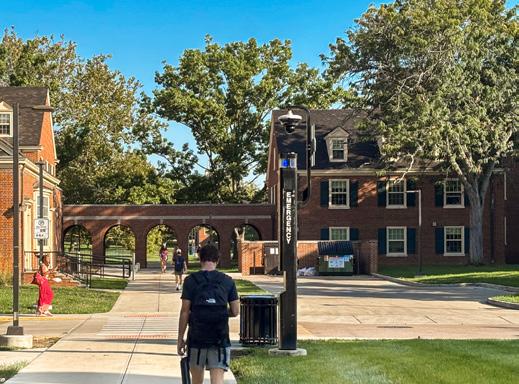
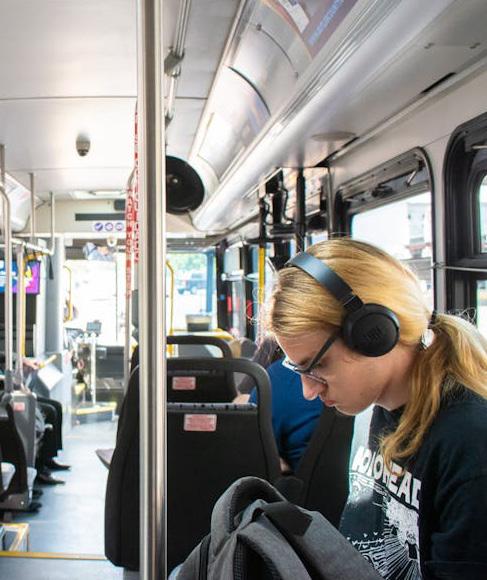
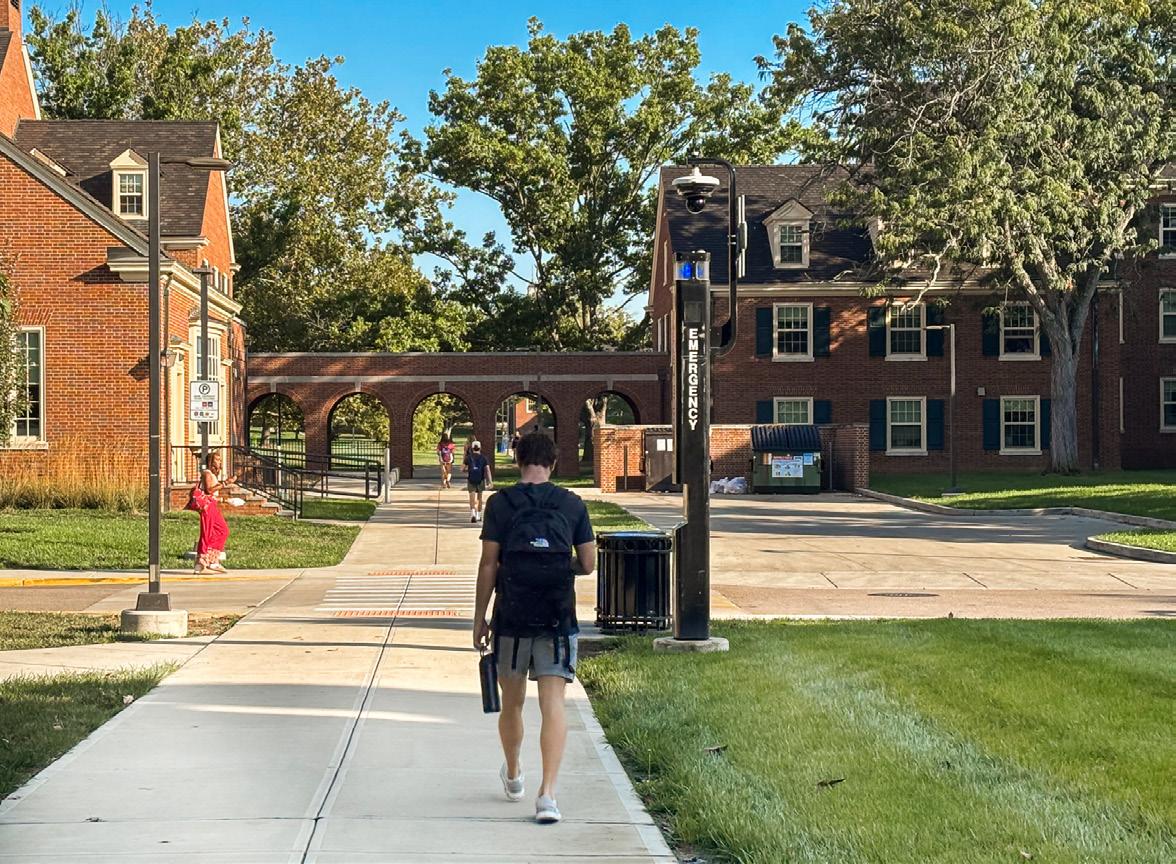
For students and residents who use public transportation, getting around Oxford has gotten new updates.
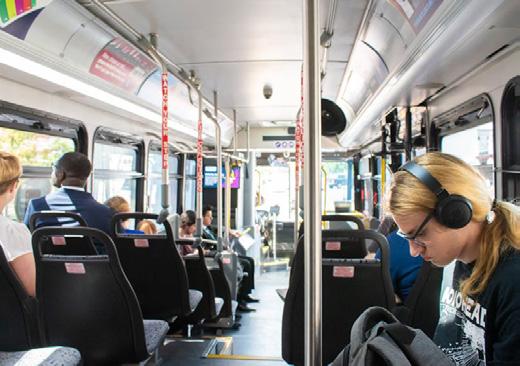
Among these additions is the continuation of an Amtrak station project in Oxford and the beginning of operations on Butler County Regional Transit Authority’s (BCRTA) new bus routes this semester, overhauling several old lines and adding new stops.
New bus routes
Changes in BRCTA include revamped O routes that run bidirectionally, separate routes for the pre-
viously connected Walmart to Kroger line and new stops at Level 27 and The Annex.
Anna West, a junior individualized studies and religion double major, said these new routes make it more convenient to get to her of-campus housing.
“Last year, they didn't have stops by my apartment complex,” West said. “Now that they have every bus stop by me, other than one, it's pretty easy for me to get everywhere.”
Others, like Ella Fretchling, a sophomore English major, said the new routes are confusing for those used to the old ones.
“Last year was easier for me to use,” Fretchling said. “I feel like it’s gotten more complicated. I used U3 every single time last year, and now
it’s like I don’t know what bus I’m taking, and you have to get of at this stop to get to this place and they’re all diferent.”
Students can fnd bus routes near them by downloading the Transit app, which tells them the approximate distance of stops, departure times and length of routes. By signing in with a Miami ID, the app automatically brings you to Oxford.
After the initial learning curve, West said the Transit app was “pretty easy to use.” However, the Transit app can’t account for situations like late buses, a frequent issue for bus riders. James Nippa, a junior electrical engineering major, said that his biggest concern with BRCTA is just that.
PARKER GREEN ASST. CAMPUS AND COMMUNITY EDITOR
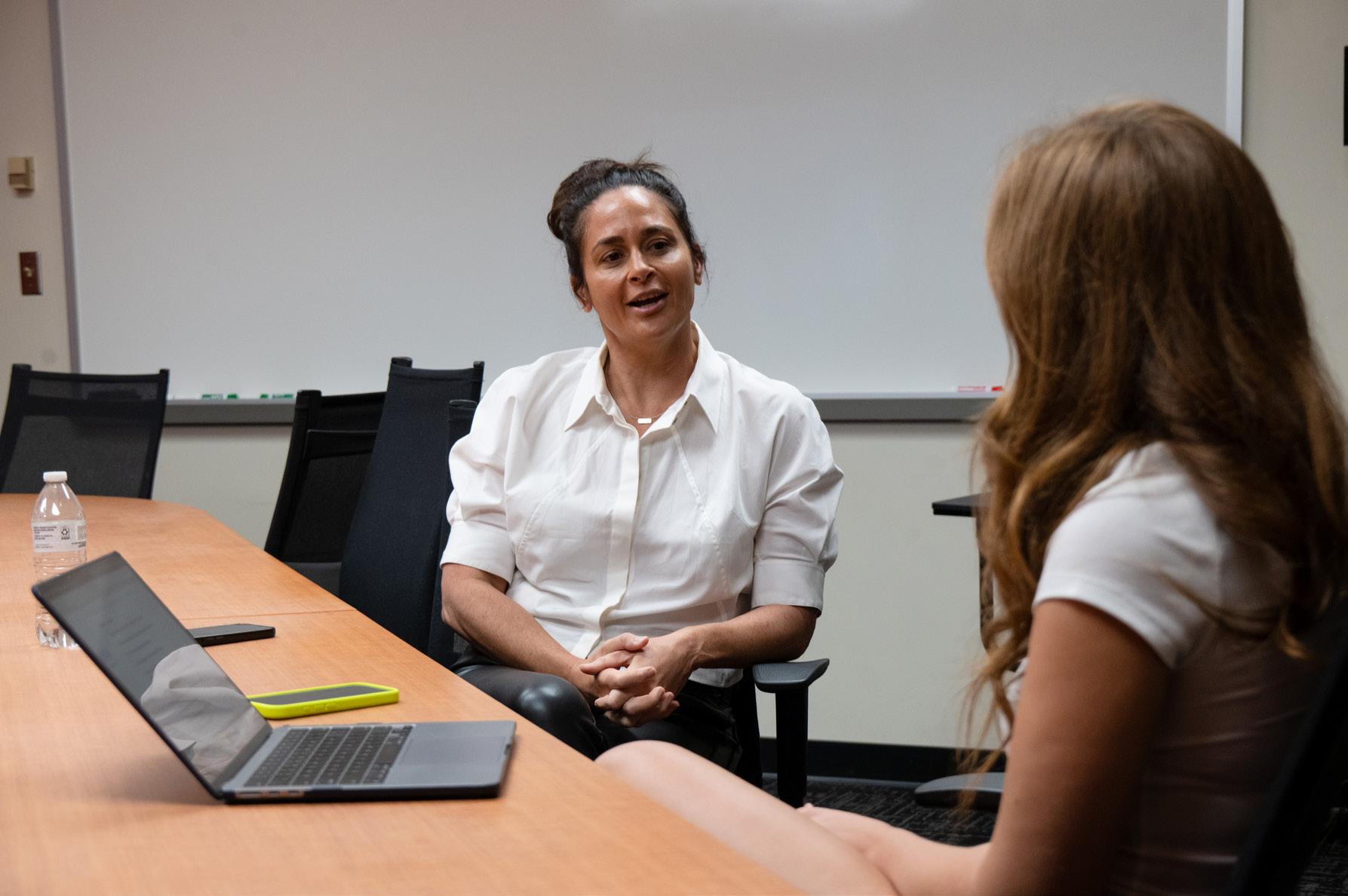
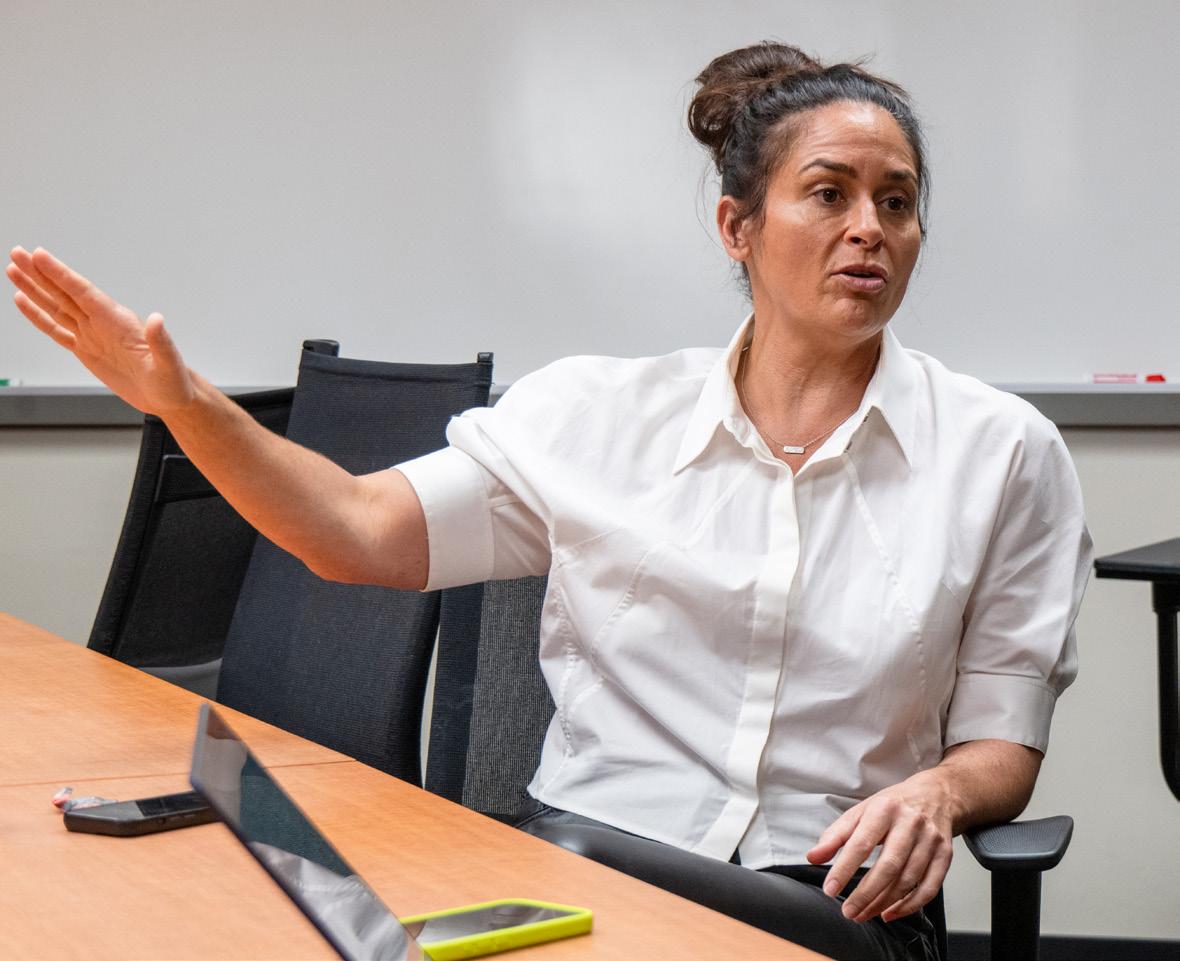
Antonia Lofaso, a competition-winning celebrity chef, restaurateur, author and single mom, visited Miami University as part of the lecture series on Sept. 29. The Miami Student had the chance to talk with her about last meals, diversity in food and her creative process.
Questions and answers have been edited for concision and clarity.
What would be your last meal?
It’s a classic “ice-breaker” question, but when the person you’re speaking to is a chef, nothing food-related is ever simple.
“It’s not just a dish; it’s a whole meal, just so we’re clear,” Lofaso said. “I’m Italian, so for me, Italian food is just it. I would love to start with some prosciutto, burrata, melon, a lot of bread, some fresh ricotta cheese — just a ton of antipasti.
PETE HARTLAGE THE MIAMI STUDENT ELISA ROSENTHAL PHOTO EDITOR
Year in and year out, synchronized skating is consistently one of the top teams in both the country, as well as the world. The RedHawks are currently ranked 20th in the world, according to the International Skating Union World Standings.
The program is split into a collegiate team and a senior team. The collegiate team performs against other universities in the country, while the senior team goes of to compete internationally if it places high enough.
“Sometimes they’ll come on time, sometimes they don’t, and you just have to wait,” Nippa said.
West has run into similar problems. She said she’s waited 15-2o minutes for a bus to arrive before, and sometimes they never show up.
“There have been times when the bus has just been canceled and I've had to walk to class, and I was late,” West said. “They can be a little bit of on their Transit times.”
New Amtrak Station Beyond busing, Oxford will soon be home to an Amtrak train station, as part of the Cardinal Line. This line includes stops in New York City, Washington D.C. and Chicago.
This past season, the collegiate team won its fourth-straight title at the 2025 national championship in Colorado Springs, Colorado. The RedHawks have won 23 national titles overall and hold the record for most consecutive national title wins (2005-16) in United States fgure skating.
The senior team has gone of to compete at the world championship in Finland twice in the past four years. In 2007, it became the frst team from the U.S. to medal at the world championships.
Miami’s national and global success begs the question: what is it about this program that sets it apart from larger schools? According to junior skater Eleanor Ashdown, who skates for the senior team, Miami’s program is unique because the skaters get to live together in a small town.
“We all live in the same town here and live pretty similar lives here in Oxford to each other,” Ashdown said,
SARAH KENNEL GREENHAWKS EDITOR
An unexpected part of the Miami University experience are deer. Whether it's seeing a group of them grazing outside a dorm, or stopping on Main Street to let a family cross, most students will encounter deer up-close on more than one occasion during their time at Miami.
However, these frequent experiences point to a bigger issue; an environmental crisis in the local ecosystem.
According to Miami’s natural areas feld manager Nancy Feakes, an overpopulation of deer has led to the decline of local plant species. Among these are buckeye and oak trees that are unable to grow taller and replace older trees due to deer chewing them down.
“We’re missing a whole section of the natural environment,” Feakes said.
Assistant city manager Jessica Greene said the City of Oxford has also been aware of the negative impacts deer overpopulation can have on the community. She said this has been seen through evidence of vegetation damage, vehicle collisions and increased fear about tick-borne diseases.
“People have come to council to share their concerns,” Greene said. “People have submitted public comments to council. I think it’s happened throughout the past couple years, and it’s risen more and more to the front of mind for city council.”
Both Miami and Oxford have attempted to control populations through bow hunting programs in recent years. In each program, selected hunters are assigned parcels of land on which they are allowed to hunt.
Retired pastor Sonny Hurd has spent his time in recent years hoping to help maintain Miami’s natural areas through the program. Last year, he hunted with his grandson who brought home a deer. More recently,
Hurd has been working to remove invasive honeysuckle from hunting areas to improve visibility for the upcoming hunting season.
“Anything I can do to help, I want to try to do it,” Hurd said. Over 100 potential hunters have applied to be part of Miami’s upcoming fourth year of deer management.
Fifty one hunters will be chosen in a lottery selection to facilitate hunting in 17 parcels across Miami’s natural areas. Deer harvests can be used by the hunters, donated through an Ohio program or given to the Myaamia tribe to be used in ceremonies and for making hides.
Feakes said so many hunters value the program and want to participate because it provides them with their own hunting space and cuts the expense of obtaining a hunting license.
“We have your own little private hunting reserve for that period,” Feakes said. “You’re the only hunter out there. That means a lot to them.”
AYLA PEDEN ASST. CULTURE EDITOR
When Steinkeller frst opened in 2000, Jim Kuykendoll was only a junior at Miami University. Now, 25 years later, Kuykendoll and his wife, Jenny Kuykendoll, have been the proud owners of the beloved restaurant for four years, and they aim to bring German culture and great food to Oxford.
Before Todd Hollenbaugh – Jim Kuykendoll’s stepfather – opened Steinkeller on High Street, he spent a lot of time overseas in Germany, where he fell in love with Bavarian culture and the Oktoberfest celebrations in Munich. This passion fueled the creation of the Baravian-inspired bier hall.
“[Steinkeller was] created as a place for Miami students who study abroad to enjoy the same quality beer they enjoyed overseas,” Jim Kuykendoll said. While many bars in Oxford serve classic American beers like Budweiser, Miller High Life and Coors Light, Steinkeller imports its beer directly from Munich, with one exception being Stiegl, which comes from Austria. The beer is brewed according to Germany’s Reinheitsgebot, otherwise known as the Beer Purity Law. Created in 1516, this law restricts beer to four main ingredients: water, hops, barley and yeast.
“I like to think of our beer as ‘real beer’ because it’s authentic, high quality and traditional,” Jim Kuykendoll said.
“You’ll know what you’re drinking. It’s very clean ingredients, based on the purity law, and we have one of the widest variety of German import draft beer lineups in the U.S.” However, the beer is not the only thing that makes dining at the restaurant unique. Steinkeller (translated to mean “Stone cellar”) is located under-
ANTONIA LAFOSO. PHOTO BY SARAH FROSCH
THE MIAMI STUDENT STAFF
OLIVIA PATEL EDITOR-IN-CHIEF
KISER YOUNG
ANNA REIER
MANAGING EDITOR
TAYLOR STUMBAUGH
SENIOR CAMPUS & COMMUNITY EDITOR
KETHAN BABU
SPORTS EDITOR
TAYLOR POWERS
OPINION EDITOR
STELLA POWERS
CULTURE EDITOR
CONNOR OVIATT
HUMOR EDITOR
SARAH KENNEL
GREENHAWKS EDITOR
OLIVIA MICHELSEN
DESIGN EDITOR
SARAH FROSCH
DIGITAL MEDIA EDITOR
ELISA ROSENTHAL
PHOTO EDITOR
Advertising information: Smith646@miamioh.edu Send us a letter: eic.miamistudent@gmail.com
SOCIAL MEDIA EDITOR
MADELINE BUECKER
ASST. DESIGN EDITOR
ELISA ROSENTHAL
PHOTO EDITOR
SHANNON MAHONEY
PARKER GREEN
ASST. CAMPUS & COMMUNITY EDITORS
ALYA PEDEN
ASST. CULTURE EDITOR
JEFFREY MIDDLETON
ASST. SPORTS EDITOR
AUSTIN SMITH
BUSINESS MANAGER
FRED REEDER JR.
FACULTY ADVISER
SACHA BELLMAN
BUSINESS ADVISER
AIM MEDIA MIDWEST PRINTER
its students or staf. CORRECTIONS POLICY
The Miami Student is committed to providing the Miami University community with the most accurate information possible. Corrections may be submitted up to seven calendar days after publication.
Our Awards
2024 and 2025 Corbin Gwaltney Award for Best All-Around Student Newspaper in the large school category, beating out every student paper at a university over 10,000 students in Ohio, Michigan, West Virginia and Western Pennsylvania
2025 Ohio Society of Professional Journalists (SPJ) Award for First Place in the Best College Newspaper category
2025 Greater Cincinnati Pro Chapter Society of Professional Journalists (SPJ) Excellence in Journalism Award in the College/ University Student Publication category
2024 Ohio Society of Professional Journalists (SPJ) Award for Second Place in the Best College Newspaper category
2025 Ohio News Media Association Award forFirst Place in Best Website
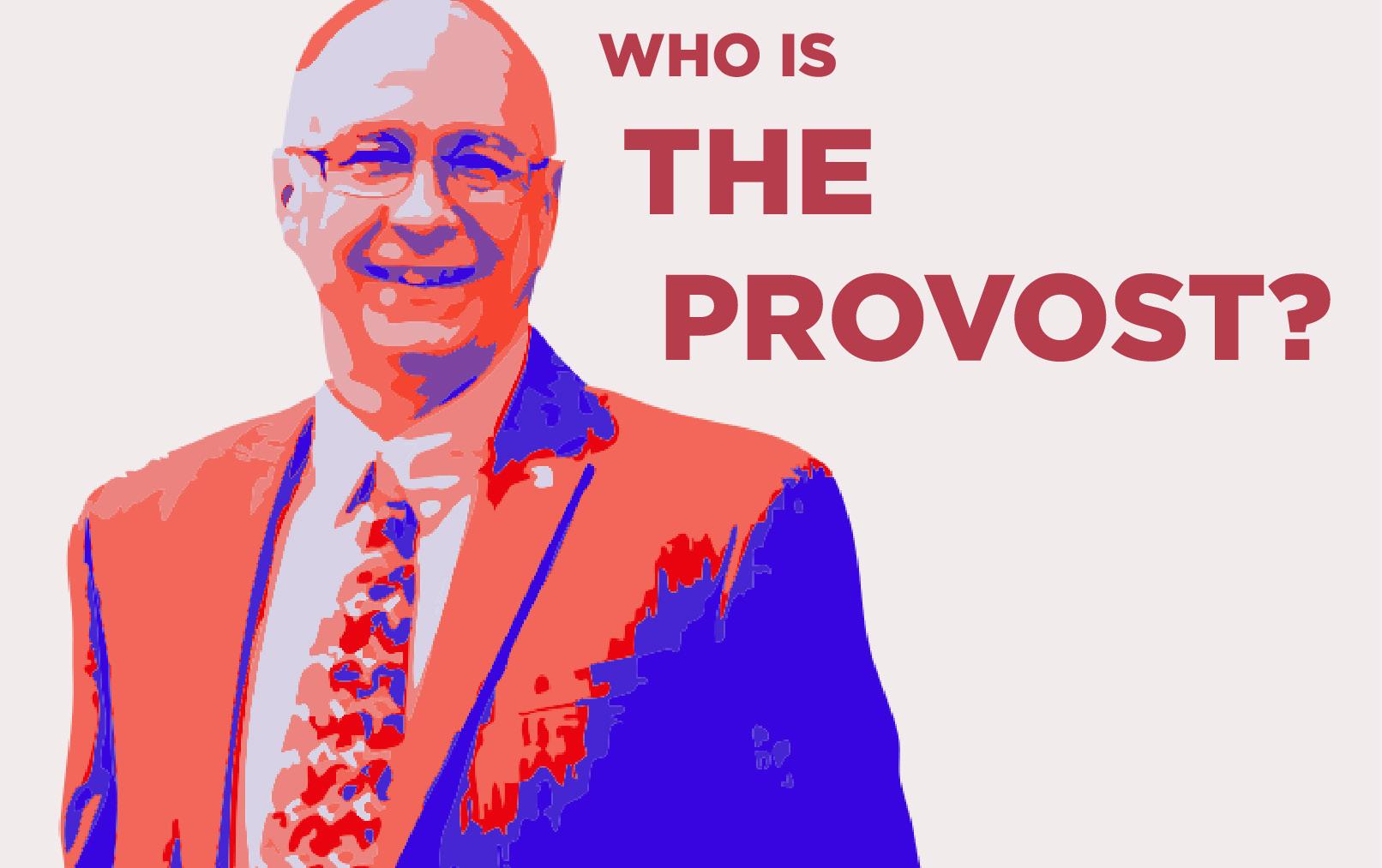
Who’s Who at MU: the Provost
BILL KWAN
STAFF WRITER
Since former provost Liz Mullenix stepped down last spring, Chris Makarof has taken on the role of Miami University’s interim provost, a position that has a wide range of responsibilities at Miami, but goes curiously unseen.
So, what exactly does a provost do?
The provost is the university’s chief academic ofcer; they oversee everything related to academics at Miami. This includes managing all academic programs, departments and schools.
Every dean at the university reports directly to the provost, as do the chairs of departments and key programs, like the honors program and the graduate school.
As a provost, Makarof holds biweekly meetings with all the deans, meeting with each individually and then coming together as a group twice a week. Beyond that, he meets with university committees, the vice president’s ofce and key administrative ofces, such as Human Resources and Development. When problems arise — whether it’s a student or parent appeal that escalates beyond the professor, or conficts with faculty unions — Makarof is often involved in the solution. He also represents Miami at the Inter-University Council meetings held in Columbus, where provosts from other universities discuss statewide
academic issues.
“I’m involved in a lot of diferent areas, and each day brings something new,” Makarof said. “Sometimes it’s working with deans on hiring requests or redesigning academic programs. Other days, I’m helping with the THRIVE initiative, a polytechnic-focused project or supporting the nursing program and career services.”
Makarof said the role requires balancing many moving parts across the university.
“Chairs see their own departments and deans see their colleges, but as provost, I have to think about what’s best for Miami as a whole,” he said.
Another part of Makarof’s role as provost is to manage academic hiring. When a professor leaves unexpectedly or a new program needs stafng, the provost works closely with deans to fnd and approve the correct replacements.
Seth Bauguess, Miami’s senior director of communications, said Makarof is also involved in the search for a new provost.
“We will be working with Storbeck Search and looking over various candidates for the new provost,” Bauguess said. “In particular, we will be holding open forums across campuses informing people about our fndings and also taking questions.”
Michael Chisanga, a sophomore computer engineering major, said he has never heard of the provost or knows what he does.
“I think it’s because [students] are more focused on what they’re here for: their academics,” Chisanga said.
“Like for me, I have to complete my degree.”
This is a statement echoed by students across campus.
Laila Diane, a frst-year biochemistry major, agreed that she had never heard of a provost before. She said it sounded like something you research.
Makarof’s role isn’t a feld of study; instead, he said he plays a big role in deciding whether new academic programs ft the university’s goals, or if they overlap too much with existing ones and helps to reshape programs when needed.
“It’s important work, but I have to live vicariously through others since I don’t see as many direct benefts anymore,” Makarof said.
Higher education today faces new challenges.
“Students are consumers now, and the university is seen as a product,” Makarof said. “When students and their parents get upset, sometimes it’s because they expect more since they’re paying for their education.”
With initiatives like MiamiTHRIVE and experiential learning growing on campus, Makarof’s role is to guide these eforts in ways that beneft students and the university community.
“I might not always get to see the results as directly as I could when I was a department chair or a dean,” Makarof said, “but at the end of the day, I’m here to do what’s best for the whole university.”
kwanwz@miamioh.edu
Public urination and public indecency plague Oxford this week
AUSTIN SMITH BUSINESS MANAGER
Between Sept. 22 and Sept. 29, offcers responded to 28 diferent incidents, a 47% increase from two weeks ago, according to Oxford Police Department reports. Additionally, ofcers responded to a pedestrian struck by a car on Sept. 30.
On Sept. 22 at 4:31 p.m., in the 5200 block of Brown Road, ofcers responded to a report of a brown bear sighting posted on social media. After investigating the matter, ofcers determined that the sighting was unfounded and warned the poster for inducing panic.
On Sept. 23 at 9:46 a.m., in the 5100 block of Red Cloud Court, ofcers responded to a report of a burglary in progress. After questioning the suspects, ofcers discovered that one female resident had assaulted a male. She was arrested for domestic violence and taken to jail.
On Sept. 25 at 4:57 a.m., in the 600 block of S. College Ave., ofcers were called to a welfare check for a female. The female approached the police and told them her boyfriend had physically assaulted her. After confrmation, the boyfriend was arrested on multiple domestic violence charges.
Later that day, at 2:39 p.m., in the 0 block of Day Circle, ofcers arrested a male for domestic violence. The male had taken his father down to the ground and attempted to cause physical harm, according to police reports.
On Sept. 26 at 11:35 p.m., at the intersection of East Sycamore Street and Bishop Street, ofcers observed a crash occur and saw the at-fault vehicle leave the scene. Ofcers stopped the vehicle and arrested the underage driver for operating a vehicle while intoxicated. On Sept. 27 at 12:04 a.m., in the
40 block of East Park Place, ofcers responded to a fght involving multiple people. When ofcers arrived, one of the involved individuals was found to be 17 years old and heavily intoxicated.
That same day, at 4:47 p.m., in the 100 block of S. Campus Ave., ofcers responded to an intoxicated male who had fallen and injured himself. Ofcers discovered he was underage and charged him with underage consumption.
Later that day, at 6:18 p.m., in the 5700 block of College Corner Pike, offcers responded to a report of a male urinating inside Walmart. The male was identifed, and a report was fled for public indecency.
On Sept. 28 at 1:57 a.m., at the intersection of North College Avenue and West Withrow Street, ofcers and emergency medical services were dispatched to a passed-out female. Upon arrival, the female was unable to wake up and was transported to the hospital. She was cited for underage consumption and disorderly conduct.
Later that day, at 2:02 a.m., in the 700 block of South Poplar Street, offcers were dispatched to a dispute. After arriving at the scene, they located a group of involved males. Neither party wished to pursue charges; however, two of the males were cited for possessing a fake ID. On Sept. 30 at roughly 8 a.m., at the crosswalk near Cook Field on Trenton Oxford Road, ofcers responded to a pedestrian hit at the crosswalk. A 65-year-old Indiana man was driving east and struck a 25-year-old woman, according to the incident report.
The woman was transported to the hospital, and the road was subsequently closed for 34 minutes.
smith854@miamioh.edu
GRAPHIC BY SYDNEY MULFORD
GRAPHIC BY MACY CHAMBERLIN
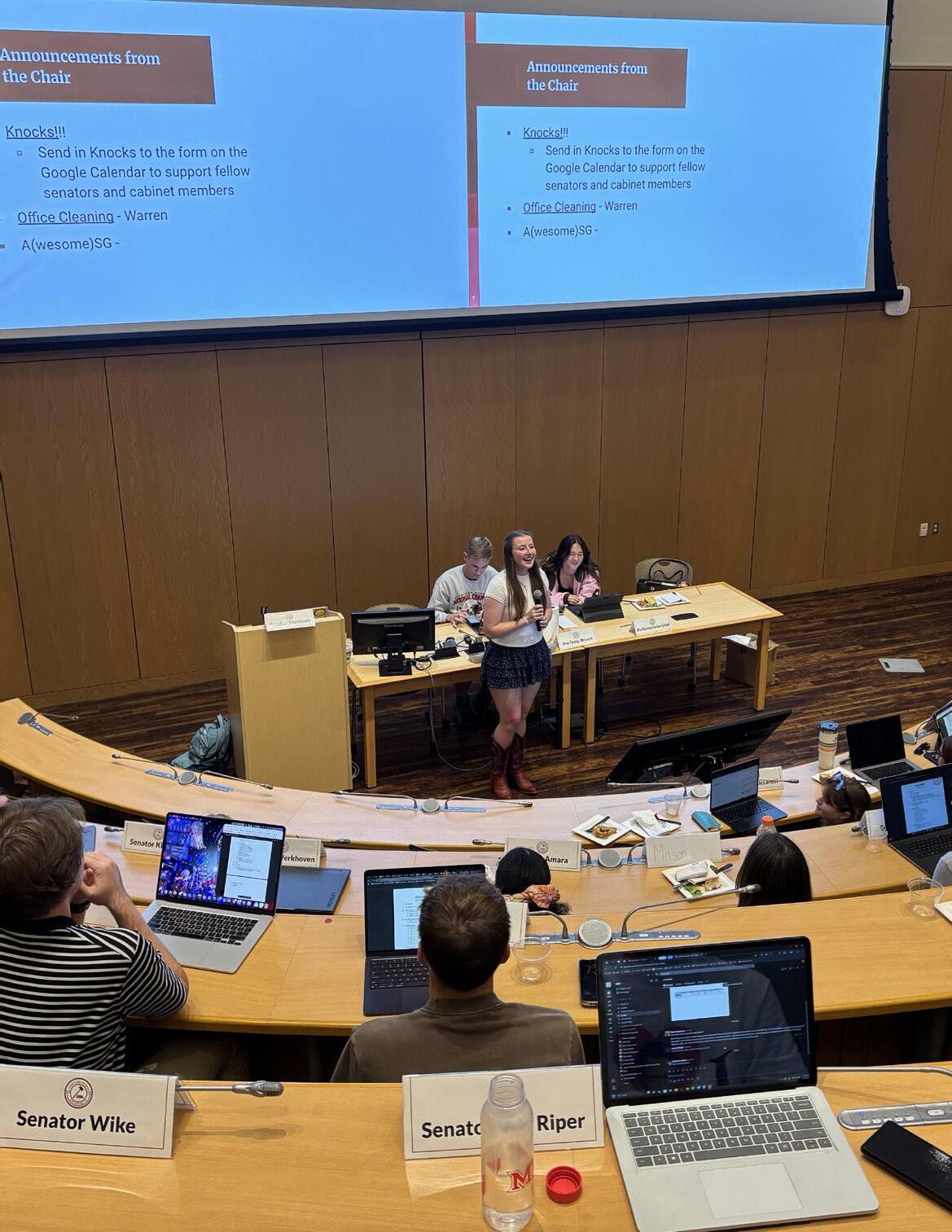
ASG discusses University Senate, student trustees, Oxford skate park
SHANNON MAHONEY
ASST. CAMPUS AND COMMUNI-
TY EDITOR
Nathan French appeared in front of Associated Student Government (ASG) to talk about the University Senate. French spoke about the new House Bill 96, which limits the power of faculty senates at universities across the state. French also said he wanted to strengthen the connection between ASG and University Senate.
“When the moment comes that University Senate asks for your response, or if there are opportunities like that emerging AI policy or a conversation about AI that we need to have, don’t hesitate to reach out to us,” French said. “If we come to you, we’ll come to you through various channels. We will welcome the opportunity to return here [to ASG] and present.”
Peyton Morrow and Arushi Agrawal, the student trustees for the Board of Trustees, gave a presentation about the search for a new student trustee, since Morrow’s term will soon come to an end. Student
trustees sit on the Board of Trustees and provide a valuable point of view that can help shape decision-making at the school.
Jack Isphording, chief of staf, gave a presentation on how student trustees are selected. Applications will close on Tuesday, Oct. 28.
“It’s important to choose a student who is able to combine a lot of diferent reaches in order to have a very holistic and very good view of the student experience,” Isphording said. “If you’re interested, run next week.”
President Daniel Martin and Vice President Kirsten Osteboe addressed the senate about their campaign platform, which won their election last semester. The pair ran on a platform focused on civic engagement, transparency, leading from behind and community building. Both Martin and Osteboe emphasized their initiatives on campus, like philanthropy fest, and their ofce hours – which they say will resume soon.
“We have a really involved campus, but there’s also diferent sects of campus that don’t always interlap, so we really wanted to kind of bridge those gaps, and then also bridge the
gap with the community of Oxford,” Osteboe said.
ASG then reviewed student concerns. Senator Buckalew responded to a concern that had been brought up last week about red flters on the water bottle stations at the recreation center. Buckalew said flling out a service request is the only way to fx these issues; however, he also said that they are looking into a long-term fx to this issue.
“The sustainability committee is working to get QR codes added to the stations with links to the service request website so that more students understand this process better,” Buckalew said.
Additionally, ASG committed a concern about the closure of the Oxford skate park to the Community Engagement Committee to try and fgure out a solution to student concerns and confusion about why the park has been shut down.
ASG will meet again on Tuesday, Oct. 7, at 6 p.m. in the Joslin Senate Chambers.
mahones5@miamioh.edu
CAMPUS & COMMUNITY
New bill reduces funding for public libraries
SOLOMON BOWSER STAFF WRITER
SOPHIA
YOUNG THE MIAMI STUDENT
A new piece of Ohio legislation has raised concerns over the well-being of public libraries.
Governor Mike DeWine signed House Bill 96 (H.B. 96), Ohio’s operating budget for fscal years 2026 and 2027, into law on June 30. The bill determines how certain state funds are distributed to state agencies and can set new policies for how these institutions operate. Two of its provisions have raised alarm for their potential impact on how Ohio libraries are funded, as well as the kind of content they can share.
Libraries will see less money coming in from the state over the next two years because H.B. 96 treats the fund as a fxed line item, where it was
originally taken as a percentage of the General Revenue Fund.
The bill currently allocates $490 million to fscal year 2026 and $500 million to fscal year 2027. According to an article by the Ohio Library Council (OLC), the percentage rate for each fscal year would be $531.7 million and $549.1 million, respectively.
OLC reported that with an additional $10.3 million annual deduction from the Public Library Fund, libraries will be going into the 2026 fscal year at a $25 million defcit. Joseph Greenwood, the director of Lane Libraries, said he’s mainly worried about the long-term impact of this decision. Greenwood said that even though Lane has maintained a small levy over the past 15 years, continued losses in state funding could force the libraries to cut back on future projects or general services.
“Ohio has had very stable funding historically through the Public Library Fund,” he said. “Of course,
we’re concerned about losing that stability and becoming a line item.”
In the case of H.B. 96, instability isn’t just a matter of capital. When it was introduced in February this year, it contained a provision (Section 3375.47 on page 1,307) that would limit access to materials related to sexual orientation or gender identity for people under the age of 18. Governor DeWine vetoed this section before signing the budget into law, but legislators have the opportunity to override gubernatorial vetoes until the end of the current General Assembly in December 2026.
This piece of the bill has been a major center of controversy throughout the budget’s lifetime. Many deem the restriction an act of unconstitutional censorship, especially considering the role of libraries as institutions of accessible information and knowledge.
Megan Kuykendoll, an instructor of family science and social work at
Miami University, said the act of banning or even restricting material like this only serves to further marginalize certain groups or identities. She emphasized that censorship doesn’t just limit people’s access to something, but also denies a group’s sense of belonging within a community.
“When you remove those stories, you’re telling kids that their families don’t count,” she said.
Elena Ziccarelli, the co-president of Miami’s Young Democratic Socialists of America, also expressed concern over H.B. 96’s impact on queer visibility.
“It sends the message that queer people are a salacious topic, like it’s something that should be hidden,” she said.
While the bill poses some immense changes to how libraries are run, this isn’t the frst time these institutions have faced adverse circumstances.
In 2009, then Ohio Gov. Ted
Strickland proposed a 30% cut to state funding for libraries as a way to balance the state budget. After hearing about this, patrons to public libraries across the state were outraged and mounted a response to the cuts being made, pressuring the General Assembly to reject Strickland’s proposal.
Greenwood and Carrie Mancuso, Lane Library’s public relations manager, pointed to this moment as a prime example of the patrons being a library’s loudest voice. Mancuso said they can always depend on people to show up for their libraries.
“Our patrons are very committed to protecting what they get from their public library,” she said. “So we’re very fortunate for that.”
bowsers2@miamioh.edu youngsp2@miamioh.edu
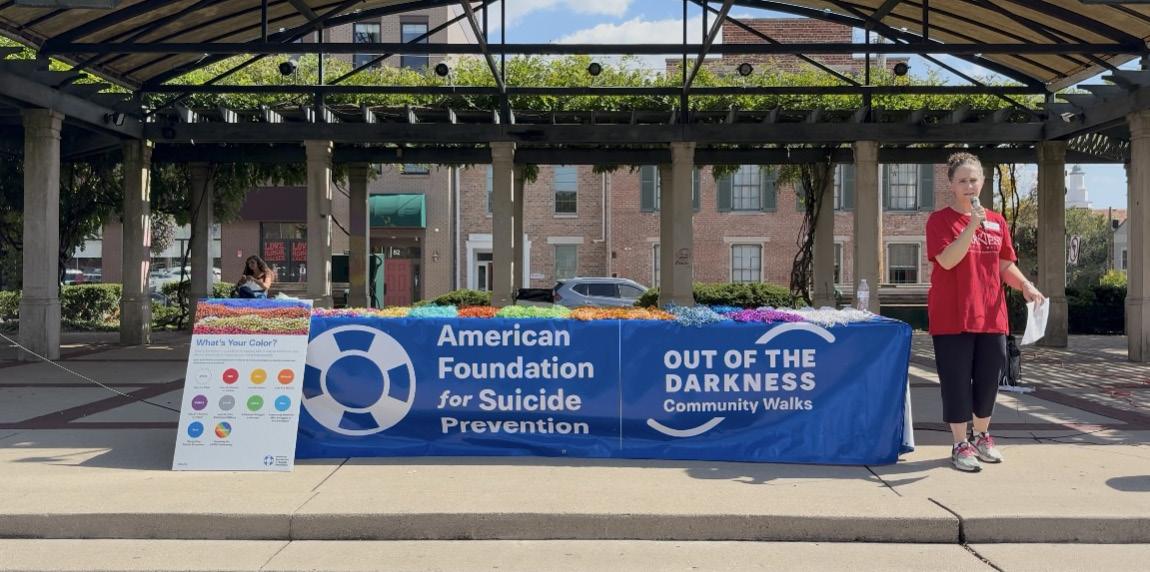
Miami and Oxford community comes together for annual Out of the Darkness Walk
CAITLIN O’BRIEN THE MIAMI STUDENT
Miami University and the City of Oxford hosted the 10th annual Out of the Darkness Walk at Memorial Park on Sunday, Sept. 28, at 1 p.m. Jennifer Young, psychologist and associate director for community engagement at Student Counseling Services, organized the event.
“We had the most people and the highest amount of money raised than we have for any other event,” Young said. “And we had lots of families from the community, as well as Miami students who came, and to me, that’s really rewarding.”
Clubs, student organizations and other tables with resources were stationed around the park before the walk started. Each table provided an activity or materials for participants to explore after they checked in, before the opening remarks started.
After a few words about the walk’s history and the funds raised this year, Young introduced Emma Halcomb,
a graduate student at Miami and a community manager in the Ofce of Residence Life.
“There’s so much news and negative things being pushed at students and young adults that we’ve never seen before, and I think that’s causing a lot of mental anguish,” Halcomb said. “So talking about [how] it’s OK to not always feel 100% is really important.”
Halcomb spoke about her personal connection to the walk and kicked of the honor bead ceremony, where attendees were invited to take diferent colored beads to wear to represent who they came to walk for. Mitchell Gruber, a sophomore computer engineering major at Miami, wore teal beads to support his friend who struggled.
“He was in tears and they asked him if he thought he was a danger to himself. He said ‘yes,’” Gruber said.
“We took him to the hospital, where he stayed for three days.”
Each person who took part in the walk had a story to tell. Other at-
tendees wore diferent colored beads to honor their loved ones, their own personal struggles or to show their support for the cause in general.
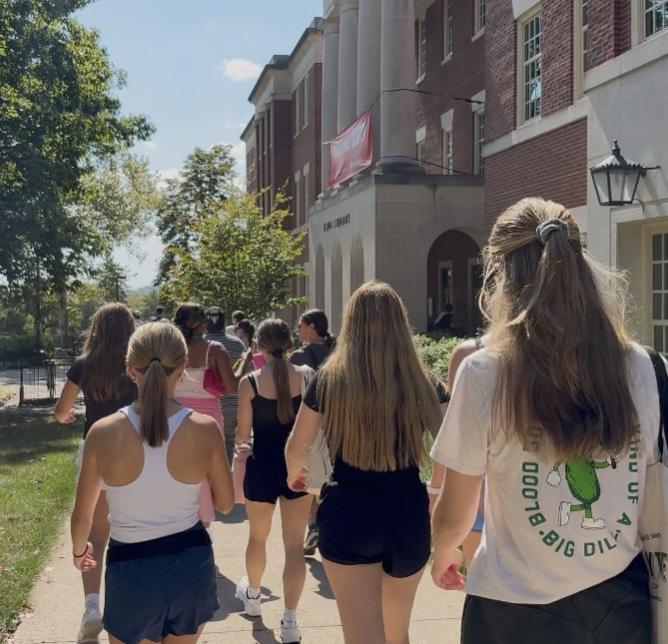
The group was then led in two groups through the two-mile walk around Uptown and campus, then back to the park where they could grab healthy snacks before leaving. The success of the walk paved the way for the rest of Suicide Prevention Week, in which Miami will hold events through Friday, Oct. 3.
“We are here to show support for those who struggle with mental health concerns, we are here to break the stigma of seeking help and we want to spread hope that suicide is preventable,” Young said. “Today we walk for those who can’t.”
If you or someone you know is struggling, reach out for help. Call or text 988 or text TALK to 741741. For more resources, go to asfp.org obrie175@miamioh.edu
CAMPUS & COMMUNITY
Level 27 removes previously provided transportation due to new management
provided transportation to school.
PFENNIG
KIERNAN
THE MIAMI STUDENT
For many Level 27 residents, they choose the far away location with the easy access to campus through the provided transportation. However, on Aug. 22 residents learned their apartment complex would no longer provide transportation from students’ apartments to Miami University. Instead, Butler County Regional Transit Authority (BCRTA) added a new stop at Level 27. The problem: BCRTA buses only come roughly once every hour.
“The Level 27 bus would stop every 20 minutes,” Savannah Higley, a senior zoology major, said. “I have a 10:05 a.m. class Tuesdays and Thursdays. If I don’t get on the bus at 9:10 a.m., I have to drive to campus. I won’t get to class on time.”
The busing change is a result of a change in management at Level 27. The previous owners were Blue Vista Capital Management LLC until they sold it in May 2025 to Rise Select.
Many students choose Level 27 for the cheaper apartment rates and the
TAYLOR STUMBAUGH CAMPUS AND COMMUNITY EDITOR
Workday Student, an interface meant to replace BannerWeb, was set to launch in March, but got pushed back to the 2027-2028 academic year.
The goal of Workday Student is to replace the current course registration system, degree audit report, registration override request waitlist system, among other student-facing platforms as an additional module in Workday.
David Seidl, Miami University’s vice president for information technology and chief information ofcer, said the implementation team was
Cordelia Stubblefeld, a junior journalism and media and communication double major, signed her lease in November 2024. Lindsay Smith, a senior psychology major, lived at Level 27 for the 2024-25 school year and wanted to live there again for the included amenities.
“[The included bus transportation] was the main reason I signed my lease with them,” Smith said. “Otherwise, I would have moved to a closer complex, because the whole draw of Level 27 is ‘yes, it’s a little ways on campus, but you have easy access to it.’”
Because of the limited time between the announcement and school starting, Smith has chosen to ride his bike to school. On average, this takes between 12-20 minutes, depending on where he is going on campus.
“The roads themselves aren’t too terrible,” Smith said. “Sometimes the bike lane has some debris in it, but I usually am able to avoid it. The hardest part is the hill up and down, both ways. Then, having to deal with pedestrians and cars, that’s a little scary.”
The management switch has also brought other changes to the apart-
ment complex.
“[I was] supposed to have free parking,” Stubblefeld said. “I did have to pay $50 for my parking pass on the day that I moved in.”
Stubblefeld and her roommate picked Level 27 as it allows pets, and her roommate has a snake. However, with the management change, pets were no longer allowed. But, they made an exception for her due to the preexisting agreement.
Smith also felt that since the change, it’s harder to get in contact with maintenance.
“[The] fre safety system does not work and it’s been [that way] since June,” Smith said. “Sometimes they don’t specify [which] buildings or when the water is going to be shut of.”
Overall, Level 27’s change in management has interrupted student’s lives and created inconveniences with bussing and other valuable selling points.
To fnd more information on bus routes, visit butlercountyrta.com.
mulforsj@miamioh.edu
pfennikp@miamioh.edu
sulting and implementation partner.
After two and a half years, Miami has spent $14 million on Workday Student, with millions more estimated to be spent before the implementation is complete.
confdent moving through production until reaching “checkpoint two,” which involves the fnancial aid capabilities of the new interface.
“We started to say, ‘OK, we’re not going to be able to deliver some of the things that we want to be able to do from a fnancial aid perspective, because Miami’s really detailed and complex, and we do a lot of specifc things with fnancial aid,’” Seidl said.
“... That means we’re waiting a year, but that also buys us a decent amount of time to pick a product, do the full implementation, do all of the complexity around it, and then we can spend more time in the interim working on all the rest of it and provide a better product.” Avaap is Miami’s Workday con-
“If you think about this, an institution like Miami might do an [Enterprise Resource Planner (ERP)] implementation like this once every 20 [to] 25 years. In this case, exactly 25 years,” Seidl said. “That means we don’t have a lot of internal experience doing that, and we also have not worked with the product before, so we are basically paying them to be experts on it and to help us get there.”
ERP, the core business software, is in charge of course registration, the course catalog, fnancial aid, bursar payments and more, which will be inside Workday Student.
Mija Lisnich, a sophomore fnance major and information service specialist in the Armstrong Student Center, said she mainly used Work-
Douglas Elliott, the city manager of Oxford, said that the city is going through with the project, but that an additional appropriation was needed.
“We had originally budgeted $250,000, and I think we had $73,000 remaining, so we were asking for an additional $126,000 on this contract, given the estimates we have for the design engineering,” Elliott said. He said construction on the project must be completed by Dec. 31, 2027; while there is no ofcial timeline, there is at least an end date.
As far as student
“The
day to check in and out of her job and submit her hours.
“I think [advancement is] always a good thing,” Lisnich said. “Like just to keep updating and like staying up with certain trends and technology, it’s always good to help the students and make everything work smoother. [When] rolling out a new system, there can always be something that goes wrong. When you’re testing something out, you just don’t know what it would be, but it’s defnitely expected.”
Seidl agreed with this, saying he’s looking for a “truly modern experience.”
“I don’t know about you, but everything I do these days is on my phone via a mobile app, and Banner is not really necessarily mobile-friendly the way we’re implementing it,” Seidl said. “We were also looking at modernizing all the business processes that go on behind the scenes, and we were looking at new tools like AI and
things like that that can be baked into it.” Eleanor Prytherch, a second-year master’s student in English education, said she has worked at the Howe Writing Center since her undergraduate years at Miami, where she uses Workday.
“I’d defnitely be interested in [Workday Student], because BannerWeb is not very user-friendly,” Prytherch said. “It does give the vibes of being very old, but I think that would be interesting, because I like the online interface for Workday more than on the phone. There’s not a lot of use for it as a student employee, because we’re clocking in and out on our phones. But I like the interface, so I think it would be more straightforward than BannerWeb as a replacement for that.”
stumbata@miamioh.edu
SYDNEY MULFORD STAFF WRITER
walked
story of RedHawks football team captain Silas Walters
COLIN MCDONALD THE MIAMI STUDENT
In the era of the transfer portal and Name, Image and Likeness (NIL), college football teams rely on recruiting current players from other programs by promising lucrative contracts, more than fnding talent they didn’t know was right in front of them. Since these practices have become so common, the concept of walk-on players – players that never received a scholarship but made the team through tryouts – has fzzled out.
But in the case of redshirt senior safety Silas Walters, his journey took him from being a low priority walkon to team captain for the Miami University RedHawks football team.
Growing up less than an hour from Miami, Walters attended RedHawks games in the early 2010s with his family, including his uncle who lived in Oxford.
“I have some history of watching the RedHawks,” Walters said. “It’s part of the reason I came here.”
At Lakota West High School, Walters helped with the team’s regional fnal run in 2020, where it fell to St. Xavier during his senior year.
Although Walters didn’t receive a collegiate scholarship straight away, he knew that his calling was football. When he arrived at Miami’s campus his frst year, he showed his determination to prove himself by trying out for the team as a walk-on.
Through his frst year, Walters had people he looked up to in the safety room that were crucial to his development into the player he is now.
“Some of the safeties that came before me when I frst got here –Sterling Weatherford, Mike Brown – were [guys] I really looked up to,” Walters said. “And in 2022-23, Michael Dowell was a big wise guy and had a bunch of experience. So those guys really helped develop me a lot as a player.”
As a walk-on, Walters saw limited playing time and spent more time on the sidelines than on the feld from 2021-22. He knew that to earn playing time, he would need to develop himself physically and mentally in his free time.
Head coach Chuck Martin has seen Walters’ entire transformation as a RedHawk. He got his frst break on special teams before moving to backup safety. At each new stage, he said Walters would continue to show that he’s willing to go above and beyond to improve himself and the team as a whole.
“When he got here, he was a walk-on,” Martin said. “He would go straight to the scout team and give it
KETHAN
BABU SPORTS EDITOR ALEXANDER SMITH
THE MIAMI STUDENT
One walk past Cook Field on a weekday night will reveal the importance of club sports at Miami University. With more than 50 club teams on campus, Miami students can compete in a wide range of sports, from the more popular ones like soccer and baseball to more niche activities like equestrianism and clay shooting.
Club sports are an important part of the Miami community. While they don’t get the funding that varsity sports do, they are still highly competitive and provide a step up from intramural competitions.
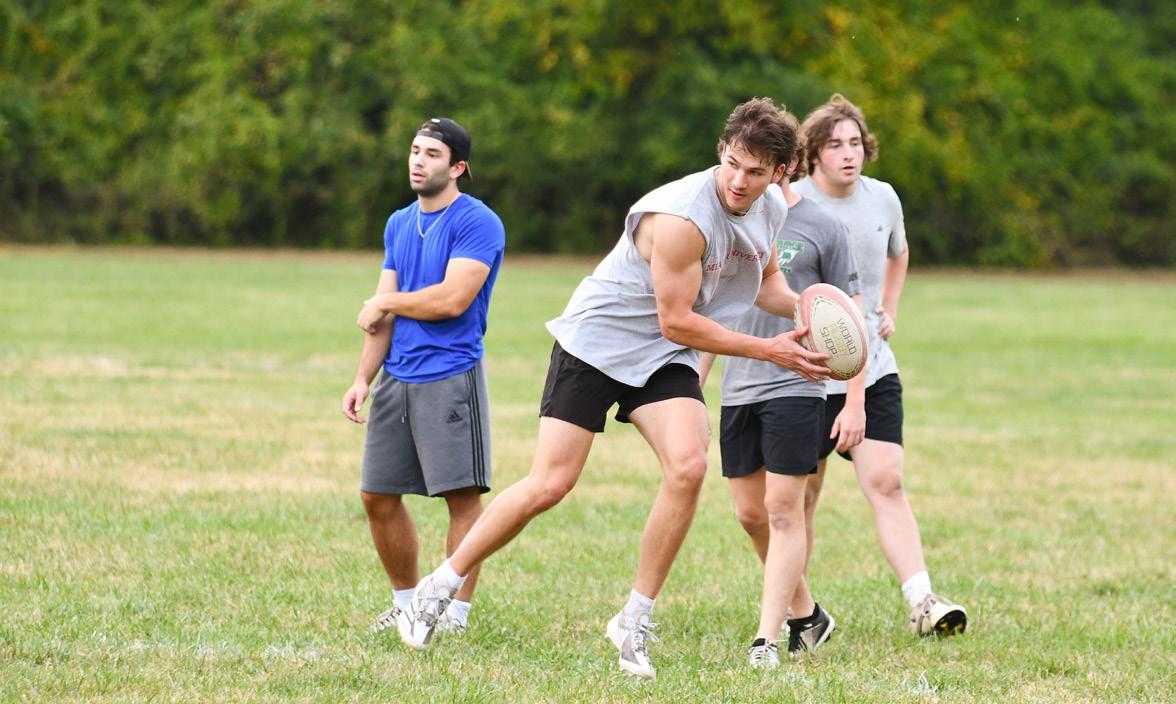
For the Miami club rugby team, competing at a high level is at the top of its priorities. This season, the RedHawks took their development a step further by inviting Grant Keenan, the director of the Crusaders International Academy and a former rugby coach from New Zealand, to coach the team from Sept. 22-26 in preparation for their home opener on Oct. 4.
The club rugby team has been around since 1968, when it was founded by an Englishman named Lionel Young. It is the oldest club sport on campus, and former players still support the team both fnancially and by attending matches.
Second-year head coach Killan Mulkern said throughout the program’s history, the roster has consisted of players with an extensive history in rugby, as well as those who have never played the sport.
“We have guys that have never played rugby before, join us the frst couple weeks of school … and a couple have become starters on our
his all. Then, [he would] go to special teams and lead the country in special team tackles in one year. After getting noticed by all of the coaches and teammates, he’ll go to backup safety, then backup nickel. Next thing you know, he’s a starter. Shortly after that, he’s team captain.”
At the 2023 spring showcase, Walters was called to the middle of the feld for the opening coin toss. Martin told him he had a choice: he could decide whether his team would receive or kick, or he could decide to accept a scholarship position on the team.
From that point on, Walters has elevated his game and became a cornerstone of Miami football.
“When I frst got here, it was sort of trying to make a name for yourself and get on the coach’s radar,” Walters said. “You’re trying to get a scholarship. Now, in my last year, it’s diferent. I know I’m playing, so the expectation keeps getting higher for me.”
Now being on scholarship, Walter’s role on the team has changed. He is looked at as a leader and an expected playmaker: a night-and-day diference from when he frst tried out his freshman year.
With these expectations, Walters has shined as a starter and proven his team captain status. Going into conference play this season, he matches redshirt senior linebacker Corban Hondru with two interceptions to lead the roster and ranks third in tackles (25).
He also picked up a sack as a safety against Rutgers University and had one of the RedHawks’ biggest plays of the year when he caught an interception in the endzone against the University of Wisconsin.
“It was fourth down, and they got in a tight formation,” Walters said. “I read my key receiver as he came across the feld. The quarterback made a poor throw, but I was in position and was able to capitalize of his mistake.”
With this most likely being Walters’ last season as a RedHawk, Martin said Walter’s future is bright.
“I know he wants to have a crack at the NFL,” Martin said. “He has put himself in that position and wants to get an opportunity. He’s been dreaming of playing on Sundays, and I know that’s a huge goal of his. But to me, whatever he chooses to do, he’ll be widely successful. He’ll be an asset to anyone who ends up being part of his life.”
The importance of walk-ons is diminishing in the new era of college football. However, players like Walters show that those who had zero ofers out of high school can still become a vital cog in any football team.
GRAHAM YOUNG
THE MIAMI STUDENT
The Miami University women’s soccer team fnished 4-3-4 in Mid-American Conference (MAC) play last season, placing ffth in the conference and falling short to Kent State University in the frst round of the conference tournament.
This season, the RedHawks look to rebound from 2024 and chase something they haven’t obtained in over a decade: a conference championship.
One month away from the MAC tournament, the RedHawks are 6-5 (3-2 in MAC play) heading into the home stretch of the regular season. Last season, they started MAC play after an even 3-3 record in the non-conference slate, including 3-0 shutouts against Chicago State University and Tennessee Tech University.
Miami’s 3-2 record in MAC play puts the team at third in the conference with six games remaining, a huge improvement from last season, when the RedHawks were 1-2-2 through their frst fve MAC games.
“We’ve come a long way since last year,” sophomore forward Millie Cook said. “One of our biggest strengths moving forward is having the mindset that we’re going to score. We’re going to fnd a way to get the ball in the back of the net.”
Cook shined in a 3-2 victory over Queens University in the RedHawks’ second game of the season, scoring two goals early in the frst half. Her frst goal was assisted by junior midfelder Morhéa Hoefen at the 1:37 mark, and her second was scored unassisted. Cook currently leads the roster with three goals this year, followed by two each from junior forward Katie O’Malley, junior midfelder Kayla Perfect and red-
team,” Mulkern said. “We have a good mixture. We have a lot of players that have played before, but also guys that are brand new. They all gel together very well.”
Team captain Mason Craddock, a senior marketing major, joined the team his freshman year after playing football all through high school. For him, rugby was much of the same: hitting people and getting a ball across the goal line.
“That’s defnitely what attracted me to the sport,” Craddock said. “I already do pretty much [all of this] in football. The big thing with football is you’re very tied to your position compared to rugby, where everyone can essentially be a running back. Everyone has the ball in their hand at some point.”
Not every player on the team has a background in football. Some joined after playing basketball and tennis before college, while others have never played a contact sport before. Despite that, the team works to get everyone adjusted to the physical demands involved with rugby.
As with every team sport, unity is necessary with rugby: not just on the feld, but of the feld as well. Jack Kendall, the president of the team and a junior mechanical engineering major, said the team grows close at practice, but the players also spend time on campus connecting with each other.
“It’s a brotherhood,” Kendall said.
“Every one of us knows that we can trust each other with everything, whatever information. If someone’s struggling mentally, physically, emotionally – we’re the kind of guys we reach out to. We all love each other”
The 2024 season saw the RedHawks fnish 3-2 during Mulkern’s frst year at the helm. Miami’s wins in-
clude a 72-0 shutout against Eastern Kentucky University and a 26-17 win over Purdue University. Miami also won its Battle of the Bricks matchup against Ohio University 40-14.
This year, Mulkern said the roster turnover will beneft the RedHawks. Miami returned 13 out of 15 starters, losing two to graduation last year, while recruiting eight freshmen through MegaFair this fall.
One of the new players this year is Marcus Allen Jr, a freshman biology major. He played rugby in high school before arriving in Oxford, and he set his sights on joining Miami’s team soon after he moved in.
“It looks scary, but after you come to one practice, you’ll see how fun it is,” Allen said. “I had a friend that’s never played rugby before at all – he’s never even played a contact sport –and he came to one practice and was like, ‘Dude, I’m coming back every day.’”
For his second year as head coach, Mulkern said he wants to take the team’s development to the next level. Over the summer, he attended a coaching development course with the Crusaders, a professional rugby union team in Christchurch, New Zealand.
“New Zealand is one of the top countries in the sport of rugby,” Mulkern said. “It was really cool to learn a lot of drills and technical stuf that I haven’t necessarily seen before or thought about. I was able to bring back all of that knowledge to [the United States] and to give all that knowledge back to the boys here.”
In the course, Mulkern learned new drills, techniques and playstyles that he hadn’t seen in the U.S. He also met Keenan, whom he would later invite to Miami for a week in September to instruct the RedHawks.
shirt sophomore defender Sophia Penegor.
The defense is also of to a strong start this season with 13 goals allowed across nine games, including four shutouts. Penegor, a First-Team All-Conference defender last season, hasn’t stepped of the feld once, leading the team in minutes played at 990. She said she is confdent in the team’s back line because of their chemistry.
“We have a really special bond this season, and going into bigger conference games, it’s going to be super critical,” Penegor said. “There’s a lot of instances where confdence is key, so building of each other and knowing when others need to step up is going to be great.”
Miami’s 2-0 shutout win over Northern Illinois University in the MAC opener is a testament to the back line’s confdence and teamwork. The RedHawks lean on a defense that thrives on good communication, leading to a more cohesive play style.
“Things have changed, [and] pieces are moving,” Penegor said. “Players are aware of the role that they play in the team, which has been awesome because they know when they need to step up, and when they need to let someone else step up.”
The team’s schematic changes developed in the behind-the-scenes eforts in team practices. From slide tackling and pulling on jerseys in practice to studying flm and breaking down opponents’ play style, the team has been putting in the dirty work throughout the regular season.
“When we’re watching flm or looking at other defensive structures, we’re great at breaking them apart,” Cook said. “We’re strong in the wide channels and taking players one-on-
Before he took the role as director of Crusaders Global, Keenan was an assistant on the New Zealand women’s national rugby team, the Black Ferns, helping them win the Women’s Rugby World Cup in 2017. That year, the Black Ferns became the frst women’s rugby team to be named World Rugby Team of the Year. Keenan travels across the world coaching players, developing their skills and introducing a new perspective on the sport.
“What I’ve seen from the boys is a real keenness to learn,” Keenan said.
“The challenge that these boys have got, and the challenge for the game in [the U.S.], is that they start the game very late in their age. Some are lucky enough to start at middle school, some can start at a high school, but a lot of them tend to start in this university age, so they miss that natural upbringing within the game”
During the week with Keenan in town, the RedHawks attended coaching clinics and received feedback from him during practices. The extra
one, and we make dangerous runs that threaten the other team’s back line.
Upsetting opponents’ defenses has been the RedHawks’ story this season. They have taken more shots than the other team in all but three games, and this is an attribution to the team’s talent across their many ofensive weapons. Ten diferent players have scored at least one goal, and seven have taken double-digit shots so far.
“It’s hard for defenders to prepare when we have these diferent weapons up front,” head coach Courtney Sirmans said. “[It] helps us keep the opposition’s back lines on their toes.”
Each player on the roster brings her own style of play, which adds to a strong team balance. Sirmans credits the team’s chemistry to how the players connect with each other on and of the feld.
“When you’re around the group, you can’t diferentiate a team captain from a freshman,” Sirmans said. “Their team chemistry is phenomenal, and to be honest, it makes our job as a coaching staf a whole lot easier when they get along.”
The MAC tournament kicks of on Nov. 1. Previously, the RedHawks were ranked No. 7 out of 13 teams in the coaches preseason poll, but they have climbed their way to one of the top teams in the conference after their three-game run against Eastern Michigan, Akron and Toledo.
“I don’t believe in luck,” Sirmans said. “I believe you can create your own path, and so if we’re consistent in having that winning mentality and showing up no matter who it is, this team can be frst or second in the MAC with no question in my mind.” younggm7@miamioh.edu
help culminated in a 73-5 win over Saginaw Valley State University. This year is Miami’s frst in the Great Lakes Conference. The other members of the conference are Calvin University, Central Michigan University, Ferris State University, Grand Valley State University and Saginaw Valley State University, all of which are in Michigan.
The RedHawks are preparing for their home-opener against Grand Valley State on Oct. 4 at Ditmer Field. Miami is looking to continue its winning streak in the Great Lakes Conference.
“We have the talent, and it’s young talent, too,” Mulkern said. “The standards and expectations were high for this year. Even now, we only have four seniors this year. A lot of those guys that played last year are also here this year, and they’ll be here for the next two years. The future looks bright here in Miami.”
babukc2@miamioh.edu
smithat4@miamioh.edu
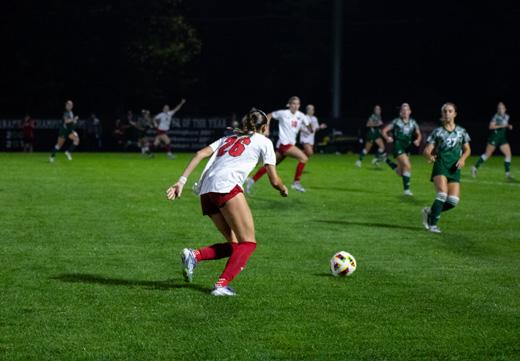
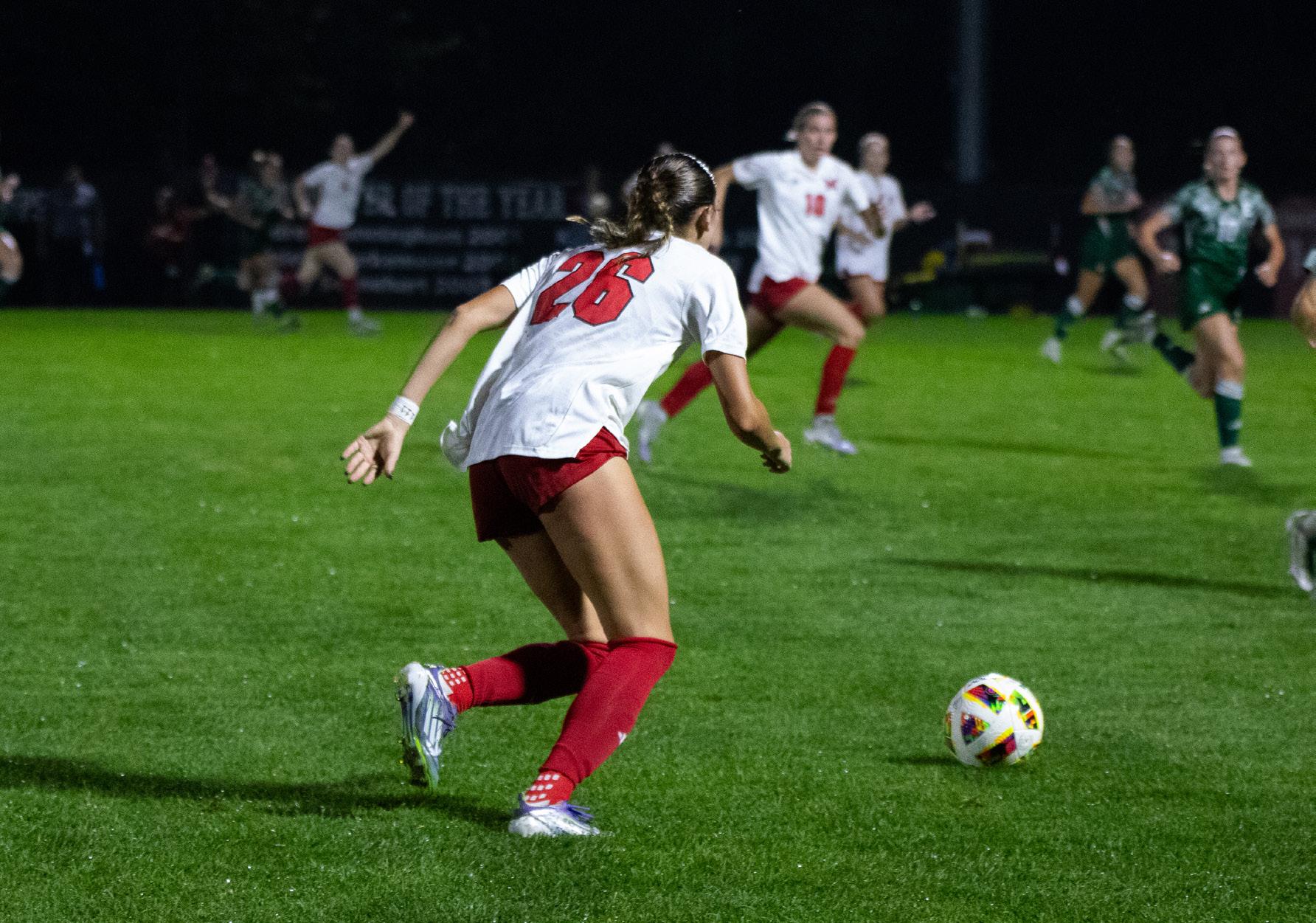
JUNIOR MIDFIELDER MORHÉA HOEFEN DRIBBLES
KETHAN
BABU SPORTS EDITOR
‘That’s the greatest gift that Miami gave me’: Miami’s journalism, SLAM programs prepared alumnus to work at Georgia
The University of Georgia Bulldogs football team averages 93,033 attendants per home game so far this season. Last year, the Bulldogs led the nation with 8.6 million average television viewers each game.
Georgia’s athletic department performs an endless amount of tasks each game. From providing gameday refreshments and merchandise to implementing marketing activities during timeouts, the staf at Georgia ensures both the fans and the media at these games have an enjoyable experience and can perform their own duties.
One member of the athletic department’s staf is Jake Stanley, an associate sports communications director who serves as the football team’s tertiary contact. During game days, he manages the stats crew and is the visiting team liaison.
Stanley arrives between three and four hours before the game starts. He sets up the stat computer, welcomes the visiting team when it arrives and sets up the visiting media press conferences.
If you ask him, Stanley will tell you that his duties with one of the most popular teams in college football aren’t too diferent from the Miami furthest away from Athens, Georgia. A Miami University class of 2017 alumnus, he served as a student assistant
in the athletic department, running multiple games and tournaments across various sports.
Stanley chose Miami at the tailend of his senior year of high school. He had looked at Ohio State University and other neighboring schools, but he chose the small town of Oxford despite his family rooting for Marshall University, the RedHawks’ rivals when both teams competed in the Mid-American Conference.
Before he got to college, Stanley already knew he wanted to work in sports communications. His great uncle, Samuel Stanley, studied journalism at Marshall and later worked as a sports information director there.
“From a young age, I was always interested in stats and stories and writing,” Stanley said. “When I was a little kid, I wanted to be a Sportscenter anchor. That was my original goal in life, and then I was like, ‘I don’t actually want to be on camera.’”
Stanley was heavily involved in his Miami classes. Sam Morris, a clinical professor in sports leadership and management (SLAM), said Stanley showed the proper amount of interest in his Ethics in Sport course without being overbearing.
“He was a talkative guy at certain times,” Morris said. “Not too much, not too little: He hit the right balance. I met him in my ethics class where we talk about a lot of interesting ethics in sports … he made a positive impression on me right away.”
As a journalism and SLAM double
What makes Miami University’s synchronized skating teams so good?
“We all live in the same town here and live pretty similar lives here in Oxford to each other,” Ashdown said, “versus other teams, where you might be traveling further to come to practice. In the same vein, we get to train every single day together for three to four hours, which is a really special opportunity.”
Head coach Katey Nyquist praised the fact that the school is a varsity
program and that the players are varsity athletes. Miami is the only NCAA Division I school with a varsity synchronized skating program, which sets the RedHawks apart from other programs. Most schools have a club team that competes at the collegiate level.
“The synchronized skating community is a pretty tight knit community, and Miami has a really strong legacy of success,” Nyquist said. “A lot
major, Stanley developed his writing and interpersonal communication skills, both of which proved to be essential for his career. He also signed up to work athletic events from the jump, with his frst event being a soccer game two months into his freshman year.
He said learning how to write through the journalism program is one of the biggest attributes he still uses today.
“That’s the greatest gift that [Miami] gave to me,” Stanley said. “The biggest thing was learning about AP style. Even in our feld, you’ll be amazed by the amount of people who don’t know how to properly write an article or how to be concise.”
As he got more experience, Stanley began working football, hockey and tennis games as well. He served as the media coordinator for the women’s tennis team during the 2015 and 2016 conference championships, and he assisted with three NCAA Regional games for the hockey team in 2014, 2016 and 2017.
Across all the sports he assisted with, Stanley said the common denominator was the importance of Miami’s history and legacy that makes him want to do the best he can in his role.
“Yes, it’s a smaller Division I program,” Stanley said, “but the amount of history and tradition that they have in most of their sports is a lot more than most of the MAC schools and a lot of the schools that are at the same
of people want to come here because it’s a varsity program, and that’s a unique experience.”
Miami’s varsity program appeals to high school prospects and encourages them to visit campus and reach out to the program, where they can learn more about it and decide if they want to try out for the team in the spring.
Another aspect of the program that drives it to success is the culture.
Junior collegiate team skater Emalie Werkowski says that the team has a standard that the skaters hold each other to.
“I think our culture is very different from things you see on other teams,” Werkowski said, “and I think something that’s really especially unique with us is just the standard we hold ourselves to. I think we really
[level].” Stanley’s highlights with Miami stretched beyond Oxford. From traveling to MAC games for football to taking a J-Term course in New York and watching a taping of the Daily Show, he said his time as a RedHawk validated his decision to go to Oxford over a larger city.
After graduating from Miami in 2017, Stanley worked as a media relations assistant for the Louisville Bats, the Triple-A afliate for the Cincinnati Reds, which is his hometown team. He also earned his Master of Science in sport administration from the University of Louisville in 2019. He worked and interned for various organizations in Louisville before getting a spot at Georgia as an assistant sports communications director. He directed media relations for the Bulldogs soccer program’s frst SEC championship in 2023 and for two SEC swimming and diving championships in 2021 and 2025. He also coordinated Georgia’s communication eforts for the Tokyo and Paris Summer Olympic Games in 2020 and 2024, respectively.
The scale of Georgia compared to Miami makes the work incredibly different, Stanley said. One aspect that is unlike his alma mater is the amount of people and the amount of departments he has to go through to accomplish something.
This distinction correlates with the budget at Miami compared to an SEC program. Working with less
inspire each other, and we’re really personally driven to just achieve this mantra that we always talk about: the champion standard on and of the ice.” The team prides itself on the importance of being connected and holding each other to a high standard.
The skaters know that at the end of the day, they will always have each other. The coaching staf also plays a role in setting that standard with goals that push them to a higher level.
“They set really high goals for us and keep the ball at constant upward movement,” Ashdown said. “I think that gives us more confdence because knowing that people beyond the athletes believe in us makes us have more belief in ourselves.”
On top of the confdence, Werkowski praises how important the
money and fewer people to report to meant Stanley needed to be creative in what he was doing.
However, he said that at the basic level, the overall goal and mentality he has now is no diferent to when he was a RedHawk.
“At its fundamental level, it’s still the same thing,” Stanley said. “You need to make sure that you’re ready to handle what’s in front of you [and] have an idea of things that might pop up, but also have an understanding that something is going to come up that you have never given any consideration to.”
This year marks his seventh year in Athens. He was promoted to an associate sports communications director position in April, and he currently serves as the tertiary contact for football and the primary contact for swimming & diving and soccer. Stanley’s success and path to one of the most popular schools in college athletics is a point of pride for his former professors and colleagues at Miami.
“We’re thrilled with that kind of thing,” Morris said. “It makes us happy to see students succeed like that. At the risk of sounding immodest, it doesn’t surprise any of us. It’s what we do. That’s our ethos, that’s our goal, is to get students where they want to go, and we do a pretty good job of that.”
babukc2@miamioh.edu
coaches pushing them to improve is for the team.
“They just really challenge us and show us new ways that we can be improving, no matter how new or how veteran we may be,” Werkowski said. The Miami synchronized skating team is preparing for the upcoming season, and pushed by their unique structure, high culture and great coaching staf, the team will be ready for another highly successful season.
Both the senior and collegiate teams have a competitive domestic schedule from November to February, culminating in Salt Lake City, Utah, at the 2026 U.S. Synchronized Skating Championships, where they hope to take home a ffth consecutive national championship title. hartlapo@miamioh.edu
Middleton’s Musings: My picks for the 2025-26 NCHC Preseason Poll
JEFFREY MIDDLETON ASST. SPORTS EDITOR COLUMN
On Sept. 17 and 18, the National Collegiate Hockey Conference (NCHC) ofcially released its All-Conference team and preseason poll results. Members of the media voted on who will be given All-Conference honors by season’s end and what they believe will be the fnal fnishing spot for teams.
I was fortunate enough to vote on both the preseason poll and the NCHC Preseason All-Conference team. For the sake of transparency, I want to disclose how I voted, along with an explanation of why I made these choices. This week, since it’s the frst week of regular-season games for Miami University and across college hockey, my column will be divided into two parts: the preseason poll decisions and the All-Conference team decisions.
Below are the fnal results of the preseason poll:
1. Western Michigan University Broncos – 252 points (19 frst-place votes)
2. Denver University Pioneers –225 points (Four frst-place votes)
3. University of North Dakota Fighting Hawks – 220 points (Five frst-place votes)
4. Arizona State University Sun Devils – 180 points (Two frst-place votes)
5. Colorado College Tigers – 128 points
6. University of Minnesota-Duluth Bulldogs – 120 points
7. University of Omaha-Nebraska Mavericks – 110 points
8. St. Cloud State University Huskies – 80 points
9. Miami University RedHawks –35 points And, without further ado, here are my picks in order.
1. North Dakota Fighting Hawks Last season was an underwhelming one for the Fighting Hawks, resulting in the fring of head coach Brad Berry and some changes to the front ofce, including the appointment of a new general manager, Bryn Chyzyk.
Under new leadership (and the new rules allowing players from the
Canadian Hockey League and USports to play in the NCAA), North Dakota brought in a handful of transfers and Canadian players. They will make a team that fnished fve points behind Arizona State University for second place in the NCHC, more talented than it was already.
Some of the players the Fighting Hawks lost over the ofseason include forwards Sacha Boisvert and Owen McLaughlin to Boston University, Jayden Perron to the University of Michigan and players Jake Schmaltz and Cameron Berg to eligibility.
The replacements for those players include Clarkson University junior forward Ellis Rickwood, University of Minnesota-Duluth forward Anthony Menghini and, most notably, Calgary Flames 2025 18th overall pick Cole Reschny and the projected second-overall pick in the 2026 NHL Draft Keaton Verhoef.
It may take a while for all of these players to gel under new head coach Dane Jackson, but I have a sneaking suspicion that, once they do, North Dakota is going to be a serious problem for any team.
2. Arizona State Sun Devils
Finishing second in the NCHC last season, the Arizona State Sun Devils made some key additions to their already talented squad this ofseason, acquiring four transfer portal commits, including former Miami forward John Waldron. Arizona State also brought in freshman forward Logan Morrell, who posted 21 points in his frst 32 college hockey games, from Michigan Tech and the leader in shutouts last season, junior Bentley goaltender Connor Hasley. Hasley, for me, is the most significant addition the Sun Devils could have made this ofseason. While Bentley competes in the Atlantic Hockey Association, a conference that may not be as strong as the NCHC or the Big Ten, he still delivered fantastic performances against strong opponents, including 39 saves on 41 shots against the No. 1 Boston College in the NCAA tournament, a game that was 1-1 until the fnal 1:19. With new freshmen around Mullett Arena and some older transfers brought in with proven success at the NCAA level, Arizona State will return to where it fnished last season under head coach Greg Powers.
3. Western Michigan Broncos
Yes, while it might come as a shock, I ranked the reigning national champions third in my NCHC preseason poll. And it’s not because I don’t think they couldn’t come out on top of the conference again. Instead, it’s because of what they lost and what others gained.
The Broncos are losing their top two scorers – Alex Bump and Tim Washe – to the pros, along with goaltender Cameron Rowe, who lost only two games all of last season. Of course, Western Michigan is returning its number one goaltender, sophomore Hampton Slukynsky, but it’s still a loss it will hope to replace nonetheless.
On the skater side, the Broncos did bring in a handful of notable transfers, including three sophomore forwards: Zaccharya Wisdom from Colorado College, William Whitelaw from the University of Michigan and Cole Spicer from the University of Minnesota-Duluth.
While there are pieces that should ft well under head coach Pat Ferschweiler and some returners who should take an even bigger step forward, there are just a couple of teams I like more. But, knowing Western Michigan’s identity, I could very well be proven wrong by season’s end.
4. Denver Pioneers
The Pioneers fnished third in the NCHC last season, and under head coach David Carle, they’ll continue to be a powerhouse. But it’s not because they added several transfers.
Instead, Denver added none, and the heavy minute and scoring responsibility will be put on the 10 freshmen students on the roster to help lead Denver back to the promised land. They won their two national championships with nine and 11 freshmen on the roster in 2021-22 and 2023-24, respectively.
One freshman who will likely be aforded every opportunity to prove himself in the Denver lineup is Kyle Chyzowski, a 5-foot-10 left-handed forward who played for the Western Hockey League’s Portland Winterhawks last season. He scored 105 points in 66 games, along with 33 points in 18 postseason games.
Players like Chyzowski should have Denver fans excited, and they are the reason why the Pioneers will be successful this season. Losing goaltender Matt Davis and defenseman Zeev Buium are two big blows
to the roster, but it’s not as if players with similar skill levels haven’t been found in other places.
5. Omaha Mavericks
The Mavericks approached the ofseason in a manner diferent from most other programs. Instead of making plays within the CHL, they opted for Canada’s version of college hockey, USports, committing to seven diferent players from that league and adding 15 new faces overall. Omaha fnished fourth in the standings last season. With a fair number of returning players, including star goaltender Simon Latkozcy, it has the right amount of experience to fnish in a respectable spot, similar to its performance last season. However, it didn’t move the needle enough for me to place them any higher.
6. Colorado College Tigers
Colorado College is another team that acquired only two transfers – junior forward Ryan Alexander from Arizona State and freshman defender Seth Constance from Northeastern University – but 12 freshmen mark the incoming class.
The Tigers fnished sixth last season in the NCHC standings, and with returners like senior goaltender Kaiden Mbereko, junior defenseman Max Burkholder and junior forward Drew Montgomery, head coach Kris Mayotte is going to need his fewand-far-between older players with college hockey experience to help the younger players develop and navigate their way.
7. Minnesota-Duluth Bulldogs
Last season, under long-time head coach Scott Sandelin, the Bulldogs fnished in the same spot, and it doesn’t feel as if they’re going to be moving up or down in 2025-26.
Adam Gajan returns as the number one starter for the Bulldogs, with former Miami goaltender Ethan Dahlmeir transferring into the program this ofseason. And they have some critical players returning, such as the Plante brothers, sophomore forward Jason Shaugabay and junior defenseman Aaron Pionk. However, it feels as if the Bulldogs lost more than they gained in the transfer portal: Menghini to North Dakota, Spicer to Arizona State, Aiden Dubinsky to the University of Wisconsin, Matthew Perkins to Northeastern University and two goaltenders, Zach Sandy and Klayton
Knapp, to North Dakota and Lindenwood, respectively. So, they remained toward the bottom in my voting.
8. Miami RedHawks
As easy as some might think it would be for me to rank Miami, considering its fnish last season, this proved to be harder than anticipated. There are 21 new players on the RedHawks’ roster, and all of them bring diferent tools to the table. However, while it is a step in the right direction, as I wrote in my frst “Middleton’s Musings” column, everyone else improved as well, either through the transfer portal, CHL commitments or both.
This new-look roster is the frst step of a long journey to returning the Miami hockey program to where everyone around it knows it should be. This rendition of the RedHawks can certainly surprise some teams within the conference, given that there were multiple games last season where they were close to winning but instead grasped defeat from the jaws of victory.
While they may fnish back in ninth, I have a hard time believing they will, or, at the very least, I don’t think the margin between eighth and ninth will be nearly as signifcant as it has been in years past.
9. St. Cloud State Huskies
We’ve reached the ultimate conclusion.
The Huskies fnished last season with seven conference wins and 23 conference points, placing them in eighth place. Naturally, if I believe that Miami will surprise people and gather more points than expected, someone has to fall on the sword.
The Huskies added two transfer defensemen and one transfer goaltender over the ofseason. Still, for the most part, they are returning players to their roster, with their top eight scorers returning to the program and 82.7% of their overall scoring returning from last season, according to the team’s website.
However, since last year wasn’t one to write home about, a decision had to be made on my ballot, so I placed them last. But, as I said about Miami, it wouldn’t surprise me to see the gap between the bottom two teams as big as it has been in years past.
middleje@miamioh.edu
CULTURE
Last meals, fine dining, opening new restaurants: Q&A with Antonia Lofaso
Then, I would probably go into a pasta course that’s very simple: a spaghetti or a bucatini with a spicy tomato sauce that would have more cheese in it, and I would mix arugula all in. Then I would go into a perfect steak, a Florentine, which in the United States is essentially like a T-bone. Dessert would probably be a simple cannoli or afogato.”
It’s an Italian-American dream dinner that shows Lofaso’s deep appreciation for food, honed through a childhood steeped in culinary exploration and many years in the industry.
But it’s an industry that is mostly male-dominated, which led us to the next question.
How has your experience as a woman in a male-dominated space afected you?
Lofaso starts with a challenge.
“Name an industry that isn’t male-dominated,” she said. “It’s not specifc to me. Most professions are dominated by men.”
She said that one time, when she was being introduced as a famous chef in a hotel restaurant, the manager of the hotel mistakenly reached out to congratulate her boyfriend.
Other times have been less overt.
“I think that I wasn’t promoted many times in which I deserved promotion because they felt like I was a young woman who had a young child, and I couldn’t dedicate the time and energy,” Lofaso said. “I do think that there were levels of opportunities that I was passed over for, but I stayed the
Autumnal
course. I knew that I deserved it.”
It was time to feel out her opinions on hot topics of the culinary world. There is a lot of diversity in food that is often underrepresented in the food world, especially within fne dining.
What is your opinion on diversity in fne dining restaurants?
“This is actually one of the most important things that I actually talk about often, and I’ve been talking about it for a very long time,” Lofaso said. “I believe that it’s a very sort of ignorant way of thinking. It’s a very uneducated thing for anyone to assume that certain foods don’t belong in fne dining.”
She said that there are fne dining establishments all over the world that lack critical accolades due to these prejudices, citing Pujol, a Mexican dining experience in Mexico City, and Commander’s Palace, an American South restaurant in New Orleans.
“For us to believe that there’s only one style of food or one type of food that should be fne dining is a complete and total falsehood,” Lofaso said. “The only diference between it being something like street food versus what they do at Pujol is the style of plating, the ambience in which the room creates. It’s the style of service and the quality of food. It’s only that diference [of plating, food quality and ambiance] that make it fne dining, so any style of food can ft that narrative.”
Lofaso herself owns several restaurants, each having its own unique style and vibe.
book to fall in love with this season
PARKER GREEN ASST. CAMPUS AND COMMUNITY EDITOR COLUMN
I couldn’t resist the pun. Here are fve books that will hopefully bring about crisp breezes and warm sweaters this October. A romantasy to read when it’s raining outside
Not only is this one of my favorite books of all time, from one of my favorite authors of all time, but it’s also a perfect fall read. This atmospheric fantasy-romance hybrid is set in a fctional setting heavily inspired by World War I-era London. If you read one thing from this list, let it be “Divine Rivals” by Rebeca Ross. A gory thriller/comedy to get into spooky season
If you want a bloody thriller with a wickedly satirical edge, look no further than “The Final Girl Support Group” by Grady Hendrix. As someone who does not love horror, this book made me feel a little sick at times. But if you love classic Halloween horror movies like “Scream,” “A Nightmare on Elm Street” or “Halloween,” I’m sure you’ll love this.
A dark academia because, duh, college in the fall
It wouldn’t be a fall book review without some dark academia. If you want to put the thinking back into books and have a little time on your hands, you have to read “Babel” by R.F. Kuang. Since I’m feeling generous, another gorgeous and deeply ac-
What is the process of creating a new restaurant concept?
It’s a very long and involved process, Lofaso said, with the most important step being that she feels strongly about and is connected to the concept.
After that, it’s more about market research and growing the space around the menu. After all, said Lofaso, if you already have fve Italian restaurants in one neighborhood, you don’t need another.
“Every choice, from the table to the chair to the lighting to the music to the glasses that you’re having your Negroni or your spritz in, have to give the diner a perception,” Lofaso said. “When they walk in through the door, they’re not going to be confused.”
Since each of her restaurants is diferent, she develops a diferent aesthetic and memory to transport her future diners.
“That’s when you start to develop the ambiance and the design of the place,” Lofaso said. “When we built Dama, my Latin-inspired place, I was like, ‘I want you to feel like you’re eating like in a piazza in Spain or Mexico,’ so we sit here and we just have these brainstorming meetings. What if the chair felt like this? Do I want to sit in a chair like this if I’m eating this?”
With her food being so deeply tied to memories, it makes sense that the last question is about her own.
When was the last time you felt perfectly happy?
“You know, the last time is actually the spot that I’m in right now in my life,” Lofaso said. “I think I have felt the most – not even happy, because the happiness is feeting – but the most content and the most grounded. I’m in a place now where I’m of to the next chapter.”
She said her future plans involve a restaurant on the Las Vegas Strip, a destination known for producing some of the best culinary experiences in the U.S.
But not all of her happiness is based on goals and new restaurants.
“I have a really expensive shower,” Lofaso said. “And it’s like this hard work of mine has paid of. I’ve never been happier and more content with what I’m doing right now, and I’m also so excited about what the next decade from 50 to 60 looks like for me.”
If her past is any indication, then the future looks bright indeed.
greenpt@miamioh.edu
Antonia Lofaso talks burnout and single-motherhood in lecture series
PARKER GREEN ASST. CAMPUS AND COMMUNITY EDITOR
Celebrity chef, author and restaurateur Antonia Lofaso might be known for winning TV cooking challenges, but she was once a single mom, simply hoping to land a job in a restaurant. Lofaso visited on behalf of the Miami University lecture series, which brings in celebrities to give a talk of their choosing a couple of times a semester.
She started her lecture on Sept. 29 with an acknowledgement of her “success out of necessity.”
“I think for me, as a woman and as a businesswoman, that when I talk about ‘success out of necessity,’ I mean really going for it and creating a life that I could be proud of,” Lofaso said. “I became successful because, in my mind, I needed to make money. There is no way I could fail.”
After graduating from culinary school, she worked for famed restaurateur Wolfgang Puck, but felt that it wasn’t the right ft for her.
“Sometimes being in the wrong environment really puts you into perspective.” Lofaso said. “Now, for me, I left Wolfgang Puck. I went on to work for another restaurant group with the promise of opening a brand new restaurant.”
This restaurant would ultimately close in the wake of the 2008 fnancial crisis, but Lofaso pushed through.
“I was left without a job, and every other chef that worked in the same restaurant group was like, ‘See, we knew she was a fash in the pan,’” Lofaso said. Now she runs three diferent restaurants, and continues to judge and compete in TV shows like ‘Top Chef” and “Guy’s Grocery Games.”
Her latest success includes winning the cooking contest “Tournament of Champions.”
That kind of high-pressure lifestyle would stretch the bounds of anyone’s mental health, but Lofaso’s unique perspective on burnout helped her roll with the punches.
“I think burnouts are good,” Lofaso said. “If you’re an entrepreneur, you will have burnout. You should never avoid burning out. I think burning out is part of the
ademic tale from the same author has just been released, so if you’ve already read “Babel,” pick up “Katabasis” for a twisty and intellectual reading experience.
A new release for spicy monster lovers
Reading about werewolves and vampires in love is ofcially cool again. Now, this book has not been released yet, but by the time of this article’s publication, it will be out in less than a week. “Mate” by Ali Hazelwood is her second standalone monster-romance novel and is sure to bring the banter, yearning and yes, spice that has made her such a famous author. Now be free, smut lovers. Don’t say I never feed you.
A nonfction to cleanse your mind after that last recommendation
If you think books about history are boring and have poor readability, think again. “Chasing Lincoln’s Killer” by James L. Swanson is a great novel to ease you into the nonfction genre. It’s extraordinarily paced, covers a fascinating topic and doubles as a safe, non-political topic to break out at Thanksgiving, because if there is one thing your distant uncle loves, it’s probably the Civil War. Thank me later. Instead of fearing the cold weather and eventual return of seasonal depression, look forward to these fve books, perfect for all your autumnal needs. You’ll thank me when that frst cold snap hits. greenpt@miamioh.edu
STELLA POWERS CULTURE EDITOR
COLUMN
Welcome back! Once again, my music taste is all over the place, but I’ve compiled some of the tracks I’ve been listening to for the past few weeks into this piece.
I fnally started listening to something new, which is a huge development for me. Unfortunately, it is a musical. But, it’s a musical I had never listened to until recently, so I’m taking that as a win. Talk about character development.
‘What’s Going On, Joe?’ — Tom Francis, Nicole Scherzinger and Grace Hodgett Young, ‘Sunset Boulevard’ Last week, a friend of mine told me to listen to the Jamie Lloyd “Sunset Boulevard” revival soundtrack. I went into it fully expecting not to be a fan, but I quickly fell in love. “What’s Going On, Joe?” specifcally ended up on repeat for me.
The track is one of the more intense, confict-driven numbers in the show, and Tom Francis repeating “that’s Norma Desmond” four times somehow manages to give me chills every time I listen. I’m not proud of it, but I’m quickly turning into a “Sunset Boulevard” fan.
process. I think that the words that are used as negative are not actually negative. I believe that burning out is part of the process, and it’s going to happen, so why do we try to avoid being uncomfortable?”
Another word Lofaso hates? Balance. She said that sometimes she has to focus on one thing at a time, and balance doesn’t really have a place.
“There’s times where I have been very honest with my daughter, and I’m like, ‘You’re gonna have to wait,’” Lofaso said. “I’ve been honest with the restaurant or my business partners and been like, ‘You’re gonna have to wait.’ And so I think that I have replaced the word balance with intense communication.”
She added that anxiety is her “superpower,” and that it allows her to stay open late for restaurant openings, be a present mom and keep her energy up while she’s judging and competing in shows.
“I open restaurants because of my inability to sleep,” Lofaso said. “No matter how much I exercise and do ice baths, that’s not taking care of you. That’s just paying yourself frst.” She said that life is a lot about fnding the opportunities from bad situations.
“It’s the shit you grow fowers from,” Lofaso said. For students like Molly Love, a junior political science major, Lofaso is inspiring because of her persistence in the culinary feld. Love was able to attend a pre-lecture seminar with the Honors College.
“I wanted to talk to her about blending her business side of things and her passion for food,” Love said. “I love watching chefs and hearing about the competitions, and she’s been in so many of them season after season.”
After the lecture, students like Maddie Peppo, a junior marketing major, commented on Lofaso’s journey, citing her resilience and background.
“My favorite part was her talking about being a single mom,” Peppo said. “I think that it was something that hit really close to me. It was really inspiring, especially to see what failure means to her.”
greenpt@miamioh.edu
other musical doesn’t mean I love
“Death Becomes Her” any less. That show, and Megan Hilty, still mean the world to me, so naturally, I’ve been listening to Hilty’s Madeline Ashton crash-out song, “Falling Apart.” It’s one of my favorite numbers in the show; Hilty’s vocals never cease to amaze me. ‘Manchild’ — Sabrina Carpenter As a Sabrina girly since “Girl Meets World,” she’s always going to be on repeat for me. “Manchild,” the frst single of her album “Man’s Best Friend,” is super fun, upbeat and has the best bridge for screaming along to with friends. I’ve been listening to it a lot since it came out, but especially in the past few weeks. If it’s not already on your playlist, you should add it immediately. You won’t regret it. The ‘Buckingham Nicks’ album — Stevie Nicks and Lindsey Buckingham One thing about me: I love Stevie Nicks. In terms of music, she is like a god to me. Everything she’s ever released is magical, and that includes “Buckingham Nicks,” her album with Lindsey Buckingham, which fnally got remastered. Prior to the remaster, it wasn’t available on streaming, so I could only listen to the album on vinyl. Now that it’s out, I can’t stop listening to it. ‘Mad’ — Reneé Rapp I’m obsessed with Reneé Rapp’s
new album. The minute it dropped, I tuned in and have been streaming ever since. I also own the album on CD and vinyl, despite not having a CD player. I’m seeing her in concert on Oct. 8 and have been listening to her latest release a lot to get prepared. Rapp is honest and vulnerable in her music, while also being incredibly witty and funny.
‘Sunset Boulevard’ — Tom Francis, ‘Sunset Boulevard’ Remember when I said I was becoming a “Sunset Boulevard” fan? I wasn’t kidding. The title track has also infltrated my “on repeat” playlist. Listening to this song while walking through a city is so much fun, and I hope everyone gets to have that experience (or something like it) some day.
‘Silver Springs - Live at Warner Brothers Studios’ — Fleetwood Mac No song has ever had this much of an impact on me as this specifc version of “Silver Springs.” Nicks’ vocals in this performance, accompanied by her singing directly targeted at Buckingham, make for one of the most powerful moments in music history. If you haven’t listened to the song or watched the video of the performance, I recommend checking it out.
‘Blow’ — Kesha I’ve been listening to Kesha since discovering her through the video game Just Dance, and “Blow” has always been a favorite of mine. Growing up, we listened to a lot of Kesha in my household, and I still love her today. “Blow” is unbelievably fun and catchy, and still holds up almost 15 years after its release.
‘A Little Priest’ — Patti Lupone and Michael Cerveris, ‘Sweeney Todd’ “Sweeney Todd” is one of my favorite musicals of all time, and Patti Lupone plays Mrs. Lovett unlike anyone else. Look, I know the subject matter of the musical is a little insane, but this song specifcally, despite its lyrics, is such a fun piece. I would love to see “Sweeney Todd” live someday.
powers40@miamioh.edu
LOFASO VISITED MIAMI AS PART OF THE LECTURE SERIES. PHOTO BY LULU RUSTUM
GRAPHIC BY AYLA PEDEN
CULTURE
From Maya to Lolita: Sabrina Carpenter’s controversial evolution
ANNALYSE DEMING THE MIAMI STUDENT COLUMN
The glamorous Sabrina Carpenter that many know and adore today didn’t dazzle her way into the spotlight. Before all of the press, photoshoots and partnerships, acting was how she earned her livelihood.
At 11 years old, Carpenter debuted in a guest role on “Law & Order: Special Victims Unit;” Shortly after, Disney Channel signed her to co-star with Rowan Blanchard on the 2014 household sitcom, “Girl Meets World.”
Her singing journey began as a preteen passion project, uploading song covers on YouTube; however, these clips didn’t really garner attention until “Girl Meets World” gained traction, and people saw her consistently in mainstream media. Carpenter originally signed with Disney’s Hollywood Records and began releasing music, which gave her the opportunity to become what she is today. Now a world-renowned, Gram-
my-winning artist with two albums released since 2023, it is important to not only consider the issues that Carpenter has dealt with post-Disney, but also how her evolving identity has afected her actions and the way that she has been perceived by the world.
One controversy surrounding Carpenter that has since been buried in her fame took place in 2023 during the production of the music video for “Feather,” a track on her deluxe album “emails i can’t send fwd:”.
Part of the video is flmed inside a Catholic church, where Carpenter is choreographed to kill men who have wronged her. There was brief, yet intense outrage from religious and non-religious fans alike who insisted that this was disrespectful to Christianity, to which she responded that they had gotten approval beforehand, and “Jesus was a carpenter.”
Afterward, it came out that the administration in that church, responsible for providing Carpenter with the space, was stripped of its titles and privileges. While this is not by any means the largest scandal to hit Hollywood, it is important to not
Twenty
TAYLOR POWERS OPINION EDITOR COLUMN
The frst time I attended a Twenty One Pilots concert was in 2017 at the KFC Yum! Center in Kentucky for their “Emotional Roadshow World Tour.”
I was 11 years old.
Now, at 20 years old, I have seen them fve times. You could say I’m a dedicated fan.
Twenty One Pilots kicked of “The Clancy Tour: Breach” on Sept. 18
at TQL Stadium in Cincinnati. The band’s eighth album, “Breach,” was released on Sept. 12, with the tour starting almost a week later. Dayglow opened the show at 8 p.m. and put on a quick but rejuvenating performance. Although I only knew two of the eight songs played, it was an enjoyable concert nonetheless. The duo took the stage shortly after, as drummer Josh Dun led the audience into “Overcompensate,” with a solo onstage performance. Dun wasn’t alone for long; as just before the beat drop, lead singer Tyler Joseph ran on from backstage and
A taste of Germany below High Street: Steinkeller review
stepped into a traditional bier hall without ever leaving Oxford. To start, we ordered the biergarten pretzel served with house-made bier cheese and German mustard. It’s safe to say that the pretzel was large enough for four girls to get a great portion of it. The pretzel came out warm and soft; the bier cheese was great, but we all agreed that some added seasoning to it would have made it even better. For only $12, this is a great appetizer to start of with. Every Wednesday, Steinkeller has an amazing steak night deal: for $21.95, you can get a 12-oz. NY strip, choice of potato, onion ring and a salad. Naturally, I went for it. The salad came out frst; I got the caesar. It was a generous portion for a
only examine Carpenter’s actions, but also how easily everything was swept under the rug.
If she had performed in a holy space for a diferent religion, the story would have probably blown up; artists, like Lil Nas X, have since been under fre for using Christian iconography in their music videos, much less using the actual church as a backdrop. Why was she so easily forgiven for costing people their careers in order to boost her own?
In addition to the location of her music videos, the content of her music has been under scrutiny.
Carpenter has been both praised and scorned for the use of explicit language and playful sexual innuendos in her album “Short n’ Sweet.” Both sides escalated after the kickof of the “Short n’ Sweet Tour” in September of 2024, which ran for just over a year; many who initially seemed to be able to excuse the risqué lyrics upon the album’s release were taken aback once the music was set to a live performance with visuals.
Arguably, the most controversial song in her setlist was the ethereally-erotic “Juno,” a track that alludes to “Juno,” a 2007 flm that follows the unplanned pregnancy and trials of a teenage girl, the picture’s namesake. Carpenter sings: “If you love me right, then who knows?/I might let you make me Juno,” using the flm’s main character to express wild sexual desire that may lead to pregnancy.
While performing “Juno” on the “Short n’ Sweet Tour,” Carpenter acted out a diferent sexual position at each stop as she asked the audience, “Have you ever tried this one?” toward the end of the song’s second verse. While the brazen, sultry display came across as an act of empow-
jumped of a piano (this sort of stunt is not uncommon for them).
With an array of fashing lights, smoke and pyrotechnics, the show continued into an emo, blast-fromthe-past rave you wish would never end.
“Breach” was practically brand new by the time touring began, but that didn’t stop fans from quickly learning the lyrics. Joseph debuted the band’s new song “Garbage,” which he says is one of his favorites the duo has ever made.
I jumped for joy at this, because this one is defnitely in my top three from “Breach.” His face when the audience knew the lyrics will forever be ingrained in my brain. It was an expression I can only describe as an “I made it” moment.
Although this was the “Breach” extension of their previous tour, only fve out of 13 songs on the record were played. “Blurryface,” the band’s fourth album, had the most at nine total. Many iconic songs from previous tours, like “Holding On To You” and “Car Radio,” were absent from the setlist. The lack of “Breach” songs was the only thing that disappointed me about the show. To me, the performance felt like more of a tribute to the 10-year-old “Blurryface.”
The duo performed a short threesong set at the b-stage, playing “Message Man” with Joseph sneaking in a
erment for some fans, it rufed others. Not only is it strange to compare yourself as an adult to a teenager in a song about sex, but the choreography is not disguised as anything other than what it is.
There was a public image of Carpenter before the “Short n’ Sweet Tour, and it was completely crushed. The question has since arisen: Why was there a preconceived idea of Carpenter to begin with? Plenty of other female artists, such as Rihanna, Lady Gaga, Doja Cat and Nicki Minaj, all use sex appeal in their performances in one way or another. What makes Carpenter diferent, and how does that change the messages in her music?
While Sabrina stopped acting on Disney Channel in 2017 with the conclusion of “Girl Meets World,” the innocent, vulnerable image that she had cultivated during her time with Disney remained with her throughout the promotion for “emails i can’t send:,” an album that centered around teenage struggle. This kind of album response post-Disney has been seen in many of its child stars, including Miley Cyrus and Demi Lovato and was heavily sympathized with due to the stress and trials of growing up in the spotlight.
This Disney background is what makes Carpenter diferent. Having a naïve image is part of what saved her during the controversy surrounding “Feather;” her unserious response was perceived as cute and clever wordplay rather than a statement of arrogance or defance. That being said, this reputation that followed her from Disney Channel is also in part what is causing her problems today.
Leading up to her most recent release, “Man’s Best Friend,” Carpenter hinted at the album’s aesthetic through promotional photoshoots that many immediately compared to scenes in the 1997 flm “Lolita.” This adaptation follows the story of an underage girl named Lo who is romantically pursued by her stepfather.
One of the images in Carpenter’s
snippet of the rap from “Pet Cheetah” into the rap section of the aforementioned song. The small platform consisted of a drum kit for Dun, a bowl of black paint for Joseph to dip his hands in (there’s a reason, I promise) and a car that catches fre.
During the song “Ride,” one of the most popular tracks of “Blurryface,” Joseph brought up a kid from the audience to fnish out the song with him. At the Cincinnati show, the young boy’s name was Brenus. Let the record show, Brenus understood his assignment. Joseph has continued to consistently choose a fan from the younger generation, which is so sweet considering he is a father of three children himself.
What’s special about “Breach” is that it features the frst song Dun has ever sung on. At this show, “Drum Show” made its live debut. This is a monumental moment for the band, as Dun has previously stated he chose to play drums so he wouldn’t have to speak in front of others. The duo ended the show with “Trees,” a long-standing tradition. During this song, the two stand on platforms within the pit, pour water on a drum and beat it to the tempo as confetti is launched from the stage. It is genuinely a life-changing experience, especially from the pit.
I was gobsmacked at how close
Steinkeller: 25 years of German
shoot that has been accused of having taken inspiration from the movie depicts the pop star lying on her stomach, soaking wet, beneath the arc of a sprinkler in a nondescript backyard. Although Carpenter denies any relation between “Lolita” and her photos, she still faced a lot of backlash upon the release of “Man’s Best Friend” — especially after hearing the tracks, which make heavy commentary on female agency and control. In contrast to her controversy surrounding “Feather,” which was saved by her playfully innocent reputation, the distaste that some of Carpenter’s fans have for “Man’s Best Friend” and its publicity material is exacerbated by her Disney history. The flmy, coquettish, nineties aesthetic from “Lolita” has been interwoven into the style of many popular female artists today, including Lana Del Rey and Chappell Roan; Carpenter alone receiving criticism is a statement about her family-friendly performance roots. Is she held to a diferent standard than the rest?
Ever since leaving the industry in awe with “Short n’ Sweet” — in which she frst premiered the soft and foxy image that has since become her iconic look — Carpenter continues to defne and redefne what a Disney child star can grow up to be. In interviews, she embraces the charm of her “Girl Meets World” persona, while in performances takes on a more sultry, mature air. The result is an omniscient cheekiness that appeals to many young women today.
The controversies surrounding her are never-ending, but it is important to consider, question, and challenge the reasoning behind them–has Sabrina Carpenter disrespected her position as an infuential role model more than any other female singer today, or is she still just expected to adhere to the image we have of her from 2014?
demingai@miamioh.edu
starter, nothing fancy, but it was well done. When the main plate arrived, the steak was a generous portion and cooked to a great medium rare, paired with mashed potatoes that were soft and perfectly seasoned. The onion ring added a nice crunchy touch, and the warm, fufy dinner rolls on the side were the perfect addition. It was a hearty, delicious meal — especially for the price.
Steinkeller’s ambiance is warm and inviting, with a cozy, old-world charm that complements its German bier hall vibe. The service was great. Even though it was busy, our server was attentive to our table, and the food came out at a reasonable time.
Steinkeller delivers on both atmosphere and favor, making it a staple restaurant on High Street. Whether you’re splitting a giant pretzel with friends or treating yourself to steak night, there is a great mix of authentic German biers and bites and a cozy charm that makes it a spot worth visiting.
Overall score: 9/10 craverhj@miamioh.edu
Steinkeller (translated to mean “Stone cellar”) is underground, in the basement of the John D. Minnis Building, located across the street from Oxford Memorial Park.
The restaurant represents a classic beer garden that feels welcoming, cozy and quaint. When designing the space, Hollenbaugh imagined bringing a German Keller to Oxford, complete with stained glass windows, arches, exposed stone, painted walls and decor straight from Bavarian culture.
Jake Korineck, the director of operations at Steinkeller, believes that the restaurant’s design creates an experience that is totally unique.
“There’s no other restaurant in
town that you could walk down a stairwell, enter the restaurant and then you’ll be in a completely diferent world,” Korineck said.
As the director of operations, Korineck oversees all aspects of the restaurant, including the food and beer served. What many may not know is that most of the food served is produced and grown locally.
“There’s a lot of things that we try to do at Steinkeller that’s very ‘farm table,’” Kornieck said. “Our Reserve Run Farm Burgers are steroid-free, grass-fed, ground beef; that’s special.”
The Kuykendolls will often update and add new things to keep up with the ever-changing world. Recently, the owners adopted a baby German wire-haired dachshund
my friend and I were to this in the pit. “This is probably the closest I’ll ever be to them,” I remember thinking. I was so wrong.
As soon as the song ended, I felt security guards on my left pushing through the crowd. Confused, I watched as they formed a pathway. I didn’t have a moment to really prepare myself as Joseph and Dun walked right past me to get back to the stage.
I swear, my soul left my body.
I had such an amazing experience that, days later, I purchased lawn tickets for their performance in Pennsylvania, on Sept. 28. Did it matter to me that it was the same show, just in a new place? No, but I did experience “Tally,” a new “Breach” song they just added to their setlist, so I’d say it was worth it.
No matter how my music taste evolves or how long I go without listening to Twenty One Pilots, I’m always pulled back to them. At every tour I’ve been to, Joseph ended the show by saying, “We are Twenty One Pilots and so are you.” So, I guess a decade of hearing that has instilled the message into me.
I am Twenty One Pilots, and I forever will be.
Rating: 9.5/10
powerstj@miamioh.edu
named Schnitzel, making him the ofcial mascot of the beloved restaurant. People can keep up with the puppy’s life at @baby.schnitzel on Instagram.
Over the course of 25 years, Steinkeller has become a place for college students and locals alike to come together and enjoy unique food and atmosphere. Jenny Kuykendoll hopes to promote this as soon as customers set foot through the door.
“German culture is all about community, fun, family, friends and bringing people together,” Jenny Kuykendoll said. “In Germany, they have a playground with the beer gardens, because the families all get together [to] play cards [...] Culture of people just getting together and you’re having a community over a great beer.”
The Baravian restaurant ofers specials throughout the week, starting with “Steak Night” and wine specials on Wednesdays. Additionally, Thursdays feature $10 liters and $12 schnitzels, along with trivia at 9:30 p.m. On Sundays, a prime rib special with $5 half-liter options is available. Steinkeller is located at 15 E. High St. in Oxford. It is open Wednesday through Saturday from 4 to 10 p.m., and the restaurant serves brunch on Saturdays and Sundays from 10 a.m. to 3 p.m., and it closes at 9 p.m.
pedenae@miamioh.edu
ELIZA SULLIVAN STAFF WRITER
This isn’t another Miami University dining hate piece: I actually think Miami does a good job with its food variety and quality, given the budgetary, personnel and time constraints.
While it has defnitely made some questionable food at times, it’s always possible to fnd an edible and nutritious meal at the dining hall.
No, it’s not what we’re used to at home, but these establishments feed thousands of people per day, and that in itself is a gargantuan task.
That being said, there are some structural changes Miami could adopt to make eating at school a little less painful.
First, we need to-go containers. When I only have a few minutes to grab food before my next class, I don’t always want Bell Tower or a weirdly dry, boxed sandwich from Emporium. If we could use a meal swipe to check out a to-go container, fll it with food from the dining hall and take it with us, we would have infnitely more choices for food on those days when there’s just not enough time for a sit-down meal.
We should also be able to use our meal swipes at more places than just the dining halls. The diplomat standard meal plan for the 2025-26 cohort costs $3,280 and provides $500 of dining dollars, 16 swipes per week for 17 weeks (16 weeks of the semester, plus an extra week’s worth of swipes) and fve guest swipes. After crunching some numbers, this means that a diplomat standard meal swipe is valued at approximately $10. Miami should partner with local businesses to allow students to purchase $10 worth of food at those locations for one meal swipe, or to allow students to use dining dollars to purchase meals. At the very least, the restaurants in Armstrong Student Center, like Panera – and the long-awaited Chick-fl-A – should have a meal swipe menu.
We should also be able to trade meal swipes in for snacks. I have the diplomat minimum meal plan, which means I only have $100 dining dollars per semester – an average allowance of $6.25 per week, which is equivalent to approximately one Celsius and a bag of gummy worms from the vending machines. I would gladly trade in a meal swipe or two for $10 worth of snacks at Emporium. These suggestions were inspired by the two other university campuses I’ve visited the most: Case Western Reserve University (CWRU) and Ohio University (OU). Both CWRU and OU allow its students to use takeout boxes in their
dining halls. At CWRU, you check out a container like it’s a library book: scan your ID, take the container and return it within two days. The system is included in the dining plans for free, unless the student fails to return the container within 48 hours, in which case they are charged a fee.
At OU, students purchase a to-go box for $5, and return it when they’re done. Upon returning the box, they receive a new box or a key tag that can be redeemed for a to-go box at a later date. Assuming the student doesn’t lose any boxes or key tags, the whole system can be accessed for a one-time purchase of $5.
OU students can also get a Flex meal plan and spend one meal swipe for $6.75 worth of items at any campus market. This means they can purchase toiletries, snacks and other goods with their meal swipes.
At CWRU, vendors on campus, such as Subway and Dunkin’ Donuts, take “portable” and “grab & go” swipes, allowing students to purchase from a set menu using meal swipes included in their dining plans. There are also a number of of-campus locations that accept Case Cash (their version of dining dollars), meaning students can use their meal plan to support local businesses.
By increasing the places students can use their meal plans, and allowing students to take dining hall food on-the-go, Miami will allow for a greater diversity of food options, without actually expanding its offerings. This could help cut back on some of that dining-hall-food fatigue. I would be much more excited to eat on campus if I could trade a meal swipe in for some Panera mac and cheese.
sullivei@miamioh.edu
LAYLA NORRIS THE MIAMI STUDENT
SIDNEY ZAWILA THE MIAMI STUDENT
It is not new information that Miami University’s historical basketball and multipurpose arena, Millett Hall, has been marked for demolition and relocation. This project has been widely opposed by the Miami community with a large list of complaints: substantial costs, the damning transformation of beloved Cook Field and the direct efects on student life. For me, the loss of Cook Field represents a loss of memories. Every fall, I get to reignite my passion for soccer by playing intramural with current and soon-to-be friends. It is an area where I run around to let of some steam. It is an area where I have shared many laughs at, and it is an area where many of my embarrassing, but cherished, missteps are held.
In addition, to the countless moments that will be lost with Cook Field being repurposed, I have recently come across another grievance that must be added to the list: the construction. If the Board of Trustees and President Gregory Crawford allow this project to proceed, a large amount of deafening construction will occur on Cook Field. Research from the National Library of Medicine studied the brain waves, beta and theta, of students directly related to attention spans. The results yielded a decrease
in the strength of the beta and theta brain waves within noisy conditions. Since stronger waves are linked to higher attention, the drop suggests it is harder to concentrate in noisy environments.
Geographically, Cook Field is surrounded by lecture halls and residential dormitories. In the case of Millett Hall’s relocation, the construction will fll the air with the sound of jackhammers drilling into the ground, cement mixers constantly whirring and hundreds of other crashes and bangs. All of this commotion can generate up to 100 decibels of sound with the ruckus from the completed arena itself reaching upward of 130 decibels. This noisy environment substantially exceeds the 82 decibel sound limit used in the experiment, which proves that noise has adverse efects on focus. It makes you wonder how drastically students’ attention span and productivity will be negatively impacted at Miami. This project will not be completed in a week, a couple of months or even a year. It will take a considerable amount of time to construct the multimillion “Arena District.”
Years of loud sounds and trouble concentrating can eventually afect Miami’s esteemed national ranking if students begin to receive lower grades due to impaired focus. All of these “what ifs” and “maybes” could be avoided if Miami leaves Millett Hall in its current location.
The university should not and does not need to take the risk of detrimentally afecting a student’s academic performance. The Miami community needs to come together and make sure that the Board of Trustees and President Crawford understand the full efects – and hidden consequences – of relocating Millett Hall to the Cook Field site. zawilasn@miamioh.edu
icy after it was previously changed during former President Joe Biden’s term. Biden’s regulations not only shifted how institutions address sexual assault, but also expanded protections for LGBTQ+ and pregnant students. Trump’s policy is framed as an amendment to Title IX intended to “restore fairness and due process to our campuses.” Behind the vague wording, the true intentions are to provide more protection for the accused person in cases of sexual violence. It rules that schools can only investigate a case if it involves “severe and pervasive sexual violence.”
petrator to fnd loopholes around what circumstance defnes sexual misconduct, therefore making it less likely for the victim to receive justice.
The new guidelines also implement the idea of “innocent until proven guilty.” This idea is a core part of America’s legal system. Prosecutors in courts bear the Burden of Proof, which means that evidence proving a suspect is guilty must be shown. However, this notion can become incredibly harmful for the victim and complicate the situation even more.
victim. Education settings, especially college campuses, should work to provide heavy protection for the victims and ensure they are safely guarded by the law.
norrisl3@miamioh.edu
that
protections. Trump has called for the reinstatement of his 2020 Title IX pol-
Educational environments are currently under attack. Recently, under President Donald Trump’s administration, monumental changes to academic policies and student treatment have occurred. A specifc example is the new guidelines regarding sexual misconduct cases within a school. Title IX was an amendment made in 1972 to guard against sex-based discrimination in education. This included protections against any sexual violence within academic settings. However, seemingly subtle changes have been made under
The issue with this is it can imply an efect that does not always occur after sexual violence. “Pervasive” can suggest the violence impeded on their education. In some cases, victims are forced to continue with their normal academic and social lives, despite the trauma. Therefore, while the assault did still occur, it did not blatantly disrupt their education.
The word “pervasive” can also imply that the violence occurred numerous times. Yet even if the attack only happened once, it is still a valid crime. The wording of the order complicates the defnition of sexual violence. This would allow courts defending a per-
The largest consequence this guideline presents is it will make victims more hesitant to come forward with their accusation. Since it changes the defnition of sexual misconduct and automatically provides protection for their assailant, victims will see no hope in bringing their case to light. As they already have so many factors working against them, it seems hopeless to fght for justice. Especially in a school setting, where if the accused was decidedly innocent, they may have to frequently see their assailant on campus or in class.
This new implementation of sexual misconduct “protections” is seemingly more harmful than benefcial. It jeopardizes the potential case of sexual violence if brought forth by a
JACOB VAN RIPER THE MIAMI STUDENT
Iryna Zarutska was a 23-yearold woman who fed from her home country of Ukraine with her mother, sister and younger brother in 2022, immigrating to the United States as refugees.
They sought a better life in America; Zarutska enrolled in college classes and found work at a local pizzeria. The day of Aug. 22 was just another one for her.
Then, she was stabbed to death by a 34-year-old Black man on a Charlotte light rail train.
Zarutska was on her way home from work, just minding her own business, when the man charged with her death, seated behind her, suddenly rose up and slashed her neck three times. It was sudden, unprovoked
The
ELISA ROSENTHAL
PHOTO EDITOR
In a time where hating police is more common than loving them, I think it’s time we unruly Miami University students paid the Oxford Police Department (OPD) some well-deserved respect.
If you take the students out of Oxford, this town is much quieter. The students more than double the town’s population of about 11,000 people, which becomes a huge responsibility for OPD ofcers during our academic calendar year.
It goes without saying that college students are huge perpetrators of alcohol-related crimes everywhere, not just in Oxford. The stigma that everyone drinks doesn’t make it any less of a crime.
In the state of Ohio, underage
and horribly tragic.
A security camera caught it all, including the fve bystanders, all of whom ignored the dying woman. None of them checked on her. One man immediately walked away, but that was the most visible reaction.
The other four apathetically looked back down at their phones, or of into the distance, not even looking over at her. The attacker had already fed, and there was no present danger, yet they still remained unbothered, as if this were just another normal event of the day.
The graphic footage of the attack went viral on social media, and some students at Miami University in the political science department were shocked by the sight of it.
Caroline Edwards, a junior political science major, said she believes this was a racially-motivated killing.
drinking or possession of alcohol as a minor is classifed as a third-degree misdemeanor. Consequences of such a charge can include fnes and even jail time in some cases. Similarly, possession or use of a fake identifcation card can result in fnes or suspension of a license. When both charges are stacked, fnes and potential jail time tend to be higher.
These are two incredibly common crimes for any college student under 21 engaging in the commonality that is underage drinking in college towns.
The drinking culture here at Miami and the placement of OPD’s headquarters across from our most popular bar amplify the rocky relationship between police ofcers and students here in Oxford.
Objectively, the OPD ofcers do a great job of keeping Oxford a safe community for both students and
“The perpetrator stated after the attack, ‘I got that white girl. I got that white girl.’ This fact seems to be left out of news coverage,” Edwards said. “I think we also need to start thinking about the integrity of humanity as everyone sat and watched her die.”
Because the video of the attack is so graphic, it hasn’t been widely circulated through major news outlets. In that video, however, the perpetrator can be heard making several comments, including what Edwards mentioned.
Peyton Schafer, a sophomore political science major, connected Zarutska’s tragic murder to failures of the punitive justice system, as the suspect had previously been arrested 14 times, and he had spent more than fve years behind bars for robbery with a dangerous weapon.
“Our catch-and-release prison
townies with minimal amounts of large-scale crime, like assaults and robberies. Most of the crimes that occur here end in misdemeanor or trafc charges.
It’s not something to take for granted that we rarely hear gunshots around Oxford or that the assump
tion when hearing a siren is that a residence hall is having a fre alarm.
Although we may not like the group of cops standing across the street from Brick Street Bar, their presence is meant to keep us safe.
I’ve heard too often students claiming that OPD hates students or that their watchful eye on us is only intended to result in arrests and fnes.
The paperwork and having to deal with college kids certainly isn’t the fun activity we chalk it up to be.
The stereotype of Miami students being majority privileged, preppy,
KATHRYN HIPPE
THE MIAMI STUDENT
The term artifcial intelligence (AI) is used so frequently in everyday conversation that often we forget the most important adjective in its name: artifcial. University professors and administrators are starting to wonder why their students turn to AI to think for them, pass for them and graduate for them. This is not news.
Students – both past and present – have adapted to an education system where intelligence is a memorized practice; getting the answer right is the ultimate end goal.
Most people can identify the familiar pattern of our higher education training: study, memorize, spit out, rinse and repeat. But somewhere along the way, what was meant to be the foundation became the fo-
rum, and what was meant to be the means became the method. Much like a search engine and its results, we have become information generators, automating and bending to what is prompted of us.
So, we cut corners. We do the bare minimum. After all, that is all that is required of us – the way we fnd those answers is irrelevant.
On the one hand, AI achieves the pinnacle of what every technological progression aims for: eliminating mundane tasks while maximizing time efciency. But wisdom is a slow practice. It is grafted in those mundane choices: the daily, the monotonous and the nonlinear.
It cannot be expedited with the technological manifestation of the coined phrase, “time is money.” You cannot get smarter, faster, because you have acquired the information quicker. In reality, the opposite is
system currently only serves to train one-time ofenders to be hardened criminals; we need rehabilitative justice to ensure the frst time in jail is the last time,” Schafer said.
The students I interviewed and friends I’ve spoken with have responded with seriousness, empathy and a genuine concern for the situation, looking to how we may prevent it in the future. This is how we should respond to tragedy. However, certain reactions to violence, especially online, look much diferent.
On ordinary platforms like Instagram, Twitter and TikTok, violent videos circulate as entertainment. Victims are stripped of their humanity, reduced to just another spectacle.
This is especially clear when politics are involved. After Charlie Kirk was assassinated, his wife was left a widow and his children fatherless. Yet online, countless people responded in celebration.
This is just another example of what happens when we are persistently exposed to graphic violence. We grow desensitized to it. Violence starts to feel normal, and people react to it in unhealthy ways.
A National Institutes of Health study shows that overexposure to violent media is linked with reduced responsiveness to such content. But we don’t need studies to show us this; we can look around and see it for ourselves.
Oftentimes, it’s simply numbness. The same numbness shown by the bystanders to Zarutska’s murder.
I, and many others, were struck by their silence because it reveals something we’ve passively and quietly known for a long time: people are caring less and less about one another.
But we aren’t made for this selfishness and hyperindividualism. From the beginning, human beings have been social creatures, made for community. With that comes a responsibility for one another. That responsibility extends be-
yond just our friends and family, but to strangers, and even to people we don’t like. When someone is in need, we have a duty to respond with charity. But what we see instead shows that violence has already been normalized. It’s not just the bystander efect. It’s cheering at an enemy’s downfall. It’s scrolling past another violent video. It’s mocking another’s misfortune.
A culture of apathy will eventually poison itself. Don’t let forgiveness, concern or compassion be crushed by the ways of the world. Guard your heart, and don’t let the world train you into indiference.
vanripjl@miamioh.edu
true: studies have shown that an increased reliance on artifcial intelligence correlates with a decreased cognitive critical thinking ability.
Ronald Becker, a media and communication professor at Miami University, adds to this ongoing con
versation through his focus on the evolution of technology and its cultural connotations in class. In stressing AI’s cognitive implications for our digitalized society, he said that the calculator is no longer a plausible metaphor for AI.
“The problem is you can use calculators as a tool only if you understand the equations …” Becker said. “[AI] does more than what a calculator does, it replaces habits of mind.”
Per one human mind, there is an infnity of artifcially-generated thoughts, and those infnities are expounded upon the comparable eight billion. You would think we’re getting
rich, white kids doesn’t seem to stray too far from the truth, here. We take advantage of the assumption that the rules don’t apply to us and assume that the town we live in is safe enough to warrant less monitoring.
Policing the town and keeping the community safe is their job, and drunk students peeing or puking in public falls under OPD’s responsibility, whether we like it or not. It’s our choice to keep ourselves out of those situations if we wish to avoid the consequences that might come with it.
Since we only spend part of the year in Oxford, we should be taking more initiative in compliance with the law as visitors in a town that’s more theirs than ours. Respecting their authority is just a small part of that.
rosente2@miamioh.edu
smarter, but we’re getting dumber. Communication, critical analysis and synthesized deduction are all at an all-time low.
The irony? We are happy to concede. Our senses, dulled and detached to the scrutiny of information, have no protest to the loss of cognitive inference – in fact, we are eager to be relieved of energy-induced and time-consuming tasks.
But availability is not to be mistaken with validity — if our world operated on our most minimal efort, what would become of it?
Victim to the overbearing, overused cliché “kids these days … back in my day...” (undoubtedly exhausted by your dad or grandparent), the younger generations are not singled out in their deviance: their parents said the same thing, and so did their parents and so on. A cliché certainly tried, but unconvincingly true. Technology merely intensifes and afrms the continuity of human nature: if there is an easier option, it will be taken.
The reality is this: we adhere to whatever status quo has been established, in whichever space, in whichever way. And oh, it has been established. We’ve all been there: an open-ended question, an awkward silence, a mind set in daydreams, an embarrassment to seem interested –all are afictions of the well-intended Miami student within the (trigger-warning) in-class discussion. We could chase our tails in circles all day, theorizing what perfect condition needs to be curated – presented in a neat little box with a bow – just for us to be slightly more inclined to change our habits and transform mere intent into a formidable practice.
Only so much can be said about intent: we intended to do things differently for our New Year’s resolu-
tion, we intended to study more this semester and we intended to change certain habits. It is easy to intend, but it is much more rewarding to be diligent, despite.
From empathetic inquiry to apathetic consumption, the hyper-dependence on AI has become an infectious and catalytic side-efect of “cognitive laziness,” where the inclination to actively participate is outweighed by the readiness to passively receive.
What does this mean? A deep thinker can only be fostered by a deep curiosity, and, likewise, we cannot simply wait for the terms to change to dictate our response.
The change begins with you: to be diligent, despite the easier option.
hippekl@miamioh.edu
GRAPHIC BY JULIA KINDEL IRYNA ZARUTKA’S
Deer management programs seek to improve the local ecosystem
Hurd said he has enjoyed being a part of the program and hopes to be a part of this year’s hunt along with his grandson; they enjoy the recreation of hunting while protecting the parks at the same time.
“It was great,” Hurd said. “Any time you get to spend with your grandchildren is a blessing, and he loves to hunt. And so, it was quite an experience for us.”
Oxford has implemented a similar bow hunting deer management program in the past, but is looking to improve their methods and research new ones. Improvements to the current program being implemented include making it easier for hunters to apply, rotating them throughout
the season and allowing them to keep their harvests.
The city is also researching a new management method, which would involve a contract with professional population control company White Bufalo, which carries out deer euthanasia through sharpshooting.
“If it’s needed and we implement it, I think we hope for a healthier population of deer in our community,” Green said, “which would lead to fewer vehicle collisions, fewer concerns about vegetation damage and fewer concerns about tick borne disease.”
A survey will be conducted in November to confrm deer population numbers and guide the city’s next steps.
kennelse@miamioh.edu
Kitahkinaani: Our garden, our connection with the Miami Tribe of Oklahoma
VENEZIA
MCHENRY STAFF WRITER
FEE
TORI
THE MIAMI STUDENT
Nestled in Western Campus next to the Boyd Hall greenhouse, Kitahkinaani, or ‘Our Garden,’ is a reminder of Miami University’s strong ties to the Miami Tribe of Oklahoma.
According to Sarah Dumyahn, an associate teaching professor in the Institute for the Environment and Sustainability (IES), there was no word in the Myaamia language database for ‘our garden’ that represented inclusivity; a garden meant for everyone. The language team at the Myaamia Center came together to create the name for the space and made a new entry in the Miami-Illinois indigenous digital archive.
The idea was initially proposed in 2020, when several students in the Associated Student Government Infrastructure & Sustainability committee approached IES with a proposal for more resources on campus related to Myaamia cultural revitalization.
In Spring 2021, Dumyahn took up the project with her sustainability in practice class, where students worked on a proposal with the Myaamia Center and physical facilities. The goal of the garden was to provide Myaamia students with an opportunity to engage with their heritage, as well as non-Myaamia students to learn more about the language, culture and indigenous plants.
From that semester onward, Dumyahn has worked with four to six students to cultivate Kitahkinaani. Tasks in the garden include weed-
How to be a more sustainable Miami student
AUSTIN SMITH BUSINESS MANAGER COLUMN
As climate change continues to pose an existential threat to our planet, Gen Z is emerging as the “sustainability generation.” A Deloitte survey from 2024 found that 62% of Gen Zs reported feeling anxious about climate change.
Whether you’re a frst-year student adjusting to college life or a returning student eager to expand your horizons, there are many ways to contribute to sustainability eforts at Miami University. By following the tips below, you can reduce your carbon footprint and inspire collective action among students.
Join green organizations Miami is home to many sustainable organizations, each playing a role in promoting eco-friendly practices on and of campus. These organizations are great for learning about green practices and meeting like-minded people.
Groups such as EcoReps, Zero Waste Oxford and Green Team ofer numerous opportunities for students to get involved with sustainability efforts on campus. You can participate in litter pickups, trash audits and community educational events. These organizations also give students a platform to advocate for sustainable changes at Miami with their club as the platform.
You can fnd all these organizations and more on the HUB, Miami’s student organization directory.
Shop sustainably
With the latest fashion trends sweeping college campuses across the country, many students on a budget may feel peer pressure to buy into
harmful trends that use fast fashion.
Retailers such as H&M, Zara and Forever 21 make it easy to fnd cheap clothes, but at a signifcant environmental cost.
According to the UN Environment Programme, the fast fashion industry is responsible for around 10% of global emissions. Therefore, choosing sustainable clothing options can reduce your carbon footprint.
Luckily, Oxford ofers many ways for students to ditch fast fashion while still fnding stylish clothes. Goodwill and Zero Waste Oxford’s pop-up thrift store are great places to discover afordable second-hand clothes. Additionally, Oxford also has an abundance of fresh local produce. The Oxford Farmers Market, held from 9 a.m. to noon every Saturday, features nearly 20 vendors ofering local produce and baked goods. Moon Co-op, located next to Dollar Tree, is another sustainable grocery store in Oxford with fresh local produce.
Despite the fnancial constraints of many college students, shopping at the Farmer’s Market or Moon Co-Op is a great way to support local farmers and promote eco-responsibility. Reduce, reuse, recycle
While this might seem obvious, it’s surprising how many people forget about this one.
Miami provides recycling bins in every dorm room, posters in the trash rooms explaining recycling procedures and even AI trash sorting systems in the Armstrong Student Center. However, recycling remains a challenge on campus.
According to EcoReps’ biannual trash audit data, which calculates the percentage of recyclable items found in the trash at dorms, contamination numbers reached up to 25% in certain dorms over the 2023-24 academic year. Improper disposal of food waste
has seen numbers as high as 27%.
Additionally, food waste is of growing concern at dining halls around campus. At Miami, organizations such as the Food Recovery Network help educate students on reducing food waste in dining halls and provide ways to do so. Although breaking bad habits can be tough, Miami’s community has made recycling and waste reduction signifcantly easier for students. Attend sustainability events Oxford is working to be known for its commitment to the environment. The city’s Climate Action Plan aims to achieve carbon neutrality by 2045 and promote more sustainable initiatives in the community. Similarly, Miami has its own Climate Action Plan, which aims to achieve carbon neutrality by 2040 through commitments to renewable geothermal energy and carbon ofsets for student transportation and university-sponsored air travel.
These commitments mean sustainability-oriented events are common around campus and town.
From the annual Wileke and Hefner lectures in environmental and natural sciences, to lighthearted events like the annual EarthFest, there are plenty of opportunities to learn more about sustainability in the community. For those seeking a more active role, volunteer opportunities such as Honeysuckle Hacks allow students and community members to get involved and remove invasive species from conservation areas.
By following these tips, you should be well-equipped to become a more sustainable Miami student and a better community member.
smith854@miamioh.edu
ing, cleaning up leaves, mending the fence, harvesting seeds and replanting as needed.
“It was an exciting way for a class to actually contribute to the cultural revitalization efort and for them to learn about the Myaamia Center,” Dumyahn said. “They learn about the Miami Tribe and Miami University relationship and help to facilitate the expansion of that on campus and to learn about it from ecological perspectives.”
Initially, students planted 12 plants native to the Ohio region. All plants are labeled in English and Myaamiaataweenki ‘the Myaamia language’ for visitors to learn from. QR codes are placed within the garden, linked in ‘mahkihkiwa,’ the Myaamia ethnobotanical database that provides information on the Myaamia words and the plants’ uses. These links provide new perspectives on plants that are often seen today as weeds, but had a signifcant use for the Myaamia people.
Andrew Sawyer, education outreach specialist for the Myaamia Center, said he hopes the garden will expose Miami students to the language and the tribal community that many students may not know exists.
“I noticed just a lack of awareness that the tribal community was even on campus,” Sawyer said. “Hopefully this helps expose [students] to that and give them a little more awareness that tribal citizens are here in their homelands, doing this work, and working on not just revitalizing their their traditions and culture, but helping to revitalize, maybe in a small way, some parts of the environment around us as well.”
Sawyer said outreach is a large part of his work at the Myaamia Center. One example is hosting workshops for faculty to incorporate indigenous perspectives into current and future classrooms. He also said collaboration with the university and the tribe is a foundational part of the relationship.
“We have tribal leaders who, when they’re in town, they come and interact with folks on campus,” Sawyer said. “We also provide opportunities for folks from Oxford to go to Oklahoma to directly interact with the tribe. I think that gives them a better appreciation for the tribe and the things that they’re working on.”
Jay Hammer, a grounds specialist at Miami, said he is there to support the Kitahkinaani and be a liaison between the physical facilities, the Myaamia Center and the academic side of Miami.
Hammer said he has visited other college campuses and seen nothing as unique as Kitahkinaani.
“This is way out of the ordinary, nothing like this has ever been seen before,” Hammer said. “It’s kind of its own special little living organism, so we have to treat it diferently than we do the rest of the campus.”
Moving forward, Dumyahn said she hopes to continue communication eforts about Kitahkinaani, create more opportunities for people to engage with the garden, and in the long term, grow the footprint to other spaces on campus.
mchenrvg@miamioh.edu feeta@miamioh.edu
My favorite application responses
SHANNON MAHONEY
ASST. CAMPUS & COMMUNITY EDITOR
As we enter deeper into the season of pumpkin spice and holiday-inspired family drama, internship applications are also upon us. These applications are a necessary evil; you can’t live with them, and you can’t live without them. Without further ado, here are some of the rejections (and acceptances) I’ve received during this time of panic and anxiety:
Dear Shannon,
We regret to inform you that your time in our 2.5-mile ultimate obstacle course of employment propensity did not meet our threshold. As such, we are unable to ofer you the summer 2026 unpaid internship at this time. Do not consider reapplying next year, unless you get a gym membership frst.
Regards, McDonald’s
Dear Shannon, Congratulations! We are pleased to inform you that you have been selected for an initial screening. To get a sense of your personality, these interviews will take place at our ofce in Chicago. Luckily, we were able to ft you in between our meetings in the late afternoon. Your time slot is 10:45 to 10:50 p.m.. If you are unable to make your meeting time, you will forfeit the opportunity to become a junior data entry analyst. Please reply
to us with your travel bookings so we can confrm your interest in the position. We wish you luck in the next stage of this interview process, and look forward to hearing your reply.
Warmly, Goldman Stanley
Dear Shannon, We regret to inform you we cannot ofer you a position at Dunder Mifin company at this time. Your interview didn’t quite have the synergistic feel we were looking for. In future, we suggest adding a little more “razzle-dazzle.” We wish you luck in your job search.
Ciao, Dunder Mifin
Re: summer internship 2026 pass. sorry went another direction.
<<Sent from my iPhone>>
Dear Shannon, Congratulations! We are happy to ofer you a manager position at KnifeCo. For the frst two years, this will be a commission-only internship, and by your third year, pending a positive performance review, we will begin to ofer compensation for teammates you recruit to our organization. We are excited to be working with you and look forward to seeing you at our sales team shin-dig.
Best, Your Neighbor - Executive Corporate Management Manager Person at KnifeCo
Doing laundry in a residence hall
CARLEY RAPP THE MIAMI STUDENT
I was warned about a lot of college rites of passage before the start of my frst year. The fre alarm that goes of at 3 a.m. because someone put a fork in the microwave. The freshman 15. The awkward half-smile you give every time you see the girl you sat next to on the frst day of class but never speak to again.
While I appreciate the heads up, somebody should’ve cautioned me about the real obstacle in my transition to college: the warzone that is the laundry room. It’s really coincidental that every time I need to wash my clothes, I’m surrounded by people who are experiencing their frst day on Earth.
Entering the battlefeld
This is the Hunger Games. No, I am not Katniss Everdeen, but I am a college student just trying to get my clothes into the washing machine. Survival depends entirely on how long I am willing to stand in front of a dryer and guard it with nothing but a hamper and hope in my heart.
If this is your frst rodeo, as it was mine a month ago, prepare to spend
your entire day waiting for a machine to open up. Bring your pillow and sleeping bag with you, because you will be in the laundry room until you get acclimated to the wet dog smell.
Weaponry
If you ever plan on getting clean clothes, you’re going to need to fnd a tactic to aid you in doing so. My weapon of choice is to put on a nasty RBF, but some people prefer to hit you with the death stare until you back of of the only open machine they were (defnitely) next in line for.
If all else fails, you can wait until the next day to do your laundry. Unfortunately, you’ll probably have no clean clothes to wear in the meantime, but luckily, the “Miami Grandma” sweatshirts are often on sale at Brick & Ivy. For $2o, you could rock one of those, basically announcing that you lost to the laundry machines … and life.
Etiquette (or lack thereof)
For the people who still don’t know if clothes go in the washer or dryer frst, do us all a favor and watch a YouTube tutorial before you come to the laundry room. I’m sorry, Chad, but it’s not my fault you’re an adult and have never done a load of your
own laundry before. Back up or I’ll throw a bag of red things in with your whites (if you’re even smart enough to do them). If I told Chad the red stuf was laundry detergent, he’d probably believe me.
And then there’s the ghosts. There is no experience quite like standing in front of an occupied dryer when the timer hits “0:01” and expecting someone to actually come get their clothes. When the cycle fnally ends, you look around, waiting. But nobody ever shows up. Where did they go? Did they transfer schools? Did they ascend into the afterlife? Because they surely aren’t here to grab their laundry. Then, you’ll have one choice and one choice only: throw it on the foor.
Maybe it’s a lesson If you ever feel stupid, just take a short trip to your dorm’s basement foor and you’ll soon realize that you’re actually doing fne in life compared to people around you. Maybe I will take one for the team and warn incoming students about the freshman 15 … pounds of dirty clothes. rappcr2@miamioh.edu
What’s it like to be on the other side?
ANA ELIZA DE MELO GARCIA THE MIAMI STUDENT
I walk into the classroom wearing my best fake confdence — tailored, ironed and held together with the same hope that powers birthday candles. Can they tell how nervous I am? Probably. I’m pacing behind the computer like a stressed-out stage mom, trying not to knock anything over while the projector warms up and my dignity cools down. Every move feels like it’s broadcasting “Look at me! I have no idea what I’m doing!”
And it’s not like I’ve never taught before. I’ve been in front of classrooms. As a graduate teaching instructor, this is hardly the frst class I’ve stood in front of.
Teaching in public schools, for example, was a nightmare. There, I was competing with a ceiling fan that sounded like a dying airplane, a green-painted wall that somehow managed to be more interesting than me, the intense heat that welded everyone’s shirt to their back and one particularly annoying mosquito who decided to buzz directly above my head — stealing the attention of every student in the classroom, right when I was trying to talk about adjectives. In my head, I know what I’m do-
ing. Teaching isn’t new. But this— teaching college students in a foreign country- students who didn’t choose to be here and are only taking this class because someone told them they had to—this feels like walking a tightrope in roller skates. And I’m allergic to heights. As the students start fling in, I pretend to be deeply invested in my computer screen. I’m not ready to make eye contact with people who might be able to smell fear. When class begins, and they glance at the screen, looking at my frst slide, I think, “Well, here I go.” And then, I trip over my very frst sentence.
Classic. I laugh awkwardly, as if to say, “Haha, let’s pretend that didn’t just happen! Let’s move on, shall we?” But nobody laughs back. At least not with me. Some of them whisper, giggling to each other, then glancing at me. And of course, I think: “Am I the joke? Did I do something weird? Did my pants rip? Do I have something in my teeth again?”
I casually glance at the slide. No grammar errors. I double-check my nails — students notice that kind of thing. I know. I used to be one of them. Then I check my outft: blue pants, long-sleeved black shirt, black Converse. Not exactly runway, but it
wasn’t clown shoes and a “#1 Teacher” apron either. So … what was so funny?
I try to move on. So, instead of looking for answers, I keep talking. But sadly, each word that comes from my month, and how my students react to them make me want to open a hole in the ground and throw myself in it. As the class drags on, it’s hard not to feel like I’m failing. I spent over 20 hours of my weekend designing this slideshow, trying to make it engaging — fun, even for students who’d rather be doing anything else. And still, their faces are blank. Bored. Their eyes say, “You’re doing it wrong.” Their eyebrows whisper, “This is tragic.” Their silence screams, “You’re the teacher, but we are still better than you.”
When class ends, I sigh in relief. It’s over. They can go.
I pack up my things like a magician who just bombed their Vegas debut and head to the next room, wondering if that one mosquito from public school is free to guest lecture. It’s an uncomfortable, never-ending cycle for me. What did I sign up for?
demeloa@miamioh.edu
Introducing Miami’s greatest duo: The ‘Bunk Buddies’
CONNOR OVIATT
HUMOR EDITOR
MICHAEL PATTEE
STAFF WRITER
The cat is out of the bag – we have secretly been the coolest duo this campus has ever seen. Not only are we the coolest, but we have the coolest group name ever created: “the Bunk Buddies” (you can guess who was on the top and bottom of the bunk bed).
How did we get our name, you ask? Our third roommate beat us to our dorm on move-in day, inadvertently altering the path of the universe forever. We have been trying to stay under the radar; however, Michael is breaking the group up at the end of the semester (apparently seeing me every day is worth less than paying
a metric crap ton in tuition). So, to give Mikes the send-of he deserves, we thought we’d chronicle our best moments in hopes that we inspire our replacements.
Our origin story: Welcome Weekend edition As soon as we moved in, we experienced love friendship at frst sight. We dined on elegantly-rubberized steak at our new favorite eater (Western Dining Commons). We had a romantic portrait drawn of us (got a caricature drawn at Armstrong). We got plants for each other (the free succulents the Crawfords give out each year). We sat on the lawn and watched freworks together. And, of course, we ended the night by sharing our bunk bed. We feel bad that our neighbor had to be a third wheel on such a special evening, but it was nec-
essary to begin society’s healing from a traumatic few years prior.
Our frst act of heroism: Saving the Earth.
The universe, knowing such a powerful force we would be, put us together in perhaps the most important course a college freshman could take: environmental biology. And our professor knew that we had the potential to save the world from day one, when Connor stood up in front of the class and said carbon emissions are bad.
Together, we learned about such important things as the Cod Wars, a tragic and bloody battle in which the stupid British fought their neighbors over fsh, bonded over hydropower, and ultimately ended all unnecessary waste in Young Hall room 268. We completely changed our Miami ecosystem, and are proud to say that we
deserve a medal for our eforts.
Our second act of heroism: Bringing laughs to The Miami Student.
We have undoubtedly made this campus a better place by bringing some much-needed tom-foolery to this all too respectable newspaper. Our journey to becoming chief funny people started with Michael signing us up to write for the humor section – without asking Connor if he would like to join.
We both received articles from the previous humor editors, and, feeling as though he was already in too deep, Connor stuck around. The irony of the situation is that Connor is now the humor editor, while Michael can’t be bothered to author a byline without Connor forcing him to collaborate. But, at least Michael shows up to the
humor meetings (2 p.m. on Mondays, by the way) for some much-needed pookie time.
Our third act of heroism: Walking on water
As you can see from the image attached to this article (web version only), the two of us walked on (frozen) water. While the photo was taken before our sophomore year glowup, it gives you an idea of the magical powers we have.
As we get closer to Michael’s sad departure from this university, we might share more stories, depending on how generous we’re feeling. Stay tuned, or don’t. We’re not your dads. patteemj@miamioh.edu oviattcc@miamioh.edu