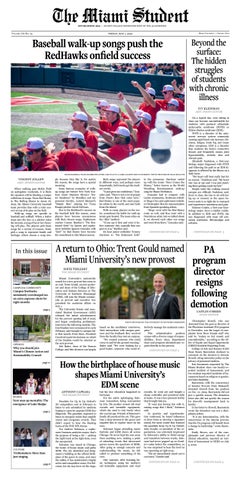

Baseball walk-up songs push the RedHawks onfield success

ASST. SPORTS EDITOR
When walking past McKie Field on springtime weekends, it is likely the speakers will be blasting a unique collection of songs. From Bad Bunny to The Rolling Stones to Jason Aldean, the Miami University baseball team provides fans with a mini concert on top of its play on the field. Walk-up songs are specific to baseball and softball. When a batter steps into the box or a pitcher takes the mound, a song of his or her choosing will play. The players pick these songs for a variety of reasons. Some pick a song to represent family and heritage, others choose a song sim-


ply because they like it. No matter the reason, the songs have a special meaning. Some famous examples of walkup songs are former New York Yankees closer Mariano Rivera’s “Enter Sandman” by Metallica and my personal favorite, Lynyrd Skynard’s “Simple Man” playing for Texas Ranger pitcher Jacob DeGrom. Due to the RedHawk’s success on the baseball field this season, some players have become synonymous with their chosen songs. Sophomore catcher Carson Raether’s “Fat Bottomed Girls” by Queen and sophomore infielder Ignacio Gonzalez with “EoO” by Bad Bunny have become the soundtrack to this Miami season.
SOFIE TERLESKY THE MIAMI STUDENT
Miami University’s nationwide search for a new provost has come to an end. Trent Gould, current professor and dean of the College of Education and Human Sciences at The University of Southern Mississippi (USM), will join the Miami community as provost and executive vice president for academic affairs on July 1.
The University Senate and Associated Student Government (ASG) released the initial advertisement for the provost opening fall of 2025 and began conducting preliminary interviews the following months. The four finalists were announced in early February and brought to campus later that month. From there, President Crawford made his decision on which of the finalists would be selected as the next provost.
Zeb Baker, dean of the Honors College, said this decision was largely
Both songs represent the players in different ways, and perhaps more importantly, both tracks get the stadium rowdy.
“It just gives me confidence,” Gonzalez said. “There’s not a lot of people from Puerto Rico that come here.” Bad Bunny is one of the most popular artists in the world, and also hails from the island.
With so many players on the roster, sometimes the battle for walk-up music gets heated. The team relies on the “dibs” method.
“If you say it first and voice it before someone else, typically that one goes to you,” Raether said.
He beat junior outfielder Tommy Harrison to “Fat Bottomed Girls”
in the preseason. Harrison ended up with the iconic “Here Comes the Money,” better known as the World Wrestling Entertainment walk-up song for Shane McMahon. Gonzalez had to compete with Latino teammates, freshman infielder Diego Cruz and sophomore infielder Christopher Roa for representation from Spanish-speaking artists.
“Diego went with the Bad Bunny route as well, and Roa went with a Dominican artist, but we talked about it, we showed each other our songs and went from there,” Gonzalez said.
CONTINUED ON PAGE 9

based on the candidates’ interviews, their interactions with campus partners and the feedback they received from the faculty they met on campus.
“We wanted someone who could come in and hit the ground running,” Baker said. “We were looking for a good leader, someone who could ef-
fectively manage the academic enterprise.”
This administrative position comes with a diverse range of responsibilities. Every dean, department chair and program administrator reports directly to the provost.
Beyond the surface: The hidden struggles of students with chronic illness
IVY
On a typical day, even sitting in class can become uncomfortable for students with postural orthostatic tachycardia syndrome (POTS) or Ehlers-Danlos syndrome (EDS).
POTS is a disorder of the autonomic nervous system commonly causing rapid heart rate increase, dizziness, fatigue, brain fog and many other symptoms. EDS is a disorder that weakens the body’s connective tissues and frequently causes joint hypermobility, stretchy skin and chronic pain.
Elizabeth Nadolson, a first-year biology major diagnosed with POTS and following the path to an EDS diagnosis, is affected by the illness on a daily basis.
“My heart will beat really fast for no reason,” Nadolson said. “My heart rate was at 130 and I was just standing there getting ready for bed.” Simple tasks like walking around campus are difficult, Nadolson said. Even in class, she has to sit with her leg up or crossed, as the space between seats is so tight she is cramped and experiences numbness and pain. Zimmer Combs, a first-year kinesiology major, faces a similar reality. In addition to EDS and POTS, she was diagnosed with mast cell activation syndrome, fibromyalgia and arthritis.
PA program director resigns following demotion
CAITLIN O’BRIEN STAFF WRITER
Christopher Howell, who was demoted from his post as director of the Physician Assistant (PA) program in December, was the target of complaints from three female staff who said he “makes us feel unsafe and uncomfortable,” according to the Office of Equity and Equal Opportunity (OEEO) Incident Reporting Form. College of Arts and Science (CAS) Dean Renée Baernstein declined to comment on the decision to demote Howell, citing university policy on the privacy of personnel matters.
But documents requested by The Miami Student show one faculty-reported incident of harassment, and two student-reported incidents of harassment based on religion or gender, and later disability.
ANTHONY CAPRARA THE MIAMI STUDENT
Panelists for Up & Up Oxford’s DJ competition met in February to listen to sets submitted by students hoping to open for popular EDM duo Shipwrek. The panelists expected to listen to energetic tracks that amplify rooms and invigorate crowds. They didn’t expect to hear the blasting horns of the FOX NFL theme.
For Andrew Solomon, a sophomore business analytics major, that’s the purpose of being a DJ — picking the right track at the right time, even the unexpected. Solomon was raised in Chicago, the home of house music and gritty EDM. The city identified and designated a building as the official birthplace of the genre in 2023, and since the 1980s, it has maintained a highly active and competitive scene. For Solomon, his city may have set the stage,
but his true education happened in his home.
For his entire upbringing, Solomon remembers being surrounded by DJs. His mother owned old vinyl records and turntable equipment, which she used to mix tracks when she was his age. Friends of Solomon’s family all practiced the art. This gave him a deep interest in the genre and inspired him to explore more on his own.
Solomon began attending music festivals and EDM shows all across Chicago. He never kept his ears away from anything new, making a point of attending events that showcased genres across the spectrum of EDM. After going to enough concerts and understanding the music, he felt called to produce something of his own.
One summer, after learning basic techniques using his mother’s old turntable equipment and vinyl
records, he went out and bought a cheap controller and practiced daily at home. It was a low-pressure hobby that brought him joy.
“[I was] just having fun with it, mixing songs that I liked,” Solomon said.
As practice and experimentation continued, he found influences to draw from to develop a signature sound, the same sound that stunned the panelists from Up & Up Oxford.
Jake Goudie, co-president of the organization, was extremely impressed by Solomon’s ability to build energy and transition between tracks. Solomon had never popped up on Goudie’s radar before the competition, so he was surprised to hear the level he was operating at right away.
“His set immediately stood out to our team,” Goudie said.
Baernstein, with the concurrence of Interim Provost Chris Makaroff, demoted Howell from his position on Dec. 12, 2025. Baernstein did not give a specific reason. The demotion letter also did not specify the reason for Howell’s reassignment back to faculty.
In her letter to Howell, Baernstein wrote the demotion was not a disciplinary action.
“It is my determination, with the concurrence of the interim provost, that the PA program will benefit from a change in leadership,” wrote Baernstein.
Emily Brown, one of the complainants and previous director of clinical education, reported an incident of harassment to OEEO on July 5, 2022.
VINCENT JOLLIFF
KLEINMAN ASST. PHOTO EDITOR

THE MIAMI STUDENT STAFF
SHANNON MAHONEY EDITOR-IN-CHIEF
ELISA ROSENTHAL
MANAGING EDITOR
EVELYN DUGAN
OWEN MARTIN
PARKER GREEN CAMPUS &
COMMUNITY EDITORS
GRAHAM YOUNG
SPORTS EDITOR
TAYLOR POWERS
OPINION EDITOR
STELLA POWERS
CULTURE EDITOR
CARLEY RAPP
HUMOR EDITOR
SARAH KENNEL
GREENHAWKS EDITOR
SYDNEY MULFORD
DESIGN EDITOR
ELISE HANNA
DIGITAL MEDIA EDITOR
EMILY CLARK
PHOTO EDITOR
Advertising information: Smith646@miamioh.edu Send us a
KISER YOUNG
SOCIAL MEDIA EDITOR
CAITLIN WONG
ASST. DESIGN EDITOR
AYLA PEDEN
REN CHAFFEE
ASST. CULTURE EDITORS
COOPER MENEGHETTI
VINCENT JOLLIFF
ASST. SPORTS EDITORS
ABE HAGOOD
ASST. OPINION EDITOR
IVY KLEINMAN
ASST. PHOTO EDITOR
AUSTIN SMITH
BUSINESS MANAGER
JAMES TOBIN
INTERM FACULTY ADVISER
SACHA BELLMAN
BUSINESS ADVISER
AIM MEDIA MIDWEST PRINTER
Our Awards
2025 Ohio News Media Association Award for First Place in Best Website
2024 and 2025 Corbin Gwaltney Award for Best All-Around Student Newspaper in the large school category
2025 Ohio Society of Professional Journalists (SPJ) Award for First Place in the Best College Newspaper category
2025 Greater Cincinnati Pro Chapter Society of Professional Journalists (SPJ) Excellence in Journalism Award in the College Student Publication category
2025 Ohio News Media Association Award for First Place in Best Website
2025 Mark of Excellence Award (SPJ) for First Place in Best Affiliated Website
ASG introduces female mascot, “Swoopette,” passes zero-waste resolution
KATHRYN HIPPE STAFF WRITER
The Associated Student Government (ASG) passed a resolution Tuesday to introduce “Swoopette” as Miami University’s female mascot, alongside a separate resolution encouraging zero-waste initiatives, as well as electing four senate leadership positions.
Parliamentarian Aubrey Crish and Senator Quin Ahler introduced legislation proposing a female counterpart to Miami’s mascot, Swoop. The proposal aims to expand representation while maintaining a symbol that has defined Miami’s identity for nearly three decades.
“It’s a long time coming,” President-elect Charlie Merrill said, citing its potential to cultivate unity and camaraderie across campus.
Secretary Katherine Allison raised questions about the necessity of introducing a separate female mascot, suggesting instead the existing mascot could be understood as gender-neutral.
“Anyone can be the mascot,” Allison said, after adding that women already perform the role behind the mask.
Crish noted pairing Swoop with Swoopette pays homage to Miami’s long-standing “Miami-merger” tradition. Though Swoop is not officially assigned a gender, the mascot has historically been perceived as masculine-presenting. Crish remains open to continued conversation surrounding its definition and public consensus.
Crish and Ahler have already begun outreach efforts. They cited examples from neighboring institutions in the Mid-American Conference utilizing dual-mascot systems and its effect in promoting school spirit, such as mascots “Rocky” and “Rocksy” at the University of Toledo. Their proposal gained traction through an Instagram post that received significant interaction, with minimal negative feedback.
The pair plans to continue discussions with university stakeholders, including the Office of the President, the Office of the Dean of Students and the Athletic Department, as the initiative moves forward.
ASG also passed a resolution encouraging internal zero-waste initiatives including reducing single-use utensils and increasing recycling bin usage.
Senator Maria Buzogany pro-

posed the piece of legislation in accordance with ASG’s agreement with Miami’s plan to achieve carbon-neutrality by 2040. The resolution will provide a tangible agreement to prioritize sustainable options in events, meetings and banquets.
ASG also elected senate leadership for the upcoming term. Senator Lynn Setter was elected as secretary of sustainability, Nathan Lentz as deputy secretary of the treasury, Senator Kali Barcroft as speaker pro tempore and Senator Nick McClure as parliamentarian.
As secretary of the Sustainability Committee, Setter said she plans to begin her term with a focus on education and student leadership, particularly within Greek life and student organizations, while promoting Student Engagement and Leadership workshops through the Center of Student Engagement, Activities and Leadership to teach student organizations. She also hopes to connect sustainability with mental health through nature walks and outdoor initiatives.
“Focusing on habits that go beyond graduation,” is central to her role, Setter said.
As deputy secretary of the treasury, Lentz will begin his role by prioritizing communication and or-
ganization within the treasury while ensuring senators are well-informed before making internal financial decisions. To start, Lentz and Secretary of the Treasury-elect Japveer Singh plan to collaborate on internal job training.
As speaker pro tempore, Barcroft hopes to improve legislation workshops and increase senate participation through legislation-writing.
As parliamentarian, McClure said he plans on using a “hands on, hands off” approach, guiding senators while allowing them to independently develop legislation.
ASG also discussed its Internal Operating Budget, during which senators briefly debated funding for “Claude Pro,” an artificial intelligence tool, for communications improvement before removing the expense from the final budget.
The meeting concluded with general announcements. Sharefest — a nonprofit corporation that redistributes student donations — will be held May 14-19 from 9 a.m. to 5 p.m., with scheduled donation drop-off locations at residence halls and Chestnut Fields Parking.
The meeting marked ASG’s final session of the academic year. hippekl@miamioh.edu

AUSTIN SMITH BUSINESS MANAGER
Between April 20 and April 27, police officers responded to 14 different incidents, according to the Oxford Police Department report.
On April 20, at 6:13 p.m., in the 300 block of Tallawanda Road, officers responded to a report of a stolen speaker at a fraternity house. Only an informational report was taken.
That same day at 8:30 p.m., in the 100 block of N. Poplar St., officers were dispatched for a man wandering around a backyard. He was transported to McCullough Hyde for a 72-hour hold and has not been charged with any specific crime.
On April 21, at 9:51 p.m., in the 700 block of S. College Ave., officers arrested a male for domestic violence. The female, with whom he shares a child, reported the male had spat, thrown shoes and charged at her with intent to harm. The male was transported to Butler County Jail.
On April 22, at 7:01 p.m., in the 5000 block of College Corner Pike, officers responded to a reported trespasser. When officers arrived, they encountered a female with an outstanding warrant. The female resisted arrest and was found with drug paraphernalia.
On April 23, at 4:01 p.m., in the 300 block of S. Locust St., officers
met with an on-duty pharmacist at Kroger to discuss a threat made by an upset customer in the drive-thru.
On April 25, at 11:10 a.m., in the Oxford Police Station lobby, officers met with two people about a reported burglary in the 100 block of Oberlin Court. A report was taken. That same day at 12:37 p.m., in the 400 block of E. Church St., officers responded to a report of vandalism. Officers identified a suspect and filed a report.
Later that day at 5:39 p.m., in the 0 block of E. High St., officers found two extremely intoxicated individuals who were unable to take care of themselves. Officers cited them for disorderly conduct and transported them to the hospital. That night at 11:39 p.m., in the 100
and North Main Street, officers stopped a female after seeing her with an open container of alcohol. The female dropped the beverage and attempted to walk away. After questioning, officers later discovered she was underage and in possession of a fake ID.
smith854@miamioh.edu
ASG SENATORS MEET TO DISCUSS STUDENT WASTE AND NEW MASCOTS. PHOTO BY KATHRYN HIPPE


KYLIE BUNN STAFF WRITER
Miami University Senate outlined their short and long-term financial trends, emphasizing challenges to come during their annual budget forum on Monday.
Nathan French, vice chair of senate and chair of the Senate Executive Committee, opened the meeting by introducing Vice President for Finance and Business David Creamer and Provost Chris Makaroff, expressing appreciation for their work.
Creamer began by discussing the upward trend in net tuition revenue after the effects of COVID-19.
“We’ve started to make some progress,” Creamer said. “It’s better that we’ve been able to reverse the trend and see some positive patterns in the last couple years that we have not seen in a while.”
The improvements have come as a result of stronger recruitment efforts and reducing institutional funded scholarships. Although promising, Creamer cautioned that projections for the upcoming budget remain un-
certain as the university finalizes enrollment numbers.
He said expenses may still go over projected revenue sources such as state support and tuition. Miami has attempted to close the gap by relying on investment income rather than surpluses from previous years.
“We’ve basically eliminated the operating surpluses, and we’ve increased the amount of investment income that we use to build the budget each year,” Creamer said. “The challenge with that is this is very bold.”
Creamer said Miami has adjusted its budget strategy in response to changing revenue sources, while also focusing on long-term stability.
“When we’re thinking about the budget, we’re not just thinking about how to get through next year,” Creamer said. “We’re trying to anticipate what we need to do to manage these trends on a long-term basis so the institution is able to accomplish its mission and maintain a strong financial situation.”
The university is seeing major changes in where students choose to enroll. In the last decade, there
has been a growth in enrollment in flagship institutions while there is a decrease in enrollment at liberal arts and regional colleges across the nation.
Creamer said Miami falls between flagship universities and regional public colleges, meaning it falls in the middle of these trends.
He added the national enrollment patterns have changed significantly since the Great Recession, when student interest shifted to career-focused majors due to concerns about return on investment. While high school graduate rates have remained stable, fewer students are enrolling in higher education altogether.
“Students have become much more career focused,” Creamer said. “They’re looking at earnings and the value proposition of a degree when deciding where to enroll and what to major in.”
Creamer added there is an expected decline in high school graduates by the end of the decade and into the early 2030s due to declining birth rates. He said Miami must respond by increasing competitiveness and
adapting to the changes.
Makaroff spoke about the uneven distribution in interest and budget across majors. He said there has been a large surplus in some areas, specifically in STEM, while there are deficits in others.
He said this has forced Miami to shift funding and staffing toward the areas with higher student demand, “Departments where we know we’re not going to hire because the number of majors is going down — we swept those lines. We took them off their books, so now the department actually looks healthy, rather than carrying this debt to make them look bad.”
He explained the changes will stabilize the university’s budget and create balance in the different majors.
The forum also addressed the university’s long-term strategies. They focused on investments in facilities, research and student experience.
Part of Miami’s strategy to expand their national profile is through partnerships and athletics, including the new basketball arena project, as it is a way to increase visibility and campus development.
Creamer added universities experiencing high enrollment have an emphasis on athletics, which the arena project is aiming to match.
“Either you grow into a national university or you die,” Creamer said. “You can’t stay the same.”
Creamer and Makaroff acknowledged concerns from the body, including how the project is being presented, too much focus on athletics and whether the cost of the stadium is justified. They stayed firm in the decision as a positive change for the university.
Miami is preparing for demographic challenges and financial pressures to remain. Creamer said higher education will continue to be more competitive and emphasized the need to adapt to market conditions.
will
The University

CAMPUS & COMMUNITY
A summer of transformation: Major construction projects set to reshape campus

Summer break may indicate a pause for students, but for campus officials, the countdown from May graduation to August move-in offers a crucial window to take on major renovations and infrastructure projects.
The re-opening of Bachelor Hall; the destruction of Williams Hall; the
construction of two new recreation spaces and renovations to Emerson, Morris and Tappan Hall are just a few of the major projects the university plans to complete by the end of this summer.
Bachelor Hall, after two years of renovation, is expected to come back online for students at the start of the 2026-2027 academic year. The En-
PA program director resigns following demotion
CONTINUED FROM FRONT
Brown wrote that there had been times when Howell was alone in a room with one of the three female employees where he yelled at them. He also required them to document his director evaluation alone with him in his office, according to her report. She shared that this review process was reported to Makaroff, who was CAS dean at the time, in early 2022, but she’s not sure if any of this information was reported out of the department.
Brown outlined other issues in her report, such as when she witnessed an employee get upset to the point of leaving campus to go home, and Howell requesting print copies of their employee files.
Brown wrote she was worried about her safety and the safety of her team members on campus, as well as Howell filing a lawsuit against her.
Howell also received two claims of harassment from one unidentified student.
The OEEO investigated the student’s report that Howell had discriminated against him or her on the basis of religion or gender, and then later disability, in August of 2024. The Office did not find Howell to be clearly guilty of that charge. But it did
find that “more likely than not” he had violated policies on the treatment of students with disabilities.
Howell wrote an email in response to the investigation’s conclusion.
“It is with respect that I request that the outcome of this investigation be reviewed on the basis that it was not thorough, and that the conclusion is erroneous and is not supported by the investigation,” Howell wrote.
According to an evaluation of his professional activities from Jan. 1 to Dec. 31, 2024, Howell led the PA program through its planned growth to full capacity.
“Howell has had important accomplishments this year, particularly leading up to a successful site visit and accreditation review,” Baernstein wrote in the evaluation. “He has made good progress in reaching some goals, but some areas of improvement are still needed. I look forward to working with him this year.”
The Grievance Committee of CAS received charges of violations to the standards of good teaching practice and professional ethics by a student.
The student is unnamed due to privacy reasons.
After a hearing on Nov. 20, 2025 — where committee members asked a range of questions to gain full context of the complaint — the committee voted unanimously that Howell did
glish, History, Philosophy and Media, Journalism and Film departments will move into their new classrooms while students are off campus for the summer.
“It’s going to be like our humanities hub on campus,” Vice President of Facility Planning and Operations Cody Powell said. “Also in Bachelor Hall will be the Ohio Writing Project and The Humanities Center that are
actively being moved into that space.”
The expected opening of Bachelor Hall will coincide with the demolition of Williams Hall and several neighboring buildings. In addition to Williams Hall, the campus will lose Hanna House, Joyner House and Wells Hall.
“We’ll also be removing the pavement drive that goes south of the Veterans Memorial, so we’ll be losing some parking there, but it’s intended to create more of a vista and an open quadrangle for the students,” Powell said.
For sophomore journalism and individualized studies major Georgia Lokey, this transition is bittersweet.
“I am excited to move into Bachelor Hall, but I do love the history of Williams Hall,” Lokey said. “There is going to be a bit of Williams Hall homeliness that I will miss.”
On the south end of campus, the university is at the tail end of its long-range housing master plan. This summer will be the second of four summers dedicated to renovating Emerson, Morris and Tappan Hall.
“Rather than taking them offline for a year, like we did our other residence halls, we don’t have enough swing space to be able to house the students while they’re offline for a year, so we’ve broken the work into four summers,” Powell said. “A fair amount of work will be occurring in those residence halls from immediately after move out, until the stu-
dents move in again in August.”
While the majority of this summer’s construction projects are expected to be complete by the start of the next school year, there is one project that is just beginning. This summer marks the beginning of Cook Field’s transformation into a new multipurpose arena.
“I don’t know that I can recall a time when over one summer, construction will so substantially alter how the campus looks and feels,” said professor of geography and Chair of the Campus Planning Committee David Prytherch. “The arena is going to be a fundamental change in how we see and experience the campus.”
While students will no longer be able to access Cook Field, the university is constructing two new recreation spaces for students over the summer. One recreation space is being constructed in front of Millett Hall on the north end of campus, while the other, much larger, field will be constructed next to the Chestnut Field House on the south side of campus. These recreational spaces will have artificial turf, much like the north portion of Cook Field.
“These little changes around campus are going to add up,” Prytherch said. “This is going to be a big summer of things starting to go up and things coming … together these changes are going to be very noticeable to people.”
terlessk@miamioh.edu

not violate good teaching practices or professional ethics in his responses to the student’s requests.
There have been no claims against Howell since these incidents.
In Howell’s 2024 Evaluation of Professional Activities, Baernstein said a year prior she charged Howell with making a number of improvements in administrative and leadership tasks, per her Evaluation of Administrators report of Sept. 11, 2024.
Although Baernstein wrote there was still a continued need for improvement, she recommended Howell for the PA program director position.
She wrote he had improved in attending and participating in college and university meetings; a required program-wide training on accommodations was completed on time; and faculty reviews, reports and supervisory actions have been submitted in a timelier manner, though not always as directed or in final form.
“He has been a proactive and constructive contributor to fundraising and outreach and his skilled presentation of the program to stakehold-
ers is much appreciated,” Baernstein wrote.
According to the Office of Human Resources reappointment letter to Howell, Howell’s contract end date was May 16, 2026.
Abby Steele, president of the 2027 cohort in the PA program, brought her concerns about the leadership change to the Board of Trustees meeting on Feb. 27.
Steele said under Howell, the PA program was flourishing. The inaugural class matched the national average for a first-time pass rate of 92% on the Physician Assistant National Certifying Exam.
“Dr. Howell is not ‘just a program director,’” Steele said. “He’s a leader in the truest sense of the word. He’s kind, compassionate and leads with empathy and integrity. His availability to help students and consistent presence in the building is something we’ve never received from any other faculty. That level of leadership cannot be replaced.”
Not long after Howell’s demotion, Todd Bialowas, medical director of the PA Studies program, sent PA stu-
dents an email announcing his resignation on Feb. 3.
“As I do not support the recent changes in PA program leadership, and can no longer in good conscience promote the program to others, I have chosen to resign my position as Medical Director,” Bialowas wrote in the email, “effective immediately.” Neither Howell nor Bialowas responded to The Miami Student’s request to interview.
A current student in the PA program, who will remain anonymous for fear of facing repercussions from faculty, said for all the students who have signed a contract and invested money based on a program led by Howell and Bialowas, it feels like they are being blindsided by a decision that directly affects their education. Howell resigned on March 31. PA faculty member Joan Kolodzik, who has taught anatomy and physiology in the PA program for three years, started as the new medical director April 1. obrie175@miamioh.edu
A return to Ohio: Trent Gould named Miami University’s new provost
CONTINUED FROM FRONT
“Trent Gould was ultimately selected because he brought a lot of experience to the table in terms of change management,” Baker said. “We were all really taken with … his ideas about how you manage change and … the kinds of evolutions that have to take place running an academic enterprise like academic affairs.” Kirsten Osteboe, vice president of the student body, said her biggest goal when joining the committee was ensuring the provost really cared about the students on campus.
“We wanted someone that could navigate all the changes that are coming to Miami … while also acknowledg-
ing and advocating for the student perspective in education and also outside of the academic classroom,” Osteboe said. Gould began his academic career at Bowling Green State University where he earned his Bachelor of Science in Education in 1998. From there, Gould attended Ohio University where he earned both a Master of Science in Physical Education and a Doctorate in Philosophy. His administrative career started at USM as director of the Athletic Training Education Program and assistant professor.
“My initial job will be to get out of the office and establish authentic, personal relationships,” Gould said.
“When I have to make decisions in the future or grow our academics in a certain area, I want people on campus to have a basic understanding of who I am and have a basic level of trust in me.”
The liberal arts approach, The Miami Plan and MiamiTHRIVE, the university’s strategic planning initiative, were among the many aspects of Miami that drew Gould to this position.
“We don’t want to change any of these things,” Gould said. “In fact, we want to figure out how to preserve our academic distinction and focus on student success in general.”
Outside of the academic realm, Gould said making a return to Ohio has its benefits for his whole family. Gould
met his wife, Kristy, as an undergraduate at Bowling Green. Known as “Falcon Flames,” Gould compares this heritage to the longstanding Miami Merger tradition.
“I already know about the Ohio culture,” Gould said. “My wife and I are very excited to come back to Ohio … this is kind of like a return home.” Gould was also attracted to Miami because of his wife’s familial ties to the campus. Kristy Gould’s grandparents, John Sheldon and Elvera Koski, graduated from Miami (1941) and Western College for Women (1942), respectively. Her father, David Sheldon, played third base for the baseball team and graduated from Miami in 1967, while her brother, John Sheldon, graduated from the Farmer School of Business in 2000. Gould has spent 18 out of his 23 years at USM as an administrator. From his experience with managing change and execution as a dean, Gould thinks these skills will translate well to leadership at Miami. “The moments that have made me the happiest are when I can create and grow something that makes a real difference,” Gould said. “I know the job will be hard, but I want to really do something that makes a high impact on campus.”
PHOTO PROVIDED BY ABBY STEELE
SOFIE TERLESKY THE MIAMI STUDENT
STUDENT WALKS ON CENTRAL QUAD PAST CONSTRUCTION SITE OUTSIDE HAMILTON HALL.
PHOTO BY EMILY CLARK

CAMPUS & COMMUNITY
Best Buddies friendship brings opportunity for connection

ZOEE ROBINSON STAFF WRITER
Courtney Hineman and Melanie Schael attended Best Buddies’ annual ball this February, each wearing black dresses and dancing to “Low” by Flo Rida and T-Pain. The pair sees nothing unusual about their friendship, but others might question it.
Best Buddies is an international organization committed to helping individuals with intellectual and developmental disabilities (IDD) form lifelong friendships, combat stigmas and promote inclusion.
Beth Sopp, chapter president and
senior inclusive special education major said the average individual with an IDD has six people in their close circle, compared to 120 for college students. Miami University’s chapter works to close that gap.
The Miami University Friendship Chapter has 80 one-on-one buddy relationships between students and adults with IDDs residing in Butler County.
Hineman and Schael are one of these relationships.
Hineman joined Best Buddies in 2015 after graduating high school to meet new people. She’s had five friendship matches, some lasting the
full four years.
Best Buddies also brought Hineman many opportunities. In 2018, she attended the Best Buddies Leadership Conference at Indiana University. In 2021, she gave the keynote speech at Best Buddies Ohio’s annual gala.
Hineman has worked for seven years now at the Butler County Board of Development Disabilities (BCBDD) as their community outreach advocate for the Speak Up self-advocacy group.
“I feel like that leadership experience helped me later on when I ended up getting my job at the Board of DD,” she said.
Hineman’s job includes helping those with IDDs access BCBDD’s services, implementing inclusion efforts in the community and hosting a Speak Up picnic every July.
Governor DeWine also appointed Hineman to the Ohio Developmental and Disability Council in 2021, where she advocated for inclusivity efforts to federal legislators.
Hineman and Schael have been buddies for two years now.
Schael is a junior and joined Best Buddies her first semester of college. Her younger brother, Ryan, has down syndrome. Growing up, Shael’s family always pushed Ryan to participate in general education classes.
Schael joined Best Buddies to continue fighting for inclusive environments.
“I thought that [Best Buddies] was a great thing because that’s exactly what I’ve always believed in,” Schael said. “I want people to see it that way.
Campus Starbucks overcharged tax on extra espresso shots for eight months
EVELYN DUGAN, CAMPUS & COMMUNITY EDITOR
All campus Starbucks locations at Miami University mistakenly charged customers with state taxes on mobile ordered drinks with extra espresso shots since an app update on July 1, 2025. Most customers didn’t notice the issue for the eight months it occurred. Meredith Murray, junior strategic communication major, purchases Starbucks a few times weekly. Between classes she will often use the campus locations for convenience. Murray said she uses the mobile ordering app, but she doesn’t normally check her receipts after purchasing. Although she is a frequent customer, she had not heard of or noticed this issue.
However, Karthik Vishwanath, associate professor of physics, noticed the problem in late January or early February when his latte with an extra shot of espresso cost $6.58 instead of the usual $6.50.
Vishwanath emailed Vineel Tummala, IT specialist at Miami Dining, for an explanation as to why he was getting charged more on campus.
“I spoke with Starbucks corporate team regarding the $0.08 charge on the extra espresso shot, and it appears the mobile app is incorrectly applying tax to that add-on,” Tummala wrote in an email to Vishwanath. “Starbucks is working on fixing the issue so the improper tax is removed from the app.”
The next day, Vishwanath emailed saying nothing had changed. Tummala wrote an email response telling him to place his order in person in the meantime and offered him a complimentary drink. Vishwanath declined the drink but requested to hear a plan for a transparent public statement from Starbucks corporate.
“They were sort of telling me, we’ll calculate how much you must have spent and refund you. And I’m like what kind of naughtiness is this,” Vishwanath said. “How many people are impacted?”
On March 16, Jason King, vice
Beyond
CONTINUED FROM FRONT
“I often wake up in pain,” Combs said. “My muscles tighten and stiffen, which makes it hard for me to wake up and just be able to go.”
She gets lightheaded depending on certain triggers, like walking up stairs, which is unavoidable in college.
“When it comes to accommodations, I do have a 504 plan to have my classes later in the day, which has helped,” Combs said. “[I also have] housing accommodations, first floor, close to the health services and the Rec Center. Also guidance from the Miller Disability Center with classes, attendance, flexibility, plans, taking exams and how much time I get to retake an exam if I miss it.”
EDS is an umbrella term for a group of 13 connective tissue disorders affecting each person differently.
“I’ve had like 17 diagnosed injuries, which is very common to have,” Combs said. “I could have a broken toe right now, [and] I’m not even realizing it because my pain tolerance is so high.”
Her brother also has EDS, but it affects him differently and he has never broken a bone, Combs said.
Although syndromes like POTS and EDS can present additional challenges to student life, resources are available to students like Nadolson and Combs. Miller Disability Center
Assistant Director Annastashia Blesi said the center has many different tools to support those navigating chronic illness.
“How our accommodations work is, we meet with a student and we discuss their disability lived experience and what barriers they’re experiencing,” Blesi said. “[That includes] the academic and housing environments and dining environment, really the college experience.”
From there, students can choose to connect with the center and seek the accommodations they need.
Blesi said because EDS is a spectrum disorder, no two students experience it the same way; some may have no chronic pain, while others face debilitating symptoms daily, meaning their accommodation plans will look completely different.
“[Students] fill out an application online and we do ask that they provide some level of disability verifying documentation,” Blesi said. “We accept a wide range of documentation, but in general, we need some sort of
You’re just making another friend.”
Schael is now vice president of Best Buddies.
Schael and Hineman first met at Best Buddies’ October 2025 match party. “I was really excited when I saw it was going to be Melanie because she had a big sign that had my name on it with purple and pink smiley faces,” Hineman said.
The pair bonded quickly, with Hineman coloring a mermaid that’s still hanging up in Schael’s bedroom.
“[We] have the same personality and sense of humor, so it was a perfect match,” Schael said.
Over the past two years, Hineman and Schael frequented local restaurants. Schael introduced Hineman to Fiesta Charra, and the pair tried the new Early Berds Cafe in Hamilton, Ohio.
Once, Schael and Hineman also baked a vanilla cake in Schael’s college house. The pair then ate lunch and watched Disney’s “The Incredibles” together. Along with Best Buddies’ annual ball, Hineman and Schael enjoyed attending the Best Buddies’ fall carnival. Schael said they played every game twice. When apart, they’re always sending each other picture updates to stay in contact.
Being friends has always come naturally for the pair.
“I cherish our friendship so much,” Schael said. “Hineman is just always giggly and having a good time, which spreads for sure.”
Hineman agreed, saying she’s al-
ways excited to spend time together.
“I feel like over time our friendship has really grown and [we’ve] really gotten to know each other,” she said. “I’m very thankful for our friendship.”
Hineman said stigmas lead society to underestimate individuals with disabilities.
“Sometimes people will treat me like I’m a little kid, even though I’m an adult,” Hineman said.
Schael said although individuals with IDDs may need more time to process information or complete physical tasks, they’re just as capable.
“I think a lot of people unintentionally place limitations because they think it’s what’s best or easiest,” Schael said. “This takes away from them thinking they can do any sort of challenge.”
Peyton Griffith, a sophomore political science and special education double major, said the panel encouraged people to step out of their own bubble.
“It’s very important for students to expose themselves to new perspectives and to find deep human connections with others,” Griffith said.
Sydney Oren, a sophomore primary special education major, said the panel explained that disabilities don’t define or limit people.
“It’s really important to hear how having a disability hasn’t really affected them,” Oren said. “They’re just normal people, and they should be treated the same.”
robinsza@miamioh.edu
president of operations at Miami Dining, sent an email to Vishwanath. King wrote there was an extensive review with Starbucks Regional Operations and their IT team regarding the tax issue. He said when the extra espresso shot button was updated last year, it was inadvertently coded as a taxable item. The issue was corrected, and the taxable tag was removed campus wide, erasing the extra $0.08 charge on the modifier.
Geno Svec, senior director of dining services at Miami, wrote in an email to The Miami Student clarifying Miami Dining operates all campus locations, however, Starbucks manages the app ordering and point of sale systems, as well as being responsible for updating the ‘extra espresso shot’ button.
Ohio Revised Code imposes sales tax on each retail sale made in the state. Dine in food is subject to sales tax. Take out food — in this case mobile orders — is exempt from sales tax. While many customizations do not fall under the tax-exempt catego-

ry, espresso shots are exempt.
Although this did not affect students using dining dollars due to meal plans being tax-exempt, anyone using a card to order extra espresso shots from the Bell Tower, Shriver Center or Withrow Hall locations on the Starbucks app was affected. Starbucks did not share if the issue is occurring at other universities or locations in Ohio, Svec wrote.
After reviewing the situation with Starbucks, Svec wrote that the tax collected and submitted to the State of Ohio from all sales, not only the ex-
tra espresso shots, was approximately $300 from the start of this semester alone. Svec also wrote any guest requesting a refund may reach out to Starbucks directly to initiate the process. There is in-app support or customer service which can be reached by calling 1-800-STARBUC. Guests will need to provide the transaction date and receipt number for the agent to process the tax refund.
duganec@miamioh.edu
clear diagnostic statement.”
While the center works to meet each student’s individual needs, Blesi said not every request can be granted.
“We, as a university, are committed to your access. We might not be able to say yes to everything, because equal access is equal access,” Blesi said. “We’re going to try to get you equal access to the learning experience and we have enough understanding of a lot of disabilities to give human-to-human advice.”
For students who have spent years being doubted by the medical system, reaching out can feel impossible, Blesi said. The Miller Center is one of the few disability cultural centers that fosters a community and pride for disabled people in the country. This means they want students to exist authentically in their disabled bodies.
Students like Combs have spent years adapting to their disabilities on their own before finding that kind of support.
“I’ve lived with it for so long,” Combs said. “I’ve always had to plan around my disability and it’s a routine now where I don’t really think about it, I just go and do it.”

BEST BUDDIES DISABILITY AWARENESS PANEL. PANELISTS COURTNEY HINEMAN, BOTTOM LEFT, AND MELANIE SCHAEL, BOTTOM RIGHT. PHOTO PROVIDED BY MELANIE SCHAEL.
STUDENTS WALK OUTSIDE THE BELL TOWER STARBUCKS. PHOTO BY ELISE HANNA

GRADUATING SENIORS

OWEN MARTIN CAMPUS AND COMMUNITY EDITOR
Miami University’s student body is an interesting bunch. Composed of nearly 20,000 students and split between more than 200 different majors, it’s hard to get students to agree on much of anything. Whether it’s the fate of Cook Field or the best dining hall, Miami students tend to have an opinion on everything. However, when asked, there is one thing most students agree on: Tyreke Farquha-
son has the best chance of becoming president.
When describing Tyreke, it’s hard to nail down an exact depiction, which is no surprise considering he’s been involved in so many different things. Majoring in Diplomacy and Global politics and Spanish, his biggest public-facing role came from Associated Student Government (ASG), which he served on for four years. His most recent role was Secretary of the Community Engagement Committee, where he championed multiple initiatives bringing together Miami students and the City of Oxford. After graduation,
‘Dare
KATHRYN HIPPE STAFF WRITER
To Chi Truong, arriving at Miami University meant starting from scratch.
Hailing from Dong Hoi, Vietnam, she crossed international borders for the first time four years ago. Her time at Miami was not defined by searching, but by a single decision: to take up space.
Now a senior pursuing a major in international studies and minors in Spanish and education, teaching and learning, Truong now holds numerous leadership positions. She is a Geoffrion Family Fellow, a student orientation undergraduate leader (SOUL) and a member of the Scholar Leader program. She is most proud of receiving the President’s Distinguished Achievement Award, as well as the Ohio International Consortium’s Outstanding International Student Award.
“I came from a background where, you know, being overly confident is looked [down] upon,” Truong said. “Seeing that other people see me and they see how hard I’m trying is really heartwarming.”
This concluding year, Truong conducted research through the John W. Altman Program in the humanities as a Geoffrion Family Fellow, where she studied the visibility of Vietnamese communities in the Midwest. Truong
said traveling and seeing Vietnamese communities across the region reassured her “my people are here,” strengthening her own sense of place.
Carving out space for conversations centered on place and visibility is not unique to her research, and it parallels Truong’s own intercultural navigation. Accustomed to Vietnam’s deep sense of communal oneness and humility, Truong said she struggled — and still does — to navigate the individualism and what she described as surface-level “small talk and friendliness” of Western social culture.
Over time, what once felt like competing identities became complementary. As a first-year finding her footing, Truong said the year was marked by moments leading her to question where she fit. Remarks of racism meant to make her shrink became the moment she decided she wouldn’t.
“This will not be my downfall,”
Truong said, when asked what kept her going. “That was the first time that I dared to take up space.”
Truong found community through campus involvement, including SOUL leadership, studying abroad in Barcelona and connecting with like-minded peers, though that sense of camaraderie did not come easily.
“There is no single definition of community,” Truong said.
Not only does Truong lead by example, but she leads by serving, said

planned on attending The Ohio State University, but came to Miami due to the sizable scholarship they offered him. Coming on campus as a member of the Naval Recruit Officer Training Corps (NROTC), Farquhason didn’t know much about Miami, but said he never questioned whether he made the right decision.
“Before I accepted Miami, I’d never been here before. I’d never seen the campus. I didn’t know much about the school, and then I came here and instantly fell in love with it,” Farquharson said. “When I drove down Route 27 for the first time, I looked out the window and knew I made the right decision.”
president, emphasized this aspect of righteousness in his leadership.
“He is unafraid to lend a helping hand, even at his own expense … He will always have your back,” Martin said.
Throughout these challenges and his time at Miami, Farquharson emphasized that the key to his success was balance. In his own words, Farquhason, “treats college like a 9-5,” getting all his work done early so he could relax and have fun in the evenings.
“I love having fun,” Farquharson said. “I find ways to do as much as I can and still party as much as I can, but still make sure I get everything done.”
he will be moving to Washington, D.C. to get a masters degree from John Hopkins University. A self-proclaimed “LinkedIn Warrior,” his resume reads more like a Wikipedia page, and he has received more awards and acclaim than many people twice his age. Between these roles and his publicity as former president of Beta Theta Pi Fraternity at Miami, it’s hard to meet somebody that doesn’t have an (usually positive) opinion on him. However, things didn’t start like this.
Farquharson confessed that he came to Miami almost by accident. A native of Columbus, Ohio, Tyreke had
Emma Pooley, a sophomore double major in linguistics and speech pathology and audiology. Pooley trained under Truong to become a writing consultant at the now-closed English Language Learning Center.
Though Truong may appear reserved at first glance, Pooley said her warmth is not centered on broad friendliness, but rather an intentionality that allows her to see people deeply and individually.
“She just kind of lights up whatever room that she is in,” said Sophia Goldberg, a senior media and communication major, and one of Truong’s current Geoffrion fellow peers. “She makes people feel better about their own work, and she makes people want to collaborate more.”
After graduation, Truong will participate in a one-year work visa program, where she will continue to travel. Wherever she goes next, she said she will carry the phrase “Người thật, việc thật,” roughly translating to “real people, real work.” For Truong, the phrase serves as a guiding principle to lead with authenticity and let her honest work to speak for itself.
“Find your values and use that to become who you want to be,” Truong said. “It doesn’t have to be an ethnic culture. It’s a human culture.”
hippekl@miamioh.edu
Behind the sea of LinkedIn posts and prestigious awards however, Farquharson’s time at Miami was filled with real challenges. During his term as president of Beta Theta Pi, Farquharson became a polarizing figure after publicly reporting allegations of hazing against another fraternity. With his name on the report, this placed Farquharson — and his reputation — in the spotlight, especially after the incident garnered media attention. The incident resulted in Farquharson choosing to take a step back from his fraternity, leaving him isolated when facing the mental health challenges that followed.
Overall though, Farquharson says he has no regrets about the situation or his decisions as a leader.
“If you lead with integrity … eventually the truth will prevail,” Farquhason said. “I was willing to take that risk because it was for the right thing.”
When thinking about his time working with Farquharson, Daniel Martin, the outgoing student body
This extends to his personal life, as well as his personal engagements. His colleagues in ASG emphasize that he is not just some boring overachiever, but somebody that can always light up a room and make anything fun.
“He’s just so fun to be around. He really treats everything with levity,” said Lynn Setter, a first-year history and Spanish major and student senator for ASG. “Even when we’re working hard, he makes sure that we have fun while we’re doing it, and I think that’s an inspiration.”
As Farquharson’s time at Miami comes to an end, it’s hard to tell exactly where he’ll go. However, if you ask anybody that knows him, they have no concerns.
“I see this man being president of the country,” said Daniel Martin. “If he puts his mind to it, he’ll get whatever he wants.”
martino9@miamioh.edu

Sophie Wertz’s final bow comes full-circle. When she was cast as a high school student, her production was canceled by COVID-19 before opening night. Now, years later, she returns to the same musical for her final performance.
Wertz, a senior theater major minoring in musical theater, takes the stage as one of the leads this spring in Miami University’s production of “Into the Woods” as the Baker’s wife. She serves as recruitment chair for the Chi Omega sorority and has participated in numerous Stage Left productions — the university’s student-run theater organization. Additionally, she has undertaken roles in assisting directing and choreographing. After graduation, Wertz will continue her training at the competitive and prestigious Michael Howard Studios Acting Conservatorship in New York City — the longest running acting studio in New York — where she will complete a year-long focus on professional acting techniques for industry mentorship.
Director of this year’s “Into the Woods” and close mentor Madsie
Flynn wrote in an email to The Miami Student that Wertz stands out not only for her talent, but for her presence in the room.
“Sophie is one of those rare actors who is as kind and generous in the room as she is talented,” Flynn said.
“I’m pretty selfishly glad we’ll get to work together on more theater in New York soon.”
Amid the buzz of dress rehearsals and choreography, Wertz said it can be easy to forget how far she’s come. At 7 years old, her love for performance sprung with her first line, “meow,” in her sister’s production of Snow White, which she had begged to be a part of. She played the “evil queen’s cat” — a role they created just for her.
Wertz said she has to pinch herself sometimes as she looks back and reflects on all she’s accomplished. With the conclusion of her final collegiate production, Wertz will have performed in at least 16 productions, appearing in shows every semester of both her high school and college careers, not including additional work outside of school. Beyond the stage, Wertz said theater shapes how she leads.
“My background in theater provided me to be a leader,” Wertz said. “Public speaking and engagement, [and] getting energies up in rooms.”
That sense of leadership, she said, overflows naturally from wanting to create the environments she needed as a first-year, resolving to never make anyone feel small or out of place.
As she prepares to enter a field defined by uncertainty, Wertz said her passion keeps her grounded. She pushes back against the idea of the “starving artist,” in persistent dedication to prove she can do it and extend the support her family has given her.
“They say to market yourself as a certain typecast,” Wertz said. “But I also think that can hurt you, because you’re limiting what you’re capable of.” Harboring a first-year fear of failure, she clung to a piece of advice one of her professors gave her: “get out of your head.”
Acting, she learned, goes beyond performance. Letting go of the insecurities tied to perception — such as the expression on her face or the sound of her voice — has allowed her to be present and fully immersed in the character.
“You just start existing,” Wertz said. “Let the lines take you where they need to.”
hippekl@miamioh.edu
KATHRYN HIPPE STAFF WRITER

‘20
ELISE HANNA
DIGITAL MEDIA EDITOR
As the frantic energy of finals week settles into the Oxford air, James Tobin, professor of journalism, prepares for a deadline of a different sort. After two decades of teaching at Miami University, Tobin approaches his final lesson.
As a first-year at the University of Michigan, where his parents met and his daughters later graduated, Tobin was unsure if he wanted to study history or journalism.
He ended up choosing the latter and spent 12 years at The Detroit News as a journalist, before getting recruited to teach at Miami by a good friend, Richard Campbell. Tobin would stay with Campbell two to three times a week when he commuted the five or so hours from his home in Ann Arbor, Michigan.
After spending the 2006 spring semester as a traveling professor, Tobin applied as a permanent faculty member.
One of the most important aspects of his teaching career has been his style of teaching. Not one to lecture much, he approaches education with a hands-on approach.
“I tried to specialize in the teaching of writing,” Tobin said. “Students learn
when their own writing is at stake.”
Sydney Pinchouck, a first-year journalism and media and communication student, was grateful for Tobin before she even stepped foot on campus.
After sorting through several applications, Tobin extended an offer to Pinchouck to join his Honors Journalism 101 class, despite her not being an honors student.
“From day one, I knew he was going to be a professor that had an impact on me,” Pinchouck said.
Tobin hopes his method of small, personal class sizes catches on throughout the other writing-based departments.
During his time in Miami’s ever-changing journalism program, Tobin has garnered both friendships and a sense of respect.
Joe Sampson, the director of the Journalism Program and one of Tobin’s closest friends, has known him for his entire Miami tenure and understands the retirement has been a long time coming.
“Twenty years in any job is a long time,” Sampson said. “It’s important to reflect to what it means to give 20 years to a university.”
Tobin has amassed many accomplishments during those 20 years, many of which he does not talk about.
“His humility is truly remarkable … He won’t talk about himself at all,” Sampson said.
While looking through his resume to nominate him for the Benjamin Harrison Medallion, one of the most prestigious awards at Miami, Sampson found several things he knew nothing about.
Tobin has been nominated twice for the Pulitzer Prize in journalism, won the National Book Critics Circle Award for Biography/Autobiography in 1997 and written several other books, including some for children.
Tobin actually agreed to begin teaching under the belief it would open himself up for more time to write books. He had already written three by the time the job offer arose.
But Tobin soon realized both how much time teaching required and how much he loved the students. He spent years serving as The Miami Student’s adviser and provided mentorship to countless journalism students.
“I had considered myself a writer who also taught, but now I’m a teacher who also writes,” Tobin said.
Tobin will wait to take down his office until the end of the semester. He still has to pack up gifts from students and find places to put all of his books, as his wife is limiting how many he can bring home from Oxford. Tobin sees

hannaer@miamioh.edu
ZOEE ROBINSON STAFF WRITER
Robin Vealey, who has a doctorate in kinesiology, has spent all 42 years of her teaching and research career at Miami University’s Department of Sports Leadership and Management (SLAM).
Vealey is from Elkview, West Virginia. Growing up, Vealey played many sports, and her parents often took her to basketball games at the University of Charleston. Her family was also Marshall University and Los Angeles Lakers fans.
Vealey’s fascination with sports psychology began when her parents took her to basketball games at a young age. Vealey said she was always drawn to the players that worked the hardest or were mentally the toughest, not the team’s star athletes. She was also fascinated by players’ ability to come in clutch during high-stakes moments.
Vealey would go on to play volleyball and women’s basketball at Marshall University, where she received her undergraduate degree in health and physical education in 1976. She was inducted into the Marshall Athletics Hall of Fame in 2011.
Vealey said physical education was the only field of study available if you wanted to work in sports at the time.
“[It’s] funny to think about all this now,” she said. “There wasn’t anything else to do besides physical education. I hadn’t fallen in love with sports psychology as an area of study yet.”
In 1977, Vealey attended Indiana University where she received her masters degree in coaching science.
After Indiana, Vealey coached women’s basketball and volleyball from 1977-79 at Linfield University in Oregon. She led the women’s basketball team to three conference championships.
Vealey said her coaching experiences introduced her to the world of sports psychology.
“When I was coaching, I was trying to use visualization and relaxation, and I didn’t know what I was doing,” she said. “I thought, ‘You know what, I need to go study this.’”
In 1984, she graduated from University of Illinois with a doctorate in kinesiology. Vealey started at Miami the following fall semester. Vealey’s teaching and research focuses on what she calls the “achieving mentality.” She studies mental aspects of athletics, such as competitive anxiety and confidence, along with coaching behavior, to see how these areas affect athletes’ performances.
Vealey’s graduate students learn the importance of visualization, goal mapping and relaxation. Her goal is to teach students and athletes how to think better, leading to overall healthier lives.
According to Vealey, a lot of sports psychology overlaps with counseling. She emphasized the importance of listening and validating the struggling individuals she consults.
“Just be a good human being,” Vealey said to her students when
teaching counseling practices.
Over the course of her career, Vealey has counseled Miami’s women’s volleyball, tennis and basketball teams, as well as individuals from the hockey and golf teams.
Vealey said she doesn’t measure success by wins or an athlete’s improved statistics, but by their ability to improve focus, manage anxiety and increase self confidence.
She also works to reduce the stigma around receiving help from a sports psychologist. As she puts it, her job is to help athletes perform better by improving their mentalhealth.
“You don’t have to be sick to get better,” Vealey said.
Vealey’s research helped her publish four books, with a fifth on the way. She also published over 100 articles in sports psychology and made over 300 presentations to audiences in South Africa, Israel and China.
She won several awards including the 1995 Distinguished Scholar Award from the Australian Psychological Society and in 2023, the Benjamin Harrison Medallion Award from Miami — the highest honor given to a faculty member for significant accomplishments in teaching, research and service.
But Vealey said the awards and recognition are not what means most to her.
“I’m most proud of our students that have come through this program and are out there as successful professionals,” she said.
She calls this network “Miami Nation.”

For almost 35 years, Mary Jean Corbett’s office was in Bachelor Hall. Whether it was overlooking Cook Field, next to the courtyard, or looking over the parking lot, Bachelor felt like home. Two years ago, however, Corbett had to give it up when Miami University announced Bachelor’s complete renovation. It was at that moment she knew her time at Miami was at an end.
“I have a lot of memories of that building,” Corbett said. “It was a very emotional time for me, and I realized that I didn’t ever want to go to the new Bachelor. I’m sure it’ll be lovely, but I’m not part of the new Bachelor.”
In Corbett’s new office in Harris Hall, there are still two little book-
shelves full of books she brought over from the move. She also has an envelope full of yellowing paper student evaluations from 1993. The boxes to move everything out are in the trunk of her car, waiting to be filled. “One of the good things about having to move two years ago was that I did get rid of a lot of things there,” Corbett said. Corbett has been at Miami since 1989, after graduating from Stanford University, where she earned a doctorate in English. Originally, Corbett was hired as part of an initiative to diversify Miami’s Department of English. In the five decades Corbett has worked at Miami, she’s seen everything: Miami changing its team names from the Redskins to the RedHawks, the introduction of the plusand-minus grading scale and the controversy surrounding Cook Field. “I’d say we have a more diverse
campus [now], and I mean that in terms of gender, sexuality, race, but also class and ability,” Corbett said. “I think it’s not perfect, by any means, but there has been some progress over this long period.”
Corbett primarily teaches British literature courses, with a focus on feminist themes. Even when she teaches more generic writing classes, Corbett always prioritizes bonding with students. She’ll even rearrange desks into circles to foster discussions if she has to.
“I’ve always said that I’m a fun teacher. I have a fun approach, but I try to be fair,” Corbett said. “I want people to feel safe enough to take a risk. It’s not always easy to raise your hand and use your voice.”
Riley Courtney, a literature graduate student at Miami, first took one of Corbett’s classes in Spring 2023, a Victorian literature class. She re-

After retirement, Veleay plans to spend time with her wife, Dr. Melissa Chase. Chase is the SLAM department chair at Miami. They have two children: a daughter Jordon and a son Jackson. She said she intends to golf more and take care of their horses on their 16-acre property.
Sanjana Dhayalan, a second year SLAM graduate student, said Vealey has played a foundational role in her education.
“She has been my backbone when supporting me through research and navigating life as a grad student,” Dhaylan said. “She’s been really helpful in trying to help me grow as a person as well.”
Amanda Kaufman, coordinator
of physical activity program and internships for the SLAM department, and former student of Vealey’s, said it is an honor to work with Vealey.
“I still pinch myself everyday that I got to learn from her, and now call her a colleague,” Kaufman said. “She’s laid a lot of the foundation of this up and coming field, and it’s been really inspiring.”
Vealey said she is grateful and proud to have worked at an institution like Miami.
“I didn’t plan to stay 42 years, but if you love what you’re doing, you never work a day in your life,” Vealey said.
robinsza@miamioh.edu
members writing a paper in class for a midterm grade. Courtney was analyzing the poem “Goblin’s Gate” by Christina Rossetti and thought she had aced it. A few days later, she got her grade back. It was a “C.”
“I was crushed. I came to her in tears,” Courtney said. “She had me come to her office hours to talk through it. It was very tough love.”
In that meeting, Corbett said Courtney needed to work on her analytical skills if she ever wanted to have a career in literature. She then gave Courtney a book, “101 Great American Poems,” and told her to read it cover to cover.
“When she did that, I left her office crying,” Courtney said. “I called my mom crying. And then by the end of calling my mom, I thought, ‘No, she’s right.’ This is never gonna work if I don’t know what I’m doing. From that moment on, I really valued her input.”
Despite that rocky start, the bond between Courtney and Corbett has grown stronger. Even in the years when Courtney didn’t have a class with Corbett, she’d still stop by during office hours to chat.
“I dated this awful boy, and she knew about him, and she also knew he was awful. So every time I saw her, she was like, ‘You still with him?’” Corbett said. “She definitely bridges personal and academics in a very good way.”
In fact, it was Corbett’s mentorship that made Courtney realize she might want to consider graduate school instead of pursuing a career in publishing.
“She points me in a lot of directions, and every direction that she’s ever pointed me in has led me to some sort of opportunity,” Corbett said. “Mary Jean actually made me realize that was not what I wanted to do, just by making me question every part of that. And then she said, ‘Why don’t you just stay in school, get a master’s, get a PhD, and teach?’ She also said, ‘The jobs are few and far between, but if it’s something you actually want to do, you can do it.’” For Corbett, these bonds with students are among the main things she’ll miss in her retirement. While normally a stoic, funny and no-nonsense type of person, talking about these relationships makes her a little emotional.
“I do think that students today at Miami are reason to give us hope,” Corbett said. “Talking about students and getting to know students, broadly speaking, has been my favorite part of teaching.”
With a little less than three weeks left in the semester, Corbett is ready to see what life holds in store for her. While she doesn’t have a specific plan just yet, she knows it’ll involve traveling, volunteering, reading a long novel — her favorite activity — and possibly relocating to Atlanta.
“I probably need to get a new thing just to keep it fresh, learn something new, take on some new challenge,” Corbett said. “But I’ll be pretty content to do very little for a while. I’m looking forward to having some actual rest.”
MOLLY FAHY SENIOR STAFF WRITER
MARY JEAN CORBETT TEACHES STUDENTS IN ROOM 249 OF UPHAM HALL. PHOTO BY EMILY CLARK
JAMES

Cooper’s Corner: Both Miami basketball teams reload their roster
COOPER MENEGHETTI
ASST. SPORTS EDITOR
Like it or not, the transfer portal has become an integral part of collegiate athletics. For both Miami basketball teams, this portal cycle was a revolving door of talent. Both squads lost some of their biggest stars, however the players acquired in the portal should bring RedHawk fans excitement for next season.
Men’s Basketball Exits:
Eian Elmer senior guard to Wisconsin
Elmer dominated the court for the RedHawks last season, averaging 12.6 points per game while scoring in over 20 points when needed. Losing an elite do-it-all wing with size leaves a substantial hole that will be difficult for the RedHawks to fill. His ability to rebound, assist and end opponents possessions early will fit right into Greg Gard’s system at the University of Wisconsin.
Brant Byers redshirt-junior forward
to Pennsylvania State University
The Pennsylvania native returns to his home state after two seasons as a significant contributor for the RedHawks. Averaging 14 points per game, Byers transferred to Penn State looking to improve the Nittany Lions record of 12-20. The question remains if Byers can handle the jump to the much more physical Big Ten conference, however, he has all the tools to be an elite scorer.
Trey Perry sophomore guard to Coastal Carolina University Perry entering the portal was not shocking. Although it’s sad to see a local talent have to look for greener pastures, he is an incredible athletic talent, dominant at driving downhill
and has an explosive vertical. I was excited to watch his development, but unfortunately it will take place outside of Millett Hall. Perry would have likely been the third or fourth choice for the RedHawks at guard, so the move makes sense to further his career.
New Arrivals:
Stevie Elam sophomore guard from University of Wisconsin–Milwaukee
A dynamic 3-point shooter, Elam seems perfect for head coach Travis Steele’s run-and-gun system. The 6-foot-3-inch guard averaged 10.5 points per game and just under five rebounds per game last season. The Panthers regularly failed to eclipse the 75 point mark in their games last season, so his scoring average should be even more exciting to RedHawk fans. Expect the sophomore to contribute right away.
Preston Copeland sophomore forward from Ball State University
Last season, Copeland averaged 4.6 points per game and 4.4 rebounds per game. Standing 6-foot-9-inch, he will try to replace the graduating Antwone Woolfolk’s production. Last season for the Cardinals was woeful. They eclipsed 75 points just seven times all season. His averages should shoot up this season if he continues to be assertive in the paint. Expect “Master P” to become a fan favorite with his high-flying dunks around the rim.
Rich Rolf senior forward from Youngstown State University
The 6-foot-7-inch Ohio native joins the RedHawks after a solid year. Averaging 9.1 points, 4.5 rebounds and 2.1 assists per game with a 36.8% mark from beyond the arc, Rolf arrives in Oxford also having spent his first two years at the University of Charlotte. He utilizes his ability to get to the basket, as well as an ability
Next man up mentality: The emergence of Luke Skaljac

LIAM CLARKE
THE MIAMI STUDENT
Luke Skaljac started the 202526 season as a second-string shooting guard for the Miami University RedHawks. Skaljac stepped up after starting point guard Evan Ipsaro suffered an ACL injury on Dec. 20, 2025 in the team’s win against Ball State University.
RedHawks head coach Travis Steele knew Skaljac was capable of playing point guard even though he hadn’t played the position since he joined Miami.
Skaljac, a sophomore sales management major, averaged 10.3 points and 4.7 assists per game during the 2025-26 season. He announced his decision to remain a RedHawk on April 14 in an Instagram post after three players entered the transfer portal.
Skaljac was a top 10 Ohio high school recruit, according to ESPN, and was a three-time team captain for the Breaksville-Broadview Heights Bees.
“He was always far and away the best player on the court,” his dad, Greg Skaljac said. “He just kept getting better and better, and here we are today.”
Skaljac attributes his love of basketball to his dad, who drove him to Amateur Athletic Union games and acts as one of his toughest critics.
“If I play like s---, he’s gonna tell me that, and if I play good, he’ll tell me that,” Skaljac said. “I love him for that.”
Greg said Luke is energetic on the court, but likes to relax off the court. When he’s not playing basketball, Skaljac said he loves to play poker and videogames. He also likes spending time at Lake Erie with his friends back home.
Greg said he and his wife, though both Miami alumni, had little to do with his college decision. He said while Miami had the best academic reputation of the schools Luke considered, it had the worst basketball team by far.
Skaljac said he chose Miami be-
to create shots with stepback moves. The senior should help to fit Byers role of the long, lengthy scorer.
Incoming freshmen Next season 6-foot-9-inch forward Alan Horton and 6-foot-4-inch guard Anthony Fresh will join the RedHawks, likely contributing on the court as well.
Women’s Basketball Exits:
Ilse de Vries sophomore forward to Stanford University
It is rare to find a player so tailor made for Miami’s system, but de Vries filled the forward role perfectly for the RedHawks. She is dynamic on the pick and roll, but commands the respect of the defense from behind the arc. Averaging 12.7 points, 4.9 rebounds and 1.9 blocks per game, her strong interior presence will be a major loss for Miami next season. Next season she will get a chance to shine on a national stage.
Tamar Singer sophomore guard to Butler University
Coming off of arguably Miami’s greatest season as a point guard, Singer decided to enter the portal. She is a dominant disruptor on defense, elite court vision and high scorer. Finishing fourth nationally in assists per game, and already ninth on the Miami all time assist leader board, it will be difficult for the RedHawks to replace what could have been a legend in the red and white.
Macie Taylor redshirt-junior guard unannounced
As a junior guard coming off the bench, Taylor added veteran experienced guard play to the RedHawk offense. Averaging 3.9 points per game and less than an assist per game as a RedHawk, it is unclear where she will play next season. Emily VanTimmeren redshirt-freshman forward to Western Michigan

Part of Miami basketball for two seasons, VanTimmeren saw little action as a RedHawk. The Michigan native will return to her home to play for a conference rival.
Mio Sakano junior guard to Florida International University
During her junior season, Sakano averaged 1.5 points per game but consistently featured as a veteran guard who helped reduce minutes for Miami’s highly utilized players. New Arrivals: Audrey Biggs junior guard from the University of Pittsburgh Biggs arrives at Miami as a relatively unproven commodity playing single digit minutes per game for most of the season. When she was given time on the court, her statistics did improve. She will look to take advantage of a hopefully larger role as a RedHawk.
Julianna LaMendola senior guard from Grand Canyon University
LaMendola arrives in Oxford having averaged 11.5 points, 6.4 rebounds and 1.8 assists per game. The 6-foot1-inch guard will add much-needed height to the Miami roster, so expect LaMendola to fill a role immediately.
Addison Baxter sophomore guard from Butler University
To a certain extent, Miami and Butler have essentially traded guards. The former Bulldog joins the RedHawks after a productive freshman
season. Playing less than 20 minutes in most of her games, Baxter averaged 5.9 points, 2.7 rebounds and 2.4 assists per game. She will likely be a key contributor to the new look Miami guard rotation. Jaya McClure redshirt-junior guard from University of Illinois Chicago (UIC)
Although McClure spent last season at UIC, she may be most well known to RedHawk fans for her work at rival Ohio University. As a Bobcat, she averaged 12.6 points, 2.5 rebounds and 3.4 assists per game. An already established and successful guard in the conference, McClure should hit the ground running next season.
Incoming freshmen
In addition to the new players from the transfer portal, guards Laia Jove, Brooke Zartman, Adela Plans and Dominika Ullmann will join the RedHawks for the 2026-27 season. Only time will tell if Miami can reconstruct its successes next season with the new look rosters, however its offseason additions should bolster the depleted rosters. There is already cause for excitement in Oxford, so expect success to continue inside Millett Hall.
meneghcj@miamioh.edu
Preview: Miami softball prepares for MAC tournament with fifth title in sight
ZOE FLEISCHER
THE MIAMI STUDENT
With only four games remaining in the regular season, the Miami University softball team, defending Mid-American Conference (MAC) champions, prepares for its appearance in the MAC tournament taking place May 6-9 at Firestone Stadium in Akron, Ohio. The Redhawks are looking for their fifth straight title win.
cause of the coaching staff and the program’s promising future. He said the team’s unselfishness and connectivity is what makes it so special.
“I knew that this was a place heading upwards,” Skaljac said.
Steele said Ipsaro’s injury was the biggest point of adversity the team faced the entire season, but everyone had confidence in Skaljac to step up.
Skaljac’s first game at point guard was Dec. 30 last year against Bowling Green.
“First possession he turned it over,” Steele said. “Once he recognized ‘hey, I can do this,’ he just took off.”
Steele said Skaljac leads by example on the court and in the locker room and always stays after practice to get extra work in.
Skaljac and the RedHawks demanded attention as they stacked up wins. People took notice, selling out the 10,000 person capacity Millett Hall and spiking school spirit.
The RedHawks took the country by storm and completed a 31-0 regular season.
The RedHawks earned an atlarge bid to the NCAA tournament despite a loss to the University of Massachusetts in the Mid-American Conference tournament, marking its first appearance since 2007. Skaljac contributed 17 points in the team’s statement win over Southern Methodist University in the First Four.
The RedHawks lost in the first round to Tennessee, but Skaljac said the goal for next season is to get to the Sweet 16 or Elite Eight.
“He does not put up with mediocrity,” Greg Skaljac said. “I always told him he’s delusionally confident, but I guess you have to be at that level.”
Steele said Skaljac’s role will continue to grow next season, and he is excited for him and Ipsaro to share the spotlight.
“I think [Skaljac] can be the best playmaker in our league,” Steele said. “With Evan coming back, we should have the best backcourt not
in
In 2025, the Redhawks secured the No. 1 seed and earned a firstround bye in the MAC tournament. Early on in the season, the team was not projected to win anything. Head coach Mandy Gardner-Colegate said it lit a fire under them to finish strong that season. They pulled through by winning the regular season and the MAC tournament.
Miami is currently 35-15 overall with a 16-8 conference record. Finishing the season, Gardner-Colegate hopes to secure the No. 1 or No. 2 seed in order to have a first-round bye again. She has full confidence the team can replicate their tournament win this year.
“Our expectation is to win the thing,” Gardner-Colegate said.
Miami is in the top three for all offensive categories in the MAC. Gardner-Colegate is especially proud of its offensive prowess and said the team is dangerous with the bat in hand.
“We can put up a lot of runs quickly,” Gardner-Colgate said. “You can see this played out in their regular season games, so they can put the pressure on the other team.”
The team is second in the MAC in runs scored (343), behind the Ohio University Bobcats (365). It’s common for the RedHawks to score in early stages of games.
Senior outfielder Katy Olive heads into the tournament as the team’s home run leader. The formi-
dable RedHawk team will play a lower-seeded team that will be hungry for an upset.
“Our coaches told us that we were the one team [other teams] wanted to ruin the season for,” Olive said.
This gave them motivation going into each game. Despite the occasional off game during a series, Olive still believes they have the full capability of going all the way in the tournament.
In order to maintain its strong season, the players feel it is important to have a positive mindset before each game.
“Showing up with no option except winning,” Olive said. “And then not expecting it either, even though the program has had success in the past, but obviously we have to do things to be able to have that success again, so I think not expecting it is important.”
The team’s mindset can be dampened at times, especially when it’s not at full strength. Injury-wise, the team has not had the best luck, Gardner-Colegate said. They haven’t had a fully healthy team in about two months. There was even a time where both the top hitter and pitcher were out.
Senior outfielder Bailey Manos broke her finger about a month ago. She returned with a bang, hitting a home run against Ohio.
“I really didn’t think I would hit anymore home runs with a broken finger,” Manos said.
She surprised herself and it sparked her confidence for future games. On a positive note, the whole roster is expected to be healthy for the MAC tournament. Depth is what makes this team so unique.
“There is always someone that could come in and play over you and you’d never know, it’s really fun competing with each other,” said Manos.
This quality has allowed the RedHawks to remain afloat when
injuries take out starters. Miami has three pitchers Gardner-Colegate said she can really count on to start. They can all pitch full games and not every team has that luxury.
“We push each other because we want everyone to be better,” said Manos. “I think that’s our biggest strength.”
Manos, Olive and Gardner-Colegate all mentioned their favorite season memory was beating Missouri twice. The accomplishment proved to their competition that they are a force to be reckoned with and can hold their own with higher-level teams.
“This is a really fun group,” said Gardner-Colegate.
Early in the season, Miami played other power conference teams like University of Mississippi, University of Kentucky, University of Minnesota and San Diego State University. They took two close losses against Kentucky and Ole Miss, 7-8 and 3-4, respectively, and won 5-3 and 6-1 against Minnesota and 7-1 against San Diego State.
“We had a close game, it was a walk off so [we only lost by] one run [against Ole Miss] and then also we came out strong with our season opener in San Diego,” Olive said. “I think that whole trip was a good start to the season.”
The expectation is that regardless of if the team obtains the one seed, it will go beyond another MAC tournament win.
“Even if we don’t win the regular season MAC we still can and we all believe we will win the tournament and move on to regionals,” Manos said. “Our goal all year long has been to make it to regionals and that hasn’t changed.”
fleisczm@miamioh.edu

but in the country.”
LUKE SKALJAC STANDS
COLUMN

CONTINUED FROM FRONT
One of the biggest downsides of playing road games is the lack of walk-up songs. The music will often allow the players to perfect their routine at home, but that gets changed while on the road. When asked about the difficulties of not having the songs on the road, Raether mentioned a lack of confidence.
“My grandma commented when we were at Kent State, she said, ‘you’re walking up very timidly, you have no rhythm,’” Raether said, “In her words, I’m not shaking my tailfeathers.”
Players will often compensate by singing songs in their heads, whether it be their selected walk-up song or a random sound from TikTok.
“When I’m out in the field and
when I go up to bat, I sing a little song, it’s a TikTok [sound] and goes
‘stepping into my casa,’” Gonzalez said, “but I sing that because it gives me confidence.”
Like many ballplayers, Raether and Gonzalez have their fair share of superstitions. Sometimes this boils down to changing walk-up music.
“This past summer, I don’t even remember the name of the song, but I was doing very poor to say the least, and I ended up changing it,” Raether said. “That song sparked my off-season run during summer ball.”
He has carried that momentum into this spring season, currently batting for a .279 average with seven home runs.
Gonzalez shared a similar experience.
“I’ve always been a Bad Bunny
guy and I had this Bad Bunny song at the beginning of my [high school] senior year,” Gonzalez said. “I was 0-15 or something. Baseball players are very superstitious so I did change it.”
Perhaps the most common song played at McKie Field this season has been “Free Bird” by Lynyrd Skynyrd. “Free Bird” is the team’s designated home run song.
“It was inspired by the USA run in hockey last year in the 4 Nation Face-Off,” Raether said. “After we saw those edits, we said ‘This needs to be our home run song.’”
The music seems to be working for the RedHawks. They currently are 30-14 overall and tied for first place in the Mid-American Conference with a conference record of 17-7. jollifvm@miamioh.edu
COOPER MENEGHETTI
ASST. SPORTS EDITOR
There are a little under five months to go before Miami University football kicks off its season at Acrisure Stadium against the University of Pittsburgh. However, questions still loom about the future of the team. As the RedHawks took to Ben Roethlisberger Field for their annual spring game, the quarterback leading the team for the first week of the season remains the most high-profile, unanswered question.
Redshirt sophomore Thomas Gotkowski started three games for Miami last season. Perceived as the obvious choice to fans, Gotkowski does not stand on solid footing as the starter based on the offseason moves.
Freshman David McComb redshirted one season at the University of Kansas before transferring to Miami. The 6-foot-4-inch Oklahoma native finished high school with a three-star rating and has immediately been thrown into the competition.
lon Isom. Those three took the most reps of any receiver, but 5-foot-5inch freshman speed threat Scoop Smith also impressed coaches and fans with his toughness in the red zone. Even with a much smaller frame, Smith is unafraid to fight for the extra yard against much larger defenders.
“All three quarterbacks have thrown complete balls to a lot of different receivers [that] have made plays,” Martin said. “We have so many new guys… It’s been really good this spring.”
Regardless of who is under center or catching passes, Coach Martin is confident that the offensive line protecting the quarterback will take great strides this season.
“We have some returners,” Martin said. “We did some good things [last year], but there’s a lot of growth [to do]. We got a lot of alignment. We’ve had tremendous growth [this spring].”
The bench erupted and players crowded the field in celebration. Former RedHawk Dillon Baker had just hit a walkoff solo home run in a game against the Northern Illinois University Huskies in March 2025.
Amid the cheering from the team was a loud bang from a water jug hitting the head of Colin Canterbury, one of Miami’s bullpen catchers. It’s a moment and injury he will remember for the rest of his life.
Though rarely recognized, bullpen catchers play a critical role in the development of the team’s pitching staff, serving as an extra set of eyes during practices and games. They also take pressure off the catchers, relieving them of knee soreness or injury, and giving them extra time in the batting cages.
In most cases, bullpen catchers deal with injuries to the hands, fingers or necks, the kind that come from hours of catching high-velocity pitches and fielding baseballs spiked in the dirt.
But Canterbury wouldn’t want it any other way, because of the bond he’s created with the team.
“You’re not a stranger to them,” Canterbury said. “You feel like you’re actually a teammate to these guys, and you’re not afraid to talk to any of them on and off the field.”
Alongside Canterbury is the team’s other bullpen catcher, Joey Heenan, who approaches the role from a different perspective. Heenan, a sophomore kinesiology major, sacrifices two hours per practice and three to four hours per game when he’s available.
Through the time commitment he’s given to the program in the last two years, Heenan has been able to gain firsthand experience with human movement, apply principles of biomechanics to improve performance and prevent injuries for pitchers and catchers.
Heenan is able to provide pitchers with tips on how to throw specific pitches and what scenarios to throw them in. Earlier this year, one pitcher was working with Heenan on two separate grips for his two-seam fastball.
Heenan observed the spin on the ball and the release point of the pitcher’s throwing motion to conclude that one had more depth, or vertical movement, and the other

had more run, or horizontal movement.
“I told him, ‘I’m not saying you have to pick between one of the two, but I think one is more effective compared to right handed batters than compared to left handed batters,’” Heenan said. “That open dialogue with one another and trying to get them to be the best they can is very important and something I’ve learned over time.”
Heenan has not only developed his skills in kinesiology, but has also developed valuable friendships and connections that could impact his future.
“I still keep in touch with a fair amount of guys who have graduated or transferred out,” Heenan said. “There are even some that went into the same field as me that are speaking with their companies about internship opportunities in the future.”
Canterbury plans on pursuing a career in teaching and hopes to coach at whichever school he teaches at. Through serving as a bullpen catcher, Canterbury has learned more about the game and has observed what it’s like to coach a Division I baseball team.
“It’s like I’m shadowing a Division I coach every single day,” Canterbury said. “We’re not just there at practice to be a bullpen catcher. In scrimmages, batting cages and meetings, I’m learning how to become a coach.”
The impact is mutual. While bull-
pen catchers build relationships and gain experience, the pitching staff gains new perspectives on their craft, and the catchers gain hitting reps and time for their knees to recover.
Senior pitcher Zac Sohosky primarily works with Canterbury in his bullpen sessions. During a midweek practice, he was working on a changeup pitch down and away from the plate. Canterbury provided feedback on his grip and the specific placement of the baseball.
After throwing the pitch eight more times, Canterbury approved, letting him know that they were good pitches. Two weeks later, Sohosky struck out a batter with the same pitch. Instances like these contribute to Sohosky and his journey from a Division III school to a Division I team in the RedHawks.
“We didn’t have the luxury of having a bullpen catcher and someone who’s willing to take that beating for the pitching staff and help us get better,” Sohosky said. “It’s been really awesome to have them and not only that, but they’re great people, and I enjoy talking to them regardless of baseball stuff.”
While players like Sohosky see results on the mound, bullpen catchers like Heenan and Canterbury continue their work behind the scenes, gaining career tips, building friendships and embracing a role that often goes unnoticed.
younggm7@miamioh.edu

Senior Caleb Heavner transferred to Miami from Fort Hays State University. With the Tigers, Heavner recorded 3,398 yards and 24 touchdowns in 24 career games. His performance in spring practices has asserted himself as a threat for the starting position. During the spring game, all three quarterbacks alternated drives as the signal caller for the RedHawks. Gotkowski turned out a solid performance at the helm. The Indiana native showed his athleticism with option-style play calls, but he sat too long in the pocket on a few plays. Gotkowski made the highlight of the game, hitting the high-flying redshirt junior Keith Reynolds in the back corner of the endzone. McComb looked capable leading the RedHawk offense, driving the team down the field for points on multiple drives. Although he fumbled the snap on one occasion, the redshirt freshman impressed fans with his speed. Though he lacks the starting experience that the other two quarterbacks do, McComb will certainly give the others a good fight for the starting role.
With a deep quarterback competition, the wide receiver position could be easy to overlook by fans. Miami has over a dozen pass catchers competing for snaps. The spring game highlighted the depth at the position as coaches rotated almost every receiver each snap.
In the post game press conference, head coach Chuck Martin mentioned he was pleased with the performance of Reynolds, as well as redshirt junior Lynel Billups-Williams and redshirt sophomore Bray-
The few sacks the offensive line did allow were a result of quarterback miscommunication. On the rare occasion, the quarterbacks would step up into a clump of blockers, allowing for the play to be blown dead as the defenders tagged the passer. As the quarterbacks develop rapport with the lineman, these miscues should be largely reduced.
On the defensive side of the ball, the RedHawks looked solid. The Keith Reynolds touchdown was one of the rare chunk plays the defense allowed. While they did not record an interception, the defense swarmed to the fumble and still found a way to shorten drives without offensive miscues.
Though last season’s dominant linebacker group of Jackson Kuwatch and Silas Walters have left Oxford to play in the NFL, the RedHawks have several options Martin hopes could replace the dynamic duo.
“We’re loaded at linebacker right now,” Martin said. “Obviously with Malcolm McCain and Brock Uihlein coming back, already playing high end football for us, and we’ve added some kids in the portal, and then we have some young kids coming up that haven’t played.”
He hopes this new linebacker group will step up and continue to lead the defense the way the Carolina Panthers seventh-round pick and the Baltimore Ravens signee did last season. Head coach Martin has built a deep roster that was on full display for the spring game. There is reason for excitement once again in Oxford, as Miami looks to return to and win the Mid-American Conference championship for the fourth year in a row.
meneghcj@miamioh.edu


GRAHAM YOUNG SPORTS EDITOR

CULTURE
Miami University’s Stage Left presents ‘Be More Chill’

LAYLA NORRIS STAFF WRITER
Stage Left, a theater organization on campus fully led by Miami University students, presents a musical every semester. This spring, they performed “Be More Chill” over the weekend of April 24-26.
“Be More Chill” follows the life of a teenager, Jeremy Here, a social outcast who has one friend, an estranged relationship with his father and an enormous crush on a girl who barely knows he exists. More than anything, he desires to be cool.
His bully, who used to be a teenage loser, gave Jeremy his solution. He could get a Squip — a pill that implants supercomputer technology in the user’s brain, which tells them exactly what to do, how to think and how to act.
Desperate for a solution, Jeremy takes the Squip, and it changes his life. His style and attitude change. Suddenly, girls pay attention to him.
The Squip is getting him everything he’s ever wanted. However, he is losing parts of himself. He begins to ignore his best friend, Michael. His relationship with his father worsens.
He’s hurting people and hurting himself in the process.
The Squip, which takes on the form of Zelda in his brain, is relentless. It wants to rule Jeremy’s life and refuses to leave his head. Eventually, with the help of his crush, Christine, and the collaboration of his father and Michael, Jeremy realizes he must stop the Squip.
They discover a way to end the technology for good, and save everyone from being ruled by the Squip and losing their sense of self.
Noah Englund, a junior psycholo-
gy major, performed the lead role of Jeremy, and DJ Hatch, a first-year arts management and arts entrepreneurship major, played Michael.
Director Sam Bryant, a senior games and simulation major, has loved this show for most of her life, so this performance held significant meaning for her.
“Throughout middle school, I was playing these songs every day,” Bryant said. “This means so much to me, especially my younger self, to be able to put this on.”
The comedy of the show was the main focus. The cast ad-libbed and frequently referenced current internet jokes, such as the “Defying Gravity” riff or Fergie’s cartwheel performance. When meaning was conveyed, though, the emotion was felt. Hatch’s performance of the song
Books to plow through during summer break
MOLLY FAHY SENIOR STAFF WRITER
I don’t know about you, but in two weeks I fully plan to be lounging on a towel in the sun, working on an epic sunburn — the perks of being a redhead.
Look, I get it, we’re all burnt out, and we don’t want to read words anymore. But at some point during summer break, you’re going to wake up on that towel on the beach and realize you’re bored out of your mind and need something to do.
To help you out, I’ve got five books for each phase you’ll inevitably hit during summer break.
A light and fun beach read: ‘Twice’ — Mitch Albom
This is the first book I ever read by Albom, and it was such a little gem. The story follows Alfie, who discovers that he can go back in time and have a second chance at different parts of his life. The only catch is that whatever happens the second time around is what he must live with for the rest of his life.
Alfie eventually falls in love with a woman named Gianna, and the rest of the book follows their story and the trials and tribulations they face.
This book is the perfect travel size, and the romance will make your heart flutter. There’s also a massive twist at the end that will leave your jaw on the floor.
When you’re tired of the heat: ‘And Now, Back to You’ — B.K. Borrison
I love Ohio, but around the start of June, I’m already over the heat and humidity. So why not cool off by reading about a blizzard?
“And Now, Back to You” is the sequel to Borrison’s breakout novel “First Time Caller.” However, you don’t need to read that to understand what’s going on here. This book follows Jackson and Delilah, two rival news meteorologists who are assigned to cover a record-breaking blizzard together.
The two are a true embodiment of the “grumpy x sunshine” trope, with one character being a severe pessimist and the other an endearing optimist.
As the two are cooped up in a lodge to cover the storm, they become close, and romance blossoms.

Jaxson and Delilah are so cute, especially when they support each other through the craziness in their personal lives. It’s definitely a quick romance you can breeze through, one that’ll hopefully remind you that cooler days will eventually come again.
Pride Month: ‘In Memoriam’ — Alice Winn
As an ally for the LGBTQ+ community, I’d like to do what every corporate company in America does and come up with a pride theme for June.
“In Memoriam” follows best friends Henry Gaunt and Sidney Ellwood as they come of age at the start of World War I. The two share a close bond, with hidden feelings for each other, and Gaunt decides to enlist to escape confronting Ellwood about them. Soon after, Ellwood follows him to the front, convinced it’s going to be a grand adventure. But quickly, the two realize that the boys they came as are not the men who will be leaving.
This book was so engrossing.
Parts of it made me laugh, parts of it made me sob. All I know is that it took me only three hours to read the entire thing. It’s absolutely haunting, but one of the finest works of historical fiction I’ve ever read. July (AKA the Month of Molly): ‘To Kill a Mockingbird’ — Harper Lee Ah, July, my birth month. It’s full of long, lazy, hot days. So, in honor of my 22nd birthday — I’m totally not at all freaking out about that number — read one of my favorite books of all
time, “To Kill a Mockingbird.”
If you don’t know what it’s about, Scout Finch and her brother Jem live in Jim Crow-era Maycomb, Alabama. They get into several misadventures and learn important life lessons from their father, Atticus Finch. It all culminates when Atticus, Maycomb’s local lawyer, is tasked with defending a Black man, Tom Robinson, in front of an all-white jury. I know that people have some problems with this book, but I think it is one of the most accurate portrayals of childhood committed to paper. It is an important window into one of America’s darkest periods, and with Lee’s writing, you can feel like you’re right there with Scout and Jem in the stifling Southern heat as tensions rise throughout the novel.
New Year, New Book: ‘Land’ — Maggie O’Farrell OK, I’m cheating a little bit here. This book hasn’t come out yet (it releases on June 2), but I’m going to preemptively say it’s a five-star read.
O’Farrell wrote the bestselling novel “Hamnet,” a book I absolutely adore, and “Land” is her first book in four years. The synopsis says it’ll follow Tomás and his son Liam as they work on the Ordnance Survey project to map all of Ireland during the Great Potato Famine. I absolutely love O’Farrell’s writing. It’s so illustrative and descriptive, and it feels like magic. So why not prepare for the new school year and cap off your summer by reading a brand-new book?
fahymm@miamioh.edu
“Michael in the Bathroom” had the longest applause of the entire night.
Penelope Seitzer, a first-year political science and English literature double major, sat in the audience for the Friday night performance. “You could tell the cast had a lot of fun putting on the show,” Seitzer said. “For not being very familiar with the show’s premise, I thought the cast and crew did a phenomenal job conveying all the themes.”
Beyond the acting, the technical aspect of the performance stood out. Stage Left uses a student orchestra pit for its shows, bringing together various instrumental players to accompany the on-stage performers.
The lighting and sound were also notable. The flashes of light and various colors emphasized the fear or stress characters felt during scenes.
Assistant Director Lillian Hayes, a
sophomore integrated social studies education major, said her experience with Stage Left this year was different than what she had been used to.
“I usually act, but I [didn’t] know this show, so I signed up to be the assistant director, and I got it,” Hayes said. “It was different for me being on this side of things, but it was amazing working with everyone.”
Every student involved in Stage Left worked to produce “Be More Chill.” The hard work paid off, and the dedication of every member poured onto the stage.
Tickets to watch Stage Left’s productions are completely free of charge. They also put on other, non-musical performances throughout the semester.
norrisl3@miamioh.edu
How the birthplace of house music shapes Miami University’s EDM scene
CONTINUED FROM FRONT
Goudie mentioned the clear influences in Solomon’s set from genres, including bass house, future bass house and trap, all keystones of Chicago’s music scene. He felt that while Solomon’s set aligned with current EDM trends, it “still had moments where you could see his own taste come through.” Artists like San Diego-based ISOXO and Knock2 came to mind for Goudie, both known for their impactful, hard-hitting sound.
“[The horns from NFL Sunday were] a super creative touch,” Goudie said, “and honestly just awesome to hear live. It’s the kind of unexpected element that can make a set memorable and get a crowd really engaged.” Solomon considers moments like this in his sets to be a defining part of his DJing. For him, it’s about the music and the way the crowd responds, not how fancy a mix is or how technical he can be with his skills.
“That’s not really what people look for. They just want to vibe or hear a song that they like,” Solomon said, speaking on the use of “crazy” transitions and effects.
Though he did not win the opportunity to perform an opening set for Shipwrek, his talent was still seen and remains memorable to Goudie, a leader in Oxford’s chief EDM scene promoters.
“I’ve had a few conversations with Andrew since then, and he definitely seems motivated to get more involved in the Oxford scene,” Goudie said. “That willingness to engage with the community and actually show up consistently is just as important as the technical side.”
While local industry leaders are beginning to notice his technical potential, Solomon’s core supporters have been experiencing his energy firsthand in the underground sphere.
Solomon has already made a name for himself among Miami University students, breaking out of his comfort zone and performing live sets in front of audiences. Eli O’Keefe, a first-year student at Miami University, met Solomon in the fall semester through connections in the campus’s alternative crowd
and has continued to support him since.
O’Keefe said that Solomon started out performing sets at Hidden Triangle, an underground Oxford house party series that serves as a space for the alternative and LGBTQ+ community to gather and meet.
It all began in October, right around Halloween, when Solomon reached out to the organization via Instagram in response to a post on their story, saying they were looking for performers. He told them he DJs, and the process was straightforward from there.
On Halloween night, he braved his first live performance ever, as one of the last sets to play. The crowd and event facilitators had no idea what to expect out of him — he was just a student who responded to an Instagram story and offered his services. Solomon was relatively unprepared as well, mainly landing the gig thanks to a fellow DJ and friend connected with Hidden Triangle. Hidden Triangle gained a reliable performer that night, and Solomon found his first crowd. He’s performed for two other events at the underground club since and looks back at each experience fondly, even calling them key moments of his life.
“If I could think of any of the best times of my life, it would be that first time playing in front of people with the music that I like and seeing how many people were having fun with it,” Solomon said. “It was just a really good feeling.”
With Oxford’s vibrant nightlife, Goudie considers the college town to be a great testing space for DJs. He’s seen what happens when performers take those next steps and described Solomon as “someone with clear potential.”
“I’m definitely having fun at every show I play or every set that I do, because I do put a lot of time into making something special and new each time that I go out and play in front of people,” Solomon said. He will perform live Saturday, May 2, at the Pixel Magazine fashion show on the XR stage at the McVey Data Science Building.
capraras@miamioh.edu
MEMBERS OF STAGE LEFT PERFORM IN THEIR PRODUCTION OF “BE MORE CHILL.” PHOTO BY CAROLINE GNEUHS
GRAPHIC BY AYLA PEDEN

CULTURE

CLAIRE GROSEL
THE MIAMI STUDENT
A junior vocalist of Miami University’s a cappella group, Treblemakers, clutched her necklace and punched a triumphant fist in the air in a burst of victory. Lindsey Hoff hit the right note after three attempts, and her focus shattered into bliss as her eyes crinkled with joy. “I got it,” she said.
To her right, 11 girls gathered in a semi-circle around a piano, dressed in a mix of sweatshirts, jeans and leggings. Their laughter bounced around the mirror-filled room as they made imitations of Hoff’s fist pump and ricocheted jokes back and forth.
The 14-member group is a student-led organization at Miami that focuses on the arrangement and performance of vocal music, according to its page on The Hub. As a treble ensemble, members range from altos to sopranos who perform a cappella covers.
The organization was founded in 2010. According to Miami’s website, they perform concerts every year and give other performances in the broader Oxford community, such as philanthropy events, collaborative showcases and other gigs at Miami. Last year, they released an EP, “Change of Heart,” on streaming platforms.
“It’s more of a family,” said Kathryn Berry, a senior speech pathology and audiology major and president of the group. “The strongest bonds I have made and the best relationships I’ve made throughout college have been through this group.”
Berry said her first year was difficult to adjust to. After Thanksgiving, the only reason she wanted to come
REN CHAFFEE
ASST. CULTURE EDITOR
Back in September, I went to Conan Gray’s Wishbone Pajama Tour. When he announced the release of “Wishbone Deluxe,” I was ecstatic yet terrified of what other perspectives the five new songs would bring. The five new songs include “Do I Dare,” “House That Always Rains,” “Door,” “Moths” and “The Best.” Each song matches the quality of the original 12 on “Wishbone.” In fact, in my opinion, these songs take an already amazing album to the next level. These songs feel well thought out and expand the story of “Wishbone,” rather than just feeling like leftover songs thrown out to boost sales.
The first deluxe track is “Do I Dare.” It is a perfect transition from “Care,” not only because of the rhyme and the matching cadences he uses to sing “Dare” and “Care,” but “Care” is all about Conan not wanting to reach
back to campus was to see these girls. Now, if she’s having a bad day, singing with “The Trebz” takes her mind off of it. They provide a safe space for her that goes beyond their talent.
“You can tell when they looked at each other and were having fun on stage, they were relaxed,” said junior Grace Barnes, an audience member at the A Cappella All Stars Invitations Concert. “It really gave away that their bond is strong, and they felt very comfortable around each other, and that made them more comfortable with a crowd as well.”
Naya Pease, a junior nutrition major and the group’s outgoing social chair and incoming president, said their closeness and comfortability is largely due to their social events. She highlights several traditions that strengthen their bond, including an initiation night dip potluck, a Galentine’s letter exchange and singing around a bonfire.
“When we do Trebz bonding things, it really brings our group together so well,” Pease said. “That really benefits us when we do sing, because that really brings our music together as a whole.”
The girls have a formal at the end of this semester in Gatlinburg, Tennessee, which is a beloved tradition, according to Pease. She said nothing compares to the joy of getting ready with everyone to take pictures on the dock overlooking the lake, when the room is filled with the sounds of music and laughter as they do their makeup and zip up each other’s dresses to prepare for their night.
“It’s my whole world,” Pease said. “I would do anything for all of them.” groselcf@miamioh.edu
out to his ex-partner while also still wanting to express that he deeply cares about him. “Do I Dare” continues the idea of caring from far away but expresses the desire to reach out, even just as friends: “Do I dare/ Repair?/ Do I dare/ Reach out and ask you how you’ve been?”
When I first saw the title “House That Always Rains,” I immediately thought of “The Cut That Always Bleeds” from his debut album “Kid Krow.” Thankfully, “House That Always Rains” is nowhere near as painful, although it will still tug at your heart. Gray emphasizes the idea that opposites attract through him and his ex. He sings about finding love despite all the obstacles and differences life presented him.
“When I was writing ‘Wishbone,’ there was really only one love song, that’s all it deserves, and I think that one thing I wanted to touch on with the deluxe was like, ‘Hey, there was still a lot of love here,’” Gray said during a listening party of the deluxe album.

AYLA PEDEN ASST. CULTURE EDITOR
Nestled on a plot along College Street, the Oxford Community Arts Center (OCAC) has been a place where locals and Miami University students alike can go to express their love of art and creativity. Over 25 years, the OCAC has grown into an integral part of the Oxford community.
Established in 2001, the center originally had two goals: to restore the historic building and to give Oxford Area Community Theater (OxACT) a permanent home to perform in.
Long before the OCAC opened its doors, the building in which the center currently resides was home to the Oxford Female Institute. Beginning in 1849, John Witherspoon Scott, a minister and former teacher at Miami, chartered the institute. The building originally consisted of a smaller two-story building on the North side of the plot and a three-story building to the south, with a walkway connecting the two, according to the Oxford College Archives.
In 1867, the Oxford Female Institute merged with the Oxford Female College and was eventually renamed Oxford College in 1890. In 1928, Miami acquired the building and began a remodeling project that would unify “the different parts of the building with a Georgian facade,” according to the the OCAC’s website.
Up until the 1980s, Miami used the building as women’s dormitories and then as co-ed graduate student housing until 1996, when it sat empty.
That’s when a group of local actors had an idea. OxACT, at this point, had been performing for 16 years — without a permanent home. Most of their shows took place in one of Miami’s many on-campus theaters, but this became a problem when the community theater could only use the space when a student group wasn’t using it.
“You can’t schedule a season that way,” said Rebecca Howard, the current president of OxACT, as well
“Door” seems to be a fan-favorite. Fans on TikTok and Reddit are calling it a Jeff Buckley-esque song, a completely new sound that none of his other songs possess. This song is truly heartbreaking. He knows he needs to close the door on their relationship, but at the end of the song, he heartbreakingly sings, “I just need to close this door/ Who do I keep it open for?/ Only you, my love.”
The direct relation between “Door” and “Moth” is genius. “Moth” starts with the same theme of doors: “The door is closed, but the window’s open/ I’ll leave the light on, and I’ll let the moths in.” The connection between the two songs really emphasizes that this relationship meant a lot to Gray, and he is deeply struggling to leave it in the past; in fact, he isn’t shutting down another chance for them at all.
“The Best” was first released as a single before the rest of the deluxe tracks came out. He starts by acknowledging his own selective memory, similar to the song “Caramel” in
as the president during the OCAC’s creation. “So we started kind of looking around, thinking of some other options.”
Bob Campbell, treasurer of OxACT at the time, suggested that the group take a look at Oxford College. It had a theater, a large amount of space and an interesting history. So, following the suggestion, Howard and Campbell toured the former college and saw a vision of what it could be.
“It was kind of at that point, OxACT, as an organization, said, ‘We think there’s potential here, and we will take point on this,’” Howard said. “We organized fundraisers. We contracted with an architect to do initial drawings and plans for the theater.”
Once the group had laid the groundwork, they decided that the center needed its own board that focused on all aspects of the community, not just OxACT. The founders wanted the OCAC to be a place where the community could explore their creative side.
However, the building needed to be restored first.
Over the years, volunteers and the OCAC board members have contributed to the restoration of the former Female Institute. Little by little, modern changes were implemented. Air conditioning was installed on the main floor, along with an elevator. Windows were replaced, and the kitchen was upgraded.
“In the first five years of the building, there was no professional staff. It was all run by volunteers,” said Heidi Schiller, executive director of the OCAC. “So those are challenges … the plaster [would be] falling, and a whole bunch of volunteers come in, and they fix the plaster. They paint, and they make this room viable, so that you can have a class and make a little money. Then you make the next room livable and viable, and then you can have another class or another event, and you get a little more money, and you continue.”
Allan Winkler, a retired history professor at Miami, took one of his classes to volunteer at the OCAC during its early years as part of their
studies on the 1960s in the U.S.
“For one evening a week, for the whole semester,” Winkler said, “the whole class went in, and we chipped at the walls in the basement.”
Hours of hard work and true community support made the OCAC’s creation — and continued existence — possible.
“I will say, it has not always been a straight uphill climb, and it certainly has this little box along the road,” Schiller said. “But if you think about where we were 25 years ago, I mean, literally a hope and a prayer and a dream. We’re a half-million-dollar nonprofit organization that regionally serves 20 miles away from Oxford and beyond.”
Now, in 2026, the OCAC is home to 28 artists’ studios, an art gallery, a theater, gardens and numerous events. Also, many organizations, such as the Daughters of the American Revolution and De Fleurs Garden Club, meet at the center. The center fosters a thriving community through good times and bad.
Winkler found community in the OCAC after his wife, Sara Penhale, died in late February. While Winkler is on the center’s board, Penhale began working with other community members in 2024 to create an art exhibit, showcasing everything from ceramic mosaic pictures to detailed woodwork. After her death, Winkler and friends held a celebration of her life at the OCAC.
“About 150 people showed up for that,” Winkler said, “and it just made me feel how invested in this community we are, and how much the Community Arts Center plays a role in that investment.”
In just 25 years, the OCAC has helped 20 different nonprofit organizations around Oxford, as well as hundreds of community members, according to Schiller. In 2022, the OCAC added a clause to its contract with Miami stating that the center will not need to renew its lease until 2052.
“It has absolutely met and surpassed every vision we had that we hoped for as a community arts space in so many iterations,” Howard said. pedenae@miamioh.edu

the original album. This song is realistic and full of conflict; he wants to move on, but wants to get closure. He wants to wish them the best, but also wants to know if they were hurt by the end of the relationship, too. These five additional songs add depth and reality to the conflicting
feelings Gray felt during his breakup. His production and lyrics on these additional tracks, and all of “Wishbone,” are top-notch, and this deluxe album is sure to be on repeat for me.
Rating: 10/10
chaffele@miamioh.edu
HAILEY CRAVER STAFF WRITER
Fiesta Charra is one of Oxford’s most popular spots. Chances are you’ve been there at least once. Maybe it was for a margarita tower during your Miami experience, or maybe you remember the endless Yik Yak rumors about police raids. As my time here comes to an end, my friends and I wanted to go back just one last time. We obviously started with a raspberry margarita tower for everyone to share, which costs about $40. There were six of us, and we each had two cups. The margaritas are incredibly
sweet, almost masking the tequila entirely, which makes them go down a little too easily.
Charra always starts you off with chips and salsa. The chips were warm, which I appreciated, but the salsa leaned more toward a smooth tomato sauce than authentic, chunky Mexican salsa. But, I can’t complain too much about free chips and dip. The queso, though, was a highlight. It came out hot and perfectly melty, and it’s easy to see why it’s a go-to among my friends. That said, the portion size is on the smaller side for an appetizer, so keep that in mind if you’re sharing. To eat, I got a classic — a chicken quesadilla. I was honestly shocked that Charra somehow messed up a
quesadilla.

OPINION
Father Jacob’s fiveyear legacy of love and honor

said. “His outreach was great for all the new freshmen.”
At the end of this semester, Miami University will lose its campus chaplain and Catholic priest, Father Jacob Willig. It’s easy to overlook how much someone can influence a community until they’re gone, and that time is fast approaching.
Willig has been at Miami since 2021. Over the past five years, he’s defined the Catholic student experience on campus, through the Miami Catholic Newman Center and St. Mary’s Church.
As campus chaplain, Willig oversaw the Newman Center, ministry team, student spiritual direction and Fellowship of Catholic University Students (FOCUS) missionaries at Miami. He reflected on his time at Miami as both unexpected and deeply meaningful.
“It is pretty amazing how a guy like me, who didn’t even want to become a priest, can be taken by the Lord and have so many dreams fulfilled,” Willig said. “Jesus truly has such a love for us and a great sense of humor.”
After this final semester, Willig is being reassigned by Archbishop Robert Casey to Mount St. Mary’s Seminary to help with spiritual instruction for first-year seminarians. A typical priest assignment lasts around six years, so this change is not out of the ordinary.
Father Chris Komoroski will succeed Willig, starting next semester. Komoroski is the former parochial vicar of St. Monica-St. George Church at the University of Cincinnati. As this transition approaches, it’s important to recognize the impact of Willig in the Miami community. I’ve only ever heard good things about him from both Catholic and non-Catholic students alike.
Kevin Stetter is the campus minister of the Newman Center and has worked alongside Willig for four years. He said his most lasting impression was Willig’s living example of a prayerful life.
“He’ll pray immediately with anyone who’s asked to pray with him,” Stetter said. “His dedication to the Lord is unlike any other priest I’ve seen.”
FOCUS missionary Christine Wendell said she admires Willig’s openness.
“He’s always open for a random conversation, and he’ll join us missionaries for outreach and handing out free coffee,” Wendell said. “He’ll always end up in a deep conversation with someone he’ll probably never see again.”
She added that this sincerity shapes how students perceive him.
“He’s able to give them such a positive view of a Catholic priest,” Wendell said. “He really cares about us, and will pray the rosary in the middle of the night, walking through campus, walking through uptown, which is something a lot of people don’t see.” That kind of care isn’t scarce — in fact, many students encounter it within their first few weeks on campus. David Flandermeyer, a first-year finance and entrepreneurship double major, remembers feeling welcomed to Miami by Willig.
“During my first few weeks as a freshman, he had a really good on-campus presence,” Flandermeyer
Artemis II: Moon joy

historic and impressive misses the point.
On April 1, NASA launched Artemis II. The mission launched approximately 10 minutes late, although it had been delayed several times from its initial launch window the previous month. Despite the delay, the launch and nine-day mission itself went off nearly flawlessly, sending the Orion spacecraft around the moon before returning to a splashdown and recovery in the Pacific Ocean on April 11.
Karly Hensley, a senior speech pathology and audiology major, is drawn to his approachability.
“I really appreciate how Father Jacob makes a strong effort to be personable and gentle with the students of the Newman Center and the Miami community,” Hensley said.
Cooper Jones, a senior marketing major and history minor, said Willig helped make the Newman Center into what it is today.
“Father Jacob revolutionized the Newman Center and made it into a home for the students,” Jones said.
“He also helped increase Mass attendance to a point where it’s out the door for every Sunday Mass.”
Despite graduating nearly two years ago, Anne Pachuk, a 2024 communication design alumna, still remembers what was possible because of Willig’s presence on campus.
“It was such a blessing to have daily access to Mass and confession while on campus,” Pachuk said. “Father Jacob always struck me as the embodiment of ‘in persona Christi.’”
At the same time, she noted that his seriousness and reverence never came at the expense of his personality.
“If you ran into him at a Tuesday dinner or while he was out for a jog, you’d meet a goofy, fun-loving man who was never lacking a joke or a smile,” Pachuk said. “Yet he always approached the sacraments with such profound reverence. He is truly an example that a life with Christ is a joyful one.”
Willig helped build the Newman Center from the ground up. It’s true that Miami won’t be the same without him, but as he’s said many times during his homilies at Mass, “We need to be excited for what the Lord has in store for us.”
This is not the end for the Newman Center or St. Mary’s, but rather a new beginning.
Willig embodied Miami’s code of “Love and Honor,” and he wishes to leave a Bible verse from Romans 12:10: “Love one another with brotherly affection; outdo one another in showing honor.”
vanripjl@miamioh.edu

The mission was the second in NASA’s modern lunar exploration program, known as Artemis, designed to be a permanent return to the moon and a stepping stone to future Mars missions. Similar to the Artemis I mission, which launched Nov. 16, 2022, it was a lunar flyby, a trial run of the long-overdue Orion spacecraft and Space Launch System.
The most critical difference between the two missions was one of the simplest — Artemis I was uncrewed, and Artemis II carried four astronauts.
Commander Reid Wiseman, pilot Victor Glover and mission specialists Christina Koch and Jeremy Hansen became the first humans to leave low Earth orbit since 1972 — the return of Apollo 17 and the end of that program. They also set the record for the furthest humans have ever been from Earth at 252,756 miles, a title formerly held by the Apollo 13 crew. It was a historic mission, and one I was proud to watch lift off live, albeit through a live stream.
On a technical basis, the mission was impressive, but to just say it was
Artemis II was about people, the astronauts on the spacecraft and the millions who watched them fly to the moon. It was a human mission at its core, a deeply human achievement. The astronauts made jokes and called the International Space Station — their friends and colleagues — to ask what they were making for dinner so they could do the same. Mission specialist Koch called herself a space plumber after she fixed the capsule’s toilet. They named a crater Carroll, after Wiseman’s late wife. It was a moving mission, one filled with humor and humanity. But my favorite part wasn’t the mission itself. It’s great to see a true return to deep space, and a continuation of the promise the Apollo program made 50 years ago, but my favorite part was watching the reactions. Seeing the amount of interest, attention and awe directed toward Artemis II surprised me. I’ve been following space exploration for years; it’s been a fascination of mine since I was a little kid. I was astounded to find so many people, those who I had never seen really care about space exploration before, watching the streams even more than I was. It was a strange, but not bad, experience to have one of my fixations thrust into the limelight in such a potent way. Artemis II turned out to be staggeringly popular, and it really did seem like everyone was watching. Major news outlets covered the dayto-day mission activities, and my social media feeds were filled with artwork and talk about the mission, favorite moments and what it really
meant to those watching. Outside of some oddball negative comments, it felt like everyone was cheering the crew onwards. It was unifying, an exceptionally literal beacon of light in an increasingly depressing world, and a reminder that not everything is bad. People coined the term “moon joy” for it, and it’s a

The stress of Miami University course registration
Every semester, the dreaded time for course registration haunts the lives of already stressed college students.
The exact registration process differs for every person. Yet, several students agree there’s a certain frustration that almost always accompanies trying to schedule classes.
So many factors have to be taken care of: knowing when you register (usually a weekday at 7 a.m.), trying to get an adviser to acknowledge your existence, deciphering a degree audit, planning the courses and then realizing every course you need is full or not even offered.
I registered on April 9, as I am fortunate enough to benefit from early Honors College scheduling (which is an entirely separate issue to address). This was only the second day of registration, so I had high hopes of getting the classes I desired. I was wrong.
Classes I planned on taking were at full capacity by the end of the first day of registration. I had to rework my schedule countless times, trying to align it with my audit.
My biggest issue is with a class for my professional writing major. There are four core classes required for this major. One class, ENG 171, only had one section offered, which was completely online with a fiveseat capacity; it was filled on the first day. I know professional writing is not a popular major, but there’s definitely more than five of us.
Issues such as this are common, particularly in the English department. Alaina Hinze, a first-year student majoring in English literature and political science, also struggled to schedule required classes for her major.
“[Miami] offered only two English courses that counted towards a literature major, and there was only one section of each course,” Hinze said. “They didn’t open any seats

when I registered.” Required courses for majors should have the easiest access. When the seats are extremely limited or there are not enough sections offered, it adds even more stress to the scheduling process. If a student cannot get into a required course for their major, it complicates the track towards graduation, especially if they want to finish their degree early.
Academic advisers should be easily accessible tools students can use to navigate the complicated registration process, however, numerous students have difficulty getting in contact with them.
Kelsie Dallas, a first-year psychology major, said she rarely gets valuable help from her adviser.
“Getting a meeting set up is hard,” Dallas said. “When we are able to chat one-on-one, I end up leaving without gaining any helpful information.”
Without any guiding direction from advisers, students are left to their own devices to decipher their degree audits and know what future classes they should take. This only makes course registration more difficult. Endless scrolling through the course list, growing a headache from staring at a screen and having meetings canceled by academic advisers all add to the stress of biannual course registration. It should
not be a difficult process. Miami students deserve easy access to the classes they have to take for their major. When they are barred from taking these classes, it is not the fault of the student. Whether the difficulties are specific to certain majors or a matter of Miami overall, the faculty should work to ease the process and make students’ path to earning their degree easier.
norrisl3@miamioh.edu

JACOB VAN RIPER STAFF WRITER
CHARLEY BABB THE MIAMI STUDENT
AT THE EASTER VIGIL,
PHOTO BY FAITH WREN
LAYLA NORRIS STAFF WRITER

OPINION

JADA ROGERS THE MIAMI STUDENT
In the early weeks of the 2025 fall semester, I logged into my Gmail on a random weekday and saw a glowing message awaiting me: Miami University’s Climate Action and Sustainability Council (CASC) was looking for students to self-nominate and apply for membership with the Student Engagement Working Group (SEWG). I’ve never clicked on an email faster; I had been on the hunt for ways to get engaged with campus sustainability efforts, and here was an opportunity staring me right in the face.
A couple of days later, I received an invitation to meet with Alex Miller, Miami’s sustainability engagement coordinator and co-chair of the CASC Student Engagement and Faculty and Staff Engagement groups. Miller describes her position as a direct result of the Miami 2040 Plan, and she works alongside the Armstrong Student Center, Office of Sustainability, Government Relations Network and the Institute for the Environment and Sustainability to engage the Miami community in sustainability and climate action using a campus and community-wide lens.
After my first meeting with Miller, I learned that the SEWG has an important role in campus sustainability. In our monthly meetings, we discuss what Miller refers to as “planning events, reaching new stakeholders on campus, awareness campaigns, bridging educational gaps and brainstorming ways to solve problems or start new initiatives.”

THE MIAMI STUDENT
I’ll be the first to admit: I am not an artist. I’ve always excelled in the sciences, focusing more on logic than creativity in my education and career. However, opposites attract, a phenomenon best proved by my years-long friendship with fellow Miami University student Alli Bumby, a senior studio art and art therapy double major with creativity to spare.
Bumby invited me to the Department of Art’s inaugural Art and Wellness Day on April 12, a first-ofits-kind event featuring workshops, group art-making activities and a guest presentation from licensed art therapist Jen McHale. Before the event, I thought I had a good idea of what art therapy was: patient-led art creation within a typical talk therapy format. But as the day progressed and I had the opportunity to discuss what it truly is — and perhaps more importantly, what it is not — I came to understand that my preconceptions about this branch of psychology didn’t even scratch the surface.
When considering what sets art therapy apart from traditional talk therapy, other than the obvious addition of an artistic medium, Bumby clarified one of the biggest misconceptions straight away.
“The biggest preface of it all is it’s never art therapy unless there’s an art therapist present,” Bumby said. “You can do lots of therapeutic art making and art has inherent therapeutic value, but unless there’s a licensed professional, it’s not art therapy.”
The distinction between art therapy and therapeutic art making was put into practice as I participated in two workshops led by Miami art students focusing on physical media making.
The first explored watercolor painting and how combining watercolor with acrylic paint adds dimension to an artwork. After half an
hour, I felt myself slipping into defeat. Most of the students I sat with were in the creative arts and worked with the colors and brushes on a level I could only ever dream of. Their almost intrinsic understanding of the materials dazzled me, but it also left me deflated.
This feeling of not being “good enough” at art to enjoy the process is common among people experimenting with therapeutic art for the first time, as they often have high expectations for themselves and feel a strong desire to “succeed,” according to the International Journal of Art Therapy. That instinct, however, is antithetical to the incredible benefits.
When I expressed my frustrations to her, Bumby instantly validated and encouraged me.
“With art therapy, it’s not about learning technical skills, but understanding the material is enough,” Bumby said.
Bumby highlighted the practice’s approachability as well as its uniqueness.
“It’s a way more body-driven experience as opposed to staying in your mind, and that’s kind of what I think is uncomfortable for a lot of people with therapy,” Bumby said. “I also think that it kind of has this subconscious ability for you to recognize, to kind of hunt down or find issues that you didn’t even know you maybe wanted to talk about.”
The subconscious exploration one experiences through therapeutic art manifested in real time, as I transitioned from the first workshop to the second, which worked with chalk pastels.
Upon first laying pastel to paper, I immediately felt a difference in the way I reacted to these new materials in comparison to the watercolors I was using not even an hour before. I found the malleable yet hardened quality of the chalk allowed a greater freedom of expression within me, and after the workshop concluded, I wished I could have stayed hours longer, exploring all of the colors
One of the biggest tasks that our group has ever worked on was the Sustainability Literacy and Culture Assessment, launched in spring 2025, which evaluates students’ perspectives on sustainability. While I was not a member at that time, my group recognized the year-round importance of this assessment. My working group helps us make informed decisions on the best outreach efforts.
Information and advocacy are the main principles of environmental issues. With the escalation of artificial intelligence, increased rollbacks on environmental protections and general anxiety surrounding the well-being of the Earth, I know there is no better time to speak up than now. I absolutely love getting to touch base with my team each month, reading about all of our fun upcoming campus opportunities and brainstorming ways to get students and staff to care about what we do.
If you’re interested in environmental advocacy and making an impact, take a look at what Miami has to offer. We have a plethora of opportunities every semester. Miller says “seeing the drive and commitment to how much our students care about our environment and the community is always so rewarding.” She says her favorite events are Earth Week in April and Campus Sustainability Week in October.
These initiatives also serve as a great space to meet new people, learn about organizations you may not know about and take a break from academic stress. Remember that a single individ-


ELIZA SULLIVAN SENIOR STAFF WRITER
As someone with a passing interest in fitness, my algorithm is pure psychological warfare. When I open Instagram, I am hit by a deluge of videos, each with a different opinion on what I should be doing with my body (with not a single shred of scientific evidence to back up their claims).
One post implores me to do pilates to access my “feminine energy.”
and textures the pastels provided.
The clarity I felt within me echoed a sentiment Bumby said she thinks sits at the core of art therapy and therapeutic art making.
“It’s really cool to have people having hands-on experience of understanding how good it can feel to use art materials, even just for 10 to 30 minutes,” Bumby said.
Art and Wellness Day is in its infancy, but Bumby has high hopes for what the future of this event holds and what it could become.
“I hope people leave with a strong understanding of what exactly art therapy is, as opposed to just playing with materials,” Bumby said. “It’s a real profession, and it’s really important work.”
Entering the day was daunting, but after the few hours I spent learning more about the field, I came to realize that if you allow yourself to fully experience the benefits of an incredible journey through therapeutic art making and art therapy, there’s no limit to what you can glean from this practice. Bumby put it best: “This is just level one.” burnsen@miamioh.edu
About Emily

The next urges me to stop putting fruit in my smoothies — the simple carbohydrates will spike my blood sugar, leading to weight gain. Another showcases a “supplement routine” that promises to fix my problems with just seven gummy vitamins every morning.
I wouldn’t be surprised to find someone online peddling old-timey medicine and saying that unbalanced humors are the reason I’m bloated:
“Follow these three simple tricks to reduce your yellow bile and get a snatched waist!”
Sprinkled between these posts are advertisements arguing that taking a weight loss supplement is self-care — after all, isn’t it time I do something nice for myself? I see so many accounts on social media selling dietary products to their followers, from debloating vitamins to greens powders. The messages that come across my feed all seem to say the same thing: What could be better than getting the body you’ve always dreamed of?
This focus on health, especially as it relates to diet, is common among college students. In January, Chartwells Higher Education released its annual Campus Dining Index, a survey of university students’ dining preferences. This year, they found that an interest in high-protein foods was the number one priority for college students, with more than a quarter of students ranking it as their main dietary concern. Students ranked dietary impacts on athletic performance as their second-highest priority, and desires for “clean eating” and minimally processed food options increased by 40% from last year. This demand is reflected by market trends. Yahoo Finance projects that the dietary supplement market will double in value by 2033. The American Osteopathic Association estimates that approximately 86% of Americans take supplements or vitamins. Of that population, only a quarter had recieved a test result indicating a nutritional deficiency. Similarly, even as companies like Starbucks push protein-packed products (seriously, who needs extra protein in their coffee?), experts in a BBC News article said most people are already eating at least 20% more protein than they need. We are paying a lot of money fix-
ing these “problems” that don’t actually need fixing. According to the National Institutes of Health, Americans spend about $60 billion on dietary supplements every year. However, in a society that puts a moral premium on being healthy — and keeps a very strict aesthetic standard for what health looks like — an extra couple of dollars can seem worth it if it allows you to feel better about the food you’re eating.
While I am not a health professional, I have taken enough science and English classes to have some media literacy when it comes to bad diet advice. Still, even when I can tell that a claim is too good to be true, it can be tempting to test it. If there really was a magical diet that could fix all my problems, of course, I’d want to follow it. But that diet doesn’t exist. Most of the problems that diets and supplements are supposed to solve aren’t problems to begin with. Having acne or not having six-pack abs is normal, not a health defect. I do my best to follow science-backed diet and exercise guidelines, and my golden rule is that unless my doctor says something’s wrong, I’m probably fine.
I’ve found that taking this more relaxed approach to health, where I’m allowed to skip the gym or eat a cookie, has made my healthy habits more sustainable in the long term. I actually enjoy eating and exercising because I’m doing them in a way that is fun for me.
There’s nothing wrong with wanting to eat healthy or exercise, but we shouldn’t be trying to drastically alter our physical appearance. There are billions of dollars being spent on advertisements to convince us that our bodies are the problem, that if we just buy this one product, we will finally be fixed. That is, until they invent another problem to sell another product.
sullivei@miamioh.edu


Earth Fest brings together local organizations under sunny skies
SARAH KENNEL GREENHAWKS EDITOR
High Street was alive with the sounds of music, children playing and vendors chatting at the nearby farmers market during Earth Fest — Oxford’s annual Earth Day celebration hosted by the Miami Environmental Professionals Association (MEPA) on Saturday, April 25.
A week packed full of nature and sustainability related events led up to the festival. Earth Week, hosted by Associated Student Government (ASG) and Student Sustainability Council (SSC), featured events from trail cleanup to free plant potting with recycled soda cans.
John Day, ASG secretary for Infrastructure and Sustainability, said that collaborating with Miami Activities and Planning (MAP) was exciting and brought out over 80 attendees.
“We had the plants picked out and the pop cans we used as planters,” he said. “We gave these out for free to students. It was a really big success. The plants ran out within the first hour and 15 minutes or something, so we’re definitely excited to partner with MAP in the future.”
Day said that this year’s Earth Fest has been particularly exciting because it has resulted in new collaborations
and opportunities for newer environmental organizations, such as Students for Sustainable Development and Humanitarian Youth Preparation for Electronics Education (HYPE), which works to refurbish e-waste and ensure that it is properly reused and recycled.
Luke Macenski, a sophomore computer engineering major, tabled with HYPE during Earth Fest. He said that it was a good way to put the club’s name and mission out there.
“Battery recycling [on campus] is a really good step, but I wanted to take it further, so I placed drop boxes in a couple buildings around the university,” Macenski said. “We collect things from ink cartridges to any kind of smaller devices and our goal is to reuse it or properly recycle it, just so everything gets to the right people.”
Macenski hopes the increased visibility will result in more drop-offs.
The group had a bin at their table and had also placed several across campus in places like Armstrong Student Center and McVey Data Science Building.
Tables run by various on and off-campus organizations circled the Uptown Parks to promote their cause or provide fun activities and small gifts to attendees. Student groups included clubs focused on a wide array of topics like botany, marine biology

and the Miami Geological Society, which did rock painting with the community. One group of students ran a table sharing their experience rehabilitating native plants with the Myaamia Center.
MEPA President Samantha Gaines said months of work went into the event and it was nice to see so many community partners come together, especially with an influx of off-campus partners and one-third of the organizations being new to the festivities.
“Our outreach with the local com-
munity businesses has grown because the student organizations are pretty on top of it,” Gaines said. “They are very aware of it, but the local organizations sometimes aren’t aware of it, so we’ve seen a real increase in that over the years as they hear about it from other local organizations and they want to join, or they just see us Uptown. But I would definitely say it’s gotten bigger and better every year.”
Local businesses, like RedLife Coffee, supplied raffles and free concessions. Off-campus organizations ranged from small businesses to po-
litical advocacy. Gaines also said annual staples of the event, such as the live music and EcoReps smoothie blender bike drew excitement.
“Everybody is so kind and willing to work with us and be patient with us,” Gaines said. “It’s come together very well this year and I’m
kennelse@miamoh.edu
North Geothermal project complete, next steps consider arena project

KENNEL GREENHAWKS EDITOR
Two years of construction on the North Geothermal Plant next to Millett Hall have come to a close. The wells are now in use and will serve 25 buildings on campus once final tests and commissioning are complete.
The project was envisioned over a decade ago as a part of Miami University’s Utility Master Plan, with the goal of transitioning the university from steam and coal to sustainable energy. This pushes Miami closer to its commitment of carbon neutrality by 2040.
“I think that everyone is very excited to see this long term planning and goal finally come to fruition,” said Director of Sustainability Olivia Herron.
With big changes coming to North Campus in the form of a new arena and relocated intramural field, the
next steps of geothermal energy at Miami have had to pivot and take the new arena into account.
Herron said that while Millett Hall was originally going to have an infrastructure update to take geothermal rather than steam energy, these updates did not happen in light of the confirmed arena plan. Vice President of Facility Planning and Operations Cody Powell said instead, the new arena will be serviced by both the new North Geothermal Plant and existing Western Geothermal Plant, made possible by a future connection project of the two plants.
Powell said this connection project was already a recommendation of the Utility Master Plan, but the approved arena construction made the timing right to implement it in tandem.
“Our long term plan was to create that separate feed that would link those two together in more than one

location,” he said. “It’s been difficult to justify that occurring, but that is something with the arena project it makes sense to complete that loop and so we are working to do so.”
The connection project will allow for the finalization of conversion from steam to hot water in several buildings on the northern portion of campus. Powell said it will also increase the resiliency of Miami’s geothermal energy in the event of technical issues and outages.
“I think this is an important element as we move forward with our goal for carbon neutrality for 2040,” Powell said. “We’ve been chipping away at some major projects, and this gives us greater [resiliency] for the campus as we transition to this new system and we look forward to the benefits that it brings to campus.”
This resilience will be important to a large number of academic halls and dormitories. Herron said that at
TORI FEE STAFF WRITER
The spring semester ushers in multiple traditions, like preparing for commencement, securing careers and finally stepping on the university seal. The 2026 spring semester is ending with a simple change and big effects for the local environment.
In previous years, sidewalks around the seal, the Tri-Delt Sundial and the area under Upham Arch could be seen covered in plastic confetti following graduation photoshoots. This year, water soluble confetti has offered an alternative to plastic through a university-wide initiative.
John Day, secretary for the Infrastructure and Sustainability Committee in Associated Student Government (ASG), said the transition away from plastic confetti to water soluble confetti began as a collaboration between ASG and the Office of the President.
“Two years ago, we ordered the confetti,” Day said. “It’s been something on our minds for a while.” Day said ASG and the Office of the President each purchased $5,000 worth of water soluble confetti from The Confetti Bar. According to The Confetti Bar website, they offer biodegradable confetti options including “solufetti” made from blown cornstarch, mica and herbs.
its full capacity, the North Geothermal Plant will service 27% of gross square footage of Miami’s buildings.
As well as laying out plans for a connection, the Utility Master Plan specified the field outside of Millett as the location for a new geothermal field. In more recent university plans, it is also set to become the new relocated site of an intramural field.
“We planned for it to be in the lawn area of Millett since 2010, so that was not a factor,” Herron said. When students return to this lawn area in the fall it will be filled with a large synthetic turf field, tennis and pickleball courts, a basketball court, workout equipment and some walking trails and green space in the form of a small dog park. This is possible because the geothermal well systems are completely underground. Project manager John Porchowsky said that the two uses will be able to coexist with each other and work in tandem.
Megan Croswell, a horticulturist for Miami’s Grounds Maintenance, said the switch to water soluble confetti makes managing the graduation season much easier. Croswell works with the grassy, plant-filled areas around campus, so easy confetti clean-ups are greatly valued in her day-to-day life.
“We can just blow [the water soluble confetti] into the bushes, and then it goes away,” Croswell said. “With the [plastic confetti], we have to find other ways to get it out.”
Student involvement was a key factor to the success of this switch.
Day said ASG reached out to seniors through social media posts, advertisements and free sets of confetti for students around campus.
Day said they were able to start distributing the confetti to students during Grad Fest at Brick and Ivy. He said they tabled before the 2025 winter graduation, and that this will be the first 2026 May graduation with the water soluble confetti.
This push was supported across organizations. Day said the signs around campus promoting water soluble confetti were from the Climate Action Sustainability Council. These signs, along with many other reminders, helped push the initiative to students.
“I feel like knowing [water soluble confetti] can be dissolved makes me
“The geothermal wells will not negatively affect the student experience or result in maintenance concerns,” Porchowsky said in a statement to The Student. “We were intentional with placement of the program items to provide the best student and community experience possible while maintaining the ability to effectively and efficiently maintain the adjacent infrastructure.”
The majority of new turf spaces will be available for students to use when Cook Field is closed. More information about the upcoming North and Western Geothermal connection project will be set in stone as construction develops on the new arena project.
kennelse@miamioh.edu
feel better about using it,” senior Emerson Diamond said.
Diamond is a graduating marketing major who will be working at Hershey in territory sales after commencement. She said she was happy to use water soluble confetti over plastic confetti. Diamond said she knew plastic confetti was worse for the environment, so she purchased paper confetti from Amazon. Students can also get free packages of water-soluble confetti from the Armstrong Student Center information desk.
Day said the water soluble confetti collaboration between ASG and the Office of the President should last into the future as traction grows for the initiative.
Day said his biggest takeaway from this change is that student initiatives work. Croswell agreed that student involvement and awareness played a large role in the successes of water soluble confetti.
“I’m just really proud of what we did, and how we were able to do something different in basically one year,” Croswell said. “It makes me hopeful that we can solve the next problem too.”
SARAH
STUDENTS WALK
PEOPLE

HUMOR
An idiot-proof guide for scheduling My big summer plans
ELISE HANNA DIGITAL MEDIA EDITOR
The weather is getting warmer, people in swimsuits have monopolized Cook field and, of course, Miami’s course list sits open and looming. As a first-year who barely survived my first round of scheduling, I can think of no person better suited to giving out advice. Follow this blindly, my dear reader, as nobody knows better.
Fake a peanut allergy
While it would be difficult to fake seniority, honor’s college status or student-athleteness, who in their right mind is going to test you on a peanut allergy?
If you’re really worried about getting fact-checked, just double down and say it’s extra bad, so much so that if you even see a peanut, you’ll die.
That way the blood is on their hands for even testing you.
Boom. Get the cream of the crop on classes, and all it costs is the ability to eat a Reese’s in public. Survey the lands
What better way to get an entirely accurate, non-biased scope of the faculty and classes on campus than to consult anonymous sources through Yik Yak.
Though if you’re growing sick of sifting through fraternity rankings and roommate complaints (genuinely, how does over half of the student population here absolutely despise the people they live with?) I recommend hitting up the good old fashioned gem: Ratemyprofessor.com.
There, you can find a variety of truthful, reliable reviews of professors, definitely not written solely by people who failed the class.
Don’t stress about time
They say the early bird gets the worm, but frankly, who wants to be a bird? There’s plenty of classes available, and the best way to get into
them is to get good sleep the night before you schedule. I recommend not even setting your alarm the night before your time ticket to schedule. Your body will, without a doubt, wake you up well-rested, right as the clock hits 8 a.m.
Speaking of 8 a.m., make sure you schedule an early morning class every day of the week, especially Friday. It gets you up and moving — no bed rotting to start your day — and you’ll be done with classes sooner. That way you’ll be first in line for Chick-fil-A, and only have to wait one hour for your food, as opposed to the regular three.
And that’s my advice, dear reader. With these handy tips and tricks, there’s no way you’ll miss out on a spot in that fancy underwater basket-weaving class we’re all vying for.
hannaer@miamioh.edu


CARLEY RAPP HUMOR EDITOR
As the semester comes to an end, I’d like to share my extravagant summer plans with you, my loyal reader (hi Mom). While my fellow biology majors are jetting off to internships or conducting research, I’ll be doing something arguably more important, asking: “Would you like fries with that?” for the third year in a row.
The unfortunate truth
Because I don’t have more than 27 certificates to my name or a personal recommendation from Meredith Grey, the healthcare industry is a tough nut to crack. If I were to somehow land an interview, they’d probably say, “Best we can do is let you look at the hospital from the parking lot and think about medicine.”
So, instead of scrubs and a stethoscope, I’ll be wearing a blue apron and visor all summer long. Welcome to my summer internship at Culver’s.
The bright side
Sure, I won’t be finding a cure to a disease or assisting a surgeon in a clinic, but at the end of the day, isn’t healthcare about making people feel better? If you were to ask me, nothing heals the soul quite like a ButterBurger and Dr Pepper. A surgeon could probably save your life, but do they know how to make a concrete mixer in seconds? Just saying.
Maybe it’s a good thing that I haven’t yet acquired a job in the health-
care field. After all, I have the Culver’s menu memorized, but don’t know a single thing about HIPPO. Or wait, is it HIPAA? Either way, I’m pretty sure the Privacy Act covers me if I tell your personal trainer how many pints you ordered while “on a diet.”
The great descent
If you see me this summer, don’t ask me about my “four-year plan.” I don’t even have a four-minute plan. (Unless it’s 10:56 p.m. and I get off at 11:00 p.m., in which case I have a very detailed plan involving pajamas and snoring). Just pull forward to the white line and your order will be out shortly.
Overall, be careful how you interact with your trusty fast food employees. Over the summer I’m just a girl who may forget your napkins, but in ten years I could be the person holding your charts. I have a very good memory and never forget a face — especially one that yells at me for a burger being too expensive, which is entirely out of my control, by the way. (I’m looking at you, Karen.) Jokes aside (kind of) That being said … I know I write for humor and it’s all extremely unserious, but if you know someone who knows a guy who once looked at a doctor, send them my way. I would like a job. Truly. Contact me for job offers only, no order complaints, please.
rappcr2@miamioh.edu

KETHAN
BABU EDITOR-AT-LARGE
One month ago, I handed over the reins of The Miami Student’s sports section to current editor Graham Young. I had previously been sports editor for two years and have been writing consistently since I was a first-year.
While I’ll miss the memories and responsibilities I had as sports editor, I won’t lie: Having extra free time has allowed me to accomplish a lot. Here’s a list of things I’ve been able to do without going to long production nights, traveling most weekends or writing multiple stories a week.
Touch grass outside of Yager Stadium
A major draw for many prospective Miami students are the numerous nature paths and green spaces on campus. Outside the frequent stroll on Cook Field, however, the only nature I’ve encountered has been the beautiful turf at Yager Stadium. Between midweek MACtion games, practices, spring showcases and pro days, I’d gotten used to visiting Yager four or five days a week. Once the football season wrapped up, that time was replaced with trips to Millett Hall. If I wasn’t on that side of campus at least once a day, it must’ve been a slow week.
After transitioning out of being sports editor, I suddenly had two
months to officially tour campus
(something I probably should have done before committing here four years ago).
Instead of walking from my apartment to Millett, I’ve been walking around Cook and playing tennis during the times I usually spent working in the newsroom. After two years of rarely doing so, I’ve been able to go for recreational strolls without worrying about editing or writing something on the spot. Attend class Once upon a time, I was a brighteyed first-year majoring in finance, who purposefully scheduled classes at 8:30 a.m. to “get my day started early.”
Early morning classes eventually became a necessity to fulfill my finance and journalism majors at the same time. Around the start of my junior year, however, I officially realized that attending these classes was optional. I faded around three classes a week, mostly in my finance courses but occasionally skipping a journalism one (sorry Sampson) to go to a press conference or hit the road for an away game. For any first-years reading this, I wouldn’t recommend skipping your classes, but if you have a good enough reason, go for it.
Since stepping down as editor and with the basketball season finished, I reminded myself that I’m still a student and that I would prefer to grad-
uate this spring. I recently went to all of my classes in a day for the first time since this semester began, surprising professors that hadn’t seen me in weeks. The temptation to fade still lingers, and I may or may not have skipped classes in the past month just to sleep in. But I can at least skip and stay in Oxford instead of missing the second class of the semester to drive to Wisconsin on a Thursday. Visit home
I absolutely pranked my family when I told them I’d changed my mind on Michigan State and decided to go four hours away to a place called Oxford, Ohio, on the last day to confirm my college decision. A large part of my reasoning was that I would drive home for every break and holiday. Believe it or not, they fell for that prank as well. My mom often asks if I will be driving home for the weekend. Imagine her shock when she checks my location and realizes I’m in Cleveland for the fourth time that year (since I also forget to tell her when and where I’ll be traveling).
I delayed my spring break this year to drive to Philadelphia and West Virginia covering March Madness. I also evaded part of J-term last year to fly to Tucson, Arizona, and I shortened my summer break to two weeks and stayed in Oxford to write for the Oxford Free Press.
When I finally did get back home for spring break, it felt like I was a caveman recently thawed after being frozen in time. It was nice to be back, but if anything, the past couple years have prepared me for what life will be like after graduation. Attend Beat the Clock It took me until my junior year to be graced with the wonders of Brick Street Bar. It also took me until junior year to realize that it’s not even close to my vibe at all, but I’m glad I can say I’ve experienced it. Brick Street always intrigued me despite it not being a major draw, but one thing I wish I had experienced before was Beat the Clock. When I was underage, I was too nervous about not being able to get in. Once I was 21, however, my weekends were usually spent driving to some school in the MAC or spending the day at Yager or Millett. If not that, I was trying my best to catch up on missing work from the classes I missed the previous week.
With two months before I’m out of here, I’ve been crawling to the finish line and applying to jobs, but I wasn’t about to graduate without going to Beat the Clock at least once as a student.
I enjoyed the experience, but it did make me jealous that I don’t have a porch to drink on every Saturday.
I’ve tried using a folding chair on my apartment’s shared deck, but it’s not quite the same.
Hit 250 bylines
In my prime, I averaged close to three stories a week. With the football and men’s and women’s basketball beats, it didn’t take me long to go from writing 35 stories during my sophomore year to 128 during my junior year. The sports editor before me, Jack Schmelzinger, finished his time with 192 bylines. When he graduated, I had less than 50 to my name and only two years to go. For the longest time, I thought that was an unreachable number until I hit 200 bylines last semester.
As far as I know, I’ve already hit the byline record for The Student, but when I realized I was 15 stories away from 250, I realized that even if I was no longer sports editor, I wasn’t quite done writing.
With this story, I’ve now hit 250 bylines and have written something for every section.
That’s all folks. It’s been a pleasure and an honor writing for The Student, but after 250 stories, I’m not sure there’s much else I need to say. Even if I did have one more in me, it’d probably come in late on production night and 500 words over the word count (a designer might actually shoot me). Peace out.
GRAPHIC BY SAMANTHA MEDINA
GRAPHIC BY JAYSON BRAKE
GRAPHIC BY CAITLIN WONG


Art in motion: Showcasing Miami talent


