

True love
By Elisa Rosenthal
Jaclyn Wenhold
An anonymous campus
Katie Whitehead
Leaving Ukraine
Kaylin Herbet
Walls that talk
Lindsay Stevenson
A day with a knight
Solomon Bowser
The big snow
Shannon Mahoney
Posters
Art Staff
True love
Elisa Rosenthal
Look both ways
Hailey Tessman
Miss Sorority Dropout
Claire Weston
Vignettes
Emma Touchard, Anastasija Mladenovska, Maureen Wilson, Kylie Bunn
‘Appstinence’
Becca Blanco

EDITORS-IN-CHIEF
Stella Powers, Taylor Powers
ART DIRECTORS
Caitlin Dominski, Sydney Mulford
DIGITAL MEDIA
Sarah Frosch, Gabrielle Wehrman, Kiser Young
ASSISTANT EDITORS
Molly Fahy, Alyvia Kaethow, Isabella Olivas, Hannah Sander, Eliza Sullivan, Claire Weston
COPY EDITORS
Kethan Babu, Taylor Stumbaugh
WRITERS
Becca Blanco, Solomon Bowser, Kylie Bunn, Kaylin Herbet, Kathryn Hippe, Shannon Mahoney, Anastasija Mladenovska, Elisa Rosenthal, Lindsay Stevenson, Hailey Tessman, Emma Touchard, Jaclyn Wenhold, Claire Weston, Katie Whitehead, Maureen Wilson
ART STAFF
Jayson Brake, Madeline Buecker, Caitlin Dominski, Lindsey Heyd, Claire Latham, Samantha Medina, Olivia Michelsen, Sydney Mulford, Madi Patton, Keegan Perez, Caitlin Wong, Jillian Wynn
BUSINESS MANAGER
Austin Smith
HEAD OF STUDENT MEDIA
Shannon Mahoney
FACULTY & BUSINESS ADVISOR
James Tobin, Sacha Bellman


Dear Reader,

Hello! On behalf of the staff of The Miami Student Magazine (TMSM), welcome to our spring 2026 edition.
If you don’t know us, we are Stella and Taylor Powers (no relation, surprisingly), two juniors majoring in journalism and media and communication at Miami University. We are editors-in-chief, and we both started working for TMSM in the spring of our first year.
Our staff has worked tirelessly over the last three months to bring you this phenomenal edition. Within these pages, you’ll find 10 long-form nonfiction pieces, four short vignettes, a poem and an interactive games page.
We have a diverse array of stories, including an analysis of screen addictions, the experience of dropping out of a sorority and even an unsent email to a beloved teacher. You’ll be sure to find a piece that speaks to you. If you’re looking for something that tugs at your heartstrings, check out our cover story by Elisa Rosenthal, who wrote about her parents’ love story.
This wouldn’t have been possible without the hard work of our incredible staff and other support. For starters, thank you to Maya Svec, last year’s editor-in-chief, and Sam Norton, a former managing editor. Without them, we wouldn’t be where we are. Their leadership and hard work left a mark on this publication that will be here for quite some time.
We also want to thank our wonderful writers for working with us this semester. Each writer contributed something special to this issue, and it wouldn’t be what it is without each of their unique voices. A few of the stories are incredibly vulnerable, and we are so grateful they were shared with us.
Our assistant editors went above and beyond, and their editorial input really shaped this issue. We tried something new with having co-editors this semester, and everyone on our editorial staff has done a fantastic job of adapting and supporting us when needed. Thank you to Molly Fahy, Alyvia Kaethow, Isabella Olivas, Hannah Sander, Eliza Sullivan and Claire Weston.
We want to extend a thank you to our amazing copy editors, Taylor Stumbaugh and Kethan Babu. They did a great job of catching details that the rest of our editorial staff (including us) would have missed otherwise. We couldn’t do this without them. We also want to thank our business manager, Austin Smith, for helping with our finances.
When you look through this issue, keep an eye out for some stunning designs from our fabulous design team, led by Art Directors Caitlin Dominski and Sydney Mulford. They contribute more time and input into this magazine than you could ever imagine.
Thank you to Kiser Young, who has done a great job working with Sydney and Caitlin to launch a social media presence for our publication. Also, thank you to Sarah Frosch and Gabrielle Wehrman for taking our staff headshots.
Finally, we want to thank James Tobin, our faculty advisor. He’s a big part of why both of us first joined TMSM, and his feedback and advice have been beyond helpful this issue. The publication isn’t going to be the same without him after his retirement; he’ll be very missed
Putting together this issue has been a bit of a roller coaster, but we wouldn’t trade it for the world. So many people poured their heart and soul into this edition, and we are so excited to finally share it with you all.
Happy reading!


Stella Powers, Taylor Powers Editors-in-Chief
At TMSM, we are constantly striving to learn and grow, so your feedback is welcomed, appreciated and encouraged. Please do not hesitate to reach out to the email provided below. themiamistudentmagazine@gmail.com
Yours


























Solomon Bowser
Claire Latham
Kathryn Hippe
Caitlin Dominski
Jayson Brake
Samantha Medina
Alyvia Kaethow
Becca Blanco
Lindsey Heyd
Kaylin Herbet
Madeline Buecker
Anastasija Mladenovska
Kylie Bunn
Molly Fahy
Shannon Mahoney
Kethan Babu
Olivia Michelsen
Sarah Frosch
Sydney Mulford
























Elisa Rosenthal
Keegan Perez
Isabella Olivas
Maureen Wilson
Jaclyn Wenhold
Kiser Young
Lindsay Stevenson
Taylor Powers
Stella Powers
Hailey Tessman
Taylor Stumbaugh
Katie Whitehead
Gabrielle Wehrman
Eliza Sullivan
Madi Patton
Claire Weston
Caitlin Wong
Emma Touchard
Hannah Sander

Rooted in community: How The Apple Tree Boutique became more
than a store
By Jaclyn Wenhold
profile
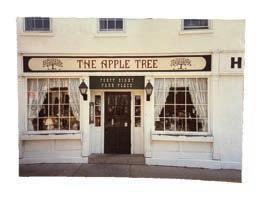
The opening sign on the front door hits the glass panels as a customer steps inside The Apple Tree Boutique. Almost immediately, someone behind the counter looks up with a smile and calls out, “Welcome in!” The quick greeting happens before the shopper even reaches the clothing racks.
Inside the store, the atmosphere feels warm and inviting. The soft lighting reflects off the carefully arranged displays of home decor and jewelry. The front windows are styled for the season, along with each display throughout the store. The layout of the boutique encourages customers to move slowly through the space, rather than rush from item to item. Quiet music plays in the background, filling the store without overpowering the conversations happening around it.
Patrons browse casually, sometimes pausing to chat with employees or one another. Someone admires an outfit on the dressing room doors, while another shares their opinion on a pair of earrings nearby. The environment feels relaxed and familiar, like a place people return to.
Clawson opened the store during a difficult economic moment. In the late 1970s, the local economy was struggling, and several storefronts in Oxford sat empty. Rather than simply observing the downturn, Clawson decided to act. Corcoran said her mom had been serving on the first Oxford Chamber of Commerce Board and came to a realization: If she was going to help promote business in the community, she might as well start one herself.
For many customers, the store is more than just a place to shop. It is a place to stop in, talk and feel connected to the community around them.
The first version of The Apple Tree was far different from the store customers see today. Instead of occupying a High Street storefront, the shop began in the lower level of a house the family owned near Uptown. Clawson filled the space with items she personally selected — pieces she discovered during her travels or objects she simply thought were beautiful.
At the time, retail buying worked differently than it does today. Clawson often traveled to gift markets, including one in Columbus, where independent shop owners could browse merchandise from various vendors. The items she chose were eclectic and decorative: glassware, figurines and collectible pieces designed to sit on shelves or tabletops.
Corcoran did not immediately plan to take over the business. For a period of time, she lived in Cleveland and balanced work there with occasional trips back to Oxford to help her mom. She would spend about a week each month assisting with buying and inventory while maintaining her own career elsewhere.
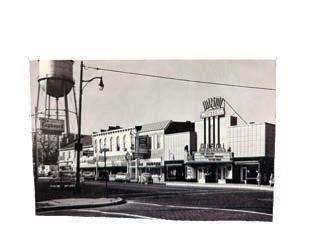
The Apple Tree has been a part of Oxford’s local landscape for decades. The store first opened in 1979 and has remained a steady presence in the community ever since. As trends in fashion and retail have changed over the years, the boutique has continued to grow alongside the town it serves.
The store has evolved from a small collectibles shop into something larger: a community anchor. It is a space offering both a personal shopping experience and a sense of familiarity. In a time when online shopping and large retailers dominate the market, local boutiques like The Apple Tree continue to play an important role in maintaining the character and economic vitality of small towns like Oxford.
The story of the boutique exudes a sense of family because that is where it all began. Barb Clawson, the mother of the boutique’s current owner, Cheri Corcoran, opened the store with a simple goal: to create a welcoming space that specialized in curated collectibles and unique gift items.
Design by Lindsey Heyd
Eventually, however, the family’s involvement in retail expanded. Corcoran and her husband opened additional shops in Oxford, including a lingerie store called Bare Elegance. At one point, the family operated several retail spaces in town simultaneously. Later, when Corcoran’s children were born, another store called Cottontails opened focusing on children’s clothing.
The different stores moved locations throughout Oxford over the years as leases changed and opportunities arose. The Apple Tree itself relocated multiple times before eventually settling into the space it occupies today.
A major turning point came in 2008. That year, Clawson injured her back and began considering leaving the business. Rather than letting the store close, Corcoran stepped in to continue operating it and finish out the remaining lease.

At the time, the storefront consisted of two spaces separated by a main wall. Corcoran decided to remove the dividing wall and transform the layout into a single, larger store.
This shift also marked a major change in the boutique’s merchandise. For decades, collectibles and decorative items have been a major part of sales until Corcoran gradually began moving away from those products and introducing more clothing and fashion pieces. The Apple Tree now carries brands such as Free People, Brighton, Peepers, Sugarboo, Enewton and Jellycat. Her goal was to create a store where multiple generations could shop together.
“I wanted it to be a place where you and your mom could both find something,” Corcoran said.
upcoming trends. As she walks through rows of vendors, she watches for patterns that begin appearing across multiple collections. If a style repeatedly shows up from different designers, it may signal a broader trend.
“All of a sudden, you’ll see a trend coming, like, it’s huge,” Corcoran said. “So you go down the rows, but you’re like, ‘I just don’t think that’s gonna work.’ Then, you go maybe four or five rows, [later] you kind of go, ‘Well, I guess that is an up-and-coming thing.’ So, we test it and see how it does. We don’t buy into it a lot, but it’s funny how trends last a season sometimes.”
When the boutique tests new trends, she orders smaller quantities before committing to them fully. Geographic trends also play a role in decision-making. Fashion frequently emerges on the coasts before moving toward the Midwest, giving store owners a sense of what might appear locally in the near future.
Each season brings new pieces into the store, but the process behind selecting them remains intentional. Choosing merchandise is part instinct and part observation. Corcoran travels to markets in places such as Atlanta and Las Vegas to browse brands and
Customer feedback can also influence buying decisions. Employees and even students who shop in the store sometimes suggest brands or products they believe will resonate with shoppers. Corcoran credits those conversations with introducing several successful items to the store’s inventory over the years.
Beyond the clothing itself, one of the most defining aspects of The Apple Tree Boutique is the relationships




that exist inside its walls. Employees are like family, and customers are often known or recognized, greeting each other by name or catching up on recent life events.
Over the years, The Apple Tree has formed connections with other businesses in the area, contributing to a collaborative local business environment. Partnerships with nearby restaurants, like The Pickle & Pig for a Christmas holiday event at the store, help strengthen the Oxford community by encouraging residents to shop locally and bring joy to the customer base as well as their employees.
For many shoppers, visiting the boutique has become routine. Some stop by to see new arrivals, while others simply browse and talk with friends or employees they may have come to know while shopping. These small interactions help create a sense of loyalty that goes beyond traditional retail transactions.
In contrast to online shopping, where purchases happen quickly and anonymously, the experience inside the boutique is personal. Customers can ask questions, receive styling advice and spend time exploring options without feeling rushed.
Amy Schlake, the front floor manager, said the way customers feel when they enter the store is one of the most meaningful measures of the boutique’s success.

“Another really huge compliment is when … people comment on how they’re treated here, … [and] how they feel when they come in the store,” Schlake said.
“They just get to enjoy something that’s really beautifully curated.”
That focus on creating a welcoming environment has helped shape the boutique’s reputation over the years. What might begin as a quick shopping trip often turns into a longer visit, with conversations continuing between racks of clothing and customers returning not only for the merchandise but for the experience itself.
However, the connection of in-person shopping took a major turn during the COVID-19 pandemic. It presented one of the most difficult periods the store has faced. Like many small businesses, the boutique suddenly had to reconsider how it operated and how to continue reaching its customers. Government relief programs helped the store remain open during that time, but the experience pushed the team to rethink the role of online shopping and digital outreach.

What might begin as a quick shopping trip often turns into a longer visit, with conversations continuing between racks of clothing and customers returning not only for the merchandise but for the experience itself.






In response, the boutique began focusing more on its website and social media presence. Corcoran admits the website is still evolving, but she views it as an important part of the store’s future.
“I want to be better,” Corcoran said. “I always try to think, if we had a big competition here, why wouldn’t I compete against myself?”
Corcoran describes the boutique in deeply personal terms. After almost two decades of running the business herself, she said the store feels like another member of the family.
“It’s like one of my children,” Corcoran said. “Everything that’s in that store reflects me.”
and paperwork. But as the boutique has continued to grow, the team behind it has grown as well. Employees now contribute in a variety of ways, from styling displays and managing inventory to helping shape the store’s social media and online presence.
Corcoran credits much of the store’s continued success to the people who help run it each day.
“I did it all, almost,” she said. “That’s how [much] we have grown, because I have the best team I’ve ever had since 1979 … and I think that’s how we make it bigger and better.”
Over time, those working relationships have turned into something deeper. Many of the employees who help run the boutique today have spent years together inside the store, sharing responsibilities and building a sense of ownership in the space they help maintain.
“The people we’re talking about have become my friends,” Corcoran said. “That’s how I feel. Like we’re family.”
As evening approaches, the pace inside the boutique begins to slow. The last few customers finish browsing, bringing their selections to the counter before heading out the door.
Employees begin straightening displays and hanging clothing back into place. Seasonal decorations catch the light as the store prepares to close for the night. What customers see during the day — thoughtfully arranged and curated displays — is the result of a team working behind the scenes to keep the store running smoothly.
For years, Corcoran handled many aspects of the business herself, from buying merchandise to managing inventory
That sense of connection extends beyond the employees themselves. For many customers, The Apple Tree has become a place where familiar faces greet them, conversations continue from week to week, and shopping feels less like an errand and more like a visit.
Soon, the lights dim and the door locks until morning.
But when the opening sign hits the glass panels again tomorrow, The Apple Tree Boutique will once again welcome the community inside — continuing a tradition that has taken root in Oxford for more than four decades. S
AN ANONYMOUS CAMPUS A DEEP DIVE INTO MIAMI’S YIK YAK
by katie whitehead
College is advertised as a beacon for connection. From internships with esteemed business professionals to classmates who will later attend your wedding, it provides an opportunity to develop relationships with people who are similar to and different from you.
Sure, there are in-person opportunities to develop these connections, such as university clubs, classes or Greek life, but in our digital world, social media offers a wide variety of apps that let users form connections by simply pushing a button. One of these apps is Yik Yak, which has taken college campuses by storm since its introduction in 2013.
Yik Yak is an “anonymous community app for college students that lets you post, comment and message with your campus,” according to its official website. As opposed to apps like Instagram and Snapchat, its sole purpose is to connect college students with others who share similar interests, values and beliefs.
The app initially offered many benefits. Its anonymity encouraged users to speak freely without fear. People were able to find others on campus similar to them, and students were able to have humorous, thoughtful and insightful conversations with others from all grades and majors.
yik yak temporarily shuts down
However, while the platform was originally used to connect students, problems soon began appearing. Its anonymity allowed for students to post racist, misogynistic and violent posts without receiving repercussions.
In 2014, a student at Michigan State University posted that he would “shoot up the school,” leading to his arrest and a two-year probation sentence. In 2017, two feminist groups

filed a federal complaint against the University of Mary Washington for “failing to protect the female plaintiffs from cyber harassment and threats of physical and sexual violence” occurring on the university’s Yik Yak feed.
The hateful rhetoric on the app continued to worsen until April 2017, when the app announced it would be “shut down” until further notice.
JUST KIDDING! yik yak returns
In 2021, Yik Yak officially announced its return, but this time with a series of safety measures to prevent hate speech and violence. It also announced new community guidelines focused on “safety, respect and positivity.” Reported posts would be reviewed quickly by the moderation team, and repeated violations of the community guidelines would result in users being banned.

Design by Samantha Medina
YIK YAK’S OFFICIAL LOGO, THE YAK

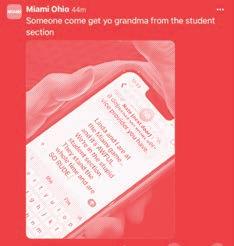
Since its return, Yik Yak has once again taken college campuses by storm, including at Miami University.
Miami’s Yik Yak community discusses a wide variety of topics. It can be a very entertaining place, with jokes about campus life such as the “Frat Flu,” laundry prices, President Crawford and dining hall experiences. These posts tend to receive a high number of upvotes, and the comment sections are often civil and encouraging.
First-year biology major Rylie Esparza loves Yik Yak for the humorous community it brings.
“I think it’s interesting to see what’s going on around the community,” Esparza said. “I love when something funny happens on campus and everyone gets together to post about it. It feels like a big inside joke.”
In addition to humor, it helps explain concepts and experiences to first-year students that they may not have heard of before.
In a popular post, a user asked about a new business opening across from Brick Street, an uptown bar. The comment section was supportive and even mentioned job opportunities that the new business was offering. While there was one negative comment, it had three downvotes.
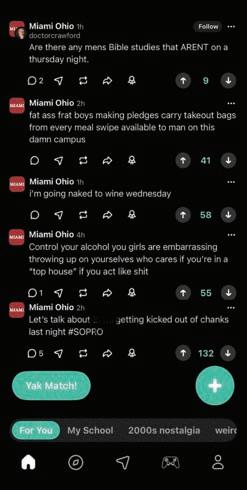
Despite these positive posts, the majority of messages on Miami’s Yik Yak have been vile and do not reflect the university and its students in a good light. Several posts discussed excessive drinking and warned those with fake IDs about bars that have undercover police officers.
greek life gets yakked!
Several posts consistently talked about Greek life, ranking both fraternities and sororities as “bouse” (bottom house) and “touse” (top house) on a looks-based system. There were also posts about sororities promising new members a spot in their organization via “bid promising” and accusing several fraternities of hazing.
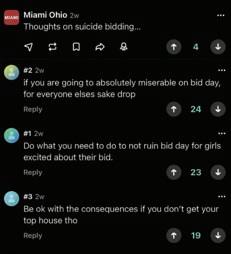
Posts alleging Greek life of improper behavior are nothing new. In 2023, a user accused Miami’s chapter of Delta Gamma of making her “remove any pics [she] posted with that black girl,” so it didn’t look like they “hang out with trash.” This post quickly became viral and even received attention from Cincinnati local news stations such as WKRC. Delta Gamma soon issued a statement via an Instagram story saying the accusation was false.

Junior marketing major Megan McManaway said she avoids looking at Yik Yak when recruitment is coming up.
“Around recruitment time, people are always fighting,” McManaway said. “[Yik Yak] turns into a very negative place that isn’t fun to look at.”
The negative comments regarding Greek life also negatively affect her self-esteem.
“It makes me upset that people are judging me solely based on my letters,” McManaway said.
Social media is often used as a place to catch up on news, and with the app’s enduring popularity, it’s not hard to assume that more and more people are using it to find out what’s happening on Miami’s campus.
But how reliable is it?
Social media is often used as a place to catch up on news, and with the app’s enduring popularity... it’s not hard to assume that more and more people are using it to find out what’s happening on Miami’s campus.

But how reliable is it?
While Yik Yak intended to provide students with details about campus life and foster a close-knit community...
fake news?!
In a poll on Yik Yak asking users whether they believe it to be a reliable site, 98 users said they believe everything they see on the platform, while 250 users said they do not. This unreliable information can be extremely dangerous, especially when the Miami community consistently shares misinformation and embarrassing stories about other individuals.
To test this, in a post asking users to share the craziest thing they’ve seen at Miami, one person claimed they’ve seen someone have sex on the Brick Street dance floor, while another person claimed to have seen a fraternity brother fighting someone outside of Bagel and Deli.
While this question was presented in good fun, it exposes speculative information about anonymous individuals on campus that could potentially be embarrassing and career-threatening. If users believe everything they see on Yik Yak, it could cause irreparable damage to an individual’s or group’s reputation.
While Yik Yak intended to provide students with details about campus life and foster a close-knit community, the app’s anonymous posting allows users to easily lie and tends to remove human empathy. In addition, its upvoting feature allows users to boost posts they want people to see and remove posts they don’t, resulting in a skewed information distribution system that can censor factual information and spread misinformation.
Miami’s Yik Yak should not be a place for violence. It should represent what Miami is: a place of love, honor and a little bit of humor S

the app’s anonymous posting allows users to easily lie and tends to remove human empathy.
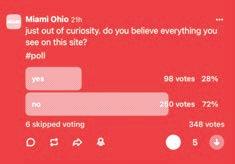
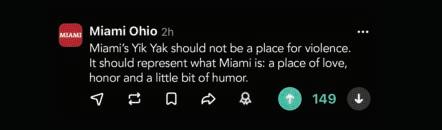
IMAGE OF POLL SURVEY RESULTS

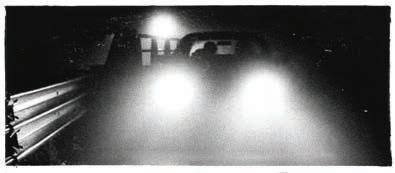
Solomiia snapped out of her feigned sleep and watched the two officers approach the car. They had finally made it off the rural road that backed up for miles, where the only illumination came from the thousands of car headlights shining in the dark.
She squeezed her eyes shut, slipping back into her role as a sleeping child. Her parents had drilled it into Solomiia and her two siblings: pretend to sleep and stay silent when they crossed the border. The officers were less aggressive that way.
One of the officers walked toward the trunk of the family’s gray Volkswagen Passat. He began digging through their bags — five backpacks, crammed with items they deemed essential for the rest of their lives.
Solomiia heard the officer at the window murmur something. He wanted their passports and documents. For more than 24 hours, Solomiia watched panic ripple around her. She smelled the heavy smoke from hundreds of cigarettes clasped in the fingers of fearful Ukrainians hoping to steady their nerves.
“Are you their father?” the officer asked. Solomiia cracked open her eyes, seeing the officer gesture towards her and her siblings.
“Yes,” her father replied.
“How old is your eldest?” the officer asked, shining a flashlight on Solomiia’s face.
“She’s 15.”
Solomiia Tkachuk grew up in the small town of Rivne, Ukraine, with her younger siblings, Roman and Zlata. It was the kind of place where people walked everywhere, and you had to drive to the next town for “good” shopping.
She was raised to be independent. Her parents taught her early on to care for her siblings and to handle responsibility on her own. At 13, when her mother and sister left to visit her father, who was working in Kazakhstan, she stayed home to manage the apartment and care for her younger brother. A week later, the phone call came.
“We can’t come back right now, but we will as soon as we can,” her mother said.
“For how long?” Solomiia asked. Her mother didn’t have an answer.
The COVID-19 pandemic had prevented any flights from leaving Kazakhstan. For five months — 152 days — Solomiia and Roman lived alone in their apartment in Rivne. She cooked their meals, did the laundry and kept the apartment clean.
In the evenings, they’d curl up in front of the TV, distracting themselves from the bleakness of a parentless home.
Sometimes her grandmother would stop by to check in on them. She made sure they had food and were keeping up with their school work, but she could never stay. Solomiia’s grandpa needed her; his health was getting worse with each week.
When she left, the house felt empty again.
Even though her parents caught the first emergency flight back to Ukraine, the five months spent as a stand-in mother figure for her 11-year-old little brother stripped her of the blissful feeling of youth.
Gradually, she set aside her love of music and the arts. It was time, she told herself, for more practical career choices. She applied to a school specializing in biochemistry. But in small moments, between the rigorous biology and chemistry classes, the joy of her childhood would rush back.
Her school required ninth-grade students to perform a ballroom-style dance. Eager for an escape from schoolwork, Solomiia and her two friends stayed at school late into the night, practicing.
For that night, she was back in kindergarten, eating buckwheat grits and taking naps on a small cot.
But when she woke up the next morning, the sun wasn’t shining through her fourth-floor apartment window. The sky had turned a shade of gray she had never seen before. When she walked out to the kitchen, her parents stood together talking in hushed voices, phones in hand. Russian rockets had struck the airport only 30 minutes away from where she stood. The gray in the sky wasn’t rain clouds covering up the sun. It was smoke and ash.
Russia had begun its full-scale invasion of Ukraine.
“Do you remember what you were thinking?” I asked.
Solomiia fidgeted with her necklace, looking out the window. It was a gold cross on a long, thin chain.
“I saw the smoke coming from the explosion [on the TV], but I was like, ‘OK. That’s it. That’s going to be it. There is no way my city’s going to be actually at war,’” Solomiia said
She’d thought the same thing eight years earlier when Russia invaded the Ukrainian province of Crimea. She’d seen the footage on TV, but back then, when she’d looked out the window, the sky had been striking blue.
“I remember looking out that window and thinking, ‘I don’t see anything. It’s probably not happening to me. It’s somewhere. I don’t know,’” Solomiia said.
Now, instead of the TV showing images of distant places with unfamiliar roads, these images held memories from her childhood.
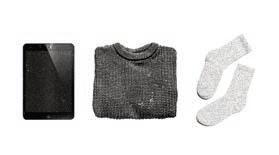
Fueled by fear and building uncertainty, Solomiia quietly slipped away from the rest of her family and began to pack a bag. She bought it in Croatia on vacation two years before, and it was once filled with sunglasses and souvenirs. But now, she placed in a few small items: a sweater, a few pairs of socks and her tablet.
“All that was going on in my mind was that I need to leave. I love my country. I love my people, but I can’t stay here right now,” Solomiia said. “Deep in my heart, I was just thinking that we were going to be away for a week or two.”
The next day, the rest of the family packed their bags. Zlata was having panic attacks, her first-grade mind overwhelmed with fear. While their mother tried to calm her down, Solomiia turned to optimism, but she knew the chances of her father crossing the border to Poland with them were slim. Able-bodied men were vital to the war effort.
“What am I going to do?” she heard her mother ask her father. “What am I going to do with three kids in Poland without knowing the language or having a job or basically anything?”
“She tried to hide it from us as much as possible,” Solomiia said, “but she was so worried.”
That night, her parents made their decision.
“We’re going to leave,” Solomiia remembers him saying. “We don’t see that there’s going to be a bright future for you here in Ukraine. And we wish the best for you.”
The next morning, before dawn, they left their lives behind.
The trek down from their apartment had never felt long before, but as the family walked down the steep stairwell
Design by Caitlin Wong
in silence, every step stretched to eternity. Solomiia left behind her textbooks, art supplies and childhood toys; things she hadn’t seen since that morning when her father closed the door behind them for the last time. She fell asleep as soon as they reached the car.
“At that moment, did you know you’d never be back?” I asked.
“No. Not at all,” Solomiia said. “I left so many things. I don’t even remember them now.”
When she awoke, Solomiia stared out the window of her family’s car. Outside, she saw her childhood racing past. Her phone was full of messages from friends and family concerned about their whereabouts.
On the opposite side of the road, Ukrainian tanks and anti-ballistic missile trucks thundered past. On TV, those machines had seemed like toys: distant, unreal, almost imaginary. Here, they loomed larger-than-life in an undeniable message: The war had crossed into her world.
At one time, Solomiia thought she was prepared for anything. When her parents were stuck in Kazakhstan, she’d learned to deal with pain and fear. She had held everything together for her brother and for herself. But this time, as Solomiia sat in the car that day, things were different.
Every car carried its own reasons to worry. Some were leaving a husband behind to fight in a neverending war, some had forgotten an important document and some had to leave their pet at home.
Slowly, the line inched forward.
When they finally reached the industrial gates, her father answered each question steadily. Yes, he was their father. His eldest was 15. The entire car held its breath as the officer studied their documents.
“Go ahead,” the officer said, handing him back their papers. “You can cross.”
No one spoke as their tires crunched over the asphalt and the car slipped past the gates. Her father increased the speed, putting distance between them and what could have been the last time they were all together as a family.
As they pulled into the small gas station on the side of the road, the whole family climbed out of the car. Solomiia brought her siblings inside to use the bathroom. As they walked out, she saw her parents locked in a tight embrace. She stopped, watching them.
The future was uncertain, but they were together.
“That was the moment when I just let go of all of that,” Solomiia said. “I was just led by my parents again. I was a kid again.”
The car line that had once crawled steadily toward the border slowed and eventually stopped altogether. People got out of their cars, talking amongst themselves. Many paced the long line, seeing how far it stretched before their turn to cross.
A few hours earlier, her father had wordlessly opened the car door and joined those pacing. She watched him through the window. She had never seen him smoke before. He smoked half a pack of cigarettes that day.
The weeks that followed in Kraków were a blur. Between the comfort of seeing her cousins and the sightseeing and shopping they did every day, it was easy to forget they no longer had a home to return to.
The family eventually found an apartment in Gdańsk, Poland. Solomiia returned to school, attending a science lyceum just as she had in Ukraine. But the news from home was inescapable.
Russia bombed an oil depot in Rivne, driving gas prices through the roof and making it almost too expensive for Ukrainians to flee. If they hadn’t left when they did, the family would have been stuck in Ukraine.
“That’s the time when our family lost contact with each other,” Solomiia said. “We used to have these family dinners just sitting together, chatting. They didn’t really know what was going on in my life. I didn’t know what’s going on with their life.”
A month after settling in Gdańsk, the Uniting for Ukraine program opened. The system provides a way

for Ukrainian citizens to live in the United States if they have a sponsor, and Solomiia’s cousins, who live in Ohio, offered to take them in. This was their ticket to starting over.
All of the paperwork was in English. Solomiia was the only one in her family who knew the language well enough to make their transition possible.
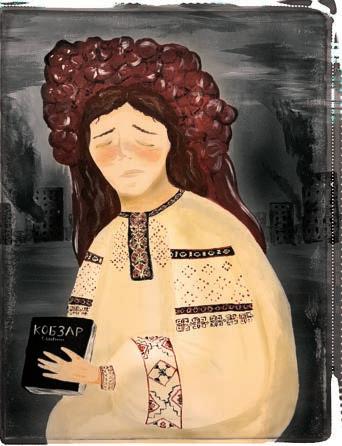
“KOBZAR” BY SOLOMIIA TKACHUK
She spent weeks inputting every required detail.
Two years later, 15-year-old Solomiia had the life she always imagined. She attended high school in Walnut Creek, Ohio, and had new friends and hobbies. She replaced her art supplies and started painting again. Her family was settled, too, each of them finding a rhythm in a new place.
She thought about Ukraine often. She missed the food, her friends, her life there. But rarely did she allow herself to dwell on those four days at the end of February when they left.
But after a late night laughing with her friends, something shifted. On the drive home, she found herself thinking more deeply about her situation than she had before.
“It was being grateful, but feeling guilty that I left my country and everyone behind,” Solomiia said, “and I’m just here enjoying my life and going to youth group with friends, and drinking my coffee and going to [an] American school that some people are dreaming about.”
“That is a thing, you know, feeling survivor’s guilt,” I said.
“My brain finally felt that everything is safe now, everything is settled,” Solomiia said. “Now it can unlock all of the emotions and can slap me in my face with everything I should have felt then, but I couldn’t feel because my emotions were pushed away.”
Tears streamed down her face for one of the first times in years, the darkness around her in the car hiding the pain she felt from the world. Everything she had held in burst through the seams: the fear, the grief, the loss, the pain, the guilt. All the things she was afraid to feel back then.
She finally let herself feel it all. S
EDITOR’S NOTE: For extended version, see miamistudentmag.webflow.io
She finally let herself feel it all.
TMSM, SPRING 2026

how MIAMI basketball shaped my college experience
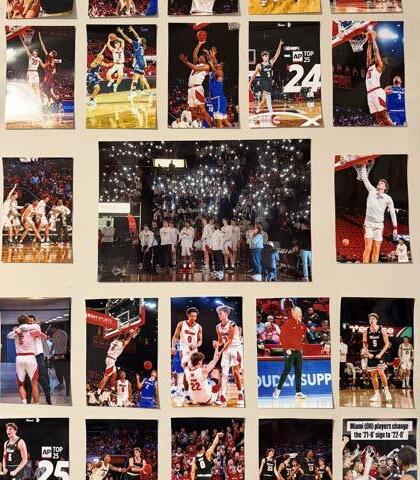
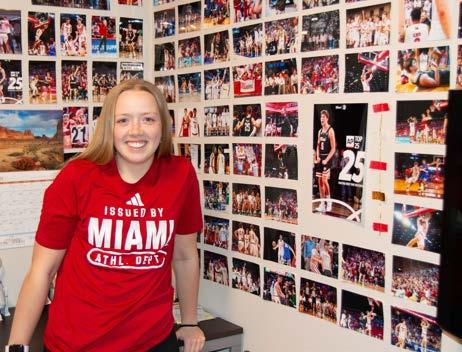
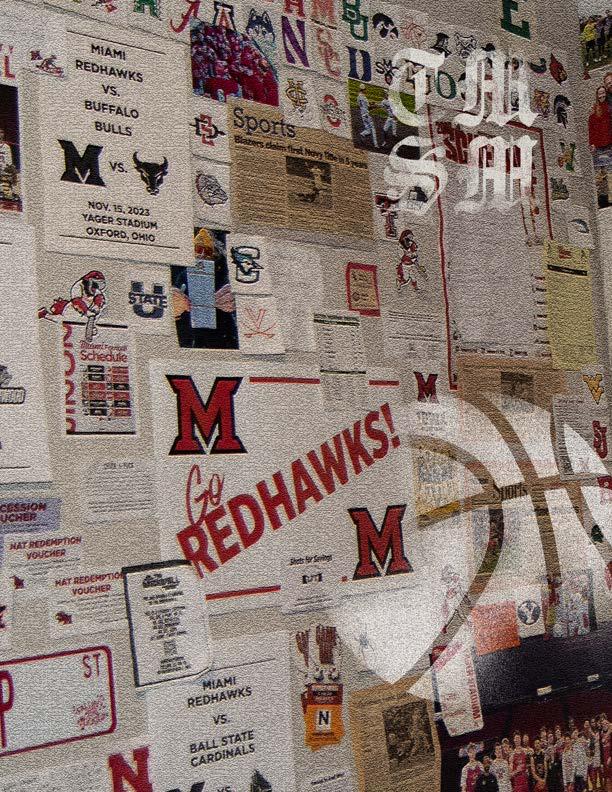
There’s a photo on my wall of a guy named Mekhi Lairy dribbling a basketball in front of what was once an empty section of Millett Hall. It’s a photo of Miami University’s season opener against the University of Evansville on Nov. 7, 2022.
Mekhi’s photo is just one of hundreds of sports decorations covering my bedroom walls. They take up every inch of space and tell the story of my emotionfilled love affair with sports, a story perhaps best told through the lens of Miami basketball.
If you’ve ever listened to a press conference by Miami men’s basketball head coach Travis Steele, you’ve probably heard him mention the Evansville game I referenced. It was Steele’s first-ever game at Miami, one where he recalls that “probably 20 people” showed up.
Steele entered Miami’s empty stadiums the same year I came to the university from my Chicago-area high school. He couldn’t believe the small crowd on his first day. As he put it, he “was floored.”
I wasn’t at that Evansville game, but I too was floored by the lack of attendance when I went to my first basketball game just weeks later — a loss against Marshall University. I grew up a fan of Iowa and the Big Ten, arguably the best conference in basketball, and I had fallen in love with the rowdy atmosphere of the games I saw on TV. They were always packed, and everyone stood, cheered and screamed for all 40 minutes.
But at Miami, no one went to games, and no one really cared. I quickly lost touch with the fanatic side of sports that I loved so dearly.
There’s a poster on my wall I’ve held onto from my second Miami basketball game, a game that forever changed the trajectory of my college experience.
I must’ve been walking back from a class or a meeting that Tuesday night — the second night back from winter break — because I vividly remember standing outside what was then Stonebridge Hall and contemplating going. I remember telling myself, “Lindsay, you like basketball. Go watch some basketball.”
So off I went to Millett.
When I arrived, I sat in the front row because, like every other row, it was wide open. Not long after, five male
Design by Jillian Wynn



students bustled into the row, concessions in hand and decked out in red. One guy was wearing a red morph suit. That guy was Adam Smith.
He was thrilled I was there.
“No one comes to games at this school,” Adam told me. “We want to make it fun.”
For all 40 minutes of basketball, those boys stood on their feet. They cheered. They screamed. They yelled obscenities at the refs on occasion. They really, really cared.
I yelled and cheered alongside them and, for the first time, I truly had fun at college. I was so excited to have found a five-person microcosm of the 15,000-person college gameday experience I had been longing for. And they were excited that their group of five people who cared deeply about Miami athletics had turned to six.
Those young men shared the vision of college that I was beginning to think only I had: one where crowds of people packed into Millett Hall, Yager Stadium and McKie Field and went crazy for every game.
They couldn’t get 15,000 people, but they still went and screamed their hearts out with five because that’s as close as they could get to the experience they wanted. Except now it was six. I had bought in. I went to every remaining home game that season and sat with Adam and the rest of the self-proclaimed “Steele’s Soldiers.” I once again loved college basketball.
There’s a picture on my wall of Adam and me after Miami beat Cincinnati in football at the beginning of my sophomore year. We went looking for a miracle, and this game solidified the fact that every ounce of me loved Miami athletics.
At this point, I worked in communications, marketing, statistics and broadcasting for the athletic department. I worked games for every sport, but men’s basketball was the exception. I was in the stands because I loved being a fan.
That year, Miami put bleachers behind the basket, which Adam branded as a student section called “The Brick Wall.” There were four of us who began “sitting” (although really we only stood) on the right side in the front row, which is still my unofficial assigned spot to this day. I’ve deviated maybe once.
The Brick Wall was not always a huge success. There were a lot of games where it was just the four of us there. Maybe we dragged a handful of friends along to make it eight. I even remember at one point the three of them left when it hit halftime, and I was the lone student in the student section.
But by the last game of the season, we had worked our way up to 20 or so people. As silly as it might sound, that was a really big win for us.
Adam graduated that May, and sports haven’t been the same here without him. I wish he could see what Millett is today, because he’d cry tears of joy.
Adam, I promise it looks even better in person than in the pictures I send you.

There’s a p icture on m y wall of one game that stands out in my memory: a December matchup against Bethany College during mine and Steele’s third year.
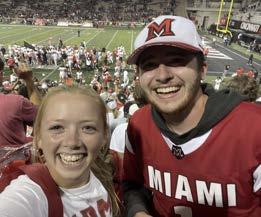
Miami broke a school record for the most 3-pointers in a game that day (22), yet the silence was deafening. I remember sitting there thinking, “If I cheered right now, everyone in the whole stadium would turn and look at me.” It would’ve been like cheering in the middle of a church service or a class.
Everyone seemed to be there to watch Miami rain threes and blow out a team in silence.
Miami started 6-0 in conference that year, and slowly, students began coming to games. One day in early February of 2025, my heart teemed with joy and disbelief as I watched the sides of the lower bowl of Millett become nearly full for the first time.
That was the most fun I’d ever had at a Miami game. I can only imagine what I would’ve thought if I had looked forward 365 days.
On the way out of that game, I remember hearing someone tell a friend, “I’m coming to every game now.” That sentiment made me so happy. That person understood me.
There’s a photo on my waLl of Miami guard Luke Skaljac flying off the bench during the 2025 MAC title game against the University of Akron Zips. Miami came one basket short of making it to March Madness that year, shattering my heart. The slow stream of student buy-in stopped.
But almost no players transferred out that year, so when my senior season rolled around, I knew the RedHawks would be special. I went to their first home game of the season against Old Dominion University, which I anticipated would be the start of a long, undefeated run. I was right. They improved to 1-0.
I had hopped onto the ride of my life.
There’s a drawing on my wall of Akron’s logo. I keep it three spots to the left of Miami in the line of MAC logo drawings that runs atop my wall.
The RedHawks were 14-0 when they played the Zips this season, their toughest opponent by a mile.
I watched that game on TV with my mom. It was tight the entire time, and in the absolute climax, a courtside
seat holder flew out of his chair in celebration. Akron had turned the ball over, and Miami was going to win.
I no longer walked anywhere. I floated. My Miami basketball team was 15-0.
After that, the rest of the world bought in and flipped my world on its head. Nearly 3,000 people reposted Miami’s 15-0 post. Students posted memes, photos and graphics of every kind. People blew up my phone with messages about how they were going to come to games now because they finally got what I had been harping on about for the last three seasons.
With the best record in the nation and one of just six undefeated teams left, the media swarmed Miami basketball. Small numbers of people slowly began to demand that we be ranked.
Everything I had ever felt for this team, other people started to feel too.
Everything I had ever felt for this team, other people started to feel too.


There’s a blurry photo on my wall that has Eian Elmer in the background. Everyone around him is overflowing with insurmountable emotion, but Eian only shows focus. The photo was taken right after his three-pointer following a miraculous tip-out by Brant Byers that sent Miami to overtime against the University at Buffalo. Not far over hangs a now-famous photo of Pete Suder saying goodnight after hitting the game-winning shot.
I ran laps around my boyfriend’s kitchen during that game, jumping through the air as my life, which had nearly been forced back to its feet, stayed turned on its head.
The following Monday, 5,403 people shared Miami Basketball’s Instagram post announcing that we were ranked. Every student knew, and almost every student cared. I may have been the first, but thousands of others had finally joined me.
With one game left before students would return from break, Kent State University forward Rob Whaley Jr. tried to single-handedly erase my dream of seeing students pack Millett. But he did not. I came back to an Oxford campus that was home to a ranked 20-0 team,
the winningest team in college basketball. I knew that would be enough to make the student body join me at Millett Hall.
There’s a huge photo on my wall , right in the center, of the Miami players looking up inside Millett on Jan. 27 before playing the University of Massachusetts. Millett’s lights are off and fans, who pack every seat, are shining flashlights. The players look like they’re looking up at the crowd.
They might’ve been watching the jumbotron, but I know that moment, surrounded by all those fans under the lights, had to be the most special thing they’ll ever experience in this world.
Earlier that evening, my roommate and I took a bus to Millett 30 minutes before the doors opened. When I saw the bus was already standing room only, I knew my dream was about to come true.
Millett filled all the way to the top. The right side filled first, then the left. The upper bowl, which I had never even seen open, was soon full too. We drew almost 8,000 students. I’d get choked up if I looked at it for too long.
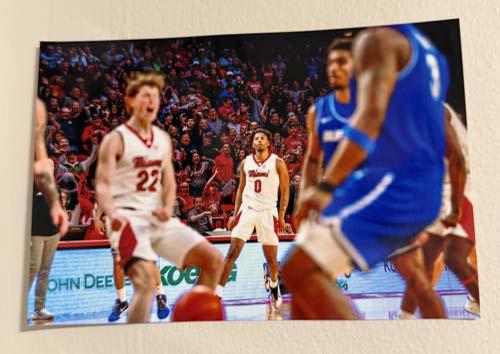
Photos courtesy of Caitlin Dominski, Will Miklautsch, Elisa Rosenthal, Lindsay Stevenson and Megan Walker
Throughout that game, people yelled. People cheered. People stayed on their feet the whole time. There were times when I thought the roof would blow off. Everyone there cared.
I jumped and danced and lost my voice and felt all of the emotions sports so wonderfully draw out of people. It was the 10,000-person version of the fiveperson game I had gone to three years ago.
If Miami had lost that game, I would’ve been sad, but I wouldn’t have been devastated because everything I wanted from college had been fulfilled.
When I walk around campus now, I daydream about basketball frequently. The very ground beneath my feet feels different as my shoes hit it. The campus isn’t just Miami anymore. It’s a basketball campus with a nationally renowned team, the last one to go undefeated in the regular season. It has a different weight.
Sometimes, as I walk, I think about myself four years ago applying to all those Big Ten schools.
“If I hadn’t gone to Miami, would I be kicking myself right now?”
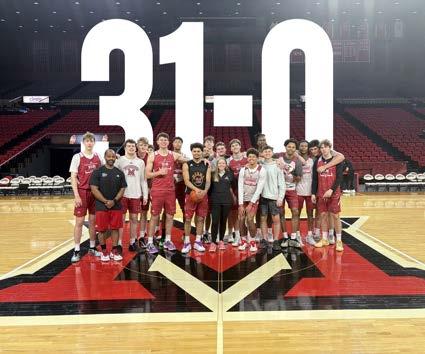
I like to think I’d recognize how cool this experience is. After all, no matter where I’d gone to school, there’s only one spot where I could’ve seen a 31-0 team. That spot is Miami, a school whose existence I didn’t know of six years ago, and I’m lucky enough to be one of not even 20,000 people who gets to be a student here during it.
That’s something you hold onto tight and don’t let go of, even if someone offers you the world.
There’s a photo on my wall of myself with the team.
Since Millett first filled up, so many people — coaches, players, players’ parents and strangers alike — have approached me to tell me they remember me from the beginning and that they appreciate what I’ve done for the team. Even though I’ve really only ever been just a fan.
While driving back from Miami’s last regular season game in Athens, I thought about the group of nine or 10 Miami students I had sat with, one of several pockets of students who had made the trip. It hit me that the number of Miami students who had driven hours to watch a basketball game was much greater than the number who had walked 15 minutes to Millett three years ago.
It’s moments like those where I think about the part I’ve played in the transformation. Going to every game.
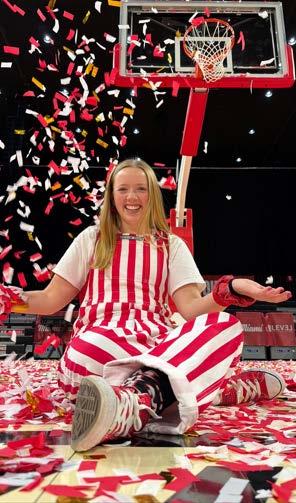
Bringing a handful of friends who brought a handful more. Showing up on the road. Being interviewed for articles about the run. Prompting President Greg Crawford to buy overalls for the student section, which led to the first line outside Millett Hall in a really long time. Small details, but part of the story nonetheless.
Back when Adam started the Brick Wall, he was adamant that we would build “brick by brick.” I’m proud to be one of the bricks in the foundation. I can’t say this wouldn’t have all happened without us, but I can say that we did play a small part. A part documented by the decorations on my walls. S


A tale by Solomon Bowser
It’s midday — almost time.
Troves of soon-to-be spectators have already gathered across rows of wooden benches and patches of open grass. If not for the arena sitting in front of them, the crowd itself could serve as its own spectacle.
A rainbow array of costumed characters fan out from the arena’s edge, and the eye wanders from warriors adorned in armor and weapons to fairies decked out in flower crowns and butterfly wings. Even the odd pauper or poet can be found dressed in a leather corset or wool beret.
Design by Jayson Brake
Photos courtesy of Tom Nader
Several obstacles and targets are set up on the long sandy track, laden with foot and hoof prints. It’s still empty, but the thrum of bagpipes and beating drums in the distance gets louder each second.
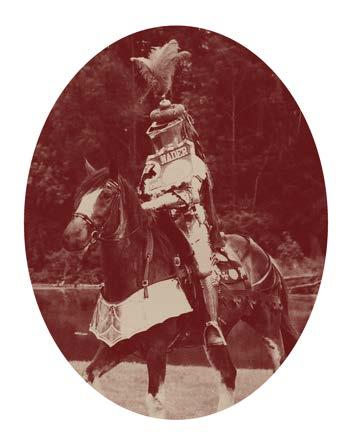
The royal parade approaches; a cavalcade of medieval characters makes its way through swathes of passersby, all led by the queen. As the procession stops, three knights, all on horseback, ride into view. They dismount to bow before the queen, and a pair of marshals walk out to welcome the crowd to the Ohio Renaissance Festival.
The first marshal to speak introduces this part of the festival — a joust — as an activity done during times of peace to keep knights in good form, mentally and physically. He addresses the crowd.
“Ladies and gentlemen, would you meet your knights?”
The crowd offers up some cheers. The second marshal interjects; he isn’t satisfied with this response.
“Ladies and gentlemen,” the announcer repeats with a booming voice across the arena, “would you meet your knights?”
The crowd roars this time.
Each knight introduces themselves.
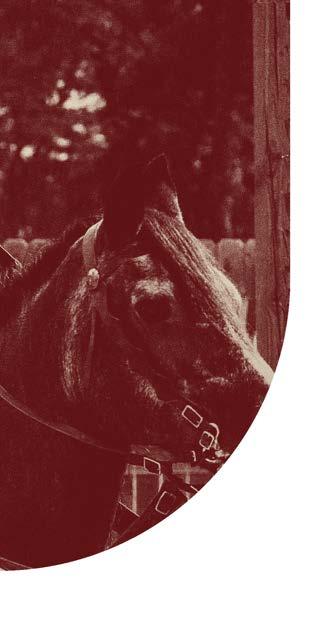
Sir Samuel, the youngest of the group, races by the crowd atop a silvery-white horse called Damascus, waving his blue beret.
Sir James, posing as the group’s bad guy, rushes past the audience on Billy with his fist raised, and a few boos can be heard amongst the crowd.
The last introduction goes to Sir Thomas Broadwarden atop his steed, Bob. He makes his round, waving his feathered cap.
The crowd offers their adoration, roaring with applause.
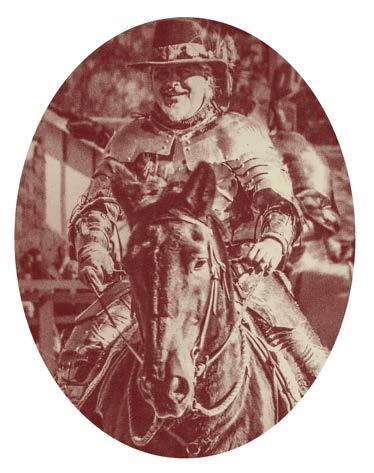
Sir Thomas’ real name is Tom Nader, and he’s been running the jousting show at the Ohio Renaissance Festival since 2021. He’s been in entertainment and historical reenactment for about 30 years, and his passion for the festival predates even that. Tom said his heart and soul will always be with the festival — it carries a little bit of everything for him, with elements of theater, history and good times with friends.
He’s always held a deep fascination with medieval culture, having grown up loving stories like Robin Hood and watching movies and documentaries about
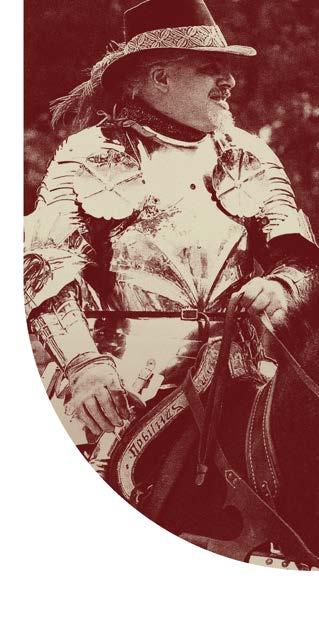
the era. When he was 18, he attended the Ohio Renaissance Festival for the first time during its opening season in 1990.
“I looked around and thought, ‘Here are all these weirdos like me,’” Tom said.
From that point, Tom got more involved as a part of the act, taking on several different roles each season. He started as an assistant to a magician, who also acted as a kind of mentor while he was interning with a regional theater during college. After the magician moved on, Tom would take up a role in a pirate act, as a street-cast
member and finally run his own booth giving short fencing lessons.
It wasn’t until roughly 1996 that the idea of jousting came up in a conversation with a friend. The two of them were giving some critiques on the current show and decided they would give it a shot. It started small, but thanks to the connections Tom made through the festival, and with some advice from coworkers at the theater, enough stars aligned for him to start his own jousting company: Combatant’s Keep.
Some staff and vendors mill about the chilly grounds, prepping for the day or just carrying conversation to pass the time. Between a small circular pen and a stable, each housing a few horses, the ensemble is getting the day started.
Most of the squires are already present. Jason is wrapping up tending to the horses, Christian just arrived, Kasia (a squire and knight in training) and Steven (one of the marshals) have yet to show, and Cassidy, Kai and JJ are talking with James and John (John is the other marshal).
Tom calls everyone together and starts the meeting off by letting them know that yesterday’s show went well, especially with how they introduced Damascus, the newest horse.
He goes through some reminders about the weather and how that might affect the horses, as well as some tips for how to keep things running smoothly for the audience.
After their meeting, they do a quick walkthrough of their positions for the day’s shows and begin prepping for the first event.
Next to the arena, there’s an open space for the troupe and neighboring acts to spend the time between shows. It’s also where they keep the horses.
This space connects to the “Knight’s Encampment,” where they conduct a meet and greet for patrons to talk to the knights, see how they work on their armor and even pet Bob, who’s the most popular horse.
The next two hours are spent scrambling to prepare. Sam, James and Tom spend between 15 and 30 minutes donning their armor. The legs are the easiest part to get on, but as soon as they get above the belt, the squires have to jump in to help.
They layer one shimmering piece after the other — breastplate, shoulder, forearm — then tie everything down. Soon enough, the three of them are up and moving, clinking about like walking silverware cabinets.
The sounds of the pirate show can be heard bellowing next door while Jason and Kasia tend to the horses. There’s the usual music or lines played over the speakers, but every so often, a cannon blast will rupture the relative calm, although at this point, even the horses are used to it.
What does receive attention is James calling out “15 to mount!”
Everyone starts to finish whatever they’re doing.
“Five to mount!” This time from Steven.
Fast forward to 2025. It’s September, the festival is in full swing and the troupe is gathering for its second morning meeting of the week.
The knights take turns climbing a small platform to mount their horses and soon enough, the gate opens, and they’re off to join the royal parade.
The first half of the show consists of three tests of skill, each completed by riding through a set of obstacles. The first requires the knight to collect three hanging rings — about as wide as a small plate — using a spear, then land a hit on a dummy target.
Sam charges atop Damascus, spear in hand. He loops the first, second and third rings and plants the spear into the dummy’s face.
The second challenge requires the knights to topple a series of dummies on either side and jump their steed over a beam.
James and Billy speed through the targets, striking each one in quick succession. Billy hops over the hurdle, and James flips his weapon into the air before catching it gracefully.
The final test involves the quintain, a large wooden post holding up a beam, with a small bullseye on one end and a sack of stones balancing it on the other. The knight must hit the target while avoiding the swinging stones.
Tom takes up his lance, a bright red pole just taller than he is while on top of Bob, and takes off. He rests the handle under his arm, raising it as Bob speeds toward the quintain. Drums and trumpets rise to a crescendo in the background as he strikes the center of the target, narrowly avoiding the flailing stones.
Tom chose to move on from the festival in 1997. He’d gotten married and had a daughter, and he decided it was time to make some changes. They moved around a couple of times, and Tom found different jobs in substitute teaching and digital embroidery. He kept the jousting company but focused on living history and reenactments.
Tom and his wife divorced around 2018, and after staying in Kentucky for a few months, he moved back to Ohio. It was at this time that an old friend of his invited him back to the fair for its 30th anniversary. He returned to find people whom he didn’t expect to ever see again. This was how he met his current girlfriend, Jennifer, whom he really liked all those years ago.
This return was what tied the current group together. At one point or another for the past three decades, whether they had been with the festival or pursued some other part of renaissance life, they found each other.
Tom and his friends all share the same passion for the festival, and their connection runs deeper; they regard each other as family.
They spend time together outside of the arena, going to dinners or riding horses. They call each other when they’re in a bad spot or need help.
John asks the crowd if they would like to see a joust, and the crowd responds with a healthy bout of cheering. Steven reminds everyone that the knights they’re about to see have taken a few more hits to the head than the
average person, so they need to be louder if they’re going to hear. The crowd responds in turn.
The first round is between Tom and Sam. They each sit atop their horses at either side, and as a squire hands them their lances, they ready themselves and tear down the track.
Sam and Tom collide at the center, their lances snap like twigs against their shields, splintering at the end. They do a few more passes, riding back to their position, taking up another lance and hoping for the best as they careen toward each other.
Tom is awarded the first victory; his next round against James is a little more challenging. The two manage to score a few solid hits, but in the
last round, Tom narrowly misses James’ shield, while James lands a point and is awarded ultimate victory.
After finishing two more shows throughout the day, the knights retreat into the encampment under the evening sun. They dismount, their faces red and dripping sweat, and congratulate everyone on a great performance. They spend the next half hour talking to patrons. Some fans in fantastical attire chat with Tom or James, a few kids come up to pet Bob and the knights even hand out their broken lance tips as souvenirs.
As the end of the day draws closer, there’s one word that seems to come up as everyone starts to wrap things up: “Pub-Sing.”
The very last stop for anyone during the festival is the Aleing Knight Pub, where people can grab some food, maybe a drink and watch a little musical act. The event is kicked off by the musical duo Damh and Dove playing a thundering tune on the bagpipes and bass drum; it’s not long before people are feeling the mood.
Once the band has finished its last song, the patrons are ushered to the BridgeSing. There’s a short wooden bridge leading over a small stream that splits the festival grounds. Members of the street-cast have lined either side of the bridge, each holding a goblet or mug, singing as the last few patrons make their way out of the festival. It’s a bittersweet song about being thankful for the moment and raising a drink to your departure, until they see you again.
After the last few people make their way across, one of the festival directors thanks the cast for all their work. Tom and the troupe return to the encampment and start to pack everything up. When they finally finish getting the horses back in the stable and everything squared away, they’ll join each other for dinner at Tom’s place. S

The Big Snow
By Shannon Mahoney
The winter stayed and left us defenseless, overcome by the blur of white, we abandoned our principles of timekeeping. We canceled the routines. We let ourselves fall back as children, discovering snow angels. We wondered “How?”
How we had forgotten we are bound by our physical senses.
How everything was buried, awash in powder, our bodies the only movement. Recognizable figures wandering across the empty landscape.
We dug ourselves out of our front doors.
We dug each other’s cars out.
We drove very carefully and let the pedestrians go first, because the pink on their cheeks made even ours sting.
When I stepped outside, wading deep into the snow, the cold air cut through my body, and the world became brighter than its origins. I squinted.
I thought of blank pages, the way the narrative expands when given the time and space.
The world was clear and dull and let us hear only what we needed to.
In a field of nothing, I watched a game of football.
Ice cold hands and unrestrained grins; barking laughter. Snow forgives. It makes us wild, uncareful.
A body tackled into the ground, but none of us flinched. We trusted the white matter. Matter, like matter, what matter when the afternoon was vibrant. Brighter than bright?
To set down the tangible work we pursue and ask what all these long nights with tired eyes really mean.
Three boys, twisted, tangled, collapsing together into the snow, the sound muffled. Against sensibility. Against the quiet. Against the way we isolate ourselves. These bodies in tandem, the only thing worth remembering.
poem
Design by Madeline Buecker













Fa we stood as if caught in a quiet exchange across






By Elisa Rosenthal
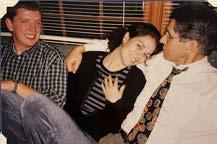
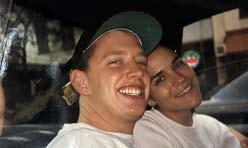
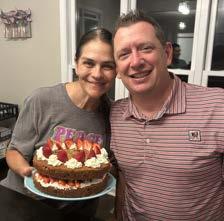
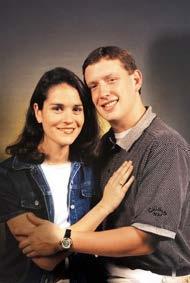
For many young girls, the fairytale magic of a perfect romance fades as they grow up. I’ve had the privilege of that magic never fading, as my parents’ perfect love story and marriage reinforce it for me every day.
When I babysat, I always told the young girls my parents’ love story as if it were some fictional tale. At the end, I would finally reveal the happy couple was in fact my parents, and their faces would glow with the realization that this kind of love existed outside just movies and books.
I still tell this story to my friends today as both a bragging point and a way to spread the magic of true love. Their story has shown me what unconditional love looks like and has set a precedent for the way I want to be treated in the future.
Robin and Bert got married on July 25, 1999, a sweltering summer day that still feels perfect in their minds, as they now recall it after 26 years. Their story is somewhat of a butterfly effect that starts long before they ever even met.
They were born a day apart, in the same year, on opposite sides of the East Coast. I truly believe fate is
Truelove
The fairytale of Robin and Bert








Design by Olivia Michelsen
Photos courtesy of Elisa Rosenthal
what brought my two wildly different parents together in a perfect mix that’s created a loving marriage.
Albert “Bert” Jules Rosenthal III was born on March 19, 1973, in Augusta, Georgia, to his parents, Bettye and Al Rosenthal.
Bert was born to a Catholic mother and a Jewish father and was set to be raised Catholic. At 2 years old, his biological mother died of complications from the birth of his younger brother. In the wake of her passing, Al decided to raise his kids Jewish.
Throughout his childhood, Judaism became a huge part of Bert’s life. He attended a synagogue and started participating in a youth group through the National Federation of Temple Youth (NFTY) when he was in high school.
He became very involved, holding two positions — social action vice president and president — on the regional board in his last two years of high school. He attended an annual event at the Union of Reform Judaism Camp Coleman, a sleepaway summer camp for Jewish children.
When Bert started attending the University of Georgia (UGA), he spent summers working as a camp counselor at Camp Coleman and joined a Jewish fraternity, Tau Epsilon Phi. After his graduation in 1996, he moved to Atlanta for work and started a side job at Temple Emanu El as the adviser for its NFTY high school youth group.
Robin Amy Bates was born on March 20, 1973, in Washington, D.C., to her parents Dennis and Gail Bates.
Robin was born and raised Jewish, and although she too had a parent of a different faith, her father, Dennis, converted when she was a baby. She also attended a synagogue throughout her life in Rockville, Maryland, and eventually in Monterrey, California, when her family moved there.
On paper, she was seemingly less involved than my father, never attending or working at Jewish camps or participating in youth groups. Her faith and morals were nonetheless equal to his, though, and Judaism was a big part of her family life.
She spent one year at a local university, then decided to transfer and move across the country to Emory University in Atlanta. After graduation, she too began working in Atlanta with different youth organizations, as she realized she wanted to be a teacher.
She also began working at Temple Emanu El as the middle school youth group adviser, working alongside Bert as needed to plan events for both the middle and high schoolers. The two knew of each other for about four months before officially meeting in January 1997.
The two became fast friends, collaborating to plan a year-end trip to Bert’s uncle’s beach house as a reward for the kids who attended the most events. As the story often goes, my dad began to see her as more than a friend but was shut down because my mom didn’t want to ruin the friendship.
The turning point ended up being that very year-end trip they had planned. They travelled to Kiawah Island, a beach town near Charleston, South Carolina, where Bert had spent many childhood summers. Bert elected to stay in the tiny laundry room all the way in the basement, allowing Robin to use the ginormous master bedroom.
One of the days spent at the beach, Robin got a bad sunburn, something that was rare for her as she naturally has very tan skin. In pain and unable to sleep, she walked down to Bert’s room looking for comfort and perhaps a distraction.
She ended up finally falling asleep in the tiny basement room with him, finding comfort and solace from the burn in Bert’s presence. As someone who lived her whole life with anxiety, she realized this was rare to come by, and this led her to finally agree to go on a date with him.
The first date was one to remember. They went to dinner together before going to the Fox Theatre to see “A Chorus Line,” a musical following 17 dancers auditioning for a spot on a Broadway ensemble. Robin was very impressed, and the pair continued to date and work together.
They became serious quite quickly, and to everyone around them, their relationship was different and more committed than others. One of Robin’s college friends, Miranda Whitmer, recalls the pair being so visibly happy around one another early on in their relationship.
“[Bert] had the biggest smile I had ever seen, and he looked at Robin, and it somehow got 25% bigger,” Whitmer said. “To see someone that happy around Robin was just wonderful, and I thought, ‘OK, yep, he’s the guy for sure.’”
After a year and a half of dating, Bert and Robin had several conversations about marriage and even went ring shopping. They wanted to spend the rest of their lives together, and Bert went to great lengths to make sure the ring and proposal were perfect.
In November 1998, Bert joined Robin at her family’s Thanksgiving, spending the week with her extended family in Richmond, Virginia. Unbeknownst to Robin, a ring box had also made its way there, hidden in her dad’s suitcase so she wouldn’t find it, and the proposal would be a complete surprise.
After the meal, the whole family went around saying what they were thankful for. When it got around to Bert, he started reading a poem he had written for her that ended with him down on one knee, asking Robin to marry him.
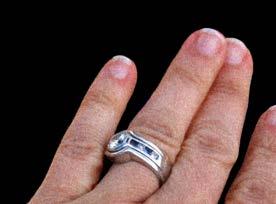
She said yes, of course, admiring the perfect silver ring with sparkling diamonds and accents of purpley-blue tanzanite, a unique detail that paralleled just how special their relationship was.
Their wedding date was set, and would be held in the very synagogue that had brought them together as advisers. A multitude of friends and family gathered from both sides to celebrate their wedding, setting the precedent for how loved they would be as a couple and the people they’d be able to bring together.
Their first dance was to “Happy Together” by The Turtles, an upbeat song that stood out in comparison to the typical slow, swaying first dances usually seen. Little containers of bubbles were passed around, and the newlyweds danced and kissed in the sea of iridescent, soapy orbs.

Growing up, one of the photos from that moment sat in a picture frame in the living room, and I passed it every day. That’s how I knew true love was real. If people as different as my parents could find one another, get along so well and create such a great life with so many friends, family and eventually their children, I could do it too. They loved each other so unconditionally, and I knew there truly was someone for everyone.
The phrase “opposites attract” has always seemed so logical to me because it sums up my parents quite perfectly. They share so many of the same beliefs, but outwardly, they couldn’t be more different.
An old camp friend of Bert’s, Jackie Dalton, has been friends with the two of them for many years and reflected on how their relationship became an inspiration for her own, eventually.
“I’ve always admired [their] relationship in many ways, but [especially] how they support each other in their differences,” Dalton said. “You know, you say those opposites attract. I feel like Robin is the calm to Bert in many ways.”
My dad is consistently described as the life of the party, always at the center of every room and friends with everyone — seriously, the man has never met a stranger. He’s chatty, always cracking jokes and is often the loudest person around, especially when UGA football is involved.
His oldest friend, Eric Kuniansky, described him exactly that way, and who would know better than the person who has been friends with him since first grade: about 45 years of unwavering friendship.
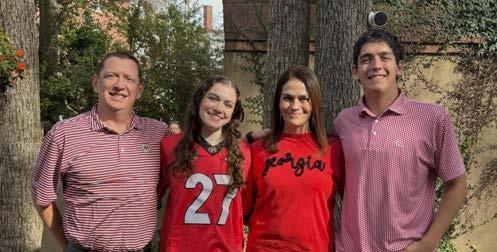
“When I think of the words fun-loving, I think of Bert that way,” Kuniansky said. “He’s the kind of person that you want to be friends with because not only is he always going to be a good time, but [he’s] always going to have your back.”
If my mom is at a party, it’s usually because my dad has dragged her there. She tends to sit on the outskirts of the craziness, preferring quiet corners as opposed to the center of attention. Smaller group social settings tend to be her preference, and she has never been one to turn down a quieter night in with a few close friends.
“[Robin] always impressed me because she went to Emory,” their long-time friend Sue Shields said. “She’s very smart, and the way she carried herself, and still does, with a level of class and sophistication which are, quite frankly, not the words I would use for Bert.”
They balance each other out and have met in the middle more over the years, becoming less different over the course of their life together. Bert has certainly calmed down — albeit not entirely so — and Robin has become much more outgoing since they first started dating.
Their differences have worked beautifully together for their 26 years of marriage, and their two children are a testament to how they’ve managed to stay true to one another. My brother and I are an obvious product of their successful relationship, and we’ve become two unique blends of both of their, sometimes starkly different, personalities and traits.
My brother Sam has my mom’s skin tone, but he is an identical replica of our dad in looks and mannerisms. He’s in the same fraternity Bert was at UGA and carries on the legacy of being an obnoxious football fan. He also shares some introvertedness with my mom and was definitely a more anxious, timid child, like she was.
I have been called my mom’s twin more times than I can count, and I’m following in her footsteps to become a teacher. I went to Camp Coleman for most of my childhood summers and participated in NFTY all throughout high school, just like my dad. He and I are also concert buddies, both sharing a love for music and expressing it similarly.
My brother and I have become an extension of their magical love story that didn’t end with “happily ever after” that summer day in 1999. Their love has never faded, and only grows stronger over the years as they started and kept a family and showed us what real, true love can look like.
We believe every piece of it, too. How could we not when we have the most perfect model right in front of us, not only exemplary in their marriage but also as the perfect parents to us. S
TheOn one Knee
It’s great to be here on Thanksgiving Day
To say I’m thankful in more than one way
Let’s relive a year and a half ago
Off to the beach with the youth group, you know
A Chorus Line - wow the offical date
And Football games now, I know you can’t wait!
Moutains and the Bay have been in between
Can you imagine the wonders we’ve seen
Now its round diamonds small tanzanites
White gold or platinum which one is right
This all leads in to an amazing plea
Robin Amy Bates, will you marry me?

LOOK BOTH WAYS
The chaos of being hit by a car
By Hailey Tessman

Red and blue lights make it hard to see. Blood is dripping down my forehead as I press a once-white shirt into it. The curb offers little support to my shaking legs and my numb hip. I can hear people shouting, asking questions, and my mom talking on the phone.
The only thing I can think is, “Why didn’t I look twice? Why didn’t I look to my right? Just why?”
Three hours earlier experience
The week before Thanksgiving is always long. By the end of it, my roommate, Abby, and I were ready for the quizzes, busy work and boring classes to come to a stop, even just for a short while.
There was a hockey game on Nov. 21, 2025, kicking off what was supposed to be a perfect weekend. We were two girls who may know little about hockey but love watching our team.
Except not this night.
The arena is packed to the brim, everyone standing shoulder-to-shoulder as people fight for seats.
“Are these seats taken?” a stranger questions.
“Unfortunately, I’m sorry,” I respond.
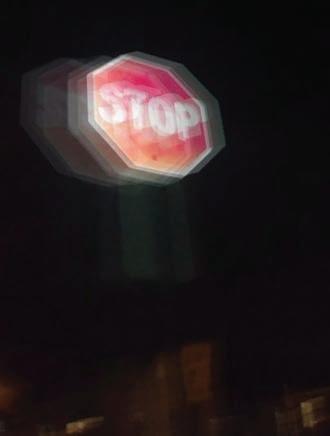
Saving three seats for our late friends turns out to be more stressful than we originally thought. The number of “Where are you?” or “Are you here yet?” texts sent becomes obnoxious.
The game turned out to be pretty boring. One team scored, then the other team scored. Typical hockey things.
At the end of the second period, Abby and I decide that we’re done watching. Our bodies were sore from the freezing rink, and our ears hurt from the roaring sounds of the game. We had been texting our friends who were at home that weekend and decided to FaceTime them back at Etheridge Hall, our dorm, only a five-minute walk away.
We start calling our friends as soon as the doors closed behind us. We are met with misty, frigid rain, and our eyes take a second to adjust to the darkness around us.
We aren’t the only ones running down the Goggin Ice Center stairs trying to avoid the rain, as others had a
similar idea of leaving the game early. We stop at the curb, and I put my phone down at my side. We were about to cross the street, so I couldn’t be focusing on that, right?
I look to my left and see the blinding headlights of a large white truck that stops for me to cross. Technically, the closest crosswalk is a block away, but no one uses it. Unfortunately, I forgot that there are two sides of the street.
I look back at Abby and yell, “We can make it!” Then I ran. Too caught up in my own mind. Too caught up in getting across the street.
Too distracted to hear Abby scream, “Car!”
Next thing I know, I’m sitting in the middle of the road. Something must have happened, but I can’t seem to remember. Where am I? What was I doing? The blurriness of my vision starts to clear, and the sounds around me come into focus.
“Hailey, you just got hit by a car.”
“Oh my God, you’re bleeding.”
“Should I call 911? I’m calling 911.”
“They are on their way.”
“I’m calling your mom.” Abby cries as she says all of these things. I get up and walk to the curb.
“What are you doing? Just sit still!” She says.
“I didn’t get hit, I don’t know what you are talking about,” I persist.
About 20 people surround me as I go to sit down on the curb. They were giving out free t-shirts at the game, and

Design by Madi Patton
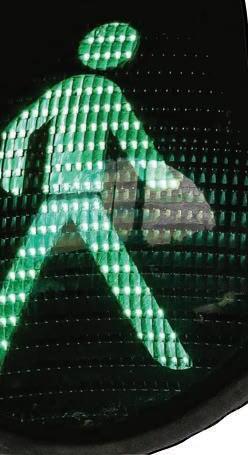
someone offers me one to hold to my forehead. The white shirt becomes bright red almost instantly. The color spreads through the shirt’s fabric in the blink of an eye.
My mom is on her way. No questions asked. Even though I messed up. Even though I’m the idiot.
The cops show up first.
“Can you tell me what happened?” they ask Abby.
“Hey, Hailey,” one of the officers says, squatting in front of me. He gives me a look over, then starts to ask questions.
“What’s your name?”
“Where are you?”
“What’s the date?”
“Who’s the president?”
Annoyed, I answer his questions, anger lacing every word.
Then the EMTS make an appearance. I tell them my hip is killing me, and they pull out the stretcher. They don’t know if I have any spine damage, so I’m put into a neck brace. Before I can ask what is happening, the stretcher is put into the ambulance and the doors close, blocking the blinding lights and the only familiar face I know.
Once the doors close, I lose it. My legs jump on their own from the adrenaline and anxiety rushing through my body. My tears that I bravely fought off the entire night spill over the edge. All I can think is, “Why is it so cold in here?”
They run my vitals and take tests. The head EMT comes over to talk to me.
“I don’t like hospitals,” I say while crying. That’s what I was worried about. Not the fact that I could be broken beyond repair, but that I would have to go to the hospital. I hate how dirty and cold they are, and my anxiety doesn’t let me step within 20 feet of one. I tell this strange man that. He laughed.
“No one likes hospitals, but we have to get you checked out,” he says while smiling down at me. He continues talking to settle my nerves..
“Where’s Abby? Is she OK?” I question.
“Did she get hit as well?” they concerningly ask.
“No, but she saw it happen, and I just want to make sure she’s OK, and I need her with me in the ambulance.”
I was just hit by a car, yet I had to make sure everyone else was OK first.
“She is fine, and since you are over 18, she can’t ride back here. Is it OK if she rides up front?”
I eagerly nod my head. I can’t stop shaking. The pain in my hip is starting to become more of an issue. The sterile lights burn my eyes, and the rain patters against the ambulance window. Goosebumps break out across my arms.
“Hey, Hailey. We are going to turn on the sirens as we take you to the hospital. This doesn’t mean that you are dying; we just need to get there fast. We are taking you to the UC West Chester Hospital.”
All I can do is nod again. And then we are off.
Forty-five minutes have never seemed that long before.
My dad and brother happened to be at a soccer tournament only 10 minutes away from the hospital. Once the ambulance doors open again, I see Abby and my dad. The tears restart. My dad reaches out and grabs my hand. His warmth travels through my arm instantly.
“I’m so sorry,” I sob.
“Don’t be sorry, Hailey.” I can see the love in his eyes.
Test after test after test. I’m put into an MRI machine, which isn’t good for someone who can’t stop shaking. My dad, Abby and I are put into a room in the ER as we wait for the test results.
“How close is mom?” I groan. Abby grabs my phone to check. She’s pulling into the parking lot. I feel the relief through my body. All I want is to see her.

After a couple of hours, the doctors return with my test results. I have a minor concussion and a fractured pelvis. However, they don’t have an orthopedic doctor in their ER to tackle my pelvis, so they have to transfer me. They schedule another ambulance to come pick me up and take me to the UC Medical Center ER. As we wait, the doctor stitches me up. She glues the gash on my forehead and my hip closed.
From what I can understand, my hip took off the car’s left mirror, and my head smashed the windshield. I am lucky that my concussion is minor. The doctor takes the time to explain how concussions are on a spectrum, and I am lucky enough to be on the lower end.
As I’m rolled into the new ER, my EMTs take bets on which room I’ll be put into. The nurses are extremely polite as we wait for the doctors to return later in the morning. My main nurse is wearing a tie-dyed Buc-ee’s T-shirt, which surprisingly calms me.


It’s 5 a.m., and we’re in a holding pattern. My dad returns to his hotel room, and my mom sleeps in a recliner holding my hand as I try to get the rest my body aches for.
Every hour on the hour, my nurse comes to check in on me. It’s hard to sleep with the heart monitor beeping loudly behind me. I don’t have a room with a door that closes, so the light peeks through the curtains. Finally, I drift asleep.
Roughly 7 a.m., we get the news we’ve been desperately hoping for: I don’t need surgery. I could go home. I’m given crutches and sent on my way. The walk out of the hospital is humiliating. I can barely move and have to be lifted into the car.
Abby left after the first hospital to pack my things so I could go home early for Thanksgiving break. After leaving, we drive to Oxford to grab my stuff, then head back to Columbus, a two-hour drive.
My life hasn’t been the same since.
I was on crutches for a solid three weeks. At home, it was a breeze. I just didn’t leave the couch. But coming back to campus was hard. I lived on the third floor of my dorm building. Before, I would try to take the stairs. Since returning, the elevator was my only option.
It wasn’t just my dorm. It was every building I had class in, too. I’d have to search for elevators hidden in the deep corners of buildings, on the verge of breaking down and smelling suspiciously of weed.
Luckily, I was able to drive around campus. I was given a temporary handicap placard that allowed me to park anywhere. This made my life somewhat easier. Especially since it was December and starting to get cold.
Somehow, I was able to maneuver around a campus that is definitely not handicap friendly. Sure, there are ramps and elevators, but they are so far out of the way that I needed extra time to get to my destinations.
But that’s not where the struggles ended.
“Oh, my God!”
“Are you OK?”
“What happened?”
Every time I entered a room, that was all I could hear. I was stuck in an endless loop of explaining one of the worst nights of my life
to all of my teachers, classmates and friends. I probably told the story hundreds of times. It was nice to know people cared about me, but I wish I didn’t have to be hit by a car to realize it.
Each time I explained what happened, people would gasp, cover their mouths and sit in silence. To be honest, I was still in shock too. But over time, I was able to laugh as I told the story. I got hit by a car and lived to tell the tale.
However, there’s one thing that people always get wrong about my story. You do not get free tuition — it’s a complete myth. What you do get is a ticket for crossing in an area without a crosswalk. Even though you’re the one who got hit by a car.
Now, months after the accident, I am on the path to full recovery. The saddest part is my handicap placard expires soon, and I will have to start walking to class again.
There is still something that doesn’t sit right with me. Sometimes, when I tell people the story, they will reply with a story of their own. Most of the time, it was a friend of a friend or just someone they had class with.
“Someone else I know got hit by a car, too,” and then they go on to explain all the gory details.
How many times is someone going to get hit by a car on this campus before something is done about it?
Cars often drive way too fast down roads filled with parked cars, making it difficult for drivers to see pedestrians. There are crosswalks, but not where students need them.
Something needs to be done before another person like me gets hurt. S
Something needs to be done before another person like me gets hurt.



Before she could conjure even a thought, she was handed a baby pink t-shirt with “Get Funky with Phi Sig” written in bubbled font. She threw it on and was herded through metal doors, toward the main gym floor where hundreds of sorority girls awaited their new members.
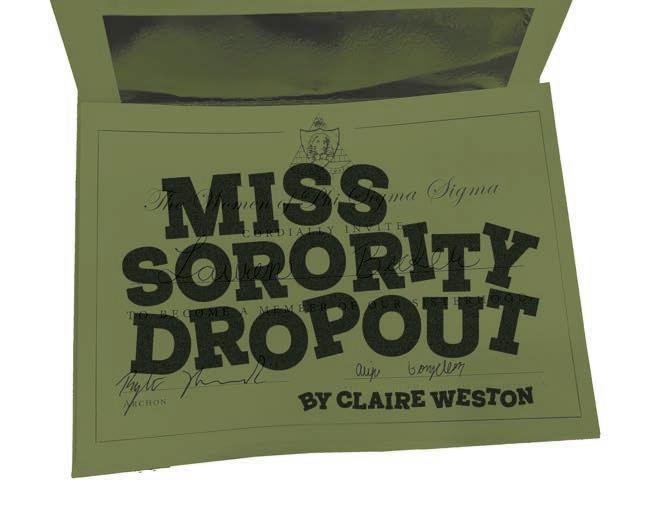
The crisp February day welcomed hundreds of college women, all bubbling with Bid Day excitement. Each one had waited patiently for today, when they’d learn which sorority accepted them as members.
Lauren Becker stumbled along with countless other girls as she entered Millett Hall, the basketball arena on Miami University’s campus. Every face she scanned held a bright smile.
As she walked inside, Lauren was handed a small envelope. It contained her new sorority, her new sisterhood.
Lauren peeled open the envelope and peered inside. She would be joining Phi Sigma Sigma. Shrieks and screams filled the air around her as other girls discovered their placements.

They were instructed to “run and find their sorority.” She was released with the screaming girls, dashing off, their eyes on a hunt. As they darted past her, Lauren couldn’t help but notice that some of the shirts resembled those of Dora the Explorer.
Lauren decided to walk.
She meandered along, scanning the colorful crowd in search of her temporary big. New members receive a big, an older member who acts as a mentor and guide. She hoped the girl would just appear magically before her. Lauren was 5-feet-9-inches tall and would later learn that her temporary big’s height reached 5 feet on a good day.
Once her temporary big finally stumbled into her, she ushered Lauren toward the Phi Sigma Sigma group. They
then walked to a dorm about a mile away and gathered to celebrate.
Upon arrival, she shuffled over to everyone gathered for pictures. The older sorority members shouted over cheers and screams. “Everyone smile!” Lauren tentatively flashed a smile as countless members held up iPhones.
When she finally left Bid Day activities — mouth hurt from smiling — she dragged herself back to her room.
“What did I get myself into?” she thought.

The pressure to join sorority life evaded Lauren when she started college. During her first fall semester, she could check off all the things that’d gone well.
No roommate issues. A fun group of friends. Easy enough classes.
She never planned to join recruitment, also known as “rush.” Anytime she imagined what sororities looked like, all she saw was plastic smiles, copy-and-paste blond highlights and enforced matching outfits.
Lauren thought about all the fake conversations, shallow compliments and social events she’d have to suffer through, all situations she’d be paying for. It sounded like hell.
Then, a friend approached Lauren. This friend was born and raised in California, just like her. Because of their similar experiences, she trusted her and, against her prior judgment, decided to hear her out about rushing.
The friend gave a pitch. Something like sorority life gives Lauren a chance to gain sisters and everlasting friendship. She could find her future bridesmaids, after all.
“Maybe I’m wrong about sororities,” she thought.
Lauren told her friend she’d give it a shot.
She returned to campus in late January after winter break, ready to begin recruitment. She attended meetings and sat amongst hundreds of girls watching highlight reels play on large, white projector screens. Each video had upbeat, preppy music blaring as countless girls flashed across the screen, each laughing or smiling.
After the meeting ended, Lauren filled out a form for each sorority that interested her.
“It’s like I’m applying for a job,” she thought.
She then ranked each sorority, and each sorority ranked her. If she and the sororities ranked the other well, she would get invited to attend the proceeding rounds.
During one round, the sorority paired Lauren up with an older member. As they chatted, Lauren brought up a series she’d loved since childhood called “Percy Jackson.” For the entire meeting, Lauren and the Phi Sigma Sigma member gushed about the series and how much they adored it.
A few days later, Lauren learned she had progressed to the final round of rush. After the final round, she visited a private room to place her “bid.” This bid was a formal commitment to the sorority that she felt best suited her. Each sorority would also decide if it wanted to bid for her.
A few weeks later, Lauren found herself at Millett Hall on Bid Day surrounded by hundreds of women, all awaiting their placements. That day it became official: Lauren Becker was now a sorority member.

Design by Caitlin Dominski
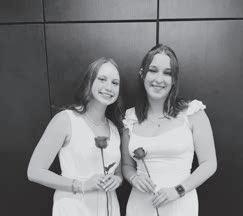
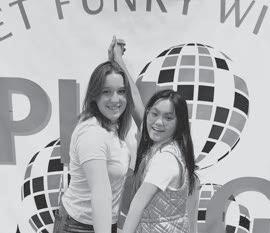

Photos courtesy of Lauren Becker
When her sophomore year began, Lauren moved into Minnich Hall, where all the other second-year Phi Sigma Sigma members lived.
Each Sunday, Lauren dragged herself down to the suite for the chapter meeting. She carried along a small brick, decorated with Phi Sig’s logo. She always had to wear her “fully initiated” sorority pin. Each meeting, she’d think about all the rules she’d been taught in the last year.
No joining other sororities. Never speak about initiation. Wear mandatory colors for every event. Never change your sorority family.
“It’s like I’m in a cult,” she thought.
One night, Lauren and her friends got ready for a fraternity party. She saw her roommate, Ana, sitting in the room. Ana was Lauren’s sorority “twin,” meaning they both had the same big in the chapter, so Lauren decided to ask her if she wanted to tag along; Ana agreed.
When the group arrived at the frat house, Lauren spotted Rylie. Lauren had befriended Rylie in her first year, along with another girl. They were a trio. The three girls hung out often, but Lauren noticed that Rylie began cutting her off, only asking questions to the other friend and shifting her body to block her from conversations.
Lauren had a three-strike system when it came to people hurting her. The first and second time something occurred, she’d share her feelings. If the person didn’t change their behavior, then Lauren would pull back from the friendship.
So, Lauren sat Rylie down twice.
Both times she told Rylie she never received invites, she was left out of conversations and Rylie never made efforts to hang out or make plans.
Both times, Rylie said she understood and that she’d do better. Both times, Lauren thought, “Maybe she’ll understand this time. Maybe she’ll act differently.”
Lauren waited. Nothing happened. No invites. No plans. No interactions.
“She didn’t do shit to change,” she said, and that was strike three. Rylie was out.
Now at the party, Lauren watched Rylie introduce herself to her twin, Ana. The pair laughed and joked around. They grabbed drinks together and ventured through the party side by side. It’d begun to feel like Rylie was the one who’d invited Ana, not her.
“I can’t believe she just stole my fucking roommate,” Lauren thought.
After that night, Ana never hung out with Lauren again.
Lauren’s room sat isolated and forgotten at the end of the dorm hallway. Her friends from her first year lived across campus, and Ana had begun to never sleep in the dorm. She stopped interacting with Lauren altogether.
Each morning, Lauren heard Ana walk into the room, change into a new set of clothes, grab her backpack and leave without saying a word. The slam of the door was the only sound exchanged between the sorority twins.
Each evening, Lauren trekked across campus, grabbed togo food, journeyed back to her dorm and ate by herself.
Each night, Lauren debated reaching out to her big. She scrolled through social media and saw her sorority sisters hanging out with their bigs, going out to bars together, eating dinner and going on trips.
Lauren was lucky if her big texted her once every few weeks. So, Lauren came up with a plan with her grand big, or “g big,” to have weekly “family” dinners.
Each week, Lauren texted her big and her twin Ana, asking them to join. Each week, Lauren showed up to dinner expecting her big and twin to arrive. Each week, only Lauren and her g big came.
Each week, Lauren thought, “Why is the one person I’m supposed to be close to not showing up for me?”
Strike one for Phi Sigma Sigma.

That same semester, she visited the Mega Fair in hopes of making new friends. She found herself in front of the club rowing team’s table after the team’s vice president called her over. She’d invited Lauren to a “Learn to Row” event later that week.
At the event, Lauren found herself surrounded by support. The rowing team pushed her to row faster and to try her best, even as strangers. At roughly 9 p.m. that same day, Lauren heard a knock on her door. As she cracked it open, 20 voices began to cheer and yell out.
She’d made the team.
A few weeks after joining the rowing team, Lauren pulled up a Google Form titled “Phi Sig Executive Board Application.” She submitted an application for three different roles.
Early in the semester, Lauren had attended multiple Panhellenic outings and conferences. At each event,
she connected with other sorority sisters, but when she returned to campus, she’d never hear from the girls again.
“I just want to feel like I’m a part of the chapter,” she thought.
A few weeks later, Lauren hung up a phone call with words she’d just heard echoing around her mind. “I’m sorry, Lauren,” her sorority sister said. “You didn’t get an executive spot.”
Strike two for Phi Sigma Sigma.

Halfway through the semester, Phi Sigma Sigma hosted a joint social with the Sigma Alpha Mu fraternity at Sushi King.
Lauren had to be a “sober sister,” meaning she wasn’t allowed to drink, and her attendance was mandatory. She and the other sober sisters were the only chapter members at the social.
“This is so sad,” she thought. “No one talks.”
She made an early escape thanks to the rowing team’s party the same night and felt a complete shift once she saw her teammates.
Everywhere she looked, she saw teammates interacting with each other. Laughter could be heard all around. One member even whipped out a saxophone and began serenading the crowd.
“This is night and day compared to Phi Sig,” she thought.
When Phi Sigma Sigma recruitment began that spring, 19 new members joined — the smallest amount in recent years. Lauren wondered if the sorority’s reputation led to low numbers. The chapter was known as “Bi Sig” because they had a higher percentage of queer women compared to other sororities.
Sorority executives decided to implement a new style for big-little “dates.” Dates were usually individualized; one new member and one older member met up to gauge compatibility. Now, two new members would be paired with two older members.
“If I get a little, I’ll stay in Phi Sig,” Lauren thought.
Each date Lauren went on, she tried to connect with the
new members, but often found herself being talked over. It felt pointless; she just couldn’t make any connections.
A few days later, her phone lit up with a notification. It was a short text message.
“Hi Lauren, I’m sorry, but you didn’t get a little this time.”
Strike three. Phi Sigma Sigma is out.

Lauren fired up her computer and wrote out a simple email to Phi Sig’s secretary.
“Hey, I won’t be returning next semester.”
The reply was instant, “Oh no, is there anything we can do?”
Lauren didn’t respond. That evening, she left the chapter Snapchat group chat. She knew it would send a notification to everyone saying, “Lauren Becker left the chat,” so after she clicked the red “LEAVE GROUP” button, she checked her notifications.
No messages. No calls. No one asked why she left. No one asked if she was OK.
“I guess they didn’t really care,” she thought.
The rest of Lauren’s spring semester went swiftly. Rowing team events picked up, so she dove straight into them. Her teammates often called and made plans with her. Every week, Lauren attended team dinners after practice and would go out to bars with her teammates.
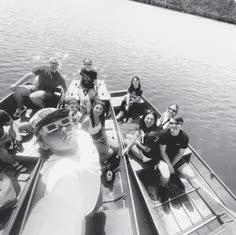
Socials were often planned. Everyone was invited, and all drinks were free, since she paid her club dues. Each time Lauren arrived at an event, she’d hear a string of greetings.
“Hi, Lauren!”
“Lauren’s here!”
“I’m so happy you’re here.”
“Maybe being a dropout isn’t so bad,” Lauren thought. S
1 Vignettes The Miami Student Magazine
Make your bed
By Emma Touchard

The alarm goes off at 6:30 a.m. For a moment, we lay still, staring at the ceiling. We will roll over and open Snapchat, TikTok and Instagram for everything we might have missed during the short six hours of sleep we received.
We shut off our phones and lay in bed briefly before stepping out for the day. While brushing our teeth, we think, “I’ll apply to that job tomorrow,” “I’ll start going to the gym Monday,” “I’ll go once I feel more ready,” “I’ll pick up that hobby once I have the time.” All of these promises I make to myself, yet get lost in wanting, before I do the achieving.
The phrase “the right time” echoes in our thoughts. Constantly waiting for the right time appears as a productive mindset and a good idea.
We convince ourselves we just aren’t ready right now, and that it’s okay. But in reality, it’s just stalling. “The right time” remains out of reach, always tomorrow, next week or next month.
/vin.yets/ plural noun
A collection of brief stories that provide a glimpse into the lives of different students
Behind us, our bed remains unmade, which seems insignificant, but it keeps the door open for not now, but later. Growth rarely begins with big, dramatic changes and decisions. Most often, it begins with something small.
We could turn around, grab the pillows, straighten the sheets, then two minutes go by and it’s done. It seems like such a silly and small chore, but a positive change has been made. Our room is put together. We feel put together. A substantial change doesn’t occur, but internally, we chose action over procrastination. It reminds us that progress doesn’t always require hours of effort, but just starting.
Making our bed is a physical reminder that something can be completed before excuses and “the right time” thoughts go silent. It becomes the first step toward accomplishing other things we’ve been putting off for weeks.
Design by Claire Latham
If we complete one simple task in two minutes, maybe applying for that job isn’t as overwhelming as we thought. Sit with the idea that maybe starting that new routine or trying something new doesn’t have to wait for the perfect moment.
There’s a quiet relief in finishing something so early in the day. It feels productive, proactive, like we’ve already taken control of the morning.
Moments like this remind us that action is much easier than the anticipation of it. Have you ever started off the day, remembered 10 things you have to do, then got back in bed because of the rush of overwhelming pressure hitting you? It’s real, but it’s only worse to avoid it.
The tasks we put off for weeks aren’t impossible; we’ve just convinced ourselves they are and that we will “do them next week.”
Starting with something simple makes the next step feel much more manageable, then suddenly the day feels full of possibility instead of delay.
Sometimes it starts with something as simple as a blanket and a pillow. S

By Anastasija Mladenovska
Universities talk about belonging as if it were a value, but the summer I couldn’t pay rent, I learned it often is a privilege.
At first, I didn’t tell anyone that I might not be able to pay rent while living at Tthe Verge last summer.
I kept going to class. I answered emails. I did my job. I smiled when people asked how my semester was going.
Campus didn’t notice. They rarely do. The emails kept coming: deadlines, opportunities, reminders about belonging. Everyonething assumed you had somewhere stable to sleep and the money to keep showing up.
I remember sitting on my bed, phone in my hand, staring at my bank account like it was something I could bargain with. I felt embarrassed by how small the numbers were.
The truth is, as an international student, you don’t really have an option. Going back costs money, too. You figure it out. You ask for money. You explain yourself. Sometimes you beg, even if you don’t call it that. You learn how to turn panic into emails that sound calm. You learn how to make fear look professional.
“I don’t have money for rent.”
“I don’t have money to come back to campus.”
I remember the words coming out wrong, heavy, like they didn’t belong to me. Asking felt awful.
The first time was the summer after my junior year, and the Honors College stepped in. The second time was the winter of my senior year, and the Department of Political Science stepped in. This kind of help doesn’t fix everything, but it changes the direction of your life. For a moment, it makes you believe in institutions, in the brick walls behind them, in the idea that someone is actually paying attention.
But I always think about my first year. The truth is, I’ve been poor all four years of college.
My department awards scholarships every May. In my first year, I applied. I didn’t get anything. In my second year, I applied again. Same result. Then, in my third and fourth years, I didn’t even apply, and I received two different scholarships.
My financial situation hadn’t changed. The difference was visibility.
By then, people knew my name. My work was recognizable. I had pushed myself far enough that I couldn’t be ignored. And that visibility came at a cost, being told I was doing too much, that I was unfocused and that I needed to narrow myself.
International students don’t get to quietly struggle. You make yourself visible, or you fall through the cracks.
There is a lot of talk in academic spaces about independence, self-sufficiency and grit. Those words sound neutral until you are the one who cannot afford to fail quietly. I learned how to look stable long before I actually was. I learned how to translate fear into productivity. I learned which parts of myself were acceptable and which had to stay hidden. Precarity teaches you that quickly.
What I didn’t understand, until these two moments, was how fragile belonging really is. How often it has nothing to do with merit, and everything to do with visibility, timing and connections.
As I prepare to graduate this May, I don’t think about my time here in terms of achievements or milestones. I think about how close I came to being unable to stay, not because I wasn’t capable, but because I was poor, foreign and one emergency away from being filtered out.
Belonging, I’ve learned, isn’t guaranteed. It has to be fought for, asked for and, too often, earned simply by refusing to disappear. S
3
Unsent email
By Maureen Wilson
I might need prescription glasses due to the amount of blue light I subject my eyes to at night. I’m either on my degree audit, Google Calendar or some paper I don’t want to start and won’t until two hours before the deadline.
My roommate was fast asleep, all too familiar with the busy work I do after hours. When I’m too tired, I write emails. It’s fun to pretend you’re actually productive — to draft them at 2 a.m. and have them delivered at 7:30 a.m.
My phone was left open to a text from my sister hours ago about how an old teacher of mine was substituting for her class. I knew her for five years — had her twice for English — and she was my primary reference for high school internships, scholarships and even college applications. Apparently, she’s still waiting for an update from me.
I’ve been busy, but not enough to forget. Moving my cursor to the body text of a new message, I thought it wouldn’t hurt to try. What I ended up typing wasn’t technically a lie.
Good morning,
I hated poetry until I was in 8th grade. I changed my mind after being assigned to analyze Edgar Allan Poe’s “Annabel Lee.” Something about the repetition and rhymes captivated me. She was my teacher back then, too, when all the classes were on Zoom, and participation was at an all-time low.
I know this is out of the blue, but…
I still don’t know why that was what convinced me of creative writing as a form of self-expression. Maybe I felt comfortable in her class, which had serious discussions about ripped kangaroos and played trap Christmas music in the background once the season came around. Our class loved to go on tangents, and I remember once she off-handedly mentioned she was in an English academic fraternity in college, along with Irish dancing.
It was random, but I remembered that. Though I can’t dance, I did join Sigma Tau Delta. During recruitment, I couldn’t help but mention her to the active members.
… do you have the time to talk?
I can’t forget when I last saw her. I begged my dad to let me back into the crowd exiting en masse after my high school graduation ceremony. Everything felt anticlimactic once I tossed my cap, though I knew I’d regret not being sentimental. I had a card to give to her, which had pen marks essentially debossed from overwriting. It wasn’t memorable as I anticipated I’d eventually follow up.
I’ve been hesitant to reach out, so I thought maybe we could do a video call or…
I’ve changed my major at least three times and dropped two minors. Even my friends can vouch that they’re not
really sure what I’m doing most of the time, other than writing. So surely, people don’t mean it when they want an update on your life. Then again, I’ve convinced myself before that nothing newsworthy happens in my life when she’d be willing to listen. Who knows? Maybe she was also lost coming into college, even if it seems hard to believe now.
…I could visit the creative writing class you started this year.
I can’t stop my middle finger from rolling back the backspace button, but I got further than I expected. My head is starting to pulse from the eye strain, which is my cue to shut off the lights and let everything go quiet.
It’s the first step of opening up, even if I don’t know it yet. S

By Kylie Bunn
Sorority recruitment is stitched tightly into the social fabric of Miami University. All 18 chapters encourage women to be a part of a sisterhood that is empowering and close-knit. With this comes a journey that each girl must go on to find the group that is right for them. Beyond the conversations and decisions, recruitment is a series of carefully curated fashion performances where clothing becomes part of the narrative.
There are four rounds of recruitment that each come with an expected dress code. These guidelines encourage a level of formality and professionalism, ensuring potential new members (PNMs) are able to present themselves appropriately. But when more than 1,000 women are following the same criteria, the question of individuality inevitably arises.
Welcome Round comes first and brings on a lot of matching sets and messy buns, to look comfortable and cute. There is a relaxed vibe, but still an expectation to be put together. Because PNMs are simply watching videos of the various sororities to later rank them, the fashion does not hold as much importance. That being said, this would be the first impression among peers who are also rushing, so the pressure remains.
Philanthropy Round is the second phase of rush. There is a finer line on what is suitable for the event. Stakes are higher while meeting active members face-to-face for the first time, and making a good first impression is crucial.
Although every PNM is given the same shirt, this is a prime opportunity to uphold self-expression in unique ways. Whether it be a long skirt, patched vintage jeans or linen pants, each one showcases its own vibe to be paired with how the individual wants to express themself. Another way of doing this would be fun, loud jewelry or kitten heels. Every element, big or small, can be considered as a way to break from the seemingly narrow dress code.
In the last two rounds, Sisterhood and Preference, there is an expectation to appear more formal. Sisterhood has a delightful tone with floral or light colored dresses and a cutesy brunch vibe. This style reflects the purpose of the round where PNMs are introduced to the sorority’s values, character and bond. Preference has a heightened need for this formality, with cohesive, subtle colors and orderly dresses, which mirrors the intensity of the final round, where more intimate connections and hard decisions are made.
Standing out during an event like recruitment can be intimidating, especially with heavy emphasis on presentation and first impressions. The desire to fit in and belong clashes with the importance of being a unique individual. But authenticity holds power, and when conversations are brief and judgements are formed quickly, being genuine will be at the forefront of what is remembered. S
By Becca Blanco
‘Appstinence’:
Taking your life back one screen at a time












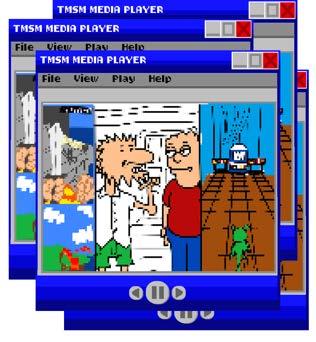






not consuming some form of digital media? What ideas would you have, what doodles would you scribble in the margins, what kinds of hobbies would you pursue if you reduced your screen time by an hour each day?
Despite your hectic life, you find time for scrolling. You make time for it. Or, at least, I did.
Lately, I’ve been reclaiming what has always been mine: time. I realized I didn’t really know myself outside my preferred flavor of consumerism (the type of miniskirt I own, my favorite energy drink, the shows I enjoy).
I’ve been doing the things that people wish they had time for — reading, journaling, exercising, organizing, mailing letters, beating unfinished video games, happily assisting my parents with menial tasks and, sometimes, nothing at all.
The best part is not about optimizing your life and fully utilizing your time. It’s just about living.
Often, I found myself rushing through my real life so I could lie in bed and mindlessly scroll to “decompress.” I was living to earn screen time. What do you plan to do with all the time you save cutting corners, avoiding awkward silence, skimming texts and copying answers? Is consuming media alone in your room really a healthier use of your time?
Why not read the entire chapter you were assigned for class? Why not have that silly conversation? Why not practice that hobby you’re awful at? You’ll find much more rewarding pastimes offline, I promise.
You are so much more than a data mine. Your time on this planet is finite.
There’s an interview with Bo Burnham, a musical comedian who found fame online at a young age, where he contextualized addictive social media algorithms.
“It’s because these companies like Twitter [now X] and YouTube and Instagram and everything, they went public, and they went to shareholders, so they have to grow,” Burnham said in the interview. “Their entire models are based on growth; they cannot stay stagnant … No matter how nice it’s trying to be, they are trying to get more engagement from you …”
He goes on to analogize attention spans as the next fertile lands for colonization, arguing that megacorporations essentially want people to be online as much as possible so they can build a consumer profile and efficiently target ads. Revenue, after all, is the main goal. The user’s well-being is not.
I’m not saying you should delete your social media accounts entirely. I haven’t done that. There’s nothing wrong with wanting to check in on acquaintances and send memes to your friends captioned “usss.” I’m saying it’s also important to be aware of all the little ways your apps monopolize your attention and steal time away from your life.
If you’re like I was and you secretly admire the chronically offline population, know this: The only person capable of making a meaningful change is you. Your algorithms will continue to adapt to your preferences, and your feeds will likely never be less appealing.
Get your friends to join you in your quest for offlinehood. Oftentimes, sticking with a new habit feels easier in groups. In the book “Cultish,” Amanda Montell wrote that habits are statistically much more likely to stay if they’re done in a group (not that I’m equating TikTok to cults, though there are some surprising similarities, like the use of coded language, including buzzwords, trending audios, meme templates, etc., to signify a special in-group status).
After I deleted my addictive apps, my best friend did the same. Now, we send each other long articles to read, recommend books, doodle, sit in comfortable silence, write creatively, exercise and talk about meaningless drama. I include that last item because I want to emphasize that there is still plenty of room in your life for frivolous fun without social media.
If you have no idea where to get started, remember to ask yourself what things you aren’t making time for now. What kinds of routines are in your ideal future?
Delete social media from your phone for a start, or set screen limits and give only a trusted friend the password. Set goals for yourself. Apps like Steppin and Steptime allow you to unlock screen time based on your movement




Design by Keegan Perez

for the day. Campaigns like appstinence.org can provide you with a community, support and a step-by-step plan for reclaiming your time.
Fill your free time with fulfilling activities instead of buying trendy products in the hopes of feeling like you’re part of a larger community. You are a human being with interests, experiences, intelligence, creativity and stories. You have inherent value. Trends and TikTok catchphrases won’t change that.
Shower the people in your life with love. Handwrite thank-you notes. Have hobbies. Be bad at them, be terrible. Free yourself from the crippling fear of cringe. Fill your time with formation and feeling, and let security seep back into your life.
You can do it. Allow yourself to believe it. I did.


“Awarding yourself a sensation of success through consuming and creating a worthy algorithm makes social media feel more gratifying than it really is.”




By Kathryn Hippe
Seeing beyond the surface: The stone facades of Florence
Jan. 1
I always feel safe when I’m traveling, running. Like I’m in protective bubble wrap — or like I’ve found a spot of land off the coast with a breeze. Loneliness, freedom, sometimes they feel the same to me.
As usual, my thoughts bled into ink on paper as the airplane carried me between the converging and diverging planes of my life — what has been and what will be. Back home, everything had a way of continuing, like a conversation never fully settled for the night.

I glanced up from my fervently scribbled notebook, my head resting against the foggy glass barrier between my small, havened capsule and the endless starry expanse. At 7:19 a.m., a beam of yellow and orange surfaced through the sea of clouds.
Somewhere underneath that horizon waited Florence.
Jan. 5
I fiddled with my pen as my “Food and Travel Writing” professor outlined our study-abroad final assignment. I jotted phrases along the margin of my notebook: creative nonfiction, sensory observation, avoid clichés, how have you changed as the setting changed?
Something in me scoffed, though I wasn’t sure why.
Jan. 7
The humid air clung to my cheeks that morning, gathering at my nose and flushing my skin pink. A shiver slid down my spine and settled into the ache of my back — the kind of gnawing cold that pulls moisture from the air and exhales an icy breath across your skin. My thoughts wandered as we rode through Tuscany’s winding roads on the tour bus. The hills rose around us, my view obstructed by frosted trees and a winter wonderland.
Tour guides and civilians alike kept noting that the snow was the first in 10 years. I felt like I was a part of something rare, a brief break in my alienation as the Tuscan natives and I witnessed something new together.
By 2 p.m., my peers had given up on finding open restaurants. We knew, in theory, about the midday rest, but only then did we fully understand it. I watched them sit and wait, like children after a long school day.
I observed the quiet town of Pienza as if it were a specimen sealed under glass — stone facades frosted white, shutters drawn, streets emptied and still.
I had written plainly in my journal:
In between lunch stop @ some small town w/10 min radius: —wandered the abandoned town, visited humble churches w/ beautiful prayer rooms —everyone was cold and bitter. I loved it though —i love the towns outside the city that haven’t adapted to tourism
I sifted its grounds for what I had decided must be “real” Italian culture, as though it had frozen itself in place, waiting for someone willing to squint hard enough to separate the picturesque from the authentic. And yet, I was already framing it into a picture of my own.
Jan. 10
Rome came and went in one sentence.
With a 7:48 a.m. train ticket and a 9:33 a.m. arrival, we breezed past cathedrals (very big, very pretty) on the way to the Colosseum, scurried to the Roman Forum, spent “enough” time there, rushed over to the Trevi Fountain (had my Lizzie McGuire moment), watched the Pope come out in front of the St. Peter’s Basilica (I took a video and will brag about seeing the Pope), moved through the Vatican museum’s labyrinth of hallways (picture, next; picture, next), complained about missing the Palatine Hill and the Pantheon, took a taxi back to the train station for the 9:48 p.m. departure and, by 11:30 p.m., collapsed into bed.
Thirty-five thousand steps, toes bleeding and a haphazard blur of artifacts behind me, Rome felt less like a city than a montage — monuments flashing past in six-second clips. In a single breath, Caesar’s words seemed to narrate the itinerary: I came, I saw, I conquered.
My eyes squinted, trying to see what everyone else did. The towering pillars of the Galleria dell’Accademia pillowed my senses. Hushed voices folding neatly into the corners, shuffling feet, flashes of cameras and dozens of doe-eyed, vacant stares, all orbiting on the Renaissance prize at the center of the room: David.
Some visitors scribbled feverishly in notebooks at the edge of their seats; others flocked to the marble statue like vultures claiming a retrospective badge of intelligence. Some whispered in corners, tracing the veins in his limbs, the soft tuft of curls of his hair, the muscles coiling around him like vines. But I had seen only a man whose story was in some faraway land, and whose victory was one I did not share. I cleared my throat and also began flocking.
David: —powerful stance, leaning back —from left side — looks so confident + assured —from right side — eyes look weary, scared even, lips pressed, shrinking back, clenching rock —a lot of people here are David Michelangelo
Design by Sydney Mulford



Niobe with her youngest daughter Artist Unknown drawing the art. others are taking notes. I wonder what they’re thinking about —when the David is all you see, you look @ it for 10 min —when you’re in a room w/dozens, you breeze past each one
Jan. 14
I didn’t begin to value homecooked meals until I came home from college for the first time. Those microwavable, pastaand-butter (maybe) salted dinners thrown together in 10 minutes to keep me alive were less of a meal than a function. So when I walked into my pastamaking class, it wasn’t the pasta that made my stomach rumble — it was the aroma of spices filling the air.
We pressed past our hunger at the 8 p.m. time stamp, hands busy with the slow mechanics of kneading dough, separating it again and again into long, rolled sheets. Vegetables were sliced and piled into a pot, then left alone to soften and simmer. Wine lingered in the air. I drew its sweet, tangy scent toward my nose with the guide of my hand. Flour crusted beneath my fingertips.
We sat down to eat at 9 p.m. The pasta was far from Italian cuisine; though, smiles lingered, aprons slipped off and hung back on their hooks, and we enjoyed what we had created together.
For a moment, the room felt strangely familiar, as if a word from English class had suddenly taken shape before me — “proustian,” the way smells evoke memories.
Jan. 15
During class, we read John Berger’s “Ways of Seeing.” His words clung to me as I wandered through the quieter edges of Florence. My camera drifted toward the motorcycles lining the pavement, the damp clothes hanging limply on balconies — mundane nuances that wouldn’t appear in the postcards.
Perhaps there is a quiet arrogance in believing only the monumental is worthy of notice. As Berger writes, “We only see what we look at. To look is an act of choice.”
Jan. 16
Everyone knows of Vivoli’s famous affogato. Though hardly the inventor of espresso and gelato, it had become
an aesthetic target of the media’s gaze: a tiny medieval window repurposed for Instagram snapshots, everyone outside photographing cappuccino mugs balanced neatly on their saucers.
The line wove lazily through the store and out the door, gathering visitors itching to taste the fame. I extended my hand, positioning it for the barista to take my ticket, when gasps and giggles pulled my eyes upward, landing on a decadent chocolate cake ringed with small candles being carried behind the bar.
The giggling employees flocked to the cake, lighting its candles, and as if on cue, the choir began: “Tanti auguri a te, Tanti auguri a te …” and surely enough, one of the male employees entered from the corner of the room, shock and bliss melting perfectly across his face.
My ticket felt heavy in my hand. I could feel the toes tapping behind me, arms crossed, faces drawn long, impatience dawning like a ticking clock.
A pop snapped through the air as an older employee burst out laughing. “Who wants prosecco?” she announced to the waiting customers, deep crevices lining her face from beaming. The handful of 10 or so employees began taking pictures, selfies and videos with their birthday boy, and before I knew it, a smile of my own mirrored theirs.
I had forgotten entirely about my delayed affogato.
Jan. 17
There was a break in winter’s chill — 60 degrees — and everyone emerged from hibernation to bask lazily by the riverfront, bottles of wine and panini in hand.
Last night’s wine pressed at the crown of my head. A dull clarity settled in, easing the pressure of the inevitable question waiting back home: How was your trip? Oh — it was a movie!
I left my apartment anyway, chin tilted upward in quiet defiance. For a moment, I stopped looking for anything more, letting my feet wander.
A deep puddle splashed, reeling me back as I cut through a back alley. One window caught my eye — books lined the ledge beside a small sign that read, “Art books chosen by artists.”
The concept alone carried my feet to the door, where a small café sat inside. I journaled for a couple of hours before asking the chef for an Aperol Spritz, my waitress nowhere in sight.
“You don’t ask the chef for a drink,” she noted when she finally returned, a light scuff in her voice.
Heat rose to my cheeks, faint amusement tugging at the corners of my lips.
All that commotion for an Aperol I didn’t even like.
Jan. 19
In “The Art of Travel,” Alain de Botton writes that the “twin purposes of art” are “to make sense of pain and to fathom the sources of beauty.” It seems fitting that when we travel to “find ourselves,” we are often met with a mirror.
I had felt that uneasy clarity as I stood before Michelangelo’s David. I tried to meet him with the neutral gaze of a viewer. Instead, it was as if I had been stripped just as bare. “What is it like to stand there as yourself?” My professor’s voice echoed in my ear.
Though our differences in nature were obvious, for a moment, our diverging planes seemed to converge. Faceto-face, we stood frozen, as if caught in a quiet exchange across centuries.
We like to imagine our sight is objective, like a camera capturing an image. But we are not cameras, and our sight never arrives alone.
Perhaps this tension is what made the statue so compelling. Scholars have noted structural weaknesses in the marble — small crevices beginning at his feet that would one day bring the marvel down. As Sam Anderson writes in a New York Times article in 2016, they suggest a strange destiny, “Not to stand, but to break.”
Jan. 20
Renaissance: rebirth — a rediscovery of the greats.
As I stepped onto the street, I realized the word was less a historical term than a process we live through. The breeze was brisk, the city unfolding with each step. I took the route my feet knew — past the cluster at the bus stop and across Piazza Santa Croce, its shadow tall and arching.
Sam Anderson’s piece lingered, almost invasively, in my mind. In “From Marble to Flesh,” art historian A. Victor Coonin describes Michelangelo’s David as emerging “like a person being slowly revealed as water drains from a bath” — a line Anderson and I both return to.
Days had gone by since then, standing defeated in front of his gaze. Yet Florence herself seemed to share something with the marble that defined her. The longer I roamed her streets and learned her rhythms, the more she slowly drained herself — her stone facade giving way, her glass-exhibit sheen dissolving.
The glamor faded.
Like David revealed beneath the surface of marble, we, too, are not so much rediscovered as revealed. I arrived searching for transformation — some sort of reconfiguration of the self that only the Italians can cure.
But the small disorientations of travel worked slowly, like a growing pain, peeling back the thin linings of my familiar facade. What remained was not something new, but something steady, exposed and quietly ordinary.
Firenze had not changed at all. I had only learned to see her.
At the bottom of the page, only one line remained,
I heart Firenze S
Abduction of a Sabine Woman Giambologna


Across Down
Miami men’s basketball shooting guard who famously said goodnight (pg. 24 )
Not named or identified
An organization of sisterhood
Money given to a student to be used to academic expenses
Travis ______, coach of the Miami men’s basketball team
Married to 30 down (pg. 42)
Something done or given for humanitarian purposes; one of the rounds during sorority recruitment (pg. 56)
A compulsion to do or use something that is bad for you repeatedly
A person born on the same day as their sibling
A famous destination in Italy; where writer Kathryn Hippe went to study abroad
Men armed with weaponry, usually riding a horse; often seen at renaissance fairs
A request for something; sororities ___ on potential new members
A knitted piece of warm weather clothing; one of the three items Solomiia took with her (pg. 17)
What Miami University men’s basketball was in the regular season
A popular sport that caused Millett Hall to have record-breaking attendance this year
Something that can be measured in hours or minutes
A sport in which that athletes use oars to steer a boat, often done in a team
A term for the duration of usage on an electronic device when before 16 across
A famous statue by Michelangelo; the figure depicted on pg. 63
An injury to the brain resulting in confusion or altered mental state
A greeting used when inviting a person into a home or establishment
The capability of being noticed; vignette writer Anastasija Mladenovska says this characteristic is important for students who are struggling
A tally representing an error; Lauren Becker has a three _____ system
People with the same parents as you
Make your ___! (pg. 53)
A set of rules a machine follows to display content
The poem references this popular U.S. sport (pg. 32)
White precipitation that falls in the winter
An autobiographical record of a person’s day; a diary
Becoming more mentally or physically developed
A form of online communication that resembles a letter
Clothing worn on a person’s feet; one of the three items Solomiia took with her (pg. 17)
With 38 down and 31 down, the name of a popular Oxford business; A large woody plant with many branches
A large, red, octagonal sign
A 14th-15th century European
movement that marked the revival of arts and literature
The name of the bride in the cover story of this issue
With 38 down and 27 down, the name of a popular Oxford store; a small, curated shop
An assistant to a knight
Relating to multiple nations; Anastasija Mladenovska is this type of student
A request for marriage; 6 across did this on Thanksgiving
A popular college app where anyone can say anything anonymously
A rectangular electronic device that has a touch screen; one of the three items Solomiia took with her (pg. 17)
A vehicle that arrives to an accident and transports people to a hospital
With 27 down and 31 down, the name of a popular Oxford business; a fruit that comes in red, green or yellow
The opposite of night; the event where sorority invitations are extended when following 12 down
A mental state or attitude; 24 down is a type of this
Caitlin Dominski & Shannon Mahoney



While reflecting on Volume 18 of The Miami Student Magazine, I am so grateful for everyone’s hard work.
Designers, I am continuously blown away by how strong your designs are and how much they impress me.
To my executive board, thank you for all your hard work. Caitlin Dominski, I am so grateful for all you have taught me about design and what you have done to make this magazine what it is. Stella and Taylor Powers, thank you for all your hard work and for keeping everything on track.
To the writers, this magazine would not be here without you. Your stories drive us to learn new things, reflect on ourselves and push creativity in our designs. And, of course, thank you to the editors for making sure the stories were refined and ready for publication.
Finally, thank you to all the other faces that made this magazine what it is. Thank you to Kiser Young for running our social media, Austin Smith for helping us stay within budget and Sarah Frosch and Gabrielle Wehrman for photographing our staff headshots. This wouldn’t have been possible without all of you.

Sydney Mulford Art Director
I joined The Miami Student Magazine (TMSM) in the fall of 2022, my first semester of college. Four years have now passed, and I can proudly say that I’ve designed nine stories, art directed three issues and am the first person — writer, editor or designer — to have been a part of eight consecutive issues (not to brag or anything).
“True Love” is my final issue, and it could not better sum up what I feel for this incredible organization. TMSM has taught me so much about design, and I am endlessly grateful for all of the incredible people I have met along the way.
To Stella and Taylor Powers — It has been a blessing working with you these last couple years. Keep up the hard work: I can’t wait to see what next year brings.
Sydney Mulford, my design partner-in-crime! I have loved every moment of designing with you and wouldn’t have wanted to lay out two publications with anyone else.
My previous Art Director, Caitlin Curran, also known as the other half of the amazing Caitlin design duo! I’m so glad you jumped headfirst into magazine design with me. I learned so much from you and am so happy to have worked together.

At TMSM, we are always seeking talented writers, designers, editors and photographers to bring our pages to life. Are you passionated about crafting captivating stories, creating sunning visual designs or polishing content to perfection?
If so, we want to hear from you!
And, last but not least, Macey Chamberlin. Thank you, thank you, thank you for asking me to be a layout designer four years ago. I would not be the designer I am today or be able to call TMSM my family without you, and for that, I will be forever grateful. scan for more:

Caitlin Dominski Art Director