ESTABLISHED 1826 — OLDEST COLLEGE NEWSPAPER WEST OF THE ALLEGHENIES
Volume 171 No. 1
Miami University — Oxford, Ohio
BACK TO SCHOOL EDITION
Students and staff advocate for environment in arena project plans
‘ The heart of Hepburn’: Building Grounds Associate dedicates 24 years to Miami ZOEE ROBINSON STAFF WRITER
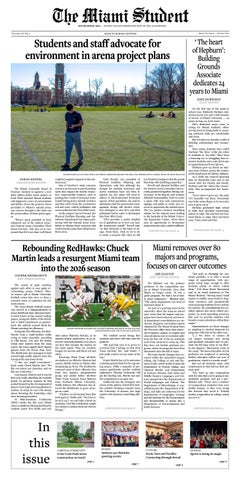
STUDENTS RELAX ON COOK FIELD LAST SPRING SEMESTER BEFORE THE AREA WAS PERMENANTLY CLOSED. PHOTO BY SEAN MCGLYNN
SARAH KENNEL
GREENHAWKS EDITOR The Miami University Board of Trustees’ decision to approve a new $281 million dollar arena project on Cook Field shocked Miami students and triggered a wave of conversation and debate. Given the project’s direct proximity to Miami’s natural areas, one concern brought to the table was the preservation of these green spaces. “There’s great potential to have enhanced use of the natural areas,” said Natural Areas Committee Chair David Gorchov, “but also we’re concerned that if it’s not done well [there
could be] negative impacts to the natural areas.” One of Gorchov’s main concerns was how an increase in paved parking spots may impact the nearby ecosystem. Impermeable surfaces, such as parking lots, result in increased water runoff during heavy rainfall. Gorchov said this could erode the ecosystem’s soil and carry vehicle pollutants and excess sediment into Four Mile Creek. As the project moves forward, the Physical Facilities Planning and Operations Department has begun partnering with the Natural Areas Committee to discuss these concerns and work towards a plan that will preserve these areas.
Cody Powell, vice president of Physical Facilities Planning and Operations, said that although the designs for parking structures and access roadways have not been finalized yet, any plans will need to adhere to Environmental Protection Agency (EPA) guidelines. He said he anticipates that the stormwater management design will involve retention strategies to slow flow and filter pollutants before water is discharged into Four Mile Creek. “EPA provides a pretty detailed set of guidelines as to how you handle stormwater runoff,” Powell said, “so that obviously is the basis of design. From there, what we try to do is create a scenario like what we did
[on Western Campus] with the ponds that help with clarifying properties.” Powell said physical facilities and the Natural Areas Committee had recently partnered together during construction of the Sharon and Graham Mitchell Sustainability Park to create a space with new trail connections, signage and paths to invite new users in to appreciate the natural areas. The two parties envision something similar for the natural areas leading to the backside of the Miami University Equestrian Center, where there may be opportunity to incorporate improvements and a visible trailhead. CONTINUED ON PAGE 14
On the first day of the 2026-27 school year, Kimberly Durham celebrated nearly two and a half decades of service at Miami University — 24 years on Aug. 24, to be exact. She’s dedicated many years to caring for Miami students, either serving food in dining halls or ensuring residence halls are comfortable and clean. But it is also two decades worth of building relationships and community. Since 2002, students have called Durham “Ms. Kim,” while she refers to students as “my kids.” She’s been a listening ear to struggling first-semester students and a safe ride home to upperclassmen from Uptown. Durham grew up about 20 minutes from Oxford, across the border, in the small town of Liberty, Indiana. As a child, she enjoyed spending time on Brookville Lake and in the woods with her friends and family. Durham said she valued the connectivity that accompanied her hometown. “I love where I grew up,” she said. “It’s beautiful out there. Everybody was in the same clique, so it was a nice area to grow up in.” Durham graduated high school in 1986, then attended cosmetology school in 1990. She married her husband Shane in 1999. They had three sons: Trynt, Josh and Clay.
CONTINUED ON PAGE 5
Miami removes over 80 Rebounding RedHawks: Chuck majors and programs, Martin leads a resurgent Miami team focuses on career outcomes into the 2026 season ABE HAGOOD
COOPER MENEGHETTI
ASST. OPINION EDITOR
ASST. SPORTS EDITOR
The sound of pads cracking against each other is once again reverberating across Oxford, Ohio. As season 138 of Miami University football comes into view, so does a renewed sense of optimism for the 2026 season. The 2025 Miami football season was viewed as a disappointment to many RedHawk fans. Between backto-back losses in big, season-ending games, losing the Battle of the Bricks and a failed experiment at quarterback, the outlook seemed bleak for Miami entering the offseason. Going into the offseason, the RedHawks took a multi-million dollar swing at roster assembly, according to CBS Sports. Not only did Miami retain nine starters from the 2025 roster, the team signed three impact players from the Power Four level. The RedHawks also managed to land several high profile players from the Group of Six and lower levels. “I like our depth everywhere,” head coach Chuck Martin said. “We like our talent, our character, and we like our work ethic.” Last season, Martin said it was his first year really attacking the transfer portal. In previous seasons, he had prided himself on the development of players from high school graduates to seniors. In 2025, he was a bit uneasy about thrusting the leadership roles onto incoming transfers. At Mid-American Conference (MAC) media day this year, Miami chose to platform lifelong RedHawks, redshirt senior Eric Smith and red-
In this issue
MIAMI'S DEFENSE SQUARES OFF AGAINST WESTERN MIGHIGAN IN THE 2025 MAC CHAMPIONSHIP GAME. PHOTO BY SEAN MCGLYNN
shirt junior Malcolm McCain, as its student athlete spokesmen. In an interview with both athletes, it is easy to see how they became the leaders on the 2026 squad. They are cerebral, hungry for success and bleed red and white. Receiving Third Team All-MAC accolades as an offensive lineman last season, Smith returns to Miami after dominating up front. The RedHawks returned most of their offensive line from last season’s inexperienced group and added fellow All-MAC Third Team honoree Evan Malcore from Northern Illinois University. Smith believes this offseason has allowed the RedHawks to grow stronger as a unit. “I believe we all learned from [the bowl game],” Smith said. “We have to be on it 24/7, we can’t take a break on anything. I feel like it definitely taught us a lesson to always keep our foot on the gas.”
The redshirt senior brings that maturity and drive with him onto the gridiron. “My goal this year is to prove to everyone that I belong on that First Team All-MAC list,” said Smith. “I just really want to set my name at the top.” Coach Martin has yet to announce a starting quarterback for the upcoming season. While a majority of preseason guidebooks predict redshirt sophomore Thomas Gotkowski will get the starting role, Martin has said the competition is an open one. Gotkowski has the strongest arm of any of the options. David McComb, the redshirt freshman transfer from the University of Kansas, has high upside with dynamic scrambling abilities.
CONTINUED ON PAGE 8
SPORTS
CAMPUS & COMMUNITY
Is the Cook Field arena construction on track? - page 4
Per Bloland was the primary professor in the composition major at Miami University. Now, that Major no longer exists. “It was a great program. We had a lot of really great composers,” Bloland said. “The whole department was kind of bummed about it.” It's part of a growing trend at the university. Since the 2019-20 school year, more than 80 majors and programs have been removed, and several department consolidations are underway. Registrar curriculum reports obtained by The Miami Student from the Provost’s office show that removals of degrees, majors, co-majors and concentrations met or exceeded additions for four out of the six academic years from 2019-20 to 2024-25. This data does not include graduate programs, where 20 programs have been eliminated since the fall of 2020. The most drastic changes have occurred within the university's largest college, the College of Arts and Sciences (CAS), where in fall of 2025 the Department of French, Italian, and Classical Studies and Department of German, Russian, East Asian and Middle Eastern Languages and Cultures merged into the Department of World Languages and Culture. The Department of Microbiology is consolidating into the Department of Biology, and talks are underway for the departments of Geography, Geology and the Institute for the Environment and Sustainability to merge into a Department of Environmental and Earth Sciences.
CULTURE
America 250: Patriotic sporting events
Hook, Yarn and Needles: Connecting through thread - page 7
“Our goal, in changing our academic portfolio, is to offer a broad range of opportunities, with programs being large enough to offer students plenty of choice within them,” CAS Dean Renée Baernstein said in an email statement to The Miami Student. “Having many small majors in similar areas tends to fragment resources and paradoxically ends up giving students fewer options for courses. By consolidating low-enrolled options into more robust programs, we avoid spreading resources thin and we provide students with broader course selections within their major.” Administrators see these changes as adapting to student demands for programs with jobs at the other end. “[...] We strive to ensure all our majors translate into strong post-graduate outcomes and we promote the life-long value of our liberal arts degrees,” Baernstein wrote in the email. “We know that 98% of CAS graduates are employed or pursuing further education within one year of graduation, which is a terrific result.” But not all students study with employment in that field as their primary goal. “You don’t go into composition with the idea that you’re going to immediately graduate and get a job,” Bloland said. “There were a number of [composition students] that were double majors, so they were doing this because they loved it. Nobody studies composition in college unless you love it.”
CONTINUED ON PAGE 4
OPINION
Sports is losing its magic - page 12
- page 9