
Consider us friends: Miami band to release first EP
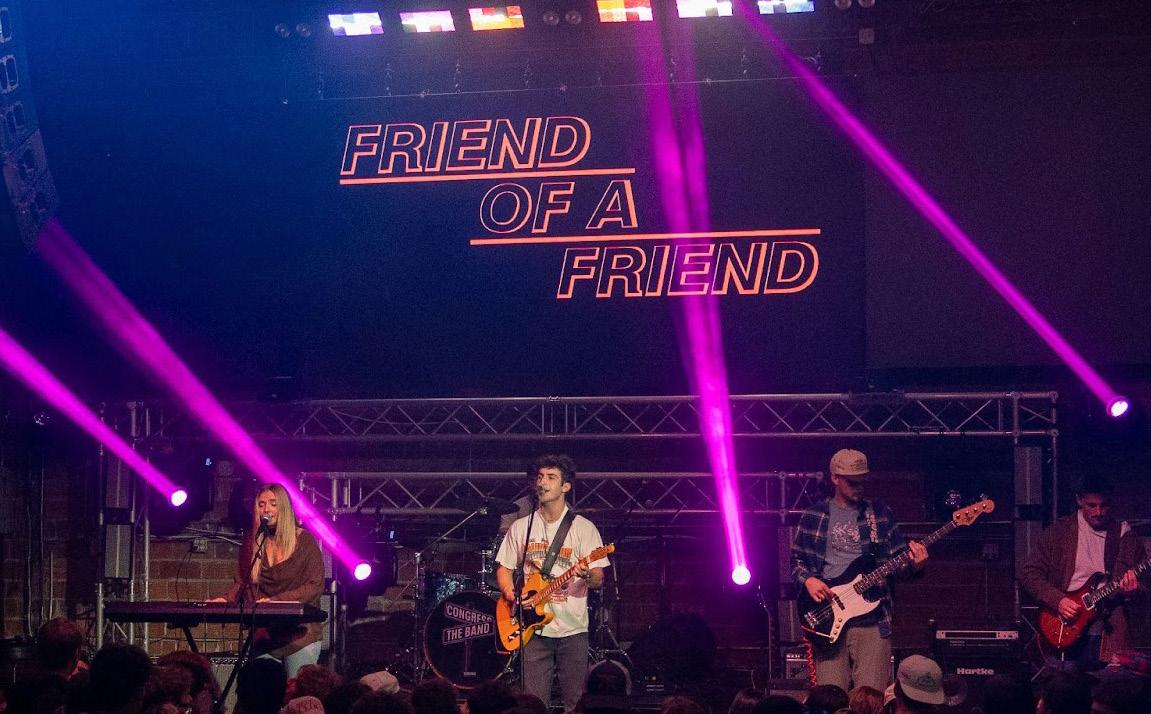
ZOEE ROBINSON THE MIAMI STUDENT
Friend of a Friend (FOF) began just as the name suggests — friends of friends joining together to jam some tunes. The original four members, Stephen Griffith, ’24, Miles “Griz” Adams, ’25, Michael Moretti, senior marketing student and Cooper Young, senior architecture student, launched the idea of formally playing together in the spring semester of 2023. Griffith, Adams and Young were in the same fraternity, Tau Kappa Epsilon (TKE), but different years, and Moretti met Young through a mutual friend on their first year spring break trip.
The boys said they just got to talking and bonded over their love for music. From that point on, they consistently practiced together at the Tau Kappa Epsilon house or in the garage of their Uptown house, Bleü Dream. In October 2023, the band played their first gig, opening for Thumbtack Mechanics and Under High Street, two successful Miami student bands, at an Interfraternity Council (IFC) tailgate before a home football game. Moretti credits the tailgate as the reason they became an official band. He says they needed a name to perform, and a friend of theirs (they can’t recall who) suggested Friend of a Friend, because they all knew each other and were somewhat friends.
And so, FOF was born.
At the IFC tailgate, the band connected with Ben Cornell, a junior arts management and arts entrepreneurship student, fellow TKE member and their soon-to-be bass player, as Griffith would graduate later that year. For the rest of the 2023-2024 school year, FOF played fraternity parties and gigs at Oxford bars such as O’Pub, Corner Bar and Brick Street Bar. In the spring of 2024, Claudia Diaz, a former primary education student, also performed with the band for one semester before she graduated. During her time with the band, Diaz introduced Lydia Long, a now senior political science and social jus-
tice student, to the band, because the two girls were both members of The Miami Misfitz, an all-female a cappella group.
Long says becoming a member was simple and quick.
“There’s no need to audition or anything,” Long said regarding the boys. “We’re not that formal. You can just start next semester.”
During the 2024-2025 school year, Adams, Moretti, Young, Cornell and Long performed together, gaining more and more traction at each show. Crowds at Brick Street went from five people arriving early to stand front row, to crowds of 30 or more arriving early.
BENJAMIN LUEBBERS THE MIAMI STUDENT
The Miami University RedHawks baseball team enters the back half of the season looking to defend the Mid-American Conference (MAC) championship they won in 2025. After climbing to the one seed in the MAC tournament last year, right fielder Tommy Harrison has emerged as one of the team’s biggest catalysts. Harrison played at St. Edward High School in Cleveland, where his powerful bat drew attention with a .420 batting average and a .988 onbase plus slugging as a junior. Harrison racked up the second most hits for his team despite missing ten games. Harrison would make the roughly four-hour trek down Interstate 71 to Oxford, Ohio for his collegiate career. In his freshman season, he showed flashes of potential, driving in 23 runs while posting a .231 average and .402 on-base percentage.
IVY KLEINMAN ASST. PHOTO EDITOR
Following an attack on a Detroit-area synagogue and rising antisemitic threats nationwide, Sarah Shmoel, executive director of Hillel at Miami University, emailed students, parents and community members March 13, reaffirming her commitment to the Jewish organization’s safety.
“We are in regular communication with both the Oxford Police Department and Miami University Police Department and have asked them to increase patrols around our building and during events,” Shmoel wrote in the email.
Hillel’s team participates in annual safety training and secures their building with access only available through intentional entry. Additionally, cameras monitor the building 24-hours a day.
“We follow the principle we all know well: If we see something, we
say something,” Shmoel wrote in the email.
Shmoel said she has not seen any backlash toward the Jewish community on Miami’s campus and feels that Miami and Oxford are safe places for students to be Jewish and to show their Jewish identity. Incidents at Miami remain far less frequent than what Jewish communities face at other universities and nationwide.
“As a Hillel director, seeing other Hillels and what they experience is very, very hard, and it makes me very sad personally,” Shmoel said. “However, I also have to recognize how lucky I am to be the executive director at Hillel at Miami, because it is such an amazing place for the Jewish community.”
Jewish organizations have long operated under security protocols that most other campus religious groups do not need. For concerns extending into the residence halls, Shmoel said incidents must first be reported through the university’s Office of Community Standards.
Booming
ZEPLYNN WHITMORE
THE MIAMI STUDENT
EVELYN DUGAN CAMPUS & COMMUNITY
EDITOR
Junior primary education major Georgia Palko worked at Bagel and Deli, but was looking for some extra cash. After calling her dad with a bright idea, she moved forward with her plan to sell sweet treats on Valentine's Day. With around $50 worth of strawberries, a college house kitchen and a side hustler mindset, she sold 300 strawberries to mothers and lovers.
“I’ve grown up doing lemonade stands, doing whatever it is — walking dogs, mowing lawns — doing whatever I can to start my own business of some sort,” Palko said. “When I got to Miami, [my dad] was like you need to find something that people don't have or people need at school.”
“Hillel is much more than what is happening in our world,” Shmoel said. “We are a place where students can connect to share a meal. They can be themselves Jewishly or just themselves as a person, openly in our space.”
Rabbi Yossi Greenberg, co-director of Chabad at Miami, is optimistic about the Jewish community in Oxford.
Chabad is an all-inclusive organization built around outreach and inclusion, focused on strengthening Jewish life rather than engaging in political battles, Greenberg said. Their mission does not change in the face of antisemitism.
“I will not call somebody out as anti-Semitic, just because I know people say that very loosely,” Greenberg said. “For years, I haven’t said the word because I always like to believe that people don’t have it in their heart, but recently I started using it, and I started feeling a little uncomfortable.”

SARAH KENNEL GREENHAWKS EDITOR
Music and conversation filled the Oxford Community Arts Center during the “Changing Climate, Changing Communities” art exhibition’s opening ceremony March 13. Organized by Engaging for Climate in Oxford (ECO), the exhibition features pieces from paintings to sculptures, all aimed
Katie
“Most
This
Palko said she thought of chocolate covered strawberries and pretzels because everyone loves them. She advertised to consumers with a Canva-made graphic on Snapchat, Facebook, Instagram and GroupMe.
After Palko informed Aldi of her plans, they readied 17 packs of strawberries for her.

THE MIAMI STUDENT STAFF
SHANNON MAHONEY EDITOR-IN-CHIEF
ELISA ROSENTHAL
MANAGING EDITOR
EVELYN DUGAN
OWEN MARTIN
PARKER GREEN
CAMPUS &
COMMUNITY EDITORS
GRAHAM YOUNG
SPORTS EDITOR
TAYLOR POWERS
OPINION EDITOR
STELLA POWERS
CULTURE EDITOR
CARLEY RAPP
HUMOR EDITOR
SARAH KENNEL
GREENHAWKS EDITOR
SYDNEY MULFORD
DESIGN EDITOR
ELISE HANNA
DIGITAL MEDIA EDITOR
EMILY CLARK PHOTO EDITOR
KISER YOUNG
SOCIAL MEDIA EDITOR
CAITLIN WONG
ASST. DESIGN EDITOR
AYLA PEDEN
REN CHAFFEE
ASST. CULTURE EDITORS
COOPER MENEGHETTI
VINCENT JOLLIFF
ASST. SPORTS EDITORS
ABE HAGOOD
ASST. OPINION EDITOR
IVY KLEINMAN
ASST. PHOTO EDITOR
AUSTIN SMITH
BUSINESS MANAGER
JAMES TOBIN
INTERM FACULTY ADVISER
SACHA BELLMAN
BUSINESS ADVISER
AIM MEDIA MIDWEST PRINTER
is committed to providing the Miami University community with the most accurate information possible. Corrections may be submitted up to seven calendar days after publication.
Who’s Who at MU: Dean of the Honors College
Our Awards
2025 Ohio News Media Association Award for First Place in Best Website
2024 and 2025 Corbin Gwaltney Award for Best All-Around Student Newspaper in the large school category, beating out every student paper at a university over 10,000 students in Ohio, Michigan, West Virginia and Western Pennsylvania
2025 Ohio Society of Professional Journalists (SPJ) Award for First Place in the Best College Newspaper category
2025 Greater Cincinnati Pro Chapter Society of Professional Journalists (SPJ) Excellence in Journalism Award in the College Student Publication category
2025 Ohio News Media Association Award for First Place in Best Website
CAITLIN O’BRIEN STAFF WRITER
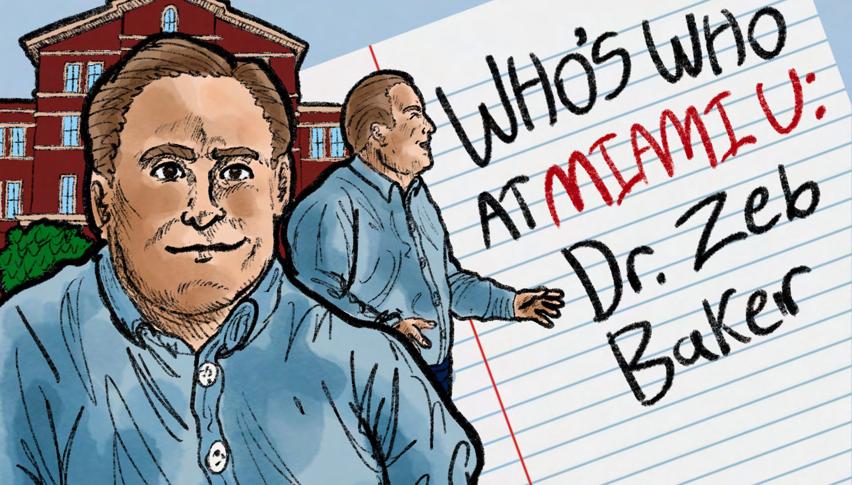
Out of every 10 undergraduates at Miami University, one is an honors student. The dean of the Honors College strives to help these students to extract as much value from their Honors College participation, so by the time they graduate, they can look back and say: “This really meant a lot.” For the last year and a month, that role has belonged to Zeb Baker.
In his role, Baker thinks about the strategic vision and direction of the Honors College. He’s responsible for finding ways to provide the 2,100 students in the program with differentiated opportunities to deepen their engagement with learning while they’re at Miami.
“I think that in any one day, I’m really meeting with my team, with our campus partners, with our students,” Baker said, “And all those conversations are really about, ‘How do we really make the Honors College even better than it already is?’”
Leading the team of faculty and staff in the Honors College is also a part of his job. He makes sure they also work in the direction of that vision and put their students at the center of everything that they do. Baker started working in the Honors College on Jan. 1, 2019, and took on the job of dean on March 1, 2025.
Alex Wrobbel, a junior mechanical engineering major in the honors program, said Baker is one of the faces of the Honors College.
“He does a really good job of being present in honor-specific situations, but also just across campus, making sure that the students, especially those in the Honors College, know who he is, and sort of can start to form that personal relationship with him,” Wrobbel said.
He begins his day at 8 a.m. Between phone calls and wall-to-wall meetings, he doesn’t leave campus until about 12 hours later. Baker doesn’t let himself go home until he’s answered every faculty email and most student emails in the same day.
“I just want to make sure that our students and our faculty know that I’m actually responsive, and that when I say you can reach out to me, that they actually hear from me,” Baker said. Baker said his least favorite part about the job is budget meetings, but what makes up for it — his favorite part — is the students.
“I’ve learned as much from our students as they’ve ever gotten from me,” Baker said. “And I think that’s the really fun part of it for me, is just continuing to try to learn from our students, learn alongside our students, learn what their concerns are… You know, I think all of those things are really at the heart of what makes my job so enjoyable.”
Samantha Brotherton, a first-year honors student who studies biomedical engineering and regulatory affairs, has seen Baker’s efforts to get students as much meaning and purpose out of their Miami education as they possibly can.
“I think he’s great for opportunities, like he’s very knowledgeable,” Brotherton said. “I think he’s easy to contact as well. He’s definitely there when we need it.”
Baker said the Honors College is a very unique institution in that it isn’t a full fledged division, but in many ways, it’s expected to function like that. He collaborates with other departments at Miami to make sure students get the classes and opportunities they need and connects with students on a day-to-day basis.
“I think he’s very energetic as a person,” Wrobbel said. “You can tell that he really does enjoy what he does for his job, and it’s nice to see that and know that someone who’s supposed to be helping you on your academic journey actually cares about you and cares about the journey that you’re on.”
Baker said he also attracts outstanding students to Miami and to the Honors College. He does this by building opportunities that get them to commit to Miami and getting them involved on campus once they’re a student here.
“So how do we continue to improve?” Baker said. “That’s really my number one focus. And I’m very much focused on the students and the faculty and doing the most that I can to get both of those groups the greatest possible experience that we can provide to them.”
obrie175@miamioh.edu
Oxford police respond to a horse, assaults and drug-related cases during spring
break

AUSTIN SMITH BUSINESS MANAGER
Between March 23 and March 30, police officers responded to 17 different incidents, according to the Oxford Police Department report.
On March 23, at 2:50 p.m., in the 0 block of Michelle Drive, officers were dispatched to record an alleged assault on the property. No charges have been filed at this time.
Later that day, at 9:41 p.m., in the intersection of South Patterson Avenue and Trenton Oxford Road, officers conducted a traffic stop on a vehicle driven by a male with warrants.
On March 24, at 2:45 p.m., a female came to the police to report that she had been given drugs and sexually assaulted. Officers wrote the report, and the investigation is ongoing.
On March 25, at 5:17 p.m., in the 400 block of W. Sycamore St., officers were dispatched to Kramer Elementary for a suspicious person. Upon arrival, officers found the male experiencing an overdose. The Oxford Fire Department treated the male and transported him to the hospital. Following treatment, the male was transported to Butler County Jail.
On March 26, at 4:18 p.m., in the 600 block of Ogden Court, officers responded to a complaint about a damaged air conditioning unit. They believed the damage was caused by BBs or another small-caliber weapon.
On March 27, at 9:57 p.m., in the 5000 block of Red Cloud Court, officers responded to a domestic dis-
pute. Assault charges are pending.
On March 28, at 5:06 a.m., in the 0 block of Reaghs Way, officers were dispatched for a vehicle fire. The fire was quickly contained and put out by the Oxford Fire Department. The cause of the fire is unknown.
That same day at 1:55 p.m., in the 5400 block of College Corner Pike, officers responded to a call about a horse running on the street. The horse had been spooked by a low-flying helicopter. After wandering through the city, the horse was eventually caught at the intersection of French and Glos Drive and later put down after sustaining an injury to its front leg.
Later that day at 11:52 p.m., in the 600 block of S. College Ave., officers conducted a traffic stop and found the driver under the influence. The subject was arrested and charged for operating a vehicle while impaired.
On March 29, at 12:34 p.m., in the 300 block of N. Beech St., officers responded to a report from a female that her car had been rummaged through and damaged. Officers found the car with multiple scratches and the hood and trunk left open. A report was fielded.
On March 30, at 12:59 a.m., in the 5200 block of College Corner Pike, officers were dispatched to an ongoing domestic dispute. It is reported the female had caused harm to the male by squeezing a sensitive area and hitting him. Officers arrested the female and transported her to Butler County Jail.
smith854@miamioh.edu
GRAPHIC BY KEEGAN PEREZ
GRAPHIC BY MACY CHAMBERLIN

KYLIE BUNN THE MIAMI STUDENT
The Miami University Senate introduced a new review process, approved a department merger and advanced a proposal for a new degree during its meeting on March 30.
Nathan French, vice chair of senate and chair of the senate executive committee, opened Monday’s meeting congratulating the men’s basketball team on their recent success and encouraging students and faculty to continue their support for Miami University athletics as the spring sports season begins.
French introduced the newly approved curricular process. He recognized the need for patience, trust and feedback while improving this process.
University Senate weighs curriculum process, discusses Miami Plan adjustments
“Part of this new process may require our senate to rethink its own committee structures and work,” French said. This new process includes initial consultation of new curricular proposals with the Office of the Provost and presentation to the University Senate for discussion and feedback 10 days prior to formal action. French announced the senate has recommended merging the biology and microbiology departments and approved the motion to do so. Steven Lippmann, professor and chair of the Department of Sociology and Gerontology, and Ryan Steel, assistant professor of sociology and gerontology, introduced a proposal for a new criminology degree. The proposal aims to address the high concentration of students in the exist-
ing department.
The proposal includes a 42-credit hour major with 30 core courses. The degree also includes an internship or research experience in addition to a capstone project.
“By and large we can do this with mostly existing resources and existing expertise,” Lippman said.
Lippman explained how the proposal fits into the existing criminal justice degree and will help limit the need for excess resources. Criminology is more analytical and theory driven, while criminal justice is more applied and systems oriented.
“The two are related, for sure,” Lippman said, “but they are distinct disciplines and in terms of career path the students often go on to pursue with these degrees.”
Steel said the proposed degree is
important because criminology and criminal justice attract different types of students, emphasizing the need for the new program.
Rosemary Pennington, chair and professor of the Department of Media, Journalism and Film presented a proposal to add contextual agility to the revised Miami Plan.
Contextual agility, an applied skill, was proposed as another addition to the Miami Plan in response to calls for stronger global and intercultural learning outcomes. The addition aims to better prepare students to navigate diverse perspectives and complex social environments.
“Students could gain competencies including respect to diversity, accurately summarize and interpret personal biases and effectively manage conflict,” Pennington said.
In response to questions from the senate body, Pennington explained the name “contextual agility” is a placeholder that will be improved upon further discussion.
The senate moved to authorize 2026-2027 committee appointments in order to allow the committee to begin confirming appointees this month rather than waiting for summer term.
Danny Martin, president of Associated Student Government, announced new Student Body President Charlie Merill, and Vice President Susanne Morrissey to conclude the meeting.
The University Senate will meet again at 3:30 p.m. April 13, in 111 Harrison Hall.
bunnkm@miamioh.edu
TAYLOR POWERS OPINION EDITOR
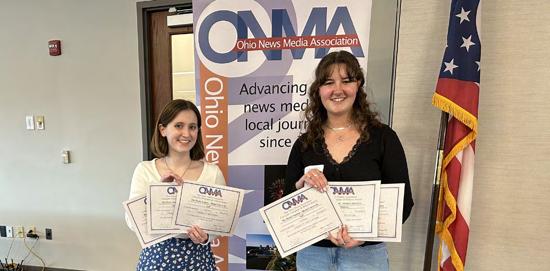
Staffers from The Miami Student attended the 2026 Ohio News Media Association (ONMA) Hooper and Collegiate Awards ceremony on March 26. The Student took home six awards, including first place for News Coverage and third place for Best Website. The Student competed in Division A, which consists of student enrollment of 10,000 or more. The publication competed against 11 other collegiate newspapers overall in 10 categories, including local colleges such as Kent State University, Ohio University, University of Cincinnati and Bowling Green State University.
The Student took first place in the News Coverage category. One judge complimented the variety of topics The Student has covered over the last year, including “hard-hitting topics” such as sexual violence at Miami University.
“Every article felt like something I’d like to read as a student, and the stories are well written,” one judge said.
The Student was awarded second place in the Sports Coverage category. The judge noted a nice mix of game coverage and features.
“Love to read about the people behind the numbers,” one judge said.
The Student was awarded third place in the In-Depth Reporting
category for an article published last year by former Campus and Community Editor Taylor Stumbaugh on sexual violence at Miami. One judge commented on the thoughtful writing regarding a harsh subject.
“The student journalist covered a challenging subject with a combination of frankness and sensitivity,” one judge said. “By highlighting multiple perspectives on a pervasive problem, the story is both educational and immediate.”
The Student was also awarded third place in the Arts and Entertainment category, with the award made out to Culture Editor Stella Powers and Campus and Community Editor Parker Green. One judge commented on how the piece did an excellent job of immersing the reader into the event, making them feel like they are “actually in attendance, in the room, or on the red carpet at SNL50.”
“Strong graphic creation ability paired with extra details to help the
reader not only understand the who or what, but the why and, above all, why it matters,” one judge said.
The Student was awarded third place in the Headline Writing category for the headline “Spilling the Tea: How a popular app has become a source of disinformation,” written by Editor-in-Chief Shannon Mahoney. One judge complimented the “simple, effective play on words that immediately lays out the story topic and goal of the piece.”
The Student was awarded third place in the Best Website category. One judge said the website had lots of information and was easy to navigate.
The Student will travel to Louisville, Kentucky, for the regional Mark of Excellence Awards by the Society of Professional Journalists from April 10-11. powerstj@miamioh.edu
Associated Student Government (ASG) passed a resolution to increase student voter engagement ahead of the 2026 midterm elections and addressed campus concerns at its March 31 meeting.
Senator Lynn Setter proposed the resolution to expand civic engagement efforts and voter registration programming through a continued partnership with the Menard Family Center for Democracy. Planned initiatives include voter education efforts and potential candidate debates on campus this fall.
“Regardless of [students’] political affiliation … the student body is not to educate [students], but to give them political resources and empower them to do their own research,” Senator Charles Amara said.
ASG addressed ongoing issues in Williams Hall after a student reported repeated work orders have not led to improvements. The student said the excessive heat poses a health concern
due to a heart condition affecting her ability to regulate body temperature. Senator Quin Ahler submitted the concern to the Campus Affairs Committee for further review.
Senator Nicholas Rentschler raised a discussion about accessing meal swipe information on the GET mobile app. Senators said the information is available through Grubhub and the university’s Web Card Center, resolving the issue during discussion. The Safety and Transportation Committee is promoting SafeRide, a free nighttime shuttle service, through a giveaway offering students a
to
AirPods Max by downloading the BCRTA BGo app and entering via QR codes on campus posters. Special senator election packets are due April 3 at
in
KATHRYN HIPPE THE MIAMI STUDENT
CAMPUS & COMMUNITY
Miami’s Jewish community tightens security amid nationwide antisemitic threats
Greenberg said Chabad is not sheltered from the hatred circulating on social media, but the community has made a conscious choice not to let it erode their pride in Jewish identity.
“You can’t stop being Jewish just because someone doesn’t like it,” Greenberg said. “We have to tolerate each other; we shouldn’t be blamed for what’s going on in other parts of the world.”
When it comes to security, Chabad continues to stay in contact with the Miami University Police Department and the Oxford Police Department to ensure gatherings and holidays are protected.
“I’m not gonna sit and complain [about] why I need security,” Greenberg said. “I’m just gonna get the security and move on.”
Although areas around Hillel and Chabad are protected, residence halls are left unprotected and prone to incidents of antisemitism. Earlier this year, there were reports of antisemitic vandalism within residence halls.
“You’ve got to put up a video camera in every hallway in the dorm, and then we won’t have any more problems,” Greenberg said. “The fact that Miami doesn’t have a video camera in every single dorm hallway doesn’t make any sense to me.”
The reason Miami is hesitant to install video cameras for surveillance in residence halls is based on privacy concerns.
Thatcher Gross, a first-year marketing major and a part of the Jewish community, said he feels generally safe as a Jewish student at Miami, and Oxford’s small-town environment puts him at ease.
“I feel more unsafe [in] big cities, [versus] a small town like Oxford,” Gross said.
Despite the relative calm atmosphere at Miami, Gross said many Jewish students remain guarded about expressing their identity on campus.
“Be careful about being outwardly Jewish, you never really know what people think, so you don’t want to bring up that you’re a minority,” Gross said.
For Greenberg, that is exactly the mindset he hopes the next generation of Jewish students can move past.
“Jewish students should feel safe, and Jewish students should go to Jewish events and [be] proud and never stop being who they are,” Greenberg said.
kleinmim@miamioh.edu
Miami University to launch replacement for The Hub
LIAM CLARKE THE MIAMI STUDENT
A new platform called Miami Central will replace The Hub, Miami University’s online platform for student engagement. It’s designed to improve the way students connect with other people and organizations. It is set to launch April 6, 2026. Miami Central will feature Campus Groups by Ready Education, a software platform that seeks to improve on-campus engagement and enrich student experiences, according to its website.
Jayne Brownell, senior vice president for student life at Miami, said Miami Central will allow each student to personalize their experience based on their interests and career goals. Brownell said the platform is used by hundreds of other universities and will improve communication between students, organizations and administrators, which is currently done primarily by email. Over 700 institutions use Ready Education, such as Case Western Reserve and Xavier Universities, according to its
website.
“It’s more modern, it’s clean, it’s intuitive and it has a lot of customization features,” Brownell said. “We were blown away by how much more they have to offer than what we’ve had over the last decade.”
The Hub is Miami’s current platform for students to navigate and join organizations on campus. It’s meant to allow students to connect with organizations, attend on-campus events and track membership involvement, according to the website. However, students say the platform can be confusing.
Noah Englund, a junior psychology and premedical and pre-health studies double major and member of Stage Left, said a new platform could be helpful. Englund said The Hub is difficult to navigate when looking for something specific.
“If the platform was better suited for specific things, like student needs, or if they’re looking for a specific organization, then it would be a good idea,” Englund said.
Brownell said when the university faced a contract renewal with the
company, the idea to replace The Hub emerged from MiamiTHRIVE, Miami’s strategic planning initiative.
Sawyer Wilson, a first-year biomedical engineering major and member of the Theta Tau Engineering fraternity said he thinks a replacement would be a good idea.
“I think it depends on the execution of the replacement, so I wouldn’t be opposed to it,” Wilson said.
Brownell said it could take a year to use Miami Central at its full capacity because of its many features. It will be up and running by April 6 for student organizations to begin to integrate, and new students will be introduced to it during orientation. The Hub will go dark on June 30.
“I hope that students have a little bit of patience with us as we get this fully up and running and learn all the capabilities,” Brownell said. “Keep moving along with us to help us find all the uses that will be helpful for students.”
clarkelt@miamioh.edu

Miami esports program set to lose all funding
PFENNIG STAFF WRITER
In March, members of Miami University’s varsity esports teams learned they would lose all funding for next year. This news was shared just after the announcement of the upcoming $281 million construction of a new sports arena on what is now Cook Field. The members speculated the rest of the esports program will likely also lose its funding.
The esports program consists of varsity teams competing with schools across the country, club teams and the Forge program, which gives students opportunities to work on broadcasting and graphic design for esports events. Funding is required to pay for faculty directors, fees for joining competitive leagues and traveling expenses for in-person events.
In conjunction with the loss of funding, the esports arena in Armstrong Student Center and gaming space in King Library may be removed. James Davis serves as the assistant director for the program and said the cost of running the esports program is relatively low.
“The program itself could run fairly comfortably at around $100,000 to $150,000, if we really wanted to stretch to make it the best we could, $200,000,” Davis said. “Compared to everything else the University is doing, for all the reputational gain the University is getting, it’s peanuts.”
Miami became the first U.S. college to have a varsity esports team in 2016. Throughout the program’s 10 years, Miami has competed in multiple games at the national level and held events at the state and regional level. This success has attracted students to Miami.
“The administration is not moved by the fact that we have 70 students who are here largely because of the [esports] program including people who are out of state, who are paying full tuition,” Davis said. “We are a nationally recognized community.”
Junior information and cybersecurity management major and captain of Miami’s Overwatch team, Scott Zwirn, is one of those students.
“The only reason why I chose Miami was because it was the nation’s first D-1 esports program,” Zwirn said. “Even though both the University of Rhode Island and the University of Colorado gave me more scholarships, [the esports program] was enough of a reason to go to Miami.
I know that now people are looking to transfer to Bowling Green and a few other places because they have esports programs and we don’t.” Miami’s varsity esports teams also provide opportunities for students to get experience in graphic design, video production and broadcasting. This experience has helped Miami alumni get positions in podcasts, including “The Jime Rome Show,” and in esports broadcasting at the highest level. Isaac Arredondo is a senior marketing major who broadcasts Miami’s League of Legends games. Esports and the Forge have given him opportunities that aren’t available anywhere else.
“I grew up watching pro leagues,” Arrendondo said. “I grew up watching these people on TV casting games, they’re doing the same thing you’d see at March Madness or for the Super Bowl. I always thought that it’d be fun to do, but I’d probably never have the chance to do it and then I got the chance to do it.” He also appreciates the community around esports and its ability to bring together people who otherwise wouldn’t meet each other.
“It’s just an awesome community of a variety of different people; we have engineers, we have business students, people from all different majors,” Arredondo said. “The idea of all of this just going away, it just sucks. I know it means so much to a lot of people, a lot of us are pretty angry … It’s heartbreaking honestly.” Arredondo sees the loss of funding as following a trend of budget cuts to support athletic programs.
“The basketball stadium is going to cost a fifth of Miami’s endowment, that is a ton of money,” Arrendondo said. “We would need less than 1% of that. They’re gutting humanities programs as well. It really shows that Miami is really only focused on their student athletes right now. They’re going against [students’] wishes by building this stadium, they’re going against our wishes by getting rid of the humanities and these other programs that students are involved in.”
The esports program is currently pursuing alternative funding sources, but without support from the Board of Trustees, their operations will be limited.
pfennikp@miamioh.edu
History department’s move to Bachelor Hall forces book disposal and loss of space
ELISA ROSENTHAL
MANAGING EDITOR
As the 2025-26 school year closes and faculty prepares for a new year, some departments are undergoing more changes than others. The newly renovated Bachelor Hall will reopen its doors as a new hub for the humanities. The English, History, Philosophy and Media, Journalism and Film departments will move into new offices and classrooms over the summer while students are off campus. For one department, this move is a consolidation in some ways more than an upgrade, as many history professors will have diminished space for their collections of books, primary documents and personal works.
One professor, Steven Conn, enjoys the luxury of one of the biggest offices on Upham’s second floor, and the room is adorned with a wall full of bookshelves, a large couch and multiple filing cabinets. His future office in Bachelor Hall will have approximately one eighth of the space for books he currently has and no space for filing cabinets holding years worth of work.
“We got a tour of the new building a month ago, so we all got to see what the size of the offices were, and we all got to see the bookcase space, or lack thereof,” Conn said.
The department currently has a shelf full of books on the second floor of Upham that won’t make the move to Bachelor, free for students to take since the new space is too small for some professors’ collections.
Conn explained his plan to give most of his books to students and take some home. He even joked about setting fire to some, since there aren’t many available solutions for the plethora of extra books.
While the new space will have provided shelving, it won’t be nearly as much as the current Upham accommodations, mostly lacking the height of the current furniture in the history offices.
“Building code law [states] if you have bookcases that are higher than this, they have to be screwed to the wall,” Conn said. “I think they just didn’t want to do that over in the new building. So we have these bookshelves that are legally short enough that they don’t have to be permanently attached to the walls, but it means there’s a ton of space above
them wasted.”
Another professor, Elena Jackson Albarrán, has a significantly smaller office, but the move will still be a downsize, especially considering the shelving issue. Her office holds several shelves full of books and a cabinet of primary resources used for student and research reference.
The move will force her to house some of these materials elsewhere, like her home. She worries having fewer resources in her office will force her to spend time away from her office and she will become less accessi
ble to her students.
“What will happen is we’ll take those writing books home, and we’ll write from home, so we won’t be on campus,” Albarrán said. “We will have much reduced capacity to use books with students, and so that kind of expertise that we have with students is going to have to [change].”
Both professors mentioned although the upgrades of a new building will be appreciated, Bachelor Hall sits on Western Campus, an area that gets significantly less foot traffic and attention than Upham Hall in the center of academic quad.
The historic building is beloved by students and faculty alike and the
decision to move the humanities hub further away from the main part of campus did not go unnoticed by the history professors. Albarrán detailed the shift in logo usage since her arrival at Miami from the previously used Upham Arch lamplight to the current block “M” logo that feels more representative of the sports teams than the liberal arts education provided here.
“Upham is the heart of campus, right? Symbols like mergers and all the photo shoots, but Upham is also the place where we have that lantern in the arch,” Albarrán said. “That lantern used to be the logo of Miami University. That was the symbol of learning enlightenment and it’s at the heart of campus and it’s the heart of the mission, but that’s our logo.”
The new Bachelor Hall location is right across the street from the upcoming arena construction that the humanities professors will likely be able to see and hear from their new offices. While the university anticipates spending $281 million on this new project, some professors feel ignored, especially when entire majors and departments are being cut.
“Real estate tells you a great deal about the priorities of a university ... Most of the humanities and even
some of the science departments are located in this central part of campus, and that sends a message,” Conn said. “The message being sent now is, we’re going to move all those humanities people off to a corner of campus where the parking is crappy and it’s gonna have to live in the shadow of our basketball palace forever.”
College of Arts and Sciences Dean and history professor Renée Baernstein said the changes in university focus are based on student interests, and the humanities are struggling on a national scale, not just at Miami.
“I think students are voting with their feet and moving away from the humanities, and you see that in our enrollments,” Baernstein said. “What I hope and what we’re trying to do in arts and science is to continue to keep the humanities strong and relevant to today’s students.” She highlighted that change is always hard and said the move would benefit the department in the long run. The updated Bachelor Hall opens for classes in the coming fall semester, and a grand opening of the building will be held sometime in September.
rosente2@miamioh.edu
KIERNAN
GRAPHIC BY CAITLIN WONG
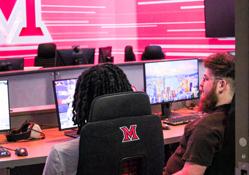
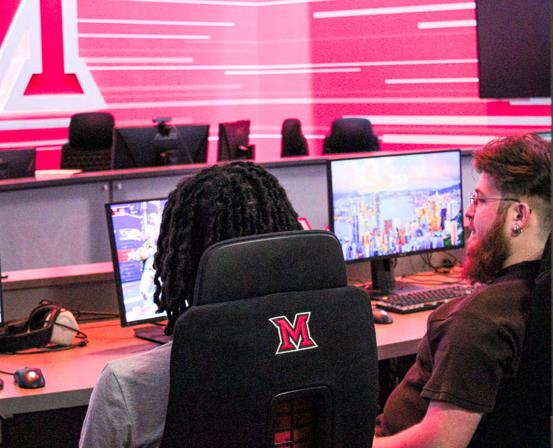
KAYLEN MILLER AND JEREMY EASTER PLAY STREET FIGHTER 6 IN ESPORTS GAMING ROOM IN ARMSTRONG STUDENT CENTER. PHOTO BY IVY KLEINMAN
CAMPUS & COMMUNITY
Booming business: Miami’s secret side hustlers
Then, she sanitized her kitchen and got to work preserving and preparing the strawberries. She learned how to do this from Youtube and ChatGPT.
To get her friends to help deliver the treats to lucky recipients, Palko paid them with extra strawberries from the batch.
Palko ran a similar scheme for St. Patrick’s Day, selling gourmet oreos, chocolate pretzels and “leprechaun bait.” She said she aspires to experiment with dairy-free and gluten-free treats as well.
While Palko runs a business out of her college house, other Miami University students run their business ventures or side hustles out of their residence halls, regardless of university policy.
“Students may not use residence
hall rooms, public spaces, sorority suites or common areas to conduct any commercial or business venture,” according to Miami’s student room regulations.
Director of Residence Life Rob Abowitz said many years ago a student started a tutoring business that eventually became a problem.
“I said, if people aren’t lining up in the hall of the residence hall to get their tutoring, okay, but [the student] actually followed through and made it a real business. When he set up the LLC for this business, he listed his residence hall as the address,” Abowitz said.
Although students are not allowed to run commercial businesses or side hustles out of residence halls, the resident assistants (RAs) do not always prevent it from happening.
A first-year interior design major operates her own nail business out of Stanton Hall on top of her other two
jobs. She charges between $20-60 for a set of nails. Her clients often get french tips or little flowers on their nails without any problems.
“My RA is pretty chill, but she doesn’t really look in our dorms at all,” the first-year said. “She’s like, ‘Unless you’re really causing a problem, I don’t really pay that much attention.’”
This side hustler said she was motivated by money and family.
“[Before college] I was like I have to make money somehow, because I don’t want to rely on my parents,” the first-year said. “I have three sisters and one of them is in college. I was like, I don’t want to ask my parents for money all the time because they’re spending lots.”
Cara Muhlenthaler, a sophomore marketing major, also has no trouble running her spray tan business out of Minnich Hall. She said the RAs don’t care as long as it doesn’t happen in
the bathroom.
“As long as it’s in our dorm [room] though, it’s fine,” Muhlenthaler said. “There’s signs all over our bathrooms, like ‘no spray tanning in the bathrooms.’”
With advice from other girls in the dorm spray tan business, $400 and excel skills, Muhlenthaler and her roommate bought a spray tan starter kit and began to book appointments.
After trying multiple websites with paywalls to establish a booking site for customers, they decided to stick to texting group chats and an Instagram account for client outreach. Most of their clients are friends or other girls living in sorority dorms.
During sorority recruitment and before spring break, the business partners created deals for their clients, since those are especially competitive times for the spray tan business. Rather than the usual $20 cost, they charged their customers $15.
MOLLY FAHY SENIOR STAFF WRITER
Senior organizational leadership and entrepreneurship major Jack Isphording had just been elected president of Miami University’s student-run Asian American Association (AAA) when he saw Senate Bill 1 (S.B.1) passed the Ohio House of Representatives in March 2025.
Eliminating all diversity, equity and inclusion (DEI) activities at public university campuses, S.B.1 was described by state representatives as “transformational legislation” for higher education in Ohio. The bill also restricted which subjects professors could teach, specifically topics related to race, sex and other “controversial topics.” For Ipshording and the rest of
the AAA executive board, the days between S.B.1’s passage and its enactment were a confusing time.
“During my first transition meeting with my exec, [when] S.B.1 wasn’t in effect yet, I [said] ‘I have no idea what direction I can give you,’” Ipshording said. “Through the summer, we were learning what other colleges were saying to certain clubs. We didn’t know how funding was going to work. We didn’t know how partnerships with the university would work.”
The AAA wasn’t the only group worried about the changing guidelines. Bryan Marshall, chair of the Department of Political Science, said the biggest adjustments with the new S.B.1 guidelines have been the requirements for universities to publicly post course syllabi and to teach a mandatory three-credit-hour Ameri-
can civic literacy course.
“I don’t have a problem with the idea; I mean, we’re a public institution,” Marshall said. “But now you have to find a software that all faculty have to figure out. There’s no one person who can do this. So things like that, we’re still in the process of implementing. We’re kind of in a holding pattern until we figure that out.”
As for concerns about restrictions on what professors can say in their classrooms, Marshall said his faculty have already been vigilant about creating safe spaces for students to share their own opinions on certain topics.
“S.B.1 says we have to watch our p’s and q’s about what we say and what we don’t say,” Marshall said. “There’s all kinds of culture war topics, right? And you have students on one side of it, you have students on the other side of it. We have to have
a classroom where there’s respectful, reasonable conversation.”
Madelyn Detloff, a professor in the Department of English and the Department of Global and Intercultural Studies, focuses primarily on LGBTQ+ literature and studies and how they intersect with political issues such as justice and fairness. Detloff said after S.B.1 passed, she and her colleagues have had to be very careful about what they say in class.
“I just think in the back of your mind, you’re always thinking, ‘Oh, is somebody going to take me out of context?’” Detloff said. “I feel like rhetoric like this from our leaders at the state and above that level, creates a kind of feeling that [people] outside of the university, have permission to sort of say and do hateful things, and I worry for the safety of myself and
Muhlenthaler and her roommate are not the only girls who manage spray tan businesses out of their dorms. There is competition everywhere, and they collaborate with other side hustlers, exchanging clients and supplies.
“I’m always worrying that there’s more competition … each sorority dorm I feel like has a girl that does this for you,” Muhlenthaler said.
“There’s actually another girl that does it [in Minnich Hall], and we actually help each other out.”
At an institution built around the business mindset, these side hustlers embody the Miami entrepreneurship experience — whether they are permitted to or not.
whitmokz@miamioh.edu
duganec@miamioh.edu
my students.”
While Detloff is more aware of what she says when teaching, she also opens her discussions to students so they feel free to share their beliefs.
“I’ve been remarkably impressed with the students I’ve taught at Miami University,” Detloff said. “Whatever background they come from, they’re ready to learn and think.”
After S.B. 1 was passed, Miami eliminated several DEI programs supporting minority students, including the Center for Student Diversity and Inclusion. However, S.B.1 does not affect student-run multicultural groups. Despite this, Ipshording said he’s already seen Miami cut back its public-facing communications supporting multicultural student organizations.
“In the past, Miami filmed a reel of [the AAA] for the APIDA [Asian Pacific Islander Desi American] month,” Ipshording said. “So, we had such cool opportunities with that, but now, we don’t get any of that. And this extends, [to] International Women’s History Month, and then February was Black History Month. We’re not seeing anything like that at all.”
Despite increasing uncertainty about the support student multicultural clubs may receive in the future, Ipshording said the AAA was still going to do what it does best — supporting Asian American students and educating the Miami community about Asian heritage and identities.
“We can handle ambiguity,” Ipshording said. “We find creative ways to go about these problems and not be deterred by something coming from legislators who don’t really know what it’s really like to be a college student nowadays.”
fahymm@miamioh.edu
KISER YOUNG
SOCIAL MEDIA EDITOR
Hailed as the “Mother of Fraternities,” Miami University is known for its robust Greek life and their multitude of affiliations representing thousands of students. These individual organizations, or chapters, fall under four larger national councils known as the Interfraternity Council (IFC), Pan-Hellenic Association (Panhellenic), Multicultural Greek Council (MGC) and the National Pan-Hellenic Council (NPHC).
According to Miami, nearly 30% of the undergraduate population is involved in Greek life, but only 24 students are currently affiliated with NPHC, a council that comprises nine historically black Greek letter organizations (BGLOs), also known as the Divine Nine (D9). Founded in 1930 on the campus of Howard University, the NPHC serves to help govern these nine BGLOs and was “established on the principles of service, academic excellence and community advocacy,” according to its website.
While many of these organizations have founding dates going back to the early 20th century, they first appeared on Oxford’s campus back in 1953 when Alpha Phi Alpha Fraternity Inc. was successfully chartered.
Six more of these organizations have joined since: Delta Sigma Theta Sorority Inc. (1969), Alpha Kappa Alpha Sorority Inc. (1977), Phi Beta Sigma Fraternity Inc. (2000), Zeta Phi Beta Sorority Inc. (2001), Omega Psi Phi Beta Sorority Inc. (2020) and
Sigma Gamma Rho (2024).
As active Greek chapters, these organizations work to be a space for racially marginalized students to connect, organize and propel a legacy of excellence within their communities.
While these organizations emphasize their historical impact in Black and American culture, Ava Britford, a senior and the president of Miami’s NPHC and the treasurer of Alpha Kappa Alpha Sorority, said students should know that even though BLGOs are historically Black, they are not exclusively Black.
Unlike their predominantly white Greek council counterparts, BGLOs on the campus of Miami do not host a designated time for rush or recruitment during the spring semester.
Jasmine Hardy, the associate director of fraternity and sorority life, said this is because “the NPHC does not govern how chapters do their membership intake.”
This informal process prioritizes discretion and could be one of the potential factors for why GBLOs see a lower level of student interest.
Despite being relatively small, BGLOs can be seen engaging with and hosting events for the community and student body several times throughout any given semester. These events are such as the new membership presentation for Omega Psi Phi March 31.
This event took place on the green grounds of the Fine Arts Plaza behind the Art Building, and brought in a mixture of around 50 students, including Miami alumni and even older affiliated Greek members living near
Butler County. Starting approximately 4o minutes after 7:11 p.m. — the founding year of the organization in military time — chants and calls coming from all angles echoed through the area. Through this presentation, one masked Omega student was highlighted as he performed a sacred choreographed walk, to entertain and interact with the crowd.
From this event, the community and camaraderie
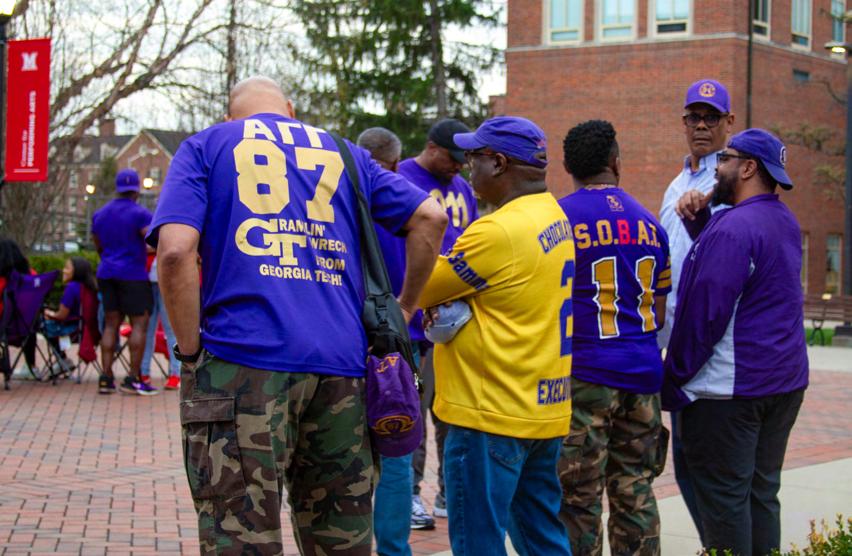
OLDER MEMBERS OF OMEGA PHI PSI WAIT
PATIENTLY FOR THE NEW MEMBER SHOW IN THE FINE ARTS PLAZA. PHOTO BY MAUREEN WILSON
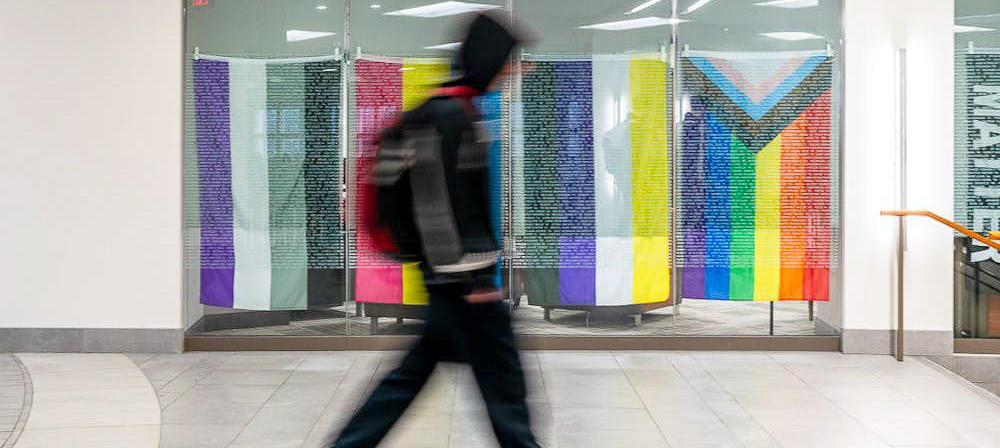
A STUDENT WALKS BY AN ARRAY OF LGBTQ+ PRIDE FLAGS DISPLAYED IN THE FORMER CENTER FOR STUDENT DIVERSITY AND INCLUSION. PHOTO BY SARAH FROSCH

366 and counting: Despite the distractions, Tamar Singer continues to dominate the hardwood
COOPER MENEGHETTI
ASST. SPORTS EDITOR
The conficts in the Middle East seem to be a faraway geopolitical struggle, but for one RedHawk, it’s a struggle that is inextricably linked to her story.
Twenty-two-year-old Tamar Singer’s story begins far away from the Oxford city limits, in Haifa, Israel, a coastal city that has recently become directly involved in the ongoing struggle. Before she could fnd her home on the Millett hardwood, Singer fell in love with basketball.
The sophomore point guard’s passion for the court sparked in 2009, when Singer needed something to do before her mom could pick her up from school. At just 5-years-old, she would begin to play the game that would bring her to Miami.
Singer would play basketball through the end of her senior year at Ironi Hey High School before joining the Israeli Defense Force. During her two year service, Singer coached basketball in her spare time while also representing Israel on the international basketball circuit.
After her military service, Singer looked ahead to what was next. One of Singer’s closest friends Yarden Garzon, a guard at the University of Maryland, told her about what it was like to play college basketball in America.
After the European women’s basketball championships in 2023, a nervous Singer would get a call from Miami head basketball coach Glenn Box as he tried to build his frst recruiting class as a RedHawk. It only took a week for Coach Box to convince her to sign.
“It was really, really quick,” Singer said. “When you feel it, you feel it. I really liked him as a coach.”
Coach Box believed in Singer’s ability and has started her in every single game she has played in a RedHawk uniform. In a recent press conference, he described Miami’s offensive and defensive game plans as “tailor made for her.”
“[Coach] Box gave me all the opportunities that he could give me,” Singer said. “He was fghting with me, he lost with me and he won with me. I really appreciate it.”
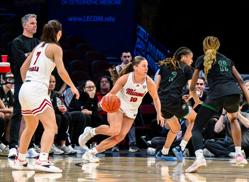
The trust in his point guard has paid of. Singer sits at fourth in assists in NCAA Division I women’s basketball, averaging 7.1 per game. This season, Singer broke the Miami single-season assist record and has already climbed to ninth place in career assists as a RedHawk with 366.
“I know how they like to get the ball and I just fnd them,” Singer said. “I know where they like to be when they’re on the foor, so I try to make their job easier.”
As dominant as she is on ofense, Singer’s defensive ability stands out as well. Leading the team in steals, she is just as efective in ending opponents’ possessions as she is extending Miami’s.
“The thing that separates [Singer] from everyone else is her ability to defend the ball and initiate the defense,” Box said. “Her ability to create havoc is something most programs struggle to have.”
Under Singer’s leadership, Miami women’s basketball has consistently increased its win total each season. The team is having fun and loving the basketball they play.
“I [would] say it’s fun because
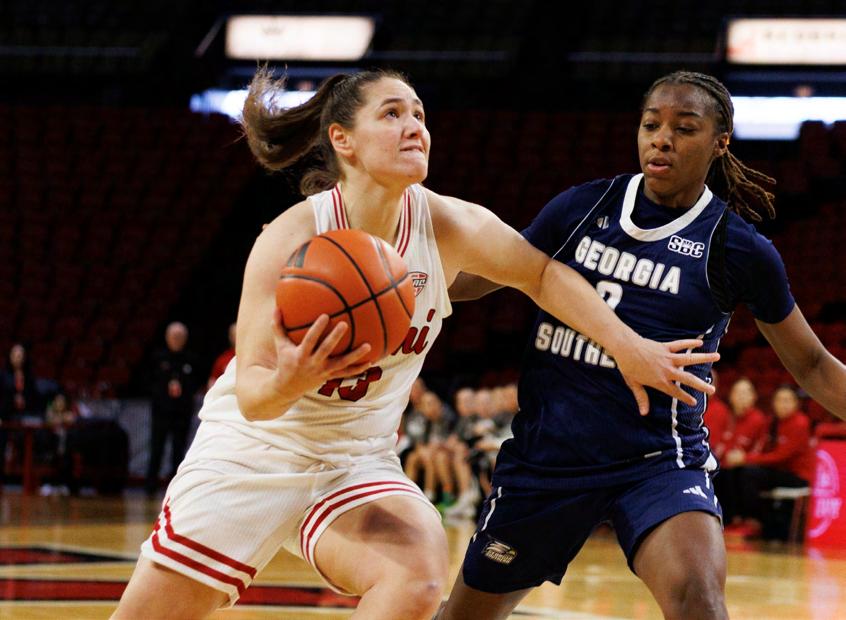
we’re winning,” said Singer. “It’s always nice to win, but we’re actually playing for each other, and we’re happy for each other. It’s incredible that we’re just playing simple basketball.”
For Singer though, the absence of her close-knit family is at the front of her mind.
“I didn’t have my people around me, and in the beginning, it was really, really hard,” Singer said. “I was talking over the phone [to friends and family] for four hours every day.”
History made, expectations surpassed: Miami basketball’s historic season
ELISA ROSENTHAL MANAGING EDITOR COLUMN
When making the decision to come to Miami University, I knew I would be giving up the large-scale game days and sporting events that had consumed so much of my life as a fan of the University of Georgia (UGA) football team. I was OK knowing my new sporting teams would have less success nationally and the stands would likely never be flled to capacity.
The 2025-26 Miami RedHawks men’s basketball team proved me wrong. Three times over.
At the beginning of the 2025-26 basketball season, former sports editor Kethan Babu asked if I wanted to cover an article about the men’s basketball team. I declined because of my lack of understanding with basketball, especially compared to the football and baseball teams I was more comfortable writing about.
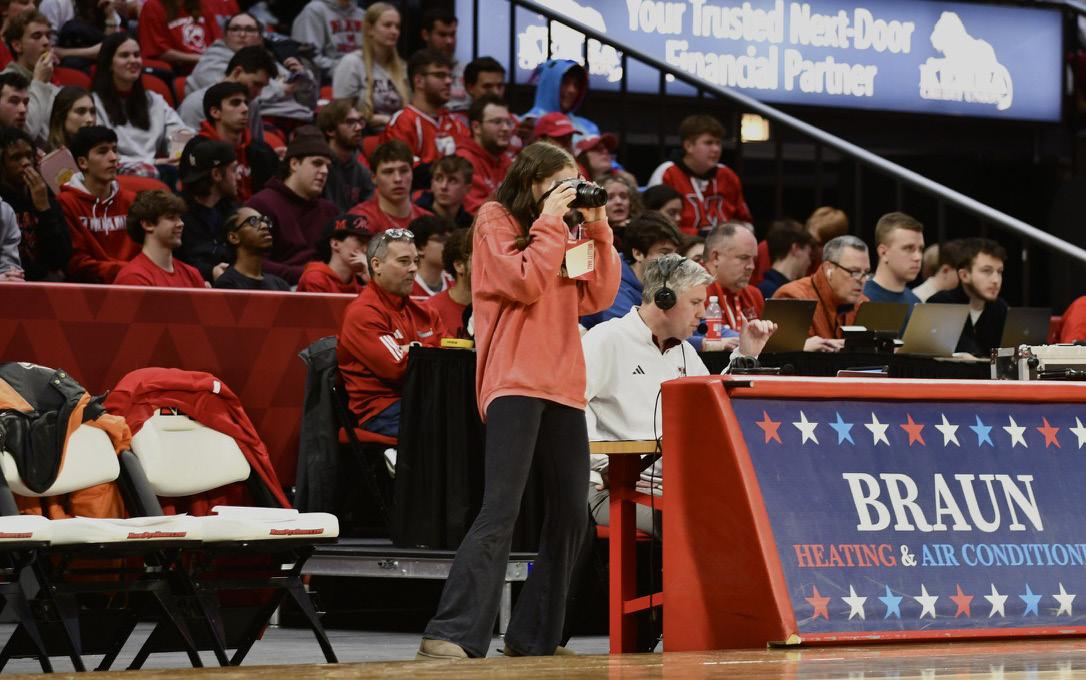
Upon my return to campus in January, my pride for Miami Athletics overtook my previous decision to not cover basketball. Selfshly, I wanted to sit courtside and take photos, so on Jan. 27, I made the trek to Millett Hall and took my position to snap photos of the shockingly still undefeated Miami team.
The energy in the stadium was like nothing I had felt at Miami, but something I had become so familiar with throughout several childhood games at UGA’s football stadium. It was a diferent environment than I was used to, but the walls of excited, loud fans on every side was undeniable.
This was history, and Miami students were going to be there to watch it.
Later that same week, I sat for six hours on the same Millett court, watching both the women’s and men’s teams reach new attendance records. I spoke to Babu again during halftime and promised him I would fnally write that basketball article he’d been encouraging me to write for two seasons.
On Feb. 5, I entered Millett again, under much calmer conditions, to interview head coach Travis Steele and two players for an article about the swim team’s presence at the games. I sat in on the end of the team’s practice and watched, realizing the true potential of the team. They worked well together in every aspect, were true friends on and of the court and were dead set on proving themselves to the world.
While I quietly watched from the side, assistant coach Khristian Smith asked what my article was going to be about and expressed his excitement for the concept. As we walked up to his ofce, Steele said he would look forward to seeing me next season as I explained my decision to stay at Miami for a ffth year.
Senior guard Peter Suder chuckled as he refected on the distraction posed by a large group of swimmers in speedos. Freshman guard Trey Perry, excited to be interviewed, said his teammate Suder was the greatest of all time.
This is not your typical college basketball team. Miami is not a Power Five program. We never will be, but these guys deserved to be in the spotlight as much as anyone.
Toward the beginning of March, the RedHawks won their last home game and followed it with a ceremonial cutting of the net before receiving the regular season trophy. I walked around confetti-laden foors and congratulated the same people I
had interviewed just a month prior.
Smith gave me a hug and took a photo with me. Suder smiled as I congratulated him. Steele thanked us for consistent coverage throughout the season. Perry posed for my camera and told me they weren’t done yet.
Watching them go undefeated in the regular season will be one of my greatest college memories. I will talk about those sold-out games for the rest of my life.
The postseason may have ended on a less jovial note, but it can’t take away from what the team did this season. Breaking school, conference and national records cannot be overshadowed by two unfortunate losses.
This season is still something to celebrate. I never imagined that my school would receive any kind of national spotlight like the UGA teams I watched so frequently growing up.
Miami basketball exceeded expectations I didn’t even know I had and showed me that attitude and resilience means everything when you surpass all odds.
I know this is not the end, but merely the beginning of what I’m sure will shape up to be an impressive basketball program. Steele showed what he’s been building at Miami for the past four seasons and proved you don’t need nationally-ranked recruits or transfers to be great. Miami basketball has made a name for itself on the national scale and I don’t foresee that stopping anytime soon.
rosente2@miamioh.edu
After the frst game, Singer felt alone as her teammates spent time with family and friends in the postgame. Without any family to turn to in person, she approached her strength coach, James Carsey, and asked him for a dad-like hug. That moment clicked for her.
“It’s nice now I have my people, and even the coaches’ kids, they are like my family here,” Singer said. “But if I could change one thing, I’d like to have my family here.”
Throughout her time at Miami, Singer has missed her family and friends back in Israel. The confict involving her homeland has only continued to expand these feelings. Through it all, Oxford has become a second home for her — full of a new family — where her basketball ability can do the talking.
@themeneghetti meneghcj@miamioh.edu
Five standout games on the Miami football slate
VINCENT JOLLIFF ASST. SPORTS EDITOR
The Mid-American Conference (MAC) released the full football schedule for the 2026 season on March 24. With 12 games in 13 weeks and eight conference games, the Miami University RedHawks hope to earn their fourth straight trip to Detroit for the MAC Championship game. The MAC experienced team changes in the ofseason as the Northern Illinois University Huskies will now compete in the Mountain West Conference for football. The Huskies will be replaced by California State University, Sacramento Hornets (Sacramento State). Sacramento State will have its frst season competing at the Football Bowl Subdivision level of college football. They previously competed at the Football Championship Subdivision level as a part of the Big Sky Conference. All 12 games will be instrumental in the success of Miami this coming season, but a few stick out as key matchups: Sept. 5: University of Pittsburgh Panthers
The RedHawks’ season opener will take place in Acrisure Stadium in Pittsburgh, Pennsylvania. The Panthers fnished 8-5 overall and 6-2 in Atlantic Coast Conference play in 2025. They will be led by sophomore quarterback and Heisman Trophy darkhorse, Mason Heintschel. Head coach Pat Narduzzi will enter his 12th season in the Keystone State with 80 career wins. The RedHawks will be underdogs in this matchup, but they hope to start the season strong.
Sept. 19: University of Cincinnati Bearcats
The Victory Bell is back. After taking a hiatus last season, Miami and Cincinnati will face of again, this time at TQL Stadium, the home of Cincinnati FC. The Bearcats hold the slightest edge in the all-time series, leading 61-60, with seven ties. Cincinnati won the last matchup in Yager Stadium two years ago 27-16. Since joining the Big 12 Conference in 2023, Cincinnati is 15-22 overall and has not fnished in the top six of its conference. Oct. 3: Bowling Green State University Falcons
The RedHawks will open conference play against the Bowling Green State University Falcons in the home
opener at Yager Stadium. Heisman Trophy winner Eddie George will enter his second season as the head coach for the Falcons. Bowling Green fnished 4-8 last season and looks to improve on that mark this year. This matchup will be the start of the RedHawks’ race to Detroit for another appearance in the MAC Championship game and the frst of eight conference tilts.
Nov. 10: Ohio University Bobcats
The Battle of the Bricks will be played during mid-week MACtion. The RedHawks lost the matchup last year in Athens 24-20 and look to avenge not only that loss, but also the 2024 MAC Championship defeat. The game being played on a Tuesday will make for an interesting home feld advantage for Miami, but the RedHawks have struggled with attendance during mid-week games in the past. Last year’s midweek game against the University of Toledo garnered only 10,800 fans, about a third of Yager’s capacity. Nov. 24: Western Michigan University Broncos
The regular season fnale will take place on a Tuesday in Kalamazoo, Michigan. The game against the Broncos is a rematch of the 2025 MAC Championship game, which the RedHawks lost 18-3. Western Michigan fnished 10-4 last year and 7-1 in MAC play, its best season since 2016. Head coach Lance Taylor will look to build of of last year’s success as a springboard for the program.
The RedHawks will play a total of six home games this season with four Saturday games and two Tuesday games. Miami’s fnal home game will be the game against Ohio University on Nov. 10 and the fnal two games will be on the road. Following the bye week on the weekend of Oct. 31, Miami will transition into only midweek games.
The RedHawks football program has been highly successful under head coach Chuck Martin. He has won 72 games in Oxford since his hiring in 2014 and 27 in the past three seasons. Miami hopes to compete for yet another MAC Championship and a sixth consecutive bowl game appearance. There is no question that the highlighted games will be essential to both eforts.
jollifvm@miamioh.edu
ROSENTHAL
ELISA ROSENTHAL SNAPS PHOTOS AT THE JAN. 27 MATCHUP AGAINST UMASS. PHOTO BY KETHAN BABU
Midseason review: Miami softball fields its stride, dialed on
a Super Regional appearance
DEVIN MCCARTIN THE MIAMI STUDENT
In a year filled with historic seasons from both the men’s and women’s basketball teams, the Miami University softball team is looking to contribute to the RedHawks’ athletics success. The Lady RedHawks are off to a 24-9 record to start the season.
The team is under second-year head coach Mandy Gardner-Colegate. During her first season with the RedHawks, they went 36-26. After losing three seniors and welcoming 14 new athletes to the roster, the team is continuing its success from last year.
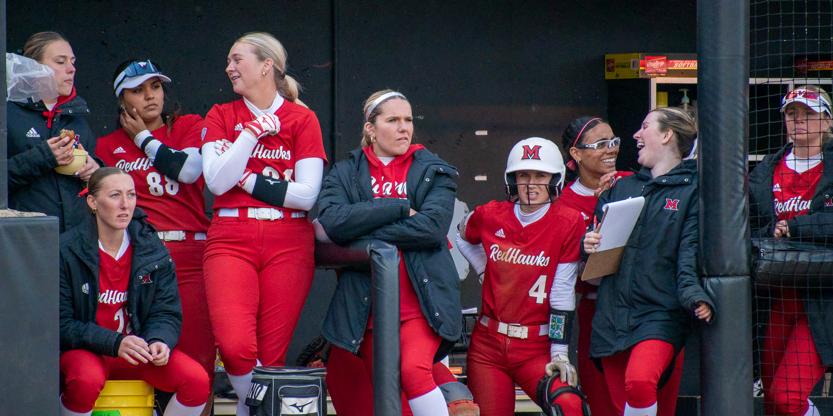
Coach Gardner-Colegate made the decision to have no captains this year. Instead, the team is player-motivated, full of new faces and doesn’t have true stand-out captains.
“We like to pride ourselves in being a player-led program, which I think is really good,” senior pitcher Presley Hosick said.
Winning four straight Mid-American Conference (MAC) tournaments is no easy feat, and the RedHawks are the only team in its conference to accomplish this. They are favored to make it five straight, continuing their dominance in the MAC.
However, over the past four impressive seasons, the RedHawks struggled at NCAA Regionals, going 1-2 in three out of the four seasons. Under Gardner-Colegate, the team looks to move past the losing records and make a deep run in regionals.
“If we are playing our game, we
can compete with anybody in the country,” Gardner-Colegate said.
Miami has improved its batting all season long. The team currently ranks No. 40 in the nation in batting average (.330), along with 43 home runs this season.
Bailey Manos, a senior who transferred from Purdue University Fort Wayne, leads the team in batting average (.438), recording 39 hits in 89 at-bats. Manos struggled with an injury and is still working on coming back fully healthy as the end of the season approaches.
“My last three years at my old school I was working on my swing,” Manos said. “I used to be a slapper, so getting into being a power hitter is still new for me.”
Manos also leads the team in slugging percentage (.888), which measures a hitter’s power. Additionally, Manos has recorded six doubles, two triples and 10 home runs on the year.
The pitching has also improved for the RedHawks this season. Coach Gardner-Colegate emphasized utilizing more quality pitchers in the bullpen to balance the workload and create more depth in the lineup.
“Last year we had basically two pitchers and then this year we have six,” Gardner-Colegate said. “We can throw different pitchers in different situations and the defense feels really confident and comfortable with them on the mound.”
Hosick is a primary contributor to the pitching success of the RedHawks. Hosick is on her third team, previously playing for California
Baptist University and the University of Minnesota. With Hosick on the mound, the team is 7-3. Hosick has pitched seven complete games and two shutout games.
“Growing up pitching, I was always told you set the tone for the game,” Hosick said. “I enjoy being able to step up for my team and be there.”
On the pitching side, the bullpen has a 3.35 earned run average per game, which ranks No. 57 in the nation, along with 123 recorded strikeouts and holding opponents to a .251 batting average.
The Lady RedHawks have excelled on defense as well. First baseman Ella Carter leads the team in putouts with 189 this season. With a near perfect fielding percentage of .958 and 20 stolen runs allowed, Miami is doing a great job defensively to complement its batting.
Coach Gardner-Colegate ensured the team has found time to bond and make the long season enjoyable amid the hard work and demanding schedule.
“We do a ton of team activities and team bonding things,” Gardner-Colegate said. “A lot of the things off the field contribute to our success.”
There are still plenty of games ahead for the team, but being ranked No. 13 in the Mid-Major Poll testifies to its success. The RedHawks are looking to do something never done in program history, qualifying for a Super Regional.
mccartd6@miamioh.edu
The Miami golf brotherhood
ALISSA SHEA
THE MIAMI STUDENT
CLAIRE WESTON
THE MIAMI STUDENT
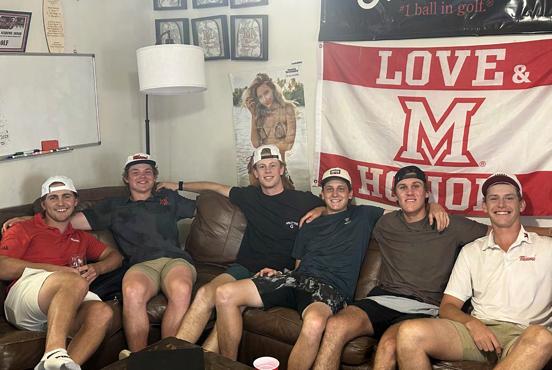
On a warm spring evening, six college students lounge inside a still Halloween-decorated house. One enjoys a steak while the five others relax on the couch watching basketball and talking about their days. Chatter and laughter bounce off the walls, and it’s hard to tell who actually lives here and who just stopped by to hang out.
Upon stepping into 318 North Main Street, it becomes clear that “TPC OX” is more than just a typical college home. For the three senior golf team captains who live there — Michael Weber, Cameron Pero and Brett Podobinski — this house is at the center of their friendship and the team culture.
Life on the road
The Miami University golf schedule is intense and travel heavy. The RedHawks compete in the Mid-American Conference (MAC) and travel across the country to participate in both team and individual tournaments. Pero, who grew up in Bloomfield, Ontario, said when the spring season begins, the routine becomes nonstop.
“The team’s day starts at 6:30 a.m. with workouts,” Pero said. “Then we have class anywhere from 8:30 a.m. until about 1 p.m. Then we practice from 2 p.m. until 5 or 6 p.m. Then we go home and do it all over the next day.”
With long days of practice and constant travel, a strong relationship is essential. Weber, Pero and Podobinski said their bond began the moment they stepped on campus as wide-eyed first-years.
“Coming here, you just get thrown right into the fire,” Podobinski said. “We’re stuck in a room with some guys you don’t really know too well, so you definitely get to know each other quickly.”
Team culture
Golf is an independent sport, requiring each player to focus primarily on his own score while still
contributing to the team’s overall success in each tournament.
For the past four years, these three seniors have learned how to balance being teammates, competitors and best friends on and off the course — all while living in the close confines of “TPC OX.”
“We get the best of both worlds,” Weber said. “We get to hang out here just whenever we’re off the golf course. Then when we’re on the course, there’s a lot of internal competition. We all want to beat each other, so it’s a lot of fun.”
The trio’s bond likely would not be as strong if any of them had transferred to another school.
“It’s kind of a lost art now; people are just always leaving,” Podobinski said. “But when you come to a school like Miami, it’s kind of hard not to fall in love with what you see and the culture with the guys.”
Three different leaders Weber, Pero and Pobodbinski all share leadership responsibilities as team captains. They each bring a different personality to the role, something their younger teammates easily recognize.
Bric Baird, a first-year golfer from Dublin, Ohio, jokingly described the trio as “ketchup, mayo and mustard,” since each one complements the other and brings a different perspective to the team.
Pero said head coach JD Fletcher
even assigned the three players “official” positions. Weber is the “communicator,” who keeps the team organized and connected. Pero is the “bulldog,” who brings intensity and competitiveness to practices and tournaments. Podobinski is the “balance” of the group, with his laissez-faire personality. Their leadership stems from examples passed down from former players. These seniors credit former Miami golfer Sam Mortell for helping establish the environment when they first arrived on campus.
Mortell encouraged his teammates to compete hard on the course but leave the tension behind when they step off. This mindset helped shape the friendly, competitive atmosphere that exists around the team today.
“We’re all really close, but it’s also the team before us,” Pero said. “We’re just part of a bigger group that’s really family oriented. Our door’s always open — if anybody who’s ever played golf wants to walk in, it’s fair game. It’s a very tight group.”
This story was produced by Miami University journalism students in partnership with The Miami Student newspaper.
sheaak3@miamioh.edu westonce@miamioh.edu
Hammerin’ Harrison: Tommy Harrison hopes to lead the RedHawks to another MAC title
Assistant head coach Kyle Trewyn quickly identified Harrison’s potential.
“Tommy was already here from the previous staff and we all knew and felt like he was a talented player,” said Trewyn. “He’s just kept on doing what he’s been doing, which is hard work. He works his butt off in the cages constantly, always bouncing stuff off of me.”
Throughout the 2025 season, Harrison spent time in and out of the lineup, constantly refining his game. As the RedHawks pushed for a MAC regular-season title late in the season, Smiley knew that Harrison was due for a big step forward.
“I remember one time on the bus, telling the whole team, ‘Tom, you’re going to come up big for us toward the end of the year,’” Smiley said. Harrison delivered. In the final regular season game against Ball State University, Harrison swatted four hits, including a double and a home run, bringing in five runs. That effort led Miami to a 26-16 win and it clinched the MAC regular-season title. He ended the season batting .209 with 18 hits, the most from a non-starter.
In the 2025 MAC tournament, Harrison remained hot. In the semi-finals against Kent State University, Miami found themselves in an early 1-0 deficit. With two outs in the bottom of the second, Harrison crushed a home run to right field that also brought in a run. Miami took a 2-1 lead and never looked back, taking a decisive 6-1 victory.
In the championship game against the University of Toledo, Harrison knocked one out of the park in the second inning again, extending the RedHawks lead to 2-0. This effort helped Miami hold onto a 6-3 victory, securing their first MAC Tournament Championship since 2005. Now a redshirt junior in 2026, Harrison has solidified himself as a starter after finding his defensive home in right field. Originally recruited as a catcher, he has played first base, third base, and has now been moved to the outfield.
“It started really off the field,” Harrison said. “I showed up to the field with a good mentality every day. I don’t think one position’s any bigger than the other.”
Harrison is a big, athletic player who finds his strengths in his instincts and physical tools.
“My IQ and the reads I make in the game make up for some of the lost foot speed, and I have a good arm,” Harrison said.
Harrison feels more comfortable and confident defensively, which allows him to focus on hitting. Serving as the primary clean-up hitter, fourth in the lineup, Harrison has the most runs (26), hits (33), runs batted in (32), doubles (8) and total bases (62) on the team through 22 games. His seven home runs are also second on the team behind infielder Evan Applewick’s 10.
What doesn’t show on the stat sheet is Harrison’s locker room presence. Trewyn emphasized the impact on his teammates.
“He’s a teammate favorite,” Trewyn said. “He definitely has some charisma.”
Smiley also credits Harrison’s coachability and his willingness to remain optimistic.
“He’s always positive,” Smiley said. “He’s always got a smile on his face. He’s not going to back down.” Harrison has continued to step up as a leader throughout his Miami career, bringing energy and making the most of his opportunities. Despite leading the team in nearly every offensive category, he is not one to take the spotlight for himself.
“I think I’m just one person, a part of 38 guys that have one common goal,” Harrison said. “That’s something we all share and that’s something we bond over.”
After position changes and injury setbacks, Tommy Harrison’s perseverance, hard work and improvement have paid off. Miami baseball will strive to go back-to-back as the MAC regular-season and tournament champions, with Harrison as a key piece in those hopes.
luebbeb2@miamioh.edu

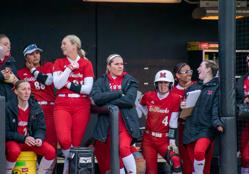
THE 2024-25 SOFTBALL TEAM STANDS IN THE DUGOUT DURING A GAME AGAINST NORTHERN ILLINOIS UNIVERSITY. PHOTO BY JESSICA MONAHAN
CONTINUED FROM FRONT
REN CHAFFEE ASST. CULTURE EDITOR
A fandom, for those who don’t know, is “a group of fans of someone or something, especially very enthusiastic ones,” according to the Cambridge Dictionary.
Fandom culture is not just a modern spectacle. In fact, according to Fanlore, “the practice of making fanzines originated in science fiction fandom in the 1930s, when they were called fanmags.”
Arguably, one of the largest contributors to fandom culture is fanfiction, sometimes called “fanfic”. Fanfiction is such a foundation in fandom culture because many people form personal bonds with characters in their favorite shows. These fictional characters reflect parts of ourselves that are hard to describe.
Fans become attached to the characters, making it hard when shows end, especially if they are cancelled.
That’s why so many people turn to fanfiction — to make these storylines continue. Anyone can add in details or plots to an already existing
LAYLA NORRIS STAFF WRITER
From cable television to YouTube Shorts, late-night shows have touched audiences everywhere.
When you hear “late-night show,” a few names probably come to mind: Stephen Colbert, Seth Meyers, Jimmy Fallon, James Corden or any Saturday Night Live cast member from 1975 to now.
However, while these names are household staples, people are watching them less and less. According to rating reports, total viewership has declined by three percent since 2024. The number of viewers ages 18 to 49 has decreased by 16%.
Why is there such a decline in viewership, especially with younger people? According to Vanity Fair, it’s because talk shows are now live online.
In Feb. 2026, Vanity Fair released an article giving the names and faces of the “new late night.” They discussed 10 internet celebrities who are “shattering the talk show format:” Brittany Broski, Jake Shane, Ziwe, Bowen
universe that they believed needed to be there, but just weren’t.
The most popular platform for reading fanfiction is Archive of Our Own (AO3), one of the largest fanrun archives. The site was launched in 2009 by the Organization for Transformative Works with the intention of being an uncensored archive. Since it’s an archive, it isn’t driven by commercial desires and doesn’t contain an algorithm, meaning anyone can post whatever they want. Users find what they want to read based on specific searches rather than on what an algorithm shows them.
After the Stranger Things finale on Dec. 31 2025, the fandom rose in popularity on fanfiction sites. Besides that, the most popular fandoms on AO3 include Harry Potter (specifically The Marauders), Star Wars, Marvel and DC.
Like anything on the internet, fandom culture has good aspects as well as bad. Participating can create a sense of community and introduce you to people online that you would not have met otherwise. This culture can also provide a creative outlet.
The less-than-ideal parts of fandom culture can include toxic environments, cyberbullying, and, oftentimes, unrealistic expectations or problematic fan projects. Some such fan projects are stories depicting violence, abuse or toxic relationships.
However, fanfiction can be a safe area in fandom culture because you do not have to engage in any parts of it that do not appeal to you. Fans may also seek fanfiction due to the perceived low production values or the cancellation of their favorite shows. When Netflix canceled its series “Shadow and Bone,” fans voiced their anger and frustration. Under Leigh Bardugo’s post announcing her thoughts on the cancellation, fans commented in support of her disappointment that her books’ adaptation was being canceled.
“Can’t say I’m surprised. Netflix can’t recognize a fantastic show even if it slaps them across the face. I hope another streaming service or network picks these projects up,” said one fan under her post, according to Hindustan Times. Through similar passions, a community forms from fandom culture.
Although the general public perceives fanfiction as “low-brow,” the creative outlet is a way for fans to connect and create community.
There can be a lot of embarrassment surrounding actively indulging in fanfiction. However, not everyone sees it this way.
“You might feel embarrassed now, but based on the millions of clicks across websites like Wattpad, Archive of Our Own (AO3) and Fanfiction.net, you have no reason to be,” Grace Kim with The Student Life wrote in an article.
People keep coming back to fanfiction because it offers long-form storytelling that often isn’t available in the original media. “The characters always somehow feel more real, even when they are [original characters] and not already well-known canon characters. I think fanfic utilizes the stream-of-consciousness style of storytelling much better, allowing us to really see the innermost, most intimate thoughts of the characters, but in a way that doesn’t drag the story,” wrote user Jaded_ Advantage_290 on Reddit. There are stories for almost ev-
erything, and it is pretty easy to find what you want with the filtering or tagging systems. Tagging on AO3, “allows users to tag their content with any tag of their choosing, and users can see all works using any given tag,” according to the Organization for Transformative Works. Fanfiction can also provide diversity in the stories that often aren’t present in mainstream media. This can be found in people creating LGBTQ+ ships, aka fan-supported romantic pairings, that the creators of the original piece of media would not have given any thought to.
Fanfiction is a legitimate form of creative expression. It offers a low-stakes way for writers to experiment, grow and share their stories with others. Although it is often dismissed or treated with embarrassment and shame, millions of works reach global audiences. Rather than being seen as lesser, fanfiction should be recognized as a powerful entry point into writing, where creativity can grow.
chaffele@miamioh.edu
From Jimmy Fallon to Brittany Broski: The evolution of late-night television
Yang, Matt Rogers, Amelia Dimoldenburg, Quenlin Blackwell, Sean Evans, Julian Shapiro-Barnum and Kareem Rahman.
Some of these names may sound familiar, and some may not. But I can almost guarantee that if you have visited any social media platform in the past year, you have consumed their content.
All of them have had breakthroughs in their careers in the past six years and have continued to change the game of popular culture.
Now, why are television shows failing, and why are these newcomers succeeding? TV segments just don’t cut it anymore — with TikTok and the general rise of social media, attention spans are declining rapidly. No one wants to sit down and watch an hour and a half of some man talking to celebrities. They want quick, exciting in-
teractions that make them laugh and hold their attention; this is exactly what these 10 influencers are doing.
One of the most notable names on this list is Brittany Broski. She became famous for a TikTok video of her trying kombucha, and now she interviews people at the Oscars. Her online recognition has spread tremendously. Her unique form of talk show is called “Royal Court.” She hosts celebrities into her “Royal Court,” where they wear medieval costumes, eat food and discuss the celebrity’s career.
It’s exactly like what any of the late-night hosts I first mentioned do — but better. It’s engaging, exciting, funny and more relevant.
Other unique examples include Amelia Dimoldenburg’s “Chicken Shop Date,” where she interviews the celebrity in the form of a romantic date while eating chicken together.

Also, Sean Evans’ “Hot Ones,” where he and the chosen celebrity chat while eating insanely spicy chicken wings, each one spicier than the last. The difference between whatever the old Jimmys do and what these newcomers do is that the latter is unique. It’s funny and exciting. People love seeing their favorite celebrities express a real personality. It
Four sweet treats to make for spring
MARIA BUZOGANY THE MIAMI STUDENT
Whether you spent spring break frolicking on the beach or stayed home to catch up on some much-needed sleep, these spring pastries are just what you need to enjoy the season ahead. From a light and fluffy lemon blueberry coffee cake to a rich and decadent fudge brownie, there’s a recipe for every occasion.
Carrot cake cupcakes
Packed with a variety of spices and topped with a velvety cream cheese frosting, these cupcakes are perfect for birthdays, Easter parties and spring gatherings.
First, preheat the oven to 350 degrees and line a standard muffin tin with cupcake liners. Next, in a medium bowl, whisk together 1 ¼ cups all-purpose flour, 1 teaspoon baking soda, ¼ teaspoon salt, ½ teaspoon ground cinnamon, ¼ teaspoon ground nutmeg and ¼ teaspoon ground ginger.
In a separate bowl, whisk together ¼ cup canola oil, 1 cup firmly packed light brown sugar and two large eggs. Stir in ½ cup unsweetened applesauce, ½ teaspoon vanilla and 1 ½
KETHAN BABU EDITOR-AT-LARGE COLUMN
It’s become customary for me to watch a movie every time I’m home. I’m happier in a movie theater than most other places, and I’d rather go watch something I know nothing about, or have zero interest in, than rot in bed at home watching Tung Tung Sahur TikToks. Over spring break, I convinced a friend to tag along for a “Ready or Not 2” screening. I knew nothing about the movie — I still haven’t even seen the first one — but the trailers interested me, and I was due for a trip to the theater. The audience filled less than half of our showing, which I simultaneously questioned and celebrated. The movie itself lived up to my expectations, but as we walked out of AMC, I thought back to the theater experiences I had growing up.
I remembered watching a “Star Wars: The Phantom Menace” re-release with a packed crowd of people dressed in costumes and carrying
cups finely shredded carrots. Add the dry ingredients to the wet mixture, and stir in ¼ cup of walnuts. Pour the batter evenly into the liners, and bake for about 20 minutes. While baking, make the frosting with a stand mixer by beating 8 ounces of room-temperature cream cheese, one stick of room-temperature unsalted butter and 2 teaspoons vanilla extract together until smooth. On low speed, gradually add 2 cups of powdered sugar until fluffy. Frost cooled cupcakes and garnish with chopped walnuts if desired. Instead of walnuts, feel free to use pecans for a similar flavor profile. Gluten-free lemon blueberry coffee cake
After a long day of berry picking, don’t forget your gluten-free friends by baking this lemon blueberry coffee cake. Paired with coffee at breakfast or served as a sweet treat to end the night, you won’t want to miss out on the fresh lemon flavor or moist almond cake.
First, make the crumb topping by combining ¾ cup King Arthur Flour blanched almond flour, ¼ cup oil or butter, 6 tablespoons white sugar and the zest of one medium lemon. Press ingredients together with a fork un-
lightsabers on a Tuesday night. I remembered the full house of screaming fans at an 8 a.m. showing of “Avengers: Endgame,” despite it being the third day it came out. I remembered how both times I went to see “The Meg,” there wasn’t an empty seat to be found, even though it had come out two weeks prior.
“Ready or Not 2” was in its fourth day of release, but an AMC in Metro Detroit didn’t draw more than half a theater on a Friday night. I can’t remember the last time I sat in a halffull theater, let alone a packed house. Even movies I’d consider blockbusters like “A Quiet Place 2,” “Thunderbolts” and “Deadpool & Wolverine” drew less than a Midweek MACtion Miami football game.
It’s not that the quality of movies has depleted: Films like “Oppenheimer,” “Sinners” and “Everything, Everywhere, All at Once,” among others, show that there is still quality in cinema. And every once in a while, people will flock in large numbers for certain movies, like when I saw “Superman.” The fall in movie theater attendance can largely be attributed to the
til crumbly and then refrigerate until later.
Next, preheat the oven to 350 degrees and line an 8-inch square cake pan with parchment paper for the cake batter. In a large bowl, whisk together three room-temperature eggs, ¼ cup lemon juice (two to three lemons), the zest of one medium lemon, ¼ cup oil or melted butter, 1 teaspoon pure vanilla extract, ½ teaspoon pure almond extract and ⅔ cup pure white sugar.
In a separate bowl, combine 2 ½ cups King Arthur blanched almond flour, ¾ teaspoon baking soda and ¼ teaspoon salt. Then, stir the wet and dry ingredients together, fold in half of the 1 ¼ cups of fresh blueberries and pour into your prepared cake pan. Sprinkle the remaining blueberries and crumb topping on top, and bake for 30 minutes or until golden brown.
After baking, mix ⅔ cup of powdered sugar and 1 ½ to 2 tablespoons lemon juice together for the lemon glaze on top and enjoy.
Pistachio pudding
For a light and refreshing dessert, try this pistachio pudding, which consists of four distinct layers that are perfect for the spring season.
First, preheat the oven to 325 de-
COVID-19 pandemic. 2019 was one of the best years in recent history for movies, highlighted by “Avengers: Endgame,” which grossed $2.79 billion, the second-highest-grossing film of all time. Eight other movies reached the billion-dollar mark that year.
Since 2020, only 11 movies total have grossed $1 billion.
When people were confined inside and restricted from socializing, streaming services became the standard for movie-enjoyers. Films like “Coming 2 America” and “Enola Holmes” had canceled theatrical releases and went instead to streaming services like Netflix, Prime Video or Hulu.
Late into the pandemic, companies adjusted their strategy and released films simultaneously in theaters and on streaming. Movies like “Glass Onion: A Knives Out Story,” “Birds of Prey” and “Space Jam: A New Legacy” came out both in theaters and on a streaming service either on the same day or within one month.
For many, the realization that they could watch a newly released film from home for a fraction of the cost to go to the theater meant there was no
grees and grease a 13-by-9-inch baking pan with butter. Next, chop pistachios until ½ cup is reached and set aside 1 tablespoon. Combine the rest of the pistachios, ½ cup softened butter, 1 cup flour and 1 tablespoon sugar into a stand mixer until blended. Press the flour mixture into the bottom of the prepared pan and bake for 15 minutes.
While the crust is cooling, combine 250 grams of softened cream cheese and 1 cup powdered sugar into a medium bowl and whisk together. Once combined, stir in 2 cups of Cool Whip and spread the mixture over the crust.
For the pistachio pudding, beat two packages of Jell-O pistachio instant pudding mix with 2 ½ cups of cold milk using a stand mixer on low speed for two minutes. Spread over the cream cheese layer and let stand for five minutes or until thickened.
For the last layer, cover the pistachio pudding with a layer of Cool Whip and a sprinkle of the chopped pistachio nuts saved from earlier. Then, refrigerate for four hours.
Once cooled, serve the dish as is, or drizzle with a layer of chocolate sauce, sprinkle of cocoa powder or fresh berries for a pop of color.
Cadbury egg brownies
going back. Studios took notice, and now, multiple movies each year speed up or outright skip the theatrical release and put their films straight to a streaming platform. Recently, “Mike & Nick & Nick & Alice,” starring Vince Vaughn and James Marsden, joined the list of movies that skipped the theatrical release. It went directly to Hulu and Disney+ on March 27. The benefits of going to a movie theater no longer outweigh the comfort, convenience and cost of watching a new release from home. Studios are using this to their advantage by skipping a costly theatrical release and extensive advertising in favor of a digital home release. However, I’ll always be a traditionalist. The experience watching “Avengers: Endgame” was less about the movie itself and more about the packed crowd of fans screaming their hearts out at 8 a.m. on a Saturday morning. Hearing the opening notes of the main theme from “The Batman” with my friends during our senior year of high school allowed us to spend time together one last week-
These brownies are a staple party dish with their chocolatey flavor, fudgy center and strong aromatic smell of espresso.
First, preheat the oven to 350 degrees and line an 8-by-8-inch pan with parchment paper. Next, heat 1 cup unsalted butter and 1 cup semisweet chocolate chips in a heat-safe bowl. This can be done as a bain marie or in a microwave by heating the mixture 30 seconds at a time, stirring between intervals until fully melted. Then, mix in ¼ cup freshly brewed espresso — or 4 tablespoons instant espresso powder mixed with ¼ cup hot water — into the melted butter and chocolate. In a separate bowl, whisk together four large, room-temperature eggs, 1 ½ cups granulated sugar and ½ teaspoon salt.
Pour the espresso chocolate mixture into the whisked eggs and sugar. Then, add ½ cup unsweetened cocoa powder, ¾ cup all-purpose flour and ¾ to 1 cup dark chocolate chunks into the batter.
Transfer the batter into the pan and sprinkle crushed Cadbury mini eggs on top. Bake for 40 to 45 minutes and serve once cooled.
buzogamc@miamioh.edu
end before we moved away for college. Locking eyes with my younger brother when Tobey Maguire stepped onto the screen during “Spiderman: No Way Home” as everyone around us freaked out let us celebrate what the Spider-Man movies meant to us growing up.
Watching the same movie in a room full of strangers who have a similar appreciation for the art form as you makes the theater experience worthwhile. There’s nothing quite like sharing a common disappointment at “Batman v Superman” in 2016 with a bunch of other comic book nerds. In an era where social “third places” aren’t as prevalent, I’ll always be a loyalist to the theater-going experience. Outside of the technologies found in movie theaters like IMAX and Dolby Atmos, the experience of taking a group of friends or family to watch a new movie in a theater with a bucket of popcorn and a crowd of people just as interested in what you’re watching can’t be replicated at home. babukc2@miamioh.edu
“This Music May Contain Hope” convinced me that hope is still out there
AYLA PEDEN ASST. CULTURE EDITOR
COLUMN
At the end of January, London-based singer-songwriter Raye announced the release of her second album, “This Music May Contain Hope,” and I have been eagerly awaiting its arrival ever since. Within a few minutes of its release on March 27, I sat down and listened to what would become one of the best albums I have heard in the past year.
Raye began promoting the album back in September with the release of “Where Is My Husband!” which instantly became a personal favorite. This song was my first introduction to Raye’s music, and I think I accounted for approximately 50% of her streams afterward, so you can imagine my excitement when the album was announced.
“This Music May Contain Hope” is broken up by the seasons, starting in fall and ending in summer. The opening track, “Intro: The Girl Under the Grey Cloud,” perfectly encapsulates the theatrical themes found throughout each “season.” I mean, starting the song with “Our story begins at 2:27 a.m. on a rainy night in Paris/ Cue the thunder” and then including literal thunder and music that could’ve been in the opening scene of
the movie “Clue” is objectively a phenomenal choice. I immediately felt enticed by the album and needed to find out what would happen next.
The next fall song is “I Will Overcome.” This track picks up at the end of the intro, with Raye trying to make her way back to her place in Paris, drunk and haunted by her past lovers. As she walks, she thinks of her sadness, with the song acting as a reminder that she will, in fact, overcome this hurdle — she just needs to get through this dark cloud. The song is backed by a beautiful, dramatic orchestra, mimicking the storm Raye has found herself in.
Following the autumnal theme, “Beware.. The South London Lover Boy” and “The WhatsApp Shakespeare” warn everyone against ever moving to London for its dating scene. The former begins with an eerie caution about a creature: The South London Lover Boy. However, immediately after the warning, we are thrown into a big band-inspired melody that makes me want to aggressively snap my fingers and tap my foot.
“The WhatsApp Shakespeare” also carries an unsettling tone. Throughout the song, Raye uses Shakespearean references to portray the smooth talker who convinced her that he actually cared about her. Raye carries the album’s theatrical nature through the song, even ending the song with
“No one did die in the story/ But I did inside when I found/ I was one of seven other leading ladies/ Starring in the new romantic thriller.”
From here, the album transitions into winter, opening with “Winter Woman.” This section features the album’s slower, melodic songs. My favorite had to be “I Know You’re Hurting” just for Raye’s vocals alone.
The ballad’s chorus features powerful, booming drums and guitar, along with the emotion and energy that Raye carries as she sings.
Another showstopper from winter was “Click Clack Symphony (feat. Hans Zimmer).” The song’s ending sounds like it could be featured in an action-packed movie trailer, which makes sense, seeing how Zimmer is known for his movie soundtracks, especially for classic action movies like “Inception,” “The Dark Knight Rises” and “Interstellar.”
Spring brings on a seemingly happier yet self-deprecating feel, with jazz and R&B inspirations bleeding through the production. This section is my favorite — I am a sucker for anything jazzy, and Raye’s lyrics are profound and hysterical at the same time.
“I Hate The Way I Look Today” starts off the section with some of the most relatable lyrics. She sings: “I hate the way I look today/ I know it seems so sad to say/ But today it’s true and it was such a shame/ That I
looked into the mirror and I cried.” Now, imagine these lyrics backed with upbeat drums and, eventually, a saxophone solo. Later on in the song, Raye embodies Roxie Hart by calling on men to sing for her. Truly, such a fun song to bop your head to.
“Goodbye Henry (feat. Al Green)” and “Nightingale Lane” are the sadder songs in this section as she sings about heartbreak and the loss that comes with it. However, unlike her more mellow songs at the beginning, Raye takes a positive approach to the pain. In “Goodbye Henry,” Raye wishes her former love the best and recognizes the privilege of getting to love them in the first place. On the other hand, in “Nightingale Lane,” she sings “Somebody loved me once/ And someday, somebody will again/ Like the way you/ Loved me/ On Nightingale Lane.” She acknowledges that while these heartbreaks cut deeply, she will find love again. Making it to the final section, summer, feels like a release of all the darkness that Raye fought through during the colder seasons. Each song feels like sunshine on your cheeks on a warm May day. The highlight, and honestly, a great representation of the album’s theme, is “Joy (feat. Amma & Absolutely).” This gospel-inspired song just makes me want to dance and clap my hands. With lyrics like “I may cry through the night, but my joy comes
in the morning,” I am reminded of “I Will Overcome,” only, in the beginning, she is trying to convince herself of this statement. Now, after going through the album’s ups and downs, she can confidently say that she will find joy and come out on the other side.
Raye wraps up the album with “Happier Times Ahead.” In the song, she describes different people around London who are going through the same hardships as her, but reminds listeners everyone must cherish the life they have and remember to have faith that things will get better.
While “Happier Times Ahead” is the last song, the final track, “Fin,” serves as the album’s end credits, listing everyone who worked on it. I appreciated this touch — I have never seen an artist so publicly thank their team, and I thought it was very telling of Raye’s character. I am so beyond grateful to have this album in my life. Few artists — at least ones I listen to — have been able to tell a complete story through an album, and I feel like Raye told a compelling story of grief, depression, love and, most importantly, hope. To know that there will be light at the end of the tunnel is a powerful message that speaks to the human experience.
Raye took me on a journey. I laughed, I cried, I danced and best believe I clapped. I couldn’t recommend this album enough — it would be impossible.
Rating: 9.5/10
pedenae@miamioh.edu
‘Ready or Not: Here I Come’ is a bloody, chaotic good time
STELLA POWERS CULTURE EDITOR
COLUMN
One thing about me, I love movies where women are covered in blood.
“Ready or Not: Here I Come” may be the most bloody film I’ve ever seen, and it has Samara Weaving and Kathryn Newton, so what more could you want?
I watched the first “Ready or Not” a few years ago and remember liking the movie, but it didn’t have much of an impact on me. I couldn’t name a single monumental moment from the film or tell you anything that happened. I know this is a hot take, and again, I did enjoy the movie — it just didn’t leave a lasting impression on me as a horror fan.
That being said, I haven’t stopped
CONTINUED FROM FRONT
Yet again, the band worried about replacing graduating seniors, as Adams would graduate in May.
But fate led then-first-year, now sophomore marketing student, Brody Leach, to walk past the band unloading for a gig in front of the TKE house last April.
That night, Leach was leaving a fraternity meeting at his own chapter, Alpha Delta Phi. This meeting was called “passdowns,” where seniors pass down memorabilia to the incoming class. Leach was given an old, beat-up acoustic guitar.
According to Morretti, the band members were actively talking about who would replace Adams, as they still did not want to hold auditions. Moretti and Long said Young tried to convince them that adding a new member would just naturally happen.
Along walked Leach, carrying his newly gifted guitar.
“They were like, ‘Well, what about this guy?’” Leach said, “‘Do you want to come join the band?’”
From that day forward, Leach
MOLLY FAHY SENIOR STAFF WRITER
COLUMN
Remember that reading goal you set for yourself back in January?
Yeah, I forgot about it too.
It’s hard to find time in our busy days to read a book. I know that after a long day of classes, the last thing that I want to do is look at a page of text.
But just because you might get hives every time you see a novel longer than 400 pages doesn’t mean you can’t enjoy thought-provoking literature. Here are five book recommendations, each under 250 pages, that will keep you entertained and engaged while helping you stay on track with your reading goal.
‘Tuesdays with Morrie’ — Mitch Albom
After graduating from college, Mitch Albom lost touch with his professor and mentor, Morrie Schwartz.
One night, Albom, randomly watching TV, stumbles across his old teach-
thinking about the sequel. I know sequels are controversial, but I truly believe this one is better than the original.
“Ready or Not: Here I Come” takes place directly after the events of “Ready or Not,” with Grace (Weaving) sitting on the steps, covered in blood, after surviving her deadly wedding day.
Grace is taken to the hospital, where she is visited by her emergency contact, her estranged younger sister, Faith (Newton). From their first interaction, it’s clear the sisters have a difficult dynamic. Faith blames Grace for leaving her and lies about how well she’s doing to show her older sister she didn’t need her.
Despite the constant bickering and troubled past, the sisters are forced to work toward a common goal: Surviving the night.
became another friend of a friend. Members of his fraternity’s class were close with members of Cornell’s class. Cornell invited Leach over to play his guitar, and FOF had a fifth member again.
“We never knew you before that day,” Young said to Leach. “We did have a lot of friends of friends that knew you.”
The current group of five is now composed of Moretti on guitar and as lead male vocalist, Leach also on guitar, Long on keys and as lead female vocalist, Young on the drums and Cornell on bass.
This version of Friend of a Friend has been playing together for 11 months now.
FOF cites The Beatles, Van Halen, The Police, Death Cab for Cutie, Red Hot Chili Peppers and Ella Fitzgerald as inspirations. The band describes their current sound as pop-rock, using rock instruments to play pop music.
Their favorite songs to perform include “Ain’t it Fun” by Paramore, “Dog Days Are Over” by Florence + The Machine, “Kilby Girl” by The
er giving an interview on Nightline. Schwartz had been recently diagnosed with ALS, a terminal neurodegenerative disease.
Albom instantly reaches out to Schwartz, and over the course of 14 Tuesday meetings, Schwartz teaches Albom his final lesson — what it means to live a good life.
“Tuesdays with Morrie” is one of the finest examples of memoir writing; It’s funny, heartwrenching and life-altering, all in 192 pages.
‘And Then There Were None’ — Agatha Christie Mystery is having a bit of a moment right now, so why not read a classic from the “Queen of Crime” herself?
“And Then There Were None” follows a group of eight people as they receive a mysterious invitation to an island off the Devon coast in England. Once the group is assembled, they learn that they were invited by a mysterious Mr. Owens, who accuses everyone of committing a murder.
One by one, each person meets a gruesome end, forcing the remaining survivors to figure out the unfolding
In the first “Ready or Not” film, Grace pulls a hide-and-seek card as part of a family game on her wedding day, which leads the groom’s family to hunt and try to kill her. The family is part of a satanic cult, and this tradition is a religious ritual for them. However, Grace did something that defied the rules of their cult: She survived.
The first film ends there, and we aren’t aware that her survival caused a major issue until the sequel. Her survival triggered a clause in the scripture, where another game must be played to determine who leads their cult. Unfortunately for Grace, this means being hunted again. She is kidnapped from the hospital, and Faith is taken with her. The sisters are handcuffed together and forced to try to survive the night.
One member from each family in
Backseat Lovers and “Stay” by Rihanna featuring Mikky Ekko.
Leach said their favorites are songs the crowd interacts with the most.
The success of these five continues to grow. They’ve had multiple shows that put Brick Street Bar at capacity. When they play at fraternities, students are packed body-to-body in the crowd.
In November, Friend of a Friend opened for Congress The Band, a growing indie-rock band with about 200,000 monthly listeners on Spotify.
“It was really cool to be asked by Brick Street to open for a band,” Young said.
However, their success does not come without sacrifices. The band practices four days a week and typically performs one to two shows weekly as well. They said it’s stressful balancing the band with school, and they even referred to FOF as a fulltime job.
Despite this stress, the good continues to outweigh the bad.
“The reward of performing is so
mystery.
One of the best-selling books of all time, “And Then There Were None,” is a gripping story, packing a lot of mystery and suspense into a short page span.
‘The Ferryman and His Wife’ — Frode Grytten
Translated from the original Norwegian text, “The Ferryman and His Wife” follows Nils Vik, the aforementioned Ferryman, as he wakes up on the day he dies. Throughout his final day, Nils’ life story is revealed through encounters with the ghosts of his past as they prepare to welcome him into the afterlife.
It’s a stunning translation that reads almost like poetry. Despite the heavy topic matter, the version of death Grytten wrote sounds almost wonderful. With short chapters and engaging writing, you’ll absolutely fly through this gem of a little novel.
‘Brooklyn’ — Colm Tóibín
Between “Sinners” and St. Patrick’s Day, I’m really feeling my Irish roots. So during spring break, I decided to lean into it and read “Brooklyn,” written by Irish author Colm Tóibín.
the cult has to hunt, and if one person dies, someone else from the family must take their place. If they accidentally, or purposefully, kill someone from another family, the killer’s entire bloodline perishes. Whoever kills Grace gets to lead the cult, but if Grace survives, she becomes the leader. The film is stressful in the best way. I found myself on the edge of my seat throughout the entire movie, rooting for Grace and Faith’s survival.
The addition of Newton’s character added so much to the story. Not only was Faith a spectacularly written character, but Newton delivered a memorable performance, and her character added so much depth and background to our protagonist, Grace. The things the characters do to survive in this film are unique and, without getting into too much detail,
much better than the stress of making time for it,” Long said.
With their increased success, FOF knew it was time to take the next step: Releasing original music.
The band is currently recording a five to six-track EP. They’re hoping to release the EP later this spring. FOF also teased the crowd at their latest Brick show by playing their first original song live.
“I feel like we also got to a point where we played so many covers, and we don’t know how much longer we have [together], that it’s a cool thing to have in existence,” Cornell said.
With graduation approaching for Moretti, Young and Long, making their own music together was a must before leaving Oxford.
“I personally don’t think I would feel satisfied leaving this place without producing something that’s of our own talent,” Long said.
The group is still discussing plans to play together after graduation.
When asked what he would miss the most, Young said: “Nothing. It’s never-ending.”
Despite an unclear future, the
It follows Eilis Lacey, who, after being unable to find work in 1950’s Ireland, decides to immigrate to the United States. While living in the States, Eilis slowly becomes her own person, working at a department store and taking night classes in bookkeeping. When she meets Tony Fiorello, an Italian plumber, the novel starts to pick up. Eilis and Tony quickly fall in love and decide to get married in secret. Eilis then learns that her older sister Rose, still living in Ireland, has died, and decides to return to her homeland to help her grieving mother. Things quickly fall apart, as old history and the possibility of a new romance threaten Eilis’ carefully constructed life. “Brooklyn” is a beautiful piece of historical fiction that will keep you turning the pages to find out how Eilis’ story ends. (Also, if you can’t handle the book right now, the 2016 adaptation is also a fantastic movie.)
‘The Safekeep’ — Yael Van Der Wouden If you watched “Heated Rivalry”
disgusting. I love it when a horror film decides to get creative with its kills — or attempts. I saw this film in Dolby Atmos, and it added so much to the experience. The immersive sound really made it feel like I was part of the movie, and the thrills were that much scarier. I went with someone who isn’t a fan of the horror genre and hadn’t seen the original, and even she liked the movie.
It’s a must-watch for any horror fan, but also anyone who likes a fun movie. Newton and Weaving have solidified their spots as iconic scream queens of this generation, and this film proves just that.
Rating: 8/10 powers40@miamioh.edu
band is sure that performing together after graduation will not be the same as performing in Oxford.
“Regardless of whether we continue to play again after this or not together, what I would miss the most [about] doing this is here,” Moretti said. “There’s nothing like this town.” Friend of a Friend said they owe Oxford a lot for their success, along with the bands that came before them, saying Under High Street and Thumbtack Mechanics paved the way for aspiring student musicians.
“It took six years of warming up,” Young said. “[We] stand on the shoulders of giants that come before [us].” Friend of a Friend also thanked their friends and the same first group of about 50 fans that keeps coming back to support them.
“Thank you for listening is what I would say to the people,” Young said. “We’ll have more noise for you soon.” robinsza@miamioh.edu
and thought: If only it took place in the Netherlands in the 1960’s and was about lesbian lovers — do I have the book for you.
“The Safekeep” won the Women’s Prize for Fiction, was shortlisted for the Booker Prize and was named a notable book by The New York Times in 2024. It’s the story of Isabel and Eva, as they come to terms with their love for each other and the past that could threaten to keep them apart. Van Der Wouden’s writing is sexy and electric, and almost reads as something Emily Brontë would’ve written. But if this synopsis makes you a little hesitant, let me just say, you’re going to want to keep reading just for the intense side-plot about Nazi occupation in the Netherlands during World War II. The novel culminates in a stunning plot twist that completely changes the narrative and leaves you longing for more.
fahymm@miamioh.edu
OPINION
The lost art of DIY
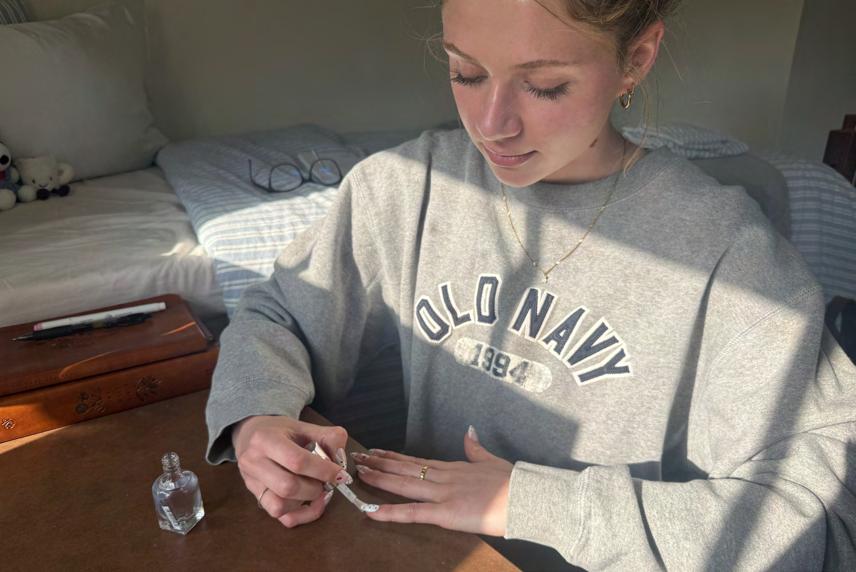
KENZI PERKINS THE MIAMI STUDENT
We’re a country that values independence above all else: financial independence, being self-reliant, starting our own businesses. The fixation on self-support begins early in life, especially in college, which is the first true taste of independence. We distance ourselves from our parents and support systems, eager to make it on our own. If this desire to be self-sufficient is so strong, why is it that we turn to others for so many of our needs?
into the habit of just picking up pizza or something from the meal exchanges. At the beginning of the spring semester, though, I didn’t want the same thing to happen: I was going to cook for myself.
It was hard at first, adjusting to meal prepping in a dorm kitchen, but I figured it out, and I’m so happy that I did. I love taking the time in the morning to make breakfast, starting my day off right. I love a good, healthy meal for dinner after a long day, and even better, the satisfaction I feel knowing that I made it myself.
It might seem like a hassle to take time out of your day when someone else could do it for you in half the time, but it’s so rewarding knowing what’s going into your food, and being your personal chef can be fun.
It isn’t just the preparation of our food that we’re pawning off on other people, though.
Getting a fresh haircut or manicure is one of the best feelings ever, but the prices aren’t feasible. I know, as a broke college student, I’m not looking to drop hundreds of dollars a month on beauty maintenance, but I still want to look my best.
more complex designs.
Not only is it more cost effective for someone paying for school, but it’s also so much fun. Best of all, I know I’ll always like how they turn out, because I’m the one doing them.
It’s easy to let other people do things for you, but there is something to be said about the process of learning something new and the satisfaction of accomplishing it by yourself. If we want to be independent so badly, then why don’t we start actually doing things ourselves? Even if it’s something as simple as painting your own nails or making breakfast, it can be a step towards greater self-sufficiency; eventually, you’ll realize you’re capable of doing all sorts of things on your own.
perkin41@miamioh.edu
Take meal preparation, for instance. It’s easy to just order takeout after work and classes or pick up something on your way home. Sure, you’re not guaranteed the best quality or nutrition, but at least it’s easy, right? I’m guilty of this, too.
When I lived at home, I would cook all the time. But at school, I fell
There are lots of services that we pay other people to do for us, simply because we aren’t knowledgeable or capable in certain areas of expertise, such as car maintenance, handy work and some beauty procedures. The exchange of services for money is many people’s livelihoods, and supporting their businesses is very important. However, there are tasks we definitely can be doing ourselves.
The most productive thing you can do is nothing
JACOB VAN RIPER THE MIAMI STUDENT
“I get bored.” This line comes from the chorus of a popular Deftones song, “Bored,” but it got me thinking: how often do we actually get bored?
Today’s age is dominated by constant stimulation. Social media browsing fills the empty time between events. TV fills the silence in the background of our homes. Music fills our ears every time we walk. We scroll when we wake up; we scroll when we go to bed.
Think about it, when was the last time you took a break? When do we ever actually get a break? Outside of sleep, real mental quiet is rare.
This point isn’t new, and few would disagree that this negatively affects our mental state. There’s nothing inherently evil about technology, but, like many things, the consequences are born out of excess use.
A cross-sectional study conducted by Frontiers between 2021 and 2022 demonstrated that “screen time has a direct, positive, and significant impact on anxiety … and depression levels.”
Attention fragmentation is another point of concern. This refers to constant interruptions that break cognitive momentum and force the brain to repeatedly refocus. Over time, this task-switching reduces the brain’s capacity for maintaining attention.
Many studies, such as one from the Journal of the American Medical Association, found there to be a “significant association” between digital media use and subsequent ADHDlike symptoms, even among people who haven’t been diagnosed with the disorder before.
Constant stimulation also makes non-screen activities more difficult to enjoy. There is plenty of neuroscience research that supports this, showing that unpredictable social feedback — such as likes, comments and notifications — reinforce behavior in a way that constitutes reward conditioning. Repeated, unpredictable digital rewards shape our subconscious expectations of stimulation, which makes less stimulating activities less enjoyable by comparison. Additionally, algorithms are driven by what keeps users on the app, not by what’s best for users’ mental health. Direct or indirect social comparison, quick content shifts and dramatic videos all further heighten the aforementioned negative mental effects.
The solution isn’t to cut out all screens, nor would that be realistic, given how essential technology is in our modern age. Rather, I think we should take initiative by actually pursuing boredom. I don’t mean staring at a wall or even passive laziness, but rather engaging in less-stimulating activities that allow the brain more
room to chill out.
A 2024 study showed that mind-wandering, which is often present in less-stimulating activities, is correlated with increased creativity and creative performance. It makes sense that greater cognitive performance can be achieved through giving the brain time to actually process information. Several studies have shown that this same kind of mind-wandering improves both the brain’s memory of past events and its capacity to concentrate on current events.
I’ve taken multi-month breaks from social media in the past, and I noticed many of the same patterns these studies describe. I enjoyed ordinary things more than I used to and adopted new hobbies I still participate in to this day. My days felt calmer, and I enjoyed being disconnected from the craziness of the world.
When implementing this change, I avoided going cold turkey because the brain has to slowly get used to not being stimulated all the time. I gradually reduced my usage instead, and as more time passed, I found that it became easier to stay off social media.
Cutting down social media usage isn’t the only solution available. Even smaller, intentional changes can help. Walking across campus without music or avoiding using your phone before class are two examples. It’s important to build discipline and not solely rely on motivation to maintain your changes.
We aren’t born to be this distracted, this twitchy, this unfocused. You’re being destroyed by something real, and it’s all within your hands. The first step is simply choosing the silence.
vanripjl@miamioh.edu
Since the start of my first semester at Miami, I’ve been teaching myself how to do my own nail extensions and manicures. It’s taken a lot of practice, but I’ve gotten pretty good at it; I’ve had people ask me where I get my nails done, and I get to tell them that I do them myself.
It’s so much easier to get started than people think: I ordered the supplies on Amazon — which all cost less than a single set of salon-done nails — and found inspiration on Pinterest. It’s a learning process, but eventually, I got to the point where I could do

Flock Safety cameras are immoral and insulting
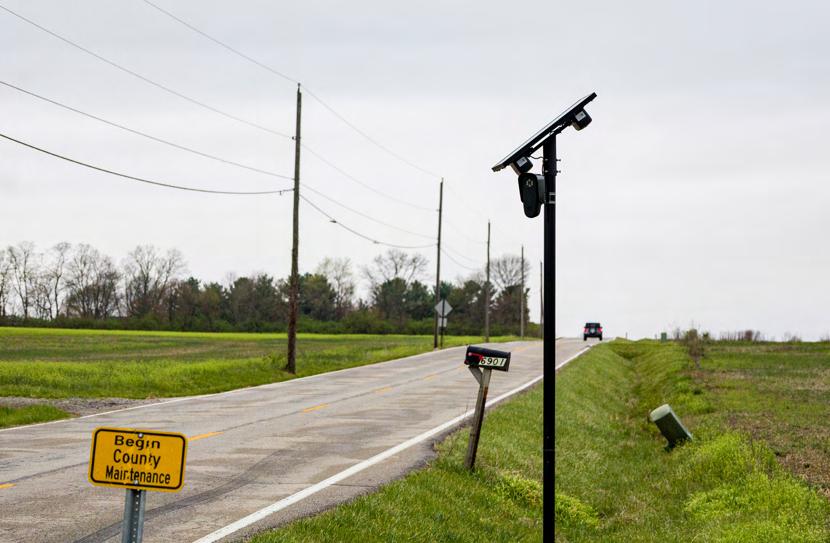
CHARLEY BABB THE MIAMI STUDENT
Over the last few years, you may have noticed some new pieces of infrastructure on the side of the road. They’re tall black poles with a small solar panel mounted on top and a little camera box slung off the side. They’re not particularly noticeable, intentionally designed to blend in with the rest of the street furniture that adorns the side of American roads.
But once you know what they are, you start noticing them everywhere.
These are Flock Safety’s infamous cameras, and they’re relying on you being unaware of what they’re doing, because these are not ordinary cameras.
Their purpose is not to monitor traffic or to support some civil engineer’s vain attempt at fixing traffic with more lanes (this time it’ll work, I’m sure). These cameras are license plate readers. They use an artificial intelligence algorithm to pull license plate numbers and identifying details — such as dents, stickers or accessories — off any car unfortunate enough to pass by them.
Their entire purpose is to track individual citizens, sharing location data with contracted police departments. They’re a nightmare for privacy and a dumpster fire for your rights.
While they are billed as a solution to increase police efficiency in catching “criminals,” they track everyone. It doesn’t matter if there is an active warrant or just some cop with a power trip; these cameras enable it. There even have been recorded instances of the cameras being used to stalk people. To put it lightly, they’re a massive overreach. Anyone, absolutely anyone, can be tracked by these cameras. They record your location and send it to the police. It doesn’t matter what you’ve done; they track you anyway. No warrants, no accountability. Frankly, that’s unacceptable. The government having the ability to track you for any reason is a horrible idea. It doesn’t matter if you’re not breaking the law right now; this
is the infrastructure, the bedrock, for a police state. They’re an enforcement mechanism made to allow any government to criminalize anything it wants. These cameras have been accessed by Immigration and Customs Enforcement and Border Patrol. While the company, the CEO in particular, has repeatedly insisted that no federal agency has “direct” access to their system, that has not stopped federal agents from gaining access to the massive network of surveillance cameras. Primarily achieved through smaller-scale collaborations with the local police departments who actually operate the cameras, the end result is the same. Federal agents have been able to track people without a warrant. In this age of masked thugs patrolling the streets, I don’t feel particularly comfortable with federal agents being able to track me on a whim if they happen to disagree with something I’ve said. These systems really have no place in this country, no place here in Oxford.
The company brags about having over 12,ooo partnerships with various companies, organizations and police forces. While they refuse to publicly share locations, there is an open-source movement locating and mapping as many of the cameras as possible.
An organization called DeFlock has released a map that pinpoints the location of over 83,000 of these cameras in the U.S. There are at least eight in Oxford alone, covering all major avenues into the city and Miami University, with two on US-27, one on Trenton Oxford Road and a handful more scattered around the paths in and out of town, tracking students and community members alike.
In addition, with a standard bit of venture capital-funded, tech company garbage, these cameras aren’t even secure. They are cheap hardware and low quality software built quickly to power the company’s unsustainably fast growth and high demand. The cameras themselves are even being leased to organizations via a subscription service,
remaining owned by Flock Safety themselves, because even the police state isn’t safe from subscriptions, I guess.
Many of these cameras have even been exposed to the internet, so anyone with basic computer knowledge — which, in this case, is just clicking the right links and searching the right things — can access thousands of public surveillance cameras across the United States.
Not only are these cameras purposely built to enable an authoritarian regime to track anyone they disagree with, but they’re also horrendously insecure to the point that it’s insulting. It’s a system built on fear; little black cameras designed to menace people into obeying, all in the name of nondescript “public safety.” Even the name of the company is an insult, trying to make us part of their “flock,” like we’re some kind of sheep. They’re trying to be intimidating, using poorly coded software and poorly designed hardware. To reference “1984” by George Orwell, they would love to be Big Brother, but their systems suck.
I’d rather this technology simply not exist, but for now, at least I can laugh at their sheer incompetence. babbce@miamioh.edu

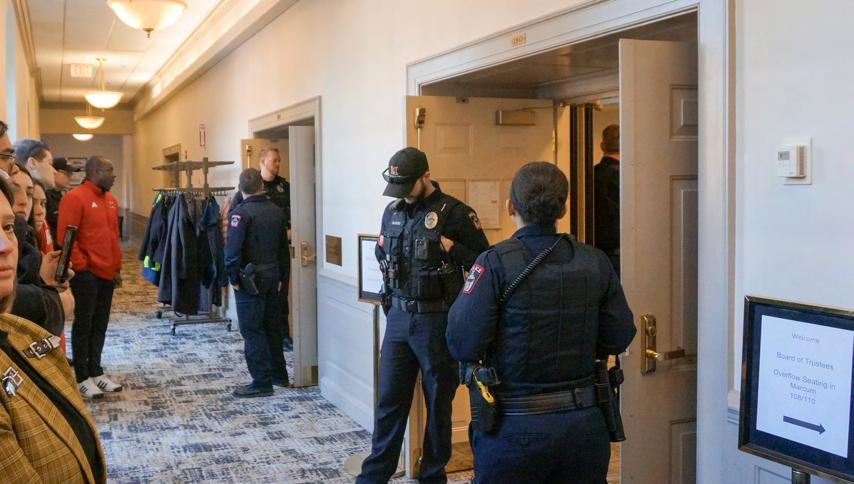
ABE HAGOOD ASST. OPINION EDITOR
At 8:45 a.m. on a brisk February morning, students and faculty lined the hallway of the Marcum Hotel and Conference Center. Organized by the Faculty Alliance of Miami, the Ohio Student Association (OSA) and the Young Democratic Socialists of America (YDSA), we assembled at the Board of Trustees meeting to oppose a motion that would take out $281 million in debt to develop a new stadium on top of Cook Field.
Despite a survey finding 89% of students and other stakeholders opposed the project, it looked like the board would move forward with the development. We wanted to make our opposition clear.
As we arrived, we were turned back at the door by campus police, who said they were out of seating, which looked to have been reduced since the last meeting. I watched through the doorway over the shoulders of cops and administrators as my peers, who had gotten the few three-minute speaking slots, argued their perspective.
Students, who organized around this issue for months and conducted a survey with over 3,000 respondents, were given only three minutes to address the board. Then, I watched as students and athletic staff in favor of the arena were given over two hours to speak.
The truth is blatantly obvious: those speaking on behalf of the vast majority of students were barely allowed to enter the room because their opinions and voices were not valued.
The vote to take out the new debt and remove Cook Field passed unanimously. This is just one example of the disregard the people with power at our public university have for the opinions of students and faculty.
They are destroying the Miami Plan, despite artificial intelligence making it more important for students now than ever. They removed the safe space in the Armstrong Student Center for marginalized groups and tore down flags supporting them. They are consolidating and re-
moving majors that they deem to have “low enrollment,” a nebulous classification that now includes my major — creative writing — the most popular in the English department.
So why is Miami University doing this? They claim these decisions are financial and based on changing student priorities. But if this were true, they wouldn’t be voting to take out millions in debt for an arena that 89% of people don’t want.
The few people in charge continue to demonstrate a clear conservative bias and, at times, a seeming disdain for higher education as a whole.
Ohio Senate Bill 1 removed a significant amount of the University Senate’s power and granted the Board of Trustees final, overriding authority over their decisions. While the individual administration members I’ve spoken with all seem to care about the liberal arts education of Miami students, I fear their judgment is clouded by a desire to appeal to the short-term market forces and current state and federal government officials.
This leaves near total control of the university with the Board of Trustees, an unelected 17-member group containing no faculty, two non-voting students and 11 members appointed directly by Ohio’s conservative governor Mike DeWine.
Unless the student body says otherwise.
A month before the Board of Trustees meeting, hundreds of Miami students assembled at the seal in sub-20-degree temperatures to protest the university’s silence on Immigration and Customs Enforcement (ICE). Organized by a coalition of student organizations, including OSA, the College Democrats and YDSA, a large group gathered to make clear that a campus that isn’t safe for all students isn’t safe for any students.
Marching through the cold at the January ICE OUT protest, the air was filled not just with flurries of snow but with a sense of solidarity, purpose and power. I felt the same solidarity at the Board of Trustees meeting, as I attended the YDSA national organizing conference in Chicago this February and at the No Kings protests I saw
in Oxford, Cincinnati and Seattle last year.
Young people working in solidarity have the power to overturn systems of oppression and shape the institutions and world they want to live in.
After the protest and pressure from an ongoing YDSA petition, the administration met with OSA to discuss concessions like using the university alert system to inform students of ICE activity on campus.
This is not enough. We need the university to fully block ICE from entering campus without a judicial warrant and ensure it is a safe place for all students. We need them to cancel all plans to waste our money building the new arena.
But their concessions prove that we students, working together, have the power to shape our future, here on campus and beyond.
If you, too, feel like no one is listening to you, join us. Together, even forced to stand in the cold and outside rooms of power, we will be too loud to ignore.
hagooda@miamioh.edu
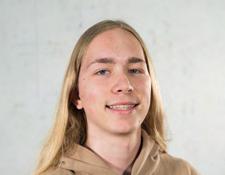
MAUREEN WILSON THE MIAMI STUDENT
I’ve spent more time in Millett Hall than I’d like to admit. Though it’s part of my job, I never viewed sports here as entertainment. I loved when we won, but as the phrase goes, “You win some, you lose some.” This last year has given me two huge exceptions I couldn’t have predicted going in: men’s and women’s basketball. The similarities are clear. Both were undefeated in their home games during the entirety of their regular season. Both had their coaches honored as Coach of the Year from the Mid-American Conference (MAC). Both broke longheld records.
But only one side has the attendance and marketing to match. At the beginning of the season, they had similarly small turnouts of dedicated fans, but why weren’t their viewerships comparable in the end?
Although the perception of women’s sports has radically improved over the years, it is still riddled with controversies. For example, on-screen representation has continued to be a struggle as ESPN has a history of limiting NCAA women’s basketball tournaments to afternoon and regional coverage. It was only in 2022 and 2023 when they were slotted for primetime television, breaking records with an 75% increase in viewership and a peak of 12.6 million. In 2024, despite being taken off primetime, the tournament finale accumulated 18.87 million viewers, becoming the most-watched women’s basketball game in history. For ESPN platforms, it was the most-viewed college basketball game ever, including men’s.
However, this success is undercut by the fact that women are broadcast differently than men. According to a 2020 study on the sexualization of women at their sporting events, commentators tend to focus more on their physical appearances rather than their athleticism and in-game plays. As a result, viewers become alienated and adopt the mindset that women players are not as skilled or interesting as their male counterparts. Even in video games, WNBA players were not included in the 2K franchise until NBA Live 18 in 2017 and 2019. The league had existed for more than 20 years at that point, and when these inclusions occurred, it wasn’t without a wave of sexist comments. Though it seems insignificant, it demonstrates how women are often an afterthought in sports fandoms. But luckily, from personal experience, I’ve seen the audience gender demographics split pretty evenly overall for Miami’s basketball games.
The problem with women’s basketball is not lack of audience, but

NICHOLAS BARRY
THE MIAMI STUDENT
Why has antisemitism become so difficult to condemn? In recent years, this issue has often been pulled into adjacent political disputes that make simple moral clarity tough for many to express.
My experience in the Associated Student Government (ASG) has shown me that even good-faith efforts can get caught in that dynamic. But it has also shown me something encouraging; when antisemitism is clearly understood as hatred toward Jewish people on the basis of religion or ethnicity, students are ready to condemn it.
Since 2022, two legislative efforts in ASG to condemn antisemitism, including one that I introduced in 2023, did not make it through. This February, however, when I introduced a clean, depoliticized resolution, it passed overwhelmingly.
National data still shows elevated
antisemitic incidents, and Jewish students report high levels of exposure and concealment. In January 2025, Hillel reported that 83% of Jewish college students had experienced or witnessed antisemitism since Oct. 7, 2023, when Hamas attacked Israel, while 41% said they felt the need to hide their Jewish identity. Violence and threats have not faded with time. In recent months, the world saw the antisemitic terror attack at Bondi Beach and the killing of two Israeli Embassy staffers outside the Capital Jewish Museum in Washington. Just a few weeks ago, Jewish students and community members at Stanford University received threatening emails containing “numerous unfounded and conspiracist claims” and references to monitoring their behavior, according to The Stanford Daily.
What has changed over the last few years is not only the level of hate, but also the degree to which that hate has become normalized in our soci-
ety. After the Oct. 7 terror attacks, anti-Jewish sentiment, which once stayed closer to the fringe, became acceptable to express in public. Much of the surge initially came from the political left, particularly on college campuses, where hatred was often wrapped in slogans and rationalized as politics.
To be clear, opposition to the Israeli government is not necessarily antisemitism; there should be room to criticize governments, wars and military actions. Not all opposition or slogans are motivated by hatred of Jews; however, some clearly are.
This year, right-wing antisemitism has become more visible. Old conspiracies about Jews controlling money, media and politics have found new life online, voiced directly by figures like Nick Fuentes and Candace Owens.
In a friendly interview with Tucker Carlson, Fuentes blamed “organized Jewry in America” for blocking
visibility.
Miami University has had the opportunity to support all its women’s teams on a larger scale. In the past, our women’s volleyball team only peaked in attendance during their Sept. 3, 2025 Ohio State game, despite being the sole volleyball team for Miami, with 2,550 people. For basketball, the late-season doubleheader events did the best, with a significant portion of the 5,034 attendees there because people wanted to secure a good seat for the men’s game.
But is it really record-breaking attendance if people are just sitting around on their phones during the women’s game, waiting for the “real stuff” to start? Personally, it was disheartening to see, and while players on the men’s team have shown up to multiple women’s games, the general student body does not hold the same amount of respect.
I hope the women’s basketball team’s recent MAC tournament win (their second after their first and only win in 2004), this season’s program record of 28 wins and second ever historical inclusion in a NCAA Tournament game (first in 2008) will help students and recent fans realize talent isn’t gendered. The historical and continuing disparities in coverage reveal the implicit biases we hold against female athletes’ capabilities, but we don’t need to maintain that gap.
Recognizing that men have been given more opportunities to develop interesting and unique narratives for their players and team dynamics — an aspect we don’t initially perceive as a reason for watching sports — is important in understanding why showing up for women’s sports matters. They’re hardworking athletes and students, too.
wilsonmv@miamioh.edu

national unity, while Owens warned followers on X that “You should absolutely be aware of where the Chabad is nearest your home. These people are dangerous.” The problem is not confined to internet personalities alone, as shown by the leaked Young Republican chats in 2025 and the antisemitic group chat involving campus Republican leaders in Miami-Dade County, Florida. When that kind of rhetoric is repeated often enough, especially by people with large platforms, it makes open prejudice feel more permissible.
That process is accelerated by the architecture of online life itself. Many of us no longer see one another eye to eye; we see each other pixel to pixel, constantly being fed people’s worst moments by code designed to hold us in a maintained state of constant outrage. This should be alarming to every student, not just Jewish students.
A culture does not become openly antisemitic all at once; it starts with words and symbols. It stems from hesitation to condemn it out of fear of “rocking the boat.” A bad joke goes unchallenged, a slogan gets rationalized and even a simple moral statement starts to sound too controversial for impartial organizations to say out loud.
Once this happens, a permission structure for hate begins to form, and a relatively small number of hateful people can bully a much larger number of decent people into silence, simply by making statements of clarity feel perilous. Too many of us worry that condemning antisemitism will be misread as taking some other stance we do not mean to take, so we end up saying nothing at all.
That is exactly why I brought my recent resolution condemning antisemitism to the floor of ASG. It passed by a wide margin, and in doing so, ASG said something that should never have been difficult to say in the first place: Hating Jewish people for being Jewish is wrong. The vote should encourage students, because it showed that the vast majority of us are still capable of moral clarity, empathy and basic decency when asked to confront this issue directly. We do not need to solve the conflicts of the Middle East before we can have clarity on this. We do not need unanimous agreement on every geopolitical dispute. What we need is the courage to say that hating Jewish people on the basis of their religion or ethnicity is wrong. Do not let fear of controversy silence you. Say it plainly: Antisemitism is wrong.
barrynj3@miamioh.edu
About
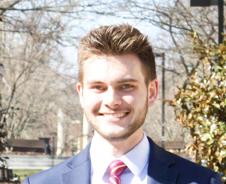
About
Hagood
CAMPUS POLICE STAND IN FRONT OF THE DOORS TO THE MIAMI BOARD OF TRUSTEES MEETING. PHOTO BY ABE HAGOOD FLOWERS PLACED AT BONDI BEACH, SYDNEY,

GREENHAWKS
Green Beer Day aids fraternities in competitive aluminum can drive
TORI FEE STAFF WRITER
Various Miami University fraternities competed to recycle aluminum cans in collaboration with Associated Student Government (ASG), Interfraternity Council (IFC) and Miami’s Sustainability Office from March 13-
20. The idea for an aluminum can drive competition stemmed from a conversation between Alex Miller, student sustainability engagement coordinator, and John Day, secretary for sustainability in ASG. Day said ASG was looking for a spring clean up event, and Miller had experience from her undergraduate years.
Miller attended Hanover College and was heavily involved with different environmentally friendly organizations. She said they wanted to do a
similar competition at Hanover, but didn’t have a waste-hauler partnership at the time.
Jack Graves, vice president of philanthropy and service for IFC, said he helped brainstorm ideas to make the competition work best.
“[The fraternity presidents] thought it’d be really easy and chill to do,” Graves said. “And with Green Beer Day, that’s a lot of aluminum cans you can throw away.”
This competition was in partnership with River Metals Recycling, which provided a large recycling dumpster for free and bought the collected aluminum cans. The payment from this sale created the winning fraternity’s prize, along with a $500 donation to the winning fraternity’s philanthropy.
“We use [River Metals Recycling] for other recycling stuff on the phys-
‘Changing Climate, Changing Communities’ sparks conversation and celebrates local art
CONTINUED FROM FRONT
“It’s a single individual walking in a rainstorm,” Feilen said. “It’s a little bit abstract, but they’re wearing a bright color, and it represents, to me, the brightness and light in the darkness and that contrast of those feelings.”
Jo Scofield, ECO board member and Project Dragonfly graduate student, helped put out the art call and communicate with featured artists. She said she found the collection of art to be diverse and stimulating, including mediums of paint, sculpture and even written word with graphic elements. Scofield also said she enjoyed the vast array of artists, ranging from professional artists living in cities to local elementary school students.
“With the elementary [students] you have that level that speaks to
their perspective on how they see the world, which is always interesting and always fun and playful,” Scofield said.
Ridgeway Elementary School art teacher Liz Krehbiel featured art from three of her students at the exhibition. Inspired by a Miami University lecture series featuring artist Laurie Hogan’s show “Total Body Burden,” Krehbiel had her 6th grade students imagine and draw animals that never got the chance to be discovered because of climate change.
“I think they had fun with the media and looking at this professional artist, and then the idea of making up your own animal was fun for them,” Krehbiel said.
The imagined animals are now hanging side by side at the exhibition, beside plaques with student names and information about their animal. Krehbiel said that she hopes students feel empowered to continue creating
ical facilities side of campus as well, so we already had a good partnership with them,” Miller said. “They said they have Miami alumni working for their office and love to come here for career fairs.”
Miller said she was impressed with how forthcoming River Metals Recycling was in helping with the competition. On top of the market price for aluminum, River Metals Recycling added an extra 50 cents for every 50 pounds collected to help push the sustainability initiative.
Over the week, nine participating fraternities collected a total of 155.5 pounds, with Delta Kappa Epsilon, the winning fraternity, collecting 43.5 pounds. Delta Kappa Epsilon will recieve $500 for their philanthropy, as well as the payment from the aluminum cans.
The other top recycling fraterni-
ties included Delta Sigma Phi with 28 pounds, Phi Gamma Delta with 27 pounds, Kappa Sigma with 19 pounds and Phi Kappa Tau with 17.5 pounds.
According to an estimation by River Metals Recycling, the total 155.5 pounds equals around 5,000 recycled aluminum cans.
A common goal among ASG, IFC and the Office of Sustainability is improving sustainability infrastructure and creating a better relationship between Greek life and the Oxford community.
“It’s a really cool way to promote sustainability and especially get all the frats involved,” Graves said. “A lot more people are starting to do more service, and this could be a big explosion where people see everything happening at once.”
Miller said this competition was a group effort that shows sustainability
can be pushed and supported outside of environmental organizations. Day said he thought a competition aspect would appeal to fraternities, and he also hopes the event can continue following his graduation.
Miller said she thinks the first trial of this competition showed great outcomes. She said spring events can bring in more interest, and she hopes the drive will ultimately lead to a long-term cultural shift towards environmental stewardship.
“Nothing changes overnight, but hopefully this is a good start to some future connections and partnerships that we can have,” Miller said.
feeta@miamioh.edu

art across the course of their lives because of their experience in the exhibition.
“Anytime you have a chance to showcase your student work, it just shows them there are other applications and there’s a bigger world out there if you want to do art, even if it’s
something like the Oxford Community Art Center,” she said. “These are local community artists. They’re not necessarily world famous. Some of them are professional, there’s Miami professors that had work in the show and stuff, but also there are just regular people, and you can continue to do art throughout your life.” The exhibition will be open to the public for viewing during the Oxford Community Arts Center’s regular open hours until Monday, May 4. kennelse@miamioh.edu
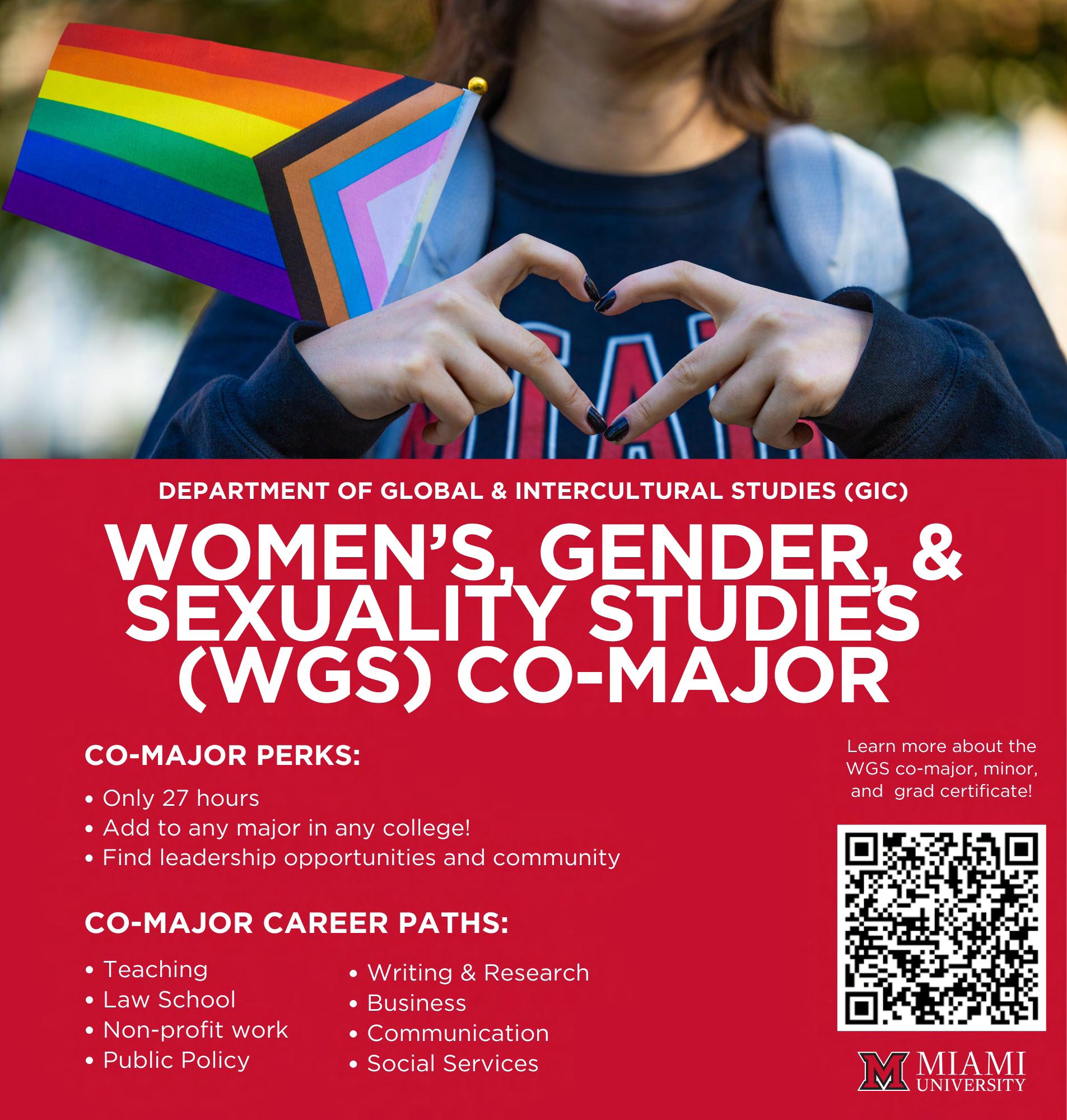
A PAINTING DEPICTING THE DANGER OF LANDFILLS HANGS IN THE OXFORD COMMUNITY ARTS CENTER. PHOTO BY SARAH KENNEL
Top superpowers I would absolutely abuse for one day

CARLEY RAPP HUMOR EDITOR
I’ve been thinking long and hard about a burning question: If I were to be granted a wish, which superpowers would I want to gain? In lectures when I was supposed to be taking notes. In the shower. And, in the place where all of my good ideas come together (IYKYK).
And to be clear, I will not be saving a cat from a tree or doing anything heroic whatsoever. The cat got itself up there; the cat can figure out how to get down. Instead, I’m going to focus on the important things — making life a little bit more convenient for me.
Invisibility
Think about it. All the times you’ve walked past someone you only kinda know, but didn’t have the energy to do the whole, “Omg hiiiiii, we should totes hangout girl!” thing with. All of a sudden, you were never walking anywhere close to them. Literally any conversation you don’t want to be a part of, you could just POOF and vanish. Imagine the power: Chemistry lab teaching assistant: “Was that you who I just saw mixing food coloring in water without gog-
gles??”
Me: “Prolly, yeah.” Chemistry lab teaching assistant: “And what is your name, missy —” POOF. Gone.
Flying God knew I’d be too powerful if I had the ability to fly. I’m already awesome, the universe couldn’t risk making me perfect too. That would be unfair to the rest of you. Picture me soaring past you peasants who drop $4 on a sketchy bus ride to get Uptown. I’d use my flight in the most advantageous way possible: Cutting the two-hour Brick line. What’s the bouncer going to do?
Reach up? I have the high ground, bucko.
No cover for the girl with wings. Seems cool to me. (To my future employer: This is satire. I love Excel and I’ve never actually been outside. Please hire me.)
Infinite MUlaa
Oh, the things I could do. I’d be the first person in history to look at a Starbucks barista and say, “Yes, the $500 upcharge for cold foam is completely fine. Here’s my gold bar.”
I might even splurge on one of those overpriced fruit cups from Em-
porium, which contains nothing but two mushy grapes and an apple slice that looks like it’s already been bit in half. Maybe I’d even buy two and leave one on a nearby table to show everyone I’ve truly made it.
Mind reading
If you don’t already know by now, chemistry isn’t really my thing. We’ve been going through a very messy, public divorce for a few years now. Since I’m not getting the house or kids, I feel entitled to some sort of compensation, which is why I need the right to read minds.
Reading minds during an exam wouldn’t be cheating per se, just think of it as… peer reviewing. If my scantron looks identical to the smartest kid in class, it’s a result of two great minds thinking alike.
Besides, I am a trendsetter. Maybe they were the ones reading my mind. You don’t know.
The verdict
Let this be a warning that one day when I get superpowers (because I will), I will not be the hero Gotham needs. Everyone knows Batman is real and can handle that himself.
rappcr2@miamioh.edu

ANA ELIZA DE MELO GARCIA THE MIAMI STUDENT
It feels so strange to think that nowadays, students walk into class not carrying a huge stainless steel mug of coffee — the kind that could double as a small fish tank — but a colorful mix of energy drink cans. Grape, strawberry, orange, blueberry, blackberry, lemon… I half expect someone to show up with “unicorn-flavored” or “glitter explosion” energy drinks next. I wouldn’t be surprised if they already exist. Meanwhile, coffee just sits there, bitter and stubborn, tasting… well, like coffee. Sometimes weak — the dreaded “coffee-tea” — sometimes strong enough to make your soul quiver. No one ever seems to get the flavor just right. Sure, coffee can be dressed up with milk, sugar, whipped cream, syrup, caramel drizzle or maybe even a dab of unicorn tears. But it surprises me that in the U.S., where we drink coffee by the gallon, most people still can’t handle more than two shots of espresso unless it’s buried under a mountain of milk and sugar. Energy drinks, on the other hand, come in a convenient can. One satisfying “psst” when you
open it, and BOOM; it’s instant, pre-flavored energy. No measuring, no milk, no heartbreak when it’s too strong or too weak. Just pick a flavor and let your taste buds ride the fruity rollercoaster — though, honestly, many of these drinks taste like medicine.
Are today’s students too weak to handle the bitterness of coffee, the kind my professor once said, “is like life itself?” Or were we, the coffee-obsessed generation, fools for loving a drink with fewer flavors, tricky preparation and extra steps to get it right?
I honestly don’t know which drink would win this caffeine battle. All I know is that whenever I see a student walk into class with a tiny aluminum can of neon liquid, I either think, “Really? That’s your caffeine?” or mutter, “Coffee would still be better if you just tried it.” Once upon a time, we were addicted to coffee the way today’s students are addicted to whatever grape-orange-blueberry drink is trending. And I can’t help but wonder: If this continues, will coffee shops become energy drink boutiques, complete with flavor flights and tiny umbrellas in every can?
demeloa@miamioh.edu
My April Fool’s Day and senior prank extravaganza

As far as I’ve been told, I am go-
ing to be graduating in May. I have already been forcibly removed from my post as the The Miami Student’s humor editor, and my parents keep yelling at me about something called
a job. Although I am sure you’re devastated to hear that my reign of excellence is coming to an end, I promise to you, dear reader, that I will go out with a bang. With April Fool’s Day

around the corner, I’ve devised the best pranks this town has ever seen. Trust me, as someone whose acceptance to Miami came under question following my high school senior prank, I really do this.
Option 1: Supergluing a toupée on President Crawford’s head
Listen, I respect President Crawford as a bald, short king. He really pulls off the look, especially when he’s wearing a suit (rawr). But, hear me out, would it not be hilarious for him to have a crappy comb-over glued to the top of his dome? I can just imagine what he would say when he wakes up: “Gee-wilikers, Dr. Crawford (he totally calls her that at home like a respectful king), what in tarnation happened to my hair?” Classic.
I think this is a strong option. However, I have a few concerns. First, while I am a menace, I am not a felon. I respect the rule of law. Second, I would not do anything to besmirch my beloved prince. And finally, I would not get to see the payoff of my prank. I think I’ll have to pass.
Option 2: Situationship hotline
I have always wondered what it’s like to have ops on this campus. This could be my best op-portunity. Here’s the plan, I’d reach out to both parties with a “Miami Special” they couldn’t refuse: Two packs of Zyns for him and a $25 Starbucks gift card for her.
All they have to do is come to the Upham arch at a time that fits within the other’s class schedule. There, I will film a TikTok asking some simple questions (for example: “John, why are you snapping five other girls despite telling Emily you’re exclusive?”). From there, I will take them on an incredibly romantic date (have my resident assistant friend scan them into a dining hall). I’m sure this would be an incredibly helpful and productive experience.
Option 3: Stand on the corner supporting a raise in tuition
The best scare I think I can give everyone in this university is standing next to the flat earth guy and arguing for why tuition needs to be raised. The administration would take my protest as a sign to raise tuition so they can afford a new underwater basketweaving arena. For students, many would be afraid that, as a man of influence, I will be successful in getting tuition raised. I know I will get the attention that I deserve (but definitely don’t want, I am not an attention seeker). Once a massive crowd gathers around, I will have my camera crew run out, tell everyone they got pranked, and maintain my title as the funniest man on campus.
oviattcc@miamioh.edu

CONNOR OVIATT
GRAPHIC BY JAYSON BRAKE
GRAPHIC BY CAITLIN WONG
GRAPHIC BY SYDNEY MULFORD