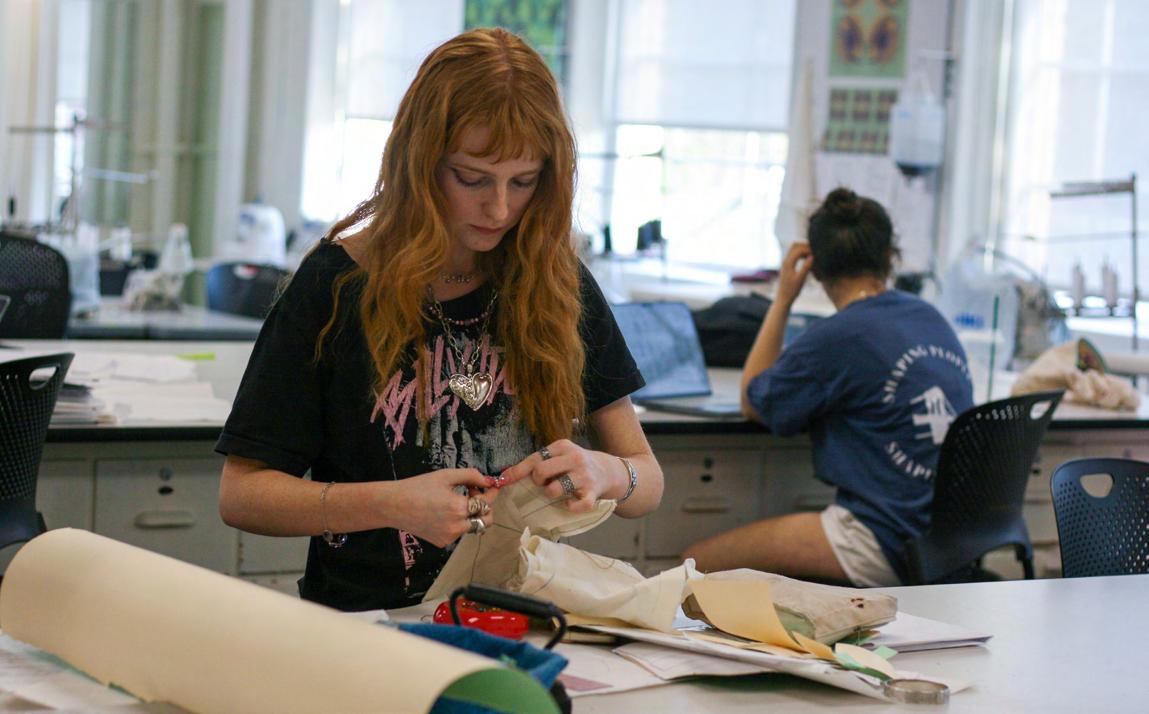
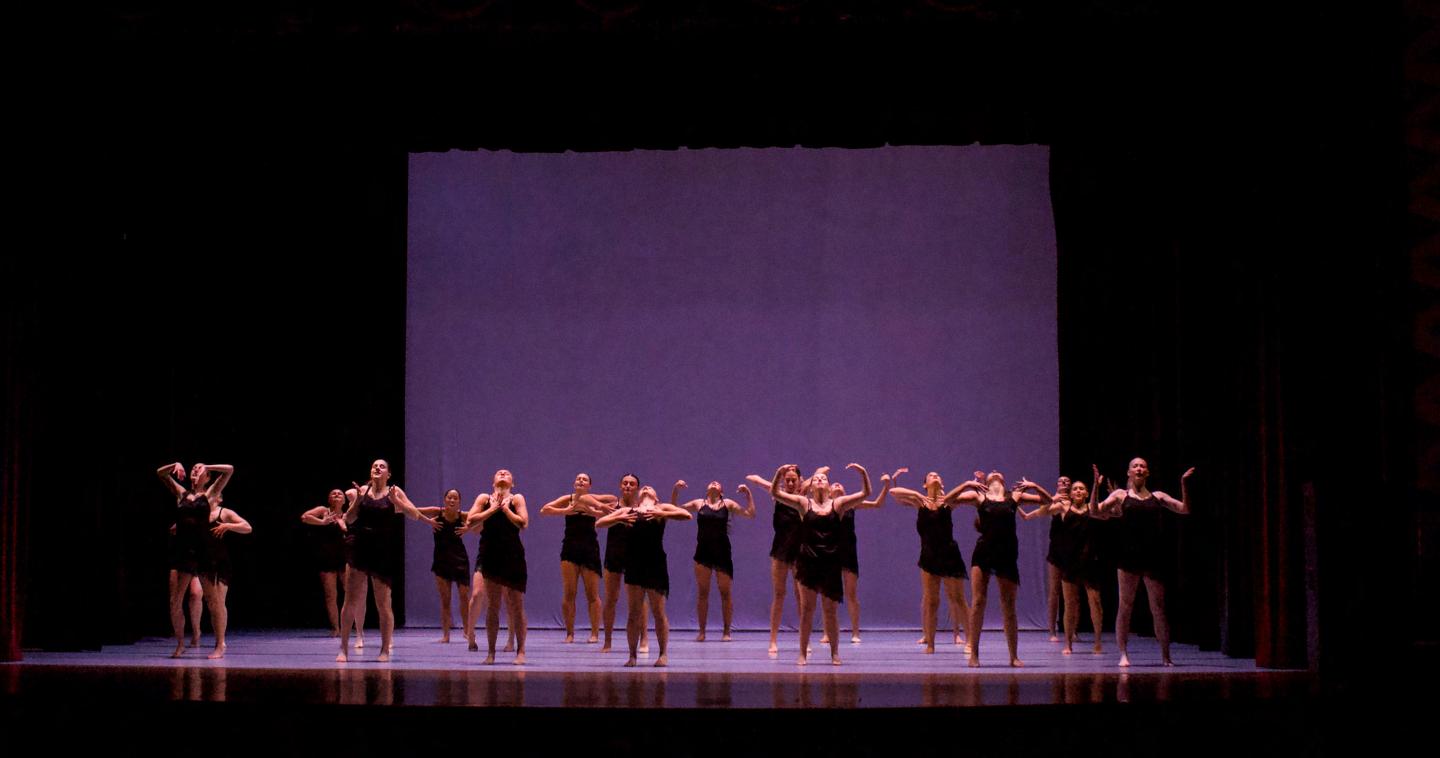
For years, the fashion world has captivated thousands of people — Miami is no exception. Over the past 20 years, Miami University Fashion and Design (MUF&D) has hosted its annual fashion show, showcasing the designs of fashion and non-fashion majors alike. With over 900 members, MUF&D is Miami’s largest student-run organization.
This year’s show, “Allure,” will take audiences on a journey, exploring the mystique and intrigue of fashion. The show is brought together by 22 designers and 87 models, as well as dozens of executive and general
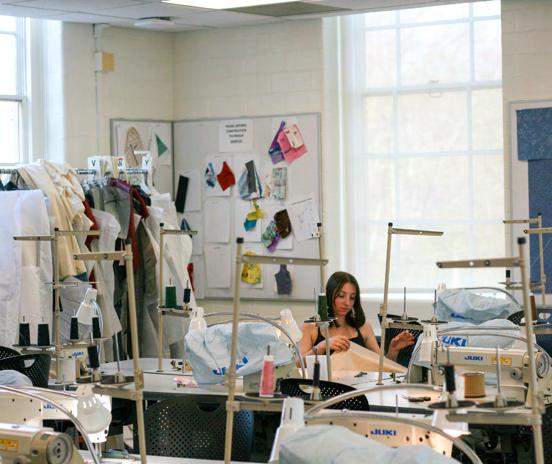
members. MUF&D anticipates an audience of over 2,000 people, making this the largest in the organization’s history and one of the biggest student-run shows in the nation, according to a press release from MUF&D. At the show, audience members will see shimmer, elegance and grandeur. What isn’t shown is the hundreds of hours of work that go into planning every minute detail.
Sara Rose Detwiler and Audrey Fitzgerald, the president and vice president of MUF&D, began planning “Allure” after last year’s show, “Mosaic,” was completed.
“Right away [Audrey and I] met, and we decided what we wanted the show’s theme to be,” said Detwiler,
KETHAN BABU EDITOR-AT-LARGE
ZOE FLEISCHER THE MIAMI STUDENT
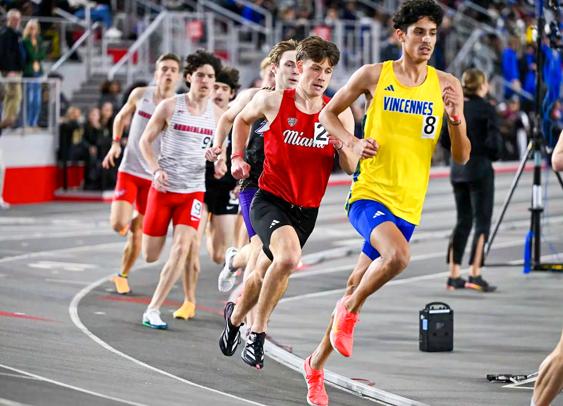
In the early hours of March 26, Tom Heal woke up for a brisk, threemile run to start his day. He ate a simple lunch of rice before heading to the Raleigh Relays meet to represent the Miami University RedHawks.
Heal competes in the 3000 meter steeplechase, an obstacle race featuring barriers and water jumps. Going into the event, he didn’t expect anything particularly phenomenal to happen. His preparation before and performance during the race felt like another day for the senior from the United Kingdom.
When he crossed the finish line in Raleigh, North Carolina, Heal set a personal record with a time of 8 minutes, 50.32 seconds, ranking third in program history. One year prior, he had positioned himself at seventh all-
a senior strategic communications major. “So that was in May of 2025, [we knew] what the show was going to be.”
The duo came up with the theme “Allure” to represent the appeal and mystique of MUF&D and the fashion world in general. Detwiler said that much of what draws students in is the mystery and excitement of the whole process — it’s alluring.
Additionally, Detwiler said that she and Fitzgerald, a senior emerging technology and fashion student, wanted to pay homage to the runways and fashion shows that defined the 2010s, as well as her childhood. Images such as Victoria’s Secret Angels, catwalks and shining lights created a
sense of nostalgia that Detwiler wanted to highlight in this year’s show, as well as the artistry that goes into making the event possible.
“We have all these very fun and mysterious, sexy things,” Detwiler said, “but there’s also such a humility and craftsmanship and hard work that goes on behind the scenes … you’re seeing all the shiny lights and the spectacle and the silhouettes on stage, and then we’re also taking you behind the curtain.”
Audiences only see a small fraction of the work that goes into creating what is eventually a whole, unique project — the same goes for every live performance.
GRAHAM YOUNG SPORTS EDITOR
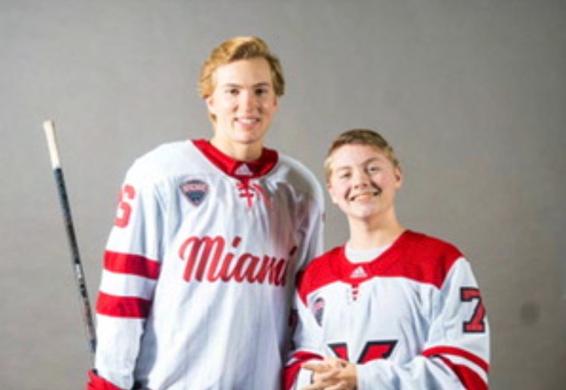
Every Monday night from September to March, the Cincinnati Icebreakers, a nonprofit sled hockey organization, hosts practices for individuals living with physical impairments that prevent them from ice skating. Miami University senior forward Blake Mesenburg and five teammates saw this as an opportunity to surprise one of the Miami hockey team’s biggest fans.
They drove 45 minutes down to the Queen City Sportsplex in Cincinnati. As they entered the lobby, Mesenburg peered through the rink glass and spotted him.
Sixteen-year-old Liam Jergenson looked up from his sled with a bright smile on his face. For the next 90 minutes, Mesenburg and the team sat in chairs with blades on the bottom, extended their legs and held two sharp-edged sticks for pushing off. Even though Mesenburg had been on the ice his whole life, he struggled to get the hang of the sled and felt out of place. Luckily for him, Jergenson cared more about the team being there than him sitting in sled hockey practice.
“It’s funny, we’d do drills and I’d be trying to pay attention as he’s talking to me, trying to figure out what we’re going to do,” Mesenburg said. “He could talk all night. He’s that type of kid.”
‘It’s
ZOEE ROBINSON THE MIAMI STUDENT
“How many of you were born before 9/11?” his professor asked. Reluctantly, Jackson Miller raised his hand, one of two raised in the entire class.
Miller is a 26-year-old student veteran at Miami University. He’s a sophomore studying organizational leadership.
Miller joined the U.S. Army in 2019, after about two years contesting a Marines disqualification over a minor eye condition.
He served as a sergeant in field artillery at Fort Riley in Northwest Kansas, in Death Valley, California and overseas in Poland, Germany and Belarus.
“I'm going to do it,” Miller said when recalling his path to enlistment.
“I don’t care what it takes.”
time in the same event during his first year as a RedHawk.
Heal started his career at Queens University in North Carolina after crossing the Atlantic Ocean from his home country. He grew up in a running family, competing in 5 kilometer races before a coach at his local athletic club introduced him to the steeplechase.
When he decided to transfer out of Queens, Heal began talking with De’Sean Turner, Miami’s head cross country and associate head track and field coach. Turner felt that Heal would fit well both athletically and academically at Miami, but the coaching staff at the time was on an interim basis.
Heal took a gamble and committed to Miami, a decision that Turner said has boosted the program’s strength and lifted up the rest of the team.
“One of the best things about Tom is you never doubt his ability to work hard,” Turner said. “You never doubt
that he is willing to put in the work to get better, which he’s done consistently since he got here … He’s actually somebody who I would really like others on the team and recruits that are considering Miami to take a look at.”
Heal’s determination was on full display at the Jesse Owens Track Classic last season in Columbus, Ohio. The day of the 3000 meter steeplechase event was littered with rainstorms and no indication of the weather improving. Turner nearly pulled his athletes from their events, but Heal convinced him to let the team compete.
Heal made it worthwhile; he finished in first place with a time of 8:54.77, seventh-best in program history.
“Everyone else in that race is running in the rain,” Heal said. “It’s not like a special condition for you, somebody’s got a cloud over your head … I was kind of shocked about 8:54.
When Miller returned home to Oxford, Ohio, in 2023, after a little more than four years of service, it took him about six months to a year to adjust to civilian life.
AYLA PEDEN ASST. CULTURE EDITOR
THE MIAMI STUDENT STAFF
SHANNON MAHONEY EDITOR-IN-CHIEF
ELISA ROSENTHAL
MANAGING EDITOR
EVELYN DUGAN
OWEN MARTIN
PARKER GREEN
CAMPUS &
COMMUNITY EDITORS
GRAHAM YOUNG
SPORTS EDITOR
TAYLOR POWERS
OPINION EDITOR
STELLA POWERS
CULTURE EDITOR
CARLEY RAPP
HUMOR EDITOR
SARAH KENNEL
GREENHAWKS EDITOR
SYDNEY MULFORD
DESIGN EDITOR
ELISE HANNA
DIGITAL MEDIA EDITOR
EMILY CLARK
PHOTO EDITOR
KISER YOUNG
SOCIAL MEDIA EDITOR
CAITLIN WONG
ASST. DESIGN EDITOR
AYLA PEDEN
REN CHAFFEE
ASST. CULTURE EDITORS
COOPER MENEGHETTI
VINCENT JOLLIFF
ASST. SPORTS EDITORS
ABE HAGOOD
ASST. OPINION EDITOR
IVY KLEINMAN
ASST. PHOTO EDITOR
AUSTIN SMITH
BUSINESS MANAGER
JAMES TOBIN
INTERM FACULTY ADVISER
SACHA BELLMAN
BUSINESS ADVISER
AIM MEDIA MIDWEST PRINTER
Our Awards
2025 Ohio News Media Association Award for First Place in Best Website
2024 and 2025 Corbin Gwaltney Award for Best All-Around Student Newspaper in the large school category
2025 Ohio Society of Professional Journalists (SPJ) Award for First Place in the Best College Newspaper category
2025 Greater Cincinnati Pro Chapter Society of Professional Journalists (SPJ) Excellence in Journalism Award in the College Student Publication category
2025 Ohio News Media Association Award for First Place in Best Website
2025 Mark of Excellence Award (SPJ) for First Place in Best Affiliated Website
ASG elects new senate leadership, passes gradebook consistency resolution
KATHRYN HIPPE STAFF WRITER
The Associated Student Government (ASG) elected new student senate leadership Tuesday night following a multi-candidate race that emphasized empowerment, order and representation within the senate body.
Senator Quin Ahler was elected out of four tickets as speaker of the student senate, while Senator Japveer Singh was selected, uncontested, as secretary of the Treasury and Kathryn Kleeberger was re-elected as secretary of the Communications and Outreach Committee.
The race for senate speaker featured three other candidates — Senators Charles Amara and Nick McClure, and Pro Tempore Aiden Bryant — with discussion frequently returning to how the speaker can balance parliamentary procedure while creating an accessible and welcoming environment.
Ahler emphasized the role of senate speaker as a facilitator of culture and engagement, aiming to empower senators to use their voices and contribute to the body’s diverse perspectives.
“I’m not here to push my own agenda at all,” Ahler said. “I’m here to empower [the senate body].”
In his remarks, Ahler invoked Miami’s founding principles, quoting the university’s first president Robert Bishop on the importance of developing “self-government” within a “free community.” Looking ahead, he said he hopes to prioritize recruitment to build a full senate reflecting a range of student perspectives and organizations.
Current Speaker of the Senate and newly-elected Vice President Susanne Morrissey said Ahler’s welcoming energy and people-focused leadership style will position him well in the role.
“[Ahler] is really great about seeing where the senators are, reading the room and just engaging with them in the ways that they need to be,” Morrissey said.
Senator Singh, who ran uncontested, outlined his priorities as secretary of the treasury, emphasizing speed, clarity and equity in ASG’s funding process, as well as creating an end-of-semester analytics report to track senate outcomes.
Singh said he hopes to improve the efficiency and accessibility of funding for student organizations.
“Communication is key to any-
thing you do,” he said. Secretary Kleeberger was re-elected, uncontested, as secretary of the Communications and Outreach Committee. During her previous term, she expanded ASG’s digital presence, increasing website views by 233% and launching new LinkedIn and TikTok accounts.
Looking ahead, Kleeberger said she hopes to continue strengthening outreach efforts, with plans to use ASG’s Facebook and YouTube accounts to further broaden engagement.
“With consistency and dedication, we can reach more students and hear more voices,” Kleeberger said. Beyond leadership elections, ASG passed several pieces of legislation addressing student concerns.
A resolution requiring professors to consistently use and update Canvas gradebooks passed with strong support in a 33-1-1 vote. Senator McClure proposed the resolution to improve transparency for students monitoring their academic performance throughout the semester. Multiple senators said some professors do not consistently use Canvas, leading to confusion when tracking grades.
ASG also passed a resolution supporting the use of MUlaa, Miami’s on-campus spending account, for dining hall purchases. MUlaa can currently only be used for select on-campus expenses, including printing, box office tickets and residence-hall laundry machines.
The measure, proposed by Senators Zoe Erickson and Catherine Conner, drew strong support, with members noting MUlaa funds are nontransferable and often go unused. They also pointed to peer institutions where similar accounts can be used for dining expenses.
“[Miami] made me put a lot of money on my MUlaa that I don’t actually use,” Erickson said. “I would really like to use that for dining.”
Senators raised questions about implementation and whether funds would carry over between semesters. The resolution passed 31-0-1.
Additional announcements were also discussed. Vice President Kirsten Osteboe and Secretary of Community Engagement Tyreke Farquharson reminded the senate of Philanthropy Fest, set for April 24 from 2-4 p.m. in Uptown Park. The event will allow student organizations to fundraise and will include food trucks, a bounce house and opportunities to earn service hours. They also noted National Volunteer Week will take place April 19-25, featuring a range of service opportunities.
Additional senate leadership elections are expected to take place next week, as ASG continues to finalize positions for the upcoming term.
ASG will meet again at 6 p.m. Tuesday, April 24 in the Joslin Senate Chambers.
hippekl@miamioh.edu
cers received a report from a male that his wallet was stolen from his vehicle while he was inside a local restaurant.
Between April 6 and April 13, police officers responded to 21 different incidents, according to the Oxford Police Department report.
On April 6, at 4:29 p.m., in the 500 block of S. Main St., a bicycle was reported as stolen from a bike rack over the weekend. No other information was provided.
Later that day at 11:41 p.m., in the 300 block of E. Vine St., officers responded to several addresses for reports of hazing.
On April 8, at 8:54 p.m., at the intersection of South Main Street and West Walnut Street, officers observed two juvenile males in possession of marijuana, alcohol and vapes. The juveniles were charged with underage consumption and possession of drugs.
Later that day at 11:22 p.m., on North Campus Avenue, officers responded to a report of a juvenile who pushed his mother down after she gave him $6 to buy food, rather than the $8 he requested. When officers arrived, the juvenile stated he wanted to harm himself and was taken to the Children’s Hospital for evaluation.
On April 9, at 3:26 a.m., in the 100 block of E. Withrow St., officers responded to a report of three lawn chairs stolen off the front porch of the property. No information about the suspects has been provided.
On April 10, at 12:09 a.m., in the 0 block of N. Poplar St., officers found a female lying on the ground. It was reported that she was heavily intoxicated and underage. Officers cited her, and the Oxford Fire Department transported her to the hospital.
That same day at 2:26 p.m., in the 600 block of S. Locust St., offi-
Later that day at 7:42 p.m., in the 0 block of E. Chestnut St., officers cited a female cashier for selling alcohol to an underage person. That same night at 8:28 p.m., in the 200 block of S. Locust St., a male cashier was cited by officers for selling alcohol to an underage person.
Later that night at 9:08 p.m., in the 0 block of E. High St., officers cited a female bartender
AUSTIN SMITH BUSINESS MANAGER
GRAPHIC BY MACY CHAMBERLIN
ELISA ROSENTHAL MANAGING EDITOR
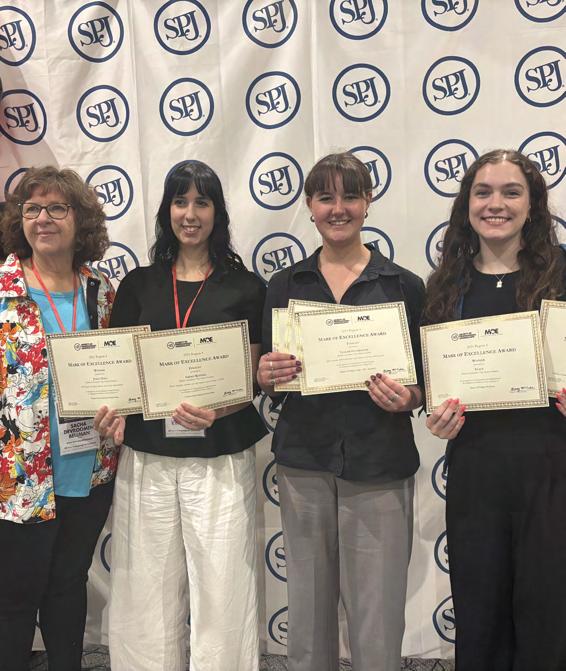
During the weekend of April 1011, members of The Miami Student’s editorial staff attended the Society of Professional Journalists (SPJ) mega regional conference in Louisville, Kentucky. The conference, titled “Never Silent,” welcomed attendees from Regions 4, 5 and 12 bringing together student and professional journalists for a series of informational sessions and the presentation of the Mark of Excellence Awards for the best of collegiate journalism.
Editor-in-Chief Shannon Mahoney, Managing Editor Elisa Rosenthal and Greenhawks Editor Sarah Kennel attended the two-day conference to expand their knowledge and receive awards on behalf of Miami University’s student media publications. Miami brought home two wins
and was honored as a finalist in five other categories.
As an Ohio-based publication,
The Miami Student is a part of SPJ’s Region 4, which includes Ohio, Michigan, western Pennsylvania and West Virginia. Other attendees from Region 4 included University of Cincinnati’s student newspaper “The News Record,” Ohio University’s “The Post” and Marshall University’s “The Parthenon.”
The Student was a finalist for the Corbin Gwaltney Award for Best AllAround Student Newspaper in the large newspaper category. The Staff as a whole was named as recipients of the award. In the category for Feature Writing, former Campus and Community Editor Taylor Stumbaugh was a finalist, specifically for her article “After six decades, retired department chair returns to his roots delivering news.”
University
KYLIE BUNN
The University Senate introduced the new provost and Associated Student Government (ASG) representatives and delivered updates on sustainability efforts, as well as proposed changes to attendance policies and the Miami Plan during its April 13 meeting.
Nathan French, vice chair of senate and chair of the Senate Executive Committee, announced that Trent Gold, current dean of the College of Education and Human Sciences and professor at the University of Southern Mississippi, will join the Miami University community as provost on July 1. Following discussions at previous meetings, the University Senate approved a motion to add contextual agility to the Miami Plan. Senators also approved a proposal from the Department of Sociology and Gerontology to create a criminology major. Both items will move forward in the university’s approval process.
Olivia Herron, director of sus-
tainability, provided an update on Miami’s sustainability efforts and achievements.
Miami earned a gold rating in the Association for Advancement of Sustainability in Higher Education’s Sustainability Tracking, Assessment and Rating System assessment last academic year. In addition, Second Nature awarded the university with the decarbonization award at its Climate Luminary Honors. Herron announced that the Sharon and Graham Mitchell Sustainability Park will open at 2 p.m. April 20. French welcomed new ASG representatives, junior President-Elect Charlie Merill and sophomore Vice President-Elect Susanne Morrissey to the body. Merrill and Morrissey shared their campaign process and goals, including their three pillars: Mental health, life development and love and honor.
“We’ve had a lot of fun during the campaign process and figuring out what our pillars are going to be and now that we’re in this position, we’re just excited to get started,” Merril
In the Science/Environmental Reporting category, The Student has both a finalist and the winner of the award. Kennel was the finalist for her article “Hefner highlights: Students and staff steward natural history at Miami,” and writer Julia Hall won the award with her article “EPA grant cuts impact Miami, local climate organizations.”
The Student took home the award for Best Affiliated Website for its website, miamistudent.net. In addition to The Student’s newspaper-related awards, its sister publication The Miami Student Magazine was a finalist for Best Ongoing Student Magazine. UP Magazine, another Miami student-run publication not affiliated with The Student, was a finalist in the same category.
rosente2@miamioh.edu
said. Theodore Peters, lead divisional advisor for student academic services in the College of Arts and Science, proposed the reduction of the minimum hours for undergraduate certificates from 12 to nine.
The change aims to align with other programs which have reduced credit hour requirements. The policy would also apply to graduate certificates, creating a single policy for both levels rather than the two that currently stand.
Carol Fabby, associate professor of the physics department, and Adam Beissel, associate professor of sports leadership and management, presented an update on the class attendance policy.
The Class Attendance Policy Committee, which began its work in fall 2024, met to address the inconsistencies in how student absences are handled. The committee has worked to revise the policy to create more clear and consistent expectations, specifically focusing on students representing the university in activities like athletics and other university-sponsored
events.
“What we really tried to do when it came to forming this policy was try and keep the policy really broad, really fair and really applicable to everyone, but then couple that with a best practices of company and guide for faculty who have extenuating circumstance, issues and complexities in terms of the courses that they instruct,” Beissel said. They provided a more clear definition of university-sponsored activities as well as an idea for a website to handle the updated policy and further guidance. This would also replace the current paper-based absence system that is used to notify professors when athletes will be missing class. Elizabeth Hoover, interim director of liberal education and teaching professor of musicology, and Elizabeth Wardle, professor of English, presented the Miami Integrated Learning Experience (MILE), outlining its general education requirements and the role of the learning portfolio and co-curricular transcript. Their plan is for students to start early on in their integrated learning
core classes and take applied skills courses that will prepare them for research opportunities and internships later on during their time at Miami.
“They are going to be capturing this in a learning portfolio, then doing internships, co-ops [and] undergraduate research that is captured in their co-curricular transcript, and everything culminates in a capstone that they are going to be reflecting on their entire time at Miami,” Hoover said.
“It’s a holistic and developmental approach that is not just a list of check boxes as part of a plan, but is able to provide a narrative and cohesion to students, which is currently missing.” Hoover also announced that MILE would be handled by a new Miami Integrated Learning Office that would help provide support for faculty and students developing and using the portfolio.
The University Senate will meet again at 3:30 p.m. Monday, April 27, in 102 Benton Hall. bunnkm@miamioh.edu
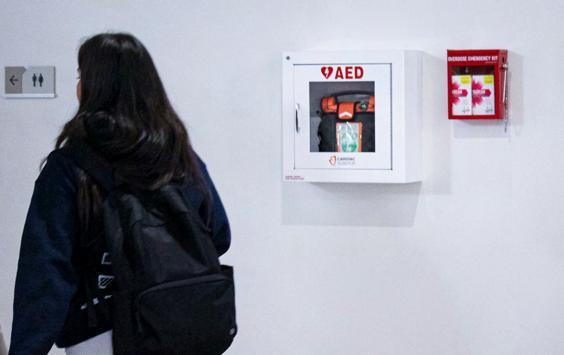
Understanding AED access on campus: Miami University’s safety strategy
Automated External Defibrillators
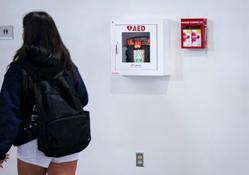
(AEDs) are “a portable, battery-operated device that a bystander can use,” according to the National Institute of Health. They are designed to save the lives of people who experience cardiac arrest.
You won’t find AEDs in most residence halls at Miami University.
Jeff Johnson, the director of Environmental Health and Safety, works to promote student safety and oversees AED placement in campus buildings.
“There is no regulatory require-
ment for [Miami] to have AEDs in any of the buildings on campus,” Johnson said. “There are no state or federal laws that require AEDs to be in any buildings on campus.”
While there are AEDs in every police cruiser and emergency response vehicle, there are logistical challenges presented by storing AEDs in every red brick building.
“We have close to 200 buildings on campus, so it wouldn’t make sense to put AED devices in every building, but it makes sense to have AEDs in some buildings,” Johnson said.
Although there are no regulatory requirements mandating the availability of AEDs in buildings, Miami
abides by federal guidelines established by the Department of Health and Human Services.
“There are four criteria,” Johnson said. “The first is physical activity: Whether there is going to be any strenuous work or exertion in an area.”
The first criteria recommends athletic or workout facilities such as the Recreational Sports Center and the North Quad Fitness Center be supplied with AEDs in case of cardiac emergencies.
“We also look at the facility layout because it may be hard for a first responder to find somebody in an extremely large facility,” Johnson said.
The second criteria specifically recommends large buildings with high visitor traffic, like Armstrong Student Center, be equipped with AED devices.
“The third criteria is whether there’s visitors to that facility, because you’re more likely to find somebody that would be in need of an AED,” Johnson said. “The fourth criteria is demographics, the age of the population, because as you get older, you’re more likely to have an event that would require the use of an AED.”
Due to the demographics and intended use of Miami’s residence halls, they do not meet the federal guideline criteria.
“Residence halls are not an unusually large building. There are
not an unusual amount of visitors,” Johnson said. “The demographic, the students, are the least at-risk demographic group. We follow a risk-based approach.”
University departments also have discretion pertaining to the quantities of AED devices that are readily available in buildings.
“The funding for the AEDs comes from within the department of wherever it’s being housed,” Johnson said.
Despite the availability of AED devices appearing to be urgently low, they are rarely ever used on campus. Johnson said no AED has been used on campus in over a year.
Yet, the infrequent use of AEDs might make an individual hesitant if they are ever in a situation where one must be used. The devices are designed to be accessible, but many students feel confused with how the devices function.
“The occupants of buildings with AEDs are offered training on how to use AEDs through courses at the Rec Center,” Johnson said. “Anyone can use an AED. We encourage people to go through training, but the training is not required.”
Many student employees opt-in to the training program, so they are confident in their ability to administer care in the event of an emergency.
AJ Waymire, a student employee at Armstrong Student Center and a former Student Orientation Under-
graduate Leader, has gone through the AED instructional program.
One thing that surprised Waymire during the AED training course is the way the device operates.
“When you open the AED and start it, the AED tells you what to do; a voice-over tells you step-by-step instructions,” Waymire said. “When you put the AED on the person, the device will test the person, and tell you whether or not you actually need to use the AED, because sometimes it’s not even necessary.”
After receiving AED training, Waymire began thinking about ways to teach other students more about AEDs and make them more aware and confident with using the device in crisis situations.
“I think AED training would be a great thing to teach new students in the orientation modules when they come to Miami,” Waymire said. “They should watch a short video so they are aware of how AEDs actually work and that the device will talk them through the process. That training will immediately make them more comfortable.”
A virtual map of the locations of AEDs is available for all students to view, so they are knowledgeable and prepared to assist someone who may be in cardiac arrest.
slarkgj@miamioh.edu
‘It’s going to have to hurt somebody before we can do something about it’: Miami’s workload policy
CONTINUED FROM FRONT
“There’s always been a workload policy,” Makaroff said. “What we have not been good at doing is enforcing the workload policy. So this year, it came to a head, primarily because of [Senate Bill] 1, empowering the Board of Trustees to have oversight over everything.”
Now that the workload policy has been in effect for a year, professors are starting to see its long-term consequences. Makaroff said 61% of professors are teaching the same amount as before the new workload policy, 24% are teaching more and 15% are teaching less.
Why the new workload policy to begin with?
In a report sent to all Ohio public universities, the Ohio Chancellor of Higher Education said most professors in Ohio were not maintaining a proper workload and 70% of a professor’s time should be spent teaching.
In response, the Board of Trustees at Miami tasked Makaroff and other university leaders with developing a revised workload policy that would better align with the Ohio Chancellor’s Office’s recommendations.
The university brought in Bain & Company, a management consulting firm, to see how Miami could improve professors’ output.
Based on the input from Bain and from other universities around Ohio, Miami decided to create a 4040-20 workload base for tenure-track professors, involving 40% teaching, 40% research and 20% service. These amounts could change depending on how research-active a professor is.
Makaroff also said the new policy was to ensure all professors were actually doing their job and not taking advantage of the previously lesser-enforced workload policy.
“The whole idea was to try to ensure that everyone was carrying their fair load,” Makaroff said. “It wasn’t that the vast majority of the people weren’t working hard, but it was because the chancellor said, ‘These are the guidelines.’ Actually, I think our plan is a lot more flexible.”
Problems with the current course load guidelines
After the new course load policy was announced, individual colleges were instructed to develop their own guidelines for determining workload. This meant after hearing from all the division chairs, the college deans would create a single, massive workload-equivalency rubric. Eventually, these guidelines would be approved by the Office of the Provost.
In colleges with several different divisions, like the Colleges of Arts and Science (CAS), it’s hard to create a single rubric to cover everyone, especially when the workloads between humanities and science professors look very different.
Heidi McKee is a professor in the English and the emerging technology and business design departments and also focuses on artificial intelligence (AI) studies. In such a changing field, McKee is constantly working on her research.
However, social science research often takes longer. Unlike pure science fields, there’s no simple experiment to test a hypothesis. McKee said
research in new fields, like AI, coupled with working with a group of undergraduate researchers, makes the process take twice as long as if she did it herself.
“Research and publication with students, particularly with undergraduate students, ought to be counted more,” McKee said. “This article [we wrote] counted as just one point, which is the same as if it would counted as if I’d written it by myself. When you’re working on publications that take longer and not getting further credit for it, then why would someone then continue doing it?”
In the CAS workload equivalency rubric, for most professors doing research to earn workload equivalency points (which replace teaching a class), they must generally publish two articles per year in premier publications.
McKee, who has seen her teaching workload increase under the new policy, said given the length of her research and the time she spends teaching, the number of articles listed in the CAS workload equivalency document is not possible.
“Right now I’m working 60-70hour weeks, and I know that I’m not going to be able to sustain that,” McKee said. “At some point, I’m going to have to readjust and recalibrate. I don’t want to short-change my students, but right now, the current structure is, I think, unsustainable over the long haul.”
There are other opportunities for professors to earn additional workload equivalent points. In CAS, there are different levels of being “research active,” based on the amount of grant money a professor receives. The more money they bring in, the more “research active” they are considered, and the fewer classes they have to teach — provided they still publish multiple articles a year. In the humanities, such as English and history, these grants are few and far between and often provide little funding. In science fields, however, there are several large grants and a more straightforward research process.
Jason Rech, chair of the geology
department, said even though the CAS workload guidelines may slightly benefit science professors, there are still issues. In the CAS document, science professors who do not bring in enough grant money may face higher course loads. Now that the federal government is defunding national science organizations, it could lead to serious problems.
“We’re not trying to say we should have a one-one teaching load and not be research active,” Rech said. “There’s been some big changes in the funding opportunities lately. I’m a full professor. I’ve been here a long time. It doesn’t really impact me, but for my pre-tenure faculty, these are difficult times to try to understand the funding opportunities out there.”
While professors in the sciences may be able to reach the required number of articles more easily, Rech said he recognizes it is hard to quantify research.
“Faculty work really hard, and so I understand the desire of universities, administrators and states to make sure that faculty are working hard and being productive,” Rech said. “The things that we take issue with are how things are attempted to be quantified across the disciplines. For example, I don’t know of any other university that is only giving partial credit for publications based on the number of coauthors or that gives grant dollars credit.”
CAS isn’t the only college with problems determining workload equivalency. The College of Creative Arts (CCA) also struggles to find ways to count professors’ research and creative projects.
Armstrong said it was hard to quantify the exact workload equivalence in creative fields, especially since many professors’ work is more service-based and less about research or collaboration with professional creative organizations.
“The department of theater is a really small department, but we have a lot of service that we do because we’re basically running a theater company while we’re working full-time jobs as professors,” Armstrong said. “I don’t
think there’s any math formula that would allow us to calculate that, and I think it relies on us being able to trust administrators, and it means administrators need to respect our disciplinary way of doing things.”
Makaroff said there’s not much the University can do to change individual colleges’ workload equivalency rubrics.
“It became clear that we couldn’t come up with a very rigid set of rules that fit all the divisions, because they’re all different,” Makaroff said. “We gave the deans some discretion in how they count research productivity. And we also gave them some flexibility as far as what people’s schedules look like, because everything is not nice and clean and neat. No system or model is absolutely perfect.”
What can professors do?
The path for making changes to the workload equivalency policies at Miami is currently unclear. Elena Albarrán, professor of history and the executive vice president of the Faculty Alliance of Miami (FAM), said even though they are in the middle of contract negotiations with Miami administrators, the language in these contracts prevents FAM from bargaining about the workload policy.
“It’s going to have to hurt somebody before we can do something about it,” Albarrán said. “We have to wait until somebody has a punitive outcome to be able to say, ‘Look at how this hurts somebody’s job performance,’ and then bring that through the grievance process, which can take a long time and be unpleasant.”
Albarrán also said FAM has heard complaints from several professors in the regional campuses.
“When the workload policy came out, it didn’t correspond at all to the regionals,” Albarrán said. “The regionals have a different mission and a different composition, and the people on the regionals have always taught a maximum level, but then they were still being put into this added pressure to produce other things.”
Makaroff said while he understands these one-size-fits-all rubrics colleges use may cause problems,
from an administrative perspective, the workload policy seems effective.
“We’re not looking to revise the policy,” Makaroff said. “We’re still tweaking it a little bit.”
How the workload policy could affect students
Miami has consistently ranked among the best schools in the nation for undergraduate teaching. According to the U.S. News & World Report, it’s ranked second among all public universities.
But as more professors are forced to increase their teaching load, they are less likely to take on undergraduates as their research assistants. Makaroff, however, said the university may still make some adjustments to how the workload policy counts professors who work with small groups of undergraduates. He said they don’t want those professors to work more than necessary.
“We want to make sure that the faculty who are doing a good job are being rewarded,” Makaroff said. “That’s one of the things that we’re just trying to work out right now, because we don’t want to discourage faculty from working with students. But it’s just like the country as a whole. You write laws for the small number of people who sort of are trying to take advantage of the system.”
Albarrán warned a lack of willingness to work with undergraduate researchers may not be the only consequence of the workload policy. She also said for professors who are juggling increased teaching loads and their research, students could soon see a lower-quality education in class.
“I teach two classes this semester,” Albarrán said. “I love it because I know everybody’s names. I can handgrade their journals. We talk after class a lot. There’s a lot of that intimate, special relationship that Miami students [have]. If I’ve got 200 students in a semester, I can’t do that.” fahymm@miamioh.edu
GABRIEL SLARK STAFF WRITER
ARMSTRONG OPERATIONS MANAGER BLAKE NASH WORKS AT HIS DESK IN 3015 ARMSTRONG. PHOTO BY ELISE HANNA
CAMPUS & COMMUNITY
The impact of Miami basketball on Oxford businesses
ALEXANDER SMITH THE MIAMI STUDENT
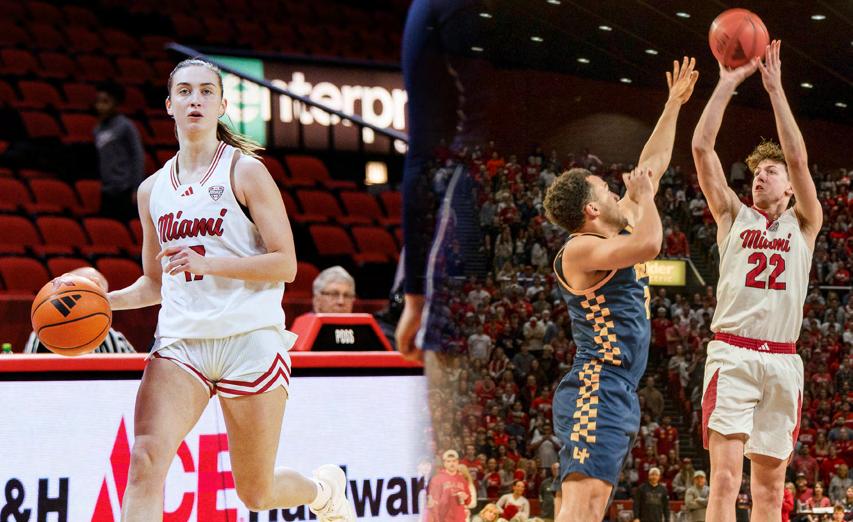
It’s no secret that Miami University’s basketball teams had unprecedented success this season. The men’s team were the eighth team in all of college basketball since 1976 to be undefeated in the regular season, made March Madness for the first time since 2007 and won a game in the tournament for the first time since 1999. The women’s team won the Mid-American Conference championship for the first time since 2008, making an appearance in March
Madness as a 13-seed. This success has not only impacted the university’s image and branding, but it’s also been a factor for Uptown businesses.
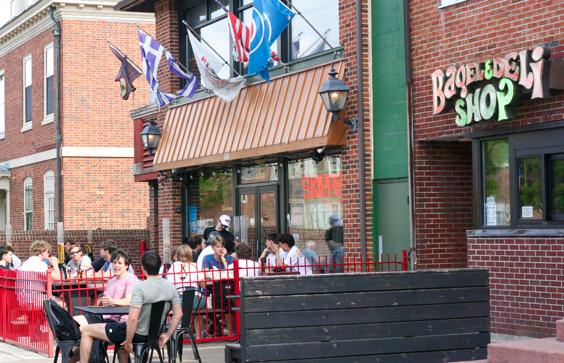
One of Oxford’s most iconic restaurants is Bagel & Deli Shop. Opened in 1976, the store is a favorite among students for their steamed bagel sandwiches and late hours.
“I mean, it definitely helped out on game days, because people started going to games, people started coming to town for them,” Gary Franks, co-owner of Bagel & Deli, said. “In past years, the basketball season was
From service to campus: Student veterans and military members at Miami
CONTINUED FROM FRONT
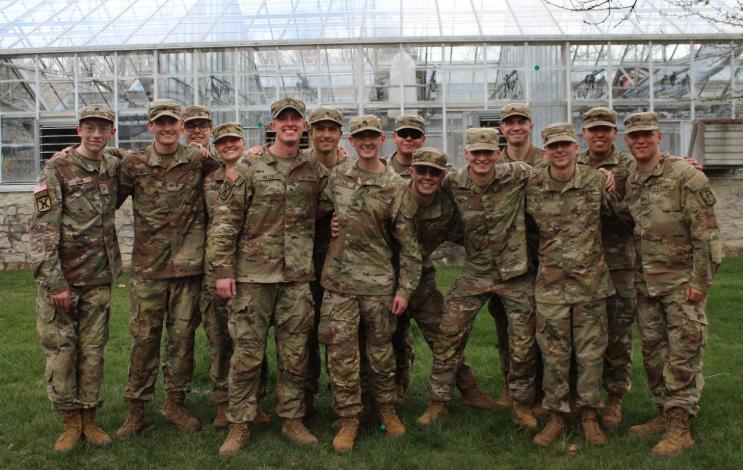
When Miller saw a fellow veteran that he served with at a restaurant in Oxford, he took this as a sign. He was going to attend Miami and complete the Army Reserve Officer Training Corps (ROTC) program to rejoin the Army, this time, as an officer.
“This is my calling,” Miller said. Miller said Miami’s Student Veterans Center has helped immensely when navigating the Veteran Affairs benefits he receives from the federal government. Resources are listed on Miami’s One Stop, which, according to Grant Woodruff, have been a big help.
Miami’s efforts to support students with military backgrounds were awarded the Collegiate Purple Star by Ohio’s Department of Higher Education. Miami was one of the first Ohio universities to receive this award, while Ohio was the first state to grant these designations.
Woodruff, a sophomore organizational leadership major, is a member of the Ohio Army National Guard and attends Miami with his tuition paid, since it’s an Ohio public university per Ohio’s G.I. Promise.
Woodruff said he knew he wanted to stay physically active after high school, but didn’t want to play sports in college in order to focus on school. He also knew the Army National Guard would help pay for his tuition, so Woodruff joined right out of high school.
Woodruff missed the second semester of his first year to complete basic training, which took place from January to August, 2025. He now spends one weekend per month at Woodlawn Training and Community Center working for the Ohio Army National Guard in the 216th Engineer Battalion as a mechanic on Army trucks.
Along with helping student veterans and current service members, Miami also cares for its ROTC members.
Sophomore global policy and diplomacy and Spanish major, Mary Catherine Kelly, is a cadet in Miami’s Army ROTC program and an active Ohio Army National Guard member in the 216th Engineer Battalion. Kelly has many veteran family members, and she joined ROTC in the fall semester of her first year.
“I was curious, so I joined for fun my freshman year, end of first semester,” she said. “I fell in love with it.”
In Army ROTC, each week Kelly, Miller and their fellow cadets complete three days of physical training, two days of military science and leadership classes and one day of lab, which includes drills. Once a semester they also train at the Fort Knox military base in Kentucky.
Kelly said after the March 12 attack on ROTC students at Old Dominion University in Norfolk, Virgina, Miami University Police Department officers followed Miami’s cadets around campus and to and from their training. Kelly also said that professors and administrators reached out in emails, giving their condolences and support to the Army ROTC students.
“Miami orchestrated our safety really well,” Kelly said. “My family really appreciated that.”
just, you barely notice a lot of the time, or a few games that might draw a few people in, but this year we still had a lot of crowds.”
Franks, who has worked at the Uptown business for decades, said this season was a “wild card,” which made it harder to prepare for.
“February is always kind of a slower time of the year... [the] weather’s not that great, so [it’s] definitely helpful,” Franks said.
At the beginning of the season, many were doubtful that Miami’s success would continue as they played through their schedule. As time passed, the RedHawks success was harder to ignore and attendance increased, which Franks says increased business.
“As that streak went on longer and longer, definitely, the crowds got bigger and bigger, more enthusiastic about it,” Franks said.
As Miami continued to win games, the team received national attention.
This included a surprise feature from CBS Sports, with Miami basketball legend Wally Szczerbiak visiting Bagel & Deli before the RedHawks game against Ohio University. Besides just business, Franks said this increased publicity and led to old friends reaching out.
While not every business was lucky enough to be featured on na-
tional TV, plenty of other businesses also saw an increase in customers, which they attributed to the men’s basketball team’s success.
Another one of those businesses was OxVegas Chicken, founded in 2024 by two graduates from the Farmer School of Business.
“We had a lot of people come in here wanting to watch the game,” said Caitlin Smith, assistant general manager at OxVegas Chicken. “We have several TVs in here, so a lot of people come in and order drinks or food. It has impacted our sales in a positive way.”
Smith said OxVegas Chicken saw an increased number of customers as the season went on, similar to Bagel & Deli.
“Especially when they were on their winning streak, we had several more people wanting to come in and at least sit at the bar and watch the game … so we put it on all the screens so people could come in and watch,” Smith said.
Compared to the football season, Smith said the restaurant saw more customers during the basketball team’s win streak than throughout the football season.
Bruno’s Pizza, another Oxford favorite, also saw increased business.
“We definitely saw an influx in business, similar to Miami’s hockey
season and the success they’ve had as well over the years,” Aryn May, co-owner of Bruno’s Pizza, wrote in an email to The Miami Student. “The large crowds and higher traffic volumes didn’t scare people away … it was an exciting time in our community and we loved watching the success they had.”
It wasn’t just restaurants that saw an increased number of visitors either. Other Uptown businesses felt the results of basketball success.
“When we started seeing the basketball team win more, we started to try to get as much Miami gear as possible,” said Ethan Stewart, co-owner of Flow State Vintage, a used clothes shop in Uptown.
Similar to other businesses, Flow State Vintage also saw more customers come in than usual, in comparison to the football season, as well as previous basketball seasons.
“I feel like we do sell Miami stuff [during the football season], but it’s pretty steady throughout the year in general,” Stewart said. “Especially just because they’re doing so well, and then everyone’s talking about it, which makes everyone want to have more [merchandise], and that’s why we were really pushing to get as much Miami [clothes].”
smithat4@miamioh.edu
JANUS Forum panelists debate immigration policy
Woodruff said the opportunities the Ohio Army National Guard provides should be presented more often to people that don’t have a set life plan.
“I think not enough people look into it,” Woodruff said. “The military definitely helps point [people] in the right direction if they’re struggling.”
Despite the benefits, Woodruff and Kelly both said being a service member is not always positive. Both have been called profanities and received dirty looks on campus when in uniform.
Woodruff says it is upsetting to experience that lack of respect and understanding after dedicating so much time to serving the country.
In addition to facing ridicule, service members also face mental health struggles.
The 2025 National Veteran Suicide Prevention Annual Report offers the most recent information regarding veteran suicides from 2001-2023. In the 2025 report, the U.S. Department of Veterans Affairs (VA) reported 6,398 veterans deaths by suicide. The rate of suicides per 100,000 veterans increased from 34.7 deaths in 2022 to 35.2 deaths in 2023.
Because of these mental health struggles and the stigmas about being in the military, the Butler County Veterans Service Commission (BCVSC) has been working for decades to improve veterans’ lives.
The BCVSC provides a plethora of services and programs to local veterans including peer support groups, helping connect veterans with VA healthcare, providing transportation, teaching training progams to recognize the warning signs of suicide and hosting community outreach events to reduce isolation.
Mike Farmer, the executive director of BCVSC, says their programs can range from individualized care to over 500 participating veterans. He also says these programs are successful in helping local veterans create community with one another.
“In the mental health space, the goal is meaningful connection and sustained engagement,” Farmer wrote in an email to The Miami Student. “Even smaller groups can have a significant impact when veterans build trust, stay connected, and feel more comfortable seeking help when they need it.”
Farmer said he has also seen awareness around veteran mental health increase in recent years as there are far more public conversations about it today.
“There is a growing recognition that veteran mental health is not just a clinical issue,” Farmer wrote. “It is a community issue that requires coordination between federal systems like the VA, local organizations and peer networks. So, while we have made progress in reducing stigma and increasing visibility, the focus now has to be on access, coordination and early intervention.”
If you or someone you know is struggling, the National Veterans Crisis Line can be accessed by dialing 988 and pressing 1. robinsza@miamioh.edu
LIAM CLARKE THE MIAMI STUDENT
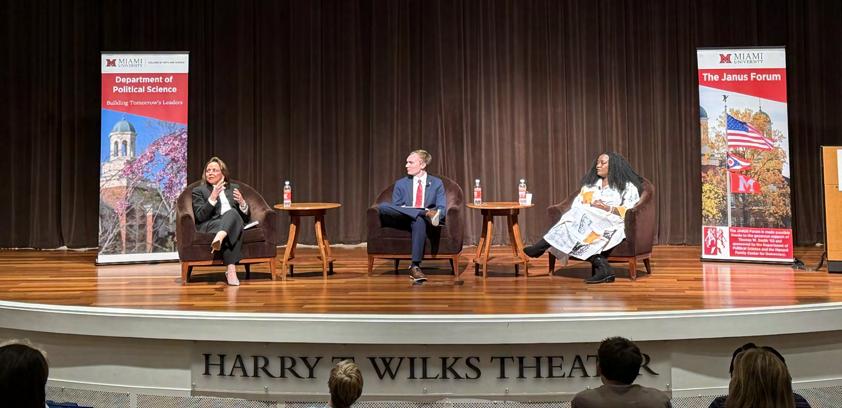
Susana Martinez, Republican former governor of New Mexico, and Ashley Allison, Democratic political strategist, shared the stage for the JANUS Forum on April 13 at Miami University.
The JANUS Forum brings in two speakers with different viewpoints to debate a set topic each semester. This semester, the topic was the evolving landscape of immigration policy. Nate Novak, junior political science and business leadership double major, served as moderator.
Martinez was a prosecutor for 25 years, during which she served as the Doña Ana County, New Mexico district attorney. She also served as governor of New Mexico from 20112019.
Allison served as a senior campaign advisor for the Obama-Biden and Biden-Harris administrations. She is a civil rights advocate and political commentator for CNN.
Martinez said she has seen immigration change during her 50 years of experience on the Mexico-U.S. border. She said a problem was some states chose to turn over undocumented immigrants who had committed crimes to the federal government for deportation instead of prosecution, and they almost always came back.
“Their return is more likely because they have not been convicted of the crime they have committed,” Martinez said. “As a prosecutor, I want to prosecute.”
Allison said crossing the border is currently treated as a criminal offense even though it’s a civil offense in the United States, which is a problem when undocumented immigrants are productive members of society.
“There are a lot of people in this country that may be living with undocumented status that have played an important [role],” Allison said. “I think we have disregarded a significant population.”
Martinez said Biden’s open-border policy overloaded the already slow legal immigration process and allowed people to come into the U.S. without adequate background checks.
Allison asked the crowd to raise their hands if they knew someone who was undocumented and to keep their hands raised if they would be OK if that person was deported.
“Your friend, whoever that person is in your life, is gone,” Allison said. “They might not have anything on the other side.” Martinez said in response that
undocumented immigrants often pay to be smuggled across the border by Mexican cartels, then owe the cartels unpayable debts.
“Once you cross over, you belong to somebody,” Martinez said. “They are ruthless.” Allison and Martinez discussed the Deferred Action for Childhood Arrival (DACA), a policy enacted under the Obama administration allowing undocumented immigrants brought into the U.S. as children to work without fear of deportation, according to USA.gov. Current DACA recipients remain protected, but U.S. Citizen and Immigration Services does not currently accept new applicants, according to the National Immigration Forum.
“DACA used to be the thing we thought we could all agree on,” Allison said. “I think eventually DACA will become law.”
Trump has signed 254 executive orders since he took office in 2025, according to the Federal Register. Some have affected immigration policy, such as securing the border and denying birthright citizenship. Martinez said it’s unwise to govern by executive orders because the next person in office can easily reverse them.
Allison said the reason for the volume of orders is because Congress isn’t doing its job.
“That is why people are governing with executive orders, because the body that is supposed to be doing it is not actually doing it,” Allison said. Novak then asked what Martinez and Allison would do to fix the immigration system.
Martinez said she would secure the border and emphasize law enforcement. She said immigrants with expertise and knowledge to contribute to the economy are necessary, but only if they are vetted properly. Martinez also said she would seek proper congressional funds, a challenge Congress currently faces. Martinez said when she was district attorney, Border Patrol or U.S. Immigration and Customs Enforcement (ICE) would always be on standby to assist in the jails by determining how long illegal detainees needed to be held.
“This would allow what we visually see in Minnesota, what we see on television, not to occur,” Martinez said. “But the mayors and governors of certain states have said no, that is cooperation with ICE or Border Patrol.” Allison said ICE should not be deployed in city streets, and undocumented immigrants who are positive contributors to society should have a pathway to citizenship. Martinez responded by suggest-
ing a pathway to legal status, not citizenship.
“Sold,” Allison said. “Compromise.”
Allison also said ICE agents should not wear masks. Martinez disagreed, and said that would put the agents and their families in danger. Finally, Novak asked how to make a difference as a student in this divided era of politics.
Martinez said it’s important to be informed, not angry, and to always be willing to hear people out.
“If you’re not open to the other side, then you’re no better than our congress is,” Martinez said. “What do they have, a negative four approval rating?”
Allison said hope must be a part of anything people do and engaging with people who have different viewpoints and can help strengthen personal beliefs.
“Someone once told me hope is a discipline,” Allison said. “If you do not act as a disciplined believer [or] an implementer of hope, it can die.”
After the debate, The Miami Student asked Martinez and Allison why they thought immigration policy was an important topic of conversation to discuss in an open forum such as JANUS.
Martinez said the government’s failure to follow immigration laws and the influx of illegals let in during the Biden administration made matters worse. She said the economy, workforce and all the essential systems of our country are negatively impacted by illegal immigration.
Martinez said her experience at the border allowed her to witness firsthand a failed system.
“Folks that want to come in legally, it seems like they’re almost swallowed by the system,” Martinez said. “So much time and energy [spent] on something that failed this country.” Allison said immigration has been a front-and-center issue in American politics since the 2024 election, and people with different opinions struggle to discuss it openly. She also said the deployment of ICE in cities and the resulting violence, such as the killings in Minneapolis, has sparked criticism of the current immigration policy.
“I think the murders of Renee Good and Alex Pretti will be one of those inflection moments,” Allison said. “They are current moments that require a change, and they will be historical landmark moments that people will study about how we got there and how we got out of it.”
The last six Miami football players drafted to the NFL
KETHAN BABU EDITOR-AT-LARGE
The 2026 NFL draft is creeping up. From April 23-25, in Pittsburgh, Pennsylvania, hundreds of collegiate prospects will wait to see whose name commissioner Roger Goodell will announce for a chance to take their careers to the professional level.
Fifteen players who graduated from Miami University have been drafted to the NFL since 2000, most notably two-time Super Bowl-winning quarterback, Ben Roethlisberger. Since 2010, six RedHawks have been drafted.
Dominique Robinson
(defensive end, 2022-present)
The only active player on this list, Robinson recorded 19 tackles — including 12 solo tackles — and 1.5 sacks with the Chicago Bears this past season. He was drafted in the fifth round of the 2022 draft, where he spent four years before being traded to the Houston Texans on March 13.
Robinson’s only Division I offer out of high school came from Miami, where he initially started as a quarterback before switching to wide receiver, catching 21 passes for 393 yards and three touchdowns between his sophomore and junior seasons.
He switched positions once more to defensive end going into his senior year during the shortened season in 2020. The following season in his final year of eligibility with the RedHawks, he had 29 tackles and 4.5 sacks, leading the Bears to draft him with the 174th pick.
In his NFL debut with the Bears, Robinson had 1.5 sacks against the San Francisco 49ers, the most by a Bears rookie player in his first game since 1987. He has 68 tackles and 3.5 sacks going into his fifth NFL season before moving to Houston.
Tommy Doyle (offensive tackle, 2021-24)
Standing at 6-foot-8-inches and 320 pounds ahead of the draft, Doyle was selected by the Buffalo Bills at pick 161 in 2021.
Doyle initially played at right tackle for the RedHawks in 2018, when the team rushed for 159.8 yards per game and allowed two sacks per game. After switching to left tackle, Doyle earned First Team All-MAC honors in 2019 and 2020.
Doyle was a reserve for most of his career, but caught a touchdown from Josh Allen on Jan. 15, 2022, in the wild card round of the playoffs against the New England Patriots. In September of 2022, Doyle suffered a torn ACL that would bench him for the remainder of the season.
Knee injuries persisted for the rest of his career, and Doyle medically retired on Feb. 14, 2025, after four seasons with the Bills.
Sam Sloman (kicker, 2020-23)
An excellent senior season performance from Sloman persuaded the Los Angeles Rams to pick him in the seventh round of the 2020 draft, making him the first kicker and 40th player overall to be drafted from Miami. In his final year with the RedHawks in 2019, Sloman converted 26-30 field goals and was a perfect 34-34 on extra point attempts.
After being drafted to the Rams, Sloman hit eight field goals on 11 attempts and went 5-5 from 30-39 yards out. He kicked 18-21 extra points through the first seven games of the season before being waived and eventually replaced by Matt Gay.
Sloman signed with the Tennessee Titans’ practice squad halfway through the 2020-21 season and was moved to the active roster to replace an injured Stephen Gostkowski. In a matchup against the Texans, Sloman was perfect on field goals (2-2) and extra points (5-5) and hit a game-winning 37-yard field goal to win the Titans the AFC South title.
Sloman bounced from various teams’ practice squads before signing with the Vegas Vipers of the Extreme Football League (XFL) in 2023. The Vipers were not included in the merger between the XFL and the United States Football League in 2024.
Quinten Rollins (cornerback, 2015-19)
Rollins became the earliest selection among Miami players since Roethlisberger when the Green Bay Pickers drafted him in the second round of the 2015 draft.
Rollins played four years of basketball for the RedHawks before joining the football team in 2014. In his lone year playing football, he was named MAC Defensive Player of the Year in 2019 after catching seven interceptions, including one for a
touchdown, tying for third-most in the country. He forced one fumble and finished with 72 tackles.
Rollins finished his rookie season with 31 tackles and two interceptions, both against Nick Foles, who played for the St. Louis Rams, including one he returned for a touchdown.
Rollins caught one more interception with the Packers against the Seattle Seahawks in 2016. He suffered a leg injury in the final preseason game before the 2018-19 season and was placed on injury reserve before being released with an injury settlement. He bounced from the Arizona Cardinals to the San Francisco 49ers but would not make either of the final rosters.
Zac Dysert (quarterback, 2013-17)
Dysert became the first quarterback since Roethlisberger to be drafted in 2013. He surpassed Roethlisberger’s career passing yards in his collegiate career, leading the Denver Broncos to select him in the seventh round.
Dysert became Miami’s starting quarterback in 2009 and finished the year with 2,611 passing yards, 11
From Carmel to Reese’s: Suder competes in NABC All-Star game
VINCENT JOLLIFF ASST. SPORTS EDITOR
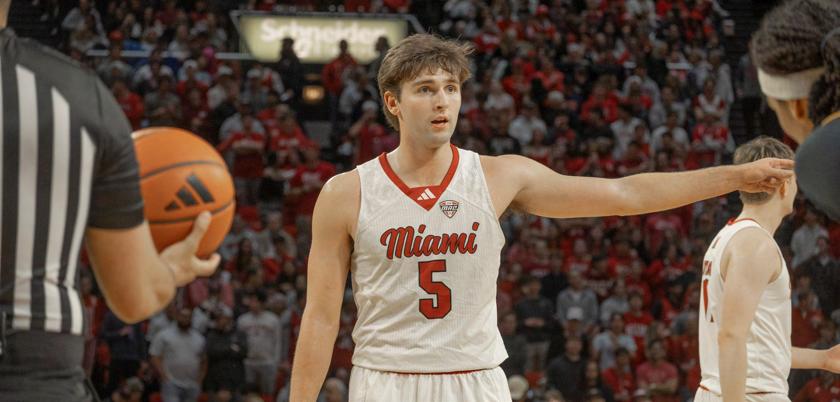
Miami University RedHawks’ senior guard Peter Suder competed in the National Association of Basketball Coaches (NABC) Reese’s Division I College All-Star Game on April 3, the Friday before the Final Four of the NCAA Division I Men’s basketball tournament.
The NABC game, sponsored by Reese’s, hosts the country’s top senior men’s basketball talent and gives them an opportunity to compete with and against each other on the biggest stage college basketball has to offer. Along with Suder, other participants this year included FirstTeam All Big East player, Tre Caroll of Xavier University, and Ohio State University’s all-time leading scorer, Bruce Thornton.
“It’s super cool to be a part of the Final Four weekend,” Suder said, “especially when it’s in your hometown.” Suder, originally from Carmel, Indiana, was able to finish his college career about 20 minutes from where he grew up. Friends and family made the trip to Lucas Oil Stadium for Suder. The entire coaching staff made the trip to Indianapolis along with Suder, a RedHawk takeover in the Circle City.
“It means everything to be honest. The fact that they drove all the way down to show support for just an All-Star game,” Suder said. “It’s just
cool to know that they’re going to be in my corner and on my side for the rest of my life.”
Among the coaching staff was head coach Travis Steele, who commended Suder’s talent and success with the team.
“I am very proud of Pete — he’s a winner,” Steele said. “I’m just glad that he’s getting the recognition that he deserves.”
Suder, who will graduate in May, is very clear about his goals and dreams moving forward. He and his coaches agree that he will have a chance to compete for a spot on an NBA roster this summer. Suder is already preparing for the opportunity, which has given him less time to reflect on the past season.
“I definitely have,” Suder said when asked if he had had time to reflect on the past season, “but I’m obviously training and getting ready for professional basketball, so it is different.”
Suder’s coaches echo the NBA and professional basketball goals expressed by the senior guard.
“I think he’ll have a chance to play in the NBA,” Steele said. “He just has to get with the right team and get the right opportunity.”
Assistant coach, Khristian Smith, shared these same views about Suder’s future in basketball.
“He could be in the NBA and we wouldn’t be surprised,” Smith said.
“We could look up ten years from now he could be a successful busi-
ness owner, and I wouldn’t be surprised.”
The duration of Friday’s game was not the only time Suder spent in Indianapolis. He and the Miami coaches got to enjoy the full Final Four experience.
“At our hotel, in our lobby, there’s pretty much every college coach,” Suder said. “John Calipari, Matt Painter, you name it.”
Both coaches are icons of the sport, Painter at Purdue University, only an hour from Carmel, and Calipari at the University of Massachusetts, University of Memphis, University of Kentucky, and now University of Arkansas. Calipari has coached Derrick Rose, Devin Booker, Anthony Davis and countless other NBA all-stars. Steele and the rest of the Miami coaches also enjoyed some of the festivities. Steele spoke at the NABC clinic and met with a plethora of his peers. He also attended the National Championship game.
It is unclear how the next few months of NBA draft preparations will result for Suder. What is clear is the legacy he left, both on and off the court, during his two seasons in Oxford. One of the results of this legacy was a chance to return home and play in one more collegiate game on the Final Four stage.
jollifvm@miamioh.edu
touchdowns and 16 interceptions. He missed three games in 2010, with Austin Boucher filling his role in the RedHawks’ MAC championship victory that year.
Dysert sought revenge in 2011, passing for 3,513 yards, 23 touchdowns and 11 interceptions. He played even better in his senior year with 3,483 yards, 26 touchdowns and 12 interceptions.
With the Broncos, Dysert was a backup to Peyton Manning and Brock Osweiler. Dysert spent the next season on Denver’s practice squad and was cut before the 2015-16 season. Over the next two years, Dysert spent brief time with multiple teams’ practice squads, finishing with the Dallas Cowboys before an injury ended his NFL career.
Brandon Brooks (offensive guard, 2012-21)
Brooks started as a guard in all four seasons with the RedHawks and played in their 2010 MAC championship-winning season. He was drafted by the Houston Texans in 2013 during the third round.
Following a rookie season spent on the practice squad, Brooks start-
ed at right guard in every game from 2013-15 for the Texans before he was traded to the Philadelphia Eagles. In Philadelphia, Brooks was named to three-straight Pro Bowls from 2017-19. His first Pro Bowl, which he shared with Lane Johnson, coincided with the Eagles’ first Super Bowl victory in Super Bowl LII. Brooks signed a four-year, $54 million extension with the Eagles in 2019, but the latter part of his career was riddled with injuries, starting with a torn Achilles in the divisional round of the 2018-19 playoffs. He returned for the next season but suffered a dislocated shoulder in the final regular season game. Ahead of the 2020 season, Brooks was named the 98th-best player by his peers. He tore his Achilles again and missed the 2020-21 season, limiting his game appearances going forward. A pectoral strain early in the 202122 season caused him to sit out the remainder of the year, and he announced his retirement in January of 2022.
babukc2@miamioh.edu
Tom Heal leads by example as RedHawks see steeplechase success
CONTINUED FROM FRONT
I was just trying not to think about the rain and just focus on each barrier, each lap, getting through it and trying to put my best version of myself out there regardless of the external conditions.”
With one year at Miami under his belt, Heal knew that the 2026 track season would push his limits once more. His preparation over J-Term and his performance at the indoor track meets set the stage for his achievement in Raleigh, North Carolina. Similar to the Jesse Owens Track Classic, Heal thought nothing of his preparation leading up to the Raleigh Relay. He didn’t realize what he accomplished until after the event.
“To be honest, I was a little annoyed,” Heal said. “I went into the race trying to run an 8:45. I always set a target that’s almost unachievable, but one day you’re going to achieve it … After a few minutes, I was like, ‘Actually, this is pretty good, I’m pretty
happy with what I’ve done.’”
Alongside Heal, Petros Sanchez Ropero and Anton Martinez had phenomenal performances in the steeplechase. Ropero’s time of 8:51.53 puts him fourth-best in the program, and Martinez finished at 9:01.20.
“They all know, including Tom, that the job’s not finished,” Turner said. “Both Tom and Petros Sanchez currently have qualifying times for the NCAA First Rounds. Anton Martinez is right behind them, so we could potentially have three guys in that event at the First Round. We haven’t had three people in one event at the First Round in a while, if we have at all.” As the season comes to a close, the team hopes that even more Redhawks will qualify for the NCAA First Round and Championship.
Heal has one more year of eligibility and competition before moving on to post-graduation plans.
LINEBACKER SILAS WALTERS PREPARES
PETER SUDER DIRECTS A TEAMMATE IN THE GAME AGAINST TOLEDO. PHOTO BY ELISE HANNA
My experience traveling with The Miami Student
COOPER MENEGHETTI
ASST. SPORTS EDITOR
One of the perks of writing for The Miami Student is the opportunity to travel around the country covering Miami University athletics. With the unprecedented success of the Miami men’s and women’s basketball teams this March, I had the privilege of exploring some of the best cities and stadiums that the country has to offer. Cleveland: B+
Rocket Arena is an above-average
‘It’s
KETHAN BABU
EDITOR-AT-LARGE
DEVIN MCCARTIN
THE MIAMI STUDENT
This season, the Miami University RedHawks men’s basketball team earned a bid to the NCAA Tournament for the first time since 2007, ending a 19-year drought. A complete overhaul of the program made this possible for the RedHawks. For nearly everyone on staff, this was their first experience with the Big Dance.
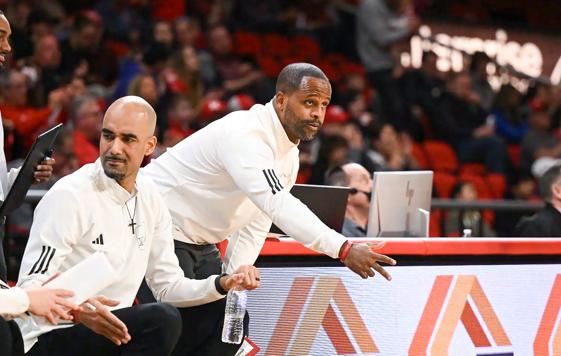
For assistant coach Carl Richburg, March Madness was familiar territory. Richburg was part of the 2006-07 squad that won the Mid-American Conference (MAC) championship but later fell to the University of Oregon Ducks in the First Round.
He has an extensive coaching tenure, and previously assisted an NCAA Tournament team at two separate schools: Marquette University in 2022 and the University of Missouri in 2018. After graduating from Miami in 2009, he spent time at multiple programs before returning to the RedHawks in 2022 for Travis Steele’s first year at the helm.
Richburg, who played basketball for Mason High School, didn’t receive an offer to Miami at first. However, his introduction to head coach Charlie Coles would earn him a spot with the RedHawks after playing one year at the University of South Indiana.
“My last game in high school was actually at Millett; we lost on a
arena in terms of amenities and fan experiences. It does not have the corporate layout many newer stadiums use. It features food from a variety of local vendors while offering the traditional stadium fare. Each seat is unobstructed, providing a great fan experience. Inside the stadium, media members mingle with those in the club seats. The bathrooms available to both were the best stadium bathrooms I’ve ever experienced. Rocket Arena includes a dedicated press conference room that was a bit small for the amount of media members
present at the championships, but it provided permanent infrastructure for press conferences.
The media facilities provided were satisfactory. Located in the top corner of the arena, the extra media setting was steep and narrow. For some reason, the chairs did not move easily, which created a variety of awkward interactions. My biggest issue with the media facilities in Cleveland was that food was not provided. Instead, media members were expected to purchase food from vending options around the stadium, most of which were not open during the tournament.
All around, Rocket Arena is a solid stadium for a basketball tournament. Although my grumblings are minor, the lack of media dining facilities ultimately lowered the score.
Dayton: B
Within driving distance from Miami’s campus, the University of Dayton (UD) Arena provided a spectacular experience for Miami fans. Smaller than most sites for the NCAA Tournament, UD Arena still holds up with the grandeur of the other stadiums. The seats go up quite high, but the video board is large enough to fill in the gaps for fans in the upper decks.
Media facilities were located in the far reaches of the arena but were expansive and provided an assortment of snacks. The court was accessed by an incredibly steep ramp, which was also used to access the makeshift press conference facilities. Unlike Cleveland, I was able to sit at a table three rows out from the court. Media members were provided a food voucher in place of the traditional media meal. Although the facilities were clearly college level, Dayton made the most of what they had available.
Philadelphia: C+
Xfinity Mobile Arena is as cookie-cutter as they come. It is a perfect oval built around the hockey rink with an upper and lower deck setup. Concession stands provided a variety of local vendors and arena staples. The only truly unique feature of the arena is a quirky scoreboard that seems to curve based on where patrons are seated. The media facilities provided for the tournament were not up to the standard of the other locations visited.
A media meal was provided, however only at specific times. Driving to the venue for the second game, meal service had stopped. I was left with eight hours of an empty stomach and only the provided Planters trail mix to quell my hunger. In addition, the press room and interview facilities were constructed out of makeshift black curtains, unlike Cleveland’s permanent press room.
That being said, I will not complain much about Philadelphia since I was able to sit one row out from the court next to one of the legends of March Madness TV production, Steve Scheer. Although Miami struggled to find offense, I was privy to a front row seat and countless stories about what makes the tournament so special.
Morgantown: A
I cannot say that I expected much from West Virginia University, and yet, at every turn the Mountaineers showed my naivety.
The Hope Coliseum is one of the coolest venues I’ve seen. The giant concrete dome was sold out, and the echo of 14,000 screaming fans created a raucous environment. I have no idea how an opposing team could steal a game from the Mountaineers in a sold-out coliseum.
Although the food selection was
not nearly as vast as the NBA arenas I visited, and the merchandise supplied was not nearly enough, the experience was so unique. The Hope Coliseum is a must-visit for basketball’s most obsessed.
Hearing the building echo with the sound of the song “Country Roads” by John Denver is a once in a lifetime experience.
For media members, the university was a gracious host. The meal was provided by a concession voucher. With my media credential, I was able to sit courtside, next to the ESPN crew broadcasting the game. WVU was a well oiled machine, providing printed stat sheets or any other material media members needed. I feared that Morgantown would not be prepared for the experience, and instead, the hospitality made the loss bearable.
Other hijinks:
In total, I traveled at least 1,817 miles and drove a total of 28 hours, which inevitably led to other adventures along the way.
Bario Tacos in Cleveland is always a fan favorite, Zio’s Brick Oven Pizza has the best cannolis in Philly and don’t bother stopping at Roy Rodgers’ on the Pennsylvania Turnpike unless you have to spend money. Philadelphia has the worst traffic I’ve
last-second shot,” Richburg said. “I had a really good game in front of coach Coles. I didn’t get a Miami offer out of high school. I was like, ‘Man, I had a great game.’ The team that we lost to went on to win the state championship.”
When he transferred to Miami, Richburg became close with Coles, who acted as his mentor. The coach inspired Richburg to pursue the same profession.
“He knew everything and everybody,” Richburg said. “He had a way of gaining your attention. You talk to him one time, and you feel like you knew him forever. I remember the impact that he had on my life, and I was hoping that one day I can have that type of impact on someone.”
Richburg returned to Mason High School as an assistant basketball coach after graduating from Miami. Within three years, he jumped to the collegiate level as an assistant coach with Thomas More College, and later, Central Methodist University. At the former, he helped the team set a program record with 23 wins in his only year with the team.
After two years with Central Methodist, Richburg took a brief hiatus from coaching and became an assistant academic counselor for student athletes with the University of Michigan. However, Richburg said within a month at the new position, he realized his true calling and simultaneously coached at Washtenaw Community College.
Richburg became a graduate assistant at the University of Missouri,
and developmental delays, and he’s the only person in the world with his specific mutation.
It’d be rare for the team to not see Jergenson at least once a week at a Friday game or practice. He enjoys hanging out with the players in the locker room before games, and sitting on the bench while they practice. Jergenson is given these opportunities through Team IMPACT, a national non-profit organization that matches children facing serious illness and disability with college sports teams, creating a long-term, life-changing experience for everyone involved. Erin Higgins, the associate director of athletic outreach for Team IMPACT, was tasked to find a team for Jergenson. Given his interest for
where he coached standout players like Jontay Porter and Michael Porter Jr. He was a member of the 2017-18 team that went 20-13 and earned an at-large bid to the NCAA Tournament.
Alabama A&M was his next stop. He spent three years as an assistant coach with the Bulldogs. He returned to the Midwest two years later as the director of recruiting for the Marquette University men’s basketball team. In his one year with the program, he coached at his second March Madness game when Marquette faced the University of North Carolina in the First Round of the 2021-22 tournament.
In the 12 years since he’d graduated, Richburg coached at seven different universities in multiple different capacities. When Steele arrived as the new head coach in 2022 and began building his coaching staff, Richburg became an automatic addition because of the pair’s prior experience in the Big East when Richburg was at Marquette and Steele at Xavier University.
“I was kind of in limbo a little bit, just trying to see what he was going to say back because there was so much going on,” Richburg said. “But when he officially offered me, it didn’t take me long at all to decide to come. We had discussions about it, but once I got the actual offer, it was a no-brainer for me.”
Richburg started his tenure with Miami as the director of basketball operations. Coming from his role as director of recruiting while at Mar-
not sure how I will ever go back to watching a sporting event without an up close experience full of free snacks. meneghcj@miamioh.edu
quette, Richburg used his talent evaluation skills to help recruit a strong freshman class going into the 202324 season.
“He brings great energy,” Steele said. “I think you gravitate towards him with his personality. He’s very engaging, he’s a good listener, and he’s a chameleon: He can speak your language a little bit, so to speak. He has a great understanding of his audience, of who he’s talking to, and that ability to connect, not just talk with people, is the key to communication.”
Richburg moved to an assistant coaching role after one year. The RedHawks trended upward in the first two years of the Steele era until their 2024-25 campaign, where Miami finished 25-9. This season coincided with a new wave of talent coming in. Players like Peter Suder, Antwone Woolfolk and Luke Skaljac all became standout names on the roster.
Miami improved once again in the 2025-26 season, going undefeated in the regular season and earning an atlarge bid in the NCAA Tournament. After defeating SMU in the First Four, Miami was in the Round of 64 for the
first time since Richburg played.
“This was the first time I was able to actually advance and win a game in the NCAA Tournament,” Richburg said. “I remember all my times going, and the one thing you realize quick is that that specific team is never the same … This year was so special, but even during the year, I was trying to embrace the moment too and notice that we’re doing something historic. I don’t want to get that lost in the whole deal.”
As the calendar flips to the 202627 season, Richburg will help continue the RedHawks basketball success through strong recruitment efforts.
“It takes a village to turn around a program, and he’s been a big part of that,” Steele said. “I let all of our coaching staff members do a lot of different things because I think that’s important for their growth… but Carl’s had his hands involved in every single part of our program, and I think that’ll really serve him well moving forward as we continue to build.”
babukc2@miamioh.edu
hockey, Higgins saw this as a great opportunity to reach out to Miami. Mesenburg invested in the two-year program and dedicated time to be involved in Jergenson’s life.
“Athletes like Blake [Mesenburg] make this program what it is,” Higgins said. “When you see the success of a match, or relationship, it stands out. Not every match is this way. Not every team can really dive into what the real mission of our program is. It takes kind, loving humans like Blake to really stand out and do this.”
Last season, the Miami hockey team posted a 3-28-3 record and didn’t win a single conference game. Although the program was struggling, Jergenson showed up with the same excitement and support that he has for the team today.
“It was never boring to him and there was never a moment where he didn’t want to show up,” Mesenburg said.
Jergenson’s mom would send Mesenburg videos and messages of him offering the team encouragement before and after every game. His support for the RedHawks would impact their 2025-26 season, where they recorded a positive 18-16-2 record.
“I always liked when I would get
those videos, and I would send it into our team group chat before every game so we could see that there’s people watching and people that care,” Mesenberg said.
Mesenburg reflected on what being a finalist for the award meant to him and what it meant to be a mentor to Jergenson.
“If you put it side-by-side with a performance-based award, looking at life and putting things in perspective, this award means a lot more to me and means a lot more to other people because it’s more about who you are as a person than what you can do on the ice,” Mesenburg said. This past February, Team IMPACT announced Mesenburg as one of five finalists for the 2026 Teammate of the Year award and announced the winners, Reagan Hornung and Emmy Cardenas from Winthrop University softball. Hornung and Cardenas received recognition at an all-expenses-paid trip to Boston at Team IMPACT’s annual fundraising event, the Game Day Gala on March 11. The bond between Mesenburg and Jergenson has only grown since their experience with the Teammate of the Year award. In fact, their impact on the program extends to other students and universities.
“As we continue to grow in all 50 states, we now have a partnership with the NCAA, so having Liam and his voice and Blake and his voice share this is giving more opportunity for other kids and teams,” Higgins said. “Blake is much more than just a hockey player, and that’s what our program really tries to highlight.”
Today, Mesenburg and other committed members of the hockey team still hang out with Jergenson. They host game nights and attend baseball games together, staying involved in his life. Mesenburg and Jergenson still call each other often.
The team also continued attending Jergenson’s sled hockey practices on Monday nights until the season ended this past March. Mesenburg continued seeing Jergenson’s energetic smile and maintained their constant conversations on the ice.
Although Mesenburg’s time at Miami is coming to an end, it’s a bond that will stick with him for the rest of his life. Even though he won’t be returning to the RedHawks next season, Mesenburg will still be able to say he has a teammate in Liam Jergenson.
younggm7@miamioh.edu
GRAPHIC BY COOPER MENEGHETTI
CARL RICHBURG DIRECTING PLAYERS FROM THE SIDELINE OF A
BASKETBALL GAME. PHOTO PROVIDED BY MIAMI ATHLETICS
BLAKE MESENBURG WITH LIAM JERGENSON. PHOTO PROVIDED BY TEAM IMPACT
COLUMN
The only correct title: A review of ‘The Drama’
LAYLA NORRIS STAFF WRITER
Director Kristoffer Borgli did not miss when he titled this movie “The Drama” — because there is certainly drama. From the beginning, you can tell something is off. While it did not convey typical aspects of horror or suspense, things felt weird. The initial scene depicts a seemingly adorable meet-cute between Charlie (Robert Pattinson) and Emma (Zendaya).
Charlie finds Emma reading a book in a cafe, lost in her own world. He snoops to see what book she is reading and lies about having read the same book to talk to her. His first attempt fails because he, unknowingly, speaks directly into her one deaf ear. Nevertheless, she gives him a second chance, and their relationship blooms from there.
This first scene led me to expect Charlie to be the villain of this story. His lie seemed suspicious to me, and his whole character seemed a little odd. While I was not entirely wrong, the plot definitely did not take the direction I expected it to.
The film flipped back and forth in time. It showed present-day scenes of Charlie and Emma planning their upcoming wedding, while also flashing back to earlier times in their relationship. I enjoyed this aspect of the movie a lot. The constant switch of timeline did not feel confusing; rather, it helped provide context for later events while being engaging and dramatic.
After the movie, I realized how effective the marketing and advertising for this film was. The trailer vaguely showed dramatic scenes between the couple, while never directly revealing anything about the plot, so going into the movie, I had zero clue what to expect.
Immediately, Charlie and Emma’s relationship begins to fall apart. Trust, security and passion faded. They must rework the trust they’ve built together over the years, after lies and secrecy are revealed.
The movie became tense, and I bit my nails in anticipation and anxiety, waiting to see what the characters would do. The flashbacks continued, giving a deeper look into how their pasts connected to the present.
Two things about the film stuck out to me most.
First, the acting was undoubtedly outstanding. With Zendaya and Pattinson, it’s obviously going to be stellar. They immediately make you forget it’s a movie. I wasn’t watching actors — I was watching real people in this world having natural conversations. It was incredibly believable and immersed you in their world.
The use of sound also stood out. Different sound effects and noises were utilized to emphasize the plot or character emotions, and it was genius.
As the plot continued to unfold, I truly began to wonder how the story could be resolved. Despite my worries, the ending was perfect. Every detail showed that Charlie and Emma are made for each other and each other only.
The movie was undeniably fantastic, but I don’t know how often I would rewatch it. Going into this movie, I had no expectations beyond understanding the usual oddity of A24 films and knowing Zendaya is amazing. This made the actual plot seem a little off to me. I wanted to like the movie more than I actually did.
Despite this, I do believe this is a must-see movie, if only for the amazing acting performances. If you’re into messy relationships and drama, this is just for you.
Rating: 8/10
norrisl3@miamioh.edu
CONTINUED FROM FRONT
However, in this case, audiences rarely see the intricate detail and planning that comes with each design, only the final product.
After a round of interviews where potential designers share their ideas for a collection — or their curated group of clothing that would be presented in the fashion show — Design Directors Lorelei Huber, a senior chemical engineering, chemistry and fashion student, and Cami Keaty, a senior marketing and fashion student, decide whether the collection would be a good fit for the show. After the designers are chosen, they begin preparing their collections for the runway.
“What people don’t know is that it’s hours and hours of work and very late nights, just constantly in the studio,” Keaty said. “So from beginning to end, you have to come up with
ELISE HANNA DIGITAL MEDIA EDITOR
Recently, I’ve picked up the hobby of collecting physical media.
Not to say I’ve never done that:
I am an avid hoarder of journals I’ll never use — they’re simply too pretty to ruin — letters from my little sister and the occasional polaroid picture whenever a friend has a camera.
But I’ve become intentional about it. I’ve gone to the thrift and spent hours sorting through piles of old CDs and records, scanning the aisle for anything that might catch my eye.
This all came about when I sat down to watch a movie with my boyfriend. Every title we named, we couldn’t find on Netflix, Hulu or any other mainstream streaming service. Longingly, I remembered the days when all you had to do was find the DVD in the ottoman storage and pop it in the DVD player.
Then, the only limit was what you owned or could rent from Blockbuster.
Nowadays, it feels as if you have to be up to date on all the current news to even have an inkling as to what streaming service might have your show in their collection on any given day. The same goes for music artists, who sign deals with specific companies.
One of the more notable of these names is Garth Brooks. Fans hoping to listen to his hit “Friends in Low Places” can only do so if they have a subscription to Amazon Music. Since 2016, Brooks has exclusively worked with Amazon, publishing his entire discography, as well as streaming an
collection, each designing one look. The emerging designers collaborate, working with the collection’s central theme, while also allowing their own style to shine through.
“[The collection] is a really fun way to get new designers into MUF&D and have them get a year’s worth of experience that they might not have gotten if we had just said we were making cuts this year,” Keaty said.
The designers are not the only ones to gain experience from MUF&D. Models have the opportunity to speak with scouting agents invited to the show, which helps them build connections in the fashion industry. Many model alumni have gone on to get signed, even working at New York Fashion Week, according to modeling directors Ava Britford, a senior political science student, and Madelyn Wood, a senior arts management and arts entrepreneurship student.
your concept. You do sketches, and then it’s pattern making and doing live fits with your models to make sure that the patterns fit right, then samples and then final construction.” These garments allow designers to express their creativity and passion.
“We have these ideas for our collection in our heads [for] like years beforehand sometimes, and you cannot shut your brain off,” Huber said. “You just never can leave your collection mode, the creation mode. You’re in a constant flow state all year round.” Along with MUF&D’s Collab collection — a dedicated collection that includes a piece from each designer and follows the show’s main theme — they introduced a new collection this year: The emerging designers collection, “Decadence.” According to Huber, five new, up-and-coming designers are part of this year’s
MUF&D has impacted thousands of students, illustrating the fashion industry’s influence on Miami and the world.
“‘Allure’ is our ode to 20 years,” Fitzgerald said. “Tying in what is so alluring about MUF&D, we both knew we wanted it to be red and grand, and just kind of go back to the simplicity of a runway … and just taking everyone into that world of ‘Allure.’”
“Allure” takes place at 7 p.m. April 25 in Millet Hall. The doors for the fashion show will open at 5 p.m., with a “pre-show experience” awaiting in Millet’s lobby. The dress code is semi-formal attire featuring black, white or red. Tickets are $35 and can be purchased at MUF&D . pedenae@miamioh.edu
exclusive dive-bar concert.
While this seemingly worked out in Brooks’ favor, allowing him to retain his stance on album integrity, it created an annoying buffer for listeners.
“I think it curtails his audience. Keeps him from being relevant. Especially to a younger audience,” Reddit user ragtagspoon8855 said.
“Haven’t listened to him regularly in years, solely because he’s not on the streaming platform of my choice.”
Beyond completely limiting audiences based on their platform, the world of digital music is rife with censorship.
One of the harshest and most visible acts of censorship comes through Spotify. In Russia, new restrictions have completely changed the way people listen to music. New laws state that criminal liability will apply to promoting drugs online. In compliance, Spotify has begun to cut or censor drug-related words. With a CD or record, there is no way to have something censored after it’s produced. Once a CD is burned, the data layer is read-only, meaning content can be viewed or listened to, but there is no way to edit any part of it. Movies can also be censored or changed, often depending on where they’re being played. On live TV, it is common practice to cut out nudity, excessive violence or scenes that are deemed unnecessary to the plot, to keep the movie within the allotted timeframe without cutting out ad time. One of the most well-known examples was when the Canadian Broadcasting Corporation (CBC) cut Donald Trump’s cameo from the 1992 film “Home Alone 2: Lost in New York.” This caused controversy when
it resurfaced in 2019, with many of his supporters claiming that it was for political reasons. In actuality, it was cut due to irrelevance to the plot of the movie, and it first occurred in 2014, two years before Trump entered office.
The act of consuming physical media opens the door for more intentional listening and connections with your content. If you’re listening to an album, you have set time with a single artist or band, free from ads or “similar songs” interrupting you midway.
It also provides rewards for people who take the time to collect physical media, often through hidden tracks or ambiance, such as applause or water running, looped in the inner groove.
As of late, I’ve been getting into Deftones through Spotify and have been listening to their entire discography — or so I thought.
Roughly 26 minutes after the last named track on their album “Around the Fur” ends, there is a hidden song called “Damone,” which is not featured or named on Spotify.
The band Queens of the Stone Age also has extra songs, though they are only featured on the deluxe version of their albums. I listened to the album “Rated R” at least 20 times before realizing there were more songs hidden under piles of EPs and singles in their discography. Streaming might offer convenience, but physical media offers a promise: that your favorite art will remain exactly how the artist intended, tucked away safely in your collection, rather than at the mercy of a licensing deal or censorship law. hannaer@miamioh.edu
and almost always get The Dinah, which is one of their most popular options.
HAILEY CRAVER STAFF WRITER
Since 1989, Bodega Delicatessen has been a local favorite deli in Oxford. They are known for their wide array of soups, sandwiches and pasta salads. Located on West High Street next to Tous Les Jours, Bodega’s bright green door has welcomed both Miami students and residents looking for a quick and consistently delicious meal. When you walk in, checkered floors cover the small interior, adding to the classic deli feel that defines the restaurant. A fridge stocked with different types of small bites, like pasta salads and fruit, meets your eyes. Their menu is displayed on the wall, handwritten in colorful chalk and neatly organized into sections depending on what you’re in the mood for. They serve their sandwiches hot or cold. I prefer the cold sandwiches
The Dinah has roasted turkey breast, provolone, basil mayo, lettuce and tomato on a piece of soft, freshly-baked French bread. The ingredients always taste fresh and high-quality. Additionally, it comes with a pickle and a bag of chips. They also have a wide variety of pasta salads. I tried the cheddar mac salad recently — an interesting mix of flavors that paired well with the creamy texture and added a unique twist to a classic side. Along with their rotating soups, these sides give customers plenty of options to build a full meal or try something new each visit. In a college town where restaurants often come and go, Bodega’s longevity speaks for itself. It remains a dependable go-to for breakfast, lunch or dinner.
Rate: 10/10
craverhj@miamioh.edu
A STUDENT WORKS INSIDE
FASHION DESIGN STUDIO IN BOYD HALL. PHOTO BY EMILY CLARK
CULTURE
my very first semester,” Flinta said.
Miami University’s Vision Dance Company (VDC) is a student-led organization on campus bringing dancers together to choreograph and perform. Established in 2001, they are “Miami’s most versatile dance organization,” according to their Instagram.
On April 10 and 11, they performed their 2026 show, V2K — their own take on Y2K — celebrating the organization’s 25th anniversary.
The performance was held in Hall Auditorium. The entryway was lined with tables and pink, shimmering decorations, all in the spirit of Y2K. Posters of each dancer sat on tables, and people were able to sign them or write messages and small notes of encouragement.
MOLLY FAHY
SENIOR STAFF WRITER
If there’s one thing you need to know about me, it’s that I love classic books. “Pride and Prejudice,” “Wuthering Heights,” you name it, I’ve read it.
You’re probably thinking, “Boooooooo, not the classics. They’re boring.” But I swear, they’re not. Classics offer us a rare glimpse into the past. Think about it — they’re the first-hand description of what life was like in that present moment. What’s more interesting than that?
So here are five classic book recommendations to help expand your mind and live out all of your historical fantasies.
“Death Comes for the Archbisop” — Willa Cather Horses, the wild, wild west and run-ins with dangerous outlaws — sounds like the perfect setting for a story about cowboys, right? I’ve got some bad news for you.
“Death Comes for the Archbishop” follows Bishop Jean Marie Latour and his friend Father Joseph Vaillant as they are sent to govern the newly established Catholic diocese in New
STELLA POWERS CULTURE EDITOR
Temperatures are finally starting to rise above freezing, which means spring is here. It’s time to trade in those cozy sweaters and winter coats for something a bit more weather-appropriate.
I’m not a style expert by any means, but I love a good spring outfit. Here are some recommendations for staple items and styles to invest in for your spring wardrobe: Polka dots
While these aren’t a warm-weather exclusive, I have been absolutely obsessed with polka dots recently, and I’m so glad they’re finally making a comeback. A cute polka-dot tank or dress is the perfect item to add to your wardrobe this spring. A vintage skirt with the pattern would also make for an adorable addition. Simple tank tops I love a tank top. You can dress them up or down; a good tank top can
The seats slowly filled with families and friends, many holding bouquets for their own beloved dancer. A projector displayed slides on the side wall introducing each dancer before the show.
Before the show, President of VDC
Casey Cestary, a senior biology and pre-med student, spoke about her time serving as president of VDC this year, and her work in coordinating their annual performance.
“I loved working with the executive team and all of our members to bring the show together,” Cestary said. “There were so many hours of hard work behind the scenes, and I am incredibly grateful for everyone’s dedication.”
The dedicated work of every member certainly paid off. The dances ranged in genre; they began with
musical theater, then performed hip hop, contemporary, ballet and more.
The costumes were simple, yet changed for every dance, matching the song and genre. The costumes for one of the slow contemporary dances consisted of a long, flowing skirt. The pleats of the skirt waved with every movement, adding motion and visual appeal to the dance alongside their movements.
The emotion on every dancer’s face stood out. More than this, every dancer genuinely seemed to enjoy their time on stage.
Julia Brisken, a senior studying interior design, said the energy made the show incredibly meaningful.
“The entire performance was full of energy and excitement, and you could really feel that both on stage and in the audience,” Brisken said. “I
honestly believe this was the strongest show we’ve had during my time in the company.”
Before every number, a short clip came on the projection screen. The videos featured interviews with the choreographers and gave the audience a glimpse into how the dances were created. Hearing from the girls who worked on the choreography provided more insight into how VDC impacted their lives and allowed them to express themselves through dance.
Jillian Flinta, a senior speech pathology and audiology major, has been a part of the organization since her first semester at Miami. For V2K, she choreographed a dance to the song “Retrospection,” which was inspired by her four years with VDC.
“I chose to choreograph to a song I listened to often as I roamed campus
“I started with the concept of looking back at my four years of college and thinking about all the impactful people I encountered.”
Every choreographer left a special piece of themselves in each dance. It was personal and impactful to them, the other dancers and the audience.
“The V2K performance was bittersweet to me,” Flinta said. “I love to perform, but this was the last time I would get to take the stage with all these astounding dancers who have become so dear to me.”
VDC performs a show annually, and they will begin to work toward their 2027 performance at the start of next semester.
norrisl3@miamioh.edu
Mexico — now, I know this doesn’t sound exciting, but stay with me.
While trying their best to establish their church, Bishop Latour and Father Vaillant encounter a whole crew of interesting, sometimes shady characters, and find themselves constantly entangled in all sorts of trouble.
This book is actually based on real-life events and is written in a simple but illustrative way, a Cather specialty. Additionally, there are some really enlightened takes on accepting others, including indigenous groups, which is a rarity among books from 1927.
“I Who Have Never Known Men” — Jaqueline Harpman
Let’s play a fun game. I’m going to call it “Is this real world or book world?”
A group of women is held in captivity by men. They have no privacy, no bodily autonomy and slowly lose their individuality and memories of their life from when they were free.
If you guessed “book world,” you’re right!
This bleak beginning sets the stage for Harpman’s classic science-fiction dystopian novel. A group of 39 women and a child are held in a cage by male guards. Their days become mo-
be perfect for any occasion, plus, they help you stay cool in the warm weather. I keep a simple tank top in almost every color in my closet — Old Navy usually has a great selection in a variety of styles and colors.
Layers Layers are once again in, as they should be. I love layered outfits, and they’re great for spring weather. If you get too warm, you can easily remove an item and solve the problem. At the same time, if it gets a bit too cool, you can add one. Layers are also just cute. You really can’t go wrong. Button-up shirt
A simple, lightweight button-up shirt is great for layering. It goes great with a plain tank top, a graphic tee or pretty much anything in your wardrobe. It’s light enough that you can stay cool without fully committing to summer. You can also find these pretty much anywhere, so it’s very convenient and decently affordable. Stripes These past few weeks, I have seen stripes all over campus. They’re simple, easy and add a little something
notonous, with the women slowly accepting their fate.
But the child, who has no memories of her life before the cage, is the only one to question what is going on and to be determined to do something about it.
It’s a haunting narrative and a shocking mirror of our society now that will leave you questioning everything.
“Suite Française”
— Irène Némirovsky
“Suite Française” is an interesting novel, partly because it’s not complete.
Written at the start of the Nazi occupation of France during World War II, “Suite Française” is divided into two books. One follows a large cast of characters fleeing Paris, the other follows a small French town dealing with its new Nazi neighbors.
The characters are written so realistically — I’ve only read a few books where the characters felt truly alive. A large part of that is due to Némirovsky’s writing. It’s gorgeous and heartbreaking. Unfortunately, readers will never know how the book ends. Némirovsky, a Ukrainian immigrant of Jewish ancestry, was arrested by Nazis in France and sent to a concen-
extra to your outfit. I just bought a striped tank top and am so excited to wear it this spring. Stripes are cute and work with so many outfits; striped items are the perfect addition to your wardrobe. Yellow While it’s usually a lighter shade, yellow adds a subtle
tration camp, where she later died.
“Suite Française” is her last novel, which was found hidden in a suitcase, and is a fitting final tribute to one of the most underrated female authors of the 20th century.
“A Tree Grows in Brooklyn” — Betty Smith Francie Nolan lives in a tenement in Brooklyn, as the title suggests. Her family is poor and struggles to survive. But Francie, with her love for reading and a creative imagination, finds new ways to find joy and slowly but surely create a better life for herself.
“A Tree Grows in Brooklyn” was wildly popular when it was first published, with its messages about perseverance and hope resonating with a post-Great Depression audience. It was also distributed as a mass-market paperback to American soldiers during World War II, where my Grandpa Fahy first read and fell in love with it.
This book is one of the best metaphors for the “American Dream,” and it’s such an endearing novel that is perfect for those who love “Anne of Green Gables.”
“Brideshead Revisited” — Evelyn Waugh
Did anyone else hate reading “The Great Gatsby?”
Even if you didn’t, which is so unbelievably bizarre to me, I think you’ll enjoy “Brideshead Revisited” a whole lot more.
Set at the start of the 1920’s in England, “Brideshead Revisited” follows middle-class Charles Ryder as he becomes friends with Lord Sebastian Flyte. The two go on a series of misadventures at university and become increasingly closer to each other. Charles eventually meets Sebastian’s eccentric family, who are the only Catholic-English nobility.
As Sebastian falls deeper and deeper into alcoholism, Charles becomes infatuated with Sebastian’s twin sister Julia, and eventually, the allure of riches leads to life-changing consequences.
It’s a far better critique of greed, with more likable characters than “The Great Gatsby,” and will keep you turning the pages to find out how the drama unfolds.
fahymm@miamioh.edu
LAYLA NORRIS STAFF WRITER
OPINION
LAYLA NORRIS STAFF WRITER
Attending a college-level basketball game and seeing seas of empty seats and silent crowds is not the usual experience one would recount. Yet this is typical of attending a Miami University women’s sports game.
Women’s sports have been consistently undermined and underrepresented. This stems from systemic misogyny in the field — there’s a common belief that men are “naturally superior” in physicality, making sports a “male culture practice,” according to a thesis from Kennesaw State University.
This thought has affected wom-
en’s sports permanently. There is lower attendance at games, less funding and less media coverage.
According to research by AP News, about 30% of U.S. adults follow women’s professional or college sports in any capacity. Comparatively, 45% of U.S. adults follow men’s professional sports, according to another AP News research study.
In the 2025-26 season, both Miami’s basketball teams had successful runs. The men’s team went undefeated in the regular season and made it to the first round of March Madness. Every game, Millett Hall was filled to the brim, and there were record-breaking attendances, according to reporting by The Miami Stu-
dent. The women’s team also had a historic season. They were champions of the Mid-American Conference (MAC) for the first time in 18 years, securing a spot in March Madness. However, the attendance for their matches was noticeably different. The women’s team also broke attendance records this season. However, their record-breaking number reached 5,034 fans while the men’s doubled that and had crowds of over 10,000 people.
The difference was shocking. With both teams setting records, the attention should have been equal. It was anything but. People circulated infographics about the men’s team
Irrational and ignorant: The death of Cook Field
CHRISTIAN POPPELL THE MIAMI STUDENT
Our Board of Trustees (BoT) approved a max of $281 million for a new multipurpose arena on Cook Field. According to a recent poll of over 3,000 people, roughly 7% of respondents support the project. Additionally, 79% want Cook Field to remain green space. The esteemed BoT must have had a great reason to approve the arena in the face of such overwhelming opposition.
I have searched through several meeting agendas from the BoT, the slides presented at the meeting where the project was approved and the official announcement on Miami University’s website for such justification. What I have found is nothing short of wholly insufficient reasoning. The first explanation given by the university in a campus announcement — notably in big red letters — is the term “Student-centered.” They claim this new stadium will benefit students. Despite this, the student body remains unconvinced; as I previously stated, only 7% support the stadium, a whopping 89% oppose it and the rest remain undecided. With such statistics, it seems almost laughable to suggest this is being done for the students as the university claims. We are not kids who don’t know what’s good for us; we do not need to be told to simply trust the university. We are mature adults capable of reaching an informed opinion. Having heard the position of the BoT and the administration, we remain overwhelmingly opposed.
The BoT discussed, on the slides presented at the Feb. 26 meeting, how this Cook Field location “unlocks the future.” Moreover, they also mention increased corporate and donor interest in the new arena. I wonder if the future the BoT sees is one of shrunken donations, and
the interest paid by donors is that of stopping their donations to Miami.
According to the aforementioned study conducted by Miami students, alumni and faculty, “69% of [survey] respondents reported they are less likely to donate to the university in the future if the project proceeds.” I wonder if the university has planned for the falloff in donations, which will no doubt stem from the destruction of Cook Field. At a time of government cuts to public higher education and an ever-shaky U.S. economy, should the BoT not at least consider the possible ramifications of building an almost $300 million stadium?
The university is very proud of mental health; it is something they boast about on tours and on their website. In Miami’s effort to prioritize mental health — an effort I applaud them for — I wonder if they have considered that being around green space has been found to cause “less mental distress, less anxiety and depression, greater wellbeing and healthier cortisol profiles” compared to locations without greenery, according to a study from Cambridge University.
Taking away Cook Field and replacing it with construction and eventually, a domineering arena will likely harm student mental health. At a time when depression and suicidal ideation have increased over the past 15 years among college-aged kids, is this really the time to remove something that can help alleviate mental distress?
Instead of spending nearly $300 million on a new arena, why not listen to the students about what they would want? After all, who knows better than the students what would make their lives better?
Maybe some students want renovated dorms, where no rats are scurrying in the ceiling or in the rooms, as is the case with mine. Some might want improvements to be made to
outdated academic halls, like Laws, Upham or McGuffey, which are quite literally collapsing. Some students might want increased class availability so they can get their core requirements done more efficiently. However, the university decided they knew better. Neither the words of the students at BoT meetings, nor the negative comments online, nor the inordinately massive disapproval of the new stadium project were enough to dissuade the university from this folly.
As I sit on Cook Field at 5 a.m. writing this article, I can’t help but think of the memories that were made here: The pickup games played, the snowball fights had, the countless alumni who, when they look back at their time at Miami, think of this space. I realize that these memories will no longer be made due to the irrational and high-handed behavior of the illustrious board.
poppelcl@miamioh.edu
sports
around Instagram almost daily; yet there was hardly a word heard about the women’s. Brooke Blumenfeld, a senior liberal studies major who plays as a forward on the Miami women’s team, said she noticed a huge difference in attendance between the two teams this past season.
“Even when we had bigger and more important games, it was still empty and you could hear the ball bounce,” Blumenfeld said. “But when you go to the men’s games, it’s packed and you can’t hear anything.”
She also said lower attendance negatively affects player performance.
“It affects the energy when you’re playing and it’s really awkward, versus you have a lot of people screaming, yelling, cheering for you,” Blumenfeld said. “You look forward to playing in front of more people.”
Showing up means something to the players. It affects the game and boosts morale and, therefore, performance. This goes beyond the collegiate level.
Earlier this year, the Olympic Games were held in Italy. Both the men’s and women’s U.S. hockey teams competed, and both emerged victorious with a gold medal.
After the victories, President Donald Trump called the men’s team as they sat in the locker room to congratulate them and invite them to the White House. In the call, he reluctantly mentioned that they would “have” to invite the women’s team as well, portraying it as an unwanted obligation. The women’s team declined his invitation to the White House. Their victory, which was equal to the men’s,
had been demeaned and ridiculed in front of a national audience.
There is no excuse for the lack of attention female athletes receive compared to male athletes. When watching sports, viewers focus on the competition; they want to see their team win. Winning is not a gender-exclusive feat.
Women’s sports continue to be undermined, especially in the U.S. At some point, this has to change. Female athletes deserve the same coverage and support, especially when successful in their efforts. We owe an apology to all women disrespected within their sports and must continue to push for equality and support.
norrisl3@miamioh.edu
JAMIE GOWANS STAFF WRITER
For sophomores, the time to find off-campus housing for next semester is quickly running out. The majority of my sophomore friends already have their housing situation figured out for the next two years, at reasonable prices. Several of them signed before their first semester at Miami was even over. Imagine signing a lease for housing you won’t live in for another two years, with people you met at most four months ago.
Agreeing to live with people you’ve just met is not the best idea. What if the friendships do not last? What if your roommates drop out or transfer? Either way, signing during your first year is not a good idea because there are so many unknown factors. You have no idea who you’ll be in two years; your lifestyle could completely change by your junior year.
I made the mistake of waiting until my sophomore year to find off-campus housing for next year. Thankfully, my friend had an open room at her apartment, but without her, I would probably have to live in the residence halls again next year. With everyone leasing their junior and senior year housing so far in advance, it makes it much more difficult for everyone else to find housing. Not everyone can afford to sign and pay security deposits on top of paying their first semester of college and being on their own for the first time.
According to Miami’s website, on-campus housing in a standard double-occupancy room for the 2025-26 cohort costs $4,759 plus a $538 residential fee. These costs do not even cover the full year; they are charged per semester for both instate and out-of-state students. While on-campus housing still costs too much, off-campus housing should be more affordable than the rates we pay as residential underclassmen at Miami. A different apartment I was looking at moving into
with a friend would still have cost me
$4,600 per semester, not including security deposits or utilities. While Miami seems to be a university filled with people from more privileged backgrounds, I find that we tend to forget that there are people here who have to put all their effort and energy into being able to continue their education and struggle to afford the costs of living in this area. Personally, my parents are not going to help me pay my rent or my bills, yet I still have to pay the same rates as the students who are lucky enough to have parents help them financially. How are the students working so hard on their own to continue their education at Miami supposed to afford everything? Are they supposed to just give up and transfer or continue taking out loans and paying to live in the dorms all four years? Miami and the city of Oxford need to help these students and work to create sustainable solutions that allow for reasonably-priced housing
GRAPHIC BY ELISE HANNA
The myth of feeling ready
KATHRYN HIPPE STAFF WRITER
I used to think of life as a blank sheet of paper — patiently, it waited for me to fill it, but the first word hung hesitantly on the tip of my pen. I tore out the page, crumpled it into my palm and began again.
I have sat down more times than I’d like to admit in pursuit of this inspirational article on feeling “ready” for graduation — repackaging a commonplace word into something deconstructed and redefined. But when every word carries weight, nothing gets written, and I have found there is a myth to feeling ready, just as much as there is to being ready.
From college applications to diplomas, “readiness” is a metric we’ve been racing towards since day one, competing with our peers to gain the fastest traction, to stand out and to signal to peers and faculty a me-
ticulously crafted, neatly presented branding of the self.
We are not just graduates, but polished products shaped for selection.
In our clamor to elevate ourselves, the spectrum of distinction has, over time, collapsed into a kind of sameness, where we compete for the same titles, positions and internships as markers of difference. The more we try to set ourselves apart, the faster the baseline rises, until standing out becomes a race just to keep up.
What emerges is a paradoxical position: We seek to learn while simultaneously being compelled to project certainty where little exists.
In that process, something quieter erodes: The willingness to sit with uncertainty, to engage deeply in the exchange of ideas and dialogue and to learn without immediate self-advancement.
Educators and scholars have grappled with this for decades — that
consistent tension between a university’s role in intellectual inquiry and its push toward functional utility. Though perhaps they can exist not on opposing planes, but converging ones.
Nineteenth-century education reformer Wilhelm von Humboldt envisioned education as a space for “freedom to learn.” He argued that we, “cannot be good craftworkers, merchants, soldiers or businessmen unless … [we] are good, upstanding and — according to [our] condition — well-informed human beings and citizens.”
That tension doesn’t just exist in theory. If you keep your head up on your walk to class, you’ve likely noticed the paths worn into the grass, direct lines students take between the concrete sidewalks.
This is no novelty. Chelsie Trapani, a recent graduate of Miami University’s kinesiology, nutrition and
health master’s program, wrote in a Facebook comment, “I can proudly say my footsteps have helped to create this path behind Phillips Hall,” under a Miami post showing one of these paths. Campus is paved not just in concrete, but in the accumulation of small, ordinary ideas and decisions that, over time, become formidable.
As first-years, it is easy to think each step bears immense weight, that there is a right path to follow. But that sense of linear progression — that “fake it till you make it” mantra — begins to dissolve. If anything, college broke down every false narrative I tried to step into, and I will not leave built up; I will leave broken down.
Visiting Assistant Professor of Media and Communication Nicholas Karpinski emphasized that fulfillment comes not from settling into what we know, but from the kinds of engagement that draw original thought.
“In order to live a fulfilling life, you do need to live a curious life,” Karpinski said. “The worst possible outcome is that you figure out what you love to do.”
But curiosity comes with risk — one that often requires a kind of failure — and a loss of certainty we are conditioned to avoid. Morgan Wehby, a senior elementary education major, said she knows less now than she did as a first-year.
“People need to be more welcoming to the concept of failure,” Wehby said. “Failure is proof that they’ve actually tried. If you fail a lot, that’s great too, because you’re trying a lot, so just keep going.”
Ironic, isn’t it, that a resume highlights our qualifications as if they are not a compilation of the many failures it took to get there.
According to the National Association of Colleges and Employers,
students consistently rate their own career readiness far higher than employers do. When we perceive our competency as high, very often it is the condition of the unchallenged — leaving behind a hollow space where character would have otherwise grown.
So, my fellow graduates, the question isn’t whether you feel ready; it’s whether you’re willing to keep learning in ways college didn’t require you to. The diplomas we receive on that concluding day will not mark a path paved. They will mark a path traced ubiquitously by those who have gone before us and carried forward in what we will leave behind.
Look back at your alma mater on that celebratory day, wave one last goodbye and never cease to trace the path of love and honor.
hippekl@miamioh.edu
Why food in other countries is better
ELISA ROSENTHAL MANAGING EDITOR
In eighth grade, after years of dead-end diagnoses, I was finally given a concrete list of food sensitivities to avoid. In my avoidance of these seven things, my lifelong stomach problems disappeared.
Since that fateful diagnosis, I’ve come to understand how to avoid those sensitive ingredients to ensure the intense bouts of nausea won’t hit me like they so frequently used to. Of the seven foods, corn has been the most prevalent, the hardest to avoid and has evoked the worst reactions.
I know most people aren’t avid ingredient list readers like myself, but I hope most Americans are aware of the laundry list of unpronounce-
able ingredients in our food and the looming threat at the top of every list: High-fructose corn syrup. Coca-Cola, cough syrup, most cereals, ketchup, every gummy candy known to man and literally everything enjoyable in this world has high-fructose corn syrup in it. I have been a Coke Zero girl for years, and although I do enjoy the soda, I feel high-maintenance, and sometimes I just want to drink the regular version.
When I traveled to Argentina for a month-long study abroad, I worried about what I would be able to eat. You can imagine my excitement when I checked the Coca-Cola bottle on my first day there to find only pure cane sugar was used to sweeten the beverage. I drank it throughout the trip and felt less afraid and had less of an urge
to constantly check ingredient labels.
The trip passed with little to no issue, but upon return, I experienced stomach pain when encountering the harsh American processed ingredients I had gone a month without. When the group of students I traveled with got together for the first time after our trip, I realized I wasn’t the only one experiencing stomach pains.
The small town called Colonia Almada, where we stayed for the majority of the trip, was surrounded by fields as far as the eye can see. Majesta Johnson, a sophomore international studies major, said the food was essentially “farm-to-table,” and it was an adjustment when she got back.
“I was sick for like maybe three days,” Johnson said. “[I] did not get out of bed. It was very bad.”
The biggest difference between the farmlands of Argentina and the supermarkets of the U.S. was the freshness of ingredients, especially meat. Gaby Hanzlicek, a junior business economics major, noticed the stark difference between deli meats that sat on shelves for days and fresh meats that were locally sourced.
“[My host family] would [get meat] that had been killed that day, it had been just freshly sliced,” Hanzlicek said. “Here I’m going to the store, getting this little box of turkey. I don’t know how many preservatives there [are].”
Even processed foods like snacks, cookies and chips had cleaner ingredients than the same products from the same brands in America. Liam McKernan, a sophomore psychology major, said he was surprised at the difference when he tried Doritos during the trip.
“It was like actual cheese flavored,
not nacho cheese flavored, and the texture was different,” McKernan said. “I could tell that this chip was significantly different than the Dorito of America.”
The junk food items, like Doritos, even had warning labels printed largely on the top of the packaging. Excess amounts of sodium, sugar or calories were marked unignorably on any food with a high content of these nutrients.
The warning labels are common in many other countries, not just Argentina, but are obviously missing from American products that sometimes contain even higher amounts of sodium or sugar.
The Pan American Health Organization (PAHO) governs most of the countries in the Americas, and product warning labels are a high-value issue within the organization. The U.S. is one of the only major countries in the organization that does not impose warning label requirements.
The labels have proven to cause a significant decrease in the appeal of unhealthy products and reduced purchase intentions when products are labeled to have dangerously high nutrient contents. One study from the PAHO proved consumers become 84-90% less likely to buy sugary products when they include high sugar content labels.
Argentina has also passed laws regulating the amounts of certain nutrients in food products, especially sodium. Another study from the PAHO shows sodium content in most products has decreased significantly. Only 5.8% of products exceeded the limits of the national Sodium Reduction Law.
I believe that, though the current administration has made efforts to-
wards reducing the inclusion of several harmful processed ingredients, it would benefit the health of many Americans to see more transparency about the healthiness of our food products in a more physical way. Warning labels ensure people know exactly what they’re putting in their bodies and allow Americans to make conscious health choices of their own autonomy. Though it won’t fix the issue of what ingredients are being included, it’s certainly a good starting point, and it encourages people to think more carefully about what lurks in those lengthy ingredi
ent lists.
rosente2@miamioh.edu
MIAMI UNIVERSITY SENIORS WILL GRADUATE ON MAY 16, AT 10:30 A.M. PHOTO BY SARAH FROSCH
Does a
modern university.
JAMES VINCH GUEST COLUMNIST
The views expressed in this article are solely those of the author and do not reflect the views of the U.S. Environmental Protection Agency, the City of Oxford or Miami University.
When I first arrived at Miami University as a student, I remember walking across campus one autumn day and noticing strange lime-green balls scattered on the ground that looked like oversized oranges. I had no idea what they were. Where I grew up in northeast Ohio, I had never seen an Osage orange tree, despite hiking and cross-country skiing in the woods.
I still remember kicking those fruits as I walked to my class. Because they were unfamiliar and distinctly local, they became one of my first uniquely “Miami” impressions. Even now, whenever I see those same fruits in the fall — often as road hazards on my daily bike rides — I am transported back to those first days on campus.
What I did not realize then, was that some of those trees had been standing for generations. One notable specimen stands behind Cook Field.
With a circumference of 234 inches, the tree may predate the founding of the university. For more than two centuries, it has witnessed the transformation of Miami’s campus, its long horizontal branches stretching outward to link “Old Miami” to the
That tree now sits within the footprint of the proposed new basketball arena. It is easy to describe the benefits of such a project in economic terms — revenue, facilities and visibility. The costs from an environmental perspective are much harder to quantify. This imbalance reflects a broader limitation in how society and the law understand environmental harm.
Our legal system is designed to protect human interests, particularly those easily expressed in economic terms. Courts are well-equipped to evaluate harms like property damage or lost income, because markets provide a way to assign value. Environmental harms are different. Nature often provides benefits that cannot be reduced to dollars and cents, and the law generally does not recognize those benefits unless tied to human use.
Consider a polluted river. If contamination destroys a fishery, a commercial fisherman may recover lost income. But if no one depends on that river economically, the law struggles to account for the loss. The harm to the river itself, the species that inhabit it or the broader ecosystem is largely invisible. However, the problem is not simply one of measurement; it is one of recognition.
This is the dilemma posed by the Osage orange tree near Cook Field. Because the university owns it, its fate will be decided based on Miami’s priorities. So long as its removal does not produce a legally recognized economic harm to the university, the tree has no independent claim to continued
existence. That conclusion may seem like common sense. Trees cannot appear in court or assert rights on their own behalf. Or can they?
In the 1970s, legal scholar Christopher Stone argued that rivers, forests, and ecosystems might be recognized as having legal standing to sue in court on their own behalf. The idea was embraced by Justice William O. Douglas in a dissent in a famous Supreme Court case, and has since been adopted in countries like Ecuador and New Zealand, where rivers and ecosystems have been granted legal rights. At first glance, this may seem like a radical departure from traditional thinking, but the law already recognizes non-human entities like corporations as legal persons. Corporations are not living, breathing human beings, but act through human representatives who articulate their interests in court. Extending a similar framework to natural objects would not require inventing a new concept so much as adapting an existing one.
The ancient Osage orange tree illustrates the limits of our current approach. Its worth is not primarily economic but historical, ecological and symbolic as an unbroken thread linking generations of students and the landscape they inhabited. If the tree succumbs to the developer’s axe, its loss could not be meaningfully replaced by planting new trees elsewhere. A 200-year-old organism is not interchangeable with a collection of seedlings. Its importance lies in continuity through time and stored ecological value.
TORI FEE STAFF WRITER
Miami University hosted the European American Chamber of Commerce (EACC) SUSTAIN 2026 conference on Thursday, April 10. The conference showcased Miami’s growing sustainability efforts while providing educational and networking opportunities for students, faculty and outside businesses.
EACC executive director Stacy Hanna said the group connects Euro-
pean and American business leaders, manufacturers and service providers. EACC also includes community partners such as Miami University. Hanna said the SUSTAIN conference began years ago to address the sustainability challenges their members faced. She said with fluctuating oil and gas prices, this year’s conference focused on energy diversification. Hanna said they chose Miami to host partly because of its cost-effective solar panel installation by Melink
Solar, the presenting sponsor of the conference.
“It just seemed like a natural fit to be able to show off what Miami University is doing as a best practice in the region,” Hanna said. “[President Crawford] seemed like the perfect person to relay the benefits that Miami has seen from alternative energy sources.”
Miami’s director of sustainability Olivia Herron said EACC looked for a host who could demonstrate their strengths in sustainability for at-
This perspective echoes renowned conservationist Aldo Leopold’s “land ethic,” which expands the moral community to include soils, waters, plants and animals. Under this view, humans are members of a broader ecological community, with corresponding responsibilities. The landscapes we inherit are the product of time and stewardship, and they cannot be recreated once lost.
None of this means that development is inherently wrong. Universities evolve, and new facilities are often necessary. But decisions like this invite closer scrutiny of the standards we use to guide sustainable change. While Miami may have no legal obligation to preserve the tree, legal rules establish the minimum requirements, not moral or aspirational goals.
At Auburn University, when historic oak trees were poisoned by a rival Alabama fan, the act was condemned as an attack on the university’s identity. Here, a comparable loss would not be an act of vandalism, but the result of deliberate institutional decision-making. Although Miami’s decision will be made in good-faith, the loss of the tree would be permanent.
The law is an important tool, but not the sole measure of what should be done. Environmental law persistently trails advances in scientific understanding and evolving ethical values. Institutions like Miami are designed to engage new ideas and reconsider established assumptions. Asking whether a tree should be protected is not merely a legal question; it is a way of examining what we val-
ue as a community. This is especially true when Miami promotes sustainability as a core value.
The Osage orange tree near Cook Field cannot speak for itself. But its presence raises a question that extends beyond any single project: How should we weigh the claims of the past against the demands of the future? How do we place value on a living museum compared to a few additional asphalt parking spaces? Some losses, once made, cannot be undone. That alone may be reason enough to pause before deciding its fate. jvinch@cityofoxford.org
tendees. Crawford’s keynote speech showed these strengths through sustainability programs, rankings, partnerships and strategies.
The conference itinerary included presentations about the economics of sustainability, networking breaks, a panel discussion and tours of the Sharon and Graham Mitchell Sustainability Park and Western Geothermal Plant.
Crawford said sustainability at Miami relies on three key areas: Geothermal, steam pipes and solar panels. Crawford also said Miami’s leadership in sustainability wasn’t just because of these facilities, but because of Miami students.
“No matter what we do, we’re always asking the question ‘How can we be more sustainable?’ or ‘How can we lead in our sustainability efforts?’” Crawford said during his keynote speech. Herron helped plan and coordinate SUSTAIN 2026. She said the sustainability department worked closely with other departments to ensure the event ran smoothly.
“Miami has conference and event services, so I’ve gotten to collaborate with those folks,” Herron said. “I’m just really lucky to have colleagues who do that all day.”
Herron said the conference expected around 100 attendees, including 84 registrants from Cincinnati businesses. She said the department also requested seats for graduate students studying environmental science.
Student volunteers were given the opportunity to lead tours and explain different aspects of the Mitchell Sustainability Park and Western Geothermal Plant. Cassie Cannon, a sophomore public administration and sustainability student, was one of the tour guides at the park.
Cannon said she’s involved with Students for Sustainable Development, and has worked with Herron before on different sustainability initiatives. She was asked to help with the conference and immediately agreed.
“I’ve already seen so many students run across [the park],” Cannon said. “It’s doing good for the environment, and it’s a nice place for students to be around and incorporate renewable energy into their lives.” Hanna said one thing that stuck out to her about the conference was seeing the increasing importance of sustainability for students. She said seeing students care gives her hope for the future.
The goals of this conference were to inform attendees about the benefits of energy diversification and help them grow their businesses, Hanna said. The EACC was appreciative of their sponsors and wouldn’t be able to have conferences like this without them.
“It’s about developing relationships and leaning into the things that are most important to our members,” Hanna said.
About James Vinch
Jim Vinch is a former senior attorney with the U.S. Environmental Protection Agency in Washington DC, a
on the
A STUDENT WALKS PAST THE CENTURIES-OLD OSAGE ORANGE TREE BEHIND COOK FIELD. PHOTO BY EMILY CLARK
BROOKLYN JENNINGS THE MIAMI STUDENT
My roommate is THE Carley Rapp. I am sure you’ve seen her name in the paper with the title “Humor Editor” following. Yes, occasionally people stop us in public and ask her about the Oxford comma, it’s no big deal. She had to mute her phone because fans keep emailing her.
How did this happen?
You may be asking yourself: How does one acquire such a high role? Well, she wrote a few articles her first year fall semester. One day in the spring semester, the old humor editor, Connor, texted her and said, “You gotta go to the print production, congrats, editor.”
I knew she was destined to be
From the moment Carley first fell down the stairs in front of me, I knew she was meant to make people laugh. She is always making people laugh, and that’s why our whole friend group has a six-pack (of abs). I had to read a
couple of dad joke books to be able to write a half-as-funny article. I’m just the background As Carley makes our friends chuckle, I am usually quietly reading Wiki-how articles about how to be funny. I stay up at night brainstorming punchlines. Even if I was at peace with my humor, I couldn’t sleep because Carley keeps me awake with the sound of her giggling at the articles she’s editing.
How did I pull this off?
Carley sent me an outline of an article and I am just editing it on Google Docs. I don’t know how authentic this article will be, because she will have to fix it. She says I am a natural and the support is really pushing the production of this. I am starting to think I am destined to be a humor writer. After all, being Carley’s roommate gives me a natural advantage.
Why write for humor?
I hear complaints that nobody writes for humor. But of the couple of people who do, they all write for a dif-
ferent reason. For me, I wanted to see what it was all about. I found myself wondering: Why does Carley always write stories instead of studying before an exam? Well, I have an exam in exactly 22 minutes and I could get used to this. I can’t come up with something else to say, and now there are 19 minutes before exam time. Productive.
As the semester ends, and we all begin planning for the coming year, no question is more important than:
Who will be my roommate? Ranging from loud alarms to seances, we have all heard countless roommate horror stories.
I entered my first year with these worries plaguing my mind. Could I
really trust a girl I met for 30 minutes in Starbucks? Turns out I had nothing to worry about; my roommate was spectacular. How could I be so lucky? Then a thought stopped me in my tracks. They always say, if you
What does the future hold? I am excited to see what the future holds. I’ll get to see my name in the newspaper for the first time. Then, I will probably see my name on the news. I can picture it now: “Student Brooklyn Jennings awarded for writing the funniest article ever.” Long term, my goal is to stay in touch with Carley. It might be hard
can’t spot the weird guy in a room, it’s probably you. Was I the horror story?
I began to meditate on my possible quirks, or to quote my roommate, “quizzically obscure but universally aggravating habits.” And I mean, she does have a point; I am not easy to live with. Most of my peculiarities stem from being a writer and thespian. The life of an artist’s roommate is not for the faint of heart. If you would like to test if you are up for the challenge, I have compiled a questionnaire to determine the few poor souls who will survive the journey.
First, you must know that artists will drag you into their work, whether you want to or not. So, unless you want to find yourself the subject of a student documentary, with your roommate yelling from behind a camera, “stop looking so annoyed,” stick to rooming with accounting majors.
Do you find joy in watching films with someone who pauses the movie every few minutes to give a TED talk on shot composition and directorial decisions? If not, decline that roommate request — it took an ungodly amount of time for us to finish Batman. Are you willing to listen to niche
considering she will either be a physician assistant or world-famous standup comedian. I just want my kids to be funny, and lord knows they aren’t getting it from me. Anyone can reach out, no critiques, no paparazzi.
jenninbd@miamioh.edu
Broadway songs on repeat for weeks on end? It’s OK to swipe left; that’s a cruel and unusual punishment. No one will blame you. (Rent songs are currently banned in my room.)
Finally, are you ready to read countless iterations of a humor article because your roommate has some pipe dream that they want to be a comedian? That was a pretty recent addition to the list, but one my roommate forced me to include.
If you have made it this far and are still considering rooming with a creative... well… there may be a problem with you. I would look into that. As a representative of the artists, I can only apologize.
As I end this quiz and send you off to find your future best friend — or the person you will describe to your aunt at Christmas as “unique… but I guess it could be worse,” — my only defense for my countless faux pas is this: If you room with an artist, you will never be bored. On the verge of a migraine and throwing a shoe across the room daily, but never bored.
strebymk@miamioh.edu
What a Harvard student would think of our public Ivy
CARLEY RAPP
HUMOR EDITOR
This is the story of a very real event that happened. When Carley Rapp the first (world-renowned Harvard Student) visited Miami University: THE Public Ivy. Here are her leaked written excerpts: First impression
I’ll be honest, I was terrified when my private jet dropped me off in the middle of a cornfield. It turns out this is just southwest Ohio for you. Naturally, I had to investigate.
First things first, if an Ivy can be public, does that mean that my generational wealth is… meaningless? Gasp.
How does public and Ivy even coexist in the same sentence? Nobody has ever said “designer Walmart” with a straight face, but here we are throwing around terms like “public Ivy,” as if that makes any sense. I kept waiting for someone to explain the joke, but apparently this is a real thing.
The social aspect
I was told that the pinnacle of social achievement here is going to something called a “Beat the Clock.” I assumed this was some sort of physics competition involving the manipulation of spacetime. What I found was much darker. It was an event packed with college students who looked like they woke up in a dumpster, drinking poisoned beverages before the sun was even fully out.
Some girl with three cups in her hand stumbled into me and asked if I was a transfer student. I told her I go to Harvard, to which she responded with, “Oh, is that near Columbus?”
Then she tripped over her own feet and fell over. She didn’t even stop smiling.
After leaving whatever sort of cult that was, I attempted to ask a passerby where the library was. I immediately regretted it once I saw his shirt, which read nothing but “BEER.” He blinked, adjusted his backwards hat and gave me detailed directions to this place called Kappa Sigma.
The unofficial, official uniform
I’m also under the impression that in order to attend this university, you must own at least $5,000 worth of Lululemon. But, of course, it was all charged to dad’s credit card. (Do students here even have their own names, or do they just go by the expiration date on their parents Amex?)
The common aesthetic is honestly impressive. Every girl is in a matching workout set at 8 a.m. and every guy looks like he just stepped out of a LinkedIn profile picture. What a place
All I can say is, stay humble, Ohio. You have beautiful red bricks, but I’m pretty sure the bricks have higher IQs than the people walking on them.
Now if you’ll excuse me, I have a flight to catch. I hear that the air is 20% more prestigious in Massachusetts.
rappcr2@miamioh.edu
The little red dots in a brown jungle
ANA ELIZA DE MELO GARCIA THE MIAMI STUDENT
Have you ever noticed the signs that the academic year is coming to an end — the ones the university seems to carry around every April like a seasonal allergy?
To begin with, students suddenly care a lot less about what’s happening in class. “I can always pull the classic ‘I need to pass this class to graduate’ speech,” I imagine them thinking — and honestly, it works more often than it should, though I suspect some professors are on the verge of starting a rebellion against it. Then come the absences. Attendance? Optional, apparently. Students know that that same graduation excuse can magically erase a missed class or two. After all, it’s much easier
to negotiate attendance than it is to negotiate a failing grade. But outside the classroom, there are clearer signs that someone isn’t just surviving the semester, they’re about to escape it. These students walk differently. They’re no longer hunched over like they’re carrying the emotional weight of every assignment they’ve ever submitted. They smile. Like, with teeth. It’s almost shocking, as if they’ve suddenly remembered that smiling is a thing people do. They also become weirdly social.
Not because life is easier — finals still exist — but because there’s this growing realization that very soon, everyone is going to scatter into their “real lives.” So now is the time to say yes to plans, to conversations, to stop being a robot and being a person again. They often come with updates, too:
A job interview, a job offer or, at the very least, a LinkedIn post draft ready to go with the famous, “I’m excited to share…”
Of course, not everyone is glowing. There’s another group, the “anxious graduates.” They lie awake at 2 a.m., staring at the ceiling and doing mental math like: “If I don’t get a job in the next three weeks, can I live in my parents’ basement?” (The answer is no.) But no matter which category they fall into, there’s one unmistakable sign: The red graduation robe. Suddenly, they’re everywhere. Walking around campus, followed by a photographer like minor celebrities. Climbing signs, posing in front of random buildings, hugging trees they probably ignored for four years. Every corner becomes a photoshoot.
And there’s something slightly chaotic about it. Wearing a graduation robe while you still have finals feels illegal. Like you’re skipping ahead in the story. Like you’re trying on an ending you haven’t fully earned yet, but need to believe in to survive the next few weeks. But who cares? Everyone waits for that moment anyway. Putting on the robe (red for undergraduates, black for graduate students) is a universal experience. And walking around campus in it, while underclassmen stare at you like you’ve unlocked a secret level, feels like walking around with proof that you made it through something that once felt impossible.
It’s a good feeling. A really good feeling. The kind that says, “This is almost over.” And somehow, at the same time, “I’m not sure I’m ready for it to be over.” The red robes stand out against the campus buildings in a way that feels almost symbolic. The buildings, brown, steady, a little tired, hold the before. The long nights, the stress or the day you decided to skip a shower because you were too tired and just needed your bed. And the red? The red is the after. Bright, loud, impossible to ignore. A small, wearable vic-
demeloa@miamioh.edu
MIA STREBY THE MIAMI STUDENT
GRAPHIC BY SAMANTHA MEDINA
BROOKLYN JENNINGS AND CARLEY RAPP POSE FOR A PICTURE IN THEIR ROOM TOGETHER. PHOTO PROVIDED BY BROOKLYN JENNINGS