
Bryan Pata murder trial nears end after almost 20 years
The ‘For U’ student government ticket secures 2026 election win
By Madison Block & Ariana Glaser
Copy Chief & Staff Writer
Jurors failed to reach a verdict in the case for 40-year-old Rashaun Jones in the murder trial of former UM football player Bryan Pata who was killed in 2006.
According to ESPN, only one juror voted to convict Jones while the rest of the jury believed he could not be found guilty beyond a reasonable doubt. After nearly six hours of deliberation on Thursday, Feb. 26, and additional time on Monday, March 2, Judge Cristina Miranda declared a mistrial which voids the proceedings and resets the case to its pre-trial status.
Early Monday morning, jurors told the judge they were deadlocked, meaning they were unable to reach a verdict. Miranda urged them to try again, but after an hour of further discussion, the jurors still could not reach a verdict.
The Pata family continues to seek answers amidst a possible new trial.
“I’m disappointed. It’s frustrating, really for all of us,” said Pata’s brother, Edwin Pata, to WPLG 10. Edwin Pata was previously an assistant offensive lineman coach for UM. “…It’s just some kind of closure for us, but we’re going to remain steadfast and it’s clearer now who’s responsible for this.”
Jones faced a second-degree murder charge and is expected to be tried again. Under Florida law, prosecutors
can try the case with a new jury, although the new trial must come within 90 days. According to The Miami Herald, Jones will possibly be tried again, and Miranda has scheduled a hearing for Tuesday morning.
Pata, 22 at the time, was shot outside of his Kendall apartment following football practice. He was found in a pool of blood next to his apartment in November of 2006.
No arrests were made until 15 years later when prosecutors arrested Jones on August 19, 2021.
ESPN had sued the Miami-Dade Police Department in 2020, requesting access to the unredacted case records in the investigation. According to ESPN, the department had said “publicly for years they had no prime suspect and no single person of interest.”
ESPN then published “Death at The U: Who killed Bryan Pata?” on Nov. 6, 2020, that included new information about the case, even naming Jones who had previously dated Pata’s girlfriend at the time, Jada Brody. Jones was arrested about nine months later.
“Brody dated a few football players before Pata, including one of his Miami teammates, Rashaun Jones, who’d found himself on the wrong end of two lopsided fights with Pata,” according to the article.
Jones maintained his innocence throughout the trial proceedings, declining a pre-trial plea deal of 15 years in prison with credit for time served.
Eyewitness Paul Conner, a former UM professor, appeared via recorded testimony after the state ruled he was no longer mentally capable of
testifying in person.
Connor said he was “90% certain” he saw Jones leaving Pata’s residence after hearing a gunshot. He also picked Jones out of two six-image photo lineups, first in 2007 and again in 2020, the first time being seven months after Conner’s alleged encounter.
But, defense attorney Christian Maroni pointed out what he believed to be “shortcomings” in the credibility of Conner’s testimony, highlighting that it was dark when Conner passed the alleged killer, and that he had imperfect vision and “didn’t know whether he had his glasses at the time.”
The case was based heavily on circumstantial evidence presented by the prosecution, relying on inference and logic to connect facts opposed to direct evidence, such as a confession or eyewitness testimony.
This evidence included Jones’ previous interactions with Pata and phone records from the night of the murder. Prosecutors argued that jealousy drove Jones to kill Pata.
Jurors also heard testimony from a former UM department compliance officer, now-retired Miami-Dade Medical Examiner Emma Lew and several of Pata’s teammates including Dwayne Hendricks, Dave Howell and Eric Moner.
The jury was also asked to review the bullet retrieved from Pata’s body.
In its closing statements, the defense argued that the evidence presented was not strong enough to result in Jones’ conviction.
“There is no way the jury could find that Mr. Jones committed this crime be-
yond a reasonable doubt,” said defense attorney Sara Alvarez.
The defense expressed to the Judge that the state alongside the Miami-Dade Police Department failed to investigate several other leads, including information from ESPN’s investigation that highlights possible gang involvement.
The defense shed light on a recent interview they discovered on March 2 with an alleged gang member who provided information related to Pata’s death.
“...no officer sufficiently investigated this and no gang members have been interviewed,” said defense attorney Christian Maroni. “This is the first time a gang member has been interviewed in connection to this case…”
Maroni told the judge the member provided information about Pata calling him and allegedly asking for protection from other gang members.
The defense engaged in a deposition on March 2, during a short break with a federal agent providing information of the gang involvement, providing sworn out-of-court testimony.
“We just want to make the record clear that we were in no way insinuating that Bryan Pata was part of a gang…was a gang member,” the defense said.
According to ESPN, Judge Miranda did not allow evidence regarding the “other possible theories and Pata’s other possible interpersonal conflicts” to make it to trial, ruling to keep out any testimony from hearing from the ESPN 2020 lawsuit.
Alvarez said the defense will “certainly try” to introduce new evidence in a new trial where Miranda will preside.
Is UM becoming ‘Influencer U?’
By Casey Servatius Staff Writer
The University of Miami’s growing social media presence has prompted students to nickname the school “Influencer U.”
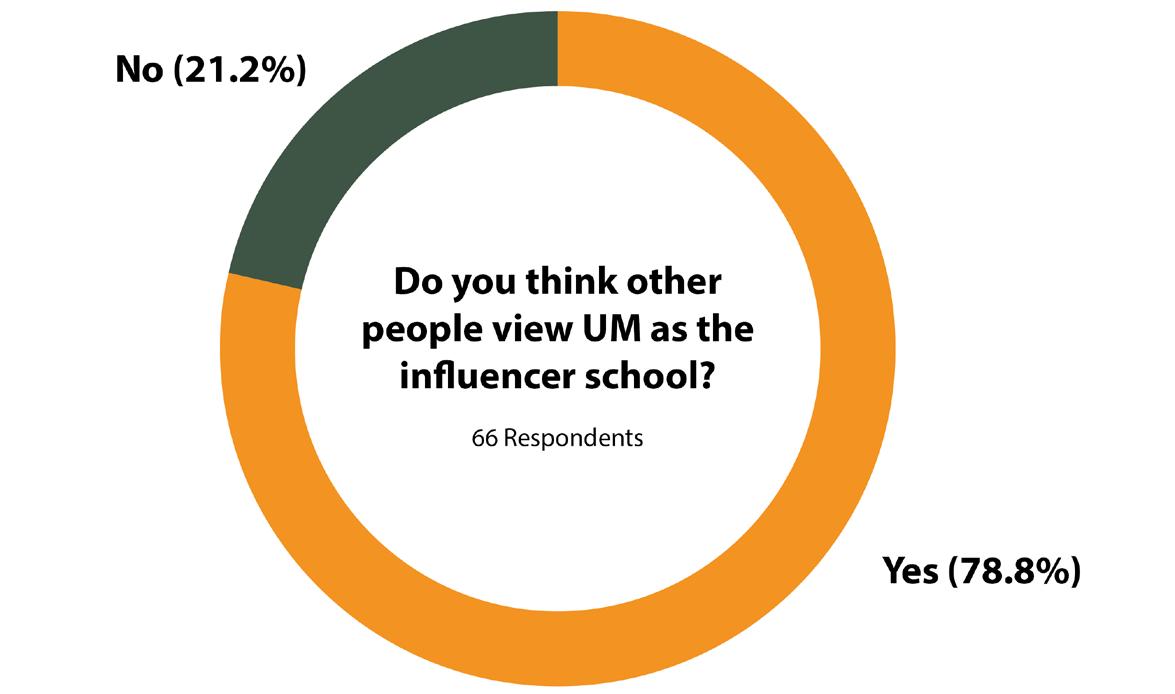
According to a survey conducted by The Miami Hurricane, 78.8% of 66 student respondents said they believe the public views UM as an influencer-focused university. The survey was posted to The Hurricane’s Instagram story for 48 hours.
Anna Becker, a junior majoring in health sciences, said she has noticed the growing popularity of TikTok around
“Sometimes by the dorms or walking to classes I’ll see people filming TikToks.”
Anna Becker UM Junior
campus during her time at the U.
“Sometimes by the dorms or walking to classes I’ll see people filming TikToks,” Becker said. “People post everything from Get Ready With Me’s, to day-in-the-life vlogs and dance videos with friends.”
One of the most notable examples is Alix Earle, who graduated from UM in 2023 and now has 8.3 million followers on TikTok and 5.5 million followers on Instagram. According to Parade and Celebrity Net Worth, Earle is now worth $20 million. Her viral videos during her junior year helped launch what many viewers refer to as the “Alix Earle Effect.”
Other influencers have grown large followings during their time at UM, turning social media into their career.
Abby Gendell, a creator with 529,400 followers on TikTok, graduated from UM in 2024. She now works in New York City as a content creator thanks to her success on TikTok and Instagram.
“When I moved to New York, I continued growing, and a lot of people who followed me in college stayed,” Gendell said. “I figured if I could build my own brand, I could do that for a company someday, and if I ever applied for a marketing role, I could point to my platform.”
Current students at UM are also finding success online, building a following that allows them to secure brand deals and receive PR packages.
Claire Mellin, a sophomore majoring in advertising management, has worked with brands like Edikted and Princess Polly.
“Most of my opportunities have come through Instagram, usually through brand outreach,” Mellin said. “My audience aligns with

to
the college-aged demographic that many brands target.”
Hosting brand trips is another way that popular brands connect with their audience. Some students had the op-
By Hannah Valdivia & Vivian Amoia Co- Breaking News Editors
The “For U” student government ticket won the 2026 Student Government executive election over the UNITED ticket on Thursday, Feb. 19, at Lakeside Patio.
Junior Fernando Sepulveda Sagaseta was announced as president-elect along with his running mates junior Aaron Gonzales as vice-president elect and junior Dylan Hall as treasurer elect for the 2026-2027 academic year. A total of 3,099 students voted in the 2026 election. Hall was announced as treasurer after receiving 50.51% of 3,080 student votes. Gonzales received 50.76% of 3,081 votes. Sepulveda Sagasta won with the largest margin, receiving 51.94% of 3,082 votes.
Sepulveda Sagaseta expressed his excitement about every member of the For U ticket winning their respective roles, saying that it would help them accomplish their goals more easily.
“I can’t believe the whole ticket won. We’re super happy,” said Sepulveda Sagaseta. “I mean, that’s honestly what we were hoping for. Like, we ran on a clear vision and I think having the whole ticket together is going to allow us to hit the ground running and start getting our initiatives accomplished.” Hall expressed similar excitement, especially given how close the race was.
“It was close. I knew it was going to be close,” Hall said. “I’m very happy with how things turned out and I just want to wish everyone congratulations. It’s been a hard week and half but I’m so proud of everyone for doing it.”
On Instagram, the For U campaign targeted three main areas of student experience at UM: academics, community and student life.
“We want to make this place the best it can be,” said Sepulveda Sagaseta. “We ran our campaign as being ‘for you’ and ‘U being back’ and our sports teams are playing their part and now, hopefully student government is too.” Gonzales also shared his drive to get started right away.
“Now it’s time for the real work,” Gonzales said. “I am still continuing in my role as director of university affairs for the current year, and am excited to get a jump start on our campaign’s initiatives before inauguration even happens in that role.”
Keira Faddis contributed to the reporting for this article.
in public relations and psychology, attended the trip through a personal connection with Tarte CEO Maureen Kelly’s son, who is a UM student.
“There were a few other UM girls besides my friends and I, maybe three or four,” Free said. “I think that being at UMiami exposes you to these kinds of experiences even if you aren’t directly trying to get them.”
Some classes even require students to make TikTok or Instagram accounts for projects, imitating real-world experiences where social media is used in everyday business practices.
CONTINUED FROM PAGE 3
Courtesy of Layla Fessler
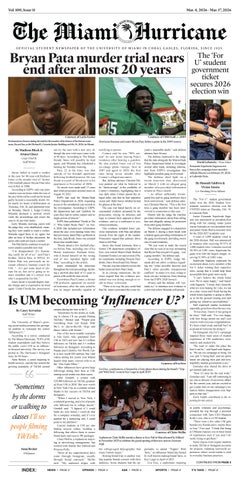
Rashaun Jones listens during his trial for the murder of his former of his former teammate, Bryan Pata, at the Richard E. Gerstein Justice Building on Feb. 24, 2026, in Miami.
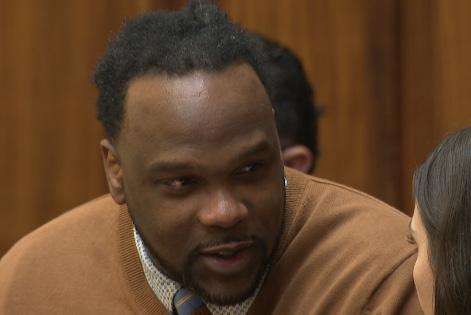
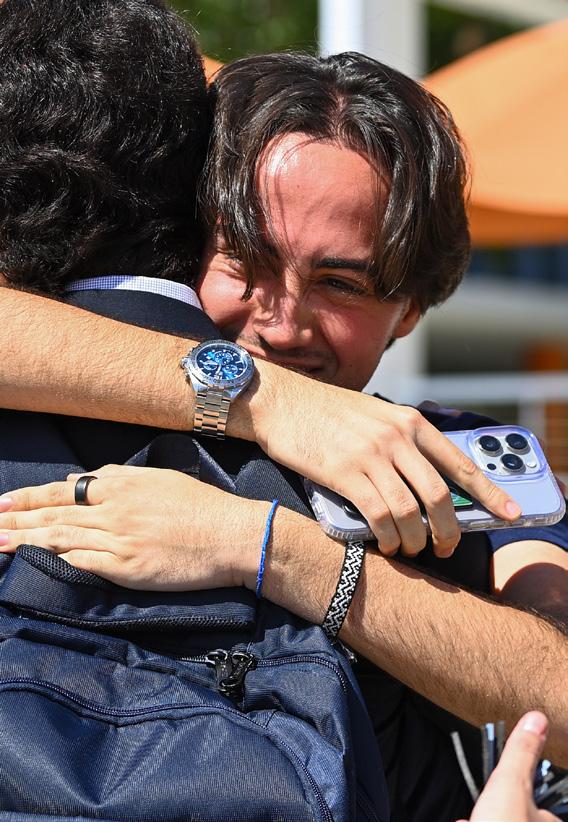
David Lebowitz// Photo Editor Fernando Sepulveda Sagaseta embraces his campaign team member Alfredo Briceno on February 19, 2026 at Lakeside Patio.
portunity
attend “Trippin’ With Tarte,” an influencer brand trip hosted by well-known makeup brand Tarte, in Key Largo in April of 2025. Eva Free, a sophomore majoring
Courtesy of Eva Free
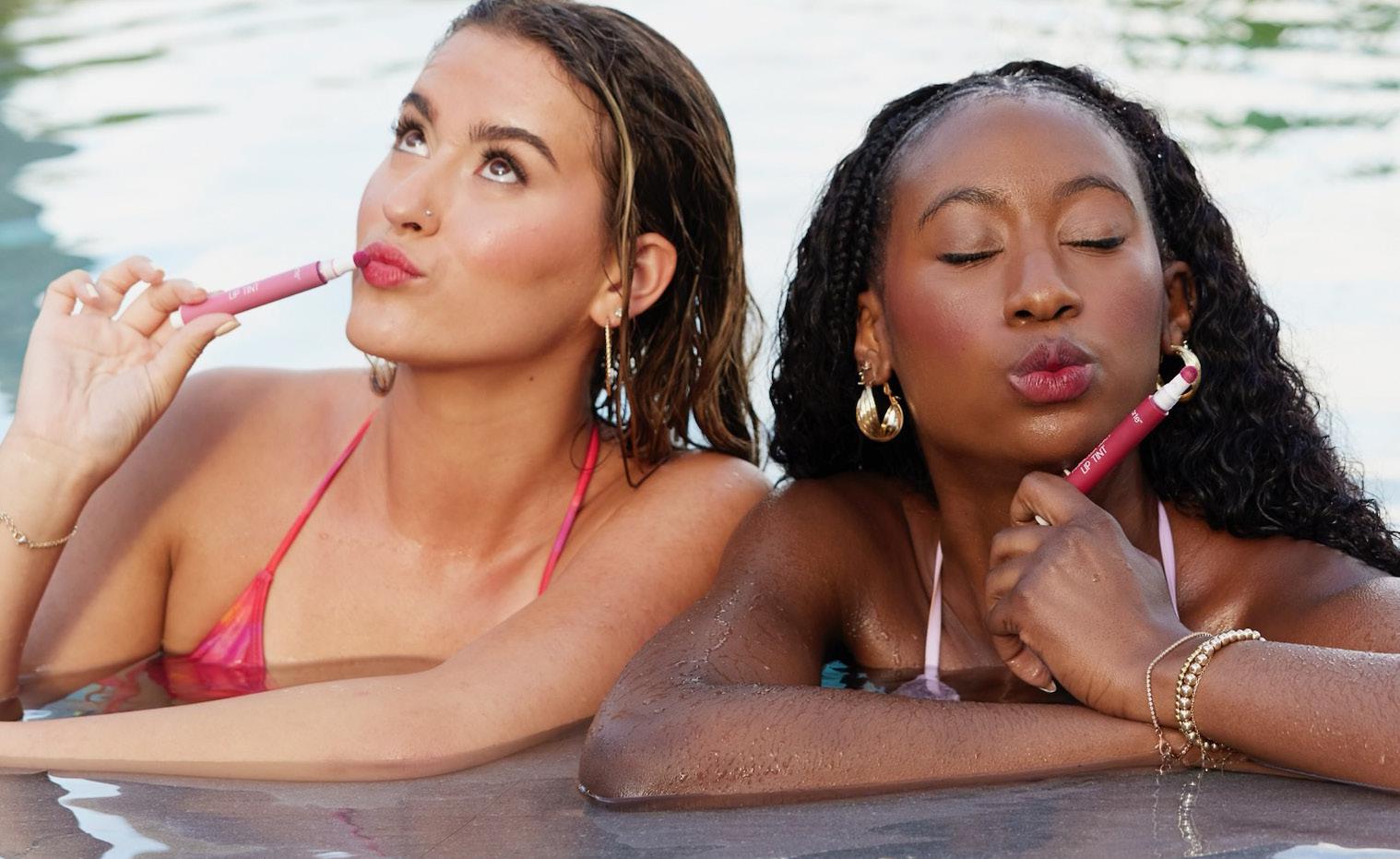
Eva Free, a sophomore, is featured in a Tarte photo shoot during the brand’s “Trippin’ With Tarte” event in Key Largo in April 2025.
Courtesy of TMH Staff, c. 2005
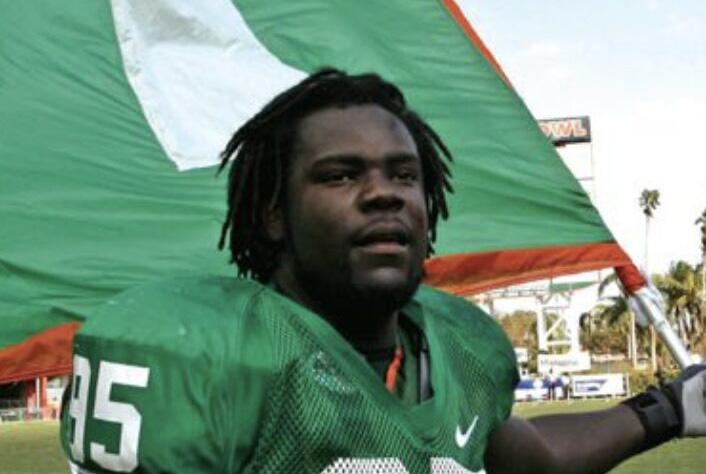
Hurricane lineman and senior Bryan Pata, before a game in the 2005 season.
Courtesy of Claire Mellin
Sophomore Claire Mellin attends a dinner at Sexy Fish in Miami hosted by Edikted in November 2025 to celebrate the grand opening of their new store in Aventura Mall.
Student government elections record second-highest voter turnout ever
By Martina Pantaleon Senior Staff Writer
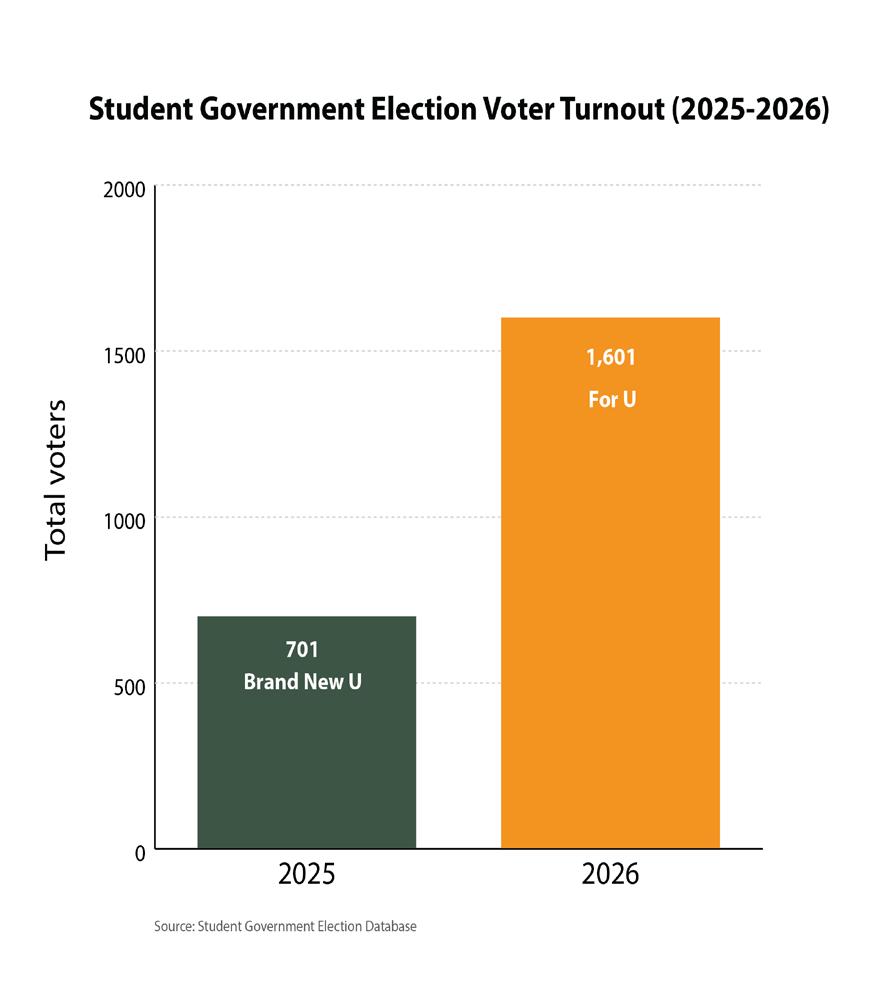
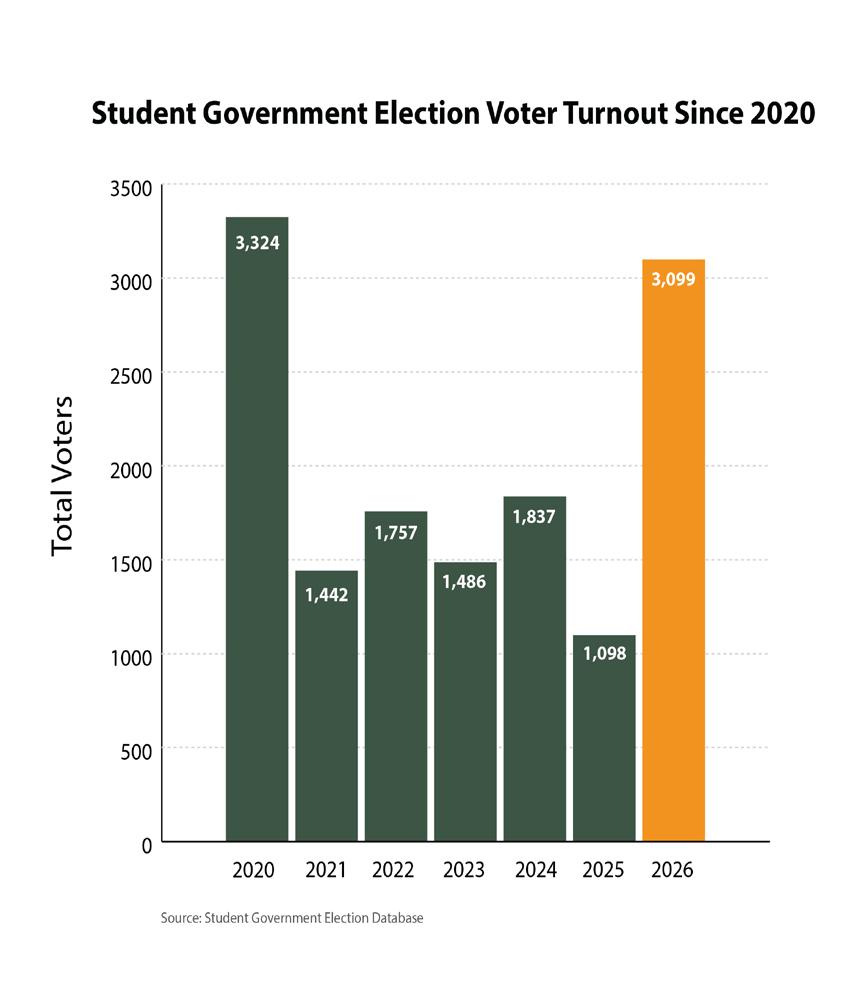
The spring 2026 Student Government elections set the record for the second-highest voter turnout ever. According to the SG election database, 3,099 students voted in the 2026 election, putting it just behind the 2020 election, which drew 3,324 voters.
Voter turnout in the 2025 election was 1,098 — less than half the number of students who participated this year. The winning ticket, For U, received 1,601 votes — more than double the 701 votes that the 2025 winners, Brand New U, received.
Incoming SG President Fernando Sepúlveda Sagaseta attributes the high voter turnout to both tickets’ campaign strategies.
“We talked to a lot of [organizations],” Sepúlveda Sagaseta said. “We were trying to hear what everyone needed.”
He estimated that For U visited more than 40 student organizations, from fraternity chapters to religious organizations, as well as activity-centered organizations like Hurricane Productions.
“It definitely incentivized me to vote,” EJ Rambau, a member of Hurricane Productions, said. “I didn’t hear anything about either party
before they came to present, and I would’ve been less inclined to cast a vote without hearing from them.”
UNITED candidates also attended the meeting. Both tickets talked about their goals and opened the floor to questions from students, according to Rambau.
Candidates reached out to classmates individually to encourage voting. Students responded well to these conversations on both sides
“I was not going to vote originally, but then [Alex Barrowclough] came up during class and asked us to vote for him,” Esha Aman, a classmate of the UNITED VP candidate, said.
For U also tabled throughout the week near the Foote Green, Centennial Village and Mahoney Pearson. They tried to catch every passing student’s attention, and many listened, Sepúlveda Sagaseta recalled.
“When it’s stuff they care about, people will stop and listen,” Sepúlveda Sagaseta said. “Everyone is busy, we get that.”
At the same time, UNITED tabled at Merrick Fountain near the Whitten Learning Center. More than 20 student organizations endorsed them and helped push their message.
“When you go up to people, they are most likely to remember you,”
Vanna Smart, a senior, said.
UNITED’s tabling efforts, give-
aways and frequent social media posts helped the ticket reach 1,334 Instagram followers — the highest following of any SG campaign in the last six years. Although they did not win, UNITED’s presence on social media was not futile.
“I did think UNITED had a more successful campaign with their social media posts,” Smart said.
While the tickets used new tactics this election, the SG Elections Com-
Florida bill targeting public universities may indirectly shift UM applicant pool
By Keira Faddis Co-Opinion Editor
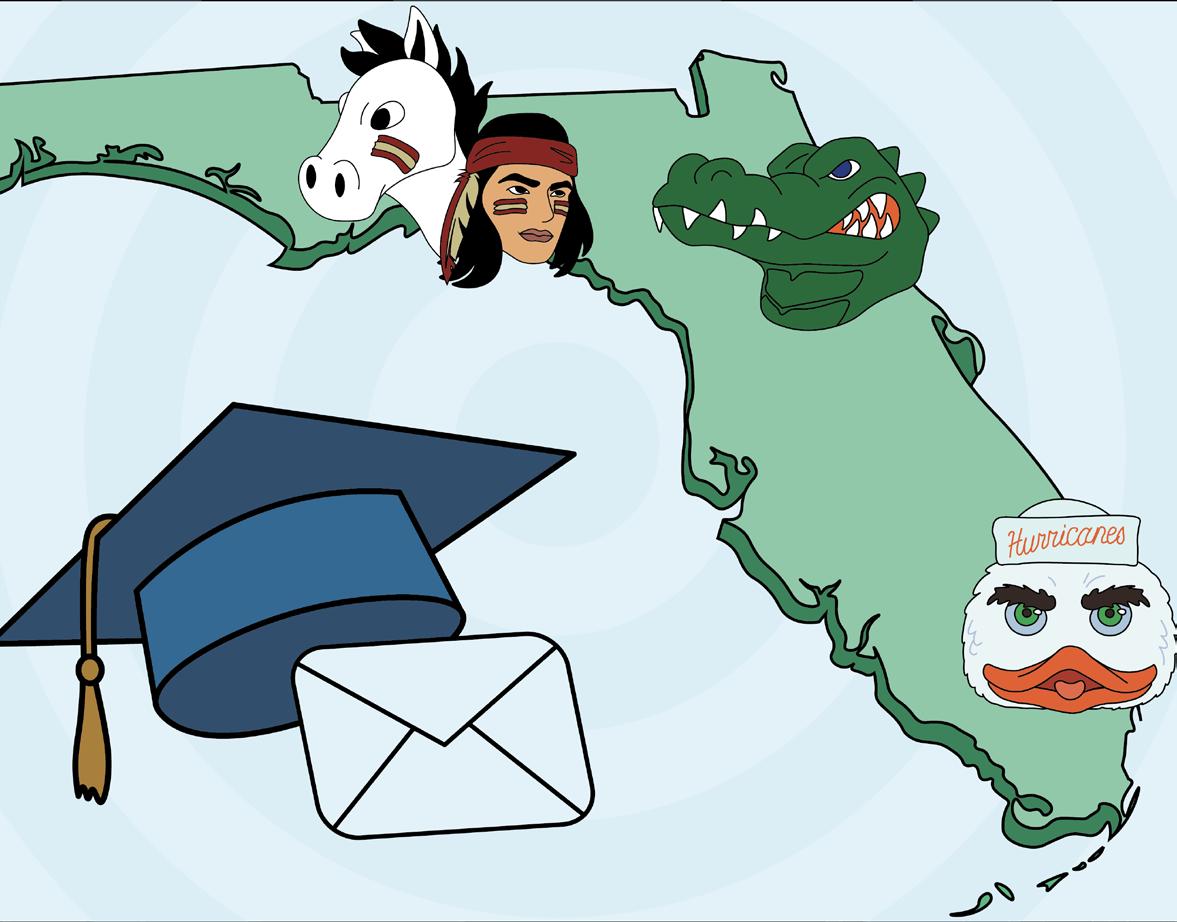
A proposal advancing in the Florida House could further limit out-of-state and international student enrollment at Florida’s public universities, potentially altering the demographics of future University of Miami admitted classes.
This bill, HB 1279, would require schools like the University of Florida and Florida State University to ensure that up to 95% of incoming undergraduate students are Florida residents.
UM’s out-of-state and international students make up more than two thirds of its undergraduate population. Since the University of Miami is a private institution, the same policies would not apply. But, UM could still see indirect effects.
If Florida’s top public universities reserve more spots for in-state
By Gaby Collazo Staff Writer
With continued success across the University of Miami’s athletic programs, student attendance has been on the rise. But when teams fall into losing streaks, empty seats can quickly outnumber cheering fans.
UM is home to 18 National Collegiate Athletic Association (NCAA) Division I sports and has grown to be known more than its dominant football eras of the late 1980s and early 2000s. This season, the 2026 Miami Hurricanes football team fought its way to the College Football Playoff National Championship for the first time since 2003. Men’s basketball is also on a historic run, ranking third in the ACC after finishing last in the conference last season.
The student sections at Hard Rock Stadium and the Watsco Center have been packed with Hurricanes fans during winning stretches, but that energy is not always consistent when teams begin to lose.
“When our teams are good, you see that directly translate to attendance,” said Ava Shah, senior creative chair for Category 5. “When we lose, attendance definitely drops.”
Category 5 is a spirit programming board and link between the athletic department and students, whose aim is to preserve and implement sport and
students, fewer Florida students may choose to apply to UM. At the same time, out-of-state and international students who might otherwise attend UF, FSU or other state schools could view UM as an attractive alternative, potentially shifting application trends and the composition of future admitted classes.
“My decision to apply came from where the university was and if it had a major of my interest,” said Georgina Paez, a sophomore media management major. “However, I was worried about being accepted or not considering the low percentage of in-state students accepted.”
Paez also said “I think there should be an equal amount of students accepted, whether it be in state, out of state, or even international. Everyone deserves an equal opportunity to come here.”
However, some non-Florida students say that the higher non-resident population on campus did not have a
spirit-related traditions at UM.
Hard Rock Stadium can hold up to 80,000 fans, but crowd size fluctuates from game to game. According to UM box score stats, 66,591 fans attended the Hurricanes’ game against USF on Sep. 13, 2025. After losses to Louisville and Southern Methodist University, and following the homecoming matchup, the next regularly scheduled home game at Hard Rock against NC State drew 59,157 fans.
Basketball attendance has followed a similar pattern.
“The beginning of the [basketball] season attendance was definitely slower just because we had a completely new team and a new coach,” said Shah.
“But as there’s been continued success and we’ve made history with our 21-5 record, the stands have packed.”
The Watsco Center, which seats 7,972 fans, sees attendance rise and fall based on the matchup, team success and overall interest in the game.
Men’s basketball drew 4,131 fans when they played Elon early in the season in November 2025. But, as the men’s team continued to win, the crowd grew.
When Miami had an upset win against North Carolina on Feb. 10, 2026, the attendance for the game reached 7,355.
Women’s basketball experienced the same pattern of wavering support.
In December of 2025, women’s basketball played Georgia State at home in front of 1,021 fans. As losses ac-
major impact on their decision to apply.
“I was aware that admission to U.S. universities is generally highly competitive,” said Miriam Tali, an incoming international student from the class of 2030. “The international acceptance rate did not play a major role in my decision to apply.”
However, Tali did consider submitting an application to UF, but decided to apply ED to UM.
“I initially considered applying to the University of Florida, but ultimately felt that UM was the better overall fit for me,” Tali said.
Currently, Florida’s public universities operate under a statewide average cap that limits out-of-state enrollment to 10%.
For example, under the current cap, the average out-of-state acceptance rate across all public Florida universities is around 10%, even though some universities, like UF and FSU, have around 20% out-of-state students. Smaller outof-state enrollment at universities lie the University of North Florida bring the statewide average down. The University of Florida recently decided to pause admissions for out-of-state transfer students.
UF alumna and Republican Lakeland Representative Jennifer Kincart Jonsson proposed the bill that has passed in the House Budget Committee.
At public universities, out-ofstate students pay more in tuition than in-state students. At UF, the in-state tuition for the 2026-2027 school year is $6,380, while outof-state tuition is $30,900.
According to Jonsson, schools will lose a combined $54 million in the first year after the cap is imposed. However, this is only a small portion of the $17.5 billion the schools receive in funding from the state.
cumulated, their attendance continued to drop. By February, 833 fans attended their game against Stanford.
Still, athletics compete with the city of Miami itself. Beyond the Coral Gables campus, students have access to the city’s nightlife and cultural scene, often choosing between attending an evening game or going out.
“The University has a unique challenge,” said Gates Fox, a junior member of Category 5. “While we have amazing sports that are fun to attend, we also have so many cool opportunities in the city of Miami that students can also go [to].”
Logistical challenges also impact whether students attend sporting events.
Since the Miami Orange Bowl closed in 2008, football games have been played at Hard Rock Stadium. Unlike other on-campus venues, the stadium is about 40 minutes from campus depending on traffic, and student tickets and transportation options are limited. The distance, time commitment and required planning can discourage students from attending, especially when the team is struggling and the incentive to make the trip feels lower.
“I think that when we lose in football, students are discouraged to go because it’s such a hassle to get to the stadium versus basketball or anything other sports that are on campus it’s easier to just pop over to a game,” said Shah.
To boost turnout during losing
mittee did not. They host the same two events every year before voting starts.
Candidate debates were held at the Rathskeller four days before the elections, and food incentives were given in the Breezeway to people who stopped to vote.
Students who voted in this election also elected Senate Candidates to represent six student groups: College of Arts & Sciences, Miami Herbert Business School, School of Commu-
nication, Commuters, Student Employees and Transfers.
Each category received twice as many votes than in 2025. Most notably, the candidates for transfer student senator, who received fewer than 100 votes in the last two years, reached 227 votes this year.
The UNITED ticket declined The Miami Hurricane’s request for comment on its campaign.
Author of ‘Son of Hamas,’ Mosab Hassan Yousef, draws sold-out crowd at SSI event
By Gianni Echeverria
Contributing Writer
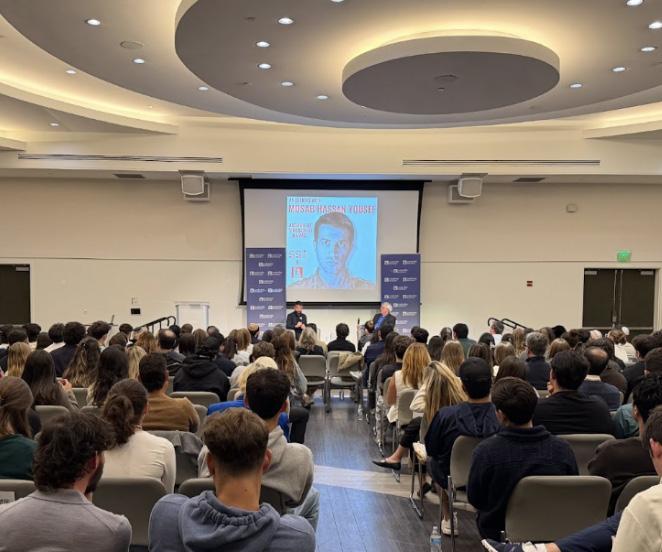
Mosab Hassan Yousef, the author of “Son of Hamas,” visited UM on Tuesday, Feb. 24, for an event hosted by the Students Supporting Israel club.
Yousef is the son of Sheikh Hassan Yousef, co-founder of Hamas, the governing party in the Gaza Strip. Hamas is designated as a Foreign Terrorist Organization by the U.S. Department of State.
Two hundred people were able to attend the event, and tickets sold out two days after it was announced.
The waitlist also reached capacity the day before the event.
Moderated by Dr. Ira Sheskin, a professor at UM’s Judaic Studies and Geography department, the event began with a look into Yousef’s early life, and why he believes he was radicalized as a child.
“Growing up where I did, there was really no other choice,” said Yousef.
“When you see the people who disobey, they are beaten, tortured and beheaded.”
The conversation then shifted to Yousef’s work with the Shin Bet, Israel’s counterintelligence agency. He described some of the operations he took part in and what motivated him to work with Israel.
Yousef also shared his views on the current Iranian regime and why he believes the pre-1979 monarchy is not the best alternative. He has recently gained a lot of attention online for his opinions on the former Persian monarchy.
The event closed with questions from the audience. One student asked about his opposition to Reza Pahlavi, the eldest son of the last Iranian shah. Another student asked about Donald Trump’s controversial plan to take over the Gaza Strip.
“He is presenting himself as this
loving monarch, like a father, who wants to take care of his children,” said Yousef, when speaking about Pahlavi. “But show me his qualifications, because I do not see them.”
Pahlavi has publicly positioned himself as a democratic alternative to Iran’s current theocracy.
“I think he is extremely intelligent. Everything he says is strategic and well thought out,” said Jami Campodonico, a mother of two UM alumni who attended the event. “Anytime he was asked a question, he really sat for a moment to absorb, and then decided what to say and how to answer.”
Others emphasized the importance of hearing testimony directly from someone who grew up inside Hamas’ leadership.
“I thought the event was very important,” said Cameron Newman, the senior advisor for SSI. “What better way than to hear from someone… who grew up in the thick of it all to give a firsthand experience,” Newman said.
The event was hosted in the Shalala Student Center, in the Grand Ballroom on the third floor. Invite-only early access meet-and-greet for the event began at 7:00 p.m. The event began at 8:00 p.m. and was limited to students, faculty and family of board members of SSI.
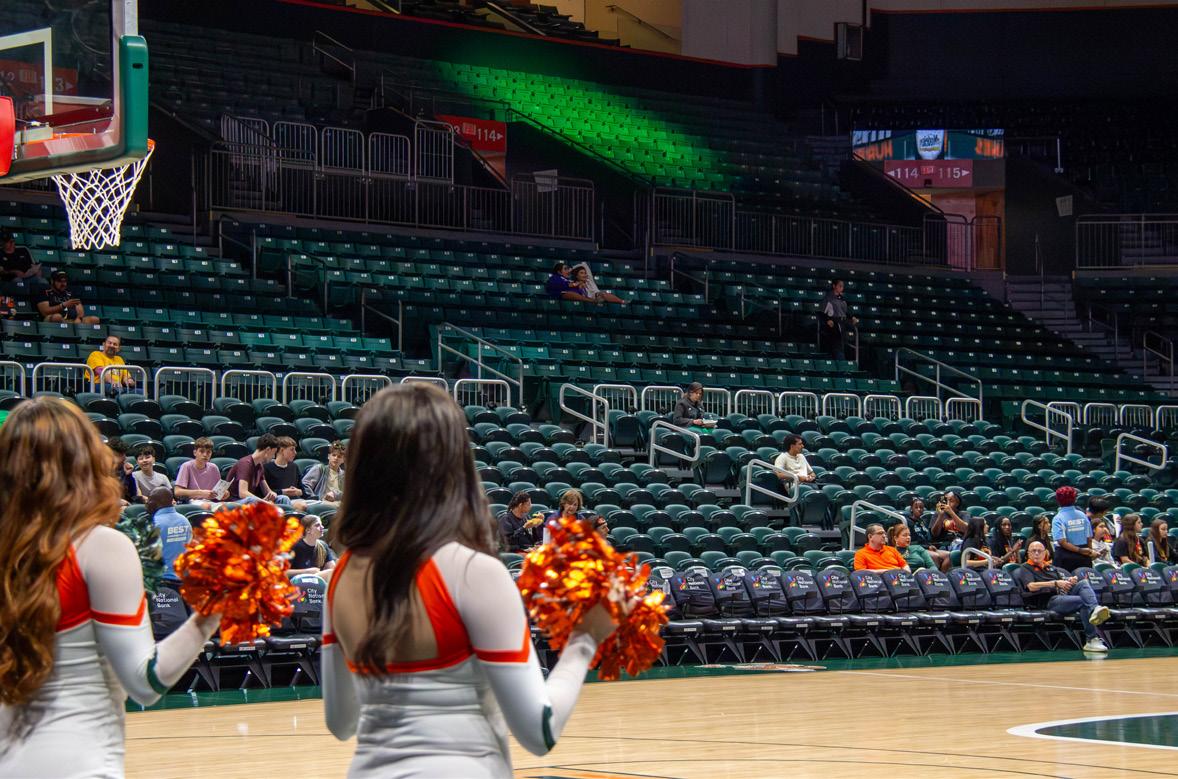
Most seats stand empty at the start of the women’s
Pittsburgh on Feb. 26, 2026
streaks, UM has introduced attendance incentives. The athletic department has offered giveaways such as Ultra Music Festival tickets and postgame food promotions with local businesses. Another recent motivator is CanesUnited, an app that allows students to earn points by attending sporting events for a chance to win $42,500 for their student organization.
“Students love free things,” said Shah. “I’ve noticed every time there are giveaways of some sort there will be an increase in attendance.” Access to athletic events is rarely about cost for students. For sports like
football, basketball and baseball, students can secure free tickets through the university’s official student ticket portal, typically by logging in with their CaneID and claiming the seats in advance. Other sports, such as volleyball and tennis, admission is generally open, allowing students to walk in without reserving a ticket. Simply offering free admission does little to guarantee student turnout. What ultimately fills the stands is the excitement of the game, the stakes of the matchup and the team’s performancefactors that create energy and a sense of community that money can not buy.
Faith Jimenez // Contributed Graphics
Sovannreach Po // Graphics Editor
Bella Ochoa // Contributing Photographer
basketball game against
at Watsco Center.
Gianni Echeverria // Contributed Photo Mosab Hassan Yousef speaks at the Students Supporting Israel event in the Shalala Student Center on Tuesday, Feb. 24, 2026.
Pentagon tuition assistance review names University of Miami
By Emil Salgado Vazquez Podcast Editor
The University of Miami is among more than 30 private schools that may lose tuition aid for active-duty service members in graduate programs, according to CNN.
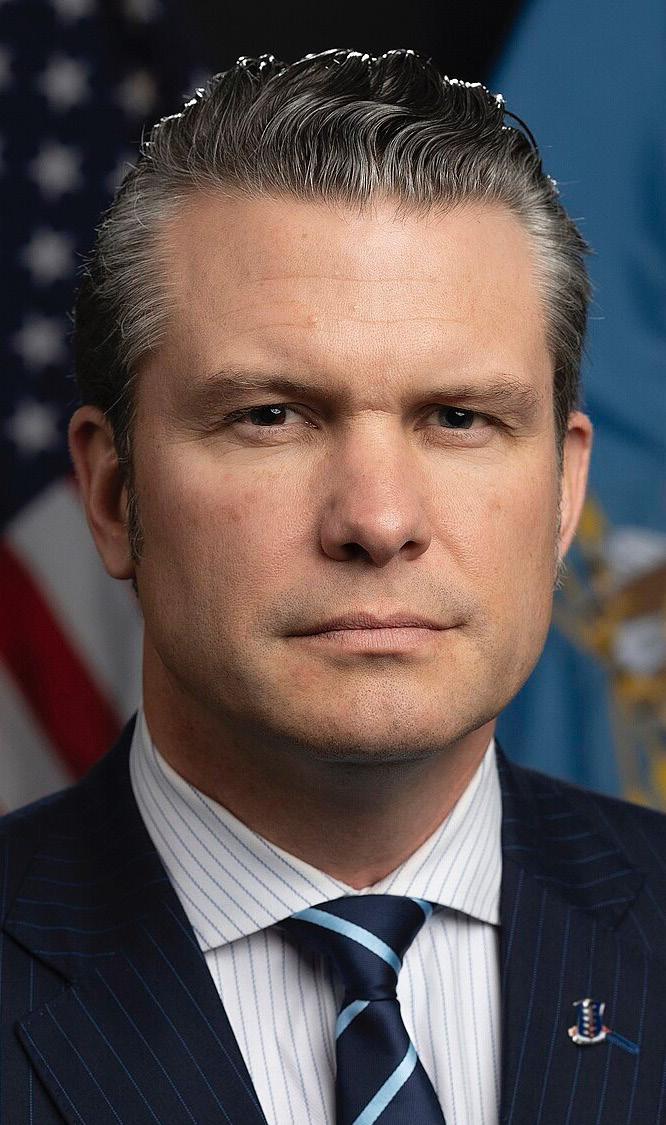
“Components of all of our departments — army, navy and air force — will evaluate all existing graduate programs for active-duty service members at all Ivy League universities and other civilian universities,” U.S. Defense Secretary Pete Hegseth said in a statement on X. If implemented, the policy could restrict tuition assistance at certain universities and shift military-funded graduate education away from private institutions. UM and the Florida Institute of Technology in Melbourne are the only two Florida schools listed in leaked emails from the Department of War as having “moderate or high risk” of being banned from tuition assistance.
“It saddens me to see that the U.S. government is considering cutting service member’s tuition aid for schools deemed ‘too woke,’” said Caroline Garfield, UM’s veteran students senator. “This is a move to further radical political opinions while depriving our service men and women access to higher education.”
Veterans using the GI Bill — which provides them and their families with help covering costs for school, training and other related expenses — would still receive benefits. ROTC programs would still remain active and military-affiliated students could continue to enroll and attend UM.
“This will affect active duty members that are relying on tuition assistance, but not the GI Bill funding because it comes from a different part of the Department of Defense,” said Gil Gonzalez Jacobo, a sophomore who served in the U.S.
Navy from 2018-2025.
Defense officials say the review aims to evaluate cost efficiency, partnerships and strategic value in military education. The review is part of broader efforts to reassess how the military trains future leaders amid budget pressures and changing priorities.
Some critics warn that restricting universities may limit diversity and educational opportunities for officers.
The Trump administration has not made a final decision regarding the review, and the universities listed may ultimately remain eligible for tuition assistance. Any changes made by the Trump administration to tuition assistance would likely take effect in the 2026-27 academic year.
If enacted, the policy would affect a small number of military-funded graduate students nationwide.
“I sincerely hope our government does not pursue this agenda,” Garfield said.
Students cycle in support of The Dolphins Cancer Challenge
By Skyla Thomas Staff Writer
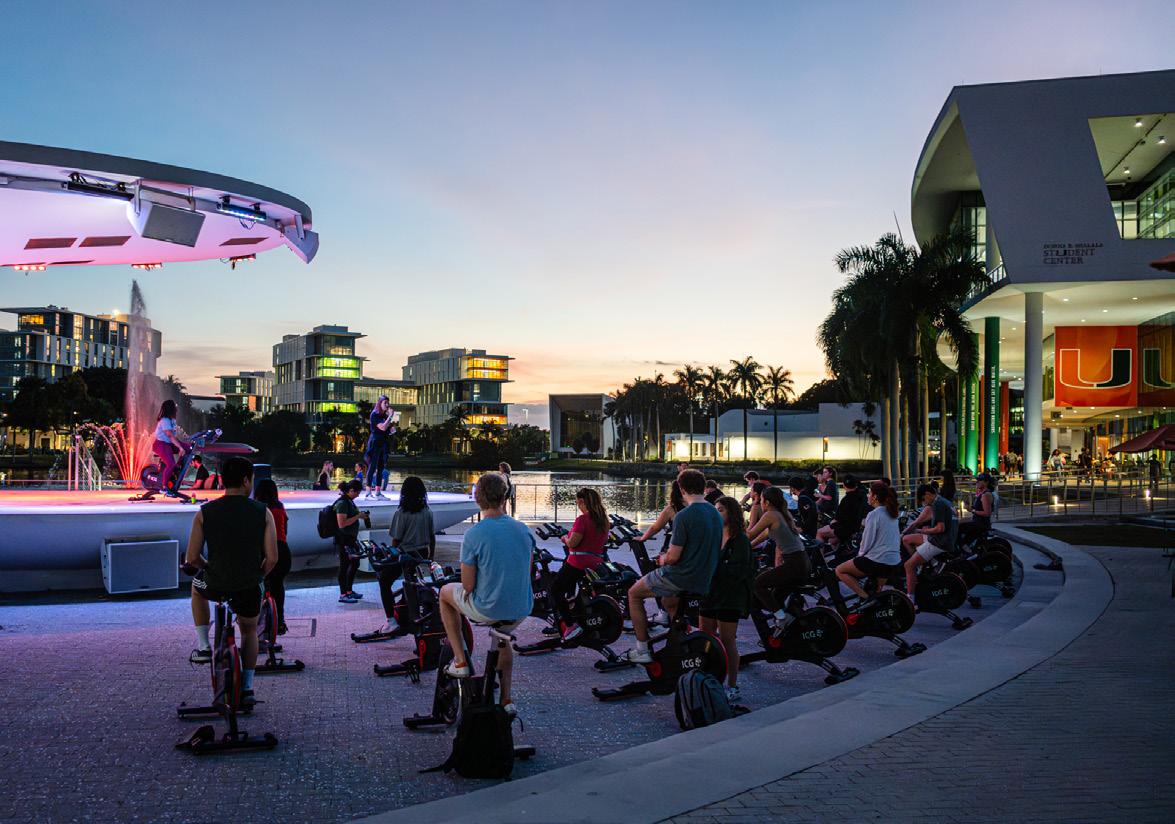
Team Hurricanes hosted the annual Dolphins Cancer Challenge (DCC), a campaign raising money for cancer research in South Florida, on Thursday, Feb. 19. This year was the sixth year UM hosted the DCC event — outdoor cycling classes at Lakeside Patio — and all of the money raised helps fund cancer research at UM Sylvester Comprehensive Cancer Center.
The event was centered around the DCC, an organization that has raised more than $100 million for cancer research, making it the most successful fundraising event in the NFL. The DCC cycling challenge raised $1,905 through donations, riding tickets, and extra raffle tickets. Each cycling class lasted 15 minutes and was choreographed to music performed at previous Super Bowl halftime shows.
Every donation that was made included the 15-minute class, giveaways, two raffle tickets to win signed NFL and Hurricanes football jerseys and helmets from former players, and other prices, and a Playa Bowl.
Melina Kalamatianos, a sophomore at UM and a spin instructor at the Herbert Wellness Center, led the spin classes at the DCC fundraiser.
“Being part of the fundraiser was truly special for me. I loved being a part of the event and encouraging my corner of the spin community to contribute,” Kalamatianos said. “I also had a great time meeting new people who attended and raising awareness for the cause.”
Kalamatianos emphasized that she has a personal connection to the DCC that made the event all the more special to her.
“My mom is a breast cancer survivor, and watching her navigate treatment with resilience and optimism


7:30 pm - 9:30 pm
Is UM becoming ‘Influencer U?’
By Casey Servatius Senior Staff Writer
CONTINUED FROM PAGE 1
changed the way I see strength,” Kalamatianos said. “I remember the uncertainty our family felt during that time, which is why funding research is meaningful to me.”
20 to 25 students participated in each cycling session and a total of 128 people registered for the event.
Sierra Stiff, the vice president of the UM beach volleyball team, brought along six of her teammates.
“The speakers were loud and motivating! Beyoncé and Lady Gaga had us fired up,” Stiff said.
In addition to a good workout, participants left with incentives.
“The giveaways and Playa bowls both added to the experience. Everything about it was well put together and right at the center point of campus for students to participate in,” Stiff said. “Getting students to participate in events like this that pertains to a group is significant in my eyes.”
According to Kalamatianos, many of her peers feel a disconnect from how to help support cancer research, because they want to be involved in the organization, but don’t know how. She feels this fundraiser was the perfect opportunity to bring her community together and change this awareness into action. Stiff agreed that the event brought the campus closer together.
“This event matters to a college campus because it brings the student body together in a way to raise awareness for a population that needs it right here in our community,” Stiff said.
Kalamatianos says that she looks forward to leading more events like this in the future. The next one is scheduled for February 2027.
“I am trying to teach every year they have it because it is a great opportunity to support a great cause, spread awareness, and, of course, get a workout in,” Kalamatianos said.
Valentina Gomez, a junior studying creative advertising and marketing, created the “Table For Two” TikTok account in September 2025 as her final project for a digital marketing class. Gomez set students up on blind dates in the library to help people form connections.
The “Table For Two” account has gained about 30,000 likes and 1,230 followers as of March 4, 2026. Her most popular videos currently have tens of thousands of views, with one video reaching 237,900 views.
“I did expect it to do well on TikTok,” Gomez said. “I think it was a unique idea and I knew that I just had to commit to it.”
Commitment is key, but influencers also attributed part of their success to UM’s lifestyle and campus.
“Being on a campus with palm trees and a lake made it so easy to film content. You’re inspired by everything around you all the time,” Gendell said.
“I feel like Miami’s aesthetics made content creation really easy .”
Abby Gendell UM Alumni and Content Creator
“I feel like Miami’s aesthetics made content creation really easy.”
Staff members at UM also view the University’s growing social media presence as a positive reflection of the University’s online image.
Professor Catherine Schenquerman, a lecturer in strategic communication, teaches a course titled “Social Media Influencers.” She understands the advantage that UM students have by going to school here.
“All universities today benefit tremendously from social media visibility,” Schenquerman said. “Univerity of Miami in particular has a stunning campus that translates beautifully to visual platforms.”
However, some students have said that the media attention has created a stereotype that all students are interested in social media.
“I think that people feel UM fits into this one mold, when it has so much more to offer aside from popularity and influencers,” Becker said.
Media attention can also hinder the
Sovannreach Po // Graphics Editor
University’s image among news outlets. The Washington Post published an article on Nov. 12, 2025, describing the “vicious turf war” among influencers at UM.
According to the student survey, 72.7% of students said they do not like or are unsure about the media attention that UM has received.
“I feel like the only reason some people are here is to be the next Alix Earle,” said an anonymous responder. Other students say that the University is not respected as an academic institution.
“It is strictly viewed as a party school with a side of education, and I really don’t like how this school has turned into that,” said another anonymous responder. Whether the influencer stereotype is embraced or rejected, students agree that social media has become an unavoidable part of campus life.
Talia Gorelick contributed to the reporting of this article.
via Wikimedia Commons
Official portrait of Secretary of Defense, Pete Hegseth on Jan. 28, 2025, by Chad J. McNeeley.
Brain Mulvey // Photo Editor
Students, staff, and community members bike at the Dolphin Challenge Cancer Cycle Sesh Halftime Hustle as the sun sets on Feb. 19, 2026.
Sovannreach Po // Graphics Editor
I can’t afford my four-year UM degree
By Emil Salgado Vazquez Podcast Editor
The University of Miami was my dream school. I grew up in Broward County, and, like anyone who was raised in the Miami metropolitan area, I was born a Hurricanes fan.
Attending UM was my dream, what I worked for my whole life. But when I got my acceptance letter from UM, I did not feel the joy I had imagined. Instead, I felt dread: “How am I going to pay for this?”
I worked hard throughout high school and was a likely candidate for full-ride scholarships at other Florida universities. At UM, my efforts paid off with three quarters of the tuition in scholarships, yet even the remaining quarter is hard to pay for. Now, in my fourth semester at UM, I am preparing to graduate in just two-and-a-half years, much to my mother’s despair — I think.
I’m not finishing early because I want to. I’m doing it because I can’t afford to stay at UM for the traditional four years.
And I’m not alone.
In a survey conducted by The Hurricane on Instagram, 59% of student respondents said they are graduating early.We live in an era of education where fast-tracked degrees might be
the only way to afford college.
“My Cane Navigator seemed offended that I even proposed the idea of graduating early,” an anonymous survey responder wrote.
“From then on I realized how much of a business this university is. In that meeting I didn’t feel like a student, I felt like a customer.”
I was fortunate. As an in-state student, I am eligible for Florida’s generous grants and scholarships. I also came into college with about 40 credits from high school, which made me a sophomore in my first year.
“I’m technically a sophomore but I don’t feel like a sophomore at all, I’m still figuring out all that UM has to offer,” a survey respondent said.
“I’m the youngest in most of my classes and I have to remind myself that everyone else has had more time to find their organizations and community. It feels like playing catch-up even though I’m doing more than the average freshman.”
Throughout the past 20 years, tuition and fees at private national universities have increased by about 32% after adjusting for inflation. These increases have outpaced those at public universities, by three percentage points for instate students and eight points for out-of-state students.
Rising costs are pushing students who are already struggling to
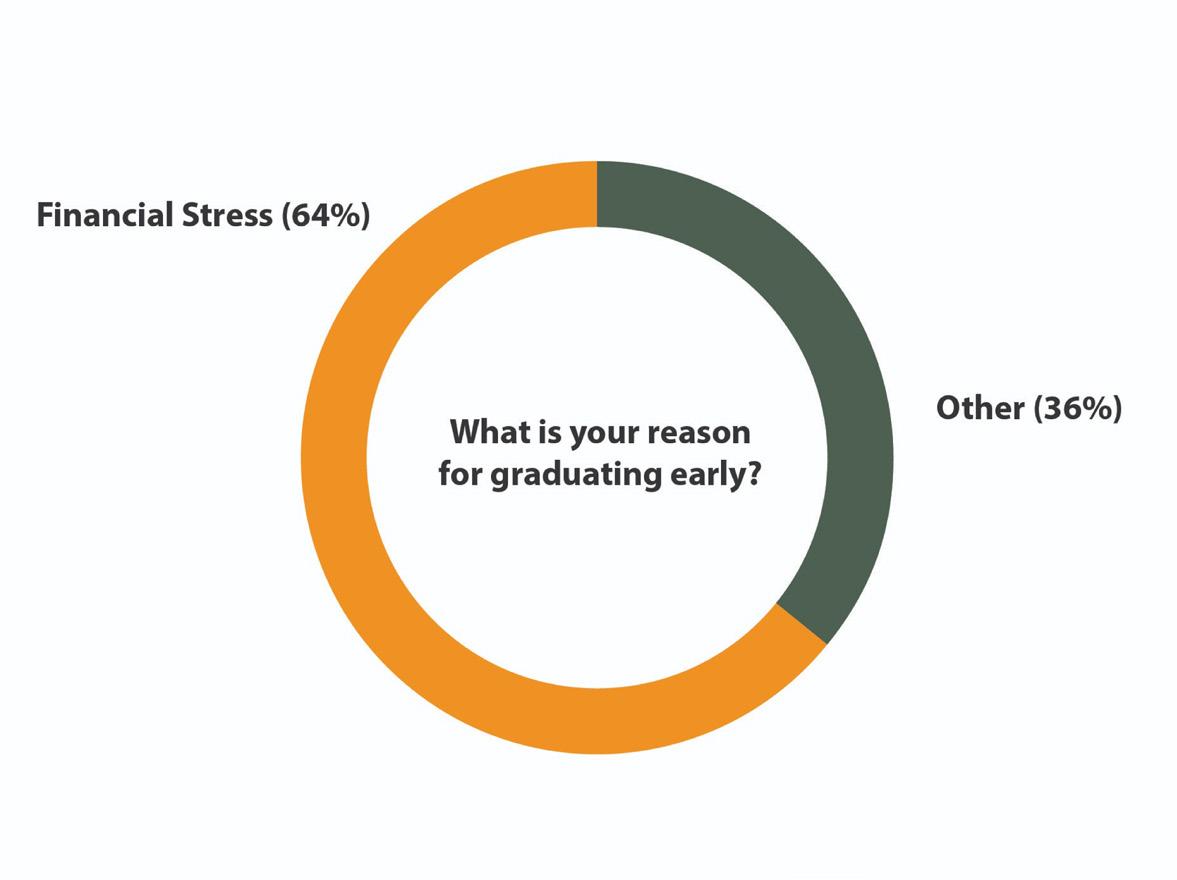
pay for college to graduate early. Of the students who said they were graduating early, 64% cited “financial stress” as a reason.
“I took several APs in high school, so I came in with 30+ credits,” another anonymous survey responder said. “It is a bit stressful having to cram the ‘college experience’ into three years but it saves time and money.”
If it weren’t for tuition skyrocketing, I would love to stay at UM for three more semesters. It’s my dream school — but the price of being here is turning that dream into a nightmare.
The need to graduate early also comes with academic and personal costs. Only 20% of students who said they’d graduate early strongly disagreed with the question, “Has your fast-tracked education caused you any problems?”
Reported issues include: having to switch majors due to a lack of accommodation; limited involvement in extracurricular activities; limited leadership experience; stress about networking; limited time to prepare for the LSAT; and limited social lives and stress about what to do after graduation. I also deal with many of these issues.
One solution to this problem might be to go to graduate school. Of the students who said they were graduating early, 68% said they were “probably” or “definitely” going to
Keep students safe by keeping campus closed
By Hannah Valdivia Co-Breaking News Editor
The University of Miami prides itself in providing a “safe, tranquil and suitable learning environment” for its students, but I’m tired of seeing random men in Meta glasses harass me and my friends with questions for their latest TikTok video.
UM sits in the center of the bustling city of Coral Gables, leaving students wondering if current security measures are enough to keep them safe.
Several students have reported dangerous encounters with strangers who are able to freely walk around campus whenever they please, because campus gates are often left open or not strictly guarded. The campus’ main gate on Stanford Drive is often left open even during late hours, meaning anyone is able to enter or leave campus without any verification of their identity.
Enforcing stricter rules at each of the gates would prevent students from
being put in dangerous situations. It would also put both parents and students at ease, especially those who may be out-of-state and unfamiliar with the Coral Gables area.
One of these encounters happened last spring when a man was reported exposing himself to a female student on campus. According to a CBS News article, an unidentified male approached a young woman in Shalala Student Center while undressed and began to touch himself inappropriately.
Another instance occurred this semester when a strange, unidentified man walked onto campus and began making taunting jokes about UM’s football team. A verbal altercation then followed when a student approached the man, leading the man to claim he was being attacked and assaulted.
Security assistants monitor the lobbies of Residential Colleges from 10 p.m. until 8 a.m. But, there isn’t exactly anything stopping an intruder from entering campus outside of these hours.
“We maintain a safe and welcoming environment through a strong 24/7 police and security presence,
rapid emergency response times averaging three minutes or less, and continuous review of our security protocols,” the University of Miami said in a statement to The Hurricane.
Despite these security protocols, freshman Riley Kai Richards was approached by an unknown person after leaving the Centennial Dining Hall.
“I was walking out from the dining hall and this much older guy came up to me and was clearly intoxicated,” she said. “He kept trying to get me to go in his car and it wasn’t until another student came up to me that he left me alone.”
She reported the incident to UMPD.
Richards told The Hurricane that the UMPD remained in contact with her for about three weeks after, but said that she never received a final update on the man. She stated she has not seen the man, or his vehicle, on campus since.
Cane Cards and guest policies are listed on the University’s Housing and Residential Life website, but it is unclear whether these policies are truly keeping students as safe as possible.
Florida Statute 810.097 states that “any person who does not have legiti-
graduate school. Only 24% of those disagreed with the question, “Has your fast-tracked education been a factor in that decision?”
However, this poses another problem for students who already struggle to afford undergraduate education. Though there are scholarships and employer tuition reim
bursement programs, early
uates will be hard-pressed to find time to utilize these resources and form their graduate plans.
The best solution would be to fix the rising education costs for college students across the country. Until the
mate business on the campus” is guilty of a misdemeanor of the second degree and may be asked to leave the premises.
Many college campuses require students to have a form of identification, such as UM’s Cane Card. But, regulations differ when it comes to allowing the public access to walk around and enter campus.
A complete lockdown would be difficult, considering students have mentioned enjoying the community aspect of UM, and it would take more time, money and energy to have constant guards and gates up at all entry points on campus. However, stricter guidelines could keep future altercations from occurring, or at least lessen how often they occur.
What it feels like to be a temporary local

By Madeline Darby Staff Writer
Nobody talks about the awkward position you find yourself in when you study abroad.
I landed in Italy without a clear role to inhabit, no persona to slip into. I wasn’t an American tourist; I was living here for four months, but I was far from a local. I found myself suspended in an uneasy middle ground: a temporary local, with no rulebook to follow.
But what does it mean to be a temporary local, as opposed to an American tourist? Mostly, it feels like being a fraud.
I am constantly trying to assimilate, knowing that no matter how
hard I try, I will always be seen as an American — an outsider.
I have no issue being the tacky
American tourist when I travel elsewhere — snapping shameless selfies in front of landmarks, waiting in lines for over-hyped, Instagram-famous restaurants, fumbling through public transit, wasting money on souvenirs. That role is easy.
But in Italy, I feel incapable of taking it on. I feel less like I’m discovering a city and more like I’m lost inside it.
This is partly because connecting with the people around me is difficult. Because I can’t carry a sentence in Italian, my inability to communicate signals that I am here temporarily, not a true resident of Rome. I feel embarrassed speaking
English, even though most people accommodate me. I notice the subtle shift that happens when they realize I am American, the slight change in tone, like the way we switch between talking to an adult and to a toddler. When they turn to their coworkers, I can’t help but assume they’re talking about me.
Most of the time, I feel paranoid, disconnected and slightly out of place, because simply living in Italy doesn’t make me Italian. That takes years of work: learning the language well enough to think in it, absorbing cultural traditions and social norms, adjusting to different values and rhythms of daily life. It means adapting and sometimes sacrificing parts of yourself in the process.
Some of what you leave behind seems insignificant: oversized iced coffees, athleisure as a daily uniform, drive-thrus, the freedom of driving, and a fast-paced lifestyle — but those habits are tied to identity. Choosing to live as a temporary local rather than a tourist requires sacrifice. It asks you to be changed by the place, not just pass through it.
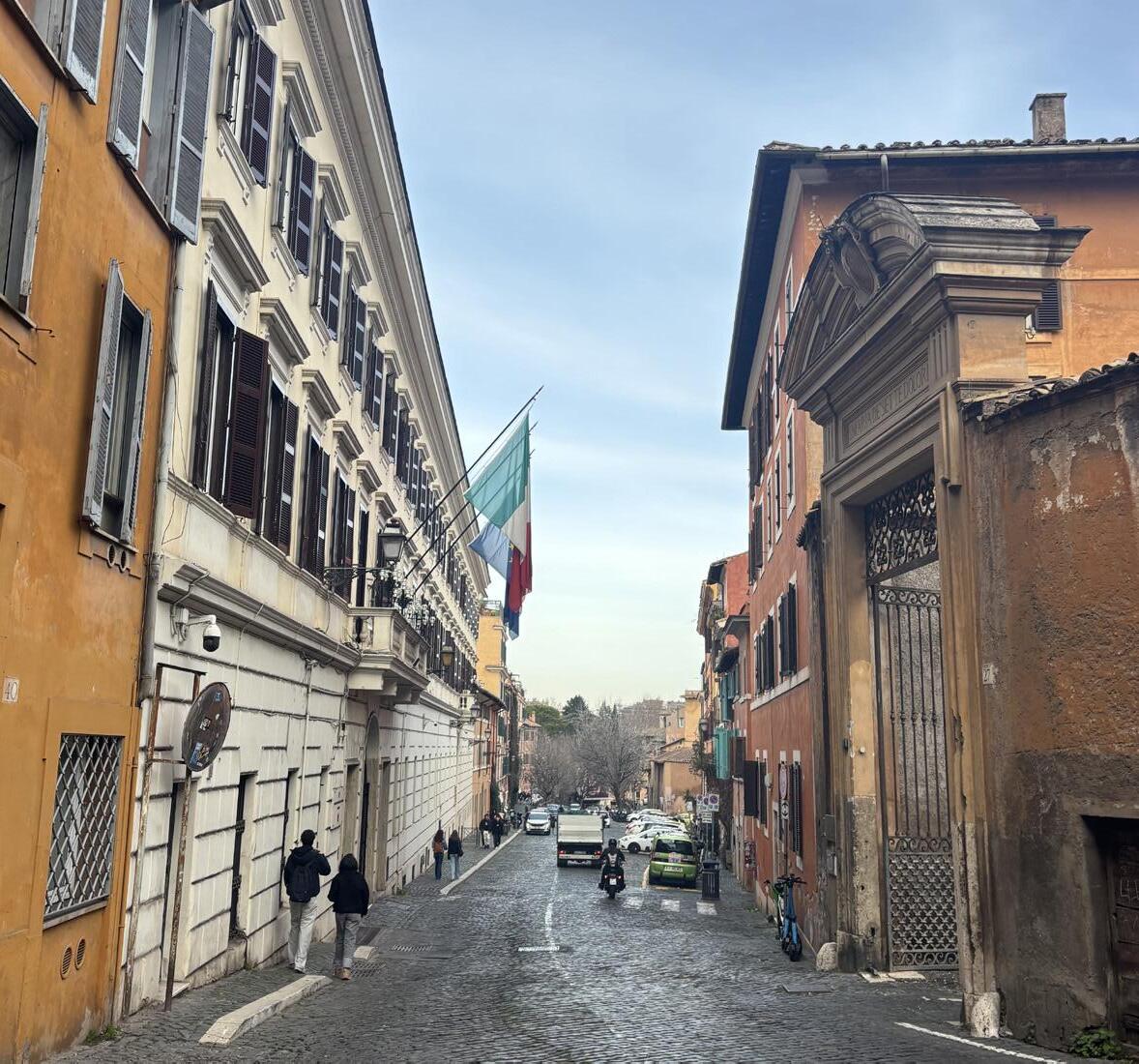
The place itself makes the role even harder. As a temporary local, you don’t stay in tourist districts; you live in neighborhoods shaped by long-time residents, where assimilation feels both necessary and impossible. In Trastevere, where I now live, Americans aren’t expected, making my presence feel intrusive, like I’m living in a space not meant for me.
In grocery stores, I wander aimlessly, too embarrassed to pull out my translation app and scan labels. I toss random items into my cart, hoping it’s yogurt and not porridge. I walk past cafes and delis, too afraid to go inside because I don’t know how to order, and go hungry instead. I can’t even walk more than
a mile in my new hometown without pulling out my Google Maps.
And when I walk down the street, I’m met with shameless stares, as if my American-ness is visible from a mile away, infesting their streets. No matter what I wear, somehow the true locals always seem to catch it. No trench coat can conceal my blonde hair, an unmistakable signal that I am a “foreigner.”
In the role of the temporary local, you can’t fully embrace your own comforts and traditions, yet you also feel incapable of fully immersing yourself in theirs. It’s an impossible in-between — one that leaves you never completely at home. Just temporary.
But, nonetheless, I’m still trying to figure out how to exist in this space.
For now, that looks like slowly learning the language and trying to apply it, even if only for a sentence or two, and building the confidence to walk into a local pastry shop or deli. But also letting myself speak English without embarrassment in a room full of Italians, and dressing like an Italian without erasing my own individuality.
Navigating this uncertain identity takes balance, patience and a lot of discomfort. I can’t say I’ve figured it out yet, but to the study abroad students who feel like they’ve been dropped into a country that doesn’t quite want them, you aren’t alone. And, who knows? By the end of this experience, I may learn to accept this role. Or maybe I’ll leave with an entirely new identity I’ve made for myself.
Faith Jimenez // Contributed Graphic
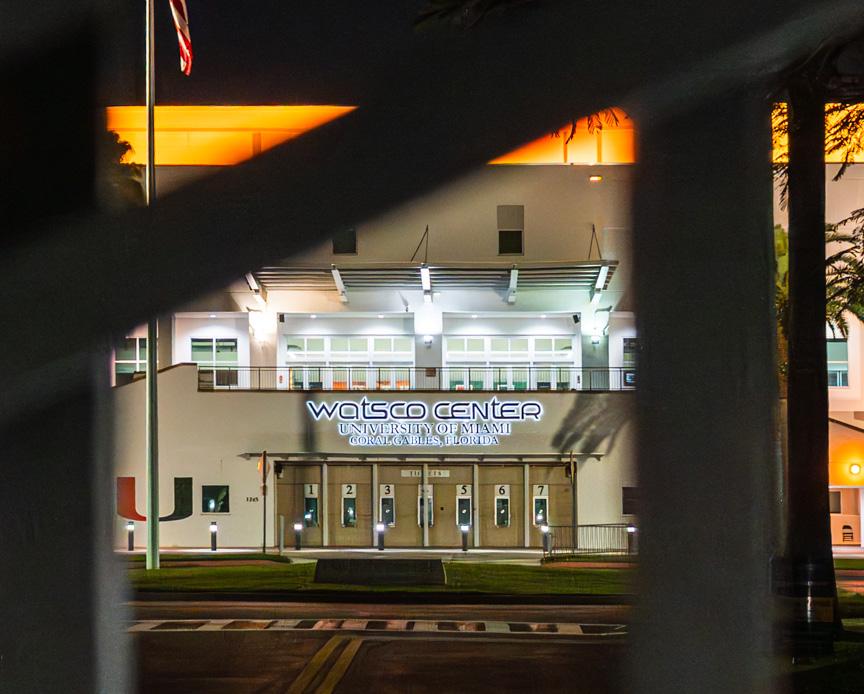
Brian Mulvey // Photo Editor Night falls on the Watsco Center on Feb. 15, 2026.
Madeline Darby // Contributed Photo
UM senior Madeline Darby sits on the terrace of the Giardino degli Aranci on the Aventine Hill with the historic skyline of Rome in the background on Jan. 17, 2026.
Madeline Darby // Contributed Photo
A quaint cobblestone street in Trastevere near The American University of Rome in Rome on Jan. 17, 2026.

By Bri Pearson Co-Arts & Entertainment Editor
Lauren Barnwell throws 110% into everything she does. She pours herself fully into each project she takes on — from her coursework, her content and, of course, the celebration of turning 21.
While many soon-to-be 21-year-olds might celebrate with a night out or a brunch in South Beach, Barnwell took a different approach.What began as simple 21st birthday content for TikTok became an entire film production.
Now, Barnwell’s birthday is turning into a short film called “Turning 21” that premieres this March.
Barnwell, a junior at the University of Miami, spent last December assembling a production crew, writing a 30 - page script and preparing to film a short movie across Miami with her closest friends.
“I just decided to turn my birthday into a movie,” Barnwell said, as if that was the most natural sentence in the world.
Barnwell is a double major in political science and Spanish, double minoring in business law and sports administration. She has an academic load that leaves little room for time to produce a film. But, her real engine is her online presence.

Across TikTok and Instagram, Barnwell has amassed more than 500,000 followers and built a platform rooted in humor, confidence and the kind of “come live life to the fullest with me” energy.
Her content showcasing her party - girl glam, Miami lifestyle and chaotic storytelling has earned her a loyal following and a steady stream of brand opportunities. So,
when she started receiving alcohol - brand emails that she couldn’t accept until she turned 21, something clicked.
Barnwell has coined her 21st on film a “monumentary,” a hybrid of scripted comedy and real - life chaos. It’s inspired by iconic comedies but has a twist: It’s told through the lens of a group of college women without relying on the tired tropes that usually follow female - led comedies.
She wants her film to be different from other female-lead comedy films, such as “Girls Trip” and “What Men Want,” that she feels have sexual, written-by-men dialogue.
She watched “The Hangover” and “Project X” six times each, and built a plot for her film that feels both familiar and fresh.
In “Turning 21,” Barnwell plays herself and wants a calm, grown - up weekend for her 21st birthday. Her friends want the opposite.
When they learn their favorite Miami club is closing for renovations, the girls orchestrate a night so wild it derails the original plan of a “chill, mature” weekend, including the luxurious boat day they’re supposed to make the next morning.
“Our chill weekend goes wrong,” Barnwell said as she summed up the film’s premise. “ The only thing left to do is have a crazy f—ing night and pray we make it to this boat.”
The film blends scripted beats with real reactions, fourth - wall breaks and background gags. It’s fast-paced, self-aware and intentionally messy. Exactly the kind of humor that lands especially well with college women who love a little bit of chaos and aren’t afraid to
laugh at the unhinged parts of life.
The movie may be pure chaos, but the premiere is full-blown spectacle. Barnwell teamed up with an influencer and production coordinator to create what she calls her, “A - list event.” Think Hollywood premiere, but pink. Very pink.
There will be a pink carpet, massive branded backdrop and a six - foot cutout of Barnwell in a martini glass. Also frozen - yogurt chocolate martinis from a sponsor.
Photographers, press and 1520 influencers, with a combined following around 100 million, are going to the invite-only premiere. It’s the kind of event that signals Barnwell isn’t just making content, she’s showing her brand to the world.
Barnwell says a UM screening will follow after spring break, giving students a chance to see the film once the premiere buzz settles. After the premiere, the film will officially release on YouTube in the first half of March, giving Barnwell’s followers — and, of course, anyone who has impeccable taste — a chance to watch.
For her longtime followers, Barnwell hopes the film delivers the same feeling her TikToks do: If she can do it, you can do it.
“Seeing you live your life made me start to live mine,” is a comment Barnwell says resonated deeply, and she hopes the movie amplifies that energy ten-fold.
For newcomers, she hopes the film sparks curiosity, not just about “Turning 21,” but about what she might do next.
“This might not be the door,” Barnwell said. “But I hope it’s the door into the right room.”
Barnwell calls the film a birthday gift to herself and something she will hold onto long after the

pink carpet is rolled up and the social media comments start rolling in.
But, she also made it for the people who’ve been watching her grow online, the ones who see pieces of themselves in her chaos, her confidence and her willingness to try something big just because she can. She wants them to laugh, to feel seen and to walk away thinking they could make something bold too.
And if there are critics? Barnwell is not losing sleep over them.
“Don’t tell me, she said. “Lie right to my face and talk about it behind my back.”
Follow @turning21 on Instagram to stay turned and watch the trailer for “Turning 21” on Barnwell’s Youtube channel: @laurenbarnwell.
Heel up for Girl Gains’ charity walk
By Charlotte Schuyler Contributing Writer
Girl Gains and UM’s National Council of Negro Women will lace up — or heel up — for a “Walk a Mile in Her Shoes” on Saturday, March 21 from noon to 1 p.m.
The campus-wide walk taking place from Mahoney-Pearson to the Cox Science Building will support the women of Lotus House Women’s Shelter in Overtown.
Participants can donate professional clothing and everyday shoes to the shelter at the event. The donations help Lotus House, the largest women’s homeless shelter in the country, continue to promote self-sufficiency and empowerment in their residents.
The Miami-based organization also provides housing, resources and support services to women and children experiencing homelessness, making each donated item a tangible extension of the walk itself.
Girl Gains, a student organization that promotes women’s empowerment
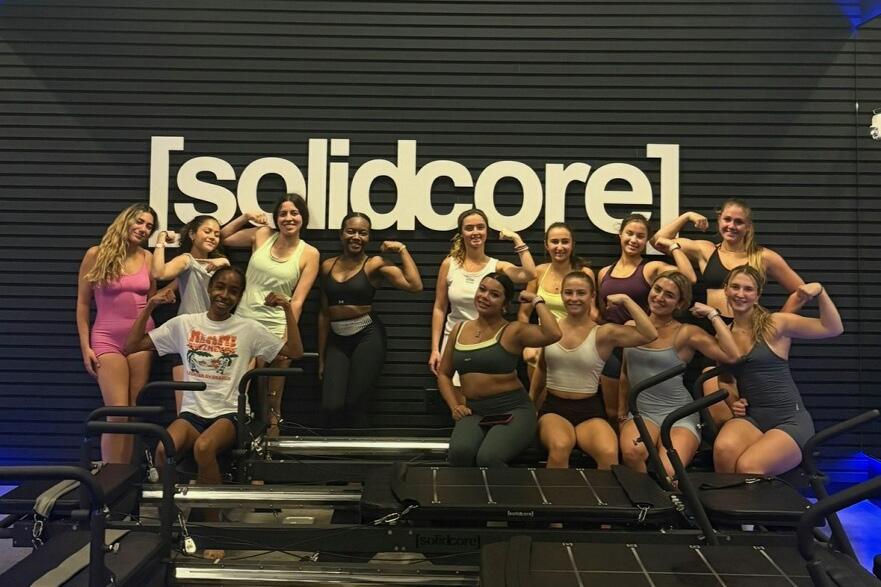
through fitness and community-building events, sees this collaboration as an opportunity to extend its mission beyond the gym.
By partnering with NCNW, the event bridges advocacy, service and student engagement.
“This collaboration lets our members show up, learn, and stand beside
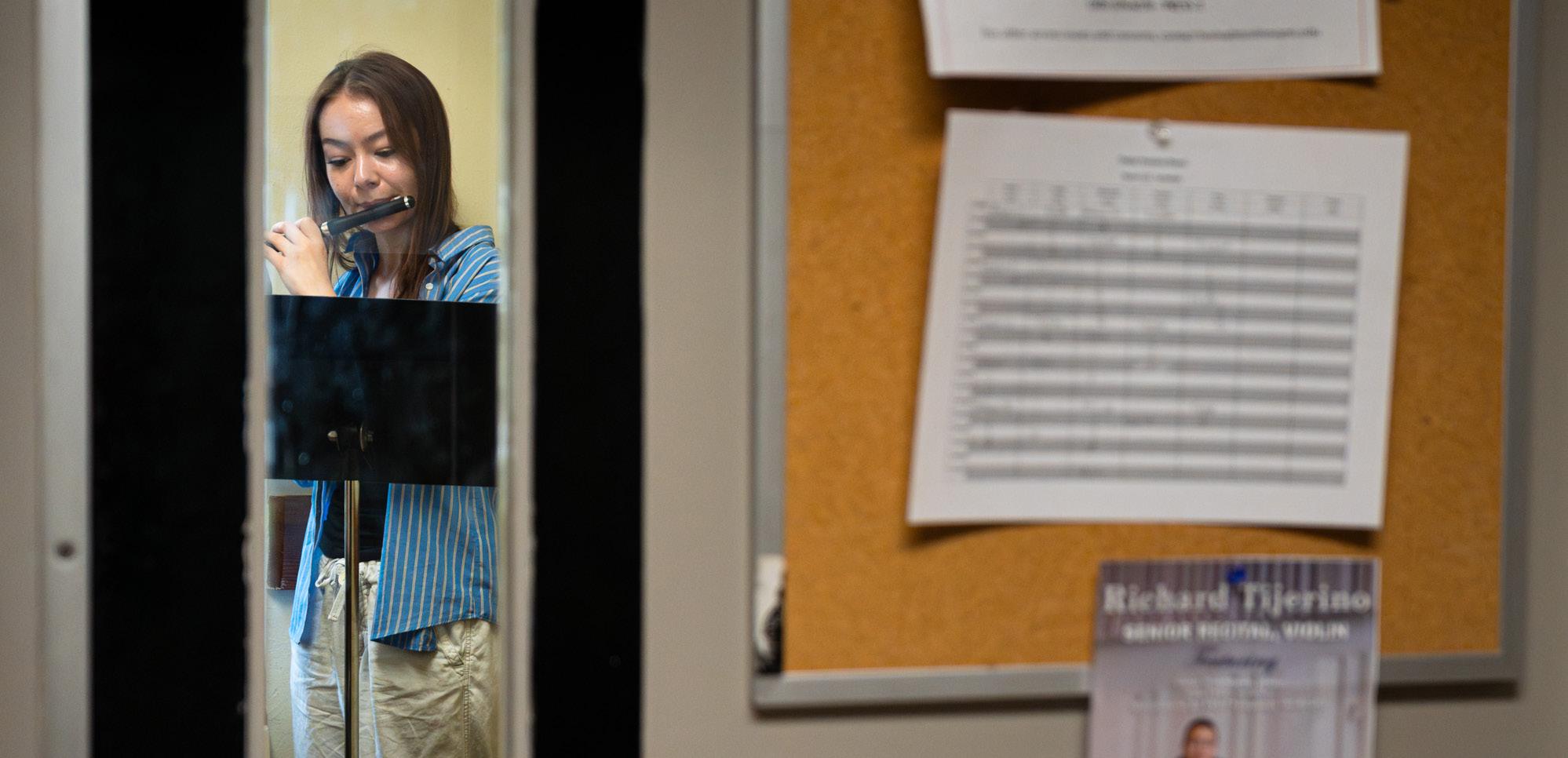
26, 2026.
By Ariana Glaser Staff Writer
stunned by the sheer size of Gusman Hall. From the moment he arrived on campus, he knew Frost was the place for him. Now, as President of the Frost Ambassadors program, Littlejohn strives to make prospective stu -
Foster
dents feel welcome.
“I give back by making the audition process light-hearted and fun for the auditionees,” said Littlejohn. “The audition process can be overwhelming, and I do everything in my power to make it a wonderful experience for Frost’s prospective students.”
Annual undergraduate auditions take place in December and February. Roughly equal numbers of prospective students audition in the fall and spring. Frost is the one and only UM
an organization actively fighting for safety, dignity, and opportunity for women,” Amanda Drobes, the president of Girl Gains, said. The walk is designed to be a public demonstration of solidarity with all participants encouraged to wear purple and, for those willing, to do the walk in heels.
school that does not allow students to apply under early decision. Prospective students can only apply under early action or by the regular deadline to Frost due to the time-consuming audition process.
All students — except those applying to the bachelor of arts in music industry — are required to submit a prescreen video in accordance with Frost’s requirements.
Prospective contemporary songwriters, must submit video recordings of three original songs, while jazz pianists must submit video recordings of four standards. Certain specialized programs — such as composition or music engineering — require portfolios.
After submitting their prescreens, select students are invited to an in-person audition.
What sets Frost apart from other music schools is that an audition day at UM is more than a quick inand-out performance. Applicants and their families are welcomed to campus with live performances, Q&A sessions and campus tours.
“Welcoming the applicants and their families to campus to show them what makes Frost so special has such an impact on applicants envisioning what their four-year college experience could look like at [UM],” Frost Director of Admissions Dominic Castillejo said. For the Frost Admissions team,
The dress code carries a serious message: walking in someone else’s shoes, even symbolically, can make participants and passerbyers think about barriers many women face every day.
“[Wearing heels can] create a small sense of imbalance and awareness, and even a short walk becomes noticeably harder,” Drobes said. “That physical experience helps people better understand how many women move through public spaces with extra caution every day.”
“Walk a Mile in Her Shoes” blends awareness with action. It invites students to step outside their routines, connect with other campus organizations and contribute to a local cause in a tangible way.
Whether you donate a pair of flats or show up in purple, the message is simple: walk with purpose.
“From a Girl Gains perspective, empowerment isn’t only about confidence in fitness,” Drobes said. “It’s about creating an environment where women feel comfortable, respected and able to exist without fear.”
audition season marks the culmination of a six-month-long recruitment tour across the United States. Decked out in Frost green while carrying bags filled with promotional pamphlets, Frost recruiters visit college fairs, high schools and summer music camps in an effort to introduce potential students to UM.
“It is so exciting to see that applicant we met at a college fair in Texas or at a high school visit in California step foot on our campus and see the magic that the University of Miami and the Frost School of Music offer that can’t be found anywhere else,” Castillejo said.
College auditions are often one of the most trying experiences in a young musician’s life, but current Frost students, faculty and staff strive to make the process as seamless as possible.
Ask anyone who’s gone through the process, and their advice is simple: come prepared and prove your passion and you’ll end up where you’re meant to be.
“You are here for a reason: someone at the school believes in you and thinks you would be a good fit at [Frost],” Frost Ambassadors Vice President Zoë Latanision said. “You have done all the work to get where you are today. Take a deep breath before you go in, and be yourself. They want to see you and who you are. You got this.”
Courtesy of Lauren Barnwell
Barnwell
Brian Mulvey // Photo Editor Frost School of Music junior Tessa Goddu works on her repertoire at the Bertha
Memorial Music Building on Feb.
Courtesy of Amanda Drobes
Girl Gains hold a meeting at [solidcore] gym in Coral Gables on Nov. 5, 2025.
ARTS & ENTERTAINMENT
UM student builds nutrition brand centered on raw honey
By Nicolette DiMare Staff Writer
For many college students, drinking large amounts of caffeine has become routine. Late nights bleed into early mornings, caffeine replaces sleep and energy drinks sit on every library desk.
Alex Jimenez noticed this pattern — and found it concerning.
Jimenez, a UM senior majoring in economics and entrepreneurship, said watching his classmates struggle with focus and rest made him question why they were relying on harsh chemicals to manage everyday problems.
“That didn’t sit right with me,” Jimenez said.
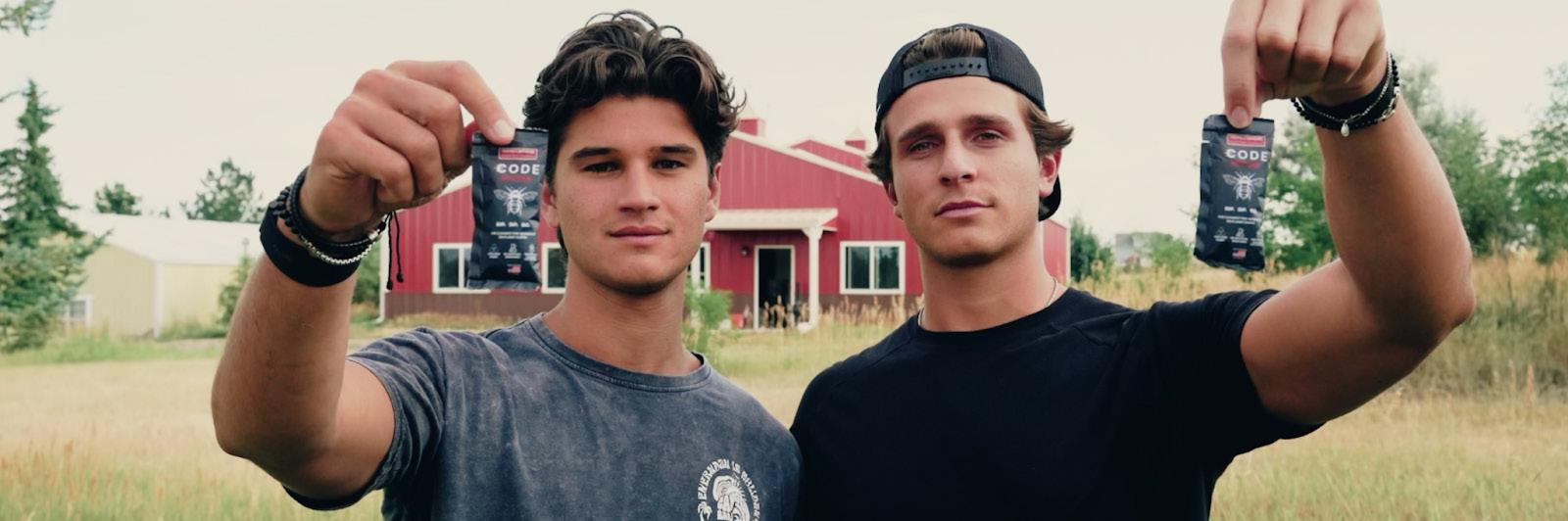
That concern led Jimenez to launch CODE Nutra, his nutrition brand, and one of its first products, CODE Nectar, a raw-honey based performance product that brings the energy boost without artificial ingredients.
Rather than selling traditional powdered supplements, CODE packages its formulas in single-serve honey sachets meant to be consumed directly — a format that reflects Jimenez’s broader belief that perfor-
mance nutrition should begin with simple, whole ingredients.
CODE centers around simple, recognizable ingredients including raw honey, green tea extract and guarana for caffeine, L-theanine to smooth out stimulation, beetroot for circulation, and Redmond sea salt for hydration.
“Most people don’t think of honey as performance nutrition. I didn’t either at first,” Jimenez said. “But the more I looked into it, the more I realized it’s real fuel.”
The natural sugars in raw honey provide quick and steady energy, making it a logical base for the product.
“It’s meant to feel like a safe place in an industry that often isn’t,” Jimenez said. “When you buy from CODE, you know exactly what you’re getting. No hidden ingredients. No fine print.”
Jimenez saw an even greater need for CODE when he tore his ACL twice. While recovering, he searched for faster ways to get back to normal.
“Doctors told me 10 months minimum before I’d be back. I told myself I’d do it in six,” Jimenez said.
He started experimenting with different recovery strategies. What
worked for him wasn’t a new piece of equipment or different therapy methods, but changing his diet.
“I cut out processed foods and focused on whole foods,” Jimenez said. “My recovery accelerated. But more than that, my energy changed. My clarity changed.”
The experience reshaped how he viewed health and performance. He began to see what he describes as a disconnect between how people want to feel and what they actually put into their bodies.
Watching classmates struggle with burnout, focus and fatigue only reinforced that belief.
“Most people aren’t unhealthy because they want to be,” Jimenez said. “They just don’t know better.”
Turning that idea into a tangible product meant learning the business from the ground up.
Jimenez initially launched CODE using pre-made supplement formulas sourced from a manufacturer — a common industry practice known as white labeling — to better understand how the supplement market and e-commerce operated.
“There were moments when my bank account was basically empty
SPORTS
and all my money was sitting in inventory,” Jimenez said. “That’s scary. But that’s also how you learn. You either figure it out or you stop.”
As revenue grew, he reinvested in the brand and shifted away from premade blends, seeking greater control over ingredients and sourcing.
One of the biggest turning points came when he partnered directly with a honey farm and manufacturer in Colorado, allowing him to source raw honey at the foundation of his products and develop his own formulations from scratch.
From there, CODE evolved into a fully custom brand, with Jimenez overseeing everything from sourcing raw materials to designing packaging and coordinating production across different states.
Being a student founder meant there was no clear separation between school life and business life. CODE followed him everywhere — between classes, to the gym and back home late at night.
“You are the company,” Jimenez said. “There’s no clocking out. If you slow down, it slows down.”
He credits the University of Miami environment with helping shape
the brand’s direction. Surrounded by athletes, fitness culture and a campus that emphasizes performance and ambition, he found himself constantly inspired by the people around him.
“Being in Miami, surrounded by high performers, reinforces what CODE stands for,” Jimenez said. Jimenez began sharing products with fellow ’Canes and athletes, collecting feedback and watching how they integrated CODE into their routines. The response, he said, has been both validating and motivating.
“Seeing people actually feel better using something I created — that’s the real win,” Jimenez said. Looking ahead, he envisions CODE growing beyond performance nutrition into a broader lifestyle brand that includes skincare and recovery products. The long-term goal, he said, is to build something that lasts — something rooted in transparency and simple ingredients rather than passing trends.
“The name ‘CODE’ comes from the idea that we are both the program and the programmer,” Jimenez said. “You can shape your life. What you put into your body matters.”
Florida-born Olympic skier Nick Page reflects on seventh-place finish
By Bella Armstrong Senior Staff Writer
Nick Page sat on the edge of his bed in the Olympic Village for an hour without moving.
Moments earlier, the American freestyle skier had finished seventh in the Olympic moguls final — close enough to feel the pressure of the podium, but far enough to replay every turn and every bend. It’s a result that, at this level, exists in the thin space between achievement and frustration.
A couple days later, on the final Friday of the 2026 Winter Olympic Games in Milan-Cortina, Nick Page video calls from a quiet corner of the Olympic Village. A large photograph of a skier decorates the wall behind him.
“I left some things on the table,” Page said, glancing down. “The things that still jump through my mind are the things that slipped through the cracks.”
Moguls is a freestyle skiing event where athletes race down a steep course covered in closely spaced bumps and perform two aerial tricks. Runs are scored based on speed, technique through the bumps and the difficulty and execution of the jumps.
When he spoke about making the final eight, Page sounded proud. He smiled as he talked about becoming one with his skis and mastering a mountain. But, he also sounded like an athlete mercilessly replaying the run.
“I turned too early,” he said. “I was devastated [because] I was in a great position, and I let it slip.”
After staring at a wall that wasn’t his own, in a room caged by deafening silence, Page began processing his disappointment post-event. He mentally rewinded his runs, identifying what he did well and the adjustments he’d have to make going forward. The hurt doesn’t dissipate in a single night — it follows. And then it becomes a pivot-point.
“Emotions come first, [but] I always try to flip the switch and think logically,” Page said.
In moguls, emotional control

is just another calibration. This wasn’t failure — this was a new jumping off point.
The average Olympic moguls run lasts less than 30 seconds. In that time, the smallest adjustments and tiniest variables can have the biggest impact on a run — and the skier’s chance at the podium.
For Page, those margins didn’t start on a course or a pine-covered mountain.
He was born in Hollywood, Fla., a place far removed from moguls courses and winter training centers. Page’s love for skiing came from his parents,high school sweethearts who were from Utah and loved to ski.
As a young child, Page and his family moved from the Sunshine State and back west to Utah. Soon, Page was mastering the bunny slopes of Deer Valley.
At age seven, he grew restless for advancement and asked for more. His mother enrolled him in the Wasatch Freestyle program, which focused on moguls.
“I happened into moguls a bit by chance,” Page explained. “I wanted more, and [the program] taught moguls.”
in Milan
2022, he holds the all-time record for the highest degree of difficulty ever completed in a moguls run.
“I feel like I’m still chasing the top of the podium,” Page said when asked about what’s next. “There’s still a lot ahead of me.”
For a moguls skier, results are only part of the story. What begins as curiosity — the thrill of movement, the satisfaction of accomplishment, the hunger to improve — eventually becomes something bigger.
“Put all the results and medals aside, and I’ve always been really proud,” Page said. “Even in the face of defeat.”
He’s an Olympian, a decorated World Cup skier, and in 2022 became the first American man to win a moguls World Cup since 2016, ending a six-year drought for the United

Courtesy of Chris Randour Team USA freestyle skier Nick Page crosses the finish line at the Winter Olympic Games on Feb. 12, 2026
Courtesy of Chris Randour, US Ski and Snowboard
Team USA freestyle skier Nick Page looks back up at the course at the
Courtesy of Andrew Leisengang
Andrew Leisengang (left) and Alex Jimenez (right) hold their product CODE Nectar at Denver, Colorado on Aug. 24, 2025. OR Andrew Leisengang and Alex Jimenez created CODE Nectar as a healthier substitue for preworkout powders.
‘We:’
How the loss of a teammate became a rallying cry
By Sebastian Font & Jayden Gonzalez Co-Sports Editors
Bryan Pata bought a beige suit months before he was projected to enter the NFL Draft.
An expected mid-round pick who was named to the Ted Hendricks Award Watchlist, an award given to the nation’s top defensive end, Pata was the Miami Hurricanes starting edge rusher during the 2006 season.
Despite all his draft promise, he never had the opportunity to wear that suit to Radio City Music Hall for the NFL Draft.
Instead, Pata was buried in that suit at a cemetery in Kendall after being murdered on Nov. 6, 2006.
Pata was shot outside his off-campus Kendall apartment following a football practice, but with no camera surveillance footage, investigators were forced to rely on eyewitness accounts.
The murder case remained unsolved for 15 years, with multiple leads went cold.
That was until 2021, when Miami-Dade police arrested Rashaun Jones, Pata’s former UM teammate, on a second-degree murder charge. After a week-long trial, the jury was unable to reach a decision and the judge declared a mistrial on March 2.
Pata’s story serves as a reminder on how the community can rally together behind the loss of a promising athlete.
While most collegiate athletes have the internal belief they will “make it to the league,” only 1.6% of NCAA football student-athletes ever make it to the professional level.
These statistics make the loss of young men like Pata even more saddening — one of the few with a true expectation of taking that next step in his career.
Family members and teammates were left wondering “what could’ve been” for Pata, who was taken away just before the final step of achieving his dreams.
A step that could have changed the lives of his family for generations.
Amid the heartache and frustra-
tion of losing a loved one, something beautiful arises — a motivation that rallies both a fanbase and young group of student-athletes.
In the immediate aftermath of Pata’s death, the entire UM community came together to honor him, inspired by his name.
“I’m going to play the beautiful game of football for myself and for Bryan,” teammate Dave Howell said at a memorial for Pata in 2006.
Pata should have been with them, alongside them in his final collegiate season, but that opportunity was taken from him — something his teammates recognized and took to heart.
And it wasn’t a fleeting moment of unity either. Teammates still carried his legacy every step they took in their professional careers.
“What’s up my boy almost there man, we did it … almost there; this is tough without you man but this weekend (NFL Draft) is what we wanted all our lives,” former teammate Tavares Gooden posted to Pata’s social media
Financial reports put a spotlight on spiraling cost of college athletics
By Lazaro J. Chavez Jr. Staff Writer
The current financial state of collegiate sports is being paid with a credit card that has reached its limit.
Recent financial reports from Florida State University peeled back the ugly truth on a sobering reality of college athletics with the school recording nearly half a billion dollars worth of athletics-related debt, according to Athletic Business. These numbers should have fans across the nation concerned.
FSU’s athletic department reported that it is projected to have a $437 million deficit for the 2025 fiscal year. While this does include the cost of a renovated football stadium and athletic facilities, this deficit stems from its off field gambles.
FSU is considered a powerhouse program that has gone through litigation with the ACC to try and leave the conference, the very same conference the Canes play in, betting its future on a potentially larger media rights deal in the Big Ten or SEC. FSU likely hoped that those other conferences could allow them to operate a more efficient cost than their current nine-figure deficit.
As part of FSU’s settlement with the ACC in 2025, the conference made key concessions for the Seminoles — a viewership based revenue sharing model and for playoff earnings to solely go to the team which qualified.
At the time litigation began in December of 2023, this seemed like a smart avenue for FSU, with a football team that just went 13-0 and missed

out on a CFP berth. However, in the years to follow the Seminoles have gone 2-10 and 5-7, unable to receive the benefits of their legal efforts. If FSU can’t balance its books in the same conference as Miami, what are the chances for Miami to survive in this environment?
While UM is a private institution and not required to disclose its full ledger, the Hurricanes operate in the same volatile ecosystem and the impact of this national “debt race” could hit home in some unexpected ways.
Last June, the House v. NCAA settlement gave Division I schools the power to give shares of the team revenue to their rosters. This has helped the Canes by being able to pay for immense talent like Cam Ward and Carson Beck out of the transfer portal and lucrative NIL deals while turning players into stars. But, not all that glitters glows.
The school cannot rely on taxpayer subsidies or public student fees like state schools do in order to pay these athletes
without losing sight of its academic mission. This money must come from somewhere — likely through increased ticket prices, donor fatigue or deeper corporate partnerships.
The reports out of Tallahassee suggest that the first casualties of the deficit spending will be the sports that don’t take the coveted Saturday night slots.
In this scenario, departments like FSU could likely cut olympic sports such as track and field and rowing. Miami on the other hand, has a proud tradition of producing Olympians, but with the cost of football and basketball skyrocketing, perhaps the school could be forced to change the priorities of the athletic department to feed their biggest moneymakers.
The Hurricanes have always prided themselves on being “The U” against the world. But in the new landscape of collegiate athletics, the toughest opponent isn’t across the line of scrimmage — it’s on the balance sheet.
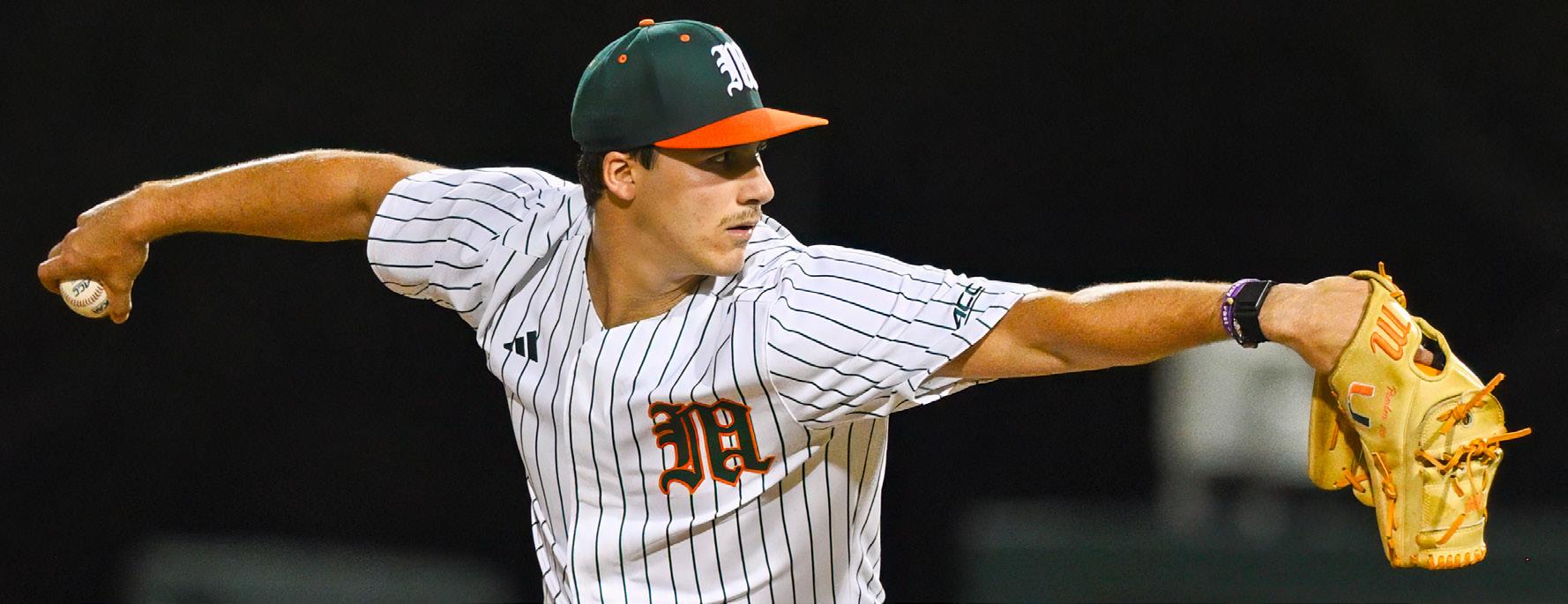
profile in 2008. “I know you are still with me every time I take the field.”
Pata’s story isn’t a tragedy limited to UM, but one that continually gets repeated across the country — draftable talent being taken before they can change the lives of their families forever.
The late Kyren Lacy, an LSU receiver who tallied 866 yards and nine touchdowns during his final season for the Tigers, tragically took his own life in 2025 while set to face a grand jury for negligent homicide. Like Pata, Lacy was projected to be a mid-round pick.
Even though both deaths took place nearly two decades apart, the support behind each was the same in their respective communities.
One of the main voices supporting Lacy was Miami Hurricanes receiver CJ Daniels, Lacy’s teammate at LSU in 2024. Daniels carried his legacy each game with his “LLK2” eye black he wore across the season, standing for “Long live K2.” Lacy’s collegiate number was two.
“All you wanted to do was get to the
league to take care of the [family], and you were so close,” Daniels wrote in an instagram post honoring Lacy ahead of the 2025 season. “I will carry your legacy 2, and finish what we started.”
Daniels himself is preparing for that next step, invited to the NFL combine with the opportunity to be drafted come this April.
And when one looks at these tragic losses, the word “we” rings loudly from the communities they were a part of. Their loss devastated their community, but also sparked a rally behind their name.
Their stories extend beyond the game, humanity is at the core of sport.
It’s not the actions on the field that captivate billions across the world, it’s the emotional aspect players have in doing so — the raw feelings sport brings out both on the field and off it.
Pata won’t be forgotten, not because of the case itself, but because his legacy was carried by his teammates and the community he took the field for every week.
Miami delivers 76-54 drubbing of Boston College
By Liam Hickey Staff Writer
Just 21 days ago, Miami was tied with Boston College with 3:50 left in the second half, fighting for their lives to escape with a narrow win on the road.
Now, just three weeks later, only two Canes starters remained on the floor as UM cruised to a 22-point rout over the Eagles, their largest margin of victory in an ACC contest since 2023.
The Hurricanes (23-6, 12-4 ACC) showed no mercy to BC (10-19, 3-13 ACC), whose blistering defensive display held the Eagles to only 54 points — the fewest allowed to any conference opponent in over two years.
Miami’s end-to-end dominance was reflected in the box score, stuffing the stat sheet in virtually every key offensive and defensive category.
The Canes destroyed Boston College on the glass and in the turnover margin, dictating play in both rebounding and points in the paint.
Most notably, they forced a season-high 18 turnovers and 14 steals, capitalizing with 22 points scored off of BC’s numerous miscues.
Miami used a strong first-half to bury Boston College away before the second half even began.
After giving up an early 13-6 lead to the visitors, Miami responded by going on a 30-6 run to close out the first frame, allowing just one basket in the last eight minutes to take a 3619 advantage at the break. The Eagles missed 12-of-13 shots in one stretch.
The Hurricanes kept the momentum rolling over the final 20 minutes, leaning on standout performances off the bench from Tru Washington and Noam Dovrat to secure the season sweep over BC for the first time since the 2021-22 season.
Washington posted 14 points in his newfound role as Miami’s sixth man, nabbing a career-high six steals along with a team-best plus-30 rating.
Dovrat dazzled in the reserve unit, setting a season-high 12 points while going 4-for-5 from three-point range in his limited action.

The Florida Gators have dominated the Miami Hurricanes in baseball over the past two decades, winning 16 of the last 20 series.
Hurricane fans often looked towards this annual series with utter disdain, but this year had a bit of hope as the Canes came into the series undefeated at 10-0.
That hope was short-lived as the No. 10 Gators stamped their authority over Miami for the fifth-straight year, securing the series win by taking the opening two games of the series before Sunday’s game was canceled due to rain.
Here’s what we learned about Mi-
ami this weekend as Florida took control of the all-time series 138-136-1:
Same old story Miami came into this matchup as the 17th-ranked team in the country with some of the hottest bats in the nation, racking up an average north of 15 runs per game.
The bats were hot, the vibes were high and it felt like it was finally Miami’s time to get over its gator-sized hump.
Yet, once UF shortstop Brendan Lawson launched an opposite-field homer in the top of the first inning on Friday, it seemed like the series was already over.
UM players looked defeated, played tight and felt overmatched both nights. On multiple occasions, Miami would get runners on, but could never come through to swing the momentum towards the orange and green. On the other hand, UF was calm
and collected — as if this wasn’t a series it hoped to win, but one it expected to win.
The Canes are historically a “blueblood” program with four national titles and their names all over the NCAA record books. But most college-aged fans and recruits have only seen Miami defeat UF a handful of times in their entire life.
That’s not just a tough stretch, that’s an identity — one that directly impacts recruiting and the overall brand of the program.
Bullpens made the difference
For all the negativity surrounding the series as a whole, both games were relatively close.
On Friday night, the game was tied 2-2 heading into the eighth andon Saturday, the game was tied 4-4 heading into the seventh.
Dovrat spoke to the media postgame about his record outing.
“I know my role on the team is to shoot the ball, especially outside the three-point line,” Dorvat said. “So I just came in and shot it. I have the confidence from the coach, from my team-
But Florida was able to deal damage against Miami relievers as they launched game-icing home runs on both nights.
The Hurricanes, on the other hand, simply had no answers for Florida’s relievers, who would come in and shut the door. Florida brought in flamethrowers in the form of Jackson Barberi and Joshua Whritenour, who overpowered UM with their fastballs that consistently reached 100 mph.
While such talent would’ve been revered on the Miami side, the Canes would’ve also appreciated their consistency. In five innings of work, Miami’s relievers allowed eight runs and seven walks. The backend of this Hurricane bullpen must improve heading into ACC play next weekend against Boston College.
Starters shine Arguably the only positives from this weekend were Miami’s starting pitchers AJ Ciscar and Rob Evans.
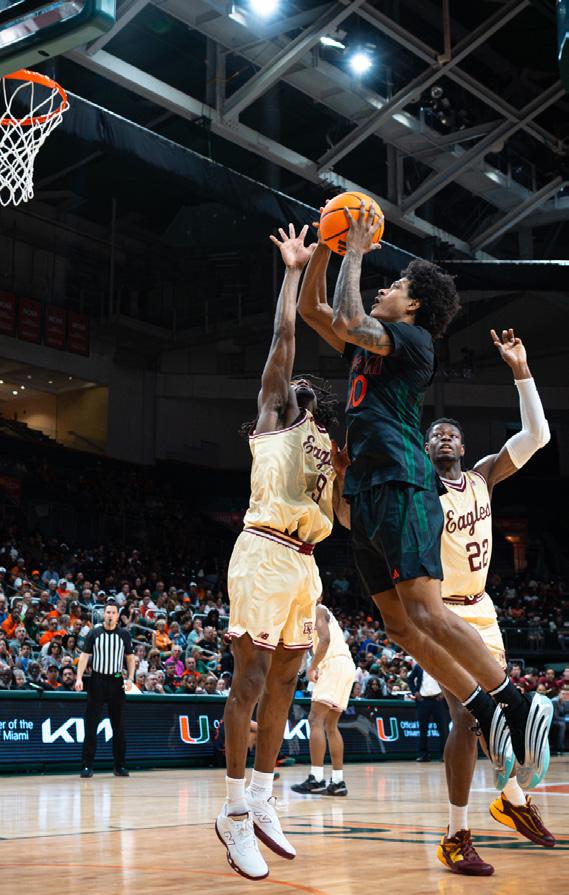
mates. Whenever I’m open, I just shoot it. Shots just fell in today.”
With its 23rd victory on the year, UM’s 2025-26 campaign under firstyear head coach Jai Lucas has now officially been cemented as the fourth-best regular season in program history.
The 16-win improvement from the Canes’ 7-24 record in 2024-25 also meant that Lucas has now executed the greatest single-season turnaround of any Division I school this year.
Despite the unprecedented success, Lucas continues to demand more from his team heading into March. His insatiable hunger for excellence came across in his messages to the media after the game.
“One thing I was telling the guys after the game is going into March, you have to continue to develop a killer instinct where you get these leads and these moments where you can go from 10 to 15, or 15 to 20,” Lucas said. “You have to be able to sustain the lead. You can’t just give and take. So we’ve got to do a better job of closing down the stretch.”
At 23-6 with two regular-season games remaining, Miami is essentially guaranteed an NCAA Tournament berth, currently projected as a No. 8 seed.
The Canes will look to clinch a double-bye in the upcoming ACC tournament with a win at SMU (19-10, 8-8 ACC) on Wednesday or on Senior Night on Saturday against Louisville (20-9, 9-7 ACC).
The Hurricane starters took care of business in their appearances over the last few weeks, but that was against subpar competition in Lehigh and Lafayette.
A key focus heading into this weekend was whether or not they could raise their game to match Florida’s offense.
They did just that.
Ciscar surgically worked his way through UF’s lineup on Friday, generating plenty of weak contact while not allowing a single walk through seven innings of work.
Evans answered the call as well on Saturday. Putting aside his adventurous second inning where he gave up four runs on five hits, the New York native carved up Florida hitters at will, tallying up 12 strikeouts — the most from a Hurricane starter since Gage Ziehl struck out 15 in 2024.
If Miami’s starters can continue to give their offense a chance, the bats will come around and make this Hurricane team a real force in the ACC.
// Contributed Graphic
Miami’s rain-shortened reality check against No.10 Florida
By Sebastian Font Co-Sports Editor
David Lebowitz // Photo Editor
Sophomore pitcher AJ Ciscar winds up to pitch on Feb. 27, 2026.
Brian Mulvey // Photo Editor Junior guard Tru Washington shoots the ball against Boston College on Feb. 28, 2026 at the Watsco Center.
V
V’s Take is The Miami Hurricane’s most controversial and longest running column.
V’s Take is a satirical work published biweekly by students and for students using our generation’s “colorful” language. V addresses all things love, sex and gossip on campus. V is not for the politically correct or easily offended.
How do you spice up a relationship?
After nearly two years of being with the love of my life, consisting of one year in person and almost a whole school year long distance, I have not once lost the spark.
I’ve quickly learned that love doesn’t stay on autopilot. It takes consistency and effort.
Whether it’s everyday conversations or time in the bedroom (or the countertop, or the car, or the shower), making a few small changes can make the relationship feel new again.
First, do something physical together. Nothing says take me home and take my clothes off like a sweaty hot yoga session.
Minimal clothing and drenched in sweat, yes please. There’s something about breathing and moving in sync that feels so intimate. We might even leave yoga early.
Something longer than hot yoga might do the trick too. Plan a three mile hike or walk so that you have to work for it before you get to the light at the end of the tunnel. And you can even get closer emotionally by talking and leaving your phones at home.
Even with long distance, you can do a quick workout on FaceTime together, or talk on the phone on the treadmill. It turns an ordinary routine into something shared and bonded, sexual or not.
The next and most important tip: Anticipation is key. Foreplay should not start the second you lay down for bed or after a long day.
Start the morning with a playful text or compliment. Or even better, tell them what you did together in your dream the night before.
Love, V
A good relationship should be stable but not predictable. Predictability is boring.
Also, communication is key. It sounds basic to tell you to “have deeper, more interesting conversations,” but it’s true. Emotional intimacy strengthens physical connection.
We like to talk about what’s stressing us out, the goals we are working towards, the latest gossip with our friends and what we may need from one another.
This goes for sex too. If there’s something new you want to try, tell your partner. If you want something done differently, tell your partner. One moment of embarrassment could completely change your sex life. Plus, no one is a mind reader.
Another thing that’s really stood out to me in my relationship, as a very independent person, is to maintain freedom in the relationship. Having different goals, hobbies and friendships helps you grow individually and bring new energy into the relationship. Growth is so hot.
And, it will give you more to talk about at the end of the day when you are each living your own lives.
After two years, I’ve realized that love deepens over time, but the spark remains with effort and intention. When you find the right person, whether they are miles apart or in the same city, staying connected means being deliberate, playful and willing to put in the effort for the person you love.
If you’ve found the right one, it will be worth it.
CALLING ALL... writers. copy editors. podcasters. photographers. videographers. illustrators. layout designers. sales reps. social media experts. all positions paid. scan here to apply: COME