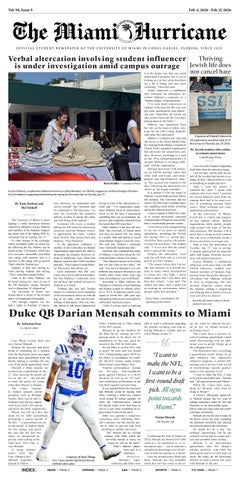
The Miami Hurricane: Feb. 4, 2026

Page 1


Verbal altercation involving student influencer is under investigation amid campus outrage

The University of Miami is investigating a verbal altercation between sophomore influencer Kaylee Mahony and members of the Students Supporting Israel club at the Spring 2026 Involvement Fair on Tuesday, Jan. 27.

In video footage of the exchange, which circulated widely on social media following the fair, Mahony can be heard saying, “Christianity, which says love everyone, meanwhile your Bible says eating with someone who is a non-Jew is like eating with an animal.

That’s what the Talmud says.”

Mahony is then seen turning toward passing students and saying, “That’s what these people follow.”

Later in the video, Mahony can be heard raising her voice at one of the SSI members, saying “Because you’re disgusting. It’s disgusting.”

The University of Miami confirmed that it is aware of the incident and is investigating it thoroughly.

“We strongly support our student’s rights to freedom of expres

sion. However, we understand lines can be crossed,” the University said in a statement to The Hurricane. “As such, the University has proactive policies in place to ensure the safety and well-being of all students.”

Freshman Ella Leon, a student tabling for SSI when the altercation occurred, said that Mahony initially approached the table, walked away briefly, then turned back and shouted, “Free Palestine.”

As the altercation continued, a member of the Committee on Student Organizations approached the table to de-escalate the situation. However, instead of complying, Leon claims that Mahony turned to [the COSO member] and said, “This is typical Jewish behavior. This is how Jews always act.”

Leon explained that SSI welcomes any kind of political dialogue, but that Mahony’s comments were not political and instead focused on Judaism as a whole.

“Nothing that was said, besides maybe two sentences at the beginning of the conversation, had to do with the flag on our table, with anti-Zionism, nothing of that nature. This was, liter

for her to kind of like dehumanize it,” Leon said. “I’ve experienced many, many different forms of antisemitism. Never in my life have I experienced something that was so prolonged, aggressive and completely detached from the reason that [SSI was] there.”

Other students in the area felt similarly. Alta Gniwisch, a Chabad intern who does not attend UM, was sitting at a nearby table and started to record when Mahony began to raise her voice. She said that Mahony’s comments were “outwardly hateful and rude.”

Gniwisch also explained that many of Mahony’s comments about the Talmud and Judaic culture were untrue.

“The Talmud is known to be a book that you can’t take at face value,” she said. “You have to interpret it in a very different way because obviously it was written many many many years ago when circumstances were so different.”

According to Bible Odyssey, the Talmud is a collection of oral teachings and debates created by rabbinic scholars in 70 CE. It addresses nearly every aspect of Jewish life 1,500 years ago, interpreting biblical texts and traditions within their historical context.

it in the proper way then you could understand it properly, but if you’re looking at it at face value then there are a lot of things that may seem confusing,” Gniwisch said.

Ariela Jaimovich, a sophomore who witnessed the altercation, described Mahony’s comments as a “blatant display of antisemitism.”

“I’ve seen Israel controversy on campus in the past, but this case was just pure antisemitism and hatred,” she said. “Hopefully, the school can take action to prevent this from happening again in the future.”

Mahony was terminated from her role as the head of public relations for the UM College Republicans after this altercation.

Mahony’s Linkedin also lists that she serves as the Social Media Chair for Turning Point Miami, a branch of Charlie Kirk’s nonprofit organization that advocates for conservative politics. However, according to a post on Jan. 29 by @StopAntisemites’s X account, Mahony is “no longer affiliated” with the organization. She had more than 125K followers on TikTok, posting videos that often took anti-Israel, anti-immigration and anti-Democrat stances. Her account was banned in the days following the altercation and shows as “no longer available.”

It is unclear if UM was aware of Mahony’s social media presence before this incident. The University did not answer The Hurricane’s multiple inquiries regarding social media screening during the admissions process.

A senior student in Hillel who wishes to remain anonymous expressed confusion that UM had not noticed Mahony’s social media presence sooner.

“It has been really disappointing to see one of my peers so openly antisemitic, including her TikTok bio saying she’s a ‘proud goy,’ which has been used as a derogatory term for non-Jews,” the student said. “I’m not sure how the school hasn’t noticed this sooner.”

Despite the altercation, Leon said she still feels safe as a Jewish person on UM’s campus.

“The reason I chose this University was because, as a Jewish student in times where antisemitism is rising very very high, I never found a place that I felt more safe than this school,” Leon said. The school just does such a great job at creating an environment where people really feel included.”

Kayla Singer contributed to the reporting of this article.

Thriving Jewish life does not cancel hate

I was not at the Students Supporting Israel table when the altercation began. I arrived later, shortly after the details of the incident had started circulating. At first, I did not believe it was as disturbing as people had said. Then I read the article. I watched the video. I spoke with students who were there. I realized my initial disbelief came from assuming there had to be more context, or something missing. There wasn’t. What unfolded was clear, unabashed antisemitism.

At the University of Miami, Jewish life is visible and integrated into campus culture. Student organizations table openly, people walk around with Stars of Davids, chai necklaces, IDF hoodies. UM is proof that a strong Jewish community can exist comfortably inside a diverse university in a major city. That is why the altercation on Tuesday, Jan. 27, was so jarring. A student approached the peaceful table and began shouting accusations and heated questions.

Kaylee Mahony, a sophomore influencer with more than 125,000 TikTok followers, verbally confronted members of Students Supporting Israel during the Spring Involvement Fair. Mahony referred to Jews as disgusting. She also invoked distorted claims about the Talmud, calling it disgusting and alleging that it teaches Jews to view non-Jews as inferior.

Read the full article online at themiamihurricane.com

“Only if you are open to studying

Duke QB Darian Mensah commits to Miami

Cam Ward, Carson Beck and now Darian Mensah.

Despite the pressure and heart break of competing for a national title, the Hurricanes have once again plucked their quarterback from the bunch, hoping to continue the suc cess of the portal quarterback trend.

Mensah, a Duke transfer, an nounced his commitment on Jan. 27, after entering the portal ear lier on Jan. 16 — the last day to enter the portal for teams other than Miami or Indiana.

The Canes original ly looked towards portal prospects such as Brendan Sorsby, Sam Leavitt and Ty Simpson, but the trio signed with Texas Tech, LSU and de clared for the draft, respectively.

Miami was left in a dire situ ation for its 2026 quarterback, prompting a search outside of the box — a quarterback not yet in the portal. It looked bleak for the orange and green, but just like the last two years, an unexpected su perstar came calling at the final hour. This time, it was Mensah.

A rising redshirt junior from San Luis Obispo,Calif., Mensah originally played at Tulane

before transferring to Duke ahead

Mensah lit up the statsheet for the Blue Devils, racking up 3,973 passing yards as he threw for 34 touchdowns on the year, good for second in the FBS for both stats.

He led Duke to its first ACC title in nearly 40 years and was named ACC Championship game MVP for his efforts to accompany his multiple All-ACC honors under former Miami head coach Manny Diaz.

Notable performances include his 361-yard, four-touchdown game against Clemson in a 46-45 shootout, as well as his 327-yard, four-touchdown performance in the Sun Bowl against Arizona State.

It was reported before the Sun Bowl that Mensah would be staying with Duke, finishing a multi-year contract worth around $4 million annually. So when the California-native entered the transfer portal at the final hour on Jan.16, it sent Duke scrambling for legal avenues to prevent the move.

Duke was granted a temporary restraining order following Mensah’s entrance into the transfer portal in order to prevent him from enrolling at another university.

“Mr. Mensah has an existing contract with Duke which the university intends to honor, we expect he will do the same,” Duke’s athletics department said in a statement.

However, Mensah’s representatives and Duke were

able to reach a settlement regarding his transfer, avoiding court and allowing Mensah to commit and enroll at Miami on Jan. 27.

“I want to make the NFL, I want to be a first-round draft pick. All signs point towards Miami.”
Darian Mensah

UM Transfer QB

Combining his stint at Tulane in 2024, Mensah has thrown for 6,696 yards at a 56 touchdown to 12 interception ratio — not to mention a completion percentage over 65 percent in both his seasons as a starter.

Like his predecessors Ward and Beck, Mensah has true draftable talent but still has room to devel -

op. So, when he entered the portal on Jan. 16, Miami became a no-brainer move.

The Canes have a proven record of sending quarterback’s draft stock skyrocketing with an additional year to polish things up at the collegiate level.

The Hurricanes have everything a quarterback could dream of: an elite offensive line, impressive offensive weapons, a sizable NIL package and a proven track record of transforming transfer quarterbacks to the superstar level.

“I want to make the NFL, I want to be a first-round draft pick,” Mensah said. “All signs point towards Miami.” While the ’Canes have everything for Mensah, what does he bring to Miami?

A 6-foot-3, 208-pound signal-caller, Mensah already has two years of college experience under his belt and flourishes in the intermediate game — able to make pre-snap reads and exploit coverages consistently.

Mensah also has the arm to make all the throws across the field, expanding the playbook downfield and utilizing his receivers talent to the full extent.

He might not be a true “dual-threat” quarterback, but he can certainly use his legs to escape pressure and scramble when needed.

Mensah is an uber-talented quarterback who fits Miami’s scheme perfectly with both the quick game and even trick plays at times. Be ready for the Hurricane offense to reach a whole new level with Mensah in

mix.

Contributing Writer
the
bers of Students Supporting Israel during the Spring Involvement Fair on Tuesday, Jan. 27.
Courtesy of Amy Zhang New ’Canes transfer QB Darian Mensah celebrates after a play.
Courtesy of Gianni Echeverria SSI organization memebers table in UC Breezeway on Thursday, Jan. 29, 2026.

Brothel law debunked: the real reason why sororities don’t have houses

Rumors have circulated campus for years about why sororities at the University of Miami do not have houses.

Students frequently assume that the city of Coral Gables allegedly had a law prohibiting six or more women to live in a house together, labeling it a brothel.

“I’ve definitely heard the rumor, and because no one ever really clarifies whether it’s true or not, a lot of people end up believing it,” said Jayden Montes, a member of Alpha Delta Pi. “It just keeps circulating without anyone correcting it, so it feels believable over time.” However, this law does not exist and never has.

The rumor has been passed down among members across several sororities, not just ADPi.

“Even before I rushed I had heard about the brothel rumor. I kind of just accepted it as the truth because everyone seemed to know about it and I had heard about it happening at other campuses too” said freshman Audrey Booher, a member of Delta Delta Delta. Still, it is unclear how this story began or what contributed to so many students believing it.

An article in the Miami New Times stated that residents complained about landlords allowing multiple “rowdy college students” to rent out one home. These complaints led to discussions about limiting the number of residents in

Two

one home in Coral Gables.

These discussions never produced any legal action, but it is possible that they contributed to the hearsay.

According to the City of Coral Gables Ordinance, there are laws that state that family residences must be occupied by one family.

This ordinance does not prohibit people of the same gender or relation to each other from living together, but simply states the homes “are to be occupied by one family plus servants, who are living and cooking as a single household.”

This rumor has spread beyond the University of Miami’s campus as similar stories have become like folklore at universities across the country.

Miami University’s student newspaper in Ohio stated that the “suggestion of the brothel law,” was common knowledge among sorority and fraternity students.

Chapman University’s The Panther also published an article in 2022 that uncovered the truth behind the “brothel myth.” The supposed law was merely a myth dating back to the early 1900s that was debunked by the University’s Hilbert Museum of California Art director.

The question that now stands: if the law is merely college gossip, why don’t sororities have houses on campus?

The University Campus District — a list of provisions for new use and development on UM’s campus — states that if the University’s Master Plan includes sorority or fraternity housing on campus, then it would be much easier to get this approved by

the city of Coral Gables.

However, University of Miami’s Master Plan does not outline any type of housing for Interfraternity Council or National Panhellenic Conference organizations. So, an amendment would need to be made to the master plan, and the housing area would have to follow the qualifications outlined in the University Campus District provisions.

“The Dean of Students Office is always glad to meet with Panhellenic organizations to discuss their needs and ideas for the use of space,” the University of Miami said in a statement to The Hurricane. “There has been no interest to pursue sorority housing present -

historic national runs: How Miami’s Spirit Squads represented the U

Before Miami played Indiana for the national title at Hard Rock Stadium on Jan. 19, the University of Miami Sunsations dance team and UCheer squad were fighting for their own titles at the UDA and Universal Cheer Association National Championships in Orlando from Jan. 16 to 18.

While Hurricanes fans were buying tickets and planning gameday outfits for the College Football Playoff National Championship, the two University of Miami teams were quietly preparing for national stages of their own.

For the Sunsations and UCheer, the journey was months in the making.

In Orlando, the Sunsations dance team made history as they advanced to the D1A Jazz semifinals for the first time and became the first private school to advance that far in the competition.

“Some of us got to campus right after the Cotton Bowl,” said Sunsations dancer Mia Diffley. “Ever since then we’ve been practicing usually from 10 a.m. to 10 p.m. with a break somewhere in the mix.”

Their journey unfolded alongside a historic run by Miami football — one that would culminate in a national championship appearance at Hard Rock Stadium.

Diffley said. “The fact that the Miami community gets to have it at home, it makes it so much more special.”

This national championship marks the first only national title to be played at a teams home stadium. The connection to Miami goes even further than the location, with Indi-

ana’s starting quarterback Fernando Mendoza, being a Miami native and long time fan of the Hurricanes.

That unique connection made this game even more high stakes.

The Sunsations’ preparation extended far beyond rehearsals, according to head coach Jonni Rodgers. “Over the past four months, this

“Having two national competitions in the same weekend makes it just honestly the best weekend of my life.”
Mia Diffley

team has committed to a level of preparation that goes far beyond the floor,” Rodgers said. “We’ve balanced every men’s and women’s basketball game, eight football home games, and three playoff runs all while continuing to train for our own gameday: UDA Nationals.”

For cheer the national cham -

pionship run has been similar.

“We’ve been preparing for the national championship and for our own national championship since we started our playoff run,” said UCheer member Sophia Mazza. “We actually found out that football had made it into the playoffs while we were at practice.”

The Sunsations, determined to perfect their routines and make a historic run, stayed on campus while most students left for winter break.

“While others are still on break, we’re returning to campus two and a half weeks early, choosing to sacrifice time away so we can be fully ready to take the UDA stage,” Rodgers said.

This season, the team once again competed in both jazz and hip hop. This time, though, they had a new creative direction.

Rodgers gave credit to the fresh talent that is behind the choreography, “This year we intentionally stepped outside the box with our choreography and overall approach. “Our jazz routine was choreographed by Marley Blanchard of The Ohio State University, and focuses on storytelling while remaining grounded in true, authentic jazz technique.”

With both styles, the Sunsations hope to bring unique flavor to the competition.

“Our hip hop routine, choreographed by Jawkeen Howard, takes a slightly different approach by bringing things back to the roots,” Rodgers added. “It leans into musicality, groove, and texture.”

Read the full article online at themiamihurricane.com

ed to our office and there is currently no real estate available.”

An article published in 2013 by

The Hurricane stated that while the brothel rumor was false, there was speculation about an agreement among the sororities not to pursue off-campus houses unless all sororities could afford to do so.

The article also stated that, according to the former director of Greek life at the University of Miami, the reason there has been no pursuit to create sorority houses is “because logistically it’s very difficult.”

However, several Panhellenic members still state they want some kind of housing.

“It’s a way to get even closer to our

sisters. Daily dinners in the sorority house would be a great way to bond with everyone,” said Hannah Salles, a freshman student in Pi Beta Phi.

Paulina Vaamonde, a sophomore in ADPi, agreed with this sentiment.

“It would be nice to have a bigger space and be able to stay with other sorority sisters in one big house,” she said.

Sorority members still have the desire for sorority housing, but the steps needed to actually make that happen are rigorous and unclear. However, with the false “brothel law” now debunked, it seems there may be hope for housing in the future.

Despite playoff success, UM football remains without an on-campus stadium

Despite a historic return to national prominence, the Miami Hurricanes football team still plays its home games miles away from campus. Students and fans living in Coral Gables have to travel nearly an hour north to Hard Rock Stadium, the home of the Miami Dolphins.

Before the Canes started playing at Hard Rock, the Miami Hurricanes used the Orange Bowl stadium, located in Little Havana, to play home games between 1937 and 2008. The Orange Bowl college football game was held at the stadium annually until it was replaced by LoanDepot Park, the home of the Miami Marlins.

The absence of an on-campus stadium has been a hot topic at UM since the Orange Bowl was demolished in 2008.

According to the Bleacher Report, an on-campus stadium could increase the number of UM students attending home games. It would bring a sense of excitement to alumni and fans throughout the community.

Miami-based attorney John Ruiz suggested that he would fund a new stadium where Tropical Park currently exists, just three miles west of UM.

“There’s about 270 acres there,” Ruiz told the Miami New Times in an interview.

Large college football stadiums rarely exceed 15 acres, meaning the space at Tropical Park would be more than enough. He even had plans drawn up for the potential stadium.

“The design is over the top, it’s gorgeous, I’ve seen it already a couple of times,” he said.

Another proposal was made by Ruiz in 2021 to build a 50,000 person, 13-acre football stadium next to Coral Gables Senior High. Ruiz said it might be necessary to demolish the school to have the necessary space. While it is unclear whether a vote occurred, Miami-Dade County Public Schools

are “not entertaining any such idea” relating to demolition plans.

“There is a major misconception that the school is going to be demolished to make this happen,” said Diana Diaz, co-chair of the stadium committee, in an interview with CBS 4 News.

The City of Coral Gables was also not supportive of Ruiz’s plan, telling CBS 4 News that the stadium would not be compatible with the surrounding neighborhoods.

Former UM President Donna Shalala agreed with critics of the proposal.

“I think it’s ridiculous,” Shalala told CBS 4 News. “We looked at every plot of land near the University and there was simply no place where you could build a stadium and have the kind of parking you would need.”

Building a new stadium also places significant financial burdens on the University of Miami. When the University of Minnesota built a new stadium in 2009, the university paid for 52% of the construction costs while the state was responsible for the other 48%.

To help fund the project, the University of Minnesota charged the school’s approximately 50,000 students an extra $12.50 per semester.

Since UM has a smaller student population, a similar fee structure would result in higher costs per student. The other portion of the costs for a new UM stadium may fall on the Florida taxpayers, specifically those living in Miami. However, since UM is a private university, they might provide funding for a stadium.

Another concern is the influx of traffic that would come with a new stadium on or near campus. UM is already tightly tucked into Coral Gables, making available land scarce if the University was looking to build new parking lots.

Considering that UM only owns the 239 acres that the Coral Gables campus is composed of, there is very little chance that the University could expand its land for a stadium.

Brian Mulvey // Photo Editor
Sorority recruits and members gather at the Lakeside Patio for Bid Day on Jan. 11, 2026.
Courtesy of Jonni Rodgers
The Sunsations jazz routine performed in Orlando at UDA.
via Miami Football 1976 Media Guide
An aerial photograph of the Miami Orange Bowl, circa 1976.

ADVERTISEMENT UM alum appointed ambassador to Peru

Bernardo “Bernie” Navarro, a graduate from the University of Miami Herbert Business School, was sworn in as U.S. Ambassador to Peru on Jan. 15. Bernando Navarro was confirmed by the Senate with a 53-43 vote on Dec. 18 and credits UM for his opportunities.

“Years ago, they took a chance on me as a young student,” Navarro said in a LinkedIn post. “And that belief helped shape the path I walk today.”

Before joining the Department of State, Navarro’s childhood dream was to attend the University of Miami.

“There was no way that our family could have afforded the U,” Navarro told News@TheU. “And when I talk to my children, one of the things I tell them is that the biggest thing I ever did, that I achieved, was that someway, somehow, I got to go to the University.”

At age 17, Jim Balter, who was the director of purchasing, gave Navarro the opportunity of a lifetime. Balter offered Navarro a job under him so he would be eligible for tuition remission, a discount for UM employees.

The job fit perfectly with Navarro’s interest in entrepreneurship. It was a family tradition. When it came time to choose his degree, Navarro did not hesitate.

He graduated from the University of Miami Business School in 1994 with a BBA in finance and marketing. Later, Navarro earned a Master’s of Liberal

Arts degree in government from Harvard University.

His time at UM left an impact on the rest of his career.

“[The] Honor of a lifetime was being nominated by POTUS to serve as ambassador to Peru,” Navarro said on X on Dec. 31.

Secretary of State Marco Rubio, another UM alumnus, swore him in after meeting almost a decade ago in 2016. Navarro served in the Florida Finance Committee for Rubio’s presidential and senatorial campaigns in 2016.

Other members of the administration who knew Navarro were quick to voice their support.

President Trump nominated Navarro for the position on June 16, 2025. He was one of the first to congratulate the to-be ambassador after the Senate confirmation.

“Bernie’s expertise in Finance, Trade, Education, and U.S.-Peru Relations will help him be a strong advocate for America’s Interests in Peru,” President Trump wrote on Truth Social.

After graduating from Harvard, he worked for two mortgage businesses, including Citi, before creating his own.

In 2001, Navarro started his first lending company, HomeMortgage. It earned $140 million by the end of 2005, when Countrywide Home Loans decided to buy it. That same year, they hired Navarro as Vice President.

Read the full article online at themiamihurricane.com

Record-breaking temperatures reveal issues with Mahoney-Pearson heating

the heat while others piled on blankets to stay warm.

“We called facilities and after over

Miami experienced record-cold temperatures around 35 degrees on Sunday, Feb. 1 — the coldest recorded in 117 years — revealing problems with Mahoney-Pearson Residential College’s heating system.

After hitting record-high temperatures for the month of January early last week, Miami experienced a sudden shift to winter-like conditions on the morning of Tuesday, Jan. 27 around 40 degrees.

Students residing in Mahoney-Pearson reported heating related issues inside their rooms as a result of the cold temperatures on Sunday, Feb. 1. Although the heat was turned on inside the building, temperatures fluctuated in each room with some becoming extremely hot or cold.

“We came back to our room today and it felt like we stepped into a sauna,” said Carter Gibbs, a first-year student residing in Pearson. “We heard about the issue but thought we were spared until our room randomly started blasting hot air. When we checked the thermostat it was 86 degrees.”

Some students reported sleeping with their doors open as a result of

“We came back to our room today and it felt like we stepped into a sauna.”
Carter Gibbs UM Freshman

20 minutes on hold finally spoke to

someone who said they would send a technician,” Gibbs said. “No one came so we called again, and received the same response, and still no help.”

One TikTok video posted by @ adam_mager, a student living in Mahoney-Pearson, shows a thermostat reading 91 degrees with the text, “Umiami pls come fix the thermostat.”

The shift follows a powerful winter storm that hit several states in the eastern part of the U.S. last week, and brought frigid temperatures, power outages, flight cancellations and over a foot of snow to several states.

Along with heating issues, the sudden change left many students underdressed and unprepared for the cold.

“Thank goodness it’s not as cold as back home, but since I’m from more north I don’t have suitable clothes for this,” said sophomore Krystal Ramdihol who is from New Jersey.

In preparation for the cold weather, the University of Miami’s Housing and Residential Life sent out an email to students on how to stay warm and comfortable in their buildings.

One dorm on campus, Eaton Residential College, does not have a built-in heating system.

“While Eaton does not have a builtin heating system, facilities will adjust building operations to help minimize

cooling and maintain a comfortable indoor temperature during the colder weather,” Housing and Residential Life said in an email. “We have placed heaters in the corridors of the second, third, and fourth floors of the building to help warm the common areas.”

The University also sent an email to University Village and Lakeside Village residents on how to turn on the heat in their rooms, but noted that space heaters and portable heaters are not permitted inside any University building.

While temperatures are expected to rise later this week, the cold snap serves as a reminder to students that South Florida’s weather is unpredictable, even in the winter.

UM students relocate paralyzed iguanas after record low

With a cold front coming over the U.S., South Florida has recorded low temperatures not seen since 2010. As chills hit the low 40s, the invasive, cold-blooded iguana species lose the ability to move their muscles.

There are hundreds of thousands of iguanas in Florida, with the highest concentration in South Florida, according to Trophy Gator Hunts. The University of Miami has a large population of these iguanas and more than32 of the reptiles were found paralyzed on campus on the morning of Sunday, Feb. 1. Ryan Chaffee, a senior studying marine science was surprised by how many

animals were impacted by the cold.

“I was surprised by the sheer number of lizards that were cold-shocked,” he said. “Not just iguanas, but a few species of anoles as well, including green anoles, which are the only native lizard species on campus.”

When the iguanas can not move they often fall from trees and appear dead. They are instead in a state of paralysis, known as torpor.

On Friday, the Florida Fish and Wildlife Conservation Commission issued an executive order giving residents and visitors permission “to remove live, coldstunned iguanas from the wild without a permit,” according to Fox News.

This order allows anyone to bring the paralyzed iguanas to a designated FWC office on Sunday or Mon-

temperatures

day. Some University of Miami students have started to collect these reptiles right here on campus.

During her beach volleyball tournament on Sunday, junior Sierra Stiff encountered a small, frozen lizard. Stiff had assumed it was dead, but when her match partner picked it up she could tell that wasn’t the case.

“[Its] small body tried to twitch a little and was unsuccessful, but its eyes were wide open staring at us,” Stiff said.

Her group decided to set the lizard on a ledge to let it warm up. When they came back, it was gone.

According to the FWC, iguanas can recover from a cold-stun faster than one might expect, which is why people collecting them are urged to work as fast as possible.

Residents attempting this are advised to use gloves and heavy clothing to protect themselves from potential bites and scratches, and the iguanas should be kept in a secure, breathable bag, and then placed in a second secure container.

The same executive order states that the iguanas can be humanely killed or transferred to people with permits for live animal sales without a permit. This is likely due to the nature of these reptiles, being that they are invasive, fast breeders and cause damage to residential and commercial landscapes.

The iguanas left behind are likely to warm up as the temperatures rise later this week, and should recover.

Courtesy of Ethan Yamar and Ryan Chaffee Iguanas laying in the sun on campus before the record low temperatures.
Courtesy of Carter Gibbs
Thermostat in the Mahoney-Pearson Residence Halls showing warm temperatures.
By Madison Block Copy Chief
Courtesy of Benworth Capitol
Bernie Navarro celebrates a ceremonial swearing-in with members of Benworth Capitol at Miami Freedom Tower. Claudia Navarro, his wife, stands beside him.
Courtesy of Alex Frangopoulos Thermostat in the Mahoney-Pearson Residence Halls showing cold temperatures.

Draft-bound athletes shouldn’t have a get-out-of-class free card

Ahead of the national championship game between the Miami Hurricanes and Indiana Hoosiers, UM quarterback

Carson Beck was asked about missing classes for the Jan. 19 matchup. He laughed.

“No class. I graduated two years ago,” Beck said.

The media room erupted. The internet followed suit. Although many people were outraged at the indifference in Beck’s comment, the moment was seemingly harmless overall — a wink at the reality of modern college football. But the joke didn’t land as expected. Not because Beck was inherently wrong, but because the moment felt oddly routine. A joke about not attending class shouldn’t register as business as usual. Yet it did.

As a graduate transfer to UM who earned his degree from Georgia in 2024, Beck’s situation is not unusual, nor is it technically controversial. The idea of the “student-athlete” has long rested on the simple idea that education and athletics coexist. But as college sports grow more commercialized, that balance is slipping. And with it, the expectation that athletes — even draftbound ones — are still students at all.

Allowing draft-bound athletes to opt out of spring academics entirely is more damaging than easing a

workload. It signals that education is optional when an athlete becomes “valuable enough.” It says that college is not an institution with standards, but simply a holding space until something better comes along.

This distinction matters, because easing academic pressure is not the same as abandoning it altogether. Until an athlete leaves campus, they are still enrolled students; students who are expected to attend class, even in the spring.

The reaction to Beck’s comment points to a growing debate in college athletics: Should draft-bound athletes who remain enrolled be permitted to forgo spring classes altogether in preparation for professional careers?

In the age of NIL deals and draft projections, elite athletes increasingly occupy a strange in-between space: enrolled in school, branded as professionals all while being treated as something else entirely.

Sure, draft-bound student athletes may be in a league of their own, incomparable to other student athletes, let alone regular students.

And from a purely professional standpoint, spring classes rarely factor into an athlete’s path to the NFL.

But here’s the catch: these athletes are not in the NFL yet.

Yes, draft-bound athletes live in a different reality. They gain national attention, bring donor interest and foster future prestige in their programs. Their schedules are brutal. Their careers can be short.

Dos and don’ts of Rome

Traveling to a new country isn’t just a change of scenery — it’s a collision with an entirely different way of living. Different rhythms, different rules and different expectations for how you move through the world and treat the people around you. That kind of immersion is a privilege, but it can also be intimidating. The truth is, cultural adjustment takes time.

When I left to study abroad in Rome, I expected culture shock. I thought my biggest challenge would be the language. What I didn’t anticipate was everything around the language: the unspoken etiquette, the respectful forms of address, the social cues and the norms that are second nature to Italians but completely unfamiliar to Americans. If you want to avoid embarrassing yourself, a bit of preparation goes a long way.

So consider this your Rome survival guide: the dos and don’ts that will help you navigate the city with more confidence, more respect and a lot less “American tourist” energy. Because if you’re going to travel, you might as well learn how to live like you belong there.

Dos: Learn the the language (at least the basics)

You don’t need to be fluent in Italian to travel to Italy. In most tourist areas, you’ll find that many people speak English, and will greet you in English before you even open your mouth.

But that doesn’t mean you should arrive unprepared. Learn a few key polite phrases like “grazie” (thank you), “per favore” (please) and “buongiorno” (good evening).

Not only will it make everyday interactions smoother, but it also shows you respect the local culture. It signals that you made an effort, have taken time to prepare and that you don’t assume the world should accommodate you.

That said, language isn’t just about knowing words. It’s about

“Essentially, for these football players, this is their work study program,” said an anonymous former Miami student athlete. “This is their life.” The athlete went on to cite opportunities high-performance college athletes miss out on, such as study abroad.

Indeed, these athletes’ sacrifices should be viewed as sacred — but not at the expense of academic and institutional integrity.

NCAA eligibility rules require athletes to maintain academic progress and enroll in a minimum number of 12 credit hours, maintaining progress towards a degree. Those standards don’t just disappear because a mock-draft looks favorable. Online classes, absences excusals, adjusted schedules and academic support already exist to accommodate athletic demands. Expecting participation is not a punishment, but consistency.

It also deepens an existing imbalance. There is no professional draft awaiting swimmers, rowers or track athletes. These athletes’ commitment to academics is non-negotiable. Carving out exceptions for larger sport athletes to cater to their draft-favoribility reinforces the idea that some athletes meeting certain criteria are permitted to be students only when it’s convenient.

“For example, we have athletes [at UM] that are Olympians, and they take time off of school to compete at the Olympic level, but because there isn’t as much coverage, it flies under the radar,” said a former Miami student athlete who asked to remain anonymous.

“When you magnify it to the scale of the football team, it really should be considered with that same leniency.”

This isn’t about denying the reality of NIL or pretending college sports aren’t evolving — they are, rapidly. But evolution doesn’t mean we should abandon the core premise that universities still claim to uphold.

When schools market athletes as students, they have to treat that label as more than branding. Selective standards aren’t flexibility — they’re hypocrisy. If universities want to continue call-

ing their athletes “students,” they must be willing to uphold that label consistently — even when it’s inconvenient for all parties involved. The water gets murky when college sports can claim educational integrity, all while selectively ignoring academic expectations for their athletes with the most monetary and professional appeal. Either student status matters, or it doesn’t. Colleges need to start being honest about which it is.

Advocating for life should be more than just abortion

As single-digit temperatures settled over most of the country — except Miami — I bundled myself in scarves and layers of clothes among hundreds of thousands in Washington, D.C. attending the annual March for Life on Jan. 23.

The March for Life began in 1973 in response to Roe v. Wade. But this year, I was marching for more than just against abortion — and I hoped everyone else was too.

The March for Life movement is often focused on just abortion. But the sanctity of life does not begin and end in the womb.

The march should not be a label reserved for one cause. It applies universally: protecting mothers holding that child, opposing the death penalty and euthanasia, recognizing the humanity of immigrants and rejecting policies or actions that strip people of their dignity.

knowing when and how to use them.

Don’t: Use “ciao” with strangers I arrived in Rome with a basic Duolingo understanding of Italian. I knew “ciao” meant hello, but I didn’t realize it’s informal, reserved for friends, family and children.

In Italy, it’s considered rude to enter a shop without greeting the storekeeper. So I confidently walked into stores saying “ciao” to everyone, until my Italian teacher finally corrected me: when greeting strangers or adults, you should say “buongiorno” (good morning) or “buonasera” (good evening).

Italians take formality seriously, and respect is built into the language. When in doubt, choose the more formal greeting. It’s the easiest way to avoid coming off too casual — or worse, disrespectful.

Do: Say “permesso,” not “scusa”

Another phrase I misused early on was “scusa” (excuse me). In English, “excuse me” works for everything: squeezing past someone, getting attention, interrupting.

In Italy, that’s not the case.

If you’re trying to move through a crowd or slip by someone on the street, use “permesso,” which essentially means “may I pass?”

If you say “scusa,” you’re more likely trying to get someone’s attention. I learned this the hard way when I said it while attempting to pass an older man in a store and he just laughed and didn’t move an inch.

Don’t: Guess labels

This one seems obvious, until you’re tired, in a rush and don’t feel like pulling out Google Translate.

Don’t guess anyway.

I learned this the hard way when my roommate once grabbed a random spray bottle from our closet and started spraying it all over the room after spotting a bug. Only after our nostrils started burning did we realize what it was: degreaser — strong, toxic and not something you want to inhale.

Read the full article online at themiamihurricane.com

I attended March for Life summits and participated in the march because I am an advocate for life. So, it was a shock learning about the altercation involving ICE agents and the killing of Alex Pretti.

Pretti, an ICU nurse at the Veterans Affairs hospital in Minneapolis, was shot 10 times on Saturday, Jan. 24, during an altercation at an anti-ICE

protest. Moments before his death, video shows him recording ICE agents and attempting to help a woman who was being pepper-sprayed. When he intervened, he was pepper-sprayed and thrown to the ground.

Pretti was legally carrying a 9 mm semiautomatic handgun in his back pocket. He had a valid permit under Minnesota’s conceal-and-carry law and never removed the weapon. ICE agents disarmed him. He was then shot and killed. Was pepper spray not enough? Was disarming him not enough? Whether you are Republican or Democrat, pro-ICE or anti-ICE, this is not something to dismiss quickly. When a life is lost, it affects the moral conscience of the nation. Or it should.

Watching this unfold while attending anti-abortion summits and conferences forced me to reflect.

As an advocate for life, recognizing violations of human dignity is essential — not just as a voter or a U.S. citizen, but as a college student supporting the movement I stand for.

At the Cardinal O’Connor Conference on Life at Georgetown University, I realized I was not alone. Jennie Bradley Lichter, president of the March for Life Education and Defense Fund, addressed the tension many pro-life advocates feel in the current political climate.

“The cultural and political landscape for the pro-life movement is challenging, no doubt about it,” Lichter said. “But these challenges are not a sign to retreat. They are an invitation to sharpen our message and be keen students of our times, to know what the arguments against us are, and to speak with moral clarity, courage and compassion.”

Read the full article online at themiamihurricane.com

Why the best professors break character

Humanities professors walk a tightrope, forced to make a neat distinction to avoid governmental oversight: politically correct versus biased speech.

Budgets are shrinking, language programs are under threat and classrooms are suddenly political battlegrounds over how language is used, what can be said and where academic freedom begins and ends. Federal cuts to programs that support language and cultural study illustrate how tricky this moment is for academia to grapple with ideas about meaning, identity and society.

Most professors take neutrality seriously. They cover the material and try to remain precise. All of which makes sense — but this restraint is more detachment than professionalism.

The most memorable classes ar-

en’t the ones that perfectly recite the syllabus. They are the ones where professors share some perspective and nuance. Whether it’s a short anecdote or an observation delivered over a nuanced punchline, students remember these stories. These stories show the depth of the material, leading to a better understanding of it.

When professors focus so hard on “doing it right,” classrooms can feel distant and boring. Students don’t want to learn from a robot — they want connection.

Senior Sam Weissman, a political science and sociology major, praised her political science professor, Dr. Matthew Nelson.

“I feel like I can talk to him about my own personal struggles because he has shared how he was in college and grad school and how it has shaped him,” she said. “He teaches us lessons and values and makes us

feel comfortable because he shares about his experience in college too.” Instructors who integrate humor and personable examples into teaching see increased engagement among students, including more interest and participation. We aren’t asking for confessions of deep, dark secrets. No one is asking for your first breakup story or your social security number. What matters is voice, individuality and humanity. When a professor lets the material touch them personally, students notice. They ask more questions. They engage. Anecdotes, humor and warmth don’t undermine rigor. They give abstract arguments relevance and they make ideas feel alive. Especially in the humanities.

Read the full article online at themiamihurricane.com

David Lebowitz // Photo Editor
Quarterback Carson Beck listens intently as a reporter asks a question at the CFP National Championship Media Day on Jan. 17, 2026.
Courtesy of Madeline Darby
Madeline Darby (left) takes a selfie with junors Lauren Tomak, Anna Gorey, And Katelyn Mitterway at the Trevi Fountain in Rome.
Courtesy of Paulina Barnjak UM students Paulina Barnjak (right) and Bella Reichard (left) at the annual March for Life on Jan. 23, 2026.
Lorelei DiSanto // Contributed Photo
University of Miami undergraduate students listening in on their Global Health Studies lecture.

The next ’Cane Records stars to add to your playlist

The new year has only just begun, but at UM, the future of music is already here. For more than 30 years, Canes Records has helped launch the University’s next big artists.

In January 2026, Cane Records revealed 10 new talents: Alivia Clark, Dreilu, Lena Joy, Koro, Maeve Mcmahon, IAMKHAOS, Isamary, Ry Greenwald, Skyrise and Matthew Jost.

All of these artists portray a wide variety of different genres and styles that make them unique. They bring their ideas to life by creating music and telling their stories.

Cane Records is a student-run record label with University professor Guillermo Page serving as advisor. Their team includes an incredible mix of A&R managers, marketing admins and is led by President Adyna Blair, a

senior majoring in Music Industry.

“Cane Records has provided me with the tools to navigate the confusing realm of releasing music and helped keep me on track with my goals.”

‘Cane Records Artist

A&R stands for “Artist & Repertoire” which is a sector of the music business that uses a manager or publisher to find and develop new talent.

“I lead event production, strategize release roll outs and give the staff all the resources they need to benefit our artists,” Blair said. “Not only am I helping with the releases of these artists, but I’m contributing to their artist development and helping them be seen and supported.”

Through a student-run record label, artists are able to simulate real-life experiences that mimic being signed to a mainstream record label.

IAMKHAOS is an artist who you might recognize from opening the A Boogie Wit da Hoodie homecoming concert earlier this year. He performed with his band, “PosterChild” and primarily focuses on hip hop and R&B.

“Having people behind me helps me

have actual structures to my releases,” IAMKHAOS said. “I feel like that’s the area I am more disorganized in.”

He has a single called “Ambidextrous” that was released in September of 2025 and a song with his band on Jan. 23 called “Miss Misfortune.”

Another artist, Isamary, is making strides in the music world. Isamary is a Puertorican artist who blends her Latin roots with classical music.

Her musical style focuses on storytelling, harmonization and syncopation, which are concepts she says she tries to reflect in performance as well.

Take a look at her single “Bello Amanecer” to hear how she blends her rich culture into her sound.

“In the process of releasing my first single, Cane Records has provided me with the tools to navigate the confusing realm of releasing music and helped keep me on track with my goals,” Isamary said.

Isamary says that they also once woke her up at 6 a.m. to help her film a promotional video.

Artist Matthew Jost is another example of success through guidance from Canes Records. The label helped Jost, a guitarist and singer, combine his love for every music genre into an unforgettable sound.

“I don’t confine myself to one genre or sound even if that might be more commercially viable so I do everything from pop to house to rap and everything in between.” Jost said. He has released two singles while being at the University of Miami and is planning on releasing more, creating a fan base and working with other artists. These artists provide a small glimpse into their future in the music industry. Tune into Patio Jams and more off-campus events to hear these voices live. Maybe they’ll even appear on you Spotify wrapped.

Dragonfly Thrift Boutique has thrifting with community impact

Baialardi Souza De Mello // Contributed Photo

Various clothing items in a wide array of colors can be found at the Dragonfly Thrift Boutique.

feels random. If you care about sustainability and enjoy shopping for unique finds, this is the place for you.

“Anything we don’t sell in the store, because we’re more boutique-style, we donate to people who will use it,” Leeann Parker, Dragonfly’s manager, said. “Like Dress for Success or other people who give to homeless people, we will donate to them.”

The boutique is an initiative of the Ladies Empowerment & Action Program, a nonprofit giving previously incarcerated women a second chance in life.

The program offers in-prison education, transitional housing and post-release employment.

forward in my life after being incarcerated for so long,” Parker said. “It’s giving me the courage to step forward in my personal life.” LEAP continues to support women even after they complete the program. According to Parker, graduates stay connected through regular check-ins and an annual gala. The store also includes a shared kitchen space where staff members celebrate birthdays and take part in cooking classes together. For many women, LEAP provides their first job after prison, helping them build responsibility, communication and teamwork skills. It’s one of the few organizations designed specifically to support women returning from incarceration.

Just a nine-minute car ride and 20-minute walk from the University of Miami, Dragonfly Thrift Boutique features a variety of clothing, home goods, books, vinyl records and furniture. Dragonfly offers a curated thrifting experience that feels different than a traditional resale shop. Prices are often lower than what you’ll see online and the store regularly runs deals like $45 fill-a-bag sales or 50% off everything.

Since its founding in 2009, LEAP has helped more than 600 women, with about 80 graduating from the program.

Parker, for example, spent 20 years incarcerated before joining Dragonfly as a sales associate. She climbed up to leadership roles, becoming store manager, while also enrolling in college and completing an internship at Telemundo.

All items sold at the store come from donations, but the selection never

“Being in the role of a leader has given me the inspiration to move

“This is a big community,” Parker said. “They still stay in contact with people that have graduated years from now. You’re still part of the family.” Dragonfly is offering University of Miami students 50% off their purchase if they show a valid student ID. The store also welcomes volunteers and ambassadors who want to get involved beyond shopping.

The Art of Healing club brings joy to hospitalized children

treatment,” Dowling said. She values creating arts and crafts herself, especially thinking back on her own time in the hospital. Dowling said

“During such a challenging time, moments like these are so important because they can provide a sense of comfort, connection and normalcy.”

“The number of children varies each time, but the joy that radiates from them while doing arts and crafts with us is always consistent.”
Senior Miranda Neill // Art of Healing Vice President

that as a kid, they temporarily helped her forget the fear and pain she was experiencing while she was there.

“I joined Art of Healing with the hope of giving that same sense of comfort and joy to children facing similar experiences,” Dowling said.

Being part of Art of Healing has helped transform a difficult chapter of her life into a meaningful act of service.

“I have seen children go from quiet and reserved to excited and engaged. I have seen their family members join them in activities,” Dowling said.

Senior Miranda Neill is the vice president of Art of Healing. She initially joined the club because she loved arts and crafts, but could not always find a creative outlet as a health sciences major. Neill used coloring, drawing and other forms of art as a safe space. By joining the club, she found a balance between personal creativity and giving back to others.

“Knowing how much they have been through and still being able to make them smile reminds me how

important small acts of kindness are,” Neill said. “The number of children varies each time, but the joy that radiates from them while doing arts and crafts with us is always consistent.”

This semester, Art of Healing is offering multiple opportunities for students to get involved. The club plans to lead one to two volunteer outreaches each week at the Ronald McDonald house, along with three themed general body meetings.

The crafts made at these meetings, like candy heart garlands in February, St. Patrick’s Day cards in March and painted flower pots in April, will be donated to the children during volunteer sessions.

Dowling and Neill want students to leave Art of Healing with a deeper understanding of empathy and service.

“I hope students take away how important small acts of kindness are and the positive impact they can have on others,” Neill said. “This club has shown me that simply showing up and creating alongside others can bring comfort and joy when it is needed most.”

They will also be organizing several fundraisers to raise money for the Ronald McDonald House Charities. One fundraiser the club will be hosting is a Valentine’s Day-themed bake and flower sale, which will take place at the UC-Richter walkway on Feb. 13, from 11 a.m. to 3 p.m.

Photo Courtesy of ‘Cane Records
New ‘Cane Records signees feature their photo ops for social media promotion.
Photo Courtesy of Liza Dowling
A young child holds up their artwork made at an Art of Healing Club event.
Beatrice

Here’s what’s next at the Ring Theater this Spring

From familiar classics like “Frankenstein” to Shakespearean comedies, the University of Miami Department of Theatre Arts has new productions and performances you won’t want to miss this spring.

The University of Miami Theatre Arts program at the Jerry Herman Ring Theatre announced their lineup for the spring 2026 season that offers brand new productions and classics.

This semester, the program will be performing five new productions titled “New Box, New Musicals” at the new Black Box Theatre on campus that had its grand opening last year through the Department of Theatre Arts.

“New Box, New Musicals” will have showings from March 2528 this year. The two other shows, Shakespereare’s “Twelfth Night” and “Young Frankenstein” will be performed in the Jerry Herman Theatre on campus in February and

April respectively.

The shows performed for “New Box, New Musicals” were written and developed by students at the Tisch School of the Arts through the Graduate Musical Theatre Writing Program at New York University.

The productions will be under the direction of NDavid Williams, the head of the BFA Comprehensive Musical Theatre program at UM.

Williams is a well-known classical pianist and accompanist who has worked throughout the United States and Europe. He has performed with numerous ballet companies and appeared in several different theatrical productions such as “Falsettos,” “Guys and Dolls” and more.

“It is an incredibly unique and valuable experience for the student performers, and will make them stand out in the professional world,” said a ticketing office representative for the Jerry Herman Theater. “It teaches a new set of skills and prepares them for so many more types of theater and types of jobs that they are likely to encounter after graduation.”

Alongside these new musicals, the program will also be performing Shakespereare’s “Twelfth Night,” a romantic comedy about mistaken identity, love triangles and the tale of twins who are separated after a shipwreck.

This production will be showing from Feb. 27 to March 5 located in

the Jerry Herman Ring Theatre. The department will also be performing Mel Brooks’ “Young Frankenstein,” a musical based on the 1974 comedy film of the same name.

The film was co-written by Brooks and Gene Wilder and based on Mary Shelley’s novel “Frankenstein.”

In the film, Wilder portrays the

main protagonist Dr. Frederick Frankenstein, the grandson of Victor Frankenstein.

The story follows Frederick Frankenstein who decides to follow in his grandfather’s footsteps by creating a monster of his own. The show is a story of desire, confusion and scolding hot soup. With memorable tunes and a monstrously funny flair, this revamped hilarious classic is sure to keep you engaged and animated. See the show at the Ring Theater from April 17-25.

A representative from the ticketing office for the Jerry Herman Theatre expressed the hard work and dedication that goes into each season, and this one won’t be any different.

“We’d love for other students at the University to see what exciting things the theatre department is doing, and recognize how much hard work and passion goes into these projects,” the representative said. Together, this season’s productions reflect a commitment to exploration and dedication, offering something for everyone.

’Canes Science Bowl brings STEM education to more students

University of Miami student Sabrina Cuba and graduate Albertie Regalado started the ’Canes Science Bowl in 2023 to build an interest in STEM education in current ’Canes and pre-college education students.

Adriana Gonzalez and Aaliyah Davis, the new ’Cane Science Bowl presidents, are keeping the dream alive. They will host the annual spring ’Canes Science Bowl with their fellow club members and student volunteers serving as moderators, scorers and timekeepers on Feb. 7 and Feb. 21.

“They are also there to mentor and inspire the next generation of scientists,.
Adriana Gonzalez ‘Cane Science Bowl Co-President

“Our members not only manage the large-scale academic events, they are also there to mentor and inspire the next generation of scientists,” Gonzalez said. ’Canes Science Bowl hosts volun-

teer training sessions, science outreach activities and leads STEM activities at Ponce De Leon Middle School and Henry S. West Laboratory School throughout the year. Student volunteers can receive up to 45 volunteer hours at ’Canes Science Bowl events.

Gonzalez and Davis create new science learning strategies with the club to develop memorable experiences with STEM education in aspiring scientists. They work to bring high school students to UM to show them the resources and opportunities STEM students have at the college of engineering and arts and sciences.

Fostering a love for science in young students and connecting UM students’ passion for science into service is a top priority for the ’Canes Science Bowl.

“We want ’Canes Science Bowl to be known not just for hosting science competitions in spring, but for creating lasting educational impact in

SPORTS

South Florida,”

Create a lasting impact in Coral Gables with the ’Canes Science Bowl. Click here to fill out their vol-

unteer application form. Stay up-to-date on the ’Canes

ence Bowl by following their Instagram and joining their GroupMe.

UM Sailing is everything varsity should be, except recognized

On the water, they’re gladiators.

For the University of Miami sailing team, wrestling water, air and sails is as much of a discipline as it is an art form.

Sacrificing comfort to compete against the best programs in the country, the UM Sailing team has long operated at the same level as any varsity program. In 2023, the team asked for that acknowledgement.

When the team made its longfought bid for NCAA varsity status — a chance to be fully recognized, funded and protected like the athletes they already were — it was denied by UM’s athletic department.

In a 2023 article by The Miami Hurricane, Athletic Director Dan Radakovich dismissed the team’s request, comparing it to “the debate team,” a line as inaccurate as it was insulting.

These athletes don’t argue in air-conditioned rooms, they defy the elements. Each practice on Biscayne Bay is a battle with wind, bruised legs, torn hands and weather that doesn’t permit negotiations — day after day, they break down their bodies and rebuild them again for a sport that demands everything.

Being a club program doesn’t make it any less competitive than the football or basketball teams; it simply restricts the resources available.

But within those constraints, Miami Sailing has done what so many teams with far more support fail to do: compete, excel and build a formidable national reputation on grit alone.

Last season, the Canes finished 11th in the nation. This year, they’re ranked inside the top 25 — ahead of programs with exponentially more funding, staffing and institutional support.

“No matter how cut short we are, we still come together as a team,” junior Brianna Hummel said. “We’ve continued to do well, despite all the hoops we’ve had to

jump through.”

Though the team has seen more financial support in the past few years, it’s still a fraction of what its competitors receive. At the national level, that difference isn’t cosmetic — it’s functional. It shows up in the gear they can’t afford, the travel they patch together and the compromises no varsity program ever has to consider.

Sophomore Nathan Long even cited a nearby sailing team having a Xbox in its team van, fully-funded by its school’s athletic department.

“We’re in the club sport van that doesn’t have AC half the time,” Long said. “[These other teams] have the advantage.”

And yet, year after year, Miami Sailing competes at that level, challenging the nation’s top varsity teams.

“It would be great to get out of this sort-of ‘debate team’ stigma we’ve been locked into,” sophomore Chris McCollum explained. “This isn’t your average club sport practice; it takes time to rig these boats [and] we work over the weekend.”

They sacrifice several hours each day for their sport, contorting into impossible positions and fighting waves constantly trying to throw them off balance.

Your hands burn and thighs shake, all while your brain tries to determine wind shifts and right-ofway rules. There is no bench nor breaks. Every second is a tactical calculation made at full speed.

“You have to want it,” McCollum said.

And while the sport demands individual precision, success depends on collective trust — the people braving the water with you.

“We have to build on each other in order to succeed,” sophomore Jadin Gonzalez said, looking at a teammate rigging a boat. “I think we do a great job of that.”

But this team’s undeniable nerve, tenacity and inspiring optimism doesn’t erase its uphill battle.

Even though Miami Sailing competes against the nation’s best varsity teams, defeating many of

them, sophomore Luca Webb explained recruits are still hesitant to come to The U.

“Kids don’t want to take the risk — even if they think UM is where they want to be,” Webb said.

Captain Steven Hardee has seen this firsthand.

“If you want to be a top team in sailing, you’re going to need to be varsity,” Hardee said. “As soon as you make this team varsity, it’s going to be a top 10 team — a top five team.”

From the U.S. Virgin Island of St. Croix, Hardee competes internationally, having raced at ten World Championships, the Pan American Games and even campaigning for the 2024 Olympics under its banner. With 14 years of competitive sailing experience, Hardee is no stranger to sailing’s physical, mental and emotional toll.

“The tactics, fleet management — there are a lot of things that go into it,” Webb said. “People don’t understand the dedication we put into this.”

And that commitment isn’t abstract. It’s tied to the school stitched across their chests, even when that loyalty isn’t returned.

“We love this school,” Gonzalez said. “We want to feel the love we give it.”

At some point, the question stops being whether Miami’s sailing team have earned recognition and starts being why they’re still waiting for it.

After watching them in motion, any reason not to take them seriously stops making sense.

You can call them just another club or compare them to the debate team if you’d like. But watch them race. Watch them turn the ocean into an arena — then try saying it again with a straight face. Because when the wind whips the bay into shape and the boat tries to throw them overboard, they rise anyway — hungry, faithful and unrelenting.

And if that’s not varsity, then the word means nothing.

Bella Armstrong // Contributing Photographer The Hurricanes Sailing Team sit in their boats as the sun rises on Nov. 11, 2025.
Bella Armstrong // Contributing Photographer The UM Sailing boats race across the water on Nov. 11, 2025.
Photo Courtesy of Faith Jimenez
The newest promotion for “Young Frakenstein” showcases the famed monster alongside its creator, Victor Frakenstien.
Davis said.
Sci-
Photo Courtesy of Canes Science Bowl
Lorem ipsum dolor sit amet, consectetuer adipiscing elit. Aenean commodo ligula eget dolor. Aenean massa. Cum sociis natoque penatibus e plurbus unum.

Kate Meier’s legacy at Miami measured in relationships, not banners

After nearly two decades of coaching University of Miami’s women’s basketball, Kate Meier was honored with a banner in the Watsco Center on Thursday, Jan. 29, recognizing a legacy defined by leadership, loyalty and long lasting relationships.

For 19 years, Meier shaped what women’s basketball looked like for Miami. She led the Hurricanes to 11 seasons with 20 or more wins, guided the team to 13 postseason appearances and has set the alltime record for wins for a basketball coach at Miami with 365.

From her time playing at Duke to her professional career overseas in Belgium, Meier consistently emphasized the importance of education. Despite battling a knee injury in her final year with the Blue Devils, she extended her academic journey by earning a Master of Arts in Teaching English from Duke.

Coaching, however, was not always a part of Meier’s plan. While playing overseas, she knew she only wanted to play basketball.

“I saw how hard it was for the women that were coaching in the

era I was playing because of the whole history of Title IX, and it was not close to equal,” said Meier. “It was a frustrating, emotional, and thankless job, so I thought I was too emotional to be that frustrated.”

Title IX, implemented in 1972, is a federal law that prohibits sexbased discrimination in any educational program or institution receiving federal funding, guaranteeing equal academic and athlet -

ic opportunities for all students. However, the full implementation was gradual, resulting in persistent inequalities between men’s and women’s sports for decades.

That mindset shifted when she was required to coach a youth team twice a week. Although she was hesitant at first, Meier fell in love with coaching.

“It was my favorite thing I did,” said Meier. “I just loved it. Those young kids I coached are still in

College basketball is facing a growing NCAA eligibility crisis

College basketball has a problem.

When it comes to rules and regulations towards eligibility in college basketball, there aren’t real guidelines as to who is or isn’t allowed to play. What was originally a rare exception is quickly becoming a growing trend as an increasing number of “professional” basketball players are attempting to return to college.

Currently, the NCAA eligibility rules require student-athletes to have graduated from high school or a comparable education, never to have signed an NBA or two-way contract, and to compete within a five-year window of their high school graduation. Under these guidelines, any player who has entered the NBA is generally considered ineligible for college competition.

Historically, college basketball has been the point of connection for young athletes looking to transition and develop their games to the professional level. But, athletes who have already competed professionally in basketball are disrupting this system.

This season alone, there have been five “student-athletes” who were granted eligibility despite having previous experience playing professional basketball.

London Johnson from Louisville was granted two years of eligibility, while Abdullah Ahmed from BYU was granted three years — both having experience playing in the G-League. The G-League are the “minor” leagues for the NBA.

James Nnaji from Baylor University was granted four years of eligibility after being drafted 31st overall in the 2023 NBA draft and playing five years overseas in Spain and Turkey.

Charles Bediako played two years in

college for Alabama, signed a two-way NBA contract, played in the G-League, and now has returned to Alabama. Despite having a court date to determine whether he will be allowed to finish the year, Bediako is currently playing for the Crimson Tide — something that should not be allowed as he waits for a ruling.

Amari Bailey played one year in college for UCLA, was drafted by the Charlotte Hornets, played 10 games for them, and now he is currently trying to make a return to the Bruins. This decision specifically will have huge ramifications on college basketball.

All of these eligibility decisions are heavily impacting the face of college basketball. Every roster spot matters, and the more former professional players going to college means less opportunities for young aspiring student-athletes looking to develop their skills.

All of the players “returning back to college” are 21 years or older which is not right. The NCAA needs to make more fair rulings on eligibility.

This shift in the priority of recruiting has already been happening in college

basketball, driven by the transfer portal and has been reflected by who coaches are deciding to recruit.

“We went away from high school basketball players, although we have taken one or two to develop, but by and large we’ve gone after older players,” said St. John’s coach Rick Pitino in an interview with sports personality Colin Cowherd.

While the first two listed athletes are either international or never signed an NBA contract, the other three are in a completely different situation. Nnaji was drafted just one pick outside the first round, Bediako played in college and left to pursue a professional career, and Bailey played professionally in the NBA after leaving college. These cases show how unclear the eligibility standards are, and how they are being stretched past their original intent.

Looking beyond individual cases, this trend will threaten the competitive balance of college basketball as a whole. The top power conference teams will use this to separate themselves from lower-level teams, as smaller schools will have less of a chance at recruiting these more experienced players.

Without any changes, this loophole will continue to grow, eventually forcing the NCAA to draw a line to preserve the opportunity for young players.

Rather than recruiting and developing high school players, coaches will focus more on these former professional players who already have higher levels of experience, pushing college basketball to become closer to a secondary league to the NBA rather than a place for young athletes to develop their craft.

While players should have the freedom to explore professional opportunities overseas or in the G-League, returning to college afterwards cannot become the standard, as it undermines the point of college athletics.

my life.”

After beginning her head coaching career at the University of North Carolina at Charlotte, Meier eventually found her way to the University of Miami. While Miami was not initially at the top of her list, she was drawn in by Senior Vice President for Student Affairs Pat Whitely’s belief in student life and impact of athletics.

“I looked at her during the whole interview thinking ‘Please pick me’,” Meier said.

A standout player herself, Meier earned Freshman All-American honors at Duke in 1986 and was named Kodak WBCA District 2 All-American accolades in 1990. She was later inducted into both the Duke and University of Miami Halls of Fame.

Despite her on-court success, Meier says it was not the wins or losses that define her career but the relationships she built along the way.

“I lost my father over this past June, and I can not tell you the amount of ex-staff and players that came all the way to Chicago for the funeral,” said Meier. “It was incredible, you feel like you have built a family.”

Even while facing challenges on and off the court, Meier said Miami’s culture always pushed her forward.

“Someone [will] grab you from the back of your neck and yank you up and say, you are a Hurricane, quit crying and go build a legacy,” she said.

With a resume that includes coaching 30 professional players, six All-American honorees, six WNBA picks, and an AP National Coach of the Year, Meier insists the accolades were never the goal.

“I was not trying to do anything except build leaders,” she said.

That sense of family and purpose was on full display Thursday night as Meier stood beneath the banner bearing her name inside the Watsco Center.

Surrounded by former players, staff and fans who helped shape her 19-year tenure, the moment served as both a celebration of her accomplishments and reflections of the values she spent decades instilling at Miami.

“From the bottom of my heart, thank you for this honor,” Meier said during her halftime speech. “I’m forever a Cane … Canes forever.”

Jim Larrañaga honored

at Miami-FSU basketball game

Former Miami men’s basketball coach Jim Larrañaga was immortalized in program history before tipoff against Florida State on Jan. 20, unveiling a banner bearing his name and the years 2011–24.

Prior to Miami, Larrañaga spent 14 years as head coach at George Mason University and said it was not an easy decision to leave, but one that proved rewarding.

“I’ve worked for the university for 15 years, and these are the 15 greatest years of my life,” Larrañaga said during halftime.“That banner represents a heck of a lot of hard work from so many people in our program, coaches and players alike.”

Larrañaga became the oldest coach in the ACC at age 62 when he was named Miami’s head coach on April 22, 2011. That day marked the start of something special. In 13 seasons, Larrañaga led the Hurricanes to six NCAA Tournament appearances, including four trips to the Sweet 16.

He helped Miami reach the program’s first Elite Eight in 2022 and its first Final Four in 2023. Those accomplishments are only a sliver of his impressive résumé at UM.

The program recorded five 25win seasons and eight 20-win seasons during his tenure.

He turned his players into March Madness heroes, fostering a winning atmosphere that allowed them to flourish on college basketball’s biggest stages.

In the 2023 Elite Eight against Texas, Jordan Miller shot 7-for-7 from the field and 13-for-13 from the freethrow line. He finished with 27 points to send Miami to the Final Four.

Other notable players included Isaiah Wong, Kameron McGusty, Sam Waardenburg and Nijel Pack. Most importantly, he brought the Miami Hurricanes community together. In 2017–18, season tickets sold out for the third straight season. During the 2021–22 and 2022–23 seasons, Miami recorded four of the five highest single-game student attendance marks in program history.

In the midst of his 14th season coaching Miami, Larrañaga stepped down on Dec. 26, 2024. He credited his decision to the ever-changing landscape of college athletics.

“All those players and coaches and the fans that followed us, you deserve all the credit,” Larrañaga said. “That banner represents you as well, and I thank you for that.” Larrañaga will forever be a Miami Hurricane.

See you at The Light: Hurricanes gear up for 2026 baseball season

From the blare of “Don’t Stop the Rock” to fans lining up for Mark Light Shakes, the electricity at Mark Light Field will be back in just a few weeks as Miami looks to make a deep postseason run in 2026.

Tate DeRias and AJ Ciscar are expected to spearhead the starting rotation this year after their freshman success last season which sparked Miami’s turnaround.

Overall, the 39-man roster bolsters 15 returning players, 11 transfers and 13 freshmen.

After starting the 2025 season losing three-straight ACC series, Miami was able to turn the page and dominate in the back half of the schedule. With head coach J.D. Arteaga at the helm, UM won the Hattiesburg Regional and advanced to Louisville Super Regional where the team fell one win short of advancing to the program’s first College World Series appearance since 2016. Multiple cornerstones from the 2025 team are set to don the team’s iconic “English M” again. Junior third baseman Daniel Cuvet posted a team best. He had a 372 batting average last season and was recently announced as a D1 Baseball Preseason All-American. With many major league scouts having eyes on Cuvet, it could be his last collegiate season and you are not going to want to miss it. On the pitching front, sophomores

Miami’s 55-game regular season

schedule will commence at Mark Light Field on Friday, Feb. 13, as the Hurricanes will play a three-game series against the Lehigh Mountain Hawks.

A week later, another Patriot League team will come to Coral Gables. The Lafayette Leopards will also make the trip from Pennsylvania, but will take on the Canes in a four-game

set. Both schools finished in the bottom half of the six-team league last season. Miami will play 12 mid-week games throughout the year, including three games against FIU and FAU. Other in-state matchups include FGCU, UCF, Bethune-Cookman and USF. The only out-of-state mid-week game is scheduled for Feb. 18 when UM will host Indiana State.

Key ACC Matchups

The Hurricanes will play 30 of its 55 games against conference opponents.

Miami’s first ACC test will come against the Boston College Eagles in early March. Last season, UM swept the Eagles, including a 3-2 win at Fenway Park. After being swept by Wake Forest in Winston-Salem a year ago, Miami’s pitching will look to tame heavy hitters in Dalton Wentz and Kade Lewis, who batted for well over .300 last season.

There are always firsts in a baseball season. Miami will head to Stanford for its first ACC matchup the weekend of April 17, and Cal will

make the trip to UM the weekend after. The Cardinal features star Japanese first baseman Rintaro Sasaki, who slugged .413 in 201 at bats last season.

Rivalry Weekends

The Florida Gators come into town from Feb. 27 to 29 for a huge series in the first half of the season. Last year in Gainesville, UF took two out of three games and went back to the 2024 season. Florida also won the series. The weekend of May 7-9 will be marked in bold on Miami’s calendar. Louisville comes to Coral Gables in which Miami hopes to seek revenge against the team that ended its season less than a year ago. Miami will end its 2026 regular season in Tallahassee to take on the Florida State Seminoles in what could be a pivotal matchup prior to the ACC tournament. In just a few weeks, baseball will be back on the corner of Ponce De Leon Blvd and San Amaro Drive, and Hurricanes fans will be ready to cheer every hit, pitch and catch of the 2026 season.

David Lebowitz // Photo Editor
Outfielder Max Galvin celebrates after scoring a run in the first inning versus Villanova, March 5, 2025.
Photo Courtesy of Joseph Jimenez UCLA Guard Amari Bailey goes up for a layup.
Zach Cohen Senior Staff Writer
David Lebowitz // Photo Editor
Former Women’s Basketball Coach Katie Meier’s gives a speach during halftime on Juanuary 29, 2026.
David Lebowitz // Photo Editor Coach Jim Larrañaga was honored with a banner in the rafters on January 20, 2026.

V’s Take is The Miam i Hurrican e’s most cont ro versial an d longest running column .

V’s Take is a satirical work published biweekly by students and for students using our generation’s “colorfu l” language. V addresses all things love, sex and gossip on campus. V is not for the politically correct

How to spend the season’s best (or worst) holiday

As the spring semester turns into a full sprint, February is already here. Some of us treat February as the short filler month right before spring break, and some of us have a big red heart around the 14th on our calendars.

This year, that extra special holiday falls on a Saturday, so at least you won’t have to run into bouquets or — even worse — extreme PDA on campus.

Whether you’re feeling single and want to plan a Galentines or are one of the lucky ones, this article is for you.

I’ve curated a list of the best, most romantic spots in Miami, with input from the locals, to take your date or your girls.

Restaurants

On the more chill side, Crazy About You is an American and Mediterranean restaurant on the waterfront in Brickell. Enjoy their applewood braised short rib or oxtail tacos with a sunset view. This place is cool and classy without breaking the bank.

Slightly more upscale but romantic and old-school luxury is Casa Tua. If you love a good Italian dish, you will love this place. It’s intimate, candlelit and the pasta is homemade.

Taking it up a notch is Miami classic Prime 112. If you are willing to spend the money, Prime 112 is a legendary spot located near South Beach with flawlessly cooked ribeye, prime rib and A5 wagyu.

Next up is KOKO Miami, which is perfect for the gals and an intimate date. This upscale, modern Mexican restaurant has great food, great energy and it feels like more than a dinner, it’s a night out.

Lastly, Catch Miami is trendy and perfect for seafood lovers. You can enjoy the famous wagyu gyoza while snapping cute pics on their rooftop with a view of the water. It’s on the pricier side, along with Prime 112 and KOKO, but the food and vibes are totally worth the hype.

V

Attractions

A classic dinner date is always a safe move on this holiday filled with love, but I’ve come up with some other fun date ideas for couples who want to have fun and try new things.

Starting off super strong is iFLY Miami Indoor Skydiving. If you and your partner are up for a thrill, iFLY gives you the sensation of skydiving without actually jumping out of a plane. The vertical wind tunnel will spark a lot of laughs and create the perfect photo opp giving “cool couple” vibes.

If you prefer to keep your feet on the ground you can trySuperblue, an immersive art exhibit in Wynwood with more than 50,000 square feet of interactive art exhibits. It even has heartbeat-activated light rooms so your date can see how fast your heartbeat is beating.

If you’re looking for something even more chill, try Color Me Mine. This paint-your-own pottery studio allows you to get creative and relax at the same time. You can pick your pottery pieces together and paint them for as long as the date lasts, and then the studio will glaze them for you. Hopefully you can pick them up together on the next date if it goes well.

Salsa Z is perfect for couples who want an intimate date, without just sitting over a meal. This Gen Z centered Salsa club hosts fun events where you can learn to salsa and meet new people. Their next event is Cima Fest on Valentines Day at Zey Zey Miami.

Last but definitely not least, Fairchild Tropical Botanical Garden is an 83-acre tropical garden in Coral Gables with all kinds of cool plants, making it the perfect spot for a romantic walk or a picnic. They even have a butterfly garden and a seasonal flower showcase on V-Tines Day.

If this holiday is just for the girls or a possible new man, I hope you all find love in the magic city this Valentines day.

CALLING ALL... writers. copy editors. podcasters. photographers. videographers. illustrators. layout designers. sales reps. social media experts.

all positions paid. scan here to apply: COME WORK WITH US

Xoxo

Turn static files into dynamic content formats.

Create a flipbook
The Miami Hurricane: Feb. 4, 2026 by The Miami Hurricane - Issuu