Vol. 102, Issue 13
April 1, 2026 - April 15, 2026
EXTR A! EXTR A! Stop. Read more into it.
Media literacy matters now more than ever Editorial Staff
News alerts appear on our phones, headlines fill our social media feeds and videos are circulated across platforms almost instantly after being posted. Information is constantly at our fingertips. But with that access comes a growing challenge: distinguishing what is true from false. Artificial intelligence, misinformation and hostile polarization toward the press make that distinction even more difficult. The spread of false information has created an urgent need for media literacy and responsible reporting. Fake news, misinformation and disinformation Fake news refers to false or misleading information presented as legitimate reporting. While some of this content is created as satire or for entertainment purposes, much of it is designed to mislead audiences and influence public opinion. Not all false information is spread with harmful intent. Misinformation occurs when inaccurate information is shared unknowingly, while disinformation is deliberately created to deceive. The intent of each is different, but both contributed to confusion and misunderstanding. As artificial intelligence continues to evolve, the line between real and fake is becoming increasingly difficult to identify. AI tools can generate realistic images, videos and text in seconds, allowing fabricated content to spread faster and appear more convincing than ever before. “If someone wants to find a seemingly realistic post that supports their stance, they easily can — even if the information shared is false,” said Yolanda Del Pino, a member of UM’s Debate Team. “This leads to many sharing mis-
information, since the audience themselves don’t know it’s false.” OpenAI’s recent decision to shut down Sora — a generative AI video model — is a big win in the fight against fake news, but AI generated videos were and still are rampant across social media. This week, it’s the controversial Love Island fruit, but what will it be next? Even harmless content — like viral videos of animals doing unrealistic tricks like jumping on a trampoline — demonstrates how believable AI-generated media has become. But when applied to political or social issues, that same realism can have far more serious consequences. Unlike in traditional newsrooms — where stories are reviewed, fact-checked and edited by multi-
“Understanding how information is produced and circulated is essential to making informed decisions.” Ana Francois UM Communications Professor
ple people — many social media influencers post without a second set of eyes looking over their con-
tent. Our attention spans are too short to fact check everything and we scroll to the next video, often without a second thought. “In a media environment shaped by algorithms and emotion-driven content, media literacy isn’t optional — it’s a civic skill,” said UM Communications Professor Ana Francois. “Understanding how information is produced and circulated is essential to making informed decisions.”
ica, affecting the trust in and the
Speed should not come at the cost of accuracy. Rushing to be the first to post about a breaking issue can be extremely risky. If something is posted without being fact checked, it is easy to make mistakes.
Bias in media Bias within media organizations just further complicates how audiences are interpreting information. It is well known that many media organizations are biased. According to AllSides, outlets like The Atlantic, The Guardian and The New York Times are left leaning, while Fox News, The Federalist and the New York Post lean right. Del Pino participated in a campus-wide St. Patrick’s Day debate on March 17 about whether social media companies should be held liable for misinformation. “The debate definitely strengthened how distinguishing between misinformation and fact has become a problem in social media,” said Del Pino. “Though it is information unintentionally shared, it still worsens the political polarization.” Although bias does not automatically mean falsehood, it does create blind spots for readers. While two outlets on the opposite end of the political spectrum may produce the same content, the framing could cause audiences to accept misinformation that aligns more with their views. Media biases also come with disinformation campaigns. They capitalize on the reader’s existing views, sharing a false headline confirming what they already believe about the “other side.” This contributes to the already polarizing climate in Amer-
freedom of the press. People are becoming increasingly distrustful of journalists, according to Pew Research. The term “fake news” has been used by politicians to describe pretty much anything they do not agree with. Newsrooms have become battlegrounds for polarization — instead of seeking for the most accurate source, readers are looking for the source that best sides with their views. This is known as confirmation bias, which can lead a person to have overconfidence in their personal opinions. It is important to consume media from different sources to get the most accurate information possible. What needs to change and The Hurricane’s role As media landscapes continue to evolve, both journalists and consumers must adapt. Headlines carry more responsibility than ever in this age dominated by short-form news and rapid media consumption. Responsible reporting starts with accurate, thoughtful headlines that inform rather than mislead.
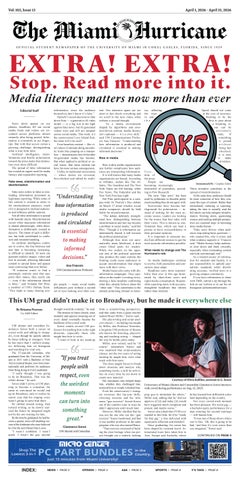
Sovannreach Po // Graphics Editor
These mistakes contribute to the spread of misinformation. At the same time, audiences should be more conscious of how they consume this type of content. Rather than immediately resharing or reposting, taking the time to actually read the full article can help mitigate misinformation. Slowing down, questioning sources and seeking multiple perspectives are essential steps in becoming more media literate. "Fake news thrives when audiences stop asking basic questions — who created this, why it exists, and what evidence supports it,” Francois said. “Media literacy helps audiences slow down and think critically, especially when misleading content can look convincingly real.” As a trusted source of information for students and faculty, it is our responsibility to uphold journalistic standards while distributing accurate, verified news to a growing campus community. If you have information to share with TMH, submit a tip through the link on our website or in our bio on Instagram @themiamihurricane.
This UM grad didn’t make it to Broadway, but he made it everywhere else By Brianna Pearson Co-A&E Editor
UM alumni and comedian Gianmarco Soresi built a career on crowd work and talking to strangers, even though he openly admits he hates talking to strangers. Now he has more than 1 million strangers following him on Instagram and watching his viral sets. The 37‑year‑old comedian, who graduated from the University of Miami in 2011 with a Bachelor of Fine Arts in musical theater, now tours internationally and performs for audiences from Hong Kong to Fort Lauderdale. “I really thought I was going to be on Broadway. That was the whole dream,” he said. Soresi didn’t arrive at UM planning to become a comedian. He came in convinced he would end up on Broadway, only to realize by senior year that his singing voice wasn’t going to carry him there. He shifted toward acting, then toward writing, as he slowly realized the future he imagined might not be the one waiting for him. By the time he graduated, he had become a quieter, more self‑doubting version of the freshman who once believed he’d be the next Daniel Day‑Lewis. “I wasn’t confident. I wasn’t quick. I wasn’t the guy anyone
INDEX:
thought would do comedy,” he said. The instinct to listen closely, react instantly and squeeze meaning out of every detail eventually became the backbone of his crowd work. Soresi credits several UM professors for pushing him in the right direction, especially those who taught him how to write. “I kind of look at my stand‑up
“If you treat people with respect, even the weirdest moments can turn into something great.” Gianmarco Soresi UM Alumni and Comedian
NEWS | PAGE 2
from a scriptwriting perspective, and that came from a great teacher named Bruce Miller,” Soresi said. His playwriting and script analysis classes — including one taught by Miller, aka Professor Emeritus, a longtime UM professor of theatre arts known for directing, playwriting and teaching acting — shaped the way he builds jokes today. Miller, now retired, said he “of course” remembers Soresi and was surprised that script‑analysis classes, not the two years of acting training he taught him, were what stuck with him most. The class taught Soresi to break down structure and analyze why something works, a skill he still relies on every time he sits down to create new material. His classmates also helped shape him, whether they challenged him, annoyed him or simply tolerated him. Even the conservatory’s strangest exercises like lip‑sync drills, clowning sessions and the infamous “gun exercise” forced Soresi out of his comfort zone in ways he didn’t appreciate until much later. However, Miller clarified that he was not the one who ran this “gun exercise” Soresi mentioned, and that it was another professor in the same program who was also named Bruce. “That exercise consisted of holding the class hostage when one person brought out a realistic looking
OPINION | PAGE 4
A&E | PAGE 5
Courtesy of Olivia Kelliher, assistant to G. Soresi Univertsity of Miami Alumni and Comendian Gianmarco Soresi interacts with crowd during performance on Aug. 12, 2023. prop gun to intimidate the others,” Miller said, adding that he “did not approve of [it] and today [it] would have triggered much complaint and protest, and maybe worse.” Soresi also joked that if UM ever wanted to hire him, he’d be “ready for that gig,” a line delivered with equal parts affection and disbelief. Since graduating, his career has been shaped by constant travel. International tours have taken him to Asia, Europe and Australia, where
SPORTS | PAGE 6
he has learned how differently jokes land depending on the country. Not every crowd‑work moment has been pleasant. His worst gig — a bachelor‑party performance for a man entering his second marriage — still haunts him. “It was one of those shows where you’re like, ‘Oh, this is going to be bad,’ and then it’s even worse than you imagined,” Soresi said. CONTINUED ON PAGE 5
V’S TAKE | PAGE 8