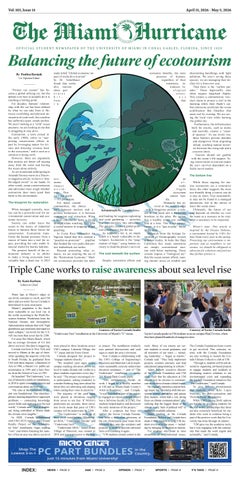

Balancing the future of ecotourism
By Paulina Barnjak Co-Opinion Editor
“Protect our oceans” has be come a global rallying cry, but the debate over how to actually do it is reaching a boiling point.
For decades, humans’ relation ship with the sea has been defined by what we can take from it. Be tween overfishing and physical de struction of coral reefs, the coastline has suffered a quiet, steady decline. We aren’t looking at a “wild” ocean anymore; we are looking at one that is struggling to stay alive.
Ecotourism, a term coined in the early 1980s, refers to “sup porting conservation efforts in part by leveraging nature for lei sure and directing revenue back to the ecosystem,” and is seen as a solution to dying reefs.
However, there are arguments that tourists are better off staying away from the water and leaving the ocean alone entirely.
As environmental anthropologist Amanda Stronza warns in a Discov er magazine article, we have a “dou ble-edged sword” in our hands. In other words, ocean conservationists and advocates must weigh whether ecotourism does more good than harm to the environment.
The blueprint for restoration
economic benefits, the mere

When managed correctly, tourists can be a powerful tool for environmental conservation and economic recovery.
Society can either leave the ocean to the mercy of industrial forces or harness those forces for conservation. Ecotourism transforms the human presence from a source of harm into a tool for repair, providing the only stable financial shield for marine habitats.
The greatest benefit of the ecotourism industry is its ability to make a living ecosystem more valuable than a dead one. A 2025
isn’t between tourism and a pristine wilderness; it is between ecotourism and extraction. When a local community earns a living through whale watching, they gain a vested interest in stopping illegal poaching.
In Costa Rica, researcher An Nguyen found that this created a “poacher-to-protector” pipeline that funded the very parks that protect leatherback sea turtles.
Beyond protecting what remains, we are entering the era of the “Restoration Economy.” Modern ecotourism provides the labor
and funding for seagrass replanting and coral gardening — activities that turn travelers into advocates.
The industry creates a global political constituency for the sea.
As supporters see it, an empty beach is a beach vulnerable to developers. Ecotourism is the “pragmatism of hope,” using human curiosity to fund the planet’s survival.
The cost beneath the surface
Despite restoration efforts and
with a dangerous posture: a camera in one hand and a marketing brochure in the other. We cannot buy a healthy ocean one snorkel tour at a time. This is not conservation; it is a “pay-to-play” burial of the deep.
Research from the Scripps Institution of Oceanography reveals a darker reality. In hubs like Baja California Sur, many operations are simply conventional tourism with better marketing. These crowds impose a “biological tax” that the ocean cannot afford, causing chronic stress on wildlife and
disorienting hatchlings with light pollution. We aren’t saving these species; we are managing their decline for a front-row seat.
Then there is the “carbon paradox.” These high-traffic sites often require long-haul flights. This creates a contradiction: travelers claim to protect a reef in the morning while their flight’s carbon emissions accelerate the ocean acidification that bleaches that same reef by evening. We are saving the local view while burning
Furthermore, the infrastructure built for resorts, such as docks and seawalls, creates a “coastal squeeze.” As sea levels rise, these barriers prevent marshes and mangroves from migrating inland, crushing natural nurseries between the rising tide and a Tourists should not gamble with the ocean’s life support. Tying conservation to tourism makes the sea’s survival dependent on a

While those arguing for marine ecotourism see a restorative force, the other suggests the most eco-friendly thing a tourist can do is stay on shore. True sustainability may not be found in a managed interaction, but in the choice to leave the ocean alone.
Ultimately, the future of our seas depends on whether we view the water as a resource to be visited or a sanctuary to be respected.
Writer’s note: This article is inspired by the Oceans Debates, a tournament hosted by UM’s Debate Team every year in the spring. Protecting our environment is important, and as neighbors to our oceans, we should be obligated to advocate for solutions and policies that further protect it.
Triple Cane works to raise awareness about sea level rise
By Katie Karlson Editor-in-Chief
Water laps at Miami’s edges as sea levels continue to swell, and UM alum and eco-artist Xavier Cortada is determined to raise awareness.
Miami’s population is the fourth most vulnerable to sea level rise in the world, according to the World Resources Institute. Predictions from the National Oceanic and Atmospheric Administration indicate that with “high greenhouse gas emissions and rapid ice sheet collapse,” sea levels for the U.S. will rise more than seven feet by 2100. For areas like Miami Beach, which has an average elevation of 4.4 feet above sea level, this data is staggering.
Cortada was born in New York and moved to Miami at the age of three. After spending the majority of his life in South Florida, he graduated from UM with three degrees: a Bachelor of Arts in 1986, a Master’s in public administration in 1991 and a Juris Doctor from the School of Law in 1991.
He launched “The Underwater,” a series of interactive public art installations, in 2018 to spark community interest and conversations about sea level rise.
“My time at the University of Miami was foundational. That interdisciplinary training shaped how I approach problems — connecting knowledge across fields and applying it in the real world,” Cortada said. “Just as important, being embedded in Miami made the climate crisis tangible.”
In 2020, Cortada collaborated with UM’s ECO Agency and Climate Reality Project on the “Underwater Vote” installation. Signs reading “vote” and others featuring the number of feet an area was above sea level


were placed in three locations across UM’s campus: Lakeside Village, the “U” statue and the Foote Green.
Cortada designed this project to “engage students directly.”
“We installed yard signs across campus marking elevation above sea level to make climate risk visible in a place students experience every day,” he said. “The project encouraged civic participation, asking [students] to consider thinking long-term about the future they are inheriting and shaping when casting their votes in elections.”
The majority of the yard signs were placed at elevations ranging from seven to ten feet. If NOAA’s predictions are accurate, these elevation levels mean that parts of UM’s campus will be underwater by 2100.
“The Underwater” is made up of three more installations: “Underwater HOA,” “Underwater Florida” and “Underwater Gulf.”
“Underwater HOA,” based in the Village of Pinecrest, was created in 2018 and was a precursor to the larg-
er project. The installation similarly uses painted intersections and yard signs to mark the area’s elevation.
Now, Cortada is collaborating with the UM’s College of Engineering’s Structures and Materials Lab to implement sustainable concrete underwater elevation sculptures — part of “The Underwater” installation — across 261 Miami-Dade County parks.
“This collaboration builds on work I began as a faculty member at UM and as Miami-Dade County’s Artist-in-Residence,” said Cortada. “It was launched as part of the socially engaged art classes I taught when I was a full-time faculty at [UM]. Our students helped deploy and document the early iterations of the project.”
After a sculpture has been installed, the Xavier Cortada Foundation hosts a dedication ceremony at the site. Participants pour water from Biscayne Bay onto the sculpture and promise to work to prevent saltwater from ever touching it again.
“UM students remain central to the
work. Many of our interns are current students or recent graduates, and all members of our team — including leadership — began as interns,” Cortada said. “They help implement projects, conduct outreach, and lead educational programming in schools.”
Adam Roberti, executive director of the Cortada Foundation and UM alum, feels that his education at UM shaped how he chooses to communicate about these climate-related issues.
He originally started as a marine biology major, but “decided to shift into ecosystem science and policy and pursue [his] masters, which had a very strong focus on climate communications” after realizing that the biggest threat to the climate was a “lack of political will” to implement available solutions.
Since working at the Cortada Foundation, Roberti and Cortada have made it their mission to keep UM students involved in the cause — including by bringing on students as interns.
For students who want to raise awareness of environmental issues,
The Cortada Foundation hosts events to get involved. This semester, interns with the Cortada Foundation are also working to launch the Cortada Climate Collective club at UM.
“Through it, students will be self-directed in organizing art-based projects to engage students and residents in developing creative solutions to our environmental crisis and expanding the reach of Foundation initiatives like ‘The Underwater,’” said Cortada.
To join, Roberti recommends that students email Kiki Lopez Nowotny, the club’s president, and Theresa Pinto, the advisor.
While UM’s course work options are helpful for preparing students for the real world, partnerships like these are also extremely beneficial for students who want to continue being a part of the positive work that the University has done through its alumni.
“UM gave me the academic tools, but it was engaging with the community that made the work urgent and actionable,” said Cortada.
study titled “Global economic im
Sovannreach Po // Graphics Editor
Courtesy of Xavier Cortada Studio
“Underwater Vote” installation at the University of Miami’s “U” statue.
Courtesy of Xavier Cortada Studio Xavier Cortada speaks to UM students at an on-campus Plan(T) event, where they later planted hundreds of mangrove trees.

Vector-borne diseases thrive in South Florida

By Keira Faddis Co-Opinion Editor
Concern surrounding vector borne illnesses, pathogens transmitted by blood-feeding bugs, is growing among South Florida residents.
South Florida’s warm, rainy climate and uniquely flat landscape create a near-perfect environment for mosquitoes to thrive year-round. This combination makes the region particularly vulnerable to these diseases that can be spread by insects like mosquitoes, ticks and fleas.
The area is home to nearly 90 species of mosquitoes and certain species, like Aedes aegypti, presenting significant health risks to residents, including diseases like dengue, Zika and yellow fever.
According to Dr. John C. Beier, a professor of public health sciences at the University of Miami Miller School of Medicine, dengue fever is particularly prevalent in South Florida.
“Dengue is more common,” Beier said. “There are imported cases, a lot from Cuba. There are also locally transmitted cases, about 20 last year.”
According to the Florida Keys Mosquito Control District, symptoms of dengue are “described as flu-like without the respiratory problems.” Other symptoms include a high fever, body aches, pain behind the eyes, rash, nausea or vomiting.
This past year, Dr. Beier conducted field research to determine how far Aedes aegypti mosquitoes travel. His department worked closely with Miami-Dade Mosquito Control, assisting the division in finding more effective control strategies.
“We have the dangerous vector Aedes aegypti year-round throughout the county,” Beier said. “Miami has good weather conditions, there are abundant larval habitats, and the local environment has good microhabitats for adult mosquitoes.”
He noted that the global rise in temperatures is concerning and that higher temperatures favor mosquito survival.
“Mosquitoes work fast,” said Shaun Judy, the CEO and founder of Dade Pest Solutions, a local pest control company. “In our climate, they can go from egg to flying adult in about a week, sometimes less if it’s really hot.”
That is why even a little bit of standing water — even as small as a capful — can turn into a problem
before you even notice.
In response to a nonscientific survey posted on The Miami Hurricane’s Instagram story, one anonymous senior said that mosquitoes on campus are “Really bad by the mangroves in the water by Eaton and on the water at RSMAS. Fine everywhere else.”
Effective mosquito control requires disrupting the breeding cycle at multiple stages.
Larvicides are chemicals that can prevent eggs from hatching within a day or two, while fogging disperses chemicals that kill adult mosquitoes on contact.
However, Judy emphasized that neither method is fully effective on its own.
“The key is hitting both the larvae and the adults, plus getting rid of the standing water,” he said. “If you do all that, you can break the cycle in about a week or two.”
Miami-Dade County’s Mosquito Control and Habitat Management Division was established in 1935 to improve the quality of life and reduce the spread of disease. This year, mosquito control spending reached $13.8 million, according to the Department of Solid Waste Management’s 2025-2026 budget.
The division monitors mosquito populations using more than 300 traps across urban and rural areas, tracking species, population levels and potential disease presence. Officials also rely on reports from residents and data from the Florida Department of Health to guide their response.
“When a suspected mosquito-borne illness is reported, we send an inspector out the next day,” said Michael Mut, the public information officer for Miami-Dade Mosquito Control. “They check the property and surrounding homes for breeding sites and treat [them] if necessary.”
South Florida’s climate means mosquito activity never fully stops, but it intensifies during the warmer, wetter months.
ADVERTISEMENT OPEN MIC NIGHT

“Because of our tropical climate, mosquito activity happens year-round,” Mut said. “From May to October, with increased rainfall and higher temperatures, populations rise significantly.”
As conditions continue to favor mosquito growth, experts emphasize that prevention depends not only on large-scale control efforts, but also on individual action — especially eliminating standing water before it becomes a breeding ground.
Centennial Village wins energy and water saving competition
By Katie Karlson Editor-in-Chief
Centennial Village residents reduced their energy usage by 7.17% in March 2026 compared to March 2025, securing their victory in this year’s UConserve competition.
UConserve is an energy and water conservation competition organized by ECO Reps, a committee under Student Government’s ECO Agency. The competition between residence halls ran from March 1 to 31, where students could participate by logging their sustainable actions in the GetGreen app.
Following Centennial in first, UV fell from first place in 2025 to second place this year, reducing its energy usage by 6.95%. Eaton came in third with a 4.44% reduction, followed by Lakeside Village with a 3.94% decrease. Mahoney-Pearson finished last, increasing its usage by 2.29%.
Tips to reduce energy and water use
included: setting the thermostat to 74, using cold water for laundry, taking the stairs instead of the elevator and closing curtains when the apartment is empty.
In the GetGreen app, students earn “leaves” for their individual sustainable actions while contributing to their residence hall’s sustainability goal. Depending on how many leaves an individual earns, they can win prizes like an eco-friendly tote bag or a hydroponic garden.
In total, the residence halls decreased energy usage by about 70,000kWh. This energy is equivalent to the annual elec-
tricity usage of seven homes or about 192 miles in an electric car, according to a post on Green U’s Instagram. Although the “number of residents [did] not impact scores,” not all of the residence halls on campus are created equal.
According to Hallmark Homes Group, older buildings tend to be less energy-efficient than new ones, largely because of outdated heating and cooling systems. In addition, Lakeside and UV are also the only residence halls with kitchens in each apartment and in-unit laundry machines in some.
The University has not yet responded to The Hurricane’s questions about how the competition accounted for these differences.
As the winners, Centennial residents can expect free Dunkin’ Donuts in their lobby. More details are available on @ sgecoagency’s Instagram page.


7:30 pm - 9:30 pm
Miami traffic lengthens commutes and worsens climate crisis
By Daniella Krasney Co-News Editor
A 9:30 a.m. class doesn’t mean a 9 a.m. alarm for many University of Miami students. For commuters, it can mean waking up hours early just to sit in traffic.
“[It can] take me an hour to get to school, and I don’t even live that far,” said Ro Pelez, a commuter student at UM. “Traffic is actually really annoying, and it does affect my schedule … it seems to be getting worse.”
Students are feeling the consequences of a city built around cars through longer commutes, denser traffic and rising environmental costs. While the immediate impact is the inconvenience of traffic, the long-term effects are far greater as population growth and development continue to increase emissions and strain the environment.
Transportation remains the leading source of greenhouse gas emissions in Miami-Dade County. When more residents move into new developments, the city becomes more densely populated, worker’s commutes lengthen and greenhouse emissions fill the air.
Urban planner Ali Lewis said that growth without corresponding shifts in transportation and land-use planning can pose long-term climate challenges for cities.
“Car-dependent growth increases Vehicle Miles Traveled, which directly increases emissions,” Lewis said. “As cities grow, those patterns become harder to undo.”
Bordered by the Atlantic Ocean and Biscayne Bay, Miami has limited room to expand transportation infrastructure, funneling more traffic into tight roads.
Still, these challenges are not unique to Miami. Researchers often point to cities like Los Angeles, which experienced rapid postwar growth centered on highways and low-density development. Over time, that model produced severe congestion, air pollution and limited access to green space, which are difficult and costly to reverse.
Experts say that the heavy reliance on cars not only brings more
traffic, but impacts how people move through the environment.
“When we are in our cars, we miss out on the three aspects of life that have been well-established through research to be the most closely associated with health, longevity and well-being: social interaction, physical activity and greenness,” said Joanna Lombard, a professor at the University of Miami School of Architecture.
Miami ranks high on the list of urban heat islands by Climate Central.
With limited access to green space, neighborhoods with fewer trees and parks tend to experience higher temperatures, creating the “concrete jungle” effect many cities experience. As heat intensifies, residents are more likely to rely on cars rather than walking for even short trips, reinforcing a cycle of car dependence and emissions. Lombard said that carbased commutes bring people away from healthy human interaction.
“Our car-based trajectory from work to home and back does not allow for the kinds of casual interactions that happen naturally when we are walking, and it turns out that those interactions are important to our health,” Lombard said.
“We might spend our whole day without ever getting near or even seeing a tree.”
Lombard added that her research has found that greater proximity to trees is associated with lower rates of many conditions like Alzheimer’s disease, heart disease, diabetes and depression.
As Miami continues to grow,
Lewis said the city is approaching a critical turning point on how the city will develop moving forward.
“The question is whether growth continues to reinforce car dependence, or whether it’s used as an opportunity to redesign how people move and live,” Lewis said.
Miami-Dade’s Climate Action Strategy aims to cut carbon emissions in half by 2030, expand renewable energy and protect green and blue spaces across the city.
“While the effects of climate change might still seem theoretical for many communities around the globe, in Miami-Dade County, we already clearly see the impact of rising seas, extreme heat and sunny day flooding,” Miami-Dade County Mayor Daniella Levine Cava said in the climate plan. “Now in our 11th hour with the clock rapidly ticking, we must take action immediately.”
While county leaders emphasize the urgency of addressing climate change, Lombard said that the path forward lies in how the city itself is designed. She said that climate-conscious development does not require stopping growth altogether, but rethinking it to include environmental solutions.
“We [can] integrate more of what is needed for daily life into our built environment and create places where [social interaction, physical activity and greenness] are just a natural part of every day,” Lombard said. “The default option would change from isolation and distance to community and proximity.”

Brian Mulvey // Photo Editor
A pool of water stands still on April 12, 2026.
Courtesy of Marra Finkelstein Centennial Village, the newest residential buildings, welcomes freshmen on Aug. 12, 2024. via Wikimedia Commons Downtown Coral Gables with the Miami Skyline in the distance.
‘Pride Is Infinite’ at 18th annual Miami Beach Pride
By Ariana Glaser Senior Staff Writer
Rainbow flags flew high and vibrantly colored floats paraded down Ocean Drive for Miami Beach Pride’s more than 150,000 attendees.
The 18th annual Miami Beach Pride Parade returned to South Beach on Sunday, April 12, upholding its mission to “envision, plan and execute a roster of events and activities that are as diverse as the [LGBTQ+] community itself.”
The parade was the culmination of a 10-day-long celebration. Miami Beach Pride began on April 2 at City Hall with a pride flag raising ceremony, followed by a kickoff celebration, women’s mingling event, family picnic, queer art showcase, mega-mixer, pageant, drag concert and festival.
For the past several years, UM has partnered with Coca-Cola to offer students an active role in the parade. UM students enjoy free bus transportation and access to events through the on-campus LGBTQ Center. Students are also provided breakfast on Miami Beach, an exclusive Pride 2026 tee shirt and other celebratory trinkets. NonUM guests can join for an individual $20 cover.
This year’s theme was “Pride Is Infinite,” a reflection of Miami Beach Pride’s legacy and the over-
arching theme of resilience among the queer community.
“Beyond celebration, Miami Beach Pride serves as a critical cultural, social and civic platform for the LGBTQ+ community in Miami-Dade County,” said Carol Coombes, director of grants and cultural affairs at Miami Beach Pride. “At its core, Pride creates a visible, inclusive space in a region where LGBTQ+ rights and acceptance have evolved significantly but still face ongoing challenges.”
Many in the LGBTQ+ community believe Pride is more important than ever as the political climate grows increasingly uncertain.
On a national scale, President Donald Trump scrapped more than $800 million allotted funding for research into queer health, dismantled The Trevor Project’s crisis hotline for LGBTQ+ youth and revoked a Bidenera queer discrimination policy.
Statewide, multiple rainbow crosswalks were painted over early this year, and anti-queer legislation continued with the “Anti-Diversity Bill” that threatened to ban municipal funding and promotion of diversity, equity and inclusion activities.
“To me, Miami Beach Pride is a symbol that change is still possible,” said Daymee Sanchez, the assistant director at UM’s LGBTQ Student Center. “It reminds me that there are leaders and community members who are actively putting
in the work to create spaces like this — spaces where people are seen, valued and protected, and being part of that each year means everything to me.”
Sanchez has attended Miami Beach Pride since she was 15 years old. From 2015-18, she attended with her high school’s Gay-Straight Alliance. At the time, hers was one of the very few high schools that participated.
“While [the UM LGBTQ Student Center] provides many community-based spaces on campus where students can feel safe, Pride is unique because it brings together a wide range of resources and community agencies,” said Sanchez. “The event amplifies their work and spreads awareness of what’s available to the Miami-Dade County LGBTQ+ community.”
Keira Faddis, a sophomore at UM and a lesbian, has spent the past two years marching with The Alliance for LGBTQ Youth.
“Seeing younger people in that space is powerful,” said Faddis. “Pride can be the first place someone feels seen or accepted, and that kind of experience can stay with them for the rest of their life.”
Though the first Miami Beach Pride in 2009 garnered a modest attendance count of 15,000, participation has multiplied exponentially. People of all ages, identities and walks of life crowd Ocean Drive
Unresolved disappearance of UM graduate possibly linked to serial killer
By Martina Pantaleon Senior Staff Writer
When UM alum Beth Kenyon did not return home from her job at Coral Gables High School on Mar 5, 1984, her family knew something was wrong. 42 years later, her disappearance remains unsolved. But, Australian journalists Andrew Byrne and Mark Llewellyn might have the answer.
In their new podcast “Catching Evil,” Byrne and Llewellyn talk about their cross-country search that could tie Kenyon’s death to Christopher Wilder, a convicted serial killer. Wilder was charged with the murder of 14 women in Florida between 1979 and 1984.
Kenyon’s abductions fit Wilder’s signature: posing as a photographer to meet young aspiring models and then luring the victims into his car.
The UM alum, a former fashion model and a finalist for Miss Florida, was no stranger to photoshoots.
“There are a lot of Jane Does — unknown victims of Wilder — still in America,” Llewellyn said in an interview with The Hurricane. “The number we are discovering could put him up there and may exceed Ted Bundy in terms of activity.”
The pair has identified him as the main suspect in more than 50 cold cases. The hunt has not stopped yet.
“It’s kind of bizarre because you have this guy who operated [without consequences] largely for 20 years on two continents,” Byrne said to The Hurricane.
Uncovering the extent of Wilder’s crimes has turned into an eightyear-long project. It started in 2019 when Llewellyn was hired by Seven Network, an Australian network, to produce an episode of the true-crime series
By Elena Fallow Co-News Editor
For many students, the end of the spring semester brings about thoughts of summer plans, and for many upperclassmen, postgraduate plans. One South Florida native skipped out on the endless job search and graduate school by choosing to teach abroad. After poor experiences with internships, Tyler Wetzler realized that the traditional post graduate route was not for him.
“I’m literally a corporate puppet and agreeing to join the matrix,” Wetzler said jokingly. During his junior year of college, he began exploring opportunities to take a gap year with a purpose. One option he looked into was the Fulbright Scholars Program.
Fulbright is a government organization that sponsors students, university faculty, administrators and researchers to study, teach or conduct research abroad.
UM political science and international studies professor, Dr. John Twichell, is a Fulbright alum-
“Murder Uncovered,” a show that tried to solve cold cases.
The topic was the Wanda Beach murders, one of Australia’s most famous unsolved cases. Two 16-yearold girls had gone missing one afternoon and were found murdered between the dunes.
Coincidentally, Byrne had writ-
“The philosophy of the podcast is to honor the women .”
Mark Llewellyn Australian Journalist
ten about the case in his book, “The Pretty Girl Killer.” In it, he explained that those two girls were likely Wilder’s first victims.
Byrne’s fascination with Wilder began when Byrne discovered that he lived a block away from Wilder’s childhood home. He was shocked to find the “family-friendly” neighborhood was linked to such a dangerous person.


annually to witness the rainbow spectacular.
Pride is loud and colorful, but for most attendees, there’s a deeper gratitude for the event. The first Pride, known today as the Stonewall Riots, was a series of protests by the queer community to combat anti-LGBTQ police brutality.
“People often assume it’s just a party, but there’s a real emotional weight to it. I remember marching with a sign I made that said ‘Born This Way’ on it,” said Faddis. “I made eye contact with an older gay couple…when one of them pointed at my sign. He said something along the lines of, ‘Yes you were.
Keep fighting,’ and it literally made me break down crying.”
After spending nearly eight years in the closet, Faddis admitted she “would have never dreamed” of attending Pride. But now, for Faddis, Pride represents “freedom.” It represents the ability to exist openly and celebrate a part of herself she once felt like she had to hide.
“There are people who are actively trying to strip away marriage rights for gay couples, and I think going to Pride is one of my ways of protesting that,” said Faddis. “It’s kind of my way of saying, ‘I’m here, I’m queer and there is nothing you can do to stop me.’”
COISO celebrates cultural diversity at the U
nus. Dr. Twichell applied for the Fulbright Research Grant in 2010 while pursuing his PhD here at the University of Miami.
The scholarship granted him the external funding and student visa needed to conduct fieldwork in Brazil for his dissertation research.
Dr. Twichell is an avid supporter of the program and encourages
That neighborhood was the first stop in their visit. Since then, they have gone wherever the cases led. But, their investigation changed once DNA technology was developed in 1986.
Suddenly, the list of Wilder’s victims started to grow.
“That’s why the new cases are so important,” Byrne said. “They’ve been left in the back of filing cabinets and police stations and cold case units around Australia and America and completely forgotten.”
Recent evidence suggests that Wilder was operating in Florida and dumped the bodies in New York or Georgia. Byrne theorized that the long trip would have been easy for Wilder, who competed in hour-long car races.
Experts in forensic psychology and former police officers involved in these investigations have helped piece together what happened.
Family members of the victims have reached out as well, and Byrne and Llewellyn visited each one to get their stories.
The podcast is about much more than solving the cases. At its core, it is a service to those whose stories were forgotten.
“The philosophy of the podcast is to honor the women,” Llewellyn said.
Kenyon’s parents passed away without knowing what happened to their daughter. Byrne and Llewellyn want to give a voice to the family members who suffered a similar reality.
The victims’ mothers, most of all, found comfort in the podcast because it helped them understand what happened.
“They’ve gone to live good lives,” Byrne said. “Damaged lives, but they are still good people. And they’ve built a picture of their loved one that honours her.”
Anyone with information can contact info@catchingevil.com.
all his students to apply.
“I would recommend Fulbright to students at Miami because the nature of our University community, complete with its culture of diversity and inclusivity, dovetails well with the Fulbright mission, setting our students up well to be competitive applicants,” Twichell said.
Fulbright was not a perfect match for Wetzler. While the program offers the experience he was seeking, scholarship recipients can only pick a country of their choice, not the city. Wetzler was set on going to Bangkok and did not want to risk being placed elsewhere.
That is when he came across Xplore Asia, an organization that helps certify participants as teachers and match them with schools in participating countries, including Thailand, Cambodia, Myanmar, South Korea, Vietnam, Japan, Costa Rica and Spain.
After graduating from the University of Central Florida in the spring of 2025, he left for Thailand and began teaching in the fall.
After receiving his teaching certification, Wetzler taught third through sixth grade English literacy at an in-
By Martina Pantaleon Senior Staff Writer
International Week is a love letter to the cultural mix of students at the University of Miami and the Council of International Students and Organizations’ longest-standing tradition.
Celebrating its 59th anniversary this year, COISO hosted 700 students — breaking its attendance record.
Connecting with the UM community, especially non-U.S. citizens, is COISO’s main goal. International students move to the U.S. every year to attend UM, with more than 800 international students admitted in the 2025-26 academic year alone.
International week began on Monday, April 6, with its opening ceremony honoring every featured region. The Middle East and Europe were celebrated on Tuesday, followed by Latin America, Africa, and Asia, respectively.
During I-Week, Lakeside Patio was bursting with music, lights and the smell of spices.
“There are international students who don’t get to go home for years,” said Nayonika Choudhury, COISO’s vice president of external affairs. “[Students at COISO] come from a selection of [more than 50] countries but are united in our hopes, dreams and struggles of pursuing a future thousands of miles away from our families and support systems.”
To celebrate this community, COISO took their flagship event literally. The Fate Bridge, which connects Lakeside Village with Lakeside Patio, was lined with flags from all over the globe. For some students,the decorations are more than just symbols.
“For me, I-Week is about representation,” Laraib Salman, COISO’s Asia night chair, said.
“It’s a night to showcase the beauty of our cultures and celebrate the diversity that UM has to offer.” COISO wanted to showcase the variety of cultures at UM and bridge the gap for those finding their place.
“We host I-Week to bring a small piece of our home to the campus,” said Choudhury. “So every UM student, regardless of where they are from, sees a part of themselves, their culture, their identity and their history reflected at UM.” Student organizations from each region were invited to table and offer culturally based food or activities. The week offered students a place to discover new people and organizations.
“It brings people together from so many different parts of the world,” Brenda Gupta, president of COISO, said. Her best friend is from Rwanda. They met while volunteering for I-Week two years ago. Changes are implemented every year to keep I-Week’s welcoming environment.
Entertainment has always been a part of the event, with guest performances from UM students and professionals. This year, attendees are included in the performances through dancing workshops and flash mobs. Dance groups included Love of Chinese, Korean and Eastern Dances Dance Team, Hurricane Bhangra and students from the Frost School of Music.
“Our goal is to foster an environment of warmth and invitation at UM towards students from all nations,” said Nayonika Choudhury, COISO’s vice president of external affairs.

ternational school in Bangkok. He uses simple reading comprehension packets that require students to find and circle information to meet students at their English comprehension level.
“Most kids I would say can have a full conversation in English and there are also kids that speak no English at all,” he said. “Navigating that as a teacher is hard.”
But for Wetzler, watching the student’s progress and growth makes the job that much more rewarding. A semester later, Wetzler has adapted well to life in Bangkok. He shared that adaptability is an important skill, and crucial for success when relocating abroad.
“Challenge yourself to grow, because you have to,” he said. “You can’t come into a situation like this with any expectations because you are always having to adapt. That’s how it works here.”
Courtesy of Brianna Vasquez
The UM LGBTQ Center community gathers at the Miami Beach Pride Parade on April 13, 2026.
Courtesy of Oscar Garcia Del Ray
President Heran Belay and Vice President Kaleab Bekele throw up the “U” during Africa Night, hosted by the Ethiopian Eritrean Students Association on April 9, 2026.
Courtesy of Tyler Wetzler
At Wat Si Bun Rueang in Bangkok, Loy Krathong is celebrated, a cherished annual Thai festival held on the full moon of the 12th Thai month to honor the Water Goddess on Nov. 5, 2025.
Pedestrian safety risks persist near UM
By Alejandra Chavez Staff Writer
Nearly 64% of University of Miami students live off campus, relying on surrounding roads and sidewalks to get to class. From cars to the metrorail to scooters, pedestrian safety plays a key role in how students get to campus.
classes that end late at night and if I walk back in the dark it’s even scarier.”
Despite the high use of micromobility devices, Miami-Dade County remains one of the most dangerous places in the country for pedestrians.
A recent study by Lemon Law Experts found Miami has the worst drivers in the United States, with aggressive behaviors such as speeding, failing to yield and unsafe lane changes contrib-
Route 1 near Ponce de Leon Boulevard and Douglas Road frequently sees severe, high-speed collisions.
Advocacy groups like Bike Walk Coral Gables say that the problem with this intersection where Bishop was hit rests in the fact that drivers can legally make a right turn on red while pedestrians have the right of way, creating a dangerous — and potentially fatal — situation.


ARTS & ENTERTAINMENT

Alix Earle’s skincare lands on campus
By Charlotte Schuyler Contributing Writer
It feels like everyone is building something at the University of Miami: a brand, a following and a future. A few years ago, Alix Earle was doing the same thing, just without knowing how far it would go.
Now, the former UM marketing major has turned her social media momentum into Reale Actives, her new skincare line that is already making its way to campus.
Earle first built her audience through her casual “Get Ready With Me” videos that felt more like FaceTiming a friend than watching an influencer. She talked through breakouts, routines and real life without trying to make it look perfect. That same energy carries into Reale Actives.
The brand focuses on simple, ingredient-driven skincare that actually fits into everyday life. It is not about ten-step routines or unrealistic results.
Focused instead on consistency, balance and products that make sense for people who are busy, stressed and still figuring it out; in other words, college students. As a UM alum, Earle’s launch also made its way back to campus in a full-circle moment, especially when its first customer turned out to be a current student.
When sophomore Jenna Simone became the first customer to purchase from Reale Actives, she did not just get a confirmation email. She got a FaceTime call from Earle herself.
“I was in pure shock,” Simone said.
“I didn’t answer two calls from a random Los Angeles number, and then I got a text saying, ‘Hi Jenna, it’s Alix Earle, answer the FaceTime.’ I thought
it was a joke … and then I called back and it was actually her.”
Even as her platform has grown, Earle still interacts in a way that feels direct and personal, the same way she started.
For many students, especially young women interested in business or media, Alix Earle’s path does not feel distant. Not long ago, she was sitting in the same classrooms, walking the same campus and figuring things out in real time — just like every other student today.
“As a UM student, it makes her success feel a lot more personal,” Simone said. “She was in the same position as us not that long ago, so it makes everything she’s built feel more real and honestly really inspiring.”
That is what makes Reale Actives feel different. It is not just another celebrity skincare launch. It is a re-

out of the same place
Canes for Canines 5k aims to boost adoptions
By Amber Del Valle Contributing Writer

not just the symptoms,” Galante said. After fostering her first dog, King, Galante realized many “amazing dogs” are overlooked in shelters due to limited exposure, prompting her involvement with Canes for Canines to help them find permanent homes. Pre-registration is open through Friday, April 17, at 11:59 p.m. Participants who choose the Sponsor a Dog option can create a personal fundraising page to collect donations and compete for prizes, sharing their page with friends, family, and on social media.
The event will be held at Miami-Dade Services and is scheduled for April 25 at 8 a.m.
All funds raised from the event will go directly to Miami-Dade Animal Services to support the shelter’s overall operations and animal care.
Participants who opt in to the “Sponsor a Dog” program during
pre-registration are matched with a specific shelter dog and receive information about them via email.
In the weeks leading up to the event, participants are encouraged to share their assigned dog’s story on their social media platforms to raise awareness and increase visi bility for adoption or fostering. While donations support the shel ter as a whole, the program offers a more individualized connec tion between participants and the dogs they are helping.
“I would say student in volvement has been so fan tastic,” Galante said.
More than 250 people filled out an interest form during the new student orga nization process.
A student who is a profes sional dog photographer even volunteered to take high-quali ty photos of dogs for their on line profiles, allowing them to improve their presentation compared to initial intake photos taken at the shelters.

“The 5K is a way to create this, like, real-life moment for the dogs to be out in the community, interact with people, show their personalities, and ultimately increase their chances of being adopted,” Galante said. Galante also shared that Canes for Canines has been “overflowed with so many organizations reaching out,” such as Greek life volunteering their time for collaboration. With strong student support and growing campus-wide cooperation, organizers hope the event will become an annual tradition and continue to make an impact at the Miami-Dade Animal Shelter.
Courtesy of Lily Cruse
TikTok Star Alix Earle stands in front of the Richter Library, posing for her senior photos.
Courtesy of Amanda Galante Students – from left to right, Nicole Yu, Sophia Walls, Amanda Galante, Venera Gillon and Callie Keys, pose for a yearbook photo at the Shalala Student Center on March 31, 2026.
Amanda Galante poses for a photo during the “Lucky Paws” event in collaboration with Miami-Dade Animal Services at Foote Green on March 20, 2026.
Courtesy of Amanda Galante

ARTS & ENTERTAINMENT
UM En Pointe Ballet Club prepares to bring ‘Alice in Wonderland’ to life
By Alejandra Chavez Staff Writer
From the Cheshire Cat to the Queen of Hearts, the University of Miami’s En Pointe Ballet Club is set to bring “Alice in Wonderland” to the stage on Saturday, April 18. Performances are scheduled for 4:00 p.m and 7:30 p.m. at the Lakeside Auditorium.
From choreography to costumes, the student-led production reflects both artistic creativity and extensive planning. The club, which was founded last fall, has spent weeks rehearsing while managing the logistical demands of staging a full ballet.
“We started working on it in December,” said Emily Huffman, the club’s treasurer and public relations director.
“We have auditions at the beginning of the semester, and then about 10 to 12 weeks of rehearsal before the show.”
Rehearsals have required a major time commitment from both dancers and leadership. Huffman said she personally spends eight to 10 hours a week preparing for the production, which includes coordinating the venue, organizing production and helping design costumes.
“It’s a pretty all-encompassing process,” Huffman said. “We do everything from booking the venue to sewing parts of the costumes ourselves.”


While the technical side of production plays a key role, dancers are also balancing rigorous rehearsals with academic and extracurricular commitments.
Dani Vega, who plays Alice, said the cast has rehearsals with long sessions dedicated to both technique and character development.
“We prioritize rehearsals on Sundays for about four hours,” Vega said. “The first hour is class, and the last three hours are just drilling choreography.”
For Vega, preparing for the lead role goes beyond mastering choreography.
The character-driven nature of “Alice in Wonderland” requires both emotional expression and technical precision.
“It’s not just about dancing as much as it is about acting,” Vega said. “She has so many emotions, so it’s been fun to channel that in rehearsals.”
The production also highlights the club’s collaborative nature, with dancers of varying experience levels coming together to create a cohesive performance.
According to Vega, the club’s inclusive environment encouraged her to return to dance after stepping away.
“I saw how inclusive the club was
and how it was open to everyone regardless of experience,” Vega said. Behind the scenes, one of the biggest challenges has been managing costs. While the University provides funding for production elements such as the venue and lighting, costumes require additional creativity and fundraising.
“We have about $2,500 for the whole year for costumes,” Huffman said. “With 25 dancers and multiple roles, it doesn’t go a long way, so we reuse costumes and add accessories where we can.”
Despite these challenges, the club is using the production as an opportunity to push creative boundaries. This version of Alice in Wonderland incorporates a mix of dance styles, including contemporary, jazz and even tap.
“We’re trying to push the box a little more,” Huffman said. “It’s a really interesting variety, and it makes ballet more accessible for people who may have never seen it before.”
For both dancers and organizers, the performance represents the culmination of months of work and a chance to share the arts with a wider audience.
“I think it’s so important for people to be exposed to the arts,” Vega said. “Tickets are free, so this is the perfect opportunity for students to come see something new.”
Students can follow the club’s Instagram, @enpointe, for updates on the show and even joining.
Why climate change rarely makes it into the movies
By Brianna Pearson Co- Arts & Entertainment Editor
Climate change is one of the most urgent issues of the century, but you wouldn’t know it from watching most movies. Outside of a handful of sci-fi blockbusters and end-of-the-world thrillers, the crisis rarely appears on screen at all — despite evidence that audiences watch more when it does.
Research shows climate change is largely confined to speculative genres like “Interstellar,” “The Martian” and “WALL-E,” while mainstream dramas, comedies and action films avoid the topic almost entirely.
When films or documentaries do address climate issues directly, viewers tend to engage more deeply, especially when well-known figures help carry the message. Hollywood’s limited approach contrasts sharply with audience interest, leaving documentaries — often fronted by celebrities — to fill the gap.
That gap becomes clearer when looking at how rarely climate change appears in popular films.
A 2025 analysis by Rice University found that only 12.8% of top-grossing films from 2013 to 2022 referenced climate change. Most of those references came from sci-fi or disaster titles, which helps explain why the speculative films dominate the conversation.
A broader review from USC’s Norman Lear Center reached a similar conclusion, reporting that climate issues appeared in just 2.8% of more than 37,000 film and TV scripts. Everyday genres — dramas, comedies, romances — almost nev-
er acknowledge the crisis.
That scarcity on screen stands in contrast to how audiences think about the issue.
While climate rarely appears in scripted entertainment, audiences are far more receptive to climate themes in films than studios may assume.
The Norman Lear Center found that viewers want to see characters who acknowledge climate change, but only a small fraction feel that film and TV reflect their level of concern. The study also notes that people frequently learn about social issues through entertainment, but climate change almost never makes that list.
For many students, that absence is noticeable, and the rare films that do address climate change tend to stick with them.
“Every time I watch ‘The Lorax’ I feel empowered to minimize my carbon footprint,” said UM senior psychology major Kate Sinha.
Other findings suggest that when climate stories reach viewers, they can have a real impact. Films and documentaries can significantly increase awareness and understanding of climate issues when they address them directly. The interest is there, but the content simply isn’t.
Some students say they’ve felt that impact themselves.
Senior ecosystem science and political science major Isabel Mundo said she experienced that impact firsthand. She watched the documentary “Chasing Coral” in high school, and it influenced her decision to pursue ecosystem science. “It really had an impact on me,” she said.
And, when scripted films do include climate themes, they tend to
perform pretty well. A recent analysis from Good Energy and Colby College found that movies acknowledging climate change earned an average of 8% more at the box office than those that didn’t, and films
“Every time I watch ‘The Lorax’ I feel empowered to minimize my carbon footprint.”
Kate Sinha UM Senior
featuring characters who recognize climate change saw a 10% boost in performance. The data suggests audiences aren’t avoiding climate stories — they’re rewarding them.
With so little climate storytelling in scripted films, much of the responsibility has shifted to documentaries, where the issue is ad-
dressed more directly and often with the help of familiar faces. The Norman Lear Center notes that climate references appear far more often in nonfiction programming than in scripted entertainment, a trend reflected in the popularity of films like “An Inconvenient Truth,” “Before the Flood,” and “2040.” Many of these projects rely on well-known figures to draw attention. Leonardo DiCaprio, Al Gore and other high-profile hosts have helped bring climate documentaries into mainstream conversation, a strategy researchers say boosts visibility and engagement. The World Economic Forum also reports that celebrity-led climate films can meaningfully increase public awareness when paired with clear, accessible storytelling. Even major blockbusters with environmental foundations — like James Cameron’s “Avatar” franchise, which has earned more than $6.2 billion worldwide — show that audiences will show up for stories rooted in ecological themes, even when they’re set on another planet.
Taken together, the research points to a widening gap between the scale of the climate crisis and the way it’s portrayed on screen. Sci - fi and disaster films imagine the crisis in broad strokes, but documentaries confront it directly, pulling climate change out of the hypothetical and into the present.
As audience interest grows, the question for Hollywood is less about whether viewers will engage with climate stories and more about when mainstream genres will begin to reflect the reality audiences already see off-screen.
Miami therapists offer guidance for students during finals week
By Gaby Collazo Staff Writer
The beginning of May marks the start of Mental Health Awareness Month, a time dedicated to raising awareness, educating the public about mental illnesses and stigmas, and providing necessary resources for well-being.
Mental health plays a critical role in daily life, especially for college students. As young adults enter unfamiliar environments and adjust to new surroundings, emotions can run high, particularly during stressful periods like midterms and finals.
To help manage these challenges, therapy serves as a meaningful and impactful resource. In Coral Gables alone, there are hundreds of therapy-related specialists and offices.
Among them are Ann Josephson, Jordanne Sculler and Jordyn Dooley, who work with students in the Miami area who are navigating academic pressure, financial stress and the broader challenges of life in college.
“I grew up in a home where both of my parents were therapists, and I always appreciated the kinds of conversations we had around our dinner table,” said Josephson. “They also taught me an invaluable lesson: How to tell the difference between situations that are truly unsafe and those that simply make me anxious but are manageable.”


Those early conversations sparked Josephson’s interest in therapy. After working as a teacher, she realized she wanted to support her students’ emotional needs and returned to school to become a therapist. When working with young adults, Josephson acknowledges that college is both fun and challenging.
“Once they arrive, they’re expected to manage food, friendships, housing, and academics on their own, all while adjusting to newfound freedom,” said Josephson. “ It’s so valuable to have a positive first experience with a therapist who provides evidence-based care and understands the demands of student life.”
Independence can also bring difficulties. With newfound freedom comes academic and social responsibilities that many students are not prepared for. Josephson most commonly sees issues of anxiety, depression and attention-deficit or hyperactivity dis-
order among students.
Sculler, who always felt drawn to the profession, saw therapy as something distant after graduating from college and starting a career in marketing. However, after experiencing family trauma, Sculler’s perspective changed.
“I felt a strong sense of purpose and clarity about the work I was meant to do,” said Sculler. “Within a month, I left my marketing job and began taking the necessary steps to apply to the program I was determined to join.”
She enjoys working with young adults, notes that leading conversations with a direct, challenging approach resonates well, as real processing, growth and change happen when they lean into uncomfortable but honest conversations.
Social pressures are a significant issue Sculler sees among college students today. The pressures that can appear in personal life, relationships and
friendships can lead to overthinking, self-doubt and trust issues with others.
“Part of the work in therapy is helping them reconnect with their own values and build confidence in making decisions based on what feels right for them, rather than what they think others expect,” said Sculler. Dooley took a less direct path into the field. After studying English for her undergrad, she initially planned to attend law school. But after graduating from college early and feeling burnt out, she felt directed off her path and onto a different one to experience life more fully.
“My own experiences of searching, growing, and navigating uncertainty led me to this work,” said Dooley. “They allow me to show up authentically and sit alongside others as they discover their own paths, knowing that the work we do together is meaningful and deeply human.”
Like her colleagues, Dooley
views college as a unique period of transition, marked with learning and adventure, but also alongside stress and uncertainty.
Dooley most often sees students struggling with anxiety, depression, uncertainty and stress, noting that anxiety is especially prevalent and often tied to academic choices, while depression can appear as low motivation, feeling stuck and a loss of direction.
“Underlying all of this is a deeper process of identity development [and] this can be incredibly destabilizing,” said Dooley. “With the right support, students can move through this uncertainty in a way that leads to greater clarity, confidence, and a stronger sense of self.”
As finals week approaches, college students face mounting pressures, not only from academic demands but with uncertainties about the year ahead — returning in the fall or graduating and stepping into what comes next.
These therapists encourage students to privatize their mental health, seek support when needed and remember that challenges during this time are both common and manageable.
Josephson is partnering with The Matcha Bike at UM on Wednesday, April 22, from 11:00 a.m. to 2:00 p.m. Students can stop by to meet Josephson, enjoy a complimentary “therapeutic” matcha and pick up limited-edition merch — perfect for getting into a positive mindset ahead of finals.
Courtesy of Jordanne Sculler Jordanne Sculler in her home office in Miami, February 2026.
Courtesy of Jordyn Dooley Jordyn Dooley in her Mosaic Office in South Miami.
Courtesy of Ann Josephson Ann Josephson poses at The Well in Coconut Grove in Miami, March 2026.
Brian Mulvey // Photo Editor
En Pointe Ballet Club goes through dress rehearsal of Alice in Wonderland on April 9, 2026.
There’s no ethical consumption under capitalism, but our choices still matter
By Keira Faddis Co-Opinion Editor
In middle school, I was “the woke friend.”
I believed corporations were evil, and that there was no point in trying to be better for the environment because my individual actions didn’t matter in the grand scheme of things. I heard the term “there’s no ethical consumption under capitalism,” and ran with it.
Over time, I realized that the mindset was less about me standing up against capitalism and more like an easy way to absolve myself of any responsibility to be better.
While it’s true that corporations like ExxonMobil, Shell, BP and Chevron drive large-scale environmental harm, using corrupt oil companies as an excuse to completely opt out of personal responsibility is ineffective in making any positive change at all. It allows us to acknowledge the problem without ever having to fix our behavior.
That mindset doesn’t just come from “the friend who’s too woke,” it shows up on college campuses, too.
The truth is, many college students are overconsumers. Do we all really need the newest trending shoulder bag or water bottle every season?
We don’t need a hundred-dollar Shein haul before a night out at a music festival or every piece of free mer-
chandise that is distributed on campus, no matter how cute the graphic is. Both actions contribute not only to overconsumption, but also to your personal carbon footprint.
I’m guilty of this behavior, too.
I can never turn down a free tote bag. I tell myself it’s okay because I’ll use them for groceries, but I don’t think my collection of more than 15 tote bags is necessary at all.
Dr. Nkosi Muse, an environmental fellow at the Harvard University Center for the Environment who got his PhD in environmental science and policy at UM, argues that the phrase “there’s no ethical consumption under capitalism” lacks necessary nuance.
While capitalism is inherently exploitative of both people and the environment, many of the goods we rely on to survive are produced within that same system.
“Should we consider a single mother buying chicken from a lowcost supermarket unethical?” Muse asks. “I don’t think that is necessarily fair — especially when more sustainable brands are less affordable, due to the extra measures that must be taken to profit while also remaining in ‘harmony’ with the environment.”
He’s right. Not all consumption is a moral failure. The responsibility for the state of our planet should not fall solely on people doing what they need to do to get by. However, there’s a difference
between not having many options and choosing convenience when options do exist. Recognizing that the system is flawed shouldn’t mean ignoring how we participate in it.
The next time you’re about to buy the newest drop of the sweatshirt everyone is wearing, ask yourself: Do you actually need it, or is it just an unnecessary purchase to keep up with a passing trend?
Small choices like these might not seem important on their own, but when enough people make them, they add up. They affect what gets bought, what gets produced and what companies prioritize.
This isn’t about expecting everyone to make perfect decisions. As Muse points out, many people don’t have the ability to prioritize sustainability in every situation. In those cases, consumption is about necessity, not excess.
“Ultimately it is a systemic political issue, in which we cannot penalize those who must do what they have to do to survive in a capitalistic society, but rather hold corporations that exploit and politicians/ policymakers who allow exploitation accountable,” Muse said.
Real change requires both awareness of the system and a willingness to adjust our own behavior when we can. Corporations and policymakers need to be held accountable for large-scale impact, but individuals still play a role in the habits and

culture that support that system. For students who feel overwhelmed by the climate crisis, the answer is not to be perfect — but it
isn’t to give up either. It’s to stay informed, pay attention to your choices and make adjustments where realistically possible.
Learning shouldn’t retire when you do

By Ariana Glaser Senior Staff Writer
I recently sat down with my mother, grandparents and their friend for Shabbat dinner. My grandfather, whom I lovingly refer to as “Saba,” and I started a semi-peaceful discussion about whether or not
global warming is really happening.
At 91 years old, my grandfather does not believe in the phenomenon.
I offered facts: California wildfires, melting glaciers and topsy-turvy weather conditions plaguing the world. He dismissed it all as “liberal propaganda.”
Sovannreach Po // Graphics Editor
Oftentimes, when young progressives try to talk politics with their elders, they’re met with people who just won’t budge. Rather than open their minds to new beliefs, our grandparents close the door to the truth — because it is easier than admitting that what they’ve grown to see as fiction might be fact. It is easier to stand with what you know than to grapple with what you don’t. Considering how rare a college degree was until recently, I find it proba-
Lake Osceola deserves better
By Niki Kawa Contributing Writer
Fishing in Lake Osceola sounds like a typical afternoon activity.
But, as the space sees heavier and more varied use, student concerns about cleanliness intensify.
This practice raises concern about both environmental damage and protection of the area.
While the University policy has historically prohibited swimming in Lake Osceola and surrounding waterways, current guidelines do not clearly address fishing.
This perception was reflected in an anonymous, non-scientific survey posted on The Miami Hurricane’s Instagram story.
55% of 53 respondents reported observing trash, 62% noticed a smell and 42% noted bait being left behind.
One student wrote, “Right after spring break, I noticed fishing bait left on the bridge for several days. It smelled really bad and there were flies around it for a few days before it was removed.”
Another added, “I’ve seen bait, severed fish and buckets left on the Fate Bridge that smell awful and take up space where people are walking,” pointing to signs of environmental neglect and unattended fishing equipment.
This debris may pose a threat to wildlife through ingestion and entanglement, according to environ-
mental agencies such as the National Oceanic and Atmospheric Administration and the Florida Fish and Wildlife Conservation Commission.
Respondents also described seeing “little kids and older men fishing.” Another noted that “people that aren’t from the school (I can
“No, I don’t think it should be allowed And to further that, I think that this policy should also apply to children who ride their bikes around the Shalala area.”
Caroline Garfield UM Freshman
tell because it’s a parent with their kid) [are] taking up entire walkways,” adding that “they should be allowed to fish, not just on bridg-
es where students walk, and they should get some sort of permit from the school,” suggesting a broader concern among students about how the lake is being used.
Although UM is a private campus, visitors are not uncommon, and they enjoy the natural surroundings.
Lake Osceola is one of the most visible and frequently used areas, creating tension between maintaining an open campus and ensuring responsible use of these spaces.
However, not all students see this as a concern. Junior Amanda Fernandez believes that fishing should be permitted for non-students, provided they are respectful of the environment.
“I think the campus is an open space for anyone who lives nearby or visiting,” she said.
Other students, like freshman Caroline Garfield, think there should be clearer restrictions.
“No, I don’t think it should be allowed,” Garfield said. “And to further that, I think that this policy should also apply to children who ride their bikes around the Shalala area.”
While University administration and campus security are responsible for enforcing policies in shared spaces, it is also the duty of those using the lake to clean up after themselves and protect campus wildlife.
During Earth Month, UM aims to raise awareness of environmental concerns surrounding Lake Osceola, including the risks posed by unattended fishing equipment and
ble that the main reason for ignorance among older generations is that most never received a proper education.
My grandfather was born in Belgium and served in the trenches of World War II. As a young Jewish boy living in Europe, he constantly fought for survival. I grew up hearing his stories of bartering for bread and watching his parents be taken by trains to concentration camps. Saba has certainly lived a difficult life, and I’m proud to be his granddaughter. He’s been through many things I’ll never have to experience, and he knows many things I’ll never know.
But, the things he went through kept him from earning even a high school diploma, which I strongly believe is the cause of his negligence toward new ideas like global warming.
I know many things he’ll never know, and my world of knowledge will continue to expand, while his will remain relatively stagnant simply because he chooses for it to.
During our discussion, Saba asked me how I knew these things to be true, and I told him, plain and simple: I don’t know the scientific principles nor the mathematical formulas used to calculate the “climate clock.” I am a sophomore in college right now, and I study music and journalism, so admittedly, science is not my strong suit.
However, I don’t think the main
point of education is to learn something specific: I think it’s to learn how to learn — and more importantly, how to keep learning.
So, while I don’t know everything about the climate, my education has given me the ability to teach myself as much as possible about global warming and to respect the findings of scientists far more educated than I am on this specific topic.
My mother received a bachelor’s degree in business before pursuing her law degree. She and I disagree on many things, but we agree on the fact that global warming, among other things, is something you cannot dispute. It is happening, whether you deny it or not.
Though my mother is long out of school, she hasn’t stopped learning. She has also tried to explain to her father that global warming is not a topic for debate, emphasizing that she saw the melting glaciers herself on a trip to Iceland.
Not everyone is so lucky as to receive an education. But, the world will keep changing. What I learn in college now will likely not be what my children or grandchildren learn several decades from now. Their worldview will expand, and I would hope that they learn more than I ever will.
However, if you go out of your way to learn in your early days, you will inherit the ability to keep learning as you age.

trash to wildlife. “There are elevated levels of phosphorus in Lake Osceola,” said Sidney Blumenfeld, a member of the Conservation Ecology subcommittee of UM’s ECO Agency. Based on his work monitoring nutrient conditions in the lake, he said these spikes are associated with fertilizer use and construction runoff.
In response, ECO is planning to install floating wetlands. Blumenfeld described these as “mats of wetland grasses and other vegetation planted on a floating platform that sits on the water surface.” The system is designed to absorb excess nutrients and improve water quality, with installation expected as early as next year. Maintaining outdoor spaces like
these depends just as much on individual behavior as on policy. The extent to which these actions can damage surrounding wildlife often goes unnoticed. As areas on campus continue to be shared, we need to start questioning not just who can use the spaces, but who is willing to protect them. The misuse of Lake Osceola ultimately comes down to accountability. Without stronger enforcement of guidelines, even well-intentioned shared spaces can be mistreated. As the lines between public and student spaces continue to blur, the future of the lake and the wildlife that live there depends not just on rules, but on our collective responsibility to protect it.
Sasha Thorne // Contributed Graphic
Olivia Attalla // Contributing Photo Erik Evjen, a regular at the lake, fishes on Saturday, April 11, 2026.
Miami rower captains ‘Team Miami’ in national EcoAthletes conservation awareness competition
By Bella Armstrong Senior Staff Writer
On the waterways of Miami Beach, where dolphins swim alongside boats and starfish rest idly beneath the surface, Miami rower Sophia Philipp trains. Her oars cut clean through the water as the junior pushes through another practice with the UM rowing team, the rhythm of each stroke as steady as the current beneath her.
But this season — her third competing under Miami’s banner — her focus hasn’t just been on the water. It’s been on something bigger.
Philipp now captains “Team Miami” alongside Miami teammate Maria Mastrando in the EcoAthletes Collegiate Cup. Transforming physical activity into environmental currency, it’s an international competition that funds beach and ocean clean-ups.
EcoAthletes, a nonprofit founded in 2020, works with professional, Olympic and collegiate athletes to turn their platforms into tools for climate advocacy. Through mentorship, media training and networking opportunities, the organization helps athletes find their voice on an issue many have traditionally avoided. For Philipp, the mission isn’t ab-

stract. It’s inseparable from the sport she spends hours immersed in each day.
“My sport wouldn’t be possible without clean oceans, without a clean environment,” Philipp said.
Before discovering EcoAthletes, she said her passion for rowing and sustainability existed in separate spaces. One was defined by discipline and competition, the other by personal interest and advocacy.
“Athletics and my sustainability work always felt like two separate
lives,” Philipp said. “Being able to [merge] those two has just been a surreal experience.”
Founder and CEO of EcoAthletes, Lewis Blaustein, launched the organization with the goal of having athletes lead climate change activism.
Blaustein believes athletes hold a unique cultural influence — one capable of shaping conversations far beyond the field, court or water.
“Athletes are the most influential humans on the planet, [and] they
have led on all manner of social issues,” he said. “Muhammad Ali, Billie Jean King, Colin Kaepernick, Megan Rapinoe — and yet we don’t have the Megan Rapinoes or Muhammad Ali’s of climate [change].”
Part of that absence, he said, stems from hesitation. Climate change can feel too political, too scientific or too polarizing for athletes to publicly engage with. EcoAthletes aims to change that by guiding athletes from being “climate curious” to becoming leaders in the space.
For Philipp, joining that movement meant finding a sense of belonging she didn’t realize was missing.
“It’s almost like finding your perfect little niche,” she beamed. “Like a missing puzzle piece.”
That connection is especially tangible in Miami, where the environment isn’t just a concept, but a daily reality.
“Everyone sees the University of Miami — beach, palm trees, dolphins,” Philipp said. “But only if we’re willing to sustain that.”
Through the Collegiate Cup, that idea becomes action. Participants log their workouts through an app, and each step, stroke or mile contributes to environmental funding efforts supported by organizations like Ocean Conservancy. In its first year of com-
petition, Team Miami has already climbed into the top tier among nearly 50 schools nationwide.
“Sophia drives enthusiasm and curiosity for what EcoAthletes is doing and what the Collegiate Cup is about,” Blaustein said. “And Miami is in the top tier in its first year.”
For Blaustein, the goal extends beyond competition or visibility. It’s about how the organization can harness the emotional pull of sports. Turning the intensity, loyalty and connection that makes sports today so compelling can drive real, equitable change.
That idea often returns to the same waters where Philipp trains.
Between early morning practices and long rows through Miami Beach’s intercoastal, the environment is not just a backdrop. It is a constant presence. Something seen, felt and protected.
Every time she cuts through the water, she moves through an ecosystem she has come to understand, depend on and now, actively fight to protect.
“It’s an honor to even be a part of it,” Philipp smiled. And in the water, that mission isn’t distant or abstract — it’s right beneath her, moving with every stroke.
Chasing excellence across continents with Miami men’s tennis coach
By Max Diaz Senior Staff Writer
University of Miami men’s tennis coach Alex Santos strives for excellence every day.
Even when he is alone in his office, all he sees is the word staring him back in the face.
Literally, “excellence” is written on his whiteboard just a few feet from his desk, sandwiching the core values of his team: “excellence; teamwork; integrity; excellence.”
“It’s kind of the mission,” Santos said. “It’s what we all have to be doing.”
Santos grew up in Oeiras, a coastal town in Portugal. There, at the age of eight, he began playing tennis after his father, a professional volleyball coach, began managing a tennis club.
That move started a career in the sport that has persisted for more than three decades.
“I don’t recall my first day,” he said, “I just recall being involved in tennis ever since.”
Despite being one of the topranked players at the junior level in Portugal, Santos decided he was destined to take another path at 18.
After working towards his degree for a couple of years, Santos began his coaching career at academies in Portugal and Barcelona, Spain.
“I felt that coaching was what I wanted to do, and in the sport I love,”
Santos said. “It was kind of a natural transition. I felt that I had more to offer on the coaching side than on the playing side at that point in time.”
In the 2009-10 season, Santos began his stateside collegiate coaching career, starting as a volunteer assistant for the Miami women’s team under head coach Paige Yaroshuk-Tews. He served as a graduate manager in the fall of 2010 before being elevated to a full-time assistant coach the following spring.
During Santos’ four years, he helped the team to an 85-24 record, tied for the sixth-most wins in any four-year span in program history.
In 2013, Santos left Miami for his first head coaching job, as head coach of Pittsburgh women’s tennis. He was at the helm for the Panthers for six years, leading Pittsburgh to its first ranked victory.
In 2019, his time in Pittsburgh came to a close when the school decided to disband the program.
“He was upset,” said Filip Vittek, assistant coach under Santos at Pittsburgh and now at Miami. “The first thing he thought about was to help the team and myself and make sure that we were all okay moving forward.”
After Pittsburgh, Santos had a oneyear stop in Waco, Texas, working under head coach Joey Scrivano for the Baylor women’s tennis team as the associate head coach.
In addition to the everyday goal for excellence Santos has, his other core values of integrity and teamwork are not a side show. Scrivano noted Santos’ efforts outside the court, taking a genuine interest in his players’ lives and well-being.
Santos’ time in Waco was shortlived, as the 2020 season was cut short due to COVID-19. He headed back to Miami, becoming the associate head coach for the women’s tennis team, a position he still holds today. Once again, the team saw major success with Santos in the fold, notably in 2024 when Alexa Noel won the NCAA singles title.
With his consistent track record of success at UM, Santos was promoted to head coach of the men’s team in May 2024, a position he’s held since.

“He’s a very hard-working person. I don’t think I’ve ever seen anybody spend that much time on the court,” said Vittek, “he’s not somebody who just wants to be good. He’s somebody who wants to be great.”
For Santos and his team, being great is not just about hard work; there is a mental aspect as well. It has to be a way of life.
“Tennis, for me, is a space of love that taught me tough lessons, that taught me how to be better, that taught me how to be more resilient,” said Santos. “How can I not be thankful want to be around people that have the same love,”
All of his work and his never-ending pursuit of excellence are worth it for Santos because it’s not just about his own love for the sport; it’s always been about the impact he can leave behind.
Miami men’s basketball report card following their record turnaround
By Omar Pinto Staff Writer
Miami men’s basketball is truly in a new era.
The program’s 26-9 season marked an incredible turnaround following last year’s 7-24 record, in large part thanks to first-year head coach Jai Lucas.
The Houston native received the 2026 Joe B. Hall National Coach of the Year award, an annual award given to the top first-time head coach in Division I basketball.
But Lucas wasn’t alone, accompanied by an entirely new roster filled with transfers and freshmen who had major impacts on this special Hurricane season.
And with the season over following Miami’s second-round loss in the NCAA Tournament, it’s time to grade those responsible for the team’s bounce-back year.
Jai Lucas: A+
In his inaugural season as head coach, Lucas did an excellent job of turning the program around. He inherited an empty roster and rebuilt it through recruiting and the transfer portal. He helped lead the Canes to a 19win turnaround from the previous season, tying a Division I record alongside a third place finish in the ACC.
With another recruiting and transfer portal cycle with Lucas at the helm, this Hurricane team can take a further leap in his second year.
Malik Reneau: A Senior Malik Reneau was the offensive engine for the Canes and dominated on the boards, averaging 19 points and seven rebounds per game.
His ability to be the first scoring option while also having a defensive presence made him the cornerstone of


the team. Those numbers earned Reneau first-team All-ACC honors throughout his 2025-26 campaign. Without him, it’s hard to say that the Hurricanes would have made the tournament. It will be tough for Lucas to find a replacement that can score and rebound at Reneau’s level.
Tre Donaldson: A-
Donaldson ran the point all season for the Hurricanes, averaging 16 points, six assists and four rebounds per game. His superb point guard play landed him on the All-ACC third team. His ability to distribute the ball while remaining a legitimate scoring threat made him a major contributor to the team’s success, showing a level of point guard play not seen in some time.
Lucas will have an uphill battle to replace the gap left by Donaldson next season.
Tru Washington: C+
Washington, a junior transfer from New Mexico, began the season in the starting five, but eventually lost his spot
to true freshman Dante Allen. As a sixth man, Washington was able to pick up the slack whenever Donaldson needed rest and brought some firepower off the bench with 12 points and two steals per game. Washington’s incredible defense was on display, but his offense was up and down, leading to his C+ grade.
Shelton Henderson: A
It’s always impressive when you see a true freshman jump right into a starting lineup, but Henderson ended up becoming one of the best players on the team just weeks into the season.
Averaging 12 points and four rebounds, he was a true two-way playmaker. His ability to be physical, get to the hoop on offense and lock down on defense made him a valuable piece to the puzzle this season. Things should only get better for Henderson as Lucas continues to develop him.
Ernest Udeh Jr.: A
Udeh was the team’s big man through and through. Averaging nine rebounds and 1.4 blocks per game, he
was the team’s defensive anchor and paced the team in boards as well. He was also a legitimate concern for defenses on the fast break, as he punched home alley-oops left and right over the course of the sea son. Udeh proved to be a true cornerstone of the team and earned himself an A grade.
The Kansas and TCU transfer’s performance this year led him to the ACC’s All-Defensive team, a hole that Lucas will need to re place next season.
Dante Allen: B
After starting the season on the bench, the true fresh man earned himself a starting job midway through the year and became a strong contributor down the stretch. A physical defender and decent scoring option, Allen was a solid starter for the team. However, among the starters,

Allen had the least impact, averaging seven points, three rebounds and two assists per game. His 3-point shooting is there, and so is his defense, and another year under Lucas will allow him to grow into a key rotational
Lucas ran a small, seven-man rotation this season, meaning most bench players saw minimal action. Some players got some minutes during midseason games or blowouts, but not enough to prove a significant impact.
Courtesy of UM Communications Assistant Coach Alex Santos cracks a smile at match against FGCU on Jan. 21, 2026.
Courtesy of Sophia Phillipp Miami rowers and EcoAthletes Maria Mastrando and Sophia Philipp at rowing practice on April 3, 2026.
David Lebowitz // Photo Editor Freshman Guard Dante Allen drive toard the paint against Missouri on March 20, 2026 at the Enterprise Center in St. Louis, Missouri.
David Lebowitz // Photo Editor
Senior Guard Tre Donaldson pulls up for a mid range shot against Purdue on March 22, 2026 at the Enterprise Center in St. Louis, Missouri.
David Lebowitz // Photo Editor
Freshman forward Shelton Henderson seals the win for Miami with a dunk against Louisville in the ACC Tournament in Charlotte, NC, on March 12, 2026.


By Zach Cohen Senior Staff Writer
In the thick of ACC play, Miami (27-9, 8-7 ACC) is rolling.
The Hurricanes took their fourth straight series win with a shutout 8-0 win over Wake Forest on Sunday, April 12.
Miami’s bats came to life with 12 hits, but the starting pitching stole the show once again this weekend.
Sophomore right-hander AJ Cis -
car, making his eighth start, threw seven innings of shutout baseball.
He struck out five batters and only allowed five hits on 90 pitches.
UM put runs on the board in five straight innings, setting the tone inning by inning, leading off with a hit in four of eight frames.
Catcher Alex Sosa continued his stellar season, with two extra base knocks on the afternoon. His first hit broke open the scoring in the third, launching a two-run homer over the right field wall.
win
He followed that up driving a triple down the right field line in the fifth, rounding second as the Wake Forest right fielder Luke Costello fumbled the ball. Sosa extended his on-base streak to 25 games in the process.
Not to be outdone, the biggest swing of them all came off the bat of none other than Derek Williams in the fifth inning.
The fifth-year senior hit a 401foot two-run homer to left center field, his 14th blast of the season. Williams finished the afternoon with a team-leading three hits.
Four of Miami’s hitters had two or more hits on the afternoon.
In the fourth inning, designated hitter Alonzo Alvarez picked up his ninth double of the season, scoring Max Galvin. Two innings later, Alvarez had another extra base hit on an 0-2 count.
Despite Wake Forest’s starting arms thriving through the first two games, the Demon Deacons couldn’t get the same production from starting pitcher Cameron Bagwell.
The right-hander only lasted 4.1 innings, giving up eight hits and five runs in the process.
A crowd of 2,768 fans erupted to the tune of “Don’t Stop the Rock” as Wake Forest head coach Tom Walter took the ball out of Bagwell’s hands.
Wake Forest’s bats were no help to Bagwell anyways, only mustering four hits. Its offense was 1-for-9 with two outs and 1-for-8 with runners on base.
Wake Forest used four relievers in the losing effort.
Junior Blake Morningstar allowed three runs in four hits in two innings pitched. Ryan Bosch and Zach Johnston were able to quiet the Hurricanes bats in the later innings.
Miami’s Lyndon Glidewell took care of business in relief of Ciscar.
The 6-foot-2 right-hander pitched two innings of no-hit baseball, adding onto his shutout relief performance on Friday.
The weekend marked Miami’s best pitching performance of the season.
Miami’s three starters, Rob Evans, Lazaro Collera and Ciscar only allowed three runs across 20.2 innings of work. The bullpen matched their efforts, allowing one run in 6.1 innings.
With the series win, the Canes have won 13 of their last 16 games and have risen above .500 in ACC play.
The Hurricanes will continue their ACC slate with a cross-country trip to face Stanford on the weekend.
V’S TAKE
The OG UM influencer has finally gotten big enough to take the leap that all almost-A-listers take: starting a makeup or skincare line.
Students and fans fled the site to buy her new — and, of course, aesthetic — skincare brand following the launch.
Are people actually excited about the product and happy to support an alum, or are they merely drawn in by the risque release video or wanting to see if she’s the next Millie Bobby Brown with Florence or the next Kim with SKIMS?
Her launch included four simple products with a clean look and apparently even cleaner ingredients. The line showcases a cleansing balm, a gel cleanser, a serum and a moisturizer.
Now, Alix has long based her brand on transparency surrounding her life and skin care journey while she handled cystic acne in her 20s.
High hopes and uneven results define Miami WBB’s 2025–26 Season

By Gaby Collazo Staff Writer
With high expectations fueled by a top-10-ranked recruiting class and a complete roster overhaul, the 2025-26 University of Miami women’s basketball team fell short of expectations, finishing with an 18-15 record marked with inconsistencies.
The Hurricanes finished 12th in the Atlantic Coast Conference and reached the second round in the ACC tournament, defeating Stanford in overtime before falling to Notre Dame 69-54. Miami’s season ended in the second round of the Women’s Basketball Invitation Tournament with a 72-65 loss to Wisconsin.
At the start of the season, Miami secured a top-10 ranked recruiting class that included Camillie Williams, Danielle Osho, Natalie Wetzel, Meredith Tippner and Soma Okolo. The Hurricanes also added a top-15 ranked transfer class, highlighted by key players like Ra Shaya Kyle, Gal Raviv and Amarachi Kimpson.
Despite only returning Ahnay Adams from the previous season, Miami entered the year with promise.
The Hurricanes opened the season with a 112-62 win over Lynn on Oct. 18 and built early momentum before suffering their first loss against Iowa 64-61 on Nov. 22. However, Miami’s longest win streak was just four games, reflecting an inability to sustain consistent play.
Key ACC wins included a 75-67 victory over Virginia Tech on Jan. 1 and a 75-66 win against SMU on Jan. 25. Still, losses to Duke, 74-58, on Jan. 29, and Virginia, 65-60, on Feb. 5 highlighted ongoing struggles.
As a team, Miami shot 30.6% from
3-point range, 43.5% from the field, and 67.2% from the free-throw line.
The Canes recorded 1,192 rebounds, 412 assists, 213 steals and 439 turnovers while also making 823 out of 1880 attempted field goals and 355 out of 531 free throws.
Kyle and Raviv led the team with Kyle averaging 16 points and 10 rebounds per game, while Raviv added 13 points and four assists.
Despite its talent, Miami’s season ultimately ended due to poor execution. The Hurricanes fluctuated between strong offensive performances and games where they failed to meet expectations.
That pattern of uneven performance is evident in Miami’s two matchups against Florida State. Miami won the first meeting 89-73 on Jan. 11th in Coral Gables. The Canes shot 47% from field goal, 32% from beyond the arc and 75% from free throws. In the rematch on Feb. 8, Miami lost 87-70, shooting 36% from the field, 19% from 3-point range and 61% from the free-throw line.
A similar trend appeared in Miami’s two games against Stanford as well. Miami won both — 65-52 on Feb. 19 and 83-76 in overtime on March 4, but posted inconsistent shooting numbers in each outing.
Those fluctuations ultimately contributed to Miami’s early exit in both the ACC tournament and WBIT. Still, the outlook remains optimistic. Under head coach Tricia Cullop, Miami is set to add international players, Mara Uranker from Slovenia and Anna Liepina from Latvia, ahead of the 2026 season.
With another recruiting class and incoming transfers expected, the Hurricanes will look to build more consistency and turn potential into
But girl, all of us who have been in the same boat know it takes a little more than an acid serum and some cleanser to go from cystic to baby-smooth.
I’m sure the products are clean and can keep already clear skin looking nice and fresh. However, us acne girls also know you have enough money to pay for the best treatments and skin therapies money can buy.
I’m not saying it’s impossible that her products could work, and I honestly really hope she proves me wrong.
But Alix! You had the perfect opportunity to make makeup that you can wear overnight! That would’ve fit your brand even better.
At the end of the day, it’s cool to see a UM alum and influencer chasing her dreams. I just hope this product launch isn’t a huge wake up call.
Anyone who tries it out, let me know.
David Lebowitz //Photo Editor
Junior Catcher Alex Sosa and Senior Lyndon Glidewell celebrate after defeating Wake Forest on April 12, 2026.
Bella Ochoa // Contributing Photographer Junior infielder Daniel Cuvet preparing to bat against Wake Forest on April 10, 2026.
Bella Ochoa // Contributing Photographer Junior guard Amarachi Kimpson in the paint against Wisconsin on March 22, 2026 at Watsco.
