Vol. 105, Issue 16
Aug. 26, 2026 - Sept. 9, 2026
OUR CA MPUS IS CHANGING Coral G ables deal could bring more undergrads and a hospital to U M By Katie Karlson Editor-in-Chief If passed, a new agreement between UM and the city of Coral Gables would allow a hospital to be built on campus, significantly increase the number of undergraduates and provide more square footage for construction. The University of Miami filed a 217-page package with the city of Coral Gables on June 11, requesting amendments to four separate documents: the Development Agreement, the Campus Master Plan, the Comprehensive Plan and the Zoning Code. This proposed Development Agreement is a 30-year agreement between the two parties, with both leveraging key negotiating assets. “The development agreement is designed to look into the future,” the University told The Hurricane in a statement. “It establishes the parameters that will govern future growth and development of the University of Miami’s Coral Gables Campus over the course of the next 30 years.” What would UM gain? The proposed deal would amend the land-use rules to allow UM to build a hospital
on campus. Page 11 of the filing suggests that UM could build a hospital along the “Ponce de Leon corridor with easy access to public transit.” No plans for a hospital have been filed with the city yet, and it is unclear if UM would build a full-service hospital or a specialty center. “The University does not — at present — possess a specific plan to build a hospital on the Coral Gables Campus,” the University said in a statement. “As home to the only university-based academic health system in South Florida, the University is planning for the future needs of its community — both on campus and beyond campus — as it continues to deliver on its mission to transform lives through education, research, innovation, and service, while providing high-quality, compassionate patient care and positively impacting the community.” UM is proposing that the area across from the University Metrorail Station along Ponce de Leon Blvd. — essentially the location of the yellow lot — be rezoned to a University Use MultiUse Area, suggesting that this
may be where UM envisions a future hospital. A University Use Multi-Use Area is a specialized land-use zoning area on campus where UM can have a broad range of uses and higher-intensity development. Additionally, the new deal would allow for UM to enroll 17,500 undergraduate students, compared to the 13,000 permitted under the old terms. This would be an approximately 35% increase in the undergraduate population. If the population were to exceed 17,500, UM would need to address traffic, housing and other concerns with the city as per the agreement. Along with the increased population cap, UM’s campus boundaries would expand. UM requested that three properties — 1530 Levante Avenue, 5827 Ponce de Leon Blvd. and 5855 Ponce de Leon Blvd. — located near Titanic Brewery and Restaurant be rezoned from the “Commercial Low-Rise Intensity category to the University Campus category.” Within the land the University already owns, the proposed deal would replace the “fixed development cap” of 6.8 million acres with a Floor Area Ratio (FAR) structure.
Areas with higher FAR values can be more densely built, making the land more efficient. The proposal allows for an FAR of 1.0. For example, if UM owned a 10,000-square-foot lot, the University would be allowed to build a total of 10,000 square feet of floor space. The floor space could be one 10,000-square-foot story, two 5,000-square-foot stories, and so on. The total cannot exceed 10,000 square feet. Stairwells, trash chutes, electrical rooms and other similar spaces have been excluded from the FAR. What would the University give? In return, UM will transfer the 5.52 acres of land known as the Lee Lincoln Site — worth an estimated $50 million — to the city. The site sits between Granada Blvd. and Ponce de Leon, behind the Mahoney-Person parking garage and east of campus. The park will be renamed “Centennial Park” in honor of the city and UM’s 100th year. It will be restricted to “ancillary recreational purposes,” making it the largest green space owned by Coral Gables. UM will also pay the city $1 million annually, with a 4% annual increase, and w i l l
continue its partnership with athletics. Specifically, the University will continue to offer “Coral Gables Day,” where football tickets are “Buy One, Get Two Free” for one agreed-upon home game, and will continue to give out 1,000 free tickets for men’s and women’s basketball and baseball. Many of UM’s existing partnerships with the city would continue as well. The Gables Fellow Program, an internship program for students committed to public service; UM’s lecture series; the UM Concert Series and more will remain in place. The Hurricane reached out to Coral Gables Mayor Vince C. Lago for comment but has not yet scheduled a time to discuss the agreement. What else is UM planning? Also in the filings, the University listed the buildings it plans to demolish. Notably, the list includes Mahoney and Pearson Residential Colleges, the Toppel Career Center, the Whitten Learning Center and Meyer Law Administration (A). The proposed deal also highlights “Future Building,” including a Football Operations Building, a School of Architecture Addition, a theatre and a building titled “STEM B.”
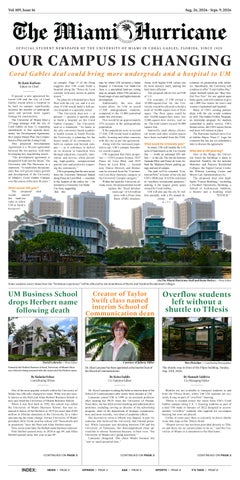
via The Miami Hurricane Staff and Brain Mulvey // Photo Editor Some students worry about how the “freshman experience” will be affected by the demolition of Hecht and Stanford Residential Colleges.
UM Business School drops Herbert name following death
Creator of Taylor Swift class named interim School of Communication dean
Overflow students left without a shuttle to THesis
David Lebowitz // Photo Editor
Courtesy of Juliette Miller
Wes Fleicsher // Contributing Photographer
Formerly the Herbert Business School, University of Miami’s Business School is being renamed after the removal of the Herbert name.
Dr. Alyse Lancaster has been appointed as the interim Dean of the Shcool of Communications.
The shuttle stop in front of the Flipse building. Sunday, Aug. 23rd, 2026.
By Rafaela Ochoa Contributing Writer
By Keira Faddis Co-Opinion Editor
By Hannah Valdivia Co-Managing Editor
One of the most popular schools within the University of Miami has officially changed its name. What was previously known as the Patti and Allan Herbert Business School is now just titled the University of Miami Business School. When it was first built in 1992, the school was called the University of Miami Business School, but was renamed in honor of the Herberts in 2019 for more than $100 million in lifetime donations to the University. In a video announcing the name change, former University of Miami president Julio Frenk said the school will “henceforth and in perpetuity” have the Patti and Allan Herbert name. Now, seven years later, the Herbert name has been removed. Patti Herbert passed away in 2020 at age 84, and Allan Herbert passed away last year at age 89.
Dr. Alyse Lancaster is taking the helm as interim dean of the School of Communication after nearly three decades at UM. Lancaster joined UM in 1999 as an assistant professor after earning her Ph.D. from the University of Florida. Since then, she has held several teaching and administrative positions, including serving as director of the advertising program, chair of the department of strategic communication, and most recently, vice dean of academic affairs. Her decision to come to Miami was shaped, in part, by someone who believed the University had limited potential. While Lancaster was deciding between UM and the University of Tennessee, her then-department chair advised her to choose Tennessee because, in their view, “the University of Miami isn’t going anywhere.” Lancaster disagreed. She chose Miami because she “saw so much potential here.”
Shuttles are not available to transport students to and from the THesis Hotel, where 140 UM students are currently living as part of “overflow” housing. THesis is located across the street from UM’s Coral Gables campus along U.S. 1, housing students as part of a deal UM made in January of 2022 designed to accommodate “overflow” students who applied for on-campus housing but were not placed. Unlike in years past, there is currently no direct shuttle route that stops at the THesis Hotel. “Shuttle service has not been provided directly to THesis and there are no current plans to do so,” said the University of Miami in a statement to the Hurricane.
CONTINUED ON PAGE 3
CONTINUED ON PAGE 3
CONTINUED ON PAGE 3
INDEX:
NEWS | PAGE 2
OPINION | PAGE 4
A&E | PAGE 5
SPORTS | PAGE 6
V’S TAKE | PAGE 8