COLLECTIBLES SPREAD (6-7)
EARNING COLLEGE CREDIT (4)
PERFORMATIVE MALES (2)
LAUFEY “A MATTER OF TIME” ALBUM REVIEW (9)
NEW ASSISTANT PRINCIPALS (11)
U NI N THE
October 2025 VOLUME XLII ISSUE I
MHSTHEUNION.COM FOR THE LATEST UPDATES
STUDENT VOICE OF MILPITAS HIGH SCHOOL
Phone policy restricts cell phone usage in classrooms By Marie De Vré
MHS has instituted a new phone policy in accordance with a new California law, Principal and Chief Innovator of MHS and New Campus Programs Greg Wohlman said. The law, known as the Phone-Free School Act, requires that by July 1, 2026, all schools need to restrict or prohibit the use of cell phones on campus, according to the official website of the California government. The law leaves it up to schools to regulate phone usage on their campus, Wohlman said. Some schools restrict phones altogether, while others try to restrict phones in a minimal manner by requiring students to simply put their phones away in their backpacks, Wohman added. The school tried to create a policy somewhere in the middle, he said. “They (students) can have it (their phones) outside of instructional time,” Wohlman said. “As soon as they walk into the class, it needs to go in the pouch, which is not lockable. People can set it in the pouch and do their school, their class, their course, and then when the bell rings, they can take their phone and make their way
to the other class. So that’s a good compromise.” So far, Wohlman has received positive feedback on surveys he has sent to teachers, he said. Based on widespread research, students will do better in school, both academically and socially-emotionally, with less phone use, he said. “We know it (the phone policy) is going to help students, and we know it’s going to help teachers,” he said. “So by having something in place now, we can find the adjustments we need to make, and our students will be more prepared when the deadline (July 1, 2026) comes.” Wohlman wants to hear how students feel about the phone policy, but right now the policy is in a transition period, he said. It’s hard to tell the full impact that the phone policy has had on classrooms since students are still adjusting to it, he added. “I want to give us more time because in the beginning, it’s like, ‘I want my phone, and I’m freaking out without my phone,’ but now we need to give it some time to get some school background in place,” Wohlman said. “So our students (say), ‘Yeah, it was hard
at first, but now it’s okay.’ We need to get enough time to develop that opinion, but students can still say, ‘I don’t like it at all.’ That’s okay, too.” If there is any pushback from individuals, his first step would be to have a conversation with that person and talk about the issue, Wohlman said. Exceptions to the phone policy, like those for necessary medical devices, are decided on a case-by-case basis, he added. “There can be medical exemptions honored, and we work with our parameters within a school about how to solve that,” Wohlman said. “It would be a very unique situation, but we’re working through those as they come.” In certain situations, students can use phones in class as long as it is related to the curriculum and with teacher discretion, Wohlman said. However, this does not mean that teachers get to allow regular phone use within their classrooms, he added. As of yet, this adaptation is not a schoolwide policy, Wohlman said. “There could be a one-off situation where teachers and students SEE PAGE 12
Marie de vre | The Union
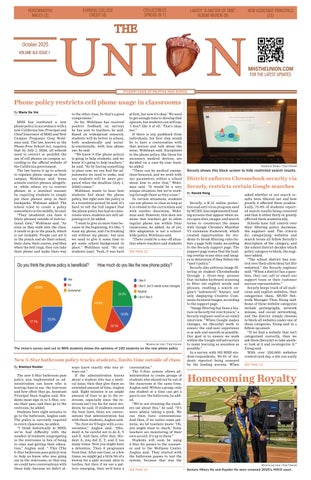
The Union’s survey sent out to MHS students shows the opinions of 192 students on the new phone policy.
New 5-Star bathroom policy tracks students, limits time outside of class By Sowmya Sundar
The new 5-Star bathroom pass policy was implemented so administration can know who is leaving class to use the restroom and how often they go, Assistant Principal Sean Anglon said. Students must sign in to 5-Star, create their pass, and then go to the restroom, he added. Students have eight minutes to go to the bathroom, Anglon said. The policy is currently required in every classroom, he added. “I think historically at MHS, we’ve had difficulty with the number of students congregating in the restrooms in lieu of being in class and getting their education,” Anglon said. “ This (The 5-Star bathroom pass policy) was to help us know who was going out in the restrooms, so that way we could have conversations with those kids, because we didn’t al-
ways know exactly who was always out.” If the administration learns about a student who has a medical issue, then they give them an extended amount of time, Anglon said. Eight minutes is an ample amount of time to go to the restroom, especially since the restroom isn’t too far for most students, he said. If students exceed the time limit, there are conversations that administration has with those students, Anglon said. “So, first we’ll begin with a conversation,” Anglon said. “(Student) A, be careful not to do X, Y and Z. And then, after that, Student A, you did X, Y, and Z too many times. Now you might have a detention. Then it progresses from that. After one time, or a few times, we might get a little bit of a leeway for a split second, akin to tardies, but then if we see a pattern emerging, then we’d have a
conversation.” The 5-Star system allows administration to create groups of students who should not be out of the classroom at the same time, Anglon said. Within a group, only one student at a time can get a pass to use the bathroom, he added. “We’re not stressing the teachers out about this,” he said. “It’s more admin taking a peek. We can then have conversations. And then, if we notice some patterns, we let teachers know: ‘Oh, you might want to check.’ Some teachers are monitoring of their own accord. It’s up to them.” Students will soon be using 5-Star for passes to the counselor and to the Wellness Center, Anglon said. They started with the bathroom passes to test the system, because that was the
Harold Hong | The Union
Securly shows this block screen to hide restricted search results.
District enforces Chromebook security via Securly, restricts certain Google searches By Harold Hong
Securly, a K-12 online protection and anti-virus program used by MUSD, has implemented loading screens that appear when users open sites, images, and search terms to counteract the issues with Google Chrome’s Manifest V3 extension framework, which created opportunities for students to break filtering rules before a page fully loads, according to the Securly support page. The support page states that the loading overlay scans sites and images to determine if they follow the “user’s policy.” Securly also enforces image filtering on student Chromebooks through a three-step process that includes keyboard scanning to filter out explicit words and phrases, enabling a search engine’s “safesearch” feature, and only displaying Creative Commons-licensed images, according to the support page. “Image filtering has been a feature in Securly for over 8 years,” a Securly engineer said in an email interview. “When Google makes changes, we (Securly) work to ensure the end-user experience is as safe and smooth as possible. Our goal is to ensure we work within the Google infrastructure to make learning as seamless as possible.” In a survey with 192 MHS student-respondents, 90.1% of students reported being annoyed by the loading screens. When
asked whether or not search results were filtered out and how greatly it affected them academically, 73.4% of students reported search results being censored and that it either fairly or greatly affected them academically. Schools have full control over their filtering policy decisions, the engineer said. The criteria for categorizing websites and search terms all follow Securly’s description of the category, and the school district decides which policy category to block, the engineer added. “The school district has control over their allow/deny list (for websites),” the Securly engineer said. “When a district has a question, they can call or email our support team or their customer success representative.” Securly keeps track of all malicious and explicit websites, then categorizes them, MUSD Network Manager Thao Xiong said. Some of these website categories include pornography, network misuse, and social networking, and the district simply chooses to block all websites under one of these categories, Xiong said in a follow-up email. “If we find a website that isn’t categorized correctly, then we ask them (Securly) to take another look at it and recategorize it,” Xiong said. With over 250,000 websites created each day, a site can easily SEE PAGE 12
Homecoming Royalty
Marie de vre | The Union
SEE PAGE 12
Seniors Hillary Ha and Kayden Ho were crowned 2025’s HOCO court.