CONTEMPORARY ART PRO/CON (2)
June 2026 VOLUME XLII ISSUE VI
U NI N COLLEGE SPREAD (6-7)
THE
RETIRING TEACHERS SPREAD (14-15)
BREAD SPREAD (10-11)
CINDY XU’S ART EXHIBIT (19)
MHSTHEUNION.COM FOR THE LATEST UPDATES
STUDENT VOICE OF MILPITAS HIGH SCHOOL
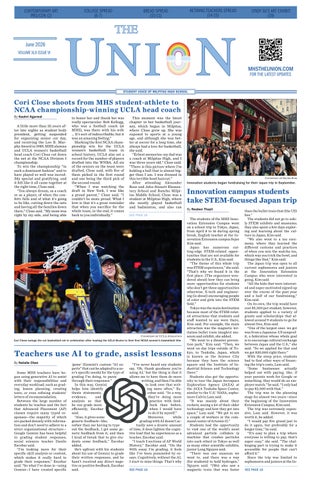
Cori Close shoots from MHS student-athlete to NCAA championship-winning UCLA head coach By Kashvi Agarwal
A little more than 35 years after late nights as student body president, getting suspended for organizing senior cut day, and receiving the Leo B. Murphy Award in 1989, MHS alumna and UCLA women’s basketball head coach Cori Close cut down the net at the NCAA Division I championship. To win the championship “in such a dominant fashion” and to have played so well was incredibly special and gratifying, and it felt like it all came together at the right time, Close said. “You always dream, as a coach or as a player, of when the confetti falls and of what it’s going to be like, cutting down the nets and having all the families down there,” Close said. “My mom was right by my side, and being able
to honor her and thank her was really spectacular. Bob Kellogg, who was a football coach (at MHS), was there with his wife … It’s sort of indescribable, but it was an amazing feeling.” Marking the first NCAA championship win for the UCLA women’s basketball team in school history, UCLA also set a record for the number of players drafted into the WNBA. All six of the seniors on the team were drafted, Close said, with five of them picked in the first round and one being the third pick of the second round. “When I was watching the draft in New York, I was like a proud parent,” Close said. “I couldn’t be more proud. What I love is that it’s a great reminder that when you sacrifice for the whole team, in the end, it comes back to you individually.”
This moment was the latest chapter in her basketball journey, which began in Milpitas, where Close grew up. She was exposed to sports at a young age, and although she was better at soccer for a long time, she always had a love for basketball, she said. “Erliest memories: my dad was a coach at Milpitas High, and I was three years old,” Close said. “There is this picture where I’m holding a ball that is almost bigger than I am. I was dressed in this terrible bowl haircut.” After attending Alexander Rose and John Sinnott Elementary School and Rancho Milpitas Middle School, Close was a student at Milpitas High, where she mostly played basketball and badminton, and also ran SEE PAGE 16
Courtesy of UCLA Athletics
Cori Close swings the cut basketball net in celebration after leading the UCLA Bruins to their first NCAA women’s basketball title.
Teachers use AI to grade, assist lessons By Natalie Chen
Some MHS teachers have begun using generative AI to assist with their responsibilities and everyday workload, such as grading, lesson planning, creating tests, or even refining students’ letters of recommendation. Between the large number of students he teaches and the fact that Advanced Placement (AP) classes require many typed responses—the majority of which are packed densely with information and don’t need to adhere to a strict organizational structure— Google Gemini has been helpful in grading student responses, social sciences teacher Danilo Escobar said. “I’m looking more for their specific skill analysis or content, which makes it really hard to grade their responses,” Escobar said. “So what I’ve done is—using Gemini—I have created specific
‘gems’ (Gemini’s custom “AI experts” that can be adapted to a user’s specific needs) for the type of grading I’m doing, to parse through their responses.” In this way, Gemini helps him identify thesis statements, evidence, and analysis so that he can grade more efficiently, Escobar said. “Also, it gives some generic feedback—like, rather than me having to type out the feedback, I get some generic feedback from it, and then I kind of tweak that to give students some feedback,” Escobar added. He’s upfront with his students about his use of Gemini to grade their written responses, and he hasn’t received any direct negative or positive feedback, Escobar said.
“I’ve never heard any students say, ‘Oh, thank goodness you’re using AI,’ but the thing is that it allows me to have them do more writing, and then I’m able to look over that writing more often,” Escobar said. “In a way, they’re doing more practice with feedback than before, when I would have to do it by myself.” Moreover, while grading with AI doesn’t actually save a drastic amount of time, it does lighten the cognitive load that he experiences as a teacher, Escobar said. “I teach 3 sections of AP World History,” Escobar said. “On the 90th essay I’m grading, it feels like I’ve been pummeled by essays. Cognitively, without the AI, I start to miss things. That’s why SEE PAGE 16
Courtesy of Sejee Kim
Innovation students began fundraising for their Japan trip in September.
Innovation campus students take STEM-focused Japan trip By Reuben Thayil
The students of the MHS Innovation Extension Campus went on a school trip to Tokyo, Japan, from April 8 to 16 during spring break, English teacher at the Innovation Extension campus Sejee Kim said. Japan has numerous cutting-edge STEM-related opportunities that are not available for students in the U.S., Kim said. “The theme of this whole trip was STEM experiences,” she said. “That’s why we found it in the first place. (The organizers wondered about) how they can bring more opportunities for students who don’t get these opportunities otherwise. E-tech and engineering (is about) encouraging people of color and girls into the STEM field.” Tokyo was the main destination because most of the STEM-related attractions that students and staff wanted to see were there, Kim said. For example, the main attraction was the magnetic levitation bullet train (maglev) museum and exhibit, she added. “We went to a disaster prevention park,” Kim said. “Then, we went on day trips outside of Tokyo, to Tsukuba, Japan, which is known as the Science City because they have the science square and the Institute of Industrial Science and Technology there.” Students also got the opportunity to tour the Japan Aerospace Exploration Agency (JAXA) at the JAXA Tsukaba Space Center, similar to the U.S.’ NASA, sophomore Calvin Lam said. “It was mainly about their rockets, seeing a lot of their older technology and how they got into space,” Lam said. “We got to see a couple of workers at the command center of Artemis II.” Students had the opportunity to visit one of the world’s most advanced particle colliders (a machine that crashes particles into each other) in Tokyo as well as many other scientific exhibits, junior Long Nguyen said. “There was one museum we went to, and there was a way (for students) to hold hydrogen,” Nguyen said. “(We) also saw a magnetic train that was faster
than the bullet train that (the US) has.” The students did not go to solely STEM exhibits and museums; they also spent a few days exploring and learning about the culture in Japan, Kim said. “We also went to a tea ceremony, where they learned the different customs and practices of when you mix the matcha tea, which way you trick the bowl, and things like that,” Kim said. The Japan trip was open to all current sophomores and juniors at the Innovation Extension Campus who were interested in going, Kim said. “All the kids that were interested and super motivated signed up over the course of the past year and a half of our fundraising,” Kim said. On its own, the trip would have cost $5,300 per student; however, students applied to a variety of grants and scholarships that allowed around 9 students to go for almost free, Kim said. “One of the largest ones we got was from a Japanese-US nonprofit, a federation whose whole goal is to encourage cultural exchange between Japan and the U.S.,” she said. “So we applied for that and we got $20,000 right there.” With the steep price, students had to find other ways of financing the trip’s costs, Lam said. “Some businesses actually helped out with paying, like, if your parents work for Google or something, they would do an employer match,” he said. “I only had to pay $2,500 with that.” The trip was in the planning stage for almost two years—since the beginning of the Innovation Extension Campus, Kim said. The trip was extremely expensive, Lam said. However, it was worth it, he added. “I would pay five grand just to do it again, but preferably for a longer time,” he said. “It’s easy to plan a trip where everyone is willing to pay; that’s super easy,” she said. “The challenging part is trying to make it accessible for people that can’t afford it.” Since the trip was limited to sophomores and juniors at the InSEE PAGE 16