Vol. 105 No. 1 October 2026
The student-run newspaper of McKinley High School
Established in 1920
McKinley Faces Drop in Funding Amid Enrollment Decline Honolulu’s high cost of living may be causing families to leave school district
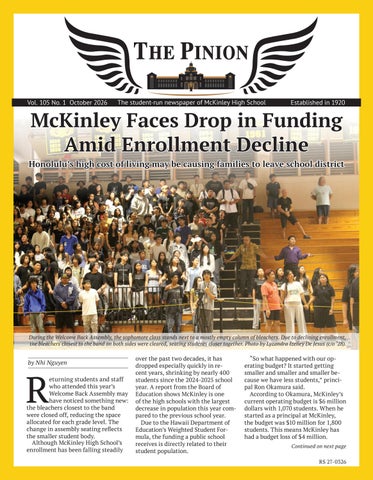
During the Welcome Back Assembly, the sophomore class stands next to a mostly empty column of bleachers. Due to declining enrollment, the bleachers closest to the band on both sides were cleared, seating students closer together. Photo by Lyzandra Izelley De Jesus (c/o ‘28).
by Nhi Nguyen
R
eturning students and staff who attended this year’s Welcome Back Assembly may have noticed something new: the bleachers closest to the band were closed off, reducing the space allocated for each grade level. The change in assembly seating reflects the smaller student body. Although McKinley High School’s enrollment has been falling steadily
over the past two decades, it has dropped especially quickly in recent years, shrinking by nearly 400 students since the 2024-2025 school year. A report from the Board of Education shows McKinley is one of the high schools with the largest decrease in population this year compared to the previous school year. Due to the Hawaii Department of Education’s Weighted Student Formula, the funding a public school receives is directly related to their student population.
“So what happened with our operating budget? It started getting smaller and smaller and smaller because we have less students,” principal Ron Okamura said. According to Okamura, McKinley’s current operating budget is $6 million dollars with 1,070 students. When he started as a principal at McKinley, the budget was $10 million for 1,800 students. This means McKinley has had a budget loss of $4 million. Continued on next page RS 27-0326
Vol. 105 No. 1 Editor-in-Chief Nhi Nguyen
Assistant Editor Rose Ganotisi
Newswriting 1 Alyx Castillo Abigail Draganescu Kayden Nakatsuka Olivia Schultz Nathan Shon Kea Walker
Photographer Kena Anien
Copy Editor Lillian Franco
Adviser Cynthia Reves Questions or comments? Interested in donating or advertising? Email cynthia.reves@k12.hi.us
Mission The Pinion strives to provide and maintain accurate, entertaining, and informative news for the students, staff, and alumni of McKinley High School. We strive to show dilligence in creating all our content so we can make a positive contribution to the public.
Publication Information The Pinion is published by the Newswriting class and printed by the Reprographics Learning Center. Find all content and more at mhspinion. com. Print archives are at issuu.com/ mhspinion.
The Pinion McKinley High School 1039 South King Street Honolulu, HI 96814 2 • THE PINION • OCT. 2026 • NEWS
Continued from pg. 1
property tax. Because over half of those living in Urban Honolulu are “Over the years, I’ve been able to renters, according to a report by absorb the losses, so I didn’t have the City and County of Honolulu, to cut teachers and programs,” increases in property tax could Okamura said. “But in the last two make living in the area more exyears we suffered just too many pensive for many. budget cuts.” Okamura said renovations in For this reason, positions and nearby public housing such as programs were cut for the first Mayor Wright Homes may also be a time in Okamura’s tenure. He cut cause of the enrollment decline, as 12 teaching positions and a few ofthey may have forced many famifice positions from last year. lies to relocate to other school disOne of the academies that suftricts. McKinley is a Title I school, fered a significant loss due to the which means a large percentage budget cuts was the Tiger Media of its students are low-income and Learning Center, which had its may rely on public housing. Digital Media pathway cut due to “Families are moving out. too low a number of students regThey’re moving out [to the] west istering for the classes within it. In side, and there’s nobody coming in the Graphic Tech pathway, classes to fill it because they can’t afford this year contain multiple levels at to live here,” Okamura said. once due to the smaller number of Franco said she believes some of students. This year, Graphic Tech the reasons for McKinley’s decline teacher Lacy Solis in enrollment may be teaches students that less young people from Graphics 1, 2 “There’s nobody are being born and and Directed Studmany people are moving coming in ... ies all in the same off island. A report from class periods. the University of Hawaii because they Lillian Franco Economic Research Or(c/o ‘27) had former can’t afford ganization says Hawaii’s Photography and population is aging rapto live here.” Digital Media idly, and by 2035, one in teacher Hailey - Principal Ron Okamura four people living in HaBaughman last waii will be seniors. Part year, who she said of the reason for this is was one of her favorite teachthat young people and families are ers. Baughman was one of the 12 moving out of Hawaii. An article teaching positions cut. Franco from the Wall Street Journal says described her as a nice teacher who Hawaii has the second-highest rate motivated her students in their of population loss compared to any work. other state, behind only Vermont. “I feel like her being cut was a More than half of all college gradumajor sadness to a lot of her stuates in Hawaii leave to the Maindents,” Franco said. “[It] just kind land U.S. because of Hawaii’s high of took away some of the atmocost of living, limited job market, sphere from our school.” and lack of growth in wages comOne issue Okamura attributes pared to price increases. the fall in enrollment to is the “There [has been] a trade off cost of living in the area. In the between local people and tourists. past decade, many high-rise condo That’s sad. I think we need more buildings have been constructed local kids here,” Franco said. in McKinley’s area, which he said Okamura said with the fall in are unaffordable for local residents enrollment, his work as a princiand have increased property taxes pal has become more focused on in Honolulu. An article published managing the school’s budget and by the MIT Center for Real Estate programs. He said his focus is on states renters take on the majorgiving students as many opportuity of the burden from increases in nities as possible with the school’s
limited budget. Okamura said one of the classes that ballooned in interest was art, but he had to cut the number of art teachers from four to two due to the funding cuts. Okamura said the classes and programs that stay are based on popularity, and so he pays close attention to which classes students gravitate to during registration. He said teachers will need to be able to market themselves and entice students to their subjects to ensure their classes can live on in the future. “We are trying to make sure that whatever we offer is quality,” Okamura said. “Whatever we offer is what students want. Whatever we offer is what teachers are excited to teach.” McKinley is not the only school suffering from a decline in enrollment; Hawaii as a whole has seen its overall enrollment drop. According to data from the Hawaii Board of Education,
38 public schools have had their enrollment fall by over 20% in the span of five years. The DOE has proposed redistricting to avoid closing schools. One school that has suffered similar losses is Kaimuki High School, which Okamura said had a population of about 1,300 students when he started working at McKinley, but it has now fallen to only 500. Science teacher Zoe Smith said she has some general concerns about the downwards trend of McKinley’s enrollment. “If this trend continues moving forward, what’s going to happen to the school?” Smith said. “I don’t want a similar thing to happen over here.” Despite concerns around funding the decrease in students has caused, Smith sees some silver linings. Smith was a freshman science teacher last year, but she started teaching marine biology after the number of freshman
academies this year was reduced from three to two due to the drop in enrollment. Smith said teaching marine biology has been different from her previous years teaching freshmen, because she feels the students are more familiar with each other because of the smaller class size. “I think it’s a little bit less intimidating to get to know your peers when there’s fewer of them,” Smith said. She said although it is unfortunate students will have less resources this year, she believes the smaller population has created more of an emphasis on community and the non-academic side of schooling, and will give students more opportunities to get to know each other. “Even though the community is getting smaller, it’s still a good community to be in,” Smith said.
Tigers Kick off School Year with Welcome Back Assembly by Rose Ganotisi, Alyx Castillo, and Olivia Schultz
Principal Okamura opens the assembly with a welcome message encouraging students to show Tiger Pride this school year. Photo by Kena Anien (c/o ’27).
O
n Aug. 7, McKinley High School students gathered in the gym for the annual Welcome Back Assembly. A major change in assembly seating due to the smaller class sizes was established at this first assembly. Students were asked to sit in the first three sections of the gym bleachers closest to the wrestling room side, leaving the last two sections of bleachers on the opposite side of the gym empty. Principal Ron Okamura’s opening welcome message emphasized the point that even though the student body is distinctly smaller this year, students can make up the difference with their spirit and Tiger Pride. “As you participate throughout the year, and as you come to school every day, we ask you to do things your teachers ask you to do, good things, and we expect you to work doubly hard so that we look like we’re full again in this gym,” Okamura said. This change in the close seating led to some mixed opinions. Some stu-
dents and teachers like how it brings students closer and makes assemblies more unified, while others complain of body heat and the discomfort of sitting close together. Kaia Matsuoka (c/o ‘28) said, “I like it because it feels more inclusive but it is really cramped, especially since the junior class is pretty big and with backpacks on top of that.” After Okamura spoke, the school counselors were introduced. Shane Cummings spoke on behalf of all the student support counselors. He encouraged students to visit their counselors whenever they need because the counselors are there to support each and every student during their high school years. The vice principals and security were then introduced, followed by introductions from the class officers for each grade level. After the introductions, the student body government did a fashion show to display the merchandise available for purchase in the Tiger Locker, including clothing Continued on next page NEWS • OCT. 2026 • THE PINION • 3
Continued from pg. 3
Leila Ragasa (c/o ‘27) shows off a shirt while holding two other items sold at Tiger Locker, a sweatshirt and a tote bag. Photo by Kena Anien.
items, lanyards and folders. The new Student Activities Coordinator and former vice principal, Natasha Taketa-Kim, experienced leading and coordinating the Welcome Back Assembly for the first time even though she has attended Welcome Back Assemblies for the past 16 years as an audience member. “I get to see the ebb and flow of different years. This year the students seem quite energetic,” she said. Taketa-Kim said she can see a difference in spirit between this school
year and prior years. “[The freshmen] sound like a class that is together, and might give the upperclassmen a good run for their money,” she said. Taketa-Kim said she would love to continue seeing students having school pride through traditions that happen on campus throughout the year. She said she hopes students will achieve unity and be proud to say they are a McKinley student. The executive student council members shared their goal for this school year, which is to boost positivity at school. The school activities they are planning for the year will be focused around this goal. “[Let us] go ahead and concentrate our energy toward a positive direction, so that we can all have a wonderful year together,” Taketa-Kim said. A video was played in the assembly with a variety of teachers’ messages to students regarding this school year. The teachers shared their advice, hopes, and goals encouraging students to try their best and put in the effort this year academically and socially to make it a great year for everyone. To promote class spirit, there were multiple grade level class competitions throughout the assembly. The classic game of musical chairs was won by the juniors and a new game called Snatch the Wig was won by the
Gregory Givens (c/o ‘27) faces off against players in other grades in a game of Snatch the Wig. Photo by Kena Anien.
sophomores. For the Spirit Challenge, the seniors came in 1st place, freshmen 2nd, juniors 3rd, and sophomores 4th. New to McKinley’s Welcome Back Assembly activities, Avish Arzaga (c/o ‘30) said she was surprised and happy freshmen got 2nd place in the Spirit Challenge. She said it would have been nice to win 1st, but “it’s okay because we love the seniors.” Dania Hauk (c/o ‘27), a veteran when it comes to Welcome Back Assemblies, described this Welcome Back Assembly to be an emotional milestone. She said knowing this was their last ever Welcome Back Assembly, “felt so nostalgic because I knew that this moment would all soon be memories that I will look back on.”
Submit creative work to the literary magazine!
The JROTC Color Guard presents colors for the singing of the Alma Mater and Hawai‘i Pono‘i. Photo by Kena Anien. 4 • THE PINION • OCT. 2026 • NEWS
International Teachers Bring New Energy to School Year by Rose Ganotisi This year at McKinley High School, there are only two new teachers. They were added to the staff to teach in the social studies department and they are both from out of the country. These two educators bring cultural experience, energy and new perspectives to the school community. The two new teachers are Dessa Mae Bontia and Jeca Guarin, both from the Philippines. They were granted J-1 visas through a teaching program, allowing them to reside in the U.S. to teach and participate in cultural exchange. The U.S. Citizens and Immigration Services website explains that a J-1 visa is a non-immigrant U.S. visa issued to individuals participating in approved work and study based BridgeUSA exchange programs designed for cultural and education exchange. Principal Okamura said when he first posted the vacancy announcement for any certified teachers interested in the two social studies openings, there were 32 applicants. “Surprisingingly for the first time in my career I think, we’ve had that many applicants,” he said. Okamura said most of the applicants were seeking J-1 visas from a variety of places, including the Philippines and Nairobi, while others were local residents attending UH Mānoa. Okamura said he hired Bontia and Guarin because they were the best qualified out of all the applicants. Bontia said she first learned about opportunities to teach in the U.S. through a program for Filipino teachers. A colleague who was already teaching on Maui gave her advice on how to apply specifically to schools in Hawaii. After being accepted by the Hawaii Department of Education, Bontia applied to schools with open
positions and was hired at McKinley. Due to necessary paperwork, Bontia could not start working until the end of August but she said her experience working at McKinley so far has been enjoyable and gratifying. “I can feel the history and tradition of the McKinley community in this short time I have been teaching so far,” she said. “The students, faculty and teachers are all great too.” Bontia said she hopes to get involved with Filipino-based activities while she is teaching at McKinley, such as the Filipino club. As part of the program she is in, she is expected to share her culture with students and the McKinley community while also learning from the U.S. American education system. “I hope to contribute, and if they need help in the Filipino club, I will probably volunteer myself,” she said. The other new teacher, Guarin, said she has always been interested in teaching abroad for professional growth and development as well as to simply experience new things. “I’m an adventurer; I don’t like to be stagnant. I like to experience new cultures, try to teach different kinds of students and see different ways of life from different parts of the world,” Guarin said, explaining why she came to the decision to teach in the U.S. She said she feels fortunate to be hired at McKinley in Hawaii because Hawaii’s weather and people are similar to the Philippines. At first, Guarin said she had a lot of doubts about starting her job, because of what she had heard about the differences between students in America and the Philippines, which made her worried about adjusting. However, so far, she said the students at McKinley have been good and that she really likes them. “Here, the students listen to the teachers and respect the teachers.
Jeca Guarin and Dessa Mae Bontia in Bontia’s classroom located in upper F building. Photo by Rose Ganotisi (c/o ‘28).
That’s why I’m so lucky to be here,” she said. Social studies department chairman, Jonathan Loomis played a key role in the hiring and interviewing process for these new teachers. Here said that while interviewing them, he found both teachers to be outgoing and cheerful. “They are the kind of teachers our students would like to be around,” he said. After conducting online interviews and several other virtual meetings, Loomis met Bontia and Guarin in person for the first time at the airport the weekend before school started. He said he felt relieved when he met them because they were exactly what he expected. “I was feeling very happy and just like “yes, we got the right people,” he said. At the airport, Loomis and his wife met the pair of teachers outside with welcome signs made by McKinley students. Loomis said he felt like it was important to greet them in this way because in his personal experience traveling, people have always welcomed him warmly. He said having people waiting for you at the airport with signs makes you feel good so he wanted to ensure the two teachers had this experience. Loomis said he admired the teachers for having the confidence to move to a different country and begin teaching in a new environment. “I just wanted them to know we’re excited to have them here,” Loomis said. “Let them know their colleagues, the teachers around them, are rooting for them and are happy to have them here.” NEWS • OCT. 2026 • THE PINION • 5
Hot Temperatures Interfere with Class Learning by Alyx Castillo
T
oo hot to learn? Well, for some McKinley High School students, the heat is more than an uncomfortable classroom experience; it interferes with their ability to focus. Kenny Nguyen (c/o ‘29) said he has a hard time concentrating in classrooms without air conditioning. Nguyen said he feels sluggish and the heat negatively impacts the amount of effort he puts in his work. “We are just stuck in the heat. This affects academic performance;” Nguyen said At McKinley, 55% of classrooms have no air conditioning, making students and teachers rely on fans and windows to keep these classrooms cool. Nguyen said he finds ways to cool off when he has classes without air conditioning. He said he relies on wind from the windows. When there is no wind, he tries to find a nearby fan, but some classes have no fans, making him stuck in the heat. Nguyen said he believes adding air conditioning would improve overall performance and mood in his classes. Teachers try to combat heat conditions in their classrooms, from having windows open to using electric fans to cool their classrooms. Shaun Kamida, a social studies teacher, is hoping to learn from a presentation the teacher union is planning that will address hot classrooms, especially humidity. He said he hopes to learn “what we could do to help students feel a little bit more comfortable as well as ourselves.” For now, however, he has to rely on ordinary methods to keep his classroom cool, such as keeping his windows open, which presents problems of its own. 6 • THE PINION • OCT. 2026 • NEWS
McKinley High School Classes With AC vs. Without AC
Rooms with AC Rooms without AC
45%
55%
Graph showcasing most McKinley’s classrooms have no air conditioning compared to classes with air condition. Infographic by Alyx Castillo (c/o ‘28).
“It’s a catch-22. You have stuff blowing all over or you close the windows in. It’s really, really hot otherwise,” Kamida said. Kamida said he notices when it gets hotter, it affects the overall energy of the class, especially in the afternoon periods. He sees that his students are tired. “The energy gets zapped out of people,” he said. Principal Ron Okamura said there are a lot of factors to consider for the implementation of air conditioning. The biggest issue McKinley has is its electrical capacity. To air condition all classes, McKinley needs an entire electrical upgrade, which is not cheap and funding needs to be requested from the legislature. Okamura was told two years ago there was an initiative to add air conditioning to all the classrooms because they had the extra money. “Great. You know I’m jumping up and down, right?’ Okamura said, “And one by one they started going ‘Well, I can’t do that. I can’t do that.’
And basically a lot of it came from the power issue.” He said within a month, the project went from the “entire campus” to five classrooms. Those five classrooms are in F Building. Okamura said that because the electric room is near F building “it was the closest and the easiest to upgrade the power to get the ACs there.” Okamura has considered other options to equip the entire school with air conditioning. Okamura inquired about getting solar air conditioning for McKinley, as West O’ahu schools had a whole industry using solar air conditioners. These air conditioners were hooked up to classroom window units. However, Okamura said there was a problem with this product and within a year, they all broke down. This problem with the heat is not only for McKinley, but for the island of O’ahu as well. A 2024 report from the Office of Climate Change, Sustainability and Resiliency from the City and County of Honolulu reported
the number of hot days doubled from 2016 to 2020. The CCSR recognized this as a climate change hazard for O’ahu, and created an action plan to cool neighborhoods for environmental, economic and health benefits. The Hawaii Department of Education attempted to implement their own solution of cooling schools. According to the Hawaii State Auditors report released in August 2025, public and political pressure made the HIDOE act quickly to implement Governor David Ige’s Cool Classrooms Initiative to cool 1,000 classrooms with air conditioning by the end of 2016. The DOE installed solar-power air conditioning systems to cool classrooms, which the state auditor found were costly and often ineffective. HIDOE also considered other approaches to reduce classroom heat such as improving natural ventilation and adding shade. However, the audi-
tor found that these approaches were discarded as the department pursued air conditioning because of Ige’s Cool Classrooms Initiative. Kamida said he felt disappointed about the DOE’s not meeting their 2016 goal of implementing air conditioning their classrooms. He said the teachers’ union is going to bring that up to the Department of Education to try again to implement air conditioning, and address issues on why the original goal failed. In a Pinion interview with United States Senator Brian Schatz, he recognized and supported a comfortable environment for student learning, but noted that his federal role has limits. When Schatz was asked a question regarding heat in the classroom, he immediately acknowledged how hot it was in The Pinion’s classroom. “...it’s too hot in here. And it’s not reasonable for you guys to try to stay focused when you’re dealing with the heat,” he said.
Open windows in Jonathan Loomis’s F-building classroom keep the classroom cool throughout the school day. Photo by Alyx Castillo (c/o ‘28).
Schatz acknowledged students deserve a quiet comfortable place to learn. However, he said it is the state government’s job to add air conditioning into classrooms. Schatz said air conditioning schools should be a priority since it is hotter than usual and previous methods of cooling are ineffective. “A lot of these buildings assume tradewinds were going to come through and cool everybody off and this is not the case anymore,” Schatz said. McKinley’s principal remains positive despite all the problems he has encountered in trying to cool the classrooms. Okamura continues to explore different options for improving classroom conditions for students “Hopefully within the next couple of years, maybe, [we] will have enough of a whole electrical upgrade and we are able to add AC to all of the buildings,” Okamura said.
Freshman English teacher Jordin Carmichael’s room on the bottom floor of F-building, which has air conditioning. Photo by Alyx Castillo (c/o ‘28) . NEWS • OCT. 2026 • THE PINION • 7
Students Adjust to Statewide Phone Ban by Abigail Draganescu For many McKinley High School students, checking their phones throughout the school day used to be an ordinary part of their routine. Whether it was checking the time, looking at social media, or listening to music, phones were always within their reach. Now, students are getting used to going through their school days a little differently. The Hawaii Department of Education issued a statewide phone ban that took effect at McKinley High school this August. The policy requires students to keep their phones put away during instructional time in an effort to reduce distractions and encourage students to focus in class. Since the policy took effect, students have been adjusting to spending time without the phones they were once able to use throughout the entire school day. Hannah Lastino (c/o ‘27) said when the phone ban was first announced she was unsure of what the new rule would mean for her. As she got used to keeping her phone put away during class, she began to notice a difference in how she experienced the school day. Without her phone nearby, she found herself paying less attention to the clock and becoming more involved in what she was doing. “It definitely made time in class way faster because I’m not constantly checking the time,” Lastino said. For Lastino, not having her phone throughout class has brought productivity and more engagement toward her work. Instead of the temptation to reach for her phone when free time
192 student respondents to a survey conducted by The Pinion said:
is given, she has the opportunity to engage with classmates and grow new connections. Rose Ganotisi (c/o ‘28), a mentor in the Newswriting class, said there are certain situations where having a phone would be helpful, especially when students are conducting interviews. “Our adviser helped us adapt to make a policy for Newswriting to use
Rose Ganotisi (c/o ‘28) uses her phone for Newswriting work. Photo by Kena Anien.
our phones during class if we’re using it for schoolwork and Newswritingrelated work, such as interviews,” Ganotisi said. Otter is one of the tools The Pinion journalists use to record interviews in Newswriting. Even though students cannot use their phones during instructional time, Ganotisi said she worked with the Pinion’s adviser, Cynthia Reves, to come to a compromise. This is one of the situations where the policy has required
students to adjust from how they normally complete their work. She said that it can be difficult when students need to access information or tools that are only available on their devices, so working it out with the adviser and coming up with a solution was necessary. Even with these challenges, Ganotisi said the policy can be managed. Students can use their computers for many of the tasks they need to complete, and they can plan around situations where a phone would be useful by asking for permission from the adviser. The phone policy has also changed how some students interact with each other. Without phones and earbuds being used during class, students have more opportunities to communicate face to face. For some students, this has made it easier to start conversations and interact with classmates. Noli Marcos (c/o ‘29) said he has observed that the phone policy has changed the way students spend their time during class. Without their phones to turn to, students have more opportunities to pay attention to the people around them and interact with their fellow peers. “Since phones are not allowed during class hours, it’s easier for people to communicate,” Marcos said. Marcos also said he noticed students who are usually shy seem more willing to step out of their comfort zones to talk to others. He said he believes the change gives students a chance to develop social skills that can help them beyond the classroom. Marcos observed that when stu-
The phone ban has been helpful and I’ve seen improvements in my learning. I’ve experienced little to no problems adapting to it. The phone ban has been okay and I understand how it’s beneficial to me. I’ve experienced some difficulties but I’ve moved past them. The phone ban has been difficult to adjust to and hasn’t really helped me so far, but I can somewhat tolerate it. The phone ban hasn’t been helpful and I struggle to not be allowed to use my phone.
8 • THE PINION • OCT. 2026 • NEWS
dents are not looking down at their screens, they have more chances to engage in conversations, ask questions, and share interests. For students who may normally spend quiet moments on their phones, Marcos said the policy has created more opportunities to interact with the people around them. The policy also encourages students to become more aware of how
often they rely on their phones. Something as simple as the lack of headphones can build an image of approachability creating new found friendships with the most unlikely of people. For students who have had their phones as part of their daily routine for years, putting them away during class is a significant adjustment. However, McKinley students are
showing that the change doesn’t have to completely disrupt their school day. They are finding other ways to stay occupied, complete their assignments, communicate with classmates, and enjoy the year. “It’s my senior year, so I get to enjoy it more, and I’m not glued to my phone,” Lastino said.
Phone Ban Keeps Teaching on Track by Olivia Schultz McKinley’s phone ban is reshaping classroom instruction. Some teachers report improved student focus, while others rely on phones as practical tools for specific assignments. Teachers are finding ways to uphold the policy with the distinct needs of each classroom. Spanish and art teacher Cecilia Cardone said her first reaction to the policy. “How are we going to put in play realistically?”. Cardone initially questioned how the phone ban could be realistically enforced in the classroom, since students can find it difficult to put their phones away. She describes students’ attachment to their devices as contributing to classroom distractions. As school days went by Cardone said she noticed a difference in students’ classroom engagement than what she had initially expected. Cardone has seen students become more engaged when their phones are put away.
28 faculty respondents to a survey conducted by The Pinion said:
“They work way better. They’re way more focused on their work… it’s a huge improvement,” Cardone said. It is a constant reminder to put their phones away which help students focus more closely on their work and produce better results. English teacher Alicia Ruiz-Laufer said enforcement has been easier than expected in her room. Ruiz said the phone policy’s effects are mostly positive. “I feel like students will be able to be more, interact far more, not be as, you know, kind of always feeling they have to check something,” Ruiz said. She has already noticed students interacting more during group activities and transitioning to the next smoother ever since implementing the policy. Ruiz said she hopes these habits will help students stay focused and present beyond the classroom. “I think it’s been a lot better for saving class time, instructional minutes,” Ruiz said. Ruiz said she spends less time interrupting lessons to remind students to put their phones away. As a re-
sult, more class time can be used for teaching and classroom activities. English teacher and Pinion adviser Cynthia Reves, said the phone ban creates specific challenges in The Pinion class for journalism tasks. “The phone is super convenient and easy. You have it with you all the time,“ Reves said. She said her students could also use Chromebook, digital recorders, cameras, but phones reflect the tools that professional journalists use. Reves said McKinley’s policy is flexible enough that she can have her students use it for educational purposes. “We’re going to continue to use the things on our phones in this class that professional journalists use,” Reves said. “And we will see if it’s adistraction, then maybe next semester year or even second semester, we might make some changes, but so far it feels okay with me.” Principal Ron Okamura encourages the McKinley community to give the policy time. “I think give the phone ban an opportunity to work,” he said.
The phone ban is easy to implement and students are improving in engagement. The phone ban is slightly easy to implement and students are improving in engagement. The phone ban is easy to implement but students need a reminder. The phone ban is not beneficial and does not work at all. NEWS • OCT. 2026 • THE PINION • 9
Pinion Celebrates 106th Year by Kea Walker
Olivia Schultz (c/o ‘27) and Abigail Draganescu (c/o ‘30) discuss their questions before interviewing principal Ron Okamura about the statewide school phone ban. Photo by Kena Anien.
S
tudents in McKinley High School’s Newswriting class are learning how to report on important topics, conduct interviews and turn information into articles for The Pinion. The Pinion is the school’s studentrun news publication, giving students the opportunity to learn journalism while reporting on topics relevant to their school community. There are nine students on The Pinion staff this year. Throughout the year, those students work together to gather information and turn their findings into stories for The Pinion. The first Pinion was published 106 years ago on Oct. 14, 1920. This year’s Pinion will be Volume 105 because there was one year in the 1930s that no Pinion was published. Now, in 2026, according to Pinion adviser Cynthia Reves, The Pinion continues to serve two main goals. “One goal is the same goal that any journalistic outlet would have. It is to provide information to our audience, information they need to know, infor10 • THE PINION • OCT. 2026 • NEWS
mation they want to know, the story of our school,” Reves said. She started advising The Pinion in 2010. Reves’ started in high school and continued her passion for journalism through college, where she majored in journalism. Through her experience and knowledge, Reves helps students learn the skills needed to research, interview, write and publish news stories. Along with informing the school community, the class provides students with hands-on experience in creating and publishing news. Reves said, “The second (goal), since we are a school, is for young people to learn about journalism, what is involved in journalism.” Students not only learn what journalists do, but also interact with members of the school community so they can better understand the role of journalism. The Pinion aims to build trust between journalists and the community they serve. “A lot of people think that journalists can’t be trusted, and I think it’s because they don’t understand what journalists do,” Reves said. Through reporting, interviewing and connecting with others, students in Newswriting learn the responsibility that comes with sharing information with an audience. Nhi Nguyen (c/o ‘27) is the editorin-chief of The Pinion. She’s been active in The Pinion for four years. She helps and contributes to The Pinion in many ways, including designing the new banner for The Pinion. Nguyen said, “[A] critic thought our banner didn’t really look like it belonged to a modern newsmagazine, and it took up too much space.” She said she also wants to redesign it so the new banner can be altered to “fit more sizes and formats, for marketing and such.” Nguyen said she hasn’t started on anything yet, but she should have it finished in the third quarter. Another change The Pinion has made is switching to publish three rather than four print issues this year.
Nguyen said the reason for that is so they have time to include events that happen later in the quarters. She also said doing so will allow The Pinion to work on more online-focused projects during the 4th quarter. “There are a lot of things we haven’t been able to do in the past, like improve our website or film videos or make podcasts, and I hope we’ll be able to this year,” Nguyen said. As editor-in-chief, Nguyen strives to fulfill the mission of “bringing quality news to The Pinion.” Nguyen said she believes The Pinion is very student focused, “Actually most of it is revolving around the students because students, they write the articles and they help other students know how to become journalists in the case of editorial board.” She said the adviser mainly just helps ensure that everyone remains on track with their responsibilities. Some of those responsibilities include meeting deadlines, conducting interviews, writing and organizing stories, gathering accurate information, helping other student journalists and publishing articles. Principal Ron Okamura said he supports the school offering Newswriting as an elective class because it provides a venue for students to “ask the questions they’re afraid to ask in class.” He said Newswriting gives students the opportunity to dive deeper on a topic they’re interested in inside the community. “It gives you the proper way to ask questions on things that you want to know,” he said. Buy a mystery pouch in W123. 1 for $6, 2 for $10.
McKinley Journalists Meet U.S. Senator Brian Schatz by Kayden Nakatsuka
U.S. Senator Brian Schatz speaks to Newswriting and Yearbook students in WI23 during an Aug. 27 interview. The topics Schatz addressed included climate, housing, and his work as a senator. Photo by Kena Anien.
Pinion editor-in-chief Nhi Nguyen interviews U.S. Senator Brian Schatz. Photo by Kena Anien.
S
enator Brian Schatz came to McKinley High School for a press conference with The Pinion. Schatz is one of two senators representing Hawaii in the U.S. Senate. Schatz told the student journalists he wanted to get into politics because of the climate. Schatz said he wanted to visit McKinley to hear the voices and thoughts of young journalists because he said he believes young journalists ask better questions compared to the professionals where they are just saying “jargon.” “Why would I want to talk to you guys? Because your questions are usually better than professional adult journalists... that sounds like a lie that’s designed to, say, make you like me, but it’s actually true,” Schatz said. Cynthia Reves teaches Junior ELA and Newswriting 1-4. Reves coordinated the visit with Schatz and his team. She said she likes having guests visit the newsroom. “My student journalists prepare really thoroughly and so they end up looking very impressive and professional and it makes me proud,”Reves said Nhi Nguyen (c/o ‘27) is in Newswriting 4 and did the majority of the interview with Schatz, while
the rest of the students from Reves’ Newswriting class and Francis Vilar’s yearbook class sat around Nguyen and Schatz watching the interview. Nguyen said she thinks the McKinley community should know more about how politics play a huge role in their lives and that they should pay close attention even to things they think don’t concern them. “It really impacts a lot of our lives.. Those kinds of decisions really kind of shape our lives, even as students,” Nguyen said. Angilie Nerbes (c/o ‘29) is in Vilar’s yearbook class. Nerbes said she was glad she got to see a senator’s perspective and believes a senator should be active in the local community. “If you become a politician you’re basically working for the people of the future, so I thinks it’s really good to talk with the people that are going to be a part of that future,” Nerbes said Nguyen ended the interview as Pinion journalists end all interviews, by asking if the senator had any last words. He said he was a little afraid that everybody’s got this idea that “politics is for those corrupt jerks.” He said if everyone thinks that about the profession, then a young idealistic person who wants to help is going to say, “Well, I am nice, I am honest, so I won’t go into politics.” “And we need as many nice and honest people going into politics as possible,” Schatz said.
McKinley High School Vision and Mission At McKinley High School we: - Inspire a passion for learning and a perseverance for excellence. - Prepare to meet the challenges of the world. - Promote compassion, integrity, and responsibility. Newswriting 1 student Nathan Shon (c/o ‘30) takes notes in his reporter’s notebook during the interview with U.S. Senator Brian Schatz. Photo by Kena Anien.
President William McKinley High School is committed to enriching students’ experiences through authentic education opportunities and maintaining a community of mutual respect. We empower students to embrace learning and become engaged citizens. NEWS • OCT. 2026 • THE PINION • 11
I Have Something to Say... Opinion briefs by Pinion journalists Name-calling at graduation by Olivia Schultz McKinley High School prides itself on a unique graduation format, but the time has come to reconsider this approach and formally implement individual name calling at commencement ceremonies. With a graduating c/o ‘27 of under 200 seniors, extending our brief ceremony is a minor adjustment that families and students would gladly support to honor 12 years of dedication. McKinley is known for being the only high school on the island that skips individual name-calling at graduation, all for the sake of “graduating as one.” True solidarity shouldn’t mean erasing who we are as individuals. We are already deeply united. We prove that every time
we sing our Alma Mater and Black and Gold. True unity isn’t weakened when we take a second to recognize each other’s individual journey. In fact, it gets stronger when we celebrate the different struggles, personal growth, and independent goals each student strove for to reach this milestone. A typical McKinley commencement is uniquely short, often lasting less than an hour. Given that this year’s graduating class is smaller, calling every name on stage to lengthen the commencement would ensure that every single Tiger is properly and individually recognized.
Movement during 20/20 by Rose Ganotisi I think there should be clearer rules regarding student movement during 20/20. This would give students and faculty a shared understanding of when movement is allowed and help make the policy more consistent. Currently, students are expected to stay in their assigned classrooms during 20/20, but the rules are not always enforced the same way. Some teachers allow students to visit other teachers for academic reasons, while others do not allow students to leave their classrooms at all. This can make it difficult for students to know what they are and are not allowed to do.
Clearer guidelines could help prevent students from wandering around campus while still allowing movement when it is necessary and approved. Students who need to move to another location during 20/20 are supposed to receive principal approval before doing so. The school could clearly explain when students are allowed to leave their assigned classroom, what reasons qualify and how students should receive approval. Having one clear procedure would make expectations easier for students, teachers and security staff to understand and enforce.
Pacific Storms by Nathan Shon I think that the reason why there are so many hurricanes occurring in the Pacific right now is because of global warming and climate change. There has been a lot of air pollution caused by people for many years, and all of that air pollution goes up into the ozone layer, making holes in it. This results in rising temperatures and environmental changes all over the world. When there are holes in the ozone layer, more heat from the sun comes
through our planet’s atmosphere, making temperatures rise noticeably high, especially in tropical locations such as Hawai’i and other Pacific Islands since they are near the equator. The more heat and warm moisture that builds up in the air above the ocean, the more it will start forming water droplets that could form thunderstorms or even hurricanes.
Read more briefs posted weekly on The Pinion’s Instagram @mhspinion! 12 • THE PINION • OCT. 2026 • OPINION