Vol. 104 No. 3
The student-run newspaper of McKinley High School
Established in 1920
Celebrating McKinley’s Future: 160 Years of Pride and Tradition by Cheska Orias
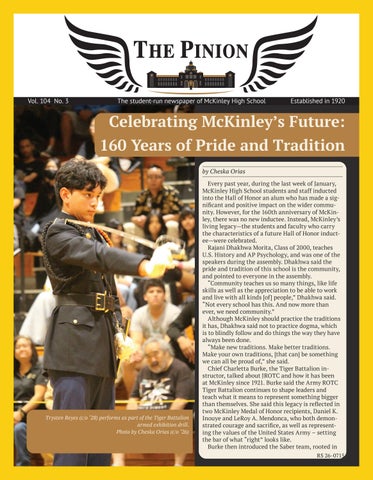
Trysten Reyes (c/o ‘28) performs as part of the Tiger Battalion armed exhibition drill. Photo by Cheska Orias (c/o ‘26)
Every past year, during the last week of January, McKinley High School students and staff inducted into the Hall of Honor an alum who has made a significant and positive impact on the wider community. However, for the 160th anniversary of McKinley, there was no new inductee. Instead, McKinley’s living legacy—the students and faculty who carry the characteristics of a future Hall of Honor inductee—were celebrated. Rajani Dhakhwa Morita, Class of 2000, teaches U.S. History and AP Psychology, and was one of the speakers during the assembly. Dhakhwa said the pride and tradition of this school is the community, and pointed to everyone in the assembly. “Community teaches us so many things, like life skills as well as the appreciation to be able to work and live with all kinds [of] people,” Dhakhwa said. “Not every school has this. And now more than ever, we need community.” Although McKinley should practice the traditions it has, Dhakhwa said not to practice dogma, which is to blindly follow and do things the way they have always been done. “Make new traditions. Make better traditions. Make your own traditions, [that can] be something we can all be proud of,” she said. Chief Charletta Burke, the Tiger Battalion instructor, talked about JROTC and how it has been at McKinley since 1921. Burke said the Army ROTC Tiger Battalion continues to shape leaders and teach what it means to represent something bigger than themselves. She said this legacy is reflected in two McKinley Medal of Honor recipients, Daniel K. Inouye and LeRoy A. Mendonca, who both demonstrated courage and sacrifice, as well as representing the values of the United States Army – setting the bar of what “right” looks like. Burke then introduced the Saber team, rooted in RS 26-0715
JROTC instructor at McKinley High School. This is proof of progress, and that leadership has no limits.” Burke stood in proxy of Lieutenant Colonel Manuel Pulido, who is a McKinley alumnus of the Class of 1990. Burke read a message from him, reminding cadets and the Tiger Battalion that it is not just about tiger pride, or being better than someone else. Rather, it is about being better than yesterday and taking care of one another. “It is that quiet confidence that comes from discipline, hard work and knowing that you’re part of something bigger than yourself,” Pulido said in the message. Burke said Pulido teaches the traditions that are connected through every generation of tigers, and the standard we uphold today. Burke adds that he demonstrates pride and honor, as well as serving and leading the Cadet Lieutenant Colonel Amara Auro (c/o ‘26) leads the armed exhibition drill cadets. “Know that you’re not just passing through after Chief Charletta Burke’s speech. Photo by Cheska Orias (c/o ‘26) McKinley. You are the next chain. You are the future. You are McKinley,” Pulido said. the army cavalry tradition. The saber represents honor, “I serve and give back because I get to work alongside an precision, discipline and leadership. incredible team. My goal is to be a spark of joy, a steady “It is not just ceremonial. It is the reminder that how conduit of knowledge, information that can be shared you move, how you lead, and how you carry yourself matwithout bias or agenda, to help broaden your perspectives, ters,” Burke said. understanding, and opportunity for every student that is In the early years of the JROTC program, female stuentrusted to us.” dents were not allowed to enroll, or have female teachers Imialoa’a Richardson, Class of 1998, teaches Modern instruct the program. Despite this, young women found History of Hawaii and Participation in Democracy. He ways to be a part of the mission through auxiliary ROTC said he was lucky enough to win the Oahu Interscholastic sponsor groups, which [provided support, guidance and Association (OIA) championship right on the gym floor of mentorship to cadets]. Burke said the first sponsor at McKinley. Additionally, his father, mother, uncle, nieces McKinley was introduced in April 1923, and is documentand nephews all attended McKinley. ed in The Pinion today. “The tradition of singing Black and Gold every trip “I am proud to stand before you as the first female back home here, whether we win or lose, our team sings
(Left to right) Center for Tomorrow’s Leaders (CTL) year two ambassadors Ariana Balubar and Caroline Dinh (both c/o ‘27) speak on projects they are working on and how being apart of CTL has changed their view on their community. CTL year one and three ambassadors also spoke about the projects they have been working on.
Photo by Cheska Orias (c/o ‘26)
2 • THE PINION • 2025/2026
“Moral excellence is who we choose to be when no one it because we’re ready to go to war and fight,” Richardson is watching,” Okuda said. “It’s choosing honesty over said. “Whenever we all sing two minutes to the end of the game, and you guys yell ‘fight’ together, that shows me shortcuts, empathy over judgment, effort over excuses, that we are all fighting for McKinley.” and courage over confidence.” Richardson said to get up, fight for what you believe in Okuda said moral excellence shows up in small moand dream the biggest dream you can dream. ments—Including someone when they feel left out, own“For those who are doing good, keep doing good. Those ing one’s mistakes, making it right and not making the of you who are not, try to do good,” Richardson said. same mistakes repeatedly. She said it is about standing up Joseph Nakamoto, Class of 2017, teaches Band and Orfor what is right, even when the pressure gets tough and chestra. Not only was uncomfortable. “Choose honesty. Choose effort. Choose to be he involved in Band as “These choices may a student, he was also not get you any apgood. Choose excellence. Because the fact of in Basketball, Volleyplause, but it shapes the matter is, true pride is involved. It’s lived. ball as the captain for our character. And beall four years, Student The traditions that we have today won’t survive lieve me when I say that Government, Center character is worth more by just words. But it will survive [through your] and lasts longer than for Tomorrow’s Leader (CTL), all while taking character and all of the actions that you take on any award or score, as many honor and Adit becomes part of our a daily basis” - Leilani Okuda vanced Placement (AP) fabric and it becomes classes. part of our lives.” “Never settle for Okuda said real pride mediocrity,” Nakamoto is protecting McKinley’s reputation through our actions. She said the alumni said. represented McKinley with integrity, and it is the responNakamoto said to push for excellence and to not be sibility of the current students and faculty to continue to complacent. He encouraged everyone to push themselves, represent with positive characteristics. saying that is the bare minimum. “When you act with moral excellence, you honor those “If you want more, you need to take care of the basics. who came before you. You set a standard for those who Like showing up on time, being ready to go and listening to your teachers and friends; respecting each other. That’s will follow you,” she said. Okuda said the students are not just part of the school the only way that we’re going to become excellent again,” for four years, but a part of the culture; the students will Nakamoto said. nurture it and it one day will become part of McKinley’s Leilani Okuda, Class of 1983, and 2020 Hall of Honor legacy. This is reflected as students walk across campus inductee, said a tradition not often spoken of is excellence. She said that when one thinks of excellence, they each day. She said it is not just about what you achieve, think of straight A’s, awards and winning every game. But but also about who you are choosing to be. there is one kind of excellence that matters more—moral excellence.
Why Was There No Inductee? Jayden Juan (c/o ‘26), President of the Executive Council, was part of the committee that chose who to induct into the Hall of Honor. Juan said the committee goes through a very strict grading process for all inductees. They have to be suggested by a community member while also having evidence of a meaningful contribution they made to the community. Juan said that the committee looks at those who are in the Hall of Honor and ask themselves: “Do they get to sit among the very others who have changed and impacted our islands that much?” “We only had one inductee this year [who was a Nisei veteran] …we did the grading back in September,” Juan said. “He unfortunately did not get a high enough score due to his application not being specific on what he did for the community. [The application] only gave a description of the Nisei veteran.”
Juan said it was multiple iterations like this combined with a shortage of applicants and the fact that they did not pass the strict grading process which lead to the lack of an inductee for the 2026 Hall of Honor. Dhakhwa was one of the alumni speakers for the assembly. She said when she first found out that there was no inductee, she was curious about why that was the case, since she had been involved with the process in past years. “If they didn’t find a suitable candidate, then I’m glad they’re not just letting anyone in,” she said. Dhakhwa said she is glad McKinley is recognizing students this year. She said it shows that many students are on their way to becoming honorable members of the community. Dhakhwa was also a speaker for the assembly, being an alum of the school from the Class of 2000. “I’m thankful that gave me a chance to get up there and 2025/2026 • THE PINION • 3
her years at McKinley there was always an inductee, but even then she said it did not make too much of a difference for her. “They’re still honoring current students. I like the idea of, ‘this is our future,’ and we’re honoring them now,” Diaz said. “It was really nice to give some students recognition.” Juan said teachers were given a Google Form where they could nominate students under different categories, such as good attitude, perseverance, selflessness, strong character, most committed and community contributor. Diaz was one of the students who was nominated for showing commitment and continuous dedication. Diaz said she found out through an envelope during 20/20. At first she did not know it was for Hall of Honor, but once she realized that it was, she felt proud. Diaz is an avid Music Club member and officer for most of her high school career. She said she always put it on herself to do the best she can for the club, and serve the school as well if they ever need help. “I felt happy because I did commit a lot of time to activities in school, and it felt nice to be recognized that way.” Ezre-Moala Sunia (c/o ‘29) said she did not know the Hall of Honor honored alumni, and thought that honoring students was something McKinley always does. “I thought the Hall of Honor goes to people who are responsible and respectful to their teachers, friends and classmates. But I did not know [it went back all the way Rajani Dhakhwa Morita gives a speech to the student body during to 1986],” Sunia said. the assembly. Photo by Cheska Orias. Juan said it was never an option to not have the assembly. He said he would like to give thanks to his Executive address the school,” Dhakhwa said. “I was very nervous Vice President, Juliana Rodden (c/o ’26), for creating the because [there were] a lot of eyes and ears [on me], but idea early on in January, as the Executive Council was I had fun and I hope the students took something away struggling to think of any other way to execute the asfrom it.” sembly meaningfully besides saying, “there is no inductJeighna Raphaela Diaz (c/o ‘26) said finding out there ee.” was no new inductee was a new feeling. She said during “I think what also helped was that this assembly was
(Left to right) Tertia Freas, Brian Maeshiro, Suzanne Nakano, Craig Fukuda, and Ron Nomura of the Class of 1975 donate $20,340 to put two fans in McKinley’s gym, ten marching band uniforms and two trees to be put in the front lawn.
Photo by Cheska Orias.
4 • THE PINION • 2025/2026
the 160th anniversary [of McKinley], which gave us lots of grounds to not only celebrate our own history, but eventually get into contact with JROTC for their 105th anniversary,” Juan said. He worried that because the assembly was more professional and informative in nature, students might be more likely to feel bored and disengaged because the options for entertainment were more restrictive. “Rallies are to hype up the student body and motivate them to continue forward, which is the nature of Tiger Rally. But with an assembly, it has to be formal and professional,” Juan said. “We solved this [with the] JROTC performance and the Band and Orchestra, who had played an amazing symphony for all of us,” Juan said. “That was our biggest hurdle. Finding ways to entertain our students without going out of the scope of what this assembly is supposed to be.” Sunia said she enjoyed the JROTC armed exhibition drill team duet performance. She said that even though they messed up some parts, she is glad they did not stop and continued the performance. “Everyone around me was hyping them up, and I could tell that a lot of them were underclassmen, so it was sweet to see people be supportive,” Diaz said. Dhakhwa said she hopes the school chooses to recog-
Maureen Seiuli (c/o ‘29) playing the violin and performing “Andrew Lloyd Webber: Symphonic Reflections” in the Symphony Orchestra. Photo by Cheska Orias.
nize students every year as a new tradition, regardless of whether there is a new inductee or not. Diaz agreed with this idea, asking, “why doesn’t McKinley do both?” She also agreed with the idea of one student from each grade being recognized. “This way, students can see themselves and be recognized for what they’re doing now, and continue to represent McKinley and our community with honor as they get old,” Dhakhwa said. “I believe if [students] want to do [their] best, [they] should step out of [their] comfort zone … Prove to yourself that you can be someone in the Hall of Honor,” Suina said. Juan said even though there were some mistakes, he is not going to let that take away from all the wins that McKinley had this year. Juan said all around, it was an amazing assembly that really tied in the idea of McKinley’s pride and tradition. The speeches from alumni teachers, the students being nominated; and the JROTC, Tiger Battalion, and Band and Orchestra performances all contributed to that sense of excellence.
“I hope this experiment has shown the importance of congratulating our students and congratulating the school overall. We have done many amazing things here, all of you have. It’s just sometimes we forget to or don’t have time to celebrate those victories,” Juan said. 2025/2026 • THE PINION • 5
Student Hall of Honor Each student below was nominated by a teacher because they showed character traits that reflect a Hall of Honor inductee. Those traits include:
Good Attitude: Showing respect, optimism and effort, even when things are not going your way Strong Character: To commit to doing the right thing, no matter how hard, unseen or unpopular it may seem. Students who demonstrate strong character have ethical judgment and accountability in their daily lives. Committed: Continuous dedication, reliability and purpose.
Selflessness: The consistent decision to place the needs of others above personal recognition and convenience. Students who demonstrate selflessness act with generosity, empathy and consideration for others even when it inconveniences themselves. Perseverance: To continue forward despite setbacks; students who demonstrate perseverance persist with purpose in the face of challenges.
Community Contributor: Demonstrated through meaningful action that strengthens not only McKinley, but the broader community. Students who demonstrate this actively invest their time and effort into the lives of others.
These students have shown traits of good attitude, perseverance, selflessness, strong character, commitment and being a community contributor.
Geraldine Acoba Nadhine Agustin Sitalia Akkin Ezekiel Alcantra Nicole Ancheta Tristan Areola Ariana Balubar Jerushah Calalang Erika Caldwell Breann Cambe Ezekiel Cambe Chelsie Cardenas Alyxzander Castillo Curtis Chan Amara Cooper Emmanuel Cordova III Jewel Cortes Leavell Cosey Nerissa Cruz Kapiolani Davey JB Deguinon Jeighna Diaz Kenny Duong Lake Evandinson 6 • THE PINION • 2025/2026
Rodney Foleni Rose Ganotisi Jing Yao Gao Lake Grandison Sean Willem Grion Laurie He Mengqi He Miye Iida Jesralin Julio Chloe Kanda Keimmani Keleb Hayun Kim Perry Lam Hannah Lastino Zoe Lau Tiger Le Kai Lesperance Amy Liu Jake Lucio Zaphina Lucio Brando Ly Zachary Martin Airi Matsuko Kaia Matsuoka
Sherry McMurray Marbe Megias Elijah Nakasone Khloe Nakasone Ariana Nath Abe Natividad Malou Bea Natividad Aidan Nguyen Johan Ocampo Eloisa Ocreto Randall Okagawa Kai Onnagan Autumn Perdido Tiffany Pham Fabien Pudja Trysten Reyes Mayah Rodriguez Jyann Rogel
Devin Sablan Mia Sakuma-Lo Inho Song Amiah Sproat Dat Chi Sy Hauoli Tabije Peyton Tajiri Alexandra Tijerina Levy Tran Selina Truong Aliston Usakl Brianna Usita Cheyenne Visitacion Tommy Vo Ting Yang Zachary Yee Lori Zheng Ellie Zhou
Find more photos of Hall of Honor on mhspinion.com!
McKinley Alumni Association Aims to Revive Engagement after Membership Decline by Dominic Niyo
S
ince the 1980s, the McKinley Alumni Association has kept graduates connected to the school community through fundraisers supporting student programs and campus needs. Now, with just over 20 members, its leaders are working to rebuild ties across generations. The association is now working with fewer active volunteers than in years past, a change that traces back to the 2020 pandemic’s shift to online meetings and the slowdown in outreach that followed. Many longtime members stepped back during that period, leaving a smaller group to carry the work forward. Barbara Inouye‑Young (c/o 1989), who recently moved into the presidency after serving as vice president, is leading efforts to rebuild the organization’s influence and support for current students. “The education I received at McKinley played a significant role in where I am today,” Inouye-Young said. “Supporting current and future students is our way of giving back.” With an annual membership fee of $10, the association is working to regain its presence on campus and reconnect with alumni. Treasurer Bucky Kaopuiki (c/o 1960) said the group remains committed to strengthening that connection. “The Association is a vital link to our past and a resource for our present,” he said. One recent effort included a collaboration with The Pinion, which received financial support from the association to send two students and an adviser to the Journalism Education Association/National Scholastic Press Association convention in Minnesota. In exchange, the student staff assisted with outreach during McKinley’s Winter Village event, where the two groups shared a booth and offered student-made pouches to alumni who signed up for membership. “We’re always looking for fresh blood and new ideas,” Inouye-Young said, “We want to make the school better and stronger for the future.” As the association works to rebuild, its leaders hope to bring back larger events and expand outreach to recent graduates, including those who have moved to the mainland. Recording Secretary Lisa‑Anne Mitsuka Chan (c/o 1991) said many younger alumni leave Hawaii for college or work, making it harder to keep them connected. “Even when people move away, McKinley stays with them,” Mitsuka Chan said. “Our hope is to give them a reason to feel connected again, no matter where life takes them.” The association is also working to clear up confusion with other school‑related groups. The McKinley High School Foundation operates independently and focuses
From left, Roland Yee, Barbara Inouye-Young and Bucky Kaopuiki represent the McKinley Alumni Association during McKinley’s Winter Village event. Photo by Kena Anien on scholarships, distributing alumni donations through a centralized application process. “Our role has always been to keep alumni connected to the school community,” Inouye‑Young said. “We focus on involvement, relationships, and supporting the programs that bring graduates back.” A third group, Tiger Resources, Inc., was formed in 2013 to manage donations that require a charitable designation. It operates separately from the alumni association but was created after alumni and community members began asking for a way to make tax‑deductible contributions to support the school. Kaopuiki said the fund has supported several projects, including a multi‑year gift that provided two annual $2,000 scholarships for students attending the University of Hawaii. “People need to be made aware that there is an alumni association, and what the alumni association does to help the school,” Kaopuiki said. “People don’t always know which group does what.” The association’s leaders say their work still follows the goals set when the group was revived in the 1980s: keeping graduates connected, supporting school programs, and creating spaces where alumni can return to the community that shaped them. As they look to rebuild, they hope renewed involvement from recent graduates will help restore the events and traditions that once anchored the group’s presence on campus. “Alumni are the school’s greatest asset,” Mitsuka Chan said. “We just need to find new ways to bring everyone back into the fold.” Those interested in joining the McKinley Alumni Association or supporting its work can contact the group at: mckinleyalumniassociationhi@gmail.com. 2025/2026 • THE PINION • 7
McKinley Alumnus to Improve Pinion
A sample of the 1941 editions of The Pinion digitized by Kaneshiro, which is fully searchable. Photo provided by Shane Kaneshiro.
The original digitized 1936 edition of The Pinion, which is accessible in Google Drive and ISSUU. Photo provided by Shane Kaneshiro.
Kaneshiro’s digitizing set-up consists of a tripod and a camera, looking over the archives. For the best quality scan, it must be laid flat. Photo provided by Shane Kaneshiro.
Shane Kaneshiro (c/o ‘24) alongside Taylor Smith, the Pacific Historic Parks’ Programs and Collections Coordinator, in 2025 retrieving The Pinion editions held in the library. Photo by Cynthia Reves.
by Jacky Oasay In 2020, McKinley alumnus Shane Kaneshiro (c/o ‘24) was a freshman on The Pinion staff. During his first work party, his adviser Cindy Reves gave him a five to six inch stack of old papers someone had donated to her classroom and said, “Why don’t you read this?” He honed in on the editions from the 1970s, sparking his interest for McKinley and Hawai’i’s deep history through the papers. “I was reading this, and it was so interesting,” Kaneshiro said. “You see how students interact with each other, what the newspaper wrote back then, the different shenanigans.” This interest led him to start a project, with the aim of preserving
8 • THE PINION • 2025/2026
Hawai’i and McKinley High School’s history. In early 2025, Kaneshiro (c/o ’24) began gathering editions of The Pinion from the 1930s to 1940s held in the school library to launch a digitization project aimed at preserving McKinley High School and Hawaiian history. Founded in 1920, The Pinion is McKinley High School’s student-led publication and has documented more than a century of student life. McKinley itself was established in 1865, making it the oldest public high school in Hawaii. The newspaper’s 100-year milestone was celebrated by the current staff in October 2025. “When people try to understand what happened in the past, newspapers are one of the first places they go,” said Reves, the current adviser of The Pinion and an 11th grade
English Language Arts teacher. “Old newspapers are time capsules. It’s not just what was written, but what’s around them. That’s what young people cared about.” Kaneshiro’s digitization project prioritizes the years 1934–1946, which capture student life before, during and after World War II. During this time, The Pinion continued printing and distributing newspapers despite the challenges of the war years. “You have a high school newspaper that recorded students’ thoughts, activities and daily lives,” Kaneshiro said. He added the publication also documented other schools in the district, such as Saint Louis and Kaimukī High School. “We have the history of how everything became. Preserving this preserves not just our school, but everything else.”
Sets Goal Digital Archives Kaneshiro was involved in The Pinion and JROTC during high school and currently works as an archivist and event assistant at Pacific Historic Parks, where he helps preserve historical materials and photograph educational events. Digitizing The Pinion is part of his job and is supervised by his manager. Along with his passion for history, he noticed the deterioration of the pages. “The pages were eaten by termites and kept in tight spaces,” Kaneshiro said. “The paper is not meant to last forever. Having a digital that’s actually high quality will be beneficial for everybody because it tells the history of Hawaii.” The interest in protecting The Pinions from the ravishes of time is not new. In the 1970s, former Pinion journalist Bart Asato wrote an article about the first 10 to 15 years of The Pinion, which had been moved from McKinley’s library to the Hawaii State Archives. Images of those editions, as well as all of the issues through 2007, were also compiled into a long PDF and stored on a CD. Reves said she copied the CD files into her Department of Education Google Drive and an online PDF hosting site called ISSUU as a summer project in 2021. However, these current files are not searchable. The technology Kaneshiro is experimenting with will create searchable PDFs. The Google Drive folder is connected to Reves’ school Gmail and once she retires, it will no longer be accessible. ISSUU is currently free through the school’s membership with the National Scholastic Press Association, meaning access may be restricted for those without a membership. The CD remains available, but it could easily be damaged, misplaced or lose the
ability to view the CDs due to modern day computers not having a CD viewing system. Reves said she has been searching for a clearer, searchable and more accessible digitization method for nearly a decade, emphasizing the importance of preserving both history and student journalism. “If there is someone with experience in digitizing physical archives, reach out to us,” Reves said. “Alumni are really proud of The Pinion, and if they want to help preserve it for the future as technology changes, we’d love to hear from them.” Beyond the historical value, there are practical concerns surrounding storage and preservation. Sandy Domion, the school’s librarian, said extra copies of The Pinion are currently stored in steel metal cabinets, which are not ideal archival conditions. Domion said archival-quality storage would cost more money and take up additional space. While the library has no intention of discarding the physical copies, she said a searchable and clearer digital version would still be beneficial. “I think it’s a great benefit for everyone, and it doesn’t take up as much physical space,” Domion said. She added researchers and alumni would not need to travel back to Hawaii if past editions were accessible online. Domion said Kaneshiro and his manager collected the Pinion editions from the library over a year ago, but they have not yet been returned. While progress has been made, the project has faced delays. Reves said her biggest concern is the slow pace, which has been affected by decisions about how the newspapers will be
digitized, including whether the editions will be unbound and re-bound and where they will be stored afterward. One of the main challenges is many editions are bound together. Although they do not have to be, it is better for the pages to be unbound and laid flat to ensure high-quality scans. When pages remain bound, the crease from the binding interferes with image clarity and capturing the full scan of the pages. Kaneshiro said preserving the original editions remains a top priority, which requires careful planning. He also said he is unsure which database will ultimately host the digitized archives. So far, Kaneshiro has completed digitizing the years 1941–1942, which were not bound. In total, 11 years still need to be digitized by Kaneshiro. With The Pinion’s long history, he chose to focus on the wartime years because of their significance to both McKinley and Hawaii. Currently, Kaneshiro is handling the project largely on his own alongside his manager. Several questions remain, including where the physical editions will be stored after digitization and how they will be protected throughout the process. From World War II to the COVID-19 pandemic, The Pinion has documented McKinley’s response to major historical moments, making it a valuable resource for students, alumni and researchers. “To digitize The Pinion is to preserve Hawaii’s history,” Kaneshiro said. “It’s a daily record of what McKinley students thought, did and lived through.”
Visit mhspinion.com > About Us > Print Issues to find archives of past Pinion issues! 2025/2026 • THE PINION • 9
In Loco Parentis Teachers Serve Many ‘Parental’ Roles by Kena Anien Some school days feel heavier than others, and when students need support, many turn to a trusted adult, teacher, counselor, or administrator for a listening ear and guidance. With students spending an average of seven hours a day on campus, school becomes more than just a place to learn; it becomes a second home where adults often step “in loco parentis.” The legal term “in loco parentis,” originating from Latin, means “in the place of a parent,” reflecting how some educators go beyond teaching and become trusted adults in students’ lives, offering encouragement and a safe space. Behind every student’s journey are the people and places they rely on to get through the challenges of high school. At McKinley High School, math teacher Jennifer Nakamoto is known among many students by the nickname “Mom,” showing how she is more than just a teacher. According to “in loco parentis” teachers are not just there to teach lessons, they also
help guide students and look out for them during the school day. “I’ve been at McKinley for 11 years,” Nakamoto said. Although she didn’t go to McKinley herself, she said her own high school experience at St. Francis really shaped how she connects with students now. She talked about a former math teacher, Ms. Alves, who inspired her to become a teacher. “I could talk to her about anything,” Nakamoto said. “She always supported me… even after I graduated.”
When she has time, Hannah Lei Montero (c/o ‘26) goes to Dawn Hess‘s classroom to hang out. “She’s a kind and genuine person who makes me feel so comfortable and welcome. Photo by Kena Anien.
Ms. Nakamoto is a teacher that from the beginning I knew I could trust and depend on whenever -Kena Anien. Photo by Kena Anien. 10 • THE PINION • 2025/2026
That experience still influences how she runs her classroom today. Over time, she realized students were coming to her for more than just help with schoolwork. One early moment in her teaching career helped her understand how much students trust their teachers. A student opened up to her about serious personal struggles, which made Nakamoto realize how important it is to listen and help students find support. “She knew she could talk to me,” Nakamoto said. “That was the first time I realized kids might see me as more than just a teacher.”
Now, Nakamoto said she feels honored when students come to her for help, even when it has nothing to do with class. “It makes me feel good that there is somebody for them … that they know I’m that person,” Nakamoto said. For her, being a parental figure means checking on students and pushing them to do their best while still being supportive. She keeps an eye on grades, encourages students to stay on track and tries to show up for big moments in their lives when she can. “It’s about being there for them,” she said. “Sometimes certain students just need someone to stay on them so they don’t fall behind.”
“Dear Ms. Alves, Thank you for always being there for me and listening when I was having a hard time. You let me sit with you and feel supported, and you helped shape the teacher I became today.” - Jennifer Nakamoto Dominic Niyo (c/o ‘26) said starting high school felt isolating for him. He described himself as quiet and unsure of where he fit in. Over time, however, one teacher’s guidance helped him grow both academically and personally. Reflecting on his early years, Niyo explained that he entered high school feeling withdrawn, but gradually learned to collaborate and find confidence through mentorship and support. “When I started high school, I was more introverted. I didn’t really like speaking with people … but now I’m able to work with a diverse group of people and do good work together,” Niyo said. As Niyo navigated challenges
throughout high school, he found consistent encouragement from a teacher who became more than just an instructor. Through feedback, mentorship and time spent learning new skills, he discovered a sense of purpose and direction that shaped his high school experience. “She was one of the first people to see potential in me to do meaningful work … someone I continue to value,” he said, describing the impact of having an adult at school who believed in his abilities. That support extended beyond academics, influencing Niyo’s confidence and willingness to step outside of his comfort zone. With encouragement, he pursued leadership opportunities, journalism projects and experiences he once doubted he could achieve. “She gave me the confidence to step into rooms I thought I wasn’t capable of being in … and pushed me into my limits in all forms of journalism,” Niyo said. Looking back, Niyo credits that mentorship with helping him grow not only as a student, but also as a person who found direction and purpose throughout high school.
“Dear Ms. Reves, I want to thank you for believing in me when I didn’t believe in myself. You pushed me past my limits and taught me skills that will stay with me for life, not just journalism but how to be a better person. You were always there supporting me every step of the way, and I’m really grateful for everything you’ve done.” - Dominic Niyo Once a quiet freshman who was shy to speak up and often followed others, Ariana Balubar (c/o ’27) has learned to step into leadership and take initiative for herself and the people around her. Now a junior in her second year on student council, Balubar said joining the group was a turning point. “I was always caught in drama. I felt sad and like I was out of place but
also like I had a place,” she said. Her freshman year was complicated, surrounded mostly by upperclassmen friends and thrown into a “high school experience” at an age when she wasn’t fully ready. But now, Balubar said, things have changed. “I have found my place,” she said. Even if that place is sometimes alone, she has learned to prioritize herself before others and grow into the student Poli’ Cooty-Garcia (c/o ‘28) receives help from student teacher Kelsey Paulseth on her she wants to be. 7-11 review article. “She is a very nice and Everything changed when she grew genuine person, who also gives amazing adcloser to a trusted advisor, Student vice that you usually hear from a close frend.” Activities Coordinator April NakaPhoto by Kena Anien. mura. Spending time in her classroom simple mentorship eventually beand participating in student council has helped Balubar realize she had came a strong source of comfort and someone she could turn to for guidemotional support during difficult ance and comfort. “She was like a moments in high school. comfort person. Anytime I saw her, “She was like a comfort person she always just wanted to give me a … She sees the real me. She’s really hug … I realized I could go to her for helping me navigate my way through almost anything,” she said. That sup- high school because I was struggling port gave Balubar the confidence to just being alone.” prioritize herself and step into leaderLooking back, Balubar said shebeship roles she had once avoided. lieves having someone who listened Balubar said having a supportive without judgment made a lasting adult changed her high school experi- impact on her personal growth. The ence. “If I didn’t get that support, I support she received helped her build probably would have been way more confidence, prioritize her well-being to myself … I wouldn’t be able to and discover her own strength. express myself freely or do the things “If I didn’t get that support, I probthat I do,” she said. The trust and ably would’ve bottled everything up guidance she found in April Nakamu- … because of her, I finally know how ra helped her grow both personally to.” put myself first and do things and academically, proving the prothat I love with the people I love,” found impact a caring adult can have said Balubar. on a student’s life. Reflecting on her early high school “Dear Ms. Naks, years compared to now, Balubar said Thank you for always being her experience has shifted dramatithere for me when nobody else recally. While she once felt surrounded by negativity and unsure of her place, ally was. Thank you for being the she now feels more grounded and second mother I never thought I at peace with herself, a change she credits largely to having a consistent, needed, and also thank you for treating me like one of your own. supportive adult on campus. “Now as a junior, I’m kind of at I feel like I really needed someone peace … I spend time with Ms. Naks like you growing up. Thank you.” in her room. She’s been like a mom - Ariana Balubar to me. Having her made me realize I don’t really need a big friend group, I just need somebody that can listen to me.” Through leadership programs and time spent in her classroom, Balubar said her relationship with Nakamura developed naturally. What began as a 2025/2026 • THE PINION • 11
School Planners Assigned to Freshmen Only 23
WEDNESDAY
“It’s kind of not okay. ... I feel like if [upperclassmen] don’t get planners though, they could still buy [a planner on their own],” Saramosing said. Chloe Fabro (c/o ‘29) said she somewhat disagrees with the change, because she believes some upperclassmen did use the planners. Fabro said. Amy Liu (c/o ‘27), who was given a planner by the school during her freshman and sophomore years, thinks the faculty should have asked students for their opinion before ordering planners. “Some people were like, ‘I actually do like the planner. I like how we can see odd or even days or when we don’t have school,’” Liu said. When referring back to her experience with the planners, Liu said she liked writing down her top assign(From left) Chloe Fabro and Margie Saramosing (both c/o ‘29) writing in their planners ments in the “do now” or “what you during 20/20. Photo by Laurie He. should do for the week” section. 1 MONDAY TUESDAY 2 “Really, it was just to have it down 2 on paper so I could remember it better. and found out it was mostly the 9th by Laurie He And if I don’t remember, I have somegraders, hence, only they got planthing to look at instead of digging in ners this year. Based on his obserEffective this 2025-26 school year, my head,” Liu said. vations, Okamura said the changes only 9th graders at McKinley High Liu also has a separate planner at will be in effect next school year School got school planners. In home where she writes things she too. Okamura said the idea of havprevious school years, every grade needs to do. Now that upperclassmen ing planners be something students level received one from their 20/20 are no longer given school planners, could pay for, like yearbooks, was teachers. she only uses her home planner to stay talked about. He also said they Principal Ron Okamura said it organized. would have to calculate how many costs a lot of money to customize Sylvia Lee (c/o ‘27) said the planplanners they have to order if that the planners, and not a lot of stuners helped her transition into high were to happen. dents were utilizing them. Okamuschool by letting her know what was “Ninth grade is a whole transition ra said when he asked students to due so she did not have to constantly year. There’s a lot of things going write things in their planner, they check Google Classroom. She thinks it on in school that they would have would say, “What planner? I don’t would be great if all grade levels were to take notes on,” Okamura said. have a planner.” given planners, as it could be helpful Margie Saramosing (c/o ‘29) uses “When you find [planners] in a to them. a school planner every day to write rubbish can or you find it just lay“I feel like there are a lot [of people] down homework. She said she feels ing around on campus, it’s a little that don’t really care about staying “in between” regarding the changes disheartening for all of us. Here we organized,” Lee said. because some students need to use thought this is an important piece Nowadays, Lee mainly relies on her the planners while others may not. students would want to have, and memory, occasionally writing things Saramosing said the planner helps yet not,” Okamura said. down and using the notes app on her her remember things as she is a Okamura asked the teachers who phone to stay organized. forgetful person. actually used the planners now 12 • THE PINION • 2025/2026
THURSDAY
4 5 2
“I would try and think about what periods I have the next day and recall, ‘Do I have something for this? Something for that?’” Megan Serrao, a 9th-grade English teacher said the discussion has been about whether or not planners were worth the monetary investment. She believes teachers were not adequately consulted during the decision-making process. Serrao said she is a big proponent of requiring students to use planners, and she said teachers should teach students how to think ahead, break down assignments, know when things are due and be accountable. “There’s so much happening in our lives that we could be focused on something in class, and then as soon as we leave, we forget about it. But if you write it down, it’ll help,” Serrao said. For the whole first school semester, Serrao said she had students pull out their planners at the start of class and write down assignments. Now in the second semester, Serrao said students do this on their own, as part of a routine. “Some of our students are very organized naturally, and so they like it. Other people like to put things in digitally. Some people are not organized, and you need to hold their hand, so they don’t really love it and they say they’re not even gonna check it anyways,” Serrao said. Despite mixed reactions, Serrao believes planners are helpful. Teachers only know what happens in their
FRIDAY
class, but with planners, they know what students in their 20/20 have to accomplish. Serrao has also found planners to be helpful as a source of parent-teacher communication. “When I’m talking to parents and asking them to check planners, maybe they’re not able to check Infinite Campus as much, so it’s just another way of doing that,” Serrao said. Serrao said she thinks some students will purchase planners on their own when the time comes. Previous students have asked her why they were not given a planner this year, and proceeded to show her the planners they bought on their own. “The ones that have come to me said that they would rather have the school planner because the way it’s set up, it says 20/20, the classes and study hall, so it’s more tailored to what they need for this school,” Serrao said. Based on her observations, Serrao believes this change will still be in effect next school year, as there is a debate on whether planners are worth the monetary investment. “Some teachers and people on campus say it’s a waste of time and money because students aren’t using them.” Serrao said. “And then you have people on the other side that say, we cannot expect students to be organized if we don’t give them the tools that they need.” Zoe Smith, a 9th grade science teacher, said it would not surprise her if the changes remain or change again next school year. Smith said she is not sure if the planners are necessary for
SATURDAY
6
all students moving forward because a lot of students do not use them. However, she said it is incredibly helpful for others that do. “[Planners were] an additional thing that wasn’t being used. But I think it’s good to at least get some of the kids in the habit ... so if they find that it’s useful, in the future, they can continue it on their own,” Smith said. Rajani Dhakhwa Morita, who teaches 10th grade US History and AP Psychology said she printed out generic planner templates at the start of the second semester for students after noticing some of them were turning things in late or forgetting assignments. Dhakhwa said she knows not everyone will use planners, but she believes students need the opportunity to try in order to be in the habit of using it. She also said students might appreciate planners more if they had the option to choose whether they want it. “I hope the school is able to and be willing to offer student planners as an option. I know they can be expensive and it takes work for it to come into fruition ... but it can be helpful for students because it’s obvious our phones are not the perfect solution to keeping track of all of our daily obligations,” Dhakhwa said. Dhakhwa also said students might feel less overwhelmed and anxious if they kept track of their tasks. “Planners can also give us a dopamine boost and a sense of satisfaction,” Dhakhwa said.
Mahalo to The Pinion’s supporters! The following have helped get The Pinion journalists to the Spring JEA/NSPA National High School Journalism Convention in Minneapolis in April!
• McKinley Alumni Association • Tiger Resources Inc. • Craig and Sandra Watanabe of Captain Cook Coin Co.
• All who bought or donated at the Christmas Craft Fair or Winter Village in Dec. 2025/2026 • THE PINION • 13
Literal: Is It Really a New Reading App for the TikTok Generation? by Rose Ganotisi Scrolling on your phone? Why not try scrolling through a book? Literal, a new reading app added to Clever at the beginning of this school year, allows readers to read books in the form of text messages. The reader can either scroll through the messages manually or set a reading speed so the texts roll in automatically. This app has a vast library of books and different AI-powered features to enhance a reader’s experience. Literal can simplify specific sentences to a grade level of the reader’s choosing to help with their understanding on top of having the ability to translate books into over 50 different languages. Ky Wong, Japanese teacher and swim coach, said, “It’s a good resource, but it’s kind of like a calculator. If you don’t need it, I don’t really think you need to use it.” Wong introduced Literal to his Japanese Level 2 class at the beginning of the year as an additional resource for students to practice reading Japanese by using the translation feature. He admitted there is a high level of Japanese used in the books from the translation, the majority being Kanji, but nonetheless it is a good source for students to get exposure to the language. Wong said he finds the line simplification tool readers can refer to while reading helpful. “I love that because teachers can’t always simplify [things] in the way you understand it, and even if Literal is not the best way of simplifying it, it tries to do that,” he said. 14 • THE PINION • 2025/2026
Kaia Matsuoka (c/o ‘28) reads “The Secret Garden” on Literal. Photo by Rose Ganotisi.
When talking about using AI sources in general for learning, Wong said he believes learning from multiple voices and explanations can be helpful as long as they do not contradict each other. English teacher Evon Le said teachers were introduced to Literal during an informational meeting at the beginning of the school year, though she has not yet mentioned the app to her students. Le said she may introduce Literal to her class in the fourth quarter as her class reads “Hamlet,” because she knows the app includes a comic version of the play which could help some students with comprehension as Shakespeare’s language can be challenging. However, many teachers say the app’s success varies by student: stronger readers benefit more.
“I think it’s a good program for students if they already enjoy reading on their phones ... but I’m not sure if it’s a good program for students that don’t like to read or aren’t really comfortable with reading,” Le said. Le also expressed concern about how Literal’s extensive digital library is managed in a classroom setting. The app offers students access to hundreds of books in a variety of genres including mystery, thriller, young adult fiction, fantasy and historical fiction, among countless others. “I think that [Literal] does still need some tinkering in terms of making sure that it is school appropriate because right now it’s more like a very open library and the teachers don’t really have control,” she said. There are also concerns among
teachers about the app marketing itself as “Reading for the AI generation” or even “the TikTok generation.” Multiple teachers said they believe labels are never good for students and don’t support Literal advertising themself for those specific generations. Erin Britos, another English teacher, said, “I wouldn’t want to be a part of any AI generation myself. I think students might not appreciate that label either.” Most students The Pinion spoke with about this app were hearing about it for the first time and their first thought was the app sounds “interesting.” One student even said the program layout is “weird,” after they saw the app and the way it’s made to look like text messages. Many agreed it is a good reading outlet if one already enjoys reading on online platforms or if one is interested in trying out a new form of reading. Kaia Matsuoka (c/o ‘28) has not
used the app before, but based on what she saw of the app from a Pinion reporter, she said, “I think [Literal’s format] might work for some people and if they prefer to read like that but it’s all preference.” Matsuoka said personally, she would rather read a physical book than online e-books. She said she can see this app being used in class but it really depends on each student. Jordyn Dong (c/o ‘28) agreed with Matsuoka and raised concerns about how the app might be perceived in the classroom, questioning whether teachers would recognize Literal as a reading app or mistake it for students texting during class. When talking about how this app is being advertised as reading for the AI and TikTok generation, Matsuoka and Dong said it’s not necessarily wrong but it definitely is not a label that applies to everyone. Matsuoka said, “The TikTok-
bound generation does not define all of us but it describes the majority of us.” Britos said students are craving more human connection and there is something special about holding a physical book, showing her support for physical books over online programs. Aside from any criticism about the app, Wong said he does see a future for Literal in learning and in the development of better features as well as more apps. “Programs like Literal are really just trying to match your needs as as learners,” Wong said, “I think that every program that’s ever come out, is going to influence more programs to develop ... It’s taking inspiration from what already existed and capitalizing on the best part of it and going on.”
Interested in other online reading programs? Check out these recommended options from Common Sense Education’s website:
• MyOn • Serial Reader • Raz-Kids Actively Learn • Headsprout
• Bookshare • Epic! • Lightsail • Newsela • CommonLit
2025/2026 • THE PINION • 15
THE PINION > ARTICLES > REVIEW
‘Dispatch’ A Game About Second Chances as the Superman movie and ROBERT R. > QUOTES > EPISODE THREE Spiderman games where the hero fails, in “Dispatch” we can “All of you in this room are Phoenixes, and it’s obvious see how failing heavily impacts *Note: Includes spoilers for the game what that means. But for you dumb ones, I’ll spell it out. Robert. Superhero games are easy to find. To burn up who you were to become who you were meant As early as in the first epiFinding good ones, though, is not so sode we watch as Robert fails to easy. “Dispatch” is one of the good to be.” find the villain, has the robotic ones. Coming out Oct. 22, 2025 on suit he pilots blown up, is put the PS5 and Steam, it was a huge hit into a coma, and admits in a within the gaming community. Deteam to tell them to cut the act and spite being out for only three months, press conference that he is stepping that he wants them to actually show back from superhero work. We watch it was nominated into The Game growth and improvement. Robert be punched and kicked when Awards, an annual event to honor He willingly goes out to a bar gaming. It was a runner up in catego- trying to stop a robbery outside of his to drink with them and gets them suit before getting help from another ries such as Best Debut Indie Game drinks because he wanted to. And if character. And when talking to that and Player’s Voice. However, in the you choose the option to tell the team character, we watch as he admits the Steam awards, it won Outstanding that he is Mecha Man, they accept issue he is dealing with, his grievStory-Rich Game, with Steam having him. Although in the case of Flambae ances with his family legacy. We a monopoly on PC gaming. All of this who attacks Robert at first, he later is for good reason, as it is able to tell a watch him in Episode 8 admit defeat comes around to accept him because to a side villain and let a character he story about second chances. he trusts him. grew to know take over, as they were Within the game, players play as In the current time and era where better suited to the situation. an ex-hero named Robert who is a people do not trust each other and Speaking of the characters Robert dispatcher for a team of ex-villains see the worst in people, “Dispatch” is turned heroes. While doing so, Robert meets, we also get to see the team a breath of fresh air. has the goal of finding the villain that of ex-villains he works with, the However, there is one thing that Z-Team, grow and change with him. killed his dad. On paper it sounds people often talk about when they And it feels rewarding and personal generic: a classic story of a superhero criticize the game: the character of trying to avenge their dad while deal- to see them grow closer to Robert. Invisigal. She is an important secThe Z-Team’s growth is what “The ing with a group of wannabe heroes. ondary character, being the one that Suicide Squad” movie wanted to be. The gameplay consists of multiple destroyed Robert’s mech suit and Both teams are filled with villains story choice cutscenes where the actively working for both the hero who are trying to get out of jail or player can choose what happens. and villains’ side. better themselves. And they both The main space is a screen where the I personally do not like her because have someone that is leading and player will get calls and assign the she throws pity parties for herself and watching over them. Yet, where “The heroes to each mission. Each mission how she believes she is made for her Squad” fails is allowing the characwill require heroes that match the villainly because of her invisibility ters to fully grow and change, while attributes given. The hero will level powers, even though there are other up after each successful mission while also connecting with their leader. characters with arguably more vilIn the beginning, the Z-Team was also growing bonds with one another. lainous powers. For example, with the hesitant of Robert, placing bets on However, the story is the thing that character Malevola is a half-demon when he would quit. Robert still caught my attention. and Sonar is a human with a bat head. stayed working as a dispatcher to get While we do see lots of moments But there are things that people get his mech suit fixed, but he started to in superhero films and games such wrong about her. I have seen people care for his team, wanting online who got the ending where she ROBERT R. > QUOTES > EPISODE ONE to see them improve and goes back to being a villian say, “I did change. In episode 3 where not fail as a mentor. It’s not my job to the Z-Team is told someone take care of her.” The entire point of “Family tradition, if there is one, is being cut, they start to being a dispatcher to these ex-villains sabotage each other. Robert is dying in that suit.” is to be a mentor and take care of holds a meeting with the them and to help them improve and
by Cheska Orias
16 • THE PINION • 2025/2026
become better.Quite literally, Robert’s job in the game is to take care of her because she is part of his team. Even if the player did not care for her, Robert did. There are some things I wish could have been changed or added. One such thing is having another romance option with Flambae, who in the story has a dynamic relationship and great chemistry with Robert. I also wish “Dispatch” had explored the characters’ backstories and relationships with one another more, instead of having it locked behind a Downloabdable Content where you only get MCKINLEY STUDENTS > HEARD ABOUT DISPATCH A survey done by The Pinion got 107 responses. 70 respondents said they have not heard about “Dispatch” while 37 respondents said they have heard about “Dispatch.”
THE PINION > DISPATCH REVIEW > CAPTION When a mission pops up, it will be indicated by the orange circle with the exclamation point, and the player will have a set amount of time to send a hero or heroes to it. Upon completion, the heroes sent will have a cooldown before being sent out once again. The heroes will often talk to their dispatcher, which gives more life to the dispatching scenes, while also making small comments about the mission they are sent on. Each comment is and matches unique and matching the characters’ personality. (The characters Bullseye, Sugar Rush, Clockwork and Mirage belong to my friends which I have been given permission to use.) Art by Cheska Orias
a comic about them. In the end, when you play the game you learn to have empathy for these ex villains. You learn that they are
just as human as me and you. You should give “Dispatch” a try not for the gameplay itself, but for the story that it is able to tell.
MCKINLEY STUDENTS > DESCRIBING DISPATCH “Fantastic story telling game that breaks any mold past superhero games had made.”
MCKINLEY STUDENTS > ROBERT ENDINGS
“Shows lots of real human emotions for a hero game.” “A nice change of pace compared to newer generation games.”
10 respondents said they have played “Dispatch” 7 got True Hero Robert 2 got Anti-Hero Robert 1 got Everyman Robert
2025/2026 • THE PINION • 17
Review: 7-11 Compare and Contrast are also regularly available, like the musubis and bentos. This location provides about 14 gas pumps, and 4 offer diesel. Employees at this location are often helpful and friendly, allowing everyone to enjoy themselves and relax while shopping. This is a suitable environment, especially for students who need a quick breakfast or have just finished school and want to grab something and quickly leave. This store in my opinion is the best 7-11 store in Pi’ikoi after being fully because it is close to McKinley and stocked in the morning. Photo by Poli’ ahu Ka’ahumanu. This is very convenient Cooty-Garcia. for high school students who have 7-11 stores can vary widely by little siblings. location, yet they all share the same On the other hand, the 7-11 on Kalconcept and convenience. akaua Ave is quite the opposite. In my The 7-11 on Pi’ikoi St. is usually experiences, there may be a pungent organized and simple to shop-in. The smell and a not very well-kept enviparking is spacious and widely availronment. able, yet it can get crowded after 1:15The parking lot is very limited and 2:30 because of school dismissal. compact, due to the space especially This store is often well stocked during peak hours like before and with snacks and everyday on-theafter school from 1:15-2:30, making go essentials. It also offers popular maneuvering difficult. While parking beverages like coffee, slurpies, as well is difficult yet manageable, the inside as fizzy drinks like Pepsi and, my per- does not reflect it. The shopping sonal favorite, Sprite. Hot food items experience can be enjoyed just like
by Poli’ahu Cooty-Garcia
other 7-11s. This location is relatively wellstocked and tidy. This store often offers everything the 7-11 on Pi’ikoi with a couple of exceptions like the 7-11 ice cream sandwiches. They do offer coffee, Slurpees, and all other beverages. This 7-11 only has 2 gas pumps, and unlike Pi’ikoi, they do not offer diesel. Employees at this location may also vary on time of day, but in my experience, they tend to be quite snappy, like crumpling your receipt before offering it to you. Nonetheless, this is a good place to shop for quick eats like breakfast, lunch and dinner. Overall, 7-11 is a reliable, available, and affordable convenience store, but the quality you can experience depends on location. While this store chain offers consistency in products, cleanliness, organization and customer service can vary widely. Putting aside these differences, 7-11 remains a popular consumer choice because of its accessibility and convenience across diverse backgrounds.
Read stories only found on mhspinion.com! Robotic Mentors
We The People
by Laurie He
by Jacky Oasay
Roger Higa
Brotherhood of Crime
by Nhi Nguyen
by Dominic Niyo
Dress To Impress by Keilana Yandall
YMCA by Alex Azhari
18 • THE PINION • 2025/2026
Scan the QR code or go to mhspinion.com!
Athletes Note Pros and Cons of Social Media by Keilana Yandall With technology advancing year by year, the use and popularity of social media has grown as well. It has significantly changed the sports field with more opportunities for exposure, learning possibilities and communication. On the other hand, social media has introduced challenges such as peer pressure, laziness and mental health issues. Whether it’s positive or negative, social media has become a key influence in modern sports. Grace Pham (c/o ‘24), a versatile player who helped lead her team to win the OIA 2024 Girls Basketball Division II Championship said, “Social media, if you know how to use it, it can be really successful for you. But if you don’t know how to use it for yourself, then you could really mess up your career or reputation, just because whatever you put out there, stays out there, and you don’t want something wrong out there that makes you look really bad.” According to the website Kaspersky, digital footprint is a digital trail that a person leaves on the internet, meaning whatever they do or say stays online forever. This can affect job and college opportunities. However, when used correctly it can be a beneficial tool for athletes to learn and reflect themselves in a positive and professional way. Pham said she spent more time on social media during basketball season. She would rewatch herself to learn what she can improve on, and watch other gameplay from different teams to scout them out and create a game plan. “If you know how to control the way you use social media, then you
know you can keep your mind right and then stay focused,” said Pham. Jasmin Benavente (c/o ‘29), an athlete who played on the JV Girls Basketball team this past season, said, “They post things that could help you become a better player.” “It’s mainly coaches or people that play basketball seriously that would post good drills to help with things like shooting or ball handling. They also post different techniques to use when playing basketball,” Benavente added. However, with the constant exposure of highlights, people find themselves comparing themselves to others. Athletes often feel pressure to appear flawless not only on the field or court, but also on social media. Negative comments or minimal to no engagement can lead to selfdoubt and increased stress, particularly among younger athletes who are still building confidence. Seeing other athletes’ success stories can Jasmin Benavente (c/o ‘29) looks at the make people feel like they are lagMcKinley athletics sports page as she scrolls ging behind, even though everyone is through Instagram. Photo by Keilana Yandall on their own path. (c/o ‘29) Benavente further explained this and motivation and skills.” sentiment when she said, “If a player Russi said she has done this many who’s best on their team sees sometimes as an athlete, so they can one online that’s way better than predict how their opponents will play them, their confidence would go and what her and her teammates can down, and they’ll think that they do against their skills. have to get to that level fast,” she “Since I’m mostly a visual learner, added. watching basketball clips or trainAn athlete can use social media ing videos I’ve come across helps and technology to scout their oppome learn how to improve on certain nent and recognize their strengths skills,” Lussi explained. and weaknesses, thus giving them an In the current era where technolupper hand. Luna Russi (c/o ‘27), is a ogy is the go-to source for informapoint guard for the McKinley Girls’ tion for most people, social media has Basketball team. increasingly become an influential She said, “You can use social media factor of an athlete’s career. to learn about your opposing teams
2025/2026 • THE PINION • 19
The Pinion’s Crossword Game
Vol. 104 No. 3
Editor-in-Chief Cheska Orias
Assistant Editors
Are you able to solve it?
Kena Anien - Social Media Editor Rose Ganotisi - Web Editor Dominic Niyo - General Editor Nhi Nguyen - Print Editor/Co Editor-in-Chief Alex Azhari - Copy Editor Jacky Oasay - Copy Editor
1
2
Newswriting I Poli’ahu Cooty-Garcia Ellie Gonzaga Laurie He Elle Kakuda Keilana Yandall TA Copy Editor Hannah Ibbay
3
4
5
Adviser Cynthia Reves
6
7
Layout Designs
Cheska Orias: 1-6, 16-20 Dominic Niyo: 7 Nhi Nguyen: 8-9, w/ Kena Anien 10-11, w/ Rose Ganotisi 14-15 Laurie He: 12-13
8
9
Mission The Pinion strives to provide and maintain accurate, entertaining and informative news for the students, staff and alumni of McKinley High School. We strive to show diligence in creating all our content so we can make a positive contribution to the public.
10
Publication Information The Pinion is published by the Newswriting class and printed by the Reprographics Learning Center. Find all content and more at mhspinion.com. Print archives are at issuu.com/mhspinion.
The Pinion McKinley High School 1039 South King Street Honolulu, HI 96814
Questions or Comments? Interested in Donating or Advertising? Email - Cynthia.Reves@k12.hi.us 20 • THE PINION • 2025/2026
Across 3. Which 7-11 does reporter Cooty-Garcia believe is the best? 4. What does Sarmosing write down in her planner? 8. Where does the phrase “in loco parentis” originate from? 9. What is Kaopuiki’s role in the McKinley Alumni Assocation? 10. What character from “Dispatch” is often criticized by players? Down 1. What trait were students recognized for if they continued forward despite setbacks? 2. The app “Literal” markets itself as “reading for the AI generation” or “the [blank]” generation.” 5. What month did The Pinion celebrate its 100-year milestone? 6. What sport does Benavente play? 7. What kind of excellence does Okuda say matters more than getting straight As or winning every game?
Vist W123 or a Pinion reporter to see if you got the right answers!